[BNA Search: "Wandsworth Common"]
[South London Press: "Wandsworth Common"]
[The Times: Search: "Wandsworth Common"].
[BNA: Buckmaster Battersea 1866]
[BNA: Buckmaster Wandsworth 1866]
[London Evening Standard: Buckmaster Wandsworth 1866]
Attempts by local people to preserve the Common against further encroachment began in earnest in 1868 when appeals were made to the Metropolitan Board of Works to take over responsibility, following the Metropolitan Commons Act of 1866, but this was initially unsuccessful.[A]
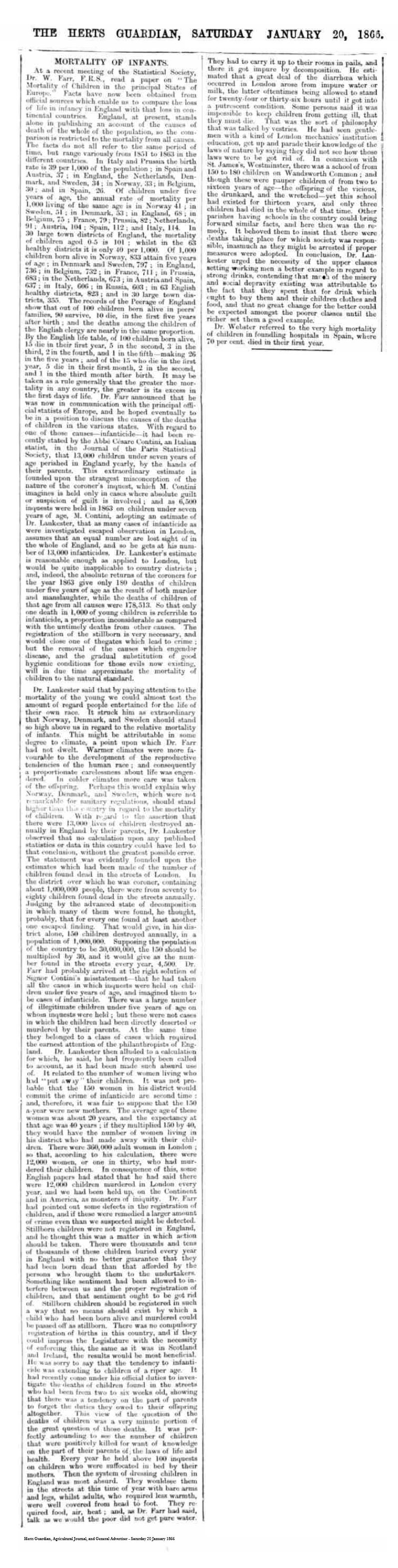
William Farr's detailed review of causes of child mortality in Britain compared with other countries. Singles out the very low death rates in St James's Industrial School, Wandsworth Common, in spite of the children's social origins ("the offspring of the vicious, the drunkard, and the wretched").
MORTALITY OF INFANTS.
At recent meeting of the Statistical Society, Dr. W. Farr, F.R.S., read a paper "The Mortality of Children in the principal States of Europe." Facts have now been obtained from official sources which enable to compare the loss life in infancy in England with that loss in continental countries. England, at present, stands alone in publishing an account of the causes of death of the whole of the population, the comparison is restricted to the mortality from all causes.
[ . . . ]
Some persons said it was impossible to keep children from getting ill, that they must die. that was the sort of philosophy that was talked vestries. had seen gentlemen with kind of London mechanics' institution education, get up and parade their knowledge of the laws of nature by saying they did not sec how those laws were to got rid of.
In connexion with St. James's, Westminster, there was a school of from 150 to 180 children on Wandsworth Common and though these were pauper children of from two to sixteen years of age -- the offspring of the vicious, the drunkard, and the wretched -- yet this school had existed for thirteen years, and only three children had died in the whole of that time.
Other Parishes having schools in the country could bring forward similar facts, and here then was the remedy. It behoved them to insist that there were deaths taking place for which society was responsible, inasmuch as they might be arrested if proper measures were adopted.
In conclusion, Dr. Lankester urged the necessity of the upper classes sitting wmking men a better example in regard to strong drinks, contending that much of the misery and Exist depravity existing was attributable to the fact that they spent that for drink which ought to buy them and their children clothes and food, and that no great change for the better could be expected amongst the poorer classes until the richer set them a good example.
Report of a large meeting of the great and good at the Mansion House in support of the preservation of London's commons and open spaces. The Lord Mayor presided. George Shaw Lefevre is prominent. Colonel Adair and John Buckmaster represent Wandsworth Common.
Notice the Board of Works urges that it should take over management of the commons, and that that parts of the commons should be sold off "for building purposes" to pay for the retention of what is left.
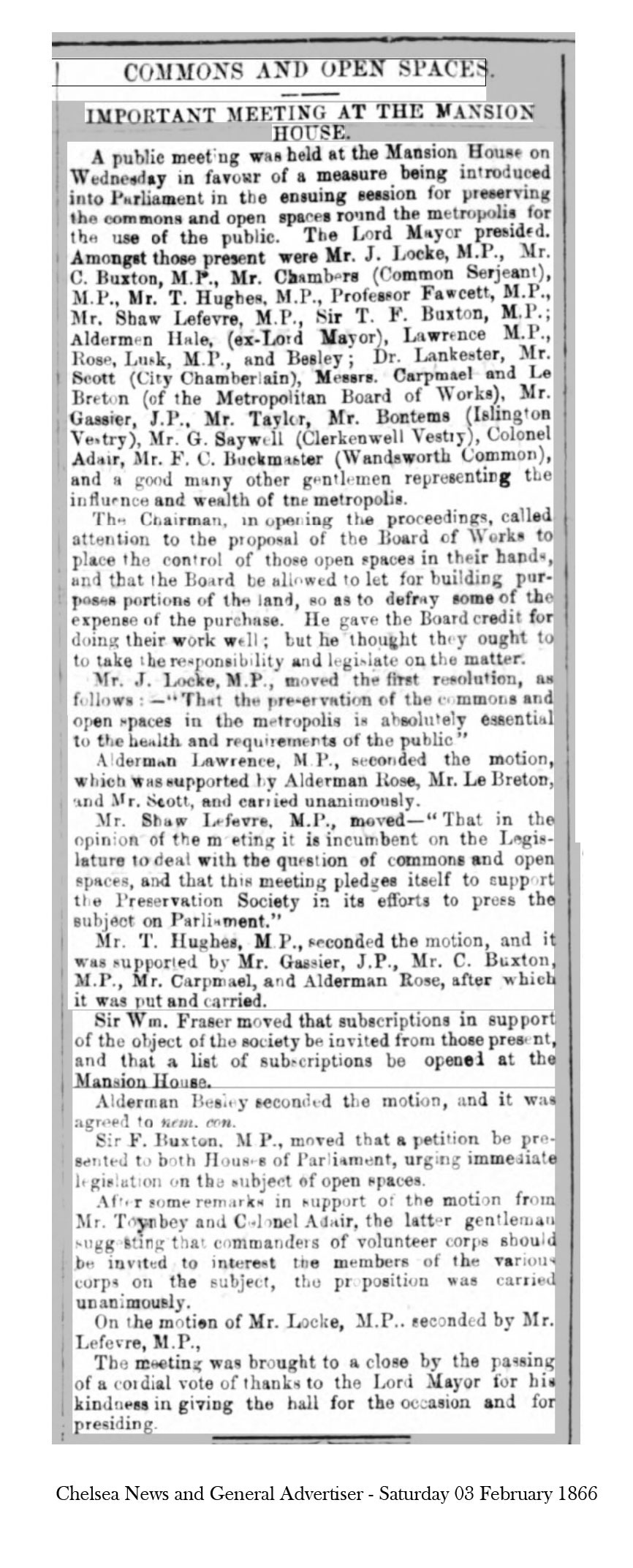
COMMONS AND OPEN SPACES
IMPORTANT MEETING AT THE MANSION HOUSE. A public meet was held at the Mansion House on Wednesday in favour of a measure being introduced into Parliament in the ensuing session for preserving the commons and open spaces round the metropolis for the use of the public. The Lord Mayor presided.
Amongst those present were Mr. J. Locke, M.P., Mr. C. Ruxton, M.P., Mr. Chambers (Common Serjeant), M.P., Mr. T. Hughes, M.P., Professor Fawcett, M.P., Mr. Shaw Lefevre, M.P., $Sir T. F. Buxton, M.1.; Alderman Hale, (ex-Lord Mavor), Lawrence Rose. Lusk, M.P., and Lesley; Dr. Lankester, Mr. Scott (City Chamberlain), Messrs. Carpraael and Le Bret$ n (of the Metropolitan Board of orks), Mr. Gassier, J.P., Mr. Taylcr, Mr. Bontems (Islington Vestry), Mr. G. Saywtll (Clerkenwell Vestiy), Colonel Adair, Mr. F. C.[sic] Buckmaster (Wandsworth Common), and good many other gentlemen representing the influence and wealth of tne metropolis.
The Chairman, in opening the proceedings, called attention to the proposal of the Board of Works to place the control of those open spaces in their hands, and that the Board he allowed let for building purposes portions th$ land, so as to defray some of the expense of the purchase. He gave the Board credit for doing their work w^ll; but he thought they ought to to take the responsibility and legislate the matter.
Mr. J. Locke, M.P., moved the first resolution, as follows; "That the preservation of the commons and open spaces in the metropolis is absolutely essential to the health and requirements of the public "
Alderman Lawrence M.P., seconded the motion, which wasHupported Alderman Rose, Mr. Le Breton, 'tnd Mr. Stott, and canied unanimously.
Mr. Shaw M.P., moved -- "That in the opinion of the meeting it is incumbent the Legislature deal with the question of commons and open spaces, and that this meeting pledges itself to aupport the Preservation Society in its efforts to press the subject on Parliament."
Mr. T. Hughes, M P., seconded the motion, and it was Hupponed by Mr. Gassier, J.P., Mr. C. Buxton, M.P., Mr. Carpmael, and Alderman Rose, after which it was put and carried.
Sir Win. Fraser moved that subscriptions in support of the object of the society invited from those pres' nt, and that list of subecriptions be opened at the Mansion House.
Alderman Bei.t y seconded the motion, and it was agreed to non. eon.
Sir F. Buxton, M P., moved that a petition be presented to both Huses of Parliament, urging immediate legislation on tha subject of open spaces. After some remarks in support ot the motion from Mr. Toyrbey and C-lmel AJair, the latt-r gentleman sting that commanders of volunteer corps should be invited interest the members of the various corps on the subject, position was carried unanimously.
On the motion of Mr. Locke, M.P. s seconded Mr. Lefevre, M.P.,
The meeting was brought to a close the passing of cordial vote of thanks to the Lord Mayor for his kindness in giving the hall for the occasion and for presiding.
[Source: Link.]
"Wandsworth Common [has] almost ceased to exist"
HOUSE OF COMMONS. The Speaker took the Chair at Four o'clock.
Hampstead, Highgate, and Charing-cross Railway.
On the motion for a second reading.
Mr. DOULTON moved that this bill read a second time this day six months, on the ground that it waa proposed give powers to purchase 29 acres of Hampstead, heath.
Mr. W. 8. POWELL said the House had manifested a spirit to prevent encroachments on the commons of the metropolis. He was glad that this was the case, but he had to call their attention to the fact that Wandsworth Common had almost ceased to exist, and that Tooting Common had also been invaded. The House should pause before allowing the second reading of this bill. It should protect the open spaces where the humble citizens enjoyed great rights, by the exercise of which their health was greatly promoted. A Member understood the object of the bill was provide means whereby people could get to a place where they could get fresh air, and he appealed to the House whether it ought not to be committed.
Mr. HUGHES thought the House ought not to grant such immense powers to the metropolitan railways which were springing up in this city (cheers).
The SPEAKER then took the opinion of the House, when the measure was thrown out.
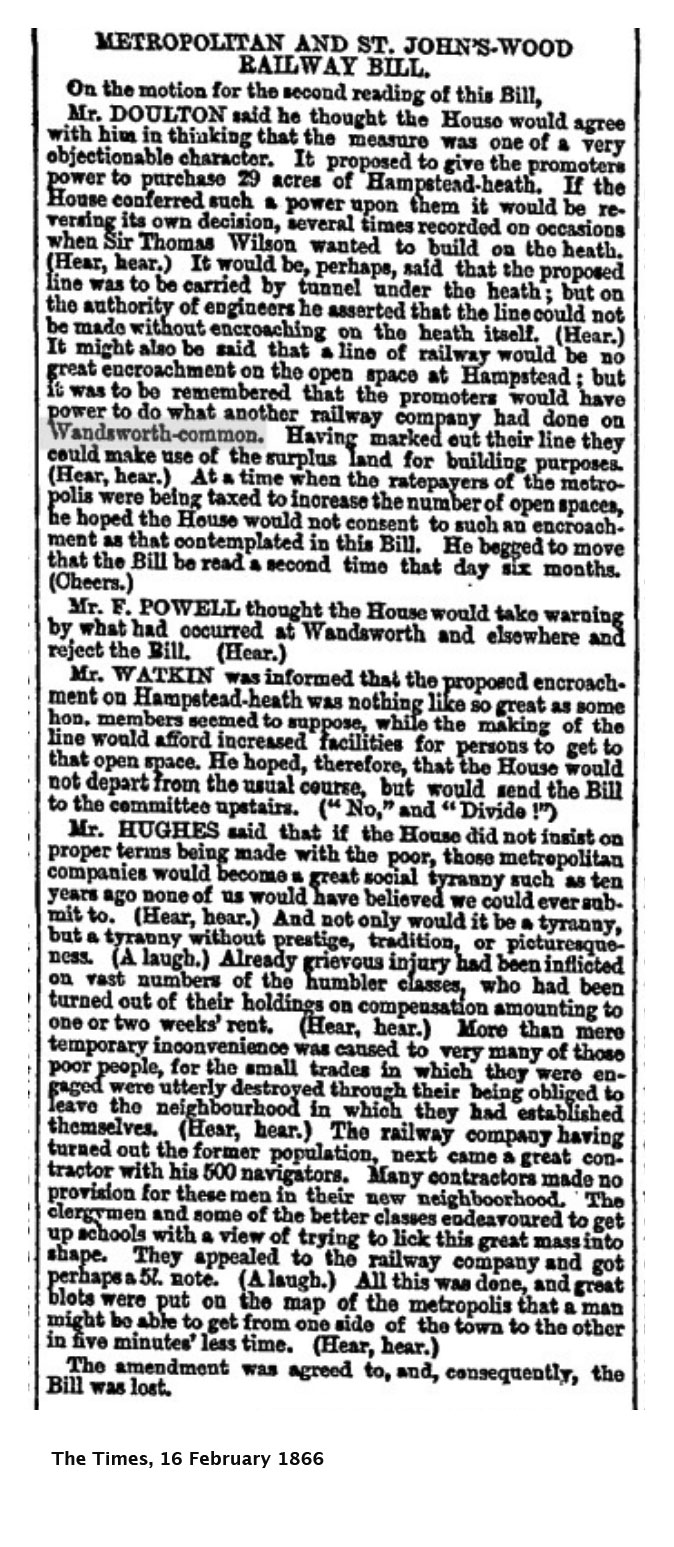
METROPOLITAN AND ST. JOHN'S-WOOD RAILWAY BILL
On the motion for the second reading of this Bill,
Mr. DOULTON said he thought the House would agree with him in thinking that the measure was one of a very objectionable character. It proposed to give the promoters power to purchase 29 acres of Hampstead-heath. If the House conferred such a power upon them it would be reversing its own decision, several times recorded on occasions when Sir Thomas Wilson wanted to build on the heath. (Hear, hear.) It would be, perhaps, said that the proposed line was to be carried by tunnel under the heath; but on the authority of engineers he asserted that the Une could not be made without encroaching on the heath itself. (Hear.)
It might also be said that a line of railway would be no great encroachment on the open space at Hampstead; but it was to be remembered that the promoters would have power to do what another railway company had done on Wandsworth-common. Having marked out their line they could make use of the surplus land for building purposes. (Hear, hear.)
At a time when the ratepa era of the metropolis wero being taxed to increase the numberof open spaces, he hoped the House would not consent to such an encroachment as that contemplate in this Bill. He begged to move that the Bill be read a second time that day six months. (Cheers.)
Mr. F. POWELL thought the House would take warning by what had occurred at Wandsworth and elsewhere and reject the Bill. (Hear.)
Mr. WATKIN was informed that the proposed encroach. ment on Hampetead-heath was nothing like so great as some hon. members seemed to suppose, while the making of the line would afford increased facilities for persons to get to that open space. He hoped, therefore, that the House would not depart from the usual course, but would send the Bill to the committee upstairs. ( "No," and "Divide!")
Mr. HUGHES said that if the House did not insist on proper terms being made with the poor, those metropolitan companies would become a great oial tyranny such as ten years ago none of us would have believed we could ever submit to. (Hear, hear.) And not only would it be a tyranny, but a tyranny without prestige, tradition or picturesqueness (A laugh.)
Already grievous injury had been inflicted on vast numbers of the humbler classes, who had been turned out of their holdings on compensation amounting to one or two weeks' rent. (Hear, hear.) More than mere temporary inconvenience was caused to very many of those poor people, for the small trades in which they were engaged were utterly destroyed through their being obliged to leave the neighbourhood in which they had established themselves. (Hear, hear.)
The railway company having turned out the former population, next came a great contractor with his 500 navigators. Many contractors made no provision for these men in their new neighbourhood. The cler u0026zmen and some of the better classes endeavoured to get up schools with a view of trying to lick this great mass into shape. They appealed to the railway company and got perhaps a £5 note. (A laugh.)
All this was done and great blots were put on the map of the metropolis that a man might be able to get from one side of the town to the other in five minutes' less time. (Hear, hear.)
The amendment was agreed to, and, consequently, the Bill was lost.
NORTH METROPOLITAN RALWAY BILL
Mr. H LEWIS, in moving the second reading of this Bill, said he believed it was quite free from the objections which had been just urged against the Metropolitan and St. John's Wood Railway Bill. The company did not intend to touch the surface of Hampstead-heath at all, nor would Hackney Downs be interfered with.
Mr. DOULTON said he had intended to oppose the Bill, but having found on perusing it that it would not affect the surface of the ground he would now withdraw his opposition.
The Bill was then read a second time.
[Source: Link.]
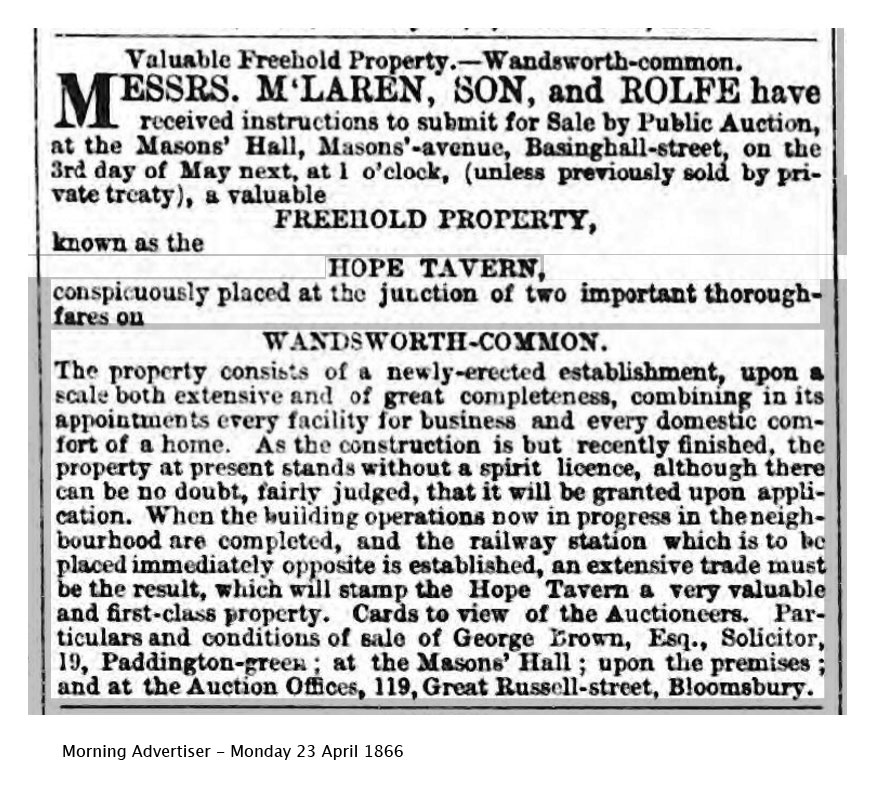
Valuable Freehold Property — Wandsworth-common
MESSRS McLaren, SON, and ROLFE have received instructions to submit for Sale by Public Auction, at the Mason's Hall, Masons-avenue, Basinghall-street, on the 3rd day of May next, at I o'clock (unless previously sold by private treaty) a valuable
FREEHOLD PROPERTY
known as the
HOPE TAVERN
conspicuously placed at the junction of two important thoroughfares on
WANDSWORTH-COMMON
The property consists of newly-erected establishment, upon scale both extensive and great completeness, combining in its appointments every facility for business and every domestic comfort of a home. As the construction but recently finished, the property at present stands without a spirit licence, although there can be no doubt, fairly judged, that it will granted upon application.
When the building operations now in progress in the neighbourhood are completed, and the railway station which is to be placed immediately opposite is established, an extensive trade must the result, which will stamp the Hope Tavern a very valuable and first-class property.
Cards to view of the Auctioneers. Particulars and conditions of sale of George Brown, Esq., Solicitor, 19, Paddington-green; at the Masons Hall; upon the premises; and at the Auction Offices, 119, Great Russell-street, Bloomsbury.
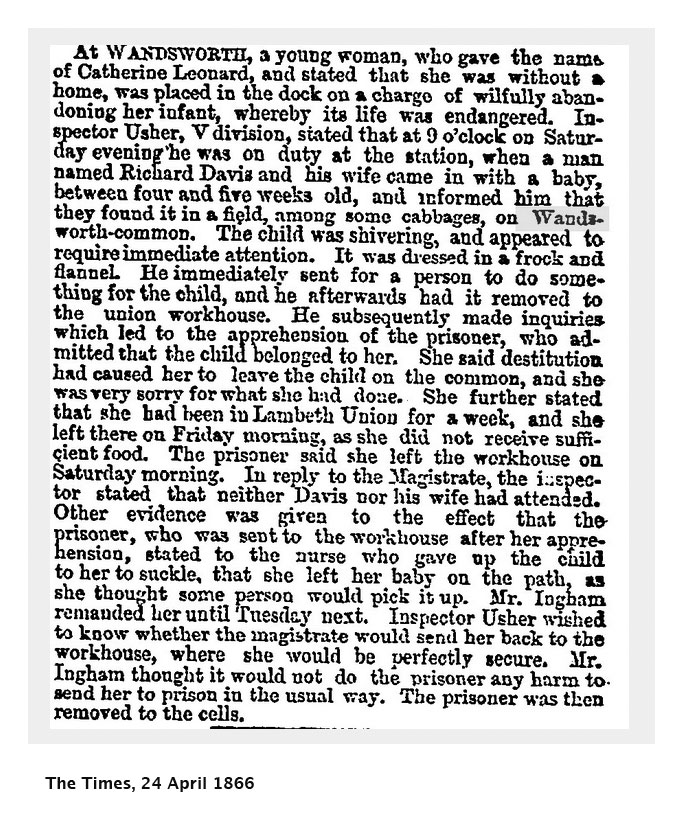
At WANDSWORTH, a young woman, who gave the name of Catherine Leonard, and stated that she was without a home, was placed in the dock on a charge of wilfully abandoning her infant, whereby its life was endangered.
Inspector Usher, V division, stated that at 9 o'clock on Saturday evening he was on duty at the station, when a man named Richard Davis and his wife came in with a baby, between four and five weeks old, and informed him that they found it in a field, among some cabbages, on Wandsworth-common. The child was shivering, aud appeared to require immediate attention. It was dressed in a frock and flannel. He immediately sent for a person to do something for the child, and he afterwards had it removed to the union workhouse.
He subsequently made inquiries which led to the apprehension of the prisoner, who admitted that the child belonged to her. She said destitution had caused her to leave the child on the common, and she was very sorry for what she had done. She further stated that she had been in Lambeth Union for a week, and she left there on Friday morning, as she did not receive sufficient food. The prisoner said she left the workhouse on Saturday morning. In reply to the Magistrate, the inspector stated that neither Davis nor his wife had attended.
Other evidence was given to the effect that the, prisoner, who was sent to the workhouse after her apprehension, stated to the nurse who gave up the child to her to suckle, that she left her baby on the path as she thought some person would pick it up.
Mr. Ingram remanded her until Tuesday next. Inspector Usher wished to know whether the magistrate would send her back to the workhouse, where she would be perfectly secure. Mr. Ingham thought it would not do the prisoner any harm to send her to prison in the usual way. The prisoner was then removed to the cells.
[Source: Link.]
INHUMAN CONDUCT OF A MOTHER. CHILD DROPPING.
WANDSWORTH. INHUMAN CONDUCT OF A MOTHER. CHILD DROPPING. A young woman, who gave the name of Catherine Leonard, and stated that she was without a home, was placed in the dock on a charge of wilfully abandoning her infant, whereby its life was endangered.
Inspector Usher, division, stated that at nine o'clock on Saturday evening was on duty at the station when man named Richard Davis and his wife came with a baby between four and five weeks old; and informed him that they found it in a field among some cabbages on Wandsworth-common. The child was shivering and appeared to require immediate attention. It was dressed in frock and flannel. He immediately sent for person to do something for the child, and afterwards had it removed to the union workhouse. He subsequently made inquiries which led to the apprehension of the prisoner, who admitted that the child belonged to her.
She stated that it was destitution that caused her to leave the child on the common, and she was very sorry for what she had done. She further stated that she had been in Lambeth Union for a week, and she left on Friday morning she did not receive sufficient food to support the baby.
The prisoner said she left the workhouse on Saturday morning.
In reply to the magistrate, the inspector stated that neither Davis nor his wife had attended.
Other evidence was given to the effect that the prisoner, who was sent to the workhouse after her apprehension, stated to the nurse, who gave up the child to her to suckle, that she left her baby on the path, she thought some person would pick it up.
Inspector Usher said he believed the prisoner had been an inmate of a lunatic asylum. Mr. Incham remanded her until Tuesday next to give full time for inquiry.
Inspector Usher wished to know whether the magistrate would send her back to the workhouse, where she would be perfectly secure. Mr. Ingham thought it would not do the prisoner any harm to send her to prison in the usual way.
The prisoner was then removed to the cells.
[BNA: Link ]
Also Express (London) — Tuesday 24 April 1866[BNA: Link.]
NB She is called Catherine "Lemaire" in the Pall Mall G`zette and elsewhere, 15 May 1866 1866_Catherine_Lemaire_Pall_Mall_Gazette_15may1866.png
[NOTE]
A Case of Exposing a Child on Wandsworth Common
[Refs to Burntwood House, Alma Terrace, County Arms, "Garratt Lane Lunatic Asylum" (presumably Springfield?), Wandsworth Workhouse (the old one or the new in Swaffield Rd?]
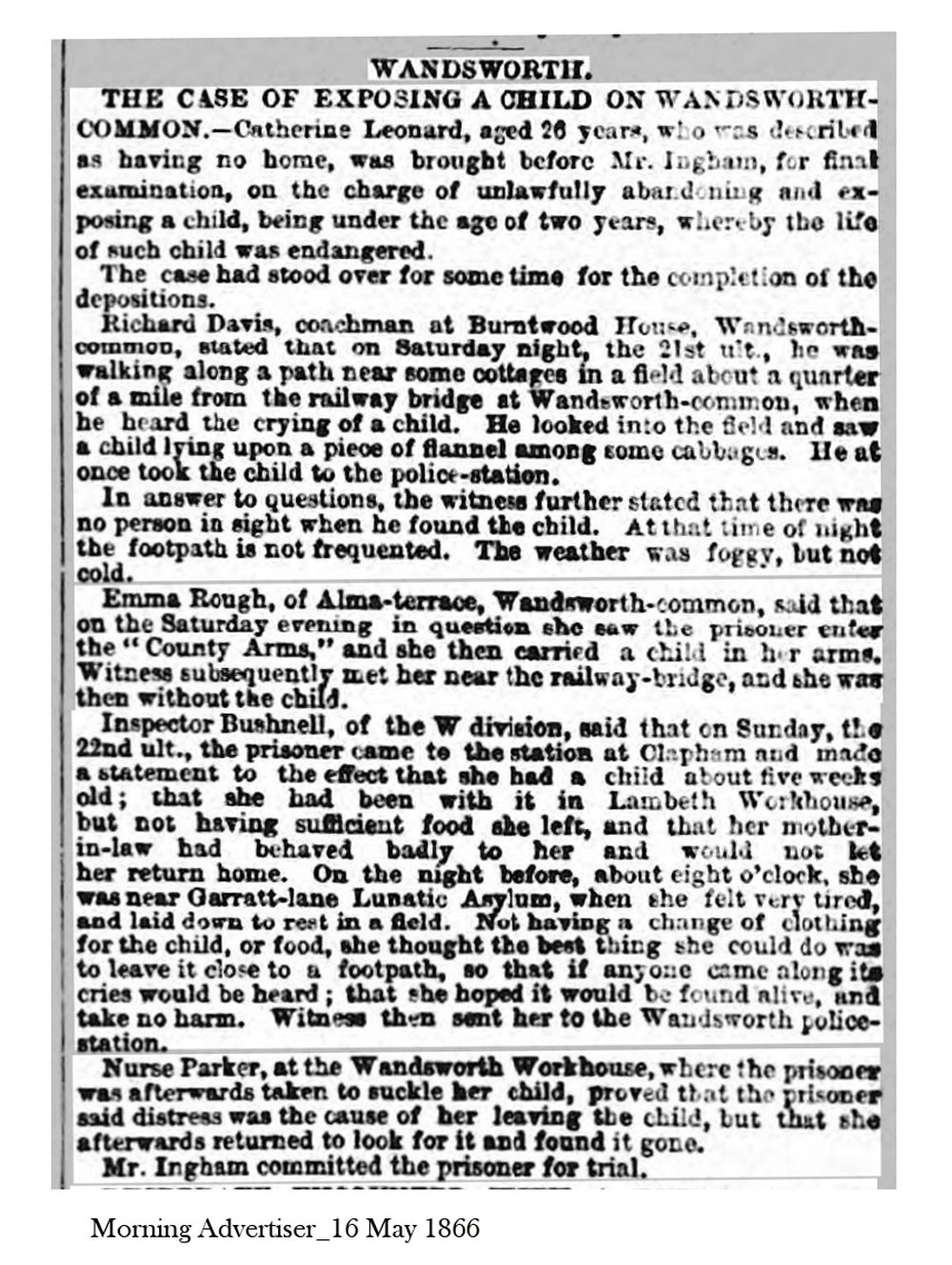
Note: In a number of accounts she is called "Catherine Lemaire".
THE CASE OF EXPOSING A CHILD ON WANDSWORTH COMMON.
WANDSWORTH. THE CASE OF EXPOSING A CHILD ON WANDSWORTH COMMON. Catherine Leonard, aged 26 years, who was described as having no home, was brought before Mr. Ingham, for final examination, the charge of unlawfully abandoning exposing a child, being under the age two years, whereby the life of such child was endangered. The case bad stood over for some time for the completion of the depositions. Richard Davis, coachman at Burntwood House, Wandsworth-common, stated that Saturday night, the n t., was walking along a path near some cottages in field about quarter of miie from the railway bridge Wandsworth-common, when he heard the crying of a child. He looked into the field and saw a child lying upon a piece of flannel among some cabbages. He at once took the child to the police-station. In answer questions, the witness further stated that there was no person in sight when he found the child. At that time of night the footpath is not frequented. The weather was foggy, but not Emma Raneb. of Ata -l ii e, WMiiimorth-'oaimoii. said that ,h. .. r . . ' , '> the cuter the County Arms," and she then a child hr arms. S — ' I ' ttlJg ' r ,hnel, of . M d that cn Sunday, t!. t came t the station at Olapham mid bt&temcnt to the effect that she had child about five week old; that she had been with Lambeth Workhouse, but not harm sufflaent food she left, and that her mother-in-law had behaved badly to her and would not her return home. the night before, about eight o clock, she was near Garratt-lane Lunatic Asylum, when the felt tired, and laid down to rest in a field. Not having change of clothing for the child, or food, she thought the best tiling the could do to leave it close to a footpath, so that if an; one came along it cnes would be heard that she hoped would found alive, and take harm. Witness then sent her to the Wandsworth Loliccstation. r Nurse Parker, at the Wandsworth Workhouse, where the prisoner was afterwards taken to suckle her child, proved tt the prisoner said distress was the cause of her leaving child, but that she afterwards returned to look for it and found it gone. Mr. Ingham committed the prisoner for trial.
[Source: Link.]
[NOTE: Is there a follow up to this story? A BNA search for "Catherine Lemaire" produced only brief accounts: Link.]
Trouble at the Vestry
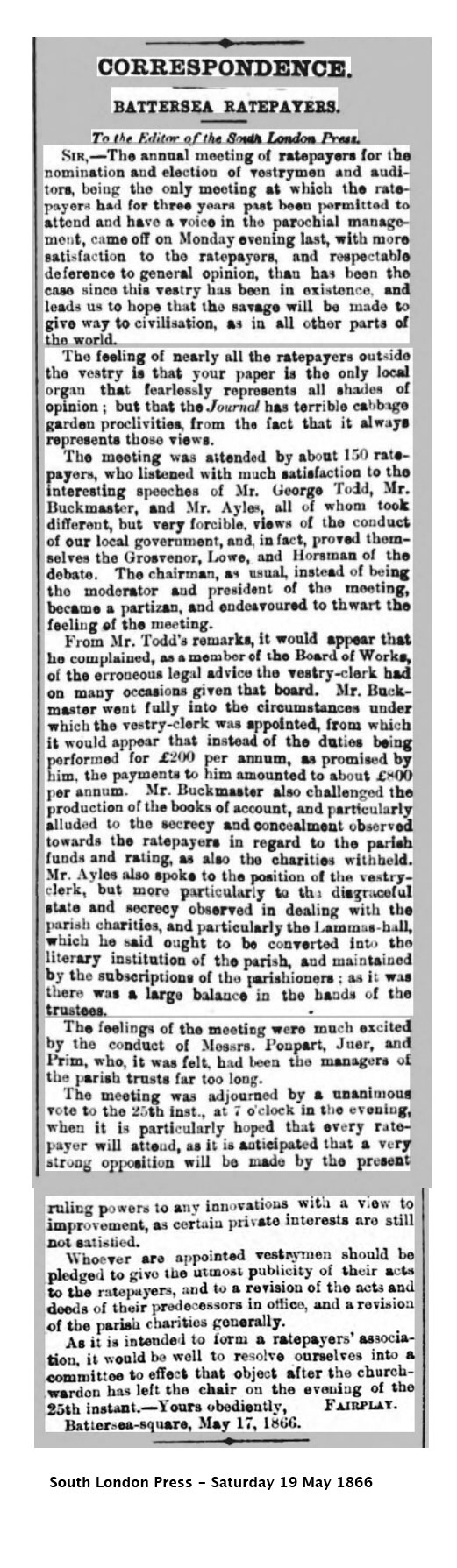
South London Press — Saturday 19 May 1866
CORRESPONDENCE. BATTERSEA RATEPAYERS.
To the Editor the South London Press
Sir, — The annual meeting of ratepayers for the nomination and election of vestrymen and auditors, being the only meeting at which the ratepayers had for three years past been permitted to attend and have voice in the parochial management, came off on Monday evening last, with more satisfaction to the ratepayers, and respectable deference to general opinion, than has bean the case since this vestry has been in existence, and leads us to hope that the savage will be made to give way to civilisation, as in all other parts of the world.
The feeling of nearly all the ratepayers outside the vestry is that your paper is the only local organ that fearlessly represents all shades of opinion; but that the Journal has terrible cabbage garden proclivities, from the fact that it always represents those views.
The meeting was attended about 150 ratepayers, who listened with much satisfaction to the interesting speeches of Mr. George Todd, Mr. Buckmastcr, and Mr. Ayles, all of whom took different, but very forcible, views of the conduct of our local government, and, in fact, proved themselves the Grosvenor, Lowe, and Horsman of the debate.
The chairman, usual, instead of being the moderator and president of the meeting, became partisan, and endeavoured to thwart the feeling the meeting. From Mr. Todd's remarks, it would appear that complained, as a member of the Board of Works, of the erroneous legal advice the vestry-clerk had on many occasions given that board.
Mr. Buckmaster went fully into the circumstances under which the vestry-clerk was appointed, from which it would appear that instead of the duties being performed for per annum, as promised by him. the payments to him amounted to about?? per annum.
Mr. Buckmaster also challenged the production of the books of account, and particularly alluded to the secrecy and concealment observed towards the ratepayers in regard to the parish funds and rating, as also the charities withheld.
Mr. Ayles also spoke to the position of the vestryclerk, but more particularly to th; disgraceful state and secrecy observed dealing with the parish charities, and particularly the Lammas-hall, which said ought to be converted into the literary institution of the parish, and maintained by the subscriptions of the parishioners; as it was there was a large balance the bands the trustees.
The feelings of the meeting were much excited by the conduct of Mos.srs. Poupart, Juer, and Prim, who, it was felt, had been the managers of the parish trusts far too long.
The meeting was adjourned a unanimous vote to the 2',th inst., at o'clock in the evening, when it is particularly hoped that every ratepayer will attend, as it is anticipated that very strong opposition will made by the present ruling powers to any innovations with a view to improvement, certain private interests are still not satisfied. Whoever are appointed vestrymen should be pledged to give the utmost publicity of their acts to the ratepayers, and revision of the acts and deeds of their predecessors in office, and revision of the parish charities generally.
As it is intended to form a ratepayers' association, it would well to resolve ourselves into a committee to effect that object after the churchwarden has left the chair on the evening of the instant.
Yours obediently, FAIRPLAY, Battersea-square, May 17, 1866.
Trouble at the Battersea vestry — JCB makes public the acrimonious correspondence between himself and Arthur Alexander Corsellis, the Clerk to the Vestry

THE RATEPAYERS OF BATTERSEA ARE TREATED UNDER THE VESTRIES ACT.
[JCB — To the Editor of the South London Press
Sir, As public attention is now directed to the better local government ot the metropolis, I shall feel obliged by your inserting the following correspondence.
I am, sir, yours, J. C. Buckmaster, St. John's-hill, March 23, 1866.
JCB to Mr. A. A. Corsellis, vestry-clerk of Battersea.
Sir, I have called at the Vestry-hall three times during the past fortnight, between the hours of 2 and 4. and found no one in attendance. I understood that after your appointment some person would always in attendance between 2 and 4, to afford the ratepayers any information they might require, in this, many other points, I have been disappointed.
I shall feel obliged by your either giving me, or affording me, opportunity of obtaining the following information — viz., the total rateable value of the property the parish; the total assessed value; the number assessments of £100 and upwards; the number of assessments from £50 to £100; the number from £25 to £50; the total value of the property in compound; the assessed value the property compound; also, the amount of arrears carried forward from the last local and poor rates to those now course of collection.
I shall also feel much obliged if you will inform whether you consider by the terms of your appointment vestryclerk of this parish, that you are bound to conduct alt proceedings law instituted behalf of the parochial officers for costs out of pocket only?
I am, sir, yours obediently, J. C. Buckmaster
[AAC to] J. C. Buckmaster Esq. Vestry-hall King-street, Battersea, S. W., March 28th. 1866.
Sir, I have to acknowledge the receipt of your letter of the 23rd inst. in which you stated that you had called here three times during the past fortnight and found one here, I am informed that this statement is not correct, inasmuch as the first three calls was made more than fortnight previously, and the third was not made until you brought the letter with von on the day following its date. must confess that I not surprised at your making such reckless* assertions, .alter the false which you deliberately made against in a letter to the Poor-law Board some time ago.
It is no part of my duties as set fortlh in my appointment have some one in attendance here any particular time of the day; to conduct all leiral proceedings the ]m the parish officers for costs out of pocket only.
The rate-books are daily use by the collectors, or myself, or my assistants, but the information tvhioh you ask for you can extract from them here Tuesday next at ten o'clock, immediately after the vestry meeting to held that morning.
Yours obediently, A. A. Corsellis
[* I made no assertion or accusations to the Poor-law Board but tbon ready to substantiate. — JCB.]
[JCB] To Mr. A. A. Corsellis, Vestry-clerk.
Sir, I beg to acknowledge receipt of your letter of the 28th inst. I fear it will impossible for to attend the vestry meeting Tuesday next. I shall therefore feel obliged if you would name some other day, when either you or your clerk will be in attendance, to give the information I solicited in my last letter.
I do not think it desirable, nor is it convenient for to go to the private residences the three collectors of rates to obtain information which I think ought to obtained at the place appointed by the parish for the transaction of parish business.
Until the receipt of your letter, I had quite misunderstood the n,.tur. of vour duties the vestry-clerk of the parish. I was certainlv under the impression that you were appointed, some person was to be in uttendaucf between and daily, except Saturday, to afford the ratepayers any information they required and the opportunitv inspectin'; the rate-books: and liras erreatlv strengthened in this impression the fact these hours of attendance were and are written on the door-post of the Vestry-hall with your consent and the authority of the vestry — .
The sooner the ratepayers are relieved this erroneous impression the better, and I regret that should have so misunderstood your duties and that I should have made the reckless statement which I again repeat that for the past two weeks one has been in attendance the Vestryhall between two and four o'clock.
I am also equally mistaken in the impression that one of the conditions of your appointment was that you were to conduct all proceedings at law instituted behalf of the parochial officer, for costs out of pocket ouly. I may also be mistaken as your salary, which I have always understood to year, and that the parish was to pay £6O a year for offices to conduct the parish business, where neither you nor any of your assistants need attend unless you think proper. This is the only interpretation I can put on your letter.
I understand that since your appointment more than £100 per annum has been paid to you for law costs. If I have been misinformed on this point I shall feel obliged by your correction. Your appointment, duties, and remuneration appear so indefinite and unsatisfactory, that the sooner they undergo revision, both for your own sake and that of the ratepayers, the better. I am not opposed to you personally, nor I actuated any hostile or party feeling, but I think the ratepayers have right to some equivalent for the constantly-increasing expenses of parochial administration, and I shall avail myself of early opportunity for taking the opinion of the parish the subject,
Yours obediently, J. C. Buckmaster, St. John's-hill, March 31, 1866.
[AAC to] J. C. Buckmaster, Esq., Vestry-hulL King-street, Battersea, S.W., April 3, 1866.
I am sorry you could not attend here this morning. The informatiou you require from the local rate books you extract front them hero either Tuesday or Wednesday morning next, at 10 o'clock. The poor rate books are in the hands of Mr. Hillier, the collector, to whom you must if you want to refer to them.
Yours obediently, Arthurr Alexander Corsellists, Vestry-clerk.
[JCB to] Mr. A. A. Corsellis, Vestry-dork.
Sir, I beg to acknowledge the receipt of your letter of the inst. I will cull ut the Vestry-hall either on Tuesday or $Wednesday next, 10 o$clock, and I shall feel obliged if you would instruct the collector of the poor rate to leave the rate book now in collection at the Vestry-ball for examination. There appears sufficient reason why this should not lie done, or why the poor-rate book should be treated as an exception to the local rate books.
I have seen the senior collector of the local rates, and informs that there is reason why all the rate books should not be permanently left at the Vestry-hall. never requires the rate book except to enter in the columns from his collecting book, which could do, and Inis no objection to do, at the Vestry-hall. I cannot understand why the poor rate collector could not do the same, if you or the parochial officers were to insist upon it. I think all the rate-books in collection ought to your custody, in the event of any of them being lost or destroyed. I do not think it would sufficient justification for you to say that you were not responsible for their safety. I called few days since at the Vestry-hall to see the local rate-books. I was informed that they were at the collector's. On calling at the collector's, I was informed was out, and it was uncertain when he would return.
I regard these books public property, to which the ratepayers, at all reasonable times, should have ready access. To what purpose has the parish spent in making suitable offices for the transaction of parochial business, with fire-proof safe, and a yoar rent, with all the necessary furniture and accommodation, if the rate-books are not to be kept at the offices of the vestry-clerk, but at the private houses of three rate collectors? I shall feel obliged if you will inlorm whether, since your appointmentas vestryclerk, you have forwarded any return to the Charity Commissioners of the and expenditure of the parochial charities.
When I call at the Vestry-hall, perhaps you will instruct your clerk to allow me to see the book books in which the accounts are kept. It is, perhaps, no part of your duty to keep these accounts, but I shall feel obliged by what information you can give on this subject.
I am, sir, yours truly, J.C. Buckmaster, St. John's-hill, April 5, 1866.
[AAC to] J.C.Buckmaster, Esq. Vuatry-kall, King-street,Battersea, S.W., April 7, 1866.
Sir, Your letter of the 5th inst., has been duly received. I have already told you when and where the rate books can seen, and I decline to alter the arrangement. I am not accountable to you for my official conduct, and to put a stop to your impertinent letters I beg to inform you that any further communications from you will be returned unopened.
Yours obediently, Arthur Alexander Corsellis.
[JCB to] Mr. A. A. Corsellis. Vestry-clerk.
Sir, I have received your letter of to-day's date, and I regret very much that I should have written any thing which you regard as impertinent. After much experience in this parish, I am reluctantly driven to the conclusion that local government is a mistake, and the sooner it is superseded the better. I have now no alternative but to publish this correspondence, and forward copies to the Poor-law Board.
I must leave others to judge how far you have answered my inquiries, and whether your letters are such a paid public servant of the parish ought to write to gentleman and a ratepayer.
l am, sir, yours truly, J.C. Buckmaster St. John's-hill April 7, 1866.
Returned unopened.
[Source: Link.]
[I can't find this in the 1866 site folder or an any drive: "/years/1866/1866_London_Evening_Standard_25may1866.png" — redo.]

COMMONS (METROPOLIS) BILL.
Mr. COWPER, in moving the second reading of this bill, said it aimed at meeting a wish expressed by the public with the view of preventing the destruction of places of natural beauty in the neighbourhood of the metropolis which wenbeing encroached upon by buildings and railways. The subject was one of difficulty, owing to the gi tion in the state of agriculture since the waste lands were set apart for the change in the mode of feeding cattle had rendered the tiko of thoso commons obsolete for the purposes for wliich they had been set a^art, while the growth of the?? and the facilities^ given by railways had created a new use for them. The principal features of the bill would be to take away metropolitan oommons from under the provisions of the Enclosure Acts; and in the next instance to give powers for the establishment of local boards the protection of commons. By the metropolitan commons he meant those pieces of land which were within the metropolitan district, or a radius of 15 miles, being the district within which the coal duties were levied.
The Enclosure Acts were passed for the promotion of agriculture, and were intended for good, not to increase the privileges of the lords of the manor. But the commons in the neighbourhood of London were not enclosed for agricultural purposes, but with the intention of building houses upon them, and if the Enclosure Acts were applied to them that which was intended to he a public good would become a public evil.
The promoters of the Enclosure Acts were alive to this, and by a $ laid down that where it was sought to enclose land within fifteen miles of the metropolis, or two miles of other large towns, this was not to be done without the special authority of parliament. The present bill would not deprive the owner of waste lands of any rights which he already _cd. It would simply withdraw from him the benefits which he might derive under the Enclosure Acts. But, notwithstanding this fact, if the lord of the manor and the commoners agreed to enclose there would be nothing to prevent them. I Heath and Peckham Rye, whieb v.erc I of public rc_ort, ought te be made the subject of compulsory the Board of Works, and thus secured for the il of the public for ever. Tbe Board of Works already port ers to lay out public parks in the?? south-east of London, and he hoped yet to the rights of Sir Thomas Wilson cover ! The commons that were chiefly to be beyond the jurisdiction of the metropolis, and which neither the lords of the manor nor the common ere desired to enclose.
He took the case of Wandsworth Common, in which the water was so deep that men had soiiietiniebeen drowned. It was, therefore, proposed to deal with such commons under the bill. In some of the commons arrangements were made between the lord of the manor and the inhabitants for the raising of a sum of money to keep thee commons in order, for instance, at Peckham Rye and Clapham. But there was a want of power to enforce the regulations that might he made by this self-constituted body.
The object of this bill was to establish a local management for n.ons, and to enable these local managers to -laws. It was deemed necessary to establish a new body of commissioners to be constituted so aa to 6ecure full responsibility without the necessity of inclining any large expenditure. This board would consist of five commisioners. Three of them would be official persons and two would be selected from their knowledge of the im" locality, and because they had leisure to act in The. official commissioners would be the First aer of Public Works, who would be in parliament; the enclosure commissioners, who would be responsible to the Secretary of State forthe Home Department; and the chairman of the Metropolitan Board of Works. There would thus be established the principle of local management with a central organisation. The right hon. gentleman concluded by moving I 1 edutg of the bill.
Mr. Ax Id_*$ moved Uie adjournment of the debate. Mr. COW i ed his surprise at such an amendment coining from tne hon. member for the Tower IL who complained the other night of a motion of a similar kind being moved at a _iuch later hour than that at which they had now arrived (five minutes to twelve o'clock)." He (M r. Cowper) hoped that the hon. gentleman would withdraw $id allow the bill to procc Sir W. JOLLIFFE also urged the hon. gentleman to allow the bill to pi",
Mir. AYRTON would consent to withdraw his motion for adjournment upon the understanding tliat the right hou. gentleman would press his measure forward that night. the motion for the adjournment of the debate was then witlidrawn.
Mr. AYRTON was glad to receive an assurance from the government lhat they intended to pore evere with the measure that night. All agreed in tiie purposes which were desired by the bill, and what they had now to discuss was whether it contained ample methods for carrying out the purposes for which it was introduced. There could be nothing more desirable than the preservation of open spaces around the metropolis and large towns for the recreation of the people, especially in the metropolis, where . the people had to travel over so many miles of streets before they could get a sight of a green shrub whioh was unoontaminated with the smoke of the metropolis, but still they must take care that they did not adopt a course that was at variance with the principles of legislation, and hesitate before they consented to 6ct up that which had been sa generally condemned for many years pas t,a dilletante irresponsible commission to do work which required the careful attention of some responsible person, whether he be an officer of the Crown or a local authority, either of which seemed to guarantee an efficient and satisfactory administration. It was most objectionable to form such a commission as that proposed by the bill, composed of persons belonging to different departments, neither of whom could be held to be responsible, and superadd to them persons subject to the will of the government .and without salaries, who could not be held responsible, because they were mere volunteers for the public benefit, and not amenable to any one for the course they might adopt Experience showed them that such bodies had signally failed to accomplish the objects for which they had been appointed, and the question he wished to raise was whether it was expedient to establish such a body as that proposed by thia bill or some more recognised responsible authority. The right hon. gentleman the Hrst Commissioner of Works had hardly given a satisfactory idea of the character of the bill, because, so far from its lieing likely to prove beneficial, it would be more likely to frustrate what was desired. Practically, very little could be done by the commission. When it was established it did not appear by whom the preliminary expenses were to be defrayed, except by the memorialists, and if that be so he doubted if they yyould interfere in the matter. The commissioners vrere to investigate and prepare a scheme, which yvas to have no effect except it was sanctioned by parliament, and there was a prevision that nothing was to be done that would affect the present rights of the lords of manors aud the commoners, so that persons so affected would be able to take advantage of that provision, and if they could show that the proposed scheme affected their rights it would be the duty of the house to reject the scheme.
Another objectionable part of the bill w providing that in case of commons within 15 miles of tne metropolis half the expenses of the whole of the proceedings of the commissioners might, by an order of the Treasury, be paid by the Metropolitan Board of Works, and charged on the ratepayers of the metropolis. That was a most extraordinary proposition, and he was at a loss to conceive on what principle it was based. And the remainder of the expense was to be paid out of the Consolidated Fund. It was by such bad precedents that on civil charges had grown up to their present high amount. The more the bill was examined the less likely would it he found to accomplish the object they had in view. They had at present an efficient body in the Enclosure Commission, to whom the working of the bill might be safely entrusted. That body, had an efficient staff and cost the country about 20,1007. per annum; and he believed that bedy was the ho$t and most efficient "body that could' lie found to discharge any duties parliament might think fit to impose on them in reforence to this hill. It would be difficult to find a tody more admirably adapted for the work in hand than the existing Enclosure Commissioners. Throughout the enclosure acts there were elayscf wliich constituted a complete cede for .citing apart recreation grounds for town populations. Hut these acts had failed te elfect this purpose, and this was, perhaps, because there was no power to citend the area of such land to any considerable extent, and because there was no power in local todies te raise money for the purpose of providing such grounds. Thee provisions had teen introduced from a jcaloii$y of allowing such bodies to acquire land, hut th o_e prejudices were not much attended te at the present day. It might be said that in the caso of the metropolis a portion of the commons would not be sufficient, as the whole extent of the commons was required; but provisions could easily be introduced for vc -ting anon commons in the Metropolitan Board of Works, upon . proper jiaynieiit being made to lords of the manor and the commoners who had interests in the commons. The whole . whether it was di .-t up a n.w board of coinmis.-kmers, or whether the K. niinis.ioners do the work necessary to ye.-ting the land in the Board of Works. They hid already determine, te vo.it what remained of Epping F -rest in the Chief Commisfionerof Works, and tiiis was directly in contest with the principle of tile present bill. lie thought it would produce a most lamentable result if, instead of encouraging the Metropolitan Board to proceed in the providing of open spaces, the liouse should pass a law which was offensive te them. he rocommcuded the right hon. gentleman to consent to refer the bill to a committee up _tairs, where it could be properly examined aud rendered?? objectionable than it was in its present shape.
The hon. member concluded by moving the following resolution as an amendment te the motion for the second rending of the bill, " That it is inexpedient to transfer the duty with which the Metropolitan Board is by law invested to an irresponsible board, navihg power to incur expenditure am n the ratepayers of the metropolis; but it is desirable te amend the enclosure acts, so as to enabi. politan Board and local authorities in towns, with the aid of the Knclnsure OomTnissionow, to acquire by purchase or gift, rights in commons, in order that the same may be kept open for the recreation of Uie inhabitants of the mefr -polis and such towns." Kir W. J(?? did not wish to oppose the bill, but expressed his surprise that the right hon. gentleman had not offered a single, reason fur the parsing of su"h a measure. cd of the manner in which the government had . y with regard to Epping Forest, Woolwich, and H__kheaUi (hear, hear).
The Enclosure Conniiissiuiier. had set out recreation grounds in various pa mntry, and he did not see why they should not do the . lmo thing for places in the immediate neighbourhood of the metroi>v_. there was no rea -m why they should not tint there should be a survey made of all; . and that they should not be interfered v. il of parliament If such a measure were brought ju;i.. an amendment to the Enclosure Act, the whole thing would he settled, and he believed that course would meet with the approval of the lords of the manor_ Mr. LOCKE said the committee which had sat upon this subject had come to two resolutions: That the Statute of Merton should -be repealed, and thatthe commons should he pr.seried in their present state. In their ri'i.rt thoy suggested the different boards and bodies the* might be entrusted to carry out the various provisir r there tbey suggested the enclosure commissi n j-olitnn I'ca.l of Works, as well as card to be ted for the purpose, and which they tho.ugl ly ol all to take charge of ' Me was ,cch in favour of referring the nuttt comIf the house thought that umit'sioncrs were the right body to whom the Btbjcct shotl entrusted the chairman of committees should have the power of handing it over to the charge of those commissioners.
There was a provision in the bill that no enclosure should be allowed te take place unless a special bill should be brought inte parliament, and another provision that no enclosure should take place in the metropolis. The main scope o-f the bill wan that lords of the manor and copyholders should enjoy their t right., and that the public also should retain their (listing rights and privileges and be free to walk over the commons in the metropolis. It would be uufortiiaal there . honldbe any difference of opinion amongst honourable members because they all had ihe same object in view for the?? of the public. Then; v. ould be enly one point necessary, as an hi: tractions to the committed, nnd that was as to what existing body should form the lioard taking charge of the subject, or whether a new board should Ik: created for the purpose, for it would be a great misfortune if no legislation were to take place upon the subject this session.
Mr. C. Hl* -..TON deprecated any division ujioii a qu$ with regard to which they were all entirely agreed.
Mr. COWPER, observing the feeling of the house, was quite ready to agree to the proposal to refer the subject to a committee, and he thought it should be an instruction to the committee that they should have power if they thought i.-able, to extend the operation of the bill beyond the metropolis. He would therefore move a resolution to that effect a
Mr. SAND ' leg's* ation of this kind was nothing less than the con: rivate property. The commons were the property of the lords of the manor, subject to the rights of the commoners, whatever I ight be. and he denied that the Statute of Merton did $ nons i:_ the neighbourhood of London. National policy should guide these enclosures all over the country (hear, hear).
Mr. Alderman LAWRENCE thought the public were more anxious for non-enclosing than enclosing commissioners. The people of the metropolis justly desired the preservation of their recreation ground.
Mr. AYRTON then withdrew his amendment, and the bill was read a second time.
The bill, on the motion of Mr. COWPER, was referred to a select committee, with instructions that the committee should consider the propriety of extending the measure of the limits of the metropolis.
trotters (Nelly and Tommy) to trot one mile in harness for 25/. aside, was decided Wandsworth Common, and the mare Nelly won yards, and covered the one mile of road in 3 minutes and 33 seconds. Great Northern Hospital, Caledonian oao. Tbc number patients . . .
Published: Monday 4 June 1866
Newspaper: London Evening Standard
1866_London_Evening_Standard_04jun1866.png
Also Cork Constitution — Wednesday 6 June 1866
1866_Cork_Constitution_06jun1866.png
TROTTING MATCH FOR £50. On Monday, the match to trot one mile between Nelly and Tommy (two wellknown trotters), came off Wandsworth Common, and the mare Nelly won twenty yards, and covered the distance in 3 minutes and 33 seconds. In betting, Nelly was the favourite, and a large sum of money changed hands in addition to the stakes. £25 a side.
[BNA: Link.]
[A reminder that people travelled on horseback or horse-drawn carriages.]
NOTICE TO TRAVELLERS BY ROAD. G. FERRIS, (tote of the Falcon Tavern, Wandaworth Road), WINE SPIRIT MERCHANT, Surrey Tavern, TRINITY ROAD, TOOTING, On the borders of Wandsworth Common. CHOICE SPIRITS * MALT LIQUORS. Stabling Accommodation.
1866_South_London_Press_09jun1866.png
South London Press — Saturday 23 June 1866
Sale of building materials at the Surrey Tavern
SALES BY AUCTION. WANDSWORTH COMMON. TO BUILDERS & OTHERS. Excellent Timber. Stone Fittings, and other Building Materials. F. HALL will SELL by AUCTION, Thursday. June *JMh, at one o'clock, on the premises, near Mr. Ferrerrs s. the Surrey Tavern, Trinity-road. leading from Tooting and Garratt lane, Wandsworth, large quantity of capital and old MATERIALS, comprts loads of sound timber, long joists, rafters, quartering, tresis and plates, clean flooring hoards, I jtu warehouse boards, capital oak p.ists. motleru tfittings. sashes ami frames, doors, several new cut and uncut (leal- -, p l and battem. chimney pieces and closets, long girders andbrestsammers,, iSH'ft cleat, quartering, capital duebe-s and eouute-s a'ates. excellent Portland steps and land ngs, stone paving, Ilrewood, fencing posts, railing and pales, and other useful materials and eileois May h� viewed, and catalogues had Die premises; the Surrey Tavern: the principal Inns Merton. Mitcham, Wimbledon. Tooting, and Streathuni or ttf the Auctioneer, ( heater-street, Keunlugion, an>l I, I burlow-terrace, Wandsworth-road.
[BNA: Link ]
BATTERsEA VESTRY
The above Vestry was held at the Lammas Hall Tuesday evening, Mr. Walton in chair. Present:%Messrs. Alder. Poupart, Purdy, Spooner, Denny, Clark, Smith, Finch, Gerrard, &c.
The principal event of this meeting was to consider the resolution of the Ratepayers, at a meeting recently held, touching the appointment and duties of the Vestry clerk.
The Clerk having read the announcement of the meeting.
Mr. Turner introduced the subject and referred to Mr. Buckmaster in connection with it, saying he had devoted much time in the interest of the parish, and hoped the business they would have to consider would be conducted in a straightforwardmanner. If they were wrong in the appointment of their officer it was too late to alter it now, but if there were certain duties neglected in that office it was a matter the Vestry should take cognizance of. There were questions concerning an overcharge of accounts, but this he thought was impossible the Vestry could through then, but it was compatible for them to see that their Clerk performed his duties. He then intimated that Mr. Buckmaster shouldaddress the Vestry.
he Chairman said it was quite clear that none but Vestrymen could speak on this occasion, but a Reporter being present made the matter public, and any parishioner was free to speak. On the subject however before them, they could appoint Committee from the Vestry and elect to call evidence.
The Clerk read the Resolution at the meeting of Ratepayers, and said that the Poor Law Board had written to him to communicate to them what he chose on the subject. But this he considered a private correspondence.
Mr. Buckmaster did not think the communication should private.
The Chairman thought if they appointed a committee the letters leceived on the subject would be read and report be afterwards delive ed to the Vestry.
Mr. Buckmaster remarked that the Poor Law Board said the Committee was not necessarily to be appointed Vestrymen but could also be selected from the Ratepayers. Mr. Turner said he did not scruple at the manner of forming the Committee and therefore named Mr. Buckmaster, Mr. Spooner, Mr. Ayles, to servo upon it.
The Chairman observed that he had laid to Mr. Corsellis, Why not and answer any one at the Committee, and he could then rebut any charge that was made.% fie approved of a Committee, and had every desire that all should be done fairly aod compatible with their position. He had spoken to Mr. Ayles and others on the matter.
Mr Smith said if the Vestry were not composed entirely of Vestrymen he should wish to propose Mr. Symonds to act upon it.
The Chairman said he must rule that the Committee be formed strictly of Vestrymen and several names were mentioned.
Mr. Smith then remarked that he objected to a packed body. The names proposed were all o d members, and he could not understand why new blood could not be introduced into it.
After a discussion, as to the propriety of the Chairman's ruling, the following names were agreed upon as terming the Committee: Messrs. Turner, G. Todd, Walton, Gerrard, Young, Smith, Witt, Purdy, and C. W. Todd.
Mr.Smith then proposed that the Committee should have access to all books and papers of the Vestry.
The Chairman said the Committee had full power to examine everything, and then consider the resolution of the Ratepayers and report thereon to the Vestry.
Mr. Buckmaster objected to the notice convening th- meeting of Ratepayers, saying it should have been signed the Churchwardens He referred to Mr. Stewart%s meeting called by the Churchwardens, and said unless the change was made as he desired he would not attend the meeting and give evidence, but continue his correspondence with the Poor Law Board.
A Vestryman asked the Clerk if the meeting alluded to was legal.
The Clerk replied that he only took the minuter of the Vestry meetings but that alluded to was not one.
After some interrogatories by Mr.Buckmaster to the Clerk to former precedents, wherein the latter took minutes, the alteration in the notice as desired by Mr. Buckmaster was agreed to.
Mr. Buckmaster said he did not think he should attend the Committee, notwithstanding what had been done, he thought the whole affair would be useless by reason of the minutes of the meeting not being fully recorded by the Clerk.
Mx. Watson said this waa_ thg first time he had addressed that Vestry, an knew tiltl# of the matter before them, he thought the Committee should meet t after fully cunsiderina: the subject should give full report to the Vestry Air. Buckmaster's charge was one of a grave character. It was, however, ex parti statement, they all knew the effect of getting up a meeting and making flaming statements. He thought the subject should be fully investigated, an I knew nothing of Mr Corsellis, yet thought fair play should exercised. Any one could get meeting, but such a place was not a proper one for Mr. Corsellis 10 explain It occurred him that the gentleman who made the charge should be present at the Committee to fully substantiate it, and be did so Mr. Corseliis was not worthy to fill his office at that Board. The party who made accusation now say he did not know whether he would at* tend the Committee, therefore if he did not go a id state the charges face to face with the Clerk the meeting would be usj'ess. The question should r>e fully sealed at once. There was no difficulty in the case,and with common sense they would soon know who was right sad who wag wrong.
Mr. Buckmaster asked the speaker if he could state the specific charges that were made.
Mr. Watson said the impression on his mind was from the statements, that the Clerk had been doing something with the parish money which he ougiit not have done. He spoke also of the impression of the meet* ing, which was of a derelictio aof duty.
Mr. Poupart said that such was his impression.
Mr. Buckmaster said he was the gentleman who made the statement, but never charged Mr. CorselUs with dishonesty, that he repudiated.
A Vestryman referred to the origin of the matter, and said there were certain charges in the parish accounts which ought not to be. Mr. Watson then rose to order, saying they had appointed Committee and the present was not the time to discuss the question He thought the best plan would be to the next business.
Mr. Buckmaster observed that he was ready to go before the Committee if Mr. Turner would confine himself to the five points concerned in the question. Half-past six o'clock was then determined on as the time of meeting of the Committee next Tuesday evening, and Mr. Buckmaster in the meantime was allowed free access to the books, to arrange his case.
Mr. Smith asked Mr. Buckmaster if he pledged his word to attend at the Committee.
Mr. Buckmaster replied that he did, and the Vestry proceeded to discuss the questions of the stoppage of the foot path from the New Wandsworth Railway Station, of the path across Plough Green, and the tout-paths generally throughout the parish.
[Source: Link.]
A gentleman, whose name was not stated, attended before Mr. Ingham to complain of the horrible state in which Wandsworth-common was at the present time, and among the nuisances he enumerated was that of a dead calf which had been lying in a pond for three weeks. He said that if there was a board of works or an inspector of nuisances their presence was unfelt and unknown. The state of the common had been made known to Lord Spencer, the lord of the manor; and applicant's object on coming before a magistrate was to obtain a smonsto found an indictment against his lordship.
Mr. Ingham said the short remedy was to apply to the parish authorities, who would take steps to abate the nuisance
The applicant said the board of works did not take steps to abaeniacs
Mr. Ingham thought that was because they believed they did not exist. He had no doubt that if the applicant put down in writing a list of the nuisances about which he complained, and applied to the board of works, he would obtain their interference.
The applicant said the nuisances had been brought before the board of works, but they had not taken any action upon them.
Another gentleman here rose, and said that in the district in which he lived there had been a case of cholera, Cesspools were overflowing, and other nuisances existed, all of which were known to the board of works. He said that the air was perfectly offensive under the present arrangements.
Mr. Ingham said it depended entirely upon their option of the board whether they take proceedings or not. They were, however, bound to take complaints into their consideration, and that could be enforced by a mandamus, The applicants could not compel them to adopt their opinion, but to force them to give an opinion.
The applicants thanked the magistrate for his attention, and then withdrew.
[BNA: Link.]
1866_London_Daily_News_02aug1866.png
Also Chelsea News and General Advertiser — Saturday 4 August 1866
[Buckmaster et al — follow up
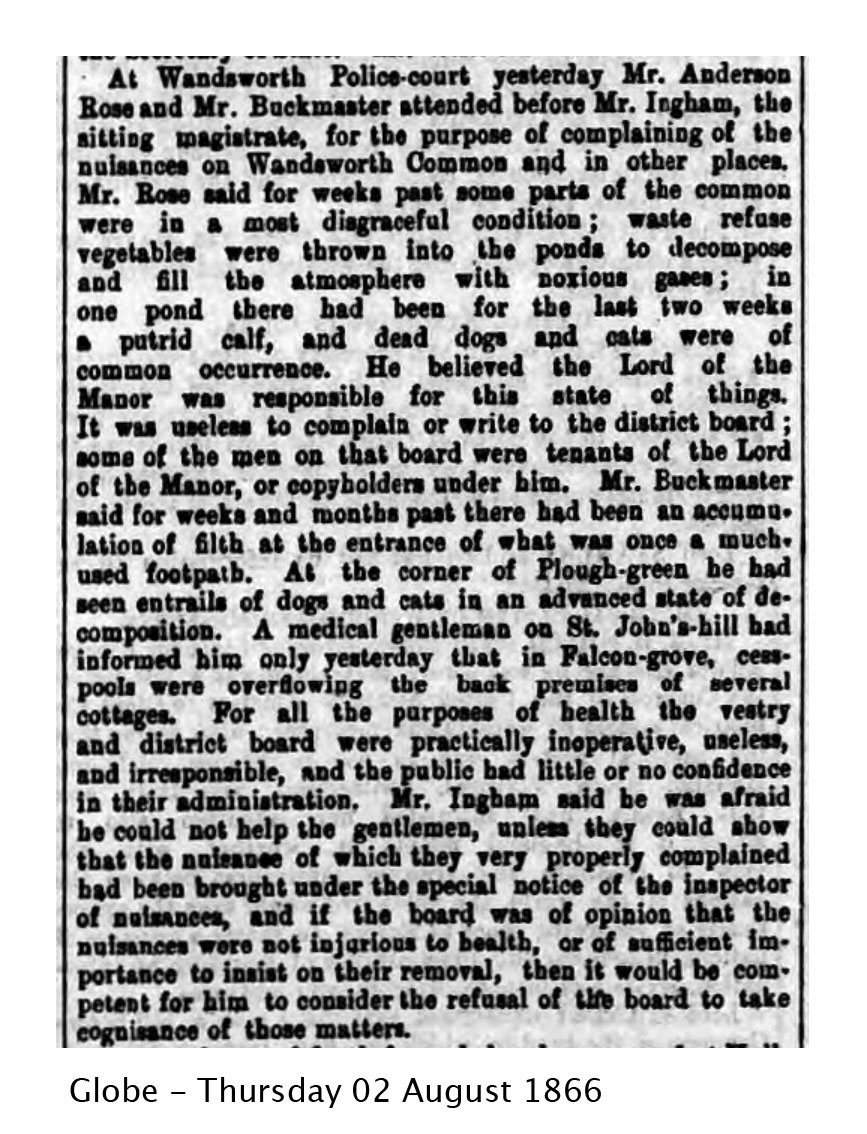
[What is this a link to? BNA: Link.]
[This must be a transcript of another, longer article — the Chelsea article?]
THE NUISANCE ON WANDSWORTH COMMON.
On Wednesday, Mr. Anderson Rose and Mr. Buckmaster attended before Mr. Ingham, the sitting magistrate at the Wandsworth Police Court for the purpose of complaining of the nuisances on Wandsworth Common and in other places. Mr. Rose said for weeks past some parts of the common were in a most disgraceful condition; waste refuse vegetables were thrown into the ponds to decompose and fill the atmosphere with noxious gases; in one pond there had been for the last two weeks a putrid calf, and dead dogs and cats were of common occurrence.
He believed the Lord of the Manor was responsible for this state of things. He exercised jurisdiction over the common and he ought to be proceeded against by indictment. It was useless to complain or write to the district board; some of the men on that board were tenants of the Lord of the Manor, or copyholders under him.
Mr. Buckmaster said for weeks and months past there had been an accumulation of filth at the entrance of what was once a much-used footpath. At the corner of Plough-green he had seen entrails of dogs and cats in an advanced state of decomposition.
A medical gentleman on St. John's-hill had informed him only yesterday that in Falcon-grove cesspools were overflowing the back premises of several cottages.
There was a scanty supply of water, and one case of death from cholera had been reported in a house where there was an entire absence of all sanitary regulations. It was useless to write or remonstrate with either the vestry or tne district board, and it was not till the cholera was at our very doors that they began to stir themselves. The district board, no doubt, under the Nuisance Removal Act, possessed ample power, but those powers, especially with reference to sanitary and social questions, were rarely exercised. For all the purposes of health the vestry and district board were practically inoperative, useless, and irresponsible, and the public had little or no confidence in their administration.
Mr. Ingham said he was afraid he could not help the gentlemen, unless they could show that the nuisances of which they very properly complained had been brought under the special notice of the inspector of nuisances, and if the board was of opinion that the nuisances were not injurious to health, or of sufficient importance to insist on their removal, then it would be competent for him to consider the refusal of the board to take cognisance of these matters.
Mr. Rose said it was desirable that the magistrate should be invested with more power with reference to these matters, but the object had been accomplished in directing attention to the filthy condition of many parts of Wandsworth and Battersea, with the hope that some immediate steps would be taken.
[BNA: Link.]
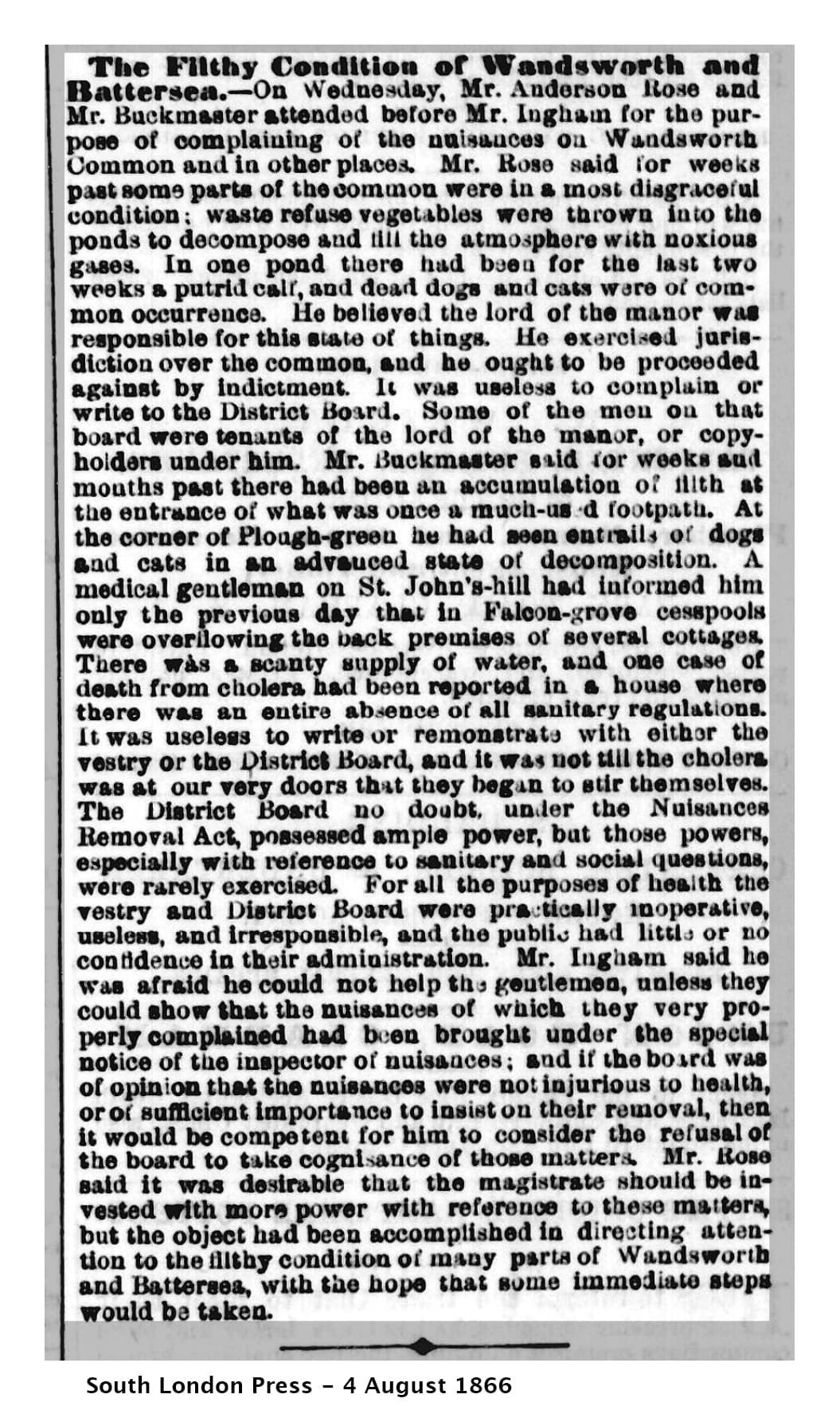
The Filthy Condition of Wandsworth and Battersea On Wednesday, Mr. Anderson Rose and Mr. Buckmaster attended before Mr. Ingham for the purpose of complaining of the nuisances on Wandsworth Common and in other places. Mr. Rose said for wee past some parts of the common were a most disgraceful condition; waste refuse vegetables were thrown into the ponds to decompose and fill the atmosphere with noxious gases. In one pond there had been for the last two weeks a putrid calf, and dead dogs and cats were of common occurrence. He believed the lord of the manor was responsible for this state of things. He jurisdiction over the common, ought to be proceeded against by indictment. It was useless to complain or write to the District Board. Some the men on that board were tenants of the lord of the manor, or copyholders under him. Mr. Buckmaster said for weeks and months past there had been an accumulation of filth at the entrance of what was once a much used footpath. At the corner of Plough-green he had seen entrails of dogs and cats in an advanced state of decomposition. A medical gentleman on St. John's-hill had informed him only the previous day that in Falcon-grove cesspools were overflowing the back premises of several cottages. There was scanty supply of water, one case of death from cholera had been reported in a bouse whore there was au entire absence all sanitary regulations, it was useless to write remonstrate with either the vestry or the District Board, and it was not till the cholera was at our very doors that they began to stir themselves. The District Board, no doubt, under the Nuisances Removal Act, possessed ample power, but those (lowers, especially with reference to sanitary and social questions, were rarely exercised. For all the purposes of health the vestry and District Board were inoperative, useless, and irresponsible, and the public had litcU or confidence in their administration. Ur. Ingham said he was afraid he could not help geutlemeu, unless they could show that the nuisauc.es which they very properly complained hod been brought under the special notice of the inspector of and if the bo ird was of opinion that the nuisances were not injurious to health, or of sufficient importance to insist their removal, then it would competent for him to consider the refusal of the board to take cognl-ance of those matters. Mr. said it was deslrable that tbs magistrate should be invested with more power with reference these masters, but the object had been accomplished in directing attention to the lllthy condition many parts of Wandsworth and Battersea, with the hope that some immediate steps would be taken.
[BNA: Link.]
South_London_Press_08aug1866A cricket match between a one-armed and a one-legged man is announced for Monday, on Wandsworth-common. The opponents are to be "Randall, the Barber," and "W. Cook, of the East-end," who compete for £l a side.
Metropolitan Board of Works:?? "an encroachment on Wandsworth-common formation of a new road by Mr. Maplesden, on. behalf of Mr. Whiting"
[BNA: Link.]
[What is this?]
1866_South_London_Press_8sep_1866.png
The "Wandsworth Common encroachment," strongly denounced by everybody, turns out to have been the work of the parish contractors, who have been committing fearful havoc on the common taking gravel from one side of it. This has been done without the knowledge of the Metropolitan Board of Works, the members of which have joined with the general public in condemning Earl Spencer, the lord of the manor, whereas the noble earl is not only innocent of all blame in the matter, but has had his property destroyed without even being compensated!
[And several other papers]
[CAN'T FIND THIS - 1866_Pall_Mall_Gazette_10oct1866 - if necessary, make another copy.]
Some time ago a boy, who gave the name of John Hobbs, was charged at Wandsworth police-court with throwing missiles at trains on the Brighton Railway, near New Wandsworth Station, and in the course of the inquiry it transpired that he had taken up his abode with a gipsy family of the name of Lee, in their encampment. One of the gipsies came before Mr. Dayman, and stated that he found the boy in a starving condition on Wandsworth-common, when he and his wife took compassion on him, and nursed him until he recovered.
The boy stated that his father was a policeman, and on going out to New Zealand he died on the passage, and that his mother died three months afterwards of a broken heart.
The boy was discharged after being remanded, and Lee expressed his intention of receiving him back in his family and treating him as his own child. The particulars of the case were published in the newspapers, and that led to the police receiving several applications from persons in different parts of the country claiming the boy.
After inquiry, and rauch correspondence in the matter, the real mother of the boy came forward to claim him.
Inspector Usher this morning informed the magistrate that the mother was in attendance, and wished for his worship's assistance to recover possession of her son. The inspector stated that the boy's father was an ex-policeman of the D division named Hobbs, but lost his life through a fire.
The boy's story was not true of his mother having died of a broken heart, for she was still alive.
Mr. Dayman was of opinion that the boy, who is sixteen years of age, had a right to remain with the gipsies. He was with them by his own voluntary act, and if he chose to stay there was no power to take him away. The mother, he added, was not obliged to maintain him unless he was disabled.
[CAN'T FIND THIS - 1866_London_Evening_Standard_18oct1866.png]
[BNA: Link.]
WANDSWORTH.
Mysterious Assault Upon a Gentleman
Daniel Shettle, one-armed watchman, was finally examined on charge of violently assaulting Mr. Nicholas L. Steppings, of South Fields, Wandsworth.
Complainant stated that between one and two o'clock the morning of the 2d inst. he was returning from the new railway station Wandsworth Town, when he drove a dog out of his way with an umbrella. A voice immediately said, What did you knock my dog for," and he then received blow at the back of his head that forced him on to the railings. He turned to defend himself, and blow was struck at his face, and that be received on his arm. He tried to catch the person who struck him, but found he had disappeared.
Witness also found that he was wounded, and that he was bleeding from the side of his throat, he ran and called out for the police. A watchman from the other side of Wandsworth Common came his assistance. Witness returned with him to the place where he had been attacked, but found the man and the dog gone. He went to the station and gave information, and at about three o'clock the prisoner was brought in. Witness bled considerably, and was unable to appear for several days. The dog was a large black one. He could not identify the prisoner as the man.
Sergeant Dudley proved going to Wandsworth Common after the complainant came to the station, where he saw the prisoner, who was watchman at a sewer there. ["AT A SEWER THERE?" - was it one in construction?] He told witness that he heard shouting, and ran to see what it was, but could see no one. The witness also proved seeing a large black dog in the prisoner's watchbox. asked the prisoner why he was otf the works, and said he had been down to the French Horn public-house and back. Witness said he had been from one end of the works to the other, and could not find him. He had been in the habit of wearing a hook on his arm, and seeing he had none he asked him where it was. He replied that he broke it a few days before, and he had thrown it into the river. At the station he said he was not the man, and the prosecutor said, Yes, you are."
The Prisoner, having declined to make an apology the complainant, who was willing to forego the charge on his admitting the assault, he was fully committed for trial.
Gravel digger buried alive on Wandsworth Common

MAN BURIED ALIVE ON WANDSWORTH COMMON.
Mr. J Payne opened and concluded inquiry last night at the Bull's Head Inn, Old-town, Clapham, into the circumstances attending the death of William Puttyfoot, 60 years of age, who died on Sunday last through injuries sustained on the previous Thursday by a fall of several tons of earth, whereby he was for some time buried alive.
John Clegg, a labourer, said deceased had just gone down the pit to commence work, and while he was breaking some lumps of earth there was a heavy fall of gravel from the right side of tbe excavation.
The deceased was buried in the fall of the gravel, and another young man, who were working near him, had a very narrow escape. The sides of the pit were slanting, and they had not shored up or barred the sides of it, because it was considered useless, and it interfered with the comfort of those digging in it.
It was not a usual thing to take precautions of that kind, and it was considered by all that their work was quite safe without.
In his (witness's) judgment the cause of the accident was attributable to a seam of sand giving way which was half way up the pit, and which it waa impossible all times to discover, as they were frequently "a little way in."
After hearing comborative evidence, the jury returned a verdict of "Accidental death,"
[BNA: Link.]
Also reported in e.g. 1866_Shields_Daily_Gazette_20oct1866.png, [an area where deaths among coal miners must have been common], also John Bull, same date, and many others from all over country. Why? NB V brief reports.
Most reports mention a "seam of gravel gave way" and was "buried beneath . . . superincumbent earth, yet lived for three days afterwards".
"They hate trees and everything that is beautiful" — John Buckmaster
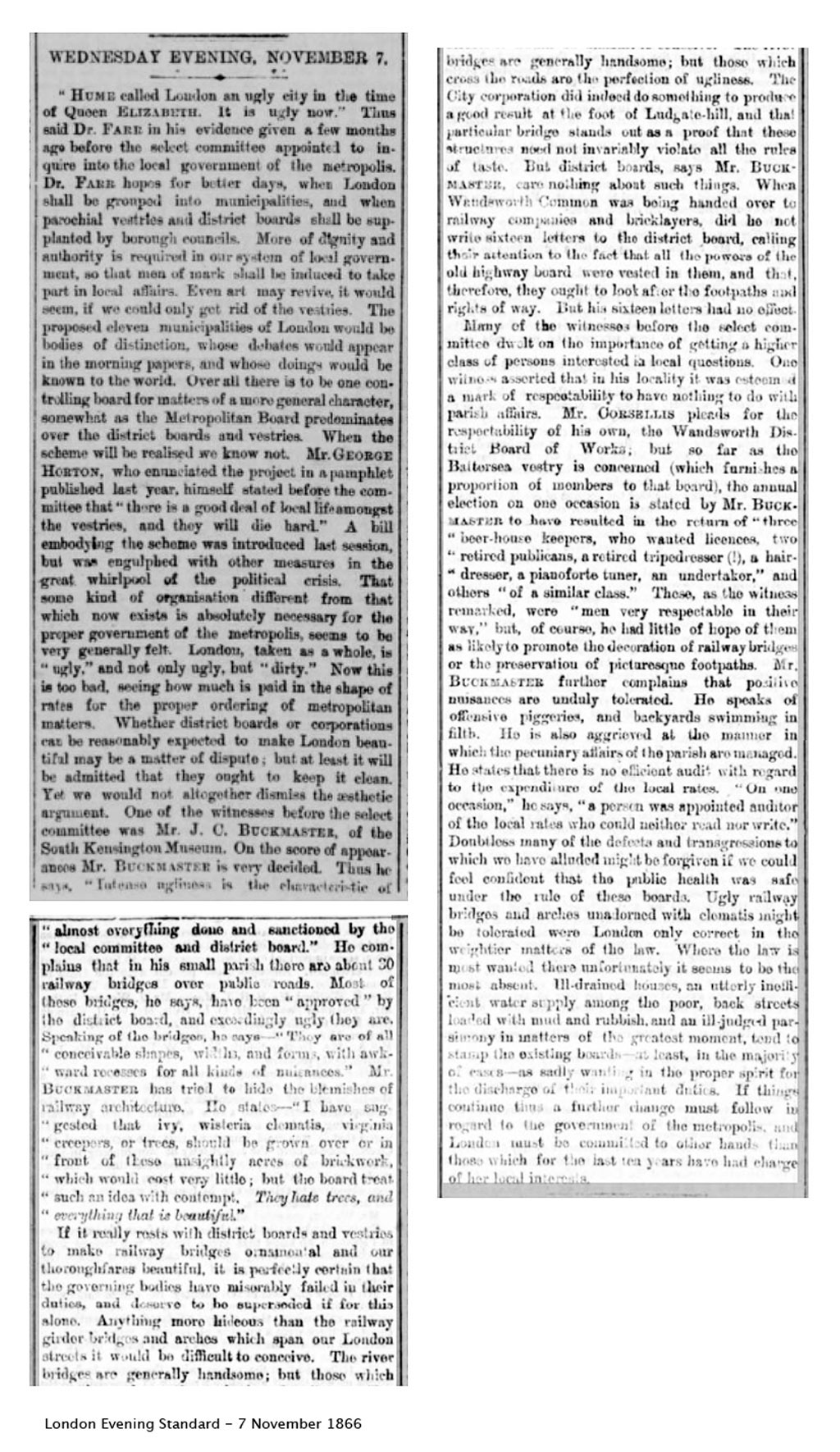
WEDNESDAY EVENING. NOVEMBER 7.
Hume called London an ugly city in the time of Queen Elizabeth. It is ugly now.
Thus said Dr. Farr his evidence given few months ago before the select committee appointed to inquire into the local government of the metropolis. Dr. Farr hopes for better days, when London shall be grouped into municipalities, and when parochial vestries and district boards shall supplanted by borough councils. More of dignity and authority required in our system of local government, so that men of mark shall be induced to take part in local affairs. Even art may revive, it would seem, if we could only got rid the vestries. The proposed eleven municipalities London would be bodies of distinction, whose debates would appear in the morning papers, and whose doings would be known to the world.
Over all there is to be one controlling board for matters of a more general character, somewhat as the Metropolitan Board predominates over the district boards vestries. When the scheme will be realised we know not. Mr. George Horton, who enunciated the project in a pamphlet published last year, himself stated before the committee that there is good deal of local life amongst the vestries, aud they will die hard." A bill embodying scheme was introduced last session, but was engulphed with other measures in the great whirlpool of the political crisis.
That some kind of organisation different from that which now exists is absolutely necessary for the proper government of the metropolis, seems to be very generally felt.<.p
London, taken a whole, is "ugly," and not only ugly, but "dirty." Now this is too bad, seeing how much is paid in the shape of rates for the proper ordering of metropolitan matters. Whether district boards or corporations can be reasonably expected to make London beautiful may be a matter of dispute; but at least it will be admitted that they ought keep it clean. Yet we would not altogether dismiss the aesthetic argument.
One of the witnesses before the select committee was Mr. J.C. Buckmaster, of the South Kensington Museum.
On the score of appearances Mr. Buckmaster is very decided. Thus he says, "Intense ugliness is the characteristic of almost everything done and sanctioned by the local committee and district board." He complains that in his parish there are about 30 railway bridges over roads. Most these bridges, he says, have been approved by the district board, and exceedingly ugly they are. Speaking of the bridges, he says — "They are of all conceivable shapes, widths, and forms, with awkward recesses for all kinds of nuisances."
Mr. Buckmaster has tried to hide the blemishes of architecture. He states — "I have suggested that ivy, wisteria, clematis, virginia creepers, or trees, should be grown over or in front of these unsightly acres of brickwork, which would cost very little; but the board such an idea with contempt. They hate trees, and everything that is beautiful."
If it really matters with district boards and vestries to make railway bridges and our thoroughfares beautiful, it is perfectly certain that governing bodies have miserably failed in their duties, and deserve to be superseded if for this alone.
Anything more hideous than railway girder bridges and arches which span our London streets it would difficult to conceive. The river bridges are generally handsome; but those which cross the roads are the perfection of ugliness. The City corporation did indeed do something to produce a good result the foot of Ludgate-hill, and the particular bridge stands out as a proof that those structures need not invariably violate all rules of taste. But district boards, says Mr. Buckmaster, care nothing about such things.
When Wandsworth Common was being handed over to railway companies and bricklayers, did he not write sixteen letters to the district board, calling their attention to the fact that all the powers of the old highway board were vested in them, and that, therefore, they ought to look after the footpaths and rights of way. But his sixteen letters had no effect.
Many the witnesses before the select committee dwelt on the importance of getting higher class persons interested in local questions. One witness asserted that in his locality it was esteemed a mark of respectability to have nothing to do with parish affairs.
Mr. CORSELLIS pleads for the respectability of his own, the Wandsworth District Board of Works; but so far as the Battersea vestry is concerned (which furnishes a proportion of members to that board), the annual election on one occasion is stated by Mr. BUCKMASTER to have resulted in return of "three beer-house keepers, who wanted licences, two retired publicans, retired tripedresser (!), a hairdresser, a pianoforte tuner, an undertaker," and others "of a similar class."
These, as witness remarked, were "men very respectable in their way," but, of course, had little of hope of them as likely to promote the decoration of railway bridges or the preservation picturesque footpaths.
Mr. BUCKMASTER further complains that positive nuisances are unduly tolerated. He speaks of offensive piggeries, and backyards swimming in filth.
He is also aggrieved at the manner in which the pecuniary affairs of the parish are managed. He states that there is no efficient audit with regard to the expenditure of the local rates. "On one occasion," he says, a person was appointed auditor of the local rates who could neither read nor write."
Doubtless many of the defects and transgressions to which we have alluded might be forgiven if we could feel confident that public health was safe under the rule of these boards.
Ugly railway bridges and arches unadorned with clematis might be tolerated were London only correct in the weightier matters of the law. Where the law is most wanted there unfortunately it seems to be most absent. Ill-drained houses, an utterly inefficient water supply among the poor, back streets loaded with mud and rubbish, and an ill-judged parsimony in matters of greatest moment, tend to stamp the existing boards — at least, in the majority of cases — as sadly wanting in the proper spirit for the discharge of their proper duties.
If things continue thus a further change must follow in the government of metropolis, and London must be committed to other hands than those which for the last years have had of her local interests.
[BNA: Link.]
An interesting example of John Buckmaster's hated "beer-houses" and "gin palaces" erupting all round the Common.

[WC as a universally understood haunt of gypsies]
Shipping_and_Mercantile_Gazette_23nov1866
[BNA: Link.]
[Identical reports in numerous local newspapers, e.g. Newcastle, Dundee, Carmarthen etc.]
1866_Shipping_and_Mercantile_Gazette_23nov1866.jpg
THE PRINCE OF WALES IN MOSCOW.
The special correspondent of the Daily Telegraph gives the following particuiars of the hurried trip of the Prince of Wales Moscow:
One of the Prince first visits was to Philaret, the Metropolitan of Moscow, the highest ecclesiastical dignitary of the Jiussian Church; ranking next, I believe, to the Patriarch of Constantinople the whole Greek communion. The old priest, who is now nearer ninety than eighty, but is still in full possession of all his bodily and mental powers, expressed great gratification the compliment paid him by the Prince$s visit. Nothing, he said, but good heart could have caused great prince come and visit feeble old man; and therefore he could assign no cause for the visit except charity.
The Prince replied through Mr. Michell, the gentleman who fills ably the post of British Consul at St. Petersburg, that he had heard so much of the virtues and goodness the Metropolitan, that felt he could not leave Moscow without calling his Holiness. The Patriarch then bestowed episcopal blessing upon his Royal Highness, and as the Prince was leaving added had prayer to make. On being assured that any prayer the Prince could grant should accorded, Philaret begged the Prince on his return to England to request his Royal mother to protect the Christians in the East.
To this somewhat embarrassing demand the Prince made answer that there was no need of such advice being tendered, that it was one of the special missions of England promote the spread Christianity, that our nation made great sacrifices for this object, and that the churches of both Russia and England laboured in the same holy cause. The astute old priest, however, was not to satisfied with generalities, and begged to call attention the political considerations connected with the Greek Church in the East.
At this stage it was thought desirable close discussion which the position of the two chief interlocutors made rather awkward one for both parties : and so, after fresh interchange of compliments, the Royal party bade farewell to the Metropolitan . . . Anything more gorgeous of its kind than the Governor's banquet it has never been my lot witness. On arriving at the palace, I was shown broad flight of stairs, decked out with flowers blszmg with light and colour. Footmen, clad in rich red liveries, stood upon every step, bowing tneir {icwdered heads as the guests came following each other. At the doorway stood Prince Dolgurouski, shaking hands with each new comer, and addressing each few civil words in French. A long suite of rooms, lighted with endless chandeliers, hung with yellow damask, were thrown open to the guests, who strolled and down them at their leisure.
The square in front of the Palace was illuminated with the electric light; and from between the window curtains you could look out on the great snow-covered space, and on the strange masses of fur-clad spectators, flitting to and fro from out the deep shadows into the dazzling ? of light. Soon after seven there was stir in the rooms, and the Royal visitors made their entrance, being received in the same manner the ordinary guests. Then servants entered the room, bearing trays loaded with liqueur bottles. For those who were ready to accommodate themselves to Muscovite customs, there were also plates of caviar, smoked herrings, and cheese. Then the band struck up the God save the the folding doors were thrown open, and the company entered the banqueting hall.
At the cross table facing the doorway the Royal guests took their seats, the Prince of Wales sitting on the right hand of Prince Dolgorouski; the side tables were reserved for persons not belonging the staff of the princes present, who seated themselves wherever they thought fit. all there were about hundred persons present. In the galleries looking over the hall there were numbers of ladies, but at the tables there were none. After dinner there was move to another room, where a company of Tyrolese singers gave their national entertainment. We have most us seen the self-same persons perform the same songs and dances in our own country, and all need say is, that the yodel was loud and the waltzing as perfect as usual But the next entertainment provided for the Royal visitors was one not to be matched, think, west of the Vistula.
In saloon the end of the suite of rooms we found, seated, company of some forty gipsies. The faces were the same those which Londoners know so well at Ascot and Epsom; but instead of being dressed in rags and tatters, these gipsy men and women were clad in rich silks and gorgeous colours, which contrasted strangely with their dark olive skins and tawny hands. Here, as much as in Hungary, England, France, or Italy, or in any country where I have seen them, they looked ever, strange people in a strange land$ Tawdry, and yet not vulgar; brazen-looking, and yet not immodest in aspect; without breeding of any kind, and yet not affected, they sat as unconcerned before the Royal party they were summoned to amuse if they had been encamped on Wandsworth Common or stealing their way between the carriages before the stand on the Derby day. Some had beads and some had jewels, some wore silks and others cotton; but they all alike looked aliens to our modern costume and manners.
The women, seated in circle, gazed upon the scene with their large, dark, lascivious eyes, they possessed a sort of magic power to attract those who looked upon them. The men stood behind, tambourine in hand, still, and all outward look utterly unconcerned. Then the Governor gave the signal and the entertainment began.
It is impossible to describe it in words.
A long low guttural cry from the mouths of all the women seemed to open the ball; sometimes wailing, sometimes piercing in shrillness, but always fitted to a strange weird harmony, the sound of many voices rose and fell Then one or two of the handsomest and youngest took up the dialogue in sad sing-song tone; and then, before you exactly knew when song changed to motion, the women were whirling round in wild fantastic measure. The strange feature was that their feet hardly seemed to move. The ? were thrown forwards, ? and down again, the head rocked to and fro, the body quivered, the shoulders shook, and, with every pulsation of the frame the chorus of seated women shrieked in unison. Somehow the feet moved, but you could scarcely hear their motion. If you fancy woman walking in her sleep, half fastened to one spot with terror, half maddened with er passion which sets in motion every muscle her frame, you will form some idea of that gipsy dance which began with cry and ended with scream.
When the spasm was over the women seemed subside at once into tneir wonted apathy, and listened languidly enough to the compliments paid them by their Russian admirers. Indeed, except a curiosity to see the Prince of Wales I could not observe any trace of their taking any interest in what, to them, must have been an unwonted spectacle. The dances were related several times.
Then another short visit was paid to the Tyrolese minstrels, and then the Prince after expressing his warm thanks to Prince Dolgorouski for the hospitality had received, took his departure. The Roval party drove straight to the railway station, where they changed their evening clothes for travelling costume, and at midnight the express train moved off, the Prince standing at the window, and bowing courteously to the crowd assembled to witness his departure.
HOW WE ARE GOVERNED.
Meeting of the Metropolitan Municipal Association
A meeting of this association, which has for its object the promotion of "the better local government of the metropolis," was held on Tuesday evening, in St. James's Hall — Mr. C. Buxton, M.P., in the chair. Among those present were Mr. Thomas Hughes, M.P., Sir W. Fraser, Bart, Mr. J. C. Buckmaster, Dr. Farr, Mr. G. Horton (Registrar-General's department). Captain Dresser Rogers, Mr. Henry Fowler (secretary), Mr. J. Beal, Mr. Washington Lyon, Mr. W. Phillips, Mr. E. Hughes, &c. There were a great many members of vestries and local boards in the meeting.
The chairman, in opening the proceedings, said that the administration the affairs of this great metropolis was disgrace to us as Englishmen. Never in the world was there a nobler opportunity for self-government$never was an opportunity more shamefully thrown away. Here, on the one baud, had a city in itself a State, a kingdom, inhabited, one might almost say, by a nation of its own, with 3,U4Kt,OUU of people within its borders, its real property alone producing $13,000,00(1 per annum; and containing, moreover, boundless supplies of ability, energy, and public spirit, of Englishmen accustomed to self-government, and imbued with a sincere desire, not only to ruled well themselves, but to rule others well too.
Such was the opportunity; what was the use made of it? Of governing bodies, no doubt, we had a plethora; but of organization, of combination among them, so as to carry on their administration of affairs with economy of power, of this at present had none. As' Mr. ilortou, in his valuable pamphlet, pointed oat$ The metropolis is divided into districts for the purposes of registration of births; into districts for the duties of the Uuilding Act; into 13 divisions for police purposes; into 13 county court districts; into militia districts; and additional divisions for Inland Revenue, postal, gas and water, and parliamentary purposes; so that a map of London must have 11 or 15 different boundaries to represent in each area the controlling powers.
The first thing to aim at should be this$that the areas of authority should be the same, that London should be divided into certain districts, and that each of those districts should completely self-governing for all and every purpose, so that each householder should feel that was a citizen, as it were, of that city. (Hear, hear.)
Next, we should seek this, that in each of these districts every householder should be enabled to take direct part in the election of those who were to govern him and spend his money.
And, thirdly, that the acts of these authorities so elected should be done as far as possible under the public eye, and an account should be rendered by them every year of thvir stewardship to those whose money they had been spending. If wanted work to be well done, the one vital thing was that the worker should feel that he was watched. These were the main points that ought to be kept in view. Wo heard a great deal nowadays about the educating effect of local self-government upon the people, bad administration, whether local or imperial, was bad education. (Hear, hear.) It made people even more selfish, narrow-minded, despotic, and indifferent to the public good than they were before. On the contrary, good administration was the best of all educations; it raised the tone of thought and feeling among those who ruled, and among those who were ruled.
The association was not going to sweep away local self-government. The work it had taken in hand, and which, by God$s help, it would carry through, was to make it, so far as it could be, perfect and pure. (Applause.)
Mr. Buckmaster moved the first resolution: That, in the opinion of this meeting, the present system of local government in the metropolis is highly unsatisfactory, and requires immediate revision, the number of local bodies now participating in such government being unnecessarily large, and occasioning a considerable amount of unnecessary expenditure.
The mover said the association had been formed for the purpose of obtaining a better local government of the metropolis. We feel, said the speaker, that the requirements of this metropolis has outgrown the present system of parochial administration. (Hear, hear.) The boundary lines of parishes can no longer be retained with advantage the boundary lines of local government. The association has adopted bill on the basis of greatly enlarged areas of administration. This bill will be submitted to Parliament as early as possible. (Hear.)
To take part in the government of such city as this should be the object of a laudable ambition. Hut what is the fact in many parishes? You have neither first-rate, second-rate, nor third-rate ability persons highly respectable, some of them intimate personal friends of my own, but frequently unfit from early early associations and prejudices of taking liberal and comprehensive view of the first principles of good government. The consequence is, you have policy which corresponds with the men; it is often narrow, selfish, and spasmodic in its action. Under the pretence of keeping down the rates, you have occasional periods of wasteful extravagance — the natural result of a false economy — and the encouragement of system which greatly multiplies officials and the cost of administration. The local government is committed to men who, in many instances, have lost the confidence of the ratepayers by their inconsistency and want of fixed principles. They are frequently spoken of with suspicion as men who have their own personal interest to advance or their little vanities to gratify.
Contrasting the old form of open vestries with the present, the speaker said the present system, under the specious pretence of a liberal democracy, is practically despotism. The ratepayers are excluded from all direct share in the government, unless they are assessed at XtO a year to the poor-rate, which may be made up of miserable fever-breeding hovels in compound; aud I have known a little manoeuvring with the rate-book to obtain qualification. I speak, of course, my own parish. Very recently two public meetings of the ratepayers have takeu place on subject of considerable local importance. The respectful and unanimous resolutions passed at these meetings, and report of a Committee of Juquiry, have been treated by the elected vestry with ridicule and contempt. The minutes of these meetings, although convened on a numerously aud respectably-signed requisition, and presided over by one of the churchwardens, have never been entered on the minute-book, because the duties and salary of the vestry clerk were discussed at these meetings. The elected vestry hold the curious doctrine that the men who pay the vestry clerk have nothing to do with either the performance of his duties or his salary. A severely-contested election for vestrymen in a parish with about 3,(W0 ratepayers will scarcely secure votes.
On one occasion I was present when an election, although by ballot, was known perfectly well to have gone, by a large majority, against a party who had had the government the parish in their hands for years. A mob, led on a drunken lawyer, took possession of the ballot-box$(laughter) $and for months had local government. I think we succeeded better that year than have done since. A summons was taken out against the ringleaders, which was dismissed Mr. Ingham, the ground that we ought to proceed by indictment at the Quarter Sessions. Some of the parochial officers actually connived and took part in these disgraceful proceedings, and it was absurd expect private individuals would to law against men who had the command of the parochial exchequer to defend themselves. The same thing would have been repeated a few elections since but for the protection of the police.
Now, all this, and much worse, has taken place under the Metropolis Local Management Act, within four miles of the Houses of Parliament. I have written (said the speaker) a number of respectful letters to the Wandsworth District Board, filing their attention to abominable pnUic aai $wees, the destruction of footpaths and old rights* way, and questionable enclosure* by the rail war on Wandsworth Common. I have sometimes snubbed$always sneered at$and at last informed by the clerk that no one else complained, and if I f-.lt aggrieved it competent for me to take proceedings. How does this District Board manage its business? contract for a portion of . . * is let to Mr. , lt after nearly half the work ia completed, and XB,OUO paid out of the local rate* to the contractor on the certificate a paid servant the board Some one, not a member the board, accidentally makes the discovery that in where the sewer ought to have been 10 feet below the surface, it was only about 3 feet or feet; and instead of the work being 9 inches, in many plates it was only 4J inches, and stock bricks about dOs. per thousand were used instead of gault bricks, at about 48s. per thousand. The surveyor resigns, aud the contractor course becomes bankrupt. Another contract is entered into by the board to complete the works at a higher cost than the original contract. This is one of the results of always accepting the lowest contract$a familiar illustration of what the board (tails economy and keeping down the rates. have no hesitation in saying that if this had occurred in any Government contract, which could have been made public at any moment by question in the House of Commons, we should have had articles and letters in all the newspapers for weeks on the mismanagement of Government business aud the expensive honours of centralization. Now what publicity has been given tothis local mismanagement > The board, in their report, say some considerable lengths new sewers have also been constructed under a contract entered into witli Mr. Xiblett. The board regret to say that they Itavc much reason to be dissatisfied with the manner in which large portion of this contract has been executed. ($Shame.$) I doubt very much if there are ratepayers ia the parish who'kuow anything of this affair, and I believe almost every metropolitan parish could supply similar illustrations. I have urged several occasions the desirability of more efficient audit and publication of our local rates, now amountiug to about £19,000 a year. The Metropolitan Board, in tbeir supplemental bills, submitted every year to Parliament might insert a clause giving the ratepayers soiqp protection against improper expenditure of their money vestries, district boards, aud their own board. (Hear, hear.) I have spoken to the auditors of the local rates on the very unsatisfactory state of the accounts generally, and the difficulties thrown in the way obtaining any acc'irate detailed information. I have been mot with the reply, How do you thiuk or expect can give the time necessary for the proper audit of these rates? It would take us two or throe days, aud have no power to discharge any one with an expenditure which wo may consider wrong. Why not liave one paid auditor ter all the rates, including, of course, the poor-rate and our charity and trust accounts, which are very unsatisfactory in most parishes. But this would probably add one-tenth of farthing to the rates, and as the chief function of elected vestries and the guidingstar of district boards is to keep down the rates, such officer will never be appointed them, although lie would save 10 times his salary. bolievo wo lose every year hundreds of pounds, because have no reliable system either of collection, expenditure, or audit. Let us just see fur moment how the parish in which I reside is governed under the Metropolis Local Management Act. Once a year, the ratepayers are called together to elect 12 men to the vestry; these men, with those already on the vestry, make up a parochial parliament of 48 persons; two auditors of local rates are also elucted. In few days after this election the vestry is called together to elect from their own body men to the District Board. They also elect members to the Burial Board, prepare list for the magistrates to appoint overseers, elect churchwardens, appoint committees and local boards. The absolute government of the parish is handed over the elected vestry$no matter what occurs, or what absurd things are proposed, the ratepayers $ro powerless, and then their influence can only be exercised third of the vestry. We have three gas companies and two water companies engaged in providing bad gas and impure water. 'The Pliumix Gas Company lights 24} lamps at 5a a lamp, 151} at $o ss. The London Gas Company lights 172 at $5 15a, 10 at $5 12a, eight at $5 65., 71 at $5, and 2 at $4 4a Wandsworth Gas Company lights 23} at $5 ss. We have 462} lamps to light miles of road. In some places these lamps are nearly quarter of mile apart. I need scarcely allude to the very graceful and ornamental gibbet posts with which those companies are encouraged to adorn the metropolia Now a lamp aud a lamp-post, with some pretensions to form and beauty, would just as cheap the ugly things wo now have in our streets. As for the supply of water, it is very irregular, in moat cases insufficient In some parts poor still depend on the impure water of pumps, sometimes in close proximity to old draius cesspools. Wo have also local Act about compound property. Every compounder regards it the salvation of the parish rates, and interprets it in his own way. Every man not compounder looks upon it with suspicion, and interprets differently. This Act was obta.ued years ago, when the parish was a market garden, it ought long since, in justice to the ratepayers, to have been abolished or amended; but the compound interest in the vestry is too strong. (liear.) Tnore are bouses in compound at $7 per house, which are letting at B*., 95., and Ids. week to persona paying income-tax. These persons have no voice or vote in the election of vestrymen. They are not on the rate book, and for all purposes of local government are unknown. On the other baud, we have streets such Su George$s-street aud West-street with houses which Lave never been occupied, aud some of them never likely to be occupied, assessed to the police and county rates. We have hundreds of newly-built houses in the parish in compound unfit for the habitation of human beings.
The assessments of the parish are in the hands of churchwardens aud overseers, aud they not uufrequeutly hare to assess their own property, or properly in which they or their friends have an interest. The rateable area of the parish is 1,600 acres. Then have 173 acres occupied as park, and 294 acres as common, the latter fast disappearing. From April, 1865, to April, 1866, the amount of money called for by the District Board was £15,551 10s. 6d. total rateable value of the property is £170,594 10s. About ouc-eighth is in compound, and rates, amounting altogether to 2s. 6 in the pound, were levied to meet these calls. If these rates Lad been properly collected, making a fair allowance for empties and irrecoverables, of which we have no proper check, except the word of the collector, a sum of about £2,000, ought to Lave been collected instead of £1,792 15s. lid.$tho sum actually collected. Why rates should be levied greatly in excess the calls I cannot understand. What I have said with reference the local rates applies with equal force to the collection of the iioor-rates; and our parish is highly favoured with reference to the collection of rates. It scarcely three miles in length by one a half in breadth, and nearly four-fllthsof the rates are raised public companies and assessments over $l00 a year. Yet we summon every half-year about 800 persons for their rates. Considerable arrears of old rates are constantly carried forward and never collected. As for obtaining any accurate financial information from our rate books and parochial accounts, you might obtain it just from $Bradshaw.$ The vestry exercises no functions with reference to the levying or collection of the rates; this is done the churchwardens and overseers, whose meetings are attended by an average of three persons. I liave been told that, although the churchwardens and overseers are responsible for the collection of the poor-rates, they have authority or power over the appointment or
_____ page 5_______
autles the collector. If the guardians have *ll the er hy not let them here ell the responsibility. absurdity this state of things ought at once be dealt with the Poor-law Board, and I am not sure that in any new system of local government OUK ht to be content with the preeent administration the poor-law. experience and corresaondence with this board several important onestions have been most unsatisfactory. The narish, then, is governed in a certain sort of wav by a Jestry of persons and 2 auditors; a board of churchwardens, 4 overseers, and 2 sidesmen; guardians and members of the Burial Board, and 12 members of the District Board. Then we have the fol-owi paid officers the parish: beadle, parish clerk, organist, sexton, pew-openers, and ringers; these are, course, paid out of the church-rate, which threefourths of the ratepayers never pay. vestry clerk with a year, a clerk to the burial board at £3O year, a surveyor at £200 a year, with £l00 additional for expenses; medical officer at £5O a year; two inspectors of nuisances at £l00 each (appointed after several persons bad died of cholera); three clerks of the works at £300 a year; two collectors of rates at about £220 year each; one foreman of the roads at 255. a week; and the proportion uaid the parish for the management of the district board is £349 195.; so that the administrative exoenscs of the Metropolis Local Management Act costs nearly £2,000 a year, and very few of these charges are exceptional.
Then there should added to this account the administrative excuses ol the uoor-rate and church-rate, which are not much under another £000. There are 50 poor men employed on the roads at the rate of 2s. 4d., 23.6(1., and 9s. day. I consider these payments disgrace to"the board. There are nearly 100 [ engaged in the local government of Battersea, and suppose the same thing islrepeated a modified form Putney, Streatham, Wandsworth, Tooting, and Clapham. regret say that in the discussion important questions these vestnes and Wds. their deliberations have seldom risen above personal altercation and party victory. The of""No centralizaUon — $will probably be raised against us, but we rest our claims for public support, noton the opinion vestries fed district boards, but the sympathy and intelligence of those who* believe the present system has been weighed in the balance public opinion and found wanting. (Cheers.)
Mr. T. Hughes, M.P., in seconding the resolution, said he had not studied the subject sufficiently to prepared with any detailed plan for setting all the matters complained right. was very glad when he was asked to join the association, and when bill brought forward by Mr. Mill last session for giving a new Government to this immense, world of London was put into his hands, did his best to understand what the object that bill was, and it seemed to him to be reasonable step, at any rate. It was bill which he would be very glad to see pressed forward in the House of Commons, because, whether one might agree with all its provisions or not, it was founded on large and clear view of what was required, and pointed out a specific remedy. (Hear hear.) It was highly desirable that anyone who knew anything the subject should throw what light he could on the provisions of that bill and on the question generally, that, speedily as possible, end might be put to a state of tilings which disgraced the metropolis in the eyes of civilized nations. (Hear, hear.) For many years he, as the occupier of house in Loudon, looked upon the question in the same way as Mr. Buckmasler had, but for the last 18 mouths had been obliged to look at it from a different point of view$as a person having the honour represent metropolitan constituency; and he declared it was a great trial to a man, when elected for one of these huge boroughs$and who fancied represented something which had a distinct corporate life$to find, when got into his borough, that the whole thing was a huge chaos. (Hear, hear.) was bom within mile and half of a country town, the population of which never exceeded 10,000; and m that town, when the agricultural or townspeople were sufficiently excited to desire a meeting, all they had to do was to possess themselves, by the leave of the mayor and corporation, of ball, holding 1,500, in which meet. But down in the great borough Lambeth it was absolutely impossible to obtain any town hall, and there was no possibility of getting any decent room to meet in. Tbs real fact was there was no common action possible. (Hear, hear.) The people in one parish did not know what the people in another parish were thinking of- there was no corporate life the borough. (Hear, hear.) He trusted, with the chairman, that they might able before long to infuse, some good reforms, municipal life into that great borough, and felt that unless that was done the whole state of things would become worse and worse, and more disgraceful. If they went to almost any of the large towns in the north of England — say Birmingham or Manchester — they would free libraries doing good service towards civilizing the people of those towns. Well, he went down the other night to a meeting in Lambeth called for the purpose of establishing a free library in Lambeth, and he found that the only way in which the Free Libraries Act could be set in motion by the action of the mayor and town council, that the meeting, which was held small school-room, was perfectly helpless without having that body without which they could not work. He thought they could say — at least, could say for himself — in words of resolution, the present system of local government in the metropolis is highly unsatisfactory.$
After the experience they all had had, might safely hope that portion of the resolution would meet with their (Hear, hear.) They might also say that anything which was $highly unsatisfactory" required revision. He agreed with the chairman this was a case which required radical reform. Wliatever side they took upon abstract politics, thought this was question upon which, as it came home to the health and comfort of every man$they would all feel that the system complained of was one which required immediate levision, which it was their duty as citizens to bring about. (Hear, hear.) The resolution again said"" The number of local bodies now participating in such government being unnecessarily large.$ one could doubt that. (Hear, hear.) doubt then* were a great many gentlemen connected with vestries and local boards in the room, and felt certain every one them would say that they could do three or four times much work if tliat work were properly organized, and not. as it now was. completely chaotic. (Applause.)
The resolution went to say that this state of things occasioned a $considerable amount of unnecessary cxi>enditure.$ That part of the resolution could dismissed in a few words. He would take the instances furnished by Mr. Buckmaster, the honorary secretary the association. The parishes of Marylebone and the city Westminster collected, within a few pounds, the same amount. Marylebon e parish collected $194,036. and Westminster city $194 031. I$lus police and county rate$Mnryiebone, $38.167 Westminster, $78,814. The salaries^ and poundage were respectively $Marylebone, $7,711; Westminster, $17,462. (Cries of $ Oh, Marylehoue parish was managed one vestry, and its administrative expenses were under $B.000 per annum; while the five boards of local management in Westminster cost nearly $20,000. These five boards employed clerks and vestry clerks, six surveyore, four solicitors, officers health, six inspecters nuisances$all these being employed for the purpose of carrying out provisions the Metropolis Local Act. ($Oh, oh. ) thought had said enough upam this resolution They must all agree that the local government of the metropolis was highly unsatisfactory and required immediate revision; and by the help the few figure of honorary secretary bad given, they must come to the conclusion that besides being very unsatisfactory state of things. they were paying much more than they ought for keeping up that unsatisfactory state of things. (Hear, bear.) It was therefore their duty, as citizens of this great city, which ought to be the best managed and best furnished in the world — in which there ought to be the best light instead of what was bad and dim — in which they ought to | have a good supply of pure water instead of that which was the worst and the dearest — to remedy these evils in everv way they could. It was all very well to talk of the old English virtues of local government. He fully appreciated the English virtue of letting things grow, and of not forcing them. But a time might still come when things were let grow until they became nuisance. ("Hear." and laughter.) London had outstrode the ideas the last and of this generation. It had gone century and half before them, and they ought to try and overtake it. (Hear.) It was time for all who desired that their country should not I afford to the world a spectacle of absurd incapacity for ordinary skill in organizing and constructing to assist this association and every other association which showed some method of escape from this unfortunate state of things. (Cheers.) Sir W. Fraser, Bart., supported the resolution, and said that one who traversed the streets of the metropolis could have a doubt of the state of things, whether as regarded the paving, the lighting, and cleansing of London, Mr. Bolting (of Marylebone) asked if the bill of the association intended include the City of London. The chairman said it did not. Mr. Fowler (of Lambeth) contended that since the passing of the Local Government Act, the vestries in the metropolis had taxed themselves to very large amount, had dealt with abuses of long standing, and had added a great deal to the improvement of the sanitary condition and public convenience and comfort of the metropolis. (Hear, hear.) It was said that the gas was not good, and the water not pure, or in sufficient quantity, but whose fault was that? (A voice; The House of Commons.$) (Cheers.) The vestries had sat from day to day to endeavour to force upon the Legislature the necessity of taking action in these matters; and were they then to told that they were to a great extent responsible for the present state of things? ($ No, no.$) The fact was, if the vestries were raised into municipal bodies, they would have that attention paid to them which was invariably given to constituted authorities. (Hear, hear.) cordially supported the resolution. A Vestryman (holding up enormous Bluebook): This book contradicts every word said at that side of the table. ($ Oh,$ and Order.$)
Mr. Buckmaster wished to explain that the reason the City of London was not included in the bill was, that such a proceeding would raise such an opposition the association could not, financially speaking, grapple with.
A vestryman of Battersea agreed with what had been said by the chairman and Mr. Buckmaster. The resolution was then put from the chair and carried.
Mr. J. Beal moved the next resolution: That any attempt to amend the existing system would be ineffectual; and that nothing less than the establishment of municipal institutions similar to those enjoyed by other cities and towns in the kingdom, would secure a government calculated to command the confidence of the inhabitants.$ Mr. Beal dealt at length with the whole question of metropolitan government, and adduced many facts to prove how the vestries had failed to meet the public requirements. Dr. Farr seconded the resolution, which, having been supported by Mr. Hughes (Woolwich), was put and carried.
Mr. W. Phillips moved $ That deputation be appointed to wait upon the Home Secretary to submit the foregoing resolutions, and to urge upon the Government the necessity immediate legislation to carry out the suggestions therein contained.$ Captain Dresser Kogers seconded the resolution, and agreed with a previous speaker, that great difficulties arose from the neglect of the general body of the inhabitants of districts failing to do their duty. The City of London had, at all events, done its duty to the public with respect to the gas companies, and that service should not be forgotten. (Hear, hear.) The resolution was passed, and the proceedings closed with the usual compliment to the chairman.