The History of Wandsworth Common
Wandsworth Common
IN THE NEWS
1869
[BNA Search: "Wandsworth Common"]
[South London Press: "Wandsworth Common"]
[The Times: Search: "Wandsworth Common"].
[BNA: Buckmaster Battersea 1869]
[BNA: Buckmaster Wandsworth 1869]
[London Evening Standard: Buckmaster Wandsworth 1869]
[Search: South London Chronicle, 22 May 1869 — may be some more articles.]
Summary from Down With the Fences [sic?]:
In 1869, 2000 people pulled down enclosure fences where Chivalry Road is now, and the following year Henry Peek (see Wimbledon Common) got a Common Defence Committee (later the Wandsworth Common Preservation Society) together to save the land threatened with development by the Spencers. Large public meetings were held in Wandsworth, Putney and Battersea. [A]
The Committee fought an unsuccessful legal battle that April over Plough Green (now Strathblaine Road, Vardens Road, off St John's Hill). [A]
"At each crashing of the fence there was a great hooting and hurrahing."
[I have yet to find the source of the fine phrase "great hooting and hurrahing".]
This went hand in hand with direct action . . .
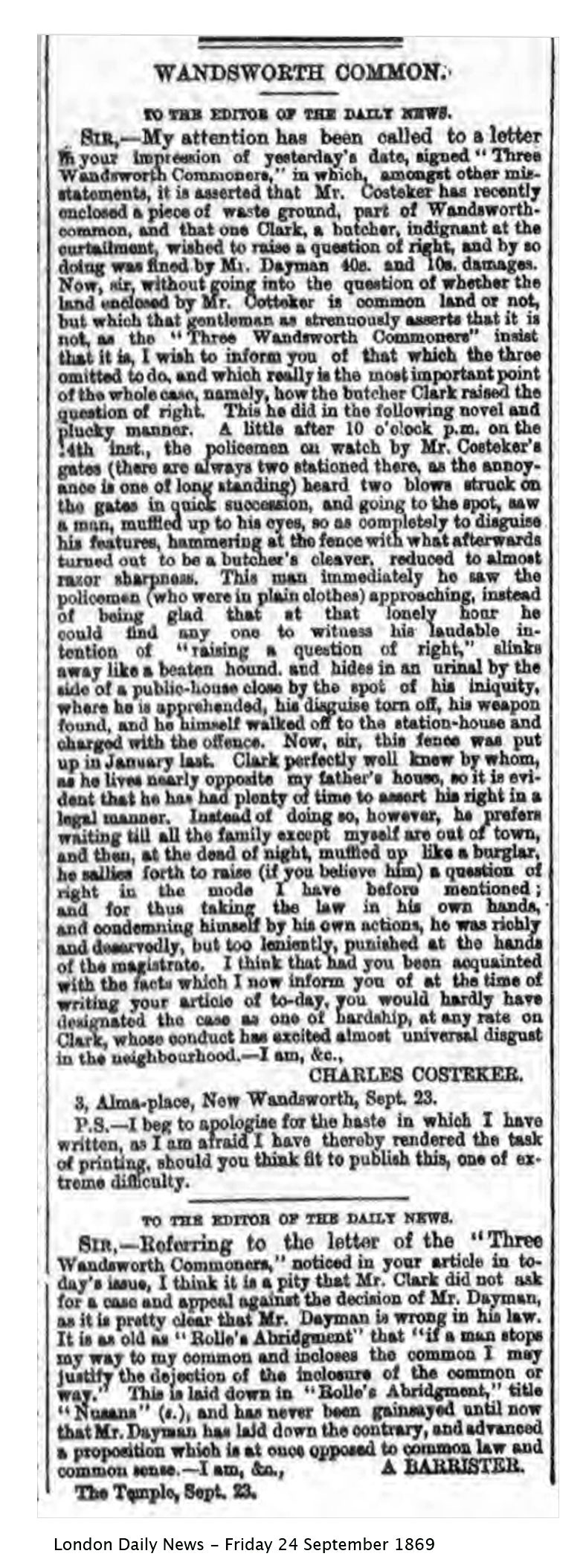
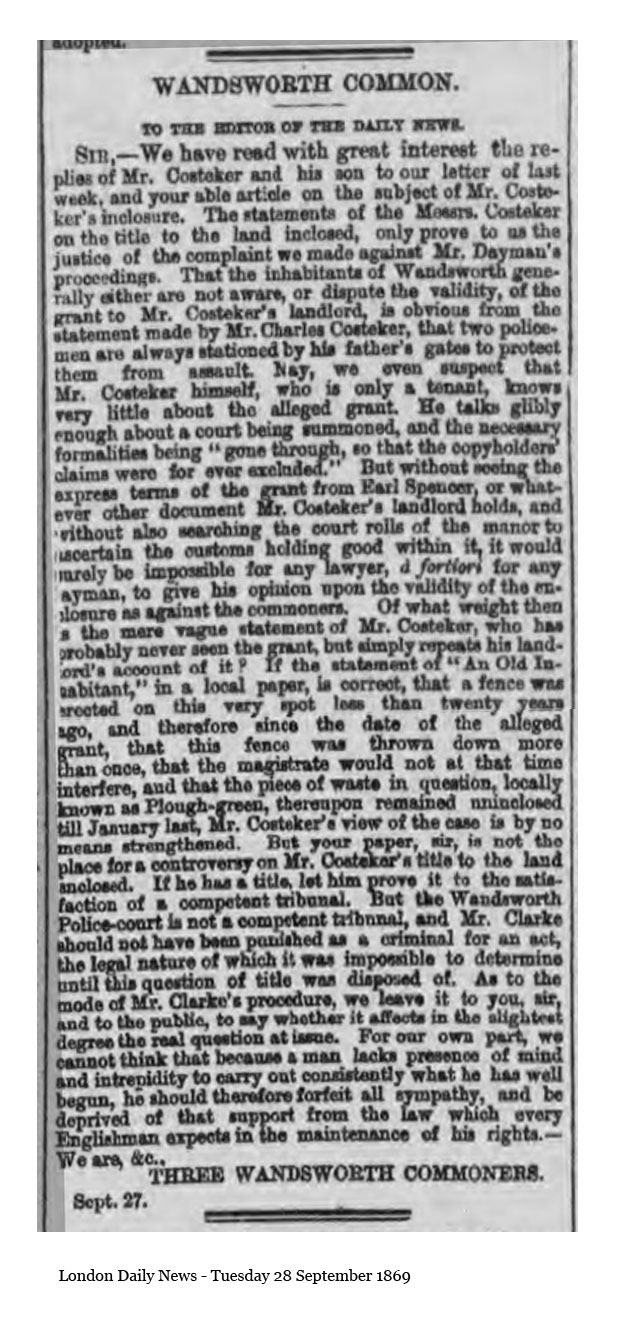
On May 14th 1869, John Buckmaster, a leading light of the Committee, was had up at Wandsworth Police Court, accused of "wilfully and maliciously destroying a fence enclosing the property of Mr Christopher Todd at Wandsworth Common."
Todd had bought the land from the railway Company, but campaigners claimed they had no right to sell, as the Lord of the Manor had no right to sell it to THEM. Breaking down the fence, Buckmaster stated that he was asserting common right. [A]
Buckmaster in the news
BNA: "Buckmaster"
TO FOLLOW UP: Numerous articles about lectures Buckmaster has given all around the country on the education of working men, elementary schools, Government aid to science classes, the "Workmen's International Exhibition", schools of Art and Design etc. A very busy man indeed. Could reconstruct his diary! But he continued to be central in activities to protect Wandsworth Common.
- Workmen's International Exhibition, meeting in Scarborough [?]. JB reflects on his own career as a carpenter..
(Click on image to enlarge)
[NEEDS EDIT]
At Scarborough, the other evening, Mr. Buckmaster addressed a crowded audience on the Government scheme for promoting scientific instruction. He stated that the council of the proposed International Exhibition had received much encouragement from the workmen of France, Spain, Germany. Italy, Switzerland, Belgium, and Russia and a hearty co-operation on the part of the working men in the large towns of England would make the undertaking a great success. A requisition, seventeen yards long, and signed by some thousands of working mon, was presented to Mr. Gladstone, asking him to give the council the benefit of his name and support, which he had cheerfully consented to do, and the prospects, now the elections were over, were brightening every day — (hear, hear).
Mr. Buckmaster continued — The extreme subdivision of labour in some departments of industry — in which a man is kept all his life cutting threads in screw, or watching the breaking of wire is not favourable to the development of an intellectual race of workmen. A reckless system of competition contracts and speculation 3 done much to separate classes and destroy the desire and ambition produce good work — (cheers). Look at the houses built now and those built two and three hundred years ago. Look at the tool chest of the carpenters and joiners of the age we call barbarous; have you anything like them now? A few tools thrown into a basket and thrown into a man's back from place placa constitute the stock-in-trade of mechanic. When I was an apprentice, if a man had not a tool chest we should have considered him an idle travelling scamp. want, then, this proposed exhibition to revive the best associations of the past, and to bring together not only the work, but the workmen, to cultivate friendly relationships and feelings between them, and to confer on hand labour the dignity of a noble life — (cheers). For there is no reason why working man should not attain the same culture and refinement of feeling as other men — The success of this scheme will depend on the hearty co-operation of the working classses.
[BNA: Western Times, 1 January 1869.
- LINK.
- Science Classes, South Shields.
- LINK.
- LINK.
- LINK.
- LINK.
South London Chronicle — Saturday 2 January 1869
OUR PAROCHIAL PARLIAMENTS. WANDSWORTH.
Board met Wednesday afternoon, when Mr. Meaden presided, and there were present Messrs. Riches, Brown, Loot, Manchester, Todd, Costeker, Vooght. Alder, Bariinger, Langton, Wright, Webster, Clayton, Kempster, Dagnali, and Young . . .
. . . That a deputation be appointed to meet Mr. Costeker on Plough green, with the view of making an arrangement for the formation of a road, 40 feet wide, from the Freemasons' Tavern to the Plough Inn, in accordance with the plan prepared by the surveyor;
The Battersea Local Committee made the following recommendations . . .
; That a deputation be appointed to meet Mr. Costeker on Plough green, with the view of making an arrangement for the formation of a road, 40 wide, from the Freemasons' Tavern to the Plough Inn, in accordance with the plan prepared by the surveyor;
[BNA: Link.]
Newcastle Daily Chronicle — Monday 18 January 1869
"Buckmaster — a lecture from him . . . sounds like a reading from Dickens"
The revival of the penny readings in connection with the Mechanics' Institute, South Shields, has so for been successful. A large audience assembled in the Mechanics' Hall on Monday last, and an excellent programme was ably performed. The members of the institution seem to be imbued with new spirit, and consequently a greater activity pervades the various departments.
The movement commenced to promote classes in connection with the science and art department of Government got an excellent start on Friday night, when Mr. J. Buckmaster — and no person is more conversant or better able to deal with the matter — addressed a large meeting in the Mechanic' Hall and an interesting lecture gave full detail of why and how the establishment of snob classes would be beneficial.
If a Mr. Buckmaster could be got to the management of each class, there could be no doubt the success of the movement. He possesses the rare power surrounding dry facts with interesting circumstances* to so great degree, that from him a scientific lecture, while loses none of its importance, sounds more like a reading from Dickens than a recital of dry musty laws and principles. The plan operations instituted by Government eminently calculated make such classes popular, and productive of great good. R is very opportune that the movement should have been brought so prominently forward the time when the amalgamation of the Mechanics' Institute with the Working Men's Club is about to be accomplished. The great influx of members whose occupations identify them with the mechanical professions, and for whose special benefit both mechanics' institutions and technical education were promoted, will cause the establishment of suoh classes Sir. Buckmaster referred to. to be necessary.
As Mr. Stevenson, M.P., said at the meeting on IVidav night, there is abundance of material power in South Shields to ensure successful _ commencement, and once commenced, they ought to increase their power, and thereby their success. 1 hope it will prove so.
[BNA: Newcastle Daily Chronicle — Monday 18 January 1869 .]
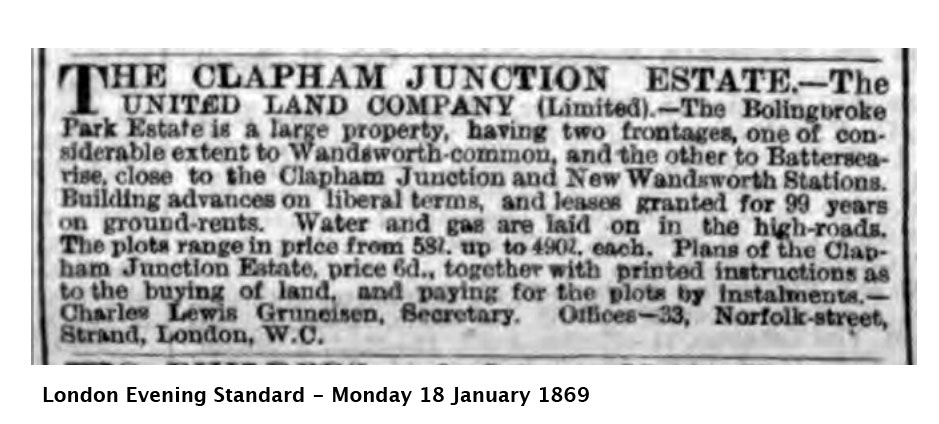
London Evening Standard — Monday 18 January 1869
(Click on image to enlarge)
CLAPHAM JUNCTION ESTATE. — The UNITED LAND COMPANY (Limited).
The Bolingbroke Park Estate is a large property, having two frontages, one of considerable extent to Wandsworth-common, and the other to Battersea-rise, close to the Clapham Junction and New Wandsworth Stations Building advances on liberal terms, and leases granted for 99 years on ground-rents. Water and gas are laid on in the high-roads The plots range in price from 58. up to 490- each. Plans of the Clapham Junction Estate, price fid., together with printed instructions as to the buying of land, and paying for the plots by Instalments — Charles Lewis Gruneisen, Secretary. O — lces — 33, Norfolk -street. Strand, I — inAon, W.C.
[BNA: Link]
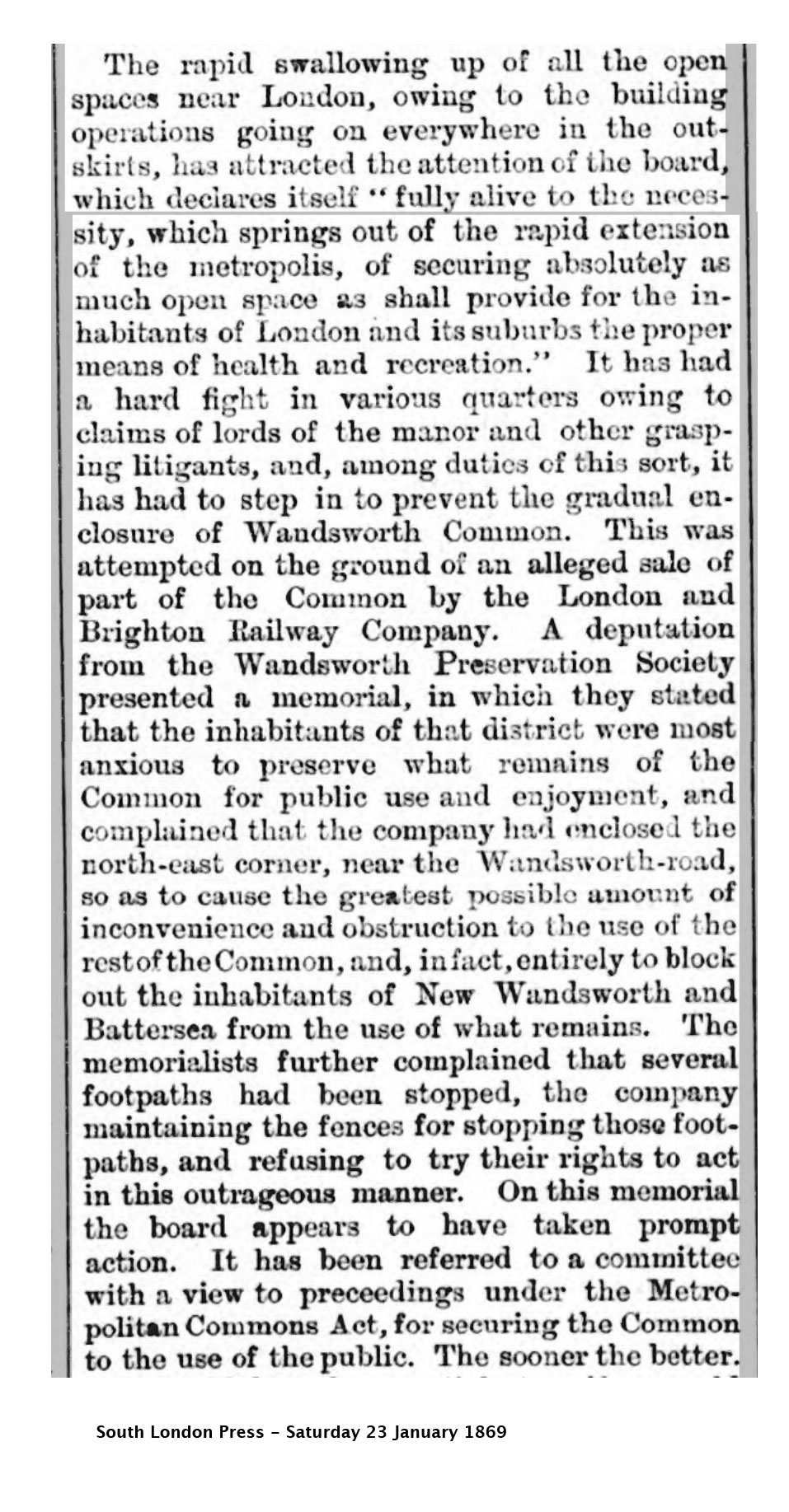
South London Press — Saturday 23 January 1869
(Click on image to enlarge)
The rapid swallowing up of all the open spaces near London, owing to the building operations going on everywhere in the outskirts, has attracted the attention of the board, which declares itself fully alive to the necessity, which springs out of the rapid extension the metropolis, of securing absolutely as much open space as shall provide for the inhabitants of London and its suburbs the proper means of health and recreation."
It has had hard fight in various quarters owing claims of lords of the manor and other grasping litigants, and, among duties of this sort, it has had to step in to prevent the gradual enclosure of Wandsworth Common. This was attempted the ground of an alleged sale of part of the Common the London and Brighton Railway Company.
A deputation from the Wandsworth Preservation Society presented memorial, in which they stated that the inhabitants of that district were most anxious to preserve what remains of the Common for public use and enjoyment, and complained that the company had enclosed the north-east corner, near the Wandsworth-road, so as to cause the greatest possible amount of inconvenience and obstruction the use of the rest of the Common, and, in fact, entirely block out the inhabitants of New Wandsworth and Battersea from the use of what remains.
The memorialists further complained that several footpaths had been stopped, the company maintaining the fences for stopping those footpaths, and refusing to try their rights to act in this outrageous manner. On this memorial the board appears to have taken prompt action. It has been referred to a committee with view to preceedings under the Metropolitan Commons Act, for securing the Common to the use of the public. The sooner the better.
[BNA: Link]
The Election of Guardians and Vestrymen.
Although some weeks will elapse before the ratepayers the various parishes of youth London will called upon to nominate and elect their representatives the vestriesand the Boards of Guardians, it not too soon to call attention to the necessity for securing the services of fit proper persons for these important positions, and to the qualifications which should required from all who come forward candidates.
As a rule, unhappily, both offices are rather shunned than sought after by the persons who are most competent to till them, and remember last year that the voting-paper in one of the largest of our southern districts presented the singular spectacle of nine candidates for the eight seats at the board, thus leaving the voter choice in single case out of the whole number. That this should the actual stale affairs, that men of high standing and good local influence should decline to fake their proper part in parochial business, is a proof that there is something wrong in the system or in the arrangements made for the meetings.
As to the actual fact there can no doubt. The members of the various assemblies are mainly selected from one class of the population, and not include that proportion of the clergy, dissenting ministers, and professional men which have right to look for. The causes their absence are not far to seek.
In the first place, the hour of meeting is, in the case of several of the boards, so arranged that it is impossible for any man engaged throughout the day to attend regularly; while in the second, the conduct of the existing bodies, and the scenes which are constantly witnessed at the vestry meetings, are of such a disorderly character that many men would think seriously before openly placing themselves in company where the Lord of Misrule seems to be the presiding genius.
So long as personal recrimination occupies hour after hour of the public lime, and abuse of the press for the exercise of its legitimate functions is indulged in vestrymen, so long shall see that very natural shyness of office on the part thoughtful and peaceable men which causes such serious injury our local institutions at the present time. not hesitate affirm that the squabbles the South London vestries, and the mismanagement at some of the workhouses, bringing with it the official reprobation of the guardians the Poor-law Board, have been the chief causes for the absence of those who not care to have their names associated with such proceedings.
That they should thus hold back from the plain path of duty, is of course proof that they lack moral courage; but unfortunately this is very common failing, especially among men of cultivated and sensitive natures; and can hardly surprised that they should object to spend an evening every week fortnight in an atmosphere of an utterly uncongenial nature, unless they feel sure that they can remedy the evil. to the public loss from their absence, our readers can form their own opinion, and would therefore suggest that during the next two months an effort should 'be made to secure their attendance. order to do so the ratepayers mast declare themselves in a most unmistakable manner several important points.
In the first place, they must demand from all candidates for the office of guardian pledge that economy, combined with efficiency, shall be their policy. Acting Mr. Gladstone's scheme, useless offices must be abolished, and parochial officials, like their brethren in the Government service, must required to show just cause for their existence, and proper result for the expenditure of the public money. Stern rule must take the place of anarchy in our workhouses, and hard taskmasters, no less than prevaricating masters and medical officers, must be treated with a strong hand, and suspended from their duties until they are proved to be innocent.
Ill-treatment of paupers, and their inhuman consignment to dark cells, must not be permitted, while equally strict surveillance must be exercised to the nature of the provisions supplied to the poor outside the house. Here are a few leading points on which every future guardian ought to declare his opinions before he is elected, and unless he can honestly bind himself to devote sufficient time the security of fairdealing all these matters, he has no right to take seat on the board.
In addition to this, each candidate should be required to 1 pledge himself to support the admission of re| porters to the meetings, and thus secure to the ratepayers the opportunity of judging for themselves of the manner in which the interests of the poor and expenditure of the money of the rich are watched over.
In the election vestrymen it should be insisted upon still more important requirement that unseemly conduct and personal attacks should banished from all the debates. If each candidate pledged himself to leave the room under protest directly the course of business was interrupted, sure check would be put upon the tendencies of quarrelsome members, whoso incapacity for office would thus clearly demonstrated to the public, and surely such a guarantee would not be too much to ask from men who aspire to take care of the interests of other people, inasmuch self-government is of the first necessity in those who wish to govern. But further than this a clear statement of accounts should demanded in the place of the present absurd summary furnished the back of the demand for the payment of rates. A
committee of the vestry ought to undertake to supply each ratepayer with balance-sheet, in which that convenient term sundries should be absolutely excluded, or, at any rate, limited to something under <£ loo, and if this were the rule we believe that a decrease would soon be found in the rates.
To procure such reforms those every candidate ought to morally bound, and at the close of his term of office ho ought to present himself before his constituents, and give nn account of his stewardship. If such qualifications are insisted upon by the ratepayers, and if they once realize the vital importance of putting the right men in the right place at the ensuing elections, we shall soon hear less of workhouse scandals and local mismanagement.
With improved tone the vestries and local boards, a higher class of men will be induced to take part in the proceedings, and without waiting for Mr. Qosehen to mature and execute his schemes, may forcibly realize truth, that reform, like charity, begins test it home. The whole matter lies in the ratepayers' hands, and in discharging their duty the nomination of proper persons, they will well to boar in mind that the interests of the country, as well as of the district, will influenced hy the result.
What is the Board of Works Doing for South London ?
etc etc
[BNA: Link]
South London Press — Saturday 30 January 1869
[WBW]
Wandsworth Board of Works
OnWednesday afternoon the fortnightlv meeting of this body was held in the Board-room, Battersea-rise.
Present: Messrs. G.P. Meaden (chairman), Dagnall, Shaw, Gaitskell, Loat, Riches, Hatton, Costeker, Vooght, J.F. Pulley, T.S. Pulley. Manchester, Brown, Turner, Hodgson, Young. Webster, Langton, Wright, C. W. Todd and Clayton . . .
THE ENCLOSURE OF WANDSWORTH COMMON
>The draft of a case, on which the opinion counsel is desired, was read by the clerk (Mr. Corsellis), at the conclusion of which it was decided to refer the matter to a committee of nine members selected from the board. The inquiry arises out of the action recently taken by Mr. Costeker, the lessee of a portion of the Common, who has erected a huge wooden barrier, covered with tar, across the footpath, the right of which is disputed.
[BNA: Link]
In consequence of the stoppage of the footpath across Plough Green (a portion of Wandsworth Common) by Mr. Costeker, the Wandsworth Board of Works has appointed a committee to take evidence the subject, with a view of ascertaining the legality or otherwise of the recent enclosure.
[BNA: Link]
"Battersea Vestry and the Vestry Clerk", South London Press — Saturday 13 February 1869
Battersea Vestry attempts to depose Arthur Alexander Corsellis, their Clerk
(Click on image to enlarge)
(Click on image to enlarge)
Battersea Vestry and the Vestry Clerk.
Serious charges against Mr. Corsellis — Important Poor-law Inquiry.
[NEEDS EDIT]
Allusion was made in our last issue to an inquiry by the Poor-law Board into a number of charges brought by the Battersea Vestry against their clerk, Mr. Corsellis. The proceedings being now closed we give a full account of the nature of these charges, and the principal features of the evidence produced.
Supplementary to many complaints made from time time by sundry ratepayers, the Vestry appointed a special committee in'inirc ($,10 several alleged defalcations and irregularities e-. the laid of a rate collector, and in consequence ~f th ir being the ivuirt of that committee$-tliat Mr. Corsellis hut been guilty of persistently and wilfully thwarting the efforts of tho investigators; ,1, . of neglecting portion his duty, not affording requiaite the accountant employed the committee accordance with Hie, "iry'$ instructions; iuefflciently discharging his duties. they memorialised the Poor-law Board piire into circumstances of the case, with a Tl,.ic'nf deciding whether Mr. Corsellis should be iho iis- from his office. It was believed he tilled the olHces of clerk the county justices. .'$ rktotbe overseers, clerk the District Board if \V..rks clerk to the vestry. Besides having private legal practice; that owing to the ul the duties lieiug fsrilled to sillxirdinate clerks who were not vaula to tho vestry. Mr. Corsellis win i.ua to afford proper information to the vestry respecting ali-tractiou of the account book'from the accountant, by his (tho vestry clerk's) private clerk representing him, which caused additional the committee, by wasting the accountant's time. vestry meeting held the tilth .Inly, IktlS, Mr. tterlolseej moved for the appointment of the committee of Inquiry, which was decided upon, five _gentlemen being selected fur purpose, i'ower given (or the committee to employ accountant investigate the liooks. A'c., and also to engage mich other asetslaneo a* might bo deemed necessary. retired police-sergeant.$Mr. Dudley$who had COM- ruble know ledge of the parish, waa employed prosc ute certain tuquirisa, which resulUid iu tho dis.-overy that several rates had been returned by the collector $a being past recovery, Although re eipw for the money had boon produced with ad collector's signature attached. eheok oust any improper use the collected, counterfoils were left in the book, nml one the charge?- dust Mr. OulmellU was that bo had allowed Hi. h counterfoils doled occmiuls to remain iu the (mads of the colluctors against whom they were included to cheeks$lids iu neglect of his duties stated iu No. 4 pnragrnph the Act of I'arhsaient, aud 11 Viet., cup. . )7. The committ, f which Mr. Hertohicri was chairman) being dissatisfied with the result of their labours, beingas they said$Texatiously opposed the vestry $ erk, I not pleased with the collector being appumteil tho guardians, and responsible to the Overseers ( but not to the vestry), presented report to the ve on the 10th of November, of which the following is a copy:
COMMITTEE'S REPORT.
Your committee have again to report obstruction by Mr. Arthur Alexander Corsellis, your clerk, to their labours carrying into effect your instructions I into the mode of conducting the business of the imrisli, and into the accounts of the rates collected.
In the present instance your committee call your attention to a letter from Mr, Corsellis the chairman of the committee, dated 2t|lh October, iHtiH; to a letter (nun Jir. C. Gray, your accountant, to our lirmari, dated -'7th October. DM)*; the of a letter from Mr, Dray to Mr. Corsellis, dutcu: llBt October. IMli*: letter our chairman to Mr. Corsellis, dated -ud November, 18(18, and to Mr. Corsellis' letters the llrd November, 18(J8, to our chairman, mid Mr. Oray refusing to produce to the latter, investigating acconnlanl. the poor rate of the West Division for October, {B i7, the rate book the West I livisiou (or November, Isib, and a ledger and cash book of local rate accounts until the poor rate book of Fast Pivisiou he replaced in Ids hands which deliant attitude Mr. A. A. Corsellis, your clerk, to the orders given your ronimltteu to him your resolutions of '.'ttli July nud 17th August of the year, has effectually clop|ieU the inquiries of your committee, who have already discovered irregularities and defalcations.
In connection with the persistent and vexatious oppositions offered Mr. Corsellis the vestry, our committee are ul opinion that the facts may thus recapitulated:
That the information relating to the property of the parish, the amounts collected, Ac., called fur hy the v. >try leth.lune, t-Silg, have never been reud r. d bv the vestry clerk ordered by the vestry on that day.
That he has, in a spirit of opposition, not delivered to the eonntaut sp],oiiite,l investigate the accounts tUi' t.i which are necessary fur him prosecute Inquiry, that he has also declined to afford information the accountant, aml bus refused answer questions the relating to the business of llie |$n$h, sud that h-' has thus oppose,l himself to the instructions of the vestry given him by your resolution 'i Ith July, iktik, appointing the committor . a by your subsequent minutes of August, 18li8.
That in neglect of No, t paragraph of the duties required of him Hie Act idth and VicU, _ ii 7, he bas allowed the enmilerfoils of closed isles remain in the hands of the collectors of those rales against whom am h eils were ft check.
That has he insufficiently discharged his duties |mintc . . . 7th paragraph of them, requiring him > tho church rate accounts. That has ine eiontly perfernied or neglected to carry _ the Mil section his Instructions requ.riug examine tliu arrears of poor rale. has persistently and vcxatiously tried to If art the of the vestry and cominittee .q _iuled i,v the v> inquire into the conduct of (he, aroehial bus ness. notwithstanding has told by the members of the committee appointed to inquire ittlo the busim iuvusligate the aecuuuls tliat one of tin collietora had rei-eived several sums aud not $_ ume.i for tliem yet, he haa. through Ids clerk, through the Induenoe possess, s t>y his plurality olliees, and his own action, endeavoured to _ the closed rate book iu the bauds of the poor r$' $ >ll. dor, against whom it is a cluck, ami for puqi-se has ignored tlio fact tlial one of Hie orensaors has taken in the attempt place the nle Issik in ilia hands the defaulting collector; $'I. m re vcr. that has prevented tlio investigat' l.y Hie committee and their accountant iuto Uic r- in the rates which are under the colleehun, f another collector, ilmt although ha ia licit the overseer a. and is their legal adviser, he allowed the collectors (including the defaulting retain the counterfoils of I he reedpts given terra for |Kior rates, which counterfoils are the, '' t "'i the collectors, tuid, moreover (to wm, obliged cadi for such counterfoils), baa ~*". alatcl them ttia prouerty of the 'ten. wherem the cost of those counterfoils has $ci j$id out $I the money raised rates in the counterfoils, which should have been in the . u of the vestry clerk for paid local rates are 1 'uitUcoming, and that the withholding such 4n,t hook, f n,.count he is screening ' '* r ***', H'' o,or '' from similar Inquiry haa dido ii-d .Icf.dt alious the poor ratea, __ vestry clc. being the person to give the '_ claims to vote for Parliament, i.,i ""t lista of voters and get the same -led and published, and duly according law, should not take part engaging himself professionally iu electioneering struggles, but should occupy an independent position above any suspicion detrimental to the idea of impartiality in th- operation of the law.
That it is prejudicial to the proper performance of tho duties of the vestry clerk that should hold plurality oliiroH, being clerk the county justices, clerk to the overseers, clerk to tbs District Board of Works, and vestry clerk, besides having his own so[p$rat$ profession occupy his time, which, for the salarv )$id to him. should be more devoted to parochial matter*, and that owing to the system of duties being thus (armed out and performed subordinate clerks, not the servants of the vestry, the vestry clerk was unable on recent occasion afford information to the vestry when called upon to so respecting the abstraction cf the account book from the accountant his (the vestry clerk's) private clerk representing him, such abstraction having caused additional expense wasting the professional accountant's time.
Your committee, under all the circumstances of the case, instructed Mr. Charles Gray, the accountant, draw a port for your vestry of his investigations far has been able to prosecute them, have directed him to attend your vestry therewith.
Your committee have also drawn a statement of the personal inquiries Mr. J. Dudley. the party employed t>?st the actual arrears of rates said to be in arrear —
F.R. BERTOLACCI, HUBERT DE CARTERET, FREDERICK WIX, and J.P.TURNER.
RESOLUTION TO DEPOSE THE VESTRY CLERK.
[column 3]
On the above report the vestry passed the following resolution: "That for the reasons stated by the committee appointed by the vestry on 24th July last
[MISSING BIT from bottom of ONE to part way down TWO]
February 9, 1869
Dear Sir, I have heard from the secretary of the Poor-law Board. He points out that the change of a parish from Schedule B to A belongs to the department of the Metropolitan Board of Works. The Metropolis Local Government Act (18 and 19 Viet. C. 120) regulates the present system of distribution. It does not appear that any power change is contained iu the Act aud I presume, therefore, that to carry out the wishes the meeting, over which you presided, enabling Act would required. the Board Works has no parliamentary representative, 1 should recommend you having interview jrilh Sir John Thwaites [Thwaites was very high up in the MBoW] on the subject. resident in the immediate vicinity, must healready acquainted with the facts the case. I shall be happy to accompany deputation should one he considered desirable, or see you here apointment any morning, if I can be of use in the matter.
Yours faithfully, WILLIAM BRODRICK.
[To: ] J. C. Buckmaster, Esq.
"20, Eastcheap, E.C., Feb. 8, 1869.
Sir, I have communicated with my colleague, Mr. Brodrick. I shall be happy to act with him in the matter of the first resolution. regards the second$the preservation of Wandsworth Common shall only be too glad of the opportunity to help so desirable au object. But the neighbourhood must itself first come forward and distinctly state its wishes, and to what extent it is prepared to support them. The Wimbledon Common Committee is doing its best in the public interest, but there are great differences of opinion, and many think the Metropolitan Board of Works would be no improvement on Earl Spencer. Personally, I have already spent about -C.'.mm in ventilating the subject of open spaces, d shall quite prepared to join others in further action.
Yours faithfully, HENRY PEEK.
[To] J. C. Buckmaster, Esq.
POOR LAW COMMISSION OF INQUIRY
In accordance with the prayer of the vestry, the Poor-law Board appointed Mr. Henry Lougley, Poor-law inspector (assisted Mr. Fry) to sit at Lammas Hall, Battersea, for the purpose of taking evidence. The sitting commenced on the 2nd inst., and occupied four days. The petitioners were represented by Mr. Brydges, barrister, during the first two days (other engagements preventing his continuance), instructed by Mr. W. Wood, solicitor. The latter-named gentleman conducted the case during the remainder of the sitting. Mr. Corsellis defended his own case.
Mr. Charles (Gray, public accountant, stated that he had examined aad proved great irregularities in the rate books, shewing that the rates and arrears had been incorrectly entered, also that the additions of the columns did not produce the same sums those which were entered as totals, and, to use his own words, the entries appeared have been made to "fit the accounts."
The vestry clerk admitted that had exercised no check nor supervision over those irregularities, and sought safety in the statement that ho did not consider it his duty to so.
Mr. Francis If. Bertolacci, chairman of the committee of tlio vestry, was examined at great length. His evidence was given to show the systematic opposition of the vestry clerk tothe endeavours of the vestry and the committee of the vestry in investigating the affairs of the i$rish, and that owing to the vestry clerk at last refusing to give rate-book to the accountant employed tlia vestry, the investigations which had already disclosed defalcations on the part of the rate collectors had been impeded. also deposed that the vestry clerk had allowed defaulting collector to get possession of the documents which should be check on the sums he had collected.
Mr. Daniel Collins was examined, who proved that he had been treated defaulter the payment of poor-rate, whilst on the contrary his rates had always been paid with the greatest punctuality; and that rate collector, to avoid accounting for the money received from him (the witness) had falsified counterfoil the receipt.
On the same day Mr. J. Dudley, the inspector employed by the committee of the vestry to inquire into the alleged arrears of rates, gave his evidence to numerous cases which he had personally investigated, very large proportion of whloh he discovered not in arrest, whilst in numerous instances sums entered the collector irrecoverable had actually been collected by him and not accounted for.
Mr. Spice, the clerk and church-rate collector, deposed that the vestry clerk had not given him the church- r.iio book contaiuiug amounts claimed until the expiration of weeks after the rate had actually been in collection, and that, although the vestry clerk's duties required him to keep the church-rate accounts and check the sums collected, he had never done either the one or the other.
Mr. Buckmaster, the churchwarden, was examined. His evidence extended to a much greater length than that of the other witnesses. He said that from the date of the appointment of the present vestry clerk, whole affairs the parish had been neglected and mismanaged, and that even the letters had addressed to the vestry clerk calling his attention to various matters of importance, had been returned unopened, whilst the arrears in the collection of the rates had in five years accumulated upwards of £ l000 per annum, until they had reached sum of above Co,ooo, which had, iu a most unaccountable manner, suddenly disappeared altogether in the account book.
At the conclusion of the evidence for petitioners, Mr. Corsellis, who had conducted his own cross-examinations, produced witnesses to character$persons connected with the vestry during the time the allowed mismanagement was proceeding.
The proceedings were conducted with great calmness both sides, bitterness Ixdng apparent.
The Poor-law Commissioner remarked that he could not anticipate the decision of the board, yet he considered that such a state of irregularity in the parish could not be allowed to continue. Ho took away with him one of the rate books, and some of the forms of receipts for sums different those which were actually payable, for the purpose of showing them to the Poor-law Board.
The vestry now awaits the decision of the Poor-law Board on the subject.
[BNA: Link]
[See e.g. South London Press — Saturday 19 May 1866]
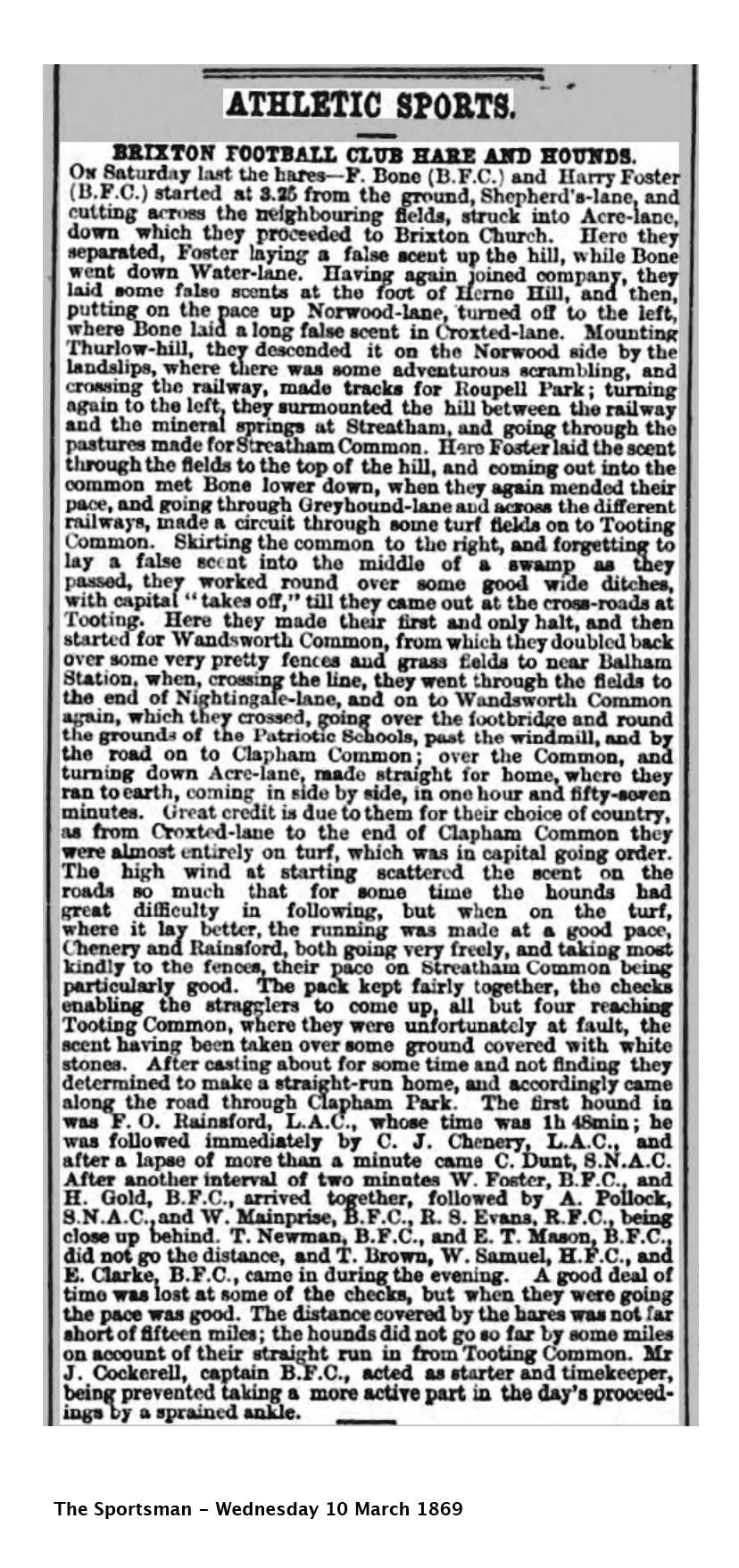
The Sportsman — Wednesday 10 March 1869
(Click on image to enlarge)
ATHLETIC SPORTS. BRITTON FOOTBALL CLUB HARE AND HOUNDS.
On Saturday last the hares — F. Bone (8.F.C.) and Harry Foster (8.F.C.) started 3.26 from the ground, Shepherd's-lane, and cutting across the neighbouring fields, struck into Acre-lane, down which they proceeded to Brixton Church. Here they separated, Foster laying a false scent up the hill, while Bone went down Water-lane.
Having again joined company, they laid some false scents at the foot of Heme Hill, and then, putting on the pace up Norwood-lane, turned off to the left, where Bone laid a long false scent in Croxted-lane. Mounting Thurlow-hill, they descended it on the Norwood side by the landslips, where there was some adventurous scrambling, and crossing the railway, made tracks for Loupell Park; turning again to the left, they surmounted the hill between the railway and the mineral springs at Streatham, and going through the postures made for Streatham Common. Hero Foster laid the scent through the fields to the top of the hill, and coming out into the common met Bone lower down, when they again mended their pace, and going through Greyhound-lane and across the different railways, made circuit through some turf fields on to Tooting Common.
Skirting the common to the right, and forgetting to lay a false scent into the middle of swamp as they passed, they worked round over some good wide ditches, with capital takes off," till they came out at the cross-roads at Tooting.
Here they made their tint and only halt, and then started for Wandsworth Common, from which they doubled back over some very pretty fences and gras* fields to near Station, when, crossing the line, they went through the fields to the end of Nightingale-lane, and on to Wandsworth Common again, which they crossed, going over the footbridge and round the ground* of the Patriotic Schools, past the windmill, and by the road on to Clapham Common; over the Common, and turning down Acre-lane, made straight for home, where they ran to earth, coming in side by side, one hour and fifty-seven minutes.
Great credit is due to them for their choice of country, .-is from Croxted-lane to the end of Clapham Common they were almost entirely on turf, which was in capital going order. the high wind at starting scattered the scent on the roads so much that for some time the hounds bad great difficulty in following, but when the turf, where it lay better, the running was made at good pace, Chenery and Raiusford, both going very freely, and taking most kindly to the pace on Streatham Common being particularly good. The pack kept fairly together, the checks enabling the stragglers to come up, all but four reaching Tooting Common, where they were unfortunately at fault, the scent having been taken over some ground covered with white stones. After casting about for some time and not finding they determined to make a straight-run home, and accordingly came along the road through Clapham Park.
[Results — names and times — follow]
The first hound in was F. O. Ruinsford, L.A.C., whose time was Ih 48min; he was followed immediately C. J. Chenery, L.A.C., and after lapse of more than minute came C. Dunt, B.N.A.C. After another interval of two minutes W. Foster, 8.F.C., and H. Gold, 8.F.C., arrived together, followed A. Pollock, B.N.A.C..and W. Mainprise, 8.F.C., R. 9. Evans, R.F.C., being close up behind. T. Newman, 8.F.C., and E. T. Mason, 8.F.C.. did not go the distance, and T. Brown, W. Samuel, H.F.C., and E. Clarke, 8.F.C., came in during the evening.
A good deal of timo was lost at some of the checks, but when they were going the pace was good. The distance covered by the hares was not far short of fifteen miles; the hounds did not go far some miles on account of their straight run in from Tooting Common. Mr J. Cockerell, captain BJ?.C., acted starter and timekeeper, being prevented taking more active part the day's proceedings by a sprained ankle.
[BNA: Link]
South London Press — Saturday 13 March 1869
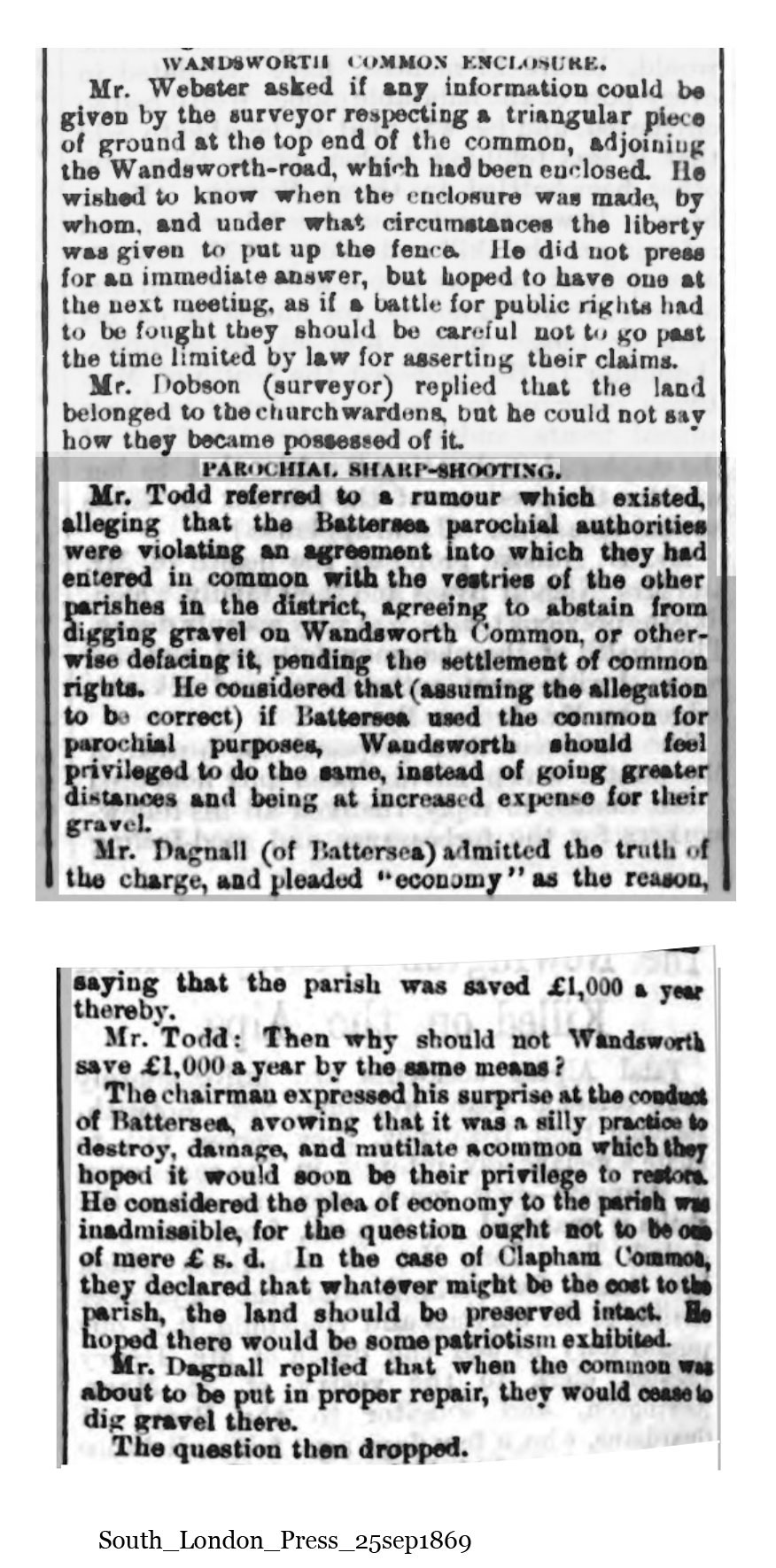
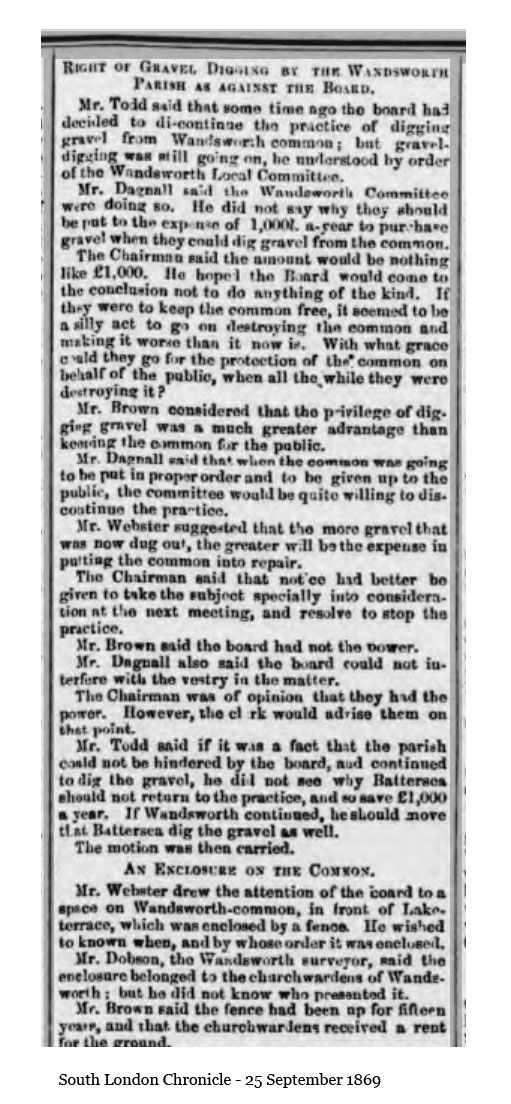
Loose characters assemble and harbour so numerously Wandsworth Common (even in broad delight) that the District Board of Works deemed it necessary to apply to Colonel Henderson for additional police supervision in the district.
[BNA: Link.]
South London Chronicle — Saturday 13 March 1869
[WBW][NEEDS EDIT]
Delinquent Battersea
The chairman called attention to the large arrears of Battersea; £ 48 19s. lid. was a small sum to be paid off £ .
Mr. Costeker said he must own the arrear looked very bad. but it gave them some satisfaction in that they were not worse in proportion to their neighbours. They had n about the arrears to Mr. Nicholls, and he had told them that to enable him to give more attention to the collection he had relinquished his duties as collector of assessed taxes, and the making up the accounts had so much delayed him that he had not had the time to give tho necessary attention to the collection of the rates. In the course of eight or ten days he would be at perfect liberty.
The chairman said that no parish was so much in arrears. Balham-hill collection had been almost all got in, in the short period of six months.
Mr. Costeker: Perhaps tho people are better able to pay. . . .
Plough Green: Public Right of Way
The clerk reported the reception of the opinion of counsel on the case referred to him on the question of the public rights over Plough green. He thought a right way could not established. Assuming that previously there was a right of way across the green in the direction intersected by the railway, a way had been substituted for it. The question was whether another right of way had been formed.
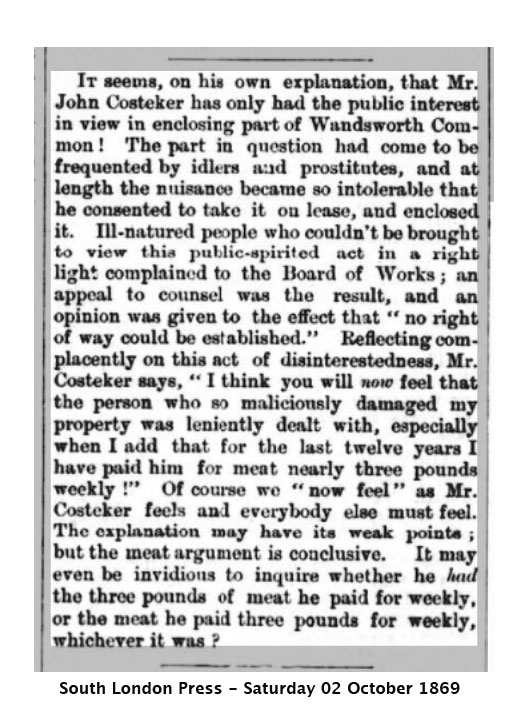
If the public had used any way for considerable length of time the use by the railway would not alter the legal result. In the present case the course of the path had been varied from time to time. Unless the course could be defined and there were proofs of continual use, no right could be maintained. Where there was a right of way, interception would not interfere with the right; but where, as in this case, the question was whether there had ever been right, it was necessary to prove a continual usor.
The chairman said that the opinion had better be entered on the minutes and referred to the Battersea Local Committee and that that committee summon a special meeting to consider the case and report upon it to the board.
Mr. Costeker said that when the board decided to submit the case to counsel be [he?] promised, and thought the board had promised, to be bound by the opinion. With that view, was it necessary to refer it at all?
The chairman said the board had made no such promise. As a matter of courtesy the opinion would be sent to the committee specially concerned, although the decision would be ultimately with the board.
The chairman's suggestion was then agreed to.
Tramways for Battersea
The clerk read the report of the agent appointed to oppose the Metropolitan Tramways Bill, be! half of the Wandsworth district The result of his negociation with the promoters the bill was that if he would withdraw his opposition they would amend the hill as to forbid the construction of tramways in any portion the Wandsworth district. He further observed that the bill in its passage through committee would require close watching, for j fear the promised amendment should shirked. There was a very general feeling anions members that the scheme would hen lit the working population and enable them g» t to Battersea park.
More Police for Wandsworth-common
The clerk was instructed to prepare a memorial to the Chief Commissioner of Police, asking for additional police supervision on Wandsworth common, for the purpose if possible of removing the people of loose character who harbour there.
Mr. Costeker said the common was covered with loose women, who were accompanied by bullies to protect them, and aid them in insulting people going across. He had succeeded in driving them away from his corner, and hoped the board would do what they could to drive them away altogether.
The clerk observed that the board were about to take stops to ascertain who had the control of the supervision of Wandsworth common, and this end would, as a member had observed, be furthered the memorial . . .
The Burial Ground, East Hill.
The clerk read a letter from Dr. Usher, calling attention to the state of the old burial ground, 11 ill, and the wanton destruction that has taken place there.
The matter was referred to the Wandsworth committee.
Loose characters assemble and harbour so numerously on Wandsworth Common (even in broad daylight) that the District Board of Works deemed it necessary to apply to Colonel Henderson for additional police supervision in the district.
[BNA: Link.]
Also
South London Chronicle — Saturday 27 March 1869
Public Rights on Wandsworth common
The Battersea Local Committee recommended that the opinion of Mr. Mellish, Q.C., be taken in the matter of the Plough green Enclosure, but on the statement of Mr. Costeker that if no action were taken by the board, he would offer no oposition to the continuance of the path near his house to the use of the public, the recommendation was withdrawn.
>>https: //www.britishnewspaperarchive.co.uk/viewer/bl/0000443/18690327/041/0005<<
South London Press — Saturday 24 April 1869
Velocipede Race on Wandsworth Common
Velocipede Race on Wandsworth Common — Wednesday a race took place with now fashionable recreation of velocipede riding on a level road on Wandsworth Common, between six amateur velocipedians, for stake of XI-'- � distance was two miles, and two of the competitors, who travelled with two-wheeled machines, were handicapped, and put i> yards below the starting point The other four, who contended with the old fashioned four-wheel velocipede. started level.
The race was commenced at a sharp pace. Mr. Canton (four wheels) finishing the flret mil Tin five minute# and seconds, ami commanding good lead spirited race was kept up. the riders the two-wheel velocipedes working easier than their opponents; and when within half mile the winning point a French gentleman (M. Ferno [sp?]) a two-wheeler came from the rear, passed his opponent, and won by several lengths. Ihe last half-mile was covered two minutes and seconds, and the two miles accomplished the winner minutes sod seconds.
[BNA: Link. What did these "velocipedes" look like? Why so slow? What was the route? What was the road surface? I have written notes about this — see the page on Trinity Road.]
- 8 May 1869
[BNA: Link]
(Click on image to enlarge)
Text
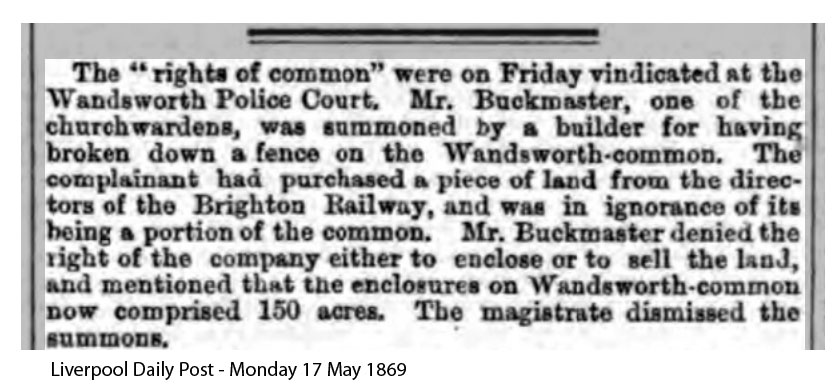
Liverpool Daily Post — 17 May 1869
(Click on image to enlarge)
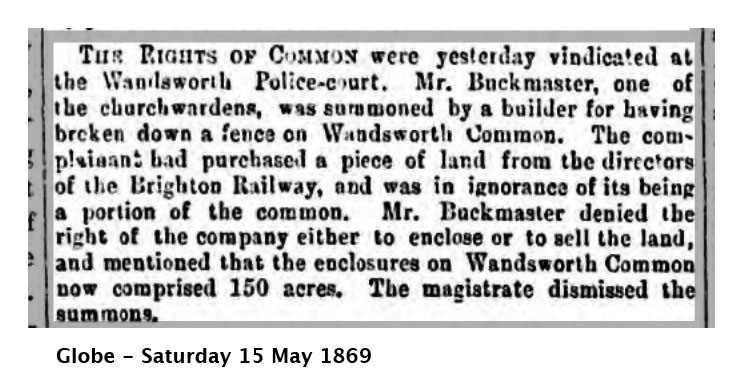
The "rights of common" were on Friday vindicated at the Wandsworth Police Court. Mr. Buckmaster, one of the churchwardens, was summoned by a builder for having broken down a fence on the Wandsworth-common. The complainant had purchased a piece of land from the directors of the Brighton Railway, and was in ignorance its being portion of the common. Mr. Buckmaster denied the right of the company either to enclose or to sell the land, and mentioned that enclosures on Wandsworth-common now comprised 150 acres. The magistrate dismissed the summons.
[BNA: Liverpool Daily Post, 17 May 1869.]
[Also: Globe — Saturday 15 May 1869, Sun (London) — Saturday 15 May 1869 ]
15 May 1869
[BNA: Link]
15 May 1869
[BNA: Link]
15 May 1869
[BNA: Link]
15 May 1869
[BNA: Link]
[BNA: Link.]
15 May 1869
[BNA: Link.]
17 May 1869
[BNA: Link.]
17 May 1869
[BNA: Link.]
17 May 1869
[BNA: Link.]
South London Chronicle — 22 May 1869,
Buckmaster in Court for breaking down the fence on Wandsworth Common
(Click on image to enlarge)
[FINISH EDITING]
BREAKING DOWN THE FENCE ON WANDSWORTH COMMON.
On Friday week, at the Wandsworth police-court, Me. John Charles Buckmaster appeared to answer a summons for "wilfully and maliciously destroying a fence enclosing the property of Mr. Christopher William Todd, at Wandsworth-common."
Mr. Banham appeared for the plaintiff, and Mr. Buckmaster [?].
Mr. C.W. Todd said that he was owner of [the?] land on Wandsworth common. He bought it off the railway company. It was surplus land. [??] He was now [the sole?] owner and [freeholder?].
Mr. Buckmaster explained that this was a question of common right. He admitted breaking down the fence, and further said Mr. Todd knows perfectly well that the fence was not [??] with [??] intent. Mr. Todd [??] the agent for the [railway?] company [??] and land [??] . When they purchased the land — if they ever did purchase it — they purchased it without [??] subject to all the [conditions and contingencies?] of such a purchase. One of these contingencies has now arisen, and as [?] parishioner and freeholder of the manor, I [?] Mr Todd's right, or the right of the railway company, or the right of any one, without the consent of the [??] and the copyholders to the enclosure which I have broken down.
The facts of the case are simply these: within the past fifteen [?] years nearly 150 [?] acres of Wandsworth-common have been enclosed, and there is every prospect that the little which remains will soon be appropriated by speculative builders like the plaintiff, unless some resistance [is given?] to these encroachments. I have given this resistance as an expression of my strong [feeling?] that v. l; hi- $,n- has lit i'li $!or.$, aid and oth-rs are |"a. to i.c! -my $ which . Ifthinkfwwt toiastittto.
In 1854 the West London and Crystal Palace I'til way .i obtain to to iistrnct railway c.'.h-ceuinion, a-am 2tH)/. was j.-.i't the to parishioners 1' itt *r-' s tor th'.' oxtiiiguishment so r.m h of tie. ir t'glits of cf'inmon, or supposed rights of common, $ r which the l- w ">7 the '.ilwtiv w is optPe I. 1 passed into the liee 1- of 1.. Uelghton and S. nth ' Company, and three < .1 a."t.-i -'" . Mr. oi'.ers ' '.'llO tin lord the manor J about tea ae: \ i of the l'r d part of tlio common, by which the cepyholders were shut out, and two convenient and much c- 1 footpaths were taken away from the public, 'either tho West London and Crystal Palace Company, n$r Brighton and South Coast ilway any power tinder *h. ir Wj make th's enrloe n-r was it in"' .tiled 1 their litii .'f deviation, shown any ir s.
It was the after-thought a few ted per; >ui-, who wished to turn it to their ull profit, the railway company, in February, 1867, sell, in a quiet sort of way — for it was almost impossible to obtain the particulars of the sale — land which I contend they never to have possessed: the plaintiff either for himself or others, and the first thing Ji. i to let to r.i in who was bankrupt at $ho time the laud erict b.er'. use, ilu gates the parish cemetery, which is to opened during the l$erby week, the very appropriate sign, " The Lord ofthe Manor." put, if possible, stop to these | enclosures, and to cool the building fever of persons like the plaintiff, the whole case has been own into Chancery.
The Plaintiff and other? 're uit, which and others shall ' . our duty 11 prosecute with all the power assistance command, and I hope c'.iiers will help us. these enclosures are permitted without any i)imtiuu the right in time iK-eames indisputab e. Before it becomes too late I have I the right, and 1 must accept the responsibility. Two years ago Sir K. May no's in$'r ' ti'i'i 'he $as that they w r re not ' n v.-si the brenfeing down so much of the . was iry raise the jasstion of .jj'i.t, they sii prevent wilful and -i-.ary destructiou 'if property. Mr. Paynter twenty years ago had before hint the fame question. Mr. Parsons and others had broken down fenc- portion Wandsworth-coin-, inon$and he dismissed the summons. Other ranji'itrntes have declined grant summonses, and I sr.l mit, sir, that this question $; f right not within the jurisdiction of this stirt. The ease not criminal case, but one that must be decided by the Court of ' lue-n's tench, where and others are ready to meet the plaintiff.
Mr. Banham, for the plaintiff, cited a case in which a man was charged with shooting over property, and in which the magistrate decided against him, but Mr. Dayman said this was a very different case. Mr. Buckmaster had raised a bona fide question, which he was fairly entitled to do.
Mr. Todd: Then at that rate Mr. Buckmaster go and break down the whole of the fence.
Mr. Dayman: Oh! it's very likely he will do so.
Mr. Banham submitted that the defendant had no right over the property, but Mr. Dayman ruled that as the damage complained of was in the assertion of a right the court had no jurisdiction. Complainant's only remedy was by action for trespass. The parties here retired.
[BNA: Link.]
South London Chronicle — Saturday 22 May 1869
(Click on image to enlarge)
WANDSWORTH. The Board met on Wednesday afternoon, when there were present Messrs. Meaden (in the chair), Gaitskell, 1) ignall, Riches, Batten, Lout, Wallace, Clarke, Langton, Gurney, Bar- i ringer, Keighley, Webster, Turner, Brown, Hodgson.
Medical Reports. Clapham, fortnight ending May 8tli: births deaths 20. great deal of illness prevailed. The deaths were far above the avert go. Amongst the parish poor there were new cases of illness and 3 deaths. Wandsworth, May 8th: births 30, deaths 11. deaths occurred in {he Surrey County Lunatic Asylum, and lin the House of Correction. The mortality was below the average, if the deaths in the public institutions (which were above the average) taken into consideration. BatUrsca, May Sth: births 70, deaths 32. the mortality and cases of illness occurring among the union out door poor have decreased much; the health of the sub-district is satisfactory.%Previous fortnight: births SO, deaths 42. Streatham and Tooting, including Balham, no date (as usual): births 10, deaths Dr. Noel says: The general health of the sub-district improved during the past fortnight. For the week ending 20th April not single death was register d. Croup was the cause of death instances during the next week. The peculiar season was the cause, throat affections generally having been prevalent. Putney and Roehampton, May Ist: births 1-3, deaths 3. Dr. reports an improvement in the public health; measles, scarlatina, and diseases of the respiratory organs, lately very prevalent, were declining.
New Road across Wandsworth common
The Wandsworth Local Committee recommended, " That the board instruct their Battersea surveyor to complete the Battersea portion of the new road from the Wandsworth railway station to the railway bridge the Tooting road, Wandsworth common. Mr. Keighley raised a question on this point. Earl Spencer had no power to dedicate the road to the public or give right of way, inasmuch as the ground was not his exclusively to give. was bound to consult the copyholders and obtain their consent. moved, amendment, that the subject postponed.
Mr. Wallace (a brother vestryman) did not want to show any discourtesy to his colleague, but thought it a great waste of time to agitate the question from time to tim *, and continually reiterate the same sentiments. (Hear.) Battersea should complete the road, as it was a portion a work already agreed upon board, Wandsworth having completed its portion. Several members had something to say about rights and no rights, and the amendment was lost. The motion was then put and carried.
[ . . . ]
The Wandsworth-common Footpath Question.
After the conclusion the ordinary business, Mr. Keighley requested and obtained permission to introduce a subject some importance. said I that about four months ago he came across a footpath leading from corner to corner of the common. This path had undoubtedly existed long enough to make it a public path with a right way. The path in | question led up to Heathfield Cottage, and was the most direct way thereto from the high road. About two months afterwards a ratepayer asked him if had seen the further encroachment on the common; this footpath had been stopped. (Mr. Keighley) thought the man must have made a mistake. About month ago, however, was walking across the common again, and found across this footpath some scaffold poles. This understood had been done by the surveyor. The surveyor had thrown upon him the duties the old surveyor of highways, who under o and Will. 4, had the right of searching for gravel in any common, and of taking it without compensation to any one. But if in digging f-%r gravel, should obstruct the highway (and this path was the highway in this instance) was liable to a penalty of b!. This path was being gradually spoiled by the excavations for gravel and this the surveyor had no right to do. Mr. Loat said there was no right of way there at all. was only a trespass path across the green to the cricket ground, and had been diverted time after time. It was found to be dangerous if kept open, therefore the surveyor had been instructed to put poles to protect the public from the pit.
Mr. Keighley said it was a misinterpretation of the words to call this a trespass-path. It was of necessity a public path. Mr. Loat said it had never been repaired by the board. The Chairman stated that if the public had walked over it for years instead of years it would not therefore public path. That had been decided. Mr. Keighley said he was aware that the chairman's mind was quite made up on that point; but (Mr. K.) was not that opinion. If that could shown to true, would have to unlearn everything had learned. was laid down that the public have rights way; a path were used for twenty years, then there was a right of way. It would be so with his own freehold property even; and had the opinion of eminent counsel who said on this (K)iiit, " I know of no distinction betwixt common and other land." He felt so strongly this subject that if he had not been a member of the board, lie would have tried the question at law. lie would wish for the opinion of the clerk this point %whether, the public having used this* path for twenty years, they could prevented from going over it.
The Clerk said this was much and no more a public path than the one which went across the Patriotic Ground, where the old commissioners set the board at defiance. That was continuation of this same path. Mr. Keighley said he did not care how the old commissioners had set the board defiance. The question was had they the right of way 'r Let that poiut decided, for upon it the whole rights the public hinged. The Clerk said there had never been an act of dedication. They had taken opinion on other and similar points, but if the board agreed would wish to have another opinion besides his own on the point raised by Mr. Keighley. . . The board then agreed to take counsel's opinion.
[ . . . ]
The board approved draft memorial to the 1 Metropolitan Hoard, requesting a contribution towards the cost widening the railway bridge at New Wandswoith. The pamphlet containing the statement to the course taken by the Metropolitan Hoard with refer- to the Imperial Gas Company's now before Parliament was referred to committee. Mr. 1 /iy ton was permitted to extend vaults the south end High street, Putney, subject to payment ' of cost of taking and relaying pavement. A letter from the Commissioner of Police intormed: the board that immediate inquiries shall be- made; to the alleged assemblage gipsies and rough people near Battersea park entrance on Sundays.
[BNA: Link.]
22 May 1869
[BNA: Link.]
22 May 1869
[BNA: Link.]
22 May 1869
[BNA: Link.]
22 May 1869
[BNA: Link.]
22 May 1869
[BNA: Link.]
22 May 1869
[BNA: Link.]
22 May 1869
[BNA: Link.]
Norwood News — Saturday 22 May 1869 — 22 May 1869
Is Wandsworth Common "no man's land," Crown property, the property of the people, the lord of the manor, or what ? At any rate it appears to be disappearing gradually, and, so to speak, going into the pockets of builders. A case brought before a police magistrate brings out some anions facts. A gentleman is summoned for maliciously destroying a fence. He admits the destruction, but denies the malice, and he urges that a railway company had enclosed about ten acres, not for the purposes of their Act, and had then sold it, "in a quiet sort of way," to a builder About 150 acres of land have been inclosed in this way during the last fifteen years.
In this particular case the summons was dismissed, the magistrate remarking that the question of right had been raised. Yes, and the question of right — a matter that interests the public at large — has been often raised before, but it seems never to be settled. The new park at Finsbury has been gradually stolen — really the word is not too strong — from the people in much the same way, and nobody knows who is to blame, who is to remedy the evil, or how to prevent the continuance of it.
To me it appears that our laws about Commons and Waste Lands are " aw a muddle," as Dickens's hero in "Hard Times " puts it. No less than £ 128,000 has been voted this year for keeping up the parks and pleasure-grounds of London — and quite right say I, as a denizen of the metropolis, though people living a couple of hundred miles off may think differently — and yet our suburban commons are being eaten away, not by inches, but by acres; and it seems nobody's business to stop it. "
[BNA: Norwood News. Also Chelsea News and General Advertiser.]
25 May 1869
North Devon Gazette, 25 May 1869
John Buckmaster trial, 1869.
Mr. J. C. Buckmaster, churchwarden, was summoned before Mr. Dayman last week for wilfully and maliciously destroying a fence on Wandsworth-common, the property of Mr. Geo. Todd, builder. The defendant denied the malice, but admitted that he had destroyed the fence. He alleged that the railway company never enclosed this land (nearly ten acres) for any purposes of their act; but it was an after thought. was then sold in a quiet sort of way to the plaintiff in 1867, without any title, and denied the legality of what had been done.
Nearly 160 acres of the common had been enclosed during the past fifteen years, and these enclosures created great anxiety. The little of the common which now remains was daily threatened by speculating builders like the plaintiff, and had destroyed the fence because be felt ought not to be there. Mr. H. Todd's solicitor, urged the magistrate to make an example of the defendant, because the plaintiff's property not safe from another attack. Mr. Dayman said, as the defendant had raised the question of right and title, he most dismiss the summons.
North Devon Gazette, 25 May 1869
[Source: BNA: https: //www.britishnewspaperarchive.co.uk/viewer/bl/0001193/18690525/052/0003.]
Norwood News — Saturday 5 June 1869
A question, which is of considerable importance to us Londoners, will shortly be tried through an action for damage and trespass in breaking down a fence on Wandsworth Common. The right of the public to this so called "common" is involved in the dispute, though the fact does not appear on the surface. It is very strange that while efforts are being made to form new parks, and numbers of people are up in arms at the slightest encroachment on Finsbury Park or Victoria Park — and very properly — several of our commons are being stolen away from us bit by bit, by railway companies and speculating builders. I should not be surprised if this trial to which I allude were to lead to parliamentary action in respect to our very unsatisfactory law as to commons and open spaces.
Meanwhile, there is a bill before the House of Commons which would do something towards the simplification of this law. It extends the application of the word "common" in the Act of 1866 to "any open space which baa been enjoyed or frequented by the public for not less than twenty-five years," and makes the Act applicable to a radius of twenty-five miles from Charing Cross; both of which enactments would, to say the least, render encroachment more difficult.
The worst of it is that while Parliament is considering these alterations, our commons are being eaten away.
[BNA: Norwood News. Also Croydon Chronicle and East Surrey Advertiser.]
]
- 5 June 1869
[BNA: Link.]
- 5 June 1869
[BNA: Link.]
South London Press — Saturday 21 June 1869
1869-06-21-Corsellis-dismissed-SouthLondonPress.jpg
Battersea Vestry.
A special vestry was called on Tuesday in the St. Mark’s Schoolroom, Battersea Rise, to read the letter sent from the Poor-law Board confirming the dismissal of the Battersea vestry-clerk by the vestry in January last. The inquiry before Commissioner appointed by the Poor-law Board in February last has been before the Central Board during four months, the decision on which has not been given a few days ago. The letter, as received [by] the wardens of Battersea, was as follows:
“Poor-law Board, Whi 8. W., June 10, 1869. “ Sir,—1 am directed by the Poor-law Board with reference to the resolution which was passed by the of the parish of 8t. , on the of January last, dismissing Mr. Corsellis from his office of vestry clerk of that parish, to state that the board have carefully considered the case submitted to them by the vestry, and the facts at the inquiry held Mr. Longley, Poor-law in- , and that the have decided they would not be justified in withholding that consent which, by the 6th section of the 13th and 14th Vic, cap. 57, is required to be ven before the resolution of the ves to remove if r. Corsellis from his office can take effect. The board accordi consent to the removal of Mr. Corsellis from the of vestry clerk of the parish.
I am, sir, your obedient servant, “
ARTHUR W. PEEL, Secretary.”
“To the churchwardens of the parish of Battersea."
Objection was taken as to the validity of the on the ground that the usual three-days’ notice had not been posted on the church doors, to which the chairman (Mr. Buckmaster) replied that the objection was frivolous. As much com t hed frequently raised by Mr. Corsellis ciroumstances, it re-summon vestry for next Mr. F. RB. Bertolacci ve notice of his intention to move resolutions at next meeting to the fol- thon Gh, Oe: Wood, solicitor, for gratuitously conducting the in quiry before the Poor-law Commissi re. & committee of five be appointed to advertise in the daily and local papers for a person to fill the offi ce of vestry clerk, and to investigate the testimon jals of a same to the applicants, and report on the “That the members cf sach committeo shall a form pledging themselves to feign shall be sent b “That copies of the notices con the g vestries clerk to the editors of the same. local papers, an: any others that might apply for “That until the election of a successor takes place, the churchwardens be authorised to the requisite assistance at a £1 per week.” cost not exceeding
South London Press — Saturday 26 June 1869
Battersea Park Bridge
Deputation to Mr. Layard. In furtherance of the proposed scheme for freeing the Battersea Park Suspension Bridge from toll, in support of which public meetings have recently been held, a deputation including the Hon. W. Brodrick, M.P., Mr. W. H. Peek, M.P., Mr. Q. T. Condy, Mr. F. K. Bertolacci, Mr. J. C. Buckmaster, and about 50 inhabitants of Battersea and Pimlico, waited upon Mr. Layard, First Commissioner of Public Works, Whitehall-place, on Thursday, at noon, to urge the abolition of toll for Battersea Park Bridge, and the establishment of a bathingplace in or about Battersea Park.
Mr. Peek introduced the deputation.
Mr. Bertolaoci, in giving a brief history of the establishment of the bridge, stated that on the first Sunday the park was opened free no less than 100,000 persons availed themselves of the boon, from which he argued that the extension of the privilege for the remainder of the week would be proportionately appreciated. He showed that there were no less than 1,500 houses let in Battersea, many of which would be occupied by workmen the present impost on the bridge were abolished. The rates of the whole parish consequently devolved upon few residents instead of on many, and were consequently excessive. He also showed that for want of the moralising and civilising influence which must necessarily follow the occupation the property by the better olaas of people many thieves and vagabonds took advantage the sparsity of the population, by up their abode in the tenantless houses, from which they sallied forth to the neighbourhood of Wandsworth Common the superior districts commit depredations by night and day.
Mr. Peek referred to the arrangement originally made, and now existing, for the bridge being free when the loan for its construction, and per cent, interest, hod been paid off the toll; he feared that at the rate of their receipts up to the present there was no prospect of any person now living being privileged to see the franchise the bridge. Indeed, said Mr. Peek, the circumstances of the case were such demand the attention of the Government.
Mr. Buckmaster then addressed Mr. Layard on the proposed scheme for disposing of the surplus land on the outskirts of the park. He explained that when the park was laid out, 140 acres of land wen aet apart on the borders in the expectation that it would be let or sold for building purposes, and so tend to reduce the rates the district, bat scarcely any property had yet been erected. that time, a builder offered £1,OOO per acre for the whole of the land, but it was mmtionable whether any approach to that pnos could now be effected, and time wore on the case would be still won*. He believed the land would fetch more money now than in future, and that every delay deteriorated the value of the land for the better class of houses, where a large number the poor were aggregated in one corner of the metropolis without the civilising influence of better people. He recommended that the bridge-toll should be abolished, and compensation be obtained by selling letting the surplus park lands.
One of the members of the deputation, whose name did not transpire, appealed in favour of bathing being permitted in the park lake before ?? o’clock in the morning. To show the appreciation bathing convenience by the public, he stated that as many as 100,000 persons bathed in one day in Victoria Park. The Hon.
Mr. Brodrick showed the necessity for some provision being made to prevent the many indecent exhibitions he had seen a pond beyond the park where numerous people bathed in a state of nudity within sight of passengers in the railway trains.
Mr. Peek did not approve the use of the present lake for bathing purposes, but thought a bathing ground of four or five acres might be made on the surplus land, and the soil which was dug out might used for mounds on the edge to shelter the bathers from the neighbouring houses. said that many people now went into the Thames near to the park, and although they chose suitable places, they were sometimes carried beyond their depth by the wash of passing steamboats and were drowned. He thought that the sum of JBIo.OOO was to be spent on the Serpentine, and a huge amount on Victoria ftuk. a large bathing place ought to be made in Battersea Park.
Mr. Layard replied that with regard to the bridge, it was a question not competent for him to interfere with, it being a financial question. His own feeling was against tolls. Honey had been borrowed from the Commissioners of the National Debt, and they were under obligation to repay that money. The question must be settled by Act of Parliament, and application must be made to the Chancellor of the Exchequer, but he feared it was too late for this session. He referred to the system recently adopted by Government for recouping the costs of parks by the sale of portion of the lands, and also the objections raised by country members to metropolitan improvements being made out of the general rates. He was of opinion that metropolitan matters differed somewhat from provincial towns, as everybody had interest in the former. After expressing his sympathy with the object of the deputation respecting the bridge, he alluded to the bathing question, and said he thought it utterly impossible to use the present lake for bathing purposes, it being very small and only three feet deep. He much preferred Mr. Peek’s suggestion for constructing new place, and promised to pay early visit to the park and its surplus land with view of testing the suitability and practicability of the scheme. The deputation expressed their approval of the answers given, thanked Hr. Layard, and withdrew.
>>https://www.britishnewspaperarchive.co.uk/viewer/BL/0000213/18690626/007/0003<<
[NB actual page is p5 not p3 - the BNA pages are jumbled, and sevral pp are missing.]
South London Press — Saturday 26 June 1869
[GRRR . . . THE FIRST PART OF THIS ARTICLE, FROM ACTUAL P6, IS MISSING. I EMAILED BNA SUPPORT ABOUT IT 13 April 22025]
>>https://www.britishnewspaperarchive.co.uk/viewer/BL/0000213/18690626/009/0004<<
NB. UNLESS THIS LINK IS CORRECTED, IT POINTS TO p7 NOT p4]
NB "as published in our columns last week" - CHECK
The letter confirming the dismissal, as published in our columns last week, was read at this stage by the chairman, the contents of which were somewhat hazy, reflecting the time at which the vacancy commenced.
The letter confirming the dismissal. as published in our columnos last week. was read at this tage Dy the ebairiuep, the contents of which wert Sule Ww DAS bay. ope tins the time at which the vacancy Com-
Ms. Bertolacci thought they had had a great deal too much law; they should now have a little commonsense. He had spoken W& the vestry cler of another aad neighbouring 5 paris. iO thin the te the effect of their sot electing ® © the A next eix monte, the answer being that the Act was entirely permissive; it could not be enforced, there- fore they ned uot elect & clerk at all unless they thought ft ile urged thet they should deliberately Uiscuss the yuesuoa to prevent jobbery. lf they adupted Mr. Smith's suggestion, they must elect a Nerk at the pext vestry, without taking the pre- vautiud pecessary for avoiding personal interests
3 ved. bee ebeirieen declared the Act to Le permissive, and said they could refuse to elect a permanent clerk, apd employ une temporarily, if they thought fit, to te paid out of the rates. —
rr Saith (to the chairman): Do you consider the present meeting to be legal :
The Chairman: 16.
Mr, Smith: Has it beea amnounced on the church ‘doors ?
¢ Chairman: The meetings are held every alternate Tecseday according to a resolution passed in Uotober lest, and asnounced is the usual way.
Mr. Turver condemmed the practice of wasting the time of the vestry, saying that it arose from ignorance through certain members not attending the regular meetings. The previously met irregularly, but now met fortnigh y in accordance witb the resolution of October last which had sever been rescunded, therefore this was s competent and leyal meeting.
Mr. Smith admitted that the meeting might be lexal for perlorming the ordinary besiness of the vestry, bat not for the election of a clerk.
The Chairman: We are not going to elect ono.
Mr. Smith: Then 1 object to anything being said about the vestry clerk unless Mr. Bertoleca with- draws bis notices of motion.
Mr. Bertolacci thea proceeded to read his first resvlation ia favour of yiving a vote of thanks to Wr. Phillip Wood, tor, for the gratuitous services rendered by him in ecanection with the inquiry before the Pooraw Comsnission in Polruary last, when Mr. Wix interposed, asking whether it was true that Mr. Wood sent in a bill for 20 guiness for services rendered on thes occasion.
Tbe Chairmen: I don’t know.
Mr. Wix : You know something aboat it.
The Chairman. Wood baving charg nor am | conscious of Mr. charged a single farthing, although I understood that he had engaged other services, the cost of which amounted to 20 guineas.
Mr. Bertolacci gave an ex on of the case, although, he remarked, he tab never geon any pia, nur was he aware of one baving been sent in. The Poor-law Board wrote to him as chairman of the committes, asking for the names of gentlemen sum- muned to give evidence before the Commissioners. A meeting was beld at the Freemasons’ Hotel, when is was decided that the employmeat of some legal
tleman was necessary. On that uccasion Mr. Flood vuluntesred to get up the evidence im his capacity of solicitor, but it was upanimously agreed that a Barrister should be ongeged to conduct the case.
Mr. Wood was then aa rized to engage counsel. He presemed the 20 guineas alluded to would be for counsel“ emoant. ea they could mot expect Mr. to pay out own poctest, Te agdiion to giving his own services. He did not think the sum too mach, as the barristot attended om two era onal « before the case reverted into Mr. Wuod's care.
Mr. Hadtield contended that the amount wae only five guincas a day, as counsel weeld take toss for the whole esse, whether he attended the whole of the Oe Wis, byected to the of 10 guineas a da
. 0 be sam a
being paid, and thought they should bave knowin beforehand what they were liable for.
The chairman argued that they could mot ask a barrister ta advance what charge he would make.
Mr. Eary moved that the reselation for paeelo a vote of thanks to Mr. Wood shuald be erred for a fortnight to enable them to ascertain whether a bill for 20 guineas bad been sent in; and if s0, what for.
Mr. Bertolacct contended that evea if a bill for 20 guineas bad been seut in, it did net affect the motion, which was a recoguition of Mr. Wood's voluntary and personal services, apart frém the employment of * Mr. Wix: I beg your pardon, for if Mr. Wood bas
r. Wix : on, for Fr.
ecat ia as bill for
0 guiness it is very doubtful whether he ever paid it. (Cries of “Oh, ab." A barrister had been down to the inquiry, dit nothing , and in what little he did be was “ coached ’’ by Mr. Bertolacei.
Mr. Bertolacci denied the last charge, seying that counsel was “coached " by Mn Wood.
Mr. Keeterton seconded the amendment.
Mter a slight disturbance, iz which some very uncumplimentary leaguage was indulged in, the amendment in favour of delay wae carried.
Mr. Bertolacci then moved a resolution to appoint a committee of tive vestrymen to con4uct the salec- tiun of three candidates, whose names and qualifica- tions should be reported to the vestr'y ; also, Late list of candidates should be obtained by advertising in the daily and local press. The object in putting that resolution was to prevent th: peveonal convene which bad been carried ou in the pacivh, which placed many gentlemen in the very awk Ward positive of being unable to give a refusal for € personal rrasoas, even when opinions were in ac- cordance. He believed in the office being thrown upem to public competition, for peblic patrosage was public propersy, and any yrreann canvassing for votes »n a9 matter of that kive vis ee guilty of a great breach of public truest as he who eollected the pablic’s moar), aad appropriated it tohis own private
Mr. Wix: Who is to the e ?
The Ubairman: | will pay lor them if the auditors dieallow thems out loca] rates.
Mr. Bertolacei: I am willing to pay my share.
Mr. Gerrard seceaded the motion.
Mr. Turner urged that the duties of the vestry clerk should be defined to prevent further disputes on the subject, and alsa to prevent euch difficulties ag they Ter ew ei ie evionn fetenwhiok bea to the extent of £1,100 om previous rates which had fone on for years. He coucleded by proposing that
is saggestion should be incorporated in Mr. leeai’s motion.
Mr. Gardner thought the next clerk should have written instructions his duties.
Mr. Bertolacciconsidered erry have ® man nes ne badiness A & proper
Mr rede! Peered in { of employing
tr. ae avour oi ¢ & aa
wo knew all the detaila of the parish. (Heaz,
-)
Mr. Keighley objected to their doing without a vestry clerk, whick would be ilfegal, aad unged that one maust be chosen within a mouth.
Mr. Smith objected to Mr. Bertolacoi’s resolutiue, declaring it to be illegal He moved as an ameadment that the motion be struck out altogether.
Mr. Wix seconded its _ The chairman refased to receive the last propesi- Lge Ae an amendment, seying ft was simply a pege- Uve to the resolution. expreased nis Rasp reghet thet geatlomen, whom he hed never seen at reretry betore, shoal come at the cleventa = \) Oa se w oy were ine difficulty. should beve left the vestry some time ago, but was pressed to stay ; from what he had secs that night e abuuld make up hig mind to stay— (hear, hear) — fur he could ese an under-curreat at work w would become visible to all the rateps He woald set his face like steam égainst the jobbery which be saw in existence. (** Hear,” and ) We decldred be weld leave thi cams, end
3 in the capecity of a vestryman, and fight the battle in language which would scavosly be suitable from a chairinan. (He was, however, induced tu resume his ecat. |
Mr. Smith thought Mr. Backmaster ought to leave the chair, for a more unfit man could met occupy it.
Mr. Wix declared the chairman to be a partisan — a charge which Mr. Backmaster denied, and repeated that be would do his best to prevent the appointment of a clerk being jobbed.
Mr. Smith: You had better go home and consult your dictionary, and know the meaning of jobbing.
The chairman declared that he had always done his share of the parochial business with satisfaction.
Mr. Wix here made a remark which was scarcely audible to the reporters, but some who stood near to him said that he charged Mr. Buckmaster with having turned parochial matters to his own personal advantage.
Mr. Wix denied this, saying that his remark was to the effect that the ‘satisfaction ” alluded to by Mr. Buckmaster was applied to himself and not to the ratepayers. A disturbance ensued, which lasted for several minutes, after which Mr. Turner made a defence of Mr. Buckmaster as a disinterested man.
The resolution of Mr. Bertelacci was read to the meeting, but it was not made clear whether Mr. Turner's rider was suspended. The division was declared by the chairman to be equal —nine for, and nine against. He then gave casting vote in favour of the motion.
The following are the names of members oe ing the resolution: Messrs. Buckmaster, Be Hadfield, Turner, Keighley, Gerrard, Eary. Gardner, and Oppitz. Against: Messrs. Smith, Wix, Baker, ree Btenning, Crosby, Gammon, Salter, and
Mr. Wix questioned the accuracy of the chairman’s counting, and contended that 10 voted in opposition to the resolution.
The chairman replied that he would not be dictated to.
Mr. Bertolacci then moved a resolution to compel each member, before voting, to sign a declaration that he would not be moved by fear or favour, or interest, but would vote for the appointment of a vestry clerk regardless of personal considerations. He alluded to some personal canvassing that was being conducted for a young gentleman who had only qualified himself for a solicitor during the past three weeks.
Mr. Gerrard seconded the motion, which on being voted upon, was lost by seven votes as against eleven.
Mr. Bertolacci then moved the names of a number of vestrymen to form a committee for advertising for a candidate for the clerkship, and selecting three mames to be examined by the v -. He alluded to the “young solicitor’ before spoken of, and characterned the conduct of affaires in connection with him as “shameful.” He announced his intention of writing to the Poor-law Board, warning them what might expected if the young man were appointed.
Mr. Buckmaster thought a public meeting should be held at which a deputation should be appointed to wait upon Mr. Goechen to state all the facts of the case, as he could plainly see that the appointment was virtually filled up before the meeting was summoned. (Hear, hear.) He objected to the appoint- ment being made, in order that there might be some tangible ground for an appeal, as it was more easy te prevent a wrong appointment than to get it MME. Smith. Why shoald tleman
- Smith : should not a n
be brought forward ? It’sa matter of opinion as to whe is suitable. I think tho parish could not have @ better man than Mr. Costeker, and I challenge any man to charge me with jobbery.
Mr. Bertolacci then stated that Mr. Costeker, sen., was one of the gentlemen who had illegelly enclosed a part of Wandsworth Common, and Mr. Smith, who was his next-door neighbour, and had been similarly guilty, now came forward to support Mr. Costeker’s son as a candidate for the clerkship. He had heard of Mr. Costeker saying that if he could get the office for his son at Ba00 a year, he would soon get the celery increased to £400. Young Mr.
r was pat in to serve the interests of other
ur. Smith denied the allegations respecting bim-
ae ae ete han ’ ught no ve
eraiest the latter in his abeonen He declared that the land was fairly bought 40 years ago.
a After some further ood upon by'D ve sclection of ve vestrymen was agreed upon votes to
A long discussion ensued repecting the payment of the expenses of testing the subsequently -discovered fact that a rate collector had been recording as irrecoverable rates which were proved to have been paid, and for which vouchers been given.
Mr. Bertolacci urget immediate payment.
Mr. Payne (one of the overseers) onid they would py when they had the authority of the Poor-law
The subject then dropped.
>>https: //www.britishnewspaperarchive.co.uk/viewer/BL/0000213/18690626/009/0004<<
https: //www.britishnewspaperarchive.co.uk/viewer/BL/0000213/18690626/009/0004<<
"Error, please contact support quoting /viewer/BL/0000213/18690626/016/0005"
South London Press — Saturday 26 June 1869
Several pages are missing from the newspaper — 2,4,6,8,9, 12 — hence the page forward/page backward navigation is adrift.
https://www.britishnewspaperarchive.co.uk/viewer/BL/0000213/18690626/020/0001
Ballyshannon Herald — Saturday 26 June 1869
James Lord [I assume it must be he] rants about how Earl Spencer's ill-treatment of Wandsworth Common demonstrateshis incompetence to rule Ireland]
(Click on image to enlarge)
HENRY Poyntz, Earl Spencer, has been chosen by the "Liberal" party to govern Ireland as Lord Lieutenant. The question which the Whig Radicals of the day have chosen to agitate for the purpose of attaining power, place, pay, and patronage, is the destruction of the Protestant Church in Ireland.
Unfortunate Ireland, thus to be chosen as the battle ground of English faction! Every one really knows that the United Church of England and Ireland is not now and never was a practical grievance — that the leaders of Irish treason and rebellion for the last twenty years have never alluded to the Irish Protestant Church hs a cause pretext for sedition and that the disendowment of the Protestant Church in Ireland, and the endowment out of Protestant revenues of the Popish College of Maynooth, and the confiscation of Protestant property to maintain lunatic and idiot asylums, which will be directly under control Popish priests, will do nothing to conciliate the Papist population, whilst it will infuriate the Protestants thus infamously plundered and oppressed.
But the real question in Ireland is the land; and we propose to shew from Earl Spencer's dealings with land questions in England, how admirably he has been chosen to settle the land question in Ireland.
His lordship is an earl by prescription, and not in consequence of any service has rendered in any way to God or man, to his kind or to his country. He inherits a noble fortune — the finest Library in England — the choicest works of art in Europe.
He is also Lord of the Manors of Wimbledon, of Wandsworth, and of Clapham, three common parks stretching for many miles to the south-west of London, and these the three or four millions of inhabitants the great metropolia are indebted for fresh air.
In the times of Lord Spencer's ancestors immemorially these Commons have been used for grazing, for pastime, for exercise, for purpose of health and enjoyment. Where he found paradise he has made morasses — where health, fever; where life was sustained, invigorated, and prolonged, he has striven to produce pestilence and death.
As Lord of Wimbledon, moreover, he attempted to make inclosures. The inhabitants broke them down. then endeavoured to procure an Act of Parliament to give him in fee simple the best part of Wimbledon Common build on for his own use and profit, the remainder to be an enclosed park, of which he was to be the master, with the profits of the grazing, the public to be subject to the will and caprice of Lord Spencer. To the credit of the House of Commons this most iniquitous Bill was rejected.
What he next attempted we cannot refer to, as the inhabitants are now embarked in a stupendous Chancery suit to ascertain and define his rights and theirs.
Lord Spencer is Lord of the Manor of Wandsworth. Here numerous enclosures have been made. Some of the inhabitants resisted the enclosures. Hundreds of the lowest tramps and gypsies were permitted to squat in front of their properties, to burn their fences, outrage all decency, till the aggregation of filth and excrement made small-pox and typhus imminent. In times before he was Lord, Wandsworth Common was matchless for its beauty and its usefulness.
One half of the Commons has been excavated, so that through the winter it is under the water. Notices are set up that the land may be had "for any purpose," that "rubbish may be shot" there, of which the inhabitants for miles round avail themselves, to deposit rotting vegetable refuse, excrementitious deposits, liquid filth, oyster shells, house sweepings, and an indescribable collection of nuisances which no decent language could designate.
Another part of the Common is used for the deposit of millions of loads of house refuse and dust bins. These are sorted and sifted; and a fire was kept burning for months, generating and distributing for miles the most unutterable stench.
Other wrongs might be enumerated; but here, too, as at Wimbledon, the inhabitants are embarked in a Chancery suit with Lord Spencer, involving untold expenditure; so we can say no more, except to quote a saying in a recent vestry meeting, that "Wandsworth Common was one of those God-forsaken spots that even the policemen never interfered with."
Lord Spencer is also Lord of a portion of Clapham Common. Here he was applied to for a renewal of the lease to the principal inhabitants, under which, at an inconsiderable expense, it has hitherto been kept a park, unenclosed, unparalleled for its picturesque beauty, its freedom, its use for every purpose of pleasure, enjoyment, and sport. He refused to renew the lease.
Another part of Clapham is held of another Lord, Mr. Bowyer, not a nobleman by prescription, but a noble man by nature. Mr. Bowyer renewed the lease of so much of Clapham Common as he was Lord of for thirty years at a nominal rent.
It is said that Earl Spencer and his Countess have apostatised to Rome. This is not to be wondered at. "He believes that God; what in the name of God does he believe of God?" says old Thomas Carlyle. He, no doubt, thinks that he will require some priestly aid to fall back on when his great day of account shall come.
In the meantime, from his dealings with land in England, Lord Spencer's appointment to govern in Ireland would seem to be fatuous.
Will-o'-the-wisp
[BNA: Link]
Also e.g. Portadown News — Saturday 26 June 1869
[BNA: Link]
[BNA: Link]
- 5 July 1869
[BNA: Link.]
South London Press — Saturday 17 July 1869
The question of the proposed buildings on a part of the site secured for Southwark Park has been referred by the Metropolitan Board to special committee which is to report on it at an early date. This is to ertent satisfactory. Meanwhile the general question of the preservation of commons and open spaces is being taken up with great spirit by the society which devoting itself to the subject. Wimbledon Common and Barnes Common are being looked after; a suit against Earl Spencer to establish the rights of the lord and commoners of Wimbledon is, however, in progress, and must be settled before anything can be done, while Barnes is already in the hands of interim conservators. As to Tooting and Wandsworth Commons, private individuals are maintaining suits by which the public interest will be secured — at least, it is to be hoped so.
[BNA: Link]
- 24 July 1869
[BNA: Link.]
South London Chronicle — Saturday 24 July 1869
COMMONS AND OPEN SPACES.
A Society for the Preservation of Commons and Open Spaces recommends itself by its very title to the support and favour the dwellers in London. The change which is going on all round the metropolis, transforming agricultural land into building land, is making all the difference in the value of the old commons and wastes. While the neighbouring fields had only an agricultural value the common was, perhaps, hardly worth inclosing, the lord the manor taking no steps to define his rights over it, and the people needed to take none to defend or even to d; serimir ate theirs; but now that every suburban village growing into a town, and long lines of villas, paying heavy ground rents, cover the fields, the waste and common lands hive a fabulous value, and the neighbouring landowner is irresistibly tempted tom�ke the most his rights respecting them. Those rights are always ill-defined, often nominally large, and may sometimes easily interpreted into ownership. The rights the public are no more clearly known, and are generally held by some vague and antique tenure: they require careful investigation and elaborate defence, but often have nobody to investigate them, and scarcely anybody to defend them. One man against the public a matter has all the chances on his side. secure what, thinks to his rights is his business, and looks after it; to secure the public rights is everybody's business, and nobody looks after it; and hence unresisted inclosures creep over our commons, and the encroachment hardly noticed till it has gone too far. this way nearly every common round London has suffered, and but for the timely interference of public-spirited persona who have fought the public battle at their own charges, we might by this time have scarcely single public popular breathing ground within reach of a day's jaunt from London. The Commons Preservation Society, its name imports, is formed to look after the commons, and to see that somebody looks after the public rights.
Under Mr. Cowper's Act of INW> — an Act for which the Society justly claims credit — no common within the Metropolitan Police District can now be inclosed. In place of inclosing it, the Inclosure Commissioners have power to entertain applications for its local management in the public interest. The process through which the common gets under government, is the preparation of a scheme something like those which the Charity Commissioners institute for the management of public charities, with the exception that the scheme has to be enacted by Parliament before can put execution.
Under this provision, the Society has just got Hayes Common, Kent, protected and dedicated to the public use. Their honorary solicitor, Mr. Lawrence, in conjunction with some parishioners and with Colonel Letinard, the lord the manor, drew up scheme for its administration, which has passed during the present session. That scheme provides that Haves Common shall henceforth managed by body of conservators, who consist of the lord of Baston Manor, and five persons elected by the parish vestry. These conservators have charge of the common on behalf of the public, whom they represent, and have power to drain, ornament, and improve it, to frame bye-laws for the prevention of nuisances, and for the proper of the common, and even to levy rates for the purpose the same way as poor-rates, subject to the approval of the parish vestry. Henceforth, therefore, the common is under a strictly parochial government, and no further question can arise as to removal of soil, encroachment, or any other matter; and the land is as safely guaranteed to the public use as Act of Parliament can guarantee it. believe this the first common which has been protected under the Act of l8�>f�. In this case, course, much of the facility with which the business has been transacted is owing to the friendly disposition of the lord of the manor, who cordially co-operated with the Society and the parishioners in settling the scheme. But the Act may be carried out where co-operation is denied. It was intended, says the report, secure the interest of the public and inhabitants in any uninclosed space; and its adoption docs not require any sacrifice of the right of the lord of the manor, justice does not necessitate the payment of any money in exchange for that consent.'
Movements to protect other open spaces are in progress. A memorial and draft scheme has already been presented to the Inclosure Commissioners from Hackney, asking that Hackney-downs, London-fields, Well-street Common, South and North Mill-field, and several smaller bits of land, may put under similar conservation. The only hitch in the proceedings as y��t is a doubt in the minds of the Commissioners whether the Hackney Commons, being Lammas hands, come the of 18*56; but it said that the difficulty will probably be overcome, there is no doubt that the lands arc wastes of the manor of Lord's Hold, Hackney. A similar application respecting Waltham Common is also before the Commissioners, while at Black heath, at Chislehurst, and at Mitcham steps are being taken preparatory to a similar application the part of the inhabitants. Wimbledon Common and Barnes Common are being looked after; a suit against Earl Spencer to establish the rights of the lord and commoners of Wimbledon however, in progress-*, and must be settled before anything can be done, while Barnes is already the hands of interim conservators. Stam?s Moor and Wanstead Flats are also under the eye of local committees, who are preparing the needful steps for their conservation. In the yet more interesting case Hampstead Heath the Society can nothing. The question to settled is one as to the mutual rights of the lord and commoners of the manor, and must be settled by action of law, to which such a Society cannot b'-aparty. Plumstead Common, Boston Heath, and Shoulder-of-Mutton Green are all in the same predicament; as indeed are Tooting Common, Wandsworth Common, and part of Epping Forest.
all these cases private individuals are maintaining suits by which the public interest, will be secured, and the report, says — ��it is difficult to estimate the had effect it would produce upon the aspect of the whole question if even one suit were allowed to drop." In few other cases public action is being taken. Epping Forest is promised government protection; Common has been before a select committee, which has decided against its inclosure; a bill, brought in by Mr. T. Chambers, to extend the Act lSGfi to twenty-five miles round London, is now before select committee; and Mr. Cow per has proposed to extend the operation of the same I Act to the large towns of the kingdom. Public opinion is, in fact, thoroughly aroused to the necessity of keeping open breathing places round ' London and our large towns, and it only needs a watchful support by the public of those who are fighting its battle ensure the public right to all these scattered bits of public land. — Daily New*
[BNA: Link]
Pall Mall Gazette — Thursday 29 July 1869
(Click on image to enlarge)
COMMONS.
A KIND of private agitation is always going on all round London in which the public are much more interested than they seem quite to Lnow. The agitation results from conflict between certain private interests and certain public rights, and it makes its appearance sometimes in the public press, sometimes in the courts of law, and sometimes in Parliament.
During the present session it has been represented in Parliament by a bill for the protection of Hayes Common, which has become law; by a successful protest against the enclosure of Wisley Common, by discussions on the preservation of Epping Forest, and by a little bill which contains but two enactment clauses, the object of which is to extend the operation of the Metropolitan Commons Act of 1866.
In the courts of law the movement is represented by several suits, sustained entirely at the cost of private persons, for the protection of common rights. Hampstead Heath is at present protected by an injunction pending the decision of a Chancery suit which the new lord of the manor has inherited from his choleric predecessor. The freeholders of the manor of Plumstead have commenced a suit for the protection of three commons in that manor, Plumstead Common, Bostal Heath, and Shoulder of Mutton Green. The trio last of these were actually enclosed by the lords of the manor (Queen's College, Oxford), but Mr. John Warrick and some other freeholders broke down the fence around the green, and it remains down — shile the fence round Bostal Heath has fallen into decay and is not renewed while the suit is pending.
Earl Spencer has two suits to defend, one to protect Wimbledon Comrmon against his encroachments, the other to protect Wandsworth Common, and in each the proceedings are likely to be long drawn out.
At Tooting, Graveney Common, an enclosure absorbing about half of the land has been attempted by Mr. Thompson, the lord of the manor; and Mr. Betts, a commoner of the manor, has, on behalf of the freehold tenants, filed a bill against it and the suit is proceeding with good prospects of success.
Parts of Epping Forest which lie in the manors of Loughton and Chigwell are also to be protected by litigation. The Rev. J.W. Maitland, Rector of Loughton, is lord of that manor, and his attempts to prevent the inhabitants from lopping wood in the forest (a practical assertion of the public ownership) and to enclose a part of it are resisted by two suits which are now proceeding and which affect the public right over fourteen hundred acres of land. In the manor of Chigwell a committee has been formed under the auspices of the Commons Preservation Society to resist any attempt to enclose another bit of Epping forest, known as Lord's Bashes, and containing about eig ?? acres of its most picturesque part. In this case litigation has not been necessary because no encroachment has yet been made, ard the signs ofpublic Nvatcfurl tess will probably prevent it from being made. At another point Epping Forest includes the manor of Waltham Abbey, of which Sir Charles Wake, a minor, is the lord, but the Crown retains forestal rights over the waste, and Sir T.F. Buxton and other commoners of the manor have brought it under the Enclosure Commissioners to ensure their protection for it.
Thus all round this spreading, metropolis there wages the old strife for land. Thousands of acres which nobody owned, or which lords of manors and the public held in common, have become irnamensely valuable; private right to them has become well worth assertion by the very circumstances which have made the public right more needful to be maintained; and but for the fact that so many public-spirited persons have been willing to incur expense and trouble in the public interest private ownership would speedily absorb every open space outside the metropolitan boundary.
Within the metropolitan police district the strife goes on under more, favourable conditions.
The Metropolitan Commons Act of 1866 has not entirely stopped litigation, as some of the above-named cases show; but it has provided machinery by which any commons within the metropolitan police district may be ensured to the public use and placed under public guardianship. This Act treats a common somewhat as other legislation treats public endowments and charities. It enables certain parochial persons to prepare a scheme for the management and due appropriation of; the common, to submit this scheme to the Enclosure Commissioners, and en their approval of it, after allowing time for appeals against it, they may submit it to Parliament to be enacted.
We believe that?? to the present time only one common has been thus protected, and that the Act embodying the scheme has become law during the present session.
This first common to be put under a scheme is that of Hayes, in Kent; and the nature of the scheme under which that common is now to be administered illustrates the procedure under the Act of 1866, the powers the Act confers, and the nature of the protection it gives. Hayes Common is in Baston Manor, of which Captain J.?? Lennard is the lord. At a vestry of tile parish Captain Lennard, with the rector, churchwardens, and overseers, adopted a draft scheme prepared by the Commons Preservation Society, and memorialized the Enclosure Commissioners for its enactment. The Commissioners adopted the scheme, allowed two months for objections, sent an assistant commissioner to make public inquiry on the spot, and then embodied the scheme with one or two modifications in a bill which Parliament has passed. Hayes Common is now managed by a body of conservators, who consist of the lord of the manor and five other persons elected by Hayes parish vestry. These conservators can drain and improve the common, defend it against encroachment, stop nuisances, and, subject to the approval of the vestry, levy a rate to pay the cost of putting and keeping it in order. They are, however, bound to preserve its natural features and to frame by-laws for its use by the public.
Similar memorials are before the Commissioners from Hackney, Waltham Abbey, and Wimbledon,; ?? Wimbledon waits till the suits named above are decided, Waltham till the Crown's forestal rights are duly asserted, and Hackney till it has been dtci(led AVLethcr lammas lands come uinder the Act at all. The I Hackney memorial prays that Hackney Downs, London-fields, Well street-common, North and South Mill Field, and several other bits of common land may be put under a body of conservators and protected by a scheme, as public lands, wastes of the manor of Lord's Hold. A similar movement is going on at Blackheath; another at Chislehurst, and another at Barnes Common. Mitcham Common is being watched by a local committee; some members of the Commons Preservation Society are moving for the protection of Wanstead Flats; and i some inhabitants of Staines hope to apply the Act of 1866 to the conservation of Staines Moor and Shortland Common. Meanwhile, Mr. Cowper has introduced a bill, now postponed, to apply the same principles to commons in the neighbourhood. of all great towns Lard Mr. Chambers has proposed to extend the Act of 1866 to twenty-five miles round Charing-cross. A Select Committee which has had both bills before them has reported treat our experience of the Act of 1oC6 is not yet sufficient to enable a full and fair judgment to be made as to its
Mr. Cowper's bill stands therefore over, ani Mi lr. Cl imberss is reduced to two enacting clauses, onc e utenliig the intc-pretation Of the word " Commons and the other extendizg the right to menorialize for their protection to 'any twelve or more rate,3yers o. inhabitants of the parish or parishes in?? the metropolitan common is situate." it is possible that in the stru, le for life to which small private hilts are sublecst in the dog-days this bill mav succumb but thu whole tendency of lhe inquiry by the Committee was so conclusively in favour o0 its principle that it isill have a new chance in a new session. Indeed legislation on this subject is but in its infancy. The Metropolis Coun-?? Act of i1866 is but a first step in the direction in which yet further legislation is needful: and it is satisfactory to observe that just when the necessity of breathing spaces is growing more imperative the public interest in lands which form part of the public heritage is reviving. Watchfulness is the one condition of their safety against private greed.
[BNA: Link.]
Pall Mall Gazette — Friday 10 September 1869
THE STORM.
Although the summer of 1869, from its beginning with unprecedented heat in April to the present time, has been nearly as warm (with occasional intervals of cold) as that of last year, we had nearly passed it without a thunderstorm. For some days past, however, the extreme sultriness indicated that a tempest was approaching, and this morning the metropolis and suburbs have been visited with one of considerable severity.
It began last night, and in some districts thunder was heard from ten o'clock till after midnight. Then came a lull, till about four o'clock this morning, when the storm began again. The lightning grew more frequent, flash succeeding flash in rapid succession, and shortly before five, with a heavy peal of thunder, the rain descended in torrents. The thoroughfares a few minutes afterwards resembled streams, and where the drains got stopped up by the rush of water bringing down the deposit of rubbish with it, the roadways were soon half a foot under water. At daylight the storm was at its height. While it lasted the tempest was very severe — in some parts of the metropolis more especially, and considerable damage is reported.
On Wandsworth Common a tree was literally shattered in two, and on the south side of the common, at the back of the residence of Mr. Allen, a valuable horse was killed by the lightning.
At Battersea three sheep were killed. The electric fluid broke all the ironwork in the front of a house, twisting it in a remarkable manner. So heavy was the rain in this parish that great damage was done to the flowers and shrubs in the Park, many of them being washed out of the ground and broken. At Clapham a large tree was struck by the lightning and almost levelled with the ground, while in Stockwell the lightning struck the ironwork of a conservatory and broke it to pieces. Several minor accidents are reported from Brixton, and also from Chelsea and Kensington. The weather still continues sultry, and the sky was densely clouded during the forenoon.
[BNA: Link.]
London Daily News — Wednesday 22 September 1869
Support from "Three Wandsworth Commoners" for Mr Clark, fined for defending the Common, and criticism of the magistrate
[An article c.1888? calls him "Thomas" Clark.]
(Click on image to enlarge)
WANDSWORTH COMMON.
TO THE EDITOR OF THE DAILY NEWS.
On Wednesday last [i.e. 15 September?] a butcher, of Wandsworth, was charged before Mr. Dayman with maliciously cutting and injuring a gate belonging to Mr. Costeker. It appeared that the gate in question formed part of a fence protecting an enclosure recently made by Mr. Costeker of a piece of waste ground, part of Wandsworth Common.
Mr. Clark, an old inhabitant, was indignant at this last curtailment of the common, and wished to raise the question of right. But the magistrate had no sympathy with the feeling, and fined the offender 40s. and 10s. damages.
The remarks with which he accompanied his decision constitute a valuable addition to our law on the subject. He observed that the lord of the manor had the privilege of enclosing land at pleasure, provided he left sufficient for the commoners; that Mr. Clark had disputed the right to enclose in an un-lawful way, as he should have remembered that the fence once put up constituted possession, and that "possession was nine points of the law."
If Mr. Clark had wished to contest the right fairly and legally he should have given the opposite side notice of his intention to do so.
Clearly Mr. Dayman does not wish the commons round London to remain open long. If any one who erects a fence is to have the benefit of his arbitrary act in all contentions with his justly indignant neighbours until by means of an expensive lawsuit its illegality is proved, we shall no doubt see a speedy increase in these already too frequent encroachments. If there was any principle of law relating to the subject of common rights which was clearly ascertained, we had always fancied it to be this, that an aggrieved commoner had a perfect right to throw down the whole of any fence upon his common, whether it interfered with the exercise of his rights or not.
As for sufficiency of common, and the lord's right to approve, under the Statute of Marton, which Mr. Dayman so glibly referred to, we had always thought these matters of which a police-court could hardly take cognizance. We had imagined that questions of [??] He must be referred to a very different tribunal. However, Mr. Dayman has improved upon all this. What a saving of expense and time if he could have dealt thus summarily with Mr. Augustus Smith when he threw down two miles of Lord Brownlow's fencing on Berkhampstead-common. Only perhaps Mr. Smith would not have acquiesced so quietly in the magistrate's views of law as a Wandsworth butcher of probably slender means.
We are, & c., THREE WANDSWORTH COMMONERS.
[BNA: Link. PB: I wonder who these "three Wandsworth Commoners" were? Buckmaster, Bickersteth, Anderson Rose, Lord?]
London Daily News — Friday 24 September 1869
[Signed by John's son, Charles Costeker — though it may have been by the father himself — swiftly response to the letter from the "Three Wandsworth Commoners" — notice the class contempt — "one Clark, a butcher", "the butcher Clark" and so on. But not without humour. And what a dramatic description of the events of the night!]
London Daily News — 24 September 1869
(Click on image to enlarge)
WANDSWORTH COMMON.
TO THE EDITOR 0F THE DAILY NEWS
SIR, — My attention has been called to a letter in your impression of yesterday's date, signed "Three Wandsworth Commoners," in which amongst other mis-statements, it is asserted that Mr. Costeker has recently enclosed a piece of waste ground, part of Wandsworth-common, and that one Clark, a butcher, indignant at the curtailment, wished to raise a question of right, and by so doing was fined by Mr. Dayman 40s. and 10s. damages.
Now, sir, I without going into the question of whether the land enclosed by Mr Costeker is common land or not, but which that gentleman as strenuously asserts that it is not, as the "Three Wandsworth Commoners insist that it is, I wish to inform you of that which the three omitted to do, and which really is the most important point of the whole case, namely, how the butcher Clark raised the question of right.
This he did in the following novel and plucky manner.
A little after 10 o'clock p.m. on the 14th inst., the policemen on watch by Mr. Costeker's gates (there are always two stationed there, as the annoyance is one of long standing) heard two blows struck on the gates in quick succession, and going to the spot saw a man, muffled up to his eyes, so as completely to disguise his features, hammering at the fence with what afterwards turned out to be a butcher's cleaver, reduced to almost razor sharpness.
This man immediately he saw the policemen (who were in plain clothes) approaching, instead of being glad that at that lonely hour he could find any one to witness his laudable intention of "raising a question of right," slinks away like a beaten hound and hides in an urinal by the side of a public-house close by the spot of his iniquity, where he is apprehended, his guise torn off, his weapon found, and he himself walked off to the station-house and charged with the offence.
Now, sir, this fence was put up in January last. Clark perfectly well knew by whom, as he lives nearly opposite my father's house, so it is evident that he has had plenty of time to assert his right in a legal manner.
Instead of doing so, however, he prefers waiting till all the family except myself are out of town, and then, at the dead of night, muffled up like a burglar, he sallies forth to raise (if you believe him) a question of right in the mode I have before mentioned; and for thus taking the law in his own hands, and condemning himself by his own actions, he was richly and deservedly, but too leniently, punished at the hands of the magistrate.
I think that had you been acquainted with the facts at the time of writing your article of today, you would hardly have designated the case as one of hardship, at any rate on Clark, whose conduct has excited almost universal disgust in the neighbourhood.
I am, & c.,
CHARLES COSTEKER
3, Alma-place, New Wandsworth, Sept. 23.
PS — I beg to apologise for the haste in which I have written, as I am afraid I have thereby rendered the task of printing, should you think fit to publish this, one of extreme difficulty.
"[PB: "writing your article of today," suggests an article as well as the Three Commoners' letter — try to find.]
In the same issue "A Barrister" wrote:
SIR, — Referring to the letter of the "Three Commoners" notice in your article in today's issue, I think it is a pity that Mr Clark dod not ask for a case and appeal against the decision of Mr. Dayman, as it is pretty clear that Mr. Dayman is wrong in his law.
It is as old as"Rolle's Abridgment" that "if a men stops my way to my common and incloses the common I may I may justify the dejection of inclosure of the common or way."This is laid down in "Rolle's Abridgment." title "Nuisans" (s.), and has never been gainsayed until now that Mr. Dayman has laid down the contrary, and advanced a proposition which is at once opposed to common law and common sense.
I am, & c.
A BARRISTER
The Temple, Sept. 23.
Clerkenwell News — Friday 24 September 1869
Planting Trees the Common.
Each side of the road on Wandsworth-common was ordered to be planted with black Italian poplars, and protected suitable fences.
[BNA: Clerkenwell News.]
South London Press — 25 September 1869
(Click on image to enlarge)
Mr. Webster asked if any information could be given by the surveyor respecting triangular piece of ground at the top end of the common, adjoining the Wandsworth-road, which had been enclosed. wished to know when the enclosure was made, by whom, and under what circustances the liberty was given to put up the fences did not press for an immediate answer, but hoped to have one at the next meeting, if a battle for public rights had to be fought they should careful not to past the time limited law for asserting their claims. Mr. Hobson (surveyor) replied that the land belonged to the church wardens, but he could not say how they became possessed of it.
PAROCHIAL SHARP-SHOOTING
Mr. Todd referred to rumour which existed, alleging that the Battersea parochial authorities were violating into which they had entered in common with the vestries of the other parishes in the district, agreeing to abstain from digging gravel on Wandsworth Common, or otherwise defacing it, pending the settlement of common rights. He considered that (assuming the allegation to be correct) if Battersea used the common for parochial purposes, Wandsworth should feel privileged the same, instead of going greater distances and being at increased expense for their gravel.
Mr. Dagnall (of Battersea) admitted the truth of the charge, and pleaded "economy" as the reason, saying that the parish was saved £ 1000 a year thereby.
Mr. Todd: The why should not Wandsworth save £ 1000 a year by the same means?
The chairman expressed his surprise at the conduct of Battersea, avowing that it was a silly practice to destroy, damage, and mutilate a common which they hoped it would soon be their privilege to restore. He considered the plea of economy to the parish was inadmissible, for the question ought not to be one of £ s d. In the case of Clapham Common, they declared that whatever may be the cost to the parish, the land should be preserved intact. he hoped there would be some patriotism exhibited.
Mr. Dagnall replied that when the common as about to be put in proper repair, they would cease to dig gravel there.
The question was then dropped.
[BNA: Link.]
South London Press — Saturday 25 September 1869
Wandsworth Morality.
It might be considered severe were we to assert that public and private morality is exceptionally low in the neighbourhood of Wandsworth. And we make no such assertion; but we are sure that the public will agree with us that it would not be singular should this impression be forced on them by facts constantly being brought under notice.
Wandsworth Common appears to be the great source of demoralization, and those apt to jump at conclusions might easily convince themselves that the source is very potent and the effects most deplorable. For example. At the Board of Works' meeting on Wednesday attention was drawn to a triangular piece at the top end of the Common which had been enclosed, and the surveyor was asked when, by whom, and under what plea this outrage was committed ?
The officer could only answer that the land belonged to the churchwardens, but he could not say how they became possessed of it. Here we have as No. 1. the churchwardens, of all people, under suspicion of brigandage, of appropriating public property to their private uses.
The next point arising was a rumour that the Battersea Vestry bad appropriated" gravel from the Common, in gross violation of an agreement entered into with other vestries, thus saving 1,000 a year. So No. 2 shows the pleasing spectacle of a vestry, which ought to have some little care for public rights, coolly taking advantage of its position towell, "convey, the wise it call"—what it had expressly stipulated not to lay hands on.
From the vestry to a man who has taken a prominent part in public affairs is an easy stage, and, as No. cose, the name Mr. Costeker next crops up. This time it is police-case. Mr. Costeker has, it is alleged, enclosed a piece of waste ground, part of Wandsworth Common, and there are those in the parish who believe he has done this, and has no more right do this than he would have to stop a traveller the high-road and demand his money or his life.
Among others who entertain this opinion is Mr. Clark, butcher, an old inhabitant (whom Charles Costeker, while ready to Mr. hia namesake, petulantly calls 'one Clark "), who recently went and tried to break down the fence. Costeker at once had him before Mr. Dayman, for maliciously catting and injuring a gate belonging to him, and, though assured that the act was only done try right, our local Midas fined the offender 405., and 10s. for damages. From the remarks accompanying the decision, one of two conclusions seems inevitable—either the magistrate did not know what he was talking about, or there was strong bias in the case.
The decision and the remarks have alike aroused public indignation. This has been expressed in the newspapers, and Mr. Costeker, or his son, has written fiery letter which has not improved matters. In the course of it he grows sensational and angry in one; says of Clark that the dead of night, muffled up like burglar, he sallies forth to raise (if you believe him) a question of right."
There is nothing like carrying things with a high hand, and there is something amusing in Charles Costeker's affecting to believe that Clark was not influenced by the motive he assigned, though he obviously went to work in the manner described, so to save himself from falling victim to the public interests.
At all events, here we have three cases of alleged appropriations of parts of that tempting prize, the Wandsworth Common, and seeing who the parties concerned are, we ask again whether those apt jump at conclusions would not be almost justified in concluding that the public and private morality about Wandsworth is at an uncommonly low ebbP
One thing is certain, Wandsworth owes it to itself to try the question of Common rights, while it has Common left to try it over, or character to be affected by the decision. If the battle is to be fought, it should be fought at once, as that of Edmonton Common is about to be fought by its spirited Local Board.
[BNA: Link.]
South London Chronicle — 25 September 1869
(Click on image to enlarge)
25 September 1869 — questions asked about the fenced triangle of land opposite Lake Terrace at the corner of West Side and North Side. The lake that once stood there had been drained — this lake had caused the future Trinity Road to vere westward for its last hundred or so yards. The swerve is now the top end of West Side, which formed part of Trinity Road until the late 1960s.
(Click on image to enlarge)
Right Gravel Digging by the Wandsworth Parish against the Board.
Mr. Todd said that some time ago the board had decided to discontinue the practice of digging gravel from Wandsworth common; but gravel digging was still going on, he understood order of the Wandsworth Local Committee.
Mr. Dagnall said that the Wandsworth Committee were doing so. He did not say why they should put to the expanse of £ 1000-a-year to purchase gravel when they could dig gravel from the common.
The Chairman paid the amount would be nothing like £ 1,000. He hope the board would come to the conclusion not to do anything of the kind. If they were to keep the common free, it seemed to be a silly act to go on destroying the common and making it worse than it now is. With what grace could they go for the protection of the common on behalf of the public, when all the while they were destroying it?
Mr. Brown considered that the privilege of digging gravel was a much greater advantage than keeping the common for the public.
Mr. Dagnall said that when the common was going to be put in proper order and given to the public, the committee would be quite willing to discontinue the practice.
Mr. Webster suggested that the more gravel that was now dug out, the greater will be the expense in putting the common into repair.
The Chairman said that notice had better be given to take the subject specially into consideration at the next meeting, and resolve to stop the practice.
Mr. Brown said the board had not the power.
Mr. Dagnall also said the board could not interfere with the vestry in the matter.
The Chairman was of opinion that they had the power. However, the clerk would advise them on that point.
Mr. Todd said if it was a fact that the parish could not be hindered by the board, and continued to dig the gravel, he did not see why Battersea should not return to the practice, and save £ 1,000 a year. If Wandsworth continued, he should move that Battersea dig the gravel as well.
The motion was then carried.
An Enclosure on the Common.
Mr. Webster drew the attention of the board to a space on Wandsworth-common, in front of Lake-terrace, which was enclosed by a fence. He wished known [to know?] when, and by whose order it was enclosed.
Mr. Dobson, the Wandsworth surveyor, said the enclosure belonged to the churchwardens of Wandsworth; but did not know who presented it.
Mr. Brown the fence had been for fifteen years, and that the churchwardens received a rent for the ground.
[BNA: Link.]
South London Press — Saturday 25 September 1869
(Click on image to enlarge)
Wandsworth Morality.
It might be considered severe were we to assert that public and private morality is exceptionally low in the neighbourhood of Wandsworth. And we make no such assertion; but we are sure that the public will agree with us that it would not be singular should this impression be forced on them by facts constantly being brought under notice. Wandsworth Common appears to be the great source of demoralization, and those apt to jump at conclusions might easily convince them selves that the source is very potent and the effects most deplorable.
For example. At the Board of Works' meeting on Wednesday attention was drawn to a triangular piece at the top end of the Common which had been enclosed, and the surveyor was asked when, by whom, and under what plea this outrage was committed? The officer could only answer that the land belonged to the churchwardens, but he could not say how they became possessed of it.
Here we have as No. 1. the churchwardens, of all people, under suspicion of brigandage, of appropriating public property to their private uses. The next point arising was a rumour that the Battersea Vestry had appropriated" gravel from the Common, in gross violation of an agreement entered into with other vestries', thus saving £ 1,000 a year.
So No. 2 shows the pleasing spectacle of a vestry, which ought to have some little care for public rights, coolly taking advantage of its position towell, "convey, the wise it call" — what it had expressly stipulated not to lay hands on. From the vestry to a man who has taken a prominent part in public affairs is an easy stage, and, as No. cose, the name Mr. Costeker next crops up. This time it is police-case. Mr. Costeker has, it is alleged, enclosed a piece of waste ground, part of Wandsworth Common, and there are those in the parish who believe he has done this, and has no more right do this than he would have to stop a traveller the high-road and demand his money or his life.
Among others who entertain this opinion is Mr. Clark, butcher, an old inhabitant (whom Charles Costeker, while ready to Mr. hia namesake, petulantly calls "one Clark "), who recently went and tried to break down the fence. Costeker at once had him before Mr. Dayman, for maliciously catting and injuring a gate belonging to him, and, though assured that the act was only done try right, our local Midas fined the offender 405., and 10s. for damages. From the remarks accompanying the decision, one of two conclusions seems inevitable — either the magistrate did not know what he was talking about, or there was strong bias in the case.
The decision and the remarks have alike aroused public indignation. This has been expressed in the newspapers, and Mr. Costeker, or his son, has written fiery letter which has not improved matters. In the course of it he grows sensational and angry in one; says of Clark that the dead of night, muffled up like burglar, he sallies forth to raise (if you believe him) a question of right." There is nothing like carrying things with a high hand, and there is something amusing in Charles Costeker's affecting to believe that Clark was not influenced by the motive he assigned, though he obviously went to work in the manner described, so to save himself from falling victim to the public interests.
At all events, hero we have three cases of alleged appropriations of parts of that tempting prize, the Wandsworth Common, and seeing who the parties concerned are, we ask again whether those apt jump at conclusions would not be almost justified in concluding that the public and private morality about Wandsworth is at an uncommonly low ebbP One thing is certain, Wandsworth owes it to itself to try the question of Common rights, while it has Common left to try it over, or character to be affected by the decision. If the battle is to be fought, it should be fought at once, as that of Edmonton Common is about to be fought by its spirited Local Board.
[BNA: Link.]
London Daily News — Tuesday 28 September 1869
(Click on image to enlarge)
WANDSWORTH COMMON
TO THE EDITOR OF THE DAILY NEWS
Sir, We have read with great interest the replies of Mr. Costeker and his son to our letter of last week, and your able article on the subject of Mr. Costeker's inclosure. The statements of the Messrs. Costeker on the title to the land inclosed only prove to us the justice of the complaint we made against Mr. Dayman's proceedings.
That the inhabitats of Wandsworth generally either are not aware, or dispute the validity, of the grant to Mr. Costeker's landlord, is obvious from the statement made Mr. Charles Costeker that two policemen are always stationed by his father's gates to protect them from assault.
[Two policemen! Interesting — Costeker was a tenant of Spencer, not a freeholder. Did all this kerfuffle cause Costeker to move away?]
Nay, we even suspect that Mr. Costeker himself, who is only a tenant, knows very little about the alleged grant. He talks glibly enough about a court being summoned, and the necessary formalities being "gone through", so that the copyholders' claims were for ever excluded. But without seeing the express terms of the grant from Earl Spencer, or whatever other document M Costeker's landlord holds, and without also searching the court rolls of the manor to ascertain the customs holding good within it, it would surely be impossible for any lawyer, a fortiori for any layman, to give his opinion upon the validity of the enclosure as amainst the commoners.
Of what weight then is the mere vague statement of Mr. Costeker, who has probably never seen the grant, but simply repeats his landlord's account of it?
If the statement of "An Old Inhabitant," in a local paper, is correct, that a fence was erected on this very spot less than twenty years ago, and therefore since the date of the alleged grant, that this fence was thrown down more than once, that the magistrate would not at that time interfere, and that the piece of waste in question, locally known as Plough Green, thereupon remained unenclosed till January last, Mr. Costeker's view of the case is by no means strengthened.
["January last", i.e. January 1868. Can we find the letter from "AN Old Inhabitant"?]
But your paper, sir, is not the place for a controversy on Mr. Costeker's title to the land enclosed. If he has a title, let him prove it to the satisfaction of a competent tribunal. But the Wandsworth Police-court is not a competent tribunal, and Mr. Clarke should not have been punished as a criminal for an act, the legal nature of which it was impossible to determine until this question of title was disposed of.
As to the mode of Mr Clarke's procedure, we leave it to you, sir and to the public, to say whether it affects in the slightest degree the real question at issue. For our own part, we cannot think that because a man lacks presence of mind and intrepidity to carry out consistently what he has well begun, he should therefore forfeit all sympathy, and be deprived of that support from the law which very Englishman expects in the maintenance of his rights.
We are, & c.,
THREE WANDSWORTH COMMONERS
Sept. 27.
[BNA: London Daily News — Tuesday 28 September 1869.]
South London Press — 2 October 1869
(Click on image to enlarge)
Costeker [v Clark?]
It seems, on his own explanation, that Mr. John Costeker has only had the public interest in view in enclosing part of Wandsworth Common! The part in question had come to be frequented by idlers and prostitutes, and at length the nuisance became so intolerable that he consented to take it on lease, and enclosed it. Ill-natured people who couldn't be brought to view this public-spirited act in a right light complained to the Board of Works; an appeal to counsel was the result, and an opinion was given to the effect that no right of way could be established.
Reflecting complacently on this act of disinterestedness, Mr. Costeker says, "I think you will now feel that the person who so maliciously damaged my property was leniently dealt with, especially when I add that for the last twelve years I have paid him for meat nearly three pounds weekly!"
Of course we "now feel" as Mr. Costeker feels and everybody else must feel. The explanation may have its weak points; but the meat argument is conclusive. It may even be invidious to inquire whether he had the three pounds of meat he paid for weekly, or the meat he paid three pounds for weekly, whichever it was?
[BNA: Link]
- 2 October 1869
[BNA: Link]
- 2 October 1869
[BNA: Link]
Chelsea News and General Advertiser — Saturday 2 October 1869
A conclusion, in which nothing is concluded, has been arrived by one of Our magistrates. The lord of the manor of Wandsworth (as it was first stated, though afterwards turned out to be only a resident) had erected fence inclosing part of the common; another inhabitant pulled down this fence; and the former summoned the latter to the police court The offender was fined 405., and had to pay 10s, for the damage, the magistrate remarking that the lord of a manor had right to inclose much of common as he chose, provided leave enough for the commoners."
Such a magisterial dictum as this shows in what unsatisfactory state the law. Why this decides nothing Enough for the commoners 1 But the commoners want it all; they wish to be left free and open to themselves and their children, and this is what all London wishes, and all London concerned in the matter. And if the right, and the lord of manor has a right to put up a fence, or allow another person to do so, and leave what the lord of the manor considers enough for the commoners," it is a matter which concerns the inhabitants of every town on the outskirts of which there may be that precarious boon — a common.
[BNA: Chelsea News and General Advertiser]
- 9 October 1869
[BNA: Link]
South London Press, 9 October 1869
Demands for an end to gravel extraction on Wandsworth Common
[COMPLETE & TRANSCRIBE]
An end to gravel extraction.
1869_gravel_extraction_WC_SouthLondonPress_9oct1869.jpg
"Wandsworth Common", South London Press,9 October 1869
(Click on image to enlarge)
WANDSWORTH COMMON.
Mr Keighley proposed That all gravel digging on the Common be discontinued, and that all the parishes under the jurisdiction of the board be prohibited from purchasing gravel or flints for the use of the roads dug from Wandsworth Common." He said that this resolution was on the agenda paper in the name of Mr. Webster, bnt as did not see that gentleman in the room he took it upon himself to move the resolution.
Mr. barson asked if that was in order. The chairman said it was.
Mr. Keighley continued that he had had no previous notice of this resolution, and knew nothing of until he came to the board that day. was pretty generally known that there was some one digging gravel on Wandsworth Common. When he took his walk on the common he found the gravel being taken away so quickly that when wanted to return the path he had taken earlier on the same day, he found gravel taken away in that short time to such extent that the pathway quite diverted, flow was this? Of course, he had concluded when he first saw this that was being done Cord Spencer, but on inquiry be found that it was actually done by the Wandsworth Local Committee. He made inquiries, and was informed the surveyor that ho was instructed by the Local Committee to remove the fences further back, and that be could not do so without taking away some of the gravel, flow so far back the 21st August, 1866, the board, on the recommendation of the Local Committee, passed a resolution to the effect that the gravel digging on the common be discontinued, and suggested that the common be kept for public recreation. _ There was every reason, he urged, for keeping to this suggestion, and he hoped, therefore!, that the board wonid carry the resolution proposed.
Mr. Kempster briefly seconded the resolution.
Dr. Brown rose to oppose the motion. When gravel was dug out the holes were filled up with something better, and he could not see any harm in taking sway the gravel to apply it to useful purposes.
Mr. Turner said he was sorry hear Dr. Brown speak in that strain. He was gentleman to whom they looked forward to with great respect, and his remarks had always great weight. The holes which Dr. Brown stated were being filled with something better than was taken out, were, in fact, being filled up with filth, smudge, and dirt. thought it would much bettor if the board passed this resolution and interfered no more in the matter in abeyance, until they saw if the Metropolitan Board of Works intended doing anything, or if Lord Spencer intended doing anything.
Dr. Brown said that as a medical man he was competent to assert that the stuff placed in the holes in the common in Wandsworth parish was not in any way detrimental to the health of the inhabitants.
The Chairman spoke in favour of the spirit of the resolution. He read the resolution come to by the board in January last, when 27 members were present, which decided that gravel digging should be discontinued for the present, and he had hesitation in saying that whoever was digging gravel from the common was doing so without the sanction of that board. (Hear, hear.) They had, therefore, on their minutes enough, he thought, to prevent any gravel digging without any further resolution.
Mr. Dagnall did not think there was any reason to assent to the resolution. If the board denied any one the privilege of digging gravel on the common, they could obtain permission from Lord Spencer. (Hear, bear.) And why, he asked, did they single out Wandsworth Common when that board had also control over the commons of Wimbledon and Tooting? If such resolution as this was passed all, it should be general one, and not one referring merely to one common.
Mr. Sarson said that the board appeared to have lost sight of the main question, as far as Wandsworth was at issue. By this resolution they did not get one step nearer the desired objecU To conform to this resolution would be simply taking some hundreds of pounds — be might say thousands — out of the ratepayers' pockets, and putting it into the pockets of the contractors. The contractors could purchase the gravel from the lord of the manor, and they could on doing so to eternity, and this board could not prevent them. Ue thought that long the board had the right to get this gravel they should do so, or else some one else would, unless, of course, some arrangement could come by which it would be agreed that no one would have the privilege taking away gravel. He had beard with some surprise the resolution which the chairman had read to them. He remembered it well, bat had been under the impression — and knew other members of the board had also been under that impression — that it referred the other commons, and not to Wandsworth Common. would, therefore, move as amendment that the consideration of the question be adjourned until the clerk put himself into communication with the lord of the manor, with the view of making aomu arrangement to discontinue the taking away gravel from Wandsworth Common.
Mr. Kempeter wished to explain that was with Mr. Webster when framed the resolution, and it was far from bis intention that the contractors or any one else should have the privilege of taking gravel away, was argued by a preceding speaker.
Mr. Keighley briefly replied, and suggested that a copy of the resolution, if carried, should be sent to Lord Spencer. The amendment was put and lost, and the board then divided upon the original motion, when tbs numbers WMi — For, 14; against, 9. The resolution was therefore carried, and the meeting adjourned.
[BNA: Link]