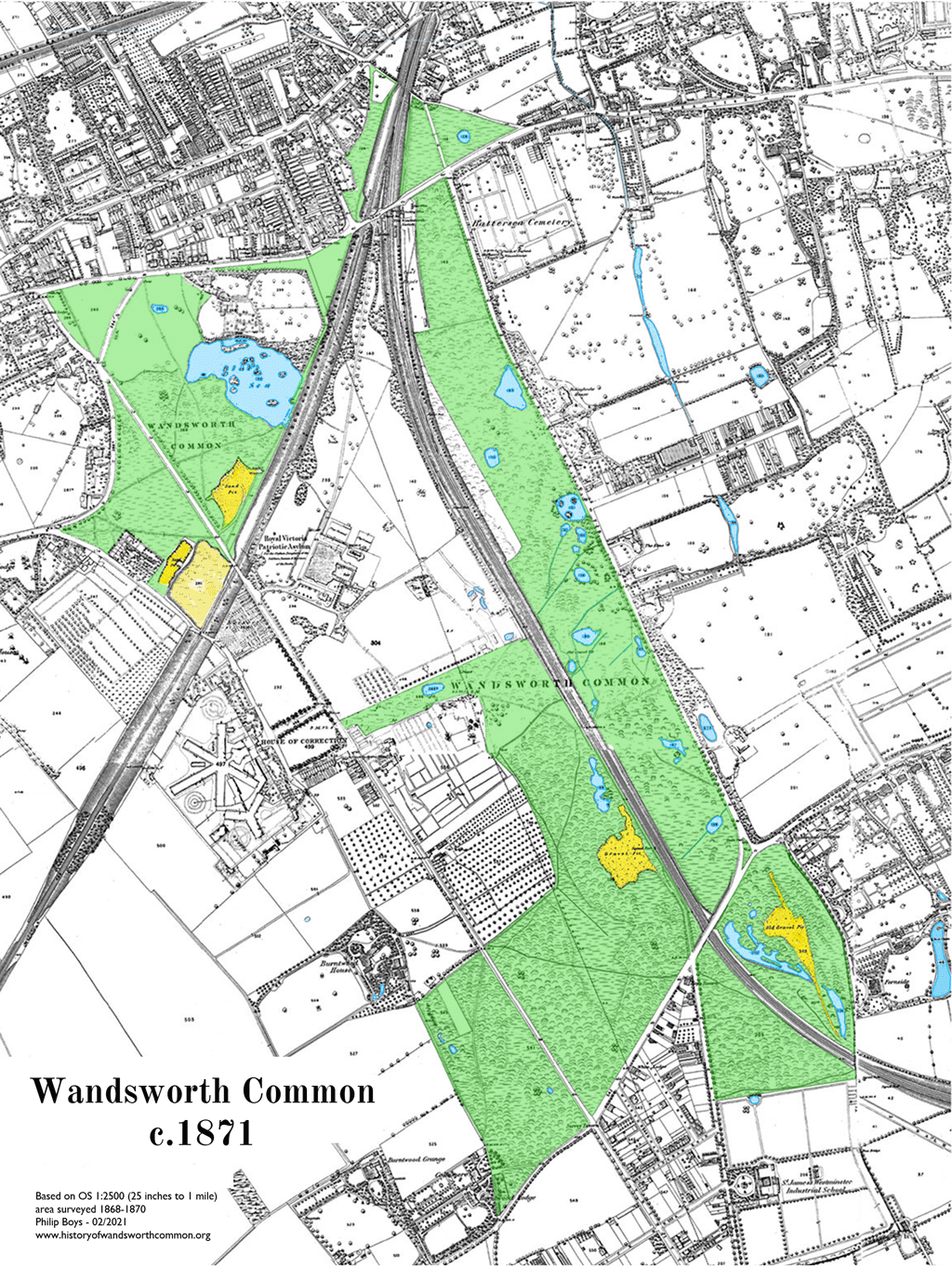
[BNA Search: "Wandsworth Common"]
[South London Press: "Wandsworth Common"]
[The Times: Search: "Wandsworth Common"].
[BNA: Buckmaster Battersea 1871]
[BNA: Buckmaster Wandsworth 1871]
[London Evening Standard: Buckmaster Wandsworth 1871]
SUBJECT
The committee for the preservation of Wandsworth common have, it is stated, at length succeeded in effecting an amicable arrangement with Lord Spencer, which will secure the common for public recreation and enjoyment. To carry into effect this arrangement a bill will be submitted to Parliament next session.
[BNA: Link ]
[NOTE]
[Buckmaster lectures on technical education and art. Extraordinary rant about about young men's dissipation]
" . . . the valuable leisure of the winter evenings is dissipated in tobacco and bagatelle; men lived as if the world was made of beer and Nigger songs. The amusements most sought after, instead of refining the feelings, vulgarise the taste. Teachers and lecturers on science and literature had been driven from the platform to make room for mountebanks, buffoons, and comic songs of the kind popular in the musical entertainments provided at some public houses."
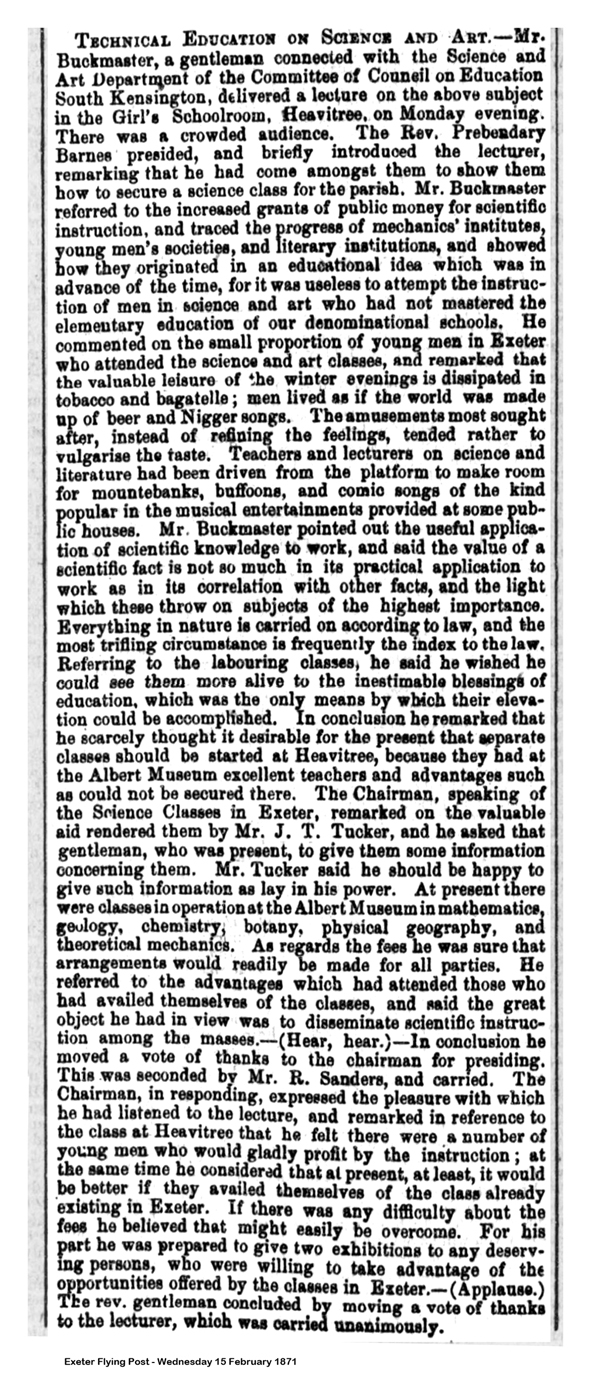
TECHNICAL EDUCATION ON SCIENCE AND ART.
Mr. Buckmaster, a gentleman connected with the Science and Art Department of the Committee of Council on Education South Kensington, delivered a lecture on the above subject in the Girl's Schoolroom, Heavitree, on Monday evening. There was a crowded audience.
The Rev. Prebendary Barnes presided, and briefly introduced the lecturer, remarking that he had come amongst them to show them how to secure a science class for the parish. Mr. Buckmaster referred to the increased grants of public money for scientific instruction, and traced the progress of mechanics' institutes, young men's societies, and literary institutions, and showed how they originated in an educational idea which was in advance of the time, for it was useless to attempt the instruction of men in science and art who had not mastered the elementary education of our denominational schools.
He commented on the small proportion of young men in Exeter who attended the science and art classes, and remarked that the valuable leisure of the winter evenings is dissipated in tobacco and bagatelle; men lived as if the world was made of beer and Nigger songs. The amusements most sought after, instead of refining the feelings, vulgarise the taste. Teachers and lecturers on science and literature had been driven from the platform to make room for mountebanks, buffoons, and comic songs of the kind popular in the musical entertainments provided at some public houses.
Mr. Buckmaster pointed out the useful application of scientific knowledge to work, and said the value of a scientific fact is not so much in its practical application to work as in its correlation with other facts, and the light which these throw on subjects of the highest importance. Everything in nature is carried on according to law, and the mold trifling circumstance is frequently the index to the law. Referring to the labouring classes, he said he wished he could see them more alive to the inestimable blessings of education, which was the only means by which their elevation could be accomplished.
In conclusion he remarked that he scarcely thought it desirable for the present that separate classes should be started at Heavitree, because they had at the Albert Museum excellent teachers and advantages such as could not be secured there.
The Chairman, speaking of the Science Classes in Exeter, remarked on the valuable aid rendered them by Mr. J. T. Tucker, and he asked that gentleman, who was present, to give them sonic information concerning them.
Mr. Tucker said he should be happy to give such information as lay in his power. At present there were classes in operation at the Albert Museum in mathematics, geology, chemistry, botany, physical geography, and theoretical mechanics. As regards the fees he was sore that arrangements would readily be made for all parties. He referred to the advantages which had attended those who had availed themselves of the classes, and said the great object he had in view was to disseminate scientific instruction among the masses. — (Hear, hear.)
In conclusion he moved a vote of thanks to the chairman for presiding. This was seconded by Mr. R. Sanders, and carried. The Chairman, in responding, expressed the pleasure with which he had listened to t
he lecture, and remarked in reference to the class at Heavitree that he felt there were a number of young men who would gladly profit by the instruction; at the same time he considered that al present, at least, it would be better if they availed themselves of the class already existing in Exeter. If there was any difficulty about the fees he believed that might easily be overcome. For his part he was prepared to give two exhibitions to any deserving persons, who were willing to take advantage of the opportunities offered by the classes in Exeter. — (Applause.)
The rev. gentleman concluded by moving a vote of thanks to the lecturer, which was carried unanimously.
Inclosure Law Amendment Bill
(Mr. Shaw Lefevre, Mr. Secretary Bruce.)
Bill 32 Second Reading
Order for Second Reading read.
Motion made, and Question proposed, "That the Bill be now read a second time." — ( Mr. Shaw Lefevre.)
SIR FRANCIS GOLDSMID
, though he had no intention of opposing the second reading of the Bill, wished at once to offer some observations upon it, both because the remarks he desired to make were of too general a character to be suitable for Committee, and because it might be convenient to give the Government time for considering the Amendments which he should have to suggest.
He would, in the first instance, remind the House of what had been stated with great clearness by his hon. Friend and Colleague the Under Secretary of State on the introduction of the Bill, but had not unfrequently been left out of sight in discussions on similar matters, that to abstain from passing Inclosure Bills could not possibly be any interference with the rights of property, since it left lords of manors and commoners to exercise those rights as they pleased. Although, therefore, Parliament had for a long series of years given great facilities to the passage of Inclosure Bills, because it believed that by bringing waste land into cultivation they promoted the public advantage; still, if the circumstances of the country had changed, if the views of what was politic were modified, the Legislature was perfectly free to alter its course. It was perfectly free, without any possible imputation of violating proprietary rights, to refuse to pass Inclosure Bills, or to attach to the passing of them any conditions which, on behalf of the public, it might consider advisable. That this was the opinion of the Legislature, was shown by the Metropolitan Commons Act of 1866.
Now, in determining how far it was conducive to the public interests that they should afford facilities to the passing of Inclosure Bills, the first question to be answered was, whether they were desirous that legislation should take such a course as should tend to as rapid an increase as possible of the population, or whether they would prefer that their legislation should tend to a somewhat less rapid increase of population, provided that the people were likely to be in a better position with regard to morality, and to enjoy a larger amount of happiness. He thought the House would have no difficulty in deciding in favour of the latter alternative; and the necessary corollary of that was that stringent conditions, on behalf of the public, should be imposed on the passing of these Bills.
Among the most important matters to which these conditions ought to relate were — reservations of recreation grounds, and of foot and bridleways. To footpaths and bridle-roads, which were provided for — but he thought not sufficiently — by the 9th section of the Bill, he was, perhaps, led to attach greater value from his living in a district where their unusual number had afforded him an opportunity of appreciating their advantages. It appeared to him that existence in such a district, where you might walk or ride in almost any direction that you chose, and might visit nearly all the prettiest positions, was worth twice as much as in a neighbourhood where, in walking or riding, you were confined to narrow lanes and muddy or dusty roads, and where, as a consequence of that confinement, you were excluded from many of the most beautiful points of view. Nor let it be said that this was the mere fancy of men of leisure. You had only to look at the places which the better class of workmen selected for their jaunts, in order to be satisfied that they were not insensible to the beauties of nature. Nor, again, did it require much foresight to perceive that, with the improvement of education, such tastes were likely to extend among the working classes.
Let it be remembered that the love for scenery was, even among the educated, of comparatively recent growth. Passages cited by Lord Macaulay in the second volume of his History of England, showed that less than 200 years ago, the Highland hills and heaths of Scotland were subjects of horror rather than of admiration, and that even cultivated men preferred the flat and fertile pastures that surrounded Leyden. To encourage tastes, such as that for natural beauty, was, in his (Sir Francis Goldsmid's) opinion, among the best means of promoting moral improvement, and checking drunkenness and other degrading habits. To such means he looked with much more hope than to the prohibitions and penalties which were in favour with the hon. Member for Carlisle, or even to the no doubt useful Bill, about to be introduced by the Home Secretary, for subjecting to stricter regulations the sale of fermented liquors. Men must have amusements. If you wish to get rid of the low and hurtful, then encourage the elevating and innocent.
In comparing the importance of increasing the home-growth of food with that of preserving recreation grounds, and walks and rides, we should remember the growing facility of importing provisions. Already we brought from the other side of the world a not inconsiderable proportion of our cereals, or — to use the American phrase — bread-stuffs. The same thing had been tried as to meat, and had, to a certain extent, succeeded. It might reasonably be hoped that this success would increase with improving means of transport, and with the advance of chemical science and mechanical ingenuity. But it was scarcely necessary to point out that no improvement in the facilities of conveyance, or in cooking, packing, or chemistry was at all likely to enable us to import footpaths or rides. The considerations which he (Sir Francis Goldsmid) had mentioned, led him to the general conclusion that, although the original purpose of Inclosure Bills — the bringing of more land into cultivation — had not lost its importance, yet in the altered and altering circumstances of the country, that purpose ought only to be pursued so far as it was consistent with, and in subjection and subordination to, the more important object of securing for our increasing population amply sufficient spaces for recreation and exercise. Nor should it be forgotten that if we, in one year, went somewhat too slowly in passing Inclosure Bills, we might, in a succeeding year, make up the deficiency. But if we went — as in some instances he believed we had already gone — too far, we could not re-trace our steps. We could not do so wasteful a thing as to throw out of cultivation land in tilling which we had, by sanctioning its inclosure, encouraged the outlay of capital. The present Bill seemed to him to be, in a great measure, framed in accordance with the principles he had ventured to indicate; but two of its clauses required, he thought, important amendments — the 3rd and 9th.
The 3rd clause directed the appropriation, for the purpose of recreation grounds or field-gardens, of one-tenth of the land to be inclosed, unless such tenth should exceed 50 acres, and in that case of 50 acres only. Now it appeared to him most unreasonable that although, if the land inclosed comprised 500 acres, 50 would be appropriated to the purposes mentioned, 50 acres, and no more, should still be the quantity if the inclosure extended over 1,000, 2,000, or 3,000 acres. It would, he suggested, be much more rational that the appropriation for recreation grounds or field-gardens should include one-tenth of the first 500 acres to be inclosed, one-twentieth of the second 500, one-thirtieth of the third, and so on for any greater quantity. His objection to the 9th clause — which related to the highly important subject of the setting-out of paths, rides, and drives — was, that it gave to the Inclosure Commissioners a permission only instead of a direction. The existing enactments as to recreation grounds and field-gardens had been of comparatively little use, because they were merely permissive; and accordingly the framers of the present Bill proposed to substitute for these the compulsory provisions of the 3rd clause. A similar reason existed for making the 9th clause also compulsory. There was one other point to which he wished to refer; and that was, that when land was extremely valuable there were continual instances of lords of manors doing illegal acts under pretence of legal rights, and the result was that many illegal inclosures has been made. It was a difficult matter, of course, to frame a clause to check such proceedings; but the matter was one which, in his opinion, well deserved the consideration of the Government.
COLONEL BARTTELOT
said, that if the Bill had been founded on the recommendations of the Committee which sat on the subject two years ago, he should not dissent from its provisions. It, however, went far beyond those recommendations, and incorporated the proposals entertained in the Bill of the right hon. Member for South Hampshire (Mr. Cowper-Temple) which ought, he thought, to be dealt with in a different manner. Under those circumstances, although he should not oppose the Motion for the second reading, he hoped the Bill would be referred to a Select Com-
mittee not for the purpose of delaying, but rather of facilitating its progress. He thought it was desirable the Commissioners should be allowed to judge of the requirements of a particular locality, for they were perfectly competent to decide what allotments should be given to labourers, and what land should be set aside for the purposes of recreation. How much better, too, he would ask, would it not be that where ground was of a swampy and had nature it should be drained and properly cultivated than left as it was, paying nothing in alleviation of those local rates which pressed so heavily on particular districts? He was, of course, far from saying that allotments should not be given to the labouring poor, and as to the commons, of which the hon. Baronet who had just spoken seemed to think the great landowners and lords of the manors got the lion's share, he might instance the case of one inclosure in his own immediate neighbourhood in which the lord of the manor got only a sixteenth part. Under all the circumstances, the proper course, in his opinion, to pursue, was to send the Bill to a Select Committee.
MR. WINTERBOTHAM
said, he hoped the House would not accede to the hon. and gallant Gentleman's proposal. He felt very grateful for the introduction of the Bill, because it recognized the principle that the people had a real interest in the public lands of this country. Before the year 1845 the rights of the poor in connection with waste lands were systematically and absolutely ignored. No less than 4,000 private Acts had up to that time been passed for making inclosures — 2,000 in the last century, and 2,000 in the first half of the present century. The Bill of 1845 directed the Commissioners to authorize inclosures only when expedient, and contained provisions with respect to recreation grounds and allotment gardens. Under it, about 500,000 acres had been inclosed, yet only an infinitesimal portion had been set aside for recreation grounds and allotments; nor did it appear that the Commissioners had ever stopped any inclosure on the ground of the interest of the public generally.
The Act of 1866 provided that, within a certain distance of the metropolis, commons should not be inclosed under the Inclosure Acts at all, thus recognizing the interests of the general public as against those of the lords and the commoners. The present measure extended this provision to all large towns. It also improved the earlier provisions as to allotments and recreation grounds. The Bill did not go quite far enough, however, for it only considered the interests of the public in the particular locality in which, the waste lands were situated. We were only beginning to open our eyes to the sanitary conditions under which our immense population was living, and perhaps hon. Members were scarcely aware of the growing extent in which our increasing population was pent up in towns. Those growing masses of the people had an immense interest in the little that was left of the waste lands of the country; and the Legislature would be recklessly improvident if it did not consider the interests not only of the present population, but also of the very much larger population which would follow them. It was not enough to provide for the interests of the locality, around, for instance, the Malvern Hills, Helvellyn, or Snowdon; such places were frequented by the public from a far wider range, whose interests were entirely unprotected by the Bill. He did not think the interests of the landed proprietors of the country were more adverse to the public interest than were those of any other class; perhaps they were less so. But he asked them to recollect that their number in this country was constantly diminishing; that estates were growing in size, and getting into fewer hands; that the occupation of land was also getting into fewer hands, and that as farms became consolidated and the use of machinery increased, fewer labourers would be employed on the land. He did not complain of this; but what would be the result if the number of persons brought into direct contact with the land as owners, occupiers, and cultivators diminished in number while the population increased? Those persons who favoured the present system should, therefore, consider how it might be made most tolerable to such as had no land. If all land were inclosed, and the rights of property strictly exercised over it, the people being kept to the public roads, living in England would become intolerable. At present, the liberal use of their parks and of private waste land allowed by certain landed proprietors was a mitigating circumstance. As a landless man and an habitual trespasser he gratefully acknowledged this. But the public had an interest in the use of the public waste lands of the country; and if you allowed no vent to the indescribable longing for a country life among the town masses of the population, there would be a growing feeling of discontent which would operate much more seriously than the advocates of inclosure were aware of. One point he wished to bring under the notice of the right hon. Gentleman at the head of the Government, who praised the liberal administration of the Crown lands. There was no private proprietor who used the rights over waste lands in so grudging and so niggardly a manner as the Crown and the Duchy of Cornwall. The Crown lands were coined into the last farthing; and what might give enjoyment to thousands would be sold for a halfpenny if no more could be got for it. He would, therefore, make these practical suggestions — First, the Crown and the Duchy of Cornwall should be expressly restricted from inclosure. Next, no inclosure should be allowed anywhere except under the Inclosure Acts, so that under no circumstances could the lord and the commoners, acting together, or the lord alone under the Statute of Merton, evade the intentions of the Legislature. Again, no inclosure ought to be made until the Secretary of State, or some other responsible person, was satisfied that not only were local interests satisfied, but that the interests of the public at large were not injuriously affected.
Parliament was asked to legislate very much in the dark on this question. In 1844, Mr. Blamire's estimate of the extent of waste lands in England was 8,000,000 acres. Another estimate was 6,000,000; but we now really had no accurate knowledge on this point, and the extent of land available for the public use was probably much smaller than was supposed. He suggested, then, that there should be a survey of the waste lands of the country, and under the direction of the Ordnance Department such a survey could be made with very little difficulty or expense.
Until a survey had been made they ought to hold their hands, and he therefore trusted that his hon. Friend (Mr. Shaw Lefevre) would consider favourably the Amendments which he should place upon the Paper for proposal in Committee, with a view to prevent inclosures without the sanction of the Secretary of State, and to provide for the survey of the waste lands of the country.
MR. WALSH
said, he had no great fault to find with the Bill. In the county which he represented (Radnorshire), where there were a great many waste lands, they were regarded as unmitigated nuisances. Not only did they give rise to a great deal of local crime, but they especially afforded facilities for sheep stealing and harbouring of vagrants. They were also a fruitful cause of had blood and feuds, in consequence of disputed rights of pasture. So much was this the case, that shepherds were frequently selected not because they were well skilled in the management of sheep, but because they were proficients in pugilism. It would, therefore, be a source of congratulation if those lands were inclosed on fair terms. Nearly every class in Wales was in favour of their inclosure; but that the lord of the manor should not have the right of veto different to that enjoyed by the Commissioners.
Although not entertaining that view, he considered it was one that might be advantageously submitted to a Select Committee. He believed, however, with the hon. Member for Stroud (Mr. Winterbotham) that no lord of the manor was so hard a taskmaster as the Commissioners of Woods and Forests. Indeed, the encroachments made by the Commissioners were constantly increasing, and but little, if any, attention was ever paid to the rights of the commoners. He should not vote against the second reading, but he should support, at a later stage, the proposal of his hon. and gallant Friend (Colonel Barttelot) to refer the Bill to a Select Committee.
MR. FAWCETT
moved the adjournment of the debate.
MR. SHAW LEFEVRE
said, he hoped that his hon. Friend would not press the Motion. Looking at the business before the House, he feared it would be many a long day before so good an opportunity could be found for the discussion of the question, and it was still early.
MR. J. LOWTHER
supported the Amendment for the adjournment of the debate. The hon. and learned Member for Stroud (Mr. Winterbotham) had propounded a most extraordinary doctrine namely, that the waste lands of the country were to be reserved for the enjoyment of tourists, or rather gentlemen excursionists, rather than for those who had a pecuniary interest in them.
The whole matter might become a question of compensation, and if the Malvern Hills and similar lands were to be reserved for the public it might, perhaps, be worth consideration whether a demand in respect of them might not be made upon the Consolidated Fund.
MR. LOCKE
said, he thought these commons ought not to be treated as if the lords of the manor and the other persons possessing particular rights in them were the only interested parties, as it should be borne in mind that the public in general had a right to pass over them. He objected to the Bill being referred to a Select Committee, thinking it would be better to consider its provisions in the ordinary way in Committee of the Whole House.
MR. BRUCE
said, he would not resist the Motion for adjournment.
Debate adjourned till Monday next.
[Hansard: Link]
DEBATE CONTINUES 4 APRIL 1871]
BATTERSEA VESTRY.
On Thursday evening a meeting of this Vestry was held in the infant school-room, Battersea-rise, the vicar, the Rev. J. S. Jenkinson, presiding. There was a very small attendance of members, and it was not until" long after the hour of meeting that a quorum could be formed.
The Burial Board. A letter was read from the Clerk to the Burial Board, asking the Vestry to reconsider their decision with respect to the election of Messrs. Gammon and Gosden as members of that Board. Mr. Cleave said the Vestry had elected two gentlemen as members of the Burial Board to fill up the two vacancies, and the Burial Board also elected one, so it would be necessary to rescind the motion, and instead of two elect one.
Mr. Gosden said if it would get the Vestry out of a difficulty he would resign in favour of Mr. Gammon, as he had been elected first. The Clerk, Mr. Harrup, said it was a piece of sharp practice on the part of the Burial Board. When this Vestry met to elect two members to the Burial Board quorum not being obtained no business was transacted, and the month then elapsing the Board elected Dr. Brown, and subsequently the Vestry elected Messrs. Gamman and Gosden. Mr. Cleave said the Burial Board having elected Dr. Brown contended that his election was good. The only way to settle the question was by going to the Court of Queen's Bench. A Member then gave notice that at the next meeting he would move that the resolution appointing Messrs. Gamman and Gosden be rescinded, and the subject dropped.
Hampstead Heath
Mr. Hadfield, pursuant to notice, brought under the consideration of the Vestry the bill of the Metropolitan Board of Works for the purchase of Hampstead-heath, and moved the adoption of petition against the same. Mr. Harrup then read the petition, which set forth that the parish of St. Mary, Battersea, would be liable to be rated for its purchase, and the petitioners denied the expediency- to purchase it the expense of the ratepayers generally. They also denied that they would derive any benefit from such expenditure. Those who had the chief benefit from the heath had distinct interests to the rest of the metropolis, and the petitioners denied the expediency of abolishing the common rights upon the heath. They therefore prayed that the bill might not pass into law as it now stood, or that they might be heard counsel, witnesses, &c., against the bill, for the insertion of protective clauses. Mr. Hatfield, in speaking of the motion for the adoption of the petition, said ho had imposed upon himself a somewhat delicate task, inasmuch as the question had occupied the public mind for some considerable time, and many battles had been fought over that heath both inside and outside the Houses of Parliament. The fight had been against the unbecoming attitude of the Lord of the Manor. This Vestry was a representative body, and as such had perfect right to look this matter in its face and express freely their opinion upon it. It might be said that as Hampstead-heath had been so long before the public that they should allow it to be settled somehow or other, and let it be preserved for ever and ever upon the present conditions. But as the ratepayers had to pay; for this they had a right to look at the question and determine in their minds whether it was being done in the best possible way.
The Vestry of Battersea must not forget that they had a common which they were desirous of preserving, and had petitioned for its preservation, but in a different way to that in which it was proposed to preserve Hampstead-heath. The metropolitan commons had been the subject of discussion for some years, and in 1866 the Legislature took the matter in hand, and that was mainly due to what had been said about Wandsworth common.
Mr. Cleave: No; it was Wimbledon. Mr. Hadfield thought it was in consequence of what was said both with respect to Wandsworth and Wimbledon. The Legislature took some action in the matter, and framed a bill. He then contrasted the question as it stood between Hampstead-heath and Wandsworth-common, and contended that the bill with reference to the first was an improper and unwise measure. The Metropolitan Board of Works took Hampstead in hand, and be thought at the same time they should direct their attention to Wandsworth and Wimbledon commons. He considered that the metropolitan commons should be treated en maise, and he deprecated the course adopted by the Metropolitan Board of Works in treating one in preference to the others. Wandsworth had been lying waste while they had leave to attend to it, and they did not know that even up to the present time the Metropolitan Board of Works had done or thought anything of it. Mr. Cleave observed that they had prepared scheme. Mr. said he had never heard of it, but it certainly was very kind to think of them now after neglecting them so long. The Metropolitan Board of Works were now going to Parliament with a scheme which he submitted should be more clearly developed. In the bill nothing was said as to the amount of money to be paid for the purchase of Hampstead-heath. So far as the bill was concerned the ratepayers of London did not know whether they had a good or a had bargain, but it was a matter of notoriety that an enormous sum was to paid. He believed it was £45,000 for the purchase-money and £30,000 were to be spent in the purchase of the common rights. When he looked at the average he considered the bargain a had one. There were only 210 acres, and they were going to purchase them at £350 per acre. The heath as it now stood only brought in the Lord of the Manor a small sum a year, and he said the price the Metropolitan Board of Works were going to give for it was a fancy one. The acreage of Hampstead-heath was small in comparison to that of Wimbledon, the acreage of which was 1,040.
He would now speak of the utility of the scheme. He was quite willing to admit that London wanted its breathing places; but when they looked upon Wimbledon, which was used for Government purposes, and was becoming a national spot, and found that an opportunity existed for its purchase at the rate of £3O per acre, he thought it should be bought in preference to Hampstead. He then alluded to the facilities for reaching Wimbledon by rail, and said he thought the Metropolitan Board of Works should turn their attention to it. The principal thing they had to consider with respect to the bill was whether or not the Metropolitan Board had made a good bargain. As he considered the bargain a had one, he opposed the purchase, and, referring to the cost, said the sum was an enormous one, and they would not in the shape of benefits have any equivalent for the money laid out. This parish was quite willing to pay for the preservation of Wandsworth and Wimbledon commons, and did not go to Hampstead and ask the place to help pay the costs. That was the principle they went on. He was sorry to say in this movement that they were being opposed by the Wandsworth District Board of Works, but that body, he submitted, had nothing whatever to do with the matter, being a subject for the consideration of the Vestry only. He spoke against the way in which that body always treated the Battersea representatives, and said whatever scheme was brought forward Battersea Wandsworth and Clapham always joined together to oppose them. When the bill for the purchase of Hampstead-heath was considered all the Battersea members voted against it. Mr. Cleave: With one exception. Seven voted against the bill and one for it. Mr. Hadfield concluded by remarking that the bill was not a good one, and he hoped they would all vote for the petition. Mr. Clark seconded the motion.Mr. Bertolacci regretted see the Wandsworth District Board oppose them. He had thought of calling a public meeting upon the subject at the Lammas Hall. He should like to see all open spaces in the metropolis paid for by a common fund, but he certainly thought this bill unjust when it called upon Battersea to pay its quota while no provision was made for the ratepayers of other parishes. The Rev. J. Conder said they were now paying a halfnenny rate for the preservation of their own commons, but if the matter had been under the control of the Metropolitan Board of Works, in all probability the whole of the metropolis would also have to pay a halfpenny rate, so that this parish would not be benefited. He supported the motion. Mr. Cleave cordially supported the motion, which, after some further discussion, was carried unanimously. A similar motion with respect to Leicester-square was likewise carried, and the meeting adjourned.
[BNA: Link]
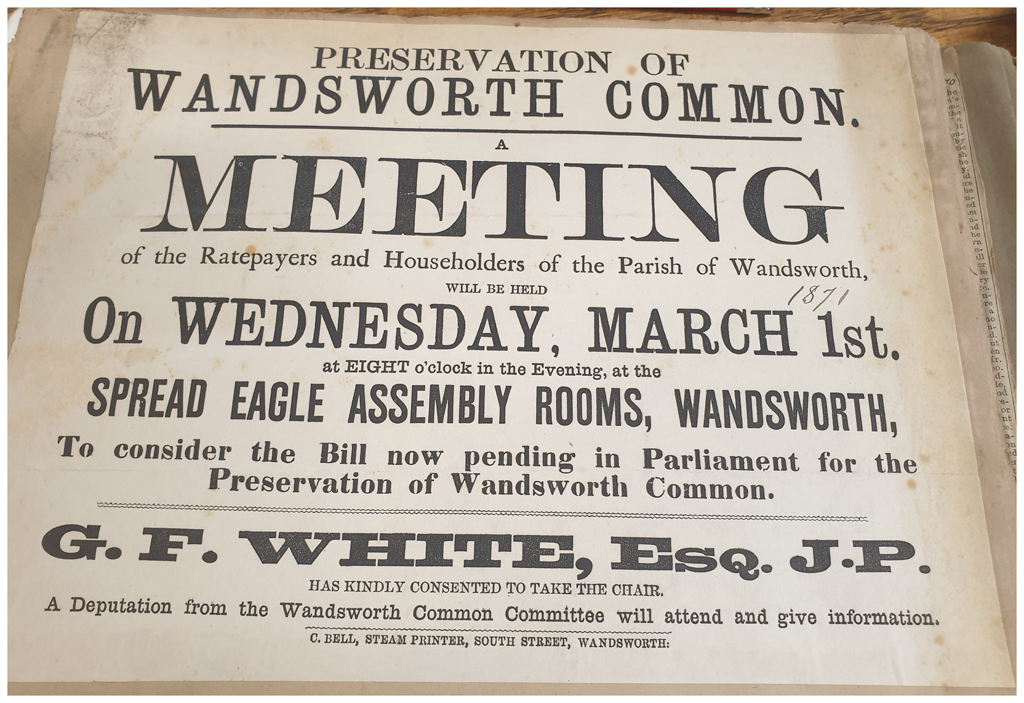
This debate was "resumed" after an adjournment on 23 Feb 1871 — was it simply listed then or was anything ever actually said? — Find.
HANSARD 4 April 1871 Commons Sitting
INCLOSURE LAW AMENDMENT BILL. [BILL 32.] SECOND READING. ADJOURNED DEBATE.
HC Deb 04 April 1871 vol 205 cc1148-73 1148
Order read, for resuming Adjourned Debate on Question [23rd February], "That the Bill be now read a second time."
Question again proposed.
Debate resumed.
MR. FAWCETT
said that there appeared to be at length some prospect of Parliament giving to this important subject a portion of the attention which it deserved. Probably amongst the many shortcomings of this Parliament, and its predecessor, there was nothing which posterity would more entirely condemn than the fact that the inclosure of lands had been left to an irresponsible department, which, as he would prove, had neglected the interests of the public with wanton recklessness. Up to the year 1845 inclosures were carried on by Private Bills, and by this process, in a century and a-half, 7,000,000 acres of land were inclosed. The late Duke of Newcastle, a distinguished friend of the present Prime Minister, who carefully investigated this subject, stated, with regard to those 7,000,000 acres, that in almost every instance the public and the poor had been most shamefully neglected.
Since 1845 a different system had been introduced. This House had taken upon itself the responsibility of considering the inclosure of lands, and it was almost unnecessary for him to describe the way in which they had discharged that duty. In regard to this question, there was no difference to be drawn between Conservative and Liberal Governments — they were all alike. The most passionate declamation about interest in popular rights, strong vociferations that the Government were anxious to prevent the people from being divorced from the soil, were forgotten; and a Liberal Government, in a householder's Parliament, used its whole influence to force Inclosure Bills through the House without comment or discussion.
Anyone who had considered the condition of the agricultural labourer must be perfectly well aware that no inconsiderable portion of the present unsatisfactory state of things was to be traced to the manner in which inclosure of land had been permitted. This was abundantly proved by a great mass of evidence collected by the Commission which lately inquired into the condition of women and children employed in agriculture. Mr. Kebbell, summing up the evidence in a book which he had recently written, came to the conclusion that in the middle of the last century the agricultural labourer, so far as the power of obtaining the material necessaries of life was concerned, was in a far better condition than he was now; and this opinion was corroborated by almost every writer on political economy. The Rev. Mr. Davis, writing at the end of the last century, stated that the proprietary rights of agricultural labourers in the soil were greatly lessened, owing to the inclosure of land, and a class once possessing independence was being gradually reduced to the position of miserable Pariahs.
The same process had gone on unchecked during the present century. It was no justification, but rather an aggravation, of this state of things to be constantly repeating platitudes about agricultural prosperity. What was the use of saying that the land was better cultivated, that wealth was rapidly increasing, that rents were rising, and farms were actively competed for, when, as a background to this glowing picture, there was a class of labourers eking out a miserable existence on 9s. or 10s-a-week; sometimes living in houses which did not deserve the name of human habitations; their children growing up in a state of ignorance, which could not be greater if England had lost her Christianity and her civilization; living day by day uncheered by hope, with no other prospect before them than that when their work was done they would have to become supplicant mendicants for the pauper's dole?
It was true that during the last 10 years wages had been increased by 10 per cent; but in the same time there had been a rise of 20 per cent in articles of food consumed in the rural districts; while, in consequence of improved means of communication, prices had been, to a great extent, equalized throughout the country, so that the labourer could scarcely live more cheaply in the country than he could in the metropolis.
Before the opening up of the railway system, 25 years ago, articles such as milk, of essential importance to the labourer, could be obtained in the rural districts for nothing; but now, labourers' families suffered greatly from the difficulty of obtaining milk. Formerly there was a common in nearly every village, on which the labourer could keep cows, pigs, or poultry; but in the present day it was a rare thing to find a labourer who was able to keep a cow. Probably it would be said that this Bill would remedy the evil, and if he thought so he would cordially support it. He did not blame his hon. Friend who had charge of the Bill (Mr. Shaw Lefevre), because a subordinate Member of the Government, to a great extent, sacrificed his individuality; and he was sure that if the Prime Minister gave the hon. Gentleman despotic power in this matter, he would bring in a measure which would fully satisfy those who hold the most extreme views.
His fundamental objection to this Bill was, that it still left the whole question to the irresponsible department of the Inclosure Commissioners. It might be said that securities were taken to prevent their neglecting their duties in future; but he would show that powers far too great were left to them, and that if the Bill passed it would be more difficult than ever for the House to resist improper inclosures. He had intentionally spoken in strong terms of the Inclosure Commissioners; and when the House had heard a few facts which he had to mention it would agree that it required a more accomplished speaker than himself to find language of sufficient severity to condemn their conduct.
Hitherto he had been obliged to call attention to this subject at 2 o'clock in the morning, when the reporters had left the Gallery; and, therefore, he intended to avail himself of the opportunity of a Morning Sitting to show what the Inclosure Commissioners had done in the past, and then he was sure the public would require the House to prevent such proceedings in future. Two years ago an Inclosure Bill was introduced to the House, proposing to inclose 6,900 acres of land in different parts of the country.
The Inclosure Commissioners were bound, by the most solemn obligation, to reserve a proper quantity for the public and the poor. How did they discharge that duty? Out of the 6,900 acres they reserved three acres as recreation ground for the public and six acres as allotment gardens for the poor. Not only did the Commissioners do this, but the Government — a Liberal Government did not utter one word of protest against their proceedings. They introduced this Bill, read it a second time, forced it through Committee, and it was only on the third reading, and with great difficulty, that it was stopped and referred to a Select Committee. The Government evidently thought an hon. Member was travelling out of the usual forms of the House in venturing to express a dissent from measures which they seemed to consider ought to be passed merely as matters of form. The Bill was eventually referred to two Select Committees.
One of the commons proposed to be inclosed was in the metropolitan area at Wisley, and the proposal with regard to that common was referred to a separate Select Committee. The common consisted of 380 acres, and the Inclosure Commissioners reserved two acres as recreation ground for the public, and nothing for the poor. The Select Committee examined witnesses from the neighbourhood, and as the result of their deliberations proposed to increase the reservation ground by 300 per cent, and unanimously decided that the poor should have the utmost that could be allowed as allotment gardens under the Act.
But he would mention a still stronger case. It was also proposed in the Bill to inclose another common at Withypool of 1,906 acres, and out of that number of acres the Inclosure Commissioners reserved one miserable acre as recreation ground for the public. The Committee sent for evidence from the neighbourhood, and being a Member of the Committee, he wrote for the parish clerk and the village schoolmaster.
In giving evidence before the Committee the Inclosure Commissioners justified their extraordinary reservation upon four distinct grounds. In the first place, they said that a larger recreation ground was not used; in the second, they asserted that the common was never resorted to by the inhabitants of Withypool; thirdly, that there were numerous other commons close to it; and, lastly, that only one acre was reserved because the rise of the ground was so steep that it was impossible to find any other ground suitable for a place of recreation.
In answer to their precise allegations, the parish clerk and schoolmaster, whose evidence was not shaken, stated, firstly, that the miserable reservation of one acre had caused the greatest possible discontent in the neighbourhood; second, that the common was constantly and repeatedly used, that the friendly societies held their meetings there, and that on summer evenings there were generally 50, 60, or 70 people walking about on it; thirdly, they proved by maps that the nearest other common was five miles away; and, fourthly, they proved by plans that the acre reserved was in the corner of a triangular piece of 10 acres, the remaining 9 acres being in every respect identical with the character of the soil and their elevation.
Was it necessary for him to say more in order to convince the House that these Inclosure Commissioners could not be safely trusted; that their statements must be narrowly watched, and their proceedings carefully scrutinized?
Possibly the supporters of the present Bill might say that it provided security against the misdoings of the Inclosure Commissioners; but that he denied. It came out in evidence that the local inquiries were a farce and a delusion, because they were almost invariably held at half-past 11 in the morning, when none of the labouring poor could attend. No notice of that practice was taken in the Bill. Again, there was no provision to ensure the public, who were interested, being invited to these inquiries to give evidence on the wants of the neighbourhood. It would be said that the Bill proposed, in every instance, to reserve the fixed proportion of one-tenth; but such a provision would not satisfy the requirements of every case.
The Prime Minister the other night said it was necessary to pass the Bill, because its delay paralyzed the activity of the Department. What did that activity mean? The very moment this Bill should be passed another Bill, which was ready in the Department, would be introduced, proposing to inclose 28 commons consisting of 18,000 acres. He wished to check that kind of activity. Amongst those 28 commons was one of 70 acres, in the heart of a most populous district, surrounded by the hard-working population of the Potteries. The common possessed great natural beauties, and was much resorted to by the inhabitants of the neighbourhood; but what would the present Bill effect with regard to that common? It would take away all the 70 acres, with the exception of three and a-half acres for allotment gardens and three and a-half acres for recreation ground, and would also deprive the population of the enjoyment they derived from the natural beauties of the place.
However difficult it had been to fight the Inclosure Commissioners in the past, it would be more difficult to fight them in the future, if the present Bill was passed, because it would be said that the House was bound to pass Inclosure Bills with a reservation of one-tenth, as that was the arrangement sanctioned by Parliament. Inclosures would then go on more rapidly than ever, and that House, composed in a great measure of landowners, wrapping itself up in self-complacency, would be able to say that it had done all that was required in reserving one-tenth of the inclosures for the public.
The Inclosure Act of 1845 was described in its Title as "An Act to facilitate the Inclosure and Improvement of Commons and Lands held in common." He wished to have the policy of the past reversed, and to retard inclosures. It was of the utmost importance that all waste land should be surveyed; that such parts as had great natural beauty should be reserved for the public. This was the proposal of his hon. Friend the Under Secretary of State for the Home Department; and he was quite sure his hon. Friend was far too sound a politician to change his position.
MR. SHAW LEFEVRE
begged to state that he had never promulgated any such scheme.
MR. FAWCETT
meant the present Under Secretary for the Home Department (Mr. Winterbotham). He very well recollected his hon. Friend's speech. The most plausible arguments in favour of inclosures were supposed to be furnished by political economy; but probably no other science had ever had so many bad things done in its name as that had. He ventured to assert that after inclosure had attained a certain point, and one which was long since attained in this country, political economy did not supply a single argument in favour of inclosure; but, on the contrary, its principles, if worth anything, would tend to show that inelosure, if not stopped altogether, should be carried on with great care and caution.
One of the most remarkable changes in the rural districts was that within the last 25 years there had been a strong tendency in favour of having pasture land. The reason was this$we obtained corn from all the world — India, Australia, California; but for dairy produce and such perishable commodities we had to rely chiefly on our own soil. The consequence was that produce became inevitably dearer with our progress in wealth and population. Much of the common land that had been inclosed was some of the best pasture in the kingdom; and if it should be said that whilst common it did not, from want of drainage, produce so much as it might, he would remind hon. Members that that argument might be extended to private property, which in many cases did not certainly produce the utmost of which it was capable. Again, it might be said that commons were ill looked after; but that was an argument for better management, and not for inclosures.
Why not issue some kind of Commission, and treat all the commons in the country in the same way as those within the metropolitan area, providing some means for their improvement by means of a rate? If a common was not used for the purpose of recreation the whole rate should be paid by the lord of the manor and the commoners who used the common. If, on the other hand, the common was used for the purpose of recreation, then it was only fair that a considerable portion should be thrown on the rates of the neighbourhood. It was said that the inclosure of commons promoted the production of wealth and gave employment to the poor; but this remarkable fact came out in evidence$that in many localities where the largest inclosures had been made the population had absolutely diminished since these inclosures had been effected. What was the reason? Nothing could be more erroneous than to suppose that this desire to inclose land was solely promoted by philanthropical anxiety to increase the productive resources of the country.
In thousands of instances the commons inclosed did not produce a single blade of grass or a single ear of wheat more than when they were an open space; the only difference between their inclosed and un-inclosed condition was this$that now a privileged few could shoot tame pheasants and hares and rabbits over them, whereas before they could be enjoyed alike by the whole public. It was said that we should have better securities in the future against improper inclosures; but what securities would there be if this Act were passed?
In the present Session a Bill would be introduced to inclose 28 commons, and last Session there was an Inclosure Bill, which they had to fight night after night to prevent the Government from sneaking it through the House at 2 o'clock in the morning. It was quite by accident he discovered that, if that Bill had passed, it would have destroyed, as far as man could destroy, two of the most lovely pieces of scenery in the kingdom$it would have destroyed the beauty of the Lizard Point and Kynance Cove. There could be no satisfactory legislation until the method of procedure was entirely changed. Every Inclosure Bill introduced ought to be referred to a Select Committee, which should have power to take evidence from the locality. If they did that they would not be legislating in the dark as at present.
When the Government were trying to pass an Inclosure Bill at 2 o'clock in the morning, he used to think of their platform speeches about elevating the people and not divorcing them from the soil. How could they more effectually divorce them from the soil than by inclosing every bit of common land, and what was the use of trying to elevate the people when they shut them out from those open spots where they could enjoy nature in her most beautiful aspects? All they did to elevate the people would be of no avail if they assisted those whose desire was to make this country as ugly as they could, instead of rendering assistance to those who wished to enjoy the invigorating influence to be derived from conversing with nature.
It was said this Bill incorporated the provisions of the Bill of his right hon. Friend (Mr. Cowper-Temple) for the preservation of urban commons; but even if the commons were brought within the Metropolis Act, that would not give a security against inclosure. Commons might be inclosed either by common law, or by means of Parliamentary interference, and there was nothing in the Act to prevent an inclosure at common law. This being so, every common in the country would be in imminent peril; and, indeed, every common might be inclosed unless commoners, sufficiently public-spirited and sufficiently wealthy, were found to resist it.
The commons of Berkhampstead and Plumstead — two of the most lovely in the country — would have been inclosed but for the efforts and expenditure of two gentlemen — Mr. Augustus Smith and the junior Member for Rochester (Mr. Goldsmid) — who spent in legal proceedings many thousands of pounds. What he desired was that the survey suggested by his hon. Friend the Under Secretary for the Home Department should be carried out with the least possible delay. We should then know all the commons that were worth preserving on the score of natural beauty or proximity to large towns, and the Government might be left to take on itself the responsibility of preserving them$always bearing in mind, as at Wimbledon, that lords of the manor should be amply compensated for any rights they might have. He should be sorry to be misunderstood on that point, anxious as he was to preserve commons. He never would be a party to any such proceeding without compensating all those who had a legal interest in them.
He begged to thank the House for the great patience with which they had listened to what he feared had been too long a statement. Every Inclosure Bill ought to be referred to a Select Committee, and that should take evidence from the neighbourhood of the land proposed to be inclosed. These waste lands offered areas for the present enjoyment of those who possessed privileges over them, and they ought to be further regarded as reserves which might be used for promoting the future well-being of the country; for instance, after those who possessed rights over them had received proper compensation, it was possible they might be used for trying great social experiments in co-operative agriculture. He would vote with the hon. and gallant Member for West Sussex (Colonel Barttelot) for referring the Bill to a Select Committee, for, although their views might be different, it was impossible to have a more straightforward opponent than the hon. and gallant Member was, and time only could show which of them would gain most by further inquiry. This was a matter on which the House was bound to act with the greatest care, because if any mischief were done it could never be repaired the same as an ordinary error of taxation or legislation.
If a common were improperly inclosed, the evil would be continuous for all time, and would be absolutely irrevocable. A great statesman, whom many in the House aspired to follow, said there was no subject on which the House ought to act with, greater care and circumspection. If these words had been heeded, an incalculable amount of mischief, which could never be remedied, would never have been committed, and the public would not have been, deprived, as they had been, of privileges which money could not restore. This was not a question of a day nor of an hour, nor for to-morrow only, but for all time. Not the least valuable of what we had inherited from our predecessors were portions of the country in which nature had not been spoilt by man; and let us be careful that we were not less generous to those who would come after us, for no amount of vaunted civilization, no accumulation of wealth, could justify us in the eyes of posterity if we left this country shorn of the beauty with which it had been endowed by nature.
MR. BONHAM-CARTER
, having heard the evidence given in relation to Withypool Common, on the borders of Exmoor, thought it desirable to correct the impression produced by the reference made to the case by the hon. Member for Brighton. The acre of land spoken of as all that had been reserved for recreation purposes was only set aside as the playground of a very small school. The population of the village was only from 120 to 150. The number of houses was about 30; there was no other village in the neighbourhood, and it was only once a year that a friendly society resorted to the common. He believed that the inquiries of the Assistant Commissioners were conducted in a proper manner, and that, when all circumstances were considered, the results were generally satisfactory. It was desirable that local authorities should have power to buy land required for parks, but to take land without purchase was unjust. He believed that the Inclosure Department had served the country well; and as to the interests of the poor, he could quite understand the labourer saying, in reference to common land, that he could earn good wages from it if it were under the plough. He believed that the present law worked beneficially.
SIR MICHAEL HICKS-BEACH
entirely demurred to some of the statements made by the hon. Member for Brighton, and there were three points to which he would more particularly refer. First of all, he told the House that it was largely representative of landowners; but he would ask the House to consider the provisions of the Bill proposed to be brought in the previous night by a right hon. Gentleman who commanded a large majority in this House of landowners. The hon. Member for Brighton also told the House that the pasture land was diminishing, and that consequently the produce of pasture land was more expensive to obtain. He also descanted upon so much property being turned to private use. Now, with regard to the whole subject, it appeared to him (Sir Michael Hicks-Beach) that much of the difficulty which had obtained in this measure was owing to the uncertain and vacillating conduct of the Government.
Two Sessions ago the hon. Member for Brighton had objected strongly and successfully to the consideration of the Inclosure Bill; and his objections had been so strongly pressed that he secured the appointment of a Select Committee to consider the whole question, and his hon. Friend the Member for Sandwich (Mr. Knatchbull-Hugessen), the then Under Secretary of State for the Home Department, represented the Government on that Committee. He would with confidence appeal to the hon. Member for Brighton, and those who supported him on that Committee, if the hon. Member for Sandwich had acted in a retrograde spirit. Had not all his wishes been embodied in the Report which had been presented? And having done that, the hon. Member for Sandwich brought in a Bill last Session, which not only comprised the recommendations of the Committee, to which he, for one, had no objection, but which very seriously interfered with the rights of property. And this Bill which was now brought in was, to a very large extent, a copy of the Bill of last Session. He did not blame the present Secretary to the Admiralty (Mr. Shaw Lefevre) in the matter, as he had acted in perfect accordance with the opinions he had held at all times. This Bill had been introduced by him when Under Secretary of the Home Department; but the hon. Member who succeeded him at the Home Office could not be supposed not to have devoted his attention to this question. On the contrary, on the second reading of this Bill he laid down his views at very great length. And what did the hon. Member for Stroud (Mr. Winterbotham), the present Under Secretary, say? He told the House that the present Bill which was now before the House did not go far enough; that it only recognized the interests of the locality; and he laid down as his opinion that no inclosure ought to be made until the Secretary of State was satisfied that the interests of the public at large would not be injuriously affected. These might be the opinions of the hon. Member; but if they were, it was extremely odd that he should be obliged to sit on the Treasury Bench and hear another Member of the Government advocate a Bill connected with his own Department, and with which he himself did not agree.
[Mr. WINTERBOTHAM: I do approve of it.]
The hon. Gentleman went beyond it. It seemed to him a most anomalous position for any Member of the Government to be placed in, as he believed the rule was that Members of the Government were in the habit of proposing measures with which they concurred. He was willing to leave the question in the hands of his hon. Friend the Member for Reading (Mr. Shaw Lefevre), and he believed it would be better dealt with by him than by the hon. Member for Stroud; because the views of the hon. Member for Reading were moderate in comparison, and were more likely to commend themselves to the House than those of the hon. Member for Stroud, which, if adopted in legislating on more important subjects, might seriously interfere with the stability of Her Majesty's Government. He would now briefly refer to the principles of the measure which were not recommended by the Committee of the year before last. The 3rd clause took away the discretion which Parliament had hitherto vested in the Inclosure Commissioners. The hon. Member for Brighton did not consider that this went far enough, and wished to see the Commissioners abolished altogether. But these inclosures could not be properly considered generally; and the merits of each case required to be gone into by some body like the Commissioners.
The Bill provided that in every case an allotment not less than one-tenth of the whole land inclosed, except where it would exceed 50 acres, should be set apart for recreation ground or field garden. Now, in a thinly-populated district it was possible there might not be 50 persons living within a reasonable distance who might be able to take advantage of that allotment. An allotment to that extent was simply waste ground, and he could not see any purpose whatever to which it could fairly refer. Then, the 4th clause dealt with, land of a description which had never before been subject to an allotment of this kind, because under the old Acts only land subject to the rights of common were subject to allotment.
That clause provided that "Where the public have been in the habit of using any commonable land at any time of the year for the purposes of exercise and recreation, and such commonable land is proposed to be inclosed, the Commissioners shall, in their provisional order relating to such land, specify, as one of the terms and conditions of the inclosure thereof, the appropriation free of all charge of an allotment for a recreation ground."
But what did recreation mean? Did it mean that a small number of people by simply strolling over commonable land all the year round should be entitled to claim an allotment for the purpose of exercise and recreation, which, probably, would be of no use to them? Then, again, it was proposed to keep up public paths, rides, and rights of way. He was glad they were going to keep these up, as they were of very much more use than recreation ground could possibly be. It seemed to him that the Bill proposed to set apart allotments for the purpose of field gardens, in utter disregard of the number of the poor. He was in favour of allotments for the benefit of the neighbouring poor, but he would like to know of what service these allotments would be if they were too large for a labourer to cultivate during his spare time, or if they were so far distant from his cottage that he could not convey to them manure, or reach them within a reasonable time. In every ease they would be of no service at all.
Disagreeing with the hon. Member for Brighton, he held that inclosures were, as a rule, very beneficial to the country. He certainly admitted that there might be cases, and frequent cases, where a common, or part of a common, would act as the lungs of a great town, and in such cases it would be by no means desirable to inclose them. But, as a general rule, inclosures were beneficial, because they directly increased the number of the proprietors of the land in the country. In the second place, they increased the produce of the country, and therefore were of service to the whole of the population. In the third place, they provided work for those who might be otherwise unemployed, and that was a purpose, to his mind, of very great use.
All those benefits taken together, greatly outweighed the advantages to the professional vagrant, if he might use the term, to the professional man who wanted a right to ramble over a common, and who was rather disposed to claim a "knapsack title" to property which did not belong to him. But even after the commons there were plenty of mountains which he could wander over wherever he would. While he was in favour of the Bill, he should like to see it referred to a Select Committee, in accordance with the Notice of the hon. and gallant Member for West Sussex (Colonel Barttelot) because he believed it could be better considered by such a body than by the whole House, and would thereby stand a better chance of being made fair and equitable in its provisions.
MR. LEVESON GOWER
said, he would like to see some modification of the Bill; but, at the same time, he could see that these modifications could be introduced in a Committee of the Whole House, and therefore he would vote against the Amendment. He was also certainly anxious that fuller inquiry should be made into the subject. He had been a Member of the Inclosure Committee which sat two years ago, and he regretted that the scope of the inquiry had been limited to the operation of the Inclosure Act. He thought it would have been desirable, if they had had it in their power, to inquire into the general policy of inclosures. Such an inquiry was most desirable, and he did not see why such an inquiry should not be made independently of this Bill. He thought that his hon. Friend the Member for Brighton (Mr. Fawcett) in referring to this Committee, had been a little hard upon it, for he had listened to the evidence brought before it, and he could not come to the conclusion which had been come to by his hon. Friend, as he believed the Committee had exercised its duties in a satisfactory manner.
He agreed with the hon. Member in lamenting the condition of the agricultural labourers of this country; but he did not think he could go the length of concurring with him in his statement that their condition had deteriorated. He could say from his own experience that their condition had decidedly improved. They were now better lodged, clothed, fed, and educated than they were only a few years ago, and they had the great advantage of cheaper and more abundant fuel. Still less could he agree with his hon. Friend that inclosures had injured the condition of the labouring classes; in fact he held an entirely opposite view. He held they had been of benefit to the community, and had conferred important advantages on the labouring classes.
He generally found that the labouring poor in the neighbourhood of commons were in a less satisfactory condition than where no commons existed. In the county with which he was connected there was a desire among the people that the waste lands should be inclosed, and the poor people were very anxious indeed, in many cases, for inclosures; they felt they would be benefited. It was true that philanthropy was not the motive which caused inclosures of commons to be wished for, but the converse was equally true, for, after all, the people who obtained the greatest enjoyment from the maintenance of large open tracts of land were those who could afford to take the greatest amount of equestrian and pedestrian exercise upon them. Much as he desired a general inquiry into the question, he desired the passing of the Bill more, and he should therefore support the second reading as against the Motion for reference to a Select Committee.
SIR HENRY SELWIN-IBBETSON
said, he thought, if this Bill was passed in its integrity it would forestall the greater part of the inquiry which was desired by his hon. Friend who had just sat down, and for this reason he intended to support the Amendment of his hon. and gallant Friend (Colonel Barttelot). The hon. Member for Brighton (Mr. Fawcett) had asserted that the agricultural population owed their present position very much to the fact of these inclosures. But, in general, it could be shown that the cultivation of the soil did not always improve in proportion to the small holdings which were created, and there was a very remarkable instance of that in the state of cultivation in Ireland. The great difficulty in raising the cultivation of the soil there, in many instances, was the difficulty of bringing labour into the country, because the soil, in every part of the country had been divided into small holdings, and the inducement had not been sufficient to import capital into the cultivation of the soil.
Further acquaintance with the Bill had not increased his admiration of it. There were some parts in it of which he could not approve, and he should wish to see it referred to a Select Committee. The first part of the Bill dealt with commons in rural districts; and, with respect to them, he thought the Bill laid down too hard-and-fast a line. In preventing inclosure they would prevent a considerable addition to the arable land of the country, and thereby the employment of much labour, whilst the portion set apart would, in many instances, become the haunt of tramps, and of no benefit to anyone.
When he came to consider the second part of the Bill he was still more impressed with the notion that it was desirable that a Select Committee should consider it. He maintained that the principle of the Bill of the right hon. Gentleman the Member for South Hampshire (Mr. Cowper-Temple), which had originated this part of the present Bill, had never been properly investigated, and he thought that the details of this measure called for the most careful consideration. As the provisions of the Bill then stood, he thought it would operate very prejudicially in many parts of England; and on this point, especially, it was that he desired to see further inquiry.
MR. T. HUGHES
concurred in thinking that further inquiry was necessary. He thought that great confusion would result if the Bill were adopted as it then stood. It must be remembered that this Bill would affect every village where there was common land to be dealt with. This Bill would have to be considered with a number of other Acts which were not easy of interpretation, and which it would not be easy to reconcile with each other. If passed into law as it stood, it, in conjunction with the Acts referred to in the schedule, would form the inclosure law of the kingdom. The aspect of the British vestryman sitting down to consider these 12 Acts with a view to their interpretation$especially considering that portions of several of them were repealed by the Bill now before the House was not very cheerful. No person, not a skilled lawyer, could interpret them satisfactorily; and he thought there should be some codification of these various Acts, so that the law upon the subject might be made clear.
In the present day, when historical monuments were beginning to be valued, the question was of peculiar importance as regarded some of the spots in the country rendered most famous by events of historical interest.
He regretted to hear that so interesting a spot as the Roman camp at Wimbledon was about to be broken up, and the site to be used as building ground. The battlefield of Newbury, near which he had lived for many years, was classic ground; and he regretted to say that the spot where Falkland was killed, and the spot where the train-bands of London had made their famous stand, with Essex and his white hat and plume in their centre, had been inclosed, and the mounds where the dead were interred cut through and defaced.
If the question were taken to a Division, he should vote for the Motion of his hon. and gallant Friend the Member for West Sussex (Colonel Barttelot). With respect to what had been said as to the advantage of inclosing these wastes, in order to give industrial employment to unemployed labour, he did not think that was a very strong argument. Inclosure would throw all these lands into private hands, and that policy had gone too far already in his opinion.
MR. SHAW LEFEVRE
declined to take notice of invidious comparisons drawn between himself and his Colleagues further than to say that it was untrue that he had sacrificed his individuality to their demands. Many hon. Members were aware that he had always given great attention to the subject of commons, and he would be wanting in self-respect if he had consented in office to support a Bill inconsistent with his professions out of office. But this Bill he entirely approved; it was a liberal and practical measure, although it did not respond to the full extent of the wishes of his hon. Friend the Member for Brighton (Mr. Fawcett).
The House would bear in mind that this question was one of considerable difficulty and delicacy. Two classes of opinions had been expressed on this subject. Some persons contended generally that the commons should remain as they were, and that, at all events, it was an almost absolute necessity that commons in the neighbourhood of large towns should be kept open. On the other hand, there were persons who entertained an opposite opinion, and who contended that, for the sake of the employment of the labouring classes, all available land should be brought into cultivation. The Bill was framed so as to meet the views of both to same extent. It would not interpose difficulties in the way of inclosure in rural districts, but would, in all such cases, insure greater regard to the interest of the labouring classes and the public than had heretofore been the case, and as regards the commons in the neighbourhood of towns, it prohibited inclosure through the Inclosure Commissioners.
His hon. Friend the Member for Brighton had hardly done justice to the Inclosure Commissioners under the Act of 1845 in respect of the allotments they had made for public use. The duty of those Commissioners was undoubtedly to inclose, and they were bound by very narrow restrictions as to the amount of allotment they could set apart; and it should always be remembered that their orders had, in all cases, been submitted to Parliament, so that Parliament was as much, if not more, responsible for any errors of the past than the Commissioners.
The Bill under consideration dealt with allotments in a more liberal spirit than the Act of 1845, and required one-tenth of any land dealt with to be set apart for recreation ground or labourers' allotment. It contained, however, a proviso that the allotment should not exceed 50 acres, This restriction was not originally contained in the Bill, but had been inserted at the instance of the hon. Member for Radnorshire (Mr. Walsh), who had pointed out the case of commons, consisting of mountainous lands in Wales, which it was desired to inclose rather for the sake of separating the sheep and cattle than for the purpose of increasing the production of the land; and where, if so large a proportion as one-tenth were required, no inclosure would take place. The proposal to set apart one-tenth would yield a much larger proportion of land for the public than that yielded under the Act of 1854. But it was necessary to fix the maximum of land reserved to 50 acres, or owners would be disinclined to sacrifice so large a proportion to achieve their object in the case of wastes of above 500 acres.
The difference between the operation of the Act of 1845 and this Bill was easily seen. Of the 370,000 acres inclosed under the Act of 1845, 3,700 acres only, or 1 per cent. had been reserved for labourers' allotments and recreation grounds; but 14,500 acres would have been reserved if the provisions of this Bill had been adopted.
That part of the Bill dealing with suburban commons had been framed upon the model of an Act passed in 1866 having reference to metropolitan commons only. The Select Committee which had considered that Bill unanimously inserted a clause extending its provisions to the suburbs of all large towns; but the clause was struck out by the House of Lords as being foreign to the Bill. London was perhaps more fortunate than any other town in the country from the great number and beauty of the commons in its vicinity. There was no fewer than 140 or 150 commons, varying in size, but comprising altogether some 13,000 acres, within 15 miles of the metropolis.
The Committee of 1865 made a careful examination into the condition of those commons. As regarded the legal position of the public, they reported that, although the law recognized the right of every village to its village green, founded upon user, yet it did not seem to have pressed the doctrine further in respect to commons in the neighbourhood of large towns so that commons like Blackheath were not to be considered analogous to village greens. Well, what was the prospect of those commons remaining open for the public? They had hitherto remained open in consequence of the conflicting rights between the lords of the manors and the commoners; and the Committee thought there was every probability that the same causes would operate to keep them open in the future.
The Report of that Committee and the Metropolitan Commons Act of 1866 was followed by very important consequences. The lords of the manors around London appeared to have been roused to the vindication of their supposed rights, and a considerable number of the commons near the metropolis were shortly afterwards inclosed.
As had been anticipated by the Committee of 1865, in all these cases the commoners took action against the lords of the manors, and either brought suits in equity to restrain their inclosing or resorted to the ancient and constitutional practice of pulling down the fences. [A laugh.] The Master of the Rolls in one case affirmed that that was a constitutional practice, declaring, in answer to observations made upon what at first sight seemed to be rather a bold proceeding — namely, the sending down of 200 men from London to pull down the fences in the well-known case of Berkhampstead Common — that it was a perfectly legitimate transaction.
Other suits in equity were brought through the unfortunate differences between Lord Spencer and the commoners of Wandsworth, and much light was thrown on the relations between lords of the manor and commoners by those proceedings. In all the cases that were tried out the decision had been that the lords of the manor were not justified in inclosing.
In some cases compromises had been effected, as in the instance of Hampstead Heath, the Metropolitan Board of Works having agreed to give £45,000 for the lord's right, which was about one-tenth of the sum asked by the late lord, Sir Thomas Wilson; and in respect to Wimbledon and Wandsworth Commons, Bills were now before the House for dealing with these Commons, Lord Spencer agreeing on very liberal terms to resign his rights to trustees for the benefit of the public. He hoped to see that arrangement carried out.
In the case of Plumstead Common and Tooting Common, the Master of the Rolls, he believed, had decided that the inclosures were illegal, but appeals to a higher Court were now pending in respect of them. The result, however, of that litigation, as far as it had gone, was not, indeed, that the lords of the manors had no right of inclosing, but that if any single commoner objected, the inclosure was practically impossible.
It was, however, impossible not to admit that there was something curiously out of date in these suits.
They were instituted ostensibly for the purpose of vindicating rights of turfing or of turning out cattle, but really in the interest of the public for the purpose of preserving them for recreation. The rights asserted by the commoners of cutting turf, lopping trees, and turning out sheep and cattle on those commons had long ago ceased to have any value to them. Everybody knew that on all the commons around London no cattle or sheep were turned out, no trees lopped, no turf cut by the commoners, and therefore the rights of the commoners were of an unsubstantial nature; but they were of the greatest value, so far as they could be used to prevent inclosure, and it might, therefore, be a question whether the law should not be amended so as to prevent illegal inclosures by lords of manors.
He had frequently asserted his opinion that it would be competent for Parliament to step in and either recognize practically what had been the user of the public or to prevent such inclosures as he had mentioned. At the same time, he would not recommend that clauses to that effect should be introduced into the present measure, because such a proposal, even if adopted by that House, would probably be rejected in the other House, and the Bill as it stood contained provisions of such value that he would be sorry to see it postponed until a more comprehensive measure had a fair chance of passing.
The litigation to which he had alluded had somewhat deferred the operation of that part of the Bill of 1866 relating to the metropolitan commons, which had reference to schemes for their management. At the same time, two such schemes had been framed under that Act, from which they might judge of what was likely to be the effect of the Bill now before them in regard to the commons near other large towns. Those schemes related to Blackheath and Hayes Commons. The first was for enabling the Metropolitan Board of Works to drain and generally to improve the aspect of Blackheath, and the second, in respect to Hayes Common, was to much the same purport.
The Bill before the House as to suburban commons extended the policy of the Act of 1866 to all commons within certain prescribed distances from towns in the country. The distances specified in the Bill were so moderate that he thought it reasonable to extend the measure to commons so situated. Formerly almost all our towns of importance were surrounded by commons on which the freemen had the right of turning out cattle; but those rights had either been lost to a great extent or the land had been inclosed; but there still remained a considerable number of commons in the neighbourhood of towns which it was desirable to keep open.
In conclusion, he admitted that the subject was one of considerable difficulty, and therefore, looking at the general opinion that had been expressed by the House, he should not oppose the proposal for sending the Bill to a Select Committee after it had been read a second time, upon the understanding, however, that every endeavour would be made to pass it this Session, for, as had been stated the other evening by the Prime Minister, the action of the Department was altogether stayed by this Bill, and there were already about 30 cases of provisional orders waiting for the enactment of this measure.
MR. COWPER-TEMPLE
in reply to observations respecting the principle of the Bill, denied that the measure would interfere with the rights of private property. The hon. Member for Winchester (Mr. Bonham-Carter) seemed to forget that the rights of property in the lords of the manor never was of the same description as those which they had in their private estates. From the earliest time the lord of the manor had the fee-simple of that portion of the waste used for the enjoyment of the tenants of the manor; but he had never any right of excluding them, and practically now he could not exclude the public from it.
If Parliament, in the exercise of its legislative power, conferred rights on the lords, the public ought not to be left without adequate compensation for being deprived of the use of the land. The allotment made to the public since 1845 had been insufficient; but the appropriation of one-tenth of the inclosed common to the use of the public, would not always be suitable, the quantity of land so set apart being sometimes above and sometimes below the requirements of the district. Under the circumstances, he was glad that the Government had assented to the proposal for sending this Bill to a Select Committee.
The health and happiness of the inhabitants of towns would suffer if suburban commons ceased to be used for the recreation of the public. A Select Committee would make inquiry as to whether the prescribed area around towns could not be extended. Many suburban commons became a nuisance for want of management; a local authority enforcing order and expending rates in improvement, would convert them into people's parks for innocent amusement without infringement of rights of property; and the House would be guided to take that course most advantageous to the public interests while dealing justly with all parties.
MR. WINGFIELD BAKER
expressed his gratification at the prospect of lords of manor becoming general benefactors of the public under the provisions of the Bill; but he wished their real position to be understood. Under the Bill, one-tenth of the proposed inclosure, not exceeding 50 acres, was to be set apart for recreation grounds and gardens for the public. He asked the House to look how they would act with an inclosure of 400 acres at the rate of $1 per acre, from which 40 acres would be deducted as the tenth of the whole quantity. These 40 acres at $1 per acre would, at 30 years' purchase, be worth $1,200, equal to three years' purchase of the whole estate. Nobody could doubt this was a large contribution on the part of the lords of the manor. Then came, besides, the expenses of drainage, fencing, levelling, together with the expenses of passing the Bill through the House, which might be put at two years more purchase on the whole value of the inclosed 400 acres.
What, he asked, was, that the state of things should be considered, and that the lords should be put in the same situation as the public, and as they got their 40 acres without paying any Parliamentary fees, the lords — the donors — should be put on the same footing as regards paying no fees.
MR. GOLDSMID
said, that having during many years had occasion to assert the rights of the public, he was glad that this Bill had been brought forward though he did not think it went quite far enough with regard to those commons which were in the suburbs of large towns. He hoped the Committee would consider what would become of a common which the lord of the manor desired to inclose without application to the Inclosure Commissioners, no commoner being in a position to oppose him in consequence of the enormous expense of legal proceedings. That was almost the condition of Plumstead Common when he took up that case on public grounds; for the authorities of Queen's College, Oxford, knowing that the consent of the commoners had once been refused, had actually began to inclose the common without any application to the Commissioners, and also without the consent of the commoners.
He hoped that an attempt would be made in Committee to solve this problem; for as frequently it was impossible that a lord of the manor should be opposed by one commoner, who could only apply to the Court of Chancery, which had been proved by experience to cost an extravagant sum of money, it was most expedient that a lord, who thus endeavoured to exercise entirely illegal (so-called) rights with a high hand, should be met by a summary method of proceeding.
MR. ASSHETON
objected to the principle of the Bill, although he would not move its rejection, as it seemed to be the general feeling of the House that it should be read a second time. He should not be doing justice to his constituents, however, if he did not express his opinion that the Bill would be a very bad one. We had had Inclosure Law Amendment Bills repeatedly since the general Act of 1845, having for their object the facilitating of the inclosure of land.
From the provisions of this measure, and the speeches delivered in its support, he thought it might have been more appropriately entitled a Bill for securing a certain amount of open spaces in the neighbourhood of large towns. Certainly it was a great national object to obtain fresh air and recreation grounds in the vicinity of populous places; but there were two means by which that object could be accomplished more aptly than by those contained in the present measure. The burden ought to be undertaken by the people who brought the population there, and who made money out of the manufactures of large towns; yet there was no proposition to tax them; or it might be imposed upon the landowners whose land in the neighbourhood of busy and thriving towns had enormously increased in value without any effort having been made towards that end on the part of the proprietors.
The Bill contemplated provision being made for the wants of populous places by a small class — namely, the joint owners of commons lands; and consequently, if passed, this would, be class legislation of the worst type. He did not wish to use unparliamentary language, but, altogether, he looked upon it as a very curious Bill.
MR. WHITWELL
said, in the county in which he resided 33 per cent of the whole land was uninclosed, and he thought this a most valuable Bill. On the first reading a promise had been made that the rights of the public should be fully considered; but so far as footpaths over mountainous districts were concerned, there was only power taken to set up such foot-paths for the people in the neighbourhood. That power ought to be extended, as no injury could be sustained by the pasturage, and he hoped that portion of the Bill would be altered.
The right to prohibit inclosure on the part of any single individual should be abrogated; more than 50 acres should be taken as the quantity for the benefit of the community, and the expense of the dividing walls should be diminished. He hoped these points would receive the best attention of the Committee.
Question put, and agreed to; Bill read a second time.
COLONEL BARTTELOT
, in moving that the Bill be referred to a Select Committee, wished it to be distinctly understood that the Committee should have power to send for persons, papers, and records. He did not desire to impede the progress of the Bill, knowing that it was absolutely necessary that some Bill should be passed; but it was important that evidence should be taken as to the quantity of land proposed to be taken for recreation grounds and garden allotments, and as to the commons around large towns where there might be minerals.
MR. FAWCETT
said, he hoped that the stipulation of the Secretary to the Admiralty about no delay taking place would not be held as controlling their freedom of action. Whether this measure passed this Session or not, above all things it was most important that there should be a thorough, complete, and searching investigation. The Government must understand that there was no pledge whatever to pass the Bill this Session as it came from the Committee.
COLONEL SYKES
expressed the hope that the Select Committee would have due regard for the rights of those labourers who had cottages and gardens on commons, and take care that they were not disturbed. The right to graze a donkey enabled the labourer to convey the produce of his bit of garden to market; and his wife enables him to eke out his scanty wages by the sale of a goose or two and a few fowls.
MR. BRUCE
thought that, instead of agreeing to the suggestion of the hon. and gallant Member for West Sussex (Colonel Barttelot), it would be better to refer the Bill in the ordinary way to the Committee, who, if they required [1173] further information, would take the necessary steps to obtain it.
Bill committed to a Select Committee. "And, on May 3, Committee nominated as follows: Mr. COWPER-TEMPLE, Mr. LIDDELL, Mr. CHARLES HOWARD, Mr. WALSH, Lord EDMOND FITZMAURICE, Sir MICHAEL HICKS BEACH, Mr. VERNON HARCOURT, Mr. WILLIAM LOWTHER, Mr. JULIAN GOLDSMID, Colonel BARTTELOT, Mr. FAWCETT, Mr. SIMONDS, Mr. MARLING, Mr. WILLIAM HENRY SMITH, Mr. DIXON, Mr. KNIGHT, and Mr. SHAW LEFBVRE: Seven to be the quorum.
Back to INCLOSURE LAW AMENDMENT BILL. [BILL 32.]
Buckmaster lecture at Portsmouth on the International Exhibition.
"If people would not cultivate a taste for things beautiful in nature, they could produce nothing beautiful in art. In every town there ought to be a good picture-gallery, easily accessible to working men (hear, hear); there should be a museum, which should illustrate, as tar as possible, the application of fine art to the chief industry of the place (hear, hear); and failing thin a man should walk into the fields, gather a few flowers, the advantages to be derived from which were so pure and refined that he wondered it was not more taught and encouraged from the pulpit. (Hear, hear). In the fields were the works of a greater artist than Raphael or Angelo; but the majority of persons passed from the world as indifferent to them as if they had been tenants of a dungeon."
[PB: Elsewhere [International Exhibition lecture III, Sep 1871, JSB talks about the beauty of a sunset being ignored. But doesn't he add that a sunset also suggest death?]
THE ANNUAL EXHIBITIONS AT KENSINGTON.
PUBLIC MEETING AT PORTSMOUTH.
A public meeting was held at the Guildhall, on Monday evening, at which Mr. Buckmaster was present, and explained " the special objects of the Annual Exhibitions, as well as their educational, commercial, and artistic value to the people of England." The Mayor (John Baker, Escen presided; and among those present were the Vicar of Portsmouth (the Rev. E. P. Grant), the Revs. J. Knapp, J. W. Banks, and J. Horan, Aldermen Sheppard and Batchelor, Messrs. Spencer, Milting, Carter, &c., and a number of ladies.
The MAYOR, in opening the proceedings, said most of them would remember the high expectations that were formed of the Great Exhibitioner, and how much had been wanting in the realisation of those expectations and prognostications; but one result had been attained they had permanently established an institution which was calculated steadily and perseveringly to advance and develop all sorts of manufactures in the United Kingdom.
He had no doubt, too, they would be shown that evening how a more modest effort was to be sustained and developed from time to time, chiefly by the effort, not of one class in particular, but of all classes, who were benefited in a measure by this undertaking. (Hear, hear.)
Mr. BUCKMASTER, In the course of an address which occupied upwards of an hour in its delivery, called attention to the fact that since 1851 they had had exhibitions of all kinds, and for all sorts of purposes cats, dogs, babies, and barmaids (laughter)from which nobody could derive profit or instruction; but the Exhibition which would be opened on the 1st of May, and remain open till the let of October, would be devoted to the illustration of two important industries. There would also be a fine-art collection, and an exhibition of scientific inventions; and it was thought that it [should be devoted to educational purposes.
The true idea of an exhibition, which was frequently lost sight of altogether, was to show in the articles exhibited the history and extent of a country's progress in arts and sciences. (Hear, hear.)
The arts of utility were probably as old as the human race. Turned into the world the most helpless of all creatures, man had to begin life under circumstances of great natural weakness, but this helplessness stimulated the use of his faculties and from the rude covering of the savage to the dress-coat of the West-end tailor they had the history of an important industry.
The useful led to the fine arts; for when a man had made something useful, his next idea was to ornament it. This connection of the useful and the beautiful was a manifestation of that spirit which had been breathed into man by God, who had made all things beautiful. Beautiful things suggested to their minds a purer and a higher life; and there was a period in the history of this country when there was a more general desire than at the present time to make things beautiful.
He could remember the time when an apprentice occupied the leisure time of his apprenticeship in ornamenting the interior of his tool chest; and would anybody tell him that such an occupation of his leisure time did not have a most material influence on the character of the workman?
But what did he see now? Apprenticeship discarded; the tools thrown into their chest anyhow; the evening spent in smoking, drinking, and frivolous amusements; and the consequent degeneration of the workman. They had done all they could to separate the beautiful from the useful; but it was hoped by these exhibitions to revive in this country the desire to produce good instead of cheap work.
It was to the establishment of schools of science and art, and annual exhibitions of works of art applied to works of utility, that this country must mainly look for its progress. (Hear, hear.)
They must not fail into the common idea that fine art applied to articles of domestic use was a degraded or inferior kind of art. There was no reason why a plate or a teacup should not have some pretensions to form and beauty, and why the workman should not be encouraged to make everything on which he worked elm gent. (Hear, hear).
If people would not cultivate a taste for things beautiful in nature, they could produce nothing beautiful in art. In every town there ought to be a good picture-gallery, easily accessible to working men (hear, hear); there should be a museum, which should illustrate, as tar as possible, the application of fine art to the chief industry of the place (hear, hear); and failing thin a man should walk into the fields, gather a few flowers, the advantages to be derived from which were so pure and refined that he wondered it was not more taught and encouraged from the pulpit. (Hear, hear).
In the fields were the works of a greater artist than Raphael or Angelo; but the majority of persons passed from the world as indifferent to them as if they had been tenants of a dungeon.
In medicinal times the highest art was commonly associated with the moat useful materials; and one of the objects of these exhibitions was to encourage this. Every work of art would find its appropriate place in the proposed Exhibition; and if men had nothing this year, they might contribute something next. He did not of course mean that a man was to work day and night hewing so many pieces of cloth, and making an article which should contain so many million stitches, but the article exhibited should be something original, or something beautiful in color or design; and if any article were exhibited, it was a far greater honour than an honourable mention, because out of the many articles sent. none but those which possessed merit were admitted.
Mr. Buckmaster then referred to the advances made in the manufacture of various articles.
Glass, for example. was so scarce in 1597 that a nobleman ordered the windows of his mansion to be taken out and laid up till his return; in 1835 there was a difficulty in getting pieces of glass at any considerable size; but in 1851, there were produced, in a very short time, nearly 900,000 square feet, a feat which would have been utterly impossible, had not science and art in its application to this industry made great progress.
In the 14th century they commenced the manufacture of paper; in the lath printing was introduced; but reading made but little progress, and it took years to sell an edition of 600 copies of the Bible. For many years, reading was all but confined to the clergy, and an ability to read was a ground for the repeal of capita] punishment, the convict receiving, in the language of the law, " the benefit of clergy."
Having stated that the forthcoming Exhibition would be more particularly devoted to the illustration of woollen and worsted articles and pottery, Mr. Buckmaster, by the aid of a plan, took the meeting for an imaginary walk round the Exhibition, calling attention to its various departments. In the department for pottery, there would be illustrations of all the processescrashing, grinding, Sec.in the manufacture of the roughest piece of terracotta and that of the finest piece of porcelain.
Mr. Buckmaster traced the history of pottery, which dated from before the time of Homer, and expressed his belief that terracotta was likely to occupy an important place in architectural ornamentation. In the fine art gallery, there would be works of utility, pictures, and sculpture; and when they I looked at the pictures and sculpture, he asked them not to criticise the length of the finger and the thickness of I the thumb, but to realise the idea which the picture was intended to convey, and instead of looking at everything, lot them select a few things, and devote as much time as they could to the proper study of them. The great evil of the exhibitions hitherto had been the multitude of articles exhibited, all of which nobody could thoroughly study.
Describing the Royal Albert Hall, he said if a person were convoyed 200 miles blindfolded, and had a view of this magnificent building, he would be repaid. It was one of the largest buildings in the world, it being capable of easily accommodating 8000 persons, and the orchestra was for an additional 1000. The height of the building to the span of the roof was 185 ft., and from the latter to the extreme point of the lantern, which lighted the building, was 150 ft., f:0 that the extreme height was nearly 300 ft., and the Monument of London Bridge might be placed inside with nearly 100 ft. to spate. The building was eliptical in form, and had diameters of 240 it., and 275 ft. In the organ there were 9000 pipes, and 120 stops; the bellows were worked by two steam. engines of 12 horsepower; daily performances would be given during the Exhibition; and the Society of Arts had arranged to give six concerts under the direction of Sir Michael Costa.
In dwelling on the influences of music, Mr. Buckmaster expressed his opinion that the more music was cultivated, the more the tastes of the people were elevated, and the greater was the charm of domestic life. To be unable to play some instrument was, at one time, considered a mark of ill-breeding; but the 15th and 16th centuries were marked by a deterioration in the arts and sciences. Singing was put down; organs were broken to pieces; in the time of Cromwell, this country was without a single composer of reputation; and, so low did the taste for music degenerate, that Lord Chesterfield told his son to avoid singing as unbecoming the character of a gentleman.
There was something in their nature, however, that was touched by art. In Yorkshire and Northumberland the inhabitants were remarkable for their music and part-singing and he hoped that one of the results of these exhibitions would be to revive the love of music.
Referring to the worsted and woollen fabrics, which industry probably dated from the time of the Romans, Mr. Buckmaster mild the earliest record was the establishment of a small mill in the neighbourhood of Winchester, for manufacturing cloth for the Roman army. Though they might not be able in this exhibition to equal the feat of the time of Sir Thomas Throgmorton, who, at an agricultural dinner, died suddenly in a coat, the material of which was on the back of the sheep on the same morning, this industry would be largely illustrated.
The great idea of the Albert Hall was to perpetuate the name of a great and good man, who believed that art was the means by which humanity was to advance; and in it there would be congresses, meetings of the Society of Arts, learned bodies, exhibitions, conferences, &c. Having passed through the scientific experiment department, the refreshment department, in which he advised them not to stay too long (a laugh), and to the national portrait gallery, he said the distance the visitor would traverse would be about 1 mile.
He then asked what was likely to be the practical result of therm exhibitions?
There was a growing idea in this country that nothing was of any use unless it turned in money. Making money, however, was not the highest good. Advancement of the people in arts and civilisation, and the highest culture and refinement, were far more desirable than the mere accumulation of silver and gold; for society might suffer from vulgar riches as well as from vulgar poverty.
All interest in producing good work was nearly gone; and they had now in this country little but shams and make-believes. (Hear, hear.) Fireproof safes made of inflammable material, knives made of iron instead of steel, clocks that would not keep time, chairs they were afraid to sit on, aloes made of brown paper, clothes they were afraid of putting into the washtub, for fear they should not see them again, and men fined every week for short weights and measures, were what they now saw. (Hear.)
The influence of all this on society was demoralising. There wean time when English work was celebrated all over the world; but it was not so now. Everything England sent to other countries was received with the utmost caution and suspicion. To some persons these exhibitions would be of no use unless they were conducive to trade. In many instances these exhibitions had been lost in the desire to promote the sale of flaked cocoa and pickled sprats. (Laughter and hear, hear.)
The good sense of the country, however, or that little which was left (laughter), would, he hoped, support the Commissioners, who proposed to mate these industrial exhibitions. No prizes would be awarded, except in a few special cases. The Commissioners had no desire that men should exhibit simply for the sake of puffing their geode; but they believed that good work would be its own recommendation and reward. (Hear, hear.)
It was sometimes said that foreigners would imitate the work. There was a good deal in England that one would be sorry to see foreigners imitating; but no nation derived so much good from the Exhibition of 1851 as this country, for an impulse was given to manufactures, and a success was obtained which they would not otherwise have seen. The whole of the intellectual activity of mankind and the instincts of the heart pointed to a great and noble future.
This world was not altogether a vale of tears, nor a vanity of vanities. This life was not all pleasure or all pain; it was not all poetry or all reality; but it was pretty much as they themselves made it. The work in which the Commissioners were engaged to show man's power over matter, and God's kindness to those who studied his laws rightly was a work for the whole human race; and he asked for the hearty cooperation of the people of Portsmouth. (Applause.)
The MAYOB 'suggested that a committee should be appointed to endeavour to make arrangements for Sills tatingi visit to the Exhibition by all classes, and especially by those who were termed " working men." (Hear, hear.) He had no doubt some arrangement might be made with the railway companies.
The Rev. J. KNAPP would like to ask a question. He was sure nobody could have listened to the good, true, and manly words of Mr. Buckmaster without having his heart stirred within 'aim. Mr. Buckmaster had asked them to cooperate with the Commissioners in this work; and he (Mr. Knapp) would like to know in what manner they could do so. He imagined there could be but two modesby inducing others to become exhibitors, or by visiting the Exhibition themselves. If Mr. 13uclimaster would give them some practical hints, it might help many who would be glad to do what they could. (Hear, hear.)
Mr. BUCKMASTER agreed with the rev. gentleman that these were the only ways in which the inhabitants could cooperate with the Commissioners; but a local committee had always been found the best for doing this work. Probably the committee of the School of Art would be the best they could have. The best way would be to induce as many persons to visit, the Eihibition as possible, as its success would depend on the number. The local committees could arrange with the railway companies much better than persons in London, if 300 or 400 work, ingmen should wish to go up on a certain day.
The MAYOR' asked the Vicar of Portsmouth if the coon enittee of the School of Science and Art would be willing to undertake the duty?
The VICAR 0F PORTSMOUTH had no objection to answer the question; but if the Mayor had an ulterior object it getting the Vicar on his legs, that he might make a speed utter that of Mr. Buckmaster, he should disappoint him He would, however, move that then best thanks of the meeting be given to Mr. Buckmaster for his able and interesting address, from which he had learned more o the use of these exhibitions ithan .he had ever learner before: (Hear, bear.) He believed these annual exhibitions were calcalated to advance science and art and 'everything that _was good: Ode imolai in_ courtry, pact terefor!?tote:ge/4W the Sates and ton
morals of the people a great' deal more than any speeiti exhibition, such aethate had in 1851 and 1802, They were therefore deserving of ah the support any locality could give.. Hew that support wogto be given by such a localiti as this, was a question wields it was rather difficult ti answer, Here they had net fro much to do with wooller and worsted goods or pottery. they had, however, beer endeavouring to aid science and art, and he might con gratulate the . borough on it fair num not of success. lit hoped, therefore, the visit of Mr Buckmaster might be stimulus to their local school.. He did not know that thes could do more, in connection with the summation of Mr Buckmaster, than ask the railway companies to take them to the Exhibition as cheaply as they could, end bring them back as safely as they could. (Laughter and bear hear.) The committee of the School of Art, however would be glad to do what they could, with this proviso that they should have one or two names added to the list for this special purpose.
Mr. WOOD seconded the resolution, and stated that during the Exhibition of 1862 the railway companies took bond Ade working men to London, and brought then: back again, allowing them three days, for lie. The tickets were tekea by one person, who was responsible to the companies that the passengers were workingmen, anS many took advantage of these excursions, as Om individual of whom the tickets were obtainablE was easily to be got at. The latter was a eir cumstance on which he laid some stress, as working men would feel a good deal of delicacy in going to the Vicar of Portsmouth at any time. He also urged that meetings of this kind should for the future be held at Landport, as it would be much mere convenient to man: of the working classes. A great number of the latter rem the local newspapers, and they observed that there wen scientific gentlemen in the borough, by whom, if semi arrangement could be made for instructing the people ii various subjects, much good might be done. He expresse( his regret that the present Chancellor of the Exchequer when \Tice-President of the Council of Education, hag struck out music from the list of subjects taught in th schools; but Mr. Wood expressed his gratification at th speech of Mr..Buckrnaster, whose name be had frequentl: seen in the newspapers, but whom he had never bean before.
The MAYOR, in reply to Mr. Wood, hoped that befor long they would have a Bali so commanding and centre that when a meeting of the inhabitants was to be called there would be no question as to where it should be con vened. (Hear, hear.) The VrCAR would like to ask Mr. Wood a question, i he 'were in order. At the present time they had not more than 40 or 50 persons joining their science and art class and he would like to ask if it were because the class were not sufficiently known, or was it in consequence of th locality? He did not know whether Mr. Wood had see the new Minute on education. He (the Vicar) though Mr. Robert Lowe, when Vice-President of the Counci was perfectly justified in erasing toesic from the list subjects, because so much time was given to the highs branches of education that the lower and more nec.esear subjects were neglected, and Mr. Lowe introduced a MOE excellent system. By the new Minute schools were to t fined that did not teach music. The resolution was unanimously agreed to.
Mr. BUCKMASTER, in reply, said he should have pleasui in visiting Landport in the autumn; but he had lectured there on a previous occasion, and he remembered that t had about a dozen to hear him. Landport had perhaj become convinced of its many. deficiencies (laughter), at he hoped when next he visited it, there would be a large audience, It was resolved that the committee of the School Science and Art be requested to make the necessary arrangements, and the names of Mr. Henry Smith, of Yor street, Hyde-park-road, and Mr. Alderman Sheppard we added.
A vote of thanks having been accorded to the May for convening the meeting and presiding, the proceedin terminated.
Hampshire Telegraph Wednesday 19 April 1871
Evidence heard on the Wandsworth Common Bill
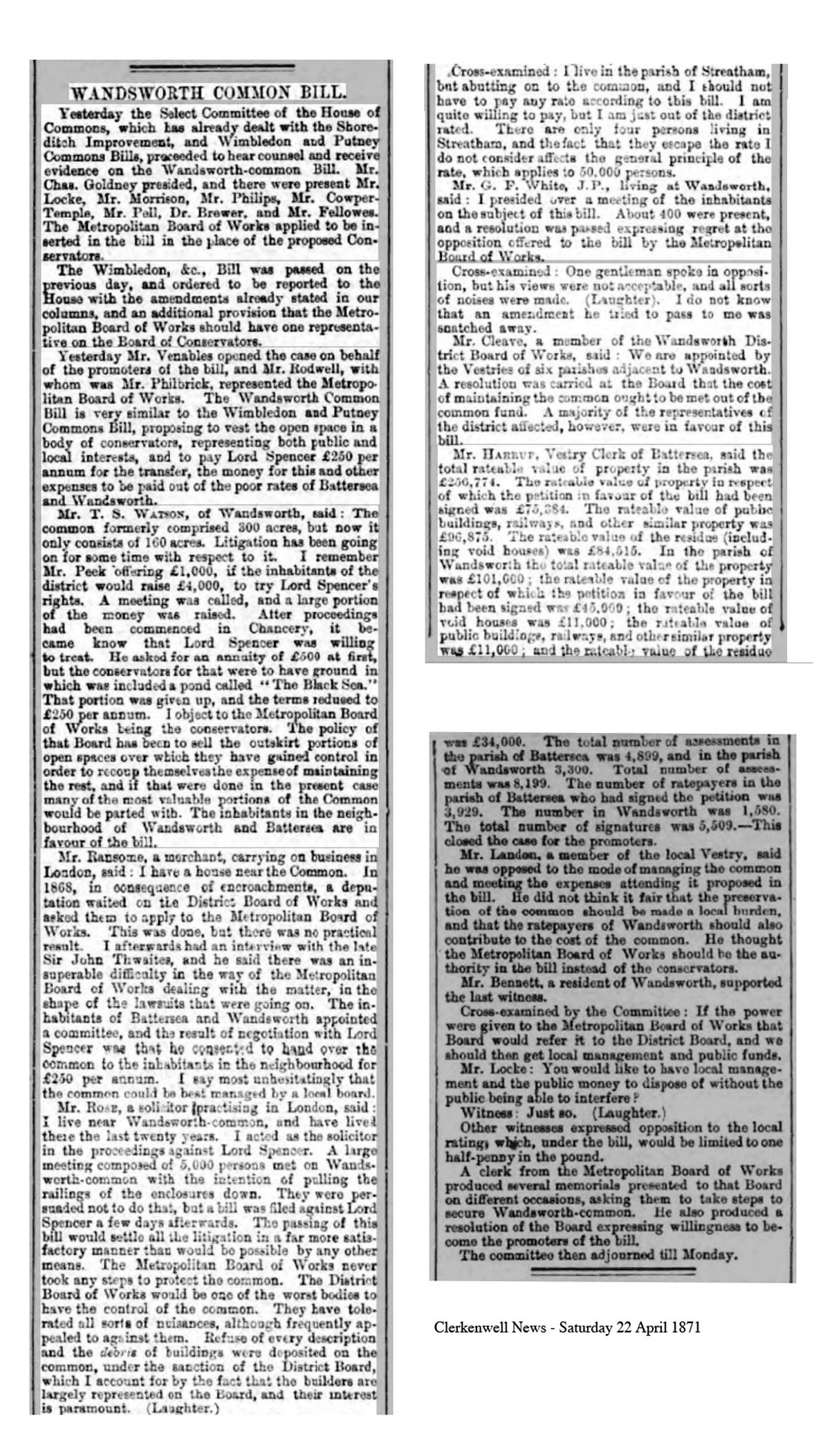
[NB. BLACK SEA BIT?]
WANDSWORTH COMMON BILL.
Yesterday the Select Committee of the House of Commons, which has already dealt with the Shoreditch Improvement, and Wimbledon and Putney Commons Bills, proceeded to hear counsel and receive evidence on the Wandsworth-common Bill. Mr. Chas. Goldney presided, and there were present Mr. Locke, Mr. Morrison, Mr. Philips, Mr. Cowper-Temple, Mr. Pell, Dr. Brewer, and Mr. Fellowes. The Metropolitan Board Works applied to be inserted in the bill in the place of the proposed Conservators.
[PB: Meaning? Presumably wanted to take over running the Common, instead of the Conservators.]
The Wimbledon, &c., Bill was passed on the previous day, and ordered to be reported to the House with the amendments already stated in our columns, and an additional provision that the Metropolitan Board of Works should have one representative on the Board of Conservators.
Yesterday Mr. Venables opened the case on behalf of the promoters of the bill, and Mr. Rodwell, with whom was Mr. Philbrick, represented the Metropolitan Board of Works.
The Wandsworth Common Bill is very similar to the Wimbledon and Putney Commons Bill, proposing to vest the open space in a body of conservators, representing both public and local interests, and to pay Lord Spencer £250 per annum for the transfer, the money for this and other expenses to be paid out of the poor rates of Battersea and Wandsworth.
Mr. T.S. Watson, of Wandsworth, said: The common formerly comprised 300 acres, but now it only consists of 160 acres. Litigation has been going for some time with respect to it. I remember Mr. Peek offering £1000, if the inhabitants of the district would raise £4,000, to try Lord Spencer's rights. A meeting was called, and a large portion of the money was raised.
After proceedings had been commenced in Chancery, it became known that Lord Spencer was willing to treat. He asked for an annuity of £500 at first, but the conservators for that were to have ground which was included a pond called "The Black Sea." That portion was given up, and the terms reduced to £250 per annum.
I object to the Metropolitan Board of Works being the conservators. The policy of that Board has been to sell the outskirt portions of open spaces over which they have gained control in order to recoup themselves the expense of maintaining the rest, and if that were done in the present case many of the most valuable portions of the Common would be parted with. The inhabitants the neighbourhood of Wandsworth and Battersea are favour of the bill.
Mr. Ransome, a merchant, carrying on business in London, said: I have a house near the Common. In 1868, in consequence of encroachments, a deputation waited on the District Board of Works and asked them to apply to the Metropolitan Board of Works. This was done, but there was no practical result.
I afterwards an interview with the late Sir John Thwaites, and he said there was an insuperable difficulty in the way of the Metropolitan Board of Works dealing with the matter, in the shape of the lawsuits that were going on.
The inhabitants of Battersea and Wandsworth appointed a committee, and the result of negotiation with Lord Spencer was that he consented to hand over the common to the inhabitants in the neighbourhood for £250 per annum. I say most unhesitatingly that the common could be best managed by a local board.
[CARRY ON EDITING HERE . . . ]
Mr. Rose, a solicitor practising in London, said: I live near Wandsworth-common, and have lived there the last twenty years. I acted the solicitor in the proceedings against Lord Spencer. A large meeting composed 5,000 persons met Wandsworth-common with the intention pulling the railings of the enclosures down. They were persuaded not to do that, but bill was filed against Lord Spencer a few days afterwards. The passing this bill would settle all the litigation a far more satisfactory manner than would be possible any other means.
The Metropolitan Board of Works never took any steps to protect the common. The District Board of Works would be one of the worst bodies to have the control of the common. They have tolerated all sorts of nuisances, although frequently appealed to against them. Refuse of every description and the of buildings were deposited the common, under the sanction of District Board, which I account for by the fact that the builders are largely represented on the Board, and their interest paramount. (Laughter.)
Cross-examined: I live in the parish of Streatham, but abutting on to the common, and I do not have to pay any rate according to this bill. I am quite willing to pay, but I am just out of the district rated. There are only four persons living in Streatham, and the fact that they escape the rate I do not consider affects the general principle of the rate, which applies to 50,000 persons.
Mr. G.F. White, J.P., living Wandsworth, said: I presided meeting of the inhabitants on the subject of this bill. About 400 were present, aod a resolution was passed expressing regret at the opposition offered to the bill by the Metropolitan Board of Works.
Cross-examined: One gentleman spoke in opposition, but his views were not acceptable, and all sorts of noises were made. (Laughter). I do not know that an amendment he tried to pass to me was snatched away.
Mr. Cleave, a member of the Wandsworth District Board of Works, said: are appointed to the Vestries of six parishes adjacent to Wandsworth. A resolution was carried the Board that the cost of maintaining the common ought to be met out of tbe common fund. A majority of the representatives the district affected, however, were in favour of this bill.
Mr. Harrup, Vestry Clerk of Battersea, said the total rateable value property the parish was £256,774. The rateable value property in respect of which the petition in favour of the bill had been signed was £70,084. The rateable value of public buildings, railways, and other similar property was £90,87-3. The rateable value of the residue (including void houses) was £84,615. the parish Wandsworth total rateable value of the property was £101,000; the rateable value of the property respect of which the petition favour of the bill bad been signed wn£ £40,000 the rateable value of void houses was £11,000; the rateable value of public buildings, railways, find other similar property was and the rateable value the residue
The total number of assessments the parish Battersea was 4,899, and in the parish of Wandsworth 3,300. Total number of assessments was 8,199, The number of ratepayers in the parish of Battersea who had signed the petition was 3,929. The number in Wandsworth was 1,580. The total number of signatures was 5,509. This closed the case for the promoters.
Mr. Landon, a member of the local Vestry, said was opposed to the mode of managing the common and meeting the expenses attending it proposed the bill. He did not think it fair that the preservation of the common should made a local burden, and that the ratepayers of Wandsworth should also contribute to the coat of the common. He thought the Metropolitan Board of Works should the authority in the bill instead of the conservators.
Mr. Bennett, resident of Wandsworth, supported the last witness. Cross-examined by the Committee: If the power were given to the Metropolitan Board of Works that Board would refer it to District Board, and we should then get local management and public funds.
Mr. Locke: You would like to have local management and the public money to dispose of without the public being able to interfere?
Witness: Just so. (Laughter.)
Other witnesses expressed opposition to the local rating! wlych, under the bill, would be limited to one half-penny the pound.
A clerk from the Metropolitan Board of Works produced several memorials presented to that Board on different occasions, asking them to take steps to secure Wandsworth-common. He also produced a resolution of the Board expressing willingness become the promoters of the bill.
The committee then adjourned till Monday
[Source: BNA Link.]
[ Follow-on articles in the Clerkenwell News . . . https://www.britishnewspaperarchive.co.uk/search/results?basicsearch=%22wandsworth%20common%22&exactsearch=false&retrievecountrycounts=false&newspapertitle=clerkenwell%2Bnews&sortorder=dayearly&page=9]
Wandsworth Common Bill
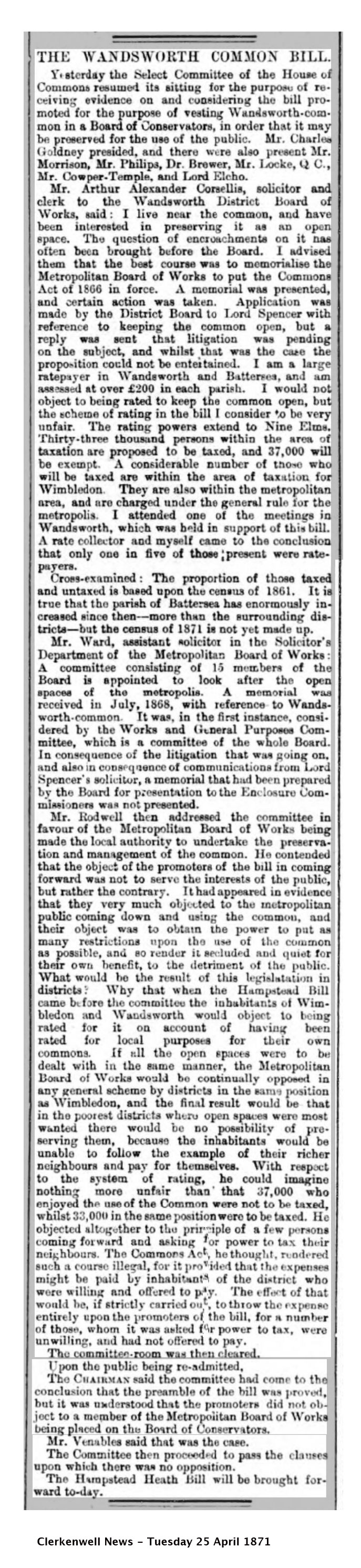
Clerkenwell News — Tuesday 25 April 1871
THE WANDSWORTH COMMON BILL.
Yesterday the Select Committee of the House of Commons resumed its sittiug for the purpose of receiving evidence on and considering the bill promoted for the purpose of vesting Wandsworth-common in a Board of Conservators, in order that it may preserved for the use of the public. Mr. Charles (Joldney presided, and there were also present Mr. Morrison, Mr. Philips, Dr. Brewer, Mr. Locke, Q C., Mr. Cowper-Temple, and Lord Elcho.
Mr. Arthur Alexander Corsellis, solicitor and clerk to the Wandsworth District Board of Works, said: I live near the common, and have been interested in preserving it as open space. The question of encroachments it often been brought before the Board. I advised them that the best course was memorialise the Metropolitan Board of Works to put the Commons Act of 1866 in force. A memorial was presented, and certain action was taken.
Application was made by the District Board to Lord Spencer with reference to keeping the common open, but a reply was sent that litigation was pending on the subject, and whilst that was the case the proposition could not entertained.
I am a large ratepayer in Wandsworth and Battersea, and assessed at over £200 in each parish. I would not object to being rated to keep the common open, but the scheme of rating in the bill I consider be very unfair. The rating powers extend to Nine Elms. Thirty-three thousand persons within the area of taxation are proposed to be taxed, and 37,000 will be exempt. A considerable number of those who will be taxed are within the area of taxation for Wimbledon. They are also within the metropolitan area, and are charged under the general rule for metropolis.
I attended one of the meetings in Wandsworth, which was held in support this bill. A rate collector and myself came the conclusion that only one in five of those present were ratepayers.
Cross-examined: The proportion of those taxed and untaxed is bused upon the census of 1861. It is true that the parish of Battersea has enormously increased since then — more than the surrounding districts — but the census of 1871 is not yet made up.
Mr. Ward, assistant solicitor in the Solicitor's Department of Metropolitan Board of Works: A committee consisting of 16 members of the Board is appointed to look after the open spaces of the metropolis. A memorial was received July, 1868, with reference to Wandsworth-common. It was. in the first instance, considered the Works and General Purposes Committee, which is a committee of the whole Board. In consequence the litigation that was going on. and also in consequence of communications from Lord Spencer's solicitor, a memorial that had been prepared by the Board for presentation to the Enclosure Commissioners was not presented.
Mr. Rodwell then addressed the committee favour of the Metropolitan Board of Works being made the local authority to undertake the preservation and management of the common, contended that the object of the promoters of the bill in coming forward was not to serve the interests of the public, but rather the contrary. It had appeared in evidence that they very much objected to the metropolitan public coming down and using the common, and their object was to obtain the power to put as many restrictions upon the use of the common as possible, and so render it secluded and quiet for their own benefit, to the detriment of the public.
What would be the result of this legislation in districts? Why that when the Hampstead Bill came before committee the inhabitants of Wimbledon and Wandsworth would object to being rated for it on account of having been rated for local purposes for their own commons.
If all the open spaces were to be dealt with the same manner, the Metropolitan Board of Works would be continually opposed in any general scheme by districts in the same position as Wimbledon, and the final result would be that in the poorest districts open spaces were most wanted there would no possibility of preserving them, because the inhabitants would be unable to follow the example of their richer neighbours and pay for themselves.
With respect to the system rating, he could imagine nothing more unfair than that 37,000 who enjoyed the use of the Common were not to be taxed, whilst 33,000 the same position were to be taxed.
He objected altogether to the principle of a few persons coming forward and asking for power to tax their neighbours. The Commons Act, he thought, rendered such a course illegal, for it provided that the expenses might be paid by inhabitants of the district who were willing and offered to pay. The effect of that would be, if strictly carried out, to throw the expense entirely upon the promoters of the bill, for a number of those, whom it was asked for power to tax, were unwilling, and had not offered to pay.
The committee-room was then cleared.
Upon the public being re-admitted, the Chairman paid the committee had come to the conclusion that the preamble the hill was proved, but it was understood that the promoters did not object a member of the Metropolitan Board of Works being placed on the Board of Conservators.
Mr. Venables said that was the case.
The Committee then proceeded to pass the clanses upon which there was no opposition.
The Hampstead Heath Bill will be brought forward to-day.
[BNA: Link]
SUBJECT
[4]The two great questions of the utilisation our town sewage and of our waste lands continually force themselves upon the attention of the public. As our population increases, the existing food-producing districts become less and less adequate. We might leam a useful lesson from the Chinese in this matter, for they utilise every inch of soil and every ounce fertilising substances. There can be no doubt that many largo tracts land this country are irreclaimable — not literally so, perhaps, for the most barren ground must yield to scientific treatment — but absolutely irreclaimable by any means which would yield profit upon the labour and capital expended. But leaving the utterly or almost hopeless tracts out of the question, it has been estimated that there are in the United Kingdom no fewer than 15,000,000 acres, or one-fifth of the entire area, which are now not under cultivation, but which might be cultivated at a profit and become a source of employment to the poor and of wealth to the community at large. An enthusiastic pamphleteer calculates that if our waste lands were fully brought under practical cultivation they would produce 75,000,0001. worth of food, or double the quantity now imported. But supposing this to a gross exaggeration, — suppose that the energetic writer has doubled the actual figures, and that the results would be only one-half what he estimates, — even then the facts are sufficiently significant to demand careful attention, patient investigation, and, so far and so soon possible, practical realisation. If it be true, the pamphlet in question assures us, that we import nearly 20 milhon pounds worth of wheat, and nearly equal quantity of other cereals, leading to send abroad in payment for our food the enormous sum of over 37,000,0001. yearly, it is surely time to take some steps to ascertain beyond dispute how far this theory food-production at home upon lands now
[5]
hold good when the test of prac-1 applied. If only tithe glowing possibilities could brought to it would be boon no ordinary magm- For we must not confine ourselvee to the . the food produced, there will the Sbour moderately remunerated, which is called action by such food-production. There r the fact also that the wages paid for such $hour will be spent in this country, and the oital thus set in motion will act and react in its circulation, creating and diffusing wealth on every will permeate, in fact, the entire fabric of society. It certainly requires no great profundity in the science of political economy to preciate the immense advantages to this country of producing its food at home in the way suggested, compared with the yearly exportation of sums ,0 enormous to remunerate food-producing labour in distant lands, and to be expended in such lands. do not conceal from ourselves, however, the mass of prejudice and the immense variety of other obstacles with which a discussion of this sort in such $ society as ours is naturally and necessarily beset. People are too apt to attribute to the Government for the time being the blame of any reluctance which may be exhibited to the practical realisation of such schemes; but the fact is that, as a rule, | no Government$ Whig, Tory, Kadical, or Coalition$likes to grapple with a question of such magnitude and delicacy. Then there are the lords manors and other people, with rights more or less real, more or less founded on antiquated privileges and time-honoured customs, and they are sure to be found in combination to resist what they deem encroachments upon their vested interests. The legal profession is also ever on the alert when land has to dealt with in any way; and the lawyers, true to their traditions, resent as an injury transactions which do not permit the interesting manufacture of costa. But if some scheme for the utilisation of waste lands could be shown to be really practical, and likely to produce even a reasonable proportion of the results we have indicated, the day is not far distant when $the pressure from without will force upon a reluctant Legislature of landowners the adoption of some plan for giving work to the wilHnns and adding so materially to the wealth of the community. The interest which the masses of the people take in questions of this sort has latterly been somewhat clearly demonstrated relation to Epping Forest, Wandsworth Common, and Hampstead Heath. In these instances the question was one of health,$ the preservation of open spaces for the purposes of recreation. The still greater question of the foodproducing capabilities of lands now lying idle is gradually taking root in the public mmd; and on an early opportunity the Government of the day will be forced to discuss the matter seriously, and adopt some really practical method of endeavouring to solve a difficulty which has long perplexed the politician. If the man who makes two blades of grass grow where only one grew before$ is benefactor to his species, what shall we say, when they succeed, in laudation of these amiable enthusiasts who are for ever reminding that land enough is lying idle to supply with all the cereals we want, and with work for all the unemployed who are at all capable of performing such work! . . . To carry out this scheme, it is not requisite to withdraw from the public use spots suited to popular recreation, and conducive to the general health in the shape of those open spaces in which they can breathe the fresh invigorating air, and promote their happiness by indulging in diversified and healthful exercise. The more we reflect upon what is at least possible, if not perhaps immediately probable, in these matters, the more thoroughly we are convinced that something must done to satisfy the just expectations the toiling and the suffering, the starving and the unemployed, whose vast and urgent necessities can only be encountered with practical success some such means those which we have indicated.
[NOTE: Could this be Buckmaster?]
Preservation of Commons in Surrey.
[NEEDS EDIT]
Preservation of Commons in Surrey.
The long pending controversy as to the right of Earl Spencer, lord of the manor, to enclose Wimbledon-common has been settled very amicably, and after an expenditure of £3,000 in law proceedings, the common is to be preserved for the benefit of those having pasture and common rights, and portion is to be appropriated as a public recreation ground. The efforts made officials to make a sewage bed Wimbledon-common has met with such strenuous opposition by the resident ratepayers that the scheme is now abandoned, and the common, with the exception of certain improvements, will remain intact.
The dispute in reference to the waste at Wandsworth, between the ratepayers and the lord of the manor, and in which violent hostile proceedings were adopted, is also amicably arranged, and no further encroachment on the common rights will be made. But a small portion of Wandsworth common now remains in its original form a county prison, and several public schools and almshouses and railway cuttings nearly consume the common, and the remainder is not to be enclosed.
Tooting common is to be laid out in ornamental form and converted into public park. The opposition party to the proposed enclosure of these commons have obtained victory on behalf of the commoners and others interested in their preservation.
[BNA: Link ]
[NOTE]
The enigma of Wandsworth Common's eels as a challenge for science.
ANGLING
THE THAMES EEL QUESTION — WOODHOUSE VERSUS ETHERIDGE
The eel has always been a slippery subject. There are those who question whether it was not an eel that tempted our common mother, rather than a veritable serpent, for we have very many instances on record of the all-powerful prevalence of this tempting dish, whether fried, stewed, or spitcooked [sic?], over the female appetite. Indeed, even in in this prosaic period . . . .
[CARRY ON . . . NEEDS A LOT OF WORK]
As, however, this is a matter of importance. and most lha Interests of the mill owners the Thames, as well as the fishermen, we had, perhaps, better begin the beginning. merely that wheat Mr. W. H. Brougham anathematised the eel, stating that for Us poaching ought to be Improved out of the depths of the waters, that gentleman could scarcely have known what powers evil still lurked the I "" loathsome dell things' and bow soon the courts law would . resounding forensic reverberations with its merits and dUptuiea.
At the Petty Sessions, at Windsor, June 36.1670. Captain Henry Whitbread Etheridge, the Inspector of the Board of Conservancy for the Upper Thames, William Wood house, the jouuger, of Bray, with unlawfully taking, end attempting ' to take, eels within the fence season (between Feb May 31), contrary the Upper Thames by-laws was proved, and a fins of and costs Ivs. followed. The defendant, dissatisfied, applied the magistrates for record of appeal, was compiled with the magistrate in answer set forth amongst other pleas, it was admitted Wood house for purpose of raising the question for decision In this case, that be had within the limits the fence mouths taken eels means traps engines called grig wee Is. finch grig weels are wicker baskets sunk the river means weights. They contain a chamber into which there an entrance, narrowing Inward nearly to a point, and formed the end of converging willow rods. Three rods diverge upon pressure externally, and admit the long thin body the cel into the chambers, when they again and prevent his egress. engines are Intended used only for the catching of eels, but other fish may be caught therein. Salmon, and salmon trout, and trout spawn between Sept Marefa3l,aad are then out season, and unfit for human food, and the taking would a wanton hindrance to their propagation. And pike, jack, perch, roach, rudd, barbel, bream, chub, carp, tench, grayling, gudgeon, pope, dare, crayfish, bleak, minnow, and every kind ttah known as river fish (except salmon, salmon trout, and trout) spawn between Feb 14 and May 31, and are then out of sod unfit for human food, the taking them would b.s likewise a wanton hindrance to their propagation. Statements were made and quotations read from different works upon natural history the advocates of the prosecutor and defendant to the nature and habits of tlte eel, I but sutteteoi evidence was given to prove a fact how eels are pro|"gated, whether they are oviparous or viviparous, or whether they not spawn or propagate their vnung between Feb 14 and May 81, or any other particular tlma. It was alleged the defendant, but disputed the prosecutor, that eels are never known out of season or unfit for human food any tine when it poaaibla to take them; that eela can only be taken by the means employed by the defendant, or uae of baits, between the beginning March and the end oi October. They are taken in the months October. Nor ember, and December by means large fixed engines, called eel bucks which interrupt them in their passage down the river towards the sea. Upon' these facts it contended, on the part of the defendant. that it had not been proved that eels are fish known rucrjish. hut that had been proved that they were not ejuttUm with several kinds of fldi specified by name in the anb-section B of the eighth by-law, bo to be included in the description "every kind of fish known river fish" in the bylaw mentioned; that the? were not within the mischief intended to provided against by the by-law, and tliat, therefore, according to tin) true and reasonable intent and construction of the bylaw, the defendant had not committed any offence against the aarne, but the prosecutor alleged to the contrary thereof. The magistrates, however, being opinion that the said eighth bylaw included in Ute expression " every other fish known river fish," considered that they must convict the defendant. The question for the opinion of the court is whether, upon the facts above stated, they were bound to convict the defendant of offence against the ninth by-law, if read together with the exception the thirteenth by-law. If they were bound the conviction is to affirmed, otherwise it to quashed.
(Signed) G. Howard Vvea, Colonel, J.P. Bd. Hall Say, J P.
This appeal came on for heating in the Common Picas on the ult, before Mr Justice Wilies and Mr Justice Montague Smith, and (he following Is the judgment in substance:
JUDGMENT
Mr Justice Willies: This is uiiestion raised apparently by "rrangetnent in ihss form of a special oa"e for purpose of determining whether the eighth by-law o< those made the Elver Thames Commissioners does does not apply eels in far whether they may or may not be deemed to riser fish, and, coming within the periods there prescribed within which rlrer may or may not be taken. There can be no doubt you take the by-law itself, that eel bred and living in any particular river a river fish. And in Coke Little law. 11, Lord Coke, speaking of tislieries. and of certain machines used for the catching of lith, some which are there mentioned name, expressly recognises eels as river hsh, so that an eel lias long been considered In popular language to belong to the class known river fishand (bis view appears be con firmed upon reference to the thirteenth by-law. which provides that nothing therein contained, except the provisions of the eighth section, shall hike away the right of the owner or occupier a private fishery — as the party this case was — or any person having a private right, from fishing with certain nets or tackle there described. Then the learned counsel. Mr Harrington, argues that we ought not to construe the by-law applying to eels, because no evidence was given before the magistrate as to their requiring any special protection a particular period, said that eels must be out of a bylaw of this description by reason of their not requiring protection in the river, and from the circumstance of their spawning la the sea if they spawn at ail, therefore, ws ought not to apply tills by-law them. own I do not exactly follow that argument. not think it requires any great pretension offer an opinion on the mode in which eels bring forth their young. enough to say that the law regards the order of nature, and there is the fact that eels must at some time bring forth dieir young, likely exhausted in doing so, and until restored by the ordinary process by which nature repairs Itself, require to be specially protected such period. Without rouh ureteuaioo owe might any that being so. there must periods of the year during which eels require protection; and if one was to adopt what Mr Harrington threw out as the generally received notleo, that the eels roll down the autumn floods, and come up. both the old and the young. In the spring, there most be occasions when eels require protection in the fresh water in respect their going down and their return. Ido net mean pronounce any opinion this by-law. lam not acquainted with the particular part the river; I know bow mm;b rivers differ from one another; but these is enough to found conclusion that the commissioners might well fix a time during which the cels might protected; end might fix time when they were returning after they had produced their young when they might require some restoration. 1 see nothing ail irrational or unreasonable in the commissioners coming conclusion that this was a proper by-law. The person who says this by-law cannot properly apply eels seams to have the burtfon east open him to show why it should oot so. la other words, lbs person who complains that which the commissioners have dene to impose protection on the this period ought bring forward some evidence show that that which they have done so absurd that it cannot done. Passing over the argument its bring unreasonable that this bv-Uw should apply sals, I come the verbal construction of it. aad considering that eels are a flsh importance, do doubt used for the food of man, and more fit for it than many oilier flsh which are here mentioned, and they are described with much particularity, even down to the minnows, refers live rule of law which lays down in this way; that If ths dsscripUpe a number things consists In speoifle statement Individuals belonging to species, and concludes with general words, or words of ssssssss character, that you ought refer the general words indiriduab coming within the species which the preceding specified individuals belong; and that you ought not to extend miy other speriesT though falling within the genus which, if oth.-r words were used, they might capable good rule which every one would apply to the ooosUuciioa of language which adopted the lawyer as well by the grammarian. That being ought construe words. every kind flsh known river flsh,'s being applicable fo flsh of the same species those thet go beforo — which are perch, roach, chub, barCTiss: these mighthecleemd under one order. All the larger kind flsh would fall within one species, and then there are Interposed greet number of flsh, thrown together so speak, individuals a different species mixed in no order, which shows that the peieoo who was putting these together was giving an enumeration all thought were In Ihenrer, not expressing himself in very good lan page, or confining himself one species. And then out. and every kind of fish known s" fish. The would seem hardly within ordinary rule. Harrington right saying that the previous flsh mentioned includes every firti withln the rule to the construction of general things gtnerit has application at all. thelndlriduals named do include species you roust apply your general words some other species. Then there treated thrown aside, trivial; no one would regard for preservation such things as minnows and the like, which are no use all, and then you have nothing left except flounders, eeU. and Umnrevs " one has suggested any other which wcmld come within what arc known river flsh. I cannot help thinking to rl.w ut tli. the Motion lh.t th. object w.. include mid to del with every kind it"h known a. rieee Bth; uiwu the b"Jt mid cltwMt nnnly il" Ulta motion that I been able lo give to It. b.r" lo the oom-luilon tket every kind river nub wee meant to Include, .mong.t nthere, eel.. muehfor the oonettuotion. Then -let I. the <""t of the ewttlon h. point of law under tboaff.i and Ictona, chap 113. MVlions and "7? It 1s mid Mat eeaumlni that the by-law dote lie language Include oela. It doer not Include them eo pnrUcular and w"y a" to make the by-law a" enorciee power gieento the oottimlieionete by the Ualnte. te cnn'""led that eel. ought Itare been named lu the by-law. They are dmerlbed la the by-law other llah a. completely^a. If every other (lab wblch could let la rlrer was mentioned name, clmuodwl that It I. whM ahould mentioned name. <" tom" sMc(l 'JSdf- mwrtissd. The. comes ths i7th section which Tot this Act. sny power oonisrred by tills act. or,n y, ths nmsrvstion ths flsh in the river Thames — which tbs flth sot extend to, away. " lt^ or saying that the persons who bars private fishery are not "uh except by by-law for the preservation of the fish. And doabt this by-tow sres oommi-siomsr" fnr the 111 ism of flsh during time when the taking of SSraetlssd. Tbs question here is. whether. asroming ths language descfibsselsgeneially, to general terms, as "< other kind ofnvS fish," this a Dsrtlcui.ror Sto'thl l "Mvp ri l7, tlS?, u"no by law time.- dld to too to Impom toe rommMooert the necemltj naming "e the . _, "n in the ordinary Unguags. which should under- wbtek the by-law nerttonlar es pat down nomltotum la tta ISjUfss It enough that It ahould tpirl""i la ordinary Urn ordinary of bagnagr.lt thcaa Aib knowa rteer bTtow enbeecdao tbirtaew. I wonld cowctnde wllbta Urnelgbthby " mmmlmliin- had powto tow to they had "B< eels there would hare brer doubi of the qoss- Bunb? have right to proceed their o"cer bar dona
p""s. and ii enough to any they here exercised the power In enJMert s""""". s" that w" ought not to strain the words. A tie rnmiaweinnsf alter the by-law they meant to inelade eels when they have net done eo, they ran alter the by-law. It better that they should left to take that couree rather than should go of o"r way by strata lag the language arrive at an opposite coarse. If they did mean to Include eels, eels are Included; If they did not mean It, they ran easily era that right. laaby manna Inelteed anggeM that there was any error all, and I think this decision appealed from ought to aflrmed. Mr Justice Burn lam of the same opinion. I think is safe rule to act suppose that the framers efthaee rules meant what they had said. It dear that eels come within the description river fish. The framers of these by-laws have section included besides the fish which era specially mentioned every kind of fish known river fish. think that eels come within that description. I can find nothing the context which is sufficiently dear enable to say that the eommiariooen did not mean to include eels in ttuue general words. It looks very much if the framers these rules were tuoklag after the very small fish, and in their minute search had forgotten the larger ones: and thinking they might enumerate all fish they use words which clearly mean to sweep In ell other fish which come under the description of river fish. would mere speculation to suppose they did not intend to Include eels. It seems that should doing violence to the language wu were to hold that they did not include eels in these wordi. Mr 1 think the costs follow event. Mr Justice I think it woe be too much in queei lion Uka this give oosfs. 1 dare say the commissioners would not press for costs. We do not think we should give costs. It raises very nice question. We may at some future time comment both upon the evidence before the magistrates and the facts given in live judgment of the judgea, there much of interest to be eliminated therefrom. We will "ow only content ourselves with remarks upon a few points Immediately bearing upon this Individual case, and which, however, ran scarcely have escaped the notice of the experienced I angler or fishermen. It will seen that defendant Woodhouse admitted that other fis>. besides eels can caught in grig wecls referred to. Indeed, it was "la ted that Etheridge had in the course of his duties river keeper and superintendent taken up grig weels or eel baskets from bottom of the river 1 almost full of perch and oiber fish which are specified protected In the eloee months. The long willow rode at the thin end of the grig wed or basket became so soft and pliable by constant immersion that good sized fish are able get Into trap, so that for this reason alone they should be Interdicted in the fence months. The attempt prove that an eel was aot fish was of, course treated as ttdeservei. for it clearly eonu-s under the, definition of fish does pike-it has fins, and breathes through the gilia. attempt to take "" fish " therefore in the fence months, even had not been admitted, waa. beyond a doubt, leaving out fact that other fish than are taken by this meant. It may asked whether eel bucks are stopped during the fence mouths? Certainly, the reetrictions oqualiy apply, although the by-laws referenra the latter engines expressly imply that they shall not used for any other purpose any time than for catching eels, and that any other river fish taken therein must relumed to the river. It may, therefore, b'come question whether the owners of grig werls, taking, or rather any other fish but eels thus caught are not liable for thst act alone. Recent experiments and observations all lend show that eels spawn in the sea, In estuaries. In rivers tidal, and otherwise, and in meres, lakes, broads, ponds, dttchea. The spawn of an eel is now no longer an uncommon or doubtfol subject. Almost every museum can show examples this ora. which have hitherto avoided observation from their extreme minuteness. A Thames rtsbsrman, mora particularly those the tWal way. will, at obtain seasons point out the fringes in which the spawn Is exquisitely arranged, and microscope or pocket magnifyingglaas will render the latter perfectly perceptible. If eels do not spawn in ponds surronudad with plantations and dusty paths, so as to render ingress and egreas next to impossible, whence do the voung of the eel, which we find therein every year, and are too tender for the migratory passage over land, which their strong and tough hided parents are not unjustly accused, come from Are we to look up the thunder clouds, and down the feet of the heron for the myriads we annually find In these places? The superstitions regarding the eels are likewise remarkable, and obtain in many districts of Great Britain and the Continent.
Their marvellous fecundity, sudden appearances and disappearances, assisting to beget and cherish notions supernatural. The little stream which takes its rise near the BuUa Wimbledon courses through Richmond Park, skirts Barnes Common, and enters the Thames at Barnes Elms, maybe seen one day a black mass of young eels, or elvers, and the next not one discoverable This circumstance, a gentleman of otherwise strong mind and high position told us. had strange and lasting impression upon him. thst men to this day he uncontrolably associates the name Richmond Park with something weird and uncanny. The solution here Is the presence of running water leading to many channels. .. i
Instances out of number might be adduced eels breeding In . water. A pood in Harland Brick Yard, near Bristol. I known the Eel Pond," has Its water only from spring and rain-fall, and there river or water-shed wllfiln two milss. . Yet this isolated water abounds with all sizes, from the thickness of straw to over half pound in weight.
The Black Sea on Wandsworth Common, feet shove the Tim mes, surrounded with roads, and supplied by a windmill pump, famous for its eels. Eels while spawning have been brought the dredgers of the Thames.
Kelt, although not naturally fond of mud, generally supposed, penefirale through it In the spawning seasons Gao the sand or gravel, and thus the mud becomes warm covering, and promotes their natural offices, for eels are particularly ausoeptible of cold. Very many farts regarding the rala will found in \ol of the F Furman's under Use head " Curiosities of Angling Literature." Red GUI (Oreville Pennell); and Mr J. H. Lamprey most appropriate name), who waa formerly totor Lord Lome, afterwards librarian at Windsor Castle, and now secretary to The Royal Geographical Society has and is still giving much attention to the natural mystery of the"l. oiax.
[BNA: Link.]
THE COMMONS PRESERVATION SOCIETY AND THE HOME SECRETARY.
THE COMMONS PRESERVATION SOCIETY AND THE HOME SECRETARY.
TO THE EDITOR OF THE MORNING ADVERTISER.
Sir, Will you permit me to notice statement made the First Commissioner of Works last night in the debate on the Epping Forest Bill ? Mr. Ayrton asserted that the whole management of open spaces near London had been entrusted by the Metropolitan Commons Act, 1866, to the Metropolitan Board of Works. This is not so. The Metropolitan Commons Acts, 1866 and 1869, give power of initiating schemes for the management of commons to four bodies — the lord of the manor, any commoners, the local authority, and any ten inhabitants.
For commons within the metropolis, as defined by the Metropolis Management Act, 1855, the Metropolitan Board is the local authority for this purpose of initiating schemes; and that Board is also empowered to contribute towards the expenses of carrying out scheme for any metropolitan common. These are all the powers conferred upon the Board.
The Act appoints no body to manage commons. This is a matter left entirely to the promoters of each scheme and the Enclosure Commissioners who have to sanction it. Neither is there anything in any of the Acts more especially relating to the Metropolitan Board which gives them those exclusive powers and duties which Mr. Ayrton stated they possessed last night. These statements, I may add, do not rest on any private interpretation of the Acts of Parliament merely, though the Acts themselves are perfectly clear.
The question was argued at length by the counsel of the Metropolitan Board before the committee of the House of Commons which sat this session on the Wimbledon, Wandsworth, and Hampstead Bills. The committee decided against the claims of the Board without the slightest hesitation, and passed the Wimbledon and Wandsworth Common Bills, establishing local management in the teeth of the opposition of the Board, based on the very proposition which Mr. Ayrton enunciated last night.
I should not trouble you with these remarks had it not always seemed to the Commons Preservation Society of the greatest importance to foster and encourage strictly local action, and that such action may be seriously embarrassed if Mr. Ayrton's statement pass unchallenged. Mr. Cowper-Temple, the president of the society, was unfortunately prevented from attending the House last night by a recent accident, or he would have stated these facts in debate.
I am, Sir, yours, &c., EDWARD W. FITHIAN,
Secretary to the Commons Preservation Society, 1, Great College-street, Westminster, Aug. 9, 1871.
[BNA: Link ]
[NOTE]
From HOW THE BATTLE FOR WANDSWORTH COMMON WAS FOUGHT & WON:
Date? 1871
The first conservators appointed by the Act were: -
Mr. James Du Buisson, JP
Mr. Edwin Rayner Ransome
Mr. Charles Eccles
Mr Charles Lambert
Mr. Thomas Simons Watson
And the following were subsequently appointed as under [?]
Mr. Wyatt By Secretary of State for the Home Department.
Sir Edwin Pearson Appointed by he First Commissioners of Work
Mr. Meaden Appointed by the Metropolitan Board of Works
On August the 3rd [1871], the conservators held their first meeting at the house of Mr. Du Buisson; they have since that time published reports of what has been done year by year.
The remains of Wandsworth Common
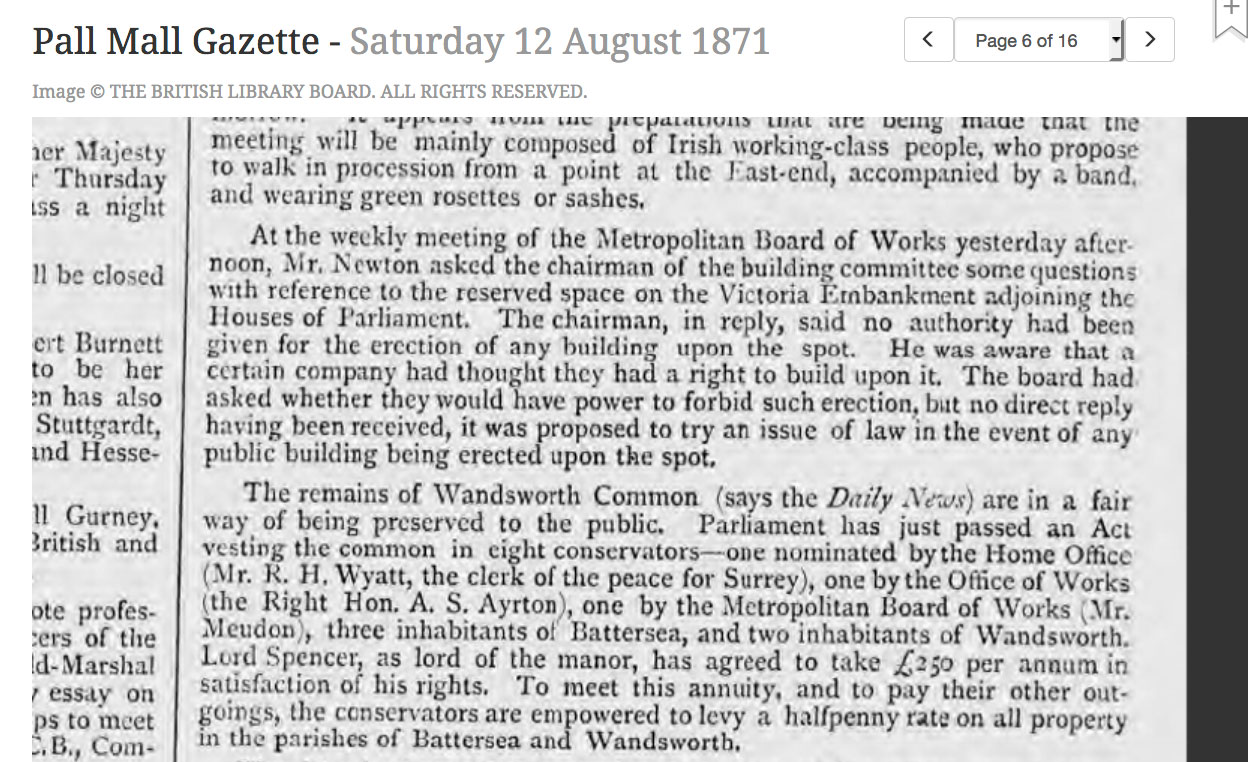
The remains of Wandsworth Common (says the Daily News) are in a fair way of being preserved to the public. Parliament has just passed an Act vesting the common in eight conservators — one nominated by the Home Office (Mr. R. H. Wyatt, the clerk of the peace for Surrey), one by the Office of Works (the Right Hon. A. S. Ayrton), one by the Metropolitan Board of Works (Mr. Meedon), three inhabitants of Battersea, and two inhabitants of Wandsworth.
Lord Spencer, as lord of the manor, has agreed to take £250 per annum in satisfaction of his rights. To meet this annuity, and to pay their other out-goings, the conservators are empowered to levy a halfpenny rate on all property in the parishes of Battersea and Wandsworth.
[BNA: Link.]
[Is this Buckmaster's second or first talk?]
_p1.111_INTERNATIONAL_EXHIBITION.jpg)
Each year from 1871 to 1874 an Annual International Exhibition was held in London. These followed on from the 1851 Great Exhibition of the Works of Industry of All Nations and the 1862 International Exhibition in London, and the many international exhibitions which had been held in various countries since 1851.
The first received over a million visitors [1] and made a profit, but the subsequent three had fewer visitors and all made a loss.[1]
[Wikipedia: Annual International Exhibitions (London 1871 — 74)]
The article continues, with info. about colonial exhibitions (mainly Australia) and India, but chiefly about the 1873 exhibition. There is a reference to Henry Cole's account of the exhibitions ("Special Report on the Annual International Exhibitions of the Years 1871, 1872, 1873, & 1874, Drawn Up by Sir Henry Cole, KCB., Acting Commissioner in 1873 and 1874, and Presented by the Commissioners for the Exhibition of 1851 to the Right Honourable Richard Assheton Cross, &c. &c., One of Her Majesty's Principal Secretaries of State. , 2006. Internet resource." and also "The International Exhibition, 1871. London: Virtue & Co., 1871. Internet resource.|". I wonder if Cole mentions JCB?
Google Books says it was published by the House of Commons in 2006 but there's no ebook available
https://books.google.co.uk/books/about/A_Special_Report_on_the_Annual_Internati.html?id=rvi4wgEACAAJ&hl=en&output=html_text&redir_esc=y
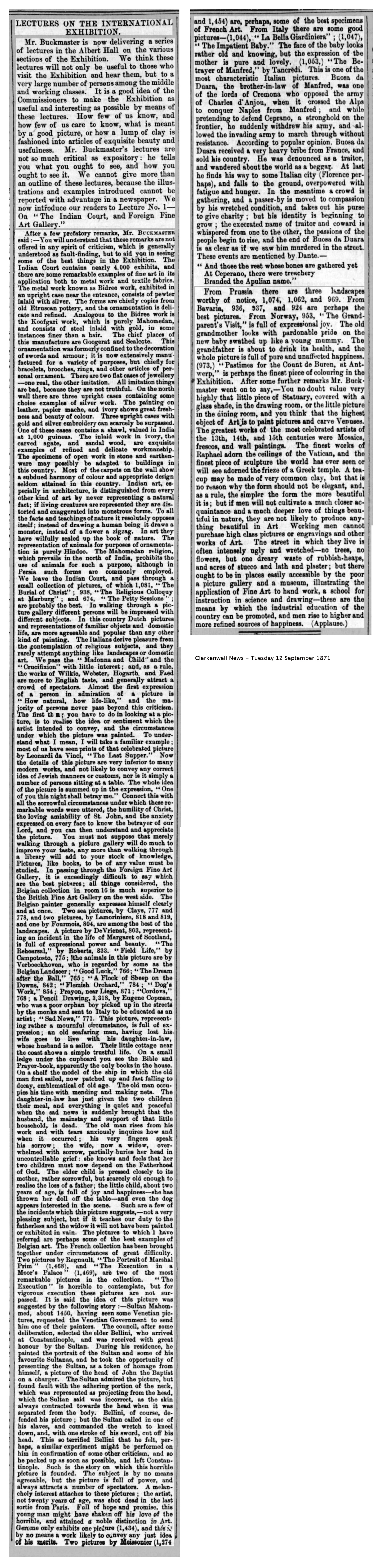
Clerkenwell News — Tuesday 12 September 1871
LECTURES ON THE INTERNATIONAL EXHIBITION.
Mr. Buckmaster is now delivering a series of lectures in the Albert Hall on the various sections of the Exhibition. We think these lectures will not only be useful to those who visit the Exhibition and hear them, but to a very large number of persons among the middle and working classes. It is a good idea of the Commissioners to make the Exhibition as useful and interesting as possible by means of these lectures. How few of us know, and how few of us care to know, what is meant good picture, or how a lump of clay is fashioned into articles of exquisite beauty and usefulness.
Mr. Buckmaster's lectures are not so much critical as expository: he tells you what you ought to see, and how you ought to see it. We cannot give more than an outline of these lectures, because the illustrations and examples introduced cannot be reported with advantage in a newspaper.
[Did he show lantern slides? If so, were these photographs or e.g. engravings?]
We now introduce our readers Lecture No. 1- On The Indian Court, and Foreign Fine Art Gallery."
After a few prefatory remarks, Mr. Buckmaster said You will understand that these remarks are not offered in any spirit of criticism, which is generally understood as fault-finding, but to aid you in seeing some of the best things in the Exhibition.
The Indian Court contains nearly 4.000 exhibits, and there are some remarkable examples of fine art in its application both to metal work and textile fabrics. The metal work known as Bidree work, exhibited in upright case near the entrance, consists of pewter inlaid with silver. The forms are chiefly copies from old Etruscan pottery, and the ornamentation is delicate and refined.
Analogous to the Bidree work is the Koofgari work, which is purely Mahomedan, and consists of steel inlaid with gold, some instances finer than a hair. The chief places of tbia manufacture are Googerat and Sealcote. This ornamentation was formerly confined to the decoration of swords and armour; it is now extensively manufactured for a variety of purposes, but chiefly for bracelets, brooches, rings, and other articles of personal ornament.
There are two flat cases of jewellery — one real, the other imitation. All imitation things are bad, because they are not truthful. the north wall there are three upright cases containing some choice examples of silver work. The painting on leather, papier mache, and ivory shows great freshness and beauty of colour. Three upright cases with gold and silver embroider}'can scarcely be surpassed. One of these cases contains shawl, valued in India at 1,000 guineas. the inlaid work in ivory, the carved agate, and sandal wood, are exquisite examples of refined and delicate workmanship. The specimens of open work in stone and earthenware may possibly be adapted to buildings in this country. Most of the carpets on the wall show a subdued harmony of colour and appropriate design seldom attained in this country.
Indian art, especially in architecture, is distinguished from every other kind of art never representing a natural fact; if living creatures are represented they are distorted and exaggerated into monstrous forms. To all the facts and teachings of nature it resolutely opposes itself; instead of drawing a human being it draws a monster, instead of a flower zigzag. In art they have wilfully sealed up the book of nature.
The representation of animals for purposes of ornamentation is purely Hindoo. The Mahomedan religion, which prevails in the north of India, prohibits the use of animals for such purpose, although in Persia such forms are commonly employed.
We leave the Indian Court, and pass through a small collection of pictures, of which 1,081, The Burial of Christ"; 938, "Tho Religious Colloquy at Marburg"; and 674, ** The Petty Sessions; are probably the best. In walking through picture gallery different persons will impressed with different subjects.
In this country Dutch pictures and representations of familiar objects and domestic life, are more agreeable and popular than any other kind of painting. The Italians derive pleasure from the contemplation of religious subjects, and they rarely attempt anything like landscapes or domestic art. We pass the "Madonna and Child'' and the "Crucifixion" with little interest; and, as a rule, the works of Wilkie, Webster, Hogarth, and Faed are more English taste, and generally attract a crowd spectators.
Almost the first expression of person in admiration of picture is "How natural, how life-like," and the majority of persons never pass beyond this criticism. The first tb you have do in looking picture, is to realise the idea or sentiment which the artist intended to convey, and the circumstances under which the picture was painted.
To understand what I mean, I will take familiar example; most of us have seen prints of that celebrated picture by Leonardo da Vinci, "The Last Supper." Now the details of this picture are very inferior to many modern works, and not likely convey any correct idea of Jewish manners or customs, nor is it simply number of persons sitting at a table. The whole idea the picture summed op in the expression, "One of you this night shall betray me." Connect this with all the sorrowful circumstances under which these remarkable words were uttered, the humility of Christ, the loving amiability of St. John, and the anxiety expressed on every face to know the betrayer of our Lord, and you can then understand and appreciate the picture.
You must not suppose that merely walking through picture gallery will do much to improve your taste, any more than walking through library will add to your stock of knowledge. Pictures, like books, to be any value must be studied.
In passing through the Foreign Fine Art Gallery, it exceedingly difficult to say which are the best pictures; all things considered, the Belgian collection in room is much superior to the British Fine Art Gallery on the west side. The Belgian painter generally expresses himself clearly and at once.
Two sea pictures, by Clays, 777 and 778, and two pictures, Lamoriniere, 818 and 819, and one by Fourmois, 894, are among the best of the landscapes. A picture by De Vrienat, 803, representing an incident in the life of Margaret of Scotland, is full of expressional power and beauty. "The Rehearsal," Roberts, 833. Field Life," by Campotosto, 775; The animals this picture are by Verboeckhoven, who is regarded by some as the Belgian Landseer; "Good Luck," 766; "The Dream after the Ball," 765; "A Flock of Sheep on the Downs", 842; "Flemish Orchard," "Dog's Work," 864; Prayon, near Liege, 871; "Cordova," 768; a Pencil Drawing, 3,318, by Eugene Copman, who was a poor orphan boy picked up in the streets the monks and sent to Italy be educated as artist; "Sad News," 771.
[Source: Eug�ne Joseph Verboeckhoven — he mainly painted landscapes with cows, sheep, goats — nothing on the Artnet site implies he ever painted anything like "Sad News".]
[So JCB prefers Belgian art! ("The Belgian painter generally expresses himself clearly and at once." ) I think Art Journal says as much in their review.
Try to find "Sad News" — JCB says it's no. 771 — there must be a complete list of paintings in the exhibition, but I haven't found one. I've tried the V&A, and there's clearly a lot of files on the exhibition, but nothing obvious.
Frustratingly, a lengthy review of the exhibition does not mention Copman, or "771". https://archive.org/stream/internationalexh00londrich/internationalexh00londrich_djvu.txt.
Notice "Sad News" is about the loss by a 2-year-old of a parent, just like JCB. Is it by the Belgian artist Eugene Copman, 1839-1930? — it's not clear who it's by — check cutting. ArtNet doesn't have anything on Eugene Copman. I wondered whether it was a misprint for Coomans — but "Pierre Olivier Joseph Coomans" seems a stretch, especially since none of his paintings shown on ArtNet are remotely comparable — mostly "classical" images, and lots of naked ladies.]
This picture ["Sad News"], representing rather a mournful circumstance, is full expression; old seafaring man, having lost his wife goes to live with his daughter-in-law, whose husband is a sailor. Their little cottage near the coast shows a simple trustful life. On a small ledge under the cupboard you see the Bible and Prayer-book, apparently the only books in the house. On a shelf the model the ship in which the old man first sailed, now patched up and fast falling decay, emblematical of old age. The old man occupies his time with mending and making nets.
The daughter-in-law has just given the two children their meal, and everything is quiet and peaceful when the sad news is suddenly brought that the husband, the mainstay and support of that little household, is dead. The old man rises from his work and with tears anxiously inquires how and when it occurred; his very fingers speak his sorrow; the wife, now widow, overwhelmed with sorrow, partially buries her head in uncontrollable grief: she knows and feels that her two children must now depend on the Fatherhood of God. The elder child is pressed closely to its mother, rather sorrowful, but scarcely old enough to realise the loss of a father; the little child, about two years of age, te full of joy and happiness- she has thrown her doll off the table-and even the dog appears interested in the scene. Such are few of the incidents which this picture suggests,-not a very pleasing subject, but it teaches our duty to the fatherless and the widow it will not have been painted or exhibited vain.
The pictures to which I have referred arc perhaps some of the best examples of Belgian art.
The French collection has been brought together under circumstances of great difficulty. Two pictures by Regnault, "The Portrait of Marshal Prim " (1,468), and "The Execution a Moor's Palace ' (1,469), are two of the most remarkable pictures in the collection.
"The Execution" is horrible to contemplate, but for vigorous execution these pictures are not surpassed. It is said the idea of this picture was suggested following story Sultan Mahommod, about 14-50, haying seen some Venetian pictures, requested the Venetian Government to send him one their painters. The council, after some deliberation, selected the elder Bellini, who arrived — at Constantinople, and was received with great honour by the Sultan. During his residence, he painted the portrait of the Sultan and some of his favourite Sultanas, and he took the opportunity of presenting the Sultan, as token homage from himself, a picture of the head of John the Baptist on a charger.
The Sultan admired the picture, but found fault with the adhering portion of the neck, which was represented as projecting from the head, which the Sultan said was incorrect, as the skin always contracted towards the head when it was separated from the body.
Bellini, of course, defended his pictures; but the Sultan called in one of his slaves, and commanded the wretch to kneel down, and, with one stroke of his sword, cut off his head. This so terrified Bellini that he felt, perhaps, a similar experiment might be performed on him in confirmation of some other criticism, and so he packed up as soon as possible, and left Constantinople.
Such is the story on which this horrible picture is founded. the subject is no means agreeable, but the picture is full of power, and always attracts a number of spectators.
A melancholy interest attaches to these pictures; the artist, not twenty years of age, was shot dead the last sortie from Paris. Full of hope and promise, this young man might have shaken off his love of the horrible, and attained noble distinction Art. Oerome only exhibits one picture (1,434), and this means a work likely to convey any just idea his auit*. Two pictures by Meissouer (1,274 and 1,454) are, perhaps, some of the best specimens of French Art. From Italy there are some good pictures-(l,o44), — La Bella Oiardiniera- (1,047), — The Impatient Baby." The face of the baby looks rather old and knowing, but the expression of the mother is pure and lovely. (1,063,)
The Betrayer of Manfred,- Tancredi. Tbia is one of the moet characteristic Italian pictures. Buosa da Duara, the brother-in-law of Manfred, was one of the lords of Cremona who opposed the array of Charles d* Anjou, when it crossed the Alps to conquer Naples from Manfred; and while pretending to defend Ceprano, a stronghold on the frontier, ho suddenly withdrew his army, and allowed the invading army to march through without resistance. According to popular opinion. Buosa Duara received very heavy bribe from France, and sold his country. He was denounced as traitor, and wandered about the world as begesy. At last he finds his way to some Italian city (Florence perhaps), and falls to the ground, overpowered with fatigue and hunger. In the meantime crowd is gathering, and a passer-by is moved to compassion by his wretched condition, and takes out his purse to give charity; but his identity is beginning to grow; the execrated name of traitor and coward is whispered from one to the other, the passions of the people begin to rise, and the end of Buosa da Duara as clear if we saw him murdered in the street. These events are mentioned by Dante.- And those the reat whose hones are gathered yet Ceperano, there were treachery Branded the Apulian name.-
From Prussia there are three landscapes worthy notice, 1,074, 1,062, and 969. From Bavaria, 936, 537, and 924 are perhaps the best pictures, from Norway, 953,
"The Grandparent's Visit," is full of expressional joy. The old grandmother looks with pardonable pride on the new baby swathed up like a young mummy. The grandfather is about to drink its health, and the whole picture is full of pure and unaffected happiness. (973).
"Pastimes for the Count de Buren, at Antwerp." is perhaps the finest piece of colouring in the Exhibition.
After some further remarks Mr. Buckmaster went on to say,-You no doubt value very highly that little piece of Statuary, covered with a glass shade, in the drawing room, or the little picture in the dining room, and you think that the highest object of to paint pictures and carve Yen uses.
The greatest works of the most celebrated artists of the 13th, 14th, and 16th centuries were mosaics, frescos, and wall paintings. the finest works of Raphael adorn the ceilings of the Vatican, and the finest piece sculpture the world has ever seen or will see adorned the frieze of a Greek temple.
A teacup may be made very common clay, but that is no reason why the form should not be elegant, and, as rule, the simpler the form the more beautiful it is; but if men will out cultivate much closer acquaintance and a much deeper love of things beautiful nature, they are not likely to produce anything beautiful in Art
Working men cannot purchase high class pictures or engravings and other works of Art street in which they live is often intensely ugly and wretched-no trees, no flowers, but one dreary waste of rubbish-heaps, and acres of stucco and lath and piaster; but there ought to be in places easily accessible the poor picture gallery and a museum, illustrating the application of Fine Art to hand work, a school for instruction in science and drawing-three are the means by which the industrial education of the country can be promoted, and men rise to higher and more refined sources of happiness.
(Applause.)
[BNA: Link]
At the Albert Hall, John Buckmaster lectures on British Art and Craft at the International Exhibition. This appears to be the third and final talk. Check.
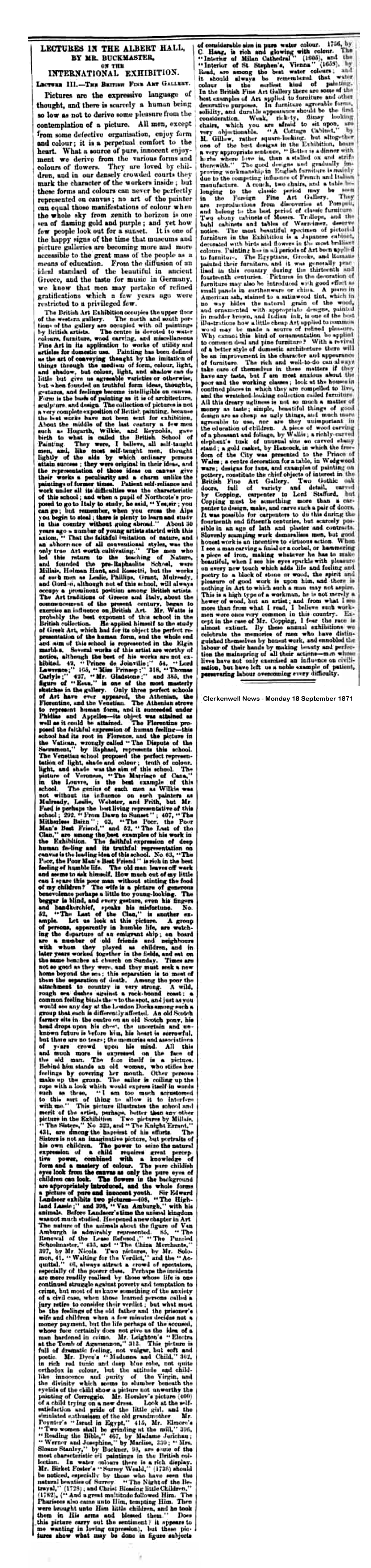
LECTURES 15
THE ALBERT HALL,
BY MR. BUCKMASTER, ON THE INTERNATIONAL EXHIBITION. III
[Did JCB also do a Lecture I, II? yes, but probably not a IV etc.]
The British Fine Art Gallery.
Pictures are the expressive language of thought, and there is scarcely human being so low not to derive some pleasure from the contemplation of picture. All men, except from some defective organisation, enjoy form and colour; it is a perpetual comfort to the heart. What source of pure, innocent enjoyment derive from the various forms and colours of flowers. They are loved by children, and in our densely crowded courts they mark the character of the workers inside; but these forms and colours can never be perfectly represented on canvas; no art of the painter can equal those manifestations of colour when the whole sky from zenith to horizon is one sea of flaming gold and purple; and yet how few people look out for a sunset.
[Note his view of the surpassing beauty of nature, but art is nevertheless to be aprpreciated and made more accessible to the "great mass of people". Hence his call as long ago as 1859 for galleries to be gas lit e.g. HWC: 1859]
It is one of the happy signs of the time that museums and picture galleries are becoming more and more accessible to the great mass of the people a means of education. From the diffusion of an ideal standard of the beautiful in ancient Greece, and the taste for music in Germany, know that men may partake of refined gratifications which a few years ago were restricted to a privileged few.
The British Art Exhibition occupies the upper floor of the western gallery. The north and south portions of the gallery are occupied with oil paintings by British artists. The centre is devoted to water colours, furniture, wood carving, and miscellaneous Fine Art in its application to works of utility and articles for domestic use.
Painting has been defined as the art of conveying thought by the imitation of things through the medium of form, colour, light, and shadow, but colour, light, and shadow can do little but give us agreeable varieties or otherwise, but when founded on truthful form ideas, thoughts, gestures, and feelings become intelligible on canvas. Form the basis of painting as it is architecture, sculpture and design The collection of pictures is not a very complete exposition of British painting, because the best works have not been sent for exhibition.
About the middle of the last century a few men such as Hogarth, Wilkie, and Reynolds, gave birth to what is called the British School of Painting. They were, I believe, all self-taught men, and, like most self-taught men, thought lightly of the aids by which ordinary persons attain success; they were original in their ideas and the representation of those ideas on canvas give their works a peculiarity and a charm unlike the paintings of former times.
Patient self-reliance and work under all its difficulties was the characteristic of this school; and when pupil of Northcote's proposed go to Italy study, he said, "Yes, sir; you can go; but remember, when you cross the Alps vou begin to steal; there is plenty to learn and study in this country without going abroad. About 30 years ago a number of young artists started with this axiom, "That the faithful imitation of nature, and an abhorrence all conventional styles, was the only true Art worth cultivating."
[Note emphasis on self-reliance, on locally-grown, self-made men. And the "return to the "Teaching of Nature".]
The men who led this return to the teaching of Nature, and founded the pre-Raphaelite School, were Millais, Holman Hunt, and Rossetti, but the works of men such as Leslie, Phillips, Grant, Mulready, and Gordon, although not of this school, will always occupy a prominent position among British artists.
The Art traditions of Greece and Italy, about the commencement of the present century, began to exercise influence on British Art.
Mr. Watts is probably the best exponent of this school in the British collection. He applied himself the study of Greek Art, which had for its object the perfect representation of the human form, and the whole end and aim of this school is represented in the Elgin marbles.
Several works of this artist are worthy notice, although the best of his works are not exhibited. 49, "Prince do Joinville;" 64, "Lord Lawrence;" IGS, "Miss Prinsep;" 318. "Thomas Carlyle;" 427, "Mr. Gladstone;" and the figure of "Esau" is one of the most masterly sketches in the gallery.
Only three perfect schools of Art have ever appeared, the Athenian, the Florentine, and the Venetian. The Athenian strove to represent human form, and it succeeded under Phidias and Appelles — its object was attained well it could attained. The Florentine proposed the faithful expression of human feeling — this school had its root in Florence, and the picture in the Vatican, wrongly called "The Dispute of the Sacrament," by Raphael, represents this school. The Venetian school proposed perfect representation of light, shade and colour; truth of colour, light, and shade was the aim of this school. The picture Veronese, "The Marriage of Cana," in the Louvre, the best example of this school.
The genius of such men Wilkie was not without its influence on such painters as Mulready, Leslie, Webster, and Frith, but Mr. Faed is perhaps the best living representative of this school; 292. "From Dawn to Sunset "; 407, "The Mitherless Bairn"; 63, "The Poor, the Poor Man's Best Friend." and 62, "The Last of the Clan," are among the best examples of his work the Exhibition. The faithful expression of deep human feeling and its truthful representation on canvas is the leading idea of this school.
[ArtUK: Thomas Faed, "The Poor, the Poor Man's Friend"]
No. 63, "The Poor, the Poor Man's Best Friend " is rich in the best feeling ef humble life. The old man leaves off work and serins to ask himself, How much out of my little can I spare this poor man without stinting the food of my children? The wife is picture of generous benevolence perhaps a little too young-looking. The beggar is blind, and every gesture, even his fingers and handkerchief, speaks his misfortune.
[ArtUK: Thomas Faed, "The Last of the Clan"]
No. 62, "The Last of the Clan," is another example. Let us look at this picture. A group of persons, apparently in humble life, are watching the departure of an emigrant ship; on board are a number of old friends and neighbours with whom they played as children, and in later years worked together in the fields, and sat on the same benches at chnrch on Sunday. Times are not as good as they were, and they must seek a new home beyond the sea; this separation is to most them the separation of death. Among the poor the attachment to country is very strong. A wild, rough sea dashes against rock-bound coast; common feeling binds the to the spot, and just as you would see any day at the London Docks among such a group that each is differently affected.
An old Scotch farmer sits centre on an old Scotch pony, his head drops upon his chest, the uncertain and unknown future is before him, his heart is sorrowful, but there are no tears; the memories and associations of years crowd upon his mind. All this and much more is expressed on the face the old man. The face itself is a picture. Behind him stands an old woman, who stifles her feelings by covering her mouth. Other persons make up the group. The sailor is coiling up the rope with a look which would express itself in words such as these, "I am too much accustomed to this sort of thing to allow it to interfere with me." This picture illustrates the school and merit the artist, perhaps, better than any other picture in the Exhibition
[ArtUK: John Everett Millais, "Sisters", 1868]
Two pictures by Millais, "The Sisters," No 323, and "The Knight Errant." 431, are among the happiest of his efforts. The Sisters is not an imaginative picture, but portraits of his own children. The power to seize the natural expression of a child requires great perceptive power, combined with knowledge of form and a mastery of colour. The pure childish eyes look from the canvas only the pure eyes of children can look. The flowers in the background are appropriately introduced, and the whole forms picture of pure and innocent youth.
Sir Edward Landseer exhibits two picturee — 4oB, "The Highland Lassie;" and 398, "Van Amburgh," with his animals. Before Landseer's time the animal kingdom was not much studied. He opened a new chapter in Art The nature of the animals about the figure Van Amburgh is admirably represented. 85, " The Renewal of the I.ea*c Refused;" "The Puzzled Schoolmaster." 436, and "The China Merchants," 397, Mr Nicola.
[ArtUK: Abraham Solomon, "Waiting for the Verdict", first exhibited 1857, J Paul Getty Museum]
[ArtUK: Abraham Solomon, "Not Guilty" (The Acquittal), first exhibited 1859 , J Paul Getty Museum — [two years after the Waiting for the Verdict — oh, the suspense! What a cliffhanger!]
Two pictures, by Mr. Solomon, 41, Waiting for the Verdict," and the "Acquittal." 4C, always attract crowd of spectators, especially of the poorer class. Perhaps the incidents are more readily realised by those whose life is one continued struggle against poverty and temptation to crime, but most of know something of the anxiety of a civil case, when those learned persons called jury retire to consider their verdict; but what the feelings of the old father and the prisoner's wife and children when minutes decides not a money payment, but the life perhaps of the accused, whose face certainly does not us the idea of a man hardened crime.
And remember, JCB at this time was besieged by writs concerning his fence-breaking on WC!]
Mr. Leighton's "Electra at the Torah of Agamemnon," 313. This picture is full of dramatic feeling, not vulgar, but soft and poetic. Mr. Dyco's " Madonna and Child," 3G2, rich red tunic and deep blue robe, not quite orthodox in colour, but the attitude and childlike innocence and purity the Virgin, and the divinity which seems to slumber beneath the eyelids of the ckild show a picture not unworthy the painting of Correggio. Mr. Uorelev's picture (400) of a child trying on new dress. Look at the satisfaction and pride of the little girl, and the simulated enthusiasm of the old grandmother. Mr. Poynter's "Israel in Egypt," 415, Mr. Elmore's "Two women shall be grinding at the mill," 396, "Reading the Bible," Madame Jericbau; " Werner and Josephine," Maclise, 330; " Mrs. Sloane Stanley," by Buckner, 98, are some of the most characteristic o paintings in the British collection.
In water colours there rich display.
[ArtUK: Myles Birket Foster]
[Source: Weald.
[Source: Link.
Mr. Birket Foster's "Surrey Weald," (1738) should be noticed, especially by those who have seen the natural beauties of Surrey. [Section missing?] "The Night of the Betrayal," (1728); and "Christ Blessing little Children." (1782), ("And a great multitude followed Him. The Pharisees also came unto Him, tempting Him. Then were brought unto Him little children, and he took them in His arms and blessed them." Does this picture carry out the sentiment? it appears to wanting in loving expression), but these pictures show what may be done in figure subjects of considerable size in pure water colour.
[Above: dates for Surrey Weald and the other two paintings wildly wrong for MBF — who was born 1825, d.1899 — i.e. he was JCB's contemporary. It looks as though a passage has been missed out, since there is a Blessing by Benjamin West from 1781, which is likely to be the painting referred to — now at the RA. I don't know about Betrayal, but I wouldn't be surprised if West didn't do that too. There must be a list of paintings on display somewhere. ]
17*>C, by C. H&ag, is rich and glowing: with colour. Ihe "Interior of Milan Cathedral" (1605), and the "Interior of St Stephen's, Vienna" (1658), by; Head, are among the best water colours; and it should always remembered that water colour is the earliest kind of painting.
In the British Fine Art Gallery there are some the best examples of Art applied to furniture and other decorative purposes. In furniture agreeable forms, solidity, and durable appearance should bo the first consideration. Weak, rickety, flimsy looking chairs, which you are afraid to sit upon, are very objectionable.
A Cottage Cabinet, b) M. Gillow, rather square-looking, but altogether, one of the designs the Exhibition, bears very appropriate sentence, Better is dinner with rbs where love is, than a stalled ox and strife therewith." The good designs and gradually sm: proving workmanship in English furniture mairdy due to the competing influence of French and Italian 1 manufacture.
A couch, two chairs, and table belonging the classic period may seen in the Foreign Fine Art Gallery. They are reproductions from discoveries at Pompeii, and belong t<� best period of classic furniture Two ebony cabinets of Messrs. Trollope, and the buhl cabinets and table* of deserve notice.
The most beautiful specimen of pictorial furniture in the Exhibition Japanese cabinet, decorated with birds and flowers in the most brilliant colours Punting has in ail periods of Art been npplb d to furniture. The Egyptians, Greeks, and Romans painted their furniture, and it was generally practised in this country during the thirteenth and fourteenth centuries. Pictures the decoration of furniture may also introduced with good effect small panels in earthenware or china.
A piano in American ash, stained to a tint, which in no way hides the natural grain of the wood, and ornamented with appropriate designs, painted in madder and Indian ink, is one of the la �t ill nutritions how alittle cheap Art applied to common may made source of refined pleasure.
Why can not this kind of ornamentation be applied to common and pine furniture With revival of better style of domestic architecture there will be improvement in the character and appearance of furniture. The rich and well-to-do can always take care themselves these matters if they have any taste, but arn most anxious about the poor and the working classes look at th� houses in confined places in which they are compelled to live, and the wretched-looking collection called furniture
All this dreary ugliness is not so much matter of money as tasto; simple, beautiful things of good design are cheap as ugly things, and much more agreeable to use. nor ore they unimportant in the education children.
piece of wood carving of pheasant and foliage, by Wallis; richly-curved elephant's tusk of unusual size en carved ebony stand; a gold casket, by Hancock, in which the freedom of the City was presented to the Prince Wales; a centre decoration for a table, Wedgwood ware; designs for fans, and examples of painting on pottery, constitute the chief objects of interest in the British Fine Art Gallery.
Two Gothic oak doors, full of variety and detail, carved by Copping, carpenter to Lord Stafford, but Copping must be something more than carpenter to design, make, and carve such a pair of doors. It was possible for carpenters to do this during the fourteenth and fifteenth centuries, but scarcely possible in an ago of lath and plaster and contracts.
Slovenly scamping work demoralises men, but good honest work is an incentive to virtuous action. When I see man carving a final or a corbel, or hammering a piece of iron, making whatever he has make beautiful, when I see his eyes sparkle with pleasure on every new touch which adds life and feeling and poetry to block of stone or wood, the spirit and pleasure of good work is upon him, and there is nothing in Art to which such man may not aspire.
This is a high type of workman, he not merely a hewer of wood, but an artist; and from what I see more than from what I read, I believe such workmen were once very common in this country. Except in the case of Mr. Copping, I fear the race is almost extinct.
By these annual exhibitions we celebrate the memories of men who have distinguished themselves by honest work, and ennobled the labour of their hands making beauty and perfection the mainspring of all their actions — men whose lives have not only exercised influence on civilisation, but have left us a noble example of patient, persevering labour overcoming every difficulty.
[BNA: Link]
[PB: SO WILLIAM MORRIS! DID THE KNOW EACH OTHER? AND THERE'S ALBERT. AND THE V&A]
IS THIS THE END?
NB also his attempts to introduce art into the curriculum — it wasn't just science that he valued.
[BNA: Buckmaster, Clerkenwell News, 1870-1871 ]
LONDON INTERNATIONAL EXHIBITION of 1871 will CLOSE on the 30th September.-ADMISSION DAILY, except Wednesdays, from 10.0 a.m. to 6.0 p.m., ONE SHILLING. On Wednesdays Half a Crown.
THE LAST WEEK but ONE of theLONDON INTERNATIONAL EXHIBITION, which closes on the 30th
LONDON INTERNATIONAL EXHIBITION of 1871.- ORGAN RECITAL This Day. at Three, by Herr HENRICI, the Baden Organist. Mr. Buckmaster's Lecture at One. Band of the Scots Fusilier Guards in the Horticultural Gardens at Half-past Three.
LONDON INTERNATIONAL EXHIBITION OF 1871- JL- The LONDON GLEE and MADRIGAL UNION (director. Mr. LAND) will give CONCERTS at Three o'clock on Saturday, the 23d. Tuesday, 26th. and Thursday, 25th September.
LONDON INTERNATIONAL EXHIBITION of 1871.- REFRESHMENTB. SPIERS and POND. Contractors. — The Dining Halls for Hot and Cold Dinners are at the South End of the Gardens, at the point farthest from the Royal Albert Hall. Visitors intending to dine late will please be in the Dining-room before Six. Buffets for Light Refreshments under the West Terrace, in the Albert Hall and in the French Annexe.
[BNA: Link]