[The Times: Search: "Wandsworth Common"].
[BNA: Buckmaster Battersea 1881]
[BNA: Buckmaster Wandsworth 1881]
[London Evening Standard: Buckmaster Wandsworth 1881]
Mr. Ellice Hopkins has kindly promised to address meeting of ladies on Tuesday afternoon, the 25th inst., in the drawing-room of Bolingbroke House, Wandsworth Common, the object being to promote the formation of a Battersea Association for Friendless Girls. The enterprise laudable one, and should receive, as doubt will, the hearty support of the wealthy residents the Reality. https://www.britishnewspaperarchive.co.uk/viewer/bl/0000213/18810108/078/0006
PROPOSED ERECTION OF AN IRON CHURCH AT WANDSWORTH
On the recommendation of the building act committee, it was resolved that the application of the Rev. J.E. Clarke for the approval by the board of a plan for the construction of a temporary iron church in Darley-road, Bolingbroke Grove, Wandsworth Common, be granted.
[Source: Link.]
[PB: This is the future St Michael's.]
What's this about? Where was this? Why Conservators of Wandsworth Common?]
THE WIDENING OF FALCON-LANE. The Battersea Local Con.miner recommended with reference to the letter from the secretary of the Bolingbroke Tradesmen's and Ratepayers' iiluh, forwarding copy of resolution passed hy such club approving the action of the board in widening Falcon-lane at its Junction with York-road, and calling attention to the necessity throwing the enclosed piece of ground at the junction of Falconlane and Lavender Hill into the public road,that the clerk be instructed to apply to the Conservators of Wandsworth Common for permission to remove toe posts and rails which enclosed the piece of ground in question, with the view the roads there being widened and improved by the board. Mr. Tullv, in moving the adoption of the recommendation, described the piece of land question as a ' perfect monstrosity," Mr. Hlscox thought would he illegal to remove the posts and rails. Let the petitioners themselves apply to the proper authority . . . , A member asked whoso authority a similar piece of land at Wandsworth Common had been thrown into the road. He believed the work was cone by the men in the employ of the board. Mr. Purdy supported the rccou fact the suggestion emanating from tradesmen's club should not deier them *rom doing their duty. The recommendation was carried. https://www.britishnewspaperarchive.co.uk/viewer/bl/0000213/18810129/035/0006
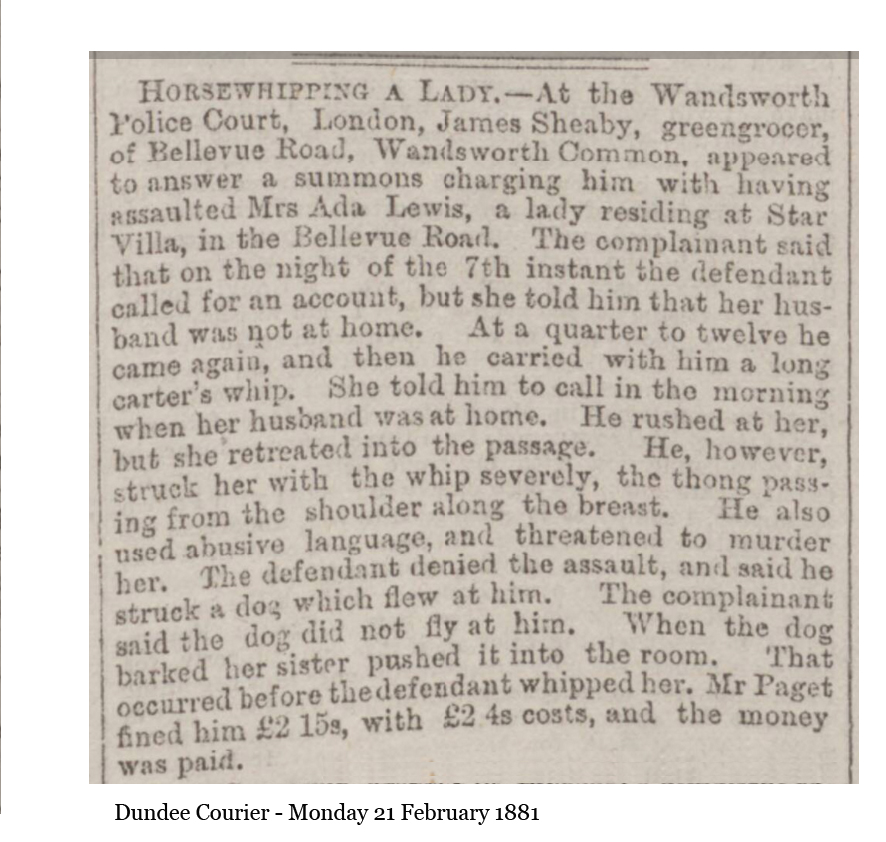
Bellevue Rd greengrocer horsewhips lady
HORSEWHIPPING A LADY
At the Wandsworth Police Court, London, James Sheaby, greengrocer, of Bellevue Road, Wandsworth Common, . . .
Steabey, living at Wandsworth Common, called at a customer's house for an account. Mrs . . .. . . A greengrocer named Steabey, living at Wandsworth Common, called at a customer's house for an account. Mrs. Lewis told him to call when her husband was at home, whereupon he struck her across the shoulder with . . .
[BNA: Link. Also e.g. also Leeds Times etc]

A youth named Walter Jackson was charged at Wandsworth police-court oa Saturday with behaving disorderly, and damaging a flag belonging to the Salvation Army. Charles Humphreys, a bookseller, living in Greenwich, said on Good Friday he and several other members of the Salvation Army went to Wandsworth-common to hold a meeting. A number of roughs interrupted them, and to avoid a disturbance they proceeded to march back again to the hall. The prisoner rushed at the banner, caught hold of the stick, and broke it.
A policeman said he saw the army hustled off the common by the roughs. In the Spanish-road matters were likely to become serious, as there were 500 and 600 persons. He had to rush in between them. He was alone.
Mr. Paget: You were alone between the two armies.
The constable further said that when he took hold of the prisoner there was a shower of stones and mud. He had a fair share of them.
Mr. Paget said it was a disgraceful business to all parties. The prisoner had no business to interfere, however foolish people welt to parade the streets in that way. He committed him to prison for seven days.
[BNA: Link]
PB: The Salvation Army was still relatively new - founded 1865. This is a good example of the use of the Common for public gatherings - religious, political and so on. Notice the numbers - between 500 and 600 persons. Presumably this had brewed for some time. I wonder what happened later?
August 2021: interesting article on PastTense website about hostility (from the "Skeleton Army") towards the SA, 1881.
I have seen similar accounts of the break-up of Baptist gatherings, which eventually led to the building of e.g. the Chatham Rd Baptist Chapel [date?], in which the Spurgeons, father and sons, were involved. And of course Pamela Hansford Johnson describes similar scenes in the 1930s. /p>
Buckmaster and trees
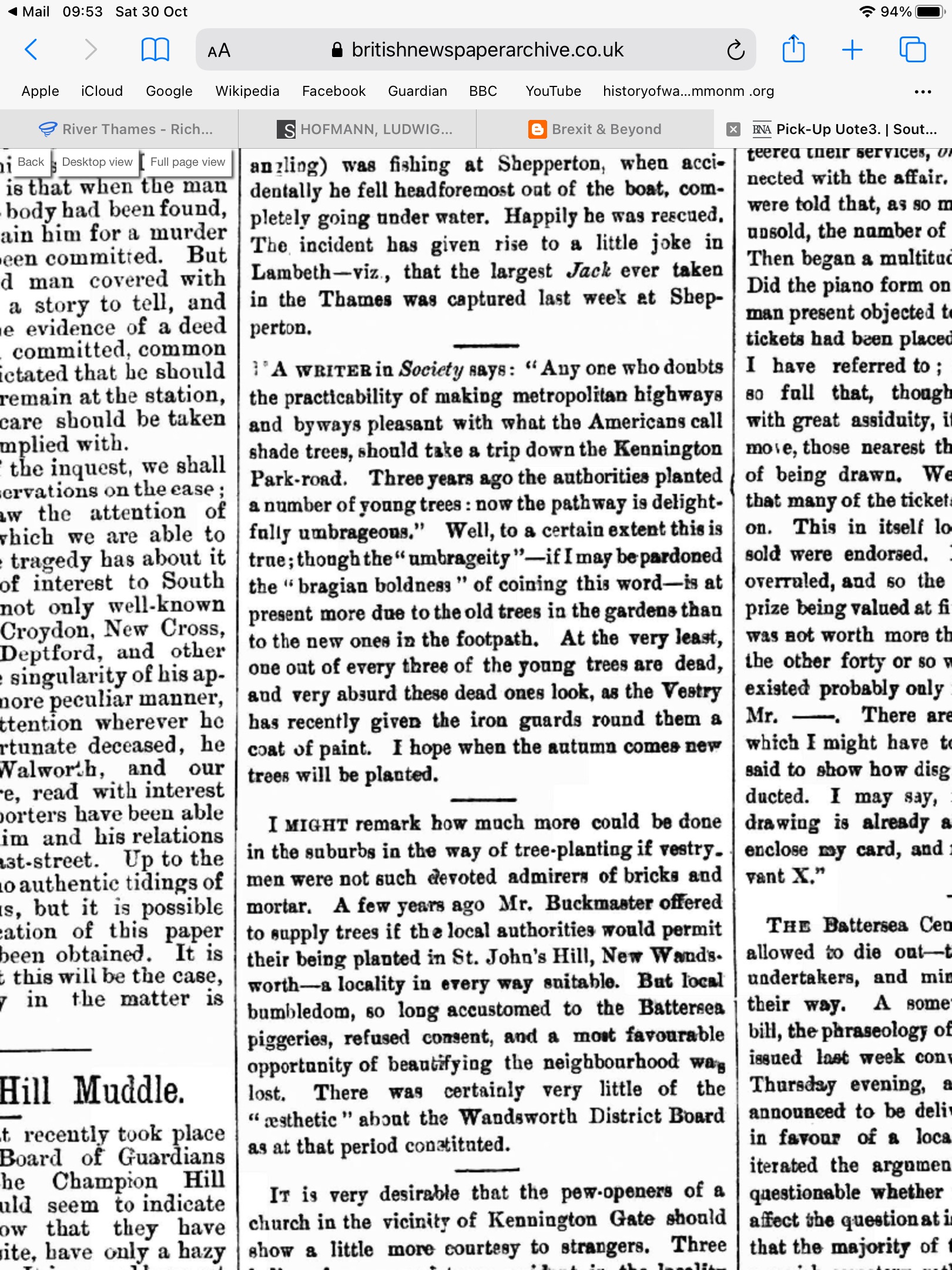
A writer in Society says: "Any one who doubts the practicability of making metropolitan highways and byways pleasant with what the Americans call shade trees, should take a trip down the Kennington Park-road. Three years ago the authorities planted a number of young trees: now the pathway is delightfully umbrageous."
Well, to certain extent this is true; though the umbrageity - if I may be pardoned the "bragian boldness" of coining this word - is at present more due to the old trees in the gardens than to the new ones in the footpath. At the very least, one out of every three of the young trees are dead, and very absurd these dead ones look, as the Vestry has recently given the iron guards round them a coat of paint. I hope when the autumn comes new trees will be planted.
____________________
I might remark how much more could be done in the suburbs in the way of tree-planting if vestrymen were not such devoted admirers of bricks and mortar, A few years ago Mr. Buckmaster offered to supply trees if the local authorities would permit their being planted in St. John's Hill, New Wandsworth - a locality in every way suitable. But local bumbledom, so long accustomed to the Battersea piggeries, refused consent, and most favourable opportunity of beautifying the neighbourhood was lost. There was certainly very little of the aesthetic about the Wandsworth District Board at that period constituted.
[BNA: Link]
"Bragian boldness" - a mangled phrase from Charles Dckens, Martin Chuzzlewit: " 'Why, drat the Bragian boldness of that boy!' cried Mrs Gamp, though not displeased. 'What a imperent young sparrow it is! I wouldn't be that creetur's mother not for fifty pound!' "
South London Press - Saturday 02 July 1881
Noisy Meeting on the Battersea Cemetery Question.
On Thursday evening meeting was held the Lammas Hall in connection with the closing of the Battersea Cemetery. Mr. Edward Wood occupied the chair, and reviewed the history of the whole question. Mr. Wood was supported on the platform Mr. Harrap, the vestry clerk, and the Ecv. C. Kirtland. The platform presented as hare an aspect as the body of the hall. The Rev. C. Kirtland said the closing of the Battersea Cemetery had left 107,000 persons without place to bury their dead.
The matter had been before the Burial Board for some considerable time, but no definite result had been obtained. Earlsfield had at first been selected, but the Wandsworth people strongly opposed the proposition, and, mainly i the influence of Sir Henry Peek, it was defeated. .
Tooting, Wandsworth, Wimbledon, Brompton, and Woking Cemeteries were open to the Battersea people, but in some instances the fees were really prohibitive. He contrasted the different treatment Battersea had accorded Wandsworth. The former allowed them for some time use the Battersea Cemetery, but polite refusal was the result when Battersea asked similar indulgence. If they went to Norwood, the vicar of Battersea would receive a fee under old Act whether did duty there or not. (Cries of "Shame" and "What swindle!") He was simply stating facts. It was, he considered, a glaring injustice that such state of things should, obtain. (Hear, hear.) He did not blame the incumbents but the law, which placed Dissenting ministers on different footing to Church of England ministers.
Alluding to the fees at Woking, he said that in addition to the ordinary fees there was a sum of 6s. 2d. to be paid to the Battersea incumbent I it the funeral took place in consecrated ground. ("Shame.") The fees were much more than a parishioner of Lambeth or Wandsworth had to pay for interment in their own cemetery. Why should not Battersea able to bury its dead as cheaply as these parishes? Taking 2,000 Battersea funerals in the year, about, £700 would be paid annually, more than they would have to pay if they had local '. cemetery. There were other objections to going to Woking - the loss of half work, for instance, as the funeral would take the day. Then, again, there was the sum of 4s. which the friends would subsequently have to pay to visit the graves; that the latter satisfaction was really cut off. To the rich man it was mere bagatelle, but to the working man it was consideration.
Then there was the probability of the Woking Company - a financial undertaking - raising their faros. The local undertakers would be seriously affected if not ruined, seeing that they must turn over some £6,000 or £7,000 in the, parish. They had heard a vast amount of eloquence, expended and many vehement speeches made upon the injury to health. He had made inquiries at Brompton both from the residents and the employes, and he found that no complaint on sanitary grounds existed; nor was the Brompton Cemetery, though surrounded houses, considered injurious to health. The em-1 ployes, too, found were healthy, and felt no ill effects; in fact, a slate club they had established to provide against illness had so few claims upon it that they divided the fund.
He also found the Battersea Cemetery employees gave similar answers. These facts, thought, were unanswerable by those who cried Wolf on sanitary grounds. With regard to a cemetery being self-supporting, he instanced Tooting and Brompton, which paid over handsome surplus. In 1880, St. Mary's, Battersea, had paid its own way, with the exception of some £96. He was satisfied that if land could be purchased at reasonable cost, the cemetery would be remunerative. He regretted that the clergy of the district had not taken more active part in the matter. He, in conclusion. moved resolution - viz., "That on the ground of expediency and economy, it was desirable that cemetery should provided under local management, and that petition be presented to the vestry." Mr. Daws seconded the resolution.
Mr. Cleave, who spoke amid great interruption, said understood Mr. Kirtland to have stated that he did not intend to take any steps in the matter when he presented himself for re-election at the last vestry contest. He had come there that night and cast severe reflections on the local clergy. (Uproar.)
The chairman appealed to the meeting to hear both sides of the question, stating that force of lungs was not argument.
Mr. Cleave, amidst running fire of iterro'M tories, continued his arguments, and strongly condemned the action of Mr. Kirtland-in reflecting upon the conduct of the vicar of Battersea, who was entitled to their respect.
The meeting was not public one; but he challenged Mr. Kirtland to deny that he had really called the meeting after pledging himself on more than one occasion to move no further in the matter. Mr. Worley followed, and denounced the action of those present in endeavouring to defeat argument and opposition by noise and clamour.
The undertakers present reminded him of the silversmiths of old, who, finding their trade likely to disappear, adopted similar tactics. He (Mr, Worley) contended that there was no land in Battersea suitable for a 1 ocal cemetery.
With regard to the balance sheet read Mr. Kirtland, that was all very well; but he had not read the previous ones, which were favourable. He condemned most strongly the grabbing spirit displayed by the clergy in connection with the fee question. He very much respected Mr. Kirtland, but was comptiled to ili?a?rec with on this question. believed that Woking would he the burial ground of the metropolis The chairman again hod to interpose and appeal for a hearing for the speaker.
The Rev. C. Kirtland, in reply Mr Cleave remarks, said he had received fees, but he had worked for them. (Applause) He (Mr. Cleave) had not told them how much he liad given back to the poor out of the amounts he had received. He was sorry to find that a personal animus ran through Mr. Cleave's remarks upon all occasions. He denied that he had attacked the vicar of Battersea, any individual member of the local clergy. He had simply stated that he regretted the local clergy were not with them upon the matter.
Mr. Daws followed, and denounced the way which parochial interments were made at Woking. The resolution was then put to the meeting and carried large majority.
A vote of thanks to the chairman concluded the business of the meeting.
[BNA: Link]
[BNA: Link]
South London Press - Saturday 09 July 1881
BATTERSEA CEHIST'Efi.T MEETIXJG.
Sir - The wide circulation given to the charges which Mr. J. Chase made me the recent meeting held in Lammas Hall the cemetery question, 1-ads me to ask permission to give through your paper - a most unqualified and emphatic denial to his accusations. Mr. Cleave eba mo with attacking the vicar of Battersea. I Ins was a pure invention, made in a moment of Decontrolled passion. I neither attacked the vicar nor any other incumbent in Battersea. Havirg occasicn to compare the fees imposed by different cemeteries, I necessarily alluded to tie statute which provides that ou every funeral from tersea in the consecrated portions of Brompton, and Woking mor, the incand �nfc of the r shall receive 1G�. from the tvo and G. 2d. from t last, without obliged to officiate at the interment. Taking the case Brompton, I said ibau the unconsecrated parts of the common ground were closed; that Dissenters who were buried there must be pavt the consecrated r ound £ and that while recent law legalized funerals by Nonconformist mioi-iter he could cl dm but that im Battersea incumbent 10-*. for work done antdt ler for one of the Dissenting flock. I protected against the injustice of this - not as attHcting any Battersea incumbent, but a against the law which sanctioned the wrong. And I protest still. Next, Mr. Cleave asset ted that I attacked the vesti y.
[BNA: Link]
[BNA Search: Link]
South London Press - Saturday 09 July 1881
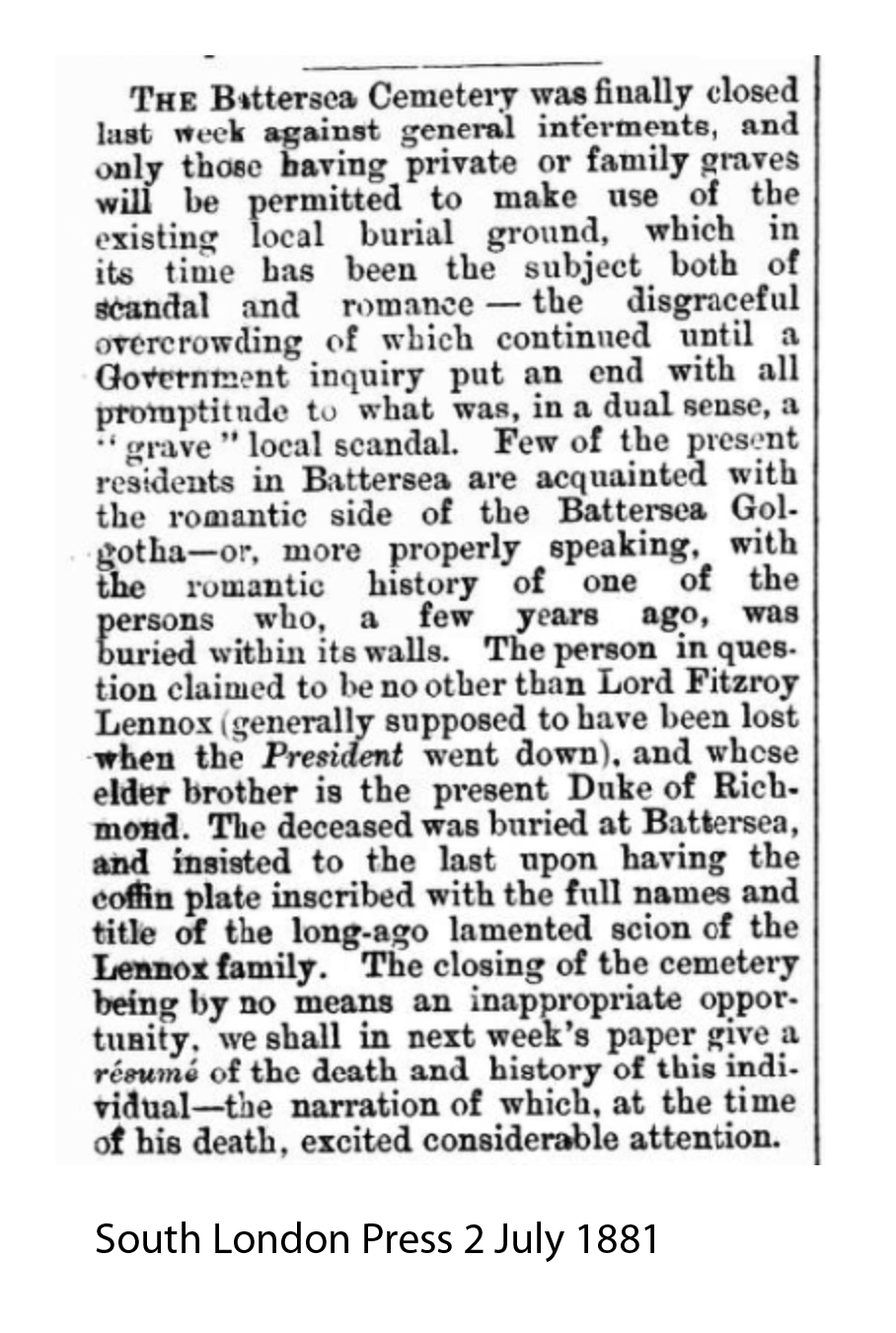
The Last of Battesea Cemetery.
Battersea is really too pitiful. It is now without a cemetery, and those who not rejoice in the possession of family grave not yet filled up in the present ground, must seek farther afield for aces wherein to bury their dead. It must, however, confessed that the parishioners as a body - we do not intend jest - take the matter very philosophically. A meeting, it is true, was held last week in Lammas Hall, hut the attendance was very poor, and the proceedings were really made the vehicle of a growl on the part of the local undertakers, who, in their mind's eye, can see the Woking Cemetery Company swallowing their trade, and iving them practically dead live upon. must confess that, admitting the necessity undertakers, wo cannot bring ourselves to look upon the matter from their standpoint. and it is rather surprising to find the Rev. C. Kirtland coming forward their champion, and in the same breath reviling the clergy the Church of England for accepting fees. It is perhaps right to add that Mr. Kirtland is anxious it should understood that, did not attack the Vicar Battersea. Perhaps not, but he certainly fell foul of the local clergy; and distinction was made, it was onlv fair to assume - as Mr. Cleave did - that "tarred them all with the same brush." ther Mr. did or did not include Canon Clarke is not, however, of much importance. The regrettable part the matter is that in his speech made the clerical aspect of the question the burden his complaint. So far as the cemetery question is concerned, we believe that the Battersea clergy have studiously avoided expressing any opinion on the ct, and in think they sit'G right. Unquestionably, the foes derivable from burials form very comfortable additions a clergyman's income. Whet her it the best way of paying him may of course be doubted; but as the law allows him the privilege, to blamed for availing himself it. But to have taken an active part in a question which so nearly affects them would have placed the Battersea ehriry m a position open to comment Mr. Kirtland unfortunately, has fallen into this error, and the course he has adopted becomes still wor=e when it is remembered that by the dosing of Battersea Cemetery has suffered distinct loss, because, unlike the Vicar of Battersea, he cannot claim what in trade would called a royalty on every burial Battersea parishioner which takes place at Norwood or Woking. Hence, the illnatured may remark, the reason he has made common cause with the undertakers Bat from this point of view it is impossible for the ratepayers, however much they may sympathize with the undertakers and Mr. Kirtland, to regard the closing of the cemetery as a calamity. It is tar greater grievance to know that going o other cemeteries their funerals wdl he made more expensive. Now, on this point it would well to have some definite information. Mr. Kirtland mentioned that Tooting, Wandsworth, Wimbledon, Brompton, and Woking were open to the Battersea neonle but some instances the were really prohibitive." a uitv Mr Kirtland did not mention the cemeteries where the fees are of this nature Are the fees high Wandsworth or at Tooting? Either of these cemeteries are conveniently situated in regard to Battersea and though the Wandsworth people some time ago refused to allow Battersea the use their cemetery, it possible that some kind of compromise could effected. Wandsworth unquestionably is the cemetery which from its situation, should available; and the obstacles thrown in the way the Wandsworth authorities only furnish additional argument for the necessity ot radical change in the government of greater London. The miserable jealousies and squabbles, the dog-in-the-manger spirit which distinguish our local assemblies, the entire absence of any common action and the enormous expense which results from half a dozen parishes doing singly that which could be done jointly at half the cost, make one despair of any reform in local self-government, save that of totd abolition. This however, is just now not the question. The problem the Battersea people - at least, the poorer section of tlmm-havc to solve how to bury their dead without adding to the burdens which funeral charges, already far too heavy, entail. Perhaps the undertakers, if they lay their heads together, could come to the rescue.
[BNA: Link]
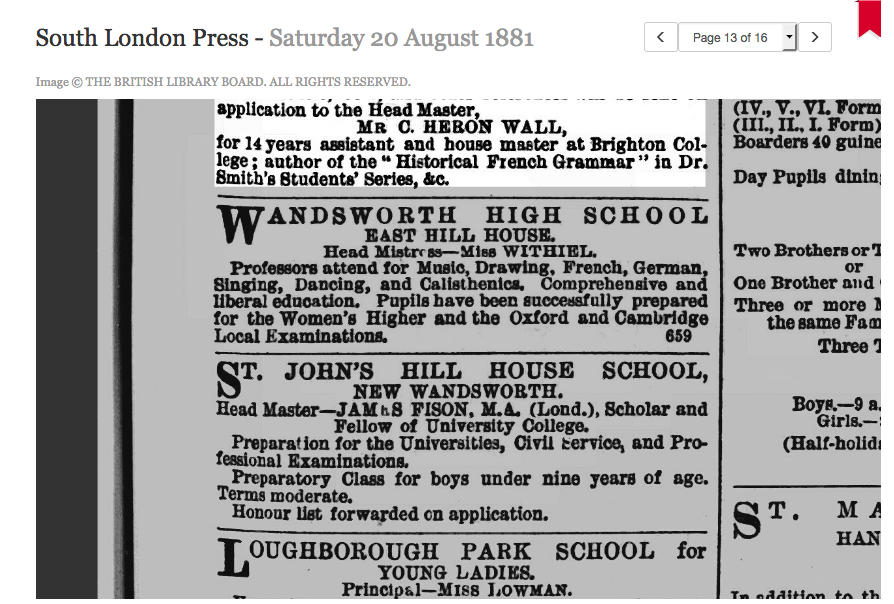
[A High School for Girls on East Hill?]
[PB: "The "Sons of Gentlemen"!]
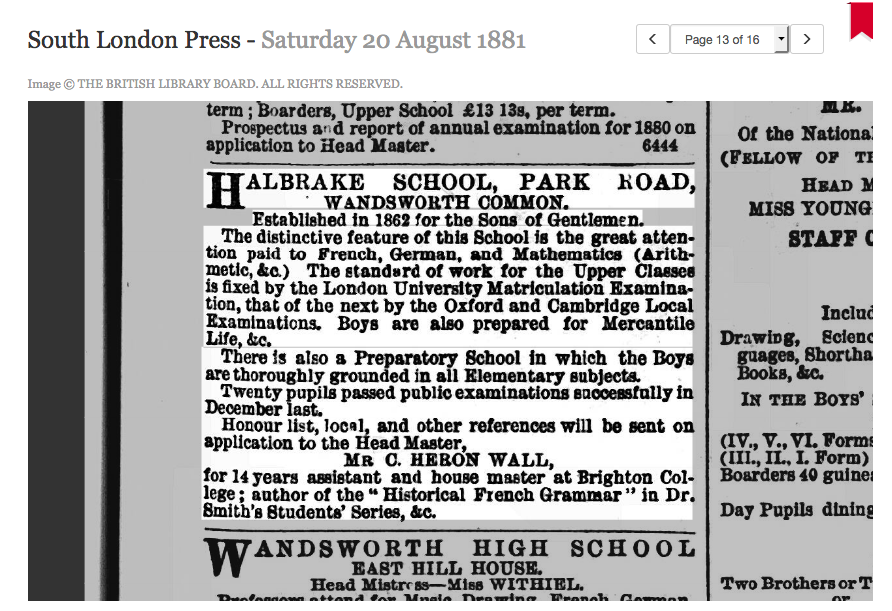
Halbrake School, Park Road, WANDSWORTH COMMON.
Established in 1862 for the Sons of Gentlemen. The distinctive feature of this School is the great attention paid to French, German, and Mathematics (Arithmetic, Ac.) The standard of work for the Upper Classes is fixed by the London University Matriculation Examination, that of the next by the Oxford and Cambridge Local Examinations. Boys are also prepared for Mercantile Life, Ac. There is also a Preparatory School in which the Boys are thoroughly grounded in all Elementary subjects. Twenty pupils passed public examinations successfully In December last. Honour list, iocs], and other references will be sent on application to the Head Master, Mr C. HERON WALL, for 14 years assistant and bouse master at Brighton College; author of the Historical French Grammar in Dr. Smith's Students' Series, &c.
[BNA: Link]
[CHECK THESE OUT - following on from Halbrake above. Such a lot of [small] local school. Did Edward Thomas attend St John's Hill School? Where exactly was it?]
St John's Hill School - Wandsworth High School for Girls -