[The Times: Search: "Wandsworth Common"].
[BNA: Buckmaster Battersea 1896]
[BNA: Buckmaster Wandsworth 1896]
[London Evening Standard: Buckmaster Wandsworth 1896]
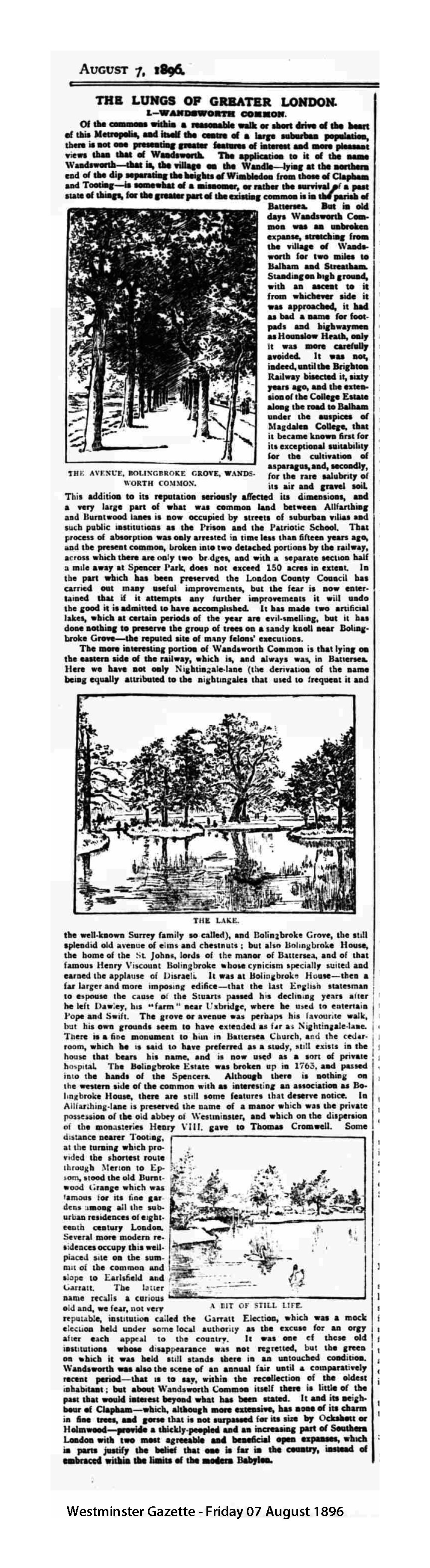
THE LUNGS OF GREATER LONDON
WANDSWORTH COMMON
Of the commons within a reasonable walk or short drive of the heart of this Metropolis, and itself the centre of a large suburban population, there is not one presenting greater features of interest and more pleasant views than that of Wandsworth. The application to it of the name Wandsworth — that is, the village on the Wandle — lying at the northern end of the dip separating the heights of Wimbledon from those of Clapham and Tooting — is somewhat of a misnomer, or rather the survival of a past state of things, for the greater part of the existing common is in the parish of Battersea.
But in old days Wandsworth Common was an unbroken expanse, stretching from the village of Wandsworth for two miles to Balham and Streatham. Standing on high ground, with an ascent to it from whichever side it was approached, it had as had a name for footpads and highwaymen as Hounslow Heath, only it was more carefully avoided. It was not, indeed, until the Brighton Railway bisected it, sixty years ago, and the extension of the College Estate along the road to Balham under the auspices of Magdalen College, that it became known first for its exceptional suitability for the cultivation of asparagus, and, secondly, for the rare salubrity of its air and gravel soil.
This addition to its reputation seriously affected its dimensions, and a very large part of what was common land between Allfarthing and Burntwood lanes is now occupied by streets of suburban villas and such public institutions as the Prison and the Patriotic School.
That process of absorption was only arrested in time less than fifteen years ago, and the present common, broken into two detached portions by the railway, across which there are only two bridges, and with a separate section half a mile away at Spencer Park, does not exceed 150 acres in extent.
In the part which has been preserved the London County Council has carried out many useful improvements, but the fear is now entertained that if it attempts any further improvements it wiil undo the good it is admitted to have accomplished.
It has made two artificial lakes, which at certain periods of the year are evil-smelling, but it has done nothing to preserve the group of trees on a sandy knoll near Bolingbroke Grove — the reputed site of many felons' executions. The more interesting portion of Wandsworth Common is that lying on the eastern side of the railway, which is, and always was, in Battersea.
Here we have not only Nightingale-lane (the derivation of the name being equally attributed to the nightingales that used to frequent it and the well-known Surrey family so called), and Bolingbroke Grove, the still splendid old avenue of elms and chestnuts; but also Bolingbroke House, the home of the St. Johns, lords of the manor of Battersea, and of that famous Henry Viscount Bolingbroke whose cynicism specially suited and earned the applause of Disraeli. It was at Boiingbroke House — then a far larger and more imposing edifice — that the last Erglish statesman to espouse the cause of the Stuarts passed his declining years after he left Daw:ey, his "farm" near Uxbridge, where he used to entertain Pope and Swift. The grove or avenue was perhaps his favourite walk, but his own grounds seem to have extended as far as Nightingale-lane. There is a fine monument to him in Battersea Church, and the cedarroom, which he is said to have preferred as a study, still exists in the house that hears his name, and is now used as a sort of private hospital.
The Bolingbroke Estate was broken up in 1763, and passed into the hands of the Spencers. Although there is nothing on the western side of the common with as interesting an association as Bolingbroke House, there are still some features that deserve notice. In Allfarthing-lane is preserved the name of a manor which was the private possession of the oid abbey of Westminster, and which on the dispersion of the monasteries Henry VIII gave to Thomas Cromwell.
Some distance nearer Tooting, at the turning which provided the shortest route through Merton to Epsom, stood the old Burntwood Grange which was famous for its fine gardens among all the suburban residences of eighteenth century London. Several more modern residences occupy this well-placed site on the summit of the common and slope to Earlsfield and Garratt.
The latter name recalls a curious old and, we fear, not very reputable, institution called the Garratt Election, which was a mock election held under some local authority as the excuse for an orgy after each appeal to the country. It was one of those old institutions whose disappearance was not regretted, but the green on which it was held still stands there in an untouched condition.
Wandsworth was also the scene of an annual fair until a comparatively recent period - that is to say, within the recollection of the oldest inhabitant; but about Wandsworth Common itself there is little of the past that would interest beyond what has been stated. It and its neighbour of Clapham — which, although more extensive, has none of its charm in fine trees, and gorse that is not surpassed for its size by Ockshott or Holmwood — provide a thickly-peopled and an increasing part of Southern London with two most agreeable and beneficial open expanses, which in parts justify the belief that one is far in the country, instead of embraced within the limits of the modern Babylon.
[BNA: Link]
[EXTRACT]

THE BACTERIA WHICH WE BREATHE, EAT, AND DRINK
THE surface of the earth is inhabited by bacteria: wherever there is dead organic matter, wherever there are human or animal excreta, wherever decomposition is going on, in stagnating or in flowing water, within our houses and without, bacteria collect. They are so widely distributed that practically everywhere we are surrounded by these minute vegetable cells. From the bacteriological standpoint we live amongst de-composing matter. Without bacteria there is no decomposition or putrefaction; they reduce the organic matter to " dust," and with the atomised matter they are again carried away by air or water. Dust is laden with bacteria, and since a great part of dust is derived from decomposing matter, it follows that, although we do not realise it, we are living in an atmosphere of decomposition.
The air which we breathe, therefore, contains bacteria. These vary in amount with certain conditions. If the air is calm their number diminishes, but if there is wind or draught, they may be present in enormous numbers. Again, in the open country air there are, other things being equal, considerably less micro-organisms than in the dusty streets of London. Thus there is an extraordinary difference between the air in Oxford Street and on Wandsworth Common.
The air may be roughly tested by coating sterile plates of glass with gelatine, and exposing them for a given time in the locality which we wish to examine. The bacteria will fall on the surface of the gelatine, and on. incubation at a suitable temperature they will develop into visible colonies which can be readily counted. The number of colonies is a fair, though not an absolute, index of the bacterial purity or impurity of the air. The more colonies we find on the surface of the gelatine, the more bacteria, of course, the air must have contained. A plate exposed in Oxford Street would be covered with colonies, while a plate exposed on Wandsworth Common would show only a few. This is, of course, only a rough-and-ready method which cannot be used for accurate work, but, nevertheless, it gives us good comparative results.
The lantern slides exhibited on the screen demonstrate to you that the air which we breathe always contains micro-organisms, and that therefore we are always inhaling bacteria. Many organisms are incapable of growing at the temperature of the body; they require a lower temperature. Such organisms, we may assume, cannot thrive in the body of the warm-blooded animal, and are therefore, probably, of little importance so far as we are concerned.
Keeping this in view, I have always incubated my plates coated with agar-agar at the body temperature, in order to gain information as to the approximate number of organisms which are likely to find access to our respiratory tract, and which have a chance of thriving there. I have not attempted to separate the aerobic organisms from the anaerobic ones, i.e. those which can grow in the presence of oxygen from those which cannot. All I wish to show is that under ordinary conditions of life we must breathe an air which contains bacteria, sometimes many bacteria. These plates do not tell us how many bacteria we inhale in a given time; they simply tell us that the air which we breathe is not sterile.
The bacterial flora of air varies considerably. The lady shopping in Oxford Street will inhale more bacteria than the boy who runs about on Wandsworth Common . . .
A lecture delivered at the London Institution, by Dr. A. A. Kanthack, Lecturer on Pathology, St. Bartholomew's Hospital.