[The Times: Search: "Wandsworth Common"].
[BNA: Buckmaster Battersea 1906]
[BNA: Buckmaster Wandsworth 1906]
[London Evening Standard: Buckmaster Wandsworth 1906]
1906_wc_station_enlarged_Pall Mall Gazette - Tuesday 20 March 1906.png
Pall Mall Gazette - Tuesday 20 March 1906
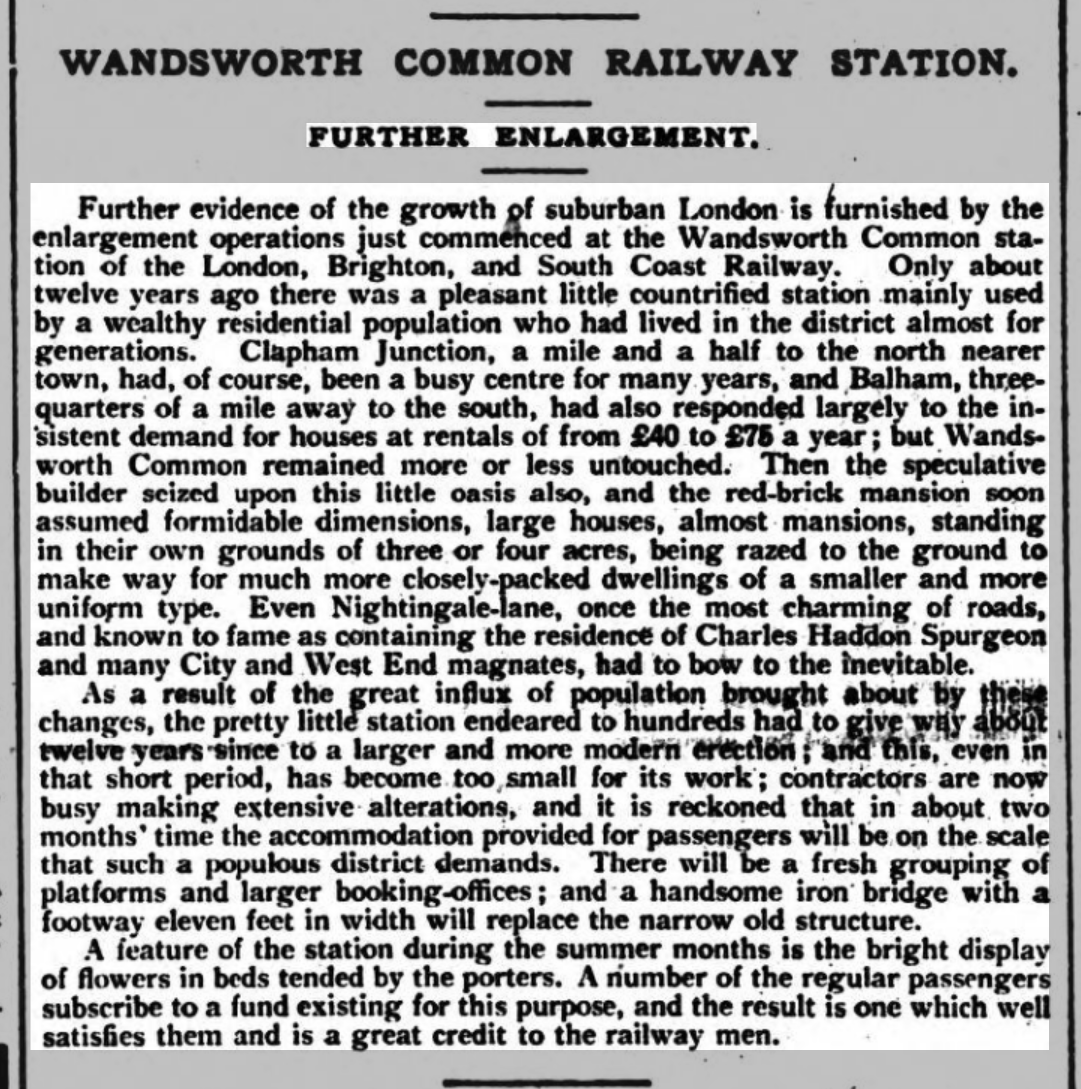
WANDSWORTH COMMON RAILWAY STATION
FURTHER ENLARGEMENT.
Further evidence of the growth of suburban is furnished by the enlargement operations just commenced at the Wandsworth Common station of the London, Brighton, and South Coast Railway.Only about twelve years ago there was a pleasant little countrified station mainly used by a wealthy residential population who had lived in the district almost for generations. Clapham Junction, a mile and a half to the north nearer town, had, of course, been a busy centre for many years, and Balham, three-quarters of a mile away to the south, had also responded largely to the insistent demand for houses at rentals of from £4O to £76 a year; but Wandsworth Common remained more or less untouched.
Then the speculative builder seized upon this little oasis also, and the red-brick mansion soon assumed formidable dimensions, large houses, almost mansions, standing in their own grounds of three or four acres, being razed to the ground to make way for much more closely-packed dwellings of a smaller and more uniform type.
Even Nightingale-lane, once the most charming of roads, and known to fame as containing the residence Of Charles Haddon Spurgeon and many City and West End magnates, had to bow to the inevitable.
As a result of the great influx of population brought about changes, the pretty little station endeared to hundreds had to give way about twelve years since to a larger and more modern erection; and this, even in that short period, has become too small for its work ; contractors are now busy making extensive alterations, and it is reckoned that in about two months' time the accommodation provided for passengers will be on the scale that such a populous district demands. There will be a fresh grouping of platforms and larger booking-offices; and a handsome iron bridge with a footway eleven feet in width will replace the narrow old structure.
A feature of the station during the summer months is the bright display of flowers in beds tended by the porters. A number of the regular passengers subscribe to a fund existing for this purpose, and the result is one which well satisfies them and is a great credit to the railway men.
[Source: Link.]
The Princess Royal is to make one her infrequent appearances at a public function, this afternoon, at the laying of the foundation stone of the new wing of the Bolingbroke Hospital, on Wandsworth Common. One can imagine the courtly grace with which the eponymous Bolingbroke would greet her Royal Highness could Mr. Pope's St John awake again.
And there was M. de Voltaire, who once upon knew Wandsworth Common very well. He was the guest in 1726, after his second experience of the Bastille, of the dedicatee of "Zaire," Sir Everard Fawkener, afterwards - on the strength of that dedication, the author thought - our Ambassador Constantinople.
[Source: Link.]
[Death of boy must have underlined the need for enlarging the Common to make p safe pitches available - hence the purchase of the Farm.]
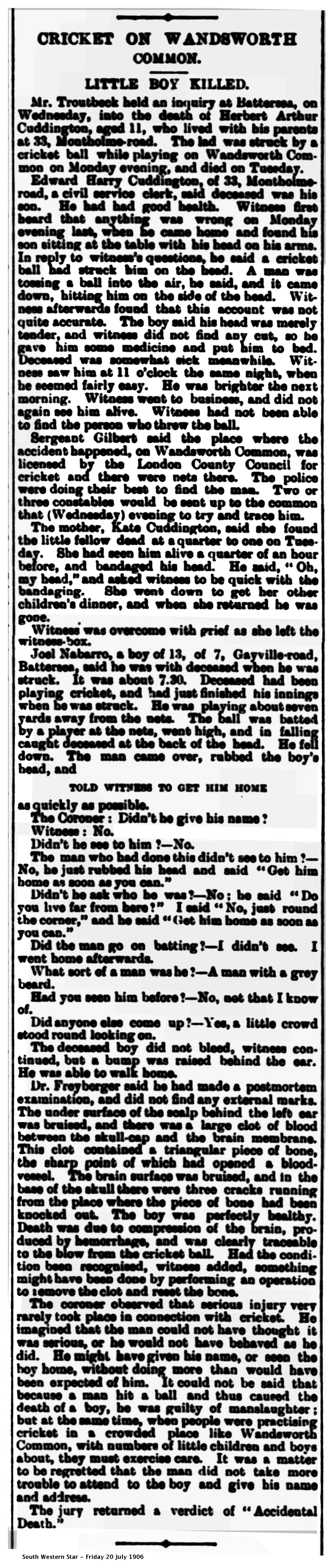
CRICKET ON WANDSWORTH COMMON. BOY KILLED.
Mr. Troutheck held an inquiry at Battersea, on Wednesday, into the death of Herbert Arthur Cuddington, aged 11, who lived with his parents at 33, Montholme-road. Thee lad was struck by a cricket ball while playing on Wandworth Common on Monday evening, and died on Tuesday.
Edward Harry Cuddington, of 33, Montholme-road, civil service clerk, said deceased was his son. He had had good health. Witness first heard that anything was wrong on Monday when he came home and found his son sitting at the table with his head on his arms. In reply to witness's questions, he said a cricket ball had struck him on the head. A man was tossing a ball into the air, he said, and it came down, hitting him on the side of the head. Witness afterwards found that this account was not quite accurate. The boy said his head was merely tender, and witness did not find any cut, so he vs him some medicine and put him to bed. was somewhat sick meanwhile. Witness saw him at 11 o'clock the same night, when he seemed fairly easy. He was brighter the next morning. Witness went to business, and did not again see him alive. Witness had not been able to find the person who threw the hall.
Sergeant Gilbert said the place where the accident happened, on Wandsworth Common, was licensed by the London County Council for cricket and there were nets there. The police were doing their beet to find the mats. Two or three constables would be soot up to the common that (Wednesday) evening to try and tram him.
The mother, Kate Cuddingtoo, said she found the little fellow dead at a quarter to one on Tuesday. had seen alive a quarter of an hour before, and bandaged his head. He said, "Oh, my head, " and asked witness to be quick with the bandaging. She wont down to get her other children's dinner, and when she returned be was gone.
Witness was overcome with grief as she left the witness-box.
Joel Nabarro, a boy of 13, of 7, Gayville-road, Battersea, said he was with deceased when he was struck. It was about 7.30. Deceased had been playing cricket, and had just finished his innings when he was struck. The ball was batted by a player at the nets, went high, and in falling caught deceased at the back of the head. He fell down. The man came over, rubbed the boy's head, and
TOLD WITNESS TO GET HIM HOME
as quickly as possible.
The Coroner: Didn't he give his name?
Witness: No.
Didn't he see to him?' - No.
The man who had dene thie didn't see to him � - No, he just rubbed his head and said "'Get him home as soon as you can."
Didn't he ask who he was - No; he said - Do you live far from here?" I said "' No, just round the corner," and he said "Get him home as soon as you can."
Did the man go ca batting! - I didn't see. I went home afterwards.
What sort of a man was he? - A man with a grey beard.
Had you seen him before? - No, not that I know of.
Did anyone eles come up? - Yes, a little crowd stood round looking on.
The deceased boy did nat bleed, witness continwed, but a bump was raised behind the ear. He was able to at walk home.
Dr. Freyberger made a postmortem examination, and did not fid any external marks. The under surface of the scalp behind the left ear was bruised, and there was a large clot of blood between the skull-cap and the brain membrane. This contained a triangular piece of bone, the sharp point of which had opened a blood vessel. The brain surface was bruised, and in the base of the skull there were three cracks running from the place where the piece of bene had been knocked out. The boy was perfectly healthy. Death was due to compression of the brain, pro deced by hemorrhage, and was traceable to the blow from the cricket ball. Had the condition been recognised, witness added, something might have ben done by performing an operation to remove the clot and reset the bone.
The coroner observed that serious injury very rarely took place ia connection with cricket. He imagined thas the man conld not have thought it was serious, or he would not have behaved as he did. He might have given his mame, or seen the boy home, without doing more than would have been expected of him. It could not be said that because a man hit a ball and thus caused the death of a boy, he was guilty of manslaughter; but at the same time, when people were practising cricket in a crowded place like Wandsworth Common, with numbers of little children and boys about, they must exercise care. It was a matter to be regretted that the man did not take more trouble to attend to the boy aad give his name aad address.
The jury returned a verdict of "Accidental Death."
[BNA: Source.]