[The Times: Search: "Wandsworth Common"].
[BNA: Buckmaster Battersea 1910]
[BNA: Buckmaster Wandsworth 1910]
[London Evening Standard: Buckmaster Wandsworth 1910]
Vote - Saturday 30 April 1910
THE VOTE. OUR WORK. During the IF those who say that the militant Truce. movement is dead are not afraid of spooks they would see what would strike them as a very healthy resurrection indeed should they happen to pay a visit to our offices. The number of applications for membership is increasing daily, and inquiries concerning the aims and objects of the Women's Freedom League - inquiries which we are only too willing to answer - are unceasing. As there are a large number of our members who are anxious to help us and do not know how they can best do it, we invite them, too, to write in or call in to us, and we shall find use for them. We want more street sellers for THE VOTE.
The sale of our paper is going up every week; the increase is steady, and anyone who buys it once wants it again. It is easy to sell and pleasant to read, so intending volunteers with a few hours to spare should apply for a pitch. Other Activities. WE want volunteers for our open-air meetings. In Regent's Park every Sunday we hold enthusiastic gatherings and make many converts and strengthen the convictions of the indifferent. Presently we shall be holding others in Hyde Park and Kennington Park. Special open-air meetings in Battersea Park, Wandsworth Common, Clapham Common, Brockwell Park, Victoria Park, Finsbury, Park, &c will be found announced under " Forthcoming Events,' which should be carefully studied each week.
For Mrs. Manson's drawing-room meetings we are anxious to get more promises of drawing-rooms. Drawing-room meetings are a special form of propaganda which draw in many women who would, before they are convinced, be shy of standing to hear an open-air speaker. Mrs. Despard is speaking at many fixtures in London and the provinces, and her engagements will be found on the list. On May 4th she will address a meeting of telegraphists at Essex Hall, Strand, and on Friday, 29th, will speak at Miss Seruya's reception at the Bijou Theatre. Scotland.
[Link?]
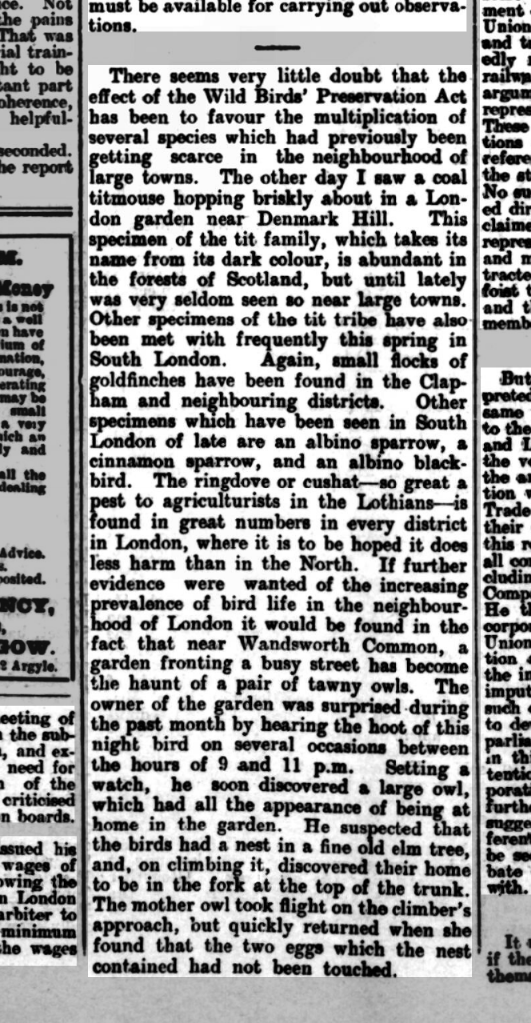
There seems very little doubt that the effect of the Wild Birds' Preservation Act has been to favour the multiplication of several species which had previously been getting scarce in the neighbourhood of large towns. The other day I saw a coal titmouse hopping briskly about in a London garden near Denmark Hill. This specimen of the tit family, which takes its name from its dark colour, is abundant in the forests of Scotland, but until lately was very seldom seen so near large towns.
Other specimens of the tit tribe have also been met with frequently this spring in South London. Again, small flocks of goldfinches have been found in the Clapham and neighbouring districts. Other specimens which have been seen in South London of late are an albino sparrow, a cinnamon sparrow, and an albino blackbird. The ringdove or cushat-eo great a pest to agriculturists in the Lothians- -is found in great numbers in every district in London, where it is to be hoped it does less harm than in the North.
If further evidence were wanted of the increasing prevalence of bird life in the neighbourhood of London it would be found in the fact that near Wandsworth Common, a garden fronting a busy street has become the haunt of a pair of tawny owls. The owner of the garden was surprised during the past month by hearing the hoot of this night bird on several occasions between the hours of 9 and 11 p.m. Setting a watch, he soon discovered a large owl, which had all the appearance of being at home in the garden. lie suspected that the birds had a nest in a fine old elm tree, and, on climbing it, discovered their home to be in the fork at the top of the trunk. The mother owl took flight on the climber's approach, 'out quickly returned when she found that the two eggs which the nest contained had not been touched.
[BNA: Link]