Last modified: 3 October 2026
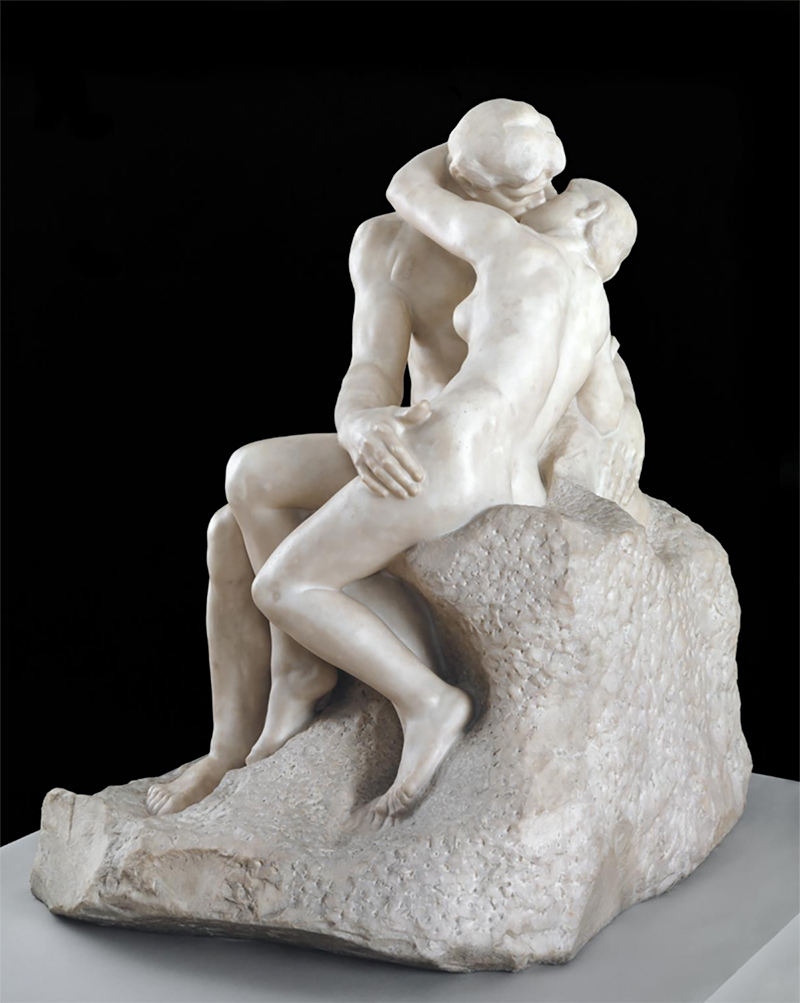
The damned lovers Paolo and Francesca, by Auguste Rodin, 1900. Tate Gallery, London.
You might question what Rodin's The Kiss has to do with Wandsworth Common, and you'd have a point. But there is a connection, though admittedly quite remote. The Tate's version of The Kiss (there are a few around the world) was commissioned by the US millionaire and art connoisseur Edward Perry Warren, who just happens to have been my father's godfather. (It's a long story, albeit a good one. But let's leave that for another time.)
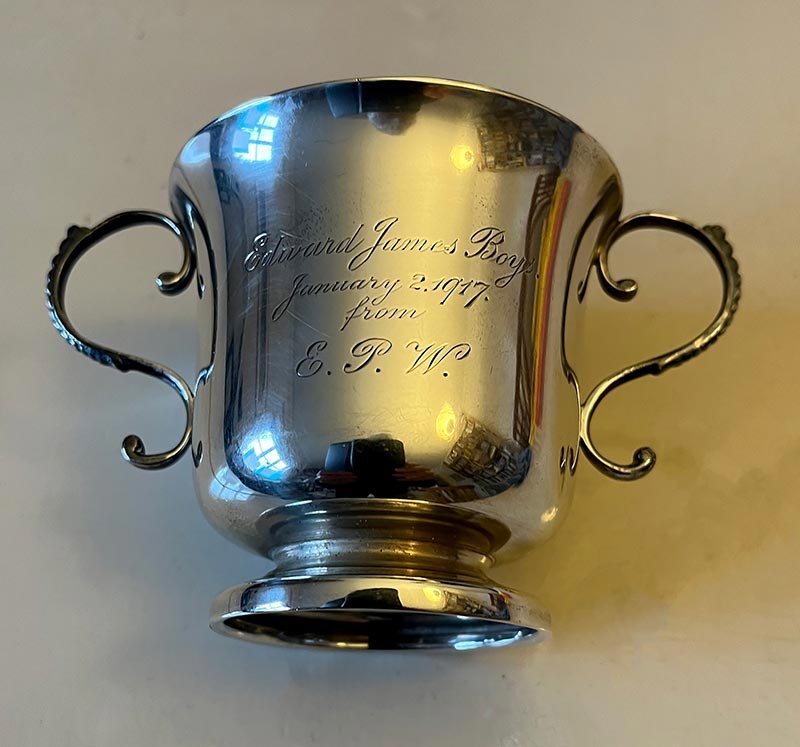
Silver christening mug inscribed to my father, Edward James Boys, January 2, 1917. His godfather, "E.P.W.", was Edward Perry Warren, who lived in some style in Lewes House, Sussex. The baptism took place in nearby Plumpton. Was EJB named "Edward" to honour his godfather? I don't know.
NB. My father's christening mug is obviously not to be confused with the somewhat controversial Warren Cup, which EPW owned, now in the British Museum. As the "author of works proposing an idealised view of homosexual relationships" and a home shared with a number of mainly young men in the "Lewes House Brotherhood", EPW himself was no stranger to forbidden love.
One of the reasons The Kiss was once so scandalous (and hence perhaps so popular) is not necessarily because the couple are naked (there were after all any number of undraped women in late Victorian and Edwardian statuary), but that Francesca is drawing Paolo powerfully towards her. She is so obviously enjoying their embrace.
Paolo and Francesca had been reading the Arthurian legend of Lancelot and Guinevere together (Paolo is holding the book beneath his left hand — take a peek round the back, if you can get access, and check), and were overcome with desire for each other. For this, they are damned.
[What makes both liaisons "forbidden" is that Guinevere is married to King Arthur, and Lancelot is Arthur's right-hand man — and Paolo is Francesca's husband's brother.
Lancelot — the greatest knight of the Round Table — had been widely tipped to find the Holy Grail. But his love for Guinevere puts an end to all that: when Lancelot glimpses the Grail, he is told his adultery has made him unworthy to touch it.
It falls instead to his own son, Galahad — the child he had unknowingly fathered on Elaine, daughter of the Grail keeper — who had inherited his father's prowess but not his fatal weakness.]
For this adulterous (and indeed, given the beliefs of the time, incestuous) relationship, Dante, in his Inferno, consigns Paolo and Francesca to the second Circle of Hell. This is reserved for the lustful, which is where Rodin (who himself had many lovers) depicts them on his Gates of Hell.
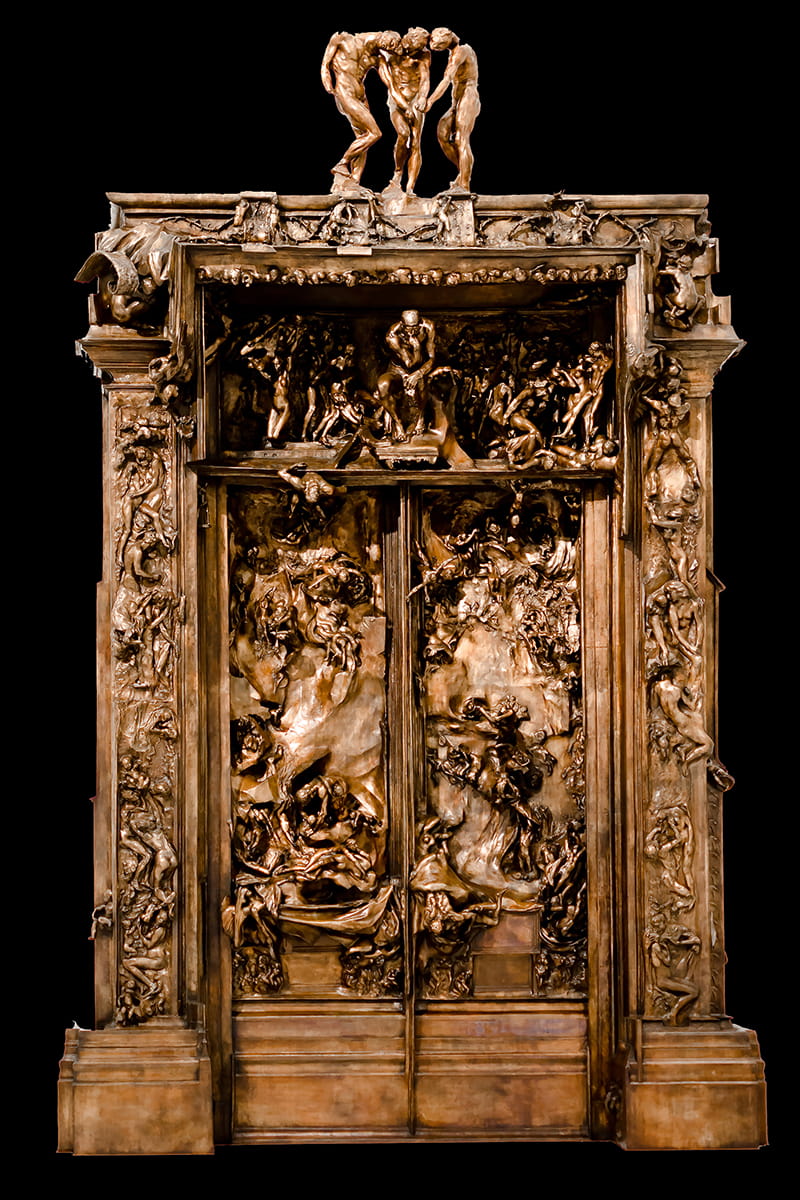
The Gates of Hell, by Auguste Rodin. Museo Soumaya, Mexico City. For the final version, Rodin changed Paolo and Francesca's posture — see them bottom right.
— Tate Gallery: Rodin, The Kiss
— Wikipedia: The Kiss (Rodin sculpture)
— Wikipedia: Paolo and Francesca da Rimini
— Wikipedia: Edward Perry Warren
— Wikipedia: The Warren Cup
— Horniman Museum: The Lewes House Brotherhood
Now at last we're getting a little closer to Wandsworth Common.
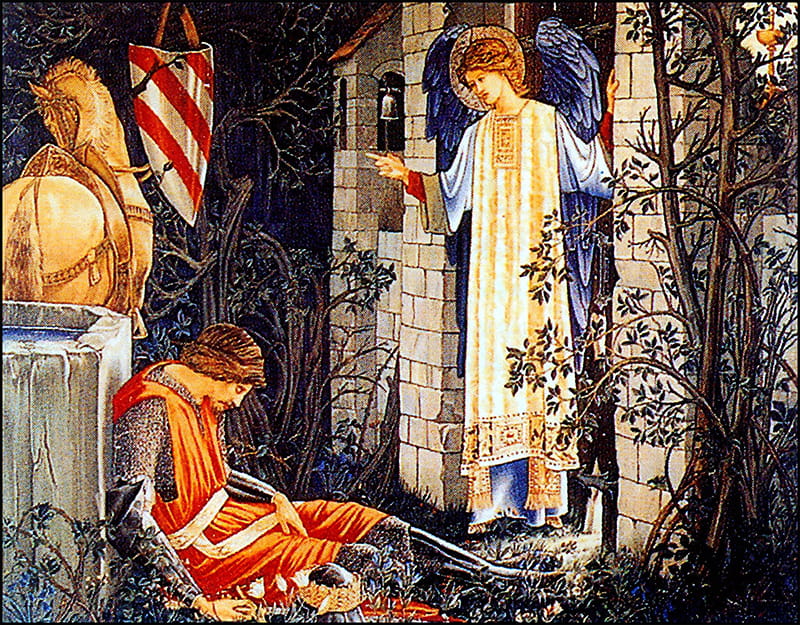
The Failure of Sir Launcelot to enter the Chapel of the Holy Grail, Number 3 of the Holy Grail tapestries woven by Morris & Co. 1891-94 for Stanmore Hall. Wool and silk on cotton warp.
Edward Burne-Jones and William Morris created the overall design and figures, with John Henry Dearle supplying flowers and decorative details. And as you may recall from a piece about his life and work in December 2023's Chronicles, JHD lived for some years on Lyford Road, at "Red Thorn" (was this no. 31?).
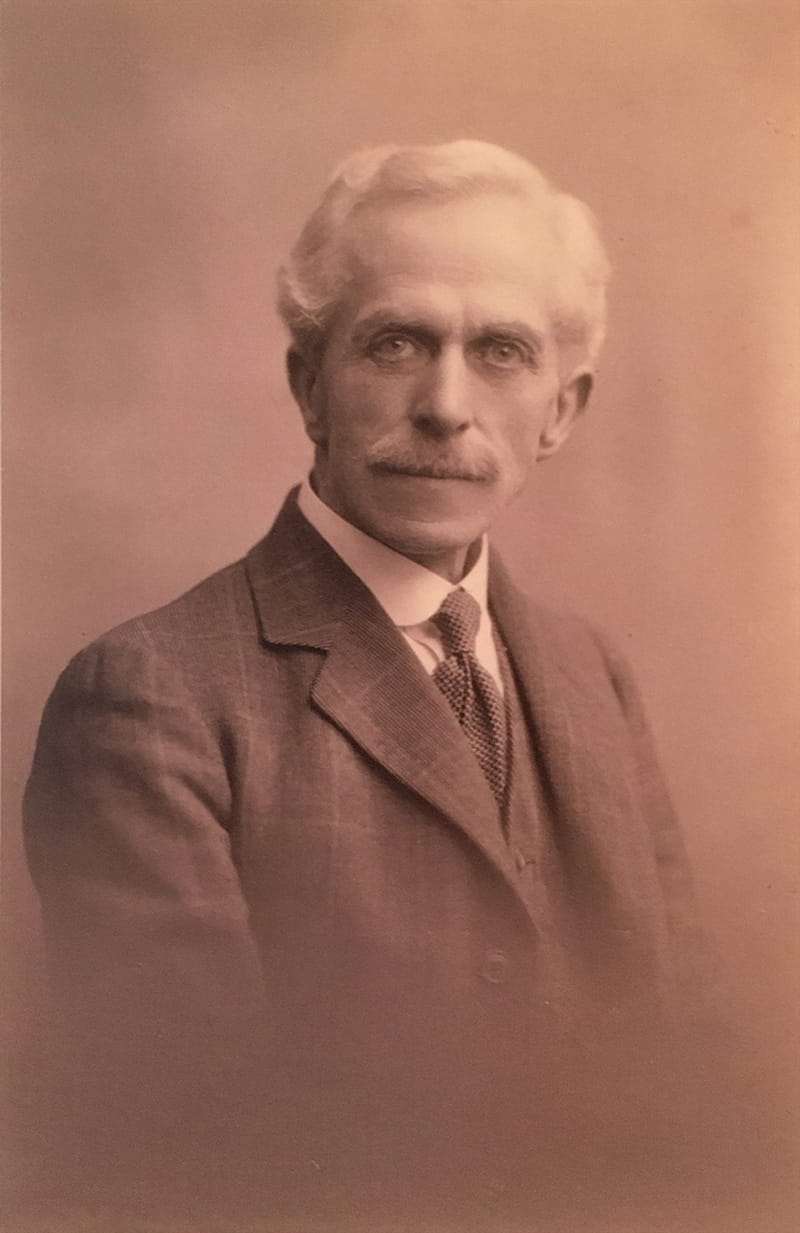
John Henry Dearle, c. 1930? He joined Morris & Co in 1878, and was trained as a tapestry weaver by Morris. He produced his first tapestry design in 1887. He became the firm's chief designer in 1890, working on a variety of woven and printed textiles. After Morris's death, Dearle became the company's Art Director.
[I wonder why JHD chose a late-Victorian-style house rather than a more Artsy-Craftsy one, as were appearing on the other side of Lyford Road?]
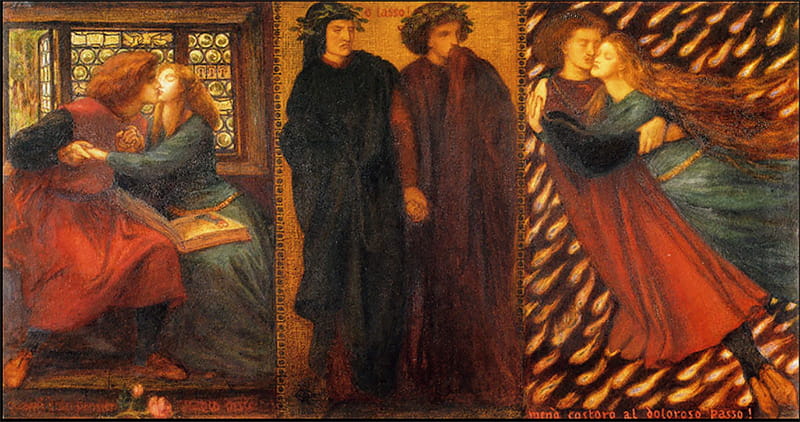
One of many images of Paolo and Francesca by Dante Gabriel Rossetti - a frequent visitor to his friends near the Common, including Alexander Macmillan, near Tooting Bec, and James Anderson Rose, who lived in a substantial house next to Fernside, more or less where Airedale Road is today. Rose owned several paintings and etchings by DGR, among them one described as "La Morte D'Arthur".
What brought all this to mind was reading some March-related passages from Helen Thomas's wonderful autobiographical writings. (I like to celebrate Edward Thomas's birthday — he was born 3 March 1878 — by including at least something about him in the March Chronicles every year.)
Their relationship was certainly not "forbidden" to start with, but it became so after Helen's father's death. Many of their subsequent clandestine meetings were on the Common.
As a teenager, Helen, nee Noble (her father was the journalist and literary critic James Ashcroft Noble), lived close to the Common. Their first home, from 1893, was on St Ann's Hill (then called The Grove), and later, from 9 December 1895, the rather larger 6 Patten Road. In these years, Helen and her sister Mary attended Wimbledon High School.
Here's how Helen, aged 90, recalled her first impressions of Edward:
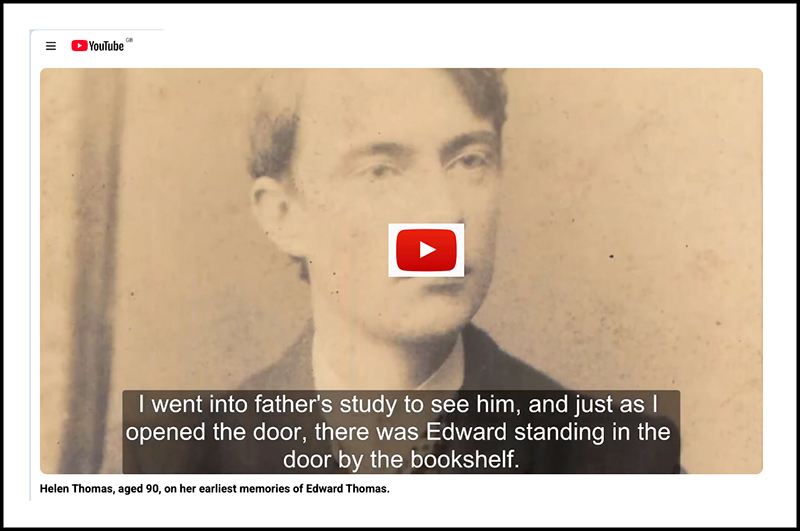
I went into father's study to see him, and just as I opened the door, there was Edward standing by the bookshelf — very tall, very good-looking, and very shy and reserved. We shook hands, and I remember very well indeed that he shook my hand very firmly and hard, and I liked that. I thought, well, yes, you look rather shy and timid, but you don't shake hands like one.
I stayed and listened to father and Edward talking, then left. He came several times after that, and every time he came I was attracted by him. I went into the study to join in the talk, which was all about books of course, and writing.
At that time he had written a book about nature — a nature diary — and it was obvious from what he told my father how interested he was in wildlife, and how he used to do tremendous walks in the country round London, which was then great open country but is suburbs now.
Father one day said, "Here's Helen, longing for the country — why don't you take her on one of your walks?" So Edward took me, more than once, and that was how it all began . . .
Father was delighted — though he didn't live very long after that. He was very fond of Edward, and he was delighted that we were being so friendly. He had no idea then that we should marry.
The "book about nature" which Helen mentions was The Woodland Life, published in 1897 when Edward was only 19. It includes several references to Wandsworth Common. Here for example is an entry for March in the last chapter, his nature diary:
"March 29: Deep-red blossom clusters on the ash; odorous of the earth, or of peeling bark.
Missel-thrushes sing on Wandsworth Common.March 30: Dull dry days, but calm beautiful nights.
Gorse-thorns, like fir-needles, form a friable mat of soil on the surface; gorse wastes almost as much as the bramle, in the number of its less branches which decay each year.
Poplar-twigs daily more jagged with beeaking leaf-buds . . .April 13: Swallows, house-martins, and sand-martins come to Wandsworth Common in fine blue weather."
[Q: Do "swallows, house-martins, and sand-martins" still come to Wandsworth Common? I imagine not, but I could be wrong. [pp.233-34]]
At least at first, Helen and Edward went walking together (unchaperoned) with parental consent — indeed, with her father's active encouragement.
But this changed when her father died [1896], and her mother became more hostile. Eventually, theirs too was a kind of forbidden love.
After my father's death life at home became very different. His genial kindness and happiness withdrawn, my mother's harshness became more pronounced. My friendship with Edward when it was mentioned was always alluded to with sneers and contempt . . . Edward never came to the house now, but though my mother had forbidden it she was powerless to prevent my meeting him and I never hid from her that we did. We met and walked and talked, and love grew.
There was no definite moment when friendship became love, but a natural merging into love as we became closer, friends. At this time we both knew that the friendship between us was the happiest thing in our lives, but we did not regard the future. We were content with the present.
And then came their first kiss . . .
I remember one evening very well. It was in the spring and nearing Edward's birthday, March 3rd. We were walking on the Common, very happy, talking of what we had been reading, what doing, what thinking, walking as usual hand in hand.
In a space of silence, when thought and emotion went to and fro between us too full even for speech, I felt that wonderful experience of the first stirring of desire, though at this time it seemed half-maternal tenderness for his big, strong body, and his lovely face, and his hand holding mine, which now held his more firmly — mingled with something new and strange that I did not understand.
I remember how, with that emotion flooding my being, my heart beat too fast, and my face burned, and I could have fainted with the pain and the joy of it. For it affected me as later I was affected by the first flutter of my baby in my womb.
When we reached the place for good night I could not let him go as he had always done before, but put hands round his head and drew it down to mine and kissed his mouth and looked close into his eyes. And he returned my kiss and my look, and then turned to go. But as I turned to go, too, he caught me in his arms and pressed me to him and kissed my mouth and my eyes and my neck; blindly and fiercely he kissed me, and I abandoned myself to him, not responding but just yielding myself to his kisses.
When I was in my bed I could not sleep, but lay trembling half with fear, half with wonder, at what I had awakened in him. I had not known that love could be like that — so fierce, so rough, so greedy.
[As It Was (1926), in Under Storm's Wing, p.32.]
I wonder how many passionate kisses have been exchanged on the Common over its many centuries?
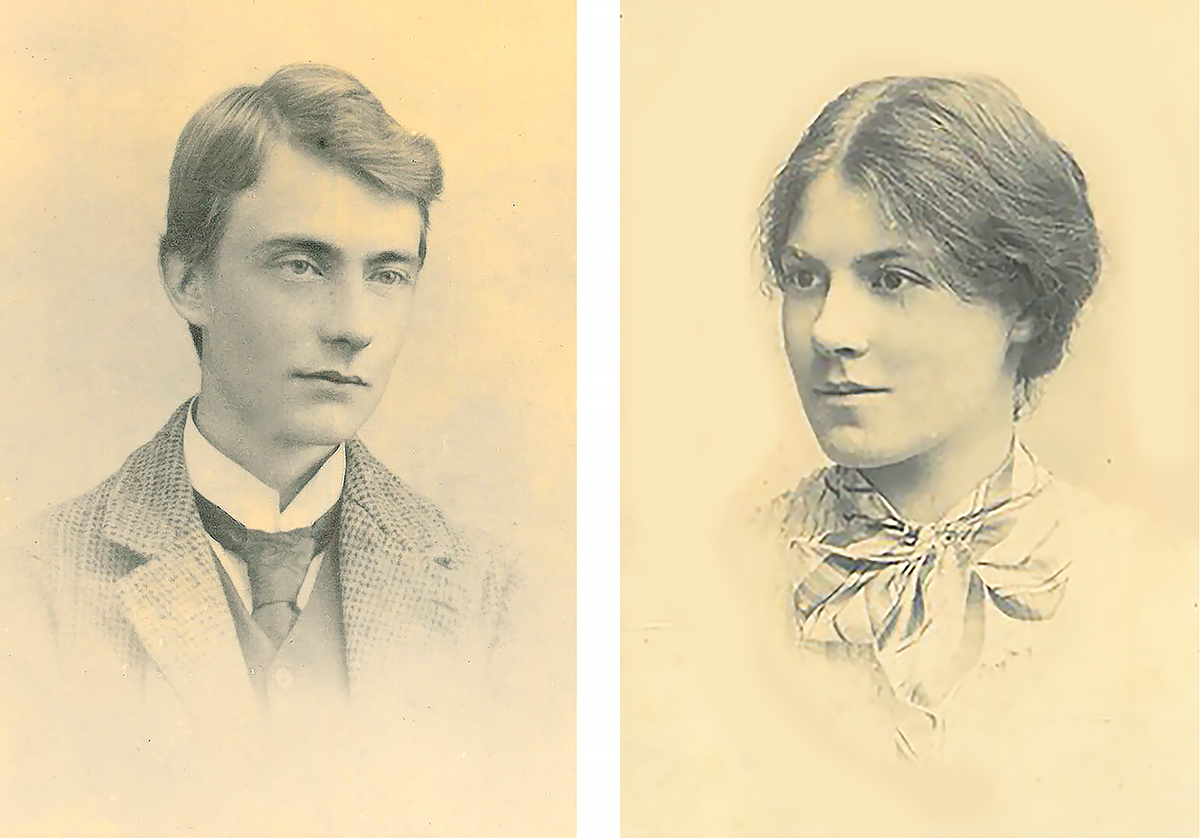
Edward Thomas and Helen Noble, 1899. Edward was a student at Oxford at this time, and Helen a governess in Broadstairs. They married in June 1899. Their first child, Merfyn, was born the following year.
If you want to know what happens next (albeit on Wimbledon Common, which was a little less exposed than Wandsworth), you'll have to consult Helen's marvellous account in Under Storm's Wing (1988). This brings together her two memoirs, As It Was (1926) and World Without End (1931), and several letters and memoirs.
Reading Helen's descriptions of their early lovemaking, it will come as no surprise that D.H. Lawrence was a great friend.
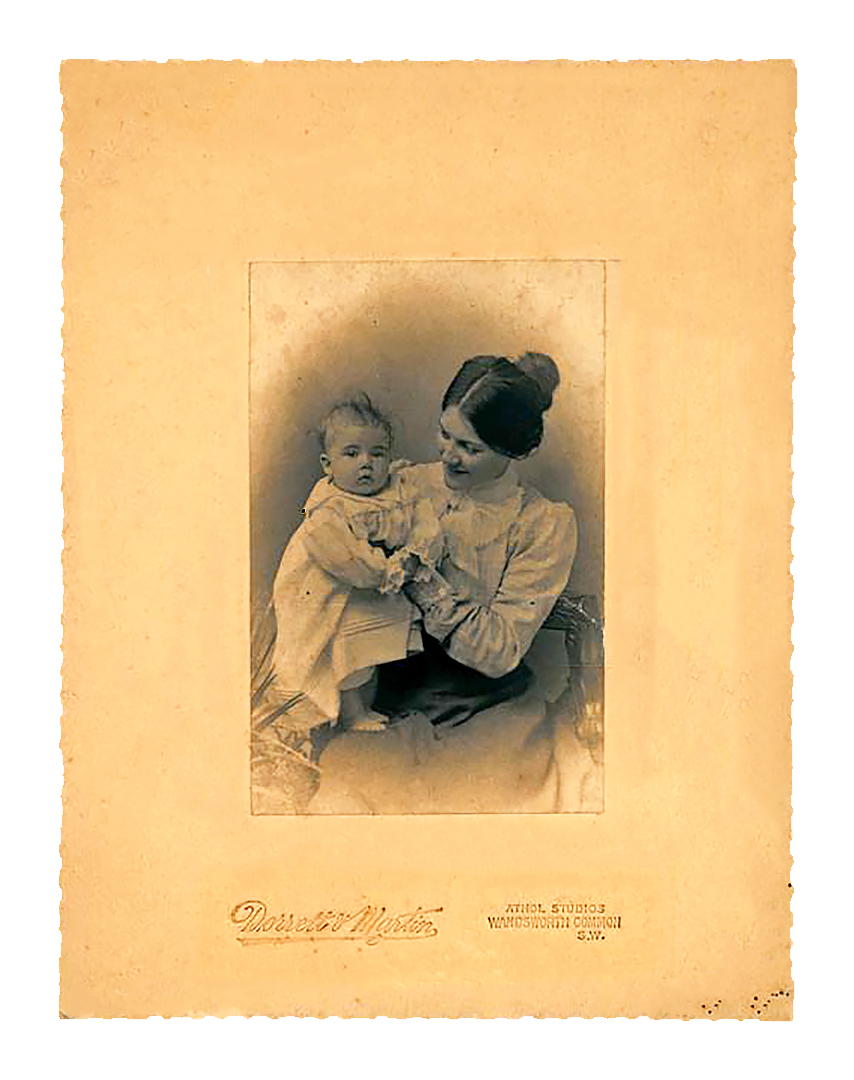
Helen Thomas with her son Merfyn, born January 1900. Photograph by Dorrett & Martin, Atholl Studios, 16 Bellevue Road.
I have written a number of pieces on forbidden love on the Common, for example one that led to a tragic suicide pact between Alice Allen and George Bastow, in 1907.
Another, in 1865, also involved a couple called Alice and George: a vicar's daughter, Alice Crosse, and the family groom, George Smith. I outlined their story in the September 2021 Chronicles:
18 September 1865 — "The Bride and Her Groom" — a humorous poem in the Cockney vernacular, featuring the Common and other Wandsworth locations.
Miss Alice, the daughter of a vicar, falls for the family's groom, one George Smith. Her father is not pleased and forbids their meeting ("he gave Miss A. a scolding sharp / And Mr George the sack"). The couple elope but can't get a licence to marry. But Alice is more than equal to the challenge.
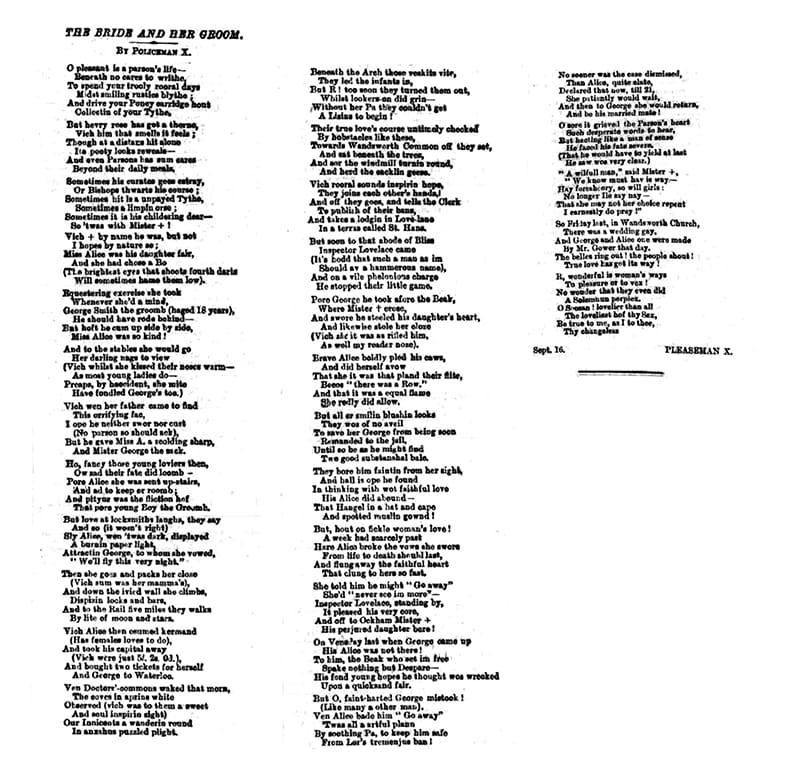
"The Bride and Her Groom", by Policeman X. The Standard, 19 September 1865.
I've transcribed the poem here. Notice the use of "+" or "X" throughout to imply Alice's family name: Crosse. Also, the nice twist in the last verse.
When I first wrote about this poem, I had assumed that the story was entirely fabricated. But no — "The Bride and Her Groom" quite accurately reflects the actual events. See the account under the title "The Insanity of Love" in the Cheltenham Chronicle (19 September 1865).
[There is a suggestion in the article that the account originated in The Times. Check.]
Do you want to know what happens next to Alice and George? I wouldn't be a bit surprised. But I've run out of time now. I'll probably get down to it eventually. Or perhaps you'd like to find out for yourself, and let me know? I could publish your findings next month.
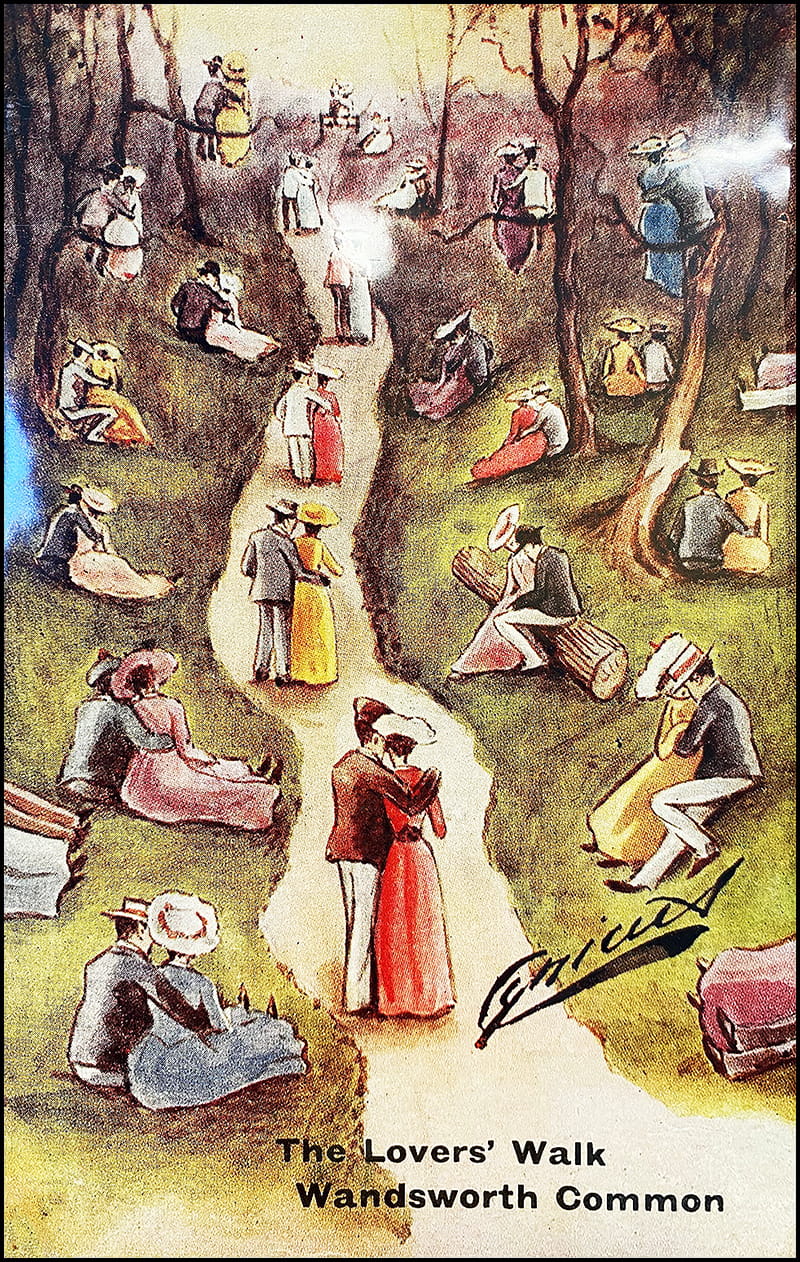
Postcard, c.1910.
[Q: I am told that Elizabeth Berridge, in her novel Across the Common (which was based on her childhood experiences of Wandsworth Common), refers to the large number of children conceived on the Common. Can anyone tell me exactly what she writes, and where?]
But finally, a love story that was not banned (I trust) . . .
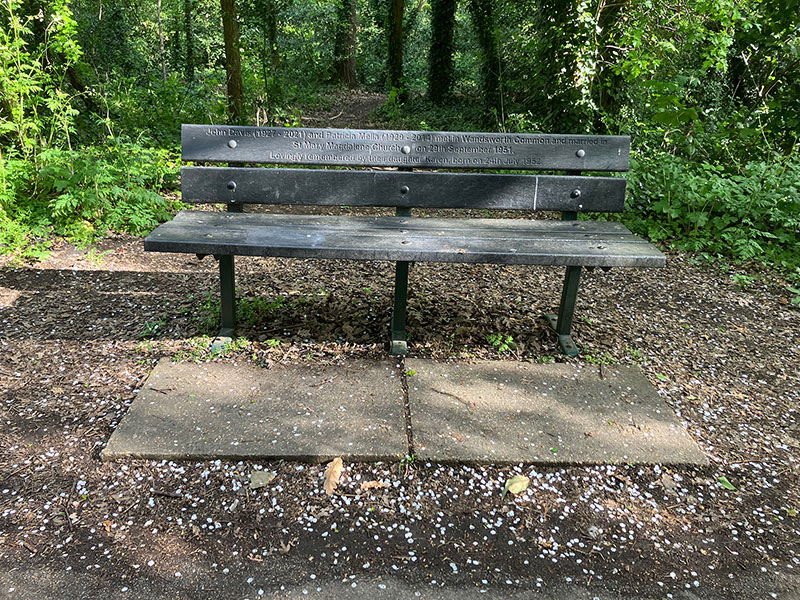
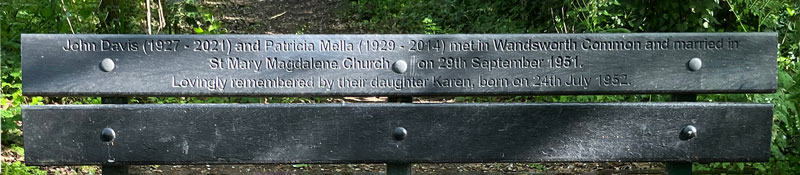
"John Davis (1927—2021) and Patricia Mella (1929—2014) met on Wandsworth Common and married in St Mary Magdalene Church on 29th September 1951.
Lovingly remembered by their daughter Karen, born on 24th July 1952."
The bench is on The Avenue, near Trinity Road. If you would like to add more about the family, and the special meaning the Common had for them, let me know. And of course tell me about other benches on the Common.
[See also Anne Karpf's lovely piece for the Guardian earlier this month, "Why are memorial benches so popular? Because they keep the dead part of the flow of everyday life," which you can read here - thanks, Anne!]
Wandsworth Historical Society — Wandsworth Historian issue no. 120
In the latest issue of the Wandsworth Historian we reflect on the achievements of Henry Rounthwaite, the LCC's Chief Mechanical Engineer early last century who lived for many years in Wandsworth* and Putney; we hear how one local researcher uncovered the experiences of her ancestors in the Wandsworth Workhouse; and we take a heritage walk around Burr Road, Southfields.
We also get an impression of what it was like to visit Old Battersea House in 1950, and honour the memory of Fanny Wilkinson, the pioneer garden designer who laid out Coronation Gardens on Merton Road in 1903. Gillian Brett's statue of Fanny Wilkinson was unveiled during a ceremony at Coronation Gardens, Southfields, last July.
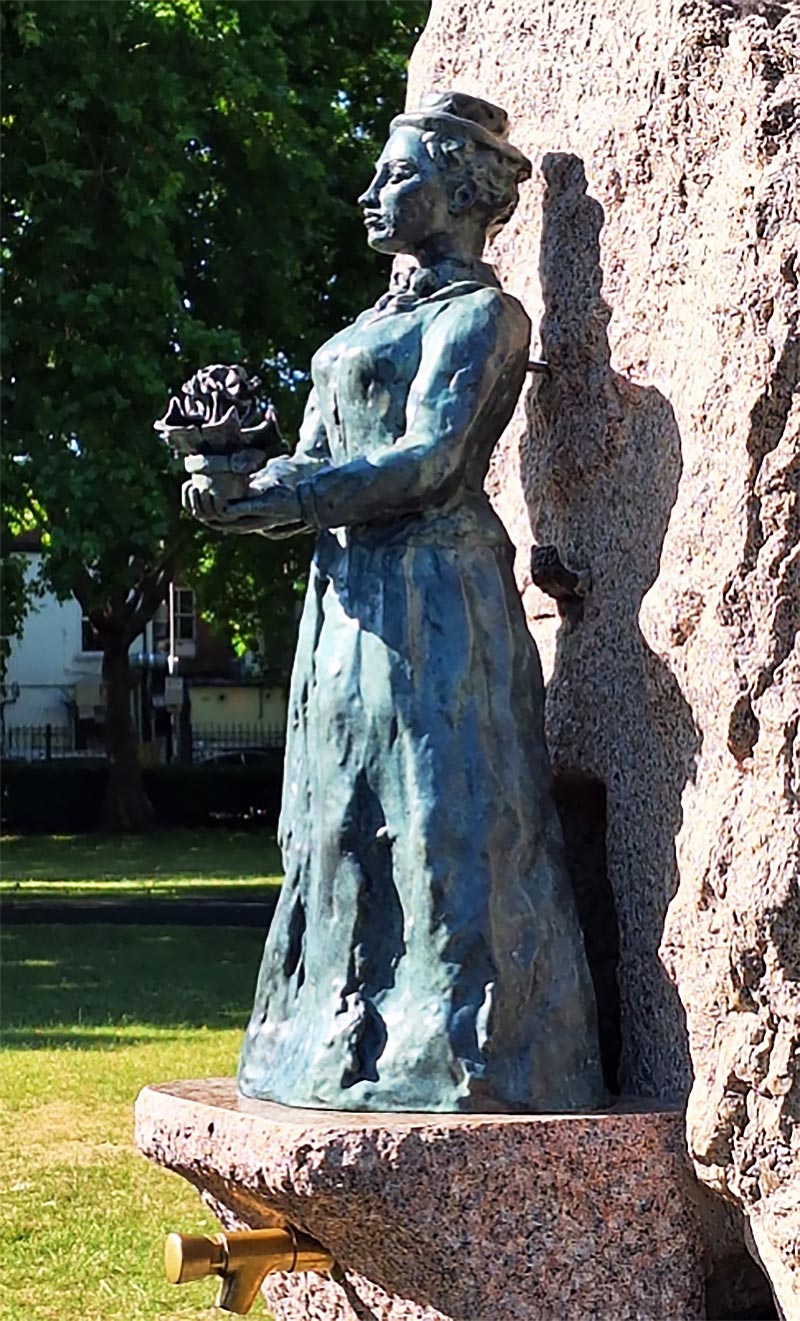
Gillian Brett's statue of Fanny Wilkinson was unveiled during a ceremony in Southfields last July. Photo: Neil Robson
(Click on image to enlarge)
All this and more in the 2026 issue of the Wandsworth Historian (ISSN 1751-9225), the magazine that brings you the latest research into Wandsworth's past.
The Wandsworth Historian is published by the Wandsworth Historical Society. Copies are available price £3.00 plus £3.00 for postage and packing. Please email neil119@gmail.com to find out how to buy a copy.
The website address of the Wandsworth Historical Society is www.wandsworthhistory.org.uk.
[* In the 1890s, the Rounthwaite family were living at 15 Nicosia Road, in today's "Toast Rack". Henry is recorded there in the 1891 census with his wife Sophie, a son and three daughters (info Jean Davidson.)]
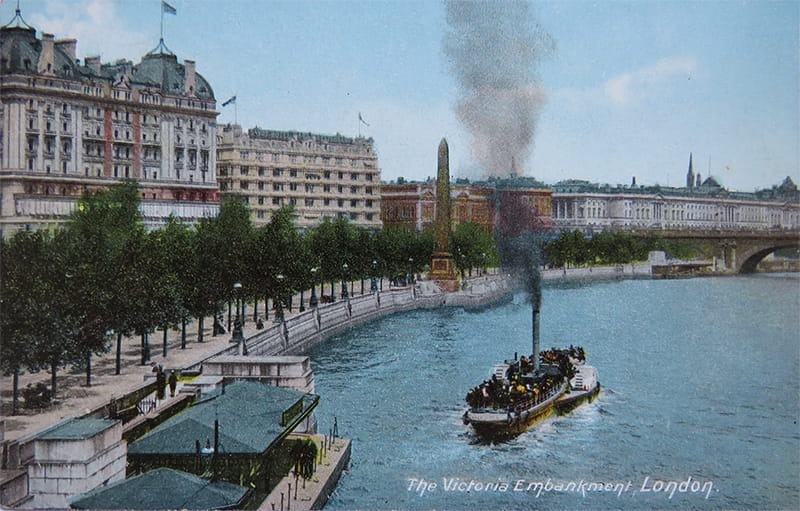
Among Henry Routhwaite's many achievements...
Thursday, 30 April 2026, at NatureScope, Wandsworth Common, SW18 3RT
6:30 for 7 p.m.
Sarah Vey and I will be talking about our exploration of the amazing Geoffrey Bevington Album of albumen prints, now in the Victoria and Albert Museum. Geoffrey, who died in 1874 at the age of 34, was a gifted young photographer working in the early days of the medium — most of his images were taken in the early 1860s.

Geoffrey Bevington, self-portrait, almost certainly taken in the garden of Ivy House, West Side. This is the first photograph in the family's commemorative album compiled after his death in 1874.

Leather-bound, gold-embossed and massive (in the manner of a Family Bible), this album of photographs by Geoffrey Bevington was donated to the V&A by John Bevington in 2016 [Accession no. E.541:19-2016.]
There are nearly 800 images in the collection, with a great variety of themes and locations. There are numerous photographs of his family and friends in London and Northern Ireland, including numerous exquisite portraits of his gorgeously dressed relatives.

Geoffrey's cousin Elizabeth Hezlet. GBA no.83
Some portraits are formal in feel, but many are more casual and humorous, including scenes of games (such as croquet) and dressing up. There are numerous holiday and work scenes, too, but the most interesting for us are likely to be the local scenes — for example of the Common — but above all of their home, Ivy House, on West Side.
It really is a remarkably complete view of an affluent family living on the edge of Wandsworth Common in the 1860s.
[Bookings are available through the Friends of Wandsworth Common's members' newsletter. If you are not currently a member, but are interested in coming to the talk, please contact the Heritage Group Chair, Stephen Midlane using this email link.]
SO many more stories still to tell. But that's all for now, folks.
Send me an email if you enjoyed this post / want to comment on something you've seen on the site / would like to know more — or just want to be kept in touch.
If you would like to receive notifications of new Chronicles, let me know . . .
Philip Boys ("History Boys")
March 2026
— Friends of Wandsworth Common
— Wandsworth Historical Society