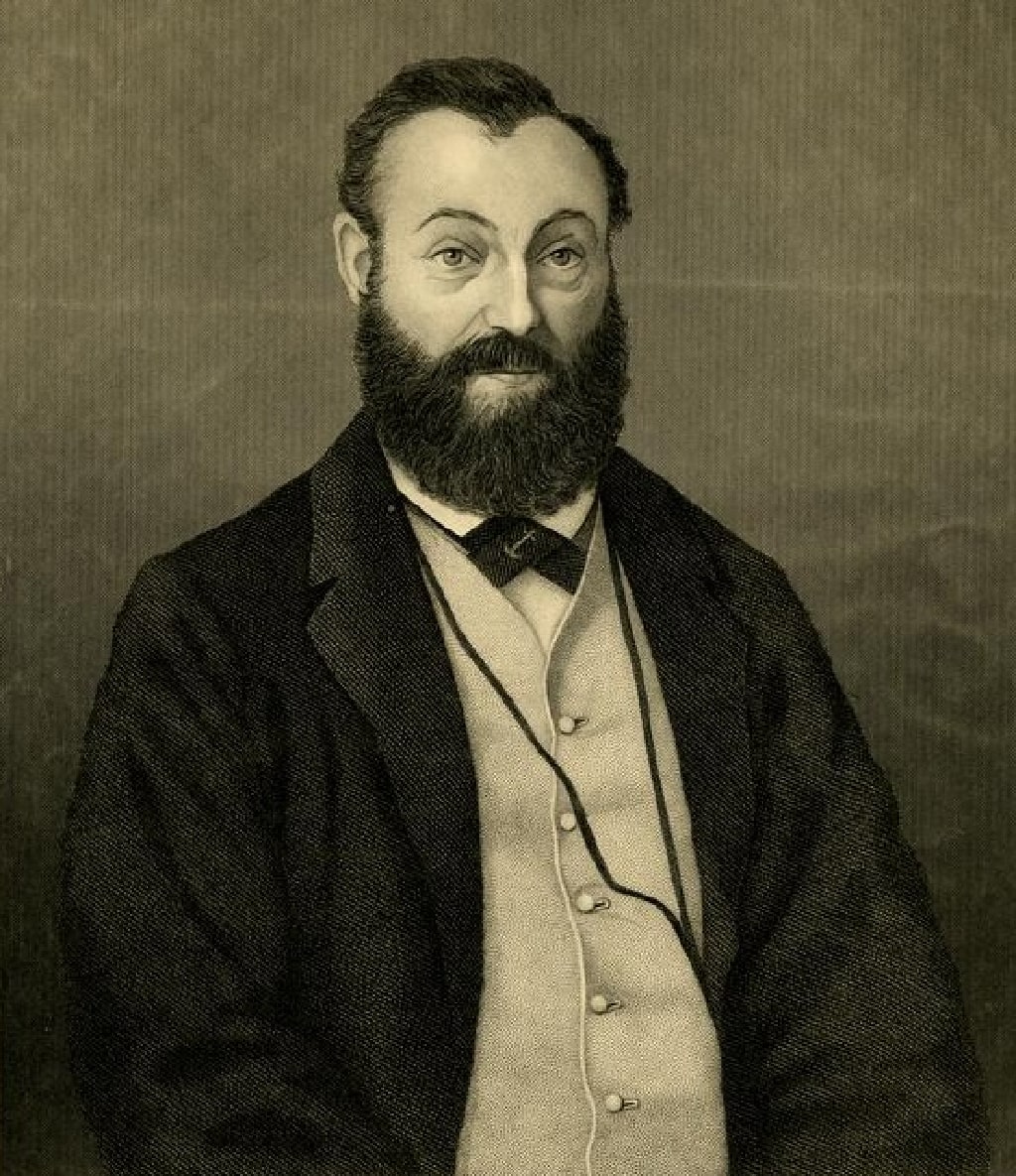
Job Caudwell, one of Spencer Park's first inhabitants, by an anonymous artist, 1850. British Museum.
Can you believe it — this edition of the Chronicles
completes FOUR WHOLE YEARS of monthly articles!
The death and burial of Job Caudwell, June 1908
Job Caudwell is buried beneath this great granite needle in Magdalen Road Cemetery. The first obelisk in the cemetery, it was probably erected shortly after the cemetery opened in 1878, but the chamber beneath remained empty for many years. As we shall see, many more can be seen nearby, but this remains the largest:
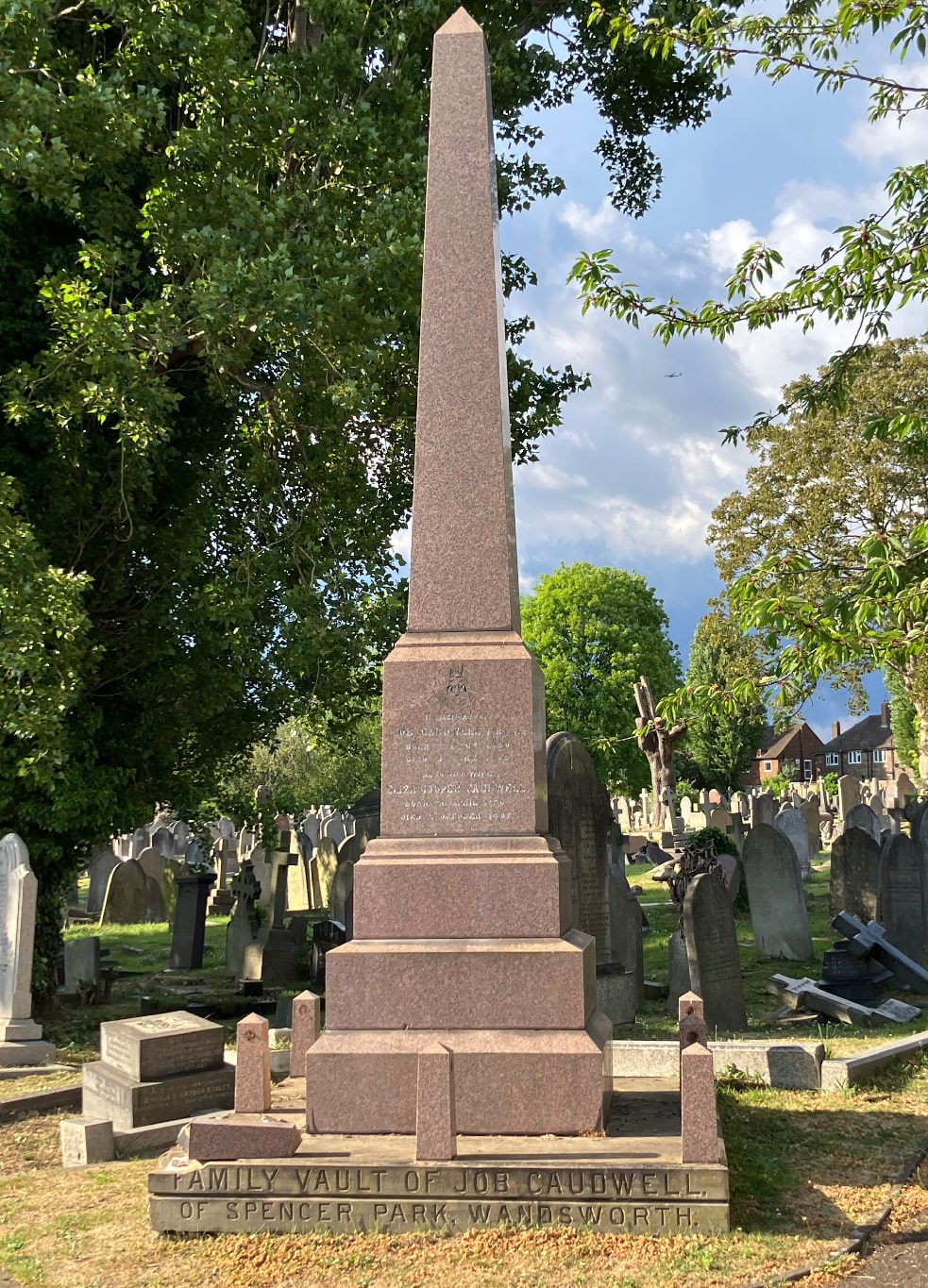
"The Family Vault of Job Caudwell, of Spencer Park, Wandsworth"
(Click on image to enlarge)
Job's obelisk is now somewhat dilapidated (though it's survived better than many crosses). A corner of the plinth has broken away, the iron rail that once surrounded the main obelisk has disappeared, and some of the small obelisks around the tall slender pillar have been toppled.
His grand-daughter, Irene Caudwell, who lived in Spencer Park and Earlsfield Road, wrote at length about her grandfather in her marvellous (but as yet unpublished) memoir of local life, Four Miles from Charing Cross . (You may remember her description of flying bombs in the Second World War I quoted in the Chronicles for September 2024.).
At great expense he erected a monument, composed of reddish brown granite brought specially from Aberdeen and set up in Wandsworth Cemetery beside the little chapel. A most heathenish erection, Grandfather always maintained it was the tallest in the cemetery. It consisted of a Cleopatra's needle set upon so substantial a base that the mere sight of it gives one indigestion.

Heathenish?
No cross appears on Grandpa's monument, as in his day no Wesleyan would dream of using any form of the sacred emblem, even in the Chapel, it being considered Popery of an extreme degree, leading direct to the Seven Hills.
I must say, this rather surprised me. Neither Job nor Irene appear to have known about the Vatican Obelisk. Moved from Egypt and erected in Rome as a symbol of imperial power by the Emperor Caligula, it was moved to its present central position in St Peter's Square in 1586.
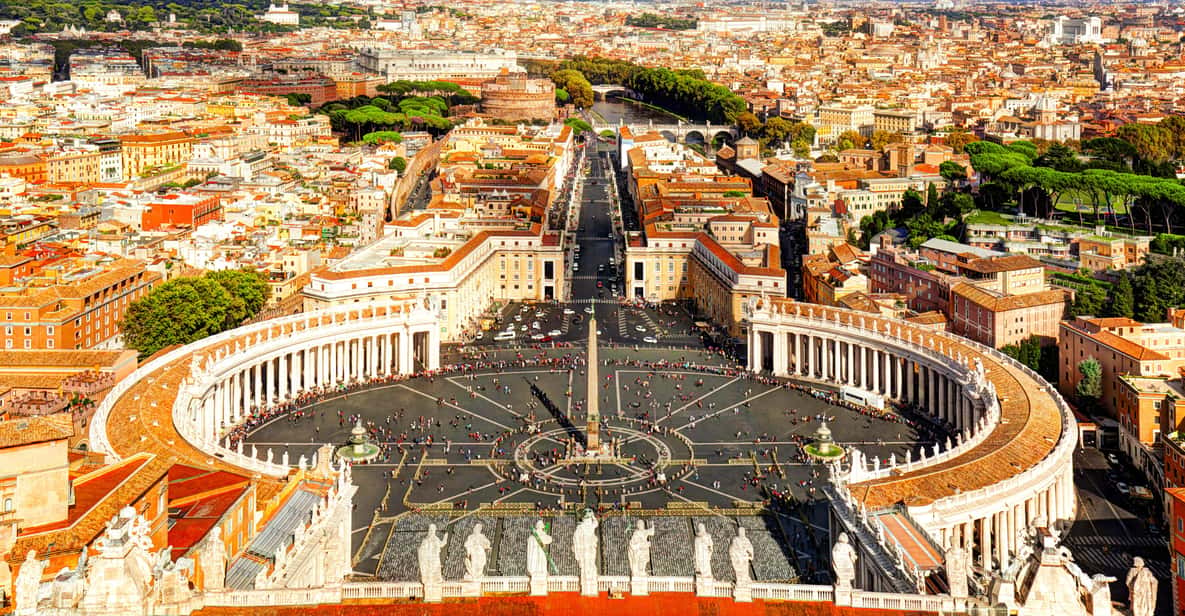
Vatican Obelisk, St Peter's Square, Rome.
[It also functions as the gnomon of an immense sundial, "a visual metaphor for the Church’s foundation upon the Apostles and martyrs, her unwavering faith standing tall amidst the changing shadows of time."]
(Click on image to enlarge)
Obelisk-mania in Magdalen Road cemetery
Have a look round the top of the cemetery, near the two chapels:
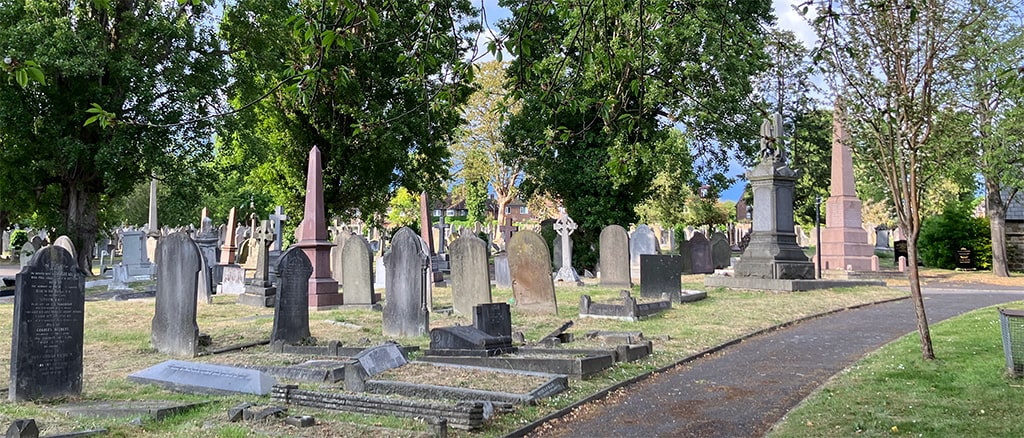
Job Caudwell's obelisk is on the extreme right.
(Click on image to enlarge)
Grandfather's idea of Cleopatra's Needle was copied in a lesser form on the opposite side of the pathway and twins appeared a few yards away on the same side. One or two Wandsworthians even so closely followed his example as to record the names of their dead and living offspring on neighbouring tombs.
Here are a few more obelisks close-by (I really must count them):
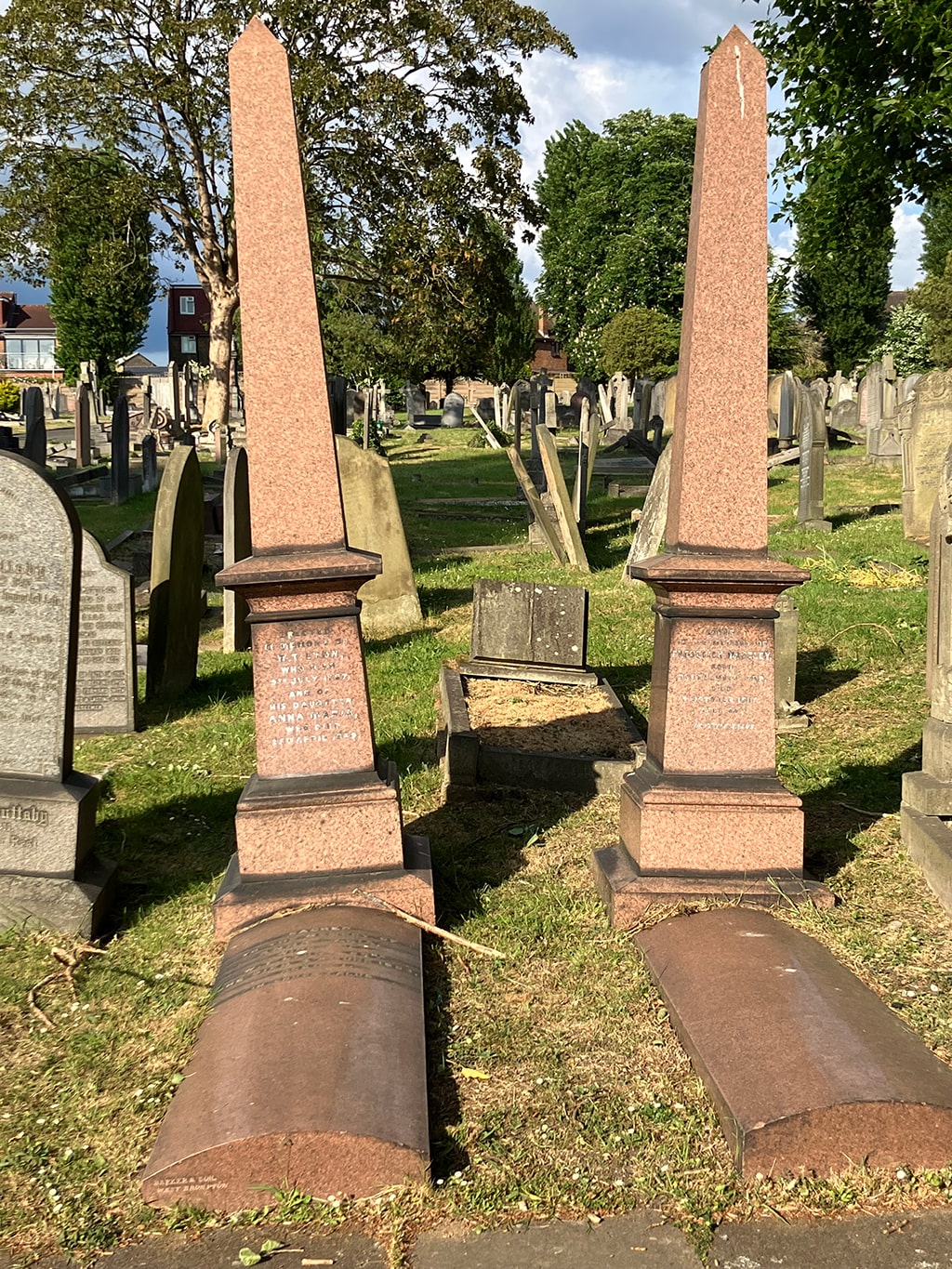
(Click on image to enlarge)
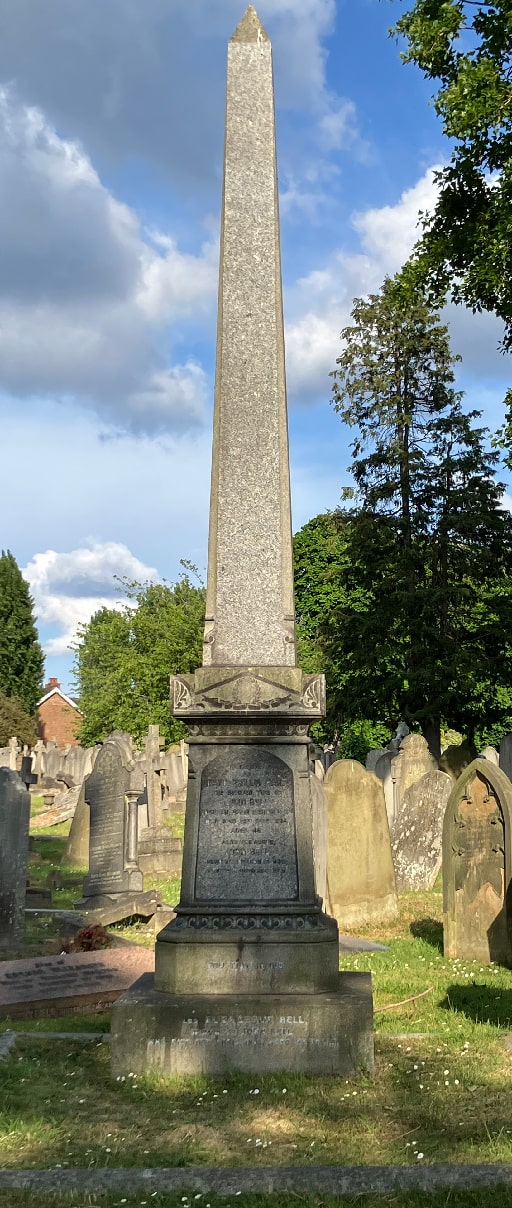
(Click on image to enlarge)
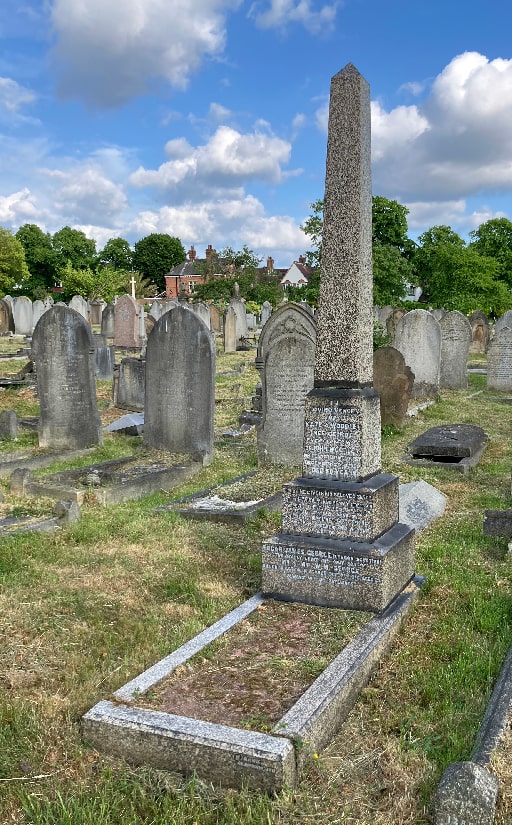
(Click on image to enlarge)
[I have no idea whether this number, and density, of obelisks, is actually unusual in London graveyards. Do you know? Are there many obelisks in Battersea Rise Cemetery?)
Although obelisks had been used in (Christian) funerary memorialisation for some decades — probably stimulated by the victory of Nelson over Napoleon in the Battle of the Nile in 1798 and his death in 1805 at Trafalgar — they probably became even more popular after the erection of Cleopatra's Needle on the Embankment in 1878 (the year that the cemetery opened).
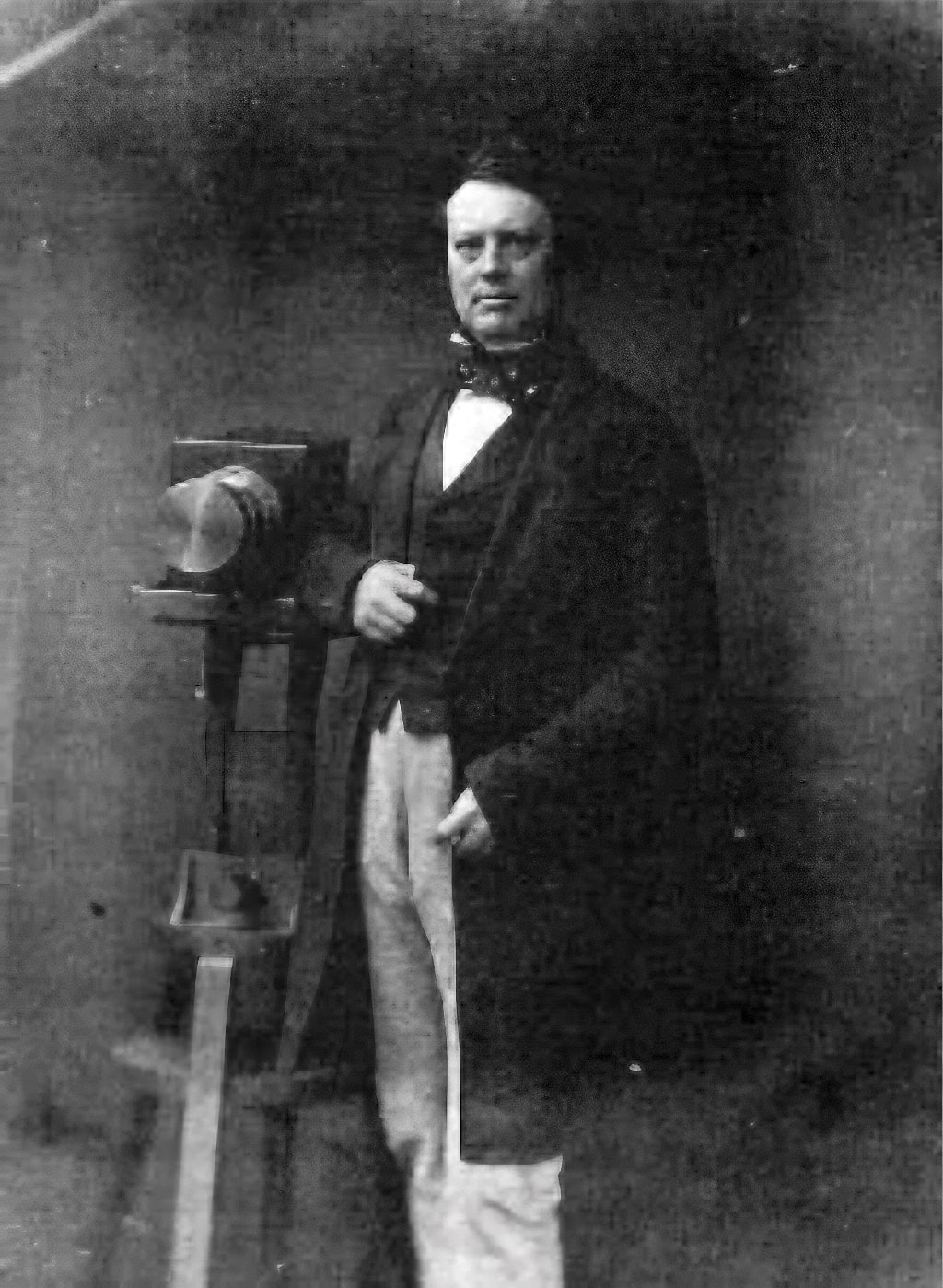
As we saw a few years ago, there is an interesting local connection in Peter Le Neve, who lived on North Side only a hundred yards or so from Job Caudwell's home on Spencer Park. (They must have known one another.) On his way to and from work (as the Secretary of the Royal Society of in John Adams Street), Le Neve Foster recorded the erection in a celebrated series of photographs.
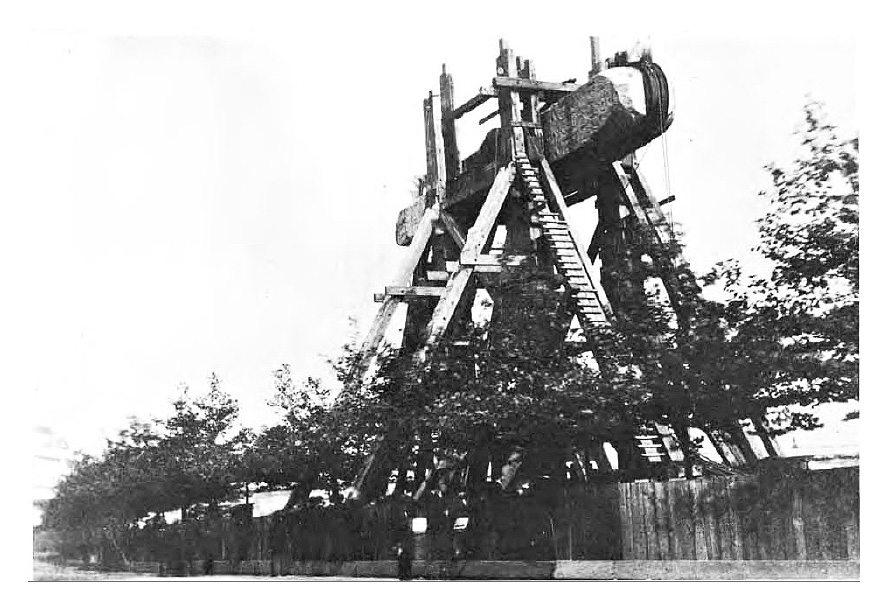
Peter Le Neve Foster: photograph of the erection of Cleopatra's Needle on the Thames Embankment, August 1878 (work finished on 12 September 1878).
(Click on image to enlarge)
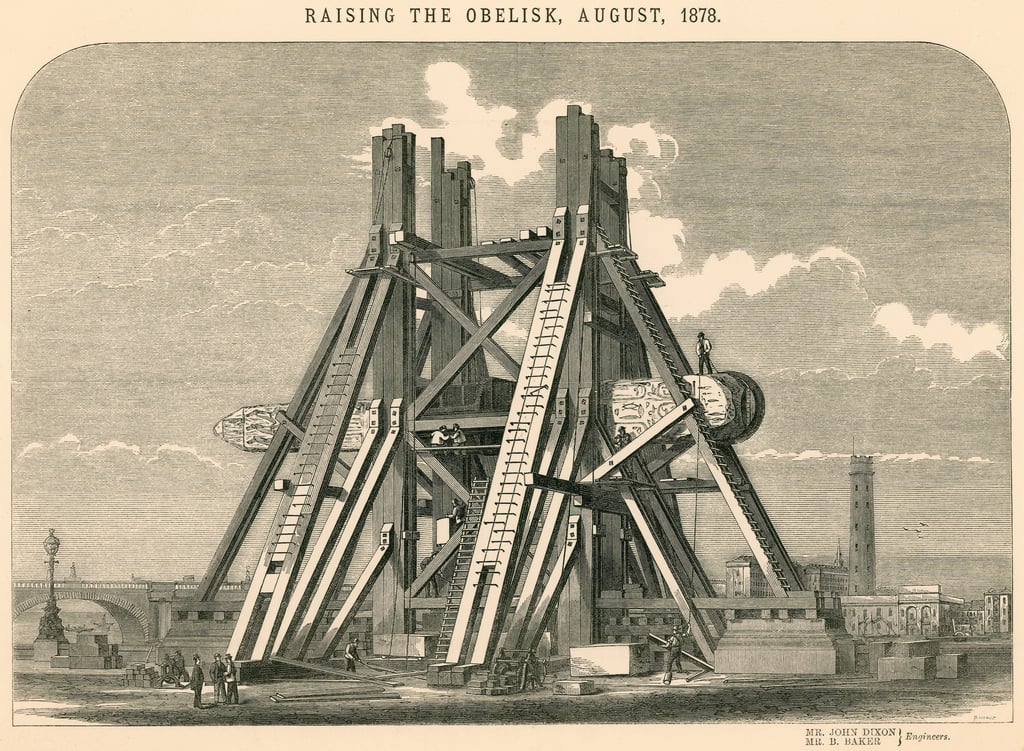
Engraving of the erection of Cleopatra's Needle on the Thames Embankment, August 1878.
(Click on image to enlarge)
Here's a portrait of Peter Le Neve Foster, with camera:
(Click on image to enlarge)
Inscriptions on the base of the obelisk
Front — Job and his wife Eliza Caudwell:
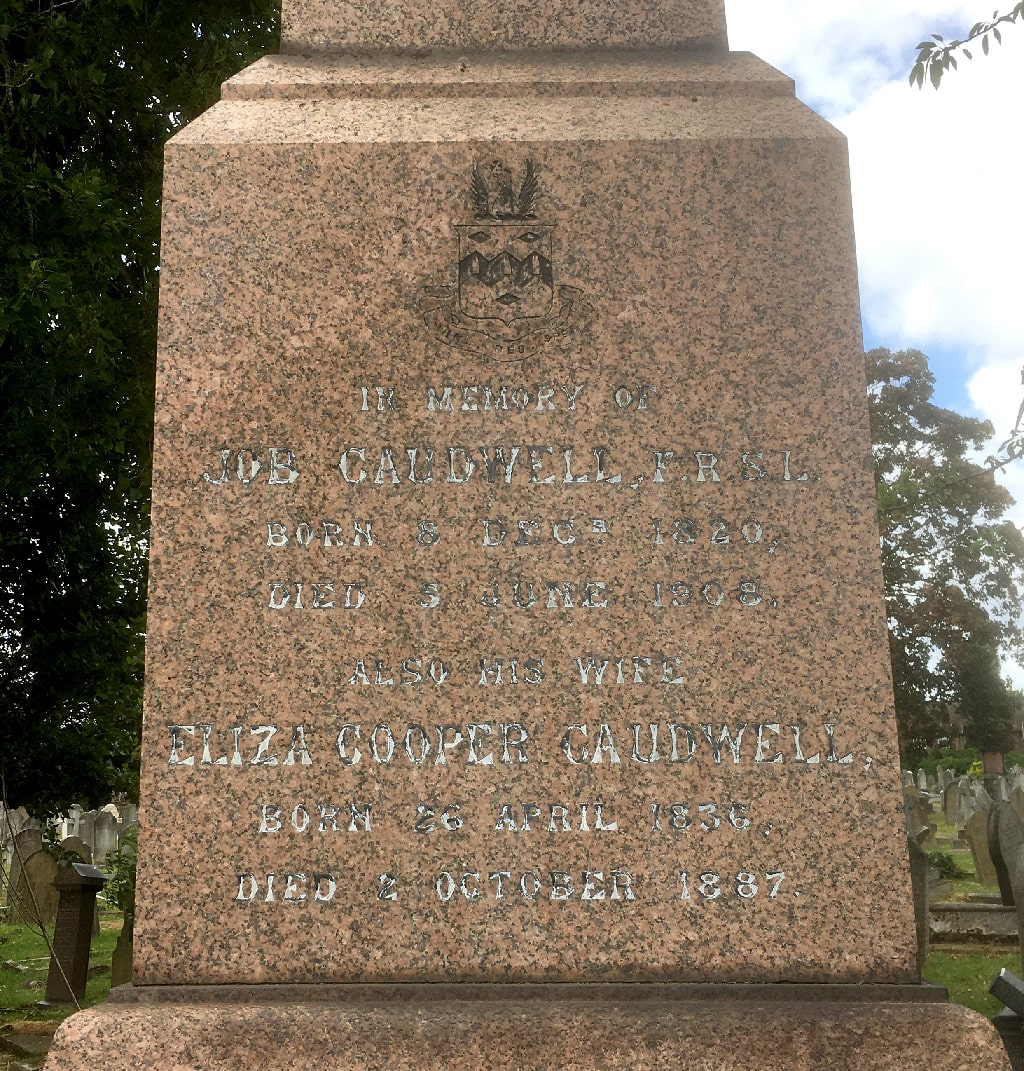
[Caudwell coat of arms]
In memory of
Job Caudwell, F.R.S.L.
Born 8 Decr 1820,
Died 5 June 1908,
Also his wife
Eliza Cooper Caudwell,
Born 26 April 1836,
Died 2 October 1887.
F.R.S.L. — Fellow of the Royal Society of Literature.
Side — a list of Job and Eliza Caudwell's ten children, with their birth and death dates:
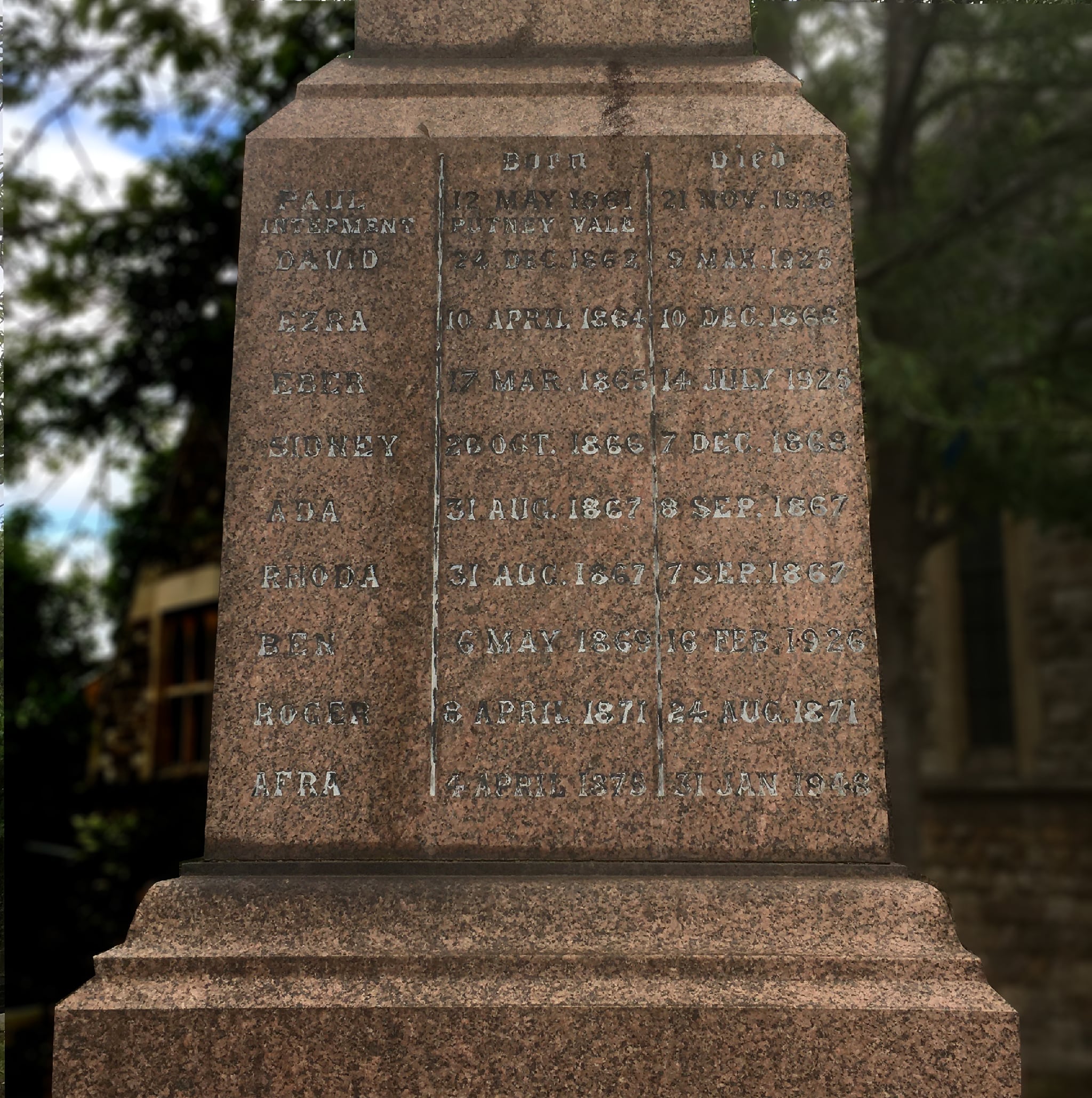
Born Died
Paul: 12 May 1861 — 21 Nov. 1938
Interment Putney Vale
David: 24[?] Dec. 1862 — 9 May 1925
Ezra: §0 April 1864 — 10 Dec. 1868
Eber: 17 Mar. 1865 — 14 July 1925
Sidney: 20 Oct 1866 — 7 Dec. 1868
Ada: 31 Aug. 1867 — 8 Sep. 1867
Rhoda: 31 August 1867 — 7 Sep. 1867
Ben: 6 May 1869 — 16 Feb. 1926
Roger: 8 April 1871 — 24 Aug. 1871
Afra: 4 April 1875 — 31 Jan 1948
(Click on image to enlarge)
Irene Caudwell recalls of her grandmother that "One thing only gave [her] any sense of spiritual enjoyment . . .funerals":
. . . and happy was she if one of these events fell on a Saturday or other holiday, when she could collect the whole family and take them with her. Poor little wretches! On the return journey she occupied the time by informing them that the next funeral they attended would be her own, a prophecy which took at least a dozen years to reach its fulfilment.
Not that she had not come near it several times, for she was a delicate woman and of the ten children, including two sets of twins, with which she presented Grandpa, five died in very early infancy. My father remembered one of them, Sidney, an exceptionally sweet natured little fellow who used to sit on the stairs sharing a boiled potato with his favourite cat.
Grandfather had all five buried in the old cemetery on Battersea Rise, not far from Clapham Junction, where they lie beneath a large and flat and most indigestible slab, with an outsize stone book on the top recording their names and the short span of their mortal lives. It is strange to think these infants were my Uncles and Aunts.
Mother [i.e. Irene's mother, Ada (1860-1957)] was my Grandfather's niece as well as his daughter-in-law, but she never came to Wandsworth until she was grown-up, when she arrived on a short visit. Grandpa met her at Clapham Junction and by way of a treat, immediately escorted her, plus bag and baggage complete, to the cemetery to admire the tombstone before he took her home.
The flying bomb which three-quarters of a century later landed in the cemetery, turning up the earth and toppling over the grave-stones in a manner gruesome to behold, did not disturb the infant Caudwells’ monument.
[Have you seen this "most indigestible slab" in Battersea Rise Cemetery ? Can we locate it? I have not been able to find records of their interment on the WBC registry search.
Incidentally, Irene writes that there were two sets of twins, yet only Ada and Rhoda (b.1867) are listed. Did the second pair die before they were named, and hence are not recorded here? Or did one child of the pair die before being named?]
All ten children are named even though five were still alive (which some saw as rather macabre). So their death dates were added later. (I'm not sure by whom added — possibly Irene Caudwell herself.) Job's last surviving child was Afra, who died in 1948.
(Click on image to enlarge)
The impression that Job Caudwell must have intended was that all his extensive family are (or would eventually be) buried with him in the vault beneath. But, as we have seen, five children had already been buried elsewhere. Moreover, after Job's death, the remaining five (and indeed his second wife) preferred to be buried elsewhere. In short, only Job and his (first) wife, Eliza, are in the vault.
Irene continues, in her typically dry manner:
Somewhere beneath it in the heart of the earth is the family vault conveniently fitted out with enough shelves for Grandma herself, Grandpa and the remaining four sons and daughter. No room was provided for any wife of the former or husband of the latter. It is simply a strictly cosy family affair.
Its amenities were further enhanced by a hefty iron railing and the addition on one side of the wedding-cake tiers on which the "needle" is erected, of the names of Grandpa's ten children living and dead — those departed and buried in the cemetery on Battersea Rise being distinguished by the dates of their arrival and departure, the five still living having their names, but the dates politely left blank.
Father [the first-born, Paul] being the eldest headed the list and succeeding Vicars of St. Anne‘s, Wandsworth, declared it positively gave them the creeps when they came out of the cemetery chapel after a funeral, to see the name of their friend, Paul Caudwell, on a tombstone, when possibly they were having tea or supper with him the following day.
Alas for those conveniently arranged shelves in the vault, all four sons and the daughter were buried elsewhere in different corners of England. So was the second wife, to whom Aunt Afra had kindly bequeathed her own special shelf.
Perhaps it was as well that none of them claimed their rights, as to open the tomb is a major operation, requiring the removal of a substantial piece of the cemetery.
[Paul Caudwell, who was for many years the Solicitor for the London Borough of Battersea, is buried with Ada in Putney Vale Cemetery, not Magdalen Road (which was in sight of their home on Earlsfield Road). He regarded the obelisk as ungodly.]
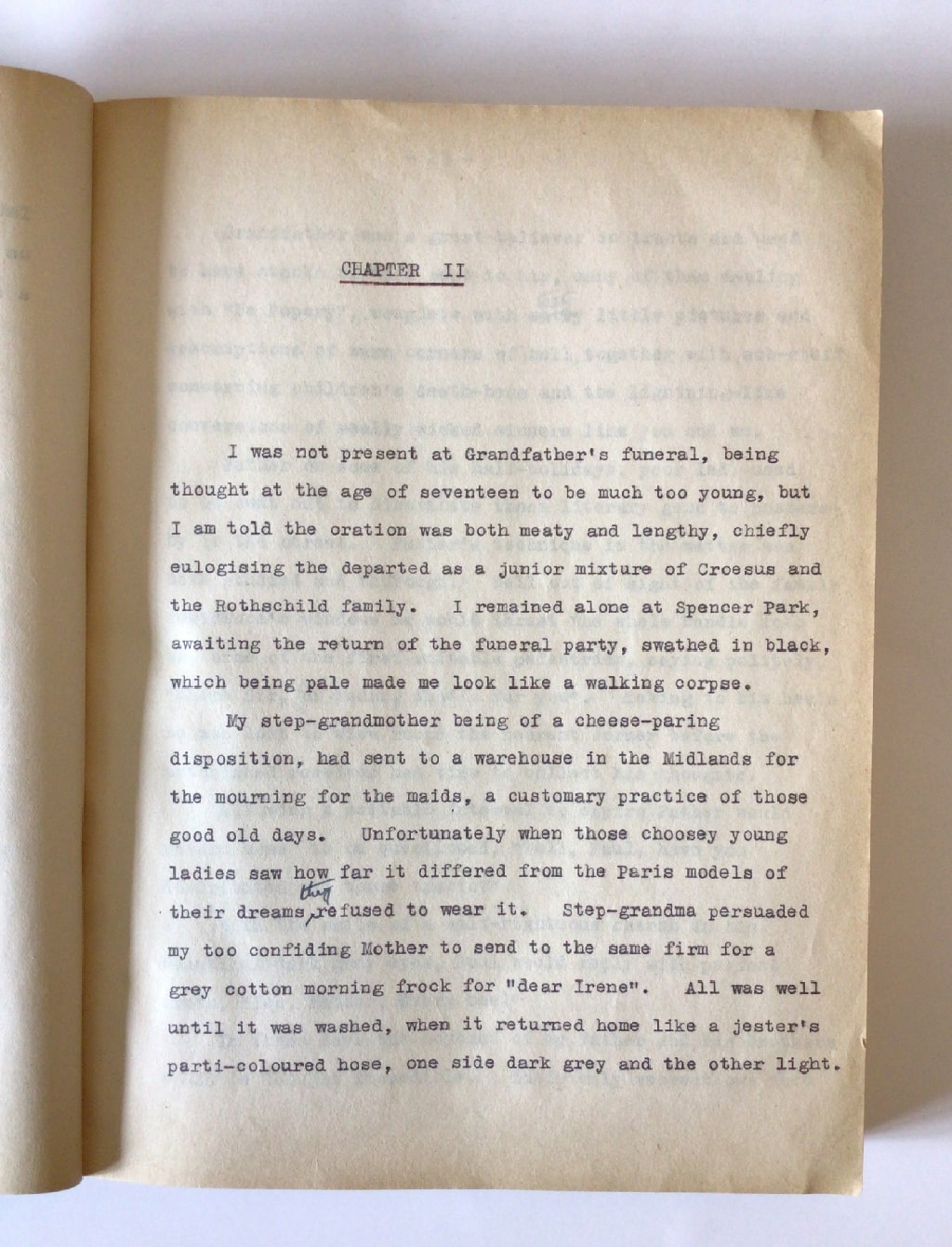
Let us turn to Job's funeral in June 1908, and Irene Caudwell's recollection of the day:
(Click on image to enlarge)
I was not present at Grandfather's funeral, being thought at the age of seventeen to be much too young, but I am told the oration was both meaty and lengthy, chiefly eulogising the departed as a junior mixture of Croesus and the Rothschild family. I remained alone at Spencer Park, awaiting the return of the funeral party, swathed in black, which being pale made me look like a walking corpse.
My step-grandmother being of a cheese-paring disposition, had sent to a warehouse in the Midlands for the mourning for the maids, a customary practice of those good old days. Unfortunately when those choosey young ladies saw how far it differed from the Paris models of their dreams, they refused to wear it.
Step-grandma persuaded my too confiding Mother to send to the same firm for a grey cotton morning frock for "dear Irene". All was well until it was washed, when it returned home like a jester's parti-coloured hose, one side dark grey and the other light.
Job Caudwell (8 December 1820—5 June 1908)
We've discussed the monument, and related funerary practices, in some detail. Now we come to Job Caudwell himself. What sort of a man erected such an extravagant obelisk to himself?
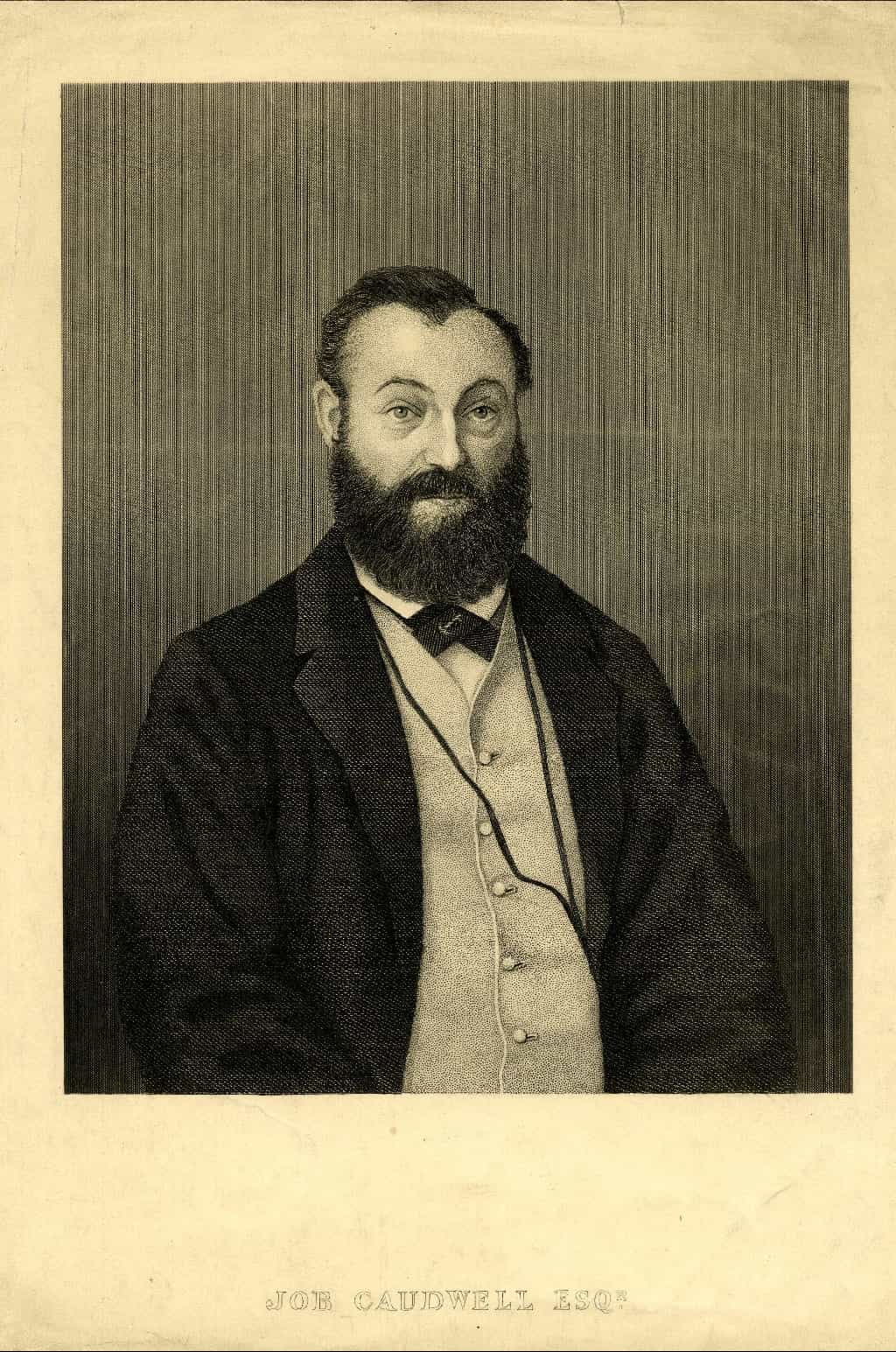
He was quite a character — some might say he was the original crank. He actively campaigned against vaccination, male-midwives, and Darwinism, but very much for temperance, mesmerism, homeopathy and vegetarianism (his pioneering Vegetarian Cookery for the Million ran to 6 editions 1864-1865).
As an author, publisher and later as an important property developer in our area, Job's business activities made him rather rich. Rich enough to erect a massive obelisk, for example, and to build a very substantial house on the newly-created Spencer Park c.1872.
[The land on which Spencer Park was built was in effect a sweetener to Earl Spencer for agreeing to relinquish his rights over what was left of the rest of Wandsworth Common in 1871.]
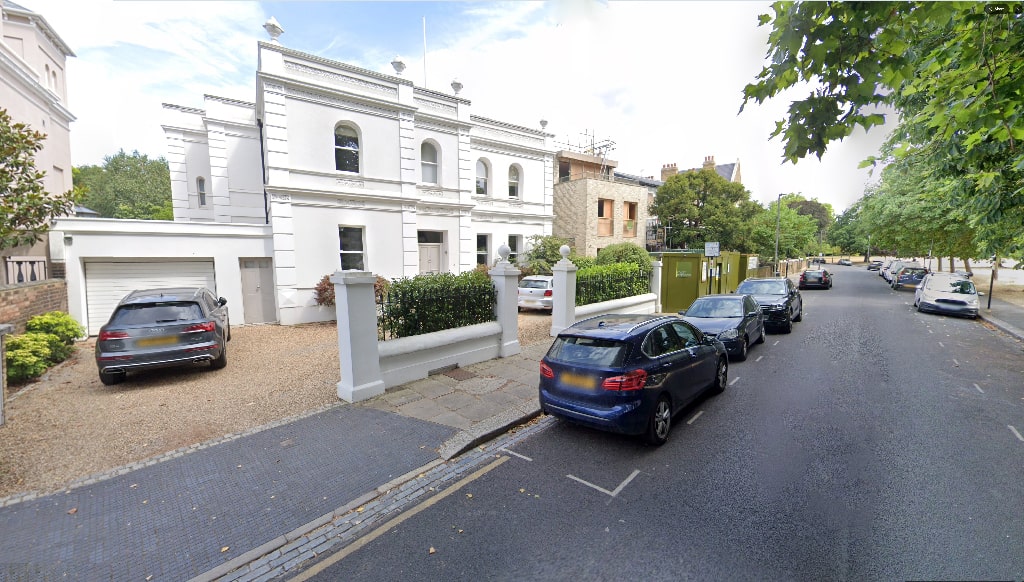
Job Caudwell's house, now No. 3 Spencer Park, but originally No. 44. The house was constructed from concrete — then a very unusual building material. Notice the balls mounted on the pillars (on which more below).
(Click on image to enlarge)
Grandfather bought the second plot of ground in Spencer Park and had his house built to his own design entirely of concrete; floors, staircase, walls and ceilings, to obviate danger of fire. Four square, with a front door bell sufficiently loud to rouse the local Fire Brigade, it had a flat roof from which a considerable part of London was visible, including a first-class free view of the fireworks at the Crystal Palace. Later inhabitants had an equally interesting view of the approach of more deadly fireworks in the shape of flying bombs.
[Is the view still as good? Have trees and buildings obscured much? I'd love to know.]
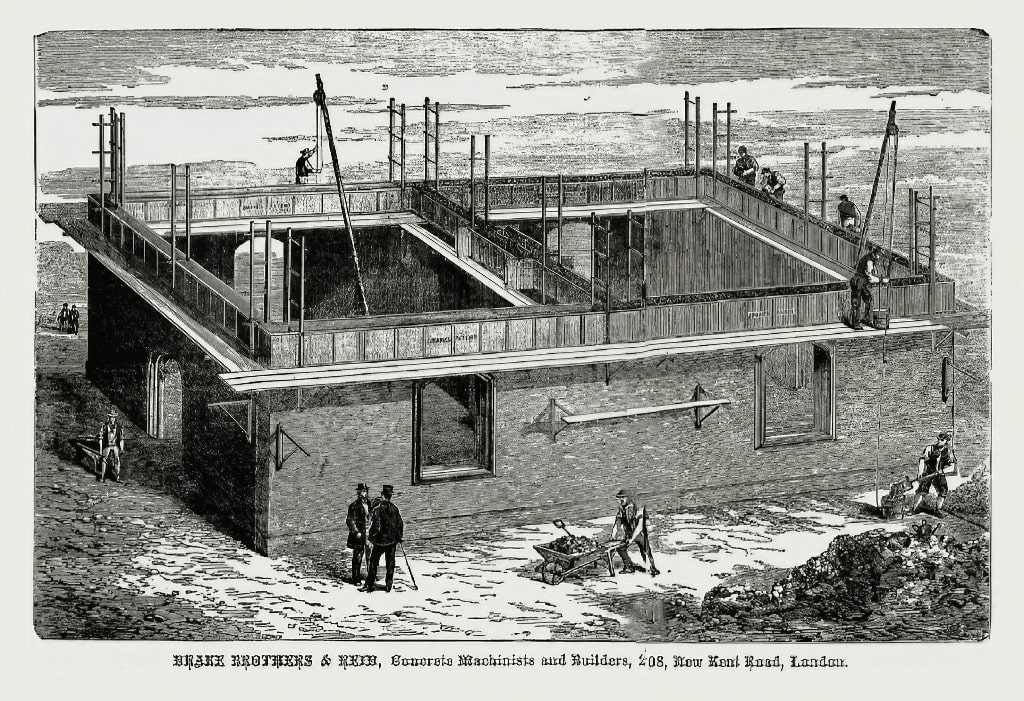
Advert for concrete houses, date?. Reducing the risk of fire was one stimulus to the use of concrete, another was cost: it was argued that concrete construction was around a third less expensive.
(Click on image to enlarge)
[Concrete buildings of the time soon deteriorated. There's a terrific article by Paul Latham about the restoration of an early Drake concrete house in Lordship Lane, East Dulwich, here. Several other commentaries, including Wikipedia: 549 Lordship Lane.]
Irene adds an interesting note about the influence of her grandmother's astraphobia on the design of the house:
Grandma was scared to death of thunder and lightning, perhaps with good reason, seeing that in her childhood her nurse had been killed by her side during a storm. To overcome this trouble Grandpa had a room built in the heart of the earth beneath the house, very much like a railway carriage in shape, where Grandma retired out of reach of the lightning and of all but the worst claps of thunder. The afore-mentioned later inhabitants found it very handy as a ready-made air-raid shelter.
[It is worth recalling that three adults and four children were killed by lightning on the Common in June 1914. I have described this in some detail in the June 2023 edition of these Chronicles.]
Irene adds a note about the gates:
"The gates were a copy of those of the old Manor House far away from London where Grandpa had spent his youth, with identical round knobs on either side. This, I understand, was a mistake on Grandpa's part as these knobs, strictly speaking, although often appearing on villas and like residences with such names as "Clovelly", "Mentone” or “Kosey-Nook", should only be used on the gates of an actual manor."
There's far too much to say about Job in this single edition of Chronicles but I'd like to at least get us started. — Irene's memoir is simply bursting with (appalling but highly entertaining) stories. Here's just one:
I was nine years old [1900], with a crimson frock and highly starched white embroidered pinafore, dark hair which required many knobbly curl papers on Saturday nights and a fringe, when my parents brought me to Wandsworth to live with the gentleman known to me as Grandpa and to my father and his brothers as "The Governor".
Spencer Park, with its very genteel houses, entirely surrounded an enchanting private park where the birds sang and nested amid the pink and white chestnut trees, and the sweet perfume of lilac, or flew chirping amid the golden chains of the laburnum and the budding walnut trees.
Old Bradford, the chief gardener, would have fallen in his tracks had a weed been found in his glowing flower beds or a dandelion on his immaculate lawns, where in summertime a comfortable brown horse gently dragged the lawn mower up and down.
The Park was sacred to the tenants of the surrounding houses, each of which had its private gate and key. And the rules of its use were as stern as any tribal laws of darkest Africa.
No games except the well-bred, non-turf-destroying recreation of croquet were permitted and the nicely brought-up children were trained not to walk upon the grass or pick a single flower. All was decorous, neat and deadly slow. Grandpa was a keen croquet player, but sad was the occasion if anyone so far forgot themselves as to defeat him. My Mother did so once, but never, never again.
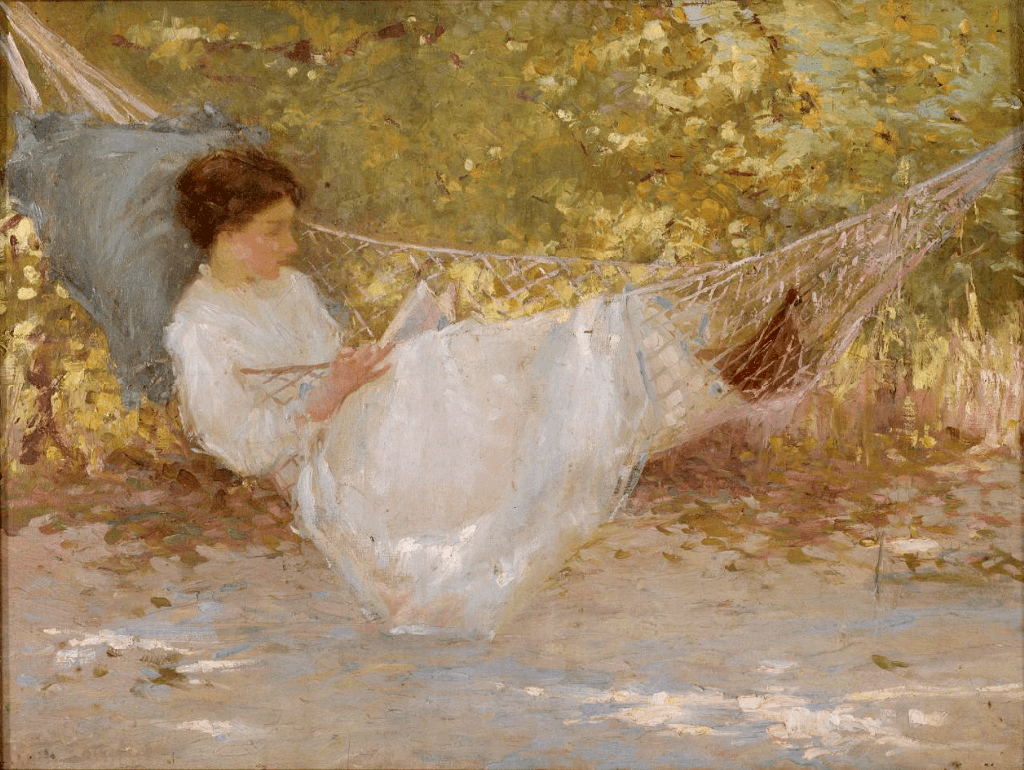
A gratuitous image of a young woman in a hammock, to help you visualise the scene a moment before Job arrived with his pocket knife. Painting by Ruth Sutherland, c.1910
(Click on image to enlarge)
On one inauspicious day an enterprising young lady broke every rule by slinging a hammock between two of the sacred trees and ensconcing her pretty person within it. But not for long! Grandpa, breathing fire and sulphur, appeared upon the scene and in vehement tones commanded her to remove the obnoxious object immediately.
The lady, far in advance of her times, entirely refused to obey the voice of Authority. But a little thing like a girl in a hammock would not deflect Grandpa from what he considered his duty, so that without further argument he produced a business-like pocket knife and cut down the hammock, complete with girl.
Rushing into her nearby home the girl's complaints brought her Mother on the scene, brandishing a horsewhip with which she proposed to teach old Job Caudwell a lesson. But that wily gentleman had disappeared within the fastnesses of his own garden and the incident, as well as the gate, were closed.
A rum character, eh? More — probably much more — on Job Caudwell in future Chronicles.
Also . . .
When I started writing about Job Caudwell's obelisk, I expected it to be only a paragraph or two, but it grew and grew, overshadowing everything else. (Rather like the man.) So I've decided to cut this month's Chronicles more or less in half — I'll send out the remainder in a couple of weeks' time.
Isabelle Ross / Marie Duval (1847—1890)
But while we're in Magdalen Road Cemetery, I cannot fail to draw to your attention a nearby headstone. This is to Isabelle Ross — better known as the brilliant comic artist Marie Duval, "one of the forgotten wonders of 19th-century art", who was buried a short distance from Job's obelisk in June 1890. Isabelle/Marie has been described as the first "truly humorous" women artist.
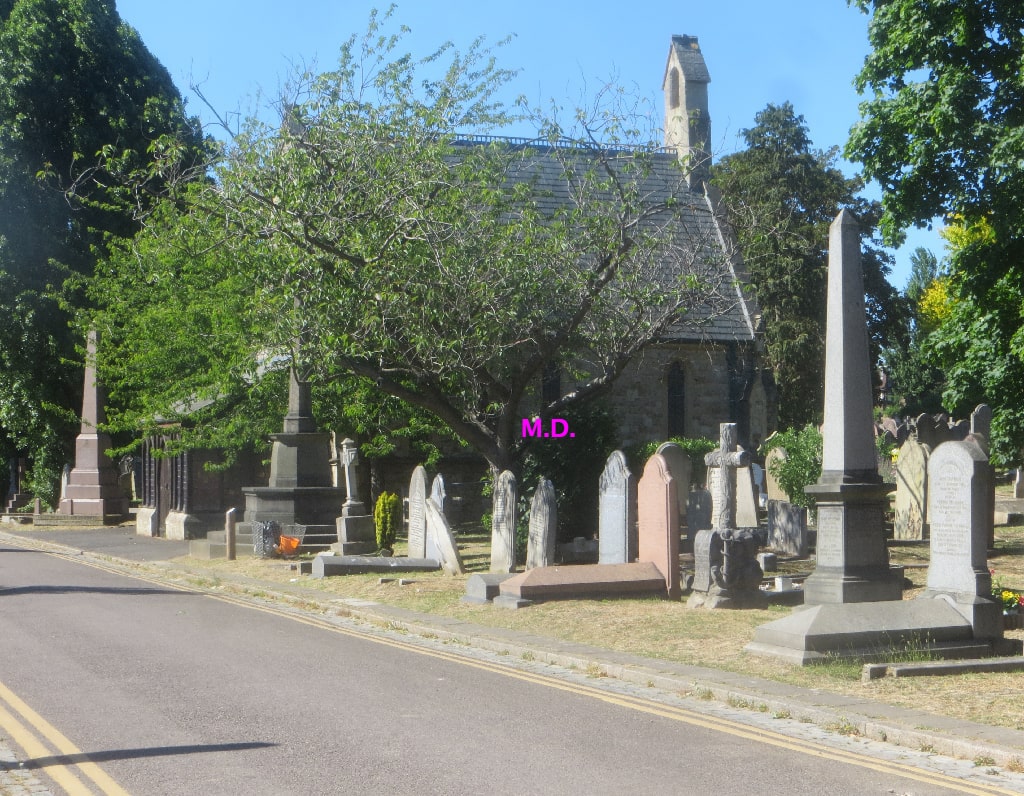
Location of the memorial near the chapel in Magdalen Road Cemetery. Job Caudwell's obelisk can be seen on the far left.
(Click on image to enlarge)
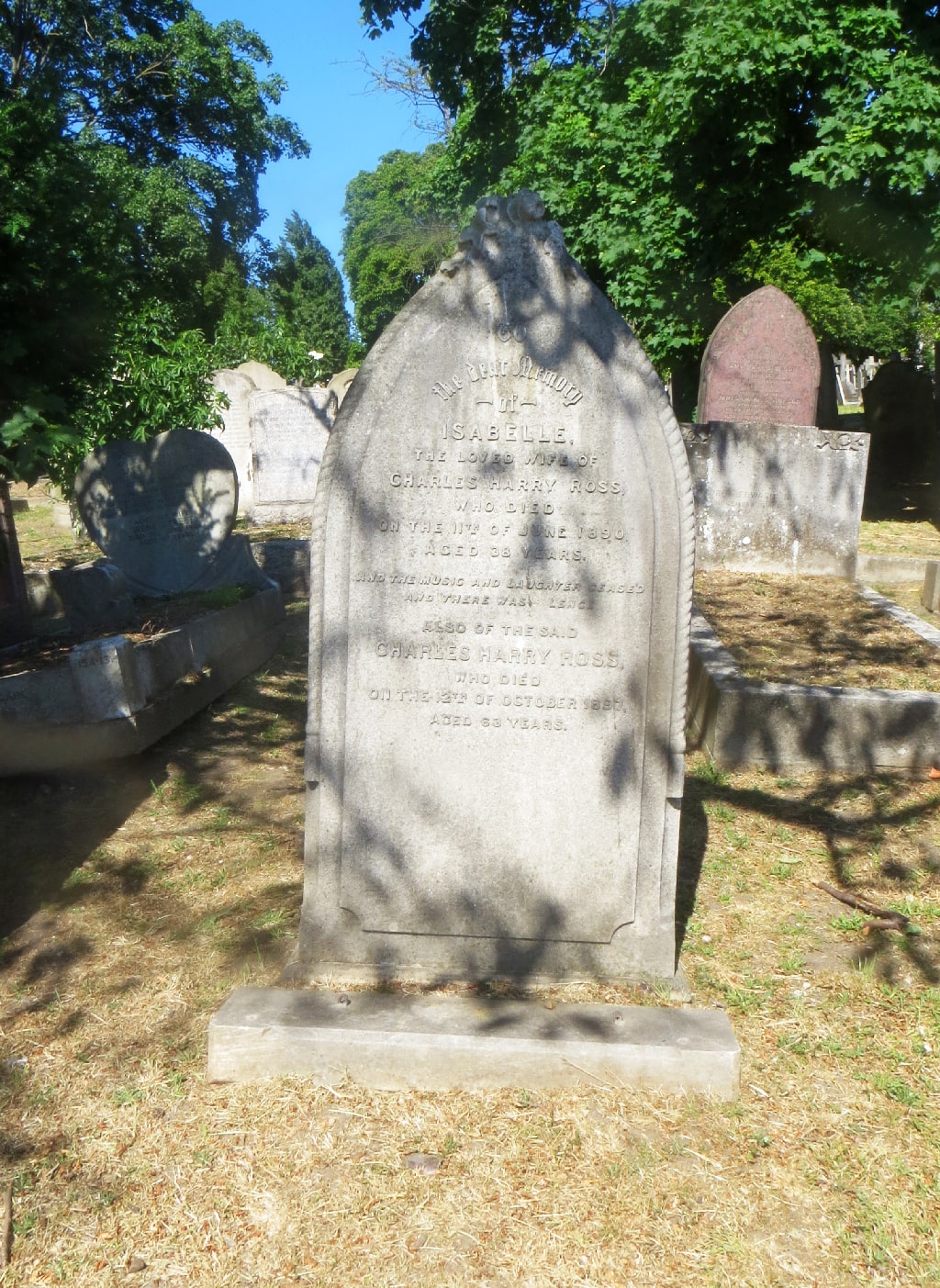
Isabelle Ross — born Isabelle Émilie de Tessier but better known as the artist and actor Marie Duval, but also as "Noir" and "S.A. The Princess Hesse Schwartzbourg". Headstone shared with her husband/partner Charles Ross in Wandsworth Cemetery, Magdalen Road. The couple living on or near Wandsworth Road, on the Battersea/Clapham border.
(Click on image to enlarge)
To
the dear Memory
of
ISABELLE,
the loved wife of
Charles Harry Ross,
who died
on the 11th of June 1890
Aged 38 years.
And the music and silence ceasedand there was silence
Also of the said
Charles Harry Ross,
who died
on the 12th of October 1897,
Aged 63 years.
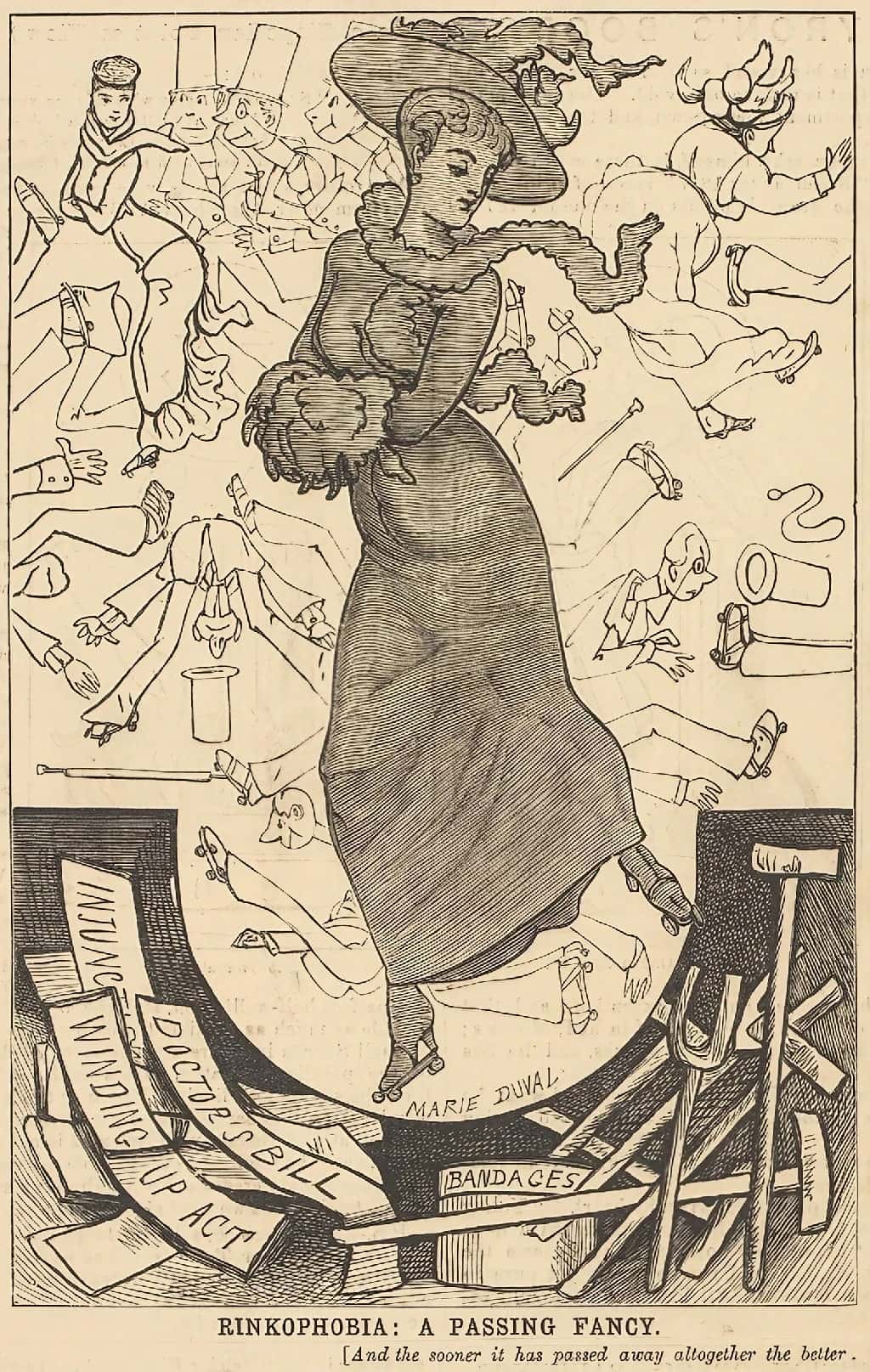
Marie Duval, "Rinkophobia", commenting on the Victorian enthusiasm for roller skating. A self-portrait?
(Click on image to enlarge)
More on Isabelle Ross/Marie Duval (and her extraordinary creation Aly Sloper), very soon. In the meanwhile, give a loved one (or yourself) a treat and buy this beautiful book on her life and work:
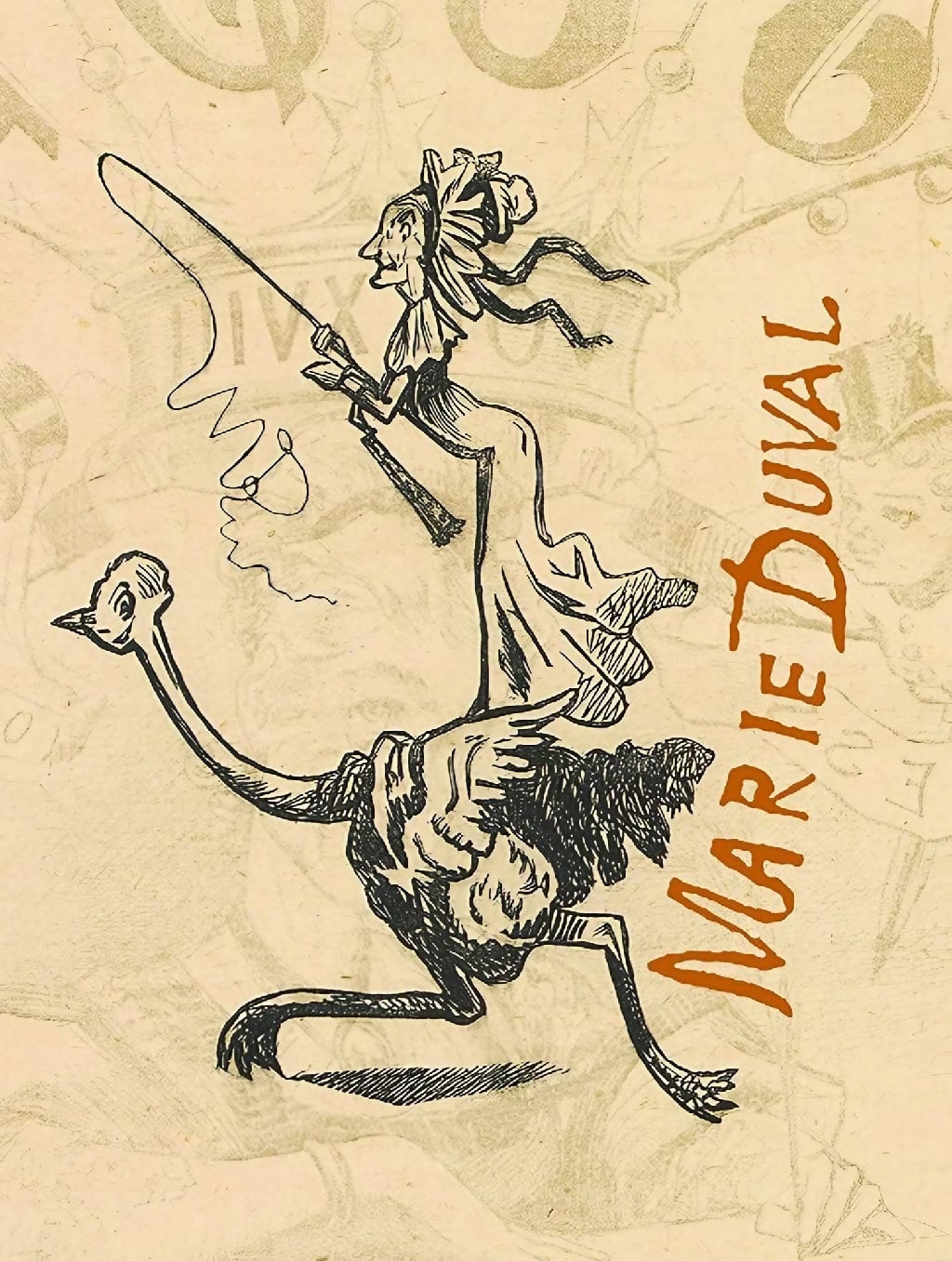
Marie Duval, Simon Grennan, Roger Sabin, Julian Waite, Myriad Editions, 2018.
(Click on image to enlarge)
"And the music and silence ceasedand there was silence"
SO many more stories still to tell. But that's all for now, folks.
Send me an email if you enjoyed this post / want to comment on something you've seen on the site / would like to know more — or just want to be kept in touch.
If you would like to receive notifications of new Chronicles, let me know . . .
Philip Boys ("History Boys")
June 2025
Some organisations you really must join:
— Friends of Wandsworth Common
— Wandsworth Historical Society