Last modified: 3 October 2026
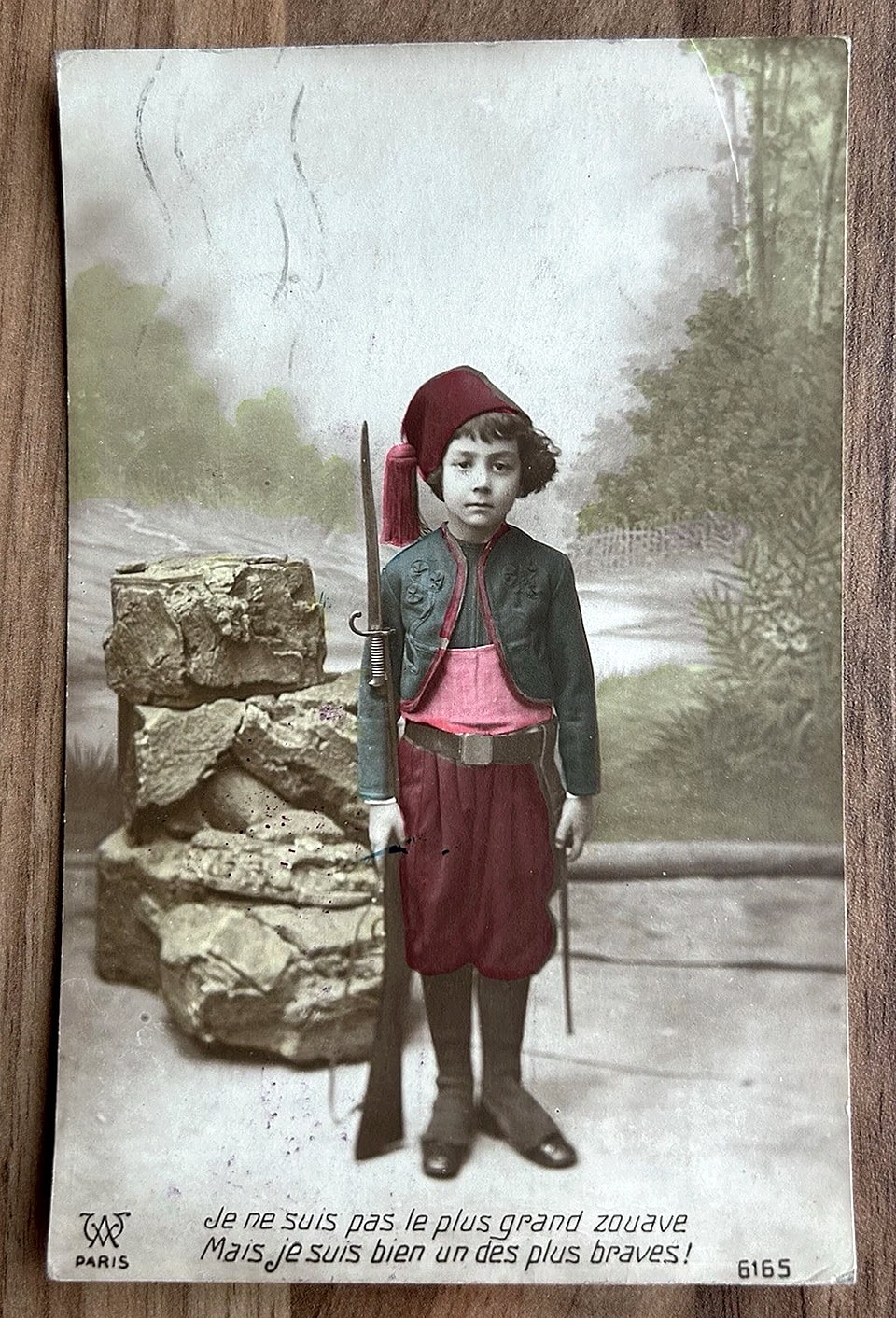
"I'm not the biggest Zouave*
But I am definitely one of the bravest!"
* Zouaves: a light-infantry regiment in the French army, originally formed of Algerians and long retaining their North African style of uniform
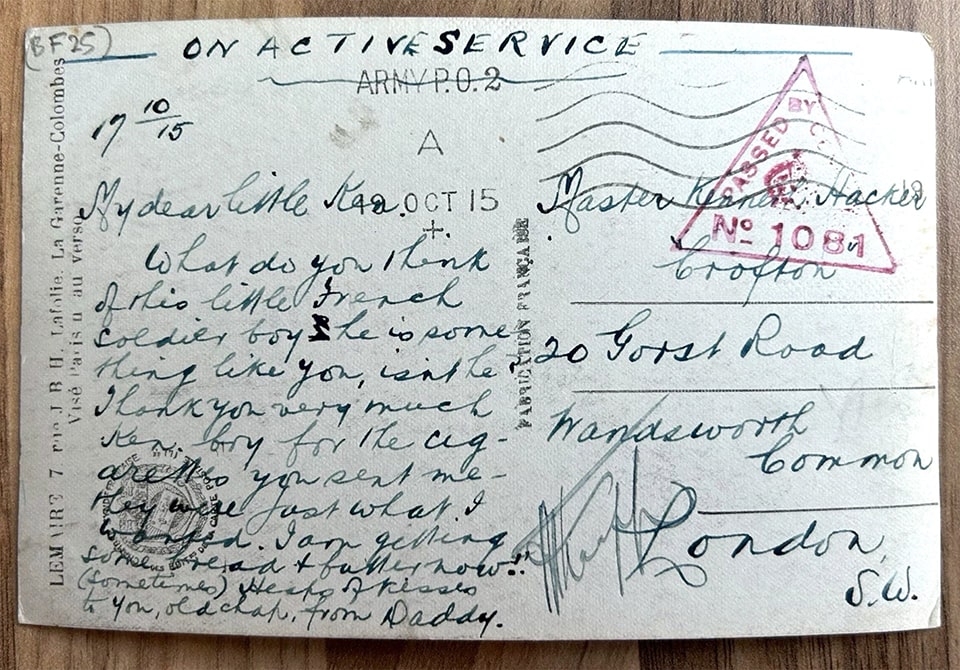
Master Kenneth Hacker
Crofton
20 Gorst Road
Wandsworth Common
London S.W.
ON ACTIVE SERVICE
[17 October 1915]
My dear little Ken,
What do you think of this little French soldier boy — he is some-
thing like you, isn't he?
Thank you very much for the cigarettes you sent me — they were just what I wanted.
I am getting some bread and butter now !! (sometimes)
Heaps of kisses to you, old chap, from Daddy.
If you want to know what happened to Ken's Daddy, click here.
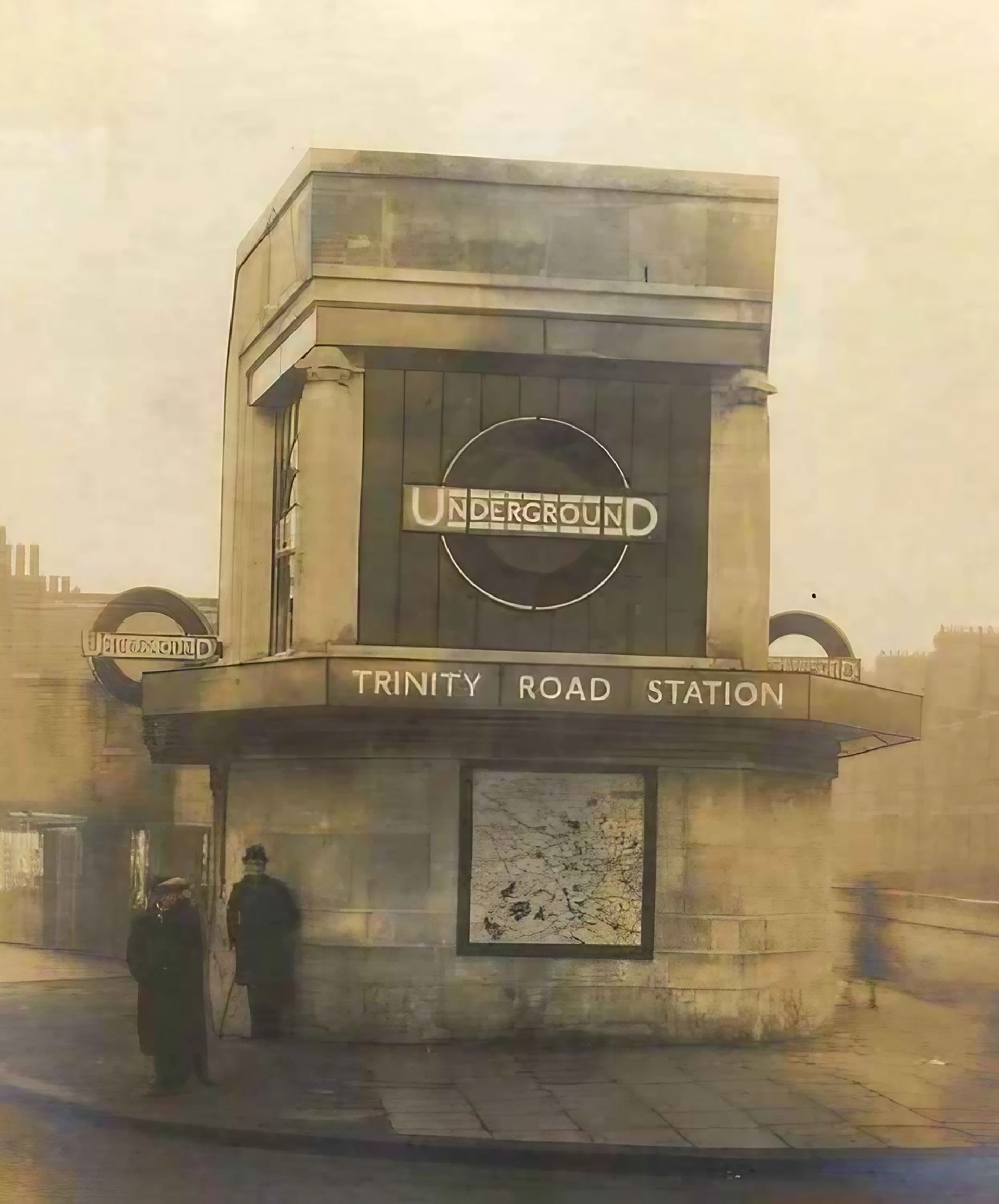
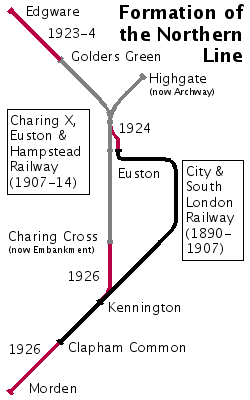
The station was originally opened as part of the Morden extension of the City & South London Railway (later the Northern line) on September 13, 1926, with the name "Trinity Road (Tooting Bec)".
I hunted down the large map on the front wall of the station (above). It appears to be this:
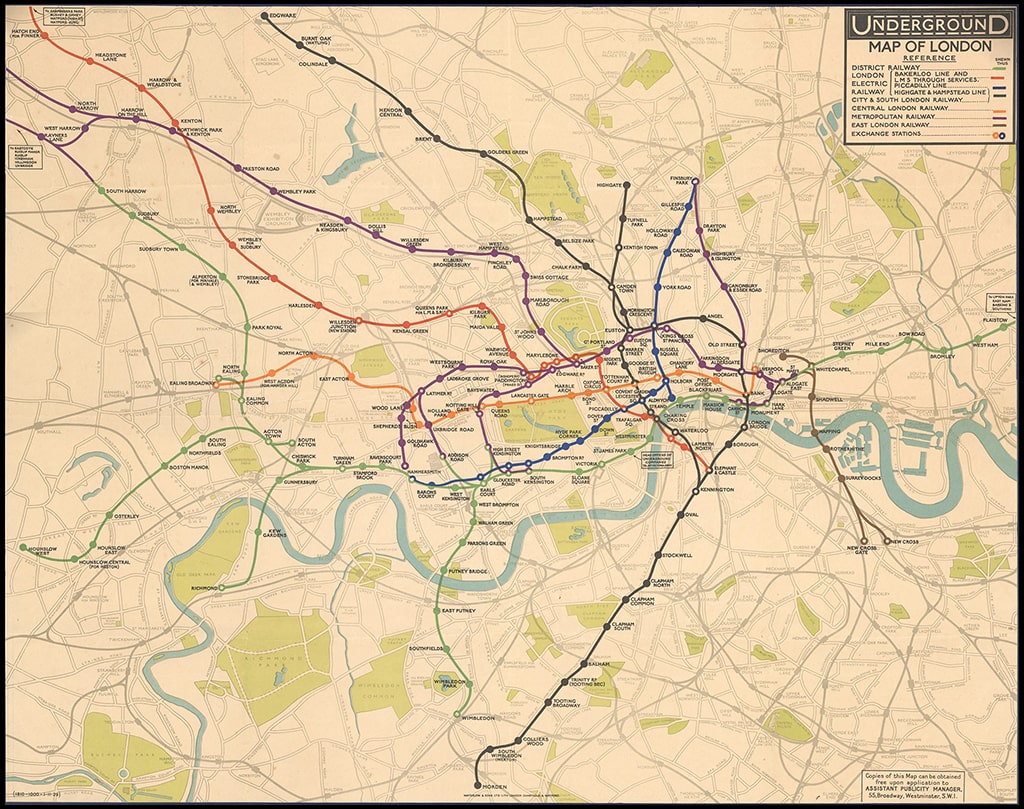
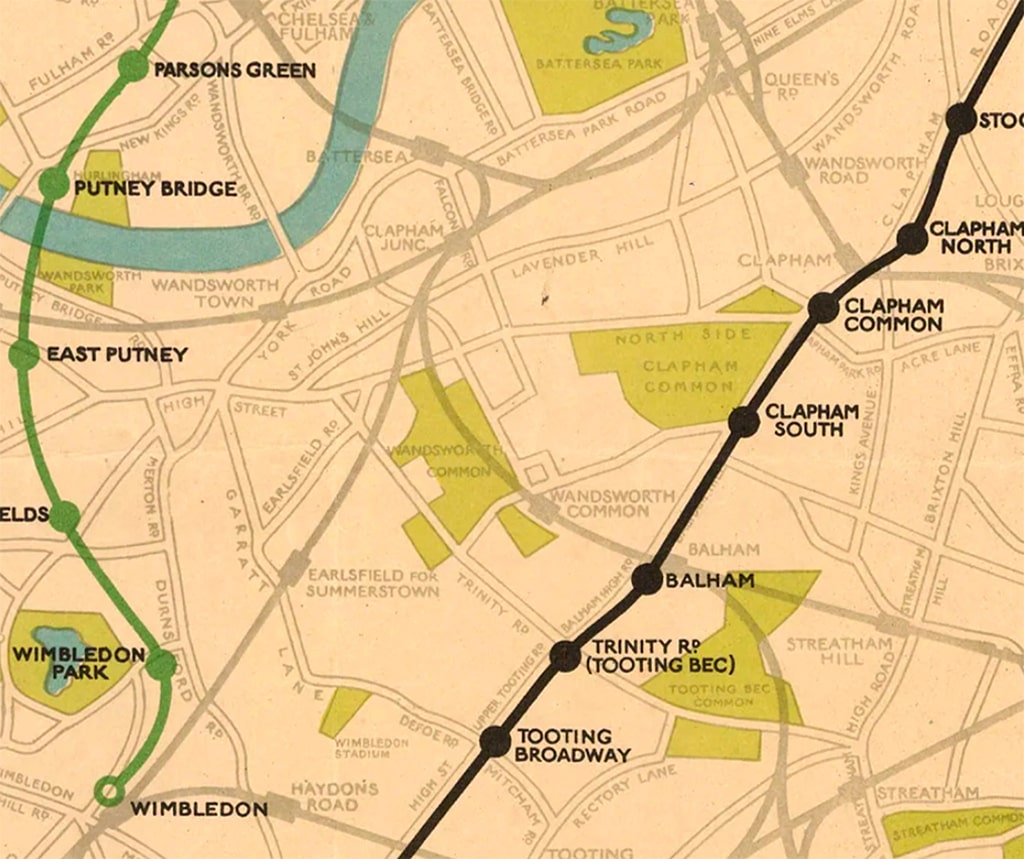
1931: the earliest tube maps were fairly naturalistic or "topographical".
Harry Beck, an electrical draughtsman in his late-twenties (but at this time unemployed), was inspired by schematics and circuit diagrams to create a more rational map. It was a long struggle to get his radical "topological" diagrams accepted.
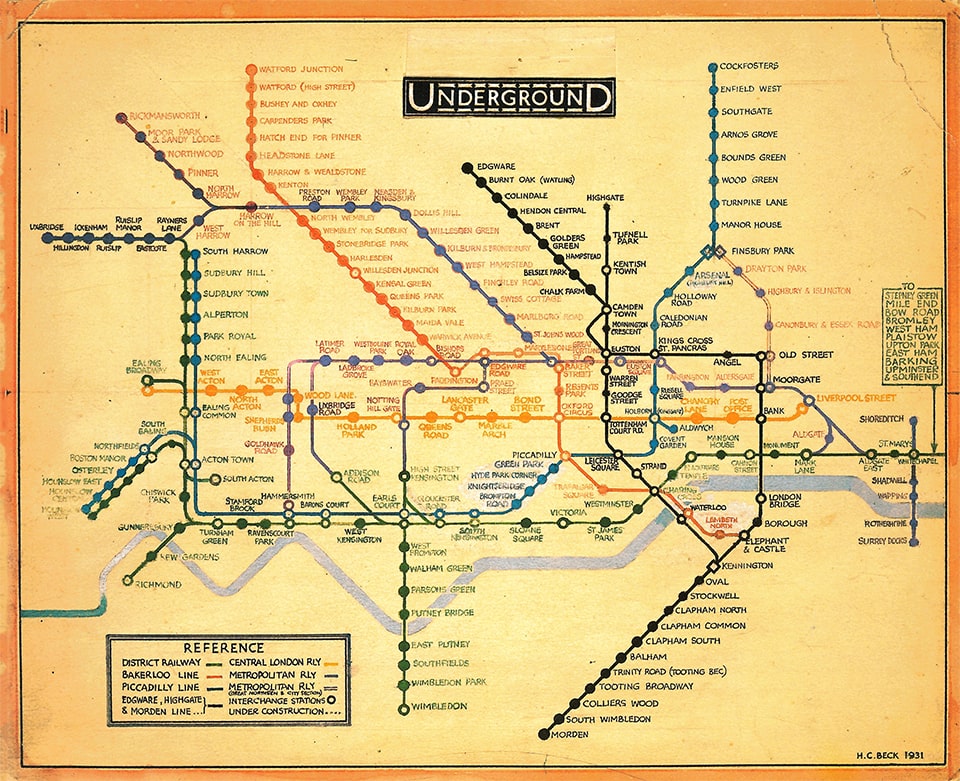
1931: An early draft of Harry Beck's map of the London tube, focusing on names, relationships and connections, and omitting much visual clutter.
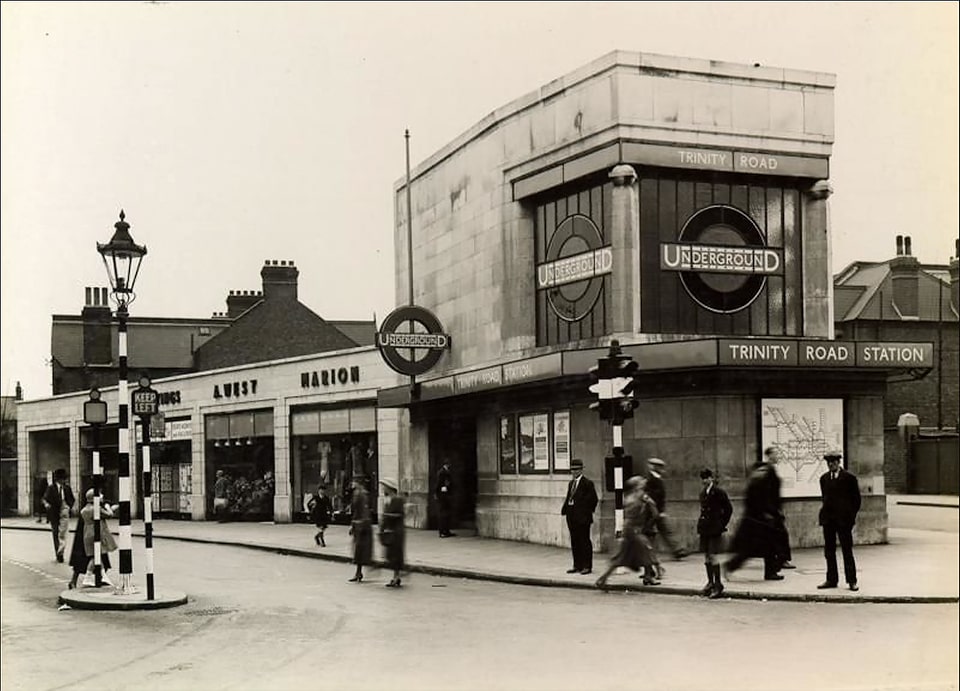
By May 1936, Beck's topological map had replaced the earlier topographical one, as we can see here.
— Wikipedia: Tooting Bec tube station Line
— Transport for London: Research Guide No.13: A Brief History of the Northern Line (pdf)
— Wikipedia: Northern Line
— Wikipedia: Harry Beck
— The Londonist: History of the Tube Map
— History Hit: Evolution of the Tube Map
— Issuu: William Bates: "How has the identity of the London Underground been shaped by its architecture: 1863—present? (brief intro. to a fascinating subject)
6 October 2025: Jason Hazeley sent this fine image of pioneering designs for Tooting Bec Station from Eitan Karol's biography of brilliant architect Charles Holden (2007):
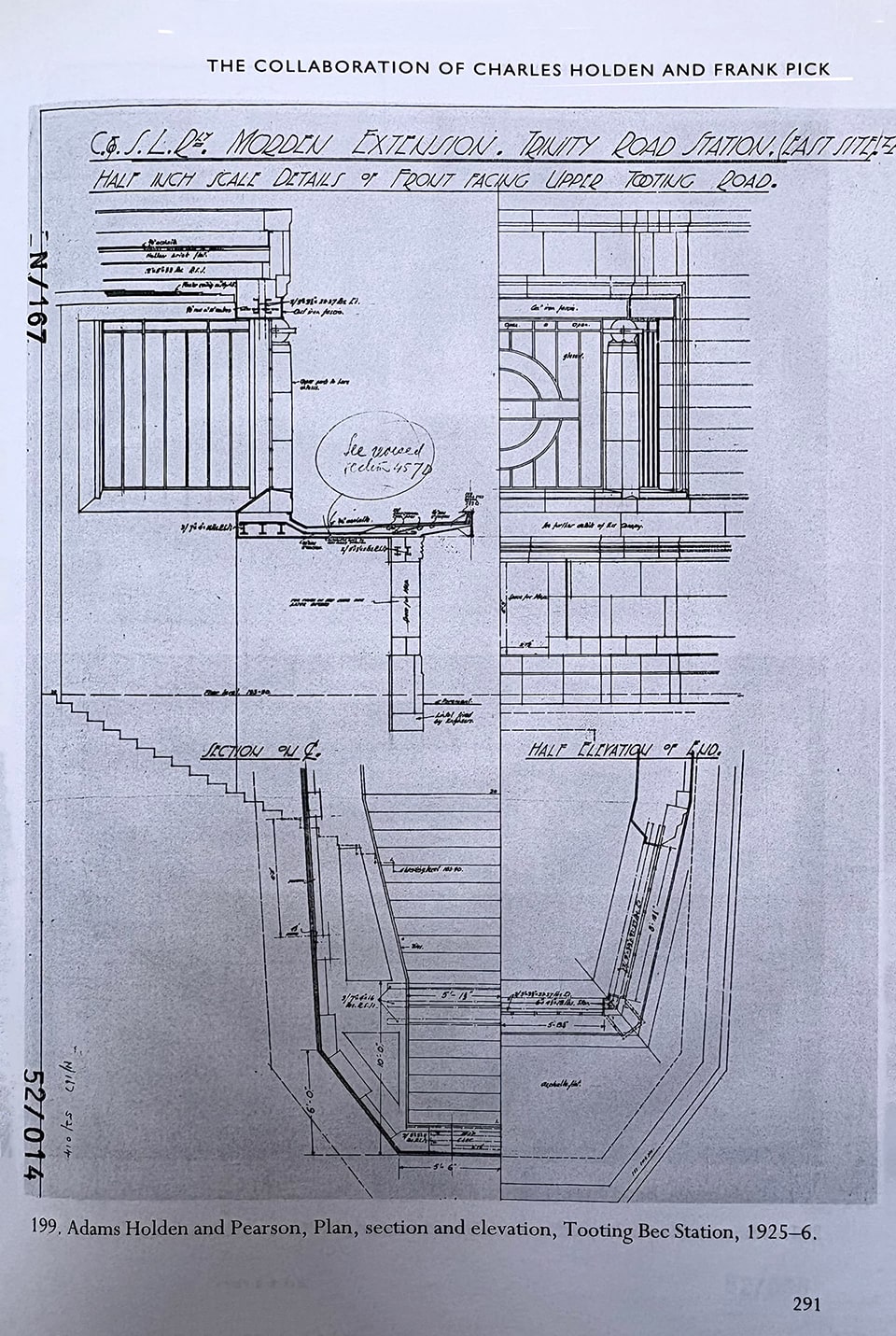
Thanks, Jason!
Cathy Rowntree recently told me an extraordinary story about an escaped lion at Clapham Junction station — thanks, Cathy!
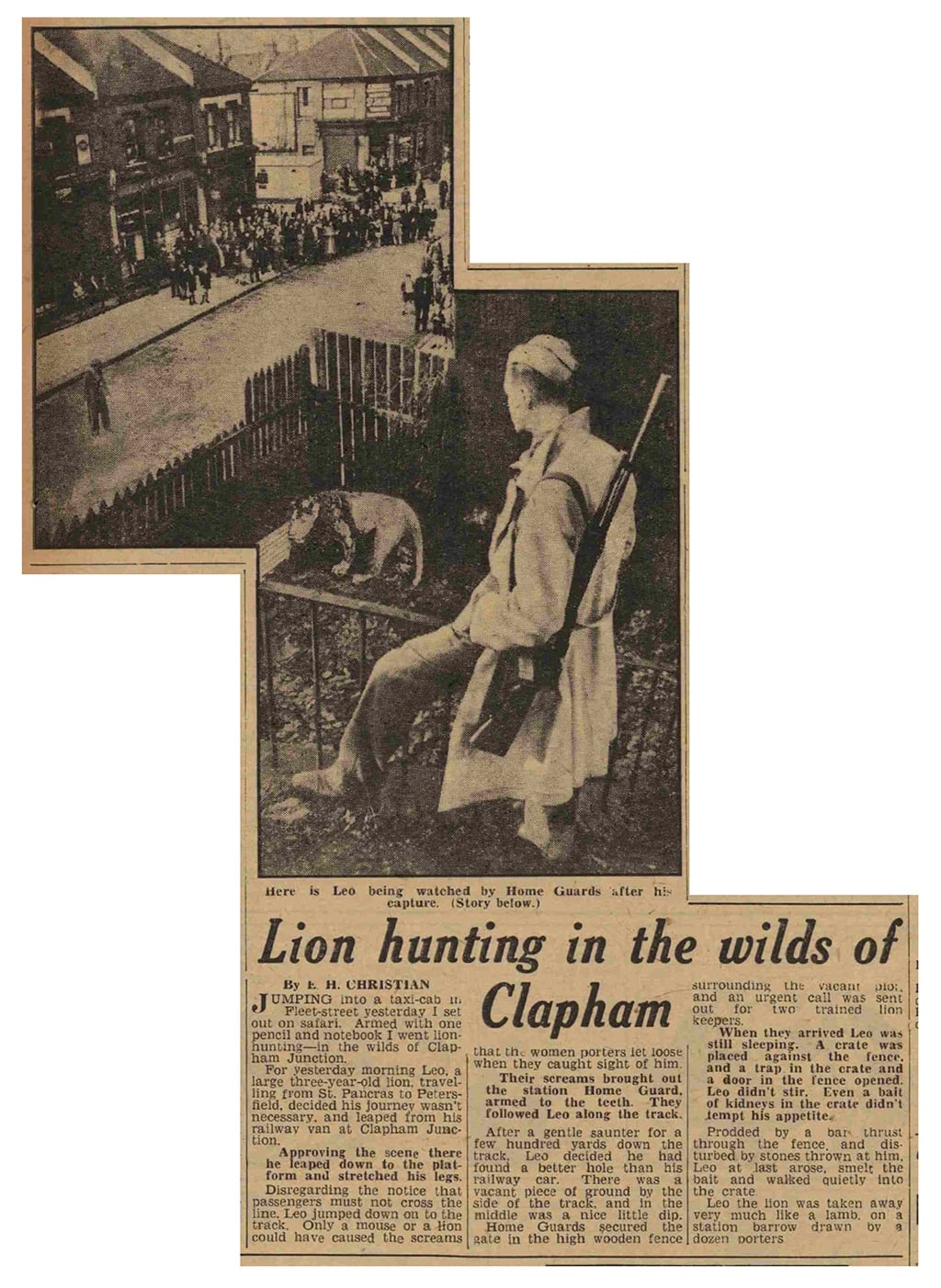
"Lion hunting in the wilds of Clapham", Daily Mirror, 23 October 1943
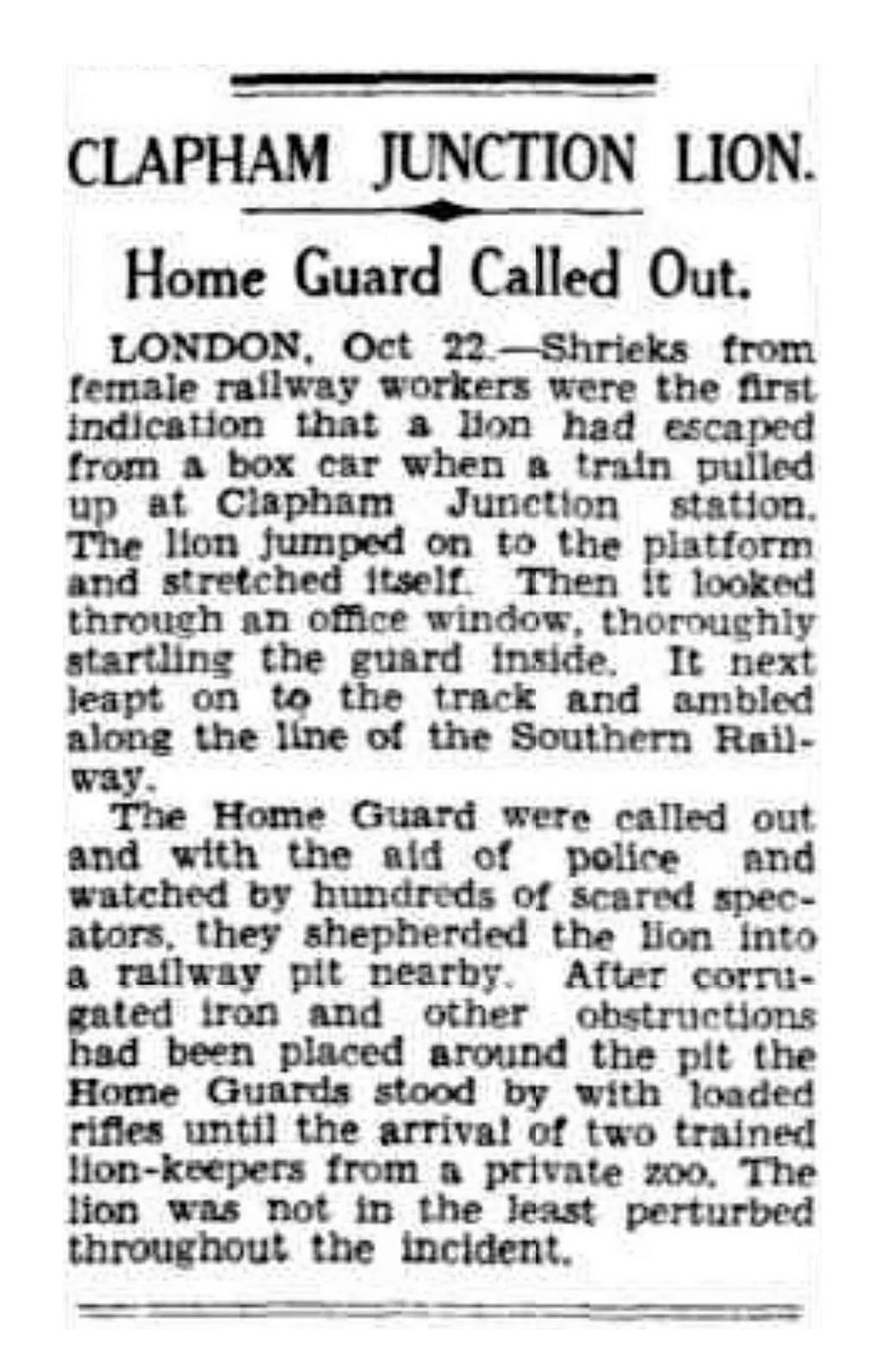
Remarkably, especially given this was in the middle of a war, a Movietone film exists of the drama. Well worth a watch . . .
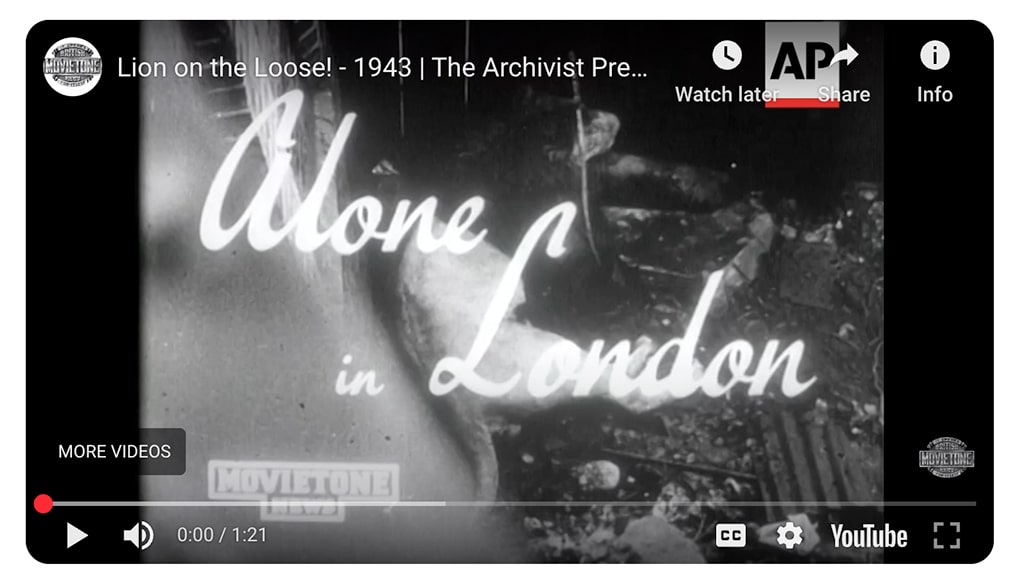
Movietone News: "Alone in London" — October 1943
Here's my transcription of the (marvellously fruity) commentary:
Alone in London
Lions are quite rare at Clapham Junction nowadays.
When a lion escaped from a Southern Railway boxcar and took up a rather vulnerable position in the sort of a pit, there was great excitement in the neighbourhood.
If you go to see the lions in the zoo, you have to pay. But here was a free show — except that the Home Guards got all the best places.
Obviously they were eager to defend Clapham from this new danger.
He himself was apparently pretty bored, or maybe he was just scared. Anyway he obviously sincerely regretted having pulled the communication cord in the train, or however it was he escaped.
All he wanted now was to be taken home. That was easily arranged.
A most intelligent lion, really.
Mind his tail!
A rare event indeed with a happy ending for all concerned.
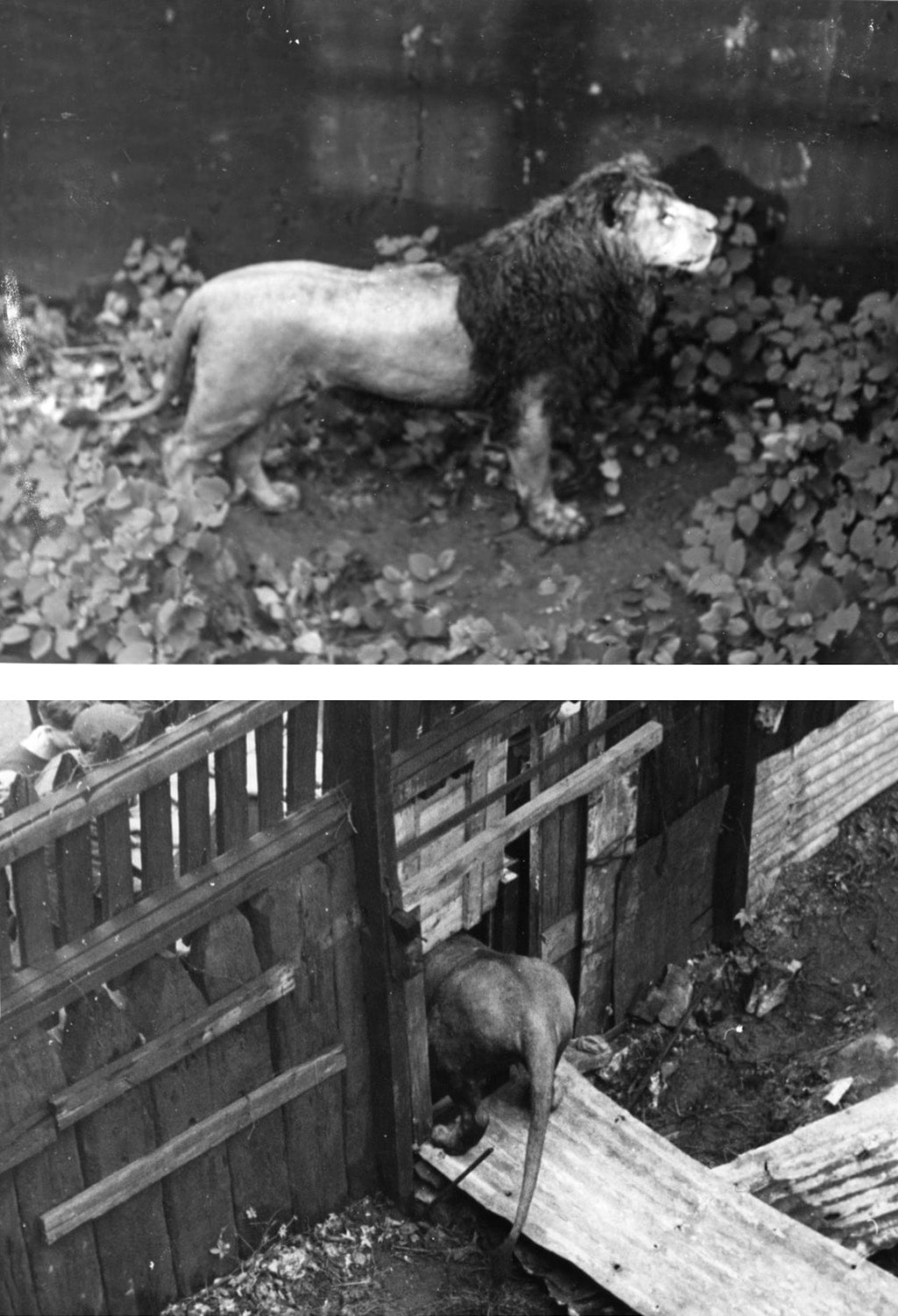
"Mind that tail!" Escaped lion at Clapham Junction, 22 October 1943.
From the Imperial War Museum's archive:
(22 October 1943) An escaped lion, crouched by a wooden fence in the corner of a railway yard at Clapham Junction, South London. The police and Home Guard have secured the area. The camera pans around to reveal a marksman on the opposite side of the fence and a civilian crowd gathered outside a shop further down the street. More marksmen and a police officer appear to have the lion cornered as they peer over at the escapee from the vantage point of a railway bridge. The lion looks around drowsily, propped up against a fence. An empty crate is brought up to the fence, the lion is somehow lured in, and the door is slammed shut behind it. The crated lion is then manually lifted onto a trolley and wheeled to a railway wagon, where it is loaded on-board. (42 sec) SH281
[IWM: Link.]
While we're on the subject of straying felines, you may recall a story about a leopard hunt on Wandsworth Common in June 1846:

Not to mention Jumbo (Miss Champion's cat with two white whiskers, that is), lost on Wandsworth Common in January 1883:
Beating the Bounds, 2026?
A John Buckmaster walk, around the time of his birthday in February, or in July to commemorate the anniversary of the passing of the Wandsworth Common Act, 1871?
How about this for a possible route?
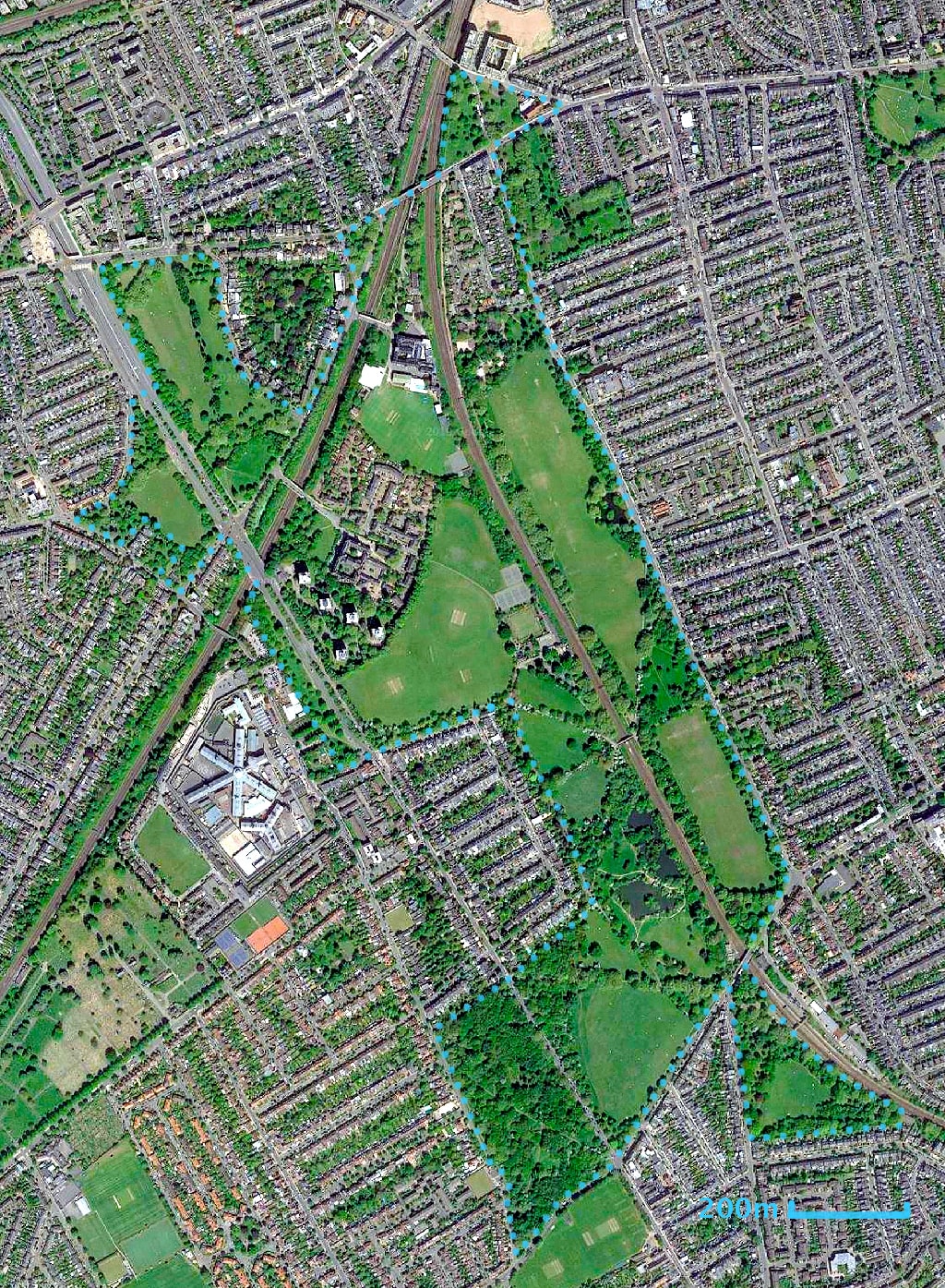
A circumnavigation of Wandsworth Common.
As I was outlining the route around the outer edge I began to think about how many of the zig-zag detours were caused by enclosures of the Common — mainly made between 1800 and 1871, the year of the Wandsworth Common Act that Buckmaster and other stout defenders of the Common had fought so hard for.
Hence it would be good to reflect on these losses as we walk round e.g. the Allfarthing Piece that is now the Toast Rack, Spencer Park, McKellar's Triangle &c.
The obvious place to meet would be under the plaque to John Buckmaster, and to set off (clockwise, following the sun, of course), then keep as much to the perimeter of the Common as possible.


Julia Bott and Stephen Midlane unveil the John Buckmaster plaque on the wall of Neal's Lodge in 2021.
What do you think?
On Wednesday 15 October at 2 p.m., I'll be going for an hour or so's walk around the Lake. If you would like to join me, contact history@wandsworthcommon.org to book a place.
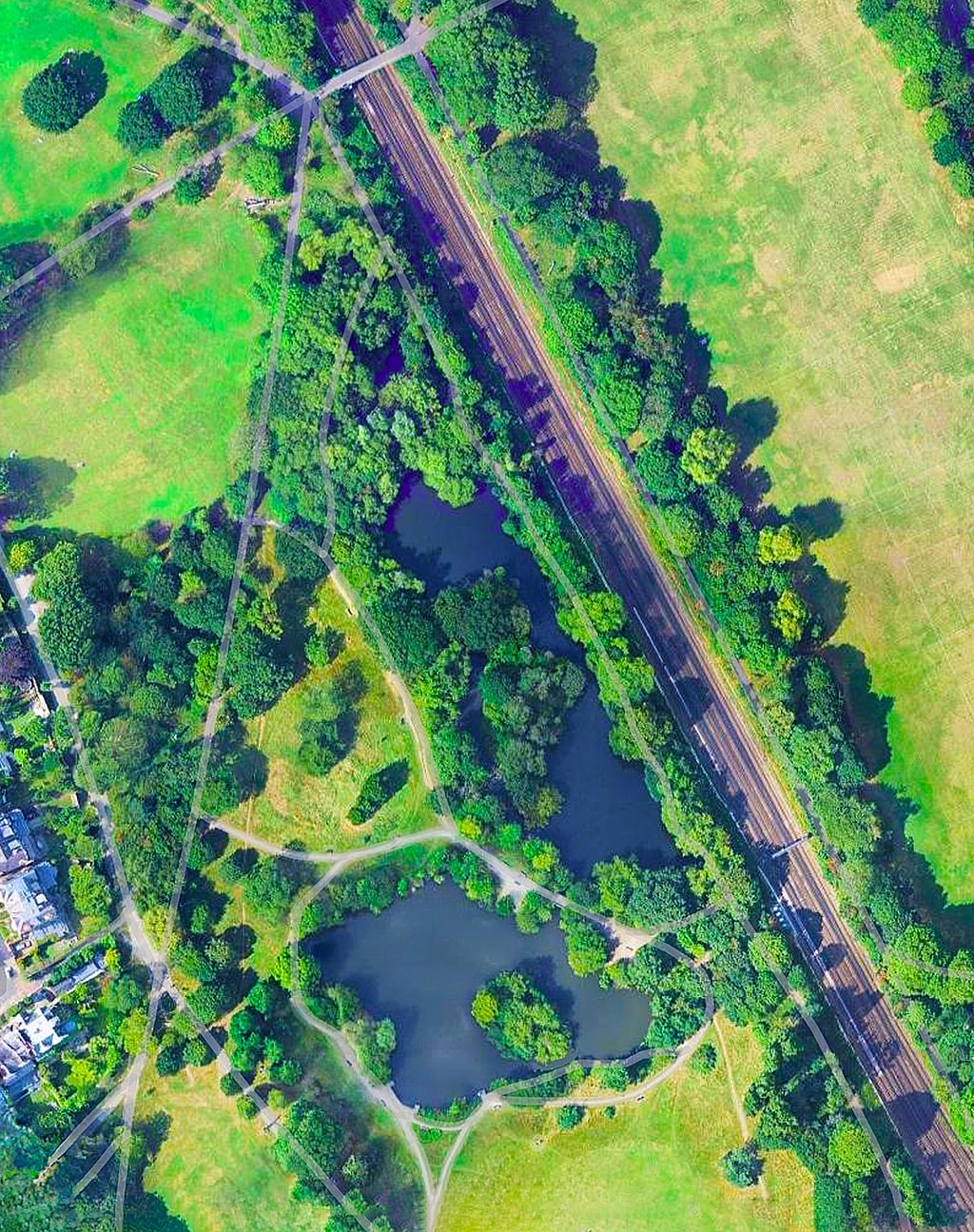
The Wandsworth Common lake. (Google aerial view, 2025)
I expect I'll talk about its origins as a gravel quarry (after the Black Sea had been filled in to make way for Spencer Park), and include something on the fierce opposition to its construction (as encouraging cholera miasmas, and exposing "the ladies" to naked boys cavorting in its cooling water).
We'll look at how it's grown and changed, its islands, and various incarnations of the bridge across its waist. I expect we'll ruminate on its fish, its lethal swans and terrapins, and look at its significance in the creative life of poet Edward Thomas.
And probably some tragic drownings, and the deeply painful stories behind some of the commemorative benches on its edges. But we may also meet the "sagacious collie" Grissel, who plunged in to save a child - and earned the high award for canine bravery.
Perhaps less, but almost certainly much much more. And please bring your own stories to share.
You will be relieved to know that Ken's Daddy survived the war. This was Alfred George Hacker (born 1867, so an elderly 48 years old when he wrote his postcard home). His mother was Alice Maude nee Ray (born 1874). Alfred had been a tobacconist before the war but by 1921 was a civil servant in the Dept of Education. In 1921, Alice was a teacher.
Later, Ken became a teacher (e.g. at Larkhall Lane LCC School, Clapham), as did his brother ("E.G. Hacker"). He married a teacher too.
The family lived at a number of addresses in the area, including 20 Gorst Road and [no.?] Blenkarne Road (three doors from one of his sons, says AGH's obituary in the Norwood News, 11 September 1936). One of Ken's sons later lived in Quarry Road.
AGH was buried in Wandsworth Cemetery (Magdalen Road) after a service in St Michael's Church on the edge of the Common. Here's an extract from AGH's obituary:
BOWLS AND CINEMA
Since his retirement, Mr. Hacker's chief pastime during the summer had been bowls, and he was an enthusiastic member of the Heathfield Bowling Club. He had been a member of the club committee for fifteen years and one of his last thoughts was for the welfare of the club.
During the winter he occupied a good deal of his time at the cinema. He frequently attended local cinemas three times in a week. He was also a popular figure with bus conductors, policemen, road sweepers, and other public officials, for whom he always had a cheery word and a cigarette.
Here's a puzzle for you: In 1890, an "Alfred George Hacker", aged 23 (so the same age as our AGH), appears in the records of the Liverpool Road Islington Workhouse. AGH was born in Islington. So could this be Ken's Daddy? If so, what a remarkable turnaround in his life.
Does anybody fancy trying to find out more about the Hackers? Great if you do. Let me know your discoveries and I'll add them here.
I am delighted to say that Sarah Vey took up the challenge. Read about her amazing genealogical explorations into the Hacker family, including a close look at the evidence that Ken's father Alfred might have been in the Islington Workhouse in 1890, here.
Thanks, Sarah!
SO many more stories still to tell. But that's all for now, folks.
Send me an email if you enjoyed this post / want to comment on something you've seen on the site / would like to know more — or just want to be kept in touch.
If you would like to receive notifications of new Chronicles, let me know . . .
Philip Boys ("History Boys")
October 2025
— Friends of Wandsworth Common
— Wandsworth Historical Society
