
Last modified: 3 October 2026
Jane Austen was born 250 years ago this month — 16 December 1775 — at Steventon, near Basingstoke, where her father was the rector. In 1809, she moved fifteen miles or so to Chawton near Alton. There were visits to friends and family elsewhere in Hampshire and neighbouring counties, and a number of longer trips, for example to Bath, the Dorset and south Devon coasts, and as far away as Derbyshire.
But more importantly for us today, she also visited London several times, particularly to stay with her brother Henry, who lived first in Sloane Street (near Knightsbridge, but often referred to as "Chelsea") and then in nearby Hans Place.
So did she ever visit Wandsworth Common, or know anybody well who was living here?
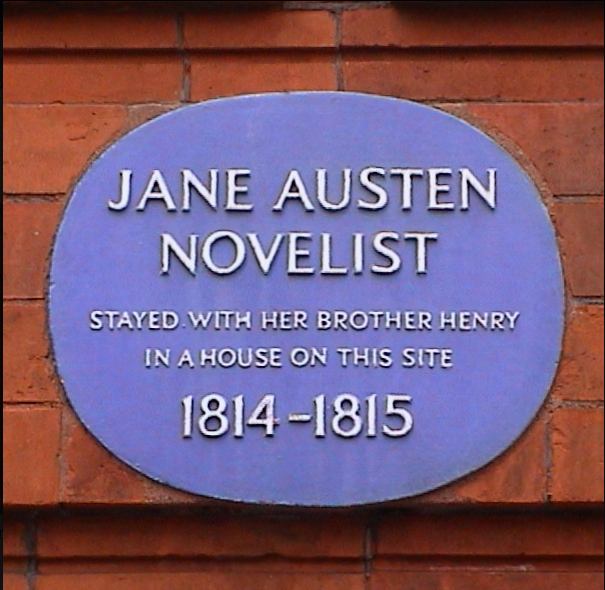
Plaque on the site of 23 Hans Place, SW1. Henry's home has been replaced by a block of flats.
This month, we're playing "Degrees of Wandsworth Common" — which is my take on "Degrees of Kevin Bacon". It's a game based on "Six Degrees of Separation" — the theory that everybody is connected to everybody else by no more than six handshakes.
It started with Kevin Bacon's claim in an interview that he had "worked with everybody in Hollywood or someone who's worked with them", hence the headline claim that "Kevin Bacon is the Centre of the Universe". This gave rise to what Wikipedia describes as a "popular parlour game where players compete to connect any actor to Kevin Bacon through the shortest chain of film co-stars. An actor's 'Bacon number' is the number of links in their chain: Kevin Bacon's number is 0, actors who were in a movie with him have a number of 1, and so on. "
But my theory is even bolder: that not just every person but also every place and every event in history is connected to Wandsworth Common — and generally through only a few links. The precise number of links is their "Wandsworth Common Number" (or WCN).
So Wandsworth Common itself has a WCN of 0, and Earl Spencer and John Buckmaster have a WCN of 1 — as do I and most of you, dear Readers. (Though astonishingly we do have some subscribers to these Chronicles who've never visited, so their Wandsworth Common Number is 2. And so on. ) Get it?
Let's try four lines of enquiry:
1. The frequency of references to "Wandsworth Common", "Wandsworth" and "Battersea" in Jane's writing — in her six completed novels (plus a couple of unfinished ones), her voluminous correspondence, and in the fairly extensive recollections of her contemporaries . . .
2. Journeys she made to and from London by carriage and stagecoach: did she pass through Battersea amd Wandsworth? . . .
3. Her possible intimacy with "Mr. White", the mysterious Lord of the Manor of Allfarthing (who has hitherto escaped the notice of both Janeites and Austen scholars), or perhaps other notables . . .
[Whoops, sorry. For me, this is an extraordinarily interesting question, but so challenging to get the story straight that I'll have to leave it for another time.]
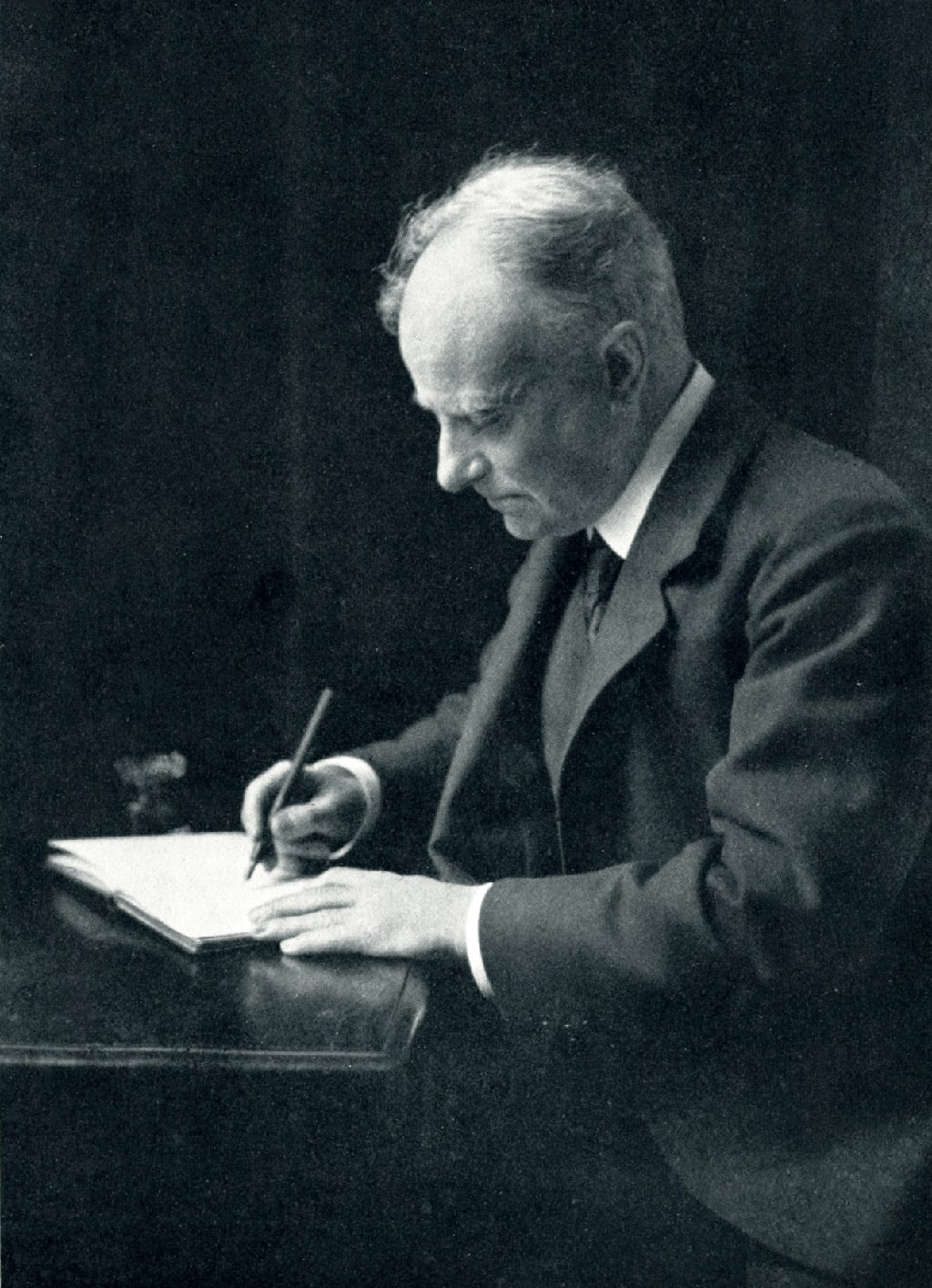
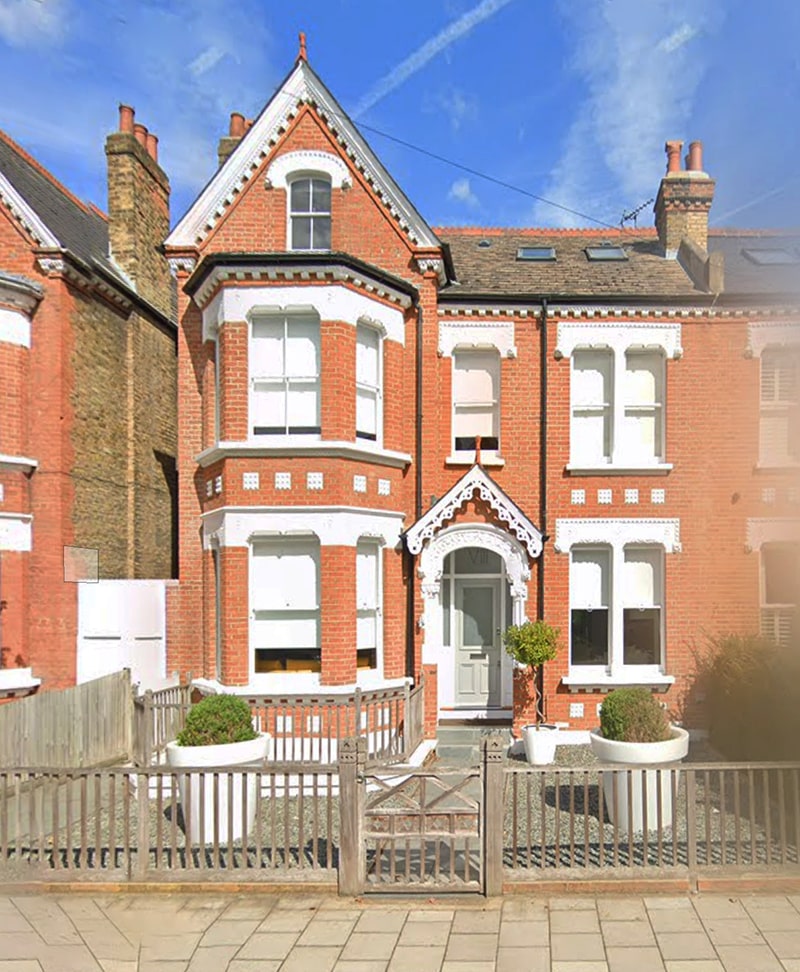
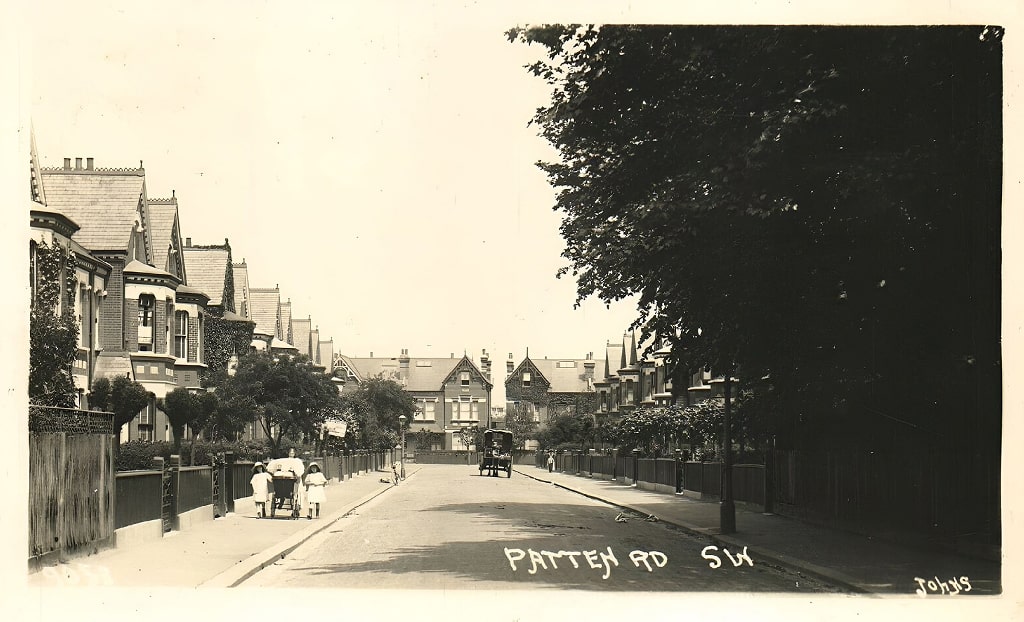
4. And finally, virtual connections (through art, theatre, cinema etc), for example the role of the late-Victorian/Edwardian illustrator Hugh Thomson, who lived at 8 Patten Road in today's Toast Rack. His artwork, mainly from the end of the nineteenth century, in effect inaugurated the now universally recognised "Look" of Georgian England that we all know.
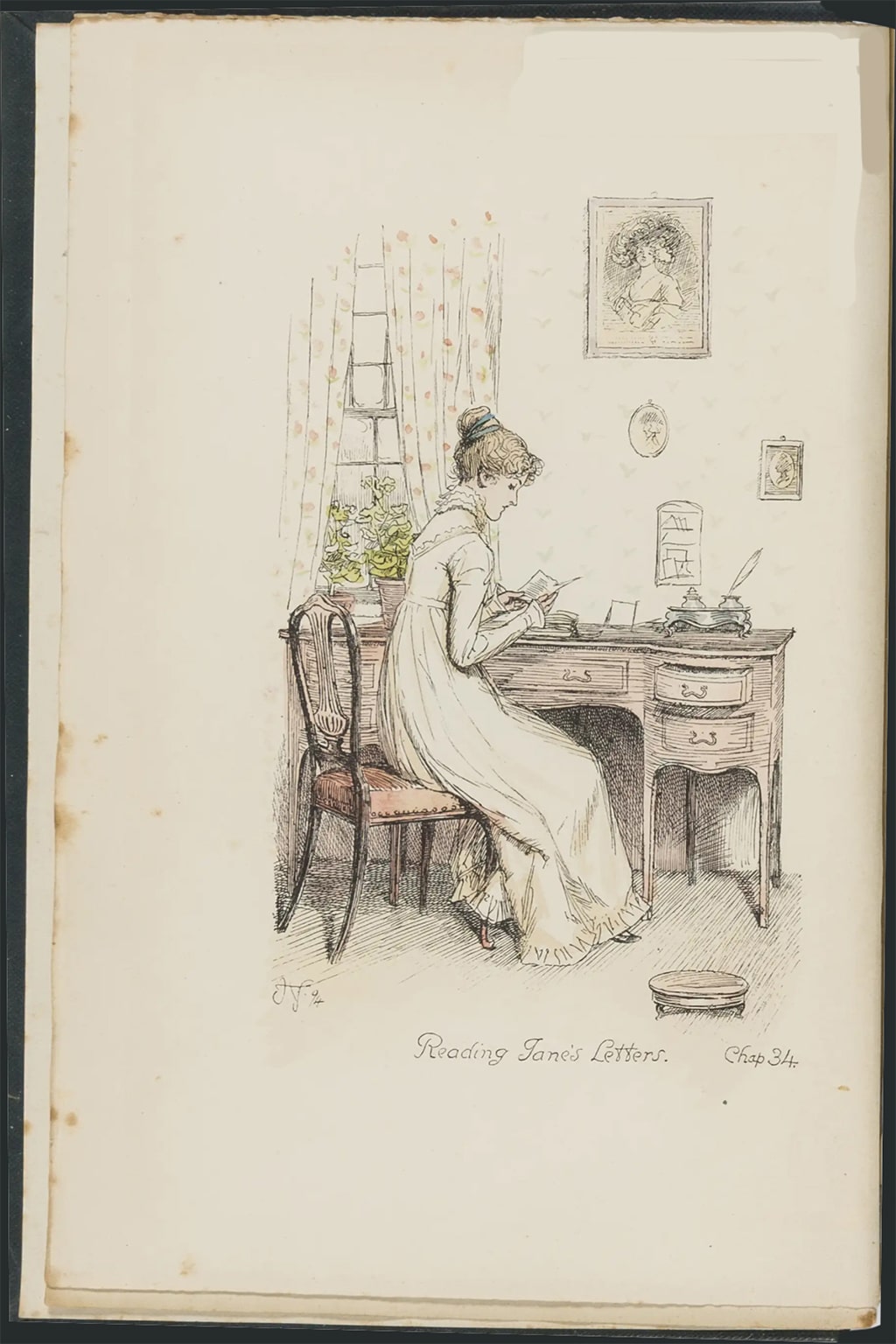
Hugh Thomson, illustration to Pride and Prejudice (1894)
I did what any time-poor modern historian would do: I asked Chat GPT. Back came the answer in an instant. First, it disarmed me up with the salutation "Good question", but then it ruthlessly delivered the coup de grace:
"No. I found no reliable evidence that Jane Austen ever mentions Wandsworth explicitly in her surviving letters or her novels."
Hmm. Confound ChatGPT. I of course immediately explained this away by saying that Jane, a prodigious correspondent, must in fact have written about Wandsworth (and particularly Wandsworth Common), at length, and with wild enthusiasm, but these letters were lost among the thousands famously destroyed after her death by her sister Cassandra.
Happily, all was not lost. I asked the same question about Battersea, Clapham, Putney, Streatham and Wimbledon, and had more luck. No mentions of Wimbledon, but several references to Battersea, Clapham and Putney.
In Pride and Prejudice, for example, Mr. Bennet makes inquiries in Epsom and Clapham after Lydia and Wickham run away. And in Northanger Abbey there are three references to Putney (chapters 15, 25, 27) — including a discussion of gold-digger Isabella Thorpe's family background. Putney, Jane hints, is not all that it should be:
"Her mother is a very good sort of woman," was Catherine's answer.
"What was her father?"
"A lawyer, I believe. They live at Putney."
"Are they a wealthy family?"
"No, not very. I do not believe Isabella has any fortune at all: but that will not signify in your family. Your father is so very liberal! He told me the other day that he only valued money as it allowed him to promote the happiness of his children."
There are a number of references to our wider area in her letters, notably to Battersea, Clapham, and Streatham. These mainly concern travel, the second of our lines of enquiry.
For example in a letter to Cassandra from the "Bull and George," Dartford (24 October 1798 ) Jane refers to Clapham and Battersea. Jane and her parents are returning to Hampshire from Sittingbourne in Kent, where they have been visiting the considerate Mr Nottley (which sounds a lot like Knightley). She writes in some detail about their journey so far, and highlights a decision that has to be taken about the route. Should they travel through or around London?
Our route to-morrow is not determined. We have none of us much inclination for London, and if Mr. Nottley will give us leave, I think we shall go to Staines through Croydon and Kingston, which will be much pleasanter than any other way; but he is decidedly for Clapham and Battersea.
In short, it seems likely that both Battersea and Clapham were quite well known to Jane — if nothing else, they were certainly clearly marked on her mental map.
So which route would they have taken? Given the arrangement of turnpike roads at the time, how would she have travelled from Croydon to Kingston? It really isn't obvious. So did Mr Nottley's view prevail, and they proceeded via Clapham and Battersea? But then what?
Here's a rather interesting map of Surrey's turnpikes — the motorways and trunk roads of their day. Notice how all routes south of the river start in Southwark. To the south-west, Kingston, Guildford and Farnham are in effect major transport hubs, at which several routes converge. Such towns will have had numerous coaching inns, in which travellers, horses and carriages could be housed and fed, and transfers made to other routes onward.
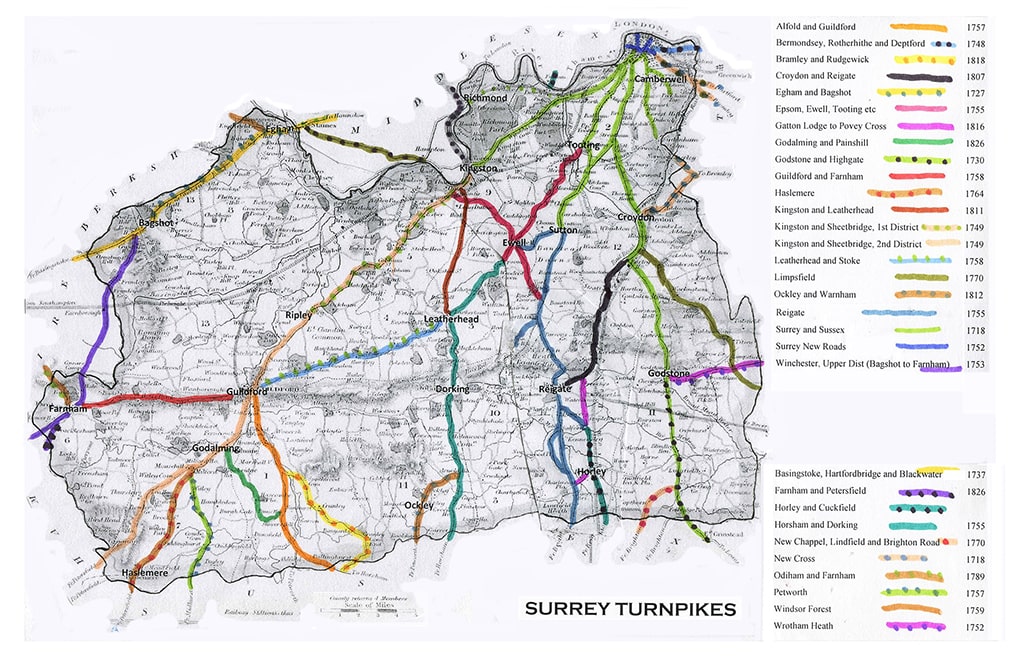
Turnpikes, by the way, were usually toll-roads. Hundreds of turnpike trusts were set up by specific Acts of Parliament, starting in 1663 but mainly after 1750. The trusts relieved local authorities (usually the parish vestry) from responsibility for maintaining a road that was being used and abused by others from outside the parish.
The tolls were not expected to be a source of profit, rather a way of funding the repair, resurfacing and improvement of roads, including filling potholes and draining morasses, and straightening and widening roads. Trusts could also create entirely new roads and install bridges.
The "turnpike" proper was the gate that blocked the road until the toll was paid. The original was a military defensive barrier typically made from sharp-tipped pikes or spikes that gave its name first to the toll-gate and then more generally to the road itself.
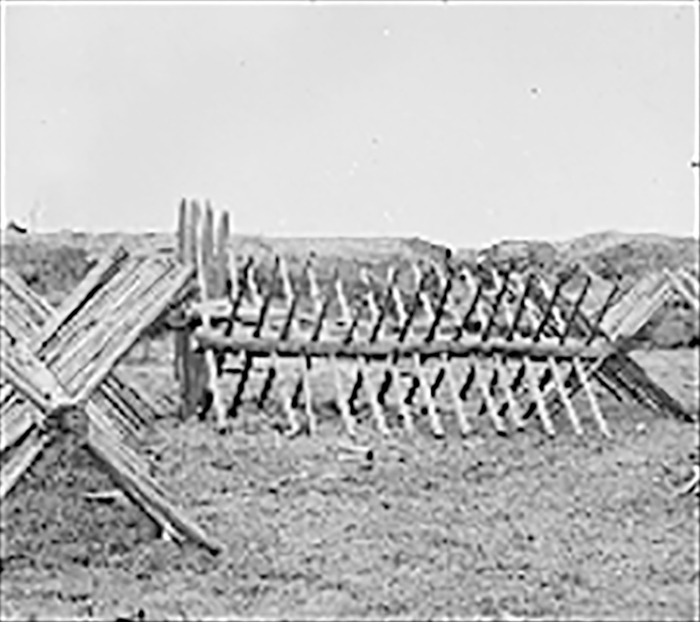
True "turnpikes" used as defences against cavalry charges. This image is from the American Civil War (1861-1865).
When Jane and family were living in Steventon, only a few miles beyond Basingstoke, they probably took the Staines route. This ran from central London to Southampton via Hammersmith, Hounslow, Staines, Virginia Water, Bagshot. It could also be joined from Kingston, which was a key transport hub around 1800.
But when the Austens moved to Chawton, near Alton, the Portsmouth road was probably much the better route:
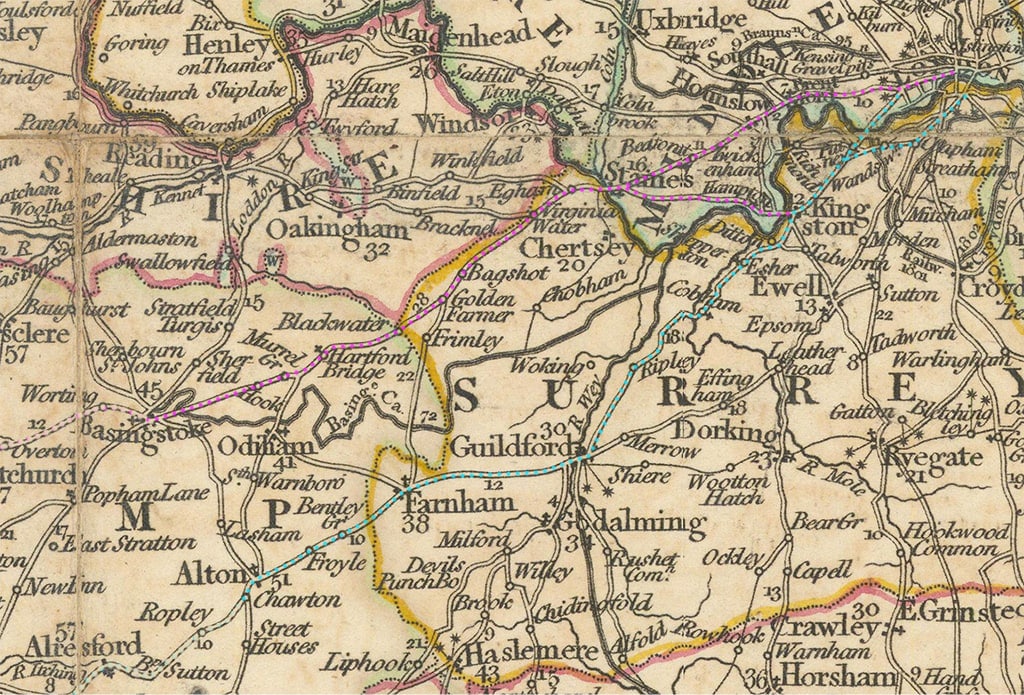
Cary, 1816. Some of the routes Jane Austen is likely to have taken between her homes in Hampshire and London.
In a later letter, Jane states that her preference is to travel to and from London keeping south of the Thames. This is the Portsmouth Road (the pink dotted route above) — Battersea/Clapham, Wandsworth, Kingston, Claremont, Ripley, Cobham, Esher. Guildford, Farnham, Alton &c. This was both more attractive to her, and more convenient for Chawton, just outside Alton.
Let me quote from one of her letters at length. In this instance, Jane is travelling from Chawton to London not by stagecoach but by curricle, a fashionably sporty two-wheeled carriage pulled by two horses harnessed abreast — so speedy that she was in Chelsea in just twelve hours.

Learning to drive a curricle.
I assume it's her brother Henry who is driving:
My dear Cassandra
[ . . . ]
How lucky we were in our weather yesterday!
This wet morning makes one more sensible of it. We had no rain of any consequence; the head of the Curricle was put half-up three or four times, but our share of the Showers was very trifling, though they seemed to be heavy all round us, when we were on the Hog's-back; & I fancied it might then be raining so hard at Chawton as to make you feel for us much more than we deserved.
Three hours & a qr took us to Guildford, where we staid barely two hours, & had only just time enough for all we had to do there, that is, eating a long comfortable Breakfast, watching the Carriages, paying Mr Herington & taking a little stroll afterwards. From some views which that stroll gave us, I think most highly of the situation of Guildford. [ . . . ]
We left Guildford at 20 minutes before 12 – (I hope somebody cares for these minutiae) & were at Esher in about 2 hours more. – I was very much pleased with the Country in general
Between Guildford & Ripley I thought it particularly pretty, also about Painshill & every where else; & from a Mr Spicer's Grounds at Esher which we walked into before our dinner, the views were beautiful. I cannot say what we did not see, but I should think that there could not be a Wood or a Meadow or a Palace or a remarkable spot in England that was not spread out before us, on one side or the other.
Claremont is going to be sold, a Mr Ellis has it now; – it is a House that seems never to have prospered.
At 3, we were dining upon veal cutlets & cold ham, all very good -; & after dinner we walked forward, to be overtaken at the Coachman's time, & before he did overtake us we were very near Kingston.
I fancy it was about ½ past 6 when we reached this house, a 12 hours Business, & the Horses did not appear more than reasonably tired. I was very tired too, & very glad to get to bed early, but am quite well to-day.
Upon the whole it was an excellent Journey & very thoroughly enjoyed by me; – the weather was delightful the greatest part of the day, Henry found it too warm, & talked of its' being close sometimes, but to my capacity it was perfection.
I never saw the Country from the Hogsback so advantageously.
We ate 3 of the Buns in the course of that stage, the remaining 3 made an elegant entertainment for Mr & Mrs Tilson who drank tea with us. [ . . . ]
Here's where she discusses the alternative routes:
Henry & I are disposed to wonder that the Guildford road should not be oftener preferred to the Bagshot, it is not longer, has much more beauty, & not more hills. – If I were Charles, I should chuse it; & having him in our thoughts we made enquiries at Esher as to their posting distances.
From Guildford to Esher 14 miles, from Esher to Hyde Park corner 15 – which makes it exactly the same as from Bagshot to H. P. corner, changing at Bedfont, 49 miles altogether, each way.
Yrs very affecly
J. A.
I quote this at such length because her preference for the southern route via Kingston slightly increases the probability that she will on occasion have travelled through Battersea and Wandsworth.
Let's focus now on the section of the road between Kingston and London.
Kingston is mentioned again in a letter to Cassandra (15—16 September 1813). Jane, who has just arrived at Henrietta Street near Convent Garden, writes:
"Here I am, my dearest Cassandra
[ . . . ]
We had a very good journey — Weather & Roads excellent — the three first stages for 1s 6d & our only misadventure the being delayed about a quarter of an hour at Kingston for Horses, & being obliged to put up with a pr belonging to a Hackney Coach & their Coachman, which left no room on the Barouche Box for Lizzy, who was to have gone her last stage there as she did the first — consequently we were all four within, which was a little crowd; — We arrived at quarter past 4 . . . "
[For more on the different vehicles, and their significance, see Jennifer S. Ewing's superb article "As the Wheel Turns: Horse-Drawn Vehicles in Jane Austen's Novels" JASNA (Jane Austen Society of North America), vol. 40 no. 1, Winter 2019.
The most detailed studies of travel by stagecoach I know of are by Wandsworth historian Dorian Gerhold. These include a book, Stage Coaches Explained, the Bristol Example (2012), and an essay, "The development of stage coaching and the impact of turnpike roads, 1653-1840", The Economic History Review, vol.67, no.3 (August 2014), pp.818-845.]
Today's Kingston Road rises from the outskirts of Kingston then falls to cross Beverley Brook, rises again to the top of Putney Heath/Wimbledon Common, then descends West Hill to cross the River Wandle in the centre of Wandsworth. On the way it now bypasses "Putney Heath Village", which grew up on either side of the earlier "Portsmouth Road". that Jane must have driven along.
[I assume this "village" was built in enclosures of former common land, but I'm not sure when. For a modern exploration of the original route, see e.g. "Roads No More: walking and photographing roads where the car is no longer king"": Old Portsmouth Road.]
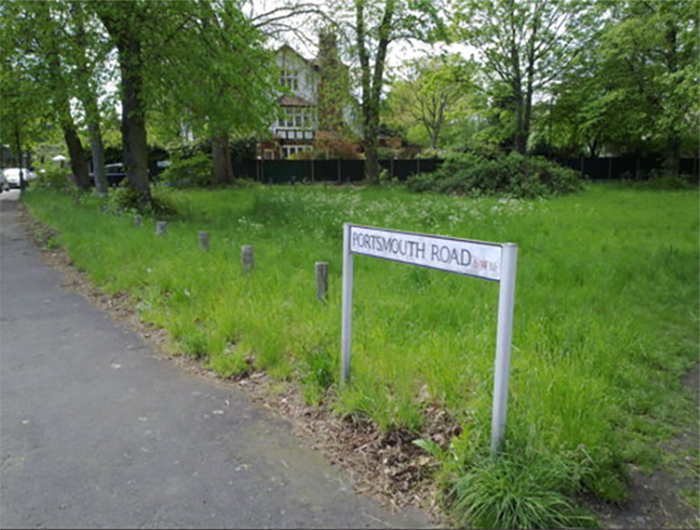
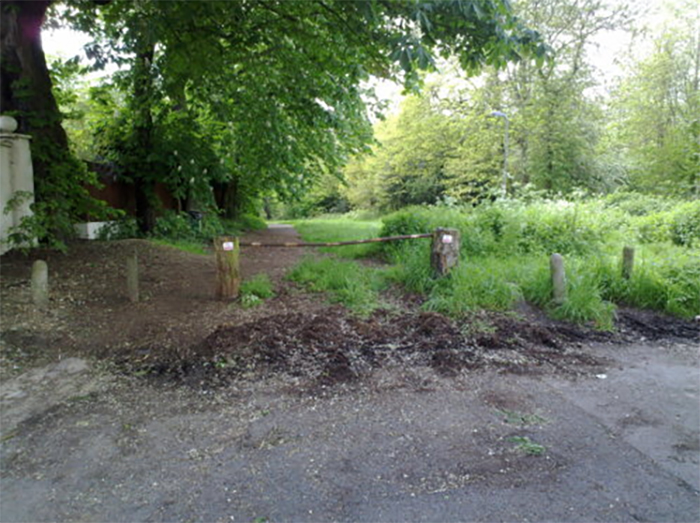
I stumbled upon this, from the I ♥ Putney Village website:
Putney Village is situated in the heart of Putney Heath, London, UK. Surrounded by heathland, this exclusive community comprises a wealth of mansions and mansion blocks. The architecture is largely a mixture of Arts and Crafts and Art Deco, lovingly preserved in fitting with the era.
Set within a Site of Special Scientific Interest and a Special Area of Conservation, our environs are protected for generations to come. Residents enjoy a variety of outdoor activities, including cycling, walking, running and cricket, whilst private tennis and squash courts, swimming pools and gardens are the norm.
[PutneyVillage: Link.]
Yes, it's a lovely location today. But in 1800, you were likely to meet footpads and highwaymen; this would have been a very dangerous place indeed — particularly for women travelling unaccompanied.
You may recall the scene in Northanger Abbey in which the central character, Catherine Morland, fantasises about her possible abduction by "three villains in horsemen's greatcoats". Later in the novel she is actually expelled from the Abbey by her cruel host General Tilney (who has discovered she is not the heiress he thought she was). To be sent home by stage coach by herself is not just a humiliation, it puts her at obvious serious physical risk.
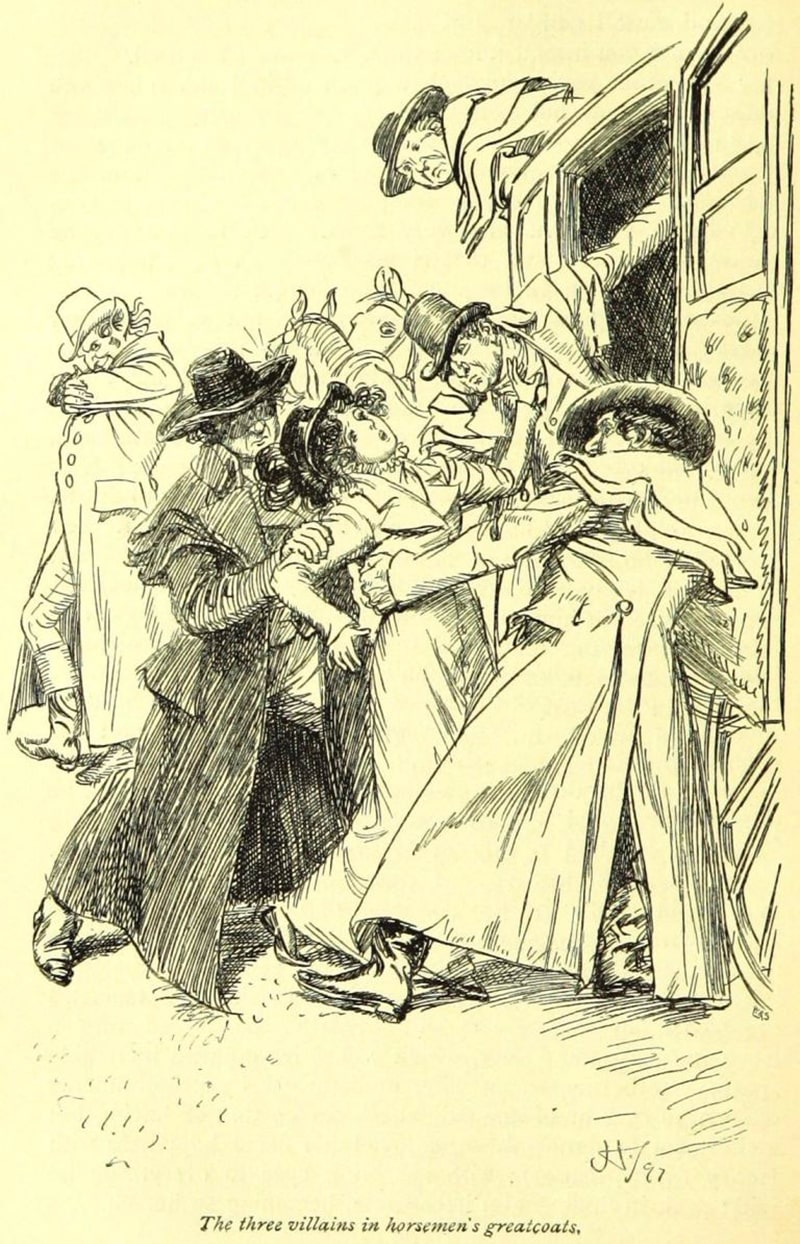
Of course there's a certain romance attaching to highwaymen, but (so far as I know) this was entirely undeserved. They were in reality a pretty unpleasant bunch.
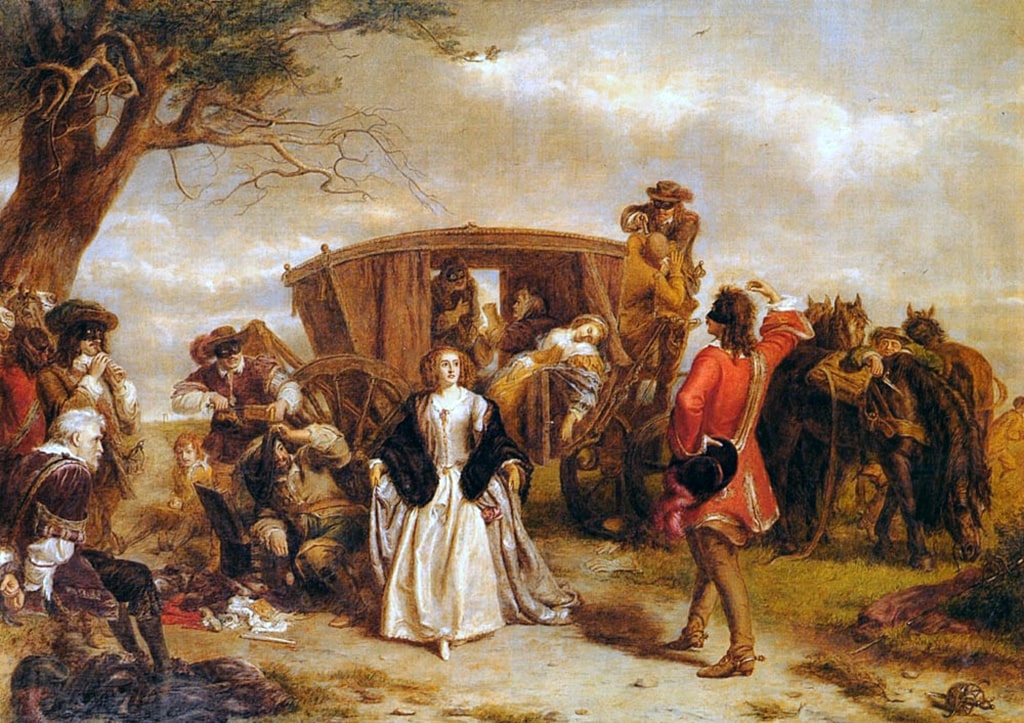
William Frith's fanciful mid-Victorian (1860) depiction of a Restoration-period highway robbery a century earlier | Manchester Art Gallery: Link
I've always believed that Tibbett's Corner was where highwaymen who practised their trade hereabouts were hanged and gibbeted. But I now read that this is only partly true. It seems that while their bodies may have been displayed on a gallows here, as a warning to others, this was only after they had been executed elsewhere — for example at Kennington Common or of course Tyburn, near today's Marble Arch.
The most famous highwayman in these parts appears to have been Louis Jeremiah ("Jerry") Abershaw (Abershawe, Avershaw etc), who had made his headquarters at the Bald-Faced Stag Inn in Putney Vale. He was hanged at Kennington Common on 3 August 1795 and his body afterwards taken to Putney Common where it hung in chains on a gibbet for several years. Jerry was the last highwayman to have his body put on public display after execution in England. (He was not the last highwayman to be executed, though. This honour goes to Robert Snooks, in 1802.).
I have no idea whether Jerry Abershaw's body was suspended in an iron cage, or simply hung in chains from a gallows:
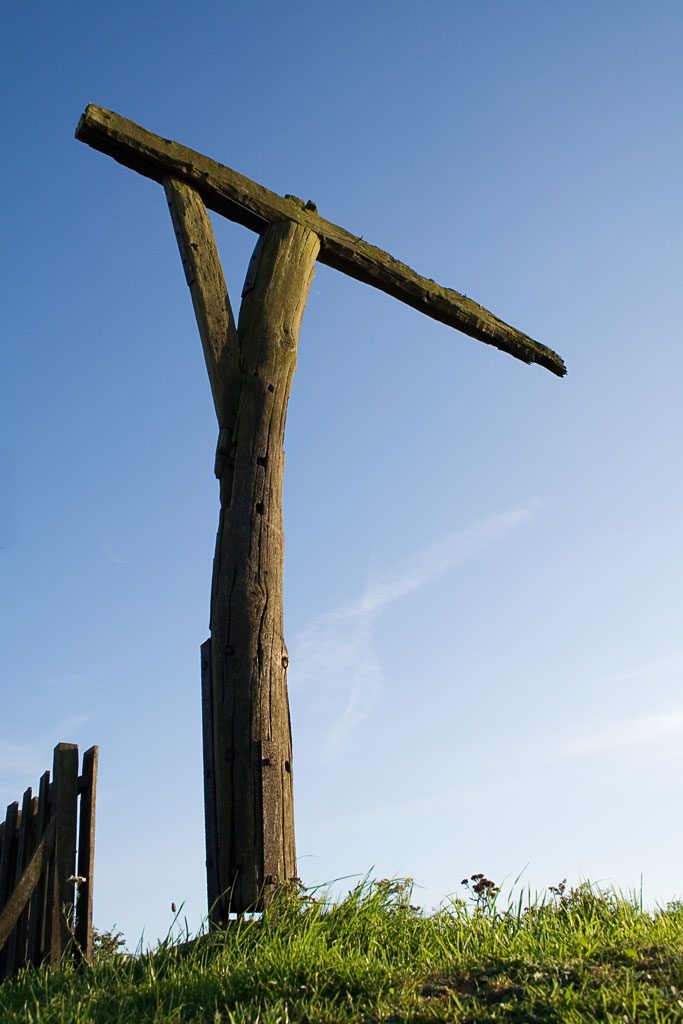
Reconstructed gallows-style gibbet | Wikipedia
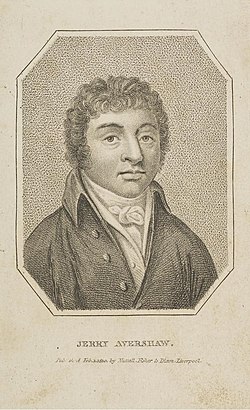
Jerry Abershaw, highwayman, murderer.
According to The Newgate Calendar, Jerry Abershaw's bones became almost holy relics, and the location of his "posthumous punishment" on Putney Heath/Wimbledon Common a pilgrimage destination:
The infamy of Avershaw's life, and the atrocity of his deeds, rendered him a fit object for the posthumous punishment of hanging in chains on the arena of his crimes, and (painful as is the record, the truth must be told) while the disgusting carcass of this malefactor, devoured by the birds and withered by the elements, gradually disappeared, the spot on which he had been gibbeted was converted into a temple of infamy, to which the thieves and vagabonds of London resorted in a sort of pilgrimage; and while the leading ruffians of the flash school, of which Avershaw was the child and champion, procured from his decaying and piece-meal carcass the bones of his fingers and toes to convert into stoppers for their tobacco-pipes, the tyro villains contented themselves with tearing the buttons from his clothes, as mementos of the estimation in which they held their arch prototype.
Since this is close in time — only a year or so — from when Jane Austen may have passed this way, it is not impossible that she saw Jerry Abershaw's gibbeted corpse. But even if not, it is more than likely that she knew about him. (Incidentally, they were almost the same age, and both were in their early twenties at this time.)
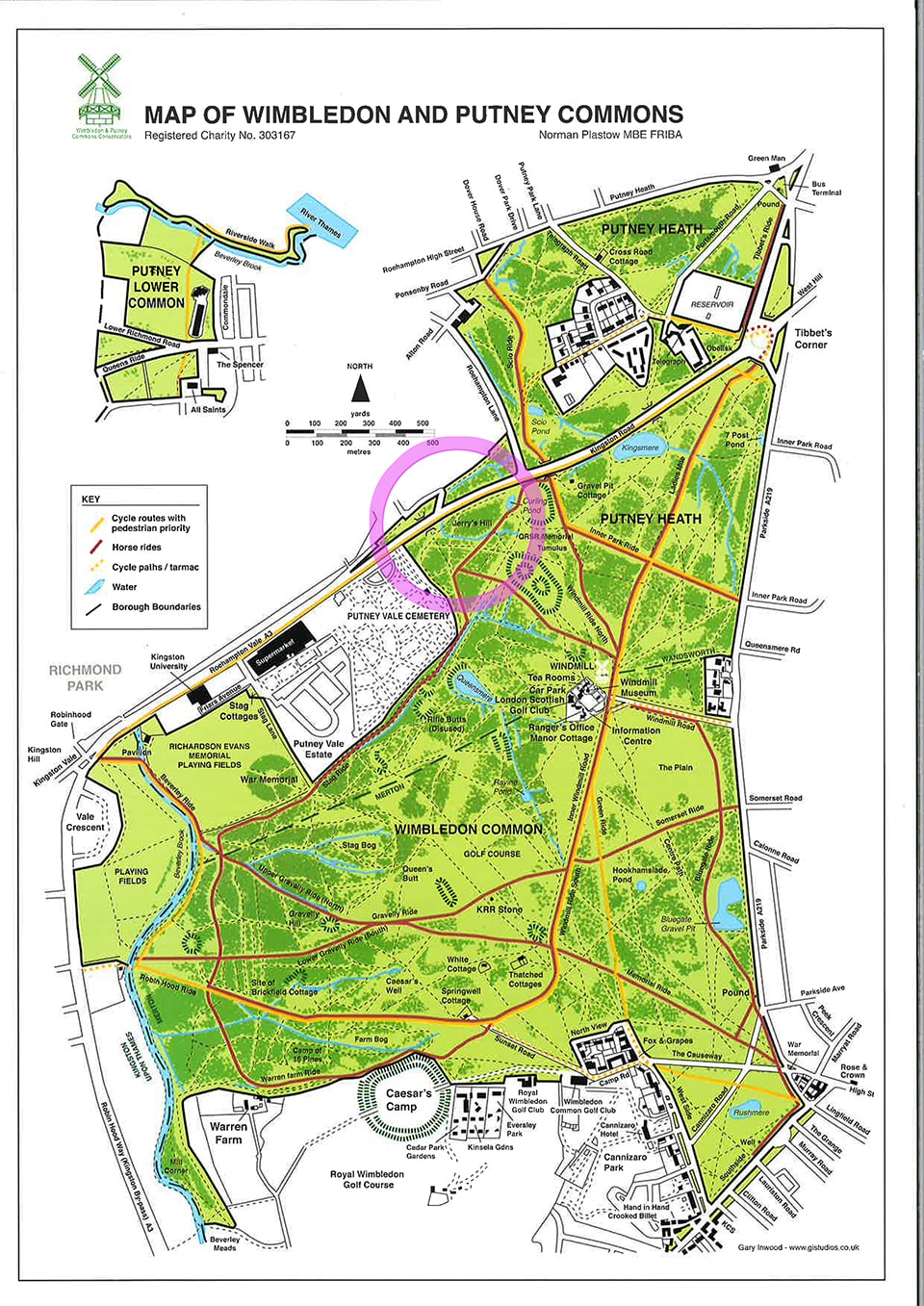
The knoll on which the gallows was erected appears on some maps as "Jerry's Hill", as here. Notice the "Supermarket" and "Stag Cottages" a few hundred yards away.
I became curious about the location of "Jerry's Hill" and his lair at the Bald-Faced Stag Inn.
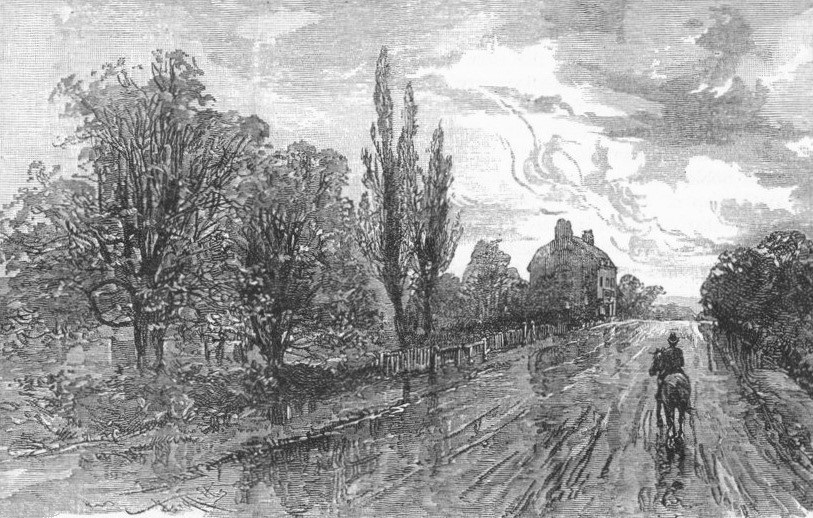
Bald-Faced Stag Inn (originally the Halfway House), Putney Vale, engraved 1888. The inn's shape suggests this was the original building that Jerry Abershaw and gang used as their HQ.
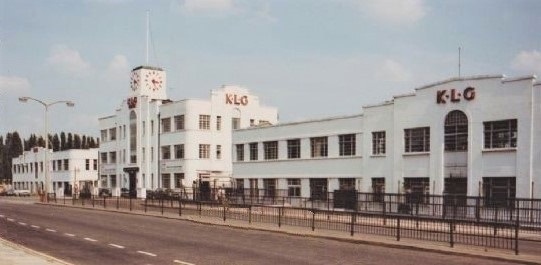
The Inn was demolished c.1912 to make way for a factory making sparkplugs for car and aircraft engines.
The factory prospered in World War One, when the sparkplugs made there were in great demand for aircraft. As the "Robinhood Engineering Works", and later "K.L.G.", the factory ultimately employed 1,200 mainly women workers in a fine Art Deco building. This was demolished in 1989, and the site turned over to the supermarket chain.
K.L.G., by the way, were the inventor-owner's initials: Kenelm Lee Guinness, racing driver, world land speed record-holder, businessman, spark plug manufacturer, and member of the Irish Guinness family. He is buried next door, in Putney Vale Cemetery.
— Wikipedia: Kenelm Lee Guinness.
— Green Classic & Vintage Spares: KLG Spark Plugs (Smith Industries).]
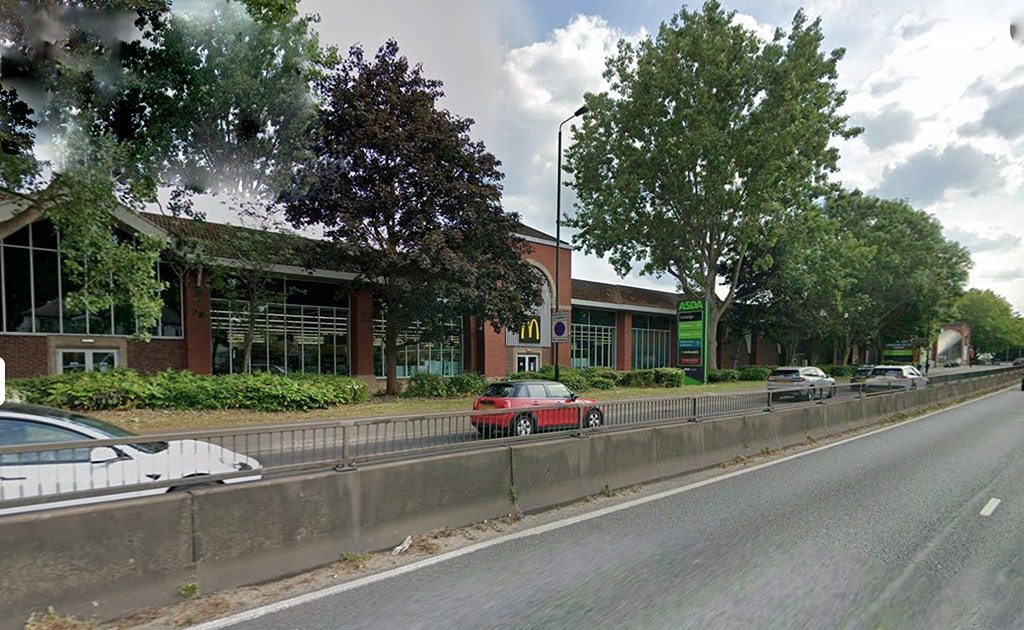
The view today: an ASDA superstore.
Sometime or other, I must write in more detail about James Grant's novel Second to None, A Military Romance (published 1864, but set in Napoleonic times). Its hero, Basil Gauntlet (yes, really), crossing Wandsworth Common on horseback, hears a woman's scream and encounters "two armed and mounted highwaymen, with crape masks on their faces. Such gentry were at that period still in the zenith of their perilous fame . . . " In spite of the fact that Basil only has a sword, and they blunderbusses, he promptly hacks three fingers off the leader's trigger hand, and the blackguards disappear in a funk. Stirring stuff.
Incidentally, Grant is writing about the Wandsworth Common that we know — not the north-east fragment of Wimbledon Common sometimes called Wandsworth Common because it lay within Wandsworth parish. I wrote about the relevance of this for the Earl of Cardigan's duel with Captain Harvey Tuckett in the July 2024 edition of these Chronicles.
And let's not forget his predecessor Dick Turpin (1705-1739), also associated with Battersea and Wandsworth. I have discussed at length his association with the Plough Inn on St John's Hill here. As we shall see below, if my hypothesis is correct Jane would have passed the Plough either on her way into Town or on her way to Streatham.]

Dick Turpin (1705-1739)
— Wikipedia: Putney Vale
— Wikipedia: Jerry Abershawe [Link.]
— DNB: Abershaw or Avershawe, Louis Jeremiah (1773?-1795). This lists a number of nineteenth-century sources. [Link.]
— Jane Austen's World: article by Tony Grant, "The Tale of Jerry Abershawe, Highwayman" (8 February 2011) [Link.]
— Easily the most vivid account of Abershaw's life and death is (unsurprisingly) the one in the Newgate Calendar (most easily accessible on the Ex-Classics website here).
— It is worth noticing that among Jerry Abershaw's early misdeeds is the poaching of deer from Richmond Park. Check if E.P.Thompson mentions Abershaw in Whigs and Hunters: The Origin of the Black Act (1975), or Customs in Common (1991), which includes his study of the late-C18 campaign to secure public access to Richmond Park.
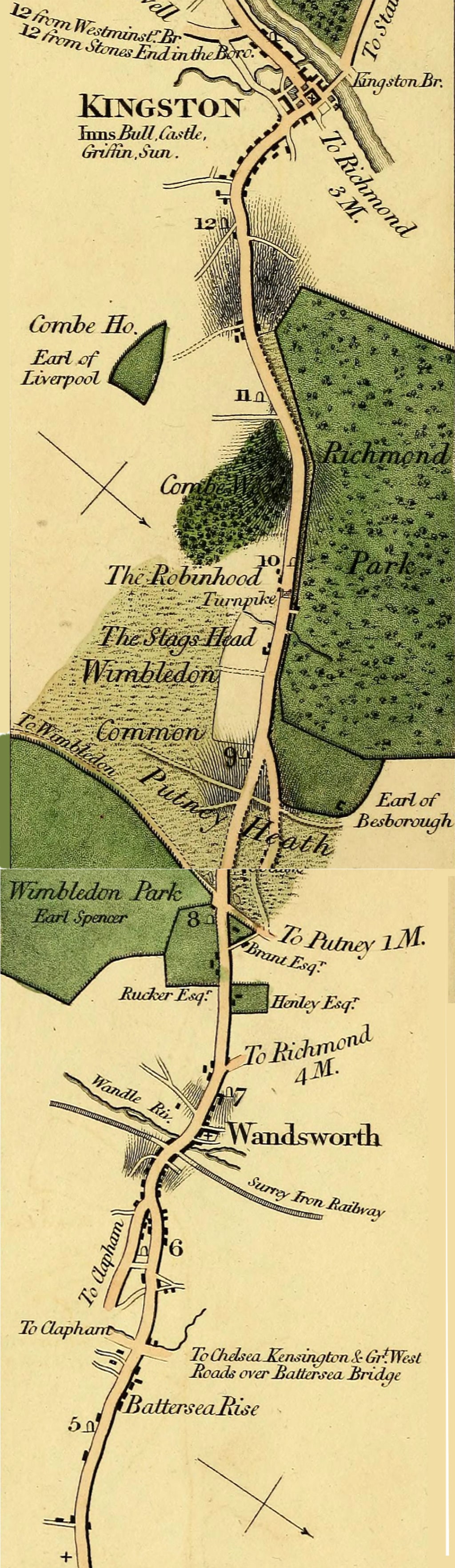
Mogg, 1817: London to Kingston via Battersea and Wandsworth, Survey of the High Roads of England and Wales, Part the First.
Having crossed Putney Heath safely, what then? Did Jane take the left fork, down Putney Hill, to cross Putney Bridge (opened 1729, then called Fulham Bridge), and along the Brompton Road to Knightsbridge and Hyde Park Corner? This might have brought her more speedily to her brother Henry's home.
Or did she continue on the right fork, through Wandsworth, crossing the River Wandle in the centre of town, and then the Surrey Iron Railway (opened 1803)
[Hmm, I've got to admit that the former seems more likely since, if she took the Wandsworth route, how did she then get to Knightsbridge? It's possible that she crossed Battersea Bridge (opened 1771). Other bridges were Vauxhall 1816, Westminster 1750, Waterloo 1817, Blackfriars 1769, and Southwark 1819.]
The turnpike to and from Wandsworth ran from the top of East Hill into central London via St John's Hill towards today's Arding and Hobbs/Falcon Pub, where it crossed the Falcon Brook. The turnpike then rose up Lavender Hill to the Wandsworth Road, and so on towards London.
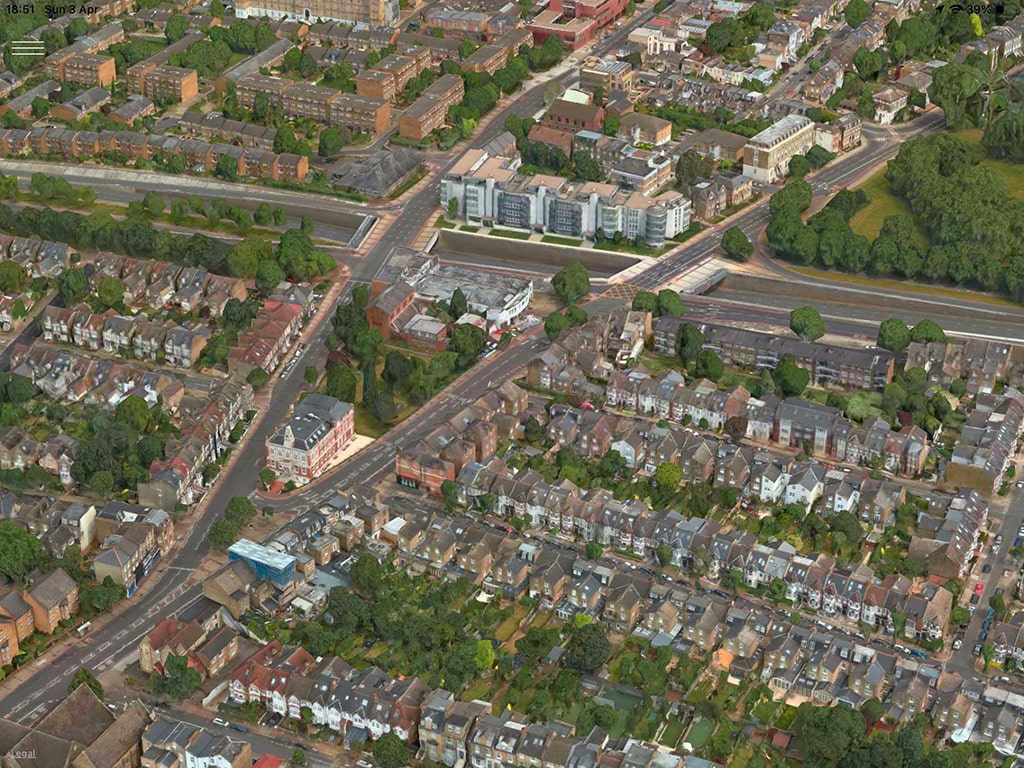
Modern aerial view of the fork in the roads at Book House, at the top of East Hill. Left, the turnpike to today's Clapham Junction. Right, the road to Clapham.
The Turnpike into London would have to cross the Falcon Brook at "The Wash" or "Wash Way" (between today's Arding & Hobbs and the Falcon Inn), and this presumably was very wet and muddy indeed.
Here's the route marked on John Rocque's mid-18th century map. Notice the three large ponds upstream from the crossing on the site of today's St John's Road. These must have been created by the damming of the Falcon Brook at the crossing. Curiously, there is no reference on maps to a bridge. So was it a very muddy ford? Or had the Falcon Brook already been culverted — put in a pipe — beneath the crossroads (as it is now)?
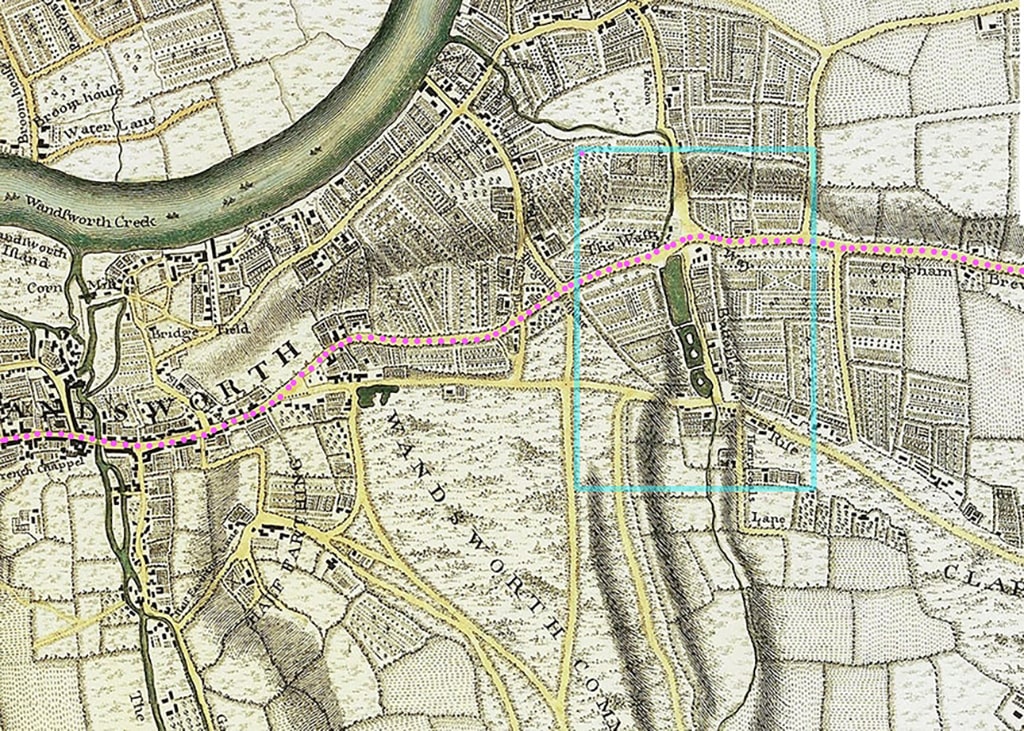
John Rocque, 1766. I'm not sure exactly when the turnpike was created, but probably early in the century (1718?). I've marked its route with a dotted pink line. The blue box frames The Wash — the crossroads at the foot of St John's Hill and Lavender Hill, with Falcon Road (north) and St John's Road (south).
Incidentally, the right hand fork at the top of East Hill, today's North Side (a frustratingly narrow section of the South Circular), was never itself a turnpike. This ran from Wandsworth towards Clapham along today's Battersea Rise. I've read that this used to be referred to as the Canterbury Road — presumably because it once took pilgrims to Southwark and onward (as in Chaucer's Canterbury Tales).
[When I asked ChatGPT to confirm this it enthusiastically agreed with my account — but when I looked further its only source was, er, me. ]
So Jane may have come quite near us, but we still have no evidence that she actually crossed the Common — in a carriage, perhaps, or a curricle. Or do we?
For me the most intriguing references to local places are in her letters to Cassandra about their close friend Catherine Bigg-Wither, who was married to the (very much older) Reverend Herbert Hill, the Rector of St Leonard's Church in Streatham.
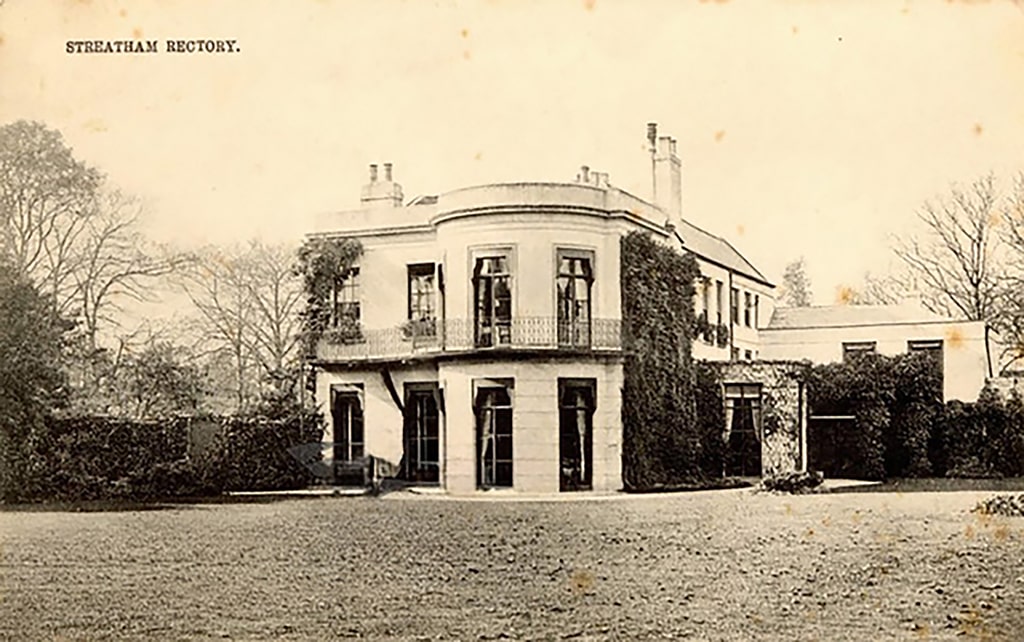
Streatham Rectory, Prentis Road, demolished 1907
Jane certainly planned a visit. For example, in a letter to Cassandra on 18th April 1811, Jane writes from Henry's home in Sloane Street:
"I wrote to Mrs. Hill a few days ago, and have received a most kind and satisfactory answer. Any time the first week in May exactly suits her, and therefore I consider my going as tolerably fixed. I shall leave Sloane Street on the 1st or 2d, and be ready for James on the 9th, and, if his plan alters, I can take care of myself. I have explained my views here, and everything is smooth and pleasant; and Eliza [Henry's wife] talks kindly of conveying me to Streatham."
[Pemberley: Letter 55.]
A recent article by John Brown and Frances Short argues that both Jane and Cassandra visited Catherine several times after this:
In November 1813, it was Cassandra's turn to enjoy the hospitality of the Recto- ry. It was also hosting the visit of Catherine's sisters, Elizabeth Heathcote and Alethea Bigg: 'You, & Mrs H & Catherine & Alethea going about together in Henry's carriage, seeing sights! I am not used to the idea of it yet. All that you are to see of Streatham I have seen already! . . . '
In August 1814, Jane paid another call on the Hills and notes the prevailing atmosphere in a letter to her future sister-in-law, Martha Lloyd: 'Some delightful Drives in the Curricle has been the sum of my doings. One of our afternoon drives was to Streatham, where I had the pleasure of seeing Mrs Hill as well & comfortable as usual; but there is a melancholy disproportion between the Papa & the little Children.'
[Streatham Society News, Spring 2025, pp.28—30.]
But how did they get to Streatham?
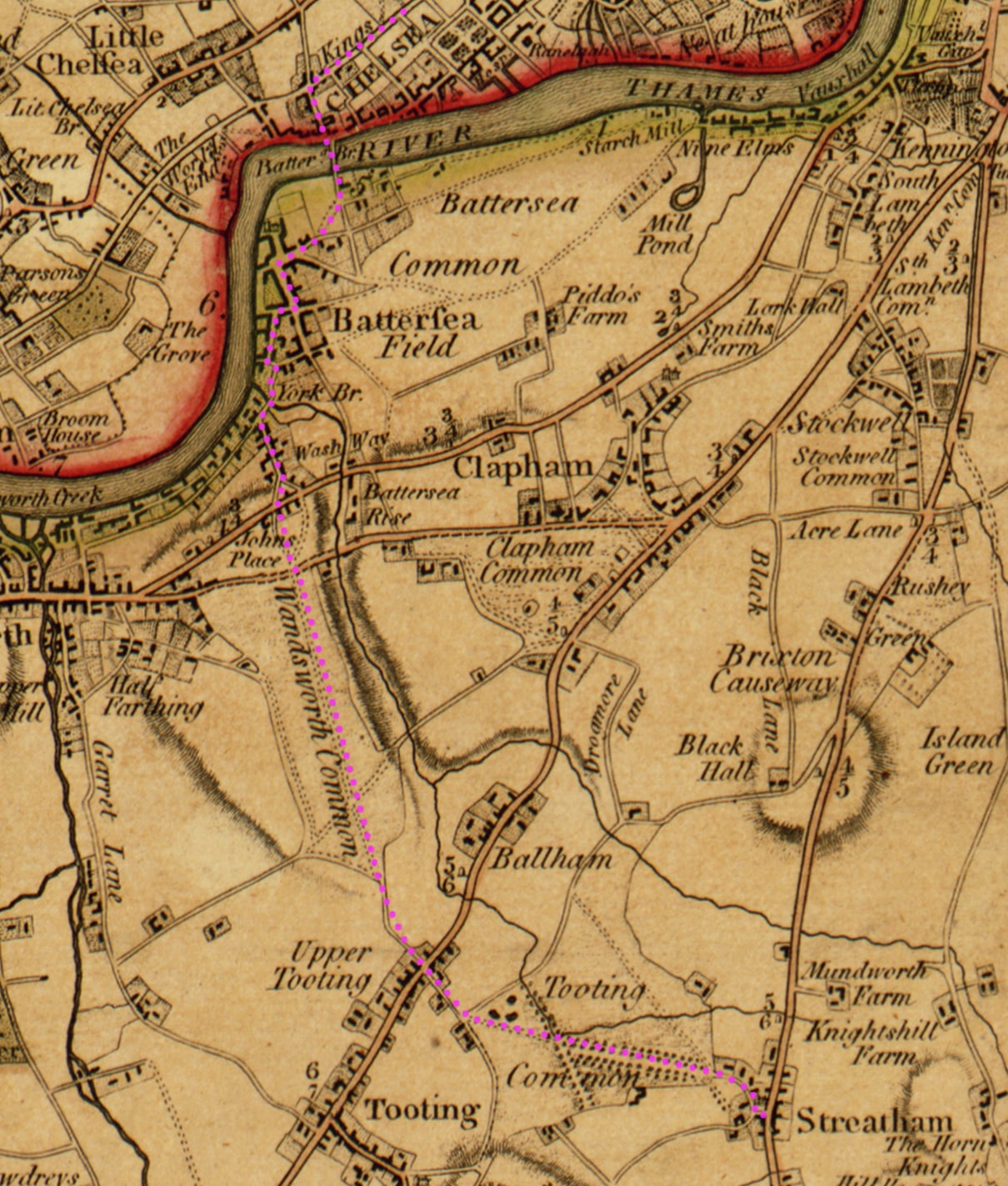
A conjectural route between Henry Austen's home in Knightsbridge and Streatham Rectory.
If Jane took this route, she would have crossed Battersea Bridge, turned right through Battersea, crossed the Falcon Brook by the York Bridge, ascended today's Plough Road, then taken one of the roads either side of St John's Place. This would have taken her straight across Wandsworth Common on what I have called the "ghost road" to Tooting and onward to Streatham.
Notice that this gently curving ghost road is neither today's Bolingbroke Grove nor Trinity Road, but a completely distinct road (running more or less along the Battersea-Wandsworth parish boundary, first on on side, then the other) that has now disappeared.
[It seems likely that the long dead-straight Trinity Road itself was not laid down properly until the end of the eighteenth century — it's not present on John Rocque's map of e.g. 1766, nor on Faden's map of 1790, nor the Edwards Companion of 1801 (by which time it was probably several years out of date). But is clearly shown on Milne's map of 1800.
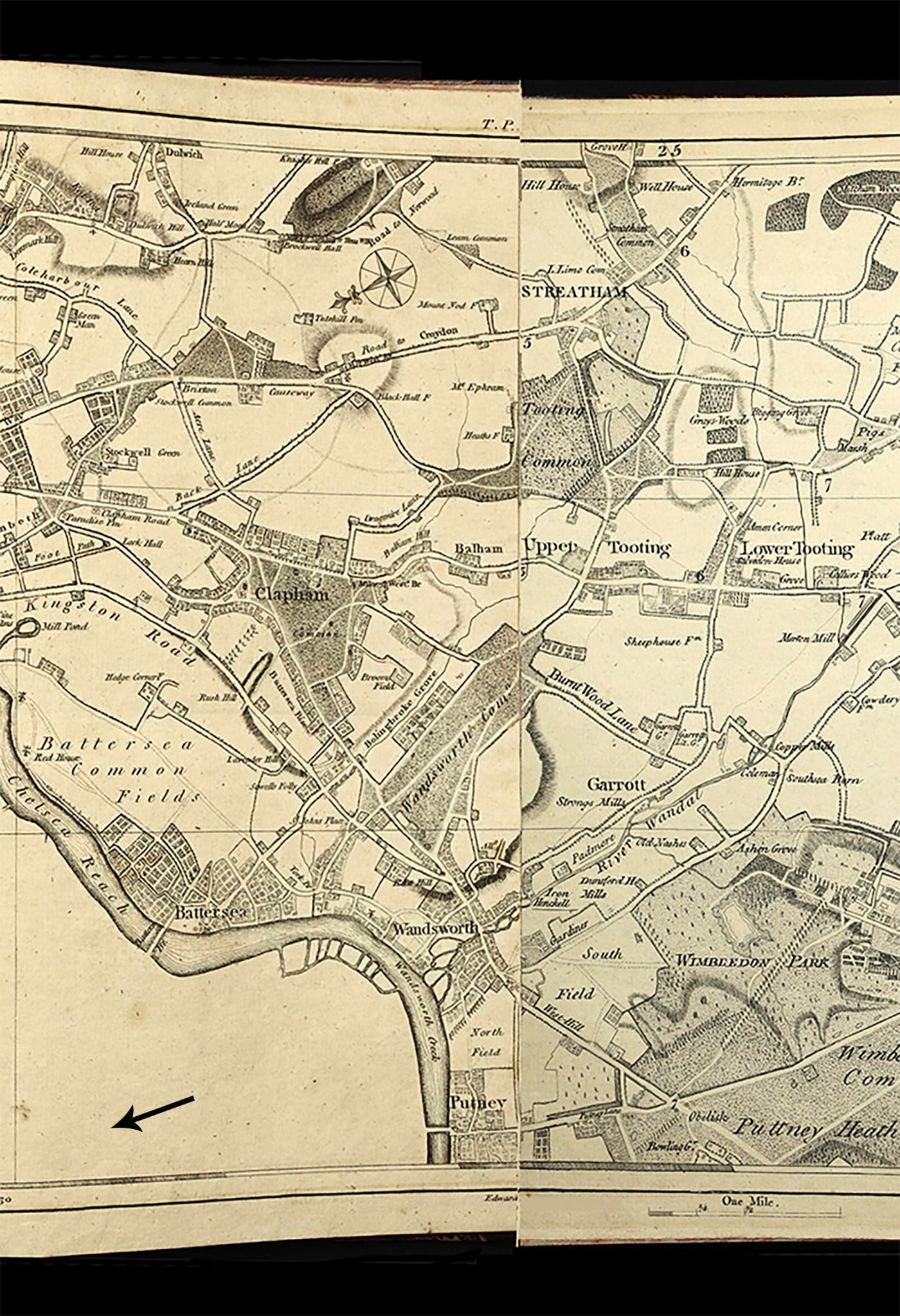
James Edwards, A Companion from London to Brighthelmston in Sussex, 1801. Try not to be too confused by the odd orientation.
[I would love to know when exactly Trinity Road was built, and indeed why? Until the late 1960s, it stopped abruptly (and somehow senselessly) at North Side, well short of the Thames. Was it originally intended to lead to a new bridge? Did money or legal problems about land ownership stop its progress? Wandsworth Bridge itself was not built until 1873, and the dual carriageway, underpass and massive roundabout leading to it not completed until almost a century later (c.1969).
Does any reader know anything more about the origins of Trinity Road? Do tell.]
I'm still trying to understand what happened to the ghost road, but it seems to have just faded away. Perhaps travellers going to and from Battersea Bridge to Tooting, Streatham and beyond, eventually took a new road — Five Houses Road, later called Bolingbroke Grove. This was already in existence on Rocque's maps but perhaps improved when the "Five Houses" were built in the 1780s and 1790s.
I believe it was John, 1st Earl Spencer who instigated the building of a bridge at Battersea, and was the principal shareholder — originally intended to be stone, a lack of investment meant this first bridge was built from wood.
I have read that in the 1820s the Spencer family attempted to boost the volume of traffic using the bridge by improving roads between Tooting and Battersea, including constructing Bellevue Road and St James's Drive. It would be good to know more.
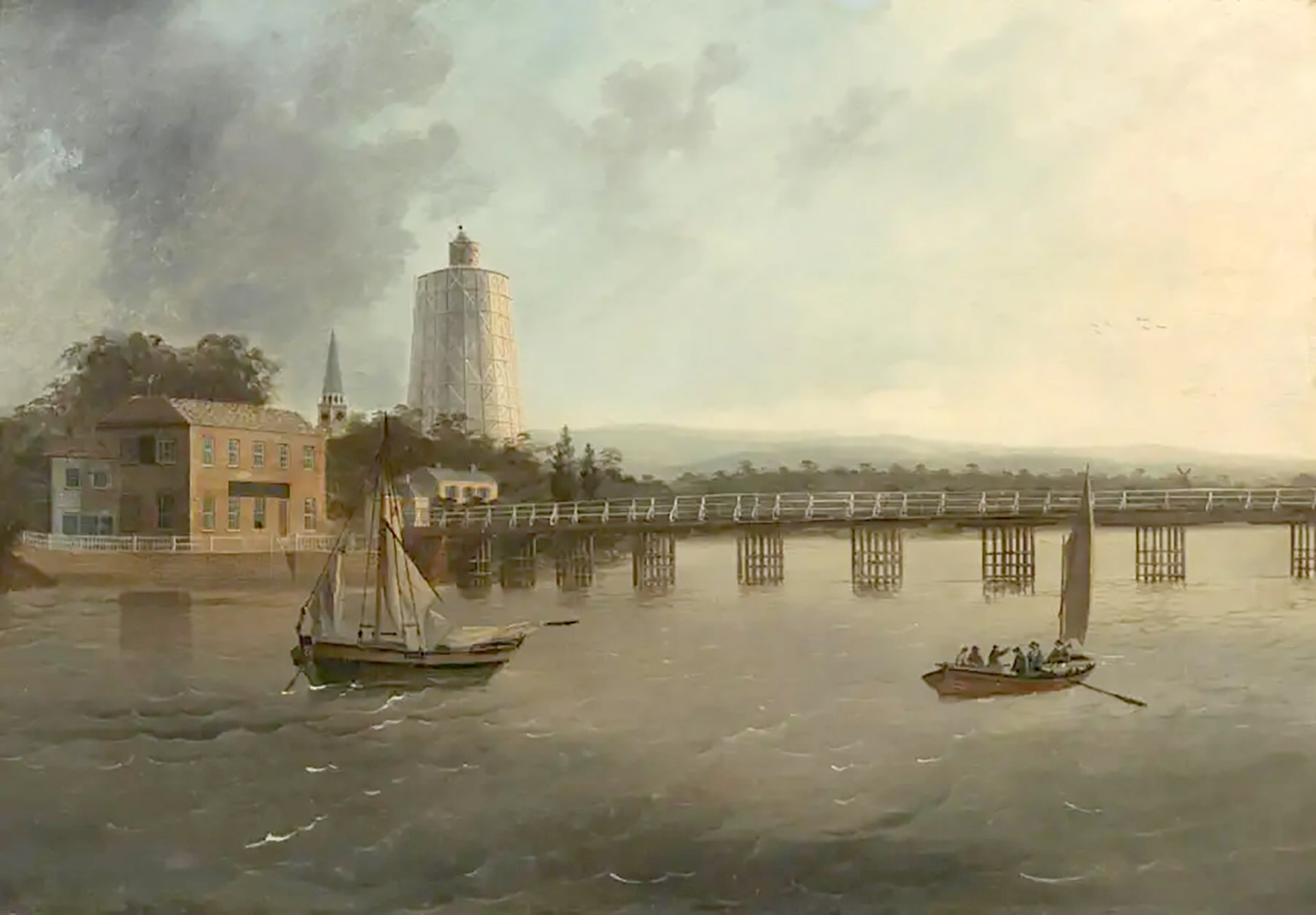
Old Battersea Bridge, c1805, with St Mary's Church and Malt Mill, by Daniel Turner. (Tate Gallery: T14891.)
— Wikipedia: Battersea Bridge
— Jeanne Rathbone: Industrial Battersea Riverside Walk
Doubtless there are many links but one which intrigues me is the late‑Victorian/Edwardian illustrator Hugh Thomson, who almost-single-handedly established the now universally recognisable "Look" of Georgian England.
Hugh Thomson, who lived at 8 Patten Road in the "Toast Rack", illustrated all of Jane Austen's novels, but also many semi-contemporary works such as Mary Russell Mitford's Our Village, Elizabeth Gaskell's Cranford, and later retro works set around 1800, notably J.M Barrie's Quality Street. This is the gorgeous aesthetic embodied in BBC TV's innumerable adaptations.
Here is his exquisite cover design for Jane's most famous work, known (unsurprisingly) as the "Peacock edition" of 1894:
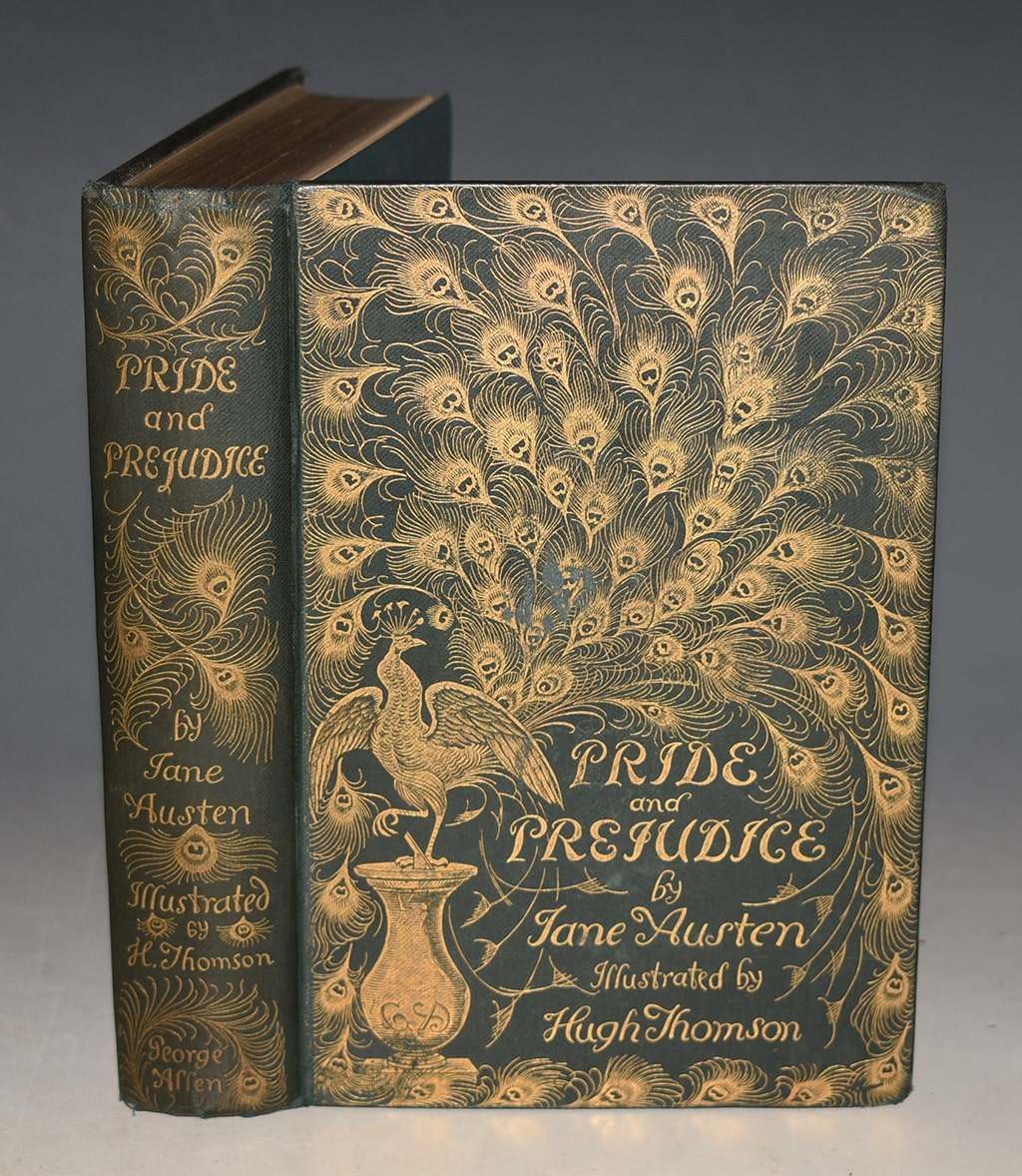
Pride and Prejudice, illustrations and cover design for publisher George Allen by Hugh Thomson. The peacock is standing on a sundial, admiring his own tail-feathers. Copies of the first edition now sell for up to £7,500.
Hugh Thomson preferred line illustration, though sometimes tints were added:
Hugh Thomson loved drawing horses and carriages. Here's one of many:
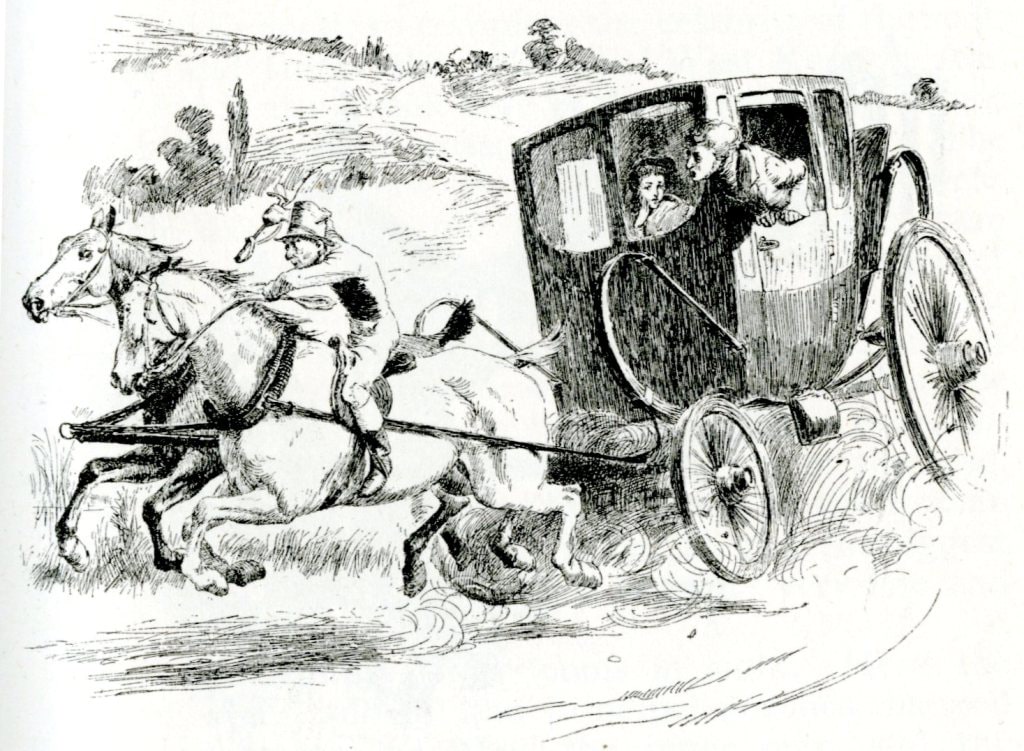
"Eloped", from a novel I have yet to identify. (Though it would fit Lydia and Wickham's escape to London in P&P.)
Other books Hugh Thomson illustrated with a similar look, but now in stunning full-colour, include J.M. Barrie's Quality Street: A Comedy in Four Acts (1901):
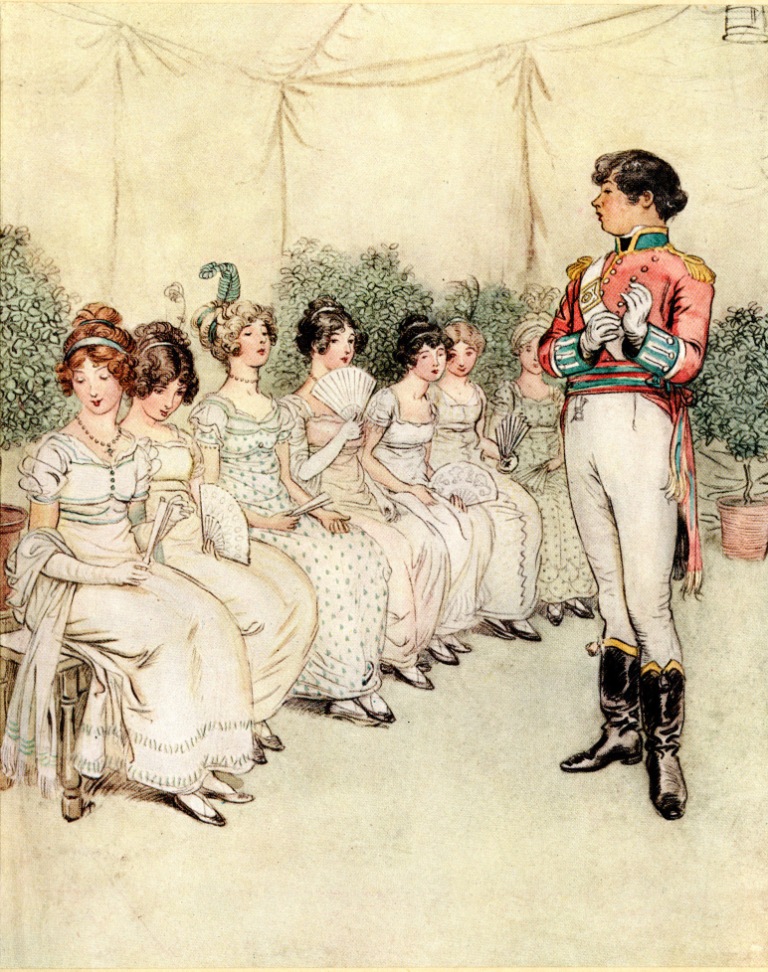
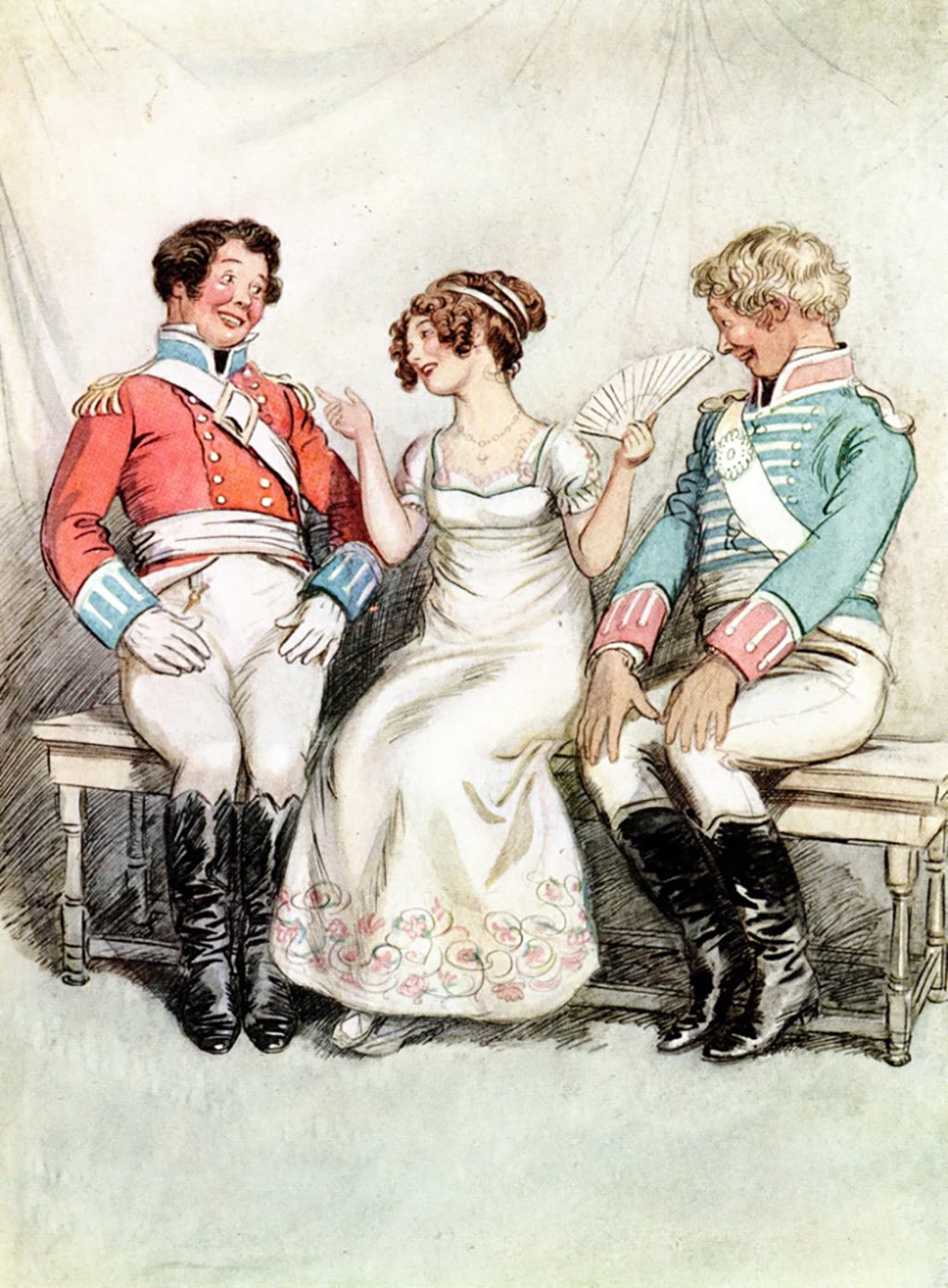

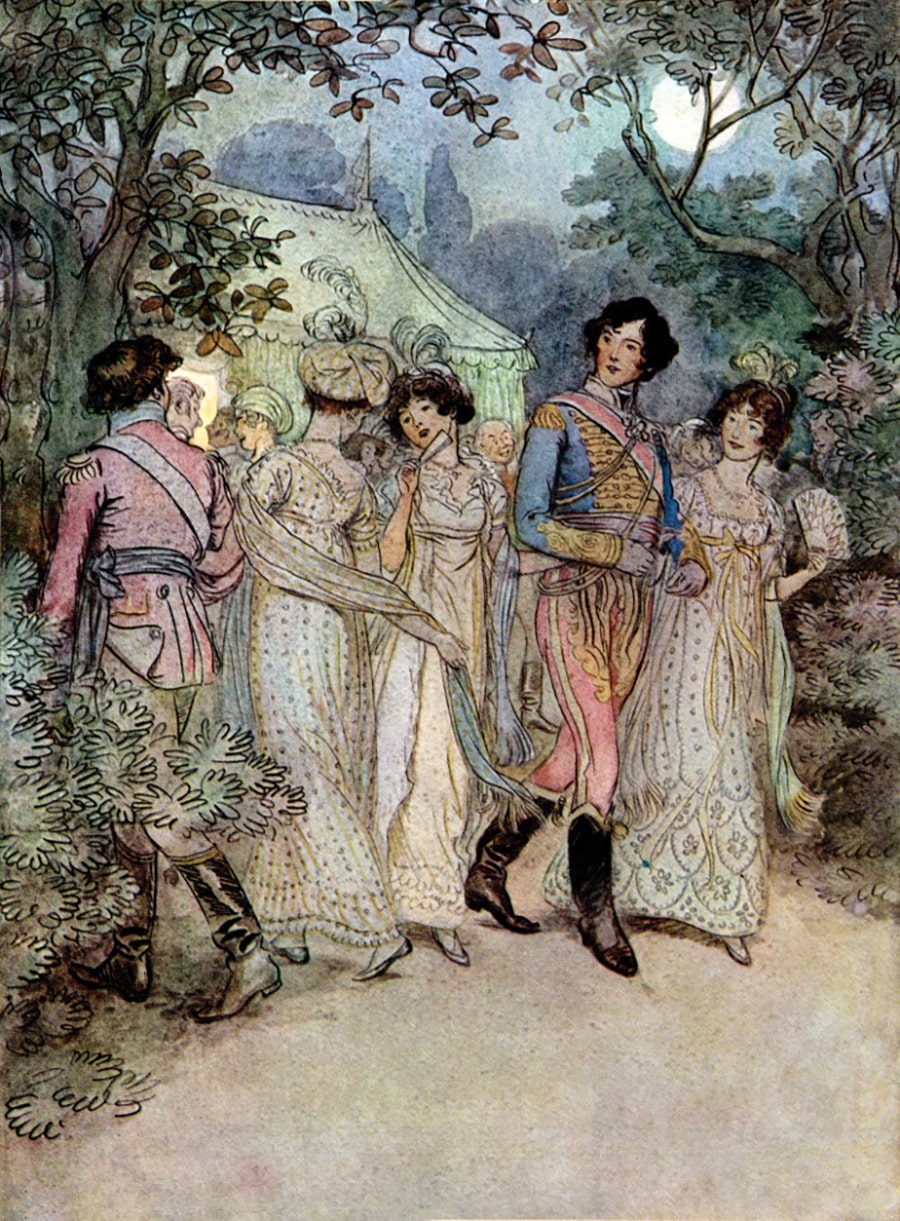
Hugh Thomson: a small selection of his many wonderful illustrations to Quality Street (1901)
And yes, the name and look of the original Mackintosh's boxes of toffees and chocolates (1936 onwards), once widely bought at Christmas, were lifted from Hugh Thomson's visual treatment of this popular play:
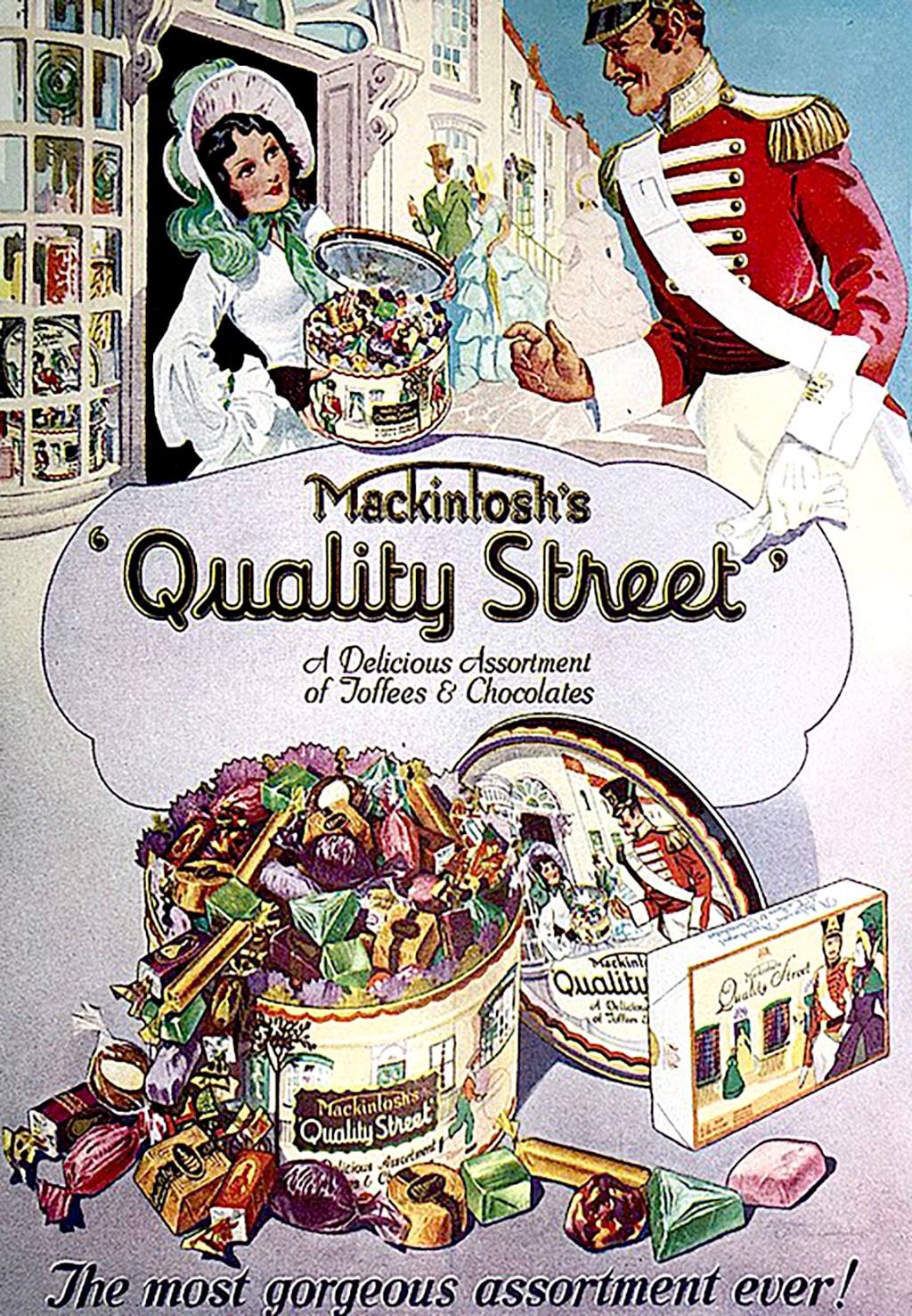
Advert for Macintosh's "Quality Street" toffees and chocolates (1930s) featuring "Major Quality" and "Miss Sweetly", based on the characters Captain Valentine Brown and Phoebe Throssel in J.M. Barrie's 1901 play.
Hugh Thomson lived at 8 Patten Road:
And here's the Patten Road he knew in the early twentieth century:
Continuing with our Christmas theme, here's a small drawing Hugh Thomson sent out in 1899:
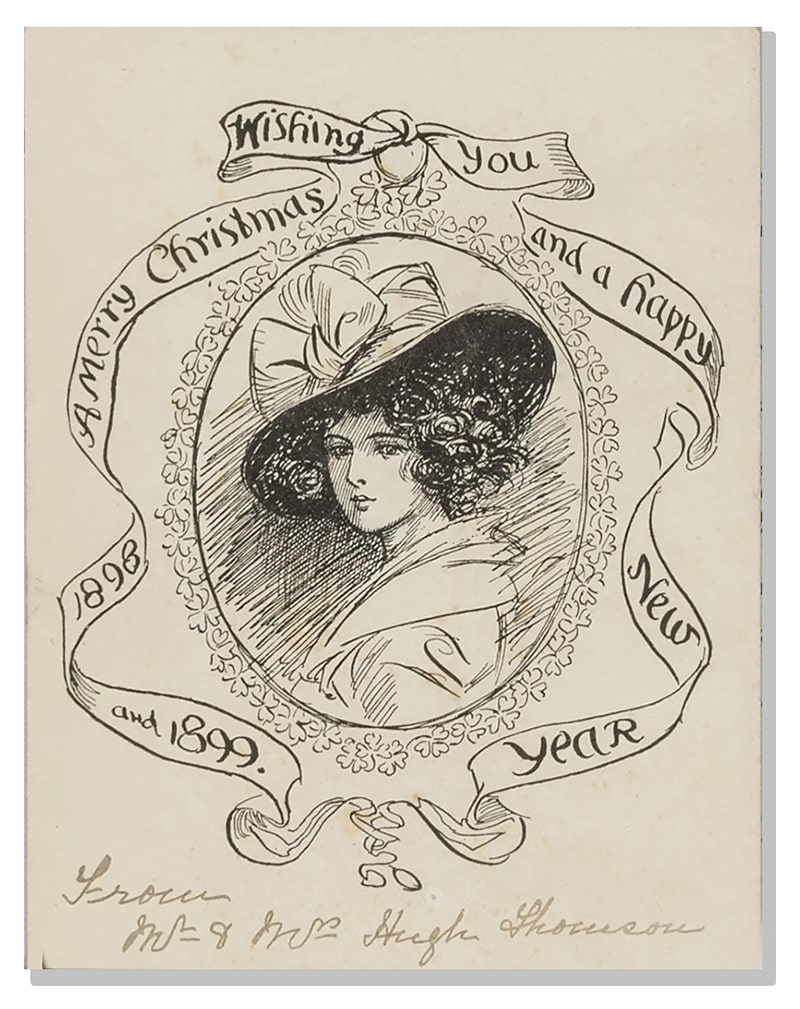
Hugh Thomson: "Wishing you a merry Christmas and a happy New Year, 1899-1900", sent from 8 Patten Road.
I've had to leave out a lot of news, views and comments that have come in while I've been working (rather obsessively) on this month's Chronicles. So, as an experiment, I'm adding an extra page — Chronicles December 2025 Part Two.
For example, readers may wish to bid for a remarkable collection of photographs from the early 1850s by Hugh Welch Diamond, once the "Superintendent of Women" at the Surrey Pauper Lunatic Asylum (later Springfield Hospital). These are coming up for auction at Christie's on 10 December 2025. The estimate is £100,000—£200,000. Good luck, I hope you win. If you're successful, invite me round to see them.
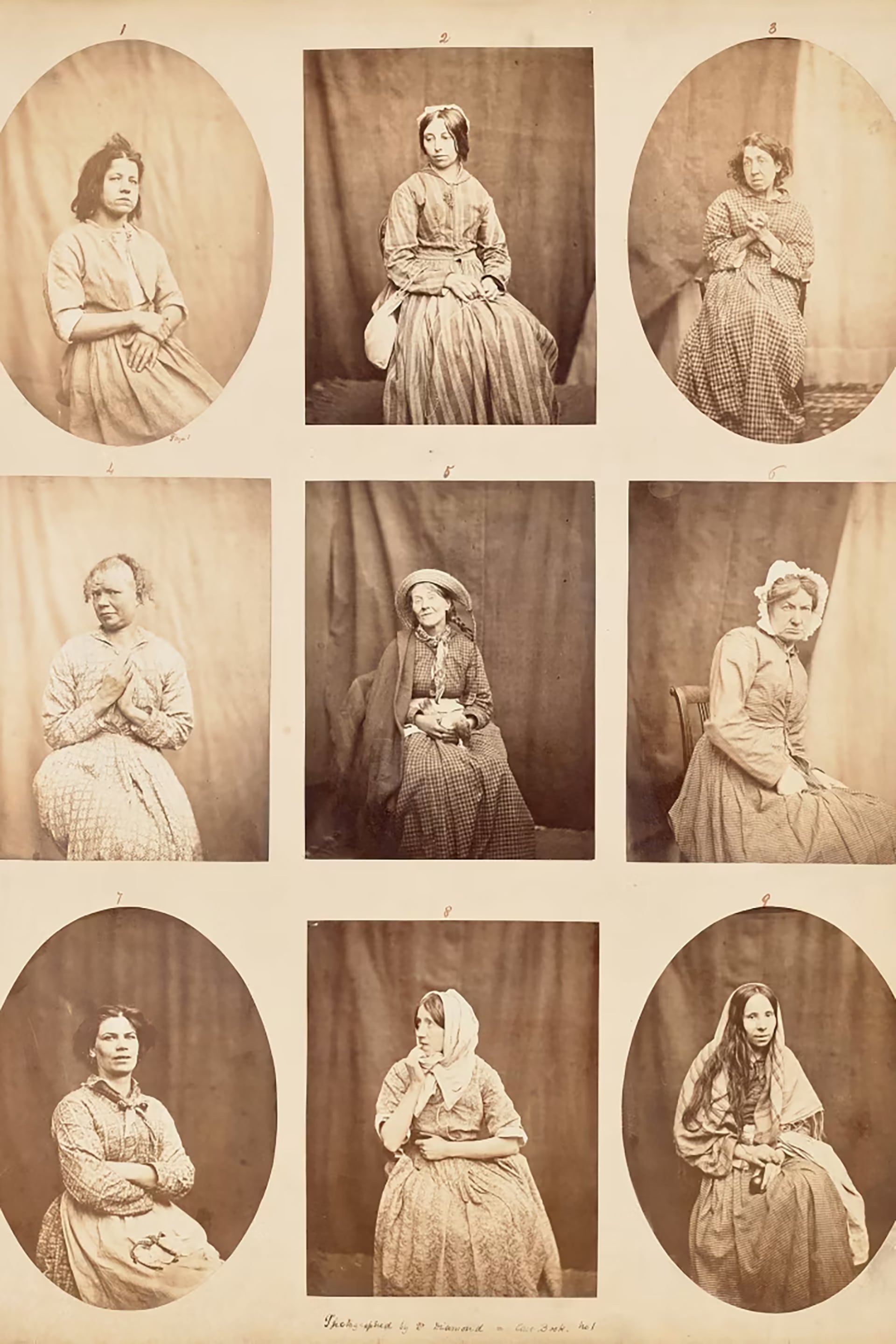
Click on the image to visit Chronicles December 2025 Part Two, an extra page of news and notes about the history of Wandsworth Common.
SO many more stories still to tell. But that's all for now, folks.
Send me an email if you enjoyed this post / want to comment on something you've seen on the site / would like to know more — or just want to be kept in touch.
If you would like to receive notifications of new Chronicles, let me know . . .
Philip Boys ("History Boys")
December 2025
— Friends of Wandsworth Common
— Wandsworth Historical Society
