p. 207This chapter considers development by organisations and institutions. With the exception of Type 7, however, they all belong to the private sector, and are in reality merely larger entities applying the same methods of estate creation and building as the individuals examined in Chapters 8-10/12. The only exception is the Artizans’ Dwellings Co., whose Shaftesbury Park was built by direct labour, and is the only uniform estate in Battersea in terms of style. The freehold land companies had their origin in schemes to create votes, but once the plots had been sold, building took place in the usual way, albeit even more heterogeneous in appearance because of the large number of small ownerships created. The only way in which these estates differ from the norm is in their size – 7% of estates but 12% of houses.
Type 7 – Municipal Estates
In 1889, Battersea was separated from the Wandsworth District as a Metropolitan Vestry. Like the contemporary L.C.C., it favoured municipal enterprise, for example electricity generation and housing. The Vestry used powers under the Housing of the Working Classes Act 1890 to build some maisonettes behind the new Town Hall in 1898. Some smaller flats, specifically aimed at the lower-paid were added in 1904.1 (Town Hall Road was proposed in 1891 as an “ordinary” development by William Willcocks on behalf of the Newcastle contractor John Wilson as Cheam Road. This proposal, predating the completion of the Town Hall, came to nothing.2)
The major pre-1914 development was after Battersea became a Metropolitan Borough in 1901. Latchmere Common, latterly used as allotments, had remained parochial property, an island completely surrounded by housing. The opportunity to make an open space was lost when it was largely covered with an estate of 315 two-storey tenements in 1902-4. Schemes to build here date back to 1888, but this one had its origins in 1898-9, when plans for 354 houses and seven streets covering the entire area were prepared. One plan was entitled “Houses proposed to be built in Blocks suitable for two Families for the Artizan and Labouring Classes of Battersea”. The plan adopted left a small open space (1.75 ac.), and four new streets, with suitably radical names, were approved in June 1901.3 The grand opening, by John Burns M.P., was on 1 August 1903. The Borough Council was proud of its achievement, especially the use of direct-labour at union rates.4
These projects were small harbingers of municipal enterprise after 1919, when thousands of the houses discussed in this study were cleared as unfit, a process which lasted until the early 1980s, leaving relatively little predating 1870.
Type 8 – Freehold Land Company Estates (7 estates; 97.81 acres; 1,605 houses)
Although only 3.3% of estates, these include 9.1% of land and 6.2% of houses (average 14 acres/229 houses, density 16.41 hos./ac.). The National Freehold Land Co. (NFLC) and its successor the British Land Co. (BLC) built two each (692 houses), and the Conservative Land Society (CLS) three (913 houses). Most belong to the period 1853-69. The NFLC/BLC estates were all at the extremities of the parish (two overlapping into neighbours), more or less isolated
p. 208from contemporary activity. This reflects the cheapness of land in such locations, and also that, initially at least, they were concerned with the creation of votes through the sale of minutely-divided freehold land. It was left to the new owners to decided how and when to build, and although road layouts were always provided by the company, building styles were notably heterogeneous, despite the conditions in the prospectuses as to type and value of property. The National Industrial Land and Lands Allotment Companies had only 180 houses between them.
The NFLC’s Clapham Station estate belonged to Charles Norris in 1839 (TA 240/2). He sold out to Thomas Morland of Reigate and Conrad Wilkinson of Croydon for the Company in July 1853.5 The lots were only nine-foot wide, the vote-creating principle being the driving force. They were randomly grouped to form house-plots, mostly for detached or semi-detached houses. Lots 21-25 became 29 Spencer Road, a 45ft. plot bought by Susannah Thompson, a Ramsgate widow, in September 1853 for £150. The timing was misjudged, since building was heading for a severe recession. Lots 189-191 (18 Elsynge Rd.) were not sold until Nov. 1863, to John Brooker, a Westminster dairyman, for £125. He leased them to Richard Down, a Westminster joiner (99yrs.; Christmas 1863; £6 p.a.), to build a £200 house within two years. In October 1863, Down took 16 on similar terms (£6/10/- p.a.) from William Knowles of Hackney, gent. 11 Vardens Rd. was built in 1871, and was let by William Smith of St. Johns Hill, gent., and William Harris, builder, to Frederick Arthur, of Elsynge Rd. (99yrs.; Michaelmas 1870; £8 p.a.)6 Unusually, the main St. Johns Hill frontage was lined with small plain terraces, many used as shops. Wandsworth Common North Side had the largest villas. The Railway Tavern overlooked the station which gave the estate its name. This, however, was replaced by Clapham Junction in 1863, giving local residents an extra half-mile walk.
In November 1853, the NFLC acquired twelve acres between Wandsworth Common and Webbs Lane (TA 340/2 pt.). Once part of the Dent estate, it was bought by Moses Hoper in 1800, passing to his daughter Elizabeth by 1839. It was assigned by Marianne Richards and her husband General Ramon de Morella to Charles Whitmore in 1850, and sold by him to the NFLC with the Countess de Morella’s consent. Lots for sale again outnumbered houses. Charles Dungate (d.1899), a Clapham grocer, bought 150-6 Northcote Road in Aug. 1855 and 83-7 Chatham Rd. He raised £290 from the associated National Permanent Mutual Benefit BS in 1855, and another £270 in 1864.7 In Aug. 1855, Abraham Edmonds, a stereotyper from Camberwell, purchased a 22ft. plot facing the Common for £70 (£1,167/ac.). The BLC sold the north-western quarter of the estate to barrister James Lord in 1866 for £2,400. Lots 100/1 (32 by 208ft.) were sold to George Evans, a Pimlico house agent for £140 in April 1866. (£914/ac.). He sold them in Jan. 1867 to Charles Webb, landlord of the Gardeners Arms nearby, for £150. Joseph Stapleton, just starting out as a builder, acquired Lots 14-16 in Nov. 1859 for £120 (£798/ac.). He built the Bolingbroke Arms beerhouse.8
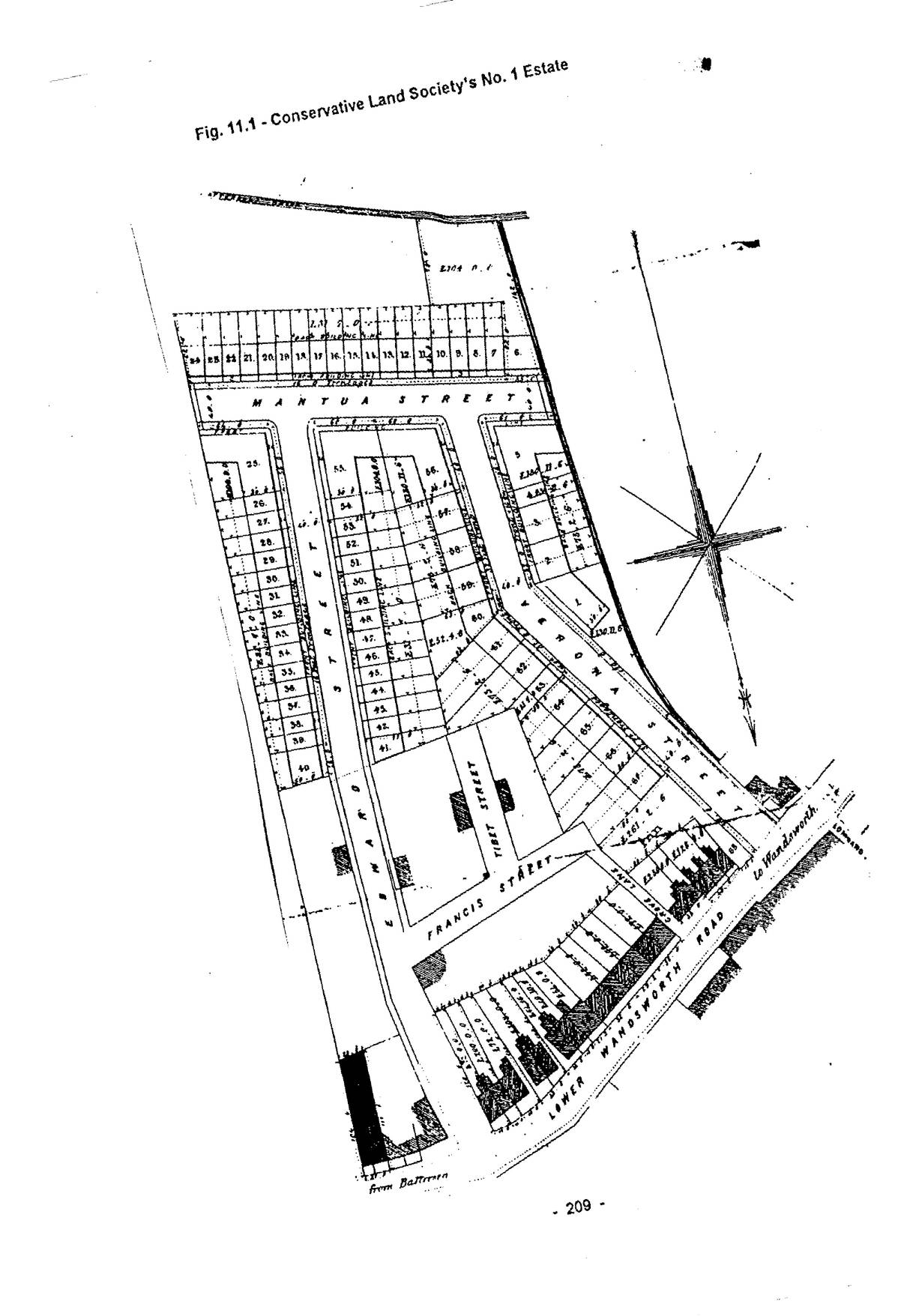
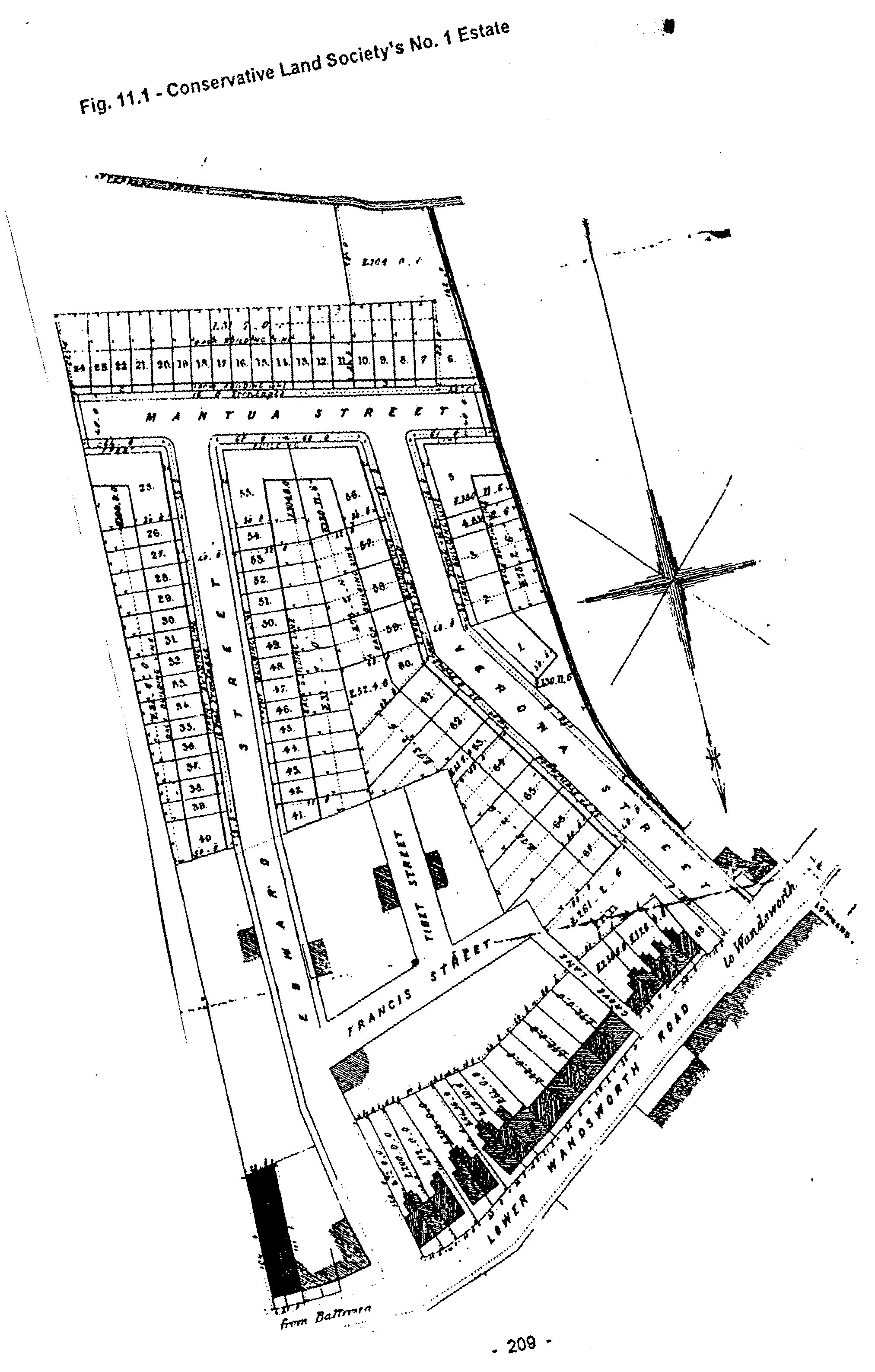
The CLS bought its first local estate from Francis Lithgow in 1857, and laid out two new streets.9 It was divided into eighty lots for sale, including the existing houses in York Road, but not those in the side streets. Prices ranged from £31/7/- for 16ft. plots in the side streets to £262 for Lot 68, an inn with a large rear plot in York Road and £130/1/6 for the triangular Lot 1 in Verona St. The total yield was £4,547/9/6 (£1,100-1,700 per acre), roundly ten times the agricultural value
Open zoomable view
p. 210a generation earlier.
| Plot | Date | Purchaser | Price |
|---|---|---|---|
| 1 | 1857 | Wm. Darbyshire, commission agent, Mayfair | 130/11/6 |
| 2 | John Hawkins, carpenter, Westminster | 73/2/6 | |
| 4 | John Dyre, grainer, Pimlico | 36/11/6 | |
| 5 | Joshua Kaley, beer retailer, Westminster | 130/11/6 | |
| 6-24 | Fred. White, brewer, Chelsea | 667/15/- | |
| 14 | Revd. Thos. Candy, Cambridge | 31/7/- | |
| 27-32 | John Waller, currier, Bermondsey | 188/2/- | |
| 33/34 | Wm. Griffin, agent, Battersea | 62/14/- | |
| 39/40 | Henry Smith, victualler, Lambeth | 62/14/- | |
| 41-44 | Wm. Haynes, engineer, Battersea | 125/8/- | |
| 47 | 1859 | Wm. Westley, carpenter, Battersea | 31/7/- |
| 48 | 1857 | Wm. Griffin, v.s. | 31/7/- |
| 51 | Henry Lidyard, plumber, Pimlico | 31/7/- | |
| 53 | 1866 | Joshua Kaley, builder, Westminster | 31/7/- |
| 54 | 1869 | Fred. Roberts, whitesmith, Pimlico | 31/7/- |
| 55 | 1862 | Henry Dean, beer retailer, Pimlico | 104/9/- |
| 58 | 1857 | Wm. Jennings, innkeeper, Alresford, Hants. | 73/2/6 |
| 59 | Robert Anslow, builder, Battersea | 62/14/- | |
| 60 | Andrew Bright, schoolmaster, Rossington, Yrks. | 52/4/6 | |
| 62 | Joseph Cooper, farmer, Lt. Milton, Oxon. | 73/2/6 | |
| 63 | Lewis Rigsley, joiner, Chelsea | 31/7/- | |
| 65 | Robert Anslow, v.s. | 73/2/6 | |
| 66/67 | John Page, builder, Lambeth | 146/5/- | |
| 69 | Charles Lewis, solicitor, Lincoln’s Inn | 126/-/- | |
| 70 | John Kissick, cemetery supt., Finchley | 230/-/- | |
| 73 | Charles Rider, gent., Southwark | 72/-/- | |
| 75/76 | John Berry, lighterman, Isleworth | 87/6/- | |
| 81 | John Mivart, gent., Camden Town | 112/10/- |
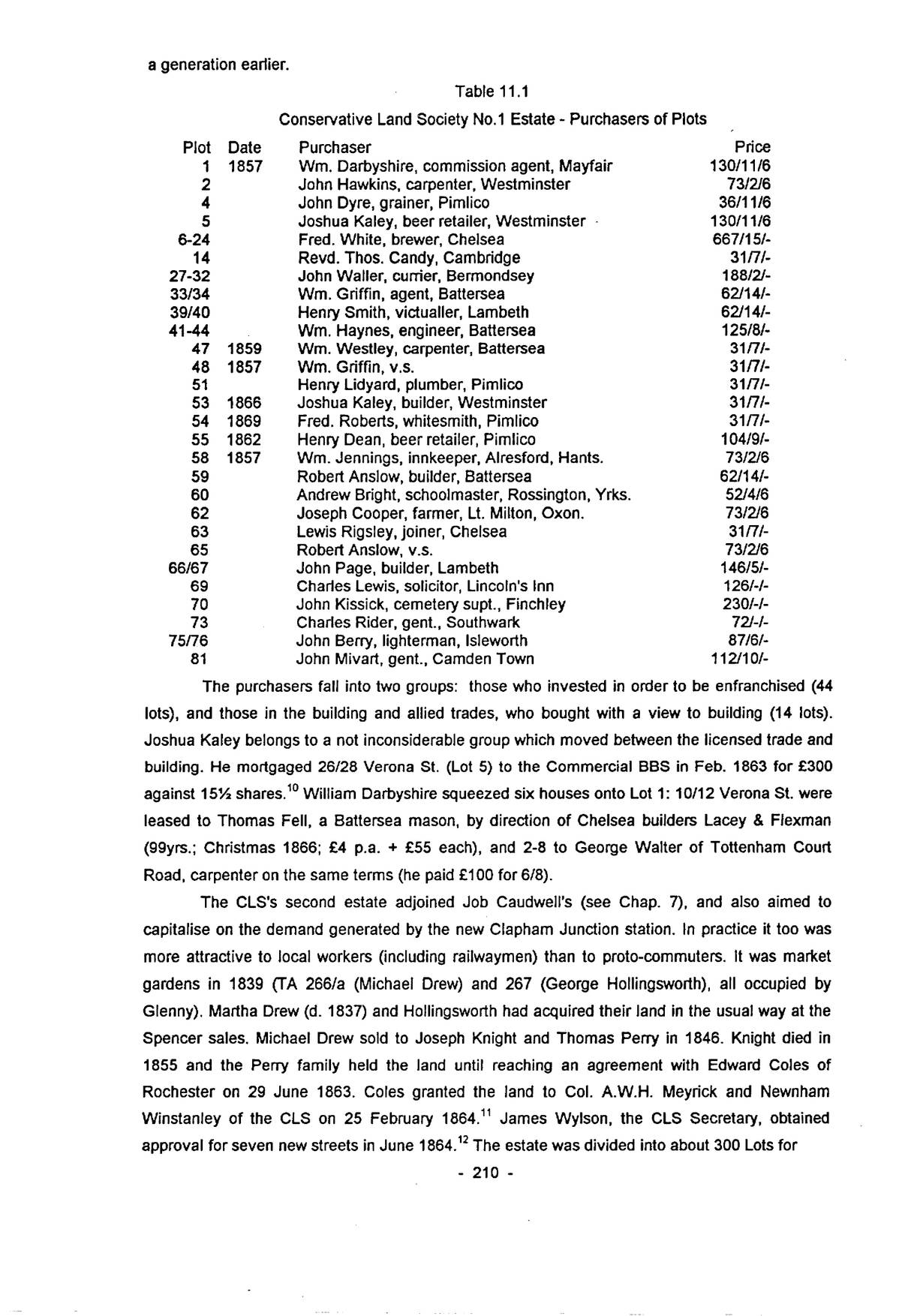
The purchasers fall into two groups: those who invested in order to be enfranchised (44 lots), and those in the building and allied trades, who bought with a view to building (14 lots). Joshua Kaley belongs to a not inconsiderable group which moved between the licensed trade and building. He mortgaged 26/28 Verona St. (Lot 5) to the Commercial BBS in Feb. 1863 for £300 against 15½ shares.10 William Darbyshire squeezed six houses onto Lot 1: 10/12 Verona St. were leased to Thomas Fell, a Battersea mason, by direction of Chelsea builders Lacey & Flexman (99yrs.; Christmas 1866; £4 p.a. + £55 each), and 2-8 to George Walter of Tottenham Court Road, carpenter on the same terms (he paid £100 for 6/8).
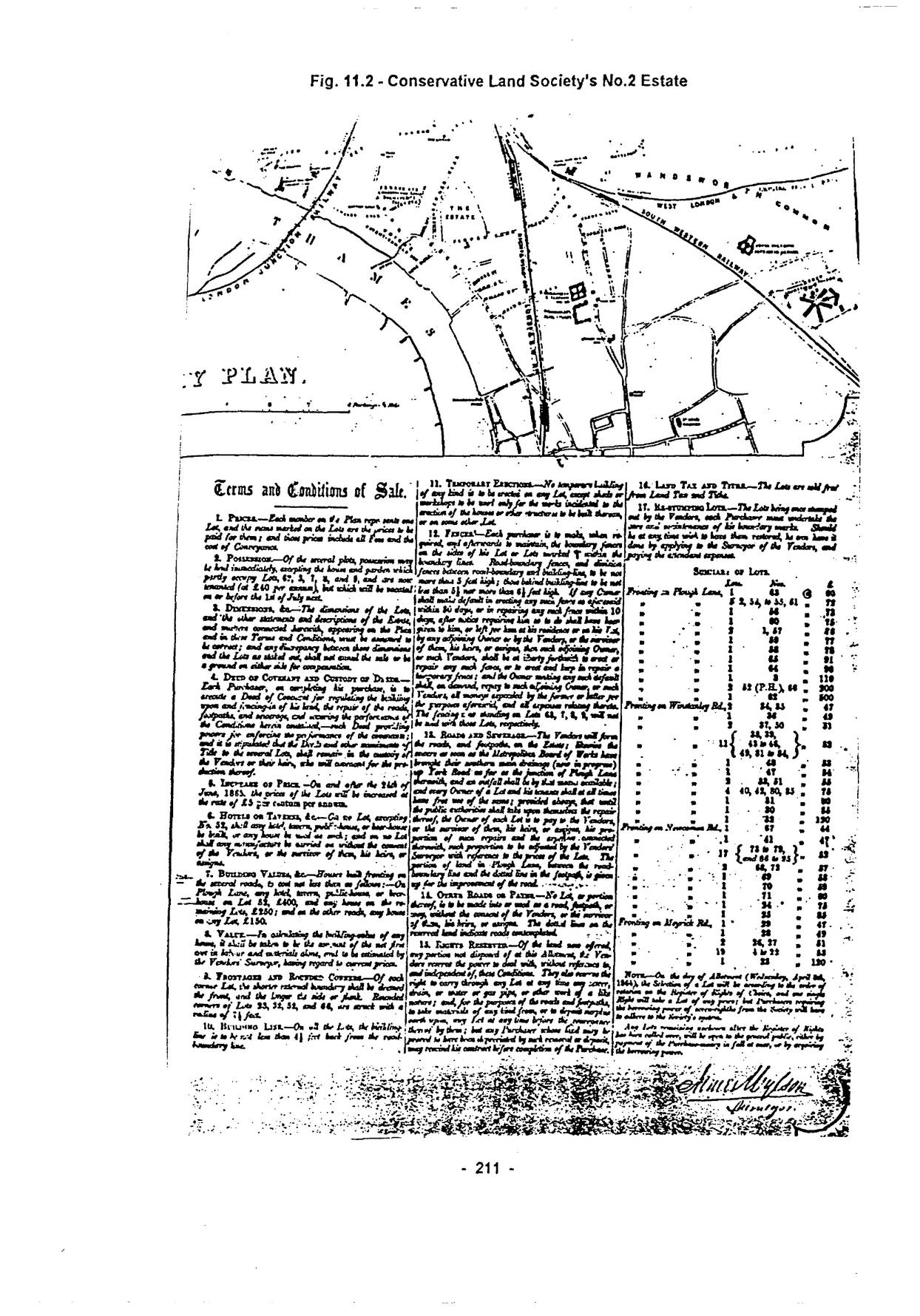
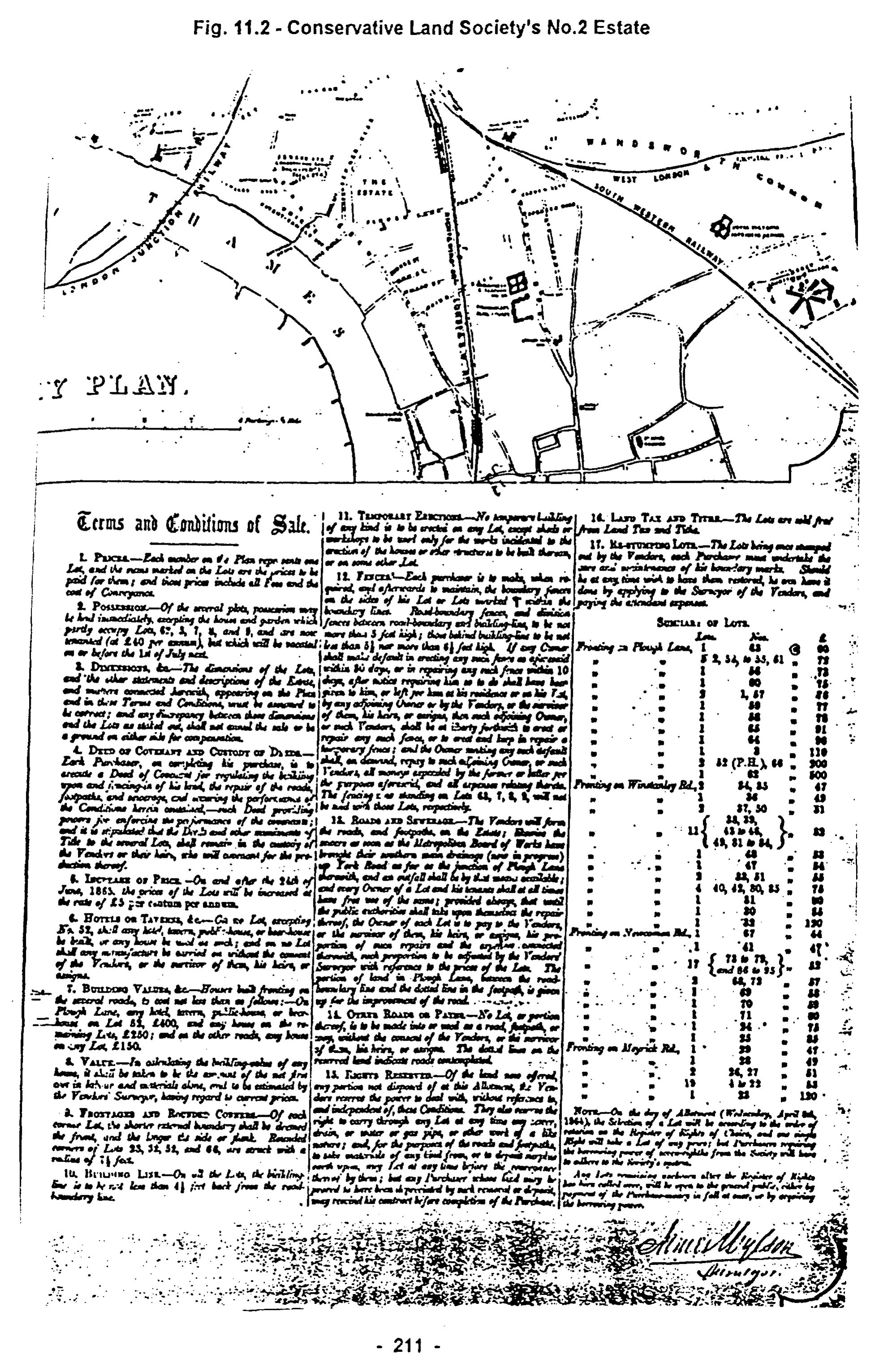
The CLS’s second estate adjoined Job Caudwell’s (see Chap. 7), and also aimed to capitalise on the demand generated by the new Clapham Junction station. In practice it too was more attractive to local workers (including railwaymen) than to proto-commuters. It was market gardens in 1839 (TA 266/a (Michael Drew) and 267 (George Hollingsworth), all occupied by Glenny). Martha Drew (d. 1837) and Hollingsworth had acquired their land in the usual way at the Spencer sales. Michael Drew sold to Joseph Knight and Thomas Perry in 1846. Knight died in 1855 and the Perry family held the land until reaching an agreement with Edward Coles of Rochester on 29 June 1863. Coles granted the land to Col. A.W.H. Meyrick and Newnham Winstanley of the CLS on 25 February 1864.11 James Wylson, the CLS Secretary, obtained approval for seven new streets in June 1864.12 The estate was divided into about 300 Lots for
Open zoomable view
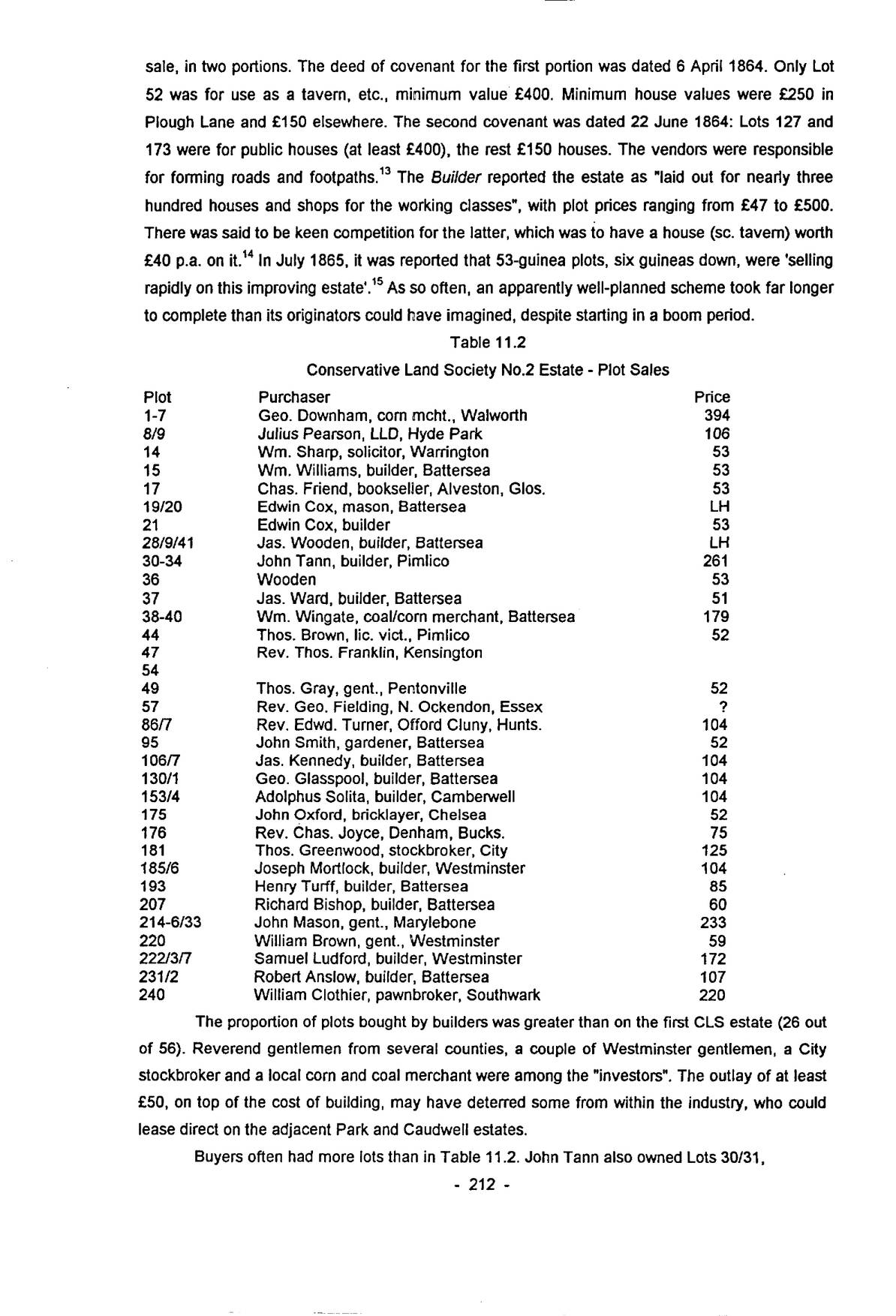
p. 212sale, in two portions. The deed of covenant for the first portion was dated 6 April 1864. Only Lot 52 was for use as a tavern, etc., minimum value £400. Minimum house values were £250 in Plough Lane and £150 elsewhere. The second covenant was dated 22 June 1864: Lots 127 and 173 were for public houses (at least £400), the rest £150 houses. The vendors were responsible for forming roads and footpaths.13 The Builder reported the estate as “laid out for nearly three hundred houses and shops for the working classes”, with plot prices ranging from £47 to £500. There was said to be keen competition for the latter, which was to have a house (sc. tavern) worth £40 p.a. on it.14 In July 1865, it was reported that 53-guinea plots, six guineas down, were ‘selling rapidly on this improving estate’.15 As so often, an apparently well-planned scheme took far longer to complete than its originators could have imagined, despite starting in a boom period.
| Plot | Purchaser | Price |
|---|---|---|
| 1-7 | Geo. Downham, corn mcht., Walworth | 394 |
| 8/9 | Julius Pearson, LLD, Hyde Park | 106 |
| 14 | Wm. Sharp, solicitor, Warrington | 53 |
| 15 | Wm. Williams, builder, Battersea | 53 |
| 17 | Chas. Friend, bookseller, Alveston, Glos. | 53 |
| 19/20 | Edwin Cox, mason, Battersea | LH |
| 21 | Edwin Cox, builder | 53 |
| 28/9/41 | Jas. Wooden, builder, Battersea | LH |
| 30-34 | John Tann, builder, Pimlico | 261 |
| 36 | Wooden | 53 |
| 37 | Jas. Ward, builder, Battersea | 51 |
| 38-40 | Wm. Wingate, coal/corn merchant, Battersea | 179 |
| 44 | Thos. Brown, lic. vict., Pimlico | 52 |
| 47 | Rev. Thos. Franklin, Kensington | |
| 54 | ||
| 49 | Thos. Gray, gent., Pentonville | 52 |
| 57 | Rev. Geo. Fielding, N. Ockendon, Essex | ? |
| 86/7 | Rev. Edwd. Turner, Offord Cluny, Hunts. | 104 |
| 95 | John Smith, gardener, Battersea | 52 |
| 106/7 | Jas. Kennedy, builder, Battersea | 104 |
| 130/1 | Geo. Glasspool, builder, Battersea | 104 |
| 153/4 | Adolphus Solita, builder, Camberwell | 104 |
| 175 | John Oxford, bricklayer, Chelsea | 52 |
| 176 | Rev. Chas. Joyce, Denham, Bucks. | 75 |
| 181 | Thos. Greenwood, stockbroker, City | 125 |
| 185/6 | Joseph Mortlock, builder, Westminster | 104 |
| 193 | Henry Turff, builder, Battersea | 85 |
| 207 | Richard Bishop, builder, Battersea | 60 |
| 214-6/33 | John Mason, gent., Marylebone | 233 |
| 220 | William Brown, gent., Westminster | 59 |
| 222/3/7 | Samuel Ludford, builder, Westminster | 172 |
| 231/2 | Robert Anslow, builder, Battersea | 107 |
| 240 | William Clothier, pawnbroker, Southwark | 220 |
The proportion of plots bought by builders was greater than on the first CLS estate (26 out of 56). Reverend gentlemen from several counties, a couple of Westminster gentlemen, a City stockbroker and a local corn and coal merchant were among the “investors”. The outlay of at least £50, on top of the cost of building, may have deterred some from within the industry, who could lease direct on the adjacent Park and Caudwell estates.
Buyers often had more lots than in Table 11.2. John Tann also owned Lots 30/31,
p. 213conveyed by him and his mortgagors, two cabinet makers in Tottenham Court Road, for £360 to Joseph Porter, engineer of Meyrick Rd., in August 1874.16 George Downham leased 182-92 Meyrick Rd. to James Kennedy in April 1869 (80yrs.; Mich. 1868; £5 p.a.) and 1-5 Plough Lane to William Gibbs. In May 1869, Downham raised £800 on 5 Plough Lane from Harriot Dixon.17 William Wingate leased 102/4 Winstanley Road to Edmund Baker of Chelsea four years after purchase (Sept. 1869 – 99 yrs.; Christmas 1868; £4/10/-). Baker thereupon raised £350 from the Conservative Benefit BS. In Nov. 1877, Wingate sold the plots to Charles Shepherd, gent., for £180, making a profit equivalent to £6/10/- a year.18
The Revd. Turner sold his two lots, still vacant, to John Hawkins of Chelsea for £130 in April 1867. They remained thus for 14 more years, before being leased to William Piper, builder, in Aug. 1881 (80yrs.; Christmas 1880; £6 p.a.) by Henry Bool, photographer, of Chelsea and his wife Ellen, Hawkins’ daughter.19 John Oxford, bricklayer turned builder, rapidly capitalised on his £52 investment by leasing the house to Robert Seaman, a Chelsea ironmonger on 27 Feb. 1869 (99yrs.; Christmas 1868; £5 p.a. + £275). Seaman raised £200 from the Wilts. & Western BBS over 14 years, followed by a further £100 in Aug. 1881 and £200 from a Billingsgate fishmonger in 1885. Oxford’s involvement ended in July 1871, when he sold the freehold to J.C. Fowler, a Chelsea builder for £100.20
The CLS was prepared to lease direct to builders, such as James Wooden. Edwin Cox leased 156/8 Meyrick Rd. (Lots 19/20) in October 1869 (99yrs.; Mid-1869; £4 p.a.), and mortgaged them to the Conservative BBS for £390. The lease and goodwill of the Duke of Wellington in Meyrick Rd. were sold in 1872 (90 years; May 1869; £50 p.a.), including a clubroom for 250, stables and a large quoit ground.21 18/19 Knox Rd., three-bedroomed houses with parlours, bay windows, kitchen and wash house, renting at 8/- p.w. (‘but worth 12/-‘) were sold in August 1878.22
The third CLS estate was on the same lines as its predecessor. In 1839, the land belonged to Henry Willis (TA 328-334). It was sold to Henry Wheeler in Jan. 1859, and by him to the CLS on 11 March 1868.23 Seven new streets were approved in 1869.24 The Second Reform Act (1867) removed much of the original raison d’être of the freehold land companies, and by June 1869 the CLS had become the United Land Society. The vendors were now Newnham Winstanley and James Goodson, M.P. No lots were allocated for public houses or manufacturing, and values were to be at least £750 (Bolingbroke Grove); £400 (Northcote Rd.) or £350 (other streets).25 The standard price for plots in the latter was £69-71 (18ft. frontage). In May 1868, the CLS advertised its new estate in the local press ‘4½ miles from the General Post Office’.26 The first portion was 113 plots fronting five new streets, ‘subscriptions are being raised for the erection of a church nearby (St. Michael, Chatham Rd. or St. Mark, Battersea Rise27); water and gas are laid on in the main roads... plans (6d) and instructions from the Secretary, Charles Gruneisen, 33 Norfolk St., Strand’.
Alfred Heaver and his partner Edward Coates, purchased Lots 447-451 (3-11 Salcott Rd.) in Oct./Nov. 1869. They mortgaged Lots 449-51 to the Conservative BBS for £1,125. Some lots were leased directly by the ULC: 452/3 to John Dickeson in Oct. 1872 (99yrs.; Michaelmas 1872; £5 p.a.), mortgaged to the CBBS for £480. The plots were sold in Dec. 1872 to Revd. W.C. Moore
p. 214of Devon and Henry Moore of the Strand, for £200. A further 180 plots were sold in October 1872.28 The estate was extended in 1875, with two new streets and an extension of Northcote Rd. to designs by John Ashdown, the ULC’s Surveyor & Secretary. There were 71 lots – of which 16 were immediately sold to the SBL for Honeywell Rd. schools.29 In March 1875, an auction was held of leasehold and freehold houses and freehold plots, the residue of the ULC estate fronting Northcote, Mallinson, Bennerley and Salcott Roads. Houses could be purchased for 10% down, with the balance payable monthly or quarterly.30
| Lot | Purchaser | Price |
|---|---|---|
| 70 | Henry Clark, Battersea | 71 |
| 77 | Henry Smith, gent., Strand | 71 |
| 78 | John Graves, builder, Clapham | 71 |
| 87 | Charles Crustra, Gt. Leighton, Essex | 71 |
| 89 | John Mann, builder, Battersea | 71 |
| 92 | Samuel Steel, pattern maker, Battersea | 71 |
| 94 | John Murray, builder, Battersea | 71 |
| 106 | Edward Heaver, builder, Brixton | 71 |
| 177 | William Pether, engineer, Battersea | 70 |
| 201 | Samuel Gifford, architect, Battersea | 70 |
| 215 | Stephen Vatcher, gent., Clapham Com. | 73 |
| 266 | Charles Longworth, builder, Battersea | 73 |
| 438 | William Haynes, gent., Battersea | – |
| 447-51 | Heaver & Coates, builders | 345 |
| 452-3 | John Dickeson, builder, Battersea | LH |
| 463 | David Kettle, builder, Battersea | 110 |
| 512 | Revd. James Back, Ealing | – |
| 581 | Alfred Heaver, builder, Battersea | 70 |
| 632 | Henry Bragg, builder, Stockwell | 82 |
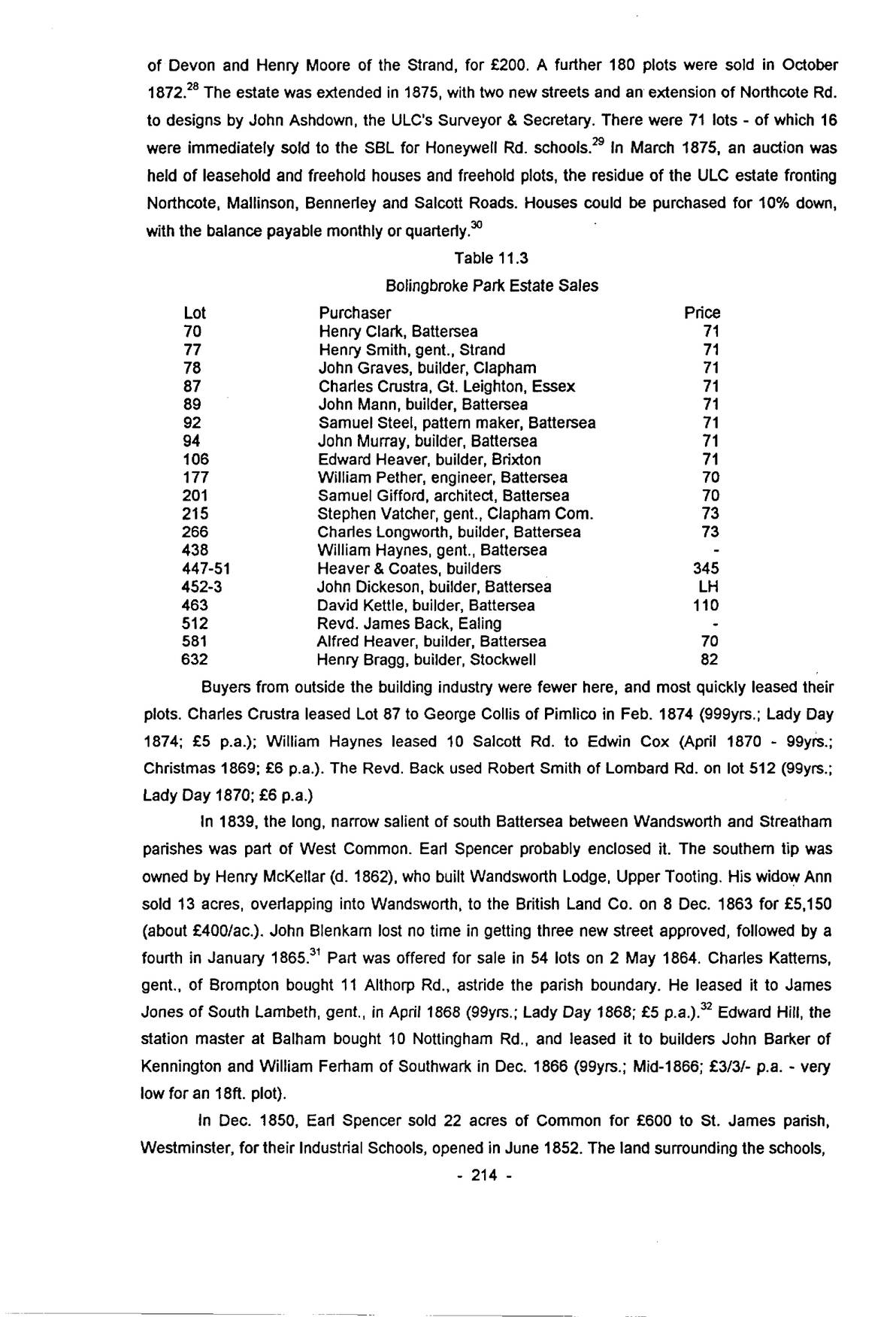
Buyers from outside the building industry were fewer here, and most quickly leased their plots. Charles Crustra leased Lot 87 to George Collis of Pimlico in Feb. 1874 (999yrs.; Lady Day 1874; £5 p.a.); William Haynes leased 10 Salcott Rd. to Edwin Cox (April 1870 – 99yrs.; Christmas 1869; £6 p.a.). The Revd. Back used Robert Smith of Lombard Rd. on lot 512 (99yrs.; Lady Day 1870; £6 p.a.)
In 1839, the long, narrow salient of south Battersea between Wandsworth and Streatham parishes was part of West Common. Earl Spencer probably enclosed it. The southern tip was owned by Henry McKellar (d. 1862), who built Wandsworth Lodge, Upper Tooting. His widow Ann sold 13 acres, overlapping into Wandsworth, to the British Land Co. on 8 Dec. 1863 for £5,150 (about £400/ac.). John Blenkarn lost no time in getting three new street approved, followed by a fourth in January 1865.31 Part was offered for sale in 54 lots on 2 May 1864. Charles Katterns, gent., of Brompton bought 11 Althorp Rd., astride the parish boundary. He leased it to James Jones of South Lambeth, gent., in April 1868 (99yrs.; Lady Day 1868; £5 p.a.).32 Edward Hill, the station master at Balham bought 10 Nottingham Rd., and leased it to builders John Barker of Kennington and William Ferham of Southwark in Dec. 1866 (99yrs.; Mid-1866; £3/3/- p.a. – very low for an 18ft. plot).
In Dec. 1850, Earl Spencer sold 22 acres of Common for £600 to St. James parish, Westminster, for their Industrial Schools, opened in June 1852. The land surrounding the schools,
p. 215about 14½ acres, overlapping into Streatham, was sold by auction on 13 March 1878, the BLC paying £14,500.33 Henry Mitchell, surveyor, laid out three new streets, plus two in 1880.34 He auctioned 92 lots (out of 206) on 24 May 1880, the minimum value of houses was to be £350.35
Type 9 – Industrial Dwellings and Other Companies (5 estates; 47.78 ac.; 1,647 hos.)
Apart from Shaftesbury Park (74% of the houses and 80% of the land), this type is not significant in Battersea. Four of the five commenced between 1873 and 1882. Victoria Dwellings (1877) is the only representative of the barrack-like blocks which are more typical of the City and inner suburbs.36
The National Industrial Land Co. of New Bridge St., Blackfriars, was first, with the Olney Lodge estate (1867). It belonged to William Carter, senior, in 1839 (TA 227/8), but had not been included in his family’s own developments. The plans were by J.R. Gover, a City surveyor. Four new streets were approved in September 1867.37 Leases were for 99 years from Midsummer 1867, ground rents £4 for 15-16ft. plots.
John Lamb, lessee of at least ten houses on the estate, was a member of the 77th. Starr Bowkett BBS, and mortgaged 1-7 Stockwood St. for £600 in April 1868. In May 1868, Joseph Porter, engineer, paid £435 (£145 each) for 30-34 Benham St. Eight shops (2-7, 9/10 Olney Terrace) were sold in Sept. 1874 by Charles Woodroffe of Blackfriars on behalf of the Company; 6 & 7 were resold in May 1875 for £280.38
The Artizans’ & General Labourers’ Dwellings Co. was founded in January 1867 by William Austin (b.1804), and built its first houses in Battersea in that year, on Charles Lee’s Rollo St. estate.39 Their first large scheme for cottage properties for skilled artisans and clerks, but hardly general labourers, was also local. More than 1,200 houses – but no licensed premises – were built between 1873 and 1877, mostly by direct labour, making the AGLDC the largest “builder” of all. The estate and its layout did not, however, originate with them, but was a product of the 1860s. The area had been in various hands in 1839. Earl Spencer had 35 acres of market gardens, all occupied by Samuel Poupart (TA 674-8/80/85). Spencer never sold this land, which was laid out for building by George Todd, in 1867-8. The so-called Parkfield Estate had 13 streets, broadly on the lines of the later AGLDC estate, approved in May and October 1868.40
By early 1871, barrister James Lord had bought the estate, and had new plans drawn up by Earl Spencer’s local agents, Beeston, Son & Brereton, which were amended later that year, still using the 1868 names. The estate was now called, with typical disregard of geography, Clapham New Town.41 Tenders were invited for constructing the roads and sewers,42 but 1871 was not a good year for getting builders and investors interested in a 38-acre estate remote from the nearest station. Lord was no doubt grateful to sell to the Artizans’ Co. in 1872. They got approval for a new batch of names in Jan. 1874, after building had actually begun.43 The plans and elevations of the various houses and institutional buildings were by the company architect, Robert Austin of Westminster, and generally partook of a Gothic style, with certain corner houses having towers and turrets to relieve the monotony of long terraces. The facades were enhanced by the projecting canopies with the company monogram and the date (only 1873 and 1874 were used, although houses were built down to 1877).44
p. 216The first stone of their first scheme but by the end of two years the paid-up capital was less than £2,000, although £250,000 had been authorised. The Earl of Shaftesbury and Lords Lichfield and Elcho were associated from the early days of the Company.45 The Artizans’ did not confine their activities to London, and by 1874 had estates in Liverpool, Gosport, Salford, Leeds and Birmingham. In 1871 the dividend was a very healthy 7½%, paid-up capital £18,580. The policy of building for sale, highly unusual at the time, was related to the need to raise money, not merely to the creation of a new class of owner-occupiers. Austin was ousted as Chairman in 1870 and replaced by Dr. J. B. Langley.46
The Company paid £28,000 for its principal Battersea estate, about £735/acre, not excessive given that the area was ripe for development. The local paper hailed the “Workmen’s City at Wandsworth (sic)” when Lord Shaftesbury laid the memorial stone on 8 August 1872.47 The Company report for 1872 said that ‘it is proposed to erect on this estate 1,200 houses suited respectively for clerks, artisans and labourers, in addition to a lecture-hall, co-operative store, school rooms, baths, wash-houses, etc. A reservation of three acres is allotted for recreation and pleasure grounds. The plans... should be consulted by all desirous of purchasing or renting... due attention has been bestowed on the sanitary arrangements... the Directors regard a healthy house as the cheapest... (and) strict attention has been paid to secure dry and well roofed habitations, with a simple plan of ventilation supplying fresh air to every room. Having regard to economy in cooking and fuel, and seeing the present enormous price of coal... (they) are considering what appliances can be obtained with the least consumption of fuel’.48
In 1873, it was reported that a temporary Lecture Hall, seating 800, had been built, and a Working Men’s Institute, ‘self-supporting lectures, concerts, penny readings, etc.’ had taken place. The School Board was using the hall pending construction of its school in Holden St. The Company had its own workshops and sawmills. Each house was a separate tenancy, and also for sale. The co-operative stores, recreation ground and permanent hall were never built. The greatest might-have-been, however, was the planned station on the LCDR, whose Clapham Junction-Brixton-Ludgate Hill line formed the northern edge of the estate. It would have taken the massed ranks of “clerks, as well as artizans” to work. Despite many attempts to goad the railway into action nothing happened. In January 1876, a memorial to the LCDR revealed that the Artizans’ Co. had originally undertaken to build the station at their own cost and to guarantee £500 in fares in the first year. No reason is given for the change of heart, but it may not be unrelated to the fraud involving the Secretary, Mr. Swindlehurst, and others, which was revealed in 1877.49 This fraud led the company to increase rents twice in 1877 and to build houses on the space reserved for the recreation ground. Not until the trams arrived on Lavender Hill in 1881-2, providing frequent and cheap services to Southwark and Westminster, did public transport become adequate. There was not even good access on foot to Clapham Junction, nor, until 1879, to Queens Road (LSWR) and Battersea Park (LBSCR) stations.
By February, 1873, some of the better class houses had been completed, and contracts entered into for 300 more, with roads and services. It was hoped to have them finished by August/September, which was duly achieved (479 houses in the first twelve months), with a great demand reported.50 A report in November says that the LCDR station had not yet been started,
p. 217but about 350 houses were ready, lining 40ft. asphalt-paved roads. There were four grades of house, with five-eight rooms, all having “forecourts with handsome railings”. Rents started at 6/- per week, rising to 8/6 for seven rooms (with cellar) and 9/6 for eight rooms (with bathroom – a real luxury in such houses at this date). Purchase prices were £170 to £310, over 5-21 years. Amenities now planned included a library, baths and gymnasium, none of which were built.51 By April 1874, 237 houses were let for a total ground rent of £787/11/-, 69 were under construction, and the value of the estate excluding road/sewer costs was estimated at £130,922. The company dividend was a very healthy 6%, its capital now £268,000. The north-western part of the estate, with 300 more houses, was opened in July 1874, at a ceremony attended by Disraeli and Lord Salisbury.52
The direct labour policy was not adopted immediately, and the first eighteen months saw a variety of builders working to Robert Austin’s plans. the great majority, however, were built direct, although almost all the notices to the District Surveyor were by Thomas Penny of 93 Ashley Rd. Jonathan Parsons of Chelsea and George Austin of Rollo St., probably the son of the Company’s founder, were the other “front men”.
| Street | 1872 | 1873 | 1874 | 1875 | 1876 | 1877 | Total |
|---|---|---|---|---|---|---|---|
| Ashbury | 11 | 80 | 91 | ||||
| Ashley/Elsley | 111 | 51 | 21 | 183 | |||
| Birley | 51 | 51 | |||||
| Brassey | 16 | 6 | 22 | ||||
| Eland | 32 | 3 | 29 | 64 | |||
| Elcho | 59 | 59 | |||||
| Eversleigh | 16 | 14 | 21 | 51 | |||
| Grayshott | 7 | 23 | 37 | 16 | 83 | ||
| Holden | 56 | Sch. | 57 | ||||
| Kingsley | 63 | 1 | 64 | ||||
| Litchfield | 26 | 146 | 172 | ||||
| Morrison | 48 | 48 | |||||
| Sabine | 121 | 26 | 1 | 148 | |||
| Shaftesbury | 7 | 7 | |||||
| Tyneham | 60 | 60 | |||||
| Unspecified | 21 | 40 | 61 | ||||
| Total | 67 | 224 | 487 | 334 | 88 | 21 | 1221 |
| b. Builders | |||||||
| Artizans’ Co. | 65 | 21 | 86 | ||||
| George Austin | 8 | 43 | 51 | ||||
| George Bass | 7 | 7 | |||||
| Samuel Bowes | 7 | 7 | |||||
| George Harrold | 18 | 18 | |||||
| Charles Martin | 10 | 10 | |||||
| James Norton | 10 | 10 | |||||
| Jonathan Parsons | 60 | 191 | 251 | ||||
| Thomas Penny | 347 | 334 | 87 | 768 | |||
| John Southwick | 12 | 12 | |||||
| Wall Bros. | Sch. | 1 |
The Company was responsible for 95%, and benefited from the general depression in building, both in terms of readily available labour, and the absence of competition in the finance
p. 218and housing markets. The AGLDC was entirely successful in achieving its aim of a homogeneous estate of skilled workmen and clerks, and Shaftesbury Park was seen by Booth’s collaborator Balfour as the quintessence of working-class housing, and was allocated wholly to Class F. The estate was seen as a bastion of respectability. It was also one of the key sources of Battersea radicalism in the 1890s and beyond.
About the time they began Shaftesbury Park, the AGLDC had tried unsuccessfully to obtain part of the Crown Estate. The Commissioners were asking £3,000 an acre in 1872, considered to be far in excess of its real value by the Company, which bid £1,200.53 It is not clear how much land was involved, but this may explain why the Crown estate had got off to such a slow start once the Park opened in 1858. Given local overbuilding and the depressed state of the market, £1,500-2,000 would have been a more appropriate price in 1872. In 1874, the Artizans’ were reported to be looking at sites off Bridge Road, near Battersea Station, between Surrey Lane and the High Street and from the Latchmere to Falcon Road. None is readily identifiable with a gap in building at that time.
Eventually, the Company did obtain a second, far smaller estate in Battersea. Garfield Road was laid out in 1882 on 2.75 acres south of Lavender Hill to plans by Rowland Plumbe FRIBA.54 All 62 houses were built by James Holloway of Marmion road. In Nov. 1884, he took no.64 and a plot to the rear of 52-62, with a 45ft. frontage (90 yrs.; Mid-1883; £16/10/- p.a.), and in Oct. 1885 leased 45 (same term; GR only £4).
The Metropolitan Artizans & Labourers Dwelling Company (or Association) did acquire 1½ acres of Crown land, on which it built Victoria Dwellings, 188 flats in three four-storey blocks – one for artisans and two for labourers – to designs by Charles Barry.55 The substantial artisans’ block, with a central courtyard reached by two archways, contained 304 rooms (98 tenements), while the distinctly more spartan labourers’ blocks had 90 one- and two-room flats (156 rooms). Rents ranged from 2/6 to 9/- per week (2/5 per room). Flats for artisans were self-contained with corridor access, but the others were “associated”, with three sharing one toilet, and outside gallery access. The ground floor rustication on the centre block, thin stone bands between floors and a hipped roof sprouting a mass of chimneys, was the only relief to otherwise barrack-like blocks in yellow stock brick.
A Select Committee in 1882 noted that 180 tenements were occupied by 8-900 people, and provides data for 133 families.56 Two thirds belonged to Class III (of which three-quarters were skilled manual workers (cf. 56% and 66% for Battersea as a whole in 1881). About one third of household heads were semi-skilled or unskilled (cf.26% in Battersea). These figures are very similar to those in the 1881 Census. Building (16%), Manufacturing (32%) and Transport (23%) were the major occupational groups, reflecting the close proximity of various railway premises, riverside industry and the high level of building activity at the time. Most numerous were: labourers and tailoring (13 each), carpenters/joiners (12) and railway servants and porters (10 each). The rent per tenement averaged 5/10½ per week (cf.6/5½ in the 1887 Board of Trade survey57), which purchased 2.45 rooms at Victoria Dwellings (2.81 in Battersea as a whole). The impression is that these blocks attracted a representative sample of the local population, although the various regulations and constraints inherent in flat-dwelling no doubt kept away the poorest
p. 219classes. Arthur Balfour summed it up succinctly in 1891 as “prosperous, but not popular”.
John Lucas sold some of his estate in June 1860 for £3,300 to Henry Parriss (d. 1864), whose sulphuric acid manufactory stood on the east side of New Road, still isolated in the fields.58 In 1874, Henry Parriss jun., living in Cuba, leased the works and land to Hugh Wallace, vitriol maker, for 35 years (Michaelmas 1864, £575 p.a.). In May 1880, Henry & Jane Parriss sold out to the Lands Allotment Co. Ltd., of Cannon Street for £7,300 (£2,500/ac., a 121% growth in 20 years).59 Plans by S. Walker, a City surveyor, were approved in July 1880 and April 1881, on behalf of John Barwell, a Croydon builder just starting out locally, built all the houses between August 1880 and May 1881.60 In November 1882, the estate was sold to the House & Land Investment Trust Ltd., a related company with the same City address, for £3,800 plus a £5,000 mortgage. The Trust was wound up in 1892 by the Official Receiver, and its interest in the estate passed to the Debenture Corporation.61 These problems led to the houses being re-leased in 1894 (99yrs.; Lady Day 1894; £4/15/- or £5 p.a.).
Type 10 – Charitable Institution
Although such estates tend to be found closer to the centre, notably that of the Foundling Hospital in Bloomsbury, there is one example in Battersea, not, however, by a local body. The 41 houses in Kilton St. (W) belonged to the Trustees of Stockwell Orphanage (TA 623/9). The Orphanage (or Spurgeon’s Homes) began in 1866, when Mrs. Hillyard gave Charles Spurgeon the Baptist preacher £20,000 to start a foundation for fatherless boys.62 The first phase was built in 1867-8. The Homes were extended in 1880, eventually housing 500 children. It is not known when the Trustees acquired their land here. The ground rents (about £175-200 p.a.) would have been a useful source of income. (Kilton St. itself was laid out by Samuel Poupart in 1866.) The original leases were for 99 years from Lady Day 1869, and were granted between September 1869 and January 1871. An Order was made by the Charity Commissioners on 31 January 1888 under the Charitable Trusts Amendment Act (1885), which prohibited Trustees from making leases in reversion after more than three years of an existing term, or for any term for life, or for any term greater than 21 years. The Order made the new leases by the Trustees legal.
In many ways, the three types of estate discussed in this chapter differ from the “normal” pattern which has been established in earlier chapters, and from the composite types which follow. The prime cause of this divergence is, of course, the corporate nature of the developer, whose policies were in many cases driven by the need to show a return on capital to shareholders. The specialised nature of the freehold land companies as originally conceived tended to produce some of the most varied streetscapes in Battersea as a layer of freeholders was injected into the usual developer-builder relationship, notwithstanding the fact that many purchasers were also builders, an element which increased over time as the franchise was widened. These companies could also be out-of-phase with the building cycle, and many years elapsed between the sale of plots and their eventual building. The attraction of large blocks of cheap land at the very edge of the parish was an important consideration for the National Freehold Land Co., but much less so for the CLS, which chose its sites with more regard to the actual centres of activity.
p. 220The Artizans’ Company was a local product, and not only its first hesitant steps in 1867, but also its first major cottage estate were in Battersea. The size of the latter – 38 acres, 1,220 houses – and the choice of well-built, architect-designed houses aimed at skilled artisans, shop assistants, clerks and the like make it seem in retrospect a harbinger of the L.C.C.’s Totterdown Estate in Tooting (1903) and thousands of imitators up and down the country down to the present day, as does the use of direct labour. On a smaller scale, Battersea’s own first significant municipal scheme (1903-4) clearly owes much to its pioneering neighbour. The Artizans’ model was also exported by the Company itself to Queens Park and Wood Green. Council housing in a middle-distance suburb of London was very much the trend of the 1920s and beyond, although Battersea Borough Council was an early proponent, and committed to this and other forms of municipal socialism. Latchmere was, however, the first and last major greenfield scheme, its successors were slum clearances, virtually all block dwellings rather than houses/maisonettes.
The multi-storey block for working-class occupation was also both an aberrant form of housing in Victorian Battersea and a model for the future. The aptly-named Victoria Dwellings were typical of their kind in catering for the upper echelons of the working classes, who could afford the rents and saw the rules as a necessary hallmark of respectability. Paradoxically, these blocks came to share the Crown Estate with hundreds of middle-class flats after 1890 (Chap. 13).
The industrial dwellings companies were not otherwise very important in Battersea, with only two small schemes in the mosaic of estates. Thessaly Square was all built by Charles Barwell, although the Olney Lodge estate was the work of the usual array of builders in the late-1860s. The local intervention of the Stockwell Orphanage – a single half-acre strip – can only have been fortuitous.