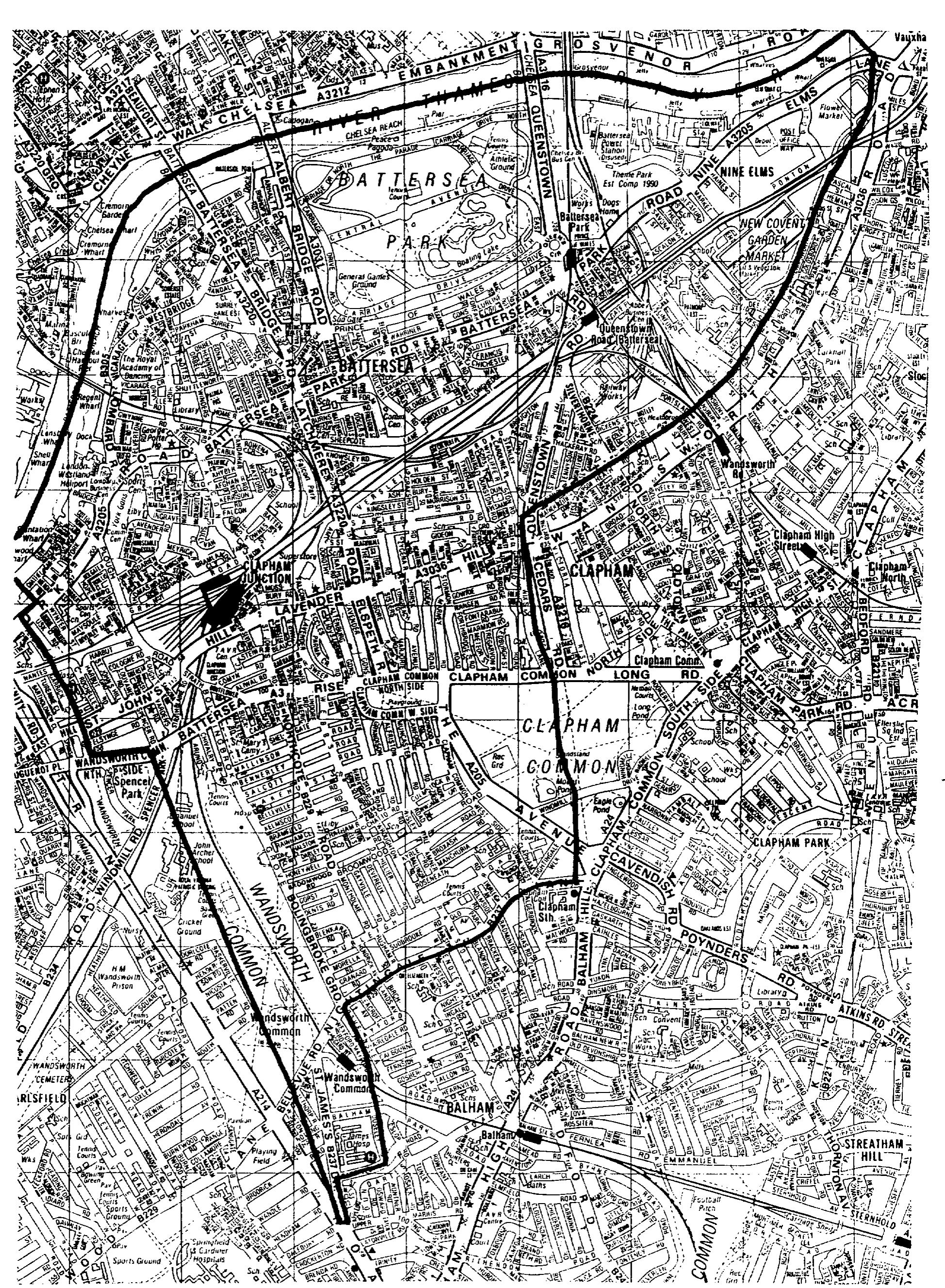
Battersea: General Street Plan c.1990, with the boundary of the old parish marked. Click to enlarge, or use the zoom viewer below.
Home › Building histories › The Metamorphosis of Battersea
Build 2 — 24 September 2026
Submitted for the degree of Doctor of Philosophy, The Open University.
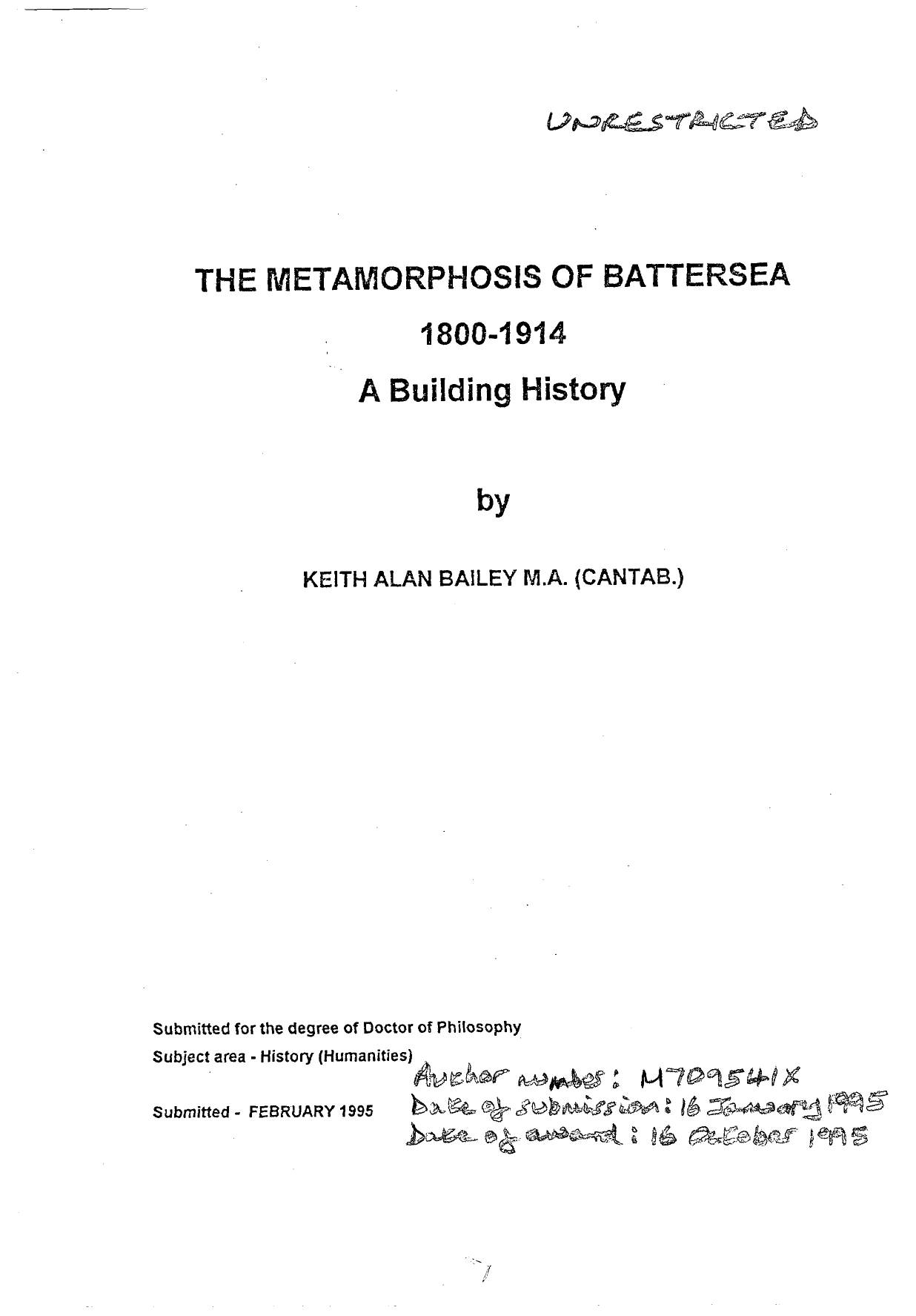
Subject area: History (Humanities). Submitted February 1995. [title page]
This is a complete digital edition of Keith Bailey’s doctoral thesis, published here with his permission. Every chapter, appendix and the bibliography has been transcribed from the typescript and checked against the page images, with the original page numbers in the margin, linked references, and the text fully searchable. The original typescript can also be downloaded from The Open University’s Open Research Online.
The Metamorphosis of Battersea is a study of the process of building development in a London parish during the nineteenth century. Part I reviews existing literature on the subject and looks at the physical and pre-urban background. It also provides a brief overview of the creation of the essential infrastructure of the suburb, from sewers to railways and from churches to music halls, and looks at the social and occupational background of the population as it grew with breathtaking rapidity from less than 3,000 in 1801 to 170,000 a century later.
Part II discusses the evidence for building cycles in Battersea. The myriad men responsible for building the houses are then examined. This was an industry which essentially remained a collection of hand crafts throughout the period, albeit with some increase in the scale of operations after c.1870. Almost all of the thousands of builders and others came from within a five-mile radius of Battersea, and few lasted more than five years, most considerably less. The speculative nature of housebuilding was always at present and left a trail of bankruptcies and lesser failures in its wake.
A classification of building estates according to the occupation of the initiator is proposed. Most were small operators who often failed to make the sure profits they expected when they set out. Case studies in Part III demonstrate that despite the degree of fragmentation in both estates and building, the operation of the various processes tended to produce homogeneous results in terms of the type and quality of housing, and of the tenants who occupied it, at least when new. This convergence often occurred despite the aspirations of landowners and developers, so that the supply and demand equation was usually in balance over a mid- to longer-term period, although there were severe cyclical fluctuations causing casualties among the many groups associated with the transformation of Battersea from an agricultural settlement with a substantial industrial base to a fully-fledged London suburb, larger than most provincial towns.
| 2.1 | General Location Map | 26 |
| 2.2 | Drift Geology | 27 |
| 3.1 | Railways | 42 |
| 3.2 | Road and River Transport | 47 |
| 3.3 | Places of Worship c.1900 | 56 |
| 5.1 | Housebuilding Cycles c.1790–1915 | 77–8 |
| 5.2 | Trend in Land and Property Values | 82 |
| 5.3 | Cumulative Houses by Rateable Value | 92–3 |
| 5.4 | Boundaries of Development Sub-Zones | 100 |
| 5.5 | Mean and Median Centres of Building | 101 |
| 6.1 | Builders and Housing Starts by Period | 111 |
| 6.2 | Builders’ Addresses | 123 |
| 7.1 | General Map of Battersea Estates | 133 |
| 7.2 | Size of Estate by Period | 136 |
| 7.3 | A Model of Estate Development | 141 |
| 8.1 | Fields & Estates south of Battersea Park Road | 155 |
| 8.2 | Surrey Lane Estate Plan | 157 |
| 8.3 | Job Caudwell’s Estate 1864 | 164 |
| 9.1 | W.R. Glasier Estates 1852 | 172 |
| 9.2 | Harefield Estate | 182 |
| 9.3 | Lombard Estate | 184 |
| 10.1 | Earl Spencer Place | 197 |
| 11.1 | Conservative Land Society’s No. 1 Estate | 209 |
| 11.2 | Conservative Land Society’s No. 2 Estate | 211 |
| 12.1 | Kambala Road Estate | 226 |
| 12.2 | Corsellis’s Lavender Hill Estate | 231 |
| 13.1 | Battersea New Town c.1786 | 238 |
| 13.2 | Battersea New Town 1839 | 241 |
| 13.3 | Cobb Estate 1839 | 243 |
| 13.4 | Cobb Estate 1866 | 246 |
| 13.5 | Carter Estate 1894 | 249 |
| 13.6 | Battersea Park area 1846 | 253 |
| 13.7 | Battersea Park area 1894 | 256 |
| 13.8 | Morrison’s Estate 1856 | 261 |
| 13.9 | Pocock Estate | 264 |
| 13.10 | Alfred Heaver’s Estates | 268 |
The following list of abbreviations covers those used throughout the thesis.
| BLC | British Land Company |
| BPAct | Battersea Park Act (1846) |
| CLS | Conservative Land Society |
| DBW | Wandsworth District Board of Works |
| GLRO | Greater London Record Office |
| GWR | Great Western Railway |
| LBSCR | London, Brighton & South Coast Railway |
| LCC | London County Council |
| LCDR | London Chatham & Dover Railway |
| LNWR | London & North Western Railway |
| LSR | London & Southampton Railway |
| LSWR | London & South Western Railway |
| LTS | London Topographical Society |
| MBW | Metropolitan Board of Works |
| MidR | Midland Railway |
| Minet | Surrey Collection, Minet Library, Lambeth |
| SBL | School Board for London |
| SLP | South London Press |
| SRO | Surrey County Record Office |
| TA | Battersea Tithe Award |
| VCH | Victoria County History |
| WBN | Wandsworth Borough News |
| WECPR | West End of London & Crystal Palace Railway |
| WH | Wandsworth Historian |
| WHS | Wandsworth Historical Society |
| WLER | West London Extension Railway |
| WLHC | Wandsworth Local History Collection |
| WP | Wandsworth Paper |
Battersea: General Street Plan c.1990, with the boundary of the old parish marked. Click to enlarge, or use the zoom viewer below.
Scroll or pinch to zoom, drag to move.
— Keith Bailey’s building histories
Keith Alan Bailey, The Metamorphosis of Battersea 1800–1914: A Building History, PhD thesis, The Open University, 1995. Digital edition published with the author’s permission; prepared by Philip Boys, 2026. Build 2 — 24 September 2026.