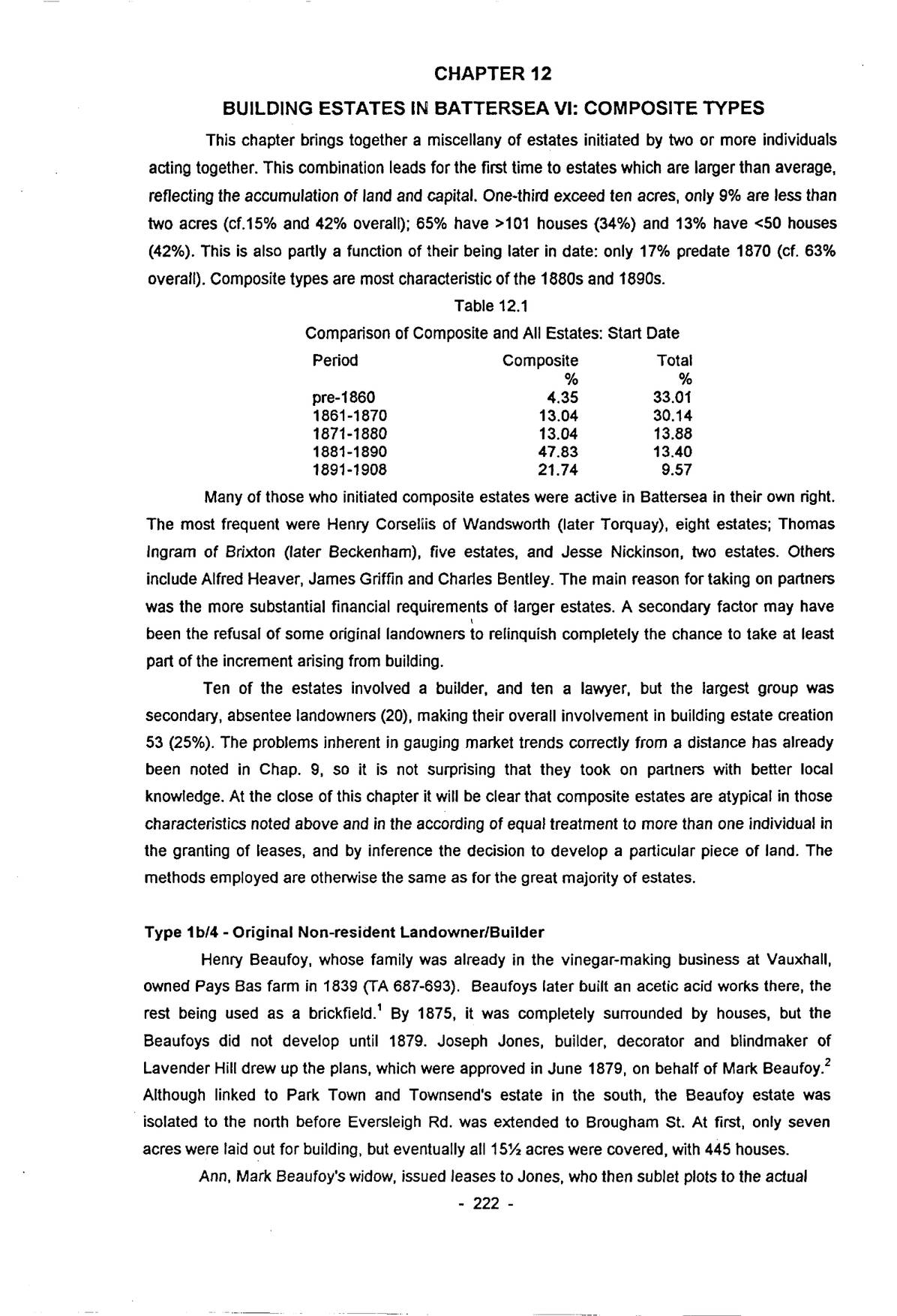
p. 222This chapter brings together a miscellany of estates initiated by two or more individuals acting together. This combination leads for the first time to estates which are larger than average, reflecting the accumulation of land and capital. One-third exceed ten acres, only 9% are less than two acres (cf.15% and 42% overall); 65% have >101 houses (34%) and 13% have <50 houses (42%). This is also partly a function of their being later in date: only 17% predate 1870 (cf. 63% overall). Composite types are most characteristic of the 1880s and 1890s.
| Period | Composite % | Total % |
|---|---|---|
| pre-1860 | 4.35 | 33.01 |
| 1861-1870 | 13.04 | 30.14 |
| 1871-1880 | 13.04 | 13.88 |
| 1881-1890 | 47.83 | 13.40 |
| 1891-1908 | 21.74 | 9.57 |
Many of those who initiated composite estates were active in Battersea in their own right. The most frequent were Henry Corsellis of Wandsworth (later Torquay), eight estates; Thomas Ingram of Brixton (later Beckenham), five estates, and Jesse Nickinson, two estates. Others include Alfred Heaver, James Griffin and Charles Bentley. The main reason for taking on partners was the more substantial financial requirements of larger estates. A secondary factor may have been the refusal of some original landowners to relinquish completely the chance to take at least part of the increment arising from building.
Ten of the estates involved a builder, and ten a lawyer, but the largest group was secondary, absentee landowners (20), making their overall involvement in building estate creation 53 (25%). The problems inherent in gauging market trends correctly from a distance has already been noted in Chap. 9, so it is not surprising that they took on partners with better local knowledge. At the close of this chapter it will be clear that composite estates are atypical in those characteristics noted above and in the according of equal treatment to more than one individual in the granting of leases, and by inference the decision to develop a particular piece of land. The methods employed are otherwise the same as for the great majority of estates.
Type 1b/4 – Original Non-resident Landowner/Builder
Henry Beaufoy, whose family was already in the vinegar-making business at Vauxhall, owned Pays Bas farm in 1839 (TA 687-693). Beaufoys later built an acetic acid works there, the rest being used as a brickfield.1 By 1875, it was completely surrounded by houses, but the Beaufoys did not develop until 1879. Joseph Jones, builder, decorator and blindmaker of Lavender Hill drew up the plans, which were approved in June 1879, on behalf of Mark Beaufoy.2 Although linked to Park Town and Townsend’s estate in the south, the Beaufoy estate was isolated to the north before Eversleigh Rd. was extended to Brougham St. At first, only seven acres were laid out for building, but eventually all 15½ acres were covered, with 445 houses.
Ann, Mark Beaufoy’s widow, issued leases to Jones, who then sublet plots to the actual
p. 223builders at a premium. Terms for the former were 90 years from Mid-1879, rents £2-4 for 16-17½ ft. plots, and for the latter 88 or 90 years from a variety of dates, GR £4-5, so that Jones made at least 100% return on his outlay.
A few houses were sold in the early stages. Charles Bye, bricklayer, paid £335 for 77 Beaufoy Rd., while Charles Simmonds bought 14 Basnett Rd. from Leonard & Noah Bottoms for £325, both in July 1881.
| a. Building | |||||||
|---|---|---|---|---|---|---|---|
| Street | 1879 | 1880 | 1881 | 1882 | 1883 | 1884 | Total |
| Arliss Road | 36 | 15 | 51 | ||||
| Basnett Road | 5 | 12 | 30 | 47 | |||
| Beaufoy Road | 31 | 48 | 39 | 2 | 120 | ||
| Hanbury Road | 12 | 18 | 6 | 36 | |||
| Wickersley Road | 16 | 38 | 10 | 46 | 6 | 116 | |
| Wycliffe Road | 18 | 11 | 8 | 15 | 24 | 76 | |
| Total | 51 | 92 | 150 | 100 | 29 | 24 | 446 |
| b. Builders | |||||||
| Walter Peacock | 23 | 22 | 22 | 67 | |||
| Peter Duplock | 6 | 9 | 16 | 28 | 59 | ||
| J.C. Peters | 11 | 5 | 28 | 6 | 50 | ||
| Thomas Jenkins | 29 | 8 | 37 | ||||
| Fred. Pinnegar | 6 | 6 | 4 | 7 | 8 | 31 | |
| William Warren | 4 | 14 | 8 | 26 | |||
| William Kerr | 24 | 24 | |||||
| Robert Saker | 8 | 8 | 6 | 22 | |||
| Sub-Total | 23 | 72 | 114 | 79 | 20 | 8 | 316 |
| 18 Others | 28 | 20 | 36 | 21 | 9 | 16 | 130 |
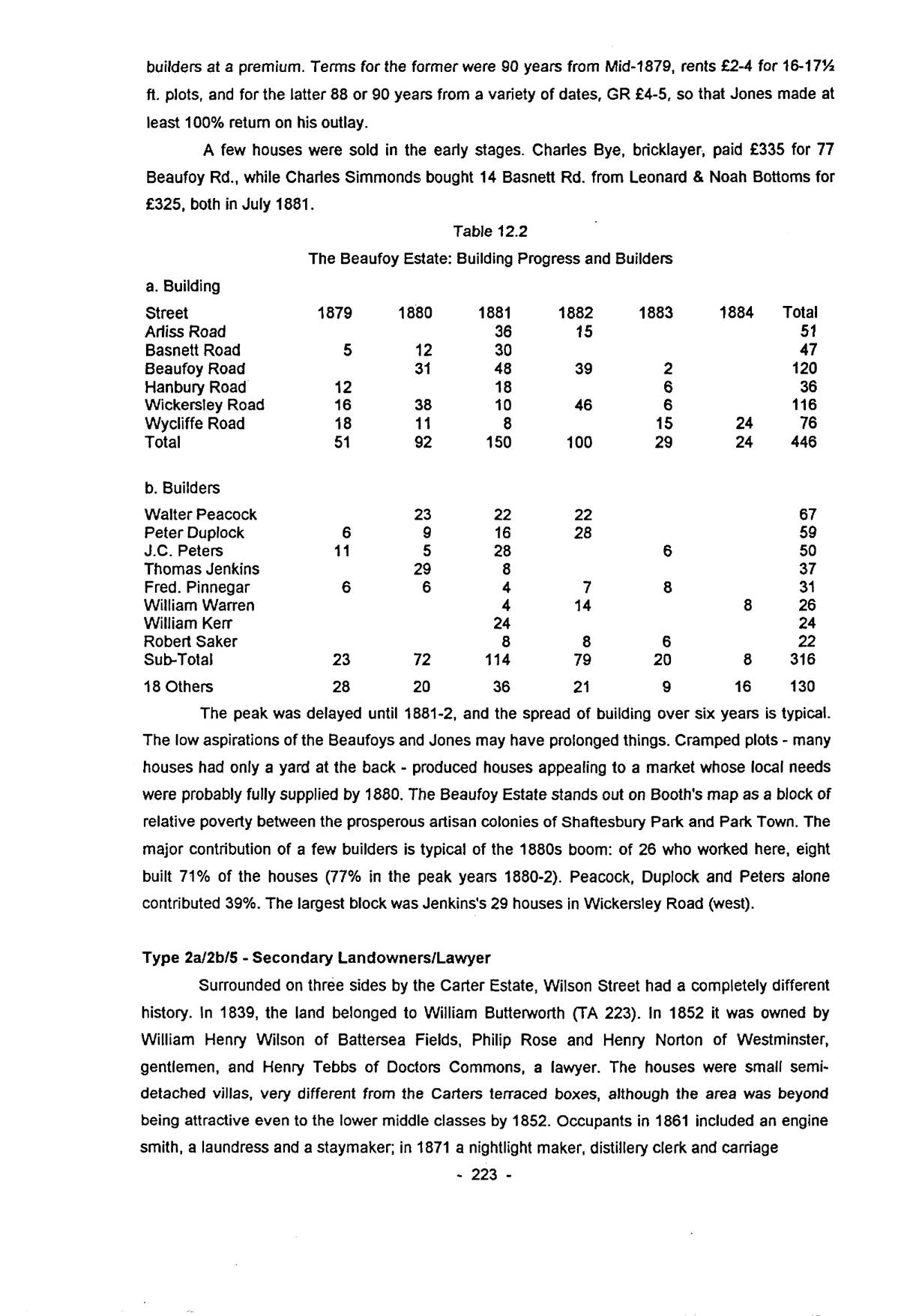
The peak was delayed until 1881-2, and the spread of building over six years is typical. The low aspirations of the Beaufoys and Jones may have prolonged things. Cramped plots – many houses had only a yard at the back – produced houses appealing to a market whose local needs were probably fully supplied by 1880. The Beaufoy Estate stands out on Booth’s map as a block of relative poverty between the prosperous artisan colonies of Shaftesbury Park and Park Town. The major contribution of a few builders is typical of the 1880s boom: of 26 who worked here, eight built 71% of the houses (77% in the peak years 1880-2). Peacock, Duplock and Peters alone contributed 39%. The largest block was Jenkins’s 29 houses in Wickersley Road (west).
Type 2a/2b/5 – Secondary Landowners/Lawyer
Surrounded on three sides by the Carter Estate, Wilson Street had a completely different history. In 1839, the land belonged to William Butterworth (TA 223). In 1852 it was owned by William Henry Wilson of Battersea Fields, Philip Rose and Henry Norton of Westminster, gentlemen, and Henry Tebbs of Doctors Commons, a lawyer. The houses were small semi-detached villas, very different from the Carters terraced boxes, although the area was beyond being attractive even to the lower middle classes by 1852. Occupants in 1861 included an engine smith, a laundress and a staymaker; in 1871 a nightlight maker, distillery clerk and carriage
p. 224cleaner; in 1881 a rent collector and a decorator; and in 1891 a candlemaker and a carpenter. Wilson St. always attracted members of Class III (mostly manual workers), employed locally, and was indistinguishable from neighbouring developments. At least ten houses in phase 1 were built by William Hayman, a Marylebone lace manufacturer, who was also developing on his own account in Frances Street at the same time. By 1859, Thomas Merritt of Islington, gent., had taken over leasing the whole of the west side, keeping the original datum of Christmas 1853, although for 94 rather than 99 years. Ground rents were , although for 94 rather than 99 years. Ground rents were £3/10/- to 5/10/- per house.
Each pair had suitably genteel names – De Boisson; King’s; Duke’s; Princes Villas. 21/2 were mortgaged by William Howick, printer of Clare Market in Westminster, for £344 in Dec. 1859, indicating a value of about £175/house, considerably more than contemporary houses on the Carter Estate. The Tebbs family retained an interest – Robert & William Tebbs, auctioneers of London Bridge, mortgaged 19-22 to the New Imperial BBS in March 1864 for £442/15/-.
Type 2b/3 – Secondary Non-resident Landowner/Architect &c.
Battersea’s final pre-1914 estate was West Side or Battersea Rise (1908-16), 436 houses on 22 acres. The principal component was the Thornton house and grounds (TA 394-8). In 1793 banker Henry Thornton bought and enlarged a modest villa built for Isaac Ackermann, a City china-dealer.3 Other parts belonged in 1839 to William Haigh, James Horne, and Thomas Potts (TA 392/3/9-404). A later Henry Thornton rounded off the estate by purchasing a field off Broomwood Rd. in April 1881 from John Cobeldick and the Land Securities Co. Ltd. Development was by Henry Corsellis of Newbury and Edwin Evans & Sons, auctioneers, land agents, surveyors and valuers of Clapham Junction. Five new streets were approved in May 1908.4 Leases were for 99 years from Lady Day 1908, ground rents in the £7-7/15/- range for 18-24ft. plots, modest for this date, indicative perhaps of an urgency in getting the estate built.
The lease for 29 Culmstock Rd., was issued by Evans and A.A. Corsellis, whose involvement is to be expected. Houses were sold in 1912-5 for about £390 each. A proposed church at the end of this road, a typical addition to Victorian middle-class developments, was never built.
Type 2b/4 – Secondary Absentee Landowner/Builder (6 estates; 54.11 ac.; 1,329 hos.)
Four date from the 1879-82 peak, the others from the late-1890s. The smallest, the Elsdon Estate, overlapped into Clapham. Chatto’s Estate had 713 houses, the fourth largest in Battersea.
In 1839 the Elsdon estate had been part of a five-acre meadow belonging to R.W. Southby (TA 703), surrounded by ditches and only 9ft. above sea-level. In July 1861, it belonged to Barnard Graham, and was compulsorily purchased by the LCDR for its line to Victoria, which soon swept across the area on a viaduct. The surplus, a curved strip paralleling the viaduct in both parishes, was sold in Dec. 1867 by William Cooper and Richard Stocker to Grosvenor Hodgkinson of Newark, M.P., and Richard Hodgson of Chingford. It was conveyed for £1,100 to John Hall in December 1869, with the consent of Hodgkinson and Hodgson.
p. 225John Hall died in May 1872 at Ramsgate, and his wife Mary Ann that October, leaving the estate to their second son Walter and Mary Ann Kate their daughter. In Feb. 1873, William Adams Murphy, the Camberwell architect and Henry Riches, solicitor of Kings Bench Walk, were appointed trustees by James Prendergast, the New Zealand Attorney-General under the terms of 23 & 24 Vict. c.145. Riches was soon replaced by Michael Manning, architect, of Fleet Street. In June 1874, Walter Hall made a complaint in Chancery against Murphy, Manning and his sister, then aged 17. It seems that the two architects were intent upon developing one of the few vacant areas off Wandsworth Road (cf. Murphy’s involvement at the same time east of Stewart’s Road [140]). Walter alleged that his father had agreed to let the land in plots to Charles Gooding for building. On 31 July 1874, Murphy admitted the material allegations. On 1 Dec. 1875, Gooding was reported to have given up his interest in the 2a 3r 20p for a paltry payment of £50.
Walter Hall came of age on 27 August 1876, and judgement was finally given on 7 May 1877 that he was entitled to half of the estate and to act as trustee for his sister, who came of age on 31 May 1878. The local press in August 1878 reported seven acres of land “near New Road, Battersea”, which had a dubious title.5 ‘The families died out, and the land was got by a railway land jobber for £50 from a man who grazed cattle there. The names of neither appear in the rate books or on maps. the land is worth £1,000 per acre’. Although larger than the Elsdon estate, it seems likely that this is the same property. In the event, the Halls did not develop, but sold the land for £3,900 to William Elsdon, a Clapham builder and his spinster daughter Emma on 27 March 1879, a very handsome return on the sum paid by their father. Emma Elsdon took the leading role, mortgaging the estate for £3,500 at 5% to Maria Perry, a fellow Clapham spinster on 28 March 1879, and raising another £400 from Charles Rhodes of Chancery Lane on the 29th. This money was probably used to lay out Gonsalva and Portslade Roads, approved in May 1879.6
Emma Elsdon only paid interest to Miss Perry and Mr. Rhodes for the first six months, and failed to repay the capital on 28 Nov. 1879. Rhodes, however, agreed to lend her another £200, repayable on 29 March 1880, and this was followed by three further advances totalling £651/16/3 between 31 Dec. 1879 and 2 March 1880. Emma was no better at honouring these obligations: on 24 Sept. 1880, she was six months in arrears on the interest on £4,751/16/3. In May 1884 she granted all the land to her father and his partner Sydney Pocock, by which date Charles Rhodes had advanced a total of £1,600. In May 1885, the original £3,500 mortgage was transferred by Miss Perry to Army Captain Francis King of Maida Vale, as was the Rhodes debt. Capt. King agreed with Elsdon and Pocock to reduce the rate of interest to 4½% – he must have had considerable faith in the ability of the estate to generate the necessary cash given the previous history.
Leases were for 99 years from Mid-1879, ground rents £5 (6/3 per foot front), rather high for this area. Most were issued in 1881-2, in the names of Emma Elsdon and her two mortgagors. William Merrifield of Lydon Rd., Clapham built at least 35 houses in Gonsalva Rd. between April 1880 and August 1882. Joseph Evans of Ware, Herts. (11) and George Bentley of Balham (22) built most of the rest. In Aug. 1880, Merrifield raised £200 on 36 Gonsalva Rd. from Maria and Louisa Churchman, two Godalming spinsters, and two months later £300 on 32/4 from Hori Hale, maltster of Haslemere and Ann Hale, widow, of Godalming. Blocks of houses began to be sold
Open zoomable view
p. 227soon after the estate was completed. In Dec. 1887, a five-part transaction involving Elsdon & Pocock, Frederick Lloyd, a City gentleman (who had taken over the mortgage from Capt. King) and William Langridge, estate agent of Tunbridge Wells saw Edward & Mary White of Paddock Wood acquire 13 houses for £1,445 (about £111 each).
Occasionally, a developer failed to acquire direct control of all the land necessary to produce a well-rounded estate, and this happened to Alfred Heaver in 1881. His Falcon Park estate (see Chap. 13) was nearing completion, but he had not obtained almost three acres to the north-west. This land was bought from Earl Spencer by Abraham Sheppard, a Bermondsey market gardener, for £400 in October 1835 (Lot 61a). He let it in Sept. 1856 to William Watling, a Pimlico provision dealer (99 yrs.; Mid-1856; £60 p.a.), who in turn leased it in March 1865 to Julius Becker and James Townsend of Rotherhithe, fat melters (80 yrs.; £80 p.a.+£200), including piggeries, a house and other buildings. (Despite the obvious trend towards suburban development from 1860, they were all concerned only with the continued agricultural use of the land.)
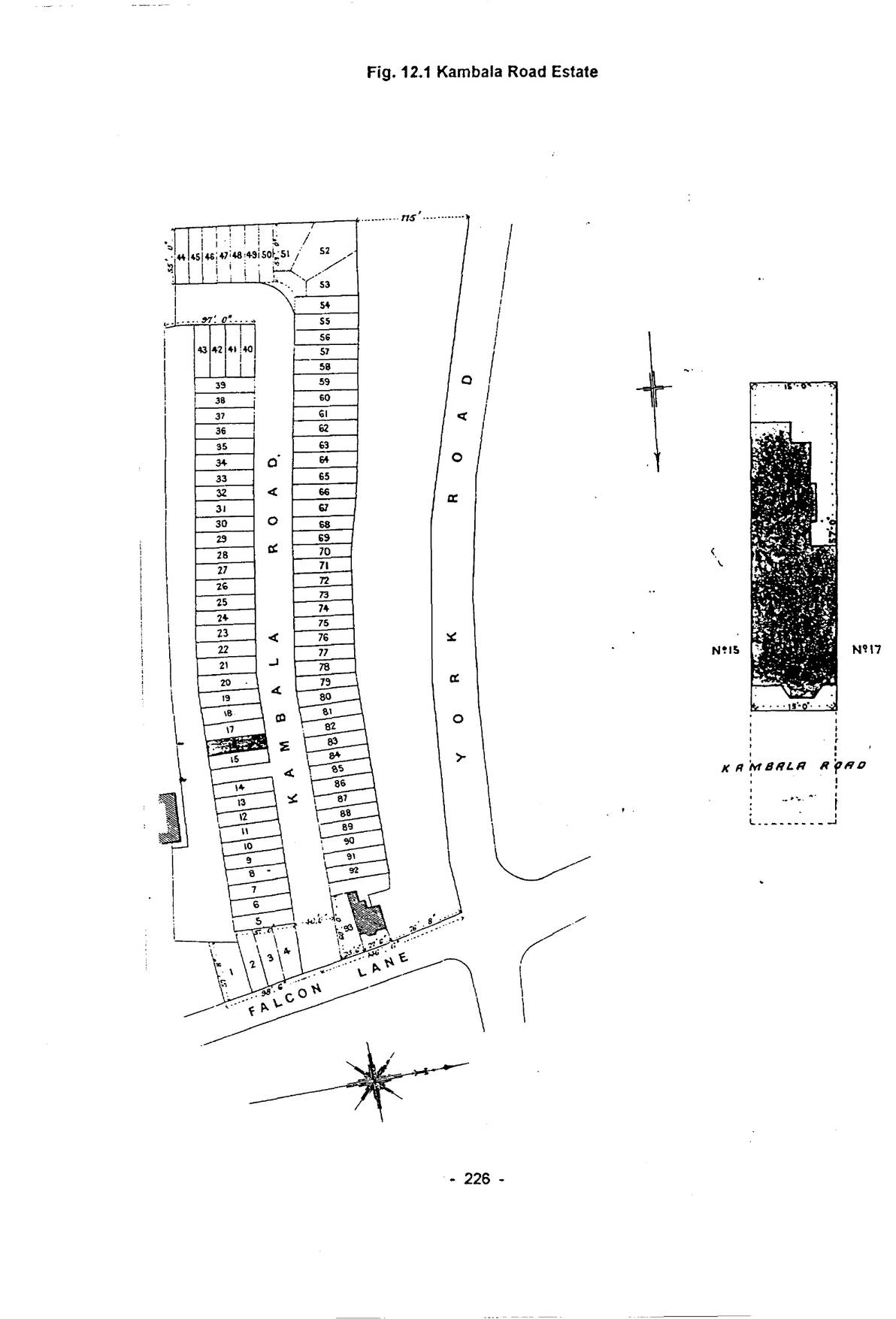
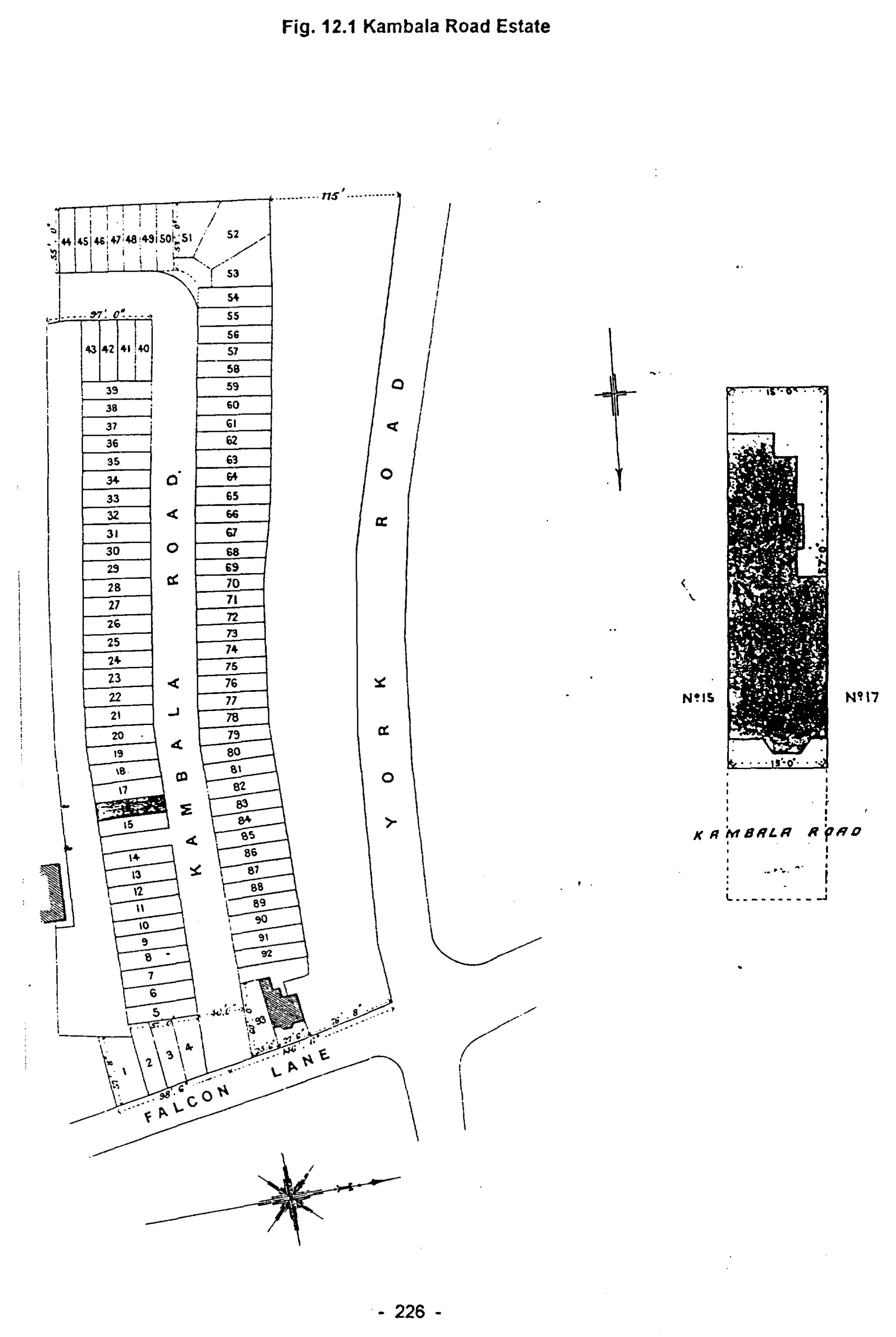
William Watling died in March 1868, and his son William in Aug. 1873. On 29 Sept. 1880 Abraham Sheppard sold it to John Stephens for £2,000 (£714/ac., very low for this date, although Sheppard made a good return on his original £400). Stephens was Watling’s executor, in business as a publican at the Plough Notting Hill. He died in October 1881, and the estate passed to his widow Emily, of Park Villas, Shepherds Bush. Although Stephens had obviously agreed to lay out Kambala Road, connecting Falcon Rd. with Musjid Rd. on Heaver’s estate, it was Emily who was left to issue the leases. The plans were by William Poole, who often worked with Heaver, and were approved in the latter’s name in Oct. 1881.7 Leases were for 99 years from Lady Day 1882. Ground rents in Kambala Road were £5/10/- for standard 16ft. plots (except 2-6 – £6). The shops in Falcon Rd. commanded a sizeable premium: £8/10/- to £20 p.a. All were built within twelve months. Henry Mundy erected 43 houses, followed by Daniel Pitt (14) and J. Dewing (12) – 73% in all, the rest were by five others.
As was often the case, Chatto’s (or West Side) Estate had a false start. Alfred Heaver, just completing his first major estate, Falcon Park, purchased 12 acres in late-1880/early-1881. In 1839 they belonged Thomas Potts (TA 403-6), whose mansion had a rateable value of £296. He was in residence until the 1860s. By 1871 the estate was owned by Thomas Potts Chatto. W.C. Poole drew up plans for a five-street Heaver Park Estate in March 1881, but they were never submitted to the MBW for approval.8 It seems that Heaver was over-committed, not helped by the downturn in building. By 1885 the land had been added to the 13 acres already being developed to the west by Messrs Bragg and Ingram. (TA 407-9 belonged in 1839 to Joseph Wilson, whose mansion was near Battersea Rise [RV £492, one of the highest in the parish]. By 1851 it belonged to Charles Webb and in 1871 to Jane Webb.)
W. Newton Dunn laid out West Side estate in late-1882. All the streets (apart from Berber and Keildon Roads, created in 1884 when Leathwaite Rd. was added at the eastern end), were extensions of those on the Conservative Land Society’s No. 3 estate.9 Newton Dunn also planned the extension onto Chatto’s land in 1885: four new streets and two extensions.10 He continued to be involved during construction, including correspondence with the DBW in May 1888 over an alleged frontage infringement in Webbs Road by G.H. Stringer, whose shops were said to be less
p. 228than 20ft. from the new centre line. According to the architect, they agreed with the plan approved by the MBW.12
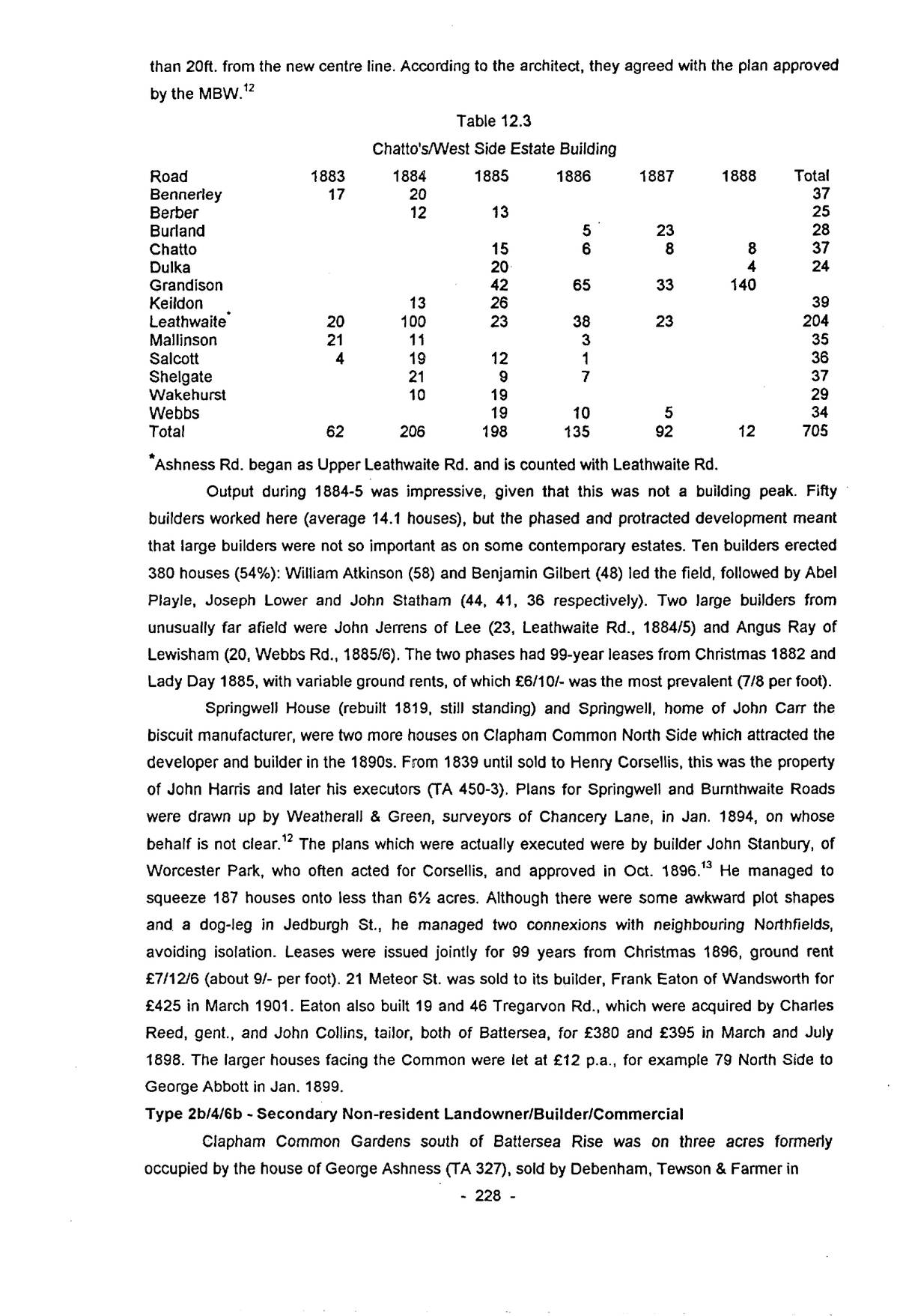
| Road | 1883 | 1884 | 1885 | 1886 | 1887 | 1888 | Total |
|---|---|---|---|---|---|---|---|
| Bennerley | 17 | 20 | 37 | ||||
| Berber | 12 | 13 | 25 | ||||
| Burland | 5 | 23 | 28 | ||||
| Chatto | 15 | 6 | 8 | 8 | 37 | ||
| Dulka | 20 | 4 | 24 | ||||
| Grandison | 42 | 65 | 33 | 140 | |||
| Keildon | 13 | 26 | 39 | ||||
| Leathwaite∗ | 20 | 100 | 23 | 38 | 23 | 204 | |
| Mallinson | 21 | 11 | 3 | 35 | |||
| Salcott | 4 | 19 | 12 | 1 | 36 | ||
| Shelgate | 21 | 9 | 7 | 37 | |||
| Wakehurst | 10 | 19 | 29 | ||||
| Webbs | 19 | 10 | 5 | 34 | |||
| Total | 62 | 206 | 198 | 135 | 92 | 12 | 705 |
∗Ashness Rd. began as Upper Leathwaite Rd. and is counted with Leathwaite Rd.
Output during 1884-5 was impressive, given that this was not a building peak. Fifty builders worked here (average 14.1 houses), but the phased and protracted development meant that large builders were not so important as on some contemporary estates. Ten builders erected 380 houses (54%): William Atkinson (58) and Benjamin Gilbert (48) led the field, followed by Abel Playle, Joseph Lower and John Statham (44, 41, 36 respectively). Two large builders from unusually far afield were John Jerrens of Lee (23, Leathwaite Rd., 1884/5) and Angus Ray of Lewisham (20, Webbs Rd., 1885/6). The two phases had 99-year leases from Christmas 1882 and Lady Day 1885, with variable ground rents, of which £6/10/- was the most prevalent (7/8 per foot).
Springwell House (rebuilt 1819, still standing) and Springwell, home of John Carr the biscuit manufacturer, were two more houses on Clapham Common North Side which attracted the developer and builder in the 1890s. From 1839 until sold to Henry Corsellis, this was the property of John Harris and later his executors (TA 450-3). Plans for Springwell and Burnthwaite Roads were drawn up by Weatherall & Green, surveyors of Chancery Lane, in Jan. 1894, on whose behalf is not clear.12 The plans which were actually executed were by builder John Stanbury, of Worcester Park, who often acted for Corsellis, and approved in Oct. 1896.13 He managed to squeeze 187 houses onto less than 6½ acres. Although there were some awkward plot shapes and a dog-leg in Jedburgh St., he managed two connexions with neighbouring Northfields, avoiding isolation. Leases were issued jointly for 99 years from Christmas 1896, ground rent £7/12/6 (about 9/- per foot). 21 Meteor St. was sold to its builder, Frank Eaton of Wandsworth for £425 in March 1901. Eaton also built 19 and 46 Tregarvon Rd., which were acquired by Charles Reed, gent., and John Collins, tailor, both of Battersea, for £380 and £395 in March and July 1898. The larger houses facing the Common were let at £12 p.a., for example 79 North Side to George Abbott in Jan. 1899.
Type 2b/4/6b – Secondary Non-resident Landowner/Builder/Commercial
Clapham Common Gardens south of Battersea Rise was on three acres formerly occupied by the house of George Ashness (TA 327), sold by Debenham, Tewson & Farmer in
p. 2291875 to Thomas Ingram, builder of Coldharbour Lane, Brixton, his partner James Brown of the Sawing & Planing Mills, East Brixton, and George Powell, a City gentleman. Two plans survive, one by Ingram & Brown dated 26 Oct. 1875, the other, undated, by W.H. Rawlings, surveyor of South Lambeth; the two new streets were approved in Oct. 1875.14
The three-storey terraces faced with grey bricks were similar in many respects to those of Park Town, built a decade earlier, and were rather passé by 1876. The estate proceeded in fits and starts. James Duncanson of Brixton built all 17 houses on Battersea Rise. Although John Miller applied for all 45 houses in Almeric Rd. in June 1877, he did not complete them; James Brown finished the last six (2-12, clearly identifiable on the 1894 O.S. plan).
A printed lease was used, issued in all three owners’ names. Terms were unique in Victorian Battersea – 250 years from Christmas 1875, ground rents £6-6/6/- for 17ft. plots. 3 Lindore Rd. was let to John Price of Battersea in May 1876 and assigned by him to Henry Nevill of Herne Hill, Welsh bread manufacturer, in July 1879 for £550. (The freehold could be bought for £135 (22½ years’ purchase) before Mid-1877.) 11 Almeric Rd. was leased in Oct. 1877 to John Miller, but actually erected by David Kettle of nearby Wakehurst Rd., who sold it to Susan Mitchell, a Kennington widow for £525.
The Elms/Broomwood Park 2 estate, also developed by Ingram, Brown & Bragg will be considered in Chapter 13).
Type 2b/5 – Secondary Absentee Landowner/Lawyer (8 ests.; 40.74 ac.; 1,085 houses)
The Colestown Estate was discussed in Chap. 9, since the majority was built under the ownership of Jesse Nickinson, rather than the original owner, E.R. Coles.
The other seven estates were all initiated by Henry Nicholas and A.A. Corsellis, although virtually all deeds were issued only in the name of the former. Their total contribution was 947 houses, 3.7% of the total. The first two were small pockets of land in the Village which had somehow escaped the attention of developers. Corsellis purchased the Grove House estate from Mary Ann Jones on 1 August 1884. It occupied 1.4 acres between High Street and Green Lane, and was laid out by Joseph Lewry, a local builder. Orville Rd. was approved in August 1884.15 It belonged in 1839 to Thomas Stirling (TA 122 pt.). In Jan. 1859 Stirling was involved in a transaction which included Thomas and Francis Woodgate. The latter was associated elsewhere in Battersea with land deals prior to development, which suggests that development was then in view.16
The 43 plots were let for 99 years from Christmas 1884 at relatively high rents – £7 in Orville Rd. for 16-17ft. plots and £12-15 in the High St. The three-storey terraces were built in 1885-6. Although not a particularly isolated or insalubrious area, Orville Rd. went rapidly downhill, and was classed AB by Booth within a decade. He attributed this to the class of tenants, but it is likely that the root cause was the high rents which led to rapid turnover and overcrowding. Corsellis had reduced his involvement by then, selling 19 houses to Walter Clarke of Sidcup and Thomas Clarke of Witley, Surrey, gents., in August 1886 for £3,140/5/-. In March 1886, 2/4 Orville Rd. had been sold to William Marlow, printer, for £320 each.17 Plots 14/15 were assigned in March 1887 by A.A. Corsellis, then of “Layer Marney”, Torquay to J.H. Lewry for £515, then mortgaged
p. 230back to Corsellis for £381 at 5%.18
To the west, beyond Green Lane Schools, a vacant strip was conveyed by Earl Spencer to H.N. Corsellis in May 1886 for £945 (about £2,000/ac.). On it, Corsellis built 18 houses called Spencer Terrace. Leases were for 99 years from Mid-1886, G.R. £5/5/-, with 15ft. frontages. 16-18 were leased to Scott & Deryck in May 1888. They had worked in Orville Rd., and immediately mortgaged the three houses to Miss Helen Corsellis of Torquay for £600.
The Mayfield Estate was part of Elizabeth Graham’s extensive estate in 1839, and included the extension of hitherto isolated Sugden Rd. Corsellis bought the property from Ebenezer Bristow in June 1886. The plans were by Walter Stanbury, of Wandsworth, architect, whose family were closely associated with the Corsellises for over a decade.19 This was another high-density development, with 183 houses on 6½ acres. Leases were for 99 years from Michaelmas 1886, GR £7 for 17ft. plots (8/3 per ft.). Blocks taken by builders include: 5-12 Joseph Lower; 13-31 Rowden & James of Tooting; 32-36/78-81 W. Elliott, Battersea; 43-55 Scott & Deryck; 56-67 J. Stanbury; 68-77 George Ugle; 83-92 Ruff (sc. Henry Rough), Pimlico. The estate was rapidly completed, indicating a high level of demand for lower-middle class housing: 1886 – 69 houses; 1887 – 103; 1888 – 15. Fourteen builders were involved. The most significant were James George (35); John & Walter Stanbury (34); F.H.Gilbert (24); J.V. Packe (17) and Rowden & James (15), building 70% between them.
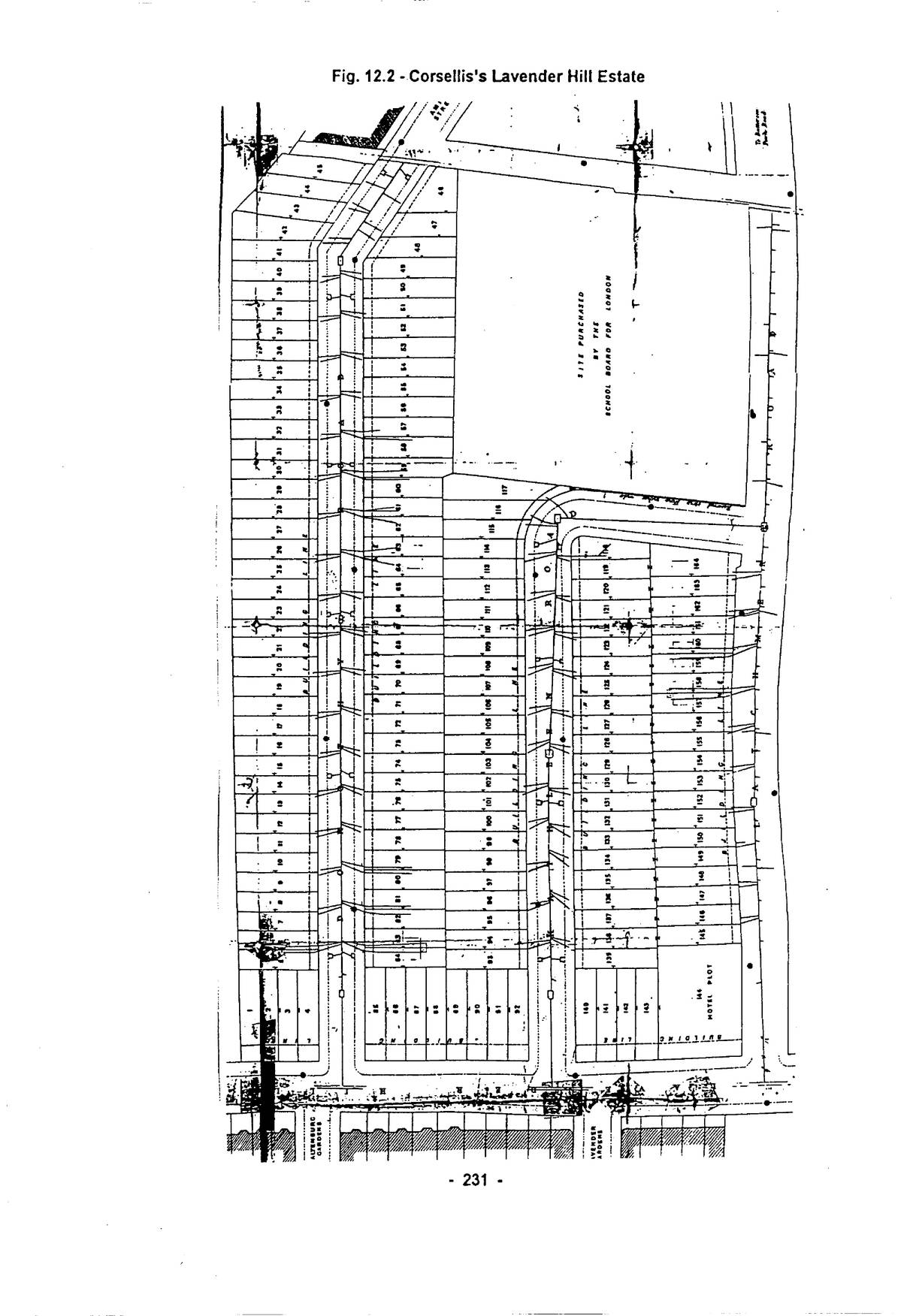
Lavender Hill Estate covered almost six acres on steep slopes overlooking the railway east of Clapham Junction. Originally the sites of three of the many early-nineteenth century villas on Lavender Hill and their landscaped grounds, the whole block belonged to George Taylor in 1839 (TA 494-496). The Taylor family sold two of the plots to William Stafford in 1874 and 1879, and the third to various parties in 1884. Corsellis purchased the whole block on 9 August 1888 for £26,400.20 This is equivalent to £4,319/acre, whereas the income from ground rents was about £1,030. The plans were by Walter Stanbury, for 164 plots, of which 144 on Lavender Hill was reserved for an hotel (not built). Two streets were approved by the new L.C.C. in October 1889.21 The terms were: 99 years from Michaelmas 1888, GR £7/10/- p.a. for 17ft. plots (8/10 per ft., continuing Corsellis’s high-rental policy). The estate was built rapidly between Nov. 1888 and Sept. 1889. Only ten builders were involved, with six erecting 83% of the houses: John & William Stanbury (33); Samuel Rashleigh (29); James George (26); James Sallows (14) and Joseph Lower (12).
In March 1890, Henry Corsellis sold nine houses in Dorothy Rd. to Henry Dobede of Hyde Park, Henry Bacchus of Warwickshire and Walker Neale of Lucknow for £1,721/5/- (25½ years’ purchase).22 James Sallows mortgaged 42-50 Dorothy Rd. to Corsellis for £1,250 in June 1889, and they were assigned to Cecil Mercer of Victoria, Official Receiver in December. (Sallows was declared bankrupt in Nov. 1889 before he could complete all of the houses he had undertaken, and died shortly afterwards.) Albert Parkhurst of Fulham took over Sallows’ leases.
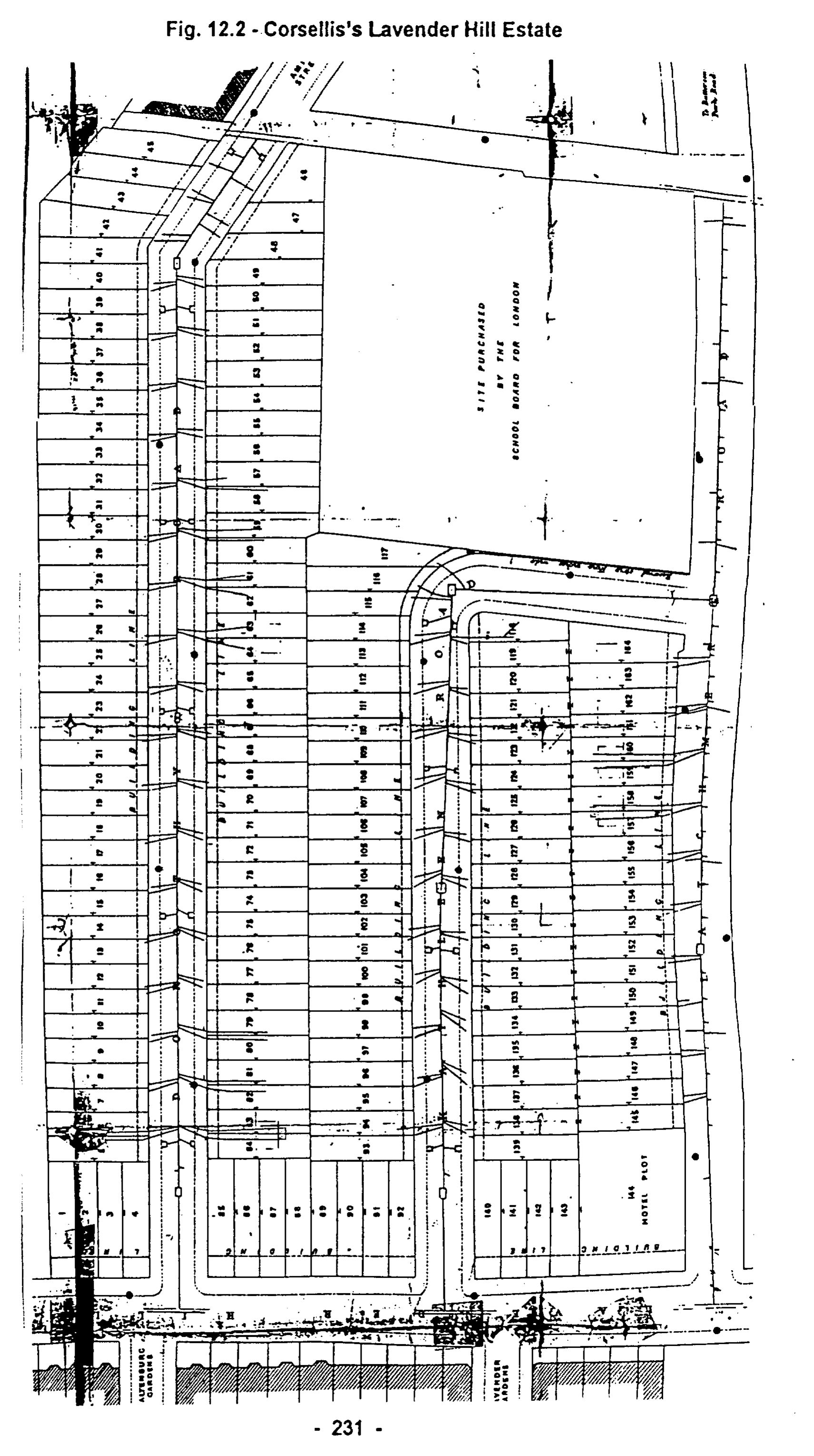
Corsellis’s largest estate was Bolingbroke Grove, 11½ acres between Wandsworth Common and Webbs Road. It was laid out by Walter Stanbury, in 295 lots, and two new east-west streets were approved in March 1890.23 W.H. George took 20 lots in Bramfield Rd. (189-198; 237-246) and George & Son seven in Kelmscott Rd. (5-11). Leases were for 99 years from Lady Day
Open zoomable view
p. 2321890. 173 houses were built in 1890, 63 in 1891 and 37 in 1892, although the last was not completed until mid-1895. Sixteen builders worked here, of whom six (W.H. George (55), W. Stanbury (46), John Stanbury (26), J. Staples (25) and Alfred Eaton and George & Son (24 each)) built 69%.
John Stanbury took 73 Bolingbroke Grove, facing the Common, in Dec. 1891 for £12 p.a., assigning it to William Eames, gent., the following February for £600.24 William Brown, gent., paid £335 for 23 Kelmscott Rd., built by W.H. George. William Stanbury, currently serving in the army at Shorncliffe Camp in Kent, leased 73 Kelmscott Rd. in August 1891 for £7 + £275. John Myring of Wandsworth built 52 Webbs Road on the eastern edge of the estate, paying £8 p.a. from October 1894.
Eighteen months later, John Stanbury applied for two new streets on behalf of Corsellis, on the Sisters Estate. In 1839, this was two of the typical villa-and-grounds units along Clapham Common North Side (TA 422-425 – 422 George Scholey; the rest Miss Bowers). The plans were by W.H. Stanbury, C.E., based at Shorncliffe in July 1891.25 Mrs. Elizabeth Bowers was living near Doncaster when she made her will in Nov. 1857, and died in Feb. 1858. Her Battersea estate of just over eight acres passed to Ernest Bowers, her son, who sold it in July 1891, in conjunction with the Hon. F. Worthy of Kensington and Thomas McAdam, Esq., of Ireland. Henry Corsellis paid £32,550 – £27,000 for the main estate between the Common and Lavender Hill and £5,550 for The Sisters, a house and garden on the Common. This represents a substantial sum to recoup – equivalent to £125 for each house.
All 230 houses were built by John Stanbury in only twelve months, from September 1891 (88 houses in Elspeth Rd.) to September 1892 (74 houses in Mysore Rd.), with the result that this is one of Battersea’s most uniform estates. Terms were 99 years from Midsummer 1891, G.R. £7/7/- p.a. for 16½-17ft. plots (8/9 per foot). This would have given Corsellis an income of about £1,600 p.a.. The 12 shops on Lavender Hill were leased at £18-23 p.a., adding £235 to the rent roll. Corsellis would therefore have taken about 15 years to recoup his outlay on the estate, before making any profit. As was often the case, however, he soon sold blocks of property. In May 1894, Richard and Charles Garton, glucose manufacturers based at Southampton Wharf off York Road, paid £5,530/16/- for 1-47 Mysore Rd. (£223 each) and the following September £5,925/2/- for 2-70 opposite (£169 each). Andrew Barlow, a Southampton brewer paid £4,212 for eight shops in Lavender Hill (£527 each). Between them, these sales gave Corsellis 57% of his outlay, and there may well have been other sales which have left no record. In addition there were the usual sales of individual houses, for example 27 Elspeth Rd. to its occupier Ingebrigt Elwick for £365 in June 1892, and 60 Elspeth Rd. to Fanny Davis, a butcher’s wife for £360 in June 1893 – which incidentally shows the benefit of buying in bulk.
Henry Corsellis’s final venture was much smaller – a terrace of 45 houses at the north-eastern end of Broomwood Road. The plans in this case are anonymous, and he applied for the extension himself.26 This had formed part of the estates of Messrs. Carter and Cavendish in 1839 (TA 370/372 pt.). John Stanbury, now living in Worcester Park, again built all the houses between March 1896 and February 1898, by which time work was in full swing on the Broomwood Park estate opposite.
p. 233
Type 2b/5/6b – Secondary Absentee Landowner/Lawyer/Commercial
This rather unlikely combination was responsible for an estate called Long Hedge No.1 covering 4.7 acres with 137 houses. The partners were John Levy, gent., and John Coles, merchant, both of Rochester (the latter a relative of E.R. Coles, see Chap. 9), James Griffin, auctioneer of Battersea and the legal firm of Richard Prall and Jesse Nickinson of Chancery Lane. There is no trace of a formal approval by the M.B.W., nor of the original plans. The addition of Palmerston Terrace to the topically-named Russell and Palmerston Streets in 1865 was planned by Thomas Haylock, builder and George Sheppard, timber merchant, both of Pimlico.27 (Russell St. followed an earlier track, preserved when the LSWR was built, connecting with Park Town.)
Some leases were issued by the partners acting together, others by individuals or pairs. Levy, Coles, Griffin and William Hall, gent., of New Cross, were all involved in leasing 5/6 Russell St. E to Jonathan Parsons, the Chelsea builder responsible a decade later for most of the houses on the Shaftesbury Estate, who also worked on Nickinson’s Long Hedge No.2 estate next door, at the direction of Haylock & Sheppard in July 1863 (99yrs.; Christmas 1862; £4 p.a.). Parsons raised £465 from the Temperance Permanent BBS in Nov. 1865 over 12 years at 5%. Levy & Coles alone leased 3/4 Russell St. to Parsons via Sheppard & Haylock in the same month. In July 1864, John Newson, gent., of Pimlico paid £1,500 for 13-18 Palmerston St. W, leased to him by Prall & Nickinson at Sheppard & Haylock’s direction, and paid the same for 19-24 the following December.
Type 2b/6b – Secondary Absentee Landowner/Commercial
Wayford Street was one of those estates east of Clapham Junction where the open-field landscape had been disrupted by the creation of the WLER. Most had belonged to Thomas Carter in 1839, but did not pass to W.W. Pocock in the 1850s. John Wilkinson gained approval for the new street in Nov. 1866.28 T.D. Carter had sold some land in Upper Wilditch Shot to James Griffin, gent., of Dorking and James Bennett, a Battersea draper in Aug. 1865, who were associated with John Foord of Rochester. 5/6 Wayford Terrace in Sheepcote Lane were leased to builder John Gowman in Feb. 1867 (99; Mid-1866; £5 p.a.), as were 1-4 on the west side of Wayford St. 5/6 Wayford St. were taken by his partner Mr. Wilkinson. Gowman mortgaged 1/2 to Robert Fell, a City linen draper and Curtis Colson, a Nottingham law clerk for £460 at 5% in June 1867.
Despite this prompt start, building did not proceed smoothly. Foord disappeared in 1867, and was replaced by fellow Rochester men John Levy and John Coles. They and Griffin sold their interest to Bennett in the autumn of 1873. That December, Bennett, by now of Balham, sold some land, including 1/2 Wayford St. to Mrs. Betsey Hue, a Holloway widow, and William Hue for £2,200. The rest was market garden ground in four lots totalling just over two acres. In Aug. 1876, Bennett sold land on the east side (15 southwards) to James Porter, merchant of Gracechurch St., for £1,600. Porter set about finishing the houses, leasing 25/27 in Jan. 1878 to Abraham Isaac (99 yrs.; Christmas 1876; £5 p.a.). (Isaac was one of the largest builders on Pocock’s estate.) 38 of the 68 houses on the estate belong to the late-1870s boom rather than that of the mid-1860s when the estate was conceived. In this Wayford St. resembles the adjacent Pocock estate, which
p. 234spanned three peaks of the cycle.
Type 3/6a – Architect/Manufacturer
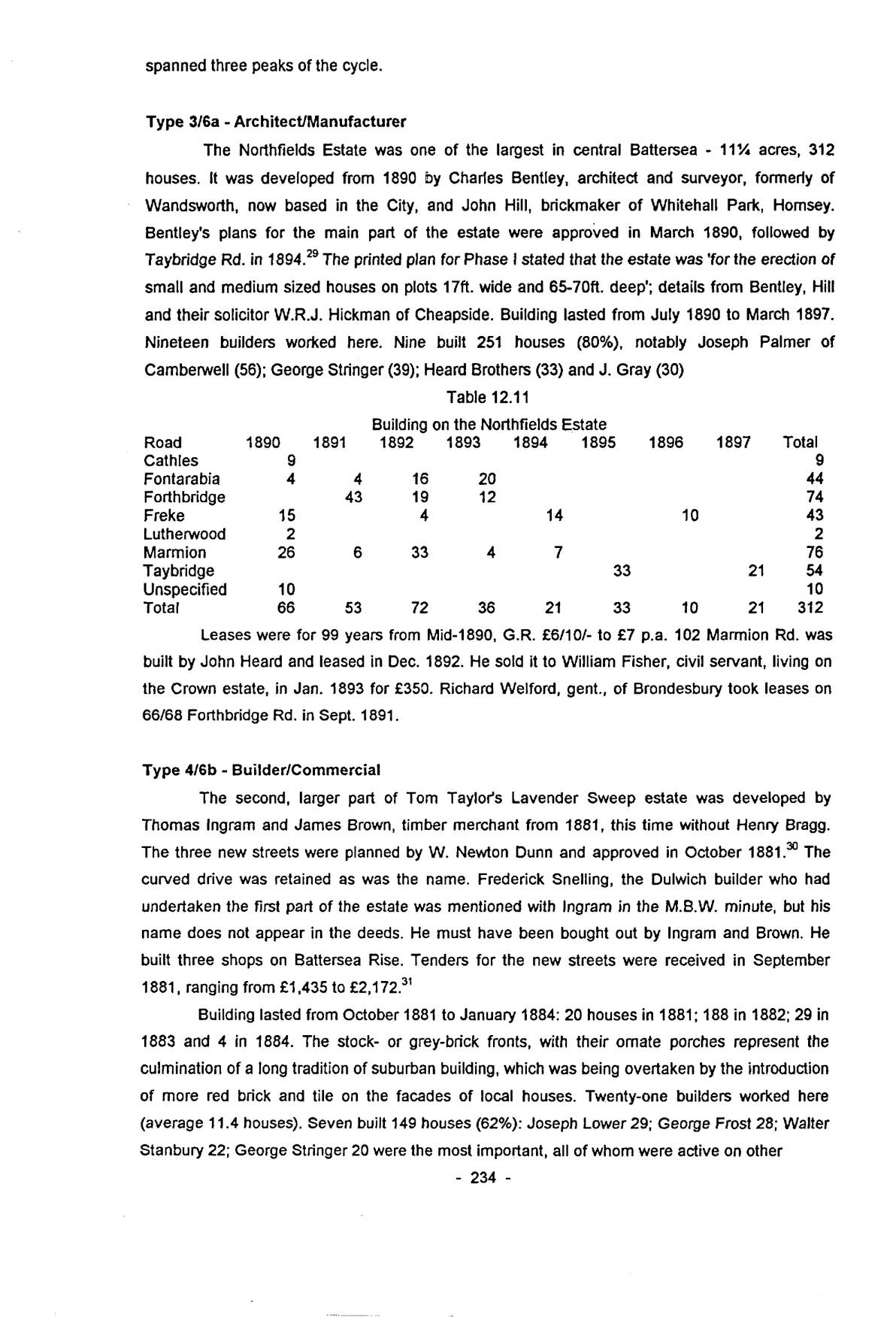
The Northfields Estate was one of the largest in central Battersea – 11¼ acres, 312 houses. It was developed from 1890 by Charles Bentley, architect and surveyor, formerly of Wandsworth, now based in the City, and John Hill, brickmaker of Whitehall Park, Hornsey. Bentley’s plans for the main part of the estate were approved in March 1890, followed by Taybridge Rd. in 1894.29 The printed plan for Phase I stated that the estate was ‘for the erection of small and medium sized houses on plots 17ft. wide and 65-70ft. deep’; details from Bentley, Hill and their solicitor W.R.J. Hickman of Cheapside. Building lasted from July 1890 to March 1897. Nineteen builders worked here. Nine built 251 houses (80%), notably Joseph Palmer of Camberwell (56); George Stringer (39); Heard Brothers (33) and J. Gray (30)
| Road | 1890 | 1891 | 1892 | 1893 | 1894 | 1895 | 1896 | 1897 | Total |
|---|---|---|---|---|---|---|---|---|---|
| Cathles | 9 | 9 | |||||||
| Fontarabia | 4 | 4 | 16 | 20 | 44 | ||||
| Forthbridge | 43 | 19 | 12 | 74 | |||||
| Freke | 15 | 4 | 14 | 10 | 43 | ||||
| Lutherwood | 2 | 2 | |||||||
| Marmion | 26 | 6 | 33 | 4 | 7 | 76 | |||
| Taybridge | 33 | 21 | 54 | ||||||
| Unspecified | 10 | 10 | |||||||
| Total | 66 | 53 | 72 | 36 | 21 | 33 | 10 | 21 | 312 |
Leases were for 99 years from Mid-1890, G.R. £6/10/- to £7 p.a. 102 Marmion Rd. was built by John Heard and leased in Dec. 1892. He sold it to William Fisher, civil servant, living on the Crown estate, in Jan. 1893 for £350. Richard Welford, gent., of Brondesbury took leases on 66/68 Forthbridge Rd. in Sept. 1891.
Type 4/6b – Builder/Commercial
The second, larger part of Tom Taylor’s Lavender Sweep estate was developed by Thomas Ingram and James Brown, timber merchant from 1881, this time without Henry Bragg. The three new streets were planned by W. Newton Dunn and approved in October 1881.30 The curved drive was retained as was the name. Frederick Snelling, the Dulwich builder who had undertaken the first part of the estate was mentioned with Ingram in the M.B.W. minute, but his name does not appear in the deeds. He must have been bought out by Ingram and Brown. He built three shops on Battersea Rise. Tenders for the new streets were received in September 1881, ranging from £1,435 to £2,172.31
Building lasted from October 1881 to January 1884: 20 houses in 1881; 188 in 1882; 29 in 1883 and 4 in 1884. The stock- or grey-brick fronts, with their ornate porches represent the culmination of a long tradition of suburban building, which was being overtaken by the introduction of more red brick and tile on the facades of local houses. Twenty-one builders worked here (average 11.4 houses). Seven built 149 houses (62%): Joseph Lower 29; George Frost 28; Walter Stanbury 22; George Stringer 20 were the most important, all of whom were active on other
p. 235estates in central and south Battersea in the early 1880s.
Composite estates, though having very heterogeneous initiators, confirm the general pattern of development outlined in previous chapters. As mentioned in the introduction to this chapter, this is in large part due to the fact that many of those concerned were involved in the development of building estates in their own right, and naturally employed the methods which were seen to bring results, albeit subject to change and delay in many cases. Even some of the partnerships occur in more than one category, for example those between Ingram and Brown and Prall and Nickinson. The unseen personal contacts and information networks clearly played a crucial role.
The activities of men like W. Newton Dunn, William Poole and Charles Bentley, architects and surveyors, should not be underestimated, even if they did not actually own the land and reap the rewards. A good example of such an unequal partnership, which nevertheless endured for ten years, is that between the Corsellis and Stanbury families. The ability to find capital sums of £20,000 and upwards was a key factor in the ability to gain admission to the developers’ club by 1880, especially as many of the properties coming on to the market included villas and mansions dating from the first generation of building in Battersea. The pressures to maximise returns, and the fact that virtually no developer actually lived, or wished to live in the area, ensured that few of these survived.
Although larger than average, composite estates were still subject to the fluctuations inherent in building development. Many which were laid out in the 1860s were not finished until the late-1870s, and those started in the 1878-80 boom often took five years to complete. Many of these estates in central and south Battersea, however, were very successful measured in these terms, indicative of a real demand for lower middle-class housing in the area. Henry (and Alexander) Corsellis were beneficiaries of this, reaping large rewards from their high ground rent policy and from sales of blocks of houses. Thomas Ingram, with a variety of partners and eventually on his own, made an even more significant impact on the local townscape between his first appearance in 1875 and his death in 1901. In all, 2,154 houses (8.4% of the total) were on estates in which he had been involved.