Home › Building histories › The Metamorphosis of Battersea › Chapter 14
Build 2 — 24 September 2026
– Introduction
– Common Field and Meadow to Suburbia
– Methods of Development
The principal objective of this study has been to analyse the processes of building development in Battersea, a south-west London parish covering less than 2,200 acres, during the period 1780-1914, examining the methods employed and the individuals who were involved. The aim is to add to the number of such case studies which have been undertaken in other London suburbs over the last forty years or so, and to see how similar, or how different, things were in Battersea.
While the source materials may not be as comprehensive as those for Middlesex, a large sample of deeds and other sources have enabled a broad cross-section of developments to be analysed, based on a typology which divides estates according to the individual(s) responsible for their initiation. The local evidence for the operation of the building cycle has also been examined, as has that for the builders and other craftsmen who were responsible for the dramatic changes in the Battersea landscape during the period.
The transformation from a mostly rural parish, albeit one with a significant industrial base and already attracting wealthy Londoners to its more favoured areas, with a population of scarcely 2,000 to a fully-integrated part of the Edwardian world city, with 170,000 inhabitants would have been inconceivable to the local inhabitant of 1780, although the opening of Battersea Bridge in 1772 was an early straw in the wind. It was the 1870s and 1880s, however, when the population grew by 53,000 and 60,000, respectively – each equivalent to a goodly sized provincial town – which saw the creation of the mature suburb, with its shops, churches, schools and other vital infrastructure. In this, Battersea was of course no different from dozens of other London suburbs, and this study generally supports the views of development and building already reported from other parts of the Metropolis, and from certain provincial cities such as Leeds, although differences are apparent at a disaggregated level.
Battersea was characterised by extremely fragmented landownership, in large part due to the survival of open fields as late as the mid-nineteenth century, itself a function of the development of market gardening to supply the London market from the early seventeenth century onwards. The quarter-, half- and one-acre strips of the medieval fields were well-suited to this labour-intensive business, enabling a variety of crops to be grown. It is important to note, however, that the Common Field occupied only the northern third of the parish, on the fertile flood-plain and brickearth deposits. The rest was enclosed by 1600 (if indeed it had ever been farmed communally), or formed part of two extensive heaths with poor soils suitable only for rough grazing.
In the north, much of the enclosed land was used for market gardens and orchards, as well as grazing livestock and some arable, all reflecting the dominance of the London market. In central Battersea after 1750, many of the fields became adjuncts to the villas and mansions built
p. 281around East Heath, although there is little evidence to suggest that there was any landscaping of note. Most of this first generation of out-of-town residences survived until 1880, but thereafter fell like dominoes to the developer and builder in a thirty-year campaign, which has left only a scattering of the houses, shorn of their valuable grounds, and some street-names to witness this phase of the perennial retreat from the city which is the basis of the English suburban dream.
The fragmentation of ownership is one of the principal reasons for the way in which Battersea developed. In 1839, the 1,742 acres subject to tithe redemption were owned by 165 individuals (average 10.56 acres), but if one excludes the ten largest owners (829 acres – 47.6%), the average for the rest is only 5.89 acres (cf. 5.12 ac. for the average building estate). Even among the largest owners, the survival of open field meant that their “estates” were highly fragmented, only those whose property was concentrated in the south had large discrete blocks at their disposal – for example, the Dent family’s 71 ac. and Henry Willis 58 ac. John Lucas of Clapham was unusual in having his sixty acres in a block in the north-east. The bulk of Thomas Ponton’s 100 acres lay at Nine Elms. A large proportion of Richard Southby’s 265 acre estate formed a band of enclosures between the Lower Wandsworth Road and the Heathwall Sewer. Such concentrations of land in 1839 did not, however, mean that their owners went on to develop the kind of large building estates which characterise areas like Bloomsbury, Marylebone and Hampstead. This was mainly due to the creation of a dense network of railways and associated works, engine sheds and freight facilities between 1838 and 1867, which had the effect of fragmenting many estates and leaving their development to new owners.
The average size of the 209 building estates which were crammed into the remaining 1,071 acres of Battersea was 5.12 acres/123 houses. There was little scope for amassing large blocks of real estate after 1840. The only exception to this rule was the purchase by the Crown of almost 300 acres – mostly open field strips – between 1846 and 1853 for the creation of a new Royal Park. The sixty acres around the fringe of the park formed the largest building estate in the parish, but one with a short history. This, and the fact that much of it was given over to the building of blocks of mansion flats marks it out as unique, although the methods employed were the same as on the smallest quarter-acre property. The second and third largest estates – Park Town (57ac., 1,346 houses) and Shaftesbury Park (38ac., 1,217 houses) were on enclosed land in unified ownership in 1839, although both were more or less affected by railway building and neither was developed by its original owners.
The industrial nature of the northern half of the parish soon established that the demand for working-class, especially artisan, housing would far outstrip that for the middle classes which developers most favoured. The Flower family soon found that their dream of a Pimlico south of the river was unachievable in reality, the presence of railways and factories far outweighing the amenities of the Park. The sharp contrast between the substantial three-storey terraces of the 1860s and the half-houses of the 1890s is physical evidence of how they came to terms with the problem. The Artizans & General Labourers’ Dwellings Co. was much more successful, setting out to create a “Workmen’s City” for the so-called aristocracy of labour with strict control over licensed premises. Their estate was noted as a bastion of the respectable artisan, a forerunner of the L.C.C’s. cottage estates from Totterdown, Tooting (1903) to Burnt Oak and Becontree in the
p. 2821920s and 1930s.
Relatively few Battersea estates retained high status tenants over a long period. There were enclaves such as New Wandsworth and Westbridge Road where Class I and II households were not uncommon, even in the 1890s. In central and south Battersea, railways and industry were less obtrusive, and developers could pitch their aspirations higher, although most tenants (and a few owner-occupiers) belonged to the shopkeeper/clerical/lower professional classes, rather than the upper echelons of the middle classes. The scaling-down of plots at Broomwood Park from 24ft. with detached or semi-detached in the early 1880s to 17-18ft. with long, monotonous terraces in the late-nineties is symptomatic of a growing realism in the face of market demands. The north:south, low-lying:elevated, working-class:middle-class dichotomies were established by 1800 and persisted until the Great War, with few important exceptions.
Since working-class and “clerical” suburbs are clearly more numerous than middle- and upper-class ones, the environmental factors underlying the development of Battersea are probably more likely to represent the norm than those which determined the history of the Bedford, Grosvenor and Cubitt estates. Chief among these influences would seem to be the absence of any major landed or institutional landowner with the resources and persistence to impose conditions on builders and tenants which ensured the maintenance of social cachet over prolonged periods, followed by the existence of a pre-urban industrial base which grew markedly between 1800 and 1850. The third crucial element was the railway, not as a mass carrier of proto-commuters, but as a major landscape element and employer of local labour. Not only the land in direct ownership was affected, but scores of additional acres where their physical presence was significant, or where housing was provided which attracted their employees (north Battersea 1850-75) or their potential passengers (central/south Battersea 1870-1900). Many other London suburbs were affected in this way, of course, from Stratford in the east to Acton, Willesden and Ealing in the west, Hornsey in the north to Croydon in the south.
The overwhelming impression from this sample of building estates is that the process of converting fields and gardens into streets of houses was extremely uniform throughout the period and everywhere in the parish, and closely mirrors the experience of a wide range of landowners in suburbs across Greater London, from the great landed estates of the West End, Dulwich and Hampstead to the slum courts and alleys of Somers Town and Walworth. Despite the fact that housebuilding was essentially achieved by a congeries of hand crafts (as indeed it still is) organised, with few exceptions, in very small groupings, with myriad sources of finance, it is clear that the model of long leasehold development which grew up and was refined in seventeenth- and eighteenth-century London was used on virtually every estate in Battersea between the 1780s and 1914. The only significant deviation from the norm was the freehold land companies in the 1850s and 1860s, where the sale of small freehold lots intervened between the original owner and the builder, although even here the method of building was indistinguishable from that used on neighbouring estates. A handful of private owners also employed this method of raising short-term capital at the expense of long-term ground rents and ultimate reversion.
p. 283Despite of the wide range of types of owners and the very fluid market in generally small plots of land, development was highly standardised. The most significant feature in the covering of 1,100 acres of Battersea with 26,000 dwellings is the random way in which owners decided to build. There is little evidence of a steady spread of houses from north-east to south-west from the point closest to London, or that this applied in neighbouring parishes (Chapter 5). In some ways, the Village centre acted more as such a diffusion centre, albeit not consistently.
Far more important was the purely local catalytic effect of events such as the death of a long-term owner or the sale of land at auction, bringing in new owners with building specifically in mind. Even when the fate of Battersea as a suburb of London was irreversible (probably during or just after the great boom of the mid-1860s), many landowners showed little or no sign of wishing to capitalise on their assets, leaving the pleasant estates of central and south Battersea to the attentions of the speculative builder. Edward Fownes’s estate was virtually surrounded by houses a decade before he sold out to Alfred Heaver in 1879, and Matthew Whiting stayed at Lavender Lodge – a few acres in the commercial heart of the new suburb – until his death in 1904, allegedly so rich that he had no need to develop.
Two crucial agents creating the conditions for estate development were the Spencer freehold sales of 1835-6 and the railway. The first transferred ownership of substantial amounts of land from the lord of the manor to his tenants at a time when housebuilding was just beginning to seem a more lucrative land use than nurseries and market gardens, laid the foundations for many estates. Railways first impinged on the local landscape at the same time, and over the next three decades many acres, not only for lines and stations, but also for goods yards, sidings, locomotive and carriage sheds, and the two great works at Nine Elms and Longhedge. Their compulsory acquisition of land upset ownership patterns in many parts of Battersea, just as the requirement to sell off surplus land laid the foundation of many small estates. The physical impact of embankments and viaducts in the lowlying north of the parish had a profound effect on the aspirations of more than one owner/developer, as well as isolating estates which might otherwise have formed connexions with one another.
A third influence was the creation of Battersea Park, which took more than two hundred acres of potential building land off the market and affected the type of development of sixty more. It prevented the industrialisation of the whole riverfront and the hinterland from becoming several dozen more working-class estates, their otherwise inevitable fate. The Park attracted middle-class houses and flats, the latter decidedly alien south of the Thames, and provided an open space for thousands crammed into more typical estates nearby. Equally important in this respect were the two ancient commons – once Battersea East and West Heaths, but transformed into Wandsworth and Clapham Commons, even they had only a minority of the land.
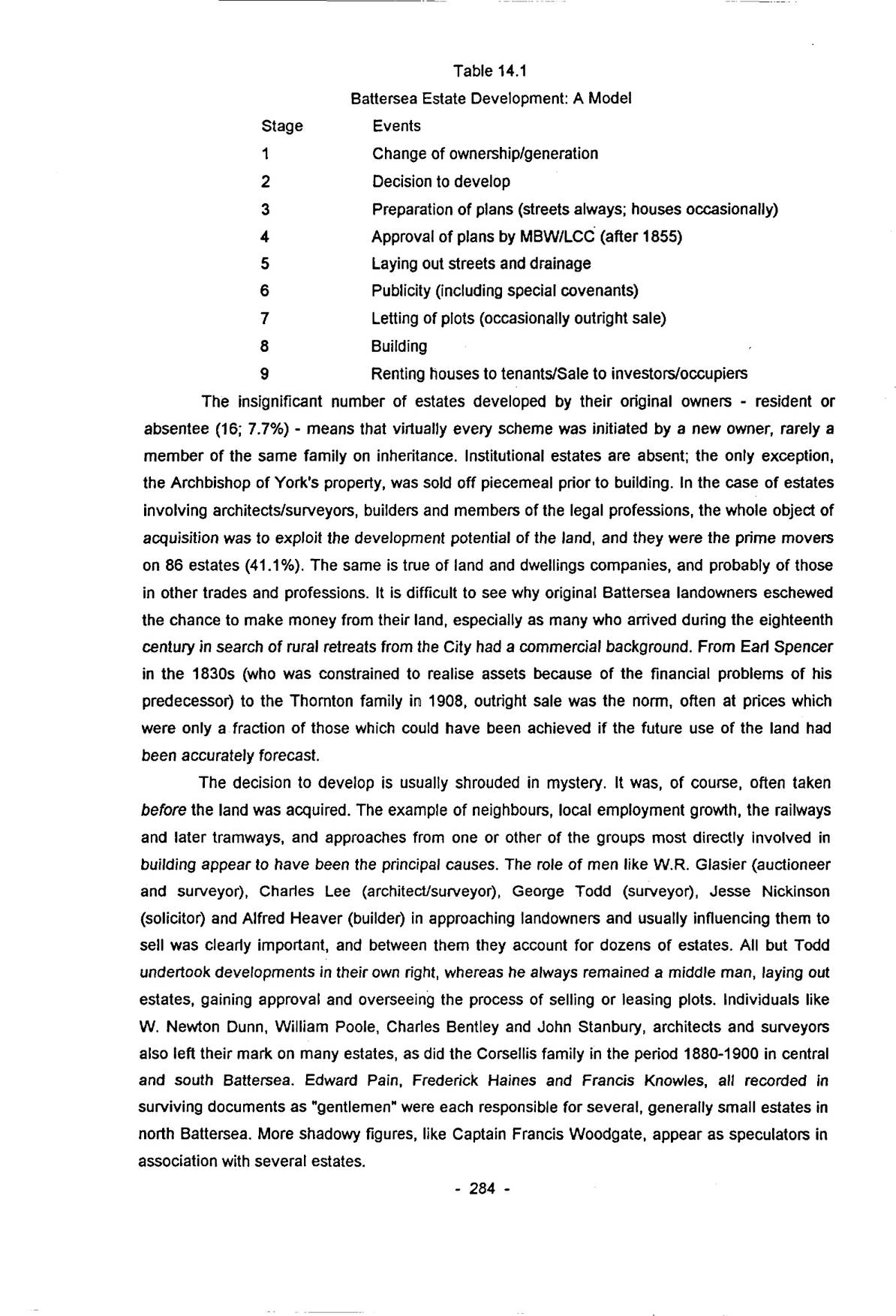
Given the highly standardised approach to estate development, it is possible to formulate a simple sequential model:
| Stage | Events |
|---|---|
| 1 | Change of ownership/generation |
| 2 | Decision to develop |
| 3 | Preparation of plans (streets always; houses occasionally) |
| 4 | Approval of plans by MBW/LCC (after 1855) |
| 5 | Laying out streets and drainage |
| 6 | Publicity (including special covenants) |
| 7 | Letting of plots (occasionally outright sale) |
| 8 | Building |
| 9 | Renting houses to tenants/Sale to investors/occupiers |
The insignificant number of estates developed by their original owners – resident or absentee (16; 7.7%) – means that virtually every scheme was initiated by a new owner, rarely a member of the same family on inheritance. Institutional estates are absent; the only exception, the Archbishop of York’s property, was sold off piecemeal prior to building. In the case of estates involving architects/surveyors, builders and members of the legal professions, the whole object of acquisition was to exploit the development potential of the land, and they were the prime movers on 86 estates (41.1%). The same is true of land and dwellings companies, and probably of those in other trades and professions. It is difficult to see why original Battersea landowners eschewed the chance to make money from their land, especially as many who arrived during the eighteenth century in search of rural retreats from the City had a commercial background. From Earl Spencer in the 1830s (who was constrained to realise assets because of the financial problems of his predecessor) to the Thornton family in 1908, outright sale was the norm, often at prices which were only a fraction of those which could have been achieved if the future use of the land had been accurately forecast.
The decision to develop is usually shrouded in mystery. It was, of course, often taken before the land was acquired. The example of neighbours, local employment growth, the railways and later tramways, and approaches from one or other of the groups most directly involved in building appear to have been the principal causes. The role of men like W.R. Glasier (auctioneer and surveyor), Charles Lee (architect/surveyor), George Todd (surveyor), Jesse Nickinson (solicitor) and Alfred Heaver (builder) in approaching landowners and usually influencing them to sell was clearly important, and between them they account for dozens of estates. All but Todd undertook developments in their own right, whereas he always remained a middle man, laying out estates, gaining approval and overseeing the process of selling or leasing plots. Individuals like W. Newton Dunn, William Poole, Charles Bentley and John Stanbury, architects and surveyors also left their mark on many estates, as did the Corsellis family in the period 1880-1900 in central and south Battersea. Edward Pain, Frederick Haines and Francis Knowles, all recorded in surviving documents as “gentlemen” were each responsible for several, generally small estates in north Battersea. More shadowy figures, like Captain Francis Woodgate, appear as speculators in association with several estates.
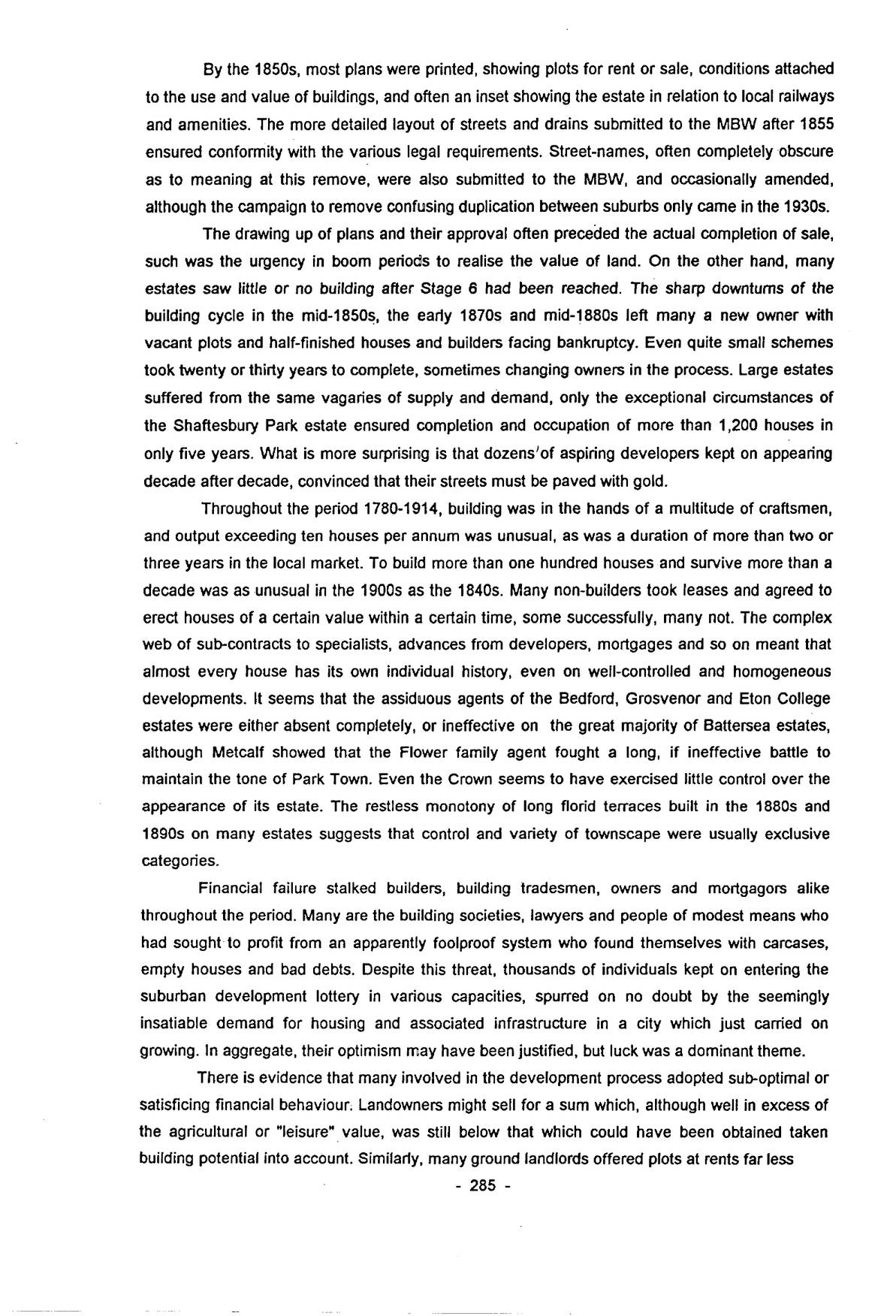
p. 285By the 1850s, most plans were printed, showing plots for rent or sale, conditions attached to the use and value of buildings, and often an inset showing the estate in relation to local railways and amenities. The more detailed layout of streets and drains submitted to the MBW after 1855 ensured conformity with the various legal requirements. Street-names, often completely obscure as to meaning at this remove, were also submitted to the MBW, and occasionally amended, although the campaign to remove confusing duplication between suburbs only came in the 1930s.
The drawing up of plans and their approval often preceded the actual completion of sale, such was the urgency in boom periods to realise the value of land. On the other hand, many estates saw little or no building after Stage 6 had been reached. The sharp downturns of the building cycle in the mid-1850s, the early 1870s and mid-1880s left many a new owner with vacant plots and half-finished houses and builders facing bankruptcy. Even quite small schemes took twenty or thirty years to complete, sometimes changing owners in the process. Large estates suffered from the same vagaries of supply and demand, only the exceptional circumstances of the Shaftesbury Park estate ensured completion and occupation of more than 1,200 houses in only five years. What is more surprising is that dozens of aspiring developers kept on appearing decade after decade, convinced that their streets must be paved with gold.
Throughout the period 1780-1914, building was in the hands of a multitude of craftsmen, and output exceeding ten houses per annum was unusual, as was a duration of more than two or three years in the local market. To build more than one hundred houses and survive more than a decade was as unusual in the 1900s as the 1840s. Many non-builders took leases and agreed to erect houses of a certain value within a certain time, some successfully, many not. The complex web of sub-contracts to specialists, advances from developers, mortgages and so on meant that almost every house has its own individual history, even on well-controlled and homogeneous developments. It seems that the assiduous agents of the Bedford, Grosvenor and Eton College estates were either absent completely, or ineffective on the great majority of Battersea estates, although Metcalf showed that the Flower family agent fought a long, if ineffective battle to maintain the tone of Park Town. Even the Crown seems to have exercised little control over the appearance of its estate. The restless monotony of long florid terraces built in the 1880s and 1890s on many estates suggests that control and variety of townscape were usually exclusive categories.
Financial failure stalked builders, building tradesmen, owners and mortgagors alike throughout the period. Many are the building societies, lawyers and people of modest means who had sought to profit from an apparently foolproof system who found themselves with carcases, empty houses and bad debts. Despite this threat, thousands of individuals kept on entering the suburban development lottery in various capacities, spurred on no doubt by the seemingly insatiable demand for housing and associated infrastructure in a city which just carried on growing. In aggregate, their optimism may have been justified, but luck was a dominant theme.
There is evidence that many involved in the development process adopted sub-optimal or satisficing financial behaviour. Landowners might sell for a sum which, although well in excess of the agricultural or “leisure” value, was still below that which could have been obtained taken building potential into account. Similarly, many ground landlords offered plots at rents far less
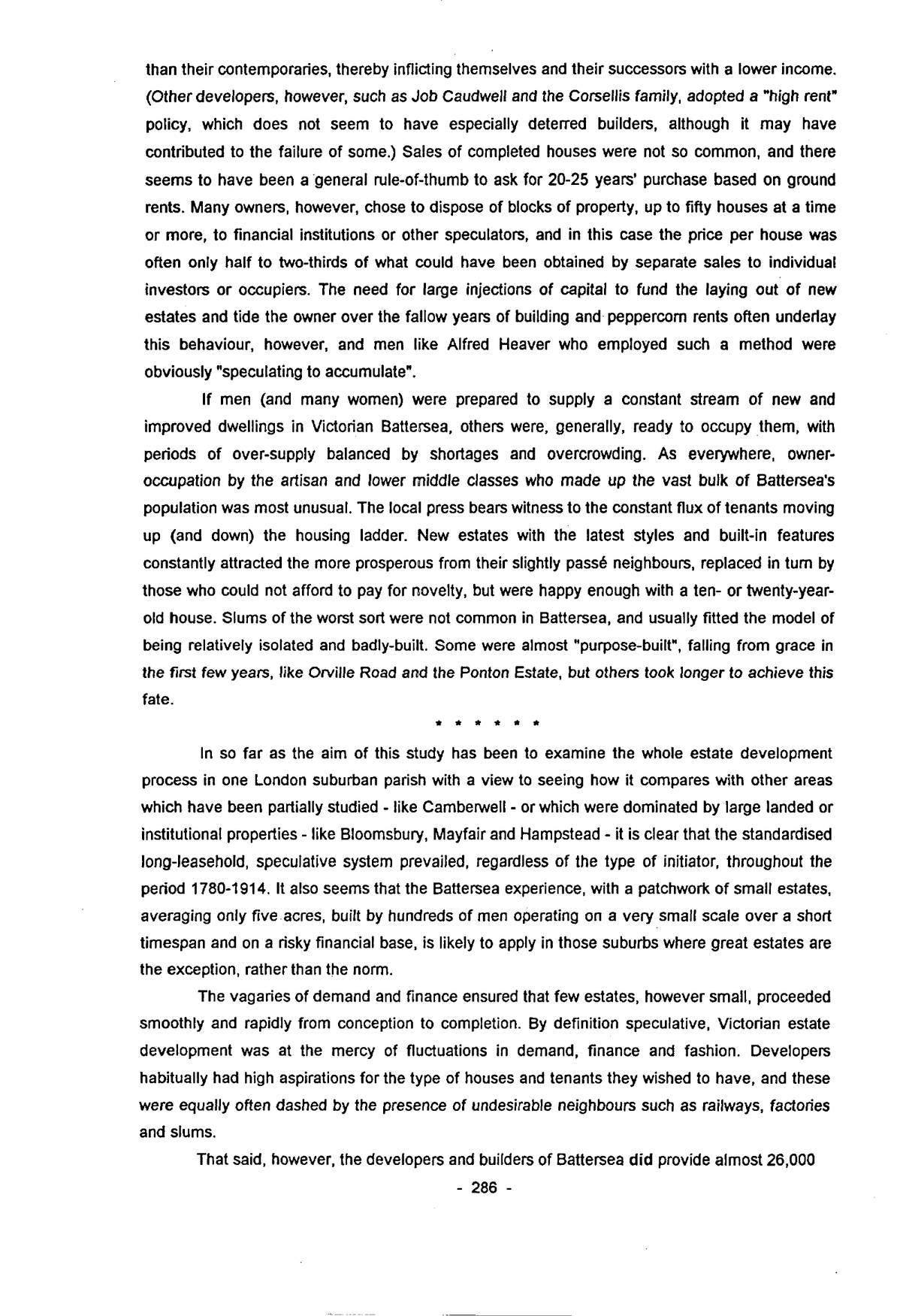
p. 286than their contemporaries, thereby inflicting themselves and their successors with a lower income. (Other developers, however, such as Job Caudwell and the Corsellis family, adopted a “high rent” policy, which does not seem to have especially deterred builders, although it may have contributed to the failure of some.) Sales of completed houses were not so common, and there seems to have been a general rule-of-thumb to ask for 20-25 years’ purchase based on ground rents. Many owners, however, chose to dispose of blocks of property, up to fifty houses at a time or more, to financial institutions or other speculators, and in this case the price per house was often only half to two-thirds of what could have been obtained by separate sales to individual investors or occupiers. The need for large injections of capital to fund the laying out of new estates and tide the owner over the fallow years of building and peppercorn rents often underlay this behaviour, however, and men like Alfred Heaver who employed such a method were obviously “speculating to accumulate”.
If men (and many women) were prepared to supply a constant stream of new and improved dwellings in Victorian Battersea, others were, generally, ready to occupy them, with periods of over-supply balanced by shortages and overcrowding. As everywhere, owner-occupation by the artisan and lower middle classes who made up the vast bulk of Battersea’s population was most unusual. The local press bears witness to the constant flux of tenants moving up (and down) the housing ladder. New estates with the latest styles and built-in features constantly attracted the more prosperous from their slightly passé neighbours, replaced in turn by those who could not afford to pay for novelty, but were happy enough with a ten- or twenty-year-old house. Slums of the worst sort were not common in Battersea, and usually fitted the model of being relatively isolated and badly-built. Some were almost “purpose-built”, falling from grace in the first few years, like Orville Road and the Ponton Estate, but others took longer to achieve this fate.
· · ·
In so far as the aim of this study has been to examine the whole estate development process in one London suburban parish with a view to seeing how it compares with other areas which have been partially studied – like Camberwell – or which were dominated by large landed or institutional properties – like Bloomsbury, Mayfair and Hampstead – it is clear that the standardised long-leasehold, speculative system prevailed, regardless of the type of initiator, throughout the period 1780-1914. It also seems that the Battersea experience, with a patchwork of small estates, averaging only five acres, built by hundreds of men operating on a very small scale over a short timespan and on a risky financial base, is likely to apply in those suburbs where great estates are the exception, rather than the norm.
The vagaries of demand and finance ensured that few estates, however small, proceeded smoothly and rapidly from conception to completion. By definition speculative, Victorian estate development was at the mercy of fluctuations in demand, finance and fashion. Developers habitually had high aspirations for the type of houses and tenants they wished to have, and these were equally often dashed by the presence of undesirable neighbours such as railways, factories and slums.
That said, however, the developers and builders of Battersea did provide almost 26,000
p. 287dwellings for 170,000 new inhabitants in the period, all but a tiny minority built and funded by myriad individuals working together in an extremely efficient system, almost a production line. There were many casualties, and many failed to make the fortunes to which they aspired, but losers were far outweighed by winners, not least the tens of thousands who enjoyed reasonably-built accommodation at affordable rents thanks to the efforts of men as diverse as William Sleford, the Southwark butcher; the Carter and Gaines families and Francis Lithgow, local market gardeners; Thomas Cubitt, the originator of the idea for Battersea Park; Alexander Corsellis and Jesse Nickinson, solicitors; William Pocock, architect and Alfred Heaver, carpenter turned major developer. Men who saw an opportunity and took it.
Transcribed from the typescript of 1995 and checked line by line against the page images. Keith Bailey’s wording, spelling and punctuation are kept. Errors made by the scanning software have been corrected silently. The grey page numbers in the margin (e.g. p. 5) give the original page, and can be clicked to see an image of it. Note numbers link to the references and back.
Keith Alan Bailey, The Metamorphosis of Battersea 1800–1914: A Building History, PhD thesis, The Open University, 1995. Digital edition published with the author’s permission; prepared by Philip Boys, 2026. Build 2 — 24 September 2026.