
— Lake
— Lake Walk 2025[lots of nice pics]
— Fish
— Maps
— Bridges
— Benches
— People
— Ice
— Pondlife
— Birds
— Dogs
— Nottidge
On Wednesday 15 October at 2 p.m., I'll be going for an hour or so's walk around the Lake. If you would like to join me, contact history@wandsworthcommon.org to book a place.
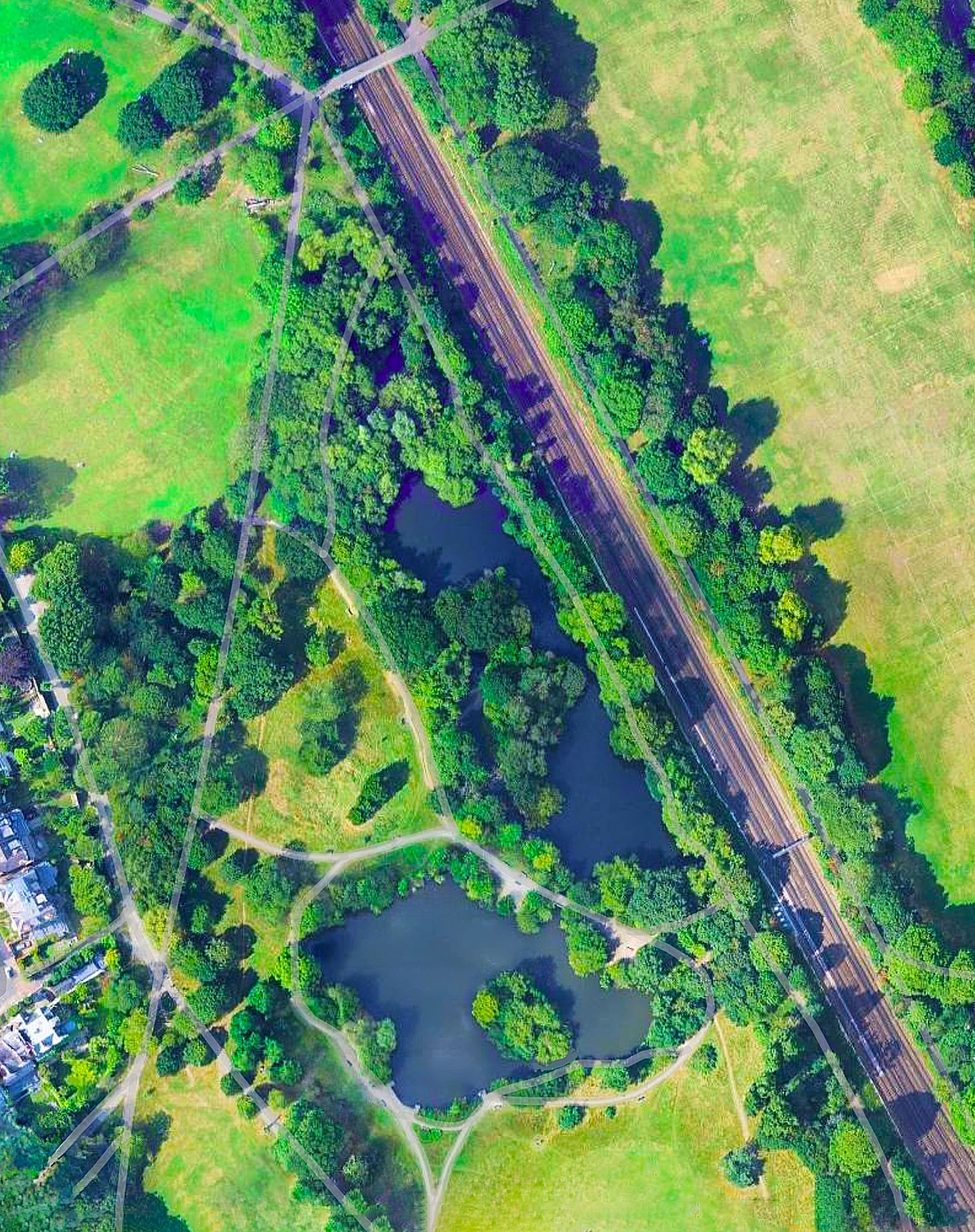
I expect I'll talk about its origins as a gravel quarry (after the Black Sea had been filled in to make way for Spencer Park), and include something on the fierce opposition to its construction (as encouraging cholera miasmas, and exposing "the ladies" to naked boys cavorting in its cooling water).
We'll look at how it's grown and changed, its islands, and various incarnations of the bridge across its waist. I expect we'll ruminate on its fish, its lethal swans and terrapins, and look at its significance in the creative life of poet Edward Thomas.
And probably some tragic drownings, and the deeply painful stories behind some of the commemorative benches on its edges. But we may also meet the "sagacious collie" Grissel, who plunged in to save a child — and earned a high award for canine bravery.
Perhaps less, but almost certainly much much more. And please bring your own stories to share.
What do you call it? The Lake? The Long Pond? The Dog Pond? Or just "The Pond", as in "Let's go up the pond". This is how I referred to it when I was a child. The Pond.
— Maps of the lake's development
— Rain — what happens to the water that falls on the Common?
— The lie of the land — height, slope, tilt etc . . .
— The Black Sea filled in — a new pond needed? Why so important to have an ornamental pond? The filling in of other ponds but the creation of a single more substantial pond
— Origins in a small gravel pit — N.B. You can see a suggestion of the edges of the pit in some maps — gravel-digging employed 50 or 60 people — probably v. poorly paid — and work was hazardous.
What do you call it? The Lake? The Long Pond? The Dog Pond? Or just "The Pond". This is how I referred to it when I was a child. As in "Let's go up the pond"—all lower case.
We'll look at why it has different names below, but in the meanwhile let's just talk about it as the Lake, since that seems to be name the most widely used today.
Children Adults Ice Suicides and murders Dogs - Grissel But bigger question - why build a pond at all? To pond or not to pond

He also writes about "the roundish Box Pond that lay half-way between the top of our street and the railway", filled in at the end of the nineteenth century:

I fished for sticklebacks and gudgeon in the long pond on the far side of the railway, which owed its name of "Backaruffs" or "Pack of Roughs", so I always thought, to the poor ill-dressed boys who used to swarm to it from Battersea on Saturdays and bank holidays.

[Some of the notes I wrote some years ago on the correspondence between the naturalist Arthur Gardiner Butler and Charles Darwin about sexual selection among sticklebacks made it into The Wandsworth Common Story. I'll add something more on this eventually, but feel free to ask if you want to know more. You can read a transcription of Arthur Butler's letter of 29 June 1871 here.]
A couple of years ago I made a short video (my first) from Edwardian postcards and photographs of the lake, set to contemporary music by Claude Debussy, which you can view here. Utterly self-indulgent.

And here's one on the Three-Island Pond:

Back to the top of this page . . .
Money was VERY tight...after Spencer's £250 and the repyamnet of loans...
Individuals made donations, and organised funds e.g. Dr Mann below. [He, it will be remebered, was opposed to the new ornamental pond near the Clapham Road.]
Wimbledon and Wandsworth Commons
[ . . . ]
The accounts in connection with the preservation of Wandsworth Common have also been presented at
March [??] meeting of the Conservators - Mr. Du Buisson in the chair - held a few days ago. The balance sheet showed that with the balance from last year (£30 4s. 4d.) the total receipts had been £855 16s. 10d.
Of this sum £429 had been compulsorily devoted to expenses beyond the control of the Conservators - such as the annuity secured in return for the rights of the lord of the manor, sinking fund, audit, taxes, &c.
The remainder, with a small deduction for working expenses, was expended upon the maintenance of order upon the Common, draining, planting, &c., leaving a balance of £96 7s. 3d. to carry forward.
[PB: i.e. a half! And presumably in previous years there had been even less money to spend on the Common - see below.]
The receipts included sum of collected by Dr. Mann, of Bolingbroke Grove, and specially applied under the provisions of the Act for planting trees in the neighbourhood.
An analysis of the past expenditure indicated that since the passing of the Act the following sums had been laid out in the improvement the Common - viz.,
1872, £287;
1873, £235;
1874, £132;
1875, £179;
1876, £195;
1877, £312;
1878, £249.
Mr. Hatch, a ratepayer, suggested the desirability of improving the banks of the sheets of water contiguous to the Brighton Company's line; and Mr. Whiteley drew attention to the question of allowing bathing in certain of the ponds upon the Common.
[PB: the "the sheets of water " must be a reference to or lake.]
In answer to these gentlemen, and also to Mr. Moore, who suggested certain improvements connection with the paths, the chairman stated that the plan upon which the Conservators had hitherto acted had been to consider that moneys raised from the rates should be expended for the improvement of Common a whole, and that improvements in particular spots, such as those suggested, should be provided for subscriptions raised in the locality to be benefited. Such subscriptions the Conservators would be at all times ready to receive.
[PB: i.e. charity, donations]
The remarks and suggestions which had fallen from the ratepayers present should, however, meet with due consideration during the coming year.
[Source: Link.]
