[BNA Search: "Wandsworth Common"]
[South London Press: "Wandsworth Common"]
[The Times: Search: "Wandsworth Common"].
[BNA: Buckmaster Battersea 1863]
[BNA: Buckmaster Wandsworth 1863]
[London Evening Standard: Buckmaster Wandsworth 1863]
Dreadful Suicide
On Tuesday morning the police authorities at Scotland-yard received intelligence of a dreadful suicide committed near the Patriotic Asylum, Wandsworth Common.
It appears that on Monday William Cades, a postmaster, carrying on business as a baker in York-road. Battersea, was seen by two plate-layers loitering near the West End and Crystal Palace Railway Wandsworth Common: and on the approach of the Brighton express train he ran down the embankment and placed his head upon the metals. The train immediately passed over it, smashing it in most dreadful manner. To such an extent was the poor man's head crushed that could only identified by his clothes. His remains were carried to the workhouse of the Wandsworth and Clapham Union, awaiting inquest. From the inquiries made of his friends it appears that the deceased had been in a desponding state for some time.
[Numerous similar articles, and some anxiety that suicides in this way are increasing : "Wandsworth Common". ]
EPIDEMIOLOGICAL SOCIETY. B. G. Babikoton, M.D., F.R.S., in the Chair. OK THE BKIX DEVELOPED IN SCHOOLS, WORKHOUSES, AND FACTORIES, FROM DEFECTIVE HYGIENE.
By Thomas Hunt, Esq.
The author wished prominently to bring forward the effects of congregating and incarcerating many children or young persons under one roof, of feeding them on one and the same diet, and thus promoting locally the more or less permanent inroads of certain cutaneous diseases, which diseases often subside spontaneously upon the removal of the sufferer from the locality.
These diseases are chiefly the common ringworm (porrigo scutulata) and scabies; the former being usually aggravated by the presence of a vegetable, the latter by an animal parasite. He had never visited a workhouse, or a detachment of pauper children, or a large boardingschool occupied by the poor, without observing many cases of ringworm and scabies; one of these two diseases prevailing at one time, the other at another period, and both showing a tendency to pustulation. These cutaneous plagues will often persist month after month, in spite of tne most careful treatment and the most scrupulous attention to cleanliness and ventilation.
Ho had already published an account of an endemic scabies, which infected, for many months together, large girls' school in the neighbourhood of London, where cleanliness, ventilation, good drainage, good nursing, and good medical care, were conspicuously apparent; but nothing was of any permanent service until entire change 01diet was March 25,1863. introduced, together with the daily exercise of the inmates away from the premises. Accounts of similar endemic difficulties reached the author from medical practitioners who had the charge of institutions of the same character in different parts of the country, and the same kind of treatment proved equally effectual in all of them.
In those factories where children are employed, and boarded and lodged on the premises, like occurrences are observed, involving the clean and the dirty, the well-fed and the ill-fed. The doctrine of contagion fails to explain the cause; nor, indeed, is any one imaginable cause to be named that is capable, per se, accounting for all the peculiarities of the case. But appeared to him that, by duly reflecting upon all the sanitary circumstances in which these children are placed, may be able to discover an aggregate of influences, so to speak, which not separately, but concurrently, may combine to produce these morbid conditions. Atmospheric impurity, unnatural diet, deficient exercise, and contagion, are the four conditions which appear to unite their several forces to perpetuate these loathsome affections of the skin. And yet not one of these causes alone ever presents a formidable difficulty in the treatment; neither does either of them exist in any prominent degree in these establishments. There is no sensible vitiation of the atmosphere, no had smell, no defective drainage, no neglect of ventilation. The diet is excellent in quality, plentiful in quantity, wholesome in character, and correct m its chemical dements. Exercise is allowed and encouraged within the walls of the institution, and contagion is, for the most part, antagonized by care and cleanliness, and very often by individual segregation. So that, considered apart, these causes of disease exist, if at all, in scarcely an appreciable degree. And yet, together, they are capable of establishing a most formidable cachexia. They poison the blood, producing not only their immediate effects in the form of parasitic skin disease, but laying the foundation probably of more serious disorders, manifested in after life by the presence of lutnbrici, ascarides, tape-worms, pediculi, fungi, hydatids, tubercles, and, perhaps, cancerous germs, in the various organisms which, under morbid changes, become capable respectively of nourishing these distinctive parasites.
The autnor then considered the causes referred to singly, and of sameness of diet be said: There is a daily dole of potatoes with boiled mutton, or potatoes without boiled mutton; there is the eternal pea-soup or oatmeal gruel, with so many ounces of bread and so many grains of salt. Oh, what a luxury would a red herring be to those poor creatures, or a lettuce, or an apple, or dish of greens, or carrots, or turnips. Man was made capable of living upon a variety of fooa, animal and vegetable — fish, flesh, fowl, root, leaf, stem, fruit, and seed. But no man can live on bread alone; nor on mutton chops alone; nor on any two or three articles alone. The life supported by half a-dozen changes only, is in a feeble, impearfect, half-poisoned condition. It appeared to the author, then, that these four causes, atmospheric impurity, sameness of diet, insufficient exercise, and contagion, all of them trifling in degree, are yet capable of working together for evil, and may thus become powerful agents in the promotion and perpetuation of disease. The blood becomes vitiated from the unvarying character of the diet, from impure and stagnant air, from deficient perspiration, and restricted activity of limb, and the agents of contagion triumph over the low degree of vitality which results. If this be sound pathology, these combined evils will, probably, be found to play a busy part in the production or aggravation of other diseases, endemic or epidemic in their character. Fortified an ample, generous, and varied diet,' free ventilation, active exercise, and cleanly habits, our junior population might set at defiance cholera, diphtheria, dysentery, and typhus, and probably half the physical ills which flesh is heir to." Mr. French said that his experience of the itch in a London workhouse — viz., that of St. James, Westminster did not accord with that of the author of the paper that the disease was produced by an uniform diet, or the other circumstances to which he alluded. In that establishment there were about 200, who were fed unvaryingly upon boiled mutton every day, and had been so dieted for many years, who took little or no exercise, and were, in every respect, so circumstanced as to favour the occurrence and maintenance of the disease according to the view expressed by the author; yet these were the very people among whom the disease did not occur.
It was disease frequently admitted into the workhouse for the purpose of being cured, and only spread when sufficient care was not bestowed on the separation of the infected, and this very rarely happened. the other band, at the parochial school at Wandsworth Common, where the diet was varied, where fresh vegetables of every description were freely used, and exercise in the open air was abundantly taken, where no fresh comers were admitted with the slightest papulae upon them, here the disease would continually break forth, unless the most rigid inspection were constantly observed, the patients with papulae immediately separated, and active treatment adopted.
It is true that neither vesicles nor pustules ever appeared, except in cases where the treatment was purposely deferred in order to afford conviction of its necessity; indeed, nothing but ample experience can convince the mind of a medical observer of the necessity of dealing peremptorily with symptoms of so slight a character as those Which furnish the first evidence of itch. He thought that the author attached too much importance to some of the circumstances which accidentally surrounded the patients as the cause of the disease; and the same remark applied to the conjectures which he hazarded as to cholera being influenced by the same causes. Air. Harris agreed fully with the author of the paper as to the primary importance of improved diet in all cases of scabies, when occurring in a large number of children, wherever collected. He also cordially subscribed to the opinion that next to an improved diet (especially avoiding all boiled meats), fresh air, and exercise in it, were of primary importance. Cleanliness was essential; but to prevent overcrowding was not less so.
Mr. Harris resorted, the correct treatment of what he believed to be true scabies (but only acknowledging a vesicular or pustular form), to the wash recommended by the Poor-law Board to their medical officers; but which he had used long prior his reception of their printed formula, in preference to sulphur ointment either simple or compound. The form of wash was thus: — " Two pounds of sublimed sulphur, one pound of quick-lime recently burned, and three pounds of water" (to which Air. Harris added a small quantity of sulphuric acid and common salt when boiled); but the above three ingredients, in these specified proportions, were boiled together for one hour, or until a green colour was produced; then pour off without straining, and keep in stone jars well-stoppered; and this wash, applied after a warm bath in which soap had been used, would cure scabies in the vesicular form in two days, with only one dressing per diem, and the pustular form in four days; and no sheets, blankets, or clothes, would be messed or spoiled; for if rubbed in with bit of sponge or tow before the fire, it would dry in ten minutes, causing some shrinking of the skin and a smarting warmth; but the cure was most satisfactory. scabies becoming endemic in wards and schools compelled the non-return of the cured patients to their old ground or it would quickly recur. Air. Harris alleged that numbers alone would not render scabies endemic, but the persistence of succession cases in the same ward; and he instanced the workhouse of St. Luke, to which he was medical officer. He was also medical officer to the Orphan School, Haverstock Hill, wherein, with nearly always children, he had never secu case scabies, and very liltle ringworm, the other disease s|>ecially mentioned by the author of tl I paper. Ringworm, like itch, was another term so loosely |applied that to Mr. Harris it appeared all childrea's eruptions were called either ringworm or itch; fifty per cent, of ringworm (so-called) was eczema of the scalp; thirty per cent, was impetigo; and twenty per cent, only was tubercular, strumous, or true favus; frequently commencing as the disease called porrigo decalvans, and passing on into true tubercular ulcers, minute, clustering, confluent. Of the treatment here, he would not speak under such uncertainty that each meant the same thing; but to corroborate Mr. Hunt's views, he would say that an improved diet of roasted and broiled meats was imperative; much exercise out-of-doors; and but few children in any one apartment, however large. These, conjoined with free ablutions with hot water and soap, would go long way to effect cures; and the specific treatment might be safely left to each individual medical attendant; never forgetting that in strong solutions of nitrate of silver and iodine we possessed the main elements of local success, and that in steel we had a most energetic and valuable constitutional auxiliary. Dr. Murchison, Dr. Buchanan, Dr. Ilillier, Dr. Seaton, also took part in the discussion Brit. Med. Jour.
[BNA: Link.]
[Bevington child born]
[BNA: Link- and other sources]
[Court case about someone setting fire to George Rough's haystack — but it's in Streatham.]
[BNA: Link.]
ALCOHOL IN WORKHOUSES.
To the Editor of "The West Middlesex Advertiser"
Sir. — It must be a source of satisfaction to the ratepayers of Chelsea, to learn from your report on a pvevious week thatthe management of their workhouse like that at Kensington, is so admirable. But to adopt a favorite test,pf mine referred to the pubilshed accounts to see what was the consumption of alcoholic articles in the workhouse. I found that in the year to the 25th March, of last year the cost of beer, wine, and spirits consumed by the inmates was £249 15s., and taking the average number of inmates throughout the year as 490, the average cost per head for man,} womun and child was 10s. 2d. But assuming that only one-third of the inmates would be consumers of these articles it would give 30s., per head annually. For curiosity sake I looked into the published accounts of the Wandsworth board of guardians for the same period,to how much less that rural district, (which includes Putney .Tooting, Streatham, &c.,) expended in stimulants, to my great horror and surprise I found the following charges, for their average number of inmates of 508, housed on Wandsworth common — ale and porter £626 2s. 10d., wine and brandy £139 18s., gin £56 14s., tobacco and snuff £63 14s, 6d., total £886 9s. 4d., or 35s., per head for man, woman and child, or taking one-third as the consumers, £5 5s., per year or 2s., a head' per week. I felt inclined to ask you Sir, how to account for it that in a close and therefore more depressed locality like Chelsea a less quantity of artifical stimulant would suffice, than in the salubrious and open situation of the Wandsworth workhouse. The first question that occurred to me, whether the guardians themselves gave "a liftf'to consume some(8000 gallons of beer, and about 22,000 " screws" of tobacco in the year in their workhouse, I could not conceive that to be the case. Then was it, that like Sir J. Jebb, the guardians made " pets" of the pauper lambs" by pampering and quieting them. This also seemed questionable. The only conclusion I could therefore come to, is this, that in the case of Chelsea, the bull's eye'' of the press penetrates the proceedings of the' board of guardians, as of all the parochial boards. You Sir are not only allowed to report all their proceedings, but have every facility given you of inspecting the workhouse and to catechise the inmates in your character as public journalist whilst as I understand in the Wandsworth union, the press is not allowed footing on the threshold of the board room, much less the opportunity of putting the unfortunate inmates the "confessional." Yours &c,
[BNA: Link.]
PROPOSED ENCLOSURE OF TOOTING-COMMON.
On Tuesday next a meeting will be held at the Castle Inn, Tooting, by the Assistant Commissioner under the Enclosure Acts, to hear evidence as to the enclosure of Tooting-common. But a few years since, before the avalanche of bricks and mortar had threatened to swallow up the southern suburbs, they were girded with a belt of commons gorgeous to behold in their spring robes of green and gold, and affording ample scope for exercise and recreation to southern breadwinners ; but Dulwich-common and Stockwell-common are already gone, Wandsworth-common is partly enclosed and in process of absorption. Wimbledon-common is partially spoilt, Peckham-rye is dissected by a road, Tooting-common is threatened, and what is to save Clapham and Streatham commons from the like fate? The Metropolitan Board of Works are about to purchase land for forming a park at Finsbury.
Here is a plot of ground laid out and planted by nature's own hand, which seeks neither cost nor care from the hand of man, and may be a joy for over to countless generations if only it be let alone.
[BNA: Link.]
[TIMES 23 MAY 1863]
1863 WANDSWORTH LODGE — THE LATE HENRY MCKELLAR'S HOUSE FOR SALE
[Times: Link.]
Fernside, The Willows (Balham) etc for sale — clearly after a very complex court case in Chancery.
[Very interesting — tidy up, work out exactly where everything is, and make map.]
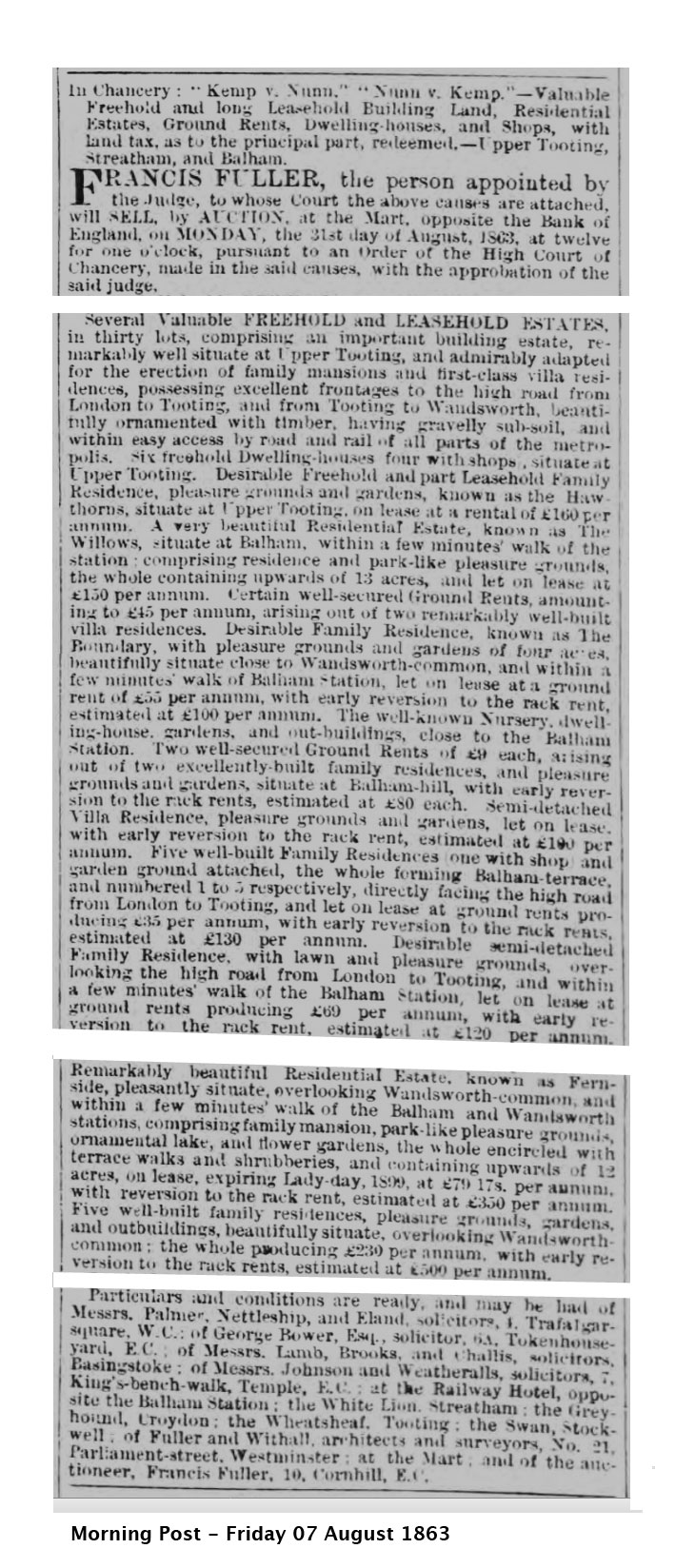
Several Valuable FREEHOLD and LEASEHOLD ESTATES in thirty lots, comprising an important building estate remarkably well situate at Upper Tooting, and admirably adapted for the erection of family mansions and first-class villa residences, possessing excellent frontages to the high road from London to Tooting, and from Tooting to Wandsworth, beautifully ornamented with timber, having gravelly sub-soil and within easy access by road and rail of all parts of the metropolis, six freehold Dwelling-houses four with shops, situate at Upper Tooting.
Desirable Freehold and part Leasehold Family Residence, pleasure grounds and gardens, known as the Hawthorns, situate at Upper Tooting, on lease at a rental of tltitf pt annum.
A very beautiful Residential Estate, known as The Willows, situate at Balham, within a few minutes' walk of the station: comprising residence and park-like pleasure grounds the whole containing upwards of 13 acres, and let on lease at i £??0 per annum. Certain well-secured Ground Rents, amounting to £4;" i per annum, arising out of two remarkably well-built villa residences.
Desirable Family Residence, known as The Boundary, with pleasure grounds and gardens of four aces beautifully situate close to Wandsworth-common and within i few minutes walk of Balham Station, let on letise ata "round rent of x.55 per annum, with early reversion to the rack rent estimated at £100 per annum.
The well-known Nursery dwelling-house. gardens, and out-buildings, close to the Balham station. Two well-secured Ground Rents of £� each aiisina out of two excellently-built family residences, and pleasure grounds and gardens, situate at Balham-hill, with early reversion to the rack rents, estimated at £S0 each.
Semi-detached villa Residence, pleasure grounds and gardens, let on'leas.- with early reversion to the rack rent, estimated at £1*) ncr annum, hive well-built Family Residences one with shot, tn. 1 I garden ground attached, the whole forming Balham-terrace and numbered 1 to . respectively, directly facing the high Yoa.i from London to Tooting, and let on lease at gnmnd "nts mo diicnig?? per annum, with early reversion to the rack reins estimated at £130 per annum.
Desirable semi-detached Family Residence, with lawn and pleasure grounds over looking the high road from London to Tooting and within" a tew minutes' walk of the Balham Station, let'?? ground rents producing am per annum, with eariy re version to the rack rent, estimated it £I'o nJ
Remarkably beautiful Residential Estate, known Fernside, pleasantly situate, overlooking Wandsworth-common, and within a few minutes' walk of the Balham and Wandsworth Stations, comprising family mansion, park-like pleasure grounds, ornamental lake, and flower gardens, the whole with terrace walks and shrubberies, anil containing upwards 12 acres, on lease expiring Lady-day, 1899, at 17s, per annum, with reversion to the rack rent, estimated at per annum. Fire well-built Family Residences, pleasure grounds, gardens, and outbuildings, beautifully situate, overlooking els worth-common; the whole producing per annum, with early reversion to the rack rents, estimated at £500 per annum.
Particulars and conditions are ready, and may had of Messrs. Palmer, Nettle-ship, and Eland, Solicitors, No. 4, Trafalgar-square, W.C.; of George Bower, Esq., Solicitor, No. G.\, Tokenhouse-yard, E.C.; Messrs. lamb, Brooks, and Chnllis, Solicitors, Basing-tokc; of Messrs, Johnson and Weatheralla, Solicitors, No. 7, King's Bench-walk, Temple, E.C.; at the Railway Hotel, opposite the Balham Station; the White Lion, Streatham; the Greyhound, Crovdon; the Wheat sheaf, Tooting; the Swan, Stockwell; of fuller and Withull, Architects and Surveyors, 21, Parliament-stmt, West, minster: at the Mart; and the Auctioneer, Francis Fuller. No. 10, Comb ill, E.C.
[BNA: Link.]
Also Morning Advertiser — Saturday 15 August 1863
[BNA: Link.]
Also
CHANCERY — DU CANE — KEMP-V-NUNN-NUNN-V-KEMP-1863-1890s
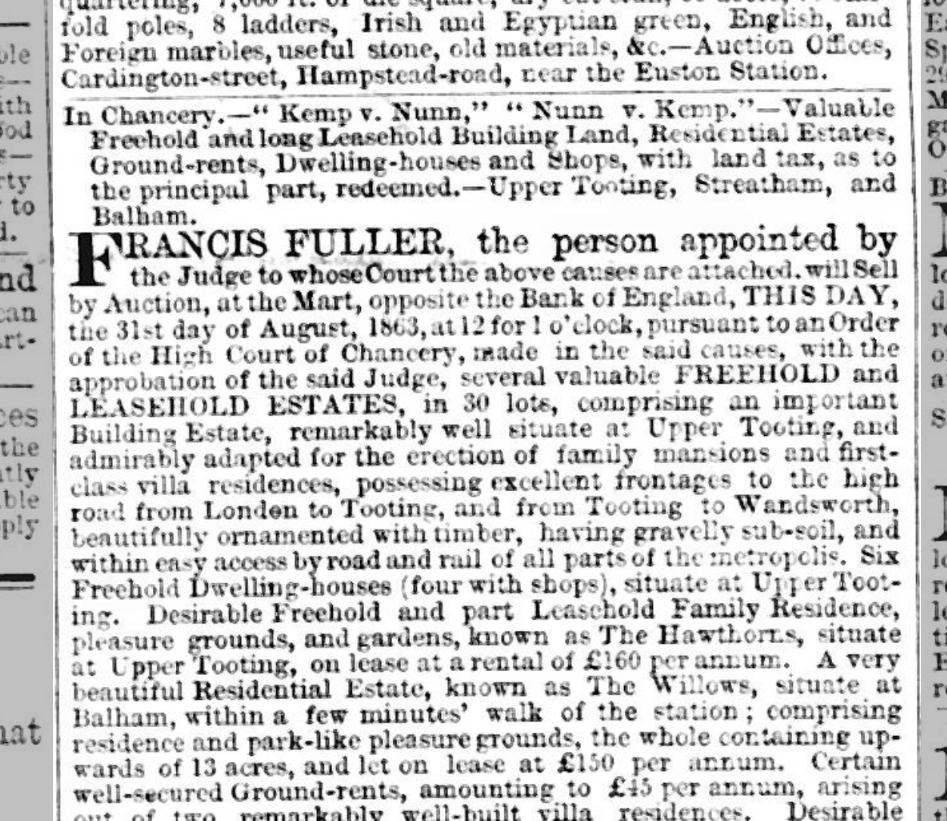
In Chancery: "Kemp v. Nunn," "Nunn v. Kemp." — Valuable Freehold and long Leasehold Building Land, Residential Estates, Ground Rents, Dwelling-houses, and Shops, with land tax, as to the principal part, redeemed.- Upper Tooting, Streatham, and Balham.
FRANCIS FULLER, the person appointed by the Judge, to whose Court the above causes are attached will SELL, by AUCTION, at the Mart, opposite the Bank of England, on MONDAY, the 31st day of August, 1863, at twelve for one o'clock, pursuant to an Order of the High Court of Chancery, made in the said causes, with the approbation of the said judge.
Several Valuable FREEHOLD and LEASEHOLD ESTATES in thirty lots, comprising an important building estate remarkably well situate at Upper Tooting, and admirably adapted for the erection of family mansions and first-class villa residences, possessing excellent frontages to the high road from London to Tooting, and from Tooting to Wandsworth, beautifully ornamented with timber, having gravelly sub-soil and within easy access byroad and rail of all parts of the metropolis, six freehold Dwelling-houses four with shops, situate at Upper Tooting.
Desirable Freehold and part Leasehold Family Residence, pleasure grounds and gardens, known as the Hawthorns, situate at Upper Tooting, on lease at a rental of tltitf pt annum.
A very beautiful Residential Estate, known as The Willows, situate at Balham, within a few minutes' walk of the station: comprising residence and park-like pleasure grounds the whole containing upwards of 13 acres, and let on lease at £150 per annum.
[WAS THIS WHERE THE FUTURE DU CANE COURT WILL BE BUILT?]
Certain well-secured Ground Rents, amounting to £45 per annum, arising out of two remarkably well-built villa residences.
Desirable Family Residence, known as The Boundary, with pleasure grounds and gardens of four aces beautifully situate close to Wandsworth-common and within a few minutes walk of Balham Station, let on lease at a ground rent of £55 per annum, with early reversion to the rack rent estimated at £100 per annum.
The well-known Nursery dwelling-house. gardens, and out-buildings, close to the Balham station. Two well-secured Ground Rents of £9 each arising out of two excellently-built family residences, and pleasure grounds and gardens, situate at Balham-hill, with early reversion to the rack rents, estimated at £80 each. Semi-detached Villa Residence, pleasure grounds and gardens, let on lease with early reversion to the rack rent, estimated at £100 per annum.
Five well-built Family Residences (one with shop), and garden ground attached, the whole forming Balham-place and numbered 1 to 5 respectively, directly facing the high road from London to Tooting, and let on lease at ground rents producing £35 per annum, with early reversion to the rack rents estimated at £130 per annum.
Desirable semi-detached Family Residence, with lawn and pleasure grounds overlooking the high road from London to Tooting and within a few minutes' walk of the Balham Station, let'?? ground rents producing am per annum, with eariy re version to the rack rent, estimated it -I'o nJ
A Remarkably beautiful Residential Estate known as Fernside, pleasantly situate, overlooking Wandsworth common and within a few minutes' walk of the Balham and Wandsworth stations, comprising family mansion, park-like pleasure grounds, ornamental lake, and flower gardens, the whole encircled with terrace walks and shrubberies, and 'containing upwards of 12 acres, on lease, expiring Lady-day, 1899, at £79 17s per annum, with reversion to the rack rent, estimated at £350 per annum.
Five well-built family residences, pleasure -3? -3 and outbuildings, beautifully situate, overlooking Wandsworth common; the whole producing £230 per annum.*" with early reversion to the rack rents, estimated at ib00 per annum
Particulars and conditions are ready, and may be had of Messrs. Palmer, Nettleship, and Eland, solicitor*, i Tn, aig*ir yaru, FX, of Messrs. Lamb, Brooks, and challis, solicitors Basingstoke . of Messrs. Johnson and Weather alls, solicitors kings-bench- walk. Temple, E.C.;at the Railway Hotel, o^l site the Balham station; the White Lion. Streatham the Greyhound, Croydon; the Wheatsheaf. Tooting; the Swan, Stockwell of Fuller and Withall, architects and surveyors V 0 n Parliament-street. Westminster: at the Mart: and of the auctioneer, Francis Fuller. 10, Cornhill, E.C. Dulwich-common, Surrey.
["rack rent" seems to mean the full annual market rent — but what is its siginficance? A future rent as opposed to the lower rent currently prevailing? i.e. and therefore attractive to capitalists?]
[BNA: Link.]
TO FOLLOW UP?
I wonder what the case and counter-case was all about?
Cause number: 1861 K2. Short title: Kemp v Nunn. Documents: Bill only. Plaintiffs: . . .
Reference: C 16/31/K2
Cause number: 1861 K2.
Short title: Kemp v Nunn.
Plaintiffs: John Young Kemp, John Simpson and John Edward Bovill.
Defendants: Henry William Nunn, William Henry Nunn, Selena Bovill spinster, Benjamin Stevens Bovill and Emily Rose Bovill his wife, Edward I'anson, William Bovill, John Robert Bell, Maria Elizabeth Clarke widow, Robert John Clarke, Stephenson Clarke, Harvey William Clarke, James Strachan Clarke, Arthur Clarke, Maria Jane Clarke spinster, Edward Dawn, Rose Ann Dawn his wife, George Sewell, Constantine Post Forrester, Solodovinkoff Matveieff and Mary Emily Matveieff his wife, George Goss Frederick Alexander Matveieff, Revd Thomas Harvey, Emily Jane Harvey his wife, Thomas Harvey the younger Heathfield Smith, Henry Gordon Harvey, Spencer Philip Harvey and Emily Clare Harvey spinster.
Amendments: Amended by order 1898. Plaintiffs: Mervyn Henry Nunn, Charles Fryer and Ethel Mary Fryer and Alice Isabel Nunns.
Provincial solicitor employed in Hampshire.
Kemp v The West End of London and Crystal Palace Railway Company
" KEMP V. WEST END OF LONDON 1K. & J. 682. were the lessees of a valuable leasehold estate at Balham, Surrey, which was held by the Plaintiffs under several leases thereof,: granted by Peter Du Cane the elder and Peter Du Cane the younger, for two several terms, making together a term of eighty years. On the 10th of May 1854 the Defendants gave to the Plaintiffs the usual notice to treat for the purchase of the lands and hereditaments described in the schedule to such notice, which was as follows:- " The Schedule referred to in the within notice. " All those pieces or parcels of land, buildings and hereditaments situate in the parish of St. Leonard, Streatham, in the county of Surrey, containing by measurement five acr
ENCLOSURE OF WANDSWORTH-COMMON.
Upwards of 200 ratepayers have signed a memorial to Earl Spencer, in which they say: "To the Right Hon. Earl Spencer, P.C. lord of the manor of Battersea &c. &c. — The memorial of the copyholders, ratepayers, and inhabitants of Battersea, humbly showeth, — That during the past few years enclosures to the extent of upwards of 100 acres have taken place on Wandsworth-common, and that some of these enclosures have been effected by private individuals; that within the last few months an enclosure to the extent of eight acres has been effected by the Brighton Railway Company, a footpath has been stopped, and this has taken away a pleasant and much frequented part of the common.
That for centuries the Parishioners and their families have enjoyed undisturbed the healthy walks on Wandsworth-common, and the custom of years, right or wrong, has given them an apparent right to this enjoyment.
Your memorialists view these encroachments with deep sorrow and regret, and if permitted to go on they must at no distant period lead to the entire extinction of Wandsworth-common.
Your memorialists, therefore, humbly pray that your Lordship would be pleased to exert your influence to preserve to the public those privileges which have been enjoyed from time immemorial, and to institute such inquiries with reference to enclosures not sanctioned by your Lordship as will lead to their speedy removal and secure to the public, the inhabitants of Battersea, and their children, the continuance of those rights they have so long and so freely enjoyed."
[Link?]
THE ENCLOSURES OF WANDSWORTH EDITOR
Sir,—I am glad the subject of the enclosures on Wandsworth-common is likely to be brought under the notice of Karl Spencer. As a long resident in the neighbourhood I have watched with much pain the gradual appropriation of some of the most beautiful parts of the common; and, on inquiry, I can find no one who can give any explanation why these appropriations are made, or by whose authority.
Surely it is time these things were inquired into, and the parishioners, copyholders, and others should clearly understand how a person or company can enclose acres of ground which, for the last 40 years, I have walked over, on an average, two or three times a week without let or hindrance.
I trust the appeal to Lord Spencer in the memorial, which appeared in your paper of yesterday will have its effect. I believe it will, for Lord encer has a good heart and feeling in favour of recreation, and would not, without some goood reason, allow Wandsworth-common to be covered with small tenements and railway sheds,
I think, sir, the neighbourhood ought to be obliged to Mr. Buckmaster for his trouble; it was a pouring wet night when he called for my signture to the memorial, and had I been a younger man I should have had much pleasure in helping him.
I am, Sir,
A RESIDENT
[BNA: Link.]
1863
ENCLOSURE OF WANDSWORTH-COMMON.
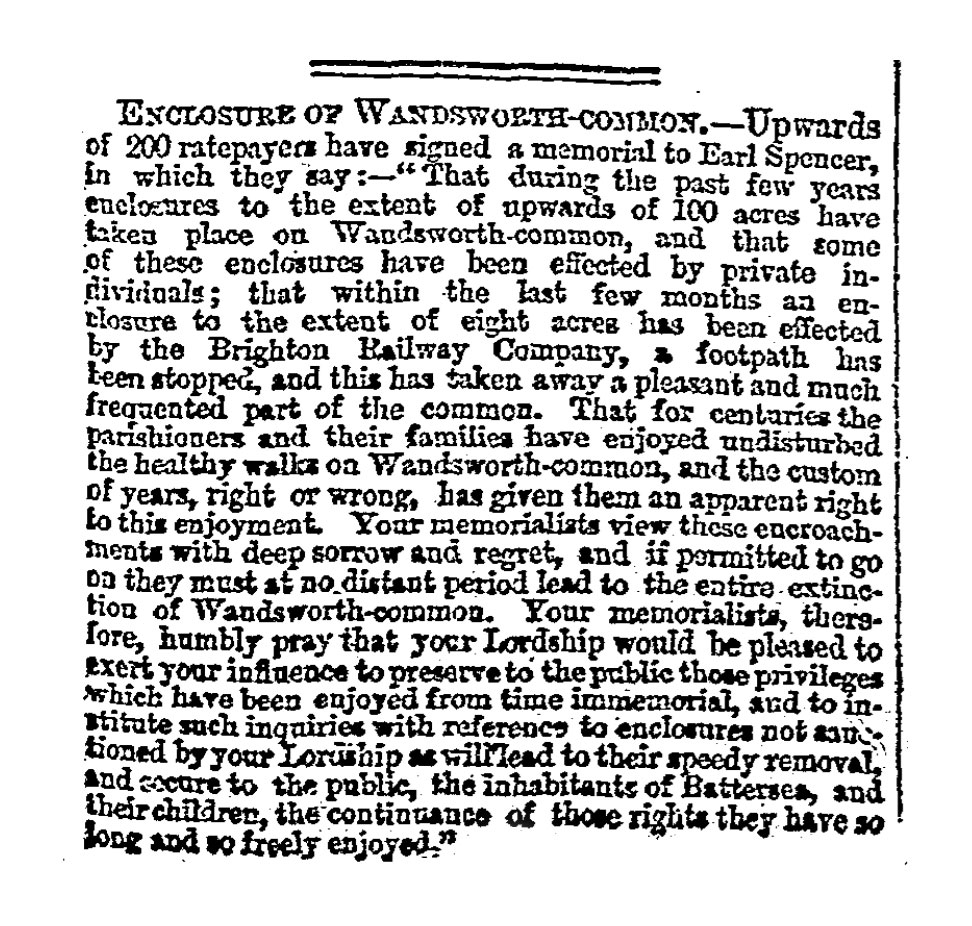
Upwards of 200 ratepayers have signed a memorial to Earl Spencer, in which they say: "That during the past few years enclosures to the extent of upwards of 100 acres have taken place on Wandsworth-common, and that some of these enclosures have been effected by private individuals; that within the last few months an enclosure to the extent of eight acres has been effected by the Brighton Railway Company, a footpath has been stopped, and this has taken away a pleasant and much frequented part of the common.
That for centuries the Parishioners and their families have enjoyed undisturbed the healthy walks on Wandsworth-common, and the custom of years, right or wrong, has given them an apparent right to this enjoyment.
Your memorialists view these encroachments with deep sorrow and regret, and if permitted to go on they must at no distant period lead to the entire extinction of Wandsworth-common.
Your memorialists, therefore, humbly pray that your Lordship would be pleased to exert your influence to preserve to the public those privileges which have been enjoyed from time immemorial, and to institute such inquiries with reference to enclosures not sanctioned by your Lordship as will lead to their speedy removal and secure to the public, the inhabitants of Battersea, and their children, the continuance of those rights they have so long and so freely enjoyed."
[Source: Link.]
1863
ENCLOSURE OF WANDSWORTH-COMMON.
Upwards of 200 ratepayers have signed a memorial to Earl Spencer, in which they say:
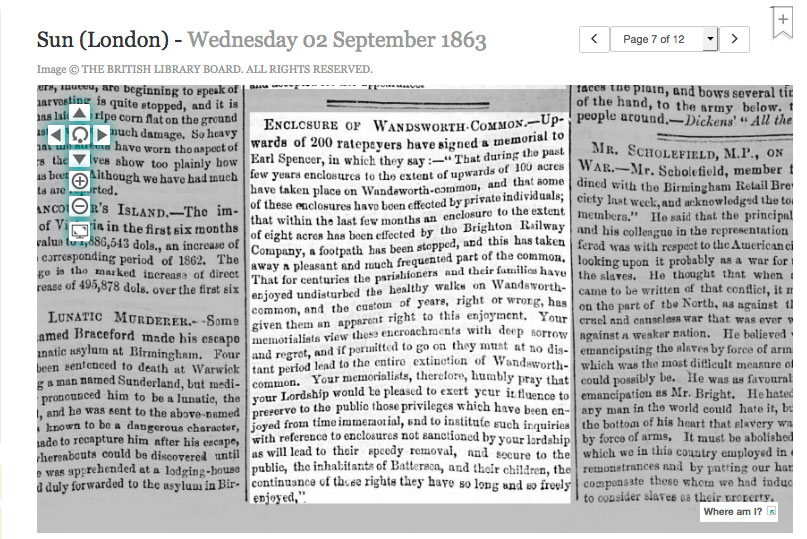
"That during the past few years enclosures to the extent of upwards of 100 acres have taken place on Wandsworth-common, and that some of these enclosures have been effected by private individuals; that within the last few months an enclosure to the extent of eight acres has been effected by the Brighton Railway Company, a footpath has been stopped, and this has taken away a pleasant and much frequented part of the common.
That for centuries the parishioners and their families have enjoyed undisturbed the healthy walks on Wandsworth common, and the custom of years, right or wrong, has given them an apparent right to this enjoyment.
Your memorialists view these encroachments with deep sorrow and regret, and if permitted to go on they must at no distant period lead to the entire extinction of Wandsworth-common.
Your memorialists, therefore, humbly pray that your Lordship would be pleased to exert your influence to preserve to the public those privileges which have been enjoyed from time immemorial, and to institute such inquiries with reference to enclosures not sanctioned by your lordship as will lead to their speedy removal, and secure to the public, the inhabitants of Battersea, and their children, the continuance of these rights they have so long and freely enjoyed,"
[BNA: Link.]
Also:
[BNA: Link.]
[BNA: Link.]
A shorter version:[BNA: Link.]
WANDSWORTH. ENCLOSURE OP THE COMMON
Upwards of 200 ratepayers have signed a memorial to Earl Spencer (lord of the manor.) in which they say — That during the past few years enclosures to the extent of upwards of 100 acres have taken place on Wandsworth Common, and that some of these enclosures have been effected by private individuals; that within the last few months an enclosure to the extent of eight acres has been effected by the Brighton Railway Company, a footpath has been stopped, and this has taken away pleasant and much frequented part of the common. That for centuries the parishioners and their families have enjoyed undisturbed the healthy walks on Wandsworth Common, and the custom of years, right or wrong, has given them an apparent right to this enjoyment.
Your memorialists view these encroachments with deep sorrow and regret, and if permitted to go on they must no distant period lead to the entire extinction of Wandsworth Common. Your memorialists, therefore, humbly pray that your Lordship would be pleased to exert your influence to preserve to the public those privileges which have been enjoyed from time immemorial. and to institute such enquiries with reference to enclosure* not sanctioned by your Lordship will lead to their speedy removal and secure the public, the inhabitants of Battersea, and their children, the continuance of those rights they have to long and so freely enjoyed.
this subject Mr. J. C. Buckmaster, of St. John's Hill, writing to The Times, says: "For many years it was the eastern to bring before public meeting of the parishioners any proposal for the appropriation of any portion of this common, and various sums of money have been paid by railway companies the parish compensation for the land taken by their respective railways; but very recently the Brighton Railway Company baa enclosed with well-tarred fence, 6ft high, several acres of the very beet part of the common, without, far as I can learn, any authority and without any Apparent necessity. The place where my children used to play for hours is now sort of potato garden, and. 1 very little space attached to house, the children must shortly either tramp the dusty roads or be made uncomfortable all day in small playroom.
What the railway company has done on grand scale others imitate in humbler degree. A heap of decaying cabbage stumps or mud is very carefully protected with little trench, and few stick or bushes. This trench has marvellous power of widening and deepening; the heaps increase in area, the bushes grow, and in the course of time these rubbish heaps become the eligible site of a detached cowshed, or something more objectionable, and if it can be so erected to be great nuisance to somebody, or face gentleman's drawing, room, so much the better. The property rises in value in the ratio of its annoyance. The gentleman grumbles wife grumbles, he Ulke with his gardener and consults with his solicitor, who advises him to purchase the lot.
There is, I believe. such a body as the court leet, but I have never been able to understand the modern and power of this august body. Formerly, I believe, they used to hang people; but now the copyholders meet once three or four years, have a good dinner, drink the health of the lord of the manor and his steward, and give permission to erect windmills and enclose such portions of the common were nuisance the adjoining property. One gentleman had a three corner nuisance of five acres conveniently near to his house. The court leet gave him permission to enclose it, with the distinct understanding it was never to be built upon. The gentleman thanked the court leet and stood glasses round; in few days the business of ditching and fencing goes on, and somehow it not only the three-cornered piece which is enclosed, but another piece by the side of it, four times larger than that which was represented as a nuisance. In the course of time the rich msn dies, and his executors advertise and sell as eligible building land that which 15 years ago was common land upon which I played a game of cricket.
[PB This must be McKellar's triangle — which by my calculation is about 22 acres or so. The initial 4 acres is shwn on contemporary maps as a kind of garden in from of his house, on the other side of Trinity Road.
These common lands are no doubt a great temptation they appear to belons; to nobody, because the public have enjoyed for ages the privilege of walking where they choose without any interference." goes on to state that none of these encroachments have been permitted on Clapham-common, which belongs to the same manor, and attributes it to Clapham-common having a large number of wealthy residents, while Wandsworth has (with few exceptions) a comparatively poor and scattered population.
[BNA: Link.]
[BNA: Link.]
Also:
"A memorial is in circulation, the object of which is to prevent Earl Spencer from enclosing Wandsworth Common."
[200 ratepayers? Notice how carefully and ever-so-humbly this is put — and no reference to Spencer's own sales of land. See also Leamington Advertiser comment 3 September 1863.]
Enclosure or Wandsworth CoMMON.-Tho progress of railroads, the building of gaols other public institutions, has cutup much that Mtonsivo heath ohich is known Wandsworth Common. The inhabitants of) Batter, sea and the neighbourhood have taken alarm at the prospect of having their recreation ground altogether destroyed, and they have addressed memorial to Earl Spencer, the lord the manor, on the nbjoct.
[BNA: Link.]
[Notice: "a petition from a sheep to a lion" and "no organised resistance"!]
1863
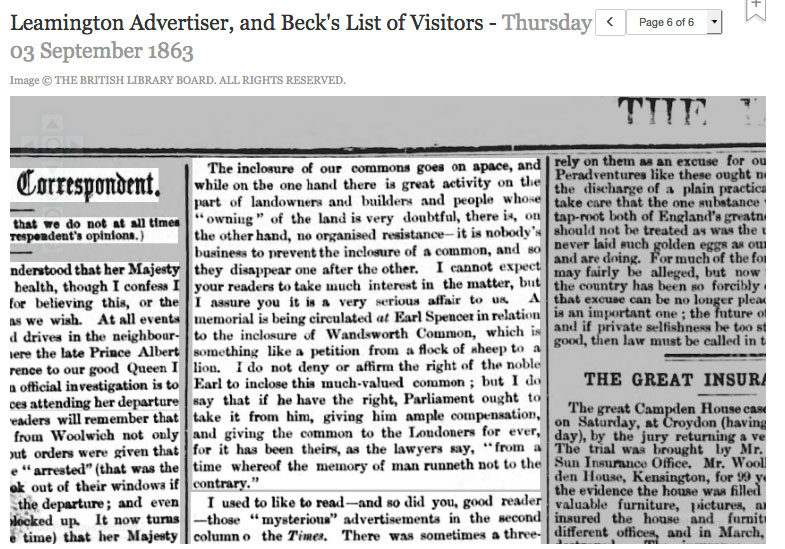
From "Our London Correspondent"
(We deem it right to state that we do not at all times identify ourselves with our correspondent's opinions.) . . .
The inclosure of our commons goes on apace, and while the one hand there great activity the part of landowners and builders and people whose owning the land very doubtful, there is, the other hand, no organised resistance — it is nobody business to prevent the inclosure of a common, and so they disappear one after the other.
I cannot expect your readers to take much interest in the matter, but I assure you it is very serious affair us.
A memorial is being circulated Earl Spencer in relation the inclosure Wandsworth Common, which something like a petition from a sheep to a lion. I do not deny or affirm the right the noble Earl to inclose this much-valued common; but I say that if have the right, Parliament ought to take from him, giving him ample compensation, and giving the common to theLondoners for ever, for it has been theirs, the lawyers say, "from time whereof the memory of man runneth not to the contrary."
[BNA: Link.]
[I wonder who wrote this — given its ironic tone, emphasis on the need for organisation, change in the law, and memory, could it be JCB? Notice his first Times letter a short time later — see below.]
Innumerable repeats in local newspapers — the C19 equivalent of email forwarding and retweets — might be worth listing some of them, from all over the country.
[BNA: Link.]
See also
[BNA: Link.]
[BNA: Link.]
[BNA: Link.]
[BNA: Link.]
[BNA: Link.]
<[BNA: Link.]
[BNA: Link.]
[BNA: Link.]
https://www.britishnewspaperarchive.co.uk/viewer/bl/0000762/18630905/082/0006" target="_blank">Link.]
[BNA: Link.]
[BNA: Link.]
[BNA: Link.]
[BNA: Link.]
John Buckmaster writes to The Times — possibly his first letter on the enclosure of the Common? Most of the central concerns of the fight are already in place. Notice also the contrast between Wandsworth and Clapham Common based on differences of wealth.
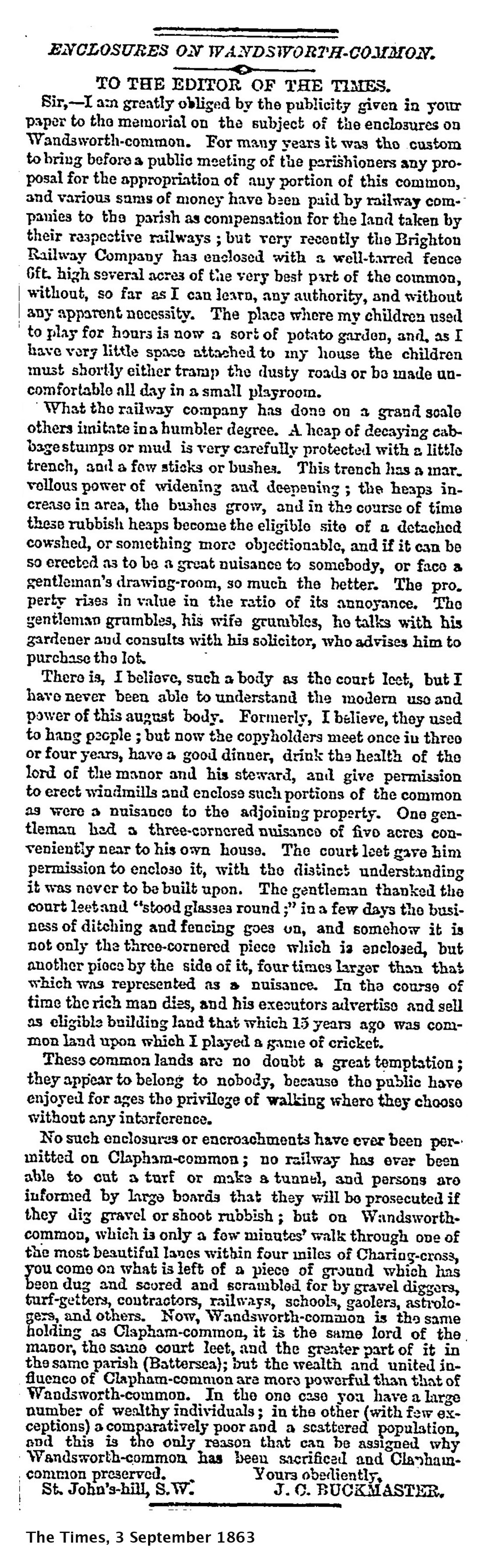
"ENCLOSURES OF WANDSWORTH-COMMON".
TO THE EDITOR OF THE TIMES.
Sir, — I am greatly obliged by the publicity given in your paper to the memorial on the subject of the enclosures on Wandsworth-common.
For many years it was the custom to bring before a public meeting of the parishioners any proposal for the appropriation of any portion of this common, and various sums of money have been paid by railway companies to the parish as compensation for the land taken by their respective railways; but very recently the Brighton Railway Company has enclosed with a well-tarred fence 6ft. high several acres of the very best part of the common, without, so far as I can learn, any authority, and without any apparent necessity.
The place where my children used to play for hours is now a sort of potato garden, and as I have very little space attached to my house the children I must shortly either tramp the dusty roads or be made uncomfortable all day in a small playroom.
What the railway company has done on a grand scale others imitate in a humbler degree. A heap of decaying cabbage stumps or mud is very carefully protected with a little trench, and a few sticks or bushes. This trench has a marvellous power of widening and deepening; the heaps increase in area, the bushes grow, and in the course of time these rubbish heaps become the eligible site of a detached cowshed, or something more objectionable, and if it can be so erected as to be a great nuisance to somebody, or face a gentleman's drawing-room, so much the better. The property rises in value in the ratio of its annoyance. The gentleman grumbles, his wife grumbles, he talks with his gardener and consults with his solicitor, who advises him to purchase the lot.
There is, I beliove, such a body as the court leet, but I have never been able to understand the modern use and power of this august body. Formerly, I believe, they used to hang people; but now the copyholders meet once in three or four years, have a good dinner, drink the health of the lord of the manor and his steward, and give permission to erect windmills and enclose such portions of the common as were a nuisance to the adjoining property.
One gentleman had a three-cornered nuisance of five acres conveniently near to his own house. The court leet gave him permission to enclose it, with the distinct understanding it was never to be built upon. The gentleman thanked the court leet and "stood glasses round;" in a few days this business of ditching and fencing goes on, and somehow it is not only the three-cornered piece which is enclosed, but another piece by the side of it, four times larger than that which was represented as a nuisance. In the course of time the rich man dies, and his executors advertise and sell as eligible building land that which 15 years ago was common land upon which I played a game of cricket.
These common lands are no doubt a great temptation; they appear to belong to nobody, because the public have enjoyed for ages the privilege of walking where they choose without any interference.
No such enclosures or encroachments have ever been permitted on Clapham-common; no railway has ever been able to cut a turf or make a tunnel, and persons are informed by large boards that they will be prosecuted if they dig gravel or shoot rubbish; but on Wandsworth-common, which is only a few minutes' walk through one of the most beautiful lanes within four miles of Charing-cross, you come on what is left of a piece of ground which has been dug and scored and scrambled for by gravel diggers, turf-getters, contractors, railways, schools, gaolers, astrologers, and others.
Now, Wandsworth-common is the same holding as Clapham-common, it is the same lord of the manor, the same court leet, and the greater part of it in the same parish (Battersea); but the wealth and united influence of Clapham-common are more powerful than that of Wandsworth-common. In the one case you have a large number of wealthy individuals; in the other (with few exceptions) a comparatively poor and a scattered population, and this is the only reason that can be assigned why Wandsworth-common has been sacrificed and Clapham-common preserved.
Yours obediently, J.C. BUCKMASTER
St John's-hill S.W.
[Source: Link.]
John Buckmaster [ADD Linkk
From time immemorial the inhabitants of the Western suburbs of London have rejoiced Wandsworth Common; it is a delicious recreation ground. Nature's own handiwork, with no laid out flower beds, no palings or starched stiff walks, alas; there is a probability of this pleasant common, one of the two or three, that are left within ten miles of London, being built over, inclosed, ruined, annihilated. The inhabitants are getting up a memorial to Earl Spencer, the Lord of the Manor, entreating him not to ruin it, but whether it will have the effect of preserving the open Common for the pent up Londoners, remains to be seen. I fear that remonstrance is too late.
[BNA: Link.]
Also:
[BNA: Link.]
[BNA: Link.]
[BNA: Link.]
etc etc
Enclosure of Wandsworth COMMON. The progress of railroads, the building of gaols and other public institutions, has cut up much of that extensive heath which is known as Wandsworth Common. The inhabitants of Battersea and the neighbourhood have taken alarm at the prospect of having their recreation ground altogether destroyed, and they have addressed memorial to Earl Spencer, the lord of the manor, on the subject.
[BNA: Link.]

SUBHEAD
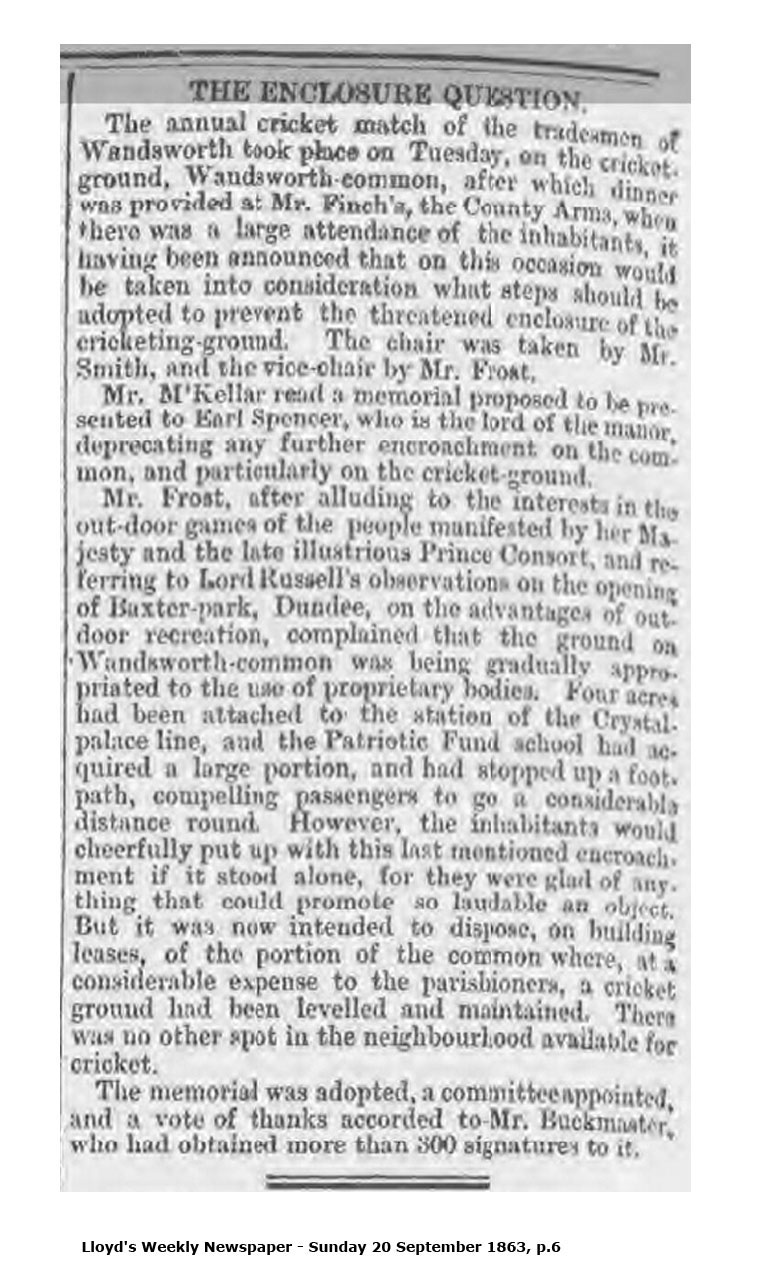
THE ENCLOSURE QUESTION
The annual cricket match of the tradesmen of Wandsworth took place on Tuesday, on the cricket ground, Wandsworth-common, after which dinner was provided at Mr. Finch's, the County Arms, when there was a large attendance of the inhabitants, it having been announced that on this occasion would be taken into consideration what steps should be adopted to prevent the threatened enclosure of the cricketing-ground. The chair was taken by Mr. Smith, and the vice-chair by Mr. Frost.
Mr. McKellar read a memorial proposed to be presented to Earl Spencer; who is the lord of the manor, deprecating any further encroachment on the common, and particularly on the cricket-ground.
Mr. Frost, after alluding to the interests in the out-door games of the people manifested by her Majesty and the late illustrious Prince Consort, and referring to Lord Russell's observations on the opening of Baxter-park, Dundee; on the advantages of out-door recreation, complained that the ground on Wandsworth-common was being gradually appropriated to the use of proprietary bodies. Four acres had been attached to the station of the Crystal-palace line, and the Patriotic Fund school had acquired a large portion, and had stopped up a footpath, compelling passengers to go a considerable distance round.
[WHERE WAS THIS PATH & THE AREA LEVELLED FOR CRICKET?]
However, the inhabitants would cheerfully put up with this last mentioned encroachment if it stood alone, for they were glad of anything that could promote so laudable an object. But it was now intended to dispose, on building leases, of the portion of the common where, at a considerable expense to the parishioners, a cricket ground had been levelled and maintained. There was no other spot in the neighbourhood available for cricket.
The memorial was adopted, a committee appointed and a vote of thanks accorded to Mr. Buckmaster who had obtained more than 300 signatures to it.
[BNA: Link.]
[PB: Interesting — the protection of WC arising out of sport. Add notes about the location of this cricket ground — North/East Trinity Road, near Heathfield Cottages. I think early maps show an area there without obvious gorse or pits.]
Also:
Brecon Reporter and South Wales General Advertiser, Saturday 17 October 1863 (brief mention)
[What is this: Link.]
[BNA: Link.]
etc
Proposed "railway from the Brighton and South-Western on Wandsworth Common to Wimbledon Common . . . without the slightest interference with Richmond Park . . . is earnestly supported by the National Rifle Association and other volunteers".
A New Railway.
A survey, it is understood, is now proceeding for the purpose of enabling the promoters to obtain parliamentary powers in the next session for the construction of a railway from the Brighton and South-Western on Wandsworth Common to Wimbledon Common, Kingston Vale, Norbiton, Petersham, Star and Garter, Richmond, Kew, and to join the North and South-Western at Brentford.
The project, it is said, is earnestly supported by the National Rifle Association and other volunteers. It would afford the public the facility of a more easy access to the beauties of Wimbledon Common, Richmond Park, and the pleasant neighbourhoods of Norbiton, Petersham, Richmond, and Kew.
To the frequenters of the future Star and Garter it would be a great boon to have the accommodation of a railway station close at hand, and this to be effected without the slightest interference with Richmond Park.
The length of the proposed railway would be about eleven miles and a half, and it is estimated by Mr. Fulton, the engineer, that the cost would be £350,000..; bo that, assuming theaverage receipts per mile would only amount — a very low estimate to a fouith of the average receipts per mile of the North London Railway and deducting 50 per cent, working expenses, there would remain a dividend of 8 per cent, upon the estimated outlay.
[BNA: Link.]
[The cheek of it! Destroy Wandsworth Common so people can enjoy "more easy access to the beauties of Wimbledon Common, Richmond Park" etc! "earnestly supported by the National Rifle Association and other volunteers" indeed! Reproduced more or less verbatim in numerous newspapers throughout the country. It would be good to have more info.]
[BNA: Link.]
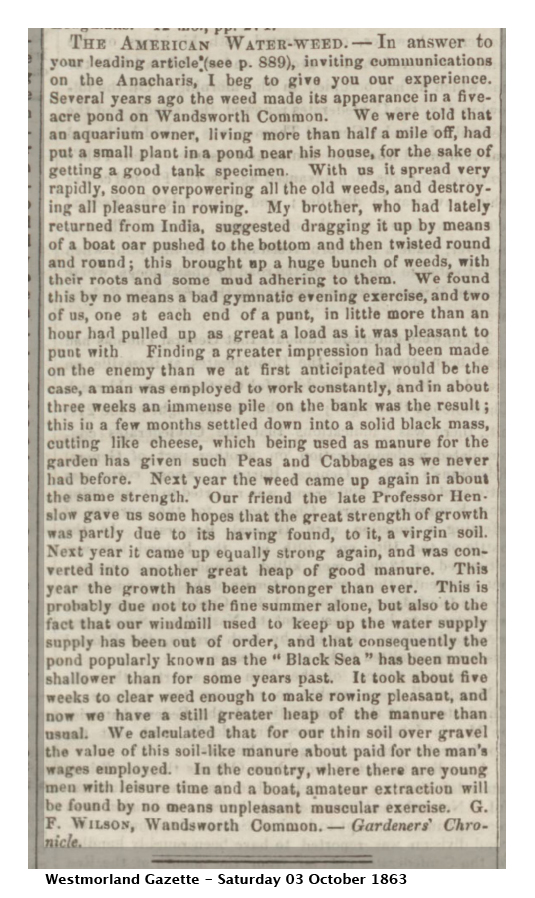
The American Water-weed.
In answer to your leading article (see p. 889), inviting communications on the Anacharis, I beg to give you our experience.
Several years ago the weed made its appearance in a five-acre pond on Wandsworth Common. We were told that an aquarium owner, living more than half a mile off, had put a small plant in a pond near his house, for the sake of getting a good tank specimen. With us it spread very rapidly, soon overpowering all the old weeds, and destroying all pleasure in rowing.
My brother, who had lately returned from India, suggested dragging it by means of a boat oar pushed to the bottom and then twisted round and round; this brought a huge bunch of weeds, with their roots and some mud adhering to them.
We found this by no means a bad gymnastic evening exercise, and two of us, one at each end of a punt, in little more than an hour had pulled up as great a load as it was pleasant to punt with. Finding a greater impression had been made on the enemy than we at first anticipated would be the case, a man was employed to work constantly, and in about three weeks an immense pile on the bank was the result; this in a few months settled down into a solid black mass, cutting like cheese, which being used as manure for the garden has given such Peas and Cabbages as we never had before.
Next year the weed came up again in about the same strength.
Our friend the late Professor Henslow gave us some hopes that the great strength of growth was partly due to its having found, to it, a virgin soil. Next year came up equally strong again, and was converted into another great heap of good manure.
This year the growth has been stronger than ever. This is probably due not to the fine summer alone, but also to the fact that our windmill used keep up the water supply has been out of order, and that consequently the pond popularly known as the "Black Sea" has been much shallower than for some years past. It took about five weeks to clear weed enough to make rowing pleasant, and now we have a still greater heap of the manure than usual.
We calculated that for our thin soil over gravel the value of this soil-like manure about paid for the man's wages employed. In the country, where there are young men with leisure time and a boat, amateur extraction will be found by no means unpleasant muscular exercise.
G. F. Wilson, Wandsworth Common.
Gardeners' Chronicle.
[BNA: Link.]
[Anacharis — today more usually called Elodea or "Canadian Pondweed" Elodea canadensis.
To follow, up, visit e.g. Gardeners' Chronicle, 1863 — in the Biodiversity heritage Library, which has a superb search function.
Biodiversity Library: Link.]
Convenient Freehold Residence, with Stabling, and Gardens, about 10 minutes' walk from Clapham Junction and Wandsworth Stations.
MESSRS. DEBENHAM and TEWSON SELL at the Mart, on Tuesday, October 13, at Twelve, the very compact detached FREEHOLD RESIDENCE, known as Soho Lodge, pleasantly situate on the summit of St. Anne's hill, Wandsworth-common; it comprises six bed-rooms, drawing and dining rooms of good dimensions, library, and well-arranged domestic offices; stabling for two horses, coach-house, harness-room, lawn, large walled garden. The ground has a frontage of 174 ft., and a portion is available for building.
The whole let to J. W. Wilson, Esq., on lease expiring at Midsummer next, at the very low rent of 701.
May be viewed by cards only, and particulars had of M. Davis, Esq., solicitor, Usk, Monmouthshire; of Messrs. Debenham and Tewson, auctioneers, 80, Cheapside.
[BNA: Link.]
Enclosures Wandsworth-common
Yesterday a deputation of the inhabitants of Battersea and Wandsworth had an audience with Lord Spencer, lord of the manor, relative to the enclosures on Wandsworth-common. In reply to the memorial and statement made to him, Earl Spencer said that he was most anxious continue the friendly relationship which had always subsisted between himself and the parish, and that present he had no intention or idea of any scheme for enclosing any portion of the common; that he concurred in the views expressed concerning the desirability of providing open spaces for public recreation populous localities, and that if any future period such a plan should brought under bis consideration would bear this in mind, 9 His lordship did not see how recent enclosures of the railway, which were, he believed, the only considerable ones that had been made since his succession to the property, could now be interfered with, but there was not the slightest objection to further inquiry being made in the matter; the parochial authorities ought to have urged their objections the proper times. The deputation thanked lordship for the very favourable consideration he had given the matter, and then withdrew.
[BNA: Link.]
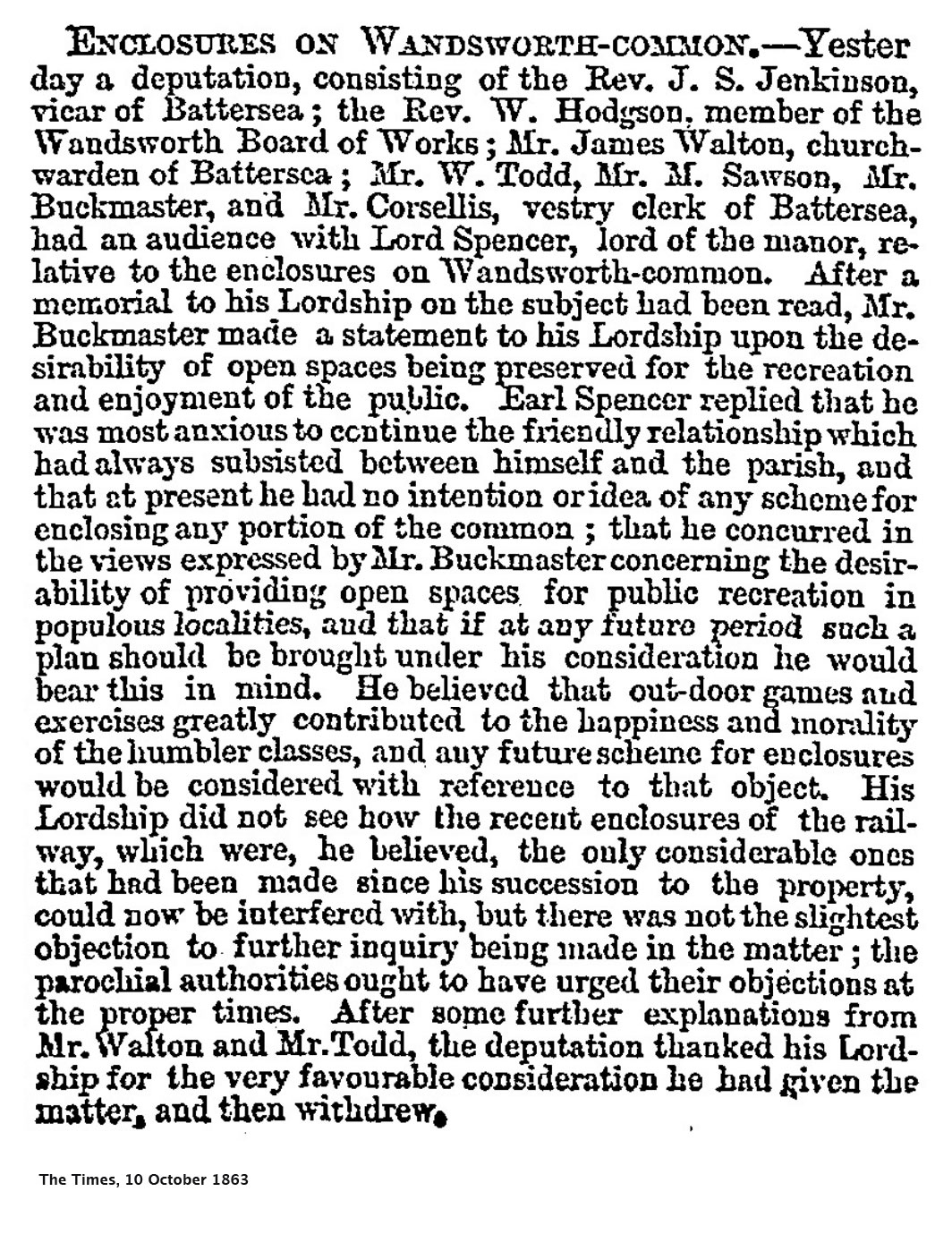
ENCLOSURES ON WANDSWORTH-COMMON.
On Friday, a deputation, consisting of the Rev. J. S. Jenkinson, vicar of Battersea; the Rev. W. Hodgson, member of the Wandsworth Board of Works; Mr. James Walton, Churchwarden Battersea; Mr. W. Todd, Mr. M. Sawson, Mr. Buckmaster, and Mr Corsellis, vestry clerk of Battersea, had an audience with Lord Spencer, lord of the manor, relative to the enclosures on Wandsworth-common.
After a memorial to his Lordship on the subject had been read, Mr. Buckmaster made a statement to his Lordship upon the desirability of open spaces being preserved for the recreation and enjoyment of the public.
Earl Spencer replied that he was most anxious to continue the friendly relationship which had always subsisted between himself and the parish, and that at present he had no intention or idea of any scheme for enclosing any portion of the common; that he concurred in the views expressed by Mr. Buckmaster concerning the desirability of providing open spaces for public recreation in populous localities, and that at any future period such plan should be brought under his consideration he would bear this in mind.
He believed that outdoor games and exercises greatly contributed to the happiness and morality of the humbler classes, and any future scheme for enclosures would be considered with reference to that object.
His Lordship did not see how the recent enclosures of the railway, which were, he believed, the only considerable ones that had been made since his succession to the property, could now be interfered with, but there was not the slightest objection to further inquiry being made in the matter; the parochial authorities ought to have urged their objections the proper times.
After some further explanations from Mr. Walton and Mr. Todd, the deputation thanked his Lordship for the very favourable consideration he had given the matter, and then withdrew.
[Source: Link.]
Very similar article in
[BNA: Link.]
[PB: Buckmaster's account of the meeting (in his autobiography) is rather different. He describes his fellow "memorialists" as obsequious and struck dumb by being in the august presence. Buckmaster was his usual self. When they leave, they are furious with him.]
ENCLOSURES ON WANDSWORTH-COMMON
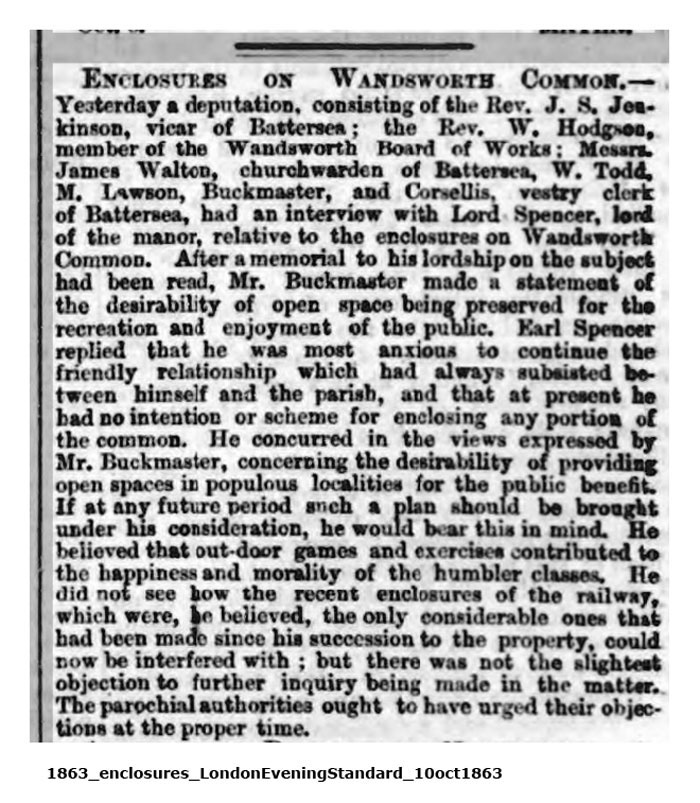
ENCLOSURES ON WANDSWORTH COMMON
Yesterday a deputation, consisting of the Rev. J. H. Jenkinson, vicar of Battersea; the Rev. W. Hodgson, member of the Wandsworth Board of Works; Messrs. James Walton, churchwarden of Battersea, W. Todd, M. Lawson, Buckmaster, and Corsellis, vestry clerk of Battersea, had an interview with Lord Spencer, lord of the manor, relative to the enclosures Wandsworth Common.
After a memorial to his lordship on the subject had been read, Mr. Buckmaster made a statement the desirability of open space being preserved for the recreation and enjoyment of the public.
Earl Spencer replied that he was most anxious continue the friendly relationship which had always subsisted between himself and the parish, and that at present he had no intention or scheme for enclosing any portion of the common. He concurred in the views expressed by Mr. Buckmaster, concerning the desirability of providing open spaces in populous localities for the public benefit.
If at any future period such a plan should be brought under his consideration, would bear this in mind. He believed that out-door games and exercises contributed to the happiness and morality of the humbler classes.
His Lordship did not see how the recent enclosures of the railway, which were, he believed, the only considerable ones that had been made since his succession to the property, could now interfered with; but there was not the slightest objection to further inquiry being made in the matter. The parochial authorities ought to have urged their objections at the proper time.
[Source: BNA: Link.]
ENCLOSURES ON WANDSWORTH-COMMON.
A deputation, consisting of the Rev. J. S. Jenkinson, vicar ot Battersea; the Rev. W. Hodgson, member of the Wandsworth Board of Works; Messrs. James Walton, Churchwarden of Battersea, W. Todd, M. Lawson, Buckmaster, and Corsellis, vestry clerk of Battersea, had an interview yesterday with Lord Spencer, lord of the manor, relative to the enclosures of Wandsworth-common. After a memorial to his lordship on the subject had been read, Mr. Buckmaster made a statement of the desirability of open spaces being reserved for the recreation and enjoyment of the public.
Earl Spencer replied that he was most anxious to continue the friendly relationsUip which had always subsisted between himself and the parish, and that at present he had no intention or scheme for enclosing any portion of the common. He concurred in the views expressed by Mr. Buckmaster, concerning the desirability of providing open spaces in populous localities for the public benefit. If at any future period such a plan should be brought under his consideration, he would bear this its, mind. He believed that outdoor games and exercises contributed to the happiness and morality of the humbler classes.
He did not see how the recent enclosures of the railway, which were, he believed, the only considerable ones that had been made since his succession to the property, could now be interfered but there was not the slightest objection to further inquiry being made in the matter. The parochial authorities ought to have urged their objections at the proper time. After some further explanation from Mr. Walton and Mr. Todd, the deputation thanked his lordship for the favourable consideration he had given the matter, and withdrew.
[BNA: Link.]
[BNA: Link.]
Wandsworth Common. — Yesterday a deputation, consisting of the Rev. J. H. Jenkinson, vicar of Battersea; the Rev. W. Hodgson, member of the Wandsworth Board of Works; Messrs. James Walton, churchwarden of Battersea, W. Todd, M. Lawson, Buckmaster, and Corsellis, vestry clerk of Battersea, had an interview with Lord Spencer, lond of the manor, relative the enclosures Wandsworth Common.
After a memorial to his lordship on the subject had been read, Mr. Buckmaster made statement the desirability of open space being preserved for the recreation and enjoyment of the public.
Earl Spencer replied that he was most anxious to continue the friendly relationship which had always subsisted between himself and the parish, and that at present had no intention or scheme for enclosing any portion of the common. He concurred in the views expressed Mr. Buckmaster, concerning the desirability of providing open spaces in populous localities for the public benefit.
If at any future period snch plan should be brought under his consideration, he would bear this in mind. He believed that out-door games and exercises contributed to the happiness and morality of the humbler classes.
He did not see how the recent enclosures of the railway, which were, believed, the only considerable ones that bad been made since his succession to the property, could now interfered with; but there was not the slightest objection to further inquiry being made in the matter. The parochial authorities ought have urged their objections at the proper time.
[BNA: Link.]
A DEPUTATION recently waited on Earl Spencer in reference to encroachments on Wandsworth-commen. It was urged by Mr. Buckmaster that the common was highly prized by the people as a place of recreation, and that its inclosure would be a direct injury to the public. Lord Spencer received the deputation favourably, and prontured to give their representations his best attention.
[BNA: Link.]
[BNA: Link.]
[BNA: Link.]
[BNA: Link.]
[BNA: Link.]
[BNA: Link.]
Brief mention of the deputation to Spencer.
Link.]
In Chancery.—' 4 Kemp v. Nunn—Nunn v. Kemp.”—Valuable Long Leaseholds, Balham, Surrey. FRANCIS FULLER begs to that Lots 19, 20, 21, and 27 of the ESTATE offered for Sale by Auction, the Mart, on Monday, the 31st day of August, 1H63. now REMAIN UNSOLD, and may treated for by PRIVATE CONTRACT. Such lots comprise Two well-built Family Residences, known the Laurels” and Elms,” with lawns, pleasure-grounds, gardens, and out-buildings, beautifully situate at Balham-hill, on the high road from London Tooting, and within three minutes’ walk the station. Each house contains dining, drawing, and morning rooms, five bedrooms, kitchen, and domestic offices. Held by the vendors on lease for unexpired term 72 years, virtually at a peppercorn rent, and underleased for an uncxpired term of years, a ground-rent of £9 per annum each, at the expiration of which underleases the rack rents, estimated at per annum each, will become receivable. Also valuable ESTATE of FIVE well-built FAMILY RESIDENCES, ono with shop, forming the whole Balham-place, and numbered 5, with piece of garden-ground in the rear, commandmgly situate at Balham-hill, and immediately adjoining the above. Each house contains two kitchens, front and back parlours, and four bedrooms, held lease by the vendors for an unexpired term of 72 years, virtually at a peppercorn rent, and underleased for an unexpired term of 18 years, ground-rent of £35 per annum, at the expiration of which underlease the rack rents, estimated at per annum, will become receivable. Also very desirable FAMILY RESIDENCE, with lawn, pleasure-grounds, flower gardens, meadow land, shrub Wry, kitchen garden, orchard, stabling, and out-kuildinps, beautifully situate overlooking Wandsworth-common, and within few minutes walk of the Wandsworth-common and stations, the whole containing about four and half acres. Held lease the vendors for term of 72 years, virtually at a peppercorn rent, and underleased for an term wears, ground-rent of £5O per annum, at the expiration of which underlease the rack rent, estimated at per annum, will become receivable. , _.. , , , The whole of the above Properties Sold in one or more lots. Further particulars may obtained of Francis Fuller. 10. Cornhill, E.C., or Messrs. Palmer, Kettleship, and Eland, 4, Trufalgar-squaro, W.C.[BNA: Link.]
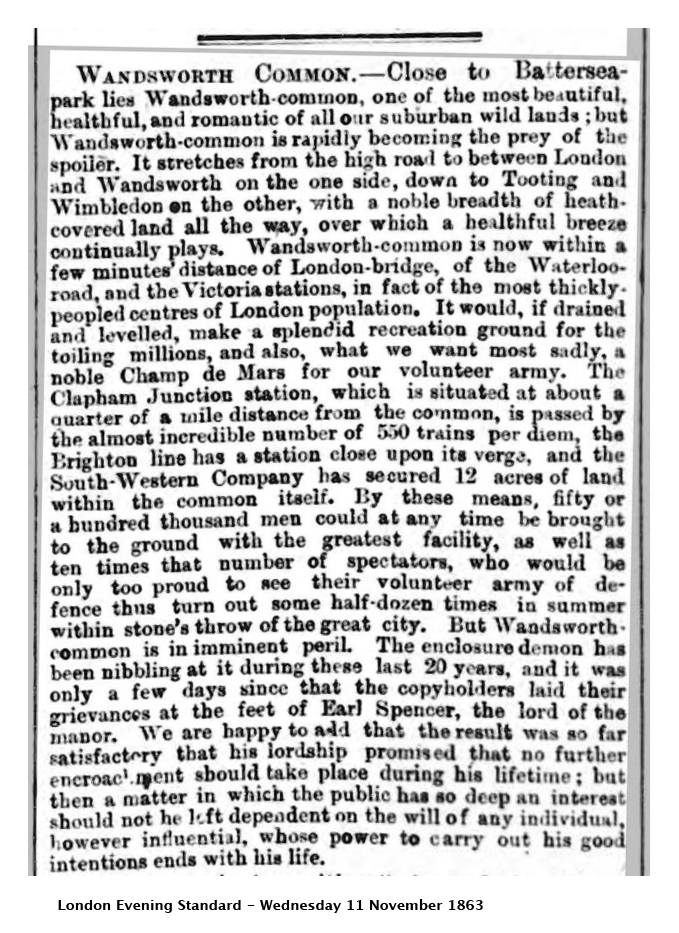
Wandsworth Common.
Close to Battersea-park lies Wandworth-common, one of the most beautiful, healthful and romantic of all our suburban wild lands; but Wandworth-common is rapidly becoming the prey of the spoiler. It stretches from the high road to between London and Wandsworth on the one side, down to Tooting and Wimbledon on the other, with a noble breadth of heath-covered land all the way, over which a healthful breeze continually plays.
Wandsworth-common is now within a few minutes' distance of London-bridge, of the Waterloo-road, and the Victoria stations, in fact of the most thickly peopled centres of the London population.
It would, if drained and levelled, make a splendid recreation ground for the toiling millions, and also, what we want most sadly, a noble Champ de Mars for our volunteer army.
The Clapham Junction station, which is situated about a quarter of a mile diatance from the common, is passed by the almost incredible number of 550 trains per diem, the Brighton line has a station close upon its verge, and the South-Western Company has secured 12 acres of land within the common itself.
By these means, fifty or a hundred thousand men could at any time be brought to the ground with the greatest facility, as well as ten times that number of spectators, who would only too proud see their volunteer army of defence turn out some half-dozen times in summer within stone's throw the great city.
But Wandsworth-common is in imminent peril. The enclosure demon has been nibbling at it during these last 20 years, and it was only a few days since that the copyholders laid their grievances at the the feet of Earl Spencer, the lord of the manor.
We are happy to add that the result was so far satisfactory that his lordship promised that no further encroachment should take place during his lifetime; but then a matter in which the public has so deep an interest should not be left dependent the will of any individual, however influential, whose power to carry out his good intentions ends with his life.
[BNA: Link.]
[CHECK THIS IS COMPLETE & ACCURATE -I THINK IT"S THE LONGEST — IT MAY BE SIMILAR TO OTHER BITS BELOW]
THE METROPOLITAN COMMONS
London enjoys an advantage peculiar to itself, which if properly utilised might be made a genuine and valuable means of health and recreation to the three millions of inhabitants recorded in the last census returns as being included within the bills of mortality. We refer to the various large tracts of common land which surround it on every skis, and I which in consequenorof the rapid constrnsiism of short lines of railway from the City and Weet-emd are becoming more accessible every day, but which, as they are growing more valuable for the same reason, are threatened with universal enclo- sure, unless some means be taken to preserve them from the encroachments of building speculators, connived at by lords of the manor, who are every day tempted by large pecuniary ffers to give up their own slender rights, forgetful that at the same time they are destroying the rights of the common people, to whom these commons, after all, really belong, and for whose benefit they might be made so many noble free parka and play-grounds.
The persevering attempts of the lord of the manor to place buildings on Hampstead-heath are familiar to everyone who looks over the parliamentary debates. Year after year bills are brought in under one preheat* or another, and it requires the utmost vigilance on the part of the inbahinuati of the, vicinity and Of the isistropo• litan members to prevent the enclosure Of one of the most °harming bits of wild land that ever ccnamented the outskirts of a meat city. We can also remember the disclosures of lest aession respecting Hainault Forest, and the very bad figure which the crown the guardian of the public rights, cut in that tmnsaotion • but lit is the same thing everywhere. "What's everybody's business is nobody's business." The short railways are opening up the commons to Londoners day by day, and no sooner does the little station amp up amid the wild heather than down the building epeculators, matters are "made pheasant" with the lord of the manor, and the common rights of the millions of the two metropolitan'counties are remorselessly destroyed. The commons begin very close to London. The first is Kennington, which up to no very recent Period was wild enough. In the week days it was crowded with cricketers of all ages,. and on Sundays with controversishnta of every-religions denotaiaation. At night it was Paid to be the resort of bad eharacters—meaning, of course, persons who were without the means of paying, for a night's lodging ; and the old people of the neighbourhood could point to the earner close to the church, which within living memory bad witnessed the execution of many noted highwaymen and footpads. 'ln fact, great pains were taken to give Kennitigton-common a bad name, with the ulterior view of improving its morality by covering it with houses, for the advantage of speculative and encroselsmg individuals. The bricks and mortar at last actually did appear on the ground, and • large corner was dexterously covered with houses before anyone had time to interfere, when • public-spirited of the neighbourhood took the matter in band, and so bestirred the. Woods and Forest* for powers and . the local public for means, that Kennington-common was rescued from the spoiler, and has now boom. Kennington-park, one of the prettiest things of its extent about London, being thus preserved for ever as a pleasant promenade and Sam of re:ovation for the inhabitants of the vicinity. Sack • result is • striking proof of what may done even by one publio . spirited individual. If there were a Mr. Hodgson keeping a baker's shop in the vicinity of each of our great metropolitan commons, we should not perhaps hare so heavily to complain of the neglect of the people's legal protectors, the cupidity of lords of the manor, or the encroachments of building speculators. In a time of great excitement on sanitary questions and under great public preimure government rescued Battersea fields from the plague of bricks and mortar, and turned it into • park, which is improving in appearance every day, and is daily more and more appreciated by the public. It is in the hope of stimulating these exertions a little further in the same direction that we now take leave to call their attention to the condition of certain other commons in the neighbourhood of Loudon.
Close to Battersea-park lies Wandsworth-common, one of the most beautiful, healthful, and romantic of all our suburban wild lands ; but Waudsworth-common is rapidly becoming the prey of the spoiler. It stretches from the high road to between London and Wandsworth on the one aide, down to Tooting and Wimbledon on the other, with a noble breadth of heath-covered land all the way, over which a healthful breeze continually plays. Wandsworth-common is now within • few minutes' distance of London-bridge, of the Waterloo-road, and the Victoria stations, in fact of the most thickly peopled centres of London population. It would, if drained and levelled, make • splendid recreation ground for the toiling millions, and also, what we want most sadly, a noble Crump de Mare for our volunteer army. The Clapham Junction station, which is situated at about • quarter of a mile distance from the common, is passed by the almost incredible number of 550 trains per diem, the Brighton line has a station close upon its verge, and the South Western . Company has secured twelve acres of land within the common itself. By these means, fifty or a hundred thousand men could at any time be brought to the ground with the greatest facility, as well as ten times that number of spectators , who would be only too proud to see their volunteer army of defence thus turn out some half-dozen times in summer within stone's throw of the great city. But Wandsworth-common is in imunneut peril. The enclosure demon has been nibbling at it during these last twenty years, and it was only a few days since that the copyholders laid their grievances at the feet of Earl Spencer, the lord of the manor. We are happy to add that the result was so far satisfactory that his lordship promised that nu further encroachment should take place during his lifetime ; but then a matter iu which the public has so deep an interest should not be left dependent on the will of any individual, however iuduential, whose power to carry out his good intentious ends with his life.
The manorial rights over Wandsworth-common were vested some century or so ago in no lees • parsonage than the famous Lord Bolingbroke; and there is a tradition in the neighbourhood of their having been won from St. John by the Lord Spencer of the period whilst the two were riding *crop On Friday last the Rev. Francis Burges Good- Clapham-common into town, in the highly exciting sore, N.D., was instituted to the coosolidated rectories of game of pulling halfpence out of a haystack. Howtrilby and Herglisen, in the county of Norfolk, on the pre- ever that may have been, the commou remained intimates) of John Goodacre, of Rugby. In the county tact in all its primitive wildness under the Spencer Warwick, a minor. On the same day, the Bev. Charles rile until about a quarter of a century since, when Short*. 8.A., was collated by the Lad Bishop of Nor- t h e wor k o f enclosure, without any parliamentary with to the honorary canonry is the Cathedral Church of • Norwich. Tweet the death o f the Rot , , Causing — iormannes, began. First twenty ache were taken fur ham, and was installed the following day. , St. James's School. Then certain persons leased or LONDON.--It appears from the a large portion, with powers merely to cut turf and weakly rehire et the Registrar-General that the deaths in cart ravel, and undertaking to apply their profits London the colder sesame deem cm, bet hitherto to the drainage and other improveumuts of the the rate of increase has been alight. They were 1,270 in the land i n their immediate ne i g hb our h oo d. Th e y week that ended on Saturday. The made large profits, but forgot the improvements, deaths in tee earapooding weeks (via, a th re e nl e e sth a i u n w et r h of a the years 1853-421 is, with a oorrectecie for Mamw of and one of their body secured and inclosed about population, 1,270. Berme it spawn that them:steal mortality forty acres ou his own account, which, on his in the week was exactly the same as the result which is ob- death, very recently, were sold by auction. The mined by calculation. There were 23 deaths from small- South Western Itailwey Company have secured pox. Four of these occurred in the subdistrict of Whitemantwelve •acres in the very centre of the common and street, while there were only two in the whole of that region of the metropolis shish limos the south aide of the Thames. enclosed it, having given the copyholders 801. for Scarlatina was resorted 125 Seventeen of these their right of " tetherage," and of course satisfied occurred in Marylehom. 11 Palmas, sin Limehoum. 6 the claims of the lord of the manor. The London, Bow. Four children of a bouse.paister died at 26, 1301. Br ighton , and South Coast Company Lave a stasoverstreet. Berrlebries, the 4th, sad 7th inst., of tutu just as its edge, and four acres of surrounding midair. Farr deaths f the same disease at 13, Northampton-row, Clerkenwell, within 9 day.. Typhus land, and their line runs right through to exhibits an imaged mortality. In last three weeks Wimbledon. This encroachment would seem the death, few it es as average were 61 ; in lb* previous to have been a must beneficial one, for three weeks were 52. last week the births of 1,011 i t ena bl es boys and 965 girls, all children, were registered people omen in a few minute, the nos weeks of years elution to the to get from London-bridge or the avengber (corrected) was 1,879. and has wonderfully stimulated building specula-
in the adjoining (not common) land. On the right hand side of the high road, from Clapham to Wandsworth town, an extensive settlement has sprung up, called New Wandsworth, consisting of hundreds of handsome villas and cottage, and so great is the demand for these residences consequence of the railway facilities for getting to town, that no sooner is the foundation of a new house dug than the contractor is pestered with applications from intending tenants. This thriving colony is deeply interested in the preservation of the common rights, and its numbers increase every day. The Patriotic school took a tremendous slice, fifty-two acres, the school buildings forming a conspicuous feature in the prospect, and the great telescope requires some twelve or fifteen acres for its accommodation. These are a few of the greater encroachments, but there are, in addition, numberless smaller ones of which there is no very distinct record as to how they came about ; but there they are, and their tendency is to spread until the whole common is swallowed up if steps be not taken to preserve it for some public) use, either a park, a recreation ground, a volunteer review field, or some arrangement which shall answer all these purpomis.
There is, for example, a row of houses called Heathfield, running scrag the centre of the common, of which the history is a little curious. In the year 1832 the spot was occupied by a few tumbledown old houses, ' mere huts, and when the lira visitation of the cholera broke out in that year these huts were used as a sort of suburban cholera hospital. When the pestilence ceased, the present row of handsome houses roes mysteriously in their pleas, but their very situation shows them to be nothing but as encroachment on the common.
The condition of the ground, which is still left intact, is not satisfactory. The inhabitants of the neighbourhood complain that it is the resort of bad characters, and the some of a great deal of profligacy and immorality. One of the large prisons impinges on the common — we are not sure whether it rs not also an encroachment — but it has a custom which renders it a great nuisance to the neighbourhood. The male prisoners whose time has expired are all let loose at nine in the morning, and the females at ten, and they generally spend the day on the common, surrounded by their friends from town, making holiday in a manner which does not at all conduce to the tranquillity of the vity. A small patch near the western boundary is used as a cricket ground, but the tenant of a neighbouring villais making strenuous efforts to hate the orieketing 'appraised, on the ground that ahem the cricketers are tired of their game they are apt to seek variety in the less genteel pastime of "knock 'em downs," a practice to which this gentleman and his family have, it appears, a decided aversion.
["He"? Sl obviously not Mrs Nicholl [not quite her name], who refused to return cricket balls that fell in her garden.]
Should he succeed in banishing the cricketers, another enclosure will most probably follow, and thus, one by one, on one pretence or another, the whole common will be enclosed. Lord Spencer has, we understand, the right to let, but not for enclosure or building purposes and on the other hand, the copyholders, who claim exclusively the common rights, can only insist on "tetherage," and the right to cut turf and dig gravel. It is therefore obvious that it is in just such a case that the government ought to step in, purchase the slender rights of both parties, and seam [?] the common foe the general public. Clapham-common is protected, so is Streatham, and Battersea-fields have been purchased. There dill remain Wandsworth, Wimbledon, and Tooting, all which are now brought by the railways within a few minutes' ride of the centre of the town, and the opportunity is most favourable for securing them for eves for that portion of the public who are the head landlords of all English ground, but who can show no title-deeds for their ancient patrimony.
[BNA: Link.]
Probably identical to:
[BNA: Link.]
And
[BNA: Link.]
A "noble Champ de Mars for our volunteer army"! Notice also the comment that it cannot be "a matter in which the public has so deep an interest should not be left dependent on the will of any individual, however influential, whose power to carry out his good intentions ends with his life."
Wandsworth Common.
Close to Battersea-park lies Wandsworth-common, one of the most beautiful, healthful, and romantic of all our suburban wild lands; but Wandsworth-common is rapidly becoming the prey of the spoiler. It stretches from the high road to between London and Wandsworth on the one side, down to Tooting and Wimbledon on the other, with a noble breadth of heath-covered land all the way, over which a healthful breeze continually plays.
Wandsworth-common is now within a few minutes' distance of London-bridge, of the Waterloo-road, and the Victoria stations, in fact of the most thickly-peopled centres of London population. It would, if drained and leveled, make a splendid recreation ground for the toiling millions, and also, what we want most sadly a noble Champ de Mars for our volunteer army.
The Junction station, which is situated at about a quarter of a mile distance from the common, is passed by the almost incredible number of 550 trains per diem, the Brighton Line has a station close upon its verge, and the South-Western Company has secured 12 acres of land within the common itself.
By these means, fifty or a hundred thousand men could at any time be brought to the ground with the greatest facility, as well as ten times that number of spectators, who would be only too proud to see their volunteer army of defence thus turn out some half-dozen times in summer within a stone's throw of the great city.
But Wandsworth-common is in imminent peril. The enclosure demon has been nibbling it during these last 20 years, and it was only a few days since that the copyholders laid their grievances at the feet of Earl Spencer, the lord of the manor.
We are happy to add that the result was so far satisfactory that his lordship promised that no further encroachment should take place during his lifetime; but then a matter in which the public has so deep an interest should not be left dependent on the will of any individual, however influential, whose power to carry out his good intentions ends with his life.
[BNA: Link.]
WANDSWORTH and FULHAM BRIDGE
>fin 'orporntionof Comrany— Const™ tion of Works, &c,l NOriCK i-< HBRKBY GIVEN, that APPLICATION is intended tobe made to PARLIAMENT in the ensuing Session for an ACT to autliori c ana incorporate a com* any, hereinafter termed " tlic company," to construct and snalnlam a bridge over thp River Thames for the passage of carriage", carts, 1 orses, and nasscnecrs, with proper rod <, approaches streets, or highwava thereto and therefrom, ami with n • 1 necessary and convenient abutments, piers, walls, embankments, toll-houses, toll-gates, landing-stairs, and other works aud couvt-uien es couneetod thereto, as follows (that is to say)— 1. A bridge eammencing' in the parish of Wandsworth, iv the coupty of Surry, on the foreshore of the River Thames, at or near a point about :!i"ofet f"om the no-th-east ofthe east side ofthe abutment of the rder called " Wandsworth Pier," to a point directly oppositeuii tie fori sh*jre of the River Thames in the parish of Fulbam in Co county of Middlesex, at or near a put or portion et the Pn'hsm meadows, nnd on the west side of the osier beds now in tho occupation of Mr. Smuiel Wuldcn. 2. A road, approach, street or highway to such bridge, com- mencing at the southern abutment of tho proposed bridge, and running tbromrh parallel or curved with an existing road, street, or highway*, called " Jews-row," across the road called tho " York- j road," and tbe strio or piece of waste ground on the soutli-u-e-4 side of "Jews-row" aforesaid, in a southerly direction throueh or under the embankment of the ** Richmond and Windsor Branch" of. "The London and South- Western Bailway" to the high road leading from Wandsworth to London, called " Wandsworth-Toad," at a point about 10 feet frora the north-west cornerof the burial-ernund, aituated at the intersection of the said road, called Wand worth- road, and a road leading from East-hill t > Wandsworth-common, the whole of which said road, approach, street, or highway, is situate in the parish of Wundsworth, in the county of Surrey. 5. Two road« or approaches, streets, or" highways, to such bridge commencing at the northern abutment of the pn^voscd bridge, and running through or near the town, meadows, market gardens, the eastern branch road, approach, street, or highway, terminating at a point about 270 feet from the south east corner i f a public-house called the "Duke's Head." situate at the intersection of the road, street, or highway called Peterborough-road with Kinu-'s-road": tho western branch approach, road, street, or hiiriiwav, terminating eastward at a point about 60 feet, from a public-house culled " Peter- borough Arms," -ituafe in the Kings-road aforesaid, the whole of whioh said proposed two rotds, branches, approaches, streets, or highways are situate inthe parish of Fulham, in the county of Mid- dlesex. 4. To authorise the comrnlsory purchase of lands for tho before- mentioned purposes, or deviation from fhe lines and levels to be deicrib^d on the plans and sections hereinafter mentioned. 6. To authorise tho levying, collecting, and apuropriation or ap- p'ieation of any rates or increased rates, or of any annual er other sum or sums of money out of or in addition to the rates levied and collected or hereafter to be levied and collected under and by virtue ofthc powers and provisions of any or cither ofthe local acs for the administration of tho poor laws or relating to the highways in the parishes of Wandsworth an-' Fulham respec' ively, or other- wise, and to apply the name towards all or either of the beforo- deseiibed Intended roads, Wanehes, approaches, streets, or high- ways, and also an tar as maybe necessary for the purposes aforesaid, to reneal, alter, amend, or extend tha powers and provisions of the said local act--, or eit lerot th 6. To authorise (he company to levy tolls, rates, or duties upon, for, or in respect of th* use of the said bridge, roads, branch roads, streets, highways, and approaches. 7. ToaMeK any existing tolls, rates, or duties; to confer, vary, or extinguish ex"nptons from payment of tolls, rates, or duties; and to oonfer, vary, or extinguish other ri-.-hts aud privileges. 8. To incorporate with the proposed act someof the provisions of "The Lands Clauses Consolidation Act, 1845," "The Companies Clauses Consolidation A<*t, 181">," "The Lands Clauses Consolida- tion Acts Amendment Act, 1830," and "The Companies Clauses Act, 1863." And Notice is hereby also Giver, that an or before the SOth day of November i'stant, there will bo deposi'el for public Inspect lin with the olerk ofthe peace for the county of Midd'esex. at his office at Clcikenwell, and with the clerk of the peace for the eountv of Surre/, at bis Office at Lambeth, and al the olliec of the Metropolitan Board of Works, Spring-gardens, Charing-cross, duplicate pans and sections doscri. ins the lines, sihiations, and lovels, of tho works before-mentioned, an t the lands through or Into which t ac same may be made, and wlil.h are iutendid to be taken, together wiih books of reference to such plans containing the names of the owners or roptitel owners, lessees or reputed lessees and occupiers of the linds which may be so taken, and a copy of this notice as published in the " London Gazette," and on or before tho said 30th day of November instant, a copy of so much of ench plans, sections, and books of reference as relates to each of the said parishes of Wandsworth and Folium respectively; and a copy of this notico, ns pub'iihed In the "Loudon Gazette," will be deposited with the parish clerk of each such paiish at his residence, and a cony of so much of the said plans, sections, and books of rcferonce as relates to tkc several parishes in, through, or into which thesaid bridne, roads, and appria'hes will be made or pass, wi h a copy of this notice, as published ia the "London Gazette," will be deposited with the el irk of the Wandsworth district board of works, at his office at Wandsworth, and with the clerk of the Fulham dis- trict board of works, nt his office at Hammersmith. And Notioe is hereby further Given, that on or before the 23rd day of December next printed copies of the proposed act will be deposited in the Private Bit. Office of the Hause of Commons. Dated this 12th day of November, 1863. WALMISLEY, SON, and lIARDEY, 5, Victerla-strect, Westminster Abbey, Parliamentary Agent.
[BNA: Link.]

PARKS FOR THE PEOPLE.
LONDON SATURDAY, NOVEMBER 26, 1863.
patriots are talking a good deal about parks for the poor people of London And that about the easiest part of the business. Nearly all are agreed the desirability having parks, but how obtain the necessary funds to establish them, consistent with the present heavy parochial taxation pressing upon the people, is the thing that blocks the way.
What a pity parks were not thought more of a century j ago. Many a beautiful meadow might have been protected from the speculative builder that is now covered with houses — many an open space preserved, and many a lofty elm and spreading oak allowed to yield their shelter. seems to have been nobody's business guide or control the greed those who cared nought for the injury they inflicted upon posterity so long as they were filling their own coffers. And even now, when sanitary laws are so well understood, and the importance of good drainage is universally acknowledged, houses are being "run up" in swamps and quagmires, constituting so many citadels where fever and cholera may run riot. Hut the most surprising thing of all is that whilst men are clamouring for parks and recreation grounds, they are apathetically allowing their wild lands to be taken from them.
We attach more importance to places to play in than we do to those set apart for promenading.
Our Kennington Park is very pretty, and makes the neighbourhood more aristocratic and houses more valuable. But why was the Government allowed to take it from the people? Had " the 10th of April " anything to do with it? Has not every open space where a monster meeting could be held in London been rendered unavailable for the purpose Kennington Common was taken during the time the Tories were power.
And what the Government has done wholesale, private persons are doing retail.
While we write there are boards Wandsworth Common, announcing portions of it to let. What are those antiquated bodies the Courts Leet about? Or have they, as has been alleged, betrayed their trust to serve themselves their friends "r By what right can any man, except it be the lord of the manor, let to another, for building purposes, portion common landsls there nobody to compel the spoiler to prove his title? Is there nobody to bring him to book?
"'Tis very had in man or woman
To steal a goose from off the common,
But for that man there's no excuse
Who steals the common from the goose."What boon it is to Londoners that some parks are preserved!
Look at St. James's, one of the prettiest parks England, full of tall trees and gay (lowers, with its ornamental waters covered with fowls, representing many rare species, and yet the clever landscape gardener who designed it lias allowed abundant scope for thousands children to gambol.
Even the Temple Garden like an oasis in the brick and mortar desert. "What St. James's Park now, with respect to houses, Wandsworth and Tooting Commons will become in few years, for bricks and mortar are tarnishing every green field eligible for building thereon; how important, then, to succeeding generations that these open commons should be preserved! Parliament should take the matter up, and not leave dependent upon the life or will of any lord of the manor whether those health-giving grounds should be preserved to the public or destroyed for ever.
There are many instances where persons have been allowed grants of pieces of common lands to enclose for grazing, and, after retaining possession of the land for few years, have sold it to builders.
Many a middle-aged man can remember playing upon ground that was then free to everybody, but which is now covered with houses. How much better to preserve those green spaces than to compel our successors to give one thousand guineas an acre (about the price now asked for the proposed South Eastern Park) for land to convert into parks!
Shall it always be that one generation will have to rectify the blunders shortsightedness of its predecessor?
[BNA: Link.]
The question of Parks for the people, which has been rather equivocally illustrated by recent proceedings at Birmingham, will presently have to be entertained by our Metropolitan Board of Works.
It appears that the Manor of Tooting Graveney, which comprehends a considerable portion of Tooting Common, has just been purchased for the sum of £3,650. The new Lord of the Manor, shortly after the completion of the bargain, made an application to the Enclosure Commissioners for leave to enclose about 63 acres of the Common, with the intention of converting it into building ground.
To this design the inhabitants of the neighbourhood naturally felt strong objections, and proceeded to take such measures as suggested themselves for the protection of the Common and its preservation as an open and salubrious space. They first formed a Committee for the promotion of the purposes in view, and then called a meeting, which they invited the new Lord to attend.
He declined to accept this summons, and then the Committee offered to take his bargain off his hands, to refund the purchase-money with interest, and defray all the expenses which had been incurred. When this proposal was declined also, the Committee sent a deputation to the Metropolitan Board of Works, and laid their griefs and apprehensions before those high authorities.
The statement of the case involved some curious assumptions. The deputation declared that the ordinary profits of the Manor yielded the purchaser a very sufficient return for his purchase-money, independently of any acquisition to be made by the proposed enclosure; so that the scheme was placed in the light of an exorbitant and unconscionable design.
With similar impressions it was urged that an injunction against the new Lord's proposals, might be fairly sought, inasmuch as he had contumaciously refused to sell again at the price which he had originally given. However, from these doubtful arguments the deputation proceeded to stronger reasons, and observed with great cogency that, -w it was one of the duties of the Board to make Parks for the people, it followed as a natural consequence that the Board should be vigilant and active in preserving the natural Parks which were ready made in the form of common lands.
To save such Commons as those of Tooting, Wandsworth, Clapham, Battersea, Streatham, Mitcham, and others would be a far cheaper and more practicable policy than, to create and establish new Parks in their place, and the action of the Board, therefore, in the matter was not invoked without very good reason.
It seems, however, by no means certain that the present powers of the Board will enable it to interfere with effect. We are told that the law forbids the enclosure of common lands within fifteen miles of London, except in pursuance of a special Act of Parliament, and against such an Act cause might always be shown. If, however, the Lord of the manor and the Copyholders are agreed upon the — manter, and join in the enclosure proposed, theni n the special Act is siot required, and the Board seemed to be in doubt as to the extent or availability of their powers in the ins u0027ance before them. To the public it will appear an unfortunate circumstance that the residents at Tooting did not secure this important manor while it was in the market, for it was of more value to them than to anybody, and they would evidently have had no difficulty in raising tha money.
As it is, the bargain fell to somebody else, and we need hardly stop to observe that the actual purchaser is under no obligation whatever either to part with his purchase or to forego any of the advantages which may he found to attach to it. It is no argument to say that he got his money's worth without this chance of an enclosure. He bought the manor in open market, and with it all the rights and privileges appertaining, whether visible or invisible. Whether among these rights is that of enclosing 60 acres of the common land is a question which the proper authorities must decide, but the new Lord has a right, at any rate, to make the application, and wrongs nobody in doing so, though his design if he can accomplish it, may deprive the public of a benefit. If the Manor of Tooting Graveney conveyed rights over Tooting Common, Tooting Common must have been always enjoyed subject to those rights, and the condition now makes itself felt.
Although, however, we cannot look upon the residents m aggrieved by the refusal of the new Lord to sell again what he has just bought, we entirely approve their endeavours to amend the matter as far as they can. It would have simplified the case immensely if they had secured the property by fair purchase when it was offered for sale, but as that chance v,was missed, they mulst try what chances remain. The Board of Works seems well disposed to ast them if it can see its wvay to so doing nor do -w, e, indeed, hear that the newv Lord is inclined to thwart them, except in so far that he mill not throw asray a good bargain. If the proparty for which he gave 3,6501. is well worth al that money irrespectively of a possible title to upwards of GO acres of valuable building land, it is clear that 3,650!. would not be a very good price for tha repurchabe of the whole lot, prospeets included. The deputation innocently remarked that "nobody could have supposed " that the purchase-money in question, " besides giving "property of great value, would cover ttho right "to enclose so large a portion of Tooting Common. " We cannot say how far this reversion of profit was a secret, but at any rate it is a factt, and a bargain does not become impeachable from the fact of its proving an unexpectedly goodone. The Tooting people, if they had been on the alert, mighit have secured their Common for nothing, since tlhe price of the lot which covered it would have bcen well repaid from other and inde. pendent sources of profit. We wvish they may securo it still, but we do not think they are aggrieved in not getting it now on quite such easy nterms.
As to the Birmingham Park, our readers must have been perplexed to discover from the correspondense which we published on Thursday last what views of completing that purchase were ever really entertained We can onlv u0026ee that the origia n u003dhow for raising ths money entirely fied, and nwe imagine that it must have become virtually hope- I less at an early period of the transaction. We are inforned that the price asked for the Park is nearly double its real value, but that is only an ordinary incident in bargains of this bind.
What is plain in the matter is, that after what has passed the Birmingham authorities should complete the purchase and secure the Park for the use of the town with as little noise and delay as may be. The less the case is discussed the better, and as the purchase-money, whether fxed extravagantly or otherwise, can be nothing to so opulent a community, we are at some loss to understand why the difficulty was over allowed to become public. If £28,000 would have bought the Park at once and terminated the complication, and if the Council were ready with their £20,000, it seems to us inexplicable, how such false steps could have been taken as those which have recently been brought to light.
We should Like to see all great towns provided with Parks, and the value, indeed, of these places of popular recreation was promptly recognized in the designation of the works upon which the distressed operatives of Lancashire might be employed. But, whether such places are formed out of ancient Commons or purchased from private proprietors, they must be dealt with like all other property. They are not to be had for nothing.
The Birmingham people if they keep their Park must pay the money for it; the Tooting people if they want their Common, and others have acquired rights over it, must buy off those rights. In cases of such public interest the law may help, but only as it helps a railway or other public enterprise. In the meantime, however, it would certainly be well if the Metropolitan Board of Works would take warning by the Tooting case, and keep a watchful eye over such matters in future.
That a body which is specially charged with providing open spaces for public recreation should be vigilant in preserving such places as are provided already is a proposition too plain to require argument, and we hope it will be profitably applied.
[BNA: Link.]
Schoolmistresses. wanted, CERTIFICATED MISTRESSES, for the ROYAL VICTORIA PATRIOTIC ASYLUM. Wandsworth common. .., *
Assistant Matron and Mistress of the Senior School, have charge girls from 13 years of age. Salary M', to Mlatress for the same School. Salary to rise to WI. * ~w 3, Third Mistresses for the same School Salary JJ.'. Also 4. A*Senior Mistic for the Second School. s�l�r, . ri-lDi; *of cuch boerd, Icl.-iri,, and wuhms, . BTC prorided.
Testimoalel, eiMtrt to the Secretary. 19, New street, Spring j�nlcM. where ferther pertlcaUn, it necewe,,, m.y WNaineA
[BNA: Link.]
The South Western has, or rather had, its Clapham Common Station, which was a mere trap for the unwary. The luckless traveller who took his ticket for this station found himself at the end of his journey turned adrift on Wandsworth Common, two miles distant from Clapham Town. Such excellent sport did this seem to other companies that they forthwith joined together, to the number of seven or eight, in the construction of the Clapham Junction, which receives ten passengers where the Clapham Common station receives but one.
With satisfaction then have I, in common with my fellow parishioners, regarded the bond fide Clapham Station of the L. C. & D. I was one of the original public who attended a crowded meeting more than three years ago to hear the proposals of its directors. "Hear, hear," we all cried as these worthy gentlemen dilated on the advantages of our being on a " main line" and promised us no end of fast trains stopping at our very doors.
Great was the enthusiasm with which, on the opening day of the Metropolitan Extension, I got in at Clapham and was up to Victoria in nine minutes. Equally great my enthusiasm, on the first day of the Loop Line, at getting out at Clapham, having got in at the Elephant and Castle. A great convenience, sir," I said, " this Clapham Station will be when the main line is completed from Herne Hill to Beckenham, and from Faversham to Margate and Ramsgate." The "mains" having now been completed I determined the other day to avail myself of a ruo down to Ramsgate. "To say nothing," I thought, "of our Clapham Station, there is a saving of nineteen miles as compared to the Old South Eastern."
In this complacent state of mind I began to study the time bill. The first fact that study revealed was that only one main line train, the early " parliamentary," stops at Clapham. Perceivitv, however, that several main liners stopped at Brixton I considered that I should only lose a few minutes by taking the Metropolitan Extension to Brixton, which would at all events be %' on the road." But further inspection revealed that none but slow trains stop even there, the exnress train stopping nowhere between Victoria and Herne Hill. So I sin4led out the 10 a.m. from Victoria. aid resolved to run down to Herne Hill by any train that might call at Clapham at about 10 o'clock or a little before. But finding no sign of any such train in any bill I could get hold of, I deemed it prudent to be at our station before 9.30, at which time a train leases Clapham for Victoria. On inquiring about the Herne Hill trains I learned there were no such trains, and accordingly took nay seat in the 9,30 to Victoria. So much then for the "advantage of being on a main line." The station is close at hand, but the trains don't stop; whereas at the "Junction," though two miles off, the trains at least do stop.
The result of the process I had to go through was that five-and-thirty minutes after I had left the Clapham Station, I cause back through it on my way to Rarnsgate. My time, however, whatever else it may be, is not money. So I consoled myself with the reflection that if I gained no time by deserting the South-Eastern, I should at least enjoy the novelty of a new route. In this respect I was not di-appointed, especially as the L. C. awl D. has, for a native of Kent, the charm of summoning up old recollections to be contemplated from a new point of view.
The Sittingbourne Station revives the memory of the coaching days. Of late years, in travelling to the Kentish coast, we have had to diverge far away from the once familiar road. When the South-Eastern Company was formed, such stout resistance was made in Kent to its pursuing the straight course to Canterbury and Dover, that it had to adopt a very roundabout track. Now we return to its old paths. There are no reminiscences of Kent Road connected with Reigate, Tunbridge and Ashford. But at Sittingbourne one immediately remembers the changing of horses and the coach dinner at "The Rose" or " The George." The coaches were not fast on this road. They didn't even race fast I can remember a whole day's very dreary racing between the " Union" end another coach. So far as my experience goes, there never was a fast " Union" on any road. Unions are always lumbering " family" coaches, as indeed I suppose the very name was intended to testify. One had a right to expect a better pace from the " Express," a favourite coach of mine when I was quite a child. I liked its colour (blue), and its four greys at Canterbury, and 1 have stood as a little boy at the " cattle market" and longed to ride on it. But when my wish was gratified I thought the " Express" an imposter. The Tally Ho was somewhat better. Many a time have I watched its departure from the Spread Eagle, Gracechurch Street. at three p.m. The Spread Eagle yard, with its queer old galleries, its numerous coaches, an subterranean stables, was the pleasantest of all Loudon pc. To this day I like ocealioitally trio 610ry t h.% yard is utterly denarted. Aod in the inn itself I recognise no representative Or its William, the waiter in the lower coffee room. " Things are changed here, William," I say whenevet I go there. " since you and I first knew each other " " Yes, indeed sir," says William, " they are." The " Eagle," siow and safe, was another Dover coach that used to start from this yard. There was a branch Eagle from Canterbury to Ramsgate, the most notable circumstance connected with which in my memory was the excitement caused in the streets of Ramsgate by the horses running away with old Buff the ceachinau, and coming down all in a heap against Miller's timber yard on the Sands. Buff was found saying that it was " easier to drive four horses than two," which we boys used to interpret as meaning that as Buff couldn't drive two he might very easily find no more difficulty with four. We used, I remember, to think depreciatingly of the Eagle. One really fast coach there was on the Dover road, the day mail, drisen by Bolton and one of the Wattsons. This name (Wattson) was a familiar one on the Kent road. The father and four sons were at one time driving on various Dover coaches, and youngest, George, driving the night mail, a good coach, I believe, but one of which I had no experience. Sittingbourne is a little more than half way on the road to Dover, and in days long past was the end of the first day's journey to persons posting down to Dover on their way to the Continent. Hence its once fatuous hotels. The next station at which my train stopped was Faversham, and as this is the point of deparure of the recently constructed branch line to,Margate and Ramsgate, I amused myself with the study of Bradshaw in order to compare the releive advantages of the L. C. and D. and the S. E. with respect to the various Kentish towns. I foend that Canterbury and Margate are the chiet gainers by the L. C. and D. The distance to Canterbury is thereby diminished by '2O miles, and express train beats the S. E. express 32 minutes. The decrease of distance to Margate is 27 miles, and of time by express 40 minutes. Thus Margate is the principal gainer. In fact its distance is almost reduced to the minimum, only one mile over the old coach road. Ramsgate is less favoured, its decrease of distance being 12 tubes, and of time by express 20 minutes. The reason of this, as compared with Margate, is that, whereas the S. E. goes to Marg.ite by way of Ramsgate, the L. C. and D. goes to Margate first, and thence to Ramsgate by nay of Broadstairs. It will be seen by these figures that the gain in time is proportionally less than the decrease in distance. This is owing to the superior pace of the S. E. So straight and level is the S.E. line between Reigate and Ashford, that a very high rate of speed is easily and safely attainable. The L.C. and D., from what I hear on the subject, has steeper gradients and more dangerous curves. Perhaps the fairest test of the relative speed of the two lines is to be looked for in their Dover trains. In distance the L.C.and D. has the advantage by 10 miles. In time they seem fairly matched. The afternoon express on each line runs down to Dover in two houre 20 minutes. The same time is taken by the L. C. and D. morning express; but the S.E. morning express, from some reason which I do not perceive, as it has no extra stoppage, takes 10 minutes longer. The S.E. Continental express, with only one stoppage, reaches Dover in two hours; whilst the L. C. and D. boat express, with four stoppages, takes two hours and 15 minutes. I ought to have mentioned that there is the same difference of ten minutes between the S E. morning and afternoon expresses to the other towns, and that I reckon, d according to the slower (morning) train. The L. C. and D.'s advantage in point of distance to all these towns will be lessened by twelve miles as soon as the S. E. has constructed its direct line from London to Tunbridge. The public doubtless are and will be gainers by this rivalry, though as yet, singularly enough, both co w. parries charge a higher fare than was formerly charged by the S.E. for some of its fastest trains. Both charge the same fares. But whilst the S.E. has raised the fare for some trains it has lowered them for others, hating now in fact made them uniform for all trains. There is anon to complain of this. It is not for the good of — 'e that rival companies should cut each other's the pu enough that their competition gives a throats. t d tends to the security of civility and choice of routes, hick took me to Ramsgato was speed% punctual If Sittingbourne re.t T to h a e the route very station. 'lied:be memory of " the road,'' a fresh set of front Faversham awakened. rtt.rriitinte at recollections of bygone day though s --Y at least to no the days me. to some not bygone et%en tv% of Ramsgate by steamboat. 'travelling to 'Margate and rather The road, es I have said, w,6 ra er teLous. Thertfore, except in very had weather, we preferred the deck. The railway comes in sight of the sea at the east and of the estuary which divides the Isle of Sheppy from the main land. A very lonely island is Sheppy. At least it was so when I once explored it as a boy in company with a native who was revisiting it after long years of absence. I remember his taking me up to the top of a village church tower, and showing me his initials cut in the lead. I thought of that as my train passed on towards Whitstable, a place Letter known to most persons by repute, I imagine, than by sight, and yet, if not by silht, at least well-known by taste. Many a traveller will be indebted to the L. C. & D. for the opportunity of gazing for a few minutes on the cottages and numerous fishing boats of the men whose labours supply him with the far-famed Whitstable oysters. Whitstable is an out of the way place, though it has long been a terminus of one of the oldest railways in the kingdom. The Canterbury and Whit table line had been working for years before the S.E. was born or thought of. Its trains were drawn partly by locomotive, partly by rope, partly by nothing at all, for at one point they went down hill by themselves. It is now incorporated with the S.E., end the locomotive has entirely superseded the rope and the nothing. On quitting Whitstable, the L. C. and D. makes for Herne Bay, once celebrated for its long pier, traversed by." Neptune's Car," and for nothing else, so far as I know, unless indeed for the frequent mention of its "policeman," by Punch. But to me Herne Bay is inseparably associated with the " Red Rover " and Captain Read, and with Captain Large's " City of Canterbury," not " Royal George," as Mr. Thomas Ingoldsby erroneously sang. The two former boats used to stop at Herne Bay, and it was shortly after leaving the pier that the Red Rover was run down and sunk by the Magnet in a dense fog. In due time she was " raised," and served the public again for several years. We ratter liked the sensation of walking the deck of a vessel which has spent a considerable time at the bottom of the sea. The public also had a special liking for old Watts, the steward of the Red Rover, who was a remarkable man in his way. It may have been on account of the prestige gained by the Magnet in the above encounter that Louie Napoleon selected her as his transport in his abortive descent upon Boulogne. But the Magnet, however strong, was not fast. The same verdict may be pronounced upon all the Margate and Ramsgate steamers until the advent of Mr. Napier's celebrated " Eclipse," which introduced a new sera on the Thames. It was off Herne Bay that I first saw the Eclipse. I was era one of the fastest Ramsgate steamers, when the Eclipse, on one of her experimental trips, overhauled us and went by in a style altogether new to us. She was a long narrow iron vessel, with feathering paddles and high pressure engines. Her paddles would sometimes get out of order and bring her to a standstill. But for the most part she was like a bird, and when fairly established on the Ramsgate station gave us the novel sens,tion of beating on the river the crack Gravesend steamers much more easily than ever they had beaten us. No subsequent steamer on the Thames has achieved such marked superiority of speed over all rivals. Others were soon built which nearly equalled her is pace, whilst they surpassed her in accommodation for passengers. But for two or three years she was always the trial boat for every new, steamer. A race with the Eclipse was invariably the first effart of every new aspirant for fame. I can remember several of such contests, one in particular with the " Herne," which proved seiy exciting from the latter nearly boring us aground on the Essex coast. For some distance the paddle-boxes were literally in contact. When we got clear we beat her. Since those days there has been a gradual advance in the construction of steamers with a view to speed. But lam sorry to say that the benefit of this advance is not now apparent iii the present Ramsgate or Margate steamers. It seems as if those persons who now choose the steamboats as a conveyance do so for the pure love of sea air, whilst all who are in a hurry prefer the rail. I am one of the latter%. Not aat lam always in a hurry. But I retain some very disagreeable recollections of the North Foreland. The river was well enough, very pleasant, and often exciting. But after the Nore, on the down passage, if there was any East iii the wind, then my troubles be;an. Very sluggish then would appear the pace even of the Eclipse or Prince of Wales. Herne Bay sod the Reculvers would then seem a very long t i.ne in sight, particularly at low water, when we ha 1 to steam, some distance from the shore, through the %' tive-fat.:orn channy." I used to think the Reculvers especially a most provoking landmark. 1 was always impatiei.t see the two sp4.os in a line, so as to appe.,r like cue. when I began to feel that at last we were really passing t hem. I have now had my revenge on the Reculvers. I'he new railway passes clos%, to the south of them. Hence to come it sight of them, to have the spires in a line, and to be whirled away from them, is the of a few minutes. Ha, my fricacis."!lioug . me many a over with your plaguing now." At the Reculvers we entered the Isle of Thanet, and, passim the village of Birchington, cross the S.E., near its station, at right angles at Margate. No place, as I have said, is more beneEtted by the L. C. &D. than Margate. Now that it has been brought 27 miles nearer to London, and has of late years been specially recommended by physicians for the salubrity of its air, we may expect to see Margate " looking up" a bit, though I am net sanguine of its again becoming, what some of my readers may be surprised to hear what it once was, a;elect fashionable watering place. " Oldest inhabitants' of Thanet, who remember the palmy days of Howe's Royal Hotel, recorded the traditions of Margate as a resort of the aristocracy. Such a resort it is not at all likely to be again. Nevertheless it may have entered upon a new lease of prosperity. Instead of going straight to Ramsgate, the L. C. and D. after leaving Margate, takes a sweep round in order to call at Broadstairs, affording its passeog, rs a near view of the North Foreland lighthouse. ilroadstairs has long been a favourite retreat for persons who like quietness. Whether the railway will entirely alter the character of the place I cannot yet say. Perhaps one effect of the railway in general will be considerably to diminish the number of persons who do like quietness, or at any rate to increase the number of those who believe quietness to be less dependent upon outward circumstances than has been hitherto supposed. I knew an old lady who selected a particularly quiet spot for her residence in the outskirts of a Kentish town. Great was her horror when it became apparent that the S. E. railway was coning close to her garden wall and had fixed upon the adjacent land for a terminus. She was sure she must leave, But she had become attached to the house, and was proud of her garden So she resolved to stay on till she should be fairly driven away by the noise and bustle. Well, the noise and bustle came. But the lady never moved, and in due time she even went so far as to avow that she found the proximity of the station a great convenience. She lived in the same house till the day of Ivr death. A quiet oil Icily she was before the railway catne, and quiet she continued to be. Her quietness was that of mind and character. The sweep round by the Fere'and increases the distance between Margate and Rainsgate from four to seen miles. [laving known every inch of the road from boyood, I was struck as one always isii such a case, by the novelty of rapidly pa%sin:; in succession places which had always seemed to me at souse considerable distance from each other. The Lie of Thanet is now well provided with railway accommodations and all its towns and viii iges ale brought into easy emninutication. Ot the rival companies, the South-Eastern, when its line from London to Tunbridge is completed, will probably retain most of the Ramsgate traffic, while the L . C. and D. stands a good chance of monopolising that of Margate. Neve, the. less the Ramsgate people have been as forward as t he Clapham% people were in giving an un questioning adhesion to the schemes of the new centp.dY% In so doing I think they were rather ungrataul,o the South- Eastern, which has always behaved vell to Ramsgate. Whether they 401 gain or suff, r by bringing the terminus of the L. C. and D. down on the Sands remains to be seen. There is now some apprehension that the railway works have much encroaohld on she space available to the it,utting machines. who h at high water was little enough before. The line emerges on the Sands through the tunnel under the Cliff, close to Augusta iztairs. No advantages ciuld compensate Ramsgate for any injury done to the Sands. But has it eatmot suit the purposes of the Directors to injure the town, I doubt nut that they will bring engineering science in some way or another to the rescue of the hat hing whines. This narrative has already extended to too great a length, or else, hat ing conducted the reader to [6(llBg:de, I might have felt disposed to detain him (here whi:st I indulge in some reminiseenses of a place which is not without interest to most Londoners. I like Ramsgate, and indeed all the Kentish towns, which perhaps is no more than is nivurally to be expected from A Man of Kent."
[BNA: Link.]