[BNA Search: "Wandsworth Common"]
[South London Press: "Wandsworth Common"]
[The Times: Search: "Wandsworth Common"].
[BNA: Buckmaster Battersea 1864]
[BNA: Buckmaster Wandsworth 1864]
[London Evening Standard: Buckmaster Wandsworth 1864]
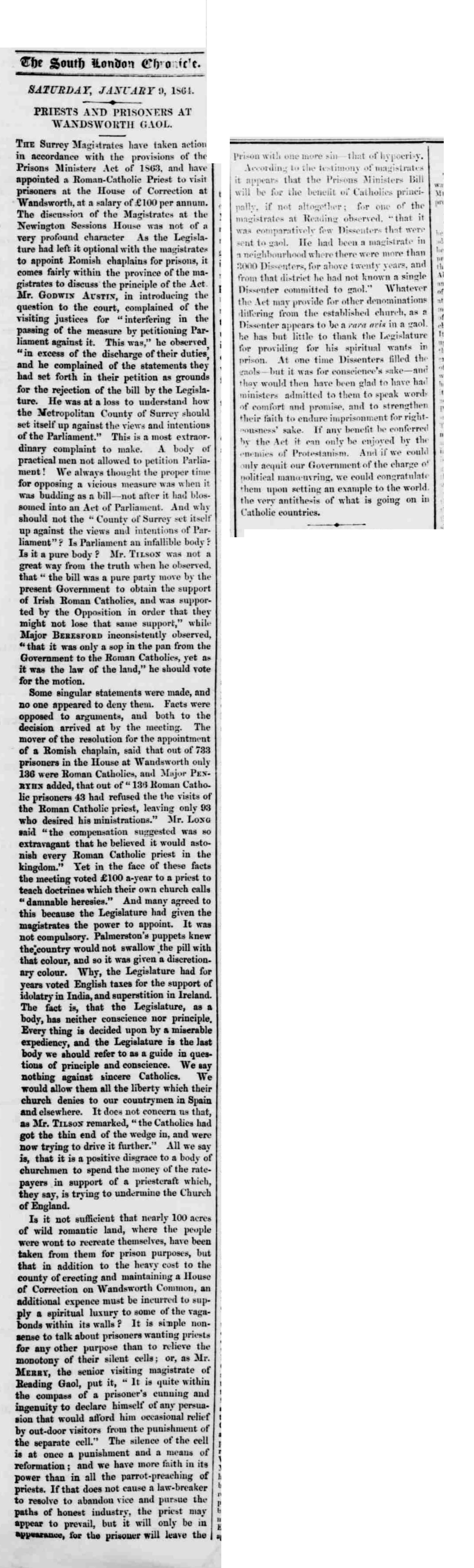
PRIESTS AND PRISONERS AT WANDSWORTH GAOL.
South't'f. Saturday, jasvast i>, isci. The Surrey Magistrates have taken action in accordance with the provisions of the Prisons Minister? Act of 1863, and have appointed a Roman-Catholic Priest to visit prisoners the House Correction at Wandsworth, at a salary of £100 per annum. The discussion the Magistrates at the Newington Sessions House was not of i\ very profound character As the Legislature had left it optional with the magistrates to appoint Romish chaplains for prisons, it comes fairly within the province of the magistrates to discuss the principle of the Act Mr. Godwin Aitsttx, in introducing the question to the court, complained the visiting justices for " interfering in the passing of the measure petitioning Parliament against it. This was," he observed "in excess of the discharge of their duties, and he complained of the statements they had set forth in their petition as grounds for the rejection of the bill by the Legislature. He was at a loss to understand how the Metropolitan County of Surrey should set itself up against the views and intentions of the Parliament." This is a most extraordinary complaint to make. A body practical men not allowed to petition Parliament ! We always thought the proper time for opposing a vicious measure was when it was budding as a bill—not after it had blossomed into an Act of Parliament. And why should not the 44 County of Surrey set itself up against the views and intentions of Parliament"? Parliament au infallible body? Is it pure body ? Mr. Tilsos was not a great way from the truth when he observed, that the bill was a pure party move the present Government to obtain the support of Irish Roman Catholics, and was supported the Opposition in order that they might not lose that same support," while Major Beresford inconsistently observed, u that it was only a sop in the pan from the Government to the Roman Catholics, yet as it was the law of the land," he should vote for the motion. Some singular statements were made, and no one appeared to deny them. Facts were opposed to arguments, and both to the decision arrived at by the meeting. The I mover of the resolution for the appointment ' of Romish chaplain, said that out of prisoners in the House at Wandsworth only 136 were Roman Catholics, and Major Pesetas added, that out of " 13*5 Roman Catholic prisoners 43 had refused the the visits of the Roman Catholic priest, leaving only who desired his ministrations." Mr. Loxo said "the compensation suggested was ho extravagant that he believed it would astonish every Roman Catholic priest in the kingdom." Yet in the face of these facts the meeting voted £100 a-year to a priest to teach doctrines which their own church calls u damnable heresies." And many agreed to this because the Legislature had given the magistrates the power to appoint. It was not compulsory. Palmerston's puppets knew would not swallow the pill with that colour, and so it was given discretionary colour. Why, the Legislature had for years voted English taxes for the support of idolatry in India, and superstition in Ireland. The fact is, that the Legislature, as a body, has neither conscience nor principle. Every thing is decided upon by a miserable expediency, and the Legislature is the last body we should refer to as a guide in questions of principle and conscience. We say nothing against sincere Catholics. We would allow them all the liberty which their church denies to our countrymen in Spain and elsewhere. It does not concern that, Mr. Tilsox remarked, "the Catholics had got the thin end of the wedge in, and were now trying to drive it further."
All we say is, that it is a positive disgrace to a body of churchmen to spend the money of the ratepayers in support of a priestcraft which, they say, trying to undermine the Church of England. Is it not sufficient that nearly 100 acres of wild romantic land, where the people were wont to recreate themselves, have been taken from them for prison purposes, but that in addition to the heavy cost to the county of erecting and maintaining a House of Correction Wandsworth Common, an additional expense must be incurred to supply a spiritual luxury to some of the vagabonds within its walls ?
It is simple nonsense to talk about prisoners wanting priests for any other purpose than to relieve the monotony of their silent cells; or, as Mr. Mebby, the senior visiting magistrate of Reading Gaol, put it, "It is quite within the compass of a prisoner's cunning and ingenuity to declare himself any persuasion that would afford him occasional relief by out-door visitors from the punishment of the separate cell." The silence of the cell is at once a punishment and a means of reformation; and we have more faith in its power than in all the parrot-preaching of priests. If that does not cause a law-breaker to resolve to abandon vice and pursue the paths of honest industry, the priest may appear to prevail, but it will only be far the prisoner will leave the prison one more sin that of hypocrisy. According the testimony of magistrates it appears that the Prisons Ministers Bill will l>e for the benefit Catholics principally. if not altogether; for one the magistrates at Reading; observed, '"that was comparatively few Dissenters that were I sent to gaol. He had been magistrate in •l neighbourhood where there were more than for above twenty year?, and from that district had not known a single Dissenter committed to gaol.*' Whatever the Act may provide for other denominations differing from the established church, as Dissenter appears to a rara avis in a gaol, has but little to thank the Legislature for providing for his spiritual wants prison. At one time Dissenters filled the gaols — but it was for conscience's sake —ami 'hoy would then have been clad to have ha< ministers admitted to them to speak word? of comfort and promise, and to strengthen their faith to endure imprisonment tor righteousness' sake. If any benefit conferred by the Act can only enjoyed by tin ••n»*mies of Protestantism. And if we could a<*(|iiit our Government of the charge political manoeuvring, could congratulate them upon setting an example to the world, the very antithesis of what is going on Catholic countries.
46 Building Plots and a corner plot for a pub.
[Where? Could it be Trinity Road, so pub would be the Surrey Tavern? Or St James's Drive?]
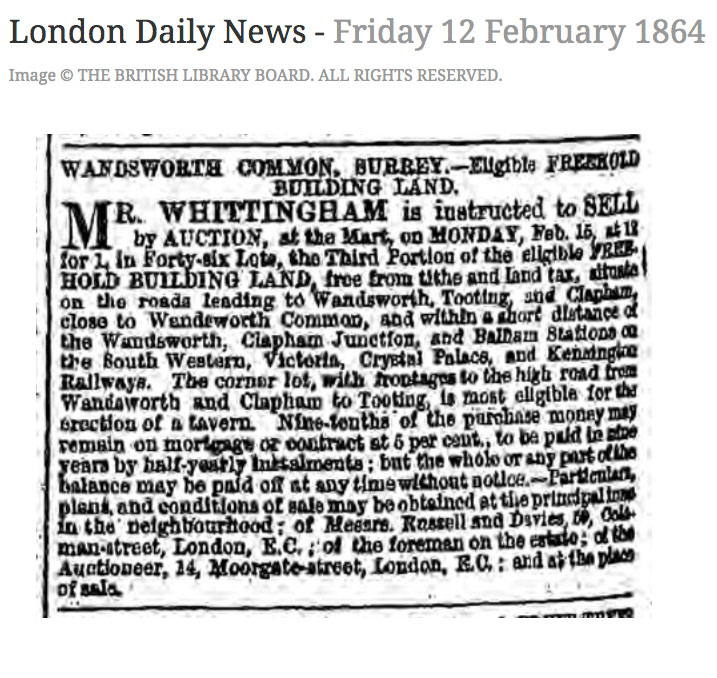
WANDSWORTH COMMON, SURREY — Eligible FREEHOLD BUILDING LAND.
MR WHITTINGHAM is instructed to SELL by AUCTION, at the on MONDAY, Feb. 15 at 12 fr 1, in Forty-six Lots, the Third Portion of the eligible FREEHOLD BUILDING LAND, free from tithe and land tax, situate on the roads leading to Wandsworth, Tooting and Clapham, close to Wandsworth Common, and within a short distance of the Wandsworth, Clapham Junction, and Balham Stations on the South Western, Victoria, Crystal Palace, and Kennington [?] Railways.
The corner lot, with frontages to the high road from Wandsworth and Clapham to Tooting, is most eligible for the erection of a tavern. Nine-tenths of the purchase money may remain on mortgage or contract at 5 per cent, to be paid n ine [?] years by half-yearly instalments; but the whole or any part of the balance may be paid ff at any time without ntice.
Particulars, plans . . . .ewithentaetic ?srticslSA s De~e an eoditont otsale may be obtained at the prlncipal inns [?] in the neighbourhood; of MlessBrs.Ru2stell a d s UAb', mn~sutreet, london, EB.C. ~ol the foreman ontbsesil .f 7'Auctiooeer, 14, yicorgateHsreet, London, E.G.; anda tS l5 Y of ale.' .
[Source: Link.]
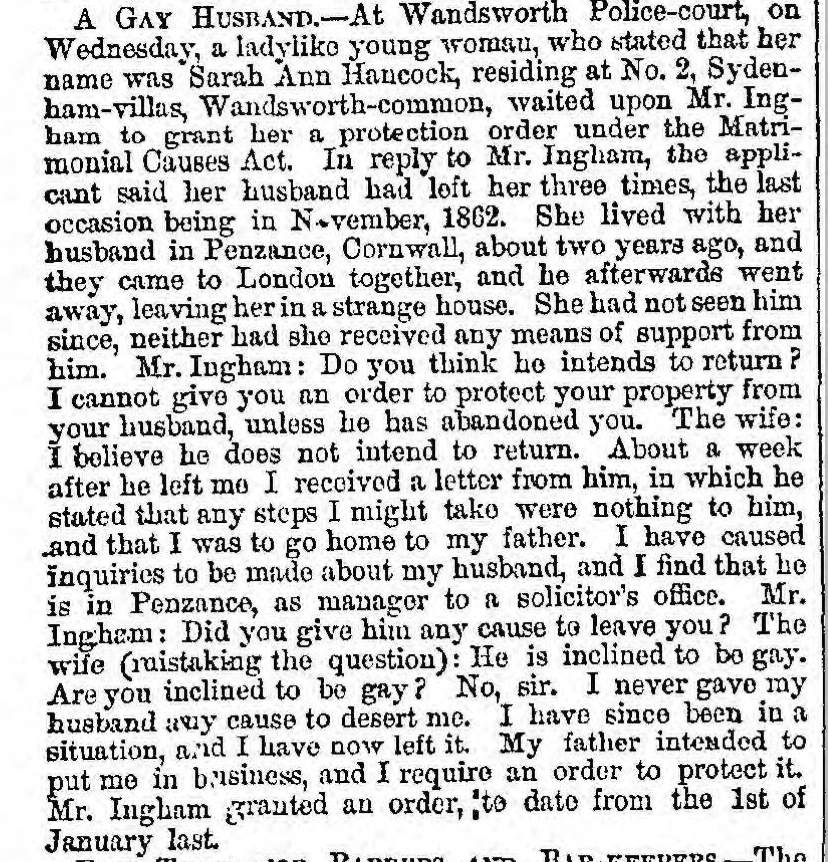
A GAY HUSBAND
At Wandsworth Police-court, on Wednesday, a ladylike young woman, who stated that her name was Sarah Ann Hancock, residing at No. 2, Sydenham-villas, Wandsworth-common, waited upon Mr. Ingham to grant her a protection order under the Matrimonial Causes Act.
In reply to Mr. Ingham, the applicant said her husband had left her three times, the last occasion being in NJvember, 1862. She lived with her husband in Penzance, Cornwall, about two years ago, and they came to London together, and he afterwards went away, leaving her in a strange house. She had not seen him since, neither had she received any means of support from him.
Mr. Ingham: Do you think ho intends to return ? I cannot give you an order to protect your property from your husband, unless he has abandoned you.
The wife: I believe he does not intend to return. About a week after he left me I received a letter from him, in which he stated that any steps I might take were nothing to him, .and that I was to go home to my father. I have caused inquiries to be made about my husband, and I find that he is in Penzance, as manager to a solicitor's office.
Mr. Ingham: Did you give him any cause to leave you?
The wife (misttaking the question): He is inclined to be gay.
Ars you inclined to be gay ?
No, sir. I never gave my husband tony cause to desert me. I have since been in a situation, and I have now left it. M~y father intended to put me in business, and I require an order to protect it.
Mr. Ilgham granted an order, to date from the 1st of January last.
[BNA: Link.]
TO GARIBALDI
Sir,—The inhabitants of the British metropolis rejoice to welcome you among them, rejoice in the opportunity thus afforded them of testifying their enthusiastic ealmiration for the first of living patriots, the undaunted and disinterested champion of not only the freedom and indepeodeoce of his own beloved and classic land, but of civil end religious freedom throughout the world. Free England welcomes with affectionate and heartfelt respect the great Apostle Liberty ; the heroic) and chivalrous soldier, whose sword is never drawn but in a just cause; the conqueror of a kingdom, that he might deliver its people from oppression ; poor himself, whilst making others rich ; the self-devoted, self-denying citizen, loving the rights and welfare of his own country, and of the whole human race better than his own life ; the truly good, pure-hearted, and upright man whose private worth is only imputed by his public virtues, and more than Spartan and Koman magnanimity. We thank you, general, for thus honouring us by becoming for a time our guest; and we sincerely and profouodly trust and pray that the same merciful and Almighty Power, which has hitherto and in a marvellous manner preserved, amidst the greatest perils and dangers a life so precious to Christendom and mankind, will complete your restoration to perfect health and strength, and enable you yet to accomplish all that your heart desires for the future, making that future even more glerior than the past, more fruitful in great and goad works, more beneficial to Italy and all other oppressed order of the Committee. JOHN RICHARDSON. Hoe. JOHN ROBRItt TAYLOR, f London, April 11, 1864. Again Garibaldi shakes hands with the secretaries, and comiog forward to the edge of the platform, every voiiv is hushed, while in tones that tremble with emotion, be makes the following reply : lam very happy to be enabled to-day to give my thanks to this noble nation for its generous sympathy for the of my country, and the amuse of mankind. (Great cheering.) Lou ago I wished for this day, and ery happy am 1 to express to you all my gratitude. The General retires back a little, amidst renewed cheers, and then Mr. Hartwell, one of the secretaries of the Working Men's Committee, comes forward and reads the following address from the Working Meu's Committee, which was also in the course of its reading loudly cheered : Illustrious Chief,—ln the name of Britain's sons and daughters of toil, we bid you welcome to this metropolis. We hail you the representative of a regenerated and united Italy, and for the love we bear to that beautiful land and its noble people, so long oppressed—but now, thanks to your devoted patriotism and indomitable courage, almost freed from the foreign oppressors, we bid you wel- come. Your name is to us a household word, the symbol of liberty, associated with lofty daring, bold enter- prise, and nueltish devotion to the cause of human program ; for your noble deeds we thank, love, and welcome you ; and in the name, the sacred name, of that liberty for which you have fought, bled, and won for the oppressed peoples. we give you place, the first place in our hearts ; and while doing so we cannot forget that there are many who have been associated with you in your glorious enterprises who are also deserving of our admiration sod esteem, especially the illustrious Joseph Ifaini, who has dose so much for Italy, freedom, and humanity. We therefore hope soon to be able to show our love for your co-workers. Aoospt then, dear brother, our heartfelt delight at seeing you in our midst; and, expressing a fervent &mire for the full realisation of your hopes, viz., your country's and the world's freedom, once more—in the unbounded fulness of our love for you sad liberty—weloome. Signed, on behalf of the working men of Great Britain's metropolis, ROBLIU Secretary of the Working Magee Committee. London, April 11, 1864. Before the General could reply an Italian lady, Madame Filopanti, rushed eagerly up to the platform and addressed the General in a set speech, part only of which was heard from a misapprehension that it was an interruption of the proceedings, which indeed it was, but an agreeable one, for the lady turned out to be related to one of Garibaldi's oldest and moat esteemed friends : Welcome (she says)—welcome, Garibaldi. This good Red generous people long to honour you for your bravery and your chivalry, for your generous and all-worthy ambition. An admiration great as glorious bursts forth spootanscarly from the heart of the most noble, as it is the most powerful, nation in the world. By this expression of their feelings, this manifestation of their sympathy and their admiration, they prove themselves the friends of virtue, of humanity, and of liberty. lam overpowered with joy to witness this glorious movement, this loving scene. And the more so that I am the countrywoman °tithe hero whom you have No heartily greeted with enthusiasm, sad I dare raise my voice in this assembly of Englishmen to thank them in your name and in the name of Italy for the honour they are bestowing upoo you. Garibaldi, may your holy patriotism and disinterestednees be greeted by the final triumph of Italian liberty against despotism. (Loud chem.) May your noble example exhilarate all hearts and contribute to establish that love and truth among natioos in the hallowed 00410 of liberty, which will one day unite humanity in one happy family. (Cheers-) During the delivery of this address, at first so interrupted, but at last received with enthusiasm, Garibaldi courteously bowed to the lady, still making use of the same graceful deprecatory motions of the baud when reference was made to his merits. When Garibaldi came forward to acknowledge the working men's address, he seemed bursting with emotion. At length, overcoming his feelings with an effort, he stepped forward, and said : I wish to say to the workmen particularly that lam very grateful, and shall never io toy life forget the welcome of a class to which I consider that I have the tumour to belong. (Prolonged cheers.) I to call my brothers the workmen of every part of the world. This address, touching from its simplicity and from the visible emotion of Garibaldi while delivering it, seemed to touch the hearts of the people, and another vigorous cheer rang out, in the midst of which a general move was made to the door of the building, and there ensued another scene of wild enthusiasm, the people below the platform rushing forward in a body to try and shake hands with the Italian patriot, and mostly failing in the attempt, they fell to cheering with might and main as some compensition. Those on the platform having been cautioned in large placards not to move from their places, of course a simultaneous rush was made, in consequence of which one of the secretaries, Mr. Taylor, was precipitated over the platform, but fortunately received no damage in his descent. A frantic policeman endeavoured to interpose his single person as an obstacle to the onward rush, but what can a policeman do against some two hundredl In a moment V 216 was swept away in the vortex, and was no more seen or heard. Arrived in the open space there was a general rush to the carriages, and the one in which Garibaldi, his two sons, and Mr. Seely, M.P., were seated, having been surrounded by a body guard of marshals and the members of the Garibaldiu: legion, proceeded to the entrance gates to witness the march past of the various trade societies.
THE JOURNEY TO STAFFORD-HOUSE.
There never was so great a crowd assembled in our streets, nor one so thoroughly inspired by one absorbing sentiment, as that which the metropolis of the world sent forth yesterday to welcome the humble, self-despising, single-minded man whose only claim upon English love and admiration was that he had fought freedom's battle and won it in a land which for centuries before his ooming had known no fate but to change the yoke of one tyrant for that of another, and every fresh fetter more galling than its predecessor. We are told the population of London numbers three suniassuredly two-thirds of that number :turned out see to cheer Garibaldi. From Nine Elms Stafford-bowie is a distance of little less tliau five miles-94nd five miles of wide roadway simnel, crowded will human behugs, and all inspired with one gathered for oue purpose, and waiting for mu, was a sight which the world has probably never seen equalled either in sublunity or aniggestiveness. We feel that it would be quite impossible to express in written words the impression it made upon ourselves, or to produce by description even a faint reflection of that impression upon others. The most simple form of words in which a fact can be stated are the must suitable for such a theme. As many English men and women as could find standing room in five miles of wide roadway, or as could gaze from window, or balcony, or housetop all along the line of procession, were abroad yesterday patiently waiting from morning until almost night the coming of their hero, and showing, by their incessant inquiry of "Is he coming f" that they thought of nothing, saw nothing, wished for nothing but the approach of Garibaldi. The weather was everything that could be wished for carrying out this stupendous demonstration in the most successful manner. The sky was dull in the morning, but towards noon the clouds cleared away, and the sun shone very nearly as brightly as our visitor may ever expect to see it in our northern clime. The people began to gather as early as eleven o'clock, and in a manner different from any former great assemblages that we have witnessed in London. They were not to be observed all hurrylog in oue direction, and becomng denser and dewier in numbers as they more nearly approached the great centre of attraction. Everyone seemed to be fully aware that there were quite enough of people coming forth to greet Garibaldi to fill the whole line of his route from the railway I station to Stafford-house, and accordingly each man or woman took up his or her station at once, and remained in it throughout the entire day, preserving as order, cheerfulness, and propriety of demeanour, such as all the police in Europe could not have enforced in a crowd of similar dimensions, but brought together by a leas worthy motive. The people kept the route clear themselves, the front row locking arms all the way along, and the dense muses which were packed on each side of the way, between the volunteer, pclioe, and the houses, aiding the good work by submitting to every inconvenience rather than break the line. Sir Richard Idayne'a police were of course there also, but they stood few and far between, a.id their superintendents had nothing to do but ride gently along the centre, and good humouredly wave their batons. The people were as docile as children ; they had come forth for a good day's work, and they were determined that its moral should not lose oue hair's breadth in political value by the slightest approach to riot or disturbance. The working men of London had organised a procession for the purpose of meeting and welcoming the liberator of Italy ; but this procession, although numbering fifty thousand intelligent artizaus, regularly marshalled either according to their respective trades or under the banners of their various friendly societies, was completely swallowed up in the mighty ovation of the whole metropolitan people, and served merely as • foretaste to Garibaldi of the extraordinary testimony which was about to be given of the estimation in which his principles and services in the cause of liberty were held by the English people.
Taken by itself, however, this procession of the trades would have been an extraordinary triumph for any ordinary man. When its head appeared in front of the railway station, with the emblematic banners of the cordwainers waving in the air, the last file was stated to be standing on Wandsworth-common, and although we could not test this by personal inspection, it is probably not much of an exaggeration.
Not more than ten or twelve carriages were admitted into the courtyard of the station together, with a moderate number of spectators on foot. A company of volunteers "who had served with Garibaldi" occupied a conspicuous position close to the great gate that opened in upon the platform, and their band played the Garibaldian hymn whilst we waited the arrival of the Southampton train. There was space enough for circulation within this privileged enclosure, but without, far as the eye could reach on every side, the waves of the living ocean could be seen heaving and surging, whilst that awful sound, " the whisper of a million," broke upon the ear and told of the ovation which was to some. Every window was filled with faces, men oould be seen climbing to the most perilous positions. in order to obtain a commanding new, and hundreds of men and boys, who had crept into the yard notwithstanding the utmost vigilance of the police, suddenly popped their heads up out of each railway truck and cattle waggon on the ground, whilst others pushed these huge machines as near as possible to the gate through which Garibaldi was to come to his carriage. Up to half-past two o'clock there were to be seen about the station only the few carriers we have mentioned sad their occupants, the selected band of volunteers who had served with Garibaldi, the Notting-bill tire brigade, and the band that so persistently played the Garibaldian hymn. There came now and then a faint cheer from within the station, and a deep murmur from the immense crowd in the road outside ; then could be seen the fluttering of the trades' banners over the walls, and the eager faces peering through the rails, but all this was quietude itself as contrasted with the scene upon which the curtain was so soon to rise. At about one o'clock the carriage of the Duke of Sutherland, drawn by four noble bays, and attended by outriders, drove up to the gate, and the cheering both within and without showed how gratified were the people at the compliment paid by the highest aristocracy to their represents-' tire man. At last the great gates of the station were thrown open, and the vista it disclosed was of extraordinary interest for the outside spectators. From the roof fluttered the Italian national colours in flap and festoons ; generics ran all round filled with ladies whose white handkerchiefs waved like a snowstorm ; the centre presented a sea of human heads, struggling, cheering, moving slowly forth • and from all sides rose a cheer which gradually in creased like the swell of an organ and burst out into full volume as General Garibaldi, surrounded by hie friends, appeared at the doorway and prepared to ascend the carriage which had been sent for him by his distinguished friend. Everyone who sees Garibaldi describes his appearance, or the impression which his appearance makes on them, for it would appear as if nature had intended him to be " all things to all men," that is to have points about him which all and each can admire and sympathise with. To ourselves he appeared, as he stood up in the carriage to return the salutations of the people, as • man who would be picked out in a moment amongst ten thousand as a born leader of men, and to have in perfection that peculiar port and presence which win for chiefs the title of lion from their followers. He is of the middle size, but no one thinks of his stature ; broad shouldered and well-knit, tawny hair and beard, and that peculiar deep grey eye, which can at one moment express the most melting tenderness, but at another flash with the lightning glance of the conqueror. He stood up, looking for a moment irravely round, and to that look a hundred thousand men would have yielded obedience bad they stood in arms at his feet. In the next moment he smiled, and every one rushed forward to shake his hand, their instinct had recognised him as a leader, their hearts now accepted him as a friend. Had the General had a thousand bands they would not have been enough for the eager Britons who shake hands eternally with those they love, as well as those whom they propose in the next minute to knock down, but the police, who knew by experience the lengths to which this frank and friendly ceremonial is times carried, suddenly rushed to the carriage door on each side, and by • vigorous demonstration succeeded in preserving the General's wrist from dislocation. It is to be honed that there will be no necessity for the repetition of such strong measures, but that the public will remember that Garibaldi is only one whilst they are legion, I and that the fervour of the British shake hands, whilst only a pleasant stimulus to each of themselves, becomes &serious strain upon nerve awl when the force of a thousand gripes is ou one unhappy wrist and set of fingers. liusautli was in this country he was disabled from writing, so much was his wriat and Lis nerves shattered by the perpetual of hands to which he had to submit during pro. greet The General wore a grey military cloak carelessly, but picturesquely, draped, r e l ieve d over out shoulder by the bright scarlet which ever) oh. recognises as the Garibaldi red, and as he up in his carnage to enjoy and reciprocate the feelings of the people, it would he imagine a more striking picture than his lace ant figure presented. There was a good deal of delay iu organising the exit of the carriages and the defile of the procession, which halted outside, which it was proposed should pass the Sather laud carriage. At last the latter was out, and hating drawn up on the the working men pa s sed o n marc hi ng und 4 their various banners and attended by their ban which played as each section came up some Arcs that was thought suitable to the occasiou. A. police, who very properly deemed the preser%,:. of order to be before everything, had oratr. l the gates of the railway yard to be the moment General Garibaldt's carria-e had passed out, we could only see the, tat. dards and sometimes the heads of the dard bearers we could read the mottoes and hear the music, but for the rest we could merely the numbers of the procession iu military by timing the pace, reckoning the tiles, and ..b. serving how long a time elapsed before the la,t banner had passed on. The Shoemakers Wilt first, with ten marshals and a flag inscribed " Garibaldi ;" then the members of the joint con'. mitten, and closely following them the ttuiperatte societies, who required only five marshals to leaf them. Next followed t he variants trades unions in ;Treat foroe, with their own bands, and the whole closed up with a number of private carriages, including that which contained the representatives of the public press, and which was not allowed talcs.* until the whole of the trades' procession had defiled past Garibaldi. From the time this procession iu passing it was computed that its numbers did not exceed forty thoussuidould it was very soon absorbed by the enormous civwd which now surroutand it on every side. Th carriages iu their turn passed the General and saluted, and places having at last been allotted, the procession moved on, tie General's carriage bringing up the rear, its pLee indicated by a white banderolle on each aide, and immediately in front of it was a baud headed by a very conspicuous personage mounted on a bay charger, who was constantly being cheered in mistake for Garibaldi, and then as regularly " chaffed" and criticised when the spectators found out their mistake. The interest of the spectacle was now and henceforth fairly divided between the object of tbit great of ation and the ovation itself, for whilst the people cheered and shouted fur Garibaldi the latter looked with wondering admiration on the counties, myriads of human beings who surrounded him ou every side, and who seemed but to have one absorbing idea, that of doing him honour and bidding him welcome. In the narrow road, in the broad highway, in the palatial street, it was still the same. Houses decked with the Italian ooiours, windows and balconies bright with fair faces and Garibaldian favours, the road, black with moving humanity, and the liviug sea heaving and surging, but still keeping the passage clear whilst the lengthy cortege pawed slowly along. We have seen many crowds iu various great centresof population, we have seen royal pro- gresses and imperial entries, but we ueversaw anything like the crowds that filled London streets yesterday, and we believe that that is the verdict which will be given by those who were present and who're competent to form an opinion. With such masses of people to pass through, it is not surprising that our progress should be slow. The narrow way that led from the railway station to the Wandsworth-road was a passage of great difficulty, but we lived in hopes of easier transit when we got into the wider highway ; where however it all the same. Wandsworth-road was so full to cause a stoppage every twoor three minutes. Then the crowd would cheer for Garibaldi, and handkerchiefs would be seen waving from every window. The white banderolle at the carriage door, like the white plume at i Ivry indicated the presence of the hero, would be seen to be stationary, and the occupants of the fruit carriages would be inundated with eager questions of "la he coming." The people thought or talked of nothing else. "Is he coming I" " When will he be here r " Has anything happened to him 1" and then when these questions were answered, a general shout was the regular order of things, repeated over and over again duringour slow progress. Many thousands of the people, through whose ranks the carriages slowly threaded their away in the later. part, of the afternoon, had stood in the ranks from early morning, but not an impatient word or an angry gesture escaped them. It was sufficient for them to know that Garibaldi we well, and that he was coming ; with ' these two assurances they were prepared to wait cheerfully for as many hours longer. The handsome front of the Licensed Victuallers' School gaily decorated with banners, and with the children cheering and waving their handkerchiefs, arrested the General's attention, and shortly afterwards, se the cavalcade out to the Kennington-road, the full magnitude of the crowd began to be fairly appreciated. There is a wide open space at Keonington-cross, and, once entered upon this, the whole vista of the road almost down to Westminster-bridge was thrown open to the view. We looked back to where the white banderolle told us the position of the general's carriage, and we could could see him standing up and gesticulating his amazement at the myriads of human beings before hint. White handkerchiefs were waving from every hand in the windows, the crowd.cheered and cheered again, and another start of the carriages launched us fairly into the human torrent. It was here that our carriage, drawing up at the roadside for a moment, allowed us to see pees a singular and suggestive procession. It was the representatives of the venous oppressed nationalities who have found shelter and protection in England, and who had come forth humbly to honour the man who, they hoped, destined by Providence to inaugurate a brighter future for the world. There was the Pole—perhaps newly escaped from the tender mercies of Berg or Mouravieff—the Hungarian and the Italian who bad fled from the laden despotism of Austria, and also some bright and eager faces which told of a nationality nearer home, where freedom of thought and expression iv sometimes visited with penalties as heavy as the Russian kuout or the Austrian dungeons. Wan and poor many of these men looked, but none of them craven or broken-hearted. They stepped along boldly on the free soil of England, and seemed to acquire fresh confidence as every now and then they turned back to look at Gariba ldi, and to join in the cheers which rose at every fresh point where the pressure of the crowd caused a momentary suspension f We had left the station at Lalf-past two ; it now six o'cloc k and we had only reached that portion of the Westminster-road where the suburban villas terminate, and the street, proper, leading up to the bridge may be said to begin. The crowd seemed only to increase in magnitude, and to cut pass in patience and good humour the thousands through whose ranks we had already palmed. They thought nothing of themselves, but the long waiting had brought on nervous anxiety for the safety of their visitor, and rumours be gan to be circulated as to an accident bavin happened, and also as to the General having bee so exhausted on his arrival at Nine Elms as to °cogitate bis immediate going to bed. The occupau of the carriages were besieged with eager queatiow. and the accident was explained to have been mere y the breaking of a trace in the genera?' carriage, ail the gambols of a restive horse in another, without a the,latter case, however, any worse result than an inmediate descent of all the occupants of the carriage to terra firma. The popular mind wait nor relieved, and occupation was found in watching for the white flag, which they were told signaled the approach of the hero of the ovation. The crowd was still growing denser every moment, aid
w e were approaching more nearly the centres of and population, a greater force of police beawe necessary to keep a passage, when it was exce,liugly gratifying to observe how completely deportment of the police authorities harmonised with the pervading sentiment of the day, j avoided all appearance of violence or performance of a necessary duty. It appeared that each superintendent carried the procession through his own district, and as it first passed thr.•;igh the domain of Mr. Payne, the chief of the ue had full opportunity of witnessing the tact, and good humour of that intelligent in dealing with the enormous but perio-.lv good-humoured and docile crowd. such an enormous mass of physical surging up and down, an impatient gesture iu a moment have created a serious riot, on the other hand a little patience and a of good humour enabled Mr. Payne to ch the way without difficulty for the advance of th. procession. From Mr. Payne the crowd passed un.a the sceptre of Mr. Walker, of the A's, who,oug been facile princeps in the management and who on this occasion fully his established reputation. But for sd r. W.tiker's tact and generalship we should L dt.,.l, iy have Lad a " congestion" at Westwhich being considered a f.noural.le point of view, had been fully ocli,:e i throughout the day, and now became closely by the fresh reinfprcemeuta that came up n.,.useut. Mr. Walker, however, with the four troopers, gradually opened a central and disclosed a view which could not prob. be equalled anywhere else in the world. r was the graceful bridge spanning noble river, and alive over its whole ~:nice with expectant human faces. Beyond it, the tall towers of the "Queen's Palace at e-zminster" cut against the blue sky, and, interc,-• the evening sun, threw long shadows a:ru-- the moving mass. There was a haze in the which gave the wholo scene an 'tidbit:l.: • Jeamy appearance, and the distant shouting came up from the cavalcade behind served to t:,e illusion complete. The Conscript Fathers acre all the while busy in both houses, scd t!:e only faces that peered out at the pageant were a few privileged ones from the in the clock tower, which now was for the t :16e thrown open. The procession now moved e. h.to Parliament-street, to find the windows all ..o.t.,ted ant filled with spectators, and the roofs the public offices crowded. Trafalgar-square an extraordinary eight, thepeople having Liken i;!1 advantage of its spacious area to choose in arable points of view. The equestrian statue i like the well-known Frederick group at Berlin crew tett and crammed was it with people. The 1a . . . .a the Nelson column became a living pedestal ; a . . . i a- for the roadway, pin dropped among the p 001 . . . , would have had some difficulty in finding • way to the ground. The cheering here became deafening, and the progress of the preee,-• became gradually accelerated in conic.;%ence of the much greater area to be passed At Her Majesty's Theatre the artists .wde, l the roof of the colonnade, and an enthusiastic ovation to their illustrious ntryruan. Iu Pall-mall the windows had • been taken out of the club-houses, the apertures crowded with Leads, and the press was here, at a . ! aarter to eight o'clock, nearly as thick as it mad Leo: at any point in the progress. It was too to permit of Garibaldi being seen by the who had waited for him patiently since but they bated not one jot of their patience humour, the mere consciousness of pre-cnce amongst them seeming to be Aulicient to raise their cheers to enthusiasm. pgeaut, the moat extraordinary and imposing,d probably ever been seen in the streets of L either on the occasion of mill progresses imperial visits, now drew to a conclusion, and in ry few minutes more the carriage of General ciribildi turned in at the Park entrance, and the ce doors of one of the most princely of England's closed upon the type-man of Nature's own bility. was not, so far as we could learn, any r. accident during the day—there was not a assault or other act of violence came under observation during the whole progress, and it was all over the crowd broke up and was rbed by the innumerable streets of London, t .king way for the ordinary traffic, which in half. -.our was going on everywhere as briskly as if t had happened to interrupt it. The General entered Stafford-bome leaning on the cf the Drake of Sutherland. Red cloth had been • down from the door to the entrance of the grand stair. cue, at which pole' the Duchess of Sutherland advanced atdcoolially welcomed the illustrious guest. The Duchess of Sutherland also came forward to welcome ma after an interchange of oomplimeula the • coadocted the General to his quarters. He awned greatly fatigued by the excitement of the day. L. Dim and Duchess of Argyll, the Earl of Shaftesbury, the I.l.achioaess of Ely, Viscountess Jocelyn, the Hon. Leolo:,1 Agar Ellis, Lady Blantyre, and Hoe. Misses • toe youthful Marquis of Lorne, Lords Albert and 1: Levison Gower, Lord Richard Creamer, General I. Henry Howard, ge., came on the grand stair. • witness the arrival of the General, but they took no pe: the welcome, which was confined to the hat sod hostess and the Dowager Duchess. T.- still persisted in surrounding the house and • ram; vociferously, as if expecting that the General come oat on the balcony and address them. He d.. a. do so, and the crowd at length dispersed. circle was confined to eighteen persons, the Dowager of Sutherland, the Duke and Duchess of .1•.72. and a small family party, being the principal persons 1:- -a: to meet the General. ', not — Fn.—Owing to the unexpected visit of to Yortamouth Dockyard on setnurday last, de. of respect was made by the municipal authorit • representing the town. A special meeting of the ..uncil has, however, been convened for this day to consider the propriety of presenting an addrase APRIL 11.—A committee comprising, •r of the most influential inhabitants of Woolwich, 1 n.vite4 General Garibaldi to attend a banquet in .ou, the following reply boa been received by the T. Tutbeld, chairman :—"Brook, April 9. Sir,—l trd by General Garibaldi to inform you that and circumstances permit he will piiy a short Woolwich. end that he begs to decline the honour inet.—Your most obedient servant, J. H. Lieut.-ColooeL" A public meeting was this reted. to be held at the Town-hall on Thursday ad.:n:4 measures for giving a fitting remption to I .Anbaldt, who it is hoped will visit Woolwich and the Royal Arsenal and other public esatblishments.
[Link.]
Commons debate on London's open spaces and recreation

[NEEDS EDIT]
OPEN PLACES FOR RECREATION.
Mr. DOULTON, in moving a resolution on the necessity of preserving open spaces in and around the metropolis, said few questions were more interesting to the mass of the industrial population than this. Open districts were fast becoming absorbed. The importance, and he would say the absolute necessity, of preserving open spaces for the recreation of the people would not be denied by any, but in order to prove it he would call attention to some very striking facts connected with the large increase of population in the metropolis. In 1851 the population of what was termed the metropolitan district was 4,700,000; in 1861 it was not less than 5,600,000, or an increase of 900,000 in the short space of ten years. In the same period there was an increasein the number of houses to the amount of 103,000; that increase was still going on, and he questioned whether at any time during the ten years it advanced at a greater ratio than at this moment. But the important point was this-that while the necessity for open spaces was increasing, the difficulties of obtaining control over them were increasingalo. (Hear.)
This was not the first time that the question had been brought forwatd, though not in the same form as that in which he submitted it to the House that evening. Bat whenever it had been considered, whether in reference to Hampstead-heath or to the places to which the hon. member for Maldon (Mr. Peacocke) had called attention, there had been almost an unanimous expression of opinion in favour of the preservation of those p (Hear.)
A very few years ago London might be said to have been belted with those natural parks. Many of the commons on the south and north sides of London had become entirely extinguished, being appropriated for building purposes; and others were in process of extinction. The question of the forests and that of the commons and open spaces in the neighbourhood of the metropolis ought to be kept distinct. Parliament had already in an address to the Crown, and a committee of hat House in a report, had expressed the opinion that it was necessary that those forests should be preserved for the purpose of public recreation. The Government, however, had taken no action in reference to the matter until within the last few days, when a communication was sent to the metropolis. tan Board of Works by the Secretary to the Treasury, asking that Board -whether they were prepared to purchase the rights over Epping Forest, with an ultimate view to the cession of the rights of the Crown. He would presently show that the Metropolitan Board of Works had no power to deal with the matter, but, if they had, there was no necessity for throwing this duty on them. The commons rested on a different tenure, for the rights over them belonged, not to the Crown, but to the lords of the manors, the copyholders and the commoners.
With respect to the enclosure of commons, application was generaly made to Parliament through the Copyhold Commission, but there were some startling exceptions to that rule, and Wandsworth-common, one of the largest and best on the south side of the metropolis, was being appropriated for building purposes, though no application to enclose it had been made to the Copyhold Commissioners, and, consequently, the case had nexer come before Parliament. Therefore, the fact that lords of manors were able to enclose commons showed the necessity for Parliament to deal with the question.
The Secretary to the Treasury had suggested, in a letter, that the Metropolitan Board of Works should take up the matter, but it was neither in theirpower nor was it their duty to do so. The Act of Parliament constituting the Board authorized them to form public parks by purchasingland by agreement, but nobody who knew the nature of the negotiations for the purchase of land would dream of the Board forming a park in the neighbourhood of London, unless they had such compulsory powers as they did not at present possess, 'Tho Metropolitan Board of Works were told to maintain Epping Forest for the purpose of public recreation, but, as that was beyond their jurisdiction the forest must be preserved at the expense, if the Board determined to undertake the task, of the inhabitants of the mnetropolitan districts, and the inhabitants of the neighbourhood of the forest beyond the jurisdiction of the Board, while enjoying great benefit from the preservation of the forest, would not contribute one farthing towards the expense. He would also take the cases of Mitcham and Wimbledon commons, and he asked what would be the result if the Metropolitan Board of Works undertook to preserve them as places of public recreation.
With regard to Mitcham-common, the inhabitants of the healthy and incresming townof Croydon would derive great part of the benefit, and would not contribute in any degree to the expense. So with regard to Wimbledon-common the inhabitants of Richmond and other large towns would receive great advantage from the common being preserved, but would not be called on to pay one farthing. The Metropolitan Board of Works had aready incurred liabilities for improvements to the extent of between £8,000,000! and 9,000,000! That very large expenditure was to be defrayed by the metropolitan ratepayers, and it was impossible to go on imposing fresh rates on the metropolis, the Metropolitan Board having no other means of raising funds except by direct taxation.
If that Board were to be called on to preserve these open spaces-a duty which he thought more properly belonged to the Government-the House ought not to b so chary in giving the Board the ame powers to tax the metropolis as were exercised in provincial towns. In bringing this question forward he did not wish it to be understood that he was desirous that these open spaces should be transformed into neatly-trimmed and laid-out gardens and parks. His object was to have them preserved in all their wild and uncultivated condition, and at would be a plesant sight to see the boisterous enjoyment of the working people in places where there did not exist those restrictions which were natural and proper enough in well laid-out gardens. (Hear, hear.) He did not wish that the money for this purpose should be taken out of the Consolidated Fund, but he asked the Government to introduce a Bill givino the necessary taxing powers to the Metropolitan Board of Works to carry out the object.
He concluded by moving the'followingiresolution .-\" That it is the duty of Her MJesthe Government to provide for the preinrvetionsof open spaces within the limitsassignedby the 14th ection of the Enclosure Act of 1845. "
Mr. F. PEEL sed it would bo a cauce of much regret if none of the pn spaces around and, more especiamy,tbose in the metropo rs hould be preserved; ard he owned that it was the duty of the Government, more particularly whon thointentions oE Parliamentohad been exprssed, to attend to those things. In an ordinary ease, where there was an open spaceoin which different eonA had an iterest, as commonersa tenanut or lords oflthe manor, the encosure of ruch land, tf it ras ewithin a certain radius o the metroolis,rcouldenothbebeffectedwihout an Act of Parliament On such an application being made, therefore, Oharliaateno could eithr refuse it or grantit under cert-in conditions, asd for instance, with regard to he resorvation of *o much ground for the recreation and health of the public. When anenlosurewas recentlyauthorize in Chigweflt arish, 50 acres were allotted for the use of the public. It was a mistake to suppose that there had been anyv uery considerable diminuion in the open spaces in and arounnd the metroanolis. It was nearly 20 years since the idet in regard to enclosures writhin the metropolitan radius of 15 miles was passed, and during that time not more than about1,500 acres had been wclosd, the greater part of which was uoward. of 10 miles from town. On the part of the Crown there had certainly been no disposition to deprive theinhabitants of Lotdon of any rights to which they were entitled in this respect. HIe wras willing to admit that in tre admmnistraton of arown property regard shoutld be had to the effect of open ground on the public health, even in preference to the benefit which the publicmight otherwise derive from the disposal of the eant
In Epping Forest the Government did not feel at liberty to use forestral rights of sporting and hunting as a title tohe property of private individuals. As a proof of the anxiety of the Government to give due consideraton to the clams of the publc in regard to open spaces, he might reter to the parks of london, and especildly to the new ones -Vmctoria and Battersea, which had in recent years been added to the number. With respect to the commons which were the property of private personsd it was not the duty of the Government, and it would be qmte inmpossible for them, to deprivethe owners of the right touse the ground in the same manner as other owners of private property were entitled to do. Atauyrate, it couldnot bedone svithontgivingcompensa. tion to the owners, many of whom, moreover, having only a limited interest, couldnot sell if they wished. The Governinentwooldalsorequiro tobearmedwith specialpjiowers for the purpose. The chief and crowningdifficultyr, however, was the source from which the expense of preeerving the open spaes should be derived.- Ele could not ad'mit that it was the duty of the Governlment to provide the means out of the publie purse. There ought to boe n difference in that irespect between the metropolis and the other large townsf of the country. As to the suggestion that further powers should be given to thme M£etropolitan Board of Works, it would receive the consideration of the Government. (Hear, hear.)
Mr. LOCKE said that the difficulty at EppingForest arose from the neglect of the Government in allowing houses to be built on pound over which the public had a right of way. The obect of the resolution was to render the Go'vernmert mnore careful in re.ard to such matters. There might be some diffculty as tg compensations, but the metropolis was niot in th s ame position as other towns, for it6 was expanding in a manner quite without e Promi time to. time encroachments bad lately 1 ae in the open spaces near Loondon by private Bills 'or other means. For instance, a railway had been carried through the centre of Wandsworth-common, and when that had been done he presumed any other nuisance mighit be initroduced. (A. laugh.) Tooting and Streatham had also been subject to encroachments. The resolution was intended to promote the desirable object of presrvig those pen pacs whch ereso essential to the pubic heath bu i woldnotemorrssthe Government by ledingthe tony artculr mdeofdoingso. (Hear.) He bouht he esoutin dsered hesupport of the Hous, an hopd hi boo frind wuldpress it to a di.
Sir W, FRASER said it was much to be regretted that the open space in the neighbourhood of the metropolis had been allowed to be cut up by railways. Whcu those railwaus Wer constructed iLf there bad been public officer to protect the interest of MZe public, in all probability they would either have been stopped altogeter or forced totake
was afraid the recreation grounds arouati London would continue to be encroached upon.
Mr. TORRENTS observed that persons claiming to be lords of the manor werejn the habit of laying hold of hundreds of acres in Epping Forest and elsewhere, without any steps being taken on the part of the Government to protect the rights of the Crown and of the commoners. It was high time that the Attorney-General should be instructed by the Treasury to interfere in such cases.
Mr. COWPER admnitted that means should be taken, if possible; to prevent the commons around London from being enclosed, but there were difficulties in the way, and he was afraid the resolution of the hon. member for Lambeth would not remove them. Last year the Metropolitan Board of Works were charged by an Act of Parliament with the duty of looking after the open spaces within their jurisdiction, but he believed they had not yet done anything in the matter, and he suspected that the present resolution, if tDas would equally prove a failure, It would be far better to appoint a select committee to inquire into the whole subject and endeavour to ascertain how the difficulties now experienced could be overcome.
The House then divided, when there voted -
For the resolution, 79
Against, 40
Majority, 39
The announcement of the numbers was received with cheers from the Opposition benches.
[Hansard: Link.]
[NEEDS EDIT]
1864_commons_around_london_ClerkenwellNews_1jul1864.jpg
[NEEDS EDIT]
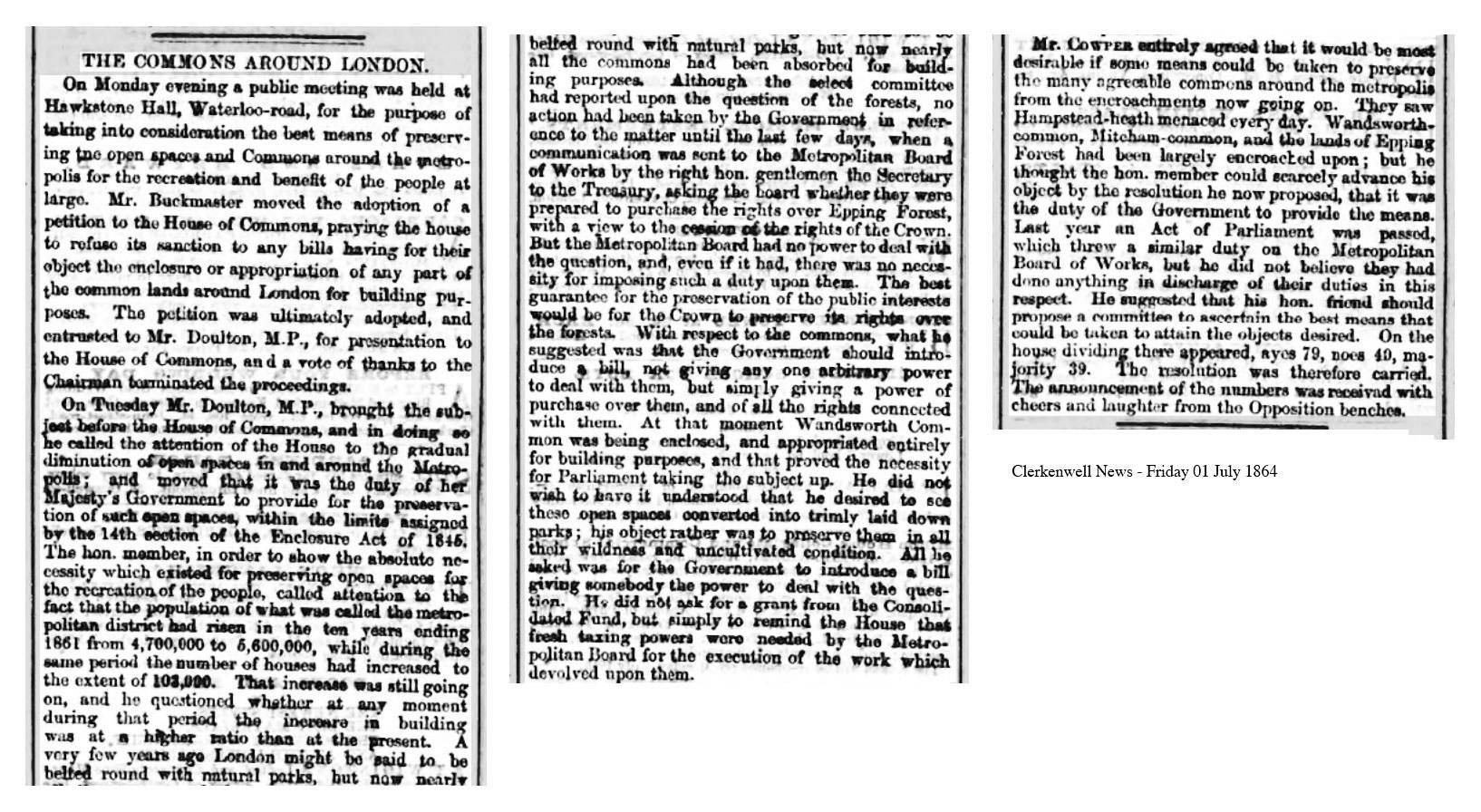
THE COMMONS AROUND LONDON
On Monday evening a public meeting was held at Hawkstone Hall, Waterloo-road, for the purpose of taking into consideration the best means of preserving the open spaces and Commons around the metropolis for the recreation and benefit people at large.
Mr. Buckmaster moved the adoption of a petition to the House of Commons, praying the house to refuse its sanction to any bills having for their object the enclosure or appropriation any part of the common lands around London for building purposes. The petition was ultimately adopted, and entrusted to Mr. Doulton, M.P., for presentation to the House of Commons, a vote of thanks to the Chairman terminated the proceedings.
On Tuesday Mr. Doulton, M.P., brought the subject before the House of Commons, and in doing so called the attention of the House to the gradual diminution open spaces in and around the Metropolis; and moved that it was the duty of her Majesty's Government to provide for the preservation of such open spaces, within the limits assigned by the 14th section the Enclosure Act of 1846. hon. member, in order to show the absolute necessity which existed for preserving open spaces for the recreation of people, called attention to the fact that the population what was called the metropolitan district had risen in the ten years ending 1861 from 4,700,000 to 6,600,000, while during the same period the number of houses had increased to the extent of 101,000. That increase was still going on, and questioned whether moment during that period the building wiis at higher mtio than the present.
A very few years ago London might said belted round with natural parks, but now nearly all the commons had been absorbed for building purposes. Although the select committee had reported upon the question of the forests, no action had been taken by the Government in reference to the matter until the last few days, when communication was sent to the Metropolitan Board Works by the right hon. gentlemen the Secretary to the Treasury, asking the board whether they were prepared to purchase the rights over Epping Forest, with view to the cession of the rights of the Crown. But the Metropolitan Board had no power to deal with the question, and, even if it had, there was neecessity for imposing such a duty upon them. The best guarantee for the presentation of the public interests would for the Crown preserve its rights over forests.
With respect to the commons, what suggested was that the Government should introduce a bill, not giving any one arbitrary power to deal with them, but simply giving a power of purchase over them, and all the rights connected with them.
At that moment Wandsworth Common was being enclosed, and appropriated entirely for building purposes, and that proved the necessity for Parliament taking the subject up. He did not wish to have understood that desired to see these open spaces converted into trimly laid down parks; his object rather was to preserve them in all their wildness and uncultivated condition.
All he asked was for the Government to introduce a bill giving somebody the power to deal with the question. He did not ask for a grant from the Consolidated Fund, but simply to remind the House that fresh taxing powers were needed by the Metropolitan Board for the execution of the work which devolved upon them.
MR. COWPER entirely agreed that it would be most desirable if some means could taken to preserve many agreeable commons around the metropolis from the encroachment now going on. They saw menaced every day. Wandsworth-common, Mitcham-common, and lands Forest had been largely encroached upon; but he thought the hon. member could scarcely advance his object by the resolution now proposed, that it was the duty of the Government to provide means. Last year an Act of Parliament was passed, which throw a similar duty on the Metropolitan Board of Works, but did not believe they had done anything in discharge their duties in this respect. He suggested that his hon. friend should propose a committee ascertain the best means that could taken to attain the objects desired. On the house dividing there appeared, ayes 79, noes 40, majority 39. The resolution was therefore carried.
The announcement of the numbers was received with cheers and laughter from the Opposition benches.
[Source: Link.]
[BNA: Link.]
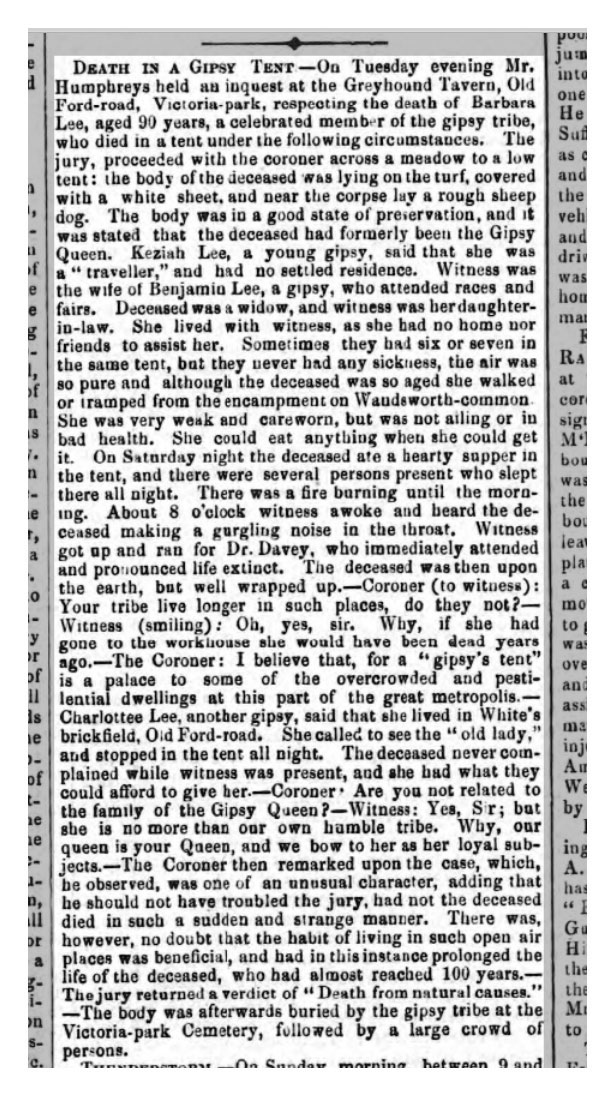
Death in a Gipsy Tent
On Tuesday evening Mr. Humphreys held an inquest the Greyhound Tavern, Old Ford-road, Victoria-park, respecting the death of Barbara Lee, aged 90 years, a celebrated member of the gipsy tribe, who died in a tent under the following circumstances.
The jury proceeded with the coroner across a meadow to a low tent: the body of the deceased was lying on the turf, covered with white' sheet, and near the corpse lay a rough sheep dog. The body was in a good state of preservation, and was stated that the deceased had formerly been the Gipsy Queen.
Keziah Lee, a young gipsy, said that she was a traveller," and had no settled residence. Witness was the wife of Benjamin Lee, a gipsy, who attended races and fairs.
Deceased was a widow, and witness was her daughter-in-law. She lived with witness, as she had no home nor friends to assist her. Sometimes they had six or seven in the same tent, bat they never had any sickness, the air was so pure and although the deceased was so aged she walked or tramped from the encampment on Wandsworth-common She was very weak and careworn, but was not ailing or in had health. She could eat anything when she could get it.
On Saturday night the deceased ate a hearty supper in the tent, and there were several persons present who slept there all night. There was a fire burning until the morning. About 8 o'clock witness awoke and heard the deceased making a gurgling noise in the throat. Witness got up and ran for Dr. Davey, who immediately attended and pronounced life extinct. The deceased was then upon the earth, but well wrapped up.
- Coroner (to witness): Your tribe live longer such places, do they not?
Witness (smiling); Oh, yes, sir. Why, if she had gone to the workhouse she would have been dead years ago.
- The Coroner: I believe that, for a "gipsy's tent" is a palace to some of the overcrowded and pestilential dwellings at this part of the great metropolis Charlotte Lee, another gipsy, said that she lived in White's brickfield, Old Ford-road. She called to see the old lady," and stopped in the tent all night. The deceased never complained while witness was present, and she had what they could afford to give her
- Coroner: Are you not related to the family of the Gipsy Queen?
- Witness: Yes, but she is no more than our own humble tribe. Why, our queen is your Queen, and we bow to her as her loyal subjects.
- The Coroner then remarked upon the case, which, be observed, was one of an unusual character, adding that he should not have troubled the jury, had not the deceased died in such a sudden and strange manner. There was, however, no doubt that the habit of living in such open air places was beneficial, and had in this instance prolonged the life of the deceased, who had almost reached 100 years.
- The jury returned a verdict of Death from natural causes." — The body was afterwards buried by the gipsy tribe at the Victoria-park Cemetery, followed by large crowd of persons.
The Suffolk Chronicle; or Weekly General Advertiser & County Express — Saturday 27 August 1864
See also Irish Times, 26 August 1864. Is the text identical?
[NEEDS EDIT]
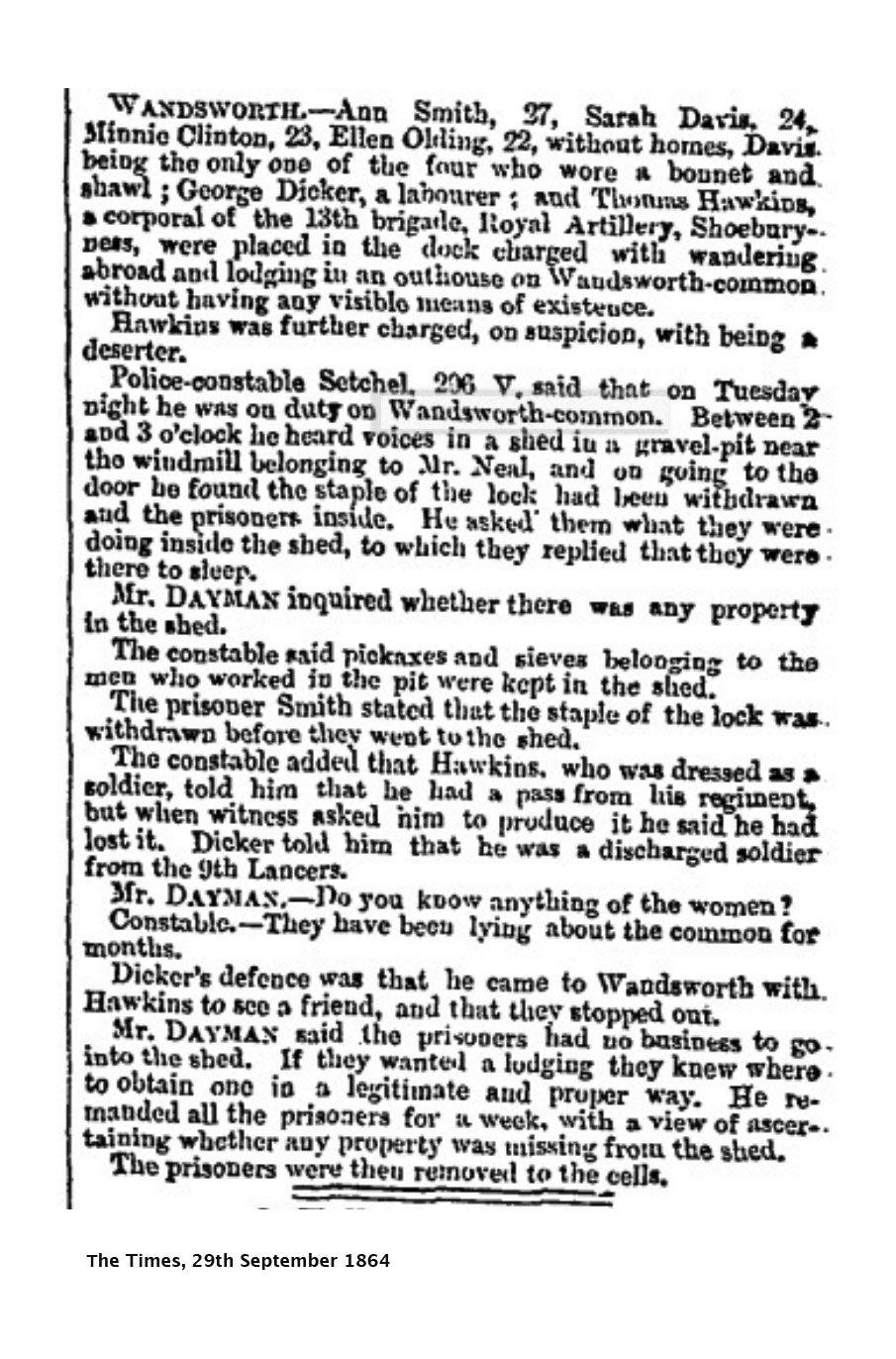
WANDSWORTH
Ann Smith, 27, Sarah Davis 24, Minnie Clinton, 23, Ellen Olding, 22, without homes, Davis being the only one of the four who wore a bonnet and shawl; George Dicker, a labourer; and Thomas Hawkins, a corporal of the 13th brigade, Royal Artillery, Shoeburyness, were placed in the dock charged with wandering abroad and lodging in an outhouse on Wanndsworth-common without having any visible means of existence.
Hawkins was further charged, on suspicion, with being a deserter.
Police-constable Setchel, 296 V, said that on Tuesday night he was on duty on Wandsworth-common. Between 2 and 3 o'clock he heard voices in a shed in a gravel-pit near the windmill belonging to Mr. Neal, and on going to the door he found the staple of the lock had been withdrawn and the prisoners inside. He asked them what they were doing inside the shed, to which they replied that they were there to sleep.
Mr. DAYMAN inquired whether there was any property in the shed.
The constable staid pickaxes and sieves belonging to the men who worked in the pit were kept in the saied.
The prisoner Smith stated that the staple of the lock was withdrawn before they went to the shed,
The constable added that Hawkins, who was dressed as a soldier, told him that he had a pass from his regiment, but when witness asked him to produce it he said he had lost it. Dicker told him that he was a discharged soldier from the 9th Lancers.
Mr. DAYMAN: Do you know anything of the women?
Constable: They have been lying about the common for months.
Dicker's defence was that he came to Wandsworth with Hawkins to see a friend, and that they stopped out.
Mr. DAYMAN said the prisoners had no business to go into the shed. If they wanted a lodging they knew where to obtain one in a legitimate and proper way. He remanded all the prisoners for week, with a view of ascertaining whether any property was missing from the shed.
The prisoners were then removed to the cells.
[Source: Link.]