Bellevue Road

16 — Athol House

16 Bellevue Road — aka "Athol House"

16 Bellevue is the subject of two Chronicles and a talk by resident William Garforth, on the occasion of the unveiling of a plaque to photographers Paul Martin and Harry Dorrett in November 2025:

16 Bellevue Road
16 Bellevue Road.

Dorrett & Martin, photographers

From 1900 to 1925 this house, with iron railings in front, was occupied by the photography firm Dorrett & Martin (the partners were Harry Dorrett and Paul Martin).

JP (2017, e.2020)

"On April 1st, 1899 Dorrett and Martin entered into a partnership and bought the premises of Fred Kingsbury, who had a photographic business at 16, Belle Vue Road, Upper Tooting, and for a short period also at 60, The Strand, in London . . . Among their multifarious photographic activities they included studio portraits, developing and printing for amateurs, photographic jewellery, such as lockets, and photo-badges. The photo-button craze had spread from America and became very lucrative for the partners during the 1914–1918 war when badges of generals sold especially well. They also produced unexceptional postcards of the local area for themselves and others. Their own postcards are identifiable by the inclusion of either 'Dorrett and Martin' or 'D&M' on the picture side of the cards."

[Croydon Camera Club: "Biography of H.G. Dorrett"]

A sign saying "PHOTOGRAPHER" can be seen above the door in a number of photographs and postcards of Bellevue.

D&M are responsible for many of the old photographs now held in the Wandsworth Heritage Service archives — their names or initials D & M can be seen in the bottom corner of some.

[PB: I have yet to find anything on Fred Kingsbury, but I haven't looked very hard.]

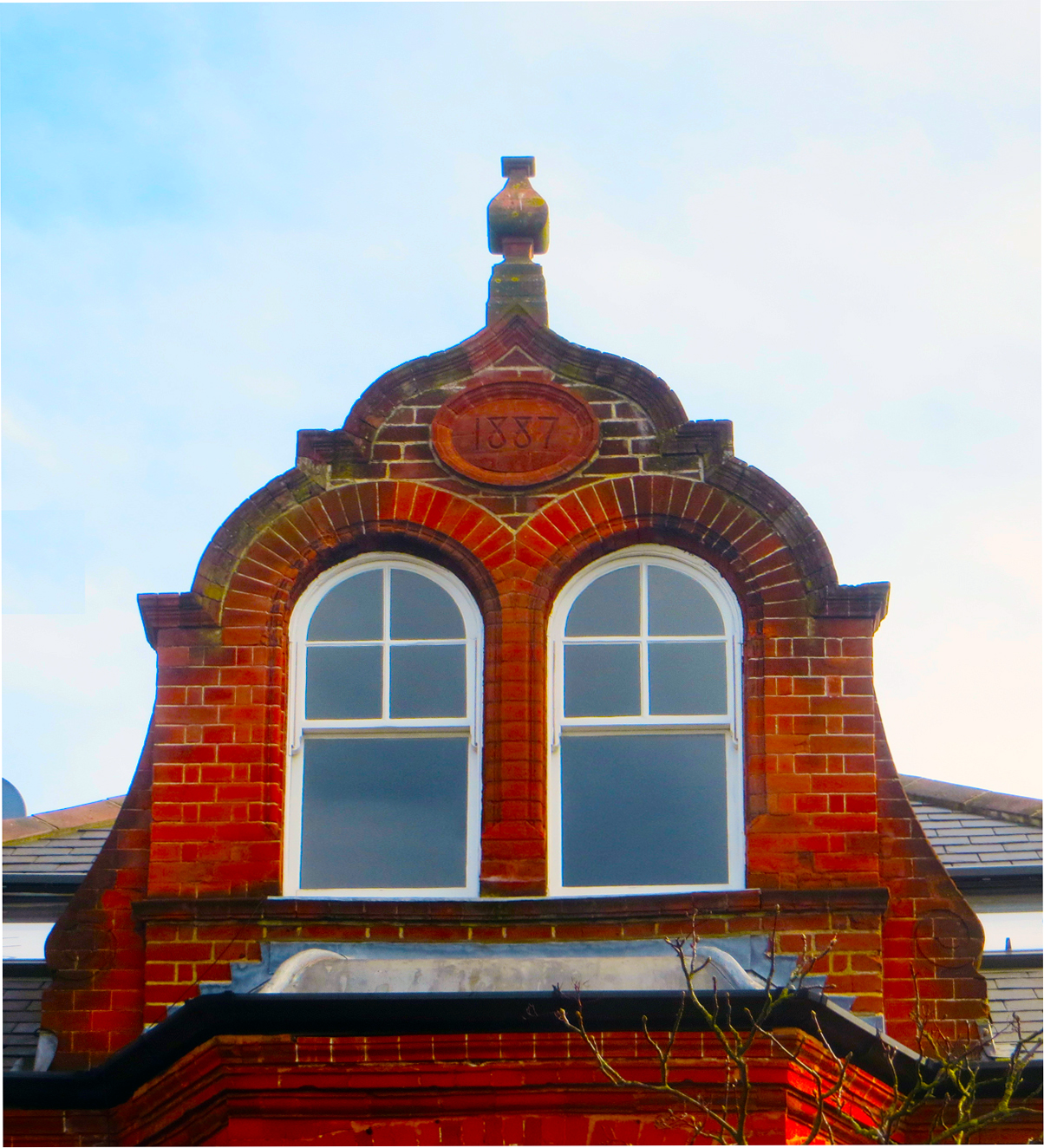
Date tablet, 1887

Date tablet on 16 Bellevue Road: 1887
The date tablet at the top of 16 Bellevue Road: 1887.
[PB: Notice the date in a ?tablet ?cartouche [if that's what it's called] at the top of the house — 1887.]

After the photographers: Rendezvous Restaurant and beyond

No. 16 then became the Rendezvous Restaurant until about 1950, after which it was briefly a dancing school and then a guest house. It is now a private house.

  • See also the 1939 England & Wales Register, when it was described as a "Boarding House and Restaurant" run by Sebastian and Clara Bach: Link.

Photograph of the lake by Dorrett and Martin

Photograph of the Wandsworth Common lake by Dorrett and Martin
Photograph of the lake by Dorrett and Martin. Notice the Hope end of Bellevue in the distance. Unknown date.
[What is the building with the inverted V roof top left?]

Helen Thomas and Merfyn, photographed at Athol Studios

Helen Thomas and Merfyn, photographed by Dorrett & Martin
Helen Thomas, wife of poet Edward Thomas, and their son Merfyn, photographed in D&M's "Athol Studios" — Merfyn was born in 1900, so presumably late 1900/early 1901 [check dates].

16 Bellevue when it was Dorrett and Martin

No. 16 when it was the photographers Dorrett and Martin
No. 16 when it was the photographers Dorrett and Martin.

Panel from Jennifer Penny's U3A presentation, 2017

Notice the very useful listing from Kelly's Directory, 1933 (left).

A panel from Jennifer Penny's original U3A presentation in 2017
A panel from Jennifer Penny's original U3A presentation in 2017.
16 and 17 Bellevue Rd
16 and 17 Bellevue Rd. (Google 2019)

Correspondence about Leonard Bottoms, builder of no. 16

Hello, Dave

Your enquiry was passed on to me.

Your ancestor's house is one of my favourites — I've collected some info about it (and other houses in the area). There's a summary at historyofwandsworthcommon.org.

Leonard Bottoms is mentioned, for example, in vol.50 of the Survey of London, which I quote.

Do you have anything you can add? If so, I would love to see it.

All best
Philip Boys

PS You are also likely to receive information direct from Keith Bailey, who knows an immense amount about builders in the Battersea area.

From: dbottoms@john-lewis.com — 19 March 2021

Dear Sir/Madam,

Am doing a little bit of family history research on my own family. My great grandad Leonard Bottoms (1842–1902) was a builder in the Wandsworth area in the late 19th century and apparently built a rather nice looking house at 1 BELLEVUE RD. I wondered if you had any pictures of the property from about that time. I believe he ran a building business from that property and it was called Athol House at some point.

Any help gratefully received. Many thanks — Dave Bottoms

From: Keith Bailey — 24 March 2021

Dear Dave,

Your message to Philip Boys about 16 Bellevue Road has been copied to me for additional comment. Having studied Victorian building/builders in Battersea for very many years, it's good to be able to turn them from statistics into "real" people.

My first sighting of Leonard is in 1861, when he was described as an Excavator, lodging in Chelsea. By 1871 he was in Battersea, as a bricklayer, a description also used in 1881 when he was at Basnett Grove with brother Noah, also a bricklayer. Oddly, all of the houses which they are known to have built (from the District Surveyors' Returns) are in north Battersea and all were built between 1877 and 1881 — total 55.

Their partnership was formally dissolved at the end of 1885, after which Leonard proceeded south and built the very distinguished 16 Bellevue. If, as seems likely, an architect was involved, he has not been identified. Likewise, there is no trace of any more houses built by LB in any part of Wandsworth/Battersea that I've got data for, though given the location of his works, he may have been active in Streatham.

By 1897, Leonard had returned to Beds. as a farmer, while in 1901 Noah was a builder & contractor in Luton.

Hope this helps. Best wishes — Keith Bailey

From: dbottoms@john-lewis.com — 24 March 2021

Dear Keith — this is terrific stuff. I discovered by doing a newspapers archive search that Leonard (and Noah too probably) got into drainage and sewerage contracting in the 1890s while based at Wandsworth/Battersea/Tooting (it seems to vary but all the time at 16 Bellevue I think). They tendered for work all over the country Hants/Cornwall/etc but came to grief when they won the tender for York and then failed to cope with the excessive mud around the river Ouse — he overspent and then failed to get money back off York Council and unsuccessfully took them to court with further financial losses.

I think this basically bankrupt him which is probably why he left 16 Bellevue and returned to farming in the villages South of Bedford. He was a tenant farmer at Wrest Park which is a big stately home south of Bedford and when he died there was quite a bit of stock to auction off from his farm so think he was probably doing all right for himself again by then. He was also chairman for the parish and a district councillor so had some 'standing' in the community up until his somewhat sudden death in 1902.

Please pass my thanks to your colleagues too. Every best wish for the future — Dave Bottoms


Survey of London, vol. 50, chapter 19

This was part of a larger, 20-acre wedge of ground between Trinity Road and St James's Drive enclosed between 1848 and 1853 by Henry McKellar, a wealthy local landowner, to add to his extensive Wandsworth Lodge estate adjoining to the west. It was claimed at the time that McKellar had agreed to take only a small plot, and had appropriated the rest without authority.

There was still nothing but empty fields here in 1863 when McKellar died and this land was sold along with rest of his estate. The chunk between Trinity Road and St James's Drive, known as McKellar's Triangle, and two other lots adjoining on the west side of Trinity Road, were acquired by the Liberal-backed National Freehold Land Society and British Land Company to form a new estate. This was intended to attract buyers of small freeholds for house-building (which came with voting rights) from among London's growing mass of respectable working people, tradesmen and lower middle-class professionals.

Very quickly the British Land Company's surveyors began laying out new streets: Althorp, Nottingham and Wiseton Roads within the area covered by this chapter; Brodrick and Wandle Roads just outside. Road frontages were divided into house-plots, which were sold at auction in the summer of 1864.

Three of the earliest buildings, erected in 1864–5, were the Hope Tavern, standing at the apex, opposite the site later taken for the railway station — the ideal spot for a pub — and two good-sized double-fronted houses situated some way down the two main roads: White Lodge, at 23 Bellevue Road, and Clifton Villa, now 111 St James's Drive.

Between 1866 and c.1871 much of Bellevue Road filled up, mostly with small two-storey houses and shops, as at Nos 4 & 5 and 6–11, though there was also a large dairy at No. 14. Later infill of the 1870s and 80s introduced considerable variety, for example: the bulkier three-storey red-brick shops at Nos 12 & 13 (1876); a pair of red-brick houses at Nos 18 & 19 (1884), built in the grounds of an earlier house (Churzee Cottage, of 1866), by its owner; and especially the fine group of house, stables and workshop in rubbed red brick, erected in 1887 at No. 16 by Leonard Bottoms, a local builder, for his own use.

Of later alterations and additions, the most important before the war were the red-brick flats and shops of Bellevue Parade, erected at the corner of Bellevue and Wiseton Roads in 1928 to designs by J. W. Stanley Burmester and G. Whittaker. The modishly flat facade, without bays or projections, was not simply a stylistic choice, but was required by the local authorities under the existing building regulations.

[Survey of London, vol. 50, chapter 19.]