
— Index / Links - Edward Thomas.
— Titles....
— Talk Draft 1 Intro . . . .
— Talk Draft 3 Edward and Helen . . . .
— Index / Links — Edward Thomas.
— Titles....
— Talk Draft 1.
— Homes 1 . . . .
— Homes 1 . . . .
— Talk — Notes.
— Homes....
— Helen Thomas, On Storm's Wing [text part-OCRd].
— Halbrake / St John's Hill House School.
— Sir Walter St John's / Battersea Grammar School.
— Chronicles so far [contents with links].
— Chronicles — all text so far [all text].
Once, once upon a time, many many years ago, I was on a Birthday Walk to celebrate my friend Stephen Andrews's 50th birthday.
He'd invited lots of people to walk 50 miles with him around the Cotswolds.
Out into Gloucestershire and back into Oxfordshire.
I said I'd just do the second day — a rather shorter walk.
The keen fit types raced ahead, and were probably back at the pub by midday.
And here they are:
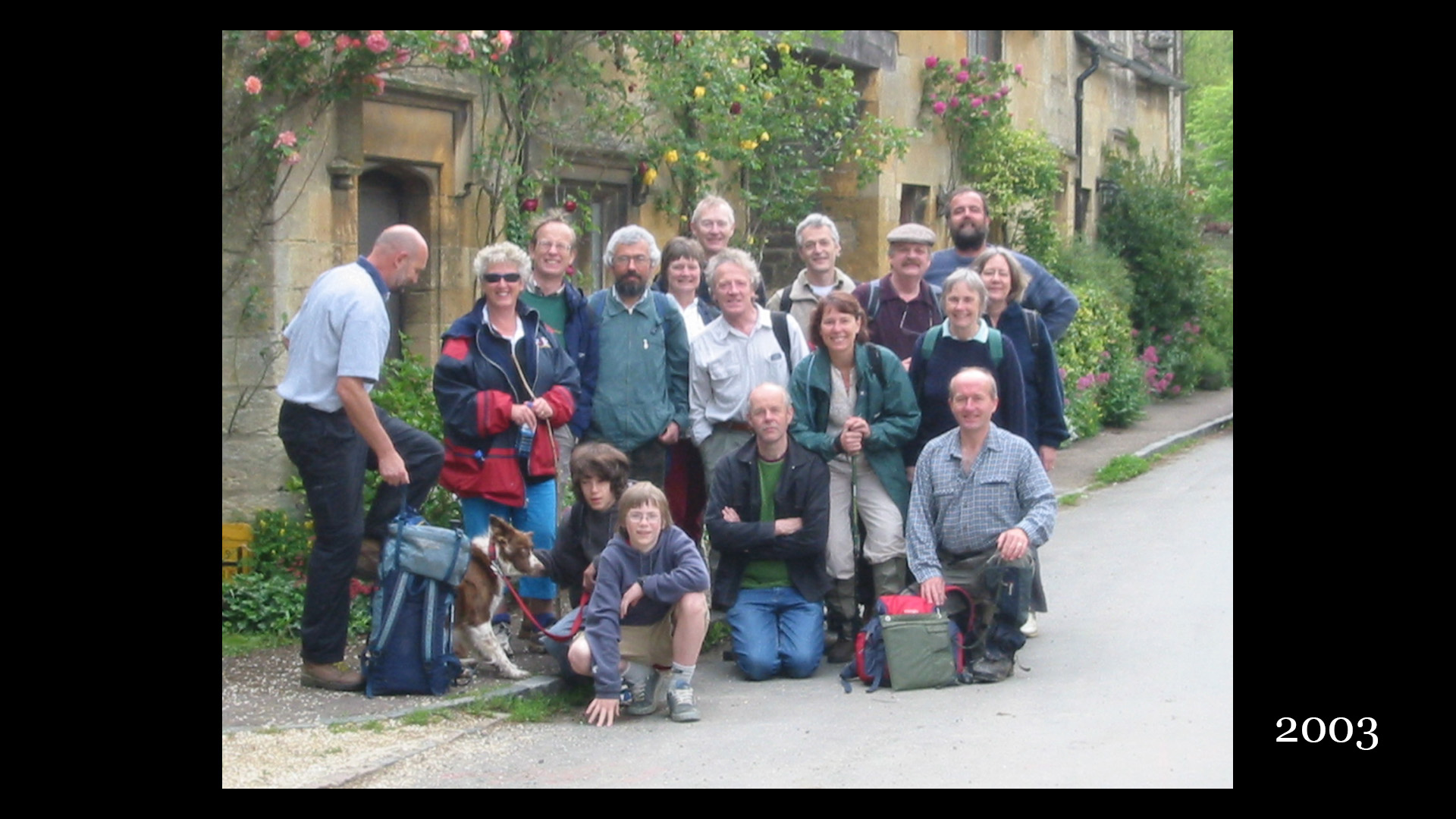
If you look very closely, you will find that I am not among them.
Had I been Edward Thomas, on the other hand, I'd easily have been back first — he was a famously fast walker, one who could go great distances over any terrain.
But I favoured a rather relaxed stroll.
In the middle of the afternoon, among a small band of stragglers and still a long way from home, we entered a quaint Gloucestershire village I'd never heard of before and saw in front of me this fine sign:
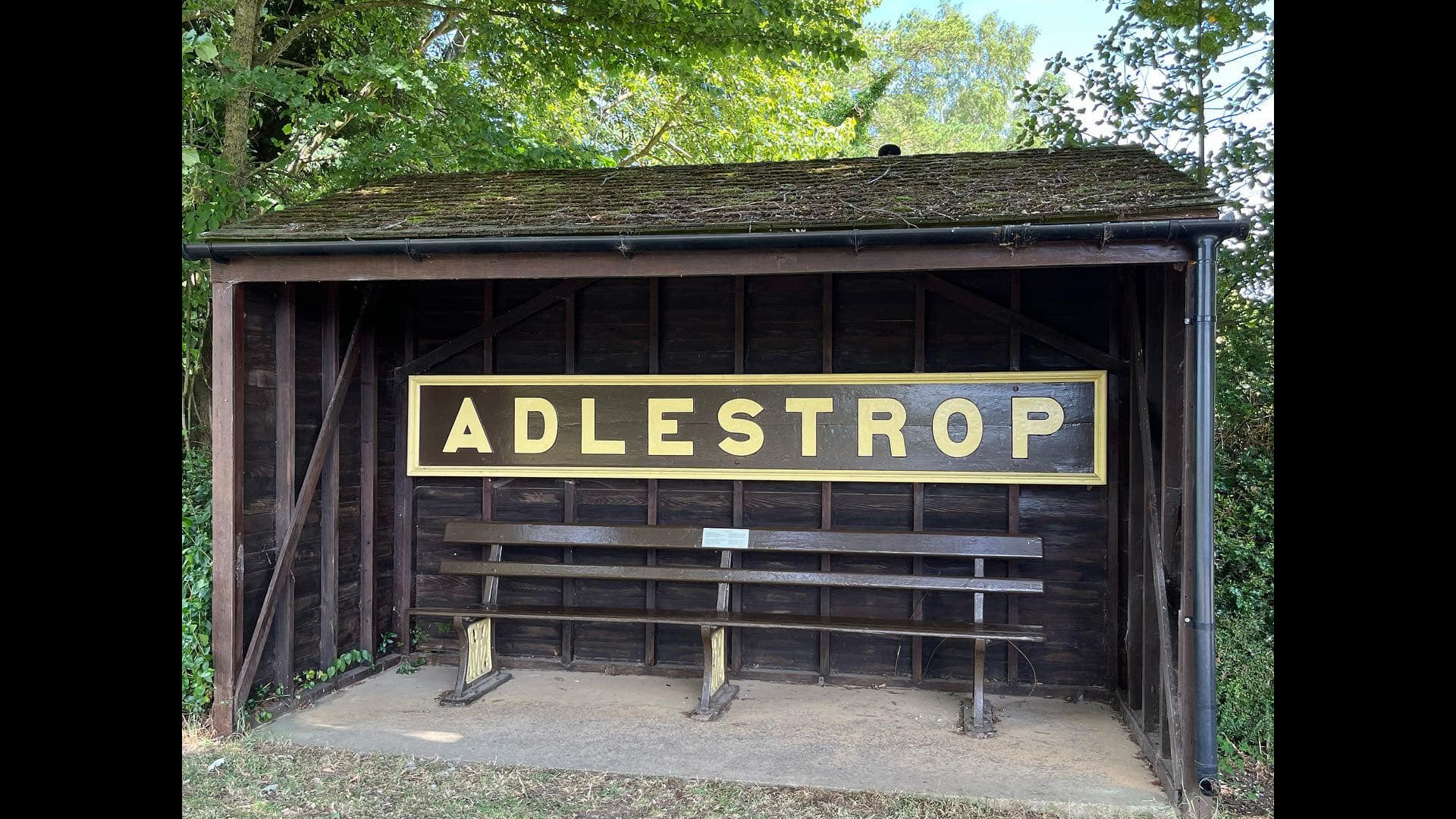
[Historic England listing: Adlestrop.]
"Adlestrop".
What a curious name, I thought. "Adelstrop": "adle", strop".
How should you pronounce it?
"Addle", like an old egg?
"Adle", to rhyme with cradle?
Here's another:
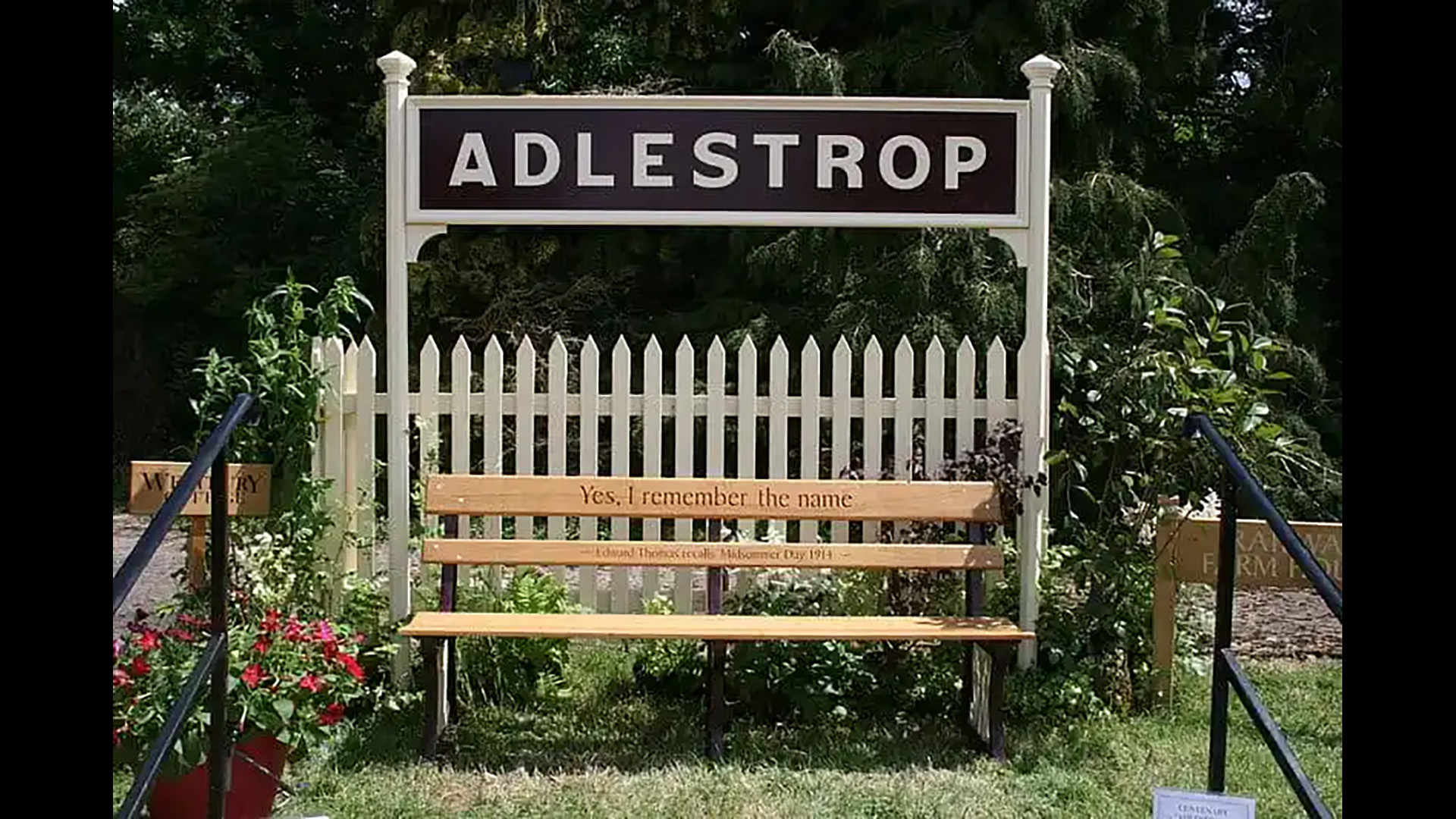
Obviously the signage of a railway station, but where was the railway?
Well, I'm sure you know the answer.
[The station closed in 1966 — cut down when Ernest Marples, until recently the Managing Director of the mega-building contractor Marples Ridgway, together with Doctor Beeching, a director of ICI (which produced asphalt for roads), wielded the notorious axe that did away with thousands of miles of track and hundreds of stations — including of course Adlestrop.
For Marples and Beeching, the more roads there were, the better. Trains and train lines were competition to cars and roads, so they had to go. Or so it seems.]
It all adds to the appeal of the place. A comforting traditional world destroyed by "progress".
Adlestrop?
Then something odd happened. A couple of other slow-coaches walking alongside nudged one another:
"Yes, I remember Adlestrop", said one in a knowing sort of way.
To which the other responded: "Yes, I remember Adlestrop."
I didn't know what on earth they were talking about, but I was curious. I looked it up:
"Yes, I remember Adlestrop", or just "Adlestrop", a poem by Edward Thomas.
Often said to be among the nation's top three poems. Even our favourite poem.
[Incidentally, do you know the name and the poem? Could you recite any of it? Anybody?]
Here's the first verse:
It continues:
Yes. I remember Adlestrop —
The name, because one afternoon
Of heat the express-train drew up there
Unwontedly. It was late June.The steam hissed. Someone cleared his throat.
No one left and no one came
On the bare platform. What I saw
Was Adlestrop — only the nameAnd willows, willow-herb, and grass,
And meadowsweet, and haycocks dry,
No whit less still and lonely fair
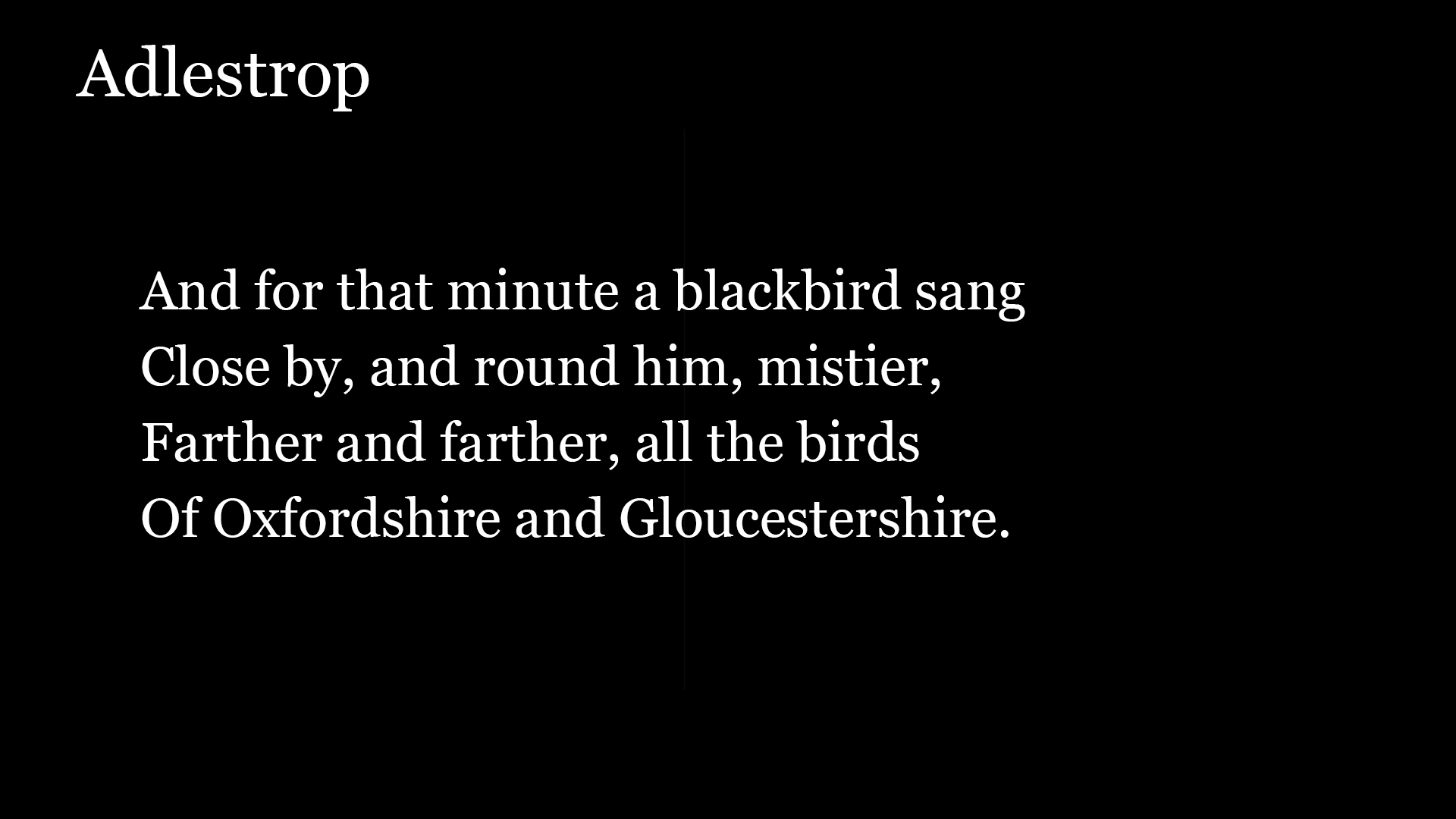
Than the high cloudlets in the sky.And for that minute a blackbird sang
Close by, and round him, mistier,
Farther and farther, all the birds
Of Oxfordshire and Gloucestershire.[Poetry Foundation: Adlestrop.]
[Poetry Foundation: Edward Thomas.]
"Adlestrop" was first published in late 1917, after the death of the poet on Easter Monday 9 April 1917 at Arras, in northern France.
But the event itself took place three years earlier, on the 24 June 1914. — 6 weeks before the start of the First World War. It's sometimes described as depicting the "sunny innocence" just prior to the calamity.
Edward and his wife Helen Thomas were on the express train from Oxford to Worcester to visit the American poet Robert Frost in his home near Ledbury, near Hereford.
Edward filled his notebook with details of the chance event. Though in truth it's not much of an "event". Nothing much happens.
"The steam hissed. Someone cleared his throat. / No one left and no one came."
Nothing much happens. Which is part of the point.
Edward Thomas, eh?
I vaguely know the name.
War poet, was he? Died in the First World War?
Commemorated along with other greats in Westminster Abbey?
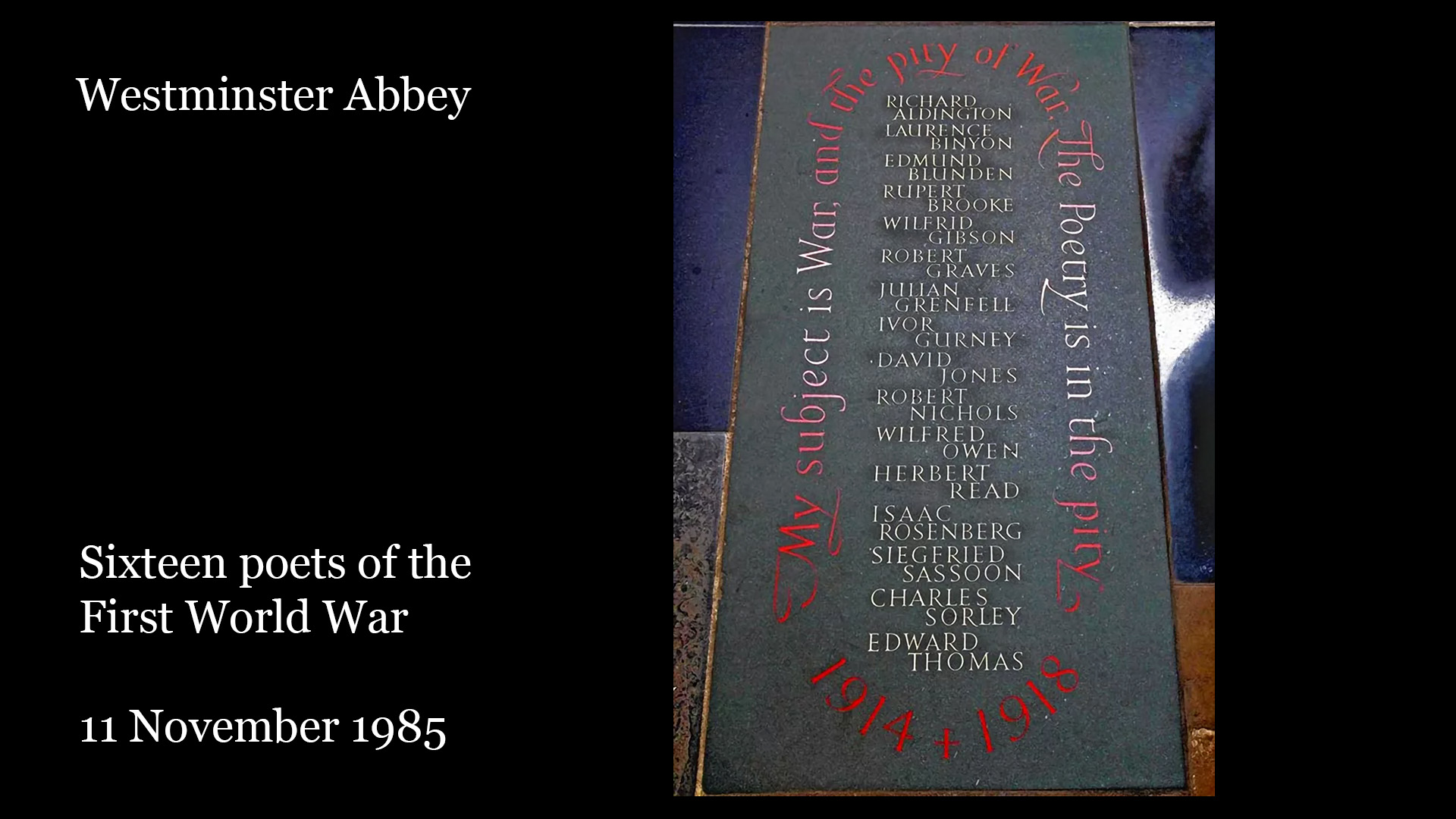
Yes, that's him. At the end.
Edward Thomas was on his way to stay with the great American poet Robert Frost, who persuaded Edward Thomas to write poetry.
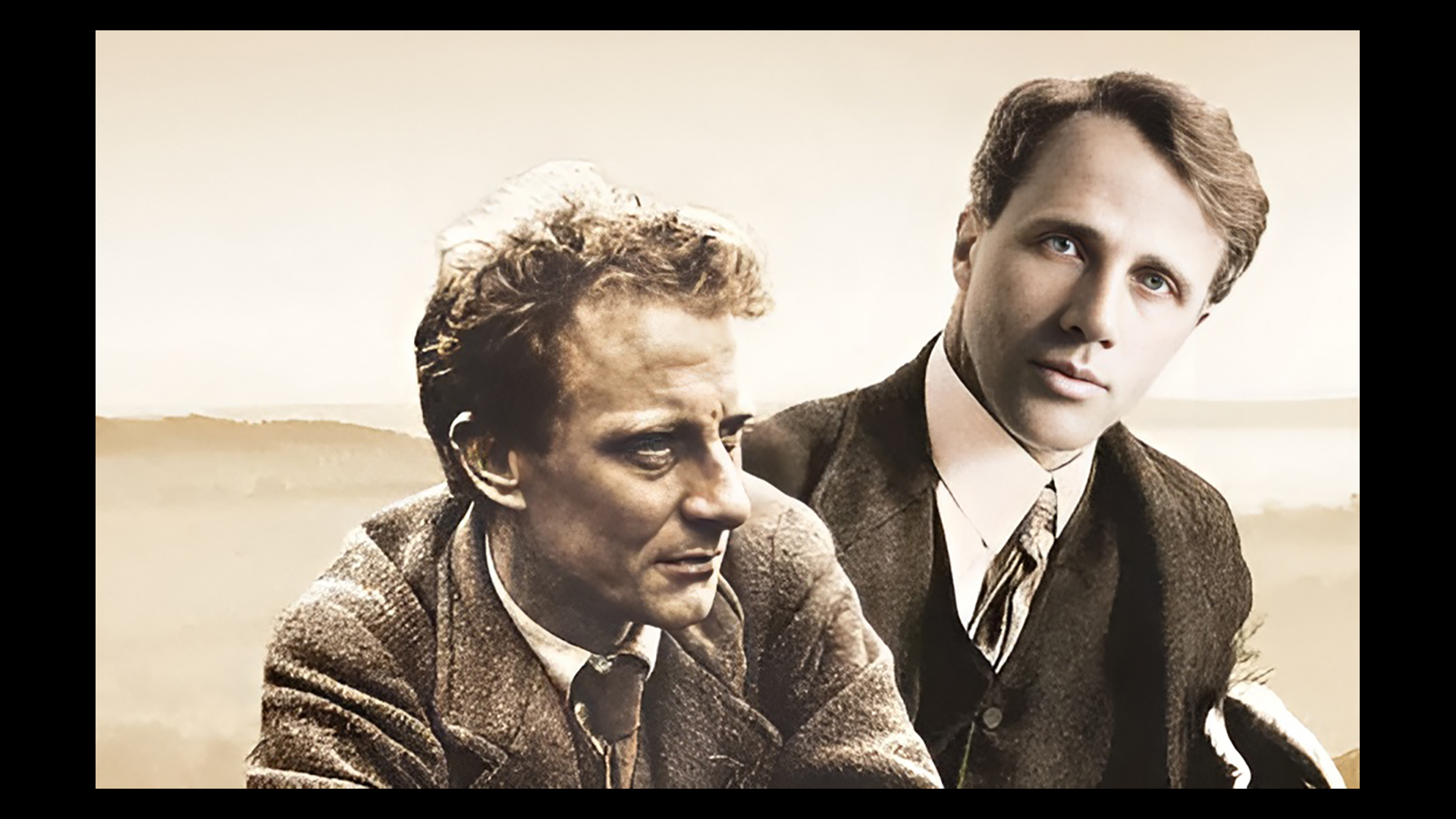
Speaking at the dedication ceremony at Westminster Abbey in 1985, Ted Hughes called Edward Thomas "the father of us all".
He also wrote that Edward Thomas was "the link" between Thomas Hardy and more recent poets such as himself.
Now as you may know, I believe absolutely that everything in the known and unknown universe is connected by no more than two degrees — or links — to Wandsworth Common.
Two? Why so many, I say — it's usually just one.

In which case, it's perhaps not at all surprising that two out of three of these poets lived around here.
Thomas Hardy lived on the corner of Brodrick Road and Trinity Road, between 1878 and 1881.
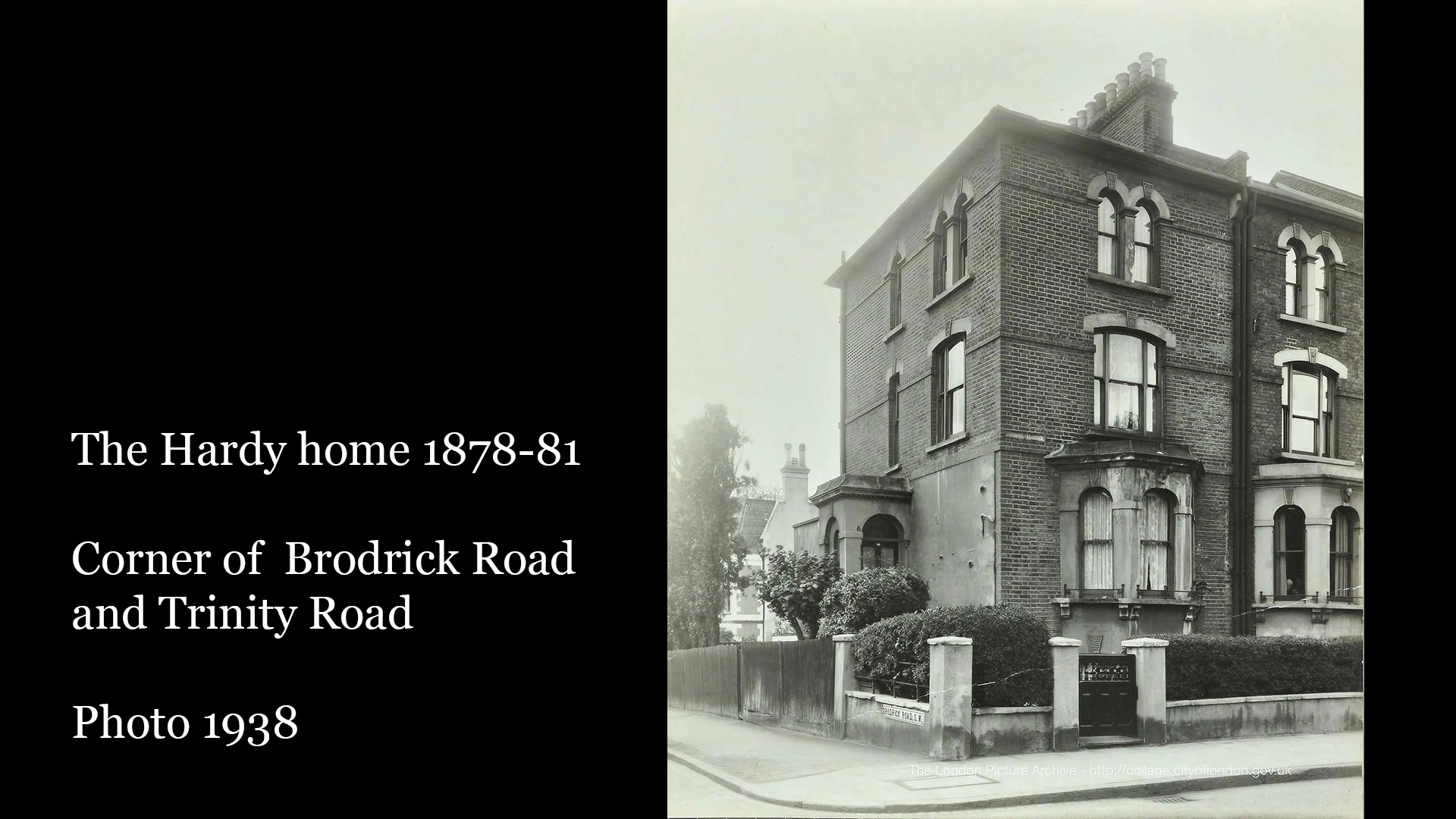
And as we shall see, Edward Thomas arrived on the other side of the Common, Wakehurst Road, in 1880, the year before the Hardys left. So they overlapped.
By the way: THOMAS Hardy > Edward THOMAS > Ted [i.e. EDWARD] Hughes.
And it seems that Edward and Helen, en route to see Robert Frost when their train stopped "unwontedly" at Adlestrop, may have set off earlier that day in June 1914 from Wandsworth Common Station.
It's all inevitable, really.
So how come Edward and Helen had set off from Wandsworth Common?
Back to the top of this page . . .
Richard Purver:
"It is possible that Edward and Helen set off on the railway journey which produced arguably the best-loved of all his poems. Interestingly, although the poem has a profound sense of solitariness, Helen was with him when he experienced arriving at Adlestrop station."
Readings of the poem
Helen Thomas:
[YouTube: Link.]
Richard Burton —incomparable!
[YouTube: Link.]
Geoffrey Palmer:
[YouTube: Link.]
"My subject is War; and the pity of War. The poetry is in the pity." Wilfred Owen.
Richard Aldington
Laurence Binyon
Rupert Brooke
Wilfred Gibson
Robert Graves
Julian Grenfell
Ivor Gurney
David Jones
Robert Nichols
Wilfred Owen
Herbert Read
Isaac Rosenberg
Siegfried Sassoon
Charles Sorley
Edward Thomas
On November 11, 1985 a memorial stone was laid in Poets Corner recognizing the poets of World War I. This stone has the name of 16 British poets who also served as soldiers during the Great War. Some had died during the war. Others went on to live full lives. All seemed tormented by their experiences. At the time of its dedication, only Robert Graves was alive to see his name etched in the stone.
[Source: Link.]
[Westminster Abbey: Link.]
The Historic England website listing says of this sign and bus shelter:
Edward Thomas was inspired to write "Adlestrop" the poem when his express train made a brief stop at the station in June 1914. The poem evokes of the beauty of the English countryside in counterpoint to the horrors that were about to intervene in the lives of many with the onset of the First World War. "Adlestrop" captured a moment of bucolic serenity and innocence that was about to be lost.
[Historic England: Link.
The train, symbol of modernity and movement, stops and allows Thomas, too, to stop, pause, contemplate, observe, and admire the surroundings. The increasingly busy and fast-moving world suddenly slows right down to allow a brief moment – ‘that minute’ – to enjoy nature and stillness, peace and beauty. This is, suddenly, a world of stillness and slowness again, not the bustling modern world: ‘No one left and no one came / On the bare platform.’
And of course Edward Thomas knew quite a lot about trains — he lived close to Clapham Junction Station, and used it frequently. It was already the busiest railway station in Britain, and probably the Europe, maybe even the World?. Railway lines criss-crossed Battersea. And of course slashed its way across Wandsworth Common, butchering it into numerous cuts. All day and much of the night it sounded furiously, with its steam and smoke and soot and the rattle of the trains on the tracks.
[Signs at Clapham Junction declare it to be not only the busiest station in Britain, but the whole of Europe. Not in terms of passengers getting on and off — that would probably be Waterloo — 62 million passengers a year]. But number of trains passing through — about over 2000 a day. It may not have been as many a century or so ago, but it was already considerable.]
--->There isn’t a railway station at Adlestrop any more. It was closed in 1966 during the infamous Beeching cuts. In 2014, the year of the centenary of Thomas’s ‘visit’ there, local Adlestrop resident Ralph Price said: ‘We get lots of visitors who want to see the place as Thomas saw it, but, of course, he never did see it.’ He never got off the train, just passing through as he was. ‘And then they want to see the station, but that’s not there any more.’ But we have the poem. It’s inscribed on the bench that occupies the place where the station could be found, all those years ago.
[Interesting Literature: Link.]