The History of Wandsworth Common

Top of this page . . . 


CHRONICLES - ALL TEXT SO FAR


Months . . .  .  

— Months . . .  .  


Chronicles: All text so far . . .  

— Chronicles — All text so far


2025

— October 2025 Part I | this page . . .

— September 2025 Part II | this page . . .

— September 2025 Part I | this page . . .

— August 2025 Part II | this page . . .

— August 2025 Part I | this page . . .

— July 2025 Part II | this page . . .

— July 2025 Part 1 | this page . . .

— June 2025 Part 2 | this page . . .

— June 2025 Part 1 | this page . . .

— May 2025 | this page . . .

— April 2025 | this page . . .

— March 2025 | this page . . .

— February 2025 | this page . . .

— January 2025 | this page . . .


2024

— December 2024 | this page . . .

— November 2024 | this page . . .

— October 2024 | this page . . .

— September 2024 | this page . . .

— August 2024 | this page . . .

— July 2024 | this page . . .

— June 2024 | this page . . .

— May 2024 | this page . . .

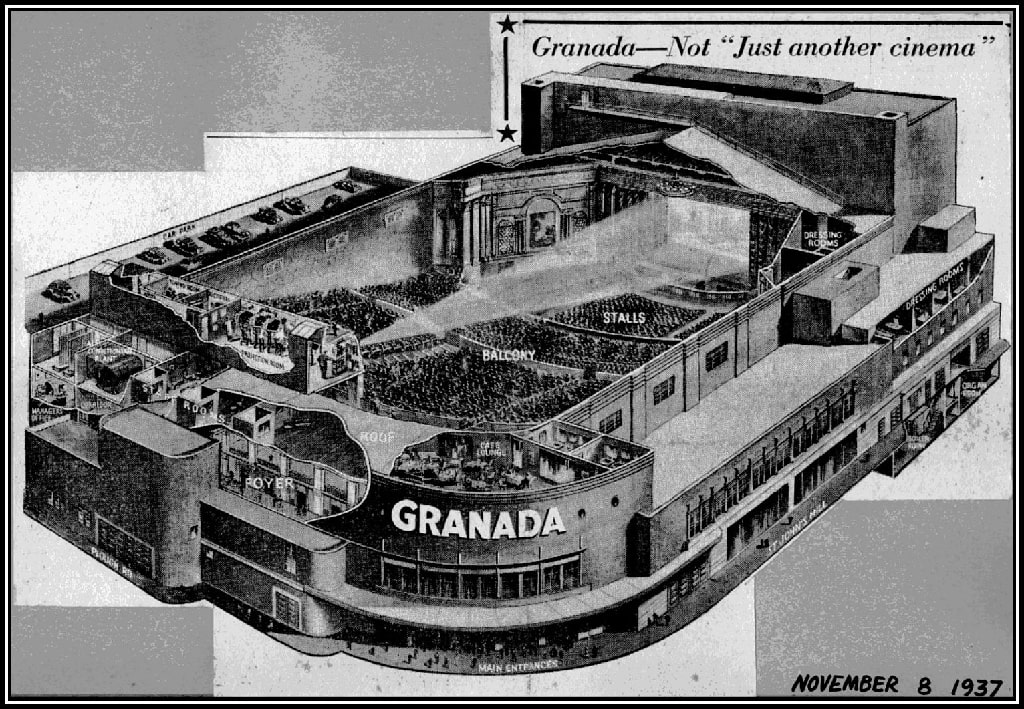
— Granada Cinema, 1949 | this page . . .

— April 2024 | this page . . .

— March 2024 | this page . . .

— February 2024 | this page . . .

— January 2024 | this page . . .

Top of this page . . . 

2023

— December 2023 | this page . . .

— November 2023 | this page . . .

— October 2023 | this page . . .

— September 2023 | this page . . .

— August 2023 | this page . . .

— July 2023 | this page . . .

— June 2023 | this page . . .

— May 2023 | this page . . .

— April 2023 | this page . . .

— March 2023 | this page . . .

— February 2023 | this page . . .

— January 2023 | this page . . .

Top of this page . . . 

2022

— December 2022 | this page . . .

— November 2022 | this page . . .

— October 2022 | this page . . .

— September 2022 | this page . . .

— August 2022 | this page . . .

— July 2022 | this page . . .

— June 2022 | this page . . .

— May 2022 | this page . . .

— April 2022 | this page . . .

— March 2022 | this page . . .

— February 2022 | this page . . .

— January 2022 | this page . . .

Top of this page . . . 

2021

— Lewis Carroll & Arthur Hughes | this page . . .

— December 2021 | this page . . .

— November 2021 | this page . . .

— October 2021 | this page . . .

— October 2021 — John Breeze | this page . . .

— September 2021 | this page . . .

— August 2021 | this page . . .

— Oscar goes to Wandsworth Prison | this page . . .
— July 2021 | this page . . .

— June 2021 | this page . . .


Chronicles

September 2025


The Quest for PY Betts

Written and presented by Stephen Midlane and Sue Delafons

Part Two


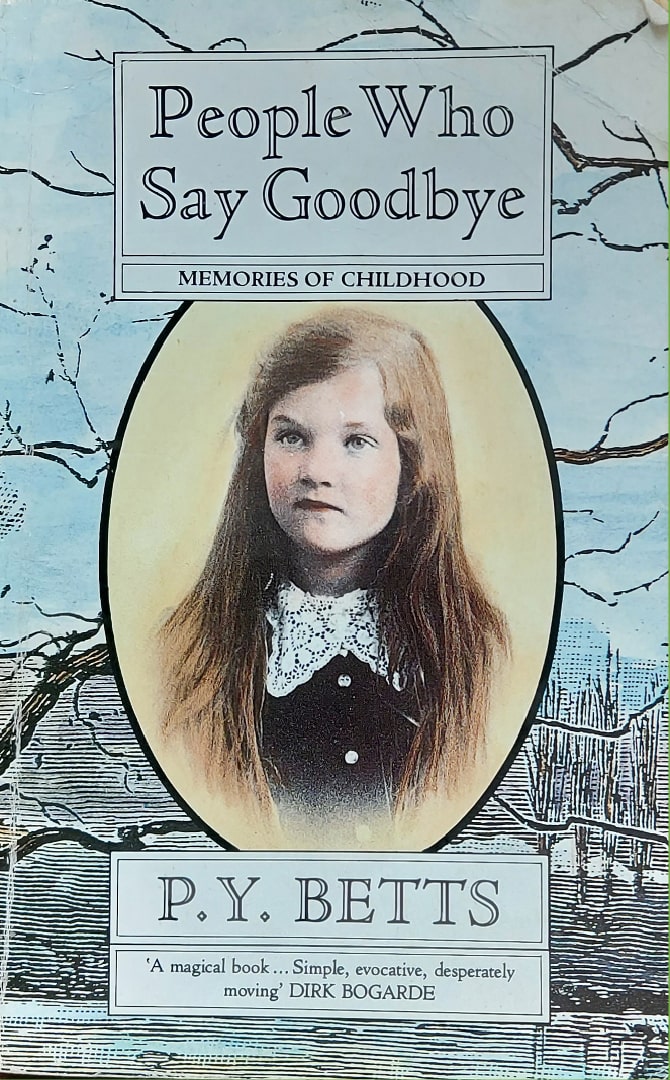
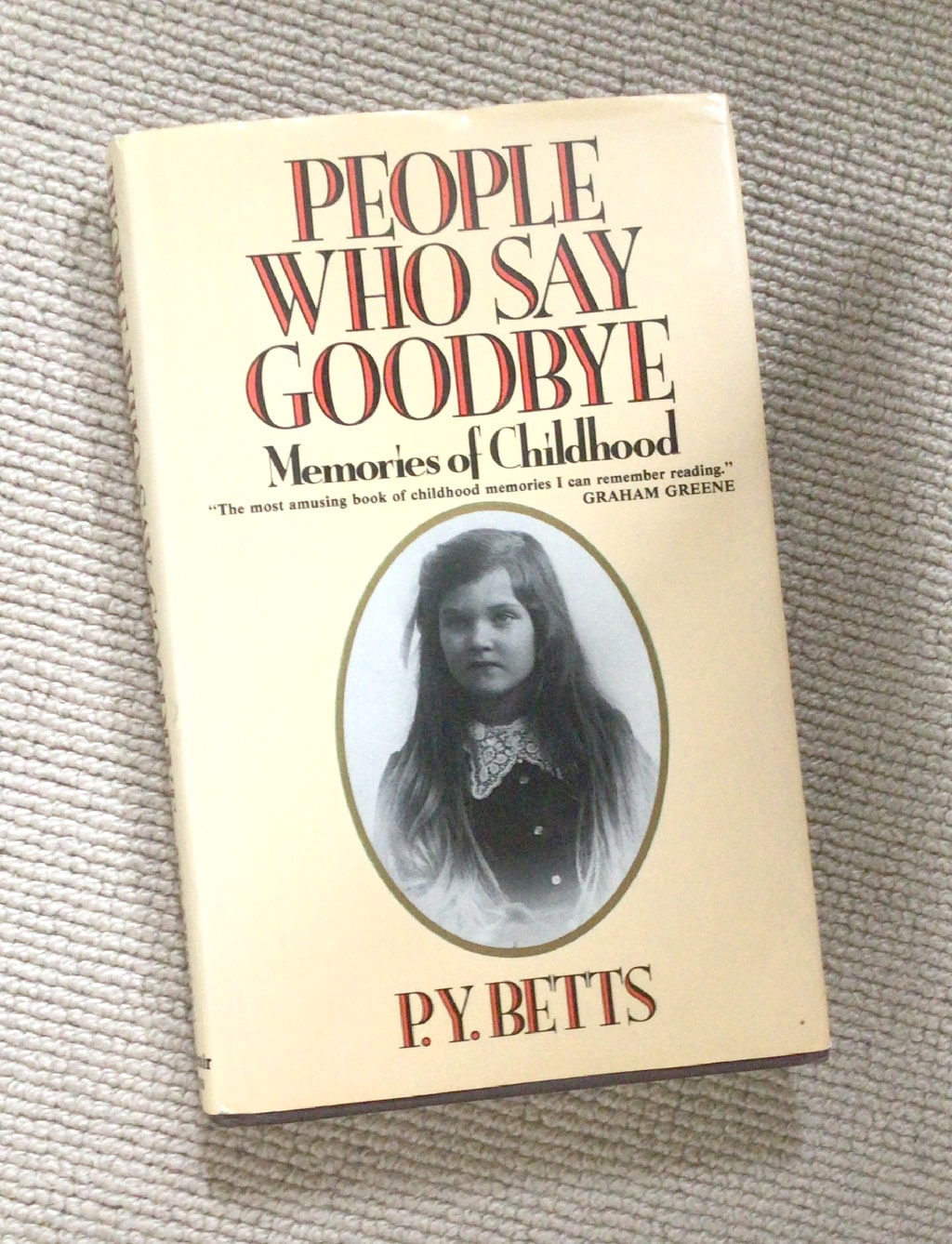
In 2023, and again in 2025, the Friends of Wandsworth Common heard a wonderful talk by Stephen Midlane and Sue Delafons on local author PY Betts, and her memoir People Who Say Goodbye. Published in 1989 (when "Betts" was around 80), this extraordinary work covers her memories of Wandsworth Common childhood during and shortly after the First World War.

I enjoyed these talks so much that I asked Stephen and Sue if I could adapt them as a kind of "guest post". The first part was published here earlier this month.

As we saw, the writer Christopher Hawtree had come across the enigmatic "P.Y. Betts" (who had successfully concealed her gender behind her initials) when he was researching a short-lived magazine, Night and Day, edited by Graham Greene. In the British Library, Christopher had unearthed her only novel, French Polish (1933). But who was she? What had happened to her? How could Christopher make contact?

Christopher wrote an article in the Observer about his initial findings, and (astonishingly) heard from someone in the House of Lords who had been at school with Betts — and knew where she lived . . . 


Stephen:

So, let's return to "The Quest for PY Betts".

As Christopher Hawtree's research revealed, Betts progressed on to St Paul's Girls' School in the 1920s and then took up a career as a writer and travelled extensively through the 1930s.

Here are some records of a transatlantic voyage she made to and from New York in 1937, when she would have been aged 28 and writing for the short-lived magazine Night and Day. You can see that she was referring to herself as a "writer" and that she was still living with her parents in Magdalen Road.
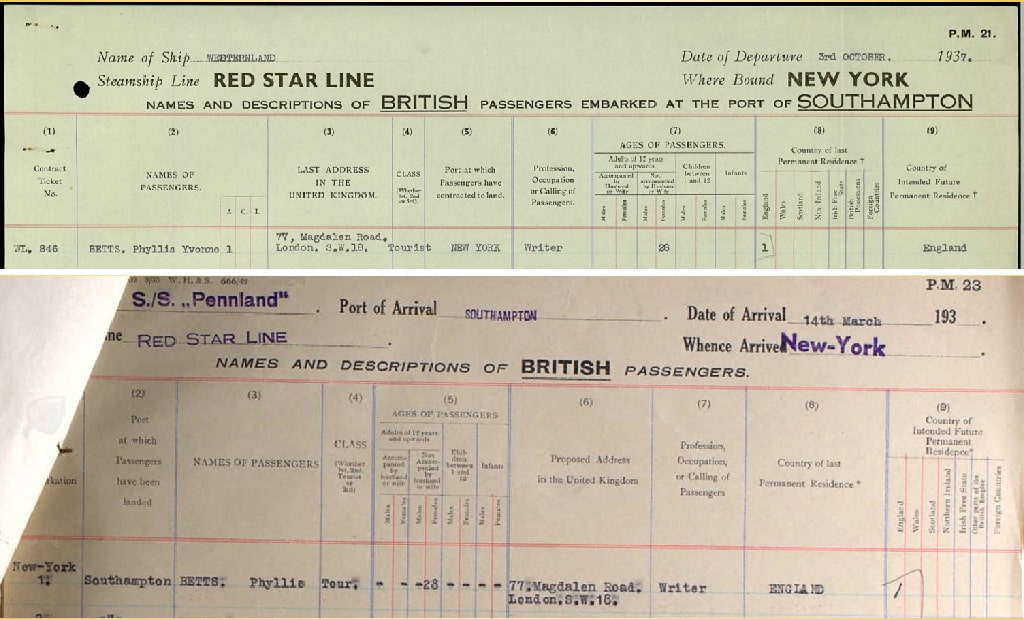

Sue:

She entered the Land Army during the Second World War and then settled in rural Wales.
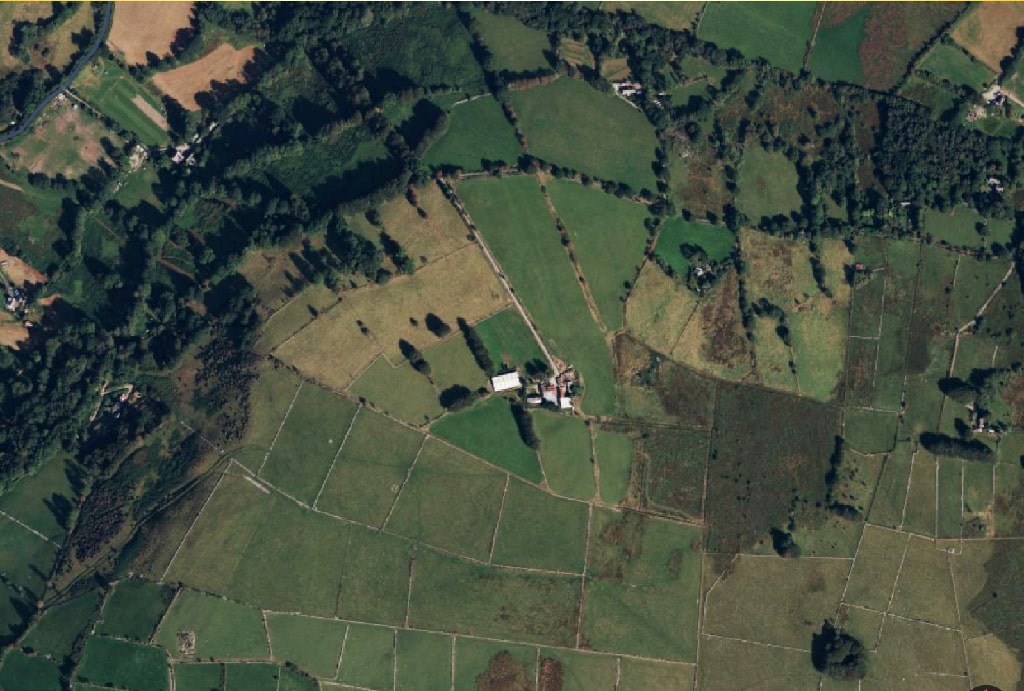

She gave her reasons for moving away from Wandsworth in a letter she later wrote some years later:' "I did not want to live like that, always short of space and time and breathing recycled air."

And in 1987, she was still there, in Wales . . . 

Christopher Hawtree takes up the story:


A little later, Veronica Wadley of the Daily Telegraph readily agreed that I should travel to Wales for an interview. This was quite a journey, without signposts through narrow lanes with high hedges in a motor car at low gear; when I did see anybody and asked directions, there was astonishment that I was going to visit P.Y. Betts ("we've heard of her but never seen her!").

Eventually I got there, at one end of a long track where I was greeted by a goat of an uncertain disposition and, after a struggle between tyres and mud, parked beside a low, thick-walled cottage from which, followed by a cat and dog, Betts emerged with pails in hand to feed others of the various animals which lived upon her tranche of hillside.

There was something marvellously heartening about her conversation borne of long experience (and visits by the mobile library where she put in for so many new books); she was savvier about the world than those who are eternally, wirelessly connected. All of this I wrote up, and it appeared complete with a photograph of her beside one of those animals: a seemingly stray peacock.

Sue:

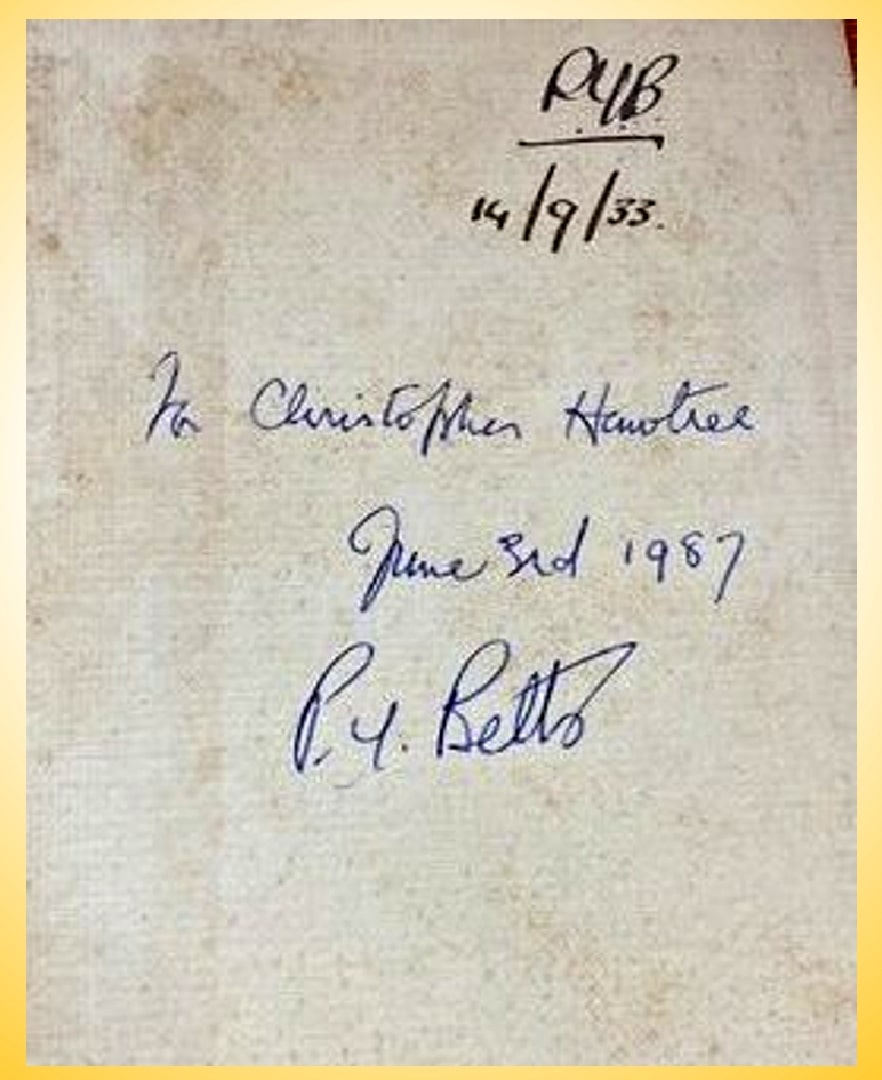
One token of Christopher's visit was a signed copy of French Polish that Betts gave him. You can see the dates, over 50 years apart.

Christopher:


One morning I received a telephone call.

A woman said, 'Mr. Hecht would like to speak with you'.

'All right', I replied, puzzled, curious.
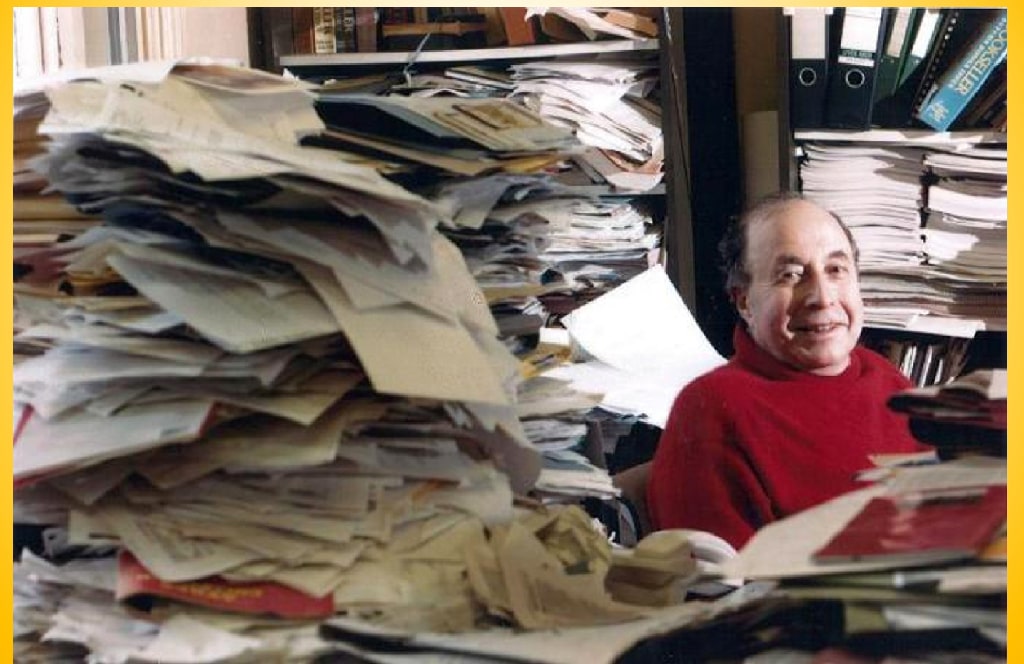

This turned out to be Ernest Hecht, the owner of independent publisher Souvenir Press, whose outwardly elegant office, chaotic within, was opposite the British Library on Great Russell Street. He had chanced to see the Telegraph piece — and wondered whether Betts would like to write a second book, one about the upbringing she had described to me.

This was an inspired notion, to which she readily agreed, and she wrote it — People Who Say Goodbye — through a Welsh winter.
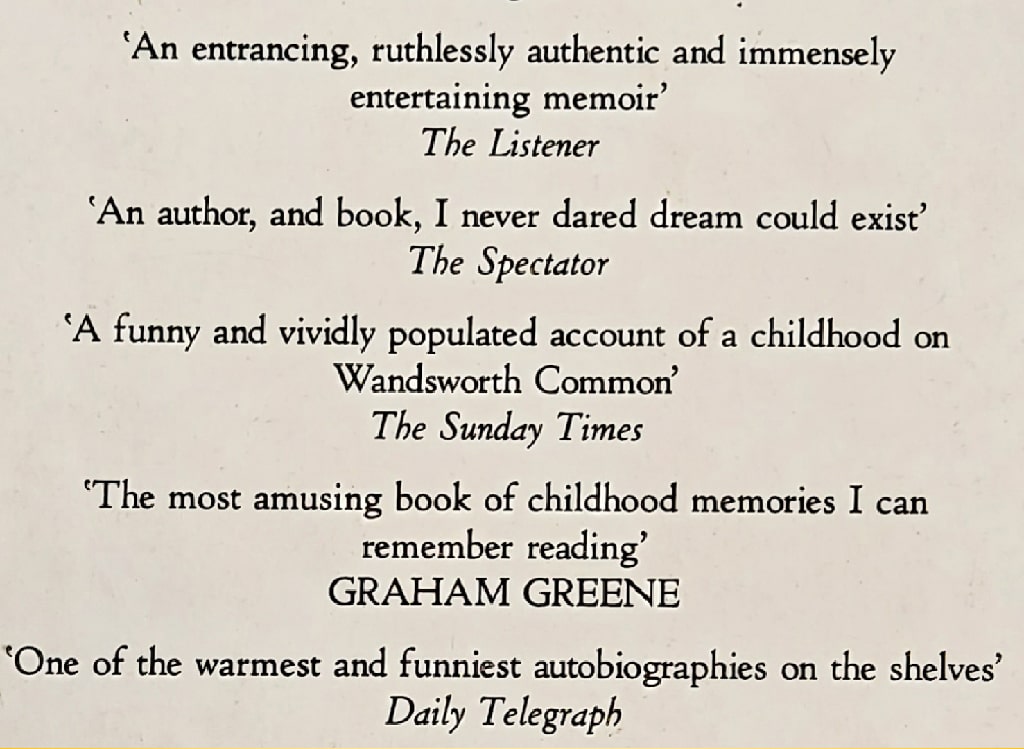

I asked Graham Greene if he would give a quote for the cover, which he happily did, and, one way and another, the book got about.

It was read in eight instalments on national radio, which, one Saturday, also sent an interviewer to her, while Dirk Bogarde, who had found it in a Chelsea bookshop, made it one of his books of the year.
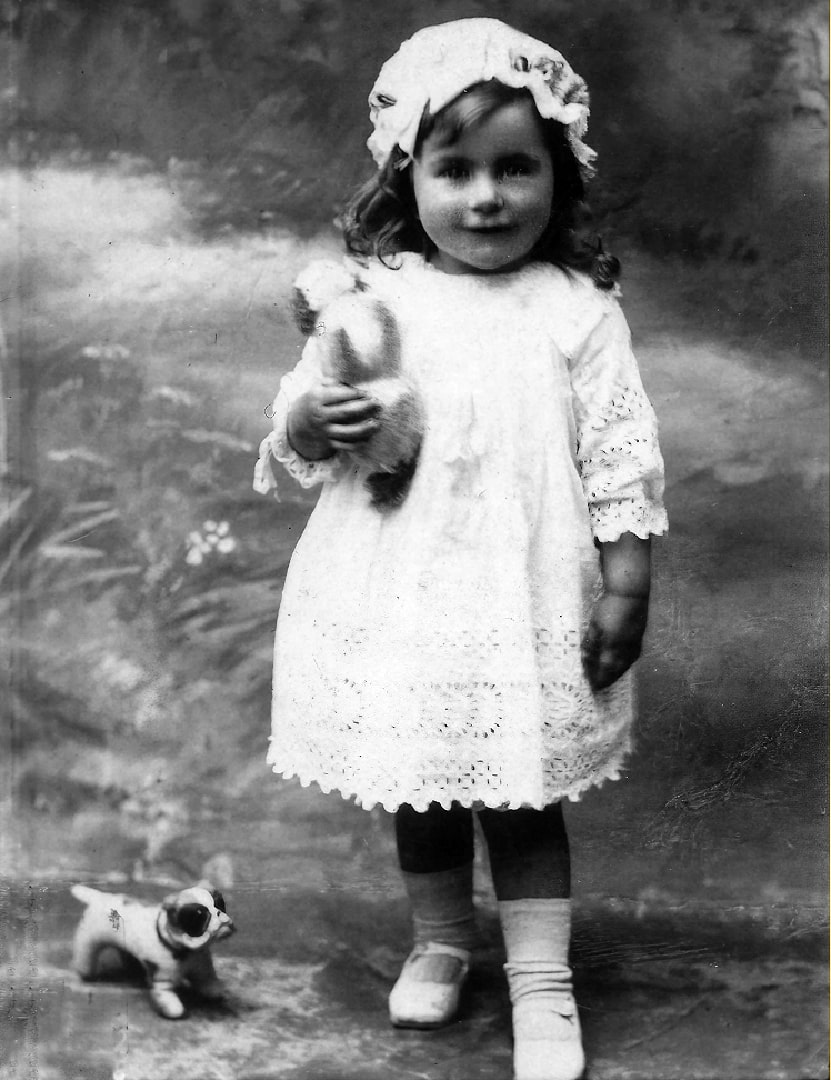

She died in her nineties, after a stroke which meant that — after living alone for so long — she had, ever pragmatic, to agree to a carer in that cottage where, as I found on another visit, there were now fewer animals, but her spirit was still vivid — as it remains, so wise, so funny, and this sequence of events always makes me thankful that I had made the initial foray to the Reading Room.

Sue:

And what of the title of Betts's memoir: People Who Say Goodbye?

Stephen:

Well, this is explained in the following passage, late in the book, when Betts is talking to Clement, who has been her piano tutor:


As usual, Clement was by himself at the piano. I told him I had passed the entrance exam and so should not be coming back for any more coaching. He doodled a bit on the piano, looking at me . . . .

[Clement] "Will you be coming back to see us?"

[Betts] "I shouldn't think so. In a way I should like to, but the way things are, I don't expect I shall."

"Why do you say that?"

"Because I've seen that people who come to say goodbye usually don't come back."

"When did you begin to notice this?"

"It came on gradually, from when I was about five, right up to now. It's true, you know."

"You were young to notice that is how things are."

"Fairly young, I suppose, yes."

"Do you remember the people who don't come back?"

"Yes. I remember them all."

"Will you remember me?"

"Of course I shall. If I live to be eighty I shall still remember you here playing the piano . . . playing the 'Dance of the Blessed Spirits'."

— "Dance of the Blessed Spirits", from Gluck Orfeo ed Euridice, played by Tarek Refaat.

Stephen:

And in her old age she did indeed remember Clement, and all the other people who passed, however briefly, through her young life.

And she preserved them forever in this wonderful book.

Thank you.


PB:

At this point, assuming this was the end of the evening's talk, the audience burst into wholehearted applause.

But, happily for us all, this was not the end . . . 


The Quest for Christopher Hawtree

Sue:

We thought our quest for PY Betts was complete. But it led us to wonder what had happened to Christopher Hawtree.

And so another quest began.

I think we had somehow, rather by association, not really considered the possibility that Christopher Hawtree might himself be "still there" somewhere today — and so it proved to be. It was Stephen, who — quite late in the day — decided to extend the quest and gleefully reported: "He's alive! And living in Hove!"

This was wonderful news as I had recently moved from Wandsworth Common to Brighton. It turned out Christopher had previously been a local Councillor, and I eventually tracked him down via a visit to the Green Party HQ . . . 


 . . . serendipitously located next to the "Arka Original Funeral Parlour" (which seemed a nice Bettsian touch). And a couple of weeks ago, we met and spent a charming evening at . . . 
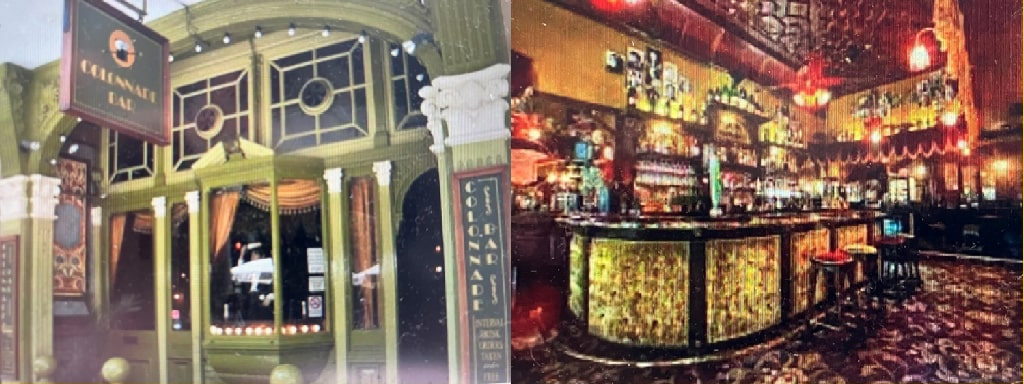

 . . . The Colonnade bar outside Brighton's Theatre Royal, when he turned up with a photocopied manuscript of French Polish! He said he would like to attend our talk, and we are delighted to present as our finale . . .  Mr Christopher Hawtree, to whom we are all beholden for this lovely book:
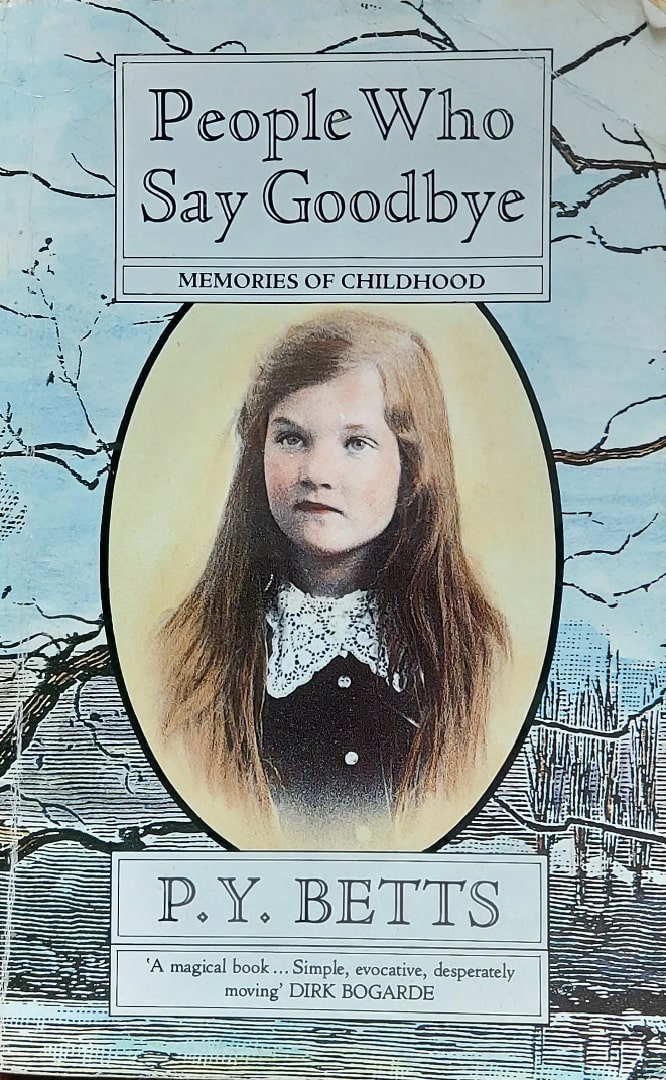

Chistopher Hawtree [for it is he]:

Thank you, Stephen and Sue, for organising this marvellously staged evening.

I'd just like to raise a glass to Betts and to Ernest Hecht who, in his own right, was an amazing man. He was an astonishing, independent publisher.

He did a lot for charities and published all sorts of strange books, including Chariots of the Gods and Arthur Hailey. And he stayed solvent in a very valuable premises opposite the British Museum. And it's thanks to him; he had the great idea of Betts writing this book.

I think it's still in print. It's gone through many paperbacks and different incarnations, and as Sue said it was read on the radio and Graham liked it very much. When he said, "The most amusing book of chilhood memories I can remember reading ", Betts wrote to me in one of her brilliant letters, "Well, at his age, he can't remember anything beyond last week", which was typical of her wit and her letters.

And I'm just amazed. I could easily have not gone to the British Library, and therefore not read her novel.

I wanted to track down everybody who appeared in Night and Day as much as I could. And it just goes to show how one little thing can lead to another and another and another. And here we are today. It's brought me full circle to Wandsworth Common.

Another part of the serendipity is that Night and Day magazine is remembered because it came to a rapid end after just six months. It was underfunded, but it's still popularly thought that it collapsed because 20th Century Fox sued it on behalf of the 9-year-old Shirley Temple, whom Graham Greene had reviewed in no uncertain terms — he had detailed the sexual subtext in her performance in Wee Willie Winkie (1937), directed by John Ford.


And, by great coincidence, at the same time as PY Betts's book appeared, there appeared the equally good volume of memoirs by Shirley Temple which she wrote herself called Child Star, in which she ended up agreeing with Graham's review of her film.


So at one extreme we have PY Betts, and on the other, that same autumn, Shirley Temple.

It's just astonishing to me that it keeps on going, this story. So, well done to both of you for organising this evening. It's just great that you have given this further fillip to the PY Betts's story and I think she'd be amazed. She was modest but also very savvy. She was nobody's fool, but in the best sense of the phrase.

Stephen:

When you finally got to meet her, what was she like?

Christopher:

It was wonderful. It's a cliche, but it's as though we'd known each other all the time. We just talked about not only the past which came up a bit in her speech — I didn't use a tape recorder or anything and, just as she went out with the pails to feed the animals, I scribbled down all the notes of what she'd said.

And she not only spoke about growing up in Wandsworth, which she records so well in the book, but she was very alert to what was going on in contemporary Wales — all these surviving hippies in the hills nearby who moved into caravans and carried on living in the spirit of the 60s.

Thank goodness for mobile libraries. The one at Lampeter was not far, that went all the way up all those lanes, as I did in my Citroen 2CV — and that was an ordeal. It somehow got around this long track and up the pathway, the long pathway to her cottage, where she only got electricity in 1970.

Stephen:

Sadly, People Who Say Goodbye is currently out of print, but second-hand copies can be bought online. It is also available through our local libraries' Libby app. (As a last resort, I have a spare copy which I would be prepared to lend. I can be contacted via history@wandsworthcommon.org.)

Here are a couple of reviews of the book online:

— Stuck In a Book: People Who Say Goodbye

— I Prefer Reading: People Who Say Goodbye, PY Betts


And don't forget the video of the original talk:
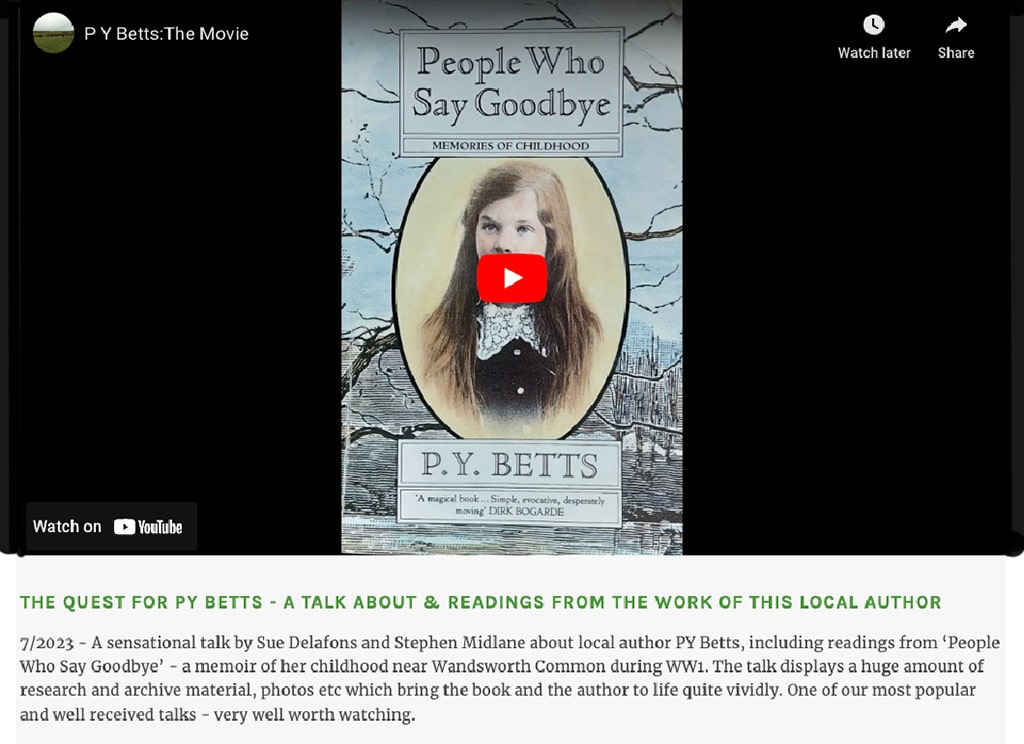


At this point, the talk really did come to an end.

My thanks to Stephen, Sue and Christopher for two wonderful evenings, and for agreeing to my adapting it as a Chronicle of Wandsworth Common.


Chronicles

September 2025


The Quest for PY Betts

Written and presented by Stephen Midlane and Sue Delafons

Part One


Seventy years ago, when Wandsworth Common was still a countrified suburb, the author of this enchanting book, a satirical writer of genius during the 1930s, was growing up there, observing with absolute clarity the behaviour and conversation of the adults around her. She did not always understand the implications of what she saw and heard, but she remembered it and recreates that vanished world with startling immediacy.

In July 2023, Friends of Wandsworth Common were treated to a thoroughly delightful talk by Stephen Midlane and Sue Delafons on local author P.Y. Betts, and her marvellous memoir People Who Say Goodbye: Memories of Childhood. The quote above comes from the publisher's cover copy to the first edition (1989), and is absolutely spot on (though it's now just over a century).

This was videoed for posterity by John Crossland and is available on the Friends' website. Well worth watching.

In 2025, Stephen and Sue repeated the talk, which I enjoyed so much that I asked if I could adapt it as a kind of "guest post". They very kindly agreed.

What follows is almost verbatim, but with occasional tweaks to adjust for differences between spoken and read words. With few exceptions, quotations are from P.Y. Betts herself. These are highlighted in a tinted box, preceded by giant open quotation marks, as here:


There were so many trees. There was such abundance of fresh air. It was incidental that much of the fresh air blew in from the domain of madness, crime, wounds and death, each of which required a large acreage of living space, if living is the word.


The Quest for PY Betts

Written and presented by Stephen Midlane and Sue Delafons

Stephen:

Hello. I'm Stephen Midlane, chair of the Heritage Group of Friends of Wandsworth Common. Welcome to the latest in our series of heritage talks.

I'm delighted to welcome Sue Delafons, one of my co-editors of the Wandsworth Common Story. As well as introducing Sue, I'm also joining her as a double act in explaining the fascinating journey we've undergone in our "Quest for PY Betts".

Let me hand over to Sue to explain further:

Sue:

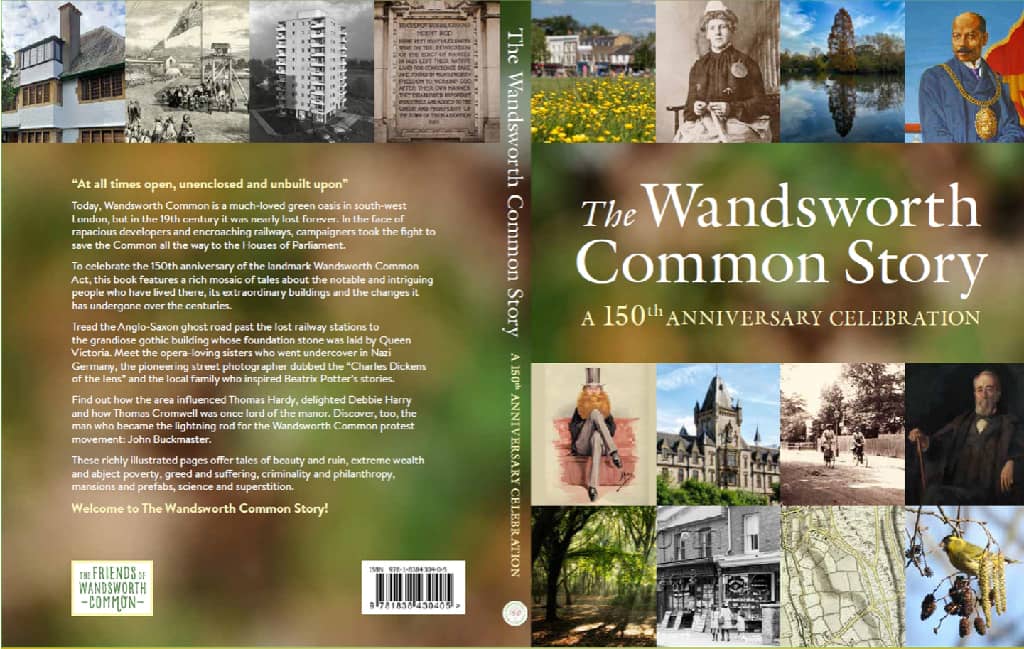
As Stephen explained, he and I are two of the authors behind The Wandsworth Common Story. This came from our love of and fascination with Wandsworth Common — and one of the wonderful things is the abundance of material it has generated for walks and talks and further research.
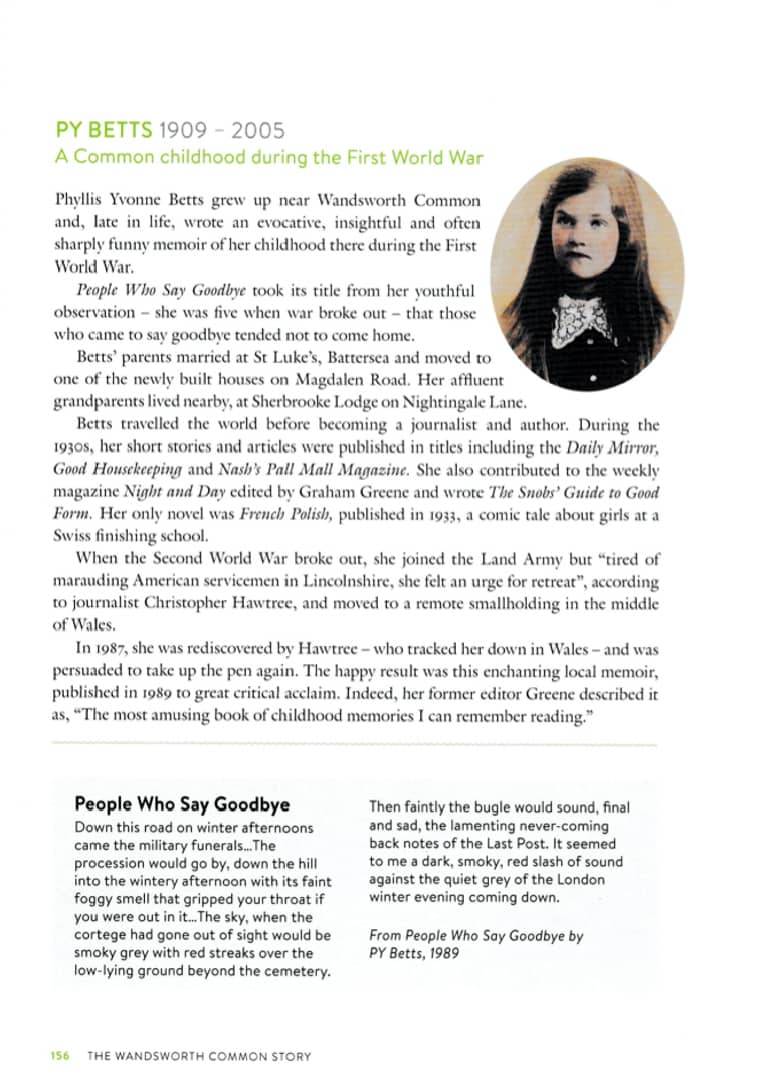

I wrote the article on P.Y. Betts and her wonderful memoir People Who Say Goodbye— and here I must give credit to Philip Boys who originally drew her to our attention.

[PB: Thanks, Sue!]


We soon found that her voice was so evocative and captivating it exploded outside the original 250-word article limit — so we couldn't resist including vignettes throughout our book.

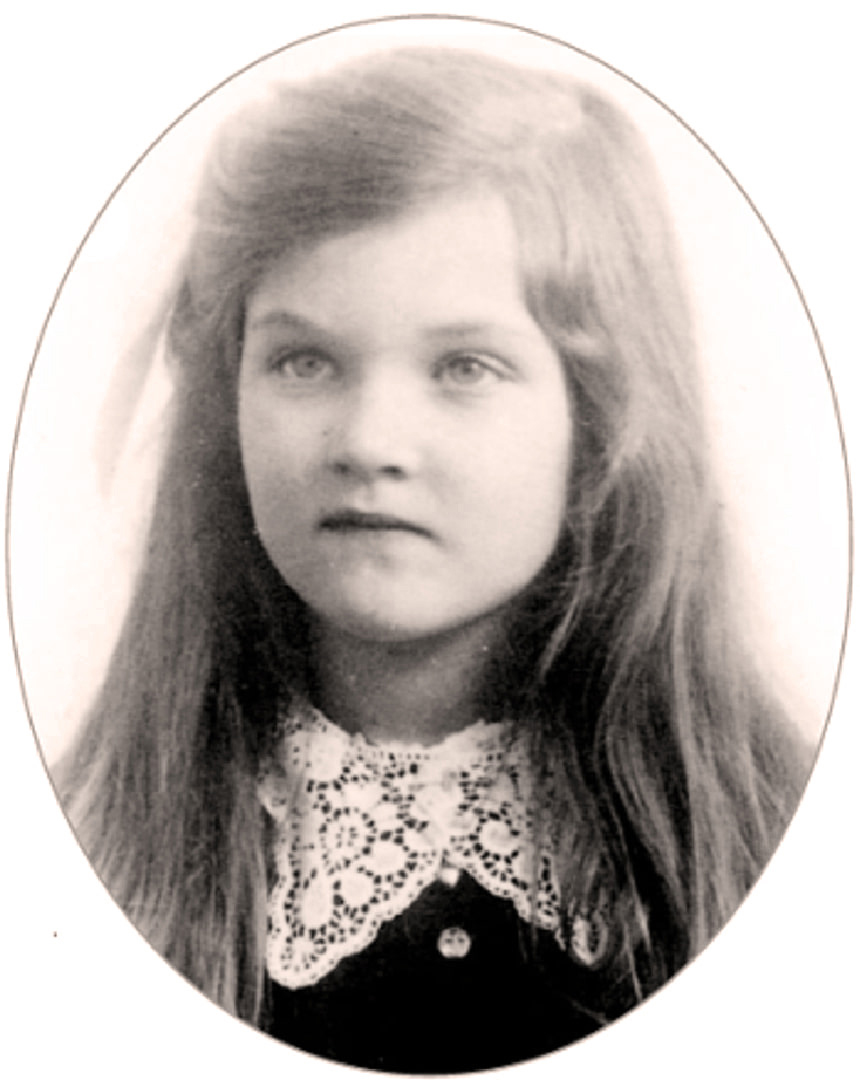
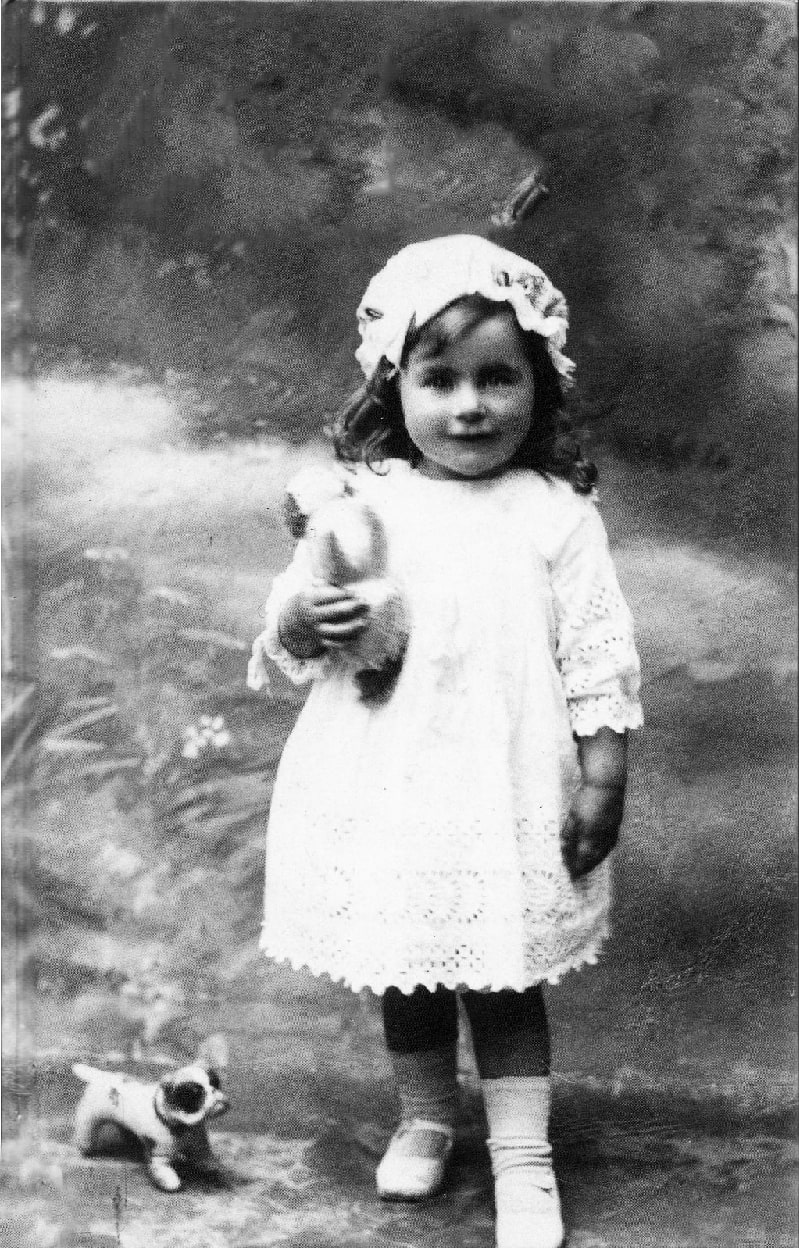
This is her memoir of a young girl, Phyllis Yvonne Betts, growing up on Wandsworth Common during the First World War — she was just five when the war broke out in 1914.

(From now on, we'll refer to her as "Betts", which is how she preferred to be known.)

It's infused with insights and perceptions of the society of the time — in transition from the Edwardian era — with the practical and often humorous everyday events around the Common in the foreground, but also the shadows of the global stage at a time when "people who say goodbye" tended not to come back.

So it's a period piece; but much more than that, it's a really delightful book. Her words are so fresh, honest, penetrating, funny, poignant. We hope to give you a flavour of this through readings during the talk.

Stephen:

And, of course, she is often writing about places around Wandsworth Common still familiar to us today.

Yet nowhere does she say exactly where she was living, or where the events took place, or who she is describing. But because we know the author and our area that we can decode where and what — and often even who — she is writing about.

Here was an opportunity for some real detective work — to explore the historical background to the locations featured in her book and to track down the family and friends whom she brings to life.

This was the "Quest" that we want to share with you.

(A note about the images we're going to show: many of these depict the exact location that Betts is talking about, but in some cases the pictures are purely illustrative of the places and activities she describes.)


The setting

Sue:

But first, the story of the book's origination — how People Who Say Goodbye came to be written in the 1980s, many decades after the events it describes. It begins with journalist Christopher Hawtree:


And this is a story of discovery in itself.

During the evening, Stephen will read Christopher's narrative, interspersed with me reading selections from Betts's book, and supported by findings from Stephen's local research.

Christopher Hawtree was a journalist and writer who, back in the 1980s, undertook his own quest for PY Betts. This is his account of where his research led him, taken from articles he wrote for the publishers Slightly Foxed in the early 2000s:

Christopher Hawtree:


At a desk beneath the dome of the British Museum Reading Room, as sombre PhD types on either side of me pored over earnest-looking volumes, I had to restrain myself from yelling for joy at item NN 20963, the catalogue number for French Polish by PY Betts.

It was her only book, a novel published in 1933.
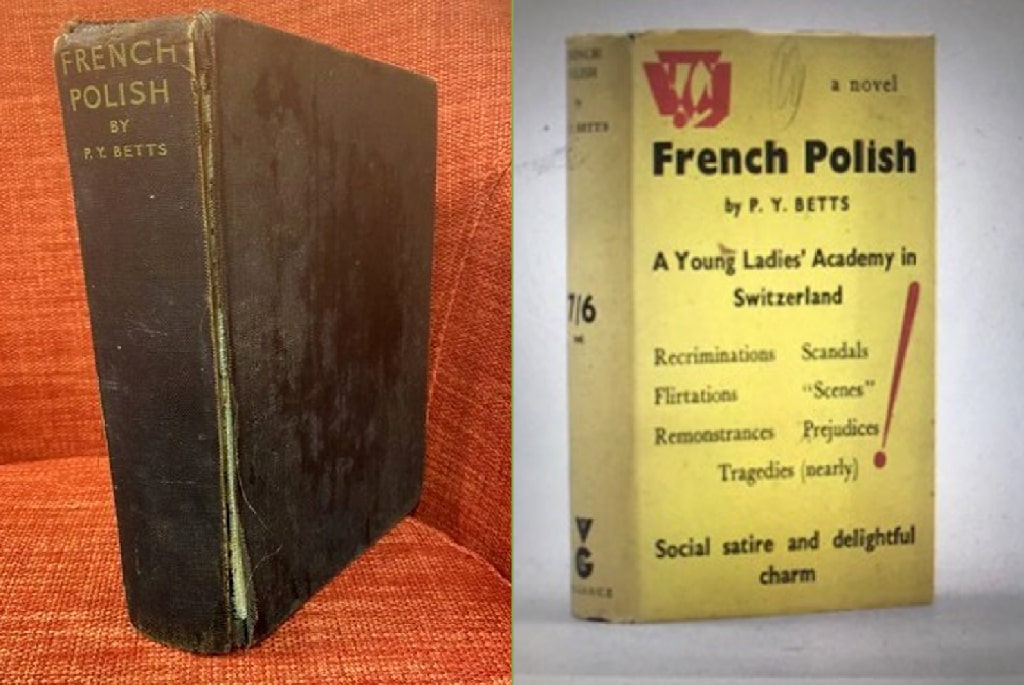

It looked as if nobody had opened it for some while — perhaps for more than 50 years.

It was 1985 and I was at work on an anthology of the rare weekly magazine Night and Day, which in 1937 had sought to be an English incarnation of the New Yorker. But after six months it had come a cropper.
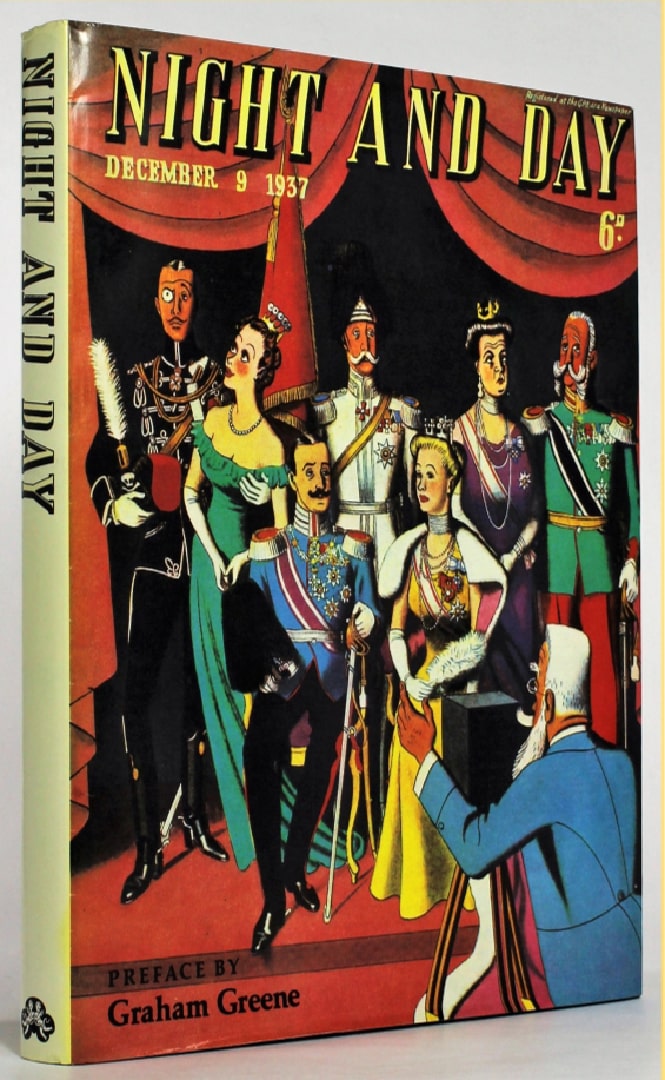

Many of the magazine's contributors, such as John Betjeman and Alistair Cooke, and indeed the editor Graham Greene himself, were to become very well known.

Yet often as interesting were those of whom little if anything was later heard, among whom was PY Betts. She wrote entertaining pieces for the magazine, including a "Snob's Guide to Good Form":

"In eating, perhaps more than in any other social activity, it is important to realise that the opposite pole to good form is not bad manners, but gentility".

Certain foods are "good or bad form according to the time of day at which they are eaten. Kippers and bacon and eggs are poor form at breakfast but completely sophisticated between midnight and 6 am."

"Communism and Fascism are both a la mode."

"Lemons are socially acceptable at any meal."

This anticipated Nancy Mitford's "U" and "Non-U" by two decades.

The same spirit was evident in French Polish, the story of a group of lascivious girls at a Swiss finishing school. The plot seems less important than its characters' off-the-wall observations and comments.

"I guess if you thought a little more about sex, your circulation would be a whole lot better, there's nothing like sex for keeping a girl warm."

And

"Have you ever noticed that people who are quite disintegratingly beautiful in the nude are often dreadfully pedestrian in clothes?"

Here was somebody with a distinct take on the world. I could not get P.Y. Betts out of my mind. What could have become of such a talent?

Try as I might I could not discover anything much about her, and lamented this en passant in the long introduction to the Night and Day anthology.

A review of this in the Observer referred to the mysterious disappearance of "the great PY Betts".

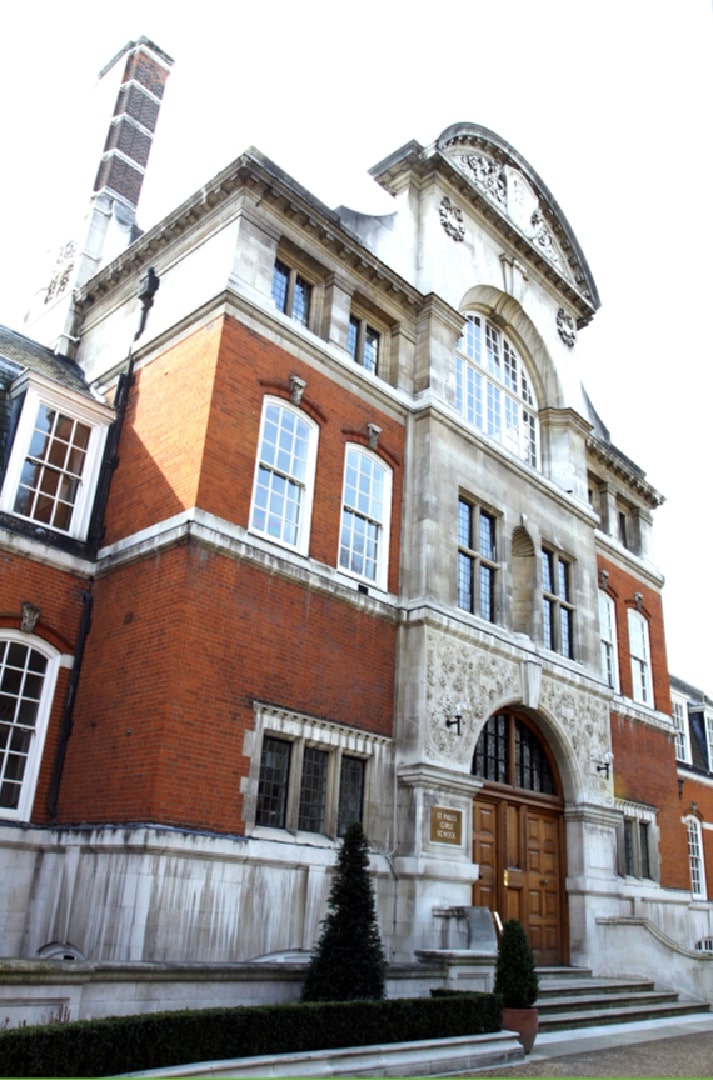
Soon after, the mystery was solved by Lady Eirene White, who got in touch from the House of Lords to say that she had been at St Paul's Girls' School with Betts (as she was known). And that after growing up near Wandsworth Common during the Great War, Betts had travelled around the world in the 30s, writing articles as she went.

Sue:

When war broke out, she joined the Land Army in Lincolnshire. But tired of marauding American servicemen, she felt an urge for retreat, and, in 1944, she moved, alone, to a remote small-holding in the middle of Wales.

And she was still there . . . 

We are going to return to Christopher's quest later. But now to the book itself: People Who Say Goodbye: Memories of Childhood (1989):


There were so many trees.

There was such abundance of fresh air.

It was incidental that much of the fresh air blew in from the domain of madness, crime, wounds and death, each of which required a large acreage of living space, if living is the word.

Stephen:

So where were these "domains" that P.Y. Betts was referring to: Madness? Crime? Wounds? Death?

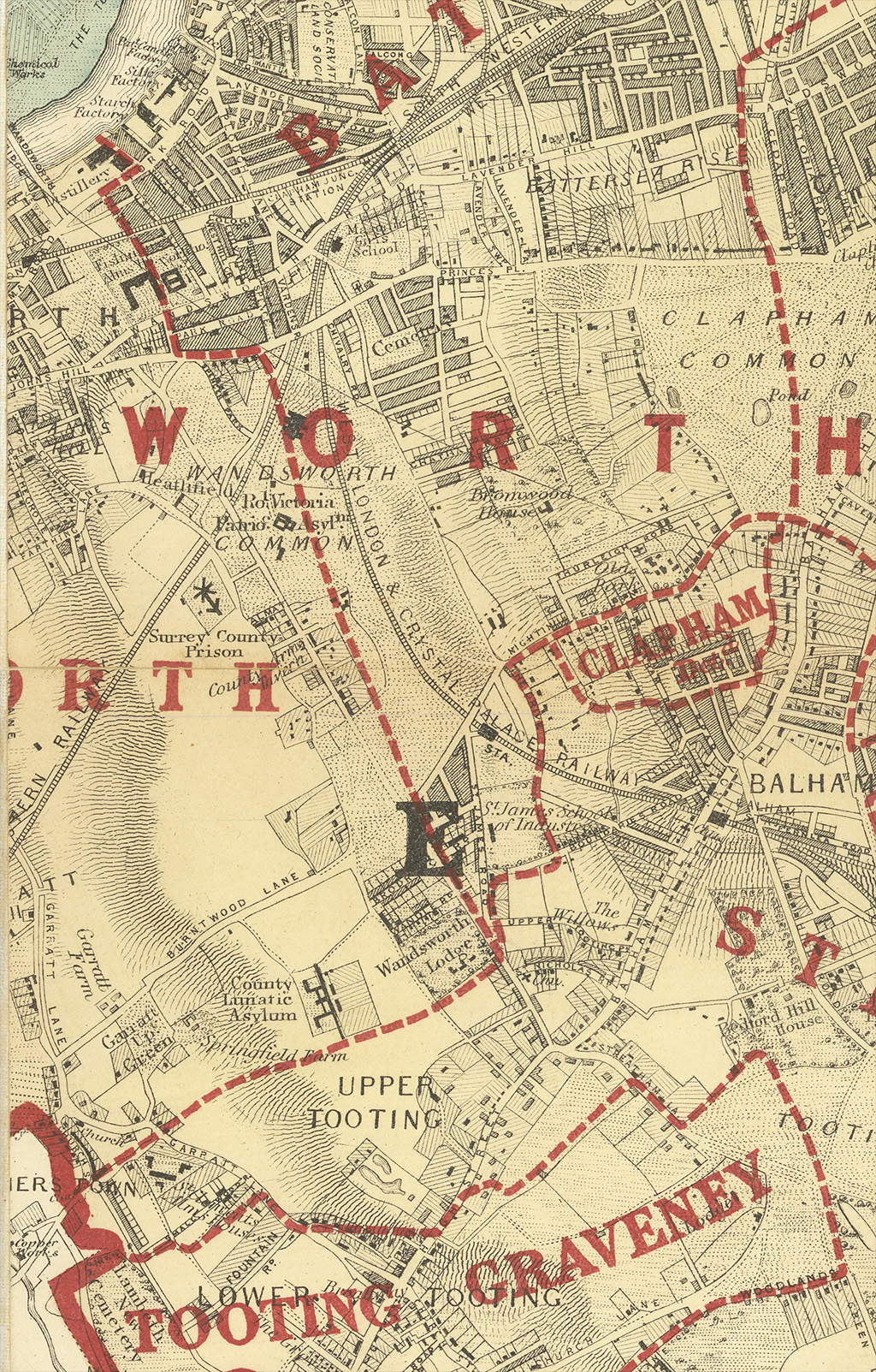
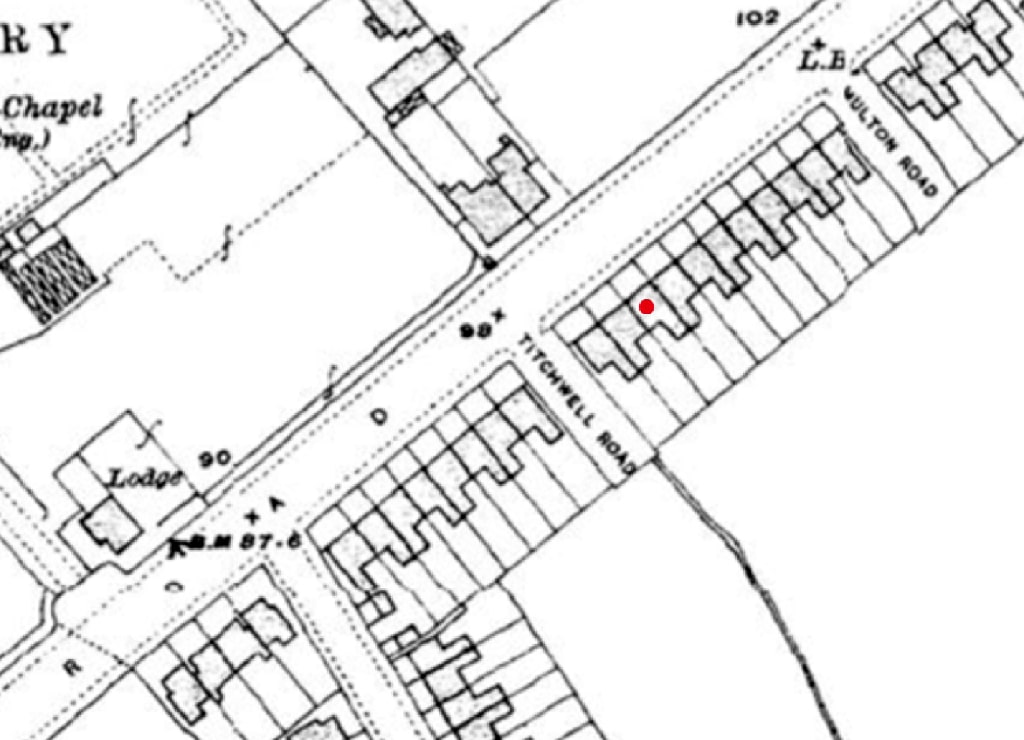
This map, from the 1890s (so roughly 20 years before she was writing about) shows us the various locations, all within striking distance of the Betts's house (which is marked with a red dot):


Madness — the Asylum, just off Burntwood Lane;

Crime — the Prison;

Wounds — the Royal Victoria Patriotic Asylum (used a hospital in World War One);

Death — Wandsworth Cemetery on Magdalen Road.

Here they are in more detail, from the 1916 Ordnance Survey map:


The County Lunatic Asylum is today known as Springfield University Hospital.


Wandsworth Prison.

Notice that the detailed layout of the buildings is not shown on the map and that it's still being referred to as Her Majesty's Prison — a sign that maps cannot always be trusted!


The Royal Victoria Patriotic School

As you can see from the map, this was set up as a school for "Orphan Daughters of Soldiers, Seamen and Marines of the Realm". During The First World War it had been converted into the 3rd London General Hospital, for troops injured in the conflict.
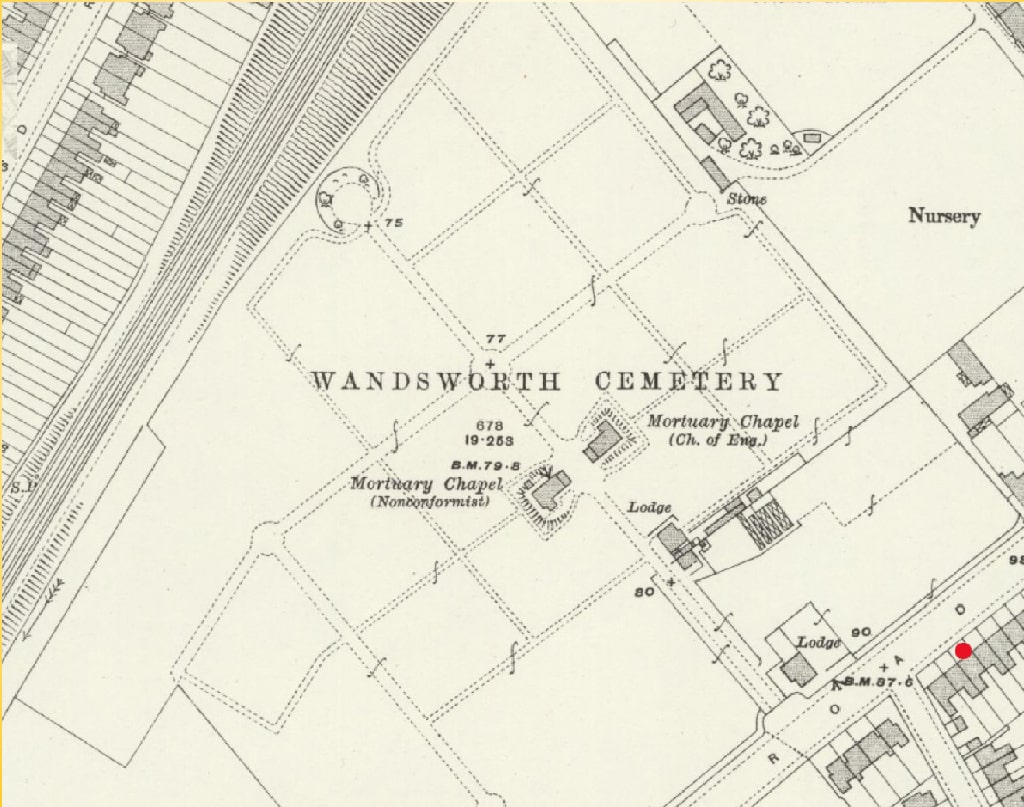

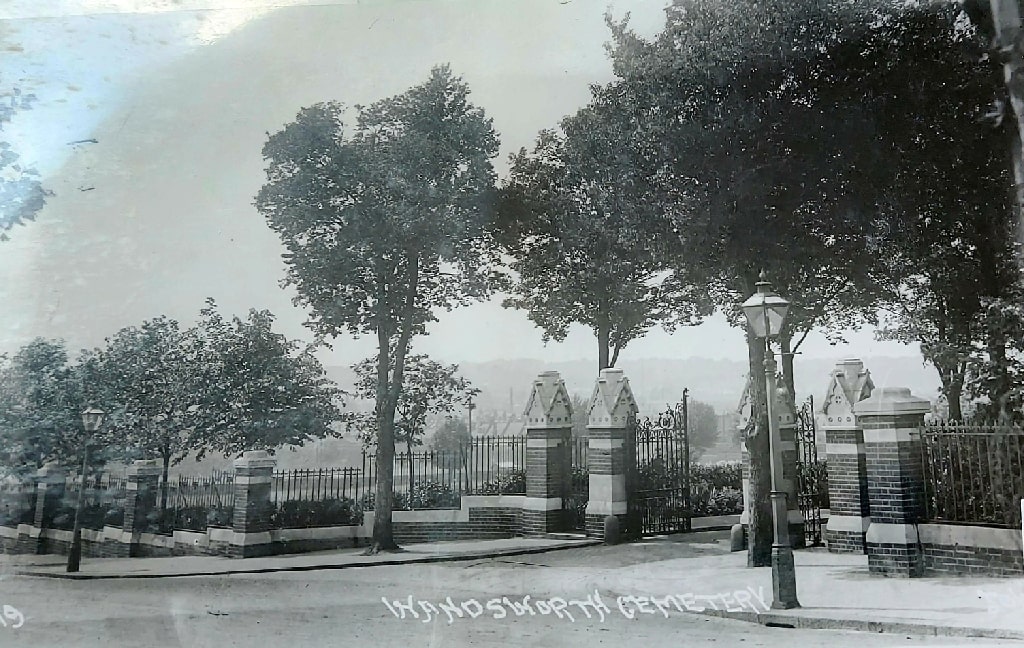
Wandsworth Cemetery, Magdalen Road

This was much smaller than it is today. Notice it had two chapels: one Church of England, the other Non—Conformist.

We'll look at each of these institutions in more detail in due course. But first, we turn to Betts's home life and what we might call the "Domestic Domain".


The Domestic Domain


Our suburb was a favoured one on account of its wide roads and many open spaces.

Not only was there the Common, there was a nursery garden full of flowers, threaded with footpaths . .  . there were enchanting glimpses through wrought-iron gates of the secret gardens of the big houses in the road between the two commons where my grandparents lived."
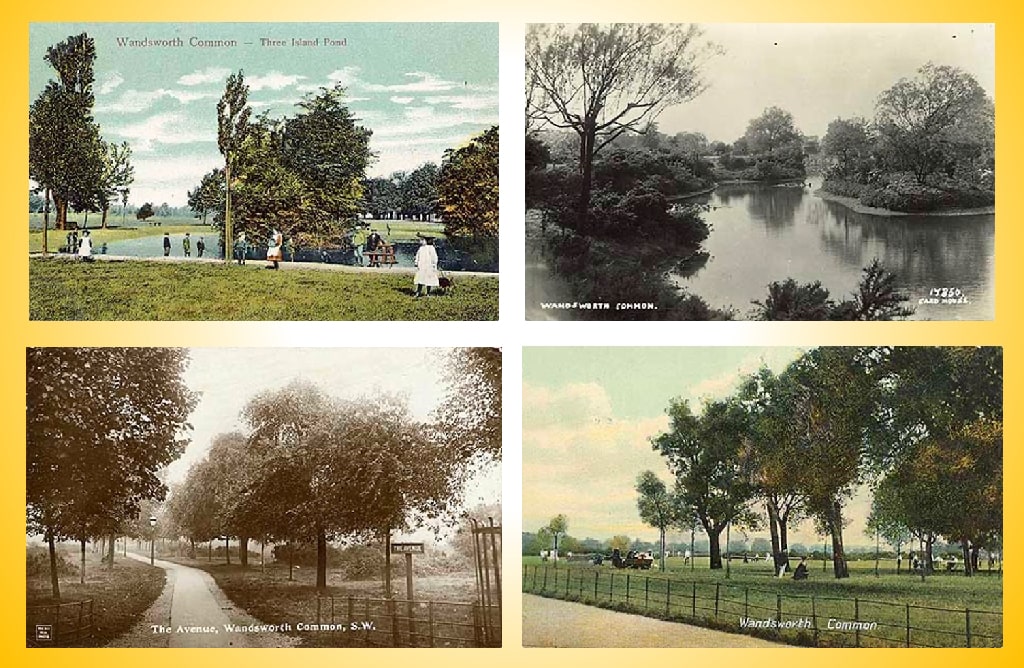


Stephen:

The "road between two commons where my grandparents lived" was Nightingale Lane. We will hear more about her grandparents and their household later.
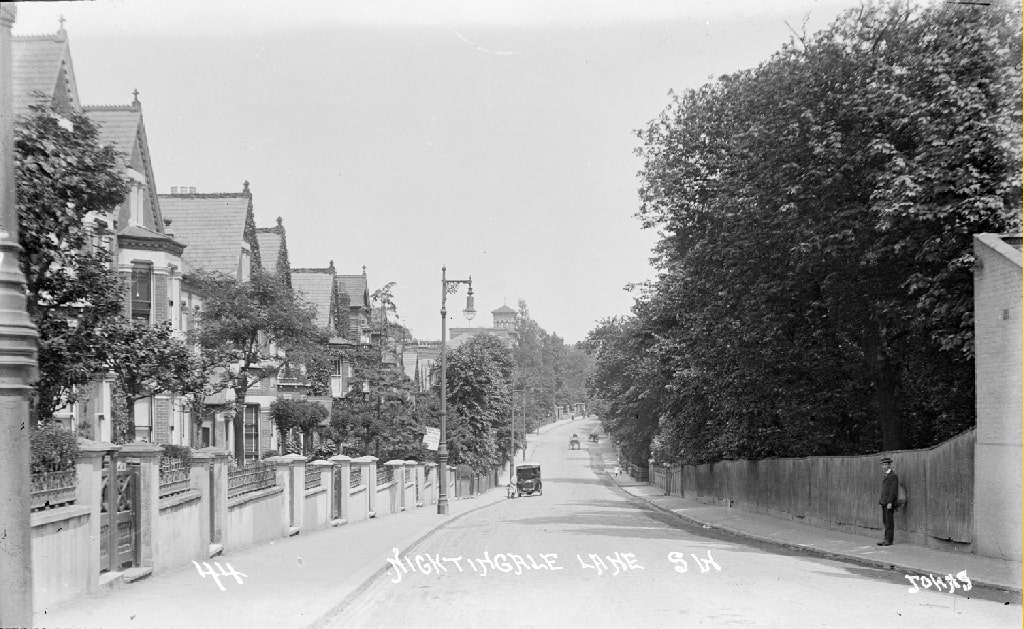

Betts and her family were living on the other side of Wandsworth Common:


Our house in London was at about the middle of a long, very wide road lined with (then) young plane trees.

Here is a picture of the foot of the road from about 1900, before the planting of the plane trees, so just before her house was built: The foundation stone of the Baptist chapel on the right is dated 1898 [1899?].
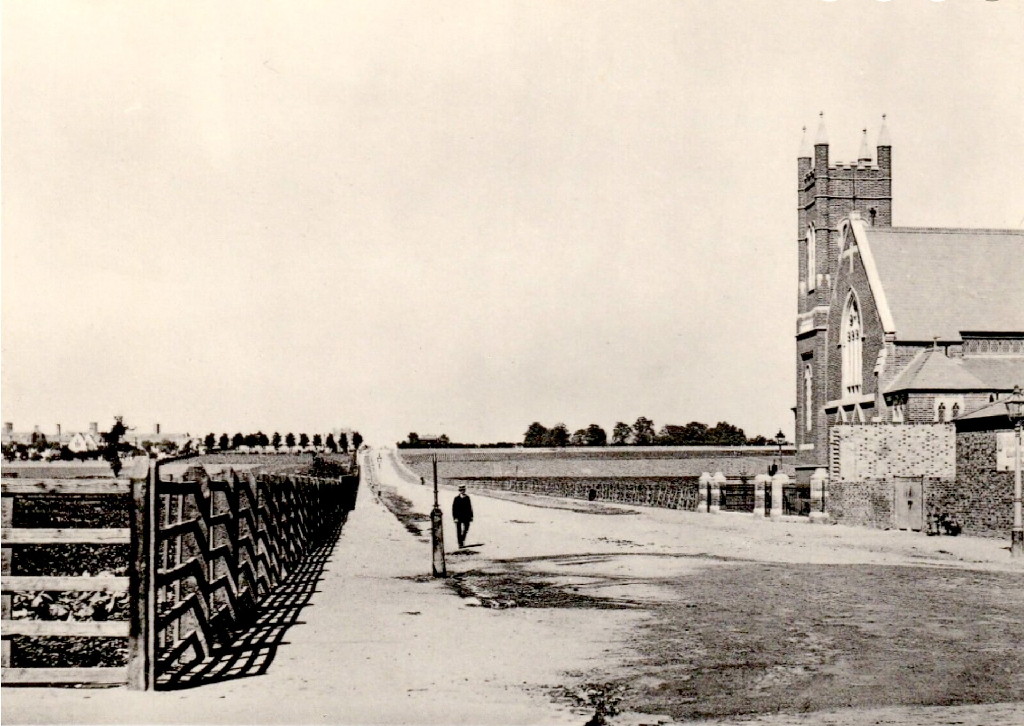

And here it is again, a few years later, probably around the time that Betts was born, or shortly after:
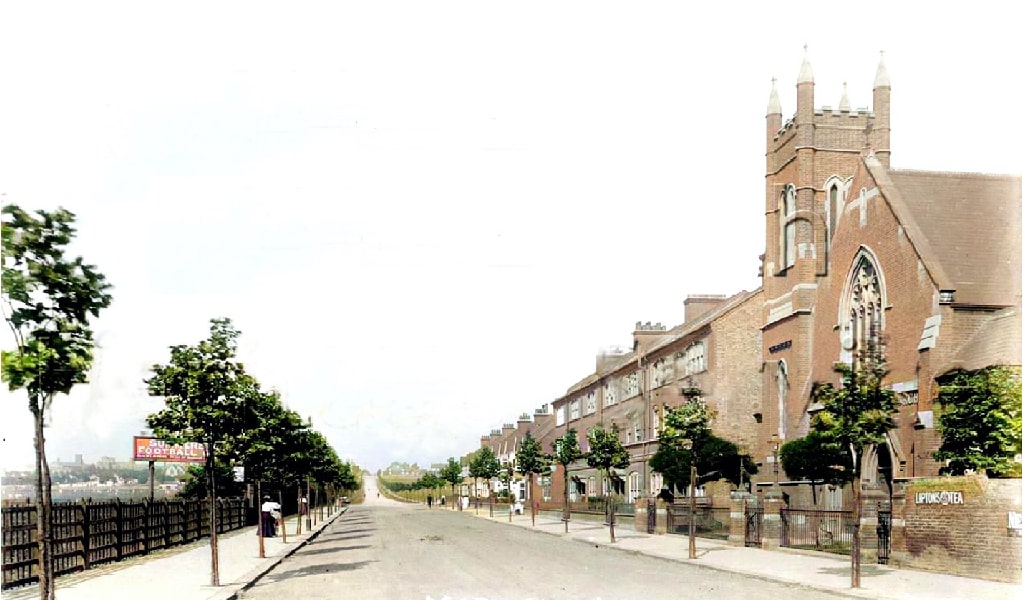


The top of the road near the Common was the 'better' end, going down past our house and other houses like it . . . 
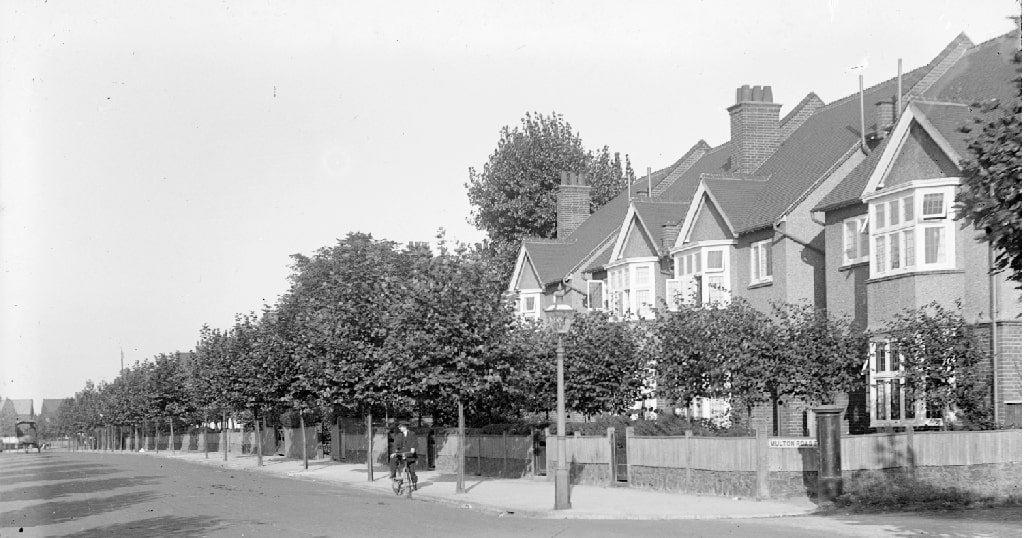


and then more steeply downhill to a stretch not built on, a vague area of slightly messed-up open spaces, a Board school with its shrieking playground, and the cemetery.
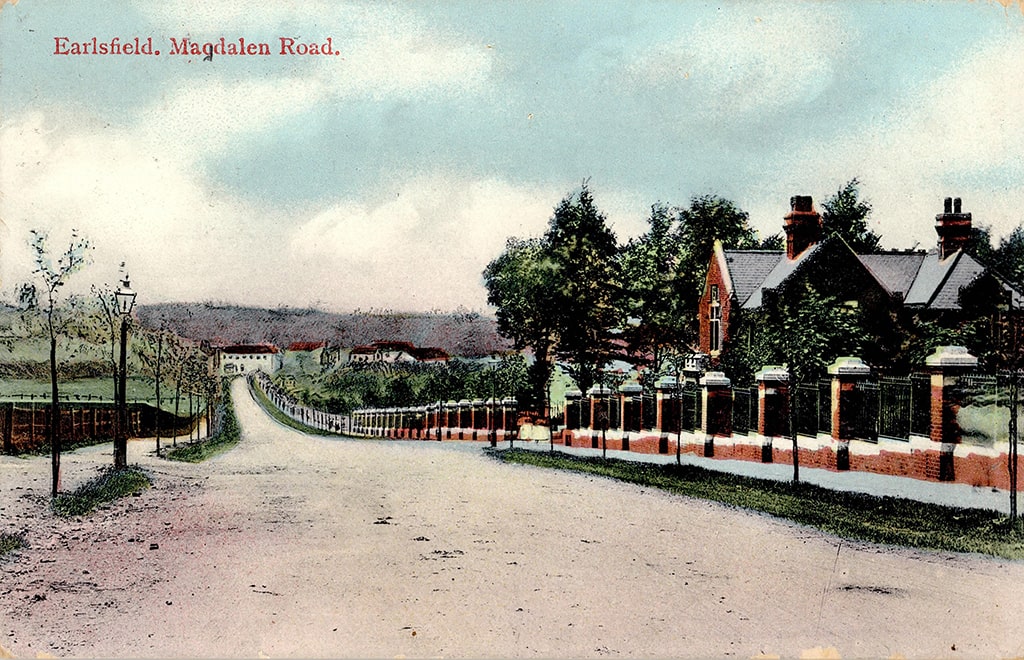

Stephen:

Betts is talking about Magdalen Road, which was laid out in the 1870s by Magdalen College, Oxford, linking Garratt Lane to Trinity Road. (Hence Betts probably pronounced it "Maudlin Road".)
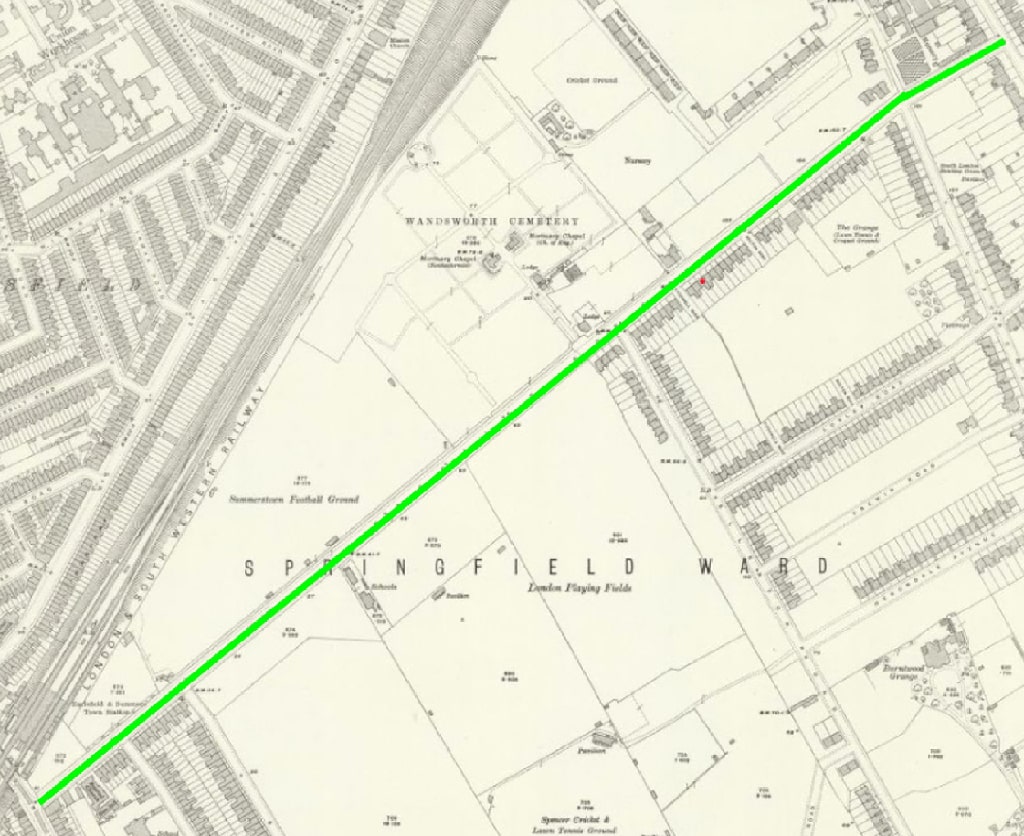


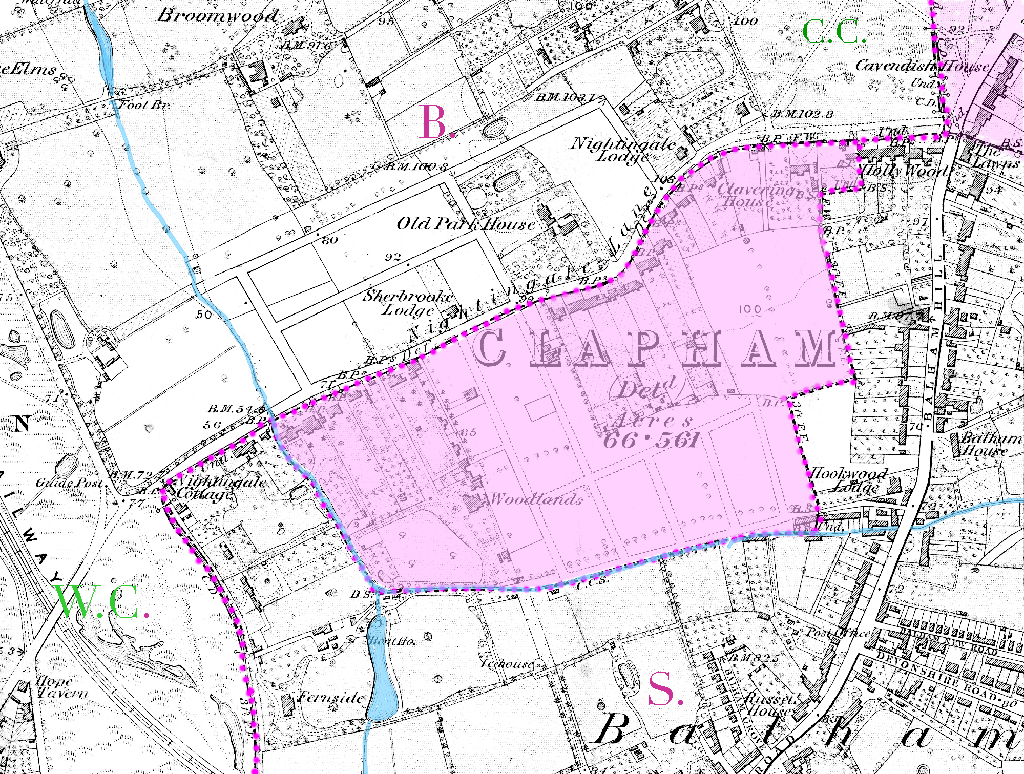
The pink-tinted area is the land owned by Magdalen College, Oxford, c.1900, framed by Wandsworth Common, Garratt Lane, the SW Railway and Burntwood Lane.

The college had owned this large swathe of land since the 1840s and developed ambitious plans for the whole area to be developed as a fashionable Garden Suburb, the Magdalen Park Estate.

However, after the First World War further development stalled and the land below Ellerton Road was purchased by Wandsworth Borough Council to create social housing — which became the Fieldview and Openview estates.

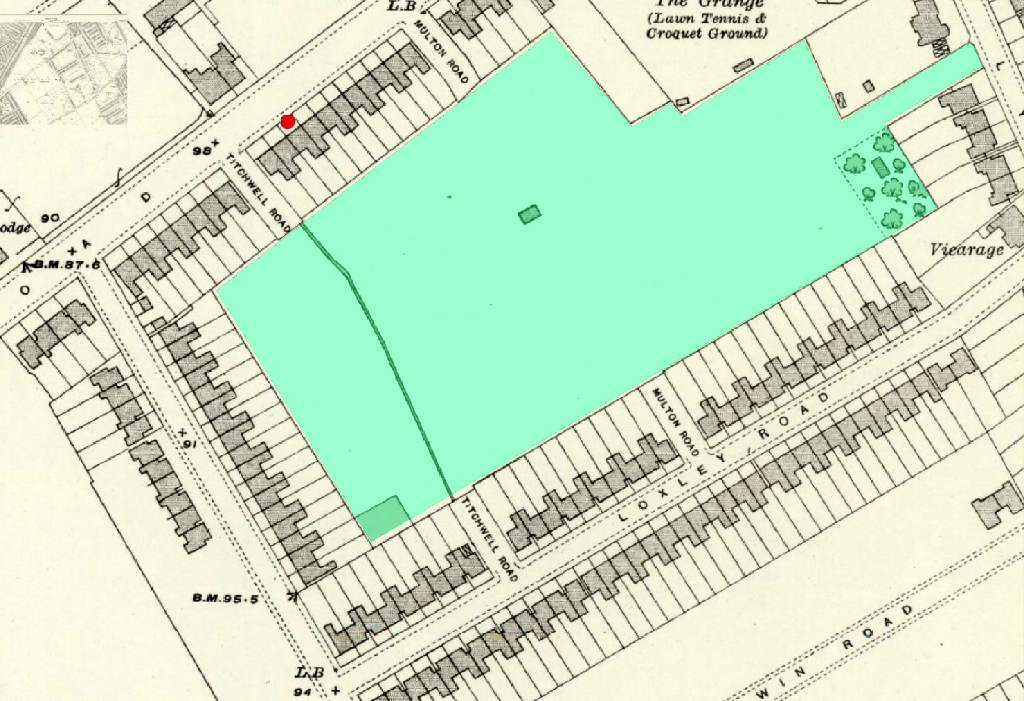
The Betts family lived at 51 Magdalen Road, marked here with a red dot:

Here's what it looks like today. (Thanks to a renumbering of the houses in the 1920s, it is now number 77.)
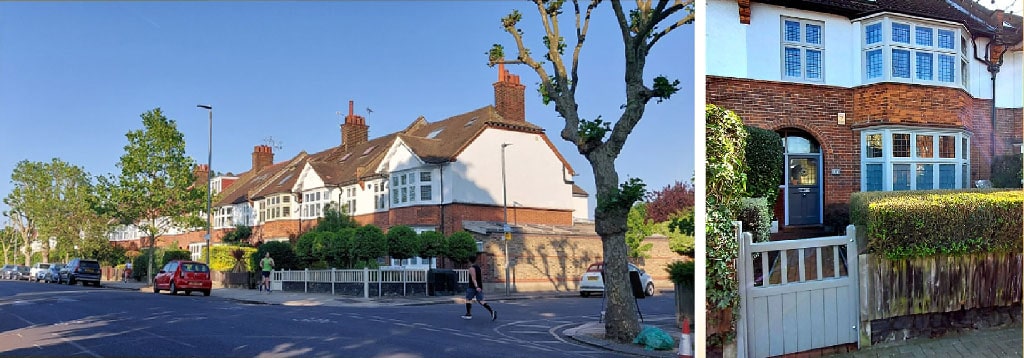


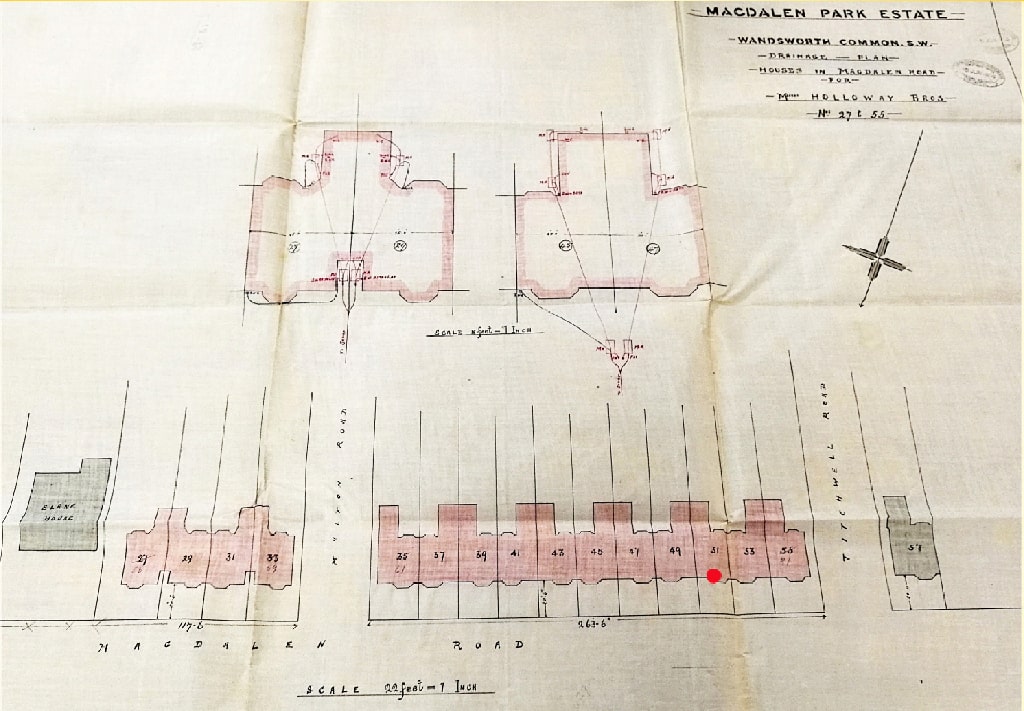
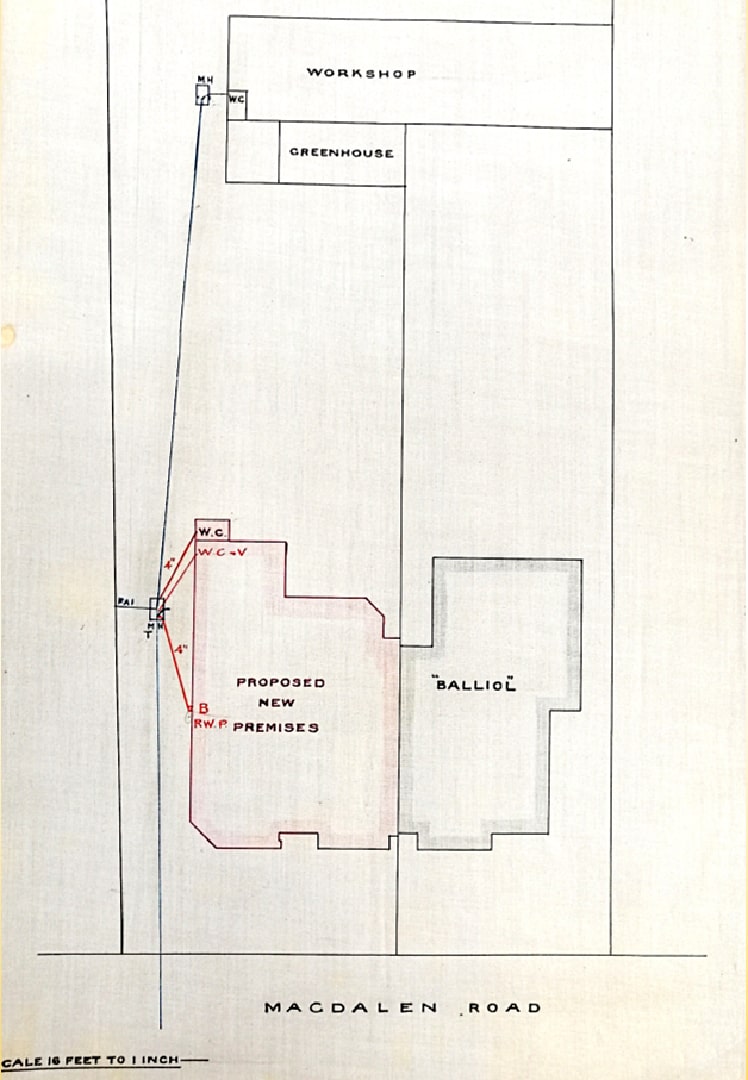
The Betts family were probably the first occupiers of the house as it was part of a newly-built terrace erected c.1906 by local builders Holloway Brothers.

This is the drainage plan submitted by Holloways at the time showing the row of houses from number 27 to 55:

The Betts family consisted of PY herself, born in 1909, her brother Eric, five years older, their parents Arthur and Beatrice, and (usually) one servant.
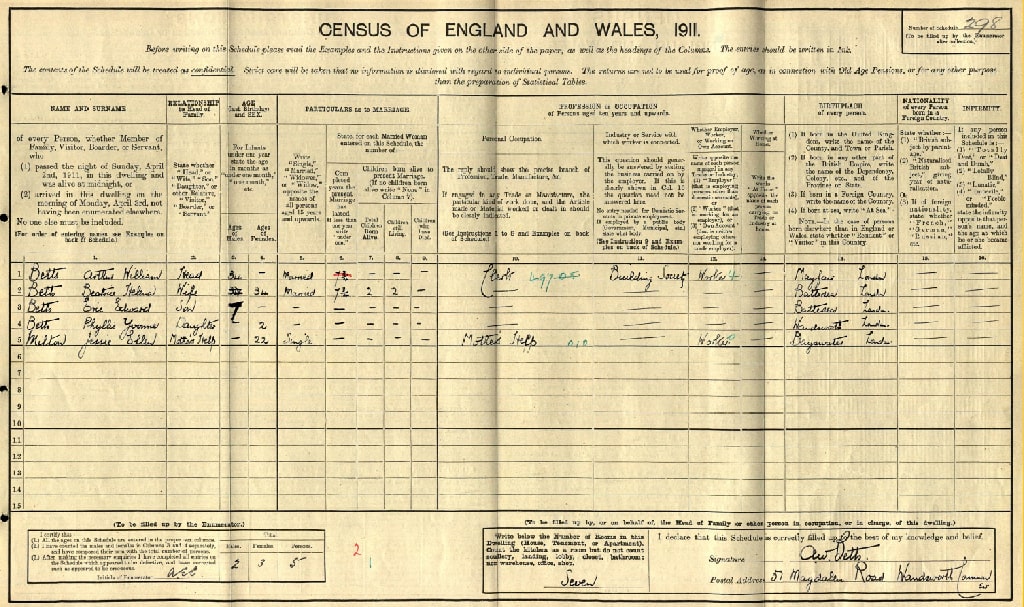

The 1911 census shows us that Arthur was a clerk in a Building Society and that, at that time, Beatrice (or Bea) had a 22-year-old live-in Mother's Help, Jessie Elland [sp?].

Arthur and Bea had been married in St Luke's church on Thurleigh Road in 1903 and Phyllis Yvonne was christened there on 4th July 1909.
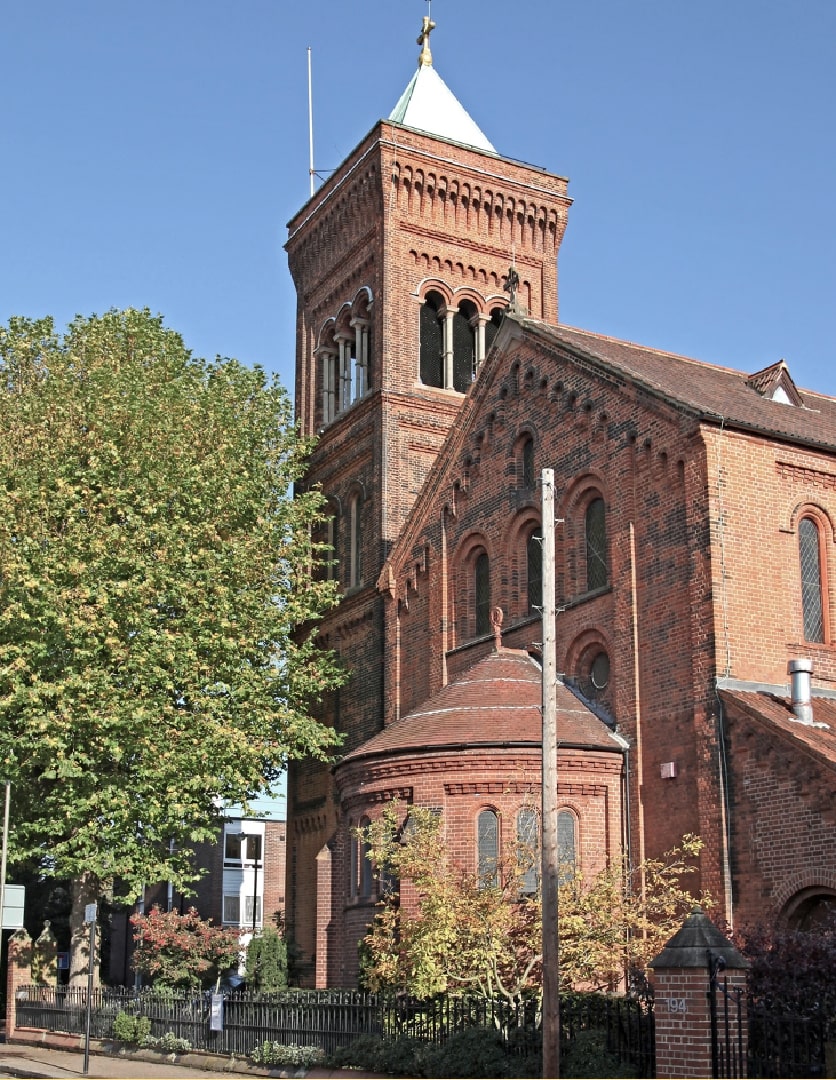

Both ceremonies were conducted by the influential Vicar of Battersea, John Erskine Clarke.

Betts paints vivid, and (generally but not always) affectionate portraits of her family, friends and assorted characters with whom she came into contact.

About her parents, and their first maid:


I knew that some mothers lied to their children about wounds and death, but I should have been ashamed to have had a soft centre mother like that.

My mother was rather unlike other children's mothers in her ways, but though she could be embarrassing I was quite proud of her, and of my father too, because they were bold and good-looking.

I should not have liked the funny-looking parents who fussed about everything that some children had.

Clara had been my newly-married parents' first little maidservant, a fourteen-year-old up from Somerset.

Later, when Clara leaves to get married:


At home, minus Clara, we were 'without'. 'Without" meant being without domestic help and was accepted verbal currency among ladies who customarily employed . . . .

My mother revelled in this deprivation. She had long striven to sink socially, and now here was her chance.

We ate in the kitchen.

About their family doctor (whose surgery was on Northcote Road, on the other side of the Common):


In his dress, which was immaculate, Dr Biggs was a relic of a former generation. I knew nobody else who dressed like Dr Biggs. He was snuff-coloured all over. He wore a frock coat, a long wrapped-over affair, with trousers of the same colour and spats. His waistcoat had pearl buttons. He always wore wing collars . . . 

Outside the house, during his visits, waited Dr Biggs's brougham with his coachman. Other doctors already did their rounds by motor car but Dr Biggs was a carriage and horse man to the last. That was the nicest thing about him.

One supposes that his horse, when it was out of sorts, was doctored with the same brown physic and red physic that were all his patients ever got, but in somewhat larger doses.

The area around the Betts home was more open then than now:


Our house backed onto a field of eleven acres bounded by gardens of houses built four sides of a square. It was a real meadow with hedges and ditches and many big trees.
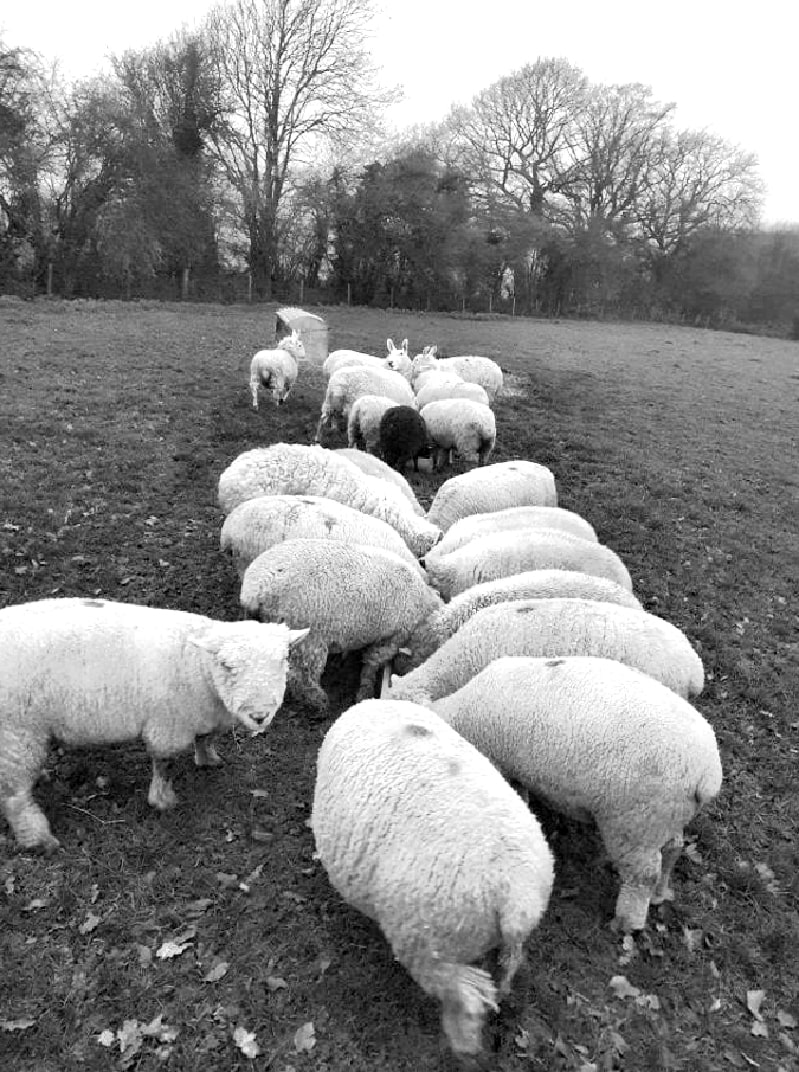


In the summer hay was cut there and after the hay sheep were turned in to graze. Usually there was nobody there, at most two or three children from the neighbouring houses, playing . . . "

Playmates:


I had become friendly with a girl who lived in the next road to mine. Her name was Marion Morris. Her experience was limited in that she seemed never to have done anything naughty, never fought with anybody or even climbed trees . . . .

Her father was manager of Price's factory in Battersea and he often brought home reject candles. She would give me some small coloured barley sugar Christmas ones if I liked.

Our friendship strengthened.
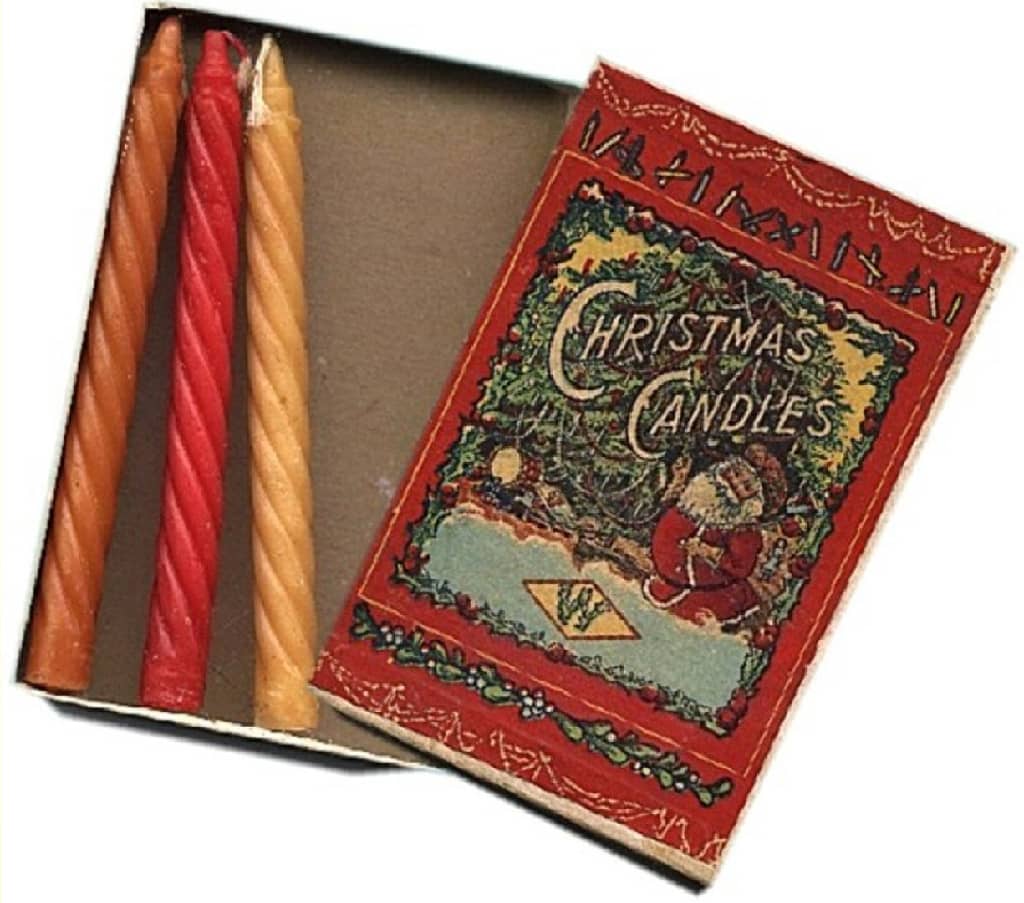

Stephen:

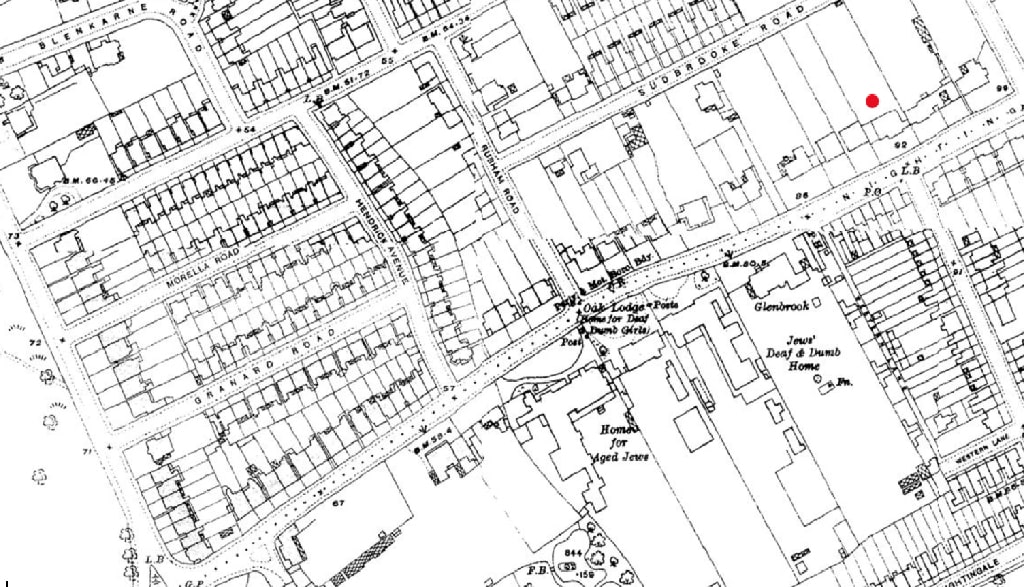
As we've seen, Betts's grandparents lived on Nightingale Lane. Their house was Sherbrooke Lodge, located opposite the top of Endlesham Road. Here it is in 1870, quite isolated on the north side of the Lane, and with a fairly substantial garden behind:
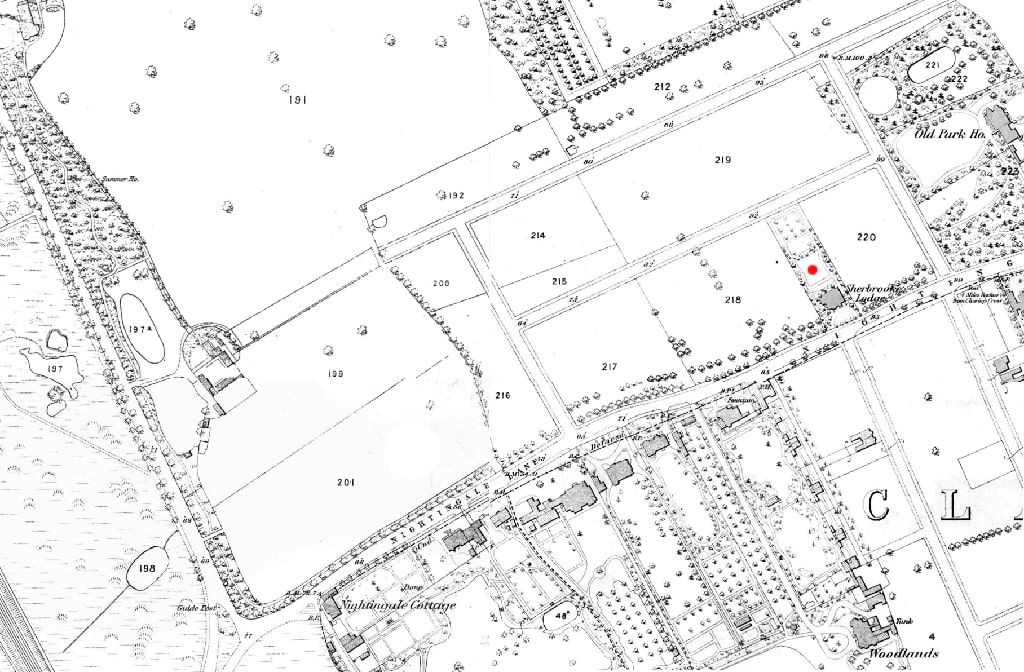

Here you can see how the area had developed by the 1910s, when Betts began to visit:

This is the site today, with Sherbrooke Lodge replaced by a modern block of flats. But notice the fine tree. I'm sure this once stood in the front driveway of the Lodge:
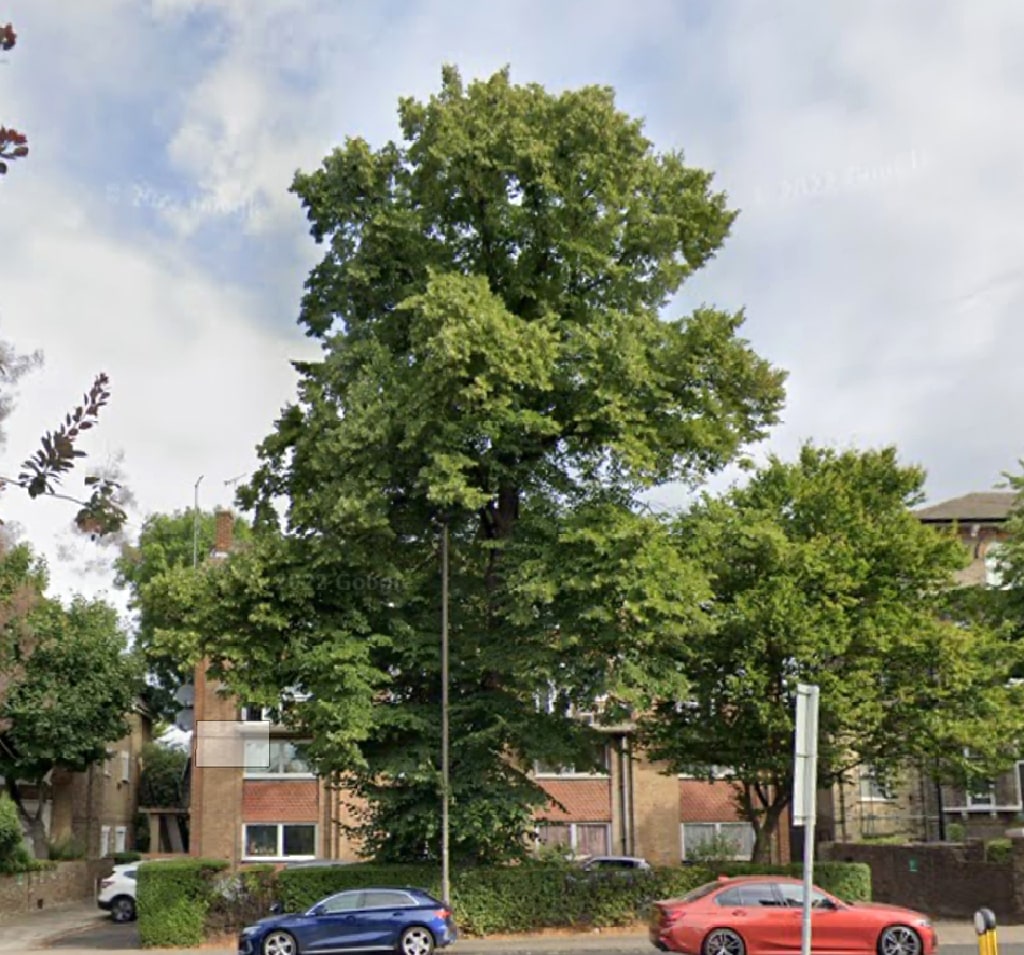


Though we were not forced to go to church, our Sundays were not without their burden of duty. We were expected to accompany our mother on the weekly walk across the Common to visit our grandparents for tea.

The house was a substantial Victorian one with two entrance gates and a sweep-around drive, probably quite similar in size to no.101 on the other side of the road.
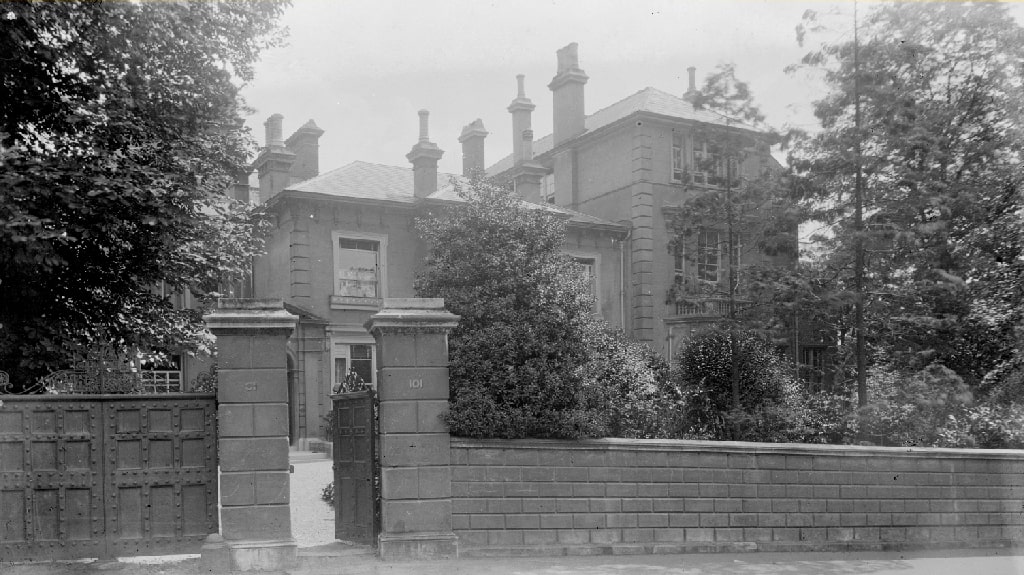


It was covered with creeper that was not, however, permitted to straggle. A flight of steps led up to a storm porch, closed in winter, and the front door. The brass door furniture was brightly polished. In summer a striped awning shielded the paintwork from the blistering action of the sun.

There was a brass bell-pull with echoes in the depths of the house, followed by the approaching footsteps of the parlourmaid. We would say 'Good afternoon, Alice', in answer to her greeting.

Stephen:

Betts's grandfather was Edward Wood JP, the manager of the Temperance Building Society. (This was the firm that Betts's father, Arthur, worked for.)

In 1911, the household consisted of Edward; his wife, Elizabeth; two daughters, Ada and Ethel; a son, John (known as Jack), and two servants:
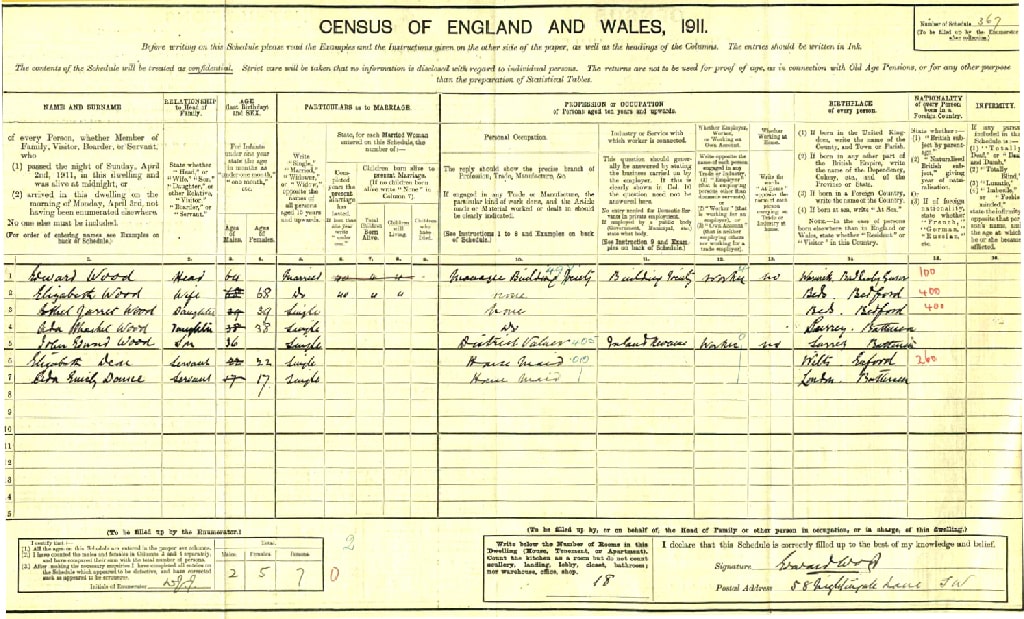


Grandpa was immaculate. Everything about him was clean and fastidious. His well-kept hands were shapely. His speech was impressive — when Grandpa spoke, people listened. His articulation was crystalline. All in all Grandpa was a well-polished specimen.

It was hard to believe that he had started life in a miner's crowded cottage in Nottinghamshire and had had no schooling after the age of eleven.

Sue:

Aunts Ada and Ethel also lived at Sherbrooke Lodge.


There was a period, not so long past, when almost everybody had an aunt called Ethel. I even knew one or two who not only had an aunt called Ethel but were themselves called Ethel and were themselves aunts — Aunt Ethels that is.

There was something about the name that not only brought on aunthood but was somehow marriage-repellent. Ethels did not breed much. Perhaps that is why they have become comparatively rare.

Although Aunt Ethel may have looked like Lord Longford in drag, she had been sought in marriage, though only by a curate.

This offer had been refused.

Stephen:

We now return to where the Betts lived on the west side of the Common, Magdalen Road.
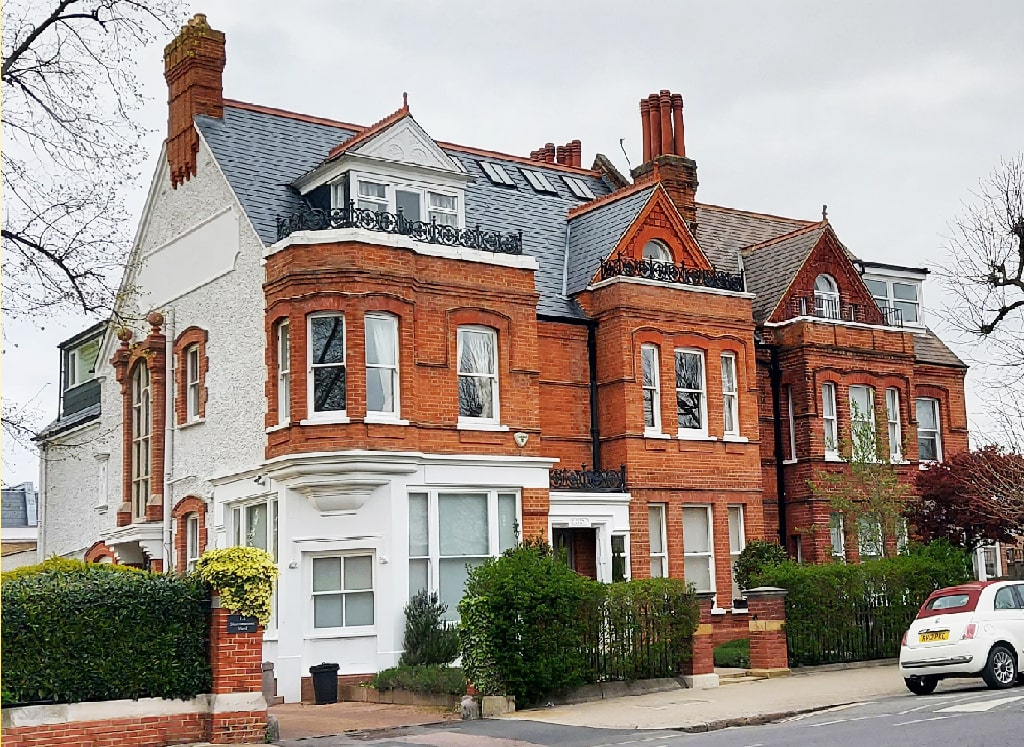


On the other side of the road from us there were only two houses, built close together. They were bigger and older than the modern houses on our side. One was the undertakers; the one next door was a small private school.

So, on the left here we have the undertakers, and on the right, the private school:

These two houses were built by local builder James Carmichael; the first in 1898 and the second a few years later. They continued the Oxford University connection by being named "Balliol" and "Oriel".
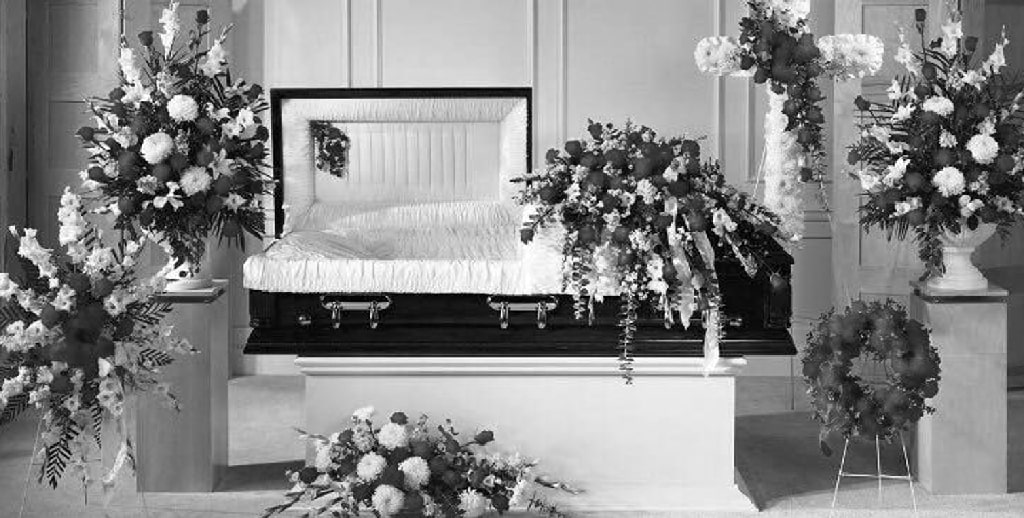


The undertaker's family lived over the shop, which had a big front showroom with a display of coffins and artificial flowers under glass domes.

Behind this there was the joiner's shop where the coffins were made.

There must have been a mortuary too, because in later years, when refrigeration became common, my mother had the bright idea of getting round the undertaker to store her furs in the cold room there during the summer — it was so much handier than the Army and Navy Stores.

Cheaper too, no doubt. Just one or two of my mother's dazzling smiles would do the trick with the undertaker, whose customers were so much less lively than my mother.
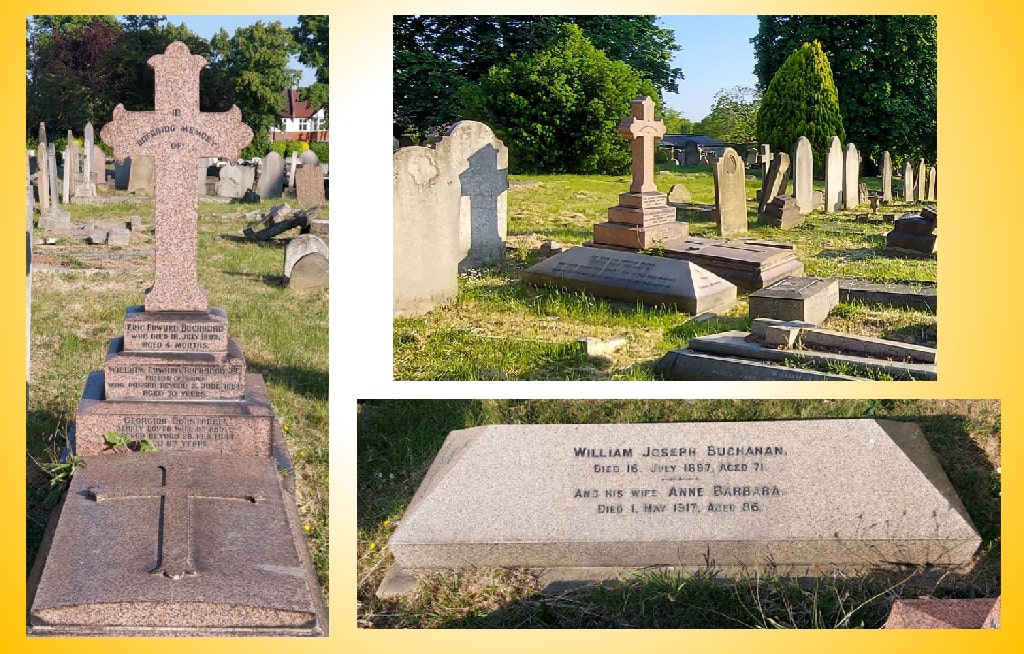

Many of the gravestones in Wandsworth cemetery were produced by Buchanan's and the family are themselves interred there.
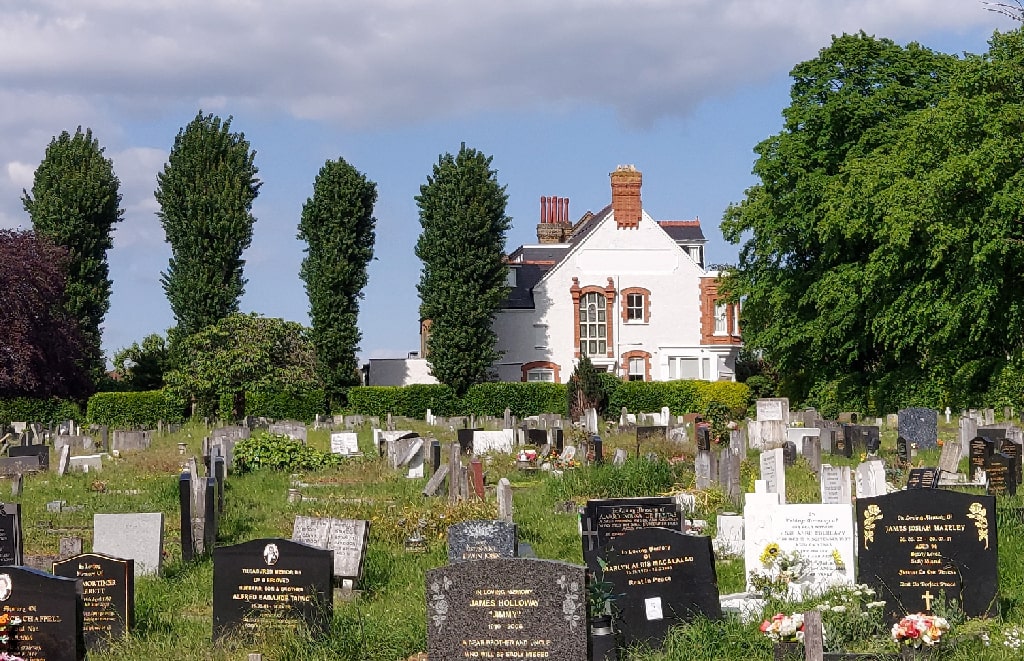

The company continued in the premises until fairly recently and present-day inhabitants of the area can still remember when a sign on the side of the building overlooking the cemetery carried the Buchanan name.
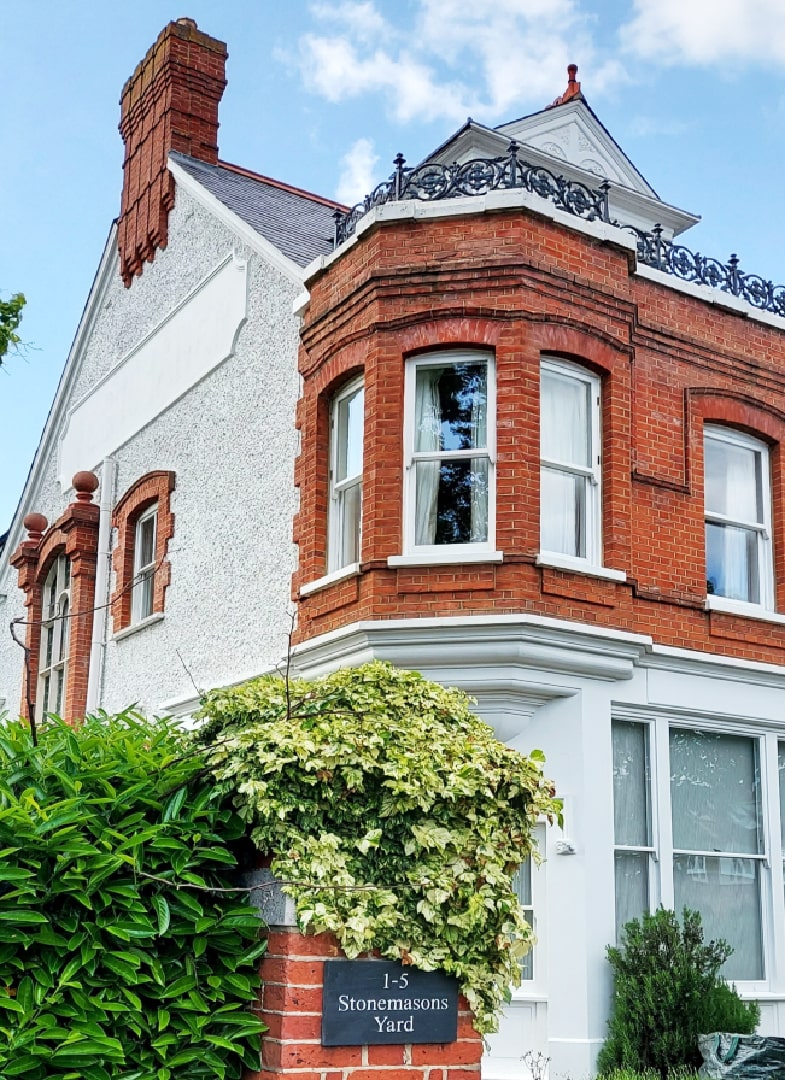

Recently, the area at the rear where the workshops used to be was developed into new housing but its heritage is reflected in the name "Stonemasons Yard".

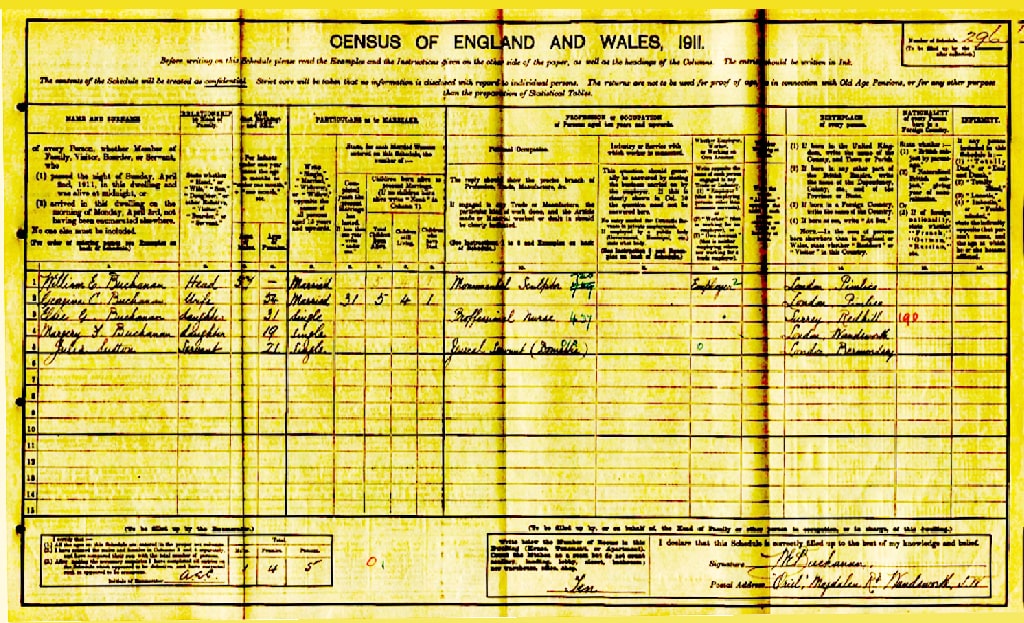
The undertaker was William Buchanan, who did indeed supply coffins and funeral arrangements but, as you can see from the census, regarded himself primarily as a "monumental sculptor".
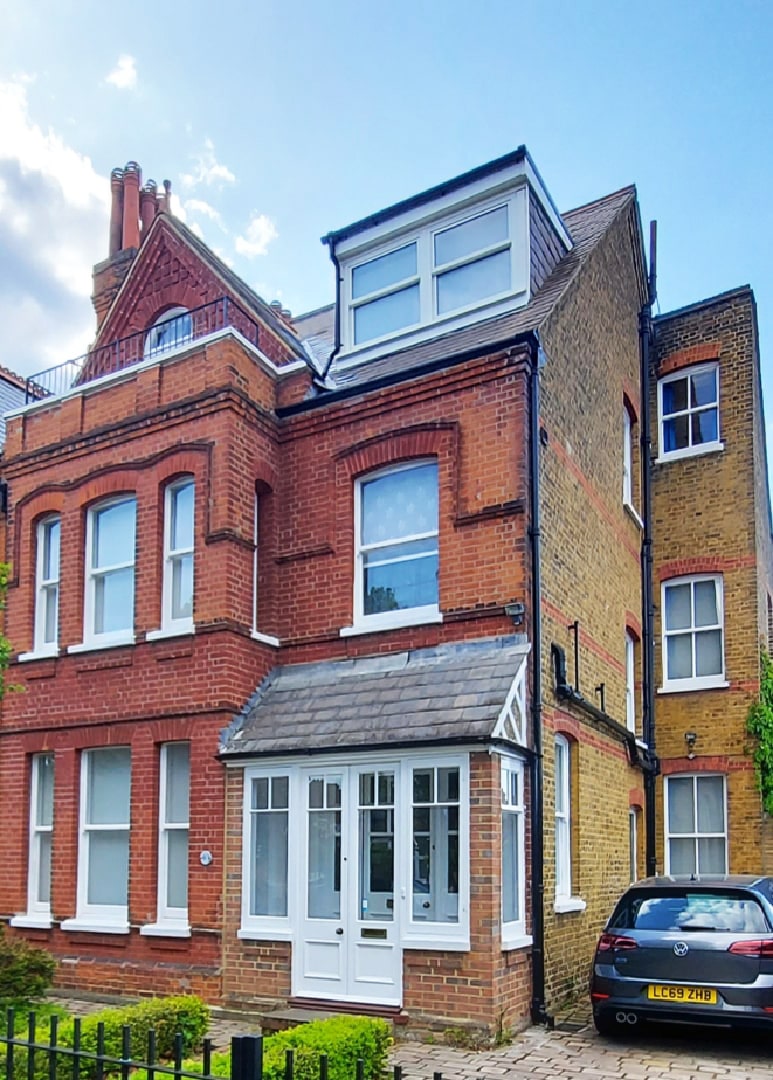


The Domain of Education

The house next door was a small private school, which Betts herself attended for a while. It emphatically did not resemble these images of children sitting straight-backed, arms folded behind their backs, or formally drilled in arithmetic:
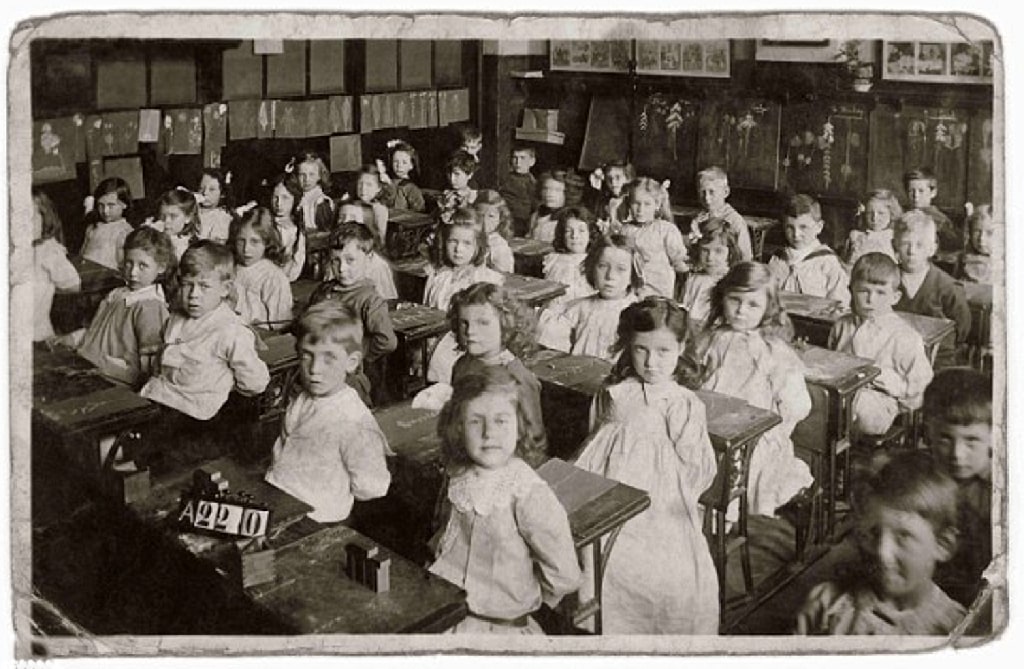

On the contrary:


Mrs Stroud's school was a sort of happy bedlam, not at all upmarket. It catered for children of all ages and both sexes, boys of kindergarten age and girls from tiny children to what appeared to be ripe woman-hood.

What made it down-market was that its pupils were drawn almost entirely from down the road. Shopkeepers' daughters went there, well-nourished girls whose fathers wielded cleavers behind butchers' blocks, or kept pubs. These were far from needy; though considered, of course, common. The school swirled with the diversity of the human genetic pool.

This was a private house . . .  The pupils were packed into the first floor and the attic that ran from front to back of the house. The place was crammed. There was no room to move. The only game possible in the eleven o'clock break, which perforce had to be spent in the classroom, was Sardines.

Nobody gave a thought to the fire risk. The undertaker's was conveniently placed next door.

Sue:

One of the teachers was a Miss Snead.
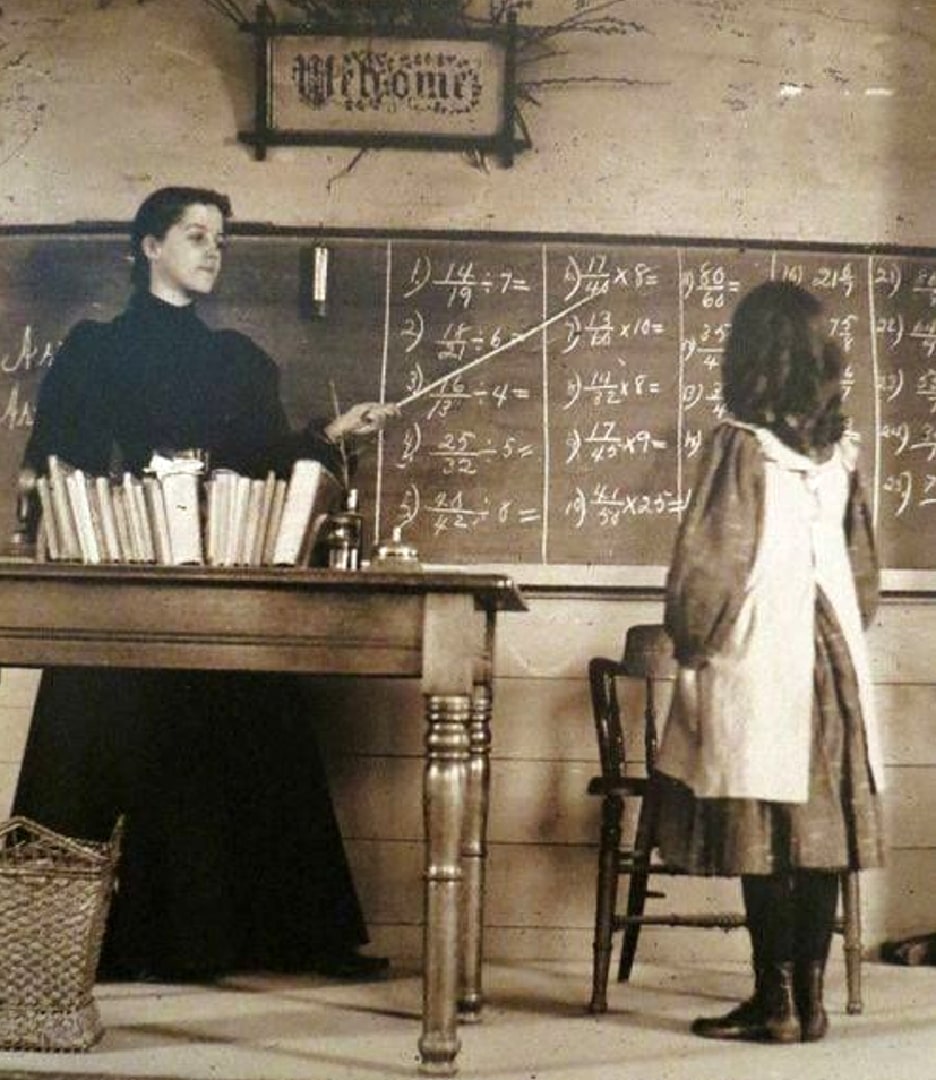


Miss Snead was the sort of person you have to look at when they pass you out of doors. She would be in her later forties, tall, thin and rectangular. Her face was a yellowish brown, with dark eyes and black hair above a high forehead.

Seen from the front she appeared to be a sketchily articulated series of oblongs, some longer and thinner than others, the head almost square. But these rectangles were not in parallel with one another, nor did they move to the same rhythm.

There was a touch of wryneck about Miss Snead — the head a little tilted to one side, the face on yet another plane, the lower part pushed forward, the lips stretched in a contained smile over uncountable false teeth.

She was like a cluster of metal mirrors set at different angles, jangling together as they flashed uneasy light into the eyes of strangers.

She could have scared crows.

Stephen:

The "real" Stroud family were actually called Wood. Emmeline Wood was the Schoolmistress and her husband Walter was an optician. Their daughter Molly was 2 years old at the time of the 1911 census.
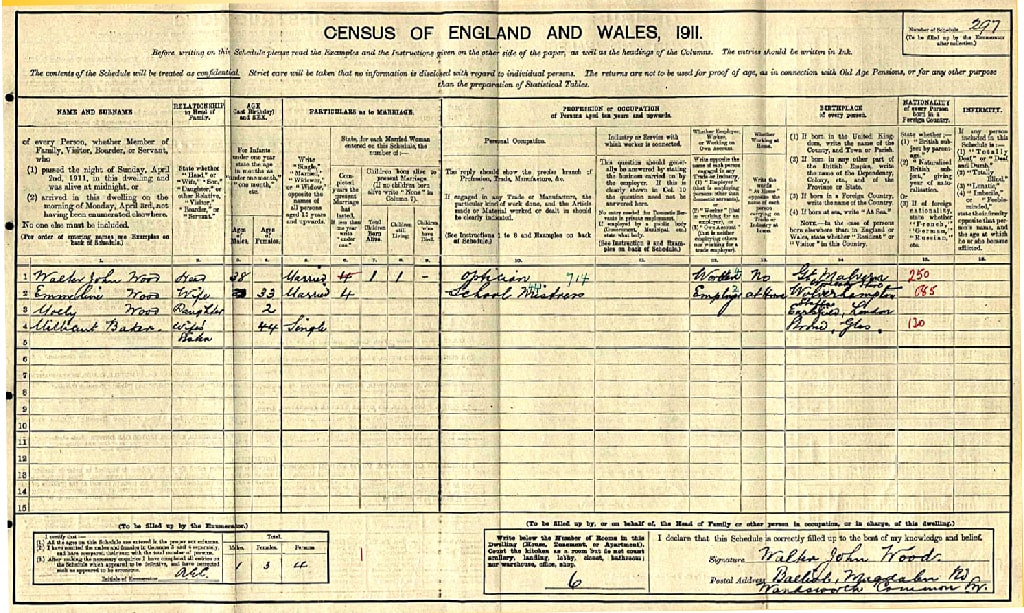

Betts writes about Molly and we learn that, like many of Betts's young acquaintances, she died young, succumbing to Black Measles in 1915. (Black Measles is a severe form of measles characterized by dark eruptions caused by bleeding under the skin.)
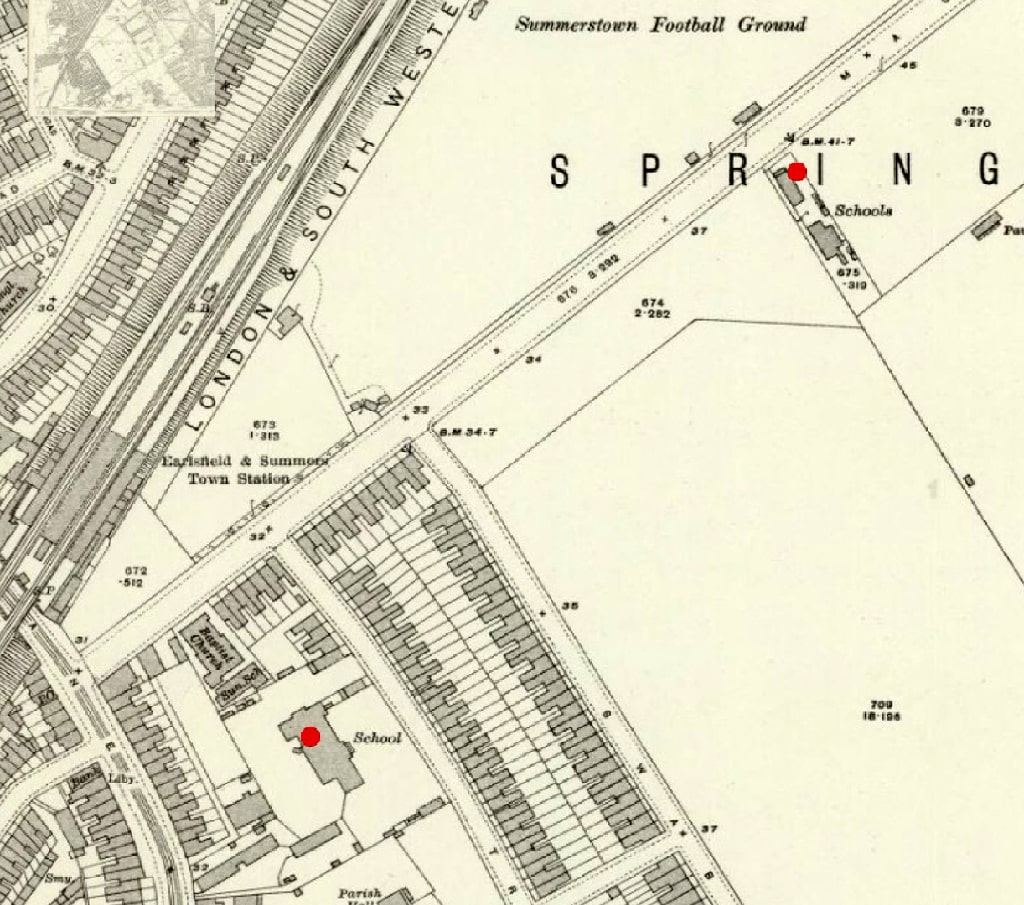

There were two further schools "down the hill".

The small school buildings halfway down that we can see on this 1916 map were replaced [in the mid-1930s?] by the present-day school premises. It was called Magdalen Road school and was initially for infants only. It later became Beatrix Potter.

The school at the bottom of the hill was one of the many "Board" schools that sprang up following the 1870 Education Act. Initially known as Tranmere Road School, it is now Earlsfield Primary.


The Board school was for pupils drawn from the nether regions at the bottom of the hill who were too poor to pay for fees, though some of the more ambitious parents, according to my mother, scraped together fourpence a week to pay for violin lessons.

She was full of a sort of exasperated pity for these needy little aspirants scraping away on their tinny fiddles till their fourteenth birthday pitched them empty-handed into the nearest factory, which was a smelly one.

I never knew what was made there. Something to do with glue, I think, or gas.

Stephen:

The smelly factory that children would move onto from school might well have been the horse-slaughtering business run by Harrison and Barber. They had seven depots throughout London, which killed 26,000 horses a year.

The one on the banks of the Wandle, just off Garratt Lane, was the largest of them and included a complete refrigerating plant in which two hundred and fifty horses could be stored:
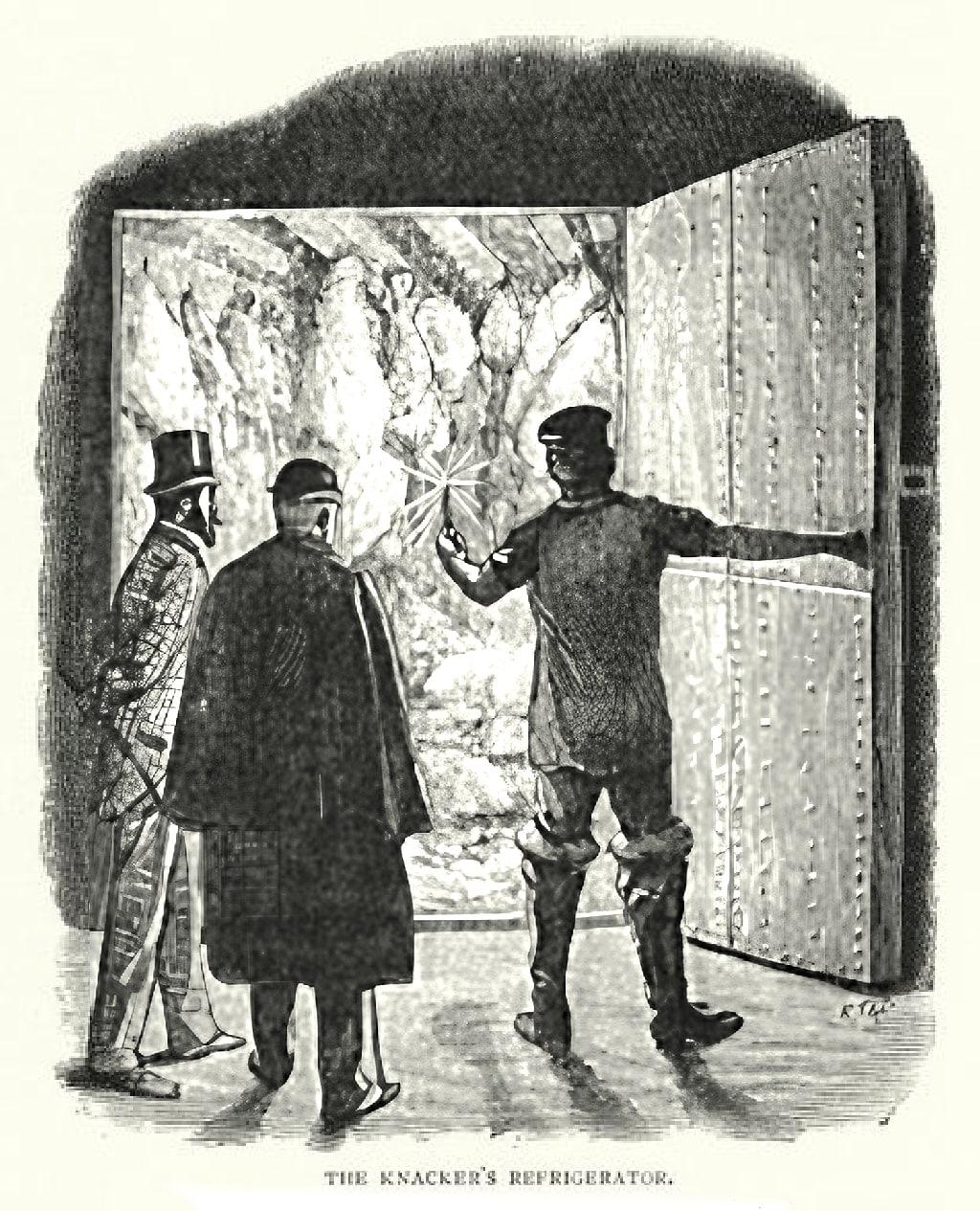

No piece of the poor animal went to waste. Meat was set aside not just for cats and dogs, but also for human consumption. Associated industries on site included a chemical manure factory and facilities for bone crushing, glue production and fat melting.

No wonder it was smelly!

The Domain of Madness


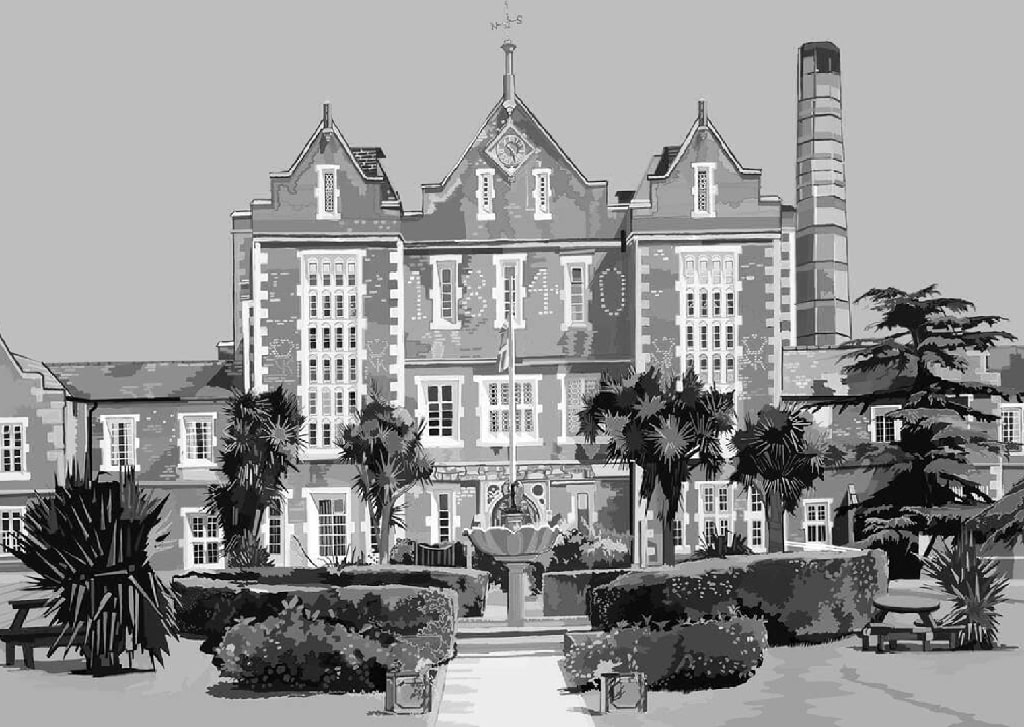
Madness was accommodated in the large lunatic asylum, with its own farm, not far from the Common.

In the days of my youth there were not euphemisms for mental disturbance. If you were mentally ill you were mad and if you were mad you went to a lunatic asylum and no messing . . . .

In my own day no especial horror stories came out of the asylum. There were high walls round the grounds.

Stephen:

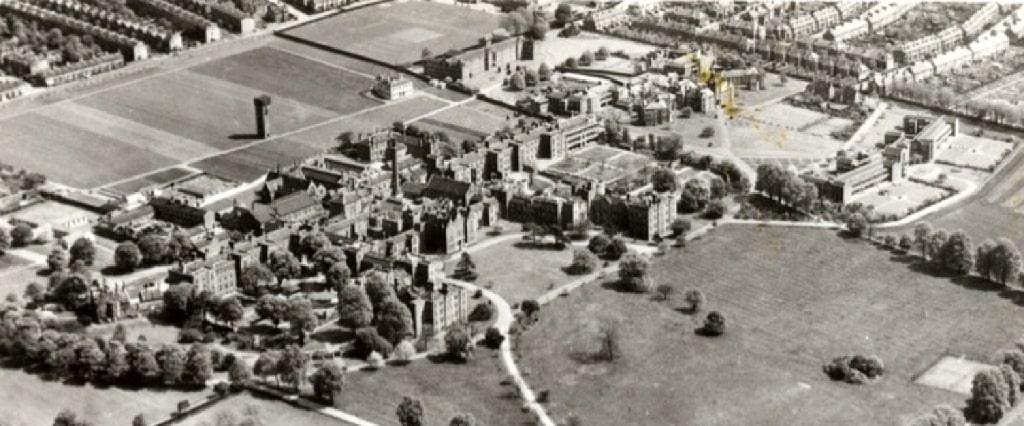
The Surrey County Lunatic Asylum first opened in 1841 on a 97-acre site bought from Henry Perkins, a wealthy brewer, who had himself obtained the freehold from the 2nd Earl Spencer.

The asylum was intended to serve the pauper population of rural Surrey and could initially accommodate 350 patients.

It was supported by a large farm including a massive kitchen garden near the central kitchens.

In 1895, a separate annexe for "Idiot Children" was created in order to remove children from the main wards within the hospital. John Langdon Down, famous for his description of the condition now known as Down syndrome, advised on the layout of the Annexe.


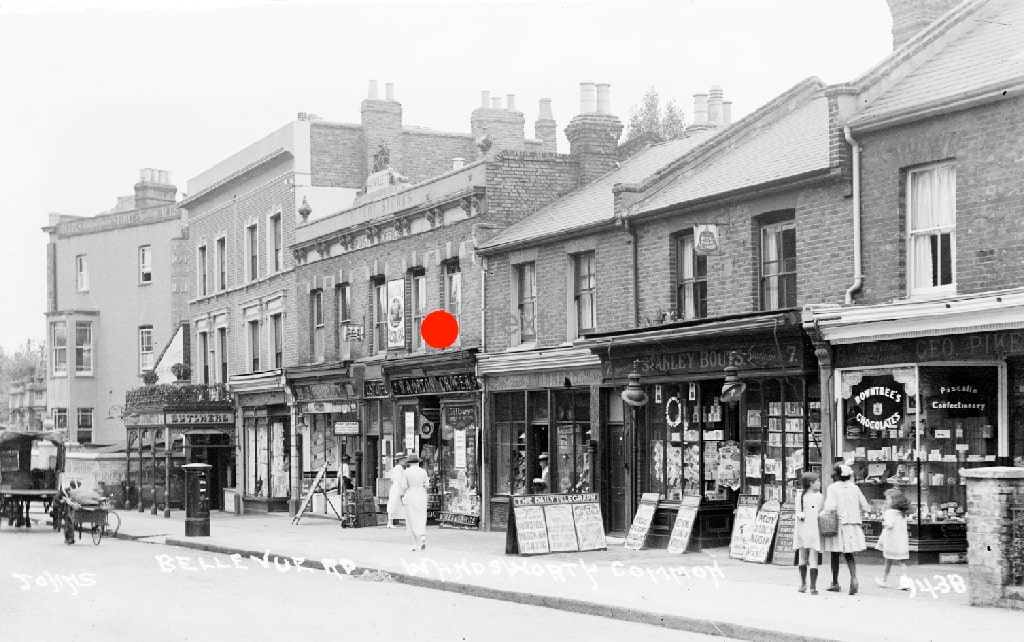
Sometimes a happy band of more or less presentable inmates would issue forth in the care of their keepers, busily chattering . . .  Their enjoyment was intense. They were mostly, if not all, female, with bright excited eyes and frizzy grey hair, darting jubilantly in and outof the parade of shops facing the Common, clutching small purchases.

'They always buy sardines,' my mother said, and it was true: fourpenny tins of sardines gleamed in their hands as they emerged, discarding paper bags, the afternoon light blazing back from their shining eyes.

Stephen:

The parade of shops is, of course, Bellevue Road, and the shop from which they bought the sardines might well have been the grocers at no. 5, run at the time, by Mr Alfred Davis.

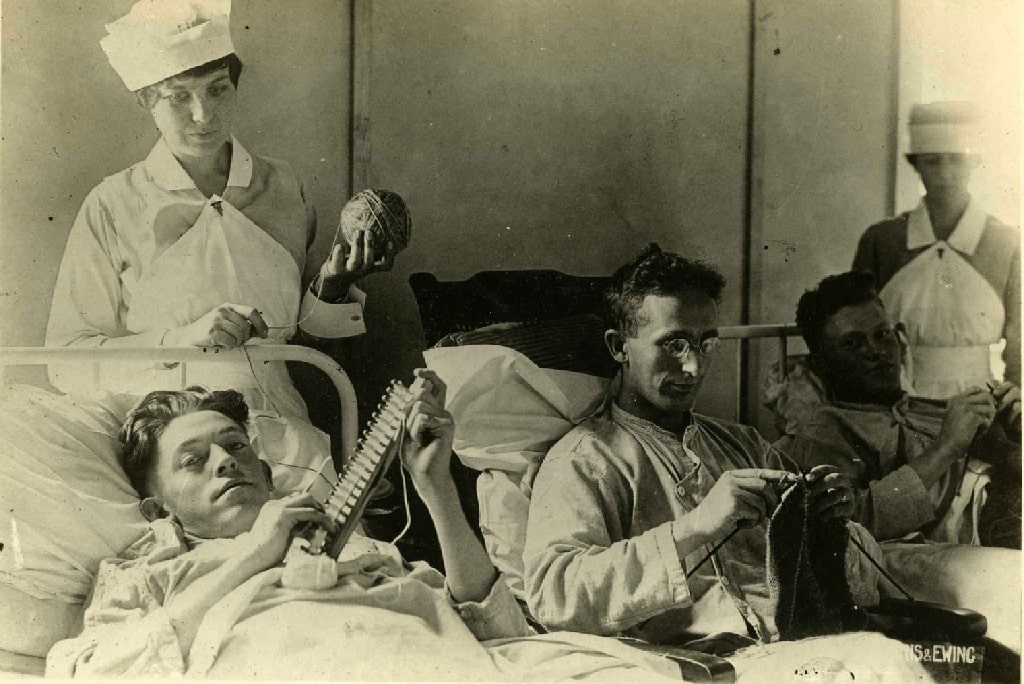
During the First World War, part of the asylum became the Springfield War Hospital, and a Neurological Unit was established in the Annexe for patients with shell shock or "loss of mental balance". Along with King's College Hospital on Denmark Hill, it became one of the principal reception centres for those sent home from the front in France.


The Domain of Crime


The façade of the prison was sombrely impressive, a fortress. It had a huge main gate like the gate of a medieval castle . . . 
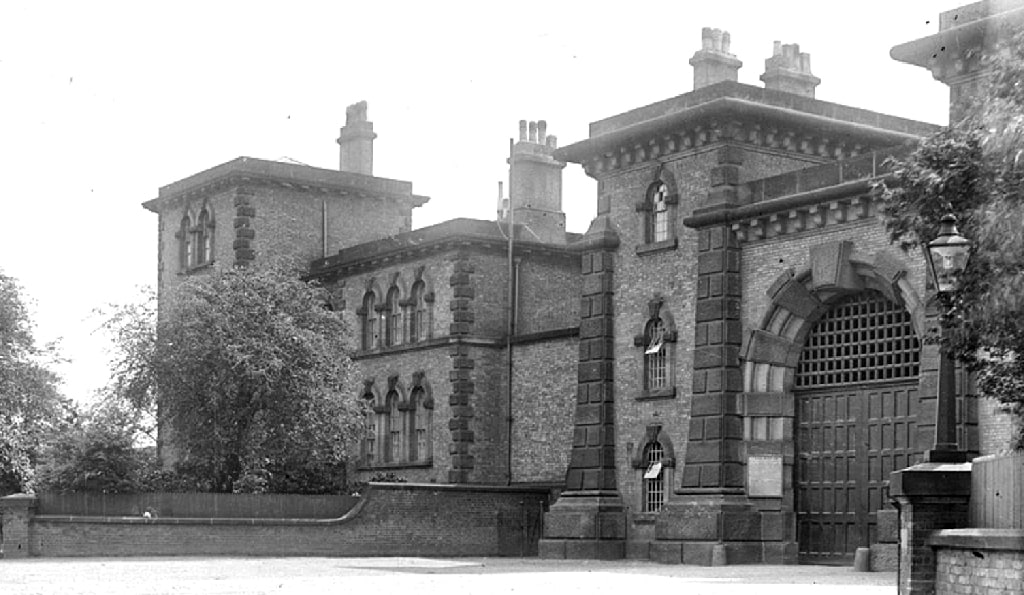


The domain of crime was the prison which, with its ancillary buildings, was as big as a village, whole streets of warders' houses and big houses with gardens for the Governor, chaplain, doctor. There was a cordon sanitaire of open ground around it, leased off to bowls and tennis clubs.

Opposite our house was a rough field with a footpath leading away into the prison hinterland whence sallied forth at times a hooligan family of red-haired boys, warders' children to terrorise clean little prep schoolboys in their grey flannels. Neighbours tut-tutted about these boys, who seemed ripe for imprisonment themselves . . . 


On winter mornings before it was light on the day of an execution there would be a clippety-shuffle noise on the pavements outside our house. It was the sound of the leather-shod or hobnailed booted people from the bottom of the hill coming up to watch outside the prison in time for the execution at eight o'clock . . . .
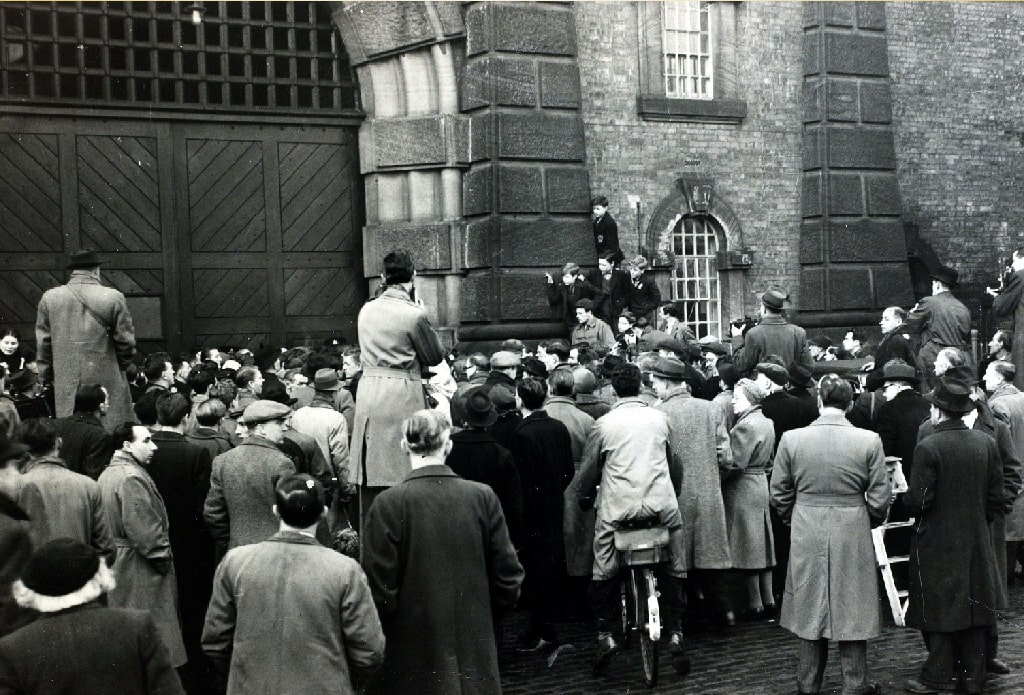


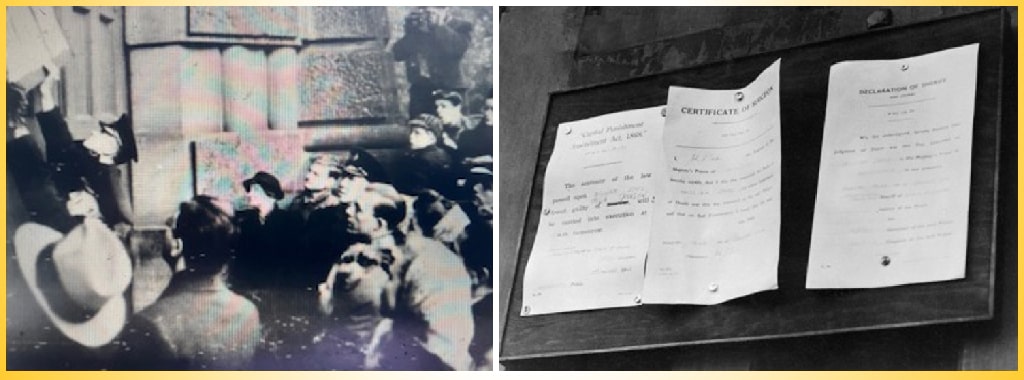
When notice of the hanging was posted . . . a communal collective exhalation would go up from the crowd . . . I thought of this enormous sigh as the last breath of the hanged murderer, all the breath that had ever been in his lungs going out into the world without him.

Stephen:

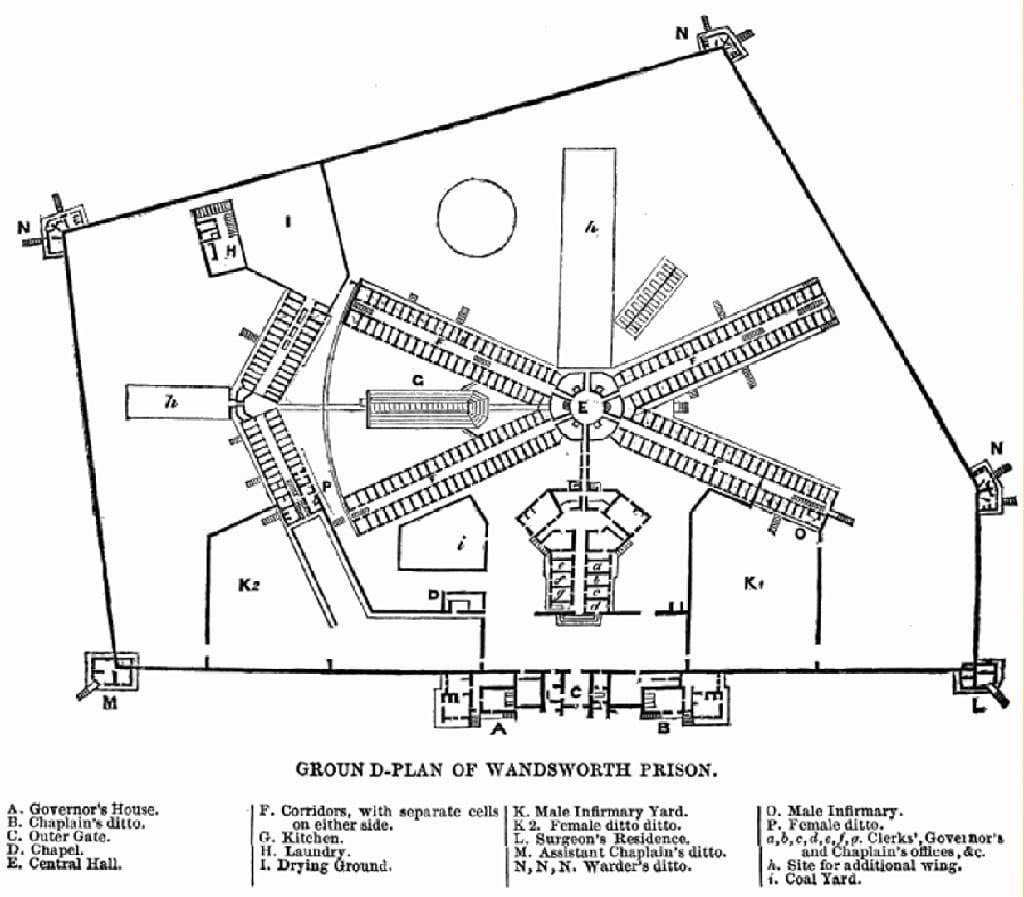
Wandsworth prison opened in 1851 as the Surrey House of Correction.
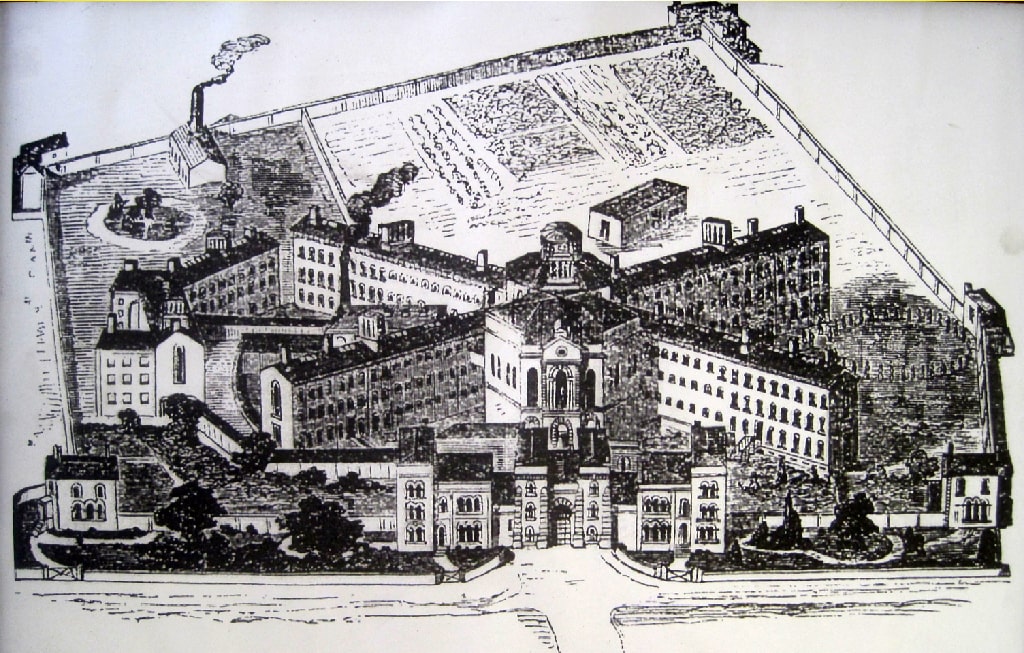


It was initially designed to hold 1,000 prisoners, with four wings accommodating men and a separate building which housed women up until the late 1800s.
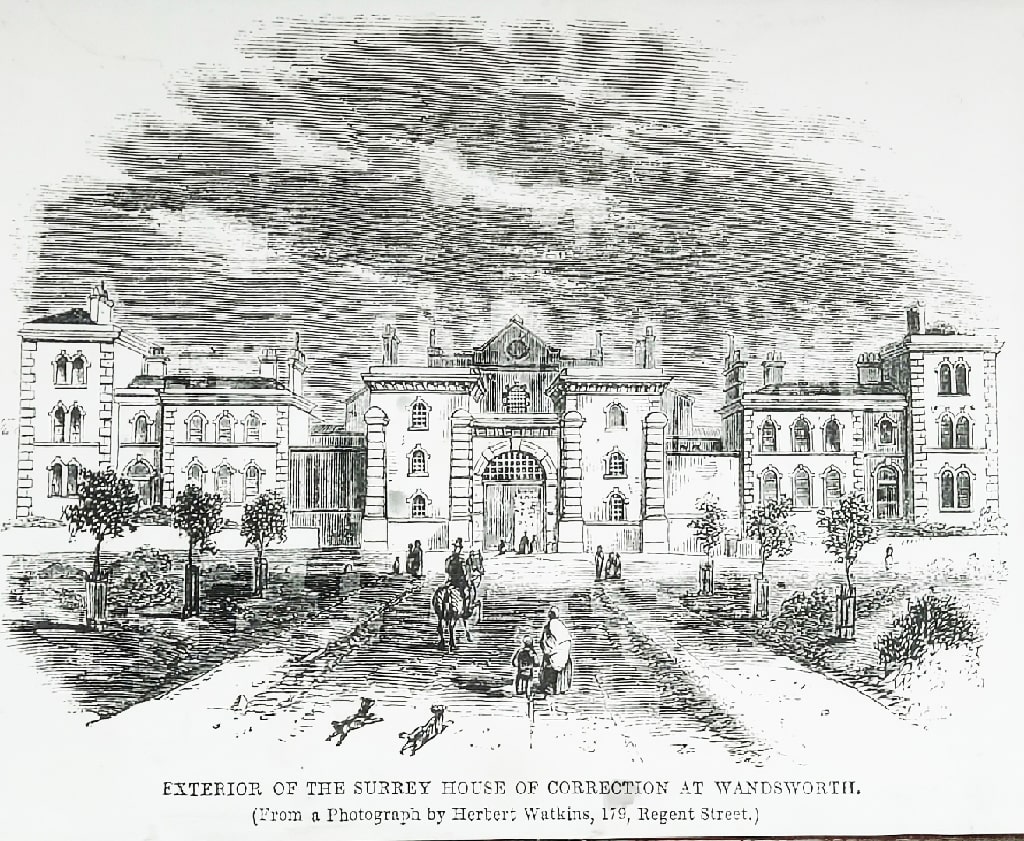

This view shows the approach from Trinity Road along the now lime tree-lined Heathfield Avenue.

The prison was run by the County of Surrey until it was nationalised in 1878, at which point it became the' hanging prison' for south London. A total of 135 executions took place at Wandsworth prison until capital punishment was finally abolished in 1969.

This is a picture of Kate Webster's execution, the only woman ever to be hanged at Wandsworth, in 1879:
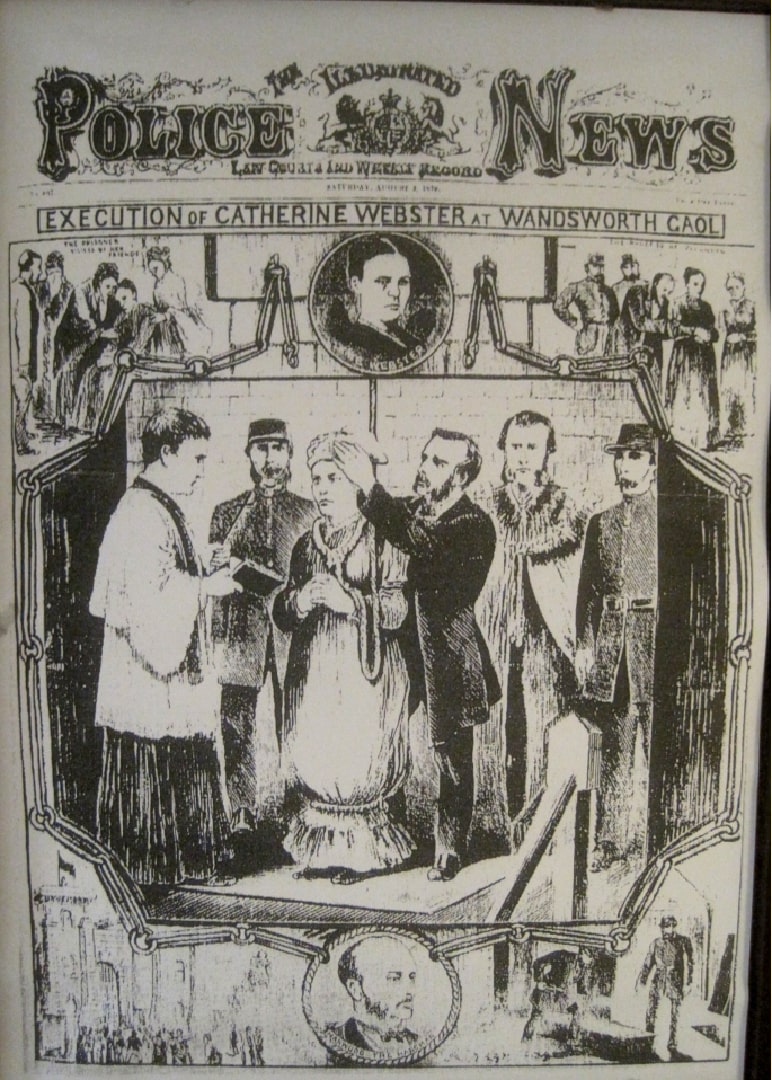
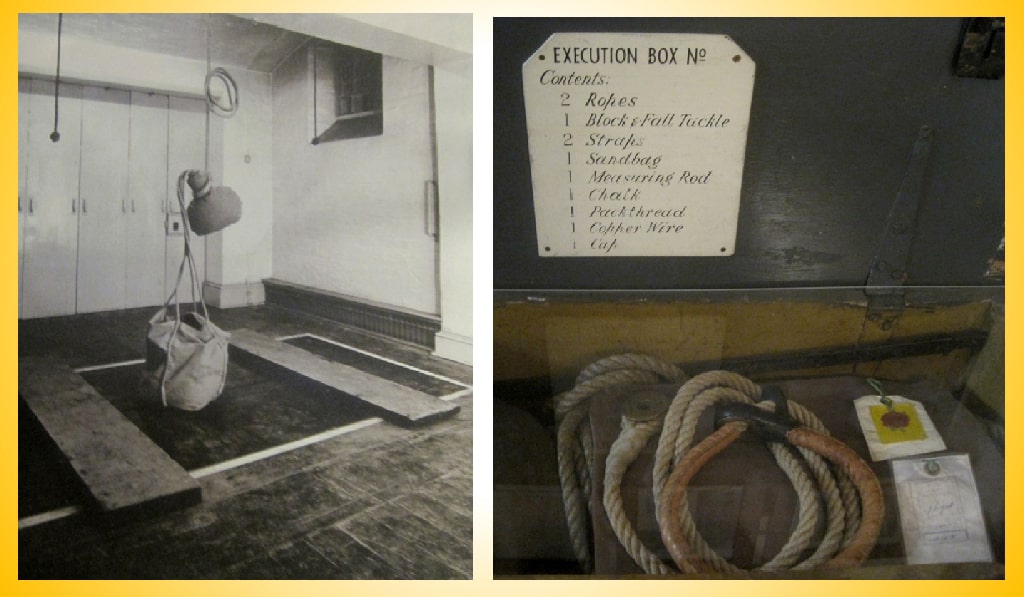

The prison retained a working gallows, tested every six months, until it was finally dismantled in 1993.
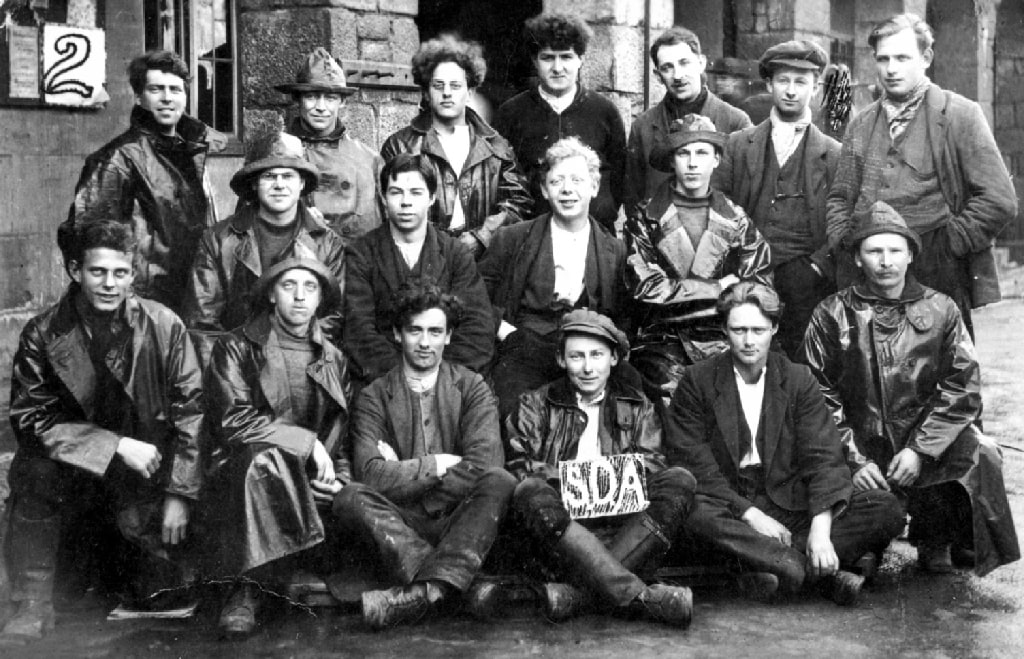

During the First World War, the wing that used to make up the women's prison held conscientious objectors (shown here) but also absconding squaddies from the British, Canadian, Australian and New Zealand armies; upwards of 200 Irish Republicans following the Easter Rising in 1916 and spies.

The only spy actually to be hanged at Wandsworth during the first World War was this man, Robert Rosenthal:
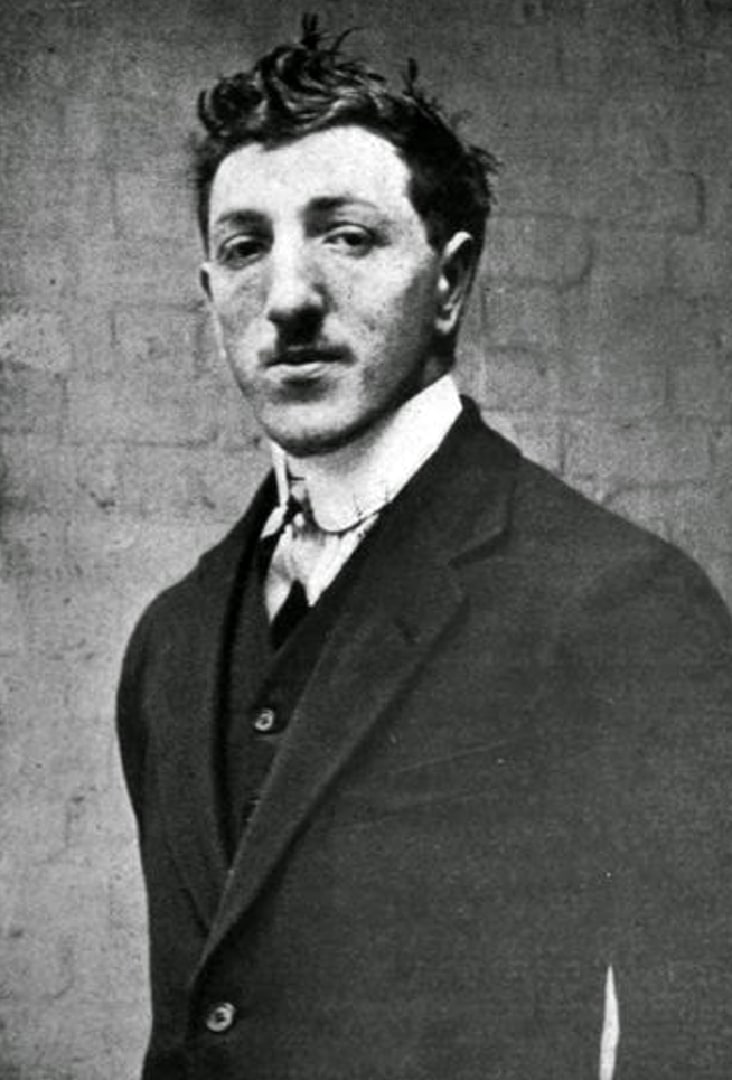

Eleven other men convicted of spying were initially held at Wandsworth until they were transferred to the Tower of London and shot by firing squad.


The Domain of Wounds


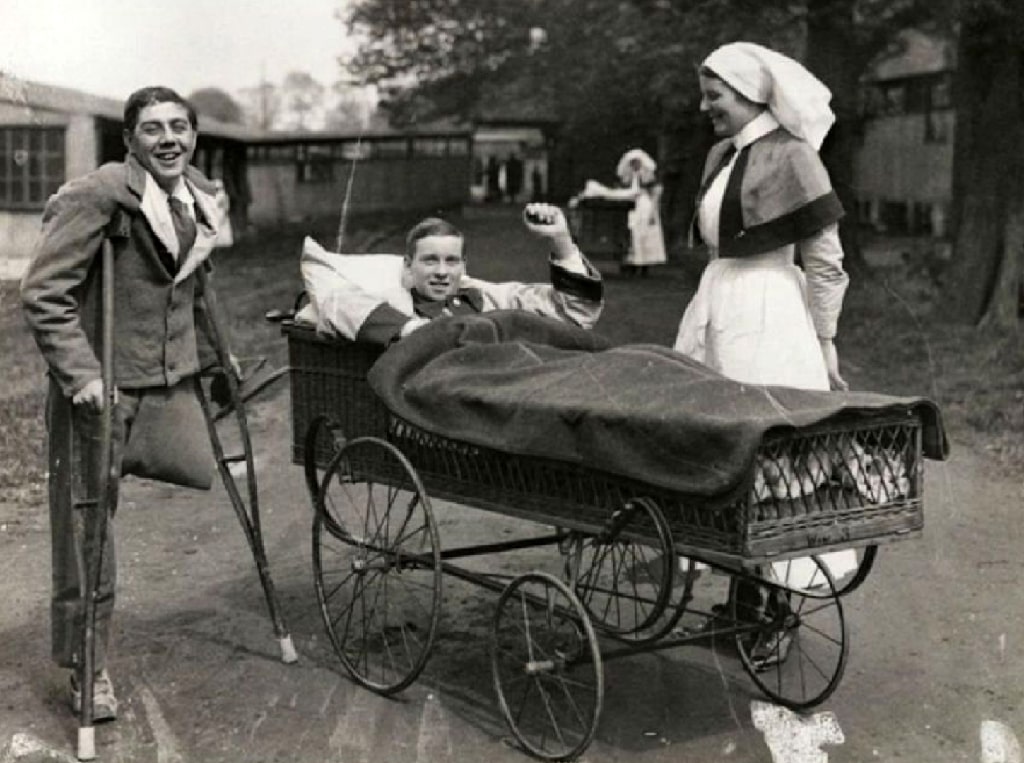
The walking wounded from the military hospital wore bright blue jackets and trousers of a hairy flannel that was not pressed or tailored like a uniform. It had a cosy look about it, more like a bed jacket. Their shirts were white and their ties were bright red. They were hatless.

They humped about on crutches or on two sticks. They wore an arm in a sling or were minus a leg or bandaged round the head. Some showed no visible signs of injury. On fine days they lurched and hirpled about the Common. Most of the benches would have tw o or three wounded soldiers in their hospital blue, resting, when the sun was shining.
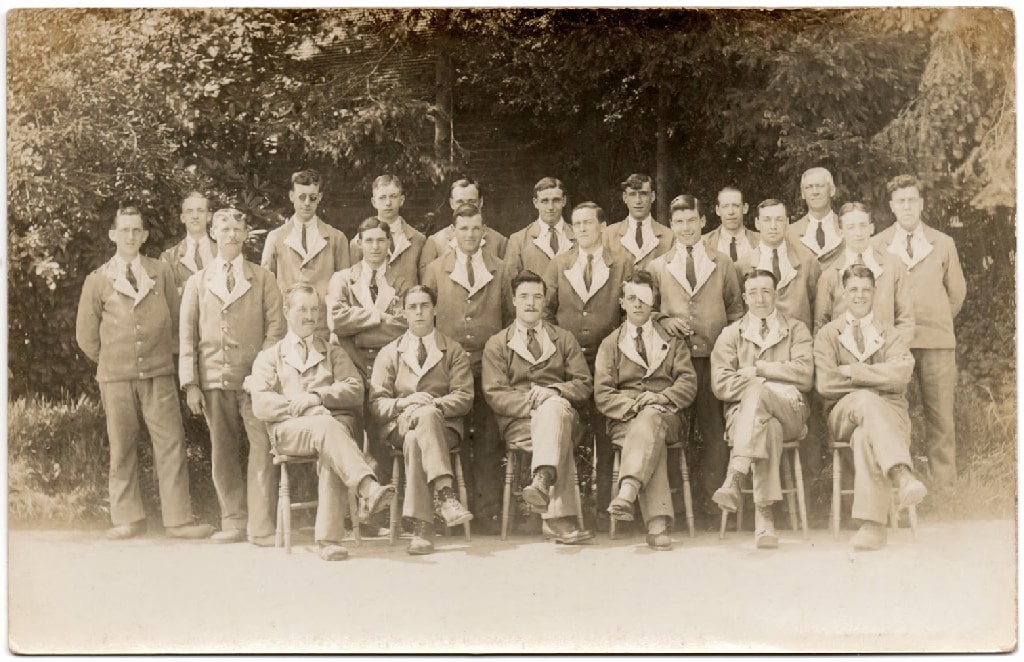


When they looked up as I scudded past them on my scooter, they did not look sad. They smoked cigarettes and seemed contented enough. But these were the ones who were not going to die.

Stephen:

The "military hospital" was the 3rd London General Hospital, housed in the Royal Victoria Patriotic School. The school had been built after the Crimean War to educate orphaned daughters of servicemen. It needed considerable alteration in order to be suitable for its new function but by the time the first patients arrived in September 1914 it was up and running as a hospital of 200 beds.
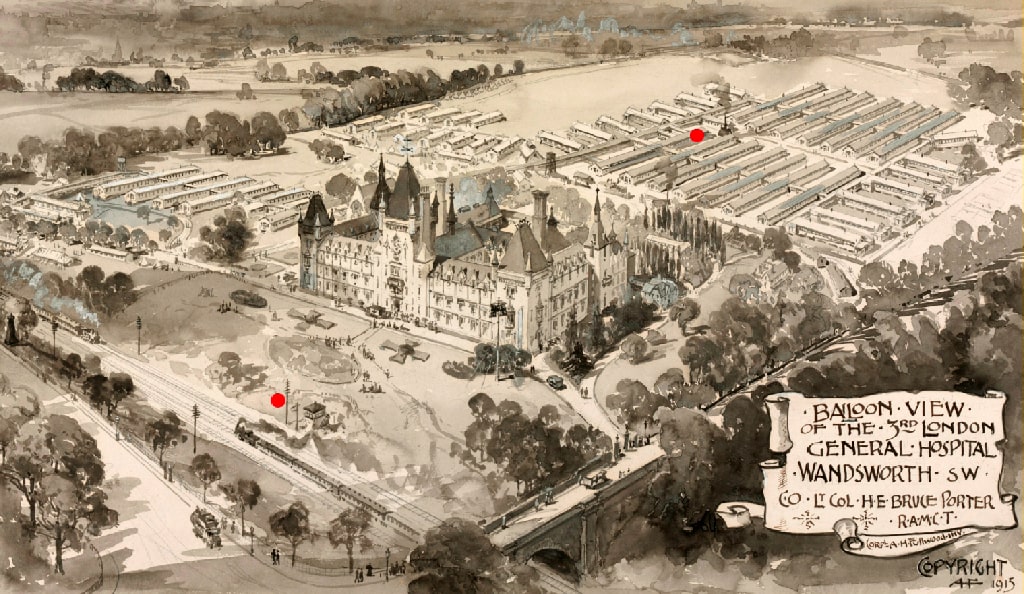

There was soon a need for more accommodation and hutted wards were built in the grounds. This area became known as "Bungalow Town" and by 1917 housed 1,600 patients. You can see it spreading over what we now know as the cricket field, next to the Skylark café.

Patients usually arrived by train. Initially they were picked up at Clapham Junction station but later at a special temporary station, here at the bottom of the picture.

Over the course of the war more than 62,000 patients were treated at the hospital.

The Domain of Death


Down this road on winter afternoons came the military funerals . . . These were the funerals of the soldiers who had died of wounds in the military hospital up the road . . . They went at a measured pace, the hooves of the horses . . . clopping soberly by. Behind the pairs of horses came the gun carriage with its coffin draped with the Union Jack. There were mounted soldiers, khaki-clad, useful-looking riders without ceremonial trappings . . . 

The procession would go by, down the hill into the wintry afternoon with its faint foggy smell that gripped your throat if you were out in it. It was the smell of coal fires and winter. The sky, when the cortege had gone out of sight, would be smoky grey with red streaks over the low-lying ground beyond the cemetery.


Those afternoons were very quiet. I would wait.

Then faintly the bugle would sound, final and sad, the lamenting never-coming-back notes of the Last Post.

It seemed to me a dark, smoky, red slash of sound against the quiet grey of the London winter evening coming down.

Stephen:

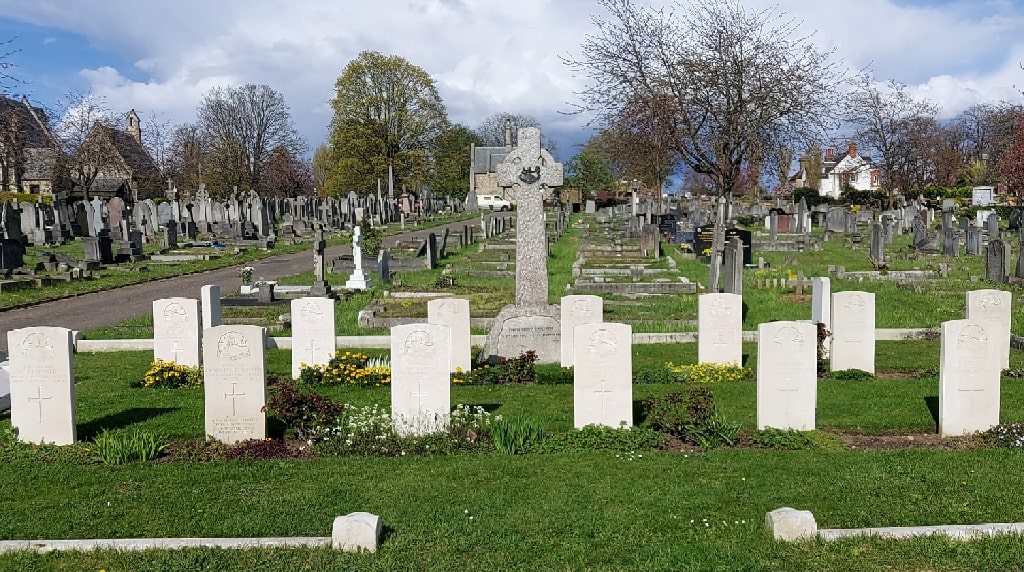
Wandsworth cemetery, which lay only a few yards from Betts's home, had been opened in 1878.

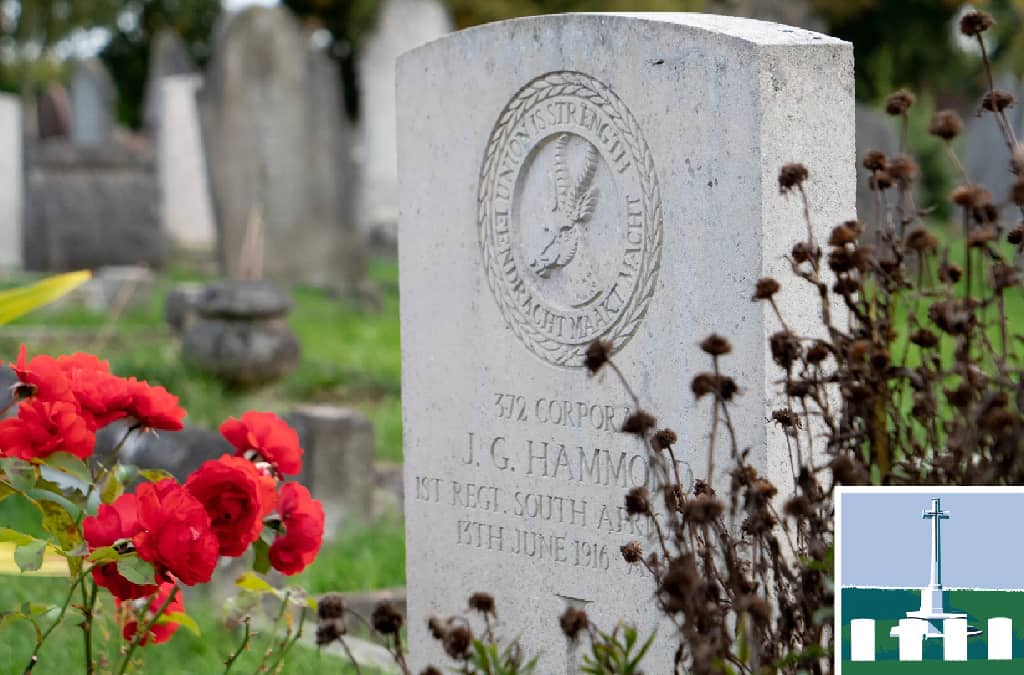
There are 475 servicemen of the First World War buried in the cemetery from all over the Empire. There are South Africans, Australians, New Zealanders, one member of the Indian Army, and a number of Canadians.

A particularly moving group of graves is that containing soldiers and one nurse from Newfoundland.

All so very far from home.
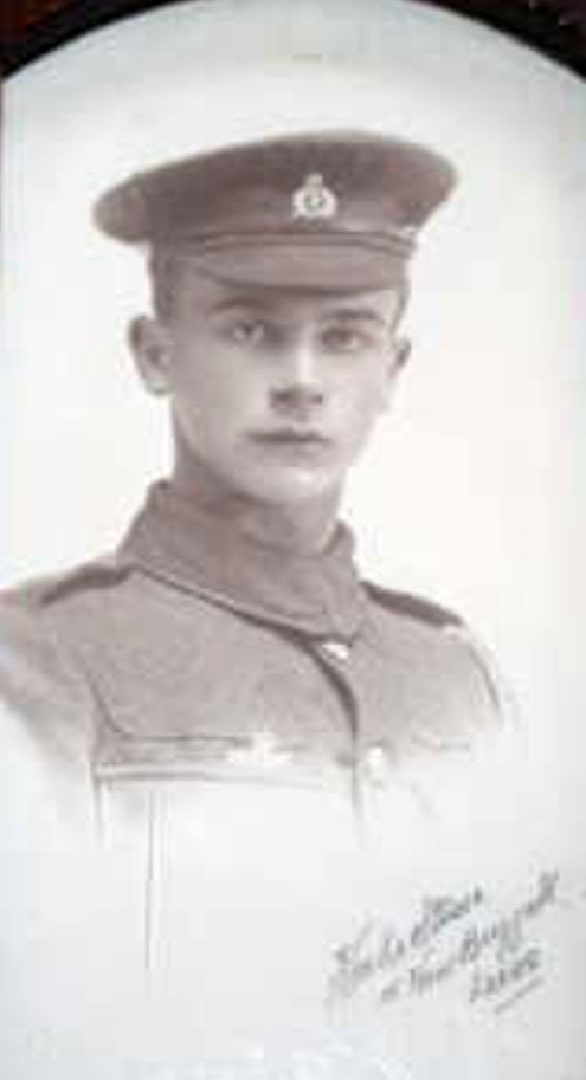


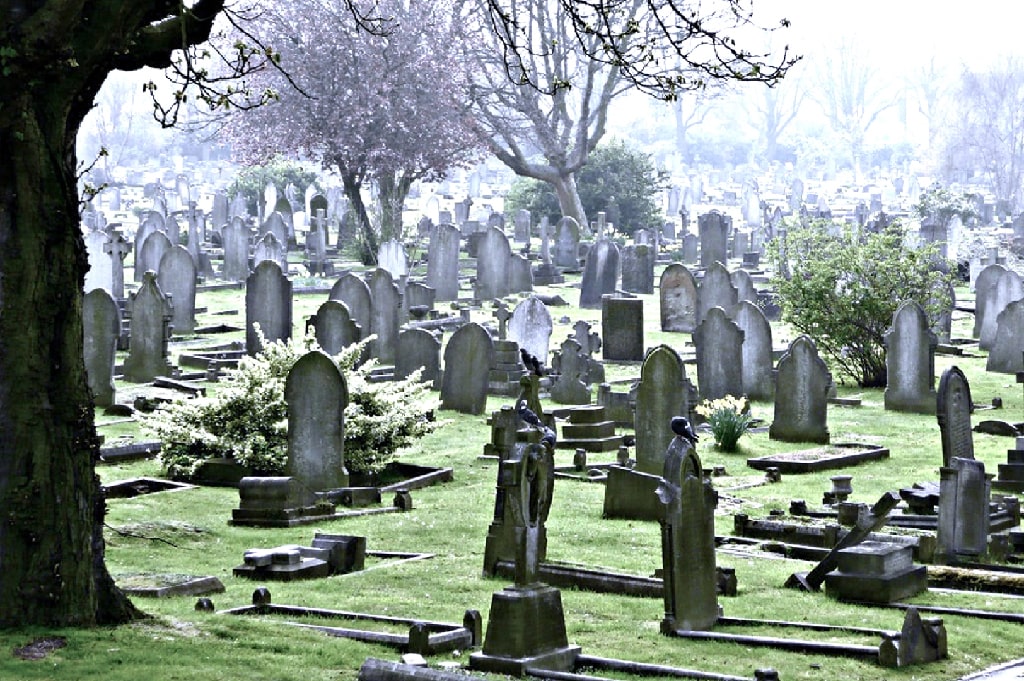
At the beginning of the war, when I was small, there had been several young subalterns who had come to the house to say goodbye to my mother before they went away to fight . . .  One had a sword. You could see he was happy. You could see he loved having a sword to wear. Just for a moment you could see he was not quite a man yet, only a big boy like the scouts who sometimes made dens of branches in the field.

At the end of the war, suddenly, I remembered him, half a lifetime away. I asked my mother:' That soldier who came to say goodbye at the beginning of the war, what happened to him? He had a sword.

'' That must have been Colin Cowper. What a good-looking boy he was! . . .  He was killed in the autumn of 1914. He was only twenty.

I saw the sword drawn in his hand, saw him hit and saw him fall, saw the bright sword fall from his hand, point down into the mud, and be lost like a spoon in a jar of jam. There it had fallen and there it lay still, rusted, the bright sword.
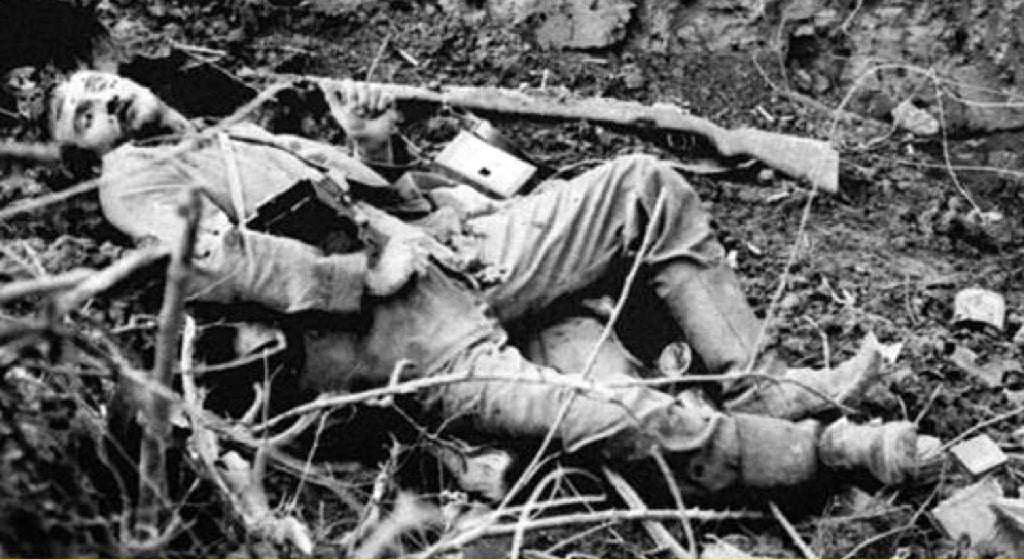
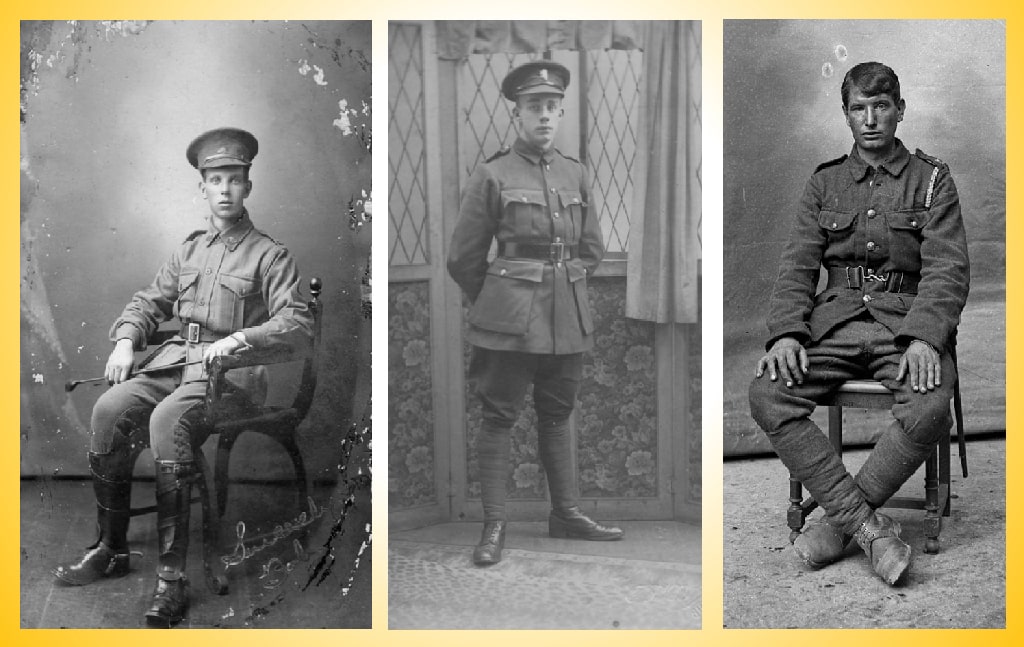


This was a time of sadness and weariness among the grown-ups.

After four years of a heart breaking war there was scarcely a family not touched by loss. Three younger cousins of my father' s, brothers, had all been killed.

In neighbours' houses there were so many photographs of dead young soldiers looking out from silver frames. I used to look and look at the eyes of these soldiers, wondering what they had seen . . . 


As for those at home, life had gone grey for them, Everybody was tired and few were well nourished.

When the great influenza epidemic struck, its victims offered little resistance. Those who died were often in the prime of life. Those who survived suffered from terrible depression.


I lay in bed one early morning and considered my situation. All around were gloomy grown-ups, always grumbling about something. They seemed abstracted and anxious if not actively disagreeable . . . 

I found I was humming under my breath. The humming came up louder.
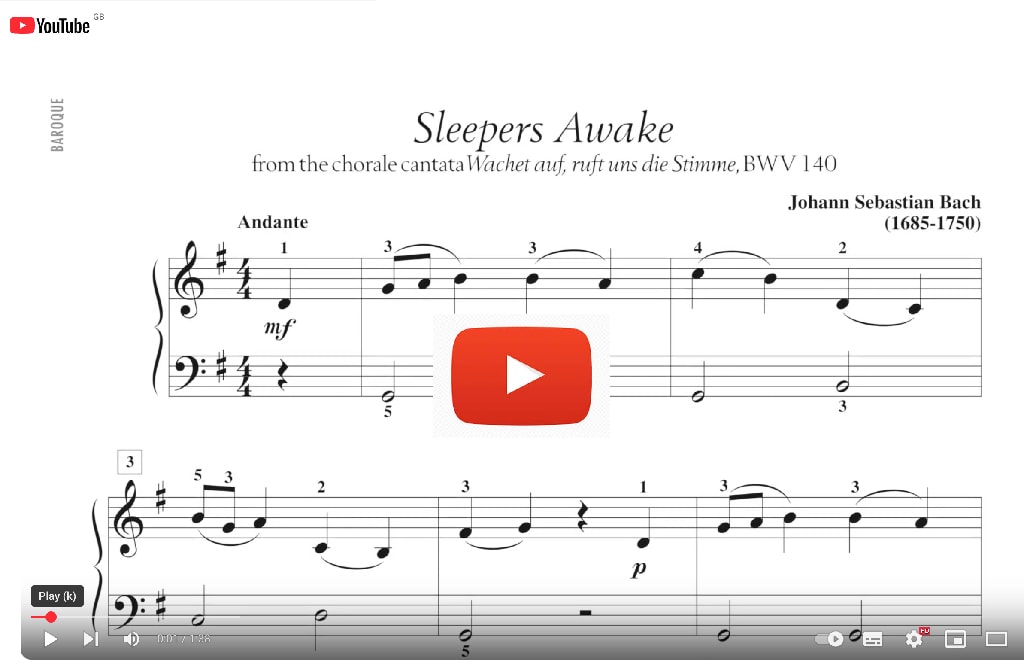

Click on the score to hear the music.


It was Sleepers Awake, splendid and heartening.

I hummed louder — I had no idea of the words — only the invigorating notes sang out, full of hope and courage. From his bedroom my father shouted at me for God's sake shut up. I shut up, but only slightly.

I still sang under my breath and felt suddenly wonderfully cheerful. Things were not so bad, really . . . .

Life was not so bad if one did not take it too seriously. One could hand it out as well as take it.

Sleepers Awake!


Stephen:

This resilient and spirited attitude towards life and her determination not to "take it too seriously" stood Betts in good stead in future years . . . 


At this point, let's take a break.

Sue:

We thought our quest for P.Y. Betts was complete. But it led us to wonder what had happened to Christopher Hawtree. How had he come to meet Betts? How had he persuaded her to write a book? What had happened to her?

And so another quest began . . .


Chronicles

August 2025

Part Two


What Lies Beneath?

(Click on image to enlarge)


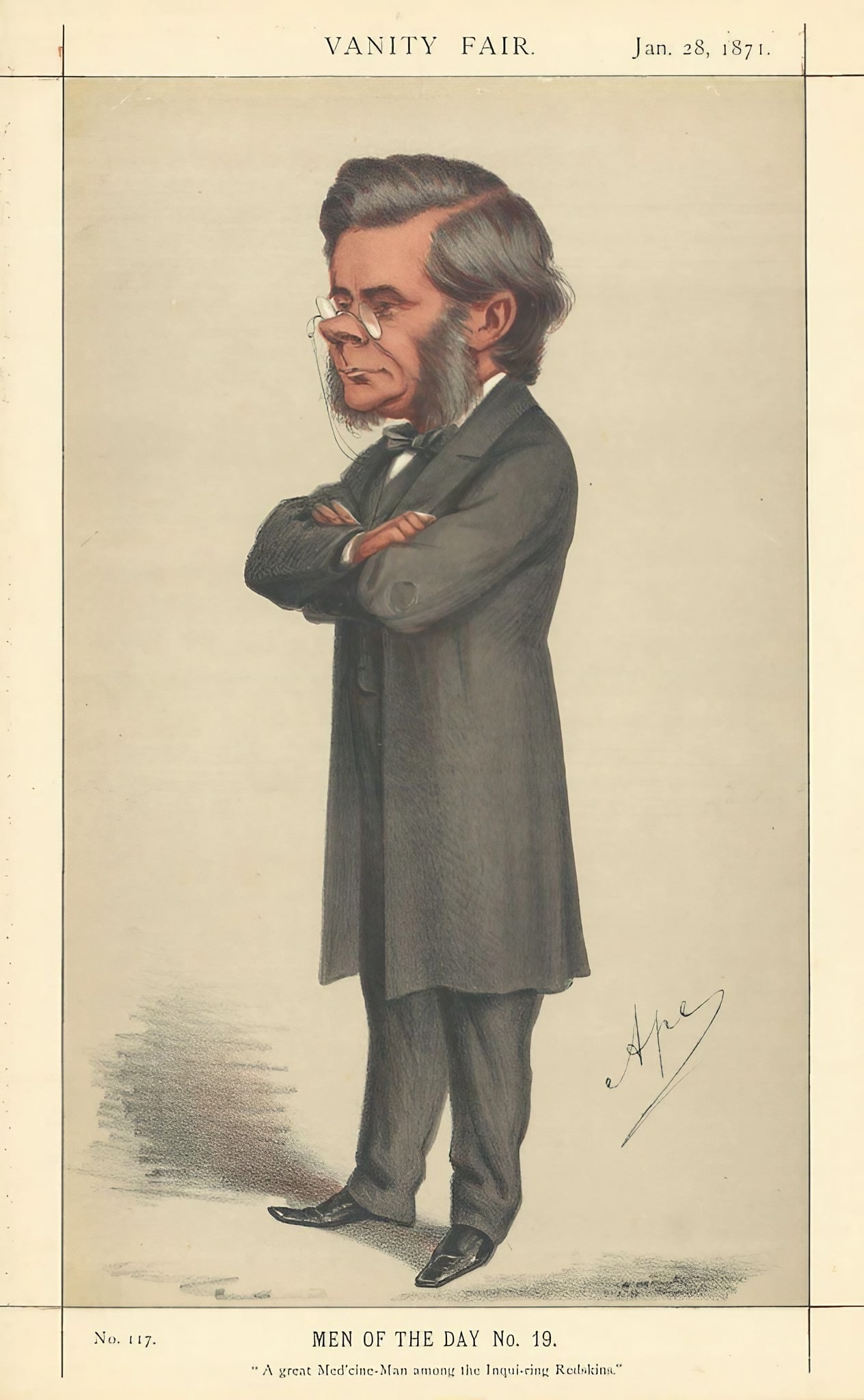
In last month's Chronicles (July 2025) I mentioned how Thomas Hardy became acquainted with the great Victorian natural scientist Thomas Henry Huxley at glorious garden parties at Knapdale, not far from Wandsworth Common at today's Tooting Bec.


Thomas Henry Huxley: "A great Med'cine-Man among the Inqui-ring Redskins" by "Ape", Vanity Fair (28 January 1871).

(Click on image to enlarge)

Huxley is often referred to as "Darwin's Bulldog" for his robust defence of the theory of evolution by natural selection, then under seige. Huxley's reputation was chiefly made by his apparent* trouncing in a debate debate at Oxford in 1860 of Battersea-born ("Soapy Sam") Wilberforce (1805-1873), Bishop of Oxford and son of the anti-slave-trade MP William Wilberforce.

Widely known as "Soapy Sam" (thanks to what Disraeli memorably called his "unctuous, oleaginous, saponaceous" manner), Wilberforce was born "between the Commons" in Broomfield House (renamed Broomwood House, hence Broomwood Road).

[* I say "apparent" because the reality is rather different. At the time, both sides were able to claim victory. Wilberforce was a much more intellectually capable opponent than posterity generally admits. If you want to know more, email me and I'll send some good references.]


Battersea-born Samuel ("Soapy Sam") Wilberforce (1805-1873), son of the anti-slave-trade MP William Wilberforce. By Ape, Vanity Fair, 24 July 1869.

Some time ago, I discussed the possibility that Samuel had participated as a boy in Beatings of the Battersea Bounds. Here's a map of the 5 Houses on Bolingbroke Grove — and nearby Broomfield House, where Wilberforce was born:
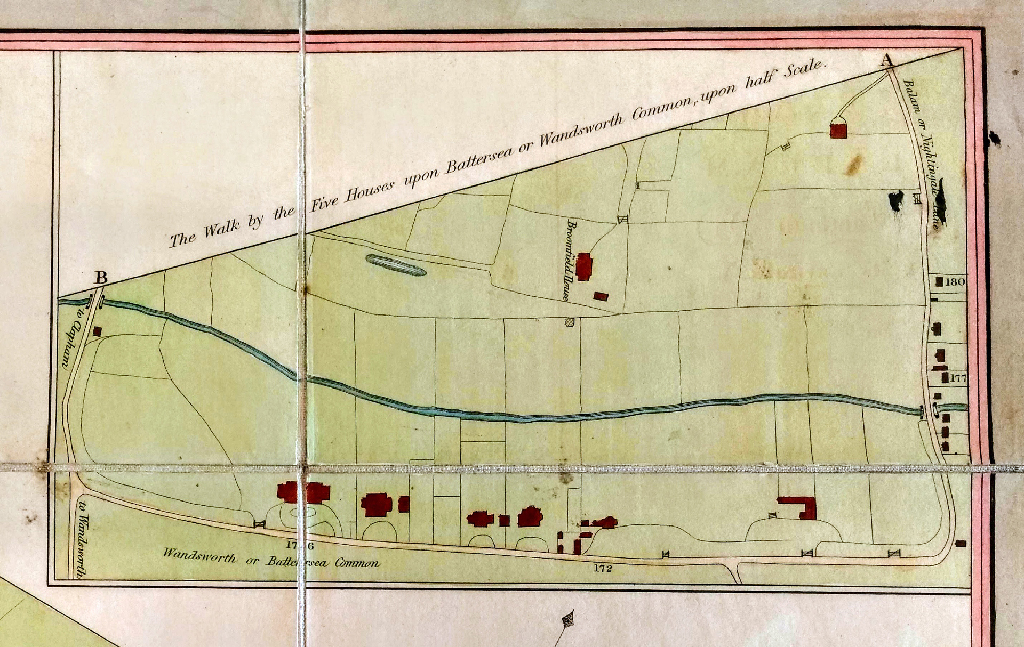


The "Five Houses" and Broomfield (later renamed Broomwood) House shown as an inset on H.N. Batten's A Plan of Clapham with the Common & its Environs (1827).

Across the bottom, "Wandsworth or Battersea Common". Bolingbroke Grove (unnamed) runs parallel to a small river, the Falcon Brook, with bridges at either end across Battersea Rise and Nightingale Lane. I am indebted to historian of Clapham Mike Tuffrey for sending me photographs of sections of this map from which I patched together a composite — thanks, Mike!
(Click on image to enlarge)

And now back to Thomas Henry Huxley . . . 

A couple of years before the Hardys arrived on Trinity Road, Alexander Macmillan published Huxley's pioneering work of popular education, Physiography: An Introduction to the Study of Nature.

Like many of his most brilliant contemporaries (such as the mathematician-engineer Henry Moseley, and our local hero John Buckmaster), Huxley was devoted to improving educational opportunities for the working and lower middle classes, not just the elites of the day.

I don't know whether Thomas Hardy knew and read Huxley's book, let alone was influenced by it, but it seems to me that it resonates with Hardy's own outlook:   the awesome powers of Nature acting not just at the macro-level — planetary, continental or national — but also at the everyday and seemingly insignificant levels. In short, that the general and universal is best understood through the individual and the local.

In place of Hardy's Wessex microscosm, Huxley's focus is on the Thames Valley. (Huxley was born not far away in Ealing, West London.)


It was necessary to illustrate my method by a concrete case; and, as a Londoner addressing Londoners, I selected the Thames, and its basin, for my text . . . 

In very broad, but, I hope, accurate, outlines, a view of the "place in nature" of a particular district of England, the basin of the Thames; and to leave upon their minds the impression that the muddy waters of our metropolitan river; the hills between which it flows; the breezes which blow over it; are not isolated phenomena, to be taken as understood because they are familiar . . . 

He follows this with a sentence that is dangerously long but worth unpicking:


On the contrary, I endeavoured to show that the application of the plainest and simplest processes of reasoning to any one of these phenomena, suffices to show, lying behind it, a cause, which again suggests another; until, step by step, the conviction dawns upon the learner that, to attain to even an elementary conception of what goes on in his parish, he must know something about the universe; that the pebble he kicks aside would not be what it is and where it is, unless a particular chapter of the earth's history, finished untold ages ago, had been exactly what it was.

In short, to learn about the Big Picture — the universe, ultimate causes, or long chapters of the earth's history — Huxley urges us to look up close at what is immediately at hand, that we can perceive directly: at what occurs in our parish, or in the existence of a pebble. I like that. It could act as the epigram for these Chronicles.

You will not be surprised to hear that Wandsworth Common and surrounds feature prominently in Physiography (at least in the first edition of 1877). Let's look at a few examples.

Here's one.
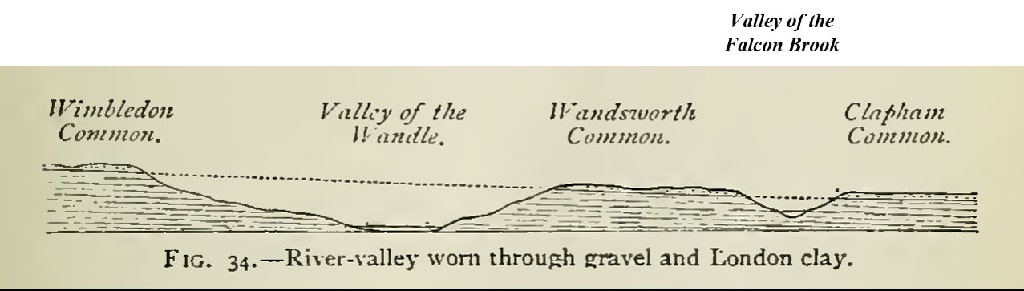


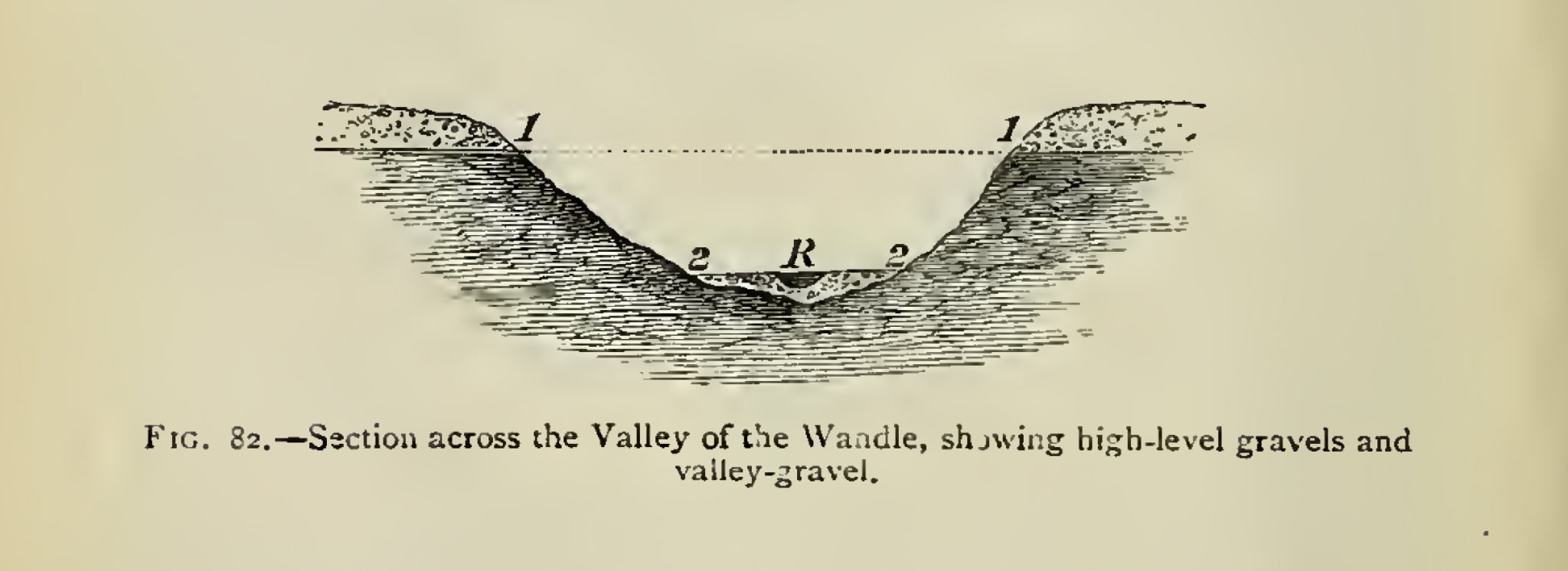
Huxley has drawn a section across the Wandle Valley, with Wimbledon Common in the west, Wandsworth Common in the centre, and Clapham Common in the east.

[I have added a caption locating the Falcon Brook, which now runs beneath Northcote Road and Falcon Road.]
(Click on image to enlarge)


[Huxley, Physiography, p.280.]
(Click on image to enlarge)


Here it is seen that the surface of Wimbledon Common is covered by a bed of gravel spread over the London clay. On descending from the summit of the common to the valley of the river Wandle, the gravel is seen to be abruptly cut off and succeeded by the underlying clay; but, on going up the opposite slope of the valley, the gravel again appears, at about the same level, and covers the surface of Wandsworth Common; and similarly the gravel will be found on the surface of Clapham Common.

[Huxley, Physiography, p.139]

To help you visualise this, I've drawn just such a line on an Ordnance Survey Geological Map from 1913. The yellow strip in the middle is the alluvium alongside the River Wandle, with the gravel mass of Wandsworth Common, tinted chestnut-brown , immediately to its east.
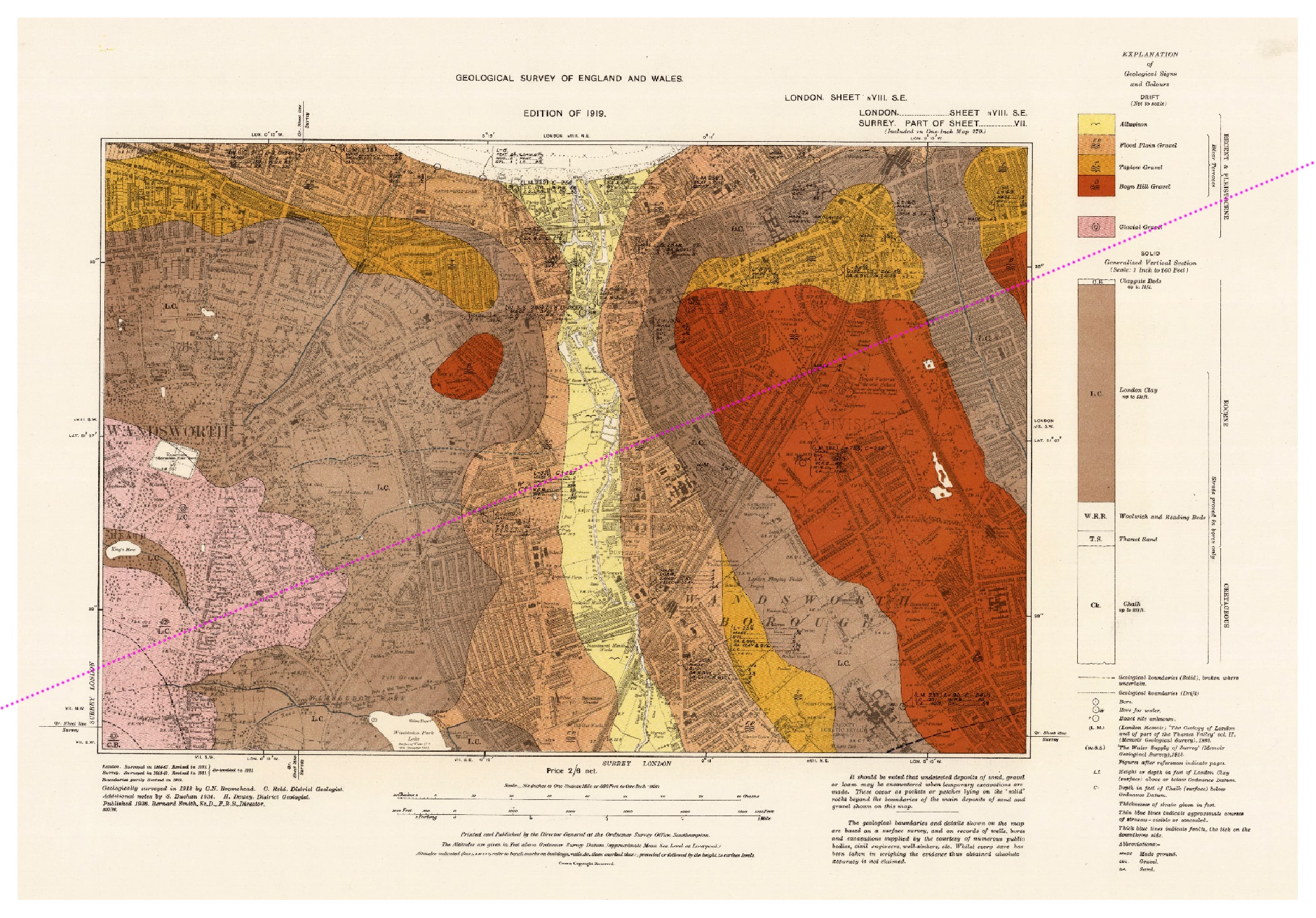


(Click on image to enlarge)

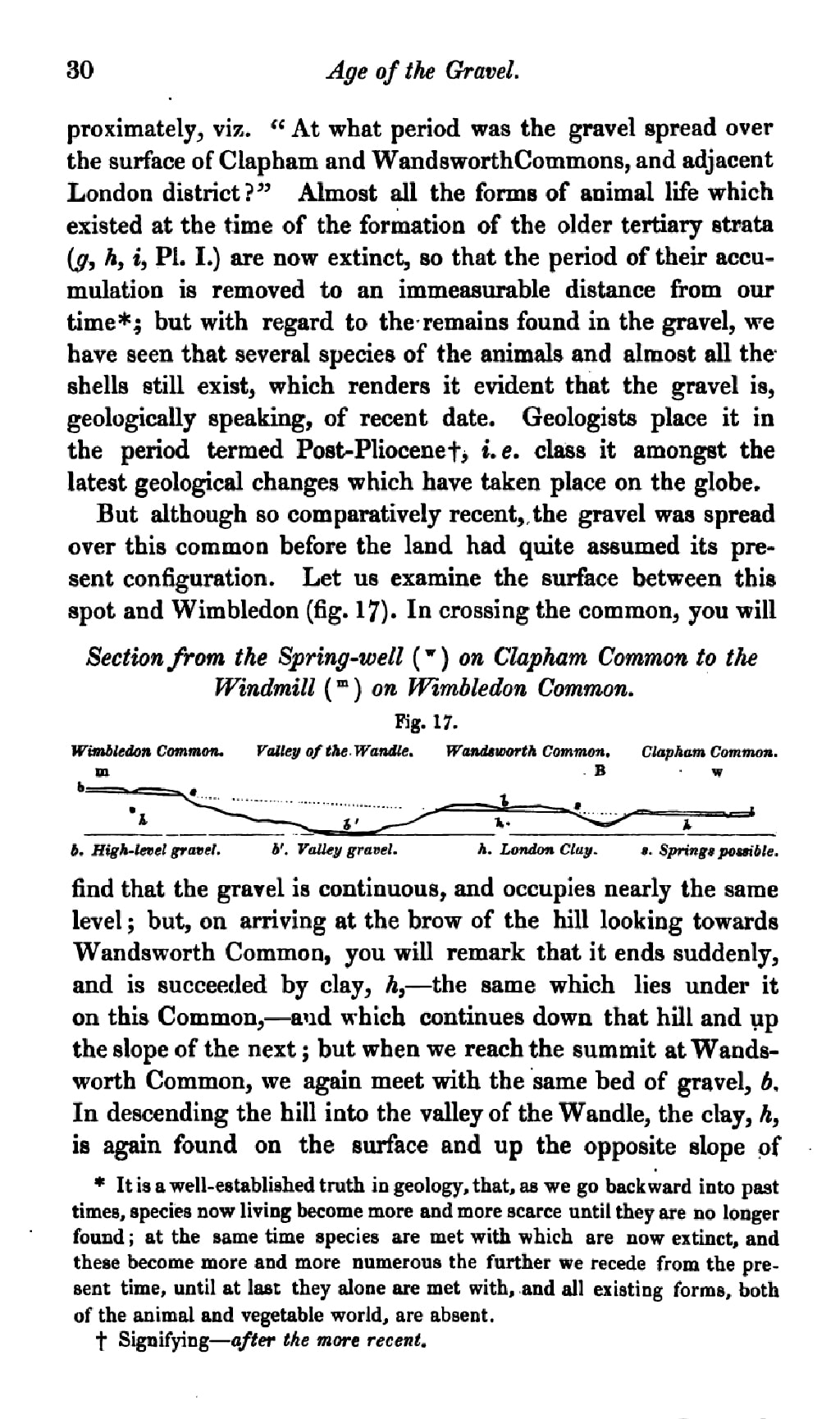
In fact, Huxley has borrowed this cross-section (indeed much of his explanation of local geology and landforms) from the great Clapham-born geologist Joseph Prestwich (1812-1896).

Here's a page from Prestwich's marvellous The Ground Beneath Us, Its Geological Phases and Changes: Being Three Lectures On the Geology of Clapham and the Neighbourhood of London Generally (1854-1856).


(Click on image to enlarge)

Joseph Prestwich's lectures were given to the Clapham Athenaeum, a club founded in 1841 as the "Clapham Literary and Scientific Society" to discuss "subjects of general interest among the young men resident in the neighbourhood".

[Did young women, such as Henrietta Wollaston, attend too? I don't know. Minutes of its "Proceedings" are held by the Lambeth Archives, so there may be an answer there. See National Archives.]

At this time, Prestwich was a wine merchant in the City, but such was his absorption, energy, and brilliance that he went on to become Professor of Geology at Oxford University.

Here he is in (much) later life:
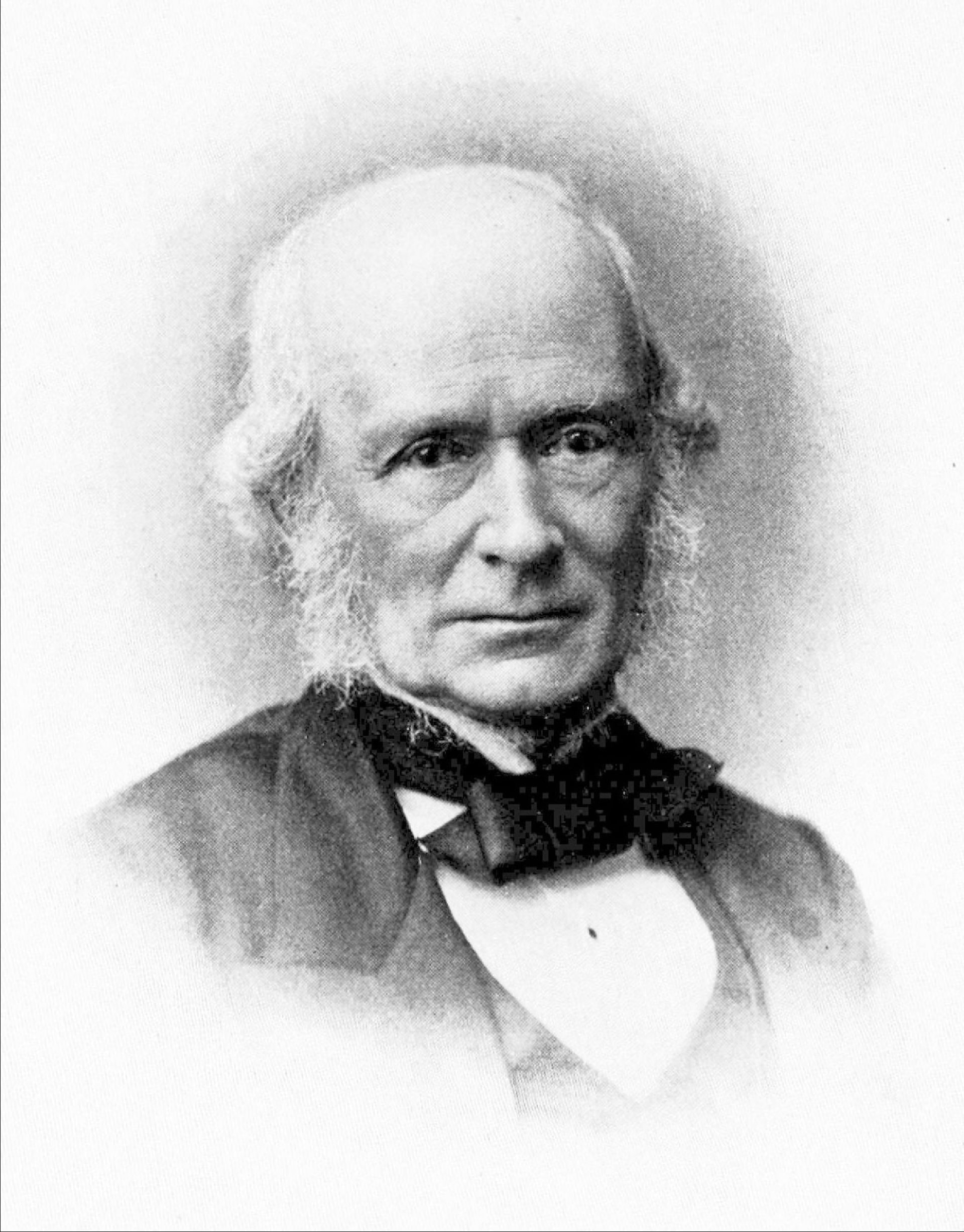


Joseph Prestwich (1812-1896).

(Click on image to enlarge)

[I had firmly intended to write something more about local-boy Joseph Prestwich, for example about about his young life in the area, which he records in an entertaining memoir — about his schooling, his walks along Lavender Hill, his time in a Wandsworth school, and his love of the Wandsworth Fair. But I became so absorbed in the research that I will have to delay saying anything more for another time. In the meanwhile, have a look at his Wikipedia entry .]


One the geological origins of Nappy Valley

Here's another example from Huxley's Physiography (p.137). It shows how the valley betwixt and between the Commons was formed by millennia of erosion by the mighty Falcon Brook:
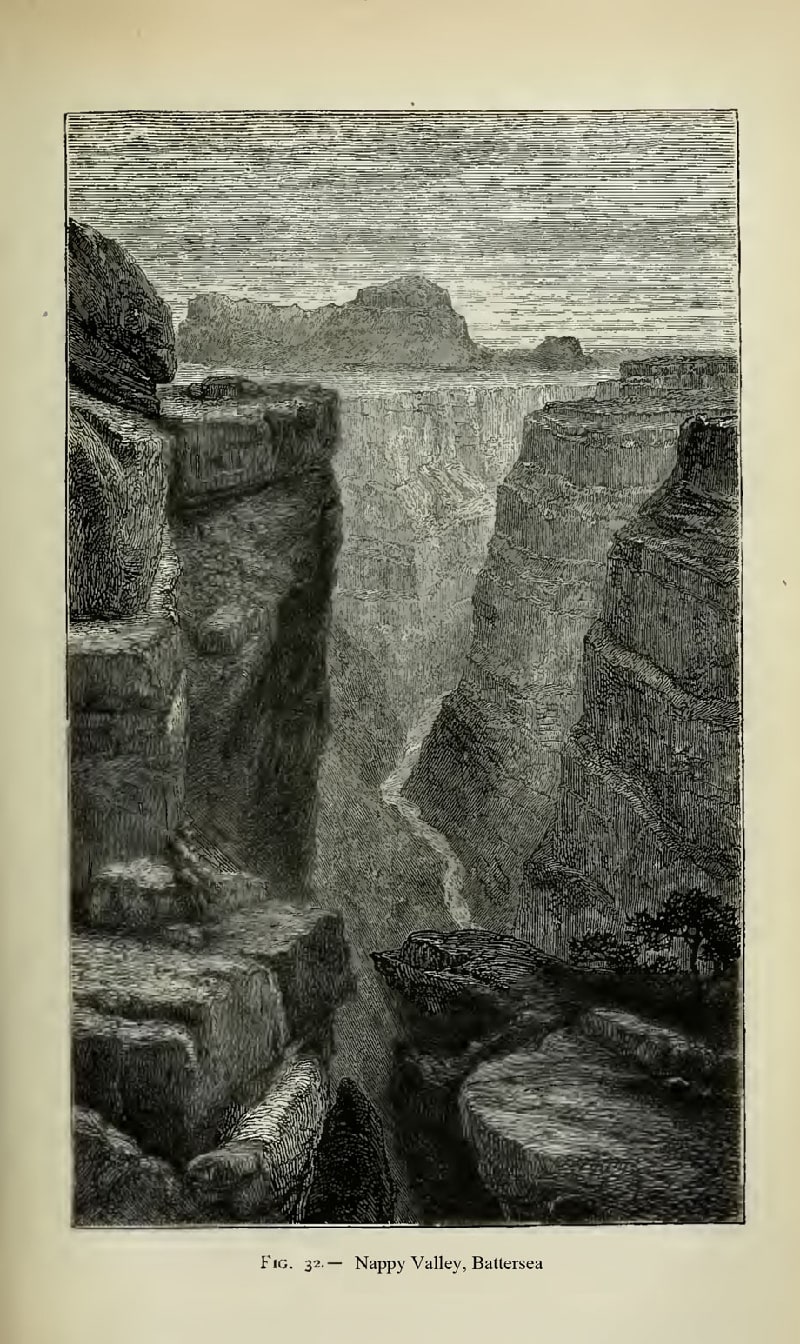


Nappy Valley, Battersea. Tell a lie, his original caption actually says "Grand Canyon, Colorado". But Huxley's argument is that the principle is exactly the same. Both have been formed by the erosion of rocks by rivers.

(Click on image to enlarge)

Going down . . . 

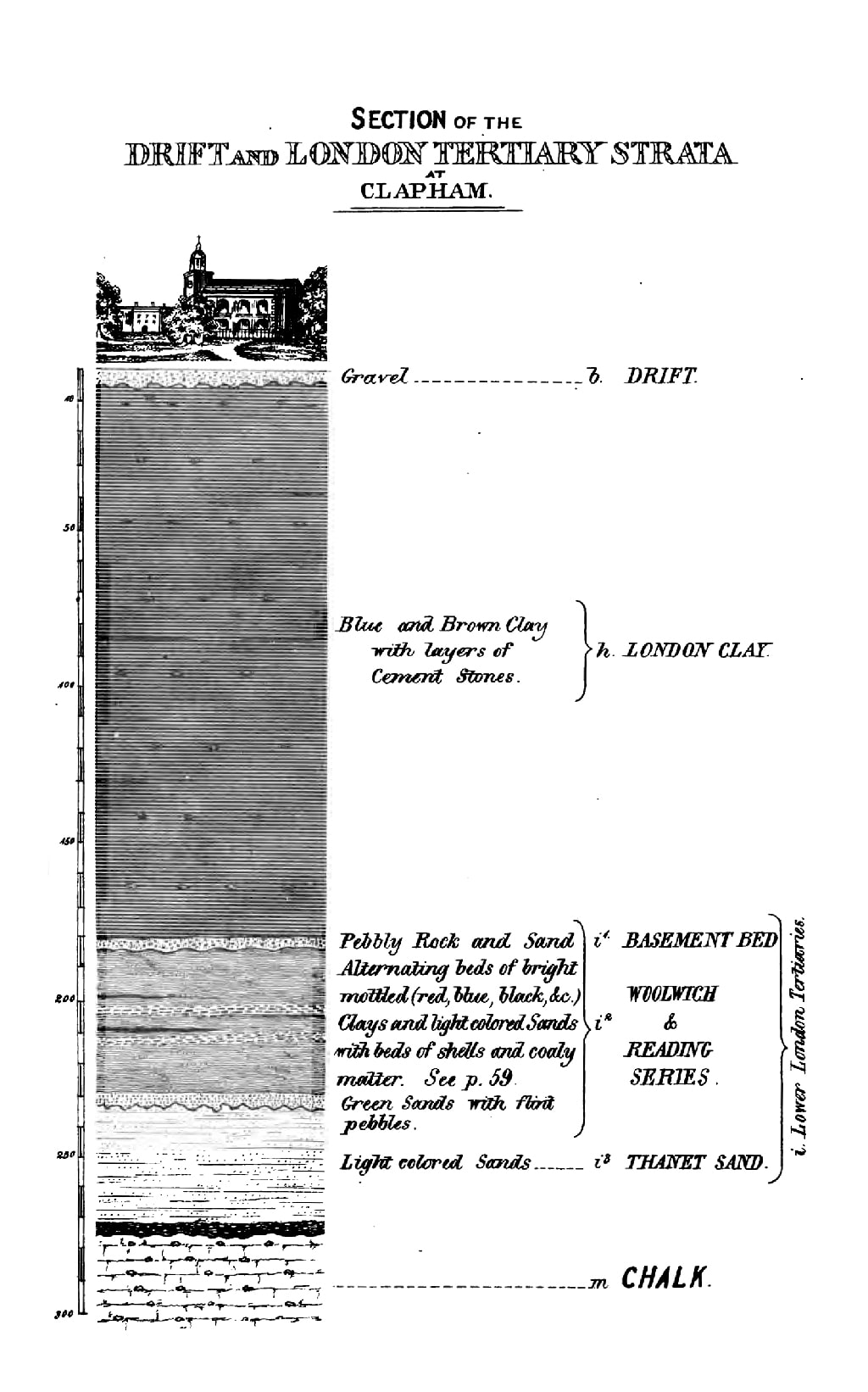
Prestwich and Huxley also take us deep underground, using discoveries from the latest boreholes being dug around the capital. These were being dug not for scientific reasons, but because of the need to provide water to the houses and new institutions (such as Wandsworth Prison) being built in the area. Thanks to his geological prowess, Prestwich became the leading authority on water-bearing strata in the London area.

Here is Prestwich's remarkable cross-section of the ground beneath Holy Trinity Church, on Clapham Common:


(Click on image to enlarge)

Big beasts . . . 

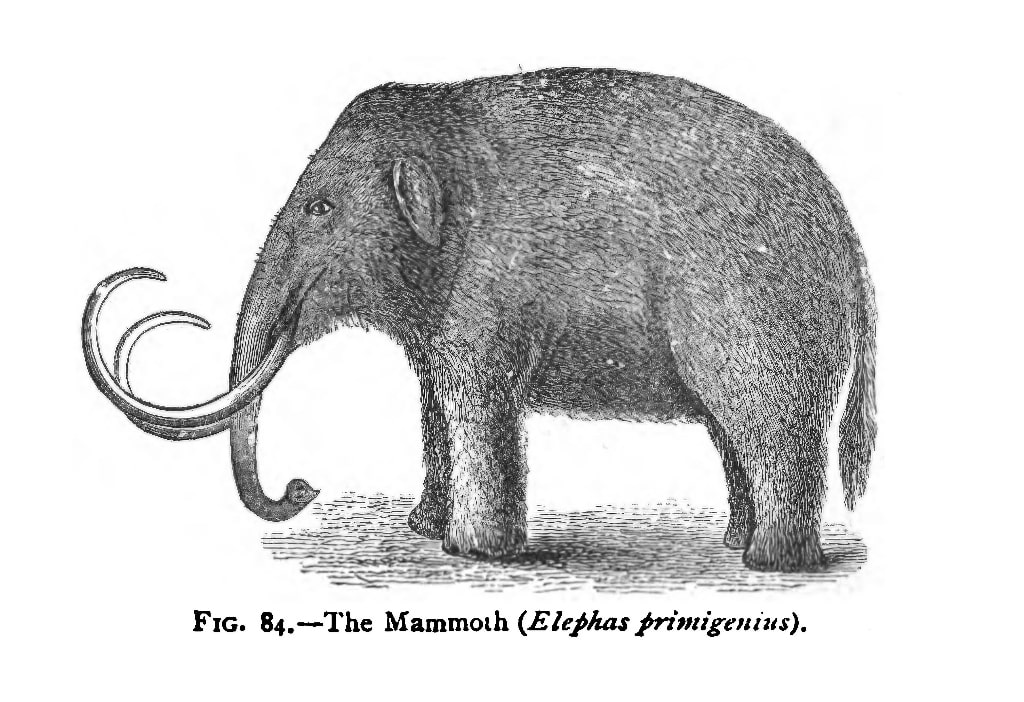
Before we leave Huxley for a while, I just can't resist showing his illustration of the mammoth. Cuddly, isn't it.


(Click on image to enlarge)

Again, it's an image borrowed and adapted from Prestwich.
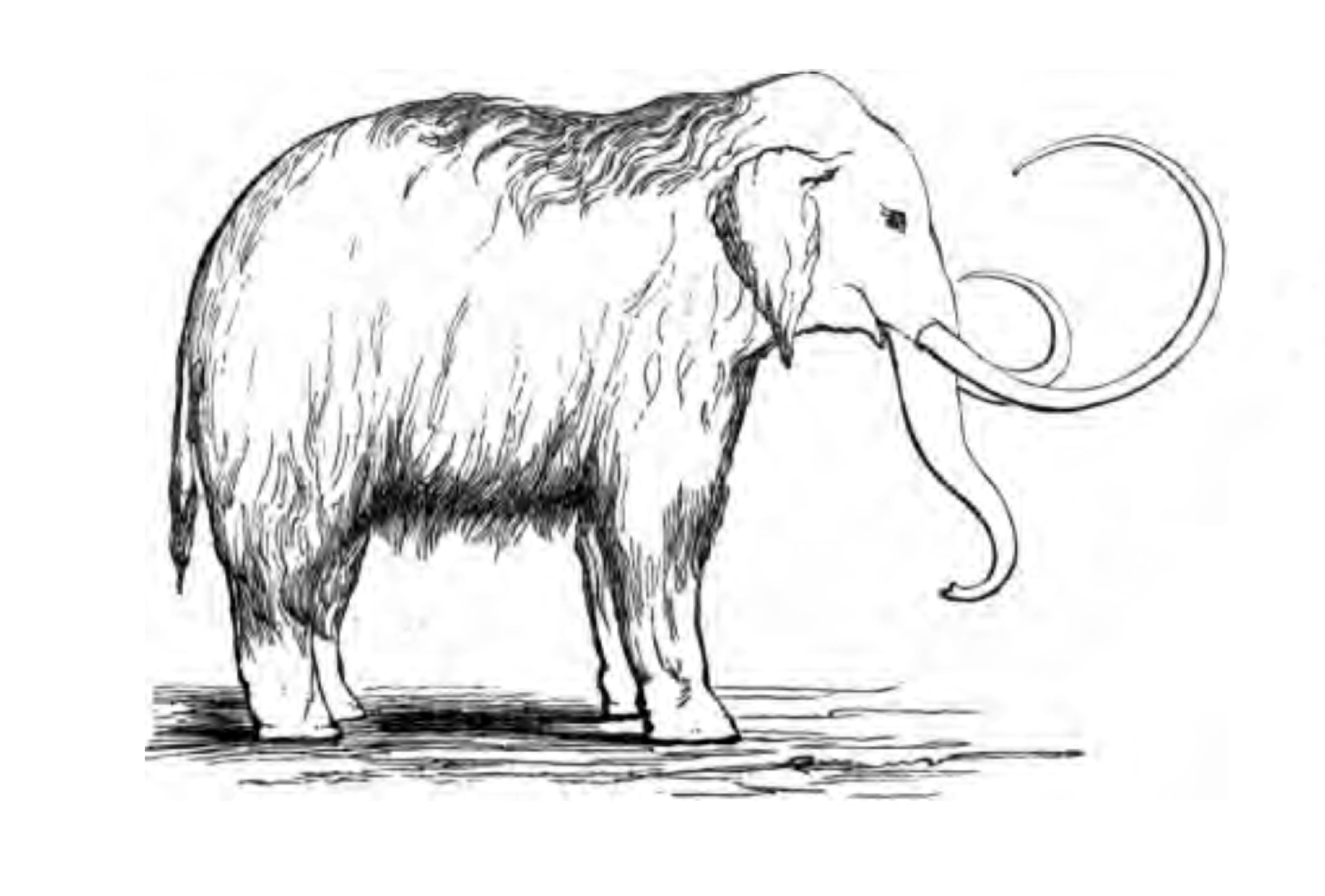


Prestwich, Three Lectures, p.32.

(Click on image to enlarge)

These reminded me of the first-ever image I used in the first-ever talk I gave about Wandsworth Common, by Zoom:
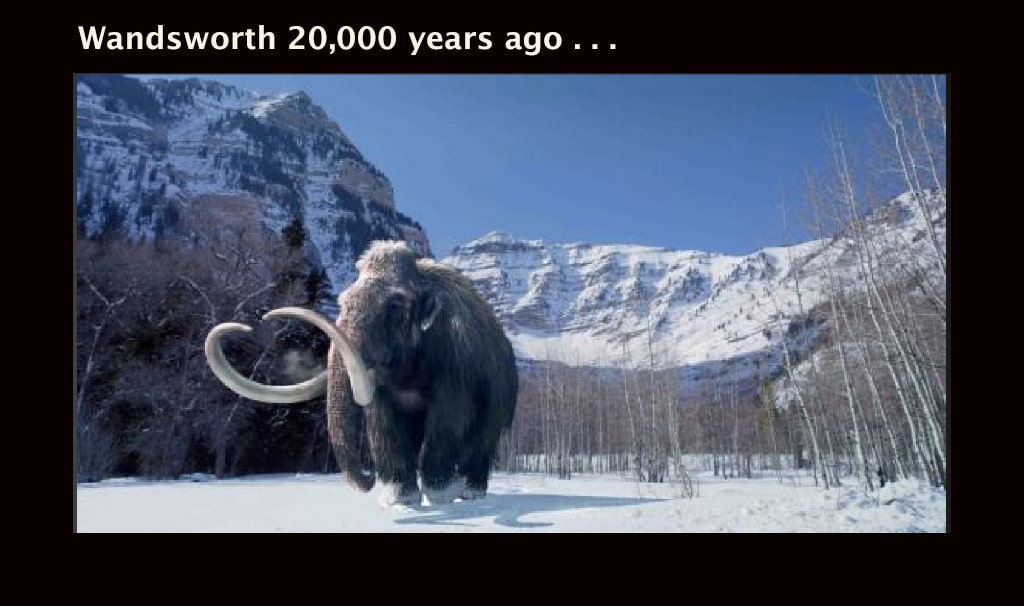


(Click on image to enlarge)

And here's another impression of who you mght have bumped into when you were walking your dog over the Common in winter:



Woolly-mammoth (Mammuthus-primigenius). Illustration by Mauricio Anton.

(Click on image to enlarge)

I wasn't being entirely serious. But then I suspect neither was the author of this piece in the local Guardian in 2013, which starts "Some of the world's leading mammoth experts are flocking to Wandsworth after construction workers digging the controversial Thames Tunnel unearthed prehistoric teeth, bones and tusks."

"Flocking to Wandsworth"? Really? Why?
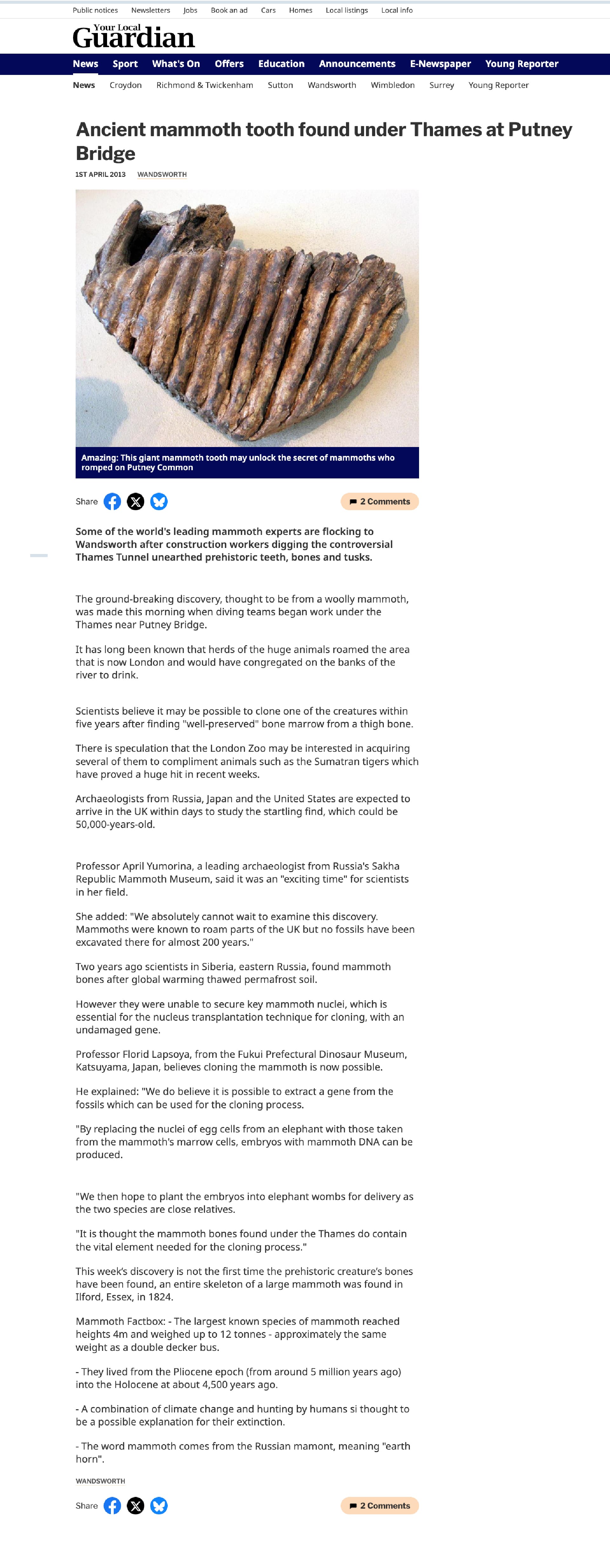


(Click on image to enlarge)


The ground-breaking discovery, thought to be from a woolly mammoth, was made this morning when diving teams began work under the Thames near Putney Bridge.

It has long been known that herds of the huge animals roamed the area that is now London and would have congregated on the banks of the river to drink . . . 

[Your Local Guardian: Ancient mammoth tooth found under Thames at Putney Bridge.

So the world's leading mammoth experts were "flocking to Wandsworth" to see the "ground-breaking" (ho-ho) find. Really? Why?

The paper goes on to suggest that any DNA that could be extracted and used to re-create a mammoth.


Scientists believe it may be possible to clone one of the creatures within five years after finding "well-preserved" bone marrow from a thigh bone.

Yes, but this was a tooth, not a bone. Ah, but have a look at the date. Is it a spoof? I still don't know.

I tried digging into blogs of the period:


On 6/9/2013 mudlark76 wrote:

Yes . . .  there was a lot of confusion at the time about whether this was or was not an April Fool's story — not helped by the fact that the local newspaper embellished the story with the usual rubbish about DNA and cloning.

Some reports mentioned other bones and tusks. Some didn't. All very unhelpful and I'm still not 10% sure — although the find wasn't reported in the NHM bulletins as far as I know (or at least not yet).

If it was an April Fool's joke it was an ill-advised choice of topic given that mammoth fossils including teeth have been reported from the London gravels (albeit rarely) in the past. For your find, my money would still be on Palaeoloxodon rather than Mammuthus taking frequency of finds into consideration.

[The Fossil Forum: Link.]

I'm not qualified to judge. I must ask Pamela Greenwood, our local expert on all things archaeological and palaeontological. Any thoughts, anyone?


22 August 2025: Mike Tuffrey responded:

As for the April Fool or not — great fun. Professor April Yumorina is a good one. WikiCommons says "Yumorina, Ukrainian: Гуморина is an annual festival of humor held in Odessa, Ukraine on and around the April Fools' Day since 1973."

PB: Wow, quite an elaborate hoax for a local newspaper, then — but that does seem to settle the question!


But there definitely have been mammoth finds in our area.

Here's a prime specimen of "An English Woolly Mammoth Tooth" found in the Wandsworth area in 1886, at auction at Christie's in 2016:
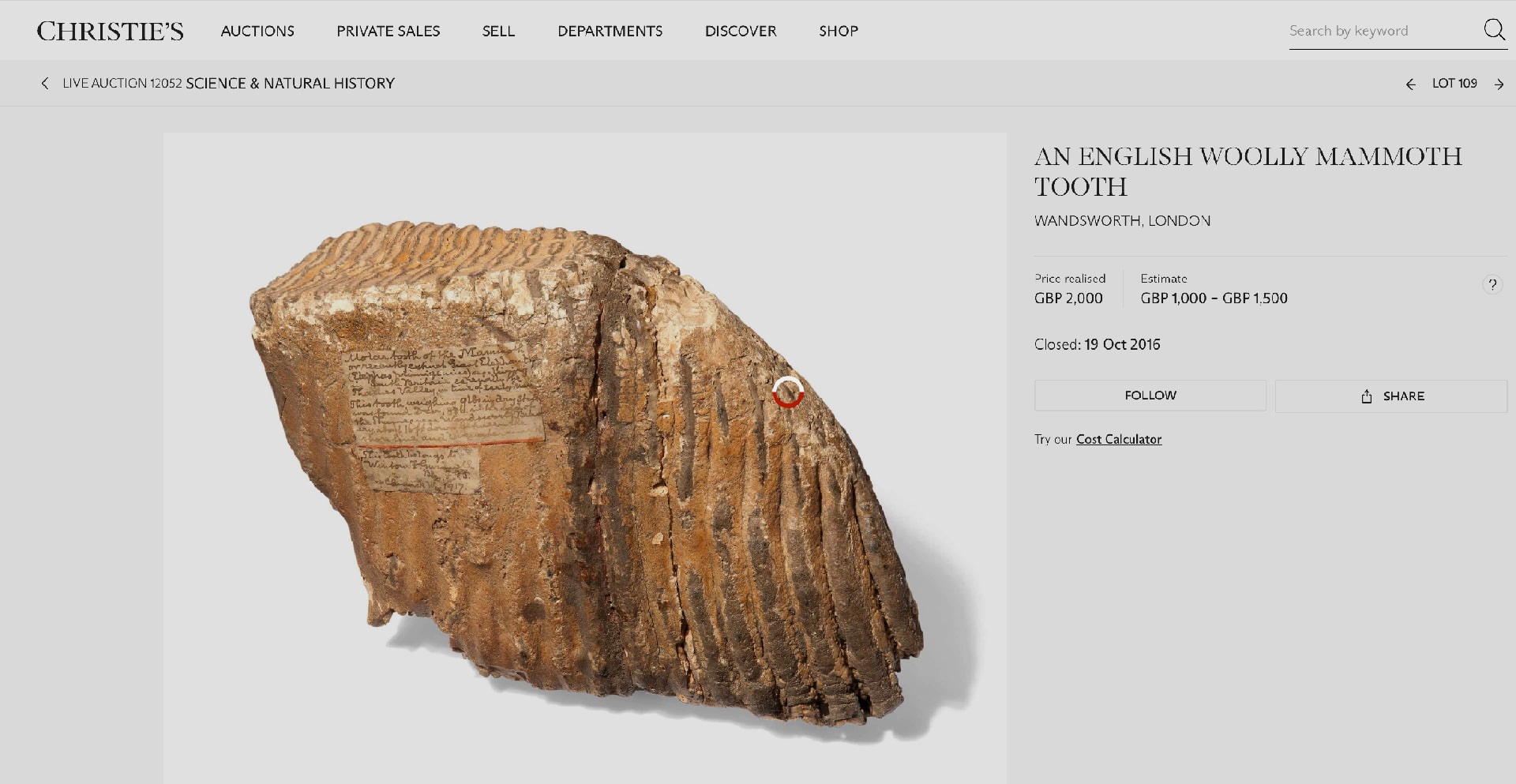


Christie's, 19 October 2016.

(Click on image to enlarge)

I've tried to enlarge the label. Can you read the text? Let me know if you can improve upon my transcription:
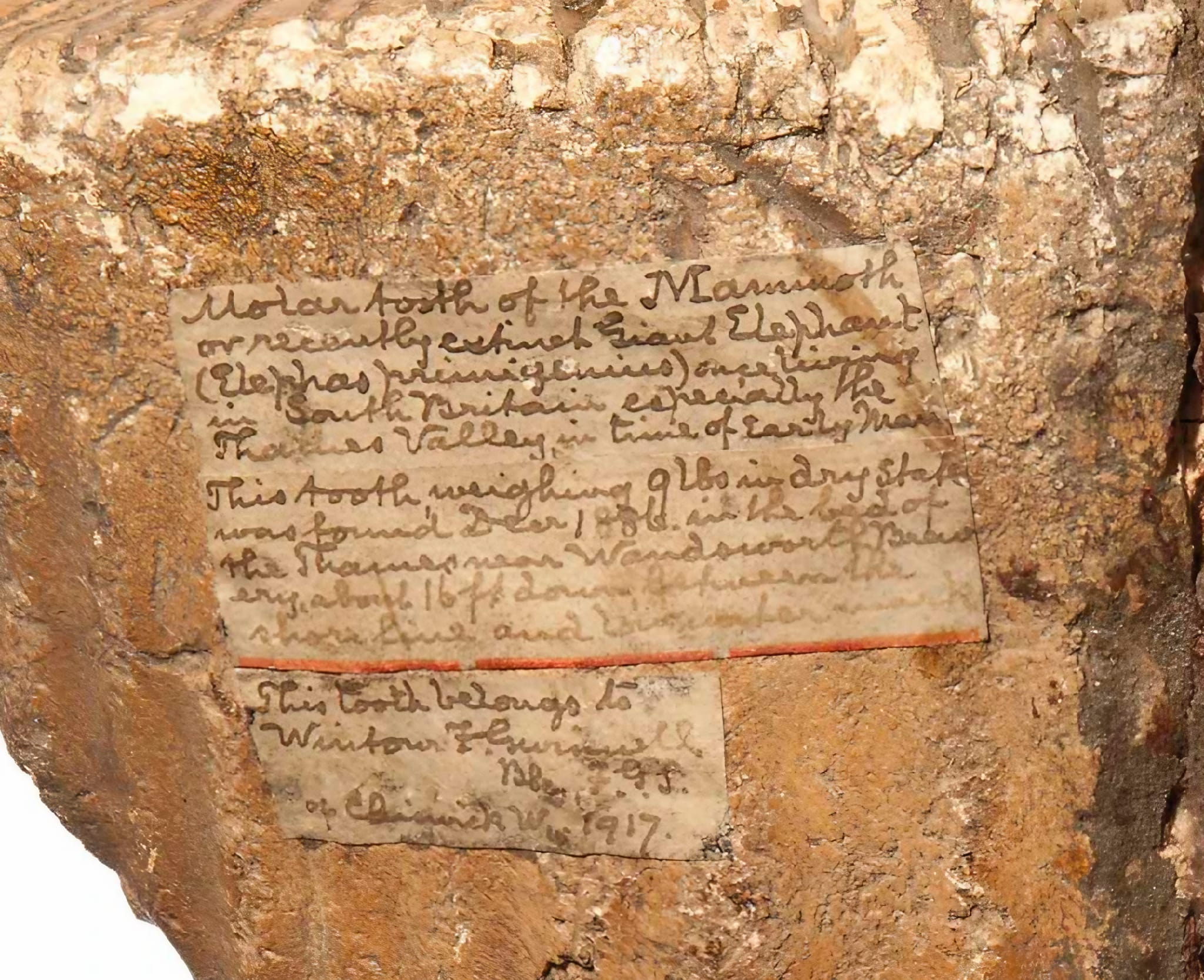


(Click on image to enlarge)


Molar tooth of the Mammoth
or recently extinct Giant Elephant
(Elephas primigenius) once living
in South Britain especially the
Thames Valley in time of Early Man.

This tooth weighing 9lbs in dry state
was found Decr 1886 in the bed of
the Thames near Wandsworth Brew
ery about 16 ft down Between the
shore line and [illeg. — low water mark?]

This tooth belongs to [Wintour F. Gurney?] F.G.S. [Fellow of the Geological Society]
of Chiswick W. [?] 1917.


Another memorable mammoth . . . 

There used to be a mammoth tooth on show in the Wandsworth Museum, which many of you will remember:
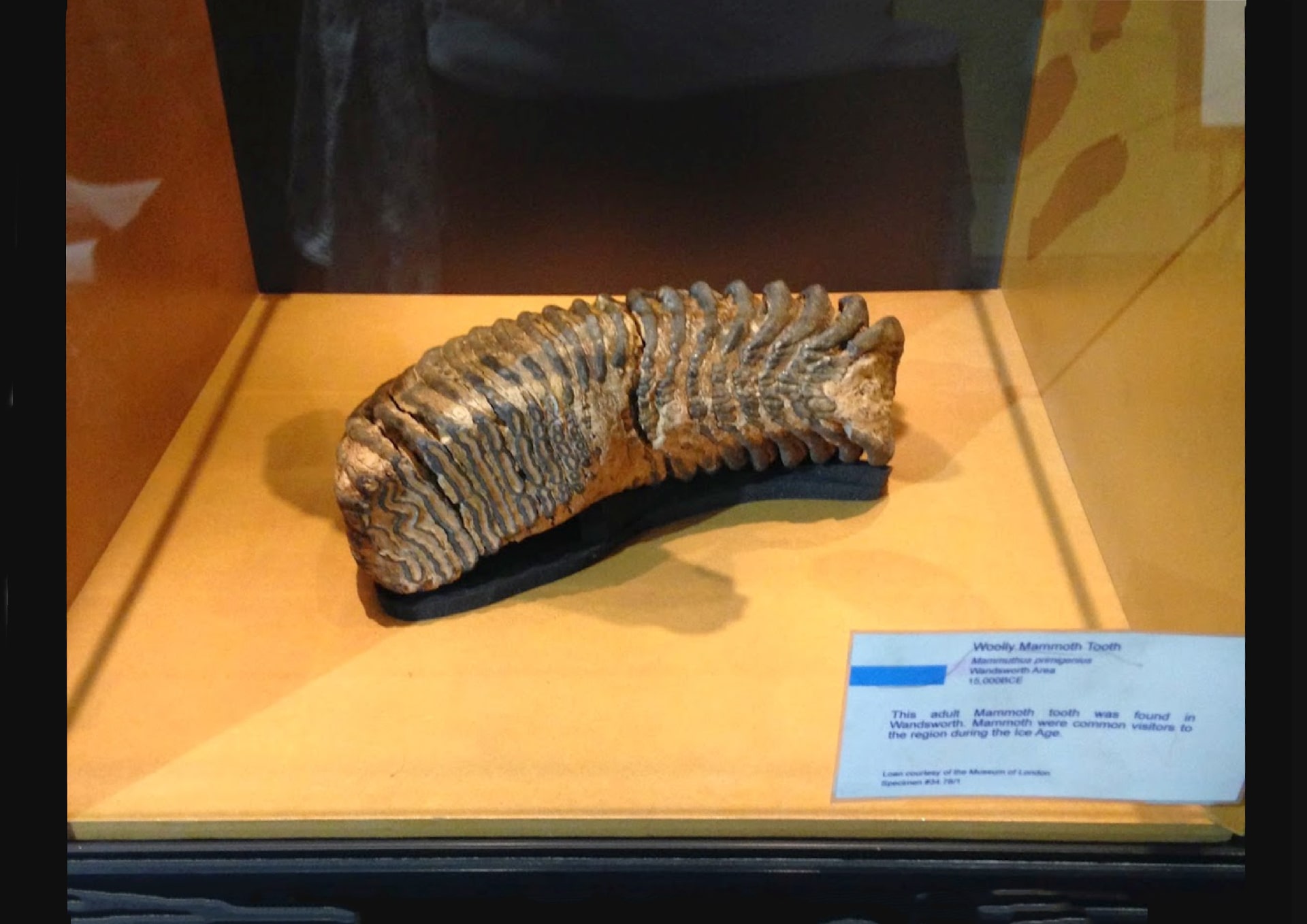


"Woolly Mammoth Tooth
Mammuthus primigenius [sic?]
Wandsworth area

15,000BCE

This adult Mammoth tooth was found in Wandsworth. Mammoths were common visitors to the region in the Ice Age.

Loan courtesy of the Museum of London.

[Specimen no. illegible.]

(Click on image to enlarge)

But again, we have to ask exactly where in the "Wandsworth area"?

The "Museum of London" (or at least the part once housed in the Barbican) has been closed for several years, which I greatly regret. But it's due to re-open next year as the London Museum at the former Smithfield Meat Market.

So far as the former Wandsworth Museum is concerned, I know lots of people are working extremely hard to catalogue and photograph all the items (of which there are more than 25,000). Eventually there will be a website. This alone will be immensely valuable. But with effort, money and luck there will also one day be a super new Wandsworth Museum that everyone can visit.
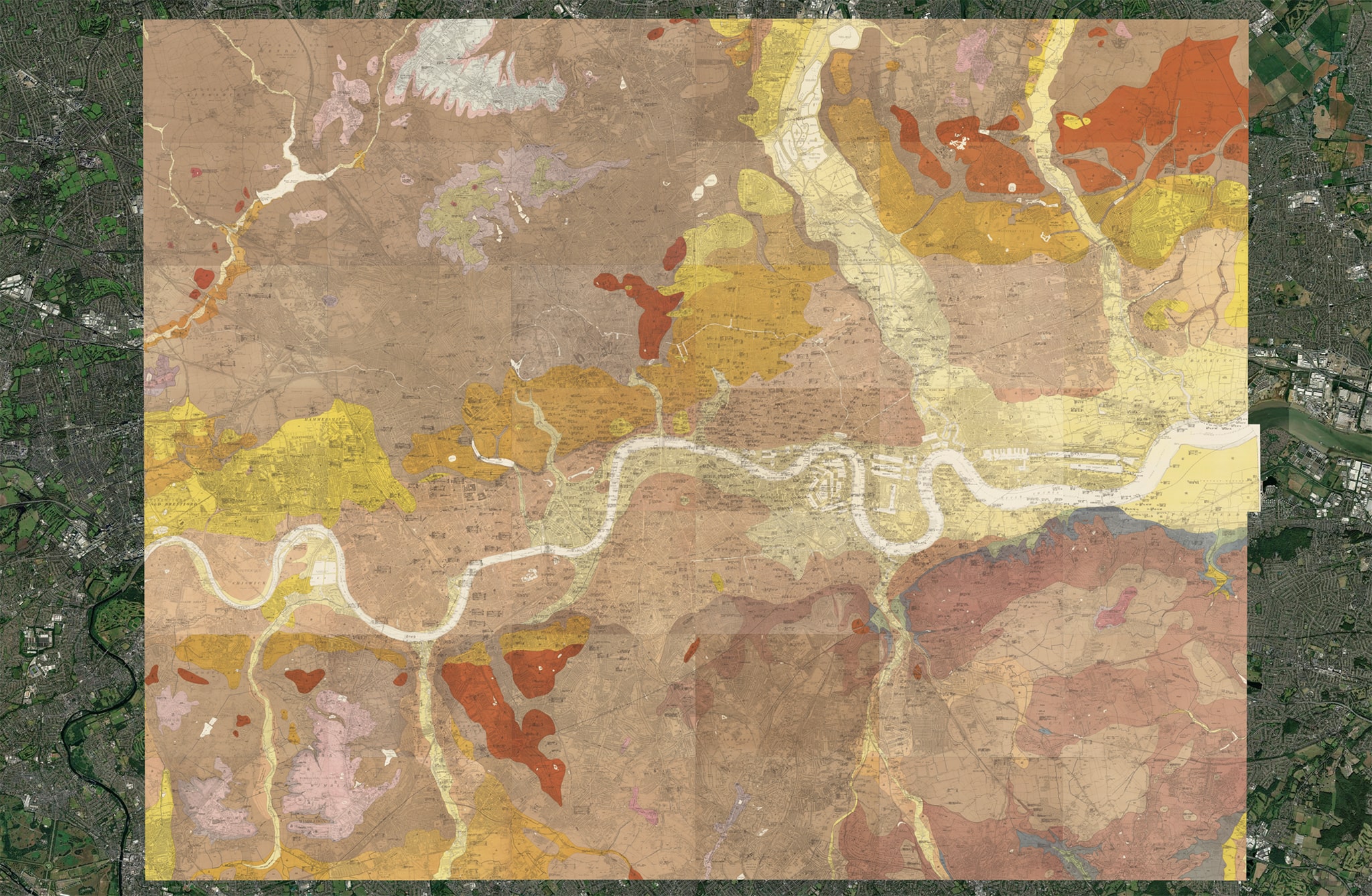
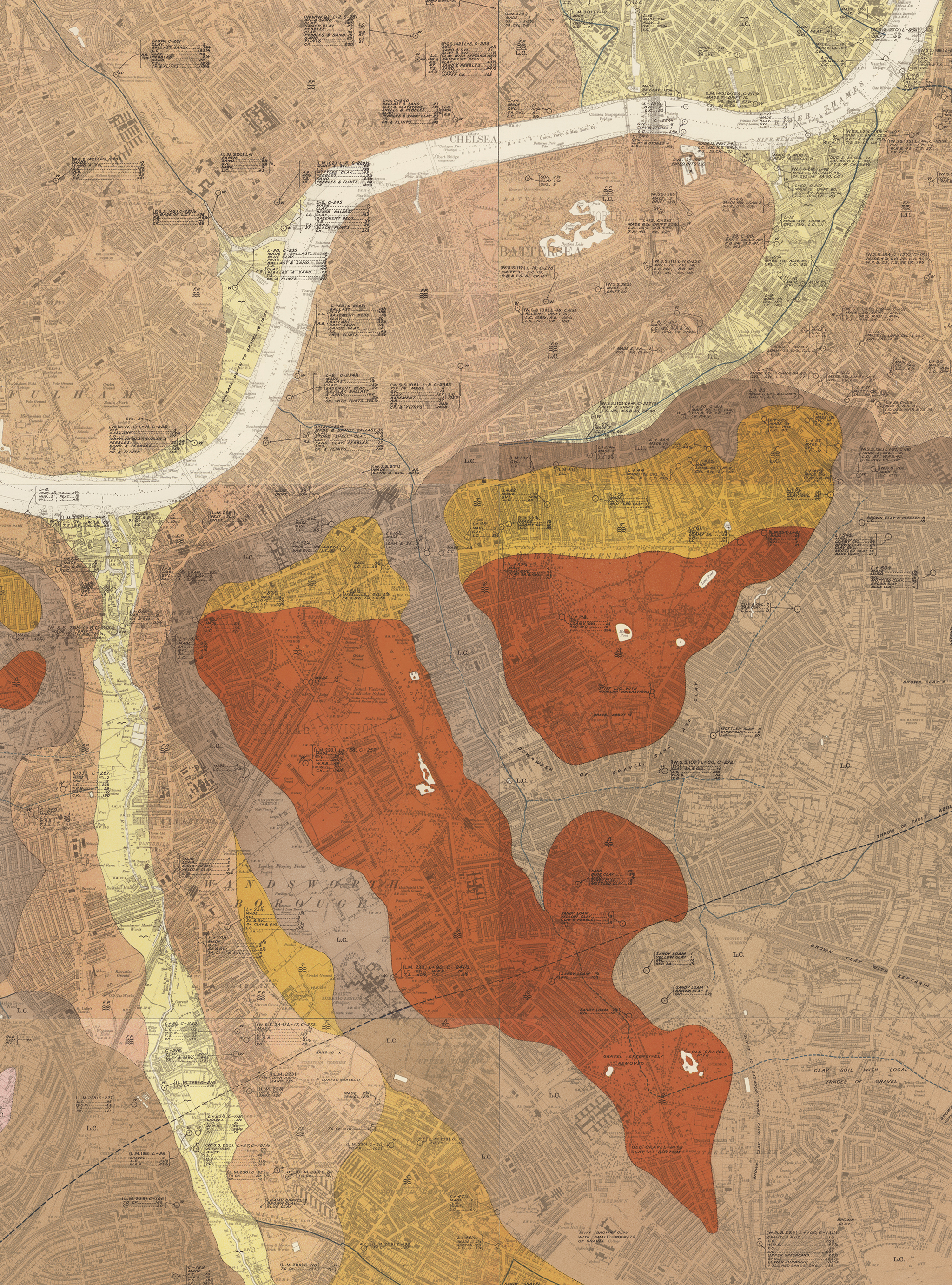
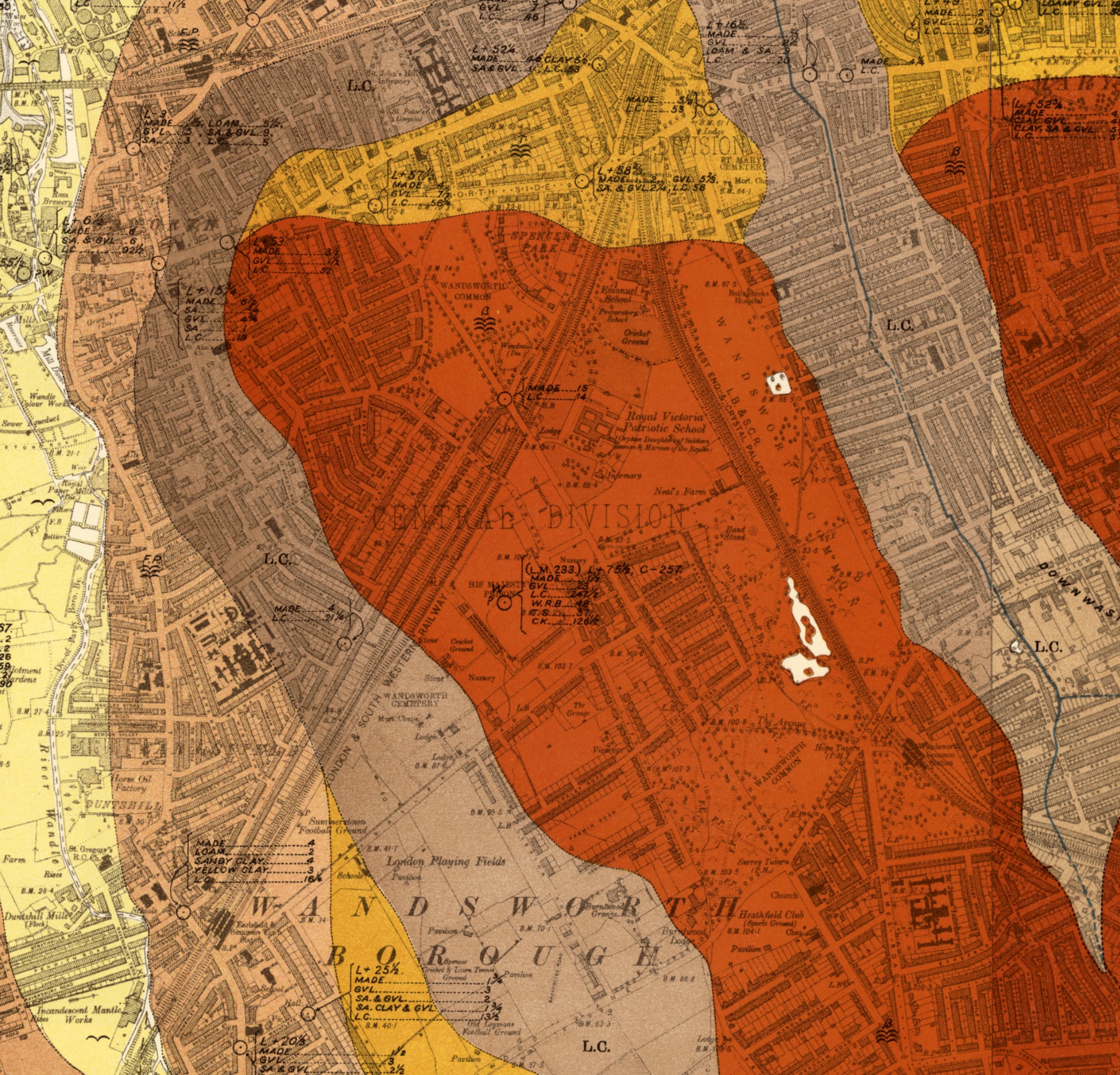
Map of the Month:  

Ordnance Survey, Geological, (1: 10,560, 6 inches to the mile), 1913.

For understandable reasons, this month's map is geology-related and dates from the early 20th century. As we shall see, modern maps are very little different, though some (but not all) of the terms used to describe geological deposits and layers have changed. Here's London as a whole:


[London nVIII.SE (6 inches to the mile). OS revised:   1913, Geological Survey surveyed:   1912, Published:   1936. NLS:   Link.]
(Click on image to enlarge)

Here is Battersea and Wandsworth east of the Wandle:


Click on the image to see the map in more detail.

And here is Wandsworth Common . . . 


(Click on image to enlarge.)

The colours indicate various surface deposits (sometimes called "Drift"). Notice how Wandsworth and Clapham Commons are similarly coloured (mainly chestnut-brown), as are parts of Islington in North London (and even larger areas in Essex). This is because they share a similar kind of gravel (which at this time was referred to as "Boyn Hill Gravel", after a suburb of Maidenhead where its particular mix of ingredients was first recognised).

The map distinguishes a number of different gravels (on which more below), plus clay, alluvium, and silt (sometimes called "brickearth"). Notice how clearly London's rivers stand out. These are associated with (yellow-tinted) alluvium — typically fertile deposits of clay, silt, fine gravel and sand carried down by running water and distributed over the adjacent land.
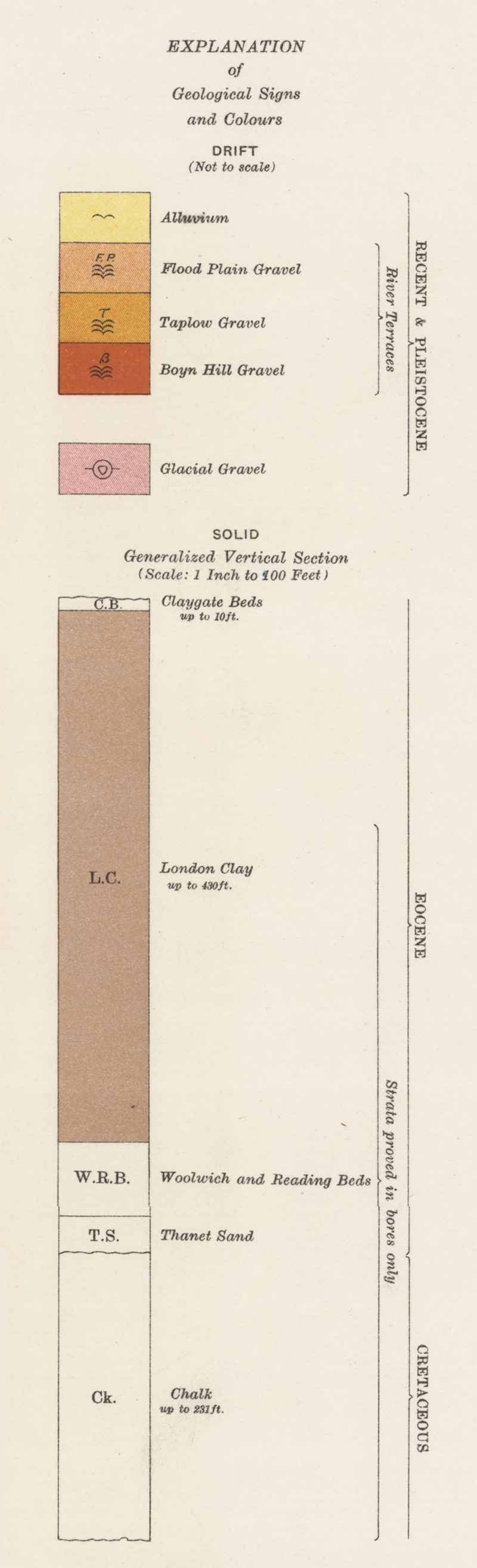
Key


(Click on image to enlarge)

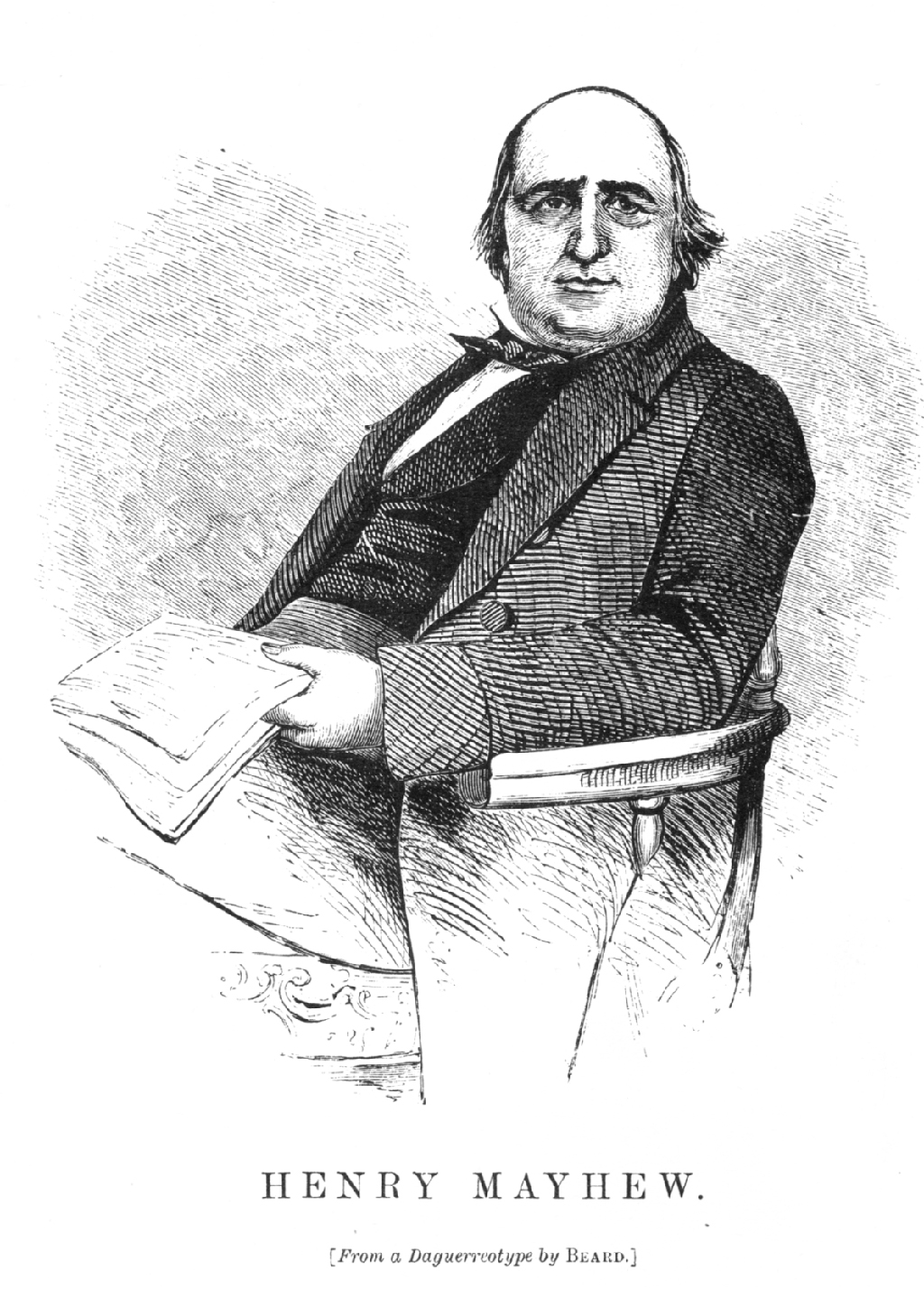
Henry Mayhew visits the Surrey House of Correction . . . 


Henry Mayhew

(Click on image to enlarge)

At some time in the middle of the 1850s, Henry Mayhew undertook a remarkable rail journey from central London to Wandsworth Prison which (given the many changes he perceived as he travels through city, suburban and rural landscapes), he likened to "the ascent of a mountain in the tropics, and gradual passage through the several atmospheric layers of different climates". (I assume in this he's following Alexander von Humboldt's 1807 discoveries about the vertical zonation of plants.)
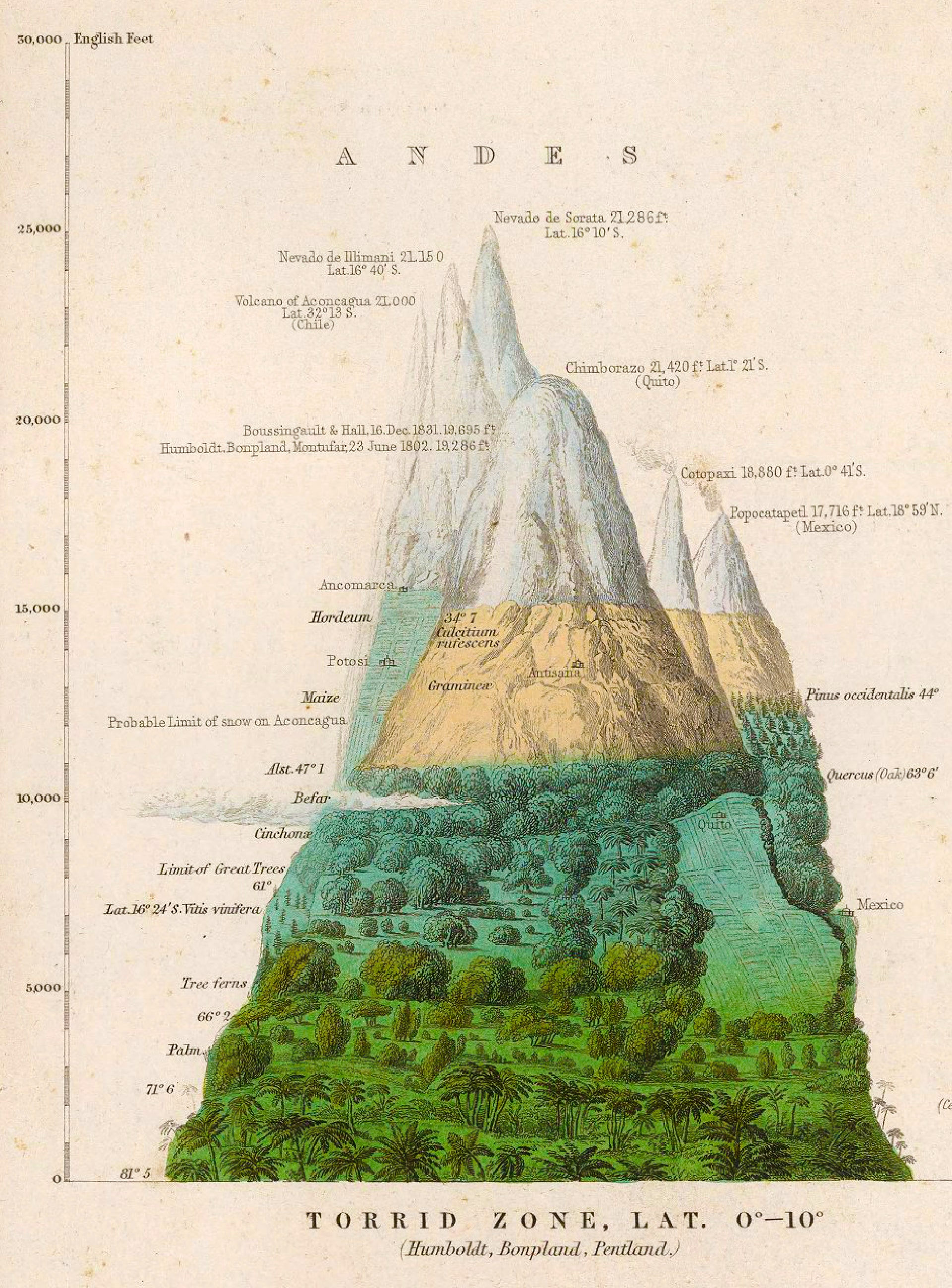


Image source
(Click on image to enlarge)


[This] reveals, as we rise above the plains, the mountain sides prismatically belted, as it were, with the rainbow hues of various zones of fruits and flowers — the same as if we had passed along rather than above the surface of the globe — from the brilliant and glowing tints of vegetable nature at the tropics, to the sombre shades of the hardier plants and trees peculiar to the colder regions, even till we ultimately reach, at the peak, the colourless desolation of the poles themselves.

But this journeying upwards through the various botanical strata, as it were, of the earth is hardly more peculiar and marked than is the rapid transition now-a-days, while travelling on some London railway, from town to the country; for as we fly along the house-tops through the various suburban zones encircling the giant Metropolis, we can see the bricken city gradually melt away into the green fields, and the streets glide, like solid rivers, into the roads, and cabs and busses merge into wagons and ploughs, while factories give place to market-gardens, and parks and squares fade gradually into woods and corn-fields.

Perhaps this change, from civic to rustic scenery — this dissolving view, as it were, of the capital melting into the country, is nowhere better seen than in a half-hour's trip along the Southampton rail [to the prison at Wandsworth Common].

I'll discuss his odyssey in more detail another time, but for now I'd like to note one his findings in the prison itself, the well. In this case, of course, the strata are deep below ground, rather than elevated high above it.


(Click on image to enlarge)

The Pump Room at the Surrey House of Correction

(Not to be confused with the Pump Room at Bath.)

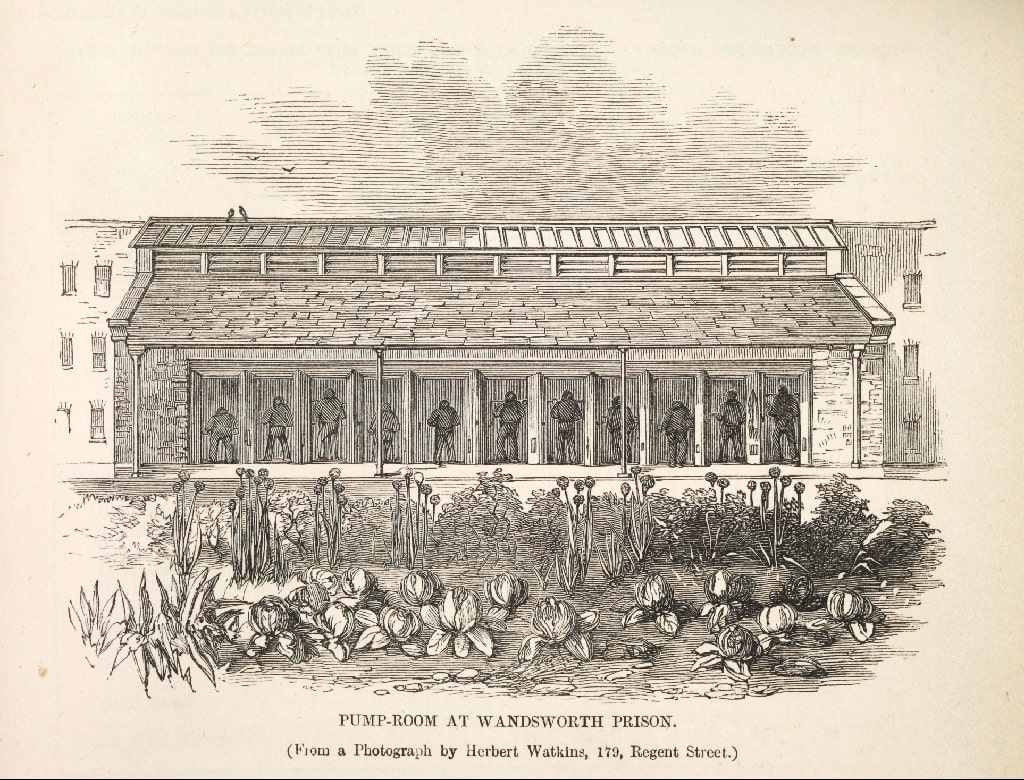
Notice in the top right quadrant of this contemporary engraving a small rectangular building standing alone near neat vegetable plots. This stands on top of the prison well, and houses the pumps.
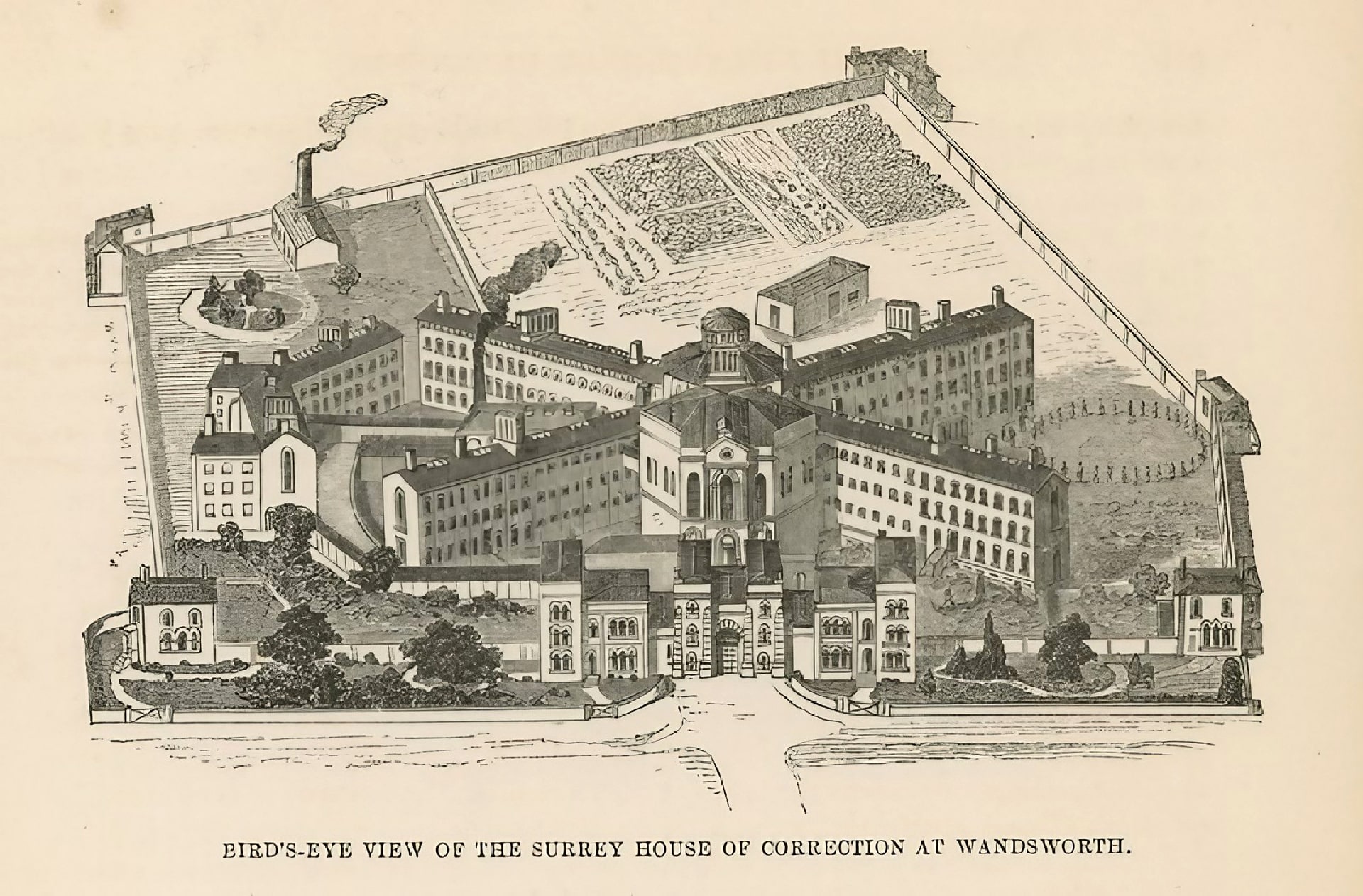

(Click on image to enlarge)


The pump-room at Wandsworth Prison. (The Criminal Prisons of London and Scenes of Prison Life, by Henry Mayhew and John Binny (1862), p.405.)

(Click on image to enlarge)

The prison, as Mayhew and his co-author John Binny note, is:


supplied by water drawn from an artesian well, 480 feet deep, immediately beneath the pump-house . . .  The pump-house is an oblong building about 54 feet long and 32 feet broad. The machinery runs along the centre of the building.

There are twelve stalls on each side, each of them furnished with a handle connected with the central machinery, which, when set in motion, conveys the water into cisterns on the roof of the prison.

The prisoners are employed on these machines an hour at a time, and during that period rest three times for five minutes, so that they are kept working forty-five minutes . . . The number of revolutions performed at the pumps the day before our visit was 4703, which is about the average number."

[London Museum:   Link.]

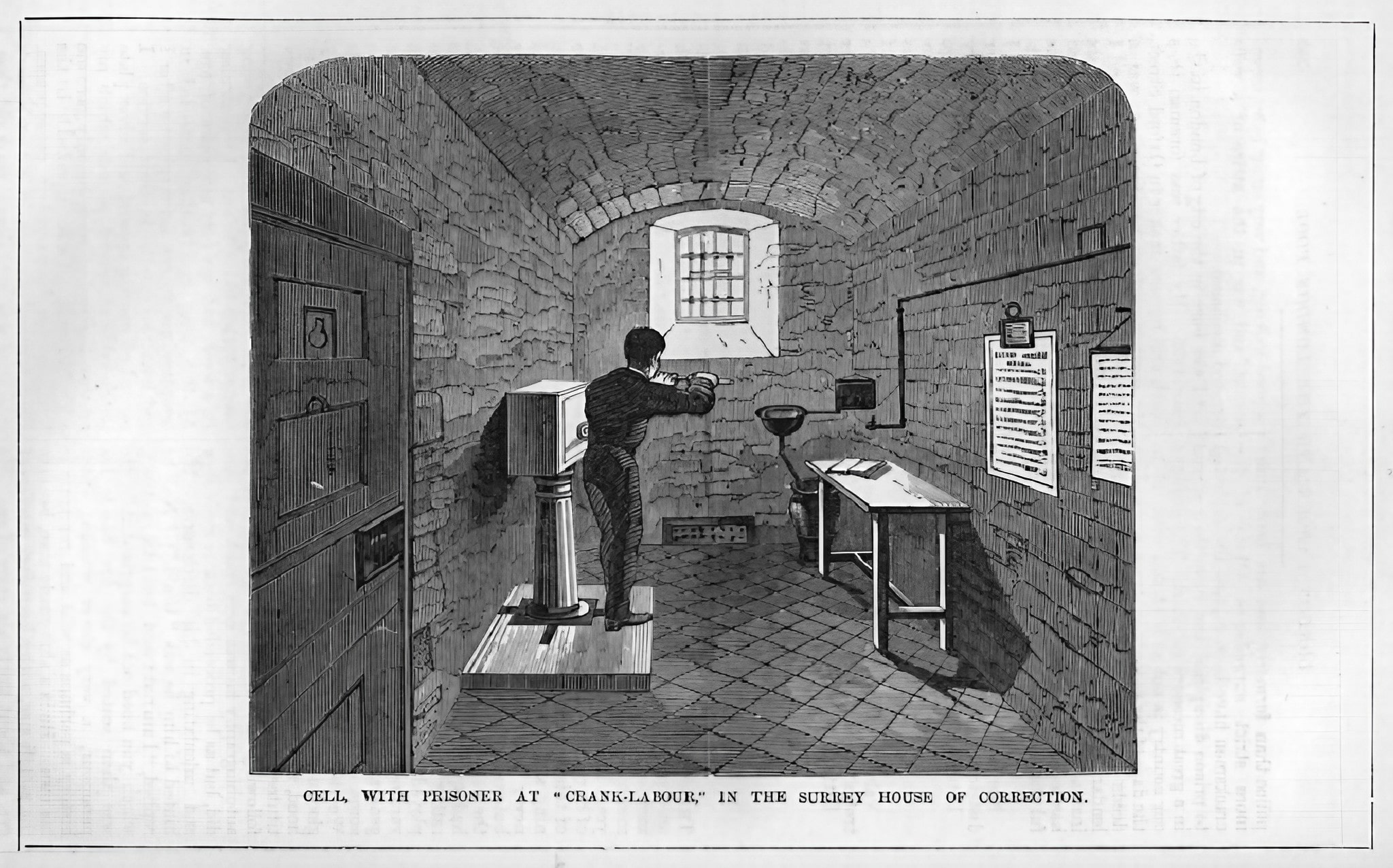
Incidentally, this is not to be confused with "crank labour" in Wandsworth's initially individual cells, which was designed to be effortful but utterly pointless; in short, to break the spirit. It did not supply water to the (then innovative) flushing lavatories in each cell — see one in the right hand corner.

There is a debate whether the lavatories were deliberately removed to create the space for "doubling up" — two prisoners to be housed in each cell. Possibly, but in any case the lavatories didn't work.


(Click on image to enlarge)

Let's look more closely at the prison as shown on our geological map, which shows a deep well within the prison walls:

Here's how Mayhew describes this well in an article on his visit to the prison (probably in the mid-1850s). The prison, he writes, is:


"supplied by water drawn from an artesian well, 480 feet deep, immediately beneath the pump-house . . .  The pump-house is an oblong building about 54 feet long and 32 feet broad. The machinery runs along the centre of the building.

There are twelve stalls on each side, each of them furnished with a handle connected with the central machinery, which, when set in motion, conveys the water into cisterns on the roof of the prison.

The prisoners are employed on these machines an hour at a time, and during that period rest three times for five minutes, so that they are kept working forty-five minutes . . . The number of revolutions performed at the pumps the day before our visit was 4703, which is about the average number."

[London Museum:   Link.]
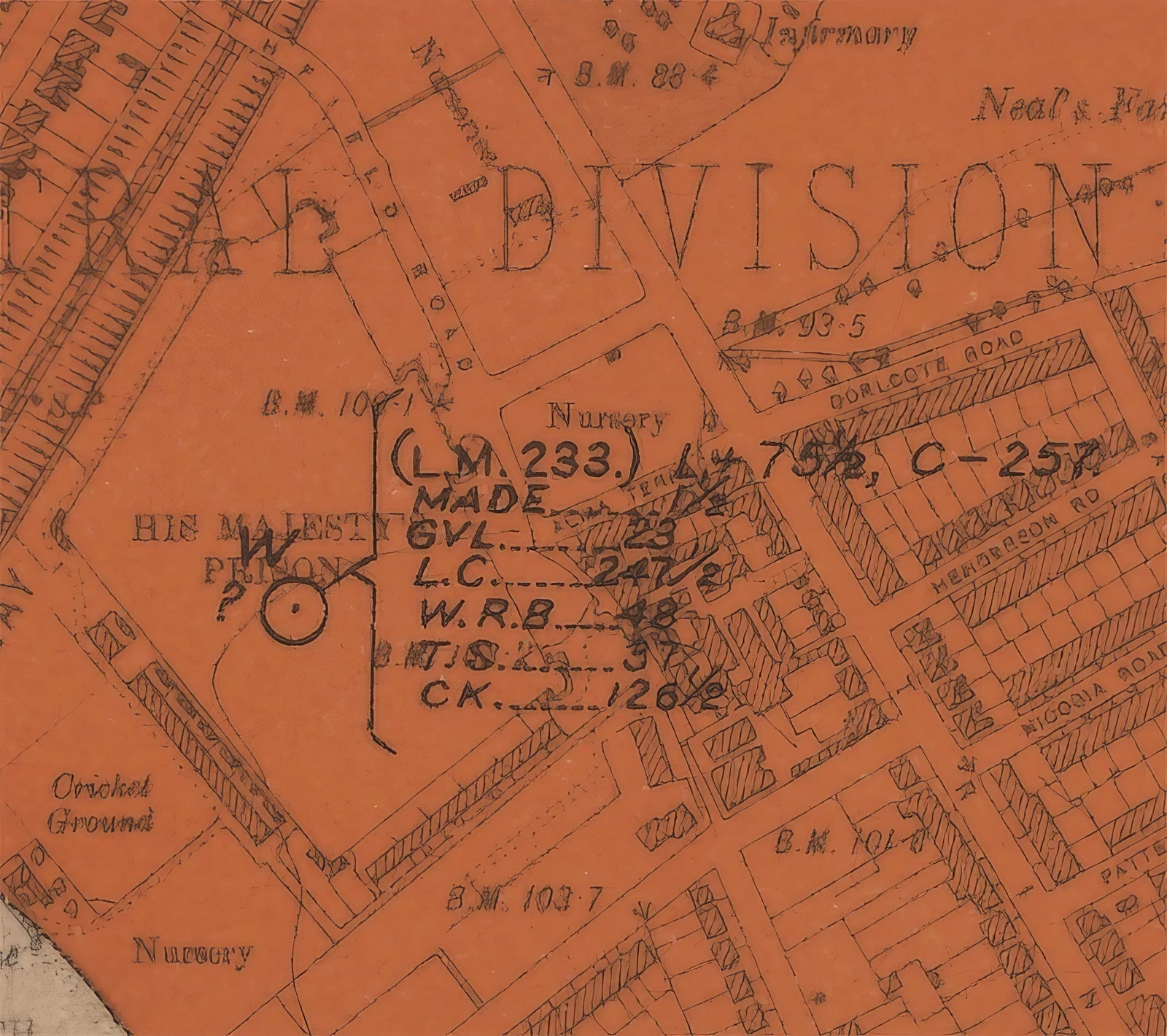
In 1849, when the builders of the Surrey House of Correction dug down nearly 500 feet (150 metres) down to find a reliable source of water, what did they find ?


Prison well

(Click on image to enlarge)
Which means:  

— ⊙ (circle with dot in the middle):   Borehole.

— W:   Water.

— (L.M. 233.):   London Memoir, The Geology of London, vol II, 1889, p.233.

— L+ 75 ½:   Height in feet of the top surface of London Clay above Ordnance Datum (i.e. mean sea level at Newlyn, Cornwall).

— C- 257:   Depth in feet of Chalk (surface) below Ordnance Datum.

Thickness of strata in feet:  

— MADE:  1½ ft [an “artificial” surface made by humans from e.g. imported soil, spoil from digging, broken bricks and refuse].

— GVL:  gravel = 23 ft.

— LC:  London Clay = 247½ ft.

— WRB:   Woolwich & Reading Beds = 48 ft.

— TS:   Thanet Sand = 37 ft.

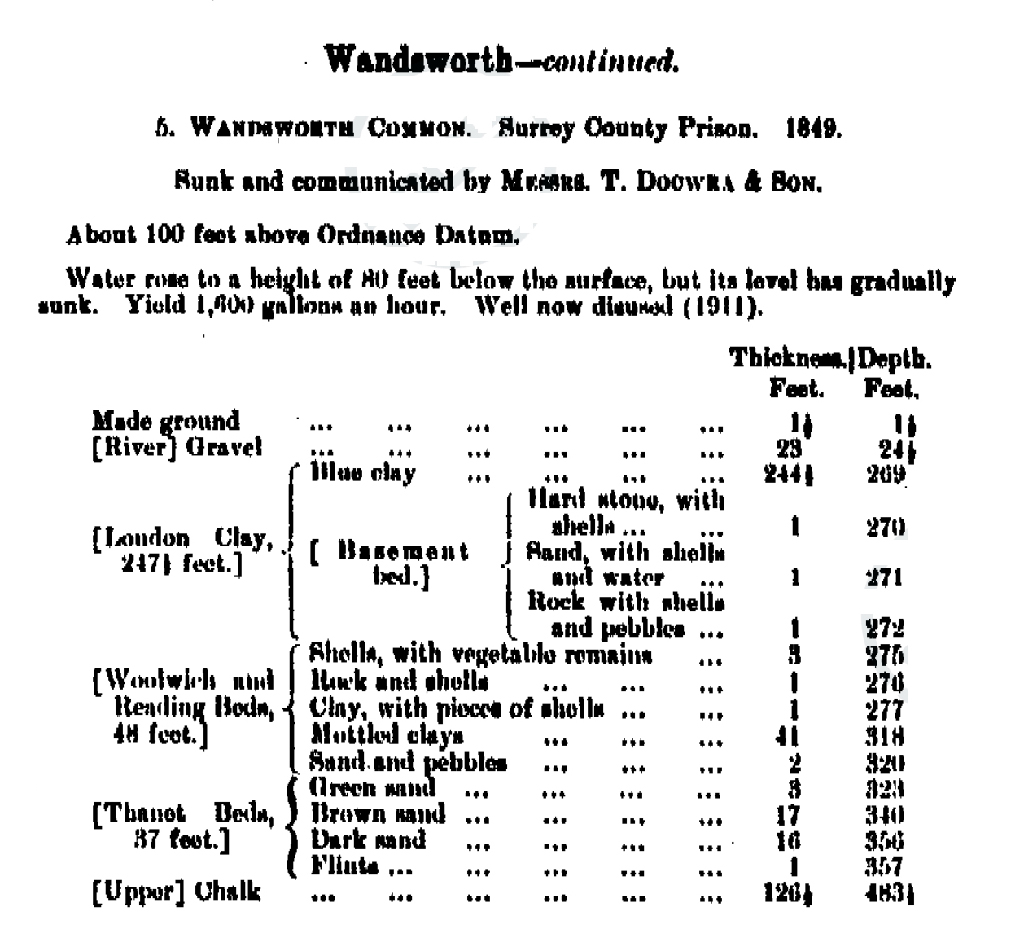
— CK:  Chalk = 126½ ft. [does this mean the layer of chalk is only 126½ feet here — if so, what lies beneath? The key says “Chalk up to 231 feet”.

Here's a similar listing of the strata, downloaded from the BGS site. Notice the well ceased to be used in 1911.

Are there any any signs of it today? I must ask historian of Wandsworth Prison Stewart McLaughlin.


(Click on image to enlarge)

Finally, here's an up-to-date map . . . 

For simplicity, I've labelled the different deposits. I won't go into any detail about the different surface deposits today, but the main point is that our local Commons — Wandsworth, Clapham, Tooting, Wimbledon — are as they are because all are topped by a cap of infertile gravel. It is this that made them Commons or uncultivated "wastes" in the first place (perhaps 1000 or more years ago) and kept them that way until the present.

SW-London-Geology-Viewer-BGS-tweaked-head-1920px-min.jpg SW-London-Geology-Viewer-BGS-tweaked-head-1024px-min.jpg
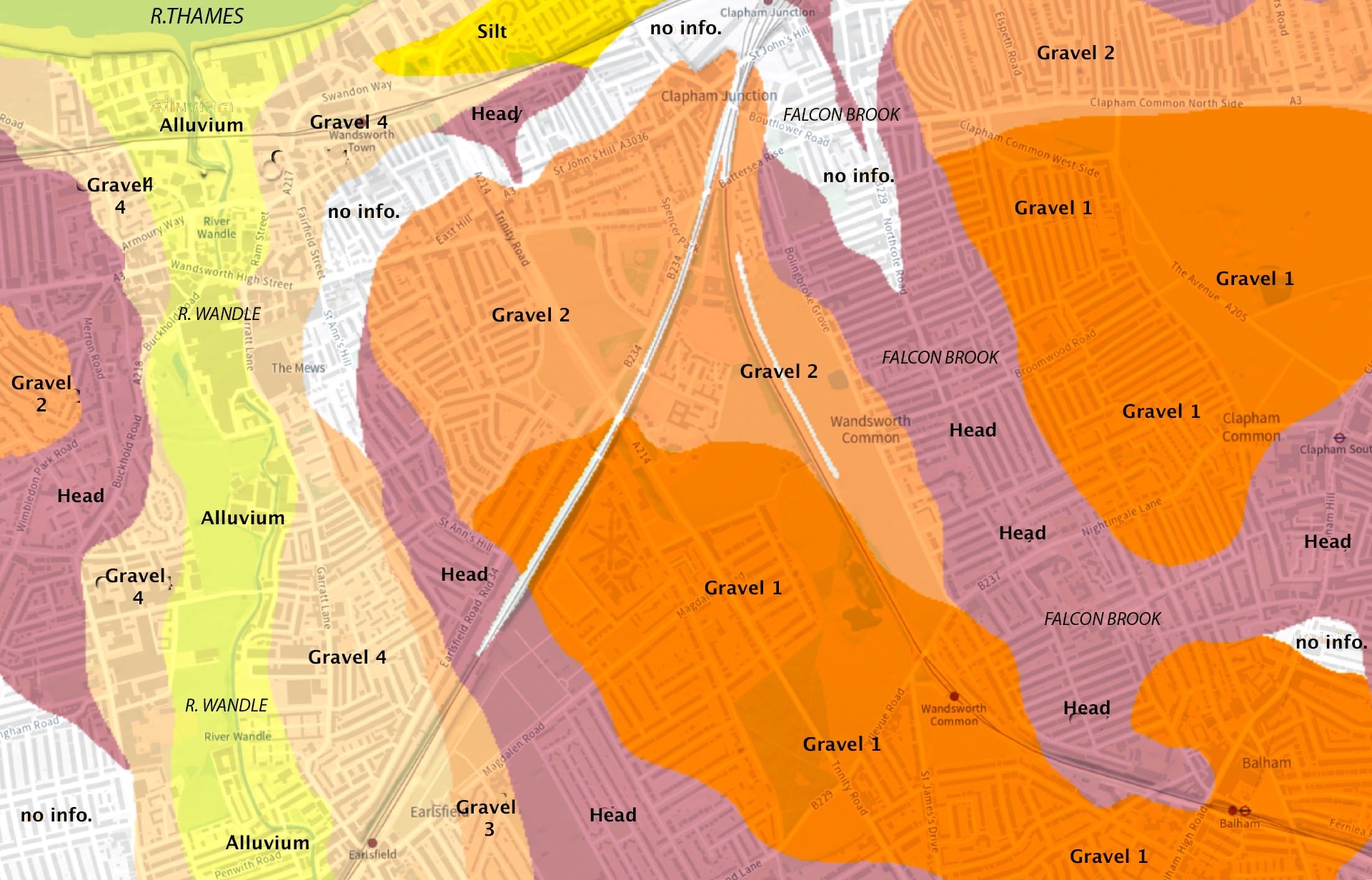
Our area as seen on the British Geological Survey's wonderful "Geology Viewer". Great fun to explore.

Modern names for rocks are sometimes different from those used in the 1913 map above. Gravels vary in their age, height above sea level, and their particular makeup. They differ, for example, in the average size, roundness or angularity of the small stones they're made up of. They take their name from "classic" sites in the Thames Valley where the particular mix was first described.

Unlike solid bedrock strata, on hills (such as Wandsworth, Clapham, or Wimbledon Commons) the oldest gravel layers are usually at the top of the pile. (Don't ask me why — at least not yet.)

Surface features

Layer after layer of sediments were laid down over our area, and cut into chiefly by rivers and streams.

The very top layer, where present, is often called Artificial ground, Made-ground, or just Made — i.e. "human-made".

Much of this is deposits of soil or landfill debris spread on the natural surface. On the Common, this can be up to about half a metre deep, but is usually shallower (or even absent). I often wonder when and how soil was added all over the Common. Where did it all come from?

Layers of Gravel can be up to 10 metres thick, but usually five metres or less. Huge amounts were stripped away in the nineteenth century, chiefly for making roads and buildings. The ponds on Wandsworth Common were once gravel pits.

There are several different sand/gravel layers in our area, laid down from more than 300 thousand years ago to the end of the last Ice Age about 11,700 years ago. The main ones in our area are:

Gravel 1 — Lynch Hill Gravel — the oldest.

Gravel 2 — Hackney Gravel.

Gravel 3 — Taplow Gravel.

Gravel 4 — Kempton Park Gravel — the youngest.

Head — a mixture mainly of sticky clay with silt, sand and gravel all jumbled together by the downward movement of material from higher layers.

Silt (sometimes called "Brickearth") — Langley Silt — clay and silt.

Alluvium — clay, silt, sand and gravel — formed since the end of last Ice Age.

Beneath all these deposited materials are the much older "Bedrocks".

These are London Clay, a layer of clay and silt up to 150 metres thick that formed around 50 million years ago.

Below that, 30 metres of Woolwich, Reading and Thanet Beds of very mixed materials, including shells, vegetable remains, clay, pebbles, sand, and flints.

And beneath all of the above lies Chalk, up to 200 metres thick, formed between 100 million and 61 million years ago. Over millennia huge volumes of water have percolated down Into this permeable layer that can be tapped by "artesian wells" such as the one beneath Wandsworth Prison.

Chalk often contains layers of Flints. There are no outcrops of chalk in our area, but most of the pebbles and gravels across our Common were once flint, pushed around, broken up, and smoothed by glaciers and flowing water.

There's loads more stuff below the Chalk too, but we've got to stop somewhere.

(Click on image to enlarge)

Boreholes on the Common

Perhaps, sometime in the future, we can look at other boreholes on and around the Common — most having been undertaken for the construction of wells, sewers, foundations of buildings, high-tension electricity cables, and even the possibility of running a train beneath our feet.
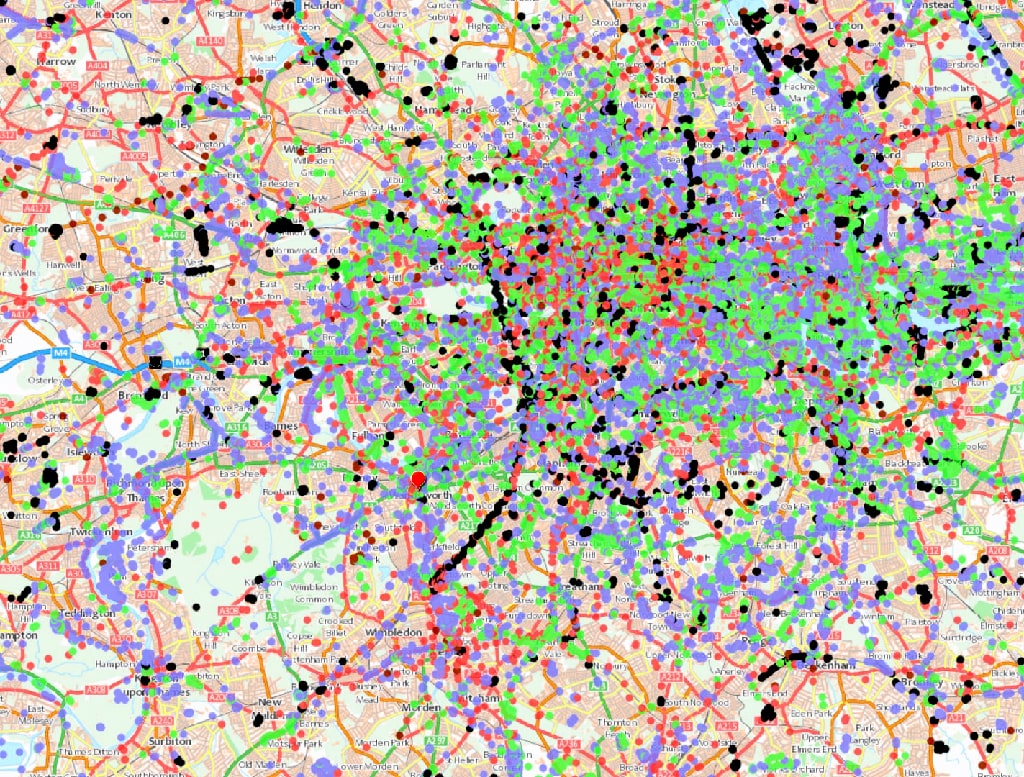


London boreholes as depicted on the BGS website.

(Click on image to enlarge)

There's a lot more to be said about the fascination of local geology and topography, for example the sculpting of the landforms that underlie our Common and roads, and the durable perception (and reality) that this represents is a "healthy" area. But not now.


Water-Gravel-Siren-Music

A few years ago, I made a 90-second video of water running over gravel on the side of the Avenue path near Bellevue Road:


(Click on image to enlarge)

Digging deeper

THis list is a bit of a rag-bag at the moment, but I wanted to record some of the resources I'd come across in researching this month's Chronicles.

I'll almost certainly carry on trying to make sense of our local geology. And you may fancy doing the same.

— Learn more (much more) on the British Geology Society (BGS) website.

— Explore the BGS "Geology Viewer".

— BGS Borehole online map and records (GeoIndex Onshore).

— I expect D.R. Bridgland, Quaternary of the Thames (1994) is the bible of local geology. Thorough but very technical.

— Very good (easier, though still often beyond me), is R.A. Ellison et al, Geology of London. Memoir of the British Geological Survey, Sheets 256 (North London), 257 (Romford), 270 (South London) and 271 (Dartford). British Geological Survey. Online here.

— The Geology of London, compiled by Diana Clements. Geologists' Association Guide No. 68. Includes itineraries. I've only seen the introduction in an old edition, but even that was useful. There was a 2nd edition in 2024.

H Barron et al, London’s foundations: protecting the geodiversity of the capital , London, UK, Greater London Authority (pdf).

Over time, I'll add to this list. Let me know if you come across anything you find useful.


Do you know a knowledgeable geologist with an interest in the Thames Valley who could help with my questions on the geology of Wandsworth Common? Do let me know. I'd really appreciate speaking to someone who actually knows what they're talking about.


Chronicles

August 2025

Part One


I had intended to write about rather different topics this month, but things changed suddenly when one of my favourite trees on the Common shed some of its massive branches:

Friends of Wandsworth Common, 22 July 2025:


Very sadly we must report that the ‘boundary oak’ — one of the oldest trees on the Common, marking the boundary of Battersea and Wandsworth parishes — lost a major bough overnight. The area has been cordoned off while tree officers assess the situation.
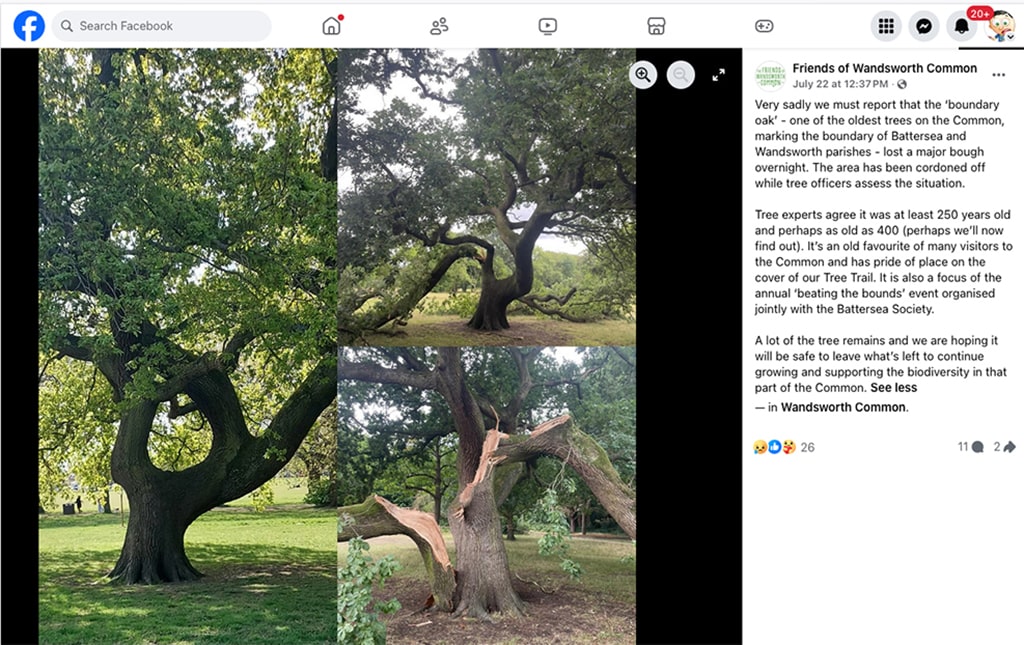


(Photos: Stephen Midlane)

(Click on image to enlarge)


Tree experts agree it was at least 250 years old and perhaps as old as 400 (perhaps we’ll now find out). It’s an old favourite of many visitors to the Common and has pride of place on the cover of our Tree Trail. It is also a focus of the annual ‘beating the bounds’ event organised jointly with the Battersea Society.

A lot of the tree remains and we are hoping it will be safe to leave what’s left to continue growing and supporting the biodiversity in that part of the Common.

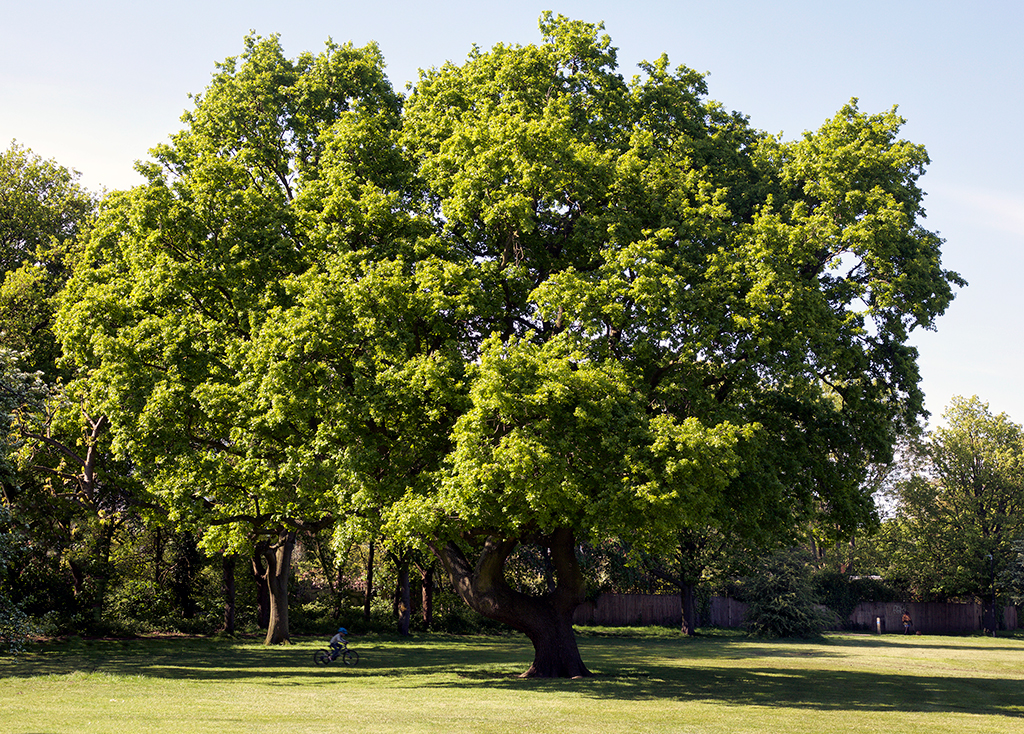
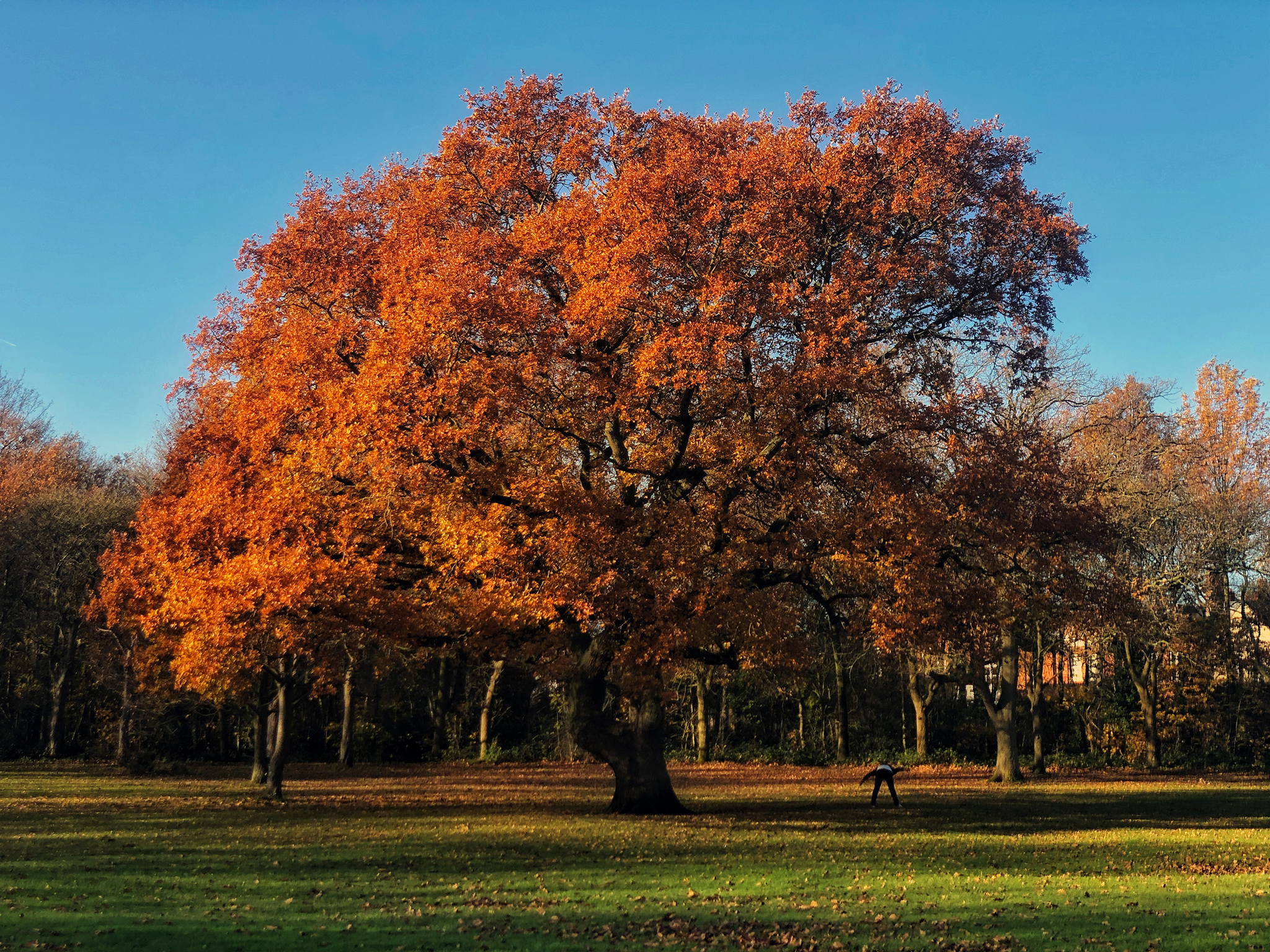


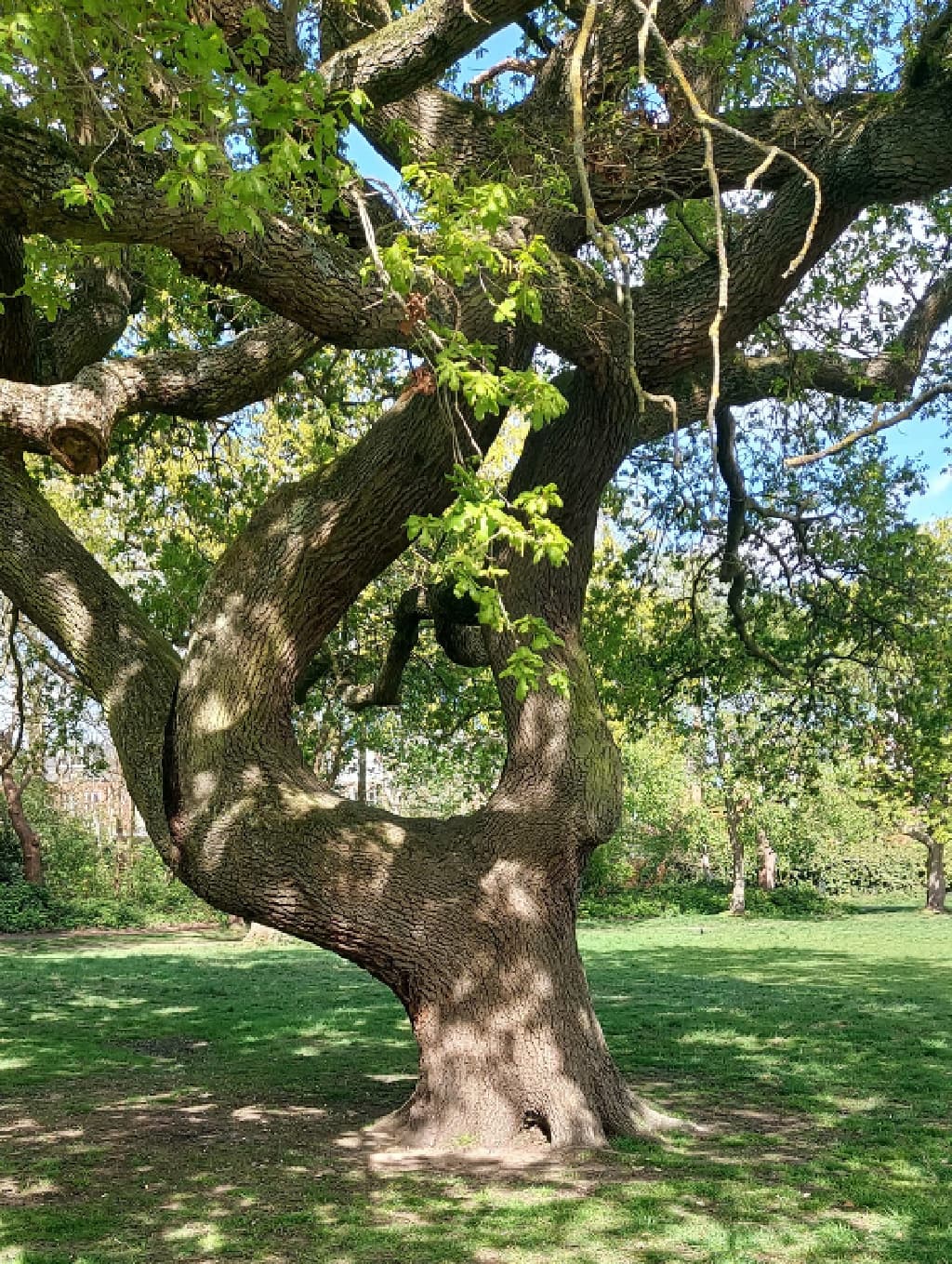
The Boundary Oak, 22 July 2025. (Photo: Philip Boys)

(Click on image to enlarge)

Happier times . . . 


May, 2018. (Photo: Lewis More O'Ferrall)


November, 2019. (Photo: Lewis More O'Ferrall)


January 2021. (Photo: Lewis More O'Ferrall)

(Click on image to enlarge)

The Boundary Oak is sometimes called the Elephant Tree, for obvious reasons.


(Photo: Lewis More O'Ferrall)

(Click on image to enlarge)


(Photo: Stephen Midlane)


Can you spot the Boundary Oak?


(Click on image to enlarge)

The boundary . . . 


(Click on image to enlarge)

I'd known (and wondered about) this remarkable tree for a long time, but it wasn't until Stephen Midlane pointed out its position on the boundary between Battersea and Wandsworth parishes that I realised its significance. True, we haven't come across any further visual or written evidence, but it makes perfect sense.

[We know of other instances in the area of oaks being deliberately planted on the Common for just this reason, but I can't lay my hands on a better source than my memory at the moment. As soon as I do, I'll add it.]

In the late-19th century, an extraordinary number of boundary posts were erected every few yards to emphasise the parish/borough boundary between Battersea and Wandsworth. (This may seem odd, given how good mapping was by this time.) Previously, boundaries were recognised largely by natural features — streams, for example, or unusually shaped trees.


The Boundary Tree on the boundary between Battersea and Wandsworth, shown on an OS map of 1893. A surprising number of metal boundary posts (circled in purple) are shown. Most have now disappeared .

(Click on image to enlarge)

The Boundary Oak stands roughly half-way between two (later) posts or markers:


Boundary Tree seen from the post on the Avenue. (Photo: Tim Wren, 2024)

(Click on image to enlarge)


The same post seen from the reverse angle. Maggie (my wife), Theo and Marlowe (grandchildren) hunting for boundary posts, 31 July 2019.

(Click on image to enlarge)

Looking the other way, there is a very unusual pair of boundary markers, near the corner of the Toast Rack salient:
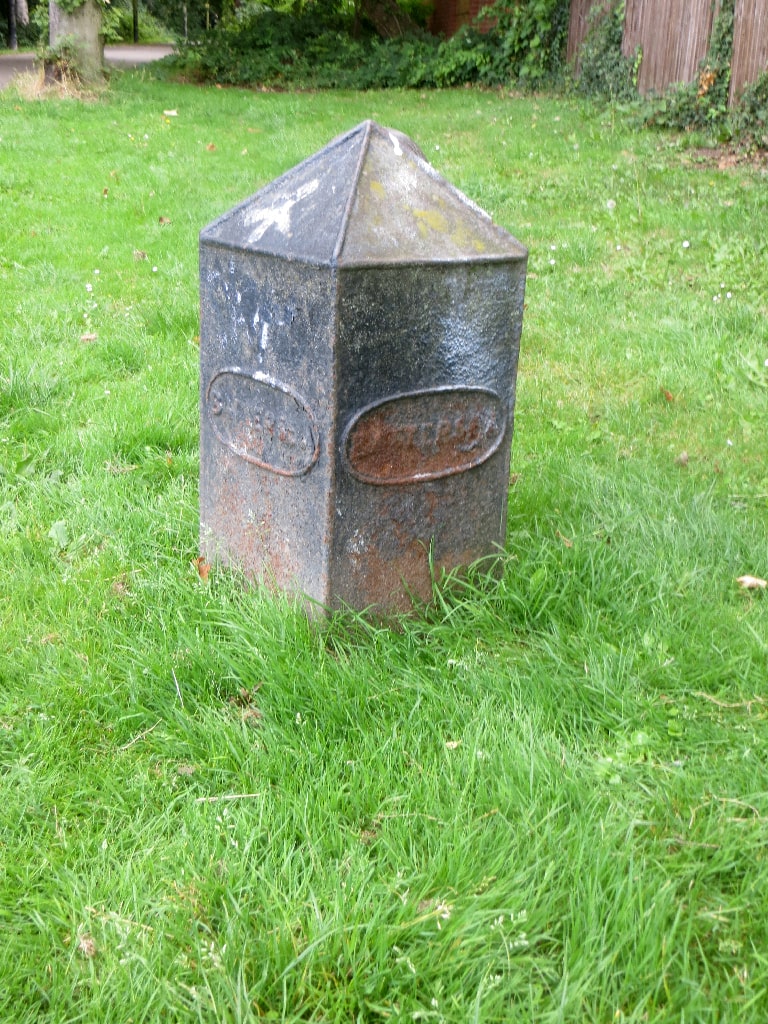
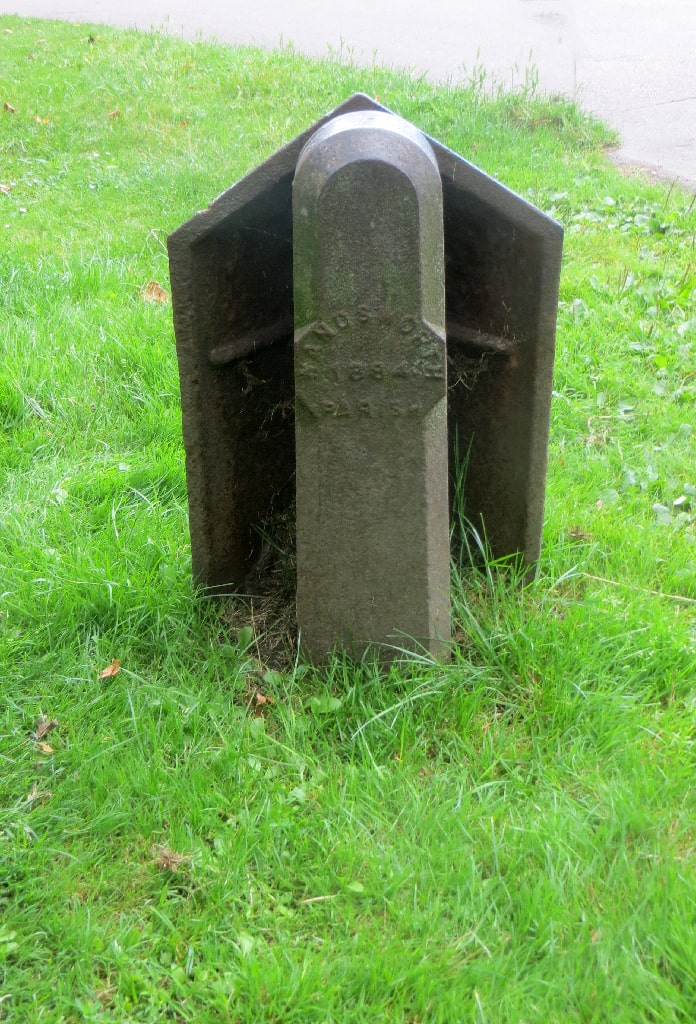

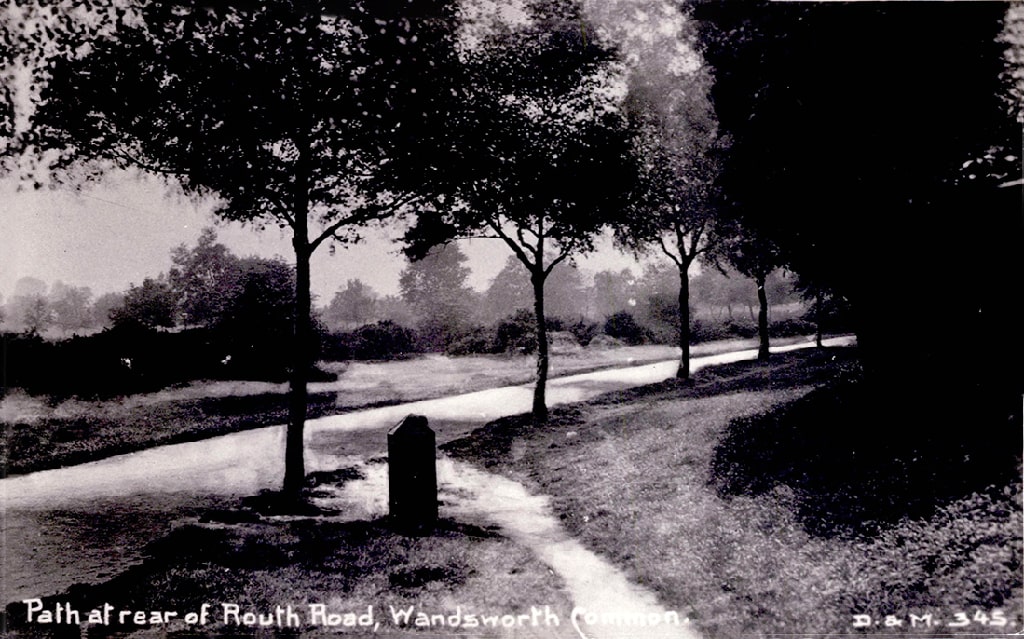
Very unusual paired boundary markers separating Wandsworth (1894) and Battersea, c.1910. (Photos: Philip Boys)


Postcard by Dorrett & Martin, whose studio was nearby on Bellevue. I think the Boundary Oak is just about visible in the distance, on the left. (Ron Elam Collection.)

(Click on image to enlarge)


You can just about see these boundary posts in the distance on the extreme left.

(Click on image to enlarge)

Our Boundary Oak must have been well-known to generations of beaters of the local bounds. I wish there were more (and more detailed) records of these perambulations, both by Battersea and Wandsworth parishioners.

A few years ago, I transcribed and annotated a wonderful account from 1862. Also a collection of photographs of boundary posts. Looking back at them again, I see I'd left them in a bit of a mess. which I'll try to tidy up. Let me know if you'd be interested.

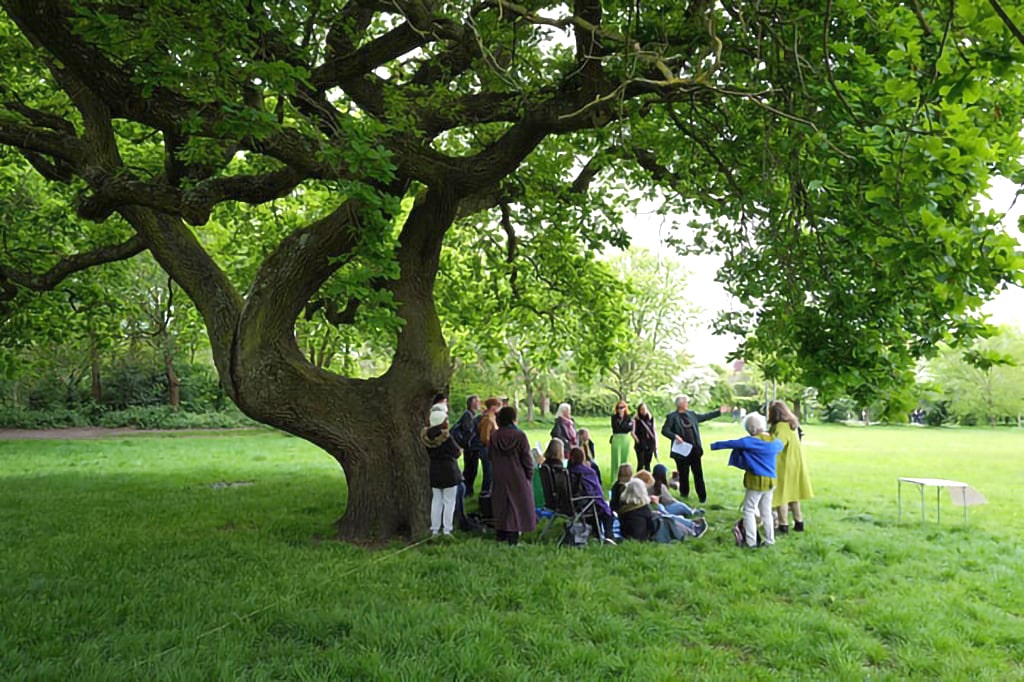
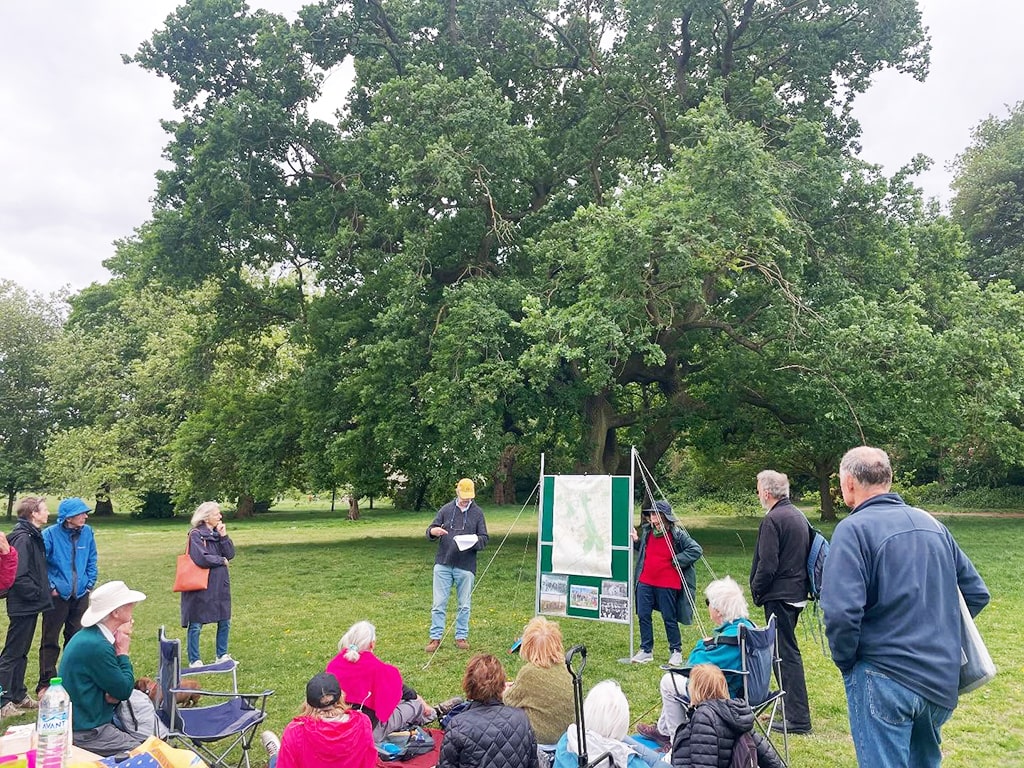

The Boundary Oak, a.k.a. the "Elephant Tree". Just to the right of the trunk, the boundary post on the Avenue. In the distance, Bellevue Road. (Photo: Lewis More O'Ferrall)

(Click on image to enlarge)


Beneath the Boundary Oak: me (in heroic pose) addressing exhausted Battersea-boundary-beaters about the history of their route, May 2024. (Photo Tim Wren)

Stephen Midlane, doing likewise, May 2025.

(Click on image to enlarge)

"Would you know how oak-trees grow . . . "

Cicely Mary Barker, The Acorn Fairy (from The Fairies of the Autumn (1925))

To English folk the mighty oak
Is England’s noblest tree;
Its hard-grained wood is strong and good
As English hearts can be.
And would you know how oak-trees grow,
The secret may be told:
You do but need to plant for seed
One acorn in the mould;
For even so, long years ago,
Were born the oaks of old.


And then . . . 

After just a couple of days, the tree people came to assess the damage properly and make the Boundary Oak safer. The ambition, I hear, is to keep as much of the fallen wood as possible, and to carpet an area around the trunk with mulch as a way of keeping the tree better protected from drying out. The outer edge of the mulch matches the canopy — a good guide to the reach of the roots. I think they've done a wonderful job.

Reports suggest that what may explain the shedding is the sudden heavy rainfall that occurred a few days earlier. Coming after a severe extended drought, the boughs took up too much water and broke sunder the strain of the extra load.

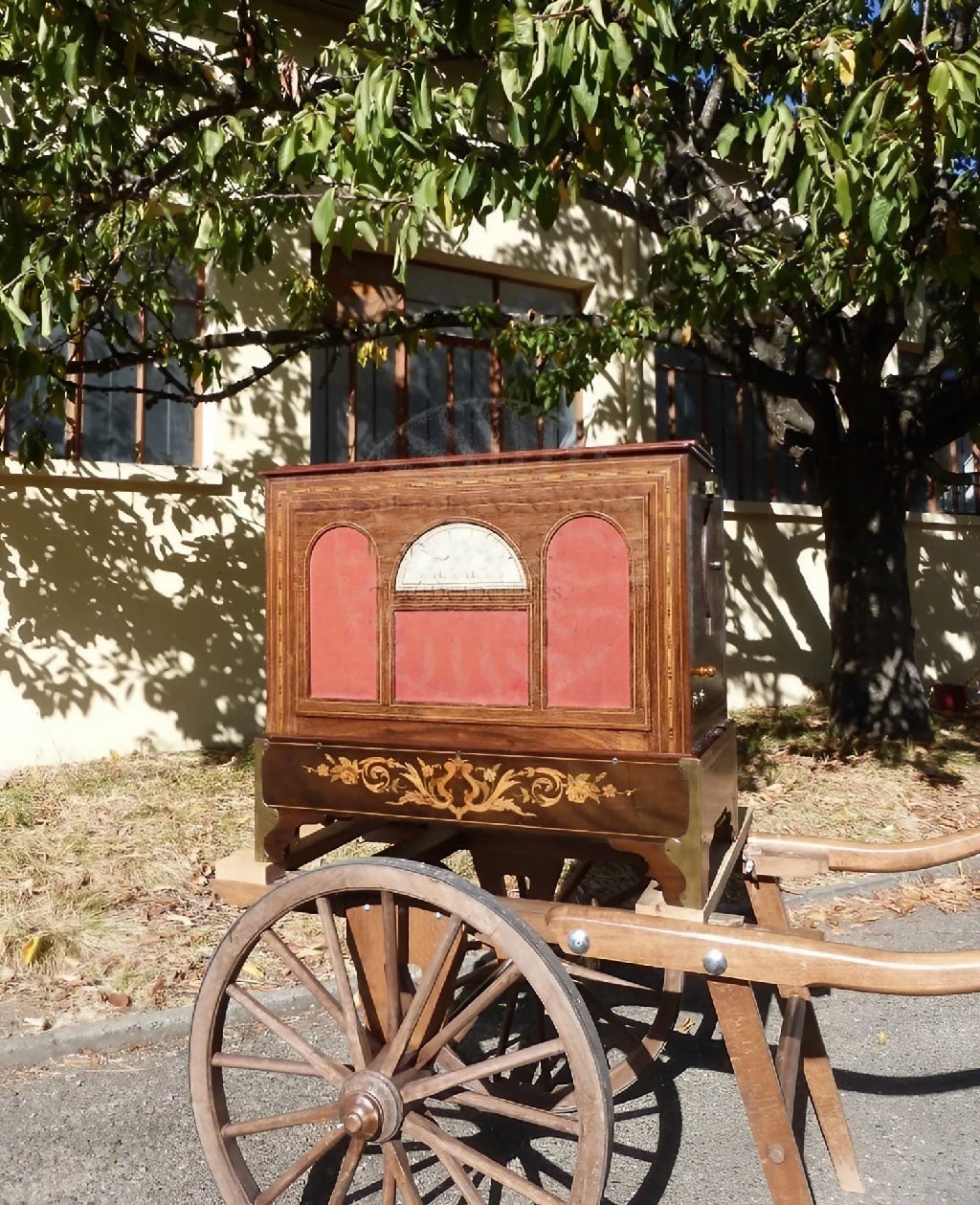

(Photo: PB.)

(Click on image to enlarge)


Do you have special memories or favourite photographs of the Boundary Tree? Please send them to me — I'll add them to a commemorative page I'm putting together.


Chronicles

July 2025

Part Two


Is this the sort of "Harmoniflute" that so agitated Thomas Hardy?


Thomas Hardy chases an organ-grinder down Brodrick Road . . . 

I tell this month's story as much for what it says about the soundscape of our streets as the intrinsic fascination of the incident itself. It involves Thomas and his first wife, Emma Hardy (nee Gifford), who lived for three years (1878—1881) on the corner of Trinity Road and Brodrick Road.

In the summer of their first year here, Emma Hardy looks out of the back window and sees Thomas running down Brodrick Road. She is perplexed, perhaps largely because he has fled the house without his hat.


Brodrick Road, off Trinity Road, the presumed route that (a hatless) Thomas Hardy sprinted down. The Hardys' house is now numbered 172 but at the time was usually referred to as 1 Arundel Terrace, or (rather unconvincingly) "The Larches".

(Click on image to enlarge)


Thomas Hardy, by Herbert Rose Barraud, 1889 (an older Hardy, since it was taken about a decade after the Hardys arrived). There are copies on Wikimedia and the NPG.

(Click on image to enlarge)

Here's how Hardy's second wife, Florence Emily Hardy (nee Dugdale) described the event her Life of Thomas Hardy (published by Macmillan, 1928-1930):


Mrs Hardy used to relate that during this summer, she could not tell exactly when, she looked out of a window at the back of the house, and saw her husband running without a hat down Brodrick Road, and disappearing round a corner into a by-street.

Before she had done wondering what could have happened, he returned, and all was explained.

While sitting in his writing-room he had heard a street barrel-organ of the kind that used to be called a 'harmoniflute', playing somewhere near at hand the very quadrille over which the jaunty young man who had reached the end of his time at Hicks's had spread such a bewitching halo more than twenty years earlier by describing the glories of dancing round to its beats on the Cremorne platform or at the Argyle Rooms, and which Hardy had never been able to identify.

He had thrown down his pen, and, as she had beheld, flown out and approached the organ-grinder with such speed that the latter, looking frightened, began to shuffle off. Hardy called out, 'What's the name of that tune?'

The grinder — a young foreigner, who could not speak English — exclaimed trembling as he stopped, 'Quad-ree-ya! quad-ree-ya!' and pointed to the index in front of the instrument.

Hardy looked: 'Quadrille' was the only word there. He had til then never heard it since his smart senior had whistled it; he never heard it again, and never ascertained its name.

It was possibly one of Jullien's — then gone out of vogue — set off rather by the youthful imagination of Hardy at sixteen than by any virtue in the music itself.

["down Brodrick Road, and disappearing round a corner into a by-street" — this must have been St James's Road (now Drive).

Quadrille — music to accompany a square dance, often based on popular tunes, operatic melodies etc.

There are some Jullien Quadrilles on YouTube.

Cremorne — presumably the Cremorne Gardens, just across Battersea bridge at Chelsea?.

Argyle Rooms — presumably those near Regent Street.]

The authorship of The Life of Thomas Hardy is complicated. Initially, it was published by Macmillan (on whom more below) over the name of Hardy's second wife, Florence Dugdale. At this time (1928-1930) it was presented as having been compiled by her, after Hardy's death, "largely from contemporary notes, letters, diaries and biographical memoranda as well as from oral information in conversation."

However, it later became apparent that Hardy himself had engaged in a literary deception — that it was he who had written The Life as his own autobiography, intending it to be as it were a posthumous "official biography" to be passed off by Florence as her own. As a result, later editions have generally been credited to them both.

To add to the confusion, more recently some scholars (notably Michael Millgate) have argued that Florence had in any case rewritten Thomas's work (in defiance of his wishes). However, all was not lost:


Through careful examination of pre-publication texts, Michael Millgate has retrieved the text as it stood at the time of Hardy's final revision. For the first time The Life and Work of Thomas Hardy can be read as a true work of autobiography — an addition to the Hardy canon. [Publisher's blurb, 1984.]

Whether this greatly affects the chapters on the Hardys' life on and around Wandsworth Common, I don't know. But I have just ordered Millgate's book, so we shall see.


What is a "Harmoniflute?"

This is a puzzle. Most references to "harmoniflutes" claim they are rough equivalents to harmonicas (mouth organs), or accordions. But this is a barrel-organ, and its young player is described as a "grinder", i.e. he turned a handle. Perhaps it looked something like this:


Expertises: Harmoniflute Barrel Organ.

(Click on image to enlarge)

The Hardys visit "Knapdale", home of the publisher Alexander Macmillan


July 8 or 9

With E. [Emma] to Mrs Macmillan's garden-party at Knapdale, near our house. A great many present.

Here's another July entry in the Hardy diary, in which Thomas and Emma attend a garden party at "Knapdale", ten minutes away down Trinity Road in the direction of Tooting Common. This had been the residence since 1863 of the publisher Alexander Macmillan.

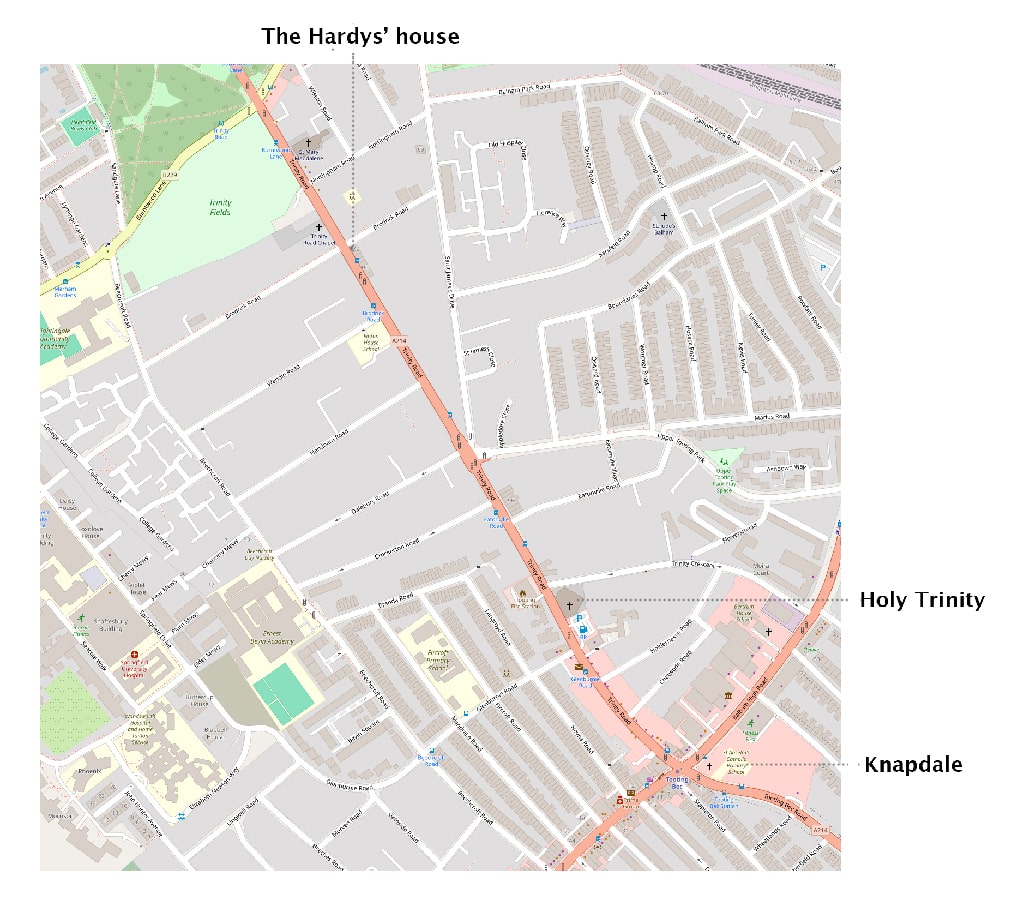


Knapdale: previously called "The Elms", but renamed in the 1870s after the Macmillans' ancestral home. ([It may also once have been called Broadwaters. See below.)


Knapdale, in relation to today's Tooting Bec junction.

(Click on image to enlarge)

Macmillan had several years earlier turned down Hardy's first novel, The Poor Man and the Lady (1867-1868; unpublished, manuscript lost), but had been encouraging. Persistence paid off, and Macmillan eventually published several of Hardy's mature works, including The Woodlanders (1887), Tess of the D'Urbervilles (1891) and Jude the Obscure (1895), as well as collections of poetry.]

Absolutely everybody went to Alexander Macmillan's parties (which may explain why Thomas had moved to Trinity Road in the first place).


Alexander Macmillan

(Click on image to enlarge)

Alexander Macmillan published, among many other soon-to-be-classics of children's literature, Thomas Hughes, Tom Brown's Schooldays (1857); Charles Kingsley's Water Babies (1863) and Westward Ho! (1855); Lewis Carroll, Alice in Wonderland (1865) and Alice Through the Looking Glass (1871), and Rudyard Kipling, Kim (1894). [See also this Macmillan Timeline.]

The entry in The Life continues:


Talked to Mr White of Harvard University, and Mr Henry Holt the New York publisher, who said that American spelling and idiom must prevail over the English, as it was sixty millions against thirty. I forgot for the moment to say that it did not follow, the usage set up by a few people of rank, education, and fashion being the deciding factor.

Also to John Morley, whom I had not seen since he read my first manuscript. He remembered it, and said in his level uninterested voice: 'Well, since we met, you have . . . '  &c, &c.

Also met a Mrs H., who pretended to be an admirer of my books, and apparently had never read one. She had with her an American lady, sallow, with black dancing eyes, dangling earrings, yellow costume, and gay laugh.

It was at this garden-party at Mrs Macmillan's that the thunder-storm came on which Hardy made use of in a similar scene in A Laodicean.

[For the thunderstorm during the garden party at Knapdale as depicted in A Laodicean, see chapters 15 and 16.

Also during the party, the unnamed "American lady, sallow, with black dancing eyes, dangling earrings, yellow costume, and gay laugh" appears as "Miss Deverell — a sallow lady with black twinkling eyes, yellow costume and gay laugh".


The cover illustration of a 1970s' Macmillan edition of A Laodicean, which Hardy wrote during his time living on Trinity Road.

(Click on image to enlarge)

I'd love to find a full-on Victoria book illustration showing the violence of the thunderstorm, but I can't. (I suspect the parasol in the recent Macmillan edition hints at the event.) This is the best I can do — a scene from the garden party inn which our hero and heroine have retired to a decorated and lit marquee, in which guests are dancing:


George du Maurier's (rather feeble) illustration for Harper's New Monthly Magazine (1880) showing the moment the hero (Somerset) and heroine (Paula) first touch hands. Illustration from Victorian Web

(Click on image to enlarge)


The thunder-storm showed no symptoms of abatement, and the music and dancing went on more merrily than ever.

"We cannot go in," said Somerset. "And we cannot shout for umbrellas. We will stay till it is over, will we not?"

"Yes," she said, "if you care to. Ah!"

"What is it?"

"Only a big drop came upon my head."

"Let us stand further in."

Her hand was hanging by her side, and Somerset"s was close by.

He took it, and she did not draw it away. Thus they stood a long while, the rain hissing down upon the grass-plot, and not a soul being visible outside the dancing-tent save themselves.

"May I call you Paula?" asked he.

There was no answer.

"May I?" he repeated.

"Yes, occasionally," she murmured.

"Dear Paula! — may I call you that?"

"O no — not yet."

"But you know I love you?"

"Yes," she whispered.

"And shall I love you always?"

"If you wish to."

"And will you love me?"

Paula did not reply.

"Will you, Paula?" he repeated.

"You may love me."

"But don't you love me in return?"

"I love you to love me."

"Won't you say anything more explicit?"

"I would rather not."

By the time of Hardy's visits, the Macmillans were well-established in the area. Alexander had moved here in 1863 with his wife Caroline, his brother’s widow Fanny, and their combined family of eight children. His aim was to be "in the country" yet close enough to a railway station (Balham) to whisk him to his offices in Covent Garden. The house and location must have suited because Alexander at first took a lease but later in the decade bought The Elms/Knapdale outright and lived here for more than twenty years.

[One of Fanny's children living at Knapdale was Maurice Crawford Macmillan (1853-1936), father of British Prime Minister Harold Macmillan. So here we have another PM with a local connection, joining William Pitt the Younger, David Lloyd George, and Clement Attlee.

By the way, Hardy was a guest at Harold Macmillan's wedding to Lady Dorothy Cavendish, the daughter of the 9th Duke of Devonshire, on 21 April 1920. ]

There's a vivid description of Knapdale in Sarah Harkness's fine Advocating for the Ignorant blog. I hope she won't mind if I quote her at length, since it's such a good account. I have interspersed her text with photographs of Knapdale in the Wandsworth Heritage Library. Their date is uncertain but probably taken after the Macmillans had left, since when it had become festooned with ivy.


If Tooting was to become an attractive alternative to living in central London, it needed decent transport links. Not everyone could have their own carriage! In the 1850s an omnibus service connected Upper Tooting and London six times daily — the bus was drawn by four horses and came from Carshalton via Mitcham and Lower Tooting, calling at the Wheatsheaf Inn [at today's "Tooting Bec"]. In 1861 the population of Tooting was just over a thousand, but over the next ten years it grew by some 40 per cent.

The major impetus to settlement had come with the opening of Balham Station in 1856 — on the West End of London and Crystal Palace Railway. This line terminated at Victoria, and its utility was crucial in persuading the overworked and highly stressed Alexander Macmillan, whose publishing business was relocating from Cambridge to Bedford Street in London’s Covent Garden, to move his whole family south as well.

The Elms was a large and comfortable house in its own grounds, described by Alexander’s son George as "old-fashioned but commodious." It took the form of an H-shaped, substantial three-storey gentleman’s residence constructed in brown London brick with an "in and out" carriageway from the main road.
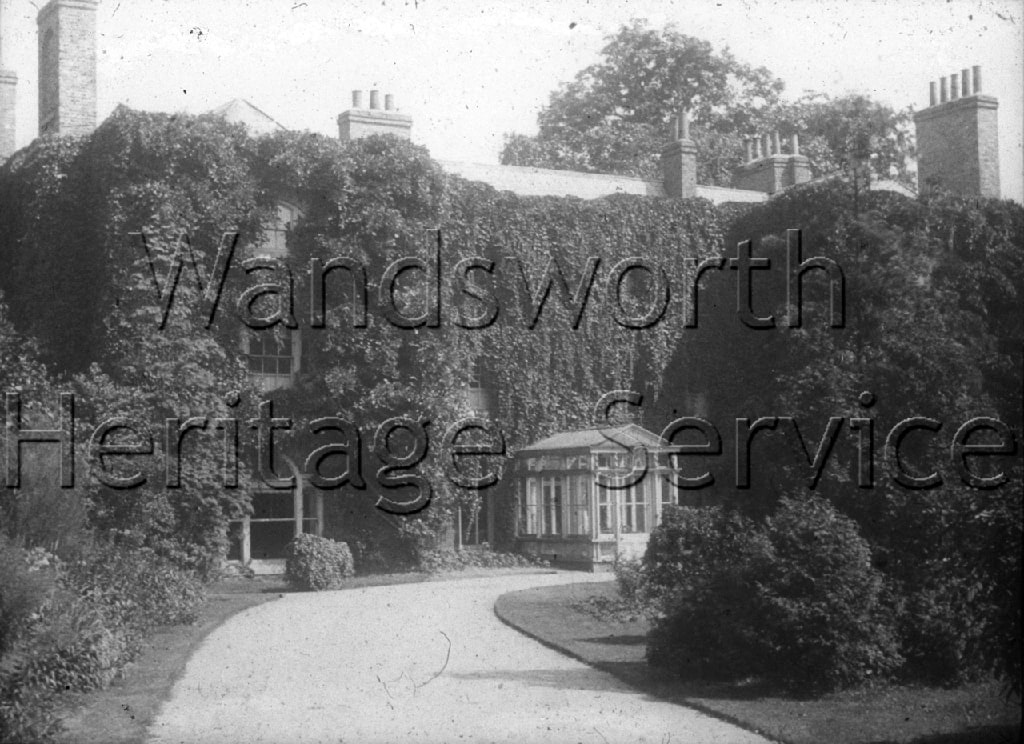


(Click on image to enlarge)


The brick of the house covered what in the eighteenth century was a timbered black and white house, with mahogany doors added, and delicately carved Adam-style mantelpieces in the reception rooms and the large bedroom. The attics were large and roomy. On the ground floor, beside Alexander’s library, there was a good-sized entrance hall with a broad staircase, and dining and drawing rooms. The nursery and night nursery were on the first floor corner facing the street, and the daughters of the house, as they grew up, were given the next two front bedrooms.

Alexander and his wife slept at the back overlooking the garden, and there was a gallery that ran from their room to the top of the staircase, along which the children built toy villages and roads on wet days.

Alexander described it as "a nice quaint old house, with a very pleasant garden so retired and countrified and yet so accessible." Though it was in a London suburb, yet there were "gypsies and tea on the common when we first went there".

The move was a massive relief for the Macmillan family, not just for the simplification of Alexander’s business life, but in terms of the space it gave the children, who "tumbled about in the grass" all day long. He remarked that it was funny that they had moved to London to find themselves living in the countryside. "I never knew what the blessing of a country life was before."

The elm trees were a feature of the place; Macmillan wrote "I am getting to find them unendurable since they have given up the murderous habit of shying down big branches at people’s heads." There was also a mulberry tree, which Macmillan believed had been planted by the philosopher John Locke, on a visit to Lord King, his biographer, who had lived on the site. Unfortunately the tree blew down in 1886.

The house was highly convenient for Alexander, being only a fifteen-minute walk from Balham station and its trains to Victoria. It allowed Alexander to dispense family hospitality, home-cooked meals supervised and hosted by his wife and his sister-in-law, gardens to enjoy and the offer of a bed for the night.
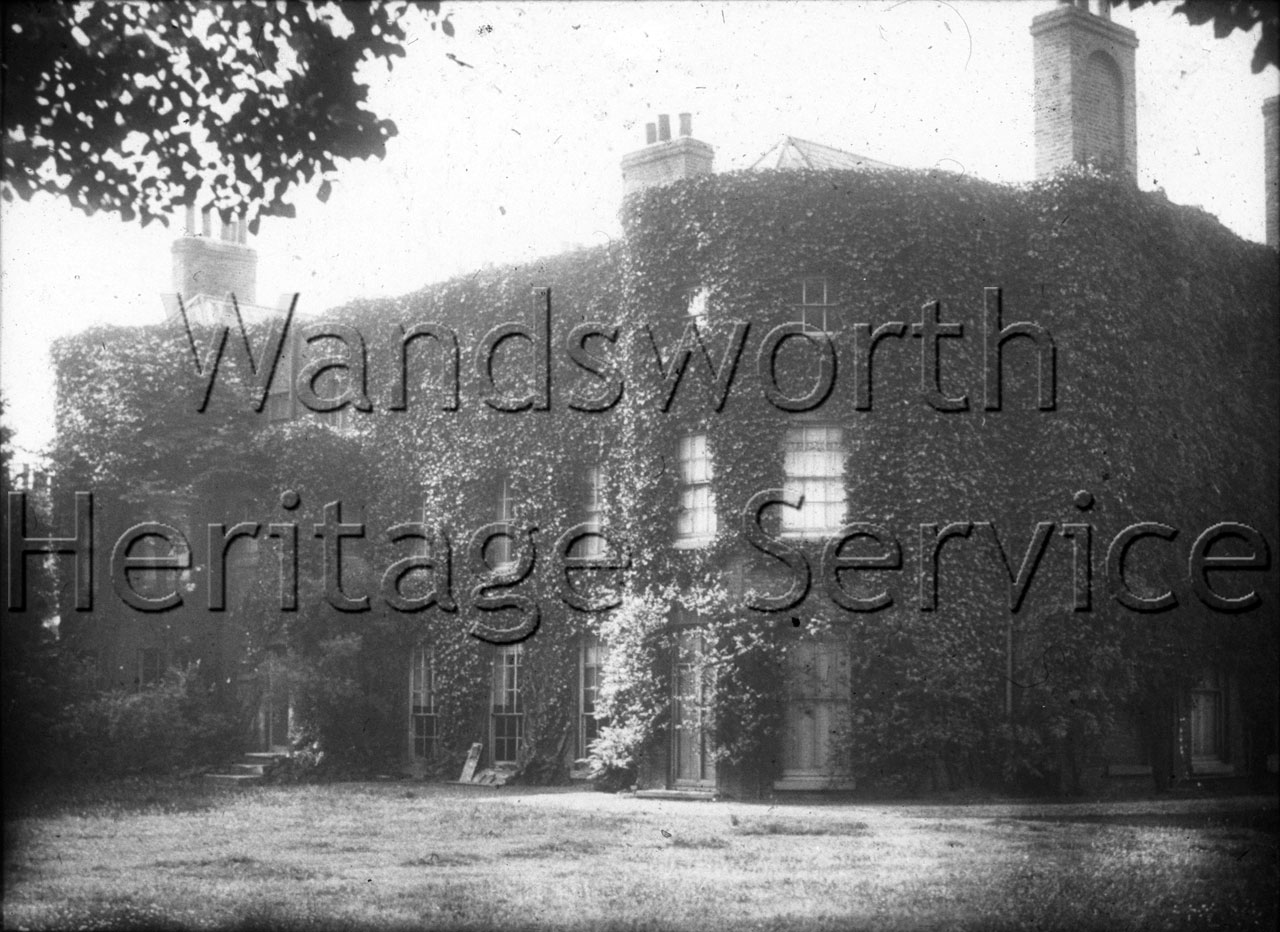


(Click on image to enlarge)


When Alexander had first opened London premises in Henrietta Street, he cultivated a circle of young and ambitious writers, painters, scientists and critics at Thursday evening gatherings of "talk and tipple" known as Tobacco Parliaments. Regular attendees included the Rossetti brothers, Thomas Hughes, Charles Kingsley, Thomas Huxley, FD Maurice and occasionally Alfred Lord Tennyson. These raucous evenings could now be replaced by open invitations to visit the publisher at his home.

Furthermore, his monthly periodical, Macmillan’s Magazine, was already showcasing female talent; now he had somewhere he could host these contributors for whom London drinking would not have been suitable. Mrs Craik, Mrs Oliphant and Miss Yonge were regularly invited. Christina Rossetti spent a night in June 1864. Jane Carlyle, wife of Thomas, stayed in Tooting on several occasions in June 1865 while her husband was travelling: she wrote that she had been entertained by Alexander singing Scotch songs, accompanied on the piano by the governess, but had been kept awake all night by the family dog under her window.

When she returned the following week the dog had been confined to the washhouse, and Alexander gave her a toddy of whisky to ensure she slept better. Alexander’s daughter Margaret recalled how Mrs Carlyle loved "the little attentions bestowed upon her by my mother, saying ‘Make of me, my dear, I love to be made of.’"

A great friend from Cambridge days, Alfred Ainger, wrote of Knapdale "In its large leisurely rooms, or in its spacious old world garden, there gathered together informally the men and women of note and the young promise of the day — authors, poets, painters, English and French, whether they came from Oxford or fresh from the ranks of the Impressionist Artists".
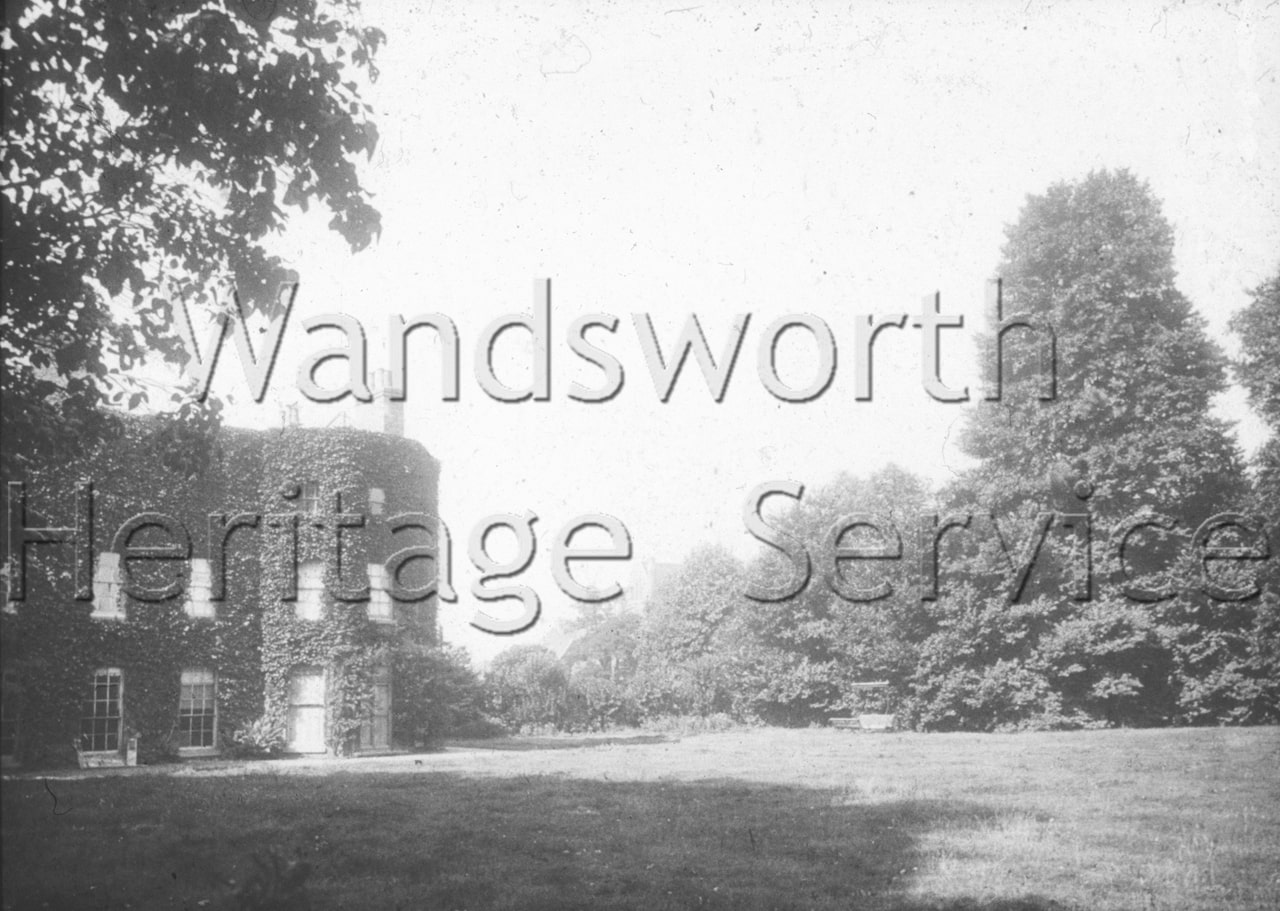


(Click on image to enlarge)


The reputation of the Macmillan home as "the place to be invited if you wanted to get published" continued for many years: from 1878-1881 Thomas Hardy brought his wife Emma to live at No 1 Arundel Terrace, on Trinity Road in nearby Wandsworth in an attempt to get himself more noticed by literary London. Hardy visited Knapdale several times, where he met other writers including Matthew Arnold and Tennyson — he was at a garden party at Knapdale when a thunderstorm hit, and the guests had to take shelter, an incident he used in The Laodicean.

Margaret Macmillan wrote a memoir of her father’s life at this time:

"The family’s day started with prayers at eight o’clock, followed by breakfast and then ‘the departure for the station, bag in hand. A short cut to Balham station led across a field belonging to a neighbour, and my sister and I often stood and watched him at the garden gate. I can see him now, his broad figure of average height, the shoulders a little rounded, and a rather peculiar walk, the toes turned outwards. Always a leisurely walk, for he gave himself plenty of time to catch the train."

[Sarah Harkness: "A Little Corner of Victorian London". I have just bought her Literature for the People: How the Pioneering Macmillan Brothers Built a Pubishing Powerhouse (2024), which I'm very much looking forward to reading — as soon as I've got July's Chronicles out of the way.]

The Hardys make several references to Macmillan or Knapdale in these years. We've already seen that Thomas used a thunderstorm that occurred during one garden party in The Laodicean, the novel he wrote when living on Trinity Road.

They also record that on 16 June 1878, a Sunday evening, Alexander told Thomas and Emma of a (very Hardy-esque) spooky story about a woman in a red cloak who passed for a witch on Craignputtock Moore. He'd heard it from Thomas Carlyle's wife, the Scottish writer Jane Welsh Carlyle, apparently from personal experience.

It was at Knapdale that Hardy met (and seems to have bonded with) "Darwin's Bulldog" Thomas Henry Huxley:


Thomas Henry Huxley: "A great Med'cine-Man among the Inqui-ring Redskins" by "Ape", Vanity Fair (28 January 1871).

(Click on image to enlarge)


We sat down by daylight, and as we dined the moon brightened the trees in the garden, and shone under them into the room. For Huxley, Hardy had a liking which grew with knowledge of him — though that was never great — speaking of him as a man who united a fearless mind with the warmest of hearts and the most modest of manners.

Finally, we must mention once again the Macmillans' role in Thomas Hardy's near-fatal illness. This started in October 1880:


23 October 1880 Thomas Hardy falls seriously ill

On returning to his home in Trinity Road, the author Thomas Hardy falls seriously ill. He won't be able to walk outdoors again for seven months — until May 1881, when he sets off alone and ecstatic across Wandsworth Common. He is just 40 years of age.

Thomas was in great and persistent pain.


Emma had sent for a surgeon who lived opposite. The surgeon returned on successive days and pronounced that Hardy was bleeding internally. An operation was required, but it would be very risky.

Mrs Hardy called for advice on their friend the publisher Alexander Macmillan (who lived at Knapdale, an impressive house near Tooting Bec Common). The Macmillans' doctor agreed with the earlier diagnosis.

I'm sure I've written more about Hardy's illness, and the slow progress of his eventual recovery, but for the moment I really can't remember where.


Thomas and Emily Hardy on and around Wandsworth Common

I've written about their experiences a number of times already, including here:

— October 2021: Thomas Hardy falls dangerously ill (23 October 1880).

— January 2022: "A January Night (1879)" (poem).

— February 2022: "On the first of February 1880 Hardy observed a man skating by himself on the pond by Trinity-Church Schools at Upper Tooting".

— March 2022: Thomas and Emma Hardy move to Arundel Terrace, Trinity Road (22 March 1878).

— May 2022: Thomas is often troubled at night by "a monster whose body had four million heads and eight million eyes" (19 May 1880).

— June 2022: Hardy is on the train up to Town: "In railway carriage a too statuesque girl; but her features were absolutely perfect" (27 June 1879).

But there are still some more stories to tell.

For example, thanks to the brilliant research skills of Sarah Vey I can now tell you where on Bolingbroke Grove (and with whom) the Hardys stayed the night before they moved into "The Larches". (Thanks, Sarah!) But I'll probably keep you in suspense until its anniversary month, which is March.

Plus there's Thomas's ecstatic walk over Wandsworth Common in May 1872, his first after recovering from his desperate illness.

Oh, and I really must tell you my theory about Thomas Hardy and Kate Webster, the only woman to be executed at Wandsworth Gaol.

Of the last of these, and much else, more next month.


Even more notes

Trinity Road and Holy Trinity Church

The name "Trinity Road" is a relative late-comer. I'm not sure when the road between Upper Tooting and Wandsworth was first called that, but probably around 1860 as it derives from Holy Trinity Church, just outside the Battersea-Wandsworth boundary within Streatham parish.
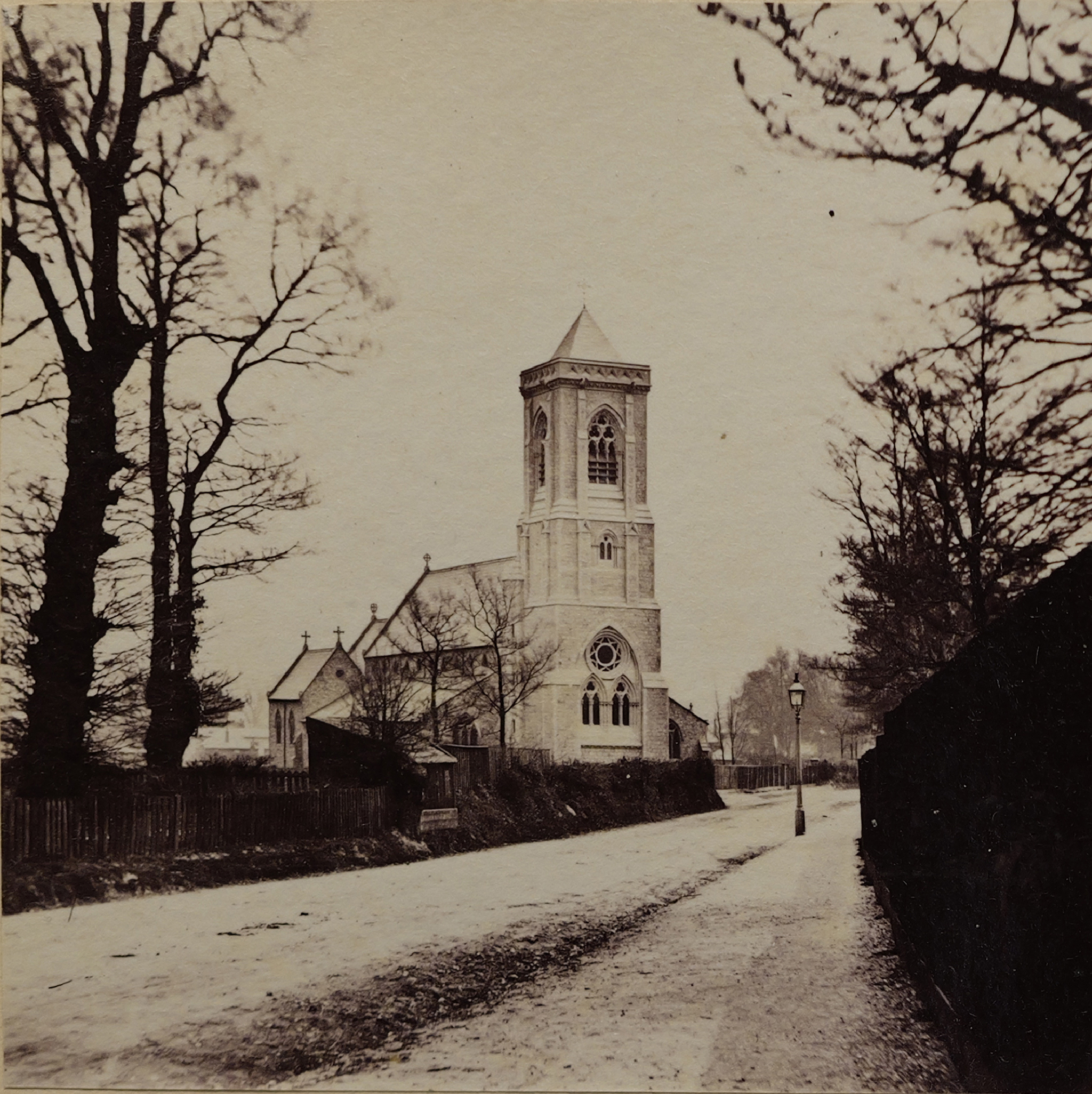


A remarkable early photograph of Holy Trinity Church, Trinity Road, by local young photographer Geoffrey Bevington c.1864.

(Click on image to enlarge)

Holy Trinity Chuch, consecrated 26 June 1855, was half-way between the Hardys and the Macmillans. It was here that the Macmillans worshipped. Did the Hardys ever attend church here (or indeed somewhere else)? I'd very much like to know.


Was Knapdale once called "Broadwaters"?

I have followed Sarah Harkness in declaring that Knapdale was previously called "The Elms". However I have also come across an entry by local historian Graham Gower in his excellent Balham Heritage Trail (Streatham Society, 2010) that refers to the house as "Broadwaters". Perhaps it was renamed several times? ("The Elms" is such a Victorian villa name. I wonder why? I can think of four or five in our area, including one on Bolingbroke Grove and two near St Anne's Church).


(Click on image to enlarge)

So whatever happened to Knapdale?

In 1912, the great historian of London, Walter Besant, foretold the death of Knapdale, "a fine old seat", in his tour of Wandsworth, Tooting, and Streatham:


 . . . then comes Tooting Bec Road, or till recently Streatham Lane, leading to Tooting Common. In this road are two fine old seats, "Streatham Elms" and" Knapdale," but the demand for building sites has taken the land up to their very back doors, and before long they will probably give way to the prevailing straight rows of two- and three-storied houses.

[Walter Besant, Survey of London: London South of the Thames (1912).]

Yet, strangely, Knapdale is still there, behind a high wall and a screen of trees. So well concealed, in fact, that for years I waited almost opposite for a number 19 or 49 bus to carry me back to my home near the prison and never suspected its existence.

It's best seen from the top of a bus, or a Google aerial shot, as here:
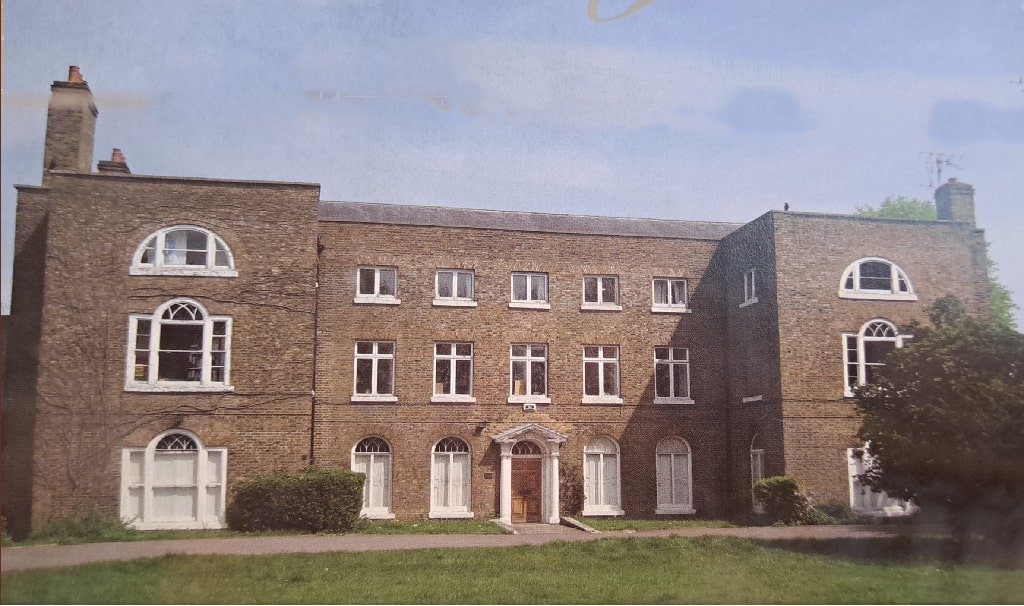


Knapdale much spruced up and freed of its ivy overcoat. Presumably a fairly recent photograph. Notice the square projecting bays, venetian windows and lunettes. (Pevsner complains about the replacement glazing.)

(Click on image to enlarge)


Spot Knapdale today. View across Tooting Bec Road.

(Click on image to enlarge)

Here's another aerial view, showing that the projecting bays at the front are rectangular, but polygonal at the rear.
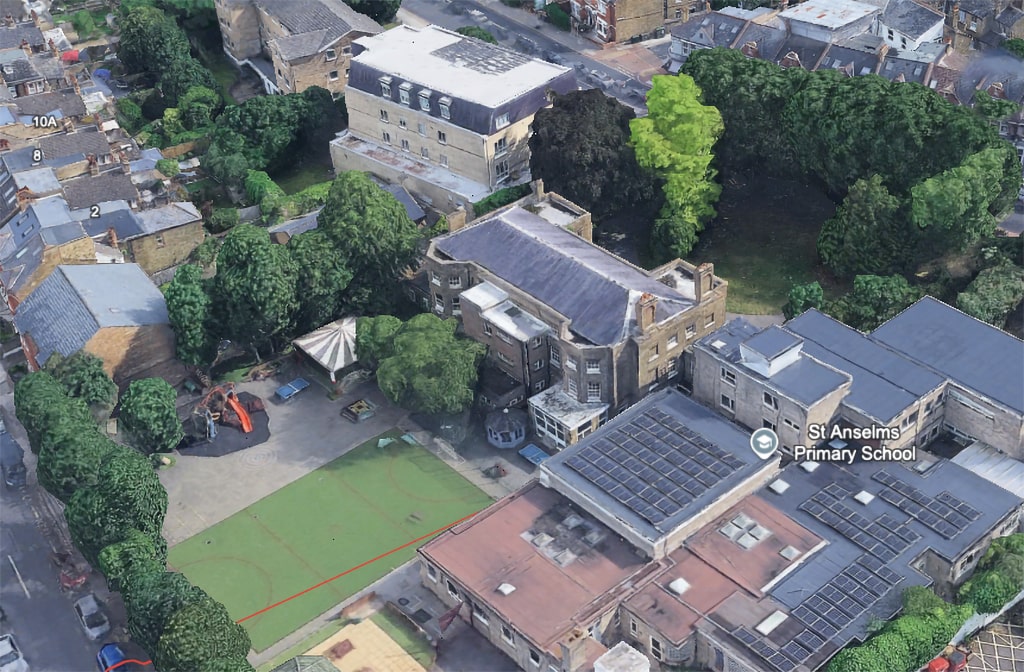


St Ansem's Primary School. View of the rear of the former Knapdale, across Louisville Road.

(Click on image to enlarge)

It is currently St Anselm's Primary School. (It was once a convent school but never La Retraite, as Pevsner states). Having been used as a school for many years, I expect (but don't know) that there are few interior features left from the Macmillan era. [I have greatly benefited from a discussion with Peter Farrow on this. Thanks, Peter!]
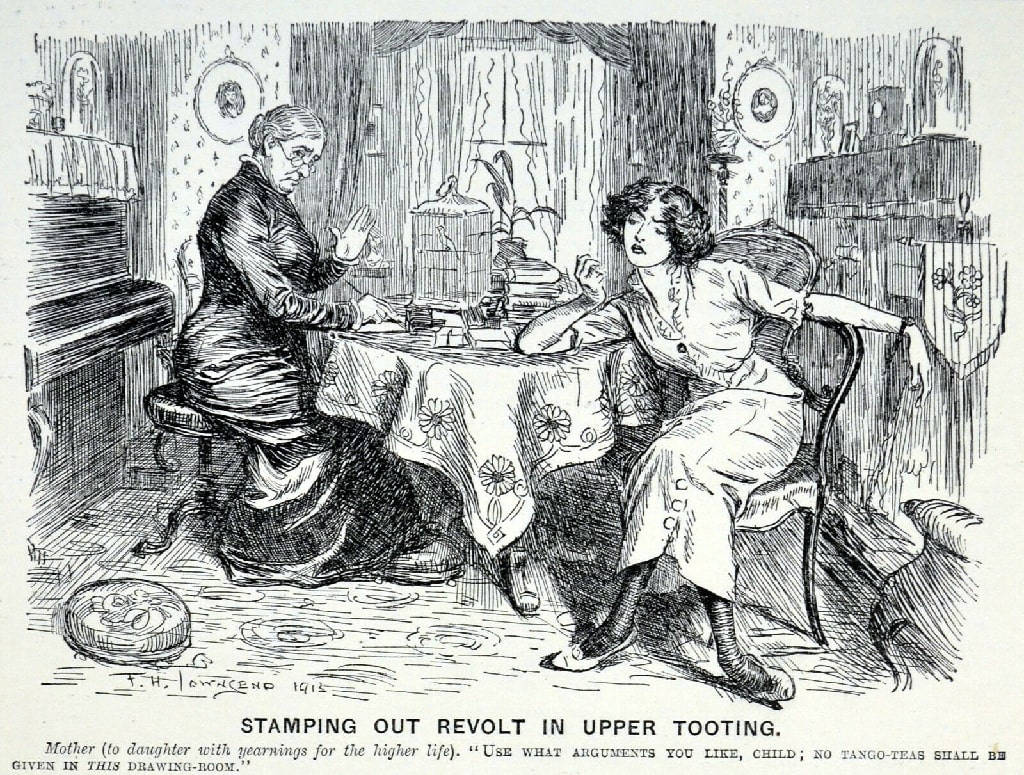

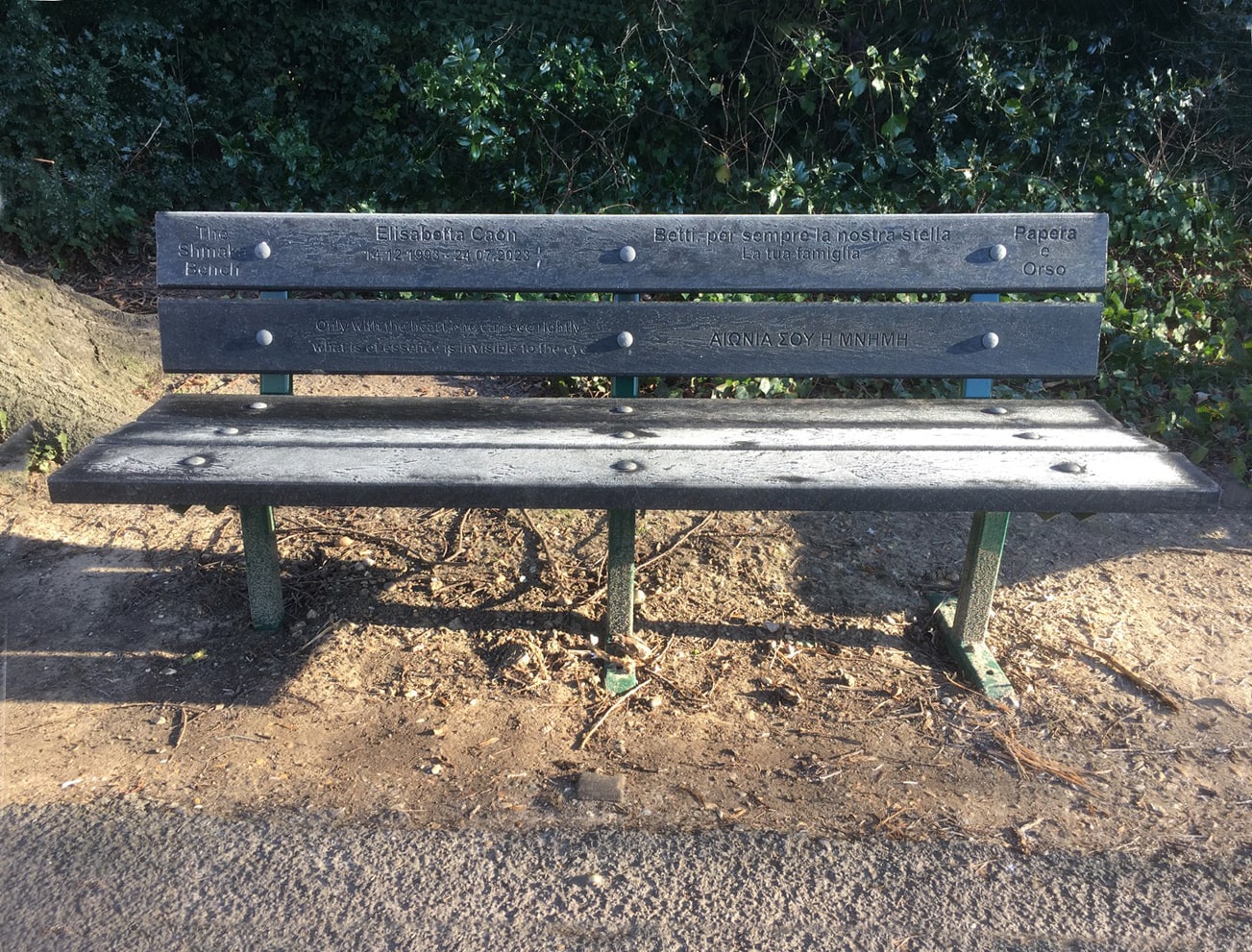
Oh, bother. Just as I was about to stop writing, I suddenly remembered this Punch cartoon that reflects (sarcastically) on a central theme of The Laodicean (one of Hardy's least-read novels) — the emergence of the independent, educated, free-spirited New Woman:

Frederick Henry Townsend, "Stamping Out Revolt in Upper Tooting", Punch, 6 September 1913.

(Click on image to enlarge)


Chronicles

July 2025

Part One


Elisabetta Caon


(Click on image to enlarge)

(14 December 1993 — 24 July 2023)


A couple of years ago, I was asked to research two benches recently placed on the railway side of the lake commemorating Benny, Bella, and Ruth Spanier.

Since then, another bench has appeared nearby, with inscriptions in English, Greek and Italian. It is dedicated to Elisabetta (or Elizabeth) Caon, a young medical researcher at University College London who died two years ago.


Elisabetta Caon

(Click on image to enlarge)


The Shmaka Bench

[I'm not sure of the meaning of "Shmaka" — can anyone help?]

Elisabeth Cain     14.12.1993—24-07-2023

Betti, per sempre la nostra stella    [Betti, for ever our star]

La tua Famiglia     [Your family]

Papera e Orso     [Duck and Bear] [?]

Only with the heart we can see rightly

What is of essence is invisible

[Epigram from Antoine de Saint-Exupéry's novel The Little Prince.]

AIONIA SOY I MNHMH [Your memory is eternal — a reference to the Greek Orthodox funeral liturgy]


At the time of her death, Elisabetta/Elizabeth was a gifted researcher at University College London, where she had just completed a PhD. Two professors at UCL wrote:


Obituary for Elisabetta Caon.

It is with heavy hearts that we share the profoundly tragic news of the untimely passing of Dr Elisabetta Caon on July 24th, 2023.

In 2017, Elisabetta joined us at the Institute for Liver and Digestive Health, University College London, UK as a young and promising MSc student in Industrial Biotechnologies, from the University of Padua, Italy, to undertake an Erasmus Student Mobility Traineeship.

Elisabetta's dynamic nature were undeniable. This was further exemplified when she was awarded the prestigious Juan Rodés PhD Fellowship by the European Association for the Study of the Liver (EASL), a distinction that allowed her to extend her studies in our team.

Elisabetta's endeavours knew no bounds, as she presented her ground-breaking findings in esteemed international meetings including the International Liver Congress (ILC — EASL), the Liver Meeting (American Association for the Study of Liver Disease — AASLD), European Club for Liver Cell Biology (ECLCB), and the Tissue Engineering and Regenerative Medicine International Society World Congress (TERMIS).

On the 28th of June 2023, Elisabetta was awarded her PhD, Doctor in Philosophy. What began as a junior fellow blossomed into an independent investigator, ready to embrace her first post-doctoral role.

Elisabetta was a kind, bright and caring person, with a strong resilience and a great heart for all her colleagues and collaborators. Elisabetta will be greatly missed, a great loss to everybody who knew her, it was a privilege to work with Elisabetta. As we navigate this sad time, our thoughts and heartfelt sympathies extend to Elisabetta's family, her partner, and friends.

Professor Krista Rombouts
Professor Massimo Pinzani

[UCL: Obituary: Elisabetta Caon.]



Elisabetta Caon's PhD Dissertation, Exploring the Impact of Genetic Variations of Human Hepatic Stellate Cells Using Extracellular Matrix 3D Models (2023), can be downloaded from UCL.

(Click on image to enlarge)

Elisabetta's death was reported in a number of European news media. She had been on a beach in Sparta with her Greek boyfriend, Yannis (if you know his surname, please let me know), when she suddenly fell ill:


She was quickly transported to the nearest hospital, where, however, the doctors could not help but confirm her death.

According to the medical reports, the girl did not suffer from any particular pathology and it seems that she died because of an ischemic cardiac arrest.

Who was Elisabetta Caon?

The young woman was a researcher originally from Resana, in the province of Treviso. Elisabetta Caon leaves her mother Rosetta Stocco, professor at the Itis Barsanti of Castelfranco, her father Franco Caon, surveyor at the Municipality of Castelfranco, and her brother Alberto.

Once informed of the tragic news, Elisabetta Caon’s family members immediately boarded the first available flight to Greece to be able to say a last goodbye to the girl, who had recently completed an important doctorate in London.

[Breaking Latest News: "Greece: 29-year-old girl who died of an illness" (July 29, 2023). This link was broken when I returned in June 2025.]


Elisabetta was also a talented classical guitarist, a founder member of the Sliwowitz Quartet:


In April 2025 a special prize and concert were given to commemorate Elisabetta Caon at the 3rd International Guitar Competition and Festival, held in Padua.

(Click on image to enlarge)


"Elisabetta Caon was passionate about music . . ."

(Click on image for translation)


The view towards the bridge from Elisabetta's bench. (Photo: Philip Boys, 29 June 2025. Does anyone have a better one I could substitute?)

(Click on image to enlarge)

Benches such as Elisabetta's, and the Spaniers', are the result of almost unbearable grief, but also of great love. I am grateful to their families and friends for placing memorial seats that everyone can share in such a beautiful place by our lake.


Map of the Month

London County Council (LCC), 1913


London County Council, 1913. The dotted blue line shows the old parish boundary — Battersea to the east, Wandsworth to the west. I have emphasised the revised boundary using a dashed red line.

[Notice that the northern lobe of the lake has no island at this time.]

(Click on image to enlarge)

The historic (probably Anglo-Saxon) boundary between Battersea and Wandsworth parishes was more or less straight across the Common [the blue dotted line]. Its southernmost point was near the junction of what we now call Trinity Road and St James's Drive.

Such a direct line made sense when there were few houses and roads, but things became more complicated administratively when parts of the Common were sold off to build orphanages, schools and terraced streets. The new boundary [red dashes], which zig-zags its way across the area, passes around rather than through the Patriotic School (so that it is entirely within Wandsworth) and Emanuel School (entirely within Battersea). It often divides a street left and right, but not generally houses and gardens. This came into play when the parish vestries ceased to be responsible for civil administration and new "Metropolitan Borough Councils" were formed in 1900.

[I'm not sure when exactly the boundary changes took place. Was it shortly after 1888, when the Battersea Vestry seceeded from the combined Wandsworth Vestry of 1855 (Battersea, Clapham, Putney, Streatham and is Knight's Hill exclave, Tooting Graveney, Wandsworth)? Or after the Local Government Act of 1894? Or when the Metropolitan Borough of Battersea was created in 1900?

(A quick check of OS maps shows that the old boundary was still in use in 1896.)

Wikipedia has a nice outline map of the Metropolitan Boroughs of the County of London that demonstrates the Battersea secession rather well.

And have the boundary lines continued to change? It would be good to check later boundaries.]

Look at the street signs on either side of Wiseton Road, off Bellevue.
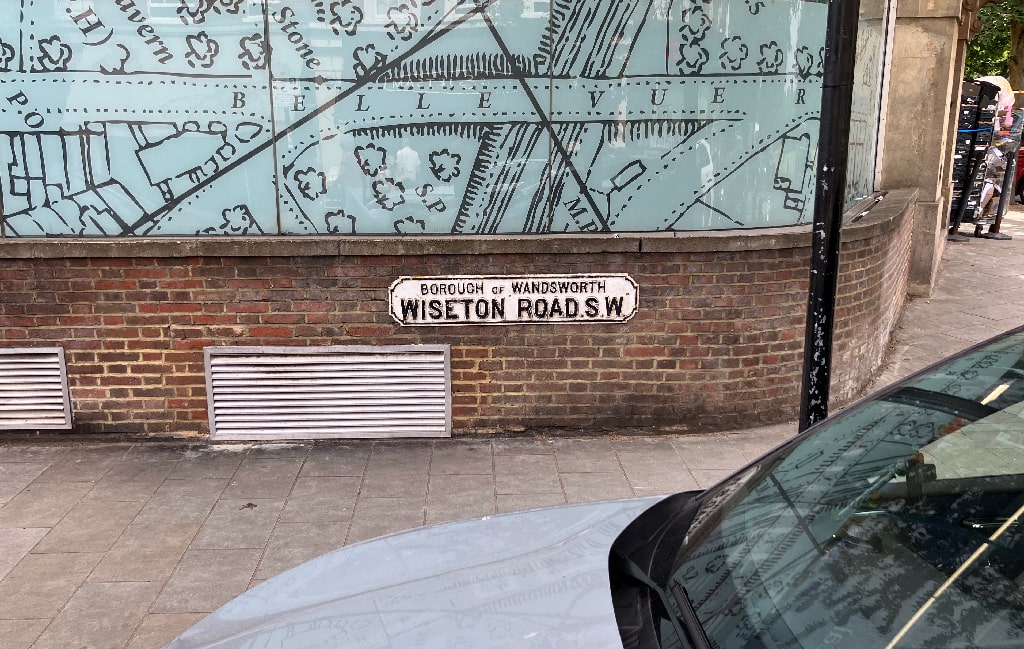


The north side of Wiseton Road, Wandsworth.

Turn and see the sign on the other side of the road: Batterssea.

(Click on image to enlarge)

Before the Battersea-Wandsworth boundary was rationalised (if you can call it that), it passed through houses and gardens between Althorp and Wiseton Roads, heading for the "Boundary Oak" and the posts at the end of the Routh Road passage onto the Common.

[Boundary adjustments may have reduced confusion, for example by clarifying which Town Hall rates had to be paid, permissions sought, or grievances aired, but didn't please everyone. I'm sure I've got a note somewhere about the expostulations of householders who suddenly found themselves in — shock, horror — Battersea.]

"The Farm" (aka Neal's Farm) is clearly marked, with the original buildings, tracks and orchards, but now tinted green. This signals it is part of the Common (once again). This area was then called "the Extension" and had recently been purchased by the LCC to be added back to the Common. The war stopped much progress being made on converting the area into a sports field (particularly for cricket, bowls and tennis). But there appears to be a wall separating the RVPA from the Extension which had not, I think, existed previously. Was this the first thing to be done by the LCC before further work could start?

[I have distinct memory that the purchase of the Extension from the Patriotic Fund entailed the LCC agreeing to build, and pay for, a new dividing wall for the then-large sum of £5000. I must check this.


6 July 1944, Andree Borel executed in Nazi Germany

Last month I included an item on the unveiling of a plaque commemorating MI5's London Reception Centre that operated at the Royal Victoria Patriotic School 1941-1945. You can read more about the event in June's Chronicles.

I am very grateful to Louisa Russell, Chair of the Secret WWII Learning Network, for providing a pdf of the information panel now displayed at Le Gothique.
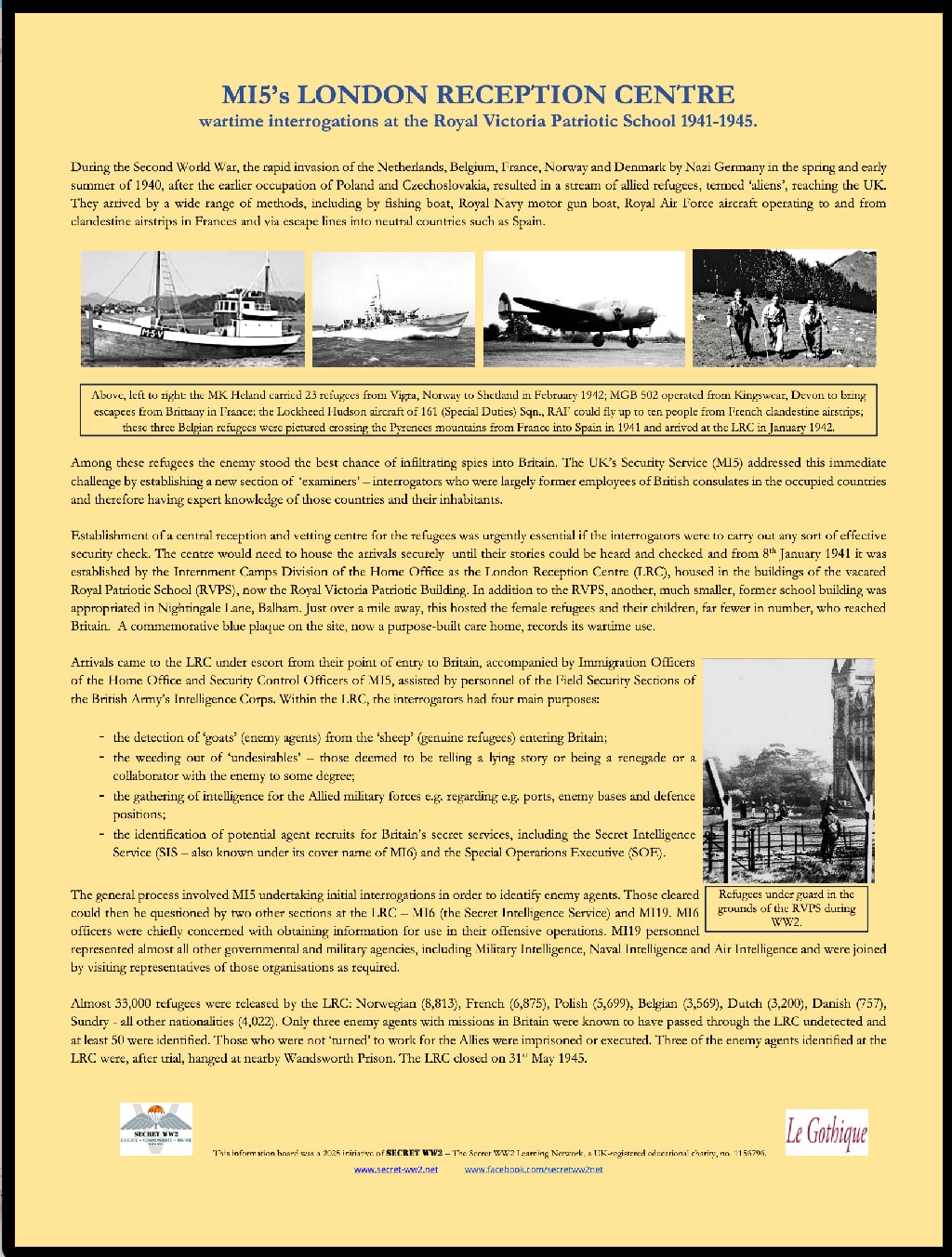


Information panel about the London Reception Centre in Le Gothique restaurant, RVPS.

(Click on image to view high-resolution pdf of the board)

Louisa also introduced me to local military historian Paul McCue, who has been most helpful in supplying me with information about Andree Borel — thanks, Louise and Paul!

Last month I wrote about the so-called "London Reception Centre" at the Royal Victoria Patriotic School during WWII, at which all male civilians arriving in Britain were interrogated — 34,000 of them.

But I would also like to mention the less-well-known 101 Nightingale Lane, close to the Nightingale pub. This was a large house with grounds (over which today's Oak Lodge School and a wing of Nightingale House have been built) to which women and children were sent.

Some years ago, I saw that Princess Anne had unveiled a plaque to three female members of the Special Operations Executive (SOE) who had been recruited or trained here, had travelled to France to work with the Resistance, and had subsequently been captured and executed.
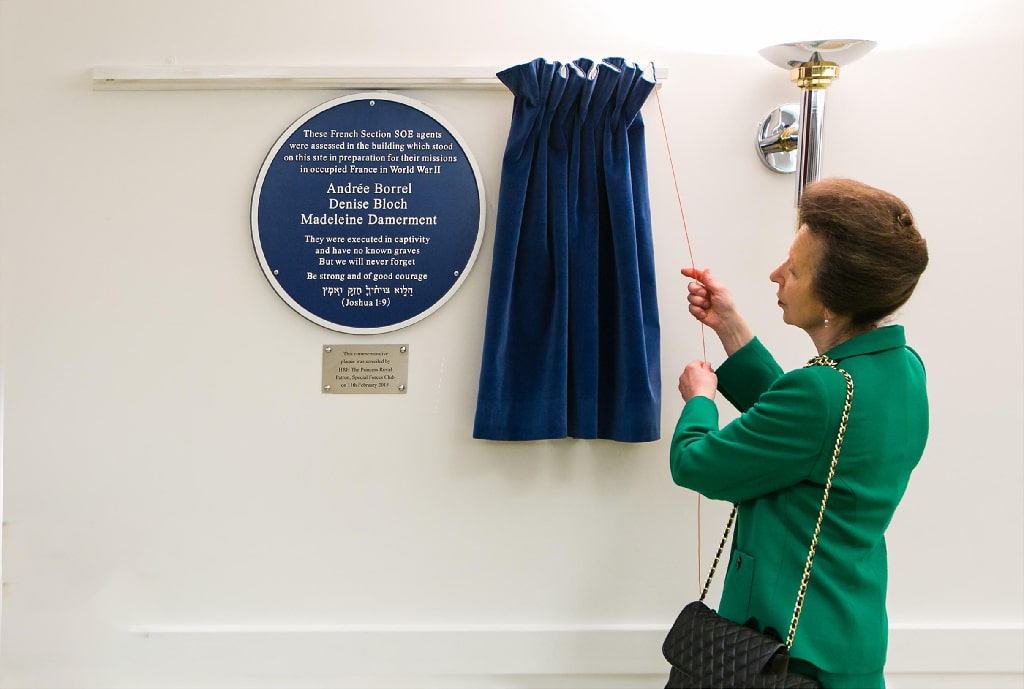


Wednesday 11 February 2015: Princess Anne unveils a plaque to commemorate the lives of three female secret service agents: Andrée Borrel, Denise Bloch and Madeleine Damerment.

(Click on image to enlarge)

At that time, I knew nothing about these brave women, but I've since started to learn more. I hope to write something more substantial in the near future, but today I'll just mention one, Andree Borel.
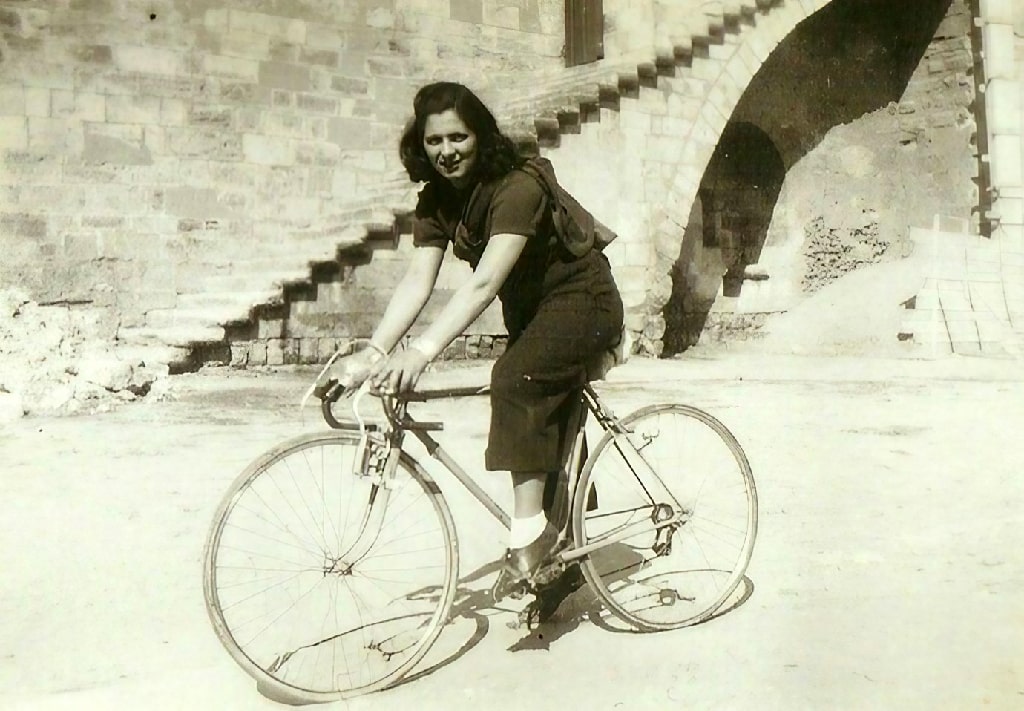


Andree Borel was a keen racing cyclist.

(Click on image to enlarge)

She and fellow-agent Lise de Baissac were the first women to be parachuted into France (in September 1942). She joined the Resistance in Paris, was arrested and interrogated by the Gestapo in June 1943, and executed at the Natzweiler-Struthof concentration camp on 6 July 1944. At the time of her death she was 26.


Death of Tom Taylor

12 July 1880, staunch supporter of Wandsworth Common Tom Taylor (also known as an editor of Punch, and author of the play that Abraham Lincoln was watching on the night of his assassination) died suddenly at his home, Lavender Sweep, Battersea. He was buried in Brompton Cemetery three days later.

Tom Taylor has been mentioned quite frequently in earlier Chronicles (and I still intend to write about his poem "The Cry of the Commoners"). For more info., read Jeanne Rathbone's terrific article, "Tom Taylor 1817-1880, dramatist and editor of Punch" (19 October 2016).

Last year, I was present at a rather wonderful unveiling of a plaque commemorating author/playwright/editor Tom Taylor and the composer Laura Barker in Lavender Sweep, off Battersea Rise. The event was organised by Jeanne, and was a hoot.

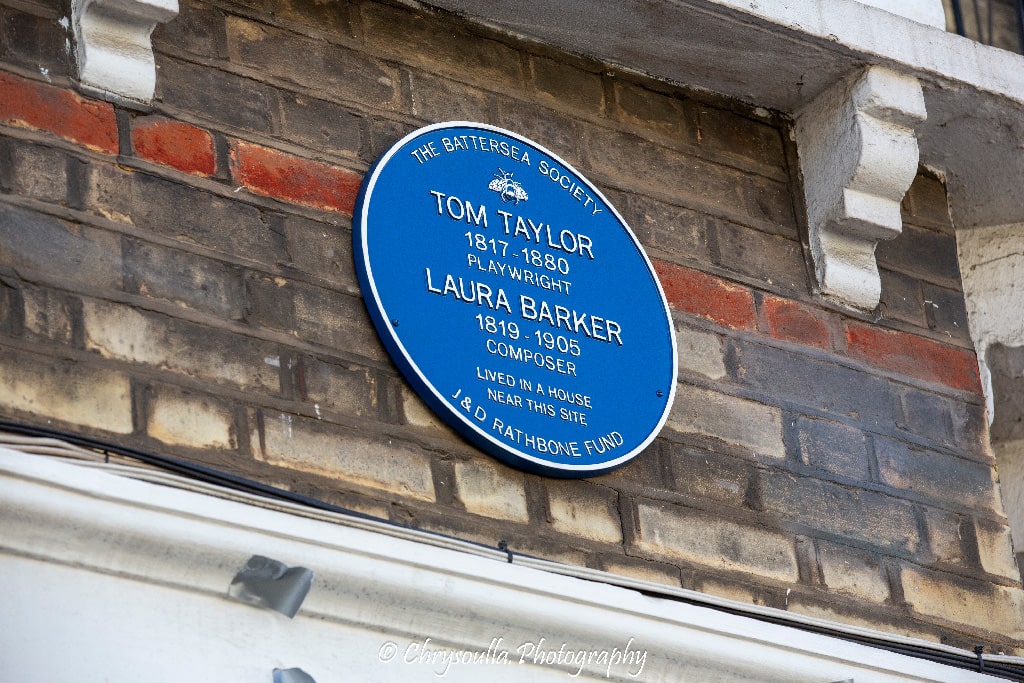

28 September 2024: Lord Fred Ponsonby and Alun Armstrong unveil the plaque to Tom Taylor and Laura Barker, 84 Lavender Sweep (Photos: Chrysoula Photography)

(Click on image to enlarge)

Here's a rather wonderful photo of Tom Taylor (seated, on the right) in a social milieu I imagine I preferred to all others, the theatre:


Tom Taylor and the Old Stagers — the Old Stagers are recognised as the oldest amateur dramatic society still performing.

(Click on image to enlarge)

A.O.B.

Since I've just mentioned Jean Rathbone and plaques, here's the text of an email she sent recently with news of two local unveilings in July:


I am delighted to be MC-ing these two Battersea Society plaques unveiling events as part of the Wandsworth Heritage Festival which might be of interest if you are around.

The first on Friday 4th July at 2pm on BAC/Battersea Town Hall is to Jeanie Senior, first woman civil servant when appointed as Inspector of Workhouses by Sir James Stanfeld an enlightened Liberal in 1874 as President of the Local Government Board. (Shockingly, married women were not allowed to be executive civil servants until 1946.)

This plaque is sponsored by the FDA civil service trade union and speakers will include Penny East, CEO Fawcett Society; Fiona Ryland, Cabinet Office; Sybil Oldfield, her biographer; Tarek Iskander, BAC Director, and great nephew Arthur Hughes from the US.


Jane ("Jeanie") Elizabeth Hughes (1828–1877), Mrs Nassau John Senior, by G.F. Watts, 1859. (ArtUK: National Trust: Wightwick Manor. Link.) Jane Senior lived at Elm House on Lavender Hill, a villa in wooded grounds on the site of today's Battersea Arts Centre.

(Click on image to enlarge)

If you don't know about the incomparable Jeanie Senior, you really should. Jane "Jeanie" Elizabeth Hughes (also widely referred to as "Mrs Nassau John Senior") lived on Lavender Hill until her very premature death in 1877.

[There's so much to say about Jane ("Jeanie", pronounced "Janie") but perhaps not here and now. I strongly recommend Jeanne Rathbone's online article, "Jeanie Nassau Senior, first woman civil servant". (Don't let the phrase "the first woman civil servant" put you off, if indeed it does. She was, among other things, a pioneering social researcher who wrote a devastating report on the education (or rather lack of it) of pauper girls.)

There is also a Wikipedia article: Jane Senior, and a very readble book-length study by Sybil Oldfield: Jeanie, an 'Army of One': Mrs Nassau Senior, 1828–1877, the First Woman in Whitehall (Sussex Academic Press 2008). Barbara Hardy's review will convince you to learn more.

(Incidentally, Jeanie was the sister of Thomas Hughes, author of Tom Brown's Schooldays. Both he and her husband were active in the 1860s in defence of Wandsworth Common)


The second plaque unveiling is on Sunday 13th July at 2pm to Edith Lanchester, socialist feminist, and her daughter Elsa Lanchester, actor of stage, TV and film, at 27 Leathwaite Road SW11 1XG.

This plaque is funded by the O’Pray family. Speakers will include singer Dillie Keane, Charlotte Booker (star of She’s Alive), her biographer Mike Simpson, and Paul Nolan of The Lanchester Archive.


Elsa Lanchester, star of Bride of Frankenstein, with Boris Karloff as the Monster, directed by James Whale (1935). Elsa played both the bride and Mary Shelley, author of the original novel Frankenstein (1818).

(Click on image to enlarge)

Thanks, Jeanne!


Friends of Wandsworth Common — Heritage Information Boards

Wonderful to see the new info. panels around the Common. They've been mooted for years (quite possibly for decades), but the first three are now with us. Expect more.

Many people contributed expertise, funds, and enthusiasm, but Anne Lambert's role was decisive — thanks, Anne!


Instagram: Link.


Board 2 — "A little history" — is sited near the Skylark cafe and the memorial plaque featuring John Buckmaster. Others are on Northside and Bolingbroke Fields. A fourth will shortly appear on the Scope.

(Click on image to enlarge)

See Friends of Wandsworth Common: Heritage Interpretation Boards Installed (15 June 2025).


Thomas Hardy postponed . . . 

It really hurts me to do this, but I've cut out from this month's Chronicles a longish piece about the life of Thomas Hardy in our area, including his terrifying pursuit down Brodrick Road of an organ-grinder, and garden parties at "Knapdale", Alexander Macmillan's home narby.

Still, I've written it now, so I'll send it out later this month (as July Chronicles Part II). But if you're excessively interested in Thomas Hardy, get in touch.


Knapdale, one of the largest houses in our area.

(Click on image to enlarge)

Absolutely everybody went to Alexander Macmillan's garden parties (which may explain why Thomas, who had ambitions to become a literary lion, moved to Trinity Road in the first place).


Chronicles

June 2025

Part II


This is the second part of June's Chronicles. My draft had grown so long and complicated that it seemed kinder to hack the thing into two and serve the halves up separately. To view Part I, click on the "Previous" link above.

June 1980

Did you see Paul McCartney filming on Wandsworth Common?


Official video of Paul McCartney's Waterfalls (1980).

(Click on image to play)


Paul McCartney on Wandsworth Common and in a Wandsworth studio. Stills from his music video Don't Go Chasing Waterfalls, from The Beatles Diary Volume 2: After The Break-Up 1970-2001.

(Click on image to enlarge)

From The Beatles Diary Volume 2: After The Break-Up 1970-2001:


[June 1980]  . . .  Paul shoots a promotional film for the song ‘Waterfalls’ on a specially built set in the middle of Wandsworth Common, with additional scenes being shot in a disused aircraft hangar.

To assist with the taping, Paul obtains one and a half tons of polystyrene, and an eight-foot Polar bear called Olaf, hired from Chipperfield’s Circus. After numerous re-edits of the sequences, a total of six different promotional films are prepared, but only version three will be screened on shows such as Meet Paul McCartney  . . . 

From the outset, this production was to be an epic! Not just in terms of length or indeed technical wizardry (like ‘Coming Up’), but as a series of set pieces each requiring meticulous setting up and shooting… There are only four shots in the whole clip — Count them!

Water was used as the link between each shot. This not only gave a literal interpretation of the lyrics but also provided a clever way of introducing each new set. In order to achieve this water effect at the various locations, special portable fountains were designed and constructed for ‘Waterfalls’.

The video starts with Paul playing the piano in what appears to be a pretty country cottage but is, in fact, a studio set in the middle of Wandsworth! What seemed to be a simple shot as the camera goes through the open window, was the result of a complicated and much rehearsed set of manoeuvres.

As the camera moves in towards the open window, the entire cottage wall comes apart enabling the camera to move into the room. As Paul moves from the piano, the fountains burst into view to provide the first ‘waterfall’ background.

As the waters disappear an arctic wasteland is revealed. This again is a set, complete with an enormous painted backdrop measuring 150′ x 65‘ No mean feat with a paintbrush! When the set building was completed, to add that final touch of authenticity, a real live polar bear was cast in the supporting role at Paul’s request!



Paul McCartney with Olaf, "a real live polar bear", on the set of Waterfalls.

(Click on image to enlarge)


Although “Olaf” had been trained to perform in a circus [Chipperfield's], every safety precaution had to be taken and rigidly enforced as Paul was singing on the set very close to the bear. It took ten days to build and light this set and this scene ends with more fountains which dissolve into the next location.

Each set required something extra and this one was no exception. A fire engine was needed to pump water from a lake in the gardens, over a hill, to the shooting site 500 yards away, for the next watery background.

[Presumably these are the scenes filmed on Wandsworth Common. But which "lake" supplied the water, and where exactly was the carousel erected?]


Paul McCartney — on Wandsworth Common? If so, where?

(Click on image to enlarge)


This shot starts with Paul walking down an avenue with a castle in the background. The camera ‘tracks’ (that is, it is pushed along on rails like a train) for 120 feet with Paul. He then steps onto a Carousel which was brought in specifically for this shot and is not a permanent feature of the gardens.


Paul McCartney rides a Carousel on the Common

(Click on image to enlarge)

As Paul steps off the carousel, the fountains appear once more and we are transported back with him into the country cottage. He walks back to the piano and finishes the song. Obviously the cottage walls had to return to their original position as the camera passed back out through the window, and once again, a lot of rehearsing was required. The song is now over, Paul gets up and closes the window, leaving the cottage in darkness.

[The Paul McCartney Project: Waterfalls.]

Do you have any recollections? Do share.


Map(s) of the Month

William Faden's "The country twenty-five miles round London", 1788—1819

I'm rather keen on maps, as you may have noticed. The ones I generally show were produced either by the Ordnance Survey (the gold standard) or Stanford. But other mapmakers produced work of great interest, including William Faden (1749-1836).

Here's part of his hand-coloured "The country twenty-five miles round London: planned from a scale of one mile to an inch" (1790 printing):
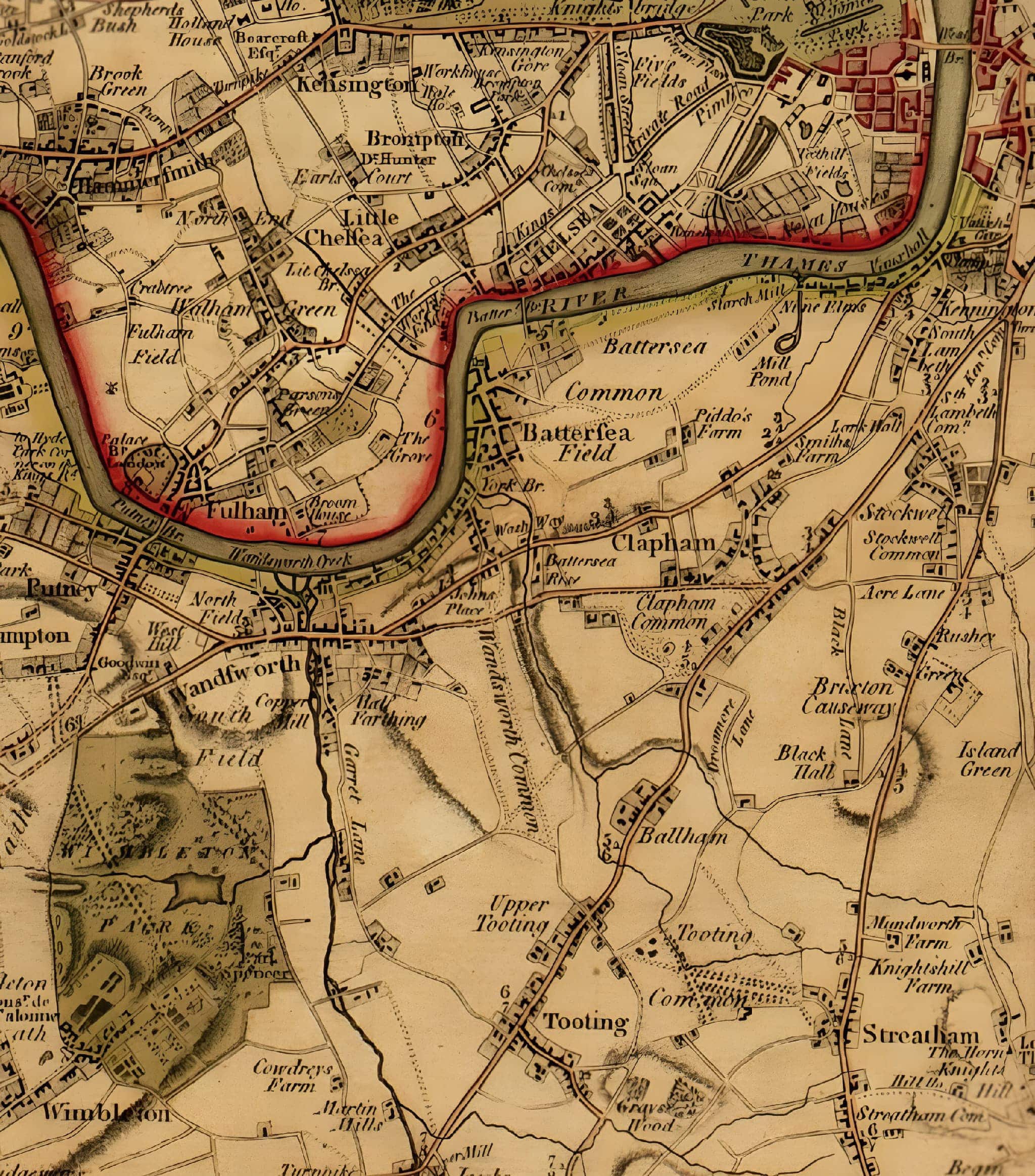


William Faden, 1790. Library of Congress. The map of London as a whole is just over a metre across.

It's not very detailed, of course, and quite out-of-date even at the point of publication (an inevitable problem for all maps, of course). As it happens, it's not from a new survey by Faden himself but a composite of existing county maps published in the previous decades.

[This probably explains why the "Five Houses" are missing, even though they'd been built a decade earlier.]

It may be sketchy but there's still a lot to see. Faden's map shows the country just before the great transformations of the next century.

As Andrew Macnair has written, it gives us a good idea of the landscape


close to the metropolis in the last third of the 18th century. It shows the extensive commons, downs and heaths which were soon to disappear with Parliamentary Enclosure as well as the estates of the landed gentry who wanted to enjoy the countryside but who also wished to live close to the capital.

[Incidentally, Macnair tells is that in 1801 the French War Department copied and engraved this map in preparation for an invasion of England.]

Most obviously, the population is very much smaller in our area, and more thinly distributed across the terrain. There are no railways, of course.

Notice the map's emphasis on the location and extent of large houses (the inhabitants of which were doubtless Faden's intended customers). Their grounds are clearly outlined and strongly tinted (Earl Spencer's estate at Wimbledon, in particular). Wandsworth Common itself is only lightly shaded. Field boundaries are not shown
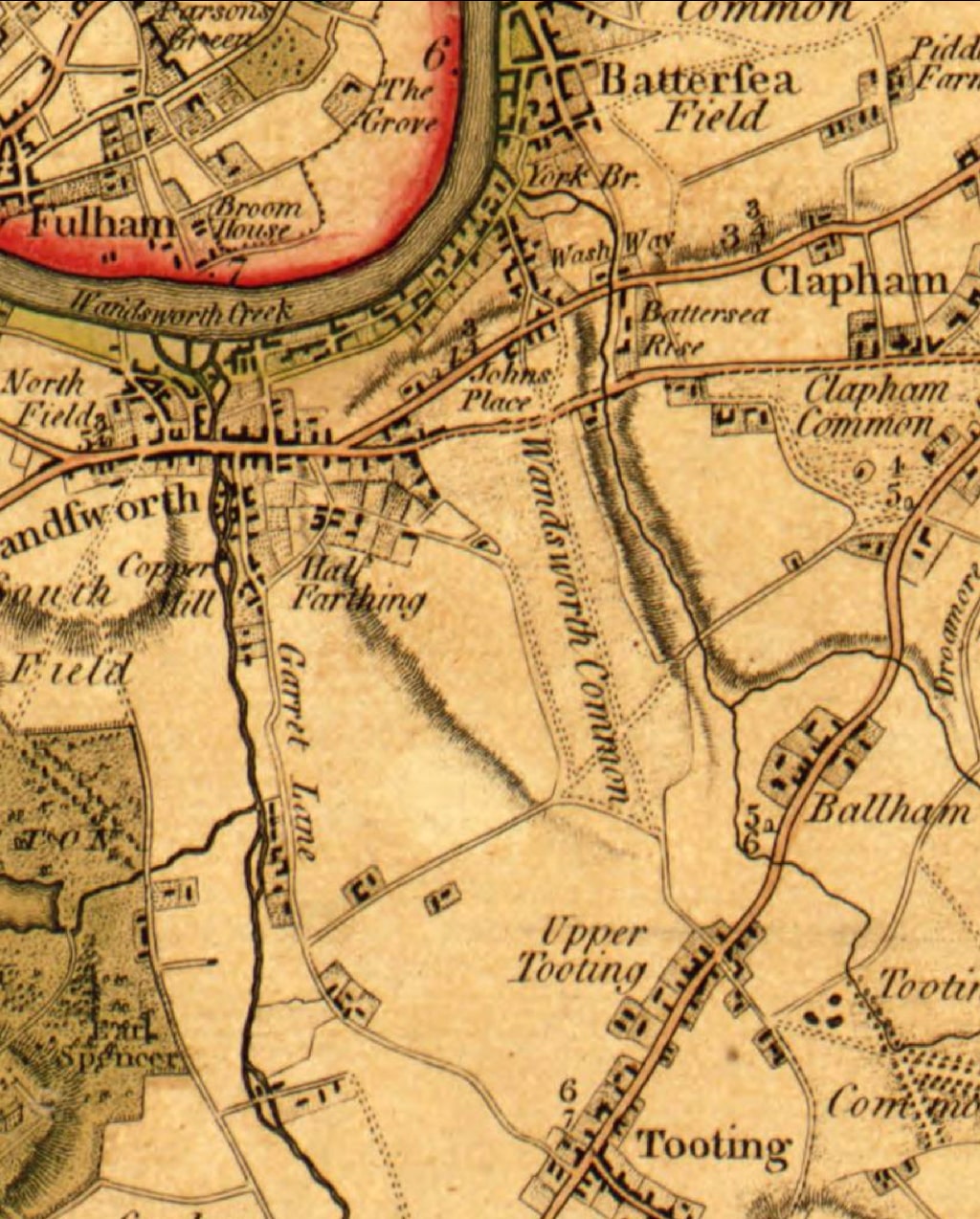


William Faden, 1788-1790

(Click on image to enlarge)

For the moment, I'll only point to a couple of features. There are still very few houses on or around the Common — mainly a cluster in the north-west, near the main road between Wandsworth and London.

Notice also the absence of the future Trinity Road. Yes, there is a long straight road across the Common, but it's heading from "Upper Tooting" towards "Johns Place" and "York Bridge", near the Thames (down what we now call Plough Road).

[This is exceedingly odd. We've seen the same on John Rocque's map of the 1740s. Was there really no straight "Trinity Road" until the C19? Was the main route really a more easterly one, across to Plough Road? If so, what's happened to it?]

Faden had some problems showing elevation and slope — this is before visual conventions such as hatching or contour lines had settled down. See the dark shading showing the valley in which the (unnnamed) Falcon Brook flows, just to the east of the Common.

[A curious feature: see also the prominence of the two tributaries of the Falcon Brook that meet close to the Common and proceed to the Thames in Battersea. The southern arm is shown as originating in Tooting, and the northern as far as Knight's Hill! At this time, the stream was worth recording its course over many miles on a map. Today, hardly anybody is aware of its existence. The Falcon Brook is of great interest to me — I hope to talk about its course, now entirely underground, in the autumn.]

For now, I'll leave it up to you to look in more detail at this map — but please send me your comments, which I'll add to this article.

A few decades later, Faden carried out a proper survey. Here's his 4th edition, of 1819.
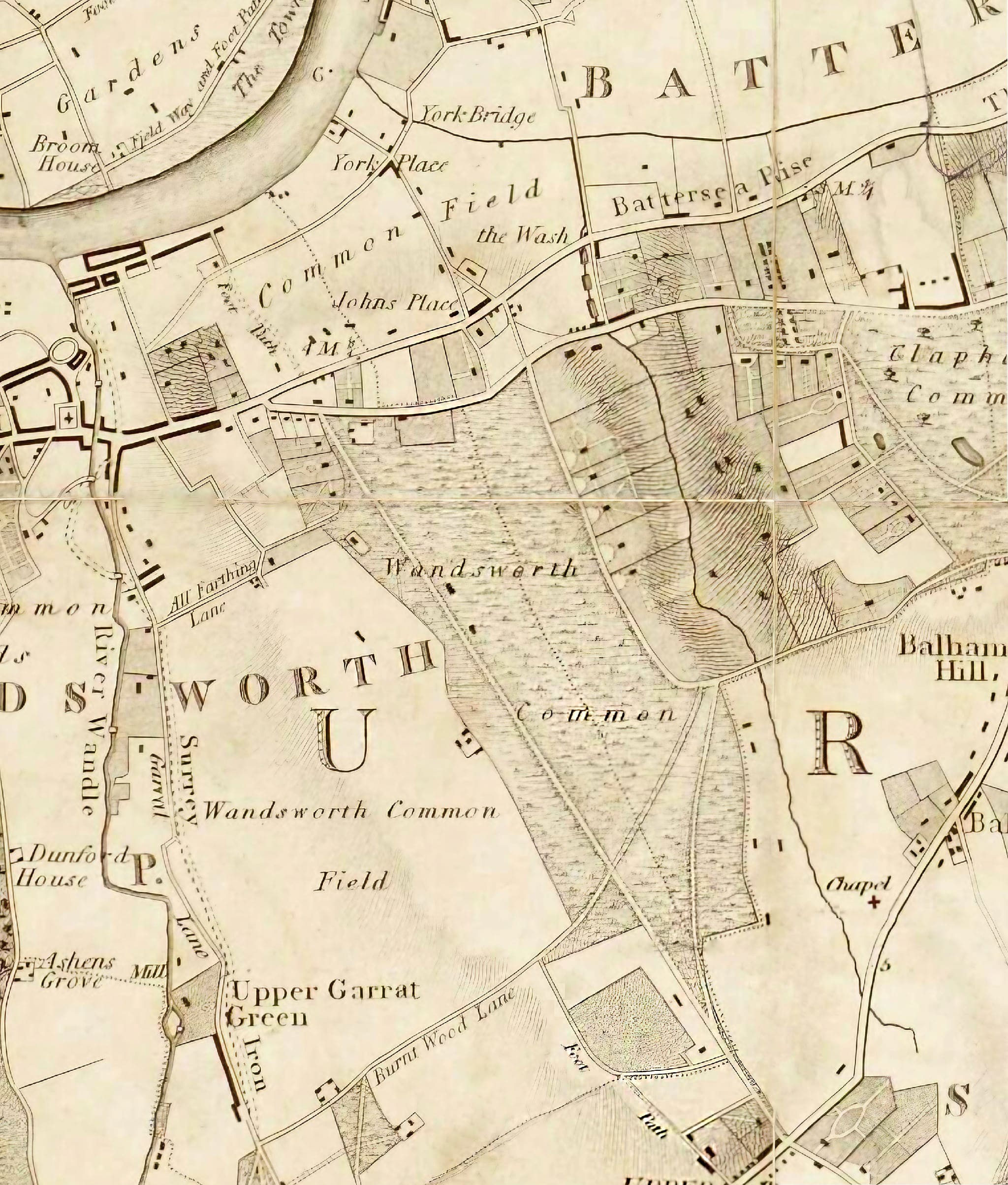


A section of William Faden's A New Topographical Map of the Country in the Vicinity of London 4 June 1819 (the 4th edition). This is from a full recent survey, and it shows. What changes from 1790 would you draw attention to?

(Click on image to enlarge)

I'm sure this new version would have been much more use to Napoloeon, had he escaped exile on St Helena and decided to fight his new Waterloo on Wandsworth Common.

[You may recall reading in past Chronicles about the "sham fights" — mock battles or military manoeuvres — that took place between various yeomanry regiments over Wandsworth Common during the Napoleonic period e.g. in September 1804 and October 1807.]


June 2000

    "The hunt is on for a 130ft-high hot air balloon in the shape of Douglas, the Lurpak Butter character, stolen from Wandsworth Common . . . "

Here's another story I have no recollection of, though it was fairly recent. Perhaps you do?


Duncan, the Lurpak Balloon, was BIG! (Photo: Mike Goodes, Leeds Castle Balloon & Vintage Car Show, 8th September 2002)

(Click on image to enlarge)

The Belfast Telegraph reported the theft on 21 June 2000:


A 130ft high hot air balloon of Douglas, the Lurpak Butter character, was stolen yesterday.

The balloon had been flown yesterday morning and a second flight was planned later in the day.

It was stolen from Wandsworth Common, London, at 3pm along with the Lurpak trailer carrying it.

A local estate agent saw the silver and blue trailer, weighing 1.5 tonnes, being towed away by a red Peugeot 205.

On the same day, the Wolverhampton Express added some helpful background: Douglas, it said, was a small man made from butter . . . "


(Click on image to enlarge)


Lurpak hot air balloon stolen

The hunt was on for a 130ft high hot air balloon in the shape of Douglas, the Lurpak Butter character, after it was stolen from Wandsworth Common, London. The balloon was in a 1.5 tonne trailer in between flights when it went missing. A reward of £1,000 and a year’s supply of Lurpak butter is on offer.

[BNA: Link.]


Douglas served as the mascot in UK adverts for Danish butter brand Lurpak from 1985 to 2003 and again from 2014-2015.

He was a small man made from butter.

In earlier adverts, Douglas would emerge from a block of Lurpak and would sing about it before either going back into the block or into food.

In 1992, to mark that year's Olympic Games, an advert featured Douglas diving into a bowl of soup.

In later adverts, Douglas is depicted as a trombonist who in the adverts, played "Flight of the Bumblebee" on his trombone and would sometimes be stopped by the advert's narrator (played by Penelope Keith). Douglas is shown to be nice and jolly to Penelope anyway.

In 1994, a Christmas advert was made in which Douglas was allowed by Keith to play his trombone, to which he plays "Deck The Halls".

Some rather nice collections of Duncan ads:

— YouTube: The Best Lurpak ‘Douglas’ TV Adverts Compilation

— YouTube: Lurpak Butter Douglas Aardman Advert Compilation (1985-2003)

— Lostmediawiki: Lurpak (partially lost Aardman Animations commercials for Danish butter brand; 1990s)



Duncan and friends, not on Wandsworth Common. (Photo: Paul Thallon (Flikr))

(Click on image to enlarge)


(Click on image to enlarge)

[FYI: "Ballooning brilliance: the greatest special shapes of all time":   Part 1,  Part 2,  Part 3.]


Late extra!

Just I was about to send these Chronicles out, I came across a sequel:

Shropshire Star — Wednesday 21 June 2000


Balloon finder may get reward

A scaffolder was celebrating the prospect of £1,000 reward today after finding a 130 ft high hot air balloon which had been taken from Wandsworth Common in its storage trailer yesterday.

Simon Fovargue, from Wandsworth, is in line for the reward which was offered to anyone giving information to help return the balloon, depicting Lurpak butter character Douglas, to Flying Pictures. Mr Fovargue found the trailer on Tuesday night.

[BNA: Link.]

A happy ending, then. (I wonder if it was.)


A.O.B.

Secret WW2 Learning Network

I was very disappointed last month not to be able to attend an unveiling of a plaque at Le Gothique in the Royal Victoria Patriotic Building, involving local residents Louisa Russell and Paul McCue.

Fortunately John Crossland was on hand to make a video of the event:
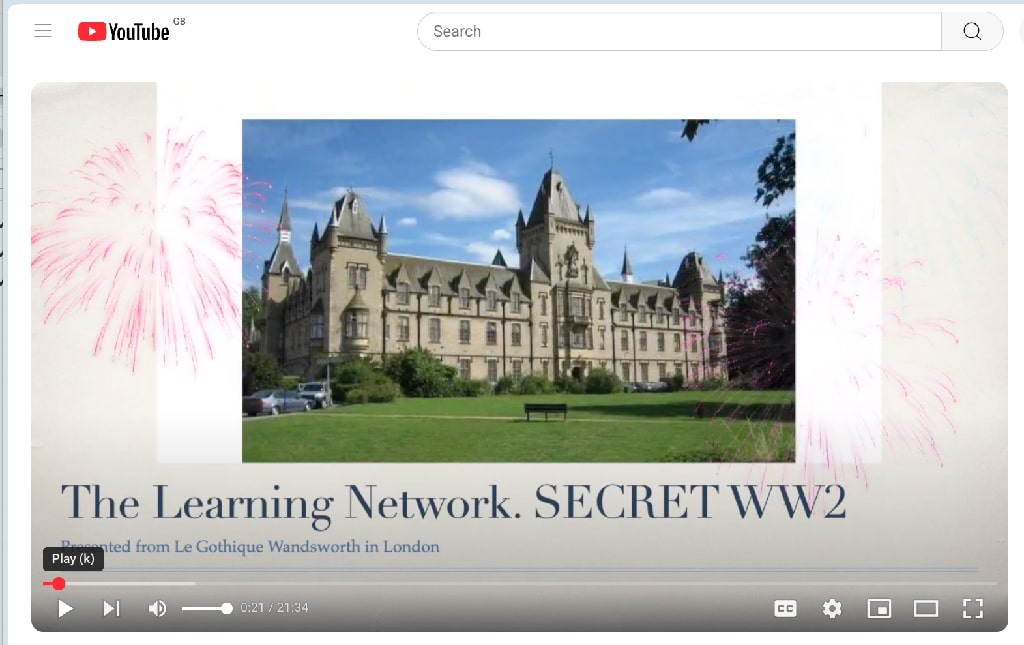


(Click on image to view video.)

In a fascinating talk, Paul McCue explains what the plaque commemorates:


During the Second World War the rapid invasion of the Netherlands, Belgium, France, Norway and Denmark by Nazi Germany in the spring and early summer of 1940, after the earlier occupation of Poland and Czechoslovakia, resulted in a stream of allied refugees which we called "aliens" — so the aliens came here, having reached the UK.

They arrived by a wide range of methods, including by fishing boat, Royal Navy motor gunboat, Royal Air Force aircraft operating to and from clandestine air strips in France, and via escape lines into neutral countries such as Spain and Portugal.

Among these refugees the enemy stood the best chance of infiltrating spies into Britain, so the UK's security service MI5 addressed this immediate challenge by establishing a new section of "examiners" — these were interrogators largely former employees of British consulates in the occupied countries, so they had knowledge expert knowledge of the country and of the inhabitants.

So the establishment of a central reception and vetting centre for the refugees was urgently required if any sort of effective security check was to be carried out.

The centre would need to house the arrivals securely until their stories could be heard and checked, and from the 8th of January 1941 this establishment was established by the Internment Camps Division of the Home Office and was called the London Reception Centre . . . 

Paul's talk continues, and is followed by scenes of the unveiling of the plaques.
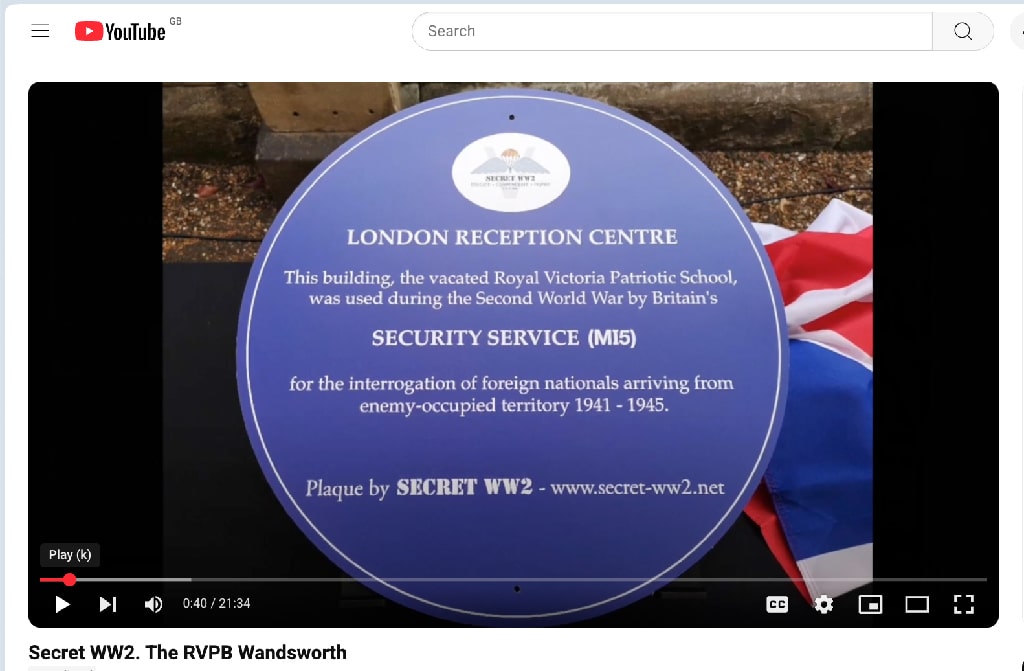


(Click on image to view video.)


The Secret WW2 Learning Network – is an educational charity established in 2014 with the aim of creating greater public awareness of the contributions and experiences of the men and women who took part during the Second World War in Allied special operations, intelligence gathering and resistance.

For further info, and to support this educational charity, visit the Secret WW2 Learning Network website.



(Click on image to visit the Secret WW1 website.)

I am very grateful to Louisa Russell, Chair of the Secret WWII Learning Network, for providing a pdf of an information board that describes the significance MI5's London Reception Centre — thanks, Louisa!:


Information panel about the London Reception Centre in Le Gothique restaurant, RVPS.

(Click on image to view high-resolution pdf of the board)

I look forward to returning to this important subject in future Chronicles.
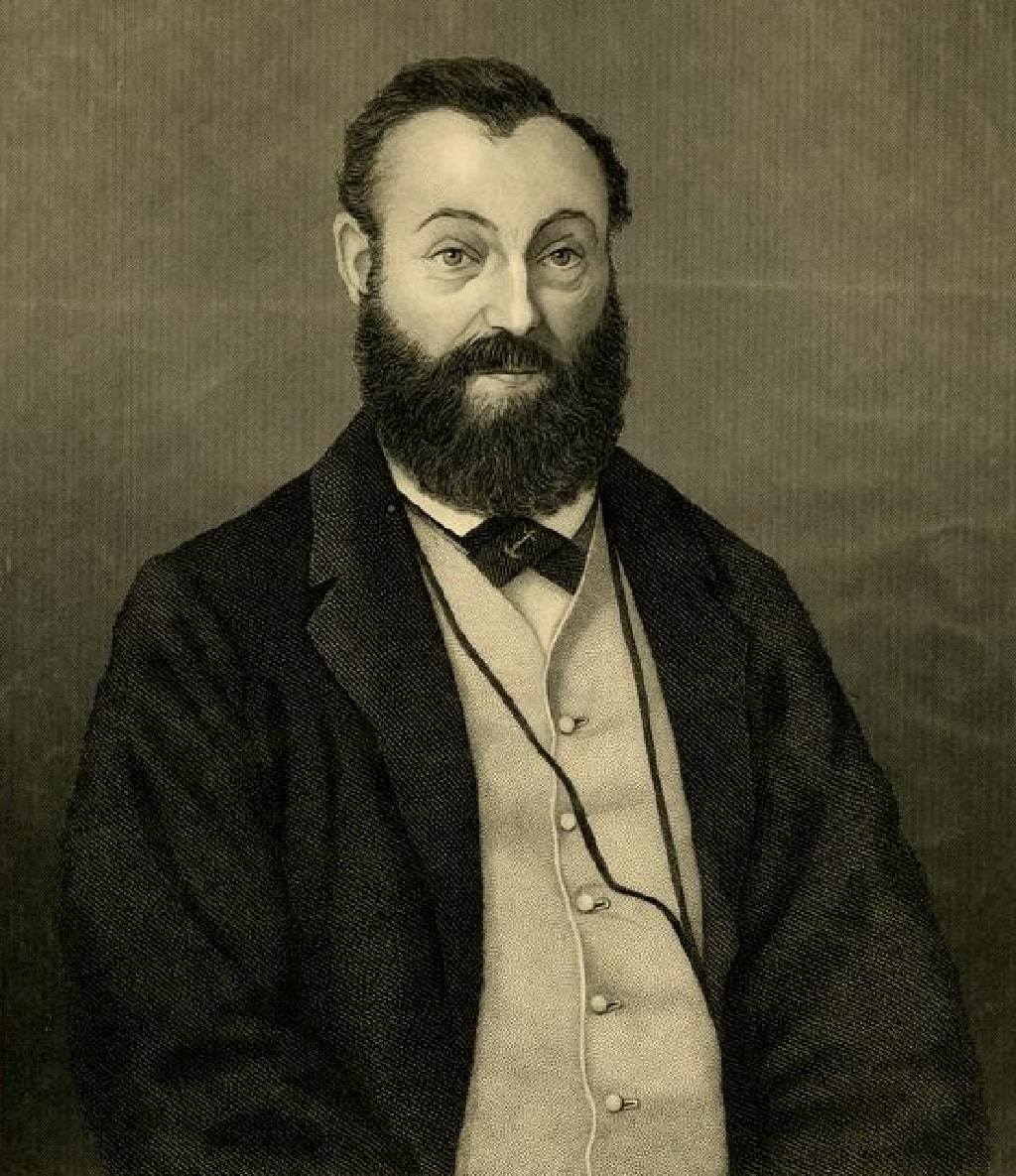


Chronicles

June 2025

I


Job Caudwell, one of Spencer Park's first inhabitants, by an anonymous artist, 1850. British Museum.


Can you believe it — this edition of the Chronicles
completes FOUR WHOLE YEARS of monthly articles!


The death and burial of Job Caudwell, June 1908

Job Caudwell is buried beneath this great granite needle in Magdalen Road Cemetery. The first obelisk in the cemetery, it was probably erected shortly after the cemetery opened in 1878, but the chamber beneath remained empty for many years. As we shall see, many more can be seen nearby, but this remains the largest:
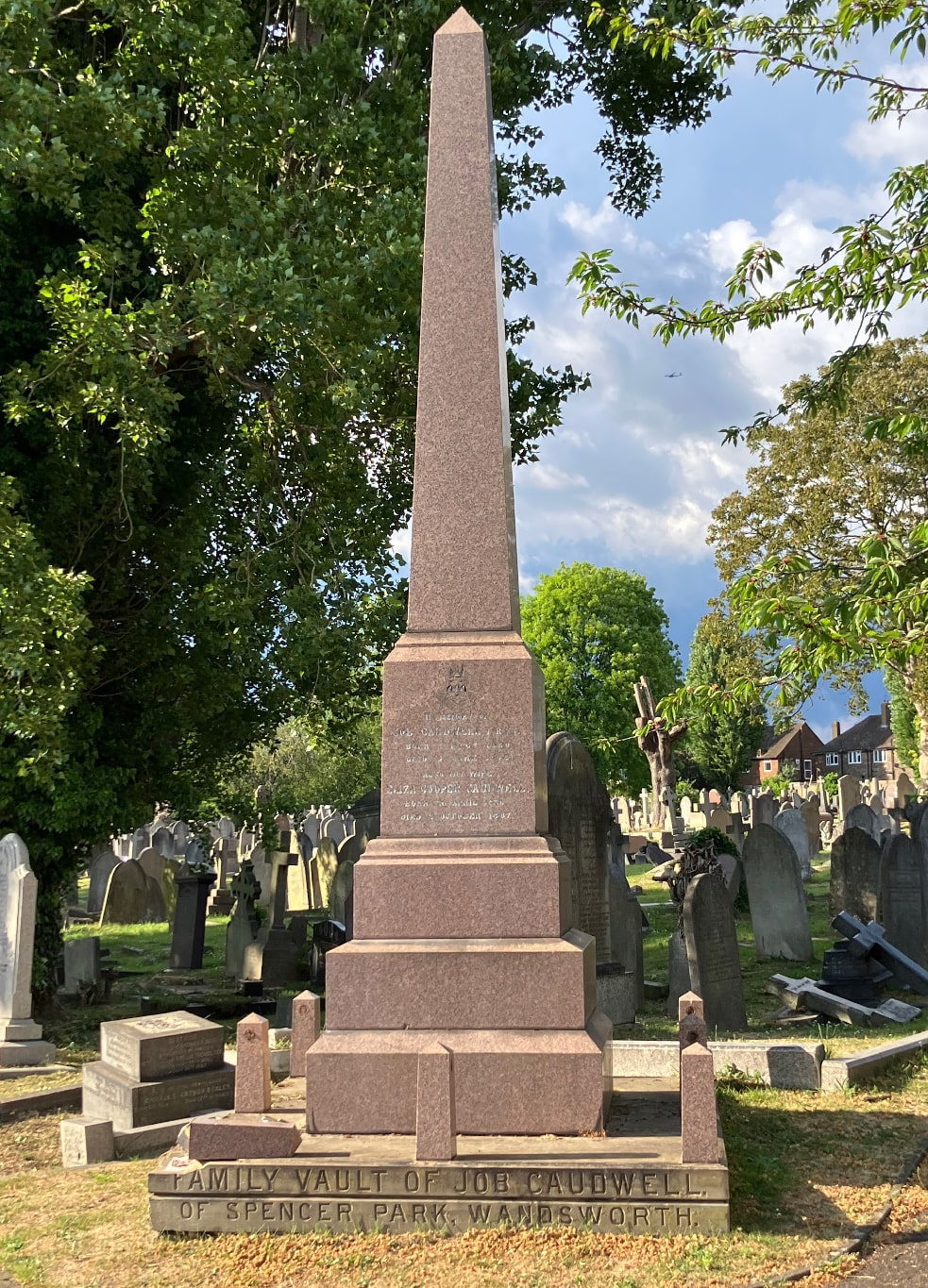


"The Family Vault of Job Caudwell, of Spencer Park, Wandsworth"

(Click on image to enlarge)

As you can see, Job's obelisk is now somewhat dilapidated (though it's survived better than many crosses). A corner of the plinth has broken away, the iron rail that once surrounded the main obelisk has disappeared, and some of the small obelisks around the tall slender pillar have been toppled.

His grand-daughter, Irene Caudwell, who lived in Spencer Park and Earlsfield Road, wrote at length about her grandfather in her marvellous (but as yet unpublished) memoir of local life, Four Miles from Charing Cross . (You may remember her description of flying bombs in the Second World War I quoted in the Chronicles for September 2024.).


At great expense he erected a monument, composed of reddish brown granite brought specially from Aberdeen and set up in Wandsworth Cemetery beside the little chapel. A most heathenish erection, Grandfather always maintained it was the tallest in the cemetery. It consisted of a Cleopatra's needle set upon so substantial a base that the mere sight of it gives one indigestion.

Heathenish?


No cross appears on Grandpa's monument, as in his day no Wesleyan would dream of using any form of the sacred emblem, even in the Chapel, it being considered Popery of an extreme degree, leading direct to the Seven Hills.

I must say, this rather surprised me. Neither Job nor Irene appear to have known about the Vatican Obelisk. Moved from Egypt and erected in Rome as a symbol of imperial power by the Emperor Caligula, it was moved to its present central position in St Peter's Square in 1586.


Vatican Obelisk, St Peter's Square, Rome.

[It also functions as the gnomon of an immense sundial, "a visual metaphor for the Church’s foundation upon the Apostles and martyrs, her unwavering faith standing tall amidst the changing shadows of time."]

(Click on image to enlarge)

Obelisk-mania in Magdalen Road cemetery

Have a look round the top of the cemetery, near the two chapels:
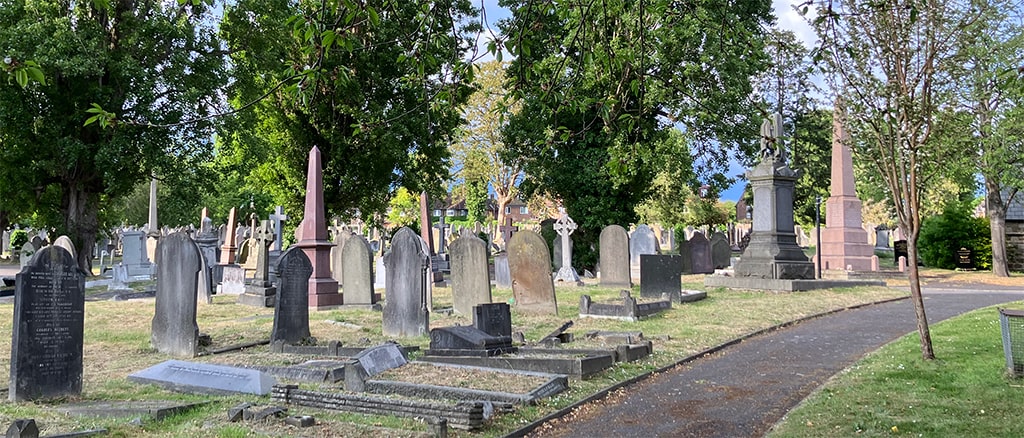


Job Caudwell's obelisk is on the extreme right.

(Click on image to enlarge)
Irene Caudwell observes:


Grandfather's idea of Cleopatra's Needle was copied in a lesser form on the opposite side of the pathway and twins appeared a few yards away on the same side. One or two Wandsworthians even so closely followed his example as to record the names of their dead and living offspring on neighbouring tombs.

Here are a few more obelisks close-by (I really must count them):
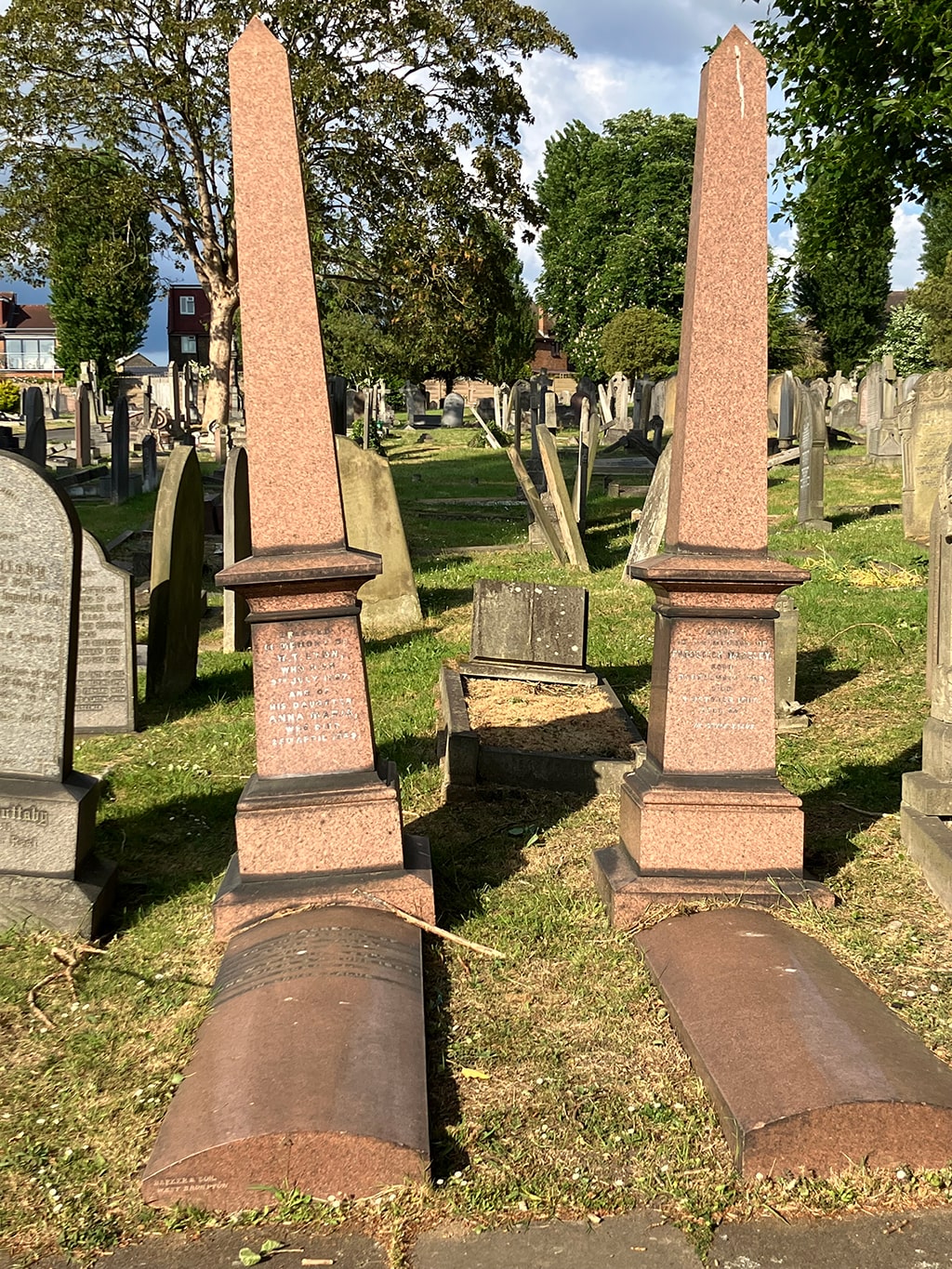


(Click on image to enlarge)


(Click on image to enlarge)


(Click on image to enlarge)

[I have no idea whether this number, and density, of obelisks, is actually unusual in London graveyards. Do you know? Are there many obelisks in Battersea Rise Cemetery?)

Although obelisks had been used in (Christian) funerary memorialisation for some decades — probably stimulated by the victory of Nelson over Napoleon in the Battle of the Nile in 1798 and his death in 1805 at Trafalgar — they probably became even more popular after the erection of Cleopatra's Needle on the Embankment in 1878 (the year that the cemetery opened).

As we saw a few years ago, there is an interesting local connection in Peter Le Neve, who lived on North Side only a hundred yards or so from Job Caudwell's home on Spencer Park. (They must have known one another.) On his way to and from work (as the Secretary of the Royal Society of in John Adams Street), Le Neve Foster recorded the erection in a celebrated series of photographs.
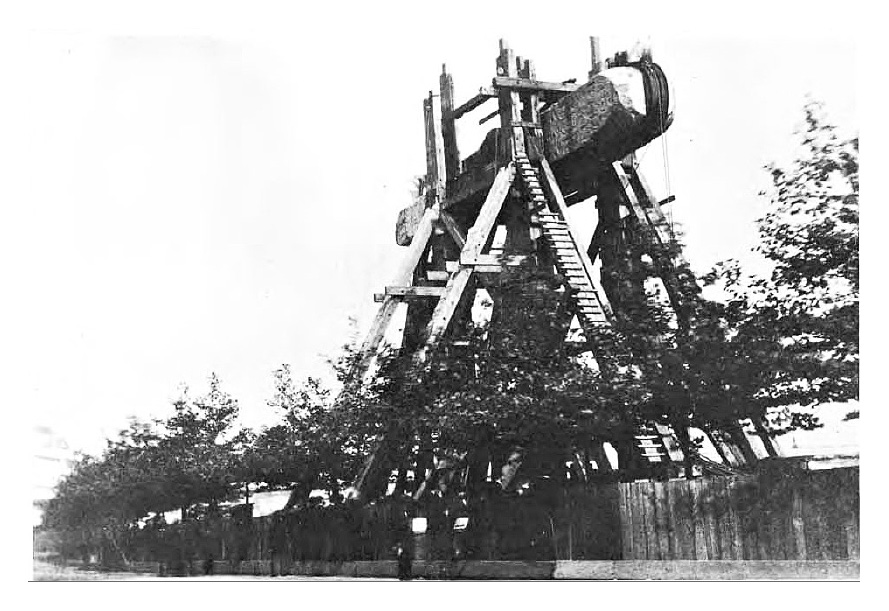
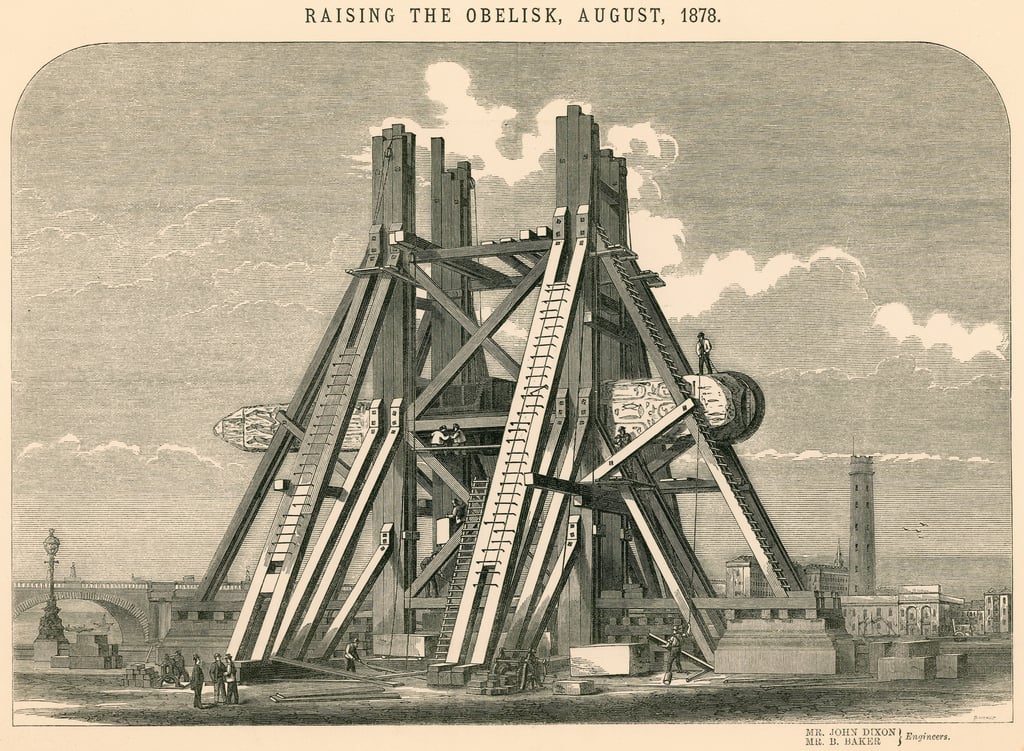

Peter Le Neve Foster: photograph of the erection of Cleopatra's Needle on the Thames Embankment, August 1878 (work finished on 12 September 1878).

(Click on image to enlarge)


Engraving of the erection of Cleopatra's Needle on the Thames Embankment, August 1878.

(Click on image to enlarge)

Here's a portrait of Peter Le Neve Foster, with camera:
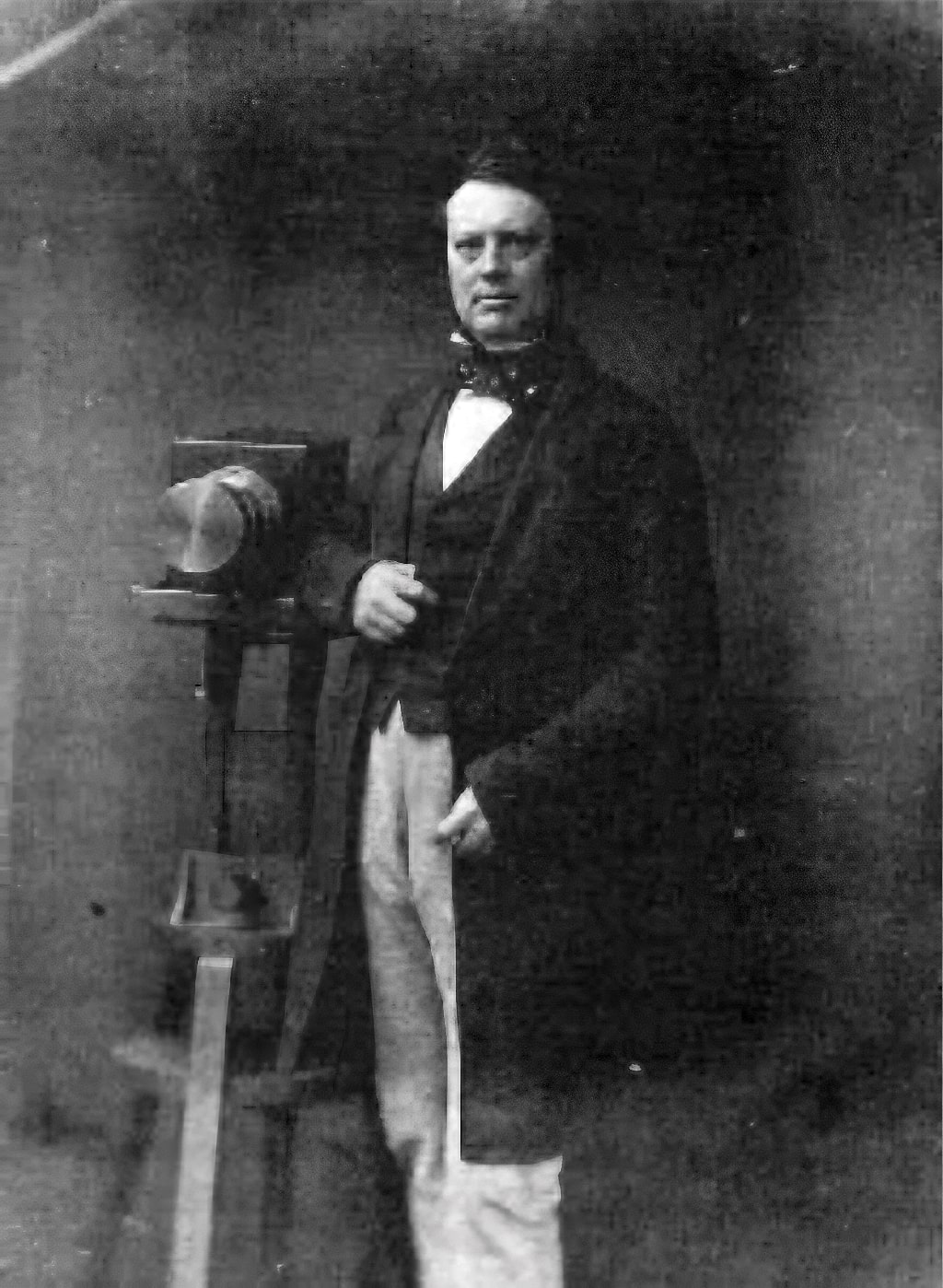


(Click on image to enlarge)

Inscriptions on the base of the obelisk

Front — Job and his wife Eliza Caudwell:
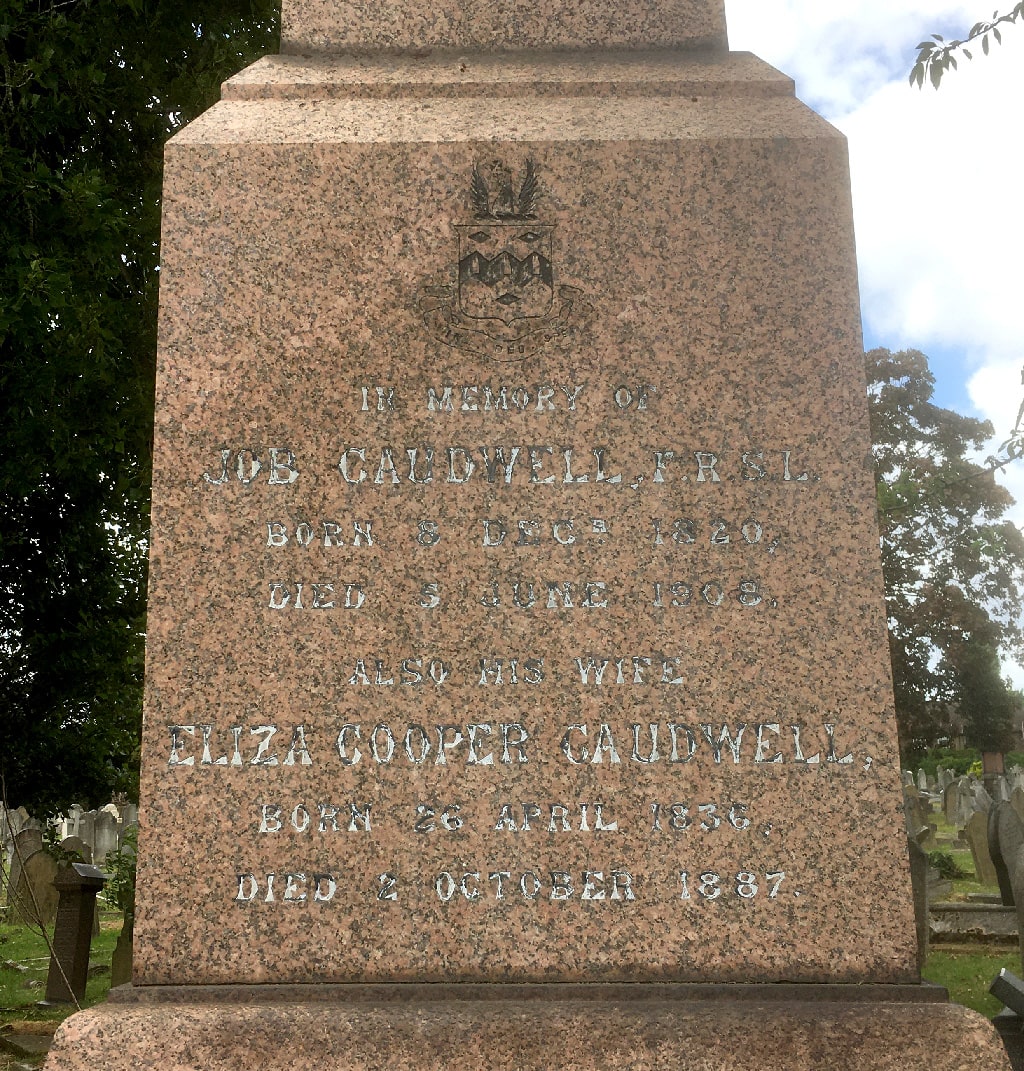


[Caudwell coat of arms]

In memory of
Job Caudwell, F.R.S.L.
Born 8 Decr 1820,
Died 5 June 1908,

Also his wife

Eliza Cooper Caudwell,
Born 26 April 1836,
Died 2 October 1887.

F.R.S.L. — Fellow of the Royal Society of Literature.

Side — a list of Job and Eliza Caudwell's ten children, with their birth and death dates:
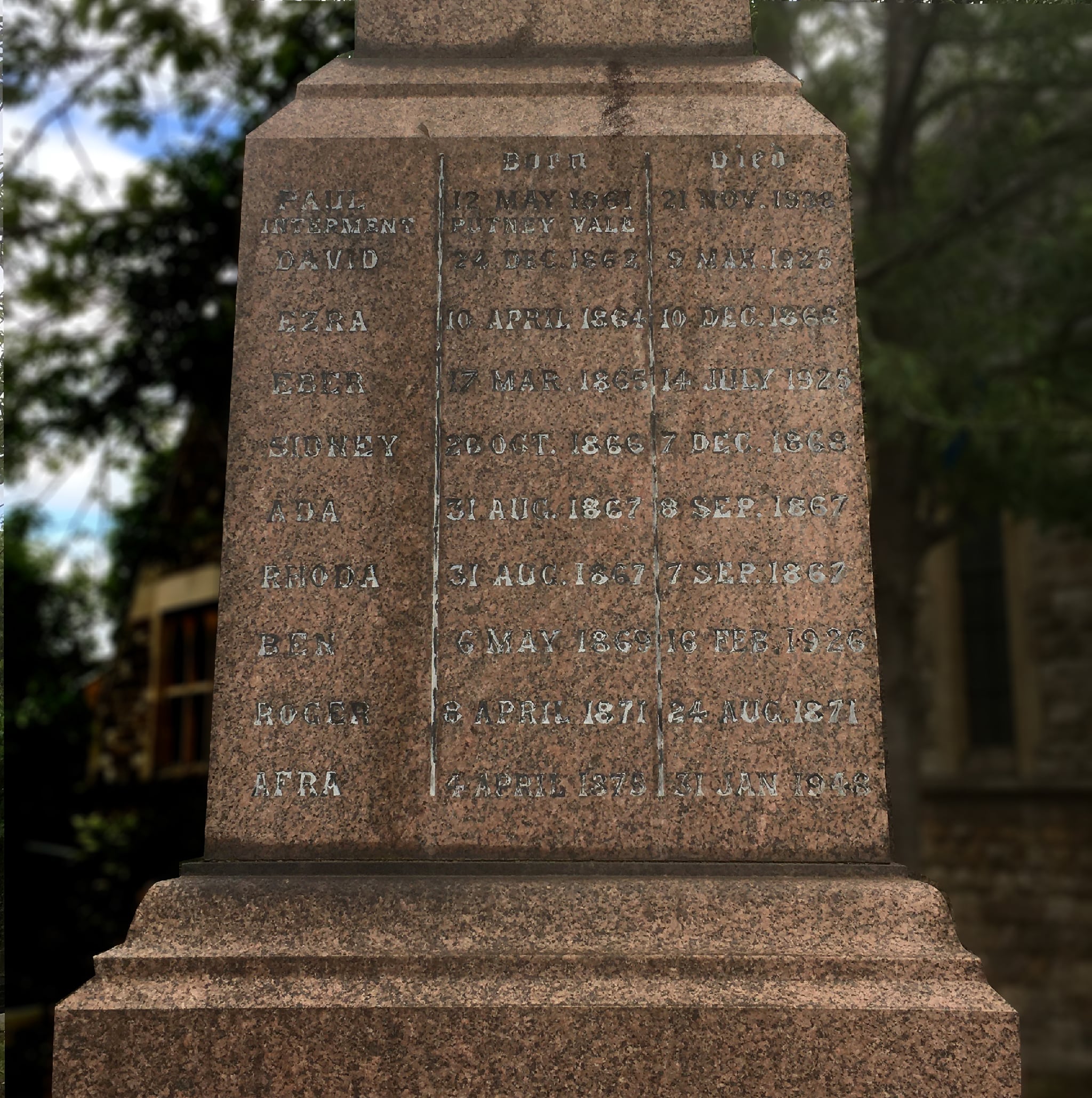


               Born               Died

Paul:   12 May 1861 — 21 Nov. 1938

      Interment Putney Vale

David:   24[?] Dec. 1862 — 9 May 1925

Ezra:   §0 April 1864 — 10 Dec. 1868

Eber:   17 Mar. 1865 — 14 July 1925

Sidney:   20 Oct 1866 — 7 Dec. 1868

Ada:   31 Aug. 1867 — 8 Sep. 1867

Rhoda:   31 August 1867 — 7 Sep. 1867

Ben:   6 May 1869 — 16 Feb. 1926

Roger:   8 April 1871 — 24 Aug. 1871

Afra:   4 April 1875 — 31 Jan 1948

(Click on image to enlarge)

Irene Caudwell recalls of her grandmother that "One thing only gave [her] any sense of spiritual enjoyment . . .funerals":


 . . . and happy was she if one of these events fell on a Saturday or other holiday, when she could collect the whole family and take them with her. Poor little wretches! On the return journey she occupied the time by informing them that the next funeral they attended would be her own, a prophecy which took at least a dozen years to reach its fulfilment.

Not that she had not come near it several times, for she was a delicate woman and of the ten children, including two sets of twins, with which she presented Grandpa, five died in very early infancy. My father remembered one of them, Sidney, an exceptionally sweet natured little fellow who used to sit on the stairs sharing a boiled potato with his favourite cat.

Grandfather had all five buried in the old cemetery on Battersea Rise, not far from Clapham Junction, where they lie beneath a large and flat and most indigestible slab, with an outsize stone book on the top recording their names and the short span of their mortal lives. It is strange to think these infants were my Uncles and Aunts.

Mother [i.e. Irene's mother, Ada (1860-1957)] was my Grandfather's niece as well as his daughter-in-law, but she never came to Wandsworth until she was grown-up, when she arrived on a short visit. Grandpa met her at Clapham Junction and by way of a treat, immediately escorted her, plus bag and baggage complete, to the cemetery to admire the tombstone before he took her home.

The flying bomb which three-quarters of a century later landed in the cemetery, turning up the earth and toppling over the grave-stones in a manner gruesome to behold, did not disturb the infant Caudwells’ monument.

[Have you seen this "most indigestible slab" in Battersea Rise Cemetery ? Can we locate it? I have not been able to find records of their interment on the WBC registry search.

Incidentally, Irene writes that there were two sets of twins, yet only Ada and Rhoda (b.1867) are listed. Did the second pair die before they were named, and hence are not recorded here? Or did one child of the pair die before being named?]

All ten children are named even though five were still alive (which some saw as rather macabre). So their death dates were added later. (I'm not sure by whom added — possibly Irene Caudwell herself.) Job's last surviving child was Afra, who died in 1948.


(Click on image to enlarge)

The impression that Job Caudwell must have intended was that all his extensive family are (or would eventually be) buried with him in the vault beneath. But, as we have seen, five children had already been buried elsewhere. Moreover, after Job's death, the remaining five (and indeed his second wife) preferred to be buried elsewhere. In short, only Job and his (first) wife, Eliza, are in the vault.

Irene continues, in her typically dry manner:


Somewhere beneath it in the heart of the earth is the family vault conveniently fitted out with enough shelves for Grandma herself, Grandpa and the remaining four sons and daughter. No room was provided for any wife of the former or husband of the latter. It is simply a strictly cosy family affair.

Its amenities were further enhanced by a hefty iron railing and the addition on one side of the wedding-cake tiers on which the "needle" is erected, of the names of Grandpa's ten children living and dead — those departed and buried in the cemetery on Battersea Rise being distinguished by the dates of their arrival and departure, the five still living having their names, but the dates politely left blank.

Father [the first-born, Paul] being the eldest headed the list and succeeding Vicars of St. Anne‘s, Wandsworth, declared it positively gave them the creeps when they came out of the cemetery chapel after a funeral, to see the name of their friend, Paul Caudwell, on a tombstone, when possibly they were having tea or supper with him the following day.

Alas for those conveniently arranged shelves in the vault, all four sons and the daughter were buried elsewhere in different corners of England. So was the second wife, to whom Aunt Afra had kindly bequeathed her own special shelf.

Perhaps it was as well that none of them claimed their rights, as to open the tomb is a major operation, requiring the removal of a substantial piece of the cemetery.

[Paul Caudwell, who was for many years the Solicitor for the London Borough of Battersea, is buried with Ada in Putney Vale Cemetery, not Magdalen Road (which was in sight of their home on Earlsfield Road). He regarded the obelisk as ungodly.]


Let us turn to Job's funeral in June 1908, and Irene Caudwell's recollection of the day:
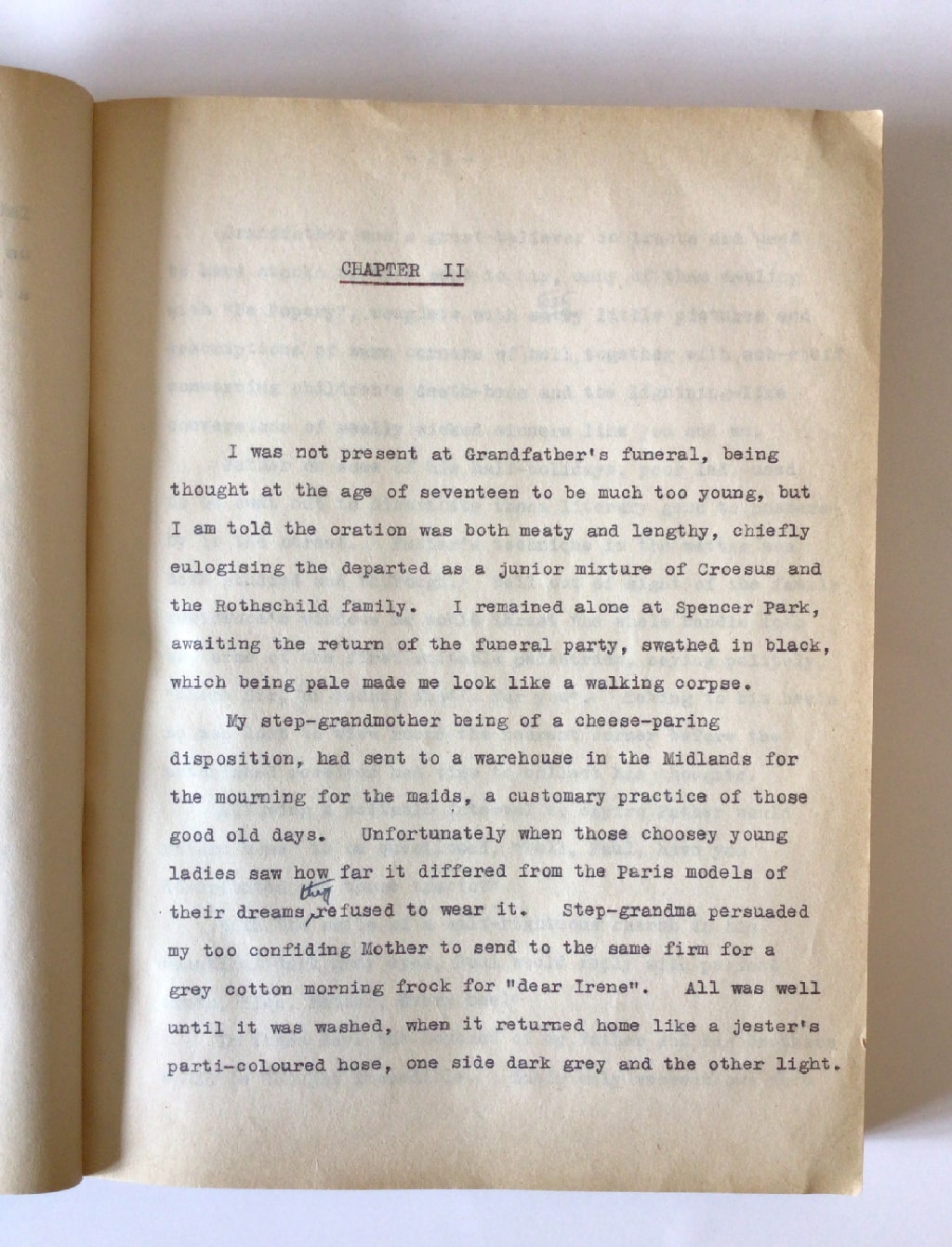


(Click on image to enlarge)


I was not present at Grandfather's funeral, being thought at the age of seventeen to be much too young, but I am told the oration was both meaty and lengthy, chiefly eulogising the departed as a junior mixture of Croesus and the Rothschild family. I remained alone at Spencer Park, awaiting the return of the funeral party, swathed in black, which being pale made me look like a walking corpse.

My step-grandmother being of a cheese-paring disposition, had sent to a warehouse in the Midlands for the mourning for the maids, a customary practice of those good old days. Unfortunately when those choosey young ladies saw how far it differed from the Paris models of their dreams, they refused to wear it.

Step-grandma persuaded my too confiding Mother to send to the same firm for a grey cotton morning frock for "dear Irene". All was well until it was washed, when it returned home like a jester's parti-coloured hose, one side dark grey and the other light.


Job Caudwell (8 December 1820—5 June 1908)

We've discussed the monument, and related funerary practices, in some detail. Now we come to Job Caudwell himself. What sort of a man erected such an extravagant obelisk to himself?
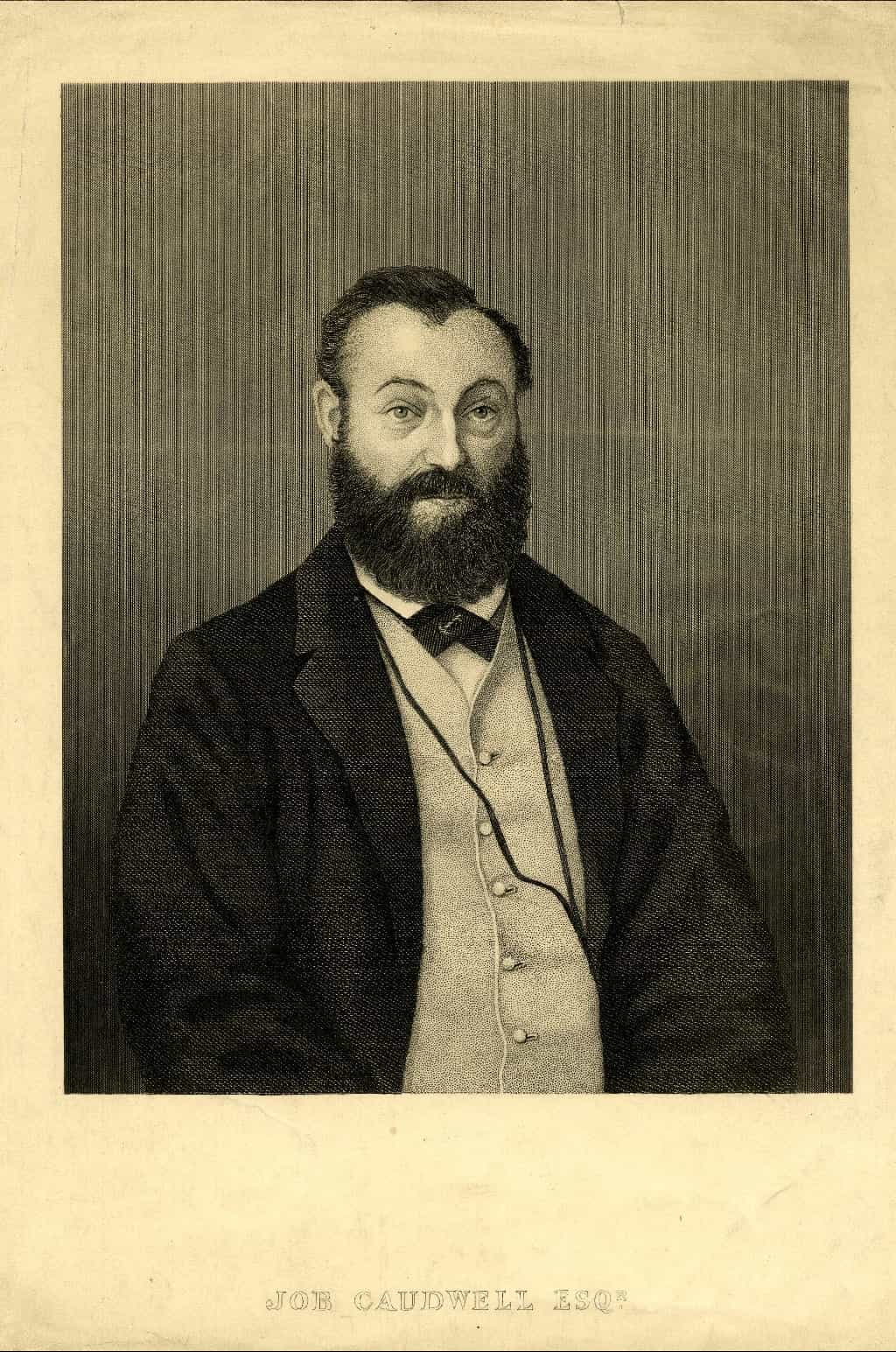


He was quite a character — some might say he was the original crank. He actively campaigned against vaccination, male-midwives, and Darwinism, but very much for temperance, mesmerism, homeopathy and vegetarianism (his pioneering Vegetarian Cookery for the Million ran to 6 editions 1864-1865).

As an author, publisher and later as an important property developer in our area, Job's business activities made him rather rich. Rich enough to erect a massive obelisk, for example, and to build a very substantial house on the newly-created Spencer Park c.1872.

[The land on which Spencer Park was built was in effect a sweetener to Earl Spencer for agreeing to relinquish his rights over what was left of the rest of Wandsworth Common in 1871.]
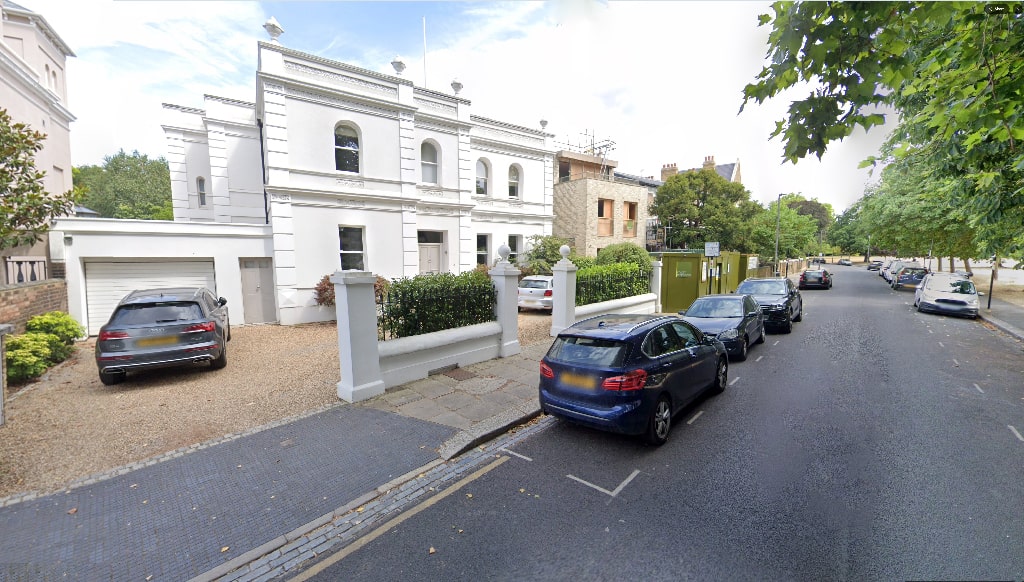


Job Caudwell's house, now No. 3 Spencer Park, but originally No. 44. The house was constructed from concrete — then a very unusual building material. Notice the balls mounted on the pillars (on which more below).

(Click on image to enlarge)


Grandfather bought the second plot of ground in Spencer Park and had his house built to his own design entirely of concrete; floors, staircase, walls and ceilings, to obviate danger of fire. Four square, with a front door bell sufficiently loud to rouse the local Fire Brigade, it had a flat roof from which a considerable part of London was visible, including a first-class free view of the fireworks at the Crystal Palace. Later inhabitants had an equally interesting view of the approach of more deadly fireworks in the shape of flying bombs.

[Is the view still as good? Have trees and buildings obscured much? I'd love to know.]
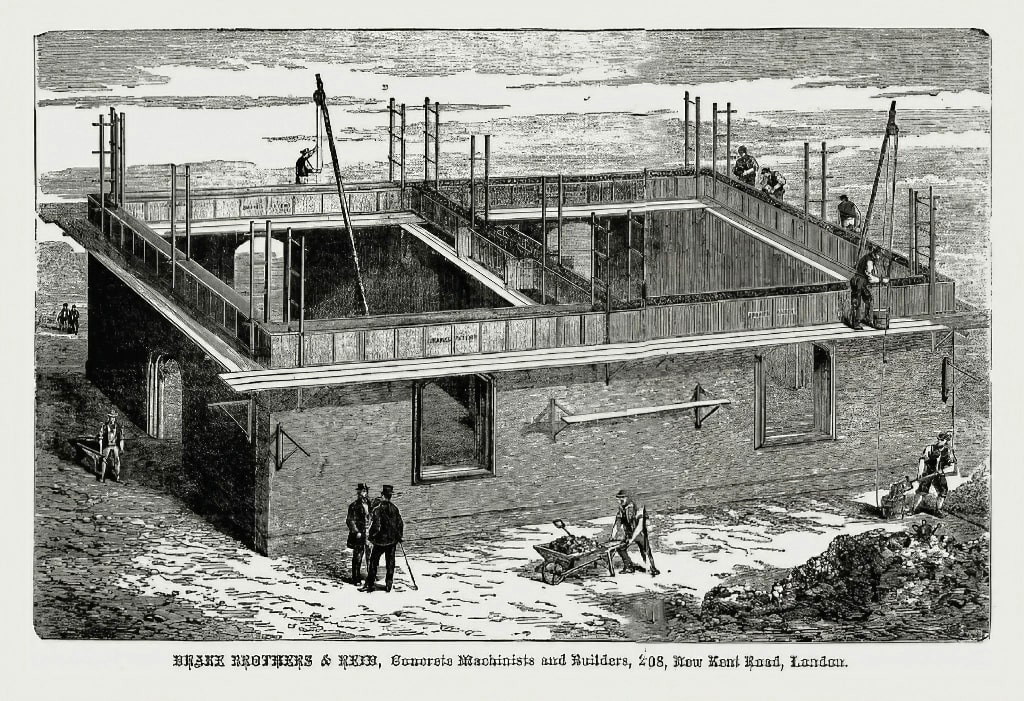


Advert for concrete houses, date?. Reducing the risk of fire was one stimulus to the use of concrete, another was cost: it was argued that concrete construction was around a third less expensive.

(Click on image to enlarge)

[Concrete buildings of the time soon deteriorated. There's a terrific article by Paul Latham about the restoration of an early Drake concrete house in Lordship Lane, East Dulwich, here. Several other commentaries, including Wikipedia: 549 Lordship Lane.]

Irene adds an interesting note about the influence of her grandmother's astraphobia on the design of the house:


Grandma was scared to death of thunder and lightning, perhaps with good reason, seeing that in her childhood her nurse had been killed by her side during a storm. To overcome this trouble Grandpa had a room built in the heart of the earth beneath the house, very much like a railway carriage in shape, where Grandma retired out of reach of the lightning and of all but the worst claps of thunder. The afore-mentioned later inhabitants found it very handy as a ready-made air-raid shelter.

[It is worth recalling that three adults and four children were killed by lightning on the Common in June 1914. I have described this in some detail in the June 2023 edition of these Chronicles.]

Irene adds a note about the gates:


"The gates were a copy of those of the old Manor House far away from London where Grandpa had spent his youth, with identical round knobs on either side. This, I understand, was a mistake on Grandpa's part as these knobs, strictly speaking, although often appearing on villas and like residences with such names as "Clovelly", "Mentone” or “Kosey-Nook", should only be used on the gates of an actual manor."

There's far too much to say about Job in this single edition of Chronicles but I'd like to at least get us started. — Irene's memoir is simply bursting with (appalling but highly entertaining) stories. Here's just one:


I was nine years old [1900], with a crimson frock and highly starched white embroidered pinafore, dark hair which required many knobbly curl papers on Saturday nights and a fringe, when my parents brought me to Wandsworth to live with the gentleman known to me as Grandpa and to my father and his brothers as "The Governor".

Spencer Park, with its very genteel houses, entirely surrounded an enchanting private park where the birds sang and nested amid the pink and white chestnut trees, and the sweet perfume of lilac, or flew chirping amid the golden chains of the laburnum and the budding walnut trees.

Old Bradford, the chief gardener, would have fallen in his tracks had a weed been found in his glowing flower beds or a dandelion on his immaculate lawns, where in summertime a comfortable brown horse gently dragged the lawn mower up and down.

The Park was sacred to the tenants of the surrounding houses, each of which had its private gate and key. And the rules of its use were as stern as any tribal laws of darkest Africa.

No games except the well-bred, non-turf-destroying recreation of croquet were permitted and the nicely brought-up children were trained not to walk upon the grass or pick a single flower. All was decorous, neat and deadly slow. Grandpa was a keen croquet player, but sad was the occasion if anyone so far forgot themselves as to defeat him. My Mother did so once, but never, never again.


A gratuitous image of a young woman in a hammock, to help you visualise the scene a moment before Job arrived with his pocket knife. Painting by Ruth Sutherland, c.1910

(Click on image to enlarge)


On one inauspicious day an enterprising young lady broke every rule by slinging a hammock between two of the sacred trees and ensconcing her pretty person within it. But not for long! Grandpa, breathing fire and sulphur, appeared upon the scene and in vehement tones commanded her to remove the obnoxious object immediately.

The lady, far in advance of her times, entirely refused to obey the voice of Authority. But a little thing like a girl in a hammock would not deflect Grandpa from what he considered his duty, so that without further argument he produced a business-like pocket knife and cut down the hammock, complete with girl.

Rushing into her nearby home the girl's complaints brought her Mother on the scene, brandishing a horsewhip with which she proposed to teach old Job Caudwell a lesson. But that wily gentleman had disappeared within the fastnesses of his own garden and the incident, as well as the gate, were closed.

A rum character, eh? More — probably much more — on Job Caudwell in future Chronicles.


Also  .  .  .

When I started writing about Job Caudwell's obelisk, I expected it to be only a paragraph or two, but it grew and grew, overshadowing everything else. (Rather like the man.) So I've decided to cut this month's Chronicles more or less in half — I'll send out the remainder in a couple of weeks' time.

Isabelle Ross / Marie Duval (1847—1890)

But while we're in Magdalen Road Cemetery, I cannot fail to draw to your attention a nearby headstone. This is to Isabelle Ross — better known as the brilliant comic artist Marie Duval, "one of the forgotten wonders of 19th-century art", who was buried a short distance from Job's obelisk in June 1890. Isabelle/Marie has been described as the first "truly humorous" women artist.
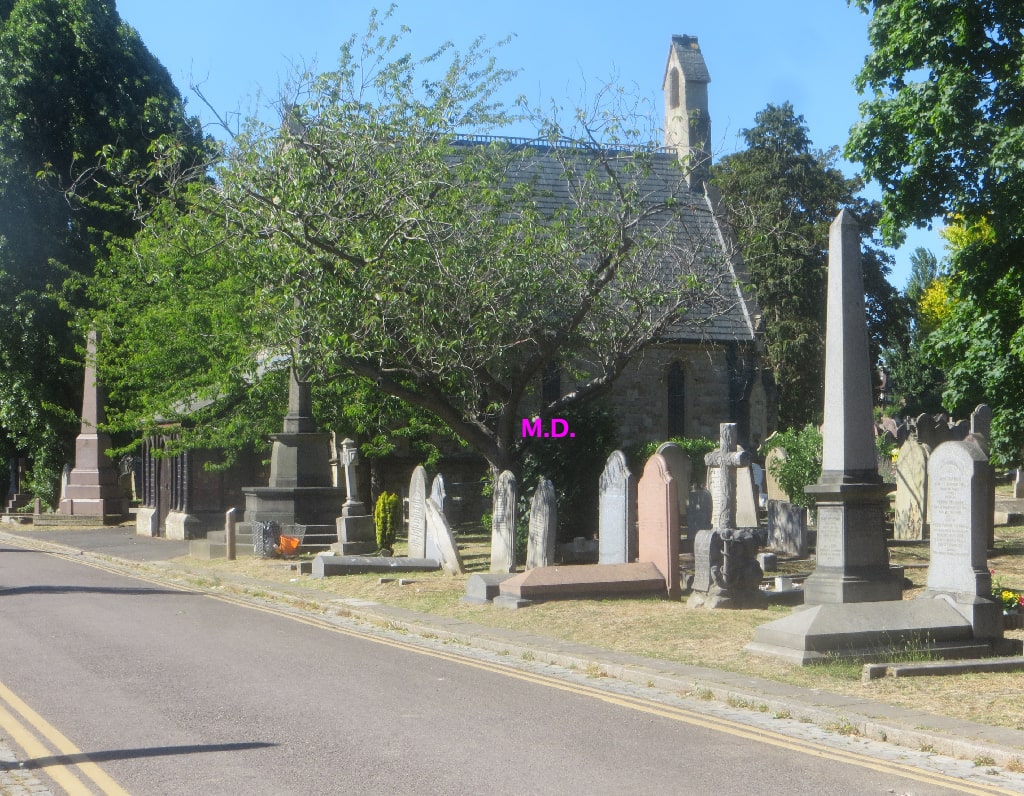
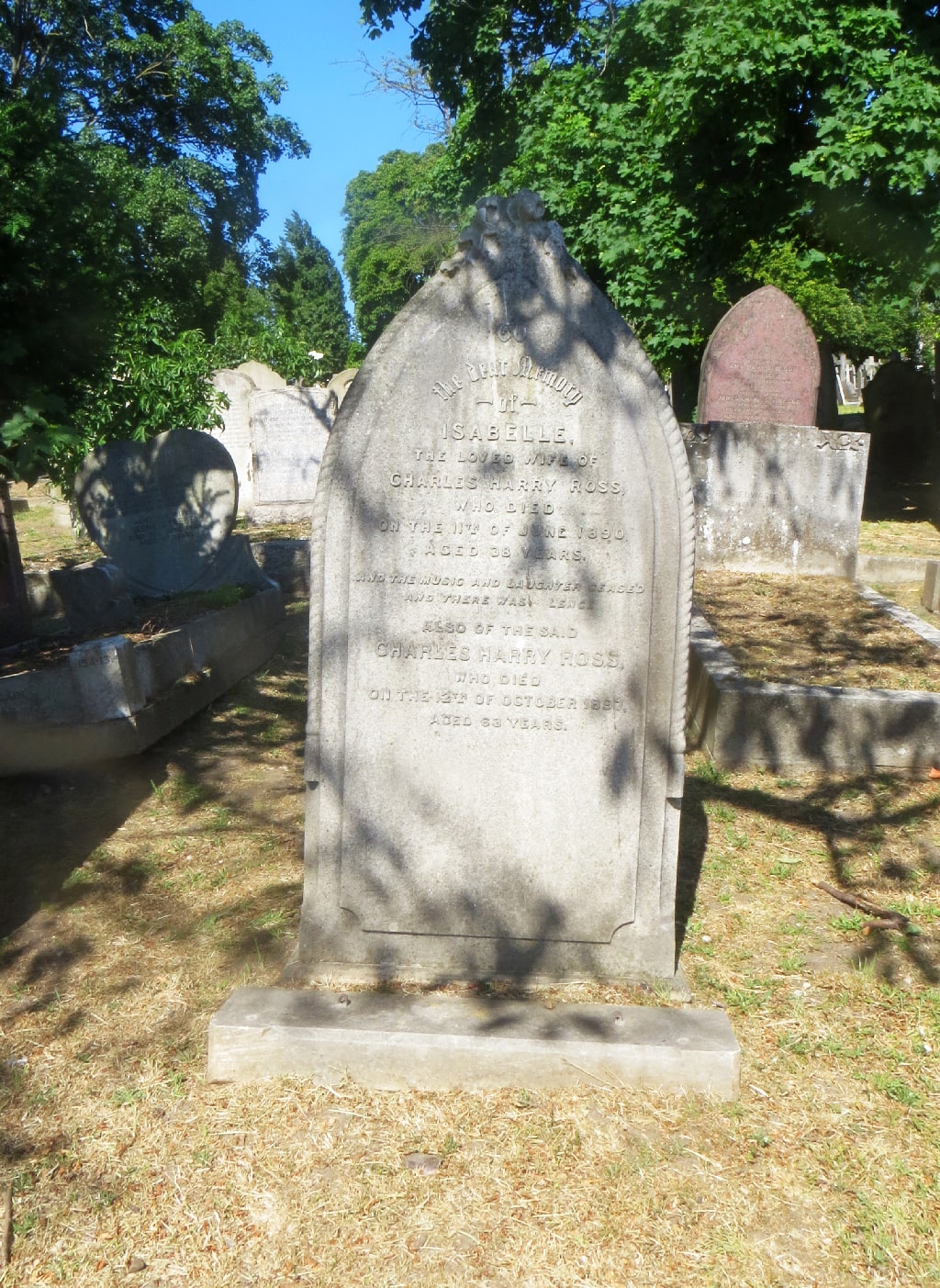

Location of the memorial near the chapel in Magdalen Road Cemetery. Job Caudwell's obelisk can be seen on the far left.

(Click on image to enlarge)


Isabelle Ross — born Isabelle Émilie de Tessier but better known as the artist and actor Marie Duval, but also as "Noir" and "S.A. The Princess Hesse Schwartzbourg". Headstone shared with her husband/partner Charles Ross in Wandsworth Cemetery, Magdalen Road. The couple living on or near Wandsworth Road, on the Battersea/Clapham border.

(Click on image to enlarge)


To
the dear Memory
of
ISABELLE,
the loved wife of
Charles Harry Ross,
who died
on the 11th of June 1890
Aged 38 years.

And the music and silence ceased
and there was silence


Also of the said
Charles Harry Ross,
who died
on the 12th of October 1897,
Aged 63 years.
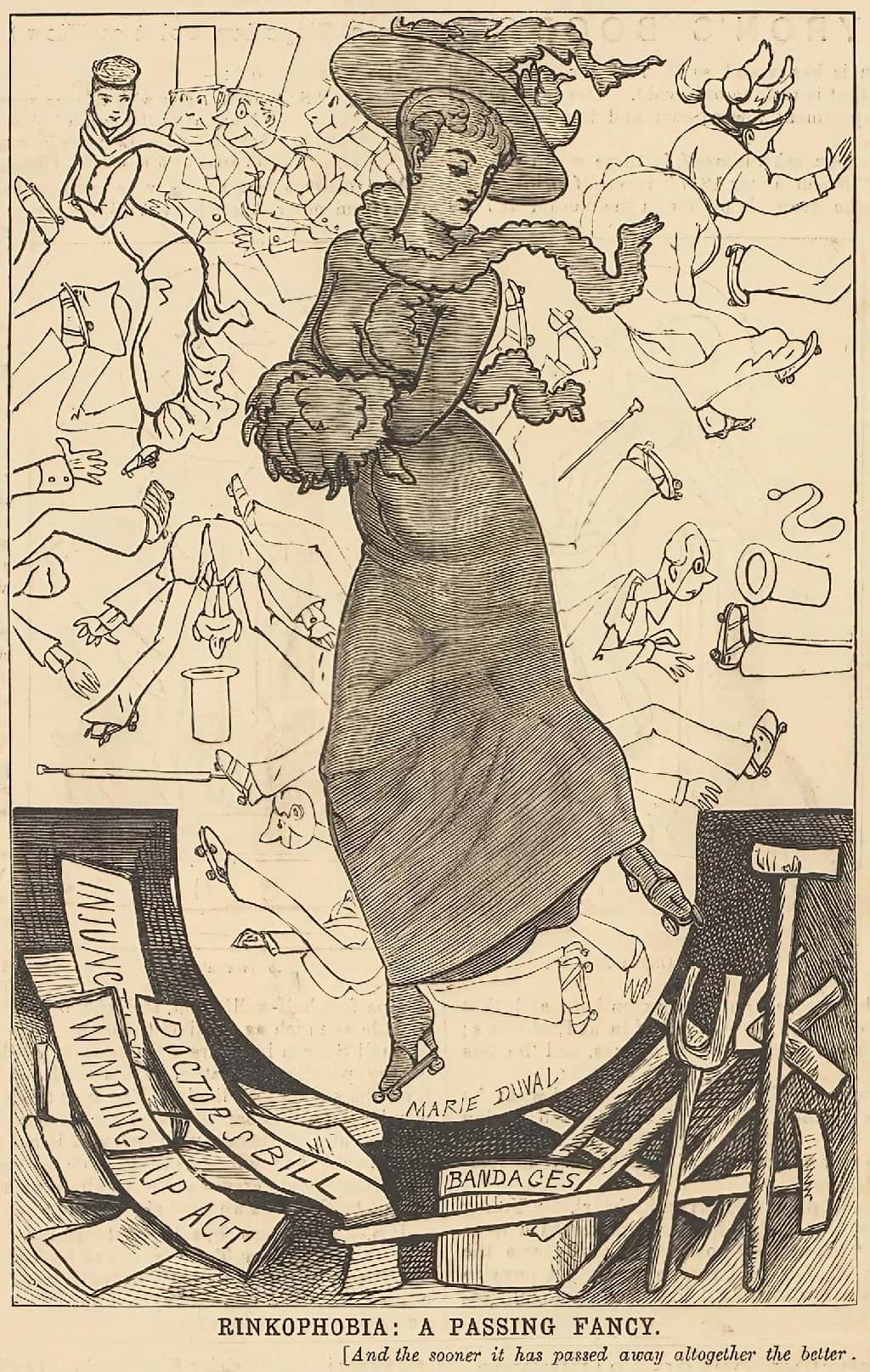


Marie Duval, "Rinkophobia", commenting on the Victorian enthusiasm for roller skating. A self-portrait?

(Click on image to enlarge)

More on Isabelle Ross/Marie Duval (and her extraordinary creation Aly Sloper), very soon. In the meanwhile, give a loved one (or yourself) a treat and buy this beautiful book on her life and work:


Marie Duval, Simon Grennan, Roger Sabin, Julian Waite, Myriad Editions, 2018.

(Click on image to enlarge)


"And the music and silence ceased
and there was silence
"


Chronicles

May 2025


Wandsworth Common nearly three centuries ago, as shown on John Rocque's map of 1748. More than twice the area of today's Common, it was undivided and unobstructed by walls, fences, surfaced roads or railway lines. Very few houses are shown on or around its edges. (The green tint is my own.)


Wandsworth Common appears on one of the 16 maps making up John Rocque's "New and Accurate Survey Of the Cities of London and Westminster The Borough of Southwark with The Country about it for nineteen Miles in Length and thirteen in Depth . . . " (1748)

(Click on image to enlarge)

So how did I do? Will there be a plaque on the former St Mark's Infants School, Battersea Rise, one of Wandsworth Common's most sacred sites?

In last month's Chronicles, I outlined my case for Wandsworth Council to erect a plaque on this tiny school, where many Wandsworth Common Preservation Society and Battersea Vestry meetings were held in the late 1860s and 1870s. This is also where Samuel Sullings, imprisoned for fence-breaking nearby, was celebrated on his day of release.

The Committee selecting the new plaques met on April 4th. Was I successful?


St Mark's school (erected 1867-8) and church (1872-4), on Battersea Rise.

Well, er, the selection committee didn't actually consider my proposal, so the answer is no. But I really can't complain because it's all my own fault, since I had missed the deadline for submissions (April 4th). For some reason I had it in my head that the deadline was much later in the month.

(Clear message: never trust a historian with dates.)

Maybe another year?


I would like to take this opportunity to write about some aspects of the transformation of the Common in the last few hundred years.

Here's a simplified image of Rocque's Wandsworth Common which I've imposed on an Ordnance Survey map from 1868. I have also added the bounds of the three manors that inter-commoned here: Wandsworth, Battersea and Allfarthing.

["Inter-commoning" allowed local people to share the resources of the entire area of Common (for pasture of animals, digging of gravel, cutting of turf, collection of firewood etc), even though the contiguous parts were legally attached to separate manors.]
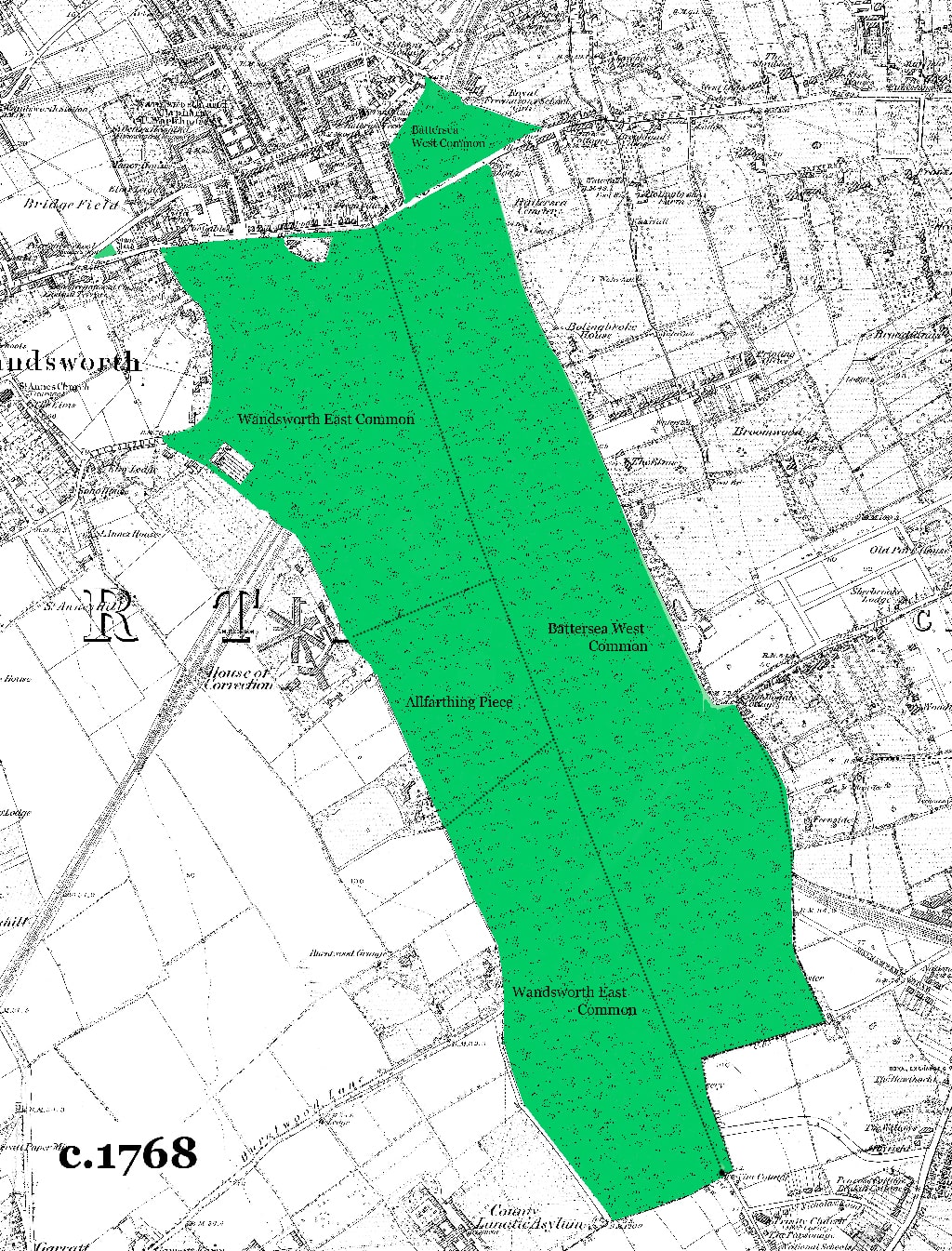


Today's Bolingbroke Field formed a large part of Battersea Manor's "West Common". The Scope and West Side/North Side was once Wandsworth's "East Common". The "Allfarthing Piece" — a thrust deep into the Common — has now all been built over as the Toast Rack.

By the late 1860s, a century or so after Rocque's map was published, the Common was less than half the size, it was criss-crossed with roads and railways, and ringed around with large houses and state and charitable institutions (schools and a prison). In the late 1850s the Patriotic Asylum ate the heart out of the Common — more than 50 acres.
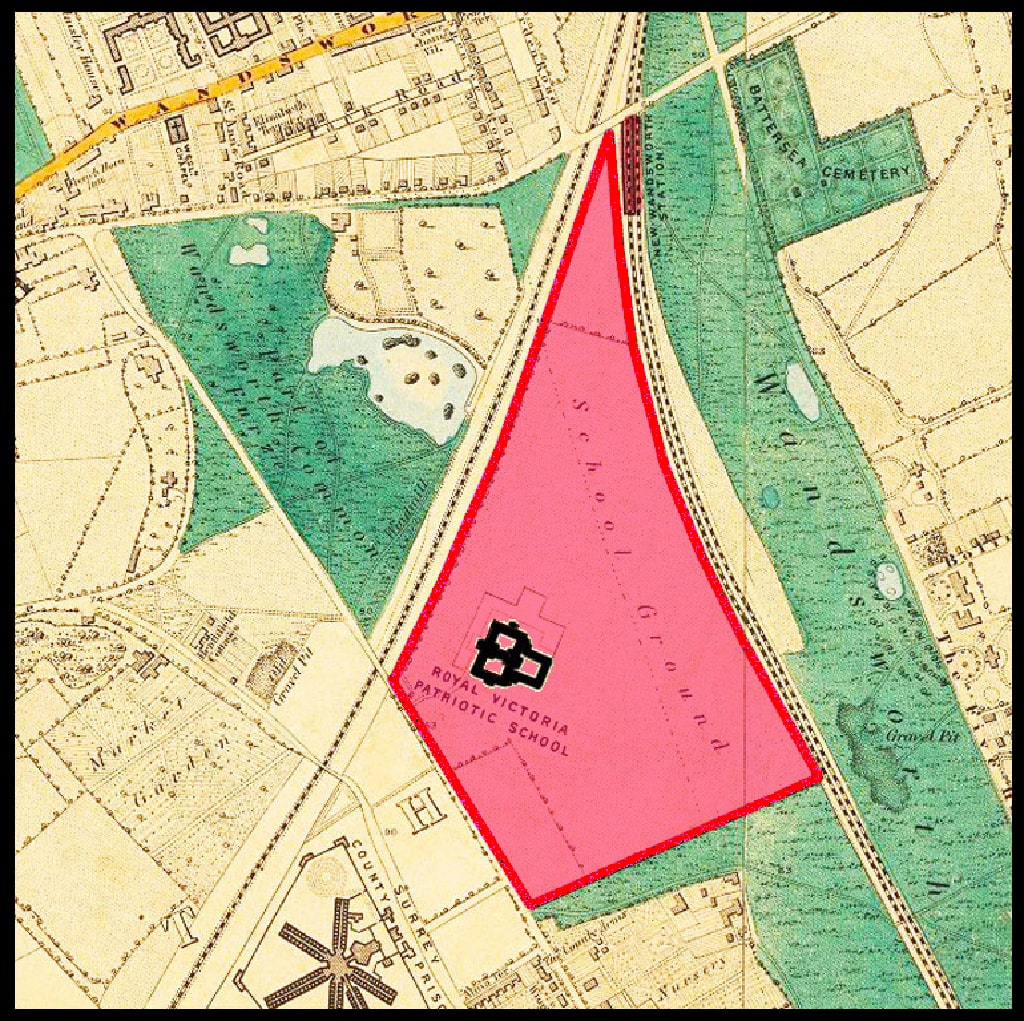


(Click on image to enlarge)

The Royal Victoria Patriotic Asylum for Girls c.1860, in a recent 50-acre enclosure of the Common. Its kite-like shape is defined by two sharply converging/diverging railway lines, the future Trinity Road, and a straight boundary at right angles ending at the railway line en route to Crystal Palace.

Traditional routes, once free and unobstructed in every direction, were now closed off, hence walkers had to find new, usually less convenient, ways across the Common. Notice, for example, how access to the Common is restricted to a narrow passage opposite the County Arms pub between the RVPA Asylum grounds (behind by a long high wall) and an enclosed nursery.

[This nursery area, leased from owner Magdalen College, Oxford, by the Neal family, had been open Common within living memory. This will eventually be built over as the "Toast Rack".]

If, in the 1860s, local people had not campaigned so hard to save the fragments of Common that remained, there would be little left for us to enjoy today.
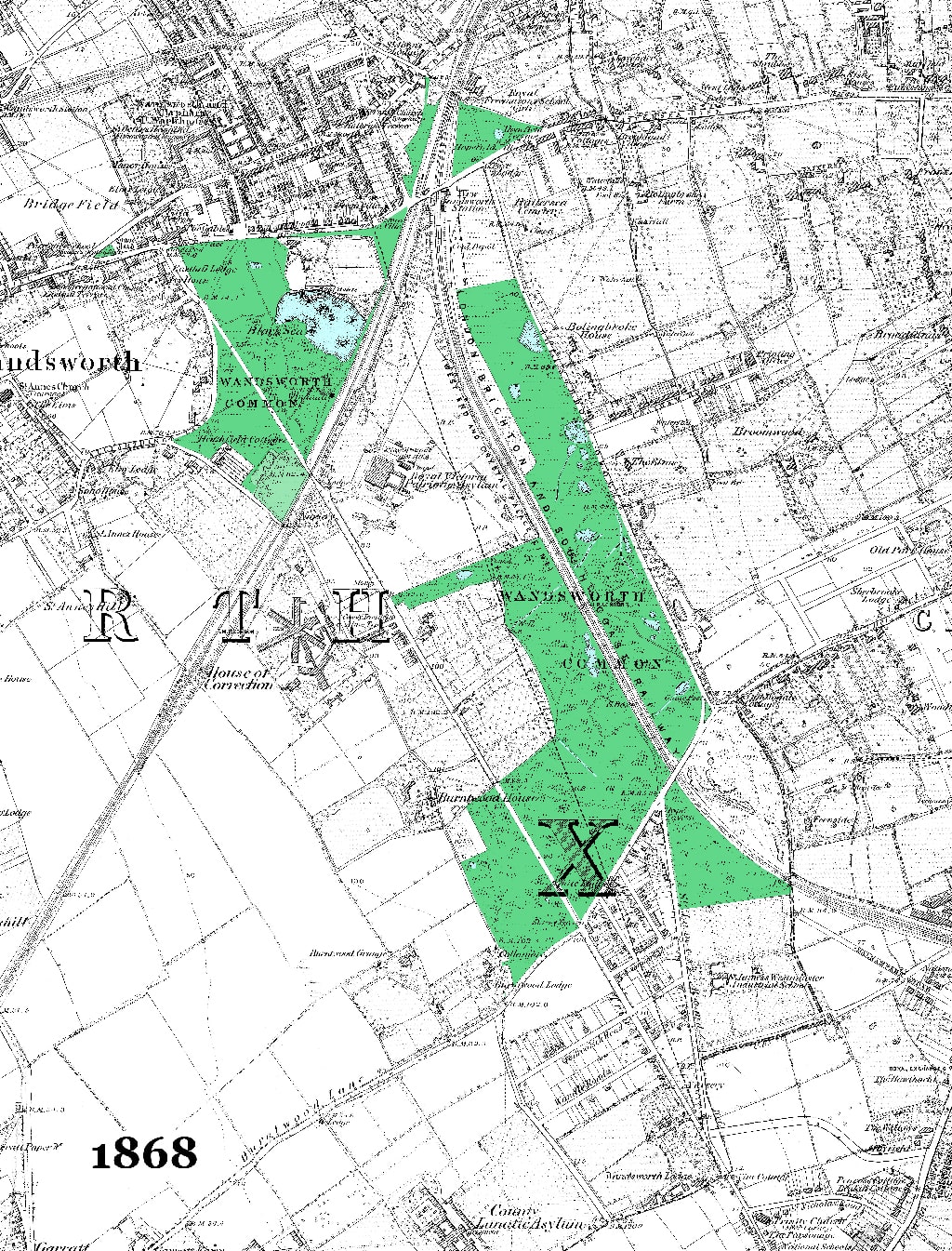


Wandsworth Common in 1868.

The Common was at its smallest in 1868, today it's 20 or so acres larger. A strip was lost when Trinity Road was "dualled" in the late 1960s, but patches were found here and there to compensate — such as "Prison Banks", and an acre or so in the grounds of the Patriotic Building.

The most significant area to be added occurred when the LCC bought the "Extension" — about a third of the old RVPA site — just before WWI. This fenced area now contains the cafe, cricket pitches, tennis courts and bowling green:
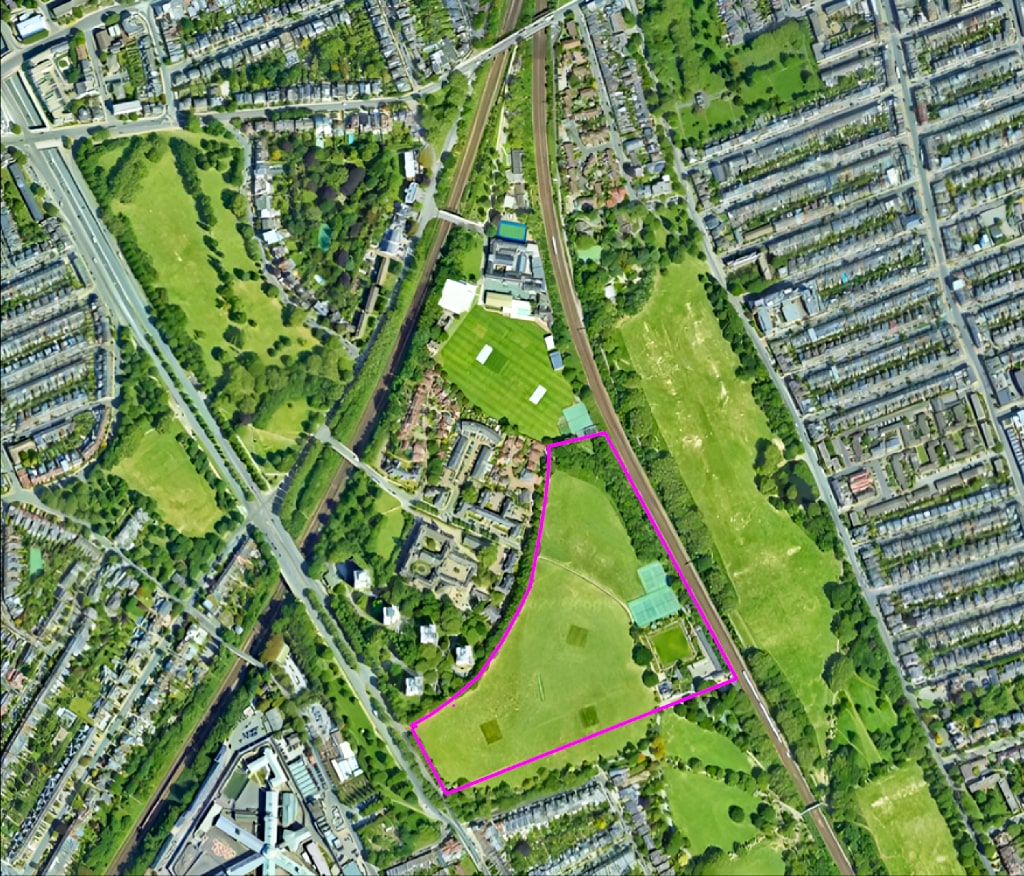
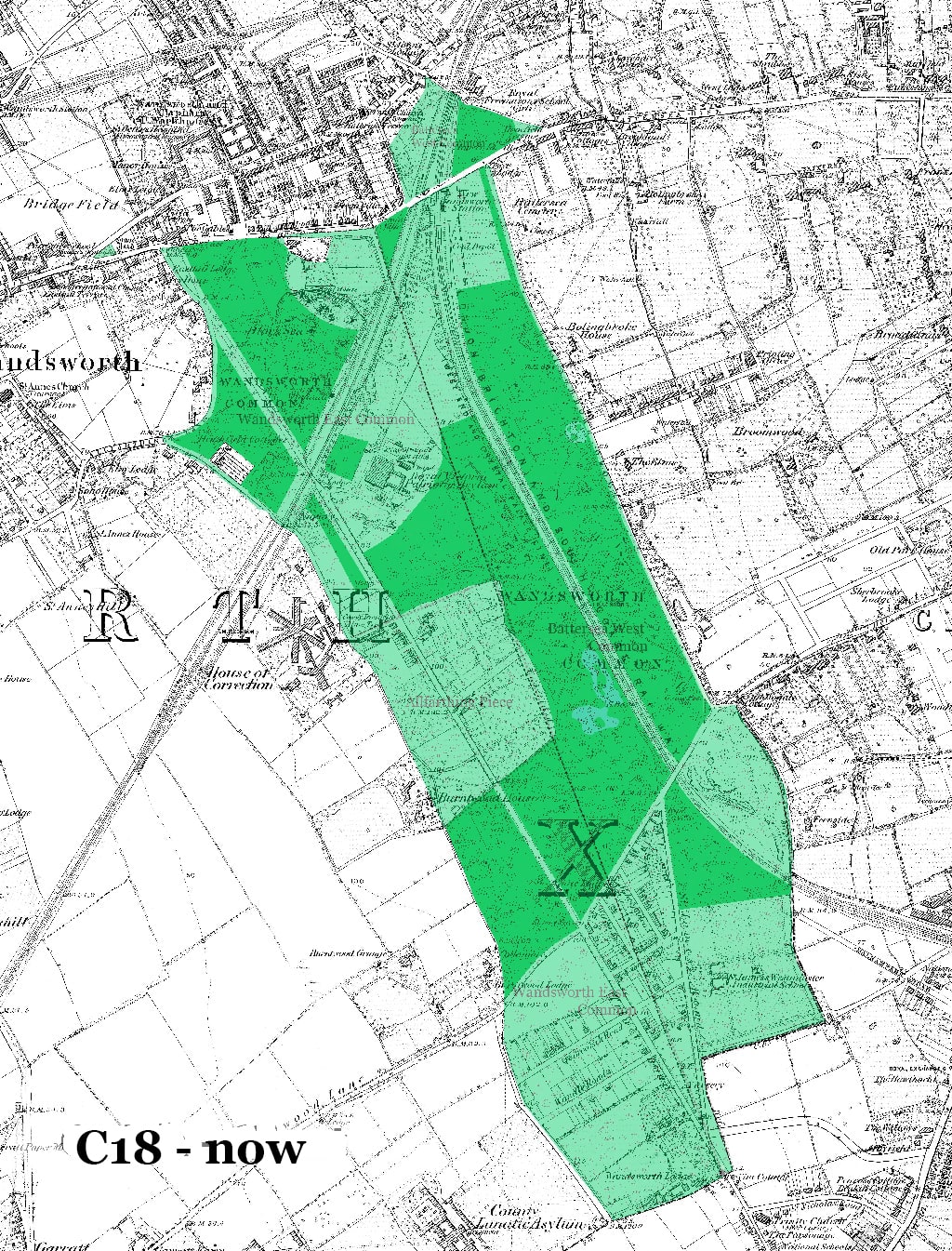

The northern area of Wandsworth Common, showing the Extension (restored to the Common in 1913).

(Click on image to enlarge)


250 years of change: Wandsworth Common today shown within its likely extent in the late-C18.

(Click on image to enlarge)

"DOWN WITH THE FENCES!"

As promised last month, here is a closer examination of this fine "Down with the Fences!" poster (which is a history lesson in itself):
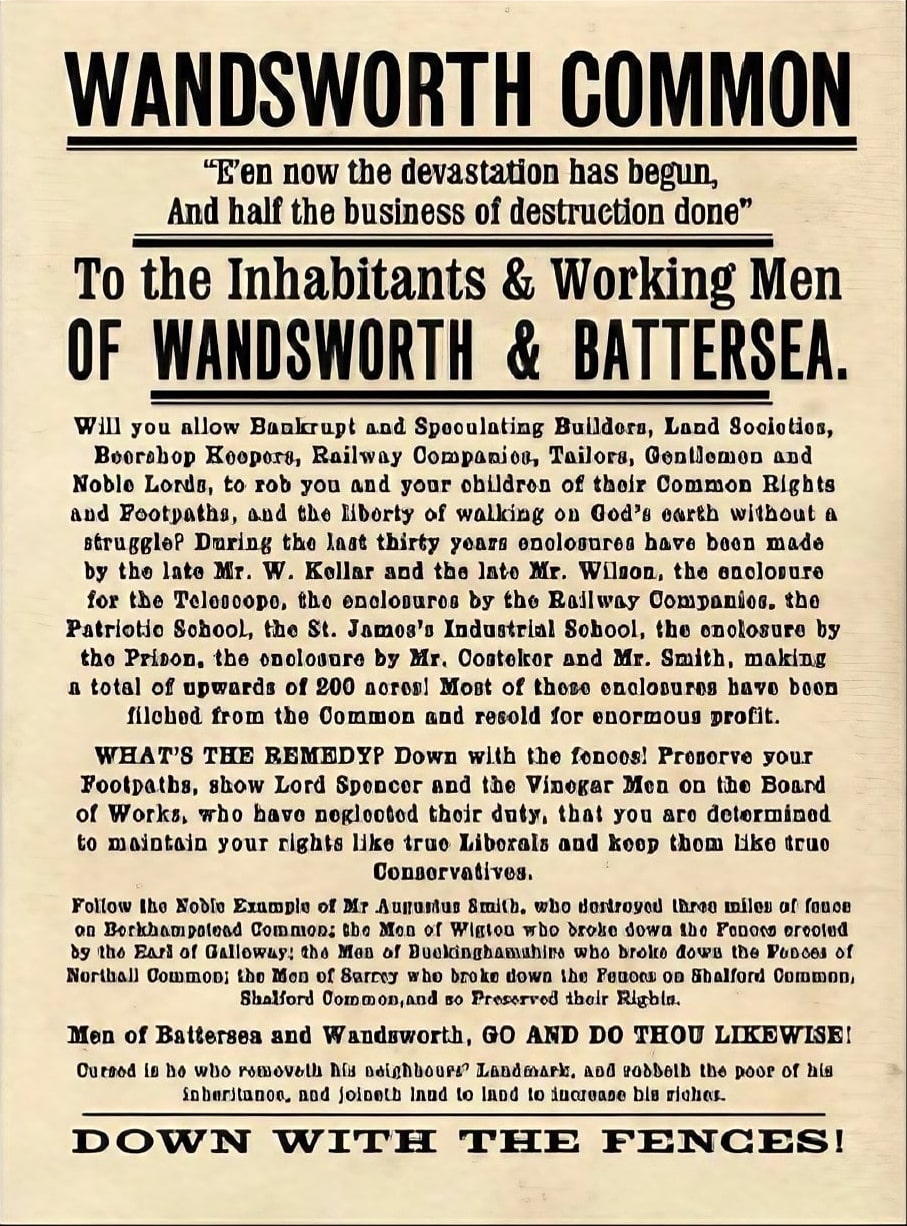


WANDSWORTH COMMON

__________________________

"E'en now the devastation has begun,

And half the business of destruction done."

__________________________

To the Inhabitants & Working Men

OF WANDSWORTH & BATTERSEA

__________________________

Will you allow Bankrupt and Speculating Builders, Land Societies, Beershop Keepers, Railway Companies, Tailors, Gentlemen and Noble Lords, to rob you and your children of their Common Rights and Footpaths, and the liberty of walking on God's earth, without a struggle?

During the last thirty years enclosures have been made by the late Mr. W. Kellar and the late Mr. Wilson, the enclosure for the Telescope, the enclosures by the Railway Companies, the Patriotic School, the St James's Industrial School, the enclosure by the Prison, the enclosure by Mr. Costeker and Mr. Smith, making a total of upwards of 200 acres!

Most of the enclosures have been filched from the Common and resold at enormous profit.

WHAT'S THE REMEDY?

Down with the Fences! Preserve your Footpaths, show Lord Spencer and the Vinegar Men on the Board of Works, who have neglected their duty, that you are determined to maintain your rights like true Liberals and keep them like true Conservatives.

Follow the Noble Example of Mr. Augustus Smith, who destroyed three miles of Fence on Berkhampstead Common; the Men of Wigton who broke down the Fences erected by the Earl of Galloway. The men of Buckinghamshire who broke down the Fences on Northall Common; the Men of Surrey who broke down the Fences on Shalford Common, and so Preserved their Rights!

Men of Battersea and Wandsworth, GO AND DO THOU LIKEWISE!

Cursed is he who removeth his neighbours' Landmark, and robbeth the poor of his inheritance, and joineth land to land to increase his riches.

___________________________

DOWN WITH THE FENCES!

I can't be sure, but the Down With The Fences! poster must surely have been composed by John Buckmaster himself. Buckmaster is a master wordsmith, his literary style, themes — and even his theatrical mode of delivery — inspired by his friend Charles Dickens.

[Indeed, when he addressed a large meeting in the Mechanics' Institute, South Shields, in 1869, newspaper reports remark that "Listening to Mr Buckmaster is like a reading from Dickens". [Newcastle Daily Chronicle — Monday 18 January 1869 .]

Notice the heady textual mix that JCB would have mastered as an itinerant "lecturer" on behalf of the Anti-Corn Law League in the 1830s:

Old-fashioned poetry: "E'en now the devastation has begun", from Oliver Goldsmith's classic "The Deserted Village" (1770), about the destruction of rural life after enclosure.

Biblical allusions: "Vinegar men" is a reference to the Crucifixion — when Jesus cried out for water, his tormentors gave him vinegar. "Cursed is he who removeth his neighbour's landmark . . . robbeth the poor of his inheritance . . . joineth land to land to increase his riches" are phrases cobbled together from Deuteronomy, Job, Hosea, and Proverbs.

Evangelical exhortation:"The liberty of walking on God's earth . . . Men of Battersea and Wandsworth, Go and do though likewise."

Popular invective: "filched . . . sold for enormous profit".

The whole bitter and abusive diatribe is suffused with wit and sarcasm, invective and fine phrase-making, with lots of rhetorical questions and exclamation marks.

Notice too the political intelligence — the explicit call to both Conservatives and Liberals (there was as yet no Labour Party): "Show Lord Spencer . . . that you are determined to maintain your rights like true Liberals and keep them like true Conservatives".

There is also a subtle class sensibility — one that aims always to unite the great majority against the few: the working and middle (and even upper-middle) classes against the landed aristocracy (in the person of Earl Spencer), and their allies and servants the "railway companies"", "beershop keepers", "bankrupt and speculating builders", and "bankrupt and speculating builders".

[We can attribute Buckmaster's hostility to publicans in part to his own father's alcoholism.

The reference to "Tailors", incidentally, is not a (snobbish) criticism of the trade or craft as a whole. It is probably a specific reference to Henry McKellar, who lived in the large "Wandsworth Lodge" off Trinity Road. He had made his first fortune in India, dressing the East India Company.

McKellar (aka Kellar, as in this poster) bought the nearby fields from Earl Spencer, 1848-53 — all of the land along to Burntwood Lane, including an area of Wandsworth Common (now "Trinity Fields"), and all of the Common between St James's Drive and Bellevue Road ("McKellar's triangle").
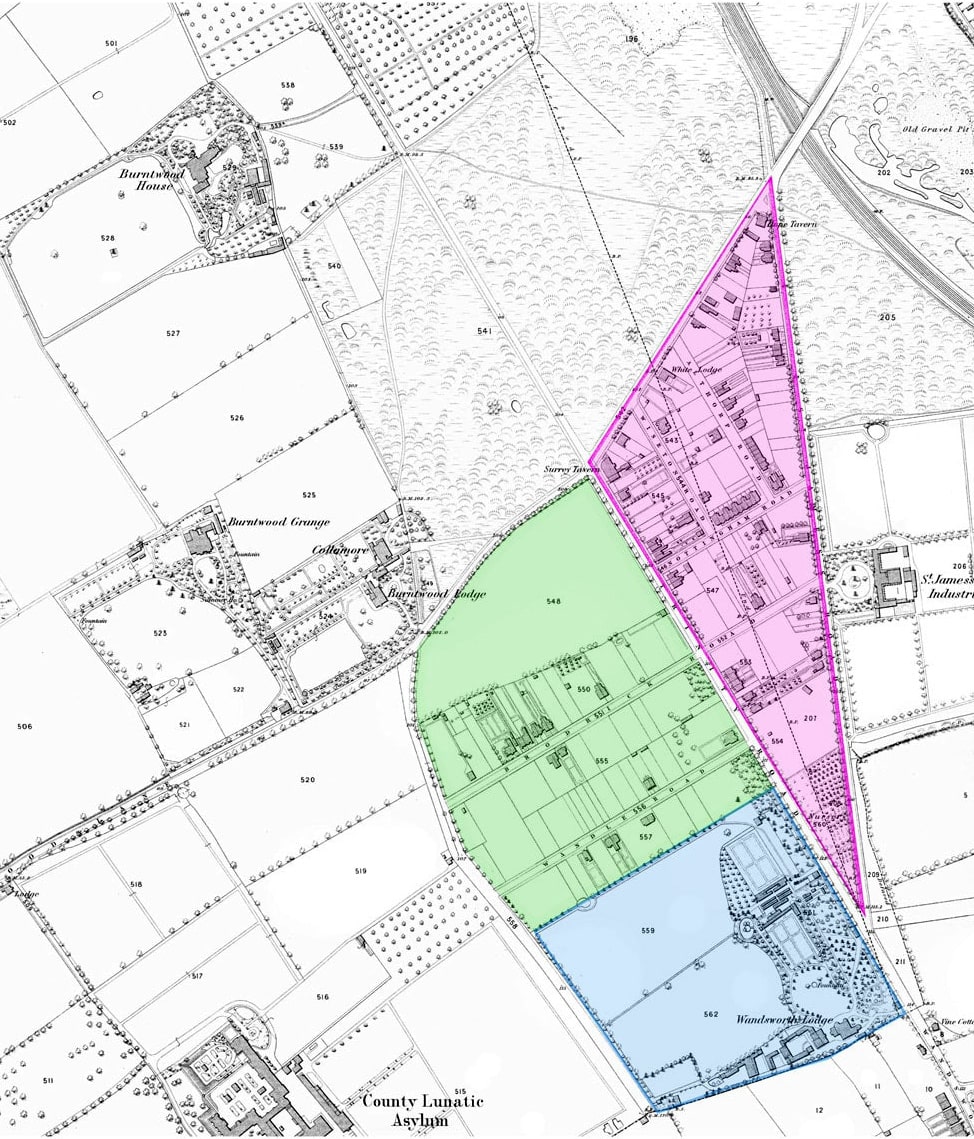
Henry McKellar's house and gardens, Wandsworth Lodge, on an Ordnance Survey map of c.1868 (tinted blue). those tinted pink formed "McKellar's Triangle". These fields, until recently part of the Common, were not built over until after his death in 1863.

[Another possible "Tailor" was John Costeker, discussed last month. If I am right, and he is the same man, J.C. was Warden of the Merchant Taylors' Guild in 1846 and its Master in 1853. For more on the "commons stealers" John Costeker and Henry Compton Smith, see April 2025's Chronicles.]

On "the Noble Example of Mr. Augustus Smith, who destroyed three miles of Fence on Berkhampstead Common" [sic], see Wikipedia: Berkhamstead Common, and Augustus Smith (politician)". Also Campagner Kate: "To venge the Common Right".

[It would be interesting to know more about "The Men of Wigton who broke down the Fences erected by the Earl of Galloway . . .  The Men of Buckinghamshire who broke down the Fences on Northall Common . . . The Men of Surrey who broke down the Fences on Shalford Common"".]

If possible, sometime soonish I'll follow up with a look at Tom Taylor's poem "The Cry of the Commoners", published in Punch magazine ten days after Samuel Sullings was jailed.

I would also like to discuss in some detail what I always think of as the "Great and Good" poster, targeted at the middle class, published at the same time as "Down with the Fences!":


(Click on image to enlarge)

This May is 80th anniversary of the end of WWII in Europe

Four months before the start of the war (September 1939), estate agents and auctioneers remained "confident that the international horizon would clear before long ". At a local meeting they roundly condemned the "jitterbugs" who "should be ashamed of themselves":

"[P]roperty [is] still the finest investment . . . If war came, stocks and shares would fall, but bricks and mortar would stand. To imagine that flocks of aeroplanes would destroy London in a few days [is] absurd . . . "

Norwood News — Friday 5 May 1939


ATTACK ON THE "JITTERBUGS"

Should be Ashamed of Themselves

AUCTIONEERS ARE IN CONFIDENT MOOD

"JITTERBUGS" were attacked by South London auctioneers at the Ardington Rooms, Clapham Junction, on Friday. At the twelfth annual dinner of the South London branch of the National Association of Auctioneers, House Agents, Rating Surveyors and Valuers, Mr. H. Marshall (national president), proposing "The Branch," expressed the hope that when the branch next met they would not have the shadow of threatened trouble from overseas.

The difficulty of carrying on business worried him and he could see no way out of the difficulty, except that he was confident that the international horizon would clear before long.

"I think people to-day who are suffering from 'jitters' should be ashamed of themselves," he went on. "They are behaving neither as Britons nor even human beings. Great Britain and the British Empire have been in wars hundreds of times and we have always been successful. No doubt we should be successful again, although I do not think war will come. (Hear, hear.) To get the wind up before it comes, at any rate, is being childish."

THE FINEST INVESTMENT

Mr. Marshall urged that those who dealt in property should be brought to realise that property was still the finest investment. If war came, stocks and shares would fall, but bricks and mortar would stand. To imagine that flocks of aeroplanes would destroy London in a few days was absurd and gave no consideration to the naval and anti-aircraft measures.

If people would get over the "jitters" and get on with their jobs, auctioneers and property agents would have no difficulty in earning their livings . . . 

[BNA: Link.]

Local heroes, Lyminge Gardens, 11 May 1941 [the last day of the London Blitz]


'The impressive 'London Blitz' George Medal group of five awarded to War Reserve Constable W. H. Young, 'W' Division Metropolitan Police, who was decorated for his great gallantry on the morning of the final major Luftwaffe raid on the Capital during the Second World War.''

[L to R: George Medal, G.VI.R. — 1939-45 Star — Italy Star — Defence medal — War medal]


In the very early hours of the morning of 11 May 1941 [Constable William Young] was one of four Police officers and an Air Raid Warden who responded to the total demolition of several houses at Lyminge Gardens, Wandsworth Common by a German high-explosive bomb.

Knowing a lady was alive — but trapped — inside one of the houses, Constable Young and his colleague Constable Gordon immediately set to work to free her, despite the air raid still being in progress, having no specialist equipment, and with the remainder of the building in imminent danger of complete collapse.

This they achieved after two hours of undoubtedly terrifying, exhausting and back-breaking labour — the lady was saved and, as further testament to their (but especially Young's) tenacity, almost unbelievably after a short rest he then went back on duty.


London County Council Bomb Damage Map (1945). The Lyminge Gardens bomb is circled in pink.

[For more about bombs on our area, see e.g. HoWC: Chronicles, September 2024  ]

Statement of Junior Station Inspector W. D. F. Williams, Metropolitan Police, 13 May 1941:


"'It was decided to attempt to clear a way through from the rear of the debris.

"At first glance the task appeared a hopeless one, as many attempts to remove the floorboards and beams would in all probability bring the remainder of the debris on top of the would be rescuer and the woman.

However, without the slightest hesitation W.R. Young commenced to dig and scrape with his bare hands. He succeeded in burrowing a hole big enough for him to work in, and then commenced to remove the boards and beams which lay across the woman.

"Time and again the debris and masonry above threatened to collapse on top of the W.R. but he continued working with complete disregard for his personal safety.

"The whole time that the W.R. was digging enemy aircraft were active overhead, thus preventing the use of any light.

"After digging and scraping for almost two hours the W.R. was able to clear away sufficient space for the woman to move her legs  . . . When the W.R. was lifted from the hole in which he had been working he was suffering badly from cramp and exhaustion and had to be assisted to a nearby house, where after a short rest, he was able to return to Balham Police Station at about 5.15 a.m., 11th May 1941.

George Medal citation: London Gazette 29 August 1941:


"A high explosive bomb partially demolished a house and a woman was trapped. The beams and boards which were pinning her down were also holding up the debris and masonry which had fallen from above. Despite the danger, War Reserve Young burrowed a hole large enough to work in and, after two hours, managed to clear away sufficient rubble for the woman to be extracted.

"In the meantime, War Reserve Gordon got into the wreckage from a different direction and protected the victim from falling debris. His position was cramped and dangerous but he remained there, comforting the woman and indicating the best method of effecting her release.

"An air raid was in progress during the whole operation and there was the additional danger of the house collapsing, which it did shortly after the rescue was completed. Gordon and Young showed outstanding courage and determination."

Commissioner of Police for the Metropolis, Air-Vice Marshal Sir Philip Woolcott Game:


"The raid was going on during the whole operation and the two War Reserves had therefore to work in darkness. The risk they ran was shown by the fact that the house collapsed at the point where they had been working shortly after they had completed the rescue.

"There seems little to choose between the performances of these two men so far as regards danger. If anything, perhaps War Reserve Young had the harder task. When he finished he was exhausted and suffering from cramp, but he soon recovered and was able to resume duty  . . . W.R.s Young and Gordon are recommended for George Medals.""

A brief biography of William Young:


William Henry Young was born in October 1912 at St. John's Wood in London; his birth certificate notes that his father — Herbert Arthur — was a Police Constable in 'S' Division, so perhaps family influence led William into the same calling. Newspaper and Police journal extracts also note he became very involved in extra-curricular activities with his uniformed colleagues, being a keen rower with the Balham Police Athletic Club.

Living in Clapham upon the outbreak of the Second World War, and with his civilian profession noted as a 'Motor car driver', he joined the Metropolitan Police as a War Reserve Constable shortly after war was declared. Not to be confused with Special Constables, War Reserve Constables nevertheless performed a similar voluntary role alongside their civilian professions and were authorised with the same powers as Regular officers.

All quotations above are taken from the Spink auction catalogue, 20 July 2023: "It was decided to attempt to clear a way through from the debris at first glance . . . ". I am indebted to Marcus Budgen, Head of Medals at the auction house Spink and Sons, for bringing these remarkable men to my attention — thanks, Marcus!

Rebuilding after the war

Letter from architect Terence Carr to H.W. Tee, Superintending Officer, Wandsworth Borough Council, 11 May 1946:
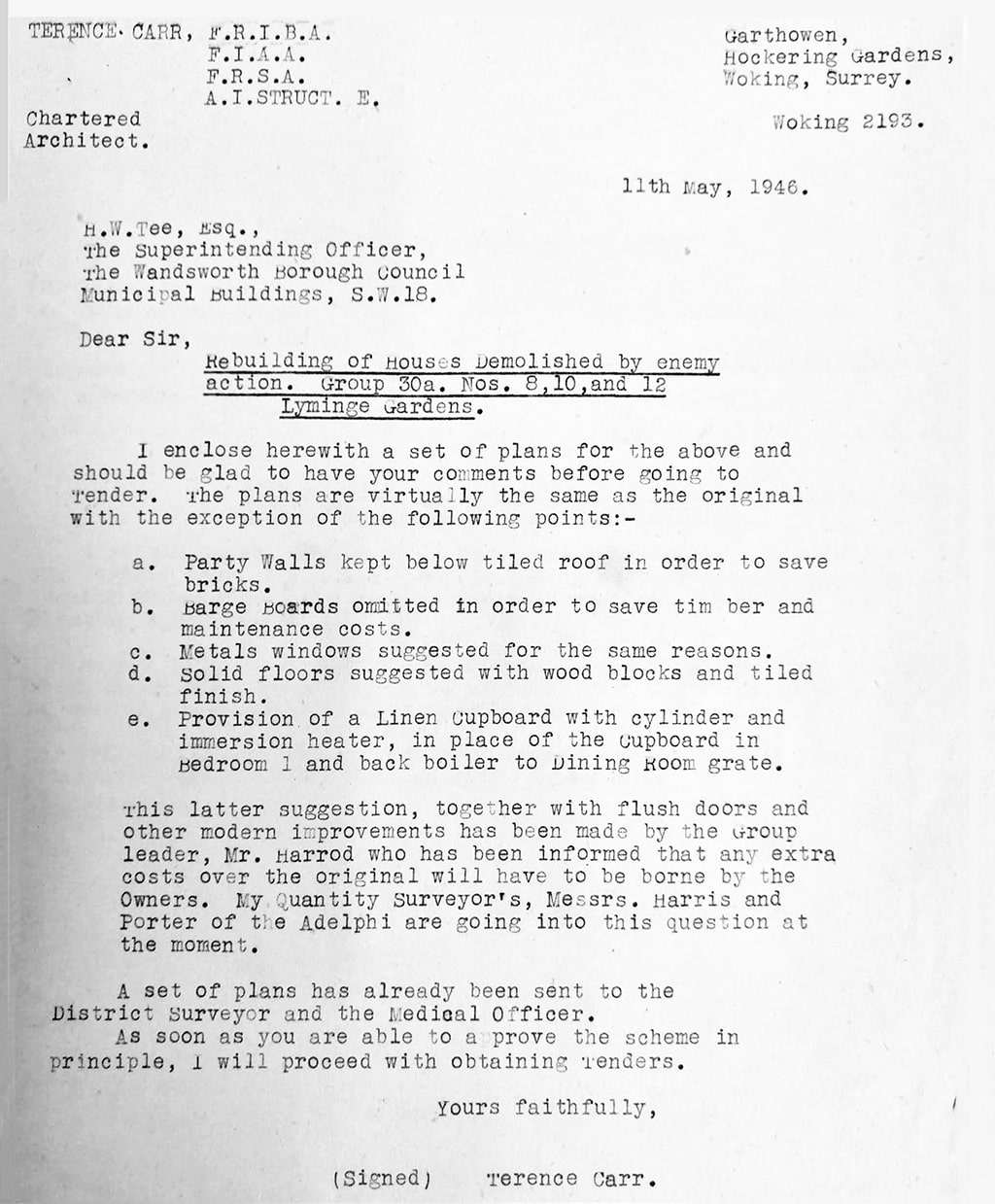
(Click on image to enlarge)

And today?


Lyminge Gardens, SW18: Which of these houses were destroyed by bombs and rebuilt after WWII? How can you tell?


Squirrels . . . 

I've written about rabbits on Wandsworth Common before, but never I think about squirrels.



A Grey squirrel on Wandsworth Common, 2024. Photo by Lewis More O'Ferrall — thanks, Lewis!

(Click on image to enlarge)


Red Squirrel, from Revd Theodore Wood's Dwellers in the Woods (1908).

Revd Wood, vicar of St Mary Magdalene, lived in the fine Vicarage on the corner of Loxley Road and Lyford Road. He and his father (the Rev. J.G. Wood) were among the most influential 19th and early 20th century popularisers of natural history. More . . . 

(Click on image to enlarge)

I find it hard to believe my memory, but as a child in the 1950s I simply do not recall seeing any squirrels on the Common — red or grey. Faulty memory?

Perhaps not. Here is a table from Monica Shorten's 1940s' study of the spread of Grey Squirrels:
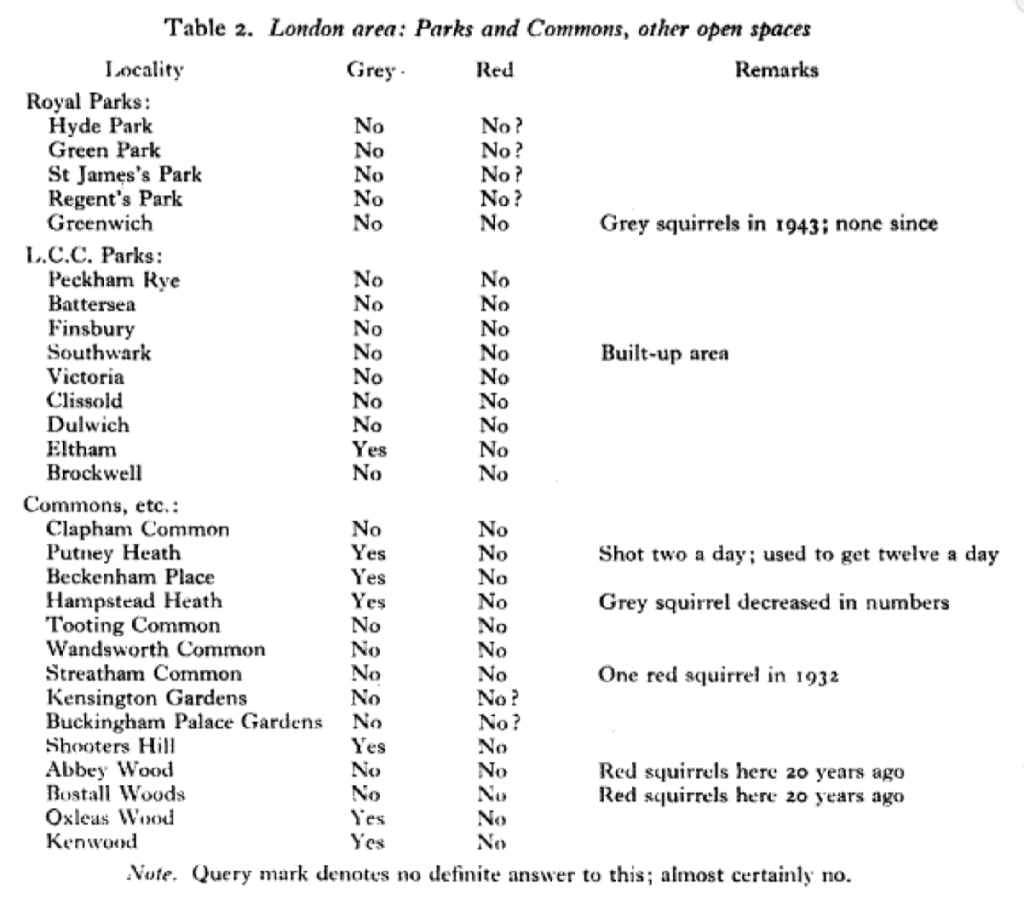
Red v Grey . . . 


Distribution of Red and Grey Squirrels in London's parks and other open spaces, 1944-45.

Monica Shorten, "A Survey of the Distribution of the American Grey Squirrel (Sciurus carolinensis) and the British Red Squirrel (S. Vulgaris leucourus) in England and Wales in 1944-5", Journal of Animal Ecology, Vol. 15, No. 1 (May, 1946), pp. 82-92.

In London, all the Red squirrels had died out in the 1920s, but Grey squirrels were on the ascendant. They'd been introduced at least 30 times from the USA from 1876 as an ornamental species to populate the grounds of stately homes. They thrived. (It became an offence to import and release Grey squirrels in 1930.)


You probably know that Beatrix Potter sent illustrated letters about Peter Rabbit to young Noel Moore at No. 20 Baskerville Road; but it was new to me that she also wrote to him about other works in progress, including The Tale of Squirrel Nutkin (1903).

(Click on image to enlarge)

I wonder when the last Red squirrel/ first Grey squirrel was seen on Wandsworth Common?


Talking about red . . . 

Where did you get that hat?

Last night, we watched Conclave, about the election of a new Pope by all the Cardinals in the Roman Catholic Church. Very enjoyable, very topical.

And very red.


Conclave: Cardinals gathering.

(Click on image to enlarge)

I was reminded that one of Wandsworth's most successful exports was once a red or scarlet hat, much much prized by Cardinals. (This, I think, was the wide-brimmed Galero (a variety of Sombrero), rather than the small hemispherical skullcap, the Zucchetto ("little pumpkin"), seen above. )

(See Wikipedia: Galero. For a useful guide to the range of religious headgear, see "Papal Conclave: Why do Cardinals wear Funny Hats?.

Was this hat made in Wandsworth?



Peter-Paul Rubens, St Jerome, wearing a Cardinal's scarlet Galero.

(Click on image to enlarge)

Given the date that Rubens painted this picture, c.1625, definitely not. But had it been a century later, probably yes.

How so?

According to the historian of the Huguenots, Charles Weiss, writing in 1854:


"Hat-making was one of the most important manufactures taken into England by the refugees [i.e. the Huguenots].

"In France it had been almost entirely in the hands of the Protestants. They alone possessed the secret of the liquid composition which serves to prepare rabbit, hare, and beaver skins, and they alone supplied the trade with fine Caudebec hats in such demand in England and Holland.

"After the Revocation [of the Edict of Nantes, 1685, which deprived French Protestants of religious and civil liberties], most of them went to London, taking with them the secret of their art, which was lost to France for more than forty years.

In this period,


" . . .  the French nobility, and all persons making pretensions to elegance in dress, wore none but English hats; and the Roman cardinals themselves got their hats from the celebrated manufactory at Wandsworth established by the refugees. "

[Charles Weiss, History of the French Speaking Protestant Refugees from the revocation of the edict of Nantes to our own days, 1854. p. 259-60.]

What an irony, then: Roman cardinals sourcing their hats from workshops established by Protestants fleeing Catholic persecution.

Hats and scarlet dye continued to be local specialities, as Daniel Lysons (The Environs of London, 1792) writes:


Towards the close of the last [i.e. C17] century, when great numbers of French protestants fled from the persecution which prevailed in the reign of Lewis XIV, many of them settled at Wandsworth, where they established a French church.

Among these refugees was a considerable number of hatters, who introduced their manufacture at this place, and carried it on with great success.

Though much diminished in its extent, the manufacture still exists; Mr. Chatting, a grandson of one of the refugees, being now a hatter in Wandsworth.

Lysons continues:


"The art of dying cloth has been practised at this place for more than a century. There are now two dyers here, Mr. Barchard and Mr. Williamson."

[Daniel Lysons, The Environs of London: Volume 1, County of Surrey (London, 1792), British History Online.]

Mr. Barchard - though I'm not sure whether he himself was of Huguenot origin - specialised in ‘Wandsworth Scarlet’, the vivid red textile dye made from the heartwood of a tree imported from Brazil, Paubrasilia (from the Portuguese "pau" or wood and "brasa" or ember. ]

[Indeed the name Brazil itself is a shortened from of "Terra do Brasil"", the land of the Brazilwood tree.]

According to a terrific article about Wandle Dyeworks on the Wandle.org website, Mr Barchard's "dyeworks were located on the east bank of the Wandle, about 70 yards north of the bridge carrying Wandsworth High Street, on a site now occupied by the rear buildings of the Ram brewery."

[There is a Barchard Street quite close to Wandsworth Town Hall.]

But conditions there cannot have been ideal. Earlier in the century, on 27 March 1743, Thomas Cecil complained to the Wandsworth Vestry that:


"from the filth Mud and dirt which from time to time is Washed into the River near to his Dyehouse by the great quantity of Road water that is discharged into the said River from the great Road or common Highway called Garret Lane . . . he is totally obstructed from carrying on his Trade or business of a Scarlet Dyer in the said Dyehouse . . . ".

The Surveyors of the Highways were asked to look into the matter.

At which point, the Spanish Inquisition arrived, unexpectedly:


"Nobody expects the Spanish Inquisition!" — Monty Python's Flying Circus, first shown BBC, 22 September 1970. (View on Youtube.. See also Wikipedia: The Spanish Inquisition (Monty Python).)

(Click on image to play video)


Chronicles

April 2025


Tiny St Mark's School, Battersea Rise, was built on a corner of Wandsworth Common 1866-67.

This photograph shows the school in 2023, in a wretched state, before its splendid restoration and rebirth as the studio of Dow Jones Architects.

(Click on image to enlarge)


S PROMISED LAST MONTH, here is my case for a Wandsworth Green Plaque to be placed on the former St Mark's Infants School, Battersea Rise. For me, and for everyone who loves Wandsworth Common, this is hallowed ground, a sacred site.


St Mark's school and church, on Battersea Rise — the church was built five years or so later.

(Click on image to enlarge)


Aerial view showing how St Mark's Infant School and Church were built on a sharp corner of Wandsworth Common, within the V-shaped "bird-beak" entrance to a drove lane between Wandsworth and Clapham Commons. This drove lane later became called Battersea Rise.

(Click on image to enlarge)

In the fight to save the Common in the 1860s and early 1870s, the Wandsworth Common Preservation Society sometimes met in the school, and in 1867 up to 5000 people gathered (loudly) on the grass nearby to protest against further enclosures of the Common

This month, I want to commemorate an event in April 1870, when Samuel Sullings (our very own martyr) was jailed for breaking down fences that blocked people's access to the Common. But for various reasons, I'm going to tell the story in the wrong order.

I'll start with his release from Wandsworth Prison in July 1870 when he was brought in a procession to this building and treated like a king, then look at why he was imprisoned in the first place, and (if there's space) the broader context of fence-breaking at this time.

Here's how John Buckmaster recollected the popular jubilation in his marvellous autobiography, A Village Politician (1897).


When his companions heard of [Samuel Sullings's] release they procured a van and decorated it with ribbons, laurels, evergreens, and flowers. An armchair was placed in the centre for the prisoner.

A band of music arrived at the prison gates, and the prisoner was received with hearty expressions of sympathy and goodwill.

The band, with van and procession, moved slowly to the scene of the late battle, for which the young man had suffered ten days' imprisonment*. The procession stopped as long as the police permitted it in front of the houses of the common-stealers and played, almost to the bursting of their instruments, 'See the conquering hero comes,' with occasional yells of 'Who stole the common?'

Eventually, they reached St Mark's School:


The procession moved through the parish to the schoolroom, where I presented the prisoner with a new suit of clothes and five pounds, provided by the committee. I persuaded the audience to go quietly home. I sent two men with the prisoner to his lodgings.

Some of the men had been drinking and were getting noisy and troublesome, and when they are in that state you may as well try to persuade a milestone to go home.

Buckmaster concludes this part of the story in his usual dry manner:


I did all I could, and as the young man was safe I left the others, and the next morning two or three of them were fined five shillings each."


Let's unpack these paragraphs a little.


" . . . The houses of the common-stealers"

The "commons-stealers" were William Compton-Smith and John Costeker, two affluent chaps who lived on St John's Hill (between today's Vardens Road and Strath Terrace). Before the arrival of the railway c.1837, the area of Common behind their houses was known as Plough Green (after The Plough pub, opposite the top of Plough Lane).
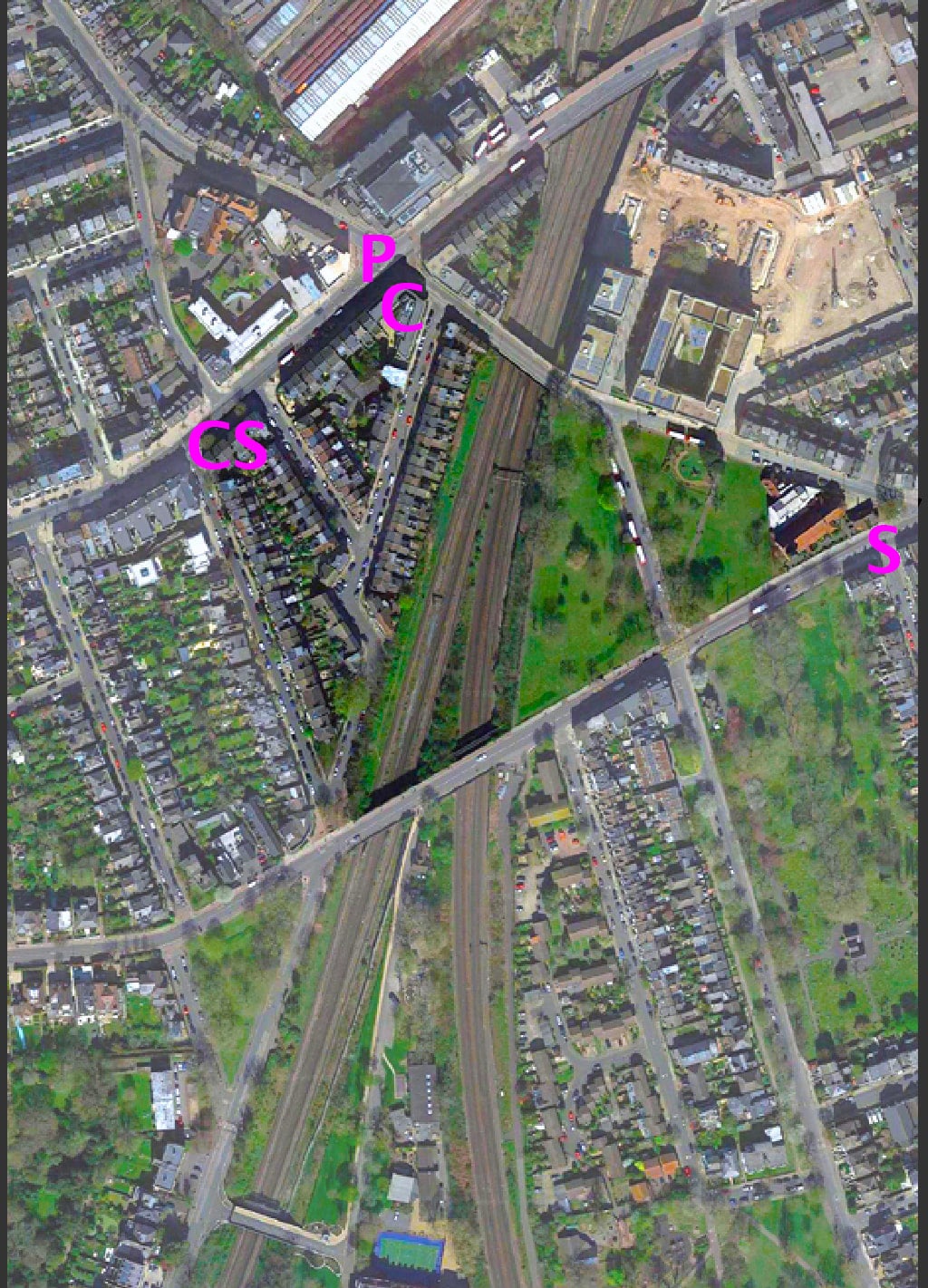
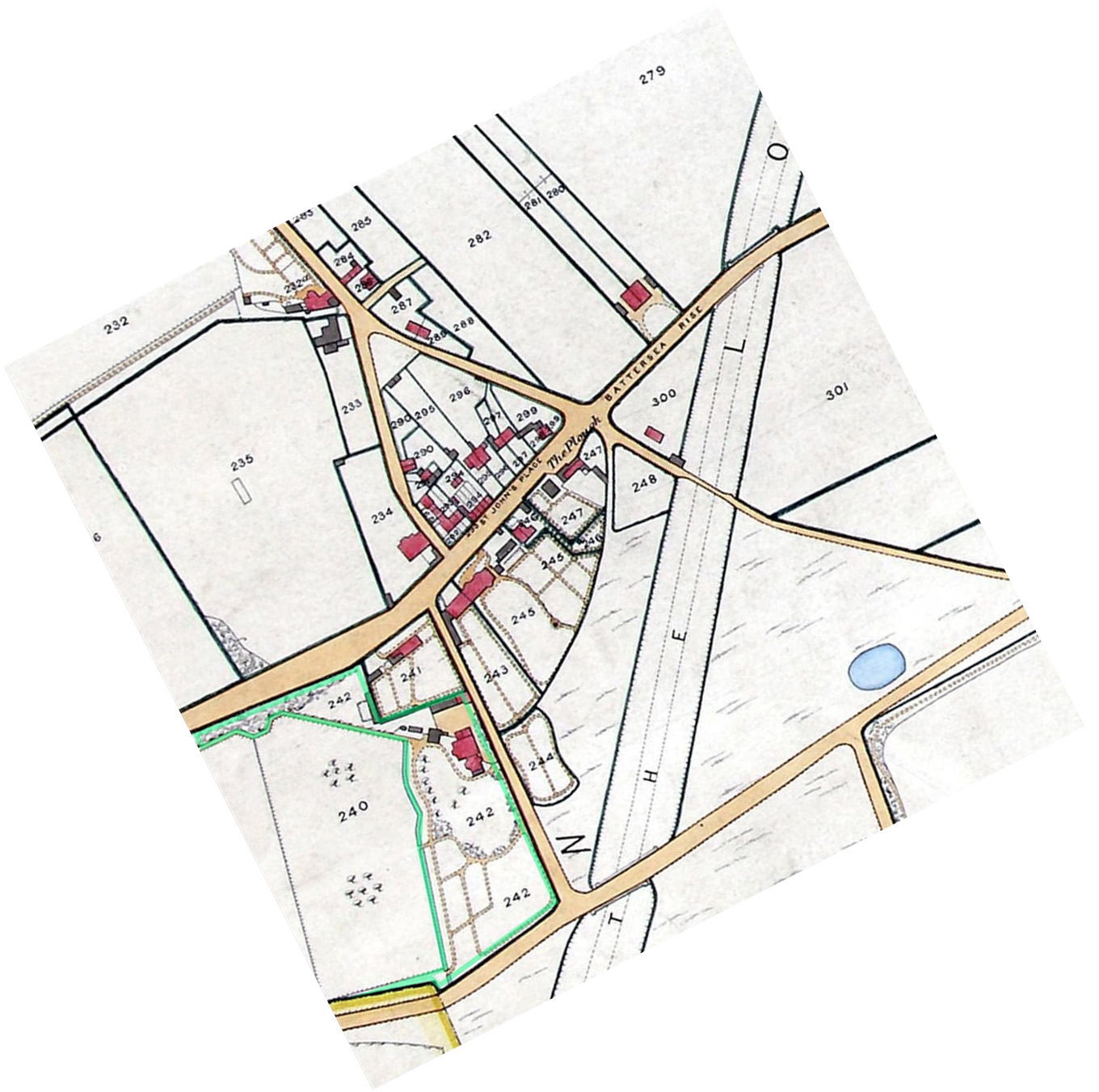


The area once known as "Plough Green" is highlighted on a modern aerial photograph. P is the Plough pub, CS is the position of Compton-Smith's house, C is Costeker's. St Mark's Church and its tiny school on the extreme right, S.


Here we see the houses on the edge of Plough Green/Wandsworth Common around 1840, before St Mark's church and school were built. The railway had been pushed through a few years earlier, curved and angled to avoid the large houses and gardens to the west. As a result, areas of the Common were cut off, making them vulnerable to enclosure.

As the wonderful Survey of London: Battersea points out, by 1870 the old houses and long gardens south-west of the Plough had become ripe for "development". William Compton Smith owned Ivy Lodge, on the corner of St John's Hill and what became Vardens Road. John Costeker's house was near the corner of what is now Strath Terrace. Both were attempting to enlarge their gardens by stopping up pathways onto the common, and enclosing and adding common land to their properties.

And they succeeded. Within a couple of years, these detached houses and gardens were sold off, demolished, and covered in terraced housing.
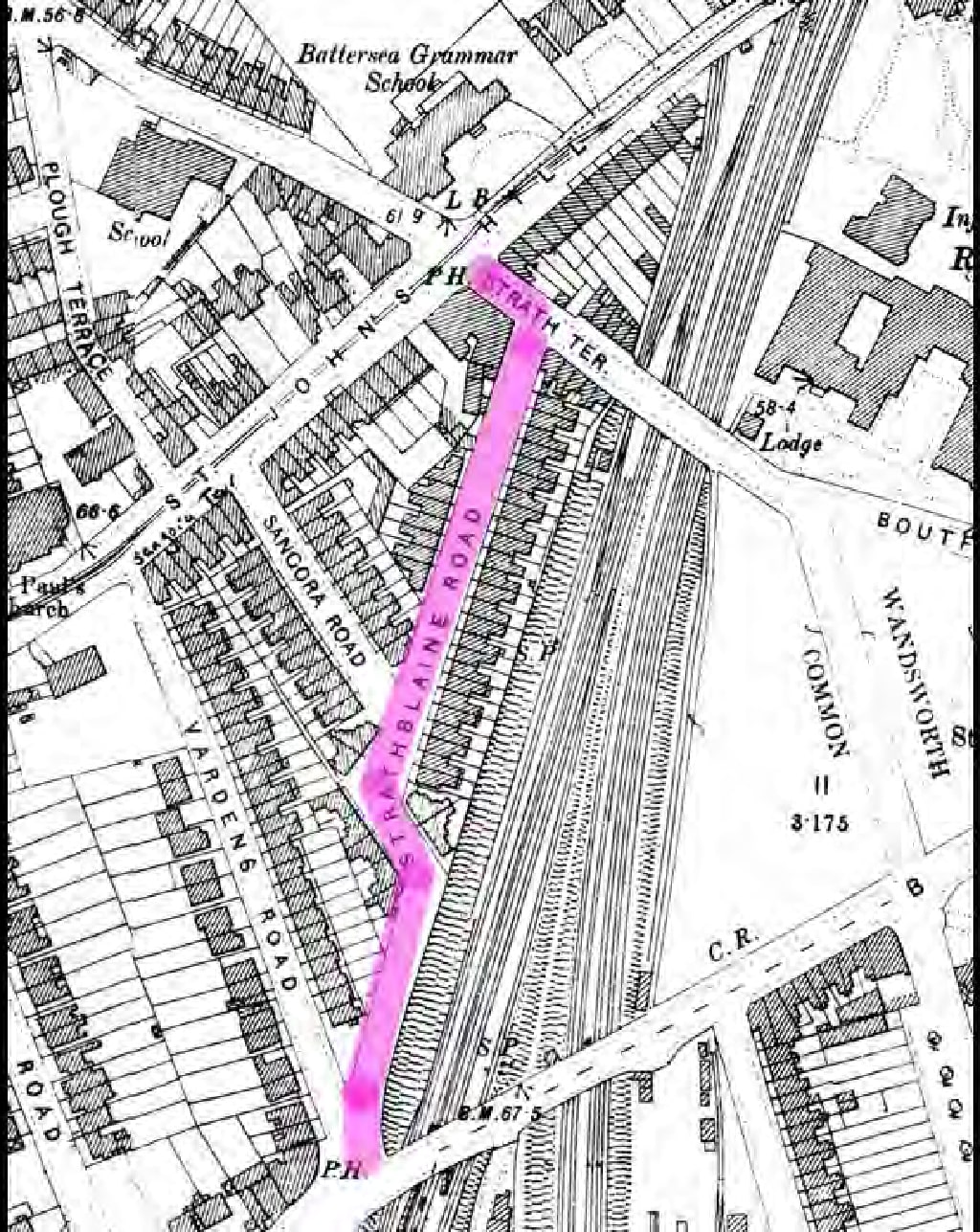


Zig-zag roads and tightly-packed terraces (with almost no gardens) that succeeded the large houses and spacious grounds enjoyed by Compton-Smith and Costeker. Strathblaine Road, marked in pink, roughly follows the route onto the Common that Samuel Sullings and his fellow fence-breakers were endeavouring to keep open.


" . . . See the conquering hero comes"

You will notice frequent references throughout Buckmaster's account to popular music, song, and poetry of the day — which I'm delighted to be writing about because April 2025 is the start of Wandsworth's year as The Mayor of London's Borough of Culture.

"See the conquering hero comes" is a chorus from George Frederic Handel's oratorio, Judas Maccabaeus (1746), by 1870 an all-purpose patriotic hymn:


"See, the Conquering Hero Comes"

(Youths)

See, the conquering hero comes!
Sound the trumpets! Beat the drums!
Sports prepare! The laurel bring!
Songs of triumph to him sing!

(Virgins)

See the godlike youth advance!
Breathe the flutes and lead the dance!
Myrtle wreaths and roses twine
to deck the hero's brow divine!

(Israelites)

See, the conquering hero comes!
Sound the trumpets! Beat the drums!

You can hear this chorus in numerous versions that are nothing like how it must have resounded on St John's Hill and Battersea Rise in July 1870 (e.g. here and here). But this version may sound a little more like it.

Wouldn't it be fun to put together a scratch band and assemble lots of local people to play and sing it together this year!

[The song was also associated with the openings of railway stations and lines — including the first, the Liverpool & Manchester line in September 1830. Clapham Junction station opened in March 1863. I don't know whether the band played "See, the Conquering Hero Comes" on that day, but I wouldn't be a bit surprised.

By the end of the 1860s, railway workers were the largest occupational group in Battersea. They formed a number of musical ensembles, including brass bands and blackface "minstrel" groups which performed in various public gatherings, including Commons-related events (such as the monster demonstration of Friday 23 August 1867, when perhaps 5000 people gathered near the school). It would be good to know more about these groups. I'll write more about this demonstration another time.]


[Where exactly is the reference to brass bands and minstrelsee? It's not in Buckmaster, A Village Politician (so far as I know). So where?]
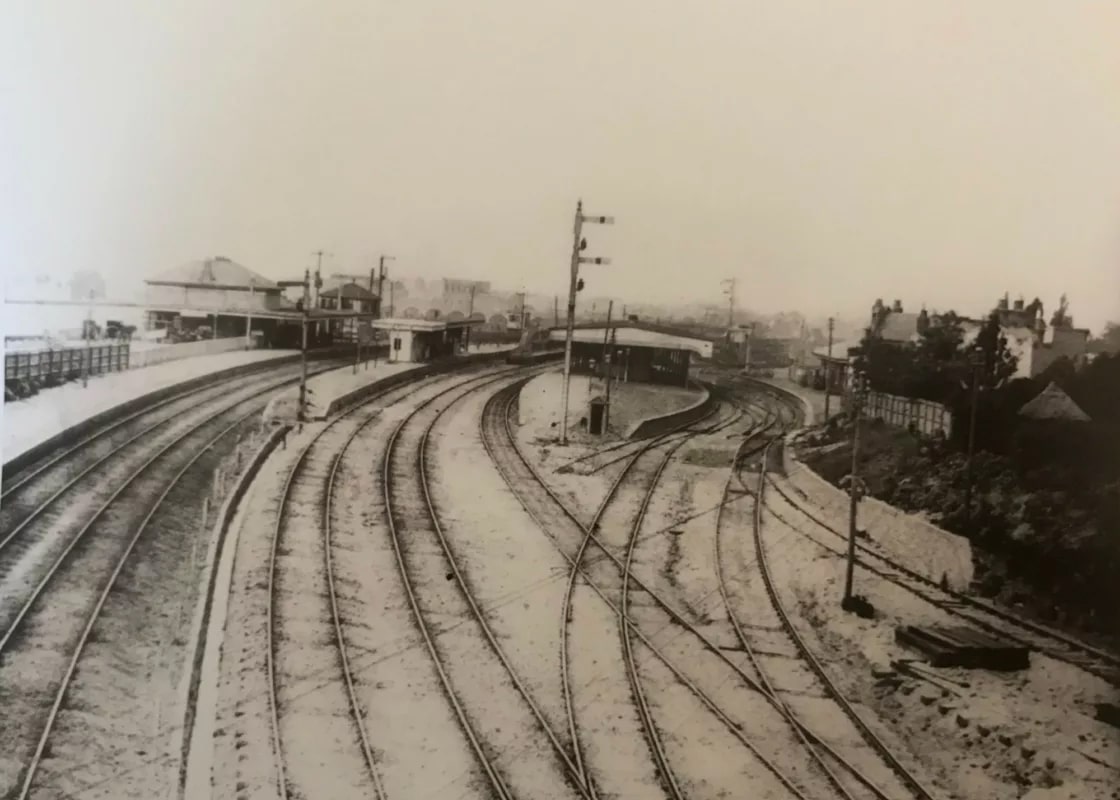

The earliest photograph of Clapham Junction station (c. 1875) that I know of, looking north from St John's Hill bridge. Notice there were still very few lines at this time. The "riot" that Samuel Sullings was involved in took place only a hundred yards or so from here.

John Buckmaster's home, in New Road (now Prested Road), may just be in view on the right of the photograph. It was demolished to make way for new tracks when they were added later in the century.

There's something of an irony in this. The coming of the railways fragmented and destroyed the integrity of Wandsworth Common, but it also encouraged innumerable railway workers and their families to settle in Battersea. And of course it was the cramped unhealthy terraced dwellings they were forced to inhabit that made free access to the Common all the more desperately needed.

" . . . Who stole the common?"

A reference to a seventeenth-century protest verse that John Buckmaster often declaimed (to great public hilarity):


“The law locks up the man or woman
Who steals the goose from off the common
But leaves the greater villain loose
Who steals the common from off the goose.”
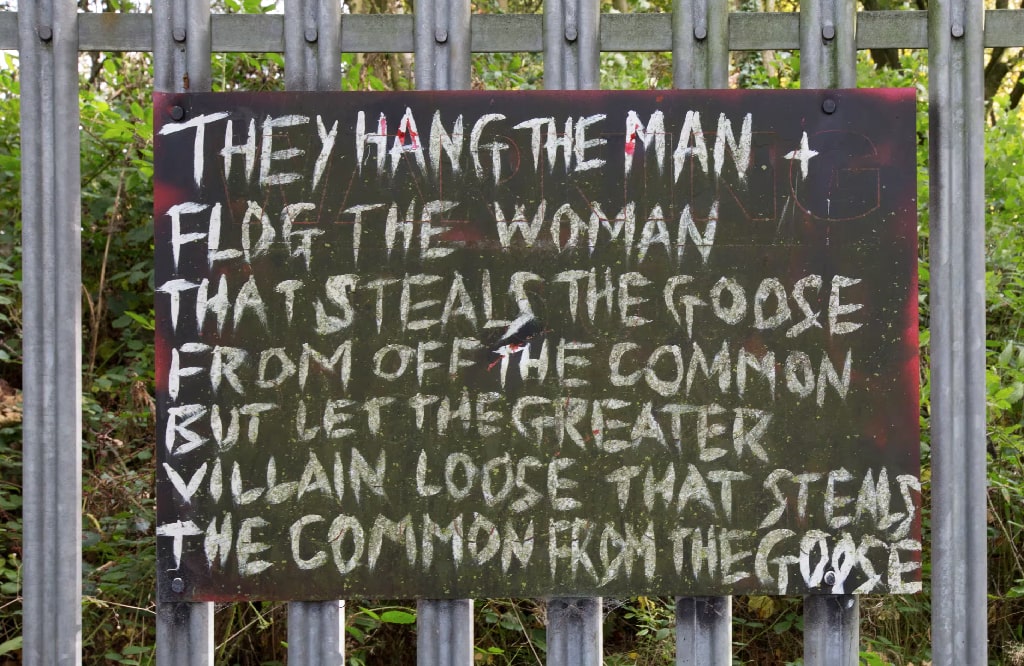


The rhyme is endlessly adaptable. Here's a version painted over a "No trespassing" sign on a fence surrounding Freeman's Wood, Lancaster (Guardian, 10 February 2016).


What was Samuel Sullings's crime?

According to the London Daily News (15 April 1870):


Samuel Sullings, a sawyer, aged 21 years, was charged with being concerned, with other persons not in custody, in wilfully damaging a wooden fence enclosing a kitchen garden belonging to Mr. John Costeker, of St. John's-hill, Wandsworth.

The report continued:


On Wednesday last about 300 men of the roughest kind came to the place and knocked down the gates and a considerable portion of the fence. Fruit trees were damaged, and an immense amount of injury was done to the property."

A police constable said he saw Samuel Sullings:


call upon the mob to assist him to break down the gates. He threw a heavy stone at the gates, and after he got them down he jumped upon them and broke the panels. He picked up a large stick and walked across the ground. He said, 'This is our place, boys, and we'll stick to it.' "

Dr. Dayman, the magistrate, said he sympathised with the cause, but unless the law changed he was compelled to punish the prisoner regardless:


It was very desirable, no doubt, that open spaces in crowded localities should not be enclosed, but he doubted whether the public could claim to keep open Wandsworth-common without an Act of Parliament.

He fined the prisoner 40s. [i.e. £2], in addition to £15, the amount of damage, and in default ordered him to be imprisoned for six months.

[You can view the original Daily News article here; BNA Link. ]

[Numerous other accounts were published, but they're all very similar, e.g. Daily Telegraph (15 April) (headed "Riotous proceedings on Wandsworth Common", Morning Post (15 April), Sun (16 April ) ("Suburban warfare . . . Wandsworth common is still the field of battle").]

But of course £17 was far more than Samuel Sullings could pay. As an unskilled young gardener, he probably didn't earn much more than a £1 a week — so this was the equivalent of perhaps 4 months' work.

In default, then, Samuel Sullings was sent to Wandsworth Prison for six months of hard labour.
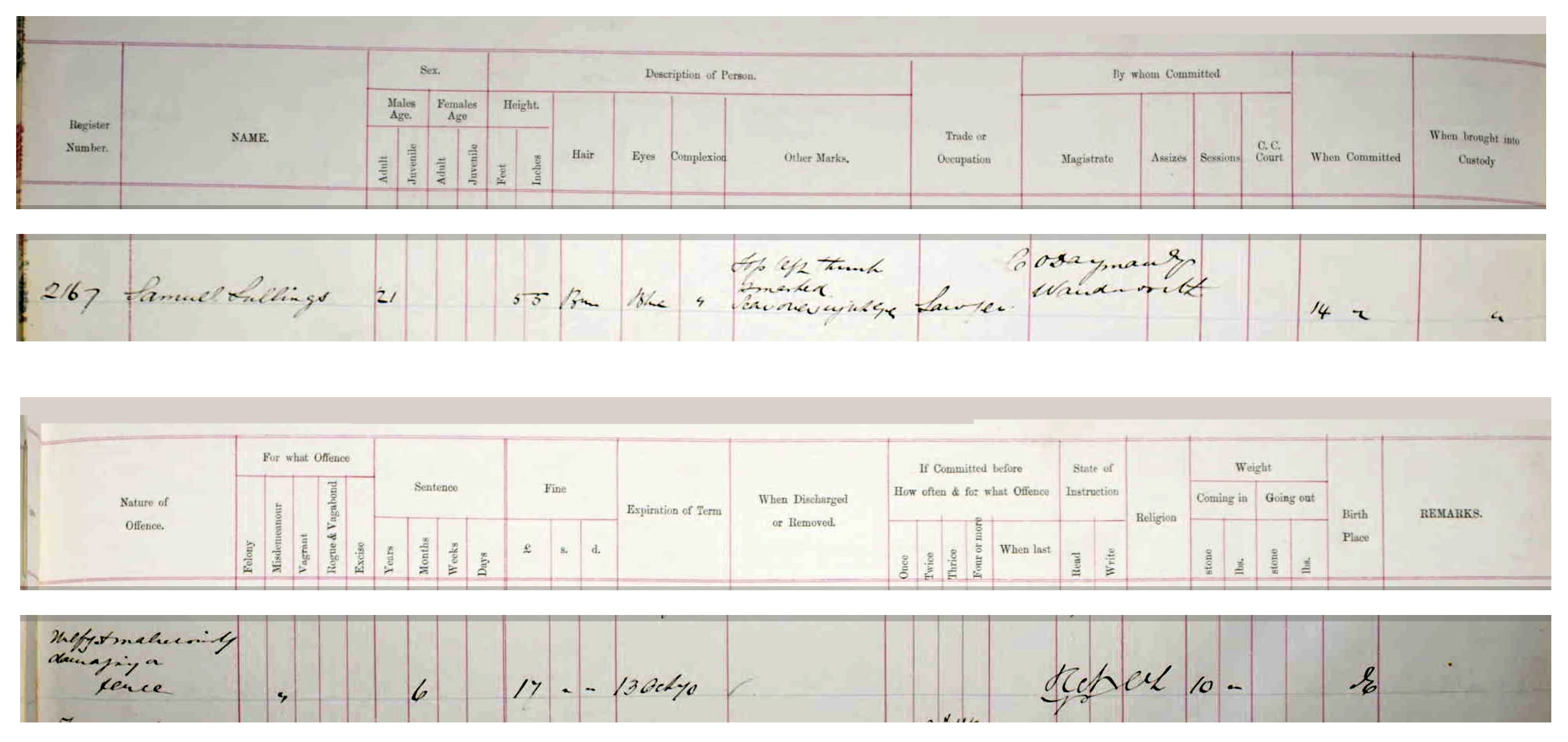

Samuel Sullings in Wandsworth Prison . . . 


Samuel Sullings: entry in the Wandsworth Prison Registry


Number: 2167
Name: Samuel Sullings
Sex: Male
Age: 21
Height: 5 feet 5 inches
Hair & eyes: Brown — Blue
Other marks: Top left thumb [____ed?] Scar over right eye
Trade or occupation: Sawyer
Magistrate: C.O.[?] Dayman Wandsworth
When committed: 14 [April]
Offence: [illeg.] damaging a fence
Sentence: 6 months
Fine: £17
Expiration of term: 13 Oct 1870
State of instruction: Read/Write/Religion: [illeg]
Weight coming in: 10 stone
Birthplace: E [England]

[Let me know if you can read any more words. Ancestry: Link. ]
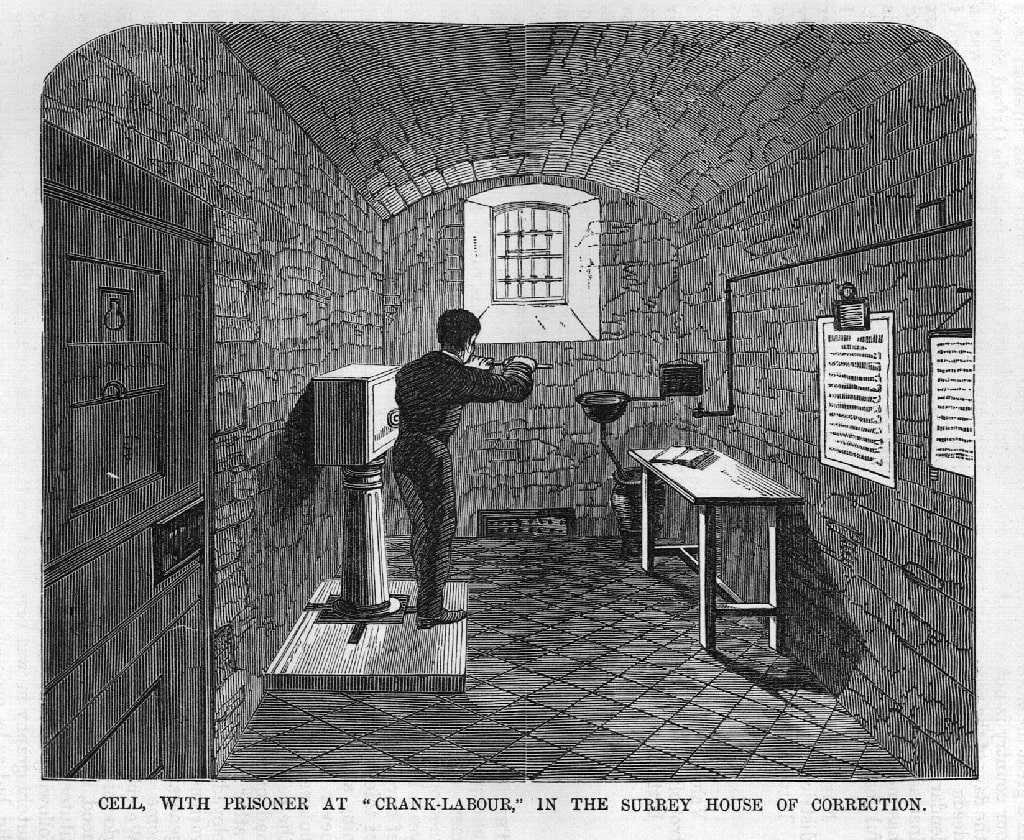


It is likely that Samuel Sullings will have spent most of his period of confinement alone in a cell, performing arduous — but useless — labour on a "crank machine" for hours at a time.


Reckless, perhaps, but not mindless . . . 

No matter how hot-headed (or indeed drunk) Samuel Sullings and his fellow fence-breakers may have been, this was not an isolated act of "mindless vandalism" but one enjoying widespread social approval. He was part of a large group — a "mob . . . 300 men of the roughest kind" — engaging in what they considered to be perfectly reasonable and legal — or at least principled — behaviour.

And it didn't come out of the blue — there was long back-story of similar actions in the area (and on commons and forests elsewhere in the country) in the last 20 or 30 years. Even the magistrate, Mr Dayman, admits the cause has its merits — "It was very desirable, no doubt, that open spaces in crowded localities should not be enclosed" — but acknowledges the confused state of the law; that "without an Act of Parliament" his hands are tied and he must punish Sullings as though it was an act of vandalism, not political principle.


John Buckmaster's account of the events . . . 

Let us return to John Buckmaster's account, the most complete, vivid, and affecting we have:


A footpath which ran diagonally across a piece of the common was stopped at both ends, and the land added to the gardens of adjoining owners. This enclosure deprived the public of a convenient footpath, and stopping it created much ill-feeling and indignation.

The enclosure was protected at both ends with a high closed fence of a most formidable character, lined inside and out with sheet-iron. The one boundary was the railway, and the other the gardens of the common-stealers.

Men would assemble in small detachments in the evening and look at the fence. The police were on the lookout. They expected a siege some evening, and they were not disappointed.

One evening about a dozen men came out of a near public-house* and with heavy hammers and stones attacked the fence at both ends, broke it down, trampled down the fruit-trees, and went out at the other end amid the deafening cheers of a large crowd which had by this time come together.

[* probably the Plough Inn, or possibly the Surrey Hounds, on the other side of the road.]
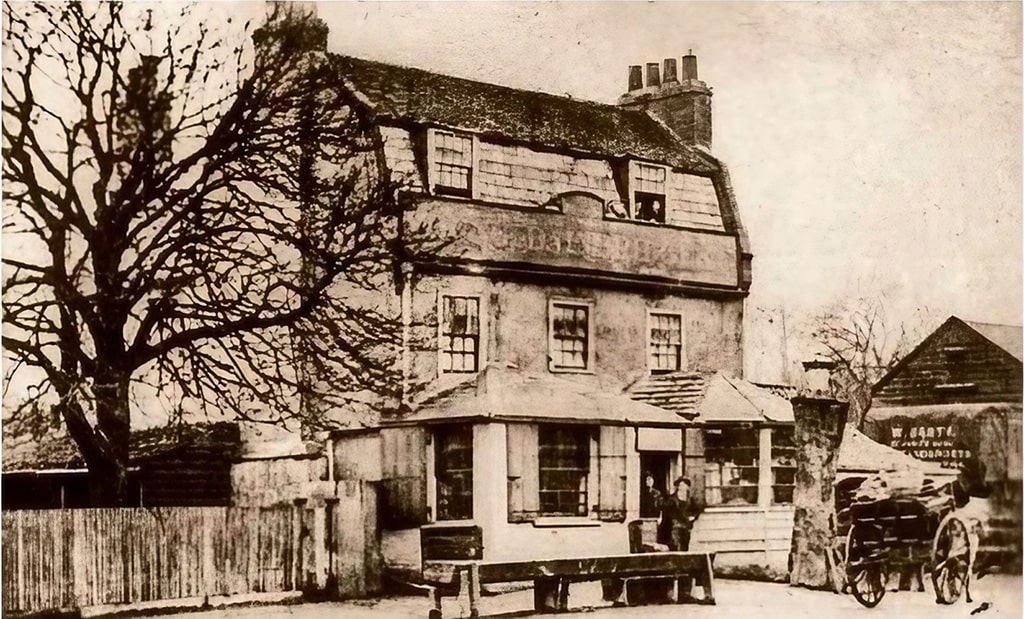


"The Plough" public house, photographed c.1875.

Among them is the unfortunate Samuel Sullings:


One stupid young fellow, who had recently come up from the country to work in the gardens, took up a large stone and deliberately knocked down some palings. His companions saw the police and called him away, but he was deaf, and the police took him into custody, and he was locked up.

I happened, fortunately for myself, to be away, but, unfortunately for the young man, the whole affair was so sudden and unexpected that no arrangements were made to defend him. The next morning he was brought before the magistrate, confessed his guilt, and expressed his sorrow. He was sentenced to a fortnight's imprisonment.

The common-stealers pleaded damage and pressed for a heavy punishment as an example. If instead of pleading guilty he had pleaded a right, the magistrate must have dismissed the case.

Buckmaster, in characteristic fashion, swung into action, writing letters to the press to highlight the enormity of what had just happened (e.g. to the Echo, 27 April) and pulling all the levers available to him.


On my return I called on his employer, who expressed his willingness to give the man work when he came out of prison.

I at once prepared a memorial to the Home Secretary for his liberation.

I first went to the parson of our district* and asked him to sign it. Now this man, who had often expressed to me his full sympathy with our efforts, began to make all sorts of excuses. The common-stealers formed part of his congregation. They were wealthy and subscribed liberally to his church, and unless they first signed it he could not without giving offence. This was the representative of the Church of the poor man, which ought to have protected him against the greed and avarice of the rich . . . 

[* This was J.S. Jenkinson, vicar of St Mary's Battersea, appointed to the position by Earl Spencer himself. JCB (who was the Churchwarden) is often disparaging. He was much more enthusiastic about John Erskine Clarke, the vicar from c. 1872.]


I placed a table in front of a shop where hundreds of persons passed daily to the railway, and in the course of two days obtained nearly a thousand signatures.

I took the memorial at once to the House of Commons and sent for Mr. Fawcett [Henry Fawcett, the blind Liberal member for Brighton], who was out. I then sent for Sir Charles Dilke [Liberal member for Chelsea, a noted radical], who suggested I should leave it at the Home Office.

I knew what would become of it if it found its way to the Home Office. It would probably be referred to every person, from the messenger to the Assistant Secretary, who would refer it from one to the other, whose business would be to initial it, write on, "Seen — refer to Brown — look up precedents," "Refer to Asst. Sec. for instructions," "Refer to committing magistrate"; and before all was finished the young man would have done his time.

I pressed Sir Charles Dilke to take it direct to the Home Secretary, who was in the House, and explain the circumstances of the case and its urgency.
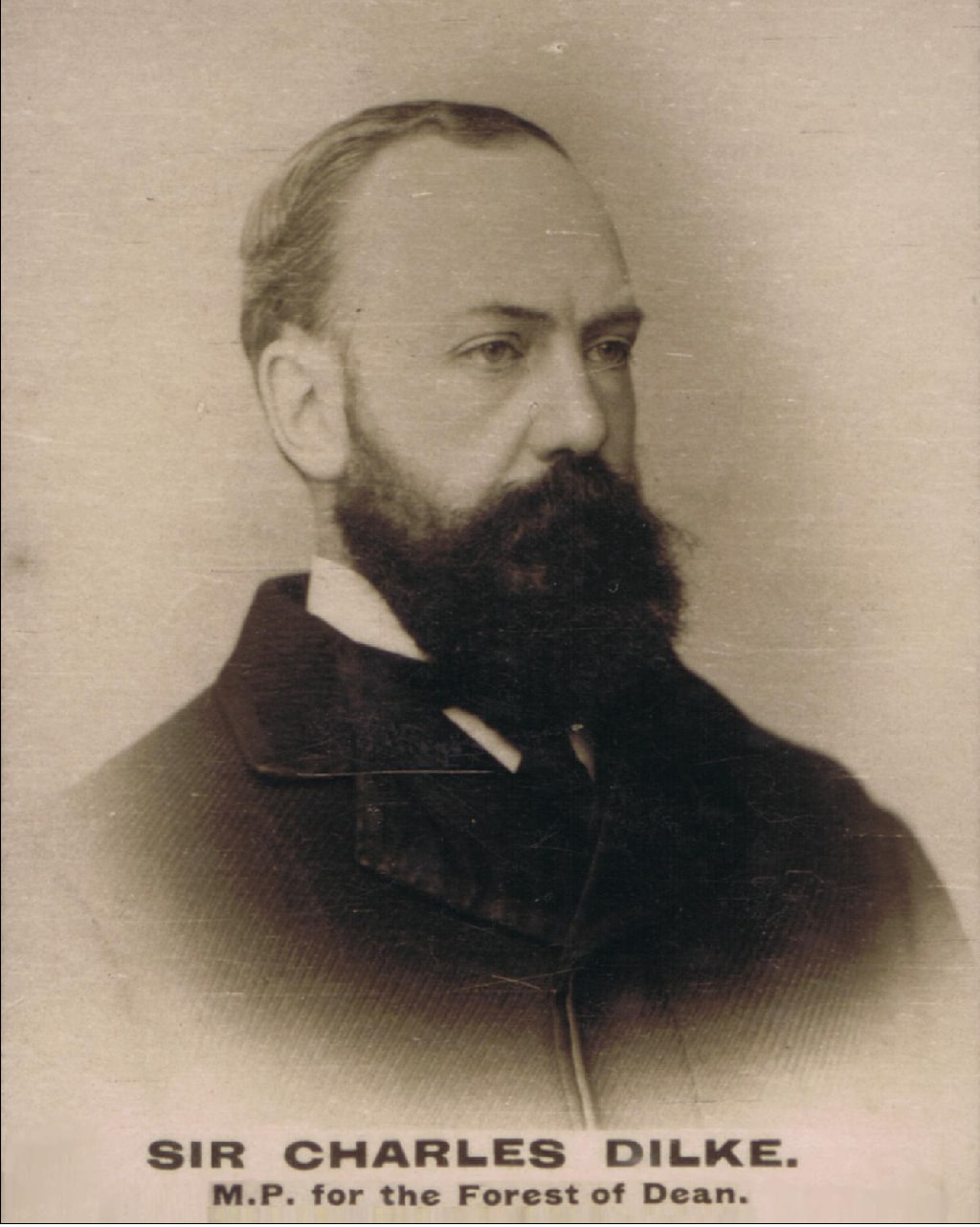


Charles Dilke, radical M.P,, friend of Wandsworth Common.

I called next day at the Office and found that the matter had been referred to the committing magistrate, who offered no objection to the prisoner's release, and I expected in a day or two the governor of the prison would receive an order accordingly.

But no order came.

I called again at the Home Office, and was informed that the papers had been forwarded to Balmoral. I waited two or three days, when I was informed there had been some mistake, and the papers would be returned to Balmoral at once.

After the young man had served his term of imprisonment all but two days, the governor received an order for his release.

[A puzzle for you: How many days did Samuel Sullings serve?

I'm quite perplexed by the dates. Samuel Sullings, not having the money to pay the fine and damages, had been sent down for six months. This means he would have been freed on 13 October. This date is confirmed by the prison register.

John Buckmaster says he tried to secure the release straight away but there were frustrating delays which meant that Sullings was in prison for 10 days. Buckmaster also states: "After the young man had served his term of imprisonment all but two days, the governor received an order for his release.

However, the celebrations at St Mark's School were on 9 July, i.e. 3 months after SS was imprisoned.

Can anybody help?]

Buckmaster's frustration with the whole rotten, creaking, crushing machinery of state is tangible. Characteristically, he grieves for Samuel Sullings's mother.


A few days after his imprisonment his poor mother came up from Suffolk in great sorrow and went direct to the police-station, where she was informed by somebody, which everybody denied, that I was the cause of her son's imprisonment.

I was deeply grieved when she came to my house, and her sorrow was the sorrow of a mother. I gave her some tea, made her comfortable, and lodged her for the night.

I sent for the treasurer of the Common Fund, and we sent her home with the assurance that her son would not suffer or lose his character.

She was much hurt when she applied at the prison to see her son. The door was slammed in her face, and she was rudely told to be off about her business.

A person in distress is more sensible of kindness than those who have never tasted the waters of deep sorrow through the errors of their children."


There's a lot more to be said about these events, and the many influences that brought things to such a head, but I'd better stop now. If possible, I'll follow up later this month with a look at Tom Taylor's poem "The Cry of the Commoners", published in Punch magazine ten days after Samuel Sullings was jailed, and a closer examination of this fine "Down with the Fences!" poster: (which is a history lesson in itself):


Moving rapidly onward . . . 

Although St Mark's Infant School is (or rather was, since it closed in the mid-1960s) built for education, as yet I haven't said anything about its century of service as such to the children of Battersea. I'm collecting stories, but in the meanwhile here is a marvellous contribution from someone who attended the infant school around 1950:
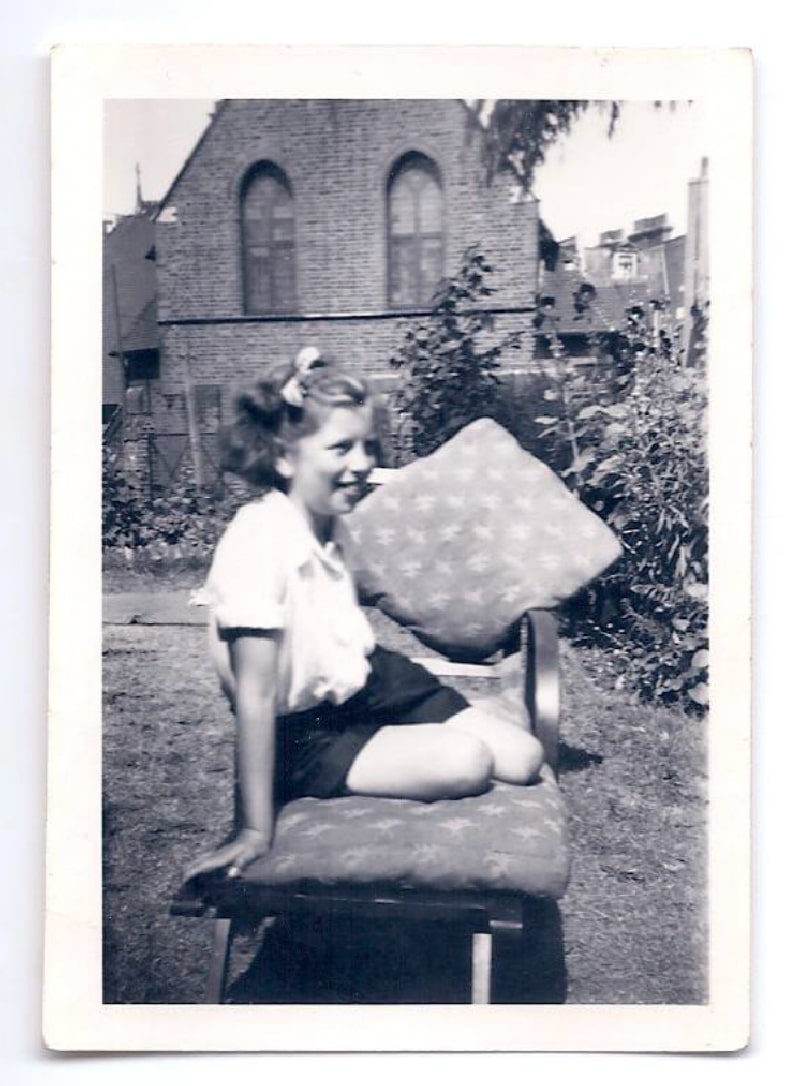
Barbara Windsor (nee Barbara Madsen) remembers St Mark's School around 1950 . . . 


Barbara Windsor (nee Madsen) in front of her prefab home when she was about 9 years old. St Mark's Church is in the background.

In February 2025, I asked Barbara to send me recollections of her tiny infant school, which was just yards from her prefab-home (where she lived from 1946 to 1956) on what we now call St Mark's triangle. I'm so pleased I asked!

It was very convenient to start my school years a mere two-minute walk away from home and I attended St Mark's Infant School from around 1948/49 until 1950/51 prior to going to Belleville Road Primary School when I was around seven.

I have a very vivid memory of the school room, the two classes divided across the middle by, I'm pretty sure, a curtain, and a large central fire enclosed by a railed safety guard. Miss Carter was the headmistress assisted by Miss Webb. I have a vague memory of standing in front of the fire and being awarded a prize and I suppose when I get round to sorting out vast amounts of memorabilia, there might be some evidence of this somewhere!

It doesn't happen these days, but the school bell was rung in the morning, calling children to school. Boys and girls were taught together, but when it came to playtime, girls were in the tiny playground adjacent to Battersea Rise and boys were in the one alongside Comyn Road.

We were issued with cardboard pencil boxes, played with sand and had a choice of several basic musical instruments to experiment with. And of course in those days, a third of a pint of milk at playtime — I think the cod liver oil capsules came later! I can remember writing the date 1949 when I would have been five.

[For Barbara's memories of growing up in the prefabs, see the Chronicles for March 20025 Part II.

In October 2022, Barbara was interviewed at length by Ros Page as part of the Friends of Wandsworth Common "Common Lives" project. Some of what she said above is also covered, but Barbara also recollected crying on her first day at the school:


because my friend Penny Jones, who lived next door, was a year older than me so she was in the other class and so we weren't together. So I do remember, I do remember crying the first day.
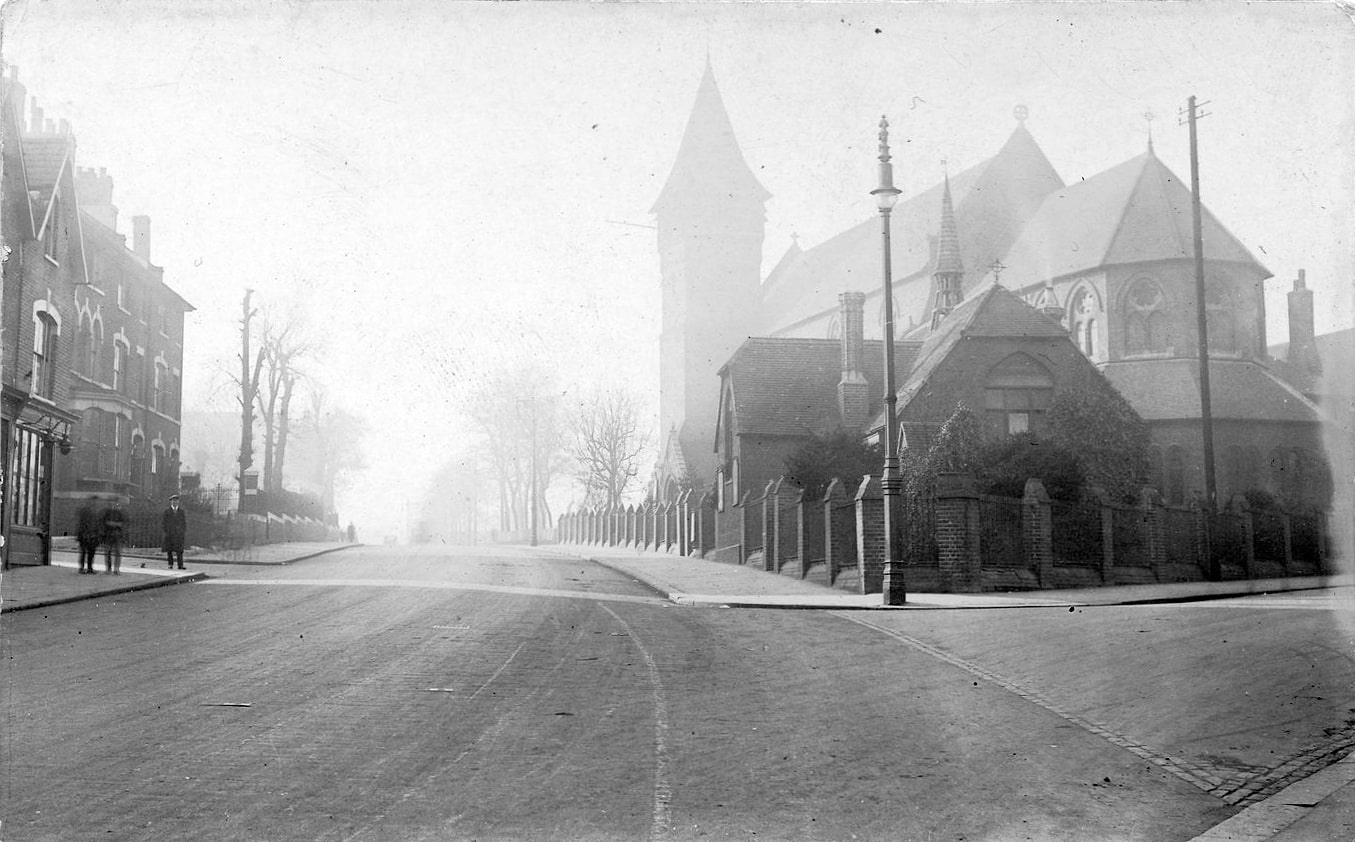


(Click on image to enlarge)

Do any other readers have recollections of the school (or indeed of the prefabs)? Let me know.
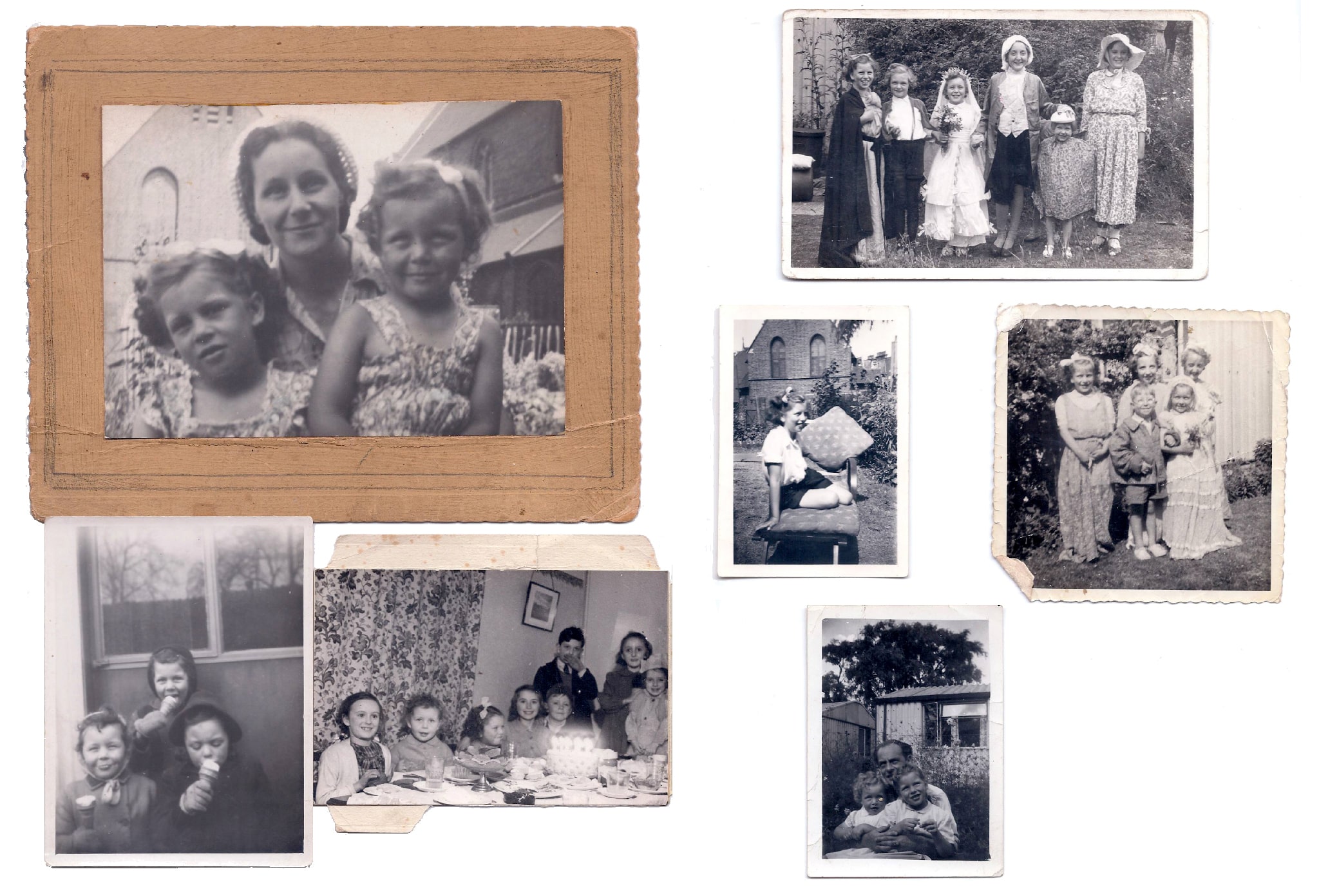


Photographs from Barbara Windsor's album.


Barbara Windsor: "It's lovely to see the building looking so pristine and in use. Although (unbelievably!) I'm now 80, I still have very vivid memories of standing behind those railings on the left and my mother bringing me a breaktime snack."

[On the origins and architecture of the school, see The Survey of London: Battersea, chapter on Schools; Historic England, list entry: , St Mark's Infant School, Battersea Rise and the research report by Emily Cole (pdf).

For further info. about the recent restoration of the school, see e.g. Dow Jones Architects and Architects' Journal.]

Thank you, Barbara — it's such a pleasure corresponding with you!

[My good friend Hugh Betterton, who grew up on West Side, wrote to tell me that his mother, Bessie, whose family name was Holmes (and later Bettes), attended St Mark's infant school in 1911. You may recall from earlier Chronicles that her stepfather Albert Bettes and stepsister Florence were killed by lightning on Wandsworth Common in June 1914. Their home was at 1 Chivalry Road, but Florence was probably too young to be a pupil at the school. ]
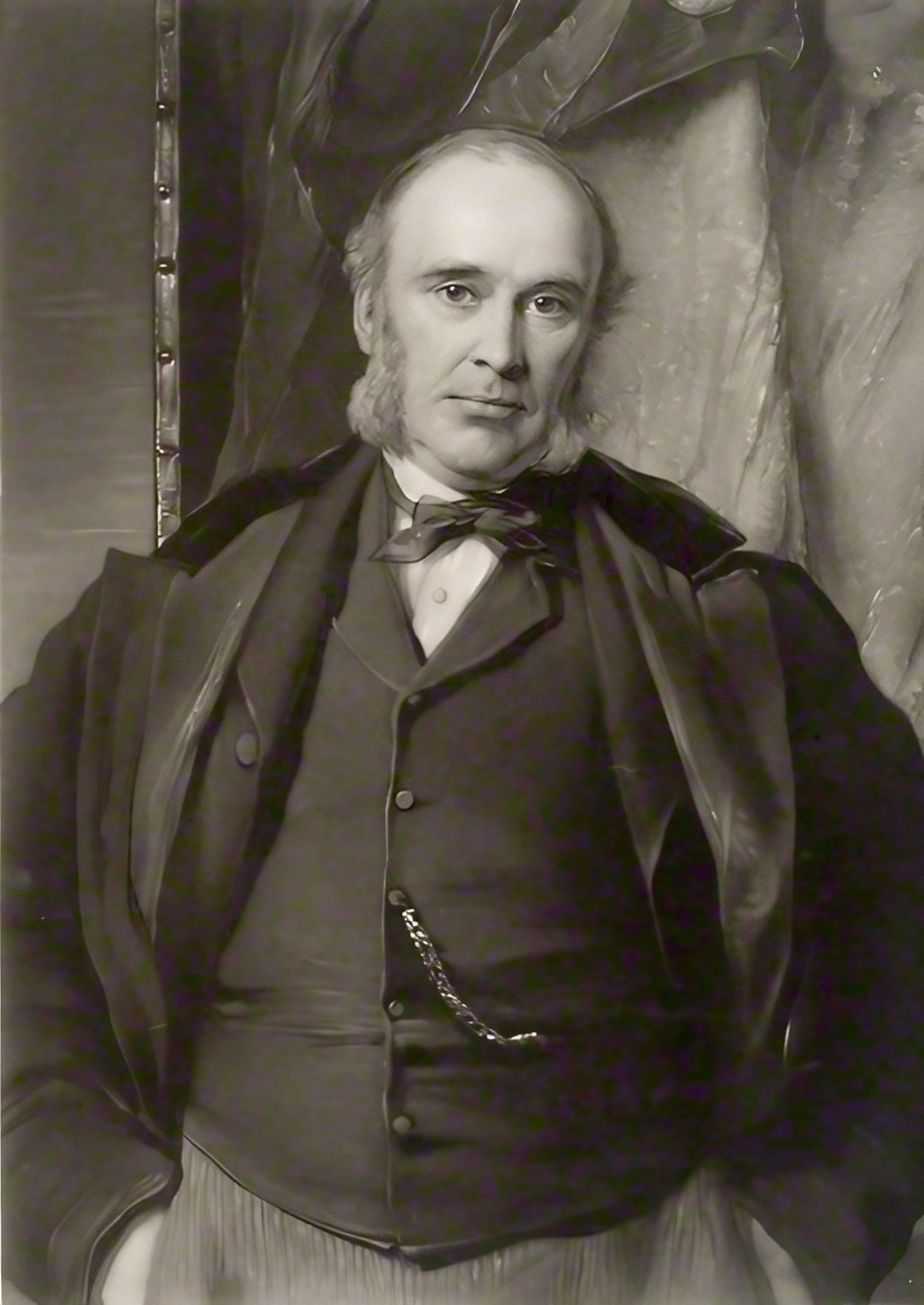

Common Memories — Life on & around Wandsworth Common, 1930s-1980s. (Friends of Wandsworth Common, 2024)

(Click on image to view video.)

A.O.B.

So farewell, then, W.H. Smith, Friend of Wandsworth Common . . . 


William Henry Smith (1825—1891)

News has just reached me that W.H. Smith, the bookseller and newsagent always associated with the nation's railway stations (where the company's news-stands became ubiquitous in the middle of the nineteenth century), has just been bought out and will no longer trade under this name.

The mid-Victorian owner of the company, William Henry Smith M.P., was a great friend of Wandsworth Common, lending his name in support of campaigns and petitions, and making donations to funds set up to fight legal battles to secure the Common.

For example, in July 1870, the month that Samuel Sullings was released, it was advertised that Smith would be among a host of dignitaries attending an important meeting chaired by the Lord Mayor at the Mansion House to be held on 14 July, where he would be donating £23 to the "Peek Fund" (the equivalent of about £3500 today):


for the purpose of making an appeal on behalf of a fund of £5000, to which Mr. H.W. Peek, M.P., has promised £1000 . . . for the purposes of taking proceedings against Lord Spencer, the lord of the manor, to prevent him  . . .  enclosing, selling and building upon Wandsworth Common."

I hope I'll have an opportunity to discuss the significance of the Peek Fund and the Mansion House meeting quite soon.


And finally . . . 

"Wimbledon: In a David vs Goliath battle, what is the price for democracy?"

I was on the point of sending out this month's Chronicles when I saw Cyril Richert's recent blog about Wimbledon Park (CPAG, 7 April 2025). It starts:

Local residents are fighting to protect Wimbledon Park from the All England Lawn Tennis Club’s expansion plans, highlighting the financial challenges of defending public spaces. A recent meeting aimed to raise funds for the upcoming Judicial Review.

How could we not be struck by similarities with the story we've just been exploring? Access to law is costly, so in 2025, as in 1870, crowd-funding is needed.
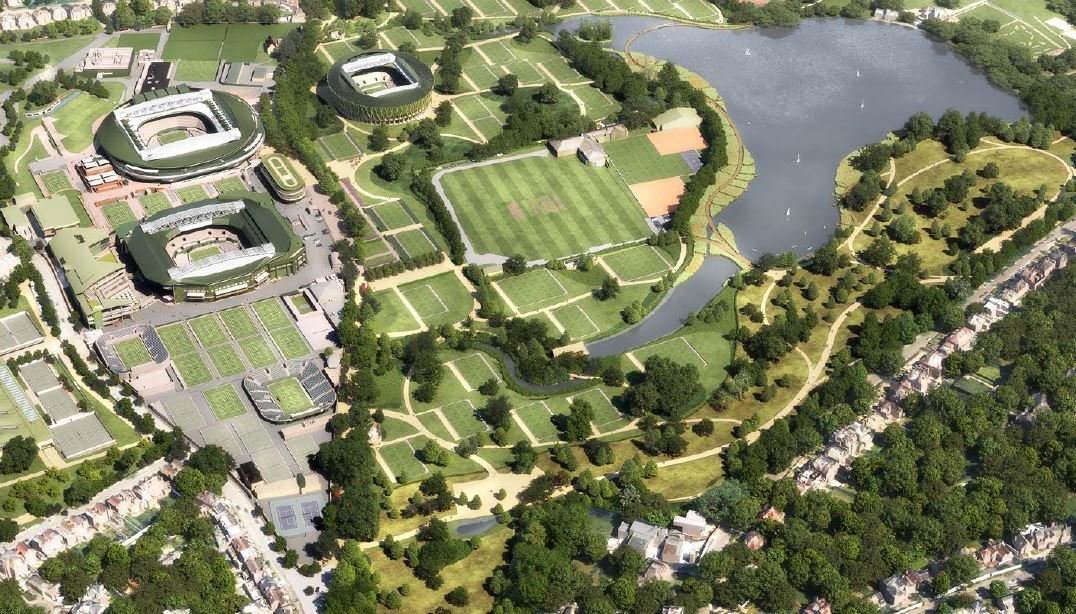


The AELTC Wimbledon Park Project – Credit: AELTC brochure

I'm sure you'll want to read it:


Chronicles

March 2025

I


March, 50 million years ago — a Nautilus is swimming in the shallow tropical sea that covers Wandsworth Common.

(Click on image to enlarge)

The Nautilus in Miss Wollaston's Choice Cabinet  . . . 

Around 1837, Miss Henrietta Wollaston, walking in a deep cutting being dug across the Common to make way for the new London and Southampton railway, finds this same fossil, and gives it pride of place in her "choice cabinet".

We know this because the eminent palaeontologist Gideon Mantell included it in his "Short Sketch of the Geology of Surrey", a chapter of Edward Brayley's monumental A topographical history of Surrey, 5 vols. (1841-44).


Henrietta Wollaston's Nautilus

"Nautilus imperialis: from the London clay, Wandsworth common; in the collection of Miss H. Wollaston; the original is six inches in diameter." (Plate 1, fig. 14.)

Mantell writes:


"In Surrey, the usual fossils of the clay have been found wherever the strata have been explored, by wells, railway sections, and other excavations.

The section across Wandsworth common, formed by the line of the Southampton railway, afforded a highly-interesting suite of specimens, of which a good series is preserved in the choice cabinet of Miss Henrietta Wollaston  . . . (p.135).


Railway cutting across Wandsworth Common, probably showing the bridges bearing Trinity Road (in the distance) and Heathfield Road (foreground).

[I assume it's this way round since we appear to be looking uphill, with a slight bend to the left.]


Stanford's Geological map, 1878. The orange colour shows "Gravel and Sand of various ages", the brown layer beneath is "London Clay", and the small patches of yellow are "Brick Earth".

Notice in the centre of the Stanford map how the slender curves of the railway lines gouge through superficial gravel and sand deposits to the clay layers beneath. This exposure was achieved by the efforts of hundreds of navvies in the course of just a few months. On the right, the Falcon Brook has scoured out a much wider band down to the clay, but the process had taken many thousands of years.

[Similarly, but on an even greater scale, the Wandle — just off-image bottom left hand corner.

Notice, by the way, that the first large houses in the area — such as Allfarthing Manor, the "Five Houses" along Bolingbroke Grove, or the Burntwood houses — were built on gravel, never on clay. Gravel drains better than clay, and was therefore believed to be "healthier".]


Gideon Mantell goes fossil-hunting on Wandsworth Common and Clapham Common . . . 


Gideon Mantell

(Click on image to enlarge)

In the first of a series of lectures given in Clapham in November 1840 (to help fund a local school), Mantell invited his audience "to stroll with him over Clapham and Wandsworth commons". As the Morning Post recorded:


[F]rom the interesting phenomena furnished by these well known localities [Mantell] taught them many of the wonders of geology, and much of the history of the ancient earth and its inhabitants.

In the gravel they had discovered the teeth and bones of the elephant and the rhinoceros, creatures of tropical growth and origin, and in the clays they had found the usual exuvia; of a marine deposit, the weeds, sponges, shells, and fish, which could only have existed in the depths of a profound ocean.

[BNA: Link.]

Mantell's talks were hugely popular — not surprising because he was universally famous for discovering* and naming the first dinosaur — the Iguanodon. but also because fossil-hunting on the Commons had been all the rage for several years. Even without the railway cuttings to give access to deep layers, both Commons were covered in pits, mainly to provide gravel and sand for new roads in the area. (Doubtless gravel-diggers were paid if they passed on interesting-looking specimens.)

[* Or was it his wife, Mary Ann? But that's another story.]

Mantell was a brilliant showman, engaging artists such as John Martin to visualise the primordial world with much drama and violence:


John Martin, In the Country of the Iguanodon, 1838. The scene is the Sussex Weald, so Wandsworth Common is in the far distance.

[A decade or so later, Martin will become celebrated for his scenes of apocalyptic destruction and heavenly rewards at the other end of Time (e.g. The Great Day of His Wrath (1851-1853.)]

Here's another Mantell-inspired image of the awesome Iguanodon:


[Reconstruction of Iguanodon by Samuel Griswold Goodrich from Illustrated Natural History of the Animal Kingdom (New York: Derby & Jackson, 1859). Wikipedia helpfully reports that this is "not a factually correct dinosaur restoration".]


Mantell's Iguanodon and the making of Wandsworth Common . . . 

I'm banging on about Mantell's Iguanodon, even though it's taking us away from Henrietta Wollaston (if only for a while), because it has a great bearing on the history of Wandsworth Common.

When the Great Exhibition closed at the end of 1851, the "Crystal Palace" was dismantled and moved from Hyde Park to Sydenham (1852-54). Or, to be more precise, to Penge Common — at this time, Penge was a "detached" part of Battersea. (It didn't become independent of the manor until 1888.)

To add to the visitor attraction, models of dinosaurs were made on a giant scale and exhibited in the Park — including Iguanodon:


The Crystal Palace Iguanodon and Hylaeosaurus as illustrated in Matthew Digby Wyatt's Views of the Crystal Palace and Park, Sydenham, 1854


A recent photograph.

One of the most splendid publicity stunts was a dinner held within the body of the Iguanodon model:


A dinner held within the model Iguanodon, Illustrated London News, 31 December 1853. Notice "Mantell" is being feted, along with the illustrious palaeontologists William Buckland, Georges Cuvier and Richard Owen.

But how would Londoners reach a place as remote as Penge/Sydenham? By railway, of course. Hence a new line was constructed specifically to carry visitors.

The obvious, most direct, route would have taken the line across Clapham Common, but local hostility prevailed. An alternative round-about-the-houses route was decided upon that crossed Wandsworth Common, where there were fewer powerful people to protest.

Work began on the "West End of London and Crystal Palace Railway" in 1853, and the line opened in 1856.


Stanford 1862: "New Wandsworth" and "Clapham Common" stations

New Wandsworth station opened on 29 March 1858 and closed on 1 November 1869, when Wandsworth Common station opened.

[Nearby Clapham Common station opened 21 May 1838 and closed 2 March 1863 — the new Clapham Junction station opened the same day.]

(Click on image to enlarge)

Years later, having been extended in both directions (ultimately to Victoria and London Bridge in a great loop), this became the line that runs through our Wandsworth Common Station.


How dinosaur-mania devastated Wandsworth Common . . . 

From the point of view of Wandsworth Common, the new dinosaur railway was a double whammy. First, yet another line was being built that divided the Battersea side of the Common and closed off all traditional footpaths. The railway cutting was bridged only once in nearly a mile between Battersea Rise and Nightingale Lane railway — at what became the Cat's Back Bridge.

Secondly, the railway company acquired (from Earl Spencer) very much more of the Common than they needed ‐ a land-bank or "wayleave" — presumably because they couldn't know in advance where exactly their line would run. When the line was completed, they were legally obliged to sell the land. But of course they did not return all surplus land to the Common; they parcelled it up and sold it off to speculative builders, and profited handsomely from the sale. High fences, typically coated in black tar, were erected around the alienated areas.

However, these assaults on the integrity of the Common in the 1830s, '40s and '50s, were ultimately powerful stimuli to the campaign to save it in the 1860s. John Buckmaster, for example, was frequently prosecuted for breaking down the railway company's fences.


OS, c.1870. In 1863 and 1867 the London Brighton & South Coast Railway company (which had acquired the WELCPR), sold off its "surplus" land, which it was obliged to do. The largest purchaser was developer Christopher Todd.

The long thin strip in the south — where most of today's "bumps" are — probably largely the result of the excavation of the cutting. Edwin Rayner Ransome, stalwart defender of Wandsworth Common, is said to have negotiated the return of this land to the Common.


"Down with the Fences!" agitational poster, c.1870.

[Another large area of Common sold off by the railway company at this time was the triangle close to Wandsworth Common station, where Ravenslea, Wexford and part of Mayford Roads were later built. The purchaser, James Anderson Rose, intended the land to be returned to the Common on his death. But the Battersea vestry [sic?] refused to stump up the money.]


Today's Chivalry Road area, once part of the Common. The former New Wandsworth Station was on the left. Battersea Cemetery is on the right.


So now at last we can get back to Henrietta Wollaston . . . 

Female fossilists on Wandsworth Common

For Henrietta Wollaston, the railway cutting over Wandsworth Common was no great distance from her home in Battersea. Her illustrious family lived "between the commons", first at 83 Clapham Common West Side (her house is still there, nicely restored), and then nearby at Beechwood (demolished to make way for Culmstock Road).

[Her father was George Hyde Wollaston (1761-1841), a merchant, banker and Clapham antiquarian, and her uncle the wealthy chemist, physicist and geologist William Hyde Wollaston (1766-1828). Doubtless the family knew the great scientist Henry Cavendish, who lived on South Side and regularly walked to Wandsworth Common and back.

GHW became chairman of Marc Isambard Brunel's Thames Tunnel Company — the tunnel, between Rotherhithe and Wapping, is still in use. (Today, the Thames Tunnel carries not the foot passengers and horse-drawn carriages it was designed for but the Windrush Overground Line.). N.B. Brunel's sawmills were not far away from us — by the Thames on the Battersea-Wandsworth border.]

There are even a couple of "Wollaston islands" — one is south of Tierra del Fuego, the other is north of Australia in the Timor Sea.]


Isla Wollaston. (Isla Hornos is the famous "Cape Horn" at South America's southern tip.

[In his Voyage of the Beagle (1831-1836), Charles Darwin writes about the inhabitants of Wollaston Island which he visited around the time that Henrietta Wollaston was combing Wandsworth Common for fossils.


Came to an anchor in the evening under Woollaston Isd.” (Feb 24)

“I walked or rather crawled to the tops of some of the hills; the rock is not slate, & in consequence there are but few trees; the hills are very much broken & of fantastic shapes.

Whilst going on shore, we pulled alongside a canoe with 6 Fuegians. I never saw more miserable creatures; stunted in their growth, their hideous faces bedaubed with white paint & quite naked.

[See "Savages" in a "Charming Country". Curiously, I came across this on the same day of the year as Darwin's diary entry— 24 February. What were the chances?]

But Henrietta Wollaston was not alone as a fossil-hunter (or "fossilist"). Many local women created important collections at this time, as Mantell records:


In the flints and pebbles  . . . may be found many of the silicious* fossils of the chalk formation; of which there are numerous examples in the interesting collections of Mrs. Allnutt, Miss H. Wollaston, Mrs. Potts, Miss Graham, and other residents on Clapham common. Among these fossils are casts of the usual echini, plagiostoma, pectens, spirolinites, and other shells of the chalk; and remains of corals, and other zoophytes. (p.130)

[* silicious (made from from silica) i.e. flint.]

Mantell also draws attention to microfossils, a branch of study in which some of the Clapham fossilists were particularly skilled.


Nor must I omit to mention those minute but highly-interesting objects, the fossil infusoria, which abound in the flints; one specimen, highly magnified, is here figured (Pl. 1, fig. 36); the original is invisible to the unassisted eye."

Thus, with merely a common lens, the attentive observer may find an inexhaustible source of amusement even in the beds of gravel spread over the wastes and heaths of this district. (p.130)


"Xanthidium in flint: from Clapham Common; highly magnified; the original is scarcely visible to the naked eye. Many beautiful and highly-interesting specimens of fossil infusoria, and minute polyparia, from the flints of Clapham and Wandsworth commons, have been collected by Mrs. Potts, and Miss Graham, of Clapham Common."

(Click on image to enlarge)

Clearly Mantell thought of these women as thorough-going scientists, not casual hobbyists. Although unable to attend a university or any other advanced course of study, a number must have acquired start-of-the art optical instruments and used them expertly.

I have no idea what kind they used, but here is a contemporary microscope:


Burson achromatic microscope, and wooden case, c.1840.

(Click on image to enlarge)

I can imagine groups of ladies in crinolines* arriving at the railway cuttings armed with small geological hammers to scour the newly exposed layers (doubtless much to the delight of the navvies with their pickaxes and shovels).


The World of Fashion, 1838. It is unlikely women "fossilists" (the contemporary term) ventured onto the Common dressed like this.

(Click on image to enlarge)

No, not crinolines — these were hooped dresses that mainly prevailed in the 1850s and 1860s. This is the period of huge puffed-out sleeves.

[See Mimi Matthews's visual guide to fashionable clothing in the 1830s . But this mainly shows the evolution of evening dress.]

So what did affluent women wear when prospecting for fossils in railway cuttings? We may never know, but here's a painting of the palaeontologist Mary Anning (1799-1847), who was also active at this time — though she was not an affluent Clapham lady, and collecting was her work:


The pioneering palaeontologist and fossil collector Mary Anning (1799-1847) is known for her discoveries of ichthyosaurs, plesiosaurs and pterosaurs at Lyme Regis. It is possible that Henrietta knew Mary personally, perhaps through her scientifically well-connected uncle William Hyde Wollaston.

(Click on image to enlarge)

"Mrs Allnutt, Miss H. Wollaston, Mrs Potts, Miss Graham . . . "

Wouldn't it be good to know more about the pioneering collectors "Mrs Allnutt, Miss H. Wollaston, Mrs Potts, Miss Graham, and other residents"? But so far as I know, no work has yet been been carried out on this remarkable group of local women. What a wonderful project for someone!

According to Henrietta's father's list of Clapham residents in 1841, a "John Allnutt" lived on Clapham Common South Side, the Wollastons lived on West Side, a "John Graham" and a "Mrs Graham" lived in separate houses on North Side, and a "Thomas Potts" on Clapham Common and a "Roger Potts" were living on Nightingale Lane. "Dr Mantell" is living at Crescent Place (George Hyde Wollaston, Clapham with its Common and Environs).s

[In one edition of this essay, Mantell also mentions a "Mrs Abbott", but this may have been a misprint for "Mrs Allnutt".]

The Allnutts (the head of the household was a noted wine merchant) are known to have exhibited examples of local geology in their gardens. Mantell writes that local flints often became cemented together to form large irregular blocks of conglomerate "imbedded in the loose sand and gravel of Clapham and Wandsworth commons", and that:


[M]asses of this conglomerate are employed with good effect in grotto and rock-work, as in the beautiful grounds of John Allnutt, esq., of Clapham common."

[I must ask historian of Clapham Common, Mike Tuffrey, where the Allnutts lived, and whether there are any fragments of grotto and rock-work can still be found in local gardens.]


"Scientists, collectors and illustrators: the roles of women in the Palaeontographical Society"

As I was drafting these notes, I came across an important article that mentions Henrietta Wollaston as an early member of the Palaeontographical Society, the world's oldest society specifically dedicated to palaeontology: Elsa Panciroli, Patrick N. Wyse Jackson & Peter R. Crowther, "Scientists, collectors and illustrators: the roles of women in the Palaeontographical Society", Geological Society, London, Special Publications, 2021.

This lists 24 women members of the Palaeontographical Society in 1848 or 1849, shortly after the Society’s formation. So far as I can tell, none of Henrietta's local contemporaries was also a member.

I am most grateful to Professor Wyse Jackson for sending me a copy of this essay.


"A few of the most characteristic fossils from Wandsworth commons . . . "

According to Mantell:


The tertiary* formations of the London basin have long been celebrated for the immense number and variety of their organic remains  . . . [which include] the teeth and bones of several extinct mammalia; bones of birds, serpents, turtles, crocodiles, and other reptiles; many genera of fishes, crustacea, and a few zoophytes; immense quantities of marine shells, of several hundred genera and species; and leaves, seed vessels, stems of plants, and rolled masses of wood perforated by boring-shells (p.135).

[* Tertiary — a term no longer employed in geology, but widely used in the early C19 to mean rocks thought to be associated with the Great Flood in the Bible. In modern chronology, roughly between 66 and 2.6 million years ago.

It would be good to discuss how the study of geology and palaeontology in the Wandsworth/Battersea/Clapham area related to contemporary religious beliefs (I'm thinking about catastrophic floods, the extinction and creation of species, the immense destructive power that has raised and ground down mountains, and above all the emerging idea of Deep Time), but I think we'd better leave that for another time.]

Mantell lists many fossils that have been found on Wandsworth Common:


"Fossils from the London clay, Wandsworth common."

(Click on image to enlarge)


Plate 1, p.128.

(Click on image to enlarge)


Plate 2, p.136.

(Click on image to enlarge)

As the key makes clear, "Miss Wollaston" is responsible for many of the finds: Plate 1, fig.14, and 2, figs 1, 2, 3, 4, 6, 7, 8, 9, and 19.

In another edition of this essay, in which the plates were re-used with a slightly modified commentary, Mantell revisits specimen 7 ("Wood") and elaborates:


"7. Teredo antenautae: Pl 2. fig 9

(Click on image to enlarge)


7. Teredo antenautae: Pl 2. fig 9. Masses of wood, more or less perfectly preserved, and perforated by a boring-shell allied to the teredo, are found everywhere in the London clay.

Miss Wollaston's cabinet contains several fine specimens from Wandsworth common; some examples are sufficiently hard to bear cutting and polishing, and in that state present a beautiful appearance from the section of the sparry tubes, and the rich grain of the wood they traverse."


Whatever happened to Henrietta Wollaston . . .  did she evolve into Lady Pollock?

I first came across Henrietta Wollaston five or six years ago, but I failed to find out anything more about her than her Nautilus and other fossils, as discussed in Gideon Mantell's volume.

At much the same time, I noted a reference to a "Lady Pollock", the only woman referenced in the run up to the 1871 Wandsworth Common Act — she helped to fund the campaign, and was clearly a great supporter of the preservation movement. As with Henrietta Wollaston, it proved impossible at the time to find out anything more.

It certainly never occurred to me that they could be connected.


1870: Local people, believing they would have to go to court to secure the future of Wandsworth Common, launched a campaign to collect funds. Wimbledon-resident Henry Peak promised he would donate £1000 if others gave £4000.

(Click on image to enlarge)

Lady Pollock listed among the Great and Good of the campaign to save Wandsworth and Clapham Campaigns, April 1870:

Lady Pollock subscribed £25 to the Fund for the Preservation of Wandsworth and Clapham Commons — subscriptions up to April 14th 1870.

The target was £5000. Hers is the 12th name in the Battersea list, near John Buckmaster, Robert Hunter, and Tom Taylor. At this point, Battersea is well in the lead.

(Click on image to enlarge)

Is this a photograph of Lady Pollock?

For some years I assumed that this "Lady Pollock" was a Wimbledon-resident, active at the same time in their local campaign. This was Sarah Anne, the second wife of Frederick Pollock, 1st Baronet. Here's a fine photograph of her by Camille Silvy:


[NPG: Link.]

(Click on image to enlarge)

And here's her husband, Frederick:


[NPG: Link.]

(Click on image to enlarge)

But I now think, no — Frederick is George Pollock's brother (both having been made Baronets in their lifetimes). Hence both wives are called "Lady Pollock". Confusing, eh?


In short, I believe that "our" Lady Pollock was born Henrietta Wollaston and married the East India Company soldier-hero "Sir George Pollock of the Khyber Pass". (Really — I wouldn't make it up.) He was chiefly famous* for leading an "Army of Retribution" into Afghanistan in 1841, during what Britain called the First Afghan War.

[* Or infamous: I recall reading at the time of the British withdrawal of troops from Kabul ten years ago that local people still remember the punitive destruction of their great Bazaar in 1842. This was Pollock's doing. (Yet another example of the general historical principle underlying these Chronicles that "What happened then still matters now".)]


"Field Marshall Sir George Pollock, Bt, 1865." (NAM: Link.)


Sir George Pollock's fame rests on his remarkable achievements in the Himalayas in the aftermath of the first Anglo-Afghan war (1838-42). The war had been a disaster for the British. Sir Robert Sale and his army were besieged in Jelalabad and Pollock successfully forced the Khyber Pass and relieved the trapped forces. In 1844, the British residents in Calcutta created the Pollock Medal to commemorate Pollock's achievements. This medal was awarded to the 'best cadet of the season' at the Addiscombe Military Academy.

[NAM: Link.]

Well, that's one way of putting it. Certainly his "remarkable achievements" in forcing the Khyber Pass made him into a popular hero back home in Britain (to which he returned soon after).

But there are other ways of telling the story, for example as told by William Dalrymple in his Return of a King: The Battle for Afghanistan (2012). Here's his characterisation of George Pollock from an introductory dramatis personae:


Sir George Pollock (1786-1872): Pollock was a precise, ruthless and doggedly efficient [East India] Company general who had been in India more than thirty years when he received his orders to relieve the besieged British garrison in Jalalabad. His reputation had been built on careful planning and meticulous logistics, and he was determined not to be bullied into acting prematurely. After carefully collecting supplies in Peshawar, he forced the Khyber with his Army of Retribution, finally relieving Jalalabad on 16 April.

After another pause to collect more transport and ammunition, he advanced, defeating Akbar Khan in the Tezin Pass and retaking Kabul on 16 September. After destroying Istalif, and burning much of Kabul, he withdrew from Afghanistan and was received by Lord Ellenborough at Ferozepur on 19 December 1842.

His first wife having died in 1845, and by now seriously ill. George Pollock returned the following year to England. He married Henrietta in 1852. She was in her mid-40s. He was 20 or so years older. (I wonder how they met?) There were no children in this second marriage.


General Pollock, Illustrated London News, 1842. Notice the map of "Affghan" open on the table like a saint's attribute.


"After returning to England in 1846, Pollock benefited from an annuity of £1,000 per annum from his employer, the East India Company, and lived at Clapham Common"

[Wikipedia: Sir George Pollock, 1st Baronet.]


Sir C. Pollock. Durbar Court, Foreign, Colonial and Development Office (originally known as the India Office), Whitehall, London. Photograph by George P. Landow (The Victorian Web: Link.)

[It's hard not to make some joke about how Henrietta's husband is seen here as some kind of old fossil whose visage has been petrified in the very fabric of the building. There's even a shell.]

(Click on image to enlarge)


The bust of George Pollock is cropped in the top-left of the image. Durbar Court, Foreign and Colonial Office, Whitehall, London.

The battles shown at the end of the hall include [Cawnpore?], Meerut, Arcot, Lahore, and Mooltan.

The busts include Sir James Outram, Lord Clyde, Sir H. Lawrence, and Sir H. Havelock

(Click on image to enlarge)

When I visited the Foreign and Colonial Office a decade or so ago during an Open House weekend, I was largely oblivious to the iconography. However, I imagine many visitors from the countries such as India, Pakistan and Afghanistan, where these battles took place, and where many of the figures held sway, are rather less ignorant. I wonder what they think when they gaze upon such lavish memorialisation?

[By the way, it has proved impossibly difficult (so far) to find detailed information about the iconography. Blog-type articles about the "glorious Durbar Court" seem utterly oblivious to the meaning of what they're looking at ["The stunning floor is made of Greek, Sicilian and Belgian marble . . . there are many sculptures and carvings of officers, dignitaries and intricate tiled friezes."

If you know of any good sources, and there must be some, please let me know.]


On the life and times of George Pollock    

— Wikipedia: George Pollock, 1st Baronet.

— National Army Museum: First Afghan War; a well-illustrated account.

— National Portrait Gallery: Portraits of Sir George Pollock, 1st Bt (1786-1872)

— Charles Rathbone Lowe, Life and Correspondence- of Field Marshal Sir George Pollock (1873).

— British Empire.co.uk: Afghanistan 1839: George Pollock; a recent Anglo-centric view that probably reflects how Pollock's actions were viewed at the time.

— William Dalrymple, The Return of a King: The Battle for Afghanistan (2013) — a terrific account of the First Afghan War, whose "splendid narrative echoes with latter-day reverberations". Dalrymple uses many Afghan sources, not previously taken into account. See also Wikipedia: Return of a King.

— On his death on 6 October 1872, George Pollock received an spectacular funeral in Westminster Abbey. I include a programme for the service (in effect a who's who of the military establishment of the time), and a poem by Tom Taylor, a near-neighbour, published in Punch, 26 October 1872.


P.S.

Some of you will remember Southlands Teacher Training College on Wimbledon Parkside. The College took the name "Southlands" from its original home on what is now called Castle Street, Battersea ‐ this was George Pollock's house. (Why did he give it that name? Was it to remind him of south Asia?)


"Southlands", George Pollock's home in Battersea before he married Henrietta Wollaston and moved up the hill to Clapham Common. It became a Teacher Training College for Women in 1872 (the year of George Pollock's death).

[Notice also the (Anglican) National Society's Training College nearby. In the 1840s John Buckmaster was first a student here, and then briefly a teacher.]


Southlands Teacher Training College, c.1900. Notice how rapidly house-building had taken place on former Battersea market gardens. Houses meant children, vastly increasing local demand for schools and teachers.


The College, originally for women students, was there from 1872 to 1930, when it sought more spacious grounds on the edge of Wimbledon Common. The name "Southlands" was retained. Men were admitted in 1965, and it later joined with other teacher training colleges and was incorporated into the University of Roehampton.

— Roehampton University: Southlands College: History.


Staff of Southlands College, unknown date. This was George Pollock's house before he married Henrietta Wollaston and moved to nearby Clapham Common West Side. Photo of unknown date.

I'm sure the new opportunities being offered for the education of women in the home her husband had vacated would have pleased Henrietta Wollaston no end.


Return to the top of this page . . . 


Coming soon . . . 


Portrait of Jane Austen, engraving, 1873, enhanced by PB, 2025.

Now you might think that Jane Austen couldn't possibly have spent time on Wandsworth Common (and I'm not saying you're wrong). But there are links.

Really?

Oh, yes.


Chronicles

March 2025

II


Davy Crockett, Fleetway/Cowboy Picture Library no.271 (more covers here . . . )


Born in a tenement in Battersea
'e killed 'is Ma when 'e was only free [three]
Chopped up his Pa when 'e was only four
Now 'e's lookin' for 'is Bruvver-in-law.

Davy, Davy Crockett,
King of the Teddy boys.

[As sung by me in 1956.]


Another year, another birthday . . . 

You may recall that in March last year I indulged myself shamelessly by collecting posters of films shown at the Granada cinema in 1949, the year of my birth. At the end of the piece, I promised I would write something soon about "Cowboys and Indians". Well, this isn't exactly "soon", but hey.

The initial stimulus was a letter, published in that year in the South Western Star. It's from a local nature-lover J.P. Ede, who lived at 39 Broomwood Road, Here it is again, in case you need reminding:


Not the Last of the Mohicans . . . 


TOMAHAWKS AND BLOOD

I was under the impression that we had seen the last of the Mohicans. But I was mistaken, for only the other day I encountered on Wandsworth Common a band of these predatory Redskins, obviously on the warpath.

Their red-brown bodies, naked save for diminutive bathing trunks, were smeared copiously with blood, and in their hands they carried weapons ranging from rifles to tomahawks.

The "braves" were local boys, their skins reddened and tanned by the holiday sun, while the besmearing blood was only the innocuous stain of the blackberry, artfully applied to chest and shoulders.

J.P. EDE, 39 Broomwood Road, Battersea.

(Ed.) Wot, no scalps?


[I transcribed a number of JPE's letters in Chronicles for March 2024.]

That was in 1949. A few years later, I might have been one of those children.


"Red Indians" on Wandsworth Common . . . 

Writing about his childhood on Wandsworth Common in the 1880s, the wonderful poet Edward Thomas (born 3 March 1878) tells of child tribal warfare — on Bolingbroke Grove, nearby streets, and the Common itself. He recalls how he and his friends


modelled ourselves on Sioux, Mohicans or Hurons, crouching, pausing, trying to hush the sound of our breathing. We forgot everything in this Indian ideal.

The battles were between Board-school boys, or "Boardy Blags" (i.e. blackguards), and a neighbouring school "of the grammar-school standard".

The "Board School" must be Belleville (opened 1877), which Thomas himself attended. And the "neighbouring school of the grammar-school standard" must be Battersea Grammar School — which, by a marvellous coincidence that fits my purposes perfectly, once stood on the site of the Granada cinema. (On which, more below.)

Their inspiration was not films, of course, but the wildly popular "Leatherstocking" novels of James Fenimore Cooper, such as The Last of the Mohicans — A Narrative of 1757 (1826), The Pathfinder (1840), and The Deerslayer (1841):

Edward Thomas contrasts his vivid recollection of these with other seemingly more worthy novels read in youth, such as Sir Walter Scott classics:


I remember the eager walks over Wandsworth Common to borrow volume after volume of the Waverley novels, but of Waverley, Heart of Midlothian, Peveril of the Peak and The Talisman, not a rack is left.*

[But] Of The Last of the Mohicans and The Pathfinder rather more is left. They gave me an idea of a noble savage. The Pathfinder himself towers in memory as grandly as Milton's Satan but more dimly. The name of the girl Cora has folded itself up in my mind like a gentle snake . . . .

[These "eager walks over Wandsworth Common" were to 6 Patten Road, in today's Toast rack, the home of writer James Ashcroft Noble — and his daughter Helen.]

* "Not a rack is left": an allusion to the final scene of Shakespeare's The Tempest.]


Fight! Fight!

Let's look more closely at the choreography of these battles:


The Common and the streets leading up to it were the scene of our principal game. It was played chiefly on Saturday, our whole holiday. We assembled, for example, at the top of the road [i.e. Wakehurst Road] in the well-trodden garden of a doctor who had a rowdy son; each bringing a weapon or several weapons, wooden swords and pikes, or daggers, shields, pistols, bows, arrows and with horns and trumpets, and perhaps some bread and cheese and an apple or orange.

There sides were chosen. One side went out to seek a fort in someone's garden or among the gorse bushes. Ten minutes later the other set forth, often in two divisions.

Sometimes stealth was the rule of expedition, we advanced whispering and in some order. Sometimes everyone was shouting for his own plans and against another's. At other times the methods alternated, the stealth would become wearisome, we began to chatter and disagree, or the riot of anarchy would suddenly strike us as wrong, everyone said "hush", and for some minutes we modelled ourselves on Sioux, Mohicans or Hurons, crouching, pausing, trying to hush the sound of our breathing. We forgot everything in this Indian ideal.

Nevertheless the enemy had to be found. Nor were they loth. Someone was sure to show himself and wave defiance, or to leap out on us, supposing we passed by. If seen at a distance they might change the stronghold and there would be a chase. If they were content to stand a storm, the second army would gather all its numbers together and, with yells and counter-yells, batter and push them out or be battered and pushed out itself.

The struggle was one of character, not weapons. The side possessing the fiercest and most stubborn boys won. The winners would than in turn fortify themselves and sustain an attack; and so it went on, until a mealtime, or nightfall, or rain, or a serious quarrel, finished the war.

[* The "doctor who had a rowdy son" may have worked at Bolingbroke Hospital, which faced the Common at the top of Wakehurst Road.]


At long intervals fiercer battles were waged. The boys of a neighboring school of the grammar-school standard looked down upon the Board-school boys, or 'Boardy Blags' (i.e. blackguards). The Board-school boys resented this. The feud was usually hardly in so much as a smouldering condition, and so far as I know must have been all but forgotten. Then suddenly it would flame out.

A loose army of Board-school boys several score strong moved along the Grove at the edge of the Common towards the enemy's school. The army was continually being swelled from the side streets. With all the smaller or more timid boys hanging on its fringes, more angry than warlike, more curious than angry, the numbers were considerable. Stones were the long-distance weapons. But rarely, I think, did both sides muster a fairly equal army at the same time.

When they came in sight of one another they began to throw stones. They halted, odd stones were thrown here and there, the hangers-on disappeared. I doubt if both sides ever advanced and clashed in hand-to-hand conflict. Usually after some challenging shouts, some wavering and dissension, the victors knew themselves and set up a shout and moved forward confidently. The smaller army broke and fled down the streets; the larger broke and pursued. Here and there a group kept together and set upon any solitary enemy it could discover.

I, who was too small to be in the army, was content to hang on the outer outskirts, pick up the news, and occasionally insult one of the enemy if I remembered that he was one.

Numerous youth groups founded around this time, or shortly after, including Baden-Powell's Boy Scouts, were inspired by an interest in American "Indians". A leading figure was Ernest Thompson Seton, whose Woodcraft League of America was originally called Woodcraft Indians and League of Woodcraft Indians [1901]. Campfires were central to the collective experience.


On a visit to England, Seton gave Baden-Powell a copy of his Birch Bark Roll of the Woodcraft Indians (1902).

Soon after meeting Seton, Baden-Powell decided to revise his earlier works into a more comprehensive Scouting for Boys. This was written on a Wandsworth Common, albeit the part on Wimbledon Common.

See e.g.

— Ernest Thompson Seton Institute: Biography

— Melbourne Blogger: "Ernest Seton vs Robert Baden-Powell: Woodcraft Indians".


Lord Baden Powell in his Indian Chief head-dress.


Baden-Powell's Scouting for Boys was written in the Manor House next to the Windmill on Wimbledon Common. This was technically in Wandsworth, as I've written about before in relation to duelling. B-P was loaned the house as a comfortable place to write. [Now completely demolished?] There are exhibits of B-P material in the Windmill museum.

As children of the 1950s, growing up "in the shadow of" Wandsworth Prison, we often cycled or trained to Wimbledon Common to make "camps" in deep remote boggy valleys — much like Edward Thomas fifty or 60 years earlier. We loved the opportunity to get away from civilisation and to sit around the fires we made. (The principal threat to our pursuits came from Common Rangers, who perhaps significantly were mounted on horses.)

Do local children still do the same today?

Like most of my peers, I joined several youth groups. First I was a Cub, then (briefly) a Scout (at St. Paul's Church on St John's Hill, a few yards from the Granada). At other times, In I was keen on the Life Boys at the Trinity Road Chapel (but did not progress to the Boys' Brigade, which seemed too militaristic, though most of all I didn't like the funny pillbox hat). But my all-time favourite was the Woodcraft Folk, which met in a school at Figges Marsh, Mitcham. Bliss.]


"Far far away in the depths of the wild wood . . . "

Do you recognise a song with these lyrics?

Another of Edward Thomas's memories is of a song ("a kind of dirge for a North American Indian"), sung at Belleville School, which he could not identify, and neither can I. Perhaps you can?


The only one of the many songs we sang at school which I can recall was in the minor key. It was a kind of dirge for a North American Indian. I can still hum the melody, but I remember no more of the words than "Far far away in the depths of the wild wood". These were several times repeated. The rhyme to "wild wood" was I believe "childhood". I used to sing this to myself, and have periodically returned to it ever since.


[It does not appear to be The Indian's prayer or Far Away in the Depths. Both are sufficiently dirge-like, but otherwise have little in common with ET's song.]


On Cora, the Dark Lady . .  

Cora, you will remember, is the heroine of The Last of the Mohicans whose name "folded itself up" in Edward Thomas's mind "like a gentle snake".

Her connection with Wandsworth Common? Let's see.

If all you know of Cora is from the 1992 film (starring Daniel Day-Lewis as "Hawkeye"), what I'm about to say will make no sense. But this is because the film has very little in common with James Fenimore Cooper's original novel (published 1826). The book is very more complex than the super-simple boy-meets-girl romance of the film.

In the 1992 film the central romance is between feisty Cora and Hawkeye. How could it be otherwise, given it's a Hollywood blockbuster starring heart-throb Daniel Day-Lewis?

However, in the original novel, Cora's love interest is actually Uncas, a Mohican warrior.

This makes the "racial" dynamic very much more interesting. Remember, Cooper is writing only a few years before the American Civil War (1861-65).

[In the 1992 film, it is Cora's sister — the blonde, conventional Alice — who falls for Uncas. And when I say "falls for", I mean it quite literally. Both she and Uncas end up plummeting from a high cliff. In this way, they fulfil the basic rule of the Hollywood "impossible love" — white girl/"coloured" man — they can only get together in the Happy Hereafter.

The 1936 film is slightly more faithful to the book in that it is Uncas who loves dark Cora (and vice versa), but Hawkeye loves blonde Alice.

In the novel, as it happens, Hawkeye is not in love with anyone — unless it's with the Great American Wilderness. Weird, eh?

Here's a neat summary of what a travesty this film is from Jeffrey Walker: Deconstructing an American Myth: Hollywood and The Last of the Mohicans

The Last of the Mohicans is perhaps the most filmed novel ever. Versions include Leather Stocking (1909), The Last of the Mohicans (1920 American), The Last of the Mohicans (1920 German), The Last of the Mohicans (1932), The Last of the Mohicans (1936), Last of the Redskins (1947), The Last Tomahawk (1965), Fall of the Mohicans (1965), The Last of the Mohicans (1968), The Last of the Mohicans (BBC, 1971), Last of the Mohicans (1977), The Last of the Mohicans (1992).

Complete text of The Last of the Mohicans.]

Just so you know, here is how Alice and Cora are introduced in the original novel:

Alice:


was the more juvenile in her appearance, though both were young, permitted glimpses of her dazzling complexion, fair golden hair, and bright blue eyes . . . 

Cora:


The tresses of this lady were shining and black, like the plumage of the raven. Her complexion was not brown, but it rather appeared charged with the color of the rich blood, that seemed ready to burst its bounds.

And yet there was neither coarseness nor want of shadowing in a countenance that was exquisitely regular, and dignified and surpassingly beautiful. She smiled, as if in pity at her own momentary forgetfulness, discovering by the act a row of teeth that would have shamed the purest ivory . . . 


Cora (left) and Alice in the 1993 film. They are scarcely contrasted, though Alice is the fairer. (Incidentally, the novel emphasises Cora's modesty — for example, she is often described as concealing herself behind a veil. But in this film, not so much.)


Cora (Madeleine Stowe) with Hawkeye (Daniel Day-Lewis), 1992.

Book illustrations, comics and animations are more likely to emphasise captivating Cora's dark hair and complexion:


Cora's ancestry . . . 

Although it's never even hinted at in the films, the circumstances of Cora's birth are central in the novel. (And hence would have been known to Edward Thomas.) In short, Cora is dark because of her part-African ancestry.

In Chapter 16 of the novel, we learn that her father, Colonel Munro, had travelled to the West Indies, where he met and married Cora's mother — who was "descended, remotely," from someone who had been enslaved:


I had seen many regions, and had shed much blood in different lands, before duty called me to the islands of the West Indies. There it was my lot to form a connection with one who in time became my wife, and the mother of Cora. She was the daughter of a gentleman of those isles, by a lady whose misfortune it was, if you will," said the old man, proudly, "to be descended, remotely, from that unfortunate class who are so basely enslaved to administer to the wants of a luxurious people.

[There is a simply enormous secondary literature on this, which I won't even try to precis here. But if you're interested, get in touch. I'd love to share the material with you.]

But why go on about this here? What's it got to do with Edward Thomas and Wandsworth Common?

Well, let's look again at Edward Thomas's line "The name of the girl Cora has folded itself up in my mind like a gentle snake . . . "

In brief, I believe Cora may have been personified for Edward Thomas in a particular girl in his class at Belleville School — Tottie Armour.


"Black curly hair, dark eyes and cherry lips . . . her name was Tottie Armour."

It is a remarkable feature of Thomas's Childhood memoir that he so often names names, hence we now have the wherewithal (thanks to online sources such as censuses, birth and death certificates, and newspaper archives) to find out exactly who he is talking about.


I knew boys and girls in several of streets parallel to ours or crossing it . . . With one of these friends, a girl, I went home once and in her back garden I first saw dark crimson dahlias and smelt bitter crushed stalks in plucking them . . . 

Their faces are invisible to me all except one: I can say only that some were fat and the eyes narrow, and that some girls had dark hair, others fair.

The one that I can see has black curly hair, dark eyes and cherry lips; and she is smiling: her name was Tottie Armour. We picked sorrel leaves and ate them among the gorse bushes on Wandsworth Common.

I talked a little about Tottie in a talk I gave on ET a few years ago. At the time, I hadn't made the connection with Cora, so I'd like to pursue it again here.

The Armour family in the 1881 Census
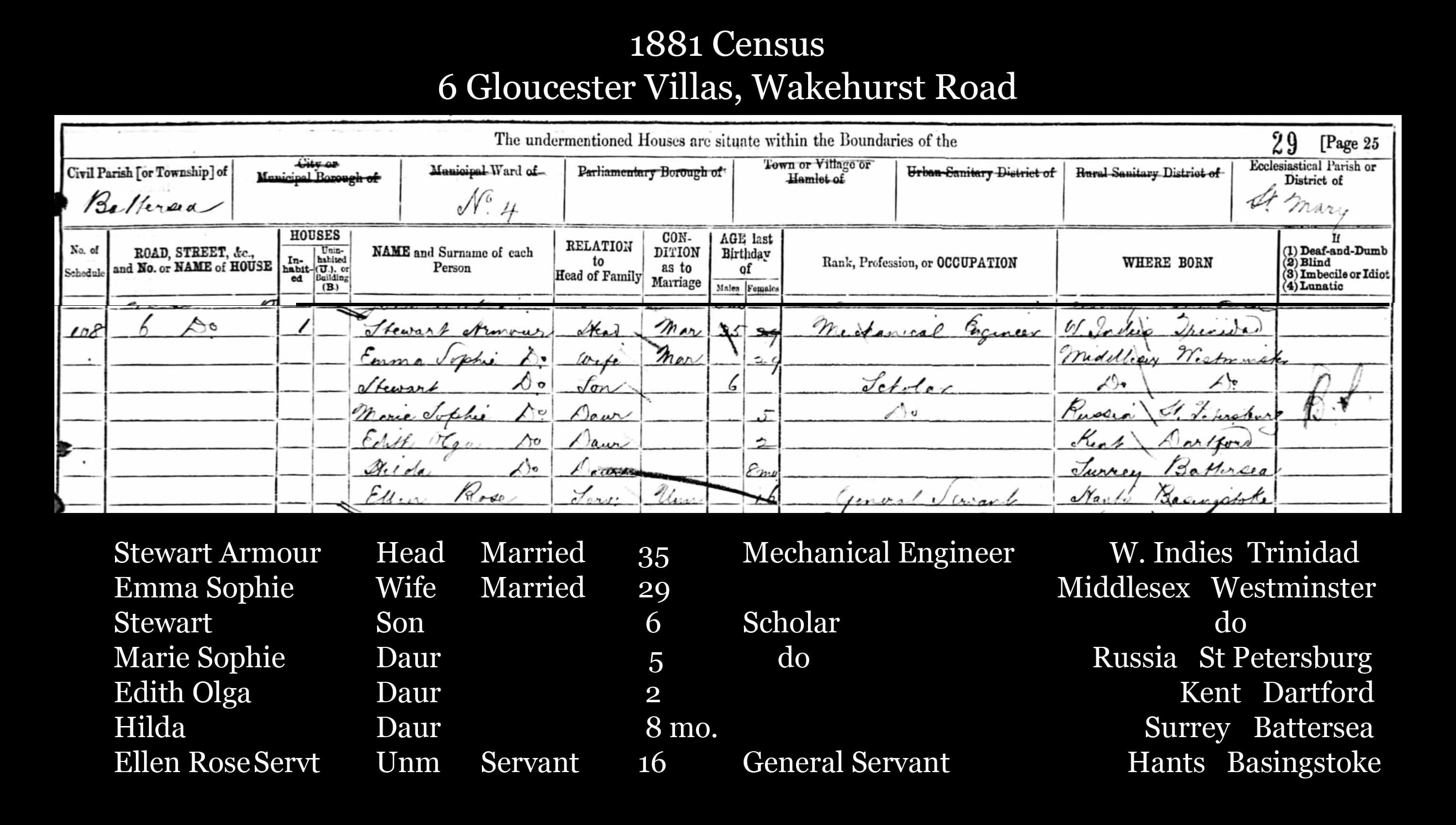


1881 Census: the Armour family, living close to the Thomases on Wakehurst Road.

I assume that "Tottie" is Edith Olga, since she was exactly the same age as Edward Thomas.

[But why "Tottie", a familiar name more usually associated with Charlotte or Dorothea? I don't know, but I have found examples of other Totties who are definitely Ediths.]

Notice that Stewart Armour, the head of the family, is described as a Mechanical Engineer. He must have previously travelled with his family for work since his daughter Marie Sophie, aged 6, was born in St Petersburg, Russia, and Edith Olga has a Russian middle name.

Tottie's father is also described as born in Trinidad. Was he, then, a person of colour? Given Edward Thomas's depiction of Tottie, this seems very possible.

So far as I know, none of Edward Thomas's biographers has investigated Edward Thomas's young girl friends such as Tottie Armour and Mabel Looms. I know a little about what happened to Edith Olga in later life, which I mentioned in the talk, but I'll leave further elaboration for another time.


Saturday mornings at our local Flea Pits . . . 

My own enthusiasm for "Red Indians" was kindled less by literary stimuli than by frequent visits to "the Pictures", aka "the Flicks".

Chronicles' reader Barbara Windsor (nee Barbara Madsen) spent her earliest years in a prefab on St Mark's Triangle. She was kind enough to send me some reminiscences of her school days at the tiny school on the corner of Battersea Rise and Boutflower Road. (I'll share these next month when I discuss the cultural importance of this building, and its role in helping to save Wandsworth Common.)
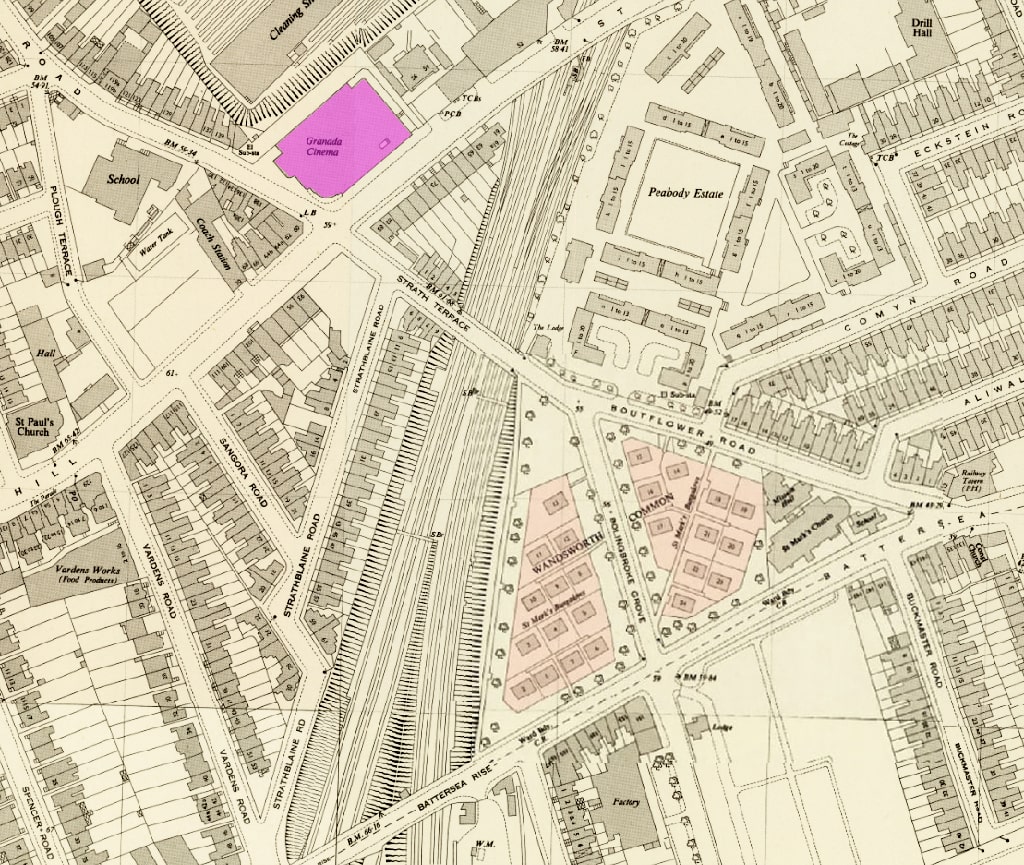


Barbara Windsor's home c.1950: Prefabs on the St Mark's Triangle, and the nearby Granada cinema.

But Barbara also mentions visits to the Granada Cinema on St John's Hill in the early 1950s:


Saturday morning pictures were a regular treat — I'm just amazed to think my sister and I were allowed to go on our own, crossing the main road at the top of Plough Road, clutching our sixpences.

I think we'd be pretty horrified to see six- and seven-year-olds out on their own now without adult accompaniment, but it was pretty much the norm then; and you just had to go the following week, as there was always a cliffhanger at the end of the film, usually with superman about to be crushed!

There was the resident organist who accompanied the children's theme song — "We're all for one and one for all, the Clapham Grenadiers".

I think there might have been a rival Saturday morning pictures at the cinema in Northcote Road — presumably long since gone, and Northcote Road now looking very much upmarket with virtually all the stalls gone.

[This was the Century cinema — see below.]

I remember being taken there with my sister when I was about seven or eight. I think the very first films we saw were 'Dumbo', a cartoon, and the main film was one with the American swimmer/actress Esther Williams — of course we could only go to those films certified as 'U' and nearly always arrived at the cinema half way through the film, staying on to see the first half, then leaving when the second half came round.



Walt Disney's gorgeous Dumbo came out in 1941, but was frequently shown again in British cinemas in following years.


How did we put up with all that smoke, everyone puffing away on their cigarettes, and no complaints! There was a choice of seats, one shilling and sixpence or one shilling and ninepence I seem to recall, with probably half price for children.

Strangely enough when I was about eighteen, I worked a holiday season in Brixham, Devon, and worked as an usherette in the tiny cinema there. I saw the film Gypsy Rose Lee countless times, and because I came from London and had been to a grammar school, I was trusted with being the ice-cream lady in the interval! My dad was a keen film buff and we regularly took the 'Picturegoer' magazine. Happy times!

[Personal correspondence, March 2025 — Thank you, Barbara!]
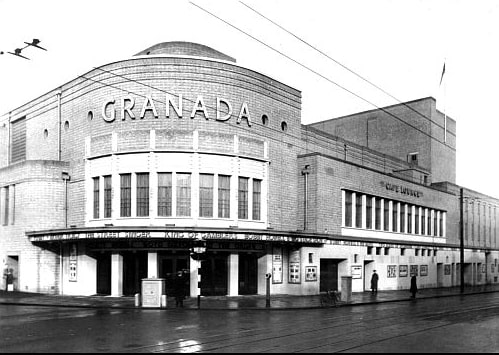


The Granada Clapham Junction opened in 1937, probably too late to show the then-curent version of The Last of the Mohicans. However it did screen the film on its re-release in 1946.

(Click on image to enlarge)


Posters for the 1936 version of The Last of the Mohicans


19 March 1937: The Last of the Mohicans was showing at the Granada Wandsworth Road and at the Grand Clapham Junction. (The Granada Clapham Junction was still in construction at this time.)


Granada — Not Just another cinema — 8 November 1937. Cutaway illustration.


The song Ghost Riders in the Sky (one of my favourites) as seen and heard at the Granada cinema, Clapham Junction in 1949.

(Click on the image to view a wonderful scene from the film.)

The cinema on Northcote Road that Barbara mentions was the Century.
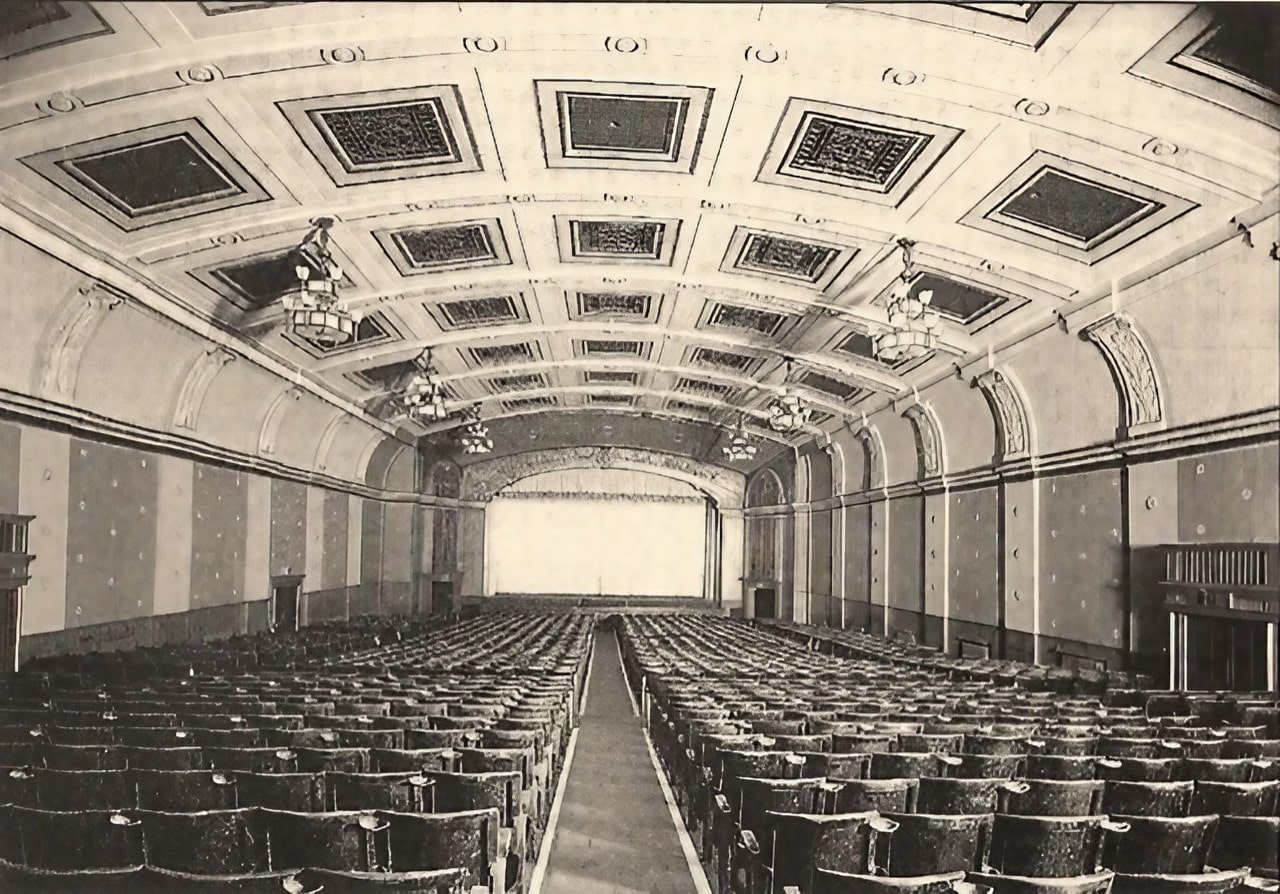


The Century Cinema, 15 Northcote Road

What's in a name?

According to Cinema Treasures.org, the Century started as the Bolingbroke Assembly Hall in 1880, before being converted into a cinema, the Bio-Pictureland Theatre, in 1907. By 1910 it was the Bio-Picture Palace with a seating capacity for 600. From 1917 until around 1923 it was re-named he Bolingbroke Picture Hall. After enlargement and radical refurbishment, it re-opened as the Globe Cinema in 1930. It was re-named the Century in 1951 (which is the name I knew it by) and closed as such in 1964.

The building was then stripped out and converted into a Tesco supermarket, later becoming a KwikSave supermarket and, in 2009, a Somerfield supermarket. By 2013, it was a Co-operative supermarket.


As seen in 2023: yet another future for the former Century Cinema. What is it now?

Local cinemas

(with links to the fabulous Cinema Treasures website)

Granada, Clapham Junction. (See also HoWC: Granada 1949.)

Century, Northcote Road

Ruby, St John's Hill

Essoldo [Clapham Grand]

Classic, Tooting Bec


[Hugh Betterton, whose childhood was spent on West Side, wrote:


This was a tour de force! Brought back so many memories of both Saturday morning pictures, as well as other times at the Granada, the Century and The Essoldo (The Grand). The Imperial (I think) is now a hotel almost opposite the entrance to CJ station. Blimey, spoilt or what? I also went to the Gaumont in Wandsworth High Street. Those songs also brought a recall of how Granadiers were encouraged to sing on stage during intervals, as were Gaumonteers! All for 6d and 2 hours of film and fun. Think that the cinemas were heaving with kids aged 7 — 12.

Good stuff!

Hugh and I also exchanged memories of children being invited onto the stage in front of the screen. For example, I recalled my childhood pal Ronnie Thomas (who I have mentioned before) showing off his tricks with a yoyo at the Classic, Tooting Bec. And Hugh remembers spinning his hula hoop.

Thanks, Hugh!]


Westerns were everywhere on the on T.V. in the 1950s . . . 

The earliest appears to be the Lone Ranger, which started in 1949, the year of my birth. Few people had in Britain TVs then, but over the next ten years numbers rocketed. Cowboys programmes proliferated.

Here are some of the Western-themed TV programmes I recall, all from the US (of course), and there were a lot. The year shown in brackets is when the series started, but it sometimes took a few years for episodes to be shown on British TV. Some of the series were repeated for many years after their first showing.

— Bonanza (1959)

— Champion the Wonder Horse (1955)

— Cheyenne (1955)

— Circus Boy (1956)

— The Cisco Kid (1950)

— Fury (1955)

— The Lone Ranger (1949)

— Gunsmoke (1952)

— Maverick (1957)

— The Range Rider (1951)

— Rawhide (1959)

— The Adventures of Rin-Tin-Tin (1954)

— Riverboat (1959)

— Wagon Train (1957)

[For a comprehensive (and intensely evocative) list, with links, visit Wikipedia: 1950s Western (genre) television series.]

Catchy signature tunes were vital, such as "Champion the Wonder Horse":


Like a streak of lightning flashing cross the sky
Like the swiftest arrow whizzin' from a bow
Like a mighty cannonball he seems to fly
You'll hear about him everywhere you go
The time will come when everyone will know the name of
Champion, the Wonder Horse!
.

[Hear Champion, the Wonder Horse here.]

Many were sung by the wonderful Frankie Laine, including Rawhide (which introduced Clint Eastwood as young, impetuous Rowdy Yates).


Keep rollin', rollin', rollin'
Though the streams are swollen
Keep them dogies rollin', Rawhide
Through rain and wind and weather
Hell-bent for leather
Wishin' my gal was by my side
All the things I'm missin'
Good vittles, love, and kissin'
Are waiting at the end of my ride

Move 'em on, head 'em up
Head 'em up, move 'em on
Move 'em on, head 'em up
Rawhide

Cut 'em out, ride 'em in
Ride 'em in, cut 'em out
Cut 'em out, ride 'em in
Rawhide
Keep movin', movin', movin'
Though they're disapprovin'
Keep them dogies movin', Rawhide

Yeah!

[Hear Rawhide here.]


Davy Crockett: King of the Wild Frontier, 1956.

But the biggest, brightest, most bodacious Western for us all was the 1956 film Davy Crockett (starring Fess Parker). It sparked an obsession throughout the country with "coonskin" (i.e. raccoon) hats with little tails behind, which looked like the family cat). You will notice that Davy looks almost identical to the 1930s version of Hawkeye, and not a bit like Daniel Day-Lewis's semi-Mohican version.


Davy Crockett: King of the Wild Frontier, 1956

 . . . .and of course this song:


Born on a mountain top in Tennessee
Greenest state in the land of the free
Raised in the woods, so's he knew ev'ry tree
Killed him a b'ar when he was only three
Davy, Davy Crockett, king of the wild frontier.


Some early versions of the Ballad of Davy Crockett

— YouTube: Bill Hayes

— YouTube: Fess Parker

— YouTube: Tennessee Ernie Ford

— YouTube: The Mellomen (with lyrics)

— [Max Bygraves also recorded a version for the British market, but we won't mention that.]

See also:

— Wikipedia: The Ballad of Davy Crockett

— Wikipedia: Coonskin Cap


Davy Crockett, Cowboy Comics no.165.

Our chief delight in the song was in its infinite potential for parody, customisation and localisation. For our purposes, the song Davy Crockett offered endless opportunities:


Born in a tenement* in Battersea
'e killed 'is Ma when 'e was only free [three]
Chopped up 'is Pa when 'e was only four
Now 'e's lookin' for 'is Bruvver-in-Law

Davy, Davy Crockett,
King of the Teddy boys.

[* Or "bungalow"]

Here's another Battersea-themed version recorded by Iona and Peter Opie in their indispensable The Lore and Language of Schoolchildren (1959):


Born on a roof top in Battersea,
Joined the Teds when he was only three,
Coshed a copper when he was only four
And now he's in Dartmoor for evermore.

Davy, Davy Crockett,
King of the Teddy boys.

[Similar versions to the above reported in Great Bookham, July 1956; Swansea, September 1956; Romford, April 1957. Many more feature on pp.118—120]

Here's a nice version:


Born on a hobby horse in Garratt Green *
Fed every day on Stork Margarine
Killed himself a cat when he was only three
That's how he got his Davy Crockett hat
Baby, Baby Crockett, King of the Wild Frontier.

[* Confession: the verse the Opies report refers to Ardwick Green, and was recorded in Manchester. But I couldn't help myself.]

[On Baby Crockett as a comic character in his own right, see below.]

Before we move on, I must mention one of our old jokes:


Q. "How many ears has Davy Crockett got?"

A. "Three: A left ear . . . A right ear . . . And a wild frontier."

Here's another reference to Davy Crockett, which the Opies' volunteer researchers recorded in Tooting in October 1956, sung to the tune of "Out of Town":


Say what you will,
School dinners make you ill,
And Shepherd's Pie
Makes David Crockett cry;
All school din-dins
Come from pigs' bins
- That's no lie.

[Lore and Language, p.162.]

All of these recollections can be dated very exactly. According to the Opies, David Crockett-fever had reached everywhere by the summer holidays of 1956, but that "At the end of the summer Crockett play and costume disappeared as suddenly as it arrived."

Yet the song, and its lively variants, lasted much longer. And here I am, recollecting it all again 70 years later.

Do you remember any of these songs, rhymes and jokes? Did you have different versions of your own?


Baby Crockett

[Stephen Midlane also remembers the long-running Baby Crockett comic strip. This started in The Beezer only months after the film was first shown in 1956, then ran in various comics and annuals until 2002 (Wikipedia: Baby Crockett.]

Here's Baby Crockett's song, as recollected by Stephen:


Born in a bungalow and not yet three,
The wildest babe in the whole country,
The terror of his ma and his pa is he,
And his grandpa feels safer up a tree.

Baby, baby Crockett, king of the family.

Thanks, Stephen!]


Baby Crockett in The Beezer, 29 July 1961. Any connection with the Wild West as long gone.

CAPTION-2


My lovely white Lone Star Repeating Rifle, mid-1950s . . . 

I can't forget something that happened on the Scope* on a snowy Christmas Day in the mid-1950s.

[ * Not that we ever called it the Scope — we always called it "Bushy Common", or the "Rough Bit". We'd never heard of the Craig Telescope. When was it first called the Scope? ]

In December 2020 I compiled some notes about childhood on the Common in the 1950s. Here's part of what I wrote.


Lone Star Repeating Rifle, white, 1950s. This is very much like my happy gun of memory. Notice the distinctive red star on the stock.


I was terrifically excited to be given a Lone Star toy rifle with a white stock that fired caps. Being Christmas, I couldn't knock on anybody's door to find out if they could come out to play. So I went over Bushy Common by myself — to lie in the tussock grass, to edge forward through the mud, pretending to be a Sioux Indian brave, a Cavalry Scout or a Cowboy.

Two boys, a few years older than me, grabbed my gun and taunted me with it for while, raising it high above their heads and threatening to smash it on a tree trunk. I tried to get them to give it back, but they wouldn't. Over and over again they made to smash the gun. The more I pleaded, the more enthusiastically they tormented me.

Of course, eventually they tired of the game. They'd had enough of all the taunting and the tears. So they smashed the gun on a tree trunk anyway, and set off home in time for Christmas lunch.

Ah well, that was the 1950s for you, and as a child there was always a certain riskiness associated with the Common. Not only were there the "big boy" bullies, but there was a lot of talk about "Teddy Boys", who were said to carry an arsenal of flick-knives, razors, and bicycle chains. (As it happens, I was never troubled by Teds.)

On the one hand, parents and Parkies were very strict, and exercised absolute powers over us. On the other, we were left to our own devices away from our home for hours on end. Children brought each other up in those days, adults played little part. Especially on the Common.

[* Edward Thomas tells a wonderful story of receiving a toy sword, scabbard and belt for Christmas. Having no one to admire his sword, he too goes "up the Common" and walks backwards and forwards among the elms on Bolingbroke Grove. By great good fortune, he eventually meets Mabel Looms, out strolling with her family. He parades before her, believing her to be impressed by his "swinging sword" (pp.34-35).]


Reader David Ainsworth shared a gun-related reminiscence:


I think that my Lone Star or equivalent rifle survived a year or two of combat and many reels of caps, but my beautiful six-shooter had a very short life. Soon after being given it, showing it to a friend in the street who asked me to pretend to draw it and menace him with it, he showed me a recently-learned trick (from a film?).

He kicked it out of my hand and the pavement disassembled it, and repair was beyond even my dad. Very sad, but, I think, an unintentional result.

These memories stick. (There is always Ebay to soothe me).

Thanks, David!]


Indian Crafts and Lore . . . 

Indian Crafts and Lore was one of my all-time favourite non-fiction books at Earlsfield Primary School, Transmere Road School. I found a second-hand copy of it quite recently. It is exactly as I remembered it. Full of information about different tribes, but best of all it was in colour with lots of art and craft activities. In the largely leaden monochrome 1950s, this was a special treat.


Indian Crafts and Lore, W. Ben Hunt (1954).

No, thinking about this again, I realise that something else that made this book so special was that it was deeply respectful of native Americans. The contrast with what we saw on the screen at Saturday Morning Pictures could not have been greater.]


How to make a Horned War Bonnet

I was reminded of this in January 2021, when I saw images of the "QAnon Shaman", wearing horns with a coonskin hat.



[Note to self, a few weeks after after publication of these Chronicles:

I've completely neglected to write anything about bows and arrows, which were a big part of our childhood between 8 and 10, when I was living at Heathfield Court. We spent hours and days selecting and cutting straight branches for bows, and sticks as arrows, adding weights (such as nuts) to the pointy ends of the arrows (but never, I think, flights, to make them go farther.

We did target practice in the back yard (I sometimes got up early to get some shooting in before setting off for school), or long-distance competitions on the lawn in front of the block. Our longest flights nearly (but not quite) reached from end to end.

How is it possible nobody lost an eye (though we often talked about someone who nobody knew personally who had indeed lost an eye that way)?]

.


Coming in April . . . 

My candidate for a new Wandsworth Blue Plaque: the former St Mark's Infants School, Battersea Rise:


Tiny St Mark's (originally St Mary's) School was built on the Common 1866—67. (The church followed later.) This photograph shows it a few years ago, before a splendid restoration and rebirth as the studio of Dow Jones Architects.

(Click on image to enlarge)

This little school is hallowed ground for Wandsworth Common enthusiasts because Samuel Sullings, our very own martyr, was feted there on his release from prison in July 1870:

South London Chronicle — 23 July 1870


(Click on image to enlarge)


WANDSWORTH COMMON.

Samuel Sullings, who was imprisoned with hard labour for breaking down fences on Wandsworth-common, and subsequently released on a memorial presented to the Home Secretary by Sir C. W. Dilke M.P., was entertained by a number of his fellow workmen at the Infant School, Battersea, on the 9th inst.

Sullings appeared in a new suit of clothes, hat, and boots, which were paid for by a few friends. The workmen have made a subscription, which will placed in the Post-offce Savings Bank.

Mr. Churchwarden Buckmaster occupied the chair, and made a speech, in which he endeavoured to show that those who had erected the fences were more guilty than Sailings; and the idea saying to poor men, when their rights and enjoyments were taken away by rich people, that if they feit aggrieved they could proceed by action at law or indictment, was simply adding insult to injustice. (Cheers.)

The chairman then referred to various matters connected with the common, and expressed a hope that would not again he necessary for poor working men to suffer imprisonment in defence of what they believed to be their rights; he looked with hope and confidence to the result the forthcoming City meeting.

Three cheers for Mr. Buckmaster, three groans for those who had enclosed the common, and a vote of thanks for the vicar for allowing the use of the schoolroom, concluded the proceedings.

[BNA: Link]

I'll explain the background and implications in a few weeks' time.


Chronicles

February 2025


Reverse of a Half Farthing coin, 1845


A picture puzzle for you


A single candle distorted by the liquid in a mysterious glass bowl.

A detail of which painting?

[Answer at the bottom of the page . . . ]

(Click on image to enlarge)

In last month's Chronicles I included a map of proposed railway lines across the Common. Hawk-eyed reader Jason Hazeley noticed that what we now call Allfarthing (as in Allfarthing Lane) was shown as "Half-Farthing". Why?
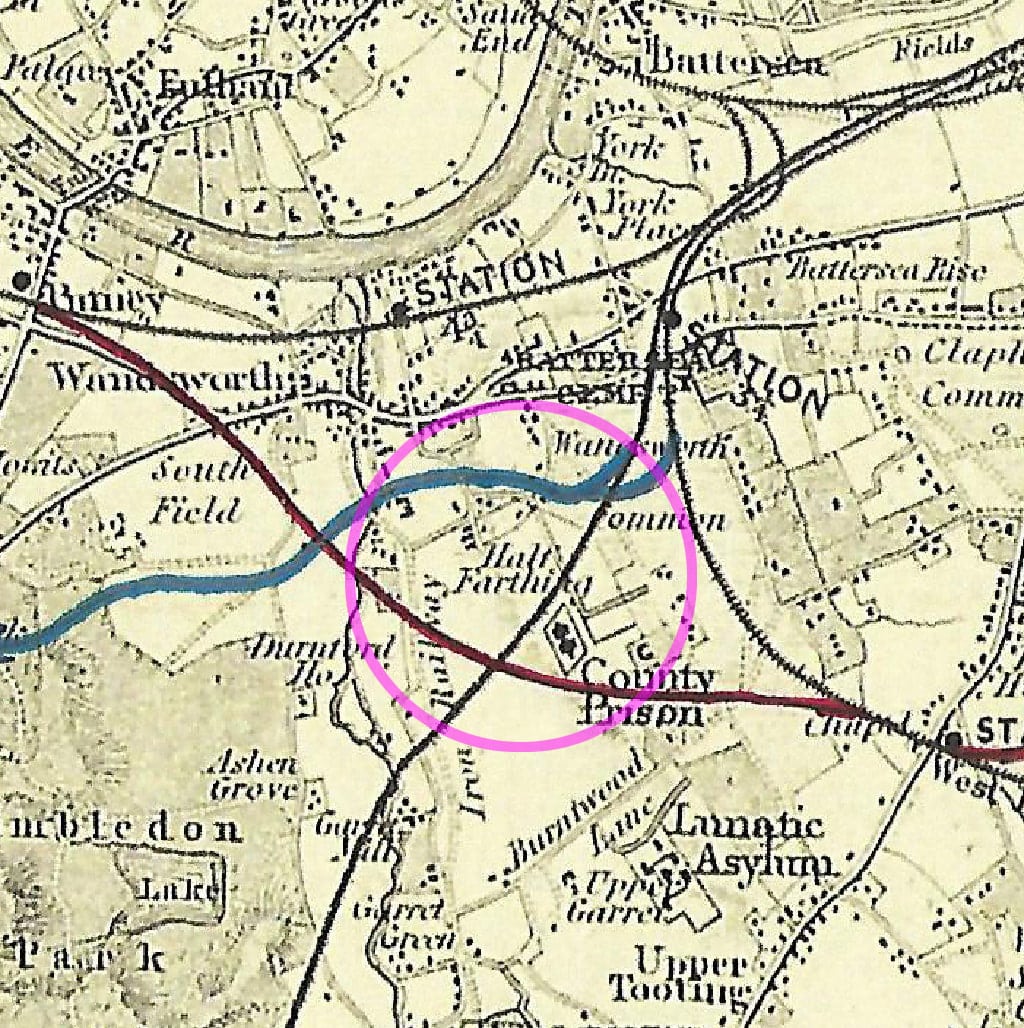


(Click on image to enlarge)

As placenames, "All Farthing" and "Half Farthing" are unique — there are no other similar toponyms anywhere in England. So why here? Which is "correct"? What did the names mean?


But first, I've since learnt that yet more railway lines were proposed for our area. Had they been built, there would surely have been no room for houses.
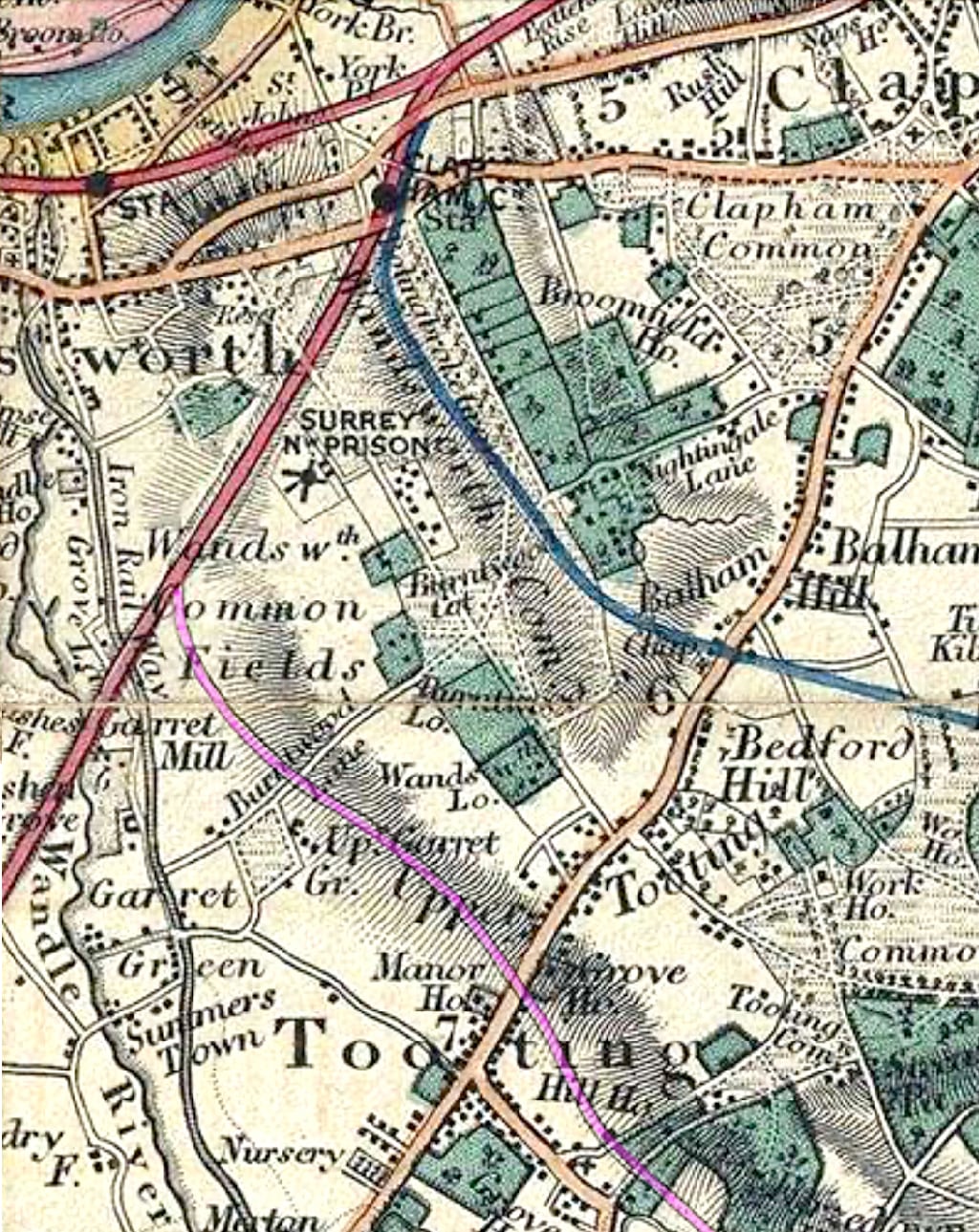


Cruchley, 1855. (I've coloured the proposed track pink). Notice also the "Iron Railway" running north-south parallel to Garratt Lane and the River Wandle. Its carriages were drawn by horses, not of course by steam locomotives.

(Click on image to enlarge)

In relation to a modern map, the proposed branch would have left the London-Southampton line just above Earlsfield station, cut through Wandsworth Cemetery, then followed today's Dawnay Road or Openview before crossing the new Springfield (Hospital) Park on its way to Croydon (and thence to Brighton).

The London Extension Railway, 1804

And that's not all. A little over fifty years earlier — well before the use of steam locomotives — a "London Extension Railway" was planned that would have started by a junction with the Surrey Iron Railway at the entrance to the Wandsworth dock, and run roughly north-east to Southwark:


Relative to present-day topography, the route was to the northwest of and roughly parallel to St. John's Hill and Lavender Hill to join Wandsworth Road, then turned to the north through South Lambeth. It continued along Kennington Road, ran to the east of Waterloo Station, then turned eastwards along Stamford Street to terminate some distance short of Blackfriars Road.

[Peter Mcgow, Surrey Iron Railway and Croydon, Merstham and Godstone Iron Railway, Wandle Industrial Museum, 2001.]

A plan showing the route was deposited with the Clerk of the Peace for Surrey on 29 September 1804. Does anybody have a copy of this plan? I'd love to see it.
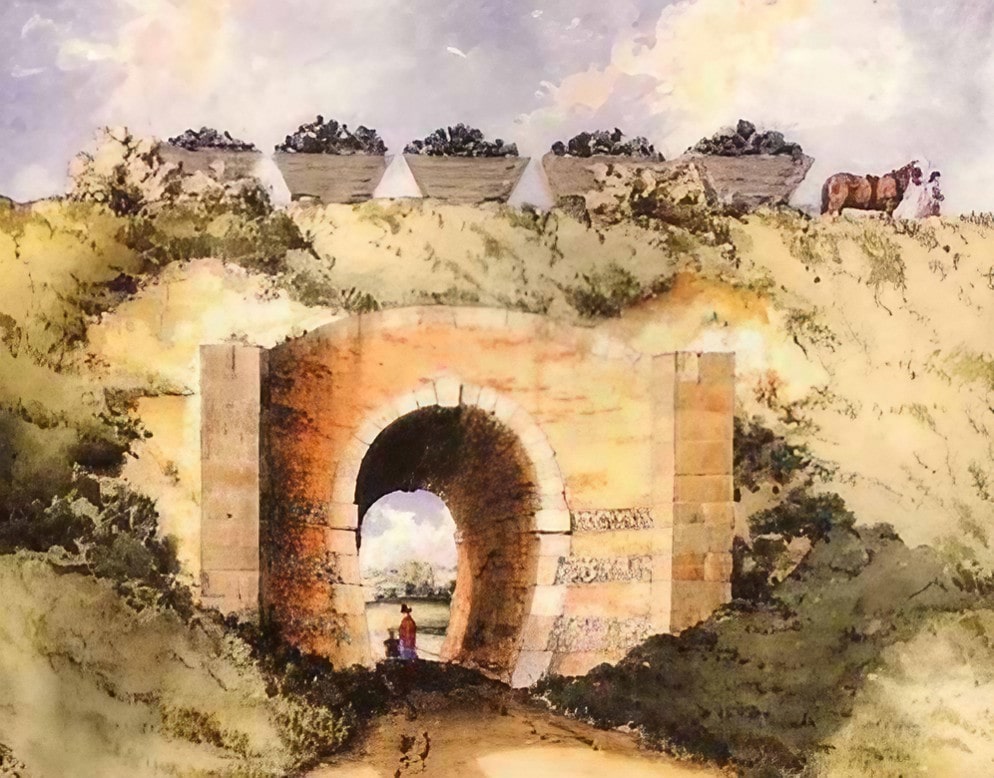


Watercolour showing a horse-drawn goods train at Coulsdon, further down the line, 1823.

(Click on image to enlarge)

Wikipedia: Surrey Iron Railway

Unsurprisingly, many local people (including "several gentlemen from Clapham and Lambeth") were outraged:
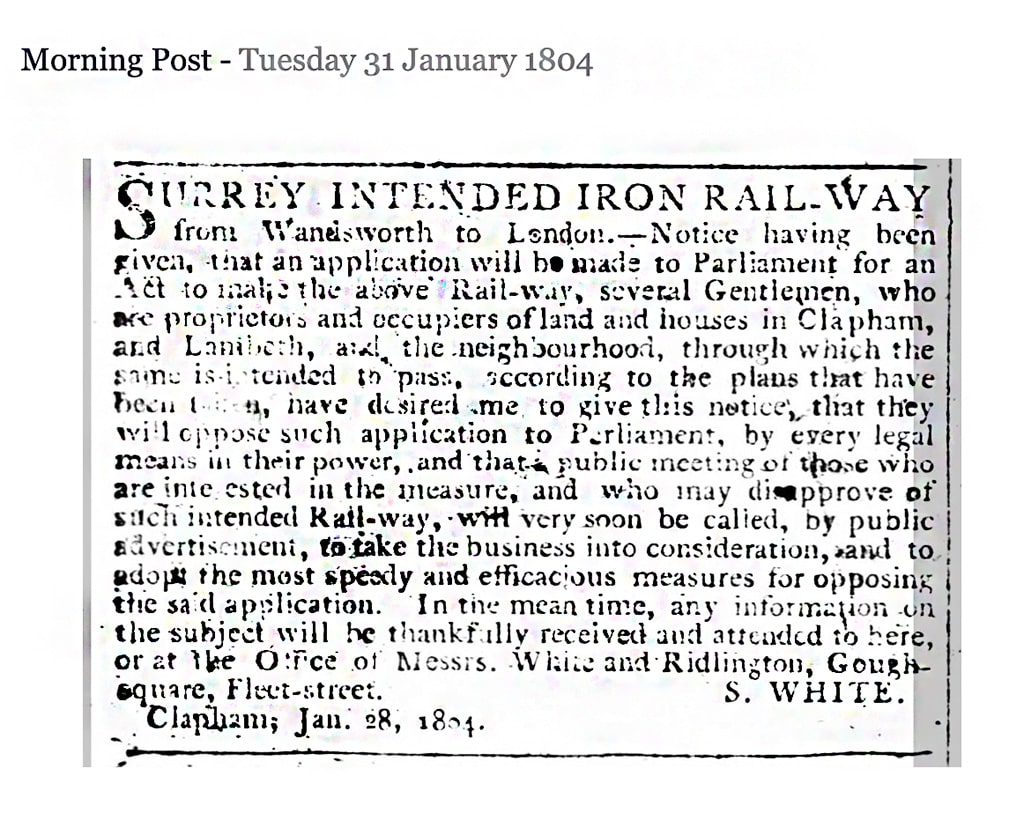
Morning Post — 31 January 1804


(Click on image to enlarge)


SURREY INTENDED IRON RAIL-WAY

from Wandsworth to London

Notice having been given, that an application will be made to Parliament for an Act to make the above Rail-way, several gentlemen, who are proprietors and occupiers of land and houses in Clapham, and Lambeth, and the neighbourhood, through which the same is intended to pass, according to the plans that have been taken, have desired me to give this notice, that they will oppose such application to Parliament, by every legal means in their power, and that a public meeting of those who are interested in the measure, and who may disapprove of such intended Rail-way, will soon be called, by public advertisement, to take the business into consideration, and to adopt the most speedy and efficacious measures for opposing the said application.

In the mean time, any information on the subject will be thankfully received and attended to here, or at the office of Messrs White and Ridlington, Gough Square, Fleet Street.

S. White, Clapham, Jan. 28, 1804.

[The "S", by the way, was "Samson".]

A meeting was announced for 10th February at the Royal Oak, Vauxhall, "to consider of and determine upon, the most proper and effective measures to be pursued for opposing such application, and preventing by all legal means the obtaining or passing of such Act" [BNA: Link).]

At this meeting (with the wonderfully named Samuel Goodbehere in the Chair):


"It was unanimously resolved, That upon mature consideration it appears to this Meeting, that the making of the proposed Rail-Way from Wandsworth to Stamford-street, Blackfriars-road, would be an unnecessary measure, inasmuch as the present most excellent roads to Wandsworth, together with the Navigation of the River Thames, and the completion of Public Works now going on, afford every convenience and accommodation that are essential to any public object.

Resolved likewise unanimously, That the intended measure, if carried into effect, will be highly injurious to private property, by destroying the present inclosures, and rendering the cattle, crops, and other property therein, insecure and open to depredations; and that, from the very populous neighbourhood through which this way is proposed to pass, the retirement, and many other essential comforts of a great body of respectable individuals will be done away. That the many grievous and perplexing inroads necessarily to be created, will be peculiarly harassing, and such as the compensation expected to be made cannot be sufficiently adequate to.

Resolved therefore unanimously, That the said application to Parliament be opposed."

[BNA: Link.]

Sufficient investment could not be found and the sponsors never proceeded with the delivery of a petition to Parliament. Plans for the new railway went nowhere.

But if things had gone to plan, doubtless railway companies would have ensnared Wandsworth Common in a cat's cradle much like the "Battersea Tangle" a mile or so up the line:
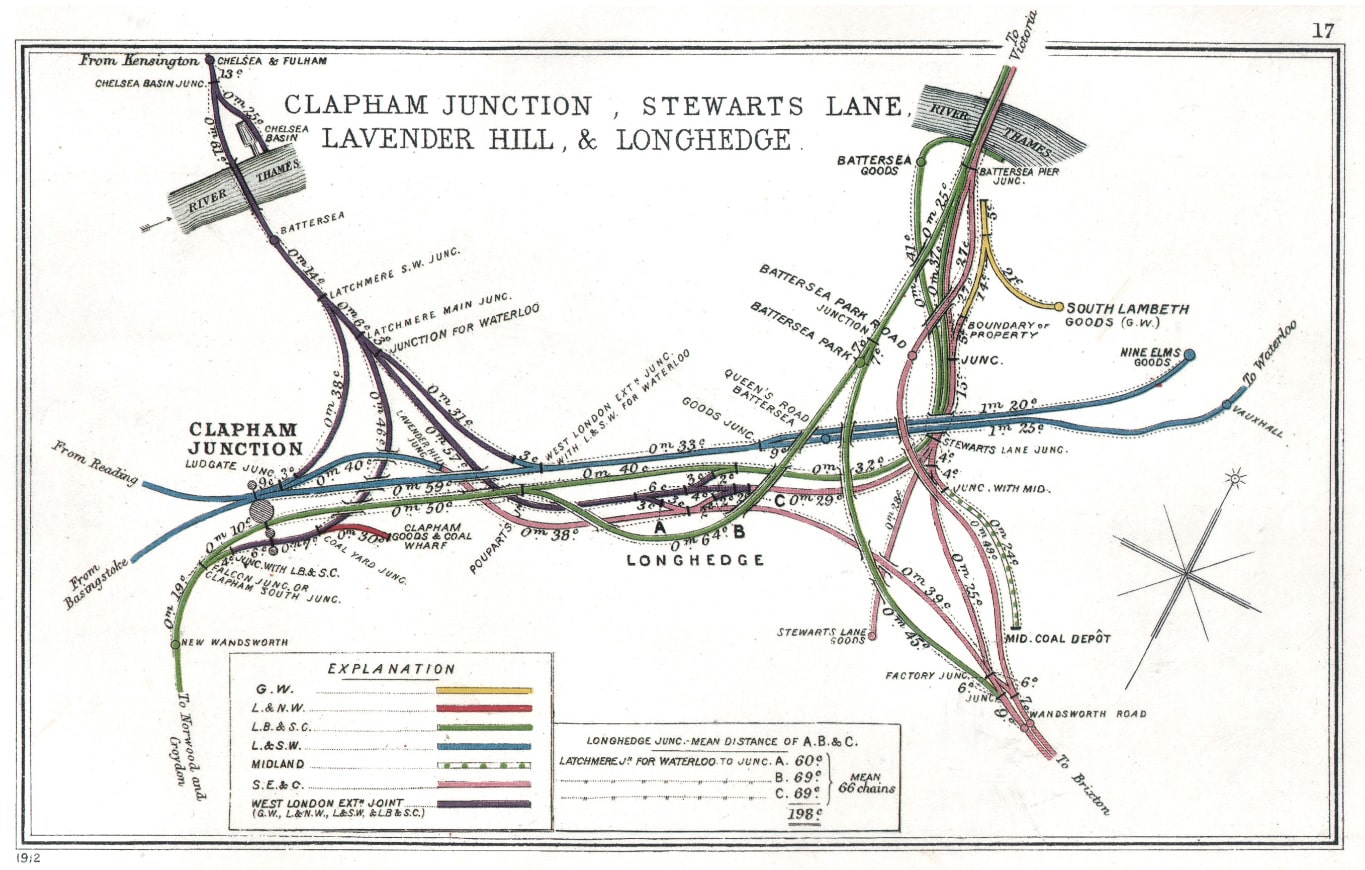


The "Battersea Tangle", or "Battersea Knot".

(Click on image to enlarge)

Thank heavens for NIMBYS, I say.


1 Feb 2025: A response from Elizabeth Jeveons draws attention to a recent local furore over an application by Enable, who tend the Common (and much else), for licences to serve alcohol at possible future events, with "up to 10,000 attendees", to be held on up to four sites around the Common:

Following Enable’s attempt to gain a monetising licence for the Common, "in perpetuity”, and the huge outcry about that that has just happened, it is good to know that only by saying “not in my backyard” have we ever preserved the Common and I am pleased there are enough people who have always loved and respected open unfettered land for us to have what we have now. May it continue that the Common’s Conservateurs will win against the monetisers, over users and exploiters for their own gain and glory.

All best, Elizabeth

She added a link to a very interesting article by Alex Long about why the applications were made, and why they were withdrawn (for the present):

Clapham Junction Action Group: Wandsworth’s parks: Commercial events with 10,000 people planned – then cancelled

Thanks, Elizabeth!


Anyway, enough of railways and popular protest (for the moment). Now back to this month's chief themes, which are farthings and half-farthings, the mysterious slaughter in 1741 of ten sheep from which only the fat was taken, and candles. At the very end of this month's Chronicles, I learn about song-bird "mules" that once engaged in sonic battles in pubs on the edge of the Common.


Edward Thomas describes one of his favourite childhood walks in the 1880s . . . 


"Allfarthing Lane was worth going down for its name's sake. We invented explanations and repeated those of our parents.

At the top dwelt an old woman in what looked like a one-room hut who presumably knew and had something to do with the origin of the queer name."

[The Childhood of Edward Thomas: A Fragment of Autobiography .]


All-farthing or Half-farthing?

When Jason's email arrived I happened to be looking at a brief account of a perplexing crime that took place on "Half Farthing Farm" nearly three centuries ago.

Gloucester Journal — 3 February 1741

Mysterious slaughter of 10 sheep at Half-Farthing Farm.
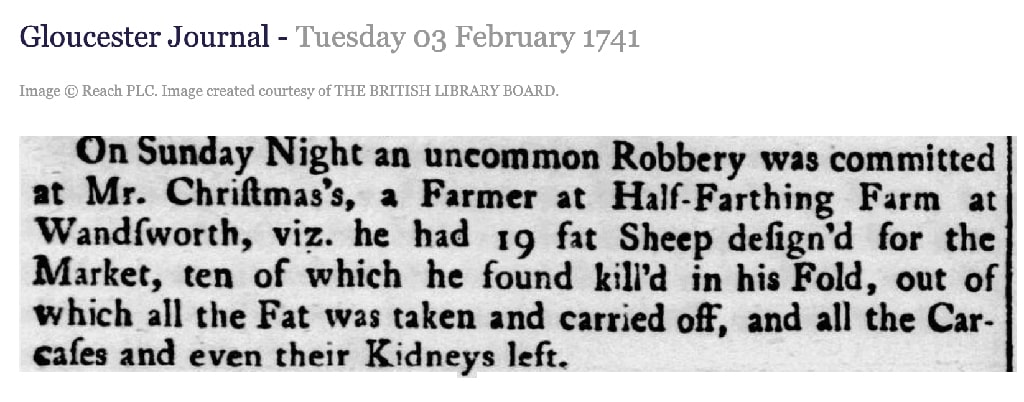


(Click on image to enlarge)


On Sunday Night an uncommon Robbery was committed at Mr Christmas's, a Farmer at Half-Farthing Farm at Wandsworth, viz. he had 19 fat Sheep deign'd for the Market, ten of which he found kill'd in his Fold, out of which the Fat was taken and carried off, and all the Carcases and even their Kidneys left.

I think we can assume that Half-Farthing Farm was directly attached to the manor house, close to the kink in Allfarthing Lane — more or less where Allfarthing School is today. Part of the farm may have been nearby on the other side of the lane. (See the Gardner/Porter map below.)

But why had the thieves killed and butchered the sheep in their fold, then taken the fat and nothing else ("even their kidneys"). What use could fat possibly be put to that was so lucrative that you would risk your neck in this way?

[It would also be good to know why the story is being reported as far away as Gloucester, and to learn more of "Mr Christmas", but perhaps these questions will have to wait for other times.]
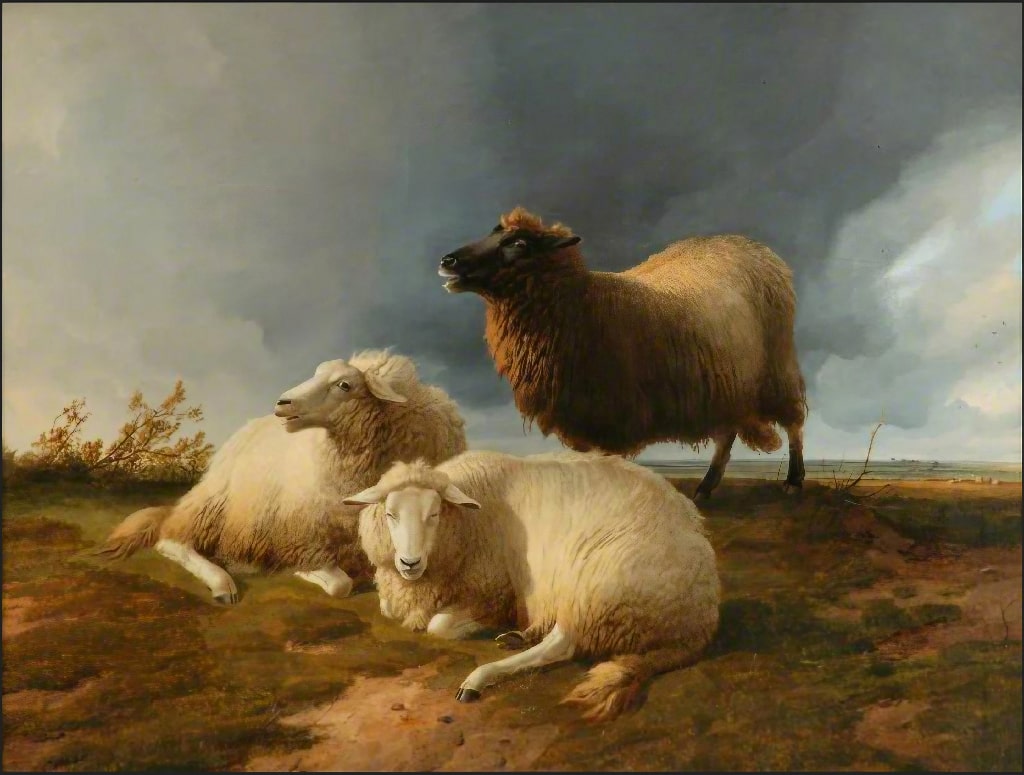


Thomas Cooper, Sheep on a Common, 1873. Manchester Art Gallery. Almost certainly not Wandsworth Common. These fine, fat, fluffy animals — the impressive product of more than a century of intensive breeding — are probably much larger than the sheep that grazed Half-Farthing Farm.

(Click on image to enlarge)

Not long after, I came across a reference to "Half-Farthing" in a report of the death of the famous actor, dramatist, song-writer and scene-painter Thomas Dibdin (1771-1841). Dibdin, it says, had studied for a "twelvemonth under Mr. Tempest, of Half-farthing-lane Academy, Wandsworth, where he was taught to speak bad French at dinner-time."


Thomas Dibdin, by William Owen, Museum of Fine Arts Boston.

(Click on image to enlarge)

This must surely be the same school that "Master Bruce" was attending a few years earlier when he played "hare-and-hounds" on the Common. As you may recall, he wrote home about it excitedly on 20 July 1772.



George Brudenell Bruce, c.1768, attributed to William Hoare.

(Click on image to enlarge)

[If you haven't read this story, please do. It's one of my favourites. It would be good to learn more about this school, which must have been located in Allfarthing Manor, on the west side of the kink in Allfarthing Lane. (It's rather pleasing that today's Allfarthing School now occupies this site.)]


Farthing/Half-farthing?

The English Placename Society (EPNS)

My first port of call was the English Placename Society, based at the University of Nottingham. This lists a number of variants, but with no obvious pattern:


Elverding c.1230)

Alferthyng 1268,1371,1379,1413

Halverthyng 1334

Alverthyngg 1365/p>

Alferdyng 1540

Halfefarthing 1544

All fardinge 1597

Allfardthing, Allfardtheng, Allfarding 1644/p>

[EPNS: Allfarthing (supplies references).]

[The EPNS also examines the etymology of Wandsworth (aendel's farm or enclosure), and Battersea.]

[Note to self: I have just learnt that the manor had an earlier name: "le Frithe". Marc Stchedroff reports personal correspondence with Dr Matthew Payne, Keeper of the Muniments, Westminster Abbey (30 October 2023), who writes:


"I am afraid that we have no maps or plans relating to Allfarthing at all . . . Although the manor known as ‘le Frithe’, and later Allfarthing, was purchased by the Abbey in the mid-fourteenth century, it has left relatively little trace among the archives. It was surrendered at the Dissolution in 1540 (having been leased by the Abbey to Thomas Cromwell in 1533), when Henry VIII annexed it to the honour of Hampton Court. So the only limited material we have relating to this estate dates from the late medieval period.

[OLBC: See The manor of All Farthing.]

[Keith Bailey adds "frith (OE fyrhth) has sundry meanings — "a wood", "woodland", "wooded countryside", presumably in this case denoting "land not cultivated" and/or "waste land" i.e. the Common. It often appears in field-/place-names in simplex or unqualified form, as here." [KB to PB, 21 January 2024.]]


All-farthing/Half-Farthing on an early map

I've looked at a variety of maps (all more recent than any of the EPNS entries, of course) and both forms appear fairly promiscuously — though interestingly "Half-farthing" was much the more common name in the C18 and early C19.

Here's the earliest map of our area (that I know of) — of Allfarthing Manor created by Peter Gardner for its new lord, Endymion Porter. The original, of 1633, is lost, but this is a copy of 1644:
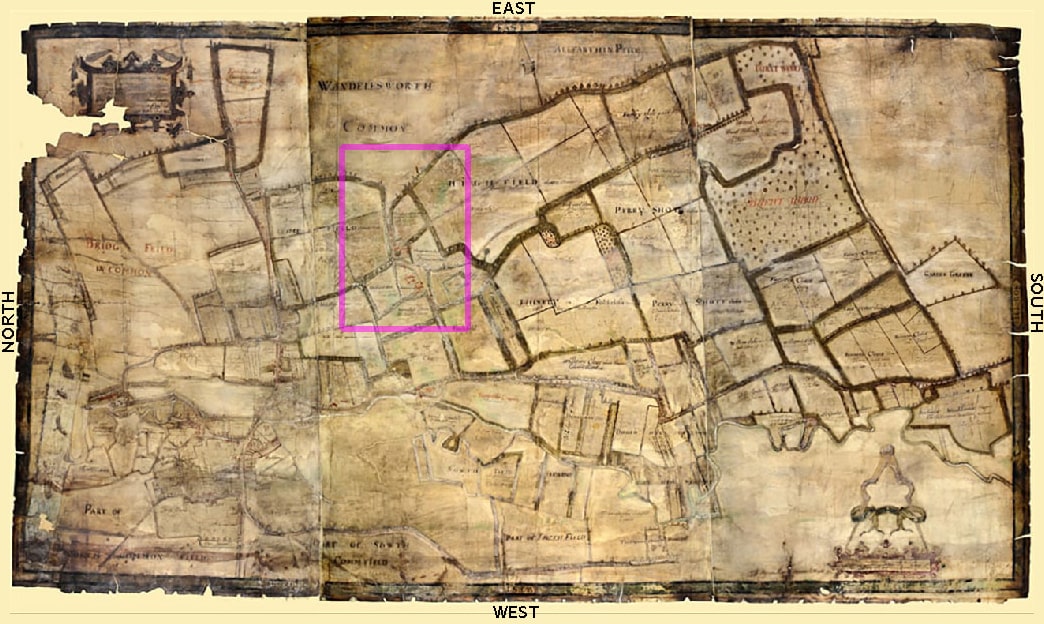


The Gardner/Porter map of Allfarthing Manor, 1633-1640. It is oriented roughly west-east, with north to the left. The pink rectangle frames Allfarthing Manor House and the top of what is now Allfarthing Lane (expanded below).

Surrey History Centre, SHC 3991/1

(Click on image to enlarge)

The map as a whole may be a little mind-boggling at first. The Thames runs up and down on the extreme left. The Wandle, which forms a natural estate boundary, runs across from right to left. At the top, the edge of Allfarthing Manor is roughly the crest of the gravel-topped hill that forms "Wandelesworth Common" (the ridge follows the line of today's Lyford Road-Heathfield Road-West Side).

An incursion into the Common, called "Allfarthin Peece" [sic], will become the so-called Toast Rack. On the right, "Garret Green" and a tree plantation, "Burnt Wood", probably the enclosed (and hence protected) relic of a much larger wooded landscape.

Frankly, it's quite hard to make much sense of this map unless you look at it close up and in great detail (which we'd better leave for another time). But I've rotated the map and fitted it (loosely) onto a modern map, and this may help a little.
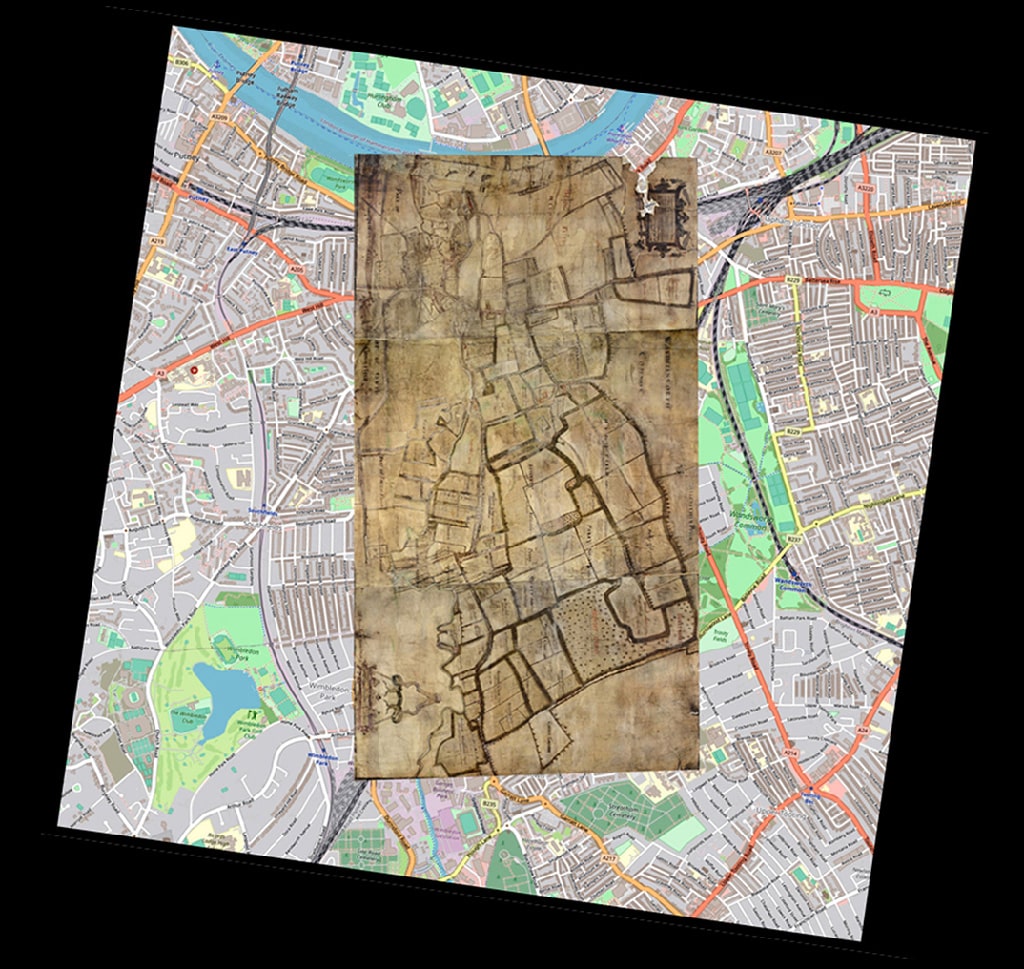


Here's the area near Allfarthing/Half-Farthing Manor House:
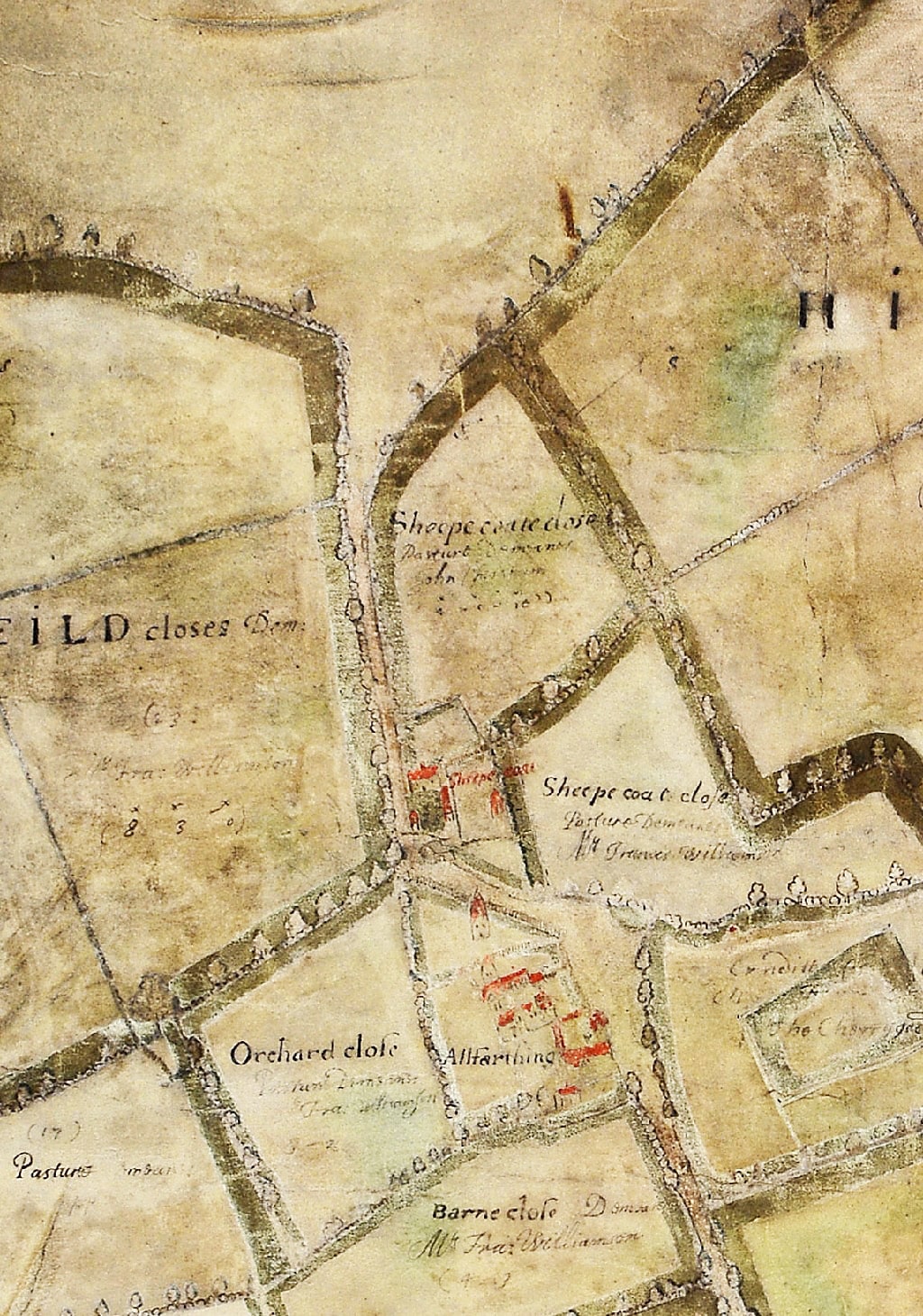


"Allfarthing" manor house and farm buildings (with striking red roofs) to the left (north) of what is now Allfarthing Lane. There are also red-roofed buildings and two small enclosures, each of roughly three acres and called "Sheepe Coat Close" (in black lettering), and the phrase "Sheepe coat", in red.

A "close" is a small enclosure, often a subdivision of a larger "field" (as elsewhere on this map). But what is a "sheep coat" (or "sheepcote")? It appears that these are not fenced folds, which would be temporary and movable, but permanent structures, typically bounded by earthworks and/or hedgerows.

[Incidentally, there's a "Sheepcote Lane" in Battersea, near the Battersea Tangle. I'd like to know more about it.]
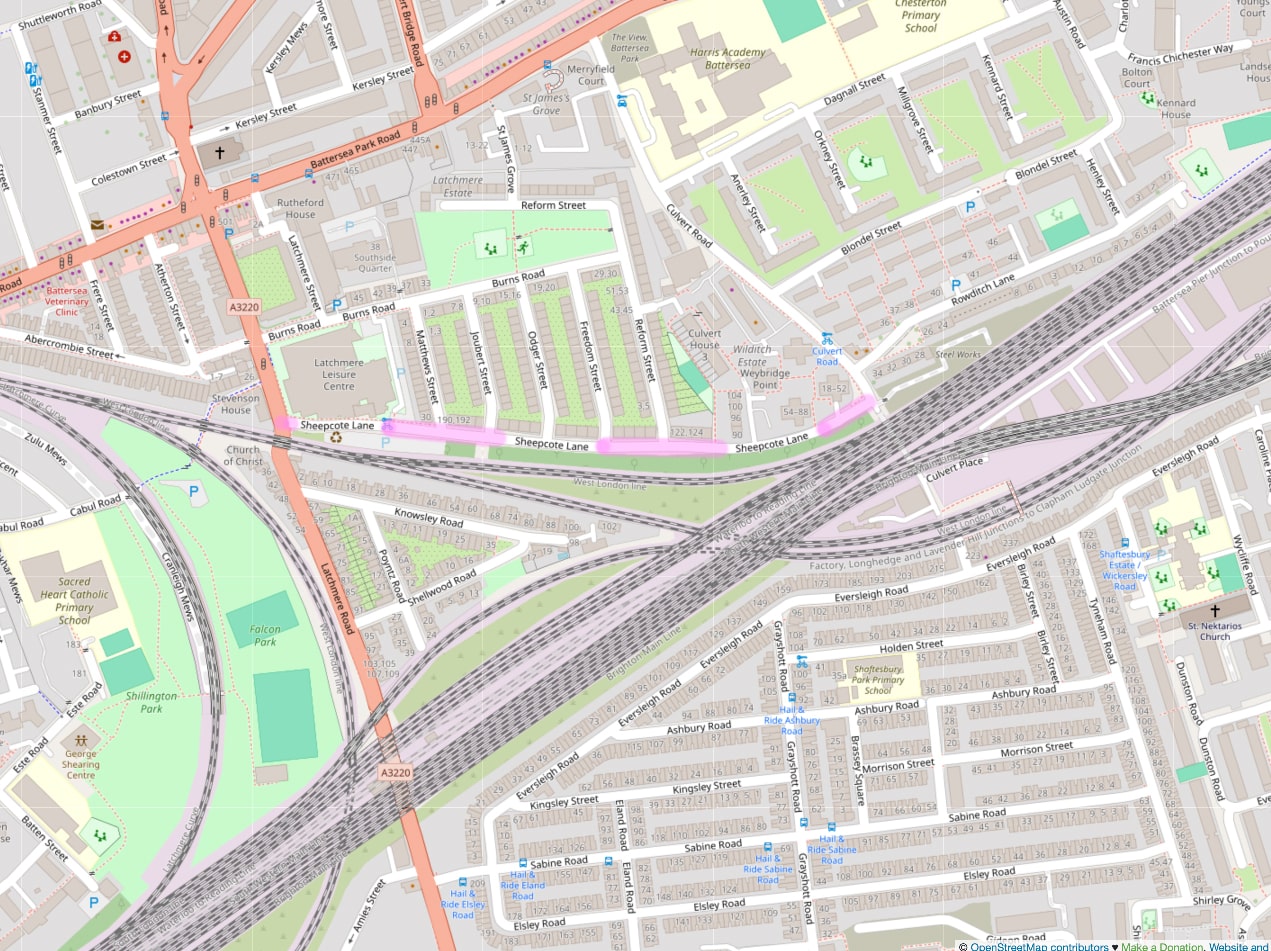


OpenStreetMap: Sheepcote Lane, Battersea.

(Click on image to enlarge)

The 13th-century agricultural writer "Walter of Henley" urges that sheep be brought in from Martinmas (11 November) until Easter. Housed in roofed, wooden buildings erected within larger sheepcotes, sheep were easier to protect and feed during winter months, and concentrated together for efficient lambing and shearing in early spring.

Here's a fab. image:


February: Les Tres Riche Heures du Duc de Berry (c.1412-1416).

Wikipedia: Très Riches Heures du Duc de Berry

[Notice, by the way, the trio (left), sans undergarments, warming their private parts in front of the fire.]

On the Gardner/Porter map, many of the field boundaries appear to be hedges with occasional standard trees, which suggests these hedgerows were already well-established by the early C17 — possibly the product of Tudor enclosures, or even earlier.

The "bird's mouth" at the top forms the exit through which sheep and other animals passed on their way to graze on "Wandelesworth Common" — and by which they were efficiently funnelled back into their sheepcotes again.
(Click on image to enlarge)


Double portrait of Endymion Porter and Anthony van Dyck, 1635, by van Dyck, set in the Toast Rack, Allfarthing Manor, Wandsworth (only joking). Prado, Madrid.

[It's a fascinating painting. Let me know if you would like me to say more.]

(Click on image to enlarge)

Later maps

Here's John Rocque's beautiful map, made a century or so later, c.1740s.
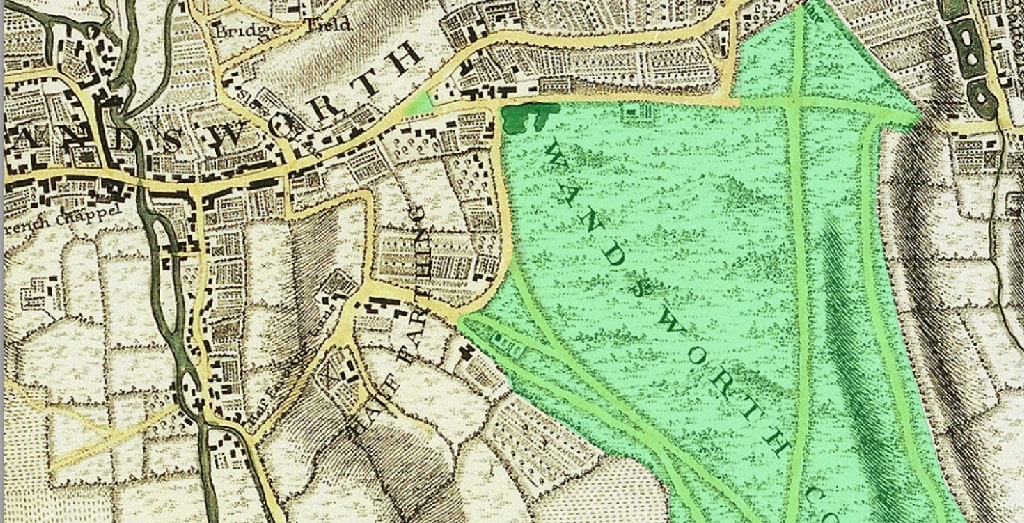


(Click on image to enlarge)

Gardner/Porter (1633-1640) Allfarthing, Allfarthin

[NB: some books of heraldry describe Porter as "of Alfarthing"]

Senex (1727) Half Farthing

Rocque (1750) Half Farthing

Tirion (1754) Half Farthing

Cary (1786) Half Farthing

Corris (1787) All-Farthing

Faden (1790) Half Farthing

Milne (1800) Allfarthing

OS (1808-1822) Half Farthing

Cruchley (1832) Half Farthing

Tithe (c1840) [not named on map]

Davies, Environs of London (1841) Half Farthing

Cruchley (1847) Allfarthing Lane [first mention on a map?]

Whitbread (1865) Allfarthing Lane

Wyld (1872) Half Farthing Lane
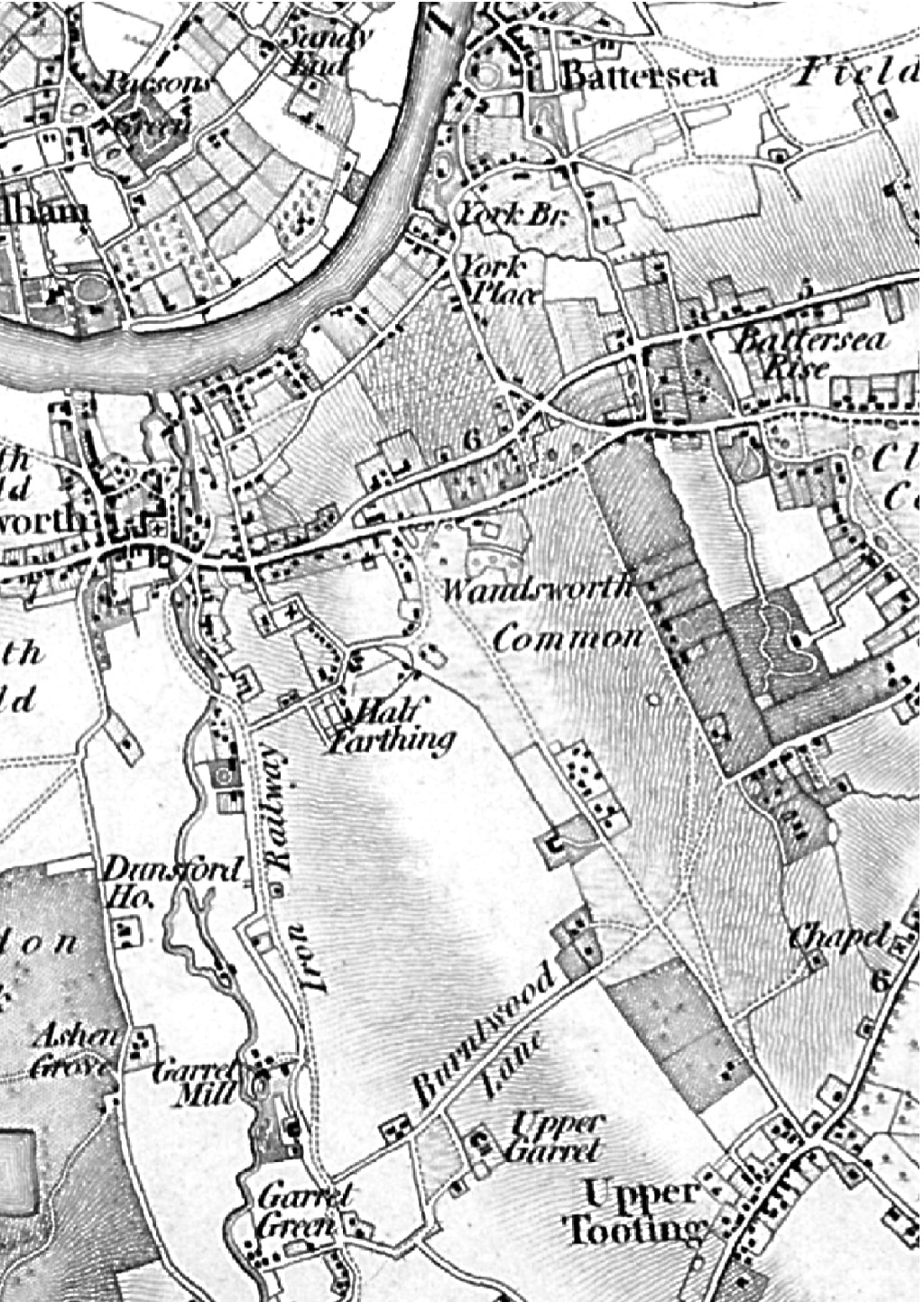


"Half Farthing", Ordnance Survey, 1-inch map (c.1810).

(Click on image to enlarge)

By the time Cruchley and Stanford maps appear (from mid-19th-century) the name is no longer applied to an area but only to a lane zig-zagging its way from the Wandle to Wandsworth Common, and its name has settled down almost exclusively to Allfarthing (All Farthing, Alfarthing).
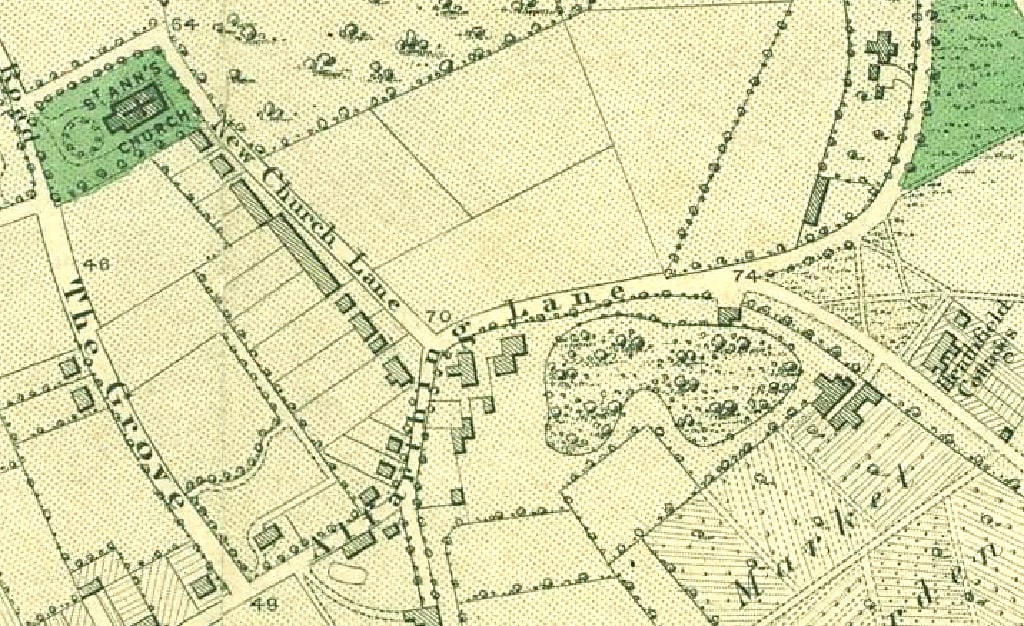


Stanford, 1862. Allfarthing manor house once stood facing Allfarthing Lane between "Church Lane" (now called St Ann's Crescent) and "The Grove" (now called St Ann's Hill).

(Click on image to enlarge)

Farthings and Half-farthings

If you're older than 65, you'll certainly recall farthings — in effect, "fourthings" — tiny bronze coins worth a quarter of an old penny. They only ceased to be legal tender in the UK on 1 January 1961, but remained in circulation in the Falkland Islands and its dependencies, and also in the British Antarctic Territory, until 31st October 1970. [Why?]


A Wren Farthing — my favourite coin from childhood. The wren replaced the figure of Britannia in 1937. Today, the coin is of even greater significance to me because I have a granddaughter called Wren (born 2018).

In the mid-1950s, I attended Earlsfield Junior School. Farthings were still legal tender. After school more or less every day, I visited the delightful sweetshop on the corner of Tranmere Road and Magdalen Road where we could buy four farthing chews and still have spent no more than one penny in total.
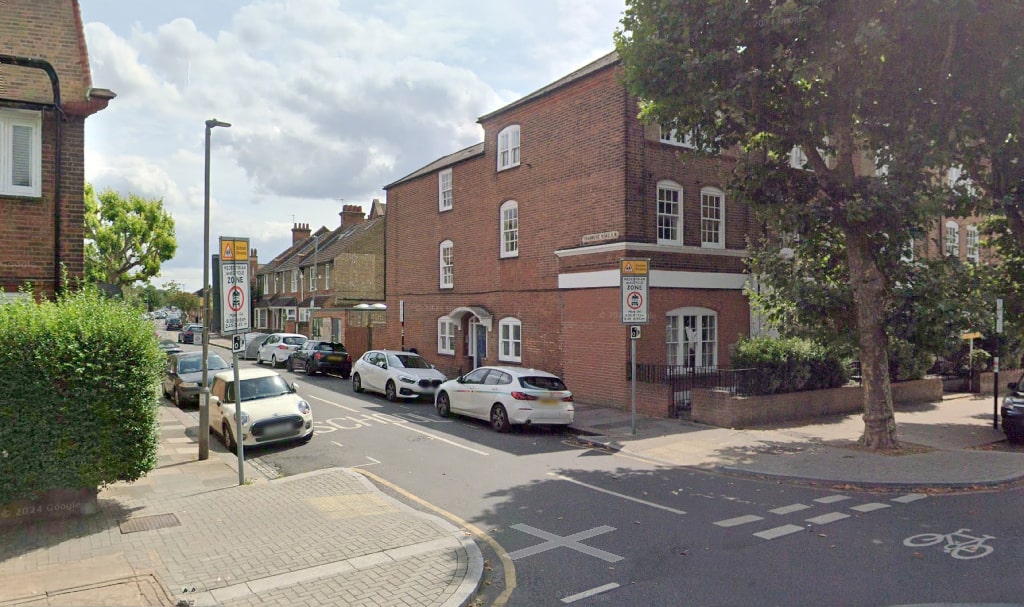


The corner of Magdalen Road and Tranmere Road. The sweetshop of dreams disappeared years ago. Its large windows, once filled with jars of tooth-rotting treats, has been bricked in on both elevations to simulate a regular terraced house.

(Click on image to enlarge)


Oranges and lemons
Say the bells of St. Clement's
You owe me five farthings
Say the bells of St. Martin's


Half-farthings?

For a start, I hadn't even realised a "half-farthing" was ever an actual coin of the realm. Did you? If I'd ever thought about it, I might have assumed it was a medieval coin. But no.
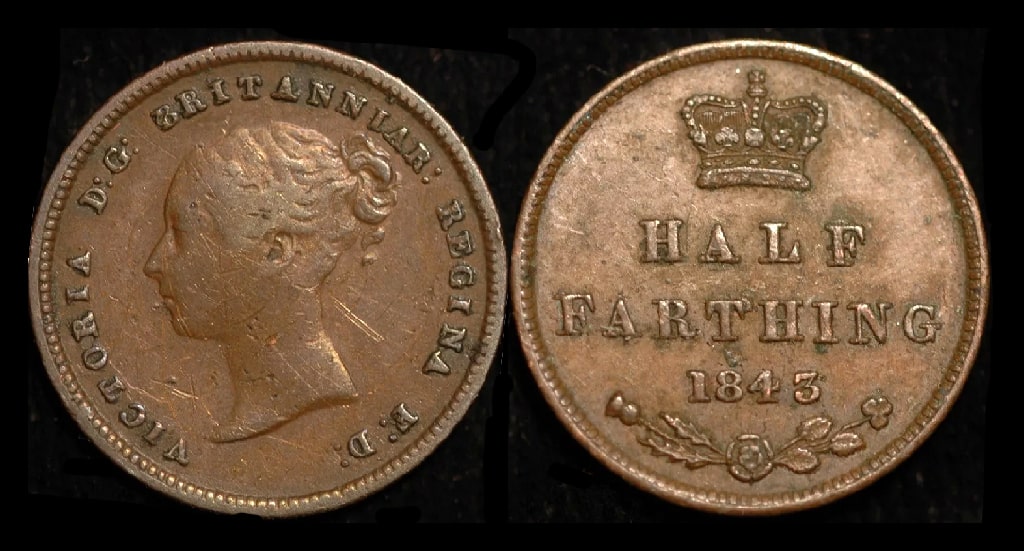


Half Farthing, obverse and reverse, 1845

(Click on image to enlarge)


The half farthing was a British coin worth 1⁄1920 of a pound, 1⁄96 of a shilling, or 1⁄8 of a penny. The coins were minted in copper for use in British Ceylon in various years between 1828 and 1856, and as a bronze proof coin in 1868. In 1842, they were also declared legal tender in the United Kingdom. Half farthings were demonetised along with all other British copper coins on 31 December 1869.

[Wikipedia: Link.]

Alas, according to the Royal Mint Museum, "the coins were a nine days’ wonder and never became popular in this country. They were demonetised with effect from 1 January 1870".


"The widow's mite . . . "

Passionate advocates of the half-farthing (and amazingly there were some) argued that there was mot only a biblical precedent for such a tiny amount, there was even a ready-made name, the "mite".


Gustave Dore, The Widow's Mite, c.1870.

"And Jesus sat over against the treasury [offertory box], and beheld how the people cast money into the treasury: and many that were rich cast in much. And there came a certain poor widow, and she threw in two mites, which make a farthing" (St Mark, ch.12, v. 41-42.).

(Click on image to enlarge)


Sixteenth-century Mite Box.

(Click on image to enlarge)

[When I was young, churches gave out small cardboard boxes to encourage us to collect donations of small denominations. Do they still do so? Do they ever call them "mite boxes"?

Remarkably, other fractional farthings were coined, including "Third-farthings" (for use in Malta), and even "Quarter-farthings" (Ceylon).

Readers of Trollope will recall that Plantagenet Palliser, when Chancellor of the Exchequer, toiled frantically to institute a decimal farthing — a "quint" — of which there would be five to the penny. Utterly futile, of course.]

Does the name "half-farthing" signify its origin in some charitable act? Not impossible, but highly unlikely.


Money, money, money — or something else?

Until now, we've assumed that "all-farthing" and "half-farthing" must refer to money — a division of some coin. But what if that which is divided is not money but land?

Keith Bailey in a compelling article for the Journal of the English Place-Name Society writes that Allfarthing/Half-farthing may represent a fraction of the large estate that we can call Battersea-cum-Wandsworth. This was granted to the nuns of Barking Abbey in the seventh century but later transferred by William I to Westminster Abbey (1067).

Using two Anglo-Saxon charters (c.690, 957), a number of local historians (including J.G. Taylor, Dorian Gerhold, Nick Fuentes, Graham Gower, Michael Green and, most doggedly, Keith Bailey) have attempted to trace its boundaries on modern maps. I'm not qualified to enter the debate, or even summarise it, but here's just one (delightful) version, from 1925:
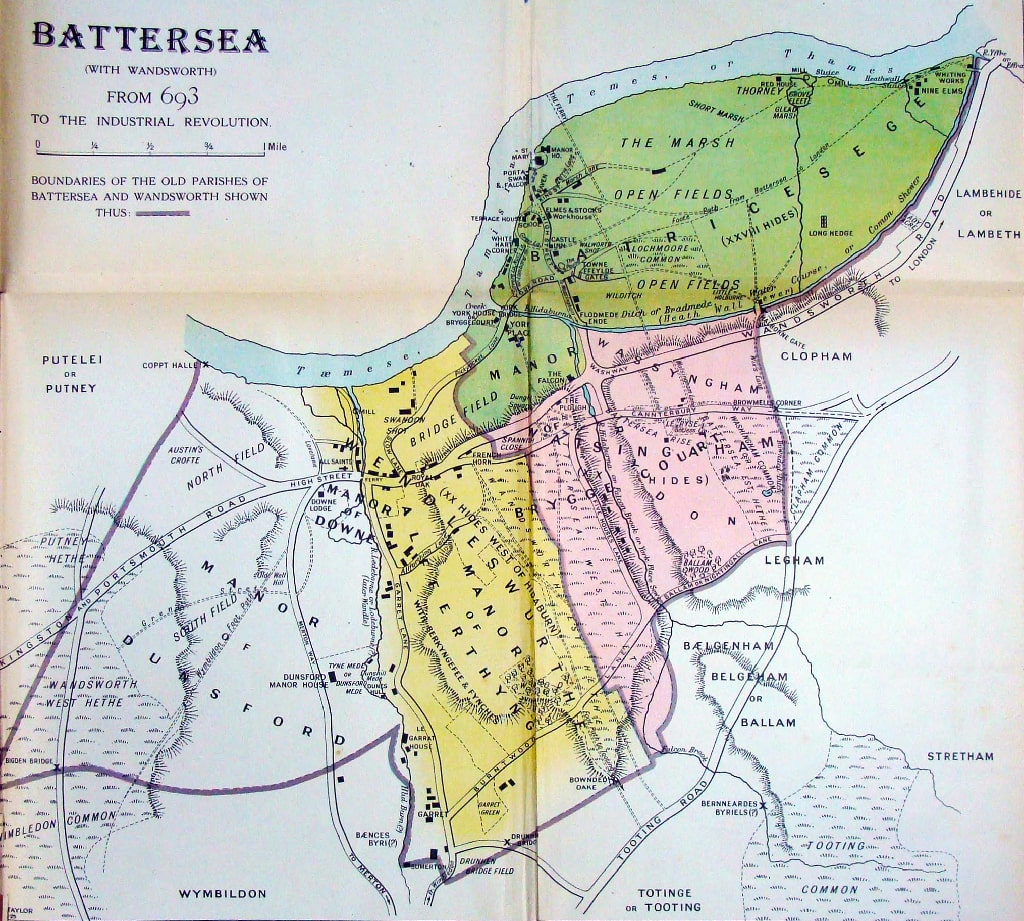


"Battersea with Wandsworth from 693 to the Industrial Revolution" — remarkable (albeit controversial) reconstruction by J.G. Taylor, Our Lady of Batersey (1925). Allfarthing manor is tinted yellow. Roughly an eighth of the total, it appears to have been carved out of the centre of the overall estate.

Other sub-manors include Dunsford, west of the River Wandle, and Downe.

(Click on image to enlarge)

In the following centuries, Battersea-cum-Wandsworth was sub-divided, one of the smaller manors being Allfarthing. Perhaps significantly, this appears to have been roughly an eighth of the previous whole.

This certainly makes a lot of sense.

But just as we feel we're getting somewhere, Keith undercuts our certainties with a very different suggestion. What if it's not a fraction at all? What if it records someone's name, with an Old English "-ing" on the end?

This is not uncommon in and around the London area, as in Ealing, Barking, Woking, Dorking — or indeed Tooting (possibly named after an Anglo-Saxon chieftain called "Tota"), just up the road from us.

So whose name? Keith helps us out yet again:


Keith Bailey, "Allfarthing: is it really a fraction?ʼ, Journal of the English Place-Name Society, 45 (2013), 42-45.

[Lost letters of the alphabet: the wonky "d" is an "eth", and the elongated "p" is a "thorn". Both are pronounced "th" — either soft (as in our modern word "Wandsworth") or voiced, as in today's "the".]

(Click on image to enlarge)

Which gets your vote? Fraction or name?
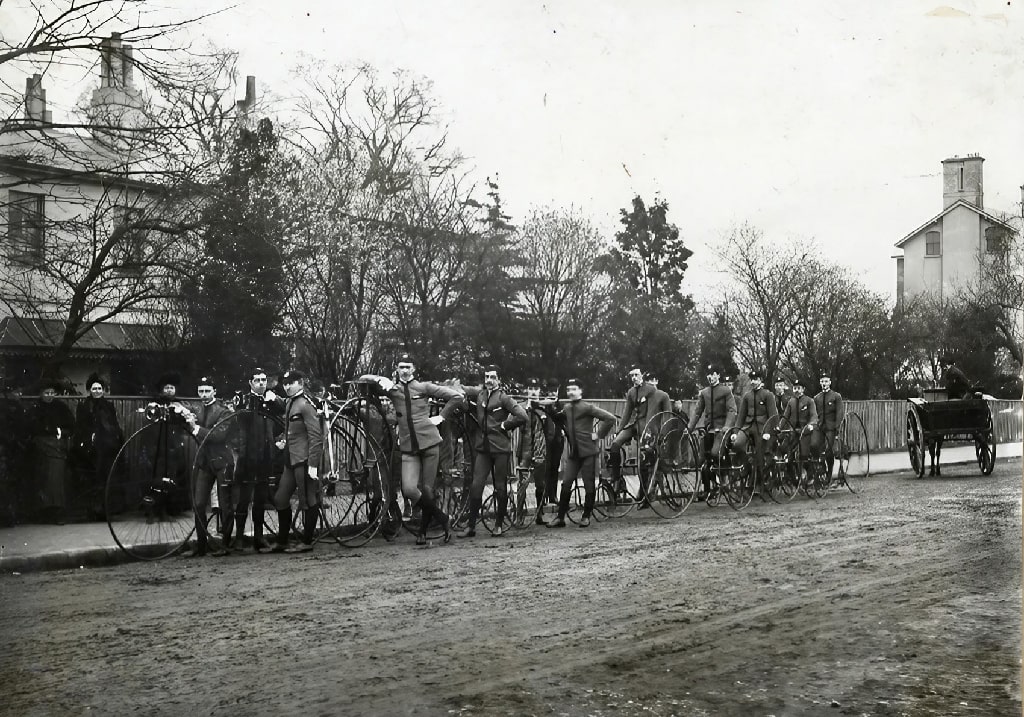


Club outing on "Penny-farthing" bicycles, Wandsworth, date and location?

(Click on image to enlarge)

Now back to slaughtered sheep . . . 


Thomas Cooper, Sheep on the Common, 1873, Manchester Art Gallery

(Click on image to enlarge)

What was so valuable about fat?


(Click on image to enlarge)

Mutton fat (or tallow) is 20% fat, with no water, protein, or carbohydrates. Rendering animal fat is the process of melting the original hard fat and straining it to remove impurities and create a stable oil. It's had countless uses historically, and still quite a number today. Here are some:

— Cooking (think suet)

— Baking

— Conditioning leather

— Cleaning guns

—  Print-making — applied to metal plates to resist acid etching

— Skin Care

— Soap making

— Lubrication e.g. greasing wooden wheel axles and steam-driven pistons

— Candle-making

— Bell-making — to separate the false bell in casting

— Fuel

— Flux for Soldering

— Sizing, lubricating and softening yarn in textile manufacture

— Treating blisters
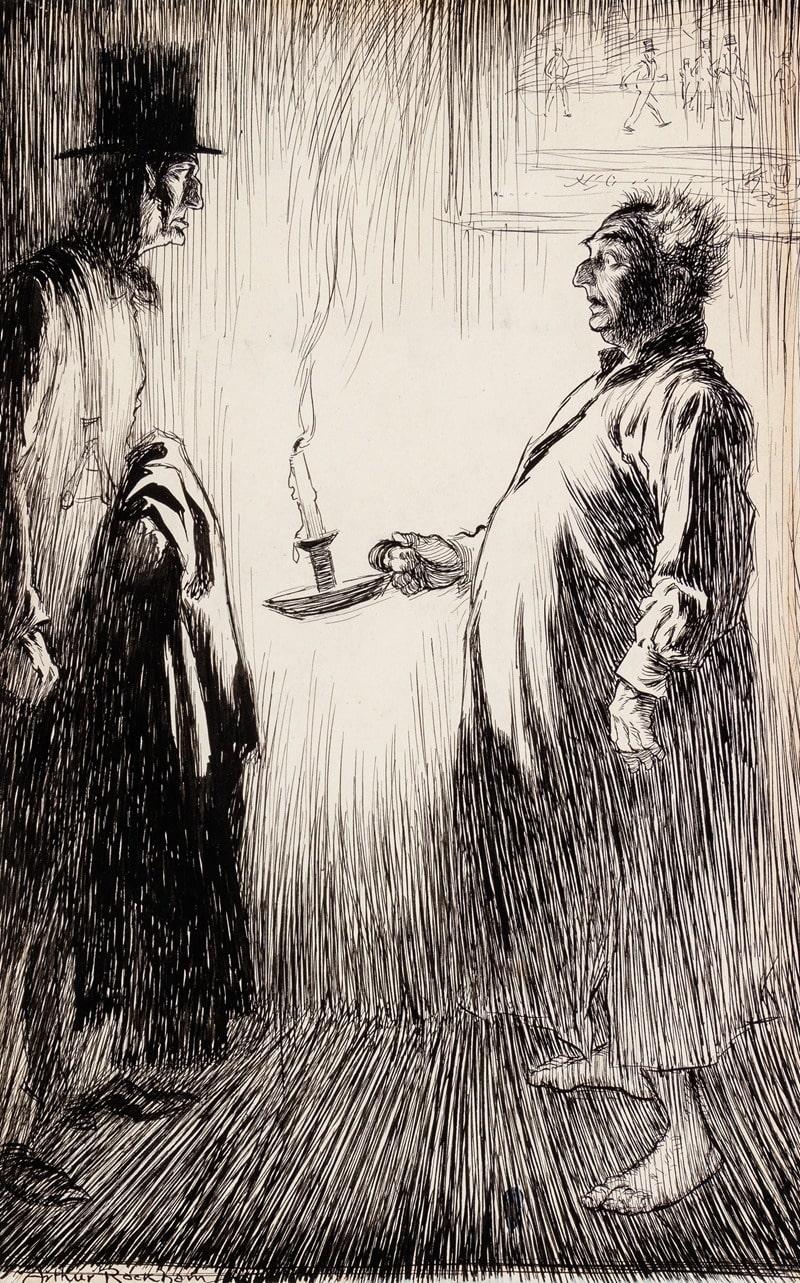


Candlight, by Arthur Rackham, unknown date. As a teenager, Arthur Rackham lived on what is now St Ann's Hill.

(Click on image to enlarge)

Farthing dips and candles


Tallow once was widely used to make molded candles before more convenient wax varieties became available — and for some time after since they continued to be a cheaper alternative. For those too poor even to avail themselves of homemade, molded tallow candles, the "tallow dip" — a reed that had been dipped in melted tallow or sometimes a strip of burning cloth in a saucer of tallow grease — was an accessible substitute. Such a candle was often simply called a "dip" or, because of its low cost, a "farthing dip" or "penny dip".

[Wikipedia: Tallow. Tallow candles tended to be smoky and smelly, but beautiful beeswax candles were too expensive for most people. Enter Price's Candles. See also Gertrude Jekyll: "Rushlights: How the Country Poor Lit the Homes".]
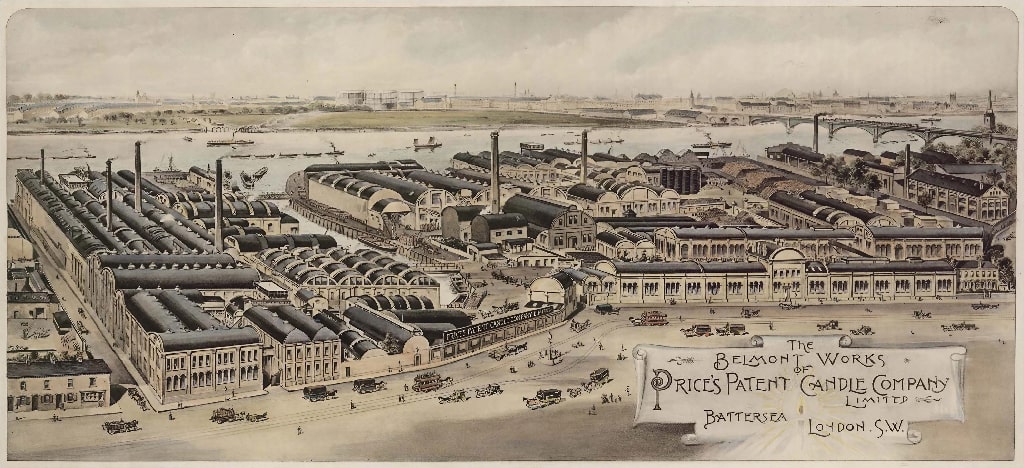


In the nineteenth century, our local Price's Patent Candle Company became the world's largest manufacturer of new types of "composite" candle — part tallow, part coconut or palm oil. (It also became a major producer of lubricants.)

(Click on image to enlarge)

I hope to write more about Price's soon, but in the meanwhile here's a short piece I wrote in 2022 about Price's splendid "Sperm candles", made from whale oil.


Sperm whale, South Seas. The "Father of British Whaling", Alexander Champion, lived in one of the "Five Houses" on the eastern edge of Wandsworth Common.

(Click on image to enlarge)

So, what do you think? Which of the many potential uses of sheep fat could possibly have paid our thief/butcher enough to risk slaughtering ten fully grown sheep in a field, and then painstakingly remove all the fat but no meat ("not even the kidneys")? Candle-making, or something else entirely?


At this point I was going to segue into a full history of sheep on the Common, but for now I'd better focus on just one story — also fat-centred.

This is John Buckmaster's cautionary tale of the dreadful fate of a man he had met when he first began to teach, in the mid-1840s. JCB's first appointment was to a penal institution for boys awaiting transportation to Australia at Parkhurst on the Isle of Wight. (Today it is an adult prison, part of "HMP Isle of Wight".)
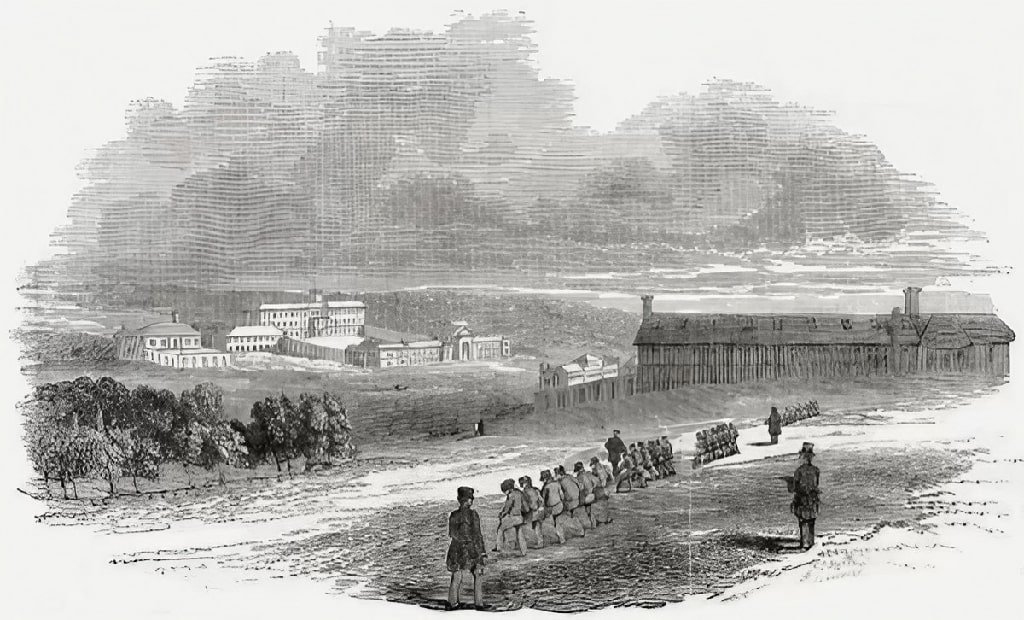
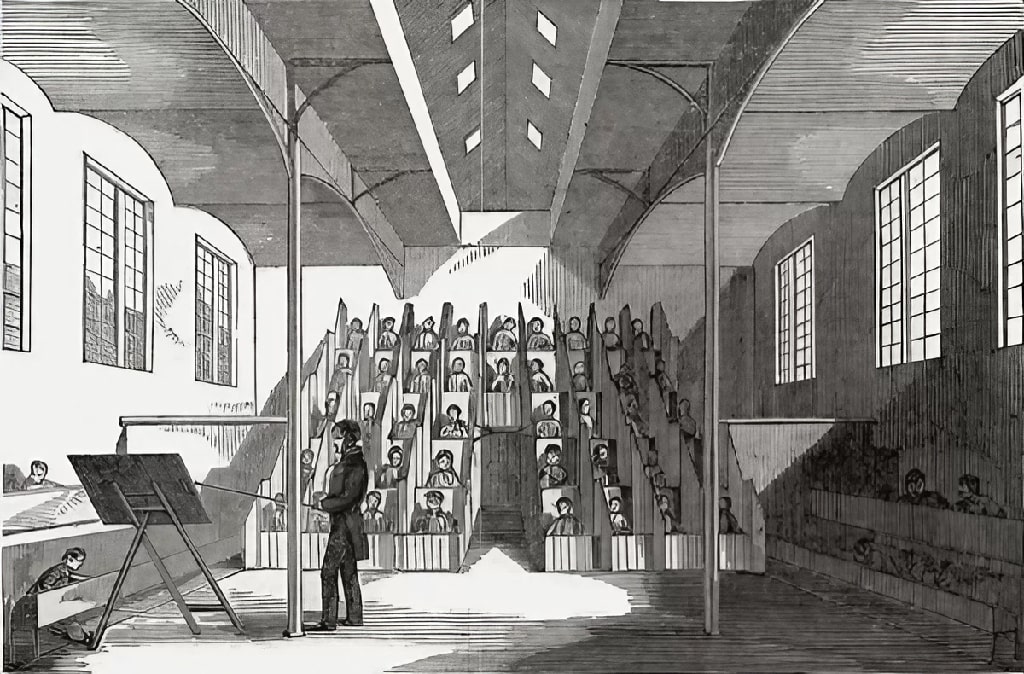

Distant view of Parkhurst, c.1847.

(Click on image to enlarge)


School room at Parkhurst, presumably the one that JCB taught in c.1847. The boys are boxed in, to restrict any conversation or interaction.

(Click on image to enlarge)

It's a fascinating piece of writing — in my view, well worth taking the time to savour:


LECTURE V.

HASHES AND STEWS

Better is a dinner with herbs where love is than a stalled ox and strife therewith.

If music be the food of love, play on.

 . . . 

HASHED mutton is the horror of most husbands, but this arises from its not being properly prepared . . . 

It is now some years ago, more than one likes to remember, that I had a bachelor friend; we used to take long walks together, and discuss the affairs of the country, and put everything right. My friend was a philosopher: he used to say, "Well, I've seen so many fellows make a mess of getting married that I shall be very careful what sort of woman I marry, that is, if I should ever be fool enough to marry."

All this, and much more, my friend used to preach to me whenever an opportunity offered. We were both in the convict service, but not as convicts; he was my mentor and had a salary of about £150 a year, rising up to £250. He was moved from the country to London, and for a time we were separated.

In course of time I came to London, and our walks and our friendship (which was the purest and most disinterested I have ever known) were renewed; but my friend had become a changed character. He talked of the misery of being alone in London, and he frequently spent his evenings at a house where there were two young ladies, one of whom was very accomplished. She could do something in water-colours and wool-work, could talk French, knew all about the kings of Judah, and the march of the Ten Thousand; and, among other accomplishments, she could sing at the Penny Readings. I reminded my friend of a verse in Ecclesiasticus, "Avoid the company of a singing woman, lest thou be overcome with her attempts."

He was a little angry, but was anxious to introduce me to the other daughter, but I had given offence to the mother by a speech at the Christian Young Men's Tea-party, at which the mother and these young ladies were present. I said that half the young ladies of the present day would wonder how the apple got into the dumpling, and all the mothers and the young ladies present considered this very insulting. As all the parties are now dead, there can be no impropriety in my referring to this circumstance.

My friend got married on £200 a year, and a man and his wife may live respectably and comfortably on £200 a year, 1f the woman knows how to cook and the family is not too large. He took a semi-detached villa, one of those ugly plaster things in which the neighbourhood of London abounds, Two months after my friend was married, he wished me to dine with him and be introduced to his wife.

We met by appointment at the station and arrived at the semi-detached villa, which was like a packing-case with square holes. The hideous cast-iron railings in front, the compo steps leading to the front door; the sixpenny knocker, painted black, with a goat's head; the newly varnished door, cracked and split in every direction by the sun, like a map of Europe. The newly gravelled path; the yellow marble paper and narrow passage, with the drawing-room separated from the dining-room by folding-doors, which would neither open nor shut; cheap ugly fireplaces, with iron sufficient to make a railway — 25 per cent. was the leading idea of the man who built it. Inside and outside there was nothing but show and untruthfulness.

The drawing-room carpet was beginning to show by faint white lines the exact width of the flooring boards. The kitchen chimney had caught cold and smoked, so we had to wait about three-quarters of an hour beyond the time appointed for dinner, which neither improved my friend's temper nor his language.

I kept saying it was all right, and as we had nothing to do, waiting was of no consequence.

At last the happy moment arrived. Only a plain dinner, fish and a leg of mutton; they kept a very plain cook and a waiting-maid. I thought this rather strong on two hundred a year, but everybody must be the best judge of their own affairs. A piece of turbot came up like fish-soup, in small pieces; it had been boiled to rags and strained over a colander, and I should never have known what kind of fish it was if I had not been told.

My friend, I could see, was getting uncomfortable; he complained about good fish being spoilt and the waste of food and so on.

Then followed the leg of mutton, black all over except the ends. Attempts had been made to scrape off the black, which had removed the skin, which had been clumsily stuck on again; it looked anything but nice. When the knife went into it off came the skin, and you could see that from about three-quarters of an inch from the outside it was as fresh and as tough as it was in the butcher's shop.

My friend was bursting with anger, but his wife said, very blandly, "Cut off the outside, my dear, the remainder will do for hash; I am told it is all the better for not being too much done."

Then came the vegetables, cabbages and potatoes, the potatoes in a squashy condition and the cabbages raw. My friend now made use of language I had never heard him use before. His wife remonstrated with him, she threw all the blame on the servants, who had, perhaps, never seen a leg of mutton before, except in a butcher's shop.

After my friend was a little more composed he said to his wife, "You ought to have seen to the cooking yourself."

And now for the climax. His wife replied, "Very complimentary to know that when you married me you thought you were marrying a cook." My friend swore, it was not his habit. His wife cried and left the room, and this is how two young persons commenced their married life on two hundred a year.

We went into the garden and smoked; my friend seemed a little comforted with his pipe. I began to feel he had made a mistake, but his was one of those natures that could not or would not be reasoned with. He gradually took to dining away from home, and spending his evenings with sporting men or at billiards, he became a gambler and a drunkard, lost his situation, and died at thirty-one in an hospital.

His wife endeavoured to earn a livelihood for herself and her little child by teaching music, and after a wearisome struggle the child died, and the mother shortly followed to that place where the weary are at rest. What a misfortune that this young lady had never been taught the practical duties of domestic life, for God intended that man and wife should be happy in this world, but Pride, Pretence, and Hypocrisy make us miserable.

JCB's recipe for Hashed Mutton (and domestic harmony)

 . . . for the benefit of young ladies whose mothers have neglected their education, I will endeavour to teach them how to make Hashed Mutton an attractive dish . . . 


HASHED MUTTON

Ingredients

    Eschalots

    Cold mutton

    Tomato sauce

    Bouquet garni

    Walnut

Cut up neatly from a leg of mutton or other joint all the meat in pieces about the same size. Remove all the fat, skin and bone, and every piece which is burned or blackened by the fire, or the hash will have a strong disagreeable flavour. The parts not used for hash may go into the stock-pot.

Melt in a quart stewpan one ounce of sweet butter, then two finely minced eschalots and a dessert-spoonful of flour, and stir for five minutes. Now add two gills of stock, salt if necessary, half a teaspoonful of whole pepper, one clove, three allspice, a bouquet garni, a teaspoonful of walnut ketchup, or half the quantity of Worcester sauce, and a tablespoonful of tomato sauce.

Stir continually till the contents come to the boil, keep boiling a few minutes, then strain into another stewpan, and let the sauce cool before adding the meat or it will harden. When cold lay in the pieces of meat, place the stewpan over the fire, and let the contents gradually warm, occasionally shake the stewpan, and be careful not to let the hash boil.

As soon as the meat is sufficiently warmed serve with sippets of bread fried in butter.


John Tenniel, "The leg of mutton got up in the dish and made a little bow to Alice," from Lewis Carroll, Through the Looking Glass (1871).

It was Tom Taylor — the Battersea-dwelling dramatist, editor of Punch magazine and inspirational defender of Wandsworth Common in the run-up to the 1871 Act — who introduced Lewis Carroll to John Tenniel, the illustrator of both Alice books.

(Click on image to enlarge)

Matters arising . . . 

I've already mentioned how an email from Jason Hazeley got me thinking about Half-farthings and mutton fat. But there were a number of other very interesting responses. Here are one or two.

Last month, I wrote about bird-song competitions between "goldfinch mules" held at the Carpenter's Arms on Chatham Road (long since gone, of course), in which I said something very silly:


"Mules" must be cocks/male birds, but what do "Once in the mouth" and "Gaslight" mean?


From Joseph Nash, A Practical Treatise on British Songbirds; in which is given every information relative to their natural history, incubation, &c., together with the method of rearing and managing both old and young birds,, 1824 (pdf here).

(Click on image to enlarge)

Nobody has come forward (so far) with what "Once in the mouth" and "Gaslight" might mean, but I now know quite a lot more about Goldfinch "mules".

Within a few hours of receiving January's Chronicles, our wonderful wildflower expert Roy Vickery commented:


At one time plants which were hybrids between two species were known as 'mules'. Thus the first hybrid known to have been deliberately made, a cross between sweet william, Dianthus barbatus, and carnation, D. caryophyllus, was known as 'Fairchild's mule', having been created in 1716-7 by Thomas Fairchild.

Probably irrelevant, but possibly 'goldfinch mules' were hybrids between goldfinches and some other species?

For more info. on "Fairchild's mule", see e.g. Herbaria Plants: Dianthus caryophyllus L. x Dianthus barbatus L. (Caryophyllaceae), which starts, "During the seventeenth and eighteenth centuries, bastard, freak, rogue, monster, mongrel and mule described horticultural oddities."

Almost at the same moment, Barbara Littlechild emailed to say she had found this online:


"British finches are often associated with mules, a term used by cage bird breeders to refer to hybrids of finch species bred in captivity, such as that of a goldfinch and canary . . . 

Song — this was the original purpose of cross breeding the canary with finches. If the young mules were moved away from canaries after weaning and kept in earshot of the finch, the young mules would sing pure finch song.

[Wikipedia: British Finches].

Barbara added that it still seems to be current practice with several websites & "training" videos on YouTube.

(Click on image to enlarge)

Here's a video, one of many online, of a goldfinch mule singing.


YouTube: "Goldfinch Mule Singing 20% Goldfinch Song".

(Click on image to play video)

Spot on, Barbara and Roy — many thanks to you both!

On bird competitions of a rather different kind, see this story of cock-fighting in an unnamed Wandsworth Common beerhouse, 19 February 1838. This too is likely to have take place in Chatham Road.
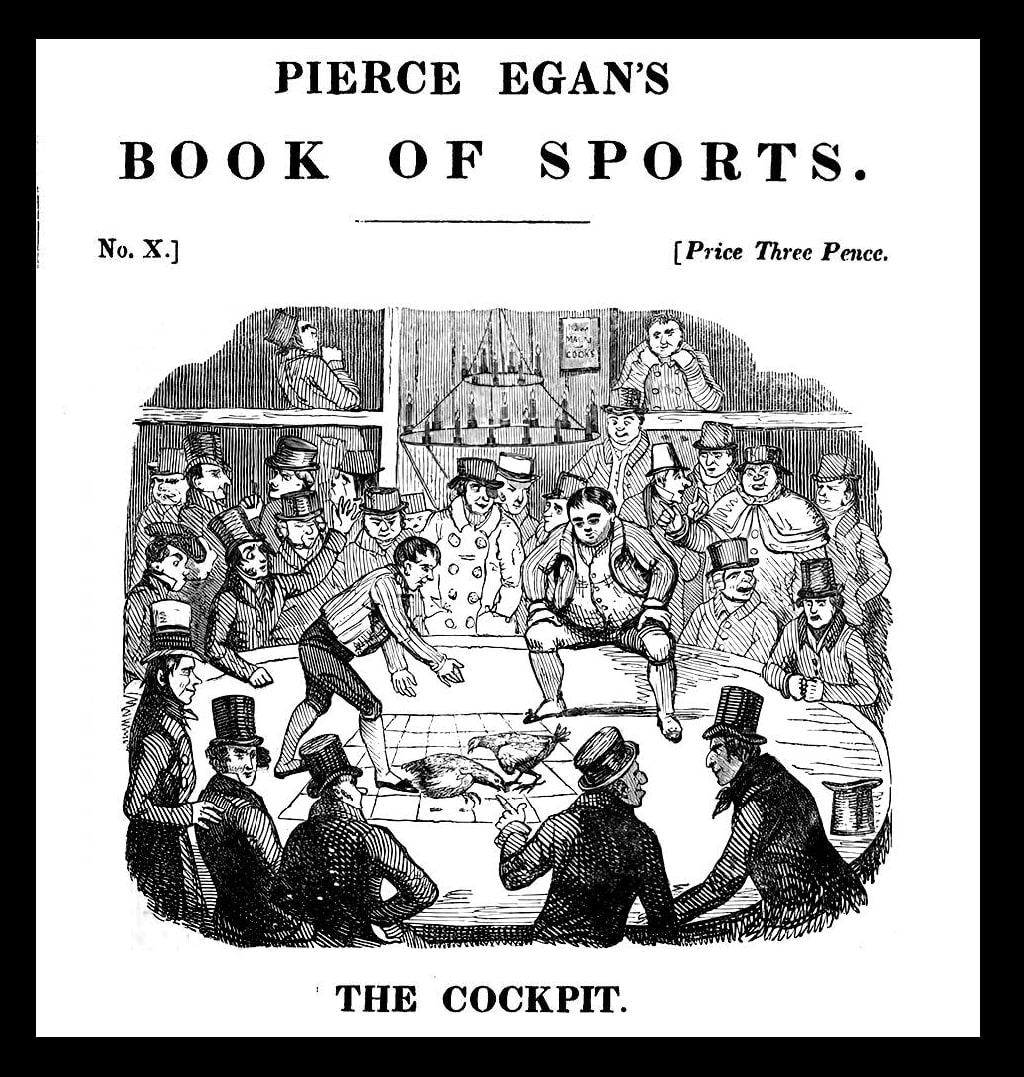

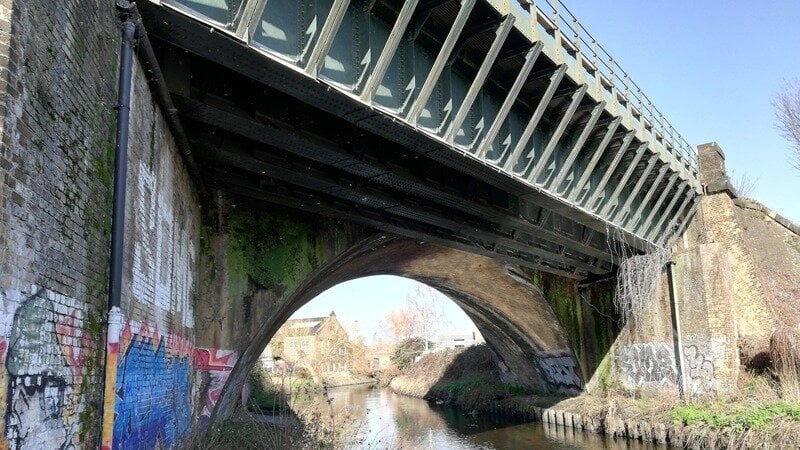
The Cockpit, from Pierce Egan's Book of Sports, and Mirror of Life: Embracing The Turf, The Chase, The Ring, and The Stage interspersed with Original Memoirs of Sporting Men etc. (1832?).

(Click on image to enlarge)

A.O.B.

Let's fix the "Missing Link" in the popular Wandle Trail!


Fix the "Missing Link" in the Wandle Trail

At the moment, there's no way through

(Click on image to enlarge)

This petition was started 27 January 2025 by the Wandle Valley Forum.

Here's the Forum's latest bulletin.

Petition to the Leaders of Wandsworth & Merton Councils


Fix the "Missing Link" in the Wandle Trail

Why this petition matters

The Wandle Trail is blocked by the major railway bridge near Earlsfield. Walkers and cyclists are forced to leave the river and divert via busy roads.

Fixing this "Missing Link" in the Wandle Trail has been a priority for local communities and all who care for the Wandle for many years.

Providing a route through the bridge will be transformational. It will create a major new active travel route for walkers, families with children, cyclists and wheelers. This will address demands arising from significant new development in the area and help meet the wider needs of the Wandle Valley.

The railway bridge lies on the border of Merton and Wandsworth. Both local authorities have identified it as a "priority project" in their Local Plans and Infrastructure Delivery Plans. It is eligible for funding from the community infrastructure levy on new development among other sources.

A feasibility study has now been completed by Merton Council. It provides a preferred option which has the support of Network Rail and Environment Agency and costs c£1.1m.

The feasibility study shows that there is a solution to the "Missing Link" which is deliverable and affordable. We are asking the leaders of Merton and Wandsworth Councils to deliver this preferred option and realise the benefits it will provide.

Please sign this petition . . . 

And share this petition in person or use this QR code . . . 


The stretch in question at the end of the C19:
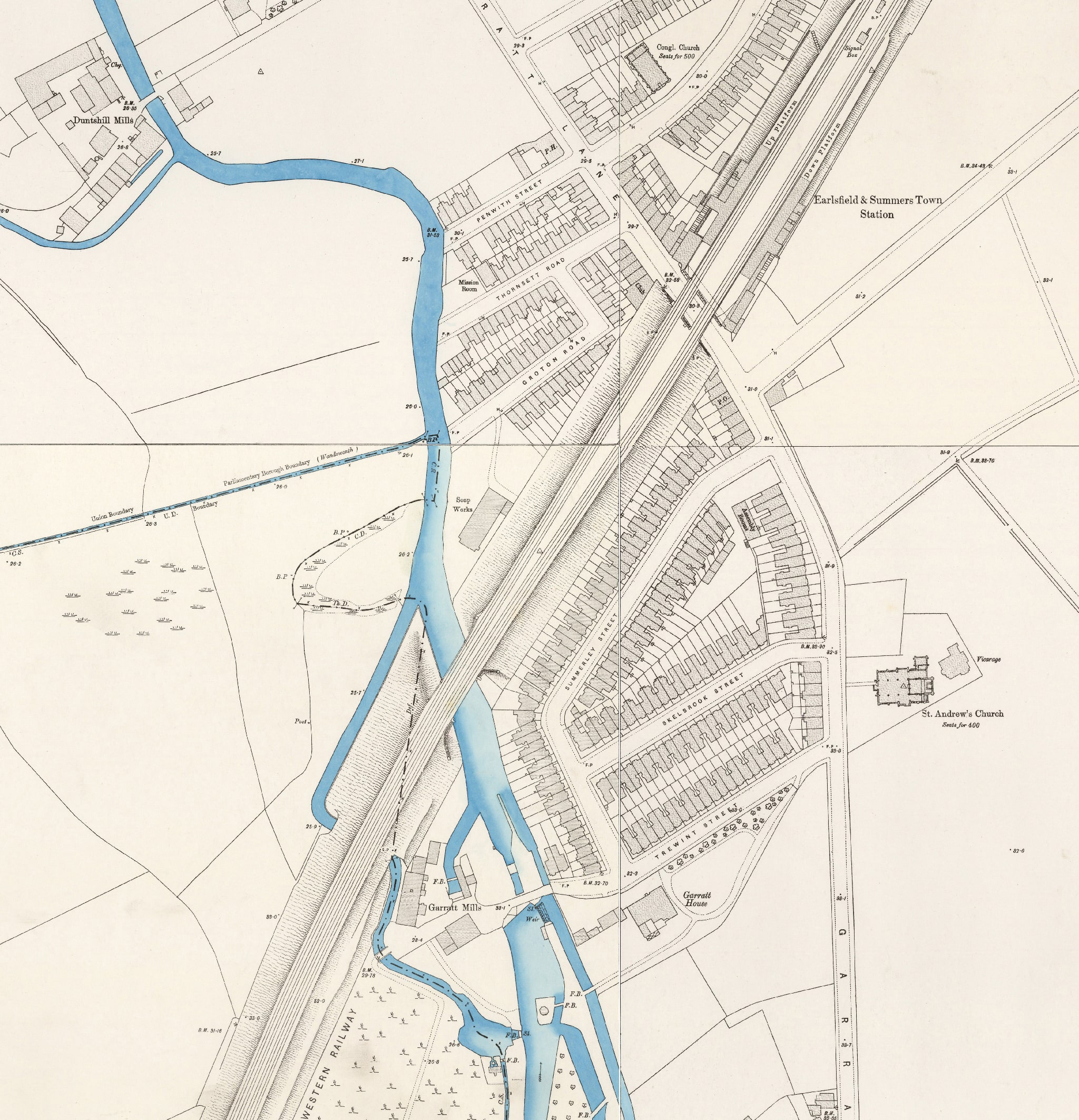
OS, 1890s, 5 feet to one mile: Earlsfield railway bridge crossing Garratt Lane and River Wandle.

(Click on image to enlarge)

National Portrait Gallery

Portrait of the Month: Octavia Hill

Octavia Hill, portrait by John Singer Sergeant, 1898. National Portrait Gallery.

(Click on image to see this portrait on the NPG website.)

I don't know how well Olivia Hill knew Wandsworth Common, but Robert Hunter, her friend and fellow-founder of the National Trust, was a key figure in the saving of the Common in 1871. (He lived 1869—1872 at 5 Louvaine Road, where there is now an English Heritage Blue Plaque.)

Among Olivia Hill's many achievements (perhaps less well known than others) was to help save sections of the Wandle riverbank that are now part of the wonderful Wandle Trail. (See e.g. the Wimbledon Society's article "How the protection of the Wandle Valley started".
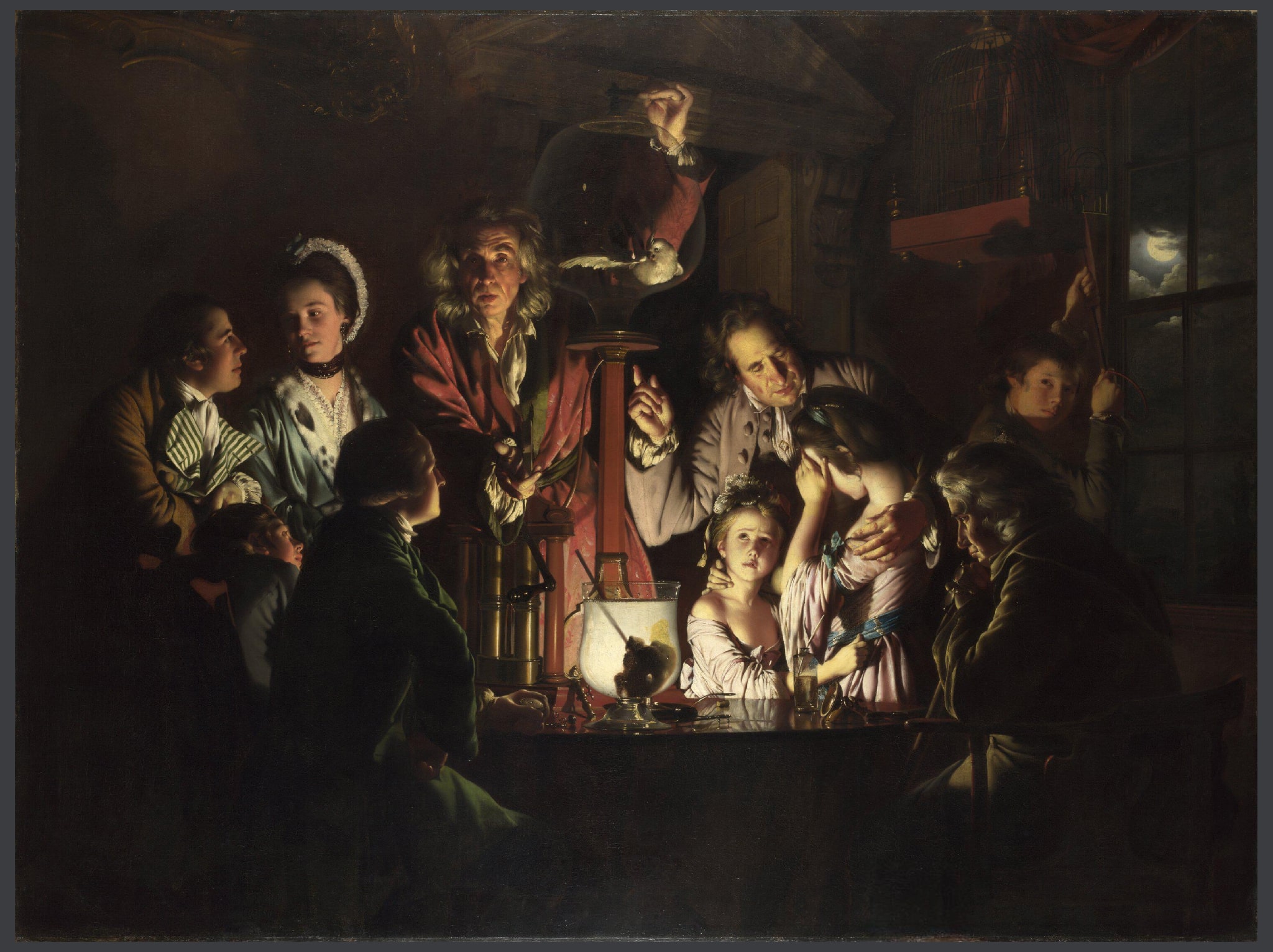
That picture puzzle solved  . . . 


Joseph Wright "of Derby", An Experiment on a Bird in the Air Pump, 1768. National Gallery, London. A single candle sheds more light on the assembled group than the full moon — but makes the whole scene so much more mysterious and perhaps alarming.

(Click on image to enlarge)


Chronicles

January 2025


"Two venerably bearded Turks in the full costume of the East".

How are these chaps (or rather ones looking much like them) connected to Wandsworth Common? Answer at the foot of the page.

(Click on image to enlarge)

Let's start with a story about New Year's resolutions . . .

1 January 1920

A man in a railway carriage coming up to Town confides to his fellow commuters that he has a "terrible awe-inspiring resolve" to commit a "fearful outrage". He wants to kidnap the director of the railway company (the London, Brighton and South Coast line) and then to subject him to "long, lingering, terrible torture".

And the nature of the torture?

    "I'm going to  . . . make him travel third class on the 8.45. And he will have to get in at Wandsworth Common!"

Yes, it's pretty frivolous stuff, but reading between the lines you can learn quite a lot about the concerns and life-experiences of (middle-class male) suburban Londoners at this time.
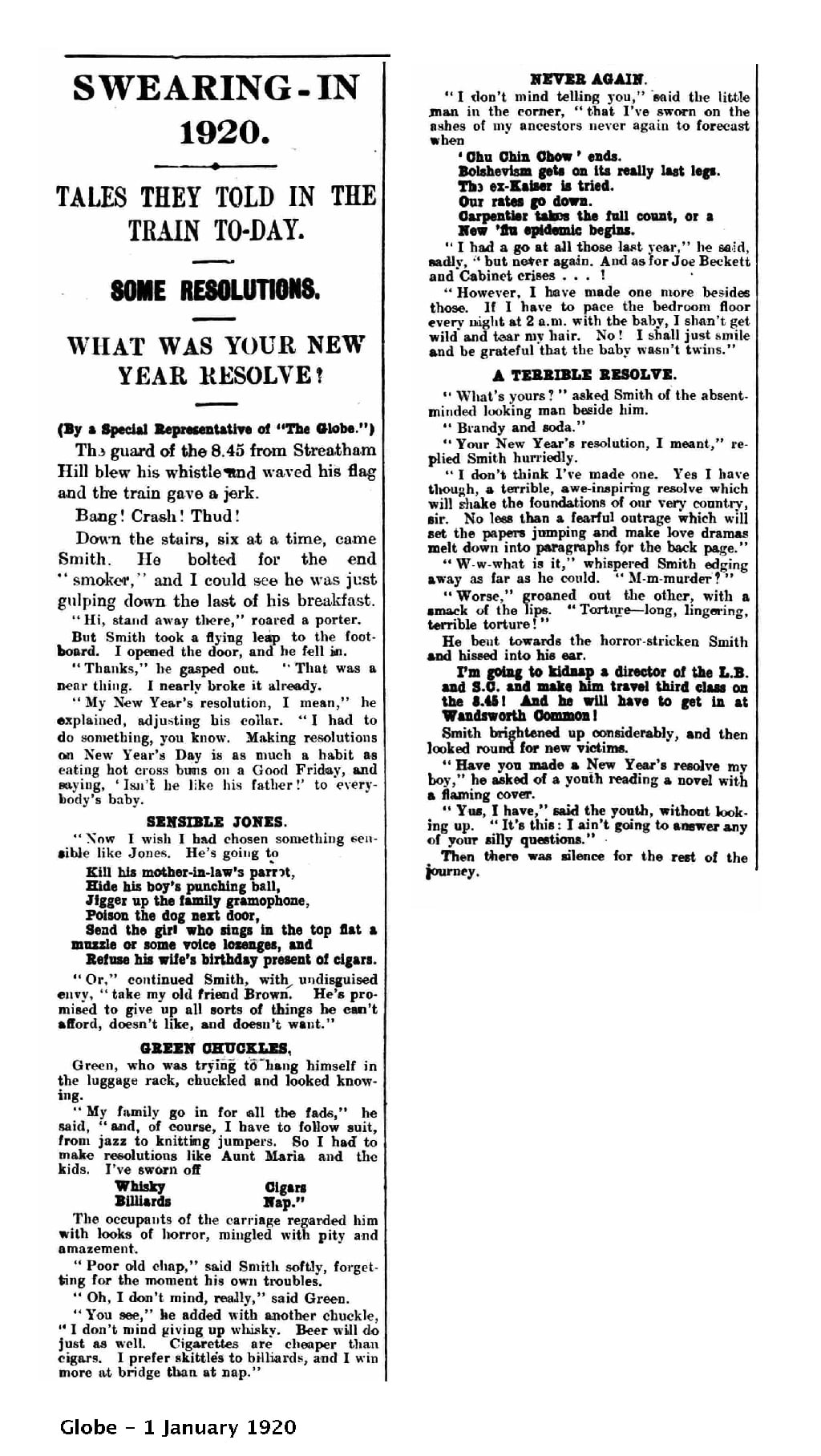
Globe — Thursday 1 January 1920


(Click on image to enlarge)


SWEARING-IN 1920

TALES THEY TOLD IN THE TRAIN TO-DAY

SOME RESOLUTIONS

WHAT WAS YOUR NEW YEAR RESOLVE?

(By a Special Representative of "The Globe.")

The guard of the 8.45 from Streatham Hill blew his whistle and waved his flag and the train gave a jerk.

Bang! Crash! Thud!

Down the stairs, six a time, came Smith. He bolted for the end "smoker," and I could see he was just gulping down the last of his breakfast.

"Hi, stand away there," roared a porter.

But Smith took a flying leap to the footboard. I opened the door, and he fell in.

"Thanks," he gasped out. "That was a near thing. I nearly broke it already.

"My New Year's resolution, I mean," he explained, adjusting his collar. "I had to do something, you know. Making resolutions on New Year's Day is as much a habit as eating hot cross buns on a Good Friday, and saying, 'Isn't he like his father!' to everybody's baby.

SENSIBLE JONES

Now wish I had chosen something sensible like Jones. He's going to

    Kill his mother-in-law's parrot,
    Hide his boy's punching ball,
    Jigger up the family gramophone,
    Poison the dog next door,
    Send the girl who sings in the top flat a muzzle or some voice lozenges, and
    Return his wife's birthday present of cigars.

"Or," continued Smith, with, undisguised envy, take my old friend Brown. He's promised to give up all sorts of things he can't afford, doesn't like, and doesn't want."

GREEN CHUCKLES

Green, who was trying to hang himself in the luggage rack, chuckled and looked knowing.

"My family go in for all the fads," he said, and, of course, I have to follow suit, from jazz to knitting jumpers. So I had to make resolutions like Aunt Maria and the kids. I've sworn off

    Whisky          Cigars
    Billiards          Nap."

The occupants of the carriage regarded him with looks of horror, mingled with pity and amazement.

"Poor old chap," said Smith softly, forgetting for the moment his own troubles.

"Oh, I don't mind, really," said Green.

"You see," he added with another chuckle, I don't mind giving up whisky. Beer will do just well. Cigarettes are cheaper than cigars. I prefer skittles to billiards, and I win more at bridge than at nap."

NEVER AGAIN

"I don't mind telling you," said the little man in the corner, that I've sworn on the ashes of my ancestors never again to forecast when

    'Chu Chin Chow' ends,
    Bolshevism gets on its really last legs,
    The ex-Kaiser is tried,
    Our rates go down,
    Carpentier takes the full count, or a
    New 'flu epidemic begins.

"I had a go at all those last year," he said, sadly, but never again. And as for Joe Beckett and Cabinet crises . . . !

"However, I have made one more besides those. If I have to pace the bedroom floor every night at 2 a.m. with the baby, I shan't get wild and tear my hair. No! I shall just smile and be grateful that the baby wasn't twins."

A TERRIBLE RESOLVE

"What's yours ? asked Smith of the absent-minded looking man beside him.

"Brandy and soda."

"Your New Year's resolution, I meant," replied Smith hurriedly.

"I don't think I've made one. Yes I have though, a terrible awe-inspiring resolve which will shake the foundations of our very country, sir. No less than a fearful outrage which will set the papers jumping and make love dramas melt down into paragraphs for the back page."

"W-w-what is it," whispered Smith edging away as far as he could. "M-m-murder?

"Worse," groaned out the other, with a smack of the lips. "Torture — long, lingering, terrible torture!"

He bent towards the horror-stricken Smith and hissed into his ear.

"I'm going to kidnap the director of the L.B. and S.C. and make him travel third class on the 8.45.

And he will have to get in at Wandsworth Common!"

Smith brightened up considerably, and then looked round for new victims.

"Have you made a New Year's resolve my boy," he asked of a youth reading a novel with flaming cover.

"Yus, I have," said the youth, without looking up. It's this. "I ain't going to answer any of your silly questions."

Then there was silence for the rest of the journey.

[BNA: Link.]

By the way, it's the first of January, but clearly the men are travelling to work. I really hadn't remembered that it wasn't until 1974 that New Year's Day became a bank holiday.


One of my favourite postcards of Wandsworth Common Station . . 

Can we date it?
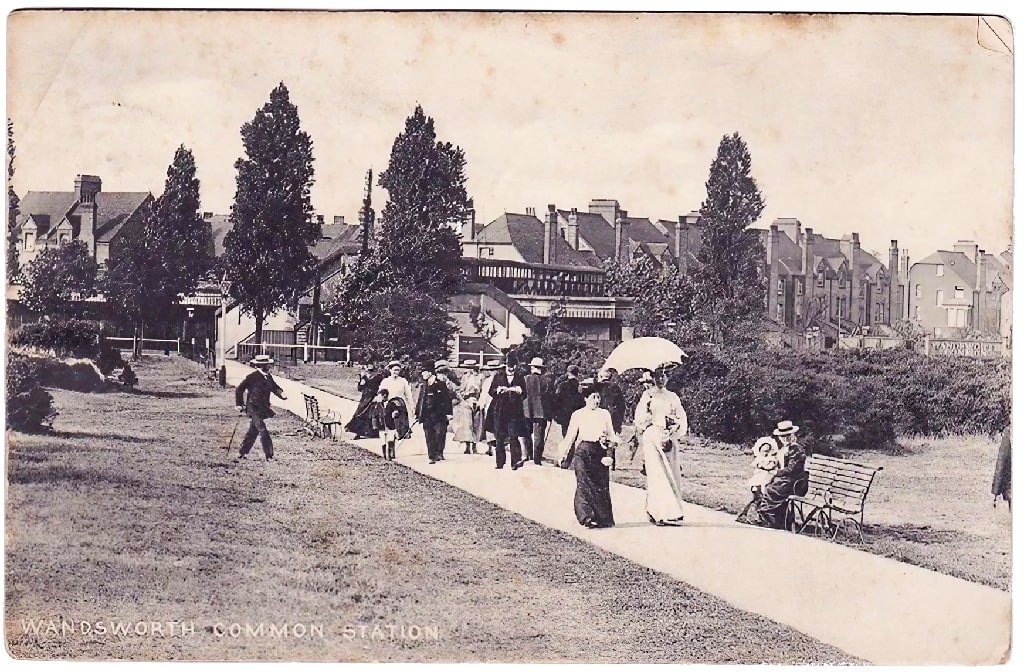


Wandsworth Common Station, early C20 — notice there is no ticket office on the Common side.

I wondered when the ticket office was built, and went looking for an answer.

According to the Northern Daily Mail (Hartlepool) (18 April 1908), "The booking office of Wandsworth Common Station was destroyed by fire last night. It was built last year." This implies 1907.

Here's an image of another fire at the station a few years earlier, but this one seems to have involved the wooden bridge over the tracks.


[BNA: Penny Illustrated Paper, 7 March 1903.]

(Click on image to enlarge)

When I first saw this image, I assumed it was only about Wandsworth Common Station. (Even I, who thinks that the sun, moon and stars revolve around Wandsworth Common, was surprised that so much national attention should be drawn to a fairly parochial incident.)

But then I looked more closely and noticed something very odd in the circle in the centre of the picture.

Take a closer look.

A row of soldiers firing rifles. Shooting commuters? At Wandsworth Common station?

It turned out that the image is a composite of not one but three stories, entitled "SOME INCIDENTS OF THE WEEK":

1. Collapse of a wall near Walworth Road Station.

2. Spanish Guards Fire on a Disorderly Crowd during the Carnival Festivities at Vigo. Several Persons were Killed or Wounded.

3. Burning of Railway Bridge at Wandsworth Common Station.

An odd juxtaposition.

As for the date of the postcard, some time around 1905?


While we're talking railways . . .
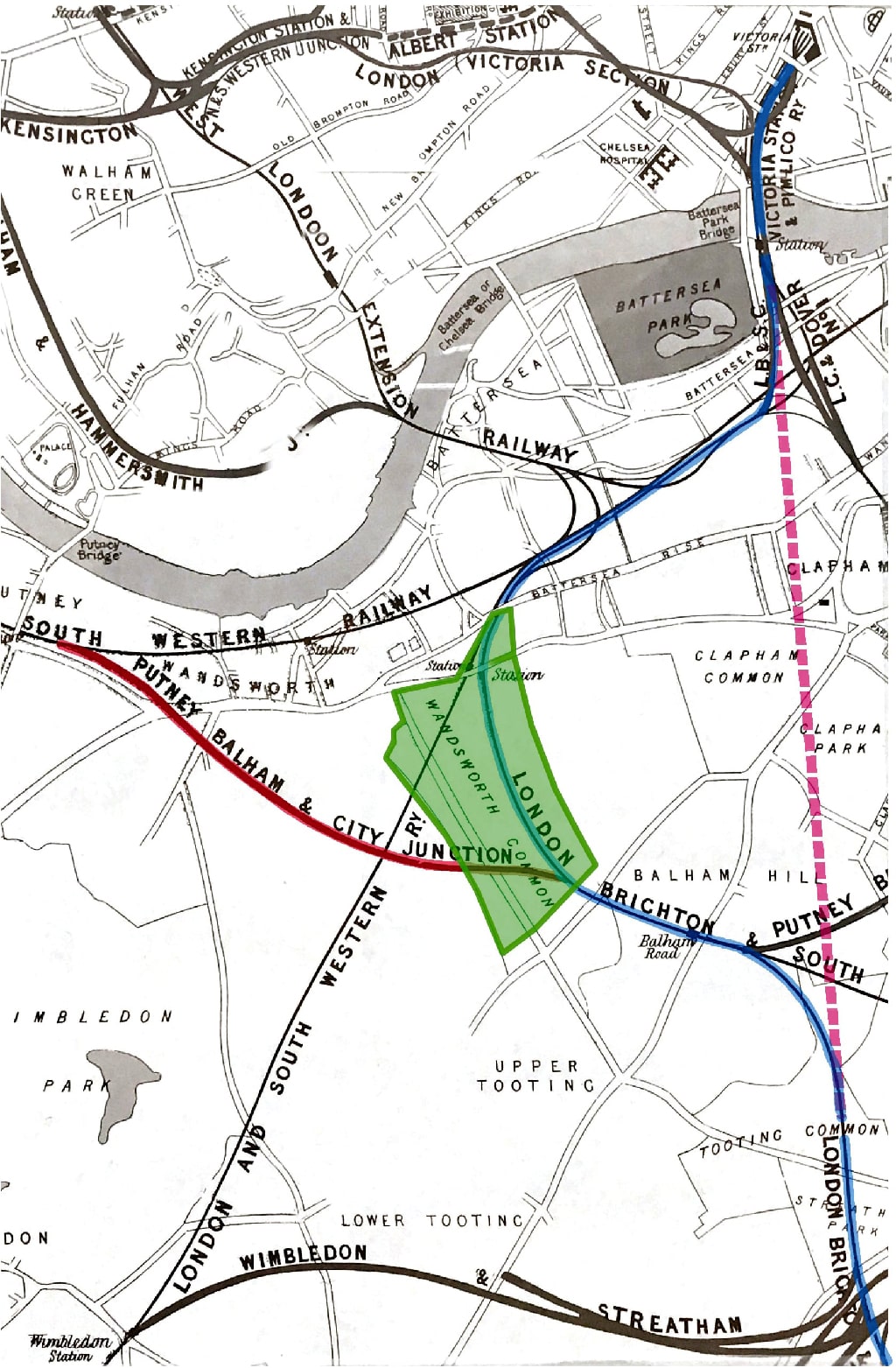
Proposed new lines crossing Wandsworth Common, 1863


Proposed new railway lines, 1863 (thick), existing routes (thin). I have aded some colour for clarity. Notice in particular the Putney, Balham and City Junction line (red). This would have gouged yet another great canyon across Wandsworth Common.

[I've also added a pink broken line to show the direct route the Brighton line might have taken from Brighton to Victoria had the people of Clapham been less insistent that it didn't come anywhere near their Common — which meant of course that our Common was transected instead.]

(Click on image to enlarge)


The course of the Putney, Balham and City Junction line crossing Wandsworth Common superimposed on a modern map.

(Click on image to enlarge)

The new line was intended to veer off at what would later (1869) be Wandsworth Common Station, then pass in a cutting under Trinity Road (more or less where Routh Road crosses now), loop just south of the prison, traverse St Ann's Hill, span Garratt Lane at the end of Allfarthing Lane, then straddle the Wandle and what is now King George's Park (on a viaduct).

[Keith Bailey tells me that the detailed plans for the Putney, Balham etc are at the House of Lords Record Office HL/PO/PB/3/plan 1862/B27.

"The Putney, Balham & City Junction appears on London Topographical Society 116 (1973) which shows schemes submitted in 1863. It would have used the Chatham & Dover line to reach Blackfriars & Holborn (and thence north). Had they all come to fruition, the scope for housebuilding would have been rather curtailed! The urge to link Putney & environs to the City was finally solved by the Waterloo & City tube.""

Thanks, Keith! ]

The Putney, Balham and City Junction line was not the only extra line proposed to cross the Common. How about this one, about which I know very little (including, frustratingly, the date and source of the map!):
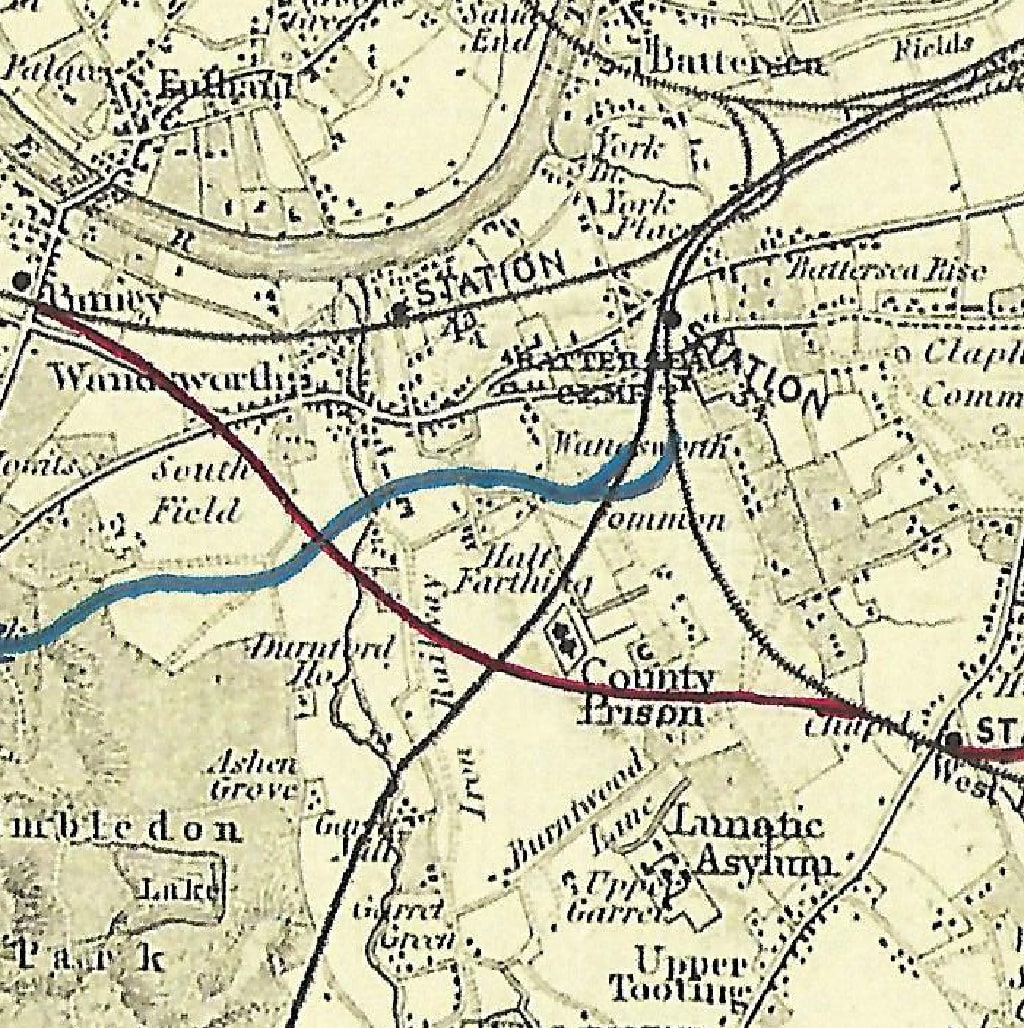


(Click on image to enlarge)

Branches are shown to/from both the Southampton and the Brighton lines, which is strange because of course they were owned by different companies at this time. (And collaboration was very unusual.) The line would have crossed Wimbledon Common and Coombe Hill, presumably on its way to Kingston.

This next article may be related, but possibly refers to yet another line, since Putney and Barnes lie in a different direction.

South London Press — Saturday 28 January 1882


The London and South-Western Railway propose to construct a railway about quarter of a mile long, to commence by a junction with the main line just westward of the Royal Freemasons' School, Wandsworth Common, and terminating at a junction with the Richmond Railway at Clapham Junction station.

It will pass under a public footpath leading to Plough-lane, and under Wandsworth-road, at a depth of sixteen feet two inches below the roadway.

The scheme includes the widening on both sides of the railway the north side from Barnes station to Clapham Junction, and on the south from Barnes station to within a distance of about five hundred feet west of Putney station.

The widening on the south side will continued from a point about five hundred feet east of Putney station to near the crossing at York-road by Wandsworth station.

The proposed railway and widenings will cross over the Board's main low level sewer in Wandsworth-lane, and again at York-road, Wandsworth; the Putney boundary sewer, near Oxford-road, Putney; and many local sewers.

The Wandsworth District Board will oppose this bill, with the view of obtaining the insertion of certain clauses, which they consider to important in the interests of the inhabitants.

[BNA: Link.]

More information, anyone? Any maps?


Laughter in court — the defendant, who had killed a duck with a catapult, was "only in pursuit of game" . . .
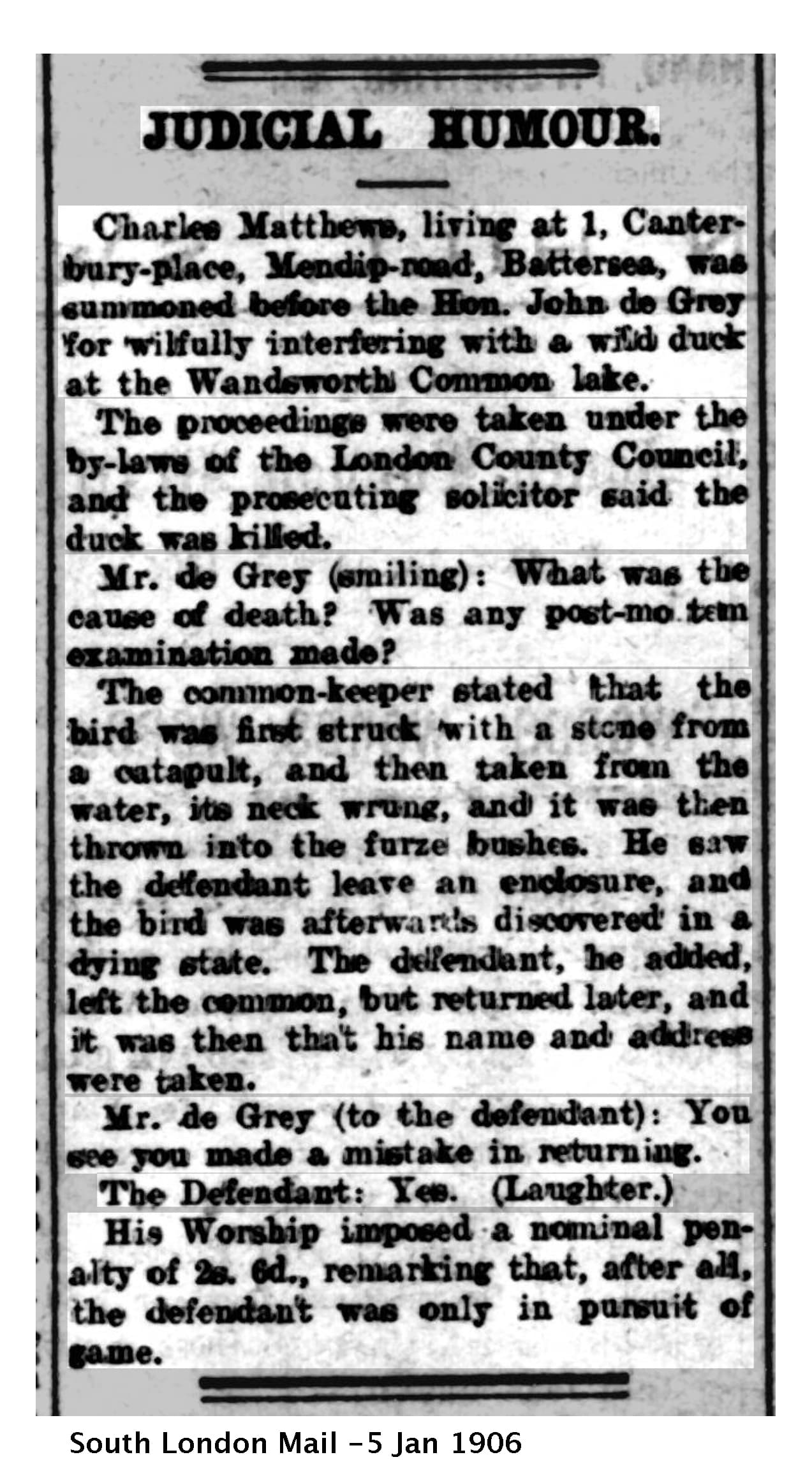
South London Mail — Friday 5 January 1906''


(Click on image to enlarge)


JUDICIAL HUMOUR.

Charles Matthews, living at 1, Canterbury-place, Mendip-road, Battersea, was summoned before the Hon. John de Grey "or wilfully interfering with a duck at the Wandsworth, Common lake.

The proceedings were taken under the by-laws of the Landon County Council, the prosecuting solicitor said the duck was killed.

Mr. de Grey (smiling): What the cause of death? Was any post-mortem examination made?

The common-keeper stated at the bird first struck with a stone from a catapult, and then taken from the water, its neck rung, and it was then thrown into the furze bushes.

He saw the defendant leave an enclosure, and the bird was afterwards discovered in a dying state. The defendant, he added, left the common, but returned later, and it was then that his name and address were taken.

Mr. de Grey (to the defendant): You see you made a mistake in returning.

The Defendant: Yes.

(Laughter.)

His Worship imposed a nominal penalty of 2s. 6d., remarking that, after all, the defendant was only in pursuit of game.

[BNA: Link.]


The Revd Craig's "Brobdignagian cigar" —isn't that brilliant description — recollected in 1868

Newcastle Journal — Thursday 30 January 1868


The Craig telescope, the world's largest, on Wandsworth Common, as shown in the Newcastle Journal, 30 January 1868. The telescope had been demolished more than a decade earlier.

(Click on image to enlarge)


Mr Craig had manufactured a refracting telescope with an object glass twenty inches in diameter; it was erected on Wandsworth Common, in a tube resembling a Brobdignagian cigar, but so imperfect was its achromatism and aplanatism that it has long been laid aside as practically useless.

etc etc

[BNA: Link]

"Practically useless", perhaps, but it did boast of one major achievement — establishing the existence of a third ring around Saturn:

Wexford Independent — Wednesday 26 January 1853


The Craig Telescope

This giant refractor lately erected on Wandsworth Common, of two feet aperture and eighty feet focal length, has been brought to bear up in the planet Saturn on the first favourable evening after its erection.

The instant result has been to set the question at rest for ever amongst astronomers as to the satellite having a third ring. This Telescope has brought out this third ring beautifully. It is of a bright slate colour . . . 

In fine weather the wonders of the heavenly bodies are exhibited by this eighty feet refractor, in a way that the eye of man has never heretofore been permitted to see them.

[BNA: Link]

I love this evocation of the Craig telescope at work on Wandsworth Common. Can the night sky really ever have been so awesome? Image from Greg Smye-Rumsby's wonderful website: www.craig-telescope.co.uk:


"the wonders of the heavenly bodies are exhibited  . . . in a way that the eye of man has never heretofore been permitted to see""

[Hmm, I've included the web address but I'm currently (December 2024) having difficulties accessing the site. With luck, by the time you read this things will have been fixed and you'll be luckier.]


"The Planet Saturn, with its third ring, as seen through the Craig Telescope." Really? How did Saturn actually appear to viewers? I couldn't have looked like this!

[Source: Craig-Telescope.co.uk: Observations at the telescope.]

(Click on images to enlarge)

But there were innumerable problems with the telescope itself including too cumbersome to track stars across the night sky, and poor optics), and also its location on Wandsworth Common — too close to the light pollution caused by London's rapid expansion.

It was in effect a grandiose folly, and within a few years it was demolished and sold off as scrap . . .


Learn more about the Craig Telescope by watching this recent video of Greg Smye-Rumsby's talk to the Friends of Wandsworth Common:


(Click on image to enlarge)


THE CRAIG TELESCOPE

24 October 2024 — The story of an iconic building that lives on in name only - by Greg Smye-Rumsby

Around the time of the Great Exhibition, in 1852, a futuristic telescope was built on a corner of Wandsworth Common in an area now called the "Scope". "We now have a much better understanding of this strange and cumbersome instrument and why it never fulfilled its promise, despite employing the minds of some of the greatest engineers of the day", according to Greg Smye-Rumsby — specialist planetarium presenter for the Royal Observatory, Greenwich who has made this subject his own.

[Friends of Wandsworth Common: Videos.]
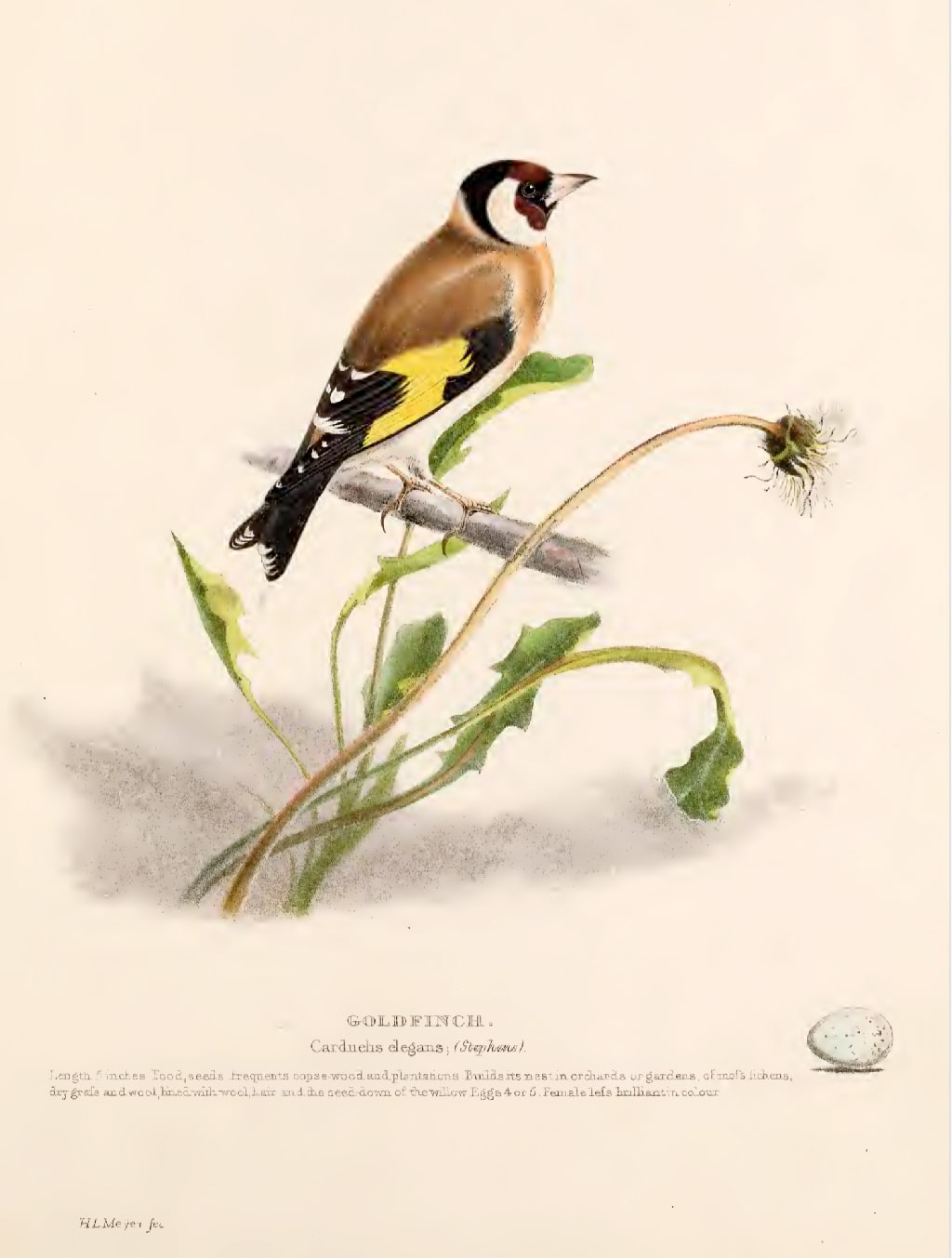

Sporting Life — 11 January 1882


Engraving of the Goldfinch by local artist Henry Meyer

(Click on image to enlarge)


BIRD SINGING

The final handicap for the season 1881, for a handsome lamp, presented by the proprietor of the Carpenter's Arms, Chatham road, Wandsworth Common; thirteen pair of goldfinch mules put up.

F. Rush's bird won with 3 score 8.

A linnet handicap is now coming on, for two handsome prizes. Other races to follow.

H. Collins is open to sing any goldfinch mule (gaslight), once in the mouth, for £1. H.C. will be in waiting at the above house on Saturday, January 14, from seven to nine.

[Largely irrelevant, but here's a terrific short exposition of the symbolism of the Goldfinch in art, from the Fitzwilliam Museum, Cambridge.

Chatham Road was once abundantly supplied with public houses. Here are some of them:

— Eagle, 104 Chatham Road, Miss Young

— Gardeners Arms, 109 & 111 Chatham Road, Miss Arlott

— Bolingbroke Arms, 17 Chatham Road, Briggs

— Carpenters Arms, 39 Chatham Road, Barrow

Today, only The Eagle remains (of course the road itself is only half as long — it once stretched all the way to Bolingbroke Grove, on the edge of the Common).

Some questions:

"Mules" must be cocks/male birds, but what do "Once in the mouth" and "Gaslight" mean?

How were singing contests scored, and who judged?

Incidentally, a search for more information about The Eagle found this interesting note from the publican, David Law:


I'm the current Publican for the above site and have been so since 1996. I am currently researching the building for possible planning and historical protections. So far I have discovered that it was originally one of five pubs on this road and started life as a beer house.

I have yet to find out its original build date although from other building info I suspect it was 1863, being substantially rebuilt in 1890 by the Holloway Bros, to designs by Karslake & Mortimer Architects. The Holloway Bros also built Albert Bridge on the Thames and the most recent remodelling of the Bank of England."

[LondonWiki: LondonPubs: The Eagle, 104 Chatham Road, SW11 6HG.]
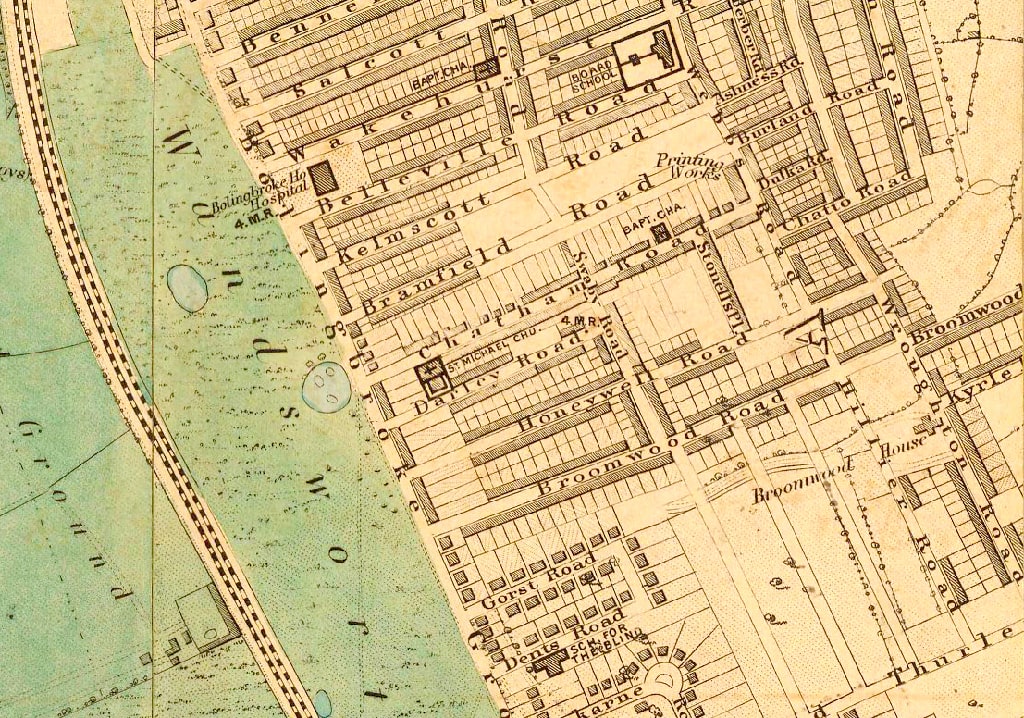


Stanford, 1896. The Eagle, on Chatham Road, is more or less opposite what was then a Baptist Chapel. The chapel was demolished and the Gardener's Arms built on the site. Why so many pubs?

Even this small fragment of a map should provide hours of fun. Notice, for example, how Northcote Road has yet to run through to Broomwood Road - to be joined up with "Swaby Road". Belleville School is shown, but not Honeywell. Historic England states that it was built in 1891 to a design by T.J. Bailey. So why does it not appear on this map?


The Gardener's Arms, opposite the Eagle. My old friend Alan Turk recollects we drank there in the 1960s, early on in our drinking career - it must have been early, he writes, because "it was a Watney's pub! I remember paying 2 shillings for a pint of Red Barrel and thinking 'That's a bit steep!' "

(Click on image to enlarge)

A block of flats now stands on the site. ClosedPubs.co.uk says last orders were called at the Gardener's Arms in February 2011 and the pub was demolished in July 2011.

(Click on image to enlarge)

Birmingham Mail — Wednesday 31 January 1900


Two "professional" ratcatchers to the London County Council were appointed yesterday — one for Battersea Park at a fee of £5.15s per annum, and the other for Clapham and Wandsworth Common at £5.5s.

[BNA: Link.]
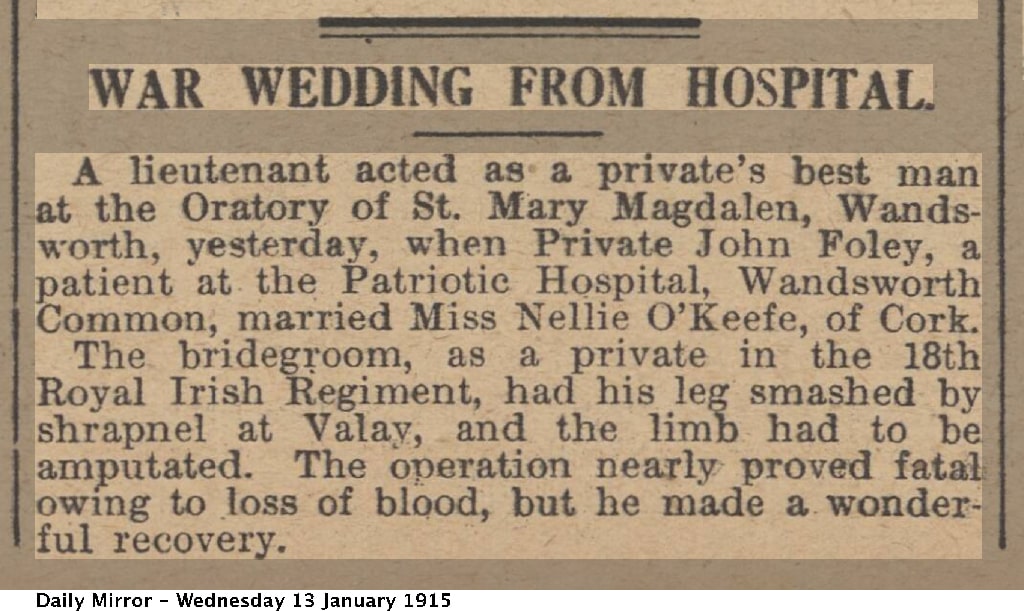

Daily Mirror — Wednesday 13 January 1915


(Click on image to enlarge)


WAR WEDDING FROM HOSPITAL

A lieutenant acted as a private's best man at the Oratory of St. Mary Magdalen, Wandsworth, yesterday, when Private John Foley, a patient at the Patriotic Hospital, Wandsworth Common, married Miss Nellie O'Keefe, of Cork.

The bridegroom, as a private in the 18th Royal Irish Regiment, had his leg smashed by shrapnel at Valay, and the limb had to be amputated. The operation nearly proved fatal owing to loss of blood, but he made a wonderful recovery.

[BNA: Link.]

Some other newspapers added snippets of information:

Belfast News-Letter — Thursday 14 January 1915


WOUNDED SOLDIER'S ROMANCE

Wounded and removed to the Patriotic Hospital, Wandsworth Common, Private Foley, of the 18th Royal Irish Regiment, was married St. Mary Magdalene, Wandsworth, Tuesday Miss Nellie O'Keefe.

For some time the soldier's life was in danger. His left leg was amputated, and owing to loss of blood his condition became precarious. But slowly he recovered, and then decided to marry without delay the young lady whom he had been engaged before war broke out.

Miss O'Keefe entered the church on the arm of Colonel Bruce Porter, the officer commanding at the hospital, and she was attended by the matron, Miss Holden, as bridesmaid. The wedding breakfast was given the hospital by the officers, and later the other wounded men attended reception.

Lady Constance Butler sent bunch of shamrock from Kilkenny, and the wedding cake was present from the Honourable Winifred Douglas-Pennant.

[BNA: Link.]

The England & Wales, Civil Registration Marriage Index, 1837-1915, confirms that John Foley and Nellie O'Keefe married in Wandsworth in the January Quarter of 1915.
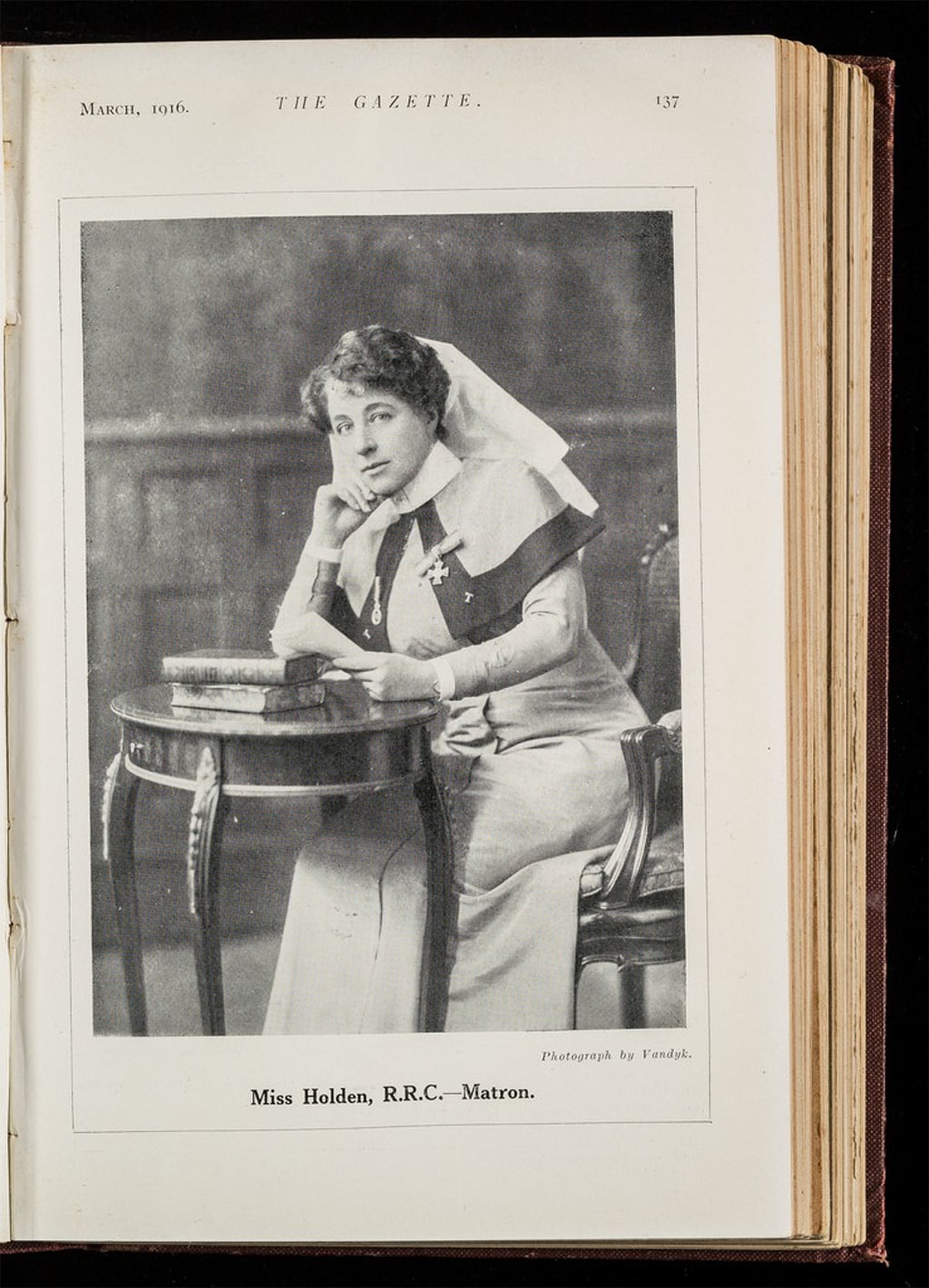
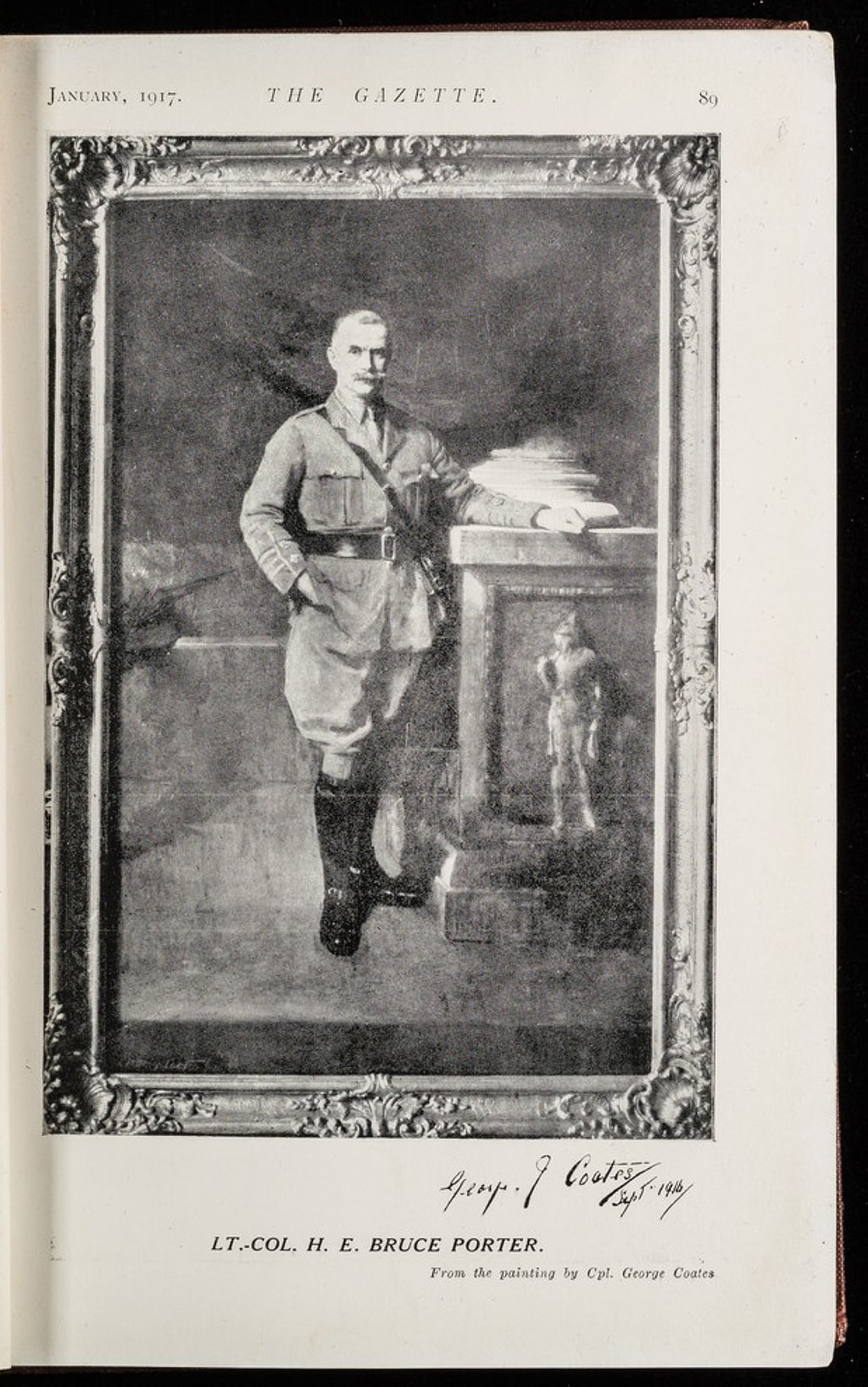

Photoraph of Edith Holden, Matron, 3rd London General Hospital, Gazette, March 1916.

(Click on image to enlarge)


Full-length portrait of Lt-Col. H.E. Bruce Porter by George Coates, Gazette, January 1916.

(Click on image to enlarge)

Searchlight and Gun Stations for sale, Wandsworth Common . . .

Daily Express — 12 January 1920


(Click on image to enlarge)


Ministry of Munitions.
By direction of the Disposal Board.
Huts and Building Materials Section.
Sale by Auction of
Hutments and Contents,
at Bolingbroke Grove and Spencer Park

Searchlight and Gun Stations,
Wandsworth Common.

On Friday, January 23rd, at 12 o'clock and 2 o'clock respectively.

Including:

Stoves, Shelving, Benches, "Colinda" Range,
Farm Boilers, Baths.
1200 ft. Corrugated Iron Fencing,
3 Canvas Hut Tents . . .

[BNA: Link.]


The playground area near Chivalry Road — where the searchlights and anti-Zeppelin gun were sited during World War One.

(Click on image to enlarge)

Mud, mud, glorious mud . . . 

The Sportsman —Monday 12 January 1903


HARLEQUINS v. BLACKHEATH

MUD SPOILS THE MATCH

Rarely is a game contested under such adverse conditions as that witnessed at Wandsworth Common between these leading clubs on Saturday. For the best part of the week Harlequins' ground had been under water, and although by means of pumping, etc., an effort had been made to get the pitch in something like order was still in a very sloppy state, pools of water were to be seen in places.

Strange to say, the players seemed to have a particular affinity for the worst spots, for the majority of the game was contested where the mud was thickest, with a result which can be well imagined, and which, whilst disconcerting to the players, provided plenty of amusement for the three or four thousand spectators.

Some of the men were quite unrecognisable before the game was any minutes old, and both they and the ball were subjected to frequeat scrapings for the purpose of removing superfluous "upper crust". But still, despite all tbeee drawbacks, the game was a keen one, and although naturally confined largely to the forwards an interesting one to watch.  . . . 

As it was, the game ended in a pointless draw, which was undoubtedly the most satisfactory ending to the struggle in the mire.

[BNA: Link.]

Incidentally, I am GREATLY enjoying Sport and the British, Clare Balding's "30-part series charting how sport has shaped the British and how Britain has shaped sport" (BBC Sounds). Highly recommended, even if (like me) you're not much interested on sport.

As you must have gathered by now, I strongly believe the current shape, nature and layout of Wandsworth Common has been largely determined by the history of sport played on its denuded, smoothed, levelled, drained surfaces - see e.g. videos of a couple of talks I gave for the Friends of Wandsworth Common a few years ago.


South London Press — Saturday 15 January 1881


PROPOSED ERECTION OF AN IRON CHURCH AT WANDSWORTH

On the recommendation of the building act committee, it was resolved that the application of the Rev. J.E. Clarke for the approval by the board of a plan for the construction of a temporary iron church in Darley-road, Bolingbroke Grove, Wandsworth Common, be granted.

[Source: Link.]

This "iron-church" (or "tin-tabernacle") is the future St Michael's, opposite the Three-Island Pond. The incomparable John Erskine Clarke had already used a prefabricated iron church to establish St Luke's on Ramsden Road. The impressive brickwork was erected around the iron structure, which was removed from within on completion — services were scarcely interrupted.


"Switch off that LIGHT! ", 1940
Norwood News — Friday 5 January 1940


"Switch off that LIGHT! Less Light — More Planes"

(Click on image to enlarge)


Unscreened Lights

Lewis Fisher, Stormont-road, Battersea, was fined 2s. 6d. at the South-Western Police Court for allowing an unscreened light at his flat at 6.30 p.m. It was stated that the light was showing from a top-floor window. Defendant said. "I have just taken over the house, and have not had time to put up the black-out yet" Defendant added that he was out of work.

Mrs. Lilian Langridge, North-side, Wandsworth Common, was fined 10s.. for a similar offence at her flat at 9.p.m.

P.C. Willis stated that a light was showing from a third-floor window. It came from a candle on a dressing-table in front of the window. Defendant said, "I took the curtains down to wash them, and forgot to put them up. Will it go against me? I have three sons in the Army."

[BNA: Link.]


"CARROTS keep you healthy and help you to see in the blackout"

(Click on image to enlarge)

Here's an odd story. Perhaps you can make more sense of it than I can. But it's interesting, even if you can't .

It involves a Wandsworth Common "college-man" at the University of Cambridge who may not be entirely the gentleman he purports to be, and two "venerably bearded Turks in the full costume of the East".


Two fashionably dressed Turkish men, c.1820. Such a wonderful print I couldn't stop myself using it, but not necessarily anything like the two men in our own story. (For one thing, they're not fully bearded.)

(Click on image to enlarge)

Star— Friday 25 January 1822


POLICE. BOW STREET.

A pair of venerably-bearded Turks, in the full costume of the East, appeared before the sitting Magistrate, a few days ago, attended by one of the porters belonging to the Home Secretary of State's Office, who informed his Worship, that Mr. Hobhouse had desired they should be conducted before him, they having some complaint to make against a member of the University of Cambridge.

Neither of the Asiatics could speak a syllable of English, but they were accompanied by a man who offered himself as their interpreter, and who also called himself a Turk though he was an exact personification of an English stage-coachman a sturdy, curly headed, red-faced, knowing-looking fellow; in top-boots, bird's-eye fogle, and poodle benjamin.

[According to the indispensable (Green's Dictionary of Slang):

"bird's-eye fogle" — a silk handkerchief with a birds-eye pattern. Perhaps significantly, fogles were used as a prizefighter's colours.

"poodle benjamin"? Unknown, but a "benjamin" is a coat or waistcoat.]


To this man one of the strangers talked for nearly a quarter of an hour, with astonishing volubility, and most redundant gesticulations; and, having concluded, the man delivered the following narrative partly in English, partly in French, partly in Turkish, and partly in a dialect of his own, composed of all the others:

The Turks, in the course of their travels, had sojourned some days at Cambridge; and whilst there had sold about ten pounds worth of their merchandize to a "college man," (a collegian — one Mr.__________, of Wandsworth Common, as appeared from an address written on a slip of paper which they produced). The "college-man" did not pay them for the merchandize at the time of their bargain; but promised to be ready with the money on a future day.

When the day arrived, however, he was "gone somewhere away," and they could not find him. Some days more elapsed before he made himself visible; and then another day of payment was appointed; but when the day came he was gone away again.

In short, as the interpreter said, he was "always far off, round about in the countries sometimes here, and sometimes there, sometimes every where, and sometimes nowhere at all."

In all these eccentricities the poor Turks endeavoured to keep up with him; and urged the chace so warmly that, it would appear, he began at length to grow confoundedly tired of it; and, hopeless of exhausting their patience by this kind of wild-goose chase, he hit upon the following queer contrivance to rid himself of their troublesome presence:

Having apologised for the delay that had occurred, he appointed to meet them on the following morning at a certain public-house, about five miles from Cambridge, on the road to London.

The Turks were exact in keeping their appointment, and they had not waited long before the "college-man" made his appearance. He was accompanied by a young woman; and he proposed to the Turks that they should escort this young woman to town for him; that they should take great care of the young woman, as she was very dear to him, and wait altogether at the White Horse Cellar, Piccadilly, till he joined them; that he would follow them in a day or two at farthest, and immediately on his arrival in town he would give them a cheque upon his banker for the original debt, and the travelling expenses altogether!


White Horse Cellar, Piccadilly, by James Pollard, unknown date. One of the best-known coaching inns.

(Click on image to enlarge)


This would have been a comical proposition to have made to an Englishman, but it answered very well with the poor Turks' they readily agreed to it; not doubting but he would keep his word when they had a Lady in pawn who was so "dear" to him and they took their departure for the Metropolis by the first coach that passed; the "college-man" taking a tender farewell of the Lady, and the simple Mussulmans escorting her along the road with as much care as though they had been conducting some fair Circassian to the Seraglio of the Grand Seignior.

They arrived at the White Horse Cellar in due course, and waited day after day for the arrival of the "college-man;" but to their astonishment he never came, and their patience and faith evaporating together, they at length sought redress from the laws.

The Magistrate (G.R. Minshull Esq.) said it appeared that the collegian, by this unprincipled trick, had killed two birds with one stone" he had disburthened himself of his creditor and his mistress at once.

The stratagem, he said, was the more unprincipled, inasmuch as it was played off upon foreigners, who were utterly ignorant of the customs of the country, but still he was afraid it did not come within his jurisdiction.

After some further conversation, his Worship having learned that the young woman was still under the protection of the Turks, he desired that she might be brought before him: and the Turks, with their interpreter, left the Office for the purpose of fetching her; but they did not return in the course of the day.

[BNA: Link]

And there, alas, the story ends.

Or does it?


Season's Greetings, Common People !

Chronicles

December 2024


Snow at the 3rd London General Hospital, compiled from images in The Gazette, 1914-1920, set to "Let It Snow", by Sammy Kahn and Juli Styne, performed by Josh Turner.

(Click on the image to play the video. Turn up your volume.)

— tiny version, small enough to download and send as an email attachment.

— higher-resolution version on YouTube.

This video-card grew out of a talk I did last month that you can view from the Friends of Wandsworth Common website, or here:


(Click on the image to play the video. Turn up your volume.)

Christ born on Wandsworth Common . . .

Sydenham, Forest Hill & Penge Gazette — 2 August 1884

"Taking Hyde Park as representing Jerusalem . . . Bethlehem would be on Wandsworth Common."

(Click on image to enlarge)


COMPARATIVE OUTLINE OF THE HOLY LAND

Mr. John MacGregor (Rob Roy) describes the size and the bearings of the Holy Lend in a way very intelligible to a London audience, and to others familiar with English geography.

Taking Hyde Park as representing Jerusalem, the relative positions of the Temple, the Mount of Olives, the Dead Sea, Bethlehem, the Sea of Galilee. and other localities. Ihe outline is, of course, but a rough one, but it is suggestive.

Jerusalem occupies, as it were, that part of Hyde Park to the east bounded by the Serpentine. The site of the Temple — Mount Moriah — the space north of Achilles' statue, and Zion — the Dairy.

Gethsemane would he located at Grosvenor-square, and the Pool of Bethesda at Grosvenor-gate, while the Pool of Siloam would be Buckingham Palace Gardens water, and Kedron River Park-lane.

The Holy Sepulchre would be in the site of the barracks, and strange to say, Herod's Palace on that of the of the Royal Humane Society.

The Guards' house at the bridge represents the Jaffa Gate, and the Mount of Olives — 2,700 feet above the sea-level — would be in Bond-street. The upper Pool of Gibon would be at the Round Pond in Kensington-gardens, and the Damascus Gate would be represented by Victoria Gate. Petersburg place, Bayswater-place, would be the site of the Russian convent, and Rachel's tomb would be close to Chelsea-bridge.

Bethlehem would be on Wandsworth Common; Hebron at Redhill; the Dead Sea — 1,300 feet below sea-level at Erith; Carmel at Leicester Nazareth at Peterborough; and Mount Hebron at the mouth the Humber; while the Sea of Galilee would be in the fens of Norfolk. near Stoke, and the Mediterranean at Great Marlow . . .

[Source: BNA: Link.]


Buckmaster's Cookery — 150th anniversary of John Buckmaster's pioneering book

Drat! I missed celebrating this event last month. But better late than not at all. And besides, December is a very culinary month.

We may chiefly remember John Charles Buckmaster today for his powerful influence on securing Wandsworth Common, but there's a lot more to him. Here's another of his many personae — cookery lecturer and author:


Buckmaster's Cookery remained in print from 1874 at least until the start of the First World War. (I hope to sort out the details of its publishing history, but not quite yet.)

(Click on image to enlarge)

JCB, writing from St John's Hill, Wandsworth, dates his Preface "2 November 1874":


It was with much reluctance that I accepted in 1873, the invitation of Her Majesty's Commissioners of the International Exhibition to deliver a course of lectures on Cookery. One of the exhibits that year was Food, and it was thought this section might be more instructive by lectures . . .

But there was a small problem: John Buckmaster knew absolutely nothing about cooking. But fortunately for him his wife, Emily, daughter of a Cambridge butcher, certainly did. Doubtless she coached him thoroughly, and his lectures were a triumph. (Though so far as I know he never credited her contribution.)


John Buckmaster lecturing (sermonising?) on Cookery at the Third International Exhibition, 1873, held at South Kensington. One newspaper reported his talks to be “far more entertaining than most plays going on these days”. During its run, JCB famously taught Queen Victoria how to cook an omelette.

Notice the demonstrators — five of the six are female — preparing food to hand out to the audience to try. The cook at the back, in front of a range and open grate, wears a large crinoline — not ideal where open fires were involved.

The demonstrators in front are cooking with gas — Buckmaster's lectures did much to promote the installation of gas in homes at this time. (We should not forget that Wandsworth Gas Works, close to Wandsworth Bridge, and another in Battersea, were among of London's largest — both gasworks survived until fairly recently. Edwin Rayner Ransome (on whom more below) was a director of the Wandsworth gasworks.)

(Click on image to enlarge)


The International Exhibition building at South Kensington, 1872. See Link.

(Click on image to enlarge)


A single event symbolises the birth of the domestic subjects movement, a movement that was to promote tirelessly the re-education in housewifery of the British female. On 1 April 1873 J.C. Buckmaster of the Science and Art Department, South Kensington Museum, gave a series of lectures and demonstrations on the application of scientific principles to cookery, as part of the third International Exhibition that had been organised after the success of the Great Exhibition of 1851.

The lectures were spectacularly successful; crowds flocked to them and one newspaper reported them to be “far more entertaining than most plays going on these days”.

This missed the point; something far more momentous than entertainment was intended, and what started as a fad among the fashionable of London society soon spread to become a movement bent on raising the standard of cookery and household management in all private homes.

Within three months a prospectus for a National Training School for Cookery was issued. Its aim was “to teach the best methods of cooking articles of food in general consumption among all classes". Over the next 30 years women in this movement assiduously promulgated the need for domestic instruction across the nation.

[Annmarie Turnbull, "An Isolated Missionary: the domestic subjects teacher in England, 1870-1914", Women's History Review, vol.3 no.1, 1994.]

Incidentally, John and Emily were great entertainers at their home on "New Road" (now Prested Road), near the new Clapham Junction railway station. (Their house itself was demolished many years ago, when the station expanded.)

As their son Martin described ruefully years later:


My father . . . could not afford a large family and although we kept two or three servants, in the Victorian manner, as well as a governess, I found myself very much a backstairs slave, cleaning the household boots and knives — no rustless steel then.

My father and mother were most hospitable, and if friends called they were usually invited to lunch or dinner, no fuss or preparation, only a few more plates and knives and forks for me to tackle later.

I did not much mind slavery in the kitchen and scullery, but I hated the servitude of the dinner parties, when my father dressed me as a waiter, in a boiled shirt and white tie, to wait on his guests and my brothers, through a five course dinner.

I know I was a snob but I hated the patronage of the guests who told me "how well I waited". I was then about sixteen years old, a very sensitive age.

I hope one day to write in detail about this aspect of JCB's life's work, which had a profound effect on the teaching of Domestic Science in schools (and probably on very much more).

At this point I was going to relate one of JCB's cautionary tales — probably the one about how a young wife's culinary failings caused the breakdown of their marriage ("Hashed mutton is the horror of most husbands"). But I'll leave that for another time.

I hope to pick this up again in April next year. But in the meanwhile, if you're interested in learning more, and perhaps in researching this topic for yourself (or just want to try cooking some of JCB's recipes!), please get in touch.


AOB

One of the most thrilling sides of producing the Chronicles month after month, year after year, is that people with no obvious connection to Wandsworth Common stumble across things I've written and get in contact. Some ask for extra info., but mostly they add something completely unexpected. I love it when this happens.

There have been a number of examples this month, including a wonderful picture from the photographer Fred Kingsbury (who owned the studio on Bellevue before Dorrett and Martin), and the splendid discovery of a velocipede from 1869 made, it seems, by Edwin Rayner Ransome's company — Ransome lived on North Side, and was among the stoutest defenders of the Common prior to the 1871 Wandsworth Act, and (as a Conservator) way beyond.


Fred Kingsbury, Photographer, 16 Belle Vue Road


(Click on image to enlarge)

A week or so ago, I received a very interesting email about Fred Kingsbury, whose studio on Bellevue was later used by Dorrett and Martin (they took over the lease 1 April 1899):


"I came across your website while searching for the photographer Fred(erick) Kingsbury.

I don’t know any more about him than you already do except that he took the attached wedding photo of my great-grandparents Max Schliephak and Charlotte Poulsen. I don’t know if the photo was taken on the day itself, but the wedding was on 31st December 1898.

You can see the name Fred.k (short for Frederick) Kingsbury and the address 16 Belle Vue Road at the bottom.

This page at the National Archives also seems to detail a photo of his from 1897 that they have. It refers to 16 Belle Vue Road.

You’re welcome to use the photo on your webpage if it’s of any interest.

All the best.

David

Thanks, David!

I rather wonder if Max and Charlotte had a connection with Wandsworth Common, but there's nothing obvious yet. Here is their marriage, on New Year's Eve 1898:


(Click on image to enlarge)

Did the couple travel down to Bellevue from Paddington? Or did Fred Kingsbury travel there (which seems unlikely). Were they perhaps honeymooning locally?

David also sent me a link to an image (undigitised, or not online) in the National Archives catalogue of


Photograph of the ladies Eileen and Ruby Elliot grouped. One figure seated with legs crossed, the other figure looking down with right foot on sofa.

[Copyright: Frederick Kingsbury, 16 Belle Vue Road, Wandsworth Common, registered 5 June 1897.]

[National Archives: Link.]

Alas, no image is available to view online. It would be good to have a copy, wouldn't it.

I wonder if Eileen and Ruby Elliot lived locally?

David replied:

My great-grandfather, Max Schliephak, was originally from Germany, and the first place I know of when he moved to London was at 90 Victoria Street. He did some kind of apprenticeship there.

Their marriage certificate shows that he called himself a “Chemist” at the time they got married, though I’m not sure of the difference between that and a pharmacist in those days. Coming from a German background, he would have been called an “Apotheker”. I have a postcard written to him at 90 Victoria Street from Germany, where he is addressed as “Apotheker-Chemist”.

I don’t know if you have access to Ancestry.co.uk, but I think there’s a good chance that this is the likely family of Lady Eileen Elliot and Lady Ruby Elliot. If so, they seemed to be daughters of the 4th Earl of Minto. Whoever that is. It might explain by the National Archives bother to keep a photo. It adds a bit of colour to Fred Kingsbury’s life if he was taking photos of the aristocracy.

They both married in the Westminster area. So, I wondered if he perhaps he had more than one studio, either at the same time or consecutively.

Then I found this article. It says about Fred and about 16 Belle Vue “On April 1st, 1899 Dorrett and Martin entered into a partnership and bought the premises of Fred Kingsbury, who had a photographic business at 16, Belle Vue Road, Upper Tooting (1 p. 63,64 ; 10) and for a short period also at 60, The Strand, in London ( 1 p.64;p.114 n. 126; 3 p. 18)” then it also mentions “… while Martin had stayed near the Bellevue Road business… “

Fred(erick) also seems to have taken some well known photographs of Constance Wilde, the wife of the famous Oscar Wilde.

On this page, it says “It did strike me that, as I put it in my article, the photograph showed ‘a woman whose beauty had lost some of its bloom since the familiar Frederick Kingsbury studio photographs of 1892.”

On this Sotheby’s page, if you click the second photo down, you can see a photo of Constance, taken by Frederick in 1892. The address on it is 45 St George’s Place, Knightsbridge.

The same photo of Constance is here on the National Portrait Gallery website.

I hope some of this is interesting. It adds some detail about one of 16 Belle Vue’s occupants but, as we now know that Fred had several studios, it probably makes it less likely that either my great-grandparents, or the Ladies Eileen & Ruby Elliot had any specific connection to Wandsworth.

[Readers with access to Ancestry.co.uk can read more about Max and Charlotte here.]

Thanks once again, David — so much very useful info. to add to the picture. I'd completely forgotten Fred Kingsbury's studio in Town, even though I'd mentioned it in a talk I gave (with Chris Allies) on Dorrett and Martin for the Friends of Wandsworth Common in October 2023:


(Click on image to enlarge)

"PIONEERS OF PHOTOGRAPHY ON AND AROUND WANDSWORTH COMMON - PART II 10/2023 - The second instalment of our heritage talks about pioneering photographers, this time focussing on Paul Martin and Harry Dorrett, who worked together at a studio facing the Common at 16, Bellevue Road (Athol House). Martin pioneered the use of ‘snapshots’ taken with a hidden camera and images taken with very long exposures at night. "


Constance Wilde, taken by Fred Kingsbury in his Knightsbridge studio, 1892 (three years before Oscar Wilde's imprisonment in Wandsworth).

(Click on image to enlarge)

Velocipede, 1869, by S. & E. Ransome


Photo Colin Kirsch.

(Click on image to enlarge)

A fortnight ago, Colin ("WingYourHeel") Kirsch emailed me about his latest acquisition:


I have a bicycle museum (online) and have recently managed to acquire an 1869 velocipede with a stamping (cartouche) by S. & E. Ransome of Essex St Strand. I’ve just started researching the company.

Edwin Ransome is mentioned in a Quaker periodical relating to the establishment of a school in Tasmania. At the moment I am assuming he is the "E" in S. & E. Ransome. But I’ve also seen him mentioned on your page as having an interest in Wandsworth Gas Company (below) and a wider family connection to Ransome’s lawnmowers.

I wondered if you had any information that shows his connection to S. & E. Ransome Ltd?

I did have some info., and I shared it with Colin. Here's something I wrote about Edwin Rayner Ransome a couple of years ago:


Edwin Rayner Ransome, a Quaker and a passionate campaigner for Wandsworth Common.

(Click on image to enlarge)

Visit Colin's wonderful Online Bicycle Museum for numerous fine images of the velocipede in question: 1869 | E.R. Ransome, the French Velocipede Company.


(Click on image to enlarge)


(Click on image to enlarge)


"This velocipede represents an important part of British cycle history because its cartouche, engraved and stamped into the backbone, shows it to be built by Edwin Rayner Ransome of 10 Essex St, Strand, London, and licensed by the French Velocipede Company of 14 The Strand, London.

This company was one of the first to import velocipedes from France for resale in Britain: “A boneshaker with forged ironwork, and front wheel of 32 inch, 34 inch or 36 inch was £10 or £12 according to finish and fittings.” ££12 in 1869 would be around £1750 today."

[Online Bicycle Museum: 1869 | E.R. Ransome, the French Velocipede Company.]

You may recall I wrote about velocipede racing on Wandsworth Common a couple of years ago:

— HoWC: Chronicles: April 2022: Velocipede Racing on Wandsworth Common.

Two wheels good, four wheels bad

Morning Advertiser — Thursday 22 April 1869


(Click on image to enlarge)


RACE WITH VELOCIPEDES

Yesterday a race took place with the now fashionable recreation of velocipede riding level road on Wandsworth-common, between six amateur velocipedians, for a stake of £15. The distance contested was two miles, and two of the competitors, who travelled with two-wheel machines, were handicapped, and put 25 yards below the starting point. The other four, who contended with the old-fashioned four-wheel velocipedes, started level.

The race was commenced at a sharp pace, Mr. Canton (four wheels) finishing the first mile in five minutes and 32 seconds, and commanding a good lead a spirited race was kept up, the riders of the two-wheel velocipedes working easier than their opponents; and when within half a mile of the winning point a French gentleman (M. de Ferne) on a two-wheeler came from the rear, passed his opponents, and won by several lengths.

The last half-mile was covered in two minutes and 28 seconds, and the two miles accomplished by the winner in 10 minutes and 30 seconds.

[BNA: Link. Also e.g. South London Press — Saturday 24 April 1869.]

I wonder how these speeds might compare with a modern bicycle? Any cyclists out there prepared to provide some times?

The straight, level "two-mile" course must be our Trinity Road, which at that time stopped at North Side. But in fact the distance is a little less — just over 1.8 miles.


Four- and three-wheeled velocipedes. The latter is described as a "Rantoone" — Colin may know otherwise, but can we assume the "Rantoone" owes the first part of its name to Edwin Ransome? In which case, who or what des the "Toone" refer to?

(Click on image to enlarge)


Beating the Bounds

Mike Tuffrey, historian of Clapham and a regular correspondent, tells me that the three old parishes that form the Borough of Lambeth (Clapham, Streatham, Mary Lambeth) may be beating the bounds next May. Very exciting news indeed.


"It's looking like the three old parishes in modern Lambeth — Clapham, Streatham and St Mary Lambeth — may organise a joint beating the bounds on May 24th next year. I went on a bike ride of St Mary's as part of this year's Lambeth heritage festival, organised by Jon Newman, and the idea has grown from there. 'Joint' as in doing it on the same day with potential to actually meet up at Clapham New Park where the three join, if we can get the timing right . . .

My first task is to walk the route and see how close we can get. The boundary on the west is described as "the watercourse" — I'm guessing Mayford Road, then back east along Nightingale. We'll get to wave at your Common at least!"

Which raises puzzles about the precise route of the Clapham parish boundary.

There are two major questions. What is the course of the boundary with Battersea that crosses Clapham Common? (On tithe maps drawn up in the early 1840s, for example, Clapham claimed the whole of Clapham Common, but Battersea disagreed.)

— More on the Battersea/Clapham boundary crossing Clapham Common

And second, even closer to our Common, the enigma that is "Clapham Detached", which you can see marked on the map below. In this case Nightingale Lane is its northern boundary. (The centre of the road? Or one side of the road? The issue is in part which parish had responsibility for the upkeep of Nightingale Lane.)


Stanford, 1878: "Map of London and its Environs, Shewing the Boundary of the Jurisdiction of the Metropolitan Board of Works. Also the Boundaries of the City of London, the Parishes, the Districts & Extra Parochial Places."

(Click on image to enlarge)

Clapham attached or detached?

I replied:


Yes, it looks like the boundary of "Clapham (Detached)" included part of the northernmost of the two tributaries to the Falcon Brook (Anglo-Saxon "Hildaburna"; "York Sewer" from mid-C19) that met/meet at the corner of Calbourne Road and Mayford Road.

So the mysterious Clapham Detached's southern border — the "watercourse" in question — ran beneath most of today's Oldridge Road — the eastern half of Calbourne Road — northern part of Mayford Road — Birchlands Avenue (centre of road, or through the back gardens and edge of Nightingale Housw?).


OS, 6-inch map, c.1868, marked up to show the boundary of "Clapham Detached". W.C. refers to Wandsworth Common; C.C. to Clapham Common; B. is Battersea parish; and S is Streatham parish. The tributaries of the Falcon Brook, and ornamental lakes created by damming it, are marked in blue.

(Click on image to enlarge)

If you're interested in participating, contact me and I'll forward.


And finally, wonderful news from from the Friends of Wandsworth Common . . .


(Click on image to enlarge)


BLACK POPLAR PLANTING

[We'll soon be planting] some rare black poplars close to where the three once grew near Skylark and the Cat's Back bridge.

The young saplings have been grown from cuttings from the one in the playground next to Skylark which has been genetically verified as a pure native rather than a hybrid. It is therefore one of the rarest natives in the country.

Black Poplars are among my very favourite trees. Every one that dies is a grievous loss to the Common.

Here are some links:

— HoWC: Wandsworth District Board of Works orders an avenue of Black Poplars to be planted on the Common, 1869

— Woodland Trust: Black Poplar (Populus nigra subsp. betulifolia)): "Imposing, elegant, rare. The black poplar was once a staple of Britain’s landscape but these days, the trees are few and far between."

— Wikipedia: Populus nigra.

— National Trust: "Saving our native black poplars".


SO many more stories still to tell. But that's all for now, folks.

If you would like to receive occasional notifications of new Chronicles, let me know.

This search box is not very consistent, but always worth a try:

Send me an email if you enjoyed this post, or want to comment on something you've seen or read on the site, or would like to know more —or just want to be kept in touch.

Philip Boys ("History Boys")

December 2024

Top of this page . . . 


Season's Greetings, Common People !

Chronicles

December 2024


Snow at the 3rd London General Hospital, compiled from images in The Gazette, 1914-1920, set to "Let It Snow", by Sammy Kahn and Juli Styne, performed by Josh Turner.

(Click on the image to play the video. Turn up your volume.)

— tiny version, small enough to download and send as an email attachment.

— higher-resolution version on YouTube.

This video-card grew out of a talk I did last month that you can view from the Friends of Wandsworth Common website, or here:


(Click on the image to play the video. Turn up your volume.)

Christ born on Wandsworth Common . . .

Sydenham, Forest Hill & Penge Gazette — 2 August 1884

"Taking Hyde Park as representing Jerusalem . . . Bethlehem would be on Wandsworth Common."

(Click on image to enlarge)


COMPARATIVE OUTLINE OF THE HOLY LAND

Mr. John MacGregor (Rob Roy) describes the size and the bearings of the Holy Lend in a way very intelligible to a London audience, and to others familiar with English geography.

Taking Hyde Park as representing Jerusalem, the relative positions of the Temple, the Mount of Olives, the Dead Sea, Bethlehem, the Sea of Galilee. and other localities. Ihe outline is, of course, but a rough one, but it is suggestive.

Jerusalem occupies, as it were, that part of Hyde Park to the east bounded by the Serpentine. The site of the Temple — Mount Moriah — the space north of Achilles' statue, and Zion — the Dairy.

Gethsemane would he located at Grosvenor-square, and the Pool of Bethesda at Grosvenor-gate, while the Pool of Siloam would be Buckingham Palace Gardens water, and Kedron River Park-lane.

The Holy Sepulchre would be in the site of the barracks, and strange to say, Herod's Palace on that of the of the Royal Humane Society.

The Guards' house at the bridge represents the Jaffa Gate, and the Mount of Olives — 2,700 feet above the sea-level — would be in Bond-street. The upper Pool of Gibon would be at the Round Pond in Kensington-gardens, and the Damascus Gate would be represented by Victoria Gate. Petersburg place, Bayswater-place, would be the site of the Russian convent, and Rachel's tomb would be close to Chelsea-bridge.

Bethlehem would be on Wandsworth Common; Hebron at Redhill; the Dead Sea — 1,300 feet below sea-level at Erith; Carmel at Leicester Nazareth at Peterborough; and Mount Hebron at the mouth the Humber; while the Sea of Galilee would be in the fens of Norfolk. near Stoke, and the Mediterranean at Great Marlow . . .

[Source: BNA: Link.]


Buckmaster's Cookery — 150th anniversary of John Buckmaster's pioneering book

Drat! I missed celebrating this event last month. But better late than not at all. And besides, December is a very culinary month.

We may chiefly remember John Charles Buckmaster today for his powerful influence on securing Wandsworth Common, but there's a lot more to him. Here's another of his many personae — cookery lecturer and author:


Buckmaster's Cookery remained in print from 1874 at least until the start of the First World War. (I hope to sort out the details of its publishing history, but not quite yet.)

(Click on image to enlarge)

JCB, writing from St John's Hill, Wandsworth, dates his Preface "2 November 1874":


It was with much reluctance that I accepted in 1873, the invitation of Her Majesty's Commissioners of the International Exhibition to deliver a course of lectures on Cookery. One of the exhibits that year was Food, and it was thought this section might be more instructive by lectures . . .

But there was a small problem: John Buckmaster knew absolutely nothing about cooking. But fortunately for him his wife, Emily, daughter of a Cambridge butcher, certainly did. Doubtless she coached him thoroughly, and his lectures were a triumph. (Though so far as I know he never credited her contribution.)


John Buckmaster lecturing (sermonising?) on Cookery at the Third International Exhibition, 1873, held at South Kensington. One newspaper reported his talks to be “far more entertaining than most plays going on these days”. During its run, JCB famously taught Queen Victoria how to cook an omelette.

Notice the demonstrators — five of the six are female — preparing food to hand out to the audience to try. The cook at the back, in front of a range and open grate, wears a large crinoline — not ideal where open fires were involved.

The demonstrators in front are cooking with gas — Buckmaster's lectures did much to promote the installation of gas in homes at this time. (We should not forget that Wandsworth Gas Works, close to Wandsworth Bridge, and another in Battersea, were among of London's largest — both gasworks survived until fairly recently. Edwin Rayner Ransome (on whom more below) was a director of the Wandsworth gasworks.)

(Click on image to enlarge)


The International Exhibition building at South Kensington, 1872. See Link.

(Click on image to enlarge)


A single event symbolises the birth of the domestic subjects movement, a movement that was to promote tirelessly the re-education in housewifery of the British female. On 1 April 1873 J.C. Buckmaster of the Science and Art Department, South Kensington Museum, gave a series of lectures and demonstrations on the application of scientific principles to cookery, as part of the third International Exhibition that had been organised after the success of the Great Exhibition of 1851.

The lectures were spectacularly successful; crowds flocked to them and one newspaper reported them to be “far more entertaining than most plays going on these days”.

This missed the point; something far more momentous than entertainment was intended, and what started as a fad among the fashionable of London society soon spread to become a movement bent on raising the standard of cookery and household management in all private homes.

Within three months a prospectus for a National Training School for Cookery was issued. Its aim was “to teach the best methods of cooking articles of food in general consumption among all classes". Over the next 30 years women in this movement assiduously promulgated the need for domestic instruction across the nation.

[Annmarie Turnbull, "An Isolated Missionary: the domestic subjects teacher in England, 1870-1914", Women's History Review, vol.3 no.1, 1994.]

Incidentally, John and Emily were great entertainers at their home on "New Road" (now Prested Road), near the new Clapham Junction railway station. (Their house itself was demolished many years ago, when the station expanded.)

As their son Martin described ruefully years later:


My father . . . could not afford a large family and although we kept two or three servants, in the Victorian manner, as well as a governess, I found myself very much a backstairs slave, cleaning the household boots and knives — no rustless steel then.

My father and mother were most hospitable, and if friends called they were usually invited to lunch or dinner, no fuss or preparation, only a few more plates and knives and forks for me to tackle later.

I did not much mind slavery in the kitchen and scullery, but I hated the servitude of the dinner parties, when my father dressed me as a waiter, in a boiled shirt and white tie, to wait on his guests and my brothers, through a five course dinner.

I know I was a snob but I hated the patronage of the guests who told me "how well I waited". I was then about sixteen years old, a very sensitive age.

I hope one day to write in detail about this aspect of JCB's life's work, which had a profound effect on the teaching of Domestic Science in schools (and probably on very much more).

At this point I was going to relate one of JCB's cautionary tales — probably the one about how a young wife's culinary failings caused the breakdown of their marriage ("Hashed mutton is the horror of most husbands"). But I'll leave that for another time.

I hope to pick this up again in April next year. But in the meanwhile, if you're interested in learning more, and perhaps in researching this topic for yourself (or just want to try cooking some of JCB's recipes!), please get in touch.


AOB

One of the most thrilling sides of producing the Chronicles month after month, year after year, is that people with no obvious connection to Wandsworth Common stumble across things I've written and get in contact. Some ask for extra info., but mostly they add something completely unexpected. I love it when this happens.

There have been a number of examples this month, including a wonderful picture from the photographer Fred Kingsbury (who owned the studio on Bellevue before Dorrett and Martin), and the splendid discovery of a velocipede from 1869 made, it seems, by Edwin Rayner Ransome's company — Ransome lived on North Side, and was among the stoutest defenders of the Common prior to the 1871 Wandsworth Act, and (as a Conservator) way beyond.


Fred Kingsbury, Photographer, 16 Belle Vue Road


(Click on image to enlarge)

A week or so ago, I received a very interesting email about Fred Kingsbury, whose studio on Bellevue was later used by Dorrett and Martin (they took over the lease 1 April 1899):


"I came across your website while searching for the photographer Fred(erick) Kingsbury.

I don’t know any more about him than you already do except that he took the attached wedding photo of my great-grandparents Max Schliephak and Charlotte Poulsen. I don’t know if the photo was taken on the day itself, but the wedding was on 31st December 1898.

You can see the name Fred.k (short for Frederick) Kingsbury and the address 16 Belle Vue Road at the bottom.

This page at the National Archives also seems to detail a photo of his from 1897 that they have. It refers to 16 Belle Vue Road.

You’re welcome to use the photo on your webpage if it’s of any interest.

All the best.

David

Thanks, David!

I rather wonder if Max and Charlotte had a connection with Wandsworth Common, but there's nothing obvious yet. Here is their marriage, on New Year's Eve 1898:


(Click on image to enlarge)

Did the couple travel down to Bellevue from Paddington? Or did Fred Kingsbury travel there (which seems unlikely). Were they perhaps honeymooning locally?

David also sent me a link to an image (undigitised, or not online) in the National Archives catalogue of


Photograph of the ladies Eileen and Ruby Elliot grouped. One figure seated with legs crossed, the other figure looking down with right foot on sofa.

[Copyright: Frederick Kingsbury, 16 Belle Vue Road, Wandsworth Common, registered 5 June 1897.]

[National Archives: Link.]

Alas, no image is available to view online. It would be good to have a copy, wouldn't it.

I wonder if Eileen and Ruby Elliot lived locally?

David replied:


My great-grandfather, Max Schliephak, was originally from Germany, and the first place I know of when he moved to London was at 90 Victoria Street. He did some kind of apprenticeship there.

Their marriage certificate shows that he called himself a “Chemist” at the time they got married, though I’m not sure of the difference between that and a pharmacist in those days. Coming from a German background, he would have been called an “Apotheker”. I have a postcard written to him at 90 Victoria Street from Germany, where he is addressed as “Apotheker-Chemist”.

I don’t know if you have access to Ancestry.co.uk, but I think there’s a good chance that this is the likely family of Lady Eileen Elliot and Lady Ruby Elliot. If so, they seemed to be daughters of the 4th Earl of Minto. Whoever that is. It might explain by the National Archives bother to keep a photo. It adds a bit of colour to Fred Kingsbury’s life if he was taking photos of the aristocracy.

They both married in the Westminster area. So, I wondered if he perhaps he had more than one studio, either at the same time or consecutively.

Then I found this article. It says about Fred and about 16 Belle Vue “On April 1st, 1899 Dorrett and Martin entered into a partnership and bought the premises of Fred Kingsbury, who had a photographic business at 16, Belle Vue Road, Upper Tooting (1 p. 63,64 ; 10) and for a short period also at 60, The Strand, in London ( 1 p.64;p.114 n. 126; 3 p. 18)” then it also mentions “… while Martin had stayed near the Bellevue Road business… “

Fred(erick) also seems to have taken some well known photographs of Constance Wilde, the wife of the famous Oscar Wilde.

On this page, it says “It did strike me that, as I put it in my article, the photograph showed ‘a woman whose beauty had lost some of its bloom since the familiar Frederick Kingsbury studio photographs of 1892.”

On this Sotheby’s page, if you click the second photo down, you can see a photo of Constance, taken by Frederick in 1892. The address on it is 45 St George’s Place, Knightsbridge.

The same photo of Constance is here on the National Portrait Gallery website.

I hope some of this is interesting. It adds some detail about one of 16 Belle Vue’s occupants but, as we now know that Fred had several studios, it probably makes it less likely that either my great-grandparents, or the Ladies Eileen & Ruby Elliot had any specific connection to Wandsworth.

[Readers with access to Ancestry.co.uk can read more about Max and Charlotte here.]

Thanks once again, David — so much very useful info. to add to the picture. I'd completely forgotten Fred Kingsbury's studio in Town, even though I'd mentioned it in a talk I gave (with Chris Allies) on Dorrett and Martin for the Friends of Wandsworth Common in October 2023:


(Click on image to enlarge)

"PIONEERS OF PHOTOGRAPHY ON AND AROUND WANDSWORTH COMMON - PART II 10/2023 - The second instalment of our heritage talks about pioneering photographers, this time focussing on Paul Martin and Harry Dorrett, who worked together at a studio facing the Common at 16, Bellevue Road (Athol House). Martin pioneered the use of ‘snapshots’ taken with a hidden camera and images taken with very long exposures at night. "


Constance Wilde, taken by Fred Kingsbury in his Knightsbridge studio, 1892 (three years before Oscar Wilde's imprisonment in Wandsworth).

(Click on image to enlarge)

Velocipede, 1869, by S. & E. Ransome


Photo: Colin Kirsch.

(Click on image to enlarge)

A fortnight ago, Colin ("WingYourHeel") Kirsch emailed me about his latest acquisition:


I have a bicycle museum (online) and have recently managed to acquire an 1869 velocipede with a stamping (cartouche) by S. & E. Ransome of Essex St Strand. I’ve just started researching the company.

Edwin Ransome is mentioned in a Quaker periodical relating to the establishment of a school in Tasmania. At the moment I am assuming he is the "E" in S. & E. Ransome. But I’ve also seen him mentioned on your page as having an interest in Wandsworth Gas Company (below) and a wider family connection to Ransome’s lawnmowers.

I wondered if you had any information that shows his connection to S. & E. Ransome Ltd?

I did have some info., and I shared it with Colin. Here's something I wrote about Edwin Rayner Ransome a couple of years ago:


Edwin Rayner Ransome, a Quaker and a passionate campaigner for Wandsworth Common.

(Click on image to enlarge)

Visit Colin's wonderful Online Bicycle Museum for numerous fine images of the velocipede in question: 1869 | E.R. Ransome, the French Velocipede Company.


(Click on image to enlarge)


(Click on image to enlarge)


"This velocipede represents an important part of British cycle history because its cartouche, engraved and stamped into the backbone, shows it to be built by Edwin Rayner Ransome of 10 Essex St, Strand, London, and licensed by the French Velocipede Company of 14 The Strand, London.

This company was one of the first to import velocipedes from France for resale in Britain: “A boneshaker with forged ironwork, and front wheel of 32 inch, 34 inch or 36 inch was £10 or £12 according to finish and fittings.” ££12 in 1869 would be around £1750 today."

[Online Bicycle Museum: 1869 | E.R. Ransome, the French Velocipede Company.]

You may recall I wrote about velocipede racing on Wandsworth Common a couple of years ago:

— HoWC: Chronicles: April 2022: Velocipede Racing on Wandsworth Common.

Two wheels good, four wheels bad

Morning Advertiser — Thursday 22 April 1869


(Click on image to enlarge)


RACE WITH VELOCIPEDES

Yesterday a race took place with the now fashionable recreation of velocipede riding level road on Wandsworth-common, between six amateur velocipedians, for a stake of £15. The distance contested was two miles, and two of the competitors, who travelled with two-wheel machines, were handicapped, and put 25 yards below the starting point. The other four, who contended with the old-fashioned four-wheel velocipedes, started level.

The race was commenced at a sharp pace, Mr. Canton (four wheels) finishing the first mile in five minutes and 32 seconds, and commanding a good lead a spirited race was kept up, the riders of the two-wheel velocipedes working easier than their opponents; and when within half a mile of the winning point a French gentleman (M. de Ferne) on a two-wheeler came from the rear, passed his opponents, and won by several lengths.

The last half-mile was covered in two minutes and 28 seconds, and the two miles accomplished by the winner in 10 minutes and 30 seconds.

[BNA: Link. Also e.g. South London Press — Saturday 24 April 1869.]

I wonder how these speeds might compare with a modern bicycle? Any cyclists out there prepared to provide some times?

The straight, level "two-mile" course must be our Trinity Road, which at that time stopped at North Side. But in fact the distance is a little less — just over 1.8 miles.


Four- and three-wheeled velocipedes. The latter is described as a "Rantoone" — Colin may know otherwise, but can we assume the "Rantoone" owes the first part of its name to Edwin Ransome? In which case, who or what des the "Toone" refer to?

(Click on image to enlarge)


Beating the Bounds

Mike Tuffrey, historian of Clapham and a regular correspondent, tells me that the three old parishes that form the Borough of Lambeth (Clapham, Streatham, Mary Lambeth) may be beating the bounds next May. Very exciting news indeed.


"It's looking like the three old parishes in modern Lambeth — Clapham, Streatham and St Mary Lambeth — may organise a joint beating the bounds on May 24th next year. I went on a bike ride of St Mary's as part of this year's Lambeth heritage festival, organised by Jon Newman, and the idea has grown from there. 'Joint' as in doing it on the same day with potential to actually meet up at Clapham New Park where the three join, if we can get the timing right . . .

My first task is to walk the route and see how close we can get. The boundary on the west is described as "the watercourse" — I'm guessing Mayford Road, then back east along Nightingale. We'll get to wave at your Common at least!"

Which raises puzzles about the precise route of the Clapham parish boundary.

There are two major questions. What is the course of the boundary with Battersea that crosses Clapham Common? (On tithe maps drawn up in the early 1840s, for example, Clapham claimed the whole of Clapham Common, but Battersea disagreed.)

— More on the Battersea/Clapham boundary crossing Clapham Common

And second, even closer to our Common, the enigma that is "Clapham Detached", which you can see marked on the map below. In this case Nightingale Lane is its northern boundary. (The centre of the road? Or one side of the road? The issue is in part which parish had responsibility for the upkeep of Nightingale Lane.)


Stanford, 1878: "Map of London and its Environs, Shewing the Boundary of the Jurisdiction of the Metropolitan Board of Works. Also the Boundaries of the City of London, the Parishes, the Districts & Extra Parochial Places."

(Click on image to enlarge)

Clapham attached or detached?

I replied:


Yes, it looks like the boundary of "Clapham (Detached)" included part of the northernmost of the two tributaries to the Falcon Brook (Anglo-Saxon "Hildaburna"; "York Sewer" from mid-C19) that met/meet at the corner of Calbourne Road and Mayford Road.

So the mysterious Clapham Detached's southern border — the "watercourse" in question — ran beneath most of today's Oldridge Road — the eastern half of Calbourne Road — northern part of Mayford Road — Birchlands Avenue (centre of road, or through the back gardens and edge of Nightingale Housw?).


OS, 6-inch map, c.1868, marked up to show the boundary of "Clapham Detached". W.C. refers to Wandsworth Common; C.C. to Clapham Common; B. is Battersea parish; and S is Streatham parish. The tributaries of the Falcon Brook, and ornamental lakes created by damming it, are marked in blue.

(Click on image to enlarge)

If you're interested in participating, contact me and I'll forward.


And finally, wonderful news from from the Friends of Wandsworth Common . . .


(Click on image to enlarge)


BLACK POPLAR PLANTING

[We'll soon be planting] some rare black poplars close to where the three once grew near Skylark and the Cat's Back bridge.

The young saplings have been grown from cuttings from the one in the playground next to Skylark which has been genetically verified as a pure native rather than a hybrid. It is therefore one of the rarest natives in the country.

Black Poplars are among my very favourite trees. Every one that dies is a grievous loss to the Common.

Here are some links:

— HoWC: Wandsworth District Board of Works orders an avenue of Black Poplars to be planted on the Common, 1869

— Woodland Trust: Black Poplar (Populus nigra subsp. betulifolia)): "Imposing, elegant, rare. The black poplar was once a staple of Britain’s landscape but these days, the trees are few and far between."

— Wikipedia: Populus nigra.

— National Trust: "Saving our native black poplars".


December 2024


Return to the top of this page . . . 


NOVEMBER 2024

November 2024


George Coates, Arrival of the first Australian wounded from Gallipoli at Wandsworth Hospital, London, Australian War Memorial. The finished painting was first exhibited in Australia in 1921.

The disastrous Gallipoli Campaign took place from 25 April 1915 to 9 January 1916. Coates had been present when the first wounded troops arrived, probably mid-May 1915 — given how distant the battlefield in Turkey was from Britain, and the difficulties of transporting seriously injured men to London by ship, then train, then ship, then train, and finally by ambulance or car.


Notice the powerful female presence — only the nurses are lit. The red cross is particularly prominent. Further wounded men are being brought in through the doorway from the front of the Patriotic Building. Coates emphasises the dark church-like feel of the receiving hall, and portrays the recumbent "first Australian" soldier as Christ-like.


Spectators, several dressed in the blue uniform of patients, view the newcomers from a balcony. [When did this balcony disappear?].


Sergeant George Coates, Gazette, [date].

(Click on image to enlarge)

November 2024 | this page . . .

Top of this page . . . 


Phew, I made it! But only just. This month's Chronicles are even later than usual because I was working to the last minute on a talk for the Friends of Wandsworth Common, delivered on Monday 11 November as a contribution to the commemoration of Armistice Day. My subject was "Life and Death on Wandsworth Common: The Third London General Hospital, 1914-1921".

The wonderful John Crossland made a video of the talk, which you can view from the Friends of Wandsworth Common website, or here:


(Click on image to enlarge)

A number of people contacted me afterwards seeking further information, so I'm using these Chronicles to supplement the talk. Even so, there's far too much to reference here. But if you still have questions, please get in touch.

November 2024 | this page . . .

Top of this page . . . 


Ward Muir

The main sources I used were the writings of Ward Muir, who was a Royal Army Medical Medical Corps Orderly from May 1915 to the end of the war. I can think of no better way of paying tribute to Ward Muir than by quoting him at some length, and pointing you towards some of his other essays and books.


Muir was one of a large (at least 25-strong) group of artists and writers recruited as orderlies from the Chelsea Arts Club, including George Coates, C.R.W Nevinson, and W.R.S. Stott, and the sculptor Frances Derwent Wood.

[Strictly speaking, Nevinson was not a member of the Club, but his friend Ward Muir, who was, thought he would fit in nicely with fellow artists — he didn't.]

Incidentally, Coates, Muir, Nevinson and Stott are commemorated in street names on the new-ish housing estate near the Patriotic Building:


Coates? Muir? Nevinson? Stott? Who they? Watch the video to find out.

Why these names were chosen, and by whom, I don't know. Can anyone clarify?

In my view, Bruce Porter, the Commanding Officer, should be commemorated, as should Matrons Eleanor Barton and Edith Holden.

Of the artists, James Henry Dowd's brilliant comic illustrations (mainly about "The Doings of Donovan") did more than anyone to raise morale. And what about Frances Derwent Wood, who used his skills as a sculptor to make masks to help facially disfigured soldiers?

And then there's Harry Fullwood, who painted the astonishing balloon-view over the 3rdLGH and Common in 1915?


(Click on image to enlarge. Don't forget to turn on your sound.)

That beef out of the way, at least for now, let's start with a chapter from Ward Muir's Observations of a Orderly: Some Glimpses at Life and Work in an English War Hospital (July 1917), which I think helps us to understand George Coates's painting better.

Muir describes a "huge room, with a lofty and echoing roof, a little in the style of a church" that's still in use today. It's been many other things since, but here is an image of its original incarnation, as the dining room of the Royal Victoria Patriotic Asylum for Girls.


(Click on image to enlarge)


Party for King's College, London, Geography students.

(Click on image to enlarge)


Fencing Class, ALRA (Academy of Live and Recorded Arts).

(Click on image to enlarge)


(Click on image to enlarge)


The home of an annual Halloween Beer and Cider Festival

[I imagine very few drinkers will be thinking about the ghosts of men who were here as patients.]

(Click on image to enlarge)

November 2024 | this page . . .

Top of this page . . . 


Ward Muir, Observations of an Orderly (1917)

Chapter VI — "When the Wounded Arrive"


George Coates's preparatory sketch was published in the Gazette in July 1919 as "Arrival of a convoy at the 3rd London General Hospital", but it is likely to have been painted much earlier. This more-general title is less evocative than the one it has come to be known by.

(Click on image to enlarge and view in colour)

(Click on image to enlarge)

CHAPTER VI

WHEN THE WOUNDED ARRIVE

THE receiving hall of the hospital is its clearing house of patients. It is a huge room, with a lofty and echoing roof, a little in the style of a church. Before the war, when the building was a school, this rather grandiose apartment no doubt witnessed speechifyings and prize distributions. May the time be not far distant when it will once again be used for those observances! Meanwhile its vast floor is occupied by ranks of beds.

Those beds are generally untenanted.


The Great Hall repurposed as the receiving ward of the 3rd London General Hospital.

[Image from the Ron Elam Collection, part of which has recently been acquired by The Friends of Wandsworth Common and The Wandsworth Society. See below.

(Click on image to enlarge)

Visitors who, like the lady in the play, have taken the wrong turning, are apt to find themselves in the receiving hall, and, gazing at its array of vacant beds, have been known to conclude that the hospital was empty. (As if any war-hospital, in these times, could be empty!) But our patients have only a short acquaintanceship with the receiving-hall beds: these beds are momentary resting-places on their journey healthwards: they are not meant to lie in but to lie on.

The three-score wards for which the receiving hall is the clearing house are the real destination of the patients; down long corridors, in wards far cosier because less ornate than this, the patient will find "his" bed ready for him, the bed which he is not to lie on but in.

November 2024 | this page . . .

Top of this page . . . 


A hut ward ready to receive patients.

[Notice, incidentally, the state-of-the-art wall of "hopper windows" along the sides, ensuring maximum daylight and a free flow of air, but no draughts or rain.]

(Click on image to enlarge)


(Click on image to enlarge)

We orderlies meet each convoy at the front door of the hospital. The walking-cases are the first to arrive — men who are either not ill enough, or not badly enough wounded, to need to be put on stretchers in ambulances. They come from the station in motor-cars supplied by that indefatigable body, the London Ambulance Column. The walking-case alights from his car, is conducted into the receiving hall, and ten minutes later is in the bathroom.


"Walking wounded" generally arrived by private cars, loaned for the purpose by affluent Londoners. Ward Muir notes that it is unlikely many soldiers would ever previously have travelled in such luxurious vehicles.

(Click on image to enlarge)

For the ritual of the bath must on no account be omitted — although now not so obviously imperative as in the early period of the war. Few patients reach us who have not first sojourned, either for a day or two or for weeks, in hospitals in France.


An Intake of Wounded at the 3rd LGH II — Walking Cases

(Click on image to enlarge)

They are therefore merely travel-stained, as you or I might be travel-stained after coming over from Dublin to Euston. The bath is thus a pleasure more than a necessity. Whereas there was an era, when our guests came straight from only too populous trenches . . .

"O.C. Baths," as the bathroom orderly was nicknamed, had to be circumspect in the performance of his job.

The few minutes which the walking-case spends in the receiving hall are occupied (1) in drinking a cup of cocoa, and (2) in "having his particulars taken." Poor soul! — he is weary of giving his "particulars." He has had to give them half-a-dozen times at least, perhaps more, since he left the front. At the field dressing-station they wanted his particulars, at the clearing-station, on the train, at the base hospital, on another train, on the steamer, on the next train, and now in this English hospital. As he sits and comforts himself with cocoa, a "V.A.D." [Voluntary Aid Detachment] hovers at his elbow, intent on a printed sheet, the details of which she is rapidly filling-in with a pencil.

For this is a card-index war, a colossal business of files and classifications and ledgers and statistics and registrations, an undertaking on a scale beside which Harrod's and Whiteley's and Selfridge's and Wanamaker's and the Magazin du Louvre, all rolled into one, would be a fleabite of simplicity.

Ere the morrow shall have dawned, our patient's military biography will be recounted, by various clerks, in I don't know how many different entries. If you are curious, refer to one of our volumes of the Admission and Discharge Book: Field Service Army Book 2ja. Open it at any of its closely-written pages and see the host of ruled columns which the orderly in charge of it must inscroll with reference to each of the many thousands of patients who pass through our hospital per annum.

The columns ask for his Regiment; Squadron, Battery or Company; Number; Rank; Surname; Christian Name; Age; Length of Service; Completed Months with Field Force; Diseases wounds and injuries are expressed by a number indicating their nature and whereabouts); Date of Admission; Date of Discharge or Transfer; Number of Days under Treatment; Number of Ward; Religion; and "Observations" a space usually occupied by the name of the hospital ship upon which our friend crossed the Channel, and the name of the convalescent home to which he went on bidding us adieu.

November 2024 | this page . . .

Top of this page . . . 


W.R.S. Stott, "The Pack Store", Gazette, June 1916.

(Click on image to enlarge)

Having furnished the preliminary statements which lay the foundation of this compendious memoir, the walking-case thankfully finishes his cocoa, picks up the package of "blues" which has been put at his side, and departs, with his fellows, to the bathroom. Here he is tackled by the Pack Store orderlies, who take from him, and enter in their books, his khaki clothes. These he must leave in exchange for the blue slop uniform which, pro tem., is to be his only wear.

When he emerges from the bathroom he is attired in what is now England's most honourable livery — the royal blue of the war-hospital patient.


"England's most honourable livery" — the distinctive blue clothing, tartan slippers and red tie of the patients shown on the cover of Happy Though Wounded, a volume of writing and artwork taken from the Gazette edited by Ward Muir.

[Notice the hats, which show an Australian and a Canadian [?] soldier supporting a British soldier.]

(Click on image to enlarge)

And (though perhaps the matter is not mentioned to him in so many words) his own suit is already ticketed with an identification label and on its way to the fumigator. This is no reflection on the owner of the suit  . . . but there are some things we don't talk about. Mr. Fumigator-Wallah is not the least busy of the more retiring members of a war-hospital staff. He is not in the limelight; but you might come to be very sad and sorry if he took it into his head to neglect his unapplauded part off-stage.

The walking-cases are still splashing and dressing in the bathroom when the ambulances with the cot-cases begin to appear.

Now is the orderlies' busy time. Each stretcher must be quickly but gently removed from the ambulance and carried into the receiving hall.


R.B. Ogle, Night Arrival of Wounded at the 3rd London General Hospital, , [date?].

[Notice searchlights in the distance. Searchlights and a big anti-Zeppelin gun were sited nearby on the Common, just across the London-Brighton line, on slightly raised ground (close to where the Lady Allen Playground is today). As you can imagine, the noise of the gun was particularly disturbing to men with shell-shock. ]

(Click on image to enlarge)

November 2024 | this page . . .

Top of this page . . . 

Four orderlies haul the stretcher from its shelf in the ambulance; two orderlies then take its handles and carry it indoors.

At the entrance to the receiving hall they halt. The Medical Officer bends over the patient, glances at the label which is attached to him, and assigns him to a ward. (Certain types of cases go to certain groups of wards.) The attendant sergeant promptly picks a metal ticket from a rack and lays it on the stretcher. The ticket has, punched on it, the number of the patient's ward and the number of the patient's bed in that ward. This ceremony completed, the orderlies proceed, with their burden, up the aisle between the beds in the receiving hall.

Arrived at the bed, they lower their stretcher until it is at such a level that the patient, if he is active enough, can move off it on to the bed; if he is too weak to help himself he is lifted on to the bed by orderlies under the direction of the receiving-hall Sister. The stretcher is promptly removed and restored to its ambulance.

If the patient is in an exceptionally suffering condition he is not placed on the receiving-hall bed; instead, the Medical Officer having given his permission — his stretcher is put on a wheeled trolley and he is taken straight away to his ward, so that he will only undergo one shift of position between the ambulance and his destination.

The majority of stretcher-cases, however, reach us in a by no means desperate state, for, as I say, they seldom come to England without having been treated previously at a base abroad (except during the periods of heavy fighting). And it is remarkable how often the patient refuses help in getting off the stretcher on to the bed. He may be a cocoon of bandages, but he will courageously heave himself overboard, from stretcher to bed, with a gay wallop which would be deemed rash even in a person in perfect health.

Our receiving hall, at a big intake of wounded, when every bed bears its poor victim of the war, presents a spectacle which might give the philosopher food for thought; but I suspect that, if he regarded its actualities rather than his own preconceptions, what would impress him more than the sadness would be on the one hand the kindliness, brisk but not officious, of the staff, and on the other the spontaneous geniality of the battered occupants of the beds.


C.R.W. Nevinson, "The Receiving Hall", Gazette, February 1916.

[Presumably Nevinson's vantage point was the balcony, shown in Coates's painting above.]

(Click on image to enlarge)

The orderlies can spare little time for talk, but the few chats which they are able to have with patients whom they are helping to change their clothes, or to whom they are proffering the inevitable cocoa (which is a cocktail, as it were, prior to the meal which will be served in the men's own ward), are punctuated by jokes and laughter rather than the long-visaged "sympathy" which the outsider might — quite wrongly! — have pictured as appropriate to such an assemblage.

November 2024 | this page . . .

Top of this page . . . 


(Click on image to enlarge)

The stretcher-case, before he is taken to his ward, must also "give his particulars, " must also be interviewed by the Store officials, and must also have assigned to him his blue uniform (wherewith are a shirt, a cravat, slippers and socks) in anticipation of the time when he shall be able to use his feet again and promenade our corridors and grounds. He receives the customary packet of cigarettes (probably the second, for he often gets one at the railway station too), and then, on another stretcher, mounted on a trolley, is wheeled off to his ward.

Here, bestowed in bed at last, we leave him to his blanket-bath, his meal, his temperature-taking and chart filling-in by the Sister, his visit from the doctor, and all the rest of it. For the moment we see no more of him; we must race back to the receiving hall, and, if there are no more patients to take away, return the trolley to its proper nook, put straight the blankets and pillows on the beds, sweep the floor, and tidy up generally, in readiness for the next convoy's advent.

Presently the huge room, beneath its dim arched ceiling, is silent and empty once more. The four ranks of beds, without a crease on their brown blankets, are bare of occupants. The Sister and her probationers have vanished. The Pack Store orderlies have carried off their loot of dirty khaki tunics and trousers for the fumigator. The clerical V.A.D.'s have gone to enter "particulars" in ledgers and card-indices. The cookhouse people have removed their cocoa urn.

The sergeant is inspecting the metal ward-tickets left in his rack. A glance at them tells him how many beds, and which beds, are free in the hospital; for the tickets have no duplicates; any given ticket can only reappear in the rack when the bed which it connotes is out of use and awaiting a newcomer; the ticket hangs from a nail in the wall beside the patient's bed just so long as that bed is tenanted. So the rack of metal tickets might almost take the place of that important document, of which a freshly-compiled edition is typed every morning, the Empty Bed List; and the sergeant is meditative as he sorts into the rack the tickets which have newly been sent in from the Sisters of wards where there have been departures. "Not much room in the eye-wound wards, " he ponders; or, "A lot of empties in the medicals." And then  . . . the tinkle of the telephone . . . .


C.R.W. Nevinson's very different take on arrivals by night. Nevinson was at this time inspired by Futurism and Cubism.

[A colour version exists of this scene, which I'll discuss another time.]

(Click on image to enlarge)

"Another convoy expected at 6.15? Twenty walking-cases and seventeen cots. Right you are!"

And at 6.15 the party of orderlies will be back again at the front door, again the motor-cars will stream up the drive, again the ambulances will come with their stretchers, and again the receiving hall will awaken from its interlude of silence to echo with the activities incidental to a clearing house of those damaged human bundles which are the raison d'etre of our great war-hospital.

November 2024 | this page . . .

Top of this page . . . 


In the fullness of time, I hope to transcribe and illustrate more of Ward Muir's marvellous essays from Observations of an Orderly:

I — MY FIRST DAY

II — LIFE IN THE ORDERLIES' HUTS

III — WASHING-UP

IV — A "HUT" HOSPITAL

V — FROM THE "D BLOCK" WARDS

VI — WHEN THE WOUNDED ARRIVE [above]

VII — T . . . . A . . . .

VII — LAUNDRY PROBLEMS

IX — ON BUTTONS

X — A WORD ABOUT "SLACKERS IN KHAKI "

XI — THE RECREATION ROOMS

XII — THE COCKNEY

XIII — THE STATION PARTY

XIV — SLANG IN A WAR HOSPITAL

XV — A BLIND MAN'S HOME-COMING

And from Happy Hospital:

— NOTE ON HORRORS

— MASKS AND FACES

— "SISTER"

Extraordinary writing that deserves a wide readership.

November 2024 | this page . . .

Top of this page . . . 


The Gazette of the 3rd London General Hospital


The cover of the first issue — my own copy.

(Click on image to enlarge)

The Gazette started with (I think) a print-run of 2000 copies, assuming that 3rd LGH patients and staff would be its principal audience. However it soon proved popular in and around Wandsworth, where it was sold in local shops and by such street sellers as "Gazette Girl" Eve.


Gazette-seller Miss K.M. Fish (Eve).

(Click on image to enlarge)

With sales to family members all over the country, and to the "Dominions" (Australia, New Zealand and Canada were particularly important "markets" because about a half of the patients in the hospital were from there.

This also helps to explain why there are so many Commonwealth graves in Magdalen Road Cemetery.]

I'm not certain exactly what its maximum print run was, but it was least 20%0 for local distribution, and possibly more for national and international postal distribution.

The cost per issue rose a number of times during the course of the war. Early editions cost 3d, or 4d if sent through the post. Visual appeal was such an important feature of the magazine that there was no skimping, but printing plates for artwork were more expensive than set text. Paper costs too rose steeply, so the price per copy rose again to 6d by 1919. The Gazette was "not for profit" — all money collected went into producing further copies, and into a fund for use in the hospital.

Many war hospitals around the country produced magazines and newsletters, but none (so far as I know) was anywhere near as successful as Wandsworth's Gazette — largely, I imagine, because of the professional skills of the editors (Ward Muir and Noel Irving) and the contributions of fine artwork from Chelsea Arts Club (and other) artists who had volunteered to work here. And then of course there was the enlightened encouragement of the Commanding Officer, Colonel Bruce Porter.

November 2024 | this page . . .

Top of this page . . . 


The Gazette — online

Several people have asked whether the Gazette is available online. It is.

Wellcome Collection, London — all issues, bound in 4 vols.


Trove browser screen: "The gazette of the 3rd London General Hospital, Wandsworth".


(Click on image to visit the Trove site.)

Trove, Australia — some issues are missing but the presentation of the issue separately and the transcriptions are very useful.

["Trove is a collaboration between the National Library of Australia and hundreds of Partner organisations around Australia."]


Trove browser screen: "The Gazette of the 3rd London General Hospital, Wandsworth". .


(Click on image to visit the Trove site.)

November 2024 | this page . . .

Top of this page . . . 


Other war hospitals

A number of people have asked about other war hospitals. The Royal Victoria Patriotic School was repurposed as the 3rd London General Hospital. Where were the other London General Hospitals? And did other local hospitals play a role?

Territorial Force Hospitals

In the country as a whole, there were 23 Territorial Hospitals, of which five were in London:

— 1st City of London General Hospital, Duke of York’s Headquarters, Chelsea.

— 2nd City of London General Hospital, St. Marks College, Chelsea.

— 3rd London General Hospital, Wandsworth Common.

— 4th London General Hospital, Denmark Hill, Camberwell. Formerly the Maudsley Memorial Hospital. By June 1918 it was known as Maudsley Neurological Clearing Hospital.

— 5th London General Hospital. Located at St Thomas’s Hospital.

Other local hospitals in the London Command District

— Bolingbroke Hospital, Bolingbroke Grove, Wandsworth Common

— Clapham Auxiliary Military Hospital, Cedars Road, Clapham

— Dover House, Roehampton

— Gifford House Auxiliary Hospital, Roehampton

— Perkins Bull Hospital for Convalescent Canadian Officers, Heathview Gardens, Putney

— Queen Mary's Convalescent Auxiliary Hospital, Roehampton

— St. James' Infirmary, St. James's Road [later Drive], Balham

— Springfield War Hospital, Beechcroft Road, Upper Tooting

— Streatham Relief Hospital, Streatham

— Templeton House Hospital, Roehampton

— The Grove Military Hospital, Tooting Grove, Tooting

— Tooting Military Hospital, Tooting

— Tooting Grove Military Hospital, London SW. A specialist venereal disease hospital.

— Weir Hospital, Grove Road, Balham.

[See Long Long Trail: Military Hospitals in the British Isles, and Lost Hospitals: Auxiliary Hospitals during WWI.]


Springfield War Hospital, formerly part of the Middlesex County Asylum, Wandsworth, aka Wandsworth Asylum.

This is not the well-known main building, from c.1840, but the "Annexe for Idiot Children", built c.1887 a hundred yards or so to the east. The Asylum as a whole was built as the Surrey Pauper Lunatic Asylum, but sold to Middlesex County Council c.1889 after new mental hospitals were built in the Surrey countryside.

From Lost Hospitals of London:

During WW1 the Asylum became the Springfield War Hospital. A Neurological Unit was established in the Annexe for Idiot Children, renamed Springfield House Hospital (separated from the main Asylum by a high fence) for patients with shell shock or loss of mental balance.

Together with the 4th London General Hospital [King's College Hospital, Denmark Hill], it was the principal reception centre for the mentally disabled from the front in France.

At the beginning of 1916 Springfield House Hospital accepted severe or protracted cases referred from the Neurological Units of the 23 Territorial Force General Hospitals in the United Kingdom."

[Lost Hospitals of London: Springfield University Hospital.

(Click on image to enlarge)

November 2024 | this page . . .

Top of this page . . . 


Some acknowledgements, references and resources

[IN PROGRESS]

I am indebted to Stephen Bartley, Archivist at the Chelsea Arts Club, for his help in clarifying which 3rd LGH artists and writers were members. Thanks, Stephen!

I strongly recommend Pippa Sharp's essays published in the Wandsworth Historian:

— Pippa Sharp, "Chelsea Artist on the Wandsworth Salient", Wandsworth Historian, 98.

— Pippa Sharp, "Francis Derwent Wood and the Tin Nose Shop", Wandsworth Historian, 102.

[Incidentally, I believe Pippa lives locally. If you know her, do please send her a link to this month's Chronicles, and say I would very much like to be in touch.]

See Jean Davidson's deeply informed essays, again published in the Wandsworth Historian:

— "Five remarkable lives associated with the 3rd London General" Wandsworth Historian, 101. [Major Hugh Corbett Taylor Young, Australian surgeon; Frances Eileen Boyd, a VAD, and her husband Capt. Leslie Craig; Vernon Lorimer, illustrator; Albert Jacka, VC, MC.]

— "'He died an Australian hero, his duty nobly done’: the Australian war graves in Wandsworth Cemetery", Wandsworth Historian, 103.


Reproduced from Jean Davidson's "Australian War Graves".

[Houses in the background are on Magdalen Road.]

(Click on image to enlarge)

If you are interested in doing further research on soldiers and nurses who died in the 3rd London General Hospital, please get in touch.

November 2024 | this page . . .

Top of this page . . . 


A.O.B.   

Images of Wandsworth (from the Ron Elam Postcard Collection)

A note from Stephen Midlane, who convenes the Friends of Wandsworth Common Heritage Group:

An initiative by The Friends of Wandsworth Common meant that, in partnership with The Wandsworth Society, we recently managed to safeguard nearly 900 pictures of old Wandsworth for use by the local community.

The images, covering the Common and surrounding areas, were part of the very extensive Ron Elam postcard collection which was put up for sale at Toovey’s Auction House on 13th November.

Having acquired this wonderful collection, the next step is to scan and catalogue the images and then make them available to support a number of planned projects aimed at furthering our understanding of our local heritage.

Watch this space for more news soon!

Thanks, Stephen! Nine hundred pictures - fantastic news! I wrote a short piece about Ron, his fabulous collection, and the stall he used to set up on Bellevue Road every Saturday — it needs updating, but you can see it here.

I know a number of the pics in the new collection quite well, but many I've never seen before. The images haven't been scanned and catalogued yet, but here are snaps of just a few of them to give you a taste of the delights in store:


(Click on image to enlarge)


(Click on image to enlarge)


(Click on image to enlarge)


(Click on image to enlarge)


(Click on image to enlarge)

November 2024 | this page . . .

Top of this page . . . 


OCTOBER 2024

October 2024


QUESTION

What links Big Bad Mouse actors Eric Sykes and Jimmy Edwards, corporal punishment at Emanuel School, St Mary Magdalene Church Hall, and Hair, the quintessential 1960s "American Tribal Love-Rock Musical"?

(Click on image to enlarge)

October 2024 | this page . . .

Top of this page . . . 


October's Chronicles

[Click on the three dots to whizz you to the specific section, or take your time and read the whole thing in order. It's your choice.]

—  Literary Wandsworth Common  . . .  | this page . . .

—  Big Bad Mouse  . . .  | this page . . .

—  Whack-O! and the comedy of corporal punishment  . . .  | this page . . .

—  Hair and long hair  . . .  | this page . . .

—  Trinity Jazz Club, cradle of British R&B  . . .  | this page . . .

—  Where were the Wandsworth Stocks?  . . .  | this page . . .

—  Surrey Pauper Lunatic Asylum opens, 1841  . . .  | this page . . .

—  Save All-Saints  . . .  | this page . . .

—  Battersea Society: Plaque commemorates Tom Taylor and Laura Barker  . . .  | this page . . .

—  WHS: Talk on the Thames Valley in the Iron Age  . . .  | this page . . .

—  "Life and Death on Wandsworth Common in WWI: The 3rd London General Hospital" — an Armistice-day talk for the Friends of Wandsworth Common  . . .  | this page . . .

October 2024 | this page . . .

Top of this page . . . 


Literary Wandsworth Common . . .

I often wonder why "Wandsworth Common" features so often in literary texts. As a setting or significant reference in novels and plays, I suspect that it pulls way above its weight — particularly where skulduggery is involved.

Off the top of my head, there's William Thackeray's Vanity Fair (c.1850); Charles Kingsley, Alton Locke (1857); Mrs Braddon, Henry Dunbar (1864); James Grant, Second to None: A Military Romance (1864); William Ulick O'Connor Cuffe, Earl of Desart, Mervyn O'Connor (1880); Oscar Wilde, The Canterville Ghost (1887); Arthur Lillie, The Cobra Diamond (1890); Arthur Conan Doyle, The Adventure Of The Greek Interpreter (1893); Sax Rohmer, The Hand of Fu-Manchu (1917); Noel Coward, Fallen Angels 1925), R.C. Sherriff, The Fortnight in September (1931), David Severn, A Cabin for Crusoe (1943); Elizabeth Berridge, Across the Common (1964, 2008), Sabine Durrant, Under Your Skin (2014), Remember Me This Way (2015) and Finders, Keepers (2020), Peter May, Lockdown (2020), Michael de Larrabeiti, The Borrible Trilogy (1976-1986), Robert Nuttall, Wandsworth Common (2020) . . . 

I could go on and on — and probably will. But do let me know if you come across others. I'd like to thank Rita Gallinari for alerting me to some of these books — thanks, Rita!

Is there another London open space that might challenge it? Hampstead Heath? Wimbledon Common? I think not.

If I made some more time, I might one day run some rigorously scientific content-analysis. But in the meanwhile, I'll stick with my claim and let you prove me wrong.]

October 2024 | this page . . .

Top of this page . . . 


Big Bad Mouse

And now, at last, we get to Big Bad Mouse — see the playbill at the top of this piece. No, we're not talking about the Big Bad Mouse who terrifies the Gruffalo's Child, but a "sex-pest" who chases a young woman on Wandsworth Common.

Hugely successful in the 1960s, this West End farce became a star vehicle for two popular comedians, Jimmy Edwards and Eric Sykes. The show ran for more than 600 performances — a desperately-needed hit that saved the then-ailing Shaftesbury Theatre.

[When the show transferred around the country, the name of the local open space would be substituted, but Wandsworth Common was the original, and best-known, location. But why Wandsworth Common? What was so inherently funny/dodgy about it?]


WARNING: The early-1960s' sexual politics will not bear too much scrutiny.

(Click on image to enlarge)

Here's a helpful plot-summary:

The action takes place in the sleepy factory office of the fictitious Chunkibix Ltd. The office is run by the domineering and pompous Mr Price-Hargreaves [Jimmy Edwards] whose assistant, the shy and downtrodden Mr Bloome [Eric Sykes], is under his thumb and generally treated badly.

This continues until a flasher and stalker chases a young woman across Wandsworth Common (changed to a prominent local park when the show toured). Bloome is accused of being the flasher by the victim and a police detective.

Surprisingly, the female workers in the office, to whom Bloome had previously been all but invisible, suddenly find him sexually interesting, and almost a hero figure.

[Well, don't say I didn't warn you about the sexual politics.]

Their flirtatious attentions have the effect of bolstering Bloome's ego; he quickly grows in confidence and stature, finally answering back to Price-Hargreaves, and even suggesting revolutionary improvements that greatly increase sales, thus drawing the attention of Chunkibix company owner, Lady Chesapeake.

So satisfying is Bloome's transformation and newly found confidence that when the young victim discovers she has made a mistake in identifying him as her assailant, Bloome becomes increasingly desperate to keep her quiet . . .

[Wikipedia: Big Bad Mouse.]

October 2024 | this page . . .

Top of this page . . . 


Whack-O! and the comedy of corporal punishment

Jimmy Edwards was hugely famous at the time for his role as the sadistic (and perpetually drunk) headmaster in the BBC TV series Whack-O!.


In spite of appearances, this photograph was not taken in front of Emanuel School — though as it happens caning was commonplace at Emanuel during the 1960s, when I was there.

(Click on image to enlarge)

The series (in black and white) ran on the BBC from 1956 to 1960 and (in colour) from 1971 to 1972. Edwards took the part of Professor James Edwards, M.A., the drunken, gambling, devious, cane-swishing headmaster who tyrannised staff and children at Chiselbury public school (described in the opening titles as "for the sons of Gentlefolk").

[Wikipedia: Whack-O!.]

If you're at all interested in the peculiarities of a time when a popular TV programme could be based on the pleasure a man derives from the caning of boys' backsides, you can read more in the Wikipedia article cited above and on the BBC website: Whacko.

According to Jimmy Edwards's biographer, quoted on the BBC site, "Watching the series now is a little painful in one respect — we're too sensitive to find canings amusing — but it's right on the money in other ways, mainly because finding over-privileged kids vile hasn't gone out of fashion."

All of which got me thinking about corporal punishment at Emanuel.

Caning at Emanuel was carried out not only by "masters" (teachers), but also by 6th-form "prefects" ("responsible young adults preparing for leadership positions when they left school", or Establishment stooges, depending on your point of view), who imposed strict discipline throughout the school outside of the classroom.

[And masters — there were no "mistresses" back then — wore mortar boards and academic gowns. Do they still? I must ask Emanuel's ever-helpful archivist Tony Jones.]

Acts that seem to me in retrospect (and at the time) trivial — putting a foot on the grass, fighting, answering back, were deemed to be serious "offences" that could be punished by an hour or two's detention on a Saturday morning. Grrr. But these hours mounted, and since there were only a certain number of hours on a Saturday (when you had much better things to do with your life), you could get the hours "caned off" — at the rate of two strokes per hour.

And the "offences"? Here are a few from the Prefects' Punishment Book:

"Insolence"

"Trying it on"

"Grunting in detention"

"Repeated cranial nudity" [i.e not wearing your cap]

"Repeated flapping of the lips"

"Lack of respect for an old bag"

"Ignoring my several instructions not to"

How we laughed!

The idea that big teenage boys were encouraged to thrash those smaller than themselves may seem, well, a little odd now.

Caning could even be celebrated ironically. Here's an image of "Beating the Bounds of Emanuel School" in the 1920s:


"Iconic Images of Emanuel School no.43: Beating the Bounds" [unknown date, 1920s]

For more on the Beating of Bounds at Emanuel School, see. March 2023 Chronicles

We boys were also thrashed/beaten/flogged at Earlsfield Junior School on Tranmere Road in the 1950s — though the more usual instruments of inflicting pain were the teacher's big rubber plimsoll, rounders bat, or wooden rule (or flat the hand).

[All forms of corporal punishment were made illegal in state schools in 1986, but in private schools not until a decade or so later, in 1998. Hmm, which isn't actually that long ago. There was a very interesting debate in the Commons in July 1986. (See Hansard, Abolition of Corporal Punishment.)]

— October 2024 | this page . . .

Top of this page . . . 

Curiously, in the early 1950s Wandsworth Prison became the repository of the country's entire stock of birches and cats-o-nine-tails for use in penal institutions:

Memorandum to Prisons re: Birches and Cats-o'-Nine Tails, 1951

Prison Commission

Horseferry House

Dean Ryle Street

London SW1

20 July 1951

Memorandum to all male establishments

BIRCHES AND CATS-O'-NINE TAILS

Governors are requested to note that any stocks of cats-o'-nine-tails and birches should be returned immediately to Wandsworth Prison: no stocks of these items should be held at any time at any establishment other than Wandsworth.

In future, when a recommendation for corporal punishment is forwarded to the Commissioners, a demand should be placed on Wandsworth for the supply of three cats or birches, as the case may be. There should thus be no delay in the execution of the punishment if confirmed.

Each cat-o'-nine tails must be thoroughly tested before use. Unused cats and birches should be returned immediately to Wandsworth; used ones should be destroyed in accordance with Standing Orders (Appendix 8).

F.S. Collins

Controller

[Source: PRO: HO 323/13 (memoranda and circulars to prisons), reprinted in Corpun: World Corporal Punishment Research.]

October 2024 | this page . . .

Top of this page . . . 


But what about Hair?

Now here's something that feels like irony, of sorts.

While Big Bad Mouse was playing at the Shaftesbury Theatre, the law governing what could and could not be shown on the stage was changed. From 1737 to 1968, scripts had to be approved by the Lord Chamberlain. So, needless to say, there was a good deal of censorship (and indeed prudishness) — increasingly alien to the ethos of the "Swinging Sixties".

This very brief summary of the almost revolutionary actions of the Labour Government of 1964-1970 includes the ending of theatre censorship (on 26 September 1968):

A number of liberalising social reforms were passed through parliament during Wilson's first period in government. These included the near abolition of capital punishment, decriminalisation of sex between men in private, liberalisation of abortion law and the abolition of theatre censorship. The Divorce Reform Act 1969 was passed by Parliament (and came into effect in 1971).

[Wikipedia: Labour Government, 1964-1970.]

On 27 September 1968, the following night, the musical Hair opened at the Shaftesbury. (Its first performance having been delayed until the passing of the Act.)


(Click on image to enlarge)

Hair: The American Tribal Love-Rock Musical . . . reflects the creators' observations of the hippie counterculture and sexual revolution of the late 1960s, and several of its songs became anthems of the anti-Vietnam War peace movement.

The musical's profanity, its depiction of the use of illegal drugs, its treatment of sexuality, its irreverence for the American flag, and its nude scene caused much comment and controversy. The work broke new ground in musical theatre by defining the genre of "rock musical", using a racially integrated cast, and inviting the audience onstage for a "Be-In" finale.

[Wikipedia: Hair (musical).]

[See also Wikipedia: Theatres Act, 1968.]

Hair had an exceptionally long run and was just short of its 2,000th performance when part of the theatre ceiling collapsed and the house had to be closed. (Doubtless some people thought it a judgment.)

October 2024 | this page . . .

Top of this page . . . 


Long hair

While we're on the subject, I suddenly recalled how much the length of a boy's hair was the subject of much controversy in the 1960s. Presumably this reflected a still heavily militarised wider society immediately post-Second World War.

"Long hair" was widely held to signify dirtiness, lack of ambition, lack of discipline, unmanliness, "effeminacy" and gender-confusion (but also sexual promiscuity), antagonism to authority, rebelliousness, anti-Americanism.

(It was certainly the thing that generated more conflict between myself and my father than any other.)

Golden days.

You may recall how the Beatles, the Rolling Stones et al were all at least in part notorious for their hirsuteness. Another such group was the Downliners Sect. They may not have reached the same stratospheric heights of fame, but they were once really big, albeit in a modest sort of way.

October 2024 | this page . . .

Top of this page . . . 


The Downliners Sect at the Trinity Jazz Club

This is what the Downliners Sect looked like in the mid-1960s. Pretty unremarkable today, but shockingly long-haired and scruffy at the time (though notice that a couple are wearing ties):


(Click on image to enlarge)

And here's what they sounded like — not unlike early Rolling Stones. (A lot of groups did.)


Downliners Sect, Sect, 1964.

[YouTube: Link.]

(Click on image to enlarge)

Maracas, tambourines and harmonicas (super-cheap instruments that were easily available and required little musical education) were de rigueur. Pretty standard blues repertoire for many groups at the time; loud and almost unbearably exciting in the confined space of the Trinity Jazz Club.

I'd better not bang on about it now, but as a teenager I was a regular at the Trinity Jazz Club. In my memory, the place was HUGE. And yes, it was always PACKED and STEAMING HOT. But time passes, and all things change. When I went back to the hall a couple of years ago (to see a pantomime with my grandchildren) I was simply incredulous at how tiny it was.

Here's a comment I found online from John Jones, commenting in September 2019:

"I remember well seeing Downliners Sect at Trinity Jazz Club, Wandsworth in 1964, not sure of date. A man named Colin was the ‘organizer’, I believe, at the door. The Jazz Club was a small hall actually part of a church. Great raw sound and a delight as it was 5 minutes from where I lived. I also remember practicing at that hall as I was in a start up band playing guitar. The night I saw Downliners, it was packed and hot and I had a great time!"

[GarageHangover.com: Link.]

[Colin? May his name be blessed. Does anybody know anything more about him?]

Sixty years later devoted fans have compiled lists of Downliners' performances. Here are some from 1964:

22 February — Trinity Jazz Club, Wandsworth, South London

8 March — Trinity Jazz Club, Wandsworth, South London (evening)

22 March — Trinity Jazz Club, Wandsworth, South London (evening)

18 April — Trinity Jazz Club, Wandsworth, South London (evening)

2 May — Trinity Jazz Club, Wandsworth, South London

27 June — Trinity Jazz Club, Wandsworth, South London

[Another group that performed quite frequently at the Trinity Jazz Club, which I loved, was Themselves — I think they had originally been called Them, but Van Morrison's band of the same name got into the charts first, with "Gloria" and "Baby Please Don't Go", so an instant rebrand was called for. Their finale was always a 20-minute or more cover of Muddy Walters's "I'm a Man". I can still hear it in my mind's ear.

My personal favourite was the Thyrds, a group from Emanuel School led by Paul Ellis. I followed them everywhere, including to the finals of ITV's "Ready Steady Win" — a competition to win a recording contract that grew out of "Ready Steady Go". But of that, and them, perhaps more another time.]

And here's the venue today. Has it shrunk?


The Church Hall at St Mary Magdalene, Trinity Road, once a famous live venue for rhythm and blues bands in south-west London. Who would have thought that once upon a time the Downliners Sect, the Cyril Davis All-Stars, and many other groups (they were "groups" in those days, not "bands") played here, and the Hall was always rammed?

[The hall is still available for hire. Perhaps someone should start the Trinity Jazz Club up again?]

(Click on image to enlarge)


St Mary Magdalene Church, on Trinity Road. The entrance to the hall is through the blue door to the left of the main porch.

[Incidentally, why are the two parts — hall and church — so different in architectural style, decoration and colour? The church is really rather austere, at least on the outside. What does Pevsner say?

In personal correspondence, Barbara Littlechild has made some very helpful comments, including an explanation of how the hall may indeed be smaller than the one I remember, though only by a small amount:

"According to the SMM website, it appears the first part of the Church (Nave & South Aisle) were completed in 1888, the Chancel in 1900, and the Hall & North Aisle in 1907.

Re St Mary Magdalene Hall — we've had a whole wall of 6-foot-deep cupboards built to house the nursery's "stuff" so it does slightly reduce the space. Also in the 1990s we built extra halls in the transepts of the church and opened up a connecting door from the hall.

It also mentions that the Stained Glass windows by the main door on Trinity Road were blown out and that the big window was bowed as a result of bombs, which would tie in with a bomb on Trinity Fields near Trinity Road.

I know Mum talked about being moved out of her house in Trinity Road for a few days into the pre-fabs on the common due to a bomb, I'm guessing the one in Brodrick Road."

October 2024 | this page . . .

Top of this page . . . 

A year earlier, the blues harmonica-player Cyril Davis performed here (possibly at least four times) with his R&B All-Stars. At some gigs at this time the Rolling Stones were Cyril's support band (though not, sadly, at the Trinity Jazz Club). As one recent writer described him: "Hailed by many as the best blues harmonica player the UK ever produced, Cyril Davies was a grumpy, balding panel beater who happened to lead the London R&B scene that shaped British rock, yet made few records before passing away in January 1964 at the age of only 31  . . . [He] inspired a generation of rock musicians — and has been all but airbrushed out of history" (Chris Needs on the Louder Sound site.]

[There a lot of fascinating information about Cyril Davis online. I would have liked to include more, but we should probably move on. Here, though, is a link to one of his signature numbers (another Muddy Walters R&B standard), "Got my Mojo Workin'". Give it a listen.]


Cyril Davis, with Long John Baldry and the R&B All-Stars, "I Got My Mojo Workin'" (1963). Notice the Velvettes, black South African backing singers who appeared at the Trinity.

(Click on image to enlarge)

Nearly all of the music being played had been originated by black musicians (mainly at this time Muddy Waters, Howlin' Wolf, Bo Diddley and Chuck Berry), which young white ones were attempting to copy. It is impossible to overstate the importance of music in establishing new attitudes of respect for black music and black performers, male and female.


Cyril Davis, with bass-player Jack Bruce and saxophonist Dick Heckstall-Smith. (Unknown date, and almost certainly not at the Trinity Jazz Club. I include this photo partly because I met Dick a few times, and liked him (and his music) very much.)

(Click on image to enlarge)


Cyril Davis R&B All-Stars gigs, May 1963.

[Carlo Little: Early Gigs and Cyril Davis R&B All-Stars Early Gigs]

(Click on image to enlarge)

Does anybody have any recollections or memorabilia of golden age Trinity Jazz Club? Tell me.

October 2024 | this page . . .

Top of this page . . . 


Where were Wandsworth's Stocks?

Here's another local punishment-related story. Doubtless some people would have welcomed seeing the Downliners in the stocks, but that's not what this is about.

    "The following case, which occurred last week, cannot fail to excite in the minds of majority of your readers feelings of the most ineffable disgust and indignation . . ."

In October 1838 an (anonymous) writer complained to the local press about the treatment of a young woman (with an infant in her arms). She had been found in an intoxicated state and fined (two shillings) but her husband had refused to pay the fine. (I have seen many examples of husbands refusing to help their wives.) Since she could not (and her husband would not) pay, she was held in Wandsworth's stocks:


The Stocks at Belstone in Dartmoor. (Certainly not Wandsworth or Battersea, but I visit Dartmoor quite often.)

(Photo by Ethan Doyle White, CC BY-SA 4.0, Wikimedia: Link.)

(Click on image to enlarge)

Weekly Dispatch (London) — Sunday 14 October 1838

THE WEEKLY DISPATCH

MR. EDITOR,

The following case, which occurred last week, cannot fail to excite in the minds of majority of your readers feelings of the most ineffable disgust and indignation.

A young woman named Sarah Hill, with an infant in her arms, was taken to Wandsworth Police-office, charged with having been found on the steps of a door with an infant in her arms the preceding evening, in a state of intoxication. The prisoner was, on inquiry, found to be a married woman, and admitted the truth of the charge of which she was accused.

The Magistrate, after duly commenting on her disgraceful conduct, ordered her to pay a fine of two shillings.

She said she had no money, and her husband was subsequently applied to, but he refused to pay the fine. The woman was then ordered to be placed in the stocks, and was accordingly soon at or taken by the Wandsworth constable to the stocks, and was then seated on a low stool: the infant, which appeared very young lay on its mother's lap!

The stocks, it is stated, are in a retired part of the town, near the river, and a number of boys soon collected, who began to hoot the unfortunate object of their sport. After remaining about half an hour in this unenviable state, she was liberated! This is the substance of the report.

Whoever the enlightened Mentor was that awarded such a sentence, is a disgrace to the Bench. Assuredly he cannot be either a husband or a father to sentence a young female, with her infant child, to undergo so demoralizing an exhibition. It betrays a want of humanity, and a violation of the decencies of civilized life. "Oh Judgment! thou art fled to brutish beasts. And men have lost their reason."

Let it be granted that the unfortunate woman had debased herself — that she was one of the mast drunken of her sex; I ask any rational-minded person if such a mode of punishment was calculated to bring a reformation, but, on the contrary, whether it was not admirably adapted to blunt her moral feelings?

If I am not mistaken, such a mode of torture is now somewhat rare, even for male offenders, and is only resorted to in remote districts of the country; but let it be borne in mind, that in this instance the party was a young married female, placed in what must, at any time, be a most uneasy and painful position, and materially increased by having the child's weight to sustain.

As she acknowledged her fault, and expressed her inability to pay the fine and her husband refused to pay it, was there no other method of punishment that would have answered the purposes of Justice more effectually than by having recourse to so unusual a mode of female torture? I pause for a reply.

Whatever her conduct may have been, I have seldom heard of so harsh, so unfeeling, and so uncalled for a mode of punishment. It is highly discreditable to the Justice Shallow who heard the case, and speaks little in favour either of his tender mercies or of his morality. If such abuses are of frequent occurrence in Wandsworth, the sooner they are abolished the better.

[BNA: Link.]

[How interesting that the piece is packed with literary and mythological references, including:

— Mentor (Homer, The Odyssey: "When Odysseus left for the Trojan War, he placed Mentor in charge of his son Telemachus")

— "Oh Judgment! thou art fled to brutish beasts. And men have lost their reason." (Shakespeare: Julius Caesar: Act 3, Scene 2)

— Justice Shallow (Shakespeare: Henry IV: Part II).]

The article says the stocks were located in "a retired part of the town, near the river". Any idea where?


William Strutt (1825-1915), "Stocks closed firmly with an upwards tendency" (1889).

[ArtUK: Link.]

(Click on image to enlarge)

[In spite of the varied refuse that has clearly been thrown at the victim (I see a turnip, a dead rat, a dead fowl, old bones and much else), his uniform is remarkably pristine. Presumably this illustrates a scene in a book or play, which I have not been able to identify — but almost certainly nothing to do with Wandsworth or Battersea.]

By the way, there's a difference between stocks and pillories. In stocks, you sit, and your feet are clamped (sometimes your wrists as well). In pillories, you stand or kneel, and your head and wrists are gripped.]


Titus Oates in a pillory. (Wikipedia: Titus Oates.)

(Click on image to enlarge)

October 2024 | this page . . .

Top of this page . . . 


The Surrey Pauper Lunatic Asylum completed, October 1841 . . .


The Mirror, the new Surrey Pauper Lunatic Asylum, 1841

(Click on image to enlarge)

Sun — Wednesday 20 October 1841

COUNTY LUNATIC ASYLUM

The Visiting Justices appointed to superintend the erection of the County Lunatic Asylum reported that the building was now completed at a cost of £99,860 10s. 5d.*, and it was capable of receiving three hundred inmates.

There were at present 238 patients in the Asylum, four of whom only afforded the slightest probability of their being cured of their malady; and the cases of the other might be considered as incurable from the long duration of the disease. One patient, a woman ninety years old, had died in the asylum, and one had been sent home, cured, to her friends.

[BNA: Link.]

[* Fifteen years later the enormous Royal Victoria Patriotic Asylum cost just £35,000.]


The floor plan of the original building, on which work started in 1840.

The Elizabethan-style original building was relatively small and simple, and set in a glorious rural landscape with views across the Wandle Valley to Earl Spencer's Wimbledon Park estate. The roof line was castellated to imply security — this was, after all, intended as an "asylum" in the original sense of a place of safety, a refuge from the dangerous outside world.

It looks to our eyes more like a stately home than a warehouse-like "bin" characteristic of later in the century. In the 1870s large wings were added to the front left and right. Later, there was considerable building all over the site.

The creation of such an immense — and immensely costly — institution, set in a 100-acre site on the edge of a fast-growing London requires explanation (but sadly for me, not just now). Numbers of inmates rose from the initial two or three hundred to over two thousand by the Second World War.

Aerial view of the (very near) future:


I've highlighted the original 1840 building on a recent rendering of the new Springfield Hospital, Park and housing development. This is still in construction in October 2024, though much has already been built.

[N.B. The viewpoint (from the North) is almost the reverse of the one used for the plan (above). Here is a link to Google Earth.]

(Click on image to enlarge)

Clearly most of the original grounds and farm are already built over, or shortly will be. However, a large park is also being created, with open access from Burntwood Lane. Another section of the park, with delightful playgrounds, was opened on 1st October. When I went with a nearly-three-year-old on Friday, the playgrounds were heaving.

A patient photographed in the early 1850s by Hugh Welch Diamond, superintendent of the women's department at the Asylum.

(Click on image to enlarge)

October 2024 | this page . . .

Top of this page . . . 


Advert


TALES FROM THE SURREY PAUPER LUNATIC ASYLUM

"As one of our contributions to this year’s Wandsworth Heritage Festival, Philip Boys relates tales from what would later become Springfield Hospital. Some of the records of former patients — most of them women — are confined to a single photograph, often vivid and poignant, but for others there are fascinating stories to tell."

[Friends of Wandsworth Common: Videos (scroll down to find the one you want to view.]

October 2024 | this page . . .

Top of this page . . . 


Following on from last month . . .

LOTS of correspondence — thank you, everyone. It's been fun, and very illuminating. In the fullness of time, I hope to add everything to the Chronicles. Apologies for any delay.

One remarkable contribution was this, from Barbara Littlechild, whose family have been involved for many years with St Mary Magdalene Church. (See, for example, this entry on Barbara's mother Dora and fellow members of an embroidery circle who together had created the gorgeous Parish Cope.)

Barbara's father Alan (1926-2004) had at some time made a remarkable map of bombs that fell on the parish. He knew the area well. He lived in Elsynge Road as a child, joined the 1st Wandsworth Scout (St Mary Magdalene) Troop based in the Church Institute, Wiseton Road, in 1940, aged 14, then moved to Ellerton Road in 1954 with his parents.

Having read last month's Chronicles, Barbara remembered seeing her father's map in the back of a cupboard. And here it is:


Bombs that fell on the parish of St Mary Magdalene, 1939-1945, plotted by Mr Alan Littlechild (unknown date, but not before c.1960, when the base map was published). It is not known what his sources were, but they must have included his own memories.

You may want to compare this distribution with the LCC Bomb Damage map discussed last month.

(Click on image to enlarge)

The boundary of the parish is marked in orange. In addition to the V-1 flying bombs and V-2 rockets, whose craters are well-established, it shows the impact points of many high explosive bombs (e.g. on the Prison and the RVPB, and on the Common itself, which are not). It also shows the locations of two barrage balloon sites, one on Trinity Fields and the other on the Cricket Pitches, at the corner of Dorlcote Road and Trinity Road. (This area is shown in aerial photographs.)

I sent a copy of the map to a Graham Jackson, a regular correspondent, who has written a book on the History of Trinity Fields (mentioned several times before in these Chronicles, including in "last month's). This is his response, which arrived only moments later:

Oh Wow! If only I had this information in 2021, it would be certainly worth putting in my book!

I also notice the bomb that hit Lyminge Gardens.

What is interesting regarding the two bombs that landed on the field itself is if they were recorded in the bomb map which I know you have sent me somewhere. Think they were not?

If you look carefully at the 1947 aerial photo you can see what might have been the damage inflicted by the bomb next to the Brodrick Road gardens. it would appear it landed just inside Battersea Grammar School's portion of the field demarked by the hedge and perhaps explains some of the damage to the Beechcroft Road pavilion which was considerably repaired and modified around 1950. Interesting that it seems the hedge survived in that area and possibly shielded it from damage to the Trinity Road pavilion.

The impact of the bomb opposite the church is less clear unless being immediately next to Trinity Road it was filled in. If not it might have plugged into the bank and perhaps failed to explode.

I like the graphic regarding the barrage balloon!

Thanks, Graham!


Aerial photograph of Trinity Fields, and part of the Scope, 1947

(Click on image to enlarge)

October 2024 | this page . . .

Top of this page . . . 


A.O.B.

All Saints Church in threat

At the last Wandsworth Historical Society meeting, Neil Robson spoke briefly but very movingly about how All Saints Church is falling down — and may not be able to find the money for the repairs.

If you haven't seen these pics, they're scary.


(Click on image to enlarge)

October 2024 | this page . . .

Top of this page . . . 


Tom Taylor and Laura Barker

Time and space are now so tight that I am combining two items in one, and condensing them.

First, I was present at a rather wonderful unveiling to author/playwright/editor Tom Taylor and the composer Laura Barker in Lavender Sweep, off Battersea Rise, last Saturday. The event was organised by Jeanne Rathbone, and was a hoot — thanks, Jeanne!


28 September 2024: Lord Fred Ponsonby and Alun Armstrong unveil the plaque to Tom Taylor and Laura Barker, 84 Lavender Sweep (Photos: Chrysoula Photography)

(Click on image to enlarge)

Charge of the Light Brigade, 25 October 1854

And second, here is Tom Taylor's poem "The Battle of Balaklava" — published in Punch magazine before Tennyson's "Charge of the Light Brigade", and using many of the same words and phrases. But sadly for Tom, his didn't create quite the same historic bow-wave.


Tom Taylor, "The Battle of Balaklava", Punch

I imagine most people today wouldn't take the time to read TT's poem, which is a shame because it's rather a good summary of the events of 25 October 1854.

If anybody would like to discuss this poem, or any other about Balaklava, I have a world-beating collection. Really.

(Click on image to enlarge)

As I've said a few times before, several Wandsworth and Battersea residents fought in the Light Brigade in the Crimean War, and a number are buried in Battersea Rise Cemetery or in Magdalen Road Cemetery.

Here's just one of them:


Battersea-resident John Breeze (or Breese) died on Friday 11 October 1889 and was buried in St Mary's Cemetery, Bolingbroke Grove a week later.

(Click on the image or link to read (much) more about John Breeze, including how he lost his arm, how cheese saved his life, his meeting with Queen Victoria (and the sketches she made of him).)

October 2024 | this page . . .

Top of this page . . . 


Wandsworth Historical Society

Talk, Friday 25 October 2024

The Thames on on the Eve of Londinium


(Click on image to enlarge)

Exploring a late Iron Age landscape

A talk by Craig Campbell from the Kent Archaeological Society.

You are welcome to come along to one of our talks free of charge before deciding whether you want to join the Wandsworth Historical Society. Our talks are usually held on the last Friday of the month

8pm

Friday 25 October 2024

Friends' Meeting House

59 Wandsworth High Street, SW18 2PT

(The Meeting House is opposite the Town Hall, a short walk down from the Spread Eagle pub)

[Wandsworth Historical Society: Home page.]

October 2024 | this page . . .

Top of this page . . . 


My next Friends of Wandsworth Common talk . . .

On Armistice Day, Monday 11 November, I hope to give a talk to/for the Friends of Wandsworth Common on "Life and Death on Wandsworth Common in WWI: The 3rd London General Hospital".


George Coates, "Arrival of the first Australian wounded from Gallipoli at Wandsworth Hospital, London", c.1915

This is the great hall at the Patriotic Building, which had been commandeered in August 1914 as the "Third London General Hospital". Notice the strong female presence — including nurses from the Royal Army Medical Corps, Australian Army Nursing Service or Queen Alexandra's Imperial Army Nursing Service.

Australian War Memorial

(Click on image to enlarge)


Cover of The Gazette of the 3rd London General Hospital Wandsworth, vol. 1, no. 1 (October 1915)

(Click on image to enlarge)

The venue as usual will be Naturescope, on the Common, just a couple of hundred yards from the RVPA, and even closer to the rows of hutted wards that covered the cricket pitches throughout WWI.

— October 2024 | this page . . .

March 2023 | this page . . .

Top of this page . . . 


Harry Fullwood's almost miraculous aerial view, 1915.

(Click on image to enlarge)

Here's a little video I made a few years ago:


(Click on image to enlarge. Don't forget to turn on your sound.)


Naturescope, near the Skylark Cafe, Bowling Green and tennis courts. Dorlcote Road is just a hundred yards away.

(Click on image to enlarge)

Talk by Philip Boys (HistoryBoys) at the Naturescope, Wandsworth Common, Monday 11 November 2024, 6:30 for 7pm.

You should be able to book a place using this link . . . 

But if the link doesn't work, email history@wandsworthcommon.org direct.

October 2024 | this page . . .

Top of this page . . . 


SEPTEMBER 2024

September 2024


Bombs on and around Wandsworth Common, emphasising V-1s and V-2s that fell June 1944 to March 1945. I've combined a number of LCC Bomb Damage maps, and tinted the V-1 and V-2 circles.

[Click map to enlarge. Unless otherwise stated, the dates refer to 1944. Where the date is uncertain, I've just said "1944". All dates need checking.]

Black — Total destruction
Purple — Damage beyond repair
Dark Red — Seriously damaged, doubtful if repairable
Light Red — Seriously damaged, repairable at cost
Orange — General blast damage, minor in nature
Yellow — Blast damage, minor in nature
Green — Clearance areas
Small circle — V-2 Rocket
Large circle — V-1 Flying bomb

For greater clarity, I've also highlighted the V-1 and V-2 circles pale purple and pink respectively. The original circles were simple outlines.

These maps can be viewed online (to get started, tick "Use this overlay" at the top, then zoom in). They're also available as a single huge volume, edited by Laurence Ward (2015). The base map the LCC used was already out of date, but the latest available at the time.

September 2024 | this page . . .

Top of this page . . . 


According to the South Western Star, 15 September 1944:

    "Except for a possible few last shots, the battle of the flying bomb has been won . . . "

Oh no, it hadn't.

The reason I'm discussing V-1s and V-2s this month is because I came across a article in the local press from mid-September 1944 that thoroughly perplexed me. It asserted, apparently authoritatively, that the "battle of the flying bomb has been won" — that the aerial war was now over because Britain had found ways of preventing further attacks from V-1 "Doodlebugs".

But as we know, there would be more V-1s — they continued to fall until 28 March 1945, though much less frequently.

And having grown up in a block of flats on Heathfield Road built on the site of a rocket-bomb, I knew there would be a new generation of weapon on its way. This was the V-2 — a quite different beast.


6 March 1945: a V-2 rocket fell on the S.E. corner of Wandsworth Prison, near Heathfield Road. This is where my third home was built, c.1957.

In fact, by 15 September 1944, the first V-2 rockets had already reached London. (The total would eventually be more than a thousand. At 6:37pm on Friday 8 September 1944, a V-2 landed in Chiswick, killing three people (including a three-year-old girl), and injuring nineteen.

But initially, the V-2 rockets were not acknowledged among the more numerous V-1 doodlebugs. The government was so anxious not to alarm people that they talked about V-2 blasts not being caused by bombs at all, but gas explosions. (This led to a cynical public calling the V-2 rockets "Flying Gas Pipes".)

Another reason for discussing bombs in this edition of the Chronicles is that the Blitz started in September, four years earlier (7 September 1940), and it too profoundly affected our area.

Until mid-1944, bombs were always dropped from planes — among them High-Explosive [HE], Incendiary [IB], and Anti-Personnel [AP] bombs, and Parachute Mines [PM]. Some exploded on impact, some when they had descended to a certain height above the ground (which increased the damage caused by the blast), and some with delayed-action fuses that might lie dormant for several days.

From June 1944 onwards, though, nearly all high explosives were delivered by pilotless V-1 flying bombs — the Cruise missiles of their day — or by V-2 rocket-bombs.

September 2024 | this page . . .

Top of this page . . . 


As we shall see, many of the post-war houses around the Common were built on bomb sites, which I'm trying to map and date. I'm also trying to collect stories left by eye-witnesses. (If you know of any more, do please get in touch.)

Here is that overly-optimistic article in full, with the locations of bombs that had fallen in the previous three months:

South Western Star — 15 September 1944


South Western Star — 15 September 1944

The focus of the article is on Battersea but there are many references to Wandsworth too. (The two metropolitan boroughs were not combined, to form the London Borough of Wandsworth, until 1966.) It is remarkably explicit about the number of bombs, where they'd fallen, and with what effect (including the precise number of deaths caused). I'd always assumed that this sort of info. was deeply hush-hush, in case it alarmed Londoners and told the Germans how successful or otherwise they were being with their murderous new "vengeance" weapons. But no.


South Western Star — 15 September 1944

(Click on image to enlarge)

September 2024 | this page . . .

Top of this page . . . 


Innumerable bombs fell on and around the Common during World War Two. Not every bomb caused destruction and or death, but many did. We can often still see signs of these events today, for example in houses built where the bombs fell.

There is also a long list of local men, women and children injured and killed at this time. Reading through the Commonwealth Graves Commission (CWG) Casualty Search lists for Wandsworth and Battersea and other sources I notice the deaths of people living in many of the roads shown on our map, among them (roughly clockwise from top left):

— West Side

— "Wandsworth Common Shelter" *

— Tonsley Place, Tonsley Hill

— Huntsmoor Road

— East Hill Estate, St Peter's Almshouses, Spanish Road

— Usk Road, Petergate

— Price's Factory, York Road

— Maysoule Road

— Surrey Hounds pub, St John's Hill, Plough Way

— Vardens Road

— Lavender Hill

— Lurline Gardens, Altenburg Gardens, Lavender Sweep

— Battersea Rise

— Battersea Cemetery

— Bolingbroke Hospital

— Hauberk Road

— Chatham Road

— Honeywell Road

— Balham Grove

— Balham Tube Station

— Kate Street

— Bethany Convent, Nightingale Lane

— Jewish Home of Rest, Birchlands Road

— Nightingale Lane

— Mayford Road, Calbourne Road

— Ravenslea Road

— Wandsworth Common Station

— Boundaries Road

— St James's Hospital (St James's Drive, Sarsfeld Road)

— Hosack Road

— Springfield Hospital

— Anglo-American Laundry, Burmester Road

— Hazelhurst Road

— Swaby Road

— Openview Road

— Tilehurst Road

— Lyminge Gardens

— Lyford Road

— Heathfield Road

— Earlsfield Road

— St Ann's Hill

— Geraldine Road, Melody Road

— Wilna Road

— Malva Road

— Garratt Lane

— St Ann's Hill, Westover Road

— Swaffield Road

— Rosehill Road

— Barmouth Road

— Allfarthing Lane

[N.B. I've probably missed some — if you know of others, please let me know.

Links point to further references in these Chronicles.

* "Wandsworth Common Shelter", which appears in some lists (though not the CWG's), has probably been confused with Wandsworth Park's, where at least 16 people died in April 1941.

Some roads no longer exist, e.g. Kate Street and Huntsmoor Road.

Sources

— Commonwealth War Graves Commission: Civilian Casualties in Battersea

— Commonwealth War Graves Commission: Civilian Casualties in Wandsworth

— See also Stephen Henden's immensely useful site, Flying Bombs and Rockets, which includes a timeline, background information, stats, recollections, and detailed incident logs analysed by postcode. SW18 and SW17 are missing from Flying Bombs and Rockets website, but he very generously sent me his as-yet unpublished spreadsheets. Thanks, Stephen!]

September 2024 | this page . . .

Top of this page . . . 


As I said earlier, I want to look at where the bombs fell, but also at the buildings we see today that were constructed on their sites. To get ourselves started, let's look at a few post-war buildings on the sites of explosions that occurred early in the war, so were not caused by the V-1 or the V-2.

In some cases, bombed buildings were repaired or totally reconstructed exactly as before — Wandsworth Common Station is an example:


Two people died when Wandsworth Common Station was hit on 23 September 1940. I have inspected the restored buildings closely, but I really can't see where the repairs were done. Perhaps you'll be able to tell?

(Click on image to enlarge)

But in many cases, there are few if any clues what their predecessor buildings were like. They have been totally erased, largely forgotten.

Here's a postcard of the old library at the top of Allfarthing Lane, facing the Common, photographed around 1910:


The old Alvering library and much of the surrounding area were destroyed on 16 April 1941. There were many deaths, including at least three on Melody Road, and four on Geraldine Road. Among them were 27-year-old Violet Freezer, at 118 Melody Road, and William Nunn, aged 45, at 135 Geraldine Road.


A new library was built on the site, and then a block of flats erected behind/above it. That would have been late-1950s, I think.


Alvering Library, unknown date [early 2000s?].

[How I loved that new library! Very modern, very bright, very comfortable. And above all chock full of new books. My first library, which I also bless, was at the bottom of Magdalen Road. But Alvering is where I was first allowed to borrow from the grown-ups section.

About 2008, to my deep disappointment, this beautiful library was sold off to a private nursery school — another public asset lost. Grrr.)

It would be good tell the story sometime of the origins of the old library, with its mix of private philanthropy, thirst for popular education, and municipal pride.]


The view today, seen from the corner of the Common (where West Side meets Heathfield Road). Melody Road is to the right.

(Click on images to enlarge)

September 2024 | this page . . .

Top of this page . . . 


After the war, very different buildings generally replaced the sometimes quite substantial houses that had been destroyed.

For example, here are views of two small blocks of flats, of similar design, built on Baskerville Road. Both back onto the Common:


The rear of 25 Baskerville Road viewed across the Common from the playground near the cafe.


25 Baskerville Road. Both blocks of flats retain the original street number of the house that preceded them.

(Click on image to enlarge)

Another bomb had fallen a few doors along, at16 Baskerville Road:


Front of 16 Baskerville Road. Notice the smoothly rendered walls on either side. Once these were party walls shared with a now-vanished twin.

[Hmm, doesn't that imply there were originally two houses on the site, not one?]

(Click on image to enlarge)

There are other examples (for example, along Bolingbroke Grove), but these will have to wait for the moment. Now let's turn to the V-weapons in 1944-1945.

September 2024 | this page . . .

Top of this page . . . 


V for Vengeance

The "V" in V-1 and V-2 is short for Vergeltung — German for Vengeance, Revenge or Retribution. The first of this new generation of pilotless terror weapons fell on Grove Road, Bow, at 4:25am on 13 June 1944. This was a week after D-Day, when the Allied invasion of Normandy began the effective fight back. A railway bridge and nearby housing was destroyed, and six people were killed.

The first V-1 to land on our area came four days later, 17th June, falling between the Surrey Hounds pub and the Granada Cinema on St John's Hill.


The Surrey Hounds pub on St John's Hill, photo said to have been taken minutes after a V-1 flying-bomb struck, 17 June 1944.

[The image, recently colourised (probably misleadingly!), is said to be in the Imperial War Museum, but I have not been able to verify this.]

(Click on image to enlarge)

The V-1 flying bomb demolished the Surrey Hounds pub, shops and a number of houses. One person was killed — far fewer than might have been expected — but many more were injured. Two passing buses were badly damaged — it looks to me that all their windows were blown out. Were many of the injured on those buses, or had the air-raid warning alerted the passengers to seek cover?


Notice how the curved corner of the new building mirrors the old pub. Can we assume the architect did this deliberately?

(Click one on the image to view the scene today in Google Streetview.)

[I have a number of fascinating eye-witness accounts of this event but I think I'd better discuss these another time.]

September 2024 | this page . . .

Top of this page . . . 


Here's a V-1:


V-1 Flying Bomb (cutaway). These were propelled by an early form of jet that pulsed, making a characteristic noise — hence their colloquial names, "Buzz bomb" or "Doodlebug".

(Click on image to enlarge)

The first person to hear the new V-1 rocket-bomb, an observer on the North Downs, described its sound as "put-put-put". Irene Caudwell, who we'll be hearing more from later, describes the ominous noise as a "chug-chug-chug":

". . .  of all the horrors of those nerve-racking years, the worst was the flying-bomb, with its rhythmic "chug-chug-chug," followed by a sudden silence in which the world seemed to stand still, waiting for the explosion with its accompanying death and destruction."

Here's a description from another South Londoner:

"The most noticeable aspect of the doodlebugs was their sound, which was quite unlike any ordinary plane; it had a strange tearing and rasping sound, more like a two-stroke motor-cycle.

It soon acquired a sinister and disturbing quality, and prompted ignoble reactions. If the motor cut out when the weapon was approaching, then it was likely to drop nearby and one tried to take shelter; if it continued its flight, one could feel relieved: someone else would be the victim.

[Time Witnesses: Ben's Story.]

The V-1 missile carried a 1,870lb (848 kilo) warhead. Between June 1944 and March 1945, over 9000 V-1s were launched against England — about thirty a day. A total of 2,419 landed on London, killing 5,125 people (roughly two per V-1 explosion):


A map of south-east England, created by Colin and Sean Welch, showing the thousands of V-1s that crashed before they reached London and some of the many that made it.

Fighter pilots, anti-aircraft guns, and barrage balloons brought down the bombs, but at great cost; resources were drained from elsewhere in the war effort. I have added a pink rectangle, top left, to indicate our area.

[Smithsonian Magazine: These Amateur Archaeologists Dig Up the Buzz Bombs That Fell on England in WW2 (February 2020).]

(Click on image to enlarge)

September 2024 | this page . . .

Top of this page . . . 


And here's a V-2:


(Click on image to enlarge)

V-2

Neither V-1 nor V-2 could be aimed with any precision. V-1 engines typically cut off after a set time, or when they ran out of fuel, then dropped more or less at random. V-2 rockets were ballistic missiles. They just went up up up into the stratosphere, then came down down down anywhere within a circle many miles across. On impact, they were travelling at around 2000mph.

Curiously, the fact that the accuracy of both V-weapons scarcely improved over time may partly be explained by the success of "Spycatcher" Lieut.Colonel Oreste Pinto working in the Royal Victoria Patriotic Building.

Pinto and his team, who interrogated nearly every foreign national entering Britain, are credited with spotting all potential German spies — hence accurate information about where exactly they were landing never returned to control centres in Belgium and Holland. It is said that false information was also deliberately spread about impact sites, so more V-2s were misdirected and landed in areas of lower population densities.


" . . . the world's most powerful man-hunter"

Lt.Col. Oreste Pinto, Spycatcher 2 (1960) — "As seen on TV"

(Click on image to enlarge)

— here's a newspaper article about one of Lt. Col. Pinto's successes at the RVPB: "Three men who gave the Cabinet jitters".

There is an enormous literature on V-weapons, including:

— Wikipedia: V-1 Flying Bomb.

— Wikipedia: V-2 rocket.

— Imperial War Museum: The Terrifying German "Revenge Weapons" of the Second World War. (Good summary, with excellent audio.).

— On the use of double agents to return misinformation about where V- and V-2 bombs were exploding, see e.g. Wikipedia: Double-Cross System [thanks for the reference, Marc!].

Here, the glorious Tom Lehrer sings of Wernher von Braun, the German aerospace engineer who was the principal architect of the V-2 rocket-bomb — and later a tireless lobbyist for spaceflight when he was scooped up by the US after the war:


"Don't say that he's hypocritical
Say rather that he's apolitical
'Once the rockets are up, who cares where they come down?
That's not my department!' says Wernher von Braun."

(Click on image to enlarge)

— Tom Lehrer: Lyrics to "Wernher von Braun".

September 2024 | this page . . .

Top of this page . . . 


So far, by focusing on the physical buildings I've been ignoring the people who lived (and in many cases died) there. I very much want to find out more about who had lived on or near these sites, and if possible to retrieve personal accounts.

(What follows is just a start. If you can point me towards further sources, I would be very grateful.)


(Click on image to enlarge)

In her marvellous memoir Four Miles from Charing Cross, Earlsfield Road-resident Irene Caudwell writes:

A typical morning during the flying bomb season was while out shopping I had to take shelter three times; on the first occasion the grocer grabbed me by the arm and pulled me into a little dark cubby-hole at the top of his cellar stairs; the second bomb to arrive found me talking to the Sister-in-Charge of the Church Army hostel, who hurried me into the basement into her store cupboard, where we sat amid jams and pickles until the evil thing had passed us by.

The third caught me alone in the church [St Anne's] as I was attending to my sacristan duties in the vestry. This one passed directly overhead, sounding as though it were just coming down. I dived under a pew and lay flat literally in the dust . . . 

It was a strange life for Londoners in those days for even such simple things as going shopping or to church might mean one would never see one's home again — either it or oneself being blown to bits.

[Four Miles from Charing Cross, p. 313. She lived at no.25 Earlsfield Road.]

A little later she writes:

[Having] friends to tea in the flying-bomb season was a hazardous experience, for we often had to make a hurried exit into the passage by the kitchen, or the cupboard under the stairs, while one of them made its horrible sinister progress above the house, suddenly cutting out.

Time seemed to stand still as we waited for the sickening explosion, then rushed out of the house to see in what direction the dreadful, mushroom-shaped pillar of smoke would arise, symbol of the death and destruction beneath . . .

My brave little cat, Whiskers, a half-Persian tabby, took it all in his stride. Only on nights when the gunfire was very heavy did I bring him in his basket from the kitchen and put him beside my mattress on the drawing-room floor. He usually spent part of the rest of the night walking up and down my spine, possibly to assure himself I was still there. I was very much there.

Irene Caudwell's memoir is a gold-mine of local experience and observation from the end of the nineteenth century to after World War Two. It absolutely must be transcribed and published.

September 2024 | this page . . .

Top of this page . . . 


St Anne's Church

I notice that St Anne's Church (which I mentioned a number of times last month in association with Wandsworth's great sewer-aqueduct) is currently celebrating the 200th anniversary of its consecration in 1824. In the nineteenth century, some of its most prominent members, such as James DuBuisson and its sometime curate, Revd John Conder (later Head of Halbrake School), were stalwarts of the fight to save Wandsworth Common.

Irene Caudwell was deeply involved with this church. Here is one of several passages in her memoir in which she describes St Anne's during and shortly after the war.


St Anne's Church today.

(Click on image to enlarge)

But this is not how St Anne's looked during the war. Irene Caudwell again:

St. Anne's received the blast from many bombs, gradually losing every window but one. The climax came with a second flying bomb close by when one of the great girders across the nave cracked and hung in a "V" shape over the centre of the church. We were classed as a "dangerous structure" but all the services were carried on as usual in the aisles, which fortunately terminate in two chapels.

It was often a crush in spite of the evacuation of a large number of the congregation, often stone-cold, very draughty and extremely dark. Noisy too, for even a slight breeze set all the first-aid blackout in the glassless windows flapping and shaking.

Two of the people killed by that second flying bomb near the church were pathetic old ladies, who had a premonition that this would be their end, so that at the sound of a siren they always hurried to the house of a friend nearly opposite. This time they did not have time to leave their home.

Nor did they ever leave it, until their poor little broken, lifeless bodies were reverently lifted from the ruins. A few days later they had a double funeral in the Lady Chapel of St. Anne's.

[pp.314-15]

I wondered who these these two "pathetic old ladies" might be. I turned to the Commonwealth Graves Commission listings for Wandsworth and found that they are Caroline and Matilda Newton, of 24 Rosehill Road, who died on 3 July 1944. They can be seen among the seven people who died nearby on that day:


[Commonwealth Graves Commission]

(Click on image to enlarge)


(Click on image to enlarge)


The V-1 that destroyed a large part of Rosehill Road, near St Anne's Church, and killed seven people, including Caroline and Matilda Newton, at no.24.

(Click on image to enlarge)

September 2024 | this page . . .

Top of this page . . . 


Let us return to examples of houses built on bomb-sites, this time caused by V-weapons.

As we saw in April 2024's Chronicles, a section of terraced houses (built around 1900 on the site of the Bevington family's Ivy House) was eventually replaced by Alexander Court, on West Side (facing the Common).


Alexander Court, Wandsworth Common West Side.

(Click on image to view the scene today in Google Streetview.)


September 2024 | this page . . .

Top of this page . . . 


The Lyford Road bomb, 23 July 1944.

I would like to finish this Cook's tour of bomb locations with a look at the V-1 that annihilated a number of houses facing the Common on Lyford Road (and damaged many houses along Frewin Road), and another that landed nearby on the Scope (damaging houses on Routh Road and Trinity Road):


(Click on image to enlarge)

Avril Crossland (who still lives nearby) recalls playing on the massive hole left by the V-1:

"As a youngster (I must have been 9 or 10 at the time, so 1954 or 1955), living in Frewin Road, one of my favourite activities on the Common involved the bomb crater.

It was on the Scope near my road and near the edge of the Common.

The steep (as it seemed to me) sides of the crater were perfect for slithering down into the pit on our bottoms.

My friends and I felt most adventurous (no bikes) as we hit the bottom of the crater then clambered up again to repeat the thrills again and again.

I remember seeing the crater still there in the late 50's.

I also remember another crater on the Scope edging onto Trinity Road that was also enjoyed by all."

[Personal communication, September 2024 — thanks, Avril!]

[I wonder what the dimensions of Avril's craters' were? Today, there's no evidence (that I can see) of the Lyford Road crater. But what about the Scope? Is it the patch of protected Molinia grass? How was the hole filled in?]


(Click on image to enlarge)

[On the relationship between the size of bombs and the craters they cause, see e.g. Pillbox.org: Bomb craters (1) and Bomb craters (2).The authors remark that the craters were often more saucer-shaped than the "V" in the diagram.

According to the sources cited, a 200lb (100kg) bomb might create a crater up to 30 ft (9m) across, and 10 feet (3m) deep. A crater made by a 1000lb (20%kg) bomb might be up to 50 feet (12m) across and 16 feet (5m) deep. The craters often filled with water very quickly.

Another source states that the impact craters of V-2 were up to 80 feet (24 m) across and of a similar depth which filled with debris to a depth of about 35 feet (11 m).]

The bombed houses were cleared and the plot left open for some years (which is why Avril and young friends could play on it so memorably):


OS, late 1940s.


Section of an RAF aerial reconnaissance photograph from 1946 showing several bomb sites, including Lyford Road (top right), also Baskerville Road and Heathfield Road. The patchwork quilted areas on the Common are, of course, allotments.

(Click on image to enlarge)

September 2024 | this page . . .

Top of this page . . . 


What was built on the site of the Lyford V-1?

This is a view of the house on the corner of Lyford Road and Herondale Road today (2024) — no.64:


(Click on image to enlarge)

No, not this house. Here is the same view a decade or so earlier, in 2012:


House swaps on the corner of Lyford/Herondale Roads, 2014 (Google Maps) and 2022 (PB).

(Click on image to enlarge.)

So what happened?

Clearly, the original Edwardian house on the corner that was destroyed in 1944 and replaced around 1950 in a "similar but different" style was itself demolished in the 2010s and a rather larger one erected in its place.

[Given that Lyford Road is in a conservation area, I imagine the developers of the house on the corner (now 64 Lyford Road, though the front door is now round the corner on Herdondale Road) argued that the 1950s replacement could itself quite legitimately be replaced.

And so it might go on?

September 2024 | this page . . .

Top of this page . . . 


Lyford Road's cluster of "similar-but-different" post-war houses

Thanks to the V-1 bomb that landed here in July 1944, Lyford houses 58—62, and the corner house 64 Herondale are not typical of others in the road. They're certainly not identical to those they replaced, but they are quite similar — similar enough (I imagine) for most passers-by not to register the differences.

Have a look at these adjacent houses:


Photographed by Google in 2012: on the right, an original early C20 house. On the left, a replacement house built in the mid-1950s. Ignore the topiary. The most obvious difference is the white render, but there are other "tells". It's worth walking along and checking each house in turn.

(Click on image to enlarge)

But even the Lyford/Herondale corner house that we viewed above visually rhymes with the original whose replacement it replaces (sort of).

September 2024 | this page . . .

Top of this page . . . 


Eight people killed . . .

Eight people were killed, four houses demolished, and twenty more severely damaged. So far I've discovered very little about the people who lived and died in the houses, but I'm working on it. Here's what I've gathered from the CWG casualty reports for the V-1 that struck on 23 July 1944, and other sources:

At 60 Lyford Road:

Agnes O'Gorman, 45, wife of Colin O'Gorman.

Stella Stafford-Clarke, 2, wife of Carrol Stafford-Clarke (H.M. Forces).

John Taylor, 17, son of the late William Taylor.

At 62 Lyford Road:

Creina Muriel Margaret McFarlane, 38, daughter of Malcolm Stewart McFarlane and Norah Jane McFarlane.

Malcolm Stewart McFarlane, 64, son of the late George McMurray McFarlane and Margaret Ann Stewart McFarlane; husband of Norah Jane McFarlane.

Norah Jane McFarlane, 65, wife of Malcolm Stewart McFarlane. Died at 62 Lyford Road.

At 64 Lyford Road:

Clara Gertrude Dixon, 77, widow of John Fitzmaurice Dixon.

Cecil Claude Dixon, 50, Lieutenant, Home Guard, son of Clara Gertrude Dixon, and of the late John Fitzmaurice Dixon, husband of Maie Victoria Dixon.

September 2024 | this page . . .

Top of this page . . . 


Heavy Rescue Service: awards to two A.R.P. men for brave conduct when a flying bomb struck houses in Lyford Road . . .


(Click on image to enlarge)

The official citation states that "A flying bomb demolished a house and a casualty was trapped under the wreckage close to a wall. Leader [Frank Osborne] Mitchell worked into the debris, cutting around a settee which was holding up fallen timbers, and formed a tunnel 12 feet long. Owing to the confined apace it was impossible to strut the tunnel and all debris had to be passed back.

During the work the N.F.S. [National Fire Service] dealt with an outbreak of fire over the centre of operations, while the party wall above was in such a precarious condition that a man had to be stationed to give warning of movement.

On the arrival of relief, Mitchell asked to be allowed to complete the rescue as he knew the state of the tunnel. He eventually extricated the casualty alive after approximately four hours continuous work in dangerous conditions.

Mitchell showed courage and devotion to duty and a complete disregard of his own safety.

Frank Mitchell was awarded a B.E.M.[British Empire Medal], and his co-worker Harry Gustav Molin an official commendation for bravery.

South Western Star — 22 December 1944

(Click on image to enlarge)

September 2024 | this page . . .

Top of this page . . . 


Some inspirations . . . 

I was largely inspired to focus this month's Chronicles on V-weapons in our area when I heard that Cathy Rowntree would be giving a talk to/for the Friends of Wandsworth Common in July on the V-1 that struck near Honeywell School on 23 June 1944. You can see a wonderful video of Cathy's talk, made by John Crossland, here:


Talk by Cathie Rowntree, July 2024: "Honeywell Evacuees and the V-1 Bomb".

(Click on image to view video)

HONEYWELL EVACUEES AND THE V1 BOMB

07/24 — Watch this fascinating curation of personal stories from former pupils of Honeywell school, related by Honeywell archivist and long-time local resident Cathy Rowntree. Honeywell school is on the edge of Wandsworth Common and was recalled fondly by many of the interviewees in our oral history film ‘Common Memories’. Lots of artefacts too, including a real WW2 gas mask!

Another encouragement was Geoff Simmons, whose recent walks (mainly along and around Garratt Lane) have been about the "Doodlebug Summer" 80 years ago:


Geoff's map of bomb-sites he visits on his walks'n'talks.

(Click on image to enlarge)

On Sunday November 17 2024 Geoff will be leading a walk to remember one of the most significant WW2 bomb incidents in Wandsworth and the 34 people who lost their lives at Hazlehurst Road, Tooting, that day in 1944.


(Click on image to enlarge)

I went on one of Geoff's walks in late August and loved it. Incredibly stimulating. Thanks, Geoff!

— Summerstown 182 [Geoff's website]: November 19th 1944

— London Remembers: Hazelhurst Road WW2 bomb

— A London Inheritance: Launch and landing sites of the first V-2 on London

I must mention Robert Harris's novel, V-2 (2021). Some might say it's not so much a novel as a lightly-fictionalised precis of the early history of rocket missiles. But very readable all the same. Includes vivid descriptions of the effects of aerial bombardment.

Finally, in addition to Avril Crossland and Stephen Henden (thanked above), I would like to express my gratitude to Trevor and Hugh Betterton, who grew up on West Side, for corresponding with me about their recollections of the war and its aftermath in our area.

September 2024 | this page . . .

Top of this page . . . 


Highly recommended . . .


The Bombing of Battersea, by Sue Demont.

"Eyewitness accounts of everyday life in Battersea where some 20% civilians lost their lives during World War II and thousands became homeless. Historian Sue Demont weaves the historical record with vivid recollections by men and women who were children in Battersea during the war and shared their stories." 49 pages.

Available from The Battersea Society, price £5. The website curently says "This booklet is currently being reprinted and will be available in mid-September. It can be ordered now".]

(Click on image to enlarge)

[See also the War Comes Home Facebook group ("War Comes Home honours Battersea's civilian experience in World War II with a varied programme carried out local residents". I'm rather embarrassed to say I knew nothing of this project until now. I'm not sure whether the group continues but I would very much like to learn more.]

September 2024 | this page . . .

Top of this page . . . 


A.O.B.

Intercontinental Sporting Centenary Special!

Back in June, Graham Jackson emailed to remind me that September would be 100 years since the South African Cricket Team played on Trinity Fields:

We are approaching a notable sporting centenary (if you include Trinity Fields as part of Wandsworth Common) — 17 September 2024 marks a hundred years since a visit by the South African cricket tourists to Trinity Fields for a charity match on their way from Scarborough to catch the boat home from Southampton.

Most of the information regarding this match, including the scorecard, was recorded in the Wandsworth Borough News at the time and the event is included in my book A History of Trinity Fields (pp.76-77, scorecard on p.191).

You will not find this match in their official itinerary but it was obviously added on after the match at Scarborough and marked the very last cricket match held under the auspices of the Heathfield club before they moved to their current premises in Lyford Road (where it remains today solely as a bowls club) . . . 

The choice of the beneficiaries for this game were interesting. Bolingbroke Hospital was one, but the others were connected with the licensed drinks trade, namely the Licensed Victuallers’ School and their Benevolent Institution.

As I've commented before, Graham has written a wonderful history about what is now called Trinity Fields — lots about sport, of course, but much much more. Here is an extract:

About 2,000 people were there to witness the match, and although the London Clubs batted first, and dismissed at lunchtime for 161, this would seem to have been a reasonably satisfactory, but inadequate, score, considering the quality of the opposition.

The players were entertained at the Surrey Tavern who were no doubt also supporting the match. Afterwards, perhaps having received too much ‘lunch’, the South Africans were bowled out for a meagre 55 — to lose by 106 runs! They only batted ten, as M.J. Susskind was listed as “Absent” but was this because he was injured during fielding, or simply did not turn up for the match, or spent too much time enjoying an extended lunch interval in the Surrey Tavern? We do not know.

Although this was in effect an exhibition match, it was nevertheless, a victory very much against the odds which members of the London Clubs team could relate to future generations as ‘The day we beat the South African Tourists’ . . . 

[I]t is not known precisely why the Field was selected for such a match. Maybe it was intended as a swansong because it was known that the Heathfield Club was closing as a cricket club after fifty years, or possibly because in the past both George Lohmann (as assistant coach to the South Africans Tourists in 1901) and Charles Mills (the ex-Heathfield club player, who had toured with the 1894 South Africans) had strong connections not only with the Field but also with the tourists.

In any event, it would have been a fine ‘send-off’ for club cricket at the Field and certainly of local interest as witnessed by the attendance.

Poignantly, however, this match, would have been the last time that the Heathfield club would have a connection with cricket, and their indigo, blue and white flag (they would certainly have had one) which fluttered above the pavilion for perhaps almost forty years, would be lowered for the final time.

You may remember George Lohmann — one of the greatest bowlers of all time — from August 2022's Chronicles:

"All his early practice was had on Wandsworth Common, and, in fact, the whole of his cricket until he was fifteen or sixteen years of age was learned on the Common . . . "


George Lohmann photographed in 1895.

(Click on image to enlarge)

(Click on image to enlarge)

If you would like a copy, email Graham at graham.jackson@btinternet.com.

September 2024 | this page . . .

Top of this page . . . 


Coming soon . . . 

Oh dear, I think perhaps I'm developing a bit of an obsession with the Royal Victoria Patriotic Asylum/Building.

On Armistice Day, Tuesday 11 November, I hope to give a talk to/for the Friends of Wandsworth Common on the 3rd London General Hospital. The venue as usual will be Naturescope, on the Common. Let me know if you want more info.


(Click on image to enlarge)

Here's a little video I made a few years ago:


(Click on image to enlarge.Don't forget to turn on your sound.)

And eventually, if given the chance, I'd like to talk about "The Short Life and Hard Times of Charlotte Bennett: The 'ghost' in the Royal Victoria Patriotic Asylum".

Charlotte really should not be reduced to a spooky presence. She was a real person worth knowing more about. And there's a lot to be said about the setting up of the RVPA after the Crimean war in the 1850s (on 50 or so acres of Wandsworth Common), its chaotic and controversial early years when it stumbled from one scandal to another, and of course about the lives of the first orphaned girls to be sent there.


Interpretation panel on the walls of the Royal Victoria Patriotic Building [almost certainly researched and written by Simon McNeill-Ritchie].

(Click on image to enlarge)

September 2024 | this page . . .

Top of this page . . . 


Late news . . . 

One of my very favourite writers on the Open Spaces Movement of the C19, Elizabeth Baigent, is to give a talk on "Octavia Hill and Wandsworth" to the Wandsworth Historical Society on Friday 27 September.

Info. provided by Pamela Greenwood, WHS — thanks, Pamela!


(Click on image to enlarge)

WHS Monthly Meeting Friday 27th September 8 pm at the Friends Meeting House, Wandsworth High Street

‘Octavia Hill and Wandsworth: how her work in the Wandsworth area sheds lights on her wider reforms’, by Elizabeth Baigent.

Octavia Hill (1838-1912) was one of the nineteenth century's most influential social reformers, with a particular concern for the welfare of the urban working class. She promoted social housing and the preservation of open spaces in cities. She was one of the three founders of the National Trust.

Elizabeth Baigent began her work on Octavia Hill while she was Research Director of the Oxford Dictionary of National Biography. She later organised a University of Oxford/National Trust conference on Hill to mark the centenary of her death. She continues her work on early conservationists as the University of Oxford Reader in the History of Geography.

We welcome guests - our meetings are free. No need to book - just come along. We look forward to seeing you there!

Tea and coffee will be served after the talk.

The Friends Meeting House at 59 Wandsworth High Street, SW18 2PT, is easily reached from Wandsworth Town Station, and by a number of bus routes with nearby stops, for example, 170, 87, 39, 37, 337, 485, 44, 156, 220 and 270.


(Click on image to enlarge)

— Wikipedia: Octavia Hill

— Wikipedia: Robert Hunter [along with Octavia Hill and Hardwick Rawnsley, Battersea-resident Robert Hunter was one of the three founders of the National Trust]

— Wikipedia: National Trust

September 2024 | this page . . .

Top of this page . . . 


Wandsworth Historical Society

Wandsworth Historian no. 118

Autumn 2024


(Click on image to enlarge)

The Wandsworth Gas Company’s certificate awarded to its employee Edgar Holloway for his long service in 1938. (Photo: Janet Smith)

In the latest issue of the Wandsworth Historian we recall the many achievements of the Battersea-based sculptors Horace and Paul Raphael Montford, find out how to explore the records of the Wandsworth & Clapham Union Workhouse, and uncover even more details about Queen Mary’s fateful car crash in Wimbledon Park Road in 1939.

We also take a glance at how a Balham builder advertised his wares in Edwardian times, and look back at the early days of the Roehampton-based Hare & Hounds Club of cross-country runners which still flourishes today.

All this and more in the Autumn 2024 issue of the Wandsworth Historian (ISSN 1751-9225), the magazine that brings you the latest research into Wandsworth’s past.

The Wandsworth Historian is published by the Wandsworth Historical Society, and copies are available price £3.00 plus £3.00 for postage and packing from WHS, 119 Heythorp Street, London SW18 5BT or by emailing neil119@gmail.com. Cheques payable to ‘Wandsworth Historical Society’, please, though on-line payment is much preferred.

The website address of the Wandsworth Historical Society is www.wandworthhistory.org.uk.

Neil Robson

16 September 2024

I'm very much looking forward to receiving my copy. I'll read every last word (I always do), but the Hare and Hounds article sounds particularly enticing (since the runners, having set off from Roehampton, sometimes crossed Wandsworth Common and the Surrey Pauper Lunatic Asylum grounds).

Here are a couple of images from the 2022 talk:


Hares and hounds crossing Wimbledon Common and environs. (Illustrated London News, 27 November 1869)

(Don't you just love the natty clothing and little embroidered motif on the hares' chests? These are lantern slides from a HistoryBoys talk for the Friends of Wandsworth Common "Turf Wars — How Sport Transformed Wandsworth Common, Part 1" (November 2022).)

(Click on image to enlarge)

September 2024 | this page . . .

Top of this page . . . 


I'm very happy to hear that the indefatigable Jeanne Rathbone has achieved more public recognition for Battersea residents Laura Barker and Tom Taylor.

More news from Pamela Greenwood:

Battersea Society Blue Plaques, Saturday 28th September

Battersea Society plaque unveiling on Saturday 28th September at 2 pm to Tom Taylor, playwright, and Laura Barker, composer, on 84 Lavender Sweep SW11 on the site of Lavender Sweep House. It was visited by eminent Victorians at their Sunday soirées. Tom wrote Our American Cousin — the play Lincoln was watching when assassinated. Unveiling by Lord Fred Ponsonby and actor Alun Armstrong with music and readings.

Tom Taylor — long-time contributor to Punch magazine and a great defender of Wandsworth Common in the C19 — has been mentioned a number of times in these Chronicles.

For example, you may recall his fine poem The Warning of Wandsworth Common (1865) that begins:

MIDNIGHT lay still on fair West Hill,
Wandsworth snored silent nigh;
But for yell and scream of the whistling steam,
As the darkling trains roared by.

That sound alway, both night and day,
Must Clapham Junction hear,
Now Battersea Plains are a place of trains
That 'sparagus erst did rear.

See the entire poem here. Stirring stuff.


Photograph of Tom Taylor (1817-1880), by Lewis Carroll, 1863. Carroll visited (and photographed) a number of Battersea residents, including Taylor and the family of Pre-Raphaelite painter Arthur Hughes.

(Click on image to enlarge)


Lavender Sweep, location of Tom Taylor and Laura Barker's home in the 1860s, showing its relationship to Wandsworth Common and Clapham Junction's railway lines. (OpenStreetMap)

(Click on image to enlarge)

September 2024 | this page . . .

Top of this page . . . 


Friends of Wandsworth Common

Talk by Sue Demont on the history of Bolingbroke Hospital, a pioneering healthcare facility on the edge of the Common.

A HARLEY STREET FOR THE POOR?

The Lives & Times of Bolingbroke Hospital

a talk by Sue Demont

Tues Sep 24th, 6.30 for 7pm, Naturescope

The Bolingbroke Hospital bordering Wandsworth Common provided a comprehensive array of medical services to residents across Battersea and Wandsworth until it closed in 2008. Its open air ward and famous nursery rhyme frieze in the children's ward are particularly noteworthy. Sue Demont explores the hospital’s architecture and operation over 128 years, including the contributions of some illustrious patrons.

BOOKING NOW via this link.


Bolingbroke Hospital seen in a postcard sent in 1906, the year work began on enlarging and modernising the house — the result of which is seen below. Canon John Erskine Clarke, whose brainchild the hospital was, also built several churches in Battersea, including St Luke's at the corner of Thurleigh and Ramsden Roads.

(Click on image to enlarge)


(Click on image to enlarge)

Naturescope, near the Skylark Cafe, Bowling Green and tennis courts. Dorlcote Road is just a hundred yards away.

At the Naturescope, Wandsworth Common, Tuesday 24 September 2024, 6:30 for 7pm. You can book a place using this link.

September 2024 | this page . . .

Top of this page . . . 


AUGUST 2024

August 2024


The "Wandsworth Aqueduct" (aka the "Putney & Clapham Extension" or the "Wandsworth Storm Relief Sewer Aqueduct"), designed by Joseph Bazalgette and built 1882-85.

We are looking eastward towards the "pepper-pot tower" of St Anne's Church (left), with Wandsworth Common on the skyline (right). I assume the photograph was taken from Merton Road, with Buckhold Road in the foreground.

(Click on image to enlarge)

August 2024 | this page . . .

Top of this page . . . 


What lies beneath?

The super-sewer that crosses Wandsworth Common

No, I'm not going to claim that a giant aqueduct once bestrode the Common. But, perhaps surprisingly, they were connected. Here's a diagrammatic map from an article by the "Sewer King" Joseph Bazalgette in 1886 showing the course of a new main sewer from Putney to Clapham:


Route of a new five-mile-long Main Sewer —from Joseph Bazalgette's article "Sewerage of Clapham, Battersea, Wadsworth and Putney", The Engineer, 2 April 1886.

(Click on image to enlarge)

For some reason, Bazalgette describes the sequence from right to left, against the flow:

Commencing at the Bedford Arms, Clapham, the sewer passes along High-street, Clapham, across Clapham Common, Wandsworth Common, St Anne's Hill, South-street [i.e. Garratt Lane], Wandsworth, the river Wandle, the Merton-road, along nearly the whole length of Ringford-road, along the Upper Richmond-road across Putney-hill, Putney Park-lane, and grounds, to Roehampton later.

But where exactly was/is the sewer? This is the main theme of August's Chronicles.

August 2024 | this page . . .

Top of this page . . . 


When I was young (in the middle of the last century), school holidays were always hot and dry — every August day was a scorcher. It really was (at least, that's how I recall it). So what were we to do? Earlier generations might have cooled off in one of the ponds on the Common, but we were much too fearful of "Parkies" (the brown-suited, trilby-hatted, bicycle-riding keepers who kept an eagle eye on everything).


Cooling Their Tootsies, c.1910.

(Click on image to enlarge)

So, as often as we could afford it, we went to the open-air swimming pool in King George's Park, just the other side of the Wandle.


The Lido in St George's Park, about 1966 (so a little after my time). True, this doesn't look very enticing in this monochrome photograph, but I remember it as bathed in light, and all over a radiant azure. There were high diving boards at one end, and a fountain at the other. Nearby was a shallower paddling pool, where I taught myself to swim (sort of).

(Photo found online, original said to be from the Wandsworth Heritage Service.)

(Click on image to enlarge)

Although we were still juniors — 9, 10, 11 years old — we enjoyed more or less complete freedom. In the benign absence of parental control, we travelled all over London, in groups or indeed alone.

Our route from the Prison Quarters lay along Heathfield Road and down the oddly named Allfarthing Lane (another puzzle for you), threaded its way through the Wendelsworth estate (note the archaic form of "Wandsworth" in what was then a modern housing estate still in construction), crossed the Wandle, and arrived at the Lido. We often had to wait in a long queue to go through the turnstile, but it was worth it.

[Incidentally, we nearly always stopped on the way to the pool in a row of shops opposite Allfarthing School to buy a pomegranate to eat, or a bunch of liquorice root sticks to chew on. Occasionally, we boys stopped to have a barber cut our hair. He sat us on a board to raise our heads to a better height. Most of the shops have been converted into houses now, only the corner cafe remains (for years this has been called "Mehmet's", but it was something else then. I seem to recall it was a steamy place, much loved by Teddy Boys, or were they proto-Rockers?). ]

[For some lovely recollections of King George's Park Lido, with interesting details, see e.g. Facebook: Wandsworth and Battersea memories live on: Who remembers the Lido in King George’s Park? The thread starts with a question from Emma Coldgun in 2021:

"Who remembers the Lido in King George’s Park? Wandsworth Open Air Pool was built in 1938 , became The Big Splash in the 1980s but sadly it went the way of many open air swimming pools, closing in 1993."

See also:

— Baths and Wash Houses Historical Archive: Wandsworth Swimming Facilities.]

— Wendelsworth Residents Association: History of Wendelsworth Estate

— Municipal Dreams in Housing: A Brief History of Council Housing in Wandsworth, Part II: 1945 to the present.]

August 2024 | this page . . .

Top of this page . . . 


Footsteps . . .

Although we didn't know it at the time, we were treading in the footsteps "20%"of literary giants.

In the 1880s, the poet Edward Thomas (born 1878) often took a similar route to the Wandle and beyond. He crossed the Common from his home on Wakehurst Road and headed for Allfarthing Lane:

"Allfarthing Lane was worth going down for its name's sake. We invented explanations and repeated those of our parents. At the top dwelt an old woman in what looked a one-room hut who presumably knew and had something to do with the origin of the queer name. But above all, whichever way we took, the Wandel had to be crossed.

Going by Wimbledon we had to cross the bridge by the copper mill. You might stop to look down at the fish or along at the fishermen, or to carve your name on the parapet.

In Wandsworth there were two bridges, fishermen hanging over the less frequented one who were never seen catching anything but never exhausted our curiosity.

But best of all was the middle way through Earlsfield, crossing the Wandel at the paper mills. The smell of the mills wafted over a mile and a half on certain still evenings gave me a quiet sort of poetic delight. Hereby the water ran over a steep artificial slant, swift, glittering, and sounding; and sometimes we stayed here and caught minnows instead of going on to Wimbledon.

It was the first place where I saw and realised the beauty of bright running water. We paddled with our stockings in our shoes and our socks tied together and slung over our shoulders. We talked and laughed and shouted and splashed the water.

I cannot remember cold or rain or any clouds there.

[From chapter 2 of Thomas's marvellous The Childhood of Edward Thomas: A Fragment of Autobiography (first published in 1938 but written before WWI). This was well before the creation of St George's Park or the swimming pool in the first third of the twentieth century, but not of the aqueduct, which must have been in construction or recently finished — but which he never mentions.]

[Notice, by the way, that Edward Thomas always spells it "Wandel". Until recently, I assumed this was in deference to his idol Izaak Walton, author of The Compleat Angler (1653), But contrary to received opinion, Walton never once mentions the river, in any spelling. (I spent hours scanning through every edition I could find.)

Sadly, the widely-repeated references to Walton describing trout “with marked spots like a tortoise”, said to be unique to the River Wandle, are a much-later editor's additions (they first appeared in the 1830s).

No, "Wandel" is how another of his heroes, John Ruskin, spells it —as in "The Springs of Wandel", a chapter in his elegy for lost people and places Praeterita. This was published in 1888, when Edward Thomas was ten, and clearly an inspiration for his own autobiography.

I must return sometime to Ruskin's contrast of the paradisal Wandel of childhood memory (with its "cress-set rivulets in which the sand danced and minnows darted") to the "same" place revisited in later life, where:

"the human wretches of the place cast their street and house foulness; heaps of dust and slime, and broken shreds of old metal, and rags of putrid clothes; which  —  they thus shed into the stream, to diffuse what venom of it will float and melt, far away, in all places where God meant those waters to bring joy and health."

[Preface to The Crown of Wild Olive (1866, 1873).]

August 2024 | this page . . .

Top of this page . . . 


And now back to the sewer  . . .

Across King George's Park, within sight of the pool, ran an extraordinary structure that I now know as the Wandsworth Aqueduct. But back then we had absolutely no idea where it came from, or where it was heading, and probably never asked ourselves.


(Click on image to enlarge)

I was reminded of this recently on a walk near St Anne's Church. Recalling from maps that the mighty sewer appeared to stop just yards short of the church, I found myself wondering where on earth it could possibly have gone to next. So that's why I've spent the last month or so collecting images and trying to determine its route.


The red circle shows the point where the Wandsworth aqueduct (highlighted in green) disappears from view. On the reasonable assumption that the sewer didn't just stop at the steps of St Anne's Church, where did it go from here? Did it/does it run underneath the church?

(Click on image to enlarge)

August 2024 | this page . . .

Top of this page . . . 


I looked around for detailed maps, originally with little success — I even emailed Thames Water (who seemed not to comprehend my request — they simply cut-and-pasted into their email guidance for people wanting to build extensions who need to know where the local sewers run).

But eventually I accumulated a number of photographs and several (admittedly rather sketchy) maps. Here is a selection.


The aqueduct preceded by forty years the creation by the LCC of King George's's Park (opened 1923). Sports facilities such as tennis courts and a bowling green have been fitted in around the aqueduct.

(Click on image to enlarge)

Naturally, the aqueduct drew admiring attention from passing aeroplanes:


The Wandsworth Aqueduct seen on oblique and vertical aerial photographs [c.1961?]

(Click on image to enlarge)


August 2024 | this page . . .

Top of this page . . . 

Here's a map again, to help you see how everything fits together:


(Click on image to enlarge)

Much of the water shown on this map has since been filled in, including the New Cut (left), the Swimming and Paddling Pools, and the great header Pond behind the Mill Dam (top centre). Wandsworth Stadium too has gone. The site of the Optical Component Works is now Sainsbury's.

[Wandsworth Stadium is not to be confused with nearby Wimbledon Stadium, on Plough Lane, which also held greyhound races (and other sports) — see March 2022's Chronicles.

According to the Greyhound Racing History website:

"[Wandsworth]] stadium was constructed on an area of unused land south of the Wandsworth reservoir between Garratt Lane (formerly South Street) and Buckhold Road. Just to the south was King George's Park (a public nursery, tennis courts, bowls green, swimming and paddling pools).

This tranquil setting was unfortunately ruined by an unsightly storm relief sewage aqueduct that ran straight over and through the middle of it."

(However, this "tranquil setting" was not enough to calm all local passions: "In 1936 rival gangs fought a battle in front of thousands of witnesses and one man was murdered after being stabbed to death.")

See also:

Greyhound Racing History: Wandsworth Track

Greyhound Racing Times: Wandsworth

Wikipedia: Wandsworth Stadium

The last meeting was 4 June 1966, after which the stadium was demolished to make way for the Arndale Shopping Centre.]

Much of the area is now South Side Shopping Centre (formerly known as the Arndale Centre, which opened in 1971, it was rebranded South Side in 2004). The River Wandle now runs beneath it, in a culvert. (It's hard to believe that an entire river would be "disappeared" in this way today — but who knows?)

August 2024 | this page . . .

Top of this page . . . 


[You might like to view some videos and blogs about kayaking on the Wandle, including a rather scary journey beneath the South Side. Not for the faint-hearted.

Inflatable Kayaks and Packrafts: Wandle: An Urban Packrafting Nightmare ("We had a good look, then shot this underground weir and were spat out the other end, grinning and alive.")

Canoe London: Kayaking the River Wandle in South London

I was going to add something here about Battersea author Michael de Larrabeiti's use of sewers and the Wandle beneath South Side as locations in his terrifying The Borrible Trilogy, but of that another time.]


(Click on image to enlarge)

August 2024 | this page . . .

Top of this page . . . 


The disappearing aqueduct  . . .

By the 1940s, the aqueduct was already dangerously dilapidated, and it was demolished in the early 1960s.


(Click on image to enlarge)


By 1942, when these photographs were taken, the piers of the old aqueduct were very wonky. Notice the use of scaffolding, and brick buttresses.

(Click on image to enlarge)

Curiously, it was the intensity of the sun — that same sun that drove us to the Lido —  that did the damage. As L.B. Escritt argued it in his article "Sewerage Design and Specification", "aqueducts should be constructed in straight lines", never curved:

particularly if built with materials that make no allowance for expansion or if the direction of the aqueduct is from east to west, otherwise expansion in the heat of the sun may cause movement.

An outstanding example of this fault is the Wandsworth Aqueduct constructed by the London County Council [actually, the Metropolitan Board of Works]. In this case the sewer is carried east and west across the Wandle Valley on a series of heavy brick piers and arches. The whole of the construction curves on plan towards the south.

When the sun shines on the brickwork it expands but, being unable to move at the ends, it pushes southwards. On cooling it does not quite return to its original position and thus there is a tendency for the main body of the centre of the aqueduct to creep southward, and this has had the effect of fracturing the piers severely.

[L.B. Escritt, "Sewerage Design and Specification", Contractors' Record and Municipal Engineering (1947), quoted in D. Ainsworth, "Wandsworth Aqueduct", Wandsworth Historian 86, p.14.]

August 2024 | this page . . .

Top of this page . . . 


London drained  . . .

Joseph Bazalgette did not include the Wandsworth sewer aqueduct among his initial "intercepting sewers".

These were created in the 1850s and 1860s to run more or less parallel to the Thames to stop raw sewage reaching the Thames by flowing from higher ground to north and south. Now largely confined to underground pipes, the effluent was carried by gravity beyond London's eastern margins, where massive pumping stations at Crossness (south) and Abbey Mills (north) could raise the (initially untreated) sewage high enough (9 to 12 metres) to be disgorged into the Thames.


Schematic map by Bazalgette and others, published in The Engineer in 1858, showing the sinuous lines of London's Main Drainage sewers — but not the Putney-Wandsworth-Clapham sewer, which was built thirty years later.

(Click on image to enlarge)

August 2024 | this page . . .

Top of this page . . . 


South of the river, three major interceptor sewers were constructed:

The high-level sewer starts at Herne Hill, and heads eastward under Peckham and New Cross to a pumping station at Deptford.

The middle-level sewer starts on Balham Hill and runs under Clapham High Street, under Stockwell and Brixton, through Camberwell to Deptford.

The low-level sewer begins in Putney and runs through Battersea, Vauxhall, and under the Old Kent Road and Bermondsey to Deptford.

Link

Over time, new sewers were built, and rivers such as the Wandle and the Falcon Brook integrated into the overall network. Among these later sewers was the Extension, carried across the Wandle Valley on an aqueduct. It seems that the original intention had been to run a road along the top (which would have been nice), though this never happened.


Start of Joseph Bazalgette's article "Sewerage of Clapham, Battersea, Wadsworth and Putney", The Engineer, 2 April 1886.

(Click on image to enlarge)

Here is a helpful diagram from 1955, which helped me to work out where the Wandsworth "Extension" sewer went after it reached St Anne's Church:


LCC Schematic map of Main Drainage sewers in London, 1955, showing the west-east "Extension" sewer in green. This was built in the 1880s, after the intercepting sewers (red). Rivers used as sewers, such as the Wandle and Falcon Brook, are shown in blue.

(Notice also three green branch sewers described by Bazalgette in his April 1886 article in The Engineer. One runs northward along Geraldine Road to East Hill, another southward to Nightingale Lane, and a third northward along Webb's Road to Battersea Rise.).

(Click on image to enlarge)

But the following map, from the 1930s, shed even more light on the course. It may look like a tangle, but stick with it.

Here's the bigger picture:


LCC map of Main Drainage sewers in London, 1934.

(Click on image to enlarge)

And here's a view closer to home:


LCC map of Main Drainage sewers in London, 1934.

(Click on image to enlarge)

The sewer was dug both by "open cutting" (aka "cut-and-cover") and by tunnelling (the latter much more expensive). Most of the length used egg-shaped pipes, but some sections were circular. Their diameter varied from about 4" 6" to 7" (as in this cross-section).

(Click on image to enlarge)

August 2024 | this page . . .

Top of this page . . . 

The line I have drawn on the next map is conjectural, but based on the maps above. It would be good to have this confirmed using more detailed plans, but it is probably fairly close to the actualité:


Ordnance Survey, 1894-1896: sections of three 25-inch maps pieced together and marked up to show the likely route of the Putney-Wandsworth-Clapham Sewer (in green). St Anne's Church is highlighted in pink

(Click on image to enlarge)

As we have seen, the "Putney & Clapham Extension" sewer travels overhead across the Wandle valley to St Anne's Church within an aqueduct, at which point it goes underground. It then turns eastward to run in a straight line just north of the Trinity Road railway bridge, past the Patriotic Building, and beneath Wandsworth Common and the London to Brighton railway to a point near (and probably under) the Three Island Pond.

Having passed beneath Bolingbroke Grove, it turns down what was then called Chatham Road (the first part of which is now Cobham Close and Darley Road), and (across? beneath?) the Falcon Brook Sewer beneath Northcote Road.

The Extension then continues "between the Commons" to Clapham Common, and joins the Southern High High Level Extension at a point near Clapham Common Station.


Bazalgette's 1886 plan showing the "Extension" sewer passing over the Falcon Brook 5-foot sewer (beneath Northcote Road). It is divided into two pipes, each 4' 6" high and 5' high. View from the side.

(Click on image to enlarge)


View from above.

(Click on image to enlarge)

August 2024 | this page . . .

Top of this page . . . 


Cutting across the Common

The question arises of how such an immense sewer was laid across the Common, and with what results.

Alas, I have yet to find out very much about it at all. The newspapers of the day are oddly quiet about it. But here is an intriguing reference in a Conservators' report in March 1885:

South London Press — Saturday 14 March 1885

The Metropolitan Board of Works having, under their general powers, constructed a storm-relief sewer passing under the common, with manhole shafts and entrances which are to remain there permanently, tho conservators took steps to secure, in aid of the Wandsworth Common rate, equitable pecuniary compensation. This will also serve to defray the cost of restoring the areas damaged during the progress of the work.

The conservators, further, obtained possession of about 4,000 loads of material, got out during tho progress of the sewer, which have been utilised in filling portions of the common which stagnant water has hitherto accumulated.

[BNA: Link.]

Understandably, the "20%0 loads of material" were most welcome in the ongoing project to level, drain and re-turf the Common. These loads of earth and gravel have all simply vanished into the new flatworld thus created. But the "manhole shafts and entrances which are to remain there permanently"? Do they still exist? If so, where? And did the Conservators secure "equitable pecuniary compensation" to fund the restoration of the Common. How did Clapham Common fare?

I havent found out very much yet, but I'll add anything I come across.

August 2024 | this page . . .

Top of this page . . . 


Recent photographs of the Clapham Storm Relief Sewer and South Western Storm Sewer

Here are just a couple of examples, of many:


(Click on image to enlarge)


For perhaps understable reasons, the explorers do not say exactly where they took their photographs, or how they gained access to the sewers.

(Click on image to enlarge)

For more of these fabulous photographs taken in November 2020 by "urban explorers" with more guts than most, visit TwentyEightDaysLater: Clapham Storm Relief Sewer and South Western Storm Sewer.

August 2024 | this page . . .

Top of this page . . . 


Questions questions  . . .

— "Why did the aqueduct curve? Available land? Would look prettier from a balloon?"

— Did the Extension sewer go up and down like a flume? Surely it can't have had a regular, slightly falling gradient from west to east, given that Wandsworth and Clapham Commons are so much higher than the Wandle and the Falcon Brook, which are in valleys.

— If you dug down, could you find the sewer? How deep is it?

— Can you still walk along the section of sewer beneath the Common?

— What happened to all the rubble when the aqueduct was demolished?

— Do any signs remain of the aqueduct, and what has replaced it?

Send me your answers — and more questions, even if there's little hope of receiving any enlightenment.

August 2024 | this page . . .

Top of this page . . . 


"Public conveniences"

For some reason all this talk of sewers reminded me of lavatories. So far as I know, no loos existed on the Common before WWI. And I have no photographs of them — for some reason, they never feature in postcards, the chief visual source we have for other features of the Common (such as the bridge and the lake, of which there are many).


(Click on image to enlarge)

A WANDSWORTH COMMON NEED

To the Editor.

Sir, Might I draw attention in your columns to the great need of public conveniences on the Common. Possibly some of the borough councillors might bring it to the notice of the L.C.C,, and put an end to the present state of affairs.

A LOCAL RESIDENT.

The rules and regs about "committing a nuisance", the euphemistic term, had always been clear. The Metropolitan Board of Works, when they took over management of the Common c.1887, asserted the following:

1. The Acts and things specified in the following Clauses numbered 1 to 23 respectively, of this Bye-law, are hereby prohibited — 

6. Committing any nuisance on the Common, or against any of the trees, shrubs, walls, railings, or fences thereof.

This was carried over (and elaborated) when the London County Council replaced the MBW a year or so later, in 1889:

Committing Nuisances

26. Committing any nuisance in or on any park, garden or open space, or against any tree, shrub, wall, railing, fence, magazine, butt, mantlet, seat, or other thing, or under any arch, or in any pond, lake, or river. [p26]

[Butt: presumably a mound of earth (as in archery)

Mantlet: a portable wall, shelter or screen originally used in the middle ages for stopping projectiles.]

August 2024 | this page . . .

Top of this page . . . 


Misuse of Urinals, W.C.'s, &c.

29. Going or attempting to go into any water-closet, urinal, or other place of convenience provided for the opposite sex, or infringing any regulatious of the Council set up therein controlling the use thereof.

Conveniences.

64. Conveniences must be kept open from 9 a.m. until half-an-hour after sunset. They must not, however, be suddenly closed in the event of any person desiring to use them. {See also lavatory regulations.) [p.14]

Rates of pay:

Lavatory attendant (male) 4s a day and uniform

Lavatory attendant (female) 3s a day and uniform [p.36]

By the 1950s, there were at least two public conveniences on the Common (one near Baskerville Road, the other near Bolingbroke Grove on the other side of the London-Brighton railway).


Location of lavatories in the 1950s.

If you have an archaeological bent, and you're very diligent, you can still find the concrete paths (Gentlemen, Ladies) close to the railway near Bolingbroke Grove.

(Click on image to enlarge)

[But why are there no lavatories in the area between West Side, North Side, Windmall Road and Spencer Park?

This was the subject of decades of argument between the Wandsworth Ratepayers Association (emphatically for), and other local agencies charged with building them (lukewarm or hostile). It's rather more than I can go into the moment, but interesting all the same. Perhaps another time.]

I must admit that I still get a slightly uncomfortable feeling walking past the rather gloomy site of the former loos just off the path near the pond.

August 2024 | this page . . .

Top of this page . . . 


I don't recall whether stories like the following were ever relayed to us (we probably wouldn't have read the item in the local newspapers but there might have been rumours), or they had any effect, but there was often a sense of risk in using the lavatories, or even walking near them.

For example, in the South Western Star of 17 January 1958 there was a short article beneath the headline "LONELY MAN FINED" (with a subhead, "WITHOUT FRIENDS"). It tells of a local man (he lived in St James's Drive) who was fined for "committing an act of gross indecency at a public convenience on Wandsworth Common".

He had been remanded in prison over Christmas but was now "ordered to pay a fine of £20 or four months' imprisonment in default". He avoided further imprisonment because "he had to use sticks and a wheel chair in order to get about".

"He was described as a lonely man without friends who roamed over Wandsworth Common striking up acquaintances with different people."

Chillingly, the article continues with a sentence within brackets: "(The other man concerned in the case committed suicide before his trial)".

August 2024 | this page . . .

Top of this page . . . 


Stink pipes on the Common . . .

While we're on the subject of the siting of the loos, let's look at some "stink pipes" (aka "stench pipes" or, more politely, "vent stacks"), of which our area is so abundantly supplied.

In principle, these allowed noxious and smelly gases building up in the sewers to vent out and dissipate high above our heads. Some had a small door at the bottom for the insertion of lumps of carbon, designed to clean up the gases. Today, most stink pipes are cut in half — few survive to full height.

Do you know where this is on the Common?


(Click on image to enlarge)

Oh, what the heck. I can't resist posting some more fab pics of stink-pipes.Can you place them?


(Click on image to enlarge)

And this one?


(Click on image to enlarge)

And how about this beauty? The finest stink pipe I know of in the area, it's in a street in sight of the Common . . . 


(Click on image to enlarge)

And finally . . . 


A lone drain, in the middle of a great expanse of grass — very odd.

.
(Click on image to enlarge)

More! More! Are there other stink-pipes or odd drains (and drain covers) on or near the Common? Let me know where you've found them — and ideally send me a photo to post here.

August 2024 | this page . . .

Top of this page . . . 


Afterword on loos and local people . . . 

It's quite an irony that the need for the building of great sewers from the 1850s onwards was the proliferation of flushing lavatories. Until then, households used "earth closets" and cesspits, or paid to have their "night soil" carted away. But the new lavatories involved far too much effluent, hence new sewers were needed to carry it away to distant places (east of London) and thence into the Thames and the sea.

And there are several local connections.

For example, the amazing "Sewer King" Joseph Bazalgette (1819-1891), who largely solved the problem, lived and died in Wimbledon — he is buried in the graveyard of St Mary's Church, whose great spire you can see from the Common.


Joseph Bazalgette, portrait photograph by Lock and Whitfield [NPG, via Wikipedia, unknown date, 1864-1877].

(Click on image to enlarge)


Joseph Bazalgette's family Mausoleum, St. Mary's Churchyard, Wimbledon.

[Photo: TheLondonDead: The man who took the piss out of London; Sir Joseph Bazalgette (1819-1891).)

(Click on image to enlarge)

But there are even closer connections. Both of the two main instigators of flushing loos — Thomas Crapper and George Jennings are both local men.

August 2024 | this page . . .

Top of this page . . . 


Thomas Crapper (1836-1910), probably the better known, lived on what is now called Buckmaster Road. I wrote about him at some length early last year.

— History of Wandsworth Common: Chronicles, January 2021: Thomas Crapper.


(Click on image to enlarge)

But in spite of his reputation, Crapper was not the "inventor" of the modern flush loo. A more compelling case can be made that it was George Jennings (1810-1882), a decade earlier. (See e.g. National Archives: Innovations in toilet design).

Jennings also designed and installed the first modern public lavatories at the Great Exhibition in Hyde Park (1851) and again in the Crystal Palace. The price to use the facilities was one penny, hence the euphemism "to spend a penny".

And George Jennings lived on Nightingale Lane.

How about that?

Expect more (much more) on George Jennings sometime in the future.


George Jennings's international-prize-winning pedestal vase lavatory, 1884.

(Click on image to enlarge)

August 2024 | this page . . .

Top of this page . . . 


Some acknowledgements

I am indebted for the Escritt quote about how aqueducts should be straight rather than curved to David Ainsworth of the Wandsworth Historical Society, formerly of the Wandsworth Local History Centre. He has also been most helpful in alerting me to possible lines of research — thanks, David!

He also recalled being contacted by a resident near St Anne's Church: "She had someone in doing some work (on her conservatory, I think), and he found something that his Kango hammer bounced off, so pretty hard concrete."

(I haven't looked at this in any detail, but I notice Bazalgette specifies the sewer should be made from granite blocks, York stone, and Portland concrete - so yes, probably pretty hard.)

Keith Bailey, doyen of building history in Battersea and Wandsworth, caused me to look more closely at maps

of the area around St Anne's Church — he is currently preparing an essay on the building history of Earlsfield.

Stephen Midlane, who is always interested in these things, sent some fab pics of stink pipes.

I would also like to thank Mike Tuffrey, historian of Clapham Common, for his invaluable support, including for introducing me to Marc Stchedroff, of the Oxford and London Basement Company. Marc is doing remarkable work on building studies in our area, and elsewhere. A recent piece, "King George’s Park nearly was the Down Estate & the Aqueduct", is closely related to this month's current Chronicles, and is terrific. But all his essays are chock-full of excellent material.

August 2024 | this page . . .

Top of this page . . . 


JULY 2024

July 2024

>

July 2024 | this page . . .

Top of this page . . . 


Gordon Bradley, London from Wandsworth Common, 1835.

(Te Papa Tongarewa / Museum of New Zealand)

July 2024 | this page . . .

Top of this page . . . 


We'll look in more detail at this gorgeous watercolour later, but first here's a literary challenge for you. Who wrote this, in which novel, and when — it's July but in which year, give or take a few?

    "Wandsworth Common was as lonely this evening as a patch of sand in the centre of Africa . . .  "

I went out for a walk one evening, at the end of the second week in July . . .  for a solitary ramble amongst the quiet Surrey suburbs, in any lonely lanes or scraps of common-land where the speculating builder had not yet set his hateful foot.

It was a lovely evening; and I, who am so much a Cockney as to believe that a London sunset is one of the grandest spectacles in the universe, set my face towards the yellow light in the west, and walked across Wandsworth Common, where faint wreaths of purple mist were rising from the hollows, and a deserted donkey was breaking the twilight stillness with a plaintive braying.

Wandsworth Common was as lonely this evening as a patch of sand in the centre of Africa; and being something of a day-dreamer, I liked the place because of its stillness and solitude.

It's one of my favourite evocations of the Common and Wandsworth. It continues:

My thoughts were pleasant, as I walked across the common in the sunset; and yet, looking back now, I wonder what I thought of, and what image there was in my mind that could make my fancies pleasant to me. I know what I thought of, as I went home in the dim light of the newly-risen moon, the pale crescent that glimmered high in a cloudless heaven.

I went into the little town of Wandsworth, the queer old-fashioned High Street, the dear old street, which seems to me like a town in a Dutch picture, where all the tints are of a sombre brown, yet in which there is, nevertheless, so much light and warmth.

The lights were beginning to twinkle here and there in the windows; and upon this July evening there seemed to be flowers blooming in every casement. I loitered idly through the street, staring at the shop-windows, in utter absence of mind while I thought . . . 

And while we're in the neighbourhood, I can't resist quoting some more:

"The town of Wandsworth is not a gay place . . . 

July 2024 | this page . . .

Top of this page . . . 

The town of Wandsworth is not a gay place. There is an air of old-world quiet in the old-fashioned street, though dashing vehicles drive through it sometimes on their way to Wimbledon or Richmond Park.

The sloping roofs, the gable-ends, the queer old chimneys, the quaint casement windows, belong to a bygone age; and the traveller, coming a stranger to the little town, might fancy himself a hundred miles away from boisterous London; though he is barely clear of the great city's smoky breath, or beyond the hearing of her myriad clamorous tongues.

There are lanes and byways leading out of that humble High Street down to the low bank of the river; and in one of these, a pleasant place enough, there is a row of old-fashioned semi-detached cottages, standing in small gardens, and sheltered by sycamores and laburnums from the dust, which in dry summer weather lies thick upon the narrow roadway.

Having set the scene so vividly, we are finally introduced to our young heroine, Margaret Wentworth:

In one of these cottages a young lady lived with her father; a young lady who gave lessons on the piano-forte, or taught singing, for very small remuneration. She wore shabby dresses, and was rarely known to have a new bonnet; but people respected and admired her, notwithstanding; and the female inhabitants of Godolphin Cottages, who gave her good-day sometimes as she went along the dusty lane with her well-used roll of music in her hand, declared that she was a lady bred and born.

Perhaps the good people who admired Margaret Wentworth would have come nearer the mark if they had said that she was a lady by right divine of her own beautiful nature, which had never required to be schooled into grace or gentleness.

She had no mother, and she had not even the memory of her mother, who had died seventeen years before, leaving an only child of twelve months old for James Wentworth to keep.

So, who wrote this, in which novel, and when?

The answer is given somewhere below.

July 2024 | this page . . .

Top of this page . . . 


If there's a theme common to all of the items in this month's Chronicles, it's donkeys.


You will have noticed in a quotation above that on Wandsworth Common a "deserted donkey was breaking the twilight stillness with a plaintive braying" This is the animal most frequently associated with the Common. There are articles in the local press i the nineteenth century about the theft of donkeys from the Common, donkey racing was a popular sport at Wandsworth Fair, and we know that donkey rides were regularly on offer on Wandsworth and Clapham Commons in the 1870s.


John Thomson, "Clapham Common Industries: Waiting for a Hire", 2 April 1877, from Street Life of London.

(The J. Paul Getty Museum, Los Angeles, Gift of Mathew Wolf)

(Click on image to enlarge)

Why so many donkeys? I suppose for the obvious reason that in the days before cars, vans and lorries, donkeys were the most valuable beast of burden, whether laden with panniers or pulling a cart:


The London Costermonger: “Here Pertaters! Kearots and Turnups! Fine Brockello-o-o!”

(from a Daguerreotype by Beard in Mayhew).

And even well into the twentieth century:


Costermonger in his donkey cart at Covent Garden Market, unknown date (1930s?).

(Postcard colorised by PB.)

(Click on image to enlarge)

July 2024 | this page . . .

Top of this page . . . 

In his London Labour and the London Poor (1861-62) Henry Mayhew writes marvellously, and at length, about the costermongers' carts and barrows, their habits and beliefs, and their close relationship with their donkeys. (See e.g. vol. 1.)

The costermongers almost universally treat their donkeys with kindness. Many a costermonger will resent the ill-treatment of a donkey, as he would a personal indignity. These animals are often not only favourites, but pets, having their share of the costermonger's dinner when bread forms a portion of it, or pudding, or anything suited to the palate of the brute.

But donkeys were not always so cosseted, as we can see in this court case, where two boys are sent to prison for abusing donkeys on Clapham Common in 1856.

July 2024 | this page . . .

Top of this page . . . 


Now back to donkeys on "Wandsworth" Common . . . 

I was intrigued by a reference in a letter from "Fusbos" published in the Naval & Military Gazette, April 1841, about what might happen if a court of arbitration were created to replace duels:

People . . . will be more cautious; they will not go to skirmish among the donkeys of Wandsworth Common, and if they see the ghost of the dusty miller, with a blue truncheon in its hand, they will adjourn to some uncommon common, or find a place of more secrecy.

[BNA: Link.]

"Donkeys on Wandsworth Common . . .  ghost of the dusty miller  . . .  a blue truncheon" — what on earth could this be about?

I think I know.

Duels were not uncommon on the Common in the early nineteenth century. I've written and talked about some of them, for example in "Two duels" (1807, 1832), and "Alias Wilkinson, Jones and Smith" (1839), and Alias Wilkinson, Jones and Smith — again.

And you may recall that Oscar Wilde referred to a duel on the Common in his comical short story, The Canterville Ghost, 1887:

"Poor Jack was afterwards shot in a duel by Lord Canterville on Wandsworth Common, and Lady Barbara died of a broken heart at Tunbridge Wells before the year was out, so, in every way, it had been a great success."


(Click on image to enlarge)

But I couldn't help thinking that Fusbos was referring to something else, and here's my theory. That his "Wandsworth Common" is in fact what we would now call Wimbledon Common; and he was not wrong.

How so?

I'm pretty sure Fusbos was alluding to the duel recently fought (12 September 1840) between the Earl of Cardigan (later the ambiguous "hero" of the Charge of the Light Brigade) and Captain Harvey Tuckett near the windmill on Wimbledon Common.

But the pair had faced one another on an area of common that was technically part of Wandsworth Parish (hence "Wandsworth Common"), of which the miller, Thomas Hunt Dann, was also a parish constable. It was the fact that they were standing in Wandsworth that empowered him to act. If they had stepped over the parish boundary into "Putney Common" or "Wimbledon Common", Constable Dann couldn't touch them.

July 2024 | this page . . .

Top of this page . . . 


A section of a map of Wimbledon Common showing how it was composed of commons ("wastes") of three parishes (Wimbledon, Putney and Wandsworth). The parishes meet at a point marked by a boundary stone ("B.S.") close to the Windmill — which was itself in Wandsworth Parish.

(This explains why the miller-cum-constable, Thomas Dann, was able to apprehend the duellists Cardigan and Tuckett, along with their seconds, and other members of their parties.)

(Click on image to enlarge)

Hearing the reports of the pistols and seeing that Tuckett was seriously wounded, Dann took Cardigan and others into custody. The duellists and their friends were brought before the Wandsworth magistrates (including local landowner William Nottidge and the owner of Price's Candles, William Wilson).


"Lord Cardigan on His Charger Ronald Leading the Charge of the Light Brigade at Balaclava, 1854."

(The original is at the Deene Park,Northants, the home of James Brudenell, 7th Earl of Cardigan, who led the Light Brigade in the Crimean War.)

(Click on image to enlarge)

This is a cracking story that I really must write up some time, but I've probably said more than enough for today.

July 2024 | this page . . .

Top of this page . . . 


Let's turn back to the image at the top of this page, from Gordon Bradley, painted in 1835 just a couple of years before work began on cutting railways across the Common. (Can you spot the donkey?)

Some time ago I stumbled across this extraordinary watercolour. A caption says that it's a view of London from Wandsworth Common, but more importantly for us it's a view of Wandsworth Common — and of these we really do not have very many.

I traced the image to the Museum of New Zealand. Thanks to the generosity of the Museum, a high resolution scan is available free of charge. (In the USA, the Smithsomian and the Getty do likewise. I wish more British museums and libraries did the same. And as for hideously disfiguring watermarks across photographs — get rid of them — they're an abomination!)


Gordon Bradley, London from Wandsworth Common, 1835.

(Te Papa Tongarewa / Museum of New Zealand — https://collections.tepapa.govt.nz/object/42264


I hoped that I could "restore" this image digitally — mend some rips and tears, brighten it up a little, bring out some more detail — and this is my first attempt. Nice, isn't it?


(Click on image to enlarge)

July 2024 | this page . . .

Top of this page . . . 

In the distance, on either side of the midline, St Paul's Cathedral and Westminster Abbey (including the remains of Houses of Parliament, destroyed by fire the previous year — this is well before the Victoria Tower/Big Ben were built). We are on an elevated position looking across and down towards Westminster and the City. Smoke rises from a number of tall chimneys. How close they are, and yet up here things are very different from the City in the distance.


(Click on image to enlarge)


(Click on image to enlarge)

July 2024 | this page . . .

Top of this page . . . 


But up here on the Common is another world entirely.

The air is clear and the landscape scarcely peopled. There are some contented cows, a solitary horse, a few sheep, and (on the right) what must surely be a donkey — a clump of elms on a knoll, two slender silver birches, some clumps of a straggly shrub (probably gorse, but it doesn't look much like that to me). There are suggestions of a few houses in the distance (the one on the far left may be quite a mansion) —  the grass seems thin and possibly overgrazed — the ground is stony and barren — to the right, we see broken ground — evidence of small-scale gravel or sand digging, with pools in worked-out pits.

And an enigmatic couple — she is almost certainly bare-foot, in a bonnet and red cloak (a sure sign of a "gypsy", and holding a baby — he carries a sack on a stick over his shoulder, he wears a wide-brimmed hat, pale (possibly canvas) trousers, and a blue top. Is he perhaps a sailor? Is there some transaction taking place between them? Perhaps he intends to seek his fortune in the City and she promises to tell his fortune, if he crosses her palm with silver?

Who knows?

July 2024 | this page . . .

Top of this page . . . 


Where was this image "taken" from?

Images such as these are not like photographs. There is no single "point-of-view". We have no idea how much the artist changed things to suit his purposes. But assuming for a moment it was indeed a fairly literal image, where might the artist have positioned himself?

I have some theories, but they will have to wait for an airing. In the meanwhile, what do you think?

July 2024 | this page . . .

Top of this page . . . 


At this point, I had intended to tell in full Cornelius Webbe's story of Sir Isaac, the donkey who flew a kite on Wandsworth Common in 1841 (from the chapter "Parks for People," Glances at Life in City and Suburb, 1845); but for the moment here's a short extract:


The story begins:

STROLLING OVER WANDSWORTH COMMON in the ever-memorable year 1841, we observed in a corner of that wide waste a solitary donkey. No uncommon sight to be seen on a common, it will be said. True, but this donkey was seen under uncommon circumstances, as we shall relate.

Before we came up to him we had been puzzling our little wit to account for a large kite floating high in the air in that open spot, without the usual accompaniment to a kite – a boy at one end of it, to conduct its ascent and descent.

We looked all over the long, level flat, and devil a boy was there to be seen anyhow – not even the whistle or whoop of a boy to tell us of the whereabout of one.

Much marvelled we at this miracle of an effect seemingly without a cause as we went leisurely towards the spot over which the kite was hovering.

But shortly a light broke in on our darkness.

It was the donkey we had seen, and no soul else, that was flying the kite!

The sagacious Sir Isaac (named after Newton, of course) is, I believe, a definite maybe for the inspiration behind A.A. Milne's Eeyore, but perhaps that narrative is a little too long for you right now. Better to leave the rest for another time.

July 2024 | this page . . .

Top of this page . . . 


AOB

Last month I told the story of Charles Knight, transported to Australia on board the Isabella for stealing a mare (though a horse, not a donkey) from Wandsworth Common. In 1841 he was tried and sentenced to 15 years' transportation.

I asked if anybody would like to help research his story. And just look what happened (more or less by return). One of our readers, Diane Oldman, who lives in Fremantle, Western Australia, replied that she had researched the Isabella, and some of its crew and prisoners. And indeed she has, in the greatest detail. I am very thankful to her for sending links to her research.

Charles Knight must have been held at Portsmouth in rotting prison hulks — many of them Royal Navy vessels left over from the French wars —  for nearly a year before setting off on the Isabella for Australia.


(Click on image to enlarge)


Isabella — a 427-ton merchantman built in 1818 that made six voyages transporting convicts (including Charles Knight) to Australia.

(Click on image to enlarge)

19 Jan — departed Portsmouth
19 May — arrived Hobart, Van Diemen’s Land
Passage 120 days.
Disembarked 266 convicts.

Read all about it on Diane's marvellous "Redcoat Settlers in Western Australia 1826-1869" website.

July 2024 | this page . . .

Top of this page . . . 


Oh, yes. I nearly forgot to reveal anything about the novel that began this month's Chronicles.

You will recall that it included the line: "Wandsworth Common was as lonely this evening as a patch of sand in the centre of Africa":

[I] went out on this particular evening for a solitary ramble amongst the quiet Surrey suburbs, in any lonely lanes or scraps of common-land where the speculating builder had not yet set his hateful foot . . . 

The phrases "scraps of common-land  . . .  speculating builder  . . .  hateful foot" sets the story firmly in the 1860s — it's very much in the rhetorical style of the defenders of the Common (such as John Buckmaster) when it was still "owned" by Lord Spencer.

The novel is Henry Dunbar (aka The Outcast), by Elizabeth Braddon — often called "Miss Braddon" or "Mrs Braddon". She is best known today for Lady Audley's Secret and other "sensation" novels.


Mary Elizabeth Braddon, Henry Dunbar — the Story of an Outcast (1864)

(Wikipedia: Mary Elizabeth Braddon b.4 October 1835, London, d. 4 February 1915, Richmond. By an odd coincidence, "Dunbar" was also the surname of the man who owned the Isabella.)

Henry Dunbar was adapted successfully for the stage by Tom Taylor, the editor of Punch who lived in Lavender Sweep, Battersea, where Mrs Braddon was a frequent visitor (hence, presumably, her intimate knowledge of Clapham and Wandsworth). Tom Taylor was also prominent in the movement to preserve Wandsworth Common. It could be argued that Mary Braddon too was defending the Common through her evocation of its qualities (and her contempt for the "speculating builder" and his "hateful foot").

Strongly recommended.


(Click on image to enlarge)

— Wikipedia: Mary Elizabeth Braddon]

— Henry Dunbar — the Story of an Outcast: there is a good online version here, and an excellent modern print edition, with notes etc by Anne-Marie Beller, has been published by Victorian Secrets, here.

— The Mary Elizabeth Braddon Association website includes an excellent biography and bibliography.

.

Here's a map of Wandsworth Town as the novelist would have known it:


The "little town of Wandsworth, the queer old-fashioned High Street, the dear old street, which seems to me like a a town in a Dutch picture, where all the tints of are of a sombre brown, het in which there is, nevertheless, so much light and warmth", as mapped by Stanford, c.1861.

(Click on image to enlarge)

I would love to see images from the period — they must surely exist — but for now we'll have to make do with this photograph probably taken about 30 years after Mary Braddon's novel:


Wandsworth High Street ( late 1890s?), some years after the events of the novel, but probably suggestive of its feel.

(Photograph colorised by PB.)

(Click on image to enlarge)

Do you know of any earlier or better images of the High Street? Do say.

July 2024 | this page . . .

Top of this page . . . 


JUNE 2024

June 2024

June 2024 | this page . . .

Top of this page . . . 

Two for the price of one!

— The Royal Victoria Patriotic Building and post-war education . . .  [this page]

— What we were watching at the Granada Cinema, Clapham Junction in 1949 [opens another page]


(Click on image to enlarge)

June 2024 | this page . . .

Top of this page . . . 


As you may have seen last month, 2024 is my 75th anniversary year, and I'm still time-travelling around this marvellous aerial image:


(Click on image to enlarge)

Here's more or less the same view today:


(Click on image to enlarge)

June 2024 | this page . . .

Top of this page . . . 


1949, mid-century, looked backwards and forwards. April's Chronicles mainly related to the recent past (though not of course the item about local vicar Chad Varah and Dan Dare). Most involved the destruction caused by the war, though I counted my own parents' marriage and my birth as quite constructive. But now I'd like to mention a few more future-oriented projects on and around the Common.

Growing up round here in the 1950s (particularly if you were a boy) meant you were almost certainly taught by men who had not been to university or teacher-training college in the normal way — most had spent years in the armed forces and then speedily retrained after they were demobbed.

I was reminded of this when by chance I came across fragments of a photograph of the "Wandsworth Training College, 1949—1950", which was plainly taken in the grounds of the Royal Victoria Patriotic Asylum/School/Building (which I'll call from now on the Patriotic).

I pieced these together, and tweaked the resulting image for clarity. Perhaps you can recognise a relative, a friend, or an old teacher?


Wandsworth Training College, 1949-1950 — an overwhelmingly (entirely?) male institution offering a crash course to more than 350 recently demobbed military men. They don't look much like today's student teachers, do they?

[Eventually I'll take a photo of the view today — for some reason, Google Streetview doesn't include the housing estate, so I couldn't do a screengrab.]

(Click on image to enlarge)

The baby-boom of the late 1940s and early 1950s (to which I was making my own small contribution), plus the raising of the school leaving age from 14 to 15, demanded a huge increase in the number of teachers, and many more new schools. Desperate times, desperate measures.

Special crash courses were set up to recruit ex-service personnel (and others) into teaching. Fifty-five new temporary centres, were set up, one of which was the Patriotic, built 1857—1859.


Royal Victoria Patriotic Asylum Wandsworth, facade, Wellcome Collection.

June 2024 | this page . . .

Top of this page . . . 

By the way, this is an artist's impression of the building made before completion — for example, a clock has been depicted where a statue of St George slaying a Dragon now stands in a niche.

(Click on image to enlarge)

The Patriotic, permanent as it looks, has proved extraordinarily versatile. Built for the orphaned daughters of military men who had died in the Crimean War of the mid-1850s, it was requisitioned during WWI for use as the 3rd London General Hospital, after which it returned to service as an orphanage. A year or two earlier a substantial area of its grounds had been sold to the LCC and this was re-purposed post-war to accommodate the Cricket Pitches, Bowling Green, Tennis Courts and Cafe.

In WWII the girls were turfed out once again (they were evacuated to Wales) and the Patriotic became the London Reception Centre (January 1941 to May 1945). More than 30,000 "alien refugees and escapers" arriving from occupied Europe were interrogated here with the aim of spotting potential spies (for and against), and gathering intelligence. (It has often been alleged that torture was carried out here, but we'll leave that question for another time.)


In September 1966, boys from Spencer Park School (see below) put on a Son et Lumiere (with Dame Sybil Thorndyke, no less, as the voice of Queen Victoria). Two pages from the programme, including part of a chronology.

Tiered seating was erected on the grass in front of the building. It must have been a terrific success, lasting two weeks.

I wonder if anybody has a copy of the audio, or any photographs? And wouldn't it be wonderful to do it again! (Images supplied by Cathy Rowntree.)

(Click on image to enlarge)

June 2024 | this page . . .

Top of this page . . . 

By 1949, everything had been transformed yet again, and the Wandsworth Training College was opened.

Jenny Keating summarises:

An emergency scheme was devised, aimed particularly at ex-services people. They would not have to have specific academic qualifications but the selection process would be rigorous. The training would be concentrated into one year and there would be a two year probationary period.

The initial scheme, in Dec 1944, was on a limited scale and with limited eligibility but it attracted many applicants. In June 1945 the scheme was opened to all men and women who had served at least a year in HM Forces or in a war industry and applicants poured in — 20%0 a month by December 1945.

This resulted in the problem of finding college places for them all but eventually, by Dec 1947, fifty-five new temporary colleges had opened, in a varied assortment of buildings — country houses, hotels and boarding houses, hospitals etc — offering nearly 13,20% places.

Students ranged from 21 to over 50 and came from a wide range of civilian occupations although clerical workers predominated. Over three quarters had some secondary or technical education and about half had School Certificate or higher qualifications. Training staff came from all branches of teaching, but mainly secondary schools. There was enormous enthusiasm and keenness to get on in the early years of the scheme, although many students had problems settling in to systematic study and working on their own.

Gradually the emergency colleges were transferred into permanent ones and by August 1951 the last one closed. Dent concludes that:

For many years teachers and administrators debated the value of the Emergency Scheme. What is certain is that it produced about 35,000 Qualified Teachers, and this made practicable the raising of the school leaving age in 1947. (By 1951 one in six of the teachers in maintained schools was emergency-trained.) Many of them proved above-average teachers, and more than a few first-class. On the other hand, there was possibly a higher proportion of weak teachers than among those produced by permanent training colleges.

[Jenny Keating, "Teacher training — up to the 1960s", 2010. This paper was produced as part of the wide-ranging History in Education Project, based in the Institute for Historical Research. Numerous background papers, and a substantial oral history archive, are freely available. Well worth following up.]

June 2024 | this page . . .

Top of this page . . . 

Cathy Rowntree (25 March 2024):

What an amazing picture! I never imagined that so many were being trained there. I'm not aware of any of teachers that might have gone on to work at local schools, but when I was at Shaftesbury Park (Holden Street School) on the Shaftesbury Estate, 1971-9, the Headmaster, Eddie Holgate, was one of those who had been "emergency trained" and it was annoying to me that such teachers only had to do two years at college, whereas we had to do three.

I think a lot of them were ex-army or navy officers & therefore considered to have had some training, but were now out of work after the war. More teachers were needed because the school leaving age was raised from 14 to 15. Mr Holgate was ex-RAF & had the moustache to go with it.

Hugh Betterton (13 May 2024):

When I started teaching at Kennington School in early 1970s, two or three teachers there had been "emergency trained" in 1945/6. This was a 6-month course usually for ex-physical training instructors (PTIs) from the Forces. One man proudly claimed that he didn't need any "training" as you just told the pupils what to do and they did it . . .  Ah, enlightened times!

The Wandsworth Training College closed fairly soon after the impressive group photograph was taken. So what happened next?

June 2024 | this page . . .

Top of this page . . . 


The LCC acquires the Patriotic and builds the Fitzhugh Estate

By 1952 (and possibly earlier) the London County Council (LCC) bought the Patriotic and its substantial grounds and immediately set about building the Fitzhugh Estate (1953—1955 [?]). With its five eleven-storey "point" blocks artfully set in "the serene greenery of Wandsworth Common" (as the Layers of London website puts it), it had quite an impact. Never having seen anything higher, we always called these blocks "skyscrapers". Wandsworth Common had been precipitated into The Future.


(Click on image to enlarge)

And what about the massive Patriotic, now almost (but not quite) dwarfed by the new Fitzhugh Estate?

June 2024 | this page . . .

Top of this page . . . 


Honeywell Secondary School (1951? — 1957/8)

For the next few years the Patriotic became Honeywell Secondary School, which (unusually for the time) was mixed.

[Most of the new schools subsequently constructed in the early 1950s in Wandsworth and Battersea were single-sex. So why was Honeywell Secondary mixed, and most of its successor schools single-sex? Whatever the reasoning, as a result single schools are still the norm among state secondary (though no longer of junior) schools in Wandsworth.]

The school has left only the faintest of traces that I can find, so please let me know if you have anything you can add — for example I have only seen images of girls at the Honeywell Secondary School — does anybody have any of boys? How did they all fare?.

Here's practically all I have found (with the invaluable help of Cathy Rowntree, Archivist of Honeywell, Clapham County and Walsingham Schools):

June 2024 | this page . . .

Top of this page . . . 


"Miss Faulkner's Art Class", Honeywell Secondary School, and girls photographed around the Patriotic buildings. (Page from Cathy Rowntree's photo-archive.)

Cathy Rowntree writes (13 May 2024):

"The pictures of the girls' art classes in 1958 were sent to me by Mrs Anne Oree nee Faulkner, when I was researching the Honeywell Centenary in 1991. She was the art teacher and also took a party of about 30 girls on a school journey by coach to France & Italy in April 1958 with other staff."

June 2024 | this page . . .

Top of this page . . . 


The RVPB Chapel, as used by the girls and boys of Honeywell Secondary School, c.1952. Notice the organ / organ loft at the end.

(Click on image to enlarge)

June 2024 | this page . . .

Top of this page . . . 


The RVPB Hall, as used by Honeywell Secondary School, c.1952

(Click on image to enlarge)

June 2024 | this page . . .

Top of this page . . . 


[Incidentally, you may recall the hall as it appeared in George Coates's painting of the 3rd London General Hospital, c.1915.]


George Coates, The arrival of the first Australian wounded from Gallipoli at the Third London General Hospital, Wandsworth (c.1915). (Australian War Memorial collection, Melbourne.)

(Click on image to enlarge)

June 2024 | this page . . .

Top of this page . . . 


And then?

By this time, the Patriotic was in a pretty desperate state of decay, and a new school was built on the site, in a modernist style, but for boys only. This was Spencer Park School.


Spencer Park School: classrooms on the edge of the playing field. Notice in the distance the profile of the Patriotic and three of the five Fitzhugh blocks.

(Click on image to enlarge)

On opening, in 1957, the intake was made up of boys from Honeywell Secondary School (already on the site, of course, in the Patriotic), plus others from Wandsworth Secondary Technical School (Garrett Lane) as well as some students from schools in Lavender Hill and Earlsfield.*

[* Learning this helped me to understand something I recalled (but couldn't make any sense of) from my childhood — the presence in the Earlsfield Primary School playground of Big Boys — and I mean Really Big Boys — up to 15 years of age. I now see that there had been no places for them in any secondary school, so they continued at their former school until Spencer Park and other local boys' schools were completed.]

Why was it called Spencer Park School (and not, for example, Wandsworth Common) School?

Good question. Were the LCC planners ill-informed about the history of the area? Did they think it sounded "historic", and maybe even "classy"?

[After all, they elected to call the Fitzhugh houses after Elizabethan (and earlier) aristocratic families. (I have tried to explain this seemingly strange development elsewhere — see Why "Fitzhugh", "Morville", "Gernigan", "St Quentin", "Skipsea", "Woodham"?].

June 2024 | this page . . .

Top of this page . . . 


And the girls?

The girls stayed for a further year in the now sadly dilapidated old building before departing, in 1958, for the brand-new Garratt Green School, erected on the edge of Springfield Mental Hospital a mile away down Burntwood Lane.

The boys returned to the now-empty Patriotic for at least some lessons, but Spencer Park moved out for good in September 1976 as the building was clearly unsafe.

— Layers of London: Garratt Green Comprehensive School, 1960

— Wikipedia: Burntwood School

June 2024 | this page . . .

Top of this page . . . 


Spencer Park School . . . 


Architects' model of Spencer Park School, presumably mid-1950s.

Notice top right the RVPB (facing the railway line and Windmill Road), with the Chapel to its left. On the far left, a wall separates the school grounds from the Cricket Field, Wandsworth Common.

At the bottom, a wall stands between Spencer Park and Emanuel School. Is this the original wall between the RVPA for Girls and that for Boys (built 1872 [check]). The latter was closed and sold to Emanuel School in 1883.

(Click on image to enlarge)

—  Wikipedia: Emanuel School.

June 2024 | this page . . .

Top of this page . . . 


Phil Rowntree and classmates, Spencer Park School, c.1960. A beaming Phil is on the right of the teacher. (Photo provided by Phil and Cathy Rowntree — many thanks to you both!)

(Click on image to enlarge)

June 2024 | this page . . .

Top of this page . . . 


Spencer Park School, classroom block, c.1958.

(Click on image to enlarge)

June 2024 | this page . . .

Top of this page . . . 


Plaque commemorating the restoration of the Chapel organ in 1959. (This was rescued by Cathy Rowntree during the demolition of Spencer Park School.) Notice the involvement of Honeywell School. (Photo: Cathy Rowntree.)

(Click on image to enlarge)

June 2024 | this page . . .

Top of this page . . . 


John Archer School (1986—1991) . . .  .

Spencer Park Boys' School moved out of the Patriotic altogether in September 1976, further buildings having been added nearby.The school was amalgamated with Wandsworth Boys' in 1986, on the Patriotic site, and renamed John Archer School. Bur the new school was not to last long.


(Click on image to enlarge)

— Wikipedia: John Archer (British politician)

— Wikipedia: Wandsworth School

June 2024 | this page . . .

Top of this page . . . 


And in the end . . . 

Spencer Park School, rebadged "John Archer School" after joining with Wandsworth Boys' School in 1986, finally closed in August 1991 and was soon demolished.


(Click on image to enlarge)

The then-headmaster of Emanuel School (Peter Hendry, as it happens my favourite teacher) is said to have wanted to buy the site, to add to the Emanuel grounds, but property developers were able to pay a lot more.

[My old schoolfriend Hugh Betterton reminds me that there had also been talk of the Inner London Education Authority (ILEA) amalgamating Emanuel and Spencer Park Schools on a combined site, but this was scotched when Emanuel went "independent". It would be interesting to learn more.]

June 2024 | this page . . .

Top of this page . . . 


Oblique aerial view of the RVPB and surrounding area. Notice the area to the north of the Patriotic, formerly Spencer Park School, is now a housing estate.

From bottom to top: Trinity Road in the foreground (bottom left), with the cricket pitches on Wandsworth Common (right). In the middle of the photograph, the Fitzhugh "skyscrapers", and the Patriotic. The housing estate is on land once used by Spencer Park Secondary Boys' School, which shared a wall with Emanuel School. Spencer Park (the late-C19 housing development) is top left.

By the way, access to the Fitzhugh Estate and the various educational establishments (Wandsworth Training College, Honeywell Secondary School, Spencer Park/John Archer School, was only ever from entrances on Trinity Road. There was no bridge from Windmill Road until the housing estate was built c.1991 [check date]. Neither was there a path across the Cricket Pitches from the cafe throughto Windmill Road.

The bridge and path, which you can just about see in this photograph, have hugely increased access to and from the Common.

(Click on image to enlarge)

The bridge and John Archer Way from Windmill Road to the renovated Patriotic and the housing estate. Built after John Archer School had been demolished — early 1990s?

(Click on image to enlarge)

[Does the housing estate have its own name? Someday soon I hope to write about the people commemorated in its street names: Coates Avenue, John Archer Way, Nevinson Close, Stott Close, Or perhaps a reader would like to do it for me?]

June 2024 | this page . . .

Top of this page . . . 


NB As I said at the start, this month you get two Chronicles for the price of one:

— The Royal Victoria Patriotic Patriotic Building and post-war education . . .  [this page]

— What we were watching at the Granada Cinema, Clapham Junction in 1949 [opens another page]


(Click on image to enlarge)

June 2024 | this page . . .

Top of this page . . . 


Coming soon . . . 

"Stories from the Surrey Pauper Lunatic Asylum, Burntwood Lane — the early years"

Tuesday 28th May 7pm, NatureScope, Wandsworth Common (next door to cafe).


(Click on image to enlarge)

June 2024 | this page . . .

Top of this page . . . 

The Asylum opened in 1841, located here because of its proximity to London, and its “southern aspect, good air and ready supply of water”. It was renamed Springfield Hospital early in the last century.

To some it looks more like an Oxford College (or Hampton Court) than a Victorian asylum (and certainly very different from the later "bins" that appeared to be modelled on contemporary factories, warehouses or prisons).

Its grounds have been a farm (home to the "nearest pigs to Piccadilly"), a golf course, and now Springfield Park, London's first for more than a decade.

I'm hoping to cover quite a range of topics, among them (possibly):

— the secretive removal of "pauper lunatics" for anatomical dissection

— the public outcry at the death of Daniel Dolley after "treatment" by freezing cold shower

— visits of Great and Good aeronauts who arrived and departed by gas-filled balloon

— "A visit to Wandsworth Lunatic Asylum on a dark and gusty night" in 1880 to view a theatrical performance

— The Springfield War Hospital WWI as a treatment centre for soldiers suffering from shell shock

— the fate of "Hare-and-Hound" runners lost in the grounds

— revelatory photographs from the 1850s of female patients, by Hugh Welch Diamond, now found in museums and art galleries around the world


(Click on image to enlarge)

"Stories from the Surrey Pauper Lunatic Asylum, Burntwood Lane — the early years"

Organised by the Friends of Wandsworth Common

The opening of a new park in the grounds of Springfield Hospital has highlighted this extraordinary pioneering building and its grounds dating from 1840. But why was it built here in such an impressive manner, and surrounded by such spacious grounds?

— Tuesday 28th May, 7pm

— Free

— Booking required (contact history@wandsworthcommon.org)

— Naturescope, Wandsworth Common, SW18 3RT

I very much hope to see you there.

More info. about the Wandsworth Heritage Festival:

— Visit Wandsworth Heritage Festival 2024.

— Download a pdf of the 2024 festival.

June 2024 | this page . . .

Top of this page . . . 


MAY 2024

May 2024

My 75th Birthday Special: Wandsworth Common in 1949 Part II

May 2024 | this page . . .

Top of this page . . . 


Repurposing the Royal Victoria Patriotic Building for post-war education:

—  Wandsworth Training College

—  Honeywell Secondary School (mixed)

—  Spencer Park School for Boys

—  John Archer School for Boys

Two for the price of one!

— The Royal Victoria Patriotic Building and post-war education . . .  [this page]

— What we saw at the Granada Cinema, Clapham Junction in 1949 . . .  [opens another page]


(Click on image to enlarge)

May 2024 | this page . . .

Top of this page . . . 


As you may have seen in March-April's Chronicles, 2024 is my 75th anniversary year, and I'm still time-travelling around this marvellous aerial image:


(Click on image to enlarge)

Here's more or less the same view today:


(Click on image to enlarge)

May 2024 | this page . . .

Top of this page . . . 


1949, mid-century, looked backwards and forwards. April's Chronicles mainly related to the recent past (though not of course the item about local vicar Chad Varah and Dan Dare). Most involved the destruction caused by the war, though I counted my own parents' marriage and my birth as quite constructive. But now I'd like to mention a few more future-oriented projects on and around the Common.

Growing up round here in the 1950s (particularly if you were a boy) meant you were almost certainly taught by men who had not been to university or teacher-training college in the normal way — most had spent years in the armed forces and then speedily retrained after they were demobbed.

I was reminded of this when by chance I came across fragments of a photograph of the "Wandsworth Training College, 1949—1950", which was plainly taken in the grounds of the Royal Victoria Patriotic Asylum/School/Building (which I'll call from now on the Patriotic).

I pieced these together, and tweaked the resulting image for clarity. Perhaps you recognise a relative, a friend, or an old teacher?


Wandsworth Training College, 1949-1950 — an overwhelmingly (entirely?) male institution offering a crash course to more than 350 recently demobbed military men. They don't look much like today's student teachers, do they?

[Eventually I'll take a photo of the view today — for some reason, Google Streetview doesn't include the housing estate, so I couldn't do a screengrab.]

(Click on image to enlarge)

The baby-boom of the late 1940s and early 1950s (to which I was making my own small contribution), plus the raising of the school leaving age from 14 to 15, demanded a huge increase in the number of teachers, and many more new schools. Desperate times, desperate measures.

Special crash courses were set up to recruit ex-service personnel (and others) into teaching. Fifty-five new temporary centres, were set up, one of which was the Patriotic, built 1857—1859.


May 2024 | this page . . .

Top of this page . . . 

Royal Victoria Patriotic Asylum Wandsworth, facade, Wellcome Collection.

By the way, this is an artist's impression of the building made before completion — for example, a clock has been depicted where a statue of St George slaying a Dragon now stands in a niche.

(Click on image to enlarge)

The Patriotic, permanent as it looks, has proved extraordinarily versatile — even more so when we add the grounds that surround it. Built for the orphaned daughters of military men who had died in the Crimean War of the mid-1850s, a large chunk of its 50+ acres was extracted on which an equivalent asylum for boys was built (1872). Less than a decade later this was sold off to Emanuel School, which migrated here from Westminster. The Girls' Asylum (renamed "School" in 1910) was requisitioned during WWI for use as the 3rd London General Hospital, after which it returned to service as an orphanage.

Much of the land had been rented off to the Neal family for use as market gardens and a site for their building and horse-drawn carriage businesses. In 1912, after a long campaign, this land was bought by the London County Council (LCC) and work began on creating leisure facilities — the Cricket Field, Bowling Green, Tennis Courts and Cafe. The war forced a temporary stop, but redevelopment progressed rapidly after 1920.

In WWII the orphaned girls were turfed out once again (they were evacuated to Wales) and the Patriotic became the London Reception Centre (January 1941 to May 1945). More than 30,000 "alien refugees and escapers" arriving from occupied Europe were interrogated here with the aim of spotting potential spies (for and against), and gathering intelligence. (It has often been alleged that torture was carried out here, but we'll leave that question for another time.)

After the Second War, the school grounds were used to build the five tower blocks of the Fitzhugh Estate — not particularly tall by modern standards, but considered intrusive at the time.

[In the early 1970s there was serious talk that an Olympic-standard sporting facility should be built here. Must follow this up. ]

May 2024 | this page . . .

Top of this page . . . 


WC OLYMPIC STADIUM - SHIRLEY PASSMORE

The battles to preserve the essential nature of Wandsworth Common as an area of natural, unenclosed, and unbuilt-on open space have not ceased since 1871.

In January 1974 having recently been handed management of the common by the GLC, the WBC Recreation Committee presented a policy paper to the council with proposals for radical development of the common. New buildings, an all-weather play area complete with floodlighting, playgrounds, dressing-room accommodation for 20 teams in the Baskerville Road area and also by Neal's Farm, together with a new cafe, a mess room for 20 men, office accommodation and a store and service area.

In addition, the common was suggested as a possible site for a new athletics track. [This would be built to] Olympic standards with a terraced stand, dressing accommodation with showers for 100 athletes, garage and storage space, offices, toilets, and refreshment facilities. The track would have covered 5 acres.

The Wandsworth Society held a common-users survey. Only a few users had heard of the proposals. A resounding 81.5% wanted the common to retain its existing character. Fortunately the proposals were not implemented. Public opinion, or perhaps money, saved the day. Legal restrictions to building on common land imposed by the Wandsworth Common Act and also by the Law of Property Act 1925 were not considered. It is doubtful if at this stage of its management the council was even aware of them.

[PB: I believe Shirley Passmore's husband was a Wandsworth Councillor with long experience of council planning, hence we can take what she writes seriously.

May 2024 | this page . . .

Top of this page . . . 


MARCH/APRIL 2024

March/April 2024

April 2024 | this page . . .

Top of this page . . . 

The personal is historical  . . .  and geographical

My 75th Birthday Special: Wandsworth Common in 1949 Part I

Including Dan Dare — born and bred in Battersea? — and the Revd Chad Varah sets up the Samaritans.


Happy birthday to me. Here I am in 1949, with my mother.


The personal is historical  . . .  and geographical

Wandsworth Common in 1949

March 2023 | this page . . .

Top of this page . . . 


I suppose you could say I owe my existence to war — wars in the Aegean, Anatolia and the Caucasus, in Palestine, in North Africa, and throughout Europe.

My mother, Lemonia Asnay, was born in Alexandria, Egypt. She was ethnically Greek. Her parents, born in the 1880s in the Ottoman empire, had made their way to Egypt as teenagers, separately and alone, from Smyrna (Izmir) and the mountainous Aegean island of Ikaria. My grandmother was fleeing poverty, my grandfather conscription in the Ottoman army (in effect, a death sentence for ethnic Greeks).

My father, Edward James Boys, was a prison officer, a farmer's son from Sussex. He was athletic — a keen racing cyclist — and adventurous. They had met before the war after he volunteered to serve with the Coldstream Guards in Mandate Palestine. He had landed at Alexandria, and mostly returned there between tours of duty for "rest and recreation". This involved visiting the sites . . . 


My parents in front of the Great Pyramid at Giza, Cairo, c.1939. My father is tightly belted and ramrod straight, my mother leans against him in a floaty white cotton dress.

[You've got to smile at how the top of the pyramid has been chopped off in this photograph. Universally revered, massive, many thousands of years old, but its presence behind them is incidental to the main point of the pic., which is to record their togetherness, and perhaps to suggest the durability of their love. ]

April 2024 | this page . . .

Top of this page . . . 


Statue outside of the Mortuary Temple of Khufu, Giza, Cairo [I think]. Cocky. My father was blue-eyed and blond, but very proud of his tan.

Seeing the sites, and seeing as much as possible of my mother:


April 2024 | this page . . .

Top of this page . . . 

Once World War Two started, my father spent long periods in the North African Desert. My parents couldn't see one another very often, and in 1941 he was captured at Tobruk, so they were separated for the next five years. He spent several years as a prisoner of war (or as an escapee on the run) in Italy and Germany. In short, by 1945 he was no stranger to confinement.

It took a while for him to recover from malnutrition and jaundice, and perhaps other things too, but eventually he wrote to my mother, asking her to come to England to marry him. And she agreed. (Without doubt the worst decision she ever made, she always said.)

She travelled (alone) to London in 1947 just in time to face the worst winter anyone could remember. Given her paradisal pre-war life in Alexandria, it must felt like she had been expelled from Eden.

I imagine my father felt very differently about the experience. For him, the main thing was that he was still alive (unlike most of the men he had joined up with), and anything was better than Stalag IV-B. He had survived his season in Hell.


Stalag-IV-B, near Muhlberg. Having escaped from his POW camp near Arezzo in north-east Italy, my father had been on the run for more than 3 months when he was recaptured, taken into Germany, and incarcerated here.

(Click on image to enlarge)

With difficulty, my parents found a flat to rent for a while in Pimlico; but if they were to have a child (i.e. me) they needed a more permanent home; and that is why my father joined the prison service and was sent to Wandsworth.

Liberated through one gate, he had chosen to enter another. But at least it was one he could escape through every single day.


April 2024 | this page . . .

Top of this page . . . 


Leaving through the gates of Wandsworth Prison, 1940s. The view is down Heathfield Avenue, with Wandsworth Common beyond.

[Heathfield Avenue: for more than a century a broad avenue of (lime) trees stretched out from the prison gates, and led to Trinity Road and Wandsworth Common. Inside v. Outside. Dark v. Light. Captivity v. Liberty. When Trinity Road was "dualled" in the late 1960s, the Avenue was cut short, and all that engineered symbolic power was lost.]

April 2024 | this page . . .

Top of this page . . . 


Oblique view of Wandsworth prison and its environs, 1949. Circles 1—4 show where my parents lived for the next fifty-four years. I now live in circle 5 (Loxley Road).

Click on the image to see a higher-resolution image, without circles.

All four of the homes we shared were practically in sight of one another, and it was never more than a couple of hundred yards from one to the next.


Home #1 — 1949, 13 Heathfield Square.

So, after all their trans- and inter-continental travels, my parents rooted themselves permanently in Wandsworth. In 2002, after 54 years in the area, they died within a few weeks of each other. Their last home was on Trinity Road.

These are the homes in which I lived for the first twenty years of my life. And after various spells away (including twenty years as far away as Calbourne Road in Balham) in 2004 I moved to Loxley Road, which is where I live now.

April 2024 | this page . . .

Top of this page . . . 


Here is a slightly wider view of the same area today:


Vertical aerial view of Wandsworth Common and environs, 2023. The magenta line indicates the limits of the 1949 oblique view above.

(Click on image to enlarge)

April 2024 | this page . . .

Top of this page . . . 


What's changed?

Not very much. Perhaps the strangest thing to notice is how similar the two scenes are. They were photographed seventy-five years apart but you will have to look twice to see any differences between then and now. There can't be many parts of London that have been less altered.

[Compare the stability of the Common and its surrounding streets with, for example, the radically transformed Thames-side Wandsworth and Battersea — where factories, gas works, power stations and Victorian housing (some but not all of which were slums) have been swept away to make space for "luxury apartments", office blocks, and the Thames Path. This process continues at pace, of course, but not generally around the Common.]

Let's have a look at some of the remaining physical signs of the recent war, which had ended only four years earlier. I'll start with bombs and bomb-sites.

April 2024 | this page . . .

Top of this page . . . 


I don't know how many buildings were destroyed or damaged in Battersea and Wandsworth but Jim Slade has estimated that about 2,729 high explosive bombs and mines, 160 V1 flying bombs, 8 V2 rockets, and roughly 50,000 incendiaries were dropped here. Around 1800 people were killed and 8,900 injured as a result.

[See Jim Slade, "WWII Air Raid Casualties in Battersea and Wandsworth", Wandsworth Historian no.82, 2006.]

The London County Council Bomb Damage Maps, 1939-1945.

The meticulous LCC bomb damage maps show an almost random spread of destruction:


The maps are detailed and accurate. Colours show the extent of damage.

Large circles mark the centres of explosion of V-1 flying bombs ("Doodlebugs"). These fell between the night of 17 June 1944 and 6 March 1945. Eight such circles are shown on the north of the common, or within a few streets, and six on the south.

Black — Total destruction
Purple — Damage beyond repair
Dark Red — Seriously damaged, doubtful if repairable
Light Red — Seriously damaged, repairable at cost
Orange — General blast damage, minor in nature
Yellow — Blast damage, minor in nature
Green — Clearance areas
Small circle — V2 Rocket
Large circle — V1 Flying bomb

It's worth checking where the bombs fell, and match the locations with what has been built on the site.

April 2024 | this page . . .

Top of this page . . . 


V-1 Flying Bomb (cutaway). They were propelled by an early form of jet that pulsed, making a characteristic noise — hence their colloquial names, "Buzz bomb" or "Doodlebug". They could not be aimed with any precision, so they dropped more or less at random.

Wikipedia: V-1 Flying Bomb.


Here's an example of the destruction caused by a V-1 Flying Bomb on West Side. The row of houses that were destroyed had been built around 1900 on the site of the Bevington family's Ivy House:


According to OS maps from the early-1950s, the bombsite remained empty for some years.

Notice also the single row of prefabs along Marcilly Road and the double row along Spencer Park.

And here's Alexander Court, the block of flats built on the site of the V-1 flying bomb explosion. Any idea of the date of construction, anyone?


Alexander Court, Wandsworth Common West Side.

View the area today on Google StreetView.


[Hugh Betterton, 29 March 2024: "I believe that Alexander Court was built in the 1950s, as I had a couple of friends who lived there and I played with them when I was still at Swaffield Primary school (mid/later '50s). I can't recall flats being built though. "]

Smaller (and less numerous) circles represent V-2 rockets. These fell in the period 8 September 1944 to 6 March 1945.


April 2024 | this page . . .

Top of this page . . . 

V-2 Rocket (cutaway).

Wikipedia: V-2 Rocket.


I'll return to the V-2 after a short intermission.

Seeing these wonderful cutaway images of the V-1 and V-2 reminded me of the Eagle comic  . . . 

April 2024 | this page . . .

Top of this page . . . 


Dan Dare — born and bred in Battersea?

Well, not quite. But there is a connection . . . 


Although its first edition did not appear until 1950, Eagle comic was conceived and developed in 1949 in part by the Revd Chad Varah, a young vicar at St Paul's Church on St John's Hill.


In 1949, the Revd Chad Varah moved into the vicarage at 68 North Side, Wandsworth Common — "by our standards a rather small house, with only thirteen rooms".


Chad Varah described himself as the "Scientific and Astronautical Consultant" to Eagle, supporting the superb artist Frank Hampson and working closely with his friend the publisher Marcus Morris (himself also a vicar). Varah wrote many of the stories that appeared in the Eagle, and also in other comics that appeared at this time, including those with a mainly female readership such as Girl (1951), Robin (1953) and Swift (1954).

Chad Varah and Marcus Morris were attracted to comics as a means of promoting the work of the church to the young (it seems they had more or less given up on the old) and combating what they saw as the pernicious influence of US comics. (Morris described them as "deplorable, nastily over-violent and obscene, often with undue emphasis on the supernatural and magical as a way of solving problems".)

Their initial idea for an all-British comic-strip superhero was Lex Christian, "a tough, fighting parson in the slums of the East End of London". But they soon saw sense and Dan Dare was born. At its height the Eagle comic sold more than a million copies a week.

[Wikipedia: British comics, and Eagle (British comics).]

But this is not all that was gestating on the edge of Wandsworth Common in 1949. Chad Varah was also developing an idea for an emergency telephone service to help people who were contemplating suicide and had nowhere to turn — Samaritans.


April 2024 | this page . . .

Top of this page . . . 


A Samaritans' notice at the end of a platform of Earlsfield Station, March 2024. There are similar signs at Wandsworth Common Station.

(Click on image to enlarge)

["Varah began to understand the problems facing the suicidal when he was taking a funeral as an assistant curate in 1935, his first church service, for a fourteen-year-old girl who had taken her own life because she had begun to menstruate and feared that she had a sexually transmitted disease."]

The Samaritans launched a few years later, in 1953, after Varah had moved from Wandsworth to a City church where he had more time to devote to the project.

See also Wikipedia Samaritans (charity).]


Dan Dare stamp, 2012.

April 2024 | this page . . .

Top of this page . . . 


[Peter Farrow emailed to wish me happy birthday - thanks, Peter! - and to say he believed he had been baptised at St Paul's by the Revd Varah.]

[PB, 6 April 2024: Since writing about Chad Varah and Dan Dare last week, I've discovered that two short articles about him were published in the Wandsworth Historian (WH 93 Spring 2012, and WH 94 Autumn 2012). The first featured a monochrome image from "The Red Moon Mystery". Here it is again, now in glorious in colour.]


Notice the speech bubble: "Gosh, Sir — it's like Clapham Junction."

(Click on image to enlarge)

While the chief pilot of the Interplanet Space Fleet, Dan Dare, is on a skiing holiday in North Mars with his loyal batman, Albert Digby, he is requested by his controller to investigate a mysterious asteroid nicknamed the Red Moon which is ominously heading towards Earth.

Dare makes for a nearby satellite space station where he finds that a full-scale evacuation of Mars is already under way. Hence the remark appearing here out of Digby’s mouth as they attempt to manoeuvre their ship through the other spacecraft: "Gosh, Sir – it’s like Clapham Junction," that locale being a metaphor for traffic congestion.

April 2024 | this page . . .

Top of this page . . . 


That's the interlude over, now let's get back to the main theme . . . 


A car! Not a common sight in 1949.

A V-2 rocket fell on the SE corner of Wandsworth Prison, near Heathfield Road. This is where our Home #3 was built c.1957.

It had previously been one of the large "turret houses" that stood at each corners of the prison wall. All the others have since been demolished, but you can get an idea what they were like fro the houses on each side of the main gate.

By 1949, some of the bomb sites had been cleared, but little rebuilding had taken place. Many continued to function as informal playgrounds for children, offering limitless opportunities for creative (and destructive) play. They certainly did for me.

One of the bomb-sites we played on as children is at 9 o'clock. I recall someone had painted "42a Looksee Villas" on one of the piles. Why has this stuck with me? ]

The longer the site remained undeveloped, the more it filled with "Fireweed" (Rosebay Willowherb aka "Bombweed"), Ragwort, Buddleia ("Bombsite plant", "Butterfly bush"), and Brambles.


"The Proud City" - a rather decorous bombsite painted in 1944 for London Transport by Walter Spradbery. The scene is naturally enhanced by the "Fireweed" in the foreground.


April 2024 | this page . . .

Top of this page . . . 

[Incidentally, Marjory Allen (nee Gill, later Baroness Allen of Hurtwood) was inspired by seeing children hard at play on these bombsites to create numerous "adventure playgrounds". One is sited on the Common near Chivalry Road, where it provides adventurous play for children with disabilities living in the Borough of Wandsworth.

You can learn more from Sue Demont's talk for the Wandsworth Heritage Festival, "An uneducated lady? Marjory Allen and the Adventure Playground Movement" (31 May 2023) — the video's available on the Friends of Wandsworth Common's website, or YouTube.]


Heathfield Court, and other blocks of flats nearby, 2024. These were all built on the site of a V-2 rocket explosion.

The circle indicates more or less the same view as the 1949 image, above.

Having lived for a decade in small Victorian flats in the shadow of the prison, my parents were thrilled to move into a brand new "maisonette" (a living room and small kitchen downstairs, three bedrooms and a bathroom upstairs).

[I spent my last few months at Beatrix Potter School here (it was then infants-only), I moved aged 8 to Tranmere Road (Earlsfield) Junior School, and on to Emanuel at 11. It was from this home that I started at university, but by the time I'd graduated my father had retired and my parents had moved to Chesham Court, on Trinity Road (on the edge of the circle, at 2 o'clock).]

Google Location.

April 2024 | this page . . .

Top of this page . . . 


Meanwhile, on the Common, prefabs grew like mushrooms . . . 


Prefabs on the north of the Common — a single row along the old Marcilly Road (grassed over in the late 1960s), and a double row facing Spencer Park.

(Click on image to enlarge)


Ordnance Survey, early 1950s. Prefabs around the Common, and nearby. Their construction was delayed to 1947 (see e.g. Chronicles July 2023), and their demolition brought forward, even though there was still a pressing need for the housing they provided (see e.g. Chronicles August 2022.

(Click on image to enlarge)

April 2024 | this page . . .

Top of this page . . . 


Allotments

Let's look briefly at the allotments, still much in evidence over nearly half the Common in 1949. (Food was of course still scarce in 1949, expensive, and rationed, so many people chose to continue "growing their own"). But it was only a matter of months before the Common would be restored, principally to make way for sports.

You can see the extent of the allotments clearly on this 1947 view:


Ordnance Survey aerial photograph of central Wandsworth Common, 1947, showing areas turned over to allotments during the war that were probably still being worked, and prefabs along Bolingbroke Grove.
The bowling green and tennis courts are, of course, sacred ground, untouched by the war.

April 2024 | this page . . .

Top of this page . . . 


The Bridge

There are SO many more signs of the war in this image, but one of my favourites — and it's still visible today — is the railway bridge on Heathfield Road. Notice the white stripes, presumably painted to help drivers during blackouts.


The railway bridge on Heathfield Road. The white stripes are still visible in 2024.

(Click on image to enlarge)

April 2024 | this page . . .

Top of this page . . . 


Since it's my birthday, and since I can safely assume that nobody is still reading this far down the page (if indeed anyone ever started), I'll indulge myself with yet another photograph of me me me with my parents. It was taken on Wandsworth Common in 1949.


On the Common, 1949

(Click on image to enlarge)

I hope you've enjoyed this month's Time-Traveller's Tour of Wandsworth Common. I think I'll probably continue the 1949 story next month because I've had to pass over some quite big stories — for example, what people were watching at the Granada cinema, Clapham Junction, what happened to the Royal Victoria Patriotic Building, and to local education, and the imminent (and appalling) fate of Trinity Road). Let's see.


Enjoy Spring!

Philip Boys ("History Boys")

30 March 2024

April 2024 | this page . . .

Top of this page . . . 


MARCH 2024

EDE

March 2024

March 2024 | this page . . .

Top of this page . . . 

—  "Dear Sir, You may be interested to know . . . " J.P.Ede's letters to the South Western Star on nature on Wandsworth Common, 1949.

—  "Up with the cuckoo . . .  "

—  Old Uncle Tom Knapweed and all . . . 

—  Cicely Mary Barker

—  Gorse: "What wealth is lavished upon Wandsworth Common in these days of Spring . . .  far beyond the worth of money . . .  richer than a miser's hoard."

—  Witchery o'er Battersea

—  Bird sanctuaries invaded

—  A plaque to Edward Thomas unveiled

—  The Cat's Back Bridge

—  Mulberry trees: Up, lads, and at 'em

—  John-Go-To-Bed-at-Noon

—  The Plough

—  Is the Horsetail a Fern?

—  Vikings off course

—  Blackberries: Ede is elated

—  Not the last of the Mohicans

—  Snakes alive!

—  Hedge Mustard as lucifer matches

—  Dragonflies

—  Toadstools

—  An injured heron

—  Beatrix Potter

—  Scarlet flycaps

March 2024 | this page . . .

Top of this page . . . 


"Dear Sir, You may be interested to know . . . "


J.P.Ede's letters to the South Western Star on nature on Wandsworth Common, 1949.

March 2024 | this page . . .

Top of this page . . . 


In 1949, J.P. Ede, a local man living on Broomwood Road, began writing letters to the South Western Star about his daily walks on Wandsworth Common.

Seventy-five years on, I think they deserve another outing. I hope you agree.

I've added images, which of course were not present in the original publication. I've also made an attempt to find out more about the author, which you can read from a link at the end of this page. If I (or you) find any more letters, I will be certain to add them.

March 2024 | this page . . .

Top of this page . . . 


"Up with the cuckoo . . . "

South Western Star — Friday 8 April 1949


Cuckoo by Henry Meyer (1797—1865). He is buried in Battersea Rise Cemetery. Does anybody know where?


UP WITH THE CUCKOO

Sir,

My wife and I were roused at 6.25 this morning (Wed. April 6th), by the sound of a cuckoo.

It was singing from a chestnut tree in a nearby garden. We studied the bird for an hour and a half.

J.P. EDE, 39 Broomwood Road, Battersea.

[Ed.] Somewhat off its normal beat, wasn't it? Rumours have it, however, that a cuckoo has been heard at Wandsworth Common.

[BNA: Link]

March 2024 | this page . . .

Top of this page . . . 


Unlikely terrain for cuckoos. Oblique view of 39 Broomwood Road, the Ede family's home in 1949. Gorst Road is behind. (Google, 2024.)

(Click on image to enlarge)

I may have asked this question before: When was the last Cuckoo heard on Wandsworth Common?

March 2024 | this page . . .

Top of this page . . . 


Old Uncle Tom Knapweed and all . . . 

South Western Star — Friday 29 April 1949


No longer as formidable as when J.P. Ede was botanising here in 1949, spiked railings were ubiquitous on the Common too — they're now all cropped or replaced by gentler structures.

(Click on image to enlarge)


OLD UNCLE TOM KNAPWEED AND ALL

Sir,

You may be interested to know that while strolling along Spencer Park the other day, I observed on the railway embankment the following specimens of plant life:

Birch, elder, accacia (with formidable thorns), elder, sycamore, elder, ash, white-thorn (may), wych elm, broom, oak, gorse, bramble, mallow, parsley, dandelion (flowers and "clocks"), plantain (two kinds), burdock, mare's-tail, dock, blind nettle, yarrow, groundsel, bluebell (in bloom, including one white bloom) and knapweed.

There were probably many others, but I was prevented from making closer examination by the spiked iron-fence, which, very properly, guards the railway.

J.P. EDE, 39 Broomwood Road, Battersea.

[Ed.] And not one teeny-weeny daisy?

[BNA: Link]


March 2024 | this page . . .

Top of this page . . . 

Here are illustrations of some of the plants Mr Ede has noted on the railway embankment by Cicely Mary Barker (1895—1973). I do this for no reason other than that I love her work — and because they're so exquisite, evocative and botanically correct. She drew the plants (and the children) from life, and if she could not source one locally she would ask someone from Kew to bring her one (a plant, that is, not a little child):

Some of the plants J.P. Ede lists, transformed by Cicely Mary Barker into Flower Fairies:

— Ash

— Birch

— Bluebell

— Bramble

— Burdock

— Dandelion

— Daisy

— Elder

— Gorse

— Knapweed

— Groundsel

— Mallow

— May

— Oak

— Plantain

— Sycamore

— Willow,

— Yarrow

— Yellow Deadnettle

Most of these marvellous images are probably from the 1920s and 1930s, but Cicely was still working in the 1940s and 1950s. So far as I know, she never lived near Wandsworth Common but since she spent most of her life in Croydon surely she travelled across it many times by train (albeit on the other line).

March 2024 | this page . . .

Top of this page . . . 


"What wealth is lavished upon Wandsworth Common in these days of Spring  . . .  far beyond the worth of money  . . .  richer than a miser's hoard."

South Western Star — Friday 6 May 1949


First flowering of a young gorse plant planted near North Side by Friends of Wandsworth Common, 2021. (Photo by Lewis More O'Ferrall — thanks, Lewis!)


BRONZE, SILVER, AND GOLD

What wealth is lavished upon Wandsworth Common in these days of Spring — far beyond the worth of money.

Around the pools is to be seen the lovely bronze of copper beeches.

Here and there, in their indescribable delicacy, stand silver birches — "dainty ladies" as one poet so charmingly described them.

Scattered about the plateau is the gold of gorse, richer than a miser's hoard.

Battersea is indeed a wealthy borough!

J.P. EDE, 39 Broomwood Road, Battersea.

[Ed.] "Those who live amid beauty are often too close to see it!

[BNA: Link]

March 2024 | this page . . .

Top of this page . . . 


South Western Star — Friday 13 May 1949


Arthur Rackham, witches in flight, from Thomas Ingoldsby's 'The Witches’ Frolic.

(Click on image to enlarge)

WITCHERY O'ER BATTERSEA

Sir,

Recently I referred to the natural wealth of Battersea expressed in terms of tree and shrub. I must now add witchery to wealth, for, only the other day, I saw a hawk flying over Wandsworth Common. For some time I watched it hovering and soaring until it passed out of sight.

A day or two later, as I was passing over Battersea Bridge, I saw seven or eight white witches flying over the river. Actually they were swans, with great and graceful spread of wings, their long necks stretched out like besom handles. Surely there is indeed witchery in the sight as they flew low and planed to rest on the water near Lots Road power station.

J. P. EDE. 39 Broomwood Road, SW11.

[Ed.] They tell us pink elephants also are occasionally seen in Battersea.

[BNA: Link.]


Swans in flight

(Click on image to enlarge)

March 2024 | this page . . .

Top of this page . . . 


South Western Star — Friday 20 May 1949


Eric Ravilious, Boy Bird-Nesting, wood-engraving, c.1927.


BIRD SANCTUARIES INVADED

Sir,

Edward Thomas, the poet (to whose memory a plaque was recently affixed to 61 Shelgate Rd), used to roam Wandsworth Common in search of birds' nests.

He would have greater difficulty, perhaps, in discovering them to-day, as the common is less wild than it used to be. Even the shrub-covered islands in the ponds, which ought to be kept sacred as bird sanctuaries, are being invaded, as there are evident marks to show.

However, nests are still to be found by the diligent observer and, only the other day, I noticed several dainty little moorhen chicks with thelr mother among the flags that fringe one of the islands.

J.P. EDE, 39 Broomwood Road, Battersea.

[Ed.] Moorhen chicks are not an uncommon sight on any London pond at this time of year.

[BNA: Link]


Sorry, I didn't have a good pic. of moorhen chicks to hand. But here's a fabulous image of adults taken by Lewis More O'Ferrall — thanks, Lewis!

(Click on image to enlarge)


Plaque commemorating Edward Thomas, placed on the wall of 61 Shelgate Road in 1949.

March 2024 | this page . . .

Top of this page . . . 


[I could not find a letter from J.P.Ede in the "Our Readers Write" section on May 27.]

March 2023 | this page . . .

Top of this page . . . 


South Western Star — Friday 3 June 1949


Sir,

Wandsworth Common has much to show us these days. If we pass over the Cat-back Bridge which spans the railway cutting and take the path that leads diagonally to the left, almost at once we find ourselves within a most striking arboreal tunnel.

The branches of the trees overarching the pathway interlace and form a thick canopy — until it seems as though some giant auger had bored a hole through a jungle.

J.P. EDE, 39 Broomwood Road, Battersea.

[Ed.] We don't know about that but courting couples find it mighty useful.

[BNA: Link.]


Edwardian postcard.

(Click on image to enlarge)

March 2024 | this page . . .

Top of this page . . . 


South Western Star — Friday 1 July 1949


UP, LADS, AND AT 'EM

Sir,

"Here we go round the mulberry bush" is a ditty children used to sing as they danced in a ring. Doubtless, the mulberry bush was imaginary, for such bushes — trees, I should prefer to call them — are comparatively few and far between.

All the same, there is at least one such tree in the vicinity of Wandsworth Common. And, this year, it is well laden with fruit.

J.P. EDE, 39 Broomwood Road, Battersea.

[Ed.] Ah, for those halcyon days when we'd have done our scrumping-best to utilise such scrumptious news!

[BNA: Link]

I was curious. Is there still a mulberry tree (Morus nigra) in our area? And if so, where is it?

And then I found a website dedicated to this very subject:


Unravelling the tale of London's mulberry tree heritage

Since Roman times mulberries have been planted in London for their delicious fruit and medicinal virtues.

Today's trees help to tell this tale, including of London's medieval abbeys, monasteries, and King James I's attempt to start a silk industry to rival Italy and France."


(Click on image to enlarge)

Your photos of local mulberry trees, please!

March 2024 | this page . . .

Top of this page . . . 

[My plea for sightings was answered! Peter Farrow responded:


March 2023 | this page . . .

Top of this page . . . 

Yes there is, or was when I last checked a mulberry tree on what was once (I think) part of the common, the Huguenot Burial ground — planted by the Wandsworth Society to mark the 300the anniversary of The Revocation of the Edict of Nantes, or perhaps better the Edict of Fontainebleau, heigh ho.

I am resolved to add it to the Morus londinium map, as soon as I have stretched my legs to the burial ground to take a photograph.

Will keep you posted.


"To mark the 300th anniversary of the Revocation of the Edict of Nantes (23 October 1685) which was followed by the arrival in Wandsworth of Huguenot refugees seeking peace and toleration. Wandsworth Society. October 1985."

The verse is from A.E, Housman, A Shropshire Lad, XII:

In the nation that is not
Nothing stands that stood before;
There revenges are forgot,
And the hater hates no more.

(Click on image to enlarge)

Thanks, Peter! Any more mulberry trees, anyone?

March 2024 | this page . . .

Top of this page . . . 


South Western Star — Friday 8 July 1949


"Goat's-beard", Tragopogon pratensis (aka "John-go-to-bed-at-noon").


THIS PLANT HAS GOT SOMETHING

Sir,

By the bridge that spans the railway not far from the site of the "The Plough" (broken in the blitz) where Dick Turpin is said to have refreshed himself on occasion, I discovered a fine specimen of "Goat's-beard."

A popular name for this plant is "John-go-to-bed-at-noon" on account of the strange habit of its blooms in closing up their petals while the sun is still high in the heavens.

In addition to its yellow flowers, I noticed that it was displaying a splendid "clock," a fluffy globe nearly the size of a tennis ball.

J.P. EDE, 39 Broomwood Road, Battersea.

[Ed.] Go to bed at noon, eh! Not a bad idea during the hot weather. There's something to be said for a siesta.

[BNA: Link]


As J.P.Ede remarks, the Plough had been destroyed during the war, and was still a bombsite in 1949. I recall discussing at some length its various interations (and Dick Turpin as a customer) in a talk for the Friends of Wandsworth Common some time ago. I'll see if I can find a link to the video.


The latest incarnation of the Plough, opposite the old Granada cinema on St John's Hill. There has been a pub on this site at least from the eighteenth century, and probably much earlier. ( Google, 2023)

(Click on image to enlarge)

March 2024 | this page . . .

Top of this page . . . 


[I could not find a letter from J.P.Ede in the "Our Readers Write" section 15 July.]


South Western Star — Friday 22 July 1949


IS THE HORSETAIL A FERN?

I have looked in vain for any specimens of fern life on Wandsworth Common. Not even that sturdy heath frequenter, the Hard Fern. seems to favour those wilder spots where it might be expected to grow alongside gorse and bramble. Nor does there seem to be any Bracken, except upon the islands, where it grows to a considerable height.

If, however, the Horsetail be admitted as a genuine fern, the statement must be modified, for this plant is found in some profusion by the hedges and fences that line the railway cutting.

J.P. EDE, 39 Broomwood Road, Battersea.

[Ed?] The "Horsetail" (Equisetum) although not a true fern is always included in the list of ferns, There are about ten species of the Horsetall in this country. Country folk use them for scouring.

[BNA: Link]

This is really intriguing. No ferns on Wandsworth Common? Really? When did they disappear, since surely they were there in abundance in the nineteenth century, before most of the Common was turned over to sport — stripped, flattened, drained and seeded with a couple of species of durable grasses?

[I must check this with Roy Vickery, and have a look through the different historical Floras that cover the Common.]

March 2024 | this page . . .

Top of this page . . . 


[I could not find a letter from J.P.Ede in the "Our Readers Write" section on 29 July.]


South Western Star — Friday 5 August 1949

VIKINGS OFF COURSE!

Maybe the account recently read of the crossing of the North Sea by an old-time Viking ship was responble. Anwyay, as I as gazing dreamily over the waters of Wansworth Common I beheld to my great astonishment, a long Dragon Ship with prominent figurehead, the men-at-arms being plaoinly visible.

I rubbed my eyes to obtain clearer vision and lo! the ship became a sedate mother duck with a brood of eight ducklings following in vclose procession.

Facts do sometimes dispel illusions; nevertheless it was a pleasing fancy.

J.P. Ede, 39 Broomwood Road, Battersea, SW11.

Ed. Now if someone else had told us this, we would have advised them to take more water with it in hot weather.

[BNA: Link.]

March 2024 | this page . . .

Top of this page . . . 


South Western Star — Friday 12 August 1949


EDE IS ELATED

I feel singularly elated for I have discovered on Wandsworth Common a ripe blackberry! True, it was not a large one, but it was, as its name is intended to imply, a black berry.

Please do not mistake me: blackberries abound on the common — in fact I have never seen so many there as this year — but their colours are green and red.

As you follow in the wake of myriads of eager searchers with a hundred jam jars you need to have the eyes of a lynx to spot a ripe one.

Hence my elation.

J.P. EDE, 39 Broomwood Road, Battersea.

[BNA: Link]

Quite a number of people interviewed for the Friends' video Common Memories — Life on & around Wandsworth Common, 1930s—1980s mentioned blackberrying. More information here.


(Click on image to enlarge)

March 2024 | this page . . .

Top of this page . . . 


Not the Last of the Mohicans . . . 

South Western Star — Friday 19 August 1949


TOMAHAWKS AND BLOOD

I was under the impression that we had seen the last of the Mohicans. But I was mistaken, for only the other day I encountered on Wandsworth Common a band of these predatory Redskins, obviously on the warpath.

Their red-brown bodies, naked save for diminutive bathing trunks, were smeared copiously with blood, and in their hands they carried weapons ranging from rifles to tomahawks.

The "braves" were local boys, their skins reddened and tanned by the holiday sun, while the besmearing blood was only the innocuous stain of the blackberry, artfully applied to chest and shoulders.

J.P. EDE, 39 Broomwood Road, Battersea.

[Ed.] Wot, no scalps?

[BNA: Link]

[I'm expecting to discuss "Cowboys and Indians" at some length in March Chronicles 2024 Part Two.]

March 2024 | this page . . .

Top of this page . . . 


South Western Star — Friday 26 August 1949


SNAKES ALIVE!

If a constrictor were to be encountered on Wandsworth Common it would cause considerable surprise and alarm. Fortunately, there is little danger of this experience becoming actual.

In imagination, however, it can seem very real for, just now, the bark of the plane trees is beginning to split and peel off, thereby producing a striking effect of mottled yellow and dark brown.

Some of the branches, thick as a man's arm, strongly resemble large snakes.

J.P. EDE, 39 Broomwood Road, Battersea.

[Ed.] The time for alarm is when one sees them riding tricycles up the bedroom wall!

[BNA: Link]

March 2024 | this page . . .

Top of this page . . . 


South Western Star — Friday 2 September 1949


THE WEEKLY NATURE NOTE

Do you know there are lucifer matches to be found on Wandsworth common? Their sulphur-like tips are yellow, not purple or pink, and you will have to provide your own matchbox.

The plant on which they grow—of which they form a part, in fact, is the Hedge Mustard, a stiff-looking growth of strange angularity. Minute yellow flowers are seen at the ends of slender stems and these provide the resemblance to matches. It is not surprising that "Lucifer Matches" is the name by which the plant is known in some localities.

J.P. EDE, 39 Broomwood Road, Battersea.

[Ed.] Strike a light! What else will you discover on Wandsworth Common?

[BNA: Link]

March 2024 | this page . . .

Top of this page . . . 


[I could not find a letter from J.P.Ede in the "Our Readers Write" section on 9 September and 16 September.


South Western Star - Friday 23 September 1949.

NATURALIST EDE BACK AGAIN

On Wandsworth Common the other day I watched, with interest mingled with admiration, a display of aerobatics given by a small bi-plane with a picturesque pale-blue fuselage. To and fro it flew at an altitude of no more than from 6ft to 20ft. from the ground, hovering, scaxing, side-slipping, and turning upon itself with such wondrous agility and speeds that my eyés sometimes failed to follow and I momentarily lost sight of it.

All this performance was given silently, in marked contrast to the raucous roaring of the huge ‘plane ploughing the ether high overhead.

Need I add that the delicate, gossamer-winged-creature responsible for these aerial evolutions was a dragon fly?

J.P.Ede, 39 Broomwood Road, S.W.11.

[Ed.] In our schooldays, a prime possession was a book illustrating how man had copied or adopted fer his own inventions, the mechanics pf nature.

[BNA: Link.]

March 2024 | this page . . .

Top of this page . . . 


[No letters 30 September, 7 October, 14 October, 28 October, 4 November. Check again?]


South Western Star — Friday 11 November 1949


[PB: Does anybody know the name of this fine fungus, seen on a tree on the Common? When I was young we lived in terror of certain giant bracket fungi. We believed that if we could hit them with a stone, they would shriek and deafen us.]


HE'S BEEN EXPLORING AGAIN

Most people are interested, I think, even if only casually, in the various fungoid growths popularly known as toadstools.

Recently, on Wandsworth Common, I found springing up among the grass and under different shrubs, clusters of charming cream and brown pixie-caps. Then, a little farther off, there were little pearl buttons on stalks. Here and there I saw also, tiny umbrellas and coloured parasols.

There are names, of course, for all these strange manifestations of nature, but the picturesque may be recognised without the material aid of a label.

J.P. EDE, 39 Broomwood Road, Battersea.

[Ed.] And they're not for eating.

[BNA: Link]

March 2024 | this page . . .

Top of this page . . . 


"A rather unexpected visitor seen on Wandsworth Common . . . 

South Western Star — Friday 18 November 1949


Heron on Wandsworth Common. Marvellous photo. by Lewis More O'Ferrall — thanks, Lewis!


(Click on image to enlarge)


KEEPER'S CAPTURE

A rather unexpected visitor seen on Wandsworth Common — a heron — has recently been seen Wandsworth Common.

I had heard of its appearance but was never there at the right time to see it for myself.

A few days ago, however, I was crossing the Catback Bridge when I saw the heron. There it was, its lanky legs and strong wings securely held in the arms of a keeper, who bore marks of the bird's stout resistance to capture. Its five-inch beak looked a formidable weapon.

It appears that the heron had somehow been injured: hence the reason of its being taken into custody. Soon the telephone bell was ringing and in a short of space of time the rare but welcome visitor (except perhaps to the angling fraternity) was borne away in an animal ambulance for treatment.

J.P. EDE, 39 Broomwood Road, Battersea.

[Ed.] Gross ingratitude we call it.

[BNA: Link]


Heron from the Theodore Wood's Dwellers on the River Bank, c.1908. The Revd Wood was the vicar of St Mary Magdalene (1902—1923). Like his father (the Revd J.G. Wood), he was a prolific author of natural history books.


March 2024 | this page . . .

Top of this page . . . 

Both the Baptist J.P. Ede and the Anglican Revd Wood were devoted to Nature, and through Nature to Nature's God.

Given his significance (and the fact that he was SMM's longest-serving incumbent), it's perhaps sad that there is very little about the Revd Wood in the "Our History" section of the SMM website. I wrote a short appreciation in December 2021's Chronicles, which also includes a number of pictures. I assume these simple but fine images were by the Revd Wood himself — he is said to have captivated his audiences with quick sketches he did to illustrate his talks. Is that so? *

A short but appreciative obituary was published in Nature in January 1924 (i.e. a century ago): Canon Theodore Wood.

[* No, the images were not the Revd Wood's own, as David Ainsworth pointed out. He found a copy online of Dwellers In The Pond, with a title page stating that the illustrations were by F.M.B. Blaikie (Foster Meadow Blaikie). Thanks, David!]


(Click on image to enlarge)

March 2024 | this page . . .

Top of this page . . . 


[No letter 25 November.]<.p>

"Scarlet Flycaps" — the Fly Agaric, Amanita muscaria.


Amanita muscaria, watercolour by Beatrix Potter, September 1897 (V&A).

South Western Star — Friday 2 December 1949


Recently, I mentioned certain picturesque forms of fungus that were to be seen on Wandsworth Common. Since then, I have discovered a number of little round pedestal tables, measuring several inches across for an explanation, and decorated with gaily-coloured cloths of scarlet or crimson, spotted white.

They were irregularly set out, as though for a gnomes' or pixies' alfresco repast, half-hidden beneath bushes and fallen leaves. I noticed three separate colonies or groups, so evidently the "little people" were not feasting together.

Brushing imagination aside, we say "just toadstools"; or, maybe, with a little more detailed knowledge, "Scarlet Flycaps".

J.P. EDE, 39 Broomwood Road, Battersea.

[Ed.] And we, as youngsters, regarded nature study as a dull subject. We had the wrong teachers.

[BNA: Link]

[There is a fine sequence of photographs of the development of the fruiting bodies of Amanita, here.]

The author/illustrator Beatrix Potter painted hundreds of detailed, accurate images of fungi. Whether she painted any from Wandsworth Common, I don't know, but she was a frequent visitor to her former governess and tutor, Annie Moore, who lived at 20 Baskerville Road from 1888 to 1950.

[For further info. about BP as a mycologist see e.g. Beatrix Potter: Pioneering Scientist or Passionate Amateur" (British Mycological Society website), and "Beatrix Potter (1866—1943): The Tale of the Linnean Society" (Linnean Society website).]

March 2024 | this page . . .

Top of this page . . . 

And finally:


Alice meets the hookah-smoking Caterpillar in Lewis Carroll's Alice in Wonderland, ch.5. The illustrator, Arthur Rackham, moved to 3, St Ann’s Park Road, Wandsworth in 1885, when he was a teenager.

(Click on image to enlarge)

"I suppose I ought to eat or drink something or other; but the great question is, what?"

Alice looked all round her at the flowers and the blades of grass, but she did not see anything that looked like the right thing to eat or drink under the circumstances.

There was a large mushroom growing near her, about the same height as herself; and when she had looked under it, and on both sides of it, and behind it, it occurred to her that she might as well look and see what was on the top of it.

She stretched herself up on tiptoe, and peeped over the edge of the mushroom, and her eyes immediately met those of a large caterpillar, that was sitting on the top with its arms folded, quietly smoking a long hookah, and taking not the smallest notice of her or of anything else.

[I've discussed some of Lewis Carroll's connections with Wandsworth (or rather Battersea) in the Chronicles for December 2021 and March 2023.]

I read on the Friends of Wandsworth Common website that the annual fungi walks are hugely popular. I'm not a bit surprised.


Our annual fungi walk, led by Ling from Enable, was its usual huge success with two back-to-back walks this year to satisfy demand. Species observed included milking bonnet, parachute mushroom, dead lady’s fingers, gem studded puffball, shaggy parasol, dead man's fingers, stinkhorn, jelly ears and fly agaric (pictured)

[Friends of Wandsworth Common: Link.]

Ooh, I'm so looking forward to next year's walk, when I might be able to identify some of those fabulous fungi.


(Click on image to enlarge)

They look good enough to eat (but best not to). Super photos of Fly Agaric illustrating the Friends of Wandsworth Common's fungi walks, Autumn 2023.

The close-up is by Richard Fox — thanks, Richard! I'm not sure who took the other photograph (if you know, please tell me and I'll add a credit).


Fly Agaric / Amanita muscaria / Scarlet Flycap — so gorgeous, it even has its own emoji:


March 2024 | this page . . .

Top of this page . . . 


[No letter 9 December, 16 December, 23 December, 30 December.]


March 2023 | this page . . .

Top of this page . . . 

So who was J.P. Ede? And did he write any more letters after 1949?

— March Chronicles 2024 Part One — J.P.Ede: Letters to the South Western Star, 1949 . . . 

— J.P.Ede: Further letters to the South Western Star, 1950 . . . 

— J.P. [John Philip] Ede: a biographical note.

— Top of this page . . . 

— March Chronicles 2024 Part Two [coming soon] . . . 

March 2024 | this page . . .

Top of this page . . . 


FEBRUARY 2024

February 2024

February 2024 | this page . . .

Top of this page . . . 

—  Down to the Crossroads  . . . 

—  Traffic lights, 1936  . . . 

—  The death of a young woman motor-cyclist, Ethel Hearn, in a collision with a bus, 1929  . . . 

—   "Bus and Car Collide", 1934  . . . 

—  "Extraordinary poisoning case", 1907   . . . 

—  A dispute between neighbours on Honeywell Road: A pet monkey poisoned and corrosive liquid thrown, 1890.  . . . 

—  "Curious Discovery of an Infant at Clapham Junction", 1878 — was she thrown from a passing train?  . . . 

—  The Royal Victoria Patriotic School for Boys up for sale, 1872  . . . 

—  Girl found wandering on the Common seeks adoption, 1909  . . . 

—  Burntwood Cottage young gentleman accused of theft, 1843  . . . 

—  The burial of Peter Le Neve Foster, 24 February 1879  . . . 

—  Feedback from Peter Santo Warner about an item in December 2023's Chronicles . . . 

—  8 February 2024: "Edward and Helen Thomas on Wandsworth Common", for the Friends of Wandsworth Common  . . . 

—  May Talk: "Stories from the Surrey Pauper Lunatic Asylum, Burntwood Lane — the early years"  . . . 

—  News of a 75th anniversary special  . . . 

Chronicles

February 2024

Where is this? What's it like now? Why did it change?


(Click on image to enlarge)

February 2024 | this page . . .

Top of this page . . . 


Here's a similar view, from a little later (compare the buses):


(Click on image to enlarge)

Do you know where this is yet?


The junction of Bolingbroke Grove, Ravenslea Road and Nightingale Lane, with its triangular island of mature trees, horse trough, and finger post (c.1910).

(Click on image to enlarge)

Before the First World War, this junction was a popular subject for postcards. It's a little less "picturesque" now. The island and the slip road towards Bolingbroke Grove have gone (though you can still see a suggestion of the old road sweeping away left through the trees towards Bolingbroke Grove).

[Shortly after I posted Feb's Chronicles, Alan Underwood (Wandsworth Historical Society) got in contact with very useful information about the Nightingale Lane horse trough shown in the 2 photos. Thanks, Alan!]

Here's more or less the same view today:


The junction of Bolingbroke Grove, Ravenslea Road and Nightingale Lane (2024)

(Click on image to enlarge)


Approach to the junction from Bolingbroke Grove, with Ravenslea Road straight ahead.

(Click on image to enlarge)

February 2024 | this page . . .

Top of this page . . . 


Today's curved footpath (now on the right) follows the old route. (So it's yet another "ghost road".) The larger trees on the Common-side of the path seem to be older than than those on the road side, and some may have been growing there since before the changes we're just about to explore.

Here are some maps of what is now a crossroads:


The road layout in 2024 (OpenStreetMap).


Here's (nearly) the same area in maps from the 1860s and 1890s, both showing an island. The junction wasn't yet a cross-roads since Ravenslea Road was not built until c.1900.

Stanford, 1862: notice the large green triangle or island separating the different routes, as seen in the Edwardian postcard above. Notice there is no Ravenslea Road. "The Drive" leads towards a number of large houses to the south-east — all of which disappeared in the early twentieth century.

(Click on image to enlarge)

Traffic crossing Bellevue Railway Bridge either flowed slightly right towards Clapham along Nightingale Lane, or in a smooth curve left into Bolingbroke Grove. (And vice versa, of course.)

Before the railway cut through (in the 1850s), St James's Drive continued across the Common until it met Bolingbroke Grove (opposite the top of what will be Granard Road). On the left of the map, see the remains of this now redundant section of road apparently passing through a gravel pit.


OS 1895 — showing the triangular "island", but still no Ravenslea Road.

(Click on image to enlarge)

The new railway therefore caused road vehicles to take a more indirect, zig-zag route — concentrating traffic at this junction, and causing a century-and-a-half of traffic jams. (I wonder how many millions of hours people have wasted here?).

It also led to some very serious accidents, as we shall see.

February 2024 | this page . . .

Top of this page . . . 


I was prompted to write about this junction because of a chance reading of a February 1936 news item about the introduction of traffic lights here. I'd never given traffic lights any thought before, but reasoned that they too must have a history. And indeed they do.

South Western Star — Friday 28 February 1936


(Click on image to enlarge)

Nightingale Lane Traffic Lights.

Estimates have been submitted to the Highways and Works Committee by Borough Surveyor with respect to the cost of the works involved and of the installation of traffic control signals at the junction of Bolingbroke-grove, Nightingale-lane, and Ravenslea-road.

The Committee recommended that, subject to the Ministry of Transport contributing 80 per cent of the cost of the work and of the installation and future maintenance of the traffic control signals, the improvement and the provision of traffic-signals be carried out in accordance with the plan already approved, at an estimated cost of £4729 10s 5d, chargeable to the Borough of Battersea.

The estimated cost of the future maintenance of the signals is £83 10s for the first year and £118 for subsequent years for the whole installation, towards which the Ministry will contribute 80 per cent of the cost.

The Wandsworth Borough Council will also contribute 25 per cent of the net cost of the installation and future maintenance of the traffic signals.

The report was adopted.

[BNA: Link]

Electric traffic lights were still new at this time — London's first was installed on Piccadilly in 1926, and roll-out was slow. So far as I know, the new lights would have been two-colour (there was no amber), and probably looked like this:


1930s' two-colour traffic lights at Carisbrooke Castle on the Isle of Wight — said to be the only ones still working anywhere in the country.

[Source of image and further info., see Beno: Guide to Traffic Lights in the UK.]

(Click on image to enlarge)

February 2024 | this page . . .

Top of this page . . . 


Speed limits too were in flux. Between 1903 and 1930, the national speed limit was 20 mph (like most residential streets again today), but this was widely ignored and difficult to enforce since cars were not required to have speedometers. Drivers accused of travelling at more than 20 mph could simply say they thought they were going more slowly.

I was astonished to learn that the 1930 Road Traffic Act removed speed limits althogether for most cars. True, there were penalties for reckless, careless or dangerous driving, but you were allowed to go as fast as you liked wherever you liked — with predictable results in increased deaths and injuries.

In 1934 a new limit of 30 mph was set for built-up areas, but the rapid increase in vehicles meant the number of deaths continued to grow.


Reported Road Casualties, Great Britain, 1926—2016

[Wikipedia: Reported Road Casualties Great_Britain.]

(Click on image to enlarge)

[See the summary by Readcars of the The History of Speed Limits in the UK.]

February 2024 | this page . . .

Top of this page . . . 


The fatal accidents . . . 

Reading about the changes led me to look back for reports of accidents at the junction. It soon became clear that it was not a single fatality that led to the changes but several.

The first that I know of concerns the death of a young woman motor-cyclist, Ethel Hearn, in a collision with a bus in 1929.

Streatham News — 27 September 1929


(To view the whole article, with a transcription, click on the image.)

CRASHED INTO 'BUS.

Girl Motor Cyclist Was Killed.

PILLION RIDER INJURED.

"Ethel not to blame," said the young man pillion rider, now in hospital, concerning Miss Ethel Florence Hearn (22), shop assistant, of 868, Garratt-lane, Tooting, who was killed last Saturday night while driving a motor-cycle in Nightingale-lane. Wandsworth Common. when she came into contact with an omnibus.

Miss Hearn was killed on the spot, and a young man named Fennell, who was riding pillion, is suffering from serious injuries.

The inquest on Miss Hearn was held Tuesday at Battersea. Mr. Ingleby the coroner, sitting with a Jury,

Richard Hearn, blacksmith, of Garratt Lane, Tooting, the father of the girl was very distressed. He said his daughter had ridden a motor-cycle for three years, and knew well the district where the accident happened.

[more . . . ]

[There were full accounts of the accident in the South Western Star and the Streatham News on 27 September 1929.]

February 2024 | this page . . .

Top of this page . . . 


But it was another accident a few years later, when three people died in head-on collision, that seems finally to have precipitated action.

"Bus and Car Collide At the Junction of Nightingale Lane and Bolingbroke Grove Wandsworth Common", 1934


(Click on image to enlarge)

I came across this photograph of the scene on sale as a (rather macabre) stock image in the Shutterstock photo-archive:


"Bus and Car Collide At the Junction of Nightingale Lane and Bolingbroke Grove Wandsworth Common." [20 April 1934, not 1935.]

(Click on image to enlarge)

Streatham News— 27 April 1934

DEAD DRIVER BLAMED

Three Persons Killed in Midnight Smash

TRAVELLING AT FIFTY MILES AN HOUR.

The inquest into the deaths of the three victims of the accident at Nightingale-lane on Friday night, April 20, was concluded by Dr. Edwin Smith at Battersea Coroner's Court on Wednesday.

The accident occurred close to the corner of Wexford-road, and near the point where Nightingale-lane and Bolingbroke-grove join Bellevue-road. It occurred at 11.12 p.m. As a 67 bus, travelling towards Clapham Common, approached Nightingale-lane it was struck, almost head-on, by a car coming along Nightingale-lane. The car had drawn out to pass a car stationary on its near side.

Several eye-witnesses put the pace of the moving car at 50 or 60 miles an hour. The jury found that it was being driven negligently.

[more . . .  ]

I know vanishingly little about motor cars, but I think this is something like the model of car involved in the crash: a 10-horsepower Rover from 1934:


(Click on image to enlarge)

An inquest was held the following week.

[You may notice how much speedier legal procedures were at that time. Today it can be months (or even years) before a final hearing, though most Coroners aim to complete inquests within 6—9 months of the initial report of the death.]

[I have collected a number of accounts of this accident, including from the Streatham News and South Western Star.]

Witness: "There is one other point I wanted to speak about. There seems to be no telephone box near there.

There's another point. I am up and down Nightingale-lane two or three times a day. Traffic is very fast there. There seems to be a tendency for cars to speed down one hill to get up the other.

I should also like to attention to people parking their cars opposite the big house. They could be put round Ravenslea-road."

February 2024 | this page . . .

Top of this page . . . 


The coroner said the jury had suggested in their written replies that some sort of control might be instituted at the spot. It was wise of them to word their recommendations broadly rather than go into details. "You have cars rushing along like a train, in London suburbs," he added.

Inspector Bottoms said the particular spot and the whole of Nightingale-lane was under discussion.

The Coroner: The jury's recommendation will reach the proper quarter?'

"Yes," replied the inspector.

"You may add that I regard this as a place where some control is necessary. It's a very dangerous place."

"Yes, sir," again said the inspector.

Six months after the jury had urged action, specific proposals for the complete reconstruction of the junction were announced in the South Western Star (12 October 1934):

— the slip road portion of Bolingbroke-grove west of the island should be closed and thrown into the footway including the major portion of the island;

— that the curb lines of each side of Bolingbroke-grove should be extended southwards so as to form a straight crossing;

— that a refuge be erected at the mouth of the newly aligned Junction referred to;

— that the existing fences and curb on the south side be set back on each side of Ravenslea-road and the corners splayed back;

— and that the junction should be controlled by vehicle actuated traffic signals.

[BNA: Link.]

I'm not sure exactly when the work was carried out, but the island was still intact in October 1935. We know this because the South Western Star for 4 October 1935 reports a court case in which a "man in the motor trade" (who claims he had driven a racing car for fourteen years, averaging 20,000 miles a year) knocked a cyclist off his bike at the island but failed to inform the police.

Neither is there any mention of traffic lights, because of course their installation would have been contingent on the removal of the island and the simplification of the cross-road. [BNA: Link.]

But the triangle had definitely gone by 1947, and probably before the start of WWII:


An RAF aerial view of the junction in October 1947.

Notice, incidentally, the dense covering of allotments on the Common, and the first of a long row of paired pre-fabs. And of course "Ravenslea", a large house, is still standing (on the corner of Ravenslea Road and Nightingale Lane) at this time. It will soon to be demolished to make way for the Mormon Church of Jesus Christ of Latter-day Saints.

February 2024 | this page . . .

Top of this page . . . 


(Click on image to enlarge)

Morning Post — Thursday 7 February 1907


(Click on image to enlarge)

EXTRAORDINARY POISONING CASE

Mr. Troutbeck held an inquiry at Battersea yesterday with reference to the death of William Thomas, aged seventeen, a bottle wirer, residing at Beaufoy-road, Battersea, who died in Bolingbroke Hospital Sunday last from the effect of poison taken under singular circumstances.

Jane Basten said Thomas was her adopted son. She had brought him up from infancy. He was acquainted with a girl named Alice Allen, but witness thought Allen's parents did not like it.

On the evening of New Year's Day Thomas went out with the girl, saying he was going to a music-hall. The next witness heard of them was at midnight, when the police informed her that they were both in Bolingbroke Hospital suffering from poison.

Witness went to the hospital next morning and saw Thomas. She asked him why he did it, and all said was "Through her mother."

Witness: I said, "Who took it first?" and said, "Alice." I asked him, "Who took the most?" and he said, "I did."

Annie Coles, a probationary nurse at Wandsworth Union Infirmary, said she was on Wandsworth Common the evening of January 1 when a man and a woman came to her, and the latter asked witness to help them. She said: "We feel very queer."

Witness said, "What has happened?" and the girl replied, "We have taken spirits of salts." Witness sat both of them on a seat and tried to induce them to vomit, at the same time sending passer-by for policeman. She found a bottle under the seat which had contained spirits of salts.

["Spirits of salt" — hydrochloric acid.]

Police-constable William Brice said he conveyed Thomas to the hospital, Allen walking there. He asked the girl what she had done, and she said, "We have taken poison from that bottle." At the hospital she said, "We took the poison because my parents would not allow us to keep company."

Witness added that on January 7 girl was arrested and charged with attempting to commit suicide. After several remands she was bound over to be of good behaviour for twelve months. She promised not to do it again.

Mrs. Alice Allen, mother of the young woman, of High-street, Stockwell, said she had known Thomas for two years. He worked at the same factory has her daughter, who was sixteen years of age.

At the hospital her daughter told her she took the poison because witness would not let her out with Thomas. Witness had corrected her daughter for being out late one night. The daughter had answered she was out with Thomas, and witness said she could not allow such a thing. Her objection was that her daughter was too young.

Alice Allen, in reply to the Coroner, said she wished to give evidence.

The Coroner: "Do you wish to say anything about what you did?"

Witness: "Yes."

The Coroner: "Who got the spirits of salt?"

Witness: "I did, on New Year's Day, and gave it to Thomas. He handed me the stuff on the Common and I drank some."

The Coroner: "Do you remember Thomas taking any?"

Witness: "No, sir."

The Coroner: What did you mean to do?"

Witness: "I don't know, sir."

The Coroner: "Did you mean to die?"

Witness: "No, sir."

The Coroner: "Did you wish the man to die?"

Witness: "No, sir."

The Coroner: "You did it to frighten your mother?"

Witness: "We did, sir."

The Coroner: "You thought it a very grand thing at the time?"

Witness: "Yes."

The Coroner, in summing up, said it was an old-established principle of law that where two persons agreed to commit suicide and one died the survivor was guilty of murder.

But they must be careful to see that there was a real intention to take life — they must be satisfied that these two young things really meant what they were doing.

It was evident that they wanted to do something striking, as suggested in penny novels, and did not realise what poison meant or what death really was.

After consulting in private the jury returned a verdict of death by misadventure, believing that neither intended to take his or her life but intended merely to frighten the mother.

[BNA: Link]

February 2024 | this page . . .

Top of this page . . . 


Dispute between neighbours on Honeywell Road: A pet monkey poisoned and corrosive liquid thrown, 1890.

While researching the above item, I came across this story — another "Extraordinary Case" — which has some resonances with a recent attack near Clapham Common (31 January 2024):

Sheffield Evening Telegraph — Friday 22 August 1890


(Click on image to enlarge)

EXTRAORDINARY CASE AT WANDSWORTH.

Wandsworth, to-day, Isabel Conway, a lady residing at 1, Honeywell road, Wandsworth Common, and her housemaid, Alice Saddler, were charged with being concerned in throwing some corrosive fluid in the face of Mrs Ruth Annie Firmin, who resided in an adjoining house.

Mrs. Conway had been summoned at the same court a few days ago for using abusive language to Mrs Firmin's boy, and about the same time a pet monkey, which was secured by a chain at the end of the back garden was found dead, having been poisoned by strychnine.

Margaret Barry, housemaid with Mrs Firmin, deposed that when with her mistress in the back garden last Monday, some liquid was thrown over the wall at her mistress. The only persons in the next garden were Mrs. Conway and her servant.

When a detective went arrest the defendants they barricaded the house and he had to enter by a window. The accused were remanded.

[BNA: Link.]

February 2024 | this page . . .

Top of this page . . . 


"Curious Discovery of an Infant at Clapham Junction"— was she thrown from a passing train?

South London Press — Saturday 8 February 1879

Curious Discovery of an Infant at Clapham Junction.

On Tuesday afternoon one of the men employed upon the Brighton Company line discovered between the Freemason's bridge, Wandsworth Common, and the St. John's Hill bridge a female child a few weeks old. It was warmly wrapped up, the clothes bearing the marks of the Lambeth Union.

[Lambeth Union Workhouse.]

The surprised workman first thought his "treasure trove" consisted of a doll, but on picking it up discovered that it was an animate one, and at once conveyed it to the office of Mr. Came, the stationmaster, whence it was removed to the infirmary.

The police are making inquiries with a view of tracing the mother. It is supposed the child must have been thrown out of a passing train, but in that case it is miraculous that it escaped injury.

When found it was not only uninjured but hearty.

[BNA: Link.]

Given how distressing a number of the stories are in this month's Chronicles, we should remember that the baby "when found  . . .  was not only uninjured but hearty."

February 2024 | this page . . .

Top of this page . . . 


The Royal Victoria Patriotic School for Boys up for sale, 1872


The new Royal Victoria Patriotic Asylum for Boys, engraving from 1872

(Click on image to enlarge)

London Evening Standard — Friday 10 February 1882

WANDSWORTH COMMON.

PROPERTY for SALE.

The Executive and Finance Committee of the Royal Commission of the Patriotic Fund invite PROPOSALS for the PURCHASE of that part of their PROPERTY on Wandsworth Common known as the Royal Victoria Patriotic Asylum for Boys.

The property consists of about 12 acres of land, with the large building arranged for 200 boys (built in 1871), with a chapel and all necessary offices, a swimming bath, play sheds and play ground; a detached infirmary, arranged for the isolation of infectious diseases; a detached iron and wood building. containing gymnastic appliances, workshops for carpenters, lora, and shoemakers, and a room for band instruments, and two cottages at the entrance of the ground.

The land is Freehold, and is near Clapham Junction. The use of the property is to be restricted to charitable, educational, or public purposes, and it will not be sold for a hospital for infectious diseases, nor will the land be sold for speculative building. The Executive and Finance Committee do not bind themselves to accept any proposal.

Proposals to be addressed to the Secretary of the Royal Commissioners of the Patriotic Fund, 5, St. Martin's place, W.C., marked on the outside "Proposals for Property on Wandsworth Common," and to be delivered not later than the morning of Thursday, the 16th of February, 1882.

[BNA: Link]

Notice the covenant: "The use of the property is to be restricted to charitable, educational, or public purposes, and it will not be sold for a hospital for infectious diseases, nor will the land be sold for speculative building."

After a bidding war, the purchasers were Emanuel School.

February 2024 | this page . . .

Top of this page . . . 


Wandsworth Borough News — Friday 26 February 1909

"The girl had been found wandering about Wandsworth-common, afraid to go home. Since, the step-mother had spent a term in prison for cruelty to the girl. He moved that she be adopted."

A QUESTION OF ADOPTION.

The Infirmary and Visiting Committee reported having had under further consideration the question of whether Emily Seakins, aged 15 years, should, under the powers conferred on them, be adopted by the Guardians, but were unable to arrive at a decision in the matter.

Mr. Rees remarked that the girl was the daughter of a ticket collector on the railway, who earned 27s. a week. The girl had been found wandering about Wandsworth-common, afraid to go home. Since, the step-mother had spent a term in prison for cruelty to the girl. He moved that she be adopted.

Lieut. Sanders seconded.

The Chairman thought the best thing was to adopt the girl, who was in the infirmary. The father should not, however, be let off scot free. The adoption would not nullify the Guardians coming on the parents for some of her upkeep.

Mr. Rees moved that the father be ordered to pay 5s. a week.

Mr Wade said that if the Board were going to adopt children who were treated cruelly by their parents or step-parents they would have something to do. The ratepayers were sufficiently burdened already.

On being put to the vote the motion was lost by 13 votes to 12.

[BNA: Link.]

February 2024 | this page . . .

Top of this page . . . 


"Gentleman accused of theft . . . ", 1843

There is much of interest in this story — and much that is puzzling.

It appears to involve a possible theft by a young man, Charles Cook, who has recently arrived from India via "the Brazils", intending to live with his father, an "old East-Indian" (i.e. a member of the East India Company), who has retired to Burntwood Cottage, on the edge of Wandsworth Common. The young man says he intends to go into business as a surgeon.

But is he in fact not "Charles" Cook but his son, the colourful Henry Oceanus Cook (born 1821 "at sea", as his middle name implies)?

Nothing quite adds up.

Would anybody like to join me in filling out the details of this family saga?


OS, c.1873 — The Burntwood Houses and environs.

(Click on image for closeup of Burntwood House and gardens.)

Weekly True Sun — Saturday 25 February 1843

A GENTLEMAN ACCUSED OF THEFT

At Marlborough-street, on Wednesday, a well-dressed young man, most respectably connected, of the name of Charles Cook, surgeon, Burntwood-cottage, Wandsworth-common was charged by a coffee-house-keeper of the name of Harris residing in the Haymarket, with stealing a sovereign under the following most peculiar circumstances:

The complainant, an Israelite, stated, that on Thursday evening the defendant came into his house and ordered a rump-steak and coffee. After he had partaken of them he paid the waiter, and then came to him and asked for change of a sovereign. He gave him the change on the counter; the defendant laid down the sovereign and took up the change. He immediately missed the sovereign, and on turning round to his wife to ask her whether she had taken it up, he found that the defendant had departed.

He looked after him, but saw no more of him till that morning, when he came in again and ordered another steak. He at once taxed him with having been in his house on the night in question, and with having taking the sovereign. The prisoner did not deny that he had been at the house and obtained change, but most positively denied having re.taken the sovereign, adding that if he had done so he must have paid it to a cabman for a shilling.

Mr. Cook most vehemently denied the imputation thrown upon him by the complainant, an imputation which was, he said, of a nature to injure him for life, and not only mar his prospects, but entail disgrace upon his family. He would state at once who and what he was, and all he knew connected with the transaction.

He was a surgeon, the son of an old East-Indian, who had retired to spend the remainder of his days at Burntwood-cottage; he had only five weeks since himself come from the Brazils, after travelling over nearly the whole continent of India, and also South Australia, and part of South America.

His father was a director of the Polytechnic Institution, and also most respectably otherwise connected. He had been at the complainant's house on the night in question, and paid 2s. for a rump-steak, and also gave the waiter some halfpence; he had afterwards, finding he had no silver, asked for change. He laid down the sovereign, and had never seen it afterwards.

So far from it being the fact that he had left the house directly, he had afterwards remained talking to Harris and his wife relative to a relation whom they said they had at Sydney. It was, besides, very unlikely, that if he had committed a theft, he should have again gone to the coffee-house, and risked being taken into custody.

The fact was, that he had, being a stranger in England, gone to the same house that morning, as he had found the refreshments good before. He was now on the point of going into business as a surgeon, and was going to pay £20% for a concern.

Mr. Maltby was perfectly satisfied that the complainant had made a mistake, and that the defendant left the bar without a taint. The defendant requested that, as he had been publicly disgraced by being accused of such a crime, the public press would, for the sake of his family, give the refutation. Mr. Maltby would repeat, that not the slightest imputation rested upon him.

Mr. Cook bowed and left the court.

[BNA: Link.]

February 2024 | this page . . .

Top of this page . . . 


The burial of Peter Le Neve Foster, 24 February 1879


(Click on image to enlarge)

Warrington Evening Post — Thursday 27 February 1879

The remains of the late Mr. Le Neve Foster, secretary of the Society of Arts, were interred on Monday, in the New Wandsworth Cemetery, Wandsworth Common, in presence of a large circle of friends.

[BNA: Link.]

Does anybody have any idea where he is buried in the Magdalen Road cemetery? I have tried Enable's online Wandsworth Cemeteries Registry. But so far as I can tell there is nothing (e.g. no "Peter Foster", or "Le Neve Foster" etc. for any year, let alone 1879. Deuced odd.)

February 2024 | this page . . .

Top of this page . . . 


Feedback

Here's a very welcome letter from a reader in Cornwall, Peter Santo Warner, with a deep connection with Wandsworth — many thanks, Peter!

"Coleman's Skits: The Dinner for poor Children of Wandsworth, 29 December 1896 at the Spread Eagle Hotel"

Following your extract in the Wandsworth Chronicles [December 2023], I thought readers might be amused at this characterisation of “Wandsworth Youth” (Yoof?), by my great grandfather, having attended a similar charitable function 28 years later at the Spread Eagle Hotel.


"O, yus, the dinner was alright, I had a good blow out of Rose beef an’ plumpudden but wots the use of a mug an a orange? Nar, if they only a given us a packet of Fags — eh? Anybody would fink that we were a lot o’ kids.

(Click on image to enlarge)

It is entitled “The Dinner for Poor Children of Wandsworth” which took place on the 29th December 1896. It was drawn and recorded by my Great Grandfather, Albert Ernest Coleman — the Colemans being a Wandsworth family going back several generations.

The youth is complaining: "O, yus, the dinner was alright, I had a good blow out of Rose beef an’ plumpudden but wots the use of a mug an a orange? Nar, if they only a given us a packet of Fags — eh? Anybody would fink that we were a lot o’ kids."

Even 28 years later an orange and a piece of cake seems to be standard fare but the response of the recipients as recorded is a little less charitable!

Kind regards

Peter Santo Warner

Cornwall.

February 2024 | this page . . .

Top of this page . . . 


News about next month's "75th Anniversary Special"

No, not the length of time I've been doing these Chronicles (though it probably feels like it).

I will be 75 years old at the end of March, so I thought I'd slightly change the format of these Chronicles and think about what the Common, and its surrounds, were like in 1949.


Here I am in 1949, with my mother, born Lemonia Asnay in Alexandria, Egypt. My father, Edward James Boys, who grew up in East Sussex, was a prison officer, so we lived in the Quarters, behind Wandsworth Prison (below).

(Click on image to enlarge)

I've nearly always lived round here. Three of my homes in the first 21 years of my life can be seen in this photograph. Another was built in 1957 on a bomb site on Heathfield Road, so that makes four. I lived on Calbourne Road between 1983 and 2003, which is off to the right. The house I live in now, on Loxley Road, is just off the bottom of the screen.


Aerial photograph of Wandsworth prison and its environs, 1949.

(Click on image to enlarge)

If you would like to help me celebrate the history of Wandsworth Common (and my birthday) by contributing memories or photographs or research about the area in 1949 PLEASE DO. I can also send some images and maps to discuss.

February 2024 | this page . . .

Top of this page . . . 


A Recent Talk

For the Friends of Wandsworth Common (8 February 2024).

"Edward and Helen Thomas on Wandsworth Common: Childhood, adolescence, and early adulthood-1878—1902."

Thanks to the marvel that is John Crossland, there's a video — so you can re-live every exciting moment.


(Click on image to see the entire photograph.)

View the video on the Friends website and/or on YouTube.

[The introductory music is Tchaikovsky, Children's Album, "Sweet Dreams", performed by Avril Crossland — thanks, Avril!

February 2024 | this page . . .

Top of this page . . . 


Coming soon-ish, on 28 May 2024, as part of the Wandsworth Heritage Festival 2024

"Stories from the Surrey Pauper Lunatic Asylum, Burntwood Lane — the early years"

The opening of a new park in the grounds of Springfield Hospital has highlighted this extraordinary building (and its nearly 100-acre grounds) dating from 1840.

To some it looks more like an Oxford College (or Hampton Court) than a Victorian asylum.


Front of the original asylum building, built 1840 (ash announced in huge figures in the brickwork), photographed during lockdown in 2020.

(Click on image to enlarge)


Photograph by Hugh Welch Diamond of a young woman patient, c.1851 (colourised by PB).

(Click on image to enlarge)


Aerial view of Springfield Hospital, including farm and grounds, 1950s?

(Click on image to enlarge)

So why was it built here in Wandsworth, in such an impressive manner, and surrounded by such spacious grounds? What was life like in the Asylum in the nineteenth century? What was its impact on the surrounding area?

This highly-illustrated talk may include a variety of significant episodes such as:

— the secret removal of "pauper lunatics" for anatomical dissection

— public outcry at the death of Daniel Dolley after "treatment" by freezing cold shower

— revelatory photographs of female patients, taken in the 1850s by Hugh Welch Diamond, now found in museums and art galleries around the world

— aeronauts who arrived and departed by gas-filled balloon

— the fate of cross-country runners lost in the grounds

— "A visit to Wandsworth Lunatic Asylum on a dark and gusty night" in 1880 to view a theatrical performance

— the home of "the nearest pigs to Piccadilly"

— reincarnation in WWI as the Springfield War Hospital for the treatment of soldiers suffering from shell shock.

February 2024 | this page . . .

Top of this page . . . 


JANUARY 2024

January 2024

January 2024 | this page . . .

Top of this page . . . 

—   James Leadbeater, 11, imprisoned and whipped for stealing sticks of celery, 1873   . . . 

—   Tom Sayers, bare-knuckle fighter — his first big fight, c.1849  . . . 

—  Report of Christmas Dinner for 200 poor children, 1868  . . . 

—   Home-School on Trinity Road , 1890  . . . 

—  Poisoned Lovers on Wandsworth Common, 1907  . . . 

—  Election excitement, 1910  . . . 

—   Little Red Riding Hood for the happiness of the poor, 1903  . . . 

—  The Wombles of Wandsworth Common, 1975  . . . 

Chronicles

January 2024

Happy New Year  . . . 


(Click on image to enlarge)

January 2024 | this page . . .

Top of this page . . . 


James Leadbeater, aged 11, photographed in Wandsworth Prison in January 1873:


Prisoner 4415 James Leadbeater, 25 January 1873. He is described as aged 11, height 4ft 1¾ inches, brown hair, brown eyes, scar on forehead and right shoulder. He lived in Europa Place, Battersea. Contemporaries described the street as "Little Hell".

(Click on image to enlarge)

James Leadbeater was convicted for "Stealing some celery" and given "4 days H.L. [hard labour] & whipped". He already had a record. In August 1872, he had been fined "6 shillings or 7 days in gaol" for "Stealing a quantity of pears, growing" — in short, scrumping. Had he already served time in prison? I assume so, since who could have paid such a large fine for him?

Here are the official records to which his photograph is attached. Notice there is some confusion whether his name should be spelled Leadbeater or Leadbetter (here and in various Censuses).

By chance, I recalled that another Wandsworth Prison inmate photographed in 1873 had the same surname. Jessie Leadbeater's face has haunted me. She was 15, and imprisoned for "stealing 13 bottles". Bottles of what? The contents are not recorded, so they may have been empty.

January 2024 | this page . . .

Top of this page . . . 


(Click on image to enlarge)

In the first draft of these Chronicles, I had no idea whether Jessie and James were related — she was living in Fulham at the time of her conviction, and James in Battersea. A connection seemed unlikely but since her occupation was given as "servant", this may have been her employer's address. Was she perhaps an older sister?

I was just at the point of sending this month's Chronicles out when I realised I just had to try to find out something about their backgrounds, and whether they could be related.

And indeed they were.


1871 Census: Leadbeater family, 14 Urswick Road, Battersea

[Ancestry: Link.]

(Click on image to enlarge)

14 Urswick Road, Battersea

Francis Leadbetter, head, 36, 1835, male, Kennington.

Elizabeth Leadbetter, wife, 31, 1840, female, Fulham.

Jessy Leadbetter, daughter, 11, 1860, female, Fulham.

James Leadbetter, son, 10, 1861, male, Fulham.

Henry Leadbetter, son, 8, 1863, male, Fulham.

Emily Leadbetter, daughter, 7, 1864, female, Fulham.

Elizabeth Leadbetter, daughter, 3, 1868, female, Fulham.

William Spencer, lodger, 28, 1843, male, Battersea.

In 1871, Jessy/Jessie and James are living with their parents and three younger siblings in Urswick Road, Battersea (which once ran between Gwynne Road and York Road). Their father, Francis, is a Sawyer. I have begun to research the family, but had better keep any findings for later.

You may recall I wrote a piece last year on these two young desperadoes, George Davey and William Towner, gaoled in 1873 for stealing two rabbits:


Prisoner 4100, George Davey, age 10, and Prisoner 4099, William Towner, age 12. The pair were gaoled for stealing two rabbits.

(Photographed in Wandsworth prison, prob Dec. 1872—Jan. 1873. National Archives: PCOM 2/290.)

(Click on image to enlarge)

January 2024 | this page . . .

Top of this page . . . 


Tom Sayers, pugilist

While we're on the subject of Wandsworth prison and young people, I was reminded of the story of mid-Victorian bare-knuckle-fighter Tom Sayers (1826—1865). His first big fight is often said to have taken place on Wandsworth Common, around 1849 — when he was a teenager employed as a bricklayer building the prison.

I mentioned this in a talk I gave some time ago, Turf Wars Part II (watch again on the Friends of Wandsworth Common website). Here's a clip:


Three minutes or so from me on bare-knuckle fighter Tom Sayers . . . 

(Click on image to enlarge)

But here's an alternative version, recollected in retirement by the notorious Inspector Bocking. Thomas Bocking served most of his career in Kensington (where he was cultivated for local info. by Thackeray and Dickens) but as a young policeman he had served in our area.

In his memoir, Thomas Bocking places the argument that led to the fight not in the Prison but at the Surrey Pauper Lunatic Asylum (later named Springfield Hospital), off Burntwood Lane.

Norfolk News — Saturday 2 January 1909

TOM SAYERS' FIRST FIGHT.

The following incident may help to explain how it is that there have been many regularly put up prize fights which somehow managed to escape the interference of the police:

"Nothing occurred during the time I was at Tooting, except this. A new lunatic asylum was being built in Garrett Lane for the county of Surrey. I was told off for duty on the works, Tom Sayers, afterwards the well-known pugilist, was one of the workmen. There was also a fellow named McGrath.

"One dinner hour, in a pit hole on Wandsworth Common, these two contested with each other which was the best man. It was given in favour of Sayers.

"I was behind hedge watching the whole thing. When called on to say why I did not stop it, I explained it was all over before was aware of it.

"Not true!

"This was Sayers first real fight. No more bricklaying was done by him after that."

[BNA: Link]

But can we trust Bocking's account? (He certainly doesn't come across as a very sympathetic man — for example, he writes with relish about "breaking the heads of the Chartists" in the 1840s).

Bocking doesn't state exactly when this fight took place, but since the main buildings of the Asylum were constructed in 1839—1840 Tom Sayers would have been about 13 — a full decade before he started fighting for money. Moreover, Bocking's service record shows him in Tooting in the mid-1850s, not earlier. In short, Inspector Bocking may be telling a whopper — he was misremembering or embellishing a story he heard from older policemen in the Wandsworth Common area.

January 2024 | this page . . .

Top of this page . . . 


John Buckmaster comperes a Christmas Dinner for two hundred poor children in the Reformatory on Wandsworth Common, 1868. He entertains the throng with a full-on critique of contemporary society:

"Society seems to be gradually splitting into two great divisions — the extremely wealthy and the extremely poor. Our increased wealth has not been an unmixed good; it has inflamed cupidity, and stimulated wild and reckless speculations, in which the labouring poor have been indirectly the greatest sufferer.

There is so much of interest in this account of the Dinner that I'll quote it its entirety.

South London Chronicle — Saturday 2 January 1869.


(Click on image to enlarge)

CHRISTMAS DINNER TO 200 POOR CHILDREN AT NEW WANDSWORTH.

On Christmas-day nearly 200 boys and girls assembled the Reformatory on Wandsworth Common to partake of a good dinner of hot roast beef and plum pudding. The success of this undertaking is mainly due to the exertions of Mr. Bickerdike and a few gentlemen in the neighbourhood.

After grace Mr. Buckmaster (churchwarden) was requested to preside. In proposing a vote of thanks to Mr. Leyland [who ran the Reformatory], he said this was not the time or place or audience for speechifying; but there was always to his mind something painfully suggestive at meetings of this kind, to feel that they were living in a Christian country with incalculable resources and wealth, and that probably more than 1,20% children were to be found in the parish, on the nativity of Him who had left them an example of charity and good-will, without a dinner on Christmas-day.

 . . .  there was always to his mind something painfully suggestive at meetings of this kind, to feel that they were living in a Christian country with incalculable resources and wealth, and that probably more than 1,20% children were to be found in the parish, on the nativity of Him who had left them an example of charity and good-will, without a dinner on Christmas-day.

January 2024 | this page . . .

Top of this page . . . 


I can recollect the time, continued Mr. Buckmaster, when it would have been impossible to have assembled in this parish the number now present wanting a dinner. Thousands are always trembling on the brink of pauperism. A week's frost brings hundreds to the door of the workhouse. In the metropolis in two years 30,000 paupers have been added to the ranks of those who produce little or nothing, but add heavily to the burdens of the ratepayer.

Society seems to be gradually splitting into two great divisions — the extremely wealthy and the extremely poor.

Our increased wealth has not been an unmixed good; it has inflamed cupidity, stimulated wild and reckless speculations, in which the labouring poor have been indirectly the greatest sufferer.

Is this meeting credible to the Christianity and civilisation of the nineteenth century? What is to be the future of these poor children?

My own conviction is, but nothing but a very large and liberal system free immigration, which shall relieve the labour of that pressure which brings down the price of labour to appoint barely sufficient for healthy physical existence, will suffice; but these questions these are questions more suited for other places.

Besides being political economists, we must never forget to be Christians, and let us who have given ever such little, not, perhaps, so much as we ought to have given, be thankful that we are not in the circumstances of those children; and we might and ought to do much more than we do for our poorer fellow creatures.

We have spent in this parish an average of £2,000 a year for the past four years in building and increasing the means of religious worship ostensibly for the poor, and we hve spent not £200 a year in relieving their temporal wants and necessities.

Now I believe in practical Christianity, which teaches us that our first duty is to the poor. There seems something in our present system in direct opposition to the life and doctrines taught by Him whose nativity we commemorate today.

There are always plenty of men to plead the cause of the rich and the powerful, but it is our duty and privilege to show compassion for the poor. Poverty is not a crime, and although it is sometimes our own fault, it is not even on that account to be visited with severity or punishment.

The Scripture says that the poor shall never cease out of the land; and it also says, despise not the poor because he is poor. Let us then, as far as possible, devote ourselves at this season to acts of good will and kindly consideration for the poor, and let us endeavour by education, and wise laws, and economic government, and an equitable distribution of the profits of labour, to reduce to its minimum the number of poor without food or decent clothing on a Christmas-day.

When I was asked by Mr. Bickerdike to help in the work I explained to him my many occupations, which would prevent my taking any very active part in the details. It was also suggested that I should ask Mr. Goldsmid and Mr. Robarts for a subscription. I rather objected to that, because I felt you had no right or claim to tax men who simply came forward as their representatives in Parliament.

I have always been opposed to that social taxation, which candidates felt it difficult to resist. Had that wish been expressed to me before the election*, no consideration would have induced me to solicit a single sixpence from the Liberal candidates, no matter what others had done.

[* JCB is referring to the General Election of 1868, for the newly-created Mid-Surrey Constituency, at which the Liberals Charles Henry Robarts and Julian Goldsmid lost to Sir Henry Peek and William Brodrick, both Conservatives. (Some multi-member constituencies continued until the 1950 General Election.]

I, however, wrote to Mr. Goldsmid and Mr. Robarts, and told them frankly that we had no claims upon them, and their refusal would not diminish my interest or regard for the principles which for the time were unsuccessful in the division; and if they gave anything, a guinea was all I wished.

Mr. Goldsmid immediately wrote a letter fully sympathising with the object, and forwarded a cheque for ten guineas. I then wrote and told him it was more than was required, and with his sanction two guineas were to be given to the dinner, and the remaining eight guineas were to be distributed among the poor of the parish in any way I may think desirable, a preference to given in the first instance to poor widows, quite irrespective of any religious denomination or distinction.(Cheers.)

Mr. Robarts wrote to say — "The object is one which has my hearty sympathy. I therefore send you two guineas, although you asked for only one, hoping that the children will enjoy their dinner liberally, and that no excess of conserves will injore their little constitutions. Wishing yon all a merry Christmas, yours truly, C. H. Robarts."

He felt these explanations were due to the ladies and gentlemen who had taken an interest in the dinner, and especially to Mr. Leyland, for his great kindness in decorating and placing the room at their disposal, and in many ways helping their success; but for his ready assistance their object must in great measure have failed.

I felt these explanations were due to the ladies and gentlemen who had taken an interest in the dinner, and especially to Mr. Leyland, for his great kindness in decorating and placing the room at their disposal, and in many ways helping to our success; but for his ready assistance our object must in great measure have failed, because we could not have accommodated at any other place the same number of children.

Let these gatherings be solemn admonitors to more earnest work and the diffusion of a more enlarged and enlightened spirit of Christian charity and brotherhood, which recognised every human being as equally precious in the sight of God, and, helps us to appreciate the childlike simplicity and wisdom which is necessary for another state. (Cheers.)

Mr Leyland, in reply, said he was only too happy to be able to render assistance to such an object. For more than 20 years he had been deeply interested in the reformation of poor outcast boys, and he was glad to say that his labours had not been in vain. (Cheers.)

January 2024 | this page . . .

Top of this page . . . 


Fortunately, after such a substantial speech from JCB:

Messrs Taylor, Bickerdike, and Landon made short humorous addresses, and thanked the ladies.

A lump of cake, and oranges to each of the children, and the signing of "God save the Queen," brought the proceedings to a very successful and satisfactory termination.

[BNA: Link]


Boys Home Reformatory, Spanish Road (near North Side and Wandsworth Common), on a 60-inch OS map of 1896-98.

The Home moved here c.1868 from Bridge House, just north of Wandsworth Brewery on the banks of the River Wandle (hence it was often unhealthily damp). John Leyland was manager at both places for more than 20 years.

(Click on image to enlarge.)

[For a similar dinner the previous year, see Chronicles: December 2021. For a fire at the Reformatory in 1870, see Chronicles: April 2023.]


As late as 1890, Wandsworth Common could be described as a "most bracing country situation", and hence a healthy environment for young people, especially the "young, delicate, or backward". Significantly, pupils were mainly sought in "India, China and the Colonies" — i.e. the children of ex-pats:

Home News for India, China and the Colonies — Friday 3 January 1890


(Click on image to enlarge)

CHEERFUL refined HOME-SCHOOL

LIFE in a most bracing country situation, with the best educational advantage, and facilities for in and out door recreations, thus ensuring good health and steady progress to young, delicate, or backward BOYS.

Indian and Colonial pupils remain during holidays pro rata. — Dr Blackburn, M.A., B.Sc. The Beeches, Wandsworth common, Surrey.

[BNA: Link]

"The Beeches", originally the home of the Wilson family, was situated on the corner of Patten Road and Trinity Road. It was demolished (in the 1970s?) and a small block of flats built on the site.


"The Beeches", originally the home of the Wilson family, was situated on the corner of Patten Road and Trinity Road. It was demolished (in the 1970s?) and a small block of flats built on the site.

(Click on image to enlarge)

January 2024 | this page . . .

Top of this page . . . 


Poisoned Lovers on Wandsworth Common . . . 

Sheffield Evening Telegraph — Monday 7 January 1907

A LOVE TRAGEDY.

Tried to Die Together.

At the South Western Police Court, London, today, Alice Allen, 16, was charged with attempting to commit suicide. It is alleged that the accused and her lover, George Bastow, resolved to die together, as the girl’s parents wore opposed to their marriage. Providing themselves with bottle of liquid poison they went to Wandsworth Common, and drank its contents. They were found by the police very ill, and were taken to a hospital, where Bastow is still lying in a dangerous condition. The girl was remanded.

[BNA: Link]

Leeds Mercury — Tuesday 8 January 1907

"Alice Allen, a good-looking girl of 16, living in the Stockwell-road, London has parents who oppose her marriage with a youth named George Bastow. For this reason she and her lover resolved to die together . . . "


(Click on image to enlarge)

POISONED LOVERS.

STRANGE STORY OF ATTEMPTED SUICIDE.

Alice Allen, a good-looking girl of 16, living in the Stockwell-road, London, has parents who oppose her marriage with a youth named George Bastow.

For this reason she and her lover resolved to die together.

Providing themselves with a bottle, labelled "Spirits of Salts — Poison," they made their way to Wandsworth Common, where, sitting on seat, they shared the contents.

A policeman found them there on the night of January 1st, ill and half-unconscious. With assistance, he carried them to the Bolingbroke Hospital, where the young man is still lying in dangerous condition.

The girl, who had admitted that they tried poison themselves, was brought up yesterday, at the South-Western Police court.

Mr. De Grey, however, was unable to extract any information from her, and suggested, as he remanded the case, that Miss Reade, the lady missionary, should speak to her.

[BNA: Link.]

South Western Star — Friday 11 January 1907

THE COURSE OF TRUE LOVE

Alice Allen (16), bottle-wirer, of 11a, Stockwell-road, was charged on a warrant with "unlawfully attempting feloniously of her malice aforethought to kill and murder herself."

>P.C. I9SY said that at 9 30 in the evening of New Year's Day he was called to Wandsworth Common and found prisoner and a young man named William Bastow sitting on a seat. Both were in greet pain.

The girl said, "We've taken some poison." A bottle marked "Spirits of Salts — Poison "was lying on the ground near. Both were taken to Bolingbroke Hospital.

At the hospital the girl said "We took it as my parents were not willing for me to go with William Bastow."

He arrested her on her discharge from the hospital this morning. — Dr. Hughes, medical superintendent at the hospital, said the man would not be discharged before the end of this week." — Prisoner was remanded.

[BNA: Link]

I wonder what happened to them both?

January 2024 | this page . . .

Top of this page . . . 


There has to be a General Election in the coming year-and-a-month, and perhaps very soon. Here's a story from an election just before WWI . . . 

The Liberal candidate, Walter Richard Warren, was up against the Conservative incumbent, Henry Kimber. Warren's HQ was David Lloyd George's former home on Routh Road (in the area now called the Toast Rack but then known as College Park).


David Lloyd-George's former home, 3 Routh Road, with English Heritage Blue Plaque. He had also lived on Trinity Road, at what is now number 166.

(Click on image to enlarge)

Sheffield Daily Telegraph — Thursday 13 January 1910

Mr. Lloyd-George's Old House in the Election.

The house in which Mr. Lloyd-George formerly resided at Wandsworth Common is bound up with Liberal traditions to such an extent that the present occupier has decorated the roof with a huge poster enjoining the neighbours to "Vote for Warren," the Liberal candidate for Wandsworth.

The place has, indeed, become for the nonce a glorified posting station, election literature creeping up from the garden fence to the chimney pots, and the main poster can be read a mile away.

But Liberals are few and far between in that part of London, which has been represented by Sir Henry Kimber for quarter of a century.

[BNA: Link]

The newspaper's prediction was not wrong.


(Click on image to enlarge)

January 2024 | this page . . .

Top of this page . . . 


There were numerous theatres and music halls in late-Victorian and Edwardian Battersea and Wandsworth. Whenever a theatre show was coming to the end of its run, particularly if audience numbers were in decline, it was common to offer cheap or free seats for worthy causes, as here. The proprietors, "anxious for the happiness of the poor" distributed tickets to "workhouse inmates, the Patriotic School, Wandsworth Common, and other institutions of like class":

The People — Sunday 18 January 1903


(Click on image to enlarge)

Although the pantomime at the Shakespeare is drawing crowded audiences, the management announce, with much regret, the last 18 performances — 19 nights and six matinees — of "Little Red Riding Hood."

This week some new songs, gags, and wheezes are promised.

Messrs. Bennett and Bennett, anxious for the happiness of the poor in their own immediate district, hove sent invitations to the workhouse inmates, the Patriotic School, Wandsworth Common, and other institutions of like class.

[BNA: Link]

[Arthur Lloyd: Link]

I was looking for more info. about Red Riding Hood and the Shakespeare Theatre, when by chance I noticed that last year's panto at the Battersea Arts Centre on Lavender Hill was, er, Little Riding Hood. The Shakespeare was next door to the Town Hall, as you can see in this image:


The New Shakespeare Theatre, Lavender Hill, next door to the old Battersea Town Hall (now Battersea Arts Centre). They are separated by Theatre Street. The Graphic, 14 November 1896.

(Click on image to enlarge)


The Wombles of Wandsworth Common?

There's been rather a lot of grim reading in this month's Chronicles. It didn't start that way, but that's how it developed. Partly to compensate, here's an upbeat item on some loveable creatures who the world may have learned to call the Wombles of Wandsworth Common, but for some reason it doesn't.

The first Wombles book came out in 1968, and the first TV programme in 1973, fifty years ago. (New audio versions of the Wombles books, narrated by Richard E. Grant, have just become available on BBC iPlayer.)

The Wombles were great litter-pickers, and this furry family did a lot to promote the activity (so important to us all during and since Lockdown).


Not the Wombles of Wandsworth Common, though we may have some of our own.

(Click on image to enlarge)

I had a quick look round and was intrigued by a reference in this interview to author Elisabeth Beresford's "lovely white house on the edge of Wandsworth Common". So not Wimbledon but Wandsworth. But where?

January 2024 | this page . . .

Top of this page . . . 


Newcastle Evening Chronicle — Saturday 11 January 1975


(Click on image to enlarge)

How Great Aunt Elizabeth looks after her Wombles

by Albert Watson

"HOW do you send a Christmas card to a Womble?" asked Elizabeth Beresford. I don't know, said I, how do you send a Christmas card to a Womble?

"In a Wombleope," she said.

"Groan," said I.

"Well, can you do any better?" she challenged. "The BBC asked me to think up some Womble jokes, and that's all I have managed so far."

Miss Beresford, wife of TV commentator Max Robertson, is the creator of the Wombles and, despite the ever-growing popularity of the ecological little beasts, she still keeps a close eye on them.

In her home, lovely white house on the edge of Wandsworth Common — yes. Wandsworth Common not Wimbledon Common, though the latter is only a few miles away — she writes Wombles books, Wombles TV series, Wombles Christmas shows, and checks the lyrics of each hit by the Wombles pop group.

Most people would by now have "hived off" some of the responsibility for the Wombles industry to other people, but Miss Beresford is dead against the idea. "The Wombles are just gossamer, and if I started hiving off, the original vision would go and the Wombles would soon lose their appeal.

"I know them all — they are members of my family. Great Uncle Bulgaria is my father-in-law; Madame Cholet is my mother; Wellington is a young cousin of mine, and Orinoco, the lazy one, is my son. All the Wombles are based on the characters of people in my family."

If this quote makes her sound like an unworldly Beatrix Potter character, it soon becomes obvious that she isn't. She comes across as a professional writer who earns a living through the Wombles: she takes the Wombles more seriously than she pretends to, but there is no likelihood of her becoming involved in the fantasy world she creates.

Everyone must by now know the story of how the Wombles idea was born in Miss Beresford's mind. She was walking across Wimbledon Common with her children, Kate and Marcus, in the summer of 1966 when Kate, then 15, said with a slip of the tongue "It's great to be on Wombledon Common."

"It really happened just like that," said Miss Beresford, "and immediately I thought: 'That's it — a new idea for a children's book!'"

She had been looking for one for some time. "Oh yes?' she said. "I was getting desperate. I had already written 30 children's books, and I didn't know what to do next"

The first Wombles book came out in 1968, and has since been joined by eight others — but it was not until February, 1973. that Womblemania really descended on us. It was then that the five-minute animated TV series, narrated by Bernard Cribbins, came to the screen, with a catchy signature tune called "The Wombling Song" written and sung by Mike Batt.

It was released as a single, credited to "The Wombles" and became a hit. Amazingly, the Wombles turned out not to be a one-hit novelty — since then Batt has hit the charts with "Remember You're a Womble," "Banana Rock," "Minuetto Allegretto," and now "Wombling Marry Christmas." There have been two hit LPs, and a third has just been released.

"I think Mike is so clever." said Miss Berestord. He always comes over here and sings the new songs to me on our battered old piano, and I usually wake up next morning with them on my brain."

She insists on this "vetting" process in case Batt should come up with lyrics thit contravene the Wombles ethos. Her vigilance is phenomenal — when Remember You're a Womble" was recently translated nto German (" Die Wombles Sind Sie Kommen")

[PB: something seems to be missing here in the original article — an example of a proof-reader whose vigilance is less than phenomenal?]

And so the industry continues apace — there is a new Wombles book in the offing, and a new TV series featuring a new character from Scotland — Cairngorm and MacWomble the Terrible, complete with a specially-designed MacWomble tartan.

One day there may even be a Chinese womble. Miss Beresford recently had a letter from a little boy in China, addressed to — Great Aunt Elizabeth Womble." From China?"

"Oh yes," she said, flicking through her card-index memory. The books are translated into Cantonese.

BNA: Link


Wandsworth Council's Green Plaque, 2019

"Elisabeth Beresford MBE 1926—2020 Children's author and creator of The Wombles lived here 1952—1971.

So where is her "lovely white house on the edge of Wandsworth Common"? If you don't know, visit Green Plaques in Wandsworth.

(Click on image to enlarge)

March 2024: Fred Pearce emailed:

However, the Wombles (or their costumes anyhow) were MADE adjacent to Wandsworth Common. As a teenager, my wife worked overnight to finish them for a stage production at the height of the fad with her mother, a theatrical costumier who lived and had her workshop on St James's Drive . . . 

Sorry, no pics. They were too busy sewing . . . 

Thanks, Fred!

January 2024 | this page . . .

Top of this page . . . 


PS

In the absence of actual Wombles on Wandsworth Common dealing with all the rubbish strewn around during Lockdown, I bought a couple of Litter-Picker-Pro's — excellent fun for all the family.


The Helping Hand Company Litter Grabber Litter Picker PRO 33”/85cm, Heavy Duty Litter Picker with Secure Comfortable Grip, Rubbish Picker Grabber, Leaf . . . 

(Click on image to enlarge)

January 2024 | this page . . .

Top of this page . . . 


DECEMBER 2023

December 2023


George Harrison and Patti Boyd, photographed in 1967. So what's the connection with Wandsworth Common?

December 2023 | this page . . .

Top of this page . . . 


This month's stories

[If you've got a few hours to spare, read straight through. If you've got a life, click on the three dots at the end of the line to go straight to any item that looks interesting.]

— George Harrison and John Henry Dearle  . . . 

— Orchids sent from Wandsworth Common to Washington, "soften the impression that Britain is a land of grey austerity", 1949  . . . 

— Henry Nottidge Moseley sets off round the world on HMS Challenger, 1874  . . . 

— The death of a seal, 1856  . . . 

— Light Brigade-hero James Lamb, charged with being drunk and incapable, complains he'd been robbed, 1903  . . . 

— Juvenile pilferers, 1877  . . . 

— In praise of Virol: a Wandsworth mother's testimonial, 1914  . . . 

— A Christmas Quiz, featuring Wandsworth Common, a sword, and the adorable Mabel Looms. Plus lots of lovely images by a local artist  . . . 

— December 2022 stories  . . . 

— December 2021 stories  . . . 

BTW: I've held off elaborating on the intriguing story of the "Death of the Battersea Claimant, 1871", first mentioned last December, until next month.

December 2023 | this page . . .

Top of this page . . . 


A visit to an exhibition of designs by William Morris's apprentice and successor, John Henry Dearle . . . 

I've just returned from Kelmscott House, Hammersmith, where I saw a small (but perfectly formed) exhibition of John Henry Dearle's designs for Morris & Co.

Dearle, the principal designer and manager of Morris & Co, lived around 1900 at "Red Thorn", Lyford Road (today's number 31?). He'd previously been living on Cheriton Square, Balham.

["Red Thorn" is such a nice name. Does it refer to the ornamental Hawthorn Crataegus x media "Paul's Scarlet"? There are some on the Common, aren't there? Oddly, I recall that there is a tree with just such a double flower on Lyford Road (a few doors from the Bowling Green). Check if it could be in Dearle's grounds.]


Red Thorn blossom

(Click on image to enlarge)

I love the story of how Dearle became William Morris's apprentice. Morris was visiting his insurance company and noticed the young clerk's doodles:

[When] the great artist and poet William Morris called at the office on business he noticed a youth's drawing on the blotting paper before him, and at once told him that if he could do things like that his talent could be better be be employed elsewhere.

Dearle took Morris's instruction to heart and was soon employed as an assistant in the Morris & Co. showroom on Oxford Street."

[From the introductory panel to the exhibition.]

Dearle attended evening classes at the West London School of Art, learned tapestry weaving from Morris, and by 1887 had designed his first printed textile. Three years later he was appointed chief designer. After William Morris's death in 1896, Dearle became Art Director.


The William Morris Society is excited to announce the first exhibition focusing solely on the work of John Henry Dearle (1859-1932), Morris’s apprentice and successor in the role of Artistic Director at Morris & Co.

A talented artist, pivotal to the success of Morris & Co, Dearle is still a neglected figure often lost in the shadow of his mentor Morris. This exhibition will examine Dearle’s extraordinary 54-year career at Morris & Co, his relationship with Morris and the contribution he made to the development of the English interior in the late 19th and early 20th centuries.

Objects from the Society’s collection, including tapestries, embroideries, printed fabrics and wallpapers, will feature in this exhibition showcasing Dearle’s unique artistic talent.

[William Morris Society: Marris's sucessor: John Henry Dearle.]

[See also Wikipedia: John Henry Dearle.]

You really should go. But there isn't very much time — the exhibition closes on 17 December 2023.


The Dearle family in 1901, living at "Red Thorn, Lyford Road". His son Duncan, 8, was born in Tooting.

(Click on image to enlarge)

And the connection with George Harrison?

Well, here's a photograph of him in 1967 wearing John Henry Dearle's most popular design (second in sales only to William Morris's Strawberry Thief). You can still buy such a jacket, as you can see in this current advert (which wrongly attributes the fabric pattern to William Morris):


BeatleStyle: "1967 William Morris ‘Granny Takes A Trip’ Jacket, £359.".

(Click on image to enlarge)


Golden Lily, designed by John Henry Dearle for Morris & Co. Creation date c.1897, following William Morris's death in 1896. Dearle is likely to have been living at Lyford Road at the time.

Examples of Golden Lily wallpaper, reprinted in the 1950s by Arthur Sanderson & Sons Ltd can be viewed at the V&A. A web-search will yield different colourways — the design proved remarkably versatile.

(Click on image to enlarge)

December 2023 | this page . . .

Top of this page . . . 


Continuing the floral theme, here's a story from 1949 about how orchids grown by the Dixon family on North Side, Wandsworth Common, are being exported to the USA, where they "soften the impression that Britain is a land of grey austerity". They also amused George VI.


"A FLOWER THAT AMUSED THE KING: THE "BABY-IN-THE-CRADLE" ORCHID.
(SPECIES: ANGULOA CLOWESII.)

When he was at the Flower Show recently, the King was much amused by this orchid grown by Mr. Harry Dixon, of Wandsworth Common. The flower is yellow, and, as is shown, suggests a cradle and a baby!
A breeze will case most realistic rocking of the "baby". Incidentally, his Majesty remarked that old-fashioned flowers are his favourites.
"

(Click on image to enlarge)


(Click on image to enlarge)


The Dixon family's nursery, 1916. For a while, it occupied land on both sides of North Side, including a plot on the one side of Spencer Park that had been intended for a house.

(Click on image to enlarge)

Curiously, there are a number of connections of Anguloa clowesii with Wandsworth Common.

A common cultivated hybrid is Anguloa clowesii var. ruckeri (Lindl.), named after the orchid-obsessed Sigismund Rucker (1810-75). Rucker lived on West Hill and corresponded with Charles Darwin. Melrose Hall, the Rucker mansion, has become the Royal Hospital for Neuro-disability, on West Hill.

Note also the abbreviated term "Lindl." — which shows that the plant had been named after Rucker by the botanist John Lindley. It was Lindley who put Darwin in touch with Rucker — who sent specimens when Darwin was writing his classic On the various contrivances by which British and foreign orchids are fertilised by insects, and on the good effects of intercrossing (1862).

Rucker, Sigismund (1810–75):

Merchant and orchid grower. East and West India broker with premises in Great Tower Street, City of London. Cultivated a major orchid collection at his residence at West Hill, Wandsworth, and frequently exhibited at Chiswick. Member of the council of the Royal Horticultural Society.

[Darwin Correspondence Project: Orchids.]

I know very little about the Rucker family on West Hill. A place to start might be the profiles on the website of the Centre for the Study of the Legacies of British Slavery at University College London. See e.g. John Anthony Rucker of West Hill. It was JAR who built Melrose House, West Hill. He "left it together with his West Indian property — including enslaved people — to his nephew Daniel Henry Rucker". Sigismund was, I think, another nephew.]

Lindley, John (1799–1865).

Botanist and horticulturist. Assistant in Joseph Banks’s library and herbarium, 1819. Garden assistant secretary, Horticultural Society of London, 1822–6; assistant secretary, 1826–41; vice-secretary, 1841–58; honorary secretary, 1858–62. Lecturer on botany, Apothecaries’ Company, from 1836. Professor of botany, London University (later University College, London), 1829–60. Horticultural editor of the Gardeners’ Chronicle from 1841. FRS 1828.

[Darwin Correspondence Project: Orchids.]

John Buckmaster notes that Lindley was active in the preservation of London's open spaces — it is largely down to him that Kew Gardens was saved from the speculative builder. (See e.g. The Norfolk man who helped save Kew Gardens.).

In a newspaper article at the height of the battle to save Wandsworth Common in 1870, Buckmaster recalls botanising here with the inspirational Dr Lindley in the 1840s. It is is almost ecstatic:

It is now nearly 30 years since I first saw Wandsworth Common. The late Dr. Lindley used to assemble his students, at 7 o'clock, at the Falcon [pub at the crossroads opposite where Arding and Hobbs now stands], and after a very plain breakfast, which cost ninepence each, we used to proceed to the common in search of plants.

It was a lovely spring morning. The cows and sheep were feeding among the yellow gorse, the linnets were singing, and nightingales could be heard in the evening.

Under the shade of the furze bushes the violet and heath blossomed, the air was soft and balmy, and here and there the majestic elm and chesnut reared their lofty heads. An avenue of trees, nearly three-quarters of a mile long, lined the main road [Bolingbroke Grove], and from the eastern sky, pure from the throne of God, the sun streamed in all its golden splendour, as the lark ascended at the sound of our footsteps.

Undisturbed by lords of manors, or speculating builders, or beershop keepers, or railway companies, we could wander from the Plough to Tooting Corner.

I felt thankful that within a radius of four miles from Charing Cross, from some cause or other, such a place had been left for public enjoyment. Men may tire and grow weary over picture galleries and works of art, but Nature never wearies.

But by the time of writing, the Common appeared to be in terminal decline:

I never dreamed I should live to see the common as it now is — heaps of unsightly ashes and filth, beershops, houses neither wind-tight nor water-tight, trees cut down and injured. Railway companies, gravel diggers, schools, and private individuals have scrambled for the common, and we are told by Lord Spencer that the common belongs absolutely to him.

Now, on this we join issue."

[South London Press — Saturday 19 March 1870.]

See also John Lindley (1799-1865). The Royal Horticultural Society's Lindley Library is named in his honour.

A fellow committee-member of the [Royal] Horticultural Society was George Fergusson Wilson, one of the owners of Price's Candle Works. Wilson grew up in Black Sea House (North Side) — on part of whose land the Dixon nursery was situated. Wilson's great experimental garden at Wisley is now owned by the RHS.

December 2023 | this page . . .

Top of this page . . . 


So now back to our North Side orchids . . . 


Orchids For Export (1949)

[Oh, the diction — and the background music!]

(Click on image to view the video)

"Orchids like these are the proud achievement of the nurseries near Wandsworth Common, London.

The quest for new and more beautiful specimens is endless, and highly skilled cross-breeding plus infinite care are needed to produce blooms of quality. Brothers John and Cyril Dixon are the experts responsible.

The delicate plants are carefully packed in rubber tubes filled with moist cotton wool, for this ensures that they will arrive at their destination with their freshness unimpaired.

These are very special blooms, the result of patient research and experiment on the part of the two brothers.

They're off to the United States, destined for display to America's Orchid Society in Washington, where orders it is anticipated will follow.

A consignment like this should help soften the impression that Britain is a land of grey austerity.


Anguloa clowesii var. ruckeri (Lindl.)

(Click on image to enlarge)


The "Tulip Orchid", Anguloa clowesii (Lindl. 1844), a native of Colombia and Venezuela.

There's a nice gallery of images on Wikipedia Commons: Anguloa clowesii.

(Click on image to enlarge)

I recall reading about a "Samuel Dixon" among the first residents of the new Spencer Park estate, which was built partly on land reclaimed when the Black Sea was filled in after 1871. The new Conservators, charged with maintaining and enhancing the Common, were keen to create a new lake to compensate, but faced local opposition.

Here Dixon is railing against the lake. Was he a relation — father? grandfather? — of John and Cyril, the orchid specialists?

Samuel Dixon's fellow critics of the new pond, Frederick Beeston (Spencer Park) and Peter Le Neve Foster (Lake Terrace, North Side), lived only a short distance away. Why were they all so critical of a pond intended to be dug half a mile or so away, on the other side a railway line? Or was there talk of a pond to be dug nearer to them?]

I wonder if Keith Thomas's superb study (as yet unpublished) of the building of Spencer Park discusses the Dixons?]


(Click on image to enlarge)

December 2023 | this page . . .

Top of this page . . . 


(Click on image to enlarge)

I don't know when exactly the nursery closed. I (think I) have a distinct memory of a plant nursery there in the early 1960s, but when I went looking for it in the late-1960s (I was hoping to buy a plant for my mother's birthday), it had gone.


House erected (in the 1960s?) on the site of the Dixons' nursery on North Side. For many years, there was a world-famous orchid nursery here. Its beautiful postwar babies were said to "soften the impression that Britain is a land of grey austerity". Who would have known?

(Click on image to enlarge)

December 2023 | this page . . .

Top of this page . . . 


While we're on the subject of ponds, here's the great "war poet" Edward Thomas, recalling his childhood in the 1880s:

"The gravelly shore of the Long Pond on Wandsworth Common was confused in my mind with the sea sand where Robinson Crusoe saw the cannibals' footprints."


(Click on image to enlarge)


Edward Thomas's "Long Pond" is our Lake, created around 1872 and enlarged in stages. Here it is about 1893. Notice today's island in the northern lobe is a wooded peninsula; a channel has not yet been dug yet to separate it off.

(Click on image to enlarge)

Thirty or so years earlier, Robinson Crusoe had a similarly profound effect on the great naturalist Henry Nottidge Moseley (1844—1891), who was born and grew up in a house where Heathfield Road meets West Side and Allfarthing Lane.

21 December 1872, the Wandsworth born-and-bred naturalist Henry Nottidge Mosely set sail on the HMS Challenger for a 5-year circumnavigation of the globe.

This voyage of exploration will lay the foundations of oceanography and lead to what John Murray called "the greatest advance in the knowledge of our planet since the celebrated discoveries of the fifteenth and sixteenth centuries".

On his return, HNM will soon be made a Fellow of the Royal Society and Linacre Professor of Zoology and Comparative Anatomy at Oxford University.

Here is a section of a short memoir by G.C. Bourne:

Brought up in the country [!], young Moseley had ample opportunities for indulging his inherent taste for natural history and field sports, and he did not fail to take advantage of them; but in other respects he does not appear to have shown any promise of future intellectual eminence, and was certainly not a bookish boy in any sense of the word.

He has said that his favourite reading was Robinson Crusoe, and that he first acquired from Defoe's story the desire to see foreign countries and study their inhabitants and productions; a desire which was much strengthened when he subsequently read Darwin's Voyage of a Naturalist on the 'Beagle.'

[From a new introduction to Moseley's Notes by a Naturalist, second edition 1892.]


Chart of HMS Challengers route, 1872-1876, by John James Wild, 1878. I have superimposed some dates, and the position of Tristan da Cunha (TdC) in the South Atlantic.

(Click on image to enlarge)

This not the time to go into more detail about his five-year journey and incredible achievements, but one accolade is the naming of Tristan da Cunha's Rockhopper Penguin after him:


Moseley's Penguin (aka the Northern Rockhopper Penguin), Eudyptes chrysocome moseleyi, named after Henry Nottidge Moseley.

(Click on image to enlarge)

The people of Tristan da Cunha are understandably proud of their unique penguin.

(Click on image to enlarge)

I wonder if any other residents of Battersea and Wandsworth have had species named after them, or feature on stamps? Any ideas, anybody?

For more on HNM and the expedition, you can start with e.g.

— Henry Nottidge Moseley.

— Challenger Expedition.

— HMS Challenger (1858).

One day I'll get round to adding a link to HNM's wonderful description of his encounters with this penguin from his Notes by a Naturalist on the "Challenger" (1879).


Henry Nottidge Moseley

(Click on image to enlarge)

Incidentally, a young Henry Nottidge Moseley was for a while tutored by John Buckmaster, as JCB records in his splendid autobiography, A Village Politician (1st edition 1897).

Even as a student teacher in Battersea in the 1840s, JCB found himself in demand as a lecturer and tutor. (And he was so impecunious that he had to take every opportunity to earn money.) One of his informal classes was with a group of children on the edge of the Common, at the home of the first School Inspector of Science, Henry Moseley.

The Government Inspector, who resided not far off, made arrangements for me to attend his house twice a week and give lessons to his two boys with half a dozen others. I took this class for twelve months, when a piece of Church patronage removed him.

More than 30 years after I met one of his sons at the Society of Arts. He was then Linacre professor at Oxford. When my name was mentioned he looked at me. I hesitated as to who ought to speak first, as our positions in life we are now very different; but I resolved on making myself known.

He took me warmly by the hand, and said, "I should never have been where I am but for your teaching, which gave me a love for science I have ever since cultivated." [p.247].

HNM is not named, but it was he who became the Linacre professor.

December 2023 | this page . . .

Top of this page . . . 


Children by the Long Pond (which we generally call the Lake), c.1910. "Long" because there was still no island. To get your bearings, notice the Cat's Back Bridge in the distance. A marvellous image by Bellevue-based photographers Dorrett and Martin

Note the sailor-suits and mortar-boards. I wond how many children were inspired to travel the world after gazing out from its sand and gravel banks?

(Click on image to enlarge)

December 2023 | this page . . .

Top of this page . . . 


Another water-related story, though closer to home again  . . . 

The death of a seal in the Thames, 1857

This poor "beautiful specimen" managed to swim upstream against a flow of filth, only to be shot near the Feathers pub at the mouth of the River Wandle:


"The Seal Shot in The Thames", Illustrated Times, 17 January 1857 (p.13 and p.14).

The man holding the gun is likely to be the waterman Ben Dukes, standing with the owner of "The Feathers", H. [Harry?] Salter.


London Weekly Investigator — Wednesday 31 December 1856


A SEAL SHOT IN THE THAMES

A few days ago, the attendant on the boats at the Feathers, Wandsworth, shot a large seal in the Thames near the above place. It is a beautiful specimen of the species, and is the only one of the kind that has been seen by any one of the Thames fishermen above bridge. It measures 4 feet in length, 2 feet 1 inch in breadth, and is 2 feet 3 inches in girth. The fish may be seen at Mr. H. Salter's, the Feathers Tavern, Wandsworth.

[BNA: Link.]

A couple of weeks later, the Illustrated Times followed up with an image, since "the fact that it ventured so far as Wandsworth, through such a villainous medium, renders him an object of curiosity, worthy to be commemorated by the graver as well as by the pen."

THE SEAL SHOT IN THE THAMES

That any free animal should consent to be found in the Thames of the present day seems absurd. Above the bridges, indeed, we must believe that there are little fishes; for do we not see them angled for every season? and Richmond dinners have acquainted us, en route, that swans do haunt the aits.

But of all animals in all places, a seal in the Thames near Wandsworth, does seem the most incongruous and impossible. Yet a seal was actually shot at Wandsworth a few days ago by a waterman, Benjamin Dukes, and a "beautiful specimen" it is described to be. It measures 4 feet in length, and two feet and one inch in breadth.

Apart, however, from any intrinsic feature of interest which the animal could possibly display, the fact that it ventured so far as Wandsworth, through such a villainous medium, renders him an object of curiosity, worthy to be commemorated by the graver as well as by the pen.


"The Feathers Tavern" and boat house, situated near the mouth of the River Wandle. Photo c.1870s.

(Click on image to enlarge)

The infamous "Great Stink" that closed down the Houses of Parliament took place just a few months later:

The Great Stink was an event in Central London during July and August 1858 in which the hot weather exacerbated the smell of untreated human waste and industrial effluent that was present on the banks of the River Thames.

The problem had been mounting for some years, with an ageing and inadequate sewer system that emptied directly into the Thames. The miasma from the effluent was thought to transmit contagious diseases, and three outbreaks of cholera before the Great Stink were blamed on the ongoing problems with the river.

[Wikipedia: Great Stink]


"Monster Soup commonly called Thames Water" (1828), by William Heath.

"A woman dropping her tea-cup in horror upon discovering the monstrous contents of a magnified drop of Thames water; revealing the impurity of London drinking water. Coloured etching by W. Heath." Courtesy Wellcome Images.

(Click on image to enlarge)

December 2023 | this page . . .

Top of this page . . . 


"James Lamb . . . wearing three medal ribbons . . . drunk and incapable . . . found in a helpless condition . . . gentleman said he knew me . . . asked me to drink his health as it was his birthday . . . taken prisoner by the Russians in the Crimea . . . a drug of some sort was put into my drink . . . the man walked away with my week's wages . . . it was very unkind of him, and yet he seemed such a nice young man."

Three medals? Taken prisoner by the Russians? The tone of the article is facetious. Surely this man is telling whoppers?

But not at all, for this is the celebrated 1406 James Lamb, 13th Light Dragoons, a genuine Crimean War hero who rode in the Charge of the Light Brigade on 25 October 1854. He lived off Wandsworth Common, on Salcott Road. He was interviewed a number of times for British and US magazines, including for Strand (1891) and Harper's (1908).

Weekly Dispatch (London) — Sunday 13 December 1903

HAD A DRINK BUT TOOK HIS WAGES.

At Bow-street James Lamb, a respectably-dressed old fellow wearing three medal ribbons on his breast, was charged with being drunk and incapable.

Prisoner: I don't deny that I was found in a helpless condition, but it was all owing to a gentleman who asked me to have a drink. I did not know him, sir, but he said he knew me, and was anxious for me to drink his health as it was his birthday.

Sir Albert de Hutson: Has he been here before?

Prisoner: Lor' bless you, no. sir. I was taken prisoner by the Russians in the Crimea, but that was not Bow-street, was it now? A drug of some sort was put into my drink, and the man walked away with my week's wages. It was very unkind of him, and yet he seemed such a nice young man.

Prisoner was ordered to pay 3s.

[BNA: Link]


"An erect, active man, even yet; of medium height, spare and sinewy, with a nose that is slightly arched, as the nose of a fighter so often is; a man with rough-trimmed, shortish beard, close set ears, square forehead, and eyes of greyish blue, which look at you with open frankness."

He "lives a happy, cheery life, with his aged wife and his son and grandchildren, in one of a long row of workmen's cottages which are ranked close to one another, and none in the least to be differentiated from its neighbour, in dreary Battersea.

[This is Salcott Road, remember!]

[Robert Shackleton, Harper's, 1908-1909, p.300].

His "three medals" are the Crimean (with clasps for Alma, Balaclava, Inkerman and Sebastopol), the Turkish, and the Long Service & Good Conduct.

(Click on image to enlarge)


Cavalrymen of the 13th Light Dragoons photographed in 1872 with "'Butcher', the last survivor of the Balklava Charge". James Lamb is second from the right.

(Click on image to enlarge)

If you would like to read more — much more — about James Lamb's remarkable life, visit my other website: — ChargeoftheLightBrigade.com: James Lamb, 13th Light Dragoons.

[A number of Chargers lived in Battersea and Wandsworth. I have already written about John Breeze, who is buried in St Mary's Cemetery, Bolingbroke Grove. I hope to discuss others soon.]

December 2023 | this page . . .

Top of this page . . . 


South London Press — Saturday 08 December 1877


(Click on image to enlarge)

JUVENILE PILFERERS

Harry Shepperd (16), of 1, Hampton Terrace, Upper Tooting, no occupation, John Hance (15), of 5, Wiseton-road, Wandsworth Common, butcher boy, and

Philip Keatch (13), of Madras Cottage, Trinity-road, Upper Tooting, no occupation, were charged with stealing a number of articles from various grocers.

It appeared that on the evening of Friday, the 23rd ult. a pound of butter and a posed of biscuits were stolen from the cart of Chas. Hall, grocer, of 4, Bellevue-road, Wandsworth Common, while the cart was left temporarily unattended outside the door of a customer in the Wandle-road

The following Saturday night a bottle of whiskey, two bottles of ale, and half a pound of composite candles, were stolen from the same cart under similar circumstances in Brodrick-road, the assistant in charge of the cart noticing a lad on the wheel, who ran away.

On the Monday night following, a box of Muscatel raisins, value 6s., was stolen from outside the shop of Frederic Kerry, grocer, also of Bellevue-road.

George Worley, assistant to a butcher, deposed that on Wednesday he saw three boys like the prisoners run away from a hayrick in a field in Brodrick-road. [1] Witness then found concealed in the hayrick a whiskey bottle, a black ale bottle, a jam pot, a pot of bloater paste, a pot of ham paste, a bottle of currie, a box of cocoa, two loaves of bread, some butter, and an empty raisin box.

Mr. Hall identified the whiskey bottle and several other articles produced. He said he had been continually losing things from his cart after dark lately.

Mr. Kerry identified the raisin-box as his property. Prisoners Shepperd and Hance pleaded guilty. Keatch said he helped to eat some of the things, but did not assist in stealing them.

Mrs. Shepperd said her husband was the well-known professional cricketer. [2] Her son had been on a voyage on board the Chichester training-ship, having been sent away in consequence of pilfering from gentlemen friends of his father. She wished him to be sent to sea again.

A gentleman, a relative of Keatch's, said his father held a Government appointment in Madras. The boy was a good boy, but had been led away by the others.

Mr. Bridge sentenced Shepperd to six months' hard labour, and remanded the other two prisoners.

[BNA: Link]

[1] The phrase "A hayrick in a field on Brodrick Road" reminds us how the area was not yet entirely built over. Thomas and Emma Hardy moved to the corner of Brodrick Road and Trinity Road only three months after this court case, in March 1878.

[2] This was William Shepperd, English cricketer) (1840—1919).

I wonder what happened to the three boys in later life?


"Chichester Training Ship for Homeless Boys. Supported by Voluntary Contributions."

Mrs Shepperd's "son had been on a voyage on board the Chichester training-ship, having been sent away in consequence of pilfering from gentlemen friends of his father. She wished him to be sent to sea again."

See also the remarkable "before-and-after" paintings by Barnett Samuel Marks (Saved from the Streets by on display at the Royal Museums Greenwich: "In deep mire where there is no standing' and "Escape as the bird out of the snare of the fowler".

(Click on image to enlarge)

[See also Children's Homes: The Chichester and Arethusa. I'm pretty sure I've written about the Chichester 's sister ship the Arethusa before, haven't I? Of course. It was Sarah Tonks's brother Charles.]

December 2023 | this page . . .

Top of this page . . . 


A Wandsworth mother's testimonial:

I thought you would like to see the splendid results of Virol on our little son, aged nine months. Unfortunately, he was born with catarrh of the stomach and severe constipation. We tried various foods under doctor’s supervision, but it was no use; he gradually grew worse, and we have put him into hot bath as often as six times in one day; he could not sleep more than 10 minutes, and then would wake screaming terribly.

One day a happy thought occurred, "Try Virol".

This advert appeared in a Scottish newspaper, but it was widely seen all over the country.

Dundee Evening Telegraph — 18 December 1914


(Click on image to enlarge)

BABY EVANS,

Splendid Results of Virol

Mrs. May Evans, of 68a, Waldron Road, Wandsworth Common, S.W., writes:

I thought you would like to see the splendid results of Virol on our little son, aged nine months. Unfortunately, he was born with catarrh of the stomach and severe constipation. We tried various foods under doctor’s supervision, but it was no use; he gradually grew worse, and we have put him into hot bath as often as six times in one day; he could not sleep more than 10 minutes, and then would wake screaming terribly.

One day a happy thought occurred, "Try Virol".

I can honestly state from the first feed of Virolised Milk our boy improved; at the end of a fortnight doctor admitted he was different child, slept well and digested his food perfectly. Constipation also better. I must tell you at ten months he has ten teeth, and is a perfectly healthy and happy romp.

VIROL

Used in 1,000 Hospitals and Sanatoria.

In Jars, 1/8, and 2/11.

VIROL, Ltd, 152-166, Old St, London, E.C.

[BNA: Link]

According to an interesting article in Wikipedia, Virol was the product of experimentatio by the Bovril company, who marketed products made from beef. The "vril" in Bovril and Virol, appears to derive from "from Edward Bulwer-Lytton's then-popular novel, The Coming Race (1871), the plot of which revolves around a superior race of people, the Vril-ya, who derive their powers from an electromagnetic substance named "Vril". Therefore, Bovril indicates great strength obtained from an ox." Presumably also to "virile"?

The original ingredients of Virol were red marrow extracted by the use of glycerol from the rib bones of cattle and the bones of calves, refined beef fat, diastatic malt (containing a mixture of amylases that convert starch into maltose and dextrin), eggs, lemon syrup and soluble phosphates. This emulsified product was rich in nutrients and the manufacturing process did not destroy the vitamin content. Later, orange juice replaced lemon juice.

[Wikipedia: Virol]


"Baby Evans", one of Wandsworth's finest, a testament to the powers of Virol.

(Click on image to enlarge)

December 2023 | this page . . .

Top of this page . . . 


And finally . . . 

A Christmas Day Quiz.

Here's a wonderful recollection of Christmas Day on Wandsworth Common more than a century ago, featuring a sword and Mabel Looms (who lived on Broomwood Road).

Whose recollections? Where did he live? Which school did he and Mabel attend?

To add to the festive fun, I've interspersed the text with some wonderful images of swords, all by the same (local) artist.

Who painted the images? And which stories do they depict?

ONE CHRISTMAS MORNING I woke up and felt a long lean smooth straight cold thing with straps at my bedside. It had a handle, and pulling that with one hand I brought out what I discovered to be a sword, while in the other hand was a scabbard.


(Click on image to enlarge)

The daylight came upon me still unsheathing and sheathing the sword, trying hard for the hundredth time to put it back the wrong way. As soon as I could I fastened the belt round my waist so that the sword hung on the right instead of the left side and went out alone.

The streets were empty. I was proud though without spectators. Once or twice the weapon caught between my legs. I marched up the street, crossed the road separating it from the Common and turned to the left between the elm-trees of Bolingbroke Grove, having the road upon my left, the Common upon my right.

At the top of one of the streets parallel to ours, but at that time divided from it by that big private meadow with the pond and elm-trees, I stopped and looked down. For there lived Mabel Looms, a schoolfellow whom I adored. She had had a Christmas card from me that morning.

The street was empty. I walked backwards and forwards along the Grove past the top of the street, waiting, sufficiently proud not to be overcome by long disappointment. How many times since have I waited thus for somebody, with a dog's patience. There began to be others in the streets.


At last Mabel came up towards the Common, in the company of some elders. Without a sign I continued walking backwards and forwards. They turned to their left at the top, away from our street. I turned in the opposite direction homeward, pleased with my swinging sword and believing that the passers-by admired it.


At home they knew well where I had been.

My attachment to Mabel lasted for several years and more than once after it had been broken I attempted to renew it. She was a perfect loving friend. I thought her beautiful. Her hair was light brown, her face round rather than a long face.


(Click on image to enlarge)

A year or two later, "I exchanged the Board-school when I was ten for a private school":

Here there were fifty or sixty boys of from ten to seventeen years of age, perhaps half of them boarders. They were the sons of tradesmen, professional men, moderately well-to-do clerks, and men of small independent means.

My companions were now boys exclusively. I had no sisters; my girl cousins I saw but two or three times in all my childhood; none of my friends had sisters of their own age; my father and mother had but a few close acquaintances, who rarely came to the house and hardly ever brought their children, boys or girls, with them.

Mabel and I had forsaken one another. If we met we smiled without words, without stopping.


March 2023 | this page . . .

Top of this page . . . 


Have A Very Happy Christmas, Everyone!

December 2023 | this page . . .

Top of this page . . . 


SO many more stories still to tell. But that's all for now, folks.

If you would like to receive occasional notifications of new Chronicles, let me know.

I've made a rough-and-ready index of all stories in the Chronicles so far.

Plus there's a SEARCH box at the top of this page, and here:

Send me an email if you enjoyed this post, or want to comment on something you've seen or read on the site, or would like to know more — or just want to be kept in touch.

Philip Boys ("HistoryBoys")

December 2023 | this page . . .

Top of this page . . . 


Extras . . . 

I missed this press release in November, but better late than never.

14 November 2023: Wandsworth’s new library hosts an exhibition of objects from the Wandsworth Heritage Collection

"Around 70 objects from Wandsworth’s Heritage Collection go on display at the new Wandsworth Town Library, opening today. Working in partnership with Roehampton University, Wandsworth Council have been working to give items from the Wandsworth Heritage Collection a new home in the heart of Wandsworth Town."


[Source and further information: Link]

(Click on image to enlarge)

I'm delighted with this development, the first of many that I hope will lead to the creation of a new Wandsworth Museum.

The London Borough of Wandsworth no longer has a local museum. But it does have a collection of 10,000+ items in a basement on West Hill, most of which have been there since March 2008.

December 2023 | this page . . .

Top of this page . . . 

As the Clapham Society put it so well a year or two ago:

— The Wandsworth Museum collection is very inaccessible for Wandsworth residents;

— There is currently no way of finding out what is in the collection;

— There are no plans for promoting or developing the collection;

— There is no way to add to the collection;

— It is not clear what the condition of items in the collection is and how they are maintained;

— There is a great deal of public interest in historic items and heritage issues in the borough;

— There is no opportunity for items in the collection to be used as educational tools with children and young people in the borough.

There have been inspiring Wandsworth Museums in the past. Let's hope that a new Wandsworth Museum will re-open soon.

December 2023 | this page . . .

Top of this page . . . 


Chronicles, talks, videos etc  . . . 


(Click on image to see the entire photograph.)

On 1st December I gave short talk to the Wandsworth Historical Society on a series of photographs of women in the Surrey Pauper Lunatic Asylum. They were taken by the psychiatrist Hugh Welch Diamond, Superintendent of Women, c.1851. I brought the story up to date by exploring some of the ways these images of incarcerated girls and women are being used (and even faked) today. Many are now displayed in art galleries throughout the world, or featured on mugs, tee shirts and shopping bags (a fact which I find rather disturbing).

New videos from The Friends of Wandsworth Common

In October, I gave two talks on pioneering local photographers to/for the Friends of Wandsworth Common. As usual, they were filmed by the wonderful John Crossland — thanks, John! You should be able to view the videos on the Friends website.

Dorrett & Martin

On Tuesday 24th October, at Naturescope, Chris Allies and I talked about the amazing Battersea photographer Paul Martin, and his partnership with Harry Dorrett at their studio facing their Common on Bellevue Road ("Athol House", no.16).


Paul Martin, "Surrey Tavern (on Trinity Road), Wandsworth Common, 1896. The negative of this was taken by moonlight (40 minutes exposure). Keep rather bright and strong."

(Click on image to enlarge)

"Seeing and Believing: Pioneering photographers on and around Wandsworth Common, 1845—1875"

Including Geoffrey Bevington, Hugh Welch Diamond, Peter Le Neve Foster, Lewis Carroll, John Thomson, and Henry Morris.


(Click on image to enlarge)

December 2023 | this page . . .

Top of this page . . . 


"COMMON MEMORIES: Life on & around Wandsworth Common, 1930s-1980s"


(Click on image to enlarge)

COMMON MEMORIES — Life on & around Wandsworth Common, 1930s—1980s

6/2023 — Over the past year, members of the Friends of Wandsworth Common Heritage group, led by Ros Page, have interviewed lifelong residents of the Common to explore their life and experiences and how the Common used to be.

The interviews were all filmed by John Crossland and the more than 20 hours of footage beautifully and sensitively edited down into this 'charming and engaging' film by Rosa Navas, a local film maker and Friend.

The film is interspersed with old images and film clips, bringing alive the narrative of the interviewees. The result is a fascinating insight into how life on Wandsworth Common has changed over five decades.

With special thanks to the production team led by Ros Page, including Stephen Midlane, Henrietta Gentilli, Louise Murphy, John Turner, cameraman John Crossland and editor Rosa Navas.

The film was launched on 6 June 2023 in the Fiennes Theatre, Emanuel School, and special thanks are due to Lisa Irwin and the school for their very generous support.

The video is now available to view via the Friends of Wandsworth Common website or on YouTube .

A DVD is also available, at £5.

December 2023 | this page . . .

Top of this page . . . 


Wandsworth Common: The Lake

A couple of years ago I made a short video (my first) from Edwardian postcards and photographs of the lake, set to music by Claude Debussy, which you can view here. Utterly self-indulgent.


HistoryBoys | Magic Lantern Show #1 | The Lake, Wandsworth Common . . . also known as the Dog Pond, the Long Pond, or just 'the Pond'.

And here's one on the Three-Island Pond


HistoryBoys | Magic Lantern Show #? | The Three-Island Pond

December 2023 | this page . . .

Top of this page . . . 


NOVEMBER 2023

November 2023


November 2023 | this page . . .

Top of this page . . . 


November 2023 contents:

    Click on the three dots to go straight to the story:

— "Pitches for the playing of football, hockey, and rugby netball at the London County Council parks and open spaces will be fully marked out by the council's staff free of charge", 1913  . . . 

— Girls (from Clapham County School?) playing hockey near Bolingbroke Grove, c 1910  . . . 

— The Royal Masonic School for Girls, 1852   . . . 

— The Peabody estate, 1934   . . . 

— Heritage-washing  . . . 

— Ballooning from Wandsworth Gasworks, c.1900  . . . 

— Remembering local people who died in WWI and WWII  . . . 

— Oscar Wilde recollects his humiliation on Clapham Junction Station, 13 November 1895  . . . 

— "Fine Cell Work: Designer Charlene Mullen brings her signature style to the iconic Wandsworth prison. Complete with escape rope and ‘getaway’ helicopter this intricately embroidered and truly unique design is a focal point for any space."  . . . 

— Outrage continues over the destruction of gorse and trees, the planting and mowing of grass, and the erection of fences  . . . 

— Engraving of the "Windmill" and RVPA, 1932  . . . 

— Cyclist thrown from his bike by runaway horse, 1897  . . . 

— David Bromwich's poem "Wandsworth Common" published fifty years ago this month, 1973  . . . 

— Young girl assaulted when out with her governess. Her furious father writes to the South Western Star, 1904.  . . . 

— Cholera deaths in a tent on Wandsworth Common, 1866  . . . 

— Wiseton Road cows at fault, 1922  . . . 

— Calls for the 5-acre "Railway Enclosure Piece" to be returned to the Common, 1892  . . . 

— Pedestrianism— Double v. Moore [fracas], 1849  . . . 

— St James's Drive: A Victorian postbox is sited on the Common, but only after much debate.  . . . 

— November 2022 stories  . . . 

— November 2021 stories  . . . 

November 2023 | this page . . .

Top of this page . . . 


I have a bit of a thing about the shaping and re-shaping of Wandsworth Common to meet the insatiable demands of sport (almost always those played by young men). You may have noticed.

This includes the disciplining of the greensward through the marking out of pitches.

Here, we have the announcement by the London County Council of their intention to paint lines not just for lawn tennis (a gender-mixed sport which they had undertaken at least since 1913) but for other sports too — football, hockey and rugby-netball.

The Sportsman — Thursday 6 November 1913

On or after Saturday next all reserved pitches for the playing of football, hockey, rugby netball at the London County Council parks and open spaces will be fully marked out by the council's staff free of charge, as is already done in the case of other games, such as lawn tennis.

[BNA: Link]

If you're not familiar with the fascinating (and wholly homegrown) sport of "rugby netball" have a look at some notes I wrote in my Chronicles for February 2023:

— Rugby-Netball  . . . 

And on tennis, see e.g. May 2023's Chronicles:

— Tennis . . 

But here I'm going to take off at a few tangents to tangents starting with the presence of hockey in the list. I've ever seen it played on the Common. But it certainly was in the early twentieth century.


Girls playing hockey near Bolingbroke Grove. Unknown date [c.1910?].

(Card House 17513. Loobey Collection, Wandsworth Heritage Service.)

Local historian Cathy Rowntree and I have been musing about this image for some time. We initially wondered if it might be Clapham County Girls School, on Broomwood Road (1909-1991). Cathy, who is the archivist for the school, thinks this is unlikely because it was surely closer to walk to Clapham Common (which is where she remembers playing in the 1950s).

[I've since begun to think they are more likely to have been girls from the Royal Masonic School for Girls, between Battersea Rise and St John's Hill — they would have had little space for sports on their restricted site.]

However, she did send an early postcard of girls playing on Clapham Common; but were they from Clapham County School?


School-girls playing hockey on Clapham Common, 1909-1914? The girls seem to be dressed in much the same way as in the Wandsworth Common image. So are they both Clapham County Girls, or another school entirely?

(Image courtesy Cathy Rowntree. I'd very much like to get a clearer scan of this card.)

(Click on image to enlarge)

At first glance, I thought I knew your Hockey picture, but when I searched it out, I realised the difference, in that mine says Clapham Common. I think I might have purchased it from Ron Elam and on the reverse is written in biro (not printed) 1909 — 1914.

They are very similar in terms of longer skirts, long plaits etc., but on your one there is what might be the Three Island Pond in the background and on mine the buildings to the right are taller.

The Clapham County building in Broomwood Road was opened in 1909, with girls who had originally come from Battersea Polytechnic, but in the interim they were accommodated in two of the larger houses on Clapham Common Northside — Clarence House from 1904 and Woodlands from 1906 as numbers on roll increased. It would have been logical to play games on Clapham Common. Both houses have now been demolished.

When the Broomwood building opened, the land between the school & Alfriston Road was empty and it had been hoped that this land could be acquired for a sports field. However, funds were not available & hockey continued on one or other of the commons.

November 2023 | this page . . .

Top of this page . . . 


Clapham County School for Girls — Tennis and Hockey teams, 1928-1929.

[Image courtesy Cathy Rowntree.]

(Click on image to enlarge)

Unfortunately, I do not have any pictures of sports in action, but plenty of the teams being posed, such as these from 1928/9. By this time the gym slips were considerably shorter, but legs were still carefully covered. There was plenty of room in the playground to the rear of the building for netball and tennis courts to be marked out, as in my time (1958-65). We still went up to Clapham Common for hockey (sometimes with an audience of undesirables — the teacher had been known to chase them off) and when older we walked to the tennis courts on Wandsworth Common.

Before the war, these courts had also been used by Honeywell Girls when they attended up to the age of 14. CCS had a playing field at The Maples, Clapham Common Southside until 1958, when the land was taken for the building of Marianne Thornton School.

[Email, CR to PB, 09-09-2022.]


Although they look as though come from much the same period, Cathy's Clapham Common postcard is numbered 4162, but Wandsworth Common's is 17513.

(Click on image to enlarge)

[On the not-unreasonable assumption that cards were numbered chronologically, could we not find other Card House cards with postmarks that would help to narrow the date down? (And of course help date all Card House postcards.)

But if so, why such a big jump between the numbers of the Wandsworth Common (17513) and Clapham Common (4162) pictures, since they look much the same date? And I have another Card House card, numbered 4316, that was posted in 1926, which seems too late. Hmm . . .  Perhaps the numbering system was not chronological after all. Definitely more research needed.]

November 2023 | this page . . .

Top of this page . . . 


But if not Clapham County Girls, then who?

I've since wondered whether they are in fact from the Royal Masonic School for Girls, an older establishment which also had little space for field games. The school faced a triangular part of the Common, but was only a few hundred yards away from the playing fields.


The Royal Masonic School for Girls moved here from Somer's Town, St Pancras, in 1852. At this time, there was no Clapham Junction station — only the misleadingly named "Clapham Common station" a couple of hundred yards away.

For many decades only a footbridge crossed the lines. I wrote about this here.


The school may have lost some land on its western side because of the cutting of the Crystal Palace branch of the London, Brighton and South Coast Railway (the "Brighton Line") — opened June 1854.


Aerial view of the Royal Masonic School for Girls, 1930.

Notice St John's Hill and Clapham Junction Station on the left, with just a hint of Arding and Hobbs at the top.

(Click on image to enlarge)

November 2023 | this page . . .

Top of this page . . . 


Just as the school had moved from crowded Somer's Town, St Pancras, to leafy Wandsworth Common in the 1850s, so it was transplanted to even more spacious grounds in Rickmansworth, Herts, in 1926. (And who can blame them?)


The Royal Masonic School for Girls, Rickmansworth, Herts.

(Click on image to enlarge)

Some resources and links:

— Wikipedia: The Royal Masonic School for Girls.)

— RMS For Girls: Home Page.

— Daily life of the 19th Century Pupil at the Royal Masonic School for Girls (pdf). A charming and well-illustrated account (unknown origin and date).

— Dermot Jones, "The Royal Masonic School for Girls —1852-1934", Wandsworth Historian no.89, 2010 (Wandsworth Historical Society).

November 2023 | this page . . .

Top of this page . . . 


The Peabody Estate

The Peabody Trust (founded 1862) built an estate on the site in 1934.

[There seem to be very few photographs of the estate, which is odd. If you have any, please let me know.

I'm sure some smaller buildings once part of the RMSG remained even after the Peabody buildings were constructed — a gatehouse and walls? They don't seem to be here now. When did they disappear?]

Here is a photograph taken in the middle of the Second World War of the central area turned over to Dig for Victory allotments. The estate was enclosed by a high wall and some of the blocks surround a square — in a sense, the blocks are turning their back to the railway and surrounding houses to create a protective space that enhances a sense of community (or, depending on your point of view, increases public surveillance).


(Click on image to enlarge)

The uniform, rather austere and spread-out blocks have since been demolished one by one, with new buildings replacing and adding to them — nearly doubling the number of flats but much diminishing the spaces in between.


Aerial view of the new Peabody estate — artist's impression, 2021.]

(Click on image to enlarge)

For the recent history of the redevelopment of the Peabody estate, see the excellent articles written by Cyril Richert for the Clapham Junction Action Group, which you can see here.

The Peabody Trust has written about the redevelopment, e.g. here. The article starts:

In 1934 we bought the site, formerly home to the Royal Masonic School, for £57,000 and built 353 homes across 13 blocks. The blocks were modernised in the 1970s and in 2012 planning permission was given to fully regenerate the site in three phases.

Regeneration

The 1930s homes no longer meet modern living standards – small rooms, inconvenient layouts, damp and condensation were just some of the problems experienced in the old estate. After extensive consultation with residents and the wider community, we began an ambitious regeneration project that put residents at the heart of the new development.

The regeneration of St John's Hill into Burridge Gardens involves replacing the original 351 homes with 599 new homes with balconies or gardens, as well as a new community centre, commercial space and an extra care scheme. Around 10% of the homes will be wheelchair accessible.

54% of the new homes will be affordable and there will be more social rent housing than there was on the old estate. The blocks will also be more energy-efficient with solar panels and a district heating system. Existing Peabody residents living at St John’s Hill are able to move to into the new homes.

Why Burridge Gardens?

William Burridge owned the site during the late 18th and early 19th century when it was a market garden providing fruit, vegetables and flowers for London. One of these crops was lavender which is where Lavender Hill gets its name (this was still grown up until the 1840s).

Design

The 1930s estate included a high perimeter wall and inward-looking blocks. This excluded the surrounding community and contributed to antisocial behaviour.

Our design removes the perimeter wall and creates routes through the estate to encourage connections with the wider community. The new homes are designed in an Edwardian style to fit in with the surrounding area.

[Peabody: About St John's.]

[Heritage-washing? I must try to find out more about this chap Burridge, said to have been a local market gardener. I've recently noticed several examples of new developments harking back to what was on the site well before the present, often skipping one or more (less "heritage"-worthy) stages in between.]


(Click on image to enlarge)

For example, the appalling blocks between Smugglers Way [incidentally, why "Smugglers"?] and the Thames near Wandsworth Town station (opposite the Dump) were built on the site of a B&Q DIY superstore. But the information panels somehow fail to mention that — referring instead to earlier examples of Wandsworth's glorious past, including the Gas Works (from which balloon flights often set off) and market gardens. I MUST go down there again and take some photos.]

November 2023 | this page . . .

Top of this page . . . 


The balloon Vivienne III ascending from Wandsworth Gas Works. The date is uncertain: Wandsworth Borough Photos says 27 November 1906, the London Picture Archive gives 1898.

(Click on image to enlarge)

November 2023 | this page . . .

Top of this page . . . 


Remembrance Day, 2023

"This weekend, as the nation remembers its war dead, please pause to think of nearly 250 Old Emanuels, and several staff, who lost their lives in both World Wars and 1700 in total who served their country. "

Here is a link to a fine article recently written by Tony Jones, archivist and librarian at Emanuel School. His study focuses on the Old Emanuel First XV of the 1938/39 season, most of whom had very recently left school, and the fates of some of the players.


(Click on image to enlarge)

In 2020, Tony wrote an account of Geoffrey Cholerton Smith (1897—1917), who died at the Third Battle of Ypres (also known as Passchendaele), in Flanders. Geoffrey lived at 2 Honeywell Road (he was baptised at St Michael's, on Bolingbroke Grove), then Magdalen Road.


Geoffrey Cholerton Smith (inset right) and fellow-members of the Emanuel First Eleven, 1913, from Tony Jones's 2020 article.

(Photo courtesy Emanuel School.)

(Click on image to enlarge)


"On 31 July 1917, the opening of the Third Battle of Ypres, the weather was treacherous for observation due to low lying cloud and rain. Having to fly particularly low due to the poor conditions, Geoffrey and his pilot were wounded when hit by ground machinegun fire whilst above German lines at Messines . . .  Geoffrey died of gunshot wounds to the chest and is buried in Lijssenthoek Military Cemetery. Geoffrey’s pilot also lost his life.

(Click on image to enlarge)

See also, in previous editions of these Chronicles:

— Remembering Eddie Fisher ["Sir Edmund Tintacks"](1899—1916). In 1905 Eddie was living at 8 Dents Road, and in 1911 at 8 Loxley Road.

— Edward Thomas (1878—1917 ). Edward grew up near Wandsworth Common— first at Wakehurst Road, then Shelgate Road. At the time of his death at Arras, his parents were living on the corner of Rusham Road and Sudbrooke Road. His wife, Helen, had lived with her parents on Patten Road.

— Bernard Holloway (1888—1915) grew up in Burntwood Grange. His family were responsible for building most of the houses in the area enclosed by Lyford Road, Magdalen Road, Ellerton Road, and Burntwood Lane.

Bernard, who played first-class cricket for Sussex, can also be found, along with many other local men who died in the First Wold War, on the fine Rood Screen at St Mary Magdalene Church, Trinity Road (within sight of his home). I strongly encourage you to read their biographies on the SMM website.

To help locate people who might have lived near you, Stephen Midlane and I have listed the names on the Rood Screen, with their addresses, where known. Follow the links to the SMM biographies.


The altar and rood screen at St Mary Magdalene Church, Trinity Road.

(Click on image to enlarge)

[See also War Memorials Online: St Mary Magdalene, Trinity Road.]

November 2023 | this page . . .

Top of this page . . . 


You may also be interested in my article on the Bolingbroke Grove-based sculptor Thomas Rudge, who invented a mechanical hand to help ""every soldier who has had the misfortune to be maimed." He was responsible for many fine memorials after the First World War, including St Mark's, Battersea Rise:


Thomas Rudge's WWI memorial at St Mark's Battersea Rise, installed 1920. The church must have been in sight of his workshop.

(Click on image to enlarge)

[See also War Memorials Online: St Mark's Church, Battersea.]

In time, I would like to add information about other local memorials, including St Anne's Church, Wandsworth. Others?

Does St Michael's, Bolingbroke Grove, have a memorial? If so, it appears not to be listed in War Memorials Online. There are some small images of its interior on the Geograph website, but none shows a memorial.]

November 2023 | this page . . .

Top of this page . . . 


Oscar Wilde recollects his humiliation on Clapham Junction Station, 13 November 1895 . . . 


Rainbow plaque commemorating Oscar Wilde at Clapham Junction Station.

[Source: London Remembers Plaque: Oscar Wilde — Clapham Junction.]

(Click on image to enlarge)

[I'm puzzled. My copy of De Profundis, which I have quoted from below, says November 13th, yet the plaque says 20 November, a week later.]

[Wikipedia: Link.]

De Profundis (Oscar Wilde's letter written "from the depths" in 1897, published posthumously 1905).

Everything about my tragedy has been hideous, mean, repellent, lacking in style; our very dress makes us grotesque. We are the zanies of sorrow. We are clowns whose hearts are broken. We are specially designed to appeal to the sense of humour.

On November 13th, 1895, I was brought down here from London. From two o’clock till half-past two on that day I had to stand on the centre platform of Clapham Junction in convict dress, and handcuffed, for the world to look at. I had been taken out of the hospital ward without a moment’s notice being given to me. Of all possible objects I was the most grotesque.

When people saw me they laughed. Each train as it came up swelled the audience. Nothing could exceed their amusement. That was, of course, before they knew who I was. As soon as they had been informed they laughed still more. For half an hour I stood there in the grey November rain surrounded by a jeering mob.

For a year after that was done to me I wept every day at the same hour and for the same space of time. That is not such a tragic thing as possibly it sounds to you. To those who are in prison tears are a part of every day’s experience. A day in prison on which one does not weep is a day on which one’s heart is hard, not a day on which one’s heart is happy.

 — "George from Ireland" has filmed a short talk on Oscar Wilde at Clapham Junction in front of the plaque.

 — Wikipedia: Rainbow Plaque.

 —  The Society of Architectural Historians of Great Britain: Kit Heyam: Rainbow Plaques: Making Queer History Visible.

 —  Mayor of London: Mayor announces new rainbow plaques to celebrate London’s LGBTQI+ communities (June 2023).

November 2023 | this page . . .

Top of this page . . . 


Wandsworth Prison Cushion by Charlene Mullen, —175.

"Designer Charlene Mullen brings her signature style to the iconic Wandsworth prison. Complete with escape rope and ‘getaway’ helicopter this intricately embroidered and truly unique design is a focal point for any space.".

(Click on image to enlarge)

"Fine Cell Work trains prisoners and prison leavers in high-quality needlework skills, and then supports and pays them to create beautiful handmade products, designed by world renowned artists. These luxury products are sold to the public, designers, artists, and heritage organisations, many of whom commission bespoke pieces.".

November 2023 | this page . . .

Top of this page . . . 


Outrage continues over the destruction of gorse and trees, the flattening of the lands, and the erection of fences, 1925

Daily News (London) — Thursday 12 November 1925


(Click on image to enlarge)

Vandalism in the Parks.

LONDON takes a legitimate pride in its parks and open spaces, but the habit of fencing off certain portions of the common land is developing into a nuisance.

I believe I am right in saying that when the parks were taken over by the L.C.C. the Act of Parliament laid it down that no part of the land intended for the public was to be enclosed.

To the annoyance of thousands of people in south-west London sections of the parks and commons have been fenced in to such an extent that it is only possible to walk on the footpaths.

Wandsworth Common is one of the chief sufferers. Not only have large portions of the Common been fenced round, but the natural beauties have been laid waste. Lovely gorse bushes have been destroyed and trees cut down.

Protests have been raised against this vandalism on the part of the L.C.C.

[BNA: Link]


(Click on image to enlarge)

Daily News (London) — Tuesday 17 November 1925

WANDSWORTH COMMON.

Sir, I fully endorse "Newsman's" remarks in regard to the fencing in of Wandsworth Common. The pleasing undulations, dotted with red and white hawthorn, which made an especially beautiful picture in the spring, have been ruthlessly cleared.

The Common, which I always understood was an open space in which the public might ramble at will, is now a series of level fields intersected by a few narrow footpaths fenced in on either side.

G. HIPKINS. Wandsworth Common.

[BNA: Link]

November 2023 | this page . . .

Top of this page . . . 


The "Windmill", 18 November 1932


[Info. to be added.]

(Click on image to enlarge)

[Source?: Link.]

November 2023 | this page . . .

Top of this page . . . 


Cyclist thrown from his bike by runaway horse, 1897 . . . .

Stamford Mercury — Friday 12 November 1897

Serious Bicycle Accident

On Monday, while a man named Selwood, living in the New Kent-road, was riding his bicycle along Trinity-road. Wandsworth Common, he was thrown from his machine by a runaway horse, the rider having lost complete control of the animal. When picked up Selwood was found to have sustained concussion of the spine and injury to his ribs and side. After being medically treated he was removed to his home.

[BNA: Link]

November 2023 | this page . . .

Top of this page . . . 


David Bromwich's poem "Wandsworth Common", published fifty years ago this month (November 1973) . . . .

Wandsworth Common

Geese in the pond are drifting, five
Angelic couples lie at rest
In scattered intervals. Above
A kite skips from its line by chance:
Walk by there slightly apart lest
      You stop short, hearing an absence.

This is the first verse. You can read the whole poem on the invaluable Poetry Foundation website.

[Incidentally, I'm puzzled about the phrase "five angelic couples". Swans seen as angels, yes, but Canada Geese? But if swans, surely there were never as many as five couples on the lake — and now, of course there are none.]

November 2023 | this page . . .

Top of this page . . . 


Young girl assaulted when out with her governess. Her father writes to the South Western Star, 1904.

"I hope this letter will be read by the culprit, and if so, he may thank his lucky stars the father did not catch him, or he would now be either in hospital or the Battersea Mortuary.

I am, Dear Mr. Editor, yours truly

THE FATHER."

South Western Star — Friday 11 November 1904


(Click on image to enlarge)

A PUBLIC DANGER

To the Star:

Will you permit me to encroach upon the valuable space in your widely read paper, to bring before its readers a growing danger.

Last Saturday my little girl, aged swim was out with her governess and her younger sister for a run with her hoop, and when on Wandsworth Common, decided to run round the bushes. Upon doing so, she was stopped by a lad, who threw her down and assaulted her.

She cried out out and he immediately covered her mouth with his dirty hand leaving marks on it.

Having completed his dastardly act, he thanked her, and ran away.

The poor, frightened and injured little child returned to her governess, crying and saying what had happened.

The L.C.C. keeper was at once informed and replied that it was not the first complaint he had had of a similar nature, and it was impossible on Saturdays, when the Common was so crowded with children, for the few keepers present, to be where they were needed.

I have written to the London County Council to ask them for extra officers on Saturdays and so prevent other parents having their helpless little ones outraged by these rising young hooligans.

I hope this letter will be read by the culprit, and if so, he may thank his lucky stars the father did not catch him, or he would now be either in hospital or the Battersea Mortuary

I am, Dear Mr. Editor, yours truly

THE FATHER.

[BNA: Link]

November 2023 | this page . . .

Top of this page . . . 


Cholera deaths in a tent on Wandsworth Common, 1866.

There is much to unpack in this short newspaper clipping, but for the moment I'll just transcribe it. Perhaps readers might like to comment?

South London Press — Saturday 17 November 1866

Gypsy Life as it is.

On Saturday, Abraham Smith (12), whose feet were naked, and who appeared destitute of underclothing, and Edward Cherry (13), both living in the gipsy encampment near the Wandsworth Railway Station, were brought up on remand charged with soliciting alms off foot passengers on Wandsworth-common . . . 


(Click on image to enlarge)

In answer to questions, Police-constable Smith, who took the prisoners into custody, said he had made inquiries about them.

He went to the tent in which Cherry lived, and found his sister in it with a child, which was “stiff” from cholera. There was a man in the tent, also suffering from cholera. Prisoner had father, but not a mother. The father had four children, and they all lived and slept in the tent

In the case of the other boy he found 10 persons, consisting of two families, all sleeping in one small tent. There was piece of canvas in the tent used to separate the families, but it was full of holes.

Mr. Dayman: How do they get their living?

Constable: my making few pegs and selling them.

The father of Cherry came forward and stated that he was employed on the sewer works, and that he was obliged to live in the tent, he was unable to obtain lodgings.

Mr. Dayman said there were great complaints about little boys, who, under the pretence of sweeping crossings, made it a means of begging, and they had become quite a nuisance to the inhabitants. He would have to send some of those children to reformatory, and make an order upon the parents to contribute towards their maintenance, if the nuisance continued.

He told the father of Cherry that it would be better to send his children to school than for them to go out sweeping crossings.

Smith's mother said if his worship would let her boy go this time she would send him to school.

Mr. Dayman remarked that time for boys to to school was when they were young. It was their only opportunity, for when they grew older they would expected to earn their own living. Prisoners were then discharged with caution.

[BNA: Link]

November 2023 | this page . . .

Top of this page . . . 


Wiseton Road cows at fault . . . .

South Western Star — Friday 17 November 1922


(Click on image to enlarge)

COWS AT FAULT.

Before Mr. Marshall at the South Western Police Court on Friday Herbert Twilley, 17 Wiseton-road, Wandsworth Common, was summoned by Wandsworth Borough Council for selling milk which was 7 per cent. deficient in fat. Walter Lucas, roundsman, of the same address, was summoned with respect to the sale.

Twilley admitted the offence.

Mr. B. Ward. prosecuting, stated that if Twilley took the responsibility he would not proceed against the man Lucas.

Twilley agreed.

Mr. Ward added that the deficiency of fat not large there was nothing else against Twilley.

Twilley said the milk came from own cows. He asked Wandsworth Borough Council to take a sample from the cows, but they replied that they could not; he most ask Battersea Borough Council. He asked them and the sample was found to be deficient in fat.

Mr. Ward remarked that defendant's statement was probably true. Cows which were kept in an a shed were likely to give milk deficient in fat unless they were very well fed.

Mr. Marshall dismissed the summons on payment of 14s 6d costs He remarked that defendant would not be treated so leniently if it occurred again.

[BNA: Link]

You may recall that the name "Twilley" or "Twilly" has cropped up a number of times before in these Chronicles:

— Arthur Twilley's first race . . . 

— Twilley Street and the Twilley asteroid.

— See also May 2023's Chronicles on Wiseton Road abattoir and nearby cowhouse.

November 2023 | this page . . .

Top of this page . . . 


Calls for the 5-acre "Railway Enclosure Piece" to be returned to the Common, 1892 . . . "

A snip at just £720%.

For me, one of the most interesting parts of the history of Wandsworth Common is how different the Common would have looked if other decisions had been made in the past. How some areas were saved and others lost — and in a few cases lost and then "restored".

The best example of restoration is the Cricket Pitch, once called the Extension, which had once been part of the grounds of the Royal Victoria Patriotic Asylum for Girls, but had for some years been farmed by the Neal family. (This is roughly area "1c" in the Wandsworth Common Protection Society's map "Wandsworth Common as it was and is (below).)]

Part of the yellow area "3" has also been restored as the "Prison Banks". (I discussed their origin and development as part of Neal's Nursery here.)

But around the same time there was a move to incorporate another area of open land — about 5 acres — on the other side/to the east of Wandsworth Common Station. This is the area over which Mayford and Ravenslea Roads now run  . . . 

here is the area shown on  . . .  map


"Wandsworth Common as it was and is", c.1889.

This map was created by the Conservators and the Wandsworth Common Protection Society c.1889 (i.e. just before the Common was handed over to the Metropolitan Board of Works). The coloured areas as a whole show the the extent of the Common in living memory.

The pink areas have since been sold and built upon, mostly post-1850. The yellow areas are, as yet, open, but privately owned. Hence they are not part of the Common. These could be returned to the Common.


The "Railway extension" in question is the yellow area "4" on the original map.

Bedbug ha ha no no but they live tracks bedbug bite doesn't I don't know what it is but it isn't a big hug bite that I feel pretty convinced

This was land purchased [date?] by Commons-campaigner James Anderson Rose (who lived in the next house north of Fernside) from the London and South Western Railway. Having excavated its gravel (leaving a lake behind), and using it for a while as a coal depot (you can see the railway sidings on some maps), by this time the company had no further use for the land. Anderson Rose expected the land he'd bought would be returned to the Common after his death.

[I've written something a little more detailed about James Anderson Rose and his relationship with James McNeill Whistler here].

(Click on image to enlarge)


(Click on image to enlarge)


Stanford, 1891

(Click on image to enlarge)

November 2023 | this page . . .

Top of this page . . . 


South Western Star — Saturday 12 November 1892


(Click on image to enlarge)

The enlargement of Wandsworth Common by the throwing into the "Railway Enclosure Piece," which originally formed part of the Common, is a very desirable object and one to which I hope the Vestry will extend the most sympathetic consideration. £7,20% is the sum required and the committee hope to get £1,000 from the Battersea Vestry, £1,000 from the Wandsworth Board of Works, half the purchase money from the London County Council, and the remainder by public subscription.

Everything which tends to make the locality more attractive pays in the long run, and a thousand pounds expended in this will find its way back again in rates largely increased by the fact that there are few empty houses in the parish.

Moreover, the value of property increases and the rateable value in proportion. It pays to have open spaces and attractive commons, and if only from that point of view the project is worth supporting.

[BNA: Link]

London Evening Standard — Friday 18 November 1892

OPEN SPACES

At the Board of Works for the Wandsworth District, Mr. B. Wise presiding, the clerk (Mr. H.G. Hills) reported the receipt of a letter from the secretary of the Wandsworth Common Protection Association in favour of the acquisition of the "railway enclosure piece" (adjoining Wandsworth common Railway-station), with the view to its restoration to the common, stating that the price asked for the five acres by the trustees of the late Mr. Anderson Rose is £7,20%. The matter was referred to the General Purposes Committee for consideration and report.

[BNA: Link]

Lloyd's Weekly Newspaper — Sunday 20 November 1892.


(Click on image to enlarge)

BUYING BACK THE PEOPLE'S LAND.

A movement has been set on foot, which has for its object the acquisition and incorporation with Wandsworth common of five acres of lind adjoining Wandsworth Common raiway-station, which is now in posession of the trustees of the late Mr. Anderson Rose.

The ground in question was originally part of the common, but formed a portion of that which was statutorily acquired by the London, Brighton and South Coast Railway company when constructing their line to Victoria.

Not being necesssary for the purposes of the line it was sold, and Mr. Anderson Rose became the purchaser, that gentleman having declared on many occasions that he bought it up in order to save it from being built upon.

His trustees are now willing to sell the five aeres for the sum of £7,20%, of which the Battersea vestry are asked to contribute £1,000, Wandsworth vestry a like sum, and the County council £3,750. Battersea vestry have sent the matter to a committee, and the decision of the other bodies is awaited wvith interest.

[BNA: Link.]


O4, 1895, 60-inches to the mile.

(Click on image to enlarge)

As we shall see next month, the sum of £720%, although modest, was not acceptable to the representatives of local democracy. And before too long . . . 


Stanford, 1905

(Click on image to enlarge)

[I've just realised that I partly covered this story before, in December 2022.]

November 2023 | this page . . .

Top of this page . . . 


"The match to walk three miles, for £5 a side, between F. Double and L. Moore (both of London), the former giving 10 yards start, came off on Monday last, on Wandsworth Common, but appears it ended very unsatisfactorily . . .  Double's party took down a number of roughs to make sure of a win.

Bell's Life in London and Sporting Chronicle — Sunday 18 November 1849.


(Click on image to enlarge)

DOUBLE AND MOORE

The match to walk three miles, for £5 a side, between F. Double and L. Moore (both of London), the former giving 10 yards start, came off on Monday last, on Wandsworth Common, but appears it ended very unsatisfactorily.

Moore, it is said, led for upwards of two miles, but was compelled to give up the contest at that distance, through a number of roughs surrounding him and not allowing him to go any farther; therefore Double went ahead and came in alone.

We have received a vast number of letters concerning this disgraceful affair, and it appears that Double's party took down a number of roughs to make sure of a win, if not to bring it to a wrangle.

One fellow, a pugilist, is mentioned as being the foremost of the gang, one of whom struck Mr Smith, Moore's backer, a severe blow on the the face, and another person got his shoulder dislocated, being knocked under a cab.

We have, however, received the following:

Mr Editor: Being appointed referee in Moore and Double'a walking match, I have to state that Double won, after a short contest, at two miles and a quarter, when Moore gave in completely exhausted. Double putting on his coat and completing the distance (three miles) easily, in a few seconds under 26 1/2 minutes.

Yours, &c, Thomas Pearson, 16, Bermondsey New-road

[BNA: Link]

November 2023 | this page . . .

Top of this page . . . 


St James's Drive: A Victorian postbox is sited on the Common, but only after much debate, 1892


(Click on image to enlarge)

South Western Star — Saturday 26 November 1892


(Click on image to enlarge)

POSTAL FACILITIES NEAR ST. JAMES'S-ROAD

The Works Committee brought up a report stating that they had received a letter from Mr. H. De la Hooke, Clerk to the Landon County Council, stating that the Post Office authorities had applied for permission to place a pillar letter-box on Wandsworth Common near St James's-road.

On the 14th September last the committee recommended that a similar application of the district postmaster should not be conceded on account of the narrowness of the footway, and were of opinion that a more suitable position for the box would be by the side of the paved foot—path crossing the Common.

They therefore recommended that the Council be informed accordingly.

The recommendation was adopted.

[BNA: Link]

And while we're here, what about this?


Boundary posts photographed in 2023. Only three remain of the five. Perhaps there were even more once?

Aren't the posts listed? Find and reference.

(Click on image to enlarge)

The Google image clearly shows there are three posts or bollards (left), but an earlier photograph shows five:


Boundary posts photographed in 1978. At that time there were five posts, all standing proud. Now there are just three, looking rather sad. Where are the other two? Should we not show more respect towards our sacred relics?

You may also recall the fate of some of the posts marking the Battersea-Wandsworth parish boundary:


Battersea Parish boundary post on Clapham Common, erected 1874.

[Photograph by Stephen Midlane, 2023 — thanks, Stephen!.]

(Click on image to enlarge)

Much more on boundaries and perambulations, here . . .  .

November 2023 | this page . . .

Top of this page . . . 


November 2022 stories

— The Man Who Eats Grass, 1939

— Clive Branson, radical Battersea artist

— Shepherd fined for driving sheep to Wandsworth Common after 10 in the morning, 1920

— The death of Edward Archer, 1826

— The "primitive wildness" of Metropolitan Commons under threat, 1863

— Women Munition-Makers at Battersea Polytechnic, 1916

— Edward William Mountford, local architect

— A Bridge for Wandsworth, 1863

— Boys begging on Wandsworth Common, and cholera, 1866

— "Dr Livingstone, I presume . . .  " 1871

— Armistice Day, 1920

— "Pincher", a black terrier, lost. One guinea reward.1822

— Mayhem in Battersea Cemetery, 1873

— Grimm views of Wandsworth Common and Battersea Rise in the 1770s

— Walter Besant and the Black Sea's Killer Pike   . . . 

— A bizarre death at "Wandsworth Common" station, 1849

— "Dig for Victory" competition, 1942

— Fog and ice, 1920

— Photographs by Lewis More O'Ferrall, 2022

and more . . . 

November 2023 | this page . . .

Top of this page . . . 


November 2021 stories

— New Wandsworth Station closes after 11 years, 1869

— Cricket — Wandsworth Gentlemen triumph against the MCC on Wandsworth Common, "with not a wicket down", 1828

— "They hate trees and everything that is beautiful" — John Buckmaster, 1866

— The Battersea Tangle

— Arthur Rackham

— "London going out of Town or The March of Bricks & Mortar!", a satirical print by George Cruikshank, 1829.

— Strange visitor [a Bustard] shot on Wandsworth Common, 1846

— Shooting sparrows, 1850

— A soldier shoots a pet dog on Wandsworth Common, then flees, 1860

— Death of a grave-digger, 1894

— Henry Leonard Meyer, one of the greatest bird illustrators of the nineteenth century, buried in Battersea Rise Cemetery,

— Chartists rage against "inclosure": "The poor of this country do not possess so many privileges, that they can afford to be patiently robbed of them . . . here the rosy-cheeked, chubby little children may freely inhale the breath of Heaven."

— Remembering the life and death of Eddie Fisher ["Sir Edmund Tintacks"], who lived on Loxley Road and was a pupil at Emanuel School, 1916.

— Young boys remanded for begging at Wandsworth Railway Station, 1866

— Death of Conservator James Du Buisson, 1879

— Plea to repair the Heathfield Ground cricket pitch, but faces "shallow and puerile" objections from local footballers, 1875

— John Buckmaster to give a lecture on Cookery at the Assembly Room, Wandsworth, 1874

— Homeless woman accused of indecent exposure on the Common refused permission to be kept prison while the appeal is being decided, 1861

— In Moscow, the Prince of Wales is entertained by a "company of some forty gipsies . . .  who sit as unconcerned before the Royal party [as] if they had been encamped on Wandsworth Common", 1866

— Calls for local Conservators to hand control of Wandsworth Common over to the Metropolitan Board of Works, 1886

— Man recognises his dead animal —"These are the claws of my goose", 1834

— Call in House of the Commons for a great road to be built connecting Hampstead and Wandsworth Common.

— Thomas Hardy, recently moved to 1 Arundel Terrace, Trinity Road, is often troubled at night, 1878


March 2023 | this page . . .

Top of this page . . . 

November 2023 | this page . . .

Top of this page . . . 


SO many more stories still to tell. But that's all for now, folks.

If you would like to receive occasional notifications of new Chronicles, let me know.

I've made a rough-and-ready index of all stories in the Chronicles so far.

Plus there's a SEARCH box at the top of this page, and here:

Send me an email if you enjoyed this post, or want to comment on something you've seen or read on the site, or would like to know more — or just want to be kept in touch.

Philip Boys ("HistoryBoys")

Chronicles, talks, videos etc so far . . . 

New videos from The Friends of Wandsworth Common

In October, I gave two talks on pioneering local photographers to/for the Friends of Wandsworth Common. As usual, they were filmed by the wonderful John Crossland — thanks, John! You should be able to view the videos on the Friends website.

On Tuesday 24th October, at Naturescope, Chris Allies and I talked about the amazing Battersea photographer Paul Martin, and his partnership with Harry Dorrett at their studio facing their Common on Bellevue Road ("Athol House", no.16).


Talk given to/for The Friends of Wandsworth Common, October 2023, at Naturescope.

Paul Martin, "Surrey Tavern (on Trinity Road), Wandsworth Common, 1896. The negative of this was taken by moonlight (40 minutes exposure). Keep rather bright and strong."

(Click on image to enlarge)

November 2023 | this page . . .

Top of this page . . . 


Talk given to/for The Friends of Wandsworth Common, 4 October 2023, at Naturescope.

"Seeing and Believing: Pioneering photographers on and around Wandsworth Common, 1845—1875."

Including Geoffrey Bevington, Hugh Welch Diamond, Peter Le Neve Foster, Lewis Carroll, John Thomson, and Henry Morris.


(Click on image to enlarge)

November 2023 | this page . . .

Top of this page . . . 


P.Y. Betts: The Movie. Superb. Don't miss.

(Click on image to view the video on the Friends of Wandsworth Common website.)

November 2023 | this page . . .

Top of this page . . . 


"COMMON MEMORIES: Life on & around Wandsworth Common, 1930s-1980s"


(Click on image to enlarge)

COMMON MEMORIES — Life on & around Wandsworth Common, 1930s—1980s

6/2023 — Over the past year, members of the Friends of Wandsworth Common Heritage group, led by Ros Page, have interviewed lifelong residents of the Common to explore their life and experiences and how the Common used to be.

The interviews were all filmed by John Crossland and the more than 20 hours of footage beautifully and sensitively edited down into this 'charming and engaging' film by Rosa Navas, a local film maker and Friend.

The film is interspersed with old images and film clips, bringing alive the narrative of the interviewees. The result is a fascinating insight into how life on Wandsworth Common has changed over five decades.

With special thanks to the production team led by Ros Page, including Stephen Midlane, Henrietta Gentilli, Louise Murphy, John Turner, cameraman John Crossland and editor Rosa Navas.

The film was launched on 6 June 2023 in the Fiennes Theatre, Emanuel School, and special thanks are due to Lisa Irwin and the school for their very generous support.

The video is now available to view via the Friends of Wandsworth Common website or on YouTube .

A DVD is also available, at £5.

November 2023 | this page . . .

Top of this page . . . 


Incidentally, a couple of years ago I made a short video (my first) from Edwardian postcards and photographs of the lake, set to music by Claude Debussy, which you can view here. Utterly self-indulgent.


HistoryBoys | Magic Lantern Show #1 | The Lake, Wandsworth Common . . . also known as the Dog Pond, the Long Pond, or just 'the Pond'.

And here's one on the Three-Island Pond:


HistoryBoys | Magic Lantern Show #? | The Three-Island Pond

s

November 2023 | this page . . .

Top of this page . . . 


OCTOBER 2023 - PART 1

October 2023 Part 1

October 2023 | this page . . .

Top of this page . . . 


Chronicles

October 2023

Part One


The Rustic Bridge (and iron railings), Wandsworth Common Lake, c.1910.

"Is that a Parkie heading our way?"

October 2023 | this page . . .

Top of this page . . . 


October 2023 contents

— The Rustic Bridge remade in stone (largely by unemployed ex-servicemen), 1920  . . .  [click on three dots to go straight there]

— Improper conduct, 1900  . . . 

— English and American Teeth from Wandsworth Common, 1906  . . . 

— Prince of Wales's homecoming eagerly awaited at Battersea, 1920  . . . 

— Baskerville Cricket Club play in the foggy gloom, 1953  . . . 

— On reaching Wandsworth Common, "the fourth eleven had rather an unfortunate experience", 1909  . . . 

— Bellevue butcher's horse worked when in pain, 1919  . . . 

— "Iniquitous" Tar-paving, 1909  . . . 

— A "refreshment kiosk" to be erected in Battersea Cemetery, 1898  . . . 

— "People are dying to move here! Incredible four-bedroom home with a spooky twist", 2021  . . . 

— A "mob of some four hundred persons awaited the arrival of the funeral cortege at Battersea Cemetery with the avowed intention of wreaking vengeance  . . .  ", 1877  . . . 

— Calls for a new mortuary to replace the "horrors of the present place", 1916  . . . 

— Battersea demands the right to deposit road sweepings on the Common, "as hitherto", 1887  . . . 

— Black Sea is being filled with refuse, 1869  . . . 

— Typhoid and other diseases in the girls' and boys' asylums caused by sewage, 1874   . . . 

— Pick of Past October Chronicles   . . . 

October 2023 | this page . . .

Top of this page . . . 


The Rustic Bridge remade in stone, 1920

Rustic bridges were once all the rage in urban commons and parks around 1900. Here's Battersea Park's, with a fountain:


Battersea Park: Rustic Bridge and fountain c.1910

(Click on image to enlarge)

And here's ours:


The Rustic Bridge, Wandsworth Common, c.1910. The bridge features in many postcards before WWI. It's probably the single most photographed feature on the Common.

(Click on image to enlarge)

Popular as wooden-branch bridges were — they did such a good job of evoking quaint rurality — they were rickety, prone to rot, and required a lot of maintenance. In the 1920s there was another reason for replacing it with a more massive and permanent structure — the need to find useful work for the demobbed servicemen.

But not everyone agreed this sort of public work was a good idea (as in the following article), but all agreed something had to be done if the unemployed were not to "rust" and become prey to "agitators".

South Western Star — 8 October 1920


(Click on image to enlarge)

Here's a short extract (I have emboldened the reference to the bridge.)

A crowd of several hundred workless men in the neighbourhood of the Battersea Labour Exchange yesterday was a cheerless sight, particularly as most of the men were ex-soldiers. The fact of their being without work is not the worst characteristic. It is that enforced idleness impairs the capacity for effort.

We all know the rusty metals are worthless, or nearly so. Men rust in a similar manner, and when thoroughly rusted are equally useless. Our unemployed are rapidly rusting: that was evident from the appearance of many of those who composed yesterday's crowd.

The remedy is work, not doles. Agitators recognise that, but their ideas with regard to work are crude; they do not trouble to envisage work in relation to its results.

While a man is doing something and he's regularly paid wages, the agitator is satisfied.

Work may be useless, or unnecessary like the building of a bridge over the lake at Wandsworth Common, which is being undertaken because the County Council happen to have a little spare cash.

The editorialist continued:

Unemployment cannot be removed except by productive and economically remunerative operations. Endeavours in other directions [such as the building of the Common's new bridge] are expedients which may be palliative, but generally are nothing but camouflaged pauperisation.


The stone bridge that replaced the rustic one. Built more than a hundred years ago, in 1920, it's still with us today.

(Click on image to enlarge)

October 2023 | this page . . .

Top of this page . . . 


"The woman, it was said, was in the habit of prowling about the common, and going into the workhouse at intervals for a clean up."

South Western Star — Friday 26 October 1900

IMPROPER CONDUCT

Mr. Garrett was informed by Inspector Jones that special constables have been placed on Wandsworth Common in order to protect respectable people.

As a result of extra police vigilance Thomas Charles Bixby, whose address it appeared at first had been given as No. 15 Tonsley Hill, and then 13 Ebner-street, and Matilda Elder, no home, were arrested. The woman, it was said, was in the habit of prowling about the common, and going into the workhouse at intervals for a clean up.

The conduct of both prisoners was disgraceful. They were each fined 20s or 14 days. Bixby on Saturday "begged and prayed" PC 39 VR to let him go.

[BNA: Link]

October 2023 | this page . . .

Top of this page . . . 


High class English and American teeth from Wandsworth Common.


Full dentures, plates, porcelain teeth, gilt springs, made in England, 1890-1900. The "palate" and "gums" were moulded from hardened rubber "Vulcanite".

Science Museum Group Collection (c) The Board of Trustees of the Science Museum. More info here.

(Click on image to enlarge)

Egham & Staines News — Saturday 6 October 1906.

.

(Click on image to enlarge)

Mr ERNEST DAVIS 110 TRINITY ROAD

WANDSWORTH COMMON

ATTENDS AT 90 HIGH STREET

Every Wednesday from 9 am to 7 pm

HIGH-CLASS

ENGLISH & AMERICAN ARTIFICIAL TEETH

Complete Set £1 1s

Single Tooth 2s 6d

Extractions 1s

REDUCED FEES TO SERVANTS FOR ONE MONTH


"With the discovery of the vulcanisation process during the 1840s, rubber became a viable material for the production of dentures."

[British Dental Association: Vulcanite dentures.]

(Click on image to enlarge)

I wonder how "American" teeth were different from "English" ones?

And what do you think "reduced fees to servants" means? Why servants?

October 2023 | this page . . .

Top of this page . . . 


"The arrival of the Prince of Wales was eagerly awaited at Battersea on Monday. The Royal train . . .  was keenly watched for from Wandsworth Common and from the bridges near Clapham Junction."

"[P]upils of Emanuel School . . .  apparently sat in perfect comfort on the spikes and knife-edge glass which adorn the top of the parapet of the "Freemasons" Railway Bridge at Battersea Rise . . . 


The Prince of Wales, 1920s.

(Click on image to enlarge)

It's a little hard to imagine the future Edward VIII as a "style icon", whose taste for casual clothing (particularly bold Fair Isle-patterned pullovers) made him so popular with young people, but it seems he was.

See e.g. Mediakron.bc.edu: Fashion and Decor: A Cultural History: Prince of Wales — the site as a whole is great fun.]

South Western Star — Friday 15 October 1920.


(Click on image to enlarge)

THE PRINCE'S HOME COMING.

BATTERSEA SCHOOL GUARD OF HONOUR.

The arrival of the Prince of Wales was eagerly awaited at Battersea on Monday. The Royal train, timed to reach Victoria at 12.40, was keenly watched for from Wandsworth Common and from the bridges near Clapham Junction.

Hundreds of young people pressed themselves against the railings by the side of the line. Progressive cheering started as soon as the most distant watchers caught sight of the smoke of the engine.

None of the boys were more loyally enthusiastic than pupils of Emanuel School, who apparently sat in perfect comfort on the spikes and knife-edge glass which adorn the top of the parapet of the "Freemasons" Railway Bridge at Battersea Rise . . . 

[BNA: Link]

[The description of the crowds lining the railways and bridges reminded me of the adulation shown given to Giuseppe Garibaldi, hero of Italian Unification received in 1864.]

[At this time, Battersea Grammar School was located on St John's Hill, on the site of the Granada Cinema (built 1937, now repurposed as a church, and renamed "Transformation House" ). See e.g Granada Cinema. The school moved to a site on the edge of Tooting Bec Common in ??? (now ?) Cinema Treasures Stories-of-Londonon.org: https://stories-of-london.org/granada-clapham/

Trainspotters at the end of the Drive, with the Freemasons' (now The Roundhouse) pub in the distance. c.1963. Photo by Roger George Clark. Courtesy Emanuel School.

(Click on image to enlarge)

October 2023 | this page . . .

Top of this page . . . 


"Baskerville Cricket Club: Wandsworth played The Rest in the foggy gloom — Wandsworth managed to win by two wickets before the rain arrived.


Wandsworth Common in an autumnal mist. Photo by Lewis More O'Ferrall, [year?] — thanks, Lewis!

(Click on image to enlarge)

South Western Star — Friday 2 October 1953


(Click on image to enlarge)

Cricket win in foggy gloom

Baskerville Cricket Club ended their season with an inter-club match. Wandsworth Borough Members versus The Rest.

Despite the terrible weather, the match was played to a finish. After The Rest had been dismissed for 129, Wandsworth batted in the foggy gloom and managed to win by two wickets before the rain arrived.

Details: The Rest. — Stallion c b Short 43; Schwarz run out 11; Sayers c b Hedgecock 22; Bone b Hedgecock 13; Mullett b Hedgecock 3; Baker c b Hedgecock 13; Barker run out 0; Sayers b Matthews 0; Mullett not out 15; Styles b Start 4; extras 5. Total 129 (Hedgecock 4 I don't think that's true—21).

Wandsworth. — Burrage b Bone 15; Sankey c b Bone 13; Matthews h Baker 20; Bennett c b Bone 6; Start b Baker 16; Howe run out 20; Short c b Sayers 10; Polley not out 14; Gibson not out 5; extras 11. Total 130—7 (Bone 3—30). Hedgecock did not bat.

[BNA: Link]


Baskerville Cricket Club headed notepaper.

With many thanks to Cathy Rowntree (nee Short).

(Click on image to enlarge)

Cathy's father, "Jock" Short, with her mother Daphne's brother Alan, founded the Baskerville Cricket Club club in 1945. The Short family lived on Nicosia Road, which connects to Baskerville Road. The birth of several children "in no way changed the notoriety of his home which was and still is the house where you talk cricket, you drink cricket and you sleep cricket."


The Baskerville Cricket Club, 1947.

Cathy writes: "The lady in the middle is not my mum, but one of her sisters, Sybil, who used to keep score for them. My dad is first right in the back row. He was disabled by polio as a child, leaving him with a shortened leg & malformed foot on one side, but as you see, it didn't stop him playing cricket. I think my Uncle Alan would have been away doing his National Service at this time."

(Click on image to enlarge)

October 2023 | this page . . .

Top of this page . . . 


And now for a story about football:

On reaching Wandsworth Common, "the fourth eleven had rather an unfortunate experience . . .  "

Wandsworth Borough News — Friday 15 October 1909

The fourth eleven had rather an unfortunate experience. On reaching Wandsworth Common, to play Crayton, they found that the pitch was on a piece of hilly ground, quite devoid of any grass. The players were further hampered by the presence of a garden seat, several trees, and a pond.

In the first few minutes of the game, Tims, at outside left, in endeavouring to scale one of the numerous hillocks which adorned the ground, fell and severely injured, his knee.

He was conveyed to Bolingbroke Hospital, and will not take the field again this season.

Crayton won the match by 4 goals to 3.

[BNA: Link]

October 2023 | this page . . .

Top of this page . . . 


Sidney Rough, butcher of Bellevue Road, in court for "working a horse in an unfit state," 1919.

South Western Star — Friday 24 October 1919


BELLEVUE ROAD BUTCHER'S HORSE

Robert Maton, vanman, 20 Balham New-road, was summoned for working a horse in an unfit state at Burntwood-lane on October 11.

Sidney Rough, butcher, 15 Bellevue-road, Wandsworth Common, was summoned for causing the horse to be worked.

Inspector Knight, R.S.P.C.A., stated that he stopped Maton because he noticed the horse was uneasy. Witness found a suppurating sit-fast * and a smaller sore on its back. It was quite unfit for work.

Mason said "Mr. Rough, the owner, sent me out with it. He knows it's sore. I've told him. We have not got another horse to use. Afterwards he saw Rough, who said "I did not know its beck like it is."

Arthur Case, veterinary surgeon, said the horse could not have been worked without great pain.

Defendant: "I did not know the horse was in pain, otherwise I should not worked it. It has not been out since. I have had horses for 14 years and never had such a case before."

Mr. Canceller tined Rough 40s and costs; Maton was dismissed with a caution.

[BNA: Link]

[* "sit-fast" = a hardened area of skin with inflamed edges, caused by repeated friction, on the back of a horse under the saddle].

October 2023 | this page . . .

Top of this page . . . 


"Iniquitous" proposal to spend £35 on tar-paving a path on the Common — the Borough Council versus the County Council.

South Western Star — Friday 22 October 1909


(Click on image to enlarge)

AN "INIQUITOUS" PROPOSAL

A proposal to spend £35 on tar-paving a footpath on Wandsworth Common near Wandsworth Common Station, objected to by Mr. Phillip, who pointed out that the Borough Council paid heavy sums to the County Council and might not to do that body's work as well. He mentioned that in a similar matter the London County Council had turned its back on Balham.

Mr. Lidiard said the matter required a good deal of consideration. If the Borough Council started this kind if thing where was it going to stop.

Mr. Wise said the path in its present condition was a disgrace. He urged the Council to carry out the work.

Mr. Turnbull followed with the declaration that the declaration that the proposal was iniquitous. The Borough Council ought not to make good the negligence of the County Council.

Mr. Wise read a document which showed that the Borough Council had agreed to maintain the path.

The Council referred the matter back to the committee.

[BNA: Link]

October 2023 | this page . . .

Top of this page . . . 


A "refreshment kiosk", to be erected in Battersea Cemetery, excites national (and indeed international) interest. Punch magazine even ran a rather ghoulish poem.

South London Press — Saturday 1 October 1898

BATTERSEA VESTRY has again found itself famous.

Some of the French journals have noticed and approved the decision to erect a refreshment kiosk in Battersea Cemetery. Monsieur considers that this is another proof of John Bull's "practical spirit."

Punch, too, alludes to this cemetery kiosk in the following lines:

Spirits, of course, will be there.

And bier would not out of place;

But yet, methinks, I would not care

To eat where death had left its trace.

The heart would be with oppressed with gloom

To think that lots to live had ceased.

And a reminder'd be each tomb

Of "the skeleton at the feast."

[BNA: Link]

October 2023 | this page . . .

Top of this page . . . 


"An incredible four-bedroom home in south west London is on sale for £1.4 million, but it comes with a spooky twist — it sits on the site of a graveyard."


(Click on image to enlarge)


"In terms of location, the property sits a stone's throw from Wandsworth Common, while Clapham Junction station is approximately a five-minute walk, as are the amenities of Northcote Road"

[Daily Mail: Link.]

(Click on image to enlarge)

October 2023 | this page . . .

Top of this page . . . 


"A mob of some four hundred persons awaited the arrival of the funeral cortege at Battersea Cemetery with the avowed intention of wreaking vengeance . . .  "

South London Press — Saturday 27 October 1877


(Click on image to enlarge)

The inhabitants of Battersea aired their virtuous indignation in a somewhat startling way on Monday afternoon, the occasion being the funeral of a lady lately living in Austin-road, Battersea, and whose husband, a greengrocer and coal dealer, had deserted her for "another fair" some time previously.

A mob of some four hundred persons awaited the arrival of the funeral cortege at Battersea Cemetery with the avowed intention of wreaking vengeance on the living lady who had wronged the dead one.

As it happened, only the husband followed his wife to the grave, and the mob vented their wrath in trampling down the flowers and shrubs, breaking the trees, and damaging the railings and tombs in the cemetery.

Just, however, as they were about to disperse in disappointment, their intended victim was descried walking calmly across the common towards the cemetery.

A shout was raised, the unfortunate woman was assailed with sticks, stones, mud, umbrellas, and even by feminine finger nails till she was fain, in a pitiable plight, to take refuge in a photographer's studio at the corner of the Common.

Here she stayed, with a crowd howling at her from the outside, till a police-sergeant and seven stalwart constables were sent for, who escorted her to Clapham Junction railway station, and sent her away by train to get her wounds and bruises attended to.

This is a splendid sample of English fair play, and one can very well understand the spirit that hounded unfortunate women to death a century or so ago just because they happened to be old and ugly.

[BNA: Link.]

[This must have been Henry Morris's studio. Address?]


So far as I know, a completely unrelated photograph by Henry Morris of a dapper gentleman, c.1872. The obverse shows the address of his studio on Battersea Rise.

"A shout was raised, the unfortunate woman was assailed with sticks, stones, mud, umbrellas, and even by feminine finger nails till she was fain, in a pitiable plight, to take refuge in a photographer's studio at the corner of the Common. ""

(Click on image to enlarge)

October 2023 | this page . . .

Top of this page . . . 


"The horrors of the present place are pictured by a reader whose sister was killed at Wandsworth Common in the great storm of June, 1914. The brother and mother of the poor young lady blind her "laid out in a disreputable building like a pigsty, or even like a slaughter-house, with garments untidily done up in a bundle and thrown in a corner." No wonder an eminent doctor speaks of it as a 'desecration of the dead.'"

John Bull — Saturday 14 October 1916.

That Mortuary.

The Mayor of Wandsworth courteously acknowledges the "Candid Communication" we addressed to him on the subject of the local Mortuary, and, candid in his turn, admits the building is undoubtedly a great scandal, and hopes that our revelations will impress public opinion. That is our hope also, and that was our object in opening up the matter. We think there is a possibility of success, for Wandsworth citizens are now circulating a Petition calling for a Town's Meeting, to induce the Board of Trade to sanction a loan for a new building.

The horrors of the present place are pictured by a reader whose sister was killed at Wandsworth Common in the great storm of June, 1914. The brother and mother of the poor young lady blind her "laid out in a disreputable building like a pigsty, or even like a slaughter-house, with garments untidily done up in a bundle and thrown in a corner." No wonder an eminent doctor speaks of it as a "desecration of the dead."

[BNA: Link]

For the sake of completeness, here is the earlier "communication" from John Bull:


John Bull — Saturday 30 September 1916

(Click on image to enlarge)

For an account of the 1914 great storm, and the deaths that were caused, see Sunday, 14 June 1914: "Thunderstorm on Wandsworth Common kills seven. Four of the dead are small children."]

October 2023 | this page . . .

Top of this page . . . 


Battersea demands the right to deposit road sweepings on the Common, "as hitherto", 1887.


(Click on image to enlarge)

WANDSWORTH COMMON. It was agreed that the View Committee of the Battersea Local Committee be appointed a deputation to wait upon the Parks and Open Spaces Committee of the Metropolitan Board of Works, to urge upon them the desirability of allowing the board to deposit road sweepings on a portion of Wandsworth Common, as hitherto.

[BNA: Link]

October 2023 | this page . . .

Top of this page . . . 


Photograph by Geoffrey Bevington of the Black Sea looking very sorry for itself. The water level may have dropped because the nearby Windmill (actually a water pump) was out of action.

(Click on image to enlarge)

South London Press — Saturday 16 October 1869

BLACK SEA

The chairman called attention to the filthy and unhealthy condition of the Black Sea. The water had been drawn off, and it was filled up with similar refuse to that which was placed in the holes in Wandsworth Common. It was agreed to draw the attention of the Wandsworth Board of Works to the subject. The vestry then adjourned.

[BNA: Link]


(Click on image to enlarge)


The Black Sea in more agreeable times. In the distance, the Royal Victoria Patriotic Asylum for Girls (first inmates received 1859.) Water colour by unknown artist, unknown date, but it obviously depicts a scene before 1870. The Black Sea was filled in shortly after to ake way for the building of the Spencer Park estate.

(Wandsworth Borough Collection, courtesy of Wandsworth Council)

(Click on image to enlarge)

October 2023 | this page . . .

Top of this page . . . 


The high death rate from typhoid and similar diseases among girls at the RVPA put down to the "dangerous and unsuccessful method" of treating the asylum's sewage — essentially spreading excrement on the surrounding ground.

South London Chronicle — Saturday 31 October 1874


(Click on image to enlarge)

The Royal Patriotic School.

A report was read from Dr. Muter, to the result of his analyses of earth, sewage, effluent water, and drinking water from the premises and neighbourhood of the Royal Patriotic School on Wandsworth-common.

With respect to the effluent water. Dr. Muter observes, that in this case "irrigation is a dangerous and unsuccessful method of dealing with the sewage of the school."

After giving the details of his analyses, he concluded: "The tap water an ordinary sample closely resembling Thames drinking water; but the well water is very bad, showing most marked contamination.

On the whole I beg to report that, in my opinion the outbreak of disease in the school fully accounted for.

(1) By the keeping open of the "Boys' School" well, which is a true disseminator of zymotic poison.

(2) By the that the School to the fields upon the surface of which sewage is poured, and thus permitted to permiacate [?] a soil, which, from its sandy nature, does not possess the disinfecting and absorbent properties of good earth.

Until these defects are remedied, I have no doubt that the school will suffer from periodical outbreaks of typhoid fever and allied diseases."

[BNA: Link.]

Permiacate? I have not found a definition. Is this simply our word "permeate"? It is interesting to note that the local geology of the Common on which the RVPA is built - gravel and sand - is failing to cleanse the sewage, which infects the boys' school well. From ?, this became Emanuel School.

[* "Zymotic disease — a 19th-century medical term for acute infectious diseases, especially "chief fevers and contagious diseases (e.g. typhus and typhoid fevers, smallpox, scarlet fever, measles, erysipelas, cholera, whooping-cough, diphtheria, etc.). See e.g. Wikipedia: Zymotic disease]

October 2023 | this page . . .

Top of this page . . . 


Pick of the Past

October 2021

— "Volunteer Sham Fight", 1807  . . . >[click on three dots to go straight there]

—"American Water-Weed" invades the Black Sea, 1863  . . . 

— "Memorial" petition sent to Metropolitan Board of Works to take corral of Common away from Earl Spencer, 1867  . . . 

— George Bickerdike calls for donations to support John Buckmaster's court costs, 1870  . . . 

— Calls for gravel digging to stop, 1869  . . . 

— "Coronation" of a new Mayor of Garratt, 1804  . . . 

— John Hobbs runs away with the gypsies, 1866  . . . 

— Pedestrian races, 1847  . . . 

— A deputation of local "great and good granted an audience with Earl Spencer, 1863   . . . 

— Death of John Breeze, who fought in the Charge of the Light Brigade, 1889  . . . 

— Polytechnic Bazaar at Bramblebury, 1889  . . . 

—"The Great Storm", 1987  . . . 

— Suffrage campaigner Emily Duval to speak on Wandsworth Common, 1908  . . . 

— Gravel digger buried alive, 1866  . . . 

— Rugby: Bath v Harlequins on "Wandsworth Common", 1907  . . . 

— Thomas Hardy falls seriously ill, 1880  . . . 

— In praise of Wandsworth Common, no thanks to the Neal Family, 1886  . . . 

— MCC to play Wandsworth home and away, 1828  . . . 

— Birth of John Poyntz Spencer, future 5th Earl   . . . 

October 2022

— Spot the barrage balloon, 1941  . . . [click on three dots to go straight there]

— Starving boy runs away with the gypsies, 1866  . . . 

— Pedestrianiam and running races — a suspicion of match fixing, 1847  . . . 

— Malicious damage of trees, 1897  . . . 

— Signals between the Common and Belleville School, 1941  . . . 

— Mysterious assault upon a Gentleman, 1866 — was it the one-armed Watchman?  . . . 

— The great British Pet Massacre, 1939  . . . 

— Scavengers wanted to deal with "SCRAPINGS of the roads, and for collecting and removing all DUST, dirt, ashes, rubbish, ice, snow, and filth, in the parishes of Battersea, Clapham, Putney, and Wandsworth", 1856  . . . 

— Bolingbroke Grove / Chatham Road change names, 1866  . . . 

— Please can we dump our street sweepings on the Common again? 1887  . . . 

— Mr Bonham's Prize-winning potato, 1887  . . . 

— UFOs over West Side, 2008  . . . 

— The Charge of the Light Brigade, 1854  . . . 


October 2023 | this page . . .

Top of this page . . . 


SO many more stories still to tell. But that's all for now, folks.

If you would like to receive occasional notifications of new Chronicles, let me know.

There's a SEARCH box at the top of this page, and here:

Send me an email if you enjoyed this post, or want to comment on something you've seen or read on the site, or would like to know more —or just want to be kept in touch.

Philip Boys ("HistoryBoys")

October 2023 | this page . . .

Top of this page . . . 


Some more videos, talks etc . . . 

New videos from The Friends of Wandsworth Common


P.Y. Betts: The Movie. Superb. Don't miss.

(Click on image to view the video on the Friends of Wandsworth Common website.)

October 2023 | this page . . .

Top of this page . . . 


"COMMON MEMORIES: Life on & around Wandsworth Common, 1930s-1980s"


(Click on image to enlarge)

COMMON MEMORIES — Life on & around Wandsworth Common, 1930s—1980s

6/2023 — Over the past year, members of the Friends of Wandsworth Common Heritage group, led by Ros Page, have interviewed lifelong residents of the Common to explore their life and experiences and how the Common used to be.

The interviews were all filmed by John Crossland and the more than 20 hours of footage beautifully and sensitively edited down into this 'charming and engaging' film by Rosa Navas, a local film maker and Friend.

The film is interspersed with old images and film clips, bringing alive the narrative of the interviewees. The result is a fascinating insight into how life on Wandsworth Common has changed over five decades.

With special thanks to the production team led by Ros Page, including Stephen Midlane, Henrietta Gentilli, Louise Murphy, John Turner, cameraman John Crossland and editor Rosa Navas.

The film was launched on 6 June 2023 in the Fiennes Theatre, Emanuel School, and special thanks are due to Lisa Irwin and the school for their very generous support.

The video is now available to view via the Friends of Wandsworth Common website or on YouTube .

A DVD is also available, at £5.

October 2023 | this page . . .

Top of this page . . . 


Incidentally, a couple of years ago I made a short video (my first) from Edwardian postcards and photographs of the lake, set to music by Claude Debussy, which you can view here. Utterly self-indulgent.


HistoryBoys | Magic Lantern Show #1 | The Lake, Wandsworth Common . . . also known as the Dog Pond, the Long Pond, or just 'the Pond'.

And here's one on the Three-Island Pond:


HistoryBoys | Magic Lantern Show #? | The Three-Island Pond

  Top of this page . . . 

[IS THERE AN OCTOBER 2023 PART 2?]

October 2023 | this page . . .

Top of this page . . . 


SEPTEMBER 2023 - PART 1

September 2023 Part 1

— the arrival in Wandsworth in 1911 of groups of so-called "Galician Gypsies".

September 2023 | this page . . .

Top of this page . . . 


— Zeppelin Raid, 1916  . . . 

— Harry Fullwood, Balloon View of the 3rd London General Hospital, 1915 (video)  . . . 

— Bombs on and around Wandsworth Common 1940—1945 (intro)  . . . 

— Bomb hits Wandsworth Common Station, 1940  . . . 

— "Grace's Gruelling Grind" — cycle clubs meet on the Common in spite of the bombs, 1940  . . . 

— "Footballers need shower-baths — not horse troughs", 1953  . . . 

— "From time immemorial the inhabitants of the Western suburb of London have rejoiced in Wandsworth Common: it is a delicious recreation ground. Nature's own handiwork with no laid out flower beds, no palings or stretched stiff walks", 1863  . . . 

— "In marking out the new season's soccer pitches, the LCC improves upon 'old Euclid'", 1920  . . . 

— The transfer of control over the Common from locally-elected Conservators to the distant Metropolitan Board of Works evokes fears of punitive over-regulation, 1887  . . . 

— "I, for one, never walk on a beaten track when I can get fresh turf for my feet", "Rus in Urbe" rails against rutted, straight footpaths over the Common, 1867  . . . 

— Alleged Black Sea Nuisance, 1870  . . . 

— Sounds of the (18)80s, 1889  . . . 

— This issue is between the games-playing and the non-games-playing public.  . . . 

— A puzzle for you: Who is young "Charles Baldwin", who parachutes from the top of a local printworks?, 1890  . . . 

— Cricket fracas at the Freemason's Tavern [Roundhouse], 1867  . . . 

— Navvies and Bricklayers' Labourers' Union meeting on Wandsworth Common, 1892  . . . 

— "Prisoner's arrest was the outcome of the smartness of a scboolgirl named Holly Leggett, 40 West Side, Wandsworth Common", 1909  . . . 

— Kalulu, "the lion of the day", has returned to Africa with Henry Morton Stanley, so cannot be present at Halbrake School Sports Day, 1875  . . . 

— The quest for conkers has begun, 1938  . . . 

— Beware men with badges: "In a furze bush — alleged spy charged with blackmail", 1906, and another in 1902  . . . 

— Death of Dr John Tod Thyne, 1932  . . . 

— "Obstinate alien" lands on Wandsworth Common, 1904  . . . 

September 2023 | this page . . .

Top of this page . . . 


"Galician Gypsies being moved from Wandsworth Common, 1911"

September 2023 | this page . . .

Top of this page . . . 


Some years ago I came across a rather disturbing photograph showing a family of exotic "Galician Gypsies" being evicted from their encampment by mounted police and others. They appear to be surrounded by a crowd of onlookers. According to the caption, this took place on Wandsworth Common in 1911.

Really? Who were they? Where exactly did this take place? I was gripped.


"Galician Gypsies being moved from Wandsworth Common, 1911"

I found this image online, but maddeningly I've lost the reference. The caption says it's from Simon Evans, Stopping Places: A Gypsy history of South London and Kent" (2005). I've done what I can to enhance the quality of the image but without much success.

I'm hoping to get a copy of the book, but in the meanwhile does anybody have a better version? I would very much like to know when and where this image was first published.

(Click on image to enlarge)

I looked around for more, and came up with this striking image, that appeared to relate to the same event (though I cannot be sure). Again, what is the source?


Galician gypsy women moved on by police, Wandsworth 1911.

Again, is it Wandsworth Common? What is the source? When was it taken? Is it indeed the same event?

September 2023 | this page . . .

Top of this page . . . 


And this turned up too — possibly a view of their encampment before it was broken up — also captioned "Wandsworth".


A "Galician Gypsy" camp in 1911, but is this Wandsworth Common? Is it even Wandsworth?

Notice the visitors to the camp inspecting the seated inhabitants as if they were animals in an open air zoo

(Click on image to enlarge)

I spent hours and hours inspecting contemporary maps, but I was never confident that I'd found quite the right mix of an open field, on a slope, with buildings close to the edge.


Stanford, 1872: Wandsworth Common north

For a while "Bridge Field", north of East Hill/St John's Hill, seemed to be a candidate site, but of course by 1911 it had been built over as "The Tonsleys" etc.

(Click on image to enlarge)

September 2023 | this page . . .

Top of this page . . . 


I was also intrigued by the phrase "Galician Gypsies".

Probably because of the fabulously exotic look of the women and girls — straight out of Bizet's opera Carmen, or a Flamenco dance performance — I assumed that the "Galicia" they came from was in north-western Spain/Portugal — the extreme top left of the Iberian peninsula. (Mind you, Carmen and Flamenco are associated with Andalucia, in the south, not the north.)

[As a five-year-old in the mid-1950s I had seen people exactly like this on the (then) rather remote Greek island of Ikaria. I was told the Roma people moved from island to island, staying a few weeks then suddenly disappearing. Needless to say, I was warned to stay away from them, or they would doubtless kidnap me. But I was so drawn to them that I recall sitting for hours watching from rocks just above their camp. The oddest thing about this memory is that as I watched I ate (raw) tiny silver fish that I'd caught off the edge of the harbour nearby.]

But I was wrong, of course. Their "Galicia" was not the hot south but a large area of central Europe that straddles the border between today's Poland and Ukraine:


Galicia (dark green) in relation to modern Poland and Ukraine (light green)

[Wikipedia: Galicia (Eastern Europe).]

(Click on image to enlarge)

It turned out that these were families of itinerant "Galician Copper Workers" on their way to the United States. They were said to be gathering in great numbers in South London prior to setting off together to the New World. Contemporary accounts called them a "tribe" and their arrival in England an "invasion".

The events excited interest throughout the UK. Here's the first newspaper article I came across, from Lynn in Norfolk, dated 1 September 1911. It tells of sanitary concerns about the presence of 80 "Galician Gipsies" in a yard near Battersea Park Road.

I suppose you could say they were uncomfortably odd-looking:

"The band included a number of women and children, the women being garishly dressed and loaded with barbaric jewellery . . . "

However, the group rather confounded expectations because they were not poor:

"The gipsy chief said they were metal workers and addsed that they had plenty of money, producing a number of French bank notes."

They had more than sufficient to secure for a year a large house in Garratt Lane, with grounds on which they could erect their tents:


Lynn Advertiser, 1 September 1911.

(Click on image to enlarge)

GALICIAN GIPSIES IN LONDON.

The Sanitary Department of the Battersea Borough Council has secured the removal from the district of about 80 Galician gipsies who had taken up their abode in a yard at Battersea Park Road. The band included a number of women and children, the women being garishly dressed and loaded with barbaric jewellery.

Most of the party passed the night in an open shed, under the roof of which there was a striped awning.

Mr. Isaac Young. chief sanitary inspector for Battersea, visited the place on Saturday afternoon and convinced the chief that they must not stay in the yard another night. The chief produced a reciept for £7, which he had paid as a month's rent, but Mr. Young saw that the money was re-funded.

The gipsies had un interpreter who secured a large house in Garratt Lane, Wandsworth. An agreement was made for the possession of this house with the adjacent land for one year; half the rent was paid on Saturday. and it was stipulated that the remainder should be paid quarterly in advance. The gipsy chief said they were metal workers and added that they had plenty of money, producing a number of French bank notes.

When it was explained to them that their contract gave them the right to take possession of the Wandsworth premises they at once made preparations for departure. It is their intention to erect tents on the land at Wandsworth. The chief said that they had been in Liverpool three months and that they intended to go to America in a year's time.

Does this report refer to the scenes shown in the two photographs at the top of this piece? Perhaps, but perhaps not. It doesn't read like a confrontation, with mounted police and suchlike. But if not this event, then what exactly is happening in the pictures? Where and why did they take place, and what were the outcomes?

September 2023 | this page . . .

Top of this page . . . 


Over time, I've accumulated quite a number of images and articles on this "invasion". Many were taken in Garratt Lane on 28 August 1911. (But where exactly)?

[I owe a lot to Geoff Simmons who suggested some time ago that I should take a look at the Robert Macfie / Gypsy Lore Society Archives at the University of Liverpool. (See here.) Thanks, Geoff!]

September 2023 | this page . . .

Top of this page . . . 


"Galician Gypsies — three girls — 28 Aug 1911. Taken at Garratt Lane, Wandsworth."

[I'm not sure why, but when I tested the links for these images, they no longer worked. In case normal service is resumed in the future, here are the original urls in the Liverpool University Library Archives: Record 44312. The captions are direct quotes from this archive.]

(Click on image to enlarge)

September 2023 | this page . . .

Top of this page . . . 


"Galician Gypsy girls and man holding an umbrella — 28 Aug 1911. Taken at Wandsworth."

[Record 44313.]

(Click on image to enlarge)

September 2023 | this page . . .

Top of this page . . . 


"Galician Gypsy — Lolya [Grigor Maximoff] — 28 Aug 1911 Taken at Wandsworth."

[Record 44306.]

(Click on image to enlarge)

September 2023 | this page . . .

Top of this page . . . 


"Galician Gypsies — Frankoi and others — 28 Aug 1911. Taken at Garratt Lane, Wandsworth."

[Record 44306.]

(Click on image to enlarge)

September 2023 | this page . . .

Top of this page . . . 


"Galician Gypsy woman washing clothes — 28 Aug 1911."

[Record 44310.]

(Click on image to enlarge)

September 2023 | this page . . .

Top of this page . . . 


"Galician Gypsy woman sewing — 28 Aug 1911. Taken at Garratt Lane, Wandsworth."

[Record 44311.]

(Click on image to enlarge)

September 2023 | this page . . .

Top of this page . . . 


"Galician Gypsy women preparing food — 28 Aug 1911. Taken at Wandsworth."

[Record 44308.]

(Click on image to enlarge)

September 2023 | this page . . .

Top of this page . . . 


"Galician Gypsy women — 28 Aug 1911.Taken at Garratt Lane, Wandsworth."

[Record 44307.]

(Click on image to enlarge)

I have a few more photographs — mainly portraits — but these images are probably quite enough for the moment.

September 2023 | this page . . .

Top of this page . . . 


Amazingly, there's even a fragment of a movie — only a few seconds long, but still remarkable. Notice once again the intrusive curiosity of the numerous spectators, many of them rather smartly dressed.


"London. A GIPSY CAMP. Over 120 Galician Gipsies have encamped in Wandsworth."

[I found this clip on YouTube, where it is (wrongly) described as "Galencian Gypsy Camp". There is no sound. YouTube: Link.]

(Click on image to play video)

September 2023 | this page . . .

Top of this page . . . 


I hope to pick up this story later. (It ran and ran.) As the Liverpool photographs show, many moved to Garrett Lane, others to Gressenhall Road, Southfields. Later there was a large encampment in Beddington, Mitcham.

In the meanwhile, here are a few links on that you will find interesting on Romany Gypsy and Traveller heritage in Battersea and Wandsworth.


Poster for a "The People of Wardley Street" history walk by Geoff Simmons (14 May 2022).

[Excellent outline and images here.]

(Click on image to enlarge)

Related stories in previous Chronicles, include:

— 30 July 1827 — "The Gypsey [sic] Party pitch their tent among the cedars on Wandsworth Common"  . . . . The upper class gets in on the act.

— 10 October 1866 — John Hobbs, caught throwing stones at trains, runs away to join the gypsies on the Common (with the court's blessing)  . . . 

— November 1866 — "In Moscow, the Prince of Wales is entertained by a "company of some forty gipsies . . .  who sit as unconcerned before the Royal party [as] if they had been encamped on Wandsworth Common"  . . . 

— January 1879 — Winters particularly hard for Gypsies and other Travellers  . . . 

I have also put together some quite detailed research on Wandsworth Common's world-famous "gypsy beauty" Charlotte Cooper (nee Lee) and her husband, the pugilist Thomas (or Jack) Cooper who was transported to Australia for murder. More on this too another time.


Was Wandsworth Common's Charlotte Cooper the model for C.R. Leslie's Dulcinea del Toboso (1839), a character in Cervantes's Don Quixote? I'm pretty sure she was.

[Victoria and Albert Museum, London: Dulcinea del Toboso, by Charles Robert Leslie (1794-1859). Oil on panel. English, 1839.]

(Click on image to enlarge)

SO many more stories still to tell. But that's all for now, folks.

If you would like to receive occasional notifications of new Chronicles, let me know.

There's a SEARCH box at the top of this page, and here:

Send me an email if you enjoyed this post, or want to comment on something you've seen or read on the site, or would like to know more —or just want to be kept in touch.

Philip Boys ("HistoryBoys")

September 2023 | this page . . .

Top of this page . . . 


Some more videos, talks etc . . . 

New videos from The Friends of Wandsworth Common


P.Y. Betts: The Movie. Superb. Don't miss.

(Click on image to view the video on the Friends of Wandsworth Common website.)

September 2023 | this page . . .

Top of this page . . . 


"COMMON MEMORIES: Life on & around Wandsworth Common, 1930s-1980s"


(Click on image to enlarge)

COMMON MEMORIES — Life on & around Wandsworth Common, 1930s—1980s

6/2023 — Over the past year, members of the Friends of Wandsworth Common Heritage group, led by Ros Page, have interviewed lifelong residents of the Common to explore their life and experiences and how the Common used to be.

The interviews were all filmed by John Crossland and the more than 20 hours of footage beautifully and sensitively edited down into this 'charming and engaging' film by Rosa Navas, a local film maker and Friend.

The film is interspersed with old images and film clips, bringing alive the narrative of the interviewees. The result is a fascinating insight into how life on Wandsworth Common has changed over five decades.

With special thanks to the production team led by Ros Page, including Stephen Midlane, Henrietta Gentilli, Louise Murphy, John Turner, cameraman John Crossland and editor Rosa Navas.

The film was launched on 6 June 2023 in the Fiennes Theatre, Emanuel School, and special thanks are due to Lisa Irwin and the school for their very generous support.

The video is now available to view via the Friends of Wandsworth Common website or on YouTube .

A DVD is also available, at £5.

September 2023 | this page . . .

Top of this page . . . 


Incidentally, a couple of years ago I made a short video (my first) from Edwardian postcards and photographs of the lake, set to music by Claude Debussy, which you can view here. Utterly self-indulgent.


HistoryBoys | Magic Lantern Show #1 | The Lake, Wandsworth Common . . . also known as the Dog Pond, the Long Pond, or just 'the Pond'.

And here's one on the Three-Island Pond:


HistoryBoys | Magic Lantern Show #? | The Three-Island Pond

  Back to top . . . 

September 2023 | this page . . .

Top of this page . . . 


SEPTEMBER 2023 - PART 2

September 2022 Part 2


(Click on image to enlarge)

September 2023 | this page . . .

Top of this page . . . 


This is the second part of the Chronicles for September 2023. The first was on the arrival of groups of so-called "Galician Gypsies" in 1911. One reader, Diane Oldman (who lives in Fremantle, Western Australia — yes, there are Common People all over the world), wonders if this British Pathe film shows the same group. Short answer, I don't know. But it certainly looks as though it could have been filmed on Wandsworth Common. What do you think?


British Pathe: "Gallican gypsies. Spain. 1910". We know they aren't "Gallican" but Galician. So is the date wrong too? Is it really Spain? Or is it Wandsworth (Common) in 1911?

Diane suggests: "If you had the patience you could perhaps compare some of the women’s frocks with other images you found." There are copies of this short film on YouTube (e.g. "Gallican Gypsies (1910)"", and also on the British Pathe website, where you can access a higher-resolution version of this film, and read a good description.

(Click on image to enlarge)

During both world wars, a lot of history happened in Septembers. A Zeppelin was shot from the skies one night in September 1916, and this was seen from the Royal Victoria Patriotic Building. In WWII, the UK and France declared war on Germany on 3 September. The London Blitz started a year later — the first major raid was on 7 September 1940, with aerial bombing for 56 of the following 57 nights. In September 1944, the V-1 bomb (aka the "Doodlebug" or "Buzz-Bomb") ceased to be such a threat, to the relief of Battersea and Wandsworth, but V-2 Rockets took their place the same month.

September 2023 | this page . . .

Top of this page . . . 


SEPTEMBER 2023 Chronicles / 2

— Zeppelin Raid, 1916  . . . 

— Harry Fullwood, Balloon View of the 3rd London General Hospital, 1915 (video)  . . . 

— Bombs on and around Wandsworth Common 1940—1945 (intro)  . . . 

— Bomb hits Wandsworth Common Station, 1940  . . . 

— "Grace's Gruelling Grind" — cycle clubs meet on the Common in spite of the bombs, 1940  . . . 

— "Footballers need shower-baths — not horse troughs", 1953  . . . 

— "From time immemorial the inhabitants of the Western suburb of London have rejoiced in Wandsworth Common: it is a delicious recreation ground. Nature's own handiwork with no laid out flower beds, no palings or stretched stiff walks", 1863  . . . 

— "In marking out the new season's soccer pitches, the LCC improves upon 'old Euclid'", 1920  . . . 

— The transfer of control over the Common from locally-elected Conservators to the distant Metropolitan Board of Works evokes fears of punitive over-regulation, 1887  . . . 

— "I, for one, never walk on a beaten track when I can get fresh turf for my feet", "Rus in Urbe" rails against rutted, straight footpaths over the Common, 1867  . . . 

— Alleged Black Sea Nuisance, 1870  . . . 

— Sounds of the (18)80s, 1889  . . . 

— This issue is between the games-playing and the non-games-playing public.  . . . 

— A puzzle for you: Who is young "Charles Baldwin", who parachutes from the top of a local printworks?, 1890  . . . 

— Cricket fracas at the Freemason's Tavern [Roundhouse], 1867  . . . 

— Navvies and Bricklayers' Labourers' Union meeting on Wandsworth Common, 1892  . . . 

— "Prisoner's arrest was the outcome of the smartness of a scboolgirl named Holly Leggett, 40 West Side, Wandsworth Common", 1909  . . . 

— Kalulu, "the lion of the day", has returned to Africa with Henry Morton Stanley, so cannot be present at Halbrake School Sports Day, 1875  . . . 

— The quest for conkers has begun, 1938  . . . 

— Beware men with badges: "In a furze bush — alleged spy charged with blackmail", 1906, and another in 1902  . . . 

— Death of Dr John Tod Thyne, 1932  . . . 

— "Obstinate alien" lands on Wandsworth Common, 1904  . . . 

September 2023 | this page . . .

Top of this page . . . 


Before I started working on this month's Chronicles I knew next to nothing about the aerial bombardment of London by Zeppelins. It's been a revelation. We're all aware of the WWII Blitz (September 1940—May 1941), but there was an earlier Blitz too, during the First World War. Nineteen great guns were installed in a defensive ring around London — one was on Wandsworth Common. (I'm still trying to work out exactly where — perhaps you know?).

[Colonel Alfred Rawlinson's map of London Anti-Aircraft Defences 1917-18 shows 19 Gun stations, 36 Searchlights, and 38 Observation posts. There appears to have been a searchlight very close to the Wandsworth gun, perhaps within a few hundred yards, and an observation post near Clapham Common station. Intriguingly, the major AA centre is shown as "PUTNEY" (in u.c. letters) — this is unique. Were its sight-lines so much superior to anywhere else?]

We have a number of eyewitness accounts from local people, which I'll publish eventually. But for the moment, I'll start with a remarkable painting, by Harry Fullwood, reproduced in the 3rd London General Hospital's monthly magazine, The Gazette.

Zeppelin raid, 2 September 1916


"An Historic Night. The fall of a Zeppelin as seen from the Hospital in the Autumn."

The view is from the front of the Royal Victoria Patriotic Asylum looking northward. Notice the silhouette of a spire on Emanuel School (taken down in 1932). Where exactly did this Zeppelin fall to earth? Notice also the painting is by "Sgt A.H. Fullwood" (see below). I wonder if this painting still exists?

[The Gazette, 3rd London General Hospital, March 1917.]

(Click on image to enlarge)

Roughly the same view in a contemporary photograph.

(Click on image to enlarge)

Here is an eye-witness account by Edith Holden, Matron of the 3rd London General Hospital, as recorded in The Gazette:


Matron Edith Holden recalls the first Zeppelin raid, September 1915, in The Gazette, April 1916

(Click on image to enlarge)

The First Zeppelin Raid

As seen by some of the Nursing Staff

We had been warned so often that to me it was almost a cry of "Wolf! Wolf!" I was just going to bed, when I heard a noise which sounded like far-off knocking. I listened, and it was repeated at very short intervals. Then I heard a voice from below say, "There they are!" I thought to myself "Zeppelins," so, picking up the pup (as my most valuable possession)*, I flew downstairs, and joined Cpl. Hunwick on the front step.

It was very dark — a darkness that could be felt. When I got accustomed to it, I saw an oblong object, surrounded by light, travelling very quickly away from us. The guns by this time were very loud, and we could see the firing quite distinctly. After a short time I saw a second Zep., not as distinctly as the first. Then all sorts of rumours began to spread. Victoria Station being destroyed was the principal one, I think.

The Nursing Staff in one house were very disturbed. One Sister, who was in bed, jumped out, crying "They are bombing us!" dressed at lightning speed (even to putting on her cuffs), and was heard to mutter, as she disappeared in the darkness, "Let me die with the men."

Some time later I saw the same lady, quite collected, going back to her rooms, and on enquiring what she was doing in hospital at that time of night was told that if she had to die she would much rather die in her ward with 'her men' than escape being hurt if they were in danger.

Another poor thing in the same house was left to turn out all the lights, which was such a lengthy proceeding that the Zeppelins were almost back in their own country when she got outside to see them.

Another Sister, after making elaborate preparations in the cellar (and spoiling numerous garments with candle grease in doing so), went to bed and slept soundly. On hearing the news next morning she was furious, and could not think why she had not been wakened to go to the cellar!

Since then we have repeatedly been "warned." I shall never forget the feeling it gave one to see all the men engrossed in their concert, singing at the top of their voices, and listening afterwards to Mr. Dion Cane recite 'The Hell-gate of Soissons,' while a few of us who were 'in the know' listened with the other ear and half expected — well, things we do not even dare think of.

EDITH HOLDEN

The first Zeppelin airship raids on London took place in May 1915. At first, little could be done to stop them, but by the middle of 1916 powerful searchlights and coastal and suburban batteries had been developed that helped turn the tide.

September 2023 | this page . . .

Top of this page . . . 

More powerful planes were developed that could reach the higher altitudes that Zeppelins flew at. These could fire both explosive bullets, to penetrate the hard outer skin, and incendiary bullets to set light to the highly explosive hydrogen gas within.

[Wrong. Not two different bullets, just one: "a highly sensitive bullet that would explode on making contact with an airship’s skin and create a fireball when the hydrogen inside the Zeppelin mixed in the correct proportion with the outside air." This was invented by a former Dulwich College boy (and scion of the Brock's Fireworks family). For details, see Frank Arthur Brock – Meet the Swashbuckling British Inventor Who Ended the German Zeppelin Menace, MHN, 18 September 2020.]


Matron Edith Holden's "most valuable possession" was her Pekingese pup — it accompanied her everywhere in her work. (It probably looked nothing like this.) For a while, I despaired of ever discovering its name, but now I know. Indeed, I have not only learnt its name, I have located some remarkable portraits, and even found a revealing interview he gave in 1916, which was reported at length in The Gazette. But for these, you'll have to wait.

(Click on image to enlarge)


Matron of the 3rd London General Hospital, Edith Holden, The Gazette, March 1916.

(Click on image to enlarge)


British propaganda postcard: The end of the "Baby Killer", 3 September 1916.

(Click on image to enlarge)

September 2023 | this page . . .

Top of this page . . . 

There's a lot more to be said about how Zeppelin raids were experienced in Battersea and Wandsworth, including some remarkable eye-witness accounts. I hope to have the opportunity to do a talk or a video or similar sometime soon. Let me know if that's something you would be interested in.


"Two Zepps and a Cloud" — a new name for "Bangers and Mash" during WWI.

(Click on image to enlarge)

[For vignettes of local life in WWI, see e.g. Wandsworth Heritage Service's fascinating series of posts, "Wandsworth 1914-1918: Commemorating the First World War as it happened in the borough of Wandsworth", which includes London’s Air Defences strike a blow — 2nd September 1916. and Zepp. Raid which Wrought Havoc in Streatham and Brixton’ — 23rd September 1916.]

[For a good general introduction, see e.g. German bombing of Britain, 1914–1918.]

September 2023 | this page . . .

Top of this page . . . 


Harry Fullwood, Balloon View of the 3rd London General Hospital, Wandsworth Common, 1915.

You may have seen this little video before. (I made it a few years ago). But since it's by Harry Fullwood (whose image of the Zeppelin in flames I've posted above), here it is again:


Harry Fullwood's 1915 incredible aerial view of the RVPA reincarnated as the 3rd London General Hospital.

The music, by the way, is contemporary with the image. Although now often identified with WWII (because it was used so memorably in David Lean's Bridge on the River Kwai), the"Colonel Bogey March" was written in 1914 by Lieutenant F. J. Ricketts (1881-1945) (pen name Kenneth J. Alford), a British Army bandmaster.

(Click on image to enlarge)

— For phone

— For computer

September 2023 | this page . . .

Top of this page . . . 


Bombs on and around Wandsworth Common 1940—1945

I had intended to map (and if possible date) the bombs that exploded on and around the Common, but the material grew so enormous (because so interesting, and so significant in the evolution of our area) that I'm postponing much discussion of it for now. But let me know if you want to investigate the numerous V-1 bombs ("doodlebugs", "buzz bombs") that fell on or near the Common from June 1944, and the (thankfully far fewer) V-2 rockets that started in September 1944.

For now, here are some maps and just a couple of incidents, from early in the London Blitz in 1940.


Aerial damage to property shown on The London County Council Bomb Damage Maps, 1939-1945, Laurence Ward (ed.) (2015).

The larger circles show where V-1 flying bombs ("Doodlebugs" or "Buzz bombs") fell. Four such circles are shown on or near the north of the Common, and two on the south. (The V-1 that fell near the corner of Lyford Road and Herondale Avenue killed ? people.)

The smaller (much less numerous) circles represent the generally more destructive V-2 rockets. For example, one fell on the SE corner of Wandsworth Prison, near Heathfield Road — as a child I played on this bomb site and then lived in a block of flats built on top of the rubble.


Black — Total destruction
Purple — Damage beyond repair
Dark Red — Seriously damaged, doubtful if repairable
Light Red — Seriously damaged, repairable at cost
Orange — General blast damage, not structural, minor in nature
Yellow — Blast damage, minor in nature
Green — Clearance areas
Small circle — V-2 Rocket
Large circle — V-1 Flying Bomb

(Click on images to enlarge)

September 2023 | this page . . .

Top of this page . . . 


Bomb hits Wandsworth Common Station, 23 September 1940


Notice the engine and carriages waiting to take debris away.

The station restoration was done extraordinarily well. I've just spent some time trying to work out what was original and was new. Interesting.

(Click on image to enlarge)

September 2023 | this page . . .

Top of this page . . . 


In spite of the bombing, local cycle clubs continue to meet.

"Next Sunday Miss Dolling will lead a run she calls "Grace's Gruelling Grind" into Buckinghamshire, leaving Marcilly Road, Wandsworth Common at 9 a.m. (or later in case of raids)."


[Norwood News, 27 September 1940.]

(Click on image to enlarge)

Cyclists are Adapting Themselves to Raid

Cycling clubs are adapting themselves to air-raid conditions and are carrying on.

The National Cyclists' Union (S.W. London Private Members) are dispensing with their usual tea out, and are returning to town in time for members to get home early. Should a raid be in progress when a run is due to start, the start is ostponed to 45 minutes after the "raiders passed" signal, and all take shelter should a warning occur during the run. When there has been a bad raid overnight runs are shortened accordingly.

On Sunday the Social Section had a run through the Hertfordshire lanes, visiting Elstree and Hatfield, and lunched at Tewin.

Next Sunday Miss Dolling will lead a run she calls "Grace's Gruelling Grind" into Buckinghamshire, leaving Marcilly-road, Wandsworth Common at 9.a.m.(or later in case of raids.

September 2023 | this page . . .

Top of this page . . . 


A visiting fotballer describes the facilities at Wandsworth Common as "the nearest thing to a horse-trough in which he had ever had to wash."

Kensington Post — Friday 4 September 1953.

FOOTBALLERS NEED SHOWER-BATHS — NOT HORSE TROUGHS

AWAY WITH THE HORSE-TROUGHS and let's have decent washplaces at L.C.C. grounds. That's the plea the Sunday Football Association will shortly be making to the body which controls most of London's playing fields — and a good few horse-troughs, too.

And there'll be a lot of Kensington footballers behind them. For many of our players have had a sample, oh too often, of the abominable washing facilities that the L.C.C. have to offer at a host of grounds.

I believe it was a Kensal House footballer who last season described the facilities at Wandsworth Common as the nearest thing to a horse-trough in which he had ever had to wash.

And a horse-trough it certainly resembles. A few extra taps make about the only difference.

It's situated in an open courtyard approachable through an entrance that's never closed and which, therefore, lends no privacy to mud-spattered footballers washing their bodies.

And don't think Wandsworth Common an exception among LCC grounds. It might be the worst, but there are several others with washing facilities of the common-or-garden horse trough style, including Wormwood Scrubs.

Mr. Halfacre, general secretary of the Sunday Football Association, tells me that he will ask the L.C.C. to instal shower baths at their ground. By charging about 3d. for a shower, they would soon recover the cost, he thinks.

[BNA: Link]

September 2023 | this page . . .

Top of this page . . . 


"From time immemorial the inhabitants of the Western suburb of London have rejoiced in Wandsworth Common . . . ", 1863

Bedfordshire Mercury — Saturday 5 September 1863.


(Click on image to enlarge)

"From time immemorial the inhabitants of the Western suburb of London have rejoiced in Wandsworth Common: it is a delicious recreation ground. Nature's own handiwork with no laid out flower beds, no palings or stretched stiff walks.

Alas! there is a probability of this pleasant common, one of the two or three, that are left within ten miles of London, being built over, inclosed, ruined, annihilated. The inhabitants are getting up a memorial to Earl Spencer, the Lord of the Manor, entreating him not to ruin it, but whether it will have the effect of preserving the open common for the pent up Londoners remains to be seen.

I fear that remonstrance is too late. "

[BNA: Link]

[I wonder what "stretched stiff walks" means?]

September 2023 | this page . . .

Top of this page . . . 


In marking out the new season's soccer pitches, the LCC improves upon "old Euclid", 1920.

"Among things noticeable on the face of the commons are a number of geometrical patterns formed with great accuracy . . . "

South Western Star — Friday 10 September 1920.


"Bellevue Field" hasn't been marked up for formal sports for a long time. But years of pitch lines still sometimes show through.

(Click on image to enlarge)


(Click on image to enlarge)

Among other things noticeable on the face of the commons are a number of geometrical patterns formed with great accuracy. The County Council is an educative body. It has made this plain to the mind of the most indifferent ratepayer. A straight line is a line drawn without deviation between two points. Old Euclid found that out, but be did not demonstrate it as effectively as the County Council has done. Euclid was content to trace his lines with his finger tip in the sand, a sketchy method and one that could not have been absolutely accurate.

The London County Council's straight lines are about 50 yards long. 'They are drawn with whitewash and they improve on Euclid in a very important respect. A line, said Euclid, who knew no better, is length without breadth. The whitewashed lines on the commons in Battersea have a breadth of at least four inches. Circles and triangles are marked out with equal boldness. But far as we can judge, they are mathematically correct. No doubt they serve their purpose, which is to train the eye of the citizen and to teach him to view County Council proceedings in perspective.

[BNA: Link]


For purely cosmetic reasons, here's a random spread from Oliver Byrne's The First Six Books of The Elements of Euclid in which coloured diagrams and symbols are used instead of letters (W. Pickering, London, 1847).

[The Public Doman Review: Link.]

(Click on image to enlarge)

September 2023 | this page . . .

Top of this page . . . 


The transfer of control over the Common from locally-elected Conservators to the distant and authoritarian Metropolitan of Works strikes into many who had enjoyed the freedom the Common had always offered, 1887

South London Press — Saturday 3 September 1887 .


(Click on image to enlarge)

Wandsworth Common.

Now that Wandsworth Common is under the care of the Metropolitan Board of Works, instead of local Conservators, pretty well the same regulations will be in force as are applied to other Commons under the charge of the authorities at Spring Gardens.

It will be seen that the following proposed bye-laws differ somewhat from those hitherto in force:

1. Carpet-beating, which has hitherto been allowed at spots appointed for the purpose, will be altogether forbidden.

2. Fishing in the ponds will forbidden.

3. Persons will prohibited from going upon the ice on any pond except under certain conditions.

4. Mending chairs or other articles, or causing litter the Common, will be forbidden.

5. Ducks or fowls will no longer be allowed on the Common without the consent, in writing, of the clerk of the Metropolitan Board.

6. Persons will be prohibited from playing any musical instrument, sleeping on any the seats, or drawing or driving any truck, wheelbarrow, or vehicle (perambulator or invalid chair) on any footpath on the Common.

7. It will forbidden to or make preparation to play at cricket, football, golf, or any other game on the Common, except with the consent of the Metropolitan Board, under the band of their clerk.

The proposed bye-law (No. 23) will give great satisfaction to many frequenters of the Common. Many, however, on the contrary, will think it a rather drastic measure, very much curtailing privileges hitherto enjoyed.

We quote the proposed bye-law in full:

Persons will prohibited from delivering, uttering, or reading any public speech, lecture, prayer, Scripture, sermon, or address of any kind or description whatever, or singing any sacred or secular song, or entering into any public discussion maintaining the right to deliver, utter, or read any public speech, lecture, prayer, Scripture, sermon, or discourse, or holding or causing, or taking part in any public assemblage, except between sunrise and sunset, and on the site or sites to approved by the board, which site or sites shall be denoted by noticeboards on the Common, and delineated on duplicate plans deposited at the Home Office, and at the offices of the Board at Spring Gardens.

Objections to the proposed bye-laws should addressed to the Home Secretary, whose assent to them will he applied for on or after the 12th September.

[BNA: Source.]

September 2023 | this page . . .

Top of this page . . . 


"Rus in Urbe" rails against rutted, straight footpaths over the Common: "I, for one, never walk on a beaten track when I can get fresh turf for my feet", 1867


[Source]

(Click on image to enlarge)

South London Press — Saturday 7 September 1867.

WANDSWORTH COMMON.

To the Editor of the South London Press.

Sir, In a very interesting discussion, reported in your journal of the 31st ult., I find that the Board of Works gravely discuss the point of what is a pathway, it appearing that a beaten track is not a footpath.

May I be permitted to remark that I, for one, never walk on a beaten track when I can get fresh turf for my feet; and it is really monstrous to spend time in settling whether an open Common, traversed for thousand years from all points of the compass, is not altogether a footpath — although not worn down into ruts and straight lines, as it is provident the public must learn to do.

Is there human being who can desire to have the only pretty walk within 10 miles abolished, and to satisfy practical builders, permit the Black Sea, with its islands, to be levelled and covered with angular villas, fitted up with backyards for the children to play in and annoy the neighbours? I shudder at the thought.

I am, sir, your obedient servant,

Rus in Urbe.

[BNA: Link.]

[*Rus in Urbe — Latin for "country in the city" — the feel or illusion of countryside in the heart of the city.]


"Is there human being who can desire to have the only pretty walk within 10 miles abolished, and to satisfy practical builders, permit the Black Sea, with its islands, to be levelled and covered with angular villas, fitted up with backyards for the children to play in and annoy the neighbours? I shudder at the thought."

(Wandsworth Borough Collection, courtesy of Wandsworth Council)

(Click on image to enlarge)

September 2023 | this page . . .

Top of this page . . . 


Alleged Black Sea Nuisance, 1870 . . . 


Photograph by Geoffrey Bevington of the Black Sea looking very sorry for itself. The water level may have dropped because the nearby Windmill (actually a water pump) was out of action.

(Click on image to enlarge)

The "Black Sea" had once been considered a delight. Part of the price Earl Spencer exacted for selling off Wandsworth Common to the people of Wandsworth and Battersea was for the lake to be filled in and an affluent enclave created in its place (Spencer Park). For a number of years the lake was allowed to stagnate. It became smelly and was widely believed to be a source of disease — this is the meaning of the term "nuisance".

South London Press — Saturday 10 September 1870 .

ALLEGED "BLACK SEA" NUISANCE

An application from the Patriotic Asylum was made to the board for the abatement of an alleged nuisance arising from "The Black Sea." Mr. Brown remarked that the best reply that could be made to them would be to say that they were the greatest nuisance of the two for occupying a portion of the Wandsworth Common.

The surveyor was ordered to report on the subject.

[BNA: Link.]


Map showing how close the Black Sea was to the RVPA — separated only by the railway line that had cut off its original natural water supply (hence the Windmill/pump was needed).

The pink area shows the Wilson family's estate, which they leased from Earl Spencer. It covered more or less the area subsequently developed as Spencer Park.

(Click on image to enlarge)

September 2023 | this page . . .

Top of this page . . . 


Sounds of the (18)80s . . . 

I wish we had recordings of ambient sounds on the Common in earlier times.

As the great Dutch cultural historian Johan Huizinga argued many years ago, we typically fail to consider what the past sounded like. (See, for example, his marvellous evocation of the soundscape of medieval towns and villages at the start of The Waning of the Middle Ages (1924) — church bells, urban clatter, sacred chant, street traders' cries, the hubbub of the marketplace, the smith's and the stonecutter's hammering, the sloshing of water, the cries of sheep, cows and hens on their way to slaughter, hoofbeats, barking dogs, honking geese, the creaking of carts, trumpet fanfares, the rattles of crippled people soliciting alms, and so on.

Music was popular on parks and commons throughout London in the late nineteenth and early-twentieth century, much of it performed by military bands. Here's a programme that tells us something of what you could expect to hear. I've found a few examples of performances on YouTube (click on the links). If you come across any others, let me know and I'll add them.

South London Press — Saturday 7 September 1889 .

The Battersea and Wandsworth Military Band.

This band plays on Wandsworth Common every Saturday, and grows more popular week by week, A large audience assembled on Saturday afternoon, when, under the direction of Mr. E. J. Haynes, the band performed the following interesting programme; March, "lolanthe" (Newton); valse, Soldaten Sieder (Gung'l); overture, d'Or (Brepsant); Roman dance (Boggetti); valse, "Elaine" (Lowthian); fantasia, "Echoes of the Night" (Riviere); solo (trombone), Mr. Williams; solo (horn), Mr. Elliot; serenade, "May Night," (Hartmann); polka mazurka, "Entre Nous" (Faust); and pas redouble, "March of all Nations" (Asch).

[BNA: Link.]

[And today's ambient sounds on the Common? The hum and throb of cars and lorries? The whoosh of trains? The planes every two minutes descending to Heathrows? The grind of helicopters on their way to and from Battersea. The outraged T-rex roar of motorbikes? The wow-wow-wow, howls and lamentations of police cars, ambulances and fire-engines? The pinging and ringtones of phone alerts? How will they seem to people a hundred or hundreds of years in the future? Get your phones out and start recording!]

September 2023 | this page . . .

Top of this page . . . 


"The County Council's policy with respect to Wandsworth Common is further defended in another letter written to the editor of the 'Daily Telegraph'. Mr T.W. Cole, Ralph [Routh] Road, Wandsworth Common, writes:"

South Western Star — Friday 16 September 1927.


(Click on image to enlarge)

WANDSWORTH COMMON

RIGHTS OF THE PUBLIC

"Sir, would it not help matters if the various criticisms on the London County Councils management of Wandsworth Common were brought down to their real issue, especially as this is one which affects all London commons? This issue is between the games-playing and the non-games-playing public.

"The provision for games necessarily entails temporary enclosures, partial railings, netting, restrictions on dogs, etc. Everybody agrees that games should be played, and the only question is that of preserving equity among the various conflicting tastes.

"On Wandsworth Common the London County Council have provided 18 football pitches, 24 tennis courts, two putting greens, two dry playgrounds for children, one good-sized bowling green, and one green for band and dancing. All your critics apparently think this is too much. (It is the preparation for, and the maintenance of, the grass, etc., which has evoked the present protests, apart from relatively insignificant permanent enclosures.)

"Some 20% or of the public can thus enjoy games at one time, and if we count in the friends and spectators, who evidently enjoy watching the games, the total is considerable. But it is not amusement only that the London County Council have in view in thus encouraging games. The health and physique of the next generation is the paramount consideration, and even at the risk of displeasing those who do not wish to exercise the right of playing games, or who have some of their rights of walking, etc., curtailed in small part or at times, the London County Council have given priority to games players. From a national point of view there does not seem to be any question as to the judiciousness of this policy.

"Moreover, in actual fact, the curtailment of the rights of the public is negligible on Wandsworth Common, even with wide and wise provision for players. What your critics really complain of is not that the London County Council have restricted the rights of public on the common, but have extended them to dancing, bowls, putting, etc. Every member of the public shares in these 'rights' equally. But one cannot such extension of rights without a corresponding limitation on the individual option. It is individual option, not public rights, that is in question. In the present case there is no doubt that the non-placets [negative "voters"] are few and far between and that the London County Council are fully pleasing the vast (but inarticulate) majority, besides adding to the health-wealth of the country."

[BNA: Link.]

September 2023 | this page . . .

Top of this page . . . 


Who was "Charles Baldwin"?

This item is quite a puzzle. It refers to a "precocious youth" who has been jumping from the chimney of a local printing works at Wandsworth Common using a parachute "of his own manufacture".

Is the "local printing works" referred to the one that stood at the corner of Chatham Road and Webb's Road? Did it have a high chimney?

South London Press — Saturday 6 September 1890 .


(Click on image to enlarge)

The young gentleman, now known by the professional name of Charles Baldwin, is a familiar figure in the neighbourhood of Clapham Junction. Before the Alexandra Palace parachutist came to England, this precocious youth used to descend from the top of the high shaft at the printing works by Wandsworth Common with a parachute of his own manufacture.

When he at last reached the height of his ambition, and became possessed of a balloon, engagements flowed in upon him rapidly. He has made ascents and descents in all parts of England; his daring and graceful performance have been pronounced by the provincial press to have surpassed in interest the performances of his predecessors.

His great descent at Rochdale will be remembered. To be sure of clearing the chimneys in his descent, he had to ascend two miles. In making his descent he bad the option of dropping on the telegraph wires or into the canal — he chose the latter.

He is not twenty-one yet, and if he don't break his neck soon he will shortly beat the record as as a parachutist,

"Baldwin" is the young brother of Mr. Richard Judd-Green, and a nephew of Mr. James Judd, the well-known Surrey J.P.

[BNA: Link.]

[born c.1870]

September 2023 | this page . . .

Top of this page . . . 


Local cricket fracas . . . 

"Fistic encounters" at the Freemason's Tavern involving the new Wandsworth Cricket Club — was the wrong man turfed out?


(Click on image to enlarge)

LOCAL CRICKET FRACAS

The Wandsworth Club appears desirous of maintaining the not very enviable prestige attaching to it in connection with the Wandsworth Common enclosure.

On Saturday evening, the club-house — the Freemason's Tavern [now the Roundhouse] — was the scene of a fistic encounter, in which the original secretary of the club, a well-known medical student, played a conspicuous part.

Whether the heat, or the generous fare provided by the club hostelry, is responsible for the melee, or the diminutive ex-secretary's temper had been soured in the course of the day's cricket, we know not; but a wordy encounter came about between that gentleman and one of Boniface's patrons, resulting in the ex-secretary being very cruelly handled.

After a short but merry "mill," the bar door was opened, and the assailant of the little man was ejected by the landlord, ice and arnica being applied to the bruised one.

Truly, the gentlemen of the Wandsworth Club are bent upon distinguishing themselves. The little bout has been the talk of the neighbourhood during the past week. Several present were anxious to know why the proprietor, in his zeal for the club patrons, ejected the wrong man, who was certainly the most insulted, if the least punished, of the two.

[BNA: Link.]

September 2023 | this page . . .

Top of this page . . . 


The Navvies and Bricklayers' Labourers' Union meet on Wandsworth Common, 1892.

London Evening Standard — Monday 12 September 1892 .

LABOUR MOVEMENTS . . . 

A meeting of the Navvies and Bricklayers' Labourers' Union was held yesterday at the corner of Chatham-road, Wandsworth Common, to organise the large number of men engaged in the building trade residing in that locality. A resolution calling upon all unskilled labourers to at ence join their Union was carried unanimously.

[BNA: Link.]

September 2023 | this page . . .

Top of this page . . . 


West Side schoolgirl gives beggar into custody.

"Prisoner's arrest was the outcome of the smartness of a scboolgirl named Holly Leggett, 40 West Side, Wandsworth Common . . .  "

South Western Star — Friday 17 September 1909.

COMMON SCHOOLGIRL COMMENDED

John Johnson (69), a costermonger, of 56, Welford-road, Croydon, was charged on remand with begging from house to house — at West Side, Wandsworth Common, on Monday week.

Prisoner's arrest was the outcome of the smartness of a scboolgirl named Holly Leggett, 40 West Side, Wandsworth Common. He tried to obtain money from her by telling a pitiful tale about his wife having been robbed at Clapham Junction which she did not believe.

She followed him and discovered that be told a somewhat similar story to a gentleman. She then gave him into custody.

lt was stated that prisoner had served 30 years in prison, including 21 years' penal servitude for minor offences.

Mr. de Grey said great credit was due to the girl, who followed prisoner and found him out. He would be sentenced to a month's bard labour.

Prisoner: Thank you, sir.

[BNA: Link.]

0002" target="_blank">Link]

September 2023 | this page . . .

Top of this page . . . 


Kalulu, "lion of the day", returns to Africa.

"Kalulu — who is more familiarly known as 'Stanley's boy,' being brought home by the celebrated journalist and traveller, Mr. H.D. Stanley — has once more cast in his fortune with his patron, and left Halbrake House, where he was placed by Mr. Stanley for tuition, and has gone out with Mr. Stanley to act as a medium of linguistic intercourse between that gentleman and the natives; so that Kalulu was not this year, as last, one of the lions, or rather the lion of the day . . .  "


"Kalulu" (Ndugu M'Hali, 1865—1877) by "New Wandsworth" photographer Henry Morris, c.1875.

(Click on image to enlarge)

South London Press — Saturday 18 September 1875 .

Halbrake House Athletic Sports.

The celebration of the annual sports in connection with Halbrake House Schopl, New Wandsworth, constitutes one of the permanent features in the diary of events to come amongst the middle and upper classes resident in the neighbourhood, and is looked upon by the parents of the pupils as entirely a red-letter day.

Saturday last proved no exception, and the principal, the Rev. John Condor, may be congratulated upon the success of the day's proceedings, the attendance being both numerous and select, notwithstanding that the sports had been postponed, on account of unfavourable weather, from July 15 — a period more favourable to a large attendance than the present, when so many families are absent at the seaside.

Although on this account many familiar faces amongst the local gentry were absent, there were still many of the leading inhabitants present. The scene was an effective one. The gay toilets of the ladies, as the latter flitted hither and thither — the bright costumes of the competitors, in addition to the gay colours of the flags which marked out the scene of contest, afforded the necessary elements to the production of an animated and festive assembly, whilst the military-attired band of the Laylands Boys' House, under their evidently painstaking master, Mr. W. Herring, infused an additional spirit into the proceedings.

The locale selected — a field adjoining the residence of Mr. James Du Buisson, J. P., which was kindly placed at Mr. Conder's disposal — was both central and well adapted for the purpose, the picturesque and rural surroundings lending an additional charm . . . 

It may interest many if, before closing our notice, we state that Kalulu — who is more familiarly known as "Stanley's boy," being brought home by the celebrated journalist and traveller, Mr. H.D. Stanley — has once more cast in his fortune with his patron, and left Halbrake House, where he was placed by Mr. Stanley for tuition, and has gone out with Mr. Stanley to act as a medium of linguistic intercourse between that gentleman and the natives; so that Kalulu was not this year, as last, one of the lions, or rather the lion of the day.

[BNA: Link.]


HistoryBoys, Magical History Tour: From "The Beeches" to the "Belgian Congo" (January 2022) — section of video on Kalulu.

(Click on image to enlarge)

[Halbrake School was situated on Park Road (now Elsynge Road). James DuBuisson's house was on West Side.]

September 2023 | this page . . .

Top of this page . . . 


The Quest for conkers has begun . . . 


Chestnut Avenue, Wandsworth Common, c.1905. This is the view northward, with the County Arms behind you.

There are some very odd fatures shown in this postcard. Any comments, anyone?

(Click on image to enlarge)

South Western Star — Friday 23 September 1938.


(Click on image to enlarge)


(Click on image to enlarge)

Quest for conkers has begun. As in former years we have endeavoured to ascertain why, but so far we have again met with scant success.

In Trinity-road, which is bounded on one side by Wandsworth Gaol, and on the other by the Common, we came across a group of schoolboys who were risking their lives, rummaging among the fallen leaves by the wayside.

Having got them safely on the pavement. we interrogated them as to the why and wherefore of their proceeding.

One of the boys was remarkably bright, his eyes glinted with intelligence.

"Why do you look for conkers?" we asked.

He thought awhile and then answered, "Because we want to find 'em." which was a very good answer indeed, and a model which we commend to Parliamentary candidates when they are harassed by hecklers.

Questioned further, the 'boy admitted that he not eat conkers, though he did not know what urchin discovered that fact.

 . . .

We supposed the discovery by the proceeding known to scientists as trial and error. Some hungry boy ate a conker — boys will eat anything, spill most of what they eat does them good. The conker made him sick, and all the generations of boys since then have profited by his experience.

"We can't eat conkers, but we can rlay games with 'em," explained the bright-eyed boy in Trinity-road.

And can't you play with other thing?!"

"Yes, but they aren't conkers, " which again is only too true.

Then we to findout why conkers have no attraction for girls.

"Girls can't play conkers," we were informed in something like a tone of superiority.

We suggested that they could make necklaces of them, and that girls, when they get big enough, make conquests, and to that extent are conquerors.

These subtleties were lost on the intelligent Wandsworth schoolboy. He resumed and intensified his search for conkers.

We intend to pursue our quest when next we meet with an accomplished psychologist, for we feel almost sure that this adoration of the horse chestnut has its roots in ancestor worship.

[BNA: Link]


Horse Chestnut, from The Ladybird Book of Trees (1963). Text by Brian Vesey-Fitzgerald with illustrations by one of my favourite Ladybird artists, S. Roy Badmin.

(Click on image to enlarge)

September 2023 | this page . . .

Top of this page . . . 


"In a Furze Bush — Alleged Spy Charged with Blackmail"

You may recall a story from 1901 I discussed in June 2023's Chronicles: "Couple's disgraceful conduct". The Common was, of course, one of the few easily available places for "courting couples" to, er, "court". But they thereby laid themselves open to public disgrace, and therefore to blackmail — including from men masquerading as Park Keepers. All you needed, it seems, was a badge . . . .

Weekly Dispatch — Sunday 30 September 1906.


(Click on image to enlarge)

IN A FURZE BUSH

ALLEGED SPY CHARGED WITH BLACKMAIL

Cases of men spying upon lovers on commons and rural parts around London have been frequent lately. Another case, said to be of this description, came before the magistrate at Soutb-West London Police Court.

Charles Nicholls, aged twenty-eight, described as a music-seller, having no address, was charged before Mr. de Grey with unlawfully demanding with menaces a sum of 5s. from Eugene O'Keiffe, a sapper of the Royal Engineers.

The prosecutor stated that he was with a young lady on Wandsworth Common, when the prisoner, wearing a bowler hat, to which was affixed a badge bearing in brass "L.C.C., 643," accosted them unawares, saying, "I've been watching you for a quarter of an hour. You have been behaving improperly, and will have to come with me to the policeman on point duty."

The prosecutor replied, "Very well," and with the lady, who was much agitated and distressed, walked along with him.

After going 200 yards the prisoner stopped and said, "It won't do me any good to run you in; I can be squared."

The witness asked him what he wanted, and he said 5s.

He told him he had no money except sixpence and a few coppers, but promised to meet him at the same place the following night, when he would give him the five shillings.

"What are you going to give me now?" the prisoner asked. He then gave him the sixpence, and the prisoner, accepting his name and address, which he entered in a pocket-book, left after wishing him (witness) good-night. He [Eugene O'Keiffe] reported the matter to a police-constable, and on the following night again visited the common in company of a man friend.

The prisoner did not make his appearance.

They searched about, and discovered the prisoner concealed in a furze-bush. He struggled to avoid arrest, but eventually he was got to the police-station.

William Hutchinson, also of the Royal Engineers, who accompanied the prosecutor to the common, said he was the first to discover the prisoner. He had concealed himself a short distance from a seat on which a lady and gentleman were seated.

The witness said, "What are you doing here? Get up," to which he answered, "I'm not the man."

He was wearing the bowler hat referred to, but near him lay a cloth cap, which he claimed as his.

The prisoner, offering no defence, was remanded for inquiry.

[BNA: Link.]

September 2023 | this page . . .

Top of this page . . . 

Here's another account, with further details.

Lloyd's Weekly Newspaper — Sunday 21 October 1906 .

BLACKMAILER'S L.C.C. BADGE.

Charles Nicholls, 28, bricklayer, was found "Guilty" of demanding money by menaces from Eugene O'Keeffe, a sapper in the Royal Engineers, of Battersea. lt was proved that he blackmailed young couples on Wandsworth and Barnes commons, and in the course of the case it transpired that he wore a London County Council badge, No. 643.

David Brooks, head common — keeper, Wandsworth-common, proved that the prisoner was not employed by the London County Council. The badges issued to officials were issued annually, and not recalled.

Mr. Loveland, K.C., said this case should provide a hint to the London County Council to call in all disused badges, because they might be ut to all sorts of dishonest ends.

Witness said this had already been done.

Detective-sergeant Harvey, V division. stated that the prisoner had been carrying on the "game" on Barnes, Wandsworth, Clapham, and Tooting Bec commons. On several occasions be had aggravated the offence by attempting to assault young ladies after he had succeeded in separating them from their lovers.

Mr. Loveland said the prisoner's conduct was most vile, and he sentenced him to 18 months' hard labour.

[BNA: Link.]

This was not the first time a Parkie's badge had featured in a crime.

September 2023 | this page . . .

Top of this page . . . 


Another man with another ("mysterious") badge . . . 

South Western Star — Friday 19 September 1902.

THE MYSTERIOUS BADGE

Charles George (38), Ingrave-street, Battersea, engineer's turner, charged on remand with causing annoyance to the public on Wandsworth Common, contrary to the London County Council by-laws.

The accused was seen on the common with badge in his hat, with the letters "W.P.C." inscribed thereon. A woman named Falkner told a L.C.C. constable that the prisoner ordered her off the common. "He had a badge in his hat," the woman said, "and I thought he was a common keeper."

When before Mr. Garrett last week, Mrs. Falkner, who lives at 23, Park-road [presumably today's Elsynge Road], Battersea, told a different story. She said that the prisoner never ordered her off the common, but that he merely told her to get up as a policeman was approaching. She further stated that she never saw the badge in the man's hat.

Prisoner said he picked the badge up on the common, and innocently placed it in his hat.

Mr. Garrett: Have you found out what the letters "W.P.C." mean?

P.C.220 L.C.C.: No; we don't know what to make of them.

Mr. Garrett: I should think not. They're mysterious to me.

The accused, who was given an excellent character, was discharged.

An inspector of the L.C.C. asked what order Mr. Garrett intended to make relative to the badge.

Mr. Garrett (smiling): Oh! I can't make any order about that; it's too serious a matter.

[BNA: Link.]

September 2023 | this page . . .

Top of this page . . . 


The death on 1 September 1932 of the local G.P. John Tod Thyne.

Dr Thyne's practice was based in his home at 101 Earlsfield Road.

I had intended to write something substantial about this remarkable local doctor — who, as it happens, was much loved by the people of Wardley Street and Lydden Grove mentioned in Part One. I've run out of time this month, but soon . . .


Dr John Tod Thyne, headstone, Wandsworth Cemetery, Magdalen Road. His wife, Hannah, was born 13 September 1870, and died 21 August 1950.

[Findagrave: Link.]

(Click on image to enlarge)

In the meanwhile, does anybody know where exactly their grave lies?

I'm collecting material on the lives of a number of people in this cemetery. It's not that I'm uninterested in Battersea Rise Cemetery, it's just that so much less attention has been paid to Magdalen Road. And besides, I walked through it to school every day for years — when I went to Beatrix Potter Infant School, then to Tranmere Road Junior School. (It was also a very important place to walk during lock-downs.)

Do you know of anybody buried here who you think is remarkable, or you would like to know more about? Might there be some interest in cemetery walks?

September 2023 | this page . . .

Top of this page . . . 


"Obstinate alien" lands on Wandsworth Common.

South Western Star — Friday 2 September 1904.

AN OBSTINATE ALIEN

Pascali Scal, an Italian ice-cream vendor, of 79, Surrey-lane, was charged with causing an obstruction at Wandsworth Common. P.C.111W stated that prisoner was in charge of an ice-cream barrow. He was told to move away and went, but a few minutes later returned. On being asked a second time to go he refused and was taken into custody. Scal was fined 5s or five days [in gaol].

[BNA: Link.]

September 2023 | this page . . .

Top of this page . . . 


SO many more stories still to tell. But that's all for now, folks.

If you would like to receive occasional notifications of new Chronicles, let me know.

Tthere's a SEARCH box at the top of this page, and here:

Send me an email if you enjoyed this post, or want to comment on something you've seen or read on the site, or would like to know more —or just want to be kept in touch.

Philip Boys ("HistoryBoys")

Some more videos, talks etc . . . 

New videos from The Friends of Wandsworth Common


P.Y. Betts: The Movie. Superb. Don't miss.

(Click on image to view the video on the Friends of Wandsworth Common website.)

September 2023 | this page . . .

Top of this page . . . 


"COMMON MEMORIES: Life on & around Wandsworth Common, 1930s-1980s"


(Click on image to enlarge)

COMMON MEMORIES — Life on & around Wandsworth Common, 1930s—1980s

6/2023 — Over the past year, members of the Friends of Wandsworth Common Heritage group, led by Ros Page, have interviewed lifelong residents of the Common to explore their life and experiences and how the Common used to be.

The interviews were all filmed by John Crossland and the more than 20 hours of footage beautifully and sensitively edited down into this 'charming and engaging' film by Rosa Navas, a local film maker and Friend.

The film is interspersed with old images and film clips, bringing alive the narrative of the interviewees. The result is a fascinating insight into how life on Wandsworth Common has changed over five decades.

With special thanks to the production team led by Ros Page, including Stephen Midlane, Henrietta Gentilli, Louise Murphy, John Turner, cameraman John Crossland and editor Rosa Navas.

The film was launched on 6 June 2023 in the Fiennes Theatre, Emanuel School, and special thanks are due to Lisa Irwin and the school for their very generous support.

The video is now available to view via the Friends of Wandsworth Common website or on YouTube .

A DVD is also available, at £5.

September 2023 | this page . . .

Top of this page . . . 


AUGUST 2023

August 2023

— "The death of Sarah Tonks, aged 18, who was found on Saturday morning sleeping on Wandsworth Common", 1909  . . . 

August 2023 | this page . . .

Top of this page . . . 


— "Wandsworth Common: Written on a sand-dune in the Sahara, near Timbuctoo" [Can you guess when?]  . . . 

— "In texture it rivals velvet of the richest pile" —lush grass on Wandsworth Common, 1930  . . . 

—  We don't want to keep off the grass: petition to remove the hurdles, 1896 . . . 

—  Sport v. Nature: the LCC defended, 1927 . . . 

—  "We like the bowling green best when there are no bowlers and no spectators", 1931 . . . 

— The newly laid cork pitch worries cricketers, 1951  . . . 

— George the Giraffe (not eating grass), 1954  . . . 

— Singer jeered: "Wandsworth Common in the neighbourhood of the bandstand may become as bad as Clapham", 1930  . . . 

— When Wandsworth Common Youths Make Whoopee, 1939  . . . 

— Throwing stones, 1916  . . . 

— Two small girls rob eleven children in one day, 1892  . . . 

— Twelve-year-old boy killed by a stray horse, 1874  . . . 

—  "The death of Sarah Tonks, aged 18, who was found on Saturday morning sleeping on Wandsworth Common," 1909  . . . 

— Cycleplane tragedy, 1909  . . . 

—  Wandsworth Common's "Seven Different Kinds of Air", 1927 . . . 

—  The Dunmow Flitch, 1899  . . . 

— The Bolingbroke prefabs receive their first residents, 1947  . . . 

— Cate Blanchett and Emma Thompson to star in new film about Wandsworth Common's inspirational Cook sisters?  . . . 

— Pam Alexander  . . . 


Neal's Nursery in 2023.

August 2023 | this page . . .

Top of this page . . . 


Here's a recent aerial view of Neal's Nursery on Heathfield Road:

Neal's Nursery Garden Centre, 2023

(Click on image to change view)

Neal's is now about one and a quarter acres (half a hectare), but it wasn't always so small. Here it is in the 1890s:


Possible extent of Neal's Nurseries in the 1890s, marked on an OS map of c.1893 — about 40 acres in total.

Impressive, but until the 1870s Neal's may have been larger still — perhaps 70 acres in total. At that time it probably also included much of today's "Toast Rack", together with land south-east of the prison sandwiched between Heathfield/Lyford Roads and Trinity Road (on which the South London Bowling Club now sits).

To illustrate this, let's have a look at tree nurseries in the area (for reasons that will become clear in a minute):


Tree-nurseries c.1870, probably all part of the Neal's Nursery empire.

It's very frustrating but the northern part of Wandsworth Common is poorly served for high-resolution, large-scale maps (e.g. the OS First Edition 25-inch map LXXIV is missing from the National Library of Scotland's fabulous collection). However, I have cobbled this together from the best bits of two faded, rather fractured "Historic Maps of Wandsworth": London 1869-1874 and Surrey 1868-1881. Not perfect, but not too bad.

(Click on the image to see a recent map.)

Shortly after, Robert Neal had to sell off much of his stock to make way for the Toast Rack. His advert lists e.g.


"10,000 Pines and Spruce, 1000 Cedrus Atlantica and Deodara . . . Cupressus of sorts . . . 200,000 Ligustrum ovalifolium [privet], 20% specimen Weeping Trees, 20%0 fine Limes, 6 to 10 feet, 10,000 planes, and 10,000 other Ornamental and Forest Trees, 10 to 12 feet".

[South London Press, 24 October 1874.]

Notice there's also a substantial area on the west side of the railway line (opposite Heathfield Cottages), through which Earlsfield and Westover Roads now pass) may also at one time have been part of the Neals' fiefdom.

[This had previously been owned by one or both of the Potter twins, Thomas and William, born 1801. Indeed, the Potters, also nurserymen, may have owned nearly all of the land to the west of Heathfield Road. In the 1830s they sold off a slice to make way for the London and South-Western Railway, and then much of the rest to the Surrey Justices for the prison itself. The likely extent of their nurseries feature prominently on Milne's fine map from 1800. Further research is called for.]

Let's return to the 1870s, since when rather a lot has happened:


(Click on image to enlarge)

nn — Neal's Nursery
a — Wandsworth Common — the Cricket Pitches
b — Wandsworth Common — Prison Banks
c — Prison car park
d — Paradise Cooperative Community Garden
e — Prison Quarters
f — Magdalen Park Lawn Tennis Club and Bowling Club
g — Houses on former Carmichael's site and along Magdalen Road
g — Block of flats

[See OpenStreetMap or Google.]

August 2023 | this page . . .

Top of this page . . . 

August 2023 | this page . . .

Top of this page . . . 


The personal is historical . . . 

When I was growing up around here (I've lived in 5 different homes on this map), Neal's was still a real nursery (not a "garden centre"). It actually grew plants. And it stretched the entire width from Heathfield Road to Trinity Road, not just to half way across.

Here's an aerial view from 1949, the year I was born:


(Click on image to enlarge)


Aerial photograph taken 12 August 1947 showing Neal's Nursery shortly after the end of World War Two.

Notice how Neal's is subdivided into the proverbial patchwork quilt of smaller plots. I wondered whether the whole of the nursery had been given over to allotments during the war, but clearly not — real allotments on the Cricket Pitches (middle right) are much smaller.

(Click on image to enlarge)

And here's a view from the top of one of the newly completed "skyscrapers" in the Fitzhugh Estate c.1960 (which you will have noticed were absent in the 1949 photo):


View across Neal's Nursery towards Wandsworth Prison, c.1960

The caption "Fitzhugh Estate, Trinity Road" is rather misleading — we are looking towards Earlsfield from the estate (I think it must be Woodhall House) .

(Click on image to enlarge)

August 2023 | this page . . .

Top of this page . . . 


Until the early 1850s, this stretch had all been part of the Common, but it was bought by the Surrey Justices as a cordon sanitaire in front of their brand new Prison (the Surrey House of Correction, opened 1851).

[I'm not certain of the detail but it appears that the land was intended to be kept open in perpetuity — yes, rented out for market-gardening or nursery purposes, but with the stipulation that no houses or other permanent structures were ever to be built. And so it remains: hence, so far as I can tell, Neal's buildings are fairly flimsy and could be removed quite easily.

I wonder why, exactly. Was this to guarantee that the prison would always be a prominent feature of the landscape? Perhaps awe-inspiring? terrifying? (Perhaps Mayhew provides some hints?).]


A single-carriageway Trinity Road looking south-east towards the County Arms and Tooting, pre-World War One.

Until 1912, Neal's Nursery occupied both sides of the road. After 1912 the area behind the railings on the left (which are still there) was returned to the Common as the "Extension" or "Cricket Pitches". Some people continued to call it "Neal's Farm".

(Click on image to enlarge)


In the late 1960s, a swathe of Neal's Nursery was taken to build a second (north-bound) carriageway for Trinity Road, and part was returned to the Common as the "Prison Banks".

(Click on image to enlarge)

Having been a nursery for more than a century, at the end of the 1960s the stretch along Trinity Road was dead flat and bounded by hedges. (I used to map the birds' nests along Alma Terrace and Heathfield Avenue.). Fifty years later, having been opened up, banked and landscaped and sown with varied grasses and wild flowers (plus new self-sown plants), in Spring and Summer the Prison Banks can be lovely, with a surprising number of species flourishing there.


Roy Vickery leading a Friends of Wandsworth Common walk along the Prison Banks, 2023.

(Click on image to enlarge)

The area in front of Alma Terrace, which had grown food during the war, was by the late 1950s marvellously overgrown, and strictly out-of-bounds. We loved it. It was the best place ever to build camps and run around with no clothes on.

It's now called the "Paradise Cooperative Community Garden", about which I knew very little. It has a website — www.paradisecooperative.org — on which there is a charming video introduction that refers to its origins on semi-derelict ground, and appears to be part-funded or supported by Wandsworth Council.


YouTube: "A Peek into Paradise"

"A short film about Paradise Cooperative, and some of the activities we get up to. The piece was created by London Irish Centre for their St. Patrick's Day 2021 virtual event."

(Click on image to view video.)

[Incidentally, I notice the Paradise Coop's address is "Dobbins Field" on Heathfield Road. That's a new one on me. I wonder when/where the name came from?]

August 2023 | this page . . .

Top of this page . . . 


South London Press — Saturday 21 August 1897

Here is a remarkable account of Neal's Nursery in the 1890s. It reads like an advertising puff, but there are some curious and interesting descriptions:


(Click on image to enlarge)

R. NEAL, "THE NURSERIES," WANDSWORTH COMMON

When "The Mayor of Garratt" paraded in a little brief authority near Wandsworth Common, Battersea, Wandsworth, Tooting, and Streatham, were covered with market gardens and nurseries. Battersea could still produce such bundles of asparagus as had roused enthusiasm of "Dick" Steele and inspired the pen of Dibden, and Wandsworth had still acres and acres of cornfields, cabbage grounds, and tree plantations.

The country was yet open and delightfully rural when, in 1820, "old" Mr. Neal [this was the first Robert Neal] started the great nurseries which flourish in Wandsworth to-day; but Neal's great nursery grounds have been quite hemmed in by the modern builder, and no one walking down Trinity-road can possibly imagine that, in spite of the invasion of the builder, Mr. R. Neal, the present head of the firm, has some 40 acres still devoted to his huge horticultural business.

The little old cottage so long associated with the founder of the firm has gone. Mr. Robert Neal does not, like his father, wear the broad-brimmed white hat, striped waistcoat, and top-boots of the old school, but he still cultivates the broad acres with which he has been associated from his birth, and, with his sons, he keeps up the splendid reputation of a name which has been known to all horticulturists for more than 60 years — which is now the fashionable period of retrospection.

"The little old cottage so long associated with the founder of the firm has gone" — where was this? Was it among the scattered buildings shown on what has become the Toast Rack?

To catch Mr. Neal and his sons, and induce them to show visitor over their glasshouses and grounds, one must be at Wandsworth Common Nurseries early in the morning. The dew was scarcely off the grass of Wandsworth Common, and the milkman had only got half through his matutinal rounds, when a representative of the South London Press found himself on Trinity-road, bent on a walk through tomato houses, vineries, and among extensive flowers and wide plantations of young trees.

Early as it was (writes our representative) Mr. Neal, jun., had his beautiful horse already in harness, and he was ready to go on some business expedition. After a brief chat on the antiquity and development of the great business with which he has all his life been associated, Mr. Neal, with the remark, "See the place for yourself," handed me over to an admirable guide, Mr. Best, who was soon piloting me through the extensive glasshouses, and discoursing with learned vivacity on the beautiful flowers and shrubs which were all around in glowing profusion.

The old Maypole had "more gables than lazy man would count on summer's day," * and Neal's Nurseries have more houses made of glass than I stopped to number on a delightful morning, after a splendid rain had made the gardens so bright and sparkling that the beauty of the flowers drove away all thoughts of statistics.

[* a reference to the Maypole Inn in Charles Dickens's Barnaby Rudge.]

I paced each glasshouse, and found about 100 feet long was the average, and then proceeded no farther in computing how many hundreds of thousands of beautiful plants were around me.

August 2023 | this page . . .

Top of this page . . . 


Neal's Nursery greenhouses clustered together on an OS map c.1893 — at the corner of Heathfield Road and Magdalen Road. By the 1950s this area was covered with flat-roofed garages, on which we played.

The purple dot marks where I lived c.1957—1968 in the then brand-new Heathfield Court. Until recently it had been a bombsite. The large houses shown on this map, and the buildings opposite (part of the prison), were utterly demolished by a V-2 rocket in 1944.

(Click on image to enlarge)

August 2023 | this page . . .

Top of this page . . . 


The site of Neal's greenhouses today — Clifford Court — on the corner of Heathfield Road and Magdalen Road. Heathfield Court can just about be seen on the left.

(Click on image to enlarge)

I soon found out from Mr. Best that just now great preparations are being made for the rose season, and for roses Neal's Nurseries have a great reputation.

I learned a few facts which go to show that Londoners have an increasing love of flowers. Mr. Neal sells many hundred of thousands of roses, clematises, and bedding plants, and South London alone can account for an enormous output. To get rid of 30,000 or 40,000 pelargoniums in a year is quite a common thing. The popular blue lobelia, and stocks, and china asters are likewise sent out in equally large quantities.

As for roses, the trade done in these is enormous. Neal's "Marechal Niel" and "Gloire de Dijon" are favourites with all rose-growers.


"Marechal Niel" and "Gloire de Dijon"

Perhaps somebody would like to comment on the choice of the different plants on sale in Neal's Nursery then and now? Have tastes changed?

(Click on image to enlarge)

Climbing plants are something of speciality at the Wandsworth Common nurseries. Those who wish to decorate wall, bower, and garden, can select from some 60 species of clematis, and Neal's "Ampelopsis Veitchie" [i.e. Virginia Creeper] is known — and grown — everywhere.

All plants are in pots, and so readily moveable and saleable all the year round, and are thoroughly hardy. The ferns in the glasshouses were beautiful, and it was easy see very quickly how it is that Neal's Nurseries have such a reputation for decorative plants.

It was not until I had tasted a delicious tomato, fresh gathered — with the bloom on it — that I left courteous Mr. Best and with equally courteous Mr. Boxall proceeded the nursery grounds.

Mr. Boxall has been years with the firm. He has seen the beautiful landscape hemmed in, but yet knows where to find a good view from the nursery, and standing by the corner of Wandsworth Cemetery I was able to cast my eyes over Wimbledon Park, the distant Surrey hills with a glimpse of Epsom Grand Stand in the background.

It was like "a day in the country" to walk with active Mr. Boxall and inspect the groves of trees and plants which he knows and loves so well . . . 


"Standing by the corner of Wandsworth Cemetery I was able to cast my eyes over Wimbledon Park, the distant Surrey hills with a glimpse of Epsom Grand Stand in the back ground . . .  "

Notice, incidentally, the skinny plane trees lining Magdalen Road. Just look how much plane trees grow in a century or so. Walking to school (first to Beatrix Potter Infant School, than Tranmere Road Junior School) every day for 6 years, I must have touched every one of these wonderful "camouflage trees" at least once. I still treasure their presence.

(Click on image to enlarge)

August 2023 | this page . . .

Top of this page . . . 


London has been beautified with trees in many places lately, and at Neal's Nurseries a special study is made of trees fit for London growth. Eaton-square and many other charming squares and public gardens are placed under Mr. Neal's care, and made to look beautiful all the year round.


Eaton Square, said to be the most expensive street in Britain. Were its fine plane trees born on Wandsworth Common? I wouldn't be a bit surprised.

(Neal's also laid out or tended Euston Square, and probably others.)

(Click on image to enlarge)

I saw an enormous number of deciduous shrubs in all stages of growth, groves of plane trees — so useful for London streets were there and I learned how by "home growing" and careful selection even London smoke can be set at defiance. Robinias, lilacs, Laburnams, thorns, &c., were in thousands, and if London is not made beautifully green it is not because there is any lack of material.

Mr. Neal does an enormous business in fruit trees, and though it may sound like sending coals to Newcastle, it is a fact that country orchards by the thousand are stocked by Neal.

Leaving the beautiful grounds, after quite a "constitutional," and surprised that so near to busy London can such paradise of arboriculture be found I thanked Mr. Boxall for hour such as Evelyn would have enjoyed, and then after inspection of a great array of horticultural implements, came away, convinced that Mr. Neal is capable of making every Londoner's home beautiful with shrubs and flowers the very minimum of cost and trouble.

[BNA: Link.]

August 2023 | this page . . .

Top of this page . . . 


Well, that's all for now, folks. I'll probably write in more detail about "Neal's Farm" — the buildings and roughly 20 acres of land now called the Cricket Pitches — in a future post.


On the 1916 Ordnance Survey, the "Extension" is still named Neal's Farm. Many of the old farm buildings are still there, behind the Skylark cafe.

(Click on image to enlarge)


(Click on image to enlarge)

August 2023 | this page . . .

Top of this page . . . 


The Neal Family in previous Chronicles . . . 


Evening Standard, 28 August 1857.

(Click on image to enlarge)

— Early days of Neal's Nursery, March 1827  . . . 

— Robert Neal declared bankrupt, October 1848  . . .  [I may not have published this story yet.]

— Coroner's Court at the County Arms pub: Neal's farm worker dies "by the Visitation of God", July 1852   . . . 

— Two fine Brahmin cows for sale — from A.J.Ashman, opposite Neal's Nursery Ground, September 1860   . . . 

— Two men and four women in court for sleeping rough in Robert Neal's shed "in a gravel pit near the Windmill", September 1864  . . . 

— Nurseryman Robert Neal appeals to "Noblemen and Gentlemen" to buy his plants, to make way for the Toast Rack, January 1866  . . . 

— The twenty acres of the Common leased to the Neal(e) family are being trashed. Buckmaster senses skulduggery — a private deal, aimed at selling off the land for building? [Find this story and add.]  . . . 

— Stealing Robert Neal's Horsebeans, February 1877  . . . 

— Neal's win contract to build Earlsfield Road, April 1879  . . . 

— The funeral of Robert Neal, January 1880  . . . [Have I published this story? If so, where is it?"]

— 23 October 1886 —Damage is being done by the Neal family to "one of the prettiest corners of the Common", where "a couple of real full-grown willows stand, as if to weep over the spoliation going on under their shadow", October 1886  . . . 

—  The new "George Neal & Company" announces sale of shares, July 1887 [I haven't published this story yet.]  . . . 

— George Neal jailed for the manslaughter of Lottie Crump, March 1900  . . . 

— Appeal for donations to buy the 20 acres of "Neal's Farm", June 1912  . . . 

  Back to the top of the page . . . 

August 2023 | this page . . .

Top of this page . . . 


JULY 2023

July 2024

July 2023 | this page . . .

Top of this page . . . 

— Elsie Duval comes to court again, for throwing stones, 1912   . . . 

— De-wilding Wandsworth Common, 1919   . . . 

— The history of Wandsworth Fair   . . . 

— Trouble at the Fair, 1822   . . . 

—  Wandsworth's earliest known women runners — Bet Beasley and Sal Humphries, 1822  . . . 

— Lightning brings tree down on prefabs — dog killed, iron leaves man's hand, 1955    . . . 

— Kalulu at Halbrake School's Sports Day, 1874   . . . 

— Samuel Sullings and the renovation of St Mark' Infant School   . . . 

— Queen Victoria lays the foundation stone of the Royal Victoria Patriotic Asylum for Girls, 1857   . . . 

— Fifty years later, King Edward VII and Queen Alexandra return to the RVPA   . . . 

— Intrepid balloonist Madame Garneron effects a safe descent on the Common, 1851   . . . 

— A wearying wait for prefabs to be built, 1946   . . . 

— Mick goes missing — is a gang of dog-stealers at work? — 1939   . . . 

— A permanent hospital to be built on the Common?, 1920   . . . 

— Lads shooting airguns on the Common, 1939   . . . 

— Widening the Bellevue railway bridge, 1892   . . . 

— "All's well that ends well", 1870    . . . 

— The Wandsworth Common Act is passed, 1871   . . . 

July 2023 — part one

— "All love for Benni and Bella Spanier who were killed in Auschwitz in 1944 and Ruth, their daughter, who escaped Nazi Germany on kindertransport, arriving in England, aged 11, in 1939 and for those who have lost their lives or been impacted by war.   . . . 

Part Two


(Click on image to enlarge)

July 2023 | this page . . .

Top of this page . . . 


OK, so it's not the Festive Season quite yet. But by the look of this rather odd, seasonally-inappropriate Christmas card, sent c.1904, the photo must have been taken at this time of the year.

I include it because of course Wimbledon is now on and I know a lot of you Common People are avid tennis players and followers. (BTW I discussed this image in an earlier post, in July last year — Everyone for Tennis?).


What the fashionable lady tennis player was wearing on Wandsworth Common on 22 July 1922. This was the first time the game could be played on a Sunday.

(Click on image to enlarge)

July 2023 | this page . . .

Top of this page . . . 


In case you're coming to this page afresh, you might like to know that July's Chronicles have been divided into two parts. A week or so ago I sent out a link to Part One, which reported in some detail on research inspired by the inscription on this bench:


This bench can be found between the railway line and the lake here.

The inscription reads:

"All love for Benni and Bella Spanier who were killed in Auschwitz in 1944 and Ruth, their daughter, who escaped Nazi Germany on kindertransport, arriving in England, aged 11, in 1939 and for those who have lost their lives or been impacted by war."

'Rage, rage against the dying of the light.'

Click on the image or here to read more.

July 2023 | this page . . .

Top of this page . . . 


In our first story, Emily Duval is back in court (of law, not tennis).

"Silly Girls and Their Conduct . . . "

Last month I included a cutting from The Globe (28 June 1912) in which the suffragist Emily Duval's daughter Elsie came to court for throwing stones through Post Office windows at Clapham Common. Asked by the magistrate if she could explain Emily's actions, a friend replies "Every little helps".

The Duval family, all of whom were active in the suffrage movement, lived at this time at 37 Park Road (now called Elsynge Road). A number of Duvals, including Emily and Elsie's brother Victor, organised and spoke at open-air meetings on the Common, possibly nearby on the grassy areas between West Side and North Side.


The Duvals moved from Lavender Sweep to 37 Park (now Elsynge) Road. I have marked the house on an OS map of 1913. [Google: 37 Elsynge Road.]

(Click on image to enlarge)

The magistrate had "remarked that she seemed to be only a child, and remanded her for the state of her mind to be enquired into."

Elsie's court case was postponed until mid-July.


Elsie (age unknown)

(Click on image to enlarge)

It is well worth reading the account of the trial, which has any number of resonances today.

The magistrate, Mr Francis, says: "I should think the more windows were broken the less likely you were to attain your object. Besides, the defendant is only a girl."

Back comes the response: "Yes, but every little helps."

Illustrated Police News — Saturday 13 July 1912


(Click on image to enlarge)


WINDOW SMASHING BY SUFFRAGETTE

A Magistrate on Silly Girls and Their Conduct.

At the South-West London Police Court. Elsie Duval, aged twenty, residing at Park-road, Wandsworth, was charged, on remand, before Mr. Francis, with breaking windows in the Clapham Common Post Office.

The accused was seen to throw stones the windows, breaking two. A hostile crowd gathered, and she was escorted into the building. The magistrate had remanded her for the state of her mind to be inquired into, remarking when she was last before the Court that she seemed be only a child.

Mr Francis, reading the certificate of the prison doctor, said the defendant was considered quite sane, though probably easily led by unscrupulous and hysterical persons.

The defendant said she broke the window as a protest against the action of the Government, and for the forcible feeding of her mother in prison.

Mr Francis: Do you imagine you could, by such conduct, you, a silly girl, influence the Government, or any other Government?

Defendant: I don't know what you mean by silly girl.

Mr Francis: You are a girl, and obviously silly.

A young lady who was in court was invited into the witness-box, and asked by the magistrate if she would be responsible for the defendant's good conduct.

"No," came the quick reply.

Mr Francis: Then she will have to put up with the consequences.

The Lady: She won't mind that. We are anxious to get votes for women.

Mr Francis: I should think the more windows were broken the less likely you were to attain your object. Besides, the defendant is only a girl.

The Lady: Yes, but every little helps.

Mr. Francis fined the defendant 40s, and ordered her in addition to pay the costs, 12s 6d., or one month's imprisonment in default.

[BNA: Link.]

There's a lot more to be said about Elsie Duval and her family, but alas not now.

[I wrote something about Elsie's mother Emily and brother Victor in October 2021's Chronicles.


Elsie's mother, Emily, and brother Victor.

There is a superb webpage on the Duvals by Battersea historian Jeanne Rathbone, "The Diederichs Duval suffrage family of Lavender Sweep".

BTW Jeanne generally emphasises the Duval family's first home (the one on Lavender Sweep), whereas I tend to focus on their subsequent home, close to Wandsworth Common, in Park/Elsynge Road — perhaps because that's where she was living in the first reports I read about her.

I've just discovered that Elsie now has her own Wikipedia page: Elsie Duval.]

July 2023 | this page . . .

Top of this page . . . 


The de-wilding of Wandsworth Common . . . 

One of my pet projects is to chart the "taming" of Wandsworth Common, which took place partly to further the interests of ball sports.

This was a complex, protracted process involving, for example, stripping the Common of most of its historic vegetation (especially furze), flattening and draining the land, replanting with lawn-forming grasses and tidier bushes and trees, and laying out a formal tracery of surfaced paths.

There was always opposition, from people wanting a more "natural" or "countryside" feel. But generally the benevolent dictators in the LCC (London Country Council) prevailed.

It can partly be summarised as the struggle between whether we would prefer a Common or a Park?

This came to the fore again when the "FGarm" or "Extension" (today's Cricket Field) was acquired in 1913. It came ready-enclosed, which many local people approved of.

[Thinking out loud:

There always seem to have been two warring views about the Common, one side emphasising Freedom and openness, the other Order and control. I've been musing about attempting a Structuralist account of the transformations of the Common. I've jotted down some contrasting terms here just to see what they look like (and to invite your comments):

      — Wild  v  Tame

      — Open  v  Enclosed

      — Rough  v  Smooth

      — Soft  v  Hard

      — Old, traditional  v  New, modern

      — Leisure  v  Work

      — Laissez-faire  v  Discipline, organisation, management

      — Disorder v  Symmetry

      — Diversity  v  Uniformity

      — Raw  v  Cooked

    Some corollaries for the evolution of the Common:

      — "Common"  v  "Park"

      — Country ["rus in urbe"]  v  City

      — Open  v  Enclosed, fenced

      — Relaxation, play, contemplation  v  Organised team sports, marked out pitches

      — Benign neglect  v  Close management

      — Liberty  v   Active supervision by Police and Keepers

      — Hilly/bumpy/wet  v  Flat/level/dry

      — The absence of tracks, or tracks that wander at will  v  Formally laid out, straight (or at least regular) surfaced paths

      — Benign neglect  v  Mown grass, pruned trees

Here's a small example of the playing out of these dichotomies in the early twentieth century (which we still see today).

When the LCC took over responsibility of the Common in 1889 they increasingly reconfigured or engineered the landscape. In place of trees, furze, shrubs growing willy-nilly, they were deliberately planted in rows, on the edges of paths or aggregated at nodal points such as the confluence of paths:


OS 1916: the LCC's symmetrical pattern of straight paths crossing the Cat's Back Bridge.

Trees have been planted in tidy clumps where the paths meet either side of the bridge.

Some (but not all) paths are surfaced. (In many cases, the paths and specific areas were made even more distinct by iron railings, often with aggressive spikes.)

Notice the grassy areas are still shown as partly furzy and uneven. Odd trees remain in the middle of what will soon be football pitches. The path to the south-west has since disappeared. Clearly it got in the way of the football.)

An (enclosed) "Bandstand" is shown, more or less where the children's playground is today. (Incidentally, "playgrounds" and specialist playground equipment — swings, slides, roundabouts, sandpits etc) — did not appear until the early 1920s.)

I am

It hasn't all been one-way, of course. At the moment, we're in a relatively "back-to-nature" phase (not that this doesn't require LOTS of management).

A century ago, under the London Country Council, it was quite the other way round. There are countless examples, but here's just one:

South Western Star — Friday 4 July 1919

"The Council's liking is for a bare and open ƒ, and its policy for years past has been to destroy every semblance of rurality that it can set its workmen on."

Evening papers have recently informed the world that great expanses of furze and undergrowth have been destroyed on Wandsworth Common and elsewhere.

With regard to elsewhere, the information may be accurate enough, but for a long time Wandsworth Common has not possessed may great expanses of furze. The County Council sees to that.

The Council's liking is for a bare and open plain, and its policy for years past has been to destroy every semblance of rurality that it can set its workmen on. Wandsworth Common has not suffered to the extent that Clapham has.

[BNA: Link]

This is part of a bigger study I'm engaged in, with the working title The Anatomy and Evolution of Wandsworth Common. Catchy, eh?

July 2023 | this page . . .

Top of this page . . . 


Wandsworth Fair

Slightly less ambitiously, I'm also putting together an outline history of Wandsworth Fair. At least since the middle of the 18th century, this annual event brought many thousands of people to the area — on foot and horseback, in carriages, and later on steamboats and eventually (from 1846) the railway. It was sometimes (though not always) wild and unruly.

The Fair, one of the largest in London, was generally held at Whitsun (the seventh Sunday after Easter, so generally late May or June), often for several days, in an open area called "Fair Field" between the Common and the Thames (hence of course Fairfield street near Wandsworth Town Station).


Fair Field located on maps from the 1860s and today

The raised railway line (to Richmond and Windsor) appears to have sliced through Fair Field before crossing the wide, complex Wandle delta — a major engineering feat. [See e.g. Wikipedia: Windsor lines of the London and South Western Railway.]

It's hard to say exactly when Wandsworth Fair started, or when it ended. Dorian Gerhold, in his Wandsworth Past (1998) — an indispensable resource for everything to do with our local history — writes:

"By the late 1760s Wandsworth had an annual fair, held in a field east of Fairfield Street and south of where the railway now runs. It lacked any legal authority, but survived an attempt to suppress it in 1771, when it was claimed that 'players of interludes and other evil disposed persons had  . . . built booths and sheds' used for plays and gaming, 'which had manifestly tended to the encouragement of vice and immorality'. That year people departed early instead of 'staying drinking and committing outrages and disorders til two or three in the morning'.

In the 1820s the fair was on Whit Monday for cattle and the following Tuesday and Wednesday for 'toys and pleasure'.

It was finally suppressed in the early 1830s. (p.26).


(Click on image to enlarge)

However, I'm not so sure about when it was "finally suppressed". I've been finding newspaper reports of Fairs being held (illegally) in the 1860s, though in its final years not on "Fair Field" itself, but on nearby sites that shifted faster than the local magistrates could sign an injunction. (This rather put me in mind of "raves" held in the 1980s.)

[What was Fair Field used for during the rest of the year? Bridge Field, a short distance away, was intensively cultivated in strips. But Fair Field? It makes me think of Worthy Farm and the Glastonbury Festival.]

You may recall a couple of references to the Fair in these Chronicles, including in May 2023, and this lovely one, from 1846:

July 2023 | this page . . .

Top of this page . . . 

Devizes and Wiltshire Gazette — Thursday, 11 June 1846

Leopard hunt on Wandsworth Common . . . 


Leopard Hunt on Wandsworth Common, 10 June 1846. (See also Chronicles: June 2022

(Click on image to enlarge)

A leopard-hunt took place Wandsworth on Wednesday. The leopard escaped from a show at Wandsworth fair and ran to the common; where a man noticed it, and thinking it was a dog he approached it, only to take to his heels when he perceived his mistake. A mob assembled, and scoured the common: the stranger was eventually captured at Battersea by his keeper.

July 2023 | this page . . .

Top of this page . . . 


Perhaps unsurprisingly (since good news is no news), the majority of references in early-C19 newspapers are to crimes committed or accidents suffered — at the Fair, or on the way there, or (more usually, because of the lateness of the hour and the amounts of alcohol that had been consumed) on the journey home.

July 2023 | this page . . .

Top of this page . . . 

Here are just a few examples:

Morning Advertiser — Tuesday 07 July 1818

Wandsworth Fair was numerously attended yesterday. Every rickety cart almost in the purlieus of the Metropolis was engaged in conveying live lumber to the place.

Never was such a motley group. Shows, swings, and amusements of the lowest description, attracted multitudes of idlers.

The pickpockets mustered in great numbers, and acted in the most audacious manner.

[BNA: Link]

Weekly Dispatch (London) — Sunday 12 July 1818

On Monday morning, a party of men, women, and children, proceeding to Wandsworth Fair in a cart, which was completely filled with them, the weight broke it down, and a boy who fell out was killed on the apt. in consequence of the wheel's passing over his head: many others receired injuries.

[BNA: Link]

July 2023 | this page . . .

Top of this page . . . 


Public Ledger and Daily Advertiser — Wednesday 07 July 1819

Offences — Monday night, Mr. Holmer, of Lock's Fields, was returning from Wandsworth Fair, he was attacked by a gang of pickpockets, who knocked him down and robbed him his watch.

[BNA: Link]

The biter bit  . . . 

However, not all visitors to the Fair were easy prey:

Statesman — Monday 25 May 1812

Thursday morning, about one o'clock, as a young man, named Simpson, in company with a young woman, coming from Wandsworth Fair, where they had been spending the preceding evening, in crossing the fields, were accosted by two men armed with bludgeons, which they carried under their frocks, demanding his (Simpson's) money, which he refused to deliver; being very powerful and active, he seized one of their bludgeons, wrested it from him, had immediately knocked him down with his own weapon, attacked the other in a most desperate manner, and entirely beat him off.

Some persons coming within sight, the villains made a precipitate retreat, escaping without their booty.

[BNA: Link]

["crossing the fields" — Battersea Fields?]

Isn't that a wonderful opening sentence!

July 2023 | this page . . .

Top of this page . . . 


Here's an interesting article about Wandsworth Fair, from 1822, that I would like to unpick a little because it contains a number of curious references, including the earliest example (that I know of) of women as athletes in the Wandsworth area.

Morning Advertiser — Friday 5 July 1822


(Click on image to enlarge)

WANDSWORTH FAIR

The amusements of this interesting little fair ended at a late hour on Wednesday night, after having been supported with the greatest spirit for three successive days, during which period the town was a scene of the most lively bustle.

Richardson's Grand Theatre was very conspicuous in its Bartlemy fair decorations, and the stage outside the show had to boast of every description of character that Life in London could produce, that being the piece hit upon this season to entertain the regular fair-goers of the town.

The notorious Billy Waters seemed to excite much attention here as in London, and was pulled and hacked about by watchmen and Toms and Jerrys, whose dresses were certainly very good, but the fatigued actors seemed to be tired of "fretting and strutting their hour," and their countenances seemed to express with Macbeth, that they "murdered sleep," which, by the bye, was not the only murder committed during the fair.

Cook and Brydges, equestrians, had their company in a large and commodious booth; and Frazier, with several other Itinerants, exhibited with all the splendour that they possibly could, and received a plentiful supply of mopu ses [?] for their labours during the fair.

The Crown and Anchor, City of London, and Freemasons' Taverns, &c. were erected, and dancing without affectation was kept up till all was blue; and in various parts of the town some back-slum arrangements were made in order to inveigle the Joskins.

We had the pleasure of noticing some of the gentry from White Hart-yard and St. Giles's, very busily employed in their occupations, and no doubt they made a plentiful harvest from the pockets of their country friends. [Continues below . . . ]

[BNA: Link.]

[A few notes:

"Richardson's Grand Theatre" — See e.g. Title: Link.

"Bartlemy Fair" — traditional fair held on St Bartholomew's Day (August 24). [See e.g. BHO: Bartholomew Fair, and Bodleian Library, Broadside Ballads Online: Bartholomew Fair.]

"Life in London" — Peirce Egan's comical monthly publication, a popular sensation of its day. Its central characters — Tom, Jerry and Logic — were well-heeled young men about town, keen to see ‘a bit of life’ in the poorer districts of London." See e.g. the BL's feature. I have plundered this and Pierce Egan's Book of Sports And Mirror of Life: Embracing the turf, the chase, the ring, and the stage (1832) in my researches on sport on Wandsworth Common.

The "notorious Billy Waters".


Portrait of Billy Waters by David Wilkie, c.1815. (Image: ArtUK/National Maritime-Museum, Greenwich, London.)

"Billy Waters (c. 1778–1823) was a black man who busked in London in the nineteenth century by singing, playing the violin and entertaining theatre goers with his "peculiar antics". He became famous when he appeared as a character in William Thomas Moncrieff's Tom and Jerry, or Life in London in 1821." (Wikipedia: Billy Waters (busker).)

(Click on image to enlarge)

"Cook and Brydges, equestrians" — ?

"mopu ses" — ?

"Toms and Jerrys" — see notes about "Life in London, above. See also e.g. Link.

"The gentry from White Hart-yard and St. Giles's, very busily employed in their occupations" — thieves and pickpockets from notoriously villainous parts of Southwark and central London.

"in various parts of the town some back-slum arrangements were made in order to inveigle the 'Joskins'" — "Joskin": a countryman, therefore an innocent ripe for cheating. "Back-slums": wretched dwellings made in effect invisible because they lay behind apparently more salubrious houses on public streets. (See local resident Francis Grose's Dictionary of the Vulgar Tongue (1811) https://www.gutenberg.org/files/5402/5402.txt)

Perhaps readers would like to comment?

July 2023 | this page . . .

Top of this page . . . 


And now, at last, we come to the two women runners, Bet Beasley and Sal Humphries — yay!

I'm particularly excited about this because it is the earliest reference to women athletes in Battersea and Wandsworth that I have come across.


Francis Stephanoff, coloured engraving. From Popular Pastimes, Being a Selection of Picturesque Representations of the Customs & Amusements of Great Britain, in Ancient and Modern Times, by Edward Wedlake Brayley and Francis Philip Stephanoff, 1816.

(Click on image to enlarge)

In the adjacent fields all kinds of sports were kept up, such as racing, boxing and sparrow-shooting, single-stick, jumping and wrestling.

The only race of importance was between two interesting fair ones for a chemise, or, in their own language, a smock.

Bet Beasly and Sal Humphries were the competitors, and the spot pitched on for the race was round Wandsworth Church. On the signal being given, off they went like shots; Bet Beasly kept the lead all the way, and after running round three limes, and the perspiration trickling down the lovely countenances of Bel and Sai, the former came in several yards before the latter, and won the smock with flying colours.

The result was disputed, but only briefly:

Humphries wanted to bring the thing to a wrangle, but Bet wouldn't have it, and swore "'twas all fair, and that, rather than give up her right, they should fight for it".

However they finished all differences over some Max and Heavy, and were quite satisfied with their sport. The booths were then removed to Fairlop, which commences this day.

[BNA: Link.]

[Notes

Max and Heavy — very (very) strong drink.

I have some notes somewhere, but I've misplaced them. I'll add as soon as I find them.

I must take the opportunity of mentioning an important new book by Peter Radford, They Run With Surprising Swiftness: The Women Athletes of Early Modern Britain, due to be published by University of Virgina Press soon.

See also Peter Radford, "Picturing early modern women athletes", (Folger Shakespeare Library, 18 Feb. 2022).]

[Perhaps more on "Smock Races" another time.]

July 2023 | this page . . .

Top of this page . . . 


South Western Star — Friday 15 July 1955


(Click on image to enlarge)

LIGHTNING BRINGS TREE CRASHING

Dog killed, iron leaves man's hand

LIGHTNING which struck and brought crashing the upper half of a 60 ft. tree in front of the gardens of a row of prefabs in Bellevue Road, Wandsworth Common, on Monday evening, also struck the metal name-plate on a dog's collar and killed the animal.

Mr. T. Netherway was walking from the common when he saw what looked like a "ball of fire" strike the tree in front. of his bungalow, No. 62. The top of the tree split in two — one part crashing on to the road, the other on to the pavement.

"When I got indoors," he told the "S.W. Star", my wife was under the table. She was so shocked, she could hardly speak. Later she went to hospital for treatment.

The only casualty, "Tubby" the retriever, pet of Mrs. Mary Prince of No.39. was standing at the open doorway of the shed in the back garden, when the lightning struck.

When Mrs. Prince went to pick him up he slipped through her arms. A neighbour confirmed that "Tubby" was dead. The metal name tag on the collar was melted right away.

Several telephones on the estate of prefabs were put out of order and in one bungalow where a man was ironing, the iron flew out of his hand as the lightning struck.

[BNA: Link]

July 2023 | this page . . .

Top of this page . . . 


Sports Day at Halbrake School, July 1874

"One interesting feature of the day's proceedings was the fact of Mr. H.M. Stanley's boy Kalulu (who is being educated at the school) entering for several events, who, although not fortunate enough to win, displayed considerable aptitude in the various events in which he was engaged, and evinced much improvement upon his last year's attempts — his healthy, robust appearance being much admired . . . "


[Kalulu]

This photograph was almost certainly taken by Henry Morris in his studio at New Wandsworth Station, Battersea Rise.

(Click on image to enlarge)

Halbrake School was situated on Park Road (now Elsynge Road).

Kalulu features in innumerable images, including these, which show him as Henry Morton Stanley's gun-carrier. He was present at the famous meeting of Stanley and Dr Livingstone.


(Click on image to enlarge)


Slides from an online talk I gave in January 2022 (A Magical History Tour. The section in which I introduced Kalulu can be viewed here .

(Click on image to enlarge)

South London Press — Saturday 11 July 1874


(Click on image to enlarge)

Halbrake School Athletic Sports.

The above annual sports came off on Saturday last, in a field situated near St. Anne's Church, kindly lent for the occasion by James Du Buisson, Esq.

The varied costumes of the boys, the numerous flags used in marking out the ground; the spectators, who included the fashion and beauty of Wandsworth and neighbourhood; and the excellent music dispensed by the indefatigable band of the 1st Surrey Artillery, under the direction of Mr. W. Bourd — all rendered the scene one of exceptional gaiety; and though the sun at times disdained to shine, and the envious clouds showered forth their displeasure, the effect was but transient — "all went merry as a marriage bell".

The successful athletes were well rewarded for their exertions, as it is a rare case in which prizes so elegant and valuable, and at the same time so numerous, are awarded in school sports.

One interesting feature of the day's proceedings was the fact of Mr. H. M. Stanley's boy Kalulu (who is being educated at the school) entering for several events, who, although not fortunate enough to win, displayed considerable aptitude in the various events in which he was engaged, and evinced much improvement upon his last year's attempts — his healthy, robust appearance being much admired. We are informed that Mr. Stanley would have distributed the prizes, had not his recent all-important engagement prevented . . . 

[BNA: Link]

July 2023 | this page . . .

Top of this page . . . 


I am delighted to read that the old St Mark's Infant School, in a desperate state for so long, could soon be repaired and enhanced.


(Click on image to enlarge)


(Click on image to enlarge)

For more information, see Cyril Richert's recent blog in the Clapham Junction Insider ("Interesting plan for the restoration of the old church school in Battersea Rise", 19 June 2023 ).

This little school is of extra interest to enthusiasts for Wandsworth Common because Samuel Sullings, our very own martyr, was feted there on his release from prison in July 1870:

July 2023 | this page . . .

Top of this page . . . 

South London Chronicle — 23 July 1870


(Click on image to enlarge)

WANDSWORTH COMMON.

Samuel Sullings, who was imprisoned with hard labour for breaking down fences on Wandsworth-common, and subsequently released on a memorial presented to the Home Secretary by Sir C. W. Dilke M.P., was entertained by a number of his fellow workmen at the Infant School, Battersea, on the 9th inst.

Sullings appeared in a new suit of clothes, hat, and boots, which were paid for by a few friends. The workmen have made a subscription, which will placed in the Post-offce Savings Bank.

Mr. Churchwarden Buckmaster occupied the chair, and made a speech, in which he endeavoured to show that those who had erected the fences were more guilty than Sailings; and the idea saying to poor men, when their rights and enjoyments were taken away by rich people, that if they feit aggrieved they could proceed by action at law or indictment, was simply adding insult to injustice. (Cheers.)

The chairman then referred to various matters connected with the common, and expressed a hope that would not again he necessary for poor working men to suffer imprisonment in defence of what they believed to be their rights; he looked with hope and confidence to the result the forthcoming City meeting.

Three cheers for Mr. Buckmaster, three groans for those who had enclosed the common, and a vote of thanks for the vicar for allowing the use of the schoolroom, concluded the proceedings.

[BNA: Link]

July 2023 | this page . . .

Top of this page . . . 


Queen Victoria lays the foundation stone of the Royal Victoria Patriotic Asylum for Girls, 1857


"Her Majesty laying the foundation stones of the Royal Victoria Patriotic Asylum on Wandsworth Common", Illustrated London News, 25 July 1857.


Notice Wandsworth Prison in the background , and the girls' straw "coal-scuttle" bonnets.

[I discussed this event in some detail in July 2021's Chronicles.]

July 2023 | this page . . .

Top of this page . . . 


Fifty years later, on 24 July 1907, King Edward VII and Queen Alexandra return to the RVPA.

The Royal Victoria Patriotic Asylum had been built for girls whose fathers had died in the Crimean War. At this time, most of the orphans — these "Little Daughters of the Brave" — had lost their fathers in the Boer War (though "there are few of the campaigns that the responsibilities of Empire have thrust upon us which are not recalled in the roll of 300 bright-faced little inmates".


(Click on image to enlarge)


(Click on image to enlarge)

Daily Telegraph — Thursday 25 July 1907


(Click on image to enlarge)

  . . . The Queen accepted a lovely bouquet of malmaisons from Wreath Bayley, the girl who has been longest in the school, and Mabel Poole, as a representative of the chief prise-winners, offered another of roses to the Duchess of Connaught.

["Wreath Bailey" — a curious name. Can it be correct? It might be interesting to find out more about her.]

The scene within the huge dining ball that met the eyes of their Majesties was singularly pleasing.

On either side of the broad red-carpeted way the little "Daughters of the Brave" were drawn up in triple line. A very large proportion of those now in the institution lost their fathers daring the South African War, and there are few of the campaigns that the responsibilities of Empire have thrust upon us in recent years which are not recalled in the roll of the 300 bright-faced little inmates.

In the first line were the youngest girls, all wearing new blue serge skirts and red and white strip ed cotton blouses. The older girls in the two lines behind them had similar skirts and blue and white plates blouses, all having a bright new red tie. The costume has been modified to meet present ideas since the foundation, for there were ladies present who could recall the straw "coal-scuttle" bonnets, with green strings and "curtains" of earlier days.

Under the conductorship of Mr. Seymour Dicker, musical director of the London County Council day training colleges, the girls sang two verses of the National Anthem, and at the last note turned with soldierly precision to face the King and Queen, who had now reached the flower-bordered dais.

Her Majesty wore a dress of painted muslin in a very soft shade and bold patterning of mauve, inserted and trimmed with fine lice. A feather boa exactly corresponding in shade accompanied it, and the toque was of heartsease, shaded from pale heliotrofe to deep purple.

A dress of pale blue and white mouaseline was worn by Princess Victoria, with a ruff of blue feathers, and her hat of crin [?] had a blac brim and white crown, and was trimmed with a large cluster of white marabout, tipped with black.

The Duchess of Connaught was in black and white striped silk, and in her black hat was a sweeping white ostrich plume, while she had a white feather stole.

[ . . . ]

Colonel Young then stepped forward, and announced that the Queen had most graciously consented to present thirteen of the chief gained by the girls during the year. To five of them had been awarded for good conduct the much-coveted and greatly-prized badge of the school, met as a brooch; three were gained in open cookery competitions with girls from all the schools in London and fits in equally open competition with the schools of the diocese of Rochester, were given for foligious knowledge. The happy nailed forward by sum and tie WOKE 'with the kindest of amass, handed to each her, :, prize.

Then the children sang "Rule Britannia" with a charming effect of a Bolt chorus, and the Royal party left the dais to 'impact the infirmary and the play hall, proceeding thence to the front of the building, I nhere his Majesty unveiled a mural tablet with following inscription: Nano= Krim Pima's VII., accompanied by grim visited the Royal Victoria Patriotic Asylum, 24th July, 1907, to oommernorate the Jubilee of its foundation and endowment out of the Patriotic hind in 1857, by command of HER MAJESTY QUEEN VICTORIA

[ . . . ]

The King handed the following reply:

On behalf of the Queen and myself I thank you for your loyal and dutiful address. I am glad to take this opportunity of meeting the representatives who have been chosen by my people to regulate the affairs of this important borough. The object of my visit to which we allude with so much sympathy is one which must appeal to all those who have the welfare of this country at heart.

The men of my Navy and Army have ever been distinguished for bravery and devotion, and no public effort is more worthy of support than an institution which endeavours to provide for the orphan girls of those who have died in the service of their country.

I rejoice in the success of an institution which bears the name of my dear and ever-to-be-lamented mother. I wish it every success in the future, and I share with you the gratification which we all must feel in the promotion of this worthy and beneficent object.

[BNA: Link]

[HoWC: Complete text transcriptions.]

July 2023 | this page . . .

Top of this page . . . 

The academic ambitions for the girls were not high:

" . . . during the past fifty years no fewer than 2,413 girls have been admitted into the institution, receiving a sound elementary education and a practical training fitting them to earn their own living in domestic employment."

July 2023 | this page . . .

Top of this page . . . 


"After rising steadily for a few hundred feet, the balloon took a south-westerly direction, and after a short but pleasant passage across the river, Madame Garneron effected a safe descent on Wandsworth-common . . . "

Banks & Co, A Balloon View of London as seen from Hampstead, 1851.

(Click on image to enlarge)

The Era — Sunday 27 July 1851

CREMORNE GARDENS *

On Friday night Madame Palmyre Garneron made a succcessful balloon ascent from this excellent al fresco place of amusement. The evening was very fine, and highly favourable for aerial navigation. After rising steadily for a few hundred feet, the balloon took a south-westerly direction, and after a short but pleasant passage across the river, Madame Garneron effected a safe descent on Wandsworth-common . . . 

[BNA: Link.]

[* Cremorne — popular pleasure gardens by the side of the River Thames in Chelsea, London. They lay between Chelsea Harbour and the end of the King's Road and flourished between 1845 and 1877; today only a vestige survives, on the river at the southern end of Cheyne Walk.]

Just over a year later, on Tuesday 21 September 1852, it was reported that Madame Poitevin had landed on the Common, having ascended from Cremorne Gardens in a parachute.

[Can this be so? I'm not sure how one could ascend in a parachute. Is Madame Poitevin the same as Palmyre Garneron? Can anyone help?


AN AERIAL OMNIBUS

FOURTH PARACHUTE DESCENT OF MADAME POITEVIN

On Thursday evening Madame Poitevin again ascended from Cremorne in a parachute, and effected a successful descent near Wandsworth Common, returning to the gardens within an hour of her aerial departure.

[BNA: Link]

This time, she was not (un)dressed as Europa, nor was she astride a bull, as she had been in an ascent the previous month.


(Click on image to enlarge)

July 2023 | this page . . .

Top of this page . . . 


The lack of affordable homes, and the slow pace of building, is not new. More than a year after the end of the war in Europe, little progress had been made in the construction of the Bolingbroke Road pre-fabs.

South Western Star — Friday 26 July 1946

"As the weeks pass by, home-hungry citizens of South-West London continue their weary search for somewhere to live in reasonable comfort and privacy . . . "

Houses — How Long!

As the weeks pass by, home-hungry citizens of South-West London continue their weary search for somewhere to live in reasonable comfort and privacy.

Time and again, the "South Western Star" is asked by readers for definite information concerning the progress of local building schemes and for news of any fresh moves towards the solving of this pressing problem.

But definite official news is still bound up in more than a little red tape and shrouded in a mist by departmental secrecy. Plain replies to plain questions do not appear to be possible, when, perhaps, half a dozen different departments in several different Ministries need to be combed for essential facts.

This newspaper, for instance, has recently been nigiing inquiries about the progress of work on the Arcon type prefabricated bungalows being built on the fringe of Wandsworth Common, along Bolingbroke Grove, as well as about other building estates, in the hope that home-hunting readers could be given a little cheerful news concerning the future.

July 2023 | this page . . .

Top of this page . . . 


Arcon-type prefab (not Wandsworth).

(Click on image to enlarge)

Officials in charge of the work on the spot, however, are strictly debarred from disclosing any information to the Press. Civil service officers and contractors, alike, have been warned that any inquiring pressman must be referred to headquarters before the simplest fact is recorded.

At the vast London County Council building, County Hall, courteous and urbane departmental heads refer the seeker after knowledge from one office to another, or give vague assurances that "Inquiries will be made," Borough Council officials disclaim knowledge ofresponsibility for any work that is in the charge of the Ministry of Works or the London County Council, and so on.

One helpful Public Relations Officer of the Ministry of Works, though, has, after an interval, provided the "South Western Star" with the information that the contract for the 107 Arcon houses along Bolingbroke Grove was placed on January 23 this year, and that it is hoped to hand over 16 completed houses to the County Council on August 6. Also that, provided there are no further delays in the delivery of fittings, it is expected to have completed, ready for occupation, six houses a week.

"R.A.F. buildings, underground shelters, and a balloon barrage site had to be demolished and cleared before work on the fringe of Wandsworth Common could actually commence."

This same officer pointed out that R.A.F. buildings, underground shelters, and a balloon barrage site had to be demolished and cleared before work on the fringe of Wandsworth Common could actually commence. Another point that he stressed was that there had been delay in the delivery of internal fittings, so that houses that appeared complete could not be handed over as ready for occupation.

It is in no spirit of carping criticism that the "South Western Star" asks that closer and more free and easy co-ordination between various authorities should be insisted on in dealing with such a tremendous problem as housing. It is, after all, nearly two years since various authorities did first make an effort to plan ahead together on a large scale. Since then, we have been told again and again that temporary houses could be made ready for habitation in a matter of weeks.

Yet the same story of unforeseen delays comes to light on almost every housing estate in London. Building contractors complain that their men stand around almost idle while waiting for essential fittings and parts. They find themselves, too, confused by a welter of ministerial forms, permits, and contradictory instructions. The result is obvious. A plain, straightforward job takes months instead of weeks to complete, and homeless and overcrowded families wait, and wait, and wait.

Even when such estates as that along Bolingbroke Grove are completed, there appears to be no guarantee that local people who have been putting up with every kind of inconvenience for years will have any priority over others when the houses do come to be let. No assurance on this point can be given by the borough councils. The County Council, ruling authority, vaguely says that consideration will be given to all cases. We feel there is a sad lack of driving force somewhere.

[BNA: Link]

It may have been an agonising wait, but several hundred prefabs were eventually erected on the Common:


Distribution of prefabs on and around Wandsworth Common.

(Click on the link to see some of the prefabs along Bolingbroke Grove in more detail. No.99 is highlighted. [Find and ad the names of the people who lived here.] )

mick

July 2023 | this page . . .

Top of this page . . . 


Is a gang of dog-stealers at work on Wandsworth Common? — July 1939

"International crises and the trade depressions are bad enough for Balham." says Mr. Andreas. "without these despicable thefts of valuable dogs."


In case you don't know what a black-and-tan Airedale Terrier looks like . . . 

(Click on image to enlarge)

Norwood News — Friday 28 July 1939

Is "Mick" a Victim of Dog Thieves?

THE police of South London are sparing no effort to track down a gang of dog-stealers who are at work on the Commons and open spaces of the district. They have been particularly active on Wandsworth, Tooting Bec, and Streatham Commons, and a number of residents have complained of the loss of valuable animals.

Among them is the manager of Balham Pavilion, Mr. F. W. Andreas, who lives in Ormeley-road, Balham. His five-year-old pedigree Airedale "Mick" is familiar to many Balham people, who have anxiously inquired of its whereabouts since it "disappeared"'" on Wandsworth Common, on Sunday, July 16.

Mr. and Mrs. Andreas took "Mick" for exercise on the Common about noon, and while they were sitting in deck chairs he was, as they think, decoyed away and stolen.

The dog's sister won a 100-guinea prize at Cruft's show, and "Mick" is worth more than £25.

A black and tan five-year-old dog, he has been recently clipped, and has operation scars beneath both eyes. Mr. Andreas is offering a reward of £5 for the return of the dog, and anyone who has seen him should 'phone Balham Pavilion (Str. 0471) or Mr. Andreas' home, Str. 8305.

"International crises and the trade depressions are bad enough for Balham." says Mr. Andreas. "without these despicable thefts of valuable dogs."

"Although 'Mick' is worth so much money, I should feel just the same if he were a mongrel," said his wife. "It is intolerable that these thefts should continue."

They are both grateful to the local police for the trouble they have taken in trying to trace the thieves, and have spared no effort since complaints have been made by a number of Balham people.

[BNA: Link]

July 2023 | this page . . .

Top of this page . . . 


A permanent hospital to be built on Wandsworth Common, 1920?

After World War One, the LCC faced pressure to allow the former Patriotic Asylum grounds — until recently the 3rd London General Hospital for military casualties — to be developed as a permanent civilian hospital. This would have entailed building over the area (the Enclosure or "Cricket Fields" near today's Skylark Cafe) that had been earmarked for cricket, tennis and bowls.


(Click on image to enlarge)

Daily Herald — Tuesday 27 July 1920

THREATENED COMMON

Health Ministry and Open Space in S.W. London

Public opinion is is greatly incensed at the action taken by the Ministry of Health with regard to the portion of Wandsworth Common extension at present occupied by the buildings of the Third London General Hospital, erected during the war.

The war being supposedly over, the Ministry has now written to the London County Council expressing the hope that "there will no insuperable obstacle to the appropriation of the buildings and site for the treatment of disease in the civil population."

"The L.C.C. would be the last body in the world to oppose the erection of hospitals for the legitimate treatment of the civil population of London, ' said a representative of the Council to a DAILY HERALD reporter yesterday, "but the proposed step would not be legitimate.

"Before the war it was our intention to open the land to the public as recreation ground, and it was bought for this purpose from the Royal Patriotic Fund for the enormous sum of £12,000 — half which was paid by the Wandsworth and Battersea Borough Councils.

"It is obvious that in view of this, and the increasingly crying need of open spaces, it would be a breach of trust for us to seek the legislative authority necessary to fall in with Dr. Addison's suggestion."

Patriotic Fund's Action

"I may add that the Royal Patriotic Fund Corporation has written to our Council urging that the conditions which the land was sold should be strictly adhered to, and the Council will be asked to insist on this course.

"Hospitals are, unfortunately, an acute necessity — so on the other hand — for the children especially — are as many open spaces possible.

"In this case it may be a question of prevention being better than cure."

[BNA: Link]

July 2023 | this page . . .

Top of this page . . . 


South Western Star — Friday 28 July 1939

Growing up in the 1950s and early 1960s it was our dream to own an air rifle or pistol. These guns, which looked very "real", had a very satisfying pump action that created the high pressure needed to fire lead pellets or flighted darts over quite long distances.

And they were dangerous. It was probably strictly illegal for us to own and fire one, and for very good reason.


Diana airgun, 1930s, and a box of lead pellets (or "slugs")

("Diana", Goddess of the Hunt — geddit?)

(Click on image to enlarge)

Today you have to be 18 or over to buy an air-gun (and it's an offence even to let under-18s fire one), but I'm pretty sure the age was rather lower then. Of course, what limited our access to airguns was not fear of the law, but expense and strict parental disapproval.

But I was lucky, because my father was really into rifle shooting (he was not long out of the army). He owned a .22-calibre rifle, and as a special treat would let me fire it on ranges such as the one in the Drill Hall on St John's Hill.

Here's a story from a decade or so earlier:


(Click on image to enlarge)

AIR PISTOLS ON WANDSWORTH COMMON

Two Lads Fined

Jack Goldsmith, aged 19. of 5 Wimbledon-road, Tooting, and Leslie Hawke, 16, of 38a Waldron-road, Earlsfield, were summoned before Mr. Wilson at the South Western Police Court on Saturday for discharging a firearm or other missile to the danger of persons at Lyford footpath, Wandsworth Common. on June 26.

Hawke pleaded guilty.

Golding was not in court. His mother explained that he was at work.

P.C. Willis, 208 W, said that at 8.15 pm. on June 26 he saw both lads running about behind some bushes on the common and on the footpath. Each was firing a Diana air pistol.Witness told them they were committing an offense.

Hawke said, "I didn't fire at anyone. I didn't think I had to have a licence." Goldsmith said he didn't think he had to have a licence for the pistol. No-one was hit by the boys. They had surrendered their pistols and 200 lead shots each.

Mr. Wilson: They are dangerous things. It will be sufficient if the boys pay 2s. 6d. each.

[BNA: Link]

You may remember some time ago I covered a number of stories about guns on the Common — young men shooting a Bittern in 1846, a Bustard in 1865, and members of a local volunteer regiment, the Surrey Rifles, turning their new weapons on a family's pet dog in 1860 . . . 


The Great Bustard, by Henry Meyer. Meyer is buried in Battersea Rise Cemetery.

(Click on image to enlarge)

July 2023 | this page . . .

Top of this page . . . 


South London Press — Saturday 30 July 1892

THE WANDSWORTH COMMON BRIDGE

The vestry unanimously resolved to contribute the sum of £200 towards the cost of the widening of the London, Brighton, and South Coast Railway Company's bridge over Bellevue-road, Wandsworth Common, to 40 feet. Certain roads are also widened to full 40 feet.

[BNA: Link]

I wonder how narrow this bridge was originally? I can remember the havoc caused by the strengthening and doubling in width of the Trinity Road/Windmill Road in the late-1960s when the dual carriageway was constructed from the County Arms down to the river.

July 2023 | this page . . .

Top of this page . . . 


South London Press — Saturday 30 July 1870

"ALL's well that ends well."

The Wandsworth Common difficulty is in a fair way of being settled satisfactorily, and in the interest of the public. If the prospective settlement confirms present anticipations, the efforts recently put forth will not have been "Love's Labour Lost."

[BNA: Link]

This celebration was premature, but a year later (practically to the day), the Wandsworth Common Act did indeed become law. Which is why we're here now — yay!

July 2023 | this page . . .

Top of this page . . . 


Monday, 31 July 1871

The Wandsworth Common Act 1871 is passed . . . 


(Click on image to enlarge)

Agreement was reached between the houses on Friday, 28 July and the bill was enacted (after Royal Assent) on the following Monday. From this day forward the Common must be kept "at all times open uninclosed and unbuilt on   . . .  "


Unveiling the memorial plaque on the wall near the Skylark Cafe, 2022.

(Click on image to enlarge)

July 2023 | this page . . .

Top of this page . . . 


JUNE 2023

June 2023

June 2023 | this page . . .

Top of this page . . . 

— Gone fishing  . . . 

— Children fishing in the 1930s and 1950s - and "gentles"  . . . 

— Edward Thomas on fishing  . . . 

— Even more on fishing  . . . 

— Dora Littlechild (1928—2023)  . . . 

— Friends of Wandsworth Common, Common Memories video (2023)  . . . 

— Victory Funfair — Wandsworth Goes Gay (1945)   . . . 

— Bagpipes on the Common may spark revolt (1904)  . . . 

— Yellow-bay gelding stolen from Common — £5 reward (1831)  . . . 

— Those darned spikes again (1939)  . . . 

— Trees and lightning deaths — science v. the supernatural (1914)  . . . 

— Couple's disgraceful conduct (1901)   . . . 

— Ernest Bevin public meeting attended by just 14 children (1945)  . . . 

— Elsie Duval in court for smashing post office windows (1912)  . . . 

July 2024 | this page . . .

Top of this page . . . 


(Click on image to enlarge)

June 2023 | this page . . .

Top of this page . . . 


Matters arising from May's Chronicles . . . 

Comments and further images, including flooding at the Battersea Rise crossroads, puzzling adverts and a crooked chimney in Leonora Green's painting, the plight of Battersea boundary posts, and prime cuts of information about secretive slaughterhouses behind Bellevue Road.


What's this building, seen lurking behind Sainsbury's on Bellevue and a terrace of houses on Wiseton Road in 2020? (Click on the pic to enlarge.)

And what has happened to it since?

(Click on image to enlarge)

June 2023 | this page . . .

Top of this page . . . 


Today, History is being made on Wandsworth Common.

A year ago this week, I wrote:

"Whoopee, I've been writing these chronicles every month for a whole year! I'm pretty amazed, so I'll probably carry on for a while — there are so many more stories to tell."

So now it's two years, not a paltry one. I can't believe that I've kept it up for so long (it's really not in my nature, as anyone who knows me will confirm). But somehow these stories of long-dead people involved in long-forgotten dramas in long-ignored places seem somehow to insist that they're brought to light and life again . . . 

June 2023 | this page . . .

Top of this page . . . 


June 2023 contents

— Gone fishing  . . . 

— Children fishing in the 1930s and 1950s - and "gentles"  . . . 

— Edward Thomas on fishing  . . . 

— Even more on fishing  . . . 

— Dora Littlechild (1928—2023)  . . . 

— Friends of Wandsworth Common, Common Memories video (2023)  . . . 

— Victory Funfair — Wandsworth Goes Gay (1945)   . . . 

— Bagpipes on the Common may spark revolt (1904)  . . . 

— Yellow-bay gelding stolen from Common — £5 reward (1831)  . . . 

— Those darned spikes again (1939)  . . . 

— Trees and lightning deaths — science v. the supernatural (1914)  . . . 

— Couple's disgraceful conduct (1901)   . . . 

— Ernest Bevin public meeting attended by just 14 children (1945)  . . . 

— Elsie Duval in court for smashing post office windows (1912)  . . . 

June 2023 | this page . . .

Top of this page . . . 


Gone fishing . . . 


The lake as a whole is divided by a barrier beneath the bridge that prevents fish passing between the two parts (here's why). Only the southern lobe or basin of the lake, shown here, is fishable. Notice the projecting platforms to help anglers. (Photo by Stephen Midlane, 2020 — thanks, Stephen!)

Query: what is the handsome tree in the centre — is it a Dawn Redwood (Metasequoia glyptostroboides) or a Swamp Cypress (Taxodium distichum)?

(Click on image to enlarge)

From the first moment of Friday 16 June, until the last stroke of midnight on Thursday 14 March 2024, it will be "open season" for coarse fishing on the Common. The shorter balance of the year — the end of March, April, May, the start of June — is the "close season", which helps protect fish such as roach, bream, tench and carp while they're spawning, and to give young fish a chance to develop so that they too can go on to breed.

At the start of June, I was walking around the lake when realised with a start that nobody was fishing, and that seemed strange. But then I quickly realised that it was still early June, and therefore in the "close season".

I found myself thinking about fishing on the Common, about my own obsession with it in the 1950s and early 1960s, about the almost complete absence of fishing on the Common today — particularly by children. Indeed, does any child ever fish on the Common now? Let's see.

June 2023 | this page . . .

Top of this page . . . 


Open/Close

I wondered how the "open/close" seasons had ever been agreed upon, and you will not be surprised to hear that there is a Wandsworth Common connection, albeit slight.

The open/close season was established in 1878 by the "Mundella Act", so-called because it was promoted in the House of Commons by the radical Liberal MP Anthony John Mundella (1825—1897). He's probably best known as an educational reformer (though much else besides) but cherished by us as the author of the Introduction to his friend (and our local hero) John Buckmaster's autobiography, A Village Politician.

Here's a fine caricature of Mundella by the great French painter James Tissot:


Anthony Mundella caricatured by James Tissot, chromolithograph published in Vanity Fair, 9 December 1871 (the year that the Wandsworth Common Act was passed). (Image: NPG/Wikimedia.)

(Click on image to enlarge)

— Wikipedia: A. J. Mundella.

— Canal and River Trust: History of the coarse fishing season.

June 2023 | this page . . .

Top of this page . . . 


Here's an item from the early 1930s that mentions children fishing on the Common:

South Western Star — Friday 12 June 1931

"Fishing . . .  of the most lawless type is openly and continuously carried on in the ponds . . .  At Wandsworth Common, for example here are no restrictions as to methods, bait or season. The pond is hooked and netted every day of the week by crowds of children . . .  "

There are rules and regulations which govern the practice of angling. At times we ask ourselves why these laws of the ponds and rivers are enforced by the London County Council. Fishing — if it can be so termed — of the most lawless type is openly and continuously carried on in the ponds that are supposedly under the Council's jurisdiction.

At Wandsworth Common, for example, there are obviously no restrictions as to methods, bait, or season. The pond is hooked and netted — we hope these terms are correct — every day of the week by crowds of children. True sportsmen and sportswomen if they catch a fish below a reasonable size and weight — they carry a tape measure and a scale to determine these matters — return it to the water.

But the youthful anglers at Wandsworth Common scoop up everything they can get, irrespective of age or anything else.

The wonder is that a single finny creature is left in the pond. Nothing of edible size has ever been taken out of it to our knowledge and nothing ever will unless the County Council give the fish a chance to grow up.

[BNA: Link]

"No restrictions as to methods, bait, or season"? Hmm, that was the 1930s. It couldn't be more different now. Here are some of the do's and don'ts in current regulations:

FISHING TACKLE

1. Magnet fishing is not permitted.

2. Fly fishing is not permitted.

3. Rods without tackle must not be left in the water at any time

4. Rods may not be left unattended (with or without tackle)

5. Only “fish safe” rigs or leads are allowed. In the event of fish breaking free they must not be tethered by parts of the main tackle.

6. Micro barbed and barbless hooks only, minimum of size 6. No long, curved shank hooks or 360 rigs to be used.

7. The use of boats and drones (including model boats) is not permitted.

8. No plugging, spinning or bait boats allowed.

9. All spods must have a float. Spod sizes should be limited and excessive spodding will not be tolerated.

10. No live bait to be used.

11. The use of a catapult is not permitted.

12. No leadcore or lead-free leaders

13. No braided reel lines or shock leaders allowed, including fluorocarbon and mono shock leaders (with the exception of spod/marker rods).

14. No zig rigs allowed

15. No plastic baits allowed

HANDLING FISH

16. Landing nets must be used.

17. No keep nets, keep sacks, or tubes are allowed. abl

18. To ensure fish welfare, wet hands must be used whilst handling fish and wet unhooking mats must also be used.

19. Fish must only be weighed using a wet fit for purpose weigh-sling.

20. All fish are to be returned to the water as soon as possible after weighing, using an unhooking mat or landing net.

21. Carp welfare/care kits must be used.

[You can download the complete rules and regs from Enable: Fishing-in-Wandsworth-Terms-and-Conditions-2022-2023.docx.]

Even to get started, would-be anglers need two licences or permits: an Environment Agency rod licence — £33 for an adult but free for under-16s. And a local Wandsworth Council permit — £112 for adults, £76 for Seniors, and £55.50 for Juniors (up to 16 years). Applications also require form-filling, proof of Date of Birth, two passport-sized photos, and so on.

That's a lot of money and effort.

So in answer to my question about whether any child goes fishing on the Common, given all the rules listed above, and the cost of rod licences, it would be a wonder if any ever did.

June 2023 | this page . . .

Top of this page . . . 


Fishing in the fifties . . . 

It was very different in the 1950s, when we all fished. (Actually, when I say "we", I mean boys — I don't recall any girls fishing, though some may have done. I hope someone can tell me I'm wrong.)

Even before I hit my teens I had a Saturday job, of sorts, at Mr Parker's fishing tackle shop towards the bottom of Earlsfield Road. (There was also a local rival — Stabler's, I think — near the station.)

My principle function was to fill angler's bait boxes with "gentles" — wriggling fly maggots. In return he gave me a little money to buy tackle — hooks, fancy plugs and spinners, lines, lead weights and gorgeous fishing floats. Nice man, Mr Parker. Does anybody remember him?


Top image from Canal & River Trust: "Gentles on my mind", a brief history of the use of maggots in fishing. Below: diagram of the life cycle of the maggot/blow fly from "Maggots Glorious Maggots".

(Click on image to view the video)


Canal & River Trust/YouTube: "Fishing bait: Three different kinds of maggot"

(Click on image to view the video)

The use of the word "gentle" for maggot is pretty old. Izaak Walton uses it in his marvellous Compleat Angler (1653), which was a favourite book of the great local poet Edward Thomas.

June 2023 | this page . . .

Top of this page . . . 


Edward Thomas on fishing . . . 

Like me, Edward Thomas (1878—1917) was obsessed with fishing. His first experiences, even before the age of eight or nine, were on Wandsworth Common, which lay a short walk away from his home on Wakehurst Road. He spent much of his spare time on the Common, which he writes about more vividly and more precisely than anyone else I have ever read. (See The Childhood of Edward Thomas: A Fragment of Autobiography (publ. 1983).

For him, the "long pond on the far side of the railway" is our "lake" — "long" because the main stretch of water still had no island in the middle.


On an Ordnance Survey 25-inch map of 1892—1914, there is no island in the lake's northern lobe — no channel having yet been cut to separate it off — which makes sense of why Edward Thomas refers to it as "The Long Pond".

Notice much of the Common is covered in furze (gorse) and rough moorland grass. It was still not quite entirely ironed out and marked for sports such as football and cricket, as it would be within a few years.

He also writes about "the roundish Box Pond that lay half-way between the top of our street and the railway", filled in at the end of the nineteenth century:


The Box Pond and Three-Island Pond, on a Stanford map of 1890.

(Click on image to enlarge)

I fished for sticklebacks and gudgeon in the long pond on the far side of the railway, which owed its name of "Backaruffs" or "Pack of Roughs", so I always thought, to the poor ill-dressed boys who used to swarm to it from Battersea on Saturdays and bank holidays.


"Sticklebacks and Their Nests"

(Click on image to enlarge)

[Some of the notes I wrote some years ago on the correspondence between the naturalist Arthur Gardiner Butler and Charles Darwin about sexual selection among sticklebacks made it into The Wandsworth Common Story. I'll add something more on this eventually, but feel free to ask if you want to know more. You can read a transcription of Arthur Butler's letter of 29 June 1871 here.]

June 2023 | this page . . .

Top of this page . . . 

Back to Edward Thomas:

I fished with a worm either tied on the cotton line or impaled on a bent pin, and put my stickleback or my rare lovely spotted gudgeon in a glass jam-jar. Once at least I did as I had seen others do, hauling a heavy fruit basket out into the pond and dragging it in full of weed and mud and the little 'blood worms' that breed in mud, and sticklebacks, even a red-throated one, but never a gudgeon.


Gudgeon

The gudgeon was so attractive, partly for its looks, perhaps chiefly for its comparative size, that many times I willingly paid a halfpenny for one and let it be believed that I had caught it.

Even when dead it was hard to part with, so smooth and pure was it. I liked even its smell, yet never dreamed of eating it. There were carp, too, in this pond and in the roundish Box Pond that lay half-way between the top of our street and the railway.


Carp

(Click on image to enlarge)

By the longer pond I once saw a carp many times as big as a gudgeon in the possession of a rough: he had torn its head off to make it fit his jar. Much larger ones were talked about, caught in the Box Pond by the elder brothers of one boy. I saw them fishing there once or twice without a motion of the float in the motionless water. Once I tried there myself all alone. My expectations were huge: that I failed completely only increased my respect for the sacred pond.


Perch

(Click on image to enlarge)

He continues:

Bigger boys used to fish in the Penn Ponds at Richmond Park and allowed me to buy from them a perch of four or five inches long, which looked magnificent with its dark bars, standing almost on its head in my little round bowl. There in spite of worms and breadcrumbs it shortly afterwards died.

I was pained at coming down in the morning and finding such a magnificent, uncommon and costly creature dead. Nor did I ever like the perch's stiff hard prickly corpse, faded in death, and looking much smaller out of the bowl than inside.

As you can see, there is no golden-age glow of nostalgia in Edward Thomas's writings about childhood.

June 2023 | this page . . .

Top of this page . . . 


Some references to fishing in previous Chronicles . . . 

1. Pike . . . 

Edward Thomas doesn't mention the notorious killer pike of Wandsworth Common, but others have — including the nineteenth-century writer and historian Walter Besant (with particular reference to the Black Sea). And me.


Pike

(Click on image to enlarge)

June 2023 | this page . . .

Top of this page . . . 


2. Restocking the ponds . . . 

"20%0 tiddlers for restocking the ponds of Wandsworth Common" (February 1930)


"Pleasures to come — small children watching men who are restocking the ponds on Hampstead Heath and Wandsworth Common with 5,000 good fat tiddlers" (Reynolds's Newspaper, 9 Feb 1930).

(Click on image to enlarge)

June 2023 | this page . . .

Top of this page . . . 


3. Dragging for tiddlers . . . 

I don't think dragging local ponds for small fry using baskets (like Edward Thomas, above) or sacks was ever practised in the 1950s, but I have seen other references. See e.g. George Tones, "Youthful Times in 1930s Battersea": "[O]n summer days, we would get a sack and go 'dragging' up on Clapham Common; two of us would hold the four corners of the sack and drag it in the pond. We would catch tiddlers and put them in jam jars" (Wandsworth Historian no 96).

"Dragging" is described in this story of a dog's supersense that saves a young child from drowning in the lake:

GRISSEL IGNORES THE WHISTLE

THE pond at Wandsworth Common is a favourite fishing-ground for the small children who live in South-west London, and the small boys are always excited and happy when the "tiddler" season begins. They wade gleefully through the water with "drags" — imitations of draw-nets, made of pieces of sacking or old clothing.

They are often helped by smaller children, who wade out behind them and anxiously peer at the "drag" as it is brought to the surface and discloses its treasure, which may be a "red-throat" (a very valued and superior kind of "tiddler") or only a small collection of water-weeds.

[PB: A "red-throat", as we have seen, is a male stickleback.]

No one ever knows what will be found in the pond. If a "red-throat" of unusual size is captured, the boys become so excited that they forget that their mothers commanded them to look after little "Bobby" and not to let him get too near the water. As a rule, the baby brother is as deep in the water as he can get. One spring evening a baby brother went so far into the pond that his companions could not see him and went home in the dusk without him.

That evening, Dr. St. Vincent-Ryan was walking with his son round the Common and with them was Grissel, a very handsome collie dog . . . 

June 2023 | this page . . .

Top of this page . . . 


Boys fishing on the Three-Island Pond, 18 July 1961 (Photo: Evening Standard/Getty)

(Click on image to enlarge)

[Note to self: It would be good to explore local people's recollections of fishing on the Common as posted on social media sites such as Battersea Memories and Wandsworth and Battersea Memories Live On (Facebook), or Nostalgic Memories of Wandsworth's History (Francis Frick). See also specialist anglers' groups (particularly perhaps those devoted to carp fishing).]


Carp fishing, from Bernard Venables, Mr Crabtree Goes Fishing (1952), one of my favourite books from the 1950s. Detailed fishing know-how, gorgeous colour illustration, and fine black and white comic strips. Still a delight.

(Click on image to enlarge)

June 2023 | this page . . .

Top of this page . . . 


4. Revd Theodore Wood's Dwellers in the Pond . . . 


Revd Theodore Wood, Dwellers in the Pond, frontispiece and title page, c.1910. The prolific naturalist-educator TW was for many years the vicar at St Mary Magdalene church on Trinity Road.

Download a colouring sheet here (pdf).

(Click on image to enlarge)

June 2023 | this page . . .

Top of this page . . . 


5. Fishing and the wondrous parish cope . . . 

There are several delightful references to fishing and the lake on the St Mary Magdalene cope, including these:


Numerous scenes of the Common are shown on the cope.

[With many thanks to photographer Barbara Littlechild, whose mother was one of the Sewing Guild of SMM that created the cope in 1995.]

(Click on image to enlarge)

June 2023 | this page . . .

Top of this page . . . 


Dora Littlechild (1928—2023)

I would like to to take this opportunity of showing a photograph of Barbara's mother, Dora Littlechild, whose wealth of recollections were recorded by members of the Friends of Wandsworth Common Heritage Group and featured in Common Memories (below). I'm sad to say that Dora died earlier this year, before she could see the film. I would like to think she would have very much enjoyed it.


Dora Littlechild (1928—2023), photographed in 2003.

(Click on image to enlarge)

June 2023 | this page . . .

Top of this page . . . 


June 2023 — COMMON MEMORIES — Life on & around Wandsworth Common, 1930s-1980s


(Click on image to enlarge)

COMMON MEMORIES — Life on & around Wandsworth Common, 1930s-1980s

6/2023 - Over the past year, members of the Friends of Wandsworth Common Heritage group, led by Ros Page, have interviewed lifelong residents of the Common to explore their life and experiences and how the Common used to be.

The interviews were all filmed by John Crossland and the more than 20 hours of footage beautifully and sensitively edited down into this ‘charming and engaging’ film by Rosa Navas, a local film maker and Friend.

The film is interspersed with old images and film clips, bringing alive the narrative of the interviewees. The result is a fascinating insight into how life on Wandsworth Common has changed over five decades.

With special thanks to the production team led by Ros Page, including Stephen Midlane, Henrietta Gentilli, Louise Murphy, John Turner, cameraman John Crossland and editor Rosa Navas.

The film was launched on 6 June 2023 in the Fiennes Theatre, Emanuel School, and special thanks are due to Lisa Irwin and the school for their very generous support.

The video is now available to view via the Friends of Wandsworth Common website or on YouTube .


Premier of Common Memories at Emanuel School, June 2023.

(Click on image to enlarge)

As one of the twenty people interviewed, I'm obliged to state I have a special interest in this film. And here we all are:

Norma Barwis

Philip Boys

Christine Brown

Dean Clarke

Avril Crossland

Hazel Elam

Pam Jones

Jennie Kramer

Barbara Littlechild

Dora Littlechild

Karly Olsen-Haveland

Ed Potter

Cathy Rowntree

Phil Rowntree

Barbara Streek

Joan Taylor

Michael Taylor

Aviva Walton

Charles Walton

Barbara Windsor

The interviews (each up to an hour long) were filmed and transcribed in full (though only short extracts appear in the film, of course). They have been archived in the Wandsworth Heritage Service at Battersea Library, Lavender Hill.

I hope people will explore the interviews, and perhaps use them to inform and inspire further historical work.

June 2023 | this page . . .

Top of this page . . . 


Funfair for young children pitched near Bellevue Road, 9 June 2023


(Photo by Lewis More O'Ferrall — thanks, Lewis!

(Click on image to enlarge)

June 2023 | this page . . .

Top of this page . . . 


"Victory Fair — Wandsworth Goes Gay"

South Western Star — Friday 8 June 1945

VICTORY FAIR

Wandsworth Common Goes Gay

All the fun of a victory fair is to be found on Wandsworth Common, South Side. Crowds of young people, accompanied by those who remain young at heart, found exciting attractions and thrills galore. There you can swing high in the air, or try your skill at managing "Dodgem" cars. You may ride in a chair-o-plane or visit Noah's Ark. You can roll, bowl or pitch to your heart's content, or visit a host of inviting side shows.

BORN IN THE BUSINESS

Mr. Harry Grey, the proprietor of this fair, told a 'South Western Star" representative that he was the son of a fair showman, and that members of his family had been "on the road" and caravan dwellers for over 100 years.

His wife was born and brought up on a Battersea fair ground. "It is difficult to obtain new and novel attractions these days," said Mr. Grey, "but even so, fairs are much more elaborate and costly than they were in my young day.

"When my father left me some cars I started on my own account with a few swings and dart throwing stalls, but I soon bought a 'cake walk' and a steamboat and I've been on the look out for novelties ever since.

"The most successful fair innovation in my time has been the "Dodgem" car. This has certainly come to stay and more than retain its popularity because people like to feel that they are independently in charge of the cars."

[BNA: Link.

[I've never heard of anywhere on the Common being referred to as "South Side". Have you? Is it possible the journalist confused Wandsworth Common with Clapham Common?]

June 2023 | this page . . .

Top of this page . . . 


Bagpipes bump brass bands — will the populace "rise in revolt"?

Manchester Evening News — Thursday 9 June 1904


(Click on image to enlarge)

The London County Council must be a courageous body of men. They have arranged for the pipers of the Scots Guards to give performances in certain open spaces of the metropolis in place of the usual brass bands.

Yesterday evening the kilted musicians played on Clapham Common, afterwards on Wandsworth Common, and later on Tooting Common. For a month or so the entertainment will continue in different parts of London if the populace do not in the meantime rise in revolt . . . 

[BNA: Link.]

June 2023 | this page . . .

Top of this page . . . 


Morning Advertiser — Thursday 16 June 1831

"STOLEN from Wandsworth-common, on Tuesday, the 7th of June, 1831, between the hours of eight and nine, an aged Yellow Bay GELDING . . .  "


(Click on image to enlarge)

STOLEN from Wandsworth-common, on Tuesday, the 7th of June, 1831, between the hours of eight and nine, an aged Yellow Bay GELDING, about fifteen hands and fired in front of both fore-legs — the inside of the rear fore-heel recently injured by an overreach — cut tail and white heels behind.

FIVE POUNDS Reward will be given on recovery of the said Gelding, and conviction of the offenders, Mr Deane, Livery-stable-keeper, Upper Tooting, Surrey.

[BNA: Link.]

June 2023 | this page . . .

Top of this page . . . 


Those darned spiked railings again . . . 

South Western Star — Friday 16 June 1939

BOY'S PAINFUL MISHAP

Reginald Spong, aged 15, of 49 Strathville-road. Earlsfield, slipped when climbing some iron railings on Wandsworth Common on Saturday morning. A spike penetrated his body. His mother took him to St. James's Hospital.

[BNA: Link.]

[See also "Maurice Pimm taken to nearby Bolingbroke Hospital after failing to vault an iron railing", in April 2023's Chronicles.]

June 2023 | this page . . .

Top of this page . . . 


14 June 1914 — lightning strikes kill four children and three adults sheltering beneath trees on the Common.

You may recall from previous Chronicles the deaths from lightning strikes of four children and three adults sheltering beneath trees on the Common in 14 June 1914.


(Click on image to enlarge)

The event was reported all round the world, and led to much discussion in scientific journals and elsewhere about where lightning was most likely to strike.

Here are two (rather different) accounts:

Science . . 

Coventry Evening Telegraph — Wednesday 17 June 1914

Trees and Lightning

The two species of trees — lime and elm — concerned in the lightning fatalities on Wandsworth Common on Sunday are very differently affected by the electric fluid, remarks the "Westminster Gazette."

Trees rich in starch and deficient in fatty oils offer the least resistance, while those containing plenty of fatty substances are rarely struck during a thunderstorm. The lime belongs the latter category, but any tree standing alone, as was the lime beneath which the unfortunate children sheltered, is liable to be struck, particularly when several people congregate together near its trunk.

The elm should always be avoided during an electrical storm. Even more dangerous than elm trees are the poplar and oak tree.

The safest trees are walnut, lime, beech, and birch; M. Flammarian failed to trace a single instance of the latter having been struck by lightning when he collected statistics on the subject some years ago.

[BNA: Link]

 . . . and the supernatural

Wandsworth Borough News — Friday 17 July 1914

The Long Arm

An Earlsfield lady correspondent, evidently with a leaning towards the superstitious, writes with reference to the lightning fatalities of June 14th on that part of Wandsworth Common opposite the Royal Patriotic Asylum, of a curious coincidence.

"On the part of the Conmmon referred to," she says, "is bounded on the south by a road called Trinity-road, and on the north by one called Spencer Park, and the four people who were killed were standing under the thirteenth tree from the former road, while the other three who were injured were standing under thirteenth tree from the latter row.

With regard to the number 13, some of your readers may recollect that it was close to the thirteenth tree from the Pont du Mont Blanc at Geneva that the late Empress Elizabeth of Austria was assassinated."

[BNA: Link to be added.]

[Just curious: I wonder if the thirteenth tree from Trinity Road up Windmill Road, presumably a lime tree, is still there? And if so, whether it shows any marks of the lightning strike?]

June 2023 | this page . . .

Top of this page . . . 


South Western Star — Friday 21 June 1901

DISGRACEFUL CONDUCT

A man, described as Thomas Baker (37), 9, Triton-street, Battersea, was fined 20s. for gross misbehaviour on Wandsworth Common on Saturday. His companion, Alice Batchelor (40), 141, Speke-road, was remanded for inquiries. She said she was a widow with three children. One of the London County Council constables said the prisoners were close to a footpath, children were playing near them and several cricket matches were taking place.

[BNA: Link.]

It's not clear what the couple were doing that counted as "gross misbehaviour", and perhaps we shouldn't ask. But the case is one of a number where it is clear that there was something of a moral panic at this time about monkey business on London's commons — having been preserved, the commons now needed taming. And not just physically, but also morally.

June 2023 | this page . . .

Top of this page . . . 


June 1945 — local MP Ernest Bevin holds a meeting on Wandsworth Common. He is mocked by the "gutter press" for a turn-out of just fourteen children. But are things as they seem?


June 1945, local MP Ernest Bevin holds a meeting on Wandsworth Common. Photo in The Sphere, presumably chosen to create the impression that Bevin had no audience (except a handful of bemused children).

(Click on image to enlarge)

[Any idea where the photograph was taken? It looks rather like the Frying Pan — the only the flat, grassless area I can think of on the Common — but surely that would have been rather too remote to attract an audience. A more likely location is near Wandsworth Common Station.]

The Sphere, 30 June 1945.

(Click on image to enlarge)

"A clean Press is great asset to the nation. In every great fight we have had the Daily Herald has never let us down "

This led him to give a contrasting example of what he called the "gutter Press".

He told of a meeting which he addressed on Saturday on Wandsworth Common. "It was very hot," he said, "and the people moved back under the trees and I envied them. But a few children came before the van from which I was speaking and this gutter Press published a great photograph this morning in their provincial editions indicating that there were only 14 children at the meeting.

I don't complain. I only mention it to show what depths that man is prepared to plumb."

Mr. Bevin commented that the children must have been well off because the collection at the meeting realised £14 8s. 4d.

[BNA: Link. There was a similar account in the Daily Mirror.]

Why "Ernest Bevin Academy"?

I used to wondered why the boys' school on Beechcroft Road, Tooting, is called "Ernest Bevin Academy". Happily it turned out there's a strong Wandsworth Common angle to the answer.

Ernest Bevin was Minister of Labour and National Service in Churchill's War Cabinet and later Foreign Secretary in the Attlee post-war Labour governments. In 1940 he was a prominent trade union leader. But to incorporate him in the coalition government, Bevin had to be made an MP.

A safe seat was needed — fast.

Fortunately "Wandsworth Central" (which then included the western side of Wandsworth Common, as far as the railway line) duly obliged. Harry Nathan, the incumbent (Labour) MP was elevated to the hereditary peerage as 1st Lord Nathan.

A by-election was hurriedly arranged and Bevin was elected unopposed.

In June 1945, at the end of the war, Bevin was up for re-election. Winston Churchill's caretaker government was heavily defeated and the Labour Party led by Clement Attlee (who himself had a close relationship with Wandsworth Common since his grandparents lived on North Side) won a landslide victory, achieving a clear majority of more than 150 seats over all other parties

Bevin himself won Wandsworth Central again, and held the seat until February 1950. He was returned for Woolwich East in 1950, but died in 1951.

[I wonder why EB left Wandsworth for Woolwich? Was he not popular locally? Were boundaries altered? Had the social character of the Wandsworth Central electorate changed?]


Ernest Bevin MP, Foreign Secretary

(Click on image to enlarge)

 — Wikipedia: Ernest Bevin

 — Wikipedia: Wandsworth Central (UK Parliamentary Constituency)

June 2023 | this page . . .

Top of this page . . . 


Globe — Friday, 28 June 1912

Elsie Duval in court for throwing stones through a Post Office window at Clapham Common.

" . . . the magistrate remarked that she seemed to be only a child, and remanded her for the state of her mind to be enquired into."


(Click on image to enlarge)

RENEWAL OF WINDOW SMASHING

MORE OUTRAGES

Attacks by Suffragettes on the windows of post offices and other buildings in London and the provinces are reported today . . . 

At the South-Western Court, Elsie Duval, aged 20, of Wandsworth was charged with breaking the window of a Clapham Common post office, damaging it to the extent of 12s. 6d. It was stated that she threw two stones through the glass.

Mr Francis, the magistrate, remarked that she seemed to be only a child, and remanded her for the state of her mind to be enquired into."

The Duval family were living at this time on Park Road (now called Elsynge Road).

Elsie Duval's case came to court in July, so I'll discuss it in more detail then.

[I know, I know — I promised this for July 2022, but this time I will do everything in my power to make it happen. I promise.]

June 2023 | this page . . .

Top of this page . . . 


This month's picture gallery, for your delight . . . 

Given that the main theme of this month's Chronicles has been fishing and the lake, I asked the very good Friend of Wandsworth Common Lewis More O'Ferrall if he had any related photos in his portfolio. He replied that although he didn't have any that showed people fishing, he would send a selection showing the lake.

Given that angling is often less about catching fish than the deep appreciation of place, they're spot on. Thanks, Lewis!


(Click on images to enlarge)

June 2023 | this page . . .

Top of this page . . . 


MAY 2023

May 2023

May 2022 | this page . . .

Top of this page . . . 


Chronicles

May 2023


Leonora Kathleen Green (1901-1966), Crossroads from my window, 1932.

(Wandsworth Borough Collection, courtesy of Wandsworth Council)


I've loved Leonora Green's painting of the junction of Battersea Rise and Northcote Road ever since I first saw it in one or other incarnation of the Wandsworth Museum (probably the Old Court House in Garratt Lane).

But where is it now that the Museum has closed? Perhaps in the cellar beneath the old West Hill Library (which also once housed the Wandsworth Collection)?

Wherever it is, I fervently hope it (and all the other thousands and thousands of artefacts in the fabulous Wandsworth Collection) is safe, and will soon be on display again.


On Tuesday 9th May 2023, Philip Bradley will be giving a talk for the Tooting History Group on "Where is Wandsworth's Museum" (7.30pm at the United Reformed Church, Rookstone Road, SW17 9NO).

And on Friday 26th May, he'll be leading a walk on behalf of the Wandsworth Museum Action Group, as part of the Wandsworth Heritage Festival 2023. (Meet 2 p.m. outside Putney Library, 5—7 Disraeli Road, SW15 2DR.)

(Click on image to enlarge)


Wandsworth Museum at the former West Hill Library, c.2010. This closed in 2015/6 and the Wandsworth Collection was handed over to the Battersea Arts Centre to create a "Moving Museum". In 2021, funding and other pressures caused this too to close. The Collection is currently homeless — but we hope not for much longer.

(Click on image to enlarge)

For details of the (packed) programme of events, 20th May — 11th June, pick up a copy of the full programme at your local library, or download a pdf.

If you want to know more about the campaign to save the collection and reopen the Wandsworth Museum, email me, and I'll pass on your message.

May 2023 | this page . . .

Top of this page . . . 


Chronicles of Wandsworth Common — May 2023

— Leonora Green, View from my window, 1932   . . . 

— The early history of the Battersea Rise crossing   . . . 

— New hard tennis courts for London, 1923   . . . 

— Silver Jubilee of King George V and Queen Mary celebrated on and around the Common, 1935  . . . 

— Inwood v. Twilly on Wandsworth Common, with 2000 spectators, 1845  . . . 

— Twilley Street and the Twilley Asteroid  . . . 

— A Sign in the Wandsworth Heavens, 1939  . . . 

— Bowls — marbles for grown-ups, 1934  . . . 

— Wandsworth Fair, 1837 . . .   . . . 

— A new railway station suggested for Trinity Road, 1914  . . . 

— On the Common, Broomwood Road celebrates the end of the war, 1945  . . . 

— The moving Dancing Green, 1934  . . . 

May 2023 | this page . . .

Top of this page . . . 


Treasures of the Wandsworth Museum No.1

Leonora Kathleen Green (1901-1966), Crossroads from my window, 1932.


This scene near Clapham Junction shows the lowest point of Battersea Rise, with Northcote Rd to the right and St John's Rd to the left. It would have been well-known to the author Pamela Hansford Johnson (b.1912). Her home, at 53 Battersea Rise, is almost in view at the top of the picture.


(Click on image to enlarge)

Here's a photographic view of the same crossroads, perhaps a few years earlier, from the other side:


Photograph of the crossroads looking north. (Date?)

(Click on image to enlarge)

Notice there are no traffic lights. A policeman with white gloves stands "on point duty" in the middle of the road and controls by hand gestures the flow of cars, buses, cars, vans, motorbikes, bicycles, prams, people and dogs.


(Click on image to enlarge)

[I wonder when lights were first installed? Am I right in recalling that PHJ writes about the coming of the lights in her first novel, This Bed Thy Centre (1935)? And is the original of the dismal pub she so gruellingly decribes the Northcote Tavern? Drat, I've mislaid my copy, so I can't check. Can anybody help?]

[The bus shown coming from Northcote Road is numbered 19, with the destination "Highbury Ba[rn]". The route between Highbury and Clapham Junction began in 1906, and was not extended to Tooting Bec (and sometimes beyond) until 1934, a couple of years after the painting. I only ever recall 49s going along Northcote Road, with 19s going up Battersea Rise (behind the viewer in the painting) in the direction of Emanuel School, Wandsworth Common North Side, Trinity Toad, and Tooting Bec Station. (Wikipedia: London buses route 19.]

[The white on black "TRAMS" sign is pointing towards the Falcon/St John's Hill/Lavender Hill, the nearest point for trolleybus and tram services. As I mentioned in Chronicles for July 2022>, there were plans to construct trams along Bolingbroke Grove but they came to nothing — possibly because the strip of grass opposite Battersea Cemetery, which planners might have assumed could be coopted, was protected by the 1871 Wandsworth Act.]

The pub on the right of the painting is The Northcote Tavern.


A recent photograph of the Northcote Tavern (aka The Northcote).

(Click on image to enlarge)

In the 1881 Census, Charlie Chaplin's dad (also named Charles) is shown as a barman there and his uncle Spencer as "Manager to a Publican". (See PubWiki: Northcote Tavern).


Charles Spencer Chaplin (1889-1977), better known as Charlie Chaplin.

(Click on image to enlarge)

Northcote Road as a street market

At the end of the nineteenth century Northcote Road became a popular street market — as it still is (though it's much posher now). When shops were built along St John's Road, the barrows were moved along to Northcote Road (which until 1890s had very few shops). Conflicts were endemic between shopkeepers and stallkeepers (costermongers).

In the 1950s, my mother frequently took me to May's stall on Northcote Road, just a few yards along from the pub. I recall they only sold potatoes. Mountains and mountains of them. Whites or King Edward's? Whites were cheaper. We were spoilt for choice.

Costermongers' carts, porters with great baskets on their heads . . . 

(Click on image to enlarge)

May 2023 | this page . . .

Top of this page . . . 

I've tracked down a couple of adverts that feature in Leonora Green's painting — notice how detailed they are (even in this poor reproduction).


(Click on image to enlarge)

Hoardings on the side of a house in Northcote Road — adverts for Ediswan light bulbs and Combes Brown Ale. I can't quite make out the other two adverts. Perhaps you can?

[Jason Hazeley was the first to suggest the poster top right was for Guinness — "Life seems brighter after Guinness" was their slogan at the time. Congratulations, Jason.


"So close, yet nowhere near", he writes. He suggests that the poster bottom right is for "Veritas Mantles and Burners". But no images have come to light yet.

[Here's a view of the back of a similar bus — notice the curving external stairs to the upper deck, with a "Buy Dunlop" advert, as in the Leonora Green painting.]


"Buy Dunlop", Punch, 1 March 1933.

(Click on image to enlarge)

May 2023 | this page . . .

Top of this page . . . 


Leonora Green was perfectly placed to paint the scene. She lived at 70 Battersea Rise, with her piano-tuner/repairer father.


Leonora Green's home — 70 Battersea Rise — above what in 2020 was "Viva Styles". It was from one of these windows that she painted the crossroads.

(Click on image to enlarge)

The crossroads in 2020.

(Click on images to enlarge)

I would love to know more about Leonora Green, and to find more of her paintings. But it's proving very hard. I know she studied at Camberwell School of Art, and there is a suggestion that she may have been an RA (or at least exhibited at the Academy). Two marvellous still-lifes of food — from WWII, both in the Imperial War Museum — can be seen on the ArtUK website here.

Other than that, I've found very little. If you know anything more, please please let me know.

8 May 2023: David Aunsworth commented:

"Thanks for the article on the Battersea Rise painting. About 1974 I took a photo of the crooked chimney behind the Whitbread's pub, which I eventually gave to Wandsworth Heritage. It intrigued me (as to why that shape — function or decoration?), plus I may have had a new telephoto lens, or just a new pocket Rollei camera. The chimney was later removed (sigh).

I asked David for some more info. about this image:

"Regarding the photo, I have no copy now (I should have the negative, but know not where — loft probably). I hope that it is findable in Heritage's photos — I'm sure that I noticed it in the illustrations cabinets, when I worked there. I would think that it can only be under Northcote Road or Battersea Rise — unless it is under "Chimneys" (can't remember Dewey number for chimneys). It is not a great photo — just a note really. I guess the chimney shape was just a decorative flourish for the pub.


The very odd zig-zag chimney, now removed, that David Ainsworth photographed. It would be good to find this image in the Heritage Library.

(Click on image to enlarge)

May 2023 | this page . . .

Top of this page . . . 


The origin and development of the Battersea Rise crossing

The Battersea Rise—Northcote Road—St John's Road crossing originated not in the meeting of roads, but where an east-west road crossed a northward-flowing river.

This road was once the main route from Kingston to Clapham and then on to London and Canterbury, and hence was called in the early 18th century the Canterbury Way. Since the late 1930s it has formed part of the zig-zaggy A205, better known (in defiance of geometry) as the South Circular. (It was somewhat supplanted in significance at the end of the 18th century century by a new turnpike road that today follows the line of St John's Hill, Lavender Hill, and Wandsworth Road.)

A river runs through it?

Until the middle of the nineteenth century, the Commons almost met at the river crossing, with only a narrow isthmus separating them — as you can see in this Rocque map of c.1740:


John Rocque, mid-1700s. Wandsworth Common is to the left, Clapham Common to the right. The purple circle shows the position of the future crossroads. (Clapham Junction station is more or less where the words "The Wash" appear on the map.)

Notice the road is also a drove lane or track connecting two areas of "waste" or "heath" — Battersea West Heath (one side of Wandsworth Common) and Battersea East Heath (Clapham Common). You can tell because of the almost bird-beak-like funnels that helped Commoners herd their animals from one heath to the other.


Aerial view of the crossroads showing how St Mark's Church and infant school were built on Wandsworth Common, at the v-36M.shaped "bird-beak" entrance to a drove lane between the Commons.

(Click on image to enlarge)

[Notice, incidentally, that the "Battersea Rise" marked on the Rocque map does not carry directly across from east to west, as it does today. At this time it denotes a zig-zag route running westward from Clapham Common, north along the west side of the lakes, crossing the Falcon Brook at the Falcon pub, then left up what is now St John's Hill past The Plough pub and on to Wandsworth.]

The stream (highlighted in blue) is the Falcon Brook (known to Anglo-Saxons as Hydaburna or Hidaburna, then Hydeburn, and more recently still as York Sewer). Towards the end of the nineteenth century this stream and the series of lakes was culverted and Northcote Road and St John's Road built on top. Not easy to imagine, is it?


(Click on image to enlarge)

To the north, three quite large lakes (two with islands) lead into a marshy area, wittily named "The Wash" — which was notoriously pestilential. This was crossed by the "new turnpike road" between Wandsworth and London. (The famous Falcon pub was on the west side (there at least since 1733, but perhaps a lot longer).

The stream then continues northward (beneath Falcon Road) and then westward towards the Thames. Was the Falcon Brook crossed by bridges or fords?

By the 1840s, road corresponding to St John's Road has been created — the lakes have been drained and filled, and the stream re-routed a short distance to the west. (See the tithe map for Battersea.)

By 1869 the stream and lakes had been buried underground in a culvert — a fat pipe — and, over the next twenty or thirty years, Northcote Road and St John's Road constructed on top. (If you stand near the slotted sewer covers in the middle of Northcote or St John's roads, you can often hear the water rushing beneath.)


Drain cover over Falcon brook/sewer, St John's Road.

(Click on image to enlarge)

BTW, the name "Northcote Road" appears to derive from the prominent Conservative politician Stafford Henry Northcote, though exactly why is not obvious (to me):

Stafford Henry Northcote, 1st Earl of Iddesleigh, Vanity Fair, 8 October 1870 — "He does his duty to his party, and is fortunate if it be also his duty to his country".

(Click on image to enlarge)

May 2023 | this page . . .

Top of this page . . . 


South Western Star

(Click on image to enlarge)

May 2023 | this page . . .

Top of this page . . . 


Daily News (London) — Tuesday 1 May 1923

New hard tennis courts open throughout London . . . 


(Click on image to enlarge)

HARD TENNIS COURTS

Fifty-Eight More Open in London Parks To-day.

There will be better facilities for lawn tennis in the London parks this season, which opens to-day. Fifty-eight new hard courts have been laid down by the L.C.C. Last year there were only 56 courts. This year there will be 114.

New courts will be found at . . . 

Battersea Park
Wandsworth Park
Tooting Common
Wandsworth Common

The registration fee for hard courts has been increased from 1s. to 2s. 6d., but the charge for playing on the black courts has been reduced from 1s 6d. to 1s. per hour.

For the admirable red rubble or green courts the charge is 1s 6d.

The rule that must players must prove residence in the county of London bas been relaxed.

[BNA: Link]

"Black courts . . .  Admirable red rubble or green courts"?

Part of the significance of this story is that it shows the London County Council spending money on popular sports at a time when private clubs were proliferating, but priced beyond the means of most local people. The LCC is finally able to improve facilities in the recently restored "Extension" area (which we now call the Cricket Field), commandeered during WWI and beyond by the Third London General Hospital. (See e.g. the Chronicles for April 2023

Tennis had become massively popular around 1900, but was generally organised ad hoc, on open ground rather than proper courts, as this photograph shows:

May 2023 | this page . . .

Top of this page . . . 


By 1913, the LCC had taken responsibility for formally marking out grass courts on the Common.


Neatly marked-out grass tennis courts. Detail of an aerial view of the Common (bottom right) and the wall between the Common and Emanuel School (notice, once again, Emanuel boys are playing cricket), and a corner of the RVPA's grounds (now a housing development).

(Click on image to enlarge)


The people of Wandsworth and Battersea celebrate the Silver Jubilee of King George V and Queen Mary . . . 


George V Silver Jubilee mug

(Click on image to enlarge)

South Western Star — Friday 3 May 1935

An extraordinary range of activities throughout Battersea and Wandsworth were organised to celebrate the Royal Jubilee, including the distribution of 37,000 beakers and 7,0000 spoons sent to schools and colleges in the Borough, free cinema and zoo trips, tree-planting, and lavish celebratory meals. Battersea Town Hall was floodlit "from 9 p.m. to 1 a.m. for the whole two weeks".

Flags, garlands and streamers adorned every street — none more so than Orville Road, one of Battersea's poorest streets.


(Click on image to enlarge)

"Orville Road is exceptionally brilliant. Everybody in the road has united, with the result that that is possibly the probably the brightest side street in Battersea. Not only are flags and streamers and garlands lavishly displayed, the fronts of the houses have been brightened.

Of their own accord the men of the road have painted broad bands of red, white and blue round the doorways and the windows.

An appreciative postcard has been received from a gentlman, who signs himself "Mr X.". The children are to be given a tea in the road. "Mr X." hopes they will sing the King's favourite hymn, "Abide with me", as well as the National Anthem. They will, and will also sing "God Bless the Prince of Wales"."

A very jolly time was had by all — well, almost all (see the face of the baby in the high chair on the right)  . . . 

May 2023 | this page . . .

Top of this page . . . 


Orville Street celebrates the Silver Jubilee of George V.

(Click on image to enlarge)

[For a superb account of late-Victorian Orville Road, see Keith Bailey, "Orville Road, Battersea: A Victorian Slum" — a Case Study of Charles Booth's Survey", Transactions of the London and Middlesex Archaeological Society (LAMAS) — Download pdf).]

At Bolingbroke Hospital, all patients were given a mug and allowed to have two friends to tea on Monday afternoon.

On Wandsworth Common, as elsewhere throughout the country, boy scouts were entrusted with a great beacon, to be lit at the top of Bellevue Road.


The Royal Jubilee in the South Western Star, 3 May 1935

(Click on image to enlarge)

THE ROYAL JUBILEE

Wandsworth Programme . . . 

BEACONS ON THE COMMONS

On Monday, May 6, the Mayor and Mayoress will attend the thanksgiving service at St Paul's Cathedral. At 10pm his worship will light the beacon at the top of Streatham Common. Similar beacons on Wandsworth Common and Tooting Bec Common will be lighted at the same time. The beacons are in charge of the boy scouts' organisations throughout the borough . . . 

MP TO LIGHT BEACON

Sir Henry Jackson MP will light the beacon on Wandsworth Common, opposite the "Surrey Tavern" at 10 p.m. on Monday . . .  .

1935-05-03-jubilee-SouthWesternStar-3may1935.jpg

[BNA: Link]


Thousands of beacons were lit on the night of 6 May 1935 — adapted from a map annotated by Cambridgeshire scouts.

(Click on image to enlarge)

I have no idea what our Wandsworth Boys Scouts' beacon looked like, but here is a splendid cutaway illustration of the one lit by the king himself:


Illustrated London News, 4 May 1935

(Click on image to enlarge)

Why the top of Bellevue? Well, probably because the stretch of road top of Burntwood Road and the corner of Bellevue is (almost) the highest point of the Common (c.34 metres), with views to Wimbledon to the southwest (before the houses were built on Sandgate Lane?) and London to the north.

May 2023 | this page . . .

Top of this page . . . 


Bell's Life in London and Sporting Chronicle — Sunday 11 May 1845

    "The one mile between Robert Inwood of Tooting, Surrey, and A. Twilly of Wandsworth, came off on Monday last, on Wandsworth Common . . .  but Twilly was fat and anything but up to the mark for a mile race . . . 

Last month I mentioned a race advertised to take place in May between the "pedestrians" Inwood and Twilly — the latter's first professional race (that I know of). There must have been a good deal of excitement about the match, because the crowds was said to be "nearly two thousand", and "a good deal of money was laid out".


(Click on image to enlarge)

INWOOD AND TWILLY

The one mile between Robert Inwood of Tooting, Surrey, and A. Twilly of Wandsworth, came off on Monday last, on Wandsworth Common.

The men and their friends agreed to meet at the Plough Inn, according to articles, at seven o'clock in the evening, but the time running was not sent to us by the landlord of the Plough, which should have been done, that the spectators, who mustered numerously from London and other places, might not have been detained from three o'clock to seven.

Inwood, who had been in training under the care of the celebrated Robinson of Newton Moor, at Blackheath, looked in first-rate condition, but Twilly was fat and anything but up to the mark for a mile race. This made the odds in betting 2 or 3 to 1 on Inwood, which was freely offered by the knowing ones from London, but not so freely taken, although a good deal of money was laid out.

At a quarter past seven o'clock the spectators, who numbered nearly two thousand, many of whom seemed quite tired of waiting, had the pleasure of seeing the men stripped and ready for action.

The signal being given, the men were soon at work, Inwood taking the lead at a merry pace, and at the first quarter of a mile beaded his opponent by a dozen yards, and continued gaining ground fast, Twilly already seeming in great distress, and he, finding that he had not a chance, gave up at half the distance, dead beat, Inwood running in an easy winner.

Twilly's friends seemed thunderstruck at his giving up so early in the race, and many said he had not done his best to win; but this we are assured that was not the case, for he struggled to his utmost to keep going, and when he gave up he was quite black in the face.

Not to forget the supporting act:

Berry of Lambeth and Pope from the West-end, ran a race of 100 yards, for a small stake, upon the same ground, the latter receiving three yards start, which ended in a dead heat, after a well contested race.

[BNA: Link]

May 2023 | this page . . .

Top of this page . . . 


You may recall that last month I posed a couple of Twilley-related questions, including the whereabouts of Twilley Street:

As I'm sure you knew, Twilley Street runs on the east side of the Wandle and joins Garratt Lane — it's where you'll find the Wandsworth Royal Mail Delivery Office.


Twilley Street marked on an OS map of c.1950. (The pink dot marks the Royal Mail Office.) Completely irrelevant to this story, but see the fine collection of prefabs on nearby St George's Park.

(Click on image to enlarge)

Does anybody know the origin of its name? There have been Twilly/Twilley families in Wandsworth for at least two centuries. The name looks as if it might be a corruption of a Huguenot name, such as "Tuilley", doesn't it. But alas none is listed on e.g. the Huguenots of Spitalfields website (whose coverage is rather broader than its name implies) — the nearest is "Tillet", which is perhaps too much of a stretch.

That said, my old friend John Jackson, who taught at Earlsfield (or Tranmere Road) School in the 1960s, recalls the longtime head teacher there, Royston C. Twilley, saying he was from local Huguenot stock.

And as for this image  . . . 


This is not 520% Twilley. It's not even an asteroid. But you get the point.

(Click on image to enlarge)


The asteroid (520%) Twilley, "Named 1995 Nov 07 for Royston C. Twilly (1914— )". (Johnston's Archive of Asteroids with Satallites Database.)

(Click on image to view the database entry.)

The explanation? Royston Twilley was the "inspirational teacher" behind astronomer Edward Bowell. Bowell went from Earlsfield * to Emanuel School, then University College London, the University of Paris, and on to become the principal investigator of the Lowell Observatory Near-Earth-Object Search (LONEOS).

[ * At least I think it was Earlsfield, but it is possible Royston Twilley taught at another local school (near the Wandle) before becoming head at Earlsfield. Can anybody confirm? ]

In a long career, Edward Bowell discovered 571 minor planets, the periodic comet 140P/Bowell-Skiff, and the non-periodic comet C/1980 E1. In 1981 the outer main-belt asteroid 2246 Bowell was named in his honour.


Dr. Edward "Ted" Bowell (Emeritus), Lowell Observatory.

(Click on image to enlarge)

There's a marvellous interview with him on the Lowell Observatory website in which he talks about his influences growing up in our part of south London. Here's an extract:

My father was what in Britain is known as a schoolkeeper. That might be called a caretaker in the U.S., but it was a more glorified job than that, because he had to take care of buildings and grounds and hiring and firing of cleaners and that sort of thing. Anyway, the connection with astronomy is that I lived in what were called schoolkeepers’ houses until my father died in 1959 when I was fifteen.

That meant that when all the kids went home, I had the run of these huge playgrounds. One of the things I used them for was looking at the night sky when everyone had disappeared. There were dark places in these very large playgrounds.

To go on from there, my father bought me a one-inch telescope when I was twelve, and the first thing I looked at was Jupiter, and I saw its moons, and I did exactly what Galileo did in 1610 or whenever it was, and followed the moons, without knowing anything about astronomy, but I could see from night to night that things had changed. I didn’t figure out that the moons were in orbit or anything advanced like that, but I could see things changing. And that, in a sense, began a fascination with planetary astronomy, which has been my field, and is still my main interest to this day, even in retirement. [00:04:35]

Teachers, yes, I had one teacher who was absolutely seminal in my development. His name was Roy Twilley, T-W-I-L-L-E-Y, and I first came across him when I was about eight years old. He had an idea that little kids ought to learn how to do original research. And in my case, what that consisted of, was to walk the whole length of a short river, a tributary to the Thames, called the Wandle, W-A-N-D-L-E.

That river was nine miles long, and we went as a group after class, one evening per week, and we stopped along the way and looked in public libraries at the libraries’ archives, and we made notes and so on. And one of the most astonishing things I remember from that episode was to learn that in the 1700s there were 200 water mills along this nine-mile stretch of river. Now, that’s one every fifty yards or something, so I don’t know how they did that. But the even more incredible thing was that there were still a couple of them operating in the 1950s, and so we visited those. One of them was a tannery, and the other one was a paper mill.

But anyway, I mention all of that which has nothing, apparently, to do with astronomy, but it does have something to do with learning how to learn, how to find out original facts that you wouldn’t readily find in books or walking around the street. And so that inculcated into me an idea of how you go about finding out something.

[The interview continues with his time at Emanuel.]

[Lowell Observatory: Edward "Ted" Bowell.]

Isn't that wonderful?

May 2023 | this page . . .

Top of this page . . . 


Cover of Royston Twilley and Michael Wilks,The River Wandle: A guide and handbook, 1974 (with photographs by John Jackson).

(Click on image to enlarge)

May 2023 | this page . . .

Top of this page . . . 


And while we're talking about space stuff . . . 

South Western Star — Friday 26 May 1939

"A SIGN IN HEAVENS"

0n Sunday night many people, especially those walking across Wandsworth Common and other open spaces, saw the meteor which flashed across the sky about nine o'clock on Sunday night. It was green with yellow and white sparks, and was shrouded in what looked like a mist. It has been stated that the meteor was probably about 50 to 100 miles from the earth.

[BNA: Link]


Bowls — marbles for grown-ups . . . 

South Western Star — Friday 11 May 1934


The Bowling Green, Wandsworth Common. Unknown date, but after 1930.

(Click on image to enlarge)

It is not a thing we should like everybody to know, but it is a fact none the less — that the bowling green at Wandsworth Common is a very pleasant place. And why shouldn't that be known to everybody?

Well, we believe it would cause pain to many excellent and charitable people in the provinces if they knew, beyond the shadow of a doubt, that Battersea and Wandsworth children have grassy spaces to romp on, beautiful trees to look at and even to climb (when the keeper is not about), and clumps of flowery furze among which to play hide and seek.

Those people in the provinces have been brought up to believe that children born and bred in London's industrial areas never see a blade of grass and never have the delight of gazing on opening buds in springtime. And it gives those good people much joy to try and better the lot of the poor children in London . . . 

All the same, the bowling green at Wandsworth Common is an extremely pleasant place. particularly when the sun is shining, and the lower borders are blooming and the birds are warbling, and when rival teams of bowlers are strenuously striving for cups and medals.

Among the many people who enjoy the pleasantness of the bowling green at Wandsworth Common is Mr. W. S. Sanders, ex-M.P. for North Battersea, and prospective candidate for the further representation of that desirable constituency.

We do not know if Mr. Sanders plays bowls — a form of marbles for grown-ups — but he watched the games on Saturday with peculiar interest. And while he watched he talked, which a man who has taken up politics may do with ease to himself and with pleasure, if not with profit, to those who listen.  . . . 

[BNA: Link]

May 2023 | this page . . .

Top of this page . . . 


Wandsworth Fair, 1831  . . . 

    Wandsworth Fair . . .  decidedly the best suburban fair west of the metropolis, terminated, after three days' duration, during which it was visited by thousands of the middling and lower classes of society, without, we are happy to say, the slightest infringement upon the rural games being attempted by any would-be overbearing aristocracy . . . 


The title page of Pierce Egan's Book of Sports and Mirror of Life, 1832 shows the traditional "climbing a greasy pole for a leg of mutton".

"We ought to take care . . .  to preserve our NATIONAL HABITS, MANNERS and CUSTOMS. From the union of these has arisen our national spirit, our love of indepence, of justice and of our country".

(Click on image to enlarge)

Weekly True Sun — Sunday 21 May 1837

What a wonderful first sentence (and indeed the rest) . . . 

WANDSWORTH FAIR.

Wednesday, Wandsworth, decidedly the best suburban fair west of the metropolis, terminated, after three days' duration, during which it was visited by thousands of the middling and lower classes of society, without, we are happy to say, the slightest infringement upon the rural games being attempted by any would-be overbearing aristocracy; and it was gratifying to find that the nobility, gentry, and magistracy resident within the vicinity promoted the manifold amusements, to the great delight of the visitors, who, relieved from the cares and fatigue of their several occupations, determined to have a "jollification," being impressed with the idea that relaxation at times was positively necessary for the body as well as the mind, in order to create fresh vigour upon return to business.

There was scarcely a landlord either in Battersea, Wandsworth, or Putney, but sent forth his programme of amusements for the entertainment of the town and country folks.

A variety of prizes were given by the hosts of the several inns and taverns for donkey racing, climbing a greasy pole for a leg of mutton, jumping in sacks, running for a shift, gingling matches, single-stick, wrestling, &c., and the candidates in general were very numerous, and their exertions likewise produced considerable fun and laughter.

There were aquatic sports on "Old Father Thames," and the numerous rowing and sailing matches afforded plenty of life on the water.

May 2023

Top of this page . . . 


Pierce Egan's Old Rustic Sports — rowing races on the Thames at Red House, Battersea, 1827.

(Click on image to enlarge)

In the fair there were a large number of eating and drinking booths, and the edibles and potables were disposed of with a rapidity that would have astonished the renowned "Dando" *, had he been present. The hall rooms, dancing booths, or "hops," as they are technically termed, were crowded almost to suffocation; but, nevertheless, they were fair specimens of good nature, pleasure, and happiness.

It is true that at each assembly a master of the ceremonies attended from the metropolis, to arrange the dances and keep good order; but the fact was, there was nothing like ceremony about it. Pride was out of the question; every man was as good as his neighbour, and the female portion of the company, the delicate votaries of Terpsichore, were all alive and merry on the " fantastic toe!"

The assemblies generally commenced with quadrilles and terminated with country dances; and there was no time nor room for criticism respecting the steps — every one did his best, and hops, skips, and jumps passed unnoticed. There were a number of theatrical shows, and on this occasion "the tag-rag children of Thalia, Melpomene's poor mob," mustered strongly, and great were their endeavours "to astonish the natives."

A branch of the renowned "Muster" Richardson's show, in which were the united companies of the late hero of Bartlemy and Scowton, shone conspicuous, and some — idea may be formed of the celerity of the movements of "the heroes of the' — sock and buskin, " when it is stated that in many of these practical theatres a five-act tragedy, or melodrama, in which three murders were perpetrated, and as many ghosts in blue, green, end red fire made their appearance, and vanished through vampire traps, together with a comic song, a terrific broadsword combat, and a pantomime, was flayed in the short space of twenty minutes by Shrewsbury clock.

The equestrian and tight and slack-rope performances were good.

There were also Jim Crows, conjurors, fire-eaters, learned pigs, wild Indians, white-haired infants, and fat boys in abundance.

Such were the humorous features displayed at this rustic fete at Wandsworth. It was all happiness; everybody appeared pleased and satisfied, and not the slightest disorder occurred.

[BNA: Link]

[* Edward Dando (c.1803 — 28 August 1832), born Southwark — infamous for his voracious appetite. He would order and eat to excess at food stalls and inns, then reveal that he had no money to pay. He was particularly fond of oysters. He once ate 25 dozen (300) of them at a sitting, and would have eaten more but his ruse was discovered.

Dando put up a spirited defence of his actions:

I refuse to starve in a land of plenty. Instead I shall follow the example of my betters by running into debt without having the means of paying. Why, some men live in great extravagance and luxury, owe money and cheat their creditors, yet they are still considered respectable and honest. I only run into debt to satisfy the craving of hunger, and yet I am despised and beaten.

May 2023 | this page . . .

Top of this page . . . 

You will not be surprised to read that his life was soon cut short. He is said to ave succumbed from cholera (which appropriately enough is spread by water) during the first British epidemic. Read the Wikipedia article about "Edward Dando", and AllThingsGeorgian, "Dando: the celebrated gormandizing oyster eater" — both really good.]


Alexander Adriaenssen, "Still Life with Oysters", 1630s (Web Gallery of Art, public domain).

(Click on image to enlarge)

May 2023 | this page . . .

Top of this page . . . 


A new railway station is suggested for Trinity Road . . .  if one is not forthcoming, there are fears that a bus service down Earlsfield Road would cause the houses to fall down . . . 

South Western Star — Friday 22 May 1914

WANDSWORTH RATEPAYERS' ASSOCIATION.

SUGGESTED RAILWAY STATION

The hon. secretary reported that since the last meeting he had had a letter from the general manager of the London and South Western Railway, stating that the company had carefully considered the association's proposal of a station at Wandsworth Common, near Trinity road, but were unable to adopt the suggestion.

Mr. Robertson thought that the association should persist. Five hundred people had signed the petition for a station, and if each one contributed a shilling the £25 might act as an inducement to the company to open a station.

Mr. Thomas said that a station would cost at least £1000 . . . 

Mr. Plumridge remarked that the company might be informed that if a station were not established the residents in and near Trinity road would consider the advisability of asking the motor bus companies for a service.

Mn Robertson: If the buses are to come down Earlsfield road I, for one, shall oppose it, especially if my house falls down . . . 

May 2023 | this page . . .

Top of this page . . . 


Happy evening on the Common — Broomwood Road celebrates the end of the war in Europe . . . 

South Western Star — Friday 25 May 1945


(Click on image to enlarge)


(Click on image to enlarge)

HAPPY EVENING ON THE COMMON

Broomwood Road's Celebrations

The Mayor and Mayoress were present for nearly an hour at a party on Saturday given to about 40 children of Broomwood-road. Owing to the traffic which uses the road the party was held on Wandsworth Common.

On arriving the Mayoress was presented with bouquet of tea roses, which, she said were her favourite flowers. They were given to her by six-year-old Joyce Runacres.

The highlight of the tea, which included sandwiches, pastries. jellies, blancmanges, and trifles was a large iced "victory" cake with an iced "V" motto on top.

After tea there were races for money prizes. The small tots enjoyed themselves on a rocking horse lent by Mrs. Lawrence.

As soon as it was dark enough came the event for which every boy and girl had been waiting expectantly — a firework display given by Mr. Lillistone.

The organisers of the party were Mesdames Runacres and Murphy, and Mr. F. Griffiths, assisted by Mesdames Runacres, jun, Griffiths, Dagley, Lawrence and Brown. Miss Runacres, and Messrs. Dagley and Lawrence.

[BNA: Link]

Other local celebrations (pdf).

May 2023 | this page . . .

Top of this page . . . 


A Dancing Green for Wandsworth Common.

In our ongoing quest to locate the elusive Routh/Baskerville bandstand, take a look at this . . . 

South Western Star — Friday 27 May 1921


The Dancing Green "at the rear of houses in Baskerville road" should move to "south of Routh Road . . . more remote from private residences", South Western Star, 27 May 1921

(Click on image to enlarge)

WANDSWORTH COMMON DANCING GREEN

At the meeting of Wandsworth Borough Council on Wednesday the Cemeteries Committe reported that on April 22 the Mayor, with Councillor Robinson and Alderman Buchanan, met the chairman of the Parks Committee of the County Council, accompanied by Councillor Cooper Rawson and other members of the County Council, on the portion of Wandsworth Common at the rear of houses in Baskerville road which had been selected by the County Council as a site for a dancing green and bandstand.

Representatives of the residents in neighbourhood who petitioned against the proposal were also present.

After prolonged discussion it was tentatively arranged that as no other suitable ground could be available as a dancing green this season and as the preparations made by the County Council were practically complete, the site selected should be utilised for the purpose during the ensuing summer, but that in the meantime the County Council should take steps with a view to the dancing facilities being transferred next season to another portion of the common lying to the south of Routh-road and more remote from private residences.

Second thoughts prevailed with the County Council. A dancing green remote from houses has been provided.

There was no discusson.

[BNA: Link]

It appears to imply that in 1921 the dancing green (and bandstand?) were situated "at the rear of houses in Baskerville Road" (where it seriously vexed some residents) — probably where the children's playground is now. But that it was expected that it should soon be relocated "south of Routh Road". Did it move, and if so when? Possibly to a spot a couple of hundred yards away, near the Routh Road/Baskerville Road passage, where some older residents remember it was at least until sometime in the 1950s?


Coming soon — an annotated transcription of John Buckmaster et al's 1862 "Beating of the Bounds" of Battersea Parish.


(Click on the pic to find out more.)

There's encouraging talk about a pilot walk that could be tried out this summer with a view to organising a larger scale event next Spring. If you want to know more, let me know.

March 2023 | this page . . .

Top of this page . . . 


Some matters arising from May 2023's Chronicles . . . 

May 2023 | this page . . .

Top of this page . . . 


(Click on image to see May's Chronicles)

May 2023 | this page . . .

Top of this page . . . 


Thanks, everyone, for your kind comments, queries, and further info.

After writing about Leonora Green's fabulous painting of the crossroads of Battersea Rise, Northcote Road and St John's Hill, I came across a video of flooding at this very spot — to be expected, of course, because the sewer pipe that carries the Falconbrook runs just a few feet beneath, and St John's Road was once a chain of ponds. Perhaps it's only a matter of time and it will be so again?


Tweet by David Savizon, 26 July 2021, as seen in Cyril Richert's admirable Clapham Junction Action Group blog. CR comments, "With climate change, are we taking enough notice of flooding zones?" Definitely worth subscribing to Clapham Junction Insider.

(Click on image to enlarge)


Leonora Kathleen Green (1901-1966), Crossroads from my window, 1932.

(Wandsworth Borough Collection, courtesy of Wandsworth Council)

May 2023 | this page . . .

Top of this page . . . 


More on the adverts . . . 

I had identified a couple of the adverts on the hoarding (right) — Combe's Brown Ale and Ediswan electric lamps — but couldn't quite make out the other two. I asked for suggestions . . . 


(Click on image to enlarge)

Hoardings on the side of a house in Northcote Road — adverts for Ediswan light bulbs and Combes Brown Ale.

Speedy Jason Hazeley was the first — the poster top right was for Guinness: "Life seems brighter after Guinness". But there were others who knew their 1930s Guinness adverts including Barbara Sanders, Fred Pearce, Stephen Midlane and my daughter, Rebekah. Cheers to you all.


"So close, yet nowhere near", wrote Jason about this version of the Guinness ad. He also suggested that the poster bottom right is for "Veritas Mantles and Burners". But no images have yet to come to light.

I was also curious about the "Buy DU . . . " at the back of the bus. Here's a view of the rear of a similar bus — notice the curving external stairs to the upper deck, with a "Buy Dunlop" advert, as in the Leonora Green painting.


"Buy Dunlop", Punch, 1 March 1933.

(Click on image to enlarge)

May 2023 | this page . . .

Top of this page . . . 


David Ainsworth recalled photographing the curious chimney in the 1970s (he donated the image to the Heritage Library):


The very odd zig-zag chimney, now removed, that David Ainsworth photographed.

(Click on image to enlarge)

"Thanks for the article on the Battersea Rise painting. About 1974 I took a photo of the crooked chimney behind the Whitbread's pub, which I eventually gave to Wandsworth Heritage. It intrigued me (as to why that shape — function or decoration?), plus I may have had a new telephoto lens, or just a new pocket Rollei camera. The chimney was later removed (sigh).

I asked David for some more info. about this image:

"Regarding the photo, I have no copy now (I should have the negative, but know not where — loft probably). I hope that it is findable in Heritage's photos — I'm sure that I noticed it in the illustrations cabinets, when I worked there. I would think that it can only be under Northcote Road or Battersea Rise — unless it is under "Chimneys" (can't remember Dewey number for chimneys). It is not a great photo — just a note really. I guess the chimney shape was just a decorative flourish for the pub.

It would be good to find his photograph.

May 2023 | this page . . .

Top of this page . . . 


Shortly after sending out last May's Chronicles I followed up with a (rather long) piece on John Buckmaster et al's perambulation of Battersea Parish in 1862: Beating the Bounds, 1862.


(Click on image to enlarge)

Stephen Midlane sent some superb photographs he had taken of Battersea boundary markers from Wix's Lane (at the top of Clapham Common) to Nightingale Lane. I hope to post these properly soon; but in the meanwhile, here are two:


Boundary posts on Clapham Common. Photographs by Stephen Midlane — for which many thanks.

(Click on image to enlarge)

Definitely a case for some TLC.

May 2023 | this page . . .

Top of this page . . . 


Slaughter on Bellevue Road . . . 

I've mentioned abattoirs on Bellevue a couple of times in recent months. Stephen, who has been working on the soon-to-be-premiered video of reminiscences of local people, emailed to say that two interviewees had mentioned them:

Michael Taylor [born 1940]:

[Mr Miller] was a butcher in what is now (pause)  . . .  Chez Bruce restaurant and at the back in the little alleyway that goes round there he had a slaughterhouse which I don't remember him using but he did have grazing rights for sheep on Wandsworth Common, and when people started arguing he didn't, he borrowed some sheep and kept them up there for one night, on Wandsworth Common.

It was about six sheep he had. And being a schoolchild I went to look at these sheep. [laughs]"

[What an interesting story. Strictly, the 1871 Wandsworth Common Act put an end to all "grazing rights", including presumably those previously enjoyed by the Millers and the Roughs. However, at least for a while, ratepayers could pay to graze their animals. Here is the tariff published in June 1872.]

Dora Littlechild [born 1928]:

"I remember that the butcher used to graze their sheep on the common and they were killed there in Wiseton Road and chopped up in the abattoir there."

As Norma Barwis recalled, in the 1950s there were at least three butchers (in the sense of sellers of meat) on Bellevue; and there was at least one other just round the corner in Trinity Road. She wonders whether some sheep were penned on the Common to recover from the stress of being brought to London to be butchered.

The animals may well have been butchered on the premises, but were they actually slaughtered there too? It is generally supposed that they were, but I've never been so sure.

[The Survey of London: Battersea (two amazing volumes, 49 and 50, 2013) refers to an abattoir on Althorp Road but does not say where. I have yet to find any evidence for this (unless they meant Wiseton Road).

Until now I've been rather sceptical about these abattoirs. (See, for example, George Miller's attempt in the early 1880s to site an abattoir at 16 Bellevue Road, and Charles Newbury's proposed slaughterhouse for Wiseton Road, approved by the Metropolitan Board of Works in August 1879 (provided "that a trellis-work screen, of a height of at least three feet, be constructed and placed on the top of the whole of the boundary-wall in Wiseton-road").]

I had assumed that all would-be abattoir-builders had ultimately been denied planning permission. After all, as early as 1872 the MBW Committee "had before them a Memorial from some of the inhabitants of Wiseton-road, protesting against the Slaughterhouse within a few yards of their residences." Surely their voices were heard? Surely the addition of a mere trellis along the wall would not have satisfied local residents?

I was wrong. (Well, partly wrong.)

The slaughterhouse on the corner of Bellevue and Wiseton Road

Here is an advert from 1906, which implies there definitely was a slaughterhouse near the corner of Wiseton Road and Bellevue — where Sainsbury's is today. This would seem to be the one Dora recalls. (Though some sources say it closed in 1915, well before she was born.)

Notice also the reference to a terrace of three houses on Wiseton Road, probably partly concealing the slaughter-house.

Daily News — Saturday 16 June 1906


(Click on image to enlarge)

May 2023

Top of this page . . . 

WANDSWORTH COMMON (facing the Commmon)

Three Freehold Houses and Shops, Slaughterhouse, and Stabling. 27, 28 and 29 Bellevue road, Trinity Road, let partly on lease, producing £160 per annum.

THREE FREEHOLD HOUSES and PREMISES.

2, 4, and 6 Wiseton-road. Bellevue-road, producing £92 per annum.

[BNA: Link.]


Bellevue Road and the area nearby on a mid-1890s OS map. The green line is the (then-) boundary between Battersea and Wandsworth, which appears to have gone through 23 Bellevue ("The White Lodge").

Att that time the two boroughs had different policies towards private slaughterhouses. Significantly, Wandsworth was more permissive.

(Click on image to enlarge)

But however many private slaughterhouses there were, it was only a matter of time before they would disappear altogether.

From 1828 until 1899, the slaughterhouse reform movement campaigned vigorously to abolish private slaughterhouses in London in favour of public abattoirs. Private slaughterhouses were typically small facilities that were owned and operated by independent butchers and located behind or beneath a retail meat shop. Public abattoirs were large municipally owned facilities that included a slaughter hall, a lairage to house animals prior to slaughter, facilities for processing livestock by-products and, by the turn of the century, refrigerated storage for fresh meat.

[Ian Maclachlan, "A bloody offal nuisance: the persistence of private slaughterhouses in nineteenth-century London", Urban History, 34, 2 (2007).]


"In February 1882, Dunedin sailed from Port Chalmers New Zealand with 4,331 mutton, 598 lamb and 22 pig carcasses, 246 kegs of butter, and hare, pheasant, turkey, chicken and 2,226 sheep tongues and arrived in London after sailing 98 days with its cargo still frozen. After meeting all costs, the NZALC company made a £4,700 profit from the voyage." (Wikipedia: Reefer Ship).

(Click on image to enlarge)

There may even have been a significant difference between the top of Bellevue (which is/was in Wandsworth), and the bottom (Battersea). Battersea prided itself on having very few private slaughterhouses, with the intention to speedily get rid of them altogether; Wandsworth seems to have been more indulgent (after all, much of the Wandle was lined with any number of "offensive trades"). That may be why the Wiseton Road/Bellevue slaughterhouse persisted well into the twentieth century.


Offensive trades between Garratt lane and the Wandle, Medical Officer of Health's Report, 1907 [Wellcome . . .  ]

(Click on image to enlarge)

In 1904 Battersea Council reported there were only seven premises in the whole of their jurisdiction that were licensed as slaughterhouses. The Medical Officer of Health's Report listed two each on St John's Hill, York Road, and Battersea Park Road, and one on Falcon Road.

In short, this implies that animals could not have been slaughtered in the Millers' butchers shop next to the Hope pub during most of the twentieth century.

May 2023 | this page . . .

Top of this page . . . 


What happened to the slaughterhouse site?

When the slaughterhouse on the corner of Wiseton and Bellevue was closed, the part of the site facing Bellevue was eventually redeveloped as a Westminster bank (rebranded "NatWest" at the end of the 1960s).

But when? Some sources say 1915, but although this might be true of the slaughterhouse the new bank building itself looks c.1930 though I could be wrong). Or did the slaughterhouse continue, er, slaughtering behind the bank? The terrace of three houses on Wiseton Road (2.4.6) continued to be inhabited. And, as we shall see, some of the slaughterhouse building and stables may have been repurposed.

Have a look round for yourself: Google Streetview — The corner of Bellevue and Wiseton Road.


Sainsbury's Local on the corner of Wiseton and Bellevue Roads. The building looks like a bank, because that's what it once was. The bank was built on the site of a slaughterhouse.

When the bank closed, a succession of restaurants took over (including Est Est Est and Piccolino), one of which [which? Can anyone remember?] added the impressive glass structure on the side that gave diners a wonderful view over the Common (now largely obscured by a old-map-frieze of Bellevue over the lower third of the windows).


One of the restaurants (Est est Est? Piccolino?) that inhabited the bank building before Sainsbury's arrived. This photo suggests just how impressive the glass box was.

(Click on image to enlarge)

I recall that everyone was amazed by the innovative use of immense seamless glass panels to create an external conservatory projecting forward from the window arches of the old exterior walls. (This remains there today in the Sainsbury incarnation, but with nothing like the same visual impact. This is largely because the bottom metre or so of glass is now covered by an old map of part of Bellevue.)

The glassed-in area created a fine area for diners to see out over Bellevue and the Common, and for outsiders to see in. As a result, when it opened [date?] you had to book weeks in advance (yes, really) to get a table in the window.

Sadly, the company made the mistake of handing out wax crayons, which meant the rather fine stone surfaces, so recently cleaned, were soon covered in a thick waxy murky scrawl up to the height of about 2 metres. I was told that this layer proved incredibly difficult even for specialist cleaners to deal with.


To the left of the building fronting on Wiseton Road is an easily overlooked but rather grand doorway (presumably leading to the flats above?). The name "Bank House" recalls its origins as a Westminster Bank (rebranded NatWest in the late 1960s). (Photo: PB.)

(Click on image to enlarge)

So when did the slaughter-house close? When was the bank built? I have a record of the Westminster Bank there in 1935, but it could be older than that (some sources say 1915, which I rather doubt). Bellevue Parade (opposite), which is in a fairly similar style, was built 1928-29. More research is needed.

May 2023 | this page . . .

Top of this page . . . 


Here is the building immediately next door to Sainsbury's. I won't write about this modernist development now (mainly because I know nothing whatsoever about it), but I've included this photo because it's clearly part of the history of the re-development of the old slaughter-house site:


30B Bellevue (although it is situated entirely on Wiseton Road). Photographed in 2022 (Google Streetview).

(Click on image to enlarge)

May 2023 | this page . . .

Top of this page . . . 


Let's look at what has happened to 2, 4, 6 Wiseton Road.

Let's go back in time, with a series of photographs:


June 2023. Notice the new upper floor. (Photos: PB.)

(Click on image to enlarge)

The same houses last year (2022):


2021. (Photo: Google Streetview.)

And 2009:

By 2009, nos. 2 and 4 had already been been combined. I wonder when, and how the windows and doors were originally configured. (Photo: Google Streetview.)

(Click on image to enlarge)

May 2023 | this page . . .

Top of this page . . . 


Now back to 2023 . . . 

What could this be in the garden at the rear of 2 Wiseton Road?


(Click on image to enlarge)

Surely it can't be the slaughterhouse, can it?

Any idea what whose initials these are? Or indeed what the initials are — WCF? WGF?

(Click on image to enlarge)

6 June 2023 — Jason Hazeley ruminated on this and related questions:

I’ve been thinking about that cartouche on the wall of the (very oddly shaped) outbuilding at 2 Wiseton Road . . . 

I think it reads (left to right) WCF.

If I’m right, the W is one with a loop in the middle – not unlike in Walt Disney’s signature. It’s possible I’m wrong, and that the C is a G, although I tend to think it’s a C with a small uptick serif on its terminal.

I started to wonder what WCF might stand for. And immediately alighted upon The Worshipful Company of . . .  Farriers? Fletchers? Farmers? Fishmongers? Well, all of them (like any livery company) has its own coat of arms, so the idea that a simple cartouche with the initials on it would take its place is rather fanciful.

And then, of course, I bumped head first into the notion that WC could stand for Wandsworth Common. And felt rather stupid.

A cartouche like that would, I think, be something a small commercial outfit might commission. (Although why it would adorn a slaughterhouse is anyone’s guess.)

Unless the history of the place is documented, it might be worth thinking about the way the building is designed. That window suggests it needed lots of light. And it suggests that the place was, at least in part, double height (i.e. one storey in a two-storey space).

I don’t know anything about the anatomy of a slaughterhouse, but I imagine it needed fairly substantial rails to hang carcasses from so they could be rendered. Could that account for its height?

This is almost entirely speculation, of course. And I’m no historian. But I know you don’t get anywhere without thinking this stuff out.

[PB: I completely agree about the shape/size/structure of the building in the yard — it certainly looks right for a slaughterhouse in which potentially very large animals had to be suspended to be bled/slaughtered/butchered etc. And a little more light than usual would certainly have been helpful for people armed with great meat cleavers.

May 2023

May 2023 | this page . . .

Top of this page . . . 


A slaughterhouse scene by Lovis Corinth, painted c.1905. The scene depicted is in Germany, but I imagine practices in small private abattoirs were similar throughout western Europe at this time.

(The USA had already largely gone over to slaughtering animals on an industrial scale — see e.g. Upton Sinclair's cite>The Jungle (1906).)

(Click on image to enlarge)

As for the initials, I've assumed the large "C" might be the first owner's surname?

I've looked in the 1891 Census, but the butcher's name was William White. (Of course he might have been the manager, rather than the owner/builder/proprietor. Or the original owner may have sold up by 1891.)

A propos your interesting suggestion about the Worshipful Company of Farriers, in the 1891 Census no. 2 Wiseton was indeed a farrier (no. 4 was a carpenter, and no. 6 a County Court Clerk).

Of course this could just be chance. But it does rise the question whether this particular structure might have been a farrier's workshop. (I must declare an interest: my paternal grandfather was, for much of his life, a farrier, including during WWI.)


Farriers with bellows and furnace. Notice the arched window, as in the Wiseton structure. Complete chance? (I have no further info. about this painting, but I'm looking for some.)

(Click on image to enlarge)

One among many curious things is that the building plots on Wiseton and adjacent streets — they were laid out in the 1860s — the narrowest width possible to qualify owners for a vote — 16 feet. Some builders/developers bought two or more adjacent plots and built larger houses, but 2, 4, 6 appear to have been simple 16-footers. (See the Survey of London: Battersea, chapter on "The Deep South".)


Aerial view of the (possible) slaughterhouse in 2020.

(Click on image to enlarge)

May 2023 | this page . . .

Top of this page . . . 


And today . . . 

No. 2 Wiseton Road is currently (June 2023) on the market for £6.25 million with a number of estate agents, including Savills, Hamptons, and Rampton Baseley (which describes it as "Wiseton House").

Each agent is distributing an illustrated sale brochure (pdf) of great interest. Check their websites.

There's also an interesting speeded-up video walk around the house at London Property Tours, with the promise of a "full commentated walkthrough . . .  coming soon". I very much look forward to it.

I was intending to continue this page with a discussion of "cow-houses" on Wiseton Road, but I thought better of it. That will have to wait. I hope you can bear the suspense . . . 

May 2023 | this page . . .

Top of this page . . . 


APRIL 2023

April 2023

April 2023 | this page . . .

Top of this page . . . 


Late, as usual. No particular links between the stories (that I can see), except perhaps a surprising number of references to Ireland, to people who share the name "Thorne", to walking and running, to cricket pitches, and to dangerous and annoying fences.

There are also a couple of sequels to earlier stories, including the evolution of Earlsfield road, and the identities of last month's mystery duellists.


Chronicles of Wandsworth Common — April 2023

— Jack Heath's attempt on the World Non-Stop Walking Record, 1973  . . . 

— "Mr. Bertram . . . for a wager . . . to walk from the Hope Tavern, Wandsworth Common, to Clapham Junction station in 20 minutes", 1877  . . . 

— Notice of Arthur Twilley's first race, 1845  . . . 

— Ninety-five reindeer have their run of the Common, 1887  . . . 

— Would-be duellists "Wilkinson, Smith and Jones" — their identities revealed, 1839  . . . 

— Earlsfield Road evolves, 1879  . . . 

— The remnants of the 3rd London General Hospital sold off, 1921  . . . 

— Cricket pitches opposed as "enclosures", 1877  . . . 

— Spencer Cricket Club leaves the Common, 1878  . . . 

— Indignation at the public "being deprived of ancient common rights" by the erection of fences and signs to "keep off the grass", 1895  . . . 

— Some very naughty boys set light to the Reformatory on Spanish Road, 1870  . . . 

— "Black, grim, and weird looked Wandsworth Common  . . . 

— Mysterious death of a woman, 1887  . . . 

— Cowkeeper George Rough waters down his milk, 1874  . . . 

— The first prefabs to be built on the Common, 1946  . . . 

— Classic anti-war play by Battersea resident Sean O'Casey performed at St Mary Magdalene, 1939  . . . 

— "The day when all news will be transmitted by wireless may be far distant, but a decided step in this direction has been made" on Wandsworth Common, 1913  . . . 

— In case of emergency  . . . 

— Crossing the Common at night, William Thorne breaks both his legs, 1838  . . . 

— Fundraising for Bolingbroke Hospital, 1895  . . . 

— Man injured vaulting over iron railings, 1939  . . . 

— A(nother) slaughter-house for Bellevue Road?, 1893  . . . 

April 2023 | this page . . .

Top of this page . . . 


Fifty years ago this week Wandsworth Common was the setting for Jack Heath's attempt on the World Non-Stop Walking Record . . . 

As he walked, he was interviewed for the BBC.


We've just passed the 50th anniversary of Jack Heath's attempt at the World Non-stop Walking Record, on Wandsworth Common.

Grrr — I missed this in March, but I simply can't wait another year so I'm including it now.

You can view the whole TV interview here (3 mins 43 secs), and read a transcript here.

Notice some interesting views of Wandsworth Common in the background as he walks and talks . . . 


Jack Heath's probable circuit — I measured it out and the numbers work.

(Click on image to enlarge)

Are you asking yourselves whether Jack Heath succeeded in his attempt on the world record?

I simply don't know the answer. Other than the TV report, I have found absolutely no references to his epic journey. If you know anything more about it, do please get in touch.

And while we're on the subject of circumnavigations, let's not forget John Buckmaster et al's "Beating of the Bounds" of Battersea Parish in May 1862.

April 2023 | this page . . .

Top of this page . . . 


South London Press — Saturday 21 April 1877

"Mr. Bertram . . . undertook, for a wager, to walk from the Hope Tavern, Wandsworth Common, to Clapham Junction station in 20 minutes."

LOCAL AMATEUR PEDESTRlANISM

On Saturday evening the quondam [former] quietude of the neighbourhood of Wandsworth Common was somewhat rudely disturbed by the carrying out of a pedestrian feat, which, from the notoriety of the actors therein, deserves passing record.

Mr. Bertram, of Park-road, New Wandsworth, a gentleman hitherto not credited with Westonian or O'Leary-like proclivities, undertook, for a wager, to walk from the Hope Tavern, Wandsworth Common, to Clapham Junction station in 20 minutes, accompanied by the referee, Mr. Bell Miller, a gentleman inclined to corpulency, and who was consequently entirely out of training, and by a somewhat diminutive medical student, who acted the part of "coach."

The well-known amateur commenced his task, which he accomplished in 19 1/2 minutes; but not before the corpulent retiree had got what in pedestrian parlance would be called a good bucketting, and the diminutive coach had been compelled to resort to anything but "fair heel-and-toe" pedestrianism.

The match has been the talk of the week in New Wandsworth and Clapham Junction pedestrian quarters, and the out-paced student has been heard to swear by St. George and various other hospital saints that he will never more attempt to be Mr. Bertram's mentor, and yet the performance is not a great one, unless the lateness of the hour be considered.

[BNA: Link.]

April 2023 | this page . . .

Top of this page . . . 


Notice of a forthcoming race on Wandsworth Common between two local "pedestrians" (i.e. professional runners, walkers and jumpers), Robert Inwood of Tooting and Arthur Twilley of Wandsworth. This will be Twilley's first known contest.

Bell's Life in London and Sporting Chronicle — Sunday 13 April 1845

R. Inwood of Tooting and A. Twilly of Wandsworth — to run one mile, £10 a side, near the Plough, Battersea Rise, Surrey.

Inwood and Twilley — Robert Inwood, Tooting, and Twilley, Wandsworth, Surrey, are matched to run one mile, for £10 a side. £5 a side are now down, and the race to come off on the 5th of May, near Wandsworth.

[BNA: Link]

You may recall this fine image of Robert Inwood. I haven't found one of Arthur Twilley, but I live in hope.


A fine portrait of local pedestrian Robert Inwood. I haven't found one of Arthur Twilley yet, but I live in hope.

(Click on image to enlarge)

For a report of the race itself, which took place on 5 May, and Arthur Twilley's racing year to April 1846, see next month's Chronicles.

Some questions for you. Does the name "Twilley Street" ring a bell? And how did Twilley end up in outer space? More on these as well.

(Click on image to enlarge)

April 2023 | this page . . .

Top of this page . . . 


Ninety-five reindeer have their run of the Common.

The Sportsman — Saturday 16 April 1887


Young man running past Windmill — also vest insignia

(Click on image to enlarge)

REINDEER HARRIERS

This promising club, whose muster-roll now shows a total of ninety-five members, have now changed their head-quarters to the Freemasons' Hotel. Battersea Rise, Wandsworth Common, and the following are the handicaps decided during the summer evenings:

April 27 — 120 Yards Handicap;

June 1 — 880 Yards Handicap;

July 6 — One Mile and Photo;

August 3 — One Mile Walk;

September 7 — 300 Yards Handicap. The races will decided the vicinity of their head-quarters, which are about two minutes' walk from Clapham Junction.

Three prizes will be given for each race, and entries for the sprint should sent the hon. sec. on or before Wednesday next, April 20.

All officers are requested to attend the committee meeting at the Freemasons' Hotel on the same date, at 8 p.m.

[BNA: Reindeer Harriers]

More on Reindeer Harriers (Chronicles December 2022).

April 2023 | this page . . .

Top of this page . . . 

April 2023 | this page . . .

Top of this page . . . 


"Alias Wilkinson, Smith and Jones" — again

Previous I wrote about the would-be duellists "Wilkinson, Smith and Jones". Frustrated in their desire to shoot one another on Wandsworth Common, they gave the police false names, and were altogether evasive about the cause of their dispute. In April, their identities were exposed . . . 

The Pilot — Friday 12 April 1839


(Click on image to enlarge)

The Late Meditated Duel

We have been given to understand that the parties recently prevented from fighting a duel on Wandsworth Common were Robert William Jackson, Esq, the barrister (formerly a candidate for Armagh), and Mr. William John O'Connell, Esq,, relative of the member for Dublin.

The police, who arrived just to time to prevent the exchange of shots, succeeded in capturing Mr. Jackson and his friends, and took them to Union Hall*, where they gave their names as Wilkinson, Jones, and Smith, and were bound over to keep the peace.

Mr. O'Connell escaped; but one of his pistols, which he lent to Mr Jackson, was impounded by the magistrate, and still remains at Union Hall.

The parties would subsequently have earned out their intentions on the continent, but were advised by two eminent counsel that the recognizances of their friends would nevertheless be forfeited.

We understand the quarrel originated in some misunderstanding, unconnected with politics, at Mr. Jackson's lodgings, Thayer-street, Manchester-square — Weekly Chronicle.

[BNA: Link.]

[* Union Hall — on Union Street, Southwark — the Surrey Magistrates Court. The Justices who sat here were professional lawyers, not lay magistrates.]

"The quarrel [was] unconnected with politics." Really? That's rather hard to believe.

Robert William Jackson: in the 1835 election, the Conservative Jackson (163 votes) lost to the Whig Leonard Dobbin (197 votes). Seats were decided by a minuscule electorate, of course.

The "member for Dublin" must be the illustrious Daniel O'Connell (1775—1847), political leader of Irish Roman Catholics at the time.


Daniel O'Connell

"The charismatic pioneer of Irish popular politics, O'Connell had grown up in the shadow of the repressive 'Penal Laws' which maintained the social and civil inferiority of Catholics in Ireland. In 1823 he founded the Catholic Association to mobilise the entire Irish Catholic population in a systematic challenge to the Protestant ruling class, known as the 'Ascendancy'. By sheer force of numbers and the ultimate threat of civil war they finally achieved the Catholic Emancipation Act of 1829."

(Click on image to enlarge)

Daniel O'Connell's four sons also became MPs — is the "William John O'Connell" of the article his third son, John (1810—1858)? Possibly, but perhaps not, because John was an MP at the time of the duel, and surely the report would have said so.

For more info. see the Wikipedia articles: Armagh City (UK Parliamentary Constituency) and 1835 United Kingdom General Election.

April 2023 | this page . . .

Top of this page . . . 


The evolution of Earlsfield Road . . . 

In last December's Chronicles I began to describe the origin and development of Earlsfield Road. Its Garratt Lane end was originally called "Nottidge Road", after the main landowners in the area.

By the 1870s, the Nottidges had been displaced by Robert Davis. He enlarged their substantial home, "Elm Lodge", and renamed it "Earslfield House", and Nottidge Road was restyled Earlsfield Road. By 1884 a railway station had been created at the lower end, originally called "Earlsfield and Summers Town" but eventually abbreviated to "Earlsfield".

["Earl", incidentally, was his wife's surname. See Geoff Simmons's excellent account (with lots of pics), Earlsfield Celtic Connection.]


"Nottidge Road" on a Stanford map of 1877 — the cul-de-sac (ending in a field) that will eventually become Earlsfield Road. Notice there is no Magdalen Road, or railway station.

(Click on image to enlarge)


Stanford 1891 — lots of changes. Nottidge Road has been extended and renamed "Earlsfield Road". Magdalen Road now runs straight as a ruler across the fields. The cemetery is still small (it opened in 1878, and was enlarged in 1898). Where the roads converge, notice "Earlsfield and Summers Town" station (opened 1884).

(Click on image to enlarge)

South London Press — Saturday 5 April 1879

The fact that Mr. Robert Davis, a wealthy City merchant, residing at Earlsfield House, Wandsworth Common, had purchased some ninety acres of land, lying to the right of the London and South-Western line, and extending from the Wandsworth prison to Garratt-lane, is now tolerably well known.

It is intended, we are informed, to erect thereon villa residences, averaging in cost from £800 to £1,000 each plot, having some forty feet frontage and a depth of from one hundred to one hundred and eighty feet.

The plans, which have been drawn up by Mr. T.G. Lynes, the well-known architect of Suffolk [??] House, St John's Hill, have been passed by the Metropolitan Board, and the contract for making the principal road, which is to be called Earlsfield-road, and will extend from the end of Windmill-road to Garratt-lane, has been given to Messrs. Robert and George Neal, of Wandsworth Common, the following being the various tenders sent in: Messrs. Nowell and Robson, £7,700; Neave and Son, £6,348; Clarke (Thornton Heath), £5,997 3s. 4d.; Hampton (Wandsworth), £5,586; Aviss (Putney), £5,498; James Neal, £5,283; and R. and G. Neal, £5,266 (accepted).

The Neal family, lowest bidder, won the contract. By this time they had ceased to be principally involved in ornamental plant nurseries and had other businesses, including hansom cabs and road construction and surfacing.


Part of a 1912 Railway Clearing House map of showing "Earlsfield and Summers Town" railway station

(Click on image to enlarge)

April 2023 | this page . . .

Top of this page . . . 


West London Observer — 1 April 1921

"Corrugated iron buildings and huts. All in excellent condition . . . "

The last remnants of the 3rd London General Hospital sold by auction.


(Click on image to enlarge)

Having cleared the "Extension" of its wartime assemblages, the LCC could get to work on transforming it, adding hard tennis courts and a bowling green, converting Neal's Farm into a refreshment house (now the Skylark), and creating what we call the Cricket Field. The area is now slightly larger than the Extension — its edge bellies southward — since the needs of cricketers demanded a wider boundary.


(Click on image to enlarge)


The LCC slightly enlarged the Extension's southern edge to increase the area of the cricket pitches. You can just about see the original limit in the top image as a pale line in the grass.

(Click on image to enlarge)

April 2023 | this page . . .

Top of this page . . . 


The need/demand for decent cricket pitches proved a persuasive argument for saving the Common. But pitches take up a lot of space, and must be carefully tended — levelled, drained, grassed, rolled, mown and so on. Non-cricketers could get very resentful.

Although it was public land, private cricket clubs were often happy to contribute to the costs — but only if they could signal and protect "their" area by some kind of fence or boundary rope, and had priority over use of the pitch. Hence, conflict occurred between clubs over bookings, and between cricketers and other users of the Common.

Interestingly, even after the passing of the Wandsworth Common Act in 1871 the language of "enclosure" continued to be deployed to preserve the Common — not against sale of land, of course, but to oppose its exclusive use by particular sectional interests.

South London Press — 5 April 1877

THE ENCROACHMENT ON WANDSWORTH

The clerk then read a letter from Mr. E. Hawkins, of Clapham Junction, complaining at a proposed spoliation and encroachment on a portion of Wandsworth Common by a body called the Wandsworth Cricket Club, and requesting that the vestry might take such steps in the matter as they deemed necessary.

Mr. Cleave said that the matter was a very important one, and it appeared to him that if they had any power to deal with it they should certainly do so. It was well-known that by the Act Wandsworth Common was preserved for the purpose of being devoted to unrestricted recreation, but such would not be the case if the Conservators handed over a considerable portion of the land to a particular cricket club which might at any moment be dissolved.

He moved, "That having received a letter concerning the proposed appropriation of a part of Wandsworth Common to a particular cricket club, trusts that the Conservators will keep strictly within the lines laid down in the Wandsworth Common Act — viz., the keeping of the common for unrestricted exercise and recreation, whether by cricket or other games."

Mr. Gosden inquired if Mr. Hawkins was a ratepayer.

The Clerk: Yes.

Dr. Kempster seconded the motion, as he knew personally that there existed a very great objection against any part of the beautiful common being fenced off or in any way appropriated to a particular purpose.

Mr. J.H. Ward did not wish to express an opinion one way or the other, but he had been advised that fencing off of the land was not an "appropriation', within the meaning of the Act, and in support of that view, he quoted various sections and bye-laws hearing bearing upon the case.

The resolution was then put to the meeting and carried unanimously.

[BNA: Link.]

April 2023 | this page . . .

Top of this page . . . 


The Spencer Cricket Club leaves Wandsworth Common . . . 

South London Press — 20 April 1878


The Spencer Cricket Club leaves Wandsworth Common, 1878.

(Click on image to enlarge)

I notice that the Spencer Cricket Club, which have so long monopolized portion of the Tooting side of Wandsworth Common, have now taken a private ground. The posts and rails still exist, but, it is to hoped, only temporarily. The sight of posts and rails on public common, which should be free and open all comers, is anything but a healthy one.

The Conservators will well to guard against any future appropriation of the space in question. yielding the petition Wandsworth Club, very unwise stop was taken, which was suitably resented the Battersea Vestry and others. Were all applications for space to play matches submitted to the ballot, all objection would cease.

I understand several clubs will watch very jealously the course taken Conservators during the present season with regard to the disputed space in question, which is, or should be, the property of all. Should any undue preference shown, the opposition will take very decided shape — whether of the De Morgan character or not I am not able to say.

[Note: "whether of the De Morgan character or not I am not able to say . . . " This is a reference to John De Morgan. For the moment, we can leave it as "political activist" associated with leading popular demonstrations, particularly in defence of Commons (such as the Plumstead Common Enclosure Riots of 1876). He has a number of connections with Wandsworth and Clapham Commons.]

I'm fairly sure that the Spencer Cricket Club used a ground on the Common next to the Hope. It appears to have moved first to a ground between Loxley Road and Magdalen Road, then down the hill to its current location between Magdalen Road and Burntwood Lane.

As I've suggested before, I think you can still see the evidence today in the curving course that "The Avenue" (with its mainly plane trees on either side of the path) takes between The Hope and Trinity Road. It certainly looks like the ghost of a cricket boundary to me. What do you think?


Postcard showing "The Avenue" c.1910. Notice the gentle leftward curve that I think corresponds to the boundary of the Spencer Cricket Club's original ground, near the Hope (and Wandsworth Common Railway station), which they vacated in the 1870s. The Hope was often used as their changing room.

[Notice also the metal estate fencing, crossing left to right in the middle distance, discussed  below.]

(Click on image to enlarge)

April 2023 | this page . . .

Top of this page . . . 


Indignation at the public "being deprived of their ancient common rights" by cinder paths and the erection of fences and signs to "keep off the grass".

South Western Star — Saturday 27 April 1895


(Click on image to enlarge)

The Commons and the People.

Mr. J.T. Bees, Mr. Sayer, Mr. Hall, and other well-known gentlemen were very indignant (at a meeting of the Bolingbroke Ratepayers' Club Tuesday night) about the County Councll's treatment of the commons.

On Clapham and Wandsworth Common hurdles were put while the turf was being renewed, and the public were shut off the grass. It now appears that what was regarded as only a temporary arrangement is to permanent, and those who manage the commons desire to keep the public to the shingle paths, the order "keep off the grass" being rigidly and not over courteously enforced.

Mr. Watts, secretary of the club, said the complaints about this state of affairs were many. It was resolved to send deputation to the Parks Committee of the London County Council, conveying from the club a strong protest against the public "being deprived of their ancient common rights."

[BNA: Link.]

April 2023 | this page . . .

Top of this page . . . 


Some very naughty boys set light to the Reformatory on Spanish Road, 1870

" . . .  while the fire was raging Dwyer clapped his hands and hurrahed, inciting the other boys to insubordination."


(Click on image to enlarge)

At the Wandsworth police-court yesterday, three boys named Richard Ross, aged sixteen, George Jackson, fifteen, and James Dwyer, fifteen, were charged with wilfully setting fire to the stable at the Wandsworth Reformatory, Wandsworth-common, on Tuesday last. The boys were inmates of the reformatory, under orders of detention.

Jackson was suspected by the superintendent of having caused the fire, and on being questioned he admitted that he set fire to the stable. The superintendent afterwards questioned Ross, who said he supplied Jackson with matches and tapers. He said he did not know for what purpose Jackson required them, but he suspected it was for a bad one.

Dwyer was next questioned, but he denied having had any conversations with Jackson during the dinner hour about setting fire to the place. It, however, appeared that while the fire was raging Dwyer clapped his hands and hurrahed, inciting the other boys to insubordination.

Mr. Dayman considered there was no evidence against Dwyer, and ordered him to be discharged. The other prisoners he remanded. The damage done by the fire was stated to amount to £2,20%.

[BNA: Link]


North Side c.1895. Notice the "Boys' Home (Reformatory)" on Spanish Road.

(Click on image to enlarge)

April 2023 | this page . . .

Top of this page . . . 


Illustrated Police News — Saturday 9 April 1910

"The Mystery of Rose Lodge, Nightingale Lane . . .  Black, grim, and weird looked Wandsworth Common, with its thickly-wooded furze-bushes, brambles, and giant fern, while a finger-post at its cross-roads. in the flashes of pale moonlight, appeared like a tall, spectral form in the centre of the bleak, open waste . . .  "


(Click on image to enlarge)

THE RED BAND

or

The Mysteries of the Mint

By Douglas Stewart

Revelations of Life in London Seventy Years Ago

CHAPTER VI, The Mystery of Rose Lodge, Nightingale Lane.

At the furthermost end of Nightingale Lane, and facing Wandsworth Common, at the period our life romance, stood a pretty cottage-like tenement that with thatched roof and covered with jessamine, clematis, and climbing roses, was a veritable arcadia in summer, and in the winter wore a cosy, cheery, comfortable appearance.

The night following the illuminations and festivities in London [meaning?] was a dark and murky one — the moon, in a clouded sky, only occasionally illumining the highway and open country.

Black, grim, and weird looked Wandsworth Common, with its thickly-wooded furze-bushes, brambles, and giant fern, while a finger-post at its cross-roads. in the flashes of pale moonlight, appeared like a tall, spectral form in the centre of the bleak, open waste.

Looming out in the gloom, Rose Lodge (as it was called), with its white stuccoed front and its grey roof, looked cheerful and inviting the passing wayfarer, a light from diamoud-paned window in the upper storey throwing out bright gleam of yellow in the murky air. Faint and dull the hour of midnight echoed over the common as it boomed out from the parish church of the old town.

At the last stroke of twelve was dying away the muffled figure of a man suddenly striding forth from Nightingale Lane made his way the gate of Rose Lodge . . . 

View/download the episode here.

April 2023 | this page . . .

Top of this page . . . 


St James's Gazette — Monday 11 April 1887

MYSTERIOUS DEATH ON WANDSWORTH COMMON.

The police have issued the description of the body of a woman which was found in the waters of a pond on Wandsworth Common last evening, and which is now lying at the Battersea mortuary awaiting an inquest and identification. The deceased was aged sixty-five years. She had large scar on cheek and right side of forehead; and had on a black dress, bonnet, and shawl.

[BNA: Link]

April 2023 | this page . . .

Top of this page . . . 


Local cowkeeper George Rough waters down his milk . . .  .

Pall Mall Gazette — Monday 13 April 1874

At the Wandsworth police-court, Edward Rough, a cowkeeper of Chatham-road, Wandsworth-common, was summoned for selling milk adulterated with 35 per cent of water. The defendant was represented by his wife, who said they bought a great deal of milk.

Mr. Ingham said there was a great distinction between the defendant's case and that of small traders who sold a gallon of milk or two. The defendant was a dealer to a large extent. He asked her if she could tell him where the manufacture of milk went on. Mrs. Rough said she did not know. Mr. Ingham fined the defendant £5 and costs.

Illustrated London News — Saturday 18 April 1874


(Click on image to enlarge)

Milk adulteration seems to be so profitable a business that its followers can afford to brave exposure and to pay fines. On Saturday Edward Rough, cowkeeper, of Chatham-road, Wandsworth-common, was called upon by Mr. Ingham, the magistrate, to pay a penalty of £5 and 7s. costs, for having sold milk adulterated with 35 per cent of water.

[BNA: Link.]

The Rough family feature in many local stories. Some lived for a while on Alma Terrace. I vaguely recall one was a nurseryman on land formerly part of the Common e.g. along Trinity Rd, and a number of court cases involve Roughs. Didn't I once write about the Roughs in court for liberating an impounded mare? (The pound was on the boundary between Wandsworth an Battersea parishes, close to the Skylark.)


The Pound and other local landmarks in 1894.

(Click on image to enlarge)

April 2023 | this page . . .

Top of this page . . . 


"The first of a new type of pre-fabricated dwelling to be built in Battersea should be completed within three weeks. This house is on the verge of Wandsworth Common, facing Bolingbroke Grove . . . 


Arcon-type prefab (sadly, not in Wandsworth — I'm still looking for good pics). The exterior walls were made out of an exciting new material, asbestos concrete.

(Click on image to enlarge)

South Western Star — Friday 19 April 1946

PRE-FABS ON THE COMMONS

The first of a new type of pre-fabricated dwelling to be built in Battersea should be completed within three weeks. This house is on the verge of Wandsworth, Common, facing Bolingbroke Grove. It is proposed to build 107 of these dwellings.

They are the "Arcon" type and are different in many respects from other pre-fabricated houses in the borough. They have steel frames, sloping roofs, and steel doors. The outside walls are made of corrugated asbestos. Inside there are to be many new appliances for the housewife, including a refrigerator.

The house consists of two bedrooms, a living room, kitchen, bathroom, and a separate lavatory. There is only one fireplace, and that is in the living room. The heat from that fire is blown through ventilators into every room and warms the whole house. Cupboards are built in the walls.

Other sites for this type of home will be Clapham Common. and a portion of Wandsworth Common, adjoining St Marks Church, Battersea Rise.

[BNA: Link.]


Arcon-type prefab — floorplan

(Click on image to enlarge)


Fitted kitchen in an Arcon-type prefab.

(Click on image to enlarge)


Prefabs around the Common, early 1950s.

(Click on image to enlarge)

[9 April 2023: My old friend Hugh Betterton, who grew up on West Side and (later) the Fitzhugh Estate, sent an email about this item.]

"Somewhere, in the back of my head, is a memory of watching the demolition of the prefabs on Wandsworth Common near Spencer Park — about 1957/8? The site wasn't protected at night and I think that with a couple of mates we wandered around the debris and found some 'treasures' — nails, screws, broken crockery, amongst other stuff. For some years after the ground there was strewn with small amounts of residue from the demolition; I have a small scar of a knee where a piece of glass was embedded and my mother pulled it out with tweezers; no ceremony there!"

April 2023 | this page . . .

Top of this page . . . 


Less than 6 months before the start of World War II (1 September), local thespians perform a classic anti-war play (by Sean O'Casey, a Battersea resident) in St Mary Magdalene's church hall.

South Western Star — Friday 21 April 1939

"THE SILVER TASSIE"

Anti-War Play at Wiseton Road

Sean O'Casey's four act tragi-comedy "The Silver Tassie", which had a long run in the West End few years back, was presented at the Church Institute, Wiseton-road, Wandsworth Common, last Friday and Saturday by the well-known local dramatic society, "The Players".

"The Silver Tassie" is an anti-war play, with dramatic in the front the last war — scenes reminiscent of "Journey's End."

The story is simple. A young man goes to war full of ideas about humanity and returns sadly disillusioned and a cripple. The players did excellently. Realistic scenery was designed by A.C. Rattersley.

[Cast names follow . . .  ]

[BNA: Link.]

Wikipedia: The Silver Tassie.

On the early history of St Mary Magdalene and parish, including The Church Institute on Wiseton Road ("re-developed in 2014-16 into upmarket housing and . . .  designated ‘Charles Baker Place’"), see the Saint Mary Magdalene: Our History.


Plaque commemorating Sean O'Casey's home at 49 Overstrand Mansions, Prince of Wales Drive SW11, facing Battersea Park. See Jeanne Rathbone's terrific article, "O'Casey — Battersea plaque man".

(Click on image to enlarge)

April 2023 | this page . . .

Top of this page . . . 


"The day when all news will be transmitted by wireless may be far distant, but a decided step in this direction has been made" on Wandsworth Common . . . 

True, it requires "a man-lifting kite, capable of lifting 300 yards of copper wire . . .  to a height of 20% feet" [150 metres] to make an aerial, and any messages (sent by Morse code) can only be received a few miles away. But hey, who know what might happen next?


"Flying the kite which suspends the aerial wires", Weekly Dispatch 20 April 1913. Although the article mentions the Heathfield Cricket Ground (now knows as Trinity Fields) the kite is almost certainly being flown from the Scope.

(Click on image to enlarge)

Weekly Dispatch (London) — Sunday 20 April 1913


(Click on image to enlarge)

Weekly Dispatch (London) — Sunday 20 April 1913

NEWS BY WIRELESS.

London Newspaper's Remarkable Enterprise Meets with Success.

The day when all news will be transmitted by wireless may be far distant, but a decided step in this direction has been made by The Daily Mirror, which has fitted up a Marconi installation on the roof of its offices in Bouverie-street, London, and the other day carried on a conversation with Mr. T. Thorne Baker in a motorcar at Wandsworth, South London.

A coil of wire netting was first placed on the ground near the Heathfield Cricket Ground, Wandsworth Common, for the "earth" connection. A man-lifting kite, capable of lifting 300 yards of copper wire, was sent up into the air, and within ten minutes had reached a height of 20%ft. — the wire thus providing an effective aerial from which the wireless message would radiate.

The copper wire was attached to the transmitting device in a motor-car, and Mr. Thorne Baker began to tap out the message.

It happened that the message sent by Mr. Thorne Baker was first intercepted by the British School of Telegraphy at Clapham, and it was that school which flashed the message to the receiver at The Daily Mirror, as follows:

    Editor, The Daily Mirror,

    Am sending first wireless message from motor car direct to newspaper office by wireless. Congratulate Mirror on increasing enterprise in inaugurating unique means of reporters communicating under special circumstances. THORNE BAKER

The wire was despatched and received, within half an hour. It is hoped that the General Post Office will give permission for The Daily Mirror to receive Press messages from greater distances.

[BNA: Link.]

April 2023 | this page . . .

Top of this page . . . 


In case of emergency . . . 

Before St George's Hospital relocated from Hyde Park Corner to Tooting in the late 1970s, if you had an accident on or near the Common you could be taken to one of a number of hospitals (all now closed).

For example, when I was knocked down by a bicycle by the lake (head wounds), or run over by a motorbike and sports car (mashed up all over), I was rushed to St James's Hospital, on St James's Drive. (It was closed in 1988, and demolished and houses built on the site in 1992).

And when I was kicked in the eye playing rugby, they treated me at Bolingbroke Hospital (Bolingbroke Academy from 2012).

(I also remember going to St John's Hospital on St John's Hill, but I can't remember exactly why.)

But the area didn't always have such an abundance of casualty departments. Here are a few stories about Bolingbroke Hospital, instigated by local vicar John Erskine Clarke in 1876 (and opened in 1880).


Bolingbroke Hospital on the corner of Bolingbroke Grove and Wakehurst Road — photographed in 1906, before many of its extensions and modifications were made.

(Click on image to enlarge)

April 2023 | this page . . .

Top of this page . . . 


Crossing the Common at night, William Thorne breaks both his legs . . . 

When Wandsworth Common was still a working "common" — on which animals were grazed, firewood collected, gravel and turf dug up (and above all before team ball-sports came to govern the landscape) — the surface was not the smooth lawn it came to resemble. It was a wild, rough, and really rather dangerous place.

John Bull — Monday 23 April 1838

ACCIDENTS AND OFFENCES.

Oa Monday a person named William Thorne, compositor, was conveyed to St. Thomas's Hospital, having unfortunately broken both his legs.

It appears that on Sunday night was going across Wandsworth-common, when he thought he heard the shrieks of a female at some distance, as if in distress; immediately proceeded with all speed towards the spot afford assistance, in doing which he sprang from a bank which lay in his way, and not being aware of the height he had to jump, it being dark at the time, met with the dreadful accident.

[BNA: Link.]

Notice he is taken to St Thomas's Hospital (opposite the Houses of Parliament) — until Bolingbroke was created, there was no nearer hospital.

April 2023 | this page . . .

Top of this page . . . 


South London Press — Saturday 27 April 1895

BOLINGBROKE HOSPITAL

At a meeting of the Bolingbroke Ratepayers' Club on Tuesday night it was stated that under the auspices of the club, a street collection would take place on May in aid of the accident ward of the hospital.

Dr. Lister wrote giving some interesting particulars the work of this ward. Between Oct. 1, 1894, and April 22, 1895, 616 cases had been attended to; many of the patients treated outside had had attend five or six times for dressing, &c.

During the same period new cases had been received, and 33 patients had been detained in the hospital, the period of detention varying from a few days to nearly three months.

It appeared that the cost of maintaining a patient in the hospital averaged about 30s per week. Several members said they regarded the doctor’s statement as very satisfactory.

The proprietors of the Grand sent a cheque for two guineas. The recent Grand benefit for the hospital will realize about £16.

[BNA: Link]


The music-hall star Dan Leno hosted benefit performances for Bolingbroke Hospital at his theatre, The Grand, St John's Hill.


Dan Leno as Widow Twankey in Aladdin

(Click on image to enlarge)

[The Grand, on St John's Hill — in which the music hall comedian Dan Leno was a major shareholder. Leno ("The funniest man on earth") was involved in many fundraising stunts on behalf of Bolingbroke Hospital, including knockabout celebrity cricket matches photographed by Dorrett and Martin. (I chronicled another fundraising event, The Bolingbroke Fancy Costume Ball, held at Albert Hall in February 1883.)]


Portrait of Dan Leno by Paul Martin (V&A).


Maurice Pimm taken to nearby Bolingbroke Hospital after failing to vault an iron railing . . . 

Railings proliferated on the Common under the LCC. Most were fairly benign estate-type fences, but other (such as those that surrounded the once-sacred Cricket Field) were lethally equipped with sharp points (which, being iron, soon rusted, greatly enhancing their danger). I had friends who became impaled on them. I can't quite remember when but "health and safety" concerns eventually led to the lethal pointy bits being sawn off.

South Western Star — Friday 21 April 1939

ELTRINGHAM STREET MAN'S MISHAP

On Wednesday evening while vaulting the iron railings surrounding Wandsworth Common, West Side. Maurice Pimm, of 36 Eltringham-street, Wandsworth, slipped and cut his hand. He was taken by ambulance to Bolingbroke Hospital.

[BNA: Link.]

April 2023 | this page . . .

Top of this page . . . 


A(nother) slaughterhouse for Bellevue Road?

South Western Star — Saturday 29 April 1893

A PROPOSED SLAUGHTER-HOUSE IN BELLE VUE ROAD

With reference to a letter from the London County Council, inquiring the grounds upon which the Vestry object to Mr. G.S. Miller establishing the business of a slaughterer of cattle at the rear of No.16, Belle Vue-road, the Sanitary Committee reported another slaughter-house was not wanted in the neighbourhood, and were strongly of the opinion that the time has arrived when public abattoirs should be provided in place of private slaughter-houses. They recommended that the Vestry adhere to their previous decision.

This is interesting.

From 1868, the butcher G.S. [George Short] Miller had a shop at No.2 Bellevue Road. So far as I know it stayed a butcher's until 1987, when the "celebrity chef/enfant terrible" Marco Pierre White opened Harveys restaurant there (since 1995, under new ownership, Chez Bruce).


A modern photograph of the Millers butchers at no. 2. (Is the ironwork original? reproduction? fanciful?). By 2019 Chez Bruce had annexed no.3, seen on the right.

(Click on image to enlarge)

[8 May 2023: David Ainsworth responded:

" I remember going there with a friend in 1971 to buy some meat, and I think that there was either that ironwork (probably black) or similar in position. Fifty years on I may be enhancing my recall, but I do think that I felt that it was an interestingly old shop. And as we walked over from Ellerton Road, it maybe had a good reputation, as it probably wasn't the nearest butchers."

Many thanks, David. It's what I remember too, but I don't really trust myself.]

This photograph, from the early C20, shows the original Miller business must have thrived. Notice the immense advert on the wall next to the Hope:


"Miller & Sons
Butchers
Wholesale and Retail
Contractors
[to?] Government
Telegrams "OXGOAD, LONDON"
Telephone 31, Balham"

(Click on image to enlarge)

[Oxgoad!]

The newspaper report says that "Another slaughter house was not wanted in the area". So where were the others? Is this perhaps a reference to the Millers' first establishment, at no.2?

Perhaps. It is often said that animals were slaughtered on the Millers' premises — having been fattened up on the Common first. Neither claim seems unreasonable but I have yet to find any evidence. True, after 1871 animals could still be grazed on the Common (for a fee, paid to the Conservators). And of course there are a number of well-known images of sheep on the Common, mainly from the early C20, but so far as I know these sheep were not owned by or supplied to the Millers (grazing was organised by the LCC), nor were the sheep slaughtered on their premises.


"Sheep on Wandsworth Common." Photo, c.1920, by Dorrett and Martin, whose studio at today's no.16 ("Atholl House") — the probable site of the proposed abattoir — was only a short distance from Millers' butchers shop.

(Click on image to enlarge)

But was there ever a slaughterhouse at No.2? I've looked at contemporary maps and can't be certain there was any space for it — the maps are ambiguous. The area now covered by Bennet Court and Jigsaw Clothing appears may have been owned by the Hope, not the Millers, but possibly not. In any case proximity to a public house and the railway station cannot have been ideal for the semi-public slaughter of numerous sheep, pigs and cows. But if there was an abattoir here, the idea of a new, larger one higher up Bellevue, with an entrance from Althorp Road leading to the rear of no.16, must have been very appealing.


OS, surveyed 1894

(Click on image to enlarge)

So was a slaughter-house ever built behind No.16 ? The Survey of Battersea asserts that "there was a  . . .  slaughterhouse in Althorp Road" (vol.50 ch.19). An application was certainly made to the Wandsworth Board of Works (and approved by them, with minor modifications), but was it ever built? I'm not so sure.

Were the house numbers the same in 1893 as now? Today's no.16 is the fine red-brick "Atholl House" — Dorrett and Martin's studio from c.1899 — built twelve years earlier by the interesting local builder, Leonard Bottoms. But I think they probably were.

April 2023 | this page . . .

Top of this page . . . 


Atholl House, 16 Bellevue Road. Could this really have been the site of the Millers' intended new slaughterhouse? Had the Millers acquired adjacent land, and the narrow passageway from Althorp Road?

(Click on image to enlarge)

I'll return to these questions (and Leonard Bottoms) another time — the debates in the Battersea Vestry, Wandsworth Board of Works, and the LCC about the suitability of locating an abattoir in a rapidly growing middle-class area are full of fun.

Let me know if you have any further info.

[I have since found evidence of a slaughterhouse on the site of Sainsbury's Local, where Wiseton Road meets Bellevue. See more here.]

April 2023 | this page . . .

Top of this page . . . 


That's all for now, folks.

If you would like to receive occasional notifications of new Chronicles, let me know.


April 2023 | this page . . .

Top of this page . . . 


MARCH 2023

March 2023

March 2023 | this page . . .

Top of this page . . . 

— Firing the furze on Wandsworth Common, 1850 — two boys face transportation to Australia  . . . 

— Tom Taylor (Punch): "The Warning of Wandsworth Common", 1865  . . . 

— Whiteley Exerciser for sale, 1899 — Lewis Carroll  . . . 

— Charles Booth — Maps Descriptive of London Poverty, 1898—1903  . . . 

— George Neal jailed for the manslaughter of Lottie Crump, 1900  . . . 

— The death of a child in a pram, 1902  . . . 

— Alias Wilkinson, Smith and Jones — a duel interrupted, 1839  . . . 

— Edwin Ransome, long-time campaigner for the Common, defends the record of the outgoing Conservators, 1888  . . . 

— Appeal for donations to buy the 20 acres of "Neal's Farm" that will become the Cricket Field, 1912  . . . 

— Outrage at the destruction of trees, 1920  . . . 

— Open air dancing, a bandstand, quoits and croquet on the Common, 1925 — the Extension is finally "thrown open to the public"  . . . 

— IRA bomb on the track near the Cat's Back Bridge, 1992  . . . 

— The energetic cyclist Olive Elliott endorses "Constrictor" bicycle tyres, 1913  . . . 

— Beating the Bounds — a perambulation of Battersea parish with John Buckmaster, 1862  . . . 

March 2023 | this page . . .

Top of this page . . . 


March 2023 | this page . . .

Top of this page . . . 


"Time does not flow . . .  everything happens all at once"

"I personally am very much on the side that says time does not flow . . .  This is kind of an illusion that comes from the way in which we happen to be embedded in the world . . .  on the most fundamental level, everything happens all at once — even if it doesn't appear that way to us."

[Emily Adlam, philosopher of physics at the Rotman Institute of philosophy at the University of Western Ontario in Canada, quoted in The Conversation: Great Mysteries of Physics 1: Is time an illusion?.]

March 2023 | this page . . .

Top of this page . . . 


Apologies for the (very) late posting of this month's Chronicles —I got far too involved in the history of furze (or gorse) on the Common, and just couldn't stop.

It all started with the wonderful photograph reproduced above. In the end, I had to make a separate page, In Praise of Furze. I'm still working on it, but with luck should be finished soon.

Before I start this month's Chronicles proper, here is advance notice of "Beating the Bounds: John Buckmaster's perambulation of Battersea Parish, 29 May 1862  . . .  " All being well, I'll transcribe and annotate the original report in the next few weeks.


(Click on the pic to find out more.)

I'm introducing this a couple of months in advance in case anybody wants to organise a walk (all or part of the way round) either on the same date (Monday 29 May), or on this year's Ascension Day (Thursday May 13), or some other day entirely. It will be fascinating to compare then and now. If you do a walk, let me know — I'd love to hear about it.

March 2023 | this page . . .

Top of this page . . . 


"A Wandsworth Common Bush Fire", c.1910, postcard by Dorrett & Martin.

You can easily imagine the one or other of the photographers dashing over the Common towards the flames, laden with all their equipment, and ordering the lady in the fetching hat to stand exactly here, and her child precisely there . . . 

(Click on image to enlarge)

Do you think the houses in the background are on Routh Road? If so, the photographers Dorrett and/or Martin would have spotted the fire from their studio at 16 Bellevue Road. (The fine red-brick building, with the arch.)


(Click on image to enlarge)

Is it Routh Road? And if so, where? Do you recognise these chimneys? The number of chimneys per stack (3 rather than the more usual 4), and the angles of the roof lines suggest perhaps not. Any ideas?


16 Bellevue Road, also called Atholl House, was Harry Dorrett and Paul Martin's studio 1899—1925.

(Click on image to enlarge)

March 2023 | this page . . .

Top of this page . . . 


In March 1850 news reaches Lincolnshire of a great furze fire on Wandsworth Common . . . 

Lincolnshire Chronicle — Friday 1 March 1850

The furze on Wandsworth Common, to the extent of three quarters of a mile, have been destroyed by fire.

The Gloucestershire Chronicle had run a story a week earlier (Saturday 23 February 1850) — as we shall see, this may have been a different incident — drawing attention to fire as a popular spectacle:

The furze on Wandsworth Common was set on fire on Monday night, and hundreds of people flocked out of London, thinking that a dreadful fire was raging amongst some house property.

Looking around for more information, I came across an article stating that a fire had been set by two young men whose fathers were building the new Wandsworth Prison:

Daily News (London) — Monday 4 March 1850

FIRING THE FURZE ON WANDSWORTH COMMON.

Thomas Candar, aged 17, and John Baker, aged 15, the sons of foremen on the works at the New Prison, were brought up from Horsemonger-lane Gaol, to which prison they had been committed on Monday last, on a charge of setting fire to the furze on Wandsworth Common.

The case had been brought against them by "Mr. W. Nottidge, a county magistrate, and Mr. Wilson, two of the lessees of the common"."

We have come across these local dignitaries in previous Chronicles: William Nottidge, a substantial landowner, lived at "The Elms" (at the top of Allfarthing Lane), and William Wilson, who owned Price's Candle Works, leased "Black Sea House".

The article continued:

The prisoners' friends had applied to bail them, but were refused, the offence charged against them being a felony and transportable.

What?! The young men are denied bail because setting fire to furze on the Common was a "transportable" offence? That if found guilty (and it seems the lads had confessed) they could be sent as criminals into exile to Australia, or Van Diemen's Land (Tasmania), or New Zealand?

At this point I went on a very long journey of discovery, one that delayed the publication of this month's Chronicles by several weeks.

It became evident that there was not one fire around this time, but many. And it increasingly looked as though some at least of the fires may have been part of a deliberate arson campaign with possible links to radical politics and the enclosure of Wandsworth Common.

If you want to know more, I am writing it up as In Praise of Furze [which should be available soonish].

But now back to today, as the blessed Melvin Bragg says in his trails for In Our Time . . . 


Recently planted gorse near North Side, photo by Lewis More O'Ferrall (thanks, Lewis!).

(Click on image to enlarge)

It is very good indeed to see gorse/furze being planted by volunteers from the Friends of Wandsworth Common.

March 2023 | this page . . .

Top of this page . . . 


Punch, 4 March 1865.

Anon (Tom Taylor), "The Warning of Wandsworth Common".

Tom Taylor, long-time contributor to Punch magazine (and for many years its editor), wrote a number of poems in defence of Wandsworth Common (in which Earl Spencer is always cast as a pantomime villain). Taylor lived on Lavender Sweep, a short walk away.


(Click on image to enlarge)

Here are the first few stanzas. (I have reproduced and transcribed the whole poem here.)

THE WARNING OF WANDSWORTH COMMON

MIDNIGHT lay still on fair West Hill,
Wandsworth snored silent nigh;
But for yell and scream of the whistling steam,
As the darkling trains roared by.


That sound alway, both night and day,
Must Clapham Junction hear,
Now Battersea Plains are a place of trains
That 'sparagus erst did rear.

'Twixt whistle's yell, that rose and fell,
I heard a voice of woe,
Through the Black-sea birches it scarcely stirred,
So faint it was and low . . . 

[HistoryofWandsworthCommon: Link.]

Victorian occasional verse is not to everybody's taste, but I love this poem. I think it repays a close reading (which you're very welcome to discuss with me).

You'll notice references to trains, to Clapham Junction (still new in the 1860s), Battersea Plain, and the Black Sea (where Spencer Park now stands), and many more local sites.

Observe, for example, the resonances with Matthew Arnold's dark masterpiece Dover Beach — both poems start at night, both repeatedly refer to the intrusion of nocturnal sounds, and of course share words such as "fair" and "plain".

Above all, notice the highly unusual word "darkling".

Dover Beach was not published until 1867, so did Matthew Arnold steal his famous phrase "we are here as on a darkling plain" from Tom Taylor?

I believe I may be the first person to draw attention to these parallels. And if it is true, the discovery will be my most significant contribution yet to literary criticism.

But I doubt it. True, Dover Beach was not published until three years after Taylor's appeared in Punch, but the poem had been years in the making. I am pretty certain Arnold would have read drafts to his friend Taylor on his visits to Lavender Sweep. (If so, did Arnold feel that his fine poem had been somehow mocked by Taylor's repurposing of it? I have no idea. Perhaps an Arnold scholar would care to comment?)

See also the reference to Battersea's once-famous asparagus fields, grown in enormous quantities for the nearby London market. Battersea was especially blessed because there was such a superabundance of horse and other sources of manure (including human excrement from domestic cess-pits).


The top of today's Plough Road appears on John Rocque's fine map of 1746 map as "Dunghill Square" (top centre). Carts and boats went down river to the City laden with vegetables, and returned with holds filled with dung — an example of the "circular economy" at its best?

(Click on image to enlarge)

[For further information, see for example Sally Sellers, "Feeding London: The Market Gardens of Battersea".]


Photograph of Tom Taylor (1817-1880), by Lewis Carroll, 1863. Carroll visited (and photographed) a number of Battersea residents, including Taylor and the Pre-Raphaelite painter Arthur Hughes.

(Click on image to enlarge)

March 2023 | this page . . .

Top of this page . . . 


Since we've just mentioned Lewis Carroll, here's something vaguely related that caught my eye:

Cycling — Saturday 4 March 1899

WHITELEY EXERCISER, new, 8/6, cost 12/6, will exchange acetylene lamp, Excelsior preferred.

Williams, Ramslade, West Side, Wandsworth Common.

I wondered what a "Whiteley Exerciser" might be, and here it is:


(Click on image to enlarge)


(Click on image to enlarge)

The connection with Lewis Carroll?

Well, West Side's [Mr?] Williams may have been happy to part with his "Whitely Exerciser" in exchange for a mere bicycle lamp, but Lewis Carroll swore by his. As the editor of his collected letters notes:

In June [1897] he bought a "Whiteley Exerciser," and fixed it up in his rooms. One would have thought that he would have found his long walks sufficient exercise (an eighteen-mile round was . . . no unusual thing for him to undertake), but apparently it was not so. He was so pleased with the "Exerciser," that he bought several more of them, and made presents of them to his friends.

Wikisource: Life and Letters, Chapter IX.

There's probably quite lot to be said about this device.

As you can see from the adverts, it assumes exercise is carried out in the home, and perhaps particularly by girls and women. (Presumably boys and men were much more likely to be exercising in gymnasiums, and of course playing team games — rugby, football, cricket and the like — in open-air settings such as Wandsworth Common).

There was something of a moral panic throughout the western world at this time about high rates of illness among women, high infant mortality, and low (and declining) birth rates (especially among the most affluent). Boys and men (particularly those brought up in city slums) were often found to be poorly developed physically.

In Britain, the problem came to the fore during the Boer War (1898-1902), when it proved hard to find a sufficient number of robust recruits for the Army — certainly many squaddies compared miserably with strapping Boer farmers.


(Click on image to enlarge)

Girls and women were considered the best targets for intervention — hence (among other things) they were urged to learn to cook more nutritious food (John Buckmaster was an important early influence on the introduction of cookery and "domestic science" into schools), and to encourage exercise that would enhance the intergenerational health of their children.


(Click on image to enlarge)


(Click on image to enlarge)


Since most of the adverts I've come across for Whitely (or Whiteley) Exercisers are from US newspapers, with a Chicago address, I assume they were imported. Were any manufactured in the UK?

(Click on image to enlarge)


March 2023 | this page . . .

Top of this page . . . 


Charles Booth, Maps Descriptive of London Poverty, 1898-1903.

A visual evocation of poverty and wealth in close proximity around the Common at the time of the Boer War. Streets are coloured to indicate the income and social class of their inhabitants.

Compare, for example, Spencer Park (yellow — "Upper-middle and upper classes. Wealthy") with some of the densely-populated streets near Price's Candle Works (dark blue:"Very poor, casual. Chronic want" or black: "Lowest class. Vicious, semi-criminal").


(Click on image to enlarge)

Charles Booth, Maps Descriptive of London Poverty, 1898-1903.

For the key to colours and info. about Booth's Inquiry into Life and Labour in London (1886-1903), visit Charles Booth's London.

(Click on image to enlarge)

March 2023 | this page . . .

Top of this page . . . 


At the Old Bailey, cabman George Neal is jailed for the manslaughter of five-year-old Lottie Crump — Monday 12 March 1900.

Witnesses and police:

"[Neal] smelt strongly of drink . . .  he was drunk — he staggered, and smelt of drink, and his speech was thick . . .  he was the worse for drink  . .  the prisoner was drunk . . . "

The prisoner:

"said he was not drunk . . .  "

I have transcribed the full account of this dreadful case here.

March 2023 | this page . . .

Top of this page . . . 


Westminster Gazette — Monday 4 March 1901

A young child is killed when the "bassinette" (pram) in which he is being pushed slips from his mother's hands.

DANGEROUS PATHWAYS ON A COMMON

To-day Mr. A. Braxton Hicks* held an inquest at Wandsworth Town Hall touching the death of Allan Belcher, aged two, son of a solicitor's clerk.

The mother, who wept bitterly, said that on Thursday afternoon she was taking the deceased child for an airing in a bassinette on Wandsworth Common.

When near Heathfield-road the handle of the bassinette slipped from her hands in consequence of the very uneven and dangerous condition of the pathway along which she was going.

The vehicle fell over into the roadway, a distance of several feet, and the child was thrown out. At that moment a van belonging to Messrs. Singer and Co., of High-street, Wandsworth, came along, and one of the wheels went over the child's head, literally smashing it, death being instantaneous.

The jury returned a verdict of "Accidental death," exonerated the driver of the van from blame, but commented strongly on the dangerous condition of the footpath in question and others on Wandsworth Common.

The coroner said he should write to the London County Council pointing out the dangerous state footpaths in the hope that instant remedy would be applied.

"Mr A. Braxton Hicks" — this is not John Braxton Hicks, after whom uterine contractions not resulting in childbirth are named, but his son, the remarkable coroner Athelstan. I wrote about ABH in September 2022's Chronicles.

March 2023 | this page . . .

Top of this page . . . 


London Courier and Evening Gazette — Thursday 21 March 1839

Alias Wilkinson, Smith and Jones — a duel on Wandsworth Common interrupted:

    "Yesterday three young men, who gave their names as James Wilkinson, Edward Jones, and William Smith, were charged at Union-hall with being concerned in a duel, which was to have taken place that morning, but which was prevented by the activity of the police."

"Wilkinson"? "Smith"? "Jones"? Hmm, a likely tale.


(Click on image to enlarge)

POLICE

A DUEL INTERRUPTED

Yesterday three young men, who gave their names James Wilkinson, Edward Jones, and William Smith, were charged at Union-hall with being concerned in a duel, which was to have taken place that morning, but which was prevented by the activity of the police.

John Webb, policeman, stated that between six and seven o'clock that morning he was on duty at Battersea, and observed a cabriolet, closely followed by coach, going at a quick rate in the direction of Wandsworth Common.

Having some reason to suppose that the parties in the vehicles were going to fight a duel, he followed at some distance until they stopped at Wandsworth Common.

Witness was at a considerable distance from the parties, that he might not be observed at this period; but he distinctly saw the three defendants alight from the coach, and also witnessed two other persons get out of the cab.

All the parties then proceeded some distance, over the common, and in very short time he heard the report of fire-arms, and saw smoke.

He ran towards the spot as fast as he was able, but before he got up all the persons who were on the ground fled to the spot where the vehicles were in waiting, into which they got and were driven off at a quick rate towards Clapham.

Witness, suspecting that the affair had not terminated, and that the parties still intended to carry their object into effect at some other place, followed for some distance to frustrate their design.

Finding, however, that he was outstripped in running the carriages, and suspecting that they would pull up at Clapham-common, he cut across the fields [!] and arrived at a part of the common where the principals were just taking their ground at the time.

Witness immediately rushed to the spot, and was not perceived until he was close upon the parties, and succeeded in taking the three into custody, one of whom, Wilkinson, had a duelling pistol in his hand at the time.

The other two persons, one of whom was a principal, made their escape by running off the common and jumping into the cabriolet, which drove off at quick rate towards town.

Francis Robinson, driver of a hackney coach, stated, that at five o'clock that morning he was engaged at Trafalgar-square stand by Mr. Wilkinson and Mr. Jones, and drove them to Battersea-bridge, where the defendant (Smith) was waiting, and he got into the vehicle.

After waiting some time a cab made its appearance, and witness was directed to follow it up closely, and they proceeded over Battersea-bridge into Surrey.

The coach and cab stopped at the same time, and witness saw two gentlemen alight from the latter vehicle, one of whom had a bag with pistols in it. The defendants also alighted, and all the parties went across the common.

After a short time witness saw the defendant Wilkinson and his antagonist take their stand at some distance from each other, the latter of whom attempted to discharge his pistol at his adversary, but it missed fire, upon which Mr. Wilkinson discharged his pistol in the air.

A policeman having been seen approaching now, all the parties hastily left the ground and got into the respective vehicles, and witness was ordered to drive to Clapham-common, where the apprehension of the three gentlemen who were in the coach was effected; the others escaped.

Mr. Jeremy said that the evidence was sufficiently strong against all the defendants to make it necessary for him to call upon them to enter into sureties to keep the peace.

Mr. Wilkinson said that the principals had not fired at each other, and that the witnesses were mistaken with respect to that circumstance. It was true they might have heard a report, and saw smoke; but it arose from trying the pistols before the parties who were to use them took their ground.

Mr. Smith said that his principal motive for accompanying his two friends was for the purpose of endeavouring to effect an amicable arrangement between the contending parties, and preventing the necessity of having recourse to weapons.

The three defendants, having given a written undertaking that no further steps should be taken in the affair, and also having entered into heavy cognisances to keep the peace and be of good behaviour for twelve months, were then liberated.

[BNA: Link]

There is a curious sequel to all this. In April, the identities of the hapless and frustrated duellists were discovered. I'll pick the story up again next month!

March 2023 | this page . . .

Top of this page . . . 


London Evening Standard — Thursday 22 March 1888

In 1888, control of the Common was handed from locally elected representatives ("Conservators") to the massive (and widely-despised) Metropolitan Board of Works.

It had been a bitter struggle. In this letter Edwin Ransome, long-time campaigner for the Common (and chair of the Conservators), defended the record of the last sixteen years. It tells us a lot about the state of the Common in the years after the passing of the Wandsworth Common Act 1871 — and how burdensome having to pay Earl Spencer £250 a year (in perpetuity) for selling to the people of Battersea and Wandsworth a Common he had never in fact owned:


(Click on image to enlarge)

WANDSWORTH-COMMON.

TO THE EDITOR OF THE STANDARD.

Sir,

Without entering at large into the controversy in your columns with regard to Wandsworth-common, I think it only just to my late colleagues on the Board of Conservators of Wandsworth-common to state emphatically that, whilst that Common was under their control — viz., from 1871 to 1887 — no single rood of Common land was alienated from public use.

Nay, more.

Owing to the strong personal interest inseparable from local control, many acres apparently lost before the passing of the Preserving Act of 1871 were restored to public use and enjoyment, and although the income available for the Common was limited to a halfpenny rate, out of which two hundred and fifty pounds a year had to be paid to the Lord of the Manor, besides wages for keepers and labourers, yet, with such small means at their command, the Conservators opposed and prevented divers attempted encroachments, converted some half-dozen or more obsolete ragged gravel pits into grassy slopes, filled up a number of stagnant ponds, constructed some ten or a dozen good footpaths, planted and guarded upwards of eight hundred young trees, provided some dozens of new seats, besides filling up, levelling, and draining a host of ugly, uneven holes and ditches, and in other ways carrying out improvements, which they would have continued to do to the present day, if the Common had not been transferred to other hands.

Moreover, they instituted legal proceedings against the authorities of the Royal Patriotic Asylum, to restrain their tenants' destructive use of a portion of the Common as a road for heavy traffic.

* This matter was still in progress when the Common was last year alienated from the two parishes in which it is situated.

Thus, the local Conservators, when they were extinguished last year, were able to hand over to the Metropolitan Board of Works a larger Common, and in far better conditions than existed when steps were first taken in 1870 towards securing it for public use in perpetuity.

I am, Sir, your obedient servant,

EDWIN R. RANSOME,

late Chairman of the Wandsworth-common Conservators.

Saint Anne's Park, Wandsworth-common, March 20.

[BNA: Link]

[* "their tenants' destructive use of a portion of the Common as a road for heavy traffic" — these were the Neal family (see elsewhere on this page).]

[I wrote a little more about this remarkable man in June's Chronicles last year. He deserves a proper biography.]

[See also 1875-03-13-WC-conservators-improvements-SouthLondonPress-13mar1875-1024px.jpg]

March 2023 | this page . . .

Top of this page . . . 


"A meeting at Spring Gardens," The Graphic, 1 May 1888

The London County Council took over from the Metropolitan Board of Works in 1889, with vastly increased responsibilities for the governance of London (including control of the Commons), but for many years remained in the same (tiny) building near Trafalgar Square.

(Click on image to enlarge)

March 2023 | this page . . .

Top of this page . . . 


Norwood News — Saturday 16 March 1912

Appeal to buy back the Extension . . . 

The "Extension" is the 20-acre area of the old Patriotic School grounds that had for many years been rented to the Neal family as a "farm" — now the invaluable enclosure that includes the Cricket Field, Tennis Courts, Bowling Green, and the Skylark Cafe.

For many years local people had argued that this land, if not needed for its original charitable purpose, should be returned (free) to the Common. They feared that if its owners (the Patriotic Fund Commissioners) had their way, it would soon be built over.

WANDSWORTH'S OPEN SPACES

AN APPEAL FOR FUNDS

A public meeting was held at the Wandsworth Town Hall on Friday evening of [?] week under the auspices of the committee inaugurated to raise a sum of £12,000 for the extension of Wandsworth Common by the purchase of the Royal Patriotic Corporation lands, some 20 acres in extent and known as "The Farm," Wandsworth Common.

[As we saw in June 2022's Chronicles] In 1912, cricket fan Sir Edward Davis Stern, brother of Lord Wandsworth (Sydney Stern), pledged to make up any shortfall in money collected.]

March 2023 | this page . . .

Top of this page . . . 


Three maps showing the history of the Extension


c.1860

(Click on image to enlarge)


c.1890

(Click on image to enlarge)


c.1920.

(Click on image to enlarge)

March 2023 | this page . . .

Top of this page . . . 


"The pride of the County Council is to destroy and to level . . .  "

The public campaign to buy the Extension was successful and the area eventually reintegrated with the Common. After a six-year interruption caused by WWI (when the Extension had been used by the military to house the 3rd London General Hospital), from 1920 the LCC worked hard to improve it.

But not everyone appreciated their efforts since the extra land was entirely dedicated to sport (mainly cricket, but also tennis and bowls), hence largely the preserve of the young (i.e. mostly young men). In spite of protests from some older people, all "natural beauty" was annihilated and no ornamental gardens were created to take its place.

South Western Star — Friday 26 March 1920

Nothing short of a ratepayers' strike will stop the orgy of destruction in which successive Councils have been indulging for many years.

At Spring Gardens * there is a fixed idea that every vestige of natural beauty is wrong and demoralising, and that therefore the common must be hacked and levelled to a prim uniformity.

The peculiar charm of open country is its diversity, its gentle slopes and verdant hollows, the play of light and the stateliness of well-grown trees, the picturesqueness of furze clump and bramble bush.

The pride of the County Council is to destroy and to level. Wandsworth Common has suffered terribly and will continue to suffer with Clapham Common until both places are dusty areas sparsely strewn with struggling blades of grass.

In this district the council's greatest achievement is the reduction of the once smiling orchard of "The Farm", Wandsworth Common, to a well-rolled cricket pitch.

March 2023 | this page . . .

Top of this page . . . 


Norwood News — Tuesday 31 March 1925

Open-air dancing, a bandstand, quoits and croquet on the Common — the Extension is finally "thrown open to the public".


(Click on image to enlarge)

WANDSWORTH COMMON ARRANGEMENTS FOR SUMMER GAMES.

The L.C.C. has allocated space for the coming season of summer pastimes at Wandsworth Common. It has been decided to retain the former site for the open air dancing, and the band performances on Sundays will be given on the same site. No additional facilities will be provided for tennis.

The twenty-acre extension which formerly belonged to the Royal Patriotic Corporation and which was purchased by local authorities for £12,000 will be thrown open to the public. Though heavy games will not be allowed owing to the nature of the soil, light games will be permissible. The expenditure for laying out the land has amounted to more than £3,000.

An improved and enlarged quoits pitch will be available, and a croquet court will be provided in the vicinity of Bolingbroke Grove.

Link

March 2023 | this page . . .

Top of this page . . . 


The moving bandstand

In 1913, there was a bandstand close to the Three-Island Pond near Bolingbroke Grove, but I'm pretty sure it had moved by 1925 to the other side of the railway — to the small triangle near the Cafe on which the children's playground now stands.


OS 1913, showing the location of a bandstand near the Three-Island Pond by Bolingbroke Grove.

(Click on image to enlarge)


Geographia, early 1930s, showing a new bandstand near the cafe.

(Click on image to enlarge)

However, a number of older local residents recall in the 1950s there was a different bandstand near the passage from the corner of Routh and Baskerville Roads. I wish I could remember it, but I can't.


Shakespeare on the Common in 1951 — who would have thought that plays were once performed here? But where was the bandstand?

(Click on image to enlarge)

March 2023 | this page . . .

Top of this page . . . 


IRA bomb on the track near the Cat's Back Bridge — 10 March 1992

16 December 1991 — Railway line near Clapham Junction Bomb exploded on the railway line. No injuries.

10 March 1992 — Near Wandsworth Common Railway Station, London SW18 Small device exploded beside railway line. No injuries.

[Hansard: Terrorist incidents on the British mainland, 1980—1996.


(Click on image to enlarge)

News Report: Bomb at Wandsworth Common station

News report; Interview; Vox pop

10 Mar 1992

Nicky Broyd reports on a bomb going off at Wandsworth Common British Rail station just 11 days after an IRA bomb exploded at London Bridge station. A coded warning was phoned through to Westminster Hospital. With comment from eyewitnesses Andrew Thompson (?); Brian Orderman(?) and Mavis Burke; comment from Network South-East Divisional Director Chris Iago(?).

LBC/IRN, "Bomb at Wandsworth Common station" (accessed 07 Feb 2023)

Duration: 00:01:49

A recollection from local resident Charles Walton (13 February 2023):

I used to run on the Common every morning before work and my circuit would take me close to the Cat's Back bridge. But on that day I didn't go!

But around that time I had a number of close encounters with IRA bombs, including having my office blown up in the Baltic Exchange bombing around the same time as the Wandsworth Common bomb.

From 1974-83 I was a Met Police Special Constable and I spent quite a few interesting and amusing hours searching peoples' cars and garages in the hope of finding any IRA arms or explosives.

Thanks, Charles!

March 2023 | this page . . .

Top of this page . . . 


Cycling, 27 March 1913.

The energetic local cyclist "Olive Elliott" expresses her enthusiasm for "Constrictor" bicycle tyres. (Yet another example of a Wandsworth woman's apparently unsolicited endorsement in an advert.)

"I feel I must inform you of the satisfaction I have received from using "Constrictor" tyres . . .  the ideal tyre for ladies' use. Olive Elliott, 24 Bucharest Road, Wandsworth Common"


(Click on image to enlarge)

24 Bucharest Road, Wandsworth Common

Dear Sir, — I feel I must inform you of the satisfaction I have received from using "Constrictor" tyres.

When first advised to try them I was rather doubtful about it, but use has simply proved them to be superior to all others I have tried. The lightness gained by using tubulars, and their extraordinary resiliency, together with the ease which which they can be repaired, make them an ideal tyre for ladies' use, and I am convinced that if other girls could be persuaded to try them they would find them cycling very much easier, and to be able to cover longer distances with less fatigue.

I am sure that these tyres made a material improvement in my riding, and greatly increased my pace which, on ordinary tyres, really exceeded 10 mph. I can easily do 15 and occasionally more on "Constrictors". As I am anxious in the coming year to improve on my previous mileages, I should be pleased if you will send me a pair of your Century tubulars with silk fabric and skin and rubber sides. My present tyres are 26 × 1 3/8, but I think I could do better with 26 × 1 1/4 if the same rims will suit.

I enclose price of tyres — £2.14.6.

In bringing my mileage chart for 1912 up to date I find that, since April last, I have covered 6000 miles on "Constrictor" No.3 tubulars. I have only had one puncture — this was caused by running into a hedge. In future I shall have both my machines fitted with "Constrictors". Thank you in anticipation. I am, yours faithfully,

OLIVE ELLIOTT

[BNA: Link.]

[Is Olive Elliott for real? The specificity of the address implies she might be. I have found a number of Olive Elliots living in Wandsworth in the twentieth century, but not on Bucharest Road in 1911.]

March 2023 | this page . . .

Top of this page . . . 


Coming soon . . . 

Beating the Bounds — John Buckmaster et al's perambulation of Battersea Parish, 29 May 1862.

    "On Holy Thursday, according to triennial custom, the parochial officers of Battersea, accompanied by a large number of boys taken from the various schools, perambulated the bounds of the parish."

    "The muster took place in Battersea-square, about nine o'clock in the morning; and after the boys were formed in procession, with white wands, the parochial officers and others proceeded along the water's edge to Battersea-bridge, and from thence along the river to the Railway Dock, at Nine Elms . . .  "

With luck, the text of the 1862 perambulation, with my commentary, will be available shortly.


"Beating the Bounds in Battersea" — I've outlined the walk on a copy of Stanford's 6-inch Library map of 1862.

Notice the walk proceeds clockwise, in customary fashion, beginning and ending near the parish church of St Mary's.

There were number of railway lines to cross (e.g. between 3 and 4, 5 and 6, and 10 and 11), but these lines were at the time no great impediment — people just walked across. Tracks were not electrified, of course, and the steam trains of the day announced their presence loudly.

The entire circumnavigation of Battersea took about eight hours.

(Click on image to enlarge)

Before detailed maps and official boundary markers, this was the way people down the generations knew exactly where the parish boundaries and footpaths were situated — the boys beat the boundary features with their wands, or in many cases were themselves beaten or bumped (and sometimes held upside down and shaken vigorously) at every significant point.

I'm introducing this a couple of months in advance in case anybody wants to organise a walk (all or part of it) either on the same date (29 May), or on this year's Ascension Day (Thursday May 13) — or even some other day entirely!


A group "beating the bounds" on Whitehawk Hill, near Brighton [n.d.]. Notice the "white wands" (sticks fashioned from willow or birch whose bark has been stripped away). I found this photograph in an online article about a campaign in 2018 to "Save Whitehawk Hill Our Ancient Common".

"Whitehawk Hill is threatened by the building of five high rise blocks which will smash the Local Nature Reserve in two. We will be walking the boundaries of our Common, passing its many boundary stones and marks, in defence of our common."

(Click on image to enlarge)

By this time, the once almost universal tradition of "beating the bounds" had almost died out, perhaps because printed maps had become widely available that would determine the exact boundaries of a parish. So was this event in Battersea merely quaintly "antiquarian" in intention? Perhaps. But I wouldn't be a bit surprised if John Buckmaster revived the custom to remind local people of the need for perpetual vigilance in matters of encroachment. As the Whitehorse demonstrators observe:

"beating the bounds is just as important to us today. It reminds us that we have a common with a boundary to be guarded, and in the process also reminds us how much we have to celebrate and enjoy in the richness of our shared wild space.

March 2023 | this page . . .

Top of this page . . . 


On 17 March 2023 Sean Creighton sent this very interesting account of future Battersea MP John Burns "beating the bounds" as a schoolboy:

Battersea's civic leaders were conscious of the need to protect the parish boundaries, especially from encroachments from neighbouring parishes.

Every year there was a ceremony "Beat the Bounds" going round the boundaries. John Burns was a member of a group of school children who accompanied one of these 'Beatings'.

As well as a trip along the Thames in rowing boats, they were driven in carriages and brakes to other parts, including Wix's Lane where the boundary line 'intersected a garden and the pass [?] of the house at the corner of Wix's Lane and North Side.'

The parish beadle 'glorious in green coat, gold lace, and cocked hat, pompous in manner, strident in his patronage of lesser folk', ordered them 'to climb the wall and beat the bounds, my lads, as the law and the vestry directs."

After being chased around the garden by the house maids, the children tapped the boundary walls and passage of the house with their willow wands.

The group then went to Crystal Palace and other parts of Penge which were part of the parish until 1900.

[John Burns. "Foreword to E. A. Woolmer, The Story of Battersea (Sampson Low, Marston & Co. 1924), pp.iii-v, quoted in Sean Creighton, Battersea in the 1870s and 1880s (2020, pdf). Sean's terrific essay can be downloaded from his website, History and Social Action.]

Thanks, Sean! Any idea when this might have been? Can we assume that since John Burns was born in 1858 (in Grant Road, Battersea), attended a National School locally until age ten, then had a variety of jobs in the area until was fourteen, he is most likely to have beaten the bounds in the mid- to late-1860s or early 1870s? Interesting that by this time the school children were given rides in rowing boats, carriages and brakes — unlike John Buckmaster's "beaters", they didn't have to walk the whole way!

For a useful introduction to his life, work and significance see Wikipedia: John Burns.

March 2023 | this page . . .

Top of this page . . . 


March 2023 | this page . . .

Top of this page . . . 


FEBRUARY 2023

February 2023

February 2023 | this page . . .

Top of this page . . . 


(Click on image to enlarge)

Hello, Common People

Until now, I've been sending out emails rather promiscuously whenever the latest Chronicles appeared online.

It's a nice long mailing list but I think I'd better prune it back a bit.

So if you've had enough of the Chronicles to last a lifetime, do nothing — I'll deftly excise you from the list.

You won't feel a thing.

But if you would still like to receive occasional notifications, let me know. (It would be good to hear from you anyway.) And of course encourage others to add their names.

All best

Philip

(HistoryBoys)

February 2023 | this page . . .

Top of this page . . . 


"The Lost Houses and Gardens of Wandsworth Common"

As you may know, Stephen Midlane and I are convening a group to research the histories of houses round the Common that were demolished (mainly in the late nineteenth-century). People are invited to pick a house, or a group of houses, and look at their location, layout, inhabitants, and so on. We also very much want to find images, census entries, and newspaper reports in which they feature.


Photograph by Geoffrey Bevington of croquet on the lawn of his house on West Side.

(Click on image to enlarge)


The site of Ivy House today.

(Click on image to enlarge)

To suggest some of the possibilites, I've tinted many of the "lost houses" to be seen on an Ordnance Survey map of 1868.


"Lost houses and gardens" around the Common in 1868. Named houses are highlighted in yellow and un-named houses (and some other notable buildings) in pink.

(Click on image to enlarge)

In most cases, little is visible today, but sometimes there are hints the mansions and villas that once flourished nearby — for example, road-names (Collamore Avenue, Burntwood Grange Road, Ravenslea Road). Sometimes the edges of the former gardens and estates can be seen in the layout of streets (see the notes on Spencer Lodge below); sometimes brick walls remain from the old much-larger gardens (the Burntwood cluster of houses), or stone from grand buildings intended to last centuries has been built into the walls of later houses (as on Heathfield Road). Heathfield Bowls Club is on the site of Collamore's front garden. And so on.


The "Burntwood Houses" (Burntwood Grange, Burntwood Lodge, and Collamore) at the top of Burntwood Lane, near the Scope. The "Cricket Ground" is now called "Trinity Fields".

(Click on image to enlarge)

In a few cases, I imagine there are trees in people's gardens today that once graced a very much grander space. For example, I'm pretty sure there are great oaks in the back gardens of Lyford Road that may be hundreds of years old — who knows, they may have grown in the protection of thorny hedgerows that established the seventeenth-century boundary of the Common itself. It would be wonderful to locate and date these and other relics.

If you're interested, contact me and/or Stephen.


What appears from Frewin Road to be a very old oak tree in the garden of a Lyford Road house. I'd love to measure its girth so we can estimate its age!

(Click on image to enlarge)

February 2023 | this page . . .

Top of this page . . . 


Chronicles for February 2023

    — Hunting for Treasure on Wandsworth Common, 1904  . . .  [link]

    — Big Ben's Boom heard on Wandsworth Common, 1857  . . . 

    — Rugby-netball Wandsworth, Clapham and Battersea's very own sport, 1912  . . . 

    — Lost Houses and Garden project  . . . 

    — Spencer Lodge, a great "lost house", demolished, 1855  . . . 

    — Volunteer regiments in case of emergency, 1895  . . .  [link]

    — "2000 spectators gather on Wandsworth Common to watch a race, 1847  . . . 

    — Another attempted suicide in the Black Sea, after "a matrimonial squabble" — 1867  . . .  [link]

    — A split in the campaign to save Wandsworth Common, 1871  . . . 

    — After the end of WWI, the 3rd London General Hospital continued to occupy the "Extension" or "Neal's Farm" (and now the "Cricket Field") . . . 

    — A considerable quantity of sound Mangel-wurzels for sale  . . . 

    — "Juvenile horse stealers," 1868  . . . 

    — "Cock-fights in a Wandsworth beer-shop," 1838  . . . 

    — Surrey Pauper Lunatic Asylum  . . . 

    — Hare and hounds run through the Asylum, 1872  . . . 

    — Daylight aurora on Wandsworth Common, 1871  . . . 

    — The late A.F. Pieschell's cellars of French and foreign wines for sale, Burntwood Lodge, 1823  . . . 

    — Shots fired at a crowded train at Wandsworth Common, 1939  . . . 

    — The new Trinity Road underpass opens, 1970  . . . 

    and more . . . 

    — Last February's Chronicles — 2022

February 2023 | this page . . .

Top of this page . . . 


More semi-random stories illustrating Wandsworth Common's unique past. As usual, there's no particular theme but you will notice several accounts involve lots of digging — the great underpass at the Thames end of Trinity Road in 1970, the destruction of our hallowed turf by "Treasure Hunters" in 1904, the sale of a bumper crop of mangel-wurzels in 1838, and the exhumation of an anatomised corpse in 1844.

Incidentally, Turf Wars — How Sport Transformed Wandsworth Common, Part II is now available to view on YouTube.

Video by John Crossland (thank you, John) of my talk to/for the Friends of Wandsworth Common, given Tuesday 29 November 2022.


(Click on image to enlarge)

Stories about stag- and big-game hunting, cock-fighting, hare and hounds, bird-song-contests, duels, pugilism, quoits, and of course cricket (for example, how "Wandsworth Gentlemen" beat the MCC on Wandsworth), and some very interesting early images of tennis ("They are all tennis-mad here"), football, "rugby-netball" (an interesting very local sport), and hockey.


Unusual early photograph of girls playing hockey near the Three-Island Pond, c.1910. Possibly Clapham County Girls, whose new building on Broomwood Road opened 1909? Or, perhaps more likely, Royal Masonic School girls?

(Click on image to enlarge)

Plus some observations on how the Common was transformed by new ball sports — trees and bushes grubbed up, the land levelled, drained, grassed, mown and rolled (though some new bumpy bits may have been created by the railway line on Bolingbroke Fields). Then white lines painted and repainted more or less everywhere, according to the season, much to the disgust of many who believed the Common should remain more "natural".

February 2023 | this page . . .

Top of this page . . . 


Treasure Hunts on Wandsworth Common, 1904


(Click on image to enlarge)

    " . . .  hundreds of people visited the common with garden forks, bricklayers' trowels, and other implements, using them in search for the hidden treasure . . .  "

Last month I mentioned that in 1904 a mania for "treasure hunting" seized the entire nation, leading to large swathes of Wandsworth Common (and many other places) being dug up. I promised I'd take up the story again.

Cases began to come to court all over the country. At Dulwich College, for example, "At 3.30 on Sunday morning there were altogether about thirty persons in Turney Road, some with candles, some with lamps, and some with matches. Some were working with penknives and others were trying to dig holes in the path with their fingers. A fine of 40s was imposed in each case."

The Magistrate replied "It is necessary to fine you to discourage people from committing these trivial offences. You must pay 2s 6d and 6d damages."

And on Wandsworth Common: "Three men of the labouring class . . . were summoned at the South-Western Court for damaging the turf of Wandsworth-common."

Daily Telegraph & Courier (London) — Tuesday 2 February 1904


(Click on image to enlarge)

MORE TREASURE-SEEKERS FINED

 . . .  Three men of the labouring class, named George Smith, 71, Selkirk-road, Tooting; James Forster, The Point, Wandsworth; and John Evans, 7, Waxwell-terrace, Westminster Bridge-road, were summoned at the South-Western Court for damaging the turf of Wandsworth-common.

Mr. Coltman, who appeared to prosecute for the London County Council, stated that hundreds of people visited the common with garden forks, bricklayers' trowels, and other implements, using them in search for the hidden treasure. In some cases the roots of trees were damaged, and the nuisance had become so great that the Council had no alternative but to institute the proceedings.

Hidden treasure? What were the crowds looking for exactly? The Dispatch obliged with an image:

"This is a facsimile — not necessarily the same size — of the £50 medallion. Beware of bogus discs planted by practical Jokers."

(Click on image to enlarge)

More on this story, including where the "treasure" was buried on Wandsworth Common (and who found it)  . . . 

February 2023 | this page . . .

Top of this page . . . 


And while we're on the subject of turf . . . 

West London Observer — Saturday 8 February 1890


WANDSWORTH COMMON

The Committee [of the London County Council] reported that is desirable to obtain turf for restoring the worn portions of Wandsworth Common; and we recommend — That, subject to an estimate being submitted to the Council by the Finance Committee, as required by the statute, the Council do authorise an expenditure ef £119 for the purchase of turf for use Wandsworth Common.

[BNA: Link]

February 2023 | this page . . .

Top of this page . . . 


Big Ben's Boom heard on Wandsworth Common, 6 February 1857


BIG BEN'S BOOM.

To the Editor of The Times.

Sir, — It may be interesting to you and your readers to hear that on a journey from Kensington to Upper Tooting on Tuesday last, across Battersea-bridge and Wandsworth-common, I most distinctly and clearly heard the boom of Big Ben, and that not a muffled, but a good, round, clear, and open note which to my ear (musically inclined) recognized, even beyond St James's Industrial Schools, as E. ["Echo" was right.] The wind was east.

It might be more interesting if on the next occasion of his roaring a few look-outs (or rather hear-outs) were stationed at different points — say, Kew, Richmond-hill, and even Windsor, to try and hear him.

J am, Sir, yours obediently.

ECHO.


The Houses of Parliament in 1858 — as you can see, work was continuing on the Clock or St Stephen's Tower after Big Ben cracked during trials in 1857. (It was renamed the Elizabeth Tower in 2012.)

    But the great boom experienced on Wandsworth Common in 1857 was not heard for very long. And not because of the surge in population and the rise in urban din. The first bell, cast in Stockton-on-Tees in 1856, developed a 1.2m crack during testing. (This must have been the bell that "Echo" refers to.)

    In April 1858 a second 'Big Ben' was cast by the Whitechapel Bell Foundry in East London. It was transported to New Palace Yard on a carriage drawn by 16 white horses and raised to the belfry.

    The new Great Bell's strikes were heard for the first time on 11 July, but later that year Big Ben was found to be fractured again.

    Big Ben remained silent until 1863 when, at the suggestion of the Astronomer Royal Sir George Airy, it was turned 90 degrees and the hammer size reduced, allowing the monster bell to strike the hours once more.

Here is Gordon Bradley's view of London from Wandsworth Common in 1838, four years after the Houses of Parliament burned down (1834). Notice Westminster Abbey and St Paul's Cathedral in the centre-distance. In the 1850s, they may still have been visible from the Common. I don't know exactly when they disappeared from view.


Listen to the chimes and hour strikes by clicking on the pic below, or here.


February 2023 | this page . . .

Top of this page . . . 


Rugby-netball — Wandsworth, Clapham and Battersea's home-grown sport.

Sporting Life — Tuesday 6 February 1912


Rugby net-ball is allowed at Battersea Park, Clapham Common, and Wandsworth Common.

[BNA: Link]

Rugby-netball was played on Wandsworth and Clapham Commons before WWI. Some say it was created during the Boer War, to occupy troops camped out on the Common who would otherwise be fighting among themselves and smashing up local pubs.

[PB: It would be good to know if this is true. The earliest reference I've come across is 1906, but it was obviously well-established in the area by this time. Does anybody know?]


The earliest reference I know of to rugby-netball — a photograph from 1906 taken in Battersea. Alas, I can't quite read the words: "Batroggan Net Ball Athletic Club"? Does somebody have a higher resolution version?

(Click on image to enlarge.)

In the 1930s, the game had quite a presence.


British Movietone News, unknown date, probably 1937. Does anybody recognise the stadium?

(Click on image to play the short video)

"Rugby-netball — that sounds like a new game.
But as a matter of fact they've played it on Wandsworth and Clapham Commons for more than a quarter of a century.

This match is at Wandsworth for charity,
between a side called [? and ?].

Except that there's no tackling below the knees or above the shoulders,
that forward passing is allowed,
that there are nets instead of goals
(and one or two other things),
the game's exactly like rugger.

The League team wins ten-six."

There's a more evocative version here:


Rugby-Netball In London 1937 — a rather more persuasive intro. to the game from British Pathe Gazette, 1937.

"This is a great struggle between Russell House and Wayfarers, both outstanding teams in the game . . . "

(Click on image to play the short video)

As you might imagine, the game was a cross between netball and rugby, with elements of football. It was free-flowing and very fast, with no kicking but a great emphasis on slick ball-handling. Forward passes were allowed, there was no off-side rule (phew), and no tackling below the knees or above the shoulders (to reduce the risk of injury?).

The goal was a large circular net, tilted slightly forwards to invite long-distance shots — which could very spectacular, if successful.

Rugby-netball continued to be popular until at least the 1960s. I recall it was only played in the summer, presumably to help players keep in shape during the off season. I suppose touch-rugby has taken over.

Here's a more recent view of the game, from BBC-TV in 2011:


"Meanwhile on Clapham Common there's a different version of the oval ball game. It's been going sine the end of the Boer War . . . "

(Click on image to enlarge)

A game well worth reviving, I would have thought.

February 2023 | this page . . .

Top of this page . . . 


Since drafting these notes I've found some further info.

Rugby-netball was certainly being played on Clapham Common until quite recently — the "World Championships" were held there in 2011 ("We can officially call it that as Clapham Common is the only place in the world it's played"), and I've seen references to games in 2018. But now?

I'm not sure when, but in the early 2000s Rugby-Netball appears to have been rebranded "Netrugby".

Here are some links, in the hope that someone should want to pursue this:

Guest post from Reg Waite – Old Town rugby netball veteran.

I lived overlooking Clapham Common and from early teens watched Rugby Netball (as it was known in my day) most nights of the week. Three, four, even five matches a night with hundreds of supporters hugging the touchlines. A group of us youngsters "Can we borrow a ball, mister" played on the sidelines and practised goal shots during the match half time. At about 15 I joined my favourite team Old Town and played for about two years in the reserves, eager to improve and get in the 1st team.

See also the Netrugby News blog (though sadly no posts since April 2014).

And a FaceBook page (last posts 2019).

Do let me know if you find anything more. And if you have any old photographs of Rugby-netball, do please forward scans of them to me.

February 2023 | this page . . .

Top of this page . . . 


I mentioned the "Lost Houses and Gardens" project. Here's the sort of thing we have in mind.

Spencer Lodge demolished and its materials put up for auction, 1855.


Spencer Lodge and grounds on combined Battersea-Wandsworth Tithe maps of c.1840. Notice the new London-Southampton Railway running diagonally bottom right. [My pink outline.]

[Does the deviation in the Battersea-Wandsworth parish boundary to (largely) avoid Spencer Lodge and grounds suggest the hand of some owner of Spencer Lodge?]

(Click on image to enlarge)

For comparison, here is roughly the same area today:


Spencer Lodge and grounds outlined on a recent aerial view — it once included most of the land between Vardens Road and (I think) Marcilly Road/the South Circular.

(Click on image to enlarge)

The number of items in the sale, and the opulence of the materials, give an idea of just how impressive the house had been: "250,000 bricks, 10,000 slates and pantiles . . .  30 pairs modern sashes.. .handsome French casements . . .  60 internal doors . . .  statuary and Sienna marble pieces . . .  a pair of handsome Scagliola columns . . .  flight of Portland steps . . .  "

Morning Advertiser — Tuesday 6 February 1855

Valuable Building Materials of Spencer Lodge, Spencer-road, Wandsworth-road, and adjoining the Clapham-common Railway Station.

MR. F. HALL has been favoured with instructions to Sell by Auction, on the Premises, as above, To-morrow, Feb 7, and following day, at 12 for 1 precisely (on account of the number of lots), the excellent MATERIALS the above Mansion and offices, comprising 250,000 stock bricks, 10,000 slates and pantiles, large timber, long joist plates, quartering and rafters, 30 pairs modern sashes and frames, and handsome French casements, 60 internal room and other doors, handsome maple doors and fittings library, statuary and Sienna marble pieces, pair of handsome Scagliola columns, 60 squares of clean flooring-boards and battens, folding entrance-doors, pair of large yard-gates, handsome register and other stoves, 20 square of paving, flight of Portland steps, stone coping, rills and paving tiles, slate cisterns, verandas, kitchen fittings, a large quantity of useful old iron, firewood laths, &.

May be viewed, and Catalogues had on the premises; and of Mr. R. Hall, Building Material and General Auctioneer, Chester-street, Kennington.

[BNA: Link.]

Here is the house and nearby land thirty years earlier when its lease was up for sale in the July 1824 — "The whole containing together about Twenty Acres".

Notice its "Extensive gardens, pleasure-grounds, lawns, shrubbery, walks and fine meadow land  . . .  eight bedrooms, two drawing-rooms, closets and water-closet, dining-parlour 26ft by 19ft, elegant drawing-room, morning-room, gentleman's-room  . . .  coach-houses, excellent stabling, farm-yard and out-buildings entirely new; dairy, laundry and wash-house  . . . "

[* Twenty acres, by the way, is about the same area as all the grassy parts of the Cricket enclosure near Neal's Lodge — for comparison, the Scope is about 16 acres, and Trinity Fields just 7 acres.]

February 2023 | this page . . .

Top of this page . . . 


Volunteer regiments in case of emergency . . . 

Bognor Regis Observer — Wednesday 6 February 1895


An excellent and most useful innovation in the drill of our volunteers was made in London on Saturday evening.

The War Department desired to test how the metropolis could be protected by the citizen soldiers in case of emergency, and a great "turn-out" was ordered accordingly. The idea was that an invasion had taken place, and that the enemy was pushing on towards the capital from beyond Mitcham, with the result that the general in command of the Home District had determined to rendezvous his seven brigades of infantry at and around Clapham, so as to effectually block the main road to London.

It was at half-past five that the order to march was issued from the Horse Guards, and within an hour and three-quarters the many thousands of volunteers, who were assembled on the Thames-embankment, in would Q 1 Hyde-park, at the Horse Guards, at various great West-end barracks, and at Camberwell, had reached their assigned points on Clapham and Wandsworth-commons and at Clapham-park and Tooting.

General Lord Methuen, the Commander of the Home District, showed himself remarkably well pleased with the success of the movement; and, although there were some points of detail which demanded friendly criticism, the whole was a decided triumph for the volunteers.

[BNA: Link]

February 2023 | this page . . .

Top of this page . . . 


Bell's Life in London and Sporting Chronicle — Sunday 7 February 1847

    "2000 spectators gather on Wandsworth Common to watch Heaver, who is a smart little fellow, about seventeen years of age, standing only five feet one inch, and his opponent, who is a Birmingham youth, is very thin, and stands five feet eight inches, and was backed by Birmingham men who are now working in London . . .  "

It was an unusually long race — seven miles. Did it take place entirely on the Common, where spectators could view the race at all times, or did they also run on local lanes and roads, like hare-and-hounds competitors? My guess is the former.

Note the breathless pace of the first sentence!


H. Strip and J. Heaver's match to walk for seven miles, for £5 a side, came off on Tuesday on Wandsworth Common, and although for so small a stake, the interest was much more exciting than is often the case in the great matches, and nearly 2000 spectators assembled, a good deal of money being sported on the event at 6 to 4 on Heaver, who is a smart little fellow, about seventeen years of age, standing only five feet one inch, and his opponent, who is a Birmingham youth, is very thin, and stands five feet eight inches, and was backed by Birmingham men who are now working in London.

At a little after three o'clock the sign was given and they set off at a very smart pace. Heaver, however, had the turn of speed, and took the lead, gained ground fast, and at the turn of the first mile was twenty yards ahead; at the second mile he was thirty yards in advance, exceedingly chop-fallen, for the friends Heaver made a certainty of winning, and freely offered 3 to 1 on their man, who continued to gain ground, and at the fifth mile was leading by eighty yards, but he now showedi symptoms of distress, and fell off in pace.

The Brums observing this went up to their man, urged him on to increased exertion, and Strip gained fifty yards in the next half mile, and just before they turned the sixth mile he passed Heaver and led the way at a very good pace, ultimately going in a winner by a dozen yards, much to the joy of his friends, who at one time made up their minds that their man could not win, for at the fifth mile 6 to 1 was freely offered against him, but no takers could be found.

The winner accomplished the distance on a very hilly and heavy road, in 1 hour 4 minutes — not bad work for such youths.

The stakes are to handed over to the winner on Tuesday next, at Temperance's.

[BNA: Link]

Bell's Life in London and Sporting Chronicle — Sunday 7 February 1847


MAR 1. — Norton of Windsor and Roberts of Somers Town — to walk ten miles, £5 a side, on Wandsworth Common, Norton giving one minute start.

[BNA: Link]

February 2023 | this page . . .

Top of this page . . . 


London Evening Standard — Saturday 2 February 1867

WANDSWORTH

ATTEMPTED SUICIDE IN THE "BLACK SEA"

A MATRIMONIAL SQUABBLE

Annie Walters, 22, of Westmeon, Petersfield, North Hants, was placed in the dock, charged with attempting to commit suicide.

Police-constable Wilson said that about eleven o'clock last night he was on duty on Wandsworth-common, when he heard the cries of a female for help. He hastened to a piece of water called the "Black Sea," where he found the prisoner. She was reclining in the water with her left arm and head above the surface.

He went into the water and brought her to the bank, when, she appearing to be getting exhausted, he remained with her for several minutes and then took her to the station.

Mr. Dayman — Was she out of her depth?

Constable — No, sir.

Mr. Dayman — Was she then leaning on the bank?

Constable — She could not have been resting on the bank as the water was up to my breast. She said she had had a quarrel with her husband, and she meant to drown herself.

Mr. Dayman (to the prisoner) — What have you to say?

Prisoner — At present I can't say much. I should like to speak when I am more composed.

The Constable — Her friends are here.

Mr. Dayman — She is remanded for a week, and she can compose herself in the interim.

The prisoner was then removed to the cells.

It was stated that the constable had only been in the force about fortnight, and was quite ignorant of the depth of water in the "sea".

[BNA: Link]

You could almost say there was a "tradition" of suicide by drowning in the Black Sea, including 26-year-old Amelia Alfrey (or Alfery), who attempted to kill herself and her children there in July 1844. They were rescued — as was Amelia McDougal Pringle two years later (February 1846).

However eighteen-year-old Lucy Upton, "the daughter of respectable parents residing at Wandsworth-plain" was "found by a labourer lying in the water of a pond called the 'Black Sea,' upon Wandsworth-common, and there is no doubt but that the deceased committed suicide while in a state of temporary insanity, caused by a fit of jealousy" — she had "become very much attached to a young man, the son of a licensed victualler in the neighbourhood, and she had latterly seen him in company with another young woman, which roused her jealousy, and she had been heard to declare that she would make a hole in the water for him."


Looking across the Black Sea towards the Royal Victoria Patriotic Asylum, c.1870 (just before it was filled in and Spencer Park built over much of it).

(Click on image to enlarge)

Our current lake was dug shortly after the Black Sea was filled in (c. 1871). Thirty-six-year-old Annie Elisabeth Pyne died there in December 1904, and Adelaide Potter, a widow, in January 1928. In November 1941 Torfrida Hetty Ellis Cox was found drowned in the lake after a violent argument with her husband (The coroner recored that there was insufficient evidence to show how she came into the water.)

All the cases are of actual or attempted drowning that I know of are by women — men used other methods (for example in February 1863 the postmaster and baker William Cades, who lived in York Road, ran down the embankment near the Patriotic Asylum and threw himself in front of a Brighton-bound train).

February 2023 | this page . . .

Top of this page . . . 


Globe — Saturday 11 February 1871

While the Wandsworth Common Bill was being piloted through the Houses of Parliament, a split occurred in the campaign — the local District Board of Works loudly objected to John Buckmaster et al's plans. Instead of local control by elected Conservators who would keep the Common entire and intact, the local Board preferred it to be handed over to the London-wide Metropolitan Board of Works.


The Wandsworth District Board of Works has resolved by 17 votes to 9 to object to the bill about to be presented to Parliament in favour of purchasing Wandsworth Common out of the fund recently collected (called the Peek Fund), and its maintenance out of a local rate not exceeding a halfpenny. The opponents to this scheme propose that the common should be in the care of the Metropolitan Board of Works.

[BNA: Link]

And this in spite (or probably because) of the fact that the MBW say they will sell a considerable fraction of the Common as the price of their saving what remained. (Several powerful members of the District Board are local builders or property developers.)

Fortunately, local activists such as John Buckmaster and Edwin Ransome were horrified, the MBW did not get its hands on the Common (at least until the end of the 1880s, just before the LCC took over), and the Common was thereby saved more or less intact "for ever".

February 2023 | this page . . .

Top of this page . . . 


As late as 1920 and 1921 a large part of the Common — often called the "Extension" or "Neal's Farm" (and now the "Cricket Field") — was still occupied by the 3rd London General Hospital.

The land had been acquired by the London County Council in 1912 to be restored to the Common, having formed about a third of the total area sold by Lord Spencer (illegally or at least immorally, according to most local people) to the Royal Patriotic Asylum in the late 1850s.


Harry Fullwood's marvellous aerial view of the 3rd London general Hopsital in 1915. Notice the hunts and tents covering much of the Extension behind.

Here's a little video I made of it:

(Click on image to enlarge)

But before much could be done to restore the land, the First World War began and the Asylum was repurposed as the "3rd London General Hospital".

Even after the last patient left (which I think was in 1920), a lot of "ugly accumulations" — buildings and equipment — remained.


"But, oh, to be that Last Patient!"

From the last issue of The Gazette of the 3rd London General Hospital, July 1919. Clearly there were still patients in the RVPA at this time.

(Click on image to enlarge)

In 1920, the Globe reported that "There is no sign of this land being thrown open to the public this summer." And this was becoming intolerable: "As the summer draws on, the need for the parks will become more strongly felt, and His Majesty's First Commissioner Works, who is responsible for housing all the Government Departments, will find that the London public attaches the same value its parks it did."

South Western Star — Friday 25 February 1921


THE MILITARY OCCUPATION OF THE WANDSWORTH COMMON EXTENSION

The question of the continued occupation of Wandsworth Common Extension (Neal's Farm) by the War Office was considered. The War Office had itself stated that the 3rd London General Hospital was closed in July last, and that the last of the huts and other surplus property had been passed to the Disposal Board in September 1920.

In view of the facts it was thought that the time had come when the various authorities interested in the extension should be urged to take steps to secure its early reversion to the use of the public for games and recreation. It was unanimously agreed that a letter in these terms be sent to the War Office, Wandsworth Borough Council, Battersea Borough Council, and the London County Council.

On the suggestion of Alderman J Plumridge, it was also decided that the attention of the last three bodies should he drawn to the opportunity of finding work for of the unemployed.

[BNA: Link]

The last sentence is especially interesting. Unemployed men had on a number of occasions in the past been "given" work on the Common — chiefly laying and tarmacing paths. Were they also used in the early 1920s on the Extension/Cricket Area, perhaps creating the new tennis courts and bowling green?

February 2023 | this page . . .

Top of this page . . . 


Morning Advertiser — 14 February 1838


MANGEL WURZEL — A considerable quantity of perfectly sound on SALE. Inquire of F. Meads, at the Farm, Burntwood-lane, between Wandsworth Common and Garrett-lane.


(Click on image to enlarge)

The Mangel-Wurzel [or Mangold-Wurzel, from the German for "Chard" and "Root"] is a kind of giant beetroot bred in the C18 mainly to feed cattle, pigs and horses. [It was also called the "Root of Scarcity" because . . . ] The warm south-west-facing slopes here meant it grew well even in winter. It was planted in autumn and harvested in the new year — vital when other sources of animal feed had run low. The roots and leaves are juicy, so quite a relief from dry grain and hay.


The probable source of the mangel-wurzels — Beeman's farm and fields at the lower end of Burntwood Lane. Tithe map of Wandsworth Parish, c.1840, rotated anti-clockwise to conform to the usual north-side orientation.

"Garret Great Green" (opposite the farm) is still there as "Garrett Green", but "Garret Little Green" was enclosed shortly after the map was made. Livestock was herded between these and Wandsworth Common up Burntwood Lane, and as far as Clapham Common along Nightingale Lane. The nearby County Asylum was opened in 1841, as you can see inscribed in the brickwork on the front of the main building. Burntwood School (for girls) occupies the site of the old Springfield House.

(Click on image to enlarge)


Mangel-wurzel wagon, Lucy Kemp Welch [date/source]

(Click on image to enlarge)


Worzel Gummidge, TV series written, directed and starring Mackenzie Crook, based on books by Barbara Euphan Todd (1936—1963). In the books the scarecrow Worzel is married to Earthy Mangold.

(Click on image to enlarge)

February 2023 | this page . . .

Top of this page . . . 


Oxford Chronicle and Reading Gazette — Saturday 15 February 1868


(Click on image to enlarge)

JUVENILE HORSE STEALERS

At the Southwark police-court on Tuesday, Henry Lovett, 11 years of age, whose head scarcely reached the top of the dock, was charged with stealing a horse, the property of some person unknown.

Police-constable 26 M said that about nine o'clock he was on duty in the Blackfriars-road, when he saw the prisoner leading a horse up Friar-street. Being so very young he followed him, and saw him turn into Green-street, where he rang the bell Winkley's, the horse slaughterer's, and wanted to dispose of it

Witness went up to him and asked whose horse it was, and not getting a satisfactory reply took him to the station-house. He had since told witness that he had fetched the horse from Wandsworth-common.

Mr. Burcham asked whether there was anybody else with him? The constable replied that there was a younger boy with him — Alfred Green, quite a child, was then put forward, and he said the other boy asked him with to go with him to Wandsworth-common to get a horse. He did not know what he was going with it.

The constable informed his worship that the parents of both boys were hard-working people, but he was of opinion that some older persons had got hold of them.

Mr. Buchanan said he could not think of detaining such a young child for horse stealing. The horse would detained, and the child given up to his father.

[BNA: Link]

Also e.g. South London Chronicle

.

February 2023 | this page . . .

Top of this page . . . 


London Courier and Evening Gazette — Monday 19 February 1838

Cock-fights in a Wandsworth Common beer-shop


The Cockpit, from Pierce Egan's Book of Sports, 1832

(Click on image to enlarge)

COCK FIGHTING, Joseph Page, a gardener, Charles Bailey and Joseph Deane, livery servants, and Thomas Pratt, a silk-printer, were charged at Union-hall office, by Rogerson and Piper, constables the Society for the Prevention of Cruelty to Animals, with aiding at a cock-fight on Monday.

It appeared that the constable went a beer-shop on Wandsworth-common, and saw Bailey and Deane fighting two cocks, the defendant Page having stationed himself at the door for the purpose of receiving the admission money.

One of the cocks having been killed by the spur entering its head, two more, cocks were matched, when one of the birds belonging to Pratt was also killed.

Several other cocks were fought, in which sport all the defendants look an active part, and they were taken into custody.

In the absence of evidence that they had been previously engaged in such scenes, the Magistrate mitigated the fine to 20s. each, which the defendants paid, and thereby saved themselves from imprisonment for fourteen days.

[BNA: Link]

I wonder where this "beer-shop" was? And where and what was Union Hall?

[Union Hall, on Union Street, Southwark: "In 1782 the Union Hall was opened as the Surrey Magistrates Court in the borough, the JPs having previously sat at the Town Hall in the High Street. The façade of the Hall was retained on the new structure on the site in 2005." The magistrates were legally qualified, not lay.]

I must say I was surprised to learn there was a Society for the Prevention of Cruelty to Animals as early as 1838 (indeed, it was founded in 1824), and that local people — notably William Wilberforce — were key to its formation. As you might imagine, from the start it was opposed to the harsh use of animals, to vivisection, and to cruel amusements such as fox-hunting, bull-baiting, and (as here) cock-fighting.

Princess Victoria was an early supporter, hence it was granted royal status soon after she acceded to the throne. (Its equivalent, the National Society for the Prevention of Cruelty to Children, was not founded until the 1880s.)


Cockfighting, London Courier, 19 February 1838

(Click on image to enlarge)

February 2023 | this page . . .

Top of this page . . . 


Surrey Pauper Lunatic Asylum

Given all the changes taking place on the Springfield Hospital site, I had intended to write a number of stories about the early history of the Surrey Pauper Lunatic Asylum on Burntwood Lane, including:

    — The anatomical dissection of "pauper lunatics", removed from the Surrey Asylum, 1844

    — "A visit to Wandsworth Lunatic Asylum on a dark and gusty night" in 1880

    — Pioneering photographs of female patients in the asylum, by Hugh Welch Diamond, 1850—58

But I've run out of time, so I'll have to try again later.

I came to the subject partly because my wife Maggie and I walk through the grounds quite frequently, and it's been interesting to see the changes. But also because of the way that the idea of "heritage" plays in the sale of the new properties.

The fact that this was once a "pauper lunatic asylum" is never mentioned in publicity blurbs — it's always described (doubtless less troublingly) as a Victorian "hospital".

You might care to decode this glam-shot, for example:


(Click on image to enlarge)

February 2023 | this page . . .

Top of this page . . . 


But in the meanwhile there is this curious tale, of Hare-and-Hounds racers getting lost en route to their clubhouse in Roehampton and crossing the asylum grounds in 1872:

Sporting Gazette — Saturday 17 February 1872


Two Thames Hares leading a pack of hounds towards the Surrey Lunatic Asylum and Wandsworth Common.

(Click on image to enlarge)


Part of the route taken by the Thames Hare and Hounds racers. They had started from Roehampton, crossed Putney Heath and Wimbledon Common, then cut across "below" Eaerl Spencer's Wimbledon Park.

(Click on image to enlarge)

THAMES HARE AND HOUNDS

Feb. 10. Last Saturday was fixed for the last regular Saturday afternoon winter run of this club, and a very fair meet assembled at Roehampton . . . 

After starting up the road past the Well House the scent lay right round the Bowling Green housed over some rough ground, including gravel pits ad libitum.

It was then picked up over the heath land, past Wimbledon Mill to the Pound, and so down the High-street to Wimbledon-lane, the pace being very hot for the first two miles, Fuller and Syers then leading, closely waited on by Scott and Burt.

The hounds then found themselves under the park and above the railway, which they crossed and made for Durnsford-road [1], passing the Wandle by Copper Mills Bridge [2].

Passing the Plough [3] they were cheered by the information that the hares were but a very little way ahead.

The latter had, it seems, made a bad shoot for Garrett Green [4], which they missed, eventuating on the grounds of the Surrey County Lunatic Asylum [5], whence they were hotly pursued by a large detachment of keepers and physicians, who, unaccustomed to paper chase costume, not unnaturally mistook them for escaped maniacs.

These, however, not being in other than medical training, tired after a few fields, and the chase was resumed by the legitimate pursuers round Tooting on to Wandsworth Common, when the hounds caught sight of the hares jogging along by a lane near Burntwood [6].

The promised run to sight then began, and was continued past the Surrey County Prison [7], to the no small delight of the police there assembled, until both hares were run down on the railway bridge near the Patriotic Asylum [8] by Fuller and Syers.

A fresh start was made from the corner of Alfarthing [9], the bags being taken by the invalided honorary secretary in a trap, who drew his unsuspecting followers down St. Ann's Hill and North-street [10], to the Wandle Bridge [11], and so up the High-street of Wandsworth, to the utter astonishment of the natives.

West Hill and Cutthroat-lane brought the men to Putney Heath, and home to Roehampton . . . 

The foremost hounds were in at 5.54, having been away 1 hour 19 min, including a 2 min halt at Wandsworth Common, which proved the run have been a very fast one, for the distance traversed could not have been short of 11 ½ miles . . . 

In all probability there will be a really long run arranged for Thanksgiving Day.

[BNA: Link]


(Click on image to enlarge)

February 2023 | this page . . .

Top of this page . . . 


Western Times — Wednesday 22 February 1871

Daylight Aurora on Wandsworth Common


For the Note-book of the curious I here record [that] . . .  four of my friends witnessed (what has not been elsewhere noticed) a daylight Aurora over Wandsworth Common, the clouds about two o'clock forming an arch of brick red, whilst a well-defined mock Sun, some 5 degrees off its real image, and level with it, was visible for nearly an hour, the Aurora lasting only a few minutes; Sun's declination 24-25 degrees at noon.

"Invicta," Mark Lane.

[BNA: Link]

Does anybody know what this is about? The "aurora" must be the phenomenon better known as the Northern Lights, but is it ever seen this far south — and during the daytime? I know mid-C19 scientists debated the question, but I have no idea what they concluded. Are there any keen astronomers out there who can clarify?


Here's an aurora at night within the Arctic Circle — but what would the one on Wandsworth Common have looked like during the daytime?

(Click on image to enlarge)

February 2023 | this page . . .

Top of this page . . . 


Here's another "Lost Houses and Gardens" story:

    "Three Hundred and Twenty Dozens of Old Port, Madeira, Sherry, Marcellas, Hock, Malmsey, Constantia, Burgundy, Champagne, Bucellas, Claret, Noyeau, Usquebagh, Rum, Hollands, &c. &c.  . . . " for sale at auction.

Morning Chronicle — Wednesday 26 February 1823

(Click on image to enlarge)

THE LATE A. F. PIESCHELL ESQ.

WINES

MR. PHILLIPS respectfully announces, that on Saturday next, at One, by Order of the Administrators, he shall Submit by AUCTION, at his Great Rooms, New Bond-street, TWO CELLARS of excellent FRENCH and FOREIGN WINES, selected with judgment from favourite vintages, and greatly matured by time, the entire Property of the late

A. F. PIESCHELL, Esq.

which will be Sold without reserve, and delivered from the Cellars of his Residences, at Wandsworth Common, and Bullard's, — near Croydon, Three Hundred and Twenty Dozens of Old Port, Madeira, Sherry, Marcellas, Hock, Malmsey, Constantia, Burgundy, Champagne, Bucellas, Claret, Noyeau, Usquebagh, Rum, Hollands, &c. &c. The Ports have been in bottle eight and twelve years, and have retained their high flavour and colour.

The Wines may be tasted at the time of sale, and will be warranted to accord with the samples exhibited, and removed from the binns as numbered, and an arrangement made for the removal to the purchasers at an early expence.

Catalogues will be ready on Thursday next; and then to be had at the Auction Mart; and 73, New Bond-street.

[BNA: Link]

The house itself, and three acres of pleasure grounds, were advertised earlier in the month, on 13th February 1823:


"Burntwood Lodge, an elegant Cottage Villa, delightfully situate on a pleasing eminence, commanding beautiful views of Lord Spencer's Park, late the residence and property of Augustus Frederick Pieschell, Esq. deceased . . . "

(Click on image to enlarge)

Augustus Frederick Pieschell — who he? Ah, another story for another time . . . 

[Note: Should you want to look up AFP for yourself, it may be worth searching not only for "Pieschell" but also "Pleschell", since search engines (and some authors) see the "i" as an "l".]

February 2023 | this page . . .

Top of this page . . . 


Daily Herald — Friday 24 February 1939


(Click on image to enlarge)

SHOTS FIRED AT CROWDED TRAIN

SHOTS were fired into a crowded London business train near Wandsworth Common. S.W. last evening.

Two holes were blown in a compartment window and passengers Mr. A J. Twyman. of Churchmoore were sprinkled with glass. No one was hurt.

The train was the 5.38 p.m. from Victoria to Epsom Downs.

Last night a Southern Railway official said to the "Daily Herald".

Shots of some kind — we cannot say whether they were from revolver — were fired at the 5.38 after the train left Clapham Junction.

"Two holes were made in the window above the door of a compartment."

Scotland Yard said that it was believed the shots had been fired by children from a Wandsworth playground, probably with an airgun.

Mr A.J. Twyman, of Churchmoore-street, Streatham, who was in the compartment with eight others, said last night:

"Just as we came out of the cutting outside Clapham Junction there was a crash.

We were too astonished to do much until the train arrived at Streatham Common.

I had splintered glass over my legs."

Daily Mirror — Friday 24 February 1939


(Click on image to enlarge)

10 ESCAPE WHEN BULLETS HIT TRAIN

TOO surprised to pull the communication cord, ten passengers in a Southern Railway carriage travelling from Victoria to Epsom Downs, were showered with glass when two bullets bored holes the size of half-crowns in the centre window of the carriage.

One passenger, Mr. Dennis Osmond, told the "Daily Mirror" last night : "The train was passing over Wandsworth Common when I happened to glance out of the window. I saw two young men jump up from some bushes and raise what looked like a rifle.

"Then there were two sharp cracks and two holes appeared in the window of the carriage."

All the passengers escaped injury.

The incident was reported at Streatham Common station.

The stationmaster was called. He could find no bullets.

Mr A.J.Twiman, of Churchmmore Road, Streatham, SW, told the "Daily Mirror" how, by the fraction of a second, the bullets missed striking any of the passengers.

"A woman sitting in the corner had broken glass all over her skirt, he said.

Fortunately my face was protected from the glass by the magazine I was reading.

The Southern Sailway stated last night that the matter was in the hands of the Metropolitan Police.

February 2023 | this page . . .

Top of this page . . . 


The extension of Trinity Road into an underpass, leading to the "squarabout" and Wandsworth Bridge, 1970

Drat! I really wanted to write about this at some length. It completely transformed the social geography of the area — houses and streets were destroyed, land was taken from the Common (but other areas added), new routes were created, and traffic grew. But this will have to wait too.


Stanford, 1905

(Click on image to enlarge)

Fulham Chronicle — Friday 27 February 1970


Opening of new road

Frustrated local motorists who have the unenviable daily task of going to or coming from business on the other side of Wandsworth Bridge will be pleased to know that the new Southern Approach will be opened to traffic in the immediate future.

This road replaces the present narrow approaches to Wandsworth Bridge from the south. It provides a direct link between the bridge and Trinity Road with a roundabout at the intersection with York Road, and slip roads giving access to East Hill and Wandsworth Common.

This new route, freed from conflict with the major east-west traffic flows on the A3, should provide easier and safer traffic conditions in the Wandsworth area.

[BNA: Link]


(Click on image to enlarge)

February 2023 | this page . . .

Top of this page . . . 


JANUARY 2023

January 2024

January 2023 | this page . . .

Top of this page . . . 


(Click on image to enlarge)

January 2023 | this page . . .

Top of this page . . . 


"  . . . Bloody January again!"

Flanders and Swann,
A Song of the Weather
(c.1956)

Chronicles

January 2023's stories

— Jumbo lost on Wandsworth Common  . . .  [link]

— "Ostend Rabbits"  . . . 

— Revd John Erskine-Clarke, "Chatterbox"  . . . 

— Prisoner 4100, George Davey, aged 10, gaoled for stealing two rabbits  . . . 

— When the Circus came to the Common  . . . 

— Nurseryman Robert Neal appeals to "Noblemen and Gentlemen" to buy his plants, to make way for the Toast Rack  . . . 

— Back gates onto the Common  . . . 

— A new road bridge over the railway  . . . 

— "Robert Inwood of Tooting, Surrey — Winner of Upwards of Fifty Races" . . . 

— Wandsworth Common woman discovers Grape-Nuts  . . . 

— An iron church on the edge of the Common  . . . 

— Resurrection-men dig up four bodies  . . . 

— Treasure-hunters dig up the turf on the Common  . . . 

— Quadricycle Tandem for Sale, Blenkarne Road  . . . 

— Death of Thomas Crapper . . . 

and more . . . 

— Last January's Chronicles — 2022

January 2023 | this page . . .

Top of this page . . . 


Lots of new stories for the new year, including a macabre tale of body-snatching from 1823: "For the last ten days the town of Wandsworth has been in utter confusion, in consequence of four dead bodies have been disinterred from the burial-ground . . .  "

My longest meander over the Common this month takes in Jumbo the elephant, lost cats, rabbits, "rabbits" that may in fact be cats, and some (very) juvenile gaolbirds. Plus Robert Inwood, the early Victorian "pedestrian" whose athletic triumphs started on the Common.

And many more tales. I hope you enjoy them, and of course all of 2023 . . . 

January 2023 | this page . . .

Top of this page . . . 

Jumbo lost on Wandsworth Common — 6 January 1883

The original "Jumbo" was never (so far as I know) lost on Wandsworth Common. He was an elephant, said to be "the biggest in the world". He was so universally famous in the 1880s that his name was soon attached to anything huge, and this has stuck.

Our lost Jumbo was a "large black tom-cat . . .  with two white whiskers".


"P.T. Barnum's Greatest Show on Earth — The Removal of the Biggest Elephant in the World was remonstrated against by the whole British nation."

In spite of intense public outrage, the giant African elephant Jumbo was removed from the London Zoological Garden. He was chained, forced into a box, and transported by steamer to New York. On arrival he was pulled and pushed by a team of twelve or so elephants down Broadway.

The scenes — vividly drawn around the edge of the poster — are worth examining more closely. Reminiscent of Disney's 1941 animation Dumbo, eh?

(Click on image to enlarge)

[See also Wikipedia: Jumbo. A fascinating, and very informative, article.]

But let's get back to our missing Jumbo-the-Wandsworth-Common-cat . . . 


"Once a cat, sirs, / Loved the moon, sirs. / Thought he'd die, sirs, / Very soon." — from John Erskine-Clarke's Chatterbox annual, 1883.

John Erskine Clarke, the supremely energetic former vicar of St Mary's Battersea, had by this time built a new church for himself — St Luke's on the corner of Ramsden Road and Thurleigh Road. His children's magazine Chatterbox — a weekly paper later repackaged as annuals — ran for more than eighty years (including in the USA) (1866—1948). Images and stories of animals (and the natural world more generally) abound, almost always with a moral.

(Click on image to enlarge)


Portrait of Revd John Erskine-Clarke, 1912.

(Click on image to enlarge)

South London Press — Saturday 6 January 1883


"Disconsolate One," writing from Wandsworth Common, wishes me to make the fact known the South London world that on the evening of Saturday, 30th December last, a large black tom-cat, answering to the name of "Jumbo," disappeared from his home, and has not since been heard of.

"Jumbo" was not the only household god which went astray last year; and as some time has elapsed since the sad event took place, I am really afraid he has gone the way of all cats. An inquiry down Bermondsey way might possibly not be altogether profitless, for they have a habit there of describing feline pets as Ostend rabbits!

Or, perchance, the interesting animal may yet be found in one of the many mews round Wandsworth Common.

"Jumbo" will easily be recognized, according to the owner, by the fact that he has "two white whiskers." Now, this should bring about his identification forthwith; for whoever yet saw a cat with "two white whiskers?" Truly a marvellous whiskerus naturae!

January 2023 | this page . . .

Top of this page . . . 

"Ostend Rabbits"?

I was curious about the phrase.

From the 1840s onwards, it turned out, skinned rabbits were imported in immense numbers from Ostend to the London docks (hence the Bermondsey reference). Above all, they were cheap, so they became a mainstay of poor London's diet.

The fact that Ostend rabbits could be shipped across the Channel in such numbers and still make a profit seemed a mystery. They were ready-skinned, so might have looked like just about any small mammal. Surely many must have been cats? Well, that was the widely told joke.

The reality is that rabbit-production was extraordinarily well-organised in Belgium. In the main, it was the children in families that reared a small number of rabbits to contribute to family income. The rabbits were bought by travelling middle-men and then processed on a massive scale.

The fur was a major element of the economics — it could be spun into wool, or the skins used to make warm coats, hats or clothing trims, or dyed and treated to simulate more expensive furs.


The giant Brabancon rabbits specially bred for meat are now said to be extinct. But a smaller descendant, the Dutch Rabbit, is still a popular pet.

(Click on image to enlarge)

[All is explained here — TheLowCountries.com: When Flemish rabbits fed the poor of London and Wikipedia: Cuniculture.]

There were risks — in October 1871, Dr Kempster reported to the Wandsworth Board of Works that in the previous month in Battersea East, "2 cwt of ostend rabbits were condemned by the medical officer on October 17." Two hundredweight is more than a hundred kilos.

But partly thanks to Kepmster and other attentive public health officers, rabbit moved into middle class menus. Here is our local hero John Buckmaster's recipe for Brown Fricasse Rabbit:


Recipe for Brown Fricassee Rabbit, from Buckmaster's Cookery, 1887. A similar recipe had appeared in earlier editions of this pioneering work, along with other rabbit dishes (Curried Rabbit, Stewed Rabbit).

If any reader of these Chronicles is interested in the history of cooking and diet, do please get in touch. It would be very interesting to look at John Buckmaster's work more closely — and to try some of his recipes!

(Click on image to enlarge)

January 2023 | this page . . .

January 2023 | this page . . .

Top of this page . . . 

Prisoner 4100, George Davey, aged 10, gaoled for stealing two rabbits.

And while we're on the subject of bunnies and the London poor, here is a photograph of Prisoner 4100 taken at almost this exact day 150 years ago in Wandsworth Prison. His name is George Davey, and he was sentenced to one month's hard labour for stealing two rabbits. He was ten years old.


Prisoner 4100, George Davey, aged 10, gaoled for stealing two rabbits.

(Photographed in Wandsworth prison, prob Dec. 1872—Jan. 1873. National Archives: PCOM 2/290.)

(Click on image to enlarge)

I took a quick virtual trip to the British Newspaper Archive and found George Davey in the Surrey Comet, Saturday 21 December 1872, with a reference to an older accomplice, 12-year-old William Towner:


Prisoner 4099, William Towner, aged 12. Convicted at the same time as George Davey for "stealing two live rabbits". Both lived in Richmond.

(Click on image to enlarge)

And this in turn led me to a very interesting presentation, Prisoner 4099, created for the National Archive:


The Home Page for Prisoner 4099, an educational resource created for the National Archive. The story focuses on the life and times of William Towner, and demonstrates how NA sources can be used to build a detailed and vivid picture of life in the nineteenth-century.

(Click on image to enlarge)

January 2023 | this page . . .

Top of this page . . . 

In case you missed the stories in last March's Chronicles, here are some images relating to rabbit (and hare) coursing on the Common:

Septimus E. Scott, "Fox terriers chasing a rabbit". (Photo: Bonhams)

(Click on image to enlarge)

Advert for "Wandsworth Common Fox Terrier Rabbit Coursing Meeting", to be held 4 March 1886.

(Click on image to enlarge)

Septimus E. Scott, "The red spotted handkerchief." (Photo: Bonhams)

(Click on image to enlarge)

You can read more stories about Wandsworth Common and terrier coursing in the Chronicles for March 2022. And the birth of Beatrix Potter's Peter Rabbit in August 2022.

January 2023 | this page . . .

Top of this page . . . 

Yes, but what happened to our missing Jumbo (the cat)?

Unusually for my missing-pets stories, in this case there is a happy ending.

There was jubilation when Jumbo (the cat) was found, as is recorded in the South London Press a week or two later. (But notice also the grizzly witticisms about cats as food in Bermondsey.)

South London Press — Saturday 13 January 1883


I am pleased to inform you that Jumbo has returned — not the late elephantine favourite of the Zoological Gardens, but the lost feline pet of the "disconsolate one" of Wandsworth Common.

After many roving days, Jumbo is home again, looking much "leaner" after his ramble, his two remarkable white whiskers establishing beyond a doubt his identity. His owner breathes with relief now that he knows he will not have to contemplate the dreadful possibility of Jumbo appearing on the table of a Bermondseyite, in company with a piece of his porcine relation the pig, and to know that the dish will not be wrongly called "Pork and Ostend rabbit."

But not just food for a "Bermondseyite". Rabbit soon took its place on middle-class menus too.


Battersea's Edward Morrell, "Cheeseman, Butterman, Porkman", also sold rabbits. South Western Star, 14 September 1889.

(Click on image to enlarge)

January 2023 | this page . . .

Top of this page . . . 

When the Circus came to the Common . . . 

I was asked recently whether I recall any circuses on the Common in the 1950s. I certainly remember going to the circus several times, and "wild" animals were always a big part of the show, but was that on the Common? I just don't know.

But it's very likely. Here's an advert from 1954 (when I was 5):


Advert in the South Western Star for Chipperfield's Circus, 6 August 1954

(Click on image to enlarge)

Local historian and archivist Cathie Rowntree says a friend of hers remembers a visit to a circus sited in the Frying Pan, but all Cathy herself can recall is a row of elephants linked trunk-to-tail processing along East Hill. How wonderful!


(Click on image to enlarge)

January 2023 | this page . . .

Top of this page . . . 

Comment

27 December 2022: My old school friend Hugh Betterton replied with a recollection of his own. As a child he lived on West Side:


"I have a memory of Chipperfield's Circus being on the Spencer Park side of Wandsworth Common, as well as in the Frying Pan, for at least three years in the mid/later 1950s.

The elephant walk came, I thought, from a special train into Clapham Junction but not sure; whatever, it was a thrill for a little lad! The circus itself had all sorts of wonder, including lions and tigers, being forced to roar and look angry. Liked the clown's exploding car, a fire breathing person (man/woman?) and the trapeze artists! Innocent days, maybe?

Hugh

["A special train into Clapham Junction"? That sounds interesting.]

Here are some images of a lovely model that evokes the Circus in the 1950s/1960s.


(Click on image to enlarge)

January 2023 | this page . . .

Top of this page . . . 


Images from a glorious golden-age Ladybird book, The Circus Comes to Town, 1957. Text by Denis Constanduros, illustrations by John Kenney. (Author's collection.)

(Click on image to enlarge)

March 2023 | this page . . .

Top of this page . . . 


Morning Herald (London) — Tuesday 2 January 1866

Robert Neal, local nurseryman and contractor, appeals to "NOBLEMEN and GENTLEMEN" to buy his stock of plants, "in consequence of some of my nursery grounds being required for building purposes".

He has to vacate his gardens to make way for a speculative building development by Magdalen College. This area was promoted as "College Park", but we now know it as the "Toast Rack".


(Click on image to enlarge)


TO NOBLEMEN and GENTLEMEN

PLANTING. — In consequence of some of my nursery grounds being required for building purposes, I am induced to offer a large quantity of the following cheap Standard and Dwarf ROSES, and dwarf roses in pots, standard and dwarf fruit trees, standard ornamental trees and shrubs, large specimen cedrus deodora varying from lift, to 15ft., and a general collection of evergreens, American plants, &c., including some of the newest and best kinds of rhododendrons and some very large trees suitable for making an immediate blind.

Catalogues to be had on application to Robert Neal, the Nurseries, Wandsworth-common, Surrey.

[The phrase "an immediate blind" may hint at the building of smaller houses, close to others, whose new owners fear exposure to neighbours and passers-by.]


In 1871, nurseries and market gardens covered much of the area now called the "Toast Rack", and nearby. Curiously an exception is the land in front of the prison, which is now the home of "Neals Nurseries Garden Centre". (Much smaller in area from when I was a child in the 1950s, when it really was a nursery that grew plants and not a garden supermarket.)

This area of Common between the prison and Trinity Road had been acquired by the Justices of the Peace for Surrey as a cordon sanitaire, with (I believe) covenants that continue to forbid the building of any permanent structures on the land. In the 1960s, some of this ground was restored to the Common as "Prison Banks" — to compensate for the widening of Trinity Road.

(Click on image to enlarge)

House-building started shortly after Robert Neal vacated the nursery ground (for example on Baskerville and Routh Roads, backing onto the Common), but proceeded very slowly. Demand for houses in College Park was weak, and building plots were still available 30 years later.


Edward I'Anson and Son, Magdalen College's architects and surveyors, drew this plan of the area in July 1891. There are still substantial gaps yet to find purchasers, mainly on Henderson Road and the adjacent parts of Baskerville and Trinity Roads. [But why here?]

(Click on image to rotate and enlarge)


9 April 1892: "Eligible Building Land, being the uncovered residue of the College Park Estate . . .  nearly five acres . . .  Held from Magdalen College."

(Click on image to enlarge)

January 2023 | this page . . .

Top of this page . . . 


Backs to the Common . . . 

While we're on the subject of houses whose rear gardens butt onto the Common (along Baskerville and Routh Roads, but interestingly there are no others around the Common), I've often wondered whether residents have to pay for their direct access?

South London Press — Saturday 14 January 1888


WANDSWORTH COMMON

It was resolved that the board do adopt the licenses issued by the late Conservators of Wandsworth Common, to the persons named in the report, for the use of foot-gates doorways opening on to such Common from their premises, and do instruct the accountant to collect the rents mentioned such licenses.

I knew that the Metropolitan Board of Works and then the London County Council, who had taken over responsibility for the Common around 1890, were very unhappy about the privileged access, and the sense that the Common was somehow being "enclosed" by these houses. I vaguely recollect reading that they had stipulated that no more houses could be built without a road between the house and the Common. But the Conservators had always asked such householders to pay an annual fee, and the LCC resolved to continue the arrangement.

So I asked Lewis More O'Ferrall, a fellow-Friend of Wandsworth Common.

Lewis on the back gates . . . 

"Does your house back on to the Common? And if so, do you have a gate to the Common? And if so, do you pay anything for having the access?"


I can satisfy your curiosity . . .  Yes, my house backs on to The Scope (The Wilderness in your book) and, yes, when we arrived in 1985, there was an annual license fee for enjoying access to The Common via our back gate.

The charge of £7.50 would come by way of an invoice from WBC and the process continued for a few years. Then, and I can't remember the actual year (circa 1990), the invoices stopped coming without any explanation.

It was only then that we decided that security was an issue and replaced the 3ft 6in gate with one 2m high!

Lewis

Thanks, Lewis!

January 2023 | this page . . .

Top of this page . . . 


Until fairly recently, I'd assumed that Bolingbroke Grove had always extended through to St John's Hill and Clapham Junction, and that when the railways came, a proper bridge had been constructed. But no.

A footbridge was built, which became rather rickety, but no road — in spite of countless local protests. It wasn't until 1888 that a bridge and substantial surfaced road was made up.


Tithe map of Battersea surveyed c.1839 shows a footbridge crossing the brand-new railway line. Notice the Plough pub on the corner nearby. The future Bolingbroke Grove ends at a T-junction with what is now Battersea Rise (bottom right).

(Click on image to enlarge)


Twenty or so years later, as this Stanford map of 1862 shows, there is still pedestrian-only access to the "Royal Freemasons Female School" (RMS) over a narrow footbridge across the railway line.

Bolingbroke Grove (still called "Road to the Five Houses" or similar) had recently been extended across the northernmost triangle of Common but ends abruptly at the RMS gates — vehicles cannot continue down Plough Lane to Battersea or westward towards central London.

The track along the edge of the Common will not become Boutflower Road until the late 1880s. Notice also that St Mark's (originally "St Mary's") School and Church have yet to appear (c.1868 and 1872-74 respectively). [See Stanford 1891, below.]

(Click on image to enlarge)

Here's the original footbridge in a fine early watercolour painting of the Royal Masonic School for Girls:


Royal Masonic School for Girls, opened 1853 — not to be confused with the nearby Royal Victoria Patriotic Asylum (1858-9), also for orphaned girls. The Peabody Trust's St John's Hill Estate has occupied the RMS site since c.1926, when the girls moved to Hertfordshire.

(Click on image to enlarge)

South London Press — Saturday 7 January 1888


WANDSWORTH COMMON BRIDGE

The Battersea Local Committee recommended that a vehicular bridge be constructed over the railways on the site the present footbridge connecting Wandsworth Common with Strath Terrace, and that application be made to the Metropolitan Board of Works to contribute half the cost thereof . . . 

Here's a map of a few years later, showing the new bridge and associated roads. Notice also the infilling of previously open areas by terraced houses.


OS map, 1893-94. The Royal Masonic School for Girls is circled top right.

(Click on image to enlarge)


A View from the Bridge, 2022.

To the left, the line to Wandsworth Common Station and Brighton. To the right, the line to Earlsfield and all stations west. In the distance Battersea Rise Bridge, with just a hint of the Fitzhugh Estate beyond (above the trees).

(Click on image to enlarge)

And a propos of very little, here's a plaque to commemorate the renovation of the bridge in 1964:


[Photo: PB]

(Click on image to enlarge)

January 2023 | this page . . .

January 2023 | this page . . .

Top of this page . . . 

Comment

27 December 2022: Rosemary Spencer asked about the curious conjoined buildings top right of the Tithe map:


Tithe map of Battersea surveyed c.1839 — before the creation of Clapham Junction station (opened 2 March 1863).

(Click on image to enlarge)

Happily, these two houses can still be seen today.


(Click on image to enlarge)

This is what the Survey of London: Battersea (vol. 50 ch. 16) has to say about the two houses:


54 & 56 St John's Hill

The sole survivor today of the St John's Place development and its outliers is a lone pair of semi-detached houses, now 54 & 56 St John's Hill. They stand in isolation, set back from the road between the former Granada Cinema and the sidings of Clapham Junction Station.

Formerly named Chesterfield and Westwood houses, the two plots were leased in 1828 to Edward Parsons, builder, and Charles Andrews, plumber, both of Wandsworth. Building may not have been completed until 1832–3 when Andrews sublet his house to John Adam, a fruit broker. Two years later the houses were described as capital newly erected residences, with stabling and gardens.

Though the forecourt is used today as a turning point for buses, they still have a faded elegance, presenting straightforward brick and stucco facades, of three storeys over a basement, with the windows to the ground floor set in blind arches.

By the 1970s they had been united as the Clapham Junction station-master's house; today they are in use as railway offices.

So these two houses are among the very oldest in our area, but pretty new when the Tithe map was surveyed. They had such amazingly long thin gardens — now largely railway lines, of course.

January 2023 | this page . . .

Top of this page . . . 


"Robert Inwood of Tooting, Surrey . . .  Winner of Upwards of Fifty Races . . .  "

Many of local athlete Robert Inwood's triumphs in the 1840s took place on Wandsworth Common. His races would have started at the Plough, only yards away from the bridge we've just been looking at.


"Robert Inwood of Tooting, Surrey . . .  The Winner of Upwards of Fifty Races", engraving of unknown date [1850s?].

"Inwood, with large blue eyes, and quite of the greyhound symmetry, has beaten a vaste number of men at all distances."

The image reminds us that Tooting, Battersea and Wandsworth were still overwhelmingly rural at this time. Could that be an allusion to his birthplace in the background?

[Image courtesy Sue Horwood.]

(Click on image for a closeup portrait)

In a recent talk for the Friends of Wandsworth Common (which you can view here, if you have a mind), I spoke about my remarkable good fortune in finding an engraving of the illustrious mid-19th century "pedestrian" Robert Inwood, of Tooting. It had been posted by Sue Horwood, a keen genealogist, whose husband is descended from Robert. She responded immediately when I asked her for a copy, for which I am extremely grateful.

Another piece of good fortune is the meticulous care with which the newspaper Bell's Life recorded not only individual races, but also collected and published detailed information about the previous year's contests. This of course was intended as a guide to future "form". (Which reminds us that races at this time were not generally run for glory, or cups and medals, but because they were a potentially rich source of income, and gave the public (rich and poor) an opportunity to gamble immense amounts of money.

Bell's Life in London and Sporting Chronicle — Sunday 11 January 1846


CHRONOLOGY OF PEDESTRIANISM FOR 1845

INWOOD ROBERT of Tooting beat James Rosier of Mitcham, 120 yards, £5 side, on the Mitcham-road, Jan 3 — beat Fred. Dixon of Paddington, one mile, a side, on Wandsworth Common, Feb 4 — beaten by Rodwell of London, Feb 10 — beat Rodwell one mile, £5 side, at Child's Hill, Hampstead, Feb 24 — beat Isaac Williams of Shepherd's Bush, one mile, £10 a side, Acton Bottom, March [see James Byrom of Lancashire, April 14] — beat A. Twilly of Wandsworth, one mile, on Wandsworth Common, £10 a side, May 5 — beaten by a waiter of the West-end, May 12 — beat Williams of Shepherd's Bush, one mile, £10 a side (the latter had 15 yards start), at Acton Bottom, Dec 3 — beat R. Makepeace of London, 150 yards, £5 a side, on Wandsworth Common, Dec 15 — beat W. Berry of Lambeth 440 yards, £10 a side, on Wandsworth Common, time 57 sec, Dec 23.

Robert Inwood was 18 in 1845 — he is at the start of a long career, and in effect announcing himself.

The earliest reference I've found to him was in November of the previous year, when Bell's Life in London and Sporting Chronicle for Sunday 3 November 1844 announces a forthcoming race between "Wm. Berry. of Lambeth, and Robert Inwood, of Tooting — 125 yards, £5 a side, near the Plough, Battersea Rise."

1845 was a busy year for Robert Inwood. He is competing all over London at this time, but notice how many of his races take place on Wandsworth Common. (He won all 4 of the 10 listed races he ran there, and another 4 elsewhere.) His successes led to a long career, competing at the highest level all over the country.

Later, many of his races took place in the North. The premier location for "Pedestrianism" (running, walking, leaping) at this time was "Belle Vue" or "Bellevue" in Manchester. I've begun to wonder whether this lies behind the choice of the name for the street on the edge of our Common.

Incidentally, you will notice a reference to another local athlete, "A [Arthur] Twilly" [also spelt "Twilley"]. Ring any bells? I'll expand on this fine fellow another time.

Nearly all pedestrian races on Wandsworth Common started (and presumably ended) with a gathering at "The Plough, Battersea Rise" — we would call it St John's Hill now. At that time, the Plough (which is still there, though in very different incarnation — at least the fourth pub on the site) was on the very edge of the Common. When most of the nearby area was enclosed and covered in houses, a new pub — the Freemason's Arms (now called the Roundhouse) took over as the major (though not the only) gathering point for runners on the Common.


The Plough photographed c.1860, but probably still very much like the pub Robert Inwood knew. It looked much the same in an engraving from 1701.

(Click on image to enlarge)


A race between William Berry of Lambeth and Robert Inwood of Tooting on Wandsworth Common. Notice (clear even in this tiny sample) how races are being held all over the country, but particularly in the north.

(Click on image to enlarge)

I've collected quite a number of detailed reports of Robert Inwood's races. Most are triumphs, but they also include some where he was clearly rigging the race by feigning exhaustion. (Presumably he and his "friends" bet against himself, or it improved the odds in future races.) There are also examples of how, in parts of the country where he was less well known, he would change his name, again to improve the odds. Naughty.

(He was involved in some other naughty stuff later, but that's a story that will have to wait to be told.)

A few of Robert Inwood's races:

— Robert Inwood v. Fred. Dixon (9 Feb. 1845)

— Robert Inwood v. Rodwell (16 Feb. 1845

— Robert Inwood v. Isaac Williams (30 March 1845)

— Robert Inwood v. Arthur Twilly (13 April 1845)

— Robert Inwood v. Henry Molyneux (22 July 1849) / 1

— Robert Inwood v. Henry Molyneux (22 July 1849) / 2

January 2023 | this page . . .

Top of this page . . . 


"Wandsworth Common woman discovers Grape-Nuts . . . 

"I left off taking drugs from that day, and kept taking Grape-Nuts"

As you may have noticed, I collect adverts with references to Wandsworth Common, particularly where a local resident is endorsing the product. There must have been something about our former inhabitants (whose trials and tribulations are unfailingly solved when they discover whatever it is that's being sold) that manufacturers believed would inspire universal confidence.

Derbyshire Advertiser and Journal — Friday 12 January 1912'


(Click on image to enlarge)

January 2023 | this page . . .

Top of this page . . . 

Wandsworth Common woman discovers Grape-Nuts . . . 


TOOK MUCH MEDICINE.

But Relief Came from Right Food.

Food, when it is the right kind, often accomplishes what remedies fail to do.

An instance of this truth is shown by the experience of a Wandsworth Common, London, woman:

"For many years," she says, I have been terrible sufferer. Have had leave off my house-hold duties several times in the day and gain strength to get through my work.

"About twelve months ago I began to have dreadful nervous attacks, violent tremblings, and fits depression — feeling, though the worst was going to happen.

I have taken I don't know how many bottles of medicine. At last I felt it was useless to take any more drugs, I must look to food to me.

One day I read about Grape-Nuts, and told my husband I thought it might do me some good. He only laughed, and wanted to know how many more things are you going to try!'

I began on Grape-Nuts and cream for breakfast. Wonderful to relate, I soon began to feel brighter, stronger, happier. I left off taking drugs from that day, and kept taking Grape-Nuts.

Now I have no more nervous attacks, my head is clear, I can read and sing, and long walks without feeling tired, do my household work for my husband and three children, and am grateful to Grape Nuts."

"There's a reason."

A curious item, this, because the article is placed within the flow of ordinary news — it is not marked out in any way as an advert. Neither does the brand name "Grape-Nuts" appear in a big display typeface. Subtle, eh?

Incidentally, the name "Grape-Nuts" is a triumph of misdirection — neither grapes nor nuts but a concoction of flour, salt, sugar, and dried yeast that is crunchy (like nuts), and sugary (like grapes). Geddit?

The cereal was developed in the USA in 1897 (as a direct challenge to Kellogg's Corn Flakes). Thanks no doubt to the sincere testimony of "a Wandsworth Common, London, woman", given before the First World War, the brand-name is still around more than a hundred years later.

January 2023 | this page . . .

Top of this page . . . 


South London Press — Saturday 15 January 1881

A prefabricated "iron church" is erected on the edge of the Common. St Mark's, St Luke's and St Mary Magdalene had started in a similar way.


PROPOSED ERECTION OF AN IRON CHURCH AT WANDSWORTH

On the recommendation of the building act committee, it was resolved that the application of the Rev. J.E. [John Erskine] Clarke for the approval by the board of a plan for the construction of a temporary iron church in Darley-road, Bolingbroke Grove, Wandsworth Common, be granted.

[Source: Link.]

[PB: This is the future St Michael's. John Erskine-Clarke, Vicar of St Mary's Battersea, is responsible for many local buildings, including several churches (including St Luke's) and Bolingbroke Hospital (also on Bolingbroke Grove — now the Ark Academy).]


St Michael's Bolingbroke Grove, viewed across the Three-Island-Pond before environmental enhancement.

(Click on image to enlarge)

January 2023 | this page . . .

January 2023 | this page . . .

Top of this page . . . 

Comment

27 December 2022 — Graham Jackson commented:


Rev John Erskine Clarke was also a School Governor on the Sir Walter St John's Schools Trust from 1873–1919. He lived to a great age — I think he was ninety when he died. He was also President of the Sir Walter St John's Old Boys Association (Old Sinjuns) from 1898 until 1920 (which date I think marks his death). I was President in 2003-2004!

I'm always saying we need a biography of John Erskine Clarke. I've recently been told there's one in the offing. I'm delighted.

January 2023 | this page . . .

Top of this page . . . 

Resurrection-Men at work in Wandsworth, 1823

"For the last ten days the town of Wandsworth has been in the utmost confusion, in consequence of four dead bodies having been disinterred from the burial-ground in Garratt-lane; and the inhabitants have been so incensed against two brothers named White, who have lived in the town from their infancy, and who were necessaries with the body-snatchers in the removal of the bodies, that had it not been for the interference of the police officers, they certainly would have deprive them of existence. The whole of the windows in the house where the Whites reside have been demolished."


Resurrectionists, by "Phiz" (Hablot Knight Browne) — Phiz illustrated ten of Charles Dickens's novels

(Click on image to enlarge)

"Resurrection-Men", or "Body-snatchers", earned their living by digging up fresh corpses to sell to medical schools such as Bart's and St Thomas's. Since the only legally available source of cadavers was the gallows, surgeons and anatomists paid handsomely for every body supplied.

But whenever and wherever bodies were clandestinely exhumed, local people became very angry indeed, as here.

There is so much of interest in this newspaper account that I am quoting it verbatim.

Commercial Chronicle (London) — Thursday 16 January 1823


(Click on image to enlarge)


RESURRECTION-MEN

French Horn Tavern, Wandsworth

For the last ten days the town of Wandsworth has been in the utmost confusion, in consequence of four dead bodies having been disinterred from the burial-ground in Garratt-lane; and the inhabitants have been so incensed against two brothers named White, who have lived in the town from their infancy, and who were necessaries with the body-snatchers in the removal of the bodies, that had it not been for the interference of the peace-officers, they certainly would have deprived them of existence. The whole of the windows in the house where the Whites reside have been demolished.

Yesterday, at two o'clock, a Bench of Magistrates, consisting of George Tritton (Chairman), William Nottidge, Henry James Barchard, and John Faulkner Attlee, Esqrs. assembled at the above Tavern, when Michael George Wood and Henry Goldsmith, two regular body-snatchers, were brought into their presence, in the custody of William Collingbourne, the Officer of Union-Hall, on the charge of stealing the said bodies. Henry White was also in custody, but he was admitted as evidence against Wood and Goldsmith.

Henry White being sworn, stated, that he was a labourer, and lived on Wandsworth plain. On Sunday, the 5th instant, about four o'clock in the afternoon, the prisoner, Michael George Wood, came and drank tea at his house, he (witness) knew him, and when he came into the house he was in bed, much in liquor. Wood said he wanted to speak to him, and he was in consequence awoke; on going down stairs he told him there was another man coming to see him. Witness guessed what he came about, because he knew, he was a body snatcher.

Wood, after a short time, went away, saying he would return presently with his friend. About eight o'clock in the evening the other man came, and he then asked him if he had a mind to take a stiff one up that morning (meaning a dead body). Witness replied he didn't care if he did, and the man went away.

About half-past four o'clock next morning a rap came at the shutter of witness's room, and he got up, went into his yard, and put his horse in the cart; after which he called his brother John, and they proceeded as far as the Two Brewers public house, at the corner of Garratt-lane.

Witness then told his brother what he was going about; he said he should return home and have no hand in it.

He left, and witness drove his cart up All Farthing-lane, where he was met by the prisoners Wood and Goldsmith, and another man; each threw a sack containing a body into the cart, and the strange man got up alongside him in the cart, and they drove to St. Bartholomew's Hospital; and, on their arrival, he (the man) took the sacks one by one of the cart and entered the gates, and afterwards returned with the empty sacks and threw them into the cart.

[The article continues below the images . . .  ]

[Notice the names of the Magistrates, all of them major local figures: "George Tritton (Chairman), William Nottidge, Henry James Barchard, and John Faulkner Attlee, Esqrs." Attlee is more usually named "John Falconer Atlee". ]


Wandsworth, c.1840: top left, All Saints Church and its ancient tiny burial ground; just below centre, a more recent larger burial ground, off Garratt Lane. The resurrection-men had waited with a cart a short distance away in what was then called "All Farthing Lane" (now St Anne's Hill).

Since this time, the Two Brewers pub mentioned here seems to have relocated eastward from the corner of Garratt Lane (aka "South Street" at this point) and East Hill to the corner of today's St Ann's Hill and East Hill. Sometime after 1971 it was renamed "The Brewers Inn". [See also PubsHistory: Two Brewers, 147 East Hill. Note to self: Samuel Poupart was the Licensee in 1874.]

On getting outside the hospital gates, he gave witness 35s. for his job.

Witness, on his road back to Wandsworth, met his brother in the London road, who told him that the neighbourhood was in an uproar, and that his cart was seen in the burial ground, and was suspected to have conveyed the bodies to London.

Witness on hearing this determined not to return to Wandsworth, and gave his brother his horse and cart, and he drove it to the prisoner Goldsmith's stable, in London-street, London road. Next morning he was taken into custody, and held to bail.

Witness subsequently met the prisoner Wood at the Three Stags public-house, near Bethlem, who said him, "I hear you have come it" (meaning, confessed). Witness replied he should speak the truth. Wood said he might do as he liked about it, and they parted . . . 


All Saints Church Wandsworth c.1800. Notice incidentally the parish stocks in the foreground

(Click on image to enlarge)

William Smith saw a cart in All Farthing-lane about a quarter before five o'clock on Monday morning, the 6th inst. There were three men standing near it, apparently very busy in placing something in it, after which White drove the cart away.

On getting into the town he heard the Resurrection-men had been at work. The morning was very dark, and he could not see the features of the men; they were similar built men to the prisoners, but he could not say upon oath they were the men.

Henry Cooley stated that between four and five o'clock on the Sunday evening he was sitting in the tap-room of the Bull public-house, when in came the two prisoners, who claimed an acquaintance with witness.

After remaining there some time he left the Bull and went to the brewhouse, at Wandsworth, to see a friend, and in the course of conversation, witness inquired whether there had been any funerals that day: his friend inquired why he asked such a singular question, to which he replied that he had just left two desperate body snatchers at the Bull, and he was sure they intended to rob the graves that night.

Several other witnesses stated that they had seen the prisoners about the town on the Sunday night . . . 


"Two men placing the shrouded corpse which they have just disinterred into a sack while Death, as a nightwatchman holding a lantern, grabs one of the grave-robbers from behind."

Coloured drawing by T. Rowlandson, 1775. [Wellcome Collection. Public Domain Mark.]

(Click on image to enlarge)

 . . .  James Gardner, a labouring man, stated that he was going to work up Garratt lane, soon after five o'clock in the morning, and saw a cart and horse standing near the burial ground; near the ground he kicked against something apparently very bulky, the contents of which rattled; as he was about to overhaul the something, two men came up and laying hold of a sack at each end placed it in the cart, and drove off.

Witness gave information to Oakley, the watchman, and said he suspected they were resurrection-men, and advising him to pursue them. He replied he could not be expected to attack two men without fire-arms, and as he was unprovided with any, he should not risk his life.

The Chairman said the conduct of Oakley was most shameful, and he was unfit for his situation.

Witness could not say the prisoners were the men he saw; they were certainly very much like them.

Hugh Callendar, the beadle of Wandsworth*, stated that in consequence of Mr. Collingbourne, the High Constable, telling him that some of the graves in the burial-ground had been robbed, he gave notice to the grave-digger, and several graves were examined, when four were found to have been robbed, the bodies were stolen, and the shrouds, &c. were left in the coffins.

Mr. Collingbourne, the High Constable, said, that the burial-ground from whence the bodies had been stolen was very retired, and any person might gain access to it from some fields unperceived by any individual. The ground was now very full of bodies, and some of them were not more than 19 inches under the earth.

The prisoners protested their innocence, and they were committed to take their trial, and Henry White was remanded to prison to give evidence against them.

It is impossible to describe the indignation of the townspeople against the prisoners. On their being placed in the coach to be conveyed to Horsemonger-lane [the main Surrey gaol at this time], it was nearly filled with snow, that had been thrown by the mob at the execrable wretches; and they may think themselves very fortunate it did snow, by which means stones and other missiles were hidden, otherwise they certainly would have beea dreadfully bruised.

* The Beadle — a parish constable, usually with ceremonial as well as legal duties.


Mr Bumble, Beadle — a character in Charles Dickens's Oliver Twist, illustrated by "Kyd" (Joseph Clayton Clarke), 1889.

(Click on image to enlarge)

So where had the exhumed bodies come from?

I suppose it must be the (now long-closed) graveyard at the north of Garratt Lane. As maps of the period show, this was largely surrounded by fields, hence "very retired, and any person might gain access to it . . .  unperceived".

According to Mrs Basil [Isabella] Holmes's classic study, The London Burial Grounds (London, 1896), Garratt Lane Cemetery was consecrated in 1808 and was 1 3/4 acres in area.

But if this was only opened in 1808, it must have filled very rapipdly, since the article reports that "The ground was now very full of bodies, and some of them were not more than 19 inches under the earth."

So is it possible they came from the very small (quarter-acre) graveyard at All Saints itself, which most certainly would have been over-full? This is supported by the comment here, which names the "church-yard".


"Conviction of the Resurrection-Men", Commercial Chronicle, 21 January 1823.

(Click on image to enlarge)


SURREY SESSIONS

CONVICTION OF RESURRECTION-MEN

On Saturday George Wood and Henry Goldsmith, two noted "body-snatchers," were indicted for stealing three dead bodies, from the burial ground of Wandsworth, Surrey . . . 

Both prisoners were found Guilty, and sentenced to pay a fine of £20 each; to be imprisoned six months in the County Gaol; and to enter into securities, themselves in £20 each, and two sureties in £10 each; and to be further imprisoned until the said fines were paid and securities entered into.


William Hogarth, The Reward of Cruelty, 1751.

(Click on image to enlarge)

[PB: There is an enormous literature on this subject, but the classic study is Ruth Richardson, Death, Dissection and the Destitute: The Politics of the Corpse in Pre-Victorian Britain (London: 1987, 2001). Good online sources include Wikipedia: Body snatching and Resurrectionists in the United Kingdom, and Kate Ravilious, "Haunt of the Resurrection Men", Archaeology magazine, May/June 2013).]

January 2023 | this page . . .

Top of this page . . . 

Comment

27 December 2022 — Graham Jackson commented:


Interesting to look at the map which shows Allfarthing Lane where it is now St Ann's Hill. Of course Allfarthing Lane was eventually rerouted to join Garratt Lane- you will note that the bottom half of the road that now extends from Wandsworth Common to Garratt Lane was not built in those days.

As I am sure you know, I lived at 110 St Ann's Hill. My father modified the front of the house to incorporate an awful panoramic window with a pebbledashed surround, but it has since been restored more recently (we left the house in 1976) back to its original configuration. Must thank the current owner although it might not be the same person nowadays.

Next door to us was 104 St Ann's Hill as 106 and 108 did not exist when the houses now going down to Allfarthing Lane were built. However, that part of what is now St Ann's Hill was known as The Grove when our house was built which I think was in the 1880's, so that section of road changed names twice from Allfarthing Lane to The Grove to St Ann's Hill. I think the title deeds will bear that out.

Of course, originally St Ann's Hill used to loop around the back of St Ann's Church, until that was renamed as St Ann's Crescent. All very confusing and probably more so to the home owners who could have changed addresses not once but twice without moving home!

January 2023 | this page . . .

Top of this page . . . 

Talking about digging things up, in 1904 a mania for treasure-hunting seized the nation and large areas of Wandsworth Common were feverishly excavated.

Reynolds's Newspaper — Sunday 17 January 1904


Serious complaints are made of the destruction of the turf on Wandsworth Common by treasure hunters on Sunday and Monday, and at Swindon the Magistrates instructed the police to take action against persons doing damage in their search of hidden treasure.

How so? More on this extraordinary story Next.

January 2023 | this page . . .

Top of this page . . . 


Cycling — Saturday 30 January 1892

Quadricycle Tandem for Sale, Blenkarne Road . . . 


(Click on image to enlarge)


(Click on image to enlarge)


QUADRICYCLE TANDEM, BY RUDGE CO., good as new, 2 in. pneumatic Clincher tires, bail pedals, extra brake, extra plated front, two spare extra Clincher air tubes, luggage carrier, Sphinx leather touring bag, gold lined, condition of plate and machine perfectly as new, list price £52, will take £30.

Seen by appointment. H.L.C., 19, Nightingale Crescent, Blenkarne Road, Wandsworth Common, SW.

"Clincher" pneumatic tyres were state-of-the-art at this time. These are the open rubber tyres that you pull over the rims of the wheel, held in place by the pressure from the inflated tube they partly encase.


(Click on image to enlarge)


(Click on image to enlarge)

The Common — and particularly the dead straight Trinity Road (almost 2 miles long) — was regularly used for cycle racing.

It also became the start and end point for club rides, as here:

Chelsea News and General Advertiser — Friday 6 January 1939


TO-MORROW'S FEATURES

Next Sunday all sections will meet Marcilly-road, Wandsworth Common, at 8.45 am and the socials and tandems are booked for "A day out with Gertie," tea being at Mickleham.

The hardriders will have a surprise run led by Len Coldwell, and the Intermediates will embark on 'Phil's chalk chase," tea for them being at Hookwood, near Povey Cross.'

Norwood News — Friday 11 January 1952


(Click on image to enlarge)

GO TO GOODWINS
FOR ALL THE
Leading Makes
OF MODERATELY PRICED
CYCLES

REPAIRS A SPECIALITY
(24 HOUR SERVICE)

15 BELLEVUE RD, S.W.17
WANDSWORTH COMMON

H.P. Terms arranged to suit you
Telephone: BALHAM 1725


Goodwin's Cycles, 15 Bellevue Road, c.1950. (Notice Waitrose a couple of doors along — it opened at the end of the Second World War.)

(Click on image to enlarge)

January 2023 | this page . . .

Top of this page . . . 


Death of Thomas Crapper — 27 January 1910


(Click on image to enlarge)

There's an enormous literature on Thomas Crapper, which I won't deal with here.

Essentially:

    1. Yes, he really did exist — he is not an invention.

    2. No, he did not invent the flushing lavatory.

    3. No, he did not walk from Yorkshire to London in search of work.

    4. No, he was never knighted (so there was no "Sir Thomas" Crapper).

    5. The word "crap" does not derive from his name — it's Middle English. (Though I suppose you could argue it illustrates "nominative determinism" — that he was drawn to this area of work by his name). It is however possible that the word "crapper", slang for lavatory (mainly in the USA), was inspired by the branding on the flush lavatories he manufactured.

BUT, he did live for many years in Battersea, very close to the Common, on what was then called "Middleton" Road — renamed Buckmaster Road in the 1930s (to honour either John Buckmaster or his son Stanley, or possibly both).

He was there for example in the 1871 Census — the year the Common passed into public ownership — and still there for the 1881 Census.


Middleton Road on a Stanford map of 1891 (centre right, near St Mark's Church). When Thomas Crapper and his wife Maria [nee Green — they were cousins] lived at 1 St Mark's Villas, Middleton Road, the streets had only recently been created — as you can see if you compare this map with the 1862 Stanford map above. He is 34, and described as a "Plumber and Brass Founder employing 12 men and 12 boys".

[For a modern view, see OpenStreetMap: North-East Wandsworth Common]

(Click on image to enlarge)

When piped water and mains sewerage became universal, lavatories proliferated. (Whether retro-fitted or built into new houses.) It was a great time to be a plumber. And there were new technical challenges. Flushes needed to be effective but not wasteful of water, and bad smells had to be trapped and voided outside of the house. To these ends, Thomas Crapper's innovations included ball-cock valves, siphons and the U-bend.

Perhaps more important still, he pioneered adverts with illustrations, and showrooms which home-owners could visit to view and choose sanitary ware, thus enormously expanding the market.

Modern repro. Thomas Crapper sanitary ware, including a toilet with throne seat, currently €3,450. Available here.

(Click on image to enlarge)

I was going to write that his particular genius was to bring lavatories, baths, wash-basins and other bathroom paraphernalia out of the, er, closet. But actually the opposite is true.


(Click on image to enlarge)

By the time of the 1891 Census, Thomas Crapper had moved away from Battersea to Penge. He died in 1910 at 12 Thornsett Rd, Anerley, and is buried in Beckenham Cemetery.

January 2023 | this page . . .

Top of this page . . . 

Curiously, Anerley/Penge was until as late as 1899 a detached part of Battersea parish (albeit 8 miles away). The parish was more properly called "Battersea with Penge", with St Mary's its parish church. John Buckmaster was for a while an overseer of the poor of Penge.


"Sleep-walker found on Wandsworth Common . . . "

(Click on image to enlarge)

January 2023 | this page . . .

Top of this page . . . 


March 2023 | this page . . .

Top of this page . . . 


DECEMBER 2022

December 2022

Merry Christmas and a Very Happy New Year !

White Christmas Wandsworth Common c.1908 — snow scenes by Dorrett & Martin (Bellevue Photographers)


(Click on image to view slide show)

— Click here for a low resolution Christmas Magic Lantern Show (smallest — 6Mb — best for phones)

— Click here (or on the image above) for a higher resolution Magic Lantern Show (16Mb)

— Click here for the highest resolution Magic Lantern Show (a whopping 188mb)

March 2023 | this page . . .

Top of this page . . . 


"Freezing wet December then  . . . "

Flanders and Swann,
A Song of the Weather
(c.1956)

March 2023 | this page . . .

Top of this page . . . 


December 2022's stories

— St Mary Magdalene Church "pillaged" . . .

— Whatever happened to "Nottidge Road"? . . .

— When Vampires (and Reindeer) played football on the Common. . . .

— 2-3-5, 4-3-3, 4-2-3-1, 4-5-1, 3-5-2 . . .

— Chartism and the death of Mrs Brough . . .

— Albinia Countess Dowager of Buckinghamshire seeks tenant for Burntwood Cottage . . .

— After a Magic Lantern Show, "the Asylum disappeared for ever, its place taken by the migrant from Westminster" . . .

— Wandsworth sculptor's new mechanical hand . . .

— Unemployed to titivate Wandsworth Common . . .

— Battersea Vestry declines to contribute £1000 to increase the area of Wandsworth Common . . .

— "Amputations avoided — the knife superseded" . . .

— Two December duels . . .

— Catastrophe on a number 19 bus . . .

— Two undertakers slug it out in Battersea Cemetery . . .

— "Death of the Battersea Claimant" . . .

— Losing money at a cock fight . . .

— "A real live Woodcock has been discovered on Wandsworth Common" . . .

and more . . . 

March 2023 | this page . . .

Top of this page . . . 


Yes, this month's Chronicles are later than ever, but that's partly because I gave a couple of talks on early sports ("Turf Wars — How sport transformed Wandsworth Common"). But also because many of the stories I wanted to write about were getting bushier and bushier, and I couldn't bring myself to hack them back, or uproot even more of them than I did. So there's plenty to read and look at, if you have a mind.

Last month I mentioned my mantra, "Give Chance a Chance". It certainly worked. For example, thanks to Clapham historian Mike Tuffrey's prodigious memory a brief and otherwise entirely obscure story about the death in 1826 of 16-year-old Edward Archer will be hugely enriched. Mike recalled a rather obscure book about the family, which included quite a number of letters from the young Edward to his parents. I am transcribing some of the pages he sent me and hope to show them soon. Thanks, Mike!

Please feel free to respond to any of the stories in this month's Chronicles, or ask questions — I do love a historical challenge.

Philip Boys [aka "HistoryBoys]

8 December 2022

March 2023 | this page . . .

Top of this page . . . 


South Western Star — Friday 1 December 1911

St Mary Magdalene Church "pillaged five times in the course of a year"


Postcard of St Mary Magdalene Church, Trinity Road, about 1910.

(Click on image to enlarge)


Wandsworth Prison is a great reformative agency. It is, therefore, a little puzzling to hear, as we have heard, the Rev. Theodore Wood assert that his church at Wandsworth Common has been pillaged five times in the course of one year, and that the pillagers were discharged prisoners . . .

[BNA: Link.]


The gorgeous Parish Cope. The prison gates are depicted top right. Numerous scenes of the Common are shown elsewhere on the cope.

[With many thanks to photographer Barbara Littlechild, whose mother was one of the Sewing Guild of SMM that created the cope in 1995.]

(Click on image to enlarge)


March 2023 | this page . . .

Top of this page . . . 


South London Journal — Saturday 1 December 1866

New roads planned or proposed  . . . 


BUILDING APPLICATIONS.

Letters from the Metropolitan of Works stated that they had approved of Mr. Maplesden's plan to form a new road (40 feet) along the north-eastern corner of Wandsworth-common, to be called Freemasons-road; and that they had under consideration a proposal of Mr. William Moseley to form a new road (40 feet) to be called Nottidge road, leading out of Garratt-lane, Wandsworth.

"Freemasons Road", part of which became Windmill Road and the rest Spencer Road, is a reference to the Freemasons (now the Roundhouse) pub on Battersea Rise. "Nottidge Road" evolved into Earlsfield Road. ("40 feet", by the way, refers to the statutory minimum distance between house frontages.)

Until late in the nineteenth century no roads connected Garrett Lane and Trinity Road, other than two ancient lanes (Allfarthing and Burntwood) along which animals were herded to and from the Common, and almost a mile separates them.


Stanford's map of 1862 shows fields and market gardens but very few houses. Three ancient lanes are traced in yellow — Garrett, Burntwood, and Allfarthing. At the top, in red, the sites of the former "Clapham Common" and "New Wandsworth" stations. Notice there are no routes on either side of the railway line — no Earlsfield or Magdalen Roads.

(Click on image to enlarge)

The railway line that cut through at the end of the 1830s, and subsequent housing developments, called for new ways across the fields and Common towards Battersea and central London. Also, in the absence of Earlsfield Station (until 1884) access to the new railway stations at the north of the Common ("Clapham Common" and later "New Wandsworth") was annoyingly slow.

A new main road could be constructed following the route of the railway, but it would still have to cross the Common after Heathfield Road.

The three roads — Earlsfield, Windmill, Spencer Park — did not join up to create a through route until the 1880s [I'm trying to find the exact date], and then only after a vigorous local campaign involving petitions to the Conservators who now controlled Wandsworth Common — who of course were legally bound to resist any further building on the Common.

I'll probably write about the top end another time, but let's start with Nottidge Road.

Here's a map showing the bottom end of Earlsfield Road when it was still a tiny baby:


"Nottidge Road" on a Stanford map of 1877 — the cul-de-sac that will eventually become Earlsfield Road.

Notice it ends abruptly at the edge of a field, and Penwith "Street" (now Road) stops at the Wandle (shown in blue). The southern part of Garratt Lane is shown as an avenue between fields, with mature trees on both sides.


A recent aerial view of the same area. Nottidge Road — renamed Earlsfield Road around 1879 — has been extended and widened, but the northward swerve at the Garrett Road end is till evident.

The red blob indicates Earlsfield Station — there was no station there until 1884. Magdalen Road, just east of the railway line between Wimbledon and Clapham Junction, appeared around 1899.

The blue blob shows the Penwith Road bridge over the Wandle.


Penwith Road is now a through route, extending Earlsfield Road across Garrett Lane (at a very awkward junction, the result of its unexpected origins as a short cul-de-sac) towards Merton Road. After thirty yards it crosses the River Wandle on a bridge with very jolly finials depicting, er, who exactly? Vikings? And if so, why? [Photo: PB]

(Click on image to enlarge)

    A comment from Alan Underwood:

    Thanks for another interesting monthly chronicle. You mentioned the Vikings on the bridge over the Wandle at Penwith Road, Earlsfield (unfortunately they are now painted uniformly black rather than with the striking red helmets as in your photo). I think they stem from a legend that Vikings raided a farm in the area — although they might have a problem getting a longship under the Arndale (sorry, Southside) Centre these days!

    PB: Painted black?! What an outrage — iff you going to have such jeu d'esprit as Viking finials, you might as well at least draw attention to them. Paint them red again!

So why "Nottidge" Road?

For the first 70 years or so of the nineteenth century the Nottidges (and their descendants) were the largest owners of land between Garrett Lane and Trinity Road west of the railway line.

The pater familias was William Nottidge (1767—1853), for many years a Wandsworth magistrate, he was a major donor to parish and national charities, a stalwart of St Anne's Church and School, and even for a while a lessee of Wandsworth Common.

Here's a superb portrait:


William Nottidge, mezzotint by Thomas Lewis Atkinson, after the painting by Andrew Morton — 1840s or 1850s. [National Portrait Gallery, NPG D39326.]

(Click on image to enlarge)

William Nottidge and his large family lived at the corner of the Common, in Elm Lodge, Allfarthing Lane. He also built a house next door for his daughter Harriet and her husband, the prodigious Henry Moseley.

(The "William Moseley" mentioned in the planning application above is probably Henry's brother, the architect of the Surrey Lunatic Asylum (c.1838-41). Henry Moseley, incidentally, was John Buckmaster's mentor — and JCB used to coach his children.)


Elm Lodge on the OS 6-inch map of 1868. In 1876 this house and most of the Nottidge lands in the area were bought by Robert Davis, who renamed the house (the road, the new train station, and ultimately the whole area) "Earlsfield". Without him, perhaps they would now all be called "Nottidge"?

(Click on image to enlarge)

There's much more to say about how "Nottidge" Road was extended towards the Common as Earlsfield Road, and how London Bridge is involved. But these (and other) stories will have to wait for another month.

March 2023 | this page . . .

Top of this page . . . 


The Sportsman — Wednesday 2 December 1891

When Vampires (and Reindeer) played football on Wandsworth Common . . .


(Click on image to enlarge)


VAMPIRES v. MR. F.W. JANSON'S ELEVEN, at Wandsworth Common.

Vampires: M.J.Wells (goal), E. Crotchley and W.J.Livingston (backs), G.S. Francis, P.E.Scott, and R.O. Mills (half-backs), A. Kidd and A. Lesieur (left wing), L.Dashwood (centre) A. Chells and Rogers (right wing) (forwards).

Mr. F.W. Janson's Eleven: P.J.S. Joyce (goal), C.J.M. Fox and G.H. Southey (backs), A.H. Joyce, N. Leete and F.W. Janson (half-backs), J.M. Bennett and F.S. Mayo (right wing), R.S. Ibbs (centre), W. Stevenson and Graham Roberts (left wing) (forwards).

Train 2.14, Victoria to Wandsworth Common. Change at Surrey Tavern.

[BNA: Link.]

F.W. (Francis William) Janson is playing in his own side, as a half-back.

Notice that this is a game of Association Football ("soccer") rather than Rugby Football (until recently, simply described as "Football") — there are eleven rather than fifteen players a side, and each player occupies a specific position. There is a dedicated goalie (a recent innovation), two backs, three half-backs, and five forwards.

This "pyramid" formation is how I recall all soccer was played in the 1950s — there was never any confusion about choosing 4-3-3, 4-2-3-1, 4-5-1, 3-5-2, or any other formation, or whether one formation should change to another during the course of play.


Modern football tactics demand changing formations.

(Click on image to enlarge)

Does anybody know when things changed? (or perhaps more importantly, does anybody care?)

Notice also the helpful provision of a time of a specific train from Victoria to Wandsworth Common station (the 2.14), and the important fact that players were to change in the Surrey Tavern (rather than, say, the Hope, or the Wiseton Road Hall, which were also in use at this date). The Surrey Tavern is now Brinkley's, on the corner of Bellevue and Trinity Road.

And who exactly was "Mr. F.W. Janson"? Well, I haven't spent much time looking, but I know that as a boy he played cricket for Westminster School (and he, like his father and brother) was an insurance underwriter at Lloyd's. He was born in 1862, so he would have been 29 at this time.

According to one source:


"MR. F.W. JANSON, of the Westminster Eleven 1878 and 1879, died in 1903. He was a useful bowler, and developed into a very good batsman. For many years he was prominently identified with the Crystal Palace C.C., for which he played an innings of 252 against Hampstead, in July, 1887, he and the late Mr. C.J.M. Fox, who scored 237 not out, adding 331 runs together after the fall of the second wicket. The total of the Crystal Palace innings was 656 for five wickets. He was born on January the 7th, 1862."

[Wisden Almanack: Obituaries for 1904: Mr. F.W. Janson.]

.

It's curious but we only have biographies for many men in the late 19th and early 20th centuries thanks to their sporting (particularly their cricketing) prowess in youth. Hopeless duffers on the pitch have simply vanished from history.

How and why Francis Janson supported the more proletarian soccer code, I don't know. Actually, at this time the class-divide had not yet occurred. Many teams played both "codes" — for example our local illustrious Clapham Rovers, who played on and around the Common, was a "hybrid" club — one week rugby, the next soccer.

It appears that Francis Janson died aged 40 in 1902. Had he gone out to fight in the Boer War of 1899-1902, and returned sick or injured?

But what about the Reindeer?

Ah, they were a football team who met at the Freemasons' Arms at the end of the 1880s. Their major club activity (when they weren't kicking and throwing balls) appears to have involved running around Wandsworth Common and the surrounding area several times a week — at which times they called themselves the "Reindeer Harriers".

Illustrated Sporting and Dramatic News — Saturday 14 January 1888


This club, which has the patronage of Messrs. Gilliatt and Morgan, MPs, and of other local gentlemen of influence, was founded in 1886 by Mr. E.G. Fenning, the captain, and Mr. S. E. Musk, the honorary secretary and treasurer. The present number of members is 134, which shows very rapid progress indeed.

The Freemasons' Tavern, Wandsworth Common, is the headquarters of the "Reindeers", who have a capital club and concert-room there, and good dressing accommodation . . . 

The ordinary course is from headquarters east, as far as the cemetery, then southwards along the side of the common as far as the railway bridge, westwards till the Surrey Tavern is reached, then sharp to the right along Trinity-road, over the railway, past the Mill, home.

Here's another account of a fairly typical run. This is a year later (14 January 1889), again from the Sporting Life.


Reindeer Harriers 5 miles steeplechase

Notwithstanding the inclement weather prevailing on Sunday the members turned up at the headquarters, the Freemasons Arms, Battersea Rise, for the 5 Miles Steeplechase, where four prices were offered, including one for the first novice.

The start took place from the headquarters as above, up Spencer-road, and on to Wandsworth Common, across the common and the fields for about a mile and a half. The country here was stiff, including some very heavy ploughing and strong furze [?].

Passing on from this and crossing Garrett's-lane and the Wandle, more grass and ploughed fields came in for negotiation.

Running on from here the course lays past the watercress beds and through Somerstown and up to Burntwood Lane, again taking to the fields and over onto Wandsworth Common and into Trinity Road, where there is a straight run of about a mile, the finish being in front of the headquarters.

Intriguingly, the January 1888 article came with images:


Our illustration includes the Headquarters, the well-known Three Island Pond on the east side of Wandsworth Common, and the old Mill in front of the Royal Victoria Patriotic Asylum, which marks the commencement of the straight run home.

BUT very frustratingly, the British Newspaper Archive is missing this page. Grrr. I wonder if there's another source?

Is this perhaps one of the images, possibly redrawn for Sexby's volume?


Runner passing "The Old Mill", from John James Sexby's Municipal Parks Gardens and Open Spaces of London (1898). In the background, Emanuel School indistinct on the other side of the railway line.

Sexby was the London County Council's Chief Officer of Parks. Notice, then, the fences placed around recently planted plane trees — it seems likely that it is intended to show the LCC's enthusiasm for tree planting on the recently-acquired Wandsworth Common.

(Click on image to enlarge)

It's not impossible that this is a Reindeer. True, there's no obvious visual connection, but there is a definite link with their clubhouse, the Freemasons:

Have a closer look at the shield on his vest:


(Click on image to enlarge)

It's the Freemasons' symbol: the square and compasses!


(Click on image to enlarge)

At this point, our runner would have been only a few hundred yards from the Reindeer's pub/clubhouse. What a relief.


Freemasons' Hotel c.1910.

(Click on image to enlarge)

March 2023 | this page . . .

Top of this page . . . 


Illustrated London News — Saturday 4 December 1897

The death at Chivalry Road of Mrs Brough . . . 


(Click on image to enlarge)


Mrs. Brough, who died last week at her house on Wandsworth Common, had reached the ago of ninety-five years.

To the last her memory was unimpaired. She could recollect the imprisonment of Sir Francis Burdett in the Tower in 1810.

Her own husband, Mr. Barnabas Brough, brewer and colliery-owner, of Pontypool, was the chief witness of the Government in the trial of John Frost, the Chartist. The people in South Wales, taken the teachings of Frost, deserted in consequence the inns supplied with his beer, that he had to abandon his business. These facts were turned to purpose by Mrs. Brough in one of her novels, "Hidden Fire."

The members of her family. which has made its name familiar in theatrical and scientific circles, include a number of great-grandchildren of the venerable lady, who was nearly as old as the century.

At the time of her death, Mrs Brough [nee Whiteside] was living on Chivalry Road, recently built on land that had been part of the Common — see Keith Bailey's essay, cited elsewhere on this page.)

There's no time to go into more detail about Mrs and Mr Brough now, though I hope to eventually. But if you want to follow up the Broughs' story, please do (and let me know what you find).

March 2023 | this page . . .

Top of this page . . . 


Morning Post — Friday 10 December 1813

Burntwood Cottage for sale: "A Singularly Romantic Freehold Cottage . . .  embosomed in a plantation of forest trees and shrubs of the choicest kinds . . .  [with] views in every direction singularly luxuriant and picturesque . . .  in the tenure of Albinia Countess Dowager of Buckinghamshire".

I live on Loxley Road, on land that was once attached to this "cottage". But don't be misled by the term. It was probably already pretty big in 1813, and it grew to become one of the largest piles in the area. By the middle of the century it was (I believe) renamed "Burntwood House":


(Click on image to enlarge)


Burntwood Cottage, Shrubberies, Plantations, and Fifteen Acres of rich Land, Wandsworth. Peremptorily, by Mr. MUNN. at the Auction Mart, on WEDNESDAY, December 22, at Twelve, by direction of the Assignees of Messrs. Clark and Brown.

THE Singularly Romantic FREEHOLD COTTAGE RESIDENCE,

with suitable attached and detached Offices, called Burntwood Cottage, seated a desirable distance from the carriage road across Wandsworth common, leading from Tooting to Wandsworth, embosomed in a plantation of forest trees and shrubs of the choicest kinds, and fifteen acres of rich Land.

The ground commands views in every direction singularly luxuriant and picturesque, and the Land is esteemed to be of the first quality.

The Residence, Plantations, and Eleven Acres of Land are in the tenure of the Right Hon., Albinia Countess Dowager of Buckinghamshire, on Lease for an unexpired term of 20 years, determinable at the expiration of six and fourteen years of the term, at an annual rent of Two hundred and Eighty-five Pounds; the remaining four acres are in hand.

May be viewed with tickets only, which, with particulars, may be had of Mr. Munn, Walbrook, near the Royal Exchange; particulars also of G. Tahourdin, Esq. Solicitor, King's Beach-walk, Temple; of Messrs. Gaty and Haddon, Solicitors to the Commission, Angel-court, Thogmorton-street; and at the Auction Mart.

So who is Albinia Countess of Dowager of Buckinghamshire", who is selling her lease?


"A SPHERE projecting against a PLANE" (1792) — Albinia, Countess of Buckinghamshire, and William Pitt, by James Gillray, published by Hannah Humphrey. [Metropolitan Museum of Art, NY.]

Another image that's worth decoding (though not necessarily now). Albinia Hobart and William Pitt were political enemies — underscored by their very different shapes. Her size, gambling mania, and political affiliation (she kept a salon for the notorious Whig Charles James Fox) made her the subject of countless scurrilous images by Gillray and others. (There are several examples on the National Portrait Gallery website: Albinia, Countess of Buckinghamshire.

(Click on image to enlarge)


Burntwood Cottage marked on Milne's Land Use map of 1800. Notice how few houses there were on the edges of the Common

(Click on image to enlarge)


Burntwood Huse (formerly Burntwood Cottage), the prison, and three other quite grand neighbours on an OS map of 1868.

The recently named Trinity Road is shown in pink, and the blue tinted area will shortly be marked out as "College Park" (after the main landowner, Magdalen College) — now generally called the "Toast Rack". (Since when, and originally by whom, I wonder?).

(Click on image to enlarge)

March 2023 | this page . . .

Top of this page . . . 


14 December 1881

The orphaned boys of the Crimean War are evicted from their "patriotic school" on Wandsworth Common, and Emanuel School takes over. A Magic Lantern Show softens the blow.

The Royal Victoria Patriotic Asylum for Girls opened for business in 1859, but the Boys' equivalent not for another thirteen years. Meanwhile, the boys were placed in a disused old house on East Hill, mainly in wooden huts in the grounds.


The location of the Boys' Patriotic School on East Hill in 1871 [marked with a yellow rectangle]. The following year, the "inmates" were moved to a new school built in the grounds of the Royal Victoria Patriotic Asylum for Girls (site indicated with a yellow circle). Incidentally, during its short life it seems never to have been called an "asylum", always the "Patriotic School".

This is now Emanuel School, previously located in Westminster.

(Click on image to enlarge)


(Click on image to enlarge)

According to my old Latin teacher Bernard Slater, historian of Emanuel School:


During the last two years of its existence the Boys' School had been in a flourishing academic state.

The Report of 1881 had stated that the School was in excellent discipline and had made a 'remarkably good' examination. The copybook writing in the lower standard was the only weak point to which attention was called. In the next year's Report, H.M. Inspector declared 'Both the discipline and the instruction reflect the greatest credit on the teachers'.

But nothing now could save the Asylum.

On 14th December, 1881, the boys were addressed in the dining-hall by the Chairman of the Committee, Earl Nelson, and a parting supper was authorised for them, 'with the amusement of a Magic Lantern'. A few months later . . .  the Asylum had disappeared for ever, its place taken by a migrant from Westminster.

I suppose we might describe this is an early example of the privatisation of a state educational asset.

March 2023 | this page . . .

Top of this page . . . 


March 2023 | this page . . .

Top of this page . . . 


South Western Star — Friday 14 December 1917

The Bolingbroke Grove-based sculptor Thomas Rudge invents a mechanical hand to help ""every soldier who has had the misfortune to be maimed . . . "


(Click on image to enlarge)


A NEW MECHANICAL HAND

BATTERSEA SCULPTOR'S INVENTION.

Mr. Thomas Rudge, the well-known sculptor, of St. Vincent Studios, Bolingbroke-grove, Wandsworth Common, has invented and perfected a mechanical hand which is believed to be a great improvement on all previous efforts.

During a demonstration at the studios it was proved that the hand could do almost all that can be done by the living limb. It is of great strength, and of such delicacy that it can pick up pins and small coins from the floor. The great merit of the hand are its simplicity and strength. It can be manufactured at a price which renders it easily possible for one to be supplied to every soldier who has had the misfortune to be maimed . . . 

Mr. Rudge is, we believe, the only inventor who has solved the problem of flexing both finger joint.

The thumb and all four fingers can open and shut at the same moment. If desired, the thumb and only the first two fingers work, the other two fingers being in a set position. These fingers and thumbs are detachable. Fingers suitable for special requirements can be readily inserted.

The expansion of the muscles of the chest or shoulder one quarter of an inch opens the fingers and thumb to the extent of 2 1/2in. to 3in. The power of the hand can regulate the grip of the fingers and thumb to his own liking.

Mr. Rudge's invention has been favourably considered by the authorities

[BNA: Link.]

I imagine Thomas Rudge was inspired to action by the nearby 3rd London General Hospital (which took over the Royal Victoria Patriotic Asylum for the duration of the First World War) in which many men had lost limbs and required prostheses.

I have found the texts of Thomas Rudge's patents for mechanical articulated hands, but completely failed to locate any images. In their absence here at least is a photograph of wooden hands, the basic alternative to his device, being carved:


(Click on image to enlarge)

Thomas Rudge, Sculptor and Carver

There's a lot to be said, though Rudge himself is quite an enigma. I have found very few references to his life, and no portraits.

I can't even locate with any certainty his workshop at "St. Vincent Studios, Bolingbroke-grove, Wandsworth Common", though electoral rolls show it was next to Bolingbroke Mansions. As Keith Bailey has shown, the Battersea Rise end of the road was in flux at this time, so it is possible it was a temporary construction. ("From Common Land to Suburbia: The History of Chivalry Road Battersea 1840-1914" (2021), unpublished essay.)

Thomas Rudge's work can be seen locally (St Mark's Battersea, St Barnabas Clapham), but also in public buildings in central London and elsewhere in England (70-71 New Bond Street, Marlborough House, Imperial Institute, London Opera House, Colchester Municipal Buildings, Claridge's Hotel, the Ocean Accident Offices in Pall Mall). There are also works in several British cathedrals (e.g. Canterbury, Chester, Winchester), and far beyond (Port of Spain Cathedral, Trinidad).

Understandably, much of his work after the First World War is commemorative.


Thomas Rudge's WWI memorial at St Mark's Battersea Rise, installed 1920. The church must have been in sight of his workshop.

(Click on image to enlarge)

One of his most celebrated pieces is the Finsbury memorial, a rather erotic mash-up of an angel of peace and the goddess of winged victory:


Finsbury war memorial, Spa Green, Islington, by Thomas Rudge, unveiled 1921. See ArtUK and The Victorian Web. Did TR use a local model? If so, who?

Any idea what "S? F.I.I." means?

(Click on image to enlarge)

Given the size of much of his work — and Thomas Rudge produced a lot — I imagine carts arriving at Bolingbroke Grove with great blocks of stone and leaving with massive finished pieces. Wouldn't that have been a sight.

March 2023 | this page . . .

Top of this page . . . 


Norwood News — Friday 15 December 1922

"Unemployed to titivate Wandsworth Common . . .  "


MORE WORK

UNEMPLOYED TO TITIVATE WANDSWORTH COMMON

 . . .  A further list of works consisting of the renovation of bare areas in parks and open spaces, including Clapham Common and Wandsworth Common, were recommended by the Parks Committee to the L.C.C., on Tuesday, to be carried out for providing additional employment at an estimated cost of £8,005, of which £5,360 would represent the cost of labour, and £2,645 that of materials and other incidental charges.

The scheme was adopted.

March 2023 | this page . . .

Top of this page . . . 


South London Press — Saturday 31 December 1892

Battersea Vestry declines "to contribute £1000 towards the purchase of the piece of land adjoining the railway station, Wandsworth Common, for the use the public."

This is sometimes called the Railway Extension Piece — land that had been bought by local resident and Wandsworth Common activist James Anderson Rose to protect it from property developers (as had happened at Chivalry Road). He intended the land to be restored to the Common.


The "Railway Extension Piece" shown on an OS map of 1893. This was land originally part of the Common but acquired by the West End of London and Crystal Palace Railway (WELCR) railway company. Having extracted large amounts of gravel, they used the area as a goods and a coal distribution yard.

After Wandsworth Common station opened on the site in 1869, some of the remaining land was sold to James Anderson Rose, whose house (marked in red) faced the station. I assume his five acres are the two smooth fields to the south.

(Click on image to enlarge)


Wandsworth Common

The District have refused to contribute towards the purchase of five acres, near the Surrey Tavern, Wandsworth Common, which the London County Council propose to acquire. Battersea Vestry declined to contribute £1000 towards the purchase of the piece of land adjoining the railway station, Wandsworth Common, for the use the public.

But what if the Battersea Vestry had stumped up the £1000?


This modern map covers the same area as the 1893 map, but is extended a short way beyond the eastern edge so that street names can be seen.

(Click on image to enlarge)

March 2023 | this page . . .

Top of this page . . . 


Middlesex Chronicle — 15 December 1877

"AMPUTATIONS AVOIDED — THE KNIFE SUPERSEDED

"A CERTAIN CURE for Ulcers, Scurvy, Boils, Broken Breasts, Bad Legs, Nodes, Blotches on the Skin, Scurf, Scrofula, Scorbutic Eruptions, Poisoned Wounds of all kinds, Ringworm, Itch, Corns, Chilblains, Chapped Hands, Cracked Lips, Cuts, Burns, Whitlows, Piles, Abscesses, Stings, Venomous Bites, &c."


(Click on image to enlarge)

March 2023 | this page . . .

Top of this page . . . 


Two duels . . . 

Hampshire Chronicle — Monday 21 December 1807


(Click on image to enlarge)


Yesterday morning a duel took place on Wandsworth Common, between a Gentleman in the neighbourhood of High-street, Lambeth, and his confidential Clerk.

After an exchange of three shots, the latter unfortunately fell, and expired almost immediately.

Morning Post — Saturday 31 December 1831


DUEL

A meeting took place yesterday on Wandsworth Common, between Lieut.-Colonel Sir Robert Gill, Lieutenant of the King's Yeomen Guard, and D. Finlaison, Esq., in consequence of a very serious dispute which occurred between those Gentlemen at one of the Clubs.

The parties were accompanied to the ground by Sir J. Wedderburn, Bart., and Lieutenant Walsh, Royal Artillery; and after receiving Mr. Finlaison's fire without effect, ?? Robert Gill fired in the air, when an explanation took place satisfactory to the seconds, and the parties after becoming reconciled left the field.

    Mike Tuffrey has written in response:

    [I am] curious about the identity of Sir J. Wedderburn, Bart, one of the seconds in your dueling stories — I recently got lost for several months down a rabbit hole, more a warren actually, around the Websters and Wedderburns of Clapham Common (not helped by their habit of changing names to secure inheritances). [More on Mike's researches into possible Wedderburns . . . ].

    Many thanks for this too, Mike!

March 2023 | this page . . .

Top of this page . . . 


South Western Star — Friday 27 December 1935

"Catastrophe in a Bus — Disastrous Explosion at Wandsworth Common . . .  "


(Click on image to enlarge)


CATASTROPHE IN A BUS

Disastrous Explosion at Wandsworth Common.

Our special correspondent writes:

Last Friday evening a disastrous explosion occurred in a 19 bus which was bound to the "Wheatsheaf," at the corner of Tooting and Balham High-road [now called Tooting Bec]. Fortunately, no-one was injured, but the conductor's was out of action and two passengers were in consequence carried beyond the distance for which they had paid.

The circumstances of the disaster are these:

A lady boarded the bus at Arding and Hobbs's corner, Clapham Junction. She carried a bunch of mistletoe in one hand and her shopping bag in the other. It was noticed with satisfaction that there were a good many berries on the mistletoe, berries being scarce this year, a circumstance which soma poople maintain denotes a hard winter.

It was also noticed that the lady was careful not at any moment to hold the mistletoe over her head. She was accompanied by a little girl five or six years of age. The child carried a long and highly-inflated balloon, such as those seen at most Christmas toy bazaars. She seemed both fond and proud of her treasure, and from time to time she gently caressed it, and talked to it softly, as little girls talk to their dolls.

The bus being crowded, the balloon was for a time a source of embarrassment, until a passenger made way for it and the child. The mother was a lady of foreign birth. She was extraordinarily polite for a passenger in a London bus, Tooting bound.

She said, "Thank you," unnecessarily as was thought.

When the full-up signal had been given (three sharp pulls at the bellrope), and the bus was ploughing its way across the wilds of Wandsworth Common, everybody was startled and alarmed by a loud bang. Women gripped their shopping baskets. Men placed their hands over their pockets which contained their wallets.

The conductor tugged at the bellrope to signal the driver to go forward with all speed, there having been a rumour that raiders and hold-up men were lurking on the common.

To the conductor's dismay the rope "came off in his hand," as ono timorous penny fare expressed it. It had been blown or otherwise forcibly, removed from the bell lever. A sob from the little girl who belonged to the bell lever. A son from the little girl who belonged to the lady with the mistletoe caused all to look in her direction.

To the surprise of everybody she no longer was toying with the captive balloon. It had burst and nothing of it remained but a shapeless bit of rubber dangling from a string. The cause of the disaster could not be discovered, but one of the older lady passengers gave it as her opinion that the heat of the bus had something to do with it.

March 2023 | this page . . .

Top of this page . . . 


South London Press — Saturday 29 December 1877

Two undertakers slug it out in Battersea Cemetery . . . 


(Click on image to enlarge)


THE FIGHT IN BATTERSEA CEMETERY.

John Bratley, an undertaker, of York-road, Battersea, and Henry William Webb, jun, undertaker's man, of Bridge-road West, Battersea, were summoned by the Battersea Burial Board for violent and indecent behaviour in a burial ground.

Mr. W. Rogers appeared for the Burial Board, and Mr. J. Haynes for the defendant Webb.

Thomas Akerman superintendent of Battersea Cemetery, deposed that on the 13th inst. he saw the defendants in Battersea Cemetery. They were wrestling togther, and he thought they were playing, but he then saw Webb knock Bratley down. Some ladies said it was Bratley's fault. The defendants had just lowered a coffin into a grave.

Bratley refused to leave the cemetery until a constable was sent for. Bratley was intoxicated, but Webb was sober.

John Bratley was sworn, and deposed that Webb had thrown his umbrella in the mud the day before. On the 13th witness said to him, "When you want to practise jokes, you don't practise them on me."

Webb then said, "You ______, take that," and hit witness in the eye, knocking him down. Witness was sober.

Henry William Webb was sworn, and deposed on the day in question he and Bratley were employed by Mr. Smith. Mr. Bratley came late, and was drunk. When on the hearse, Bratley said he would break witness's face.

When in the cemetery, after lowering the coffin, Bratley caught hold of witness by the throat, and gave him a black eye. He then came at witness again, and threatened to murder him. Witness then struck him with the strap they had used to carry the coffin with, and knocked him down. The day before witness had thrown Bratley's umbrella to him, and he had failed to catch it.

Henry Smith and Mrs. Farmelow corroborated Webb's account of the occurrence. Mr. Bridge said it was a most unseemly and horrible affair to be brawling and fighting at a funeral, and he considered both defendants equally to blame. He fined them £3 each and costs, or one month's imprisonment.

March 2023 | this page . . .

Top of this page . . . 


Hampshire Advertiser — 30 December 1871

Was the recently deceased "Henry Clay", a "tall, gaunt-looking, rather shabbily attired" railway worker who had lived on Battersea Rise, really Lord Fitzroy Lennox — universally believed to have drowned in the north Atlantic when the President went down thirty years earlier?

Henry Clay certainly insisted he was, and demanded to be buried as such.


(Click on image to enlarge)


DEATH OF A BATTERSEA "CLAIMANT"

WAS LORD FITZROY LENNOX LOST IN "THE PRESIDENT"?

The fact may interest many of our readers that on Sunday week died at Battersea-rise, Wandsworth, a person who some few months since was expected to startle the world with a revelation more mystifying and of wider interest than . . . 

Sorry. This is such a big story I'm going to have to leave it at least until next month — but it's a good 'un!

March 2023 | this page . . .

Top of this page . . . 


Derby Mercury — Thursday 30 December 1736

Having lost their money at a cock fight, three Wandsworth men turn to highway robbery . . .


(Click on image to enlarge)


Yesterday one Fielder, a Butcher, Goswell, a Baker, and Rowler, a Gardener, all of Wandsworth, were committed to the New Jail in Southwark, by Justice Pettywood, of Putney, for robbing the Rev. Dr. Baker of St. Michael's Corn-hill, and Minister of Barnes in Surrey, of thirty Guineas and a Gold Watch, in the Manner following:

They tied their Horses to a Gate and robbed as Foot-pads; but upon their Return the Horses had broke loose, which gave the Doctor's Man an Opportunity of alarming the Country People, who immediately pursued and easily took them before they could recover their Horses.

In their Flight they flung away the thirty Guineas and the Gold Watch; but being perceived the Booty was regained by the Pursuers.

It is said they had been at a Cock-Match and lost their Money, which put them upon this desperate Way of recruiting.

I wonder what sentences they received? Did it make a difference that they were on foot rather than horseback — hence "footpads" not "highwaymen"? Could you avoid execution that way?

March 2023 | this page . . .

Top of this page . . . 


The Sportsman — Saturday 31 December 1887

"A real live Woodcock has been discovered on Wandsworth Common . . .  "

Woodcock, from Henry Leonard Meyer (1797—1865), Illustrations of British Birds, 1848.

Dutch-born illustrator Henry Meyer is buried in Battersea Cemetery. I wonder if he has a headstone?

(Click on image to enlarge)


BIRDS

A real live woodcock has been discovered on Wandsworth Common. On learning this item of information we felt that the time might be approaching when Londoners would be enabled to have good sport without journeying to the far north or the green breasts of the Yorkshire Wolds.

With the harmless but necessary woodcock flapping its wing on Wandsworth Common doubtless we shall soon hear of grouse at Walham Green, the red deer roaming amidst the wilds of Balham *, or a good day's partridge shooting being obtained at the Green which lies alongside Fulham bearing the clerical name of Parsons.

* Deer were hunted across Wandsworth Common on a number of occasions, including March 1826, April 1845, and as late as March 1878.

March 2023 | this page . . .

Top of this page . . . 


NOVEMBER 2022

November 2022


The man who eats grass on Wandsworth Common

March 2023 | this page . . .

Top of this page . . . 


"Dark November brings the fog,

Should not do it to a dog."

Flanders and Swann,
A Song of the Weather
(c.1956)

March 2023 | this page . . .

Top of this page . . . 


November 2022 stories

— The Man Who Eats Grass, 1939

— Clive Branson, radical Battersea artist

— Shepherd fined for driving 36 sheep to Wandsworth Common after 10 in the morning, 1920

— The death of Edward Archer, 1826

— The "primitive wildness" of Metropolitan Commons under threat, 1863

— Women Munition-Makers at Battersea Polytechnic, 1916

— Edward William Mountford

— A Bridge for Wandsworth. 1863

— Boys begging on Wandsworth Common, and cholera, 1866

— "Dr Livingstone, I presume . . .  " 1871

— Armistice Day, 1920

— "Pincher", a black terrier, lost. One guinea reward.1822

— Mayhem in Battersea Cemetery, 1873

— Grimm views of Wandsworth Common and Battersea Rise in the 1770s  . . . 

— Walter Besant and the Black Sea's killer Pike   . . . 

— A bizarre death at "Wandsworth Common" station, 1849

— "Dig for Victory" competition, 1942

— Fog and ice, 1920

— Photographs by Lewis More O'Ferrall, 2022

and more . . . 

March 2023 | this page . . .

Top of this page . . . 


Give chance a chance (my mantra)

One of the many reasons for writing these Chronicles in such a rambling, semi-random way — same month (but often centuries apart), with no attempt at a continuous narrative thread (let alone an "argument") — is to enable stories to make their own connections.

I do it in the belief that when enough different chemicals are dissolved in a primordial soup, an organism will assemble itself, and then draw breath . . .  (You can tell that I'm writing this on Halloween.)

March 2023 | this page . . .

Top of this page . . . 


"Turf Wars: How Sport Transformed Wandsworth Common"

I'm currently working on a talk (to be given twice in November) on sport and Wandsworth Common. (I had intended to give the talk earlier this year as part of May's Wandsworth Heritage Fortnight, organised by the Local History and Heritage Service at Battersea Library, but to my shame I couldn't complete it in time — so this is my attempt to make amends.)

— Saturday 26th November (all-day): 42nd West London Conference By Zoom. (Download a pdf here).

— Tuesday 29th November, Friends of Wandsworth Common, 7pm. Live at the Naturescope (hey, doesn't that sound fab). Please email Stephen Midlane/FoWC Heritage Group to book a place.


"Places are limited, so please make sure you book your ticket without delay by following the details on the accompanying publicity flyer."

(Click on image to download a pdf)

The talk is not so much about the sport as such as about the conflicts over how the Common should be used and experienced, and the radical transformation of the Common that resulted. These conflicts include inter- and intra-sports rivalries, and the perennial issue of different modes of enjoyment — sporties versus (among others) strollers, picnickers, dog-walkers, freely playing children, and nature-lovers.

My case is simple. Without sport — mainly cricket, but tennis, football and other sports too — the Common would almost certainly be much smaller than it is now (indeed, it might have disappeared altogether), and probably a very different shape.

But even if it had survived, without sports the Common would be utterly changed. It could still be rough, undulating, freckled with pools and ponds and puddles, and covered in furze and ferns. There would be a scattering of trees and bushes all over the surface, rather than mainly alongside hard paths (of which there may have been very few). There would be no lattice of underground pipes to drain off water. Large areas would not be dead flat and lawn-like, and it would be wet wet wet.

To give just one example, the Common as a whole would doubtless still be covered in a wide variety of sedges, rushes and rough grasses, such as the Purple Moor Grass Molinia caerulea — now confined to about twenty or thirty square yards of the "Scope", and soon to become extinct even there.


The Purple Moor Grass, Molinia caerulea

(Click on image to enlarge)

Here's a photo of the Scope. Notice how open it is. It was like this when I played here as a child in the 1950s.


The Scope, view across to Lyford Road. Notice the openness, and the ubiquitous Molinia. Any guesses when the photo was taken? (I know the answer.)

(Click on image to enlarge)

March 2023 | this page . . .

Top of this page . . . 


In researching Turf Wars: How Sport Transformed Wandsworth Common, I've picked up a number of stories about grass that probably won't make it into the talks, but definitely earn their place here.

The Bystander — Wednesday 1 November 1939

The Man Who Eats Grass


"Every morning at 6am Mr Branson runs round Wandsworth Common. Though he is the first man seriously to try a full grass diet, he is not the pioneer of the possibilites of grass as a human food: Eustace Miles used to make a jam of it."

(Click on image to enlarge)


"The Minister of Agriculture says 'plough up your grass'. Mr JRB Branson says 'eat it!' "

(Click on image to enlarge)

The Man Who Eats Grass

The Minister of Agriculture says 'plough up your grass'; Mr JRB Branson says 'eat it!'

Harvesting: Mr Branson creates the appetite for his grass by mowing it first. The sweepings are then bagged and taken indoors for preparation.

Washing: the mown grass is carefully washed and dried, and a few dandelions — flowers and leaves — put aside as bonne bouche.

Mixing: the ration is weighed out and mixed with sugar: though grass contains everything necessary to the human organism, its carbohydrate (cellulose) is unassimilable. Mr. Branson changed his diet gradually to 100 per cent. grass; he was eating 25% other vegetables when these pictures were taken.

Consuming: he eats in appropriate syrroundings, keeps moving while he masticates.

Mr. Branson's food bill for the week is reckoned at 2s. but the rental on a decent-sized grass-producing garden in London is not included, nor depreciation of lawn mower and so on. The grass-eater, at sixty-seven, declares he has never felt better than now.

Storage is effected in carefully labelled boxes "Bowling green short 1938", "Long topped 1939", and "Dried grass 1938". In the winter these rations are very necessary to a grass-eater. Will the gourmet of the future speak reverently of such vintages as "Centre Court 1941" or "Berghof lawn 1937"?


(Click on image to enlarge)

 . . .  Mr. J.R.B. Branson, a thoughtful and distinguished retired lawyer, swears by grass as a human food, in what manner as we here illustrate.

Mr. Branson, who lives in Battersea, is a brother of Sir George Branson, a judge in the King's Bench Division. He is a graduate of Trinity, Cambridge, an ex-captain and coach of the First Trinity Boat Club. He practised as a solicitor in Madras, was G.C. clothing at Aldershot in the last war.

Now he he retired to think out his philosophy, which is belief in God but opposition to religion. The grass diet is a sideline

"The same hour was the mug fulfilled upon Nebuchadnezzar: and he was driven from men, and did eat grass as oxen  . . .  " [Daniel, 4, 33J

We hope German propagandists don't see this picture.

Every morning at 6am Mr Branson runs round Wandsworth Common. Though he is the first man seriously to try a full grass diet, he is not the pioneer of the possibilites of grass as a human food: Eustace Miles used to make a jam of it.

[BNA: Link]

March 2023 | this page . . .

Top of this page . . . 


While I was writing up this story about J.R.B. Branson, I kept dimly recalling someone with the same surname, the Communist artist and poet Clive Branson who died in Burma in the Second World War.

I had come across Clive's powerful paintings of wartime Battersea when I was researching last month's stories about barrage balloons on Wandsworth Common. Here are two:


Clive Branson, Bombed Women and Searchlights (1940/1). Tate Britain/ArtUK website.

(Click on image to enlarge)


A pierced, deflating wartime barrage balloon over Battersea — the escaping gas (hydrogen) turned the air green.

(Click on image to enlarge)

I vaguely noted that they both had connections with India. According to the Bystander article above, James had "practised as a solicitor in Madras"; and Clive's middle names were "Ali Chimmo". Vague and circumstantial, but could they possibly be related?

Indeed they could. An hour or two spent the genealogy website Ancestry and I found they were both born in India (James in Calcutta, Clive in Bombay). It turned out they were first cousins (once removed). Both were in effect children of the Raj.


Clive Branson, self-portrait [from Andrew Whitehead's blog]

(Click on image to enlarge)

There's a lot to be said about Clive Branson, but perhaps not now. If you're impatient and want to find out more, or want to see further paintings of Battersea, you can start here:

— Wikipedia: Clive Branson

— Tate Gallery: Clive Branson, 1907—1944

— Observer: Laura Cumming: "Conscience and Conflict: British Artists and the Spanish Civil War" (16/11/2014).

— Andrew Whitehead's Blog: " Clive Branson — poet, artist, activist, soldier, writer" (12/10/2013).

— Graham Stevenson: Encyclopedia of Communist Biographies: Branson Clive (19/9/2008).


A Communist Plan for Wandsworth, 1936 (probably November). A remarkable pamphlet, focusing on high (and rising) child and maternal death rates in the borough, and slum housing — at a time when an immense new Town Hall was being built at great expense.

(Click on image to enlarge)

March 2023 | this page . . .

Top of this page . . . 


Some more grass-related stories . . . 

South Western Star — Friday 5 November 1920

Shepherd fined for driving 36 sheep to Wandsworth Common after 10 in the morning.

DEFENDANT'S £18 LIABILITY

A fine of 5s was imposed on William Appleton, Park Farm, Finchley, for driving 36 sheep at West Hill after 10 o'clock in the morning.

Defendant said it was 10.20 am, when he was stopped on his way to Wandsworth Common. He could not have reached there quicker without overdriving the sheep.

Mr. Boyd, when imposing the fine, said defendant was liable to a penalty of 10s. for each sheep.

[BNA: Link]


Sheep on what is now the cricket area, near the Skylark. The Royal Victoria Patriotic Building on the left, Emanuel School on the right.

[It would be good if someone took a photo of this same view today.]

(Click on image to enlarge)

This photograph was probably taken in the early 20s — just after the huts (used as wards for the 3rd London General Hospital) had been removed and the LCC had built (at great expense) the wall between the RVPA and the Common, but before the pointy bit of the top of Emanuel School was taken down (c.1931).

But why had the grass been allowed to grow so long? If the area had been seeded for pitches, surely shorter-leaved grasses would have been planted? A puzzle.

March 2023 | this page . . .

Top of this page . . . 


In the nineteenth century, Wandsworth Common — particularly its air — was widely known for its healthfulness.

Public Ledger and Daily Advertiser, 11 November 1826

The death of 16-year-old Edward Archer . . . 


(Click on image to enlarge)

Late on Tuesday evening last, at Wandsworth Common, to which place he had been removed, in the hope of deriving benefit from change of air, died Edward Archer, the eldest son of Sir Edward Archer Wilde, of College Hill, Solicitor, after an illness of eighteen months, sustained without complaint or murmur.

This youth, 16 years old, was endeared to a large circle of relations and friends the possession of very considerable talents, most successfully cultivated; as well by temper and general principles equally praiseworthy and amiable.

He had been compelled to leave Winchester College 12 months since, where he had very honourably distinguished himself, and obtained those prizes for scholastic merit, which now remain to embalm the memory of one so deserving and beloved.

[Source: BNA: Morning Chronicle, 11 November 1826. Also Morning Chronicle, 10 November 1826 [check].]

March 2023 | this page . . .

Top of this page . . . 


Express (London) — Wednesday 11 November 1863

" . . .  the common remained intact in all its primitive wildness under the Spencer rule until about a quarter of a century since, when the work of enclosure, without any parliamentary formalities, began . . . 

Here's an interesting account of Wandsworth Common from the very start of the agitation that saved the Common in 1871. It may not be accurate in every detail, but it vividly expresses the mood of the time. (Notice, once again, its "healthful breeze".)


(Click on image to enlarge)

THE METROPOLITAN COMMONS.

 . . .  Close to Battersea-park lies Wandsworth-common, one of the most beautiful, healthful, and romantic of all our suburban wild lands; but Wandsworth-common is rapidly becoming the prey of the spoiler. It stretches from the high road to between London and Wandsworth on the one side, down to Tooting and Wimbledon on the other, with a noble breadth of heath-covered land all the way, over which a healthful breeze continually plays.

Wandsworth-common is now within a few minutes' distance of London-bridge, of the Waterloo-road, and the Victoria stations, in fact of the most thickly peopled centres of London population. It would, if drained and levelled, make a splendid recreation ground for the toiling millions, and also, what we want most sadly, a noble Champ de Mars for our volunteer army.

The Clapham Junction station, which is situated at about a quarter of a mile distance from the common, is passed by the almost incredible number of 550 trains per diem [PB: it's now more than 2000], the Brighton line has a station close upon its verge, and the South Western Company has secured twelve acres of land within the common itself.

By these means, fifty or a hundred thousand men could at any time be brought to the ground with the greatest facility, as well as ten times that number of spectators, who would be only too proud to see their volunteer army of defence thus turn out some half-dozen times in summer within stone's throw of the great city.

But Wandsworth-common is in imminent peril. The enclosure demon has been nibbling at it during these last twenty years, and it was only a few days since that the copyholders laid their grievances at the feet of Earl Spencer, the lord of the manor.

We are happy to add that the result was so far satisfactory that his lordship promised that no further encroachment should take place during his lifetime; but then a matter in which the public has so deep an interest should not be left dependent on the will of any individual, however influential, whose power to carry out his good intentions ends with his life.

The manorial rights over Wandsworth-common were vested some century or so ago in no less a personage than the famous Lord Bolingbroke; and there is a tradition in the neighbourhood of their having been won from St. John by the Lord Spencer of the period whilst the two were riding across Clapham-common into town, in the highly exciting game of pulling halfpence out of a haystack.

However that may have been, the common remained intact in all its primitive wildness under the Spencer rule until about a quarter of a century since, when the work of enclosure, without any parliamentary formalities, began.

First twenty acres were taken for St. James's School.

Then certain persons leased a large portion, with powers merely to cut turf and cart gravel, and undertaking to apply their profits to the drainage and other improvements of the land in their immediate neighbourhood. They made large profits, but forgot the improvements, and one of their body secured and inclosed about forty acres on his own account, which, on his death, very recently, were sold by auction.

The South Western Railway Company have secured twelve acres in the very centre of the common and enclosed it, having given the copyholders £80 for their right of "tetherage," and of course satisfied the claims of the lord of the manor.

The London, Brighton, and South Coast Company have a station just as its edge [PB: "New Wandsworth Station"], and four acres of surrounding land, and their line runs right through to Wimbledon [no, that was the other line, the South-Western Railway]. This encroachment would seem to have been a must beneficial one, for it enables people to get from London-bridge or Victoria station to the common in a few minutes, and has wonderfully stimulated building speculation in the adjoining (not common) land.


Stanford 1862: "New Wandsworth" and "Clapham Common" stations

Clapham Common station opened 21 May 1838 and closed 2 March 1863. New Wandsworth station opened on 29 March 1858 and closed on 1 November 1869, when Wandsworth Common station opened.

(Click on image to enlarge)

On the right hand side of the high road, from Clapham to Wandsworth town, an extensive settlement has sprung up, called New Wandsworth, consisting of hundreds of handsome villas and cottage, and so great is the demand for these residences consequence of the railway facilities for getting to town, that no sooner is the foundation of a new house dug than the contractor is pestered with applications from intending tenants.

This thriving colony is deeply interested in the preservation of the common rights, and its numbers increase every day.

The Patriotic school took a tremendous slice, fifty-two acres, the school buildings forming a conspicuous feature in the prospect, and the great telescope requires some twelve or fifteen acres for its accommodation.

These are a few of the greater encroachments, but there are, in addition, numberless smaller ones of which there is no very distinct record as to how they came about; but there they are, and their tendency is to spread until the whole common is swallowed up if steps be not taken to preserve it for some public use, either a park, a recreation ground, a volunteer review field, or some arrangement which shall answer all these purposes.

There is, for example, a row of houses called Heathfield*, running across the centre of the common, of which the history is a little curious. In the year 1832 the spot was occupied by a few tumbledown old houses, mere squatters' huts, and when the first visitation of the cholera broke out in that year the huts were used as a sort of suburban cholera hospital. When the pestilence ceased, the present row of handsome houses rose mysteriously in their place, but their very situation shows them to be nothing but as encroachment on the common.

The condition of the ground, which is still left intact, is not satisfactory. The inhabitants of the neighbourhood complain that it the resort of bad characters, and the scene of a great deal of profligacy and immorality.

One of the large prisons impinges on the common — we are not sure whether it is not also an encroachment — but it has a custom which renders it a great nuisance to the neighbourhood. The male prisoners whose time has expired are all let loose at nine in the morning, and the females at ten, and they generally spend the day on the common, surrounded by their friends from town, making holiday in a manner which does not at all conduce to the tranquillity of the vicinity.

A small patch near the western boundary is used as a cricket ground, but the tenant of a neighbouring villas making strenuous efforts to have the cricketing suppressed, on the ground that when the cricketers are tired of their game they are apt to seek variety in the less genteel pastime of "knock 'em downs," a practice to which this gentleman and his family have, it appears, a decided aversion. Should he succeed in banishing the cricketers, another enclosure will most probably follow, and thus, one by one, on one pretence or another, the whole common will be enclosed.

Lord Spencer has, we understand, the right to let, but not for enclosure or building purposes; and on the other hand, the copyholders, who claim exclusively the common rights, can only insist on "tetherage," and the right to cut turf and dig gravel. It is therefore obvious that it is in just such a case that the government ought to step in, purchase the slender rights of both parties, and secure the common for the general public.

Clapham-common is protected, so is Streatham, and Battersea-fields have been purchased. There still remain Wandsworth, Wimbledon, and Tooting, all which are now brought by the railways within a few minutes' ride of the centre of the town, and the opportunity is most favourable for securing them for ever for that portion of the public who are the head landlords of all English ground, but who can show no title-deeds for their ancient patrimony.

[BNA: Link

[PB: Heathfield Cottages, so far as I know, had no particular relationship with cholera, and was never a cluster of "tumbledown old houses, mere squatters' huts" and was never "used as a sort of suburban cholera hospital". As Keith Bailey has shown, these essentially Regency houses were constructed before the cholera epidemic of the 1830s. See for example his fine essay in the Wandsworth Historian, an excerpt from a larger unpublished study, "Heathfield, Wandsworth Common" (2020).,

But I wonder if there is a kernel of truth here, in that some parts of the Common were indeed squatted, and may have housed cholera victims? But if so, where? ]

March 2023 | this page . . .

Top of this page . . . 


Illustrated London News — Saturday 11 November 1916

"Women Munition-makers: Workers of whom more are needed"

"Drawn  . . .  at the Battersea Polytechnic"

(Click on image to enlarge)

[BNA: Link]

The connection between this and Wandsworth Common may not be obvious, but in the 1880s "Bramblebury" (on West Side), one of largest houses round the Common, was the venue for a number of "Polytechnic Bazaars" — immense garden parties to raise funds for a new "Battersea Polytechnic Institute" aiming to provide access to further and higher education for "poorer inhabitants" of London.

A catch-phrase of the day was "The youth of Battersea want a Polytechnic, and won't be happy till they get it . . .  " I wrote briefly about this in the Chronicles for October 2021.


"Bramblebury" house and grounds, West Side, early 1900s. Wandsworth Heritage Service.

(Click on image to enlarge)

The Polytechnic, located in Battersea Park Road, was founded in 1891, and its first students were admitted in 1894. The architect, Edward William Mountford, also designed Battersea Library (1889-90) and Battersea Town Hall (now Battersea Arts Centre, 1891-93) — and the Old Bailey.


Edward William Mountford

(Click on image to enlarge)

March 2023 | this page . . .

Top of this page . . . 


March 2023 | this page . . .

Top of this page . . . 


A bridge for Wandsworth . . . 

London Evening Standard — Saturday 21 November 1863


Wandsworth Bridge, completed in 1873. Notice its lattice structure. This postcard is c.1921.

(Click on image to enlarge)

WANDSWORTH BRIDGE

lncorporation of a Company for making a New Bridge across the Thames . . . 

 . . .  for carriages, carts, horses, and passengers, across the River Thames, with road approaches thereto, on both sides, and with all convenient and necessary abutments, piers, landing stairs, and works, to commence in the York-road, Wandsworth, 250 feet or thereabouts to the eastward of the junction therewith of Jews-road, in the parish of Wandsworth, in the county of Surrey, and to terminate in the King's-road, in the parish of Fulham, in the county of Middlesex . . . 

Dated this 11th day of November, 1863.

[BNA: Link]

Investors expected to make a profit by extracting tolls — pedestrians were charged a halfpenny, carts 6d — but Wandsworth Bridge was too narrow (only 30 feet/9 metres) and too weak to take much traffic. This together with the lack of a direct approach road on the Surrey side meant it lost money. Along with Putney and Hammersmith Bridges it was made toll-free in a grand ceremony in July 1880.

In the 1920s and 1930s plans were made to build a new bridge and improve access by driving a road north from the Common, which implied demolishing several streets and many houses. However, Trinity Road was not extended from Wandsworth Common to the Thames until the late 1960s.

The contract for the bridge went to the Holloway Brothers (a local company that had previously built most of the houses in the area enclosed by Lyford/Ellerton/Burntwood and Magdalen Roads on the southwest of the Common). But steel was in such short supply in the run up to the Second World War that the new bridge was not completed until September 1940. To offer a degree of camouflage against aerial bombardment, the panels of the bridge were painted in various shades of blue (as now).


1941 — The German Luftwaffe were so interested in this bridge that they photographed it, and noted details of its structure.

(Click on image to enlarge)

March 2023 | this page . . .

Top of this page . . . 


Barefoot boys begging on Wandsworth Common, gypsy tents, and cholera . . . 

South London Press — Saturday 17 November 1866

(Click on image to enlarge)

Gipsy Life as it is

On Saturday, Abraham Smith (12), whose feet were naked, and who appeared destitute of underclothing, and Edward Cherry (13), both living in the gipsy encampment near the Wandsworth Railway Station, were brought up on remand charged with soliciting alms off foot passengers on Wandsworth-common.

In answer to questions, Police-constable Smith, who took them into custody, said he had made inquiries about them.

He went to the tent in which Cherry lived, and found his sister in it with a child, which was "stiff" from cholera. There was a man in the tent, also suffering from cholera.

Prisoner had a father, but not a mother. The father had four children, and they all lived and slept in the tent.

In the case of the other boy he found 10 persons, consisting of two families, all sleeping in one small tent. There was a piece of canvas in the tent used to separate the families, but it was full of holes.

Mr. Dayman: How do they get their living?

Constable: By making a few pegs and selling them.

The father of Cherry came forward and stated that he was employed on the sewer works, and that he was obliged to live in the tent, he was unable to obtain lodgings.

Mr. Dayman said there were great complaints about little boys, who, under the pretence of sweeping crossings, made it a means of begging, and they had become quite a nuisance to the inhabitants.

He would have to send some of those children to reformatory, and make an order upon the parents to contribute towards their maintenance, if the nuisance continued.

He told the father of Cherry that it would be better to send his children to school than for them to go out sweeping crossings.

Smith's mother said if his worship would let her boy go this time she would send him to school.

Mr. Dayman remarked that the time for boys to to school was when they were young. It was their only opportunity, for when they grew older they would be expected to earn their own living.

Prisoners were then discharged with caution.

[BNA: Link]

March 2023 | this page . . .

Top of this page . . . 


And while we're talking about boys and schools . . . 

"10 November 1871" — Henry Morton Stanley finally meets Dr Livingstone . . . 


.
(Click on image to enlarge)

In March 1871 the 30-year-old journalist Henry Morton Stanley set off to find the renowned explorer Dr Livingstone, missing for some years somewhere in Central Africa. After a dreadful journey of nearly nine months, he found him in the village called Ujiji, near Lake Tanganyika in present-day Tanzania.

Stanley thought their meet'n'greet was on the 10th of November (and this is the date usually given in subsequent accounts), but his record-keeping may have been out by up to a fortnight. Some sources say it was in fact the 21st of October, others the 27th. But for our purposes, let's call it the 10th of November

This scene was illustrated in a similar way many times in the 1870s, nearly always featuring a young boy carrying a rifle. This was his servant "Kalulu" (real name Ndugu M'hali), who in a sense Stanley adopted.


(Click on image to enlarge)

When Stanley returned to England in 1873, he brought Kalulu with him. The boy was photographed many times, both in "native" and "English" dress, and in re-enactments of the meeting with Livingstone:


(Click on image to enlarge)


(Click on image to enlarge)

The connection with Wandsworth Common?

When Stanley returned to Africa, he sent Kalulu to a small boarding school — Halbrake, on Park (now Elsynge) Road near Wandsworth Common (where else?). The headmaster was the remarkable Revd John Conder, a central figure in the campaign to save Wandsworth Common.


(Click on image to enlarge)

While Kalulu was at Halbrake, he was photographed by Henry Morris, who had a studio on "Battersea Rise, New Wandsworth".


(Click on image to enlarge)

I don't have a scan of the reverse of this image, but here is one from another photo by Henry Morris:


(Click on image to enlarge)

If you want to know more about Kalulu, and what happened to him when he returned to Africa, here is an extract of a video-talk I gave earlier this year:


Video: Kalulu

(Click on image to enlarge)

March 2023 | this page . . .

Top of this page . . . 


Armistice Day, November 2020

South Western Star — Friday, November 12, 1920


(Click on image to enlarge)

ARMISTICE DAY.

SILENCE AND CESSATION.

At Battersea the two minutes' silence on Armistice Day were minutes of intense solemnity. A siren gave the signal for the cessation of all movement. Instantly a great hush prevailed. The rumble of traffic, the crunch of tram wheels, the sound of multitudinous footfalls ceased instantly. Then from the tower at Messrs. Arding and Hobbs the "Last Post" was sounded by Boy Scout buglers.

Numbers of people crowded at the of Battersea's great highways. Every man took off his hat and everyone who had served the country stood at the salute. It seemed that the life of the district was suspended. Nothing stirred or moved except a couple of pet dogs that gambled for a moment on Lavender Hill.

Just before the two minutes expired a man, whose watch might have been fast, brought his lorry slowly down St. John's-road. Two policemen, who had been standing like statues at the entrance to the road, raised their hands. The lorry stopped.

Cessation of all activity was complete. It seemed that nature joined in the act of homage to our dead; the very air was still.

At a signal from the police movement was resumed. Buses and trams resumed their journeys. Vans, lorries, motor-cars, and the lesser things on wheels set forward again. The spring of life reasserted itself. Men and women went about their individual business.

But there remained a sense of reverence, a solemnised frame of mind that in many instances will never entirely pass away. No demonstration took place outside the Municipal Buildings.

["No demonstration"? Of unemployed people? Probably.]

March 2023 | this page . . .

Top of this page . . . 


Stamford Mercury — Friday 12 November 1897

Serious Bicycle Accident.

On Monday, while a man named Selwood, living in the New Kent-road, was riding his bicycle along Trinity-road, Wandsworth Common, he was thrown from his machine by a runaway horse, the rider having lost complete control of the animal. When picked up Selwood was found to have sustained concussion of the spine and injury to his ribs and side. After being medically treated he was removed to his home.

[BNA: Link]

March 2023 | this page . . .

Top of this page . . . 


Morning Chronicle — Wednesday 13 November 1822

Pincher lost. One guinea reward.

LOST, on Friday Evening last, at the entrance of Wandsworth Common from Upper Tooting, a little BLACK TERRIER, with tanned feet, and a small mark over each eye of the same colour, answers to the name of Pincher.

Any person sending information where he may be found, or bringing him to Collins's Livery-stables, George-street, Sloane-street, may receive ONE GUINEA Reward.

[BNA: Link

["entrance"!]

March 2023 | this page . . .

Top of this page . . . 


Mayhem in Battersea Cemetery . . . 


Overall layout of the plots (1988)

(Click on image to enlarge)

I must say this story surprised me. I've always assumed that Victorians were very sober, very formal at funerals. But it seems I was wrong. I have collected a number of accounts in the local press of trouble at the graveside, including overt hostility by preachers to those in different denominations, and even fistfights among undertakers.

South London Press — Saturday 22 November 1873

The attention of the authorities of the Battersea Cemetery should be called to the utter disregard of the surrounding tombs on the occasion of large funerals like that of Saturday.

A gentleman well known in New Wandsworth was on that occasion keeping guard over the grave of his father, in order to prevent the demolition of a slab, which on a similar occasion, seven years since, became fractured by those assembled heedlessly clambering over it.

Not far from the same spot was a beautiful marble slab erected by a gentleman whose wife is recently deceased, which was ruthlessly trampled upon. The poorer parishioners, whose loving hands had decked humble graves with flowers, were likewise sufferers.

Surely arrangement is possible to prevent this sort of thing? On special occasions a few policemen might at least be spared to see that no wanton damage was done.

[BNA: Link]


Graves in plots L, N, and 12 (1988)

(Click on image to enlarge)

March 2023 | this page . . .

Top of this page . . . 


Grimm views of Wandsworth Common and Battersea Rise in the 1770s

How interesting that the ILN should be running a feature like this during World War Two . . . 

Illustrated London News — Thursday 12 November 1942

"Unfamiliar Aspects of Greater London: Grimm's Drawings of the 18th Century"

(Click on image to enlarge)

"A View of Wandsworth Common in the 18th Century"


"Another view of Wandsworth Common"


(Click on image to enlarge)

ENGLAND in the 18th Century

The most fascinating and picturesque period in the history of our country, and one which has proved an inspiration to count less authors and artists. Among the latter was Samuel Hieronymus Grimm, a Swiss, who arrived in England in 1768 and who, for 26 years, with pen and brush, moved ceaselessly about the land of his adoption, recording for posterity the social life and scenes of the period.

He had a real enthusiasm for nature, and took delight in drawing peaceful corners of urban and rural districts, everyday scenes and every day people, and buildings of historic interest.

The examples of his work reproduced on this page show parts of London and its environs: Wandsworth, for example, which derives its name from the Wandle and the Anglo-Saxon worth, signifying a village or shore, was then a thriving village with the famous common a wide and beautiful expanse known chiefly for the pike-fishing in its Black Lake.

Near the Common is Battersea Rise, which Grimm shows as a quiet country lane with a solitary cottage lost amongst trees . . . 

Notice the reference to pike in the Black Sea, which I'll pick up again below.

I would very much like to show a portrait of Samuel Hieronymus Grimm, but I haven't been able to find one. Very odd. If you know of one, do pass the info. on.

The reason Grimm made several studies of Wandsworth Common (and there may be more by him in an archive somewhere, but I haven't been able to look further) is that he was a close associate of the antiquarian Francis Grose (1731-1791), who lived facing Wandsworth Common in Mulberry Cottage (where East Hill meets North Side).

Grose was famously corpulent:


Francis Grose, by James Douglas, etching and aquatint, published 1785. (c) National Portrait Gallery, London (NPG D16518).

(Click on image to enlarge)

March 2023 | this page . . .

Top of this page . . . 


Now to Walter Besant and the menace of the Black Sea pike . . . 

In a recent talk on the Black Sea I mentioned his recollection from the early 1850s of his walks to the Black Sea from his school in Stockwell:

There were many curious and pleasant places within reach of Stockwell. Clapham Common, on the south, the first of the Surrey heaths. It was surrounded by stately mansions, sacred to the memory of Wilberforce, Thornton, and Macaulay, standing amidst broad lawns with splendid cedars.

The common itself was left absolutely untouched; winter water-ways made little ravines; there were ponds, there were no roads, there was gorse and fern. It was our playground.

Beyond lay Wandsworth Common, another wild heath with a lake called the Black Sea, wherein, it was rumoured, gigantic pike attacked and bit great holes in the boy who ventured to swim across.

Here's a marvellous photograph of Walter Besant in later life:


Walter Besant (1836—1901), the great memoirist, novelist and historian of London. Notice the thick glasses. Liberated by his poor eyesight from having to play cricket, he spent his free-time roaming throughout London, to our great benefit today. Photograph by Herbert Rose Barraud, c.1880.

(Click on image to enlarge)

And here is a pike:


(Click on image to enlarge)

As a child a century after Walter Besant had passed our way, I knew (and believed) the same story about the great Wandsworth Common pike. Indeed, I recall getting up at dawn one morning in the 1950s to try to catch it.

At the edge of the lake nearest to the Routh Road/Baskerville Road passage there were thousands and thousands of tiny silver fish-fry flapping in terror, or stranded and already dead.

Ten yards out was a massive pike looking as much like a crocodile as two-foot-long freshwater fish possibly could.

I cast my spinner towards the pike . . . 

Not a flicker of interest.

I cast again . . . 

And again . . . 

Eventually I left the Common in despair and was back home for breakfast by eight, in time for school.

There must have been quite a tradition of pike-related stories in south-west London commons. Here's another, this time from the Mount Pound on Clapham Common (where we also fished from time to time):


"Sporting Corner: Frank Pringle stalks the killer pike of Clapham Common", The Independent, 18 December 1993. Illustration by Ian Pollock.

(Click on image to enlarge)

PS. You can view a video of the complete talk on the Friends of Wandsworth Common website: The Black Sea: Birth, Life, Death (video of my Talk to/for the Friends of Wandsworth Common, 18 October 2022).


(Click on image to enlarge)

March 2023 | this page . . .

Top of this page . . . 


An account of a bizarre death at "Wandsworth Common" station (presumably "Clapham Common" station — see the map above) . . . 

Northern Star and Leeds General Advertiser — Saturday 24 November 1849

FATAL OCCURRENCE ON THE SOUTH-WESTERN RAILWAY.

On Tuesday morning Mr. D. M'Arthur, aged about forty-five, a baker at Wimbledon, died at that place from the effect of injuries received from being run over by a train at the Wandsworth-common station of the South-Western Railway on the day of the Thanksgiving.

It appear that on that evening the deceased left Waterloo station by the seven o'clock down train for Wimbledon. On the train reaching Wandsworth-common station, which is in a deep cutting, the deceased, and a gentleman named Buckley, who resides at New Kingston, took advantage of the temporary stoppage of the train to alight.

Mr. Buckley first returned to the carriage, and the train had been set in motion, when he observed the deceased, who was a very portly man, endeavouring to step on the foot board.

To enable him to do so, Mr. Buckley held out his hand, which the deceased grasped and held so firmly that, not having effected his footing on the board or step, he dragged Mr. Buckley out of the carriage and that gentleman literally rolled over the deceased on to the platform, at the same time releasing himself from the deceased, who fell between the carriage and platform; a portion of the carriage passed over his body, and so injured the spine as to produce instant paralysis, which continued until death.

Some other portion of the carriage, probably the step, caught the unfortunate man's head, both sides of which were all but scalped, the skin and hair barely being retained on the skull. Mr. Buckley, as soon as lie could recover himself, set about removing the deceased from the line, and with further assistance he was carried into the station.

Mr. Howell, sen., a surgeon at Wandsworth, attended, and Mr. Buckley, who acted throughout the matter with the greatest humanity, proceeded as quickly as possible with the deceased in a fly to Wimbledon, he being propped up by pillows, and perfectly incapable of any action except that of speaking. He was seen the same night by Mr. Fennell, who continued to attend him until his death.

[BNA: Link.]

March 2023 | this page . . .

Top of this page . . . 


Another WWII allotment story. This one hints at intense rivalry, in which Wandsworth Common beats Battersea Park . . . 

South Western Star — Friday 27 November 1942


(Click on image to enlarge)

"DIG FOR VICTORY" COMPETITION

Bramfield Road Allotment Holder Wins Silver Cup.

A MISTAKE RECTIFIED

We are informed that on re-checking the list of competitors in the recent "Dig for Victory' contest it was found that a mistake had been made in the award of the silver cup for the best allotment in Battersea Park.

The winner was given by the Ministry of Agriculture at the beginning of this month as Mr. George Biggs, of 220 Battersea Bridge-road, who cultivates Allotment 104 in Battersea Park. The mistake was discovered about a week after the results were originally announced.

The allotment holder who should have received the cup in the first place is Mr. H.J. Freeman, of 90 Bramfield-road. He also cultivates Allotment 104 — but his plot is on Wandsworth Common, not in Battersea Park.

Our reporter was told this week that the position has been explained to Mr. Biggs. "He was very disappointed, but took it very sportingly," said a Council official.

"There is no doubt about Mr. Freeman's plot being the best in the borough. In the summer judging he was awarded 92 points, and in the autumn 96 out of 100. When the mistake was discovered we thought the only thing to do was to correct it, and this was done after the matter had been brought before the Open Spaces and Cemeteries Committee."

[BNA: Link]


(Click on image to enlarge)

March 2023 | this page . . .

Top of this page . . . 


And finally . . . 

We started this month's Chronicles with a quotation from the marvellous Flanders and Swann song drawing attention to fog in November. Let's finish with fog and ice in 1920.

Thick thick fog was common when I was young in the 1950s. It was made worse of course by the smoke hanging in the air. All homes were heated by coal, and there were a number of coal-fired power stations within a mile of two of the Common: including Battersea on our side of the Thames, and Lot's Road and Fulham on the other. Hence the vile poisonous yellow-brown mix of smoke and fog was called smog,and caused a "pea-souper".

I used to carry a large white pocket handkerchief. If you tied it across your mouth as a pathetic attempt at a gas mask, it would end up filthy with soot.


The derelict Fulham power station, just across Wandsworth Bridge from us.

(Click on image to enlarge)

South Western Star — Friday 26 November 1920


(Click on image to enlarge)

FOG AND FROST.

This week we had weather enough to fill an almanac. "It may be remembered" — it may also be happily forgotten — that Monday opened with a fog, the like of which has seldom been felt or tasted in daylight. Nothing could be seen but a blank mass of dark grey, seemingly impenetrable. You had to push your way through it, risk the consequences. Fortunately these were not disastrous, thanks to the care taken by everybody and to the restraint of the people who took pains not to walk unperceived into shops and there serve themselves with bargains on credit.

Trains, tram, and bus services were for the most part suspended or held up. The roads were almost empty. At Battersea Rise we heard a voice condoling with a horse — " Jimmy, my boy, we've got out. Goodness knows how we shall ever get back the stable again."

At wide intervals buses went forth — by companies — four 77's at a time, 308 in all. Though the sun struggled out at noon and after a while drove the fog away, the entanglement of traffic continued. At night the 19 buses lost themselves and were not for a season.


"At night the 19 buses lost themselves . . .  "

[We still have the 77 bus, but the 19 has been renumbered the 219. Confession: I have tweaked this image in Photoshop — the original bus was a number 15, heading for Kew. But this is how I remember fogs in the 1950s and later.]

(Click on image to enlarge)

From Monday on frost and mist have prevailed. The frost has bitten deep. It has coated the paths and roads with crystally rime so thick that it crunched pleasantly under one's foot and made one think of the joys depicted on the pre-war Christmas cards. Ponds on the commons were coated with ice as early as Sunday morning and as late as Thursday night.

In anticipation of Christmas the County Council have stocked some of these ornamental waters with feathered fowl, ranging from gulls to swans.

The frost was a great surprise to the pheasant-coloured ducks [PB: presumably female mallards]. They stood moping on the ice, their necks drawn down between their shoulders and their sheeny green heads held on one side. The leader of the tribe has for aome dove been pondering over the riddle of the universe and has not solved it. A gull silently derided the profound thinker.

To the swans the ice on Wandsworth Common pond was a personal affront. It prevented them from getting at the policeman who stood by the rails and smiled provokingly. Again and again father swan, swimming across a square yard of open water, tried to act as ice-breaker but each time he pulled up with a thud.

One of the unemployed — unfeathered and nestless — made remarks.

"You'd go for him if you could, wouldn't you, old man? You've got a grudge against the pleece."

He explained why.

"When they (the swans, not the police) was anesting on the island the night duty men used to shine the bull's eye on 'em. Lumme he ain't never forgot it."

[BNA: Link]

[Interesting: notice the facetious reference to an unemployed man, and the presence of police on the Common day and night.]


      Comment from my old school friend Roger Richardson, who grew up on Heathfield Road but is now living in Brussels (where he was for many years a translator):

      I liked the photo of a Tooting Bec 19 bus in the fog.

      A 19 bus between Clapham Junction and Tooting Bec was a rare sight. I remember spending many a half-hour waiting for one outside or opposite the County Arms, despite the timetable on the bus stop alleging that they came "about every six minutes". We often wondered where they went.

      In 1974 as a student trainee at the European Commission I spent a few days in West Berlin. One evening I went out to a pub/restaurant area, and noticed a red London bus, presumably there as a tourist attraction. Then I realised it was a No 19. So I looked again. Yep, the destination board said "Tooting Bec Stn".

March 2023 | this page . . .

Top of this page . . . 


As a special treat, here are some wonderful photographs by Lewis More O'Ferrall of birds on the frozen Lake :


(Click on image to enlarge)

Aren't they wonderful. Thank you, Lewis.

November 2022 | this page . . .

Top of this page . . . 


OCTOBER 2022

October 2022

October 2022 | this page . . .

Top of this page . . . 


"Then October adds a gale,

Wind and slush and rain and hail."

Flanders and Swann,
A Song of the Weather
(c.1956)

October 2022 | this page . . .

Top of this page . . . 


This month's stories

— Spot the barrage balloon, 1941  . . . 

— Starving boy runs away with the gypsies, 1866  . . . 

— Pedestrianiam and running races — a suspicion of match fixing, 1847  . . . 

— Malicious damage of trees, 1897  . . . 

— Signals between the Common and Belleville School, 1941  . . . 

— Mysterious assault upon a Gentleman, 1866 — was it the one-armed Watchman?  . . . 

— The great British Pet Massacre, 1939  . . . 

— Scavengers wanted to deal with "SCRAPINGS of the roads, and for collecting and removing all DUST, dirt, ashes, rubbish, ice, snow, and filth, in the parishes of Battersea, Clapham, Putney, and Wandsworth", 1856  . . . 

— Bolingbroke Grove / Chatham Road change names, 1866  . . . 

— Please can we dump our street sweepings on the Common again? 1887  . . . 

— Mr Bonham's Prize-winning potato, 1887  . . . 

— UFOs over West Side, 2008  . . . 

— The Charge of the Light Brigade, 1854  . . . 

and more . . . 

October 2022 | this page . . .

Top of this page . . . 


A while ago I was looking at an aerial view of Wandsworth Common in 1941 when I noticed something odd. (Actually, there are lots of odd things, but let's discuss them another time.)

What I saw was a balloon far below me.

Can you find it?

Aerial view of the north of Wandsworth Common, 1941. To get your bearings, notice Wandsworth Prison at the bottom point.

Can you spot the balloon?

(Click on image to enlarge)

Click here for the answer, and (much) more about barrage balloons on Wandsworth Common.

October 2022 | this page . . .

Top of this page . . . 


Pall Mall Gazette — Wednesday 10 October 1866

The curious story, widely reported nationally, of a starving boy who runs away to join the Gypsies on Wandsworth Common . . . 

John Hobbs claims he is an orphan, "that his father was a policeman, and on going out to New Zealand he died on the passage, and that his mother died three months afterwards of a broken heart."

But is he telling the truth?


(Click on image to enlarge)

Some time ago a boy, who gave the name of John Hobbs, was charged at Wandsworth police-court with throwing missiles at trains on the Brighton Railway, near New Wandsworth Station, and in the course of the inquiry it transpired that he had taken up his abode with a gipsy family of the name of Lee, in their encampment.

One of the gipsies came before Mr. Dayman, and stated that he found the boy in a starving condition on Wandsworth-common, when he and his wife took compassion on him, and nursed him until he recovered.

The boy stated that his father was a policeman, and on going out to New Zealand he died on the passage, and that his mother died three months afterwards of a broken heart.

The boy was discharged after being remanded, and Lee expressed his intention of receiving him back in his family and treating him as his own child. The particulars of the case were published in the newspapers, and that led to the police receiving several applications from persons in different parts of the country claiming the boy.

After inquiry, and much correspondence in the matter, the real mother of the boy came forward to claim him.

Inspector Usher this morning informed the magistrate that the mother was in attendance, and wished for his worship's assistance to recover possession of her son. The inspector stated that the boy's father was an ex-policeman of the D division named Hobbs, but lost his life through a fire.

The boy's story was not true of his mother having died of a broken heart, for she was still alive.

Mr. Dayman was of opinion that the boy, who is sixteen years of age, had a right to remain with the gipsies. He was with them by his own voluntary act, and if he chose to stay there was no power to take him away. The mother, he added, was not obliged to maintain him unless he was disabled.

I've been trying to find out more, but with little success — "John Hobbs" is a common name (assuming that's what it was). And the age given here, 16, is contradicted by his mother in another report. (She says he is just 14.)

I hoped I might have more luck finding his father — an "ex-policeman" with the surname Hobbs in D Division (the Marylebone area) who had died in a fire. How many can there be? But no answers yet. (Wandsworth, by the way, was V Division.)

I've checked the Return of Deaths in the Metropolitan Police Force at the National Archive but I can't find him. Also the Register of local constables sworn in to act within the Metropolitan Police. Again nothing.

However, there was a report in Bell's Weekly Messenger (5 March 1859) of the exceptional bravery of a "Constable Hobbs, 216 D" who attempted to save people in a fire in Marylebone in March 1859. He was on an upper floor of the blazing house when some fool opened the downstairs door, causing an up-draught that fanned the flames. The roof collapsed, Hobbs fell and was severely injured, though not (at that time at least) killed.

The story, which is vividly told, can be viewed here.

Is this John's father?

Was Constable Hobbs perhaps forced by his injuries to leave the police (hence "ex-policeman"), and did he die later as a result?

And of "John Hobbs" himself, and his future life with the gypsies, as yet nothing.

October 2022 | this page . . .

Top of this page . . . 


Here's a gratuitous but not uninteresting image of gypsies on Wandsworth Common. They are welcoming to outsiders:


From David Severn, A Cabin for Crusoe, 1944.

"My family used to live in London," continued the gypsy. "Wandsworth Common. Aye, there were tents as far as the eye could see. That were in my father's father's day . . .  things are changed today."

October 2022 | this page . . .

Top of this page . . . 


On a related subject, Geoff Simmons (of Summerstown182) writes:

October will be a momentous month for anyone with an interest in Romany Gypsy and Traveller heritage in London. It climaxes with the placing of a blue plaque in Wandsworth's historic Wardley Street on Saturday 22nd October 2022:


October 2022 | this page . . .

Top of this page . . . 


Bell's Life in London and Sporting Chronicle, 10th October 1847

"Matches at Wandsworth Common"

(Click on image to enlarge)

Pedestrianism and running races on Wandsworth Common

Bell's reported that "many hundred persons" assembled on the Common to witness a number of races, and "were delighted with the satisfactory manner in which they were brought to a conclusion." There was a "walking match of six miles for £5 a side", and a "200 yards race for a silver watch".


(Click on image to enlarge)

The article also covered a race on the following day. Unusually "no betting took place to our knowledge, the spectators being of the 'rough and ready' sort". There is also more than a hint of race-fixing:


MATCHES AT WANDSWORTH COMMON.

MALLIN AND WIGZELL

The 20% yards race, for £5 a side, between J. Wigzell and C. Mallin (both of Somers Town), the latter receiving five yards start, came off on Tuesday last on Wandsworth Common. No betting took place to our knowledge, the spectators being of the 'rough and ready' sort. The start was delayed until past five o'clock, and at the second attempt they set off but before they had run one hundred yards Wigzell led the way, and looked a certain winner.

When near the finish, however, he turned round to his opponent, and bade him follow, which he did, and to the surprise of every one Mallin was proclaimed a winner by half a yard. A row took place, we left them at it, many declaring that Wigzell had a conference with Mr. Barney.

We have received several letters concerning this race, from which it appears that the affair was a "barney" altogether. The conduct of John Bryant of Maiden-Lane [who he?] is spoke of in very strong terms; and it seems this is not the first affair has concerned in. It was got up to deceive one Mr G. Price [who he?]. If really be true, B's society should always be shunned by honest men.

"A Lover of Fair-Play" also writes, and accuses two pedestrians of being the getters-up of the "barney". We have seen them, and they deny the accusation in strong terms, and challenge the writer to meet them at any place he may choose to name. They say it can only done in spite by some back-biting fellows.

[BNA: Link.]

The last few paragraphs are tantalising. What had John Bryant done? How was he hoping to deceive Mr Price? What exactly is meant by the phrases "a conference with Mr Barney, and "the affair was a 'barney'" ? Collusion? An argument? A contrived argument? Match-fixing?

In the same paper, notice is given that:


Marshall and Jenkins are matched to walk 4 miles on Wandsworth Common, on Monday, the 18th inst, for £3 a side.

They are to meet at the Plough at two, and start at three.

The Plough was (and still is) situated where Plough Road meets St John's Hill — before the enclosures of the 1860s, on the very edge of the Common.

Who are Wigzell and Mallin, "of Somers Town"? Are they local runners, from that what we today would call "Summerstown", Garratt Lane? Or from the (notoriously impoverished) area near King's Cross — where "Somers Town" was (and is) the usual spelling? I think the latter is more likely. Perhaps surprisingly, both "pedestrians" and spectators came from all over London (and indeed the country as a whole) to attend races on Wandsworth Common.

[So far as I can tell (after a quick skim) that Kevin Kelly mentions neither man in his outstanding history of Robert Sadler and the Lost Copenhagen Running Grounds . . . . This adds weight to the idea that they were not local men.]


Cover of Kevin Kelly, Robert Sadler and the Lost Copenhagen Running Grounds of Garratt Lane, Wandsworth — a Study of Pedestrianism and Athletics in South London (2013).

The image at the top of this story is from the Illustrated Sporting News, 23 December 1865 — race between James Miles of Brixton and Joseph Oliver of Chelsea — hand-coloured by Fay Whiting (presumably in 2013, to enhance the cover).

(Click on image to enlarge)


Original image from the Illustrated Sporting News, 23 December 1865 — race between James Miles of Brixton and Joseph Oliver of Chelsea.

(Click on image to enlarge)

October 2022 | this page . . .

Top of this page . . . 


South London Press — Saturday 16 October 1897

"The prisoners were seen to damage the tree deliberately . . .  [the magistrate] said commons would become a barren waste if that kind of thing was allowed . . . 

(Click on image to enlarge)


MALICIOUS DAMAGE

George Street (26), a plumber, of 328 Earlsfield-road, Wandsworth, and Herbert Vanden (23), French polisher, 108 Earlsfield-road, were charged with damaging a tree growing on Wandsworth Common and belonging to the London County Council. The prisoners were seen to damage the tree deliberately. They both expressed their regret. Mr. Denman said commons would become a barren waste if that kind of thing was allowed. Mr. Denman fined each prisoner 40s [i.e. £2], or 14 days [in gaol].

[BNA: Link]

October 2022 | this page . . .

Top of this page . . . 


South Western Star — Friday 17 October 1941

Signals between Wandsworth Common and Belleville School

Signalling by Aldis lamp.

(Click on image to enlarge)


IN TRAINING FOR THE R.A.F.
Signalling Practice at Wandsworth Common

To-morrow (Saturday) at 3 p.m. a small Party of the Battersea Squadron Air Training Corps will signal by hand from Wandsworth Common to their headquarters in Belleville-road School. The signal lamps to be used are the latest type supplied by the Air Ministry, and, although they are of low voltage messages may be read at very long distances.

The signals officer of the Battersea Wing will be in charge of the party on the common, and will be pleased to allow an inspection of the lamp after the exercises.

Classes are held in navigation, Engine fitting, machine guns, morse, wireless, mathematics, and every other subject required in the Royal Air Force.

Men on deferred service with the RAF are invited to attend the classes, and recruits in the ATC [Air Training Corps] will be made welcome.

[BNA: Link]


(Click on image to enlarge)

October 2022 | this page . . .

Top of this page . . . 


London Evening Standard — Thursday 18 October 1866

Mysterious Assault Upon a Gentleman crossing the Common — was it the one-armed watchman?

(Click on image to enlarge)


WANDSWORTH.

Mysterious Assault Upon a Gentleman

Daniel Shettle, one-armed watchman, was finally examined on charge of violently assaulting Mr. Nicholas L. Steppings, of South Fields, Wandsworth.

Complainant stated that between one and two o'clock the morning of the 2d inst. he was returning from the new railway station [this must have been "New Wandsworth", Battersea Rise] to Wandsworth Town, when he drove a dog out of his way with an umbrella.

A voice immediately said, "What did you knock my dog for," and he then received a blow at the back of his head that forced him on to the railings. He turned to defend himself, and blow was struck at his face, and that be received on his arm. He tried to catch the person who struck him, but found he had disappeared.

Witness also found that he was wounded, and that he was bleeding from the side of his throat. He ran and called out for the police. A watchman from the other side of Wandsworth Common came his assistance.

Witness returned with him to the place where he had been attacked, but found the man and the dog gone. He went the station and gave information, and about three o'clock the prisoner was brought in. Witness bled considerably, and was unable to appear for several days. The dog was a large black one. He could not identify the prisoner as the man.

Servant Dudley proved going to Wandsworth Common after the complainant came to the station, where he saw the prisoner, who was watchman at a sewer there.

[PB: "A watchman in a watchbox at a sewer there" — what can this mean?]


Stanford map, 1866. New Wandsworth Station on the right (red). The French Horn Pub is at the top of East Hill, next to the ("Huguenots') Burial Ground, mid-left.

(Click on image to enlarge)

He told witness that he heard shouting, and ran to see what it was, but could see no one. The witness also proved seeing a large black dog in the prisoner's watch-box. He asked the prisoner why he was off the works, and said he had been down to the French Horn public-house and back.

Witness said he had been from one end of the works to the other, and could not find him. He had been in the habit of wearing a hook on his arm, and seeing he had none he asked him where it was. He replied that he broke it a few days before, and he had thrown it into the river.

At the station he said he was not the man, and the prosecutor said, "Yes, you are."

The Prisoner, having declined to make an apology to the complainant, who was willing to forego the charge on his admitting the assault, he was fully committed for trial.

[BNA: LINK.]

[PB: Since the case was committed to trial, I wonder if we can pick the story up again?]

October 2022 | this page . . .

Top of this page . . . 


South London Press — Surrey Tavern, 20 October 1866


(Click on image to enlarge)

October 2022 | this page . . .

Top of this page . . . 


Norwood News — Friday 20 October 1939

The British Pet Massacre . . . 

In the first few weeks of the war in the Wandsworth area over 1000 pets were destroyed. A few weeks later, the RSPCA reported that their owners are now feeling "great regret".


(Click on image to enlarge)

At the start of the war, the National Air Raid Precautions Animals Committee (NARPAC) published a pamphlet titled "Advice to Animal Owners." The pamphlet suggested moving pets from the big cities and into the countryside. It concluded with the statement that "If you cannot place them in the care of neighbours, it really is kindest to have them destroyed." Tastefully, the pamphlet also contained an advertisement for a captive bolt pistol that could be used to kill the animals.

It caused panic.

Nationally, over 20%,000 pets were destroyed in just one week in September 1939. Thousands more were dumped on the doorsteps of the RSPCA or PDSA (People's Dispensary for Sick Animals). Animal welfare organisations tried to restore confidence, but were short of resources:


(Click on image to enlarge)


Don't Have Your Pets Destroyed

The hon. secretary of the Balham and Tooting branch of the Royal Society for the Prevention of Cruelty to Animals writes in support of the statement made by the hon. secretary of a neighbouring branch and others, deploring the large number of dogs, cats and birds destroyed on the outbreak of war, and of the great regret now being felt by the owners.

It was most unfortunate that many people appeared to think there was a compulsory order for destruction, but this was merely a humane measure advised in the case of the evacuation of whole families, so that pet animals should not be left to starve in the streets.

The hon. secretary appeals to all owners of domestic animals to spare them as long as possible, taking care to keep them within call, especially in the event of an air raid, also to keep them indoors at night.

There were over 1000 animals humanely destroyed in the Balham and Tooting branch Had its auxiliaries (Wandsworth Common, Streatham Vale and Long Thornton) during the first few days of September.

The question of finance is now a very serious one, as heavy extra expenses have had to be incurred, and several arrangements made for raising fonds during the autumn and winter have had to lie abandoned owing to the black-out, and so many supporters leaving the neighbourhood. Any donations towards the special wartime work of the society will be most gratefully received by the hon. secretary, Mrs. Lee, 4, Bushnell-road, Tooting Bec Common, SW 17.

If it becomes unavoidably necessary to have animals humanely destroyed, the branch inspector is ready at all times to give help and advice. New address: Inspector Taylor, 12, Devereaux-road, Thurleigh-road, S.W.11. Telephone Batt. 6082.

[BNA: Link. Wikipedia: British pet massacre. WW2 Civil Defence: National Air Raid Precautions Animals Committee — NARPAC. Many more articles online.]


From Joseph's Virtual Museum of Militaria and the Home Front. A treasure trove.

(Click on image to enlarge)

October 2022 | this page . . .

Top of this page . . . 


Morning Advertiser — Thursday 23 October 1856

"To scavengers and others . . .  "

(Click on image to enlarge)


TO SCAVENGERS and Others. DUST.

The Board of Works for the WANDSWORTH DISTRICT, will, at a meeting to be held at the Offices of the Board, Bolingbroke-grove, Wandsworth Common, WEDNESDAY, the 12th day of November next, at Quarter-past Three o'clock in the Afternoon, be prepared to receive TENDERS for REMOVING the SCRAPINGS of the roads, and for collecting and removing all DUST, dirt, ashes, rubbish, ice, snow, and filth, in the parishes of Battersea, Clapham, Putney, and Wandsworth, in the said District, for a period of twelve months from the first day of December next.

Forms of tender may be had on application, and the conditions upon which the tenders are to be made, may be seen at the Offices of the Board. No other form tender will be accepted. All tenders are to be left at the said Offices of the Board on or before Tuesday, the 11th day of November next. The Board do not pledge themselves to accept the lowest or any tender. By order of the Board of Works for the Wandsworth District.

ARTHUR ALEXR CORSELLIS, Clerk to the Board.

Bolingbroke-grove, Wandsworth Common, 21st October, 1856.

[BNA: Link]

Where did it all go? Good question, which I'm looking into. In the middle of the nineteenth century next to nothing was wasted — an inspiration to us all today. Henry Mayhew analyses in great detail how all "dust" was sieved and scrupulously sorted, because money could be made from just about every component. (You may remember Mr Boffin, the Golden Dustman of Somer's Town, in Charles Dickens's Our Mutual Friend (1864-65).) Things had changed greatly by the end of the century, and continued to get worse.

Wandsworth's rubbish

In the mid-1800s, was there an area on or around the Common on which dust could be sorted? Was much of it shipped out by sailing barge? Did it mainly fill old ponds and gravel workings, or was it spread more or less evenly across the surface of the Common?

(Click on image to enlarge)

Mayhew states that "The rubbish of Wandsworth is shot in Potters-hole, Wandsworth-common." Where was "Potter's Hole"? A likely spot is at the top of what is now Earlsfield Road, but I'm not certain yet. More on this soon.

October 2022 | this page . . .

Top of this page . . . 


By the way, in the 1850s the "Bolingbroke Grove" that Corsellis wrote from was what we call Chatham Road. Our "Bolingbroke Grove" was called (some version of) "The Five Houses". Here are two maps showing the change of names between 1866 and 1872:


(Click on image to enlarge)

October 2022 | this page . . .

Top of this page . . . 


South London Press — Saturday 29 October 1887

Please can we dump our street sweepings on the Common again?

Move on thirty years from Corsellis's advert of 1856, and "dust" is an even bigger problem. Towards the end of the century an increasingly "consumerist" society was simply throwing more and more away.

It seems as though Wandsworth Common was considered by some to be the obvious (cheapest, nearest) place to dump everything. But once the Conservators took over control of the Common in 1871, they were understandably sniffy about the practice, and put a stop to it.

So when the Metropolitan Board of Works took over from the Conservators (after a contrived "ratepayer revolt" after 1875), not surprisingly the question of once again using the Common as the local Tip was quickly raised:


(Click on image to enlarge)


WANDSWORTH COMMON.

It was agreed that the View Committee of the Battersea Local Committee be appointed a deputation to wait upon the Parks and Open Spaces Committee of the Metropolitan Board of Works, to urge upon them the desirability of allowing the board to deposit road sweepings on a portion of Wandsworth Common, as hitherto.

[BNA: Link]

If anybody would like to help sort all this stuff out about rubbish, please get in touch. A really interesting research project, don't you think?

October 2022 | this page . . .

Top of this page . . . 


Wandsworth Guardian 23 October 2008

UFOs over Wandsworth Common West Side
"They're here: Strange lights reported from across the borough . . . "

"Visitors: An artist's impression of UFOs over Wandsworth Common West Side"

[Source: Wandsworth Guardian 23 October 2008, reprinted UFO Newsclipping Service 2009 01 no.474.]

(Click on image to enlarge)

October 2022 | this page . . .

Top of this page . . . 


Charge of the Light Brigade, 25 October 1854


(Click on image to enlarge)

I've written already about the grave of the Charge-veteran John Breeze in Battersea Old Cemetery — see last year's Chronicles, October 2021, and John Breeze and the Charge of the Light Brigade (well worth a read, I think). But there are many more Chargers associated with Battersea and Wandsworth, including John Scarfe, William Freestone, William Bird, James Lamb, and George Wombwell.

October 2022 | this page . . .

Top of this page . . . 


Illustrated Police News — Thursday 25 October 1917

Mr Bonham's prize-winning potato, grown on Wandsworth Common . . . 


The prize-winning potato in a competition among 12,000 members of the Vacant Land Cultivation Society for the largest potato grown on an allotment this season weighed 2 lb. 13 1/2 oz. It was grown on Wandsworth Common by Mr A. Bonham.

[BNA: Link.

I knew nothing about the Vacant Land Cultivation Society. A quick search shows it was founded in London by the American Joseph Fels in 1908, see e.g. C. Osborn, "The Town Labourer and the Land", Charity Organisation Review, July 1913 (here). A biography of Fels is easily accessible (pdf). A question in the House of Commons in July 1916 suggested that there were 14,000 acres of vacant uncultivated land in and around London.

Which started me wondering how big such a potato would be. Here's my estimate (I'm showing my working, so even if I get the answer wildly wrong, somebody can correct me. And who knows, I may get a mark or two for effort.)

2 lb 13.5 oz = 1.2899 kg or about 1300g.

The density of potato is about 1.1g/ml.

1300g = 1430ml = 1.43 litres.

Which converts to a sphere with a diameter of about 14 cm.

In short, not much smaller than a football:


(Click on image to enlarge)

October 2022 | this page . . .

Top of this page . . . 

\n\n\n

SEPTEMBER 2022

"Bleak September's mist and mud,

Is enough to chill the blood."

Flanders and Swann,
A Song of the Weather
(c.1956)

September 2022 | this page . . .

Top of this page . . . 


Yes, my first story dates from the end of August, not September, but I just couldn't resist putting it right up front:

Illustrated Police News — Saturday 31 August 1907


"Sleep-walker found on Wandsworth Common . . . "

(Click on image to enlarge)

A SLEEP-WALKER FOUND ON WANDSWORTH COMMON

A POLICEMAN found a young woman, clad only in a night-gown, asleep on one of the seats on Wandsworth Common early in the morning. He awakened her only after considerable trouble. It was then learned that she had been walking in her sleep. She knew nothing of how she got the common. She is employed as a housemaid in a house [on Nightingale Lane] three-quarters of a mile away.

[BNA: Link]

January 2023 | this page . . .

Top of this page . . . 

Now for this month's challenge.

Other than the fact that they're all connected to Wandsworth Common (naturally), most of these September stories are intimately inter-twined. But how?


Price's Battersea Sperm Candles

The Marylebone Cricket Club

The Charge of the Light Brigade

Bernard Holloway (1888—1915) of Burntwood Grange  . . . 

Skye Terriers

The Rood Screen at St Mary Magdalene Church

The Navvies and Bricklayers' Labourers' Union

The Royal Victoria Patriotic Asylum for Boys

Major Rohde-Hawkins

Europa and Zeus (in the guise of a bull)

Braxton-Hicks and the Lambeth Poisoning Mystery

Madame Poitevin, The Parisian Aeronaut, comes to ground on Wandsworth Common

Whale hunting in the Southern Ocean  . . . 


And more . . . 

January 2023 | this page . . .

Top of this page . . . 

In August my daughter Catherine, son-in-law William, and their three children (Theo, Marlowe, Wren) visited the grave of Thomas Davidson Jee, my wife's great-uncle, who died on the first day of the Battle of the Somme (1 July 1916).

Having assumed that Thomas's body was never found, they went first to the Thiepval Memorial to the Missing, south of Amiens, but could find no reference to him there. However a very helpful volunteer guide discovered that he is buried not far away at Gommecourt British Cemetery, which they visited and took this photograph.

Thomas is named on the headstone, buried along with another — an "unknown soldier known unto God".


Two soldiers of the Great War
2187 Rifleman
T.D. Jee
12th Bn. Lond. Regt. Rangers
1st July 1916 Age 23

Unknown soldier
Known unto God

(Click on image to enlarge)

This led me to return once again to young men from Wandsworth and Battersea who died in the First World War, including Bernard Holloway, killed in action during the Battle of Loos on 27 September 1915. Like Thomas Jee's companion, his body was never identified.


"Lieutenant Bernard Henry Holloway". Photo: Imperial War Museum.

(Click on image to enlarge)

Bernard Henry Holloway (1888—1915) was commissioned on the 23rd September 1914 as a 2nd Lieutenant in the Royal Sussex Regt, promoted to Lieutenant in October 1914, and Captain in 9th Batt. in December 1914. He served in France and was killed in action during the Battle of Loos, Pas de Calais, France, on 27 September, aged 27.

Bernard Holloway, born at Wandsworth Common on 13 January 1888, grew up in Burntwood Grange, a substantial house with magnificent gardens and conservatories close to what is now called "Trinity Fields" — then as now an important sports ground. The house was demolished c.1940 and Burntwood Grange Road built on the site.


Burntwood Grange and nearby houses (Burntwood Lodge and Collamore) off Burntwood Lane as surveyed in 1894 when Bernard Bernard Holloway was a small boy. The "Cricket Ground" opposite is now called Trinity Fields.

(Click on image to enlarge)

Bernard (affectionately known as "Babe" because of "a complexion which would have created the reputation of any face cream on the market") was a sporting prodigy — a Rugby and Lacrosse Blue at Cambridge, he went on to play cricket for Sussex and tour the West Indies with the MCC. According to CricketArchive, he appeared in 19 first-class matches as a righthanded batsman who scored 701 runs with a highest score of 100 (against British Guiana at Georgetown).

Bernard's family were prominent builders and landlords (often in association with Magdalen College Oxford, who owned most of the land round here). The Holloway family (later styled "Holloway Brothers") were responsible for building my home (on Loxley Road), and most of the other houses between Lyford Road and Ellerton Road, and the south side of Magdalen Road. (Their joinery works towards the bottom of Magdalen is now "Victoria Mews".)


14 Loxley Road: a lease dated 25 December 1904 by which Magdalen College (the land and property owners) passed the management of the house to members of the Holloway family. Early the following year, the Holloways let the house to the first family to live here, the Tworts.

Wen we bought the house in 2004 the sale was handled by "Skelly and Corsellis". I didn't think anything of it at the time, but it turned out that this "Corsellis" was a descendant [son?] of the lawyer, A.A.Corsellis, with whom John Buckmaster had many a bitter battle.

(Click on image to enlarge)

The Holloway Brothers were involved in many local, national and indeed international projects, including Wandsworth and Chelsea Bridges, Lavender Hill Library and Baths, Battersea Polytechnic, the Morgan Crucible chimney, the neo-Byzantine Streatham Pumping House, fountains in Trafalgar Square, the Bank of England (behind the old facade), and Baghdad's Railway Station. During WWII they were key to the creation of the Mulberry Harbours vital for D-Day.


The house the Holloways built in just 6 days inside the 1910 Ideal Home Exhibition.

(Click on image to enlarge)

In 2011, after more than a hundred years, the descendant company (by now called Holloway White Allom) were placed in administration and closed.

Bernard Holloway is commemorated on the Loos Memorial, the Leys School Cambridge Roll of Honour, Jesus College Cambridge Roll of Honour, at Lords Cricket Ground (the Holloway Brothers later built the Members' Stand), on the legal profession Roll of Honour, and the Upper Tooting Methodist Church Memorial (where his name is recorded as "H Holloway").

He can also be found, along with many other local men who died in the war, on the fine Rood Screen at St Mary Magdalene Church, Trinity Road (very close to his home). I strongly encourage you to read their biographies on the SMM website.


The altar and rood screen at St Mary Magdalene Church, Trinity Road.

(Click on image to enlarge)

January 2023 | this page . . .

Top of this page . . . 

Now for a train of thought about the local memorialisation of a different war, sparked off by some stories about dogs . . . 

London Evening Standard — Saturday 9 September 1893

A paralyzed nightwatchman "on a lonely part of Wandsworth Common" in court because he cannot afford to buy a license for his dog:

A watchman asked Mr. Denman if he could assist him in providing a licence for his dog. He was paralysed and poorly off, and could not afford to obtain the necessary licence.

— Mr. Denman: Do you employ the animal as a watch dog?

— Yes.

— Mr. Denman: Not to take hold of a man by his leg? (laughter). Can you refer me to anybody who is acquainted with you?

— Applicant: Every policeman in Battersea knows me.

— Mr. Denman: That might not be a good recommendation (laughter).

— The Magistrate granted the Applicant the money with which to obtain a licence.

[BNA: Link]

South London Press — Saturday 9 September 1893


(Click on image to enlarge)

[Note: Dog licences were made mandatory in 1867, with the fee fixed at 7s 6d in 1878. That's 37½p in decimal money, but the equivalent of more than £30 today — so a lot of money in 1878. The requirement was widely ignored. This fee stayed more or less the same (it reduced by ½p when the halfpenny was abolished in 1984), so its value declined steadily. The license was abolished in 1988. [Wikipedia: Dog Licences]

March 2023 | this page . . .

Top of this page . . . 


Morning Advertiser — Monday 13 September 1869

A Skye Terrier, though almost certainly not Dan.

London, Monday, September 13, 1869

LOST, on Wandsworth common, on Wednesday, 8th of September, a SKYE TERRlER — answers the name of Dan — had on a leather collar, with the words, "Champion, Wandsworth-common," on it.

Whoever will bring the little dog the address will receive TWO POUNDS REWARD.

[BNA:Link]

[Note: according to the National Archives currency calculator, £2 was worth about £125 in today's money.]

Hmm, "Champion, Wandsworth-common". Who he/she?

In the early 19th century, there was a Champion family living in one of the grand "Five Houses" along what came to be called Bolingbroke Grove.

The pater familias was Alexander Champion, the "Father of British Whaling", no less. He acquired his great wealth mainly from whale-hunting in the Southern Ocean — seeking the waxy substance, "spermaceti" (literally "whale sperm", because of its semen-like appearance), in the head cavities of, er, the Sperm Whale.


Sperm whale, South Seas.

(Click on image to enlarge)

It would be good to go into more detail about how Alexander Champion came to be "The Father of British Whaling", and what brought him to live on the edge of the Common. But I think I'll leave that for a while. However, here are a few images, suggesting a close connection with the Battersea-based Price's Candles.


Price's Sperm Candles. The company was owned and managed by the Wilson family, who lived in "Black Sea House" (where Spencer Park is today). Their main factory was on the banks of the Thames, at the bottom of Plough Road.


Until the middle of the nineteenth century, "Sperm candles" provided the highest-quality light — bright, clean, slow-burning, sweet-smelling. In 1860 the British Government created a scientific unit of luminous intensity, the "candlepower", defined as the light emitted by a sperm candle of a standard size.

(Click on image to enlarge)

Alexander Champion died in his house in Battersea Rise/Five Houses in 1809 but his daughter Elizabeth (born here in 1780) did not die until 1870 — the year after the loss of the Skye Terrier:

Here's a report of Miss Elizabeth Champion's will:

Illustrated London News — Saturday 10 September 1870

The late Miss Elizabeth Champion, of Wandsworth-common, whose will has just been proved under £120,000, has left legacies to several charitable institutions; among them are the following The Society for Promoting Christian Knowledge, Society for the Spread of the Gospel, Church Building Society, National Education Society, National Benevolent Institution, Governesses' Benevolent Institution, Metropolitan Convalescent Institution, Bethlem, London, and St. George's Hospitals, each £100; The Church Missionary Society, St. Ann's Schools, Asylum for the Indigent Blind, Asylum for Deaf and Dumb, Battersea National Schools, and Surrey Society for the Employment of Discharged Prisoners, £50 each; and legacies to some other societies — all free of duty.

[BNA: Link.]

Was Dan perhaps Elizabeth Champion's pet? Did anyone find Dan and claim the reward? And if not, did his loss hasten her end?


Major Rohde Hawkins, one of Miss Champion's executors. Here too there's a local connection — he was architect of the Royal Victoria Patriotic Asylum for Girls (opened 1859). Unknown photographer, albumen print, e.1860s, National Portrait Gallery.

(Click on image to enlarge)

Moving rapidly onward, I wondered what the Skye Terrier might have looked like, and this little charmer came up in my search:


Gratuitous image of a Skye Terrier.

(Click on image to enlarge)

But the next image was this, which you will not be surprised to read has a number of links to Wandsworth Common:


The Skye Terrier "Peeps", with Godfrey Morgan, Lord Tredegar. Painting by John Charlton, National Trust, Tredegar House.

(Click on image to enlarge)

It's hard to believe this is the same man shown leading the 17th Lancers at Balaklava:


"The Charge of the Light Brigade, the Battle of Balaclava, 25th October 1854 with Godfrey Charles Morgan, 1st Viscount Tredegar (1831—1913) astride his horse, 'Sir Briggs', 1905. Painting by John Charlton, National Trust, Tredegar House.

(Click on image to enlarge)

Among the men of the 17th Lancers that day were 524 Private George Flowers and 916 Richard Dollard, both whom died in the Charge.

As a result, Richard Dollard's three daughters — Ellen (aged c.14), Margaret (12), and Elizabeth (10) — were sent to the Asylum on Wandsworth Common, along with two daughters of George Flowers — Mary Elizabeth (12) and Susan Sophia (8).

The Royal Victoria Patriotic Asylums for girls and boys are the largest memorials to the Crimean War anywhere in Britain. Both were built on Wandsworth Common to educate the children of soldiers, seamen and marines killed in that conflict.

Several Chargers lived in Battersea and Wandsworth, and a number are buried in the Battersea Rise and Magdalen Road Cemeteries — including William Freestone (4th Light Dragoons), William Bird (8th Hussars) and John Breeze, 11th Hussars.


(Click on image to enlarge)

(I have argued elsewhere that the statue of St George on the front of the RVPA seems to have been modelled on Lord Cardigan, who led the Charge.)

January 2023 | this page . . .

Top of this page . . . 

While we're looking at the two Asylums, here's an insight into relations between them. The girls' building was opened in 1859, more than a decade before the boys' (1872).


The Royal Victoria Patriotic Asylum for Boys was opened in 1872, but closed down after less than ten years. The building and grounds were bought by a Westminster educational foundation and reopened as Emanuel School in January 1883.

From this angle, it looks much the same today. The major difference is the spire, which fell into disrepair and was removed in 1932.

(Click on image to enlarge)

Where should the new Boys' Asylum be built? A number of sites were considered and rejected. Then it was suggested that a 12-acre chunk of the Girls' school could be hacked off and made available — though alarm was expressed about how close the boys would then be to the girls:

There had been some discussion concerning the site. In 1868 the Executive and Finance Committee had made enquiries concerning a house called "Fernside" near Balham Station, but they had decided after investigation not to recommend the purchase of the lease for the purpose of adapting the premises. Nor had they proceeded with the project of purchasing a house and land at Sheen.

At the meeting of the Royal Commissioners held at the Palace of Westminster on 23rd July, 1870, General Eyre's proposal that the new school should be built on the land belonging to the Girls' School had been countered by Sir John Pakington, who reminded his audience of "the unfortunate circumstances which attended the Greenwich School for Girls from its proximity to the Boys' School". (This piquant entry in the minutes is not further elaborated.)

In the end it was decided that "provided proper precautions were taken" there was no serious objection to building on the ground adjacent to the Girls' School, and Earl Grey's motion was carried unanimously that the Executive and Finance Committee should be empowered to make arrangements for building a school on the Royal Commissioners' land at Wandsworth.

But in spite of all "proper precautions", it was inevitable that the young people would find ways of meeting. As the "Minute Book of the House Committee" recorded, on Tuesday 19 September 1876, five girls were found on the Boys' School ground:

(Click on image to enlarge)

 . . . On the evening of Tuesday 19th September 1876 ("between a quarter to seven and ten minutes to eight o'clock") five girls were on the Boys' School ground talking to the boys. They were admitted through the windows by two of the young servants, Janet Bradford and Mary Jane Vickers. "George S. Cray wrote the note to the girls; Michael Delahery and George Ward were the channels of communicatioon".

The servants were sentenced to be dismissed, the girls to be sent home to their mothers. The boys who conveyed the notes were caned before the whole school . . . 

I only know about this because of a terrific study of the RVPA for Boys by B.V. Slater, a master at Emanuel School, a man distinguished by having tried (and failed) to teach me Latin in the 1960s. At that time, perhaps to get over his disappointment, he published his researches in the school magazine, The Portcullis. He was a remarkable scholar (he also revised the Emanuel School official history) and I take my school cap off to him.

March 2023 | this page . . .

Top of this page . . . 


It's an odd thing but whenever I look at aerial photographs of Emanuel, whatever the year, there's nearly always a cricket match in progress.

You may remember this image, from July's Chronicles (where I was writing about the tennis courts, bottom left):


(Click on image to enlarge the Emanuel School playing fields, in the centre)

There's a lot more to be said on these orphanage-"asylums", but that's probably quite enough for now. Now back to what remained of the Common, and in particular the playing of cricket. (It won't matter if you're not interested in the game — what follows is not so much about cricket itself as how the game profoundly shaped local people and places.)

March 2023 | this page . . .

Top of this page . . . 


I assume some version of cricket has been played on the Common for countless centuries, without leaving much of a written record (though I'm still looking — so if you can point me to anything, please do).

The earliest references I know of to cricket in our general area come from the start of the nineteenth century. The manorial court rolls for Wimbledon and Putney record for 31 July 1800 a "Complaint of Cricketters playing too nigh the High Road; and Order theron:"

Complaint being made unto this Court, that divers persons frequently play at Cricket, on Putney Lower Common, near the gate leading from Windsor Street to Barnes, to the great inconvenience and annoyance of travellers passing and repassing, by the cricket balls being flung in the road, and the players stopping them with their batts, in an improper manner, to the obstruction of horses in carriages.

So what was to be done?

It is ordered that the Bayliff of this Manor do take an account of their names and places of abode, and inform them that they will be prosecuted as trespassers, unless they carry on their games and diversions in future, so as not to be a detriment and nuisance to His Majesty's liege subjects.

On Wandsworth Common, in the 1820s, a "new cricket pitch" was created — presumably by grubbing up trees and furze bushes, and levelling and perhaps seeding a couple of acres of Common. The ground must have needed continual maintenance too. In the absence of mechanical lawn-mowers until later in the century, were sheep grazed on the ground to keep it in some order? Probably. There were no permanent pavilions (that I know of), but tents may have been erected on match days.


Probable location of the cricket field (which I've marked on a base map from the 1860s), between Heathfield Cottages and what will soon be called Trinity Road. Notice how comparatively smooth it is, with no Ordnance Survey conventional signs or "stamps" to indicate furze (gorse) — the spiky hedgehog marks that you can see e.g. above the word "Wandsworth".

(Click on image to enlarge)


OS conventional signs showing vegetation.

(Click on image to enlarge)

Newspapers report a number of matches played by Wandsworth teams in the 1820s and 1830s, home and away, including ones against Kingston and Clapham. And here, with the most famous club of the day, the Marylebone Cricket Club:

Sun (London) — Monday 29 September 1828

Wandsworth v.MCC at Lord's.


(Click on image to enlarge)

CRICKET

The long-expected Match between eleven of Marylebone and eleven of Wandsworth was played last week at Lord's Ground, and excited considerable interest. It was only one day's play, and terminated as follows: Marylebone 240, Wandsworth 93.

The return match will be played on Wandsworth Common to-morrow.

[BNA: Link]

So far as I can tell, this "return match" did not in fact take place on the following day. But I have found reports of other matches between the sides (to be continued . . . ).

March 2023 | this page . . .

Top of this page . . . 


I've always taken it for granted that you need a grass pitch and eleven players (or thereabouts) on each side to have a proper cricket match. But the nineteenth century didn't see it that way. For example, games were played on ice (when the opportunity arose, which it did far more frequently then than now), and often involved very different numbers (as below), or one-on-one matches ("single wicket") — you may recall last month's contest between "Randall, the Barber", with one arm, and "W. Cook of the East-end", with one leg.

Clubs began to proliferate in the second half of the century, and leagues were established. But many games were less formal, often with a novelty feel about them. For example between contrasting occupational groups, such as "Bricklayers v. Carpenters", or "Butchers v. Bakers". Or even marital status —"Single Gentlemen v. Married Gentlemen".

One day I hope to write about some intriguing all-women, or men v. women matches ("Lady Gymnasts v. their kith and kin of the opposite sex"), but not alas today.

Incidentally, the rivals with the longest team names must be the Wandsworth and Battersea Scientific and Literary Institutes, who played each-other in 1855 (the great science educator John Buckmaster did much to encourage these pioneering self-help groups).

Bell's Life in London and Sporting Chronicle — Sunday 30 September 1855

CRICKET AT WANDSWORTH

The return match between the Wandsworth Literary and Scientific Institution Club and the Battersea Literary and Scientific Institution Club was played on Wandsworth Common on Thursday, Sept. 13 1855.

There are no images (that I know of) showing cricket games on Wandsworth Cammon in the nineteenth century, but here's one that may be similar, from neighbouring Tooting Common:


ArtUK.org describes this as "Tooting Common with a Cricket Match, 1887, John Westell, BAC Moving Museum: Wandsworth Collection." (See here)

(Click on image to enlarge)

But I'm not confident about this attribution. "Westell" (who also painted scenes on Wandsworth Common) appears to be the same artist as the slightly differently named "Westall" and "Westhall". (So if you're ever looking for other paintings by him, try different spellings).

Or the date. Is it really as late as 1887? I'd love to have a closer look at the original, to see if there's anything on or behind the image that might help? But how can I now there's no "BAC Moving Museum"? What has happened to the Wandsworth Collection? I'm really rather alarmed.

Now back to Wandsworth Common, and a very asymmetrical game involving

"Nine Players and two Gentlemen v. twenty-one Gentlemen and one Player . . . 

Illustrated Sporting News and Theatrical and Musical Review — Saturday 9 September 1865


(Click on image to enlarge)

NINE PLAYERS AND TWO GENTLEMEN v. TWENTY-ONE GENTLEMEN AND ONE PLAYER.

This match took place on Monday near the County Arms, Wandsworth-common. The Twenty-two took the batting first, and the conspicuous scorers were Messrs. Green 23, Foster 18, Bamford 12, and Mills 8. Total of the innings,

The bowlers were Harwood and Southon, who divided the wickets between them.

On the side of the Eleven Mr. Wix scored 20, Lee 10, Oliver 13, and Parr, of Clapham, 22 (not out). Total 99, thus losing the match by five only.

Bamford, Lee, Howick, and W.B. Shepherd bowled, the latter throughout. He bowls well, and would be a good acquisition to his county (Surrey) . . . 

[BNA:Link]

[Note: The distinction "Gentlemen" and "Players" refers to whether or not they were paid — "Players" were generally manual workers, who did most of the bowling; "Gentlemen" on the other hand preferred to bat. The Surrey player William Shepherd, active 1864—1869, was born in Kennington and died in Tooting. ]

March 2023 | this page . . .

Top of this page . . . 


Cricket matches continued to be played on this ground, but by the 1850s and 1860s the sale of great wedges of the Common led to great concern. Cricketers believed (with reason) that their field would soon be lost.

In September 1863, John Buckmaster, the man who I like to say "saved the Common" (though there were many others alongside him, of course), attended a meeting of local cricketers at the County Arms. This is the first public gathering in the 1860s (that I know of) to address the impending loss of the Common. The collective endeavour thus initiated would culminate in the passing of the Wandsworth Common Act in 1871.

Lloyd's Weekly Newspaper — Sunday 20 September 1863

"Threatened enclosure of the cricket ground . . . "

THE ENCLOSURE QUESTION

The annual cricket match of the tradesmen of Wandsworth took place on Tuesday, on the cricket ground, Wandsworth-common, after which dinner, was provided at Mr. Finch's, the County Arms, when there was a large attendance of the inhabitants, it having been announced that on this occasion would be taken into consideration what steps should be adopted to prevent the threatened enclosure of the cricketing-ground. The chair was taken by Mr. Smith, and the vice-chair by Mr. Frost.

Mr. M'Kellar* read a memorial proposed to be presented to Earl Spencer, who is the lord of the manor, deprecating any further encroachment on the common, and particularly on the cricket-ground.

Mr. Frost, after alluding to the interests in the out-door games of the people manifested by her Majesty and the late illustrious Prince Consort, and referring to Lord Russell's observations on the opening of Baxter-park, Dundee; on the advantages of out-door recreation, complained that the ground on Wandsworth Common was being gradually appropriated to the use of proprietary bodies.

Four acres had been attached to the station of the Crystal-palace line, and the Patriotic Fund school had acquired a large portion, and had stopped up a footpath, compelling passengers to go a considerable distance round.

However, the inhabitants would cheerfully put up with this last mentioned encroachment if it stood alone, for they were glad of anything that could promote so laudable an object. But it was now intended to dispose, on building leases, of the portion of the common where, at a considerable expense to the parishioners, a cricket ground had been levelled and maintained. There was no other spot in the neighbourhood available for cricket.

The memorial was adopted, a committee appointed and a vote of thanks accorded to Mr. Buckmaster who had obtained more than 300 signatures to it.

[BNA:Link]

[PB: * This is not Wandsworth Lodge's Henry McKellar, who had died the previous year, so who?]


July 2021: Friends of Wandsworth Common Julia Bott and Stephen Midlane unveil a plaque to John Buckmaster and others who had campaigned so hard to keep our Common forever "open, unenclosed, and unbuilt upon".

(Click on images to enlarge)

St James's Gazette — Tuesday 5 September 1893

"Mr Braxton Hicks held an inquest yesterday at the Wandsworth Town Hall, concerning the death of James Frederick Lennard, whose body was found on Wandsworth Common on Thursday . . . "

DEATH BY STARVATION

Mr Braxton Hicks held an inquest yesterday at the Wandsworth Town Hall, concerning the death of James Frederick Lennard, whose body was found on Wandsworth Common on Thursday.

Rosina Lennard, the widow, of 19 Orsepp Street, Vauxhall, Lambeth, said her husband was a blacksmith. He had been out of work a good deal during the last twelve months, owing to failing eyesight. Money was accordingly very short, and the deceased had not had enough to eat, often saying that could not eat himself while his children were hungry. They had got into arrear with the rent too, owing the landlord about £5. The latter gave deceased notice to leave about week ago. This upset him very much.

The witness last saw him alive on Thursday, the 31st ult., when he left home to look for work.

William Calder, a Common inspector, in the service of the London County Council, said that last Thursday evening he was on Wandsworth Common, when saw the deceased lying dead on his back within few yards of the footpath.

Dr Arthur Thomas, of 261 Kent Road [another report says Trinity Road, which is more likely], stated that had made a post-mortem examination and found there was no food in the stomach. He attributed death to syncope*, resulting from gradual starvation.

The jury returned verdict in accordance with this evidence.

[BNA:Link]

[* Syncope — passing out, usually caused because the heart cannot pump enough oxygen to the brain.]

The case was reported quite widely, partly perhaps because Wandsworth Common, in a suburb of the Empire's capital city, seemed such an unlikely place for a family man's death by starvation. (That said, I have come across other such cases. For example, in . . .  )

This account, published on the same day, adds some significant details, including the fact that both the Coroner and the Trinity Road doctor gave financial support to the widow and her family.

Eastern Daily Press — Tuesday 5 September 1893


(Click on image to enlarge)

STARVATION IN LONDON.

At the Wandsworth Town Hall yesterday, Mr. Braxton Hicks held an inquiry as to the death of James Frederick Leonard, aged 64 years, a blacksmith, lately residing in Orupp Street, Vauxhall, who was found dead on Wandsworth Common on Thursday last.

Rosina Lennard, the widow, stated that for the last twelve months her husband had been out of work a great deal, in consequence of his sight failing. He had enjoyed good health, but often deprived himself of food for the sake of his seven children.

Witness went out to work herself, and two of the sons earned a little every week, but they were unable to keep the rent paid up, and were £5 in arrears. A notice to quit had been served on the 26th ult., which had worried the deceased very much.

Last Thursday morning witness left home to go to her work, and later on in the day she was informed that her husband had been found dead on Wandsworth Common.

The deceased was a steady man, and "a good husband and a good father to the children."

Frederick James Lennard, a son, stated that his father had eaten scarcely anything for some time past. The deceased left home at 11.45 on Thursday, when there was no food in the house. He seemed "weary" but did not complain.

Dr. Arthur Thomas of Trinity Road, Wandsworth, stated that a post-mortem examination revealed that, with the exception of the heart being somewhat fatty, the internal organs were all healthy, but the stomach and intestines were absolutely devoid of any signs of food. Death, in witness' opinion, were due to syncope from exhaustion caused by starvation.

The Coroner — You cannot say anything more than that it was a case of the men being gradually starved?

Witness — That is so, sir.

The Coroner — It is a very sad case indeed.

The jury returned a verdict in accordance with the medical evidence. The Coroner intimated his intention of assisting the widow and children with a little money and clothing.

Dr. Thomas handed his fee of £2 2s. [two guineas] to the widow of the deceased.

BNA:Link]

You may know the name "Braxton Hicks" from the uterine contractions during pregnancy — sometimes called "practice labour" — named after the London obstetrician John Braxton Hicks. This was our man's father.

Here is the son, who rejoiced in the name of Athelstan Braxton Hicks:


Athelstan Braxton Hicks (1854—1902), trained in both Law and Medicine, was the extraordinary campaigning Coroner for South-West London. He died young — at 47 — and is buried in West Norwood Cemetery.

(Click on image to enlarge)

Often called the "Children's Coroner", ABH was particularly concerned about "baby farming" and infanticide, for example when caused by "overlaying" — "suffocation while in bed with parents".

Some of his more famous cases include the "Battersea Cancer Cure" inquest, the Battersea Mystery", the "Pimlico Poisoning", the "Brixton Baby Farmer", the "Tooting Horror", and here — the "Lambeth Poisoning Mystery":


(Click on image to enlarge)

I've come across his name several times in connection with deaths associated with Wandsworth Common. I'll include the accounts in appropriate Chronicles later. But in the meanwhile, if you want to know more about Athelstan Braxton Hicks you can start here (well worth a read).

March 2023 | this page . . .

Top of this page . . . 


[ADDED 10 September 2024]

St James's Gazette — Tuesday 5 September 1893


Mr Braxton Hicks held inquest yesterday at the Wandsworth Town Hall, concerning the death of James Frederick Lennard, whose body was found on Wandsworth Common on Thursday.

Rosina Lennard Leonard, the widow, of 19 Orsepp Street, Vauxhall, Lambeth, said hsr husband was a blacksmith. He had been out of work good deal dating the last twelve months, owing to failing eyesight. Money was accordingly very short, and had not had enough to eat, often saying that would not eat himself while his children were hungry.

They had got into arrears with the rent, too, owing the landlord about £5. The latter gave deceased notice to leave about week ago. This upset him very much.

The witness last saw him alive on Thursday, the 1st ult, when left home to look for work. William Calder, a Common inspector in the service of the London County Council, said that last Thursday evening he was on Wandsworth Common, when saw the deceased lying dead on his back within a few yards of the footpath.

Dr Arthur Thomas, of 261 Kent Road, stated that had made a post-mortem examination and found there was no food in the stomach. He attributed death to syncope, resulting from gradual starvation. The jury returned verdict in accordance with this evidence.

[BNA: Link.]

["Syncope" — loss of consciousness, fainting or passing out, typically caused by reduced blood flow to the brain.

"Mr A. Braxton Hicks" — this is not John Braxton Hicks, after whom uterine contractions not resulting in childbirth are named, but his son, the remarkable coroner Athelstan. ABH has already made a number of appearances in these Chronicles, for September 2022 and September 2023.]

March 2023 | this page . . .

Top of this page . . . 


London Evening Standard — Monday 12 September 1892

The Navvies and Bricklayers' Labourers' Union meets on the Common . . . 

LABOUR MOVEMENTS

A meeting of the Navvies and Bricklayers' Labourers' Union was held yesterday at the corner of Chatham-road, Wandsworth Common, to organise the large number of men engaged in the building trade residing in that locality. A resolution calling upon all unskilled labourers to at once join their Union was carried unanimously.

[BNA: Link]


Morning Herald (London) — Friday 17 September 1852

Europa comes to ground on Wandsworth Common


Poster advertising a series of balloon ascents by Madame Poitevin from the Cremorne Gardens, the pleasure grounds on the north side of the Thames (just to the west of Battersea Bridge), in August and September 1852. She used two balloons, the Globe and the Zodiac.

The visual reference to herself as Europa, riding Jupiter/Zeus in the shape of a bull, and the hint that she will be flying naked, is interesting. I might write more about this another time.

(Click on image to enlarge)

CREMORNE


FOURTH SAFE PARACHUTE DESCENT OF MADAME POITEVIN.

The inflation of the immense balloon Le Globe was prevented in consequence of the state of the weather on Wednesday, and this was expected to have caused some little disappointment, but the simultaneous cheers of the assembled thousands at the ascent of the less gigantic, but not less beautiful, machine, Le Zodiac, set aside all fears on that head.

The selection of an earlier hour for its departure gave considerable satisfaction, and the wisdom of this determination was apparent in the lengthened and clear view every spectator had from the gardens from the moment when the elegant little machine was, as on former occasions, cut away from its hitherto protecting guide to the period when it was hidden by the foliage of the trees intervening, which overhang the outskirts of Wandsworth-common.


Europa sitting on the back of the bull (Zeus). Wall painting, Pompeii.

The princess Europa climbs on the back of a tame bull (normally described as white, not brown as here), not knowing this to be Zeus in disguise. He runs to the sea and swims to Crete, where he makes her the island's first queen. How odd that our continent takes its name, Europe, from a story of abduction.

(Click on image to enlarge)

There are a number of references to balloons flying over (and landing on) Wandsworth Common. Here is another, from the previous year:

Sun — 26 Jul 1851

CREMORNE GARDENS

Last night Mdlle. Palmyre Garneron made a successful balloon ascent from the excellent al fresco place of amusement. The evening was very fine, and highly favorable for aerial navigation. After rising steadily for a few hundred feet, the balloon took a south-westerly direction, and after a short but pleasant passage across the river, Mdlle. Garneron effected a safe descent on Wandsworth-common. The gardens were very full.

[PB: More research is needed. Is Mdlle Garneron the same person as Mdme Poitevin? Is "Mdlle Palmyre Garneron" related to the famous ballooning/parachuting Garnerin family, active earlier in the century? What is the significance of the word "parachute" in the 1852 flight? Did aeronauts parachute down from tethered balloons? What is meant by "cut away from its hitherto protecting guide"? ]


Cremorne Gardens in 1864, in a painting by Phoebus Levin in the Museum of London, and today. Only a vestige of the pleasure ground remains. Whistler, who lived nearby, was a frequent visitor. A pair of the original gates have been restored. Photo: Geograph.

(Click on image to enlarge)

And finally (because so many of this month's Chronicles have involved cricket) . . . 

Kensington Post — Friday 4 September 1953

Wandsworth Common's washing facilities the worst in London: "footballers need shower baths, not horse troughs . . . "


(Click on image to enlarge)

FOOTBALLERS NEED SHOWER-BATHS — NOT HORSE TROUGHS


SPORTS TALK by KEN DRURY

AWAY WITH THE HORSE-TROUGHS and let's have decent washplaces at L.C.C. grounds. That's the plea the Sunday Football Association will shortly be making to the body which controls most of London's playing fields — and a good few horse-troughs, too.

And there'll be a lot of Kensington footballers behind them. For many of our players have had a sample, oh too often, of the the abominable washing facilities that the L.C.C. have to offer at a host of grounds.

I believe it was a Kensal House footballer who last season described the facilities at Wandsworth Common as the nearest thing to a horse-trough in which he had ever had to wash.

And a horse-trough it certainly resembles. A few extra taps make about the only difference.

It's situated in an open courtyard approachable through an entrance that's never closed and which, therefore, lends no privacy to mud-spattered footballers washing their bodies.

And don't think Wandsworth Common an exception among LCC grounds. It might be the worst, but there are several others with washing facilities of the common-or-garden horsetrough style, including Wormwood Scrubs.

Mr. Halfacre, general secretary of the Sunday Football Association, tells me that he will ask the L.C.C. to instal shower baths at their ground. By charging about 3d. for a shower, they would soon recover the cost, he thinks.

September 2022 | this page . . .

\n\n

Top of this page . . . 

\n\n\n

AUGUST 2022

August 2022

August 2022 | this page . . .

Top of this page . . . 


"August, cold and dank and wet,

Brings more rain than any yet."

Flanders and Swann,
A Song of the Weather
(c.1956)

August 2022 | this page . . .

Top of this page . . . 


Wandsworth Common viewed from the air

75 years ago this month


Aerial photograph of part of Wandsworth Common, 12 August 1947

On the left, Trinity Road, the Toast Rack, and the RVPA (though no Fitzhugh "skyscrapers" yet). Through the middle, the railway line between Wandsworth Common station and Clapham Junction, crossed by the Cat's Back Bridge. On the right, Bolingbroke Grove (and beyond it Northcote Road).

(Click on image to enlarge)

August 2022 | this page . . .

Top of this page . . . 


This month's stories

    — World War Two Wandsworth Common from the air

    — How to deal with fire bombs

    — Allotments

    — Prefabs around the Common

    — Heat waves

    — August Bank Holiday 1935

    — the Common's disgraceful cricket pitches

    — George Lohmann: superstar cricketer who learnt his trade on the Common  . . . 

    — Stamping Out Revolt in Upper Tooting

    — Conveying a woman naked through the streets

    — Laundresses demonstrate

    — Two actors duel over the reputation of a lady

    — Adder bites boy and ends up in hospital

    — "Legs" v "Fly"

    — The last rabbit on Wandsworth Common?

and more . . . 

August 2022 | this page . . .

Top of this page . . . 


South Western Star — Friday 16 August 1940

Air Raid Wardens demonstrate fire-fighting on the Scope . . . 

HOW TO DEAL WITH FIRE BOMBS

A.R.P. [Air Raid Precautions] Demonstrations at Wandsworth Common

A crowd of several hundred people at Wandsworth Common on Friday evening watched an interesting and instructional demonstration of the most effective methods of dealing with incendiary bombs.

The demonstration was given by members of Wandsworth's A.R.P. service, and was held on that part of the common facing Burntwood-lane. A barn-like construction with an open front had been erected about three feet above the ground on wooden piles. It had a timber frame and corrugated iron sides and roof.


A.R.P. Warden, Royal Doulton Character jug

(Click on image to enlarge)

The demonstrator first gave a lecture, in which he described the composition and working of an incendiary bomb. He said the bomb load of an aeroplane carrying incendiary bombs, which are light in weight, is about 1000.

Allowing for the number that would fall in open spaces in the suburbs of town like London, and the number that would hit gutterings, and fall into places where they could do little harm, it had been worked out that, roughly speaking, 83 out of every bomb-load would fall on houses or other buildings. Incendiary bombs, when dropped from the correct height, would penetrate most roofs and would probably stay on the top floor.

IMPORTANCE OF CLEARING ATTICS

In some cases it would be the attic, hence the importance of clearing all rubbish and inflammable material from attics. The bomb threw off an intense heat, 1,300 degrees Fahrenheit [c.700° C.]. Furniture and other inflammable material spread the fire, and unless the bomb was properly dealt with there was a danger of adjoining property being involved.

The lecturer then demonstrated with the official Reading sand container and long handled shovel, and with a stirrup pump. He ignited an Incendiary bomb on the floor of the barn, and when it was burning fiercely (these bombs consist principally of magnesium) another A.R.P. man put two shovelfuls of sand around and on it, raked it on to the showel, deposited it in the remainder of the sand in the Reading container and carried it to where no further harm could be done.

The whole procedure took no more than a couple of minutes. showed what should be done if a bomb could be tackled before it had set its surroundings alight.

A TERRIFIC BLAZE

The stirrup pump demonstration was more spectacular. For this demonstration a quantity of old furniture, piled high with straw, was soaked with turpentine. In addition to the igniting of an incendiary bomb, the straw was set alight and a terrific blaze started.


(Click on image to enlarge)

The demonstrator entered the barn and crouching with his face only three or four inches from the floor, played a stream of water on the burning furniture. He had explained the necessity of keeping low on the floor. At that level the air was cooler and purer. It was also comparatively free from smoke. It he had stood uprignt the dense cloud of smoke coming from the burning straw would have suffocated him.

Not till he had sufficiently extinguished the furniture did he set about the bomb. For this he turned the fitting on the nozzle of the hose and obtained a fine spray. The ordinary stream of water should not be used for tackling the bomb.


Wills cigarette card: a stirrup hand pump in use

(Click on image to enlarge)

To show why this is so he deliberately did what he should not have done. As soon as the heievy stream of water struck the burning bomb its flare increased and burning particles flew about the room. The spray quickly reduces the burning time of an incendiary bomb.

How the youngsters in the crowd cheered as the demonstrator crawled about the floor with hose nozzle held high. They would have watched this sort of thing for hours. It was far more exciting than the pictures.

ONLY SMALL QUANTITY OF WATER USED

When he had satisfied himself that there was no danger of further fire breaking out in the smouldering furuitake. the lecturer told the audience that his colleague, who had been pumping the water from fair-sized buckets, had used only one and a quarter buckets of water for the demonstration, which was over in a very short time. He said that in practice the A.R.P. service had never used more than two buckets of water to extinguish an incendiary bomb and fire of that character.

He also warned people who thought they would be able to connect their garden hose to the kitchen tap for the same purpose, instead of buying a stirrup pump.

He explained that the fire fighting services would be drawing heavily on the water main supply in the event of bombs being dropped. So the pressure from the home supply would be very low. In addition there was the possibility of mains being damaged because incendiary bombs were often dropped in conjunction with high explosive bombs.

The demonstration was repeated on Saturday and Monday evenings. There were large crowds of people who followed the demonstration with keen interest.

[BNA: Link]

[IWM: 8 objects used by air-raid wardens during the Blitz.]


Women welding stirrup pumps

(Click on image to enlarge)

August 2022 | this page . . .

Top of this page . . . 


Allotments . . . 

During World War II most of the Sports Field (a.k.a. the "Extension") and several areas nearby were given over to allotments (hundreds and hundreds of them).

Even the railway embankments were put to use — look closely either side of the Cat's Back Bridge. Food was scarce and strictly rationed, so self-help was considered a vital part of the war effort.


(Click on image to enlarge)

In October 1940, the Ministry of Agriculture announced a "Dig for Victory" campaign, with a massive increase in the number of allotments. But there were conflicts about the amount of space on the Common that should given over to allotments, or military and civil defence uses, since these would be lost to sport. Trench-shelters were cut, and once again sand and gravel were extracted from the Common — this time to fill sandbags.


August 1947: allotments cover most of the Sports Field (a.k.a. the Extension)

(Click on image to enlarge)

South Western Star — Friday 25 October 1940

DEMAND FOR ALLOTMENTS

County Council's New Plans

The Minister of Agriculture is planning a new "Dig for Victory" campaign for 20%,000 more allotments. At the same time there are potential allotment holders who are finding it difficult to get plots.

In one case a man who applied for an allotment on Wandsworth Common three months ago is still on the waiting list. An officer of the County Council has explained that all the plots available at Wandsworth Common were allocated last season and it had taken some time to set out new plots. They would soon, however, be available.

The People's Recreation

It was pointed out that, while there might appear to be land available, the allotment holders' claims must be weighed against the people's recreation needs. It is intended to open up several hundred more allotments in the this autumn. The chief problem is the use of much of the land for military or civil defence purposes. Trench shelters have been dug in many of the parks, and excavations have been made to fill sandbags.

The County Council are exploring other ways of meeting the need. It is possible, for instance, that playing fields, apart from those in the public parks, may be used for allotments.

[BNA: Link]

The campaign was so successful that by the middle of the war about 70 percent of food was home-grown.


Digging for Victory.

Early days: allotments on Clapham Common, 1940 (I'm still looking for photos of Wandsworth Common. Perhaps you have one?)

(Click on image to enlarge)

A rather less desirable form of wartime "self-help" — more like "help yourself" — was the theft of fruit and veg from allotments. This probably wasn't common, but not unheard of:

South Western Star — Friday 31 August 1945

"Pilfered from allotments . . . "


PILFERED FROM ALLOTMENTS

Tomatoes and Cabbages

John George Bowring (69), no occupation, 38 St. John's Hill-grove (Battersea), was charged at South Western Magistrates' Court on Saturday with stealing two cabbages and 9lbs. of tomatoes, together worth about 14s., from allotments at Wandsworth Common.

P.C. Leonard said that at 8.45 a.m. on Friday he saw prisoner on one of the allotment gardens at Spencer Park, Wandsworth Common, where he pulled two cabbages. He then went to four other plots, from each of which he picked some tomatoes, putting some in his pocket and some in a shopping bag he was carrying.

At the fourth plot witness spoke to him while he had some tomatoes in his hands, and asked if that was his allotment. He replied that that and another plot were his.

Witness then said "Why have you been on the other allotments to pick produce?" and he replied "I haven't been on another allotment."

When charged at Lavender Hill Police, Station prisoner said "Not guilty." He had two cabbages and 9lbs. of tomatoes in his possession.

FELT HOW FIRM THEY WERE

Prisoner: I didn't take anything from the other allotments. I just felt how firm they were.

Detective-sergeant Parrish said that when told he would be charged prisoner said "I don't think he saw me take them."

Prisoner had nothing more to say and Mr. Wilson found the charge proved.

Detective-sergeant Parrish said there were no convictions as far as the police could ascertain. Prisoner was suffering from diabetes and was attending hospital for treatment. During the past 20 years he had done no work apart from odd jobs and he lived on the rental of two flats which he owned. He also lived in his own house.

Mr. Wilson: This was a very mean theft. Were it not for your age and physical disabilities I should send you to prison. As it is you must pay a fine of £2 10s.

[BNA: Link]

Although much of the Common was needed for food-production, about half was left for sport and recreation — spot the bowling green and tennis courts, and open grassy areas for football and cricket on the Bolingbroke side.

After the war there were arguments for restoring the Common for sport, but the allotments continued in use until the early 1950s. Many local people had become expert gardeners and were deeply attached to their plots for food, exercise, fresh air and sociability.

South Western Star — Friday 5 August 1949


Hope for allotment holders

Tenants of L.C.C. allotments on Clapham Common, Garratt Green, and Wandsworth Common, whose annual tenancies are not to be renewed because of the urgent need of their land for sports purposes, now have hope that they may not be compelled to quit their allotments for some considerable time.

The Allotments Committee of Wandsworth Borough Council has written to the L.C.C. to request that holders may be allowed to remain in occupation until development of the sites for sports purposes has actually commenced.

[BNA: Link]

August 2022 | this page . . .

Top of this page . . . 


Prefabs . . . 

The Common was also used to house people whose homes had been destroyed during the war — notice, below, a double row of prefabs ("prefabricated houses") along Bellevue and Bolingbroke Grove, and others near Spencer Park, and in front of St Mark's on Battersea Rise.


Prefabs on and around the Common, e. 1950s

(Click on image to enlarge)

For several years I looked around for photographs of prefabs on the Common, but it seemed there were none to be found. But how wrong I was. An appeal through word-of-mouth and local press yielded some wonderful images and memories. Here are two images that were included in The Wandsworth Common Story, with maps of their location:

Linda and Carol Bird outside the family prefab, 99 Bolingbroke Bungalows c. 1953

(Click on image to enlarge)


Notice the parallel rows, as see in the photograph.

(Click on image to enlarge)


Christine Brown with her family in front of their prefab, 69 Spencer Park c. 1954

(Click on image to enlarge)


(Click on image to enlarge)

The prefabs were demolished in the mid-1950s, highly-prized by their inhabitants and in spite of a desperate housing shortage across London. There were questions in the House about the squandering of a scarce resource (Hansard, 22 May 1957, but there was no stay of execution. The bungalows were evacuated but left for a while in an increasingly dilapidated, vandalised state. A fence was erected (at great expense), but it couldn't stop children exploring them.


West London Observer, 12 October 1956

(Click on image to enlarge)

As local resident Cathy Rowntree recalls,


When we were at Junior school in the fifties, my [future] husband and I played in the remains of the prefabs as they were being demolished . . .  We used to come away with our bare arms itching with fibreglass, and I dread to think how much asbestos we breathed in!

Lots more to be said about prefabs, but more another time.

August 2022 | this page . . .

Top of this page . . . 


A few hot weather stories . . . 

As I write, we're just getting over a period of extreme temperatures — including on 19 July more than 40° C in the shade, the highest ever recorded in England. A century or so ago, much lower temperatures were considered remarkable.

On 26 August 1893, the Driffield Times reported that on Wandsworth Common, London, at one o'clock on the previous Wednesday, the thermometer registered 120 ° Fahrenheit (49° C) in the sun and 94 (34° C) in the shade.

This must have seemed exceptionally high at the time — why else would a newspaper published in a market town in the East Riding of Yorkshire report a temperature from suburban London?

South Western Star — Friday 15 August 1919

BATTERSEA IN THE HEAT WAVE

Battersea and the parts adjacent have suffered from sunstroke this week. The district has sweltered and has done very little else. Everybody seemed to agree that the heat would not permit of more work bring done than was absolutely necessary. What has been done has been done leisurely, if not well.

Clothing was worn for appearance sake, but not more of it than could be helped, except by those very old-fashioned folk who adhere to the belief that what will keep out the cold will keep out the heat. This explains why now and then one met a man with his winter overcoat on. He was wrapped up to keep himself cool — just as ice is wrapped in blankets.

Children, freed from the oppressive decorum which is associated with the schools. sauntered along bare-footed and bare-headed. A single garment, and that not always a whole one, sufficed.


Postcard, "Cooling their tootsies", c.1910 (Card House 4317).

(Click on image to enlarge)

All the week the rush for the ponds on the commons has been great. Convention requires that juvenile bathers and plungers shall wait until 8 p.m., but this convention has been burnt up. Little boys luxuriate in the cool waters as early as 10 a.m., and their sisters stand on the bank, either pretending not to be there or watching for the common-keeper.

Contrary to expectations — for we delight to anticipate the worst — Wednesday was less oppressively hot than Tuesday, there being a fresher breeze. Several cases of prostration have occurred . . . 

[BNA: Link]

August 2022 | this page . . .

Top of this page . . . 


A glorious August Bank Holiday Monday on Wandsworth Common . . . 

South Western Star — Friday 09 August 1935


(Click on image to enlarge)


LONDON, FRIDAY BANK HOLIDAY.

Picnic Time

(Click on image to enlarge)

 . . . Wandsworth Common, one of Battersea's finest open spaces, drew large crowds. Picnic parties were very numerous. From four o'clock till six the common was dotted with family groups sitting in semi-circles round the festive board. Of course there wasn't any board but that is the proper way to put it. Festive board is figurative language for a newspaper spread on the grass and loaded with nice things for tea. Thermoses and milk bottles, bread and butter — the butter laid extra thick.

"Mum," we heard a little girl say, "you've had four pieces and I've only had two."

There were cakes also and jam — anybody could see it smeared all over the children's lips, but who expects part manners at a picnic?

(Click on image to enlarge)

TEA AL FRESCO

It was a hot job taking tea. Father took off his coat, and often his waistcoat as well. Mother had to look nice — "You don't know who you're going to meet when you're out." As likely as not "her upstairs" or that woman next door is flaunting herself about. Besides which mother had to keep the cups filled and to see that the children did not do altogether as they pleased. Happy little tea parties they were. Some people teaed on a high scale. They annexed a whole semi-circle of chairs (tuppence a chair, which we consider waste of money).

On some of these chairs they reclined, the ladles reclining very gracefully, especially if they had neat ankles. Other chalks were made to do duty as tables and passers-by could see there were paste sandwiches as well as cakes.

Elderly folk had little tea parties by themselves in a nook formed of furze and bramble bushes or under a clump of trees.

"You seem to be enjoying yourselves." we remarked to the head of the table (figurative language again) at one of these parties.

"Well it's very nice here," was the reply, and the entire company smiled a smile as sweet as the cup of tea into which we had seen three lumps of sugar stirred.

"A good hot of tea must be very refreshing on an afternoon like this."

The head of the table instantly became frigid. She hastened to throw a newspaper over the thermos, and she said but one word, an icy "Yes". A woman of experience, she suspected that we were loafing round to see what we could pick up, as, in a sense, we were. But we should never pick up a cup of tea; we don't drink anything but hot water, and we don't eat picnic cakes.

(Click on image to enlarge)

HOLIDAY GAMES

Having had tea the people rose up to play. Some played strenuously — cricket. rounders, and other ball games, in one of which the young men had to run after the young ladies. Some there were who played from a sense of duty to themselves. There's nothing like it for slimming," said a grey old gentleman, who was batting a ball to his wife. Neither the gentleman nor his wife were whjat you would call fat — perhaps they been slimming for years.

In family cricket matches mother took her turn at the wicket, and the children dutifully did their utmost to get her out, and father, without hat, coat, or waistcoat, encouraged them.

Dollies and dogs shared in the treats and were not forgotten at tea-time. Fortune smiled unexpectedly on one batch of children. They came running to their parents, saying. "Mum, we've found a ball." Searching of heart followed. Was it lawful to retain the ball?

We could have told the party that anything found on the commons or in the park is the property of the London County Council until such time as it can be restored to its lawful owner. It was, however, none of our business. Neither was it our ball.

Mother, being something of a casuist, as all women are, decided that her children might play with the ball and that if nobody claimed it they might assume it was theirs. "People shouldn't their things about on a day like this, " she said. Father rather discreetly concentrated on his pipe.

Great activity on the bowling green, where opposing teams, with faces like those of alleged statesmen at Geneva, performed mighty deeds. Most of them were in correct costume; they had thrown off coat and vest, and they evidenced a catholic taste in braces: no bits of string for them; no missing buttons.

Cricket matches were also indulged in, languidly, because of the heat and many lady spectators knitted and kept count of their stitches rather than of the score.

Children did not find it too hot for acrobatics — for standing on their heads and walking on their hands. Such exercises make them grow up lithe and graceful.

Next to the tea house, with its ice-cream, the most popular institution was the drinking fountain, which was always surrounded by a crowd of damp and thirsty children.

[BNA: Link]

Such a shame about the poor quality of the photos in this online BNA version. But who knows, I may find another copy eventually.

August 2022 | this page . . .

Top of this page . . . 


"So-called cricket pitches . . . "

In August 1901, after a long dry period during which South London had been like "Hell with the lid off" (to use Rudyard Kipling's expression), the rains eventually came, making "the turf as soft as newly-made putty".

All games were abandoned, so the Press's cricket correspondent needed something else to write about. He chose to fulminate against "the condition of the various cricket pitches on our local commons and parks", including Wandsworth Common:

South London Press — Saturday 3 August 1901


 . . . Frequently I have traversed these so-called cricket-pitches, and have been almost startled with the disgraceful state in which they are kept. I refer particularly to those in Dulwich Park, on Clapham Common, Brockwell Park, and Wandsworth Common.

During the recent hot weather ground has been positively dangerous to play on. You can't call them cricket pitches at all. There is no attempt to cultivate them, they are never watered except by a rainfall, heavy rolling is almost an unheard-of thing, while the men in charge are scarcely the kind who understand what it is to nurse the grass and prepare it for the game. The soil of the ground has to be specially studied, and the turf properly cared for and encouraged . . . 


(Click on image to enlarge)

It is astonishing that accidents are not of frequent occurrence on such rough-and-ready pitches. A split head, a black eye, a broken nose, shattered teeth, or a blow in the ribs are the most likely things to happen on L.C.C. pitches.

Dear me! how poor senior and junior cricketers must suffer! and what a paradise it must surely be when they play upon a decently-rolled, plumb wicket!

Personally, I have had painful experience of L.C.C. wickets, but never again, thank you. If the proper men are employed, it is quite possible for the pitches to be licked into better condition; but an ordinary gardening man knows little or nothing about the secrets of "turf polish, "' unless he is conversant with cricket and its requirements.

What is chiefly desired in the hot weather is heavy watering and rolling. I am certain the players themselves who have to play on our commons would gladly subscribe a penny or twopence towards a Water and Rolling Fund, if the L.C.C. would only adopt the practice.

I cannot think that the Sports Committee of the L.C.C. know much about cricket, to allow such wickets to be prepared. To transfer a cricketer used to true wickets on to a L.C.C. one would be almost asking him to purposely maim himself for life.

[BNA: Link]

August 2022 | this page . . .

Top of this page . . . 


A few more cricket stories, then I'll move on  . . . .

South London Press — Saturday 11 August 1866


A cricket match between a one-armed and a one-legged man is announced for Monday, on Wandsworth-common. The opponents are to be "Randall, the Barber," and "W. Cook, of the East-end," who compete for £1 a side.

[BNA: Link]

Sporting Gazette — Saturday 25 August 1866

(Click on image to enlarge)

BUTCHERS OF WANDSWORTH V. BAKERS OF WANDSWORTH.

Played at Wandsworth Common on the 21st last, the bakers being victorious by 71 runs.

August 2022 | this page . . .

Top of this page . . . 


George Lohmann — one of the greatest bowlers of all time

Behold George Lohmann, the prodigious cricketer: "All his early practice was had on Wandsworth Common, and, in fact, the whole of his cricket until he was fifteen or sixteen years of age was learned on the Common . . . "


George Lohmann photographed in 1895.

(Click on image to enlarge)

Cricket — Thursday 27 August 1885

GEORGE ALFRED LOHMANN

A South Londoner, himself, by every association, to South London belongs the credit solely and wholly of the crioket training of the young professional who has done such good service for Surrey, with bat as well as ball, during the last two seasons.

Born in 1865, on June 2, Lohmann first saw the light at a period of Surrey cricket when Jupp and Tom Humphrey had just made their reputations as two of the best batsmen of the day.

All his early practice was had on Wandsworth Common, and, in fact, the whole of his cricket until he was fifteen or sixteen years of age was learned on the Common. A member of the Church Institute Club which played there, it was with it that he first showed any signs of ability as a cricketer, and for three successive seasons (1876-77-78) he won both the average bat and ball given for the most successful batsman and bowler of that society  . . . 

This appreciation was published fairly early in George Lohmann's career. He went on to great things.

According to his (very full) entry in Wikipedia,


George Alfred Lohmann (2 June 1865 — 1 December 1901) was . . .  one of the greatest bowlers of all time. Statistically, he holds the lowest lifetime Test bowling average among bowlers with more than fifteen wickets and he has the second highest peak rating for a bowler in the ICC ratings. He also holds the record for the lowest strike rate (balls bowled between each wicket taken) in all Test history . . . 

After the 1892 season had ended, a dreadful shock came when it was announced that Lohmann had contracted tuberculosis. In an effort to improve his health, Lohmann sailed during the 1892/1893 winter to Cape Town . . . 

Lohmann did come back to England in 1901 to manage the second South African touring team (and the first whose matches were recognised as first-class). However, his health was clearly never going to recover completely, and even after returning to Cape Town with the onset of autumn in England, Lohmann's condition only became more critical.

On 1 December 1901, the tuberculosis he had fought against for nine years finally claimed his life at age 36."

[Wikipedia: George Lohmann.]

August 2022 | this page . . .

Top of this page . . . 


August 2022 | this page . . .

Top of this page . . . 


Punch, 6 August 1913

"Revolt in Upper Tooting . . . "


"Stamping out revolt in Upper Tooting"

Mother (to daughter with yearnings for the higher life),

"Use what arguments you like, child; no tango-teas shall be given in this drawing-room".

(Click on image to enlarge)

August 2022 | this page . . .

Top of this page . . . 


Morning Advertiser — Tuesday 11 August 1863

Revolt on Bolingbroke Grove . . . 

WANDSWORTH

CONVEYING A WOMAN NAKED THROUGH THE STREETS

Cecilia Utley, stout, able-bodied young woman, with her face and arms much sun-burnt, who was dressed in workhouse clothing, was placed in the dock before Mr. Dayman to answer two charges.

Police-constable Lane, 128 V, said about nine o'clock on Saturday night he was on duty in Five-house-lane [soon to be renamed Bolingbroke Grove], Wandsworth-common, when he saw the prisoner, who was drunk, and using obscene language to females as they passed. He persuaded her to away, but she refused, and last he was compelled take her into custody.

He then had a difficulty to take her to the station. She told him that if took her it should be without any clothes.

He obtained the use of a cart, into which she was placed, and she then divested herself of every particle of clothing, and tore them to pieces. He was compelled to drag the cart, with assistance, and the prisoner in a state of nudity, to the station, distance of three miles. During the way she was so violent that he was obliged to tie her hands.

The constable further stated that the prisoner had been convicted seven or eight times since Christmas.

Inspector Abrook informed his worship that the prisoner had only been liberated a few days from the Wandsworth House of Correction [i.e Wandsworth Prison, which had a separate female building at this time] after imprisonment of two months.

George Hall, coachman to Mr. Lambert, of Five-house-lane, said the prisoner was using obscene language about five yards from their gate. He asked her to get up and go away, but she refused, and going to pull her away, she repeated the disgusting language, and kicked him two or three times in a dangerous part of his body.

The prisoner, on being asked whether she had any questions to put the witnesses, commenced laughing and replied, "I will say nothing. I had better leave it alone."

Mr. Dayman told her that she appeared not to have taken warning by the previous convictions. He must now make the punishment more severe. He sentenced her to be imprisoned for two months with hard labour for the assault, and at the expiration of that time ordered her to find one surety for her good behaviour for six months.

The prisoner said, "Thank you, Sir," and left the court quietly, much to the surprise of the officers.

[BNA: Link]

August 2022 | this page . . .

Top of this page . . . 


South London Press — Saturday 31 August 1889

Demonstration of laundresses on Wandsworth Common


MEETING OF LAUNDRESSES ON WANDSWORTH COMMON

Towards the end of last year society, the Amalgamated Society of Laundresses, was started in Wandsworth, with a twofold object viz., to seek a reduction of the present hours of labour, and to obtain increased pay.

The society, guided by Sarah Barber as secretary, has made considerable progress, and on Sunday afternoon mass meeting was held on Wandsworth Common.

The members and their friends mustered in large numbers, and, headed by a couple of bands and their banner, paraded the streets of Battersea and Wandsworth.

Upon arriving at Wandsworth Common the speakers mounted a cart, and the proceedings commenced. Mr. M'Cord took the chair, and addressed the large assemblage. His remarks were received with cheers. He said that trade unions were the only way in which employees could make known to masters their needs.

Laundresses toiled from morning to evening, and deserved a higher wage. He admonished them to work day and night till they obtained their emancipation.

Mr. Daffey, the next speaker, narrated to those present the success of the agitation amongst gas workers. He was a stoker in the employ of a gas company, and was proud his body had secured their demands. He admonished the laundresses to be determined and combined, and then they would meet with success.

Mr. John Ward, the Socialist candidate for the borough of Wandsworth, moved the following resolution: "That this meeting having heard the objects of this society is of opinion that it is their duty do their utmost to assist the society, and to sweep the evils they complained of into oblivion."

The resolution was carried with enthusiasm.

[BNA: Link]

August 2022 | this page . . .

Top of this page . . . 


Pall Mall Gazette — Wednesday 28 August 1901

Two actors fight a duel over the reputation of a lady . . . 


[T]wo London actors have just fought a duel, over the reputation of a lady . . . 

The lady's champion challenged the other gentleman to a set-to with nature's weapons, and the meeting took place on Wandsworth Common, resulting in the complete discomfiture of the duellist who had made the defamatory charge.

That may not be a strictly legal way of settling a quarrel, but it is English, and manly, and eminently calculated, if not to prove the rights and wrongs of the case, at least to show that neither combatant is afraid to take the risk of a sound hiding . . . 

[BNA: Link]

August 2022 | this page . . .

Top of this page . . . 


And finally, some August animal stories . . . 


Adder (Vipera berus) on Bell Heather (Erica cinerea).

This photo was not taken on Wandsworth Common, though a century or so ago it might have been. I wonder when the last adder was seen on Wandsworth Common? Or, for that matter, any species of heather (Erica or Calluna? I'm fairly sure I remember heather on the Scope in the 1950s. (Or do I?) Is there still some? Must ask Roy Vickery.

(Click on image to enlarge)

Globe — Monday 10 August 1891


(Click on image to enlarge)


A SNAKE ON WANDSWORTH COMMON.

On Saturday a consultation was held St. Thomas's Hospital with reference to a boy named Minnion, aged 11, residing at 22, Rushill-road, Lavender-hill, who was bitten by a snake on Wandsworth Common.

The snake has been captured, and is now in the hospital.

[BNA: Link]

What? The snake is now in hospital? Yes.

Evening News (London) — Monday 10 August 1891


One is reminded of Goldsmith's mad dog by the account of proceedings in the case of a boy bitten by a snake on Wandsworth Common. On Saturday, we are told, "a consultation was held at St. Thomas's Hospital with reference to the boy; the snake is at the hospital." Goldsmith's hero, it will be remembered, "recovered of the bite; the dog it was that died." The Wandsworth snake is already in hospital.

[BNA: Link]

August 2022 | this page . . .

Top of this page . . . 


Bell's Life in London and Sporting Chronicle — Saturday 19 August 1871

A race between Davison's "Legs" v Palmer's "Fly" — along Trinity Road?


(Click on image to enlarge)

CANINE FANCY

DAVISON'S "LEGS" v PALMER'S FLY," FOR £10.

The match between T. Davison's black and white dog Legs, 43lb weight, and W. Palmer's white and bitch Fly, 34 1/2lb (both of Battersea), to run the best two out of three races at 250 yards, for £5 a side, was satisfactorily decided on a road near the Model Prison, Wandsworth Common, Monday evening last.

Great interest was manifested in the result by mime roua spectators who hod journeyed from town for the express purpose of seeing this, to them, novel kind of sport, for we believe it is the second of the kind that has taken place in the metropolis, and we are pleased to state that everything passed off in a quiet and agreeable manner.

Fly was the favourite, but speculation was not very brisk.

The owners of the animals acted as runners up, and incited the dogs with a rabbit and pigeon respectively, and by a stipulation in the articles had to be over the winning mark before the pistol was fired; in fact, the match was carried out in a precisely similar manner to those in the North.

— Heat 1: They broke away to good start, and Legs made all the running until three yards from home, when Fly shot in front, and won, amidst much excitement, by half a yard. Time, 14 4/5 sec.

— Heat 2: Another level start was effected, and a good race ensued for half the distance, when Fly drew in front, and led until a dozen yards from the finish, when she pulled and Legs won by a yard and a half. Time, 16 sec.

— Final heat: Legs got a shade the best of the start, and kept in front for 50 yards, when Fly drew past, and won by two yards.

Mr D. Broad was starter, and Mr H. Woodstock referee.

[BNA: Link]

August 2022 | this page . . .

Top of this page . . . 


The last rabbit on Wandsworth Common?


For more about competitive rabbit-coursing with fox terriers on Wandsworth Common, see Chronicles (March 2022).

(Click on image to enlarge)

I assume rabbits once flourished on the Common's sandy soils, and that from time immemorial local "commoners" had snared, trapped or hunted them with dogs for food and fur. I've found references to shooting rabbits on Wimbledon Common (for example in October 1863), but none for Wandsworth Common (yet).


Beatrix Potter's Peter Rabbit was created for a sick child (Noel Moore) living on Baskerville Road (at no.20), whose windows look over the Common.

(Click on image to enlarge)

But when did the rabbits disappear from the Common? Here's a hint that they were still present (though in vanishingly small numbers) as late as 1930:

South Western Star — Friday 29 August 1930


The Royal Society for the Prevention of Cruelty to Animals has sent us a circular in which humane methods for the snaring of rabbits are advocated.

Rabbits do not swarm prolifically in the Battersea area. There are a few in the park, and credulous persons have reported that a wild rabbit has now and then scared them from Wandsworth Common. The society, therefore, has no data for assuming that Battersea people make a hobby of laying snares for rabbits.

There is the possibility that local residents, in whom the urge of primitive instincts are strong, go far afield on cycle, 'bus, car or train, and that they may not be too proud to pick up a rabbit if they can lay hold of one by the ears.

In times past, expert poachers have hailed from Battersea. Should any of their spiritual descendants be with us we hope they will take their pleasure and their ground game humanely. A humane snare for rabbits will be forwarded to any reader who cares to send two penny stamps to the society's offices.

[BNA: Link]


Rabbit, from Dwellers (1913), by Canon Theodore Wood, vicar of St Mary Magdalene, Wandsworth Common. Illustration by F.M.B. Blaikie,

For more about the Revd Wood, see the Chronicles for December 2021

(Click on image to enlarge)

August 2022 | this page . . .

Top of this page . . . 


JULY 2022

July 2022

July 2022 | this page . . .

Top of this page . . . 


    In July the sun is hot.

    Is it shining? No, it's not."

Flanders and Swann,
A Song of the Weather (c.1956).

July 2022 | this page . . .

Top of this page . . . 


Everyone for Tennis?

Wimbledon Fortnight may be over but to keep you entertained I've written an article on the early history of tennis on Wandsworth Common. This isn't because I'm particularly interested in tennis, but because I've come to realise how important the provision of sporting facilities was for the evolution of the Common after 1871 (and particularly after the London County Council took over management of the Common in 1889).

In short, the Common is the size and shape it is largely because of tennis, cricket, football and other sports.


Young women playing tennis on Wandsworth Common c.1910 (?).

(Detail of a postcard from the marvellous Loobey Collection at Wandsworth's Heritage Service at Battersea Library.)

(Click on image to enlarge)

Here's a challenge for you.

Can you work out exactly where this photograph (from 1921) was taken?


"The Spread of Tennis", The Sphere, 20 August 1921

(Click on image to enlarge)

Read more about the history of tennis and its effect on the Common.

July 2022 | this page . . .

Top of this page . . . 


This month's stories

    — Water Sickert an the bust of Tom Sayers

    — Mrs Purrant of Bennerley Road, Wandsworth Common, writes about her husband's poisoned finger

    — Police win game of Quoits

    — My postillion has been inhumanly kicked in the face by an Army Captain on his way to the Epsom Derby

    — When swans go bad

    — John Buckmaster's Cookery Class

    — Emily Duval comes to court for smashing windows: "Every little helps"

    — Lost on Wandsworth Common: A blood bay mare

    — Samuel Sullings appears in a new suit

    — Risks to children playing on the Brighton Line

    — Coroner's Court at the County Arms pub: Neal's farm worker dies "by the Visitation of God".

    — Madame Poitevin's balloon lands on Wandsworth Common

    — King and Queen meet the allotment holders of Wandsworth Common during WWI

    — Trams for Bolingbroke Grove?

    — Phoebe Buckmaster wins a prize for reading penmanship

    — The "horrid chasm which they have made on Wandsworth Common, which henceforward is to be divided eternally . . . "

    — On Wandsworth Common, a pedestrian named Wigley performs a herculean feat.

and more . . . 

July 2022 | this page . . .

Top of this page . . . 


First, I must mention something I saw this week at the Walter Sickert exhibition at Tate Britain (on until 18 September 2022).


Walter Richard Sickert (1860—1942), "The Bust of Tom Sayers: A Self-portrait"

The Ashmolean Museum of Art and Archaeology, University of Oxford/ArtUK.

(Click on image to enlarge)

Walter Sickert was James McNeill Whistler's student/assistant (I've written about Whistler a couple of times before, in May and June's Chronicles). Sickert used this bust several times in paintings, but who is Tom Sayers?

ArtUK describes him simply as a "boxer":


"Sickert included the marble bust of the boxer Tom Sayers (1826—1865) in several works executed during the First World War. This is the earliest of Sickert's self portraits to show him wearing a beard and was probably painted c.1913—1915."

.

The caption to the painting in the Tate exhibition is a little more informative.


(Click on image to enlarge)

Tom Sayers is the last great bare-knuckle fighter, not just the English Champion in the years immediately before the introduction of the Queensbury Rules but he's also regarded as the first World Champion, having gone to the USA in 1859 and beaten the US champion John Camel Heenan.


(Click on image to enlarge)

Yes, but what is Tom Sayers's connection with Wandsworth Common?

Ah, for that you'll have to wait until I manage to finish at least the first half the "Sporting Wandsworth Common" talk/video. Sorry it's taking so long, but I keep finding new material that I can't bear not to follow up.

I had no idea when I started that the Sporting Wandsworth Common theme would be quite so rich. For example, it's led me to look in some detail at the evolution of the Sports Field (where today's cricket pitches, bowling green, tennis courts and Skylark Cafe are located).


The Royal Victoria Patriotic Asylum for Girls c.1860, alone in largely undifferentiated 50+ acres.

Its kite-like shape is defined by two sharply converging/diverging railway lines, the future Trinity Road, and a straight boundary at right angles ending at the railway line en route to Crystal Palace.

In the south, access to the Common is via a narrow passage between the Asylum grounds and what will eventually be Dorlcote Road and the "Toast Rack", but was at this time known as "College Park" (the land was owned by Magdalen College, Oxford).

(Click on image to enlarge)

I cover some of this history in the "everyone for tennis?" article here.

July 2022 | this page . . .

Top of this page . . . 


Whitby Gazette — 5 July 1918

"POISONED FINGER. — Mrs. Purrant, writing from 22, Bennerley Road. Wandsworth Common, London, S.W., says:"

"Some time ago my husband contracted a poisoned finger. We tried number of well-known remedies, but his hand grew no better, and so he stayed from his work treated by the "Panel" Doctor. Still there was no improvement, so, having heard of Zam-Buk decided to give it a trial. Zam-Buk soon made the finger look better, and within a few days my husband was completely cured."


(Click on image to enlarge)


DON'T RUN ANY RISKS WITH

ALLOTMENT CUTS & BRUISES

ALWAYS CARRY ZAM-BUK, THE ANTISEPTIC HEALER.

WORK on the allotment produces a big crop of Cuts, Scratches, and Blistered Hands, with the risk of dirt and dangerous disease germs infecting the broken skin and setting up blood-poisoning.

This applies especially to the tens of thousands of people who have been unaccustomed to the use of garden tools.

The best way to get over this trouble is to always carry a box of Zam-Buk. This unique healing balm is of herbal origin, and has Soothing and Antiseptic qualities of rare power not present in ordinary first-aid dressings.

Not only is it a good plan to rub the hands over with Zam-Buk before starting work, but by immediately dressing wounds vith Zam-Buk dangerous complications are prevented, and the sore places healed quickly and painlessly.

The fact that injuries, at first no more serious than slight scratches, may lead to amputation of a limb, and even death, shows how neoessary Is to always have handy a box of Zam-Buk.

POISONED FINGER. — Mrs. Purrant, writing from 22, Bennerley Road. Wandsworth Common, London, S.W., says:

"Some time ago my husband contracted a poisoned finger. We tried number of well-known remedies, but his hand grew no better, and so he stayed from his work treated the "Panel" Doctor. Still there was no improvement, so, having heard of Zam-Buk decided to give it a trial. Zam-Buk soon made the finger look better, and within a few days my husband was completely cured."

Zam-Buk has a World-Wide reputation as the Standard household remedy for Eczema, Bad Legs, Ringworm, Piles, Poisoned Sores, Pimples, Itching Spots, Sunburn, Heat Rash, Insect Bites and Stings, Boils etc. 1/3d [? unreadable] a box, at all Chemists and Drug Stores. Sold in large quantities to Soldiers, Sailors and the W.A.A.Cs through the Army and Navy Canteen Committees.

Zam-Buk

[BNA: Link]


A tin of Zam-Buk herbal balm "for sore, tired, aching feet" — and just about every other ailment visited on humanity.

Presumably the same stuff as the "antiseptic healer" above?

(Click on image to enlarge)

See also Wikipedia: Zam-Buk

July 2022 | this page . . .

Top of this page . . . 


South Western Star — Friday 04 July 1924

Police win game of quoits

Quoits was a popular game on the Common in the nineteenth century — John Buckmaster writes about it along with cricket and bowls. But by the twentieth century it had largely died out, except (for some reason) among the Wandsworth Common police. It was still being played locally in the 1920s.


POLICE WIN A GAME OF QUOITS

Bolingbroke Quoit Club at Wandsworth Common yesterday played a return match at quoits with representatives of L Division of Police. The last named's score was 124. That of the Quoit Club was 51.

Teams — Bolingbroke: Messrs. Briggs, Bert, Moore, Stroungler, and Reynolds. L Division: Sergeant James (captain). P.C. Ludgate (vice-captain). P.C.'s Nye, Ward, Waldron, and Anglestein.

[BNA: Link]

July 2022 | this page . . .

Top of this page . . . 


British Press — Thursday 07 July 1803

There is said to be an early phrase-book or English-language primer for the traveller in Portugal that included the immortal sentence: "My postillion has been struck by lightning." (For variants, see here)

This may perhaps be not quite as useful a phrase now as it was in the early ninethenth century, and I must admit I didn't know what (or who) a "postillion" was.


"Oh dear, my postillion has been struck by lightning."

A postillion (or postilion) is a person who guides a horse-drawn coach or post chaise while mounted on the horse or on one of a pair of horses. By contrast, a coachman controls the horses from the vehicle itself.

(Click on image to enlarge)

Here's a story of a postillion struck not by lightning, but by a Captain Brathwaite (Braithwaite, Braythwaite etc ) — clearly an absolute bounder, a prototype for Flashman:

When they came to Wandsworth Common, the Defendant [Captain Brathwaite], who wished to get to Epsom time enough for the Derby plates, thought the postillion did not drive with sufficient speed.

He ordered him to dismount, and upon his refusal pulled him off, inhumanly kicked him on the face, and left him laying in the road, in a state of insensibility. He then took the reins himself, and drove with such rapidity, that when the animals reached Epsom, they appeared in a state of the utmost distress.

One of them, a fine free horse, before in perfect health, staggered, and fell down. It rose again, was walked about a mile, then fell down, struggled, and died.

The owner of the horses prosecuted Brathwaite, as we can read here:


(Click on the image to read the entire text.)

July 2022 | this page . . .

Top of this page . . . 


Daily Herald — Saturday 22 July 1922

"Park Games Tomorrow? LCC to Decide at Meeting Today. Die-hards last ditch . . . "

On Saturday, the London County Council held a special meeting today to decide whether "Sunday Games in the Parks" could begin the following day. Everything was ready to go but a caucus opposed to the playing of sports on Sundays, including Earl Haddo, demanded yet another vote. It was touch and go but Haddo and his fellow-Sabbatarians lost.


(Click on image to enlarge)

July 2022 | this page . . .

Top of this page . . . 


Daily Mirror — Monday 12 July 1954

When swans go bad.


MEN with ropes will set out today, to try to catch Bill, the "killer" swan of Wandsworth Common, London.

For twenty-five years Bill has reigned over the pond on the Common — but recently he has been terrorising his kingdom by killing ducks, driving off other birds and attacking dogs. Now he even scares children, say Wandsworth park officials . . . 


(Click on image to enlarge)


Swan that turned killer

MEN with ropes will set out today, to try to catch Bill, the "killer" swan of Wandsworth Common, London. For twenty-five years Bill has reigned over the pond on the Common — but recently he has been terrorising his kingdom by killing ducks, driving off other birds and attacking dogs. Now he even scares children, say Wandsworth park officials.

Park Superintendent Henry Davies said last night: "We have tried to coax him near enough to grab him, but he hisses, flaps his wings and makes off. As he packs a knockout blow in each wing, we have to be careful. "

Bill, now under sentence of death, turned "killer" after his mate was stoned to death some years ago, say park attendants.

[BNA: Link]


A swan on Wandsworth Common lake. Definitely not Bill. Another swan entirely.

Postcard by the photographers Dorrett and Martin ("D&M"), Bellevue Road, possibly c.1910.

(Click on image to enlarge)

But Bill wasn't the first swan to cause concern.

South Western Star — Friday 12 June 1931

"It is . . .  to be feared that the slaughter of innocent young ducks will go on."


Something will have to be done about it, say the people who live opposite the swan pond at Wandsworth Common. A few of these good people have already done something — they have written to the County Council, but that body is too busy — considering plans for the reduction of the rates — to suggest any practical measures for the relief of residents of Bolingbroke-grove.

It is, therefore, to be feared that the slaughter of innocent young ducks will go on.

The slaughterer is a singularly ferocious swan, who has it into his head that the pond belongs to him, and to his spouse, and that all other feathered creatures who venture thereon are trespassers asking for extermination.

According to the testimony of eyewitnesses, the swan grips the ducklings by the neck and holds them under water till they are drowned.

The idea of drowning a duck would not occur to the average human being, but swans seem to have an uncanny instinct.

Public opinion in the neighbourhood favours the ducks. Men, armed with sticks, endeavour to protect them from the murderous malice of the swan, and old ladies call out from bedroom windows.

In spite of these heroic measures, the fate of the ducklings will be sealed unless the County Council comes to the rescue..

[BNA: Link]


(Click on image to enlarge)

July 2022 | this page . . .

Top of this page . . . 


Morning Post — 11 July 1874

Advert for a lecture by John Buckmaster at the London International Exhibition's School of Cookery, Albert Hall.


(Click on image to enlarge)


(Click on image to enlarge)

July 2022 | this page . . .

Top of this page . . . 


Morning Post — Thursday 15 July 1802


(Click on image to enlarge)


(Click on image to enlarge)


LOST, on Friday Brewing, a BLOOD BAY MARE, thorough bred, her off fore leg white on the fetlock joint to the hoof, the other three legs black, shews that she has cut behind,and is now five years old. She threw her groom on Wandsworth Common and ran off: sho had on a particular bit, with new double reins, a saddle made by Turner, of Epsom, and a white saddle-cloth.

She was stopped in the lane leading to the Wheat Sheaf, at Tooting, and delivered to a man on a grey horse, in brown livery.

Whoever will give notice where the said mare is, to Mrs Hall, Hamilton-street, Piccadilly; or to Mr. South, at the Leg of Mutton, at Ashted, Surrey, shall be amply rewarded for his trouble and expence; and any person detaining the saidm arewill be prosecuted as the law directs.

[BNA: Link]

The "lane leading to the Wheat Sheaf" is now called Trinity Road — the Wheatsheaf pub is still there (was it rebuilt c.1890?), opposite Tooting Bec tube.

July 2022 | this page . . .

Top of this page . . . 


Woolwich Gazette — Saturday 16 July 1870

"Samuel Sullings, who was imprisoned with hard labour for breaking down fences at Wandsworth Common . . .  was entertained by a number of his fellow-workmen at the Infant School, Battersea, on Saturday."


The Infant School, on Battersea Rise, where Samuel Sullings was feted.

The school is in the shadow of the St Mark's Church (which was built later), exactly oposite "Buckmaster Road". It's desperately sad-looking now. Can nothing be done to save it?

(Click on image to enlarge)


WANDSWORTH COMMON

Samuel Sullings, who was imprisoned with hard labour for breaking down fences at Wandsworth Common, and subsequently released on a memorial presented to the House Secretary by Sir C.W. Dilke, M.P., was entertained by a number of his fellow-workmen at the Infant School, Battersea, on Saturday.

Sullings appeared in a new suit of clothes, hat, and boots, which were paid for by a few friends. The workmen have made a subscription, which will be placed in the Post-office Savings Book."

Mr. Churchwarden Buckmaster occupied the chair, and made a speech, in which he endeavoured to show that those who had erected the fences were more guilty than Sullings; and the idea of saying to poor men, when their rights and enjoyments were taken away by rich people, that if they felt aggrieved they could proceed by action at law or indictment, was simply adding insult to injustice. (Cheers).

The chairman then referred to various matters connected with the common, and expressed a hope that it would not be necessary for working men to suffer imprisonment in defence of what they believed to be their rights; he looked with hope and confidence to the result of the forthcoming City meeting.

Three cheers for Mr. Buckmaster, three groans for those who had enclosed the common, and a vote of thanks to the vicar for allowing the use of the schoolroom, concluded the proceedings.

[BNA: Link]

(Click on image to enlarge)

July 2022 | this page . . .

Top of this page . . . 


London Evening Standard — Friday 17 July 1885


(Click on image to enlarge)


THE BRIGHTON LINE.

TO THE EDITOR OF THE STANDARD.

Sir, — In your paper to-day you mention the case of a little boy killed on the Brighton line. May I call attention to the fact that a great part of the same line from Clapham Junction, running through Wandsworth Common, is protected only by an open rail, and that nearly every evening a dozen littie children may be seen on the bank inside the fence, and within a few feet, sometimes, of the metal?

Surely some further protection ought to be afforded where a line runs through a suburban common swarming with young children who can scarcely know their danger.

I am, Sir, your obedient servant,

J WEST

Endlesham-road, Balham, July 16.

July 2022 | this page . . .

Top of this page . . . 


Age 1852 — Saturday 17 July 1852

Coroner's inquest at the County Arms: A 75-year-old labourer "died by the Visitation of God."

A doctor "bled him in the temples and adopted other remedies, but he gradually sunk, and died in about two hours."


(Click on image to enlarge)


DEATH FROM COUP DE SOLEIL

On Monday evening, Mr W Carter, coroner for East Surrey, held an inquest at the County Arms Tavern, Wandsworth Common, upon the body of Matthew Kerley, aged 75, a labourer, who died under the following circumstances.

On Friday last deceased, who worked for Mr Robert Male [presumably Robert Neal], a nurseryman on Wandsworth Common, was hoeing some ground, when he suddenly dropped to the ground, and was found by a labourer named John Young, lying on his back, with his eyes wide open and senseless. This man got assistance, and a deceased was conveyed to a shady part of the ground.

Mr Wilkinson, the resident surgeon of the new prison, was apprised of the circumstance, and quickly attended the deceased, whose head he found to be very hot, and the pulse beating fast. He bled him in the temples and adopted other remedies, but he gradually sunk, and died in about two hours.

There was no doubt of the powerful rays of the Sun bring the the primary agent. The jury returned a verdict of quotes "Died by the visitation of God."

[BNA: Link]

July 2022 | this page . . .

Top of this page . . . 


The Scotsman — Monday 22 July 1918

During the First World War, as in the Second, much of the Common was given over to allotments. (I'm sorry to say I only know of aerial images of the latter — see next month's Chronicles.) There was much excitement locally when the King and Queen came to visit.


KING AND QUEEN AMONG ALLOTMENT HOLDERS

The King and Queen, who have all along, taken much interest in the question of food production, have learned with much satisfaction of the great extension of allotment holdings, and have set a splendid example by turning all the flower beds in the Buckingham Palace grounds into vegetable gardens.

Last year they intended to visit some of the principal allotment centres in the London area, but the arrangement was spoiled by heavy rain.

No further opportunity arose until Saturday, when they visited Wandsworth Common, Putney Common, Wimbledon Park, Wimbledon, Merton Park and Clapham Common and spent a couple of hours in inspecting allotment gardens and chatting with allotment holdors.

A very cordial reception was given to Their Majesties at all points of the journey and at the various centres visited.

Crowds of people lined the approaches to the allotments, many bouquets were presented to the Queen, and repeatedly flowers (some of them grown on the allotments) wore thrown at or into the Royal motor as it passed . . . 

Their Majesties were informed that in the Borough of Wandsworth there are altogether 7457 allotments, or /a total acreage ol oC 9, as against a pre-war acreage of 50. The crops were almost without exception very fine indeed, and everywhere there were evidences of application and great care . . . 

"As the visitors were leaving, an elderly woman, apparently of the gipsy type, pressed forward and managed to grasp the King's hand . . . "

As the visitors were leaving, an elderly woman, apparently of the gipsy type, pressed forward and managed to grasp the King's hand, which she shook very heartily.

She did not notice the Queen for a moment, but then apologised in a naive way for her neglect.

She said, "You are not jealous, are you?" And the Queen replied, with a very hearty laugh, "Oh dear, no — not at all." "God bless you both," exclaimed the old lady fervently, and then she asked Her Majesty to accept a pea pod "for luck."

The Royal lady, aware of the legend about the luck of nine peas in a pod, smilingly accepted the gift, and although the giver did not add the familiar "cross my hand with silver," the King directed his equerry to hand to her a sum of money . . . 

Loud cheers were given for the King and Queen as they entered their car for tno drive back to Buckingham Palace.

[BNA: Link]

July 2022 | this page . . .

Top of this page . . . 


Uxbridge & W. Drayton Gazette — Saturday 25 July 1908

The death of John Buckmaster.


FRIEND OF COBDEN AND BRIGHT

The death is announced, at the age of 89, of Mr. John Charles Buckmaster, J.P., of Teddington, one of the best-known public men in the district. There were few local movements in which he did not take a practical interest, and at the time of his death he was chairman of three Education Committees.

In his younger days Mr. Buckmaster took an active part in the Anti-Corn Law movement, and enjoyed the friendship of Richard Cobden and John Bright. It was largely through his efforts that Wandsworth Common was secured as a playing ground for London.

Mr. S. O. Buckmaster, K.C., the well-known Chancery barrister, is one of the deceased's sons.

[BNA: Link]

July 2022 | this page . . .

Top of this page . . . 


South London Press — Saturday 28 July 1900


TRAMS FOR BOLINGBROKE GROVE

It was reported that the London County Council were considering the desirability of acquiring a strip of Battersea Cemetery if it became necessary to widen Bolingbroke-grove for tram traffic.

[BNA: Link]

[Tram map]

(Click on image to enlarge)
If tramlines had been laid . . . 

(Click on image to enlarge)

However it was eventually decided there wasn't quite enough room. I imagine the narrow strip of Wandsworth Common along Bolingbroke Grove (opposite the cemetery) may have been tempting. But the 1871 Act that protected the Common was absolute.

Bromyard News — Thursday 13 December 1900


The proposal of the London County Council to run a tramway by the side of Wandsworth Common horn Battersea Rise to Balham is evoking a storm of opposition from the residents in and around Bolingbroke Grove, a pleasant, shady road which skirts what is left of the common.

The greatest objection is to the consequent removal of the trees, which have for so many years adorned this suburban thoroughfare, and would certainly obstruct the proposed cars. A strong committee has already been formed, and an influentially-signed memorial is in course of preparation.

[BNA: Link]

July 2022 | this page . . .

Top of this page . . . 


South London Press — Saturday 30 July 1870

By July 1870, after innumerable public and private meetings, court cases, and letters to the national and local press, it seemed finally that Earl Spencer had agreed his compensation package (£250 p.a. and a free hand to build Spencer Park) and Wandsworth Common would be protected in some kind of public ownership. It took another year, until 31 July 1871, for the Wandsworth Common Act to be passed.


"ALL's well that ends well." The Wandsworth Common difficulty is in a fair way of being settled satisfactorily, and in the interest of the public. If the prospective settlement confirms present anticipations, the efforts recently put forth will not have been "Love's Labour Lost."

[BNA: Link]

March 2023 | this page . . .

Top of this page . . . 


John Bull — Sunday 31 July 1836

John Bull protests about the time it is taking for the London to Southmpton railway company to build a bridge across the "horrid chasm which they have made on Wandsworth Common, which henceforward is to be divided eternally, destroying the comfort as well the appearance of the neighbourhood, and depriving the inhabitants of a place of healthful recreation and amusement". (I assume this was the Battersea Rise bridge.) It appears the company has run out of money.


(Click on image to enlarge)


[W]e cannot but notice the outrage committed, we suppose under the powers conferred by Act of Parliament, in placing barricades across the King's highway from Clapham to Wandsworth, with no other qualification than notice painted on board announcing that the said King's highway is stopped and blocked up until the brokers and barterers in shares of the Southampton Railroad can get money and men enough to build a bridge over horrid chasm which they have made on Wandsworth Common, which henceforward is to be divided eternally, except where this to-be-built bridge is to unite it, destroying the comfort as well the appearance of the neighbourhood, and depriving the inhabitants of a place of healthful recreation and amusement; and this rail-road is to run — if ever its patching pieces are brought together — from London to Southampton, to and from which place, including Winchester, Basingstoke, &c., four coaches per diem travel, never full, and which have to convey, as some wag says, nothing but prawns and parsons from Hampshire to London.

[BNA: Link]

See also Wikipedia: London and Southampton Railway.

The bridge was built the following year:


Building bridges over the London-Southampton Railway, 1837.

Water-colour by John Absalon, Science Museum Collection.

(Click on image to enlarge)

Note: There is a caption on a monochrome version that says it is Trinity Road (which implies the one behind is Heathfield Road). Possibly, but I'm not so sure. The caption itself cannot be contemporary with the painting because the road was not thus named until several decades later. If we knew whether we are looking up or downhill, or whether the track veers to the left or right, that would clinch it. But both are uncertain (or are they?). There was also a deep quarry (possibly called "Potter's Hole) to the west of the line, between "Trinity Road" and Heathfield Road. As a result, there was no embankment here. Can this be seen?

July 2022 | this page . . .

Top of this page . . . 


Home News for India, China and the Colonies — Friday 31 July 1868

On Wandsworth Common, a pedestrian named Wigley performs a herculean feat.


GREAT PEDESTRIAN FEAT.

On July 27, a pedestrian, named Wigley, undertook for a wager of £20 to run one mile, walk one mile, wheel a barrow one mile, trundle a hoop one mile, and hop on one leg one mile, and complete the five miles in one hour. This herculean feat was performed over a measured mile of road on the Wandsworth Common.

Wheeling a barrow the mile occupied 14 minutes, running 8 minutes, trundling the hoop 10 minutes. walking 10 minutes, and hopping the mile 11 minutes, and the whole distance was accomplished in the several modes stipulated in 58 minutes, and Wigley exhibited no signs of fatigue at the conclusion of his task.

He subsequently ran two miles in 16 minutes for a wager of £5, winning easily.

(Notice the nice pun in the title.)

July 2022 | this page . . .

Top of this page . . . 


JUNE 2022

June 2022

June 2022 | this page . . .

Top of this page . . . 


"June just rains and never stops
Thirty days and spoils the crops."

Flanders and Swann, A Song of the Weather.

June 2022 | this page . . .

Top of this page . . . 


Whoopee, I've been writing these chronicles every month for a whole year! I'm pretty amazed, so I'll probably carry on for a while — there are so many more stories to tell. This month's includes last year's entries, but with quite a number of new subjects.

But I've now got to finish off a video on Sporting Wandsworth Common. Billed as "a Talk of Two Halves" for this year's Wandsworth Heritage Festival I'll be looking at sport before and after 1871.

This will include, in the earlier period, deer-hunting, cock-fights and bird shoots, bare-knuckle bouts, hare-and-hounds, terrier-coursing, pedestrianism, trotting, and velocipede racing.

And after, especially the profound effects of the explosion of team and ball sports such as cricket, tennis, rugby, and football (including some lesser-known local sports, such as rugby-netball).

These led to intense conflicts not only among rival teams, but also to (literal) "turf wars" over the use and abuse of the Common by different sports. (Can cricketers co-exist peacefully with footballers? Hmm, not really. Damage done in the winter cannot be restored in time for the summer.) Together, these have had a surprisingly profound effect on the Common's topography and vegetation.


Tennis near North Side Wandsworth Common (not Spencer Park) e.20th century.

There were no permanent courts until the mid-1920s. Players put up and took down their own nets, and there were no fences around the court so it was quite a challenge to retrieve stray balls.

(Click on image to enlarge)

I am very grateful to Wandsworth Heritage Service archivist Emma Anthony for inviting me to do this video-talk, and for providing some terrific images from the fabulous Loobey Collection of postcards.


(Click on image to enlarge)

For more information about "Sporting Wandsworth"/Wandsworth Heritage Festival 2022, click here. For a brochure, click here

.

June 2022 | this page . . .

Top of this page . . . 


This month's stories

    — James McNeill Whistler, Friend of Wandsworth Common

    — the Conservators announce new rules for grazing animals on the Common — all "entire" (i.e. uncastrated) males banned  . . . 

    — Edward Stern, brother of Lord Wandsworth, pledges to make up the funds to purchase the cricket area

    — Queen drives across Wandsworth Common

    — Leopard escapes on the Common

    — Thunderstorm kills seven, including four young children

    — Lord Spencer sells 55 or so acres of Wandsworth Common for £3700.

    — Edwin Rayner Ransome, Quaker campaigner for Wandsworth Common

    — Emily Duval's daughter Elsie in court for throwing stones through a Post Office window

    — Thomas Hardy writes about two young women passengers on his train from Wandsworth Common to Town

    — Bellevue Garage: We Win!

and more . . . 

June 2022 | this page . . .

Top of this page . . . 


Wednesday, 1 June 1870 — James McNeill Whistler, Friend of Wandsworth Common

Back in April, I mentioned that the artist James Abbott McNeill Whistler (1834-1903) had a close friend/patron/solicitor who was very active in the battle for Wandsworth Common. This was James Anderson Rose, who lived on the edge of the Common in a large house with substantial grounds more or less where Airedale Road is today.


James McNeill Whistler: Nocturne: Blue and Gold (Old Battersea Bridge)., 1872.

(Click on image to enlarge)


James McNeill Whistler, photo-portrait, [unknown date]

(Click on image to enlarge)


(Click on image to enlarge)

In early 1870 Sir Henry Peak MP promised to donate £1000 towards a fighting fund if the people of Battersea and Wandsworth could raise a further £20%0. (See April's Chronicles.)

It was good to see Whistler's name in the subscription list published 1 June 1870. (He gave a guinea.)


(Click on image to enlarge)

It's an extraordinarily interesting list of the local great and good, and others not so well known.

Notice for example the wonderful Bohemian glass engraver Paul Oppitz (who lived in Garden - now Vardens - Road) and his brother Ferdinand (Park Road, now Elsynge Road), alongside the playwright and Punch-editor Tom Taylor (Lavender Sweep), the founder of the National Trust Robert Hunter (Louvaine Road), and the gifted young local photographer Geoffrey Bevington (today's West Side).

Only a couple of supportive MPs are named at this time — later there would be more, including WH Smith (yes, the WH Smith), and Professor Henry Fawcett (who had been blinded in a shooting accident in 1858).


Ford Madox Brown, Henry Fawcett and Millicent Garrett Fawcett, 1872, National Portrait Gallery, London.

(Click on image to enlarge)

A number of professionals and owners of local businesses contributed, including the St John's Hill butcher Mr [Thomas?] Clark/Clarke (who was often in court for fence-breaking and trespass), a doctor, some builders, a dairyman ("and wife 5/-"), a stationer, a newsman, an ironmonger, a draper, a grocer, a shoemaker, a saddler, and a soldier.

Intriguingly there is a reference to "Working man named Forrester, 2/6". Clearly innumerable people had contributed small amounts for the saving of their Common ("on collection card") but remain nameless.

Most contributors live nearby, but not all (Forest Hill, Windsor, Belsize Park).

Other than the dairyman's wife, the only woman to be named is Lady Pollock. Why did she contribute to the fight for Wandsworth Common? Did she ever live here? I don't know. She was born in Calcutta, India c.1815 (nee Sarah Anne Amowah Langslow, the daughter of a soldier) and died in Hatton, Middlesex, in 1895. She was married to a noted lawyer-turned-politician, Sir Frederick Pollock, who died this very year (22 August 1870).


"Probably Sarah Anne Amowah (nee Langslow), Lady Pollock", by Camille Silvy,

Albumen print, 11 July 1865, National Portrait Gallery NPG Ax64447.

(Click on image to enlarge)

    Note: Frederick Pollock's son, Charles Edward, by his first wife, Frances, lived in Putney for much of his life at The Croft, Lytton Grove (he died there in 1897). He was a noted judge. George Lefevre, Lord Eversley, names him as a fellow founder member of the Commons Preservation Society (formed 1865) along with John Stuart Mill, Thomas Henry Huxley, Thomas Hughes and others (Commons Forests & Footpaths, 1910, p.28). He later became a Conservator of Wimbledon Common. I believe he did not become Baron Pollock on his father's death in August 1870 (in any case, he had older brothers), but for his own achievements as a Baron of the Exchequer.

    Would the wife of a Baron of the Exchequer be styled "Lady"? If so, it is possible that the "Lady Pollock" who donated to the Wandsworth Common fighting fund was not Charles Edward's stepmother Sarah but his (third) wife Amy Menella Dodgson (Charles Luttwidge's cousin, herself born Putney in 1842)? However, I have not seen any references to Amy as "Lady Pollock". (Some useful background info. here.)


"Judges No. 4: The Right Hon. Sir Frederick Pollock" Vanity Fair, 2 April 1870.

(Click on image to enlarge)

If you know anything more about Lady Pollock's links with Wandsworth Common (and the origin of her name "Amowah"), do let me know.

June 2022 | this page . . .

Top of this page . . . 


Monday, 3 June 1872 — the Wandsworth Common Conservators announce new rules for grazing animals on the Common

All "entire" (i.e. uncastrated) males banned.

Having acquired the stewardship of the Common as a result of the 1871 Wandsworth Common Act, the Conservators set about safeguarding and improving the Common, including regulating the grazing of animals.


(Click on image to enlarge)

THE WANDSWORTH COMMON ACT, 1871.

NOTICE AS TO CATTLE.

THE WANDSWORTH COMMON CONSERVATORS are willing, under certain conditions, to authorize a limited number of Ratepayers to turn out Cattle to graze upon the Common.

Before any such authority will be granted, payment will be required according to the following scale, viz.:

For every Gelding, Mare, Pony, Mule, Donkey, Cow, Heifer, Steer, or Bullock &mspace; £1-0-0 per annum [handwritten insertion: "afterwards reduced to 12/-"]

[For every] Calf less than One Year old &mspace; £0 10 0

Sheep, on terms to be agreed upon with the Owner.

No person will be authorized to turn out on the Common any Bull, or any Entire Horse, Colt, or Donkey.

No person will be allowed to turn out any Goats, Geese, or Pigs.

The Conservators will not be responsible for damage sustained or caused by any animal turned out on the Common.

Applications for authority should be made at the Conservators' office at an early date, as, from and after the 24th of June instant, the following Bye-laws, which have been duly approved by the First Commissioner of Her Majesty's Works, &c, will be strictly enforced.

BYE-LAW "5. It shall not be lawful for any unauthorized person to turn out on the Common any cattle, sheep, horse, ass, mule, or other animal (whether of a commonable nature or not), or knowingly to permit any cattle, sheep, horse, ass, mule, or other animal, to graze or feed, or remain or be on the Common. But this Bye-law shall not be deemed to apply to a dog under the control of its owner or of any other person.

BYE-LAW "23. Every person acting or taking any part in the violation of the foregoing Bye-law shall, for every such offence, be liable to a penalty not exceeding the sum of L5 sterling for each offence, and in the case of a continuing offence, every person so continuing such offence shall be liable to a further penalty not exceeding the sum of 40.s.. sterling for each day, after written notice of the offence, during which the offence continues."

Conservators' Office, St. Anne's Park, Wandsworth. 3rd June 1872.

Notice that "entire" (i.e. uncastrated) male animals are banned altogether, as are goats, geese and pigs. Until the recent past pigs had been allowed as long as their snout had been ringed — to discourage them from breaking up the turf by rooting for food or making wallow holes in which to enjoy a mud bath. "Pannage" — the right to put pigs out on Commons to eat acorns — was a traditional Commoners' right.

I'm not sure why geese were banned — too vicious? Too easy to steal? (as we saw in November's Chronicles?

June 2022 | this page . . .

Top of this page . . . 


Tuesday, 9 June 1953 — Queen and Prince Philip drive through Wandsworth Common, along Trinity Road.

The Coronation of Elizabeth II took place on 2 June 1953, and she followed it up by driving all over the country to see and be seen by as many people as possible. Our day was Tuesday, 9th June. Here's her itinerary:

Tuesday 9 June

Queen's Gardens. Spur Road. Birdcage Walk. Great George Street. Parliament Square. St. Margaret Street. Old Palace Yard. Abingdon Street. Millbank. Grosvenor Road. Chelsea Bridge, Queenstown Road, Battersea Park Road. York Road. Fairfield Street. Wandsworth Town Hall — halt.

East Hill, Huguenot Place. Wandsworth Common (West side). Trinity Road. Tooting Bec Road. Tooting Bec Gardens. Streatham High Road. Streatham Hill. Christchurch Road. Norwood Road. Thurlow Park Road. Dulwich Common, College Road. Dulwich Village.

Red Post Hill. Sunray Avenue. Denmark Hill, CamberwellNew Road. Brixton Road. Kennington Park Road. Kennington Road. Lambeth Road. Lambeth Bridge. Horseferry Road. Greycoat Place. Artillery Row. Buckingham Gate, Queen's Gardens.


The Queen and Prince Philip visit Wandsworth Town Hall, where they meet the Mayors and Mayoresses of Battersea, Camberwell and Wandsworth.

Source: Wandsworth Borough Photos.

Note: Battersea and Wandsworth had their own mayors/mayoresses at this time since they were not amalgamated as "Wandsworth" until 1965. There was talk that the two names should retained, as "Battersea and Wandsworth", but Battersea's was silently dropped. A scandal.

(Click on image to enlarge)

And, Dear Reader, I was there, aged four, outside The County Arms pub on Trinity Road, waving my little paper Union flag.

Now here are some very strange things. The photographs above are of course in black and white. But my memory is in GORGEOUS technicolor, all pale blue and yellow and pink. And the car in my mind's eye is not the stiffly upright open-back Rolls Royce (or is it a Bentley?) but a huge Yankie convertible, perhaps a Cadillac.

But also, looking at the planned route, she would have been coming left to right — from Wandsworth Town Hall south along Trinity Road in the direction of Tooting Bec and Streatham. Yet I distinctly recall her travelling from right to left.

An odd thing, memory.

June 2022 | this page . . .

Top of this page . . . 


Leopard hunt on Wandsworth Common — Wednesday, 10 June 1846


"What did the strange beast mean by gazing at him?

(Click on image to enlarge)

Devizes and Wiltshire Gazette — Thursday, 11 June 1846


A leopard-hunt took place Wandsworth on Wednesday. The leopard escaped from a show at Wandsworth fair and ran to the common; where a man noticed it, and thinking it was a dog he approached it, only to take to his heels when he perceived his mistake. A mob assembled, and scoured the common: the stranger was eventually captured at Battersea by his keeper.

Royal Cornwall Gazette — Friday, 12 June 1846


On Wednesday last, a leopard hunt took place at Battersea. The animal was first discovered on Wandsworth Common, having escaped from a travelling menagerie temporarily located at a fair, held near. After leading his pursuers a bit of a chase, the creature took up his abode in a cart-shed, and quietly permitted his keeper to secure him.

[BNA: Link.]

Hunting around for a vaguely relevant image of a leopard, I came across this, from the Revd Erskine Clarke's Chatterbox annual of 1906:


THE LEOPARD'S LOOKING-GLASS.

An old leopard came out of his den, and wandered for miles through the forest. As his lithe, spotted body glided amongst the tropical undergrowth, other creatures slunk out of his path, and he found nothing on which to prey. Hunger and restlessness drove the animal on, however, till a new and strange object made him pause to see what it was that stood in his way. The queer thing, made of wood, like the trees, had something bright within it; something that was never seen on the trunk of any tree.

The leopard drew nearer, and found himself, for the first time in his life, face to face with a looking-glass. He looked in, and saw what seemed to him the eyes of another leopard gazing into his own. Curiosity, alarm, and anger, by turns, possessed him. What did the strange beast mean by gazing at him so? He raised his heavy paw, and gave a crushing blow upon the glass.

"What did the strange beast mean by gazing at him?"

Down fell the trap — for trap it was — and the sharp spikes, heavily weighted, did their work. But though the trap was a terrible one, the leopard had in his life done greater harm than he suffered, and the forest was well rid of such a dangerous and cruel animal.

OK, possibly not the message we would want to promote today — surely it's the human that contrived the trap that is truly the "dangerous and cruel animal", and not the leopard? But let's pass over that for the moment.

John Erskine Clarke is an immensely important figure — as I've said before, he richly deserves a biography. He was previously the vicar of St Mary's Battersea (where John Buckmaster was his churchwarden — they got on very well). In later life he moved to become the vicar in a church he himself had built — St Luke's, on the corner of Ramsden Road and Thurleigh Road. Among his many achievements was Bolingbroke Hospital (discussed briefly in the Chronicles for February 2022 and May 2022). Before he came to Battersea he had published Britain's first parish magazine. He also initiated and for many years edited (and probably wrote much of) the internationally popular children's illustrated magazine, Chatterbox, which appeared weekly or monthly and annually between 1886 and 1955. Does any reader remember it?


(Click on image to enlarge)

June 2022 | this page . . .

Top of this page . . . 


Sunday, 14 June 1914 — Thunderstorm on Wandsworth Common kills seven. Four of the dead are small children.

LIGHTNING STRIKES close to the Windmill killed a young courting couple, and a man and his 3-year-old daughter. Near Bolingbroke Grove, on the other side of the Common, three children died: a brother and sister aged 5 and 4, and another boy aged 3.


(Click on image to read the rest of the article)

"A GREAT BLACK CLOUD hung like a pall over Wandsworth Common, London, lightning zigzagged in the heavens, thunder peals were deafening, and the rain came down in a torrential spate. Under a tree were group of five children, happy in spite of the war of the elements. They were playing "Ring of the Roses," and their childish voices blended merrily in rag-time songs . . . "

This appalling event was reported throughout the world, and so unusual that it was even discussed in scientific journals. All the victims had been sheltering beneath trees, a fact which was highlighted in the coverage [more . . . ].

June 2022 | this page . . .

Top of this page . . . 


Croydon Chronicle and East Surrey Advertiser — Saturday, 15 June 1912

Sir Edward Davis Stern, brother of Lord Wandsworth (Sydney Stern), pledges to fund any shortfall in money being collected to purchase the old Patriotic School grounds and restore it to the Common — now the invaluable 20-acre area that includes the Cricket Field, Tennis Courts, Bowling Green, and the Skylark Cafe.


WANDSWORTH COMMON.

Sir Edward Davis Stern has informed Mr. Edwin Evans, the Chairman of the Farm Land (Wandsworth Common Extension) Acquisition Committee, that he is prepared, as soon as the local subscription list is closed, to make up the whole amount required, which will probably amount to about £20%, in order to secure this open space to the public for ever. Sir Edward Stern some time ago presented a home in Nightingale-lane, Wandsworth, for deaf and dumb Jews.

[BNA: Source.]

I assume this "Farm Land (Wandsworth Common Extension) Acquisition Committee" was a Committee of the LCC (London County Council).

South Western Star — Friday, 14 June 1912


(Click on image to enlarge)

EXTENSION OF WANDSWORTH COMMON.

Mr. Edwin Evans writes as follows from 233, Lavender Hill:

"Your readers will be glad to know that the success of this scheme is now assured.

"Sir Edward Davis Stern, brother of the late Lord Wandsworth, sent for me and asked what money was wanted. I told him we were still appealing and should continue to appeal up to the end of the month to the public generally for subscriptions, but notwithstanding this it was probable we should be about £5OO short. He asked me to let him know when the subscription list is closed and promised to send a cheque for the balance required.

"Sir Edward's splendid generosity will, I am sure, be appreciated by the people of London generally and of Wandsworth and Battersea in particular. This gift adds only one more token of the interest Sir Edward has shown in this neighbourhood. It was he who gave the beautiful home for deaf and dumb Jews in Nightingale-lane, whilst his brother (the late Lord Wandsworth) gave the other fine institution, known as the Home for Aged Jews [now called Nightingale House], also in Nightingale-lane."

[BNA: Source.]


Sir Edward Davis Stern

[add further info. about photo.]

(Click on image to enlarge)

I would like to know more about this call for donations from the public to save part of the Common. Until I read Edwin Evans's letter, I had assumed all the money came from the London County Council, funded by local rates. Clearly not.

March 2023 | this page . . .

Top of this page . . . 

June 2022 | this page . . .

Top of this page . . . 


"Have some (more) Madeira, m'dear" — Saturday, 15 June 1867


Wine auction at Burntwood Lodge (top of Burntwood Lane)

(Click on image to enlarge)

The list of "about 240 dozen of choice wines" includes:

— 81 dozen of fine port (of celebrated vintages)

— 25 dozen Chateaux Lafitte [the ad spells it "Lafetti"] and Chateaux Margaux

— 27 dozen Richebourg Burgundy

— 9 dozen East India Madeira

— 50 dozen Maclean's 1815 very fine Sherry

— 44 dozen of East India Sherry

June 2022 | this page . . .

Top of this page . . . 


Wednesday, 24 June, 1857 — Lord Spencer sells 55 or so acres of Wandsworth Common to the Crimean War Patriotic Fund for £3700. The land is described as "waste".

This is the area on which the Royal Victoria Patriotic Asylums for girls and boys were built ["1a, 1b, 1c"]. The girls' school is now generally called the Royal Victoria Patriotic Building ["1a"] and the boy's school houses Emanuel School ["1b"].


(Click on image to enlarge)

In the recent past the Spencer Earls had sold land to St James's Westminster Vestry for an Industrial School (on what is now St James's Drive) ["6"], to the Royal Freemasons' School for Girls ["11" to the north], and a large area to local resident Henry McKellar (the 20+ acres of McKellar's Triangle ["7"], now enclosed by Trinity Road, Bellevue Road, and St James's Drive), and the fields now covered by Hendham, Wandle and Brodrick Roads southern "11"] and Trinity Fields ["2"]. He had also sold land to railway companies [including "4" and "8"], and a wide strip of land in front of Wandsworth Prison (now Neal's Nursery etc) ["3"].

Half of this area "3" was restored to the Common around 1969, when the northern section of Trinity Road was made into a dual carriageway. This is now styke the "Prison Banks".

As noted above (in entry for Edward Davis Stern, 15 June 1912), about a third of the land sold to the Patriotic Fund was eventually bought back and restored to the Common (by the London County Council) in the early twentieth century ["1c"].

June 2022 | this page . . .

Top of this page . . . 


Friday, 27 June 1879 — Thomas Hardy records in his diary the appearance of young women passengers on the train from Wandsworth Common to Town.


"In railway carriage a too statuesque girl; but her features were absolutely perfect. She sat quite still and her smiles did not extend further than a fingernail's breadth from the edge of her mouth. The repose of her face was such that when the train shook her it seemed painful. Her mouth was very small, and her face not unlike that of a nymph.

In the train coming home there was a contrasting girl of sly humour — the pupil of her eye being mostly half under the eyelid.""

Did the young women know they were being scrutinised? Did they react?

June 2022 | this page . . .

Top of this page . . . 


Saturday, 28 June 1823 — Edwin Rayner Ransome, a passionate campaigner for Wandsworth Common, was born today in Colchester, Essex.


(Click on image to enlarge)

Edwin Ransome was the owner of ?, and a Director of the Wandsworth Gas Company. Members of his extended East Anglian family (which included the prodigious Robert Ransome, inventor of the self-sharpening ploughshare) subsequently diversified into a numerous related engineering businesses — including the lawnmowers that were a precondition not just for domestic manicured lawns, but also of course for the maintenance of playing fields: cricket, football and rugby pitches, bowling greens, golf courses, and tennis courts.

>("Ransomes" is still a major brand of lawn-mower. I must find out if Enable use Ransomes machines to keep our grass nice and tidy.)


1893 poster for a small lawn mowers.

(Ideal for middle-class girls.)

(Click on image to enlarge)


(Click on image to enlarge)


Ransomes were the first company to power a ride-on mower. This photograph, from 1902, shows an early petrol-engine model, sold to Cadbury's to maintain their Bournville sports ground.

(Click on image to enlarge)

Edwin Ransome was deeply involved in the saving of Wandsworth Common, including negotiating terms with Earl Spencer, and later serving for many years as the chair of the Conservators.

You can see his name on the 1st June 1870 list of subscribers above. He was there at the meeting in February 1870 when John Buckmaster announced Henry Peek's offer to give £1000 to a fighting fund if local residents could raise £20%0. Edwin threw himself into the project, taking responsibility for all the North Side houses. He was driven by an intense religious conviction:


that it would be good, both morally and spiritually, for those who might succeed him, to have such an open space as this preserved for public use; that he himself had often felt the benefit of being able, even for a short time, to retire from the noise and bustle of city life, and quietly to enjoy what there might be left of country.

One of his achievements as a Conservator was to persuade the railway company to remove their fences around the "bumps" next to the track on the Bolingbroke side of the Common and restore them to the Common. Later, in the late 1880s, he vigorously opposed the handing over of the Common to the Metropolitan Board of Works/London County Council.

He was an active Quaker (the Meeting House was just down the road). Another long-lasting achievement was the establishment of a Quaker school in Hobart, Tasmania, which is still thriving. (I have been in very fruitful correspondence with their archivist, Melinda Clarke, to whom I am indebted.)

Edwin Ransome died on 17 May 1910 in Rushmere Cottage, Wandsworth Common, London at age 86, and was buried in the Friends' Burial Ground, Wandsworth.

Last year I gave a talk via Zoom to the Friends (as in Quakers, not Friends of Wandsworth Common). It wasn't recorded so I hope to write it up some day. So much more to say. Amazing man.

June 2022 | this page . . .

Top of this page . . . 


Globe — Friday, 28 June 1912

Emily Duval's daughter Elsie in court for throwing stones through a Post Office window at Clapham Common.


" . . . the magistrate remarked that she seemed to be only a child, and remanded her for the state of her mind to be enquired into."


(Click on image to enlarge)

RENEWAL OF WINDOW SMASHING

MORE OUTRAGES

Attacks by Suffragettes on the windows of post offices and other buildings in London and the provinces are reported today . . . 

At the South-Western Court, Elsie Duval, aged 20, of Wandsworth was charged with breaking the window of a Clapham Common post office, damaging it to the extent of 12s. 6d. It was stated that she threw two stones through the glass.

Mr Francis, the magistrate, remarked that she seemed to be only a child, and remanded her for the state of her mind to be enquired into."


Emily Duval, militant campaigner for women's suffrage, pictured sewing mailbags at Holloway Prison c.1908.

The Duval family were living at this time on Park Road (now called Elsynge Road), shown parallel to North Side on the map above.

(Click on image to enlarge)

Elsie Duval's case came to court in July, so I'll discuss it in more detail then.

June 2022 | this page . . .

Top of this page . . . 


Motor Sport Magazine — June 1935

Bellevue Garage: We Win!


(Click on image to enlarge)


Above: Doreen Evans, photographed by Bassano Ltd, 21 March 1935.

Below: Doreen Evans and her brothers, Kenneth and Denis [which is which?], Bellevue Garage, corner of Althorp Rd and Bellevue Rd, with Wandsworth Common behind. One source gives the date as 1935.

(Click on image to enlarge)


Inside Bellevue Garage: "Doreen Evans and her brothers, Doreen sitting atop her R-Type".

(Click on image to enlarge)


OS map c.1950 showing location of Bellevue Garage, on both sides of Althorp Road, near Bellevue and the Common.

Notice, incidentally, the double row of prefabs on the edge of the Common.

(Click on image to enlarge)


The site of the Evans workshop/garage in Althorp Rd, as seen in 2019

(Click on image to enlarge)

June 2022 | this page . . .

Top of this page . . . 


MAY 2022

May 2022

Farmers fear unkindly May,
Frost by night and hail by day."

Flanders and Swann, A Song of the Weather.

May 2022 | this page . . .

Top of this page . . . 


THERE'S ALWAYS A REASON why I'm late with these Chronicles. Last month I gave two talks on "Maps and the Making of Wandsworth Common", which involved quite a lot of preparation. The first talk was for the Friends, and the second (slightly reworked) for the Wandsworth Historical Society. I greatly enjoyed working on them, but it didn't leave much time for anything else. Still, I hope you enjoy what there is.


The second half of both map talks was devoted to interpreting an extraordinary map, from the early seventeenth century. At first sight, it's pretty unpromising. But the more you look at the map in higher resolutions, the more fascinating it becomes.


"An exact Plott and Discription of the Mannor of Allfarthinge lienge and being within the Towneshipps of Wandelesworth and Battersey . . .  An Dom 1640"

(Click on image to enlarge)

The map or plan was made for the new owner of Allfarthing Manor, Endymion Porter — one of Charles I's Grooms of the Bedchamber. Here he is in a painting by the marvellous William Dobson. I shoudn't think that's Wandsworth Common in the background, but let's say it is.

William Dobson, Endymion Porter, early 1640s (Tate Britain)

Is that Wandsworth Common in the background?

(Click on image to enlarge)

Incidentally, it has the first reference (that I know of) to Wandsworth Common — well, to "Wandelesworth Common":

"An exact Plott and Discription of the Mannor of Allfarthinge lienge and being within the Towneshipps of Wandelesworth and Battersey . . .  An Dom 1640"

(Click on image to enlarge)

A video of the first talk (which was filmed by John Crossland — thanks, John) will probably be posted on the Friends of Wandsworth Common website sometime soon. But in the meanwhile, you can view it here.

This month I'll be working on a video for the Wandsworth Heritage Fortnight on Sporting Wandsworth, to include stories from several centuries of the Common — bare-knuckle fighting, hare-and-hounds chases, stag-hunting, pedestrianism (walking and running races), velocipede racing, rugby netball, ice skating, hockey and a lot more besides.

Here is an aerial view of part of the Common. Any idea where it is? Notice the signs of many different sports endlessly erased and reinstated:

May 2022 | this page . . .

Top of this page . . . 


(Click on image to enlarge)

This month's stories

— Wandsworth Lodge cleared

— The Princess Royal lays a foundation stone at the Bolingbroke Pay Hospital

— The Common's Conservators sue milkman George Rough for pound-breach.

— Donations to the fund to preserve Wandsworth Common mount. Concern for fence-breaker Samuel Sullings, languishing in gaol.

— Thomas Hardy sees "a monster whose body had four million heads and eight million eyes".

— John Buckmaster in court for fence breaking.

— The "sagacious collie" Grissel saves a child from drowning in a Wandsworth Common pond   . . . 

and more  . . . 

May 2022 | this page . . .

Top of this page . . . 


South London Press — Saturday 9 May 1885

A massive clearance sale at Wandsworth Lodge — one of the oldest and grandest of the houses on the edge of the Common, just prior to its demolition. Everything must go: horse-drawn carriages, cows, pig, peacock, lavatory and urinal. Soon three new streets of terraced houses will be built on the site.


Wandsworth Lodge on an Ordnance Survey map of 1869-1874.

(Click on image to enlarge)


(Click on image to enlarge)

WANDSWORTH COMMON

Clearance Sale — Wandsworth Lodge, Trinity-road, Wandsworth Common.

Messrs, J. Mclachlan & sons have been favoured with instructions from C. De Selincourt, Esq., to SELL by AUCTION, on the premises as above, on Wednesday, 13th May, 1885, at 2 o'clock precisely, the BEDDING-OUT PLANTS, lawn mower, garden engine, hose and reel, hand and wheelbarrows, vase, garden seats, iron hurdling, striking frames, staging, lavatory and urinal, handsome brougham, waggonette by Perry of Bristol, a four-wheel chaise, boat, a shorthorn cow calving this month, an Alderney cow in milk a young black Berkshire sow, a magnificent peacock, a quantity of poultry, and sundry outdoor items and other effects.

May be viewed the morning of sale, and catalogues had of the Auctioneers, Clapham Common. S.W.

Wandsworth Lodge was owned for about a decade by Charles Alexandre De Selincourt, who describes himself in the 1881 Census as "Mantle and Cloak manufacturer" (the last word crossed out by the Enumerator and "Dressmaker" added).

He had many children, a number of whom were born in Wandsworth Lodge.

His daughter, Dorothy (aka "Daphne"), married A.A Milne — so Winnie the Pooh's "Christopher Robin" was his grandson. It seems likely (to me) that Eeyore was modelled on a Wandsworth Common donkey — our Common was famous for its donkeys. But that's a story for another time.


Did Eeyore graze on Wandsworth Common?

(Click on image to enlarge)

A few years after the sale, the house, gardens and had gone, and several new streets of terraced houses built in their place — Crockerton, Dalebury, and Hendham Roads.

The De Selincourts had moved here from Leigham Court Road, Streatham [date?]. The pater familias was Charles Alexandre De Selincourt, born in Paris to an English dressmaker, Adriana Arundell, and Amedee de Selincourt — purportedly an aristocrat who could not marry a commoner. The couple appear never to have married, but Charles adopted his father's surname. He became a naturalised British citizen, and, as a "Mantle and Cloak Manufacturer", employed 350 people.

I have read in descendants' rseaerches that it was his mother, Adriana, who designed the clothes that made the family's fortune. I have found her living in Wandsworth or Battersea in a number of Censuses. For example in 1861 she is living in Chesterfield Villas, St Anne's Road, and in 1881 in Heath Villa, on St James's Road (now Drive).


Soon after the 1885 sale, grounds of Wandsworth Lodge were built over.

(Click on image to enlarge)

Here is a remarkably evocative advert, in The Field, The Gentleman's Newspaper for 12 June 1875, describing the Wandsworth Lodge that so attracted the De Selincourts:


(Click on image to enlarge)

THE FIELD, THE GENTLEMAN'S NEWSPAPER.

Upper Tooting.

A very valuable Freehold Property, situate within about eight minutes' walk of Wandsworth common station (whence there are frequent trains to Victoria and London Bridge), and consisting of a comfortable Family Residence, with stabling, farmery, and other outbuildings, charming old pleasure grounds, extensive orchards and kitchen gardens, with ornamental avenues of trained and standard fruit trees and two excellent meadows; in all upwards of 16 acres.

The property possesses residential attractions seldom to be met with so near to London, and equally valuable for building purposes.

MESSRS DEBENHAM, TEWSON, and FARMER will SELL, at the Mart, on Tuesday, July 18 at Two, in One Lot (with possession (the important Freehold Property, known as WANDSWORTH LODGE, Upper Tooting, comprising a commodious family residence, containing a prospect room, commanding splendid views, fourteen bed and dressing rooms, and lumber rooms, drawing and dining rooms each about 27ft by 16ft 6in, including bow (the letter room communicating with a spacious and lofty conservatory), bath room, morning room about long including bow, large kitchen, butler's pantry, and ample offices; an excellent detached billiard room or ball room about 46ft 6in by 20ft 6in

[I]nclosed yards with stabling for eight horses, double coach house, harness and men's rooms, capital laundry, coal and coke houses, cow houses and sheds, piggeries, pigeon and poultry houses, large cart shed, barn, granary, &c.

There are three entrance lodges, a bailiff's cottage, an extensive series of glass houses, including vineries, strawberry, peach, fig, orchid, rhododendrons, and plant houses, ranges of melon, pine, and forcing pits, tool and potting houses, mushroom house, two prolific orchards, two very large walled kitchen gardens abundantly stocked with wall, standard, and espalier fruit trees, including over 160 varieties of pears, likewise a potato ground.

An adequate description of the beautiful grounds cannot be given within the limits of an advertisement. Suffice it to say, they embrace a handsome wide-spreading lawn, with fountain, two other lawns, charming shrubbery walks, an island &c; the whole entirely screened from the road by shady plantations of many years' growth, and profusely adorned with fine old ornamental timber (in which is a rookery), and splendid specimens of the choicest conifers, including cedrus deodars, araucaria imbricata, cryptomeria, &c; also two capital grass paddocks, skirted by plantation walk; the total quantity being about 18a 1r 13p [i.e. 18 acres 1 rood 13 perches].

The property has a frontage of nearly 1000 feet to Trinity road (the main road from Wandsworth to Tooting), and a long frontage to a road at the rear [today's Beechcroft Rd]; with these facilities for development the greater portion could be advantageously laid out for building leaving the present house and part of the grounds intact.

The soil is gravel and the neighbourhood remarkably healthy.

Particulars and cards to view of the Auctioneers, 80 Cheapside, where a series of photographs may be seen.

Notice the last line of the advert: "where a series of photographs may be seen".

Wouldn't it wonderful if we could find these photographs.

[Note, 1.6.2022: It would be good to work out when exactly the de Selincourts moved in/out. 1875—1885? And to date the roads. I believe Brodrick and Wandle Roads were laid out first (late 1870s?) and a number of houses built. At this time the back gardens of the southern side of Wandle Road would have backed onto the edge of the De Selincourt garden. Hendham etc were built later, presumably after Wandsworth Lodge was demolished. Check maps etc.]

May 2022 | this page . . .

Top of this page . . . 


Illustrated London News — Saturday 12 May 1906

A foundation stone is laid at the Bolingbroke Pay Hospital (1880—2008) on Bolingbroke Grove.


Bolingbroke Hospital seen in a postcard sent 1906, the year work began on enlarging and modernising the house.

The indefatigable John Erskine Clarke, whose brainchild the hospital was, also built several churches in Battersea, including St Luke's at the corner of Thurleigh and Ramsden Roads.

(Click on image to enlarge)

THE PRINCESS ROYAL AT BOLINGBROKE HOSPITAL, WANDSWORTH. On May 5 the Princess Royal laid the foundation-stone of new wing at the Bolingbroke Hospital, Wandsworth Common. Her Royal Highness was received by the chairman, Canon Erskine Clarke. The Duke of Fife made a speech on behalf of the Princess Royal.

[BNA Link.]

To be frank, I really don't know who this "Princess Royal" was. No name is mentioned, the rules are complicated, and titles are in any case always subject to a monarch's will. Take a look at this list of princesses of the blood royal, and take your pick. But if you know the answer, let me know.

Ah, I've just discovered that it was Princess Louise, Duchess of Argyll (1848—1939), sixth child and fourth daughter of Queen Victoria and Prince Albert. Since I have seen references to her as "Louise of Fife", I imagine the person who delivered her speech on her behalf was her husband.


Images of Princess Louise 1901 and c.1911, around the time of the laying of the foundation stone.

(Click on image to enlarge)

In spite of a string of re-models, the hospital closed in 2008, and is now a secondary school.

May 2022 | this page . . .

Top of this page . . . 


South London Press — Saturday 17 May 1873

The Conservators sue the milkman George Rough for pound-breach.


The "pound" marked on an OS map of 1894 — between the corner of Dorlcote/Baskerville Roads, and "Neal's Farm" (today's Skylark cafe etc). This is where stray or illegally grazed animals were "impounded".

Notice it sits astride the Wandsworth/Battersea boundary.

(Click on image to enlarge)

The Conservators of Wandsworth Common sued one George Rough, a milkman, for pound-breach, the plaintiffs having impounded a mare belonging to the defendant, which he, as it was alleged, illegally turned out for pasturage on the Common. The result will be hailed with satisfaction by all well-wishers to this popular place of recreation, and the Conservators will carry with them the sympathy of all in their endeavour to retain the Common for the use and recreation of the people generally.

They, acting in the interests of the ratepayers, conceive it to be their duty, in which we decidedly acquiesce, as the stewards of the people, to contest and resist claims of an indefinite character calculated to prejudice public property on the Common.

They are a body of gentlemen whom we are convinced would press hardly on no one, urging a reasonable claim in a lawful and orderly manner; but, quite rightly, they will not submit quietly to the injury of their property, or to their officers being interfered with in the discharge of their duty. The verdict of the judge in the present case will no doubt have the salutary effect his Honour evidently intended it to produce.

Link

The Surrey Comet of Saturday 17 May 1873 includes a more detailed account.


(Click on image to enlarge)

COMMON RIGHTS — IMPORTANT DECISION.

A case of some local interest was heard at the Wandsworth County Court Tuesday, the plaintiffs being the Conservators of Wandsworth Common as a place of public recreation, and the defendant, Mr George Rough, a well known milkman.

It appeared from the evidence that defendant has for some time been in the habit of turning out a herd of cows and other animals on Wandsworth-common.

On the accession of the Conservators to office they made bye-laws forbidding, amongst other things, the depasturing of cattle on the common rised persons. A notice was then printed stating the reason which the Conservators were prepared to allow the turning out of cattle, and warning persons that the bye-law would be strictly enforced after a day specified.

Subsequently a second similar notice, containing a reduced scale of charges, was issued.

Both notices were served on Mr. Rough. He however, alleged he had a right to turn out an unlimited number of cows and horses on the common, and refused to enter into any arrangement with the Conservators or even confine his claim within reasonable limits.

To bring matters to issue therefore, the Conservators, on the 26th March last, impounded a mare belonging to defendant, and on that act arose proceedings in County Court.

Mr. Rough, while the common-keeper had gone to get fodder for the horse, with five or six other men, broke open the pound and got out his horse. The Conservators thereupon summoned him for pound breach.

Mr Charles Crompton, instructed by Messrs. H[?] and Hunter, appeared for the Conservators, and Mr Steele for the defendant.

On behalf of the plaintiffs the above facts were proved by George Booker, the common-keeper, and Mr. Windsor Smith, gentleman who was walking over the common and saw the pound broken.

The Act of Parliament and the deposited plan common, signed Lord Redesdale, were put in and evidence was given that the pound was on the common as delineated on the map, and, with the soil of the common, had become vested in the Conservators.

Cases were then cited to show that by breaking the pound defendant had placed himself in the wrong, even supposing his cattle had been rightfully on the common, the proper course to raise the question being to pay the Conservators' demands under protest and bring action of replevin.

The Conservators were quite prepared to meet a claim of right in a fair and open way, but they wished persons to understand that they were not to take the law into their own hands and set at nought their authority and the duly provided machinery of the law.

On behalf of the defendant some attempt was made to deny the title of the Conservators to the common and pound, but these points were not seriously insisted on.

Evidence was then tendered that the defendant had some right of depasturing on the common, but the learned judge (H.J. Stonor, Esq.) held that it inadmissible, as the defendant had by his violent proceeding precluded himself from raising the question of right.

His Honor then stated, with regard to the whole case, that he considered the defendant had acted improperly, and that it was right he should express his disapprobation of such high-handed proceedings. He therefore adjudged him to pay £5 damages, and the costs of the summons, together with costs of counsel and attorney, within 14 days.

__________

The result of the above case cannot but hailed with satisfaction all lovers of order, and well-wishers to Wandsworth-common.

The Conservators are a body popularly elected and managing the common for the benefit of the people. In the interests of the ratepayers it is their duty to see that claims of an indefinite character are not acquiesced in to the prejudice of the public property in the common, but we are sure that they would press hardly on no man making a reasonable demand and urging it in a lawful and orderly manner.

It is not be tolerated that their property should be injured and their officers interfered within the execution of their duty every person who may advance claims in their opinion inadmissible.

Link

I'll probably return to this next month since in June 1872 the Conservators published an interesting detailed tariff for animals turned out on the Common. This included the line:

"For every Gelding, Mare, Pony, Mule, Donkey, Cow, Heifer, Steer or Bullock — £1 per annum."

(A handwritten note on my copy says "afterwards reduced to 12/-".)

May 2022 | this page . . .

Top of this page . . . 


South London Chronicle — Saturday 21 May 1870

Donations to the fund to preserve Wandsworth Common mount. Concern is expressed for fence-breaker Samuel Sullings, languishing in gaol.

Preservation Commons. The sum of £1,347 12s. 3d. has been subscribed to the fund now being raised for the preservation of Wandsworth and Clapham Commons, in addition to £1,000 given for the same object by Mr. H. W. Peek, M.P.

A memorial, numerously signed, has been presented to the Home Secretary, by Sir C. W. Dilke, M.P., praying for the release of Samuel Sullings, who was sentenced to six months' imprisonment, with hard labour, for breaking down fences which obstructed the use of an old footpath on Wandsworth common.

March 2023 | this page . . .

Top of this page . . . 


Thomas Hardy's Diary entry, 19 May 1880

Thomas is troubled by "a monster whose body had four million heads and eight million eyes".

The Hardy's house on Trinity Road, near the southern edge of Wandsworth Common, enjoyed prodigious views over a London that was rapidly doubling and re-doubling in numbers and area. The population at this time was roughly 4 million.

In upper back bedroom at daybreak: just past three. A golden light behind the horizon; within it are the Four Millions. The roofs are damp gray: the streets are still filled with night as with a dark stagnant flood whose surface brims to the tops of the houses. Above the air is light. A fire or two glares within the mass. Behind are the Highgate Hills.

On the Crystal Palace hills in the other direction a lamp is still burning up in the daylight. The lamps are also still flickering in the street, and one policeman walks down it as if it were noon. >


The still-amazing view today from Friend of Wandsworth Common Sheila Palmer's flat, a couple of houses along Trinity Road from Hardy's former home.

[Photo: Sheila Palmer. Thanks, Sheila!]

(Click on image to enlarge)

May 2022 | this page . . .

Top of this page . . . 


Illustrated London News — Saturday 22 May 1869

John Buckmaster in court again.

The rights of common were yesterday week vindicated at the Wandsworth Police Court. Mr. Buckmaster, one of the churchwardens, was summoned by a builder for having broken down a fence on Wandsworth-common. The complainant had purchased a piece of land from the directors of the Brighton Railway, and was in ignorance of its being a portion of the common. Mr. Buckmaster denied the right of the company either to inclose or sell the land, and mentioned that the inclosures Wandsworth-common now comprised 150 acres. The magistrate dismissed the summons.


(Click on image to enlarge)

Fences had been erected on the Common in the angle between Battersea Rise and Bolingbroke Grove, in front of the New Wandsworth railway station. John Buckmaster, a passionate defender of the Common against encroachment, frequently broke them down. Since Buckmaster is declaring his actions to be a political demonstration rather than vandalism, the magistrate recognises it is not within his powers to pass judgment — hence he dismisses the summons.

However, when young Samuel Sullings came to court the following year, he seems to have had no legal representative to support him, and nobody had coached him about his best line of defence. (Buckmaster records in his autobiography that he was out of London at the time.) Hence SS was fined and — since he could not pay the fine — was imprisoned. (See above, May.)


(Click on image to enlarge)


Building development on either side of Chivalry Road.

Buckmaster failed to halt encroachment in this part of the Common, but was instrumental in saving much of the rest.

(Click on image to enlarge)

May 2022 | this page . . .

Top of this page . . . 


Daily Citizen (Manchester) — Friday 23 May 1913

A medal for the "sagacious collie" Grissel, who rescued a young child from drowning in a Wandsworth Common pond.


Grissel's medal at a Dix Noonan Webb auction in 2010.

It was expected to sell for less than £250 £ but in fact made £820.

[DNW: Link]

(Click on image to see the rest of the entry)

Grissel's story has been retold several times since, but here are some early newspaper accounts.


(Click on image to enlarge)

Dr St Vincent Ryan and his sagacious collie Grissel, which was presented yesterday with a silver medal by the National Canine defence League for saving a little boy, aged 3 1/2 years, from drowning in a pond on Wandsworth Common.

Grissel was out walking with her master when she refused to obey his command to return from the pod. She entered the water and partially dragged the boy, whose presence in the pond was not suspected, towards the side. He was in a semi-conscious state and would have undoubtedly been drowned but for the dog's timely rescue.

There may be a little more to this story.

This was at a time when Battersea was still rather notorious in relation to animal experimentation, after what became known as "The Brown Dog Affair" or "The Brown Dog Riots".

Some years earlier, in 1906, a statue of a brown dog had been erected in Latchmere Recreation Ground bearing an inscription that referred to the vivisection of 232 dogs in the Laboratories of University College, London. The memorial soon became the target of vandalism from medical students from all London schools.


The Brown Dog statue by Joseph Whitehead, erected in Battersea's Latchmere Recreation Ground 1906, removed 1910.

"In Memory of the Brown Terrier
Dog Done to Death in the Laboratories
of University College in February
1903 after having endured Vivisection
extending over more than Two Months
and having been handed over from
one Vivisector to Another
Til Death came to his Release.

Also in Memory of the 232 dogs
Vivisected at the same place during the
year 1902.

Men and Women of England
how long shall these Things be?"

(Click on image to enlarge)

Students were arrested and fined, but violent protest spread. Police mounted a 24-hour watch to protect Brown Dog from the so-called "anti-doggers". But eventually, in 1910, Battersea Council sent four workers (guarded by 120 police) to remove the statue under cover of darkness. The council's blacksmith is said to have melted it down.

(It's an amazing story. There's no time to go into much detail here, but the Wikipedia article Brown Dog Affair is good though. See also Joe Cain's lovely little book The Brown Dog in Battersea Park — currently out of print but available for download via Internet Archive or on this site.

Here is another contemporary report of Grissel's achievement that suggests a clear link. After briefly reviewing the act for which Grissel was awarded the medal, the Eastbourne Gazette (Wednesday 28 May 1913) expostulated:

It is a disgrace to so-called Christians that dogs like the one which rescued the child are fiendishly tortured in thousands by vivisectors and their deeds of torture sanctioned by the majority of the clergy of so-called Christian England and also by numbers of the laity, who are influenced by the clergy in many instances.

Link

Grissel's story invited elaboration. Here is the popular author Rowland Johns (Dogs You'd Like to Meet") in 1907, with a vivid description of children's play on the Common at that time (notice the absence of adult supervision):

GRISSEL IGNORES THE WHISTLE

THE pond at Wandsworth Common is a favourite fishing-ground for the small children who live in South-west London, and the small boys are always excited and happy when the "tiddler" season begins. They wade gleefully through the water with "drags" — imitations of draw-nets, made of pieces of sacking or old clothing.

They are often helped by smaller children, who wade out behind them and anxiously peer at the "drag" as it is brought to the surface and discloses its treasure, which may be a "red-throat" (a very valued and superior kind of "tiddler") or only a small collection of water-weeds.

[PB: A "red-throat" is a male stickleback.]

No one ever knows what will be found in the pond. If a "red-throat" of unusual size is captured, the boys become so excited that they forget that their mothers commanded them to look after little "Bobby" and not to let him get too near the water. As a rule, the baby brother is as deep in the water as he can get. One spring evening a baby brother went so far into the pond that his companions could not see him and went home in the dusk without him.

That evening, Dr. St. Vincent-Ryan was walking with his son round the Common and with them was Grissel, a very handsome collie dog.

She left them rather hastily and darted in the direction of the pond, which lay in quite the opposite way to that in which her master was walking. He whistled for her to return, but she did not obey, and, as she was usually very quick to answer the call, Dr. Ryan concluded that something must be wrong.

There were very few people about and the pond seemed quite deserted. Darkness was coming on and it was difficult to see anything in the pond, but they could make out the head of Grissel moving along in the water. She was in the middle of the pond and appeared to be very busy in the deep water.

"I wonder what she's doing?" said Dr. Ryan. "Something is wrong, I'm sure."

They whistled again, yet Grissel still remained in the pond. But she was coming toward them, swimming with difficulty, as though she carried a heavy burden.

Then they saw something rise out of the water, something which looked like the branch of a tree.

"We'd better go in," said Dr. Ryan, and at once he and his son waded into the pond and met Grissel, who had been dragging toward them a heavy bundle.

Dr. Ryan bent down and picked up the body of a little boy. He took the child ashore and found that he was still alive, although he did not seem to know where he was, nor could he speak. Dr. Ryan gave medical aid, and before long the boy was well enough to be taken home.

If he had not been discovered by Grissel, he would have been dead very soon. The little fellow was only three and a half years old.

The question which puzzles Dr. Ryan is:

"How did Grissel know that the child was in the water?"

It is difficult to answer such a question, but dogs have very acute senses, and probably Grissel heard some noise which she did not understand and went to find out the reason for it. Or her eyes may have seen what was invisible to the human eye. Collies are wonderfully sharp-sighted, even in the dusk of evening.

But there is the other question which puzzles every one. It is this:

"How did Grissel know that it was more important to save the child than to obey her master's whistle to come to him?"

If dogs could write, or talk, we might learn the answer, but as yet we do not know enough of the minds of dogs to explain why, at a time of great importance, Grissel was disobedient and was right in not obeying the whistle.

I must say I've never heard of "dragging" in the pond. I'll keep my eyes open for other references.

Incidentally, I wondered who Dr St. Vincent Ryan might be, and it turns out he was an ophthalmic surgeon who lived for many years with his family on Bolingbroke Grove. Whether he was himself actively opposed to vivisection, I have no idea. But it would be good to know.

May 2022 | this page . . .

Top of this page . . . 


28 May 1864

Fatal Accidents on the Derby Day.

A pleasure van belonging to Mr Howlett, of Edgware road, was crossing Wandsworth Common from Epsom, when one of the party let fall the lighted end of a cigar among the loose straw at the bottom of the vehicle, which speedily blazed up, set the canvas curtains and awning on fire, and for a few minutes filled the van with flames and smoke.

Great difficulty was experienced in getting the women out, as some of their clothes had taken fire. Mrs Howlett and the Misses Liddiard, of Nutford-place, were severely injured.

Link

March 2023 | this page . . .

Top of this page . . . 


APRIL 2022

April 2022

April 2022 | this page . . .

Top of this page . . . 

"April brings the sweet spring showers,
On and on for hours and hours.

Flanders and Swann, A Song of the Weather.

April 2022 | this page . . .

Top of this page . . . 


Women in white . . . 


Whistler's Woman in White: Joanna Hiffernan

[James McNeill Whistler, Symphony in White, No.1, 1862. (National Gallery of Art, Washington, DC.)]

(Click on image to enlarge)

A couple of days ago I visited the wonderful Woman in White exhibition at the Royal Academy, which includes many of the paintings Whistler made of his "friend, model, lover and collaborator" Joanna Hiffernan.

I noticed this "Last Will and Testament", drawn up when Whistler just before set off on a possibly risky trip to South America. He left all his worldly goods to Joanna.


Whistler's Last Will and Testament, 31 January 1866. You can see the text more clearly here.

His executors were Dante Gabriel Rossetti and James Anderson Rose.

(Click on image to enlarge)

Normally I wouldn't spend much time squinting through perspex at such an artefact, but I'm glad I did.

I noticed his executors were Dante Gabriel Rossetti, and — most interestingly for me — his solicitor, James Anderson Rose. But Rose was much more than his lawyer; he was also a close friend and adviser, and perhaps his greatest patron. Certainly Rose had the largest collection of Whistler's etchings.

(Rose was also deeply involved in the famous court case in 1878 when Whistler sued John Ruskin for ridiculing his art — Ruskin had described one of his paintings it as "daub professing to be a 'harmony in pink and white' (or some such nonsense); absolute rubbish, and which had taken about a quarter of an hour to scrawl or daub") and for calling him a "coxcomb". But Rose probably didn't give very good legal advice. Whistler won his case — but received only a farthing in damages.)

But hey, what's all this got to do with Wandsworth Common?

Well, Rose lived for much of his life in a large house in a substantial park-like garden next door to Fernside, facing Wandworth Common Station — more or less on the site of today's Airedale Road. Doubtless Whistler, Hiffernan and many other artists knew it well.

I hope one day to write more about JAR, who was one of the most ardent campaigners for Wandsworth Common — for example, he was a signatory to the "Great and Good" poster of 1870:


(Click on image to enlarge)

April 2022 | this page . . .

Top of this page . . . 


This month's Chronicles are a bit rough and ready — I'd like to have spent more time tidying them up, and adding commentaries, but I've had other projects to work on.

On Tuesday 26 April, all being well, I'll be giving a talk for the Friends of Wandsworth Common to be called something like "Maps and the Making of Wandsworth Common, 1633 to the present". I'll probably start with the earliest detailed map I know, Peter Gardner's plan of Allfarthing Manor (made for the new lord of the manor Endymion Porter). It was badly damaged by water was dismantled, cleaned and repaired in 1995-6 by the Surrey History Centre at Woking.


This is a low-resolution image of the original. At first sight, it's pretty unpromising. But the more you look at the map in higher resolutions, the more fascinating it becomes.

(Click on image to enlarge)

I'll be following this up with a similarly-themed talk for the Wandsworth Historical Society later on Friday 29 April at the Friends Meeting House

(Advance notice: At the end of May I will be talking about Sporting Wandsworth Common, as part of the Friends of Wandsworth Common's contribution to the Heritage fortnight. More news about this at the beginning of May.)

April 2022 | this page . . .

Top of this page . . . 


This month's stories

 — Women in White, James McNeill Whistler and James Anderson Rose  . . . 

 — A new prison, but where to put it?

 — Charles Knight sentenced to 15 years' transportation

 — Edward Thomas, In Memoriam (Easter, 1915)  . . . 

 — "LOST!!! One thousand pounds reward""

 — A railway and a barracks

 — Have some Madeira, m'dear

 — The death of Edward Thomas, Easter 1917, at Arras

 — Wandsworth Common: The Musical

 — Shooting a dog

 — Death of a Lunatic

 — The Nightingale, a flight of Cuckoos, and bird-trapping

 — A suicide through jealousy

 — Dangerous holes

 — Attacking the Salvation Army

 — Surely this is Fernside?

 — Two wheels good, four wheels bad

 — Bird trapping

 — The Hope for sale

 — The trouble with cricket

 — Baby abandoned in a cabbage patch

 — A wife and house for Revd Moseley

 — To pond or not to pond?  . . . 

 — The Vote and suffrage meetings on the Common

 — Samuel Sullings imprisoned

 — Oswald Parsons, the first known fence-breaker — and the "Magna Charta"

 — 

and more . . . 

April 2022 | this page . . .

Top of this page . . . 


Welshman — Friday 2 April 1847

A prison for Wandsworth, but where?

A new Prison for Surrey, estimated to cost £110,000 has been ordered to be built, the site to be either Garratt-lane or Wandsworth Common.

Brixton House of Correction, built to contain 200 inmates, now holds more than 600. Distress amongst the poorer classes, caused by the high price of provisions, is the cause to which this increase of crime is attributed.

[BNA: Link.]

Wandsworth had been eyed up as the location of a gigantic "National Penitentiary" for more than 50 years — close to London, but not too close.

First, "Wandsworth Field" (probably Bridge Field — now the Tonsleys and nearby — but possibly an area near today's Wandsworth Park) seemed a good bet, but local people became very exercised about this and the purchase didn't go ahead.

Then a site of around 80 acres of Battersea market gardens from St John's Hill down to York Road was selected. This was philosopher Jeremy Bentham's favoured site for the building of a National Penitentiary — to his "Panopticon" design of c.1791. A canal was to be cut from the Thames into the prison grounds, to provide an abundant supply of drinking water (!), and possibly a more secure way of bringing prisoners in and out.

The favoured site for a new "National Penitentiary" outlined on a Stanford map of a century later.

The best account is Keith Bailey, "Battersea and 'The National Penitentiary'", in Aspects of Battersea History, 1770-1910, Wandsworth Historical Society, 2010.]

But there were problems in purchasing this site too — largely because the major landowner (Earl Spencer) was reluctant to lower the tone of an area "on the up" — it would surely reduce the value of building land nearer the Common.

If Bentham had had his way, where would the later railway lines have run? And what of Clapham Junction station? How different south-west London would have been.

When the prison was finally opened (as the Surrey House of Correction in 1851) it was at the top of the hill, on gravel, and quite away-from-it-all. The location was much "healthier" than the industrialised Wandle Valley or the banks of the Thames. Water was supplied from a deep well [depth?] and the Governor prided himself on the comparatively low death rates. Prisoners were, it seems, safer in prison than out.

April 2022 | this page . . .

Top of this page . . . 

[Source]

(Click on image to enlarge)

But in the first half of the nineteenth century transportation to Australia seemed a better — or at least cheaper — alternative to incarceration.

April 2022 | this page . . .

Top of this page . . . 


John Bull — Saturday 17 April 1841

"Charles Knight . . .  tried for stealing a mare from Wandsworth Common . . .  sentenced to 15 years' transportation."

Charles Knight and John Taylor were indicted for stealing a horse, the property of W. Pryor, from Battersea Marshes. The horse was found on the premises of H. Towell, horse slaughterer, together with another belonging to H. Hussey, stolen the same night from the Marsh.

Mr. Towell proved having purchased them for 50s. each of Knight, Taylor having the charge of them.

The Jury found Knight guilty, and acquitted Taylor, considering that he acted servant to the other prisoner.

They were then tried for stealing a mare from Wandsworth Common, the property of W. Mellish, and in this instance also the Jury found Knight guilty and acquitted Taylor.

 . . .  the Court sentenced Knight to 15 years' transportation.

[BNA: Link. There are detailed reports of Knight and Taylor in the Old Bailey here and here.]

Charles Knight is described as 22, so his DOB was c.1819.

There are quite a number of transportees listed in the records with the name "Charles Knight", but I think this may be him — the court, the year, and his sentence all fit:

Charles Knight

Convicted at: Central Criminal Court
Sentence term: 15 years
Ship: Isabella
Departure date: 15th January, 1842
Arrival date: 19th May, 1842
Place of arrival Van Diemen's Land
Passenger manifest Travelled with 269 other convicts

[Convict Records: Charles Knight "Van Diemen's Land" was renamed Tasmania in 1856 — since the name was so easily "demonised".]

If so, this is the ship he went out on:


Isabella — a 427-ton merchantman built in 1818 that made six voyages transporting convicts (including Charles Knight) to Australia.

(Click on image to enlarge)

There's clearly a lot more to discover about Charles Knight, including his life in Australia. Does anybody fancy trying (and for other transportees from our area)? If so, let me know and I'll do what I can to help.

April 2022 | this page . . .

Top of this page . . . 


4 April 1915

In Memoriam (Easter, 1915)

by Edward Thomas

The flowers left thick at nightfall in the wood
This Eastertide call into mind the men,
Now far from home, who, with their sweethearts, should
Have gathered them and will do never again.

April 2022 | this page . . .

Top of this page . . . 

April 2022 | this page . . .

Top of this page . . . 


Monday 9 April 1917 — death of Edward Thomas at Arras.

Edward Thomas, who grew up near Wandsworth Common — first on Wakehurst Road, then Shelgate Road — was killed on Easter Monday 1917, within moments of the start of the Battle of Arras/Vimy Ridge, northern France.

He was 39 — much older than his fellows — and had a wife and three children. Most of his friends were astonished that he had signed up.


Edward Thomas and fellow-soldiers, training camp, 1915 [check]

(Click on image to enlarge)

Here is a consolatory letter to Helen, Edward's wife, from his commanding officer. Helen (nee Noble) had lived at 6 Patten Road before their marriage. Much of their "courting" had occurred on the Common, including their first kiss. Photographs of Helen with their first child, Merfyn, were taken at Dorrett and Martin's studio on Bellevue Road.


(Click on image to enlarge)

10 April 1917

Dear Mrs Thomas,

You will have heard by now from Mr Thorburn of the death in action of your husband. I asked him to write immediately we knew about it yesterday, but delayed writing myself until the funeral from which I have just returned. I cannot express to you adequately in words how deep our sympathy is for you and your children in your great loss. These things go too deep for mere words. We, officers and men, all mourn our own loss. Your husband was very greatly loved in this battery, and his going has been a personal loss to each of us.

He was rather older than most of the officers and we all looked up to him as the kind of father of our happy family. He was always the same, quietly cheerful and ready to do any job that was going with the same steadfast unassuming spirit. The day before his death we were rather heavily shelled and he had a very narrow shave. But he went about his work quite quietly and ordinarily as if nothing was happening.

I wish I could convey to you the picture of him, a picture we had all learnt to love, of the old clay pipe, gum boots, oilskin coat, and steel helmet. With regard to his actual death you have probably heard the details. It should be of some comfort to you to know that he died as a moment of victory from a direct hit by a shell, which must have killed him outright without giving him a chance to realise anything — a gallant death for a very fine and gallant gentleman.

We buried him in a little military cemetery a few hundred yards from the battery, the exact spot will be notified to you by the parson. As we stood by his grave the sun came out and the guns around seem[ed] to stop firing for a short time. This typified to me what stood out most in your husband's character, the spirit of quiet, sunny, unassuming cheerfulness.

When I get to England again I shall be happy to come and tell you anything more you'd like to know. My address is The White House, Heath End, Farnham, Surrey, and I will write you in case you would like to see me.

Yours very sincerely,

Franklin Lushington

(Major Comdg 244 Siege Bty RGA)

April 2022 | this page . . .

Top of this page . . . 

April 2022 | this page . . .

Top of this page . . . 


Edward Thomas RIP — Easter Monday 1917

(After Scarlet Ribbons)

by Nick Pruce

He played in the scrubby wastes,
Learned to love the wildwood fair,
Hid and hunted in the thickets,
Gorse and hawthorn clustered there.


Efts and carp haunted the waters
Of the rushy Long Pond there,
Sticklebacks and gudgeon thrilled him,
Unseen foxes sniffed the air.


When he heard the guns at Arras,
Did he yearn for elms and poplars?
Did he see the Common's greenness
Sorrel leaves and chestnuts fair?
Did he dream of Sioux and Huron,
Childhood games that he played there?


Did he think of knights and Pickwick,
Games of conkers that he shared?
As the shell that killed him landed,
Was the wildwood with him there?

 — "Scarlet Ribbons" — many versions on YouTube but none gets anywhere near Harry Belafonte's.

 — Wikipedia: Edward Thomas (poet).

 — Wikipedia: Battle of Arras.

 — GreatWarForum: 244th Siege Battery location 9th April 1917.

 — Seek out also the fine memorial poems by Eleanor Farjeon and WH Davis.

For the background to the writing of this song/poem, see the next entry.

April 2022 | this page . . .

Top of this page . . . 

April 2022 | this page . . .

Top of this page . . . 


Wandsworth Common: The Musical

Sometime in 2019 I had a whacky idea for an all-singing all-dancing show, to be called Wandsworth Common: The Musical. We would aim for a performance to celebrate the 150th anniversary of the saving of the Common in July 2021. My friend Nick Pruce, who grew up near Wandsworth Common, agreed to write songs for the show. And he did a brilliant job of it. But Covid put a stop to further progress. (On the other hand, the Wandsworth Common Story was produced.)

If anybody is interested in reviving the project in some way — perhaps by recording or making videos of the songs — please get in touch.

April 2022 | this page . . .

Top of this page . . . 

April 2022 | this page . . .

Top of this page . . . 

South London Press — Saturday 4 April 1868

LOST!!! One thousand pounds reward.


(Click on image to enlarge)

LOST!!!

ONE THOUSAND POUNDS REWARD.

Whoever findeth the same, and brlngs it to G.FERRIS,

SHALL RECEIVE THE ABOVE REWARD>

G.FERRIS

(Late of the Falcon Tavern, Wandsworth Road)

WINE& SPIRIT MERCHANT,

Surrey Tavern, TRINITY ROAD, TOOTING,

On the borders of Wandsworth Common.

[BNA: Link.]


Surrey Tavern, on the corner of Trinity Road and Bellevue.

A windy day c.1910.

(Click on image to enlarge)

April 2022 | this page . . .

Top of this page . . . 

April 2022 | this page . . .

Top of this page . . . 


South London Journal — Tuesday 14 April 1857

A new railway opens across Wandsworth Common, but eager passengers are disappointed

(Click on image to enlarge)

WANDSWORTH. CRYSTAL PALACE RAILWAY.

The announcement that the Crystal Palace would be open on the afternoon of Good Friday drew a large number of intended visitors to the terminus on Wandsworth Common, but the arrangements were so inadequate, that considerable disappointment was experienced, not only at that point, but all along the line between it and the Palace. The trains ran only at very long intervals, and when they did run, there was a deficiency of carriages to convey the passengers.

[BNA: Link.]

April 2022 | this page . . .

Top of this page . . . 

April 2022 | this page . . .

Top of this page . . . 


A barracks and couple of regiments of Guards?

The opening of the railway also caused excitement among military men.

If a prison could be built near the Common, and a lunatic asylum, some orphanages, and a workhouse, why not an army barracks too? In an "emergency", trains would quickly bring the army into town. Otherwise the soldiers could simply march in.


(Click on image to enlarge)

London, Wednesday, April 7.

THE Commissioners, in their Report on the Sanitary Condition of the Army, have recorded their opinion that the defective construction, the want of ventilation, and the over-crowded state of the barracks ket: contribute in a very great degree to produce that per excess of mortality which has been found to exist in the Army as compared with the civil population at the same ages . . . 

Why should not the experiment be made of hutting the two battalions of Guards within a short distance of London?

There would be no great difficulty in getting sufficient space to erect hut barracks at Wandsworth-common, or some other point on the Crystal Palace Railway, by which the troops could on an emergency be brought into London in as short a time as if they were at St. John's-wood; while on ordinary occasions they might be marched into town . . . 

[BNA: Link.]

April 2022 | this page . . .

Top of this page . . . 


Public Ledger and Daily Advertiser — Wednesday 7 April 1824

60 dozen bottles of Port and 15 dozen of Madeira from a Wandsworth Common cellar to be sold by auction.


(Click on image to enlarge)

SALES BY AUCTION

Choice Wines — By WINSTANLEY and SONS

At the AUCTION MART, near the Bank of England,

On FRIDAY, the 9th Instant, at One,

Small Quantity excellent PORT, consisting of about 60 dozen, bottled the years 1808, 1810, 1811, and 1813; and 15 dozen of Tinta Madeira, the property of a Gentleman removing from his residence on Wandsworth Common, from whence the Wine will be regularly permitted to the purchasers.

Samples may be had previous to the day of Sale, with Catalogues, of Winstanley and Son, Paternoster Row; Catalogues also at the Mart.

[BNA: Link.]

This "gentleman removing from his residence on Wandsworth Common" was Augustus Pechell, who for some reason was often called "Pleschell" or "Pieschell". He was leaving Burtnwood Lodge, near the Grange and Collamore at the top of Burntwood Lane. Of Mr Pechell/Pieschell/Pleshell another time.

NB: Have some Madeira, m'dear (a saucy song by Flanders & Swann).

April 2022 | this page . . .

Top of this page . . . 

April 2022 | this page . . .

Top of this page . . . 


The Times — 11 April 1860

Shooting a dog on Wandsworth Common.

You may recall in last month's Chronicles the outrage caused by this case, which came to court on April 10.


(Click on image to enlarge)

WANDSWORTH.

Yesterday was appointed for the return of the summons against Mr. John Kerrison, of No. 25, Manor-street, Clapham, and a volunteer in the 1st Surrey Rifles, for an act of cruelty to a dog under circumstances which have caused much attention.

Upon the summons being called, Mr. A. Jones, a solicitor and the complainant, rose and stated that his worship would remember that his application was against the defendant for wounding a dog by shooting when it was running about on Wandsworth-common with a lady and two children. There would be very little difficulty in the matter, as Mr. Kerrison had expressed his great sorrow for what happened, and had assured him that it was quite a mistake.

Under these circumstances he was ready to allow the case to drop, the defendant being willing to make an apology and to pay all the expenses. It was most important that a stop should be put to rifle volunteers using their fire-arms in public thoroughfares, as the most dangerous results were likely to occur. The dog in question was shot through the hind quarters, and was running about at the time close to his niece.

Mr INGHAM here inquired if the defendant was present.

Mr. Kerrison, a young gentleman, then stood up in front of the table.

Mr INGHAM then addressed him, nnd said he hoped that he saw what a dangerous practice it was. He had no doubt it was done thoughtlessly, but he ought to be more careful in future. The country was much obliged to those gentlemen for the zeal they had shown in forming themselves into rifle corps, but if they were not more cautions with their fire-arms thepublic would have to trust more to an invading enemy than to their friends.

A gentleman who appeared for the defendant expressed his thanks to the complainant and has worship for the manner in which they had acted in the case. He said that it was one of these unfortunate occurrences arising from the indiscretion of youth. The great fault rested with the officers in not having issued orders in the first instance against using the rifles except in ball practise or on parade. If an order had been issued to that effect the accident would not have happened. He hoped it would be a caution to the volunteers not to take out their rifles in that way.

Mr. INGHAM said, in the open country there would not be any danger, but in the metropolitan parishes, where persons were constantly passing to and fro, it was very dangerous to use fire-arms. He had, however, no doubt it was done in a thoughtless moment, and he therefore would allow the summons to be dismissed.

The defendant then left the court with his friends.

[Gale: Times]

April 2022 | this page . . .

Top of this page . . . 


April 9, 1856 — Death of a Lunatic

A patient's death at the Surrey Lunatic Asylum in Wandsworth prompts a national outcry over the treatment of such unfortunates.

65-year old Daniel Dolley, not a violent man but described as "excitable and foolish," had that morning struck Dr. Charles Snape, the resident Superintendant. Dolley landed a "good sharp blow" to the doctor's head with his fist before being subdued by three "keepers."

The angered Snape orders that the man be placed in a narrow shower-bath; "Pull the string, keep him in a half-an-hour." For 28 minutes, drenched by unheated waters, Dolley remains in the cubicle, less than two feet square, secured by an iron bar. Removed by an orderly, the poor man is dead within a quarter hour's time.

At a perfunctory inquest at "the dead house," Dr. Snape pressures the autopsy surgeon to conclude that death was due to a had heart.

The surgeon, however, surreptitiously removed Dolley's heart, which he then carried round to several London physicians, none of whom saw evidence of significant heart decay. The Commissioners in Lunacy soon charged Dr. Snape with "unlawfully causing the death of an aged lunatic."

With an unblemished record, Snape admitted he had never treated a patient like that before, but he had never been struck by a patient before either. He's also supported by several experts who testify to the efficacy of the shower-bath in calming unruly madmen. Investigators for the Commissioners computed that Dolley had been drenched by some 618 gallons of cold water. One doctor even spent nine minutes in the cramped bath, he called the experiment "quite disagreeable," conceding that the experience had been probably even worse for "an exciteable lunatic."

Although the charge was reduced to manslaughter, a grand jury refused to indict. The Times, though acknowledging the "universally asserted" benefits of the shower-bath, called for restraints on its use, "It would be extremely difficult to convince twelve jurymen, not selected from the inmates of Bedlam, that any human being could endure the rush of water from a shower bath of unusual severity for half-an-hour without imminent hazard of life."

[Tom Hughes, Victorian Calendar: Link.]


Dickens lives. Publicity image for "The 1840 — St George's Gardens" — a residential redevelopment of Springfield Hospital, the former Surrey County Pauper Lunatic Asylum.

(Click on image to enlarge)

April 2022 | this page . . .

Top of this page . . . 


Subscribers (to 14 April 1860) to the fund to save Wandsworth Common

The local target was £20%0. If this was reached, the wealthy MP Henry Peak (connected to the families that owned Peak-Freen biscuits) would contribute £1000 — making £20%0 in total. The money was needed if Earl Spencer's alleged rights over the Common were to be challenged in court.


(Click on image to enlarge)

April 2022 | this page . . .

Top of this page . . . 


London Evening Standard — Friday 15 April 1870

A young man named Sullings was yesterday brought before the police magistrate at Wandsworth, and charged, together with other persons, more than 300 in number, with breaking down the fence of a garden on Wandsworth Common, and destroying the trees and vegetables. This proceeding arose out of a movement to resist any further encroachments upon the common. The ground in question had not been enclosed till 1868, but the complainant alleged that he bought a right to it from Earl Spencer in 1836. Defendant was fined 40s., with £15, the amount of damage.

[BNA: Link.]

Samuel Sullings, aged about 20 or 21, normally a sawyer in Essex but at this time a local gardener, couldn't afford the fine, and he was sent to prison for six months — presumably the Wandsworth House of Correction.

Woolwich Gazette — Saturday 30 April 1870

A poor man is now suffering six months' imprisonment with hard labour for breaking down fences on Wandsworth Common, which obstructed the use of an old-established footpath.

[BNA: Link.]

April 2022 | this page . . .

Top of this page . . . 

April 2022 | this page . . .

Top of this page . . . 


15 April — The Nightingale, from Revd Edwin Wood's "An April Ramble"


(Click on image to enlarge)

15 April

If our ramble takes place after the 15th of the month we ought to hear the nightingale; provided, of course, we dwell in a part of the country which nightingales favour with their summer residence. It is quite a mistake to suppose that these birds only sing by night; for they sing at almost any hour of the 24, if only they are far enough removed from the dwellings of man.

I always challenge them to a competition by whistling a few soft notes, and then waiting for an answer. In a few seconds, at the most, this always comes: for the nightingale is very proud of his own vocal powers, and ever ready to enter the lists with a competitor. So we whistle and reply to one another, the bird and I, for a minute or two, and then the nightingale grows excited and comes a little nearer; and we carry on the duet until he comes nearer still, and finds out the trick that has been played upon him. And then, I regret to say, he gives vent to a perfect torrent of abuse, in tones which no one would ever have imagined could possibly have proceeded from a nightingale's throat.

Shakespeare tells us that the hen bird is the vocalist.

'The nightingale, if she should sing by night,
When every goose is cackling, would be thought
No better a musician than the wren.'

But here Shakespeare is wrong, for it is the cock only that sings; and his impassioned strains seem designed first to win the heart of his little brown lady-love, and then to cheer her as she patiently sits on her five olive-green eggs.

[The Church Monthly, 1892 [TW became vicar of St Mary Magdalene in 1902]

April 2022 | this page . . .

Top of this page . . . 

April 2022 | this page . . .

Top of this page . . . 


Salisbury and Winchester Journal — Saturday 16 April 1870


[Meyer]

(Click on image to enlarge)

Cuckoos on Clapham and Wandsworth Commns

The Cuckoo. On Thursday morning a flight of cuckoos, which had emerged from their winter quarters located on Clapham and Wandsworth-commons. The appearance of these harbingers of spring in the south is this year earlier than usual; they continued to pour out their welcome notes for some time and then dispersed over the country. They are migratory birds, and although they breed during their sojourn in this country, they are seldom seen or heard after September, as they make their exit about that time to other and warmer climates.

[BNA: Link.]

    [PB: "Emerged from their winter quarters located on CC and WC"? How odd — presumably the author didn't know that cuckoos are migratory. Incidentally, I wonder when the last cuckoo was heard on WC?]

April 2022 | this page . . .

Top of this page . . . 

April 2022 | this page . . .

Top of this page . . . 


South London Press — Saturday 23 April 1870

THE prevalence of bird-trappers on Wandsworth and Clapham Commons is a subject of frequent remark among inhabitants in those districts. Pursuing their favourite occupation of catching nightingales, in Clapham Park, the other day, several of them were pounced upon by a number of gardeners, and roughly used, after which the caged birds were set free.

[BNA: Link]

[Source: Link.]

April 2022 | this page . . .

Top of this page . . . 

April 2022 | this page . . .

Top of this page . . . 


People's Paper — Saturday 16 April 1853

SUICIDE OF A GIRL THROUGH JEALOUSY.

The body of a fine young woman, named Lucy Upton, the daughter of respectable parents residing at Wandsworth Plain, has been found lying in the water of a pond called the "Black Sea," upon Wandsworth Common, and there is no doubt but that the deceased committed suicide while in a state of temporary insanity, caused by a fit of jealousy.

It appears that the unfortunate young girl, who is only eighteen years of age, had become very much attached to a young man, the son of a licensed victualler in the neighbourhood, and she had latterly seen him in company with another young woman, which roused her jealousy, and she had been heard to declare that she would make a hole in the water for him. She seemed in her usual spirits, and her parents left her in the parlour, in which room she slept, washing her feet, previously to her going to bed.

They went up stairs and retired to rest, and, before they did so, the deceased was heard to lock her door. Nothing more was heard of her until the following morning, when her body was found lying in the water of the Black Sea, on Wandsworth Common. Her bonnet and shawl were discovered lying on the edge of the pond, and it is supposed that the deceased waited until her parents were asleep, and then unlocked her door and made her way straight to the common. The water in the pond is very shallow, and where the body was found lying it is only three feet.

[BNA: Link. Also e.g. Kentish Mercury, same day.

April 2022 | this page . . .

Top of this page . . . 

April 2022 | this page . . .

Top of this page . . . 


London Evening Standard — Wednesday 18 April 1838

On Monday evening a person named William Thorne, a compositor, was conveyed to St. Thomas's Hospital, having unfortunately broken both his legs, under the following circumstances: it appears that on Sunday night he was going across Wandsworth-common, when he thought he heard the shrieks of a female, at some distance, as if in distress; he immediately proceeded with all speed towards the spot, to afford assistance, in doing which he sprang from a bank which lay in his way, and not being aware of the height he had to jump, it being dark at the time, met with the dreadful accident. The poor fellow, we understand, is likely to live.

[BNA: Link]

April 2022 | this page . . .

Top of this page . . . 

April 2022 | this page . . .

Top of this page . . . 


Pall Mall Gazette — Monday 18 April 1881

Mass attacks on Salvation Army meetings on Wandsworth Common.


(Click on image to enlarge)

A youth named Walter Jackson was charged at Wandsworth police-court oa Saturday with behaving disorderly, and damaging a flag belonging to the Salvation Army. Charles Humphreys, a bookseller, living in Greenwich, said on Good Friday he and several other members of the Salvation Army went to Wandsworth-common to hold a meeting. A number of roughs interrupted them, and to avoid a disturbance they proceeded to march back again to the hall. The prisoner rushed at the banner, caught hold of the stick, and broke it.

A policeman said he saw the army hustled off the common by the roughs. In the Spanish-road matters were likely to become serious, as there were 20% and 600 persons. He had to rush in between them. He was alone.

Mr. Paget: You were alone between the two armies.

The constable further said that when he took hold of the prisoner there was a shower of stones and mud. He had a fair share of them.

Mr. Paget said it was a disgraceful business to all parties. The prisoner had no business to interfere, however foolish people welt to parade the streets in that way. He committed him to prison for seven days.

[BNA: Link]

The Salvation Army was still relatively new — founded 1865. This is a good example of the use of the Common for public gatherings — religious, political and so on. Notice the numbers — between 20% and 600 persons. Presumably this had brewed for some time. I wonder what happened later?

August 2021: there are a number of interesting articles on organised hostility towards the Salvation Army from the "Skeleton Army" acting throughout southern Britain at this time.
I have seen similar accounts of the break-up of Baptist gatherings, which eventually led to the building of e.g. the Chatham Rd Baptist Chapel [date?], in which the Spurgeons, father and sons (who lived on Nightingale Lane), were involved. Pamela Hansford Johnson describes similar scenes in Clapham in the 1930s.

April 2022 | this page . . .

Top of this page . . . 

April 2022 | this page . . .

Top of this page . . . 


Morning Herald (London) — Tuesday 18 April 1848

40 acres — near a railway — a "fine flowing sheet of water" ? Surely this is Fernside House!


See Fernside on the right, with its own lake fed by the Falcon Brook.

The map is from about 1871, by which time the railway was running, and a station (Wandsworth Common) had been built (so why is not shown?). The railway company was excavating gravel from behind the station, for track ballast, hence the lakes and pits.

(Click on image to enlarge)

WANDSWORTH COMMON, near the Railway.

To be SOLD, a noble RESIDENCE, with or without nearly 40 acres of land, beautifully situate, and enjoying very pleasing views.

The house is approached by an entrance lodge, and contains a splendid suite of apartments, numerous bed-chambers and dressing-rooms. It has just been completely repaired by the owner in a tasteful and very liberal manner, and is in the highest order.

The grounds and gardens are laid out with great taste, and the meadows, which slope from the house to a fine flowing sheet of water, are beautifully undulated and wooded, and intersected by extensive gravel walks.

The whole or part of the new and appropriate furniture may be had. Particulars may be had of Messrs. Brooks and Green, 28, Old Bond — street.

[BNA: Link.]

April 2022 | this page . . .

Top of this page . . . 

April 2022 | this page . . .

Top of this page . . . 


Morning Advertiser — Saturday 18 April 1818

BROUGHT on Saturday, April 11, 1815, a CHESTNUT GELDING, 15 hands high, aged, to the Widow Wallis, Wandsworth Common, supposed to have been stolen. The Man that brought it had but one eye, and was dressed in smock frock; is about 5 feet 5 inches high, and said he came from Colebrook. If not claimed within 14 days from the date hereof, will be dealt with according to Law.

Wandsworth, April 14, 1818.

J.COLLINGBOURN, Officer.

[BNA: Link.]

April 2022 | this page . . .

Top of this page . . . 

April 2022 | this page . . .

Top of this page . . . 


Morning Advertiser — Thursday 22 April 1869

Two wheels good, four wheels bad


(Click on image to enlarge)


Two-wheeled velocipedes, 1869

[Unknown source and location.]

(Click on image to enlarge)

RACE WITH VELOCIPEDES

Yesterday a race took place with the now fashionable recreation of velocipede riding level road on Wandsworth-common, between six amateur velocipedians, for a stake of £15. The distance contested was two miles, and two of the competitors, who travelled with two-wheel machines, were handicapped, and pat yarde below the starting point. The other four, who contended with the old-fashioned four-wheel velocipedes, started level.

The race was commenced sharp pace, Mr. Canton (four wheels) finishing the first mile in five minutes and 32 seconds, and commanding a good lead a spirited race was kept op, the riders of the two-wheel velocipedes working easier than their opponents; and when within half a mite of the winning point a French gentleman (M. de Ferne) a two-wheeler came from the rear, passed his opponents, and won by several lengths.

The last half-mile was covered in two minutes and 28 seconds, and the two miles accomplished by the winner in 10 minutes and 30 seconds.

[BNA: Link. Also e.g. South London Press — Saturday 24 April 1869.]

I wonder how these speeds might compare with a modern bicycle? Any cyclists out there prepared to provide some times?

The straight, level "two-mile" course must be our Trinity Road, which at that time stopped at North Side. But in fact the distance is a little less — a little over 1.8 miles.


Old Trinity Road (before the underpass was built down to Wandsworth Bridge).

(Click on image to enlarge)

Presumably they started either at today's Tooting Bec Tube (the contemporary landmark was the Wheatsheaf pub, still on the corner there.) Or perhaps higher up, nearer Holy Trinity Church, when the straight road begins. The article seems to suggest it was slow-going to start with, before the riders picked up speed, so I suspect they started at the southern end and rode up the steepish hill before reaching the fairly level section across the Common.


Three- and four-wheeled velocipedes, 1869

(Click on image to enlarge)

April 2022 | this page . . .

Top of this page . . . 

April 2022 | this page . . .

Top of this page . . . 


Morning Advertiser — Monday 23 April 1866

The Hope Tavern for sale.

"When the building operations now in progress in the neighbourhood are completed, and the the railway station which is to be placed immediately opposite is established, an extensive trade must be the result, which will stamp the Hope Tavern a very valuable and first-class property". The new Wandsworth Common Station opened in November 1869.


"The Hope" pub, at the junction of St James's Drive and Belle Vue, c.1905 — looking much as it does today.

More on the Hope and the rest of Bellevue here. I am grateful to Wendy Leahy for colorising the original black-and-white postcard. The colours are unlikely to be accurate, of course.

(Click on image to enlarge)

Valuable Freehold Property — Wandsworth-common

MESSRS McLaren, SON, and ROLFE have received instructions to submit for Sale by Public Auction, at the Mason's Hall, Masons-avenue, Basinghall-street, on the 3rd day of May next, at 1 o'clock (unless previously sold by private treaty) a valuable

FREEHOLD PROPERTY

known as the

HOPE TAVERN

conspicuously placed at the junction of two important thoroughfares on

WANDSWORTH-COMMON

The property consists of newly-erected establishment, upon scale both extensive and great completeness, combining in its appointments every facility for business and every domestic comfort of a home. As the construction but recently finished, the property at present stands without a spirit licence, although there can be no doubt, fairly judged, that it will granted upon application.

When the building operations now in progress in the neighbourhood are completed, and the railway station which is to be placed immediately opposite is established, an extensive trade must the result, which will stamp the Hope Tavern a very valuable and first-class property.

Cards to view of the Auctioneers. Particulars and conditions of sale of George Brown, Esq., Solicitor, 19, Paddington-green; at the Masons Hall; upon the premises; and at the Auction Offices, 119, Great Russell-street, Bloomsbury.

April 2022 | this page . . .

Top of this page . . . 

April 2022 | this page . . .

Top of this page . . . 


Wandsworth and Battersea District Times, 24 April 1880


This relatively informal pitch had a glorious past — the MCC played here in 1827 — and continued in use for many years — much to to the annoyance of some local people, such as Mrs Nixon, who around 1880 lived in the nearest house in Heathfield Cottages and was tired of retrieving cricket balls batted over her wall. She soon moved, but later a wire-mesh fence was erected, and residents of the Cottages were given one shilling a year in compensation.

The 1881 Census shows Frances Nixon as a 45-year-old widow of independent means, living with three daughters (20, 19, 16) and a widower brother (39). She was still there in 1883, mis-spelt as Mrs Nickson. But she'd gone by 1891.

This is also the ground on which the Wandsworth tradesmen played prior to the 1863 meeting with John Buckmaster at the County Arms to plot a defence of the Common.

April 2022 | this page . . .

Top of this page . . . 


Bell's Life in London and Sporting Chronicle — Sunday 25 April 1852

Another cricket story, but this time of "single-wicket" sort (whatever that is — can someone explain?).

Three single wicket matches will be played Wandsworth Common to-morrow (Monday) between Messrs Wells and Brown. Messrs Becket and Cooley, and Messrs Salter and Becket, commencing at four o'clock.

[BNA: Link.]

So gar as I know, "single wicket cricket" can include players of all ages and abilities — hence they regularly play "single-wicket cricket" on The Archers. But it's never clear to me what's going on. Could somebody explain the rules? Who knows, it might be a nice sport to revive on the Common.

April 2022 | this page . . .

Top of this page . . . 


Morning Post — Monday 25 April 1836


(Click on image to enlarge)

A FAMILY'S WASHING WANTED.

Wanted, by a Laundress in the country, a FAMILY'S WASHING. Care and punctuality will be duly attended to. A respectable reference can be given. An address, post paid, to M. V., Penn's Cottage, Wandsworth Common, will meet with immediate attention.

[BNA: Link.]

[Penn's Cottage was one of a small row of houses now called "Heathfield Gardens", on Heathfield Road. See Keith Bailey article on the development of this small enclave on the Common in the latest Wandsworth Historian.]

April 2022 | this page . . .

Top of this page . . . 

April 2022 | this page . . .

Top of this page . . . 


The Times — Wednesday 25 April 1866

Baby abandoned in a cabbage patch on Wandsworth Common


(Click on image to enlarge)

At WANDSWORTH, a young woman, who gave the name of Catherine Leonard, and stated that she was without a home, was placed in the dock on a charge of wilfully abandoning her infant, whereby its life was endangered.

Inspector Usher, V division, stated that at 9 o'clock on Saturday evening he was on duty at the station, when a man named Richard Davis and his wife came in with a baby, between four and five weeks old, and informed him that they found it in a field, among some cabbages, on Wandsworth-common. The child was shivering, and appeared to require immediate attention. It was dressed in a frock and flannel. He immediately sent for a person to do something for the child, and he afterwards had it removed to the union workhouse.

He subsequently made inquiries which led to the apprehension of the prisoner, who admitted that the child belonged to her. She said destitution had caused her to leave the child on the common, and she was very sorry for what she had done. She further stated that she had been in Lambeth Union [i.e. the workhouse] for a week, and she left there on Friday morning, as she did not receive sufficient food [another article continues: "to support the baby"]. The prisoner said she left the workhouse on Saturday morning.

In reply to the Magistrate, the inspector stated that neither Davis nor his wife had attended.

Other evidence was given to the effect that the, prisoner, who was sent to the workhouse after her apprehension, stated to the nurse who gave up the child to her to suckle, that she left her baby on the path as she thought some person would pick it up.

[Inspector Usher said he believed the prisoner had been an inmate of a lunatic asylum.]

Mr. Ingram remanded her until Tuesday next ["to give full time for an enquiry"]. Inspector Usher wished to know whether the magistrate would send her back to the workhouse, where she would be perfectly secure.

Mr. Ingham thought it would not do the prisoner any harm to send her to prison in the usual way. <.p>

The prisoner was then removed to the cells.

[Source: Link]

April 2022 | this page . . .

Top of this page . . . 

April 2022 | this page . . .

Top of this page . . . 


Saint James's Chronicle — Saturday 25 April 1835

April 22, at Wandsworth, by the Rev. William Borrodaile, Vicar, the Rev. Henry Moseley, Professor of Natural Philosophy, in King's College, to Harriet, daughter of William Nottage, of Wandsworth Common, Esq.

[BNA: Link.]

Also, London Packet and New Lloyd's Evening Post — Monday 27 April 1835 [BNA: Link.]

Alas, I've run out of time to discuss the significance of this event for the history of Wandsworth Common. But I wanted to record it all the same and perhaps I can return to it soon. Among other things, I believe it explains why so many stones from the old old London Bridge (i.e. the medieval one)_ can be seen built into walls on Heathfield Road.


House on Heathfield Road constructed partly out of rubble from the medieval London Bridge

Photograph said to be c. 1950, but the Union Jack suggests 1953. (Photo by Collage.)

(Click on image to enlarge)

April 2022 | this page . . .

Top of this page . . . 


Wandsworth & Battersea District Times, March-April 1873

To pond or not to pond?

Throughout March and April 1873 a battle raged in local newspapers over the digging of a new stretch of ornamental water — the once-picturesque "Black Sea" having recently been filled in to make way for the building of Spencer Park. This was one of the first projects undertaken by the new democratically elected Conservators of the Common, who had taken over control in 1871.


Ponds c.1870.

Ponds were created informally (by the natural flooding of gravel and sand pits) and most were eventually filled in. The venerable "3-island pond", on "5 Houses" (Bolingbroke Grove) is prominent top right. Our modern "lake" is coming into being at this time, but it is tiny and as yet has no islands.

(Click on image to enlarge)

This is what we now call "the lake" (though a young me in the 1950s always knew it only as "The Pond"). Perhaps surprisingly to us today, most of the letters printed at the time are very much against creating a pond, even if it were to be financed entirely by voluntary subscription, with no cost to the rate-payers of Battersea and Wandsworth.

Its critics mocked those who did not live close to the Common saying "Oh, we like to see a piece of water when the sun shines on it". They ridiculed the "Lilliputian" islands. The critics listed numerous risks, from an extra burden on rate-payers and Common-keepers for maintenance and supervision, to pollution and lethal disease (not such an unreasonable caution given how recently cholera had swept through local communities).

And then there was its inevitable use for swimming and horseplay, when "grown lads . . .  would be seen undressed or partially attired, to the disgust and annoyance of . . .  every lady who passed by").


Hyde Park — a female uniformed park-keeper chases small boys.

There are several versions of this photograph over many years — which suggests the scene was staged.

(Click on image to enlarge)

But the Conservators had their way and the lake was dug (and enlarged later, to create the large island). I think most people would say that the lake has been a wonderful acquisition, for which generations have been grateful.

April 2022 | this page . . .

Top of this page . . . 


(Click on image to enlarge)

Vote — Saturday 30 April 1910

THE VOTE. OUR WORK . . . 

We want more street sellers for THE VOTE.

The sale of our paper is going up every week; the increase is steady, and anyone who buys it once wants it again. It is easy to sell and pleasant to read, so intending volunteers with a few hours to spare should apply for a pitch . . . 

WE want volunteers for our open-air meetings. In Regent's Park every Sunday we hold enthusiastic gatherings and make many converts and strengthen the convictions of the indifferent. Presently we shall be holding others in Hyde Park and Kennington Park.

Special open-air meetings in Battersea Park, Wandsworth Common, Clapham Common, Brockwell Park, Victoria Park, Finsbury, Park, &c will be found announced under "Forthcoming Events,' which should be carefully studied each week.

[BNA: Link.]

April 2022 | this page . . .

Top of this page . . . 


Morning Advertiser — Monday 7 May 1849

Oswald Parsons — the first Wandsworth Common fence-breaker whose name is known to us. Also the first known appearance of the "Magna Charta", a horse-drawn wagon to be used as battering ram in the defence of Wandsworth Common.

More than twenty years before Samuel Sullings (above), but also in April (the attack took place on 30 April, but came to court a week later) the bricklayer Oswald Parsons is in court charged with having "unlawfully and maliciously committed damage and injury to and upon a certain dead wooden fence, the property of Mr. William Herring."

Herring lived in Ivy House — the one on the corner of St John's Hill and today's Vardens Road, not the Bevington's Ivy House on West Side (or the one on the Grove, now St Ann's Hill). (Crikey, It must have been hell being a postie in those days.)

The land in question was situated between the Wandsworth-road and Clapham-common-road, and on the day named in the summons the defendant was seen to come, accompanied by two other men, one carrying a new and another an iron bar. The defendant sawed through the bar of a gate which had been erected, and opened it. Defendant with the saw, and the man with the bar, then went earnestly to work, and made a clear way through, and after having done it, said if the fencing was again put up, they would again pull it down . . . he said he was maintaining his right of way through, and he should always maintain it through that place.

 . . . there was a timber-carriage near the spot with an imitation piece of ordnance, with the words "Magna Charta" written on, and this . . .  was to be used as a battering ram.

[BNA: Link.]

Note: Oswald Parsons is named as Oswald "Painter" in Mark Gorman, Saving the People's Forest — a study of the key role played by popular protest in the campaigns to preserve Epping Forest and other open spaces in and near London. However, Mr Paynter is in fact the magistrate, not the defendant.

April 2022 | this page . . .

Top of this page . . . 


MARCH 2022

March 2022

March 2022 | this page . . .

Top of this page . . . 

The Monarch of Bellevue

Stag-hunts on Wandsworth Common, 1826—1878.
(Montage PB with apologies to Edwin Landseer.)


"Welcome, March, with wint'ry wind,
Would thou weren't not so unkind."

— Flanders and Swann, A Song of the Weather.

In 2013 the Battersea Society erected a plaque to Donald Swann on his former home on Albert Bridge Road.


March

Now I know that Spring will come again,
Perhaps to-morrow: however late I've patience
After this night following on such a day.

While still my temples ached from the cold burning
Of hail and wind, and still the primroses
Torn by the hail were covered up in it,
The sun filled earth and heaven with a great light
And a tenderness, almost warmth, where the hail dripped,
As if the mighty sun wept tears of joy . . . 

— Edward Thomas, 1914

The 3rd of March is Edward Thomas's birthday. He was born in 1878 and died during the Battle of Arras in northern France on 9 April 1917 at the age of 39. The complete poem can be read here.


This month's stories

— Stags and hounds on Wandsworth Common

— Sporting Wandsworth Common: A Talk of Two Halves

— Celebrating the poet Edward Thomas

— Black Sea — cricket on ice

— The origins of Neal's Nursery

— The Magdalen estate: "artistic, convenient and well-planned houses . . .  to which Small Motor Houses could be erected"

— Thomas and Emma Hardy move in

— An iron fence to protect a little-known strip of Wandsworth Common

— Funeral of Andrew Cameron, local politician and last Chair of the Wandsworth Common Board of Conservators

— Crossrail II opposed

and more . . . 


March 2022 | this page . . .

Top of this page . . . 


This report of stags and hounds among the "quiet suburban villas between Wandsworth-common and Tooting", as late as 1878, rather surprised me:

Sheffield Daily Telegraph — Saturday 16 March 1878

(Click on image to enlarge)

Stag and Hounds among Suburban Villas

About five o'clock the other evening the quiet suburban villas between Wandsworth-common and Tooting were startled by the arrival among them, at full speed, of hunted stag and its attendant pack, all seeming to have had a good burst from Ewell. The stag cleared a garden wall, and took refuge there till he had recovered somewhat, when again went away. The hounds waited in the street quietly until about 5.30, when the huntsman called them away towards Tooting, and one of the quietest suburbs of London settled down to its usual stillness.

[BNA: Link]

But perhaps I shouldn't have been surprised. Looking back to earlier in the nineteenth century, there are a number of reports of deer hunts over Wandsworth Common — reminding us how the 1871 Act came in the nick of time, just as the leading edge of the tide of houses development arrived. Beyond, to the south and west, the landscape was still largely rural until 1900 or even later — fields, commons, immense parks around grand houses. And of course it was from these parks that the stags and hunters arrived.

"The Oaks", home of the Earl of Derby, near Banstead, Surrey

The Earl's ancestors had set up Epsom racecourse on the Downs near his home — you will recognise the names of some of its most famous races, "The Oaks" and of course "The Derby" itself. They were keen stag-hunters.

(Click on image to enlarge)

March 2022 | this page . . .

Top of this page . . . 

The deer covered prodigious distances, such was their desperation to escape the dogs. This story is of a stag that ran from the Earl of Derby's estate near Banstead in Surrey, to Wimbledon Park, across the River Wandle to Wandsworth Common, then along the high road to London (St John's Hill, Wandsworth Road), and on to Vauxhall, where he was finally caught:

Bell's Life in London and Sporting Chronicle — Sunday 12 March 1826


(Click on image to enlarge)

On Tuesday last, the Earl of Derby's Stag Hounds met at the Hundred Acres, near the Oaks. A very fine stag was turned out at half-past ten, in the presence the Earl of Derby, and a numerous field of Sportsmen. The stag went away in a gallant style on the right of Cheam, through the enclosures to Morden.

The noble Earl of Derby was up when a short check was allowed, to give the stag law; a fine burst followed at speed; the stag went away to the right of Lord Spencer's Park [i.e. Wimbledon Park], over the river Wandle, up the bank of Wandsworth, across Wandsworth Common, along part of the turnpike-road, into the Meadows between Battersea Open-fields and the Wandsworth-road, and was taken unhurt and safely housed, within a few yards of the Thames, at the back of Cumberland Gardens, Vauxhall.

The chace lasted two hours and quarter. Few were in at the taking.

[BNA: Link]

"John Scott's Stag Hound", 1845

Notice the evocative view of the hunt in the background, left. The deer attempted to escape the pack by crossing streams and rivers to put pursuing dogs off the scent. Many hunts ended with the stag or hind standing terrified in water, or with its legs broken in an attempt to leap over high walls .

(Click on image to enlarge)

March 2022 | this page . . .

Top of this page . . . 

Here's a similar story, from 1844, though this time the hunt is for a hind, not a stag. The pursuit is from Malden, through Cheam and Worcester Park, to Merton. Having crossed the Wandle (where one of the followers fell in and was nearly drowned), the hind reached Wandsworth Common and Clapham Common, after which she "headed back to Wandsworth town, then away to Battersea, turned to the right, crossed the Clapham-road, and was taken near Kennington church, after a run of two hours and a half".

The Era — Sunday 10 March 1844

(Click on image to enlarge)

SURREY STAG-HOUNDS.

 . . .  On Tuesday met at Malden, where Mr. Harman kindly entertained all the gentlemen of the hunt. After the good things had been disposed of, the country being very wet, the hounds were trotted on to Banstead where the Harrow hind was uncarted.

She immediately turned round and faced the low country, from which much trouble had been taken to keep her, and she went away to Cheam, then to Nonsuch-park, Worster-park, and Malden, crossing the Malden-road to the brook, where many a horse and rider parted company; the deer then took one of the most severe parts of the country, to Cannon-hill and Merton, crossed the Kingston-road, then took to the right over the Wimbledon-road, taking the river Wandle, just below the mills.

At this point one of the field was very near being drowned, by getting under his horse in the river.

The hounds then went away between Tooting and the Wandsworth-road to Wandsworth Common, and from thence to Clapham Common, where she took a ring and headed back to Wandsworth town, then away to Battersea, turned to the right, crossed the Clapham-road, and was taken near Kennington church, after a run of two hours and a half.

[BNA: Link]

I must admit that when I started his particular "Chronicle" I knew very little about stag-hunting, and was initially puzzled by several of the expressions, for example "turned out" and "uncarted", and why they seem to have hunted hinds (female deer) more often than stags. But now I think I know. I'll follow this up in a talk I'm preparing for the Heritage Fortnight. On which subject . . . 

March 2022 | this page . . .

Top of this page . . . 

    Comments

    Graham Jackson, 5 March 2022:

The original course of the Derby ( so I understand) was run between Oaks Park in Sutton and approximately where the racecourse on Epsom Downs is today.


This is an advert.

"Sporting Wandsworth Common: a Talk of Two Halves"

Can you work out where this is?

(Click on image to enlarge)

Philip Boys (Friends of Wandsworth Common) reviews 250 years of sport on Wandsworth Common, from stag-hunting, cock-fighting, bare-knuckle fighting, fishing, "pedestrianism", and penny-farthing racing, to cricket, cross-country running, and relative new-comers such as rugby, tennis and football — including sport's profound impact on the landscape we see today.

29 May 2020

Further information from Emma Anthony, Wandsworth Heritage Service.


Tuesday March 4 1886 — Fox Terrier Rabbit Coursing on Wandsworth Common

Here's another blood-sport involving dogs, but at the other end of the social scale from stag-hunting. Captive rabbits were released in front of two terriers, the winning dog being the first to catch (and kill) the rabbit. In this case, the meeting was held on what is now Trinity Fields. Until recently part of Wandsworth Common, by the 1880s it was fenced off — which meant an entrance fee (one shilling) could be charged (and presumably no rabbit could ever escape).

Septimus E. Scott, "Fox terriers chasing a rabbit". (Photo: Bonhams)

(Click on image to enlarge)

March 2022 | this page . . .

Top of this page . . . 

Advert for "Wandsworth Common Fox Terrier Rabbit Coursing Meeting", to be held 4 March 1886.

(Click on image to enlarge)

This report of the meeting gives an insight into the event, which was watched by "goodly numbers" of spectators. Notice the local placenames attached to the prizes — "Upper Tooting Stakes, "Burntwood Stakes":

The Sportsman — Friday 05 March 1886

(Click on image to enlarge)

THE WANDSWORTH COMMON FOX-TERRIER MEETING.

The second meeting was held in very successful style hard by Wandsworth Common yesterday. Although decidedly cold the weather was bright and tolerably pleasant, and the spectators, who mustered in goodly numbers, had plenty of sport provided for them, details of which are appended:

MATCH for £10 best of three courses — Mr W. B. Rowland's Jim beat Mr A. Coe's Snider, winning the first two courses easily.

The SURREY CHALLENGE STAKES, for dogs of 20lb and under — Mr Talbot's Rags beat Mr King's Bit of Fashion, Mr Huxley's Tatters beat Mr Robinson's Willoughby, Mr Talbot's Rip beat Mr Sibley's Rough Rider, Mr Puttick's Vixen (a bye), Mr Evans's Greg disqualified, being over weight, Huxley's Lady Golightly (a bye). First ties: Rags beat Tatters, Rip beat Lady Golightly, Vixen (a bye. Second ties: Rags beat Vixei, Rip (a bye). Deciding course: Rags beat Rip.

The UPPER TOOTING STAKES, for dogs of 18lb and under. — Mr Puttick's Vixen beat Mr Hammond's Dick Dunn, Mr Mullay's Brandy (a bye), Mr Joel's Beatrice being overweight, Mr Hammond's Bosco (a bye). First ties: Bosco beat Vixen, Brandy (a bye). Deciding course: Bosco beat Brandy.

The BURNTWOOD STAKES, for dogs of 15lb and under. Mr Folley's Tatters beat Mr Puttick's Secret, Mr Howell's Jenniee beat Mr Kitchen's Trueful (after an undcided), Mr Bashford's Beatrice beat Mr Pawley's Spot, Mr Mulley's Quick beat Mr Talbot's Match Girl, Mr Puttick's Sunbeam beat Mr Sibley's King Scot, Mr Kimber's Jumbo and Mr Grove's Soho disqualified, both being overweight.

First Ties: Jennie beat Tatters, Beatrice beat Quick, Sunbeam (a bye). Second Ties: Sunbeam beat Jennie (after an undecided course), and Beatrice had a bye. Deciding Course: Sunbeam beat Beatrice.

In the made-up a stake for 18lb dags, Mr Mulley'a Brandy beat Mr Joel's Beatrice in the final course.

For the 15lb Dog Stake (made up), five dogs were entered, and in the decider Mr Howell's Jennie beat Mr Grove's Soho.

The following matches for small stakes were also decided: Mr Evans's's Greg beat Mr Rowland's Jim after several undecided courses, Mr Talbot's Bags beat Mr Evans's Greg, and Sibley's Rough Rider beat Mr Huxley's Tatters.

[BNA: Link]

A few days later, the enclosure was used for an "All-England" competition:

THE CHAMPION ALL-ENGLAND FOX TERRIER RABBIT COURSING MEETING

The third meeting of the season will be held on Wednesday, March 17, 1880, in a large meadow near the Surrey Tavern [now Brinkley's], Wandsworth Common.

This is one of the best fields ever used for rabbit coursing, and is very easy of access, being only three minutes walk from Wandsworth Common Station. L.B.S.C. [London Brighton and South Coast Railway] Railway, and fifteen minutes' walk from Clapham Junction.

[Source: Sporting Life — Tuesday 09 March 1886.]

March 2022 | this page . . .

Top of this page . . . 

These meetings were popular. As Sporting Life reported later the same month (24 April), "Holiday makers turned out en masse to witness the . . .  meeting held in the cricket field adjoining Wandsworth Common yesterday. The arrangements all round were superb . . .  " But added apologetically, "unfortunately, owing to the lateness of the season, rabbits could not obtained."

Septimus E. Scott, "The red spotted handkerchief." (Photo: Bonhams)

(Click on image to enlarge)

I wonder how disappointed the crowd was, and also how fox terriers were persuaded to race without the prospect of catching and killing a rabbit? Perhaps the organisers attached a dead animal to a line, and dragged it over the ground away from the dogs?

This is certainly what happened in 1827, when a "crack pack of Clapham hounds" run out on Wandsworth Common caught a trapped hare too quickly for general satisfaction:

On Wednesday last, at the request of some gentlemen of Clapham who had invited some friends from town, a trapped hare was turned loose before the crack pack of Clapham hounds on Wandsworth Common, but owing to their eagerness for the sport the poor timid hare was barbarously murdered before she had run 50 yards, the hounds being laid on too soon by Old Bill Day, the huntsman, who is likely to lose his place in consequence of it.

Determined to hear the cry of the hounds and see them run, they procured a string and tied it to the hare, when Sir William Doodle-doo, mounted on his celebrated hunter Rosinante, dragged it on round the common: no sooner had the hounds got scent than away they went full cry, followed by Lord Deal, Sir Joseph Pon Top, The Referee, Sir John Hashma Long Stockings, Black Adam, T. Whiteside, Esq. the Scotch Baker, T. Griskin, the Noted Trainer, and the Artful Boy.

[Pierce Egan's Life in London, and Sporting Guide — Sunday 21 October 1827.]

There is much to be puzzled about in this story — for example, why pseudonyms? And to which "Clapham gentlemen" did the pseudonyms refer? Why the reference to "the poor timid hare . . .  barbarously murdered" in a newspaper devoted to all kinds of hunting and other blood sports, including pugilism? But of these questions another time.

Incidentally, while we're sort of on the subject, I suddenly recalled greyhound racing (also motorcycle speedway and stock-car racing) at Wimbledon Stadium on Plough Lane. I used to go there in the early 1960s.

March 2022 | this page . . .

Top of this page . . . 

Wimbledon Greyhound Stadium, with Plough Lane on its far side, crossing the River Wandle near the top.

In the foreground Summerstown and a short section of Garratt Lane bottom left. Notice the old Wimbledon Football ground top right, on the corner of Durnsford Road.

I wonder when this photograph was taken — probably not long after it was built in 1928? See Wikipedia: Wimbledon Stadium. (Photo Merton Archive.)

(Click on image to enlarge)

The greyhounds chased a mechanical "hare". As the Encyclopedia Britannica puts it:

Dog racing, also called greyhound racing, the racing of greyhounds around an enclosed track in pursuit of an electrically controlled and propelled mechanical hare (rabbit). Dog racing is a 20th-century outgrowth of the older sport of coursing, in which dogs hunted by sight rather than scent.

The stadium was for many years the home of the English Greyhound Derby, the Oaks (greyhounds) and many other classic races.

Recently a new stadium has been built on the site, home of AFC Wimbledon and the rugby league side London Broncos. This replaces the old Wimbledon Football Stadium that stood for many years (1912—1991) a few hundred metres further along Plough Lane just over the River Wandle.

(Click on image to enlarge)

March 2022 | this page . . .

Top of this page . . . 


The Times, 1 March 1799.

Now for a very different kind of hunt — shots fired during an attempted highway robbery on Wandsworth Common:

(Click on image to enlarge)

Last Sunday night as Mr. LUKIN, of Long-acre, was returning to town over Wandsworth Common, he was stopped by two highwaymen, and on refusing to deliver his money, one of the highwaymen discharged a pistol at him, but it missed. Mr. L. then discharged a pistol at the robbers, on which they rode off.

[Source: The Times, 1 March 1799, p.3.

"According to tradition," writes Sherwood Ramsey in his Historic Battersea (1913), Dick Turpin (the most celebrated highwayman of his day) regularly put up at the Plough Inn on what was then the edge of Wandsworth Common.

Dick Turpin, C18 engraving

(Click on image to enlarge)

March 2022 | this page . . .

Top of this page . . . 

[A] tavern of note was Ye Old Plough Inn on St. John's Hill, which was built AD 1701 . . .  In front of the old inn grew an oak tree, beneath its shade travellers used to sit and enjoy their refreshments.

There are some grounds for the belief that the notorious Dick Turpin once stayed at this house for some time, when he was nightly visiting the Garrett Lane district. The lane was then a lonely Surrey high road, leading to Tooting and Merton, where many of the gentry resided whom Turpin used to intercept on their way home, and demand his toll. Tradition says that he was often in hiding at the Plough when he was hard pressed by the men of law.

Ye Old Plough Inn on St. John's Hill

Notice the famous old oak tree to which Dick Turpin is said to have hitched Black Bess.

(Click on image to enlarge)

March 2022 | this page . . .

Top of this page . . . 

A rhymester of the time wrote the following lines in memory of the old oak tree which grew in front of The Plough:

    "Here stands the remains of the old oak tree,
    That flourished when knights of the road roamed free,
    When bands of lawless, yet chivalrous wights,
    Struck fear to the hearts of purse-proud knights.

    This gay old king of the forest wild,
    His proud head bowed to the sun's bright smile;
    His leaves to the murmuring breeze did fling
    In the cool shade of the old Plough Inn.

    When the knights of the road of their deeds did sing,
    As the chorus loud made the rafters ring,
    They drank to the health of Turpin the bold,
    When he brought to the 'Plough' his ill-gotten gold.

    So here's to the memory of the old Plough Inn,
    And all the past memories of things that have been."

[There is a slightly different version in Henry S. Simmonds, All about Battersea.]

Ah, but was it our Plough? Just about every Plough Inn in the country claims that "honour" — try an online search for "Plough Dick Turpin" and see what comes up.

At first I was sceptical of any particular association of Dick Turpin with our area, and in my first draft I wrote that eighteenth-century Wandsworth Common was in any case much less notorious for highway robbery than Hounslow Heath, say, or the Great North Road (though we had our share).

However, I then came across a number of articles that suggested otherwise. For example, from the Westminster Gazette, 7 August 1896:

"in old days Wandsworth Common was an unbroken expanse, stretching from the village of Wandsworth for two miles to Balham and Streatham. Standing on high ground, with an ascent to it from whichever side it was approached, it had as bad a name for footpads and highwaymen as Hounslow Heath, only it was more carefully avoided . . .  "

The article continued rather curiously:

In the part which has been preserved the London County Council has carried out many useful improvements, but the fear is now entertained that if it attempts any further improvements it wiil undo the good it is admitted to have accomplished.

It has made two artificial lakes, which at certain periods of the year are evil-smelling, but it has done nothing to preserve the group of trees on a sandy knoll near Bolingbroke Grove — the reputed site of many felons' executions.

"A sandy knoll near Bolingbroke Grove . . .  reputed site of many a felons' executions"? I must say I'd never heard that before. But since the rest of the article contains any number of wildly erroneous statements, maybe there's absolutely nothing in it. But worth keeping an eye open for.

March 2022 | this page . . .

Top of this page . . . 


Life of Richard Turpin, 1837

(Click on image to enlarge)

A slightly earlier article (from 1873, but summarising one from the early eighteenth century) is even more explicit about Dick Turpin's connection with Wandsworth:

East London Observer — Saturday 06 September 1873

Upon the 17th of November 1736 the The London Spy Revived, by Democritus Secundus, of the Fleet records, "Last Tuesday morning, between six and seven, Turpin, the butcher, one of Gregory's gang, in company with another, both well-mounted on bright bay horses, were seen to ride through Wandsworth, and are supposed to the two highwaymen that have lately infested the roads in that neighbourhood."

Turpin, attired in a brown coat and red waistcoat, was afterwards seen drinking at an inn in Clapham; but no attempt was made to arrest him; and this ruffian of ruffians, elevated into a popular hero on the score of a feat of rapid riding he never performed, did not meet his deserts until three years afterwards.

The "feat of rapid riding he never performed" is a reference to an alleged ride he made on Black Bess from London to York, and of course "his deserts" meant his execution by hanging at Tyburn in 1739.

[Note: This issue of The London Spy Revived is available at the Burney Collection at the BL and elsewhere but access seems to be restricted to subscribers so I have yet to read it.]

Curiously, there are several connections with the stag-hunting story above and indeed the very existence of Wandsworth and other "commons". Turpin, who as the article states was a butcher, is said to have taken to highway robbery and burglary after he and his fellow poachers (known as "Blacks", because they blackened their faces with burnt cork) were prevented by the "Black Act" of 1723 from taking deer — which of course meant a major source of valuable meat was lost.

For large land-owners, the deer were "theirs" because they lived on "their" land. Commoners saw it in exactly the same way, but deer and land were "theirs". Of course it was only the latter, very much larger group that faced legal action: fines, imprisonment, transportation, execution.

This dispute was to have a profound significance in the next century when it came to deciding what should be done with the "commons", including Wandsworth Common. The Earls Spencer thought of it as theirs to dispose of as they willed, local people begged to differ.

See e.g. Wikipedia: Black Act 1723 for an introduction, and the classic study by E.P.Thompson, Whigs and Hunters: The Origins of the Black Act (1975).]

Dick Turpin was huge in nineteenth-century children's literature, his exploits (almost all fabricated, of course) featuring in countless "penny dreadfuls" and their successor comics. Here are a few random images (of many thousands):

March 2022 | this page . . .

Top of this page . . . 


Some random representations of Dick Turpin.

(Click on image to enlarge)

And here is a marvellously-romanticised painting of the French highwayman Claude Duval by William Powell Frith (1860), an artist who painted a number of scenes in and around London in the middle of the nineteenth century. No reason, just great fun.


(Click on image to enlarge)

March 2022 | this page . . .

Top of this page . . . 

Although after 1871 Wandsworth Common was thought of as a benign (indeed a thoroughly "healthy") place to live, it had an inherited reputation for mischief and dark deeds. This made it a prime location for scenes in any number of crime novels — for example, Arthur Conan Doyle's Sherlock Holmes story The Adventure of the Greek Interpreter (1893), Sax Rohmer's The Hand of Fu-Manchu (1917), and Sabine Durrant's Under Your Skin (2014).

Sax Rohmer, The Hand of Fu-Manchu (1917)

"Where are we?" I muttered, "where . . .  "

"Unless I am greatly mistaken," replied my bedraggled companion . . .  we are somewhere on the west side of Wandsworth Common!"


(Click on image to enlarge)

The words broke in through the curtain of unconsciousness. I strove to arouse myself. I felt cold and wet. I opened my eyes and the world seemed to be swimming dizzily about me. Then a hand grasped my arm, roughly.

"Brace up! Brace up, Petrie, and thank God you are alive! . . ."

I was sitting beside Sir Baldwin Frazer on a wooden bench, under a leafless tree, from the ghostly limbs whereof rain trickled down upon me! In the gray light, which, I thought, must be the light of dawn, I discerned other trees about us and an open expanse, tree-dotted, stretching into the misty grayness.

"Where are we?" I muttered, "where . . .  "

"Unless I am greatly mistaken," replied my bedraggled companion, "and I don't think I am, for I attended a consultation in this neighbourhood less than a week ago, we are somewhere on the west side of Wandsworth Common!"

Anyway, back to highwaymen on Wandsworth Common.

Here is a key scene from Second to None, A Military Romance (1864), by the prolific novelist James Grant. The story is set during the Napoleonic War. His military hero, the rather ludicrously named "Basil Gauntlet", has left Guildford for London but progress has been slow. It is getting dark when he arrives at Wandsworth Common. He hears a woman's scream and — spoiler alert — saves her from a highwayman:

(Click on image to enlarge)

March 2022 | this page . . .

Top of this page . . . 

 . . .  though the distance between Guildford and the metropolis is only about thirty miles, evening closed in before I saw at a distance the vast and dusky dome of St. Paul's, rising in sombre grandeur from amid the yellow haze, formed by the smoke and by the myriad lights of London.

I had left behind me the little village of Wandsworth, which is finely situated on the declivities of two small hills, and was traversing the common, then a wild and open waste covered with grass, gorse, and tall waving weeds [reeds?] through which the roadway passed.

Clouds had now obscured the stars, and the night was so dark that I had some difficulty in tracing my path, though the accumulated glare of the innumerable street lamps and other lights of the vast city was very distinct but a few miles off, rendering the foreground darker.

When about the middle of the common, I heard the sharp report of a pistol and then the scream of a woman. These alarming sounds, and the flash of the explosion, came from the very path I had to traverse, so I spurred on my jaded hack, and found a carriage stopped on the common by two armed and mounted highwaymen, with crape masks on their faces. Such gentry were at that period still in the zenith of their perilous fame.

They had fired a shot to make the postillion pull up, and were now stationed one at each window of the carriage, demanding the purses and other valuables of the travellers.

My holster pistols were at the demi-pique saddle of my troop horse, which I had left at Guildford; so drawing my sword, I rode boldly up and demanded what was the matter, and who fired the shot I had heard.

"You had better ride on and attend to your own affairs," replied a surly fellow, with a horrible oath, as he coolly reloaded his pistol.

"Surrender your weapon, rascal," I exclaimed, resolutely, "or I shall cut you to the teeth!"

"Fire at him, Bill," cried he to his comrade.

"Zounds! are we both to be cowed by a saucy shoulder-knot?"

On hearing this, his comrade urged his horse furiously round from the other side of the carriage. Then I heard another female shriek as he levelled a bright-barrelled blunderbuss, the bell-muzzle of which was so near my face that the light flashed on it as he drew the trigger, for happily it only burned priming; otherwise my head would have been blown to atoms, as on inspection afterwards I found this formidable firearm was loaded with slugs of lead and iron.

"Hung fire, by all that's infernal!" exclaimed the fellow; but his exclamation of wrath ended in a howl of agony, when by a stroke of my sword I hewed off half of his right hand, and the weapon fell on the road, together with three of his fingers. On this they put spurs to horses and galloped away at a break-neck pace.

With a shout of victory I pursued them for a few hundred yards across the common, and then returned at a canter to the carriage, the occupants of which proved to he two ladies, who, by then manner and difference of years, appeared to be mother and daughter. They had with them a waiting-maid, and it was she whose cries I had twice heard.

Their air was distinguished; the younger was a very beautiful girl with fair hair and a delicate complexion, but this was all I could discern by the light of a carriage lamp, which one of the footmen — a rascal who had hitherto hidden himself among some fern — now held within the window, while the ladies were putting on their rings, gloves, and bracelets which they had drawn off to surrender at the moment I came so luckily to their rescue.

"Mamma, dear mamma, all danger is past. They are gone, and we are safe; be assured, be satisfied," I heard the soft voice of the younger say imploringly to the elder, who was excessively agitated.

"Ladies," said I, touching my cap, "be composed now, I pray you; those fellows have fled, and are not likely to return. Fortunately, I have put a mark upon one that he will not easily efface."

"Sir," replied the elder lady, in a voice still tremulous with alarm, "accept our deepest gratitude. To you we owe our rescue. Our money and jewels would have been a trifling loss, but how know we that these men might not have murdered us here on this lonely heath? and we hear of such dreadful things in these days."

"As the night has becomes so dark, madam," said I, "you must allow me to have the honour of escorting you to town. You have still to pass Clapham Common, and its reputation for safety is somewhat indifferent. Even in Lambeth I have heard that robberies have been frequent of late."

[ . . .  ]

"[Y]ou must allow me to have the honour of escorting you to town. You have still to pass Clapham Common, and its reputation for safety is somewhat indifferent. Even in Lambeth I have heard that robberies have been frequent of late . . .  "'

"But how can we trespass so far upon your kindness, sir ?" urged the young lady, whose voice made my heart beat faster.

"Believe me, madam, I deem it a great honour and happiness to have been of service to you, and for to-night, at least, your way shall be mine. I am pretty well mounted, and very well armed."

"Fortunately, you are also proceeding to London, " said her mother; "therefore I accept your polite offer with gratitude."

I bowed nearly to my horse's mane, and then said to the valet "Hand up that blunderbuss, John; it may serve as a trophy, and remind your lady of to-night's engagement on Wandsworth Common."

"And the three fingers — oh — ugh ?" asked John, with chattering teeth.

"Those you may pocket, if you please . . .  "

March 2022 | this page . . .

Top of this page . . . 


3 March 1878 — Birth of the poet, novelist and nature-writer Philip Edward Thomas — usually known as Edward Thomas.


Portrait of Edward Thomas, c.1905.

(Click on image to enlarge)

Edward Thomas, one of the greatest of our "war poets", moved to Wakehurst Road in 1880, when he was 2 years old, and then to nearby Shelgate Road at the age of 9. His first school was Belleville. He lived in this area until he was in his twenties, and even then continued to visit his parents in Rusham Road, off Nightingale Lane — it was from there that he left for France in 1917.

Edward Thomas, surrounded by his parents and five younger brothers, mid-1890s

(Click on image to enlarge)

Edward Thomas's Wandsworth Common

There are at least two Edward Thomas anniversaries to commemorate in March — Wednesday 3rd March will be his birthday, and Sunday 21st March the anniversary of the day he set out on his bicycle for Somerset, out of which emerged his book In Pursuit of Spring, published 1914, the year of his death in northern France.

For years I've wanted to write a study of "Edward and Helen Thomas's Wandsworth Common" (Helen nee Noble, his wife, had lived before their marriage in Patten Road, on the other side of the Common from Edward.) But yet another year has gone by without finishing it. But here's a taster . . . 

March 2022 | this page . . .

Top of this page . . . 


Friday, 21 March 1913

Edward Thomas sets off on his bicycle to ride from Wandsworth Common to Coleridge's cottage in Nether Stowey, Somerset.

It was exceedingly wet that day. The journey from his parents' home on the corner of Rusham Road and Sudbrooke Rd across the Common and down Burntwood Lane is described in wonderful detail in his In Pursuit of Spring (published 1914).

Why Nether Stowey? Because Coleridge had lived there in the late 1790s, and there Edward Thomas would see "the native soil of "Kubla Khan," "Christabel," and "The Ancient Mariner," where Coleridge "on honey-dew hath fed and drunk the milk of Paradise."

I had planned to start on March 21, and rather late than early, to give the road time for drying. The light arrived bravely and innocently enough at sunrise; too bravely, for by eight o'clock it was already abashed by a shower. There could be no doubt that either I must wait for a better day, or at the next convenient fine interval I must pretend to be deceived and set out prepared for all things.

So at ten I started, with maps and sufficient clothes to replace what my waterproof could not protect from rain.

The suburban by-streets already looked rideable; but they were false prophets: the main roads were very different. For example, the surface between the west end of Nightingale Lane and the top of Burntwood Lane was fit only for fancy cycling — in and out among a thousand lakes a yard wide and three inches deep. These should either have been stocked with gold-fish and aquatic plants or drained, but some time had been allowed [35] to pass without either course being adopted.

It may be that all the draining forces of the neighbourhood had been directed to emptying the ornamental pond on Wandsworth Common. Empty it was, and the sodden bed did not improve the look of the common — flat by nature, flatter by recent art.

The gorse was in bloom amidst a patchwork of turf, gravel, and puddle. Terriers raced about or trifled. A flock of starlings bathed together in a puddle until scared by the dogs.

A tall, stern, bald man without a hat strode earnestly in a straight line across the grass and water, as if pleasure had become a duty. He was alone on the common. In all the other residences, that form walls round the common almost on every side, hot-cross buns had proved more alluring than the rain and the south-west wind.

The scene was, in fact, one more likely to be pleasing in a picture than in itself. It was tame: it was at once artificial and artless, and touched with beauty only by the strong wind and by the subdued brightness due to the rain. Its breadth and variety were sufficient for it to respond — something as Exmoor or Mousehold Heath or Cefn Bryn in Gower would have responded — to the cloudily shattered light, the threats and the deceptions, and the great sweep of the wind.

But there was no one painting those cold expanses of not quite lusty grass, the hard, dull gravel, the shining puddles, the dark gold-flecked gorse, the stiff, scanty trees with black bark and sharp green buds, the comparatively venerable elms of Bolingbroke Grove, the backs and fronts of houses of no value save to their owners, and the tall chimney-stacks northwards.

Perhaps only a solitary artist, or some coldish sort of gnome or angel, could have thoroughly enjoyed this moment. That it was waiting for such a one I am certain; I am almost equally certain that he could create a vogue in scenes like this one, which are only about a thousandth part as unpleasant as a cold bath, and possess, furthermore, elements of divinity lacking both to the cold bath and to the ensuing bun.

It is easier to like the blackbird's shrubbery, the lawn, the big elm, or oak, and the few dozen fruit trees, of the one or two larger and older houses surviving — for example, at the top of Burntwood Lane. The almond, the mulberry, the apple trees in these gardens have a menaced or actually caged loveliness, as of a creature detained from some world far from ours, if they are not, as in some cases they are, the lost angels of ruined paradises.

March 2022 | this page . . .

Top of this page . . . 

The "large and older houses surviving . . .  at the top of Burntwood Lane."

If you need to orientate yourself: notice the "Surrey Tavern" top right — now Brinkley's, at the junction of Trinity Road, Bellevue, and Burntwood Lane. Enclosure 548 is now called Trinity Field.

(Click on image to enlarge)

The Wandsworth Common Story, p.51.

(Click on image to enlarge)

I'd love to go on (and on), but perhaps not quite now. Maybe next year?


Bell's Life in London — 4 March 1855

Black Sea — Cricket on ice

March 2022 | this page . . .

Top of this page . . . 

Bell's Life in London — 4 March 1855

(Click on image to enlarge)

Cricket on the ice

The match was played on the Black Sea, Wandsworth Common, on Friday week, between Eleven Players of Battersea and Eleven of Wandsworth, which, after a hard contest, ended in favour of Battersea by 21 runs.

On Saturday a match was played between Twenty-two Players from Messrs Price's Battersea. Score: J. Allen's side 57 and 27 — total 84 (with seven wickets to go down); G. Steer's side first innings 27.

[BNA: Link.]


Morning Advertiser, 9 March 1827

When "Neal's Nursery" actually grew things. View over the area, with Heathfield Road and the prison beyond, photographed from the Fitzhugh estate, 1960. (Photo: Wandsworth Heritage Service.)

(Click on image to enlarge)

I still call the plant supermarket on Heathfield Road "Neal's Nursery", because that's what it was when I was a child. But nothing's been grown there for years, and everything is brought in by lorry from out-of-town. (It now describes itself as a "Garden Centre".) This may be the first mention, in an early-nineteenth-century newspaper, of Neal(e)'s nursery:

(Click on image to enlarge)

March 2022 | this page . . .

Top of this page . . . 

Nursery Stock — To Noblemen, Gentlemen, Nurserymen, and Others — The Valuable Stock of Mr Robert Neale, late in the occupation of Mr. Harper — By Mr WILMOT, on the Premises, near the French Horn, Wandsworth Common, MONDAY next, March 12, at Eleven precisely, without reservation.

The choice and valuable Stock consists of young trained trees, Portugal laurels sorts, China roses, filberts, lilacs, box trees, rhododendrons, variegated hollies, privets, evergreens, lancestinus, junipers, honeysuckles, arbarvitas, yellow and white broom, standard pears and plums of sorts, evergreen oaks, sycamore, fruit, and fruit trees, &c. &c . . . 

[BNA: Link.]


Morning Post — Wednesday 14 March 1906

(Click on image to enlarge)

MAGDALEN-PARK ESTATE, Wandsworth-common, S.W. Splendidly situated, high ground, and bounded the Common, within 10 minutes of L.B. and S.C. [London, Brighton and South Coast] Railway and the L.S.W. [London and South Western] Railway Stations, with quick and easy access to West End and City.

Artistic, convenient, and Well-planned HOUSES to LET or SOLD; electric light and bells: several excellent Houses, to which Small Motor Houses could be erected.

Rents varying from £l6 per annum ; prices from £530 to £1,20% at moderate ground rents.

For full particulars apply HOLLOWAY BROTHERS, Estate office. 1. Herondale-avenue. S.W.. head office. Victoria Wharf. Belvedere-road. S.E. TTT'

____________________

WANDSWORTH-COMMON (overlooking). To be LET or SOLD. FREEHOLD FAMILY RESIDENCE, standing in own grounds; bed-rooms, three-stall stable, coach-hoouse; rent £200; price £3,600. &mdash J. Higham. 2. Coleman-street.

I wonder where exactly the advertised houses were situated? Lyford Road? Herondale Avenue?

I love the bit about space for "Small Motor Houses".

The word garage, introduced to English in 1902, originates from the French word garer, meaning shelter. By 1908 the architect Charles Harrison Townsend was commenting in The Builder magazine that "for the home of the car, we very largely use the French word 'garage', alternatively with what I think the more desirable English equivalent of 'motor house'".

[Wikipedia: Link.]

When and how did garage came to be so polysemic, to refer effortlessly to a filling station, a car repair workshop, and a "small motor house"? (Let alone to a whole range of urban music styles.)

March 2022 | this page . . .

Top of this page . . . 


London Evening Standard — Friday 16 March 1888

"Not only at night, but during the day, numbers of the most disreputable characters are allowed to lurk about . . .  Exposures of the most indecent kind are frequent . . .  the inhabitants of Wandsworth are allowing their Common to be the sport of carman and contractor by day, and the haunt of the footpad and vagabond by night."

WANDSWORTH AND CLAPHAM COMMONS

TO THE EDITOR OF THE STANDARD

Sir,

The savage assault by the cab-driver Wilkes, and its severe punishment, reported in to-day's paper, bring vividly to mind the condition of our Commons in South-West London at night. Not only at night, but during the day, numbers of the most disreputable characters are allowed to lurk about both Clapham and Wandsworth Commons.

Exposures of the most indecent kind are frequent; so that children sent from Wandsworth Common to Clapham Schools are obliged in the day time to take the long route by road instead of crossing the Commons.

The Metropolitan Board of Works has now full control. Its inability, however, to check lawlessness is becoming painfully evident. Contractors' carts continue to plough a roadway across Wandsworth Common into the most disgraceful condition, in order to cultivate twenty acres of land which a few years ago were open common: scores of people grope their way at night with no friendly lamp along the footpaths.

Whilst the ratepayers of Lambeth and Brixton are purchasing open spaces at heavy cost, the inhabitants of Wandsworth are allowing their Common to be the sport of carman and contractor by day, and the haunt of the footpad and vagabond by night.

I am, Sir, your obedient servant,

C.

[BNA: Link]

March 2022 | this page . . .

Top of this page . . . 


22 March 1878 — Thomas and Emma Hardy move in to Arundel Terrace, Trinity Road.

"We came from Bolingbroke Grove to Arundel Terrace and slept here for the first time. Our house is the south-east corner one where Brodrick Road crosses Trinity Road down towards Wandsworth Common Station, the side door being in Brodrick Road."

"The Larches", 1 Arundel Terrace (now 172 Trinity Road), with its entrance doorway in Brodrick Road — photographed in (a rather dreary) 1938.

(Click on image to enlarge)

Does anybody have any suggestions where on Bolingbroke Grove they might have been staying — and with whom?


Englishman — Sunday 24 March 1833

ROBBERIES AND OTHER DEPREDATIONS.

The following are among the most extensive robberies committed since our last publication . . . 

Stolen . . .  a dark-coloured she-ass was missing from Wandsworth Common, the property of Mr. Constable, builder, of High-street, Wandsworth.

[BNA: Link]

March 2022 | this page . . .

Top of this page . . . 


London Evening Standard — Thursday 22 March 1888

The little-known strip of Wandsworth Common — along Bolingbroke Grove opposite the Cemetery — at last protected by an iron fence.

(Click on image to enlarge)

It has been a source of much satisfaction to the Conservators that during the past year the state of the funds at their disposal has admitted of their complying with the terms their Act as regards the erection of an iron fence to prevent encroachment upon the piece of land restored to the common, opposite to the Battersea Cemetery in Bolingbroke Grove. From its peculiar situation this part of the common can never, the Conservators fear, be rendered attractive, but its preservation, even under present conditions, appears to them to be preferable to its entire loss to the public.

[BNA: Link.]

I wonder when the fence was removed?


South London Press — Saturday 31 March 1894

Funeral of Mr. Andrew Cameron.

There's a lot to be said about Andrew Cameron, the last Chairman of the Wandsworth Common Board of Conservators before custody was transferred (briefly) to the Metropolitan Board of Works in 1887, and then to the London County Council (1889). He was the leading campaigner for 'Battersea Home Rule' in the 1880s and of the Progressive group that was to control the Vestry and the Borough for nearly 20 years. He was a Battersea delegate to the MBW, an overseer of the parish charities, chairman of the Battersea Library Commissioners and of the Battersea Water Consumers Defence Association, and active in many other local organisations.

March 2022 | this page . . .

Top of this page . . . 

Battersea local politician and activist Andrew Cameron, who died at the age of just 51.

He was buried in Battersea Cemetery, on the edge of the Common. In life, he had a house on nearby Chivalry Road, presumably facing his coal yard on the site of the former New Wandsworth Station.

(Click on image to enlarge)

On Saturday afternoon the funeral of Mr. Andrew Cameron took place at Battersea Cemetery, Battersea Rise. The whole neighbourhood gave every token of regret and respect. The shops in the immediate neighbourhood of Battersea Rise were closed, and St. Mark's Church, where the first part of the service took place, was thronged by members of the vestry and others who had known Mr. Andrew Cameron for nearly 20 years as an earnest municipal and parochial reformer, and hard worker for temperance and education . . . 

Mr. Cameron, who was only 51 years age, had filled nearly every office in the parish, was the last chairman of the Board of Conservators for Wandsworth Common, and was at one time representative of the district on the Metropolitan Board of Works. He was advanced Liberal in politics, and, whilst in health, had taken prominent part in the promotion of Progressive works . . . 

[BNA: Link]

I hope to return to Andrew Cameron in later articles.

March 2022 | this page . . .

Top of this page . . . 


30 March 2015 — Petition to Save Wandsworth Common

Screengrab of map on WBC Planning website March 2020, presumably from an earlier date.

Is it still online? The route shown is very different from the two alternatives in 2015 (below).

The Council's response can be seen here. The section concerning Wandsworth Common is no.24. Archived as "wbc-Response-to-Crossrail-2-consultation-8jan2016.pdf".

(Click on image to enlarge)

We the undersigned are opposed to the current planned routing of Crossrail 2 under Wandsworth Common.

The siting of two access shafts next to the Skylark cafe on a children's playground and on the corner of Trinity Fields will have a devastating effect on the our common for many years in addition to creating an enormous safety issue for local children

[Source: Link.]

The petition closed early, on 30 March 2015, because of the imminent General Election. 2,128 signatures had been registered of the 10,000 needed to trigger a debate in the House. So far as I know the plans for Crossrail 2 have been completely abandoned (at least for now).

March 2022 | this page . . .

Top of this page . . . 

Wandsworth Times, "Save Wandsworth Common campaign returns as Balham vs Tooting Broadway bring shaft threats back", 2 March 2015.

[BNA: Link. Apologies for the distortions in the larger image. I only had access to the small image, which I managed to enlarge and enhance a little, but at some cost in resolution. (Apologies to Francis Bacon.)

(Click on image to enlarge)

March 2022 | this page . . .

Top of this page . . . 

    Comments

    Graham Jackson, 5 March 2022:

Crossrail 2 is very much on the back burner, but if you refer to the latest information on the internet, because of geological problems at Tooting Broadway an alternative route was proposed via Balham. This meant that the "Areas of Surface Interest" were moved.

For instance where the two proposed routes via Tooting Broadway and Balham crossed there was to be an Area of Surface Interest there. This is approximately somewhere towards the top end of Springfield Park where the top two holes of the golf course were on the northern side of the access road to the original clubhouse.

If the route does go via Tooting Broadway the further "ASI" towards Clapham Junction would be approximately where Neal's Nursery is opposite Wandsworth Prison. If via Balham the ASI would be located approximately on the edge of Wandsworth Common somewhere in the region of Bolingbroke Grove. Either way Trinity Fields and the Skylark Cafe would be safe. Also read my book (A History of Trinity Fields, pp.142-43).

Graham Jackson, 6 March 2022:

If you look at the 2015 interactive map on the internet and zoom in on the details, you will note that the Balham option is now preferred to the Tooting Broadway alternative. Therefore the ASI on Wandsworth Common is likely to be in the vicinity of the pond in Bolingbroke Grove on Wandsworth Common.

PB: Here are some screen grabs of the 2015 maps:


(Click on image to enlarge)

March 2022 | this page . . .

Top of this page . . . 


FEBRUARY 2022

February 2022

February 2022 | this page . . .

Top of this page . . . 


Revd Theodore Wood's Dwellers in the Pond, c.1910.

At the time this book was published, Canon Wood was the vicar of St Mary Magdalene, Trinity Road.

(Click on image to enlarge)

"February's ice and sleet,
Freeze the toes right off your feet."

[Flanders and Swann, A Song of the Weather. In 2013 the Battersea Society erected a plaque to Donald Swann on his former home on Albert Bridge Road.


Jennifer Penny


Jennifer Penny, Christmas 2021

With many thanks to her daughter Rachel, who sent us this delightful photograph.

(Click on image to enlarge)

We are very sad to report the death of Jennifer Penny in early January 2022, after a brief illness.

Jennifer was a very active Friend of Wandsworth Common who joined at the launch in May 2018. She was part of the litter-picking and swan-and-duck-food-bagging teams and a great supporter of the Walking for Health group.

She also contributed to the article on Bellevue Road in The Wandsworth Common Story, based on her extensive research, and described herself as 'obsessive' about the Wandsworth Museum.

Stephen Midlane and I met with Jennifer just before the start of Covid in January 2020 to plan a walk'n'talk along Bellevue during the Heritage Festival in May of that year. When it became clear that wasn't going to be possible, we made an online "virtual walk" instead.

February 2022 | this page . . .

Top of this page . . . 


Join us on the Bellevue Virtual Walk.


Magical History Tour

As planned, on 18 January 2022 I delivered a MAGICAL HISTORY TOUR for the Friends of Wandsworth Common via Zoom.

I even managed to keep the journey-time to just 40 minutes, to give some time for questions afterwards and still get everybody home within the hour. For me, brevity is a very considerable achievement.

I enjoyed it a lot, so I hope somebody else did too.

A recording was made, which you can view here — along with links to previous HistoryBoys Talks & Videos etc.


So now for some February Chronicles . . . 

As ever, I'll keep adding to and tweaking texts and images for a few days. (Hence if you're returning to this page, it may be worth refreshing your browser.)

Email me if you want to comment on anything you've seen or read on the site, or would like to know more about something, or just want to be kept in touch.

Philip Boys

(HistoryBoys)

February 2022 | this page . . .

Top of this page . . . 


Thomas Hardy — 1 February 1880

This passage in Thomas and Florence Hardy's The Life of Thomas Hardy intrigued me:

"On the first of February 1880 Hardy observed a man skating by himself on the pond by Trinity-Church Schools at Upper Tooting, near his own house, and was moved to note down:

"It is a warm evening for the date, and there has been a thaw for two or three days, so the birds sing cheerfully. A buttercup is said to be visible somewhere, and spring has insured, peeps in upon us. What can the sentiments of that man be, to enjoy ice at such a time?  . . .  He skates around the edge, it being unsafe to go into the middle, and he seems to sigh as he puts up with a limitation resulting from blessed promise."

Trinity Schools? A lake on Trinity Road in Upper Tooting?

Now, thanks to a large-scale OS map, I think I know where Hardy encountered the enigmatic lone skater, and this is what's there today:


BP Connect Garage, 62-64 Trinity Road.

[Source: Google Maps.]

And before the garage? See these interesting images on the Borough Photos website:

February 2022 | this page . . .

Top of this page . . . 


"National Schools" were built on either side of Trinity Road, next to Holy Trinity Church. View from road showing demolition in progress, 1959.

The older school, built next door to the parsonage, was demolished in 1959 and later a filling station put on the site. After many years of dereliction, the school across the road now contains (rather handsome) flats.

[Wandsworth Borough Photographs.]

(Click on image to enlarge)

Holy Trinity Church and its environs, c.1870.

I have coloured in blue what I believe was Hardy's pond (at the corner of Field 20). Today's Trinity Road is called "Wandsworth Lane", Trinity Crescent is "St Nicholas Road". The road opposite the "National Schools" is now Glenburnie Road, and the crossroads at the bottom of the map is now Tooting Bec.

(Click on image to enlarge)

February 2022 | this page . . .

Top of this page . . . 


South London Press — Saturday 01 February 1868

WANDSWORTH COMMON

It was resolved that the London, Brighton, and South Coast Railway should be requested to remove the gipsies "camping on their land on Wandsworth Common."

[BNA: Link.]


Cycling — Saturday 03 February 1894

"RIDING over Wandsworth Common the other day, we suddenly met a cycling Rip Van Winkle . . . 

Strayed out of a picture.

RIDING over Wandsworth Common the other day, we suddenly met a cycling Rip Van Winkle, who looked as if he had ridden straight out of one of Geo. Moore's earliest drawings.

He was a gentleman of mature years, dressed in the light uniform, and polo cap, once considered de rigueur, and mounted on a venerable ordinary, in good condition.

In our own party was a young lady on an up-to-date pneumatic safety; the contrast was quite impressive, a perfect picture of May and December in cycling.

[BNA: Link.]


(Click on image to enlarge)

An "Ordinary" was what we might call a "Penny-farthing". All the rage with young men in the 1870s, such bicycles were already now obsolete. No gears, no air-filled tyres, hard to climb on to, and a great height to fall from. And of course almost exclusively male.

The arrival of "Safety bicycles" revolutionised women's opportunities for independent travel.


Up-to-date "safety" bicycles with pneumatic tyres. Illustration by George Moore.

(Click on image to enlarge)

Two women cycling on Burntwood Lane, early twentieth-century. The photograph is by Dorrett and Martin, whose studio was on Bellevue Road.

(Click on image to enlarge)

I'm hoping to give a talk in May or June on changes in local sports (and how sport transformed the Common itself) — to be called something like "Sporting Wandsworth Common: A Talk of Two Halves". More news soon.

February 2022 | this page . . .

Top of this page . . . 


5 February 1881 — Death of historian and cultural critic Thomas Carlyle


James Abbott McNeill Whistler, Arrangement in Gray and Black No.2 1873 (portrait of Thomas Carlyle). Glasgow Museums

Whistler's friend, lawyer and major collector James Anderson Rose was a major figure in the fight to save Wandsworth Common. Rose lived on the edge of the Common (facing Wandsworth Commmon Station).

(Click on image to enlarge)

Recollections of Carlyle

Carlyle, in 1865, after having finished Frederick the Great, said one day that he had ridden as many miles in his life as would have taken him round the globe, and as he would ride no more he offered him (Mr. Blunt) his horse. It was one which Carlyle, he thought, had got from Lady Ashburton. Well, he accepted the horse, but it was one which had exceedingly bad manners. There was no riding him.

Carlyle used to ride him out to Wandsworth Common and Clapham Common, and while doing so would begin to think about Frederick, so that the horse had his own way, and frequently people would see the horse grazing at the side of the road and a tall figure sitting all unconscious on his back thinking about Frederick the Great (laughter).

When he (Mr. Blunt) tried to get the animal past some places, nothing would induce him to move, and he gave him up altogether. He had been a good horse once, but had been entirely spoiled by Carlyle's habits.

[BNA: London Evening Standard — Thursday 19 January 1893]<>

February 2022 | this page . . .

Top of this page . . . 


Dundee Evening Telegraph — Wednesday 05 February 1930

"The Thames Angling Preservation Society has just presented 20%0 "tiddlers" for restocking the ponds of Wandsworth Common . . . 


"Pleasures to come — small children watching men who are restocking the ponds on Hampstead Heath and Wandsworth Common with 5,000 good fat tiddlers" (Reynolds's Newspaper, 9 Feb 1930).

(Click on image to enlarge)

"Tiddlers" From the Thames.

The Thames Angling Preservation Society has just presented 20%0 "tiddlers" for restocking the ponds of Wandsworth Common and Hampstead Heath, two of the most popular youthful hunting-grounds.

Attempts to secure a restocking of the ponds were made in Parliament last year by various members without result and the question has been, troubling the L.C.C. ever since. It is to be hoped that the youthful anglers will properly appreciate this gift from older members of the craft. A touch of sport makes the whole world kin.

[BNA: Link.]

It's hard to understand why the introduction of "tiddlers" into a pond on Wandsworth Common should interest the good people of Dundee, but there you are.


(Click on image to enlarge)

The Thames Angling Preservation Society, which provided the fish, is a rather interesting organisation. Founded in 1838, its aims were in line with the movement to protect urban commons — to safeguard and promote the right of everybody to fish in the non-tidal Thames from Richmond all the way up to Staines, about twenty miles. Foul as the river may have been in central London, in the middle of the nineteenth century the river upstream of Battersea was still rich in fish:

"Trout were few in number but celebrated for their huge size and the excellence of their flavour . . .  while pike and jack were numerous, and perch, barbel, chub, eels, lampreys, flounders, roach, dace, gudgeon, bleak, pope, ruff, and minnows were abundant in all parts of the Thames from Battersea Bridge upwards, and fine carp and tench were taken in some places."

Perhaps more about the Society another time.


(Click on image to enlarge)

Daily News (London) — Wednesday 11 February 1846

On Wandsworth Common, in front of "an enormous concourse", local man Mills loses to "the Holloway Novice" Frost.

February 2022 | this page . . .

Top of this page . . . 

PEDESTRIANISM

Frost, the Holloway Novice, who was recently defeated in his 1000 yards' match with Matthews, at Acton Bottom, encountered yesterday Mills of Wandsworth, for a regular breather of four miles, over Wandsworth Common.

An enormous concourse was attracted, and within a few a minutes of four o'clock the competitors were brought to the scratch.

Mills led for the first mile, Frost occasionally putting in the nippers, after which he parted company, and went home easy victor of 100 yards, covering the ground in 21 minutes 53 seconds.

[BNA: Link.]

February 2022 | this page . . .

Top of this page . . . 


South London Press — Tuesday 13 February 1877

STEALING HORSEBEANS

William White (46), of Wardley-street, Wandsworth, a labourer, was charged with stealing about a gallon of horsebeans, the property of his master, Robert Neal.

James Boatright, detective of the V Division, said he saw the prisoner about 6 o'clock on Friday evening in Old Farthing-lane, Wandsworth, carrying a basket. The basket contained about a gallon of horsebeans, and as the prisoner could not satisfactorily account for their possession witness took him into custody. Prisoner offered witness a sovereign to let him go.

Robert Neal, of Wandsworth Common, contractor, identified the beans as his property. Prisoner was a yardman in his employ, and had charge of the stores. He had been so employed about two years. Prisoner also had a little general shop in Wardley-street, and kept two horses.

Prisoner pleaded guilty, and begged for mercy on account of his sick wife and seven children. He did not know he could have been so silly as to take the beans. He had the heartache all the way home after he had taken them.

Mr. Bridge sentenced him to six weeks' hard labour.

[BNA: Link.]

February 2022 | this page . . .

Top of this page . . . 


Surrey Comet — Saturday 16 February 1878


(Click on image to enlarge)

ROBERT & GEORGE NEAL,

(Sons and Successors to Robert Neil)

NURSERYMEN, SEEDSMEN,

AND CONTRACTORS,

WANDSWORTH COMMON, S.W.

TAR PAVING and all kinds of ASPHALTING

done by Contract.

Estimates furnished on the shortest notice.

Loam, Peat, Mould, Turf, Gravel, and Sand.

FLOWER POTS. STICKS, STAKES, HURDLES AND FAGGOTS

GROUNDS LAID OUT AND PLANTED.

[BNA: Link.]


The Graphic and the Illustrated London News — Saturday 17 February 1883

Before you read on, have a good look at these two images. How might they be connected to Wandsworth Common?

Illustrated London News, 17 February 1883.

(Click on image to enlarge)

February 2022 | this page . . .

Top of this page . . . 

The Graphic, 17 February 1883.

Spotting who's who is a bit like trying to name everybody on The Beatles' Sgt Pepper cover.

[Source: Alamy.]

(Click on image to enlarge)

The connection with Wandsworth Common? They show revellers at a charity ball in aid of Bolingbroke Hospital, opened three years earlier on Bolingbroke Grove — yet another initiative by the extraordinary John Erskine Clarke. (Write a biography, someone!)

THE BOLINGBROKE HOSPITAL BALL

The Bolingbroke Fancy Costume Ball was held at the Albert Hall, February 6th, and was even more successful than last year, being both numerously and fashionably attended. At midnight the area of the vast interior presented to those looking down from the box tiers a veritable kaleidoscope of brilliant and ever-changing colour.

Among the characters there were, as a matter of course, Carmens, Mascottes, Madame Favarts, French Cooks, Pierrots, and Jack Tars; there was a very handsomely-attired Marie Antoinette; an Amy Robsart in blue plush and pearls; an Austrian Vivandiere in a crimson velvet jacket, trimmed with white fur; a Colleen Bawn in a green dress and a scarlet-hooded cloak; a charming brace of Boulogne fish wives; a pair (male and female) of Egyptian slaves; and a lady who cleverly represented a Paint Box, by wearing a skirt of dark brown, arranged with squares of all colours to represent the paints, a palette fan, and hair fastened with palette knife and brushes . . . 

The Bolingbroke House Pay Hospital, on behalf of which this entertainment was organised, is a spacious and conveniently arranged mansion, standing on the verge of Wandsworth Common. It is intended to offer to sick persons who are able to pay, wholly or partially, for their support, all the advantages of hospital treatment and nursing, with, as far as possible, the comfort and privacy of home. Patients are admitted on payment of a reasonable proportion of their weekly cost, which averages £2 2s., if they are really unable to pay the whole of that sum. Each room contains from two to six beds. A private room may be had at from £3 3s. weekly.

Full particulars concerning the Hospital may be obtained from the Honorary Secretary, J.S. Wood, Esq., Woodville, Upper Tooting,

[BNA: ILN, 17 February 1883.]

February 2022 | this page . . .

Top of this page . . . 

Here's how the Illustrated London News reported the event:

BOLINGBROKE HOSPITAL FANCY BALL.

The Bolingbroke House Pay Hospital, on Wandsworth Common, is "a home in sickness for thuse who need the advantages of hospital treatment, and who are able to pay wholly or partially for the same," the cost of each patient being, on the average, two guineas a week. 'This institution, of which the President is the Rev. Canon Erskine Clarke, Vicar of Battersea, and Mr. J.S. Wood is Honorary Secretary, has been two ge in operation; and we have more than once commended it to public support.

For the benefit of its funds, resorting to au agreeable method of raising inoney that is fashionable in these days, a Grand Fancy-Dress Ball took place on Tuesday night of Inst week at the Royal Albert Hall, Kensington. About four hundred and fifty ladies and gentlemen wearing costumes figured in the arena reserved for dancing, while the stalls, boxes, and galleries were filled with spectators of a very gay and amusing motley assemblage, some figures of which are shown in our Artist's Sketches.

The Earl of Leicester, from "Kenilworth," in a gorgeous white satin doublet slashed with gold, made a still more splendid appearance; there waa a Claude Duval, a Faust and a Mephistopheles, a Red Indian with tomahawk and scalp-belt, a Julius Cesar, an Ivanhoe, a Union Jack, an Albanian, a Turk, and a Chinaman, among the gentlemen; but some of them appeared in Court dress, or in military uniform.

Among the ladies there were shepherdesses, fisher-girls, flower-girls, and fairies, grandes dames of the French Court in the last century, Roman matrons, Egyptian slaves, and a copy of Mrs. Langtry in the character of Hester Grazebrook.

Thanks to the meticulous reporting of the event by the Illustrated Sporting and Dramatic News, we can know exactly who dressed up as who.

It's rather interesting to follow up some of the contemporary references. Many allusions are largely obscure to us now. But here is one with a number of links to Wandsworth Common: "Mrs. Langtry in the character of Hester Grazebrook" — a character in Battersea author Tom Taylor's play An Unequal Match.


Lillie Langtry as Hester Grazebrook.

(Click on image to enlarge)

Lillie (or Lily) was also close friend of Oscar Wilde, later to be sent to Wandsworth Prison. (A plaque on Clapham Junction station commemorates his transportation to Reading Gaol from Wandsworth Prison. In 1882, Wilde wrote an article for New York World, "Mrs. Langtry as Hester Grazebrook", which appears to have secured her reputation. It starts:

"It is only in the best Greek gems, on the silver coins of Syracuse, or among the marble figures of the Parthenon frieze, that one can find the ideal representation of the marvellous beauty of that face which laughed through the leaves last night as Hester Grazebrook.

[Source:"An Unequal Match".]

The Wikipedia article on Lillie Langtry is mind-boggling.]

February 2022 | this page . . .

Top of this page . . . 


Manchester Evening News — Thursday 17 February 1881

High drama on Bellevue Road. A greengrocer horsewhips a lady living nearby for not having paid her bill.

HORSEWHIPPING LADY

Yesterday, at the Wandsworth Police Court, London, James Sheabey, greengrocer, of Bellevue Road, Wandsworth Common, appeared to answer a summons charging him with having assaulted Mrs Ada Lewis, a lady residing at Star Villa, in the Bellevue Road.

The complainant said that on the night of the 7th instant the defendant called for account, but she told him that her husband was not home.

At a quarter to 12 he came again, and then he carried with him a long carter's whip. She told him to call in the morning, when her husband was at home. He rushed her, but she retreated into the passage.

He, however, struck her with the whip severely, the thong passing from the shoulder along the breast. He also used abusive language and threatened to murder her.

The defendant denied the assault, and said he struck a dog which flow at him. THe complainant said the dog did not fly at him. When the dog barked her sister pushed it into the room. That occurred before the defendant whipped her.

Mr. Matthews, surgeon, said he was called to the complainant on the 8th inst., and found that she had a mark eight or ten inches in length, extending from the shoulder to the breast. The skin was not broken, but the blow had been severe. A blow from a whip stick would have caused the mark.

The complainant, in reply to the magistrate said she wore a thick dress and an ulster too, as she was very cold. Her husband came home by the last train. Mr. Lewis said he had been threatened by the defendant.

The defendant applied for adjournment of the case, but Mr. Paget refused to grant it, and said he had been guilty of very cowardly conduct. He fined him £2. 15s. with £2. 4s. costs, and the money was paid.

[BNA: Link.]

I wonder where the greengrocer James Sheabey's shop was on Bellevue? I have yet to find him in any Census. I wonder if his name really was "Sheabey" — not unique, but pretty unusual. Perhaps a typo? Which was Ada Lewis's home, Star Villa? Did Sheabey's business suffer as a result?

February 2022 | this page . . .

Top of this page . . . 


Happy Birthday, Mr Buckmaster — but when exactly were you born?

John Buckmaster, the "man who saved Wandsworth Common", was probably born on the 22nd, 23rd or 24th of February — sources vary. This is confusing enough. But even the year is uncertain. (Presumably he wanted it that way.)

Portrait of John Buckmaster.

(Click on image to enlarge)

Frustratingly, the puzzle cannot be solved by reference to official records. This is before the time of compulsory registration of births, marriages and deaths (1837), and (strangely) there is no entry for his birth or baptism in the parish records in his home village of Slapton, in Buckinghamshire.

Both his mother's family's Prayer Book and Burke's Peerage give 1823, but neither source is necessarily reliable. (Burke's say they've lost the original documentation on which they based their date, and families sometimes record hearsay or estimated dates.)

John Burnett, who edited and republished John Buckmaster's pseudonymous autobiography, A Village Politician: The Life Story of John Buckley (1982) states (without showing evidence) that it was 1820.

At the other extreme, the lengthy obituary notice in the Surrey Comet (published 25 July 1908) states that "Deceased was born on 22nd February, 1819" — i.e. four years earlier than the Prayer Book states.

1819 is also the year that Mary Tasker, his great-great-granddaughter [I think I've got the relationship right, but I must check], plumps for in her terrific MSc dissertation on JCB's contribution to the history of education (1974).

Which year was JCB born? The fine plaque on Wandsworth Common, placed there by the Friends of Wandsworth Common in July 2021, nicely hedges its bets by saying "circa 1820".

(Click on image to enlarge)

The Battersea Society's plaque, at the upper level entrance to Clapham Junction station (JCB lived nearby for many decades), goes for a year earlier — "c.1819".

(Click on image to enlarge)

February 2022 | this page . . .

Top of this page . . . 

Gravestones are often good sources of info., but not in this case.


John and Emily Buckmaster's grave in Teddington Cemetery (plot Ec Grave B.199-201).

(Click on image to enlarge)

Although a birthdate is given for his wife Emily (1 November 1831), none is shown for John. Is this significant? I have yet to examine the inscriptions for myself and even the transcription is confusing — FindaGrave gives his age at death as both 88 and 89 (see here). It is not impossible that there is more on the base below the level of today's grass. I must check.

So it's still a puzzle.

But whatever year you were born, John, Happy Birthday!

February 2022 | this page . . .

Top of this page . . . 


JANUARY 2022

January 2022

January 2022 | this page . . .

Top of this page . . . 


Snow, Three-Island-Pond, c.1900.


January brings the snow,
Makes your feet and fingers glow!

— Michael Flanders and Donald Swann, A Song of the Weather.

(Click on image to enlarge)

January 2022 | this page . . .

Top of this page . . . 


5 January 2022

My very first Magical History Tour (18 January 2022).


Extract from Friends of Wandsworth Common Newsletter, 31 December 2021.

(Click on image to visit Friends website.)

I've been itching to tell this tale for a long time.

The Tour will start with some intriguing puzzles set some years ago in the Wandsworth Society Bedside Edition for 2018.

On 20 December 1877, a young man signing himself "Edwin Wilson" wrote to his friend Martin from "The Beeches", evidently a house on Wandsworth Common. He was inviting Martin to a Christmas theatrical event at an unnamed local school. Edwin illustrated his witty letter with caricatures of the dramatis personae.


A letter sent 20 December 1877 from "The Beeches" by Edwin Wilson to his friend Martin (surname unknown). This is the start of our Magical History Tour (Thursday 18 January 2022, starts 7 pm).

With many thanks to the Wandsworth Society and to Edward Potter, who supplied the letter.

(Click on image to enlarge)

In short, where was the Beeches? What was the school? The operetta? Above all, what happened to Edwin (and the rest of his family) in later life? I think I know, and I'll tell you about them

But why it's a Tour is that, having set off to crack these specific and very local puzzles, I found myself travelling step by step farther and farther away from "The Beeches" and Wandsworth Common — indeed across oceans to continents, over many decades, meeting some astonishing people on the way.

So I'd like to take you on this journey too. (But have no fear, I will get you back to Wandsworth Common within the hour.)

January 2022 | this page . . .

Top of this page . . . 


In case you missed it, here's a link to a recent post about the connection between Alice Through the Looking Glass, the Pre-Raphaelite painter Arthur Hughes, and Wandsworth Common.


(Click on image to view article)

— More HistoryBoys Talks & Videos etc, with links . . . 

January 2022 | this page . . .

Top of this page . . . 


But now, at last, some January Chronicles . . . 

As ever, some entries are a little ragged in places so I'll keep tweaking texts and images for a few days. (Hence if you're returning to this page, it may be worth refreshing your browser.)

Email me if you want to comment on anything you've seen or read on the site, or would like to know more about something, or just want to be kept in touch.

Philip Boys

(HistoryBoys)

January 2022 | this page . . .

Top of this page . . . 


London Evening Standard — Monday 12 January 1874

Gunshots over Wandsworth Common salute the New Year.


(Click on image to enlarge)


WANDSWORTH.

SALUTING THE NEW YEAR.

Mr. George Stanford, Broomfield Villa, Chatham-road, Wandsworth common, was summoned by the police for discharging a rifle within 50 yards of a highway.

Police constable Barnett said at twelve o'clock on the night of the 31st ult. he heard a rifle discharged three times. On the way to the defendant's house he met a lady, who complained of the annoyance at the unusual hour. He saw the defendant reload the gun in his parlour.

He came to the door and said he had been in the habit of discharging his gun for ten years, also that he hoped to do it again, and it was no more an annoyance tban the peal of bells which could be be heard ringing. He discharged the gun in his garden.

The Defendant, in reply to the magistrate, said it was an indiscreet act, but he had no intention of annoying anybody. It was merely a salutation to the New Year.

Mr. Ingham said the defendant, while saluting the New Year, was frightening persons in the neighbourhood. However, he fined him 2s 6d, and 2s costs.

[BNA: Link]

January 2022 | this page . . .

Top of this page . . . 


January 2022 | this page . . .

Top of this page . . . 

Thomas Hardy, "A January Night (1879)"

"The poem 'A January Night, 1879' . . .  relates to an incident of this new year which occurred here at Tooting, where they seemed to begin to feel 'there had passed away a glory from the the earth'. And it was in this house that their troubles began."


A JANUARY NIGHT (1879)

The rain smites more and more,

The east wind snarls and sneezes;

Through the joints of the quivering door

    The water wheezes.

The tip of each ivy-shoot

Writhes on its neighbour's face;

There is some hid dread afoot

    That we cannot trace.

Is it the spirit astray

Of the man at the house below

Whose coffin they took in to-day?

    We do not know.

The quotation at the top of this entry ("The poem 'A January Night, 1879' . . . ") is from Thomas and Florence Hardy's The Life of Thomas Hardy (Wordsworth, 2007). "Their troubles" obviously refers to the breakdown in the relationship betwen Thomas and his first wife, Emma.


"The Larches", 1 Arundel Terrace (now 172 Trinity Road), with its entrance doorway in Brodrick Road — photographed in (a rather dreary) 1938.

Thomas and Emma Hardy had moved here in March 1878, so this was their first winter. Januaries were particularly severe in this house. The couple moved away in 1881. [Source: Collage (recently renamed the London Picture Archive).]

(Click on image to enlarge)

January 2022 | this page . . .

Top of this page . . . 


Let's stick with January weather stories for a while. Snow and ice must have been more common in the nineteenth century. (I wonder how much more? It would be interesting to know. Any ideas how?)

Birds on the Common were trusted weather forecasters, as here with the arrival of snipes:

Bell's New Weekly Messenger — Sunday 4 January 1846


Snipes near London . . . 

During the last fortnight large number of snipes have visited the outskirts of the metropolis, which circumstance indicates approaching frost. Several of these birds have been shot in Battersea fields and Wandsworth common.

[BNA: Link]

The snipe were reported in many papers, including in the Bath Chronicle, the Liverpool Mail, and Dublin's Weekly Register. But why did anyone (outside of south London) care? Why was it so remarkable that snipes had appeared on Wandsworth Common?

[BNA: Link]


Henry Meyer, Snipe, from his Coloured illustrations of British Birds (1848), volume 5.

Meyer, who died in 1865, is buried in Battersea Old Cemetery.

Henry Meyer writes:


The favourite haunts of the Snipe are swampy meadows, interspersed with patches of black mud or peat bogs. Where the Snipe does not meet with such a spot, it alights in the evening in wet meadows or moist heath heath-ground on commons, on the grassy banks of ditches, rivers and ponds, or in osier-beds; and during windy weather particularly, among willow-stumps, felled copse-wood, and even turnip fields.

(Click on image to enlarge)

Here's another example of Wandsworth Common bird-auguries, this time from the 1920s:

Norwood News — Friday 27 January 1928


Despite the mild weather, a large number of seagulls still remain on Wandsworth Common. and some people think this is a sign of another return of cold weather.

[BNA: Link.]

January 2022 | this page . . .

Top of this page . . . 


A snowy Hope Tavern and Belle Vue Road, early 1900s.

Notice, for example, the crossing sweepers.

(Click on image to enlarge)

An extended period of cold weather meant snow and ice. Although many people welcomed the opportunities for outdoor fun (and perhaps some paid work shovelling snow), not everybody did.

Bucks Herald — Saturday 02 January 1909

"London the last days of the dying year have been rendered most unpleasant by a blizzard which produced all sorts of dire results. 'Snow, beautiful snow' may be very nice in the country, but in London, to the vast majority of people it is an unmitigated nuisance . . . "


This morning it was difficult to get to the City, for 'buses were few and far between, and the much-lauded electric tram service had broken down as it always does when a little extra pressure is put upon it. In the main thoroughfares the surfaces were covered with churned coating of melting snow and mud, and when at last the City was reached it was found wrapped in sepulchral gloom.

Anything more depressing could hardly be imagined, and the few business men who had ventured up from their suburban homes soon returned to them, leaving their clerks to put in few hours under the glare the electric lights.

The work of street-clearing is proceeding apace, and the "unemployed" are in luck! The cost promises to reach huge total. The authorities at Westminster this morning placed the figure for the whole of London at from £130,000 to £150,000.

On the other hand:


(Click on image to enlarge)


The irrepressible British youth has made something out of our visitation. With plenty of snow to favour the sport, toboggan carnivals commenced at early hour on Hampstead Heath, Wandsworth Common, Hilly Fields, Lewisham, and one or two other favoured spots around the Metropolis.

Hundreds of people flocked to these resorts with every kind of article, from the solid bob-sleigh the improvised orange box. and the scene was one of great merriment.

[BNA: Link]


Snow on Wandsworth Common with railway signals (near footbridge) in the distance, Dorrett and Martin, c.1900.

(Click on image to enlarge)

January 2022 | this page . . .

Top of this page . . . 


Iced-over ponds and lakes were a great source of pleasure but also of grave danger. Deaths were not uncommon in protracted periods of cold weather. Some people froze, a number drowned.

This is among the most poignant and detailed accounts of a death on the ice I've come across. It dates from 1833, when an eighteen-year-old boy died in the Black Sea.

Morning Post — Thursday 17 January 1833


FATAL ACCIDENT ON THE ICE.

CORONERS Inquest. — On Tuesday evening an Inquest was held at the Ram Inn, Wandsworth, before Richard Carter, Esq., Coroner, on view of the body of a fine youth eighteen years of age, named William Townsend, the son of Mr. Townsend, the shoemaker of Wandsworth, who met his death under the following melancholy circumstances:

It was stated in evidence that the deceased, on Sunday morning last, was desirous of going skating, and prepared his skates for the occasion. His father, however, knowing the ice was not sufficiently strong to bear, cautioned him and did all in his power to dissuade him from going, and contrived to secrete his skates.

The ill-fated youth, however, persisted in his determination, and in the afternoon he, in the company or a lad a companion, proceeded to a large piece of water about twelve feet deep on Wandsworth Common, called the Black Sea.

The surface of the water was covered with ice, but, not of sufficient substance to allow of the weight of any person upon it. This, however, did not intimidate the unfortunate youth, and both he and his companion ventured upon it and began to slide. They had not been many minutes there before the ice gave way, and young Townsend was immersed in the water.

He called in vain for help, as no person was near him but his companion, who could afford him no assistance, and the unhappy youth sunk under the icy surface. In about a quarter of an hour after, assistance having been procured, the body was got out, and carried to the house of Mr. Wilson the Magistrate, where surgical aid was called in, and the means usually adopted to restore animation were resorted to, but all to no effect, as the vital spark was extinct — The Jury returned a verdict of "Accidental Death."

[BNA: Link]

January 2022 | this page . . .

Top of this page . . . 


The Era — Sunday 18 January 1846

The Black Sea (a large lake that once stood where Spencer Park is today) was also notorious for suicides, particularly of young women. This attempt was stopped by a passer-by, as were a number of others. But not all were.


ATTEMPTED SUICIDE ON WANDSWORTH COMMON

On Thursday morning, about half-past seven o'clock, William Marsh, a basket-maker, living in Garrat-lane, Wandsworth, was crossing the common near to a large and deep piece of water called the Black Sea, when he heard several distinct groans, and on looking towards the pond he saw a woman floating on the water.

He called to some laborers who were at work on the South-Western Railway line, which is contiguous to the spot, and one of them, named William Spencer, at the risk of his life, jumped into the water, and with the assistance of his comrades got her out.

Life was, to all appearance, extinct, but the men, aided by police constable Dempsey, hurried her to the Wandsworth union, and in less than two minutes the unfortunate creature was placed between hot blankets, but it was not until more than an hour had expired that circulation was in part restored, and nearly another hour before she became conscious.

After the poor woman had become sensible, police constable Daley questioned her, and ascertained that her name is Amelia M'Dougal Pringle; that she is the wife of a plasterer, who is working at Kensington; was in her twenty-ninth year, and that she had only been married four months. She said she was very wretched and did not wish to live.

It was afterwards ascertained that she had called upon an old fellow-servant, who is married to a man named Cartwright, living in Love-lane, Wandsworth, and that she remained there until half past ten o'clock on Wednesday night, when Cartwright accompanied her to the foot of Battersea-bridge, and there left her, understanding she was going to her sister's at Islington.

There was no money or property of any a description found upon her, and it is probable that not having any means to pay the toll, she wandered back to Wandsworth common, where she had formerly been in service, and at last driven to madness she threw herself into the water.

She is still in a very weak state, but when sufficiently recovered will be brought before the sitting magistrate at Wandsworth Police court.

[BNA: Link]

There is rarely very much detail about the woman's circumstances in these reports, but generally sufficient to suggest a whole novel — by Hardy?


Around 1900, one of the duties of "Parkies" — uniformed staff — was to monitor the depth and quality of ice on ponds. Several London newspapers faithfully reported its depth, how smooth it was for skating, and the best train and tube stations for access.


Snow on Wandsworth Common, near the "rustic bridge" over the lake, Dorrett and Martin, c.1900.

(Click on image to enlarge)

They also reported grave dangers, even on relatively shallow ponds. In several cases, their warnings were futile.

January 2022 | this page . . .

Top of this page . . . 


Globe — Saturday 12 January 1895


SKATING IN LONDON.

ICE ACCIDENTS AT CLAPHAM.

TWO PERSONS DROWNED, AND SCORES IMMERSED.

A series of alarming ice accidents occurred on Clapham Common last night, causing the utmost excitement. Each of the four large pieces water, which have been so greatly improved by the London County Council, were invaded before the ice was sufficiently strung to bear, with the usual melancholy results . . . 

The ice there was in such dangerous condition that the park officials watched it during the whole day to prevent the public from venturing upon it. They were successful in their efforts till about half-past nine, when, in spite their cautions, a number of people — men, women, and boys began to walk upon the ice. When about a third of the way across, the ice suddenly collapsed, and all who were near the spot were immersed.

Two young man drowned ("their bodies are now lying in between four and five feet of water").

On Wandsworth Common, things were better:


Skating was commenced on the large piece water Wandsworth Common to-day, where the ice was at least three inches thick. Hundreds people availed themselves of the opportunity, and are now reaping the reward of not venturing upon it yesterday.

[BNA: Link.]

January 2022 | this page . . .

Top of this page . . . 


Winter — particularly when temperatures stayed for days below zero — always hit the unemployed hardest. Work in the building and many other trades halted, and there was little casual work to be found. Houses were cold and hard to heat, food was scarce and expensive. There were protests.

The Times — 11 January 1887

"Yesterday several large parties of the unemployed in the neighbourhoods of Battersea, Wandsworth, and Clapham paraded the various thoroughfares asking alms . . .  "


They were divided into parties numbering from 50 to 100, who walked in procession five and six abreast.

The thoroughfares traversed included Battersea Park-road, Falcon-lane, St. John's and East-hill, Bolingbroke-road, Trinity-road, and other localities in the neighbourhood of Wandsworth-common and Tooting.

At Wandsworth-common Railway Station, where one of the divisions made a halt, a white flag with black letters announced that the contributions solicited were for the unemployed of Tooting and Wandsworth, and there were also similar announcements at other points along the several routes taken.

Last night an open air demonstration to ventilate the grievances of the unemployed was  . . .  addressed by Mr. Morris (Social Democratic Federation)

In Battersea some members of the Social Democratic Federation had visited 29 streets up to the present, and had taken the names and addresses of every one out of work. In those 29 streets there were 483 men out of work for three months on the average.

The people of England would not know this were it not for the men who had now taken up the cause of the unemployed, because the rich classes were too busy to attend to such matters.


The artist and social revolutionary William Morris.

(Click on image to enlarge)

William Morris's protegee John Henry Dearle (1859-1932) died on 15 January 1932. John Dearle lived for many years on Lyford Road. There's so much to be said about him, but for the moment you can see more here.


"Summer", detail from a tapestry called The Seasons or Orchard, woven by Morris & Co. in wool, silk, and mohair on a cotton ground at Merton Abbey in 1890, designed by William Morris and John Henry Dearle.

(Click on image to enlarge)

January 2022 | this page . . .

Top of this page . . . 


Winters must have been particularly hard in winter for Gypsies and other Travellers. They were widely employed in Wandsworth and Battersea, particularly in market gardens and nurseries, or working with horses (for example, at breweries such as Young's).

Contrary to general belief, very few lived in caravans. Most spent their lives in impermanent tent-like structures made from bendy poles with canvas over the top. Families had pitched such tents on and around Wandsworth Common for many generations.

By clamping down on overnight stays on the Common, the 1871 Act (that saved Wandsworth Common) meant the end of a way of life for such "comers and goers". For a while, some found spaces on small empty plots of land around the Common, or near railway lines. Conditions were typically far inferior to the Common — overcrowded, muddy and noxious — which tended to increase public animosity.

In short, this image is not typical:


John Thomson, London nomades, Battersea, 1877.

Thompson's photograph depicts depicts the relatively affluent William Hampton, his family, and their caravan in yard in Battersea. See e.g. CityofLondon.gov John Thomson (1837—1921).

(Click on image to enlarge)

The following article, about a "camp on Wandsworth Common", is noteworthy for simultaneously condemning the gypsies (particularly for the smell emanating from their encampment) and the freezing conditions they endure, while noting with amazement their general healthiness. It also describes in almost anthropological detail the construction of their tents.

January 2022 | this page . . .

Top of this page . . . 


Dublin Evening Telegraph — Tuesday 7 January 1879

"[D]octors . . .  gather about the spot in amazement to behold the strange sight of men, women, and children lying all night upon the bare frozen ground, with no other roof than a thin canvass covering; held down by the snow."


(Click on image to enlarge)


OUR GIPSIES

There be troubles of all sorts in this ill-conditioned world of ours — the most important are not always the most keenly felt — there be some which should be no trouble at all, and yet do torment us greatly. We are worse than worried; we are outwitted by our gipsies, who, in spite of the rules which should govern their own health as well as ours, will persist in living in tents, defying the attacks of the atmosphere, rude enough to kill any Christian simply by poisoning it with their own emanations.

The magistrates have born sorely perplexed with Mr. Miles, who owns a plot of ground on which the gipsies have gathered (for it cannot be called spread) their tents, small hoods of canvass, beneath which whole families cluster together, and sleep away the hours of the night when many a denizen of a well-built house lies shivering in bed, unable to obtain a wink of slumber from the cold. What is to be done?

The ground belongs to Mr. Miles. No man has power to wrench it from him. Even Frederick the Great was beaten on that name plea of ownership by the millers of Sans Soucie, who defied his Majesty, "while the judges were sitting at Berlin." The only redress to be obtained by the neighbours round the field belonging to Mr. Miles is an indictment for nuisance. Wit.). While the doctors, less squeamish, gather about the spot in amazement to behold the strange sight of men, women, and children lying all night upon the bare frozen ground, with no other roof than a thin canvass covering; held down by the snow.

Some of the learned fraternity fancy that the clue to this endurance of cold is to be found in the manner of constructing their tents. The canvass tenement is divided within by wooden poles in the form of a cross. The feet of the inmates all converge towards the centre, while their bodies lie so closely wedged together in circle that it is impossible for one of them to move in one division of the cross to move without disturbing the others in the same division.

None of the doctors have had the courage to try the experiment of testing the possibility of sleeping on the cold ground in this vitiated atmosphere, all declaring that bottle of brandy and a barrel of eau-de-cologne would not be sufficient to combat the deleterious vapours amid which these children of nature lay down to sleep contented at night and rise rejoicing on the morrow, amid the frost and snow or pelting rain of winter, or in the stifling heat of summer, and yet, as a rule, live to a greater age than the most luxurious dwellers in houses well warmed, well ventilated, and well drained con ever hope to accomplish.

Travellers tell that the scent of Red Indian camp is made manifest for miles before it is reached; the scent of Mr. Miles' camp on Wandsworth Common will certainly reach to Buckingham Palace as soon as the permanent thaw sets in, and the wind blows from the right quarter.

[BNA: Link]

Alas, I have not been able to locate Mr Miles's camp (though I will continue looking). But there were clearly a number of such open spaces in Battersea and Wandsworth, often quite small, in which gypsies and other travellers could find a little space to live, having been turfed off the Common by the 1871 Act. These fields or yards were clearly often enclosed and wretched — far inferior to conditions once enjoyed on the Common.

Many gypies and travellers, moved on from Wandsworth Common, camped further out, for example on Mitcham Common.


Preparing the family meal, Mitcham Common, c.1881

Merton Memories Photographic Archive: Gypsy family in a bender tent on Mitcham Common.]

January 2022 | this page . . .

Top of this page . . . 


Preparing the family meal, Mitcham Common, c.1881

In rural areas such as Mitcham, or Wimbledon Common, gypsies could live off the land. Rabbits, hedgehogs, or "cleverly acquired" game found their way into the cooking pot, together with the occasional chicken. Herbs, roots and vegetables could be gleaned from local hedgerows and the edge of fields.

The group picture here, appear dark skinned, probably due to their outdoor lifestyle and exposure to the elements. They camped in areas such as Epsom Downs and Wandsworth Common but were regularly moved on by the police and local landowners.

(Click on image to enlarge)

[I have accumulated some remarkable material on the history of gypsies and travellers on Wandsworth Common which I hope to publish in some form in the nearish future. Let me know if you want to know more.]

January 2022 | this page . . .

Top of this page . . . 


Towards the end of the First World War, the preacher Harry Jeffs generated spiritual warmth from a chance observation of couples cuddling together in the snow on Wandsworth Common.

Jeffs made it the central idea of a sermon, and the basis for a critique (and a cure) of just about all social ills — estrangement in married life, heartless religion, food rationing, class conflict, and the challenges of post-war reconstruction:

Croydon Times — Saturday 19 January 1918

"He had seen couples sitting close together under an umbrella on Wandsworth Common amid the snow to keep warm. The way to get warm in religion was to get close together and keep close together."


SPIRITUAL WARMTH.

Cold Storage was the foundation upon which Mr. Harry Jeffs built his address, and cold storage being, so to speak. in everyone's mouth to-day, it was a text full of interest, and, as Mr. Jeffs handled it, full of possibilities.

Cold storage was a very important subject just now, and Mr. Jeffs showed that not only was it important in our national life, but in our spiritual life also, because it was a thing to be avoided. There were churches — and Brotherhoods too — where the atmosphere was that of cold storage; you could not attend without the danger of getting influenza or chilblains.

The Brotherhood movement was started to bring back warmth and fellowship into religion.

The first thing in the religion of Jesus Christ was the heart in a glow, the flame of fellowship communicating itself from heart to heart, and where there was fellowship religion was in cold storage and often as dead as frozen mutton.

He had seen couples sitting close together under an umbrella on Wandsworth Common amid the snow to keep warm. The way to get warm in religion was to get close together and keep close together.

There was cold storage in the home. Old married men forgot the days when they used to sit under an umbrella in the snow storm. The Apostle of Kiss the Missis was what he used to be called.

Women had a tough time to-day, what with the tea shortage, the margarine queues, and the sugar tickets, and perhaps oft unhinged and used the rough side of their tongues. Then was the time to cuddle close and get the loving wife out of the cold storage and into the glow of the old courting days.

They wanted also to get the economic lif of the nation out of the cold storage. Let there be an end of the bitter and destructive hostility of class; that bitter and destructive oondict of capital and labour that was so deadly a menace to our country before the war.

What was the reason of it? Keeping the human side of things in cold storage.

The success of reconstruction after the war would depend on getting economics out of cold storage and getting masters and men to realise that they were not working simply for private profits or private wages, but were working for the good of the country in which we all lived, for which our lads in khaki and blue were shedding their rich red blood in river streams.

[BNA Link]


Not surprisingly, cold Januaries called for off-the-shelf medicinal or dietary interventions.

Shipley Times and Express — Wednesday 1 January 1947

A letter from Wandsworth Common, "following a bad attack of fibrositis . . . "


(Click on image to enlarge)


Rheumatism dispirited him until . . . 

 . . . a friend got him to take Fynnon Salt

Where should we be without a friendly word to help us out of our difficulties?

Wandsworth Common, S.W.18.

Dear Sirs, I feel I must testify to the great benefit I have derived from taking Fynnon Salt following a bad attack of fibrositis (muscular rheumatism) . . .  I became somewhat dispirited at the slow progress towards recovery and wondered if would ever again able to walk any great distances.

IT WAS THEN THAT A FRIEND ASKED ME TO TRY FYNNON SALT.

I did and within a month . . .  I OBSERVED CONSIDERABLE IMPROVEMENT.

I continued regularly with Fynnon Salt for another two months and to my intense relief and pleasure ALL THE PAINS AND SYMPTOMS OF RHEUMATISM HAVE ENTIRELY DISAPPEARED . . . 

Yours faithfully (Signed) C.M.

Get yourself some Fynnon Salt today!

Fynnon Salt is doing a GREAT DEAL OF GOOD to a GREAT MANY PEOPLE who suffer from RHEUMATISM, Lumbago, Neuritis, Sciatica or Gout

Large Size 1/6 (including Purchase Tax)

Fynnon Ltd., Brentford, Mx.

[BNA: Link]

Here's another example, this time for Grape-Nuts.

Derbyshire Advertiser and Journal — Friday 12 January 1912

Wandsworth Common woman discovers Grape-Nuts (no thanks to scoffing husband).


(Click on image to enlarge)

January 2022 | this page . . .

Top of this page . . . 


TOOK MUCH MEDICINE.

But Relief Came from Right Food.

Food, when it is the right kind, often accomplishes what remedies fail to do.

An instance of this truth is shown by the experience of Wandsworth Common, London, woman.

"For many years," she says, "I have been a terrible sufferer. Have had leave off my household duties several times in the day and gain strength to get through my work.

"About twelve months ago I began to have dreadful nervous attacks, violent tremblings, and fits of depression — feeling as though the worst was going to happen.

"I have taken I don't know how many bottles of medicine. At last I felt it was useless to take any more drugs, I must look to food to help me.

"One day I read about Grape-Nuts, and told my husband I thought it might do me some good. He only laughed, and wanted to know 'how many more things are you going to try?'

"I began on Grape-Nuts and cream for breakfast. Wonderful to relate, I soon began feel brighter, stronger, happier. I left off taking drugs from that day, and kept taking Grape-Nuts.

"Now I have no more nervous attacks, my head is clear, I can read and sing, and long walks without feeling tired, do my household work for my husband and three children, and grateful to Grape Nuts."

"There's a reason."

[BNA: Link.]

What was it about Wandsworth Common women that made their endorsements so trustworthy?

January 2022 | this page . . .

Top of this page . . . 


Atom-hot car found on Wandsworth Common

Daily Mirror — Tuesday 5 January 1960

"ATOM-HOT" CAR IS FOUND.

A car containing a radioactive dangerous-to-handle isotope, stolen during the week-end; was found on Wandsworth Common yesterday with the isotope intact in its container.

[BNA: Link]


I can't resist finishing off with a few more pond- and lake-related stories.

As we've noted before, Wandsworth Common was often used for sermonising and speech-making at mass political and religious gatherings. A number were attacked by hostile locals, which raised the issue of a public right to free speech.

In the following case, from 1912, the police argued that, since they could not guarantee the safety of a speaker who had been threatened with a ducking (or drowning), therefore they must ban the entire gathering.

Truth — Wednesday 24 January 1912

"In November last Mr. Boulter was going to speak on Wandsworth Common on the evidences of the Christian religion. A number of rowdy youths, said to be "students and fish porters," whose religious convictions were deeply outraged by this proposal, declared their intention of preventing the address by force and of throwing Boulter into the pond . . . "


A police officer gave information that a riot was to be apprehended, and that 20% policemen would not be sufficient to prevent it. Upon this Boulter was ordered by Mr. Curtis Bennett to desist from his intention and bound over to keep the peace, or alternatively to go to prison for three months.

This is probably the most outrageous perversion of justice where the right of free speech was concerned that has ever taken place in this country. The matter was made worse by the Home Secretary's subsequent declaration in the House of Commons that he was satisfied the police took a wise and prudent course.

That the obvious duty of the police, when a number of persons who can be identified openly purpose to commit a breach of the peace in order to prevent another man exercising a public right, is to proceed against those prospective law breakers, not against the man who is exercising his right, does not seem to have occurred to Mr. McKenna [the Home Secretary*] any more than to the magistrate, or the policemen themselves.

A pretty state of things in a free country under a "Liberal" Government! But there it is.

[* Reginald McKenna, Home Secretary (1911&mdash1915) in the Asquith Liberal Government. John Buckmaster's son Stanley Owen was elected as a Liberal MP in 1911 and knighted in 1913 when he was appointed Solicitor-General.]


Daily Herald: Political cartoon from 1913 depicting Home Secretary Reginald McKenna force feeding a nameless suffragette

(Click on image to enlarge)


Birmingham Daily Post — Thursday 14 January 1869

The weekly meeting of the Birmingham Natural History and Microscopical Society, included a paper read by Mr. E. Simpson on unusually large Wandsworth Common pond-life.


Hydrophilus piceus, the largest of the aquatic British beetles, the singular water scorpion, Ranatra linearis, and other scarce insects from a pond on Wandsworth Common.

[BNA: Link]

Here are some pictures of the two prodigious insects:


Hydrophilus piceus, the largest of the aquatic British beetles

(Click on image to enlarge)


The life cycle of Hydrophilus piceus. Notice the great size of its larva.

(Click on image to enlarge)


Ranatra linearis, the "water scorpion".

(Click on image to enlarge)

This report was part of a long tradition of plant and insect hunting on the Common, which was particularly famous for species that lived in and around water. (Nearly two centuries of draining and flattening the Common have put an end to that.)

January 2022 | this page . . .

Top of this page . . . 


Reading Evening Post — Saturday 31 January 1987

"Fears about the presence of exotic animals was boosted on Saturday when a fisherman found a terrapin the size of a dinner plate in Wandsworth Common Pond . . . "


"A red-eared terrapin — tiny and innocent looking when young . . . A snapping turtle — could give a very vicious bite

(Click on image to enlarge)

By WENDY FULLER

Have you got a tiny terror in your tank?

PET lovers beware! Timid turtles and terrapins could grow into the terrifying tyrants of the Thames.

Those who buy the little pets to keep in indoor tanks are often unaware that some of the creatures grow into massive vicious snappers up to a metre long and capable of inflicting a very nasty bite.

__________

And as the popularity of the unusual pets grows, Thames Water Authority is becoming more and more concerned that worried owners will set their pets free in rivers and ponds, wreaking havoc with native fish and mammals.

Spokeswoman Brigitte Daniels said: "People who buy snapper turtles don't seem to realise the nature of the beast they have bought or what size they will grow to

"Terrapins have already been found in the waterways and we fear it is only a matter of time before someone dumps one of these snapper turtles.

"They are nasty-tempered snappy beasts and as they grow they can inflict a really nasty bite. A fully grown one has a head the size of a small dog with a horny beak — someone could lose a hand or a foot."

Fears about the presence of exotic animals was boosted on Saturday when a fisherman found a terrapin the size of a dinner plate in Wandsworth Common Pond.

And a colony of terrapins is established in a stretch of the Thames in Oxford.

__________

Thames Water would like to warn all prospective owners to be aware just how big turtles and terrapins grow. Miss Daniels added: "The snapper is possibly something that should not be sold."

[BNA: Link]

January 2022 | this page . . .

Top of this page . . . 


And to end January with a hearty laugh, here's a joke supplied by "W.D.B." of Wandsworth Common. It's my favourite of the season.

The Referee — Sunday 29 January 1905


Q: What is the difference between Noah's Ark and Joan of Arc?

A: One was made of wood and the other was Maid of Orleans.

W. D. B. (Wandsworth Common).

[BNA: Link]

January 2022

January 2022 | this page . . .

Top of this page . . . 


Six Degrees of Wandsworth Common

Lewis Carroll's Through the Looking-Glass and the Pre-Raphaelite painter Arthur Hughes

(Looking Glass was first published 27 December 1871.)


27 December 2021.

We have a running joke in our family (at my expense) that I believe that the true centre of the solar system is Wandsworth Common, and that everything (every person, every event, ever) is intimately connected to it.

You probably know the idea behind Six Degrees of Separation (also known as the Six Handshakes Rule) — that all people are six or fewer social connections away from each other.

But when it comes to Wandsworth Common, who needs so many steps?

Philip Boys

(HistoryBoys)


(Click on image to enlarge)

Take Through the Looking Glass, and What Alice Found There, written by the Revd Charles Lutwidge Dodgson. (He's better known as "Lewis Carroll" — so that's the name I'll use here.)


Lewis Caroll (Charles Lutwidge Dodgson, 1832—1898), National Portrait Gallery, London.

(Click on image to enlarge)

As we all now know, 2021 is/was the 150th anniversary of the saving of Wandsworth Common. But it's also 150 years since the publication (on 27 December 1871) of Carroll's Through the Looking Glass (the sequel to Alice's Adventures in Wonderland) in which you can find Humpty Dumpty, the Red Queen, the Walrus and the Carpenter, the fearsome Jabberwocky, and the brothers Tweedledum and Tweedledee. (Not to forget the Cheshire Cat and the generous invention of the "unbirthday" that can everyone can celebrate 364 days of the year.)

But other than the shared anniversary year 1871, what if anything connects Through the Looking Glass with Wandsworth Common?

Oh, quite a lot, and by several different routes.

For one thing, Carroll had been recommended by local resident Tom Taylor (who wrote for the weekly Punch magazine) to use their regular political cartoonist John Tenniel as his illustrator, and Taylor made the introductions. Taylor was very involved in the campaign to save Wandsworth Common — and published at least three poems on the subject. (See The Wandsworth Common Story, pp.143). Wandsworth-local Arthur Rackham is a major contributor to the visual language of Alice, but it is still Tenniel's illustrations that dominate the imagery. (Sadly, although Rackham was commissioned to illustrate Wonderland he never got to do Looking Glass: see here or here).


Tom Taylor photographed by Lewis Carroll in 1863, possibly taken in Taylor's Battersea Rise home.

(Click on image to enlarge)


Sir John Tenniel, "from Pen-Drawing by Himself", 1889.

(Click on image to enlarge)

At home with Arthur Hughes

But here's another way Carroll is connected with our Common. In the early 1860s Carroll was a visitor to the painter Arthur Hughes (1830—1915), who lived and worked at 12 Oberstein Road, a short distance from Wandsworth Common. Hughes was the first occupant in 1863-5, and was visited there by Pre-Raphaelite artists Dante Gabriel Rossetti and Edward Burne-Jones.


Whitbread map, c.1865. The artist Arthur Hughes and family lived at 12 Oberstein Road, 1863-65 (top left quadrant). Much of the area was open fields, and the Common stretched to within a few yards of their home.

Oberstein Road runs between Louvaine Road and the western branch of Plough Lane, with Brussels Road at right angles. (Why were German and Belgian city names chosen for these streets? Even the Survey of London is puzzled.) Tom Taylor's home, on Lavender Sweep on Battersea Rise, was a little way to the east.

(Click on image to enlarge)

Carroll loved visiting artists' studios (he knew the Rosettis and Millais, for example), and sometimes commissioned or bought paintings from them.

So Carroll asked Hughes to paint The Lady with Lilacs for him, possibly based on an image he himself had drawn in his original manuscript of Alice (which you can see in a wonderful digital version on the British Library website.


Arthur Hughes, The Lady with the Lilacs (1863), Art Gallery of Ontario, Canada.

Commissioned by Lewis Carroll, Arthur Hughes painted this in his studio near Wandsworth Common. According to Carroll's accounts, he paid £26.5s.0d (27 October 1863). Carroll was very pleased with the result.

(Click on image to enlarge)

Arthur Hughes to Alexander Munro, 7 October 1863:

"Oberstein Road

Will you tell Mr. Dodgson that his picture is not quite ready, wanting a day's work; that IO shall be on Saturday, or more likely I fear not till Monday."

Carroll Diaries, 8 October 1863:

"Mr Hughes told me that the picture I bought of him is finished, and we agreed that he should bring it . . .  to the Macdonalds* on Monday."

Carroll Diaries, 13 October 1863:

"Mr A. Hughes . . .  brought the picture I bought of him some time ago: the lady with the lilacs."

* "the Macdonalds" — a reference to innovative fantasy-writer George Macdonald (1824—1905) and family. Macdonald has been described as Carroll's mentor. Arthur Hughes illustrated a number of Macdonald's works, including Dealings with the Fairies, Phantastes: A Faerie Romance for Men and Women, and The Princess and the Goblin, and his nephew was engaged to George Macdonald's daughter Mary. In short, Macdonald appears to be another link between Carroll and Hughes.

A number of Hughes's paintings made during his "Wandsworth Common years" feature lilacs — were they abundant in the garden?


Arthur Hughes, Silver and Gold (1864)

Notice the lilacs, top left, and similar pose of the younger woman above to The Lady with the Lilacs.

(Click on image to enlarge)

And here's another Hughes' painting from this time:


Arthur Hughes, Ophelia ("And He Will Not Come Back Again") (1865)

(Click on image to enlarge)

In return, Lewis Carroll took photographs at this time of Hughes and his children, presumably in their back garden.


Arthur Hughes and daughter, photographed in their Wandsworth Common home by Lewis Carroll (1863?)

(Click on image to enlarge)


Hughes's daughter Amy, photographed by Lewis Carroll (1863?)

(Click on image to enlarge)


Tryphena Hughes (Arthur's wife) and children.

(Click on image to enlarge)

There remain a number of other links to explore, including how the image of the White Knight (seen on the cover at the top of this article) seems to be an ironic reference to James Brudenell, 7th Earl of Cardigan — also the possible model for the sculpture of St George in front of the Royal Victoria Patriotic Asylum. Cardigan, the hero of the "Charge of the Light Brigade", died while Carroll and Tenniel were working on Looking Glass (28 March 1868).


Is John Tenniel's depiction of the White Knight based on James Brudenell, the 7th Earl of Cardigan?


Statue of St George killing the (Russian) dragon on the front of the Royal Victoria Patriotic Asylum.

James Brudenell, 7th Earl of Cardigan (c.1860). Is he the model for the White Knight — what do you think?

(Click on image to enlarge)

Indeed, I'm tempted to argue that the whole of Through the Looking Glass is a critique of the "medievalism" then in the ascendant in mid-Victorian Britain — and embodied in so many buildings around Wandsworth Common (including the girls' asylum just mentioned, the equivalent asylum for boys [now Emanuel School], the Royal Masonic School for Girls). But that's for another time.

Season's Greetings, everyone. And very best wishes for 2022.

Philip


DECEMBER 2021

December 2021

December 2021 | this page . . .

Top of this page . . . 

Season's Greetings, Everyone!


Paul Martin, "The Surrey Tavern (in Trinity Rd), Wandsworth Common, Ground covered with snow — 1896"

Paul Martin's studio was nearby, at 16 Bellevue Road. On the reverse of this photo he's written, "The negative of this was taken by moonlight (40 minutes expose). Keep rather bright and strong. [signed] P. Martin". The image I've posted here is probably too dark. But still pretty nice, eh?

(Click on image to enlarge)

December 2021 | this page . . .

Top of this page . . . 


The Times — 3 December 1873

The Ashantee War and the Patriotic Fund

This letter to The Times reminds us of the function of the Royal Victoria Patriotic Asylums on Wandsworth Common not just to take in orphans of the Crimean War of the mid-1850s (now too old to need schooling, of course) but also children of fathers dying in current wars, of which there were many.

Clearly, it was taken for granted that enormous numbers of men would die, since the letter refers to the possibility of even greater need than existing funds can cope with:


Should the number of orphans be so great that a larger sum would be required for their relief than can be appropriated from this fund for that purpose, the Committee feel that an appeal to the public would not, in such a case, be made in vain."

This refers to the public appeals for funds that had been made during the Crimean War — appeals so successful that there was sufficient to fund two huge asylums on the Common (the girls' asylum opened in 1859 and the boys' asylum in 1872), and other great works of memorialisation.


The Patriotic Asylums on Wandsworth Common and current wars.

[The Times — 3 December 1873.]

(Click on image to enlarge)

December 2021 | this page . . .

Top of this page . . . 


The Anglo-Ashanti Wars were a series of five 19th-century conflicts, 1823—1900, in the interior of the Gold Coast, including today's Ghana. This letter refers to the Third Ashanti war.

(Click on image to enlarge)

Here's a list of named wars in the British Empire and elsewhere in the 30 years after the Crimean War (1853—1856). (These are in addition to more routine military interventions.) It would be good to know in which of these wars girls at the RVPA had lost their fathers.

 — National War in Nicaragua (central America, 1856—1857)

 — Second Opium War (China, 1856—1860)

 — Anglo-Persian War (Iran, 1856—1857)

 — India Mutiny / Great Rebellion (south Asia, 1857—1858)

 — First Taranki War/ Second Maori War (New Zealand, 1860—1861)

 — Bombardment of Kagoshima (Japan, 1863)

 — Second Ashanti War (west Africa, 1863—1864)

 — Invasion of Wakato / Third Maori War (New Zealand, 1863—1866)

 — Bhutan War (eastern Himalayas, 1864—1865)

 — British Expedition to Abyssinia (east Africa, 1867—1868)

 — Klang War / Selangor Civil War (southeast Asia, 1867—1874)

 — Titokowaru's War (1868—1869), Te Kooti's War (1868—1872) / part of the New Zealand Wars

 — Red River Rebellion (Canada, 1869—1869)

 — Third Ashanti War (west Africa, 1873—1874)

 — The 9th Xhosa War (southern Africa, 1877—1879)

 — Second Anglo-Afghan War (Afghanistan, 1878—1880)

 — Anglo-Zulu War (southern Africa, 1879)

 — Urabi Revolt (1879—1882)

 — First Boer War (southern Africa, 1880—1881)

[Wikipedia: List of wars involving the United Kingdom.]

December 2021 | this page . . .

Top of this page . . . 


London Evening Standard — Wednesday 4 December 1861

Unpardonable liberty: Daniel O'Connor, a carpenter, charged with being drunk and wantonly ringing a bell at the house of Peter Le Neve Foster. Esq., Wandsworth Common, in the middle of the night.


(Click on image to enlarge)

December 2021 | this page . . .

Top of this page . . . 


WANDSWORTH

AN UNPARDONABLE LIBERTY

Daniel O'Connor, a carpenter, was placed in the dock before Mr. Ingham charged with being drunk and wantonly ringing a bell at the house of Peter Le Neve Foster. Esq., Wandsworth.

Police-constable Goodbury, 189, V division, said that about two o'clock that morning he was on duty at Wandsworth-common, when be saw the prisoner and another man. The prisoner asked him the way to Tooting. and he directed him.

He went away, and about three o'clock he heard a bell ringing at the house of Mr. Foster. The persons in the house were disturbed, and had their heads out of window. They wished him to look after the man who had disturbed them. The prisoner was the only man there, and witness asked him why he had rung the bell, and he said he wished to be directed to Tooting. He was drunk.

The Prisoner, in defence, said he missed his way, not being accustomed to the road, and he pulled the bell to inquire the direction to Tooting.

Mr. Ingham — Why, what time was it?

The Constable — Quarter-past three o'clock this morning.

Prisoner — Not meeting with a constable, I thought I would go to a respectable house, and inquire the way.

Mr. Ingham — It was a very odd time to ring a bell to inquire the way.

The Constable — I directed him the way about an hour before.

Mr. Ingham — It was a most unpardonable thing to take the liberty of ringing a gentleman's bell at three o'clock in the morning. You are fined 10s. or seven days' imprisonment.

The prisoner was looked up in default.

[BNA: Link]

There's a lot to say about Peter Le Neve, a longtime resident of Wandsworth Common who was the Secretary to the important Society of Arts (now called the Royal Society of Arts or RSA). But for the moment here is one of a series of photographs he took of the erection of Cleopatra's Needle on the Embankment (near his office on John Adams Street) in 1878.


Peter Le Neve Foster's photograph of the erection of Cleopatra's Needle on the Thames Embankment, August 1878.

(Click on image to enlarge)


Engraving of the erection of Cleopatra's Needle on the Thames Embankment, August 1878.

(Click on image to enlarge)

And here's a portrait, from 1853, only a few years before he was so rudely awakened by an itinerant workman wanting to know the way to Tooting:


Peter Le Neve Foster, c.1853.

(Click on image to enlarge)

London Daily News — Saturday 9 December 1876

Opposition grows to the repurposing of the St James's Industrial School (on today's St James's Drive) as a smallpox hospital.

December 2021 | this page . . .

Top of this page . . . 


The weekend of 12/13 December 1914

Wandsworth Common and the making of J.R.R. Tolkien.

A 22-year-old J.R.R. Tolkien and his three closest school-friends from Birmingham attend the "Council of London" at Christopher Wiseman's home at 33 Routh Road, on the corner of Wandsworth Common.

In his letters, Tolkien writes that the Council of London at Wandsworth led to his "finding a voice for all kinds of pent up things and a tremendous opening up of everything for me". This culminated of course in epic tales such as The Hobbit (1937) and The Lord of the Rings (from 1954).


The first single-volume edition of The Lord of the Rings (1968) — perfect timing for the new dope-addled hippy generation.

(Click on image to enlarge)


Not-very-typical hippies in front of the Tolkien-inspired "Gandalf's Garden" shop, at World's End, at the unfashionable end of Chelsea and just over the river from Wandsworth and Battersea [unknown date].

"The shop promoted a peaceful "vibe" and large cushions were provided on the floor for customers to "hang out" and drink honey-flavoured exotic teas . . .  It was the first popular centre to invite teachers, gurus, monks, researchers, etc., from every spiritual tradition and practice and gained worldwide recognition" (Wikipedia, "Gandalf's Garden"). I'm pretty sure Tolkien would have hated it.

(Click on image to enlarge)

Tolkien and pals at school in Birmingham.

Things were rather different fifty or so years earlier.

December 2021 | this page . . .

Top of this page . . . 


King Edward's School, Birmingham — prefects and headmaster Robert Cary Gilson, 1910 or 1911.

Tolkien is in the back row, second from left. Christopher Wiseman sits to the right of the headmaster. Tolkien and Wiseman survived the First World War, but Robert Gilson, back row first from left, and Geoffrey Bache Smith, did not. Gilson died during the Somme offensive on 1 July 1916, and Smith not far away at Warlincourt on 3 December 1916. These are the four who met at the Council of London.

(Click on image to enlarge)

Why Wandsworth?

Christopher Wiseman's father, the Methodist Minister and hymn writer Revd Frederick Luke Wiseman, moved to London from Birmingham to become, first, secretary of the Wesleyan Methodist Home Mission, then minister at Westminster Central Hall, and later at Wesley's Chapel, London. Frederick Wiseman continued to live in Routh Road until his death in 1944.


Revd Frederick Luke Wiseman, Wesleyan Methodist minister.

Here is the house where the young men as it appears today:


33 Routh Road in 2021. This was Christopher Wiseman's home from 1913, at which Tolkien and friends met at the start of the first world war.

December 2021 | this page . . .

Top of this page . . . 

Until a few years ago, it was almost half the size. The whole right-hand-side has been added in perfect style, to make a large single-fronted house into a very much larger double-fronted one:


Spot the difference. Thanks to Google's long memory we can see 33 Routh Road as it was in 2008 — it probably looked much the same in 1914 when Tolkien stayed here.

Tolkien's biographer John Garth writes (Tolkien and the Great War: The Threshold of Middle-earth, 2004, pp.58-9):


For Tolkien, the weekend [in Wandsworth] was a revelation, and he came to regard it as a turning point in his creative life. It was . . .  the moment when he first became conscious of the hope and ambitions that had driven him ever since, and were to drive him for the rest of his life".

December 2021 | this page . . .

Top of this page . . . 


Thursday 13 December 1923

Sudden death of Canon Theodore Wood, vicar of St. Mary Magdalene, Wandsworth Common.


(Click on images to enlarge)

December 2021 | this page . . .

Top of this page . . . 

He and his father (the Rev. J.G. Wood) were among the most influential pupularisers of natural history in the nineteenth and early twentieth centuries, which is why the science journal Nature published an obituary:


CANON THEODORE WOOD

THE sudden death on December 13, at the age of sixty-one, of Canon Theodore Wood, vicar of St. Mary Magdalene, Wandsworth Common, has taken from us one who, both by his writings and by his lectures, did much to popularise natural history, and to awaken in the public mind a sympathetic interest in the birds, insects, and other common animals that come under the notice of dwellers in country places.

Brought up under the influence of his father, the Rev. J. G. Wood, who was known even better to a former generation than the son is to the present as the author of excellent books on natural history, he early acquired the seeing eye of the expert naturalist, and a close, personal acquaintance with the ways and habits of many forms of animal life.

In manhood Canon Wood handed on to others the torch that he had thus received. His frequent articles in "Our Country Page" of the Saturday issues of the Morning Post, though adapted to the general rather than to the scientific reader, were accurate, showed a considerable knowledge of current scientific literature and were always worth reading.

The titles of his books, "Our Insect Allies," "Our Insect Enemies " "Our Bird Allies," "The Farmer's Friends and Foes" to name but a few of them, indicate his desire to instruct the public on the economic importance of many of the lower animals, and to prevent the ignorant slaughter of useful and beautiful creatures by fruit-growers, farmers and gardeners; while many a boy has thank him for "Butterflies and Moths," a useful introduction for the young collector.

As a lecturer he was eminently successful, holding his audiences by his simple, clear language and enthusiasm for his subject and not less by the skilful and rapidly executed board drawings with which he would illustrate his discourse.

Nature, volume 113, page 21 (5 January 1924).

I know from a brief mention in the St Mary Magdalene website that in 1924, the year after Canon Theodore Wood's death, marble and mosaics were installed in the chancel in his memory. It would be good to know more about the Revd Wood's more than 20 years as a local vicar (he became vicar at SMM in 1902). Did he for example take children out on nature rambles on the Common? Can anyone help?

December 2021 | this page . . .

Top of this page . . . 


Hansard — Friday 19 December 1975

Ernest Perry, MP for Battersea South (1964-79), recalls Wandsworth Common in the years on either side of WWII — including vandalism to trees and house-proud squatters in Nissen huts:


I remember the days when I was chairman of a local government committee before the war, when, as soon as we planted some young saplings to make a street look more beautiful, children would come along and take a delight in bending the trees right to the ground so that they snapped, with the result that all the effort and money spent by the council "went for a Burton". That sort of thing happened then, and it is still happening.

On Wandsworth Common, where a very nice avenue of new trees was planted, 50 per cent. of them are now desecrated, mostly, I suppose, by adolescents and youths, or even by girls, who at night make a sort of foraging expedition to destroy the work done and paid for by ratepayers and taxpayers . . . 

After the Second World War, in 1946, 1947 and 1948, there was an enormous number of empty Nissen huts, formerly used by the Army and RAF, on commons and open spaces in London, such as Clapham Common and Wandsworth Common, where I come from. They were in a dilapidated condition, but because of the extreme housing shortage squatters moved into them and turned them into first-class homes. The squatters, who were perhaps just out of the Forces — married men with children — made the huts homes to be proud of, homes that were a credit to them."

[Hansard: Link]

The context of his speech is an attack on squatters in the 1970s, who he represents as quite the opposite of the post-war ex-military ones:


In less than a month of the squatters' moving in the place is far worse than a slum. They destroy the fittings and take out water heaters, electric fittings and anything else that can be moved and sold. In some cases they can connect up with electricity and gas and obtain free supplies. People who go to work and pay their taxes and rates see others moving in who render no service to the community and who destroy the pleasant nature of that community."

[Hansard: Vandalism, 19 December 1975. For background to Ernest Perry (1908-1998) as a Battersea MP, see e.g. Wikipedia: Ernest Perry (politician), and Guardian Ernest Perry obituary.]

December 2021 | this page . . .

Top of this page . . . 


19 December 1940 — the death of James William Lovegrove, Master Tailor, Allotment activist, Sufi mystic.

The first obituary of J.W.Lovegrove was published in Tailor & Cutter and Women's Wear, January 3rd 1941, so I'll probably describe his life in more detail in January's Chronicles.

While you're waiting, here are a couple of photographs:


James William Lovegrove (1867—1940)

(Click on image to enlarge)


The nine children of James and Elizabeth Lovegrove, probably photographed in their garden on Bolingbroke Grove.

(Click on image to enlarge)


The Lovegroves lived for many years at 76 Bolingbroke Grove (corner of Kelmscott Road), facing Wandsworth Common.

In 1901 the family were living at 19 Belleville Road. All the children were born in "New Wandsworth". In 1911 they were at Bolingbroke Grove — view their house as it is today

.
(Click on image to enlarge)


Lovegrove family, 1911 Census

(Click on image to enlarge)

When he converted to Islam, James William Lovegrove adopted the name Habeeb-Ullah. He went on to write the classic guide What is Islam? (1934), which starts "These pages are a humble attempt on my part to meet enquiries from various quarters as the the reasons for my embracing Islam."

December 2021 | this page . . .

Top of this page . . . 


The Times — Friday 21 December 1827


Yesterday a very numerous meeting of the most affluent and respectable resident gentry of the neighbourhoods of Battersea, Wandsworth, and Clapham Commons, assembled at the Swan Tavern, at Stockwell . . .  "

Their firm intention was to "oppose a Bill about to be brought into Parliament by Lord Spencer — a bill calculated to do very extensive mischief". This was Spencer's "Contemplated Measure For Enclosing Battersea, Wandsworth, And Clapham Commons And Other Open Lands  . . .  for dividing, allotting, and enclosing the commons, open and common fields, meadows, pastures, and commonable lands and waste grounds, within the manor and parishes aforesaid."

December 2021 | this page . . .

Top of this page . . . 


Clerkenwell News — Friday 27 December 1867

"Wandsworth-common is a receptacle for every species of filth, which is brought from the most distant parts and there deposited . . .  ."

The newly-formed "Wandsworth-Common Preservation Society", meeting at the Freemasons Hotel, New Wandsworth Station, issues a call-to-arms:


WANDSWORTH-COMMON PRESERVATION SOCIETY

The following circular has been issued: "The attention of the inhabitants of the districts surrounding Wandsworth-common is urgently requested to its condition, more especially on the fallowing points:

    1st, The enclosures of common which have taken place;

    2nd, The enclosures and building now began or threatened;

    3rd, The stopping up of public footpaths;

    4th, The numerous nuisances now existing on the common; and

    5th, The necessity for the improvement of the condition of the common generally.

At present Wandsworth-common is a receptacle for every species of filth, which is brought from the most distant parts and there deposited. It has been made a depot for dust, ashes, and excrement of the district, and has been excavated to such an extent that parts are covered with water during winter, and are consequently very injurious to the public health both of the immediate and adjoining districts . . .  "

December 2021 | this page . . .

Top of this page . . . 


28 December 1869

Horse lost


FIVE POUNDS REWARD — LOST, on the night of 28th December, 1869, from a field opposite the Surrey Tavern, Wandsworth-common, a BAY HORSE, nearly 16 hands high, the near hind hock enlarged. Whoever will give information to G. Smith, at 21 Warwick-street, Pimlico, that will lead to the recovery of the horse, shall receive the above reward.

December 2021 | this page . . .

Top of this page . . . 


South London Press — Saturday 28 December 1867

Christmas Dinner to Poor Children at New Wandsworth.

"At 1 o'clock on Christmas Day 70 poor children, picked up from the highways and byeways of Wandsworth and Battersea, sat down to a hunger-dispelling dinner at the Freemasons' Hotel, New Wandsworth . . . 


(Click on image to enlarge)


At 1 o'clock on Christmas Day 70 poor children, picked up from the highways and byeways of Wandsworth and Battersea, sat down to a hunger-dispelling dinner at the Freemasons' Hotel, New Wandsworth.

Mr. G. Bickerdike was the prime mover in this charitable effort, the room at the hotel being freely lent for the occasion by the landlord, Mr. Hare.

Several influential families of the neighbourhood were present, and gave at once a charm and a heartiness to the occasion by their genial and untiring exertions in waiting on the little ones, and cheering them on in their enjoyment of the good things placed before them; and after the little folks had partaken freely of the good Christmas fare provided for them, they were gladdened by receiving from Mr. Buckmaster a gift of 2d. each to keep in their pockets for Boxing Day.

[BNA: Link]


Two pennies, 1867

"The little children . . .  were gladdened by receiving from Mr Buckmaster a gift of 2d each to keep in their pockets for Boxing Day."

(Click on image to enlarge)

On Christmas Day the following year, the same pair — John Buckmaster and George Bickerdike — provided dinner for 200 children at the Reformatory )at the edge of the Common/on Spanish Close). Buckmaster gave a speech in which he said:


 . . .  there was always to [his] mind something painfully suggestive at meetings of this kind, to feel that they were living in a Christian country with incalculable resources and wealth, and that probably more than 1,20% children were to be found in the parish, on the nativity of Him who had left them an example of charity and good-will, without a dinner on Christmas-day."

[The whole of the 1868 speech, with further info., can be read at Chronicles: January 2024. For a fire at the Reformatory in 1870, see Chronicles: April 2023.]

December 2021 | this page . . .

Top of this page . . . 


Birmingham Journal — Saturday 29 December 1849

W. Wilson of Wandsworth Common registers a design for his new beetle trap.

The Wilsons, who owned Price's Candle Works, were prolific inventors of devices and chemical treatments for use in gardens. They lived in "Black Sea House" on North Side.


The Wilsons' house and gardens, between North Side and the railway line, in the 1860s, shown on a Stanford's map of [date? [Pink tinted area added by PB]

The family had enlarged and improved the "Black Sea" by planting the banks and small islands, and spent considerable time and money attempting in vain to clear the lake of invasive Canadian Pond Weed. They built a boat house on the northern edge and regularly rowed.

(Click on image to enlarge)

December 2021 | this page . . .

Top of this page . . . 


30 December 1865

"A BUSTARD was shot on Wednesday on Wandsworth Common by two lads, who were out shooting small birds."


[Meyer — Great Bustard]

Henry Leonard Meyer (1797—1865), who is buried in Battersea Rise Cemetery, is one of the greatest bird illustrators of the nineteenth century.

(Click on image to enlarge)

As I remarked last month, it is most unlikely that the bird the boys shot was a Great Bustard — it is generally agreed that the species became extinct in Britain in 1832. But if not, what was it that was sufficiently unusual to interest a newspaper and a readership in the other end of the country?

December 2021 | this page . . .

Top of this page . . . 


Nature — Thursday 31 December 1896

Alfredo Antunes Kanthack, the brilliant young Brazilian scientist who counted bacteria on Wandsworth Common

"[I]n the open country air there are, other things being equal, considerably less micro-organisms than in the dusty streets of London. Thus there is an extraordinary difference between the air in Oxford Street and on Wandsworth Common . . .  A plate exposed in Oxford Street would be covered with colonies, while a plate exposed on Wandsworth Common would show only a few."


Alfredo Antunes Kanthack lecturing, c.1898.

Date and place unknown [to be followed up at the Wellcome Collection. These images here and here.]

(Click on image to enlarge)

December 2021 | this page . . .

Top of this page . . . 


(Click on image to enlarge)

Dr. A. A. Kanthack, Lecturer on Pathology, St. Bartholomew's Hospital, writes:


THE surface of the earth is inhabited by bacteria: wherever there is dead organic matter, wherever there are human or animal excreta, wherever decomposition is going on, in stagnating or in flowing water, within our houses and without, bacteria collect. They are so widely distributed that practically everywhere we are surrounded by these minute vegetable cells. From the bacteriological standpoint we live amongst de-composing matter . . . 

Dust is laden with bacteria, and since a great part of dust is derived from decomposing matter, it follows that, although we do not realise it, we are living in an atmosphere of decomposition.

The air which we breathe, therefore, contains bacteria. These vary in amount with certain conditions. If the air is calm their number diminishes, but if there is wind or draught, they may be present in enormous numbers. Again, in the open country air there are, other things being equal, considerably less micro-organisms than in the dusty streets of London.

Thus there is an extraordinary difference between the air in Oxford Street and on Wandsworth Common.

The air may be roughly tested by coating sterile plates of glass with gelatine, and exposing them for a given time in the locality which we wish to examine. The bacteria will fall on the surface of the gelatine, and on incubation at a suitable temperature they will develop into visible colonies which can be readily counted . . . 

A plate exposed in Oxford Street would be covered with colonies, while a plate exposed on Wandsworth Common would show only a few . . . 

The bacterial flora of air varies considerably. The lady shopping in Oxford Street will inhale more bacteria than the boy who runs about on Wandsworth Common . . .  "

December 2021 | this page . . .

Top of this page . . . 

But why Wandsworth Common?

Perhaps no explanation is needed. Close as it is to built-up London, it was famously much airier and higher here, and demonstrably much healthier. This had been stressed e.g. in novels and adverts for houses for more than a century. It had probably encouraged many people to move here.

Or was there a more personal reason?

I don't know what connection the brilliant young Brazilian microbiologist and pathologist Alfredo Antunes Kanthack had with Wandsworth — did he ever live here? Among his many activities and achievements, he was surgeon-lieutenant in the Third Volunteer Regiment. Was he ever on military exercises or parade on the Common, as regiments sometimes did?

Perhaps it was because of his passion for rugby-football, an enthusiasm he had acquired when he was studying in Liverpool?

This seems more likely to me. Some obituaries say he was mad about the sport. And of course in the 1880s and 1890s, Wandsworth Common was an important match venue for London medical schools such as Barts Hospital. It was near central London, there were a number of pitches, and a railway station lay conveniently nearby. And changing facilities in local pubs, such as the Hope and the Surrey Tavern (aka Surrey Hotel — now Brinkley's at the corner of Bellevue and Trinity Road), where you could socialise afterwards.

I have yet to find his name in a team that played on the Common (though I'm sure I will), but here is his name in a Barts' match, next to another that was due to be played on the Common. This strongly suggests he played here at other times.


(Click on image to enlarge)

Both of these above explanations look good to me. But here's another connection. Is it possible he was introduced to the Common by George Buckmaster, with whom he worked closely in the Leprosy Commission of 1890? George, the son of the leading Wandsworth Common campaigner John Buckmaster, had of course grown up near the Common, on St John's Hill.


(Click on image to enlarge)

December 2021 | this page . . .

Top of this page . . . 


THE LEPROSY COMMISSION

The British Medical Journal understands that the Commission to proceed to India and the East to investigate the distribution, etiology, and pathology of leprosy for the Leprosy Committee will probably consist of the following three gentlemen: Mr. Beavan Rake, M.D.Lond., Medical Superintendent of the Leper Asylum, Trinidad, nominated by the Royal College of Physicians of London; Mr. Alfredo Kanthack. F.H.C.S., nominated by the Royal College of Surgeons England; and Mr. George Buckmaster, M.D.Oxon, Lecturer in Physiology at St. George's Hospital, nominated by the Leprosy Committee."

[BNA: North Devon Gazette — Tuesday 21 October 1890]

The plan was to stay in India for a year, then write "a full and detailed report" within six months.


Map by Alfredo Kanthack showing the increase and decrease of Leprosy in India since 1881.

[Wellcome L0039112 (there are high resolution images on the Wellcome Colection site)]

(Click on image to enlarge)

Alfredo Kanthack died of cancer in 1898 at the dreadfully young age of 35, just two years after delivering his "Bacteria" lecture. His achievements in many fields were already so great that Cambridge University's Pathology Library is named after him, as is Liverpool University's Bacteriological Lab and The Kanthack Memorial Library in the Pathological Institute of St Bartholomew's Hospital. The Kanthack medal is still awarded at Liverpool for results in experimental pathology and microbiology.


The Kanthack medal is awarded at Liverpool University for results in experimental pathology and microbiology.

The medal was designed in art-nouveau style by James Herbert McNair and Charles Allen.

(Click on image to enlarge)


Alfredo Antunes Kanthack (unknown date).

[Wellcome Collection: Wellcome Library no. 14388i.]

(Click on image to enlarge)

December 2021 | this page . . .

Top of this page . . . 


Morning Post — Saturday 31 December 1831

Duel on Wandsworth Common


DUEL

A Meeting took place yesterday on Wandsworth Common, between Lieutenant-Colonel Sir Robert Gill, Lieutenant of the King's Yeoman Guard, and D. Finlaison, Esq. in consequence of a very serious dispute which occurred between those gentlemen at one of the clubs. The parties were accompanied on the ground by Sir J. Wedderburn. Bart. and Lieutenant Walsh, Royal Artillery; and after receiving Mr. Finlaison's fire without effect, Sir Robert Gill fired in the air, when an explanation took place satisfactory to the seconds, and the parties, after becoming reconciled, left the field."

[BNA: Link.]

December 2021

December 2021 | this page . . .

Top of this page . . . 


NOVEMBER 2021

November 2021

November 2021 | this page . . .

Top of this page . . . 

1 November 1869

New Wandsworth Station closes after 11 years.


"New Wandsworth" and "Clapham Common" stations in 1862

Edward Stanford, Library Map of London and its Suburbs [1862]

(Click on image to enlarge)

The station was opened by the West End of London and Crystal Palace Railway on the 29 March 1858 when the railway extended its line from Wandsworth to Pimlico [PB: The station was actually opposite Pimlico, on the other side of the Thames in Battersea]. It closed on 1 November 1869, six years after Clapham Junction had opened a short distance to the north and was replaced by Wandsworth Common station.

The station was close to the London and South Western Railway's Clapham Common station located on a separate line, with both stations being open between 1858 and 1863.

[Wikipedia: New Wandsworth Station]

For a few years, residents described their leafy hill-top locale as "New Wandsworth" (to distinguish it from the old town straddling the Wandle, a mile to the west), but the name did not endure.

November 2021 | this page . . .

Top of this page . . . 


Bell's Life in London and Sporting Chronicle — Sunday 2 November 1828

Cricket — Wandsworth Gentlemen triumph against the MCC on Wandsworth Common, "with not a wicket down".

Last month, I noted that a match between "Eleven of the Players of the Parish of Mary-la-bonne and Eleven of Wandsworth" at the Lord's Ground, St John's Wood, was "delayed in consequence of the weather". When the match began, on Monday 27th October, "the day was far from propitious":


The ground was in an exceedingly miserable state from the quantity of rain that had fallen, and it was regretted that the match had at all commenced, the slippery and swampy condition of the turf rendering it extremely toilsome and unpleasant, both to the batters and fieldsmen, more particularly to the latter.

[Note by the way the terms "fieldsmen" but also "batters", not batsmen — might this be significant for current discussions about de-gendering sports?]

Wandsworth was soon all out for just 63 runs (Mr Potter the top scorer with 21), a total nearly reached by their opponents without loss of wicket — "consequently the game was entirely in the hands of the Mary-la-Bonne Players".

November 2021 | this page . . .

Top of this page . . . 

But then a miracle occurred — a downpour:


At the above state of the game a heavy shower of rain came on, which compelled the players to seek shelter in the Pavilion; and, owing to the continuance of the shower, the match was not again proceeded with. The science and thorough knowledge of the game, was manifest on the part of the Wandsworth Players; would appear as if those of Mary-la-bonne were invincible, they not having been once defeated throughout the season."

Frustrated, a proposal was made to engage in a "single wicket match", to be played on Wandsworth Common "for 20l" [i.e. £20]. These smaller scale challenges were very popular in the early nineteenth century, then fell out of fashion (at least until the Archers on Radio 4 took them up again as a knock-out competition).

[There is a Wikipedia page devoted to the Single Wicket Cricket, but I still don't really get how the game was played. Perhaps someone could explain?]

When the players convened on Wandsworth Common, they had two matches — one with two batters on each side, the other with four. Wandsworth won both games, the latter "with not a wicket down".

November 2021 | this page . . .

Top of this page . . . 


This match being concluded, the Players retired from the field, and repaired to the house of Mr Gooding, where the evening was spent with the greatest hilarity."

For all you sports fans out there, I've posted full match reports.

So who were these keen (and affluent) Wandsworth cricketers, Mr Gooding and Mr Potter?

Gooding is described in the newspaper report as "the worthy host of The Antelope" — a public house on Wandsworth High Street. There is some info. about this pub (though only post-1855) on PubWiki — Antelope Inn, 34 High Street, Wandsworth SW18. [It was still there in 1921 but I assume it closed not long after?]

I am especially interested in "Mr Potter", Wandsworth's top scorer. Is he the Potter who lived near today's Heathfield Road — who, having benefited in the 1830s when the railway line clipped the end of his garden and he was handsomely compensated, subsequently sold all his land to the Surrey Justices of the Peace to build Wandsworth Prison in the late 1840s?

Notice that game itself is only a fraction of the fun — clearly food and drink are taken to excess, and large amounts of money change hands (gambling was more or less universal in mid-century sport). This match is for twenty sovereigns.


Sovereign, George IV, 1828

A sovereign was a solid gold coin (22 carat) with a nominal value of £1. Since £20 was roughly a labourer's annual income, it seems rather a lot of money to hazard on a game. (Incidentally, this gold coin is now very rare, and would sell today for around £37,000. So what would twenty be worth?)

(Click on image to enlarge)

Where was the match played?

It is likely that the contest took place on the area of Common between Heathfield Cottages an today's Trinity Road, since this fits the information given — this site is near the Antelope, on the Common etc. It is certainly the field most regularly used later in the century, and early in the next, for which we have e.g. photographic evidence. And besides, perhaps even the name "Heathfield" suggests it?


Likely site on which the game was played.

Marked here by PB on a later OS map [late 1860s?]

(Click on image to enlarge)

I have a number of references to the making and remaking of this field by local people, and the high value they therefore placed on it. This became acute when it was heard that Earl Spencer might sell the Common, which meant of course that their cricket ground would be lost to them — hence John Buckmaster's successful appeal to cricketers at the County Arms in September 1863 (mentioned in Chronicles for September).

November 2021 | this page . . .

Top of this page . . . 


Wednesday 7 November 1866

"They hate trees and everything that is beautiful" — John Buckmaster.

Wandsworth Common defender John Buckmaster, called to give evidence before a Parliamentary Select Committee, expresses "very decided" views about how to improve our area:


"Intense ugliness is the characteristic of almost everything done and sanctioned by the local committee and district board." He complains that in his parish there are about 30 railway bridges over roads. Most of these bridges, he says, have been approved by the district board, and exceedingly ugly they are. Speaking of the bridges, he says — "They are of all conceivable shapes, widths, and forms, with awkward recesses for all kinds of nuisances."

Mr. Buckmaster has tried to hide the blemishes of architecture. He states — "I have suggested that ivy, wisteria, clematis, virginia creepers, or trees, should be grown over or in front of these unsightly acres of brickwork, which would cost very little; but the board such an idea with contempt.

"They hate trees, and everything that is beautiful."

You can see the scale of the problem on this map of railway lines in Battersea (the "Battersea Tangle"):


Wandsworth Common (not marked), is bottom left — notice "New Wandsworth Station", on Battersea Rise.

(Click on image to enlarge)

Wandsworth Common is about one hundred feet above the level of the Thames, so the tracks are sunk in cuttings. These chasms carve up the Common, but the're comparatively discrete, and in time may become marvellously green and wooded — even providing some environmental benefits. Remember local poet Edward Thomas's "unseen foxes" of the 1880s:


A railway ran across the Common in a deep bushy cutting, and this I supposed to be a natural valley and had somehow peopled it with unseen foxes. The long mounds of earth now overgrown with grass and gorse heaped up at my side of the cutting from which they had been taken were 'hills' to us . . . "


Boy Rides Fox, by Arthur Rackham (1867—1939)

Arthur Rackham was born in Vauxhall, but moved to Wandsworth c.1884 and spent his late teens here. His new home was 3 St Ann's Park Road (off Allfarthing Lane, only a few hundred yards from the Common). He is known to have sketched on Wandsworth and Wimbledon Commons — and I think I can see the influence of Wandsworth Common in his later artwork (and also Rackham's hand in some as yet unattributed studies), but so few early pieces survive it's hard to prove one way or the other. Does anybody know of any early images?

(Click on image to enlarge)

November 2021 | this page . . .

Top of this page . . . 

But most of Battersea was less fortunate. Low-lying, and wet, with numerous routes radiating to and from London, the terrain meant tracks had to be elevated above roads and houses. As a result, there are embankments, innumerable bridges, and miles of railway arches beneath viaducts.

I wonder how many bricks it took to build Battersea? And where did they all came from? Bricks are heavy and expensive to transport. Until the end of the nineteenth century most buildings were constructed from bricks that were made less than 5km away (and typically much closer still). Presumably most were locally sourced. Government reports in the mid-century describe Battersea as having "almost inexhaustible" quantities of brick clay.


"London going out of Town or The March of Bricks & Mortar!", a satirical print by George Cruikshank, 1829.

The marching army of builders carry a banner referring, for obvious reasons, to "Brixton", but the location could just as easily have been Battersea. Notice, in the centre, Westminster Abbey and the (old) Houses of Parliament. Holes are dug, trees are felled, and countless kilns spew out bricks onto the beleaguered fields — farms and animals are fleeing at the right. The pathological spread of the Great Wen, as William Cobbett called London at this time, was inexorable.

(Click on image to enlarge)


(Click on image to enlarge)

This has got me thinking. So expect some more on Battersea bricks (and a closer look at Cruikshank's stupendous image), in the nearish future.

November 2021 | this page . . .

Top of this page . . . 


Northern Star and Leeds General Advertiser — Saturday 7 November 1846

Strange visitor shot on Wandsworth Common


Bittern, by Henry Meyer

(Click on image to enlarge)

A STRANGE VISITOR

On Monday, one of those rare birds, the bittern, was shot on Wandsworth Common.

[BNA: Link]

Is it not remarkable that a radical newspaper, published in the north of England, should comment on the death of a bird on a London common? Any ideas why they would do so?

20 years later [30 December 1865], according to newspaper reports, two boys shot a Bustard on the Common. Given that the Great Bustard became nationally extinct when the last bird was shot in 1832, it seems highly unlikely it was one of these. But if not, what was it?

November 2021 | this page . . .

Top of this page . . . 


Great Bustard, by Henry Meyer

(Click on image to enlarge)

I asked my bird-enthusiast friend John Jackson for his thoughts. He speculated that it might have been a rare vagrant Hubara or a McQueen's Bustard ("which in the C19 were even seen in the UK during so-called irruptions from their homes in the Middle East and Central Asia"), or perhaps "a Little Bustard, another occasional visitor to our shores." Or was it in fact a mis-named Bittern?

Given our local young men's enthusiasm for killing strangers, it's not surprising they haven't been seen much since.

And it wasn't just "strange visitors" who faced summary execution by boys and young men on Wandsworth Common.

Guns were explicitly banned in the Bye-Laws after the 1871 Act, but may have been unremarkable earlier in the century. There were competitions on local Commons to shoot pigeons and sparrows — I assume the birds were caged and released in front of the guns in much the same way that clay-pigeon-shooting is conducted now. Except that the target was alive, not a clay disc.

I have yet to see a specific reference for such sport on Wandsworth Common, but here is an advert for an event on Garrett Lane in 1850:


(Click on image to enlarge)

AT THE PLOUGH, Garret Lane, Wandsworth, on Thursday last, Mr. D of Rotherhithe and Mr Chance shot at 25 sparrows each, for £10; Mr D. won by 1 bird, killing 22 in first-rate style. — On Thursday next Mr Toby and a gentleman shoot at 25 birds each, for £10. Other matches will be shot; to commence at two o'clock".


Tree Sparrows, by Henry Meyer

(Click on image to enlarge)

A soldier shoots a pet dog on Wandsworth Common, then flees.

It wasn't only birds that were shot.

In March 1860 a pet dog was shot by a soldier with the Surrey Rifles, a newly formed volunteer unit, apparently using it for target practice. The family who owned the dog were walking along the Avenue across the Common when the shooting occurred.

November 2021 | this page . . .

Top of this page . . . 

The complainant, a local solicitor, wrote to The Times:


This day, at about half-past 3 p.m., I was walking on Wandsworth-common with my sister and some of my children. Four persons, dressed in the uniform of a rifle corps, were practising on the common; one of them aimed at and shot a very handsome dog belonging to my sister; one of my little girls was close to the dog at the time.

These four "gallant defenders" of the nation immediately ran away, leaving us in great distress at the moans of our poor dog, to seek aid from a couple of workmen who presently came in sight, and who showed no lack of sympathy with the victim, nor of indignation against those whom they scrupled not to call cowards.


Uniform of the 1st Surrey Rifles, 1861.

This volunteer regiment was founded in 1859, apparently "after an invasion threat" (by the French, of course — so recently our "gallant allies" in the Crimean War). The number of local companies increased rapidly, with groups in e.g. Camberwell, Peckham, Clapham, Putney, Richmond.

[What is it with soldiers and birds and feathers? Which birds would have provided those big dangly plumes? Can they really have been from ostriches?]

[Ironically, the threat of invasion may have played a part in conserving Wimbledon Common — there was a clear need for somewhere spacious and remote enough for young men to shoot without risking others, and Earl Spencer was himself very keen to support the volunteers. Indeed, Wandsworth Common may have benefited too — something I hope to write about later in the month.]


Memorial to John Ingram, Grave digger, Putney Vale Cemetery

On 22 May 1894 John Ingram, a 32-year-old gravedigger in Putney Vale cemetery (opened 1891), was killed by a stray bullet from the rifle range on Wimbledon Common. According to one website, he is buried yards from where he was shot, and left a pregnant wife and a young daughter. The site also says that "Every May 22 local resident John Cooper lays flowers on the man's grave." The rifle range was closed and shooting moved to Bisley, in Surrey.

(Click on image to enlarge)

A note about the illustrations — or rather the illustrator(s).

These are by Henry Leonard Meyer, who is buried in Battersea Rise Cemetery. Meyer was one of the greatest bird illustrators of the nineteenth century. He and his family are responsible for several impressive collections that came out in various editions, including the four-volume Illustrations of British Birds (from 1835), and the seven-volume Coloured Illustrations of British Birds and their Eggs (1842?).

Much of the hand-colouring of the plates, and probably some of the original line work, was done by his wife, Mary Ann (and possibly other members of his family too).

[Does anybody know where exactly he (and his family?) are buried in the cemetery — is there a headstone?]

November 2021 | this page . . .

Top of this page . . . 


Northern Star and Leeds General Advertiser — 9 November 1839

The Chartist Northern Star rages against the "inclosure" of the commons (including Wandsworth Common): "The poor of this country do not possess so many privileges, that they can afford to be patiently robbed of them . . .  here the rosy-cheeked, chubby little children may freely inhale the breath of Heaven."


Among the few rights which remain, perhaps none are more important, though none more terribly infringed, than that of commonage. Here may the indigent commoners procure the furze and logs for their hearths in Winter; here will they take healthy recreation during the Summer, being licensed to enjoy the exercise of cricket, or of foot-ball, or of a walk without fear of "Man traps and spring guns," large dogs, insolent lodgekeepers, actions of trespass, ejections vi et armis ["by force and arms"], and other such agreeable accompaniments to a walk in the country.

On this ground also they may pasture their cattle — a vast benefit — whether the stock amount to a stately cow, or a well-fed pig or, descending in the grade, to a few chickens; hence they dig the turf and procure wood for fences and necessary repairs; and here the rosy-cheeked, chubby little children may freely inhale the breath of Heaven."

[I would love to know more about Chartist activity in Battersea and Wandsworth ("a spirited village", said the Northern Star). There's also an intriguing reference to a Wandsworth "female Charter Association".]

In September 1891, the South London Press reported an "Old Chartist's Funeral" in Battersea Cemetery. This was Thomas Holliday, who had died at the age of 76.


Chartist meeting on Kennington Common, 10 April 1848.

Daguerrotype by William Edward Kilburn (1818-1891).

During the C19, urban commons such as Stockwell or Kennington were much reduced in size or disappeared altogether. As I've written before, it would be good to know more about Wandsworth Common as a venue for political and other mass meetings.

(Click on image to enlarge)

The deceased was a member of the Battersea branch of the Social Democratic Federation, and a number of his late comrades were present, with their red bows draped with crape. One them carried wreath of flowers surmounted by a red flag, and with an inscription stating that it was sent as a mark of respect by his late comrades . . . 

During the Chartist movement he was an active member, and was present at the great meeting at Kennington Common, afterwards becoming a member of the Magna Charta Association.

After it broke up he joined the Social Democratic Federation, and since his membership he had never once been absent from any of their demonstrations or gatherings. The speaker urged upon his hearers follow in their late comrade's footsteps, and work in the interest of freedom, justice, and humanity. Then could it be truly said, 'O death, where is thy sting? O grave, where is thy victory?'".

[BNA: Link]

November 2021 | this page . . .

Top of this page . . . 


Monday 11 November 1918 — Armistice Day / Sunday 14 November 2021 — Remembrance Day

Remembering Eddie Fisher ["Sir Edmund Tintacks"], who lived on Loxley Road and was a pupil at Emanuel School.

Eddie was unusually tall and strongly built, so he looked older than his years. In 1915, walking across the Common on his way to school, a woman handed him a white feather. He was a year or two under age but he falsified his date of birth and signed up.


(Click on image to enlarge)

I have posted a fuller account of his short but remarkable life here: Remembering Eddie Fisher.

Thursday 16 November 1916

Eddie Fisher killed at Ancre, on the Somme.

On 16 November 1916, 2nd Lieut. Fisher was killed as his battalion attempted to take German trenches in a local action that became known as the battle of the Ancre. On the 18th November, the battle of the Somme was over. In all, about one million men were dead. Aged only seventeen, Eddie was one of the youngest officers to die in the war.

(Click on image to enlarge)

I have posted a fuller account of his short but remarkable life here: Remembering Eddie Fisher.

November 2021 | this page . . .

Top of this page . . . 


South London Press — Saturday 17 November 1866


On Saturday, Abraham Smith (12), whose feet were naked, and who appeared destitute of underclothing, and Edward Cherry (13), both living in the gipsy encampment near the Wandsworth Railway Station, were brought up on remand charged with soliciting alms off foot passengers on Wandsworth-common."

November 2021 | this page . . .

Top of this page . . . 


Thursday 20 November 1879 — Death of Conservator James Du Buisson

For many years an active Wandsworth Common campaigner and benefactor, James Du Buisson came from a well-established local Huguenot family. He owned a large house and fields between today's West Side and St Anne's Church. His death, and the sale of his estate, will trigger a transformation of the local area. (Death of a major landowner followed by the subdivision and sale of land to property developers is a pattern replicated many times around the Common — hence the fairly uniform terraced streets.)


Friday 20 November 1914 — it is claimed in the House of Commons that "thousands of men" are unofficially drilling on Wandsworth Common, such as their enthusiasm to fight "in the event of an invasion".

November 2021 | this page . . .

Top of this page . . . 


South London Press — Saturday 20 November 1875

The head teacher of a local private school, Halbrake House on New Road (now Elsynge Road), asks the Common Conservators if they can repair the nearby "Heathfield Ground" cricket pitch — but the project faces "shallow and puerile" objections from local footballers.

The only opposition to the scheme rests with the football devotees, who are fearful that the ground will be monopolized by patrons of the sister sport to the former's detriment. This is surely a most shallow and puerile objection, as we can see no reason whatever why both sports should not continue to be played on the Common."

November 2021 | this page . . .

Top of this page . . . 


Saturday 21 November 1874 — John Buckmaster to give a lecture on Cookery at the Assembly Room, Wandsworth.


John Buckmaster, Buckmaster's Cookery: Being an abridgment of some of the lectures delivered in the cookery school at the International Exhibition for 1873 and 1874; together with a collection of approved recipes and menus (many editions from 1874).

John Buckmaster's pioneering book on Cookery spawned cookery schools throughout the country, and promoted the teaching of Domestic Science in schools.

(Click on image to enlarge)

November 2021 | this page . . .

Top of this page . . . 


Morning Post — Friday 22 November 1861.

At the Appeal Court, Mary Ann White, a homeless woman accused of indecent exposure on the Common, is refused permission to be kept prison while the appeal is being decided.

The Lord Chief Baron Pollock declares "The prisons of the country are not refuges for the destitute. The woman must be discharged."


THE INDECENT EXPOSURE ON WANDSWORTH-COMMON.

COURT OF CRIMINAL APPEAL. — Nov. 21. (Before Lord Chief Baron Pollock, Justices Wightman and Williams, Barons Martin and Channell, and Mr. Justice Keating. ) The Court sat this morning and delivered judgment in the following cases:

THE QUEEN V. ELNOTT AND MARY ANN WHITE —

The prisoners were convicted at the Surrey Sessions for an indecent exposure of their persons on Wandsworth-common. The offence was proved by one witness. The act says it must be a nuisance to the annoyance of diverse persons.

The question raised was whether it was a conviction in accordance with the provisions of the act.

Lord Chief Baron Pollock delivered the judgment of the Court. In this case the judges were divided in opinion, and on such an occurrence it was usual to reargue the case before the whole of the judges. Two of the judges were of one opinion, and the remaining three of a contrary one. The case must therefore be again argued.

He ordered that the woman should be discharged upon her own recognisances to appear when called upon.

Mr. Thompson — The woman was sent to prison at her own request. (Laughter.)

Lord Chief Baron Pollock — How could that be?

Mr. Thompson — She had no home, and she asked to be sent to prison.

Lord Chief Baron Pollock — The prisons of the country are not refuges for the destitute. The woman must be discharged.

Judgment accordingly.

[BNA: Link]

November 2021 | this page . . .

Top of this page . . . 


Shipping and Mercantile Gazette — Friday 23 November 1866

In Moscow, the Prince of Wales is entertained by a "company of some forty gipsies. . . who sit as unconcerned before the Royal party [as] if they had been encamped on Wandsworth Common or stealing their way between the carriages before the stand on Derby Day."

This story was widely reported and reproduced in Britain. The explicit connection being made between the fabulous Moscow gypsy dancers and the inhabitants of our Common is such a curious and interesting one that I'm impatient to discuss it in more detail. But I think this will have to wait.

In the meanwhile, this is how the Illustrated London News represented the event. But judging by the passionate, sexually charged verbal accounts, I'm pretty sure the artist-engraver cannot have been there to see it. The reality was clearly much more arresting.


(Click on image to enlarge)

Globe — Thursday 25 November 1886


Provisions are to be inserted in the Metropolitan Board of Works Various Powers Bill for next Session transferring to that body all the powers at present exercised the Conservators of Wandsworth Common, provision being also made for winding up the affairs of the Conservators, and discharging them from any further liabilities in respect of that common.

November 2021 | this page . . .

Top of this page . . . 


Old Bailey — Monday 24 November 1834

"These are the claws of my goose." Thomas Flavell, a labourer living on Wandsworth Common, recognises his goose, that has been stolen (and probably killed) by James Clarkson. Clarkson declares: "The goose was dead when I found it in the hedge."

[The alleged crime took place on 25 October 1834 but the case was heard on 24 November.]


Illustration by Arthur Rackham of The Goose Girl, by the Grimm Brothers.

(Click on image to enlarge)


(Click on image to enlarge)

JAMES CLARKSON.

Theft of a goose

24th November 1834

Verdict — Guilty, with recommendation

Sentence — Imprisonment

JAMES CLARKSON, b. 1813, was indicted for stealing, on the 25th of October, at Wandsworth, 1 goose, value 5s., the goods of Thomas Flavell.

WILLIAM HALL: I am a labourer, and live on Wandsworth-common. On Saturday, the 25th of October, I saw the prisoner in Mr. Rough's hedge, about half-past one o'clock, driving a goose into the ditch — the prisoner followed it into the ditch, and was there about five minutes — he then rose up before me with the goose under his arm, tied in a handkerchief — it was then dead — I followed him — he threw it down — I took it up and gave it to Flavell, who took the prisoner shortly after.

THOMAS FLAVELL: I am a labourer, and live on Wandsworth-common. Hall produced a goose to me, dead — it was worth 5s. — I had turned it out that morning, about seven o'clock — it was my property — I took the prisoner into custody myself — he acknowledged it all to me.

THOMAS BICKNELL: I am inspector of the V division of the police, stationed at Wandsworth. On Saturday, the 25th of October, the prisoner was brought to me, in custody, by Flavell, who produced a goose — it was still warm — I have the claws.

THOMAS FLAVELL re-examined: These are the claws of my goose.

Prisoner's Defence: The goose was dead when I found it in the hedge.

GUILTY. Aged 21. — Recommended to mercy — Confined Three Months.

[Old Bailey Online: Link]

November 2021 | this page . . .

Top of this page . . . 


Hansard — Friday 26 November 1937

Call in House of the Commons for a great road to be built joining Hampstead and Wandsworth Common.


"The other day a Liberal Member was telling the Minister of Transport how London ought to be planned. He said there ought to be a great road running from Hampstead right across to, probably, Wandsworth Common, 300 feet wide and with trees down the middle, [but] the Minister of Transport rightly reminded him that the difficulty of making new roads has been the difficulty of getting the land.

[Source: Link]

November 2021 | this page . . .

Top of this page . . . 


Thursday 28 November 1878 — Thomas Hardy has recently moved to 1 Arundel Terrace, Trinity Road. He is often troubled at night.


"Woke before it was light. Felt that I had not enough staying power to hold my own in the world."

November 2021 | this page . . .

Top of this page . . . 


Tuesday 30 November 1886

Calls are heard from some Battersea ratepayers to abolish the local Conservators — who've been managing Wandsworth Common since the 1871 Act — and hand the Common over to the widely-despised Metropolitan Board of Works. They believe this will save them some money.

A furious John Buckmaster writes letters in defence of local democratic control. He ridicules as trivial the amount the Common costs per capita, and reminds people how disgracefully the MBW has always behaved towards the Common.

Over the next couple of years Conservators and other friends of Wandsworth Common resist calls to give the Common away. They recognise that many people have moved into the area who have no memory of how things had been, so they produce this map, based on ones they had used in the run up to 1871 (now, so far as I know, lost).


The map, published c.1889, is both a history lesson and a dire warning of what will inevitably happen if the people of Battersea and Wandsworth cease to be vigilant. It superimposes on top of a then-current map the area that was once the Common. The coloured areas as a whole show the extent of the Common within living memory. The green areas show what remains, the red areas show enclosures, and the yellow areas indicate open land that should be returned to the Common as soon as possible.

[I have written about this map at greater length in The Wandsworth Common Story.]

(Click on image to enlarge)

Earlier in the month The Times (19 November 1886) has reported an escalating conflict between the defenders of the Common (the Conservators and the "Wandsworth Common Protection Society") and the Patriotic Fund (that runs the Royal Victoria Patriotic Asylums for girls and boys).

There are grievances.

The Patriotic Schools have been built with money given as an act of charity by the public to provide for the orphans of soldiers and sailors. Earl Spencer had taken some of this money for the 50+ acres of Common now lost to the people of Wandsworth and Battersea. Two "asylums" had been erected on the land. Yet in 1882 the boys' school has been sold off to fee-charging Emanuel. (In 1882 Emanuel Hospital, then located in Westminster, had gazumped a bid from the local School Board.)

Moreover, twenty acres is now being leased to market-gardeners/building contractors the Neal(e) family, who are "carrying on a trade or business" there and trashing the land in the process. It is a private deal, without public advertisement or competition. Buckmaster senses skulduggery.

In the view of the Conservators, any land superfluous to the RVPA's requirements should be restored to the Common.

Local people are fearful:


"those who had noticed the extent of building operations in London would understand that the letting of land for agricultural purposes was generally the preliminary to its forming a building estate."

[PB: And they weren't wrong, were they? The "Neal" land was bought (not given) back around 1911 — it's now the fine open cricket/rugby/bowls/tennis area near "Neal's Lodge".

But the RVPA for Girls is now privately-owned, and surrounded by houses — the Fitzhugh Estate (built by the LCC in the early 1950s) and the "Windmill Green Estate" — is that what it's called? There has even been talk by WBC of considerable further building in the area.]

November 2021 | this page . . .

Top of this page . . . 


Comments

— 7 Nov 2021: Graham Jackson on the location of the field, and the idea of playing cricket in November.

November 2021 | this page . . .

Top of this page . . . 


OCTOBER 2021

October 2021

October 2021 | this page . . .

Top of this page . . . 

— "Volunteer Sham Fight", 1807  . . . 

—" American Water-Weed" invades the Black Sea, 1863  . . . 

— "Memorial" petition sent to Metropolitan Board of Works to take corral of Common away from Earl Spencer, 1867  . . . 

— George Bickerdike calls for donations to support John Buckmaster's court costs, 1870  . . . 

— Calls for gravel digging to stop, 1869  . . . 

— "Coronation" of a new Mayor of Garratt, 1804  . . . 

— John Hobbs runs away with the gypsies, 1866  . . . 

— Pedestrian races, 1847  . . . 

— A deputation of local "great and good" granted an audience with Earl Spencer, 1863granted   . . . 

— Death of John Breeze, who fought in the Charge of the Light Brigade, 1889  . . . 

— Polytechnic Bazaar at Bramblebury, 1889  . . . 

—"The Great Storm", 1987  . . . 

— Suffrage campaigner Emily Duval to speak on Wandsworth Common, 1908  . . . 

— Gravel digger buried alive, 1866  . . . 

— Rugby: Bath v Harlequins on "Wandsworth Common", 1907  . . . 

— Thomas Hardy falls seriously ill, 1880  . . . 

— In praise of Wandsworth Common, no thanks to the Neal Family, 1886  . . . 

— MCC to play Wandsworth home and away, 1828  . . . 

— Birth of John Poyntz Spencer, future 5th Earl   . . . 

October 2021 | this page . . .

Top of this page . . . 


Morning Post, 1 October 1807.

"Volunteer Sham Fight", Wandsworth Common — more military manoeuvres on the Common during the Napoleonic Wars.

A force "of upwards of 3000 men . . .  subjected themselves to military exercise, for an uninterrupted period of nearly 30 days." [See also last month's story, 25 September 1804].


The Second Brigade [implicitly perhaps "the British"], constituting the army to be attacked, mustered at an early hour; it was composed of the Camberwell, Clapham, Wandsworth, Battersea, a Corps of Cavalry, and several other corps in the vicinity. The whole marched and occupied a strong position on the top of East Hill, Wandsworth.

The First Brigade, or attacking party [in effect "the French"], consisted of the Hon. Artillery company, with field pieces and Sharp-shooters, the first Surrey Regiment and Sharp-shooters, and the Lambeth Regiment.

The Brigade assembled at Vauxhall Gardens about nine in the morning, and the troupe . . . proceeded with colours flying, and the bands playing, towards the town [Wandsworth], where the enemy was posted . . .  most advantageously situated on the top of East Hill fronting Colonel FLEMING's house.

Things then got quite heated between the two armies but the various moves are too complicated for me to follow (let alone explain), so here are some sentences that at least convey the spirit of the battle:

October 2021 | this page . . .

Top of this page . . . 


 . . .  the sharp-shooters were admitted into the gardens of the neighbouring farmers, and by that means were enabled to conceal themselves unperceived, under hedges, and gall the enemy by a fire which could not be returned upon them . . . 

"The Second Brigade, thus harassed, retired behind the Church-yard [presumably Mount Nod/the Huguenots Burial ground], and took a fresh position on Wandsworth Common, with the Sand Pitts and Ponds in front."

The First Brigade detached the left wing of the First Surrey, with one fieldpiece, round by an avenue [presumably the turnpike, today's St John's Hill] leading to the Plough [pub]. This wing advanced to the Common, threatening the right flank of the Second Brigade in their new position.

In spite of their best efforts, the Second Brigade were forced to retire up Nightingale Lane. For a while they took up a position in front of the bridge over the Falconbrook, at the lowest point where today's Birchlands and Hendrick Avenue [beneath which the river now runs in a culvert] enter Nightingale Lane. But they could not hold this position for long:


The cannonade . . .  was so impetuous that they were fairly driven away, and forced to retreat full speed towards . . .  Clapham Common . . .  on which they took up a position in rear of the Mount.

But it was no good. The Second Brigade were soon forced to call for a parley:


The Second Brigade then advanced in line to within twenty paces, halted, and saluted; and the salute was immediately returned by the First Brigade.

The manoeuvres closed, and the different Regiments, after partaking of a military repast [food and drink always played a large part in "sham fights"], returned to their respective places of parade, about eight o'clock in the evening.

The original article can be viewed: here. Let me know if you can work out all the moves.


2 October 1863

George Fergusson Wilson (of Price's Candle Works) on how he dealt with the invasion of "American Water-Weed" in the Black Sea, which lay outside his house on the Common.


Several years ago the weed made its appearance in a five-acre pond on Wandsworth Common. We were told that an aquarium owner, living more than half a mile off, had put a small plant in a pond near his house, for the sake of getting a good tank specimen. With us it spread very rapidly, soon overpowering all the old weeds, and destroying all pleasure in rowing.

Wilson's American Water-Weed, Anacharis is now more usually called "Canadian Pondweed", Elodea canadensis.


5 October 1867

A deputation from the Wandsworth Common Preservation Society presents the petition or "memorial" to the Metropolitan Board of Works, calling on the Board to take control of the Common away from Earl Spencer.

October 2021 | this page . . .

Top of this page . . . 


South London Chronicle — Saturday 8 October 1870

Common campaigner George Bickerdike asks for donations to support John Buckmaster's court costs — Buckmaster had "accidentally" broken a window of the "Lord of the Manor" pub for which he was facing prosecution.

The provocatively named "Lord of the Manor" pub had been built (on land until recently still part of the Common) on the corner of Bolingbroke Grove and Battersea Rise. The pub seems not to have lasted very long, given how many others it was competing with nearby — and of course the closure of the two railway stations, New Wandsworth and Clapham Common.


(Click on image to enlarge)

PRESERVATION OF WANDSWORTH COMMON. To the Editor

Sir, — Some time ago Mr. J. C. Buckmaster broke down a few palings on Wandsworth-common, and afterwards accidentally broke the window of the "Lord of the Manor" beershop, in removing a notice for a licence. Two actions for heavy damages, one by the beershop keeper, and the other a speculating builder, were commenced; but as the right to enclose the common and sell it for beershops and rubbish heaps could not be decided these actions, and as the chief object appearad to annoyance and expense to Mr. Buckmaster, his solicitor thought it better to pay the costs, which amounted to upwards of £50.

I felt that Mr. Buckmaster's long and faithful services in defence of common rights ought not to subject him to any pecuniary loss, and without his knowledge or consent I commenced subscription to defray his expenses, and now beg to thank most sincerely the gentlemen who have kindly and readily subscribed, and to assure them that the preservation of commons and open spaces is a question of serious growing importance to the metropolis, and all large towns, and I trust at the next general election the middle and working classes will make legislation on the subject a condition of their support.

I am, &c., George Bickerdike.

New Wandsworth, Oct. 3

According to Wandsworth Common Preservation Society, in which he was a stalwart campaigner and committee member over many years, George Bickerdike lived at Elm-terrace on St John's-hill, Battersea. He was a Gas Engineer.


The original position of the Lord of the Manor pub on the corner of a rectangular plot of Wandsworth Common acquired from the London and Brighton Line by speculative builders George Todd and his son Christopher.

(Click on image to enlarge)

Fences they erected around this 12?-acre plot were the focus of many demonstrations at this time. John Buckmaster regularly broke down fences that removed land from the Common and interrupted footpaths. In his view this was not criminal damage but a traditional means of "trying a right" — in effect he was goading the Todds and others to bring a case in court that they would lose, without himself facing the legal costs of a direct challenge.

October 2021 | this page . . .

Top of this page . . . 


South London Press — 9 October 1869

Calls in the Wandsworth District Board of Works "that all gravel digging on Wandsworth Common be discontinued, and that all the parishes under the jurisdiction of the board be prohibited from purchasing gravel or flints for the use of the roads dug from Wandsworth Common".

As one member complained:


When he took his walk on the common he found the gravel being taken away so quickly that when he wanted to return by the path he taken earlier on the same day, he found gravel taken away in that short time to such an extent that the pathway [was] quite diverted.

He had assumed this was being done by Lord Spencer; but no, it was the Local Committee [i.e. the WBW].

Opponents of the resolution said the holes were being filled "with something better than was being taken out . . . not in any way detrimental to the health of the inhabitants". (To which the retort was that, on the contrary, they were being filled with noxious "filth, smudge and dirt".)

Moreover,


To conform to this resolution would be simply taking some hundreds — he might say thousands — out of ratepayers' pockets, and putting it into the hands of the contractors. The contractors could purchase the gravel from the lord of the manor [Earl Spencer], and they could go on doing so to eternity, and this board could not prevent them . . .  [A]s long as the board had the right to get this gravel they should do so, or some one else would, unless, of course, some arrangement could be come to by which it would be agreed that no one would have the privilege of taking away gravel."

The motion was carried, but quarrying continued. Similar debates took place in the Battersea and Wandsworth Vestries.

October 2021 | this page . . .

Top of this page . . . 


9 October 1804 — "Coronation" of a new Mayor of Garratt.


10 October 1866 — a boy, John Hobbs, caught throwing stones at trains, runs away with the gypsies on the Common (with the court's blessing).


Sunday 10 October 1847

"Pedestrian races" — hundreds of people assemble on the Common to watch — and gamble — on walking and running contests.

October 2021 | this page . . .

Top of this page . . . 


10 October 1863

A deputation of local "great-and-good", including the vicar of St Mary's, Rev. J.S. Jenkinson, the solicitor and vestry clerk Arthur Corsellis, and John Buckmaster, is granted an audience with Earl Spencer at Spencer House.

Spencer House, St James's, Westminster

(Click on image to enlarge)

They hope to persuade Spencer of "the desirability of open spaces being preserved for the recreation and enjoyment of the public." All (except John Buckmaster) are overawed.

Spencer assures them that he believes:


outdoor games and exercises greatly contributed to the happiness and morality of the humbler classes, and any future scheme for enclosures would be considered with reference to that object.

According to newspaper reports, "the deputation thanked his Lordship for the very favourable consideration he had given the matter, and then withdrew."

In his autobiography, Buckmaster tells the story rather differently. He describes his fellow "memorialists" as obsequious and struck dumb by being in the august presence. Buckmaster however was his usual combative self, challenging Spencer's self-declared "right" to dispose of the Common. Spencer, insulted, storms out of the room. When they leave, the deputation is furious with Buckmaster.

October 2021 | this page . . .

Top of this page . . . 


(Click on image to see entire photograph)

11 October 1889 — Old soldier John Breeze dies in his home in Park-road Battersea — and is buried in St Mary's Cemetery, Bolingbroke Grove on 18 October 1889. More about JB later in the month, on the anniversary of the Charge of the Light Brigade (25th October 1854).

October 2021 | this page . . .

Top of this page . . . 


South London Press — Saturday 12 October 1889

One of several "Polytechnic Bazaars" at Bramblebury, West Side, Wandsworth Common: "The youth of Battersea want a Polytechnic, and won't be happy till they get it . . . "


Wandsworth Borough Photos: Bramblebury House, Wandsworth Common West SideUnknown date.

The WBS notes state "View from the Grounds", which appears to mean that this is a large enclosed field or meadow behind the house. This is plausible as I vaguely recollect that adverts posted for the sale of Bramblebury for the speculative building of terraced housing state that 9?acres or more are available. This is the area on which today's Cicada Road etc were built, having been bought by [Henry?] Corsellis. It also makes sense of various local school sports days said to have been held there.

(Click on image to enlarge)

The youth of Battersea want a Polytechnic, and won't be happy till they get it, and in brilliant coloured fires it was declared that the Polytechnic Bazaar was great snccess.

As there was dancing by electric light, and the night was beautiful with the brilliant moon shining, the thousands who had visited Bramblebury seemed very reluctant to leave the scene of day's past work and a good deal of innocent enjoyment.

When Mr. Gray, the treasurer, went round to collect the money from the different stalls and entertainments, he found he had a financial task of considerable magnitude, the day's takings being upwards of £3OO.

View original article here.

[BNA: Link.]

October 2021 | this page . . .

Top of this page . . . 


15/16 October 1987 — "The Great Storm"

Last month I sent an email to the Wandsworth Historical Society's Research Group and Friends of Wandsworth Common asking for photographs/stories/memories of storm damage to Wandsworth Common on the night of 15/16 October 1987.

As you may recall, at lunchtime on the 15th TV weather presenter Michael Fish immortalised himself by saying:


Earlier on today, apparently, a woman rang the BBC and said she heard there was a hurricane on the way. Well, if you're watching, don't worry, there isn't!"


(Click on image to enlarge)

My email continued:


I remember walking on the Common on the 16th and seeing some of the damage. For example, the flattened children's playground (now gone entirely, landscaped and grassed over) that lay between the Lake and the backs of the houses on Baskerville Road. After its virtual destruction, the playground was rebuilt in front of Neal's Lodge (where there used to be a Pitch'n'Putt green).

And the loss of half or more of the lovely grove of Lombardy poplars south of the Lake.

The whole Common seemed utterly flattened. (Though weirdly it soon grew up again and now seems more superabundant than ever. Who would have thought it? )

I don't seem to have taken any photographs (or if I did, I can't find them) — remember, this was pre-digital cameras and phones. So I asked whether anybody had any photos? Any particular memories?

I was thrilled to get this response from Cathy Rowntree. Cathy grew up on Nicosia Road, then moved to the other side of the Common with her husband Phil. She taught at Honeywell School for many years, and remains their archivist. (She's also the archivist for Clapham County School for Girls, Broomwood Road, 1909-1991.)

Here's her account of the storm, with some wonderfully evocative photographs from her album:


(Click on image to enlarge)

October 2021 | this page . . .

Top of this page . . . 

JOHN BREEZE HERE


Wednesday 25 October 1854

John Breeze and the Charge of the Light Brigade


Battersea-resident John Breeze died on Friday 11 October 1889 and was buried in St Mary's Cemetery, Bolingbroke Grove a week later . . . 


I've delayed writing about John Breeze until 25 October because this is "Balaklava Day" — the anniversary, once widely celebrated but now almost completely forgotten, of a massacre of British cavalrymen (the "Light Brigade") in the opening months of the Crimean War (1854—1856).


Edward Morin, The Cavalry Charge at Balaklava, Oct. 25th 1854"

News (and social reaction) moved more slowly then. It took nearly three weeks for a detailed report of the events to reach the public — an astounding eyewitness article by Times journalist William Russell (13/14 November). This prompted an outpouring of articles and poems, including the famous one by Alfred, Lord Tennyson (which starts "Half a league, half a league, half a league onward, all in the valley of Death rode the six hundred . . . ").

Tennyson's poem didn't appear until 9 December 1854. But a full fortnight earlier (25 November), Battersea's own Tom Taylor* had written his own paean to British valour. Alas, this has not proved as durable as Tennyson's, even though it covers not only the catastrophic Light Brigade Charge but also the (highly successful) charge of the Heavy Brigade made earlier that day.

[* Tom Taylor, who lived on Lavender Sweep, was later to publish not one but three poems in Punch lampooning Earl Spencer and calling for the preservation of Wandsworth Common.]

Taylor's poem, The Battle of Balaklava, ends:


"'Twas sublime, but 'twas not warfare," that charge of woe and wrack,

That led six hundred to the guns, and brought two hundred back!


Enough! the order came to charge, and charge they did — like men:

While shot and shell and rifle-ball played on them down the glen.

Though thirty guns were ranged in front, not one drew bated breath.

Unfaltering, unquestioning, they rode upon their death!


[Punch, 25 November 1854. You can read the whole of Tom Taylor's poem here.]

But in terms of speedy output, perhaps the most impressive feat was the lithograph (shown above) by the French artist Edward Morin, published 28 November:


This lithograph depicts the Charge of the Light Brigade, the infamous military encounter in which British light cavalry charged against Russian forces during the Battle of Balaclava on 25 October 1854. Within 20 minutes of the charge 260 British troops were killed, wounded or taken prisoner and 475 horses lost, out of a total of 673 horsemen.

The artist, Edward Morin, shows us this scene of chaos: hundreds of men from both sides charge, brandishing swords, guns and knives, and tumbling over cannons, men and horses. Some men are dead or injured . . . 

Printed just over one month after the event, indisputably this is a propagandist image."

[British Library: Edward Morin's illustration of the Charge of the Light Brigade]

(Click on image to enlarge)

The Black Sea and the Crimean Peninsula, c.1854. Map: Stanford/Cambridge University Press.

(Click on image to enlarge.)

At this point, it would be hugely enjoyable for me to outline the causes, course, and consequences of the Crimean War (1853-1856), and the famous Tennyson poem that so vividly evokes John Breeze's experiences of the Charge — and even the splendid 1968 Tony Richardson film of the Charge. But is this the time and place? Probably not. I'd better stick to John Breeze himself. And frankly, I could go on about him for far too long (he had an eventful life). So here are just a couple of stories, as a taster.


How John Breeze lost his arm, but his life was saved by cheese

So what of John Breeze at this time, in the thick of it in the Crimea, but largely unaware of all the furore back home?

Amazingly, Breeze had survived the first two great battles of the Crimean War - the Battle of the Alma (20th September 1854) and even the Charge at Balaklava (25th October). But he wasn't so lucky at Inkerman the following week (5th November).


John Breeze

Portrait c.1855 (detail). Unknown photographer, but believed to be Cundall and Howlett. The Royal Collection.

(Click on image to enlarge.)

Regimental Sergeant-Major George Loy Smith tells of how the Light Brigade were sheltered behind a hill at Inkerman:


We were halted about 200 yards from the top. The enemy must have known we were there, for they dropped their cannon-balls just over the brow of the hill so that they passed through us about breast-high. One struck a horse's head, knocking it to pieces, then took Sergeant Breeze's arm off, taking the three bars and leaving the crown."

[The "three bars" are of course Breeze's sergeant's stripes, beneath an embroidered "crown". You can see them reunited in the photograph above.]

John Breeze was sent to Scutari, an immense military hospital 350 miles way — on the other side of the Bosphorus from Constantinople (today's Istanbul). Even leaving aside the amputations (the first was insufficient and he had to endure a second) , the long journey across the Black Sea, and the filthy, disease-ridden hospital itself, were lethal.


Bird/Angel: Florence Nightingale in the Crimea, Punch, November 1854.

Florence Nightingale and her team of 38 nurses had arrived at Scutari on the 4th November 1854, the day before Inkerman. Punch rather exaggerates their impact. They would have little impact on the mortality of soldiers for a very long time.


Astonishingly Breeze survived, but it was a close-run thing.

A few weeks later, Loy Smith met up with John Breeze again in Scutari. He continues:


On asking the sergeant whose arm had been shot off at Inkerman [i.e. John Breeze] how he was, he said that his arm had been amputated a second time, and that he suffered greatly and feared he should not live, he had such a dreadful diarrhoea.

Having heard that Dutch cheese was an excellent thing for diarrhoea, I went to the bazaar and bought one. He cut a large piece at once, eat it, and the next day he was much better. After that he improved daily, and was quite well as far as his health was concerned.

Before I left Scutari he often thanked me, saying the cheese had saved his life."

[George Loy Smith, A Victorian R.S.M..]

Three months later John Breeze was invalided from Scutari to England aboard the "Neptune", and was among the wounded soldiers seen by Queen Victoria on her visit to Brompton Barracks, Chatham, on the 3rd of March 1855.


"Queen Victoria's First Visit to her Wounded Soldiers", by Jerry Barrett (painted 1856). National Portrait Gallery, London.

John Breeze is the rather dejected figure in grey on the extreme right - you can just about see his pinned-up right sleeve. Notice there is none of the marvellous swagger of the famous Royal Collection photograph.

(Click on image to enlarge)

"The Queen's Goodness to a Veteran":


On her Majesty and Prince Albert, some time back, visiting Chatham, for the purpose of examining invalided soldiers returned from the Crimea, among the wounded she noticed one, of whom, from his soldier-like appearance, as well as seeing that his arm was off at the socket, her Majesty was induced to ask several questions.

"What's your name?"

"Breeze, your Majesty."

"Where did you lose your arm?"

"At the battle of Balaklava [sic]."

"Poor fellow! I hope they'll behave well to you. What regiment do you belong to?"

"Prince Albert's 11th Hussars, where I have served as sergeant for the last twelve years," was the Sergeant's's reply.

Her Majesty instantly turned round to the Prince, saying, "My dear, you must do something for him." And nodding to Sergeant Breeze in a most gentle fashion said, "You shall not be forgotten."

Shortly after her Majesty's return to Windsor, she gave orders that Sergeant Breeze should receive five shillings a week out of her private purse, had him also appointed one of the Yeoman of the Guard, and a pension of two shillings per day for life.

[From the article "The Queen and the Veterans": unknown source, but probably the United Services Gazette. Army records confirm John Breeze lost his arm at Inkerman, not Balaklava.]

The Queen, a life-long water-colourist, took the opportunity to sketch the wounded men (rather as we might take pics with our phones):


A page of sketches from Queen Victoria's Journals.

Queen Victoria's Journals: 3 March 1855.

(Click on image to enlarge)

[Images she made of John breeze are bottom right. By coincidence, "Sergeant Scarff — 17th Lancers" (bottom left), also lived in Battersea. James Scarfe died aged 70 at 4 Mundella Terrace [Thessaly Road], East Battersea, on 1 January 1886.]


Life in London

John Breeze married in 1858, and the birth of a son, Henry John, was registered in Wandsworth in 1859. The family lived in Battersea for more than 40 years at Marlow Villa, 25 Park Road. ("Marlow" was his wife's maiden name).

[My father's notes say the house "has recently [1976] been demolished, and the site is now a garage and service station". I wonder where this was exactly? According to local historian Patrick Loobey, in 1871 Tennyson bought up the freehold of twenty-seven houses nearby at the northern end of the Park Town development as an investment. Hence several streets are named after authors - Dickens, Thackeray, Ruskin, Trollope. ]

As promised by Victoria and Albert, John Breeze became a Yeoman of the Guard.


Ten Yeomen of the Guard standing in full dress. Sergeant John Breese stands second from the left in the group. c.1885.

(Click on image to enlarge)

Death & burial


Death certificate

"John Breese, 11 October 1889, 25 Park Road, 72 years, Yeoman of the Guard. Army Pensioner. Acute Bronchitis. S Breese, Widow of deceased. Present at the death, 25 Park Road, Battersea. Registered 16 October 1889."

(Click on image to enlarge)

Here are some photographs of John Breeze's grave taken in the early 1980s by my father, Edward James Boys, a historian of the Light Brigade:


The red granite gravestone of 1102 John Breeze and his wife, Sarah, in Battersea St. Mary's Cemetery. Early 1980s.

Source: EJ Boys / Lives of the Light Brigade Archive — I inherited my father's archive when he died in 2002 and have run it ever since. It's essentially an ongoing study of all the Light Brigade soldiers who served in the Crimea — about 3000 men (and their families), and the cultural significance of the war.

(Click on image to enlarge)

It's good fun trying to locate John and Sarah Breeze's grave — well, my grandchildren found it so during lock-down.

Here's where: If you walk towards the chapel from the main gate, their grave is on the left, quite close to the path — but hidden because it's so awkwardly wedged in by later graves set at different angles.

These pics should help:


John's wife, Sarah, was buried in the same grave-space on the 21st of March 1904. The grave is No. A1-677 in Row No. 67, close to the path on the west side of the chapel.

(Click on image to enlarge)

Their tombstone is really rather unusual. My father described it in his notes as "coffin-shaped". It's made from red granite, low and horizontal, and triangular in cross-section. I wonder why this form was chosen, without the more usual vertical headstone? There are one or two like it nearby, and some in Magdalen Rd Cemetery too. Does it relate to obelisks and pyramids (popular funerary monuments at the time)? Looking around at nearby headstones and crosses — now mainly fallen, weathered and largely illegible — it was certainly much more durable.

On one surface of the raised centre the inscription reads:


In loving memory of John Breese, late Sergeant Major, H.M.'s Body Guard, formerly of the 11th Hussars and One of the Balaclava Six Hundred, who departed this life, 11th of October 1889, aged 72. "Deeply regretted by all who knew him."

And his wife is commemorated on the other:


"In loving memory of Sarah Breese, beloved wife of John Breese, who departed this life March 18th 1904, aged 82 years, 'Gone, but not forgotten.'"

I've focused on John Breeze but he wasn't the only survivor of the Charge of the Light Brigade connected with Battersea and Wandsworth — several of his comrades-in-arms were born or died here.

I've already mentioned James Scarfe. Another was William Freestone, who worked at Wandsworth Gasworks, and lived in Warple Road. His funeral in Magdalen Road Cemetery is described by Neil Robson in the Wandsworth Historian 74, Autumn 2001.

And then there was William Bird, 8th Hussars, who worked for the London County Council (LCC) and lived in Huntsmoor Road (utterly demolished when the Trinity Road underpass was driven through it at the end of the 1960s). He too was buried in Magdalen Road Cemetery (in 1912). In an interview in 1904 he tells a remarkable story about his capture and imprisonment by the Russians after the Charge.

One of my favourites is James Lamb, 13th Light Dragoons, of Salcott Road, Battersea, the subject of a fascinating interview for the US Harper's Magazine.

And there's the fabulous dandy officer George Wombwell, who is commemorated in St Mary's Church Battersea.

"Our Sir George" — George Wombwell by Ape.

Published in Vanity Fair, 24 January 1874, as "Men of the Day" Number 78.

(Click on image to enlarge)

I'll probably write about their lives and times on other anniversaries. I may even get round to telling the story of how John Breeze got his name.

[Another coincidence: The Light Brigade was led by Lord Cardigan, whose family seat, Deene Park — like Earl Spencer's at Althorp — is in Northants. The two families mingled socially, as you might expect, and both were obsessed with fox hunting. And both Cardigan and Spencer, you might say, plunged headlong into battles they couldn't possibly win.]


19 September 2021

I got up in the night for the bathroom, not taking much notice of the power cut and went straight back to sleep.

Our elder son went to school in Sheen, having to be there at 8.30, so I duly sent him off to Clapham Junction, not realising the seriousness of the situation. I felt very guilty when he returned, saying that there were no trains, especially when I found that people were being injured by falling masonry and scaffolding, as well as trees.

Phil [Cathy's husband] had set off to drive to his garage, but the police turned him back on Battersea Rise, saying that the route was not safe.

Leaving our two sons with their Dad, I set off to work myself, walking along Webbs Road and passing a teacher at Belleville School, who was telling pupils & their parents to go home.

It was the same when I reached Honeywell, where the headteacher, in her desperation to be at her post, had made her cab driver drive over the grass on Wandsworth Common, when the road was impassable.

Most of the staff hadn't made it into work and being the one who lived nearest, I found myself in charge of a motley crew of children from different classes, of different ages and attempted to provide them with suitable activities.

Meanwhile, the head was phoning parents who had just left their children in the playground on their way to work, to come back and collect them. There were health and safety issues with there not being any electricity and heating, and the kitchens were unable to provide hot lunches.

Some parents couldn't return, for example the mother of twins who was a care-worker, visiting the homes of elderly clients, so it was into the afternoon before I could be relieved of my duties and return home myself.

Meanwhile, Phil and the boys had been playing Yahtzee, sitting in the bay window in the front room, so that they could see what they were doing, and generally getting bored (no TV!) and the boys both say that they have hated the game ever since!

On my return, we went to explore the damage on the common, which is when I took the pictures. Our younger son is in the first one and Phil is in a couple of others.

The smashed up car was not a complete write-off. The owner had bought it new, only a few weeks earlier, and wanted it replaced with another new one. The car was in the garage for some weeks, being charged storage, before the insurance company eventually agreed. The garage owners waived the storage fee on the understanding that they could buy the vehicle (which was still driveable) and they bought a new body shell direct from the factory, restored and then sold it on at a profit!

My own story was much the same — there may have been a hurricane outside but I slept through it all. In the morning I was puzzled why the French windows were flung open, but took my daughter Catherine to Balham Nursery at the bottom of Endlesham Rd in all innocence, with trees blocking the pavements and roads and debris all over the place — only to find the Nursery shut. What was I thinking?

— BBC Weather News: Michael Fish's forecast, 15 October 1987

— Met Office: Great Storm

— Wikipedia: Michael Fish

— * A note on the expression "Great Storm". Fans of The Vicar of Dibley will recall a discussion about what to call the weather event that sent a tree through a stained-glass window in St Barnabas's Church. Here is part of the dialogue, and some links.

Any more photos or memories anyone? I'd love to see them!

October 2021 | this page . . .

Top of this page . . . 


Women's Franchise — Sunday 18 October 1908

Local suffrage campaigner Mrs Emily Duval is advertised to speak on Wandsworth Common, and her son Victor — Battersea-born founder of the Men's Political Union for Women's Enfranchisement — at Caxton Hall a few days later.


"Emily Hayes Duval, a prisoner at Holloway Prison in London, in prison uniform and sewing mail bags, circa 1908."

[Getty Images: Suffragette Prisoner — Emily Hayes Duval Suffragette. (Photo by Popperfoto via Getty Images/Getty Images).]

(Click on image to enlarge)

(Click on image to enlarge)

At this time, the Duval family of militant Suffragists lived close to the Common at 37 Park Road (now called Elsynge Road), having moved there from 97 Lavender Sweep (which runs between Battersea Rise and Lavender Hill).

The Women's Freedom League had held its first "Open-Air Campaign" meeting on the Common five months earlier:


New ground has been opened up at Wandsworth Common, where meetings are being held every Sunday morning. At the first meeting, on May 31st 1908 . . .  the speakers were Miss Mary Smith, Miss Alice Milne, and Mr Duval. On Whit Sunday [June 7th] Mrs Nevinson and Dr Thornett were the speakers.

["Mr. Duval" is probably Emily's son Victor, though her husband Ernest also spoke at suffrage meetings (indeed, the two men sometimes spoke together). "Miss Mary Smith", a working class activist from Manchester. "Miss Alice Milne" wrote a diary for the period 1906—1908, though I have not followed up whether it mentions Wandsworth Common. [The diary is now in the Women's Library at the LSE — surely it's been transcribed?]

"Mrs Nevinson" was the mother of the war-artist Christopher ("C.R.W.") Nevinson whose name is commemorated in one of the new roads near the Royal Victoria Patriotic Building (where he worked with the Royal Army Medical Corps when it was the 3rd London General Hospital).

I assume "Dr Thornett" is the pioneering surgeon sometimes referred to in suffrage newspapers as "Miss Thornett FRCS". In 1910, Mrs Ackroyd served as a Guardian of the Poor for Croydon — she is mentioned in Sally Alexander, Women's Fabian Tracts (1988)).]


Victor Duval c.1910.

"In October 1910, Victor went to prison after causing a disturbance at a meeting attended by the Liberal Cabinet minister David Lloyd George."

(Click on image to enlarge)

Victor was secretary of the Clapham League of Young Liberals but resigned due to frustration with the Liberal government's refusal to recognise votes for women. After seeing a woman roughly thrown out of a Liberal meeting, he stated: "I am ashamed of the men who call themselves Liberal. I am ashamed of them because they have insulted women — they have dragged the flag of Liberalism in the gutter and have trampled on it."

[Suffrage Resources: Victor Duval]

I hope eventually to write more about the remarkable Duval family, for example Victor's mother Emily and sister Elsie. And there's obviously much more to learn about Victor, who fills many column inches in the press after 1908. See BNA: "Victor Duval". Winston Churchill's attempts to nail him are interesting. I have transcribed a number of articles and added them to "/duvals/victor_duval.html".]

For a very illuminating overview of the Duval family, see e.g. Jeanne Rathbone: The Duval suffrage family of Lavender Sweep .

[Political and religious open-air meetings held on Wandsworth Common — an interesting and important history that needs research. A number of these meetings were either physically attacked by groups of local men and boys, or banned by the London County Council. Which, ironically, is the main reason we can still read about them today, having been reported in newspapers or court records. Peaceful protest is generally ignored.]

October 2021 | this page . . .

Top of this page . . . 


Globe — Thursday 18 October 1866

Gravel digger buried alive on Wandsworth Common. Many reports mention a "seam of gravel gave way" and that the 60-year-old man was "buried beneath  . . .  superincumbent earth, yet lived for three days afterwards".


(Click on image to enlarge)

MAN BURIED ALIVE ON WANDSWORTH COMMON.

Mr. J Payne opened and concluded inquiry last night at the Bull's Head Inn, Old-town, Clapham, into the circumstances attending the death of William Puttyfoot, 60 years of age, who died on Sunday last through injuries sustained on the previous Thursday by a fall of several tons of earth, whereby he was for some time buried alive.

John Clegg, a labourer, said deceased had just gone down the pit to commence work, and while he was breaking some lumps of earth there was a heavy fall of gravel from the right side of tbe excavation.

The deceased was buried in the fall of the gravel, and another young man, who were working near him, had a very narrow escape. The sides of the pit were slanting, and they had not shored up or barred the sides of it, because it was considered useless, and it interfered with the comfort of those digging in it.

It was not a usual thing to take precautions of that kind, and it was considered by all that their work was quite safe without.

In his (witness's) judgment the cause of the accident was attributable to a seam of sand giving way which was half way up the pit, and which it waa impossible all times to discover, as they were frequently "a little way in".

After hearing comborative evidence, the jury returned a verdict of "Accidental death".

[BNA: Globe — Thursday 18 October 1866 .]

The death was reported in many newspapers, including those serving areas such as South Shields where deaths among coal miners cannot have been uncommon. So why report a single death in suburban London? I don't know.


George Morland (1763—1804), The Gravel Diggers, c.1800

Not Wandsworth Common, of course. But suitably evocative, don't you think? Tate Gallery: George Morland (1763—1804), The Gravel Diggers .]

(Click on image to enlarge)

Gravel and sand had been quarried on the Common for hundreds of years but greater amounts were being extracted in the 1860s than ever before. As a result numerous ponds were created all over the Common — many of which were not filled in until after the 1871 Act (which largely — though not entirely — put an end to quarrying. There was a serious risk of drowning in the flooded pits, which also invited fly-tipping.


Ordnance Survey c.1868—69, tinted (by PB) to show the numerous sand/gravel quarries and ponds.

Earl Spencer's initial demand for an annuity of £20% per year for relinquishing control of the Common was largely based on the income from gravel that he would be forgoing.

Although John Buckmaster disapproved of gravel digging on the Common, and called for its cessation, it was a visit by two poor gravel diggers c.1863 that he says caused him to try to save the Common.


Saturday 19 October 1907

Rugby — Bath play Harlequins on Wandsworth Common.

October 2021 | this page . . .

Top of this page . . . 


Saturday 23 October 1880

On returning to his home in Trinity Road, the author Thomas Hardy falls dangerously ill. He won't be able to walk outdoors again for seven months — until May 1881, when he sets off alone and ecstatic across Wandsworth Common. He is just 40 years of age.


"The Larches", 1 Arundel Terrace (now 172 Trinity Road), with its entrance doorway in Brodrick Road — photographed in (a rather dreary) 1938.

This was Thomas and Emma Hardy's home for more than three years, 1878-1881. [Source: Collage (recently renamed the London Picture Archive).]

(Click on image to enlarge)

Thomas and Emma Hardy, c.1870.

Click here for more about Thomas Hardy's debilitating illness and the long months he spent housebound in Trinity Road . . . 

October 2021 | this page . . .

Top of this page . . . 


London Daily News — Saturday 23 October 1886

In praise of Wandsworth Common in mid-October. A remarkably poetic article highlights the wholesale damage being done by the Neal family to "one of the prettiest corners of the Common", where "a couple of real full-grown willows stand, as if to weep over the spoliation going on under their shadow."

This is the area "along by the spick and span new houses of the estate", by which is meant Baskerville and Dorlcote Roads — today's "Toast Rack".

This story is particularly interesting because it takes place fifteen years after the 1871 Act that promised to protect the Common. During this time a group of Conservators (mainly locally elected) has been assiduously looking after the Common. But within a couple of years the Common will be taken from them and handed over to the widely-loathed Metropolitan Board of Works, already mired in accusations of waste and corruption.


(Click on image to enlarge)

October 2021 | this page . . .

Top of this page . . . 


WANDSWORTH COMMON

Wandsworth Common is probably at its best in the later spring months, and it is most popular amongst the people who frequent it during the long summer days when even the sick and feeble may sit in the shade of the big trees and lounge upon the turf with impunity.

At this mid-October season, however, especially since the rains have turned the brown made by the dog-day suns into the greenest of grass, it still proclaims an abundance of charms, albeit some of them may suggest decay and induce a gentle melancholy rather than the bounding delight which a fresh May morning should bpring to all healthy persons.

Let the season be what it may, indeed, this fine open space tells its own mission of healthful service to the people, and invites every one interested in its preservation, and other places of like character, to be strong and resolute in resisting every attempt at spoliation.

You may reach Wandsworth Common by railway, but to fully appreciate the boon it must be, you should cross Westminster Bridge, and journey to it by the Albert Embankment and along the Wandsworth-road. The locality thus traversed teems with evidences of industrial labour. The shops, eating-houses, and tramcars are patronised mostly by the working classes of a substantial type, and the vast works along the riverside are the sources of their income. For these densely habited thousands, the nearest open air spaces are Battersea Park and Wandsworth Common.

On your way to the last-named you find that the air gets perceptibly clearer when once you are upon Lavender-hill. The shops, breweries, and manufactories are now succeeded by terraces of small villas set back from the pavement; old creeper-fronted houses peep between the trees of their enclosed grounds; the roar of London has become a subdued hum, and you are at a respectable height above the valley of Father Thames.

You descend as well as climb Lavender-hill but immediately on reaching the dip commence the ascent of St. John's-hill. Bye-and-bye you turn off to the left, and a short connecting link of byeway introduces you to Wandsworth Common.

The first glimpse of the greenery of the ground, and the foliage of the trees which are so liberally distributed, bids you imagine that you are almost in the country. Nor is this impression erroneous. Close by, looking over the oak palings, you may see quite a large field with cattle grazing, and as honest a rick as the remotest village could produce. Here, too, you are at the commencement of that chain of prized open spaces which only terminates with glorious Richmond Park.

No doubt the owners of the private grounds, which appear on either hand, can here pluck their flowers without smearing the hand with London smut. Half over the lanes and roadways hang the branches of immemorial elms. There is a fine row of chestnuts on the Common itself, with birches, poplars, limes, and sycamores; and in the corner yonder, to which much public attention has recently been called, a couple of real full-grown willows stand, as if to weep over the spoliation going on under their shadow. In all directions young trees, protected by railings, flourish up and down the Common with full promise of future beauty.

Though it is the 22nd of October there are men, women, and children tempted by the sunshine resting on the seats or strolling or playing on the sward amidst the dark masses of gorse, which truly is only out of bloom when kissing is out of fashion.

You must push up past the great school buildings with their ample enclosures of private ground, and cross the wooden bridge over the London, Brighton, and South Coast line to find the corner of which readers of the Daily News will have learned much within the past few days . . . 

[BNA: LINK.]

The Neals (not named) have for some years controversially been renting from the Patriotic Fund the 20+ acres no longer needed by the nearby Royal Victoria Patriotic Asylum. (This is the site now enclosed for cricket, tennis, bowls and other games, bought back by the London County Council and added to the Common in the early years of twentieth century.)

Thanks to the Neals' destructive mismanagement:


All along by the spick and span new houses of the estate laid out in that quarter runs a rough muddy road, and this, just past the willows, branches off into two up-ploughed, quagmiry cartroads, worse than many a colonial bush track. One of these cuts right through the gorse."

One of the correspondents who have very properly sounded an alarm correctly described this part as one of then prettiest corners of the Common. The spoliation requires no magnifying glass to discover it. All along by the spick and span new houses of the estate laid out in that quarter runs a rough muddy road, and this, just past the willows, branches off into two up-ploughed, quagmiry cartroads, worse than many a colonial bush track. One of these cuts right through the gorse.

These rude reminders of the heavy traffic of roads of contract manure carted to the farm (which has passed from the Patriotic Commissioners to a private tenant) would be an eyesore under any circumstances, but they are doubly ugly as being the encroachments upon the space which should be devoted to public uses . . . 

[BNA: LINK.]

These "spick and span new houses" are on Baskerville and Dorlcote Roads. And "the estate", once called "Magdalen College Park" (after its owner-developer), is now widely called the "Toast Rack".

[Incidentally, where was this "large field with cattle grazing, and as honest a rick as the remotest village could produce"? Presumably not part of the Common itself, but probably somewhere off Bolingbroke Grove? Check maps.]

October 2021 | this page . . .

Top of this page . . . 


Wednesday 25 October 1854 — The Charge of the Light Brigade

Battersea-resident John Breeze died on Friday 11 October 1889 and was buried in St Mary's Cemetery, Bolingbroke Grove a week later.


I've delayed writing about John Breeze until 25 October because this is "Balaklava Day" — the anniversary, once widely celebrated but now almost completely forgotten, of a massacre of British cavalrymen (the "Light Brigade") in the opening months of the Crimean War (1853—1856).


Edward Morin, The Cavalry Charge at Balaklava, Oct. 25th 1854"


Click on this link to read more about the Charge and the life and death of John Breeze  . . .  including how he lost his arm (and how cheese saved his life), his meeting with Queen Victoria (and the sketches she made of him), and his burial in Battersea Cemetery in October 1889.

October 2021 | this page . . .

Top of this page . . . 


Bell's Life in London and Sporting Chronicle, 26 October 1828

Cricket: MCC to play Wandsworth home and away.

(Click on image to enlarge)

Mary-le-Bonne and Wandsworth.

To-morrow, eleven players of the parish of Mary-la-bonne will, for once more this season, contend against a similar number of the gentlemen of Wandsworth, at Lord's Cricket Ground, St. John's Wood. The first match was to have been played on Thursday last, on Wandsworth Common, and the Mary-le-bonne players assembled, in consequence, at an early hour, at the house of Mr. Gooding, at Wandsworth; but owing to the extremely unfavourable state of the weather, the match was not proceeded in.

The worthy host, however, exerted himself to the utmost to make up for the disappointment, and it was ultimately agreed to play the first match tomorrow at Lord's, and the return match on Tuesday at Wandsworth. An excellent contest is anticipated.

If you want to know how our boys did against the MCC, you'll have to contain yourself until next month (2nd November 1828).

October 2021 | this page . . .

Top of this page . . . 


Thursday 29 October 1835

Birth of John Poyntz Spencer, future 5th Earl Spencer, who relinquished control of Wandsworth Common in 1871 in return for a substantial annuity and the land on which Spencer Park now stands.


John Poyntz Spencer (1835-1910)

[Source to be added.]

JPS was widely called the "Red Earl" — after his spectacular beard, not of course his politics (which were Gladstonian Liberal).


Most images of Spencer show him in older age, but he was still only in his thirties when confronted by the rebellious residents of Wandsworth Common.

Contrary to widespread assertion, 5th Earl was not the ancestor of Princess Diana — JPS had no children. The Spencer titles and estate were inherited by his half-brother, Charles, whose great-grand-daughter she was. So I suppose JPS could be described as her "Great-grand-half-uncle" (if such a relationship exists).

October 2021 | this page . . .

Top of this page . . . 


SEPTEMBER 2021

September 2021

September 2021 | this page . . .

Top of this page . . . 

1 September 1860 — "To be disposed of . . .  two fine Brahmin cows".


(Click on image to enlarge)


TO BE DISPOSED OF, the owner not having accommodation for them, TWO fine BRAHMIN COWS. Have already calved down in this country; one of them again in calf by a thoroughbred Alderney, the second has her calf still with her. Price of the two cows, &pound;20. Apply to Mr A.J. Ashman, opposite Neal's nursery ground. Wandsworth-common.

[The Times, 1 September 1860]


2 September 1904 — "A perfectly white sparrow has taken up its quarters on Wandsworth Common"

[Sunderland Daily Echo and Shipping Gazette — 2 September 1904].


2 September 1860 [CHECK DATE] — 200 ratepayers sign a memorial to Earl Spencer opposing enclosure of the Common.

This is decribed by one writer to the press [John Buckmaster?] as like "a petition from sheep to a wolf".

September 2021 | this page . . .

Top of this page . . . 


3 September 1860 — what appears to be John Buckmaster's first letter about the enclosure of the Common is published in the Times.

Later in the month, he successfully appeals to local cricketers at the County Arms pub to join the fight to save the Common (and therefore their pitch, "Heathfield", near today's Heathfield Road and West Side).


8 September 1854 — at the height of the Cholera epidemic, Wandsworth prison is declared free of this and many other diseases.

This said to be a testament to the healthfulness of Wandsworth Common, vindicating its choice as the site of the new prison (opened 1851).

September 2021 | this page . . .

Top of this page . . . 


Pall Mall Gazette — Friday, 10 September 1869

"On Wandsworth Common a tree was literally shattered in two, and on the south side of the common, at the back of the residence of Mr. Allen, a valuable horse was killed by the lightning."


Although the summer of 1869, from its beginning with unprecedented heat in April to the present time, has been nearly as warm (with occasional intervals of cold) as that of last year, we had nearly passed it without a thunderstorm. For some days past, however, the extreme sultriness indicated that a tempest was approaching, and this morning the metropolis and suburbs have been visited with one of considerable severity.

It began last night, and in some districts thunder was heard from ten o'clock till after midnight. Then came a lull, till about four o'clock this morning, when the storm began again. The lightning grew more frequent, flash succeeding flash in rapid succession, and shortly before five, with a heavy peal of thunder, the rain descended in torrents.

The thoroughfares a few minutes afterwards resembled streams, and where the drains got stopped up by the rush of water bringing down the deposit of rubbish with it, the roadways were soon half a foot under water. At daylight the storm was at its height.

While it lasted the tempest was very severe — in some parts of the metropolis more especially, and considerable damage is reported.

On Wandsworth Common a tree was literally shattered in two, and on the south side of the common, at the back of the residence of Mr. Allen, a valuable horse was killed by the lightning.

At Battersea three sheep were killed. The electric fluid broke all the ironwork in the front of a house, twisting it in a remarkable manner.

[Pall Mall Gazette — Friday, 10 September 1869]

September 2021 | this page . . .

Top of this page . . . 


Clerkenwell News — Monday 18 September 1871

In August and September John Buckmaster gave a series of lectures at the Albert Hall on displays of art and craft in the International Exhibition.

(Are there no limits to JCB's knowledge and interests?)

In lecture III of the series, he discussed British art — including Pre-Raphaelite and other art movements of recent times. He described and analysed several paintings, and showed a great appreciation of the importance of skill and creativity in manual work, now (he says) almost entirely lost — his views clearly chiming with those of his exact contemporary John Ruskin, and William Morris (younger by about 15 years).

[John Ruskin was born in 1819, probably the same year as JCB. William Morris was born 1834.]

Although never says as much, the paintings he chooses to discuss is greatest detail are clearly those that reflect his own experience — of poverty and loss, of emigration (for example people from his Buckinghamshire village, including his uncle and brother, who had gone to Ohio), and of his troubling dealings with the law.

[For more on this subject, see my forthcoming article on Buckmaster on Art and Beauty.]

September 2021 | this page . . .

Top of this page . . . 


18 September 1865 — "The Bride and Her Groom" — a humorous poem in the Cockney vernacular, featuring the Common and other Wandsworth locations.

Quite hard work to read (until you get the hang of it), but worth it.

Miss Alice, the daughter of a vicar falls for the family's groom, one George Smith. Her father is not pleased and forbids their meeting ("he gave Miss A. a scolding sharp / And Mr George the sack"). The couple elope but can't get a licence to marry. But the daughter is more than equal to the challenge.

Here's a short extract. Notice Wandsworth locations such as "Love Lane" (today's Putney Bridge Road), "St Hans" (St Anne's) and of course our windmill.


Their true love's course untimely checked!

By hobstacles like these,

Towards Wandsworth Common off they set,

And sat beneath the trees,

And sor the windmill turnin round,

And herd the cacklin geese.

Vich rooral sounds inspirin hope,

They joins each other's hands,

And off they goes, and tells the Clerk

To publish of their bans,

And takes a lodgin in Love-lane

In a terras called St. Hans.

After some shenanigans that you'll have to read for yourself, Alice is successful in her plot and her father's opposition comes to nothing:

So Friday last, in Wandsworth Church,

There was a wedding gay,

And George and Alice one were made

By Mr. Gower that day.

The belles ring out! the people shout!

True love has got its way!

[PB: I used to think this was an entirely invented story, but it seems not. I've since come across detailed accounts in the BNA which I hope to write up sometime.]

September 2021 | this page . . .

Top of this page . . . 


London Evening Standard — Monday 21 September 1863

Two more railway lines proposed to cross Wandsworth Common — branching off the Southampton line towards Kew to allow easier access to the beauties of Wimbledon Common (and beyond) without impinging on Richmond Park.


The project, it is said, is earnestly supported by the National Rifle Association and other volunteers. It would afford the public the facility of a more easy access to the beauties of Wimbledon Common, Richmond Park, and the pleasant neighbourhoods of Norbiton, Petersham, Richmond, and Kew.

To the frequenters of the future Star and Garter it would be a great boon to have the accommodation of a railway station close at hand, and this to be effected without the slightest interference with Richmond Park.

Speculators were told they could expect 8% annual interest on their investment. Any loss to Wandsworth Common was not mentioned.

September 2021 | this page . . .

Top of this page . . . 


Morning Post — Tuesday 21 September 1802

"Quitting the Manor farm . . .  numerous articles for sale", including "250 loads of dung" . . . 


(Click on image to enlarge)


[NEEDS EDIT]

Valuable FARMING STOCK, Wandsworth common By Mr. WINSTANLEY, On the Premises, the West-side of Wandsworth Common between Upper Tooting and Wandsworth,THIS DAY, the 28th instant, and following day, at Eleven o'clock ALL tbe Valuable LIVE and DEAD FARMING STOCK, implements of husbandry, and other effects, of RICHARD FLEMING, Esq. quitting the Manor farm:

consisting of six ricks of wheat, containing about 200 quarters; two large ditto of oats, one ditto of barley, one ditto of beans, two ditto of well-got meadow, and three ricks of clover hay, containing about 140 loads; ten cart-horses, a famous saddle and chaise mare, a new chaise-cart, two milch cows, 160 sheep and lambs, two waggons, eight carts, ploughs, harrows, Cooke's drill machine, and numerous other articles; also about 250 loads of dung.

To be viewed three days preceding the Sale, Sunday excepted, when Catalogues may be had on the Premises; the Wheatsheaf, Tooting; the Greyhound, Croydon; the Castle, Kingston; the Spread Eagle, Wandsworth, and of Mr. Winstanley, Paternoster-row.

[BNA: Link]

["Manor Farm" — presumably Allfarthing manor. Clearly the farm covered all, or nearly all, of the land between St Anne's Church and what is now West Side (part of which was then the future Trinity Road. Notice the connection with the sale of the land on 30 August 1802.]


Cooke's Patent Drill Machine

LOC: 1789

(Click on image to enlarge)

[Source: Link.]

September 2021 | this page . . .

Top of this page . . . 


Clerkenwell News — Friday 24 September 1869

Wandsworth District Board of Works orders an avenue of Black Poplars to be planted on the Common . . . 


(Click on image to enlarge)


"PLANTING TREES ON THE COMMON

Each side of the road on Wandsworth Common to be planted with black Italian poplars, and protected by suitable fences."

Presumably this is what we now call Trinity Road (though not named as such until a decade or so later). If not, I can't think of another substantial road on which potentially very large trees could be planted on both sides of a road.

By the way, this is before the 1871 Act, and the Wandsworth District Board of Works is concerned with the verges of the road not the Common as a whole. It is not clear to me what the WDBW could have done for the Common, but residents were scathing. In April 1871, James Anderson Rose, in arguing for a specially created body of Conservators (rather than control either by the Metropolitan Board of Works or the District Board) told the Select Committee on the Wandsworth Common Bill:


"The Metropolitan Board of Works never took any steps to protect the common. The District Board of Works would be one of the worst bodies to have the control of the common. They have tolerated all sorts of nuisances, although frequently appealed to against them. Refuse of every description and the of buildings were deposited the common, under the sanction of District Board, which I account for by the fact that the builders are largely represented on the Board, and their interest paramount. (Laughter.)"

September 2021 | this page . . .

Top of this page . . . 


Black Poplars — the massive main branches are regularly cut, or they would be shed (with potentially catastrophic results). New twigs appear quickly from the cut ends, giving rise to its characteristic fan or brush-like appearance.

Photo: Friends of Wandsworth Common

(Click on image to enlarge)

But why Black Poplar, Populus nigra? Not an obvious choice. It was already a rare native tree in Britain, though there were many hybrids. I imagine the WDBW intended to plant the tidier, tighter fastigiate form, the Italian or Lombardy Poplar.


(Click on image to enlarge)

There are some of both types of Black Poplar on the Common today, but they're now reaching the end of their lives and falling over. It seems we lose one or more every year now — including one close to the Cat's Back Bridge. In the Great Storm of 1987 half or more of the Lombardy Poplars fell in the clump between the lake and the Hope.

I vaguely recall reading of another order — made possibly by the Conservators after 1871 — was to plant Black Poplars at every major entry to the Common. It would be interesting to map them all. I expect Enable, who look after the trees and much else on the Common, already have.

Perhaps the Board of Works wanted to create a European-style avenue — evoking, say, Hobbema's marvellous Avenue at Middleharnis of 1689? This painting, which so inspired Pissarro and Van Gogh, first went on display at the National Gallery in 1871.


Meindert Hobbema, The Avenue at Middleharnis, 1689. National Gallery, London.

So far as I know, these are Alders that have been "shredded" — their side branches pruned to encourage the trees to grow tall and straight.

[See e.g. National Gallery: Meindert Hobbema, The Avenue at Middleharnis.]

(Click on image to enlarge)

Trinity Road is so long and dead straight — almost two miles — that it was often used for races. There are numerous mid-century reports of "pedestrianism" (walking and running), trotting, and in this very year — 1869 — — for "velocipede" racing. I hope to write more about this on another occasion.


(Click on image to enlarge)

So far as I know, these Black Poplars were never planted on the verges of the road. The northern end of Trinity Road has Lime trees, and Horse Chestnut trees were planted inside the RVPA and the nursery ground opposite.

The Scope section has some fine old London Planes. Bolingbroke Grove was well-known at this time for its grand old Elms, probably planted in the 18th century, which were always threatened by the construction of new "villas".


"The Chestnut Avenue, Trinity Road", early C20.

(Click on image to enlarge)

September 2021 | this page . . .

Top of this page . . . 


South London Press — 25 September 1869

Questions are asked about the fenced triangle of land opposite Lake Terrace at the corner of West Side and North Side.

Who owned it and how had it been acquired? At this time it "belonged" to the Bevington family, who lived in Ivy House and Lake Terrace (opposite the fields), and it seems they had fenced it, probably to keep out itinerants at a time when there was no effective policing of the Common.

However, in 1871, as soon as the Wandsworth Common Act was secured, James Bevington JP, who was himself involved in the campaign for the Common, donated the fields for free to the Common's Conservators, and the fences were taken down. (I wonder if he said he had only ever enclosed it to protect it on behalf of all the people of the area — I believe some others did make that claim.)


(Click on image to enlarge)

The lake that once stood on the corner there had recently been drained — this lake had caused the future Trinity Road to vere westward for its last hundred or so yards.

The swerve (circled on the map) is now the top end of West Side, which once formed part of Trinity Road. It was by-passed when the dual carriageway was constructed in the late 1960s — a bit like an ox-bow lake.

September 2021 | this page . . .

Top of this page . . . 


Kentish Weekly Post or Canterbury Journal, 25 September 1804

"Grand sham fight" on Wandsworth Common.

During the Napoleonic wars, local militia frequently engaged in military manouevres ("sham fights") in the area. In this case, militia representing the English and French armies sailed up river from London to meet in mock battle on Wandsworth Common.


After a variety of marches, counter-marches, changing front, &c, both parties suddenly retired from the field of battle; the English army took the road to Clapham, while the invaders retired to a distant part the Common. There a new and severe action commenced upon hams, buttocks of beef, &c. &c. and the carnage did not cease till the whole were destroyed.

After lunch, the armies met again on Clapham Common:


A general engagement now took place, and a heavy firing was kept up parties; the English army determined stand their ground; after a severe conflict, which lasted a considerable time, and during which, victory for some time seemed doubtful; the invading army last, without waiting the tremendous charge their adversaries, surrendered themselves prisoners war.

Hoorah!

The account adds:


A great number of pleasure boats with beautiful women accompanied them up the river. On their landing, many more persons of fashion, in coaches, chariots, curricles, &c. joined the cavalcade. It would impossible to convey, by words, an adequate idea of the beauty and variety of the scene . . . 

[Kentish Weekly Post or Canterbury Journal, 25 September 1804. I'll describe another account of a sham fight, in October 1808, in next month's Chronicles.]

September 2021 | this page . . .

Top of this page . . . 


London Daily News — Tuesday 28 September 1869

Letters from "Three Wandsworth Commoners" published in support of local Mr Clark, a butcher living on St John's Hill, in breaking down the fences made by his neighbour John Costeker.

This is the same fence that Samuel Sullings will be imprisoned for tearing down in April 1870.)

The correspondence in the local press was lively, and included vivid — indeed, lurid — descriptions of the events, as here:


A little after 10 o'clock p.m. on the 14th inst., the policemen on watch by Mr. Costeker's gates (there are always two stationed there, as the annoyance is one of long standing) heard two blows struck on the gates in quick succession, and going to the spot saw a man, muffled up to his eyes, so as completely to disguise his features, hammering at the fence with what afterwards turned out to be a butcher's cleaver, reduced to almost razor sharpness.

The dispute between them will grind on for several years, only halting after the 1871 Act.

September 2021 | this page . . .

Top of this page . . . 


The Times, 29 September 1864

Two men and four women (all in their twenties) appeared in court for "wandering abroad and lodging in an outhouse on Wandsworth-common without having any visible means of existence."

The shed, owned by Mr Neal (of Alma Terrace and later of "Neal's Lodge"), was in a gravel pit near the Windmill (probably today's "Frying Pan").

One of the men seems to have deserted from the 13th Brigade, Royal Artillery, Shoeburyness. The other said he was a discharged soldier from the 9th Lancers.

The point is made that "only one of the four [women] wore a bonnet and shawl" — thus clearly signalling their moral turpitude.

The magistrate asked the policeman who had found them: "Do you know anything of the women?"

The Constable replied: "They have been lying about the common for months."

This reminds us of the many "comers and goers" who slept on the Common at this time, possibly to avoid the nearby workhouse on St John's Hill.

September 2021

September 2021 | this page . . .

Top of this page . . . 


AUGUST 2021

No Chronicles for August 2021

August 2021 | this page . . .

Top of this page . . . 


JULY 2021

— July 2021

TO BE ADDED: Unknown date in summer, Thomas Hardy runs out of his house to quiz an organ grinder what the name of his tune was. Very vividly described in Thomas_Hardy_Life_pp112-154.pdf page 125

July 2021 | this page . . .

Top of this page . . . 


Morning Chronicle — 1 July 1858

"Melancholy Death of a Child on Wandsworth Common"


[NEEDS EDIT]

MELANCHOLY DEATH OF A CHILD ON WANDSWORTH COMMON

CORONER'S INQUEST

Yesterday Mr. Carter, coroner for East Surrey, resumed and concluded an inquest at the Nag's Head Inn, York-road, on the body of George F. Milne, aged seven years, whose death was caused by being struck down by a horse on Wandsworth-common.

It appears that the deceased was the son of Mr. Milne, a surgeon residing in the York-road, Battersea. At the first inquiry the father of deceased had made a charge that the horse in question was the property of Mr. Churchwarden Picken, and through this Mr. P. A. F. Reynolds, of 67, Chancery-lane, attended to watch the case on behalf of that gentleman.

After the empanelling of the jury a long dispute arose, relative to the choice of foreman, but ultimately Mr. S. Day, of the George and Dragon, York-road, was selected.

From the evidence adduced it appeared that the deceased on the day of the occurrence left his home and went on to Wandsworth Common. While seated on the grass a horse suddenly rushed upon him, and before he could get out of the way was knocked down, the horse passing over him.

He was as soon as possible conveyed to his father's home, where he received every attention, but, strange to say, for some time, owing to his distorted features, was not recognised by him. The deceased lingered a short period, but gradually sank and died. According to the testimony of Mr. Weston, surgeon, the deceased died from the injuries received.

From some further evidence it was however proved that the horse did not belong to Mr. Picken, it being shown that he was out with his horse from two o'clock until nearly five, thus proving that the horse could not have been on the common when the accident occurred.

This being the conclusion of the evidence, Mr. Reynolds in addressing the father of the deceased, said he hoped that after what had been stated he would not say that the horse was Mr. Picken's.

Mr. Milne (the deceased's father) said he was perfectly satisfied that it was not.

The court was then cleared of strangers, and after a short time the jury returned a verdict of accidental death, but also remarking that no blame whatever could be attached to Mr. Picken, as it was satisfactorily proved that is was not his horse by which the deceased was killed.

[BNA: Link.

Incidentally, a curious final paragraph suggests that Mr Churchwarden Picken (or should it be Picking?) had been blamed for the death of the boy for political reasons — because there were profound conflicts within the vestry. Notice the presence of the rogue lawyer Reynolds, attending "to watch the case on behalf of that gentleman".


It may be but right to mention that throughout the inquiry a deal of interest was manifested in the parish, owing to the present difficulties which the vestry are in, as regards that body not being yet completed in consequence of the difference of opinion of the inspectors of votes at the election as to whom were elected, and likewise owing to the cburchwardens not having published the list on the proper day. It was therefore rumoured that the charge at this inquiry against Mr. Churchwarden Picken was made through party feelings, but whether or not, it has fallen to the ground. [meaning?]

[BNA: Link.]

[WC: 1858.]

[PB note: this must relate to conflicts between Buckmaster and Reynolds. I wonder how?]

July 2021 | this page . . .

Top of this page . . . 


Thursday, 14 July 1870

The Great Mansion House Meeting


On Thursday afternoon a meeting was held at the Mansion-house, under the presidency of the Lord Mayor, to invoke the sympathy and assistance of Londoners in preserving the rights of the public over Wandsworth-common. Among those present were Mr. Cowper-Temple MP, Professor Fawcett MP, Mr. Mundella MP, Mr. Andrew Johnstone MP, Mr W.H. Smith MP, Mr. Holms MP, &c.

Mr Cowper-Temple MP, moved the first resolution — "That the preservation of Wandsworth-common as an open space is highly desirable in the interests of the people of London."

 . . . whatever might be the benefit from enclosures of waste lands in remote ports of the country, enclosures near towns were a national misfortune, for there they only added to the weary wastes of brick and mortar . . . 

We are are requested to state that subscriptions to the Wandsworth-common Preservation Fund of &#163;20%0 can be paid in to the London and Westminster Bank, Lothbury, or to the local treasurers.

[The Times, 16 July 1870, p. 10.]

July 2021 | this page . . .

Top of this page . . . 


Bell's Life in London and Sporting Chronicle -Saturday, 15 July 1871

A great Victorian enigma . . . 


The Black Sea on Wandsworth Common, 70 feet above the Thames, surrounded with roads, and supplied by a windmill pump, is famous for its eels.

The European eel is a critically endangered species. But 150 years ago, eels could be found everywhere, including Wandsworth Common. But how had eels got there in the first place? And since they occurred in such numbers, surely they must breed there prolifically? Yet for centuries nobody had ever seen eels reproduce anywhere on earth. So how was it possible for eels to be present in such numbers in the Black Sea, Wandsworth Common?

Further information about the eel, and the whole of the Bell's article, largely unedited, is here.

July 2021 | this page . . .

Top of this page . . . 


20 July 1908

"Grand Old Man" John Buckmaster's death announced

"A Grand Old Man: Full of years, full of honours . . . ", Surrey Comet, 22 July 1908

(Click on image to enlarge)


A Grand Old Man.

Full of years, full of honours, John Charles Buckmaster, Justice of the Peace and District Councillor, has, after a life of nearly ninety years, spent in the following of honourable callings, and the pursuit of great ideals, passed to "that bourne from which no traveller returns."

If to leave the world better than one found it is a joy at the end of life, then that joy must have been Mr. Buckmaster's; for from the time of his early manhood he was engaged as a practical and active worker in social and political efforts for the betterment of the condition of the people, and was privileged to continue his activities until within a few days of the end of his long life.

When he came to reside in this neighbourhood [i.e. Teddington, c. 1890] Mr. Buckmaster was already well stricken in years; but though an old man in years, his wonderful energy and vitality, his remarkable mental activity declared him to still be young — younger than many men twenty yean his junior.

The story of his public life in this locality would fill a volume.

We find him engaged as a Justice of the Peace, regular at the weekly meetings of the Spelthorne Bench, and daily hearing cases, when the police required, aaaat the local police station.

Anon, at the Licensing Sessions, we see him descending into the arena of the Court to plead with his unwilling colleagues to exercise their powers for the reduction of the number of public-houses. We observe him in the last two decades of his life fighting several contested elections for a position on the local District Council.

In season and out of season see him contending for the establishment of a Free Library at Teddington, or pouring out the vials of his wrath upon jerry builders and district councillors who palliated their sins against society.

A keen controversialist, he had attained great facility in speech and writing, and his flow of language was remarkable. He was a picturesque speaker, and carried conviction to his hearers by his transparent honesty, earnestness and persuasive eloquence. Had Mr. Buckmaster been trained for the Bar, he must inevitably have achieved distinction.

It is difficult for those who have known this veteran only during the past twenty years, to realise that before he rose upon the local horizon he had already spent half a century in social and political work.

The late Mr. A. J. Mundella said of Mr. Buckmaster's early life that "some parts may read like romance." Those who are interested in the story his life may find it in "A Village Politician: The Life-Story John Buckley."

Left motherless at the age two, and his early years served in sufferings beyond the ordinary, the child's character stiffened and formed, and wrought in him the mettle and the courage that enabled him to give practical sympathy and assistance to the moral force section of the Chartist movement and throw himself unflinchingly into the Anti-Corn Law agitation, in spite of the fact that his relations were chiefly agriculturists, who in consequence disowned him.

Through the enthusiasm and ability displayed in this agitation he attracted the attention of Lord Morpeth, who advised him give up politics and turn his attention to the growing cause of public education.

Says Mr. Mundella, "This was the turning — and perhaps the saving — point of his future life." Anon we see him at training college, and subsequently as a Government official as the head teacher at juvenile convict establishment; after that science master at a new trade-school, and finally as a professor of science and art, and lecturer upon cookery, under the Science and Art Department, South Kensington.

It remarkable career, and Mr. Buckmaster was remarkable man. He had clear convictions, and the ability and the courage to stand up for them at all times and in all places. By his consistency and straightforwardness no less than by the force of his ability, he won the admiration of men who were firmly opposed to him in their convictions.

Teddington and Hampton Wick are the poorer for the of this devoted life from their midst; and in a wide district around kindly, well esteemed presence will be missed and mourned among men and women in all classes of society.


Cross and plinth in Teddington Cemetery commemorating Emily Anne Buckmaster (1831-1890) and John Charles Buckmaster (1908)

[PB: I am not sure of the date of the photograph. The cross has since been reinstated on top of the plinth. Recent photographs to follow.]

(Click on image to enlarge)

—  / more . . . 

July 2021 | this page . . .

Top of this page . . . 


"Master Bruce" plays Hare-and-Hounds on Wandsworth Common . . . 

A SMALL BOY LABORIOUSLY WRITES letters to his sisters from his boarding school at Wandsworth Common. He starts one: "Dear Sister, We hunt upon the Common and one of the great Boys is the Hare, and the middle Boys hunt it . . . "

"Dear Sister, We hunt upon the Common . . . "

(Click on image to enlarge)

Written almost two hundred and fifty years ago, this is the first reference (that I know of) to sports or games on the Common. Who is Master Bruce ? Who is he writing to? Where was the school?

— "Master Bruce" plays Hare-and-Hounds on Wandsworth Common, July 1772 / more . . . 

July 2021 | this page . . .

Top of this page . . . 


11 July 1857

Queen Victoria lays the foundation stone of the Royal Victoria Patriotic Asylum for Girls, Wandsworth Common . . . 

An event stage-managed to "sparkle" that turned into a dull farce.

The ceremony represented in the Illustrated London News, 25 July 1857.

(The engraving as printed was monochrome.)

THE LAYING OF THE RVPA'S FOUNDATION STONE in July 1857 was intended to be a lavish public spectacle. Great structures were erected to create an amphitheatre on land that had recently been a wild tract of Wandsworth Common. There was a promise of exciting military entertainments, and of course the presence of Queen Victoria, Prince Albert, the Princess Royal, Princess Alice, his Royal Highness the Prince of Prussia, the Princess Charlotte of Belgium, the Archbishop of Canterbury, the Duke of Wellington (and so on and so on).

Inevitably Earl Spencer was there too — not John Poyntz Spencer, the "Red Earl" who would later relinquish his rights over the Common after the 1871 Act (but continue to charge &pound;250-a-year rent), but his father Frederick, the 4th Earl (who died five months later in December 1857).

As Lord of the Manor Frederick had sold a large area of Wandsworth Common to the Royal Patriotic Fund for a very reasonable &pound;50 an acre. So reasonable, in fact, that the Fund upped its purchase from 50 to 65 acres — a snip at &pound;38,000.

(If only it had been his to sell, said Spencer's critics, and the people of Battersea and Wandsworth had received any compensation for their loss. The dirt-cheap sale may have been for "charitable purposes", but it was the local inhabitants who were the true benefactors, not Earl Spencer.)

"Many thousands" of spectators were expected to attend — as they had done on Hyde Park a fortnight earlier when Victoria presented the first Victoria Crosses. But it didn't work out that way.

Some newspapers cheerfully ridiculed the expense and grandiosity of the stone-laying ceremony (given its inevitably dull nature). For one thing, there is only so much joy that can be engendered by the sight of a monarch ascertaining a level with a plumb line and trowelling some mortar on a slab.

And for another, entrance to the stands was by ticket, but Wandsworth Common was so far from Town (and the day so hot) that few of the ticket-holding great and good could be bothered to turn up.


As the hour of her Majesty's arrival approached, therefore, the platforms and stands presented a sad array of empty benches, and the police were empowered for once to render themselves popular by selecting the most respectable among the crowd to occupy the vacant seats in order to make a decent appearance, which was really wanting.

This was fine as far as it went, but quite a number of Battersea and Wandsworth's hoi polloi — perhaps not quite so "respectable in appearance" — also wanted to have a good look, but they were kept at a distance by sturdy palisade barriers and numerous policemen.

The diminutive Queen (scarcely 5 feet tall) was so hidden by her acolytes and the scaffold-like mechanism (to lower the foundation stone into place) that the standing spectators became restive / more [to follow] . . . 

July 2021 | this page . . .

Top of this page . . . 


Saturday, 9 July 1870

Samuel Sullings, Wandsworth Common martyr, released and feted. "Three cheers for Mr Buckmaster, three groans for those who had enclosed the common"

July 2021 | this page . . .

Top of this page . . . 


AND THE OSCAR GOES TO  . . . WANDSWORTH PRISON / Part I

July 2021

The personal is historical

July 2021 | this page . . .

Top of this page . . . 


The Main Gate, 1950s

Gangster Johnny Bannion (played by Stanley Baker) leaves Wandsworth Prison at the start of Joseph Losey's classic The Criminal (1960).

(Click on images to enlarge)

I'VE RECENTLY BEEN EXPLORING the phenomenal REELSTREETS website for visual evidence of change in our area — particularly the roads and open spaces around Wandsworth Prison.

Reelstreets is devoted to the locations used in films, and includes innumerable stills. It has an excellent search function, which makes it potentially very useful for local historical research. (I grew up literally in the prison's shadow, so there's a touch of nostalgia involved too.)


"Reelstreets is the study of commercially distributed cinema and television films with outside, recognisable, built-up locations and the changes that time, war or development may have occasioned. We are looking for location identifications, comparison shots, information, anecdotes or references to fill our pages and will mention anyone who helps, giving full credit to all contributors."

Oscar goes to Wandsworth Prison | this page . . .

July 2021 | this page . . .

Top of this page . . . 


The Criminal (released in the USA as The Concrete Jungle) (1960)

Perhaps the finest dramatic use of the physical presence of the prison — particularly of the prison's gates — occurs at the start of Joseph Losey's stunning neo-noir The Criminal, released in 1960. Its full-on depiction of the violence of life inside led to bans in some countries.

Thanks to YouTube, you can view some of these (literally) opening scenes her (highly recommended):


(Click on image or here to play the scene in YouTube)

The Criminal, whose cast includes Stanley Baker, Sam Wanamaker, and Jill Bennett, can be summarised baldly as: "An ex-con gets caught after taking part in a robbery at a racetrack but he won't tell his fellow gang members where he's stashed the loot." But that says nothing about its explosive visual language and sensibility. Or indeed its interest for the Wandsworth historian.

Here, for example, is a series of stills ("captures") from an early sequence:


Stills from Joseph Losey's The Criminal, 1960, showing captions from the Reelstreets' site.

Views of the "wings" (cell blocks radiating from a central rotunda) — Tight-lipped Johnny Bannion (Stanley Baker) is released from prison through a series of doors and gates — He pointedly ignores uniformed prison officers on the way — Now outside but still close to the prison wall he is surprised by a dodgy associate (Sam Wanamaker) — They walk together in front of a row of austere Victorian houses.

(Click on image to enlarge)

The director, US-born Joseph Losey, knew the area well — he had already featured the prison (and the officers' quarters around the back of the prison) in his 1957 film Time Without Pity (on which more below). Blacklisted as a Communist by Hollywood in the early 1950s, Losey had moved to London to work. But mustn't grumble: Hollywood's loss, Wandsworth's gain.

The scenes filmed around the prison — the gate, the high wall, and houses in Heathfield Square — are of great interest to me since I lived in the Square until the age of 8 (when I moved round the corner to Heathfield Road, even closer to the gate). My home in the Square was in one of the Victorian blocks seen behind the figures in Capture 8:

July 2021 | this page . . .

Top of this page . . . 


Sixty years later, the houses look surprisingly similar. Except of course for the cars (and the the satellite dishes):

(Click on images to enlarge)

Capture 10 is particularly evocative, because this is where my bike was crushed and I nearly lost a leg when a prison laundry lorry turned into the door of the garage (below, right-hand edge):


(Click on image to enlarge)

This garage has since been demolished and replaced with a house more or less in the same style as the originals on either side):

Oscar goes to Wandsworth Prison | this page . . .


(Click on image to enlarge)

Curiously, this particular accident (I had quite a few) occurred at much the same time that The Criminal was being made.

It may help you to see the prison, and some of the specific locations, in a modern aerial view:


(Click on image to enlarge)

The radial cell blocks of Wandsworth Prison are enclosed within a continuous high wall. At the centre, where the "wings" meet, is a high rotunda. (The smaller 3-wing building nearby was originally a woman's prison.)

The prison gate is at the centre of circle A, at the head of Heathfield Avenue. Now just a cul-de-sac with no access to Trinity Road, until the late 1960s the Avenue (of lime trees) was the main approach to the prison:


The prison gates and Heathfield Avenue from Trinity Road

The Trinity Road end of the Avenue has been grassed over and is once more part of Wandsworth Common. I'll say some more about this in another post.

(Click on image to enlarge)

Behind the prison is the prison estate I've talked about above — almost another world then, and rather remote-feeling even now. It is not itself enclosed but is cut off by the railway line and cemetery to the west and south, and tennis courts and a former builders' yard to the east.

This estate (always known to us as "the Quarters") included a sports field ("the Green") and homes originally built solely for housing prison officers but now possibly entirely privately owned. These are the houses seen The Criminal (circle C).

Losey didn't use locations in Circle B in The Criminal, but they're prominent in the earlier Time Without Pity (1957).

Oscar goes to Wandsworth Prison | this page . . .

July 2021 | this page . . .

Top of this page . . . 


Time Without Pity (1957)

"On the day before a man is to be executed for committing murder, his father arrives from Canada and tries increasingly desperate measures to prove his son's innocence."

The cast includes Michael Redgrave, Ann Todd, Peter Cushing, Leo McKern, Renee Houston, Paul Daneman.


(Click on image to enlarge)

Here are some screen captures from the Reelstreets site. Captures 9 and 10 are in circle B, the northern corner of the prison estate.


(Click on image to enlarge)

(Incidentally, the sequence in effect reverses reality. The car seemingly on its way to the prison (captures 11 and 12, circle A) is in fact driving away (captures 9 and 10, circle B). But hey, it's a film. As long as it works narratively for the viewer, you can cut and paste as much as you like.)

In capture 9, notice the railway bridge on Heathfield Road and the backs of houses on Windmill Road:


In capture 10 (below), see the row of pre-fab bungalows on the right (sandwiched between the prison wall and the railway line). These happy homes lasted longer than most prefabs in the area (for example those on Wandsworth Common which went in the mid-1950s, but were demolished in the (late?) 1960s. The site was cleared and used for many years as a (very ugly) car park.

The tall "turret house" seen at the end of the road in capture 10 (which can also be seen in The Criminal capture 7) was one of several massive houses built wherever the prison's curtain wall turned a corner.

All gone now, these looked much like the turrets that still flank the gates today. A couple were destroyed by a V2 rocket-powered bomb in 1944, and the others were eventually abandoned, fell derelict, and then demolished.


In the fairly recent past blocks of flats have been built:


Here's a nice irony. Capture 10 is exactly where the "Great Train Robber" Ronnie Biggs escaped in 1965, by climbing the wall and jumping onto a removal lorry parked beneath. I lived at the time in a flat on Heathfield Road overlooking the prison, and newspaper photographers hung out of my bedroom window to take moody shots over the wall. The fact that this was quite the other side of the prison didn't seem to trouble them. But all very interesting for a mid-teenager.


Newspaper photographs of the scene of Ronnie Biggs's escape from Wandsworth Prison in July 1965 (Getty Images and Alamy).

(Click on image to enlarge)

July 2021 | this page . . .

Top of this page . . . 


That's quite enough for now. But since such a large number of films feature the prison — particularly its gate — I'll probably discuss a few more, as well as wider aspects of the prison's history and cultural significance, another time.


Philip Boys ("HistoryBoys")

July 2021

Oscar goes to Wandsworth Prison | this page . . .

July 2021 | this page . . .

Top of this page . . . 


Some links

— Reelstreets: The Criminal

— Wikipedia: The Criminal.

— YouTube: The Criminal, the original trailer.

— YouTube: The Criminal, review of the BluRay re-release in 2020 (includes scenes on Wimbledon Common).

— YouTube: buy or rent The Criminal.

— Reelstreets: Time Without Pity

— Wikipedia: Great Train Robbery.

— Wikipedia: Ronnie Biggs.

— Wikipedia: Bruce Reynolds.

— Any more suggestions, anyone?

July 2021 | this page . . .

Top of this page . . . 


Almost entirely irrelevant footnote

To add to the general weirdness of this whole story, Bruce Reynolds, said to be the "criminal mastermind" who planned the "Great Train Robbery", often stayed in his grandmother's flat less than a mile away at 38 Buckmaster Road, Battersea, so the police raided the flat as part of their investigations.


38 Buckmaster Road, Battersea, photographed in the early 1960s (Shutterstock).

(Click on image to enlarge)

The personal is historical . . . 


The Main Gate, 1950s

Gangster Johnny Bannion (played by Stanley Baker) leaves Wandsworth Prison at the start of Joseph Losey's classic The Criminal (1960).

(Click on image to enlarge)

July 2021

July 2021 | this page . . .

Top of this page . . . 

I'VE RECENTLY BEEN EXPLORING the phenomenal Reelstreets website for visual evidence of change in our area — particularly the roads and open spaces around Wandsworth Prison.

Reelstreets is devoted to the locations used in films, and includes innumerable stills. It has an excellent search function, which makes it potentially very useful for local historical research. (I grew up literally in the prison's shadow, so there's a touch of nostalgia involved too.)

The Criminal (released in the USA as The Concrete Jungle) (1960)

Perhaps the finest dramatic use of the physical presence of the prison — particularly of the prison's gates — occurs at the start of Joseph Losey's stunning neo-noir The Criminal, released in 1960. Its full-on depiction of the violence of life inside led to bans in some countries.


Thanks to YouTube, you can view some of these (literally) opening scenes — highly recommended:

(Click on image or here to play the scene in YouTube)

The Criminal, whose cast includes Stanley Baker, Sam Wanamaker, and Jill Bennett, can be summarised baldly as: "An ex-con gets caught after taking part in a robbery at a racetrack but he won't tell his fellow gang members where he's stashed the loot." But that says nothing about its explosive language and sensibility. Or indeed its relevance for the Wandsworth historian.

Here, for example, is a series of stills ("captures") from an early sequence:


Stills from Joseph Losey's The Criminal, 1960

(Click on image to enlarge)

The director, US-born Joseph Losey, knew the area well — he'd already featured the prison (and the officers' quarters around the back of the prison) in his 1957 film Time Without Pity (on which more below). Blacklisted as a Communist by Hollywood in the early 1950s, Losey had moved to London to work. But mustn't grumble: Hollywood's loss, Wandsworth's gain / more . . . 

Oscar goes to Wandsworth Prison | this page . . .


Monday, 29 July 1879

Kate Webster executed for the murder of Julia Martha Thomas.

[Wikipedia: Link]

July 2021 | this page . . .

Top of this page . . . 


Monday, 29 July 1844

26-year-old Amelia Alfery attempts to drown herself and her two youngest children in the Black Sea, Wandsworth Common.

Twenty-six year-old Amelia was tried at the Old Bailey on 19 August 1844. Her son William was the first witness called. His stream-of-consciousness account, recorded almost verbatim, is extraordinarily evocative. The Black Sea was a large ornamental lake now covered by Spencer Park.


(Click on image to enlarge)


WILLIAM ALFERY:

I do not know how old I am — the prisoner is my sister — I live with my father, by the White Horse, on the water side, Wandsworth. On the 29th of July I was on Wandsworth-common — I saw the prisoner there by herself, at a place called Black Sea — there was plenty there — she had her children with her, a little girl and a boy — their names were Henry French and Mary French — she has lived with a man of the name of French, and the children were called by his name — I went away for some time, and came back to play at cricket — I did not see her then — when I went over in the afternoon, I saw her walking about, and the children with her — I do not know what time it was — I did not see her do anything — I heard her scream — she was then in the water, in a pond there — the children were with her — I do not know whether they were tied to her — I went in — it was very shallow water — I held up the children's heads, and tried to hold her head up too — I kept the children's heads above water till somebody came — I saw her before I saw her in the water, and asked her to go home with me, and she told me to go home — I did not see her sitting on a bench, I saw her walking about — I did not hear her say anything to the children — I saw them with her before I saw them in the water — I did not hear her call to them — I did not see her do anything with a shawl before she went into the water — I did see her go into the water — I do not know how the children were taken into the water — I was not watching her — I saw her go in — I think the children walked in — nobody has talked to me about this since I was before the Magistrate — I think the children walked into the water — I did not see them go in — I did not see her carry them — I was looking another way when she went in.

[Old Bailey Online: AMELIA ALFERY indicted for feloniously attempting to drown Mary Sarah French, with intent to murder her.]

July 2021 | this page . . .

Top of this page . . . 


Monday, 30 July 1827

The Gypsey Party pitch their tent among the cedars on Wandsworth Common . . . 


(Click on image to enlarge)


THE GYPSEY PARTY, on Friday last, pitched their tent among the cedars on Wandsworth Common, at five p.m. The viands were brought by the Duchess Leinster, Dowager Marchioness Salisbury, Marchioness of Tavistock, Lady Caroline Stanhope, and Mrs. Parnther. The wines, by Lord Tullamore and a number of bachelors.

At the hour of eight the carriages were ordered; at nine they were in town to attend the fete at Chesterfield House. The supper was laid in the grand banqueting hall, with covers for between three and four hundred persons; all served off a new and massive service of plate. The dancing was kept up with great spirit till half-past five o'clock.

[BNA: Link.]

July 2021 | this page . . .

Top of this page . . . 


Monday, 31 July 1871

The Wandsworth Common Act 1871 is passed . . . 

Agreement was reached between the houses on Friday, 28 July and the bill was enacted (after Royal Assent) on the following Monday. From this day forward the Common must be kept "at all times open uninclosed and unbuilt on".


A Message was delivered by Colonel Clifford, Yeoman Usher of the Black Rod . . . 

Accordingly, Mr. Speaker, with the House, went up to the House of Peers: And being returned;

Mr. Speaker reported, That the House, at the desire of the Lords, authorised by virtue of Her Majesty's Commission, had been at the House of Peers, where a Commission under the Great Seal was read, giving, declaring and notifying the Royal Assent to the several Acts therein mentioned; and that the Lords, thereby authorised, had declared the Royal Assent to the said Acts, as follow . . . 

Wandsworth Common Bill

An Act for vesting the Management of the Open Space known as Wandsworth Common, in the County of Surrey, in a Body of Conservators, with a view to the preservation thereof, and for other purposes.

Clause 33 of the Act:


The Conservators shall at all times keep the Common open uninclosed and unbuilt on, except as regards such parts thereof as are at the passing of this Act inclosed or built on, and except as otherwise in this Act or in the agreement scheduled thereto expressed, and shall by all lawful means prevent, resist, and abate all encroachments and attempted encroachments on the Common, and protect the Common and preserve it as an open space, and resist all proceedings tending to the inclosure or appropriation for any purpose of any part thereof.

[Source: Journals of the House of Commons vol 126 p382.]

July 2021 | this page . . .

Top of this page . . . 


JUNE 2021

June 2021

Sunday, 14 June 1914 — Thunderstorm on Wandsworth Common kills seven. Four of the dead are small children.


(Click on image to read the rest of the article)

LIGHTNING STRIKES close to the Windmill killed a young courting couple, and a man and his 3-year-old daughter. Near Bolingbroke Grove, on the other side of the Common, three children died: a brother and sister aged 5 and 4, and another boy aged 3.


"A GREAT BLACK CLOUD hung like a pall over Wandsworth Common, London, lightning zigzagged in the heavens, thunder peals were deafening, and the rain came down in a torrential spate. Under a tree were group of five children, happy in spite of the war of the elements. They were playing "Ring of the Roses," and their childish voices blended merrily in rag-time songs . . . "

This appalling event was reported throughout the world, and so unusual that it was even discussed in scientific journals. All the victims had been sheltering beneath trees, a fact which was highlighted in the coverage [more . . . ].

— 14 June 1914: Lightning kills 7 people on Wandsworth Common.

June 2021 | this page . . .

Top of this page . . . 


27 June 1879 — Thomas Hardy is on the train up to Town . . . 


"In railway carriage a too statuesque girl; but her features were absolutely perfect. She sat quite still and her smiles did not extend further than a fingernail's breadth from the edge of her mouth. The repose of her face was such that when the train shook her it seemed painful. Her mouth was very small, and her face not unlike that of a nymph. In the train coming home there was a contrasting girl of sly humour — the pupil of her eye being mostly half under the eyelid.

June 2021 | this page . . .

Top of this page . . . 


28 June 1823 — Edwin Rayner Ransome, a passionate campaigner for Wandsworth Common, was born today in Colchester, Essex.

He died on 17 May 1910 in Rushmere Cottage, Wandsworth Common, London at age 86, and was buried in the Friends' Burial Ground, Wandsworth.


HistoryBoys Talks & Videos etc, with links


Back to the Chronicles home page


June 2021 | this page . . .

Top of this page . . . 


March 2023 | this page . . .

Top of this page . . .