Social reformer, editor and publisher, of Spencer Park
A working page of notes on Job Caudwell, to which material will be added as it becomes available. It begins with the Wikipedia article on him, followed by the references to him already on this site — including his house in Spencer Park and his Clapham Junction estate in Battersea.
Born
8 December 1820, Drayton Manor, Berkshire; christened at Drayton 17 January 1821
Parents
William Caudwell (1779–1854) and Hannah, née Lousley (1782–1849); Job was their seventh and youngest son
Married
(1) Eliza Cooper Braine, 1860 (d. 1887): eight sons and two daughters; (2) Eliza Harvey, 1901
Occupations
Social reformer, editor, publisher (335 Strand, from 1859); editor of The Illustrated News of the World (1865)
Honours
F.R.S.L. 1863; F.R.G.S. 1879; member of the Victoria Institute 1891
Addresses
Haverstock Hill (1860s); 44 Spencer Park, Wandsworth Common, later renumbered 3 Spencer Park — a concrete house built to his own design, c.1873–4
Job Caudwell was born on 8 December 1820 at Drayton Manor, Berkshire.[1][2] He was christened on 17 January 1821 in Drayton.[3] He was the seventh and youngest son of William Caudwell (1779–1854) and Hannah Caudwell (née Lousley; 1782–1849).[2] He had 20 siblings. His family belonged to an armigerous Caudwell lineage in Berkshire that had settled in Abingdon in 1790.[4]
Caudwell was raised in rural Berkshire. He later travelled widely and developed interests in botany and antiquarian research.[4]
Social reform
Caudwell was a teetotaller and wrote on social problems that he associated with alcohol consumption.[4][5] With the temperance activist William Horsell, he co-published the Temperance Star (1857–1876) and the Temperance Spectator (1859–1867). After Horsell’s death in 1863, Caudwell published the Journal of Health.[5]
Caudwell became a vegetarian through reading and displayed vegetarian mottos in his home.[6] He was involved in the vegetarian movement in London and with the London Vegetarian Association.[4] He published the vegetarian cookbook Vegetarian Cookery for the Million in 1864.[5] The Journal of Health reported that Caudwell had climbed Ben Nevis while following a vegetarian diet.[4]
In July 1859, Caudwell entered into a publishing partnership with William Horsell at 335 Strand, London. The partnership lasted until September 1860.[6]
From the same premises, Caudwell operated a small homeopathic institute, where he dispensed his own preparation of homeopathic cocoa and sold unadulterated flour.[4] His publishing output in the 1860s included temperance dictionaries, health manuals, studies of Mormonism, Southcottian works, and studies of the American Civil War.[6]
Historian James Gregory describes Caudwell as a “household name” in the Victorian temperance movement.[4] In February 1865, a memoir and portrait of Caudwell appeared in The Illustrated News of the World, where he served as editor.[3][4] In 1881, he laid the cornerstone of Putney Methodist Church.[10]
Personal life and death
Caudwell married Eliza Cooper Braine in 1860, and they had eight sons and two daughters.[1] She died in 1887. In 1901, he married Eliza Harvey.[3]
Caudwell later lived in Spencer Park, Wandsworth, in a concrete house built to his own design.[1] He died there on 5 June 1908, aged 87.[11] He was buried in Wandsworth Cemetery beneath a granite obelisk inscribed with the names of his first wife and their ten children. According to the memoir of his granddaughter Irene Caudwell, only Caudwell and his first wife were interred in the vault beneath the monument.[1]
Selected publications
– Vegetarian Cookery for the Million (six editions; 1864–1865).[4]
– Job Caudwell’s Threepenny Pledge Book for the Pocket, etc. 1865. OCLC 557583794.
References (Wikipedia)
1. Boys, Philip (June 2025). “Chronicles: Part One”. The History of Wandsworth Common. Retrieved 7 April 2026.
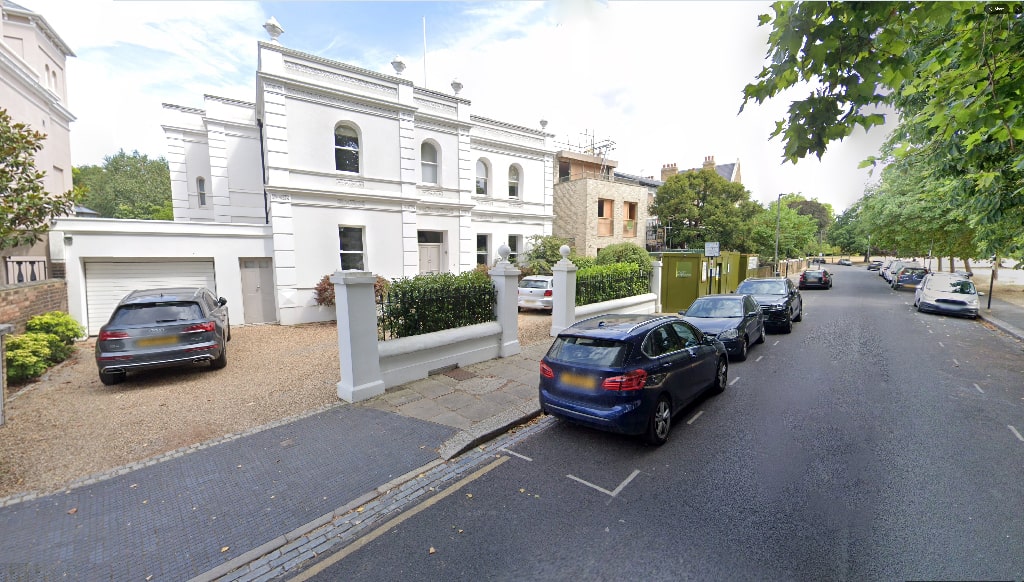
Job Caudwell’s house, now No. 3 Spencer Park, originally No. 44 — built of concrete, then a very unusual material. Click to enlarge.
Two plots in Spencer Park, either side of Lot 18 (later Nos. 1 and 3), had been reserved for Frederick Beeston and for Job Caudwell, described as a Wesleyan Senior Circuit Steward, before the auction of 1873. Nos. 2 and 3 were concrete houses built for the Revd Jacob Stanley and for Caudwell, probably in 1874. Caudwell is listed at No. 44 as “publisher” and later as of “own means”, and was still registered there in 1907 — one of Spencer Park’s long-stay residents. His granddaughter Irene Caudwell recalled:
Grandfather bought the second plot of ground in Spencer Park and had his house built to his own design entirely of concrete; floors, staircase, walls and ceilings, to obviate danger of fire. Four square, with a front door bell sufficiently loud to rouse the local Fire Brigade, it had a flat roof from which a considerable part of London was visible, including a first-class free view of the fireworks at the Crystal Palace.
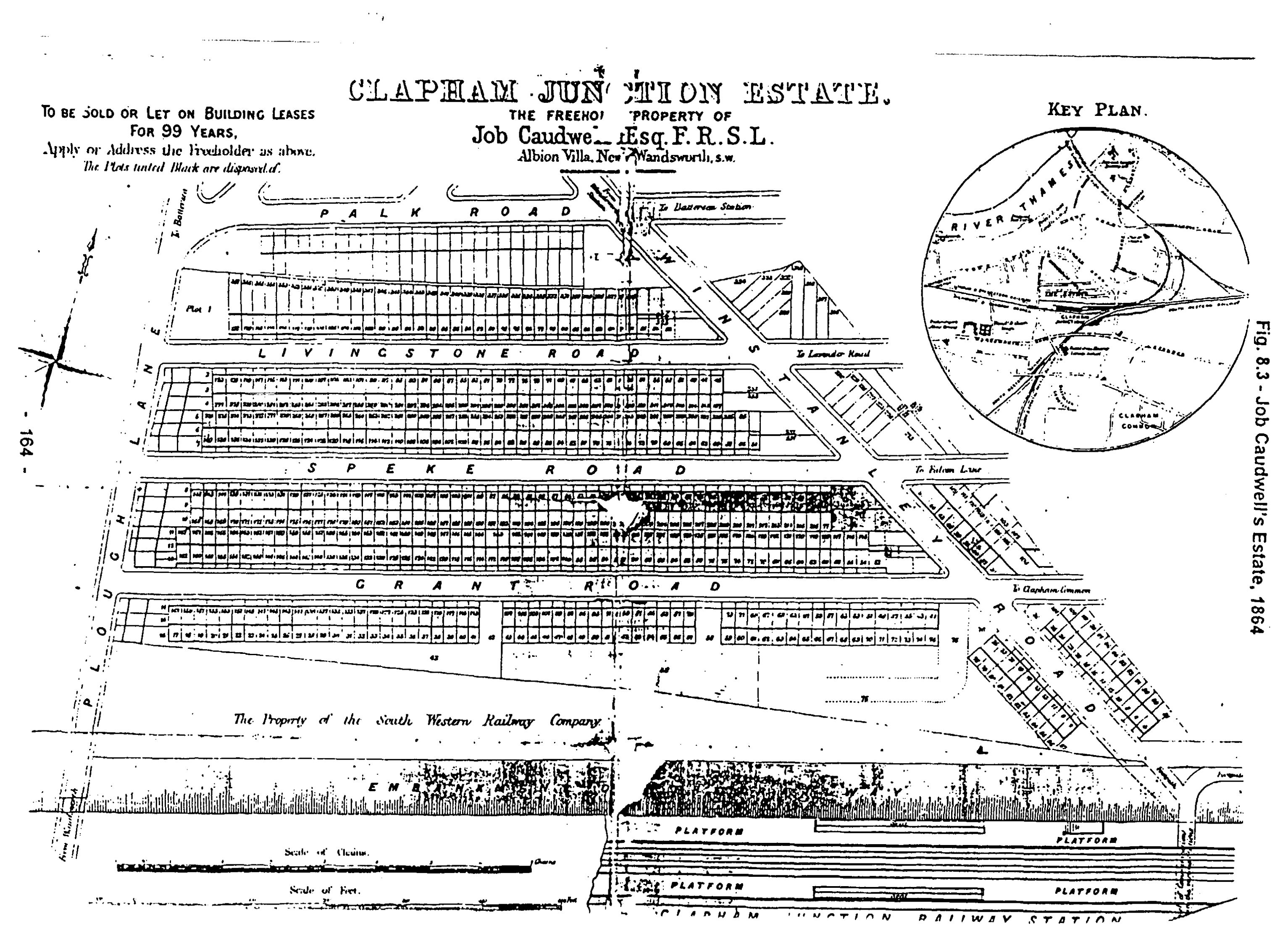
The sale plan of the Clapham Junction Estate, 1864, reproduced as Fig. 8.3 in Keith Bailey’s thesis. Click to enlarge.
Caudwell’s other local connection was as a developer. In June 1865, when still living at Haverstock Hill, he bought William Howey’s former market garden immediately north of the new Clapham Junction station, which George Todd had laid out in 357 lots. The conveyance was completed on 14 February 1866. The 12.26-acre estate eventually held 386 houses. Caudwell ran a “high rent” policy, seeing it as the home of lower middle-class railway users; in practice the tightly packed terraces filled with railway employees and workers in local industry. Keith Bailey discusses the estate in detail in The Metamorphosis of Battersea (1995):
– Chapter 8, pp. 163–166: the estate, its purchase and finance, the sale plan (Fig. 8.3) and Table 8.1, Caudwell Estate Finances
– Chapter 5, pp. 85 and 88: ground rents on the estate compared with others (Table 5.6), and builders who paid over the odds for plots
The fullest picture of Job Caudwell as a man is in the memoir of his granddaughter Irene Caudwell, who came to live with him at Spencer Park at the age of nine: Four Miles from Charing Cross. “Grandpa” fills the early chapters — his household at Spencer Park, his sons, his funeral and his monument.